


Have we passed “Peak Travel?”
Posted by Prof. Goose on June 20, 2008 - 9:55am
This is a guest post by Jason Bradford who has written here previously on "Relocalization: A Strategic Response to Peak Oil and Climate Change" and "Does Less Energy Mean More Farmers?". Jason has a PhD in Biology, is the founder of Willits Economic Localization (WELL) and runs a CSA in Willits, CA.
As a fan of Bruce Springsteen, I am keenly aware of the American fetish with the automobile, and travel in general. Check out these opening lines from the 1975 Springsteen classic “Born to Run.”
In the day we sweat it out in the streets of a runaway American dream
At night we ride through mansions of glory in suicide machines
Sprung from cages out on Highway 9
Chrome wheeled, fuel injected
And steppin’ out over the line
Baby this town rips the bones from your back
It’s a death trap, it’s a suicide rap
We gotta get out while we’re young
‘Cause tramps like us, baby we were born to run
The car does more than get you between home and work. It represents freedom, sex, power, fun, status, and if need be a way to fly away from your troubles, at least temporarily. What then, does the following graphic (updated through April) from the U.S. Department of Transportation portend for “the runaway American dream?” Has the U.S. passed Peak Travel?
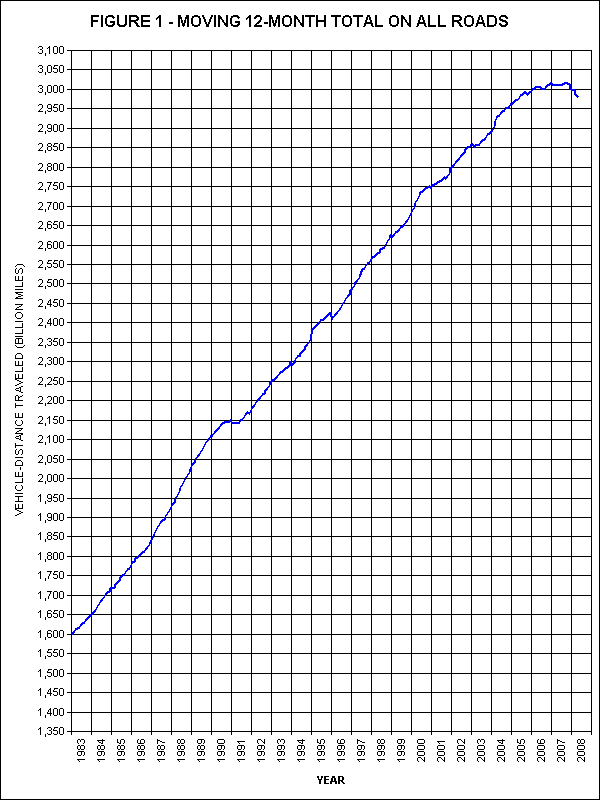
Here’s the press release associated with the graphic:
Source: http://www.dot.gov/affairs/dot8408.htm
DOT 84-08
Wednesday, June 18, 2008
Contact: Doug Hecox
Tel.: (202) 366-0660
Americans Drove 1.4 Billion Fewer Highway Miles in April of 2008 than in April 2007 While Fuel Prices and Transit Ridership Are Both on the Rise
Sixth Month of Declining Vehicle Miles Traveled Signals Need to Find New Revenue Sources for Highway and Transit Programs, Transportation Secretary Mary E. Peters Says
WASHINGTON – At a time of record-high gas prices and a corresponding surge in transit ridership, Americans are driving less for the sixth month in a row, highlighting the need to find a more sustainable and effective way to fund highway construction and maintenance, said U.S. Transportation Secretary Mary E. Peters.
The Secretary said that Americans drove 1.4 billion fewer highway miles in April 2008 than at the same time a year earlier and 400 million miles less than in March of this year. She added that vehicle miles traveled (VMT) on all public roads for April 2008 fell 1.8 percent as compared with April 2007 travel. This marks a decline of nearly 20 billion miles traveled this year, and nearly 30 billion miles traveled since November.
“We’re burning less fuel as energy costs change driving patterns, steer people toward more fuel efficient vehicles and encourage more to use transit. Which is exactly why we need a more effective funding source than the gas tax,” Secretary Peters said.
The Secretary said as Americans drive less, the federal Highway Trust Fund receives less revenue from gasoline and diesel sales – 18.4 cents per gallon and 24.4 cents per gallon, respectively.
The Secretary noted that data show midsize SUV sales were down last month 38 percent over May of last year; car sales, which had accounted for less than half of the industry volume in 2007, rose to 57 percent in May. She said past trends have shown Americans will continue to drive despite high gas prices, but will drive more fuel efficient vehicles consuming less fuel. “History shows that we’re going to continue to see congested roads while gas tax revenues decline even further,” she said.
“As positive as any move toward greater fuel efficiency is, we need to make sure we have the kind of sustainable funding measures in place to support needed highway and transit improvements well into the future,” said Acting Federal Highway Administrator Jim Ray.
To review the FHWA’s “Traffic Volume Trends” reports, including that of April 2008, visit http://www.fhwa.dot.gov/ohim/tvtw/tvtpage.htm.
The great irony of this press release is that it calls for a way to continually expand funding of highways while people are finally using them less and public transportation more! While I can’t read minds, it does seem that the Department of Transportation believes that this downward trend in driving miles is temporary. They imagine that drivers will transition away from gas guzzlers and into fuel efficient vehicles, which will be sufficient to maintain future demand for high quality pavement.
What’s at stake America? I think Bruce explains it well in the 1978 hit “Racing in the Street”
Some guys they just give up living
And start dying little by little, piece by piece,
Some guys come home from work and wash up,
And go racin’ in the street
Might we have to do that racing in something other than a V8? Or will the big engine be a symbol of rebellion in the face of high prices. After all, when Springsteen coined his lines the economy was struggling from high oil prices. Why would we expect it to be any different this time…right?
Contact
- Content: editors at theoildrum dot com
- Tech support: support at theoildrum dot com
License

This work is licensed under a Creative Commons Attribution-Share Alike 3.0 United States License.
Peak Travel has probably been reached with the current paradigm. There is still plenty of energy for travel if we change paradigms. The physics is simple, it costs less to move less. In congested, repetitive travel, why are we moving a ton to move a person?
We can build a physical-internet. This is the application of ultra-light rail networks.
Here is a link to the CSX commercial where they ask the reasonable question, "How much can a 50 miles per gallon vehicle (Prius) do for the environment?" And answer it as the Prius drives onto a rail car "not as much as the car that carries it." As they explain how they can move a ton of freight 423 miles on a gallon of fuel.
Morgantown's Personal Rapid Transit (PRT) system opened in 1975. It has delivered 110 million injury-free, electrically powered passenger miles.
Masdar, the zero-carbon city, is being built with PRT as the internal transport system.
Heathrow is being expanded using PRT.
PB-244854, from the Congressional Office of Technology Assessment in 1975 sketched how PRT can make our cities independent of foreign oil.
Booz, Allen, Hamilton's study in 2007 for the State of New Jersey affirms the findings of PB=244854. There are similar finding by the EU.
Anyone interested in contacts in this effort to re-tool to sustainable transportation, please contact me. My email is listed.
Thanks
Bill James
I live in Hollywood Florida near the Intracoastal Waterway.
We already have water taxis here and I have often wonder about the feasability of solar powered watercraft for mass transport along this route. I mean if they can do it in London. http://news.bbc.co.uk/2/hi/uk_news/england/london/5189318.stm
You figure it would be possible to do it in the Sunshine State maybe?
BTW for racing after work I suggest ocean kayaking, I am currently lusting after a V10 surf ski from Epic Kayak. The rougher the weather the better! We are talking about a boat that is over 20 ft long and I can pick one up with one hand.
Hi Hungarian(?) kayaker,
Sorry to disappoint you but this is not exactly mass transport:-) If memory serves me correctly this distance is about 500+metres or 1km return trip. Much faster to paddle, maybe 2.5 minutes in your sea kayak?
BTW, since i don't live by the sea my kayaking is a 8kg carbon/kevlar racing K1 on the river Thames.
Thanks for the post Jason.
While we're quoting song lyrics, here is an excerpt from the appropriately titled 'Rising Down' on the recently released album of the same name by Philadelphia's The Roots. There is certainly a sense of urgency here:
Between the greenhouse gases and earth spinnin' off its axis
Got Mother Nature doin' backflips 'n' natural disasters
It's like 80 degrees in Alaska, you in trouble if you're not an Onassis
It ain't hard to tell that the conditions is drastic
Just turn on the telly, check for the news flashin'
How you want it bagged, paper or plastic?
Lost in translation or just lost in traffic
Yo, I don't wanna floss I done lost my passion
and I ain't trying to climb, yo, I lost my traction
Note: 'to floss' can be defined as showing off something that is or appears to be of high value, specifically an automobile.
Thanks for the information Prof. Goose, I would lke to see a graph similar t this that represents Peak Stupidity. I wonder if we have passed that point also ?
Peak Stupidity. I wonder if we have passed that point also
Albert Einstein. Two things are infinite: the universe and human stupidity; and I'm not sure about the universe.
Everyone takes turns at being stupid. - DAK
Thus - peak stupidity will happen just before the global population drops. A strong argument can be made that there will be a spike in stupid just before a population reducing nuclear war gets started.
Enjoyed your interview with Jeff the other day.
Thanks.
Rat
Native American males on the plains would paint themselves, run off their high spirits on horseback and then glorify it with song. That was sustainable. Our mistake was to "energize" the same need for release with machines and fuel that could not be sustainably used (still glorifying it with song). The challenge now is to come up with new ways of letting off steam that do not contract our future options.
Argueably it was even less sustainable than the automobile. Remember at the time that Henry Ford introduced the model T cities were having MAJOR polution (and disease) problems due to massive amounts of horse poop. Imagine if every car on the road left a steaming pile everyhwere it went...and you think diesel exhaust is dirty! In addition feeding the many millions of horses was putting a strain on food supplies.
"The normal city horse produced between fifteen and thirty-five pounds of manure a day and about a quart of urine, usually distributed along the course of its route or deposited in the stable. "
http://www.enviroliteracy.org/article.php/578.html
http://www.all-creatures.org/nyca/ch-hist-19711000.html
Total Travel Miles = F ( (-)energy costs, (+)fuel efficiency, (-)distance between home/goods/services/workplace/recreationplace, (neutral?)availability of transport alternatives (mass transit/bike), (-)availability of substitute travel goods (internet/telephone/other) )
I just made that up. Make your own equation. Clearly energy costs drive travel miles down... but energy costs can go much higher and travel miles can still increase.
For example economic changes driven by energy costs may cause people to devalue central city locations and continue to drive them further away from the city... while controlling costs by buying much more efficient cars... resulting in more travel miles even in a higher energy cost environment.
The general proposition that energy costs will decrease travel miles is probably correct... but one can imagine complex effects in a changing economy that mitigate that effect... or even produce counterintuitive results.
Greetings from Melbourne, Oz
Just returned from tennis duty (we were washed out), with two conflicting examples of where I think we're standing...
News this morning on MS radio directly blamed petrol prices for reported downturns in restaurant patronage (though, we are in the middle of winter here!), as well as reporting a ten-year low in consumption at the bowser.
Yet: The idea of being on tennis duty (the boys were playing away) is to meet at a central hub, then head off in a single car. But, guess what! Four boys, four parents, four cars, 8km trip... We all went separately!
So, if we've hit a travel peak, I haven't seen it!
Regards, Matt B
"The approaching storm will engulf the unaware" (I like this analogy. Just hope it's a thundery storm and not a hurricane. And that it doesn't come during the night).
Well, each price increment makes a dent first at the lower income level... and then works its way up the income scale. Obviously the price hasn't started enough to bite in your personal situation.
You will see it... nationally... and then personally.
I believe in the U.S. spending on transportation consumes 15 to 20 percent of the family budget. There is a limit at which people begin to travel less.
I understand the enough-is-enough factor; I'm just curious what the "limit" in Australia might be and if we ever get there any time soon... Or does it all just stop! (The long, slowly declining plateau to the cliff scenario).
Regards, Matt B
I like your equation. It gave me a couple of ideas.
Mobility, like education and free speech, is an aspect of liberty. We need to equate relative to what is important. Here is a first cut at such a formula:
Mobility = Want (hope, desire) + Need - Access Penalty - Energy Penalty - Time Penalty - Distance Penalty (maybe)
In designing transportation systems, we need to emphasize the positive and drive out the negatives.
The distance penalty may not be needed as time and energy penalties likely already include the costs of distance. There are practical technologies today that make distance of less importance. You could take a ship to Europe and enjoy the travel as its own reward; the time penalty would account for the negatives.
The same point can be made for riding a bike. The trip can add to need and want.
It will require time and effort to re-tool transportation but there are alternatives. Other mobility technologies such as ET3 can take the energy and time out of travel. JPods, Vectus, ULTra, etc... can take out the access and energy penalties.
What do you think?
Bill,
Yes there are alternatives. Unfortunately, they don't include your "GadgetBahn" technologies. Do you reasonably see for instance a highly complicated, pervasive network of podmobiles on elevated, at grade or subway podtracks being easier to maintain in a post peak oil world than a concrete, or cobblestone or asphalt surface accomodating bicylces or very light electric vehicles requiring no computer gadgetry for control headed to the nearest mass transport node. That's your competition!!!!
I think Alan and others have already spelled it out for you yet you refuse to acknowledge reality.
We'll see, we could be deluded but the "GadgetBahn" claim seems an emotional decision.
Cell phones in 1984 would have been claimed as "GadgetBahn".
I am sure the Wright Brothers and Ford were told something similiar.
I am pretty sure the will be a mix of alternative transport solutions. I would recommend letting anyone try anything they are willing to risk their money on. Reality will sort out what is practical.
I like your proposal. But I like any effort to reduce complex problems to simple equations! :-)
Have you hit the share this button today? :) Danke.
I'd like to ask a question.
How does the "Government" know how many miles are driven on the highways? It appears to me that everyone just accepts the numbers put out by the Government without questioning the methodoligy of the numbers acquisition.
I don't "report" my miles driven to the government, do you? If they are guessing using fuel purchased and average fuel milage, then a chance in average fuel milage could throw off their numbers?
I don't say I flat don't believe their numbers, I am just questioning if there is a possibility that their numbers of miles driven could be wrong?
How does the "Government" know how many miles are driven on the highways?
I assume they use the highway gas tax. I assume they have to figure in MPG average.
If you google "Vehicle Miles traveled" there are different methods employed by various agencies, and quite a few exercises comparing and contrasting the different methods.
My purely non-scientific answer is they found the calculation that showed "a billion less miles," whichever one that is, and used it as the basis for their report. The same way the weather man will say rain is good if you need it for crops but bad if you need it for a parade that day.
I wondered the same thing so I checked the EIA gasoline sales data for the period DOT mentioned. Gasoline sales declined by 0.0024%. Therefore one would have to assume that a lot of gas was sold that didn't get used.
Personally, I think its impossible to measure miles driven. The DOT press release also touts a decline in emissions, so I suspect that this was the motivation for what I consider to government info that is right up there with the inflation data. Bogus.
Well, they model it, of course. And decades of using the model makes comparisons possible to view trends even if we all agree that the number is more of an index than a census.
It does not seem to me that "travel" will decline significantly. A high % of trips in automobiles are very short. 40% less than two miles, I hear sometimes? So "Peak automobile travel" maybe, but people are swapping in new modes (bike, foot, transit, telecommute, trip chaining). I highly doubt that a lot people are sitting at home with empty pantries because gas is above $4.
What THAT means is the US needs to better account for other modes of travel. Start better counting transit ridership, start counting bike riders, and carpoolers and then factor those numbers into the travel data.
Actual traffic counts are routine. Two common methods of data collection include:
1. A countbox linked to tubes crossing the road. Usually used on lower volume roads. Can be used to infer traffic composition (truck vs car)
2. Inductance loops buried in the pavement.
I believe the federal VMT data is based something like 4000 (?) count locations.
Start by realistically taxing trucks based on their impact on the interstates. Impossible, of course, given all the drivers currently going out of business due to high diesel prices.
Turn all interstates into toll roads and charge proportionate to weight and gas mileage. Provide a transponder to all who desire to use the interstate. Works like a dream on the current toll road to the Denver Airport. People can continue to race in the streets if they so desire and can afford the gas. This would be over and above the current gas tax. Provide flexibility so that this could be raised and lowered depending upon traffic patterns and revenue needs. Our current system with a fixed amount regardless of price of gas is absurd. We certainly don't tax other goods that way.
Do not, under any circumstances, provide disincentives to those who choose to purchase vehicles with good gas mileage. Do not simply charge based upon miles traveled without regard to weight and gas mileage.
Long term. Convert interstates or portions thereof to rail. Those who want to travel cross country in their cars can load their cars onto the trains. This has already been done for ferrys and certain rail routes.
Even longer term. Shut down the interstates; the cost to maintain them will just be too great.
I think that the maintenance costs will eventually take care of that.
First, it will start taking longer and longer to complete repairs. Eventually, longer and longer stretches of highway will be down to just one lane in each direction, with the orange cones remaining there seemingly forever, while completion of repair projects in progress is put on hold pending funding availability.
Eventually, the stretches of interstate that are more than one lane each direction and that are not reduced speed will become the exception rather than the rule.
Next, some stretches will have to be closed off altogether, and traffic routed around a detour. Again, these detours will remain in place longer and longer, and eventually become de-facto permanent.
Eventually, it will get to the point where it is hardly worth even trying to take the interstates. One will be able to make better time on the older US and state highways. The speed limits will be lower on those, but one will be more likely to actually travel at the speed limit. These will be kept in better repair, because so many people and businesses are located along them and need to have access.
Finally, the interstates will all just be permanently blocked off to all except official state and local vehicles. Gradually, they will deteriorate to the point where they become impassible.
...and then the dingos will start eating your babies...
RC
A large goods vehicle does around 10,000 times the damage of a private car:
http://project151.wordpress.com/2008/05/14/new-national-poll-shows-ameri...
New national poll shows Americans dislike larger, heavier trucks on U.S. highways. « Project151.org
Frost cycles do not help, but a combination of Alan's plan for shifting goods to rail, which should happen anyway with rising fuel costs, closing redundant lanes and using concrete rather than asphalt and gravel on small roads should make the system fairly robust to be kept going in reasonable shape for some time.
It would take political courage which seems in short supply but a proper charging system for the road damage caused by HGV would help a lot, and make more apparent the advantages of rail.
Under the current paradigm, peak travel has been reached. But, it is a dual dynamic, both price and preferrence. Even if prices return towards cost, demand may not improve. People are eagerly becoming reluctant to , for example, to spew thousands of pounds of carbon into the atmosphere on trips to 'vanishing coral reefs,' 'ski Kilimanjaro, etc. Probably, dirigibles are the way onward
They are rightly worried. The American consumer eats most of that driving as food-miles. As the revenue from gas tax decline they still have to keep maintaining the same number of highway miles and bridges that they have built for a long time yet. And you only need one pothole to brake the axle of coast-to-coast salad dressing truck and that will be the end of civilization as we know it...
How about we wire the mouths shut of the obese. The resultant weight loss would save millions of gallons of gas. So many of these people are so fat they have to have a heavy framed SUV just to carry the weight. Many are so big they couldn't even get in a Prius.
Nahh... Just get them a scooter.
So many people are obese because our society is broken, in my opinion. Angry and abusive suggestions will do nothing to change that.
"It's all society's fault! I am helpless!"
Is that an infant or an adult speaking?
Hi Kaishu - thank you for your reply.
Note that I didn't say "everyone is obese because society is broken." Individual choices play a role. But the epidemic of obesity that exists has deeper causes. It's a run-away train of lipids, and it's worth asking why.
There is a simpleminded appeal to the idea if only fat people would have some will power, well, the problem would be solved. Fast Food Nation, The Geography Of Nowhere, Car Sick, to name just a very few books, highlight some of what is wrong, in my opinion.
What is most telling is the rise in childhood obesity. Kids are seriously overweight before they even know how to spell. They are given crap to eat at home, at school, and everywhere in between. They often aren't allowed, let alone encouraged, to walk or bike to school. And those fat little bodies will be a burden to them the rest of their lives. It's not just in a few families or neighbourhoods or communities where this is happening - it's everywhere. That suggests to me that, at some level, in some respects, society is broken. We are failing our kids and ourselves. One of the things I like about this site is that many people can see that alternatives exist, and that in a number of ways we'll be better off for it. That's my view anyway.
And in reply to my question as to whether it's an infant or an adult speaking, you tell me about children being made fat by their parents.
Yes, children are not responsible. But children grow up into adults, and adults are responsible for what they do.
I wouldn't go so far as blame it on a broken society because we do have choices. However, our corn based food system is part of the problem. Some of us, however, find it more difficult to lose weight than others even though we have essentially the same diets.
I don't know the cause, but I recently visited the southeast USA (SC,NC) and I was amazed at the % of extremely overweight women. The men appeared to be slightly heavier than in Toronto, yet the women were on a whole different level. It appeared that most women actually outweighed the guy they were with.
One positive from this will be an end to the increase of a force for negative social change. As explained in my 1998 article "Impending Social and Economic Catastrophe due to Excessive Cars and Roads" which was totally ignored by the UK government and not one jot of fault ever shown in its arguments.
PS- As its point is now merely academic I suggest not reading it if you need to get on with more currently-relevant studying instead.
RobinPC,
Great article. And I was looking forward to going to bed right now.
I see also that you have written for 'Personality and Individual Differences' and are a stalwart opponent of political correctness. Being a personal friend of the Ogre of Edinburgh, and one of the few owners of his depublished book, may I say that one of the great things about 'The Oil Drum' is that you never know who you'll meet here!
Aha, we must arrange a global gathering of the 2000(?) owners, while kerosene availability still permits.
http://www.google.co.uk/search?hl=en&q=%22depublished+book%22&btnG=Searc...
Yes, but tell the governments, not me! (though, as I said, it's now getting time-expired anyway by the arrival of a traffic-calming force on the scene that's greater than any government).
Chris Brand - I've not heard from since December. I was meaning to phone to enquire whether he's gone on a retreat or else entered into reincarnation (or just to Taiwan as planned). One thing for sure - we're most unlikely ever to see his obituary in the msm such is the force of inverted meritocracy.
(Your email address isn't working, "Carolus".)
It's because they haven't suspended the gas tax! Do that, everyone will travel again, and we'll have plenty of taxes to fix the roads.
Oh, wait...
Even at $4.60 fuel costs for my motorcycle are still affordable. It hasn't hurt my personal mobility much, but hitting the road just for fun doesn't have the same appeal as it used to have.
Wow I hadnt realized it had gotten that bad so quickly. We need to see the 1970s included in these kinds of charts, for sake of comparison.
If you go to the source there are interesting data about where the greatest impacts are being felt. As reported by some media outlets not long ago the rural areas are being hit the hardest, especially in the south and west. The only region where VMT is still going up is in the northeast.
Keep in mind that these are total miles traveled not per capita miles traveled, and our population is growing.
I would have liked to see data from the 1970s also for comparison. The current drop of is very steep and I wonder how it compares?
In looking at commercial air travel in the US at the Bureau of Transportation Statistics, we see a mixed message, though the data is only available for March;
Passenger Revenue Miles:
- March 2007 = 72,698,045
- March 2008 = 73,689,383
Revenue Aircraft Miles:
- March 2007 = 647,456
- March 2008 = 645,358
So fewer miles are flown, but the airlines are getting better at filling empty seats.
While this data is mixed, the future of airline travel is a foregone conclusion, however.
I just found a round trip ticket 3000 miles across the country for 288.00 USD. Global crude production will still be within 50% of current levels for a long time. The future of cheap air travel for the masses is perhaps a foregone conclusion.
If travel broadens the mind then lack of travel could have the opposite effect. It could also be bad for the gene pool. Whole countries could consist of pockets of inbreds who are ignorant of the wider world and cling to fundamentalist religions. The next generation of kids will have to be smarter than their parents and grandparents. Yet they may never get the mental stimulus of camping in the woods, visiting opposite coastlines of their home country or experiencing a foreign language country. If Peak Oil means cutting back on steak or air conditioning that may not be so bad. By cutting back on 'healthy' travel we could be making ourselves less ready for times ahead.
There is a healthy balance somewhere. The cheap travel possibility has also led to absurdities, like flying to Vegas just to see a show. My best travel experiences, the ones broadening the mind, have taken time, as in weeks or months in a different place.
Perhaps slow boats and slow traveling will still be around for a long time, and could they give us higher quality rather than high quantity experience?
Thoreau rarely ventured far from Walden Pond and Concord.
Emerson covered most of the country.
Jeeeez, come on, have you never heard of seafaring peoples throughout history? Bad for the gene pool?!! Ever hear of sailboats? Vikings? Polynesians? Inuits? Go read Thor Heyerdahl's book Kon Tiki.
Can you imagine science and technology being reapplied to such modes of transport?
Why does anyone absolutely need to get across the Atlantic in a few hours. Most of us need to transition to a world of 3 day work weeks of online video conferencing over high speed internet access, with 3 month vacations every year. Topped off with an occasional 1 year sabbatical thrown in every 5 years or so.
"Slow down you move too fast you've got to make the morning last..." by Paul Simon.
Ironically the title to that song is 59th Street Bridge Song. When I lived in the Big Apple many years ago I met a person who had lived his entire life on Staten Island and had never even bothered to take the ferry into Manhattan.
And there will always be people like this wonderful lady!
http://www.cnn.com/video/#/video/world/2008/06/19/davies.uk.granny.runs....
The importance of this statment cannot be ignored. For those of us who wish to change society we must change this ingraned cultural value, at least in the US. Luckally it seems like the internet and cell phones seem to be the 21st century "technologies of freedom". If this cultural shift can be made more complete it may become easier for people to give up some of their physical mobility in exhange for virtual mobility.
The UK office of national statistics claims that car travel dropped 2% but that commercial traffic was up so that overall there was no change. They state: "The provisional figures indicate that there was no overall change in estimated levels between the first quarters of 2007 and 2008. The bulletin includes analyses by vehicle type and road class. Key results include: Between the first quarters of 2007 and 2008;
Car traffic decreased by 2 per cent
Light van traffic increased by 6 per cent
Heavy goods vehicle traffic increased by 3 per cent
Traffic on motorways increased by 2 per cent
Traffic on both rural 'A' roads and minor rural roads increased by 1 per cent
Traffic on both urban 'A' roads and minor urban roads fell by 2 per cent"
http://www.dft.gov.uk/pgr/statistics/datatablespublications/roadstraffic...
Not sure I believe this conclusion but make of it what you will as petrol & diesel increased in price by about 25% over this period. Would expect rural roads to show a decrease but then maybe it is just statistical noise.
They just don't get it, do they? They just can't grasp that declining VMT means that we aren't going to NEED all of that additional highway construction, and maybe aren't even going to need to spend as much on maintenance as they thought. Why keep six lanes open at 70mph when we might only need two lanes at 40mph?
There is just a total disconnect in their minds between the extrapolation of past exponential trends that they have been operating under, and the reality that the data now shows.
Look up Trans-Texas Corridor sometime.
$200 billion dollars, lots of folks call it a "land grab," championed by Gov. Perry here in Texas. He cherry-picked all the commission members that are convinced it is vital to the future of our state.
Here, I'll save the trouble:
http://www.keeptexasmoving.com/
It is still all systems go. In fifty years, we will have one of the biggest, fastests, most modern superhighways in the country. Yay.
I have been vocally opposing a massive freeway in Willits and when I began doing so I said stuff like, "As we approach and pass peak oil we should expect fewer miles traveled. I question the assumptions behind this freeway project, namely that we need it to handle ever increasing traffic."
This was in 2005 and I was written off as a wing nut.
But today...might I be listened to?
Ha! Probably not.
Oh, they get it. But they are servants of the transport and road construction lobby and want to make sure the revolving door continues to be lucrative. It's all about the concrete.
http://www.fromthewilderness.com/free/ww3/051006_peak_traffic.shtml
Peak Traffic:
Planning NAFTA Superhighways at the End of the Age of Oil
by Mark Robinowitz
May 10, 2006
http://www.road-scholar.org
Peak Traffic and Freeway Fights
As the world passes the peak of global petroleum production, gasoline prices are likely to increase to the point that traffic demands on roads will be reduced. While it is impossible to accurately predict the price of fossil fuels five, ten, or twenty years in the future, it will be surprising if gasoline is not rationed on the downslope of the Peak Oil curve (either directly by ration cards or indirectly by pricing it out of reach of many who currently consume it). US federal transportation law requires that new federal-aid highway projects consider the traffic demand twenty years in the future -- so the reality of Peak Oil and climate change means that the continent wide rush to build more bypasses, Outer Beltways and NAFTA Superhighways will not be needed. This website suggests some political and legal strategies to prevent this trillion dollar misallocation of resources.
"Planning NAFTA Superhighways at the End of the Age of Oil"
there is no stupid NAFTA superhighway and even if there was who cares? there are more important things to worry about.
replying to my negative rating.
things to worry about other than the NAFTA supernonhighway.
the national debt
consumer debt
the US dollar
us trade deficit
high oil prices
rating of my comments
This last post was surprisingly accurate.
Hi john15,
I couldn't agree more, however, consumer debt, US dollar,and US trade deficit and high world oil prices are all linked to the now annual $500 Billion cost of importing oil. Rather than worry about superhighways or vehicle miles, or replacing interstate ICE travel with electric rail etc, a really easy and very dramatic improvement in these 4 interlinked problems can be obtained without replacing private transportation and roads, where we live, where we work, what we do for recreation, and it will probably be cheaper. The average fuel efficiency of new cars and light trucks has to increase by 100%, and the very low mpg vehicles have to be either taken off road or used very sparingly. New HEV, PHEV and BEV's would help( if millions of them) but it's technically feasible now with last years models, and in fact most developed countries have a much lower fuel consumption for each VMT. SUV sales may be down 38% but this means that 62% of last years sales are still occurring, a lot of people haven't got the message yet!
We can have our cake and eat it, the cake(car) just has to use a lot less fuel.
Well then, why don't you name a few vehicles currently on the market that get 54 MPG (27 MPG average fleet efficiency US times 2) or better.
Hi fordprefect,
I think you are quoting the fuel efficiency of new motor vehicles(and I am not sure if this includes SUV's and light trucks?). The figure more relevant is average fleet efficiency which is about 18mpg( quoting Stuart Staniford's TOD article;The Auto Efficiency Wedge 2006). This is approx 12L/100km.The Toyota Yaris gets 5.7L/100km, and many small Japanese and European gasoline powered cars are in the range 6-6.5L/100km. I am sure there are a few US manufactured cars that get 35-40mpg. From Stuart's article it appears that a reduction of 5-6% a year in fuel use per VMT is possible if drivers switch to significantly more fuel efficient vehicles(ie better than the present 27mpg for new motor vehicles) and as well use older low fuel efficient vehicles for much fewer miles as occurred in 1978-1981. The point is these are not major life-style changes, unless you believe that most light truck and SUV owners spend every weekend off road on fishing or shooting camping trips. I managed to to plenty of that when I lived in Tennessee in the 1970's, without driving a monster vehicle that gets less than 15 mpg. Lets face it, SUVs became popular because little people felt bigger and safer, and obese people felt thiner. Not a good enough reason to destroy the US economy, the US dollar, the suburbs, the magnificent interstate express-way system, the coastline beaches, and the AWLR.
A 6% reduction in fuel use per VMT could give a 50% reduction in gasoline consumption in 12 years, with existing vehicle production capacity, plenty of time to start manufacturing the millions of really low liquid fuel use vehicles such as BEV or PHEV's, that could eventually give an average fleet efficiency of >100 mpg.
I didn't see the oil drum thread you're talking about, I strongly suspect that it was including heavy trucks in the mix because every time I have looked for the fleet average, the numbers I find are consistent at 25-27 mpg.
http://uspolitics.about.com/od/energy/i/cafe_standards.htm
"The US fleet average peaked in 1987 at 26.2 mpg. In 2003 (latest data available), the average new vehicle (fleet) mpg was 25.0. Why? The proliferation of inefficient SUVs and the increase, as a market share, of light trucks. "
Now, I am not denying that vehicles exist that do better than that. But there will always need to be SOME mid-sized and large vehicles in the mix, there are a lot of farmers and other people that use their pickups. So doubling the fleet mileage is a very very tall order.
I had a conversation here before on this subject, and the math indicated that even if new cars consumed NO fuel, it would be marginal whether they would keep up with projected declines. IIRC, the math was: 50% of oil consumption is passenger cars, and the average age is 10 years, which means that replacing all new vehicles with pure EVs (and magically finding the electricity) would only reduce oil consumption by (5% * 50% = 2.5%) /year. Now, VMT are front-loaded, with IIRC 15% of VMT being cars less than 1 year old, so year 1 gets a BIG onetime improvement, after which the consumption drops taper off.
Fordprefect,
Thanks for taking time to discuss this issue, with some figures. Stuart Staniford's article can be found by clicking onto his name under "editors" the article was posted 11th Feb,2007. Re-reading the link you provide on CAFE standards it says 50% of new vehicles are light trucks and SUV's ( 22.2 mpg requirement for 2007) and 50% passenger vehicles( 27.5mpg CAFE standard 2007?). I do also see the article says the fleet average is now 25mpg( I think they are still stating the average of new vehicles(22.2 +27.5/2=24.85). Another consideration is that 50% of VMT are in vehicles less than 6 years old, so 12 months after sale, these new vehicles do >9% of VMT. Thus, a big improvement in all new cars, especially light trucks and SUV's (which are mainly used for private transport) could give a much larger saving ( in fact Stuart's article shows that a 6% reduction in fuel use per VMT occurred in late 1970's, partly because of the change in vehicle use, low mpg vehicles traveling less than high mpg vehicles). Also new vehicle sales are 7% of vehicle fleet, because cars have a range of ages, a 30year old car and two new cars have an average age of 10years.
So using your example if all new vehicles that were used mainly for private transportation were EV, would save 8.55% of fuel after 12months ; 9% of VMT x95%(100% passenger vehicles +90% SUV and light trucks). Another thing to consider is that only some of the new car owners really do a lot of miles,and have low mpg vehicles so big big savings could occur if only these vehicles were replaced by PHEV, providing they could re-charge at home and work destinations, or were >50mpg HEV's.
This issue is at least worth exploring further because as far as I can see its the only real hope of surviving a post peak oil world that arrives now or in next 10years without too much pain.
Thank you. It's nice to get a 2 sided discourse here and there :)
Inre fleet mileage, I think that the assumption that older vehicles are less efficient is incorrect. There has been virtually no improvement in efficiency class for class since the late 70s. Many cars actually did better than their modern equivalents.
The point I was trying to make is that improving vehicle efficiency alone is no panacea. There are really almost no vehicles that get 50mpg, even the "smart fortwo" is only rated at 40 mpg. So, to get the savings you are really looking for we'll need the PHEVs, I don't see pure EVs taking meaningful market-share near-term due to range limitations and sheer price. The Phevs will be a while taking the market share, I wouldn't expect them to represent more than 10% of the sales in the next 5 years, would you?
I agree that it's an avenue that needs pursued... Aggressively, however, it cannot be the only course. Simply put, the savings are not there. Bear in mind here that the US automotive fleet consumes a total of 10 mb/d, or 12% of world oil, so even if the us vehicle fleet were put totally out of commission, that's only 2 years declines assuming no demand increases elsewhere. That means that we need to pursue EVERY savings, PHEVs, Electrified rail, shifting freight from road to rail, expanding public transport, shifting electricity from NG to solid fuels/nuclear, production of CTL, developing the untapped oil (drill, drill, drill), building wind, building nuclear, and so many more measures that it is truly daunting. The difficulty is that most of the measures will be opposed until it is too late for them to have positive impacts.
Just finished a cross-country trip, moving the family from Montana to Texas. We made it out of Montana and halfway through Wyoming before I saw the first RV on the road. Traffic was really sparse. I told my wife "things aren't ever going to be the way they used to be."
Agree,
I just made a roundtrip to Raleigh,NC. I also observed very very few
of those bloated RVs.
What I did see and was very scary was something that used to be fairly rare.
The pissed off driver running thru traffic at a very extremely high rate of speed. Weaving in and out like he was really pissed at the cost of gas and was taking it out in the typical childish manner of endangering many others lives.
Not just once(as in the past in the 1400 total miles) , not twice but maybe about 10 or 12 times.
I decided to drive at a normal speed limit or 5 miles or so below as I had a pickup(toyota at 30mpg) with a load. Everyone would run up on my rear bumper trying to intimidate me. One trucker driving a UPS rig but pulling doubles(overnite trailers) made me slow down more and more and finally use my brakes. It must have given him close to a heart attack for he pulled to the shoulder and stopped his rig.
There was a weight station just a few miles up the road and I believe he thought I was going to stop there and complain to the DOD Vehicle Enforcement officers. I should have but didn't.
Yesterday a truck ran out of diesel just a short distance from our truck shed/farm operation. We pumped him 10 gals to get him to the next small town. I was shocked at the man's ignorance of his rig and how to restart once your filters are empty. He tried to pull out on the highway before his compressors came up to the cutoff point. He had no tools. He was from some African country and could hardly speak.
The diversity of truck drivers with very low levels of intelligence is very frightening.
And very dangerous.
Airdale-yes I do have a CDL and drive grain rigs at harvest time over some very dangerous roads and bridges. I never exceed the posted speed limits and make copious use of the airhorns when needed. Quite a few times 4 wheelers have tried to steal my right-of-way pulling out from a side road. The air horns stay on until they are aware of how stupid they are. Does it help? Yes I think it may.
But this year I am not going to be driving a rig. Far too many fools out there.
Just a quibble. A truck driver from Africa might not know the rig because (1) it's new to him, and (2) the manual isn't in a language he reads. Neither of those have anything to do with "low intelligence."
That a trucking firm decided to make up for the cost of fuel by bringing in foreign labor, though. That's disturbing ... and dangerous if a trend.
Six years ago, everyone would have suspected he was a terrorist, and had just enough knowledge of trucks to drive one into a building or other national landmark.
The requirements,at least in Ky, is that the operator MUST be able to read, write and understand english.
He had enough english to do that but the point was he was not
that aware of the 'culture' of driving an 18 wheeler. The understanding that drivers have of each other and the unwritten 'rules of the road'.
This makes for dangerous situations. IMO of course.
Right now there are many who are in this area of lack of 'knowledge'.
Once truckers were considered 'knights of the road'. Thats pretty much gone. Give a listen on your CB sometime.
airdale--outa here and back on the road--1,400 in the next two days then I am hoping to NEVER again go beyond 100 miles of my farm once this last trip is over.
RR & Airdale: I'll tell you where all the RVs have gone - they have been parked at RV campgrounds. People pay the campgrounds a small fee to park their RVs there year round, then they drive up in a more fuel efficient car to vacation there. The RV becomes inexpensive "home base" lodging, and they can tour the area during the day in their car.
We have several RV campgrounds in our area, and I noticed last winter that they were all jam-packed full of parked RVs. This is a good deal for the campgrounds, it gives them some year-round cash flow.
The era of touring the USA in an RV is truly over, though.
It will be interesting to see how peak travel affects sports, both professional and amateur. How much oil is used to fly the Lakers around the country through the fall, winter, spring and early summer? What do the fans need to drive across LA to the games? Will the Baylor football team still play pre-season games in LA in 2020 or perhaps move at a closer venue such as Boone Pickens Stadium? What if the professional tennis players cannot find flights to the 2nd tier tournaments between Wimbledon and the Australian Open. I recall traveling several thousand miles by bus and car as a participant and fan while in high school - from Amarillo to ElPaso to Austin to Odessa to Dallas etc. ---with occasional short trips to Pampa. What will the soccer moms do?
-- Is anyone planning a ski trip to Aspen next winter?
It's not just the eleven football players - it's the thousands of fans. The recent European Champions League final was between two English teams (Manchester United vs Chelsea, 160 miles apart), but the match was held in Moscow, Russia (1,600 miles away). The distance didn't stop an estimated 40,000 British fans travelling to Moscow. The Russian embassy even suspended normal visa regulations, giving ticket-holders fast-track entry.
These fans are FANatical about their teams. Some of them would have happily sold their first-born into slavery just to get their hands on a ticket. In theory sports travel is 100% discretionary and should be the first thing people cut back on as oil becomes more expensive; but in practice these guys will do anything to attend a match. There is still scope for using less oil - in Europe it's normal for fans to charter a bus from their local town to far away matches. Here's a picture of English football fans on the bus in 1923!
It is not yet peak travel. It may be peak driving for the US and Australia.
"Driving" is not all that there is to "travel".
What would be interesting to see is not the driving figures alone, but compared with the airline, public transport, cycling and walking figures. Then we would know if people are travelling by other means, or simply staying at home.
Knowing whether people will change or just give up gives us useful clues for the future.
The NAFTA Superhighways are very real - but it is not ONE highway plan, it is a large network of new highways and expanded (existing) highways.
The 1991 ISTEA (Intermodal Surface Transportation Efficiency Act) specified the first iteration of the "NAFTA Superhighway." This was to extend I-69 from Indianapolis (it's current southern terminus) all the way to Mexico. Highwaymen from several states who each wanted their local and regional boondoggles got together and petitioned Congress to create this full route as a national priority "corridor." The new I-69 is planned to go through southern Indiana, Kentucky, Tennessee, Mississippi, Arkansas, Louisiana and Texas. The southern Indiana section is probably closest to being built.
The 1998 "TEA-21" and 2005 "SAFETEA-LU" laws expanded from the few dozen new "corridors" in the 1991 ISTEA law and the 2005 law has a total of 80 corridors. Some of these corridors involve upgrading existing highways, some involve construction on "new alignment," a couple of the corridor designations specify numerous road projects in a region.
The Federal Highway Administration page on the "corridors" is at
http://www.fhwa.dot.gov/planning/nhs/hipricorridors/index.html
There's a map showing the new "corridors."
Unfortunately, some people with unpleasant views on politics, racism and other topics have glommed onto the "NAFTA Superhighway" issue in recent years, which has caused some who do not share their particular philosophies to assume that there is nothing to the highway proposals since these advocates are wrong in other areas.
Here are some references for PRO-NAFTA Superhighways efforts:
http://www.ambassadorbridge.com/nafta_case.html
Ambassador Bridge - the NAFTA Superhighway Coalition (Canadian group)
http://www.nascocorridor.com
North America SuperCorridor Coalition Inc.
http://www.fina-nafi.org/eng/integ/corridors.asp?langue=eng&menu=integ
The north americain trade corridors
Last but not least is the FHWA "Corridors of the Future" program - which is a corollary to the NAFTA Superhighway proposals. Some of the "corridors of the future" would include major expansions of east-west highways (especially near Chicago) that would interconnect the north south new / expanded superhighways.
http://www.fightgridlocknow.gov/
http://www.corridors.dot.gov/
The new I-69 NAFTA Superhighway is one of the selected "corridors" for national prioritization.
Upgrading I-5 between Canada and Mexico is also a "corridor of the future," although they don't like to use the term NAFTA Superhighway. In Washington State, a parallel effort has studied creating a "Washington Commerce Corridor" between Vancouver WA and Vancouver BC with car lanes, truck lanes, freight and passenger rail, and utilities (electric lines, water, oil, gas, etc). This is the same model as the Trans Texas Corridor proposals (a large network of new highways around Texas with separate facilities for cars, trucks, freight trains, passenger rail and utilities).
It is stupid to do all this when we ought to shift more freight onto trains. The NAFTA promoters aren't doing a good job of promoting trade when they push for goods to be moved by trucks rather than by rail.
The giant big box stores and their "just in time" inventory systems are optimized for truck delivery. When you buy some crap at Mall-Wart, their inventory computer orders a new piece of crap to be placed on the next delivery truck. This would be significantly more difficult to do with a train-centric delivery system, although a system that valued local / regional storage in warehouses for local/regional use could probably work better with trains. Instant delivery of perishables is harder to do with freight trains.
Trains are more efficient, but they cannot reach all those soulless shopping mauls at the freeway off ramps.
a pro-highway view about the formation of the original NAFTA Superhighway proposal:
http://aaroads.com/high-priority/corr18.html
excerpt:
the concept of Interstate 69 as a "NAFTA Highway" was conceived by Indiana officials who really wanted the Interstate 69 southwestern extension. To get federal funding, they planned a multi-state routing that would cut through Kentucky, Tennessee, Mississippi, Arkansas, Louisiana, and Texas on its way to Mexico. By marketing the whole "NAFTA Corridor" concept, officials and businessmen in Indiana were able to get federal money behind the project. Of course, money was also secured for the Indiana section.
and some opposition efforts against I-69
http://www.alltolled.com
Indiana's Experience with Tolling and Privatization
Indy Bypass Toll Road - the latest proposal without a need
Illiani Toll Road - will northern Indiana have any free roads left?
New Terrain I-69 - throwing a billion dollars out the window
[note: the Indy Bypass would be part of an Outer Beltway for Indianapolis, and the Illiani Toll Road would bypass Gary and other southwest suburbs of Chicago. It looks like it would connect to the future I-355 to complete an Outer Outer Beltway for Chicago.]
Indiana (and all the way to Texas and Mexico) I-69 - NAFTA Superhighway
http://www.carrI69.org
http://www.i69tour.org
http://www.commonsensei69.org
The trans-texas corridor is just such a beast, and anybody for it does not like the label "nafta superhighway" because it implies that it is to allow a flood of Mexican trucks into the country.
Which, of course, is why it goes all the way to Mexico.
Basically, in Texas, there are two major parts - I69 (as y'all have discussed) and a replacement for I-35, which currently runs from Mexico up through San Antonio, Austin, D/FW, and on to Oklahoma.
4,000 miles of new road. In 2002 dollars, estimates were in the $150 to 180 billion dollar range to complete. Now that everything is costing more, that number must be revised.
Portions will be paid for and operated by private investors as toll roads. There will be dedicated freight and passenger rail, utility lines, truck lanes, and passenger lanes in a wide corridor. They plan to acquire 584,000 acres of land.
Republicans and Democrats both oppose it. Yet it is going forward. $130 oil won't stop it. Not sure what will.
Try and imagine what $150 billion could do to improve, well, damn near anything.
Maybe I am a Polly Anna, but I think we are heading into the most glorious period in the world's history. Almost every country gets what it takes to be prosperous (legal protection of property rights, low taxes, stable currency, solid and just legal system,) and billions will be moving out of poverty.
I think we will deal with then energy issue. Petroleum has been too cheap for alternatives to thrive. We are at that point where we will make changes and it will create jobs. I lookforward to being able to hop on an electric train to go to Las Vegas. I look forward to a plug in hybrid to get me to work. And I hope biofuels allows Africa to have its agricultural revolution.
And if we can make the switch to alternative transportation fuels, we will have enough affordable petroleum for jet and ship travel to be affordable to the masses.
At least that is the way I see it.
"And if we can make the switch to alternative transportation fuels, we will have enough affordable petroleum for jet and ship travel to be affordable to the masses."
You would think that at this point every politician in Washington would be scrambling to come up with a proposal for more mass transit in their area and throughout the country. But what we have so far is "nationalize the oil refineries" and "drill in protected areas". I am looking forward to hearing one of them talk about electric passenger trains. (But not as much as I am looking forward to calls to stop immigration). I hope within 5 years to hear the former, and within 15 years to hear the later.
Google "PML Mini Cooper." It's a Mini-Cooper with a 160hp electric pancake motor on each wheel, giving a total of 640hp. It goes 0-60 in 4 seconds, tops out at 150mph, and using a 250cc motorcycle engine to recharge has a 940 mile range and gets 80 mpg. Talk about suicide machines!
Advances in PV just might allow you to generate enough juice during the day to do your commute using toned-down tech of this type in a Smart Car or a Toyota iQ.
Hi curmudgicus,
Thanks for link. I wonder why the conversion invalidates the BMW warranty, or what is left to warranty after removing engine, gearbox drive train, wheels, brakes? Possibly BMW is worried about driver seat damage from the 0-100km acceleration in 4.5 secs. Clever design, discarding all of the ICE features and starting from scratch, thinking outside the square!!
Do you think the 160bhp motor size is needed to do 100% of the braking?, if so this would mean a larger car would require even larger electric motors, can you imagine a 2 tonne SUV taking off at daycare, might be time to require a truck license or advanced driver training, or at least limit the acceleration, otherwise tire replacements would be costing more than fuel and we may be running into "peak rubber".
Thank you! Great link. As I said, the future is going to be glorious.
An impractical "car". MASSIVE unsprung weight of wheel hub motors will do damage to the suspension, and likely the body as well (rides like a buggy).
The battery draw when accelerating would be like a short across the battery, quickly damaging the batteries.
Alan
They avoid fast discharge battery damage by the use of capacitors to provide the acceleration, Alan.
This is a demo car though, not something they are planning on putting on the road.
Also, the wheel motors aren't that heavy. In fact, they are pretty comparable to a drum brake assembly. Not only that, but since they are electric, they only need a wire connection to the car itself, rather than a force transmitting connection, so the suspension can be truly independent. Also, the mass of the batteries is significantly more than the engine would be and can be distributed as desirable for ride comfort.
Still, the QED is clearly a demonstrator, and it is massively overspecced.
How can this be? We have been promised more and more of everything forever! :-)
I also find it ironic that when people finally drive less, the first thing we hear about is that we won't have enough gas tax revenues to keep building more roads! It seems a lot of people have internalized the "more and more forever and ever" myth.
Utopia in Decay
http://home.comcast.net/~kevin.cherkauer/site/
Kevin Cherkauer
Well, I dunno about in the US, but here Down Under about 90% of the roads budget goes into maintaining the roads we already have.
So if your roads budget is limited by your fuel tax revenues, then if your revenues decline then you're going to have to either let all roads decline a little bit, or just shut some down.
Any volunteers for the first highway to be shut down in the country?
Some ready statistics for Colorado's tourism can be found here http://www.dot.state.co.us/Eisenhower/HolidayPdfs/TrafficCountsMemDay.pdf for Memorial Day and more so http://www.dot.state.co.us/Eisenhower/trafficcounts.asp#2008 for average monthly counts. Fairly steady decline so far for Q2 2008.
This is the one choke point between Denver and the mountains. Where I live it is rather wealthy and I was wondering if the traffic is dropping as much as rural poor areas. So far I don't think it has.
I wonder if this year we will still see the dual pickup truck towing a huge house fifth wheel and behind that the motorboat?