


DrumBeat: September 18, 2008
Posted by Leanan on September 18, 2008 - 10:00am
Refilling fuel tanks after Ike to take weeks
HOUSTON (Reuters) - Oil refiners and producers on Thursday rushed to restore Gulf of Mexico production following Hurricane Ike, but energy traders and analysts warned it will take several more weeks to refill U.S. fuel inventories, increasing the risk of shortages.At least five refineries were restarting out of 15 shut by Hurricane Ike that hit Texas on Saturday, while two switched off by Hurricane Gustav at the beginning of the month were restarting, as producers flew crews back to platforms across the Gulf of Mexico.
"They (The markets) are factoring in a quick return of refineries and are looking the other way regarding the gasoline situation," said one trader, who asked not to be identified by name. "I think that's a mistake."
Storm-hit US refiners cancel Mexico oil cargoes
MEXICO CITY (Reuters) - Some U.S. oil refiners affected by Hurricanes Gustav and Ike canceled some Mexican crude oil cargoes, a spokesperson for Mexico's state oil company Pemex said on Thursday."There have been some cancellations by some clients," said the spokesperson.
Oil's hurricane recovery: Slow going
NEW YORK (CNNMoney.com) -- Gas prices fell for the first time in nine days after two powerful hurricanes entered the Gulf of Mexico and smashed through the heart of the nation's oil infrastructure, but questions lingered about when production would be restored.Of the 32 Gulf coast refineries - 26 of which were in Ike's path - 12 remained completely shut down Thursday morning, and 9 were operating with reduced capacity, according to the U.S. Department of Energy. The decline in refinery operations has resulted in about 5 million barrels per day in reduced gasoline output.
"There are some restarts of refineries, but the process is very slow," said Cathy Landry, a spokeswoman for the American Petroleum Institute.
John Michael Greer: The Effluent Society
Some economists spend their lives writing in obscurity, and some become famous without seeing their ideas put into practice. Galbraith was not so lucky. Published in 1958, The Affluent Society argued that the United States had achieved a self-sustaining level of opulence to which the old laws of economic scarcity no longer applied, and that this abundance could support sweeping public programs to eliminate poverty and provide amenities for all. These claims became holy writ in mid-20th-century liberal circles, and drove most of a generation of American public investment, from Johnson’s Great Society on down. In the process, it committed America to unsustainable public expenditures that set the stage for the economic troubles of the Seventies, and helped drive the backlash of the Eighties that replaced tax-and-spend Democrats with borrow-and-spend Republicans. By the time Galbraith died in 1997, he was treated by most economists with that dismissive fondness reserved for proponents of failed ideologies.The Affluent Society has been much critiqued by those economic thinkers whose faith in the omniscience of the free market rivals a medieval peasant’s trust in the miracle-working powers of the bones of the local saint, but it seems to me that the book’s major flaw has been missed by these writers. Ironically, Galbraith in The Affluent Society fell into the same trap he critiqued in The Great Crash: the belief that economic reality had changed and the old rules no longer applied. He was quite correct to note that America in the 1950s had become stunningly wealthy, but he was quite wrong to think that this wealth was more than a temporary phenomenon.
Venezuela, Russia boost military, energy ties
CARACAS, Venezuela (AP) -- Venezuela and Russia are deepening military and energy ties, with plans to step up oil, weapons and technology cooperation.As two visiting Russian bombers left Venezuela Thursday, officials of both countries said the visit is just the start of a new chapter in a flourishing strategic alliance.
President Hugo Chavez will visit Moscow next week and is planning oil projects with Russian companies as well as joint military exercises in the Caribbean later this year.
Eni to Produce First Oil From Kashagan Field in 2012
Bloomberg) -- Eni SpA, Italy's largest oil company, plans to produce the first oil from the Kashagan field in Kazakhstan in 2012.The company is making ``over 50 percent progress on project development,'' Guido Michelotti, a senior vice president at Eni, said today in a presentation posted on the company's Web site. It expects daily output to reach 150,000 barrels of oil equivalent in the fourth quarter of 2012, rising to 370,000 barrels a day in 2014.
America’s Self-inflicted Societal Collapse
I have argued elsewhere that our American way of life is not sustainable, and I have presented compelling evidence to demonstrate that America is on the verge of imminent societal collapse. The purpose of the following paper is to make the case that we—all Americans—through our distorted worldview and resulting dysfunctional resource utilization behavior, are responsible for our “predicament”, and that we lack the collective will to take meaningful action to mitigate its catastrophic consequences.
Ike and Gustav should join OPEC
Hurricanes Gustav and Ike may end up doing OPEC’s work for them now that oil production losses of more than 1 million barrels per day are persisting in the U.S. Gulf of Mexico.At the cartel’s meeting last week, it officially proposed taking a chunk of production off the market, but this appeared to fail as a result of lack of cooperation from Saudi Arabia. But Mother Nature may be stepping in to do the same work, which prompted one analyst to ask: Should Ike and Gustav apply to join OPEC?
The Gathering Inn: Bed, Breakfast, and Beyond
We've done this really "crazy" thing-we've gone into debt buying an inn in Vermont in the midst of a resource crisis that will never end at a time when tourism and the hospitality business are likely to take a huge dive as we stumble over the threshold of a Second Great Depression.
MEDIA ADVISORY: Paul Ehrlich: Has the “Population Bomb” Finally Exploded?
WASHINGTON — Forty years after his seminal book The Population Bomb, Paul Ehrlich is again stirring debate over the connections between population growth and environmental degradation. His latest book, The Dominant Animal, coauthored by Anne Ehrlich, traces the interplay between environmental change and evolution....On September 18 at 3:00 p.m., ECSP will sponsor the launch of The Dominant Animal at the Woodrow Wilson Center; copies will be available for purchase. A reception will follow at 4:30 p.m.
The event will be webcast live at www.wilsoncenter.org. Submit questions for Paul Ehrlich to ecsp@wilsoncenter.org.
Buffett's MidAmerican Energy rescues Constellation
DES MOINES, Iowa - Natural gas and electric company MidAmerican Energy Holdings Co., a unit of Warren Buffett's Berkshire Hathaway Inc., said Thursday it will buy Constellation Energy Group Inc. for $4.7 billion in a cash-and-stock deal.
Why the Gas Engine Is Sticking Around
An automotive revolution is coming -- but it's traveling in the slow lane. With all the glitzy ads, media chatter and Internet buzz about plug-in hybrids, it's easy to get lulled into thinking that gasoline stations soon will be as rare as drive-in theaters. But displacing internal-combustion engines fueled by petroleum won't be easy and it won't be cheap.
Richard Heinberg: Don't Panic; Prepare!
The financial sky is falling. Hey, that’s not my opinion; it’s news straight from the front pages of the Wall Street Journal and New York Times. America’s top mortgage companies and investment banks, and the world’s biggest insurer have either already gone bankrupt or are in the process of doing so.For someone who wrote a book titled The Party’s Over, this might seem like a propitious moment to shock readers into greater depths of fear and apprehension. After all, we’re only witnessing the doom of the financial world now; we have yet to see the collapse of the transport and food infrastructures, which are merely fluttering at the moment as the result of high oil prices. When the inevitable and imminent decline in world oil production really starts to bite, the support struts of normalcy will truly come unglued.
Interior to expand oversight after scandal
Interior Secretary Dirk Kempthorne said Thursday he was disgusted by reports of parties, sexual relationships and lavish gifts between government oil brokers and energy company employees and that he was considering firing the federal workers involved.Kempthorne also told a House panel that he would appoint an attorney-adviser to watch over ethics in the Denver office at the center of the scandal. The office collects billions of dollars from oil companies drilling on federal lands.
Even with the recent drop in oil prices, newly-minted grads in the field are making a killing. At Texas Tech University, for instance, the starting pay for graduates with bachelor's degrees in petroleum engineering is around $105,000 - $80,000 in salary plus a guaranteed bonus of $20,000 to $30,000, according to Lloyd Heinze, chairman of the school's petroleum engineering department.
U.S. Interested in Exploiting Brazilian Pre-Salt Layer Oil Fields
The United States is interested in cooperating with Brazil to finance projects for exploiting the country's pre-salt layer oil fields, U.S. ambassador to Brazil Clifford Sobel said on Wednesday.The top U.S. diplomat in Brazil told the press that his country, as well as other nations, are very interested in the new oil discoveries in Brazil
DETROIT (CNNMoney.com) -- The applause hasn't died down for the new Chevrolet Volt, but General Motors is already planning where the technology for this new electric car can go next.
Rubbing out rudeness on public transit
An upside of leaving the car at home and jumping on public transit is all the nice, new people you get to meet.A downside? All those rude, inconsiderate and bizarre people you’ll meet as well. Like the ones Kevin O’Neil describes in the “Breaches of Etiquette” category on his CTA Tattler blog about the Chicago Transit Authority’s (CTA) buses, elevated trains and subways.
Coastal development all at sea over climate
One general insurer has estimated that the value of coastal property in Australia at risk to rising sea levels and erosion is between $50 billion and $150 billion.In a submission to a Federal Government inquiry, the insurer even suggests an insurance fund into which owners of low-lying land would pay a regular levy for compensation when sea levels cause their land to become permanently unusable.
Cheap thrills: Can you live on a pound a day?
We may all be tightening our belts, but just how far would we goto save money? Teacher Kath Kelly lived on just £1 a day for a whole year, and lived to tell the tale. Jamie Merrill follows her lead – and learns some life-changing lessons on the way.
Mideast to Cut Oil Investments If Prices Dip Below $80/Barrel
Middle East oil producers will shelve projects to boost output if crude prices drop below $80 a barrel, a senior official from the Organization of Arab Petroleum Exporting Countries, or Oapec, told Dow Jones Newswires.Abbas Naki, the Secretary General of Oapec, said that if oil prices fall further "we will see investments and developments in the oil sector in these countries decrease drastically."
Middle East oil producers have come under repeated attack for not investing enough in boosting production capacity, which they say has helped push prices to new records.
"On the long run, this will have a very bad effect on global markets," Naki said.
Post-Ike recovery continues in US Gulf oil patch
HOUSTON (Reuters) - The U.S. Gulf of Mexico oil patch continued to recover on Wednesday from Hurricane Ike, the worst storm it has faced in three years.At least five Texas refineries were restarting on the fifth day since Ike slammed into the Texas coast near Galveston and swept over Houston's refinery row, and 10 others were awaiting electricity and industrial gases, some of which are made from natural gas.
IEA Still Determining Strategic Oil Stocks Release
The International Energy Agency (IEA) is still assessing the impact of Hurricane Ike on U.S. oil and gas production and has yet to decide whether it needs to release strategic oil stocks, the agency said on Thursday.Member-countries of the IEA hold emergency oil stocks for use in case of supply shocks. They were last tapped in 2005 after Hurricane Katrina caused major disruption in the Gulf of Mexico.
'No shortage' of gas in Florida despite panic buying
With more than a week's supply of gasoline and diesel at its ports, Florida has plenty of fuel for motorists - despite a rash of panic-buying that last week quadrupled average statewide consumption.
Connecticut: State expands gas gouging probe
HARTFORD -- The state's investigation into spiking gas prices expanded to petroleum wholesalers Wednesday in response to consumers smarting from recent fuel price hikes of up to 48 cents per gallon.Attorney General Richard Blumenthal said in an interview that subpoenas were being issued to state wholesalers as well as retailers.
"We're widening the request and demand for documents to include the wholesalers," Blumenthal said outside the Capitol. "The wholesalers -- the distributors -- may well be the bigger source of the problem than the guys pumping gas or owning the retail stations."
Texas: Gas rationing just a rumor, official says
A rumor circulating Wednesday that gas deliveries were being cut off and that stations would begin rationing did not appear to be true."So far there does not seem to a problem with fuel availability," said Jack Gabriel, an executive at Brookshire Brothers. "We have adequate fuel inventory in all of our stations throughout the East Texas and West Louisiana locations."
Houston Glass Companies Struggle to Re-Coup From Ike's Impact
At Vitro America's Houston branch Terri Gilmore, sales manager, says the company is working by way of a generator; only three computers and one printer are working. Gilmore says the company sold stock sheets yesterday and will be making deliveries today, though they may take a little longer than usual because of the gasoline shortage."Some fuel lines have a two- to three-hour wait and then they may run out before you get gas," Gilmore said. "We do not know when we will have power or phone service. No one can tell us."
Ike-Related Power Outages Prompt Student Sit-in
Students at Miami University in Ohio organized a Monday sit-in on the president's lawn, protesting the return to classes Tuesday, chanting "How can we study if we can't see?" and "No power, no class." The campus had not had power since Sunday, after a Hurricane Ike-related windstorm knocked out electricity in the Oxford and Cincinnati areas. Class on Monday had already been cancelled, the Miami Student reports.Protesting students complained that they didn't receive sufficient guidance on where to shower and study during the power outage. "We just wanted to talk, we wanted some reasons," said one of the protest organizers. "We thought they were only focusing on on-campus students, when most of the campus doesn't live on campus."
Power outage has become the main issue in the city, adding miseries to the masses and negatively affecting industrial and commercial activities. In this hot and humid weather, the citizens are experiencing power failures for up to 18 hours, sparking widespread resentment against the privatised Karachi Electricity Supply Corporation (KESC).
Saipan: Residents, nonresidents join CUC rally
Hundreds of residents, dressed in black with bandages plastered on their bodies, turned out Tuesday night to protest what they called the Commonwealth Utilities Corp.'s band-aid approach to the island's power crisis.Citizens and non-citizens of all ages turned out for the event, held at the Garapan Fishing Base. Many people toted signs with slogans, such as “Will fight for light,” and “Customers Using Candles,” in a nod to CUC's acronym.
Rocky Mountain Power has dropped plans to make sweeping customer-service cuts in protest of a rate denial, but the utility still needs more money to meet demand for electricity in Utah, the company's top executive said Wednesday.
Norway Urges Russia to Stick to International Law in Arctic
All territorial claims in the Arctic must fall within the strict framework of the international Law of the Sea, Norway said Thursday in reaction to Russian plans to formally set its borders in the oil-rich region.
Greening the dream that drives America
The US should put the same creativity that produced the car into tackling the energy crisis it has caused.
Many would take pay cut for shorter commute: Goodyear
Twenty-five per cent of commuters say they'd take a pay cut for a shorter drive to work and 13 per cent confess they've wanted to quit their job because of the daily drive, according to a poll by tire maker Goodyear Canada.
How One South Texas Community Reacts to World Energy Crisis
The Lakes Master Planned Community in Los Fresnos, Texas has announced the successful installation of the first wind-driven electric generator connection at a residence in the nearly 750-acre project. The wind generating unit is about 30 feet tall and will generate approximately 1.8 kilowatts of electricity to supplement the electrical needs of the home. When the electricity from the windmill exceeds the home use, the power feeds back through a "reverse meter" into the Electric Reliability Council of Texas' grid and the owner is paid for the electricity provided to the system.Los Fresnos Mayor David Winstead commented, "We are watching very closely in the hopes that this may be a workable model for the future. If this first wind-generator is a success, we will implement a City Ordinance for regulating their installation. As a proud citizen of Los Fresnos, Texas, it is good to be on the forefront of applying new technology to reduce our dependence on foreign energy resources."
Controversial path to possible glut of natural gas: Water and chemicals injected at high pressure can extract more gas – and possibly pollute drinking water
Instead of falling, US gas production is rising, with up to 118 years’ worth of “unconventional” natural gas reserves in 21 huge shale basins, an industry study in July reported. Such reserves could make the nation more energy self-sufficient and provide more of a cleaner “bridge fuel” to help meet carbon-reduction goals urged by environmentalists.Shale gas reserves have a powerful economic lure. Companies, states, and landowners could all reap a windfall in the tens of billions. Some also predict lower heating costs for residential gas users as production increases.
Now, scores of natural gas companies are fanning out from Fort Worth, Texas, where hydraulic fracturing of shale has been done for at least five years, to lease shale lands in 19 states, including Pennsylvania and New York.
But some warn that by expanding “hydraulic fracturing” of shale, America strikes a Faustian bargain: It gains new energy reserves, but it consumes and quite possibly pollutes critical water resources.
Pickens says Wal-Mart to study switch from diesel
HOUSTON (Reuters) - Texas oil tycoon T. Boone Pickens said on Wednesday he has convinced the head of Wal-Mart Stores Inc to study the possibility of switching the fuel used for the retailer's huge fleet of delivery trucks to compressed natural gas, from diesel.Wal-Mart officials confirmed that Pickens was a guest speaker at a monthly associates meeting September 13 in Bentonville, Arkansas, with chief executive Lee Scott and thousands of Wal-Mart employees.
Rising prices tip another 75 million towards starvation: FAO
ROME (AFP) — Global numbers afflicted by acute hunger rose from 850 million to 925 million by the start of this year because of rising prices, the head of the UN Food and Agriculture Organisation said Wednesday.The number of people suffering from malnutrition, before the worst effects of global price rises, "rose just in 2007 by 75 million," Jacques Diouf, director-general of the Rome-based agency, told an Italian parliament committee, according to ANSA news agency.
Instead of Eating to Diet, They’re Eating to Enjoy
In May, the market research firm Information Resources reported that 53 percent of consumers say they are cooking from scratch more than they did just six months ago, in part, no doubt, because of the rising cost of prepared foods....Meanwhile, books like Gary Taubes’s “Good Calories, Bad Calories” (Alfred A. Knopf, 2007) and Michael Pollan’s “In Defense of Food” (Penguin, 2008) have prompted a rethinking of Americans’ eating habits and dependence on processed and refined foods.
Scientists Behind 'Doomsday Seed Vault' Ready The World's Crops For Climate Change
As climate change is credited as one of the main drivers behind soaring food prices, the Global Crop Diversity Trust is undertaking a major effort to search crop collections—from Azerbaijan to Nigeria—for the traits that could arm agriculture against the impact of future changes. Traits, such as drought resistance in wheat, or salinity tolerance in potato, will become essential as crops around the world have to adapt to new climate conditions.
Tight Labor Vexes Brazil's Deep-Sea Oil Drilling
RIO DE JANEIRO - Technological advances will help oil giant Petrobras and its foreign partners tap huge subsalt reserves off Brazil's coast, but a shortage of skilled workers and tight equipment supplies pose challenges.
Stripper wells try to get more oil from ground
(CNN) -- The political discussion about solving America's energy crisis is focused on offshore drilling and renewable energy, but scattered throughout the country are thousands of small oil wells called stripper wells.Many of them are family owned and these small, independent operators say they could also be part of the energy solution. Forgotten about and misunderstood, many small operators say most people don't even know they exist.
Washington - The White House announced Wednesday it would direct nearly $7 million in energy assistance funds to Connecticut as part of an effort to help low-income families heat their homes this winter.Democratic Sens. Christopher Dodd and Joseph Lieberman and Democratic Rep. Joe Courtney, 2nd District, welcomed the move, but warned the assistance was not enough to help working families weather the current energy crisis.
Government steps up call for nuclear power
LONDON (Reuters) - Britain will step up its campaign for new nuclear power stations on Thursday, saying they are vital for energy security, climate change and job creation.Industry minister John Hutton will tell the newly-created Nuclear Development Forum's first meeting that new nuclear power plants are also crucial in preventing power cuts as ageing coal and nuclear plants are progressively shut down.
Lithuanian Hope for Nuclear Extension Dashed by EU
BRUSSELS - Lithuania's hopes of being allowed to extend the life of its Ignalina nuclear power plant were dashed on Wednesday by the European Commission.In its treaty on joining the European Union in 2004, Lithuania promised to shut by the end of 2009 the second reactor at the plant, which is similar to Ukraine's Chernobyl facility where the world's worst nuclear disaster struck in 1986.
Australia MPs oppose uranium sale
Australia should not sell uranium to Russia, a parliamentary committee says.It said the $800 million deal should not go ahead until Russia assuaged doubts about the separation of its civilian and military uses of uranium.
Tesla, city strike deal to build all-electric sedan
Tesla got final approval Tuesday of a deal with the city of San Jose to lease nearly 90 acres of city-owned land for a plant to build the Model S, an all-electric sedan.
Scientific breakthroughs needed to unlock nation's energy potential
America has given itself a tall order. We are determined to meet growing energy demands while reducing our reliance on imported oil and curtailing greenhouse gases.But these commendable goals are being overrun by reality. The U.S. is showing few signs of reducing its dependence on fossil fuels such as petroleum and natural gas. Crude oil alone supplies more than 40 percent of U.S. energy demands and almost all of our transportation fuels, and we import 60 percent of it.
Any notion that renewables can provide for all our requirements is a mischievous and reckless boast that will leave us in the dark.
Defense officials canceled a preliminary contract with Siemans Building Technologies to construct a waste-to-energy plant at Dyess following the firm's requirement for $18 million up front from the Department of Defense, congressional aides said."They determined that the structure and the price of the project had gone way beyond the scope," Abilene Mayor Norm Archibald said. "But they're looking to regroup and see what we can do there."
Peak oil "wrong," says Schwartz
Forget everything you've heard about peak oil as a driver of clean technology, said futurist Peter Schwartz today in a provocative closing session at the Cleantech Forum XVIII in Washington D.C."The peak oil people simply don't know what they're talking about, they don't know the facts," claimed Schwartz, co-founder and chairman of the Global Business Network and author of five books.
"Peak oil is wrong. We really don't know how much oil there is in most of the oil reservoirs of the world. Oil reservoirs are complex geological structures, and most of the data is in private hands, or in state governments, and they are not particularly forthcoming about how much is there."
Oil prices rise further as dollar drops
LONDON (AFP) - Oil prices extended gains on Thursday as the dollar fell following a coordinated plan by major central banks around the world to boost liquidity amid a credit crunch."The coordinated move by central banks has seen the dollar sold off and has sparked some interest in the dollar denominated commodities like oil," said Sucden analyst Nimit Khamar.
Parts of the nation still having gasoline shortages
Parts of the USA are still running short of gasoline five days after Hurricane Ike knocked out 20% of the nation's refining capacity.The crunch is especially severe in the Southeast and Mid-Atlantic, which get their gas through pipelines from the Gulf region. It's largely hitting stations and convenience stores not affiliated with big brands such as ExxonMobil.
Gas is plentiful but panic buying shuts down some pumps
Hurricane Ike’s rampage over oil production facilities in the Gulf of Mexico and Texas did not seriously disrupt statewide petroleum inventories, but that hasn’t stopped numerous reports of price gouging and gas stations going dry.
JPMorgan Questioned on Oil Bets
A Senate subcommittee told JPMorgan Chase on Wednesday to immediately start turning over a year’s worth of internal documents about the bank’s view on oil speculation.The move came after the subcommittee obtained a private message in which an investment officer seemed to contradict testimony other bank executives gave to the Senate this week.
Governments like New Brunswick that base their regulated gas prices on the New York Harbor price might as well lay their heads on the chopping block of corporate greed, says a Toronto economist who has spent years researching the concept of price gouging by big oil companies.
Examples of exuberance and panic both abound. On the former, in April this year, CIBC economist Jeffrey Rubin made predictions of $150 by 2010 and $200 by 2012. "Despite the recent record jump in oil prices, the outlook suggests that oil prices will continue to rise steadily over the next five years, almost doubling from current levels," wrote Rubin in his April forecast.Rubin turned out to be early on his $150 forecast when oil suddenly jumped near that, to $147, in a compressed time span this year. (This week, he retracted such hyper-exuberant predictions with lower estimates.)
In retrospect, oil's sudden rise to such heights may have been part self-fulfilling prophecy given predictions from Rubin and others; it was apparently also one part speculation by index funds and others who wanted some place to park cash after fleeing financials in late 2007 and early 2008, at least according to one report released Thursday from an American hedge fund analyst.
Business elite confront world turned on its head
"On the agenda is energy supply, and also we're talking about where is the economy, what's the future," notes Mitchell. "One of the questions is, what happened to $200 oil? Things now are nothing like they were even a month ago."
Oliver and Horvat are also "peak oil" theorists, believing the world's crude production will soon reach its apex and shift into a permanent decline. Commodities, they say, are in an unprecedented boom that will last for years because of sustained strong demand from the rapidly industrializing economies of China and India, and years of underinvestment in mineral exploration.
Brazil Plans 60-Strong Staff for New Oil Company, Estado Says
(Bloomberg) -- Brazil's plans for a new state oil company to control the country's ``pre-salt'' fields include a 60-strong staff, O Estado de S. Paulo reported, citing President Luiz Inacio Lula da Silva.The government is seeking to create ``a fund, a small company,'' rather than ``another Petrobras,'' Lula said in comments recorded for TV Brasil, according to the newspaper. Petroleo Brasileiro SA, or Petrobras, is Brazil's state- controlled oil producer.
IEA Says U.S. Natural Gas Price to Average $10 This Year
``A number of factors, including higher oil prices, weather conditions and supply and demand imbalance, all played a role during the price increases in the past 18 months,'' the IEA said in its Natural Gas Market Review 2008. U.S. natural-gas prices have fallen to about $8 a million Btus from more than $13 a million Btus in July.
Russian Oil Companies May Team Up in Venezuela, Kommersant Says
(Bloomberg) -- Russian oil companies may form a partnership to develop oil projects in Venezuela, Kommersant reported, citing Russian Deputy Prime Minister Igor Sechin.No Russian oil company is ready to make the necessary investments alone to develop Venezuelan oil blocks with ``difficult characteristics,'' the Moscow-based newspaper said today, citing Sechin.
Oil-rich Russia reels as Wall Street crisis spreads
Stock markets in Russia suspended trading for a second consecutive day Thursday as the government tried to stem the dizzying plummet in share prices and restore confidence in the economy.News agencies are quoting the Russian Finance Minister Alexei Kudrin as saying the markets will remain closed until Friday.
Russia Cuts Oil Export Tax to Free Up $5.5 Billion
(Bloomberg) -- Russia plans to slash export duties on oil and refined products to free $5.5 billion for companies after crude fell from a record, Finance Minister Alexei Kudrin said.
Alberta's ‘dirty' oil a sticky problem for Charest
If you had to choose between Alberta oil or crude from Algeria and Angola, which should you pick?This is the decision Quebec Premier Jean Charest faces now that Calgary-based Enbridge Inc. has unveiled plans to pipe heavy crude from the Alberta oil sands to refineries in Montreal for the first time.
Iran official says missiles can reach ships in Gulf
TEHRAN (Reuters) - A top adviser of Iran's supreme leader said that in the event of war no ship passing through the oil-rich Gulf region would be beyond the reach of the country's missiles, a government newspaper reported on Thursday.Iran, embroiled in a standoff with the West over its nuclear ambitions, has said it could respond to any military attack by closing the strait at the southern end of the Gulf through which about 40 percent of the world's traded oil passes.
New attacks on pipelines in delta of Nigeria
LAGOS, Nigeria: Fighting between militant groups and the Nigerian military in the oil-rich Niger Delta on Wednesday entered a fifth day in the region's worst violence in two years, raising fears of an escalation in the unrest that has plagued the area....Royal Dutch Shell, the giant Anglo-Dutch multinational, confirmed two attacks on its pipelines Monday but said it could not yet confirm an attack MEND claimed it carried out on a Shell-operated pipeline on Wednesday morning.
Shell has "down-manned facilities in some field locations" and "is concerned about the recent upsurge of attacks on its facilities in Eastern Niger Delta," a Shell spokeswoman in Nigeria said.
Nigeria Loses 280,000 Barrels Daily to Attacks Over Five Days
(Bloomberg) -- Nigeria lost 280,000 barrels daily of its crude output to attacks launched by armed militants in the Niger Delta oil region in the past five days, bringing currently shut output to about one million barrels a day, the state-run oil company said.``Current shut-in production stands at about one million barrels a day, but it's not necessarily due to militant attacks,'' Levi Ajuonuma, spokesman for the Nigerian National Petroleum Corp. said by phone from the country's capital, Abuja, today. ``Only 28 percent (280,000 barrels) is because of militant action.''
Oil India asked not to use IPO cash in Iran
NEW DELHI (Reuters) - Foreign banks advising Oil India Ltd on its initial public offering have sought an assurance the explorer will not invest the funds raised in Iran and Sudan, which face U.S. sanctions, oil ministry officials said on Wednesday.
Con Edison Is Penalized for Blackouts
State regulators ordered Con Edison on Wednesday to return $9 million to customers for blackouts that occurred in New York City and Westchester County in 2007.Customers will not get a refund or a credit. Rather, the money will be subtracted from any rate increase approved by the Public Service Commission, according to a Con Ed spokesman, Michael Clendenin.
Documentary Film On Peak Oil and Suburban Sprawl, Sprawling From Grace, Available On DVD
EMotion Pictures Productions, LLC announces the release of its current documentary film Sprawling From Grace; Driven To Madness available for purchase in DVD format."At a time when people are looking at alternative energy sources for our current oil dependency, we're excited to release this film as a way of showcasing the problems created by suburban sprawl," stated David M. Edwards, producer and director of Sprawling From Grace. "It details the difficulties and dangers we face from an aging transportation infrastructure, and brings attention to the problem of peak oil and how it relates to the current oil crisis."
This film features former President Bill Clinton; former Governor of Massachusetts Michael Dukakis; author of The Long Emergency, James Howard Kunstler; and Denver Mayor John Hickenlooper. It explores how our nation is responding to the growing concerns of peak oil and the looming oil crises, and investigates the ability of alternative energy to replace petroleum. The film reveals the relationship between transportation and development, and advocates for change in the way in which we build our cities.
The enduring prospect of sky-high fuel prices concentrates the collective mind wonderfully on energy issues, maybe even the large ones like resource depletion, climate change, and our own ravenous rates of consumption (of everything). The following recent and forthcoming titles reveal a wide range of responses to the energy crisis; most prescribe cures for our oil addiction, while a couple are purely descriptive of "peak oil," the point at which oil production goes into a terminal decline, and attendant issues. Starred entries are highly recommended for all collections.
Enterprise 2.0 - Now a necessity in a low/no capital world - The Death of the Dinos
What we are experiencing is not a normal correction but the equivalent of an asteroid strike.It will get worse. For another key environmental factor for the 1.0 model was cheap and easily availble energy. As the new reality of Peak Oil becomes clear, then all business models also based on moving goods long distances and from huge central hubs fail. Of course this model is also based on massive usage of financial capital.
What once was old is new again: The car is dying; it's the age of the bike
The developed world held its breath early this summer as prices for crude oil climbed to nearly $150 per barrel — five times the 2003 price. Then, with fingers pointing in all directions, strange things started happening: In the car-centric United States, ridership rates on public transit systems shot up to levels unseen since the 1950s, American sales of automobiles dipped 16 percent, and airline pilots were ordered to slow down to conserve fuel. Suddenly, people worldwide were re-evaluating their relationship to transport and the sustainability — triggered by concern for their wallets — of commuting solo in a one-ton machine occupying the space of a small elephant.
UK: The political high ground is Labour's: The future demands an active state redistributing wealth to balance a dysfunctional economy – our party's founding principle
Britain faces acute problems in creating a more equal and sustainable economy. Decades of wealth creation have ended up in the pockets of a few. Wage levels are stagnating or falling. Benefit levels continue to drop behind earnings, unemployment is set to rise. Welfare reform will see an increasing number of the ill and disabled excluded from all forms of social support. The trend to inequality and poverty will intensify. In the longer term there is the impact of the global problems of food insecurity and water scarcity. The fear of impoverishment in old age, and the burdens of caring for aged relatives extends across the population. To compound these anxieties is the threat of climate change and peak oil. For the great majority of people, there are no individual, market solutions to these problems.
Can human poo solve the impending energy crisis?
The human bottom seems like an unlikely answer to the world's oil needs, but a group of South Island engineers say it has the potential to revolutionise the energy industry.Researchers plan to create crude oil from human waste and sewage treatment ponds, perhaps holding the key to solving the impending energy crisis.
Report: U.S. lax on exports of toxic e-waste from old e-gear
U.S. regulators aren't enforcing even limited laws against exporting toxic waste from used electronics, the Government Accountability Office said Wednesday.The GAO report is the first time the government has come down hard on toxic e-waste exports, activists say. They can expose workers in poor countries to lead and other hazards.
A "substantial" amount of e-waste goes to China and India, the GAO said. There, it's often disposed of unsafely via open-air burning of wire to recover copper and acid baths to loosen metals.
Sinking feeling: Hot year damages carbon uptake by plants
PARIS (AFP) - Plant and soil can take up to two years to recover from an exceptionally hot year, a finding that has implications for the combat against global warming, according to research published on Wednesday.The recovery lag could cause a rethink about the ability of grasslands and soil to act as a sponge, also known as a "sink," that removes carbon dioxide (CO2) from the air, its authors said.
Contact
- Content: editors at theoildrum dot com
- Tech support: support at theoildrum dot com
License

This work is licensed under a Creative Commons Attribution-Share Alike 3.0 United States License.
Ah yes, the old bait & tease ad hominem attack from Mr. Schwartz, author of "The Long Boom"
"Peak oil is wrong. We really don't know how much oil there is in most of the oil reservoirs of the world."
Doesn't the second statement invalidate the definitive nature of the first?
This is not about getting to the substantive truth, this is about dividing the world into them and us. Us are the people who are 101% sure about "The Long Boom" (the notion that the world has and will be steadily getting better). Them are the gloomers and doomers who, unlike us, don't know ALL the facts, you see.
Well, The Long Boom has ended just 9 years after it started... I think we should listen to this guy!
Cheers
From now on, it's The Long Ka-Boom!
To wit: the S&P is down nearly 4% from its morning high as of 12:49 PM.
Cheers
... and now it's up 13 points (1:21 ET).
Yo, Yo, Yo, Yo-Yo.
Higher highs and higher lows, how high will it go? Presently S&P and DOW are up 1.26% and 1.12%, with bullets.
Cheers
Ping-pong anyone?
I like ping-pong! And they just hit a lower low at 1:44...will it lead to a reversal? And if so, how low will they go?
Cheers
EDIT: Oooh... looks like a little head-and-shoulders developing right around 1:50PM... a fall in the works?
Hmmm... H and S looks to be completed here at 1:52...down, down , down?
The Dow's swing today was somethin'. I thought there was a good chance it would break 10,000, but it closed just over 11,000. I still think the best play is to short the S&P500.
Yesterday super390 mentioned the idea of a daily revisting of 1930, to which I posted a few items. In that same spirit, here's a short timeline running from October 1929 to November 1933. For me, the most impressive thing is the numbers involved, both dollars lost and people effected, which are both very small by comparison with what's gone down already.
Exactly, problem is that reserve numbers are not telling us anything about the ability to maintain or increase high flow rates. The US had always the same level of proven reserves but it didn't change the fact that production has continued to decline since the 70s.
I would suggest that by the rather ad-hoc way that reserve numbers are reported and collected in the USA, that we cannot tell the difference between a constant level of reserves and a value that has varied by 50%. e.g. It is relatively easy to fudge numbers that are 50% down to make it look like it is a constant (change probable to provable, etc). On the other hand, I would like to see someone try this on a value that changes by several orders of magnitude.
And then you see this same thing happen in places like Kuwait and SA and you have to wonder what is going on.
I read this as "Imminent Peak Oil is wrong". Indeed if we are facing PO say by 2030, because increased exploration and development bring more supplies than we currently think, it wouldn't be unjustified to claim it is too early to worry about it yet.
The guy is simply saying that climate change is much bigger and imminent danger than PO. I tend to agree.
Because theoretically I think highly organized societies like ours can get by with much less energy than we do (if we plan ahead and aren't stupid), I tend to believe that climate change is a much larger threat over the long term than peak oil because we can't do much with dying ecosystems and highly erratic weather patterns.
So there is an additional irony and contradiction with Schwartz. He is the author of a report on climate change and national security that painted a very grim picture. Basically a police state required to keep order and protect the borders and our citizens from swarms of climate refugees trying to make it to Amerika, which somehow manages to muddle through anyhow.
See: http://www.gbn.com/ArticleDisplayServlet.srv?aid=26231
Of course this flies in the face of the "Long Boom" as he puts it.
I guess this is the "trouble getting there" part.
Absolutely.
We can live without cars, but I don't think we can survive without food or a in a stressed out ecosystem. Besides there are many perspective ways to address PO, while climate change so far seems unsolvable.
Seems like we spend a lot of time arguing whether GW/CC is a bigger or more urgent issue than PO, and whether either is more important or more urgent that economic or societal collapse, whether those three trump the War on Terror, and whether any of that is more important than the 2008 elections.
How about we simply agree to largely ignore the elections (I may be overly cynical, but I don't see either party doing a very apt job of things) and focus first on projects that would help all three -- economic stability, peak oil resilience, and global warming, and get some political leverage as well. Alt energy (winds, solar PV, solar thermal), efficient transportation (efficient cars, hybrids, EVs, and of course electric trains), efficient housing, and sustainable agriculture will contribute positively to ALL THE ABOVE.
Why argue about the drivers that matter most to each of us individually if we can promote some solutions that would seem reasonable to ALL (or at least most) of us collectively?
Ignoring the elections is abdicating our responsibility as citizens of a somewhat functional democracy, which just aids the slide into "The trouble with normal is it always gets worse".
Both voting records and platforms show that McCain is much worse than Obama on alt energy ("Drill Here, Drill Now"...), efficient transportation (Repubs blocked fuel efficiency standards, sustainable agriculture, climate change, etc. Easy to google...
from PolitiFact...
"We found that Obama was right in noting that McCain had voted against renewable fuel standards and that McCain had voted against tax breaks for producing electricity from wind.
But we also pointed out that McCain hasn't been completely opposed to renewable energy. You can read our analysis here. This time, Obama adds a different claim — that McCain has said no to higher fuel-efficiency standards for cars.
Last year, Congress passed the first increase in fuel-efficiency standards in decades. McCain missed the final vote in December 2007 and missed other votes in June on the issue.
In 2005 and in 2003, McCain voted against an amendment that would have increased fuel-economy standards on a set timetable. At the time of the 2005 vote, McCain declared himself a supporter of higher standards, but also said the amendment "does not appear to be achievable without significantly and detrimentally affecting our economy."
The Obama campaign also points to McCain's vote against a 2002 energy bill that would have directed the National Highway Traffic Safety Administration to set new standards for Corporate Average Fuel Economy (CAFE). "
If you think the elections actually have meaning, then you have not been doing your homework.
That's what I was thinking , then I came across this article:
http://www.independent.co.uk/opinion/commentators/johann-hari/johann-har...
The point is, that for the first time since then Obama does not seem to be unduly beholden to big oil.
It may not solve all our problems, but it is surely a gain worth fighting for.
What makes you say that? He's getting money from Big Oil.
Not only that, but he's beholden to corn and coal, too, which probably explains his previous support for ethanol and coal to liquids.
I agree with TrueKaiser on this one. This is election is meaningless, as far as peak oil goes. And it's kind of useless to discuss, because everyone's already made up their minds. And those who haven't aren't likely to be swayed by "McCain crashed five planes" and "Obama is a Muslim" silliness.
I can't wait until this election is over so some semblance of sanity returns. Except then we'll probably have "they stole the election!" accusations instead - no matter who wins.
There's no need to steal the election. No doubt some shenanigans go on, but the real movers and shakers don't rely on that. They "fix" the elections long before November...before the primaries, even.
Thanks for the info.
I have been trying NOT to follow the political 'debate' on the Presidential race, and it looks like I was well advised! :-)
That's what comes of me thinking a newspaper columnist might have checked his facts - it's back home to indifference for me!
Although i don't actually recall Obama singing 'Bomb. bomb, bomb Iran' I probably missed it, as one of the qualifications for the job of President of the United States currently appears to be to be clinically insane.
That's true. He'd rather attack Pakistan.
Who said that the election would not provide a real choice?
It depends on who you fancy going to war with!
I recently had a quote to double-glaze all our windows - $22,000 (this particular industry in Australia, with no mandatory requirements, sucks). Even then, the wife will keep sneaking the thermostat up in winter! Global warming? How many people really think about it seriously?
Nah, we have to start insisting electrical goods sold have a mandatory five-star rating, double all fuel costs immediately, cease all baby bonus' (and immigration?) forthwith, that sort of thing. None of this will happen, of course, as long as the US keeps printing up money and things on the surface look fine and dandy. And my fellow Joes and Janes continue to believe the "sustainable growth" jargon of our so-called rulers.
I still believe we're on the slow, declining, BAU plateau to the inevitable cliff. There are too many of us, afterall, seeking stuff we can do without, not thinking there may be consequences. And sadly, I (still kind of) remain one of them.
Regards, Matt B
Hello Joe Average,
Please see Leanan's toplink: http://www.energybulletin.net/node/46564
--------------------
America’s Self-inflicted Societal Collapse
--------------------
IMO, this is a good, brief summation of what lies ahead. Almost reads like Jay Hanson's Thermo/Gene Collision [please google, then read]. Please don't discount the probabilities of a future fast-crash scenario, that is why I advocate for Asimov's Foundations for Optimal Overshoot Decline. Time will tell...
Giddaye Totoneila,
"Please don't discount the probabilities of a *future* fast-crash scenario..." That's what I said, I think: "*plateau* to a cliff"? Whether it's two, five or twenty years away, I shrug. I'm new to all this future-gazing.
On the news a few minutes ago (about the so-called economic safety-net through world co-operation) were quotes such as:
"Investors told not to panic"
"People still trust Uncle Sam's Money"
"Crackdown on short-selling"
"We'll rebuild confidence"
"Old fashion banking may make a comeback"
Perhaps because I continue to live in the BAU world, I'm seeing such "reassurances" from the perspective of my immediate circle of family and friends. If I were to show them the "Self-inflicted Societal Collapse" link, no doubt they'd either laugh it off or stare at me with highly-raised eyebrows. That's the reality, I'm sure you'd agree.
I finally get that mankind is on the highway to hell - it was the Al Bartlett lecture on exponential growth that clinched it - and would love more than anything to be able to grab the bus' wheel or stomp on the brakes. But I also get that the driver's a big, mean, hairy dude and the controls are way too complicated for me to understand - and my window's locked. And others in the bus are still enjoying the scenery, more or less. So all I can see myself doing at the moment is remaining a passenger and hoping the road's long enough for my fellow travellers to realise in time.
That's all I've got. And it's all a little depressing.
Regards, Matt B
At least the economic problems have been lead news items this week. Guess that's something.
thanks for the great google. That is the first exposure (outside of second-hand references on TOD) of Hanson that I have had. And it's hard to argue against. It makes me wonder if Cormac Mccarthy read it, was convinced, and wrote "the road" in the face of ugly inevitability.
or perhaps he was otherwise persuaded. I heard he gets around...
here's to crossing fingers,
The trouble is, as so many have pointed out before, that we have no spare capacity that we'd need to build out our new, improved techo-cornucopia. We had a chance back in the day of James Earl Carter, but we all remember what the electorate told him to do with his message.
Now, with declining cheap energy that is no longer sufficient to support a growth-addicted economy, groaning under the weight of its debt, there's no possibility of capitalizing the Manhattan-Project sized response which would be needed to make a dent in the coming declines in exported oil & gas.
And of course we haven't even talked about the impacts of declining fresh water and arable land, nor of climate chaos and forced mass migrations. Techno-fix those, Buster, and I'll be impressed.
Looking at all those SUVs and at the people driving and flying from this unimportant place to that even-more-unimportant place, I can assure you that we do have the spare capacity needed. The world will not end, except if we consider taking the bus as the End of the World.
A lot of people around here would vote for fascists rather than endure the humiliation of taking a bus. Then the fascists will push the button and end the world.
Hi LevinK, Of course climate change is much bigger than peak oil, but if we don't stop our all out use of energy (oil) on this earth, the history books will likely show that Peak Oil was the main culprit having caused climate change!
No one can definitively predict when Peak Oil has or will happen, prices certainly say that we are at least in the beginings of it though. Trends in availability show we are also probably at a plateau in production at the very least.
Unfortunately for us, you cannot reasonably separate Peak Oil from having had a negative affect on our climate and its change.
Hmmm..... Thats a bit like saying my car reaches it's maximum speed becasue it is running out of gas!! I think I understand what you mean: once oil starts depleting rapidly we will start burning so much coal, shale and tar sands that global C02 continues to rise. Sound OK to you?
Marco.
Hmmm... A bit more like "A falling rock reaches its max velocity right before impact!"
Is it just me or did the **BEEEEEP!** idiot not perfectly describe that which he claims does not exist?
Running out of oil
Grrrr!
Cheers
ccpo,
May I suggest that you're missing the point while proving it?
Our human brains are pre-wired to focus on people rather than on objective facts. So here you are taking out the lipstick and painting this pig as a "**BEEEEEP!** idiot" and he's got his lipstick out there painting Peak Oilers as gloom & doom know nothings, and that's where the main subtext is flowing.
You can see the same people-focused rhetoric occurring in political debates. I'm the decider and the uniter while he's the flip flopper and the divider. I'm the experienced one and the fighter while he's the small time community organizer.
We never get to the substantive issues because our brains are immediately drawn to the school yard taunting tactics.
No,you may not. I would not, and do not, use such language with people I believe to be genuine in their beliefs, so your point is moot here. This guy obviously knows enough to know the PO perspective has nothing much to do with running out of oil. It's propaganda. I mean to say so.
It is time those of you still puffing on the PC pipe put it down and get a dose of reality: when you're being beaten with a crowbar, picking up a rusty pipe is exactly what you should do.
The last 7+ years of insanity has been in no small part made possible by people preaching PC BS like this. People are people, talk is talk. You can parse it, analyze it, philosophize about it all you wish, but at the end of the day you are stuck with human beings speaking the truth or not. Had people been willing to say so for the last 7+ years things might have been at least marginally better. At the very least, I doubt the the Constitution would have been eviscerated as it has and there might have been some movement on climate issues.
Do note that since Obama and his camp have been hitting harder,his numbers are starting to rise. Yes, there are other issues, but that is no small part of the shift in momentum.
We are talking about shifts that have the potential to destroy everything you know. Talking nice is past. Talking truth is now. We have no other choice.
Cheers
I agree with StepBack--
Politics is more about emotion than reason. Reason is mostly useful to provide an explanation (later, after the action has been taken) for what was done.
And likewise, theater is more effective than rhetoric in swaying populations -- a fact well known since the author of Oedipus the King and explicitly stated by Shakespeare:
Hamlet Act 2, scene 2, 603–605
The Oil Drum is a fantastic resource -- but we really can't imagine that it will ever have wide appeal. Most people really aren't very cerebral, no matter how caring and kind and gentle they may otherwise be.
I can't tell if you are agreeing with step back or with me. He was telling me to not be so... vociferous, basically, because the debate is too low brow and needs to be raised. You are jsut saying the debate is low-brown and that won't change.
I think...
Cheers
I tend to agree with everyone. Securitize disagreement and push it into the future.
Learned that from the "banking" industry.
I've learned to "externalize" all my printing costs to my employer!
LNG,
Bravo. You have a keen sense for language, politics and group dynamics.
May we offer you a position in the Presidential campaign? (Either party, it really doesn't matter; just as long as every voter believes you are fighting for them and for the noble cause.)
Cheers, StepBack! I'm on your side.
Fence-straddling is an art, and with an iron jock-strap it can actually be fun.
Seriously, I have come around to the belief that conflict is only beneficial to the people who egg on the combatants. We have more in common than we have differences -- and by sitting around telling stories we can find our commonality, have a good time, be less stressed, and starve those pimps out of business.
No, I wouldn't do well in the Presidential campaign. Very little tolerance for bullshit.
ccpo,
We actually do not disagree on the substantive issues,
namely, that Peak Oil is a real and present danger
and that the arguments presented by Schwartz are self-contradicting as well as wrong headed.
With that said, Schwartz is not presenting anything new. It's the same old tired rhetoric of those who believe "The Singularity" (The Technical Singularity) is soon upon us and thus there is no need to worry. There's lots and lots of oil somewhere unknown down there and these new singularity technologies will find them and suck 'em all up no quicker than you can say Thomas Alva Edison.
But calling Schwartz a "_____ing idiot" does not help the cause. Neither does calling Schwartz disingenuous. I don't know what he thinks inside of his head and neither do you. Maybe he truly truly believes all of his BS, maybe not.
That's not the point.
The point is what do Newcomers to TOD see in our comments?
They see name calling.
They conclude that this is the best we have in our arsenal, simply calling the other side names.
We can do better than that. (And we have, countless numbers of times.)
Ah, yes, *I* am, after all, TOD. TOD is me. We are one big happy family. We pay our dues and are added to the list. We are an organization with a unified voice and outlook!
/s
You assume much and give credit where not due, in multiple ways.
Apparently, you are still naive enough to think your nice words are going to penetrate thick skulls. They haven't. They aren't. They won't.
Now, stop attempting to lecture me on how I should post. I do not lecture you or others on your style(s). Besides which, you are dead wrong. If your approach were THE approach, well, the world would be damned peaceful, would it not? Use your head. In fact, there are always multiple approaches. What works in one place and time and a given person will not work at another place and time or with a different person. I cannot believe you do not understand this, so I must ask, what are you on about if you do?
Let me illuminate what I have already said: I pick and choose my moments. I do not, unlike you, apparently, see a one-size-fits-all approach as being most effective.
Now, do I know what I am talking about? Am I acting out of ignorance? Let me tell you, then you work it out for yourself: I am a teacher and have been a counselor and have an infant son.
If I need to explain any of the immediately above points and their relevance, then this conversation is even less useful than I first imagined.
Cheers
''I am a Teacher''
That explains the self - important screed of utter bollix in your posts.
Jesus... We hada disagreement recently on a particular issue, and now it's all personal for you?
Christ... we get all kinds here.
No, we don't. We expect people who post here to treat others with civility and respect. Our guidelines are here. I agree with Step Back. You need to tone it down.
I wish you would be specific since I haven't insulted any fellow posters in this thread. I did insult some guy - not a poster here - making an obviously incorrect assertion about peak oil.
Color me confused.
Cheers
This is my argument for using the HL method, so that we don't have to rely on reserve estimate of dubious quality--and that in the case of Saudi Arabia, that never decline.
In Defense of the Hubbert Linearization Method (June, 2007)
http://graphoilogy.blogspot.com/2007/06/in-defense-of-hubbert-linearizat...
He says during his tenure at RSD they were limited to a 1k foot water depth for rigs; I thought that barrier was broken in the late 70s though.
Nothing about flow rates, or hurricanes, or geopolitical factors, or the ELM, or supply bottlenecks. North Sea? Cantarrell? Hmmm? We'll take up the slack in the pre-salt, apparently. That will only take, what, the equivalent of 4 Thunder Horses a year? Modest ambitions to say the least.
As I have previously described, Texas peaked in 1972 and has fallen to less than one mbpd. If it had not been for the Communist takeover in Texas in the Seventies, I estimate that Texas would now now be producing in excess of 6 mbpd. And of course then we had the radical Vegan terrorist takeover of the North Sea production platforms.
Seriously, how can these guys just ignore the Texas and North Sea declines--in regions developed by private companies, using the best available technology, with virtually no restrictions on drilling?
To give you some idea of our current rate of consumption, in the three years since 2005, Saudi Arabia will have produced the equivalent of about twice the URR of the East Texas Field, the largest oil field in the Lower 48, which took decades to fully deplete. Worldwide, in four years we will have consumed the equivalent of about 20 East Texas Fields, which based on Deffeyes' HL estimate, is about 10% of our remaining conventional crude oil reserves.
Westie,
Don't get emotional. The trick is to appreciate the artistry in this guy's rhetorical techniques. He can ignore whatever he chooses to ignore in his speechifying. As long as he's got the mike, he can control the directions he spins your brain toward (if you allow him to, and most people don't know any better). If you step back and appreciate the delivery as an art form (as good theater) rather than as substance, you will see it from a whole new perspective.
Sound like... Bush?
Bush: Markets are adjusting
President Bush says the U.S. economy still faces "serious challenges." Recent actions taken to stabilize the economy "are necessary and they are important and the markets are adjusting to them," Bush said. "My administration is focused on meeting these challenges," he said.
I dunno...
sounds to me like Schwartz knows of what he speaks:
Cleaned of us hominids, at any rate.
Bush's First law: A free market in downward motion continues in downward motion, A President at rest stays at rest.
Bush's Second law: When a democratic government exerts a force (F) on an otherwise free market of monetary mass (M), the rate at which the market crashes accelerates at a rate (a) defined by the Fed.
Bush's Third law: For every stupidity there is a stupidity of equal or greater farce developing.
Ergo, the markets are adjusting.
Step Back,
I agree with you that this is how it is, rhetorical fluency drives decisions rather than something more objective. I also disagree that this is not how it has to be.
I suggest more people need to read "Zen and the Art of Motorcycle Maintenance" by Robert Persig to understand why we have this problem in western discourse. There is a clear dichotomy in the meaning of words going all the way back to the ancient Greeks developing modern language.
The words truth, fact, reality and quality are often substituted for one another. The hierarchy of of these words also tends to get rearranged at will confusing people on which should rest on others when making logical statements and arguments.
Those skilled in sophistical debate can often convince others of their position regardless of the testable support for their position. The training of scientists in western cultures specifically examines this possibility as a way to be on guard against it. Reality is not merely a subjective argument but must rest on a more solid foundation that is verifiable, independent of the orator. In MHO the rest of the populace isn't aware that their reality can be manipulated at will by others because they lack this training.
"Zen and the Art of Motorcycle Maintenance" by Robert Persig----
A book I have read several times, and one I could not recommend highly enough.
Chewy, but a engaged read and story.
you need to read it twice because you don't get the true relationship with his son until the end.
You mean like how "FoxFacts" plastered on the screen is just a label, and doesn't mean that it's a "fact" at all?
I need to find my copy of "Zen and.."
I've noticed that different personality types see (or maybe value) reality in different ways. Some people seem to think that winning an argument is all that matters. They don't seem to be interested in the truth itself, only what they can convince people of. I've had a hard time understanding this because to me, the truth is what matters. The truth exists whether anyone knows or believes in it. That's why I don't particularly mind being proven wrong as long as we've arrived at the correct answer.
I've read "Zen and the Art of Motorcycle Maintenance" but I didn't care for it. I don't think I understood what he was trying to get at. It's one of the few books I've read where I just disliked the protagonist, so maybe that prevented the point from sinking in.
I didn't care for the book, either. I just don't get metaphysics, I guess. I find all those "new age" type books from the '60s and '70s rather silly.
Many of those books had what I would call a loose relationship with reality. That is, they made assumptions and drew conclusions that weren't warranted but seemed justified based on their fundamental premise (which I'll get to in a moment). They often had great insight buried in them but it was a chore to get to the insight. I too found it real work to get to the good stuff.
But at the core I would say the worldview those books started to introduce to this side of the world has a lot of value. (Again, depending on what they are saying; lots of completely unjustified conclusions were put forward, like the ability for the mind to move an object at a distance, for instance, which there is simply no good reason to think is possible and there is certainly no valid evidence supporting it that I have come across.)
One of the fundamental premises that was introduced was the notion that there could be an observer to the human mind in the mind itself. It's just a fancy way of saying that most of the time we are just machines reacting to stimuli but that it's possible to intervene and direct one's thoughts.
Said another way, these authors described the distinction between "thinking" vs. "having thoughts." Most of us most of the time simply have thoughts, which are reactions to the world as it occurs to us. We don't actually do much thinking. In English, we recognize this by saying that when thinking is occurring, we are "concentrating" -- a direct reference to the fact that most of the time our thoughts are diffuse and unordered.
There is much more to this because it turns out it is quite easy to fool oneself that we are thinking, when really we are just at the beginning of thinking, which is to focus on what the mind is doing as the machine is operating. To see where the mind is wont to go on its own, then redirect it, is real thinking and we label people with this skill "wise." (Wisdom is more than that, but includes this skill.)
In any case, Leanan, there is much of value, but also much to wade through, and I understand why it's not immediately accessible or even apparent why the effort to understand it might be worthwhile.
-André
I do find neurology interesting. Like this story.
Philosophy, not so much.
If we do get out of peak oil, I suspect it will be through neurology and related disciplines. I think that's one area where there's probably plenty of low-hanging fruit left.
For a little while this year and last, there was a show on Sci-Fi called Mind Control with Darren Brown. If you've never seen it, Brown is a mentalist who performs the standard mentalist tricks of "cold" or "hot" reading by analyzing body language, non-verbal cues etc. Another one of his skills is neuro language programming where he uses subconscious suggestions to influence peoples actions.
In this bit he passes blank pieces of paper off as currency.
Derren Brown - "Paying with Paper"
In this one he influences Sean of the Dead star Simon Pegg to believe that wants a BMX bicycle for a birthday present.
Derren Brown NLP
In this one he uses subliminal messages against a pair of ad campaign designers.
Derren Brown - Subliminal Advertising
There are a ton of his other bits on youtube. Most people can be manipulated far more easily than they ever imagine.
That's a perfect example of Western science (finally) starting to see what the East has seen for centuries, particularly many variants of Buddhism. Buddhism is often thought of as a religion and that's fair because many variants do have aspects of religion to it. But it could also be thought of as a mental discipline or, if you wish, a technology of the mind.
The first group of people to bring this sort of approach to the West often got carried away, as I mentioned, and slowed the process of introducing these fundamental realizations into our culture, which is too bad in a way. Perhaps the "inner zombie" will catch on instead.
Some years ago I came across a list of technologies that the author thought we would need to invent to get us out of our environmental predicament. Unfortunately I can't find the reference so I'm going to go by memory.
He (I think it was a he) thought we would need to invent technologies in the following areas:
There were more but I can't recall them now.
The last item struck me because I had never come across that idea before, that we could stand to use a technology for thinking. I don't know if the author had studied Buddhism or came up with this on his own.
In any case, I think that a technology for thinking is a tantalizing idea and it may (or may not) come out of the East, or neurology, or a combination of philosophy, neurology and the insights of what we now call mysticism. My take is that there is value in all three but discipline and mental effort are required to separate the wheat from the chaff.
There are many books with much detail written about the Mini-Me within and how it falsely believes it is in charge.
Of course, such talk is heresy against the MSM belief that we all have free will and rational control over ourselves and thus we are responsible for how we vote and how we consume in the "free" markets.
From what I recall of reading the book many years ago I found it rather pretentious, and the author enamoured of his self-proclaimed giant IQ, which led as it often does to mistaking confusing phraseology for profundity.
In fact, what was presented was a lightly warmed-over presentation of some ideas which had been commonplaces in many Eastern philosophies for many hundreds or thousands of years.
It was OK if one hadn't happened upon those ideas before, but they have been presented more ably and clearly in numerous places.
For Western readers, Joseph Campbell provides an interesting introduction to many of the ideas in Eastern, and indeed in Western mystical thought, and in a much more erudite and entertaining fashion.
That's exactly how I felt about it. I felt like I was being talked down to. He seemed to take an entire book to explain what he could have explained in one chapter. I did enjoy the other half of the story though, the parts about the trip and his relationship with his son and the other people in the book.
Leanan
I would ask you to Try one more time.
Please Pick up
Integral Psychology: Consciousness, Spirit, Psychology, Therapy
by Ken Wilbur
http://www.amazon.com/Integral-Psychology-Consciousness-Spirit-Therapy/d...
I would agree with your assessment of the New Age section of the book store.
In most cases that section should be labeled "Vagueness Spoken Here"
95% is complete trash.
But DO try Integral Psychology.
Wilbur is doing some original and fascinating thinking. Highly recommended.
Metaphysics dates back to Plato and could hardly be considered "New Age"!
Yeah, but it's that peculiar type that was popular in the '60s and '70s that I find pretentious and silly. Say, from "Stranger In a Strange Land" to "The Dancing Wu Li Masters."
Joanna Macy came up in the discussion under Gail's recent post on the financial turmoil. I highly recommend her Mutual Causality in Buddhism and General Systems Theory.
I concur re: ZAMM - I'm reading it now for the first time. And for the record, it's Pirsig. I also always appreciate Step Back's insight. The net result in this case is that I think that yes, it's theoretically possible that if enough became aware of the role of what you term "rhetorical fluency", we could start making better collective decisions, I see no avenue for that broad awareness to happen, so I think we're screwed...
NC,
While the art of sophistry is old, a whole new bag of technological tricks have been brought to the table including use of fMRI (functional Magnetic Resonance Imaging) to pinpoint where in the brain different inputs have effect. Skilled practitioners know how to drill drill drill those mixed messages into the subconscious.
Alvin Toffler, author of Future Shock noted his fear that the technologies of deceit will advance faster than the technologies of verification. I fear his predictions have come true.
"Communist takeover in Texas" "radical Vegan terrorist"
Wow, I knew Dallas was going downhill, but I had no idea it was this bad. Keep them down there will ya? :-)
They've even got good public transport and a light rail system. Next thing you know, they'll be putting up wind turbines.
Dallas Area Rapid Transit
Dallas, Houston Make Top 25 Green Power Buyers List
Yep, commies through and through. :)
Oklahoma will have its own green power pretty soon, we're planting our own windmills since Texas sucks so much (football joke). Public transportation I'm all in favor of. Sorry but I don't consider either one of these a communist agenda, just good ideas whose time has come.
Vegan terrorists really bother me since they would rather see meat rot than let someone eat it. Wish they would mind their own food literally and quite trying to make everyone else like them. Don't like meat? Fine, that leaves more for the rest of us who do.
http://www.vegetariansareevil.com
Thanks!
Wow, that's one bizarre site! Reads like The Onion, but not as entertaining.
Is it really on the level? Really? And you say these people are entitled to vote?
I couldn't tell whether jrc was being snarky about the "terrorist vegans" and I also could not tell if this site is serious. I lean towards it being tongue-in-cheek. Look at the T-shirts they sell.
The site is pretty funny, but has some very negative links if you are a vegan.
I was being sarcastic, but I get tired of the "holier than thou" attitude sometimes.
HL method only tells you about reserves, it tells you nothing about flows, PO is about affordable flows.
The reserves are about how long the oil can last at the current-price/rate-of-extraction.
IMO the assumption that the world production will peak when we are half way through the reserves is wrong because many wells now use technology that depletes reserves well past 50% before a very steep production decline sets in (a shark fin shaped production curve), examples Mexico, North Sea etc.
Thus, if we are indeed at, or close to, world peak production then IMO we are probably more than half way through the oil that can be economically extracted, not half way through the HL reserves.
Yes, straight from the land that invented Algebra... The 'New Math' where 2 - 1 = 2. And you can repeat this equation as long as you want...
In broader measures of 'progress', (that add positives like enjoyment of life/well being and subtracts negatives like prison budgets, oil spill cleanups, loss of wetlands, etc) we've been in decline since 1980:
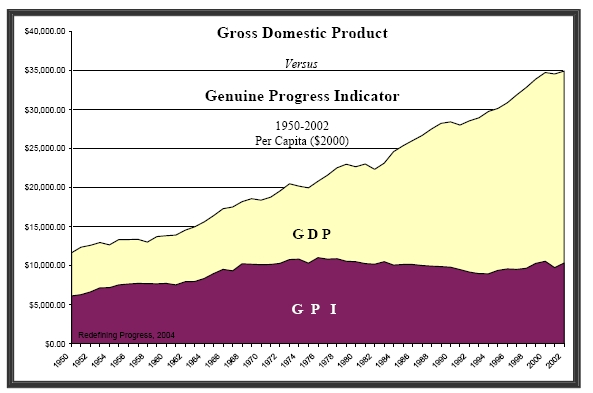
The GDP vs the GPI is analogous to the difference between the Gross Profit of a company and the Net Profit; the Net Profit is the Gross Profit minus the costs incurred. So the GPI wwould be zero if the financial costs of crime and pollution equal the financial gains in production of goods and services. Yet another example of where economists (and society) just looks at the gross instead of net.
Well, here's my problem with this graph. Their website seems short on understandable information outlining their methodology - or at least I ran out of patience before locating any. But I did find a document that's amazingly complicated for 'only' 33 pages, with a number of tables and a liberal salting of sociobabble such as (emphasis added):
Now, it seems to me that any overall single "GPI" number constructed by "operationalizing" arbitrary "popular frameworks" - popular in an ivory tower universe orthogonal to reality - will unavoidably be highly subjective, manipulable, and probably manipulative. Who gets to choose how much weight to give Gini coefficient versus an extra $1000 of average income, or how to weight any of the other myriad apples-to-oranges comparisons? Surely there are more than enough free parameters - i.e. the weights - to enable any desired result whatsoever to be produced in the overall measure?
Thus, I expect the graph you posted should teach me far more about the sociopolitical hobby horses the self-appointed "Redefining Progress" activists have chosen to ride, than perhaps about anything I need to care about. And perish the thought that academic types ensconced in comfortable tenured chairs, and thus privileged to have the hooves of their hobby horses trample only on others, might conceivably make rather unusual choices in assigning those free parameters.
So other than that the graph seems likely to reinforce a popular confirmation bias on TOD, what reason could there possibly be to take it seriously?
But I can watch a movie on my iPod! You couldn't do that in the 70's.
I can use my telephone as a camera or my camera as a telephone-this is nirvana.
"My children have got no shoes and clothing to go to school with, and we haven’t got enough bed clothes to keep us warm..."
But
"We got enough to get along on, and we got each other... That should be enough to make anyone happy."
http://tinyurl.com/3hgtfy
Nate,
With all due respect, but this strikes me as very unlikely. You may have been in decline since the 1980's, I certainly haven't.
The objective measure is not the amount we spend on this-or-that, but the amount of hours we have to work to buy/consume this-or-that. And if you are pessimistic about that, you can include forecasts in this.
We have inherited the earth, we should use it to our benefit. We also should pass it on to the next generation, but we should still keep a bit of perspective.
Cheer up: Go for a beer! I read in the papers that Anheuser Busch has been bough by Inbev, from Belgium. So talk advantage of it!
InBev A-B Deal Could Be In Jeopardy
Questions arise about InBev's deal
"With all due respect, but this strikes me as very unlikely. You may have been in decline since the 1980's, I certainly haven't."
You are not the nation nor the world. In a declining society there will always be groups of people doing well for themselves...
Obviously this guy is in denial or a firm believer in abiotic oil. Either way he is the one who is incorrect.
Concerning the post on top:
"Peak oil "wrong," says Schwartz"
I agree with Schwartz that I have no exact idea as to how much oil is out there.... BUT THEN - as he impies - neither does he.... At least I call myself "Ignorant".
What's his point?
This is about the art of rhetoric and not about getting to the substantive truth.
He's the guy saddled by cornucopia envy. You've seen him before... in the story of the ghost of Christmas present:-)
http://in.youtube.com/watch?v=yR_KAkeEIJg
Ghost: "Yet how many of my brothers have you rejected in your miserable lifetime?"
Scrooge: "I have never met any of your brothers, sir."
Ghost: "You have never looked for them!"
Swartz's not looking very hard either. And he's kinda stuck in the "now" only mode.
Yikes! With the markets in turmoil, the "now" only mode is not looking too rosy.
Happy days are here again.
Again, not unlike the Intelligent Design argument that claims biological structures are 'Too Complicated' to have occurred by chance. Exactly 'too complicated' for WHOM? That, in addition to the point that it was trillions and trillions of 'chances' in a self-replicating self-enhancing process.
It's unknown, and it's hidden/lied about by TPTB; ERGO, its going to keep flowing reliably! Drive On!
All Intelligent Design is meant to do is appeal to people's vanity. Do you really want to say "my ancestors were baboons" or "Hi, I'm a mutant gorilla". There is a good joke out there about this, "I told you about my side of the family (ID), your father told you about his(Darwin)."
Seriously, teach the kids all the creationist myths in Religious studies class and teach Darwin in Science class. Let the kids decide for themselves and the rest of us can talk about more important things. If the lefties weren't so sensitive about things like "In god we trust" etc..., this never would have seen the light of day. Left pushes on way, right pushes back. Sooner or later we are going to go our seperate ways if we can't live together. Hopefully peacefully, but I doubt it.
"All Intelligent Design is meant to do is appeal to people's vanity"
So we should let a lie live and brainwash our kids with it, just because it's so convenient? How very American.
This country is going down the drains exactly because we are choosing to live in our dreamworld instead of facing the real one.
As I said above, let the kids decide for themselves what they believe. Teach evolution in science class, and then the others. It would also give kids an understanding different cultures AND religions.
"This country is going down the drains exactly because we are choosing to live in our dreamworld instead of facing the real one." This just about sums up the way I feel about gun control and some of the foolish ideas that float around the Democratic party. There will always be the Charles Mansons and Ted Bundys of the world, so do you really want to be unarmed in the middle of the night? "Don't kill me while I'm calling 911, ok?" "How may I kiss your butt Mr Putin?".
Did you let your kid(s) decide by themselves whether drugs are good or bad?
At younger age kids still don't have the experience to tell right from wrong. Moreover we need to teach them critical thinking if we are to let them do the judgments themselves; is endorsing a convenient but entirely false idea the right way to do it?
I think once they are instructed to always take their daily dose of Prozac and Ritalin they can figure out the answer to that one on their own (or they can just watch Mom and Dad hit the booze the minute they get home from the job).
Unfortunately, it seems Prozac and or Ritalin seems to be the answer to every kid's problem these days.
They'll figure out drugs for themselves as well, whether you like it or not. All you can really do is give them alot of information on the downside. Unfortunate fact of population density and crappy TV, alot more influences than just you.
Numerous creation myths were from Egypt and Mesopotamia, there were Sumerian and Babylonian flood myths like the flood myth in the Bible or the one in the Koran. The myth of Joshua's Hebrew conquest has been vetted. The time of Joshua's alleged Hebrew destruction of Jericho did not coincide with the destruction dates given to other cities that were supposed to have been destroyed in that generation. In fact, some of the cities supposed to have been conquered by Joshua were not occupied during the c. 1200 B.C. time interval given by fundamentalists for the probable date of Joshua's campaign. Why teach myths as truths anyway? If you could make up a false story about what God did, could you also be capable of creating a false God? Even if there are myths in the Bible, this cannot prove the non-existence of an omnipotent being.
Chill, Rainsong. They are just stories.
Everyone wants to know where they came from and where they are going.
Up in Vancouver there is a museum with a giant clamshell and people crawling out of it and Raven sitting on top of it. Creation myth. Absolutely gorgeous piece. No one, especially not the artist, is interested in carbon dating that original clam.
There were 789 accidental gun deaths in the U.S. in 2005 (source = CDC).
So I could take your quote and just as easily say:
As a gun owner, I'm just as worried about my fellow gun owners mishandling their weapons or allowing them to be stolen as some serial killer.
In America a great many gun deaths are also committed by someone the victim knows. In other words, personal disputes - your friend, your neighbor, your spouse. This is not discussed in a media that gets good ratings selling the same fear of black ghetto criminals (or criminal ghettoes) that the NRA has turned into an article of faith. What is being sold is support for an arms race between the "good" Americans and the "bad" Americans - the seed of a civil war if there ever was one.
Regarding the accidents. Firearms safety is a PERSONAL responsibility. Noone elses fault but your own if it goes off. Some of the accidents are CAUSED by police too. We had one here awhile back where a stupid cop killed a 5year old because he was trying to shoot a NONPOISIONOUS snake in a TREE. If you ask me he should have went to jail, instead they fired him for his stupidity....I'm sure he's still a cop somewhere. If you aren't willing to accept the responsibility of locking your guns up so they can't get stolen and being safe with them, then by all means, don't own one. BUT don't punish me for someone else's dumba$$ mistake, especially since "assault weapons" can mean anything you want it to. My WWI Mauser98 is more dangerous than any poodle shooter AR15 more than 100yards out, and was the assault weapon of its time. Still is by Obama and Pelosi's silly standards because it accepts a bayonet.
Regarding friendly disputes....its pretty simple to hack someone up with machete too. You really should watch the news from Hati and Columbia sometime. Regarding the criminal ghettos, there was a special on the history channel a while back with a bunch of gangbangers in Vegas, most were in for life so they talked freely. Pretty interesting group of fellas, they'd break into peoples houses at random and see how much they'd beg before shooting them all. They'd do the same on the street, totally at random. Next thing you'll tell me is that the Bloods, Crips and MI-whatever are just misunderstood. "Decent" people anywhere don't break into other peoples houses or kill people at random for sport, no matter what color they are. True in my mind they are "bad" people but according to your argument all they need is a hug and some more welfare money.
Civil war? Yes indeed, not by color though but by culture. I have a friend that I shoot skeet with, he is black and also happens to be a state trooper. I know he'd love to do some "ghetto-cleansing" of the local crackhouses, but with field artillery. I'm sure the Detroit and Chicago police feel the same way. The only reason most of these guys favor gun control is because they've never seen a gun outside of the police locker room that wasn't pointed at them, poor fellas must suffer from shell shock daily.
Be careful who you trust with what.
http://news.yahoo.com/s/ap/20080917/ap_on_go_ca_st_pe/lost_weapons
In terms of people you know killing you, you should include your drug dealer, your gang buddies, and your classmates in other gangs.
From what I read, almost all gun crime is same race, same socioeconomic scale, and I guess I need to go read up on the NRA as I haven't heard your spiel from them.
Luckily my wife hates the site of blood. I suppose I should be careful that my professional friends don't off me in a rage one day....sometimes bad calls at those Little League games can get pretty heated....but at least for now they're all too busy buying assault rifles and spare magazines from a fear of Obama re-enacting bans against folding stocks and 30-round clips.
This is how it works in the UK. You need a VERY GOOD REASON to get a gun license. If you're caught with an unlicensed gun you get a ten year jail sentence. Gang violence is mostly conducted with knives. Muggings and burglary almost never involve guns. Security firms at risk of being targeted by armed robbers (armed with guns that is) take all sorts of precautions. Serial killers almost always use other methods; mass murderers have often used guns, but unlike the US this has led to a steady tightening of licensing. Apart from special units, the police do not carry guns; mainly because there have been occasional accidental shootings over the years. This situation is vastly preferable to the US. The US could be de-gunned, but it would have to become a tyranny first. Random raids on houses, anyone caught with a gun gets locked up. A decade or two of that medicine would do the trick.
"This situation is vastly preferable to the US. The US could be de-gunned, but it would have to become a tyranny first. Random raids on houses, anyone caught with a gun gets locked up. A decade or two of that medicine would do the trick."
And this is why we aren't joking when we say "from our cold dead hands" A pretty good portion of the military learned how to shoot on Grandpa's knee so yes, it would be a civil war with all sides being losers.
And let me see, you guys are now trying to regulate knives in Scotland because of the "Braveheart" complex. Vastly preferable to you maybe, but not to me. I'll take our "Rambo" complex any day of the week since atleast you are on equal footing with the gangs, try doing that with a pocket knife. I like living in free country, and last I checked ya'll never bothered to write your consitution down so its rapidly morphing into "WE the goverment will do as we bloody well please, so bend over while in Dover". BTW, the UK has a high crime rate than Romania, I read it in one of YOUR newpapers. Too bad your cops can't be trusted not to shoot themselves in the foot.
Here's another one for ya.
http://news.bbc.co.uk/1/hi/uk_politics/2656875.stm
Let me guess, they have their own guns already?
You say "I like living in free country". Being so afraid of rampaging gangs that you feel you have to be armed in your own home doesn't sound like 'freedom' to me.
And how can you even possibly bring other countries' crime statistics into the discussion when the US has a murder rate so much higher than any other industrialized country? In the argument about gun control, who cares if Britain has more crime than Romania when the US has a gun murder rate that's absolutely off the charts compared to them both?
Violence rates are much more closely correlated with social mores than whether or not people have or carry guns.
Switzerland has almost universal gun ownership but a low gun-crime rate, and in Britain in the siege of Sydney Street before the First World War the police did not have enough guns, and so borrowed some from passers-by!
"Violence rates are much more closely correlated with social mores than whether or not people have or carry guns."
Somehow I don't think that's relevant here when the violence we were referring to was gun murder.
?? The two societies I referenced, modern Switzerland and pre-First World War 1 Britain, both had or have very low rates of murder, including gun-related, and both routinely carry or carried guns.
Geez, guys, don't just spout, look up some stats:
http://www.guncite.com/
This site deconstructs some of the most common statistical obfuscations. My fav is the "felony gun death" canard that lumps in the 17,000 annual suicides with the 10,000 murders.
BTW, we don't have "rampaging gangs" in my working-class neighborhood. The gangs choose to live in derelict ratholes because it's where they can do dey bidness, like dealing, pimping, and cappin' each other. Murder victims in the US are mostly gang members, dealers, and their customers.
Us macho men aren't the ones who need to carry; Why would a bad guy target a 6', 200# male when he can pick a 5', 100# female? And that's the essence of carrying by law-abiding citizens: "God made us all, but it took Sam Colt to make us equals."
One other point: You can verify for yourself how much faster the crime rates have fallen in states that liberalized their concealed-carry laws compared to those that haven't. And if you're still interested, look at how much lower the crime rate is among concealed-carry permit holders than the general population. Sorry, I don't have those links at my fingertips.
Think it through: Crime is perpetrated by criminals, period. Outlawing the thing rather than the act makes as much sense as taking away my car to prevent any possibility of a DUI. Maybe that's not a bad idea, really: Once our personal autos are gone, a vast majority of the forty-one thousand MVA deaths annually in the US will be eliminated!
I assume you are not referring to what I said, as the point you are making is not substantially different to mine.
I am aware of the statistics, but chose to present the argument in a different form.
Yes, DaveMart, I'm agreeing with you, but it's a complicated enough topic that it doesn't lend itself to tit-for-tat factoid exchanges. It's also too serious a subject, and the arguments too heated, for us to hope to solve anything or convince anyone in this venue.
Fine, let's focus on the 10,000 actual felony gun deaths then. If you are OK with that number and see it as normal and think that availability has NOTHING to do with it, enjoy your 'freedom'. I tell you one thing, it has got to be a hell of a lot more than the number of machete deaths annually per capita in Colombia.
In one statement you remark that you don't have gangs in your area and besides, they are only killing each other. Then in other remarks you say you are glad you can have a gun to protect yourself from gangs like the ones you saw on the news that were randomly robbing, torturing and killing innocent people. So which is it? Are you truly living in fear of murderous gangs and therefore you treasure your 2nd Amendment right or is there another reason you feel it is necessary to be armed?
And that's fine about crime rates falling in areas where concealed arms are legal. My point goes back to WHO the hell would want to live in a place where having a concealed weapon is necessary for personal safety and HOW can anyone call that kind of living arrangement 'freedom'?
It all comes down to being willing to protect yourself. If you consider this someone else's responsibility, then that's your problem. I personally have no desire to be mugged, ANYTIME. Its just in case. With the economies of both our countries going downhill, I'm sure you'll get ample opportunities to change your mind. Of course, until recently all of you were "English" ie lily white, which makes things easier. Of course, the IRA still bombed places in your country too, but I guess that's more acceptable than a loaded chunk of steel in my nightstand.
And yes, I have a CC license. Don't use it much but its my choice.
Sorry to disappoint but I was born in Seattle U.S.ofA. and am American.
I am indeed willing to protect myself: by choosing to live in a place where I don't in any way, shape or form ever feel the need to be armed. What I don't get is how people of means can tolerate living in a place where one feels they need to be armed, even 'just in case'.
Again though I find your remarks confusing. In one instance you say you never want to be a victim of mugging then you say you rarely carry a concealed concealed weapon. So that sounds like you live and spend most of your time in a relatively safe place, no? If so, then why the need for the weapon permit, do you sometimes venture into known highly dangerous areas and if so, why??? Never mind, let's let this one die.
I got my CC permit simply because I prefer to have one in the glove box loaded when we travel since we prefer to drive at night. Car's still cheaper than airfare in the midwest and in some cases faster.
I also don't expect any decent sized city (I'm in OKC, thanks for the Sonics!) to be safe much longer given the foolishness in the financial markets, rising gas prices etc. I'm halfway expecting hyperinflation then shortages, how about you? Reading about the situation in Argentina since 2000 makes one nervous. Here's the link if you're interested, I think we'll be in the same way regardless of location ie welcome to Detroit or East LA. http://www.ferfal.blogspot.com/
Things would have to get pretty bad for me to carry on my person regularly since, I don't carry a small pistol. After about 2 hours, carrying a full size 45 gets annoying and heavy. If I was standing next to you, you would never know. Personally, I would prefer open carry like Vermont, since the holster selection is much better. Its an option is all.
If you've never tried it, to be good at shooting is like playing chess against yourself, and you are also the Grand Master. It requires alot of focus and disipline, like golf maybe? While I don't own any black rifles, I have no problems with them. True full auto AK47s and M16/M4s are highly regulated and very expensive. The Clinton assualt rifle definition was just silly, any semi auto could be classified as one including my Ruger 10/22.
Even though we disagree obviously, I enjoyed the discussion. Good luck on the other side, lets hope we can keep muddling along.
Switzerland = all sheep are white
Switzerland has 3.5 languages, two major religions and enough "ethnic tension" (I have heard claims of "Zurich Imperialism", etc.). And 10% immigrants.
Alan
I don't live in fear of rampaging gangs, and "la pistola" stays in the nightstand unless my wife or I feels like taking it out. Rampaging gangs only exist in certain local areas, mostly where people cower in fear. We don't do that in Oklahoma, our idea of gun control is hitting your target. Don't ask the police to protect you if you aren't willing do it yourself.
The socio-economic discussion below is pretty informative, but I'm sure it does nothing to ease your phobias. England will be the same way soon, just keep your open imigration policies and then the "stiff upper lip" will become the "bloody upper lip".
I think "I want one" is a VERY GOOD REASON to get a gun license. And a concealed carry license. That pesky 2nd Amendment can really get to you, can't it?
"I WANT ONE" is a good enough reason to exercise your constitutional rights. Not any different than expressing your opionion here, ie because you want to. There is a reason this amendment was the SECOND one. In a free society, you shouldn't have to explain your actions to anyone as long as your actions don't hurt anyone. My guns have never hurt anyone, and they won't unless you break into my house.
I don't consider driving a car a right either, just a bonus of 20th century FF. Owning a gun is a RIGHT. However, it does come with alot of responsibility as I noted above. Just because you have phobias of people you can't control doesn't mean we're evil. Funny how you lefties always talk about civil liberties, but then always want to outsource ALL personal decision making to some mindless civil servant. Perhaps you should move to China? Funny how you've never tried to repeal the second amendment, but slowly erode it through the courts. Guess you know what would happen eh? No decent people would want to live in your Utopia.
Schwartz sounds like BP, bizarre, they deny peak oil will occur because there are undeniably huge amounts of oil left in the world, then go on to explain the demand side of the peaking process while completely ignoring the supply side fact that the world's remaining oil is ever more expensive to extract profitably, and it is that decrease in affordability that causes the demand to fall away!
He is correct though that the world's huge oil reserves have nothing to do with any oil production peak.
Isn't it comfortable that someone in the knows tells us PO is wrong? I feel so much better now. Nothing to worry. Time to close down TOD. Everybody who commented above can go about their BAU now. I heared Britney released a new record.
Financial turmoil: Across USA, anxiety rises over what's ahead
Interesting article from the McPaper about how the "man in the street" is being affected.
And it looks like it's going to be a bad Christmas for retailers:
Worst holiday sales gains since '91 loom
Note that this terrible news still involves an increase in sales...just a smaller one than they hoped.
CNBC reports that Morgan Stanley is pulling out of oil trading, because of (their) liquidity concerns.
And industry group could hardly be expected to forecast total disaster three months from the High Holy Season.
Nevertheless, the Golden Calf is melting. Mammon is suffering.
Yeah, homage must be paid to the endless growth god, of course. I just want to also point out that US population increase is just shy of 1% http://geography.about.com/od/populationgeography/a/populationgrow.htm so any economic growth of less than that is a per capita decrease. 1.2% is getting perilously close to that.
A real growth rate of 0.2% is essentially indistinguishable from background noise. Econometrics just isn't that exact a science.
"Economists report numbers like GDP to the nearest 0.1% to prove that they have a sense of humor."
Inside info - my company:
2008
Revenues - down 4%
Earnings - down 26%
There is much riding on the 4th QTR to save the year...anyone want to take a stab at the probabilities it will deliver?
Given population growth, and inflation (even using the naggingly suspicious, even if Professor Hamilton, who I respect, says its mostly OK, CPI), that's actually a small but significant drop. And with so many things stretched so tightly, I wouldn't be surprised if it's the last straw that does more of those retailers in than usual.
Hello TODers,
We already know the status of many damaged offshore oil and natgas installations, but I was wondering about the status of onshore horsehead jackpumps. Can these be storm flooded, then cheaply repaired, to quickly be put back into operation? Or since they mostly extract water with a small amount of oil [high water cut, low ERoEI] will the most economic decision be to seal off the wellhead, then recycle the equipment?
Photo of a flooded horsehead pump...
http://news.yahoo.com/nphotos/Hurricane-Ike/ss/events/us/091208hurricane...
..this might have been totally submerged at the height of the storm surge and rain.
Thxs for any expert reply from WT, Rockman, ElwoodElmore, F_F, et al.
Bob Shaw in Phx,Az Are Humans Smarter than Yeast?
Local tv pictures have shown that some of the "onshore" pumps appear now to be "offshore"...
Hello Undertow,
Thxs for responding. Are they offshore because the exiting storm surge actually dragged them out to sea? Or are the floodwaters still this high so many days after Ike's landfall; that is they just appear 'offshore'? Or did some coastland really subside or erode so deep that the normal GoM tide actually comes much further inland in many places?
Possibly all of the above from the video. Does look as if water levels are still a bit above normal though from the NOAA gauges so the water may still have a bit to recede.
I have some questions:
1. when they safe the offshore platforms do they pullup the string?
2. if not what happens when the platform drags it's anchors and the string breaks
how do they reattach?
They hang off. The drill string is hung on the BOP stack, the stack is closed to seal in the well. The riser, a hollow column that runs from the rig to the BOP stack is disconnected and retrieved to the rig along with the stub end of the drill string.
You can pull all the string but on a deep well it may take 24 to 48 hours to trip out. Hanging off is much faster. In an emergency you can close the BOP, shear the string, and you are free of the well in a matter of seconds.
If you do not secure the well and the rig moves off location then you loose return circulation and face the prospect of a blowout. The potential for a blowout depends on well depth and formation but a blowout is not something that you want to risk. The gas coming to surface will represent an explosion hazard and is also likely to be extremely toxic (H2S). Any escaping gas will also aerate the water and therby lessen its density and this will result in the rig sinking.
Folks talk of the suction adjacent to a sinking vessel. There is no "suction." The air venting from the sinking vessel lowers the water density so that it no longer supports swimmers, boats, rigs, or much else, and down you go. Phillips lost a semi in the North Sea due to a subsurface blowout a number of years back; the water fizzed and down she went.
Some more thoughts and questions:
I have never been to this area so I have no idea how many of these horseheads got flooded. Are we talking just 1,000? 10,000, 50,000?
If most are electrified to operate [I have no idea]: will it be a higher priority to get the juice back on to most of these pumps before the repair crews reconnect peoples' housing?
Can an electric motor be submerged in saltwater and mud, then purged clean on-site somehow? Or does the motor have to be sent somewhere for a total rebuild of new wiring and bearings?
Just common sense: I think the hightest priority would be to get the refineries back online, as there is otherwise no place for the juice to go.
Any gear/stuff/whatever exposed to salt water is basically a write off. Wirings and barrings get hit hard. Dropped my mobile phone in the water once. took it apart and dried it completely; still broke down. My fishing gear testifies as well, that's why I spend a small fortune on reels, rods and hooks which are better saltwater resistant.
Hello PaulusP,
Thxs for responding. Yep, no doubt the top priority will be the refineries, big genplants, big powerline towers, and pipelines first. But what is the electrical repair sequence as you move further down the scale?
We TODers usually talk about an old oilfield having a long postPeak decline production tail from these horseheads pumping away for decades [also assuming no superstraws were used earlier]. But if all these pumps were suddenly wrecked: no long tail, but instead a production cliff for this oilfield as they just shut-in these wells.
The power companies won't even touch the motors and MCCs associated with those pumps. Someone will have to hire an electrical contractor to do the work. And if they are not easily repairable, say if they've been totally immersed in salt water, at a guess they probably won't bother for a few barrels/day.
Not bother? Let's see, 2 barrels per day x 365 days per year = 730 barrels per year x $90 per barrel = $65,700 in oil production per year x at least 5 year life for the electric motor = $328,500 in oil production over the life of the motor. Even at $45 per barrel of oil it would still be $164,250 over the nominal life of the motor.
I'd be delighted to have a 2 barrel per day stripper well on my farm!
Exactly Jon. I know a ver nice couple that operate a small section of a field outside of San Antonio. Their wells avergae about 1 bbl/day. At $100 a bbl I figure they are netting over $500,000 per year. And they've been operating these wells for over 25 years. And they'll be producing the same amount at least 30 or 40 years from now. It's a gravity drainage field so there's a big reserve base with a very slow recovery. And these wells are much more representative of US production then what folks see in the headlines. Been a while since I've seen the stats but all the production from all the major oil companies combined represented less than 40% of US production. The small independents produce the majority of oil from these little wells.
That's consistent with what I've seen in Wyoming and Colorado as well. There's a huge number of pump jack wells on ranches, etc. that are essentially the owner's retirement fund. You'd see most of 'em stop when the price of oil dipped below 20-ish dollars a barrel or so and start up again when it rose.
If the pump, motor, controls, etc. were totally wrecked would they drop $100-200,000 to replace them?
You'd have to do the economics. You wouldn't get $65,700/year pure income, you have take off the power cost to pump the stuff up (along with probably ten times the water volume), transport costs, etc. To totally replace the motor and switchgear might take a couple of hundred thousand dollars; at some point the low ROI on the new investment will kill it.
If all they've got to do is dry out the motor, then they'll keep it running.
As to your question about priority - wells or homes, the answer has to be the homes. If nothing else, the personnel to repair the wells have to live in the homes, but also, the priority of taking care of the people is of the utmost needs, and I can assure you that the power companies are doing things in that order. The onshore production in the impacted area is not sufficient to make any difference in the markets anyway. As to the impact on the wells, pumping units, downhole equipment, and even the surface equipment, these wells undoubtedly produce salt water, which does induce rust, but outside of electric and flywheel motors, most of the equipment is capable of operating after having been hit with or even submerged in salt water. Electric panels and motors will have been hit the hardest, and will probably have to be replaced in any event. Also, I would imagine that a great deal of the production in that area would be powered by submersible pumps, and those are run by sealed motors which are, well, downhole. The very expensive controls are above the surface, and are VERY expensive, and that will be more of an impediment to restoring the production. And, for the most part, they will be re-started.
The quickest way would be to rustle up a few dozen replacements from outside Texas, replace some motors, send those units to be refurbed in Houston or Dallas, and then use those as further replacements. Assuming the shops in Houston can get back up quickly.
Totoneila and All,
Nodding Donkeys.
(good schematic)
http://en.wikipedia.org/wiki/Pumpjack
Mobile Drilling Units
http://www.ukooa.co.uk/education/storyofoil/exploration-02.cfm
production platforms
http://www.ukooa.co.uk/education/storyofoil/production-02.cfm
production platform functions
http://www.ukooa.co.uk/education/storyofoil/production-04.cfm
production well drilling
http://www.ukooa.co.uk/education/storyofoil/production-05.cfm
In the case of a Hurricane, mobile rigs drilling single string assemblies will shut the well in and , in the case of a semi submersible will pull the marine riser and drill pipe.
In really severe conditions a semi could loose anchor changes and would then walk off site, but then it becomes uncontrollable. And a danger to other rigs and shipping.
Jack ups are stuck where they are if jacked down and must ride it out. Most would still pull in the marine riser and drill pipe.
Platforms would shut in existing wells , stopping flow.
Nodding donkeys should survive a temporary immersion in salt water if the glanding and seals to the power lines and motors are properly constructed . Which they should be: they should be built gas-tight to avoid the risk of gas leaks in proximity to energised systems. If they are gas tight, they are water tight. Most should survive
The build quality of American electrical and motor systems in proximity to gas or oil is very high and regulated. So it is safe to say salt water should not get in - if it is properly installed and maintained.
With respect to drill strings.
- It is a common misconception that the drill string ‘pushes’ the drill bit through new rock.
- This is not the case: Heavy weight drill collars supply additional weight at the drill bit. The drill string itself from above the drill collars all the way back to the rig is in tension – and not compression. The rigs Draw-works pays out line and is under tension. – The whole assembly hangs off the ‘hook’.
- Basically Hook load minus the weight of the string equals the Weight on the Bit.
toto,
The surface equipment you describe doesn't cost too much and is usually cheaply repairable. Even a well making a few net bbls/day will be fixed. Downhole problems, like corrosion holes in the tubing can get expensive and might cause abandonment. But yours was an important point: folks hear about Thunderhorse Fields coming on at 200,000 bbl/day and forget that the average US oil well produces less than 10 bbl/day. Our domestic production is dominated by stripper wells. The only condition which could effect them collectively is a long term of low oil prices. Something like $20/bbl or less. Not too likely these days. Also, these wells are far down the decline curve and thus their future decline rates are fairly low. Many wells producing 10 bbl today will be making 7 or 8 bbl/day long after Thunderhorse has completly depleted.
"Many wells producing 10 bbl today will be making 7 or 8 bbl/day long after Thunderhorse has completly depleted."
Thanks for the comforting Post Peak thought, Oklahoma is littered with these things. Nice to know they'll still be pumping away for long awhile.
Wow TODers,
Thxs for all the replies! Although there appears to be some variation in the probable cost of repairs and/or what will need to be repaired. I guess each well owner will have to assess and decide for himself/herself as to what is the best course of action. Are these horseheads generally insured, or is it an all out-of-pocket loss when a 'cane comes through?
EDIT: If one well gets shutdown, will the others be able to pump for a longer period and/or a slightly higher barrel/day? "My straw will suck your shake".
The pump itself is at the bottom of the well connected to the pumpjack by "sucker rods". The whole mechanism is very similar to the old water well hand pumps. The pumpjack serves only to move the sucker rods and pump up and down and is typically powered by a conventional electric motor. Replace the motor and you are back in business if your power panel and electric meter didn't flood.
The rods and pump are sealed to the atmosphere and floodwater would not get into the well.
boby -
I always wondered how those old-style well pumps worked.
Just out of curiosity: How deep can you go with a pump connected to those sucker rods? It would seem to me that beyond a certain length those sucker rods are going to have the rigidity of an over-cooked piece of spaghetti. (Which is is the same problem I have in picturing a drill stem several miles deep maintaining any sort of torsional rigidity.)
It's been awhile since I was in the oil business so this is from distant memory. Personally I have used downhole pumps in wells that were 3400 ft. deep using a pumpjack that was medium to small sized. I have seen units that were three or four times larger; size can be more related to the amount of fluid being moved than depth. I think the size we used were 10's and pumped 150 to 200 barrels of fluid a day. Unfortunately mostly salt water; one of the reasons I'm not still in the business.
Is all the salty water re-injected, then?
That's the typical method Gail. Not uncommon for old water dive fields to produce 50 to 100 bbls of SW for every bbl of oil produced. Usually they use an old producer and turn it into a water disposal well. I have one field that's injecting over 180,000 bbls of SW per day. It does cost but with today's oil prices it's no problem at all.
Bob: EIA's Distribution and Production of Oil & Gas Wells gives tables for each state detailing number of wells/production for same in various ranges, etc. Texas has 136,738 oil wells, 41,213 of which are producing 0-1 bbl/day. Exactly where they are would take some more digging, state land management offices often have the goods.
Texas company reports oil spills where Ike hit
Thanks, Rockman
... this from The Long Boom: A History of the Future, 1980 - 2020, By Peter Schwartz and Peter Leyden
_______________________________________
Often a simple Google of the author will help fill in the background picture
1000 miles? That can't be compressed hydrogen gas, the energy density is way too low. They must be talking cryogenic liquid storage. And of course, no mention where the energy to power this system will come from. It must be wind that will jump from 1% of our energy mix up to 40% in the next decade that will do it.
.. driving on Candy-cane roads wearing Lollipop ties!
We're on track for this... Yeah, we're starting out with those pesky Hummers... Heck check out Ahnold's ride:
"I can promise you that when I go to Sacramento, I will pump up Sacramento."- Arnold Schwarzenegger
Anyone know how much water one of these things leaks out?
Hey! Where's my Jet-Pack?
The first law of thermodynamics is: Energy can neither be created nor destroyed.. The second law of thermodynamics: Energy can be converted from one form to another and in that conversion a portion of energy is lost as heat AKA "You can't break even." On earth we live in a closed system and there is only so much energy in the form of sunlight that is available. The rapid depletion of stored energy in the form of fossil fuels is what has allowed mankind to artificially inflate his consumption of energy beyond the Solar Constant.
There are no perpetual motion machines and Mary Poppins can't fly by the power of her good nature! Humans might be clever but they're not very smart.
True. But matter can be converted to energy in enormous quantities - for example, in stars and nuclear reactors: e = mc2.
The first law says that the total amount of energy/mass in the universe is constant. It doesn't stop us from changing matter into energy.
The formulation that I'm familiar with is:
The second law implies that entropy constantly increases at the scale of the universe. Locally, entropy can increase or decrease without violating the second law.
The earth is not a closed system at all. There is a constant stream of energy arriving in the form of solar radiation (largely at visible wavelengths) and a constant stream of energy leaving (mostly at infra-red wavelengths). The reasons GHG's are screwing things up is that they have higher opacity at IR wavelengths than they do in the visible. Net result is that they slow earth's radiation of energy and upset the inflow/outflow balance.
Why ignore other kinds of available energy?
The Future of Geothermal Energy (PDF)
Uranium resources sufficient to meet projected nuclear energy requirements long into the future
Tidal Power
There are plenty of energy sources around to keep civilization running indefinitely.
That doesn't mean that Peak Oil won't cause problems, especially for transportation. And if people get crazy and start resource wars, it could cause doomster visions to become reality.
But, IMHO, there is nothing fundamental from a *physics* perpective that says we are facing a long-term energy crisis.
Just more band-aids on a system -- personal automobiles and giant roadways -- that was fundamentally flawed from the beginning, and even more fundamentally flawed when it loses its prime energy source.
Trains are the ultimate clean tech. At least, I haven't seen anything better. But, you need to eventually build the city around the trains, ie, have a walkable neighborhood around the train station.
Hey, bicycles are the ultimate clean tech. I can pedal to the train station.
You can have the train stations six miles apart. Within one mile is an easy walk. Within three miles is an easy bike ride. With this combo, you can easily make huge areas accessible by train with no cars needed. What happens next is that the areas around the station are much more densely built, because everyone (offices, shops, apartments) want to be within walking distance of the train station. Thus, while the area within one mile of the station is only a small fraction (about 1/9th) of the surface area, it may contain 50% of the activity. (It's very easy to build densely when you aren't making parking lots and mammoth roadways.) Thus, 50% of the action would be accessible by train/foot. In more urban areas, you eventually have the train stations two miles apart, and then the whole area is walking-accessible.
With 6-mile spacing, each train station serves about 28 square miles, which is to say, this is the area within an easy 3 mile bike ride of the train station. With ten train stations, you can cover 280 square miles, or 179,200 acres. At a population density of 100 persons/hectare, the average for London, that would put 7.2 million people within a three-mile bike ride of the train station.
Our Fearless Leader is going to give a statement about the financial crisis at 10:15am.
Oh jolly good. The decider is deciding again.
Yes, folks, you've just watched another set of World Trade towers come down.
But don't worry, go shopping.
Worked before.
From the article above:
"Bush had planned to attend a Republican fundraiser in Jupiter, Fla., and tour a waste facility in Huntsville, Ala."
(Maybe the waste facility is that one that is to be named after him?)
San Francisco may name sewage treatment plant after Bush
I predict that George W. Bush will be remembered for a long, long time.
He's going to read "My Pet Goat".
Well that was a short speech and no questions allowed. Not a word of support for the hungry, homeless and destitute in SE Texas though.
Bush spoke exactly at the same time Michael Chertoff gave a press conference (in Houston) about the disaster. Hopefully not a reminder to the national media which speech to carry?
Just watched a replay. He really did say he had to "console" with his advisors instead of "consult" as he meant to say. I'm sure the slip was more accurate.
From MSNBC:
If we pass this through the "Generally assume the opposite filter" we get the following:
Looks like the markets have caught on to the "opposite filter".
Dow Jones after being up over a hundred bases points earlier is skirting a mere 20 at 11:50 a.m. eastern.
Wow, now at 11:56 down 11.15.
So much for the radical interventions by the Central Banks.
Moral of the story: when the water tight compartments are filling up, bailing doesn't make much difference.
I expected a bump when the Dow hit -1% and the S&P-1.5%, which we got, but it quickly fizzled. The real bump is happening now bouncing off of -1.5% and -2.0% respectively.
Whither next? Back to positive? Or is 0 the resistance?
Inquiring minds...
Cheers
UPDATE: Well, markets up between 1.5 and 2.0% in the space of 8 minutes. NOW, all in positive territory as of 1:23.
Dow Jones took a 300 point hike, a whooping 3% jump in value in the last 50 minutes.
This is a turning into one hell of a high wire trapeze circus act. Way down, now way way up.
Oh goody, the show must go on. Can't wait to see what awaits us tomorrow.
Yeeeeee....
Yes...that spike and Paulson's proposal were timed quite well for the end of the day...weren't they?
Stocks surge on report of entity for bad debt
See, Bush's pep talk worked! We're saved.
Speaking of Dow Jones and market fundamentals, did anyone notice that "AIG" is being removed from the Dow Jones industrial index and some cheese company is being added in its stead?
Another one for Jim Willie-he called this one a long time ago.
Volker backs it, which gives hope that that may be the best way forward as he ran the Fed with considerable courage and was prepared to raise interest rates when needed.
It would still cost the taxpayer a lot of money, but might bring the situation under proper control and would avoid ever increasing sums being dribbled away piecemeal.
1. No one could ever have foreseen this
2. Our best minds are at work resolving this act of God
3. Volker is for it, it must be good.
NOT
Borat makes more convincing analysis.
Will the real crooks ever hang-- or will the common folks pay, as usual?
Will we ever learn.
I've no idea where you get that from what I wrote
1.Many people including Warren Buffet clearly did see this coming years ago, and said 'derivatives are financial weapons of mass destruction'.
2.Your statement here simply does not relate to anything I said.
3. I actually said that Volker appeared to be relatively competent, and so his being for it gave some hope - I simply don't know if it will work, but I have disliked Bernanke's and Paulson's disconnected flounderings.
If you want to provide a penetrating critique of what someone else has said, it helps if what you write bears some relationship to what they said, and is not invented by yourself.
I also agree with you that it is of the first importance that those guilty of gross negligence should be brought to book, including the legislators who authorised this abandonment of prudent standards in the interests of allowing the sacking of companies, and now the treasury.
That does not meant that somehow we don't have to deal with the financial situation as it is, not as we would wish it, and since I like most people know sod all about high finance, I have to rely on people who do, and I respected and liked the judgements which Volker made, as opposed to Greenspan, who continues to pontificate but is probably more responsible than any one other man for the present mess as he refused to prick the loose finance bubble - something which Volker did, in spite of unpopularity at the time.
Well I got what he was saying. What, you don't recognize Condi/Dubya buzzwords?
I agree that Volker is competent, maybe even gifted, but so's Dick Cheney. Doesn't make me feel all warm inside.
Maybe you have a plan which would deal with the situation without a vast new impost on the taxpayer, but I don't.
If you do, please present it here - I will read it with interest.
Absent details of your cunning plan, I would sooner have someone who has in the past dealt competently with the economy and displayed considerable political courage in doing so having his plans actioned than this present piecemeal frittering of the world's credit.
So your plan is?
It was sarcanol, DaveMart, just weak sarcanol. It's no substitute for a solution, but it keeps me from despairing.
Sorry, I seem to have missed your tone - one of the perils of the web!
I know naff all about finance, and have been trying to read up to get some vague idea of what is going on, but beyond a feeling that an emergency tax is needed, so that those execs who have paid themselves vast sums of money and scarpered after ruining their companies, and the regulators who have failed to regulate should have to return the salaries they have not earned, should join the ranks of the homeless and destitute I have not reached any conclusions.
The guilty are very unlikely to be punished anyway, save perhaps in a massacre in some terminal breakdown of society.
The elite protects it's own.
Thanks nels--
I guess I would feel better about these "desperate" measures to "help" us if this were the first time it had ever happened, and the crooks were really charting new territory.
Trouble is, this is a Groundhog Day nightmare.
They know exactly>/i> what they are doing. They are sucking the life blood out of us and leaving dried cadavers dangling in the breeze.
So, as the Fed is running out of ammo, taxpayer money will be given to the banks in exchange for toxic waste, so that the banks have funds to start lending again. But fear not and rejoice, Peak Oilers, for those fresh funds will be allocated mostly to uses that will make society better able to cope with oncoming Peak Oil and related peaks.
Seriously, I expect all this was just a shenanigan for tomorrow's options expiration. Because if it's not, the US is in deep, deep trouble.
Thanks Undertow.
I thought my hearing aid wasn't working.
He did say "console".
Probably no one caught that because the speech was so long and packed with insightful appreciations of market dynamics and fundamentals. ;-)
Looks like a new oil poll is needed again. This time price recovered to $100.
Before we would need a new poll every so many months or weeks.
Lately, it's been working out to days.
What a roller-coaster ride!
Let's wait 'till it closes above 100.
Perhaps we should increase the poll to a 15% swing, $85 - $115 next time?
Now, who was it predicting increased volatility in the oil price?
Deffeyes, among others.
He argued that scarcity creates volatility.
Perhaps enough to hide peak oil.
I've heard speculation that the "bumpy plateau" will be driven by two opposing forces: (1) Demand destruction which leads to falling prices to be followed by (2) increased demand for oil driven by falling prices. But in the last couple of days we've seen another driving force -- the flight from financials into commodities when the financial markets begin to falter.
No Way! the 10% swing is great! And, we need to have a new poll at the drop of a hat, not at the close.
Chris
I changed my mind. the 30% swing in the new poll is gutsy.
Chris
And just what is predicted as we approach and pass peak, no?
Cheers
Ever quicker is the essence of the exponential function, e.g. >1 million years for the first billion people, ~40 years for the next billion, ~10 years for the most recent billion.
There appears to be too many inter-related things changing exponentially at the moment for humans to keep up.
Technical Analysis (TA) – Seventh Post
Oil is up again this morning! To me the most interesting news is the rise in the price of gold, right after this interesting article that simultaneously announces that the price of gold “may” rise to $950, that the miners are holding back sales, that the Central bank sales will drop by 46%, and that demand will soar by 38%. All of that plus some big moves up - it sure looks like a move by the Smart Money (SM). This is bullish for oil because gold and oil are supposed to move together. Same thing is said to be true in the inverse with the drop in the dollar. http://www.bloomberg.com/apps/news?pid=20601012&sid=abv6J3EnBf7s&refer=c...
This morning it looks like the Fed is not only manipulating, I mean “stabilizing,” our markets, but the world's! “Fed Leads Global Central Bank Move to Pump Cash” (Interesting choice of words, since when did we have a global central bank?) http://www.cnbc.com/id/26768313 Don't tell me that that we are getting a bunch of our old toxic debt for collateral... All of this extra “cash” in the system would normally be bad for the “dollar” and bullish for commodities in general and oil in specific. In addition, all of the bailouts should be bad for the “dollar.”
In the mist of all of this, the relative strength (IMO) of the financial indexes is a mystery to me. Sometimes I wonder if one of the big things that the financials are doing with the “liquidity” from the Central banks, is to buy their own stocks, and support their prices. Then one of the “toxic investments” that take them down are big piles of their own crappy stock. Just wondering...
IMO people “should” be afraid of everything but commodities, or things with real tangible value (with the exception of real estate, of course). On the other hand, it appears that SM has induced a good bit of fear of commodities in the short-term traders. There is also a chance of deflation, so it is good to keep a few zero-coupon bonds and keep an eye on the commodities prices...
If I was a transportation company, I would be buying every oil contract and option I could get my hands on. Maybe the price will go lower, but high oil prices could destroy a company like an airline.
So, what does TA say about all of this? With my program, I am only getting one weak short signal from the breakout strategy (53/99), and all of the rest of the strategies have stopped out (from being short). There is still the weak “measured gap” short pattern. Still no buy signal... I'm not sure what is up with that – I'm guessing that the real-time version is showing a buy signal.
It is a classic TA buy signal when the price goes pass 100, and the price has blown through a trend line that I manually drew on the chart, so I may buy. Consolidation patterns are the norm after long trends, and I hate to get whipsawed. On the other hand, I love to own oil and may buy as insurance against wars, supply problems, etc... But, no more short-term options for me!
For my TA, I am using OmniTrader (20-day backtested, end-of-day) with the pattern recognition module (short, med, and long), and I trade USO as a proxy for oil. I am using the standard strategies for breakout, trending, and reversal (all filtered and non-optimized), one that I created with all 75 systems, and another one I created with only the volume systems (both optimized and minimally filtered). Once again I have put myself out as a fortune teller – a sure way to end up looking like a fool. I am not an expert at TA, I am a beginner. Please add to this analysis, and don't feel shy about flaming me if I said something dumb. I definitely want to stay out of the group of the “stupid people losing money.”
Generaly.
Given the disconnect between the "paper" and the "physcial" markets, if "paper" gold goes to $950, physical gold will cost you about $1500 if you actually want to touch it. The coin premium used to be about 5% over spot cost, now its like a few hundread bucks, if you can get it. I don't know if the mints resumed sales yet. Anyone know if there is still a shortage?
http://catalog.usmint.gov/webapp/wcs/stores/servlet/CategoryDisplay?cata...
I got the most a-mazing email from APMEX the other day, when silver bottomed, generously offering to buy my spare Ag bullion coins for $2.50 over spot. Yeah, right.
The only items for sale on their site were a very few, very pricey numismatic curiosities.
Well, that is only true if you wish to buy coins. You can, today, buy actual gold bullion for only a 1% to 2% markup.
How to Buy Gold Bullion
But if you keep it in your house, you don't have to buy storage. Or you could keep it in a safe deposit box for a few bucks a year.
Ron Patterson
How large would a bar of silver have to be in order to be too heavy to steal from my house? 200 pounds? Maybe I need it to be spherical so it's too slippery for two guys to lift.
if its spherical, they can roll it out the door...:-)
I like it! I'll cast my floor safe out of solid silver, and keep my spare gas can in it.
Tough to make change from a one-ton ingot, though, and that's why people pay a premium for bullion coins in reasonable denominations.
Most BIG safes get bolted to the floor in your house, they weigh about 200-300lbs. If you're really worried about it, buy a fireproof save then use some anchors to attach to a concrete floor. Then invite someone with a welder for lunch and weld the nuts on the anchors. Small and cheap fireproof safe is about 200-300 bucks, but they weigh only about 50-80lbs.
I thought about going that route, but didn't like the idea of any assessment fees when you have to sell it. Plus the coins are easier to "spend" ie barter if you need something. One gold bar is pretty hard to break up.
We bought a bunch of Silver Eagles and gave some out as Christmas presents last year. Funny, everyone acted like we gave them a gold bar. At 18bucks a coin it was a pretty cheap christmas present and EXTREMLY well received. Also had a few questions, "where did you buy this I want some more".
Hello Jrc9596,
Excellent idea! I wonder when giving a bag of NPK and/or seeds for Xmas will be the standard postPeak gift. Currently, many poor people in Africa, Asia, Haiti, etc, would be so thankful they would be crying if they were the recipients of such generosity.
I agree that the paper and physical markets are diverging, but it hasn't gotten _that_ pronounced yet.
Premiums on coins were around 1-1.5% a couple years ago, even less on things like krugerrands, which
2 or 3 or 4 years ago one could buy at a premium of about 2 USD per ounce, about half a percent. Now theyre
about 3-4%, with premiums on most of the common ounce coins ranging between about 20 USD to about 40. Fancy
single coins in presentation cases, etc, are not what i'm talking about.
Here in Europe, premiums tended to be higher historically but usually you buy coins from the counter at a
bank, and not from a discount dealer who has much lower overhead. Premiums are around 4-5% on 1-oz coins,
though most larger banks will sell house-brand (typically credit suisse and UBS) bars anywhere from 1oz to 1 kilo
at much lower premiums, like 1-1.5% and the sub-ounce sizes at higher premiums but thats always the case.
(and yes, people do buy and sell kilo bars over the counter here)
1/4 oz coins tend to see about a 15% premium wherever you go, though a lot of people go for old coinage (soveriegns &
20franc pieces usually, sometimes other stuff) and the premiums on those has recently come up to about 5%.
The picture with silver has been similar. Premiums have moved up from about 5-7% a few years ago on popular
bullion items (10-oz bars being the most popular, after government minted 1oz coins like eagles, which had about a 10-15%
premium in those days) to 10-20% now, while the premium on the eagles (and Ag maple leafs, etc) has gone up to the
20-35% territory. Old US silver coinage used to sell at spot, now it sells about 5% over spot, while the
really junk stuff like 40% coinage , which used to sell about 4-5% below spot, now goes at spot.
And in europe silver is typically hit with VAT, which i most countries is criminally high, so physical silver over
the counter is always absurdly more than the paper price anyway.
It's happening, but not as extreme as some examples have lately claimed. Draw your own conclusions about
where it's headed, though.
"soveriegns &20franc pieces usually" We bought some of those as well, but I'm having trouble keeping my wife from making ear rings out of them. :-)
Investment group withdraws Alitalia offer
The article Controversial Path to Possible Glut of Natural Gas talks about the use of unspecified chemicals used in the fracturing process. What are these chemicals likely to be?
I saw a piece in Newsweek recently which greatly concerned me. Now that we are talking about using these drilling methods in relatively highly populated areas -- Pennsylvania, New York, Ohio, etc. -- this does indeed look like a Faustian bargain.
Thoughts?
Tarzan,
In general I can promise you the subject is being very over hyped by the press. I'll go into some possible exception below but for now you have better odds of a drunk driving into your house then one of these fracs causing you any problems. The zones being frac'd are thousands of feet deep. The technique, if it works really really well, will generate a frac with a vertical height of 200'. Typically much less. Even in shallower wells operators are very careful not to exceed the fracture gradient of the earth (I actually do this calculation for a living). And they're not being careful just because they are nice guys. Frac'ing to the surface would destroy the well's productivity as well as causing a potential environmental clean up that could run into the millions.
But there can be unintentional accidents. The worse likey possible would be for the casing to rupture near the surface while they are pumping the frac to a much deeper zone. This has happened in the past. Even when it has happened little or no surface damage has occurred. I've been a pertroleum geologist for 33 years and have never seen it happen nor do I know anyone who has. But I'm sure if you dig the state regulatory records you can dig up some examples.
Speaking of which, fracs require a state permit and are subject to state safety limits. I couldn't find the article but let me ask you this somewhat leading question: did they warn of great POTENTIAL damage or did they site specific examples of such problems (date, location, operator?). If they didn't offer one specific example then you might have to wonder what the risk really is: there have been 100's of thousands of such frac jobs done in the US. Can anyone reference one frac causing surface damage? If you want to worry about something legitamate keep an eye on folks pumping down salt water disposal wells. There have been serious problems with such wells leaking into shallow fresh water aquifers. This is a real potential problem even though it suppose to be monitored by each state reg agency.
But let me point out that fracs can be very dangerous to the folks on the surface conducting the job. Many have died or been crippled. Huge amount of horse power and pressure involved. Stand half a mile from a big frac and it sounds like the end of the world.
Rockman, thanks for your response. I've worked around surface mines (in a reclamation capacity) and have some sense of the degree of disturbance, scale and hazards associated with them, etc but have zero experience with the oil and gas business. I had simply read a few things over the past couple of years that pointed to potential problems w/ hydro-fracturing and I was hoping to get an industry/professional perspective from someone here. Thanks much!
The chemicals that they use are generally long-chain polymers which have two uses, the first is to hold the sand in suspension so that it penetrates further into the crack that has been made and holds it open so that the gas/oil can escape, the other acts more like a lubricant so that the fluid and sand can penetrate further into the crack, and help to to grow further out. While I don't know exactly which chemicals they are currently using in their mixes, work we have done in the past has used guar gum variants and polyacrylamides. Some of these have been known to be used in the beer industry to sustain the froth on the top of your pint. As far as I remember the concentrations are relatively low, and they are non-toxic - having, in other uses, had to go through rigorous testing and demonstrations.
The folks from out Calgary way can better address this but there have been multiple complaints in Alberta over problems with well water after fields were frac'd.
The folks with the complaint were not at all happy with the response they got from the provincial authority which has responsibility for oil industry oversight. The rancher's well water went sour, the cattle would not drink it, and nobody in the gummint gave two hoots about the problem.
The one big plus out of all this is that any cutlery or metal pots left in a sink of this tainted water just polished up all by itself. So you cannot drink your water but your kitchen sparkles. Seems like a fair trade off.
Colbert Report: Bob Lutz Interview
Lutz seems intellectually underpowered compared to Stephen Colbert. Judging from his responses, I'm surprised that GM didn't lose more money last year.
Not everyone is as good on camera as Colbert.
I'm afraid I have not got much confidence in GM successfully deploying the Volt.
It is trying to take too big steps, too soon.
Here are some of the hassles it has been having putting the cells to together into a functioning unit:
http://www.technologyreview.com/Energy/21387/
This is the sort of issue that made Toyota cautious in rolling out a lithium battery plug-in, and caused them to delay it.
They still may delay again is they can't be sure of the reliability of the technology, but the projected range of the Prius plug-in is in any case a lot less challenging with it's range of around 8 miles instead of 40, which makes it a lot cheaper and more practical to duplicate cells and so on.
Toyota anyway have much more experience of hybrid technology than GM, and the price GM wants to charge for the Volt is one which will be difficult to find in the cash-strapped future.
GM, in my view, seems to still be producing $25bn turkeys.
I was quite unimpressed with Lutz's ability to "sell" the concept of the Volt. In the interview Lutz suggested that the "solar panel roof option" would allow a user to charge their Volt after two weeks of being parked in a sunny parking lot. Useful if you taking a two-week trip from an airport or if you do all of your driving once every two weeks. For daily use...not so much.
I think about how much better the battery performed on my cell phone or laptop before a dozen or two charging cycles and I shudder at the thought of paying $40,000 for one of these.
To the US taxpayer, what's another $25 billion when you're already on the hook for $10 trillion in debt and another $40-50 trillion in future unfunded liabilities?
Chevy Volt's unveiling sparks questions about financing
You can already buy a small solar array on some models of Audi.
They are basically an expensive option which can help a little in running ventilators to keep the car cool when parked in hot climates etc, and don't do anything much to recharge the battery.
http://www.audiusa.com/audi/us/en2/tools/glossary/operation_comfort/sola...
GM went through all the trouble of lobbying for a Federal tax credit for plug-ins; $3000 base with additional increments of $200 for each kW of battery storage up to $5000 max. That's not really enough when the car costs $40,000. Now if Tata were to bring in an electric for under $10,000 it would have an impact.
I'd heard talk of a $7000 subsidy; I guess that was blown away by the big Federal bailouts.
"Well I thought it was funny but I'm sick!" Lenny Bruce
It's just that the world is changing far too fast for Lutz.
Hi super390...I was working last summer to photographically shoot and put info online cars for sale by a Chysler dealer. As I shoot the cars I notice they all get horrible gas mileage. Really terrible. So I ask the big cheese there, "Don't you have concerns that you have very inefficient gas efficiency on every car you are selling?" He looked at me like I was just let from the looney bin. My customers don't care about that! he stated. The people who run these companies are clueless and money thrown to them will in my estimation be wasted.
Of course there were no smartcars to be found on the lot... just SUV's, trucks, jeeps, and giant cars. And now they want billions in bailouts!
That 4x4 golf cart/hunting rig looks better and better, alot cheaper too. Ouch!
Anyone know how they are doing the heat and AC in this thing?
That's the problem with the Volt. It was designed with the idea that some sort of leisurely change to using less oil was possible, in a favourable financial environment which would be BAU with 15 million cars and light trucks being sold a year under leasing and finance arrangements like those in 2006 or 2007.
The Volt is therefore designed to match as nearly as possible the performance of ICE cars.
The problem is that costs a fortune and still does not really work.
If you switch on the AC or heat and drive this thing with a heavy foot you might easily halve the 40 mile range they are aiming at.
An electric future is going to happen, but it seems that it will be much more based on a large down-grade in convenience and comfort, mainly to electric bikes and scooters with an electric golf cart or a little Mitsubishi that you would have to drive pretty carefully and conserve the juice by doing without AC if you have far to go being very much the top end.
The bad news is that it does not seem possible for most people to have anything like present comfort and mobility, the good news that a fair degree of mobility, albeit with far less convenience, seems perfectly possible.
After all, there are around 60 million electric bikes in China, running largely on the lowly lead-acid battery.
Electric cans and trucks to carry goods from the railhead are eminently do-able, although not long-distance lorries.
My guess would be that people will pretty well be able to bustle around, but more in the fashion they do today in Vietnam than in the US.
Dave,
What you are saying is true but misleading. Yes the Volt won't get 40miles on 8kWhs under some conditions but for many drivers that's still 40 miles more than most other vehicles and until the Volt concept was rolled out, the Toyota President was saying that people won't be bothered to plug in, and its Plug-in version of the Prius will only go 8-10 miles.
Both cars will allow most people to have a vehicle that can be driven without using any oil except for lubrication!
The "Volt concept" is going to help us get over the other side of "Peak Oil", and if some of us can do it with a little comfort that's OK except for those with "Doomer Religion".
I can understand peoples mistrust of the GM culture, developed by petrol-head NASCAR salesmen. I am optimistic that the Volt will pave the way for much better PHEV and EV's.
If we do get over Peak Oil, never fear, their are still other peaks to be concerned about.
I would be chuffed to bits if GM pulled the Volt off.
My doubts are really more to do with the likely financial environment, rather than some absolute technological hitch.
BTW, the Volt uses a 16Kwh battery to do it's 40 miles -which is why it is likely to be expensive.
The Prius plug-in will probably get by with a 4kwh battery or so.
That's an understatement. As I was watching Colbert I really thought that GM would have marched out some young Master Of The Universe to introduce the much anticipated Volt that they hope will save the company from extinction. Guess again. Lutz came across like a cave-man (and that's insulting to that cave-man spokesman for Geico). He immediately denied global warming and left me with the impression that he didn't give a damn what your personal beliefs were as long as you buy his f*#kin' car.
Doesn't GM realize that a core buyer for a Volt might be someone who has taken this Climate Change/ Peak Oil nonsense seriously? Lutz was a real turn-off!
Too bad the folks at Apple haven't started making transportation. I'm sure the ICar would be a mega hit, with people selling various non-essential organs to get one.
A few months back when he (or was it Wagoner) spouted off about how global warming was a fraud, I decided I'd had it. I don't care how good the Volt is, I will wait for the plugin Prius (you can do it today with an overpriced after market kit). Of course maybe thats the new plan to kill the electric car, build/market one, but so tick off the population of potential customers, that you can prove no-one will ever buy one!
An interesting story regarding chemical feedstocks that I haven't seen posted yet:
Still a ways from commercial production, but an interesting step in removing some of the key non-energy uses of oil (petrochemical feedstocks).
Other approaches have also been used. I know of one example where E.coli is used to commercially synthesize 1,3-propanediol. This page, ed0703e.pdf, states that DuPont is using it to produce the "DuPont sorona" fiber product. I believe that sorona is a nylon look-a-like. I had the fortune to listen to a presentation by NigleDunn-Coleman, the project leader -- a fascinating example of early transgenic work (done in the late 90's, but genetics is a fast moving field).
This seems to be a good example of non petroleum based, biological processes used to address [part of the] problem of finding alternatives to FF based production. I say, "part of," because presumably the rest of the production system is conventional. Nonetheless, you can now buy organic (ahem) plastic clothing.
The other day I was driving by a local car dealer "Towbin Hummer". You may be familiar with them if you're prone to wasting time and brain cells watching A&E reality shows. Josh Towbin (aka "Chop") was featured as the rapping car salesman on a show called the King of Cars that chronicled the day-to-day intricacies of Josh running the Dodge dealership he manages.
His father Dan, had one of the largest Hummer dealerships in the US. As I drove by the other day I noticed the Hummer sign was gone and the dealership name was changed to "Towbin Motorcars." Far more shocking to me was new sign proclaiming the dealership to be the "Smart Car Center of Las Vegas".
One of Nation’s Largest Hummer Stores to Shut Its Doors
Portland just lost its second Lincoln-Mercury dealership.
http://www.oregonlive.com/business/oregonian/index.ssf?/base/business/12...
No real surpise there - The old guard is dying off:
"The average age of buyers of Lincoln's flagship Town Car is 72...."
I just checked the latest DOE Situation Report (9/18 10:00 am release). Refinery shut-in numbers have not changed in two days at 3mbpd shut-in and 2Mbpd partial. This is only down a little from 3.5 and 2.5 on the 15th (I believe some Gustav repairs completed on the 16th). Repairs appear to be going pretty slowly in Tx.
Regarding getting back to BAU on the refinery sice:
MMS reports 93% of oil production and 74% of gas production in the gulf is still shut in.
The Port of Houston has resumed normal operations as of this morning. (Business Casual attire is acceptable for the rest of the week, however)
Valero is restarting in Houston. Others seem to be as well.
NEW ORLEANS — The MMS reports that as of September 17, 2008, 49 of the 3,800 offshore oil and gas production platforms in the Gulf of Mexico have been destroyed by Hurricane Ike. Currently, MMS has no information on whether any of the destroyed platforms will be rebuilt by any operator. Oil and gas operators are also reporting damage to offshore infrastructure other than destruction. These reports are being analyzed by MMS and damage statistics will be released next week.
Initial estimates are that the 49 destroyed production platforms produced a total of 13,000 barrels of oil per day and 84 million cubic feet of gas per day. (09/18/2008)
This is really excellent news if it is to be believed. This means that even though they could be profitable at a much lower price than $80/barrel, they are not going to go for more product. It is great that they are willing to forego the income! Maybe we can actually leave some of the cheap to produce oil in the ground if we conserve enough now. Everyone keep going with the carpool and mass transit. Let's see if we can get to $50/barrel by 2009. That they said this when gas prices are rising makes me think they are serious.
Chris
Well, it's not like the Arab section of OPEC has to worry about a flood of oil from non-Arab fields during the next ten years. If they prop up the price, though, the very prolonged, expensive development of exotic deep-water fields like Brazil's will proceed more smoothly.
That is just what we need to avoid. Those expensive developments will damage the world economy. It is much better to discourage them by pushing the price of oil down with conservation.
Chris
I think you and I both know that the Las Vegas Hummer store will be reopened the day oil hits $50. And you kiss any new bike paths goodbye for another 10 years as well.
High prices killed a million barrels a day of demand in the US, not voluntary conservation. Now we just need to get Jet Fuel to $10 a gallon to kill them off once and for all.
If I may paraphrase, here's hoping for one hell of a cold winter. You can get American made sweaters and jackets here if you get really cold: http://www.johnsonwoolenmills.com/
People are getting a taste for conservation and finding it is not so bad as some of the other stuff going around just now.
If we are going to make a low oil price our goal, we probably need to be organized in our approach. Fortunately, we have the Economic Regulatory Administration in law already to help with the organizing. You can read more here: http://mdsolar.blogspot.com/2008/06/oil-is-too-expensive.html
Chris
Thanks Chris,
You're right. It's not that hard to save the first 10% or so. When I have my solar array installed a few years back, the second this I did (after watching the meter go backwards) was to go in the house and turn off all the things I could turn off.
One thing that is not in the Solar ROI is the fact that most of us suddenly become energy misers. I suspect this has to do with the $20K check we write.
All that said, low oil price really should not be a concern. If you want to give $1000 a year credit to low income people to help them cope, go for it. Everyone else should pay though the nose. Including me.
Thanks again. I'll read your blog.
I think we need to set retail prices pretty high to get the kind of rapid conservation that will bring the price of oil down to $20/barrel. A $30/gallon gas tax might do the job. But, then we have the government handling a huge new revenue stream. Perhaps that goes to your rebates; Hansen's cap-and-share idea. Perhaps it goes to tax shifting; Gore's replacement of FICA. But, it seems like too much revenue which will be a politically destabilizing pulse. If we have the government distrubuting checks, we need a big new set of information on who is eligible as well. If we replace FICA, what happens when we are not using gasoline any more and the revenue drops to zero?
Tradable rations pretty much keep the money transfers private while the ration plan is already put together and sitting in the DoE.
Chris
Another money market fund has closed...
E. Swanson
Putmam turned out to be crooks a few years ago. Not too surprising that they are in trouble again.
Chris
Have we met? I was thinking the same thing. I just got my $11 check from Janus for stealing from me.
FSA to ban short selling of financials:
http://www.ft.com/cms/s/0/16102460-85a0-11dd-a1ac-0000779fd18c.html
I am fed up googling "short selling" in the hope of finding a good answer! I understand the idea but cannot find the answer to some obvious questions! Good description:
1)Who exactly are they borrowing the stock from?
2)Why on earth would a company keep 4.5% of it's stock on loan for short selling if the result of that short selling could well be fatal for that company??!!?? WTF??????
3)How can you sell something you don't own?
4)Presumiing that the original owner is the companies 4.5% of stock why on earth would they be lending out stock anyway?
5)Why is short selling not illegal?
6)Why do i want to tear my hair out trying to understand this spaghetti mess financial world?
Marco.
Warren Buffet did not understand it when he tried to work out in a company he was buying how much it owed in derivatives.
They are hiding things in complexity.
Apparently the reason Washington Mutual is in trouble is that they are trying to sort things out and so made the mistake of being more transparent than the others;
And:
http://seekingalpha.com/article/95910-all-shoes-may-drop-for-the-banks?s...
The central banks are pouring our money into a bucket with multiple holes in it.
Marco, I found this helpful.
New York AG Cuomo to short sellers: 'I am watching'
I suppose it never occurs to these guys that the reason the price of the companies stock is falling is that the companies are worthless?
I am currently short:
DAL - Delta Airlines
RCL - Royal Caribbean Cruise Lines
CCL - Carnival cruise Lines
LNY - Landry Seafood Restaurants
MTG - Mortgage Guaranty Insurance
PMI - another mortgage guaranty company
WGO - Winnebago
Covered (bought to cover my earlier sell) several others in recent days.
It has been extremely profitable in the last few years. No money down to "sell short", but enough security (recalculated every day) to cover the brokerage if prices rise too much on the stock I sold.
I typically keep by short portfolio at 20% to 25% of my long portfolio, but make about as much money off my shorts as my longs.
One sells a stock short because you expect them to crater (or go bankrupt is even better).
For example, Landry is a terrible company, bad, corrupt management, poor quality food, most profits are off real estate and HQ in Galveston. Why not short them ?
Alan
I will give you an example of shorting a share. I ignore broker commissions for simplicity.
I have 1 share of Widget Corp. worth $100. I purchased it for $50 and do not want to sell it, so I do not care about a little volatility in its value.
You offer me $2 to sell the share short. We create an agreement that you must buy the share back sometime within the next 3 months or if the share value drops to $90 or rises to $110. I require you to put down a deposit of $10.
I sell the share for $100 and put the money into a trust account with the $10. I pocket the $2 fee.
Outcome 1: After 2 months the share rises to $110 triggering a buy back using the money in the trust. I get my share back and you lose $12.
Outcome 2: After 3 months the share drops to $95. The three month limit triggers a buy back using the money in the trust account. I get my share back, now worth $95, plus the $2 fee and you get your $10 dollar deposit returned plus $5 for a net profit of $3.
The guaranteed $2 fee makes me want to allow you to sell my share short. Selling short makes me profit while the declining value of the share makes me lose. Since I would not have sold the share anyhow, I got an extra $2 for nothing. If you manipulated the market to drive the share value down to make profit on our deal, then that is another story.
Russia's "aggressive" attitude at home and abroad risks leaving the country "isolated and irrelevant", the US secretary of state warns.
http://news.bbc.co.uk/2/hi/americas/7623555.stm
Isn't that the kettle calling the pot black?
In psychology, they call this "projection" or "transference". Hate to break the bad news to you Condi, but not considered healthy.
She gets quite aggressiv indeed. She hates Russia, no wonder, after she had to drop the "take over" of JUKOS, when she was in charge with Chevron. But then came Putin and the whole plan came to the closet.
How could Russia answer evenly aggressiv?
- Cut oil exports by 10% (Russia is the biggest oil exporter of the world)
- No more accept US$ for its oil, pay in Rubel for our oil
- To stop the so called Megatons to Megawatts programm immidiately. One-tenth of America’s electricity comes from fuel made from Russian nuclear warheads. The Megatons to Megawatts program converts highly-enriched uranium in Russian weapons into low-enriched uranium that is used in US civilian nuclear power reactors.
- To stop to buy US Treasury Bonds.
Nice Russian accent! Wery hard to do in post.
According to the Asia Times, Russia is now maneuvering to get Turkey tilting its way on the issue of NATO access to the Black Sea, by offering to broker better relations between Turkey and its neighbors Azerbaijan and Armenia. Under the Montreaux Protocol, NATO can't enter there. But the article notes the Russians slipped in a reference to Iraq and Iran in its announcement, implying that it might next work with Turkey on common concerns with those countries. Syria, Iran, Iraq and Turkey are the main 4 antagonists of Kurdish separatists operating out of their US-backed Iraqi quasi-state. Syria has a Russian naval base. Iran has many shared concerns with Russia.
A change in Turkey's relationship with Russia could assure a Russian naval presence in the Mediterranean, something that Britain and then the US have worked hard to prevent for 150 years.
I almost feel pity for her.
Just remember, in this administration there are many people who not only did not like the fact the cold war ended but thinks they could of fought it better if it was still on.
Is NATO member Spain a potential threat to the US? McCain seems a little confused about the issue. Kind of gives you a warm fuzzy feeling thinking of the McPain combo in charge of the nuclear codes doesn't it?
http://www.usnews.com/blogs/robert-schlesinger/2008/09/18/john-mccain-ge...
McCain is still upset about the dastardly Spanish sinking of the battleship Maine, which affected him deeply as a child.
I think McCains mind just seized up when he heard Zapetero, his mind read Zapitista (Mexican guerillas), and no matter how many times the interviewer tried to say "No the president of Spain!", his mind just couldn't get off of the terrorist track. My big fear now, is he will win, but be declared mentally incompetant to serve before inauguration day.
Matt Simmons has been quiet as of recent. Anyone hear any news from him recently? I doubt that his view has changed and he is still calculating a cup-o-crude price.
With oil's decline I haven't seen a story about old T. Boone Pickens great plan. Suddenly gas is "affordable" again and no one cares about the environment. Natural gas is the way of the future!
http://www.stockresearchportalblog.com/
In reference to the John Michael Greer article listed above, Greer was featured in the C-Realm podcast yesterday. Here's the link if you care to listen:
http://www.podomatic.com/link/2d7e7a562889ac00e123ffbfc2a1a140
TS
http://www.cnbc.com/id/26777052
"New York Attorney General Andrew Cuomo said Thursday he is investigating whether some traders used illegal tactics to drive down the stock price of Lehman Brothers Holdings, American International Group "
the witch hunt continues - first the speculators who ran the price of crude up. then the speculators who drove banks down.
will we never take responsibility for our own faults? this is so unbelievable to me. it gives me zero hope for our future.
Latest results on Ike platform damage from MMS:
Minerals Management Service (MMS) reports that as of September 17, 2008, 49 of the 3,800 offshore oil and gas production platforms in the Gulf of Mexico have been destroyed by Hurricane Ike. Currently, MMS has no information on whether any of the destroyed platforms will be rebuilt by any operator. Oil and gas operators are also reporting damage to offshore infrastructure other than destruction. These reports are being analyzed by MMS and damage statistics will be released next week.
Initial estimates are that the 49 destroyed production platforms produced a total of 13,000 barrels of oil per day and 84 million cubic feet of gas per day.
In hard times, tent cities rise across the country
Welcome to the Shruburbs.
There are two realities in America right now, Wall Street and Main Street.
It is a tale of two classes of people in this country. More and more of those in the middle are joining the bottom class while fewer and fewer are joing the upper class.
The middle class continues to contract. Which story does the MSM mainly focus upon these days?
What has been almost surreal is the speed they can spend taxpayers money when they are motivated (i.e. their cronies are floundering). USA politicians have been talking about investing in renewable energy-and basically it is delay, delay, pontificate, delay some more-everything is so complicated, committees have to be formed, we have a 2020 plan, a 2030 plan, blah blah blah. Bernanke drops 85 billion of taxpayers money at the blackjack table in like 5 minutes. So far they have dropped 900 billion in like 6 months. They spin it through the MSM like Jesus is dropping the moolah from the heavens-this 900 billion is coming out of the rest of the economy, with little or no positive multiplier effect. Just imagine the boost to the USA economy if over the last six months they had committed 900 billion taxpayer dollars to a combo of rail, nuclear, wind and solar (and moved immediately ahead to implementation). It is quite likely the USA wouldn't even be in a recession. IMHO the fly in the ointment and the problem for post peak USA is that the most powerful have no intention of successfully leading the country-in this regard they are identical to upper management of many of these financial firms, who followed ponzi schemes and bs accounting scams that had no intention of provided long term shareholder value or the building of a sustainable business franchise.
We built the original rail roads with a fraction of the current industrial base. I suspect that any of our larger cities say 100k plus could probably support some part of a electric rail manufacturing with the smaller cities contributing a lot of parts.
This can be bootstrapped out of thin air using bonds backed by land etc. The point is again any plan to really solve our problems should be based on a reasonable expectation that we will be flat ass broke.
But is it taxpayers money if it is simply printed rather than borrowed, or taxed? You might even be able to justify running the printing press by claiming that the deleveraging is "destroying" money, and we are simply replacing it.
CNN is interviewing The Donald. He bragged about how he warned us for years that real estate was overpriced, and no one should buy it. And then added he just closed a luxury property in NJ for a fraction of what it cost a couple of years ago.
I remember him shouting it from the rooftops-the Donald knows that the public has the memory and attention of a large mouth bass and will basically swallow anything.
From the article:
Depending on how permanent these structures are, and the rate at which they increase in density, we may be seeing the beginning of slums north of Mexico.
From Planet of Slums, by way of Wikipedia.
Trouble is Bushville doesn't flow from the tongue.
But "Shruburb" does!
Someone above suggested 'shruburb'. I like it.
LOL!!!
Perfect name.
It's courtesy of Souperman. His name for the new Hoovervilles.
13,000 barrels of oil per day capacity destroyed by Ike:
http://www.nytimes.com/aponline/washington/AP-Ike-Energy.html
Chris
...and 84 million cubic feet of natural gas per day.
Also, 93% of of Gulf oil and 78% of natural gas production still shut in.
2.3 million electricity customers still off line.
3 million barrels/day refining capacity off line.
25% of Gulf natural gas processing still off line from Gustav.
Damage was less than anticipated...we dodged a bullet...that was a close one. Whew.
USS Nassau Joins Hurricane Ike Disaster Response Efforts
Hello TODers,
Does anyone doubt that Morocco will be increasingly seen as geo-strategic to the US?
USGS website PDF:
http://minerals.usgs.gov/minerals/pubs/commodity/phosphate_rock/mis-2008...
---------------------
MARKETABLE PHOSPHATE ROCK IN JUNE 2008
..There have been no reported sales of phosphate rock by domestic producers since late 2006 because all phosphate rock is used internally by domestic producers to manufacture phosphoric acid or elemental phosphorus. U.S. producer stocks were slightly lower than those in May and 23% lower than those in June 2007.
..Morocco supplies more than 99% of the phosphate rock imported into the United States; however, the U.S. Census Bureau suppresses some of the phosphate rock data from Morocco.
..Exports of phosphate rock from Morocco to the
United States for the first half of 2008 were 8% higher than that in the same period of 2007.
-------------------------
My guess is that geo-strategic concerns plus the Webb-Pomerene Act is what allows the US Census Bureau to suppress data. But I could be wrong.
As discussed in earlier postings: recall that the UN FAO Fertilizer Forecast projects North America to be headed into a giant phosphate deficit, thus the need for a giant ramping of O-NPK recycling to help delay this catastrophe, and instead, to drive for optimal Asimovian Overshoot decline. I detailed potential US-Morocco scenarios in earlier postings.
Bob Shaw in Phx,Az Are Humans Smarter than Yeast?
Hello TODers,
PDF Warning if you wish to see the included charts:
http://farmfutures.com/ME2/dirmod.asp?sid=F8F0FC025243413D80DEE92F3B36AD...
--------------------
Who Will Be First To Blink In Fertilizer Standoff?
Weekly Fertilizer Review for Sept.18,2008
..Indeed, with crop prices well off all-time highs, the logic for record fertilizer prices was less than clear. Farmers responding to a FarmFutures.com on-line poll confirmed our recent survey suggesting producers were reluctant to plant more corn in 2009 in the face of uncertain prices and sky-high costs. More than half those responding said they would plant fewer acres next spring, while only 13% said they intended to seed more corn.
Anhydrous prices last traded around $800 out of the Black Sea and $845 in Tampa.
------------------
I am not sure if this author realizes that the US currently imports 44% of our N products. As discussed in earlier postings: declining US natgas prices doesn't immediately translate into a fast ramp of native anhydrous ammonia due to the long latency in FF/I-NPK transformation.
IMO, this is not the way to rebuild global grain reserves as the agro-experts suggest to help prevent a famine. As others have already said, JIT will eventually mean 'Just Isn't There', but I see no legislative impetus to build my speculative 'Federal Reserve Banks of I-NPK'.
Have you hugged your bag of NPK today?
I've been surprised at the ample gasoline supplies in the Dallas area, but it looks like that might be changing. Until today, I had only seen a couple of examples of stations out of regular unleaded, but a Chevron station in North Dallas ran out of regular unleaded yesterday and premium today. The manager said she had no idea when they might get another shipment.
also noted in a small town in south central Kentucky, where the gasoline available at walmart was unleaded regular selling at $3.99, but i noticed that they had no premium grades of gasoline. in fact all 3 grades of gasoline were just regular 87 octane gasoline.
Today I saw $4.09 at a Shell station on I65, 37 miles north of Nashville, TN.
and yesterday, $3.89 in Bowling Green KY at all gas stations. whereas a few days ago they were running at $4.15 to $4.30 in KY.
they i fly back to Houston today and gasoline down in Clearlake is $3.69, or lower at some stations. some stations are still empty.
So those that are without power in the gulf coast of Texas may not have ice or hot meals, but they have lower gas prices.
go figure!
thanks to the sheeple!
T-Boone Pickens was mentioned in the latest copy of Texas Monthly, even on the cover. but since oil has been dropping, i noticed no more Pickens Plan commercials. I do support his idea about using nat gas for our cars. thanks to Hunter Energy and Questar. and I mean that!
oil prices may have dropped like a rock over the past month or so, gasoline fell too, but not at the same rate. however gasoline remains at $3.69 in HOU, i would suspect the price of gasoline to start creeping back up and staying up.
Interesting times we live in!
Don't understand this at all.
Apparently the Iraqi's believe that US forces killing Iraqi citizens should be held accountable in a court of law. Don't know where they come up with these crazy ideas. Probably being stirred up by Iranian troublemakers.
Next week Australian Prime Minister Kevin Rudd will lecture the UN General Assembly on how clean coal will save the world
http://www.news.com.au/story/0,23599,24370283-5007133,00.html
I wonder if this is in response to a letter from James Hansen circa March.
Before next week he should take time to read what others have to say on clean coal
http://www.richardheinberg.com/MuseLetter/197
Check this out...
Sarah Palin on Energy... - http://www.youtube.com/watch?v=G-rcD_ibmIE
She's soooo dumb... She knows nothing, absolutely nothing...
Maybe this vid can be posted in the new DrumBeat thread for all to see.
No need, since it's already posted here.
And really, I'd like to tone down the political polemic here.
Come on Leanan…let the Blues and Reds blame each other for our current problems. It’s about the only comic relief I get these days. I know it disrupts the flow of useful information but in the end the only important concept is Us vs. Them. PO and all our other economic problems will take care of themselves. As long as the 2-party system continues it successful efforts to keep the focus on the mistakes of “the other side” Americans will continue to fail to see the failure of gov’t (both Red and Blue….who I shall now refer to as the “Rue” to be expedient). Politics is an important aspect of PO but the Rue is very pleased to see the populace argue over drill vs. no drill, bank bailouts vs. mortgage bailouts, etc as long as the focus is “the other bastard that caused the problem”. It keeps folks focused on “blame” and not “cause”. And, as you know so well, without a clear understanding of cause there can be no solution.
To be honest I’m beginning to become disenchanted with TOD despite the great efforts put forward by you, Gail, WTexas, and others. Granted I’m a technologist and prefer material facts vs. philosophies, but I do enjoy spirited debates. But when the politics lead to personal attacks and arguments over which political party is “right” I tend to tune out. Really a shame too…will have been at home for 12 days before returning to work next Monday thanks to Ike. Thought TOD would be a good distraction but lately I’ve just stuck with my remodeling efforts. But keep up the good work…I do continue to scan for comments by you and the other dedicated folks here.
Politics is a game. Obama is the lesser of two evils. Sarah Palin is supposedly strong on the Energy front, but a little review of her views reveal her real self. 4 more years of Republicrats or Demolicans is gonna be devastating for the country.
Obama is not old-school democrat. Hillary and gang were in that group, and they're out. Obama is different.
I respect the sanctity of TOD, and it is great place for energy discussion, and I agree with Leanan and you, ROCKMAN, that this forum should not be muddled with politics...
Mother Nature does not divide herself into distinct subject areas.
It's all one big mix and one big mess.
Oil, politics, financial systems, human nature,
global warming, nuclear danger,
over population, religion, philosophy,
culture wars and history,
the laws of thermodynamics,
the art of dirty polemics ...
it's all one big muddy mix.
Let the mud slinging begin.
_______________________
CHORUS
We didn't start the fire
It was always burning
Since the world's been turning
We didn't start the fire
No we didn't light it
But we tried to fight it
video link #1 with Billy Joel music
video link #2 on You tube
Birth control, Ho Chi Minh, Richard Nixon back again
Moonshot, Woodsto/ck/, Watergate, punk rock
Begin, Reagan, Palestine, terror on the airline
Ayatollah's in Iran, Russians in Afghanistan
"Wheel of Fortune", Sally Ride, heavy metal, suicide
Foreign debts, homeless vets, AIDS, crack, Bernie Goetz
Hypodermics on the shores, China's under martial law
Rock and roller cola wars, I can't take it anymore
CHORUS
We didn't start the fire
But when we are gone
Will it still burn on, and on, and on, and on...
That was Cool! :)
If your referring to her statement that "oil is a fungible commodity- the molecules are not tagged" and Wolf's comment that the answer is "difficult to understand" than the problem is not hers.
FF
The thing is this, there is no shrtage and ther probably won't be, theses oil companies are just wanting to make money of of us. You's think they would giive us a break considering oil and gas prices have already caused a resession in the U.S. but no they are selfish jerks. but thats ok there getting thiers right now they may be makking like 3 bucks a gallon on us, but people are already buying less gas than they have in years and before long more and more people will be buying hybrids and mopeds, and in turn less gas, so it will backfire on them and they will be loosing more money.