


The End of Fossil Energy
Posted by Robert Rapier on October 7, 2006 - 9:31am
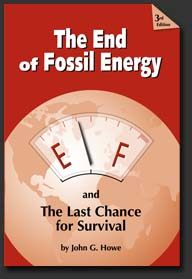
A couple of months ago, I received an e-mail from John Howe, author of the book The End of Fossil Energy and the Last Chance for Survival. He indicated his concern that the public is not getting the message on Peak Oil, and he asked if I would be interested in receiving a copy of his book and helping him post some of his ideas to TOD. I accepted his gracious offer, and I received his book in the mail a few days later. A couple of weeks later, I read the book on a flight to San Francisco.
There were a couple of things that really impressed me about John. First, he has laid out a plan for transitioning to a sustainable energy future. He calls this plan "The Five Percent Plan to Energy Sustainability", and he covers the details in Chapter 5. By actually committing a plan to writing, John is probably ahead of the vast majority of us in this debate. Most of us have various ideas for what we need to do to achieve sustainability, but I am sure that few of us have put as much thought into it as John has.
The other thing that really impressed me is that John practices what he preaches. He has built three completely solar-powered vehicles, including a 1962 MG Midget and a tractor he uses on his farm. He goes over some of the technical details in one of the appendices of the book. The experience John is gaining with his solar-powered vehicles can be a valuable asset to the world if we will learn from him. If the world had more John Howes out there, I wouldn't be nearly as concerned about the challenges facing us.
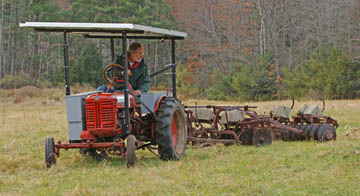
John Howe on His Solar-Powered Tractor
John asked if I could help with posting his White Paper to TOD, so with that intro, here are some excerpts covering various topics:
Our Addiction to Oil
By 2005, the first indications of peak oil awareness (headlined by the title of this page from President Bush and his 2006 State of the Union Address), started appearing from Washington. On Dec. 8, 2005, the House Energy and Commerce Subcommittee on energy held its first full-scale congressional hearing on peak oil. A bipartisan caucus co-chaired by Rep. Roscoe Bartlett (R-Maryland) and Rep. Tom Udall (D-New Mexico) along with 16 other congressmen prepared resolution 507 beginning with the following paragraph:
Expressing the sense of the House of Representatives that the United States, in collaboration with other international allies, should establish an energy project with the magnitude, creativity, and sense of urgency that was incorporated in the `Man on the Moon' project to address the inevitable challenges of `Peak Oil'.
Each time the price of oil and gas ratchets a little higher, the mainstream media gives sporadic attention. Unfortunately, the message the public hears is a blend of obfuscation and short-term excuses such as inadequate refinery capacity or terrorist activity in producer countries. (See "We Were Warned" on CNN, March 18 and 19.) As usual, media coverage is "balanced" by conflicting optimism. See page 12 for the usual delusions. Very rarely is the concept mentioned that the world just might be running out ... forever! Very few, big business, the media or most elected leaders can fathom or admit that the oil party is over. We're now faced with a giant hangover.
As with any addiction or terminal-illness prognosis, the first reaction is denial. How can this be? Our entire economy (and our personal plans) are built on never-ending growth fueled primarily by oil. As reality sets in and logic rears its ugly head, the next response will be ... depression, "gloom and doom". Next, we obviously must begin the weaning process without substitution of hopeless quackery. Finally, a proactive search for honest answers and solutions brings back some optimism even if the best first hope is to encourage others, to join a mass movement of public awareness. Remember, our addiction to oil is only a visible part of the other interrelated problems of excess population and ecological devastation.
Delusions That Will Not Save Us
(But waste valuable time and dollars while we chase them down)
With the onset of peak oil and higher energy prices, there is a flurry of new and, in many cases, revived old panaceas. Some have a touch of legitimacy. Some are pure snake oil, some are only a way to profit either from selling books or from ill-directed research grants and tax incentives. Not necessarily in order:
- Hydrogen-Hype: Now quieting down. Most people understand it has to come from fossil fuels, or if from renewables, is a terribly inefficient way to use precious non-fossil-sourced electricity. In addition, it is very dangerous and technically difficult to handle and store in compressed or cryogenic form.
- Biofuels (exclusive of wood): Sunlight is very dilute and sporadic. Expecting the annual solar energy to replace the millions of years of concentrated solar energy in fossil fuels is impossible. As the fossil fuel base (nitrogen fertilizer, diesel fuel, irrigation- energy, etc.) for our food supply winds down, we will need ALL the biomass energy we can find just to feed ourselves. Also, biofuel production (esp. ethanol from corn) requires about as much fossil energy input as the resultant energy yield. The energy returned on energy invested (EROEI) is too close to unity to be worthwhile. Finally the intensive monoculture of crop land is not sustainable.
- Wood: Somewhere between dilute annual sunlight-energy and concentrated fossil fuels is wonderful wood. But, it takes 50 to 100 years to grow a reasonable tree. Harvest at a quicker rate only depletes the forest, soils, and ecological balance. This signals the end of a civilization and is happening the world over and exacerbated; by increasing population and fossil-fuel powered harvesting equipment.
- There's Plenty Left: We are now using about 6 barrels of oil (at one billion barrels, worldwide, every 12 days) for every single new barrel discovered. Natural gas is not far behind and can't be shipped overseas except as liquid natural gas (LNG). Coal and tar sands are more plentiful but contribute heavily to eco devastation and will soon approach an EROEI of unity, especially as oil runs down and the harder-to-reach, dirtier sources are mined.
- Efficiency Will Save Us: Only if we concurrently reduce consumption (reverse growth and population). In most cases improved efficiency increases consumption due to increased value and numbers of consumers. ("Jevon's Paradox") In the long run, we must survive with no fossil energy at all.
- Other Sources: Nuclear, hydro, geothermal, solar, and wind are all legitimate. But, except for solar and wind, all are limited by site availability or in the case of nuclear, finite fuel and waste problems. Total energy will be much less without fossil-fuels.
- "Pie in the Sky": Abiotic oil, nuclear fusion, methyl hydrates, shale oil, perpetual motion machines, etc. None are proved.
Non-fossil Energy Sources
The Three fossil fuels (oil, coal, and natural gas) represent a non-renewable "bank account" being drawn down at an annual rate leading to complete depletion or the point of negative energy return on investment (EROEI) in less than one lifetime. This prediction can be challenged but more optimism will, in no way, change the obvious threat of the "Triple-Crisis." New unexpected discoveries might provide extra time and a better chance to effect a transition protocol to less population and a much lower-energy future. However, the desperate consumption of additional fossil fuels will only exacerbate the global warming component. A sustainable future can only come from sustainable, clean energy.
Nuclear
The best bet for continued, clean electricity on a large scale. But, sources of finite, fissionable uranium must be found and ultimately mined without cheap fossil energy. This scenario also assumes that acceptable waste disposal and protection from terrorism can be assured. Also, nuclear, like all other non-fossil energy sources except biofuels, produces only direct electricity. No matter what energy sources we use we will need a complete rethinking of our transportation system.
Hydro
Limited to acceptable sites nearly all of which have been used. Global warming has reduced water flow and electrical output in the last decade. Considerable fossil energy is required to replace dams, which ultimately fill with silt. Reversible pumped hydro at 85% efficiency (as well as nuclear) can be used to smooth the sporadic output of solar and wind.
Biofuels
Only for absolutely essential needs as liquid fuels, lubricants, etc. and with full understanding of the required energy input and the deleterious effect on crop land and food supply. See pages 7 and 12 for more details. Waste products will decline as a source of fuel because the original energy sources are finite and depleting.
Geothermal, Tidal, Wave, etc.
All are site specific and cannot be scaled up to be of importance.
Wind
A true, clean source that can be scaled up extensively especially while fossil fuels are still available for manufacture and installation. Sporadic electrical output could be smoothed by working in concert with solar PV and other available sources.
Solar PV (photovoltaic)
The best modern technology providing direct electricity on a local or centralized basis. Very dilute and sporadic but infinitely scalable and especially applicable to residential use as well as direct solar-powered tractors and cars. In all cases, the weak output needs to be coupled with battery storage and/or other sources. This is our best bet for a long, clean future including agricultural power and transportation. Small urban and suburban farms could use approximately 100 volt tractors with integral solar-panel arrays and large battery-packs. Huge commercial farms might better use a large portable separate array of 4 to 8 kilowatts peak power (300 to 600 square feet). With a 200 ft. #8 cable, this concept would allow working up to 3 acres almost on a one to one energy basis as long as there is direct sunlight. The portable central array could be moved to a new location or brought to the farm buildings in off-season. The high cost and availability of PV will require a 50 year scale-up from present minuscule levels. We need massive investment in solar PV and lead/acid battery recycling facilities.
The Low-Energy Community
The key component for a low-energy sustainable future is a community center with the following objectives:
- Strive for a balance between peripheral AGRICULTURAL land, which can sustainably supply food for the farmers and community center inhabitants. This food supply will ultimately rely ONLY on manual or draft animal power, solar-powered tractor power or biofuels made locally, IN LIEU of food. Fossil-fuel based fertilizer, herbicides, pesticides, and irrigation will diminish.
- Transportation energy will become unavailable except for electric or muscle power. Therefore the furthest distance to a community center would be a radius of about 20 miles. Present U.S. arable land of about 300 million acres will not be able to provide for 300 million inhabitants at today's rate of 10 energy units of fossil fuel input for each single energy unity of food output. Ideally a 20 mile radius (800,000 acres) with one-half (400,000 acres) perfectly arable land could support 250,000 people with approximately 200,000 in non-agricultural roles. The others 50,000 would live on 10,000 farms, each with approximately 80 acres with one-half tillable. The other half of the land would be forest, green space, and recreation area. On this basis, a downsized U.S. population of 250 million people could live on 1,000 such community centers utilizing 800 million acres or about one third of the total U.S. land area.
- The community center will provide the energy -mixing hub for surrounding self-generating residential energy services as well as centralized energy sources. It would also be a community center and transportation hub for intra-city electric-rail travel and shipping, which may also connect to traditional water travel routes.
Personal Action
Obviously, our only chance is to enact massive change on a national level. But, national redirection only happens as a response to a ground swell of combined personal action ... a protest movement or a revolution. Nothing will happen if individuals do not take their fate into their own hands. In addition, there are many things individuals should do to be ready for the coming crises whether they be power shutdowns, food shortages, or climate-caused catastrophes. Remember, don't plan on calling someone on your cell phone to come and save you. Everyone will be too busy saving themselves. Below are actions you can take immediately:
- Continue to educate yourself about energy, population, and ecology. Don't be misled into complacency by the delusions (page 12). Tell others what you're learning.
- Drastically decrease your personal gasoline consumption. (One-eighth of the world's petroleum goes to American motoring). This will save money as prices steadily rise. If you can't afford a hybrid, buy one of the many cars that get 35 mpg and drive half as far. This is the easiest first step.
- Plan to heat only a core area of your home (kitchen, bathroom, laundry, and living area) to less than 65 degrees F for the winter months. Wear much warmer clothes. Three hundred square feet per person would be luxurious for 99% of the world. Rearrange water pipes and insulation accordingly. In hot climates, rearrange living area into a cooler zone (cellar, breezy area) to minimize air conditioning. When the weather cooperates, you can expand back into the rest of your home. All of the above will require only a minimal expenditure, not rebuilding.
- Grow a garden. Dig up the lawn, fertilize and build up the soil. NOW! It takes a few years to get up to speed. Remember one acre could be a commercial farm in China. You'll be healthier and happier than riding the lawn mower. Learn where food comes from and how to store it. A good part of suburbia is built on good farm land. Buy a copy of Mother Earth News.
- Get the kids involved and start your own solar photovoltaic system. A couple 150 watt panels, charge controller, batteries, and 1000 watt 120-volt inverter costs about $3000. Don't worry about inter-tieing with the grid. This will be your educational and emergency back-up system. Check state incentives.
Contact
- Content: editors at theoildrum dot com
- Tech support: support at theoildrum dot com
License

This work is licensed under a Creative Commons Attribution-Share Alike 3.0 United States License.
Amen
Well done Robert.
http://www.globalpublicmedia.com/interviews/699
The problem of PO (or in my view, the problem of Global Warming, which is more pressing and more systemic than the possibility of PO) is simply this:
- we have too many people, and too advanced a civilisation, to tolerate 'going backwards'. What we have to do is figure out how to 'go forwards' by using the energy we do use with much greater efficiency and lower carbon emission, and at the same time finding new sources of energy (which are in fact very old sources of energy: wind, solar, tidal, geothermal have all been used by humans since the dawn of civilisation in one way or another).
To the extent that 'back to the land' is aligned with that, great. But most people on the planet no longer have the ability to live that way (too many people for the available land and food).
- we might get lucky and discover commercial nuclear fusion tomorrow. But more likely we are going to have to do this the long, slow, hard way- -rebuilding our physical capital for a low CO2 emission world.
An example: the Germans have a house design that only burns 800 watts a day, and has no external heating source. It relies on passive solar and the heat and light generated by its inhabitants. Rebuilding all our housing stock on that basis would be hard, but it is doable (Germany, Japan, Russia all lost 60%+ of their habitable structures 1939-45, and rebuilt them within 15 years).
- no man is an island. If we really are going off a Peak Oil cliff, or if Global Warming is anywhere near as bad as the leading climatologists are predicting, the response has to be societal. There won't, by and large, be rural communities that will somehow be insulated. Or at least that way of life is not practical for most (New York can't go and live in Vermont, and India certainly can't go and live like Wisconsin).
"the Germans have a house design that only burns 800 watts a day, and has no external heating source."
Watts is a unit of power. Watt-hours, kilowatt-hours or something thusly is a unit of energy... "800 watts a day" means nothing, unless you mean watt-days which would be a weird unit. The [Rocky Mountain Institute www.rmi.org/] is also superinsulated and uses passive solar heating and uses no fossil heat. I think they even have a greenhouse that they grow bananas in...and they're located in a place that gets really cold.
"It relies on passive solar and the heat and light generated by its inhabitants."
I've never seen glowing people before :)
"The watt is named after James Watt for his contributions to the development of the steam engine"
burning 800 of him a day could be considered another holocaust.!
I presume they mean the house runs at an average of 800W which seems reasonable. That would be 19.2 KWh per day or about £1.80 per day where I come from.
http://www.treehugger.com/files/2006/07/300whr_a_day_th_2.php?a=0
http://www.passivhaustagung.de/Kran/Passivhaus_Kranichstein.htm
couldn't find the actual power usage for the house on the site, and my German isn't good enough to translate all of that graph.
http://www.passivhaustagung.de/Kran/Passivhaus_Kranichstein_15Jahre.pdf
there as an interesting piece in the New Yorker a couple of years ago, pointing out that RMI is an environmental disaster compared to a couple in a 1 bedroom flat in Manhattan, in terms of energy consumption. The difference being the cars and the amount of living space.
Do you have a link? It would seem a little unfair to compare a commercial business building with something like 40 employees to a residence of 2 people. I doubt, even with the extra space, that a Manhattan flat could even come close to matching the RMI in terms of fossil energy used...the RMI doesn't even have a heating system, it relies on passive solar and the heat generated by the occupants and computers/lights/etc inside. Now the cars thing...that you could get them on.
The key was the driving (or lack thereof).
Unfortunately the New Yorker archive is not online in any form that I can find.
flag top right.
The energy use in the Passive haus Kranichstein (Passivhaus)
the diagram to the right at http://www.passivhaustagung.de/Kran/Passivhaus_Kranichstein.htm gives annual (final)energy consumption per m2.
Heating 10.5 kwh
Hot water 7.2 kwh
Electricity 14.7 kwh
total 32.4 kwh/m2/year
This translates into approx. 60-65 kwh/m2/year in Primary energy ( energy at the source).
At the moment some 6000 passivhouses have been built in Germany as single family homes, row houses, schools, highschools, sport halls etc. So the Passivhaus concept is going mainstream. The passivhaus it not rocket science, but application of traditional materials in an optimal combination, coupled with good workmanship. The important things are an airtight vapour barrier inside, trible glazed windows with insulated frames, ditto doors, 1-1½ feet insulation - floor-walls-roof and a ventilation with >85% heat recovery. The houses are tested with blower door for airtightness. Costs are +5-15% of ordinary buildings. The passive house principles can be applied to old buildings as well. Solar, PV etc can be added, off course and reduce energy consumption further.
regards/ And1
Certainly energy consumption will decrease in proportion to its availability. Its just basic thermodynamics. If the "free market" is taken to be the entire World System, and since it is obvious that consumption can't exceed availability, then it doesn't matter what fancy economic theories are applied, consumption will go down as availability declines. It is so for yeast, and it is so for man. The question becomes "what will be left of a civilization that is defined by consumption as consumption declines?"
I guess the "liberal survivalist" notion of Peak Oil adherents is the vison that we can go from one state of energy consumption to another in a relatively calm manner -- "no man is an island", "we can all work together to solve common problems," etc.
History, to the extent it is any guide, suggests the opposite. And if you go to FreeRepublic.com or any similar site, you may be impressed as I am with the vitriol that is heaped upon those who believe that Reason and Cooperation are keys to the future.
I guess the test of our survival as a species, or at least as a civilization, will be the extent to which the Peak Oilers can influence the Freepers to develop a saner future.
Political alliance is an identity statement, not a policy statement. So we are talking about emotions and how people organise themselves vis-a-vis the world, rather than intellectual debate.
By nature, Liberals see shades of grey, think things are amenable to reasoned debate-- we see problems and want to tinker with them and fix them. Conservatives see overarching values and principles, which cannot be compromised. They see black and white.
Think Jimmy Carter v. Ronald Reagan. The former reasoned and complex policy prescriptions (a la John Kerry) involving conservation the latter a certainty in positive outcomes, in the abundance of energy and the environment. In the case of GWB, add an unshakeable religious faith, and a conviction of being God's chosen.
I have to say the latter mindset is much more aligned with the self-view of Americans as the optimistic 'country of the future' and with the instincts of the American electorate. I would say the former, slightly wonkish outlook, is more how Europeans tend to see the world. Obviously the West Coast of the US is home to many people of the former view (particularly Northern California, Oregon, coastal Washington) and so is the north east.
Having torn ourselves apart in two World Wars, the Holocaust, the Soviet Purges, etc. etc. we Europeans are by nature less optimistic ;-). Also Europe is a small place with few natural resources.
(I am ignoring religious conservatives in this discussion, which is a different group again-- one of the most interesting developments of the last few years has been the rise of an 'ecological' evangelical movement. Small perhaps, but when you have Pat Robertson saying he believes in man-made global warming, the times, they are 'a changing (I hope)).
On the net, there is a strong libertarian heritage (think www.janegalt.net) which is quite intellectual, but also quite dogmatic (sometimes). Instapundit is a bit like that.
Conversely on FreeRepublic, you get the 'dark side' of the conservative mindset. A degree of xenophobia/ homophobia sometimes creeps in, and certainly a 'kill them all and let God sort them out'.
*When people describe Global Warming as a 'conspiracy against America' one has to understand that, emotionally, they mean it.
Puts the Peak Oil crowd in exactly the same position. Americans (of the conservative stripe) do not, by and large, recognise physical limits on human activity.
I don't think the FreeP types are amenable to reason. What one has to wait for is tangible evidence in the outside world of a need to change behaviour.
* the left wing version of this is some of the conspiracy sites. The 9-11 Conspiracy ones are exemplars of this, to my mind.
what someone said about the Free Republic - if people had trouble getting along when resources were plenty, why do we think they're going to get along when resources are scarce ?
As with others here, I'm interested in learning do you mean either:
800 W-Hr per day average energy consumption
OR
A household energy demand equivalent to 800 W? i.e, functionally equivalent to running 8 100W bulbs continuously.
I've been measuring my family energy footprint closely for most of the past year. Since the Awakening you might say. As an engineering mentor once said, "If you can't measure it, you don't understand it." So I'm very interested in getting other data points.
I can believe 0.8 kW continuous demand, which would be equivalent to 0.8 * 24 = 19.2 kWH per day. On the other hand, if they can maintain a modern lifestyle on 0.8 kWH per day........
Is this because the gas mains don't run into those places?
I would think ground source heat pumps might be a good substitute. I know the Swiss are quite interested in this area (the Swedes have about 350k installed). This fits the Swiss way of life: I think they live in their houses for a long time, and they are (famously) frugal people, so a 10 year risk free payback looks very good to them.
Germany houses are much larger than their UK equivalents, I recall reading. Partly because they have basements, but also the planning/zoning is laxer.
In the UK, more wall insulation is seen as a bad thing-- it makes your house look smaller when you sell it.
the big 'wiring up' of the UK domestic gas sector was in the early 70s I believe, when central heating became almost universal.
I was throwing words around and got sloppy (I am the son of a power engineer, I do know diff between KWhr and KW but that doesn't mean I don't get rhetorically imprecise ;-). mea culpa.
I haven't yet begun to check our power consumption. Living in a 180 year old house where I don't own the freehold there isn't much I can do about our heating and lighting needs.
So let us bow to Mecca and Medina for they have shown the shining light of the path and the 'clearing at the end of the path'(S. King material quoted).
Survival and spirituality. I can hear the sound of puking all across the liberals fruited plain in the background.
I do note that Howes tractor looks to be a IH -Farmall Cub. Not a very high powered tractor as original and the tires are surely not up to draging the 4 ganged large pull disk across any but very very well worked ground. Its biggest task is usually and estate tractor with a belly mounted White finish mower. Even a single bottom plow would mire my IH-Farmll 140(circa 1975) if not careful(25 or so hp).
I would like to see the electrical motor and drive train that is capable and any serious work. Small gardens of 1 acre? Yes. but a higly reduced set of disks. Plowing? Bushhogging? Its not certain that many here would understand just how much of a loblolly stand of weeds can grow up in a very short time. Without animals (the reasons why we all had animals) to help control the vegetation you would be hopelessly out of hand.
I applaud Howe's exposition. Seems it follows exactly the plans I have or have made to date yet I was largely pooh-pooh as a red neck and christian ner do well.
Unless this society is able to follow Howe's advice it will be as I previously stated:
"Doom as far as the eye can see."
And most here are simply (from my readings) toast for they haven't the slightest clue as to how to work or live on ought but fine cultured creeping red fescue lawns in McMansion enclaves and sucking down bon-bons from the local deli and posting bon mots on this forum.
Full ahead cornucopians..its your future to destroy.
PS. I recall the creator of this post wished to impose large gas taxes upon the consumers. When I pointed out that this would create chaos out here in the farmland his repsonse that suffering was to be endured by all. My response was and is that the farmers and those who are the farmlands infrastructure didn't need to be taxed out of jobs and a livelhood but that the city folk and not the agrains need to be the ones who pay the penalty for the bon-bons and bon mots as well.
airdale--call it payback, call it reality...its still doom
and gloom and a massive dieoff for those who chose any other way. 'I told you so....but nnnnnooooooo'.
P.S. For because I said my last post was my last post but this hit just too close to home to ignore ....and now I cease and go to prepare my new garden spot for the ground is 'in case' and our gas tanker still has fuel. This is a time to pray that we have been given a small reprieve and use it wisely.
Can I get an AMEN on that? Nahhhh...guess not. Didn't expect one anyway.
P.P.S. Leanan I started digging my sweet potatoes yesterday. The will cure and last way up til next spring planting time. What is left will be new seedlings. Thats the way it works. They DO NOT ROT. Only if left in the ground. Trust me on this. We eat a lot of sweet potatoes down chere in the Red States Southern latitudes.
Actually, you asserted this, but never seemed to have an answer for the fact that it should be revenue neutral. The gas taxes you pay would be offset by reduced income taxes or tax credits. You also never had an answer when I kept asking what those poor people in farmland would do when the market imposes those high prices with no time to prepare and no tax credits to ease into the preparation. I find your thinking on this matter extremely short-sighted.
Take tax money from an earner and give it to a non-contributor - then call it a tax break.
Hahahahahahahaha
Uh, I hate to break up the misinformation-fest, but tax credits are taken on your tax return. Tax returns are typically filed by wage earners.
I am always eager to educate. The cases you mentioned above, interestingly, are all from tax returns. So where are the non-contributors in the equation? That was the whole point here - that this isn't welfare.
If I tax your gasoline, but reduce your income tax rate (or give you a tax credit), that isn't welfare except perhaps in Bizarro world.
But I would be interested in hearing your solution for helping reduce our consumption. Or do you maybe think we don't need to?
And also, btw, government has not increased but has decreased under the Republicans. So, there is very little hope anyway regardless of the political party.
While big government, per se, is not inherently a good thing, there are certain things that need to be done to conserve oil, energy in general, and the environment, includiing our fragile atmosphere. To the extent that the government is big, its bigness is minimally a function of these kinds of activities and mostly a function of the defense budget and so called nondiscretionary items.
And did I mention all the pork barrel that has increased exponentially under the Republicans?
Clean up all those other areas of big government and then come back and relate your concerns about some piddly ass gas tax.
I meant the reverse, of course. The government has become larger and more intrusive under the Republicans.
No, it's taking money from a consumer.
And, from a free market point of view, it's externalizing costs (pollution, security, occupational health, etc, etc) that should be accounted for to make the free market truly efficient.
Since you might not be around, I thought I'd slip in this OT information for you. A while back you were talking about an alcohol backpack stove. This link has a variety of stoves including an alcohol one you can build out of a couple of soda cans.
http://www.journeytoforever.org/at_woodfire.html
Todd: a Realist
I might add that there is another being used in India where sorghum is converted by solar distillation in a 50% ethanol mixture both for cooking and lighting.
It seems to be well researched and doable. Much of India appears to be using a lot of kerosene(what we once called coal oil).
Here is the URL:
http://nariphaltan.virtualave.net/sorghum.pdf
There are designs for the stove,lamps, and the solar still
as well a commentary on the growing of plants. It appears it might be sustainable as well.
I haven't studied it that much but it looks very good on the surface.
All of these supposed arcane methods, plus some real community spirituality(brotherhood,etc) are IMO going to have to be absolutely necessary to survive.
This and other sites I found via wiki and google with searches of 'alcohol stoves' last week.
A fellow IH Farmall owner! I believe Howes tractor is actually a "Farmall A." I myself have a Farmall Cub (circa 1956) which serves most of the time as a sickle-bar mower (for that loblolly stand of weeds you mention). I've got a scrape blade attachment and a single hybrid moldboard-disk harrow plow (which I've never tried to use). It bogs down going up steep-ish hills (sometimes about dies), bogs down pushing heavy stuff with the scrape blade...but it's better than nothing. Ironically...that electric version might actually be better than the original as an electric engine pretty much makes maximum torque right off 0 rpm (no stalling!). But I think electric tractors would be about the most simple thing to make and use because there are several things working for them...weight isn't much of an issue - you need weight with a tractor, in fact my cub uses extra wheel weights (plus water in the tires)...second, they're slow as a snail and generally don't have to go far from home, reducing packaging concerns and recharging availability. Even if we wind up using more, and smaller tractors to do the same amount of work...those are jobs and jobs are good, right? ;)
I have an A, have used it for haying and hauling firewood for about ten years. Not bad for a 1948.
I simply don't believe that a solar powered motor can do even have the work I've done with my A.
I, too, live in Maine, like Howe, and I've been planning to read his book for about 3 years now. However, I saw him speak at the CommonGround fair last year and his was singularly uninspiring.
I'm trying to keep my mouth shut at the moment. Personally, I think it's too late to do anything about Catastrophe.
I asked a life-long geologist who began speaking about peak oil in the 80s. He's retired now and refuses to write anymore about it. "It's too late," he says.
"I simply don't believe that a solar powered motor can do even half the work I've done with my A."
The tractor in the picture has a battery pack, it's not running off straight solar, so there's no reason you couldn't bolt a 150 HP engine onto it, which would be something on the order of a 5X increase over the original, plus the torque benefit of an electric motor.
"I'm trying to keep my mouth shut at the moment. Personally, I think it's too late to do anything about Catastrophe."
I venture between there and thinking we might just be able to pull something off. As each day goes by the probability of a smooth changes gets less and less though.
Well...yes and no. Charging that particular tractor with the solar array it carries would definitely present a problem. But...switchable battery packs, rapid recharging from grid power, on board nuclear reactors (kidding)...there are surely ways to get around the shortcomings to reach a workable solution. A workable solution which might need to involve a re-examination of agricultural practices. Also as I've said before, there may just be a need for more farmers to run more but smaller equipment.
Planting is often done in a tight window of uncertain length. Harvesting is also time and weather sensitive.
Slower means lower farm production and more crop failures.
Only smaller farms can offset slower.
Best Hopes,
Alan
New solar tractors may be a viable supplement when speed is not as much on an issue. But allocating scarce oil for planting & harvest with old farm equipment seems a reasonable priority. That is what Switzerland did during WW II, when oil use dropped to 1/400th of US use per capita.
Best Hopes,
Alan
<on board nuclear reactors> LOL - I put "Mr. Fussion" (back to the future II) on my christmas list every year. I have been chewed out a couple of times - no sense of
humor. Would be nice to toss banana peels into something....
small farms, small electric tractors, and long extension cords....
That said what I was referring to was that the pictured tractor had way far too little structure in terms of the castings and housings,etc. for the load he was pulling and the tires (rear) were not going to work with that kind of load.
That disk is basically being pulled on top of the ground. This does nothing. Thats why he has those concrete blocks sitting on the gangs, to give it weight.
Pulling a disk then across unbroken ground takes far less power and component strength than pulling it in broken ground where the blades will sink far deeper.
What is best for unbroken (or broken) ground is a set of chisel plows which break up the soil while leaving the top unturned (not upside down due to moldboard).
The chisel plow is used in conservation tillage practices and is far kinder and gentler to the ground/soil and erosion is lessened. Yet this takes and huge amount of power vs the moldboard plow and the trailing bar hitch would have to be strong to pull such. Mostly the tires being so small would just slip if the soil is damp or the tractor would just bog down and refuse to pull.
I still say its a Cub btw.
And the power applied to the wheels needs to be commensurate to the ability of the frame members and housing to bear the loads. A 25 hp tractor can't do the work loading of a 60 hp tractor and so on..you get my drift.
It looks fine on paper(the solar powered tractor). I would like to see it in action.
The concept of solar power looks great. I used PV fence chargers way way back and loved them. One is still functioning here but I sold my horses so it just sits in the basement charging its battery.
The specs on tractor are in the book. It's a modified Farmall Cub. Lots of the questions here are discussed there. Bear in mind, John Howe is an engineer, and he considers the tractor an experiment - not a final answer, but something to generate the next series of questions.
The tractor does not run on solar input alone in real time, but must charge one way or another. It's not a production farm machine, but used in a subsistence farm environment. Mowing would be a waste of its time. :-)
Howe's current project, a very stripped down but still road-legal MG - high pressure thin tires and so forth - he thinks might run on solar input alone in real time on a sunny day. But, as John told me right off the bat, that depends on well maintained road surfaces - Kunstler's "broken axle" syndrome - certainly not something he'd rely on.
I'm building up to a 2 acre subsistence garden myself. I don't need a tractor, but do need a garden power source for chipping and shredding. Something to reduce two inch diameter wood to compostable material. Nature's way is thousands of years. That doesn't work.
Howe's book puts forward a plan for the next 20 years or so. It's a great starting point.
cfm in Gray, ME
I wonder how many people have bought smaller farm tractors and found they are glorified lawnmowers for which limited attachments are available. For heavy ploughing, seeding and harvesting even on a small acreage you need 60hp/80kw diesel engined 4-wheel-drive tractors. I think we're kidding ourselves with talk of solar powered farm machinery and highly localised self sufficiency. I can't imagine how this transition is supposed to take place.
Best Hopes,
Alan
Not quite. They are rated in the same way, but it's torque that is nearly continuous in an electrical motor (aka flat curve). Horsepower is defined as hp = (torque X rpm)/5,250...so horsepower is dependent on RPM. They're rated in the same way (as in all numbers are peak), but people tend to talk about peak horsepower and not torque or horsepower and torque curves. Unlike a normal petrol engine which can bog down (and thus lose torque bogging down more, losing more torque bogging down more, etc...) and crap out on you, an electric motor should just find it's new equilibrium and keep going, rather than suffering from a cycle of lessening power. If you want the most simple (and therefore bordering on incorrect) way of looking at it...torque is the ability to do the work, horsepower is how fast you can do that work. But as you can see, they're intertwined.
Here's a semi-interesting link: Torque Rules! Horsepower is King!
Now ya must find the bobs and mags to open that door.
Funny how fiction can suddenly seem so real.
Don't need mechanical for a garden that small. Use muscle power. Time factor? It takes a lot more time to harvest than to plant.
U-bar
In biointensive gardening, a u-bar is a hand tool used to achieve deep tilling of the soil. A u-bar is meant to approximate the effects of the labor-intensive double digging technique.
A u-bar is similar to a broadfork, which is a manual tilling tool of supposedly European origin. However, a u-bar has longer tines (18 inches, or 457 mm) for deeper cultivation, since it is meant to be used in beds that have already been double dug at least once. A u-bar also has "elbows" that allow the tines to be raised above soil level when the handles are tilted all the way back. Thus, clumps of soil that get caught on the tines can be broken up by shaking the handles up and down, rocking the tool on its elbows.
Where as double digging a 100 square foot (9.3 square meter) bed can take several hours, tilling the same bed with a u-bar can be done in 20 minutes.
This article belongs in one or more categories. Please categorize this article to list it with similar topics.
Remove this template after categorizing. This article has been tagged since September 2006.
http://en.wikipedia.org/wiki/U-bar

Rat
The problem with this guys tractor is the recharging. There is impossible that dinky solar panel will keep up with the energy required. I wonder what the run time/recharge time ratio is.
I will miss your posts and your opinions. I share many of them and many of the same conclusions.
Good Luck in the next few years and beyond.
Extreme times are coming soon I feel.
Some believe in incremental changes and slow collapse, however, on a global level I think it is more like Teutonic plate dynamics. Some small movements(ie small quakes) but sometime great pressure that has been building and building is release in a relatively short time span.
Like a test for acidic/basic ions, the water is pink and you drip in the Acid drop by drop and then just one more drop and instantly it all turns clear all at once.
A Phase Shift
A State Change in other lingo.
All the fish in the whole school may decide to all turn at once.
Things may change and the reaction to changes will change faster as the feedback loop on the change amplifies the responses...
Fare Thee Well
John
Buy herloom varieties of plants that reproduce true from seed. Herbs are generally perennials - useful and attractive.
As soon as TV starts telling people to carpool, build smaller houses, take the bus, ride the train, grow a garden, then Americans will do it, and energy consumption will decline rapidly.
Right at this moment, there is lots of energy, and the energy companies control the TV. When there is profit in conservation rather than wild excess, then we will see it happen.
No. As soon as TV starts telling dudes they'll get more chicks by carpooling/smaller houses/bus/train/etc (and that chicks want dudes that carpool/etc), and society actually starts believing it, will anything like that happen. But this isn't my bag... where's AMPOD when you need him? We need another infusion of the philosophy of inclusive fitness.
You don't get that in the TOD cardboard version, in which every male is driven to consume energy by in unremitting deamon that is "inclusive fittness"
Read "The Winner's Curse."
We do, when tested in various economic scenarios, give a stranger an even break. IMO, that's because in ancient times there were fewer true strangers. If we met someone, and "cheated" them, we'd be likely to meet them again, and suffer under the "tit for tat" game strategy that we all use.
Human nature, and sociobiological baggage, isn't all roses .. bur I was actually suprised by the case studies in TWC, that we DO have this bias toward cooperation and a sharing of rewards. Best.
AT LAST!
A clear statement of your position.
The idea, the gag if you will, is that the cooperation documented in The Winner's Curse (and other experimental economics) is at odds with the traditional view of "homo economicus."
The economists have been trying to tell us that we work constanly to improve our own position and maximize our own utility, or whatever.
We are actually more cooperative than they argued us to be.
That is tremendously good news for optimists, and those rooting for the good in "human nature."
In spite of your backpedaling I don't think I misread you.
There is of course much cooperation INSIDE a given tribe, mostly at the expense of the less dominants members, but "outsiders" can just go down the toilet.
You are a serious, if clumsy, defender of YOUR tribe.
Riddle me this ... does our genetic legacy prepare us for the vast number of incidental exchanges we have each day in industrial society? Or do we benefit from a bias toward cooperation formed in a very different enviornment?
I think the answer lies in plain sight. Why do we think cooperation is a good thing? It's those biases at work. Cooperation is not a random outgrowth or a characteristic of modern society. It is as old as life (see also the book "Cheating Monkeys, Citizen Bees"). We are semi-programmed with tendancies for cooperation, and for cheating. That's why every society on the face of the earth is able to channel some of our efforts toward cooperation.
BTW, you are a bad member of the internet tribe ... always looking for sentence fragments you can grab hold of, and ingoring the broader message. You dirty monkey, you!
...
You dirty monkey, you!
Resorting to argumentum ad personam out of anger, you are not that good with these.
As usual you ARE NOT ADRESSING MY POINT that cooperation is restricted to "insiders" and that YOU are indeed acting ONLY for the benefit of your own tribe.
Pointing out that we have some conflict among different groups is pointless. It's true, but meaningless. All it means is life is not perfect. If we were really predisposed to nothing but conflict then we'd be constantly at war. In fact, I suppose the whole world would be at war with one another right now.
The fact that everything is not always in complete chaos is due to the fact that humans actually do have some propensity towards good. Humans have a lot of bad traits too, including short-sightedness. You should give us credit for our few good traits as well.
In which sense is saying that cooperation tends to be zilch between competing tribes is a "load of crap"?
Humans evolved to be social animals whose survival is heavily reliant on cooperation.
WHAT DID I SAY?
There is of course much cooperation INSIDE a given tribe, mostly at the expense of the less dominants members
You are another practitioner of "honesty" I guess.
Pointing out that we have some conflict among different groups is pointless. It's true, but meaningless.
On the contrary, it the VERY SOURCE of trouble of our era.
In ancient times physical limitations, geography, lack of quick transportation, lack of ressources for sustained conflicts, etc allowed even most bitterly opposed cultures to evolve in their own niches.
Romans and Chinese never fought each other.
Inuits retreated to a harsh environment which still allowed them to live on.
Today ALL cultures are entangled and we cannot afford to keep fighting between tribes, if we do, either we will FULLY destroy our ressources bases (what remains of...) or, possibly, the "winning" culture will fall into some sort of degenerescence by not being able to renew its core values over long periods of time, cultural diversity will be lost.
Alas, multiculturalism doesn't work too well for maintaining cultural diversity.
In fact, I suppose the whole world would be at war with one another right now.
Not yet, yes, but soon, the proper way to "Dante's inferno"...
You should give us credit for our few good traits as well.
The whole GOOD/BAD distinction IS the source of conflicts, "we" are always good, "they" are always bad.
There will never be a chance to escape "doom" if we keep thinking along these supposedly "ethical" questions.
A systemic problem requires a systemic solution.
In-group cooperation is a dodge away from my point.
I blogged this a year ago, quoting:
http://odograph.com/?p=336
Get that, "explain political and economic conflicts from arms races to price wars" ... we are outside the in-group, aren't we?
The linked article above has gone missing but this bit from the Nobel page is probably what was interesting me:
http://nobelprize.org/nobel_prizes/economics/laureates/2005/press.html
That's what I was talking about, game theory, genetic tendancies, and "repeated games."
I think our day to day interactions and cooperation are built on an implicit expectation of "repeated games" with those we meet. That is less likely in an annoymous industrial society, but we still act as if the 100-member tribal society were the rule.
In my opinion.
I am NOT complaining about insults, I am saying that even in using insults you are NO GOOD, just showing weakness and clumsiness :
Resorting to argumentum ad personam out of anger, you are not that good with these.
This above IS an insult.
In-group cooperation is a dodge away from my point.
It is a dodge away from my point too, you are always trying to bend the meaning of my posts toward YOUR confused arguments, but it takes your outstanding mendacity to try to warp that toward the OPPOSITE meanings.
The point I made was that YOU are indeed acting ONLY for the benefit of your own tribe.
I think our day to day interactions and cooperation are built on an implicit expectation of "repeated games" with those we meet. That is less likely in an annoymous industrial society, but we still act as if the 100-member tribal society were the rule.
My understanding of this is that you just insist on the inadequacy of cooperation in "anonymous industrial society" as you stated before :
those tribal roots gives us a bias toward cooperation that isn't exactly as useful today.
You don't know me. You only have your straw man. You make indecent love to that straw man every chance you get.
You did it when you latched onto five words at the top of this thead. You took "that isn't exactly as useful today" and fit it into your diseased world.
You don't know what my tribe is.
And now, you still aren't getting what I'm saying. You are listening to that pile of straw in bed next to you.
Newport Beach...
But not only that, ALL your arguments are slanted toward "don't worry TOO MUCH, be moderately happy, we will make it".
Cui bono?
I don't need to know more about you, no straw man, your style of "moderation" is enough.
Do you think that is either accurate or rational?
What a villain I am, eh?
http://www.tagbodyspray.com/
http://www.importtuner.com/
https://loans.countrywide.com/FTLP/WHNew/default.aspx?CMSSiteID=WHCOM-ST1&from=PX&afid=171&a mp;sourceid=PXS35;8991;2;75;2;171;62857;137;CHL;;K15318;T1;D1;Tier1;GoogBK;0;08222006;SponsoredSearc h;Branded-CHL;p15352011;
It's odd but as I go looking for these things I find the web relatively devoid of overt sexual manipulation. I think it's a lack of mixed advertising. You're going to have to find something called a "magazine" or locate a device called a "television" and read/watch them, if you can't find where buying a new car, or an entertainment system isn't gonna have all the babes clinging to you, or that a new SUV doesn't turn you into an Alpha male...you're just aborbing it subconciously. Buy a Hummer, dude...restore your manhood.
C O N S U M E
Not in Germany. Perhaps 100 billion euros on high speed inter-city rail so far and more coming. Superb Urban Rail systems almost everywhere. Many Germans just have to make the decision to take 12 minutes more to get to work by tram or subway and take 90 minutes longer to visit grandparents in Munich.
The Germans need to get the freight onto rail though. If the US can do it, why can't the Germans ?
Perhaps with some help from the Swiss >:-)
Best Hopes,
Alan
The Germans need to get the freight back onto rail
But Deutsche Bahn is doing what they are told to do by the 100 per cent share holder, the Federal Republic of Germany itself. And they are not doing bad.
They have turned to 'efficiency', they earn money. They run all those trucks on german highways, they are in aviation and all that (but not really in freight on rail).
German exports and imports quite a bit to the Swiss & Italians. Rail would seem to be the best choice. Will this force DB to moving freight to rail or will trucks deliver containers on the border to SBB for transfer to rail ?
Best Hopes,
Alan
In fact, the freight companies have lost slots to the passenger train cos, because demand for passenger trains is so great.
However, it is true that Swiss rail freight locomotives are running at least as far as Karlsruhe at this point - it just may be that Swiss Rail will handle the cargo, not DB. And as for passenger service - the last time I went to Holland is was on a later ICE model owned by the Dutch rail system.
Very slowly, the rail systems are integrating. And never forget the German vehicle industry - that the Germans have lost so little rail capacity is a credit to a number of things, from a reluctance to change, to the background influence of the still politically connnected rail workers/industries, and by the Greens, who push rail and canals all the time, and whose political presence can't simply be ignored, though it is easy enough to brush off in terms of billion euro privvatization sell-offs. (The Bahn has been on the market for years, except no one wants to see it destroyed, which means the terms of sale always seem unattractive to those interested in that useful abstraction called 'share holder value.')
That said, I agree about the different European nationalities and institutions each playing their own game-- look at the problems in Eurotunnel and Airbus!
British Rail Privatisation was an unmitigated disaster, the Germans are wise to avoid it.
Depends on your definition of "much higher" - it went from 54% to 67% in the US and 31% to 52% in France.
(Sources: this page from the EIA shows the US's use of energy from 1950 to 2000, broken down by source and sector (i.e., petroleum/coal/etc. vs. transportation/residential/etc.), and this pdf from the French government contains detailed statistics about the effects of its move away from imported fossil energy due to the oil shocks in the 1970s.)
Comparing those pages and cross-referencing with per-capita oil consumption data, we see that each French citizen consumes about 0.034*365*0.52 = 6.5 bbl/year for transportation as compared to 0.0667*365*.67 = 16.3 bbl/year for each US citizen, suggesting that there's tremendous scope for people in the US to reduce their transportation-based petroleum consumption without undue suffering.
So that's good news -- using technology and techniques that are already available, proven, and commercialized today, even the hard-to-replace transportation sector can (given several years to transition) withstand a 60% reduction in available oil with little reduction in our standard of living.
The latter can't be changed, although perhaps more production could be localised (Jane Jacobs called for this).
The former is hard to change. The structure of the cities makes economic public transport hard. The grip of the Big Box out of town retailers is unlikely to change.
I can see how America could get 20,30% more efficient (more fuel efficient cars) not sure how they could do better than that.
Our current gross inefficiency means there is massive room for improvement. We don't need to ship food and vegetables cross country. We can cut that down our cut it out almost entirely. There is no reason long distances couldn't be traveled just as adequately by rail as it currently is by car.
The only place where we have a problem is in our highly inefficient, sprawling cities. There we do have a big problem. I'm not convinced it is insurmountable, but it's going to be a lot harder for us to build public transportation that it is for more densely populated areas.
All the same, don't understimate our ability to cut back. We can easily reduce our transportation use by 50% without even sacrificing much of our quality of life. Even so we'll be higher than Europe currently is (and no doubt they will cut down as well). I say the first 50% will be easy, it's going to be the next 50% that will be hard.
'the first 40% reduction will be surprisingly easy, the part after that is much harder'
We're thinking along the same lines. Which basically is that there is a lot of waste in a modern economy, which can be squeezed out. As much as anything, I am basing that on industrial experience: when the Japanese go into a production line with lean manufacturing techniques, I have seen cases where they take out 40% inventory of raw materials, 40% of cost, etc.
Similarly when engineers look at any process, they seem to find savings of that order of magnitude assuming no one has looked at it before.
On US transportation, I don't see it, for the reasons you identify. Americans have spread out, and the Big Box stores and the offices and places of work have followed them.
Similarly no one is going to take the train from Chicago to New York. Even Boston to Washington is marginal v. flying or driving.
It's very hard to fix these behaviours, now that the cities have adopted to the world of highways and sprawl and Americans are used to the Monday morning shuttle flight.
it seems to me none of this will take place without really massive increases in the price of CO2 emission. It has to be a lot more expensive to fly/ drive an SUV/ live in an un-energy efficient home, before people are motivated to do something about it.
I don't see the political will to create those sorts of tradeoffs, and so I am not an optimist on this one.
"In standard residential construction, any cost that would extend life beyond 20 years is avoided unless required by code". From professor of architechure.
The US, from 1950 to 1970, trashed virtually every downtown and much of the pre-WW II housing stock. We survivied and expanded our economy.
I do NOT see it as impossible for many modern McMansions in exurbs & far suburbs being boarded up in twenty years, big boxes vacant, etc. A multi-trillion dollar write-off, yes, but we have done that before.
Peak Oil will be a large & brutal hammer in many direct and indirect ways. Provide a carrot (Urban rail, walkable TOD), end subsidies for sprawl and let the markets do their thing !
Best Hopes,
Alan
Robert Heinlein used to talk about 'Abandoned Areas' in one of his novels.
However it makes me sick to the stomach knowing that governments/commerce/media are complicit in denying that peak oil is anything other than a far fetched theory whose symptomes may not be seen util 2030; let alone act towards a more sustainable future. One without an enviromentally tormented planet that we hand down to our children.
So as long as the public are lied to (possibly by ommision) then they will be blissfully unaware of the magnitude of the problem at hand. Also as the theory is blocked from being accepted 'mainstream' not many people will stand up and take notice of books like this: Its a catch 22.
Yes I agree it is OUR place to act now and not to wait until government tell us to do so; Baaaaaaa. But with most people listening to the wrong preecher this situation will not improve.
I am always reminded that the 'truth always wins out' but we will be so up S**t creek wiithout a paddle by then, the truth will not matter.
My penny's worth!
Marco.
Robert and I have been having a discussion on this topic. Neither one of us is a cornucopian, but we have different views on the captioned question.
Robert, on his website, states that he believes that oil production will continue to increase for several more years. Robert goes on to say that demand will probably outstrip production increases, leading to "Peak Lite," before we see a permanent fall in production.
I believe that we are probably at, or more likely, past peak world oil production.
In January, I argued, based on the HL model, that we would see: Saudi production declines; Russian production declines and rapidly increasing oil consumption in most exporting countries. I would award myself 2.5 out of three points. Russian production fell, then apparently rebounded, but the EIA has downwardly revised production estimates. I was right on the other two points.
I subsequently argued that declining imports into the US combined with rising prices meant that we must be seeing a falloff in production and a falloff in world exports. Through the first half of the year, that is what we have seen. Through July, cumulative world oil production (EIA C+C) is 142 million barrels less than if we had simply maintained our December production rate. (C+C henceforth means crude + condensate).
Robert points out that we are now seeing rising US imports and falling oil prices. He asks if that means that my premise is wrong. I don't think so. It may mean that we we may be looking at a combination of Peak Oil and a recession/depression. I do know that the US debt bubble is not going to end well. Or more likely, it may be just a cyclical downturn, as SAT predicted, in a long term oil bull market, even if we have a recession.
What makes our discussion interesting is that we have an upstream guy (yours truly) arguing with a downstream guy (Robert). Robert thinks that I am mischaracterizing oil markets, which is possible. I think that Robert is not giving enough weight to the near certain and simultaneous declines of the four largest producing fields.
Mathematically, worldwide we are at the same point at which the Lower 48 and the North Sea peaked and declined. What scares me so much is that we know that three of the four largest producing fields are declining or crashing. IMO, the preponderance of the evidence suggests that Ghawar is also declining or crashing.
In any case, given that the only question regarding the Ghawar water cut is whether it is 35% or closer to 55%, I don't see a bright future for Ghawar. The remaining oil is between a rising water leg and an expanding gas cap. They have already redeveloped the field with horizontal wells, and the water cut is at least 35%. This field is on the downward path to where Prudhoe Bay is now (75% water cut) and ultimately to where the East Texas Field is now (99% water cut).
Robert continues to ask for some kind of falsification test. All I can point to is that we have produced, through July, 142 million barrels of oil less (EIA C+C) than if we had simply maintained our December production level.
Given the mathematical model, and given the near certain declines of the four largest producing fields, I do not see any reaonsble expectation for rising oil production.
Since Deffeyes picked December as the peak month, I suggest that we simply continue to plot the spread between what we would have produced, if we had simply maintained the December production rate, and what we have actually produced.
I do believe that Robert and I--two oil guys with decades of experience between us--agree on one point. Regardless of whether Peak Oil is past tense or future tense, you should begin making preparations now for a more energy constrained future.
I'm just the messenger! (disclaimer)
Marco.
Incidentally, Heinberg has an endorsement on the back of John Howe's book. Ditto Colin Campbell.
linked into energy bulletin artice from oil drum post:
http://www.theoildrum.com/story/2006/8/4/19747/71404
http://www.theoildrum.com/story/2006/8/4/19747/71404#93
The truth is that we just don't know.
http://www.ain-al-yaqeen.com/issues/20061006/feat1en.htm
THE NATIONAL DAY:
KING ABDUL AZIZ ESTABLISHES THE FOUNDATIONS OF THE KINGDOM OF SAUDI ARABIA ON THE BASES OF THE QURAN AND THE TEACHINGS OF THE PROPHET PEACE BE UPON HIM.
THE KINGS OF SAUDI ARABIA AND THEIR SUPPORT TO THE PALESTINIANS.
SAUDI ARABIA'S PIONEERING ROLE ON THE ISLAMIC AND INTERNATIONAL ARENAS.
Excerpt:
http://www.gulfnews.com/business/Oil_and_Gas/10072839.html
Published: 10/07/2006 12:00 AM (UAE)
Rates for oil tankers could plunge by 40%
As for all those tankers, the traders don't mind where the oil is when they buy and sell it so fill em'up! Strange though that they don't buy and sell the stuff when it it's still in the ground;) I'm still reading your links!
Marco
This sure does sound to me like a pretty substantial drop in oil exports.
A few years ago a new tanker, under long term lease, was finished a few months early. Long enough for one spot charter. She earned enough in that one charter to pay for 1/3rd of her cost !
There was a recent crunch in capacity when single hull tankers were banned. A couple of new super tankers may have eased the crunch. So do NOT read too much into this.
Best Hopes,
Alan
fleet carrying capacity ??
ie how many barrels in floating storage
if the entire fleet was utilized at the
same time ??
Triff ..
Exactly right. The 40% drop could also be caused by supply side such as a 1% increase in tonnage relative to demand for ton miles.
Demand for container shipping has been growing at or near double digits for several years, but freight rates have been plunging because new ship supply has been growing at or near double digits plus a tiny bit.
I have access to a great deal of data on this from shipping reports by Clarksons, Drewrey's, Fearnly's etc. I will try to post more details in the next few hours and will be happy to try to respond to requests for specific data.
I do relise that it is very 'whispered' information so cannot be verified, but it is interesting to hear anyway!
Marco.
I believe that we are probably at, or more likely, past peak world oil production.
This is the very crux of the issue. Despite our biases here at TOD, your claim is an extraordinary claim for the public at large. Extraordinary claims require extraordinary evidence, which is why I am pressing you on this issue. Some suggest it doesn't matter whether peak is now or a few years from now (which looks likely from my viewpoint), but I think it does matter. Every additional year we have to prepare will give us a better chance - if we use those years wisely. But failed predictions of Peak Oil will only cause the public to discount future predictions, which is why I am willing to vigorously argue this point.
What makes our discussion interesting is that we have an upstream guy (yours truly) arguing with a downstream guy (Robert).
Incidentally, I am currently entertaining an upstream offer in the North Sea. I think there is a pretty good chance that the family and I will end up there within the next few years at the latest (and year end at the earliest). Upstream organizations are desperately seeking people, as I am sure you know.
Mathematically, worldwide we are at the same point at which the Lower 48 and the North Sea peaked and declined.
Given the assumptions used to model the data. That distinction is important.
Robert continues to ask for some kind of falsification test. All I can point to is that we have produced, through July, 142 million barrels of oil less (EIA C+C) than if we had simply maintained our December production level.
But of course that test would have led to many false positives in the past. When I say "falsification test", what I am looking for are pieces of information that would cause you to say "my hypothesis was wrong." A scientific hypothesis needs to be able to meet this test. I asked if increasing production in Saudi would do it.
I do believe that Robert and I--two oil guys with decades of experience between us--agree on one point. Regardless of whether Peak Oil is past tense or future tense, you should begin making preparations now for a more energy constrained future.
On that we do agree. As I wrote in the e-mail, I am ultimately on your side in this
No offense. I'm used to vigorous debates.
There is one other key difference between myself and Robert. I'm a geologist, and Robert is an engineer.
What I do involves more inductive thinking--extrapolating conclusions from some scraps of data.
What Robert does probably involves more deductive thinking--taking a lot of facts and making some speicfic narrow conclusions.
In any case, I routinely have to make some expensive bets on very limited data, and in most exploration cases I tend to be wrong.
However, IMO at this point in time--for all of the reasons I outlined above--the preponderance of the evidence suggests that we are at or past the peak of conventional world crude + condensate production.
And I'm confused. What's a mining engineer, then?
Also, consider the economic slowdown situation. It would be entirely plausible for demand to be reduced to a lower level so that Dec 05 would remain the actual production peak month even if there were capacity to exceed that in the next, say two years. After a couple or three more years, the decline of fields, big and little, would prevent a return to peak levels of production, even if the capacity had existed in the interim. Both RR and WT are arguing from the supply side of the question. RR says more supply is available. WT says it is declining. There is the demand side that may be complicating things now. Big wildcards are obviously how fast the 'biggies' will decline and how much of the mega-projects predicted production will actually materialize and how bad the economy might tank. Too many dials to turn.
As for false predictions of peak; RR, are you saying that we shouldn't ever predict the peak, or what would be criteria for a more certain prediction. I understand the concern with false predictions leading to complacency, but I'm having trouble figuring out what a 'true' prediction would be. If we knew that, we'd be real special, right? :-))
I am just saying that we need to meet a pretty high burden of proof, lest we cry wolf too many times and lose credibility, and therefore the ability to influence.
This could mean new wells can´t compensate for the given up, or it could be due to the antics of the russian state. As M. Simmons said, to be certain about peak oil you need a rear mirror.
http://www.bp.com/extendedgenericarticle.do?categoryId=2012968&contentId=7023574
Peak Lite
This is an essay I wrote back in April.
Low gas prices has spread a waft of dismissal to the theory of PO, but yet, demand destruction due to higher prices might easily explain this ride. I haven't seen it posted on TOD, but somewhere there's probably data stating country by country crude or fuel imports, with those countries that have imported less over time because of price, even though oil is said to "inelastic" ...for wealthy nations. [OIL CEO probably knows a source for these figures...] Anyway, good job WT. Always enjoy reading your posts.
That right there is exactly what Robert talks about. "Near certainty" is not "100% certainty." For the chance that, one year down the road a new production high is met because, for instance: Simultaneously peace breaks out in the middle east and nigeria, a lull in hurricane activity, and some new fields come online. For that one instant in time, new production highs are met and suddly everyone sees your year old prediction as bogus, and gets your name associated in their mind as being a bogus prediction maker...such that any subsequent message you put for, no matter how right, will be associated with bogus. That's the risk RR talks about.
"I do believe that Robert and I--two oil guys with decades of experience between us--agree on one point. Regardless of whether Peak Oil is past tense or future tense, you should begin making preparations now for a more energy constrained future. "
I think just about everyone well informed on PO could agree on that.
I was referring to the Ghawar, Cantarell, Burgan and Daqing fields. Nothing that you referenced has any bearing whatsoever on these four fields.
We know, with certainty, that three of these four fields are declining. Cantarell is probably crashing. Burgan is declining; I couldn't find any data on water cuts. Daqing reportedly has a 90% water cut, and it is definitely declining. The only question is Ghawar, and the best case is that the damn field is producing one barrel of water for every two barrels of oil. The more likely scenario is a 50% water cut.
The four fields recently produced about 14% of total world crude + condensate production. We can't replace fields that at one time produced millions of barrels of oil with fields making far less oil. That is my point.
I would also say that the White Paper is more for people who haven't had a healthy dose of Peak Oil conversations. The book, on the other hand, has a bit of something for everyone, but is aimed more at the layman.
He is practicing what he preaches. If you print it out as it was intended, you'll only use 5 pages of paper (printing on both sides) rather than 10. It also makes for a handy booklet to pass on to others.
The printing instructions should have been included at the top of the page, but here they are from the mcintire publishing web site:
"Note: This may take a few trys to make the pages come out in order. All printers are a little different in how the paper is fed."
Or so you can use 15 pages trying to print out 5 instead of 10...D'oh! ;)
PRINTING INSTRUCTIONS:
After printing and folding, this document will make a 20 page handout. Here's how to do it:
1. Load 8 1/2 x 11 inch paper into your printer.
2. Open the pdf file in Adobe Reader.
3. Print pages 1 thru 5.
4. Take the printed pages 1 thru 5 from the printer and make sure they are in the proper order. My printer prints copies face up, with pdf page 1 on the bottom (pg 9 and 10 in the booklet) and page 5 (pg 1 and 18 in the booklet) on top. If you've got the pages face up, you want to re-order these so that page 1 is on top, and page 5 is on the bottom
4b. Now place them upside down into the paper tray.
5. Print pages 6 thru 10 (page 6 should print on the back of page 5, etc.).
6. Gather the pages and fold in half.
Note: This may take a few trys to make the pages come out in order. All printers are a little different in how the paper is fed.
------------------
You want to print the booklet so that...
pdf page 6 (cover) prints on the back of pdf page 5 (1 and 18)
pdf page 7 (17 and 2) prints on the back of pdf page 4 (3 and 16)
pdf page 8 (15 and 4) prints on the back of pdf page 3 (5 and 14)
pdf page 9 (13 and 6) prints on the back of pdf page 2 (7 and 12)
pdf page 10 (11 and 8) prints on the back of pdf page 1 (9 and 10)
http://www.mr-ev.com/oildrum/Triple_crisis.pdf
VERY few run-of-river schemes have been built in the US. VERY few hydro plants of 10 MW or less. Not worth doing in economics of 1930s & 1950s. Rampart can still be built in Alaska (5 GW). More can be extracted from Niagara Falls (4 GW today). Existing power plants could produce, on average, 5% to 10% more power. One "bottom up" survey of the US estimated that 17 GW may be left in the US in smaller projects, many run-of-river.
Manitoba has several GW of large hydro planned. Mixed with their massive wind resources (look north from South Dakota #3 in US & North Dakota #1 in US wind potential) and they could produce more energy than Alberta, all of it renewable.
Norway has plenty of hydro potential left (discussed recently Oct 5 Drumbeat ?).
I admit to a fascination with Inga. Inga I & II, 1.7 GW built & operating. Inga III under development, 3.5 to 4 GW. And then Grand Inga, 39 GW !!!!
India has plans for 66 GW of hydro. One or two storage dams at the head of the river, and run-of-river below. China has massive plans as well.
Thailand will get half of it's electricity from a new hydro plant being built in Laos. Wet year, 100% renewable, normal year 95% renewable, dry year 70% renewable for Thailand.
Four years ago, 600 people attended HydroVision. This year, 2,000 from 49 nations. Plans for new hydro are EVERYWHERE !
Hydro is a tradeoff -- the energy is taken from one place to put another -- and the tradeoff is not always beneficial.
And since much of the flow in the massive hydro basins is derived from melting glacier water, hydro power could be regarded as another version of "fossil fuel." The glaciers are melting fast, and in some fairly short time the rivers will run only from annual precipitation.
Tides around Golden Gate are potential energy source
Cecilia M. Vega, Chronicle Staff Writer
Tuesday, September 19, 2006
Giant turbines submerged in the choppy waters below the Golden Gate Bridge might one day generate enough alternative energy to provide power to nearly 40,000 San Francisco homes, city officials said Monday.
The idea may sound like science fiction, but it is a real proposal backed by city leaders who hope it will decrease the city's dependence on oil and make San Francisco a hub for tidal power experimentation.
Standing at Crissy Field with the iconic bridge as a backdrop, San Francisco Public Utilities Commission General Manager Susan Leal announced Monday that her department will spend $150,000 to study the plan to harness energy from tidal waves. Mayor Gavin Newsom also said a task force made up of environmental leaders, clean energy advocates and other experts will be formed to advise the city on the topic.
"We have an imperative to do this," Newsom said. "This is not insignificant. The imperative is global warming, the high cost of energy, the scarcity of resources."
Ultimately, city officials hope that turbines below the bridge will capture tidal energy from the powerful flow that circulates in and out of the mouth of the bay and generate as much as 38 megawatts of power, or enough to power 38,000 homes.
The tides at the Golden Gate offer one of the best locations on the western coast of North America to generate that power, according to a study released this summer by the Electric Power Research Institute and backed by the city's public utilities agency.
Further studies need to be done, however, to answer questions about where the turbines would actually be located, how big they would be, and the potential environmental impacts they would have on the bay and marine life.
Still, city officials say studies of tidal power in other areas show there's little chance of harm to fish and other sea life.
"We don't need seals going through turbines and coming out the other end," Newsom said.
Officials hope to have a pilot program in place by 2009, which they said could cost between $5 million and $7 million.
"It will be a reality here, assuming we can meet all the questions and challenges that are put up, which I believe we can," Leal said.
San Francisco isn't alone in exploring the potential for harnessing energy from tidal waves. A pilot project is under way on the East River in New York City, and similar plans also are being considered in Alaska, Washington state and Nova Scotia.
The idea got strong support in San Francisco three years ago when then-Board of Supervisors President Matt Gonzalez won approval of a resolution calling for a tidal-energy project. He also campaigned on the proposal when he ran unsuccessfully against Newsom for mayor in 2003.
Now Newsom is throwing his full support behind the plan, despite the obstacles.
Submerging turbines below the bridge would require numerous federal and state regulatory approvals. It also has not yet been determined who would own the power generated from tides or who would pay to build and install the technology.
The city is in negotiations with a number of companies that could help run the turbines and cover the costs. Pacific Gas and Electric Co. is among them, said Jared Blumenfeld, director of the city's Department of the Environment.
A Florida company called Golden Gate Energy, which already has obtained a federal license to bring the turbines to the bay, is not being taken seriously in the negotiations, Newsom said. Its license expires in 2008.
In addition to turbines below the Golden Gate, Newsom said he eventually would also like to see generators placed off the shores of Ocean Beach, where they could tap into wave power.
"It's real. It's not science fiction," Newsom said.
http://www.sfgate.com/cgi-bin/article.cgi?f=/c/a/2006/09/19/BAGKJL872O1.DTL
The free market solution will result in massive environmental damage and population reduction, This is the Bush/Cheney plan.
A corner stone of the idea that the free market approach is going to be destructive is the concept that we don't have significant room for reduction. I have to strenuously disagree on this issue. Right now we have an environment of almost unimaginable waste. People I know run their ACs constantly to maintain their house at 72 degrees when it is 100 degrees outside (and their homes often aren't well insulated). People I know run their computers 24 hours per day, just wasting countless KWhs because they can't be inconvenienced by ever turning their computer on.
I don't believe I am exaggerating when I say that people could cut their energy consumption in half without resulting in any significant reduction in standard of living. Having your house 85 degrees sometimes, a little on the uncomfortable side, rather than 72 degrees, just means you are living in reality, not really living less well. But what it also means is you are using hundreds of KWhs less by not wasting power fighting the environment.
People right now can afford to waste, and they waste A LOT. The idea of a free market is it efficiently sets the price for various goods and services. In the future people won't be afford to waste. They'll have to cut their inessential luxuries like perfect climate control and perfect convenience. But it will be those inessentials that are cut first, long before our food production craters and we start starving.
That's another thing: we don't need to replace all current energy production, we just need to replace enough to support us at greatly reduced levels.
There is no cost to emitting CO2, therefore we don't care.
Slap a $100/tonne tax on carbon emissions (c. $30/ tonne of CO2) and behaviours will change (a lot).
But the European experience (CO2 permits freely traded peaked at euro30/tonne, now back down under 20) is how you devise the scheme, and who pays, has some big impacts (the Europeans gave the big polluters more credits than they needed). Certainly the coal-fired stations kept on burning, despite the extra cost, and the customer kept on paying.
In the case of Peak Oil, the market price will be the key driver but as you say, it behooves us to make preparation by encouraging conservation and doing the R&D now.
Because when PO does come, prices will go to the stratosphere, and energy inefficient goods (like SUVs) will need to be scrapped very quickly and replaced. That process will, as it did in the 70s, create a very severe recession and social turmoil.
I respectfully disagree. A mix of wind, hydro, geothermal, limited biomass and pumped storage with a continent wide HV DC grid beats solar PV and local battery storage hands down with today´s technology and likely tomorrow´s as well (wind is not a mature technology and "hot rock" geothermal has been ignored, so as solar PV gets better, so does wind).
My rough analysis of the most economic North America renewable grid has, by energy %, and 80% of today's demand (Solar water heaters everywhere)
53% Wind
12% Hydro
-19% Pumped Storage
+15% Pumped Storage
22% Nuke
17% Geothermal, Biomass, Solar Thermal in desert SW, Solar PV, etc.
Of that 17%, perhaps 6% geothermal (some hot rock), 4% biomass, 4% Solar thermal in SW deserts, and 3% Solar PV. Tidal & wave less than 1%.
Less than half (perhaps 1/3rd) of the wind is used regionally when generated. Most of it is either shipped from South Dakota to Houston/Chicago/Memphis or sent to pumped storage near Chattanooga TN. HV DC transmission losses are significantly lower.
The failed state of Zaire/Democratic Republic of Congo keep Inga I & II going along with world's longest HV DC line.
Best Hopes,
Alan
Agree the increased volatility of rainfall makes hydro power less certain. (although whether there is more or less precipitation in a GW scenario is very dependent on geography-- most of Australia is in a 7 year drought at the moment, leading to (amongst other things) cutbacks in hydro power on the Murray River) .
That I know of, there remains one major hydro project uncompleted in North America: Quebec's James Bay II project.
http://www.carc.org/pubs/v20no2/7.htm
cancelled after the New York governor (under pressure re native claims) cancelled New York's power contract with Hydro Quebec.
more at
http://en.wikipedia.org/wiki/Nelson_River_Hydroelectric_Project
In addition, the Rampart Dam in Alaska could produce 5 GW.
Add a potential 17 GW from small hydro in US (theory, no economics).
Best Hopes,
Alan
The PDF excerpt John provides on his web site does not really do the book justice, because the pages are not consecutively numbered, and therefore confusing to look at. I think a longer version, with web-links, would be more helpful.
The third edition of John's book is 189 pages, has quite a few interesting ideas, and many internet references. Since John lives on McIntire Road, and the book is published by McIntire Publishing, I would deduce that it is self-published.
Gail,
John asked if I could help him get his book published on the web (he mentioned TOD). He has been giving copies away, so he is apparently not trying to make money off of it. I think he is just trying to get the message out, but I also don't know how to go about publishing an entire book on the web.
If anyone is interested, contact John. His contact information is at the book link in the introduction.
If he wants credibility and access to a broader audience that might listen, I think it would be a disaster.
The question comes up in Robert's intro: Why isn't the peak oil message getting out?
That depends on what the peak oil message is. There are a huge number of different themes pouring out of the peak oil movement, from catabolic collapse, end of industrialization, return to an imaginary utopian past, to the need to adjust to pressures from climate change and an era of reduced supply of energy.
I recommend that John pick a website that is consistent with his message, rather than one that is eager for a joint venture. He should avoid the "riling up the choir" contingent.
Growing a vegetable garden will provide some nutrients, but few net calories. You can starve to death eating vegetables.
The solution is fruit. Fruit has lots of calories, and you can survive (and even thrive) eating fruit. A survival solution for some will be to plant fruit trees wherever possible. An orchard requires a lot less energy than a grain field.
Think five years ahead and begin planting fruit trees wherever you can. If you don't live in a climate where fruit can be grown, consider moving. Where is Johnny Appleseed when we need him?
rawguy
Potatoes can provide 90% of diet calories as well, if you can grow them in your area.
Still, I agree, plant fruit (and nut) trees ! A variety of them.
Best Hopes,
Alan
Be ready for the coy-dogs, as they call them up in Stoneham, Maine (or is that a cross breed?)
Bob Fiske
Robert,
with all due respect, get real. This is NOT going to happen. For all intents and purposes, you may as well be saying "our only chance is if abiotic oil is a reality." The chances of there being massive change on a national level at this point is probably smaller than that of abiotic oil being reality.
So what now?
As far as John's book, I have several copies of it. It is quite good, and as you say John DOES practice what he preaches. I even conversed with him a while back about what it would take to mass produce his solar tractor. Sadly, he reported there is no interest in it
As far as the plan, people are not going to voluntarily reduce their energy usage beyond what is convenient. Sure, people might be willing to carpool or relatively easy things like that but as you know we need a whole lot more than that.
The country is too indebted to reduce its energy consumption substantially. A major reduction in energy consumption is going to require less economic activity as each dollar in the economy represents (on average)a certain number of BTUs. Let me explain this a bit further as people seem to miss this point, including people who are very well-versed in these issues. I'll use myself as an example:
I don't own a car and I live a pretty Spartan lifestyle. Thus my personal energy consumption is quite low compared to the average American.
However, I make a decent income from selling books. The money I make from sellilng those book goes towards savings not consumption. Each of those books I sell requires a certain number of BTUs to produce. Now if I REALLY am going to reduce my energy consumption, I'm going to need to voluntarily sell fewer books, which means make less money.
Am I willling to do that? Hell no. Why not? Because I'd like to buy farmland like what John Howe has. I'd also really, really, want one of those solar tractors and those aren't cheap.
Here is a point of contention I have with landowners who propose major energy reduction: they already own land! The rest of us only have that opportunity if we make enough money to buy some of our own. But in order to do that we need to burn BTUs to make money to get the land!
So no offense, but I'm getting a bit peeved with older landowners and relatively wealthy people within the PO movement who already "got theirs" telling the rest of need to reduce our energy consumption. Sign your farm over to me and then sure I'll do just as you suggest. Or at lest sign your farm over to the community and I'll take you a bit more seriously. otherwise, what you propose amounts to us freezing things as they are with you on top and the rest of us and our progency as your future fuedal serfs.
(BTW, this touches on issues of generational warfare but that is a whole other post.)
Onto the viability of such a plan: even if you somehow got al U.S. based institutions (banks) to go along with this, you're not going to get our Chinese debt- overlords, the Saudis who are heavily invested in the markets, etc. to go along with it.
So once we've eliminated the possibility of there being any type of collective action we ask "now what?" I say the only thing left at this point is personal and family preparation. If you live in a community amenable to these things then I'd throw in community prep too. But very few of us live in such places.
I've found people are incredibly uncomfortable with the idea there is no plan, no solution, that can get us out of this. I wonder if this has something to with our culture, I don't know.
As far as publishing John's book, it would be very easy to do either on LATOC, TOD, Energy Bulletin, etc. I happen to think people should get paid for their work so if I was to publish it I would want to do it as part of my bulletin. That way I could pay John a royalty similar to what I've done with other authors.
Not paying the author of said work creates a bad precedent. It's like asking land to produce crops but to do so without sunshine. Major point of contention I have with many activists, including some on this board, who think all good work should be available for free. It basically means the author is required to work for "the man" so he/she can finance his publishing efforts. This in turn means you're going to self select away from people who have families or lives as they are not going to have time to work their day job, write about energy for free, and care for their family. An ass-backwards way to do things if there ever was one.
I believe John is retired and doesn't really need to make money off the book. I'm sure he makes some. I bought it at Amazon.
I will pass this along. Maybe I should ask for a cut. :-) Just kidding of course.
I am--grudgingly--beginning to agree with Matt, partly because of the response to the "collapse" in oil prices down to 50% more than Daniel Yergin's predicted long term index price. We are seeing an almost hysterical response, sort of a collective primal scream that we have plenty of oil.
I had an interesting discussion with a family member who lives in San Angelo, Texas (a small city with a population of about 80,000 in West Central Texas). He said that sales tax revenue was up something like 35% year over year and that a record low number of homes were for sale.
San Angelo, because of very good farmland east of town, could be easily food self-sufficient, and wind generators are going up like crazy. Water tends to be a problem, but they are looking at building a pipeline to a prolific Cambrian Sand aquifer east of town. In any case, I wonder if San Angelo is an example of what may be going on in a lot of similar communities around the country. The key of course is being able to make a living, but on the other hand the cost of living tends to be lower.
Note for Alan: San Angelo, like a lot of other towns, had an electric trolley car system at one time. I thnk that the tracks are still there.
Postcard of San Angelo streetcar 1908/9 at
http://www.familyoldphotos.com/tx/2c/chadbourne_street_trolley_san_an.htm
So a small town of ~18,000, without access to modern technology, was able to build an electric rail system with "coal, mules and sweat".
Puts us to shame today !
Best Hopes,
Alan
One of Alan's articles: http://www.energybulletin.net/14492.html
Small world. My best friend is in the Air Force and lives in San Angelo. In fact, I am just about to call him while we watch OU-Texas (we are both from Oklahoma). Go Sooners!
That sounds a lot like "sour grapes". There are quite a few of us old duffers here, that worked our asses off to get where we are. Anyone can do it, it just takes gumption.
I'm sitting in a small owner built home, heated with wood for the last 25 years (3 cord a year) with no mortgage.
How? I studied hard, when I needed to learn plumbing I got a book. BTW not sure if it is still avaiable but the Gov. pub. "Low cost wood frame house construction" is my bible.
Never built a chimney? Read and practice.
How did I finance it? I lived simply and saved every penny and took one step at a time. Pumped gas, cooked, washed dishes, did a bunch of factory work. The work didn't matter, it was what greased the wheels of my bigger vision. Paid cash for everything except the land itself and the real estate agent actually financed that. I've never had a credit card. You can't put independence and self-reliance on a credit card.
In the end, it is always about the choices and decisions
"you" make, not what other people have or think. ;)
Don in Maine
http://mainelyenergy.com
And that is exactly what I'm doing. You're point?
The old duffers are always going on about how they worked long hours etc yadda yadda, to buy their houses and put, over time, huge amounts of savings in the bank, but they don't understand that us young duffers are working longer hours than they ever did, and there isn't a snowball's chance in hell of us ever getting much beyond mere survival out of it.
It will be interesting when the 80% of Americans who are non-rich wake up and realize the gap between have and have-not is widening faster than anyone in the have-nots group's ability to bridge it
This conclusion was reached at other times in history, most notably during the Great Depression. People woke up and realized no matter how hard they worked, they were going to be losers in the capitalist system, so why not stop beating themselves to death to play by the rulers' rules? It was a very dangerous time for the rulers..........
So you've figured out your a loser?
I paid off one house in TN and will have another in Brasil paid off within the year. I don't have a Law Degree either I went to school for 2 years on a scholarship anyone can get and I am in an entry level job. Anyone who wants to succeed can, some don't try as hard.
I am only 29 and I was an idiot with $ until 5 years ago. So explain to me why anyone else can't buy a house or land or whatever else you are upset about.
I have other college and military experience but that is not what got me this ENTRY level job. Find something and be good at it. Show up to work on time and don't waste $ on things you don't need. Find a partner and be a DINK (double income no kids) for a few years and pay off one house.
These kids are faced with the realization that their chances of ever getting where their parents are, and having what they have, are shrinking fast. There are so many more people now that land, to name but one thing, is much harder to come by. There will be exceptions, as you are an exception compared to your peers (in your choices and lifestyle), but there will be ever fewer.
That realization, growing up realizing that it will only get worse as you get older, is in direct contradiction with the notions when you were their age. They may have started with more, but it's the hope, the prospect, that is crucial in this. The psychological consequences may well be devastating. It's not just staying at the same level as your parents, which was and is normal throughout the world and its history, but actually being worse off than them.
And to an extent it's certainly true that your generation has hoarded and used a huge part of the resources, which makes it harder for the younger generation to get "their share". Resources are finite. I share Matt's fear of generational wars, simple because of this. Think of the people in your generation that expect to live off retirement plans and pensions furnished by young people whose best prospect is working at Wal-Mart. Them too, they will claim they worked hard for it.
Painting with a pretty broad brush there, I know a lot of "my generation" that have been walking on the land lightly for a very long time.
I don't believe this either, us old folks used to call it a copout.
"And that comes down to to the fact that working your ass off to get somewhere was a lot more viable when you were young than it is for those between 0-20 years today (or even 30)."
I don't see that happening to my children, but then again they grew up with an outhouse and "spot the fire pig" for dinner. They are out and about in the system now, but are well aware of PO. I think it gives them a sound base to work from knowing that if TSHTF, they have a fallback position here. Older son has actually taken me aside and thanked me for it.
Seriously my point was that, as has been for generations, if you want to work outside of the standard scenario you can. If your goal is some personal and family security in the tough times ahead, it is within your reach, it's within anyones reach. I do not think whining about what other people have is a good first step.
"Think of the people in your generation that expect to live off retirement plans and pensions furnished by young people whose best prospect is working at Wal-Mart. "
I'm sure there are some that think like that, there are certainly others, like myself, that don't.
So yah, go to your Walmart job, live as simply as possible, put a downpayment on some property and go for it.
Walmart pays better than the gas station I worked at when I bought mine.
Cheers
Don in Maine
http://mainelyenergy.com
We (inculding two cats) lived in a 7x9' tent for 6 months or so while I built our house. It wasn't like camping out when it rained and snowed. We showered from a rubber bag that we heated in the sun and hung from a tree limb - we each got a little over a gallon.
My point is that people can do it if they want to. Even someone with little money can move to the boondocks, live in a travel trailer if necessary, take any job available, build frinds and, eventually, they will have their own place. Will life be easy? No. But, ultimately, it will be fulfilling.
I'm not "whining." And if you want to accuse me of whining why don't you come out and just do it instead of being passive aggressive about it the way you are here. Come on old man, you're better than that.
I'm about as proactive about my situation as you can get. I say if you got land and assets and what not, great for you! hey if you got any ideas on how I can get mine before the system collapses into a pile of rubble I'm all ears. But what I don't need to hear is that I need to conserve (engage in less economic activity) thereby eliminating my chance to get what you got while you sit on your land that you had 30 plus years to acquire while people my age have maybe 3 to get our situations under control.
Not sure I understand this Matt, conserving does not necessarily opt everyone out. I had my property paid off in 4 years. There was not much economic activity then, the Nixon recessation and a dose of stagflation. High unemployment, etc.. I don't see how conserving fits in there. Actually got a deal on the property because no one had any free funds for real estate.
Shit yah, I want to see as many as possible get the hell out of Dodge, those that do are the folks I'd like to re-build this with, they've shown some initiative.
Wow, "passive agressive" if you'd known me for a while you'd realize that's a compliment. ;)
Don in Maine
http://mainelyenergy.com
Now what if somebody came along as you were paying it off and said, "Don, you need to reduce your economic activity (the amount of energy your burning) by 50-90%." In that case you would not have been able to pay off the land.
No offense, but you are epitome of the arrogant boomer attitude so prevalent in this country. Yours just has a bit more of a thrift/frugality flavor to it.
I believe you and I have had this conversation part of the way but I am still not seeing a direct link between economic activity and energy use. Economies and trade existed for hundreds if not thousands of years without fossil fuels or any fuel being transported as part of the economy. Sure a local woodcutter in the middle ages probably sold firewood, but it was local and sustainable. Why can't someone power down while contributing to the economy?
matt
What that means is somebody who sells 1,000 widgets at $50 a widget is burning through more energy than somebody who sells 100 widgests at $50. You can powerdown but in order to do so you will have to sell fewer widgets. That means you will earn less money! How many people are willing to do that in a significant way? Not many.
Economies existed w/o fossil fuels but did they exist w/o energy? Of course not. Many have collapsed because their primary energy source (topsoil) was depleted or eroded to a point they could not maintain their societies growth requirements. (Rome, Norse, Mayans, etc.)
I am a woodcarver for my hobby. I can use a dremmel tool and blast through softwoods then stain them and mass produce something and sell it relatively cheaply. Or I can use my hand tools and a particularly nice piece of wood and make a really nice carving that I can sell for quite a bit more. Now since I used less wood to make the nice carving and no power (other than beer and sandwiches) which one is less energy intensive. I can divide the us population by peanutbutter used and multiply it by days off work and it is not a valuable number. If we focus on producing quality neccesary services and not on mass production/sales driven business our products still are valuable and retain that value. The majority of my carving tools are swiss made Pfeil tools and I expect them to be handed down for generations. They cost 5x more than chinese crap but are much nicer.
Second example. If I work less and garden my own vegetables which I trade to my neighbor for eggs, am I burning through energy? A barter economy does not use dollars therefore your days off/peanut butter number won't qualify. I understand the philosophical point you make but I do not think it has any science or economic factuality to it.
Matt
Next door the AC was running all day, pretty much everyday for the entire summer. The increased energy usage at my house due to higher temperatures was nearly zero (the fans do take some). Next door it was probably thousands of kilowatt hours over the course of the summer.
The funny thing is I don't even like my house to be 72 degrees. I think it's too cold. Even now it's 75 degrees in the middle of the night. Eventually as the seasons turn it will get down into the 60s, and I won't enjoy that, but I guess I'll survive as I have in the past by wearing a sweatshirt and heavier clothing (fortunately where I live it never gets down to freezing and inside is well insulated).
Next door maybe they'll crank up their heater and maintain 75 degrees inside. They are living in an artificial bubble and they are paying for it. They are paying through the nose.
Cutting back, and suffering a little. That's what people are talking about when they tell you to conserve. They're not telling you to engage in less economic activity, they're telling you not to waste-- not to live on more than you have to. Also, don't worry, you've got more than 3 years. Even if the peak is now you've got at least a decade before society would collapse, even if it will, which I rather doubt. The next door neighbors will figure out they don't need to keep their house 72 degrees in the summer long before society collapses.
Can anybody help me explain this in a bit more elegant way? Whatever it is you do for a living to get the money you put in your account, you are burning up BTUs. In order to truly conserve, you're going to have to burn fewer BTUs, both at home (less AC, less heat, etc) and at your job (produce less stuff).
Now you may say something along the liens, "well I'm a top of the industry hand model, I just sit there while people photograph me. I'm not producing anything, not really burning up much energy just sitting there."
WRONG
Who is paying you? And where/how are they getting the money? Probably it's a beauty magazine that burns through shitloads of BTUS to produce beauty products. So if you want to "powerdown" you're going to need to turn down some modeling gigs so that fewer BTUs are burned prodcuing beauty producdts.
The same is true for EMTs such as OIlrigMedic. Let's say Matt is an EMT here in Santa Rosa, CA on the city and county payroll. Well where does Santa Rosa get the money to pay him? From taxes of course. And where do they get the taxes from? From people who burn through massive amounts of BTUs to produce, distribute, service stuff.
The money you save from insulating your home, carpooling, etc. What do you do with it? You put it in the bank if you're a thrifty perso. And what does the bank do with it? They loan out $6-12 for every $1 you maintain in your account. And what does that money go to? Usually for loans to people to burn through massive amounts of BTU to do stuff such as build homes, build businesses, produce stuff, etc.
The only way for our society to TRULY reduce its energy use is to basically go into an economic depression. But who is willing/wants to do that?
All the people proposing plans to deal with PO seem to miss this. How do you predict young people are going to react if we were to decide "we need to shrink the economy in order to reduce our energy use. Sorry young guys that just means your going to need to be happy not making much money."
Can you say full fledged generational war? And probably a race and class war also.
That's why these plans will never work. If one of these boomers wants to advocate it I say "Great plan! see ya post PO cause once the lights go out and the service go down I'll be ripping the solar pv system off your roof if I'm not able to get one through traditional and legitimate means."
=)
I understand the idea of what you are saying but I don't agree with it.
You are trying to apply thermodynamics to economis and the two are not directly related. Yes you are correct in that our economy is relies on energy, but in the mathmatical sense it is not dependent. Many factors are independent. You are back tracking money to the last time it was involved in an energy transaction, then stating that all transactions are BTU's. I read once that 18% of twenty dollar bills had traces of cocaine on them. This does not mean twenty percent of our economy or population is involved. If you trace money backwards I wager you'll find it all has blood on it. Also if you trace it backwards it is charity related.
Now I'll concede these points....
Our growth based economy will eventually outgrow any energy source except fusion, and if we had fusion then we will outgrow food supply. That being said we need reform. However the reform is not from not working, it is from working on different things namely sustainability.
matt
Maybe somebody else can explain it better than I can. I'm at my wits end.
It seems that you are trying to perpetuate the energy is the base unit of currency, but it is not.
If someone stops drag racing and starts a blog, they use less energy and may be just as happy.
Kids move out.... starbucks $3.50( for a fricking cup of cofeee! This chaps my cheeks something fierce), health club membership $35.00...needs more work I suppose.
When I hear some people say - "Oh you are rich" man I let them have it with both barrels - You smoke? how much does that cost? You went to Disneyland - I worked. Starbucks??? man if I had your money I could burn mine that shit is expensive? Did you ever live in a tarpaper shack? Look at these pictures!!! Oh they get mad...screw them! So easy to look at what someone has-not how they worked and sacrificed to get it. IMHO.
I also kept a little book of expenses when I was out on my own, it took me 6 months to save up for a little radio. One of my first jobs, the shoes I wore were given me by my employer. It was at an animal hospital and I didn't tell him about the dry cat food I ate a bit in the back. Ultimately I could not do that though, it gives you Purina breath and shows on your teeth lol. Never saw a movie until much much later, too expensive. Never have been to Disneyland.
the point here is ----
Anyone born after about 1935 up until about 1960, got to grow up in the prime of the Oil Party and has had the cushest ride any humans have had, ever. Because of this, well, they tend to have their heads up their asses to some extent. They are often nice people, often very nice, they just never passed out in class or had kids at the beach laugh and count their ribs, or walked a mile or three to save the 25 cents bus fare, or foraged for a new and interesting(?) plant or something to eat in the weeds..... Their gut-reaction to life is Everything Will Turn Out OK.
Hey it's great that they got their land and houses and fat pensions and all that, but they need to understand that it's a very VERY different world now. A PhD will get you a job at a lumber store, maybe, if you have a strong back too. A typical 40-something is often moving back in with the parents or "batching it" with room-mates and bicycles are the new vehicle to aspire to for a large portion. We're going to go back to the 1970s, and then back further than that, we're talking 1930s d00dz
So maybe I do or don't know about hunger - obviously not like other in this world.
"returning to the 30's" maybe if we are lucky. I would be surprised if this was possible with the hard work that is involved and a society used to comfort.
Your posts are dripping with self-satisfaction. IMagine the following: global oil production had topped out in 1970 at 20 billion barrels per year with a decline rate of a conservative 2% per year.
That would mean that today the world would only have 10 million barrels per day. (law of 70 divided by 2 = 35 years till supply cut in half.)
If global oil production today was only 10 billion barrels per year instead of 30, do you really believe you would be as well situated as you are today?
My guess is, given how self-satisfied you sound, your answer is "yes."
http://www.theoildrum.com/comments/2006/10/7/12055/9120/119#119
I talked to an old-old gal whose husband I kinda know today..... she really got into it, vehemently, not to "all get in my face" but because she was so enthusiastic about saving! She told me all about how, since they don't smoke or drink, and always cook at home, they've paid for all their cars - which I think they paid cash for. She went on about sandwiches for her and hubby for lunch, $1.75 for both of 'em.
I could not ask her age of course, but we're not talking gray hair, we're talking WHITE. We're not talking wrinkles, we're talking topographic maps lol! I hope I get to talk to her some more, probe a bit and see what years she remembers how, I bet she remembers the 1930s from the perspective of at least 10 years old which is old enough to get a handle on things.
The fullness and quality of one's life is not a measure of material goods. It's not a measure of how big your house is, or how expensive your car is. It's a function of your friends and family and how much you enjoy living your life. There are people living in other countries who have only a fraction of the material possessions we do, and yet they are on average happier than we are.
What is the point of complaining that our parents had more, shouldn't we be thankful that we have as much as we do have? This is the golden age of the consumer, and it's on the verge of coming to an end. I say good riddance, I won't miss it when it's gone.
I also don't really see that there is a generational war on the horizon. That sounds like sour grapes to me, maybe based on personal experiences? Declining standards of living will hit us all equally. People living off pensions will be impacted just like everyone else. Many older/retired people are not especially wealthy, so I am not sure why you choose to view them with such animosity?
I suppose they might have lived in easier times. I mean, they only had to worry about being blown up in a nuclear holocaust and dying in past wars justified for various reasons (many of them false). There's never been a perfect time, and there have been a hell of a lot of periods in history where children had much worse lives than their parents. For better or worse, our time is now. Let's make the best of it.
'you' make."
This is 50% of the equation. The other 50% is the environment. Case in point: somebody in Somalia could be just as frugal, hard-working, and intelligent as you or me but they are not going to have the same results.
You seem blind to the fact that you benefitted from living at a time where per-capita energy production was growing at a rate never seen before and not since matched.
To be perfectly blunt, if you are a member of the "Greatest Generation", or an early Boomer, you had to be a complete dumbass not to do well. So Don, based on what you have accomplished as you've reported int his thread I have to say, "congratulations, you're not a total dumbass."
Now if you or your children were really as bright or as hard working as you believe you are, you'd be doing WAY better then you managed to do. As kunstler wrote once, the cheap oil bonanza allowed a lot of stupid people to do very well economically.
We are all victims of the environment and circumstances in which we live. Complaining about the good fortune of other people is a waste of time. Things could be a lot worse: you could have been born as a poor peasant down in Mexico, or maybe as a primitive tribesman in New Guinea. You come across as a big whiner, knowing that probably 95% of the world's population lives in worse conditions than you do.
My point isn't whether you worked hard, or someone else worked hard, or who worked harder, it's that you're spending a lot of time complaining and blaming people about the fact that the world is coming to an end. That time and effort could be better spent figuring out how you might improve your situation and reduce your future problems. The world's still going to be here 50 years from now, whether it much resembles the current era or not.
Pointing your finger at people and blaming them is not going to do crap to solve your problems. Those problems, by the way, are not just yours, but all of ours. We're all in this together, and we're all going to have to work together to overcome the adversity before us. Bickering over silly things is not conducive to achieving any sort of solutions.
You are projecting, injecting things into my posts that are simply not here.
Is this another call for us to pretend that there is not "any type of collective action" already in play, and then set our expectations based on that fiction?
Matt, first of all, you are responding to John's words, not mine. But John is correct in that this is what needs to happen. But your response hit upon the one thing that nagged at me while I was reading the book. John is offering a plan. But I can't see any practical way to implement such plans. So there is a huge disconnect between what we need to do, and what will actually be done. I fully recognize this. But by calling attention to the matter and getting people educated, we will slowly but surely pull more people into our corner.
Our responses have not been fixed.
We here in the US view this from the perspective of a bit of an "ebb tide" in energy programs, but they have been higher profile, and higher impact. The response in the late 70's and early 80's are the prime example of what we can do.
We are slowly gathering ourselves now, with our messy response and "collective actions" like the California HOV stickers for hybrids, or the Federal tax credits for the same.
The real straw man offered by the pessimists is that we are doing nothing, have always done nothing, and will continue to do nothing.
That hyperbole may work for the sleepy, the casual reader, or the gullible .. but I don't see much rooting in fact or history.
The issue is that years of denial now make slow responses at best futile, and probably harmful. This denial of resourse decreases and pollution increases (include CO2) has left us in a time-disconnect.
Actions like changing a lightbulb or driving an SUV were perhaps good, or even a partial answer, 30-40 years ago. But today they are the opposite: they have become just another part of denial. They are saying: it's not that bad yet. Look at me, I'm preparing!
The problem is not doing nothing, it's choosing the wrong thing to do. And the closer you get, the more the wrong choices will risk harming you.
If you failed to notice the rumble of the approaching waterfall till you can see it right in front of you, a slow paddle to the shore will not save you; you won't make it.
Yes, you can keep on denying it's an actual waterfall [only a pessimist would say that], maybe it's just some rapids making that noise. Want to take that chance? How about for your kids?
Rational risk assessment would never allow for these odds. Denial will, and into the extreme apparently.
Time, money and energy spent on slow responses now works against what you want to achieve, not towards it. It's a different world. Time to wake up. No, there is not yet 100% certainty that it's a real waterfall. You know when you're 100% sure? When you're falling off it. With your kids.
Now, the standard play in response to that, or to our own US reponse of the 1970's, is to say that we are different. Some will suggest that we are bad people deserving of our fate.
I'm sure that fits the agenda.
But I think the more likely explanation is that people are people, and that if we had been in the same energy situation as Japan or Germany, we would have reacted similarly.
When energy becomes more dear, and we are in a more similar situation, I think we will react similarly.
I don't think a crunch will be as bad in the US as it would be, in say, Japan. That said, the change in lifestyles would be very difficult.
WRONG. (again and as usual, Big O.)
We're doing LOTS, just consider:
You know I was actually starting to feel bad about coming out so strong, especially when you posted some semi-rational responses today.
But this just gives me that sinking feeling all over. You aren't going to face this squarely or honestly, are you?
You said, above:
That's bullshit. And moving the bar to other issues, like the war, like draconian police state laws, and Halliburton ... only dodges your earlier comment.
FWIW, you'll find on my site that I've had plenty to say about blood for oil, Iraq, and Halliburton.
None of that takes my eye off the ball. None of that makes me pretend that is the only "collective action" going on in this country.
I mean, who is being honest here, the doomer who repeats that "we are doing nothing" or the realist who recognizes a wide range of, admittedly imperfect, plans?
Really, when an advocate cannot admit the facts before his face, you have to wonder how emotionally charged his position really is.
Not to speak for AMPOD but you are still exercising your mendacity.
He didn't say "nothing" is done he said peanuts is done :
I guaran-damn-tee there will be more money going towards war, increased oil consumption, and propaganda to support it by a factor of 1,000 at least.
You complain about "stalking" but it is only refutation of bullshit, actually I cannot keep up with your diarrhoea, only dealing with the most outlandish cases I stumble upon.
I can understand your motivation in siding with anyone who argues with me. That is part of your diseased behavior, but even you should be sane enough to know we did not start with ratios. We started with a claim of the absolute, "no" collective action.
But thanks again, you always make me look good in comparison.
Don't speak of honesty odograph!
That just brings ridicule upon you.
You wrote, "But by calling attention to the matter and getting people educated, we will slowly but surely pull more people into our corner."
On this I believe you to be wrong. It seems you are assumming most people will be persuaded by logic, facts, etc. That is not the case excpet for a minority such as those on TOD. In other words, you are doing what many do when confronted with this situation which is (unconsciously) assume most people are rational since you are rational. (At least as rational as any of us home-sapiens can hope to be.)
What will (is already?) happen is this: as the system falls apart more and more people will continue to realize the current system is not functioning properly.
What happens next is where it gets interesting: most people will gravitate towards an explanation of why things aren't functioning as they should. Most (9/10) will gravitate towards highly reactionary or disconnected from reality explanations such as, "This is all the fault of (insert favorite scape goat)."
Nazi GErmany is the most obvious example of this in action. People did not follow or listen to the rationale segments of that society as it fell apart.
The election of Ray-Gun is another example of this tendency in action, albeit obviously not to the extent of the Nazi example. As the economy stalled in the 70s people began to believe "something is awry." Who did they follow and whose explanation did they gravitate towards: the more rational CArter or the more reactionary Regan?
The rise of the religious right in this country is another example. people have realized "something is awry." The explanation(s) they've gravitated towards are things such as "We've turned away from Gawd."
Consider the attendance at a single "Justice Sunday" event as compared to the attendencae of all the relocalization and PO conferences of the last 4 years combined.
What will happen is sites (and ideologies expressed therein) such as TOD will continue to grow but sites (and ideologies expressed therein) such raptureready.com will grow far, far more.
Point is don't let the growth of TOD, LATOC, the relocalization networ, etc. fool you. For every person who is rational and gets on board with us, there are 10, 100, or 1,000 who will get on board with far less rational groups.
You can buy pretty damn good farmland at around $1500 to $2500 per acre ,depending. Depending on many factors (woods,open,etc)..but thats about what it goes for in my area currently.
I paid $450 / acre for my farm (over 100 acres) back in 1985. Prime land and under cultivation. Half woods. Four ponds. Some fenced. A corn crib, old old house and a nice pole barn (40 yrs old though).
Note that this is land. No cities nearby. No McMansions. No Domino Pizza down the road.
Land is not really that expensive then. Surely 10 acres well tended with a woodlot on it would be sustainable.
Build a Thoreau style cabin. Learn all the skills. etc.
Why is this such a big deal? I go to a lot of auctions and its easy to buy. And not only that banks who write the mortgage consider land a very good form of collateral. I am not talking a house on it. Just the land.
In fact I just had a 45'x60' pole barn with living space and 6 acres appraised for $30,000.00 This was on my farm so I am not just bullshitting. I had it appraised 4 weeks ago. I built it myself 15 or so years ago(the pole barn). I am not looking to sell it...just giving you an appraisal of it.
Now...becoming part of the community? Another thing. But you can have all the privacy you wish and can be a loner or stay on your own place and be left alone. No big deal.
There is land in the Ozarks that can be had far far cheaper.
I was once going to buy 350 acres there ,with some very good creekbottoms, at only $45/acre. Back in the early 70s but my point is that its there and can be purchased.
There are vast tracts of land with almost no inhabitants. Again the Ozarks have some stony ground. Depends on what you want.
"Collective action"????? Thats pie in the sky. You have to fight and work hard for what you have. If you have to rely on others to do that alongside you? Then I think you may be severely disappointed later. Best to think like its maybe only going to be you or you and your own family. Most teenagers are not about to sign up for this kind of shit. Most wifes might not either and would mutiny.
You want survival? Learn to depend on YOU. Others are a question mark. Oh..it all sounds good and like ...well man we will just all have a lot of good old fun hanging out and working the soil and sitting around the stove......yeah...sure......and so when TSHTF????toooo late. Toooo late. Toast. Burnt toast.
Whose fault? The current landowners? Nope..Yours for not doing something RIGHT NOW. Oh...the job. Well too bad cause you would have to leave it. A total lifestyle change you see. Most are simply not going to anyway even if the land was almost free. Simply going to die right in the burbs while the pizza delivery guy is never going to ring the bell.
It is very easy to offer a plan when your sitting on prime, paid-for, off-the-grid farmland, have finished raising your family, have significant assets to move around and that you will be able to bequeth to your children, etc.
Most of us are not so well situated. And we would need at least 10-15 plus years of something at least loosely resembling "business as usual" to be situated as such.
It's not blaming I'm doing. It's more that the people who tend to offer plans I don't believe are recognizing who impossible such a plan is for anybody to adhere to if they aren't situated as themselves.
So I have simply decided to not work for personal survival, but social survival. I will take my chances till the very end.
Alan
If the shit is about to hit the fan I believe it wise to be near people who will have your back. For most of us that is our families.
SF Bay Area music fans...free concert in da Park this weekend. It's 1972 all over again :>)
Rat
JOINING US THIS YEAR - Earl Scruggs, Hot Tuna Acoustic, Flying Other Brothers, Ricky Skaggs & Kentucky Thunder, Robert Earl Keen, The Del McCoury Band, Ramblin' Jack Elliott, Iris DeMent, Four Year Bender, Hazel Dickens, Billy Bragg, Dale Ann Bradley & Coon Creek, Emmylou Harris, Steve Earle & the Bluegrass Dukes, Drive-By Truckers, Laurie Lewis & The Right Hands, Tim O'Brien's Cornbread Nation with special guest Mollie O'Brien, Kelly Willis & Bruce Robison, Kevin Welch, Kieran Kane & Fats Kaplin, The Devil Makes Three, Chatham County Line, Alejandro Escovedo, Jerry Douglas & Best Kept Secret, Gillian Welch, Scott Miller & The Commonwealth, Guy Clark & Verlon Thompson, Doyle Lawson & Quicksilver, Allison Moorer, The Austin Lounge Lizards, Alison Brown Quartet with special guest Joe Craven, Nashville Bluegrass Band, The Pine Leaf Boys, Dry Branch Fire Squad, Richard Thompson Solo Acoustic, The Lee Boys, Todd Snider, North Mississippi Allstars, Banjo Extravaganza with Bill Evans, Tony Trischka and Alan Munde, Jody Stecher & Kate Brislin, T Bone Burnett, The Waybacks w/ special guest Bob Weir, Heidi Clare & AtaGallop, Chip Taylor & Carrie Rodriguez, Willy Mason, The Avett Brothers, Richie Furay, Danny Barnes Collective, Annie & The Vets, The Opera Dukes, The Stairwell Sisters, Poor Man's Whiskey, Etienne de Rocher, Freakwater, A.J. Roach, Elvis Costello (solo & with the Hammer of the Honky-Tonk Gods), Barbary Coast Cloggers, Keystone Station, Kemo Sabe, David Berkeley, The Coward Brothers feat. Elvis Costello & T Bone Burnett, Jeffrey Luck Lucas & the Sorrows, Jon Langford, Rico Bell & Sally Timms of the Mekons, G.E. Smith, David Gans Trio, The Wronglers, Jimmie Dale Gilmore & Butch Hancock, Songwriter Circle featuring Steve Earle, Billy Bragg, Guy Clark & Verlon Thompson.
9-11 sure didn't do the place any favors! They show movies in the park, not bad ones either! About the same recentness as what they're showing on the airlines, everyone sits on provided chairs in the ourdoors in Waikiki, like a drive-in only it's a walk-in lol. And free.
Somehow this never happened, in fact was rather unthinkable, when things were go-go in the mid-80s.....
What is expected? You have jobs to 'focus' on, then 'entertainment' so you can 'de-stress'.
The Foley scandel as an example:
Why should I care to learn about it - its all just crooked congressmen.
I've heard something is going on with a guy named Foley
The Democrats are 23 times worse
For the public to 'get the message' on something it seems the public has to be effected personally. Be it 'what is happening to my entertainment' or 'how does it effect my job' Not that they care about the job, but they DO care about the money the job gets 'em, and what that money buys 'em.
Good luck in punching through the noise.
I think that most people in western nations are missing the real threat of peak oil. It's not how it effects our economies here they will continue to function well into post peak depletion. Simple actions like car pooling more efficient vehicles, working from home and rezoning to allow mixed residential/commercial use will drastically reduce our waste of oil. Not to mention better public transport more rail for goods and people etc. So I think at least initially we can reduce our oil usage for transportation by 25-75% with fairly simple lifestyle changes. Most of our fuel use is not required for the production of goods and services but is simply wasteful.
This means we can handle oil prices double or triple today's without our economy falling apart. In fact prices in the 300 dollar a barrel range are probably needed to pose a grave danger to our economy. I'm not saying it will grow with high prices but it will at most reduce slowly.
The problem is the rest of the world India and China in particular cannot absorb these prices their economies will falter well before ours leading to major problems.
Many second and third world countries have prices subsidies
these will be lost as the rise in prices bankrupts the nations.
So the real problem of peak oil lies in solving how the second and third world can respond. Although we can probably handle high prices internally I don't think we can handle the collapsing second and third world nations and the resulting regional wars and environmental destruction.
Just the loss of cheap subsidized propane alone will lead to the destruction of forests for fuel on a scale that would rival the effects of an impact of a major meteorite.
Secondly I think you will be surprised how well china can absorb high oil prices given the strength of their ecomomy right now. They are currently fill up on 'Cheap crude' in newly buil facilities.
Both above points are of course my opinion.
Marco.
Actually I think the West's love affair with China's poster child growing economy is a real problem also. The problem is we are ignoring warning signs of a highly unstable growth pattern to our own detriment. Considering how we deride the MSM for their coverage of peak oil I'm surprised no one questions the Chinese miracle.
Here is just a sampling of the problems China faces.
http://www.windsofchange.net/archives/008257.php
http://www.atimes.com/atimes/China/FA13Ad02.html
http://economistsview.typepad.com/economistsview/2006/01/how_fragile_is_.html
Historically the West faced the same problems right up to about 1950 when a affluent majority middle class developed. Historically a large wealthy middle class is abnormal and was created via cheap oil or in the past via a large underlying slave economy. China will not have cheap oil going forward and the slaves are restless.
You do hear some positive interesting things though, and they are actually doing something about it, something that we would never even considered on this scale:
http://observer.guardian.co.uk/business/story/0,6903,1635188,00.html
This isn't some pie in the sky idea. People are moving in soon.
Or what about the new railway link:
http://news.bbc.co.uk/1/hi/world/asia-pacific/5133220.stm
You won't catch us (the west) spending that much money on mass transit. 'Be quiet and get back in your SUV'!
Or.
http://english.peopledaily.com.cn/english/200109/30/eng20010930_81430.html
Oh..we don't have that either. Freight transit will be important.
As for the second link, "China's banking system is like a ticking time bomb. Saddled by mountains of bad loans and insufficient capital base, collapse of the state banks will cause an implosion of the Middle Kingdom, predict many doomsayers"
I'll go out on a limb here and say that this is fairly minor compared to say a collapsing housing market with rising defaults or say china dumping some dollar. Both countries are in so close a symbiosis it is fightening.
Your third link about uprising. It is almost certainly far more serious than we know about so i'll conceed that this does not paint a pretty picture of their human rights and civil libery record. That said look at the death and destruction we have caused in the middle east on the 'war on terror' - excuse me this is not the time nor place to talk about that!.
Marco.
A couple of years ago, in response to rising oil prices, plans for fifteen subway lines in Shanghai were revised. Mileage was added to the ends of several lines and two new lines were added.
Other major Chinese cities have comparable programs.
Best Hopes,
Alan
I lived in Shanghai for a year Its probably the best example of a the real China today. One one hand you have luxury apts and modern infrastructure on once the other incredible poverty.
The number of people that sneak into the city without work permits is amazing.
Lots of gloss and glitter and Its a fun city but the disparity in income levels even in Shanghai is incredible.
Its quite comparable to the immigrant New York of the 1800's.
If you spend even three months living in China I think it would be a real eye opener. For example most people don't realize most of the factories not controlled by government officials are owned by Taiwanese not mainland Chinese. Many of these Taiwanese operate out of Singapore too get around Taiwan's restrictive investment policies. If you understood how powerful Taiwanese are in mainland China it does not take long to realize the threats against Taiwan itself are hollow. Very little of the capitol earned by these Taiwanese and high level mainland Chinese owners is kept within China itself most of it is moved too Hong Kong or Western banks. They move the profit or reserve money out of China as fast as they make it.
http://www.businessweek.com/2000/00_33/b3694012.htm
This article mentions 12% but the number is actually a lot higher because of the use of shell companies to cover investments. Another large group of owners are Chinese that have migrated to western countries and return strictly to invest. My point is that a large percentage of the people investing in China are set to walk away at a moments notice if needed, they recognize the risk that China represents even if few do.
This explains the investment half.
http://www.countercurrents.org/economy-chan050504.htm
Its funny how its seems hard to find the fact that
the profits from these investments is pouring right back out of china.
Booming yes a lot of money to make yes, stable ? not by any stretch of the imagination. Wait till they have their first serious recession and you will probably see the biggest economic meltdown in this planets history.
At least in America for all its problems the wealthy are not planning on leaving for greener pastures when the time comes.
Marco.
What makes you so sure about that?
There isn't an economic case for a multi-billion rail line to Lhasa. You can't get from Lhasa anywhere else commercially important, and Lhasa itself doesn't produce much of value.
There is a lot the Chinese are doing that is very smart (I saw a 250MW wind power station in the desert, astride the highway) but not all of their investments make commercial sense.
At the peak of the Asian boom, before 1997, this is what Indonesia and Thailand were like. Billions on billions spent on office buildings and hotels that were never filled, etc.
Now China is being much more controlled, not allowing foreign 'hot money' to flow in, etc. But still, a lot of their bank lending is to investments that will never pay off.
I abhore the Chinese conquest of Tibet (and disapprove of the Indian invasion & takeover of Sikkim), but given the "facts on the ground", a rail line that replaces most truck and much of the air traffic may well be economic. Fuel has to be trucked in as well.
In a future China-India conflict this rail line is a strategic asset. Cost-Benefit analysis for military assets is different from civilian assets.
In addition, this rail line may reduce costs for future Tibetian hydropower plants (I am unsure).
Best Hopes,
Alan
There are a lot of 'prestige' projects being built in China right now, and a lot of heavy industry that I suspect will never be economic-- that actually consumes more economic value in inputs than it produces in outputs. They don't have control of their lending system in the sense that many loans are made for political and 'connections' reasons, and they are investing at such a fast rate that bad investment decisions are almost guaranteed.
Their small and medium sized enterprise sector is supposed to be underdeveloped relative to the 'super 500', a symptom of the corruption inherent in getting anything done in China (Russia has the same problem only worse).
Also their investment is increasingly skewed towards capital intensive investment. In a country whose comparative advantage is cheap and disciplined labour, that too suggests there are serious imbalances building up in the economy. It would be as if the US was heavily investing in industries that depended on 50 cents/hr labour.
I don't expect a financial crash a la SE Asia in 1997, but I do expect at some point a drop in growth which has significant political risks for them.
For this reason they will be reluctant to remove controls on currency and foreign investment. The experience of other countries, when the money flowed out as fast as it came in (or faster) was pretty unpleasant.
John Howe wrote:
Cooperation or Domination? Do We Have A Choice?
Our only chance is to throw off the Dominator Paradigm we currently live under. Is this possible?
On Thursday Bob Shaw pointed us to this article, Study Spots the Brain's Selfishness 'Off-Switch'. This study demonstrates that there's a piece of tissue in the front side of the human brain that acts as an "off-switch" of selfishness.
I submit the following articles for further consideration:
Interview with Elisabet Sahtouris.
How Did Cooperative Behavior Evolve?
Howard Bloom: The Global Brain
Interview with Raine Eisler, Are We Victims to the Beast Within?
In 1985 Eisler wrote The Chalice and the Blade:Our History, Our Future - "The most important book since Darwin's Origin of Species." - Ashley Montauge, Princeton Anthropologist. "Weaving art, archaeology, religion, social science, and history...It tells a new story of human culture and shows that war and the war of the sexes are neither divinely ordained nor a biological given. This story provides verification that a better future is possible by examining what actually happened in our past." - Dave Ewoldt
From Eisler's The Chalice and the Blade:Our History, Our Future:
From Dominator to Partner, by Dave Ewoldt, Executive Director of Attraction Retreat.
The Great Turning: From Empire to Earth Community by David Korten
Big blind spot for you: we are cooperative within the percieved tribe. That is what the studies you cite show. No argument from me or any other well-read doomer on that point.
But to rival tribes at a time when standards of living are percieved to be dropping? Well you can't really do those studies since they'd get real sadistic real fast.
As far as korten, I generally REALLY appreciate his writings. But the one you posted was so full of bullshit I couldn't believe it. His example of Baby Boomers as being "wise elders." Wtf? Sure there are some (Heinberg) but the vast majority are gas guzzling, pill-popping, fatasses.
That's just one example. He had a bit about the war protests being a sign of "The Great Turning." You got to be joking. What's more indicative of where a society is heading: a handfull of large protests that accomplished nothing or the $8 billion a month we're spending on the wars that "will not end in our lifetimes" while 99% the people who protested the wars continue bank at the banks financing the oil wars and buy oil from the companies who got us into it.
http://energikrise.blogspot.com/ include a interesting chart of price increases from 2004 to 2006 and the recent decline would seem to fall consistently within the chaotic rise and fall in price and the subsequent demand destruction ( also well illuminated on that website) you would expect with rapidly rising prices.
Most of us, on the post, are Americans, and as such incredibly impatient. We want the answer right now. We won't get it but then, if we did, we wouldn't have the great exchanges taking place today. Having said that, the overall general trend of pricing and production looks like the beginnings of peak to me. Baktiari's T1. I'm not so certain that subsequent increses would surprise me but, like Westexas, because of the big 4, I just don't think that is likely,
As to John Howe, I will read his book but the one thing I tend to disagree with is the present suitability of tractors using batteries. A 100 h.p. TDI rabbit will burn about 5 or 6 gallons of diesel running for 5 or 6 hours at 50 mph. A 100 hp Case tractor pulling a harrow for the same period would require 50 to 60 gallons. Recent battery or ultra capacitor developments make the electric rabbit feasible but not the electric Case. I think diesel and biodiesel for agriculture is the answer until another order of magnitude development in electron storage takes place. We are growing 500 acres of oil palm for biodiesel but feel only 200 acres (120,000 gallons) will provide enough to support the equipment needs of our 4000 acre tree farm. Not so different from the 1900 growth of hay for the horse doing the work on the family farm.
I think electric cars will rapidly emerge, as the natural outfall of recent commercial breakthroughs in storage, but am pessimistic that the american car companies will get the blinders off soon enough to take part in the fray. In any case I think it is unlikely that the cars will be produced in enough volume in time to offset the declining availability of liquid fuels. Inevitable agina seems to be the outcome.
I read this as "Inevitable angina seems to be the outcome," but I wonder what you really meant.
Adjusted Gross Income of North America?
http://members.fotki.com/Agina/about/ ?
http://agina.com/ ?
Ignoring for a minute what exactly we are going to the sick, elderly and imprisoned, economic law dictates that when the standard of living declines (as a result of post PO), there will be many left without jobs or earning less. These people will have not have the means, and possibly not the motivation to adjust, to `country' life.
It seems to me that the `farmland's' burden of supporting city dwellers will actually increase with the passing of PO. That is, there will be higher taxes on the employed and/or the possible forced taking of farmland or crops by the government to support unemployed city dwellers. Otherwise we may soon have riots, between the haves and have nots - not to mention the additional intergenerational conflict between the elders who got theirs and the youngers who won`t have a good chance..
I am by no means saying that Todd or Howe should not continue what the are doing - by all means, they should. I just have problem reconciling what we should do as individuals and what the country in general should be doing.
Iceland was then the poorest nation in Europe (a exploited colony of Denmark) and, as always "marginally habitable if one used a broad definition".
Best Hopes,
Alan
BTW, Iceland has undergone several disasters, mainly volcanic, that have killed off a third to half of the population. They claim to have survived three nuclear wars. The effects and afteraffects (fallout, fluorine poisoning) of major volcanic explosions that mimic nuclear war.
Alan
I really don't expect to see TPTB jumping in to aid a lot of people. I expect to see martial law. I envision a cordon around the biggest population centers, where people are left to fend for themselves.
I look at this in a couple of ways. As an individual I can prepare as well as I can for any upcoming crisis. That puts me in a position where I may be of help to others. I can't help anyone else if I am in need myself.
If, in fact, there really is some aid from the govt. I've taken myself out of the line for it and it may go to someone whose need is greater.
Don in Maine
http://mainelyenergy.com
We have seen allot of recent development in wave power technology, it's just getting started. As for geothermal, it will be interesting to see how successful the geothermal power plants are that use hot wells to tap the heat source. The western United States has a lot of potential for this type of geothermal power.
The other technologies that need development for a clean energy future is the development of the electric car, at least for urban areas and the building of a "super grid" at least in North America to handle the collection and distribution of power. The development of superconducting power transmission lines will be important for this system. I think the super grid could be modeled after the internet, with government ownership of the basic back bone, with private ownership of feeder systems.
http://releases.usnewswire.com/GetRelease.asp?id=73870
California has 5 to 25 GW of potential geothermal !
That is a signficant resource ! And geothermal is usually set up for 99% capacity (I prefer more generators, more wells and a lower capacity factor to help provide peaking power).
Best Hopes,
Alan
How about accessing the heat from played out
gas wells/oil fields ?? The holes are certainly
deep enough and I assume there's a useable
thermal gradient ??
Triff ..
In some cases the down hole temps might be useful (hot rock extraction, inject water down one hole, steam up in the other) but little work has been done with hot rock schemes. Not sexy like PV solar, etc.
In colder climates, space heating temps could be extracted (get around pollution problem) and used for home heating.
Best Hopes,
Alan
http://www.abc.net.au/news/newsitems/200506/s1399521.htm
A granite pluton comes close to the surface but not so close as to overcook the hydrocarbons in the sediments above. The financial viability of this project depends on 'green credits' for fossil energy avoided when geothermal steam generators drive oil pumps 80km away. This underscores that geothermal is really for dormant volcanic areas hence is very limited. This won't stop the ecotopians from extolling it though.
He doesn't support this, and everything else rests on it.
As noted by other people, some countries are going to have a much harder time replacing oil and gas than the US, but he's talking about the US.
He says that solar is "very dilute". What's dilute about a kilowatt per square meter? For the average household, with roughly 150 sq meters of roof, at just 20% efficiency and 4 hours of sunlight per day that's 120 kilowatt hours per day, which is more than enough for the average household's energy needs. Now, solar PV is still expensive (and that's important), but it's not dilute.
Furthermore, in the US there's enough wind to provide twice our current electrical needs, and enough coal to last at least another 75 years. Now, we may not want to use coal because of global warming, but does anybody think the US will let the lights go out because of GW? We'll replace it with other energy sources, or we'll keep using it. We may run out of natural gas, but that's only 18% of our energy needs, and easily replaced by wind and coal. So, we're not going to have blackouts.
The idea that we would use draft animals before using battery powered tractors is just...silly. At worst, you'd work for an hour before heading to the side of the field to swap out to another battery. Right now batteries are just barely economic because oil/gas are so cheap, but we'll pay a lot more for energy before we can't fill basic transportation needs.
The idea that large-scale farming will become impractical due to transportation problems is very unlikely.
Secondly, there are real life concerns which get in the way of optimal power production. Some concerns are an imperfect southern orientation (or northern in the southern hemisphere). It's not always possible to orient the panels at the proper degree for optimal production. This is especially the case in roof-based installations on existing structures where you have to go with whatever angle/orientation happens to be available.
Another real concern is obstructions. If there are trees shading your panels half the day, that's going to seriously hinder your production. Once again if you install on existing structures this can be an issue. Or maybe everything's great now, but your neighbor decides to plant a tree and 10-15 years from now it has become a problem. Depending on the location of your house you could basically be totally screwed when it comes to solar production (some streets nearby where I live are heavily treed and shaded for a significant part of the day).
A lot of these problems can be solved if the structure and solar panel installation is designed from the ground up for PV generation. No doubt this will be possible in farms and other wide open areas. In the future maybe laws will be passed so you can sue your neighbor if he doesn't cut his tree down and it shades your solar panels (if power is scarce I would not be surprised if this is done for the "public good").
That said there is still one major short coming of solar power: it is highly seasonal. The weather as well as the orientation of the sun in the sky can heavily impact how much power you produce. Solar trackers can help with the orientation aspect, but you'll still produce a noticably smaller amount of power in the winter than the summer just based on the the shorter days. That's not accounting for more cloud cover or otherwise uncooperative weather during the winter months.
So, like I said before, I am a firm believer in solar and also wind power and I believe their short comings can be overcome. But let's not pretend there are no short comings or be overly optimistic about their potential.
Well, your points are good. I agree that not every homeowner will be able to take advantage of solar PV, that it has some cost, seasonality and intermittency problems, and that Building Integrated PV (BIPV) will dramatically cut costs, and improve acceptance of PV (California just mandated this as a "standard option" for developers by 2011).
The importance of all this depends on what question you're trying to answer, and in what time frame. In this case, the question I'm trying to answer is not "can solar PV supply every household's individual needs?". I phrased it sort've that way, and so you could reasonably interpret it that way, but really the questions I was answering were: "Is there a sufficient solar resource for some or most (or even all, if necessary) of our energy needs in the long run (after, say, 20 years)? Wouldn't it take 10,000 square miles of land?"
The answer to these questions is yes, there is sufficient solar resource, and no, you don't need to cover the desert with solar panels, you can just use existing roofs.
Now, solar has problems: it's still substantially more expensive than fossil fuels or wind. OTOH, it's getting cheaper fast, though individual consumers are still paying a premium because demand is growing even faster than supply, so there's rationing of supply. See http://www.msnbc.msn.com/id/14605845/ and note that the 3 paragraphs in the middle (about $.50 costs, and 5% reduction per year) aren't consistent with Machida's remarks or general industry info that I'm aware of, and seem to have been inserted by the Reuter's writer.
Solar varies seasonally and daily: on the one hand in the US electrical demand is pretty well correlated to solar insolation, and on the other this is a pretty good match with wind, which in many places is stronger in winter and weaker during very hot, sunny weather. Here's a very important point: solar is much better correlated with demand than either wind, nuclear or coal, all of which run best on a 24 hour basis, so solar is "higher quality" than most power sources.
In the short term solar will be used for peak shaving, where power is most expensive and solar most plentiful. Wind is much cheaper at the moment, and will take the lead for a while. OTOH, solar is doubling every 2 years, and is likely in 10-12 years to be where wind is now in sales volume.
Due to intermittency wind and solar both would be expensive solutions if you tried to use them for 100% of demand: the optimal mix in the very long run might be 1/3 wind, 1/3 solar, 15% hydro, 15% storable biomass for backup, and 5% other.
"PV efficiency is not currently 20%. The best PV panels are currently almost 15% efficient."
Are you familiar with Sunpower panels? Take a look at www.sunpower.com . They are a major PV supplier, and I'm not aware of anyone disputing their 20% efficiency spec.
http://www.sunpowercorp.com
sigh.
The coyotes are howling. Something is going to die tonite.
It is as it should be. Wiffs of the wood smoke from the locals, as I pee on the compost pile.
Life is very good.
Yes the coyotes were loud and running down the hollers last nite. This meant they were out for food and a frolic. Could be my 2 Jack Russels and one beagle they would dine on for the Russels run into the woods each time they hear something.
So I open the sliding door, stuck my .357 magnum revolver out and fired one round into the area of the wooods right next to the log house.
They decided to leave my area since I heard no further howling but I put the Jacks in the basement just in case(for this one night).
"Life is good."
I hoped it would be. But some days I wake up feeling wasted, heat up yesterdays coffe and go to read the latest on TOD and try to frame up my mind to accept that , yes , 'death on a stick' is coming and still find it hard to accept.
For the 'Class of '57? Real hard for me but I lived thru the good times and can now accept the bad if I have to.
Tomorrow I go to discuss the settlement questions with my soon to be ex-wife. I will miss her. I will miss my children. They will not come back to the farm for they are of the generation that won't believe its going to fall apart on them. This was my wife's raising of them IMO. I always had farm land but they got from her the idea that only fools do manual labor.
The chickens are flocking home to the roosts soon. It won't be pretty. It will be damned ugly and I may have to point and fire that .357 at real live people instead of a pack of young pup coyotes out for a food run in the moonlight. But I for sure wasn't about to let them get at my dogs, which they would kill and eat in a flash. Dog collars are found in coyote dens , or so a game warden told my friend and stories of coyotes grabbing dogs from porches are common here depending on the season and other factors.
airdale-- "Are humans more intelligent than coyotes?"
Hint: Coyotes are masters at survival.
I am guessing, but this is probably the most common single ammunition gauge? And certainly the most common rifle in North America (taking into account police and military stockpiles).
I would add to that a pistol in .38 or 9mm calibre (I think both are more common than .45 ammo these days?-- the kick on a .45 is so unpleasant that I wouldn't use one).
And a shotgun (12 gauge). Always worth having a weapon that hurts people, but doesn't necessarily kill them, and is good for shooting varmints.
Dynamite, and detonators, if you know how to use them, are really useful. Identify the key roads and bridges in, and be prepared to block them (see Lucifer's Hammer below).
Joining your local National Guard or military reserve unit might be a good idea (although you could get shipped to Iraq) or police reserve if Americans have such things. In the end, in a breakdown of law and order scenario, it's going to be the localised military and police forces that are going to be aligned with the winners.
I am not sure how long anti-biotics can be made to last, but they will be like gold in a breakdown scenario. probably more valuable than anything else, other than petrol, food and ammunition. Disease killed far more people, even soldiers, in pre modern America than anything else. Of course, get all your immunisations up to date-- a measure of protection after things fall apart.
It's worth a (re)read of Niven and Pournelle's Lucifer's Hammer, which is a pretty good survivalist screed, and is chock full of ideas. Ditto Dean Ing wrote some good books about surviving a nuclear holocaust.
Day of the Triffids by John Wyndham is a pretty gripping tale of just that breakdown of law and order:
http://www.sfsite.com/~silverag/wyndham.html
http://www.bbc.co.uk/cult/classic/triffids/intro.shtml
You can move to a small town, work your way into the community and have some kind of support role to the local law enforcement/military/paramilitary organisations, who will be critical in any kind of real crisis.
I was slightly teasing, but if you are going to go whole hog on survivalism, then go whole hog. Waving a pistol at post-collapse looters ain't going to dissuade them! The scarce resources are going to be food, fuel, medical supplies and things to protect same -- aka ammunition.
Interesting survivalist debate question:
.223 or .30? which is the more commonly available ammunition in North America
semi-auto or bolt action?
My guess is the former. A bolt action rifle (a good one), your grandson will be using in 60 years time-- I have a friend who has a 1919 Braslian Mauser in working condition. But if you are in a firefight, a semi-auto helps you stay alive.
The southern states were much like this from 1865-1870s I gather. An armed militia seized the South Carolina statehouse from the duly elected government, and Congress prevented President Grant from doing anything about it. Eventually Jim Crow laws were enacted, and the new government confirmed by election.
I would see the state governors becoming absolutely key in that scenario-- they control by far the largest organised militia (the National Guard and the State Troopers).
As (if) the Federal Government breaks down, the states will fill the gap.
There was a novel 'The Texas-Israeli War'
http://www.fantasticfiction.co.uk/w/howard-waldrop/texasisraeli-war.htm
maybe that is what it will be like.
my aunt (70 something) owns a .303 Lee Enfield, I think.
No, but it's a big mistake to think that there are no alternatives to fossil fuels.
What makes you think that grid electricity won't be around?
" We have to think of downsizing our lifestyle using far less."
That may be a nice idea, but I don't see any reason to force it on people, at least from an energy point of view. Again, why do you think grid electricity won't be adequate?