


DrumBeat: October 7, 2006
Posted by threadbot on October 7, 2006 - 9:15am
Oil, Smoke, and Mirrors is an independent 50 minute documentary on peak oil, 9/11 and the war on terror. Watch it online, free at Google Video.
PDVSA said to halt gasoline to U.S., company denies
NEW YORK (Reuters) - Oil traders and ship brokers said on Friday Venezuela's PDVSA state-owned oil company had stopped exports of unleaded gasoline to the United States, but the company denied the reports.Traders and brokers said the stoppage also included Cuba and was due to persistent refinery problems.
The global economy is set to start shrinking as the supply of oil goes into decline. Big business will fight ruthlessly to protect their share of the pie.
Supply Chain Digest worries about Getting the Fuel Surcharge Genie Back in the Bottle.
Conspiracy Theories Abound as Oil Prices Fluctuate
ConocoPhillips backs long-term production view
ConocoPhillips said it still expects a long-term compounded annual production growth rate of 3 percent including oil from the partnership with EnCana Corp., announced earlier on Thursday.
States may make own rules on furnaces
The Energy Department on Friday proposed to let states decide whether to increase the required efficiency of residential furnaces much beyond what's now on the market, rejecting calls for significantly tougher national standards.With consumers facing high heating bills each winter, furnace efficiency has become an increasingly important matter for both keeping down costs and saving energy.
All can play part in beating global warming
Study Says Lab Meltdown Caused Cancer
Radioactive emissions from a 1959 nuclear accident at a research lab near Simi Valley appear to have been much greater than previously suspected and could have resulted in hundreds of cancers in surrounding communities, according to a study released Thursday.Chemical contamination from rocket engine testing at the site continues to threaten soil and groundwater in the area around Rocketdyne's Santa Susana Field Laboratory, the study also found.
Clampdown on air travel 'a must' for Britain to meet climate target
Nigeria violence underscores lawlessness
Attack helicopters battled speedboats full of armed fighters for control of key oil installations. Seven foreigners were abducted from a residential compound, and militants claimed dozens of soldiers were killed. Even by the standards of Nigeria's oil-rich southern delta region, it has been a bloody week."There is no rule of law here. The AK47 rules," says Anyakwee Nsirimovu, a human rights lawyer based in Rivers state, which has been worst hit by the violence.
EU seeks global energy fund to boost investment in poor nations
Statoil Says Norway's Biggest Gas Field Will Deliver
Statoil ASA, Norway's largest oil and gas company, said it will maintain natural-gas deliveries even though production from Troll, the country's biggest gas field, will be lower this year and next.
Germany aims to slash energy consumption by 2020
Higher Oil Prices Prompt Israel to Search for 'Black
Gold'
Eni chief puts price 'in perspective'
First of all, prices are not very high. Sixty dollars a barrel is not very high. If they were high, the American consumer in particular would behave differently. As long as each American consumer burns 26 barrels of oil per year against 12 for Europeans, this means that the prices are not high. High means that people start to say that I can use my energy better.
Greenspan says U.S. trusts Alberta to deliver oil
EIA - Coal Production in the United States - An Historical Overview
Carbon capture: climate savior?
Pondering a future after oil peaks: Two Orange County supervisors discuss whether local government has a role to play.
Assessing GM's Fuel Cell Strategy
The automaker plans to begin rolling out a test fleet of fuel-cell cars, but some experts say it's a mistake.
Contact
- Content: editors at theoildrum dot com
- Tech support: support at theoildrum dot com
License

This work is licensed under a Creative Commons Attribution-Share Alike 3.0 United States License.
Somehow I get the idea you don't sleep much. I was looking back at the oilsands EROEI posts yesterday, and find you there late, and here again early.
Most of what I found on the subject so far, Hanson, Heinberg, Kurt Cobb, refers to what Youngquist said 9 years ago?!, and even then not conclusive. They vary from "more in than out", to 2 barrels to produce 3.
I would like to find out, being here in Canada makes it all the more relevant. We'll keep digging. Numbers from Suncor et al. are not ideal, I think. Exact figures on natural gas use would be useful.
Sometimes that is the case. I slept about 6 hours last night. I woke up early to check in, with the intent of going back to sleep. But somehow that never seems to work out.
Most of what I found on the subject so far, Hanson, Heinberg, Kurt Cobb, refers to what Youngquist said 9 years ago?!, and even then not conclusive. They vary from "more in than out", to 2 barrels to produce 3.
Oil sands numbers have been very hard to come by. I used the 3/2 figure for a long time, but was always bothered by the observation that such a low EROEI would attract so much capital. I had a feeling for a long time that it had to be higher than that. I did the rough back of the envelope here:
http://www.theoildrum.com/story/2006/6/19/1571/97105#18
Another poster said Suncor claims 8/1. From the article he linked to:
I suspect the real answer is somewhere in the middle. But I want to make it clear that I do not advocate tar sands development. I have warned for years that Canada couldn't possibly meet their Kyoto committments and develop tar sands, and it looks like they are realizing the same. But instead of slowing down on tar sands, it looks like they will ignore Kyoto.
Canada is 24% over their 1990 emissions (early '06, undoubtedly even more now). Kyoto says they have to be 6% under by 2012. Hence, they must cut 30% of present emissions.
Oilsands operations, which already are one of the key factors in Canada CO2 emissions, are now projected to triple/quadruple by 2015.
The math is easy: something's got to give.
About ignoring Kyoto: that is not without consequences, it's a legally binding document with stipulations. My guess is they count on more countries not meeting their target. They've singled out Spain, for instance. But Spain is part of a total EU 'package', and can be over if others are below.
Germany has spent billions on meeting their target, public and private investment. Will they be idly silent while others don't invest that kind of money? Or will they claim unfair competition for their industries?
Each country that refuses or fights it means that the rest have to work that much harder doing it just to stand still and of course that does put them at a serious dis-advantage economically compared to the country's that do not follow it.
Sure, we are unlikely to powerdown when gasoline is around two bucks a gallon. You tell me, would our commitment really be exactly the same when gasoline is ten, or twenty bucks for the same gallon?
let me give you a example, during the great new york blizzard at bars milk was served more often then bear. not because the milk would spoil. but because it became a status symbol to those who could afford it after the price spike. people bought it simply to have a glass of it, to tell people around them that they can afford it.
this will happen with gas, the more the price rises the more people who can afford it will use it because the more it will become a status symbol.
Of course the joke is that neither one really means anything. They are both stupid point cases in a broader (and "uncollapsed") economy.
Now I'm boggled that you want to continue down to ... river beds? You are a long way afield from the original question.
My comment:
Please realize that treaties and agreements and arrangements and understandings are what we do as social animals. Creating a 'logical' case for the war of all against all does nothing to describe the world in which we live.
the kyoto protocol and the power-down protocol are technically a treaties but they requires all country's sign on and agree to what it says.
a normal treaty is only between a small handful of country's, this treaty has one thing kyoto and and what a peaceful power-down lack. the counter weight that there will be immediate consequences if the treaty is broken by either a governing body like the U.N. or the neighboring country's to the ones who signed the treaty.
In this respect it is like other international treaties, such as for example the treaty banning the production and use of landmines.
In August of 2006, 165 nations were signatories to the Kyoto Protocol.
The USA keeps turning up on the list of non-signatories to international treaties aimed at improving the lot of humanity. This appears to be linked to a special dispensation from God. Or perhaps a pact with Satan.
tell me what punitive measures the current signature nations are doing to punish the nations that do not sign on if they truly do care about this planet?
economic sanctions?
withdrawing any and all diplomatic ties?
military action?
the future of our plant is at stake and playing politics wont help. each nation not signing makes it harder for the rest if not impossible.
But there are different boundaries on EROI analysis - straight direct energy and partial indirect energy correlate (without subsidies) to market ROI. The tarsands have huge (and getting huger) environmental externalities, which if factored in decrease the wide boundary EROI.
1) RR assumes hat natural gas represents the lion's share of needed energy input for the process itself, and that other types of energy input are negligible.
1a) This is questionable since my impression is that the necessary start-up infrastructure costs per barrel obtained are much higher for tarsands than for conventional oil.
1b) In addition, there are other mining and mechanical processing costs for each EACH ADDITIONAL BARREL OBTAINED that cannot be negligible either.
- RR's calculations neglect entirely the matter of energy inputs required for environmental remediation. But Is it really fair to leave environmental remediation energy costs out of the picture? I would argue not; restoring open-pit mine to a condition resembling their original pristine state takes lots of energy, as does cleaing up the tremendous amounts of fresh water used in the process.
- Additionally, RR's calculations have left out the following energy inputs:
3a) The energy cost of obtaining the natural gas itself; if MacKenzie Delta natural gas becomes necessary for future tar sands extraction, that alone represents a pretty considerable energy input, does it not?3b) The energy required to obtain the very large amounts of fresh water supposedly required.
If all of these energy input factors are taken into account, then the final EROEI might indeed be far closer to 3:2 than to 8:1. In addition, there may be other energy input factors that I haven't even thought of.
More broadly speaking, it seems to me that there are some basic principles of energy accounting at stake in my dispute with RR that have considerable significance in many concrete and controversial contexts besides tarsands: for example, nuclear fission, ethanol from corn, ethanol from Brazil, heavy oil from Venezuela, etc. It is very easy to present all of these as viable substitutes for conventional oil based upon superficial EROEI calculations that take into account only the most obvious forms of necessary energy inputs.
Suncor has access to much better data on this than I. I just took published numbers and calculated a rough EROEI. I even indicated that the true EROEI would be less, due to other costs (including environmental remediation, which I mentioned in my post).
RR assumes hat natural gas represents the lion's share of needed energy input for the process itself, and that other types of energy input are negligible.
In my opinion, this is undoubtedly true. People often focus on an entire infrastructure for oil production, neglecting the fact that it produces a LOT of oil. Therefore, the ultimate per barrel contribution is not huge - compared to the per barrel input of natural gas. I just had a very similar debate with an ethanol advocate who did not appreciate this distinction. He wanted to compare infrastructure of ethanol to oil and gas infrastructure, ignoring the fact that one supports much, much higher production rates.
If all of these energy input factors are taken into account, then the final EROEI might indeed be far closer to 3:2 than to 8:1.
It will be lower than 8:1, but not that much lower. The lion's share is definitely the natural gas that goes into each barrel. The EROEI of natural gas extraction and transport is very high. Those other factors (other than remediation) are spread out over a very large number of barrels.
I just did some calculations to see what decline rates would be if we discounted oil by EROI. Using the US data the decline rate increases from 2.2% on average to 9.5%
Production goes down and it takes more energy to get the lesser amount of oil.
This was just a first pass attempt that used numbers pulled off a graph from this ASPO presentation
http://www.aspoitalia.net/images/stories/aspo5presentations/Hall_ASPO5.pdf
Did Engineer Poet take part in the conversation, or were his ideas about transitioning to an electrity-based vehicle system covered?
I would be terrified of the environmental and global warming consequences of the "everything together" that you list. However, from what I have seens of EP's calculations, transitioning to electricity over the next decade or so provides a much better outlook.
No, it came up on a mailing list of TOD editors and contributors. We kicked the issue back and forth. I agree that a transition to electricity would be much better, and I am interested in trying to push the momentum in that direction.
Fan Mail - Part I
The opening section (I felt like the entire exchange was too long to post here, so the rest is on my blog):
I am going to post Part II, where Jim really starts lashing out irrationally, in a couple of days. Part I was long enough, and Jim explicitly denied me permission to post it (because I asked). But I can be a jerk just like you, Jim. :-) And I don't pull punches with jackasses.
http://www.theoildrum.com/user/ziz
who it turns out is the founder of an organisation called the
Forth Coming UK Energy Deficit - FCUKED
I think we should all join!
From Thursday's thread, the following posts.
There are 2.89 mbd missing from OPEC production (or from their statements about it?!).
Between August '06 and 2nd quarter '07, to be precise.
They announced a 1 mbd cut this week, but that still leaves almost 2 million barrels unaccounted for.
Where are they? Anybody?
And what about that non-OPEC production? Will that increase, or is James correct in stating that there is "stagnant production capacity in virtually all non-OPEC countries"? Can't have both.
KSA has claimed repeatedly there will be so much extra non-OPEC oil in '07, they themselves are forced to cut production.
NB: Dave refers to this report by Raymond James.
Thanks
CW
- Gulf Times Aug 23: 29.32mbd (Analyst poll production '07)
- Raymond James: 29.86 mbd (Aug '06 actual production)
Sources don't compare 1-on-1, but the discrepancy is too large to ignore.2/ OPEC has claimed, more than once, they have to cut production because of a glut of non-OPEC oil coming on the market in '07. Raymond James reports: "stagnant production capacity in virtually all non-OPEC countries"
Which one is true? I'm guessing there are people at TOD with non-OPEC '07 forecast numbers
non-OPEC stagnat production - as you mention above Azerbaijan and Kazakhstan have production building. So do Angola and Brazil I believe. But then of course there is the falling production throughout 15 odd producers.
I considered the typo option, but this came from the Vienna meeting in which OPEC agreed to cut production by 1 mbd, which would put them around 28.8mbd, not 29.67.
The full statement in FT:
26.97mbd+2mbd=2006 average demand of 28.97. If there was this typo, they'd have to increase to get to 29,67.
Scotland 1 - France 0
But back to OPEC - I guess they've been producing above quota for some time now - and by and large OPEC have been irrelevant for some years - as their role as swing producers has sunk along with rampant demand that was hard to meet.
But for now they're back needing to withold production, when faced with a whole industry that has been ramped up, and demand subdued by high prices.
Quite honestly I can't see throught this, and I don't think anyone can. The new idea that has caught me though, is the notion of demand and productive capacity narrowing (i.e. prices rising) on the way down - that, I think could be very messy.
On dealing with Canada: "We in the United States trust you,'' Greenspan told 2,500 people who each paid $300 to listen to him in a question and answer session. "When you sign a contract, it doesn't have a Russian signature on it.''
On Ethanol: "There is a possibility ... that the United States may finally be weaning itself off petroleum products,'' said Greenspan, noting that one of every seven barrels of the world's crude oil is consumed on U.S. highways. If you took all the corn we grow and put it into ethanol, it could create 3.5 million barrels a day -- we use three times that,'' he said.
On Global Warming: Greenspan said while he accepted the impact that greenhouse gas emissions have had on global warming and the climate, he said moves to legislate reductions in energy use -- such as the Kyoto protocol -- won't work in a world that operates through free market opportunties.
"The people in charge of these limits are only looking at one side of the issue,'' he said. "It reduces pollution but it does other things, too. As soon as you put a cap on uses of energy, you get job losses and sharp (price) increases.''
http://www.ctv.ca/servlet/ArticleNews/story/CTVNews/20061006/greenspan_alberta_061006/20061006
On his last pronouncement, I'd rejoin with: "The people in charge of the status quo don't appear to give a crap if the planet becomes unfeasable as a biosphere."
Thats a first.
http://news.moneycentral.msn.com/provider/providerarticle.asp?feed=OBR&Date=20061007&ID=6085 247
Maybe he has been listeing to Matt Simmons.Maybe he is trying to promote pepsi. Who knows?
http://www.lutins.org/nukes.html
The artic is not looking good this year.
http://arctic.atmos.uiuc.edu/cryosphere/
It looks like the fall freezup is almost two weeks later then ever before. Generally it seems that one saving factor in the ice loss has been that the fall freeze up has been fairly consistent. Two weeks is a pretty big change and could represent a tipping point where there is enough solar energy absorbed in the summer to further delay the onset of freezup which causes thinner ice by next summer.
I think the late freeze this year is the result of a lot more mechanical break up of the ice this year over last year
opening up more leads. This is mechanical break although known is not modeled to my knowledge in any of the forecasts for ice loss.
If we get the same effect next year arctic ice could disappear far faster then previously thought.
Now if someone will show me the number of lakes under the ice in Greenland I'd be happy, tons of stuff for the Antarctic but almost nothing on Greenland. I expect we will see a huge ice flow when one of these lakes overflows but I can't find any info on them.
Right this has been going on for a while and is responsible for the thinning of the ice.
The question is how much the fall freezup is effected by this warm water sliding in under the surface and solar heating.
Putting both together gives a pretty deep reservoir of warm water that has to be cooled each fall. Probably even if surface ice does form it will be much thinner because of the leakage of heat up from the warmer water below.
I think this warm water has a longer term effect causing both early breakup of ice and thinner ice once freezing does occur. Since the initial ice formation has to do with the temperature of the top few meters of the relatively fresh water I think its controlled more by the amount of absorbed solar radiation over the summer. The two effects are reinforcing. Its interesting that co-forcing like this might cause unsuspected climate changes as two forcing agents reinforce each other.
Another possible dual forcing condition is the sub-glacial lakes in Greenland and Antarctica. As the lakes fill they expand and the overlying ice moves faster causing more crevices which cause more water to drain to the bottom filling the lakes ....
That scenario will lead to catastrophic failure of large sections of the land based ice sheets when the lakes finally overflow. Once a large chunk slides the rests starts moving
more crevices ...
So I think the large ice sheets could disintegrate rapidly if only one area suffers the bursting of a sub-glacial lake.
Hence my interest.
I've been known to be wrong though :)
Talking about the Arctic, this crazy tale seems to be taken straight out of Chaos Theory 1.0.
Pretty wild. Instruments in place, and sensitive enough, to accidentally notice a storm surge that came from halfway across the globe
You reference a big web-site. Do you have suggestions as to where we should go to read about the later fall freeze-up and thinner ice?
I don't know what memmel's been reading. I can tell you everything he's got sounds familiar and I pick up most of my climate news at climateark.org in the Climate News section. Also huge but easy to navigate and rewarding. Also realclimate has much info on topic.
Here is a poor article on the warm water.
http://www.dvorak.org/blog/?p=7264
And another
http://science.monstersandcritics.com/news/article_1205320.php/Study_Warm_water_surges_into_the_Arct ic
My google search was
warm water under artic
Like I said its been going on for a long time but
its gotten warmer lately.
And more important their may be links between the increased
solar warming from ice breaking up earlier and the
warming water. In the fall as I said its the solar warming
that delays freezup.
http://www.nasa.gov/centers/goddard/news/topstory/2006/seaice_meltdown.html
Actually this article mentions the two week delay
each winter that I noticed agian in 2006.
This is in my opinion a very big deal. Only a few
years of two week delays will really change the ice cover.
In fact I think this year may mark a tipping point where this delay in freaze up will spread.
Note we just barely statted to se a freeze up it could
still be delayed greater then 2 weeks from last year.
Its time to start watching how the ice behaves over the
next few weeks.
At least some in mainstream media waking up to the fact that oilsands wont save our butts
"AP Alert - Florida
October 5, 2006
A package of business news briefs from the Caribbean
By The Associated Press
DOMINICAN REPUBLIC: Gas stations run dry in Caribbean nation
SANTO DOMINGO, Dominican Republic (AP) _ Gas shortages across the Dominican Republic have forced drivers to form long lines and roam cities in search of fuel.
Pumps went dry at hundreds of gas stations because of delayed shipments from Venezuela and Houston, Texas, said Ruben Montas, president of the Dominican Petroleum Refinery. Tankers were expected to arrive Thursday, he said.
Venezuela had warned the Caribbean country in early September about a possible shipping delay, said Francisco Javier Garcia, secretary of industry and commerce. He did not comment on shipments from the United States.
A spokesman for Venezuelan state oil company Petroleos de Venezuela SA, or PDVSA, did not immediately return a phone call seeking comment.
Officials were rationing available reserves, said Juan Ignacio Espaillat, president of the national gasoline distributors association.
Motorists in long fuel lines complained of disruptions caused by the shortage.
"I had to take a taxi to my office because there wasn't enough gas," said Jose Martes, a 36-year-old Santo Domingo man, as he waited to fill his car's tank.
Other Dominicans turned to the crowded vans and public cars that serve as public transportation in the capital"
It's a shame you won't post your highly detailed scientific refutation, using the Laws of Thermodynamics, explaining the molten steel, and indisputable photographic evidence of precisely thermate-cut massive steel beams. I will even help you get started: it will require you to prove that dropping a piece of steel from 110 stories is more than sufficient to reduce it to a molten state at the WTC sub-basement level. I await your explicit reply that will pass scrutiny by physicists. A Nobel Prize awaits you!
Also, I think you missed the major point of the video: the object is to CONTROL DISTRIBUTION, not merely for the US to be a consumer of Iraqi oil. Rockefeller understood this concept: I don't think anyone would call him an idiot. It is all intended to drive us to the '3 Days of the Condor' scenario. Your children will be cannon fodder. IMO, it is better that you keep them close to grow permaculture for your old age. The choice is yours.
Bob Shaw in Phx,Az Are Humans Smarter than Yeast?
I have deliberately refrained from posting anything questioning the official line regarding what really happen on 9/11, because I felt it only diluted the main themes expressed here on The Oil Drum.
However, as an engineer and someone who is quite capable of objectively analyzing physical evidence, it is my conclusion that what happened on 9/11 and what the Bush regime says happened on 9/11 are two very different things. I feel a need to say this.
Conspiracy theory! Conspiracy whackos! Call it what you will.
I maintain that, sooner rather than later, it will be proved that 9/11 was indeed a conspiracy, in one way or another on the part of rouge elements in our government, to create the perfect 'Pearl Harbor' that the neocons, plus their backers in a certain small foreign country near and dear to the American power structure, have felt necessary to get the American people's minds right for the Next Big Step. Wild? Yes, it is a wild idea, but I find it the most plausible explanation.
For those of you on TOD with a technical backround, all I ask is that you take a good hard, critical, and open-minded look at the various arguments and analyses that cast doubt on the official version of what really happened on 9/11. There is a lot that just doesn't make sense.
For me, the biggest gap between the official version and reality is the question of why WTC Building No. 7 collapsed in a matter of seconds when it was hardly damaged by the debris from the two towers. No one from the Government has offered any explanation re WTC 7. The 9/11 Commission is totally silent on this issue.
Also, an analysis of the physics of how the Twin Towers came down also raises many doubts. As the expert witness in the OJ trial said, 'Something not right here!'
Then, of course, we have the action of the Government itself. Rather than pick over the forensic evidence with a fine-toothed comb, they got rid of the evidence as fast as they possibly could. They even had GPS instruments on the trucks carrying the debris to the Staten Island landfill, so that they could catch any errant truck driver carrying evidence away from the disposal site. It is clear that the Government did not want any analysis of the physical evidence whatsoever. Why were they so studiously uncurious?
WTC steel has now been recycled through China, and some of it will no doubt reture here as washing machines and air conditioners. The evidence is gone for good.
As long as we have a government capable of 'doing' a 9/11, there is no chance whatsoever that we will begin to move toward a rational solution to our energy problems. That is why 9/11 is highly relevant to this whole issue.
On the other side how do you rig those buildings with explosives, thoroughly, with more elaborate sequencing than would be normal for controlled demolition? And then keep all of your workmen amazingly silent? Anyone who could pull off that conspiracy would be godlike and might as well not resist them.
I don't expect to ever know what happened
Undoubtedly the most oft-repeated canard of the whole business. Look at page 9 of chapter 1 and see that the radius of debris from WTC 1 & 2 was over 600 feet.
http://www.house.gov/science/hot/wtc/wtc-report/WTC_ch1.pdf
One after the other, the assertions of facts of 9/11 'Truth Movement' fall apart when looked at closely.
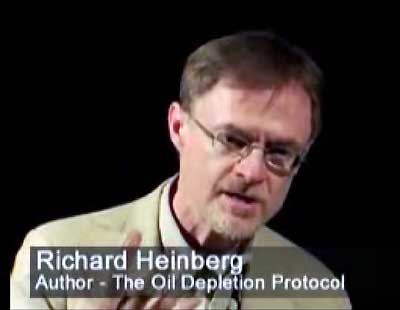
It's a shame an otherwise smart person like Richard Heinberg has bought in to this stuff. IMO it is a real problem for the Peak Oil 'movement.' Journalists like Alexander Cockburn IMO are lumping Peak Oil in with 9/11 'Truth Movement' nonsense.
If I were given to conspiracy theories, the only conspiracy that makes sense here is that the Bushies are helping to spread this nonsense to divert attention from their real crimes.
Indeed. All this ranting about the WTC, Halliburton building prison camps, etc. is doing a fantastic job of distracting people from the fact that Bush has completely screwed up and is instead focussing the attention, unfortunately, on what idiots his most dedicated opponenets are.
It's ironic that those who think they are Bush's greatest opponents are giving him a bigger boost than his helpers. With enemies like these, who needs friends.
I am looking to buy more oil futures soon, probably in the next few weeks depending on how things develop. My guess is that oil will probably keep bouncing off support at least until the 25 October Fed meeting, absent some geopolitical wild card. Last year oil didn't get going again until December. After that, hello new highs in 2007. I am pretty strongly convinced that in 2007 China demand growth plus depletion of production will exceed Western demand destruction.
I listened to a video of a seminar on 9/11 a month or so ago that included a BYU professor in, I believe, physics or something like that...the most unlikely of supporters of the "conspiracy" theory, yet he said that he was able to analyze a small piece of the molten iron from building 7 and that he was able to prove that it was a demolition job. A few weeks ago, Bush visited Utah and within days of the visit, this professor at BYU was placed on administrative leave.
I apologize for not being able to remember this professor's name.
And the conspiracy idea is already too large to hold togeather, it must have involved dozens, no hundreds of people. The only power strong enough for that is real terrorists doing a real terrorist attack and government incompetense doing real life fumbling of the protection against it.
I guess one of the reasons that some americans search for a conspiracy is that it is a bad feeling to recognice that your authorities are incompetent and parts of your state are failing. Its a lot better if there is some evil incarnate responsible for the evil deeds becouse then the problem is easy to fix. Find the bad guy, punish him and things start working well again. I am quite sure it isent that easy.
I guess I have to get used to all kinds of loons using the real peak oil problem as a pre text for their favorite problem or conspiracy. This ought to cloud the peak oil issue and make it harder to debate and propose actions for mitigating the problem.
Plese keep theoildrum fairly clean of loony theories or it will become useless.
100 per cent agree with you.
Many people forget that suicide attacks of that type were simply unthinkable before 2001/9/11 - no matter what was said after they were performed.
And iron does not need to melt, until 100,000 tons of building above it come down.
How does it feel to rejuvenate already debunked lies of the government, warm isn't it?
Besides, there were so many blackop and compartmentalized projects in the past kept under the lid for several decades that the other comment has no ground as well.
In case, you are for real and open to critical thinking check out for instance the cooperative reseach timeline where is all documented beyond reasonable doubt:
http://cooperativeresearch.org/timeline.jsp?timeline=complete_911_timeline&before_9/11=militaryE xercises
Here I am, ready to learn.
Which civil jet plane was directed to crash into a building before 9/11?
Between October 24 and 28, 2000: Military Holds Exercise Rehearsing Response to a Plane Crash at the Pentagon
Pentagon and Arlington County emergency responders assemble in the office of the Secretary of Defense's conference room in the Pentagon for a mass casualty exercise ("MASCAL"). The exercise involves three mock-scenarios. One is of a commercial airliner crashing into the Pentagon and killing 342 people, while the other two involve a terrorist attack at the Pentagon's subway stop and a construction accident. The exercises are conducted using a large-scale model of the Pentagon with a model airplane literally on fire in the central courtyard of the building. An Army medic who participates in the mock attack calls it "a real good scenario and one that could happen easily," while a fire chief notes: "You have to plan for this. Look at all the air traffic around here." [MDW News Service, 11/3/2000; Mirror, 5/24/2002; United Press International, 4/22/2004; 9/11 Commission, 7/24/2004, pp. 314]
Than you have the Bojinka plot of mid 90s or the intel warning about aircraft highjacks in the early 2001..
First: I have not replied to your posts - you started this with a reply to mine.
Second: You could not name one airplane that crashed into a building before 9/11. You give lotsa of links about warnings that this might happen.
But there is a huge difference between things that can be imagined, and those that actually happen. It's thinking here, and reality there - yes: unapprehensable reality.
Inapprehensable reality happens to be a book title by the german writer Hoimar von Ditfurth ("Unbegreifliche Realitaet"). If you want to learn what it is, why not ask the security staff on London airports?
You'll easily be able to show me oodles of web sites where you can learn how to mix fluid explosives. Or where counter measures are described. But for years that all was just imagination. Now it seems to be reality!
I've demonstrated to you that the Pentagon brass were training for this eventuality prior 9/11 which they acknowledge even in their official 9/11 report. Condie lied and perjured herself on TV about it..
In terms of the "London liquid plot" that's another comedy.
The highjackers even did not have tickets, and the "explosive mix" was not going to function without high grade lab equipment to finalize it as hinted by many scientists who evaluated this bogus case. I hope you don't expect them to board the plane with a laboratory..
Please come back after your 12th birthday, will you?
Yes, Sir.
Eeh, no, Sir. I won't stay away or come back in your discretion. Perhaps I'll even say things that don't match your opinions.
BTW: your ad hom attacks go to a man who is probably older than you yourself.
But none the less according to the 911 report they had no previous contact with US military assets. This is the key. None.
Hmmm..read Ahmed "The War on Truth" where he documents with verified stories by credible news sources, especially the few weeks that followed. The arab engineer hijacker's american girlfriend was going through his suitcase and found US military documents.
CYA time! Do you think the USA government is going to admit they were played by these guy's. The "Mother of ALL Blowbacks". Is your agency going to admit it helped train these guys?
If US assets were found to be supporting the plotters, heads would roll...perhaps even the president may have to resign. How do they turn a disaster into a huge political win?
First and foremost, you cover up any and everything connecting these guys to any US assets, military and otherwise.
Now that's a set of conspiracies!
Let's face it. The 911 plot, it's execution, the timing during exercises to take aircover away from DC and NYC is full of areas that are hidden or unresolved. The 911 committee members Hamilton and others just published a book saying the military lied about its timeline. We only know a bit about these military wargames. It seems there may have been 4 of theses operations happening simultaneously (jet attacks on commercial planes, on intercepts, etc...
As far as the collapses...study the films of the falling, it clearly shows the fall starts from the area weakened by the crash and subsequent fire. Use the razor. By the way, engineers and physicists can disagree about the cause of something...and can have good arguments. In that case we set up tests of the hypothesis. Difficult to do here.
On the discover channel there was a recreation of the Kennedy Shooting using computers to find the actual position and angle of the shooting. Then they created dummies made of bone and gell material that is supposed to mimic human flesh in density and mass. They lined the dummies up, took the angled shot with the same rifle and bullet. Same wounds and damages to both. The bullet looked pristine. Exactly as the commision said it happened.
But what a waste of ink on all these years on the "Magic Bullet Theory".
Condi can't remember the meeting warning her of 911. "It's incomprehennsible I could forget a meeting like that".
Calling people "loons" is a logically irrelevant ad hominem attack. These "loons" have copious hard evidence of all sorts, analyzed in a highly rational manner, that supports their position. If there are flaws in their reasoning (and there may well be, especially given the excruciating complexity of the subject matter), they are subtle ones. Their reasoning deserves to be looked at on its intrinsic merits. Not to do so is an instance of A PRIORI closed-mindedness that can itself not be rationally supported.
Having said that, your objection that a government conspiracy would implausibly require the participation of hundreds if not thousands of conspirators has some substantive merit. What is therefore needed in the debate is a better understanding of how the power structure of the intelligence services and military is integrated into the powers of the US government, the rules according to which knowledge is compartmentalized, the types of people who become intelligence operatives, etc. Such analyses would perhaps shed light on whether your objection has trump-card merit in the debate.
Exactly. I may save this and post it again whenever these topics come up.
Half the time TOD ponders why the outside world isn't buying it message and then spends the other half trashing that same message.
I have to say that TOD recently has made me wonder if this whole thing isn't just a doom cult. I am convinced that peak oil is a reality, but am starting to get a lot more sceptical about other aspects of the broader "movement".
Calling people "loons" is a logically irrelevant ad hominem attack. These "loons" have copious hard evidence of all sorts, analyzed in a highly rational manner, that supports their position. If there are flaws in their reasoning (and there may well be, especially given the excruciating complexity of the subject matter), they are subtle ones. Their reasoning deserves to be looked at on its intrinsic merits. Not to do so is an instance of A PRIORI closed-mindedness that can itself not be rationally supported.
Assume that they are right and there realy is a giant 9/11 consipiracy set up by parts of the US governmnet and so on. What could we do then? Overthrow the US government? Ruin most of the authority there is in hope of some good order emerging out of a chaos? You seldom get a new good order out of chaos. If there is a conspiracy and there relay are such powerfull evil people around whose schemes might break down any minute you will have the biggest positive impact if you show those super powerfull people the most constructive way out of this dead end. Get them to build something constructive and compete in ways that adds value for future generation. If they excist and can pull off a 9/11 conspiracy and so on starting serious peak oil preparations will be a piece of cake for them.
Thats my two cents on how to get people with a flawed world view to anyway do some good deeds.
Bob, I am surprised that you post shit like this. You usually do better. From Chimp I could expect this kind of crap but not form you. There was no molten steel and no thermatecut steel beams. Every very stupid claim of the conspiracy theroists have been refuted over and over again, including the ones that were brought up in the lead story of this DrumBeat. I am shocked that such crap was posted here. It detracts from the seriousness of this site and makes us out to be a bunch of wackos. At any rate, concerning the "Molten Steel":
But here is the one thing that everyone overlooks. The one thing that no conspiracy theorists can refute. Both towers collapsed from the point of impact downward. That is, from the point of impact the upper floors pancaked downward on the floor below it, and then the next floor collapsed, and then the next floor. The videos of the collapse clearly show this. Now you tell me that an army of engineers sneaked into the Twin Towers, cut into the beams, planted explosives in them, and exploded each floor from the point of impact down? How the hell would they know wher the impact was going to be?
So for god's sake, let's stop this very stupid shit. Would all conspiracy theorists take their stupid shit to some stinkhole conspiracy theorist site where it belongs.
Ron Patterson
The level of 9/11 discourse is amazingly low. The absolute nadir was the Popukar Mechanics article. Any ordinarily bright skeptical 6th grader would have been insulted by that piece. Except that skepticism is bred out of most by the 6th grade. No adult took that rubbish serously unless he or she had previously made up their mind and closed their mind.
Moreover, the fact of feeling impelled to engage in cheap ad hominem attacks in the place of rational discourse is often a sign of insecurity and fear on the part of the one launching the attack that their own position might not be so intellectually tenable as they would like to believe.
Ha, ha, ha. Popular Mechanics has already done an excellent job debunking 9/11 myths, no need for me to add anything.
Besides 'been there, done that' when I tried debating the lunar landing conspiracy theory. So I know just how futile it is, and what kind of pathetic loosers conspiracy theorists are.
And let me tell you, they are not even deserving to drink out of my toilet.
If I proposed anything it was please let us not fall out amongst ourselves so easily. Let us not trash Richard Heinberg in such a high-handed manner. Accusations about who works for the government and imputation of motive are wildly innapropriate, not to mention conspiratorial.
My reading of Occam's Razor on this one is that both the official non-explanation and the notion of a small army of demolition men working nights for a month are impossible. Occam's directs one to the simplest explanation after the impossible is eliminated. Everything I've read proposes impossible theories and I dunno what happened.
James Kunstler is vehemently on record as denying a government conspiracy, but he has very little to offer in the way of refutation other than violent ad hominem attacks. As a very general matter, in fact, the published attacks against "conspiracy theorists" tend to be short on detailed examination of relevant evidence, and very long on the deployment of ad homimem attacks bearing no logical relevance to the evidence. (This is not universally true, of course, but the tendency in this direction that I have observed really is quite pronounced.)
Darwinian,
All I can say is Amen
Occam's razor
entia non sunt multiplicanda praeter necessitatem,
entities should not be multiplied beyond necessity.
Roger Conner known to you as ThatsItImout
In the absence of having done this type of research, you do not in fact know just who it is that is violating Ockham's Razor. Griffin's work leads to the conclusion that it is the Government that has done so, not the "conspiracy theorists."
And would all conspirists answer at least some of these questions:
Why didn't the USA and its allies invade Saudi Arabia and others in 1973 after the 1st oil embargo and take the oil?
Why didn't the USA invade Iran in 1981, free the hostages in the Tehran embassy, kick Khomeini out, reemploy another sort of Shah and take the iranian oil?
Why didn't the USA occupy Iraq in 1991 in 'desert storm' and take the iraqui oil (instead of stopping short before Baghdad)?
Why would the USA have an attack on its own ground performed, have killed thousands of fellow americans, just to have a pretense to overcome Afghanistan and Iraq?
Neocons were not in command.
P.S. You are not that good at your job, your arguments are too transparent, this is TOD here not Fucks News.
The USA did attack Iran back then. (It was 1980, not 81.)
But the American generals were so smart they refused to listen to Israeli warnings and put sand screens on the intake manifolds of their commando aircraft.
Do you know how to spell f-i-a-s-c-o ?
I guess they don't list that "Mission Accomplished" campaign in the American history books under Yankee ingenuity and the unbeatable West.
Precisely! Recall my posts on Foundation and the applicability of induced perturbations to drive predictive collapse and directed decline. Fine tuning is ongoing as we speak, but success is of course not guaranteed. Such is Life.
Bob Shaw in Phx,Az Are Humans Smarter than Yeast?
Yes, and that is why such things are called Folly.
It's not the first, and it certainly won't be the last, time that rulers of countries have done stupid things.
Though I see the point, getting the reasons to be worried about peak oil out. But at times by tying the two concepts together you get understanding and then you get rage at the second half. They completely forget what you got them to understand with the first half of the video.
I personally see the connection. If anyone has read my short story "Joe and the airvent" over on my blog. They can see I have been thinking of how things are going for decades. We are getting further along toward not being able to stop having a police state in this country.
The Peak oil happening has never been the issue here at TOD, what we seem to dicuss more is the "When" and the "How Will We Know" concepts. We also what to get more people on the bandwagon. Not everyone can wrap their head around the 911 was a big plot by the people in charge, and or the people who wanted to stay in charge to stay in power and keep the WEST in the oil and their citizens from revolt. But a lot more people can understand that the bank is half out of money and no matter how much you beg for more you only have half of what you had in there at the start.
So If you are new to this whole thing, don't turn off the friends and family on to the video without knowing if they can take the second half of the message.
Admittedly, I have not discussed this issue with many of my friends or family. The few I have talked to, except one or two, don't want to hear it. They simply cannot accept the concept that our government (or a faction within it) would do such a thing.
I think the point you are maybe missing about
this Documentary is that the second half of the
docu IS the point they are trying to make. All
of these guys are Peak oil gurus. They have been
making the peak oil case for years upon years;
In some great books and tour and docu apperences.
There is not much more for them to say upon thatsubject, minus maybe last months production
numbers, or debating the mysterious low gas
situation.
I Think maybe, they are just coming around to
the 911 theories. There is certainly no mention
of it in "The Party is Over" (even the updated
version). Other than Mike Ruppert, 911 theorys
where never brought into the peak oil debates
before this documentary.
It is very "interesting" to see these several groups
of theorys and ideas come into focus. One can
only hope the US wake's up in time..
The non-anglo world i think finds it much easier to believe in elite plots and blood sacrifices, those characterising western interventions in so many countries for so long.
9/11 Press for Truth is a mature look of the 9/11 families on how the government promises about real investigation which was established after delays and ONLY THANKS to their constant presure in the form of the Bush appointed Kean-Hamilton-Zelikow Commission, turned out to be in the end a sick joke..
9/11 Press For Truth:
http://www.911pressfortruth.com/story
Video Google:
http://video.google.com/videoplay?docid=5589099104255077250&q=press+for+truth
If you get lucky you find it in your local cinema or it can be also ordered as DVD.
High quality:
http://www.archive.org/details/ThePowerOfNightmares
Lower quality (1-3):
http://video.google.ca/videosearch?q=power+of+nightmares
Also, there is this brand new documentary "Kill the Messenger" about the FBI whistleblower, the Sibel Edmonds case. Aired numerous times on the french TV Canal + this month. It will got int. TV distribution soon and perhaps resurface on the net later as well:
http://justacitizen.com/KillTheMessenger.html
Although the skeleton of her story is out there from the start, Edmonds is currently gaged by synergetic efforts of numerous institutions, courts, DOJ, FBI, and Congress.
Basically, her case is about the underground Turkish-Israeli-Pakistani bazaar where conventional, nuclear arms, genuine and infiltrated terrorist cells, drugs and campaign slush funds for D.C. figures like Dennis Hastert but Democrats as well merge into one smelly river.
This is the very same government faction which has intentionally blown up the cover of the Valery Plame and her CIA front company Brewster Jennings, which was on the trail of these rough networks in the ME.
Basic timeline of her case:
http://cooperativeresearch.org/timeline.jsp?timeline=complete_911_timeline&projects_and_programs =sibelEdmonds
Furthermore, as someone already pointed out, if there is a conspiracy it would have to involve hundreds of individuals. And the probability that none of them would have given something away by now, deliberately or not, is just about zero.
People have the right to dislike any political party or ideology. But I am fairly confident that it makes NO difference whatsoever which political party is in office. No politician wants to tell the public that economic growth most likely will diminish a few years from now, with everything that such a statement would imply. It is impossible to win elections on such statements. We are simply going to have to wait for the peak to happen before politicians have the guts to acknowledge the problem.
The problem with Heinberg is that given his leftist background he appears to want to blame the "neocons" for everything. He should be focusing on awareness around peak oil itself, and not make politics out of geology.
Let's not discuss the pros & cons of conspiracy theories here at TOD ... let's just politely ask that the discussions be taken to another website.
TheOilDrum.com is (was?) a haven for sane technically oriented discussion.
If TOD falls to the barbarians where can I go next?
Is there another peakoil techie discussion website out there which has not yet been overrun?
If not, then this infection of TOD will simply mean that the general web public have nowhere to go for hard data & related discussions on the topic of PeakOil.
"Big Oil" will be able to dismiss Peak Oil as simply the rantings of deranged conspiracy theorists.
But this very thread is partly about the new movie featuring Richard Heinberg. I'd not plug "reinvestigate 9/11 cause" into any of the other technicals thread here. So far, I have not been approached by any of the senior and trusted members of this community to take my "rantings of deranged conspiracy theorists" away.
Richard Heinberg is a credible and sane person.
On the other hand I don't know you, what is your contribution?
You might also entertain the question from another angle, if you don't like it here please go somewhere else and take your baseless attacks as well.
http://www.theoildrum.com/comments/2006/7/29/9302/67067/16#16
You are a propagandist and it is fair to point that out.
So much for you "investigative research"..
Point stands.
May I remind you this is a Peak Oil technical forum ... as far as I know it is NOT intended to be yet another forum where armchair pseudo-scientists witter on about "thermite, "thermate", "free-fall velocities", "shills" etc etc.
If TOD has fallen prey to the Borg-like spread of this silliness, fine ... but as I asked in my original post, what other discussion group covers Peak Oil in a technical manner?
If you know of a respectable technical Peak Oil forum which simply focuses on - err - Peak Oil then please do advise me - I would be glad to move there.
You too have offered nothing rational to oppose anything the 9/11 "conspiracy theorists" claim, but merely a string of logically irrelevant ad hominem attacks in the form of crude name-calling. The 9/11 "conspiracy theorists" have copious hard evidence of all sorts, analyzed in a highly rational manner, that supports their position. If there are flaws in their reasoning, they are subtle ones. Their reasoning deserves to be looked at on its intrinsic merits. Not to do so is an instance of A PRIORI closed-mindedness that can itself not be rationally supported.
Also, it is not for you to police what does and does not get discussed in this forum. The question of who brought about 9/11 has intimate and intrinsic connection to the issue of world-wide oil depletion, a fact that is sufficient to make the issue worthy of attention on TOD..
This is a Peak Oil forum - not a 9/11 forum.
I simply want to discuss technical aspects of Peak Oil ... not 9/11 tales.
I refuse to fall into the typical conspiracy theorist trap of YOU forcing ME to disprove YOUR allegations:
- If I don't respond to your "challenge", you "win".
- If I DO respond you will throw a barrage of "facts" at me until I tire ... you win again.
- If you tire, then one of your "colleagues" will join the fray until I really do tire ... you win again.
- If I have the stamina of Superman and knock down your "facts" with REAL data you will simple scamper off without admitting defeat and pop up with ANOTHER question requiring me to knock that down too. I will tire eventually - you win again.
I know this is how the 9/11 conspiracy infection works, because I actually did some research on 9/11 and found that I could NOT agree with any of the "facts" once I had done enough digging.The sad thing was that none of the pro-9/11 conspiracy crowd would accept defeat on a single point ... even when I produced techical PDF reports on, say, the effects of explosives which proved they were wrong. It's a bad sign if you can't accept the refutation or modification of even a single minor point of your pet theory.
I just hope that any uninfected person who is reading this will pause for a moment if ever approached by a 9/11 evangelist. Once you are in that rabbit hole you are doomed. Your only chance is if you are an engineer or physicist who can validate the pseudo-science claims for yourself.
Anyway, if TOD ends up full of 9/11 discussions I will indeed move away and leave you all to your fate.
In fact after this post the Borg vitriol beams will be set to "kill" so I think I'll move on anyway .... I really have had enough of fighting the 9/11 Hydra.
The goverment account of the events is not true. Call for reinvestigation is legitimized at the minimum by the extensive research done by the 9/11 families.
Why & how would I want to provide "facts" on 9/11?
Was I there? Were YOU there? Neither of us can provide new "facts" on 9/11 ... although there are certainly enough people pumping out quasi-facts based on pseudo-science.
It's amazing how so many chair-bound web surfers reviewing media photos about 9/11 can out-think the investigators on the ground. Case solved - George Bush did it!
Anyway, as I said before, this is a Peak Oil site not a 9/11 site.
I simply want to find a Peak Oil site which focusses on Peak Oil.
PeakOil.com has been overun by racists and conspiracy theorists so I though that TOD might be a safe haven.
How wrong I was ...
"It's amazing how so many chair-bound web surfers reviewing media photos about 9/11 can out-think the investigators on the ground. Case solved - George Bush did it!"
Again, I said the 9/11 Comm report can not be trusted it's own board members leaked they have been lied to by Pentagon and the inner circle of the admin etc. So, you reasoning is clearly false.
Who did I don't know. New investigation is needed.
Obviously he who changes the story numerous times and hides, destroyes evidence is a suspect.
Great phrase by Heinberg.
"Group winking" ?