
 | Dr James Hansen: Can We Still Avoid Dangerous Human-Made Climate Change? | The Oil Drum: Europe | The architecture of UK offshore oil production in relation to future production models |  |
How to Address Contrarian Arguments - part I
Posted by Luis de Sousa on November 23, 2006 - 1:50pm in The Oil Drum: Europe
Most commentators simply dismissed Peak Oil as a possibility. My first reaction was of nausea, I just couldn't believe it; these people are completely delusional. With so many people thinking like this, will we ever be able to change something, to have some kind of impact?
Then I thought I could make something good of it, because that thread had the value of being a collection of the main contrarian arguments against our message.
This is the first of a series of posts where I'll analyze the kind of contrarian arguments seen there and how to address them.
The dreaming city
If you ever read Michael Moorcock you'll probably know of Imrryr the dreaming city. Imrryr was a major city port, the center of a mighty empire, where people attained such dominance and power that they were always drugged (dreaming) in completely disconnection with reality. The dreaming was so grave that they just failed to see the end of the empire and the city, brought by the emperor himself. The folk commenting at SlashDot surely looked like Imrryrians at the edge of time.
People do not face reality. In our immense affluence and well being we just turn on the TV and let those images flood our brain without questioning it, without saying "is that so?" The Media just throw it at us without a second thought without a rebate. Remember that more than 50% of the Americans believe that Saddam Hussein was responsible for 9/11. Most of these comments got at SlashDot are based on the common sense got from the same MSM that created those beliefs. You know, at the edge of time...
There's a Peak coming
 Ah! November, the month of sweet chestnut harvest, and of new wine tasting! Now, you love sweet chestnuts and on St. Martins' day you buy a hundred of them. On that day you just eat one, properly roasted on dried pine needles. But it's so tasty and sweet that on the next day you have two; on the third your mouth is watering and you have four. You go on like that until you've finished the hundred bundle. Then in your immense unhappiness you look back and see that there was a day when you ate more than on all of the other days - Peak Sweet Chestnut Day.
This small parable is just to show you a very simple (and quite obvious) fact: a Peak is a mathematical result of growing consumption of a finite resource. Nothing can change that, even if you think that Oil is abiotic in nature (this issue will be dealt with in a subsequent post).
Peak Oil also brings with it the concept of peak occurring around the point in time where half of the recoverable resource is extracted. In our first parable this isn't the case, nothing stops you from eating more sweet chestnuts every day, until the resource isn't there. Of course your digestive system could put some restrain to that.
So it's quite common to get a question like "Why is the peak at the middle?" There's no easy direct answer besides the vague "That's how things grow in Nature." To understand the peak-in-the-middle concept we need another parable: The wood pile vs. wood land parable. You can find the hole story at WolfAtTheDoor.org.uk, here's the essential (homage to Paul be made - WATD improves from day to day and it still is one of the best websites I've ever surfed to, not only in content but also in design):
Woodpile v Woodland
Oil production can be best understood by comparison with something such as wood. Imagine an island where there is one carpenter. The R/P ratio basis of oil usage revolves around the assumption that oil production works like a woodpile in the carpenter's backyard. Whenever he needs woods, he walks out to the pile and takes however much he requires. If things get busy and he needs more wood, he simply takes more wood from the pile. There is always enough to satisfy his needs until that fateful day when he removes the last plank and it is then all gone. The only factor in its price is demand - if fewer people want wooden things, the carpenter lowers the price to stimulate demand. If he has plenty of work on, he can increase the price and get the benefit.
Comparing this with oil, if the world has 1,050 Gb of oil remaining and we use 27 Gb a year, then dividing one by the other means that we will be able to use 27 Gb of the woodpile for another 39 years. Then the yard will suddenly turn out to be empty.
But oil does not sit in one huge whole in the ground, constantly being pumped out. Rather an oil field is a set of wells of different sizes, with new wells being set up as old ones dry out. The R/P ratio takes the view that the oil has already been found and is sitting patiently in the backyard. In reality, it is more like woodland than a woodpile.
If we imagine instead that our carpenter had to chop down a tree every time he needed to make something, the problems become more evident. Trees vary in their size, proximity and quality. Initially our man would pick those that were large, good quality and nearby. As this was relatively easy, his prices could be kept low. But, as time went on, he would have to cut more trees of smaller sizes, travel further to find them and use wood of a lower standard. This extra work would take longer and naturally result in higher prices. Eventually, unless the trees were managed and replaced, he would find himself unable to find enough wood to satisfy his customers.
But couldn't he cut the trees quicker to keep production up? He certainly could employ someone to help him (which would be like drilling more wells) but that would result in depletion occurring more quickly, and the quicker you cut away the large and nearby trees, the quicker you have to resort to the small and distant ones. New technology can only help so much; no matter what circular saw or four-wheeled vehicle you have, there's always a certain minimum time needed to cut down and drag a tree to the workshop. Production still falls, the best you can do is change the angle of the slope on the chart. Any increase in production means a gentler initial decline and a steeper subsequent one.
Oil production works in a similar way with the important distinction that, unlike trees, we cannot replace the oil we use. It is as if every tree the carpenter cut down was gone forever.
Looking at it from an EROEI perspective: as consumption grows, the resource needed to feed it also grows. Imagine Conventional Oil has an EROEI of 1 to 10, if in 2005 26 Gb where consumed, the equivalent to 2.6 Gb of past production was used to create the current rate of consumption. If you want to produce 27 Gb the next year you'll have to spend 2.7 Gb of past production to achieve it.
Like Paul explains the problem is that the biggest and closer to home trees go down first (the low hanging fruit). This tells you a very important thing: EROEI for an unevenly distributed finite resource is not static; it decreases with the amount of resource consumed.
And this is the drama, the fraction of the current harvest used to maintain and grow the future harvest starts increasing, eventually overwhelming the harvest - making it peak and decline. Going back to the previous example if EROEI felt to 1 to 5, instead of neading 2.7 Gb to get 27 Gb the next year, you would need 5.4 Gb.
Curves
 The Hubbert Curve is the first derivative of the symmetric Logistic Curve (seen here at the right). The Logistic function was formulated by Verhulst (and hence also called Verhulst curve) in the XIX century, to model population growth in Nature. The Verhulst curve gives you the cumulative growth (e.g. total oil consumed up to each point in time), whilst an Hubbertian gives you the rate of growth (e.g. the oil consumed in each point in time). The first is an S-shaped curve, the second a Bell-shaped curve. Not only in Nature, but also in Human-led events, these kind of curves model growth with success.
The Verhulst curve can have all sorts of forms with a later or sooner peak producing an asymmetric first-derivative curve. In Nature you can find different kinds of Verhulst curves each representing different environments of growth; one very common is the Gompertz Curve, which describes asymmetric growth that starts stronger and ends weaker (such was the case of cell-phone use growth).
Unconstrained growth in an environment where the resource is finite and unevenly distributed usually follows a symmetric curve, hence having an Hubbertian first derivative. I surely haven't seen any example where it happens differently.
The robustness of the Hubbert curve is its simplicity (only two parameters) making it really easy to use (Hubert Linearization). Moreover, if you are in presence of an asymmetric growth phenomenon you can still use the Hubbert curve to get an idea of when the peak will be.
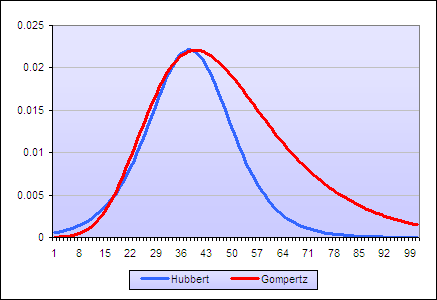
An Hubbert curve can be used to find the peak epoch of an asymmetrical growth phenomenon.
Summary
A peak in consumption versus time is a mathematical result of growing consumption of a finite resource. Denying it is going against mathematics, or saying that 2 + 2 != 4.
Oil will likely present a peak at midways of depletion for it is an unevenly distributed finite resource. The "low hanging fruit" goes first - it's easier to find and maximizes profit - making EROEI decreasing with time.
The bell-shaped curves allows for the mathematical modeling of growth phenomena. Even if oil proves to yield an asymmetric bell-shape curve, modeling it with a simple symmetric curve can identify the epoch of peak.
This first post laid down some mathematical grounds for a layperson to understand that Peak Oil is a reality; in the following posts we'll deal with comments like this:
Using energy, particularly derived from fossil fuels, is a RIGHT! Nay, an OBLIGATION!
Only a terrorist or a commie pinko would think of energy usage as a cost, something to be balanced and minimized!
See ye,
Luís de Sousa (fka lads)
Personnel
Editors
Contributors
Peak Oil Primers
Archives
- November 2010 (3)
- October 2010 (6)
- September 2010 (4)
- August 2010 (7)
- July 2010 (6)
- June 2010 (7)
- May 2010 (2)
- April 2010 (8)
- March 2010 (4)
- February 2010 (6)
- January 2010 (3)
- December 2009 (5)
- November 2009 (8)
- October 2009 (12)
- September 2009 (6)
- August 2009 (5)
- July 2009 (11)
- June 2009 (8)
- May 2009 (16)
- April 2009 (10)
- March 2009 (7)
- February 2009 (10)
- January 2009 (15)
- December 2008 (9)
- November 2008 (9)
- October 2008 (9)
- September 2008 (13)
- August 2008 (10)
- July 2008 (14)
- June 2008 (23)
- May 2008 (16)
- April 2008 (12)
- March 2008 (16)
- February 2008 (9)
- January 2008 (13)
- December 2007 (13)
- November 2007 (16)
- October 2007 (22)
- September 2007 (8)
- August 2007 (9)
- July 2007 (16)
- June 2007 (8)
- May 2007 (7)
- April 2007 (7)
- March 2007 (10)
- February 2007 (10)
- January 2007 (12)
- December 2006 (9)
- November 2006 (15)
- October 2006 (4)
- September 2006 (5)
- August 2006 (5)
- July 2006 (9)
- June 2006 (5)
- May 2006 (10)
- April 2006 (9)
- March 2006 (13)
Vital Trivia
License

This work is licensed under a Creative Commons Attribution-Share Alike 3.0 United States License.
TOD/EUR is one place I am going to have to check more often because of the quality of the posts! Hopefully more Americans will become concerned enough to check what is happening on 'the other side of the pond'.
As I see it, the biggest problem overcoming denial of Peakoil is that right at the Peak is when there is the maximum of everything.
Plastic junk, # of car & SUV models, cheap vacation flights, grocery stores full of food choices flown & trucked in from who knows where all year round, cheap computers and other appliance items, maximum extent of maintained asphalt & concrete roads,...on and on!
People cannot believe it could ever end! Their eyes, ears, sense of touch and taste, even their emotional desires are maximized to the full extent they can afford.
Even if you are a poor Bangladeshi, who has never known anything but a bare subsistence lifestyle: as long as your decline occurs slowly so as not to radically jar your memory: he still cannot comprehend the true magnitude of the forces arrayed against him.
It is only when a person truly engages their grey matter above the higher level of the lizard brain that they wake-up and say 'uh- oh, something is not right with my mental picture".
Even I find it very hard to overcome my senses in terms of Peak Everything. A good mental 'grasp' of the true situation is like
wanting to hold a red-hot steel poker in your bare hand. Sometimes, even I get burned out on PO + GW and have to temporarily withdraw into what I call my happy, mindless idiot mode. The truth hurts.Bob Shaw in Phx,Az Are Humans Smarter than Yeast?
Inebriated by all that comfort and easy living, they lost contact with the physical realities of the environment where they live. The more they break the physical constraints around them the harder it gets to see the consequences.
They don't know it, but they are On The Edge of Time.
Having been basically called names (for questioning whether Peak Oil would happen, and how it would happen) it is my first experience of the 'persecuted minority' thinking in some time.
I'm not adverse to the principle of Peak Oil (it's trivially true, in the sense that oil is an exhaustible resource-- one simply needs to remember that control of Rumanian (or Romanian ;-) oil in the first half of the 20th century was a major strategic issue-- to remember that oil is produced, and production declines).
Then I committed the heresy of suggesting that 'Peak Coal' wasn't something we should worry about too hard, because the CO2 emissions from our existing, proven coal reserves could kill us off first ;-).
I basically got told that I should google world coal reserves, and then I would agree with the poster's analysis that we only have 30 years of coal left (in the scenario of Peak Oil. So the logic chain isn't just 'we don't have much coal' but 'PO is now, therefore we don't have much coal').
If the first was questioning the divinity of Christ, the second was questioning the virginity of Mary ;-).
We need to unify against our true enemies here, gang, I mean the People's Liberation Front of Judea ;-).
So it fascinates me what reception a genuine PO sceptic would get from the 'informed' 'thinkers' here. Probably a public lynching ;-).
The only true signal one would get of Peak Oil is an explosion in the oil price*. Because
Demand = supply + changes in inventories
Only in an extreme case (where a much cheaper substitute had emerged) would the price of oil be falling at the same time as supply was peaking ie you would need wholesale 'demand destruction'.*
Since there is no sign of that at the moment, and indeed oil prices are falling, we are not (yet) at Peak Oil.
* that signal would not be unambiguous either, unfortunately. There are lots of reasons why the price of oil might go up, or production might decline, which are *not
the result of geologic oil exhaustion. Mostly they are geopolitical in nature.* there are some interesting results out of Systems Dynamics models. If you postulate very long supply and demand lags in response to changes in price (which is what oil is) then you could get a 'stuttering' market effect, where prices are very volatile.
Basically demand is lumpy (the decision to close an oil refinery, or to switch locations to economise on road transport, is a major capital decision), associated with the differences between fixed and variable costs. At the household level, the decision to add extra insulation or buy a more fuel efficient car won't happen just because oil prices have shot up-- it will have to look like those changes in oil price are *permanent
and worth the additional cost. And households are constrained in all kinds of ways (borrowing limits etc.).Supply is lumpy in part because there is oligopoly in the oil production market: for small oil producers especially, it may be sensible to ration supply in face of future prices (this is called 'OPEC' in the real world ;-). It's also lumpy because of the 'hit and miss' nature of oil development-- you pay lots of money for drilling rights, and then you hit dry holes.
Deffyes talks about this 'stuttering' in prices in his second book (inferior to the first, I thought) ie the idea of applying queuing theory.
I think that what you wrote about "stuttering prices" is right, but therefore negates what you wrote above that: "an explosion in the oil price... there is no sign of that at the moment". It's fallen somewhat in the last couple of months, but it's triple what it was a few years ago. If you look at the big picture and ignore the "stuttering" I think that the price signal is there. There are also indications of some "demand destruction", and no indication of "spare capacity".
I was struck, f'rinstance, by the rise in US SUV and light truck sales. Not a harbinger of falling gasoline consumption!
As to prices. In a world with very price inelastic supply and demand, you would get the same kind of price volatility. I think you could fairly argue that the previous price of oil was 'too low' rather than the current price is 'too high'. There is a minimum price (around $40-45/bl) which triggers new entrants such as Canadian oil sands production-- which is, indeed, happening.
The fact remains oil prices are below their recent peaks, below their all time peaks (1980) by a considerable margin, and consumption, AFAIK, is still rising.
We might be close to Peak Oil, but the market isn't telling you that yet.
It seems as if oil consumption is still rising, inventories are static, therefore supply is still rising. And, indeed, prices have fallen back.
You can tell a commodity is exhausting, if the price rises. For a long time, the real price of oil fell (1). It has now in some sense 'caught up' to where it might be (on a long term growth track).
(1) my own theory on that is that for a long time, OPEC was able to hold the price of oil higher than market forces would have let it. OPEC is a profit maximising oligopolist, and therefore reduces the quantity of its commodity supplied below the free market level (and secures a higher revenue for its efforts).
And there were genuine efforts to conserve energy (not so much in the USA post CAFE, but in Europe with high gasoline taxes, encouragement of diesel cars etc.-- and businesses worldwide sought to reduce their vulnerability to oil price swings). So you had less demand than market forces would have dictated, and at the same time 'held back' supply.
Eventually that played out as the oil price collapse of the late 90s. But in the 2000s the rise of China and India, plus continued growth in US oil consumption, has 'eaten up' the slack capacity in the system.
The oil traders, who have a big influence on the day-to-day price, seem to react to the "inventories". But I think those inventories are vastly over-rated. They are only a few days, perhaps 2 weeks, of supply. And they're not a lot higher than they were - the "increase" is what, less than one day's supply? Drawdown form tank farms in KSA and Europe can easily explain the commercial "inventories" in the USA. Meanwhile the SPR is lower than it was (pre-Katrina).
Also, like WT says, the bidding war for oil happens in spurts. So the "demand destruction" in poorer countries brings a temporary bit of "relief" to the richer countries, until the next round of bidding. It's a "musical chairs" game and the chairs are slowly disappearing even if some fat asses are still sitting.
Anyway, I am not saying that the price signal is perfect. Not at all -- that is why Peak Oil is so difficult to tackle. The Market is mostly blind, until near the end. The current visibility of some price signal is thus a sign, although uncertain, of imminent peak.
Finally, I don't think that "peak" is the important point in time. Supply can fall behind demand even before the peak. You would expect it to, since the supply curve flattens out as you near the peak, and the demand curve is still rising, even faster (e.g. China). With the globalized economy dependent on "growth" that's catastrophic. Moreover, worldwide per capita oil peaked in 1979, thus any "growth" since has been due to increasing inequity.
The supply of oil exactly equals the demand for oil, plus or minus any change in inventory.
And most oil changes hands at the market price.
When you say 'supply can fall behind demand even before the peak' that is actually logically impossible (except for changes in inventories).
I'm not aware of evidence that total world oil consumption has fallen, so if there is 'demand destruction' it's not evident in the aggregate. That (the quantity of oil demanded) would be a higher quality statistic than total oil produced.
The fall in oil per capita isn't particularly concerning. Merely a sign that the world has gotten better at generating GDP, per barrel of oil consumed. (It also uses less copper per unit of GDP than it did in 1979).
If we look at some other measures like life span and average life expectancy, or number of mobile phones in the world (1979: people connected to a phone system of any kind), proportion of people who are starving, etc. then the world is a richer place than 1979 (with the striking exception of sub-Saharan Africa, where AIDS has taken a horrific toll).
Where there is room for concern is in total pollution and in other measures of ecosystem degradation. The capacity of the Earth to handle our polluting output is finite (albeit elastic).
This I think is the #1 or #2 problem. Even with intelligent people this is not going to happen. "Don't bother me with all that negativity" they think. Technology will save us.
People have a "comfortably" delusional life - at least for now.
DelusionaL ;/
Of course, this is only tenable if you believe that there really is nothing to be done. I don't believe that, and I hope to give Slashdot a glimpse of the alternative.
the best return on investment is to do stuff that helps you and your family rather then trying to save the world as we know it.
The problem I see with trying to save your family (and the devil take everyone else) is that the social upheaval which would come with a collapse of the current social order (as opposed to one of its current power elements) would place everyone and everything at risk. You might have detailed plans to ride out the crisis and grow your own food afterward, but it only takes one angry or hungry mob to throw them all in the crapper.
I'm not going to bother making plans which probably won't be useful beyond the second event of a crisis, or even the first. Steering a path around the crisis is the way to go. And there's at least one reason to take this path, no matter what your leanings:
It doesn't matter which one motivates you, the solution is the same.
Someone who is worried about energy entirely from a geopolitical standpoint will want to maximise coal use, particularly in the US case.
From a global warming point of view (without carbon capture and storage) that is the worst thing you can do.
The coal industry, and some of the power plant industry, and to some extent the aviation and auto industry, are playing a game of chicken: keep denying global warming, keep putting obstacles in the path of doing something about it, and hope that they are right (and we are wrong) about the consequences.
Conversely the most positive step taken (inadvertently) against global warming was the 'dash for gas' by electric utilities in the US and UK, following deregulation of those industries. Big savings in CO2 emission by displacing coal with gas (the main reason why the UK has a chance of meeting its Kyoto targets).
From a Peak Oil/ energy autonomy perspective, that tied our economies into a declining energy supply, coming from politically unstable countries.
I like the idea of this series of posts on how to address contrarian arguments. Regarding the bell shape of the oil production curve, I would comment that perhaps its not so important to concentrate on the mathematical theory behind the shape of the curve or the position of its peak. A better, quicker and more convincing argument is simply to show people plots of real data for real countries or fields which have already peaked. Plots of oil production in the US are particularly good for dramatic effect. Showing people such graphs means that there is less need to concentrate on the math which for many people will always be impossible to understand and therefore highly "suspicious" to them.
Looking forward to the next post.
I think you're right in everything you say, those graphs of real things will come later in the series.
Hope to see you around at TOD:E.
In an attempt to understand PO better, I tried modelling PO using a "woodland" model, but it didn't work. Peak production in the woodland model occurs near the start, and then declines thereafter. It doesn't exhibit the classic logistic curve I was expecting.
In fact I have never come across a real world example of resource depletion that people can directly relate to, and is obviously applicable to oil - people usually quickly come back to talking about oil, as you do.
You then quickly jump into mathematics with the statement Unconstrained growth in an environment where the resource is finite and unevenly distributed usually follows a symmetric curve, hence having an Hubbertian first derivative. If I was a sceptic, I would like to a see a little more justification of that statement.
Incidentally, the statement "that's how it works in Nature" is only true for certain ideal conditions. The general formula for population growth is chaotic.
You conclude with Oil will likely present a peak at midways of depletion for it is an unevenly distributed finite resource, but without real justification apart from "mathematics says so". As a sceptic I would not think my original question "Why does the peak occur in the middle?" has been satisfactorily answered.
I think the problem with this general line of argument is that no-one really knows why oil production follows a logistic curve. Even Hubbert did not make that assumption, he just said that production of a finite resource must be zero at the start and end, but that in between any production curve is possible. By observation of past data, it can be seen that production generally does follow a logistic curve, but that does not identify a causal relationship. For modelling and prediction purposes, a symmetric curve is easiest to deal with.
I aplogise if this comes over as negative, I appreciate your attempt to explain PO, but you will need a rigorous case to persuade the likes of the sceptics at Slashdot! For me, a powerful case is made by the observation that production follows discovery, and discovery has almost dried up. That is the argument I usually lead with when making the case for PO.
How General is the Hubbert Curve?
He gave nice examples of Hubbert cycles:
Caspian sturgeon:
I bet the whalers came back to port boasting about the numbers of whales they'd seen and that whale oil was a plentiful, indeed, near infinite resource. Who would have been in a position to challenge them?
I bet also that, towards the end of whaling, many whale boats returned to port empty or near empty - and that folks will have found a myriad of reasons to explain this disappointment away - before forgetting about it. The whalling ports collective memory will have been focussed on those boats and whalers that returned with bounty and boasting of massive resources.
Its also worth remembering that it takes just 50 years or so to grow a whale. 200 million years on average to grow an oil field.
Why is it that the Whale depletion cycle is one not cited more often to counter the argument that more sophisticated technology will improve reserves and production. Surely we can point to the existence of new ships, equipment and technology providing no increase in catches after a certain point?
We will end our carbon party at some point. Mother nature will strike a balance.
If it is cheap enough, then we never fully exhaust the original resource: we just find it no longer necessary.
(I have my private hopes for coal on this score).
In the case of whales, the whale population (the exhaustible resource) at least in theory began regenerating once geologic oil became the primary source.
What is harder to show (see Jared Diamond 'Collapse' for a popular effort at it) is that there are environments, contexts and civilisations which don't recover from an exhaustion of the capacity of their ecosystem. Because recent history says we do overcome these shortages.
An oil dependent civilisation, which runs out of oil, would be a subset, or an example of Jared Diamond's collapsing societies.
It also throws up the question about what we do about it.
The answer is both simple (invent non oil technologies, find non oil energy sources) and difficult (because most of the physical capital of our civilisation is tied up in oil-dependent capital: buildings, power plants, cars etc.).
Which is really where Diamond comes in (there are others: Thomas Homer Dixon has a new book, Ronald Wright has a good book 'A Short History of Progress'-- what is it about these Canadian authors eh? ;-). That some societies surmount these obstacles, and some fail.
Tainter's view is perhaps most appropos because it's basically a thermodynamic argument. It's based on energy - in particular, the energy costs of complexity. If a society can find a source of energy that's better than one they were using before, they can continue to become more and more complex. If not, they collapse.
I think we have (almost) all the pieces of the post carbon world, or they are all within reasonable extrapolation of current knowledge. I include 'bridging' technologies in this (nuclear fission, carbon sequestration etc.).
We haven't yet knitted them all together, nor agreed amongst ourselves that we need to drive for them.
it is the current population with the current standard of living and way of life
and the answer is inevitably, no. But life will change. You cannot now stride out your door in London and go for a walk in the woods (other than a park)-- you could in the 1820s, when London only had 2 million people. Nor can you shoot passenger pidgeons from your doorstep in North America (as they are extinct). But you can log on to the internet, and the medical technology available to you is vastly better than it was in 1970, say.
A lot depends on speed of onset and what we do in the interim. If Peak Oil is now, then Houston, we have a problem. If it is 25 years from now, then what we have to do about global warming induced by CO2 emission has a lot of (positive or negative) bearing on what we do post oil.
Tainter offers a simplification, that X is all we need to focus on. His X is complexity. Throughout history others have put forward other 'prime movers.' One example would be believers in various 'cyclical' views of history.
In fact, one proponent of something called 'Historical Dynamics' takes issue with Tainter's review of his work, and trades barbs on some of Tainter's historical examples.
Honestly, I'm not that attracted to either one of these guys. I don't see them move from "interesting patterns" or "striking parallels" to a rigorously defined probability for future outcomes.
I worry, that like those stock-pickers who try to tell you next year's closing averages, they attract listeners because they have a story. More reasonable people, who 'don't know' where the market will close in December 2007 don't write a book, and don't get followers.
Again, return to the long history of "cycle" theorists in the stock market, and the "cycles" of followers they've gained.
http://www.amazon.com/Big-Coal-Behind-Americas-Future/dp/0618319409
There are some very powerful interest groups out there. Coal producers and electric utilities were huge contributors to BushCheney 2000. He promised to 'regulate CO2 emission' during the campaign, but of course that was immediately dropped once in power.
Over here, we have clean rhetoric (emission trading system) and dirty politics: the Europeans gave out more CO2 permits to polluting industries than they needed, so the price of carbon emission collapsed.
The best solution is simply to make CO2 emission an expensive business, and see how entrepreneurial initiative decides to resolve the problem.
There is one I think: North Atlantic Whaling.
I believe there was a reference to this a few years back on the Energy Bulletin.It alluded to a paper written some time ago which charted the increasing exploitation of the North Atlantic Sperm Whale, its ultimate climax, and decline. It looked pretty Hubbertian to me.
And irony of ironies: Sperm Whale was an oil resource...
For the life of me, I cannot now find it. If anybody knows of this, I believe it is worth a posting.
Happy Thanksgiving BTW. I trust the Turkey was good, the washing up done, the dog walked, Grandpa listened to when he said 'I told you so'...:-)
You dont happen to have a copy of the paper do you?
I would appreciate a copy or link if you did.
Why?
People cannot always easily relate to Peak Oil, but they sure as hell can relate to Peak Whale.
Put the two together in front of kids and the penny drops with a clang.
proceedings
presentation (.ppt)
Mudlogger - you need to remember this is a family orientated website:-)
Freudian Slip?
I find it interesting the cell phone curve, I would have never thought of that one.
Common in modelling new product penetration. You can model nice S curves for video players, PCs, cars, electric power, etc. etc.
At some point, you 'cross the chasm' and the 'early adopters' are suddenly outnumbered by all the new users.
A cell phone is also a perfect demonstration of Metcalfe's Law. Like the Dilbert Videophone, the first one is not much use (who you gonna call?).
But the utility to any one user rises with the square of the number of users.
2 dice make the number. Odds favor seven(craps).
2 = 1+1
3 = 1+2,2+1
4 = 1+3,3+1,2+2
5 = 1+4,4+1,2+3,3+2
6 = 1+5,5+1,2+4,4+2,3+3
7 = 1+6,6+1,2+5,5+2,3+4,4+3
8 = 2+6,6+2,3+5,5+3,4+4
9 = 3+6,6+3,4+5,5+4
10 = 4+6,6+4,5+5
11 = 5+6,6+5
12 = 6+6
You make very good points indeed. Khebab has already addressed the some of the issues, but it is always a good thing to check our theories.
My personal experience is this: I research on a GIS group where we currently have 3 biologists; among other things they work on geographic distribution and population dynamics of wild life.
Parallel to that we've for some time been working with cellular automata (wild fire spreading among other things). Naturally we've been trying to use cellular automata to model wild life dynamics. We're just starting with a single species and a single unevenly distributed resource in a finite world (e.g. squirrels and sweet chestnuts :-) )
Setting the resource to non-renewable, the resource consumption over time always follows a symmetric curve, with more or less noise. I'm yet to find a setting were it doesn't...
Setting the resource to non-renewable, the resource consumption over time always follows a symmetric curve, with more or less noise. I'm yet to find a setting were it doesn't...
Of course the logistic curve works for a predator/prey model, that is how it was derived. That is just treading old ground.
Oil companies are not squirrels. What happens when you model oil companies and oil deposits?
One problem with other applications of the logistic model is that of locating an appropriate data series. The harvest of buffalo in the US mid-west would be another likely resource example but one which is lacking a data set. "Peak wood" in Britain might be another but the time series would be long drawn out and would need to be constrained to reflect the population growth and increase in demand since the 1800's.
I suspect the Hubbert model may also apply to such things as music popularity, and perhaps fashion. The Beatles sold no records in 1950, by 1968 they had likely reached "peak Beatle." Sale of Beatle recordings would now be somewhere on the long tail of the downslope.
Finding an intuitive, easily understood, common application of the model would certainly assist in a general understanding of the problem. Our current experience however, is of a market which is able to deliver more, always more, in response to increased demand and I suspect this everyday experience makes it difficult to accept the counter example.
A better illustration may be found in this presentation by M Smith to be found here-->
http://www.energyinst.org.uk/events/files/oildep/msmith.pdf
See page 4 and on.
Good point!
Cousin Bob,
Before delving into Hubbertian philosophy, I would like to point out that woodlands are visible to the human eye and are distributed 2-dimensionally on flat land. By contrast, oil coal, and whales are distributed in a 3-dimensional region and are not visible by simple detection with the human eye.
Now on to Hubbert and his annoying curves. Even back in 1956 when Hubbert published his curves, the Adam Smith model of exploiting whatever nature had to offer for sake of personal profit (a.k.a. the Invisible Hand) was already a well established mechanism of human societies. Oil does not come out of the ground on its own you know. Humans have to explore, discover, drill and extract it. Hubbert was merely observing how this state of affairs had developed historically (just as Gordon Moore of Moore's Law in semiconductors was merely observing) and then he did a rudimentary curve fit. That's all.
Nothing says that the production curve "must" follow the Hubbertinian trajectory. A simple thought experiment proves it. Let's say that tomorrow all governements declare that they will no longer allow oil extraction (for whatever reason), and people obeyed. Then the production curve would show a steep plummet to zero --completely out of line with a Hubbertinian trajectory.
Accordingly, our Adam Smithian mode of behavior is as much responsible for the shape of the curve as is the semi-randomized distribution of deposit sizes 3-dimensionally below ground.

It takes time to get the first few wells up and producing in a field. Infrastructure such as pipelines and tanker loading facilities have to be built. All this means that production takes time to ramp up to maximum sustainable (hopefully according to good petro-engineering principles). Each field, if graphed separately, would ideally exhibit a flat-topped logistic curve. An entire oil province would sum together to produce the hubbert curve under 'non-constrained' circumstances.
If I remember correctly, the oil flow from Prudhoe Bay began (1976?) at a fairly high rate of production because much of the back-end production infrastructure was pretty much ready to go by the time the pipeline was finished and the 'taps' were turned on.
In your woodlot model a lot is missing that would happen in an oil province development model. Exploration and test cuttings. Getting together the right equipment for the size of the trees. Building a roadway for the first cuttings. Getting one or two trucks going regularly bringing in the first harvest. Building more roads, hiring a bigger crew, buying more trucks, chainsaws, etc. i.e. 'ramping up production' which would constitute the upside of your woodlot production curve.
Extending the analogy a bit farther, you might discover that some patches of trees you thought were good firewood turned out to be the wrong species for ideal burning, or perhaps beetle ridden, etc.
When the trees started to run out, you would run the ramping up process in reverse by laying off crews, selling trucks and so on. After all were cut, that's when you bring in the bulldozers and build your housing development that we knew you were planning all along ;-)
http://anthropik.com/2005/10/peak-wood/
and perhaps investigate why the Mayan civilisation collapsed, too. People can't relate to a peak resources situation because it is outside their experience, they REALLY haven't a clue about what is likely to happen. Nor have I, since I have never lived through more than brief shortages of unimportant things in UK, but I do dare to look. We have a whole global economy that is near totally dependent on (mostly) oil: if PO happens before we have prepared for it then that economy will break, no ifs or buts. No one really knows what happens then but to gamble that things carry on mostly unaffected is probably lunacy.
Published on 20 Nov 2006 by ASPO-USA's Peak Oil Review. Archived on 20 Nov 2006.
A Tale of Four Predictions - Hubbert, Deffeyes, Yergin & Jackson
by Jeffrey J. Brown
This is the tenth article on the Energy Bulletin that I authored or co-authored. You can find the others by searching under authors for Jeffrey Brown.
The top 10 exported about 33.8 mbpd (Total Liquids) in 2005. Nine of these ten countries (all but the UAE) are showing (through August) lower production and/or lower exports relative to 12/05 (EIA crude + condensate data). Russia is showing higher production relative to 12/05, but lower year over year exports.
I have seen HL plots on five of the top 10 exporters--Saudi Arabia; Russia; Norway; Iran and Mexico. All five are at or past the 50% of Qt mark. This was the point I made back in January, 2006--that based on Khebab's work, the top exporters are far more depleted than the world is overall.
I actually think that Luis' export model is too optimistic for Saudis Arabia and Russia.
Thank you for your words Jeff, do you know if there's more information on exports for the previous years?
This table is major piece on the puzzle of Oil Exports!
I think your work on exports is the most definitive so far.
With all due respect, I believe that the HL argument is a misguided approach for trying to get the vast unwashed masses out there to grasp Peak Oil. Very few will actually follow the logic, and fewer still will believe it. Consider the visceral reactions to the famed "hockey stick" graph of global warming (since shown to be valid). Now consider the reaction to a plot of global production vs. time, with production ever tending higher, and superimposed on that some Hubbert curves showing an imminent peak and decline. Why? People are not going to buy "that's what the model shows". I have a hard time buying it. All the other indicators--from big oilfield production crashes to fewer discoveries of cheap oil--are compelling enough, along with the basic notion of a finite resource. Beyond that, I believe that too much analysis just forms a shell of skepticism around people's heads that impedes further consideration of the issue.
JB
- in specific large fields we've seen a peaking and decline, e.g., East Texas
- ditto in specific regions, e.g., North Sea
- ditto in specific countries, e.g., USA:
- US oil production peaked in 1970 and now down about 50%
- Saudi production, formerly fluctuating, in last 2 years has been first a plateau at their highest level ever, then a slow decline
- Worldwide discoveries peaked in the 60's and have been smaller than the rate of extraction for each of the last 25 years (this point I think really rattles people)
- in recent years extraction is several times larger than discovery
- world population is still rising, and oil-produced-per-capita peaked in 1979
- total energy per capita has been on a plateau since 1979, only thanks to natural gas - for how long?
And for the USA specifically (modify for your country...)it would seem to me that people here in the u s of a believe they have some sort of right to cheap energy
* note the use of the mathmatically, although probably not gramatically, correct double paren (()) and in a later post i will demonstrate the use of the rare double exclaimation mark !! or the even more rare triple !!! you get the point i am sure or maybe not
Richard Rainwater, worth about $2.5 billion, is an interesting case history. He apparently felt a moral obligation to speak out at least once on the Peak Oil issue, which he did in an issue of Fortune Magazine in December, 2005 (interestingly enough, so far the peak world crude + condensate month, EIA).
I subsequently wrote him a letter asking him to support the idea of a US Energy Tax, offset by cutting the Payroll Tax. He wrote me back thanking me for the nice things I said about him in an opinion piece in the Dallas Morning News, but he said that he was seeking "less publicity, not more."
He is quietly going about preparing, as best he can, for Peak oil, by investing heavily in select energy companies, expanding his ability to grow his own food and integrating himself into small town life in the Carolinas.
Insofar as I know, Richard Rainwater has never made a major investment mistake. He has a track record of generating one hunded to one investment returns for the Bass Family in Texas.
I was actually making the point that Rainwater essentially agrees with you. He spoke out once on Peak Oil, and that appears to have been it. (BTW, I have corresponded with Mr. Rainwater, and we have spoken on the phone, but I can't say that I "know" him.)
I have often wondered if Rainwater's interview had a very large impact on people with serious money. Anyone with really serious money--tens of millions plus--is very aware of Rainwater's track record, and I'm sure that they paid attention when he warned that Peak Oil was the first scenario he has seen that makes him "Concerned about the survival of the human race."
It's all anecdotal, but I keep hearing lots of stories about smaller towns in the US booming. I cited the example of San Angelo, Texas, which has shown a 35% year over year increase in sale tax receipts, and which has a record low number of homes for sale. Massive wind power projects are going up to the west of San Angelo, and the area could easily be food self-sufficient. It's also not on an Interstate. The powers that be in town wanted it that way.
Do you have any evidence to back this up? I think you hurt your credibility with your level of conviction on issues you seem to know far less about than oil.
I am sure Rainwater is a fantastic investor, but his results are probably not public or in a format that is completely transparent - why would they be? A one hundred to one return seems preposterous on the face of it unless it is a single lucky investment or a very long period using nominal figures.
Following is a link to an article that I wrote that highlighted the views of two legendary Texas billionaires, Rainwater & Pickens, regarding Peak Oil: http://www.energybulletin.net/14606.html
Both of these gentlemen have profited handsomely on their energy investments, and both plan to continue to profit on their energy investments, but they have both publicly warned about the dangers posed by Peak Oil.
Exactly. The delusions of the slashdotters are what makes it possible for wakened people to try to build lifeboats in peace. Let the fools sleep. Good riddance.
I wish you guys the best.
D
In his book "How You Can Thrive When Oil Costs $200 a Barrel", Stephen Leeb talks about Milton Rokeach, a psychologist who classified personalities as "authoritarian" (tend to look to authorities for validation) or "open-minded" (realistic freethinkers). Leeb further reported research that seems to show that roughly 2/3 of people fit the authoritarian model and the remaining 1/3 fit the open-minded model.
What I found particularly interesting: that 2/3s majority "...have a narrow view of time. Their ideas about the past and future are highly idealized and they have little sense of anything outside the present, or how the present might be changing. An authoritarian leader therefore tends to ignore growing problems until they make their effects seriously felt."
My point is that probably the vast majority of people who visit this site and attend ASPO conferences are the open-minded type, but the majority of the human population simply does not share our basic, underlying worldview. So they probably CANNOT be persuaded to see things the way we do until "effects seriously felt". We will remain a minority until the shizzle hits the fan.
Build your ark.
That would be Bay Street, though the address for the TSX itself is on King Street:
http://maps.google.com/?q=130%20King%20St%20W,Toronto,On
http://www.emporis.com/en/wm/ne/?id=100673
http://www.emporis.com/en/il/im/?id=459871
http://tsx.com/
I also think that, when the peak comes, it will not be the dramatic event people suggest. There are just too many workrounds, such as CTL, GTL, conservation, etc. The real problems will not occur until all fossil fuels and nuclear run short, but before that happens a whole range of environmental issues are likely to have become critical. It is no co-incidence that the sites which started of as purely PO have diversified into GW and general sustainability issues.
On the timing of peak oil I depart from most of you. When I look at this graph:
http://www.theoildrum.com/uploads/28/LogisticAndTypeII.png
I just totally fail to see how peak can occur for at least 20 years. A couple of years ago I swallowed Campbell, Heinberg et al whole. I even bought Heinberg's 'Powerdown', Kunstler's 'The Long Emergency' and Jared Diamond's 'Collapse'.
For anyone selling up and moving into their PO retreat up in the mountains I think you are going to have a long wait before things get interesting.
I really don't see how people can write off this viewpoint. There's too much uncertainty to say "oil WILL run short within a few years" etc.
I'm starting to think that talking about PO is a very bad idea.
You can see how much of this plays out, especially in the 'we are all doomed mode' adopted by a fair number of people who grasp that a declining resource means change, but then make a vast leap, and see change as collapse. Or worse, feel change means collapse, since not being able to drive to Walmart is the end of life as we know it on this planet (actually, Germans are about to lose that pleasure - they seem less than distraught).
Quite honestly, a German or an Italian (oh, another civilization is ending?) just doesn't see the collapse of society because oil production returns to the level of 1960.
Resource wars, vast human suffering, no fresh pineapple - sure, they can imagine that.
Mobs of starving hordes gnawing the bones of the weak and unarmed while burning down everything around them? Not really in German or Italian experience - and they have faced a good number of utter and total collapses, after all, a couple of which make peak oil like practice time for real problems (climate change - now that has Germans worried).
And they import most (all?) of their energy-- bar some lignite.
Western Europe is just about the worst place for Peak Oil. Yes we are more virtuous than the Americans (our moralistic stance has been an obstacle in global climate change negotiations) but we have almost no indigenous energy sources. We live on a gas supply line from Siberia, and the dependence is increasing.
It's very unlikely that Germany or Italy would build substantial new nuclear resources. Germany I would say politically impossible. Italy: if I were an Italian, I wouldn't trust my government to build and operate them.
You can get to 15% of German electricity by renewables, maybe 20%, but that leaves a whole, huge 80%. And Germany is a very car dependent society. Not to mention the cost to the German economy if the automotive industry were in serious trouble!
The UK has its own pandora's box, which basically boils down to any solution that doesn't offend powerful local political constituencies. Not In My Back Yard and especially not windmills or nuclear plants in my back yard. No restrictions on my Cheap Budget Flights pluhhh-ease! We are facing a genuine generation shortage 2010-15.
Where I agree with you is that the Western European default state is to empower the state with more political and civil power in a crisis.
But then, we had a petrol strike, which ground the whole country to a halt. Maybe Germans aren't so stupid (Italians and French certainly are).
I see the farm fields around me with raps/canola growing, and know for a fact that the machinery for the farming can be powered this way each year, with food also being distributed by electric rail. As it is a government goal to increase organic production, which has been happening due to the higher profit margin of such products, food production is unlikely to fall off a cliff because the amount of fertilizer and pesticides is down 2/3. (One American running a company that converts agricultural waste to fuel commented that Germany's 'industrial' agriculture looked organic to his eyes - animal manure is spread regularly on the fields, no monoculture, local markets for local products, and thus, there was no major centralized amounts of waste for his company to use to produce fuel.) I look at the sustained forest management, the increasing amount of PV, solar water heaters, insulation, and the continued emphasis of local, walkable infrastructure, and compare that to the U.S.
I in no sense believe that Germany's car based economy will survive at all - but I also don't believe that millions of then unemployed workers will starve to death, or burn down their cities in desperation to stay warm - after all, they didn't in the past.
As for energy - do look up who is in the top 10 of world coal resources - an unpleasant fact, but Germany has reserves to burn for a century or two, depending on your framework and tolerance for environmental harm.
What I can imagine happening here is a return to 1900 - including back breaking field labor, barely adequate food, and cold houses in the winter, except for the well-off.
What I can't imagine is mass epidemics because of non-existent public health care, total collapse of such infrastructure as the rail or canal systems, or of adequate clean water for drinking/cooking. I also can't imagine roving hordes of armed gangs rampaging everywhere except where hardy individualists meet them with superior firepower.
There is no way that America can return to 1950 at this point in my opinion, much less 1900.
I find Britain a strange middle case though - with a real mixture of the virtues and vices of both the Continent and the U.S. As a best guess, Britain will muddle through.
I have no idea what will happen in America, except that what arises is very unlikely to much resemble what I grew up in.
My problem is that what I imagine happening is neither doom nor continuation - instead, it is based on change, where the losers will vastly outnumber the winners on most scales most of us use to measure ourselves today. Whether these changes include mass starvation of billions and the total breakdown of all civilization(s) is open to discussion - after all, I don't think anything human lasts forever. But I don't see it happening in the next 10 years in terms of declining oil production - as always, excluding war.
Last, but not least, is the great unknown question of how severe climate change may effect Britain in the event that the Gulf Stream slows down or halts (as some postulate) as a result of Arctic ice-melt.
Good news: sailing power won't go away. If there is a world trade system, we will find a way to exist in it.
As a maritime climate, driven by the interactions between the Continental air masses and the Atlantic and Arctic ones, and warmed by the Gulf Stream, we have probably the most to lose from climate change.
If the result is warming, then large chunks of the UK are at risk from flooding or even submersion (Norfolk especially).
If the result is greater rainfall but also longer droughts (the pattern so far) then we are not equipped to deal with either. The last 10 years has seen record flooding, but also record drought.
If the result is freezing, then we really are in the soup: coming from a much colder climate (Central Canada) I can tell you that Brits have no clue when it comes to winter, and the houses and lifestyle are completely mal-adapted to it. Of the 15 million relatively modern British houses that have cavity walls (which can be filled with insulation) less than 5 million have such insulation. Over half the housing stock is more than 60 years old.
Less than 10% of all journeys are by bicycle. 90% of schoolchildren travel to school by motorised vehicle. Public transport outside of a few large cities is eviscerated. The rail infrastructure is decrepit and unreliable. Government plans are for a doubling of airport traffic in the next 30 years.
Agriculture is highly concentrated on monoculture, using massive industrial inputs.
We could have the world's leading wind power resource. But local interest groups fight new windmill farms tooth and nail-- including leading environmental groups such as the Ramblers. The government has now mandated that greater than 50MW farms are referred to a central government committee, which is staffed with 3 civil servants-- it is taking 4 years on average for a case to get through.
The largest offshore wind farm in Europe (the London Array) is stymied because the borough council of Swale objects to the transformer station at the point where the cable will come onshore.
James Lovelock, of Gaia Thesis fame, argues in his new book that we need to go entirely nuclear, but one of his reasons for opposing wind power is that it will clutter up the hills around where he lives.
Sobering number: Sweden has 350,000 ground source heat pumps ('geoexchange' HP in US jargon), and the UK has 10,000.
My bet is we will take the pain from climate change much sooner than either North America or countries on the European Continent. British people, British buildings and British life are adapted to a narrow annual temperature range: say 0 centigrade to 30 centigrade. A world where the range might be -10 centigrade to +40 centigrade (with corresponding swings in precipitation) is a complete non-starter.
I first saw those in Germanic speaking countries, and wondered why they have never been adopted in North America.
I will however say Europe needs to wake up and adopt a North American (and Australian) convention: wire mesh screens! I have been eaten alive in Europe in places like Latvia, Belgium and France by mosquitoes, when there is no need!
As for what are called 'Rolladen' - these are rolling shutters used in southern Germany, which seal the window off quite well.
And if you have any concern at all for global warming, then you must reflect on the CHG to emitted when the world seeks to fulfill its energy budget from lignite.
The US Army has just over 500,000 personnel worldwide, and the Marine Corps about 50,000 I think. Of course, about 1/3rd of those 130k come from Reserve Forces which are only in those totals when on active duty.
We have about 7,000 troops deployed in Iraq, and the rest of the 'Coalition' about another 7,000 I think.
90%+ of the US forces in Iraq are drawn from those 2 services. So the Navy and the Air Force (each about 350,000 from memory) don't figure into it.
What Iraq says is that the US Military is configured on a '1/3rd' basis ie for every division on deployment, another 2 are in retraining or base status back home.
To actually achieve success in Iraq, one needs an 'infantry heavy' army of about 500,000 (plus local forces), and a willingness to take casualties. The US has a completely different, technology heavy force which doesn't understand the local language or culture or context.
US Forces now aren't really policing Iraq outside of Baghdad. They are following a strategy of casualty minimisation via concentrating on big bases and large patrols. Creighton Abrams did the same thing during the long, long retreat from Vietnam (after Westmoreland got fired, and LBJ resigned).
As to the collapse in Iraq, well we in effect engineered it. Take one deeply fractured, heavily armed society, and remove all effective central authority, military and police. Light the fuse, stand back a long way and watch the 'bang'.
Is this a model for the rest of the world? Well Cormac McCarthy has written 'The Road' which is a pretty bleak view of a US post collapse (for unstated reasons).
I suspect the world might fragment: the way the Horn of Africa is going right now (environmental, political and economic chaos) doesn't seem like a bad model. Zimbabwe is another (a government sets out to steal the country from its own people). North Korea is a third (iron control and preservation of power at any cost, even of mass famine of its own people). Cuba post 1990 is a slightly happier one (totalitarian state, but a wholesale adaptation to a world without oil inputs-- they learned a lot we could derive benefits from).
The real danger is the resource wars which follow. It only takes one miscalculation to start a nuclear exchange.
As I have argued before, if we are close to 'Peak Oil' then our response will be to burn more coal. Which will accelerate the rate at which we toast ourselves.
Agreed. And that is my fundamental concern. We can "solve" a constrained liquids energy environment by increasing the use of lignite. That in turn increases the degree of forcing unless there means taken to reduce/sequester carbon. Since carbon reduction/sequestration require private investment in the creation of a public good there needs to be political will for that and that in turn requires an informed public that will accept a price premium. And given that the majority of Americans believe Iraq responsible for 9/11 the existence of an informed public appears to be a dubious proposition at best.
No arguement with your force figures on Iraq or the sequence of failures that lead to the current intractable problem. My argument is that Bush should be impeached, not for initiating an illegal war of choice, not for misleading the US public and the world about the reason and need for that war, not for eliminating the Iraqui government, disbanding the military and police and then standing in stunned disbelief as the society plunged into anarchy, not for his series on actions/inactions leading to the death of tens of thousands of innocent Iraqui citizens (when he had responsibility as the occupying power to ensure their safety) but for the fact he has undermined US national security in a degree and manner that has never before been seen.
I am so down with that.
Better a discredited president, impotent, lame duck, than a partisan situation where the right will forever more fixate on their 'lost hero'. Iraq will have been 'betrayed' by the left. It's a narrative that would run for decades.
We went through this with Thatcher. Her own party finished her off. It would have been far better (for the Conservative Party itself) if she had gone to an election and been defeated by Labour. Instead she is this 'lost Saint' and every subsequent Tory leader has been stuck with being 'not up to Thatcher' for the faithful.
You should only impeach a President on very narrow grounds: evidence of wilfull criminal wrongdoing against the public interest. Since they won't be stupid enough to leave that evidence around, a weakened Bush is better than no Bush. And it closes the door to a future Bush family presidency-- the Kennedys are dead as a political dynasty, almost, losing the Bush family would be no bad thing either.
Impeachment is a blunt edged weapon. In the late '90s, the Congressional Republicans seriously damaged their own cause by going after Clinton. the Congressional Democrats would suffer similarly.
The counter argument of course is that Bush could still go after Iran, and in fact I think he will. But I'm not sure any Republican successor to Bush would fail to do so. It doesn't matter whether it is President McCain or President Lieberman or whatever, I think the decision to go for Iran has already been taken.
War with Iran, I suspect, is a question of when, not if.
There is a much stronger case for going after Dick Cheney. The Energy Committee just smacks of outright influence buying and corruption- -the role of Ken Lay and Enron in the Florida Recount, for example. But, again, I don't see that Cheney will leave a paper trail, and he is now wounded and marginalised by the Rumsfeld factor.
I agree with you much as I wish that were not so. In his New Yorker article this spring, Hersh reported that Bush views himself as being the only individual able to make the gutsy decision required (gutsy is my memory of Hersh's reporting not a direct quote).
With regards to when, I don't think he will wait till the last six months, or last year of his term. More likely is the period before the new congress is sworn in. There are now two carrier groups in the gulf ostensibly to help secure KSA production and loading facilities. You have a reported 20,000 increase in US deployments. You have the President and National Security advisor meeting in Lebanon with Malaki and the VP in KSA; that is a lot of high level talent out of the country at one time. There appears to be an excess of crude supply over demand and if you can convince the KSA to keep pumping that would help avert a crises shortfall. You forestall a run on the dollar as your allies have agreed to support it. You undercut the developing relationship between Russia, China, and Iran and this is a larger strategic goal then a crippling of Iran's capabilities. The rationale will be that the US had to act to forestall Israeli action. There will also be a putsch in Iraq to install Iyad Allawi has the new strongman and friend of America. I also suspect that we may learn that Rumsfeld was pushed out because he refused to participate in the military action. I hope that we are both wrong.
The window of opportunity for bombing Iran is probably winter. The Americans have a number of technological advantages which are greater in winter (eg ability to operate at night, reduced threat from anti aircraft fire etc.).
The Americans plan a giant 'cavalry raid' ie several hundred or thousand airstrikes against Iranian nuclear and military installations, and maybe some commando raids. The problem being there is (just like with Iraq) an absence of a clear strategy what to do in the years that will follow: when the Iranians will find ways to strike back.
I suspect the real motivation for attacking Iran is a genuine fear of their nuclear ambitions (which are very real, make no mistake).
The Iranians think they can keep building nuclear devices and pretend to negotiate until they have them. The Russians and the Chinese, of course, are abetting them in this delusion.
The Americans think that by bombing Iran, they can have a contained military action that will not have long term repercussions, and that the Iranian regime will be weakened, discredited, and eventually collapse. In this, the Americans are listening to Iranian expatriates who don't know the country, and are telling Bush & Co. what they want to hear. This is entirely reminiscent of Ahmed Chalabi and the pre Iraq war situation.
The Americans deeply underestimate what the Iranians can do in the long run to hit back against the US.
Both sides are deeply underestimating the other. The Iranians the American willingness to attack and fear of their nuclear programme. The Americans the resolve and depth of patriotism of the Iranian people.
As in the Cuban Missile Crisis, and more recently (eg Kosovo) the almost inevitable collision of both sides misunderestimating the other will be war.
I hope my analysis is completely out to lunch, but I can't see a way out of that logical box.
I would add two perspectives. I believe the Iranian's may have legitimate reason for alternate power sources. They want to sell their energy and I am sure they recognize the need to prepare for resource depletion.
With regard to atomic weapons they may already have them. There was a report two weeks ago regarding Israeli intelligence on an Iranian weapons test facility where tests were being performed on the triggers and explosive lenses needed to achieve criticality. This is a critical aspect of weapons development. The current issue of The Atlantic Monthly has an article on the poor security of FSU weapons stockpiles and the lack of all elementary security in that part of the world. Have this bad feeling that HEU may already have been bootlegged to Iran, they may already have some form of crude weapon and would use it as a deterrent to permit further enrichment and a larger weapons stockpile.
Problem is that they have memory of US meddling with Iranian domestic politics, US support of repressive Shah, US support of Saddham in a war initiated by Saddham (including provision of precursor chemicals i.e. weaponry of mass destruction that was used against Iran). On top of this there is the Sunni suppression of the Shia throughout the ME and the endless slaughter in Iraq which was held up as a model of how democracy and freedom will be introduced to the ME.
If the conflict kicks off it will not be a Reformation. It will be a bloodbath.
It is absolutely in the Israeli interest to get the US to attack Iran. According to Hersh, the Pentagon saw the Israeli attack against Hizbollah as a 'dry run' for the attack against Iran. Even more amazingly, many in the Pentagon and the White House saw the Israeli attack on Hizbollah as a success, proving the efficacy of an air based attack.
(military professionals, at least of the non Air Force kind, shake their heads at this point)
Under Clinton, there was a 'scam' to provide the Iranians with a nuclear trigger which wouldn't work. Unfortunately, the 'scam' was based on plans for a real nuclear trigger. The Iranians, being highly intelligent and sophisticated engineers, spotted the problems and fixed it. Presto, the CIA handed the Iranians a several year jump in technology. Reportedly Clinton approved this operation (I forget which book that was in: whether it was Risen or someone else).
The episode (if true) tends to underline US underestimation of Iranian intelligence and resolve. It's also worth remembering that this is a culture that has a specific word to encompass the concept of saying something but meaning the opposite ('tarouf').
A French friend of mine described them as the world's toughest negotiators, from her direct personal experience in business with them.
I believe the Iranians have a credible need for nuclear power: they have a growing population and finite energy resources, which they need to export. I also believe they want the bomb, and quickly.
One of the lessons of the 2 Gulf Wars for any power that might someday come into conflict with the USA is get the bomb now. Given the US has shown it will invade on its own volition, you are not safe without the Bomb.
What terrifies me more than anything, having read Hersh, is that we seem to have learned nothing from Iran-Contra, etc. Ie the Administration is convinced it can meaningfully damage the Iranian regime via subversion using Kurdish, Baluchi and Azeri independence movements and Iranian exiles, using covert operations. This is in the realm of political fantasy and will only lead to worse crackdowns on human rights in Iran.
When I read in the Washington Post that the key members of the Senate and Congressional intelligence committees, as well as senior US intelligence officials, couldn't summarise the difference for the reporter between Shia and Sunni, I thought 'what hope do we have?'
In addition, I think most Americans have conveniently forgotten that the US staged a coup (with instigation from our MI6) to overthrow the democratically elected government of Iran.
Conversely whilst I think Americans are very generous winners (the Marshall Plan), I think they are sore losers. North Korea, Vietnam, Nicaragua, Cuba and Iran have all been isolated and conspired against, because they had the temerity to pique American will and to defeat American or American-backed forces.
So 1979 rings very loudly in American ears, the humiliation of the Hostage Crisis and Desert One. Yet no American was killed directly by Iranian action (although one contracted MS) and the hostages were eventually released without harm.
(my own view, despite the trial, is that the Lockerbie bombing of the Pan Am jet over Scotland was an Iranian Intelligence operation, in revenge for the shooting down by the Ticonderoga of an Iranian civilian airbus. Whether the fact that there was a senior CIA agent on board the plane was coincidental, or the reason for the operation, I don't know. The fact remains it was the perfect crime except that the plane was late and blew up over land, not sea, so there was enough forensic evidence to track the bomb. The conclusion of the trial was of course that it was Libya, in revenge for the death of Quadaffi's daughter at US Navy hands).
For a potted history of modern Iran, written from the viewpoint of a child during the Revolution, which is both very moving and personally involving, I can recommend the 'graphic novel' (black and white comic)
'Persepolis' by Marjane Satrapi
http://www.randomhouse.com/pantheon/graphicnovels/persepolis.html
It won't take you more than an hour or so to read it, but it is totally engrossing. It is, apparently, on the reading list at West Point.
One thing that struck me was there is a scene where the Air Force is in the Revolutionary Prison, being tortured for an alleged coup attempt against Khomeini. When Saddam Hussein attacks Iran, they petition to be allowed out to defend their country. They are, and they do, and some of them die over Baghdad. That is how Iranians are-- they are patriotic in the same way Americans are.
If we bomb Iran, the Iranian people, even the disaffected, will rally behind the Regime. As will Arabs and other moslems across the world.
(I liked your analogy to the Guns of August very much ;-).
Then all hell could break loose. It might be the beginning of the Third World War, in the same way that the First and Second Balkan Wars were the harbinger of World War I.
And this may make it more attractive to Bush. He has already spoken of the "Long War." If there is a "hot" conflict with Iran (and I suspect there have already been special forces incursions or proxy incursions into Iran in order to gather intelligence and seek to stir up some of the sub-groups) then this would serve to reinforce Bush's "vision."
The Marshall Plan operated on a number of levels and was a very sophisticated intervention.
1) Most of the funds provided flowed back to the US in the form of purchases of equipment and reconstruction goods. This spurred US economy and helped avoid a post war recession due sudden curtailment of state war product demand.
2) One aspect of Marshall Plan was introduction of liquid fuels technology. This created market for US production but, more importantly, sought to displace and weaken European domestic demand for coal. Coal industry was hotbed of social activism and the intent was to weaken potential for socialist (commie) development.
Cheers!
Grounds and evidence abound, wholly apart from the illegal war: http://impeachforpeace.org/evidence/
--------------------------------------------------------------------------------
ILLEGAL SPYING
*Update - Recently Found Guilty by District Court
The memorial goes on to set forth that, George W. Bush has admitted to ordering the National Security Agency to conduct electronic surveillance of American civilians without seeking warrants from the Foreign Intelligence Surveillance Court of Review, duly constituted by Congress in 1978, in violation of Title 50 United States Code, Section 1805;
Click here to See the Evidence
--------------------------------------------------------------------------------
ILLEGAL BREAKING OF GENEVA CONVENTIONS
*Update -Found Guilty by Supreme Court
The memorial goes on to set forth that, George W. Bush has conspired to commit the torture of prisoners in violation of the "Federal Torture Act" Title 18 United States Code, Section 113C, the UN Torture Convention and the Geneva Convention, which under Article VI of the Constitution are part of the "supreme Law of the Land";
Click here to See the Evidence
--------------------------------------------------------------------------------
ILLEGAL DETENTION
*Update - Found Guilty by District Court
The memorial goes on to set forth that, George W. Bush has acted to strip Americans of their constitutional rights by ordering indefinite detention of citizens, without access to legal counsel, without charge and without opportunity to appear before a civil judicial officer to challenge the detention, based solely on the discretionary designation by the President of a U.S. citizen as an "enemy combatant", all in subversion of law;
Click here to See the Evidence
--------------------------------------------------------------------------------
ILLEGAL RELEASE OF CLASSIFIED INFORMATION
The memorial goes on to set forth that, George W. Bush authorized the leaking classified national secrets to further a political agenda, exposing an unknown number of covert U. S. intelligence agents to potential harm and retribution while simultaneously refusing to investigate the matter;
Click here to See the Evidence
You'd need a real 'smoking gun'. Investigation of political opponents, wilful manipulation of secret intelligence and secret agencies for political ends.
Better a lame duck than a martyr.
The US, and in particular a small group of decision makers (Bush, Cheney, Rumsfeld, Rice, Feith, Wolfowitz etc.) who made the decision, and wilfully distorted the evidence to persuade the public to back them.
Another group who knew the decision was wrong, or had serious reservations, but didn't resign or go public (many of the US Senate and House, Powell, Armitage, etc.)
or
Rt. Hon Tony Blair, MP, for going against professional advice in his diplomatic corps, his cabinet, and the public for backing Bush 'to the hilt'.
I'm not sure I believe Blair could have stopped Bush (I am one who believes this was planned long before 9-11, 9-11 was simply the casus belli in the mind of the American people), but he could have made a stand.
He was a consummate politician (which isn't to say he wasn't good) who worked well with both Democrats and Republicans.
In this case, he let himself get outmanoeuvred, in particular by Dick Cheney and Condoleeza Rice. His memorial to his career will be that speech to the UN.
Sad, but when you play against the pros, you can get hurt.
See James Mann, 'Rise of the Vulcans' for a good potted history of Cheney-Rumsfeld-Rice-Powell-Armitage. It is especially interesting to read now that it has all played out.
http://www.npr.org/templates/story/story.php?storyId=1753474
The playwright David Hare took this position in 'Stuff Happens' ie that Powell was a noble failure. A very gripping play.
However Hare now says, that on the basis of evidence released since then, that Powell knew how it was going to go down.
SCRAMBLER - I totally fail to see how you "totally fail to see how the peak can occur for at least 20 years"! I find that graph rather disturbing. If you accept the decline predicted under the Type III curve (reasonable enough I think), and also accept 2% annual growth will be needed on the current aggregate production, that leaves a LOT of production increases necessary for the remaining countries if the world is to bridge that ever widening gap.
With regards to having to wait around a long time before things get interesting, well if that does turn out to be the case then there's no harm done in making a few premature preparations (for the majority of people when PO hits I'm sure their preparations will have been anything but premature). I for one, feel I have spent the first few decades of my life in a bliss-like dream, but I am not now going to put my head back in the sand just because previous forecasts by Campbell, Heinberg et al have been off the mark.
I do not think this site is "alarmist". Open your eyes and look around. Oil permeates almost everything we do.
The problem is that we are clearly nowhere near the top of the bell. The gradient is still steeply upwards so we must be some way off - about 20 years would be my best estimate.
Micro-analysing the data and identifying which countries and fields are declining is all very interesting, but if you want the big picture you need look no further than this graph. It would have to perform the most un-Hubbertian spike and reversal if peak were to occur in the next few years.
Applying all I have read, I can see the right side of head forming, heading down to the shoulders. This would represent reduced output from the big four fields.
Then I can imagine the right shoulder forming with Caspian output, GOM, and an all out push to produce tar sands. (all being below the "top of the head".
No other energy source comes close to matching oil. There are other energy sources such as coal, tar sands, oil shales, etc. However, to convert those to liquids requires a lot of infrastructure. To scale up those processes to replace a significant portion of the oil we use today including the increase we expect to see due to growth is a mammoth task.
This is the puzzle. Exactly how will we respond to a steady decrease in the availability of cheap oil? Will we convert oil to liquid fuel? Will we build in more solar and wind power and convert our cars to run on electricity? And on and on and on.
Ultimately, I think that solar power is the best solution. I don't understand why more effort isn't being made in that direction. My sense is that solar power doesn't really enrich anyone except the end user. Nuclear power plants, oil fields and such provide the potential for great political power and wealth for those that control them.
- since about 1700, the world has been increasingly powered by stored solar energy-- stored several hundred million years ago in the forms of coal, oil and gas
- before that, and post our current era, we will go back to solar power: be it wind, tidal (which is actually lunar power, but what the heck), photovoltaic, solar thermal, hydro electric, geothermal (cheating to call that 'solar'), wave, solar power satellite, controlled nuclear fusion etc.
On the way we may have to use some interim technologies (nuclear fission reactors, carbon capture and storage). Not ideal by any means given the waste issues for both, but doable now and with now technology.The counter to that (Deffyes and Simmons) is that better technology only accelerates oilfield decline, it doesn't increase total production from a field.
that latter point is the interesting one, and the one that is not widely accepted.
And thus you demonstrate that you have learned nothing from this.
If you tell people something and they don't believe you, insulting them and saying they're too stupid to understand isn't "addressing contrarian arguments"; it's petty, childish, and ultimately counter-productive. If the vast majority of people don't believe your arguments, it's probably because your arguments aren't very good. You can continue repeating them until you're blue in the face, but all that will accomplish is you being written off as a raving zealot (which is already happening with much of the Peak Oil community, unfortunately).
What you need is not insults from someone with a bruised ego; what you need is clear and step-by-step arguments that do not rely on contentious assumptions.
Any argument of the form "if you assume oil recovery follows the logistic model..." is effectively begging the question, and hence is useless for talking to "non-believers". You need to talk about things that everyone already agrees with, and show how peak oil follows from those facts. Talk about how supplies were so tight this year, how demand is growing rapidly and supply is struggling to keep up because of conditions in Iraq/North Sea/etc., how truly huge the volume of petroleum pumped yearly is, how much infrastructure that requires, and so on.
Presenting your argument to a new audience and failing to convince them is a clear sign that your argument is not good enough. If you are serious about educating people, take that information to improve your argument, not to merely restate it. And, make no mistake, insisting that "logistic curves model oil consumption, trust me" is little more than a restatement of your conclusion, and is doomed to failure.
People's very indentity is tied to the status quo. We are, in essence, trying to tell people that peak oil will rip away this identity. We are saying, "Well, even if you can't afford to drive your car to work, you'll be able to go by rail." Whether we like it or not, people define themselves by their "stuff."
National vanity and ego also enter the picture; the US is number 1 in everything. People belive that. We are saying that the US is going to be in a heap of trouble if it is lucky and faces the potential of collapse in a worst case.
We also have to accept that people remember wrong projections. Look at the press given to a bird flu pandemic and the concern people expressed...but nothing has happened. The bird flu was a concrete, visible threat unlike peak energy.
If we feel that "data" is necessary, then use something like gasoline and NG projected into the future. People can understand that. The problem, of course, is that's it's darn hard to do so. And, if the economy tanks later in 2007 as many believe, energy prices will probably drop. People will see this drop as another failed projection.
So, in closing, as much as I want people to recognize what is coming, I just don't see them caring until the problems hit.
I think that a reverse approach is the simplest. Start by asking a question like what would happen if the oil started running out ?
The present the evidence. Peak Oil is like global warming its not the evidence thats the issue but the effects.
"I think that a reverse approach is the simplest. Start by asking a question like what would happen if the oil started running out ?"
If I can convince folks NOT to use any phrase, please, please, please, do not use the phrase "if the oil runs out." The most educated and best spokespeople in the peak aware movement have tried to get away from that phrase....it is a DEATHTRAP to the Peak Oil argument. That's why our opponents like CERA love it when we say "What if the oil runs out?", they can cut us to shreds in a heartbeat....
The oil is NOT going to run out. That is NOT what peak oil is about. Everyone on Earth now will be DEAD and the oil will not have run out, and their kids will be DEAD and the oil will not have "run out."
Don't use that phrase unless you are purposely trying to walk into a trap that will make you look like an idiot.
Roger Conner known to you as ThatsItImout
Wow strong words ..
The concept is to work backwards.
Its acutally the right way if you think about it.
Your obviously not thinking. Start at the tail of the curve a thousand years in the future then work your way back.
Then they understand peak oil. The only question for discussion is when.
Oil will run out in a thousand years if we keep pumping it.
Before then it own't be worth pumping ( EROI ) Important concept.
Before then the rate will decrease even though their is lots of oil left. Reserves.
And beforen then it will peak ( Maybe bring up peak discoveries. )
I think the key is to explain we have loooked in most places for oil so peak discovery has past.
Koppel asked former Secretary of State George Schultz (Reagan administration) about the energy dilemma and peak oil. He replied that in retrospect, it was too bad that all the work in conservation and alternative energy in the '70s and '80s had been abandoned, because we needed that 20 years to get prepared for today.
I was in shock. The guy must be reading Heinberg.
It also told me that the most informed people in the world are just as worried as we are. Schultz is certainly no lightweight.
It was a Stanford Roundtable Discussion. Here's a reference:
http://www.stanford.edu/dept/news/pr/2006/pr-round-110806.html
Maybe they have video available now.
So it was Schulz's regime that actively derided energy conservation and energy efficiency and decimated any government programmes to encourage same (Reagan also struck down a CFC ban, saying the hole in the ozone layer was 'a myth').
Carter and his sweaters are still the laughing stock of the Republican pundits.
So it's a bit like Colin Powell with Iraq. We now have Schulz saying 'I'm sorry, the other guy was right'.
A bit late, really.
If you want the real Republican response to the threat of Peak Oil, and more directly political instability in Saudi Arabia, it was the Dick Cheney one:
- global warming is a myth. We need more coal plants, and to exploit Alaska and the National Parks for hydrocarbons
- take control of other oil supplies (Iraq, anyone?)
Conservation is, of course, anethema, and a 'giant conspiracy against the American Way of Life'.It bugs me when people in positions of power buy into the 'Party Line' and then, once comfortably retired, admit that they thought it was B-S.
Schulz could get up on stage next to Al Gore and say he was wrong. Powell could stand up besides Russ Feingold and say the same thing.
But neither ever will.
What do they say, and what measures do they put forward?
My take is the Republicans are far too much in the thrall of the coal and the oil and gas lobbies to do or say anything which might threaten those industries.
So Global Warming is off the table, a hoax against America. And Peak Oil is a bunch of internet nutters. And you have some of the extremes of the evangelical movement, who welcome the oncoming 'End of Days' (with Europe neatly cast as the anti-Christ).
A guy with Richard Rainwater's wealth could do an enormous amount to change public policy in ways to address these problems. $100m, or 4% of his fortune, would buy a lot of cable TV and web advertising, build a significant lobbying force for change. George Soros, on the liberal side, has done precisely this, spending hundreds of millions promoting democracy in Eastern Europe, etc.
If Rainwater went round Republican politicians with his chequebook in hand and said 'Houston, we have a problem' they would listen.
But Rainwater, a rock ribbed Texan Republican in his past days AFAIK, has retired to his farm to prepare for disaster. He is quoted in that Forbes article about how amazing it is that God has given him foresight to make billions, and then to prepare for the inevitable disaster.
that more than anything, is the ideological and behavioural difference between someone who believes that, collectively, we can do something about our problems, and someone who believes in Social and political Darwinism, rule of the strong, individualism above all etc.
Todd,
Actually it is our nonscientific approach to the problem that is getting in the way. When you say you want to "convince" people you actually mean you want to alter the way their brains are operating, you want to change the programming (MIMD) that executes in their headgear. But to do that, you first need a scientific understanding of how the human brian is constructed and how it functions.
You might fall into the trap of saying, wait a minute, I got one of them things; a brain, and I use it everyday so therefore I know how it works. That is as foolhardy as the average Joe shmoe who says I have a computer, and I use it everyday and ergo I know how it works --or I have a car, use it everyday ...
I don't know where you came up with bringing in the brain as you did - I didn't. Look, pedaling peak energy is no different than pedaling a plasma TV or a bigger car. It's done via a psychological approach in the advertising since no "needs" a plasma YV in real life or a Hummer H1. The vast majority of purchasers buy one for status not because they read the tech specs.
I agree that there has to be sound science behind the peak energy cause but the thrust on TOD is to say that if people understood the science then they will modify their behavior. Look, I smoke. I know all the bad crap that goes with smoking...but I'm hooked on smoking...and I keep on smoking. People are hooked on an energy-centric lifestyle in much the same way. Logic and data simply will not lead them in a different direction until they see it first hand and are forced to do so.
Jay Hanson has argued much the same thing. Peak energy is a psychological (and genetic problem) not a smarts problem.
Todd; a Realist
Todd,
I'm sorry to hear you have a smoking problem. It's a horrible addiction to try to kick. I am not a holier than thou humanoid. I over-eat. I "logically" know all the bad stuff that happens due to obesity and yet some uncontrollable monster inside of me takes over and gorges when an undulating plate of Thanksgiving goodies is placed before my eyes.
(BTW, here across the pond, we just celebrated the holiday comemorating the time we brought smallpox to the native American Indians and they gave us corn and kindness in return. We call it "Thanksgiving". After we give thanks, we run to shopping malls and gorge ourselves in consumerism.)
You claim that you never brought up the subject of the human brain.
What do you think the word "convince" means? Does it mean that you will alter the length of the hair among your fellow planet mates? No. It means that you plan to modify the thinking patterns that occur inside of that mysterious machine, the brain.
Many of us laugh at (mock) the poor ignorant masses who do not have knowledge about Peak Oil and all its ramifications. But in doing so, most of us are hypocrites because we do not have knowledge about the Human Brain and all its ramifications.

We make fun of "their" scientific ignorance. But are we any better?
http://www.junkscience.com/JSJ_Course/jsjudocourse/q1d.htm
Are we engaged in "junk science" when we assure ourselves that the people will react (the herd will change its course) if only we show them the truth about Peak Oil?
Oh really?
How about showing smokers the truth about smoking?
How about showing overeaters the truth about obesity?
How about showing drug addicts the truth about addiction?
How about showing Americans the truth about post-Thanksgiving over-consumerism?
There is over-whelming "evidence" that just showing "them" the facts is not enough. And yet we are in denial. We at TOD keep marching to this mantra:
If only we show them the truth about Peak Oil, their eyes will open, the deep glaze covering their eyes will evaporate, and they will change their behavior en mass.
'How about showing smokers the truth about smoking'
Indeed. How about it ;-)?
Pitt the Elder says,
"If you tell people something and they don't believe you, insulting them and saying they're too stupid to understand isn't "addressing contrarian arguments"; it's petty, childish, and ultimately counter-productive. If the vast majority of people don't believe your arguments, it's probably because your arguments aren't very good."
Double and triple amen to that. I several months ago pointed this out in a string of posts asking whether the constant references to the public at large as "sheepie", questioning whether they were smarter than yeast, or making them out to be dupes of some kind of giant "iron triangle" conspiracy was really gaining allies to the peak oil awareness cause. I have not been convinced to this day that it gains allies.
To the discussion of how to deal with contrarians, well, of course, first we have to define them.
If I define someone as a "contrarian" because they do not accept the concept of "peak" in it's theoretical definition, that is, if you use a defined resource, and the defined resource is known to be finite, then the size of that resource will drop to a point where constantly increasing the consumption of said resource becomes impossible, and in fact begins to decline, I will be blessed by facing very few contrarians, at least among those versed in basic mathematics. Unfortunately, all the "wood pile" and "Hubbert curve" arguments focus at this very abstract theoretical end of the spectrum, without actually confronting the real world, day to day issues surrounding the practical issues involved in "peak oil" discussion. In effect, 2+2 is repeatedly preached to a math major.
If "contrarian" is defined as someone who accepts the core mathematical concept of "peak oil" in the above defined sense, but has doubts concerning the timing of such an event and what real world effect it will have on his or her life or culture, then we are blessed with more of those individuals to attempt to persuade, should we be of such a mind. However, we must certainly have our ducks in a row if we undertake this persuading. We (meaning the "peak aware") are first going to have to confront a "credibility" issue. It is no secret that various parties have in prior years predicted "peak", and were not exactly correct in the timing they gave for said event (I don't think I can put it more politely than that). We must also admit that the "peak oil" discussion has been joined by the "deep green" anti technology groups who do not so much as show concern about the destruction of all modern lifestyle and technology, but rejoice in it's coming. I have before posted on the horrendous damage this is doing to the credibility of the "peak aware" groups and people, and was generally "dissed off" in that argument, but please do give it some consideration.
The other issue is the weight that various organized and official "contrarians" carry in the public arena. Some may be able to dismiss CERA as a bit of a paid mouthpiece, or simply mistaken. They must also however be willing to dismiss the U.S. Department of Energy and it's Energy Information Agency, the international agencies such as IEA, and major oil producers such as ExxonMobil, BP, and others, including that producer par excellence', OPEC. The recent energy outlook by the EIA giving price projections no higher than $100 per barrel crude out to 2030 were a knockdown blow to all of us even considering alternative energy ventures, or hoping for financing of alternative or conservation efforts, and a major public relations loss. There is no other way to put it. Sorry. It will now be a very, very hard case to make that any real concern should be wasted on the energy issue with so many apparently "more pressing" issues at hand. The way to possibly salvage interest in energy issues may be to make the arguement more in terms of national security (i.e. http://www.setamericafree.org) or environmental issues (i.e. "An Inconvenient Truth"), or to pust the "modernist" cleanliness, convenience, and lifestyle enhancing aspect of cleaner/leaner design and engineering (I noticed that in some areas, Alan's beloved "electric rail" idea is being sold on the issues of quiet operation and no Diesel emissions more than on efficiency, but hey, we will take being "stuck" with the efficiency as a "side effect", right? :-)
The larger class of "contrarian" would be those who (a) accept the reality of "peak oil" in it's mathematical/theoretical concept, (b) even accept the possibility that we are looking at it in our lifetime or even in the next 20 years, but believe that there are solutions that can come into play to reduce the consumption of fossil fuels and increase the supply of "energy", which is not so easily framed by the "Hubbert Curve".
These are sometimes slandered as the "techno-copians", moony eyed believer/dreamers in technology as a solution to peak oil. Of course, some could make the argument that since the reason we have the "peak oil" problem is because we have technology, and that the only reason we are concerned about "peak oil" is because we want to preserve modern technology, peak oil is in the strictest sense a technology problem, and thus, we would expect it to be somewhat resolved by technology. I say "somewhat" because of course we must look at the "lifestyle", philosophy, and aesthetic "value" issues surrounding growth, consumption, power, etc., but at it's core it still very much about technology. This brings us back to where we started, in trying to convince all that the problem we face is strictly about "petroleum" and fossil fuels, and therefore all we have to do is scream in the face of our contrarian doubters that "2+2 IS ALWAYS 4!!" loud enough and often enough (and they already know this of course) and they will accept our wisdom and accept the much more esoteric and complex versions of the argument.
Which are?
In short, that since oil and gas are finite, energy is finite, and oil and gas cannot possibly be replaced by energy in the more general sense, thus all you need to know is Hubbert's Curve, and you can predict the world future as doom, gloom, and soon, and the shiit hits the fan, and not only that, that since only a small priesthood can actually understand the Hubbert Curve (I know, we said it was simple but actually only we have the real intellectual power to read it....DOE doesn't, Exxon doesn't, OPEC doesn't....or if they do, they are all liars...and if you doubt we can, you are just a STUPID DENIALIST!)
yeah, that's the type of argument that makes the "peak aware" sound rational alright....But sadly, that is the way the argument is seen by many who are not so easily "led" to the truth by simplistic arguments....
So, this post is of course too long. EXACTLY.
The fact is that energy in it's world girdling and world changing scope, is complex. It does not lend well to short, sound bite solutions and quick fixes.
We continue to assume that the public, in fact many here assume that human beings as species are somehow stupid cows and "sheepies", and all we have to do is coddle them a bit at one breath, and shout "whoa!" in their ear in the next breath, and they will believe us. It is not so simple, is it?
What complicates it, among many other things, is human experience (they have been down this path before, and are very cynical of "simple" curves), self interest (yeah, love it or hate it, folks will do the calculation for themselves...if they are baby boomer age, a "peak" somewhere after 2030 means their new boat and the SUV to tow it will be worn out by then anyway, and they will be on their deathbed...so let the technicians resolve it as it comes, they have a life to live, and if TEOTWAWKI {The End Of The World...} is nigh, what difference would it make anyway).
And the fact is that people do see "oil" and energy as two different things. "Oil and gas" and even coal and uranium are indeed finite, and subject to depletion curves (although not nearly as simply as the ones often given), while "energy" (which is what we are really after, oil and gas are merely the most convenient way of getting it) ENERGY is not subject to Hubberts Curve in the normal sense, and for all practical human purposes (i.e. until the sun burns out) infinite.
It is a complex subject. Do I say this to debunk "peak oil"? Of course not. I have long made my case that due to lead time, we must be making the changes NOW, educating for a new energy era NOW, finding ways to reduce stupid, pointless waste NOW (and the waste is astounding). There are ten thousand good reasons to diversify our energy supply, to reduce unneeded consumption, to incorporate cleaner, more efficient methods of supplying the human race with the energy we need without destroying the planet. Can it be done? I don't know. My view has always been that we have a "destiny" to at least make the attempt, but that is a philosophical, value, aesthetic call, and I do myself best by admitting that....it is not a "scientific/technical" point.
At the end of the day, we must choose for ourselves. Is the modern age, in it's full impact on the human experience, a good thing, and worth trying to carry forward, preserving the best advances we have made, or is it dead end, a mistake, unsustainable, and even if sustainable, aesthetically and morally right to sustain? We must choose which side we wish to take in that fight, and fight the good fight for the choice we make.
AM I A CONTRARIAN? I hope so, and I hope to remain that way. On my own little group, over a year ago, I stated the "cause" of the peak aware, as I saw myself to be one:
To admit that "demand destruction" of fossil fuel consumption must occur, and to make it as humane as possible.
To admit that "energy" (as opposed to fossil fuel exclusively) production can and must occur, and to make it as humane as possible.
What a great day to get to say Happy Thanksgiving Day, and to be able to discuss these issues with people who are alert, creative, imaginative, and yes, opinionated and fiercely independent....something to be thankful for. I am still thankful to be alive in this time and place in history and destiny.
Thank you. Roger Conner known to you as ThatsItImout
That's a great post. In fact there are several great posts here. But I also hear the whooshing sounds from the people who should be heeding them.
While TOD's clear aim is to raise awareness, threads that harp on about sheeple, Iron Triangle and dark conspiracies do create an exclusive clique, which is counter productive.
While I agree it is largely futile to persuade people who just do not want to believe, the best shot is to stick to the relevant facts. The relevant facts are past discoveries and past production (thanks Gail). These are the most persuasive indicators of future production. Squirrels, chestnuts and subtleties of sigmoid curves just confuse the issue, and aren't even the correct models to use.
It is also somewhat futile to tell believers that their arguments for PO are not persuasive. I am a believer, I can read between the lines, and know the difference between Hubbert and Gaussian (Sturgeon landings) is not that significant. The intended audience will leap on such loopholes.
If you really can't see where the "contentious assumptions" are, then there really is little scope for progress.
We don't really do Thanksgiving here, but I hope you had a good one. ;)
The point of the post was to show how inevitable a peak is. You do not show how it failed in doing so.
If I do not agree with it doesn't mean I'm offensive to you.
Could you enumerate those "contentious assumptions"?
This is a vital point. Facts presented to people - by that I mean mass society - have little impact.
One reason that facts are ignored is a psychology of prior investment that blocks consideration of inconvenient facts that may require significant behavior changes on the part of individuals.
Another block is the sheet chaos of mass media. The social energy level of American society is saturated and overstimulated. There's an overwhelming amount of social energy being expended, mostly wasted in a growing cultural entropy.
Antoher distraction is the decline of moral integrity in major social institutions regarding fundamental decisions of war, torture, depletion, etc, and indecisions e.g. health care, investments, ecology, etc..
The energy of our collective unconscious has been engineered by pr firms, the government, big business, hollywood etc, since the 1920's using Freudian and post-Freudian psychology. The successfully achieved objective of this engineering has been to transform American citizens mostly concerned with satisfying their needs into American consumers driven to satisfy their wants. The latter delivering an ever growing market that business is more than happy to oblige and encourage.
The engineers of this social consent recognize - to this day - that the way to sell anything is to stimulate unconscious desires, and facts don't do that. However, you can't stimulate desires forever for a variety of reasons. There is a building social contradiction between obvious problems resulting from excess consumption and the "express yourself by buying stuff" "no limits" messaging incessant in mass media.
So people whose "reality" is what they're buying, wearing, watching on TV, redecorating, etc, are not "consuming" the facts. Their OODA (observe, orient, decide, act) models of reality may eventually fall behind the accuracy level needed to survive in the real world.
To me (and probably to you) it as been hard to perform the proper behaviour changes to face this reality. This world of plenty is inebriating, making some choices very hard, and secondly every one around you just keep on dreaming living you alone on your heretic-ness.
I have recently come to the conclusion that I will not be bothered anymore by this. The majority of people will not think uninhibitely and that includes the majority of intellectuals.
What exactly would be the impact you'd like to have? To find some way to continue this consumption level? To save as many of us as possible and if so, who are "us"? Especially that: Who is exactly meant by "us" and "we" when it is suggested that technology will save "us"? Does that include the shanty towns of the third world, where the brunt of populational growth of this world occurs?
"We" won't change a thing, things will change "us". Profoundly. I will try to survive that the best way I can.
Remember that London had a higher death rate than birth rate until the beginning of the 20th century: big cities are quite lethal places (although even a 3rd World shanty town is healthier than the Old Smoke in about 1850).
Also if you look at countries that are fast urbanising, they also tend to be the ones that Total Fertility Ratios are falling very fast: think Morocco, Brasil, Mexico, India, China and other places that have had big falls in birth rates. Even Iran, where birth control was about as popular as Satan with the ruling mullahs.
Even within Africa, South Africa (relatively urbanised) has a much lower birth rate than Zimbabwe or Congo, say.
Kids in a rural setting are a productive asset, and they tend to die pretty easily, so you have lots of them.
In an urban setting, this is less clear. So there is a tendency to cut back.
I see what you getting at, yet the UN predicts that within 5 to 10 years the majority of the world population will be living in urban areas, a period in which it also forecast population growth.
But hey, UN predictions aren't sacred, so perhaps you're right. And to two ideas might not even be as mutually exclusive as we think: Population growth in the cities of the third world might actually be born on the countryside.
We have a small group locally in Finland, who are facing the exact same issues as everybody else talking about PO:
How to deal with the counter arguments (and for us: also how to learn from them).
For our own use, we've gathered an initial 'Frequent Counter Arguments' or FCA:
Here is a quick draft / summary. It can and should be extended.
Also, all counter arguments should be analysed based on proven information and disproved, IF possible. If it can't be disproved, it may have some validity (even if only partial). We try to take an analytical approach.
If somebody knows already of a similar list in one place with proper counter arguments, using graphs for illustration and calculations from proven data, we'd sure be glad to read it.
We've seen many pages dealing with one or more of the below, sometimes using data or even helpful illustrations, but not a single place, that does it all: - all counter arguments in logical order - disproof against each counter argument (if possible) - ... using proven data and calculations - with illustrations to show the magnitude and help people understand - all in clear, concise English. Easy for anybody to understand - no shouting, no blaming, no doom scenarios (these can't be proven)
We think it would be immensely useful. At least in the climate/culture we face here locally.
Frequent Counter Arguments against Peak Oil and it's significance
0. How come it's not all over the front page - it can't be true
- i.e. 'crackpot conspiracy' argument
1. Oil is a renewable resource, hence it will not run out (ever)
- i.e. 'abiotic oil' argument
2. Estimates about the timing of Peak are wrong, because:
2.1. There's more oil than pessimists (or even optimists like IEA or CERA) claim. Hence, PO is at least 50+ years away - with plenty of time to find alternative sources for all uses of oil.
- i.e. 'cornucopia' argument
2.2. Oil peaking or reserves/resources estimates are inaccurate and cannot be trusted, because there is such a huge range of variance in the reserve & peaking estimates between various sources. Hence, PO is probably just an inaccurate event some time in the future, which is likely to be very far into the future.
- i.e. 'estimation is inaccurate' argument
2.3. People in the PO community are untrustworthy and they're estimates cannot be trusted. Either because they've been wrong before on the date of peaking or because they have a hidden agenda.
- i.e. 'ad hominem' argument
2.4. Technology of prospecting, drilling, recovery and refinement is advancing so rapidly, that we will find more, get more out of what we find and even improve recovery of the wells already in decline. Hence, all of this combined will just push the peak so much further into the future that we have again enough time to switch to alternatives.
- i.e. 'oil technology will fix it' argument
3. Free market mechanism of supply and demand will prevent oil from becoming a critical scarce resource. When the demand is too high for the supply to meet, prices will rise so high that alternatives become profitable to be produced or even invented. Hence, any long enough supply side slump will cause alternative energy source supply and new invention to substitute the amount of oil market is demanding.
- i.e. 'market will fix it (overnight)' argument
4. Alternative energy sources are will replace oil (continuation from 3)
- i.e. 'easy replacement' argument
4.1. Hydrogen cells will be in every car
- i.e. 'hydrogen revolution' argument
4.2. We can grow bio-diesel to substitute for oil
- i.e. 'we'll just grow the alternatives' argument
4.3. We can process ethanol (out of farm produce or food) as a substitute
- i.e. 'we'll just process the alternative fuels' argument
4.4. We'll make oil from coal
- i.e. 'Fischer-Tropsch' argument
4.5. We'll make oil from (natural) gas or use gas as a substitute
- i.e. 'we'll use gas - plenty of it' argument
4.6. Electricity will replace oil - it's cleaner too (no electricity source specified)
- i.e. 'we'll switch to batteries and electric motors' argument
4.7. Solar energy is the future
- i.e. 'more light arrives on earth every day than we can use' argument
4.8. Wind energy is the future
- i.e. 'if we could harness all the winds...' argument
4.9. Biomass (burning) is the futuree
- i.e. 'wood pellets, felt, etc.' argument
4.10. Unconventional oil of Venezuela and Canada will meet our needs
- i.e. 'tar sands and oil shale' argument
4.11. We'll build more nuclear energy power plants (fission)
- i.e. 'we'll build hundreds of new fission power plants' argument
4.12. We'll just use hydrogen nuclear energy (fusion)
- i.e. 'isn't the ITER almost ready and it provides endless amounts of clean energy' argument
4.13. Geothermal energy is plentiful
- i.e. 'we'll at least heat our houses using geo-energy' argument
4.14. Tidal wave energy is the future
- i.e. 'we could just tap into all those wave' argument
4.1x. New source of energy X will solve it - somebody will invent something
- i.e. 'energy out of nothing' argument
5. We will conserve as much energy as the oil production depletes. We can do this easily, while national and global economy still keeps growing healthily and climate becomes greener (less CO2 and methane to air). We can do this without big, systemic and significant change to our culture or economy.
- i.e. 'business almost as usual' argument
6. Oil not used directly to energy production (e.g. fertilizers, pesticides, plastics, medicine, etc.) will be replaced by synthetic/biological sources, or completely new materials from materials science.
- i.e. 'technology will solve the raw material problem' argument
PS Just to make sure people understand we are not trying to re-invent the wheel. There's plenty of books, ASPO slides, presentations, videos, web sites and articles about this, but it's spread all over and when put together it is generally way too much for any single individual to dive into. If we want more people to understand this, we need clear, understandable and approachable list of counter arguments with data against them. This really needs a Wiki page, if it doesn't exist already.
My objective with these series of post is to do exactly what you're suggesting gather all the contrarian arguments in one place and try to address them the best way.
Your list is long and extensive, I'll analyze it thoroughly. Still I'll not peer into the Alternative Energy issues, because they take PO for granted. My objective is solely to make clear that PO is a reality and it'll come sooner rather than later.
Still your point 4 list is very valuable and important, and should be addressed properly. From my part I study mainly oil depletion and not so deeply alternative forms of energy (because none can match both the EROEI and dimension of Oil).
I'll touch into that, but mainly superficially. I'll not address in deep issues like Thorium Nuclear Reactors.
Luís de Sousa,
I want to thank you for your orignal long post that started this string. I made a rather longish reply myself a couple of posts prior to this one, and voiced my position in some detail, but do not want to let the opportunity get by me to voice my appreciation for your obviously well thought out effort. Frankly, I was prepared to leave this subject behind, but then, darn ya', you said something that to me is one of those great sentences that says so much more than it seems to at first glance and have caused me to have to write some more! :-)
You said,
"Still I'll not peer into the Alternative Energy issues, because they take PO for granted."
Now, do you realize how interesting that assertion is? First, I think it is for the most part true, but....a fun thought game here, what if it is not, at least for a small minority? What if someone did not take PO for granted but was still fascinated by alternative energy? Because you see, some in the alt energy industry, or just fans and students of alt energy, come to TOD thinking that they will find fans and support for alt energy, and people willing to discuss possible alt energy options. I know that was my belief when I first came here. But they can often be rudely shocked by the hostility they face, from those who believe that if said alternative energy in some way forestalls the collapse, and allows the vast number of humans on Earth to survive, it is doing a disservice, and is to be as opposed as the "techno consumer" ethic it would be supporting.
Let me play out my thought game, this will be fun, (well, at least for me, because you opened a door to my somewhat "contrarian" type of thinking, and by contrarian, I mean contrarian to easy acceptance of too simple answers! :-), and here it is: Let me play devil's advocate... Suppose I were the ultimate thoughtful technician, and believed that (a) Peak Oil was unprovable, and it was especially unprovable in timing, but....here's the fun part....(b) we MUST get alternative energy engaged and begin reducing our dependence on fossil fuel IMMEDIATELY, which, as I said, I did not believe one for one second you could PROVE was anywhere near peak! Would that position make any logically consistant sense?
I ASSERT THAT IT WOULD. Here is why: Suppose I assert further that there is a terrible danger, perhaps every bit as bad or worse than "peak oil", and that is abundence of oil and gas! Would that make sense? I assert that it would!
Remember, I am not asserting where the oil and gas is. If we assume that it is tightly concentrated, in it's remaining large and easy to extract volumes, in a very small portion of the world, then I have to express grave concern about the human situation in regard to (a) the consumer nations, who must become more and more beholden to that part of the world, and (b) the producing nations, whose peoples risk being placed in greater and greater danger of horrendously inhumane treatment, and the complete destruction of their culture by nations who would become increasingly desperate for that oil.
Does this sound familiar? Can anyone argue that the Iraqi people are not living in a hell on Earth that even "peak oil" would have difficulty matching, a hell that descended upon them with stunning quickness and ferocity? Can anyone argue that Iran may not face a hell of equal fury in the near future? Can even the Saudi's, Kuwaiti's, Arab Emirites feel certain they will be exempted from such horrors?
Can the United States be sure that, should we fail totally in our "geo-political" ambitions, that we are not in grave danger of being beholden to the resurgant overlords of the areas containing the last sweet large volume of crude oil? Likewise, can we assume that certain "capitalists" firms and people will play the game better than the rest, and have the peoples of the world under their authority, and be able to operate above and beyond the law, treating the people, either directly or by proxy, as de facto slaves?
Would not the financial strain of buying the oil reduce the purchasers to penury, and see them slowly descend to almost barbarian conditions in a vain effort to continue purchasing, year after year, the energy to try to maintain a way of life they could not survive without? As they aged, they could not survive for long without heating, medications, and at least some minimal transport...
Notice that I have not mentioned "peak oil" anywhere in this nightmare scenario. It is not needed. All that is needed for a horrendous outcome is for the oil and gas to be unequally distributed on the planet. The effect would be exactly the same as peak, and soon, EVEN IF there were decades, even a century worth of relatively easily recoverable oil and gas "out there".
Notice I have not even touched the carbon problem. If peak oil DOES NOT exist in the foreseeable future, we face a catastrophic problem in how to deal with the carbon release from plentiful oil IF you take the carbon release problem as a real threat (most folks at TOD seem to), and still have to deal with the coal problem, equally potentially catastrophic.
AT THIS POINT, would not our thoughtful technician, even if he or she could not be convinced of the evidence of eminant peak, would not this thoughtful technician push HARD AND FAST for all the possible alternative energy study we could afford? Would he/she not be absolutely fascinated by and buried in the study of renewable, decentralized, low or no carbon alternatives?
My contention, then, is that the understanding of the need for alternative energy, renewable energy, and decentralized energy DOES NOT rest on a prior belief in eminent peak oil! One can easily exist, and in my view SHOULD exist without reliance on the other! Likewise, the understanding of moving FAST on alternative energy does not rest on a prior belief in peak oil fast...as each day goes by, our freedom, our destiny and our dignity slips away, and on top of that, our MONEY!
Do we need "peak oil" to make the case for alternative energy? My thoughtful technician would argue that no, that in fact, by hitching alternative energy research to "peak oil soon" we are taking a horribly risky path. Suppose that something is slightly off in the calculations, and peak does not occur on time? Then the research which could have freed us from servitude and poverty, and made a more humane, modern, sustainable culture possible would have been abandoned, simply because peak did not occur, we would have lost the chance to free ourselves from the single sourcing and the environmental risk we keep taking with continued reliance on fossil fuel and the ever smaller band of ever more powerful overlords that provide it. We would continue the bloodbath suffering of the peoples unfortunate enough to live where the oil is. And why? Becuase we slightly, or greatly (who knows?) miscounted peak?
Can it happen that way? Yes. We have proof. Go back to 1982. Research was underway. Effort was underway. People were adjusting to a newer lean way of living. Cars were smaller. Houses were developed with passive solar heating, ground coupled heat pumps, and being bermed or protected on the north wall. Insulation values were going up. And then, the oil flooded in. No one had made the case for freedom and dignity, only that we were "running out". When we did not "run out" everyone laughed at the "doomers", and consumption took off. The alternative energy industry was wiped out, and the careers of young technicians were wiped out, as the brave firms making the alternative fuel effort were broken.
I make an assertion I have made before: There is one thought worse than the very REAL POSSIBILITY that the oil is not out there in enough volume to sustain our current level of consumption. Worse could be that it is in fact "out there".
I CANNOT prove to myself that peak is in the near future. I cannot even "prove" that it is in my lifetime. My "guess", from all I can see, is that it probably is coming sooner than many can imagine. It may in fact have already occured. We probably would not know until a decade or more after the fact (again, look at history. When the U.S. peaked in 1971, it was not admitted to until 1979, and even then with caveats). We are running completely blind on this.
I CAN prove to my own satisfaction however, that the actions to free ourselves from a fossil fuel only culture and economy are needed NOW.
So you see, even a simple sentence "I'll not peer into the Alternative Energy issues, because they take PO for granted.", is based on prior assumptions that can easily be debated, and that strike to the very heart of the arguments we make to explain our position. We must be willing to play even with our own prior assumptions.
"It ain't what I don't know that gets me in trouble. It's what I know for sure that just plain ain't so..."
Roger Conner known to you as ThatsItImout
Your point is indeed interesting. That trigger sentence was a bit edgy, but made my point, what I say is: if you're thinking of alternatives during the time of plenty you're acknowledging a problem in the future.
The big problem with oil is its finitude. Once Society starts using a finite resource above certain levels it can go into Overshoot, meaning that when that source goes into terminal decline, there won't be another to replace it. Overshoot will leave Society facing a gap that could mean painful contraction.
If we can continue to grow our Society by using more oil (quite unlikely) or by using another non-renewable source (still unlikely) we'll fare some years further just to make Overshoot even worse, and face o much more painful contraction.
So yes, getting back to balance with Nature is the only way to go.
A lot of people appear to be PO-denialists because they don't see a future if it's true; in other words, it doesn't matter if it's true or not, what they'll do, say or buy today doesn't change. If you can convince them that there is a fun, comfortable, technological future after oil, you can grab people like that.
Long expositions on those subjects probably don't belong in the PO pages themselves, but they deserve short sidebars or parenthetical asides with hot-links to detailed write-ups. Once you've got someone thinking that what you say might be true, it's time to give them the info they need to take you seriously.
(I don't think anyone serious doesn't think oil and gas production from conventional means peaks at some point, the question is one of timing 2005? 2030? 2050? and how fast and what alternatives are phased in (eg Tar Sands, Heavy Oil, Coal to Oil etc.)
ie there is enough energy out there, we just don't know (yet) how to collect it and store and distribute it in a usable fashion (we do for electric power up to a point).
On 3 the point is what is the price for oil? And the answer is that price will rise until supply = demand (less change in inventories). And that could be a very high price, which will spur innovation and conservation. But there might be severe economic consequences as well.
Peak Oil is a timing problem, about how long we transit from the 'geologic solar power (aka fossil fuel)' era to the 'solar power' era*. The global warming data says we may have less than 50 years to do that (or do the bulk of that work, in any case).
* solar power including geothermal (cheating on definitions), fusion, wave, wind, solar, solar power satellites, earth's magnetic field etc.
A harmful gas is being admitted into the atmosphere, without cost or sanction. What is called a 'negative externality' in economics parlance.
What the Stern Review calls 'the biggest negative externality in economic history'.
Without some regard for CO2 emissions, all our 'solutions' are anything but, they just dig us into a deeper hole which is harder to exit.
oil is renewable. though by the time more is formed our species will be enjoying the same place the Permian life forms enjoy :P
so the abiotic oil argument is not over if oil is renewable but over the timescale.
My understanding is that the formation of stored carbon is unique in geologic history.
Why? The forests were unusually thick and the bacteria to rapidly decay them had not yet evolved.
So the conclusion is we'll never have another mass hydrocarbon deposition as we did in that era. Because dead plants and animals decay too fast, now, to be sequestered into layers like that.
I've not researched this in any detail, but my understanding was that this was a key part of the puzzle.
The stuff is even more precious than we think.
Assuming an ideal pressurized container:
The volume of liquids getting out the container at time t is:
After some algebraic manipulations and assuming some numerical values, you get the following result:
I have indeed seen this analysis before, but I went through Abrams derivation and noticed that he made a specific assumption of the result he wanted at some point.
I do not understand why he did not just try to do the finite-element numerical calculation once he had the DiffEq. This is just a pure fluid dynamics calc much like that I collaborate on with people where I work. They solve these temporally all the time but know for a fact that this is all numerically calculated.
An important and intriguing find, but one that is frustrating to no end.
The problem I have with this approach is that the logistic curve is supposed to apply to things ranging from cell phone to whale bone. So this just raises a new question, how are whale stocks equivalent to a pressurized container?
I would be looking for a common feature of all these cases, rather than models specific to one case (unless there is an obvious way to show how they are equivalent). The common feature of the whaler and the oil driller is the profit motive. I think the model should (and can) be derived from that.
I think that the reason the logistic curve applies is mainly to do with economics, and little to do with geology. I realise this is pretty heretical. It's not really important though, as no model can capture the political and macro-economic factors, so Hubbert's model is close enough.
As an engineer, I think it would be nice to understand the causal mechanisms, even if there is a convincing correlation. But I certainly can't tell people oil production will peak shortly "because of Hubbert's curve", because that is like putting the cart before the horse.
My discussions about peak oil are with ordinary people, including science teachers and retired scientists, and they can't follow all the specialized technical jargon. Pointing out the basic facts, such as that we are using oil much faster than we are finding new sources of oil, and that new oil is getting much more difficult to find and expensive to produce (like oil sands, deepwater oil, etc.), is the best approach that I know of.
For people with little technical/scientific knowledge, I've also found that hitting the economic angle will at least get them thinking about it. The boom times are over, and it looks like we're heading into a recession (or worse), so people will start listening to economic (money-savings) arguments. There is enormous waste in this country, and a lot of money, and oil and other resources, can be saved without a lot of trouble. Building insulation is one area that I think doesn't get enough attention. It's an investment that keeps paying dividends(savings) for a long time. (Disclosure statement: my son-in-law is in the construction business). I remember back when the Alaska pipeline was first proposed, someone did a study and said that, if they took the Alaska pipeline money, and used it to insulate homes in New England, it would save as much oil as the pipeline would deliver. And you'd still have the oil!
Such was not the objective of this post. It's about contrarian arguments not a "PO for dummies" type of thing.
We're in the same situation now with agribusiness and ethanol.
They habitually fail to take advantage of opportunities (like additional insulation, or more efficient appliances) that have paybacks of less than 7 years.
Why?
- consumers are irrational, contrary to economic theory
- consumers don't have enough information to make decisions
Plenty of evidence that consumers don't collect all the information they need to make the best decisions. This is true in decisions about mutual funds, insurance and many other facets of life3. consumers are constrained in their decisions: they don't have enough money to buy the efficient appliances, cars etc. Or they are tenants, and tenants can't change the insulation on their homes easily, or buy better air conditioners.
Certainly for the lowest 20% or so of incomes, these explanations are quite likely.
4. consumers have very short time horizons. Again true in a lot of empirical experiments.
Companies also avoid energy saving measures with payoffs of as little as 2-3 years. Similar calculations apply (although are less justifiable).
Subsidising ethanol is a political 'win win' and an environmental 'lose lose'.
When looked at in context, it's pretty clear this comment was made facetiously. I wouldn't spend time responding to a comment that's actually agreeing with you.
- Things they have to do.
- Things that they want to do.
- Things that they can do.
- Things that they should do.
At this point in our history, the actions that people will take with respect to peak oil are perceived to be things that they should do. It doesn't matter whether people believe in peak oil or not, they are not going to act on it until it moves up the chart.