


Do the Russians play Monopoly?
Posted by Heading Out on May 4, 2006 - 5:13am
In a direct reference to the Russian president, Mr Barroso (head of the European Commission) last week complained that the Kremlin was increasingly resorting to a very blunt, but potent weapon in its dealings with Europe - "the use of energy resources as an instrument of political coercion". . . . . In short, to mix the energy metaphor, Gazprom appears to have Europe over a barrel.However, given that companies have to be assured of their investments before they commit to large energy construction, it is worth noting that the pipelines and infrastructure are going to cost around $11 billion. Since it will take four years to get the pipes in, is it fair to ask those who demand windfall profits taxes from the energy companies, what they would consider a fair return on that investment?
While Gazprom sells just a third of its supplies to Europe, those sales - which last year totaled more than $25.7 billion - account for two-thirds of the company's revenue because domestic energy prices are still subsidized in Russia.
And speaking of Russian gas, and the need for long-term contracts, obviously someone has been paying attention, since it is now reported that all of the Sakhalin II LNG is sold. Oh, and if you were expecting any, well:
The plant, Russia's first, will have two trains, each with a capacity of 4.8 million tonnes/year. First shipments will begin in summer 2008.Well there went that!Talks with Chubu Electric Power Co. and Osaka Gas Co. are said to be entering final stages. The firms expect to have contracts in place for the nearly all the 9.6 million tonnes/year of capacity.
Earlier, on Apr. 20, Hiroshima Gas signed a full sales and purchase agreement (SPA) to buy 210,000 tonnes/year for 20 years.
Hiroshima Gas will use a new ice-class LNG vessel to transport the LNG to its receiving terminal in Hatsukaichi.
And on a historic note, even though about 20% of the GOMEX oil production is still shut-in, the Minerals Management Service is stopping the weekly reports on change, since there no longer appears to be much, and the new season is fast approaching. This should be a bit of a disappointment to OPEC, since, as I noted earlier they had anticipated
The revision reflects a slightly worse expectation for the recovery of the US GoM in 2Q06 and 3Q06. Assumed GoM losses in 2Q06 have been adjusted to 280,000 from a previous estimate of 200,000 b/d while for 3Q06 losses are now assumed at 100,000 b/d compared to a previous 50,000 b/d. Additionally, 50,000 b/d of permanent losses are not expected to recover in 2006, an assumption that remains unchanged.However OPEC expects that the Mars platform, Typhoon and K2 (a total of around 200 kbd) will soon come back. Mars is now expected to be back on stream by the end of May. It should be back in full production by the end of June (at 140 kbd). Typhoon, you may remember, was left upside down and the production return there is not as favorable. Meanwhile the Houston Weather Research Center has been looking at the data and found a cycle.
This cycle implies that the Gulf of Mexico oil leases have a higher risk of experiencing Category 3, 4 and 5 hurricanes over the next 5 years.Sigh! Though I suspect that this is not unsurprising news.
Speaking of OPEC, back before we all became concerned about just how much oil and gas remained in Saudi Arabia, they were quite happy to admit that they had extensively carried out aerial surveys of the country to find potential new fields. But the proof of the pudding, requires that holes be sunk, and production rates established through wells rather than computer programs.
Thus they are now committing to a greater number of exploratory drilling rigs particularly focused on the offshore.
The kingdom, whose desert oil reserves are the largest in the world, will deploy 20 percent of its rigs in offshore waters to explore for new oil and gas fields, Al-Saif said.Wonder where they are finding them all?By year-end, Saudi Arabia will have 120 rigs operating in the country, up from 85 last year and 54 in 2004.
"The offshore is growing," he said. "We see it as at least 20 to 30 rigs from here on instead of six or eight."
And in regard to the Khurais development where we have previously discussed the number of wells required, and their anticipated individual production rate, the Aramco VP said
Onshore, Al-Saif talked up the Khurais development west of Saudi Arabia's massive Ghawar field as the primary way Aramco will boost crude production from just under 11 million barrels of oil per day to 12.5 million barrels by the end of 2009.This gives an individual well production of around 4,000 bd rather than the 3,000 bd figure that we quoted earlier which was based on a reported 400 wells being required. And these rigs are not cheap.Khurais is thought to contain 23 billion barrels of oil reserves, most of it light, sweet crude that's easy to refine. The adjacent Abu Jifan and Mazalif fields hold an estimated 4 billion barrels.
Al-Saif said that the project required 310 horizontal wells to access all of the reservoirs, but together the fields should produce an extra 1.2 million barrels of oil per day by 2009.
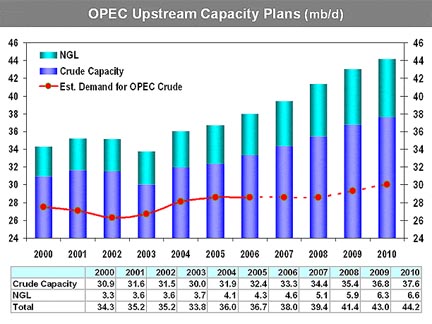
Aramco will be paying Houston-based Rowan Cos. $100,000 to $105,000 per day for each of four large offshore rigs slated to begin exploring for oil and reworking wells in the Arabian Gulf for a three-year period beginning in early 2006.And to add a little more to Stuart's great posts on OPEC production I would just add this figure from OPEC which differentiates planned crude and LNG production.
Contact
- Content: editors at theoildrum dot com
- Tech support: support at theoildrum dot com
License

This work is licensed under a Creative Commons Attribution-Share Alike 3.0 United States License.
Thxs for the new info! I find the Euro-Russian natgas situation fascinating. If the Euros are smart, they should do every effort to increase efficiency, insulation, conservation, etc, so that they can ssttrreettcchh this natgas benefit as much as possible to keep their economies robust enough to pay their bills. If not, I am sure the Russians can resell this fuel to another eager buyer with more cash. The best Euro benefit of all would be if this Russo energy could mostly be used to build the next paradigm, instead of just burning it for senseless reasons.
Still find it hard to believe that so many exporting countries let their citizens have fossil fuels at below market costs. This will not help prepare their people for the next paradigm; it will only lead them further into Overshoot.
Bob Shaw in Phx,Az Are Humans Smarter than Yeast?
Thank goodness for google, or I would have never had any idea what that meant. Sounds like some of that there crazy pommespeak! snicker
Why do you find that hard to believe? The West, and the US in particular, while not selling below market, has long been selling well below what the price ought to be in view of future depletion. And continues to even with recent increases.
The citizens in those countries, in many cases, are far less able to afford market. (Our citizens are able to pay with borrowed money -- second and third mortgages, in essence held by other countries.) So that's one form of spreading the wealth, maybe not the best, I agree.
Overshoot? Yes, again, I agree. For them, and for us.
1011121234567891012345678910
123456101234567012345678910
12345678910123456789101
234567891012345678910
What is somewhat noticeable is a feeling that the profits that are being earned by domestic German energy (electric/natural gas) companies are too much related to monopoly practices and weak to almost non-existent oversight, and that the answer is to examine the books of the companies, determine a fair rate of profit, and then adjust people's energy bills accordingly.
Sort of the way it used to work in America a generation ago, actually.
Further, since natural gas prices are tied to oil prices, there is a feeling that this artificial market coupling is a relic of the past, and that the market price of each should no longer be tied together. As you can imagine, all the German energy companies are opposed to this - this has been their little profit machine. Sort of like UPS's cream skimming against the USPS - UPS is a better managed company with a bottom line focus, has less fixed costs in terms of obligations of delivery, and every time the USPS raises rates, UPS does too (at least back when we used both for shipping) - thus increasing UPS's profits without UPS having to do anything. You will never see UPS ever oppose any increase in USPS rates - but expect truly fierce opposition if the USPS ever tried to seriously decrease rates - UPS would call it anti-competitive, or some such. German natural gas companies are much the same - they have watched rates rise 'naturally,' and of course, they can't be blamed for that. This is why they fight so tenaciously against opening their books and having a fixed rate of return based on the actual natural gas prices in their contracts, and not on the price of oil.
Gazprom has little to do with the price of gasoline - and considering that most Germans realize that taxes already are the major component of the price of gaoline, no one is demanding that oil companies be taxed more.
But there does seem to be a fairly wide agreement that the oil/energy companies are making out like bandits currently, which just shows that Germans also know how to read a balance sheet. For some reason, the citizens of the world's largest exporter seem to have a better grasp of basic capitalist principles than the world's largest debtor nation. Germans consider this normal company behavior, and a reason to have government balance various competing interests - and they recognize that government listens to people who make their voices heard (bet you haven't heard too much about various strikes currently underway in Germany - the doctors have the longest running at this point I think - or how various unions seem to have been somewhat successful in forcing companies to take the worker's power seriously when distributing profits?). Germans don't mind paying for reliable utility service, for example, as they know that reliability costs more than simply gutting a system for short term profits.
I will also add, somewhat strangely, gasoline prices seem to be acting differently here than in the U.S. - this does make me think that some of the rise in prices in the U.S. are truly limited to North America. Whether this is a symptom of something worse for the U.S. is hard to know. It could be a first tiny signal that the U.S. is truly losing its place at the head of the oil table, as other people are able to pay more and/or do with less.
European refiners have played arbitrage with gasoline in the past, but they don't seem to be at this point. Of course, they might still, but I have the feeling that the refiners are acting pretty much the way Germans (and I think most Europeans) do with anyone who is bankrupt - they won't sell anything without being paid in cash upfront. Germany most definitely does not have a credit card culture. (And yes, I have known a person whose company that went bankrupt to the tune of a few hundred million dollars or so - on paper at least, though I would guess the family members had comfortable reserves in various undisclosed locations. Nobody in the neighborhood would give them credit for anything at all, even for something costing 20 marks or so. From the first rumors of problems, everything had to be paid in cash. Yes, business failure in Germany does lead to public shame, as compared to coming back with a hit TV series or book.)
Sorry, never been to Europe, so I am much in the dark as to the degree of cross-border cooperation. One of the links HO provided talked about Gazprom's pricewise ability to divide and conquer the various Eurostates with their pipeline routing infrastructure and pricing contracts. For example, Poland being upset with the new Baltic pipelines that bypasses them; author compared this with the Hitler-Stalin Pact of 1939, and gives cost justifications that the decision was politically driven, not economically driven. Can you comment if the Eurobloc can maintain it's single market cohesiveness against Gazprom, or is this energy contention likely to get so heated that the entire EU is likely to fracture? Thxs for any info.
Bob Shaw in Phx,AZ Are Humans Smarter than Yeast?
An attempt to change the direction is obvious then: create a cartel of buyers which would negotiate with an implicit cartel of sellers (Gazprom+Norway). If successful, this strategy still might result in a completely liberalized European energy market. However, another problem appears: a market with, essentailly, one buyer and one or two sellers is not competitive in any sense of the word. This is a "matching problem": there is "match surplus" which has to be split between the two negotiating sides in proportion to their bargaining power. It is very understandable, then, that the EU Commission is mad at Germans who reduce EU's bargaining power by striking unilateral contracts.
Poland's position is less obvious (of course, they love to hit at Russia at the slightest opportunity, but I'm talking economics here): instead of being one of the few transit countries capable of extracting a lot of rents, they will become one of 25 cartel participants and probably will get less goodies in the internal EU distribution of its share of the surplus. They are losing in any case, but they are losing with NEGP more. I guess they have their own Russophobic rethorics and politics of the last decade to blame for this self-inflicting wound, though.
Coming down to the double cartel situation: EU looks to be the losing side, as more cartel members (25) on the buyer's side means more incentive to cheat. There are technical ways to avoid cheating, of course, especially with gas which has few entry points, but expect a huge political battle before anything becomes an official policy. It will definitely be more loud and nasty than the last year's EU bickering over the budget.
And the last parting thought: Ukraine was paing $50 per thousand cubic meters of gas. Population, actually, was paying just $39. It also initially proposed re-negotiating the 50 dollar contract itself (I remember reading professionals' articles in Ukrainian press last August which warned about the sheer stupidity of this step), and resorted to complains to all the high powers on Earth only after looking at the real prices. The last time I checked, end users in Germany and UK are paying real prices for their gas. Therefore, trying to interpolate the Russia-Ukraine gas spat into Russia-UK relations, as FT and others tried to do recently, is completely unwarranted. Of course, it helps to whip up population's histerics, which might be used in any future cartel-to-cartel negotiations in order to increase EU's relative bargaining power.
Everybody in Europe (yes, another generalization, but one most Europeans consider absolutely obvious) puts their own interests first. But since we live in a world of other people, shared interests are the cost of doing business.
In terms of the Baltic pipeline, my opinion is that it is mainly being done to ensure that no one else gets a cut in terms of transit fees/bleeding off gas, and to ensure that all the contracts for construction are German/Russian. (I might add, ignoring Poland has always been something Germany and Russia share completely.) Further, since there are plans to hook this pipeline up into the Norwegian/Dutch/French gas network, Germany may also being planning on putting itself into a middleman position, in terms of raking in the fees itself - for example, selling North Sea/North African gas to Poland.
But cutting the Poles out, especially after the Poles pretty much said that as EU members, they would do what America thought best, is a multi-level game. The Poles were pretty stupid in how they handled the Iraq invasion, and the pay off never materialized - like all of America's current allies, they were simply used without any consideration of anything interests but America's. (Of course, if you are Polish, America still looks a hell of a lot better than Germany or Russia in historical terms.)
The question is not to what extent the Russians/Gazprom can split Europe into squabbling nation states, the question is to what extent are the Russians returning to old Soviet Cold War ambitions. At that time, the goal was essentially to split NATO - so in a sense, that is not real likely today.
I do think this is all a touch overblown in the American/English press - the world has been held hostage to Saudi Arabia and its fairly destructive form of Islam for a generation, and now the Russians are simply stepping back into their old role of tempting Western Europe into becoming an appendage of Russia's ambitions.
Except Russia seems to be a giant kleptocracy, not an ideological monster.
And though the Soviet plans of the mid-80s might have been successful enough if carried through, there is an EU today, and quite honestly, they will probably settle it out as well as possible. Most Europeans realize that scale matters, and most Europeans have lost their faith in the U.S. as a sort of kindly big brother.
How it will play out is murky - I expect a good number of Russian officials to end up driving Mercedes, and that the EU will continue to plan for the future, balancing a number of things while trying to ensure as much comfort for themselves as possible. Europe tends to be pretty post-ideology, something most Americans don't quite grasp.
What isn't often noted here is how energetically Spain, Denmark, etc. are developing renewable energy and renewable energy industries, or France's dealing with North Africa for gas - the Europeans are hesitant to become too dependent on Russia, since no one trusts the Russians anyways. And Europeans are not lazy in the sense of expecting some miracle - they live very much in the real world.
What is so typical is that now that the Russians are starting to act like good capitalists to earn as much as the traffic will bear, those who used to fear 'Soviet domination' seem deeply worried about the Russians playing by the West's rules - and winning.
The only correct strategy for Poland would have been to say, Der Russians and Germans, you can build your pipelines wherever you want as long as you follow international regulations in place that regulate development in the Baltic Sea. However please consider how much cheaper it would be and how much easier to maintain if you build it through our country, hey we will even help with a little subsidy. Here is our offer that is too good to turn down.
With the policy that Poland has followed, Germany especially has no other realistic choice than to go through with the undersea route. Not to mention that Poland has consistently tried to punch over its weight in a manner that has been destructive to both European integration and Polish interests themselves (one may remember the ridiculous, anachronsitic attempt to forge a "Catholic axis" and the pivotal Polish part in destroying the momentum for a European constitution)
If I was a Russian, I would be anxious about developments in the Ukraine as well. I would look at the Ukraine and think that the Western powers were attempting to carve-off the Ukraine and bring it into and under the "Western" sphere of influence. Seen from Russia the Ukraine would then function like a potential spearhead pointed at Russia's heart. An agressive and atagonistic Ukraine on Russia's border would be unacceptable to me, as a Russian. Also comtemporarty Ukrainian politics are Very complicated. People in the West and East of Ukraine are different. Poland appears to have revived its old dream of bringing the Ukraine into its orbit and establishing a Greater Poland. The people in the East of Ukraine are basically Russians, who would never support it breaking totally with Russia. So we could see a situation develop where the West supports one half on Ukraine, and the Russians intervene in the East, leading to the Ukraine spilliting down the middle or even something close to civil-war. All this is further down the track, yet, we should perhaps keep these possibilities in mind.
I suppose what I'm trying to say is, that, these countries have very complicated histories, and we should be very wary and circumspect, before/if we decide get mixed-up in their internal affairs, and how they can be used as pawns in the Great Game.
Sometimes I have the impression your posts paint a somewhat too pleasant picture of the situation here in Germany.
The consideration of business failure as public shame, for instance, is also part of the cultural complex that is crippling Germany´s potential for economic development (and that doesn´t just mean growth). In the US, at least (and I invite any American to correct me on this) I have the impression that someone can start out with a grand business plan, crash and burn spectacularly, flip burgers for a few years and then come back with the next big thing - and get another chance, if he can simply convince someone to finance him, be it by the strength of the business plan, or just by trickery. In Germany it would be very rare to have such a chance, and in truth it often happens that businesses fail because they tried something too soon. This leads to people in Germany only wanting to start a business when they can feel almost 100% sure there is no risk of failure, which most often means they never start it, or only do so with financial support form the state (which certainly does nothing to weed out bullshit business plans and often preconfigures them for failure).
Many similar cultural attitudes have also combined to make Germany a socially highly immobile society. Try to find another similarly developed country where the social status and income of a couple predefines the lifetime social status and income of their children as strongly as in Germany, and this despite the value that is ostensibly placed on equality (this is the really important result of the whole PISA discussion)
Out of the current strike movements in the "Öffentlicher Dienst" the hospital-employed doctors are the one and only who have a true issue, as they actually comprise a class of people who are objectively being exploited and the conduct of the state-run clinics also runs directly against EU law. However the vast majority of other strike participants are only trying to defend historically inherited rights of expropriation against the general populace - getting more security and payment for less work than everyone else. The inevitable and ongoing reaction of cash-stripped communities is purging the workforce in double proportion to Verdi´s demands.
Honestly it seems like black humor, after following the debacle of last fall´s elections, to say that Germans have a better grasp of basic capitalist principles. In terms of paying for reliable services, the German system has devolved ever more into paying increasing amounts of money for constantly degenerating or nonexistent services. In the 1970´s the concept was still working, as you were paying high contributions for basically "full-service"; today some of the most elementary healthcare issues have been privatized and the public health system has been effectively converted into a scam system profitíng a very small circle of insiders. If you have low income and bad eyesight, you´re out of luck - better hope your state-provided glasses from 1986 will last a little longer and never fall down, cause you just can´t afford the 1100 euros.
Certainly, Germany has many advantages in its social and economical structure in comparison to the US when it comes to coping with a coming energy crunch. Only very few of these have anything to do with policy decisions or expressions of the will of the people over the last generations. The one exception is that through a combination of an export-oriented economy and just enough state intervention, Germany has reached a critical mass of activity in renewable energy, so that people are realizing you can make money with this, it is strong enough to fuel its own expansion, and this sector is now a positive factor for future development even in the books of the most boneheaded conservatives.
Otherwise, Germany´s advantages (both in comparison to the US as well as some other European countries) either have to do with the basic geography of the place, or some unexpected side-effects of history (such as the relative decentralization which is largely the long-term result of French and Swedish power projection into Germany in the 17th century)
Practically all of the social and economic trends that critically-minded Americans are upset about in their country have been adopted in Germany; some of them have failed to make a similar impact but again this is usually due to the different surroundings. For instance Germany simply doesn´t have the issue of million.sized metropolises sitting in the middle of deserts. And, suburbia/exurbia cannot grow so maliciously in Germany because at 60 miles from a city center you have usually already passed through the next major center, if you aren´t in the next country.
The reliable services was meant in regards to such utilities as electricity - it has been quite a while since the electricity in this region had any problems at all. Various German systems are nowhere near the state of decay that major parts of American infrastructure are - basically, Americans stopped investing in such unprofitable areas decades ago. This is not a major debate however - I am sure that parts of Germany are in worse shape than this region, and parts of America are in comparable condition to the best in Germany. But Germans are much more aware of the costs and benefits of having reliable systems, which is one reason German infrastructure companies do so well in the world market. And Germans certainly pay a very high price for this reliability, which is one reason the energy companies play it up so much in public debate - without discussing their profits.
You are absolutely correct about the fear of failure being a problem. And yes, it does hinder the development of new ideas or new companies - except for the new ideas or new companies it doesn't. (I also know one of the original founders of the world's largest ERP software company.) But yes, the barriers are much higher than in America, and it is a real problem. It is certainly a German economic weakness. As I am American, I can assure you that failing in one business is considered a learning experience, and not something which ruins your future in business.
At least in Baden-Württemberg, part of the strikes of government workers related to their simply having to work longer hours without any extra compensation - much like the Beamten (life-long civil servants) were also simply told they now work longer (the Konrektorin / vice principal I know, if I remember correctly, had her work time simply increased 3 hours, and various things like Christmas money simply cut). This is not at all a debate about how effective the government workers are, or whether Verdi is right or wrong, or even if these workers have a realistic view of the world (a lot of them don't). But you can't simply tell your employer you will work 3 hours less because you are time strapped, a principle which works both ways. As for the whole IG Metall strikes - one way of looking at it is that Mercedes workers didn't feel that it was their fault that Schrempp and friends lost billions of euros, while his pay increased. People here do seem to have a much clearer view about how capitalism works, which is why so many workers are union members. And why the various companies/Industrieverbände are so interested in neutralizing the unions. (As a side note - I think unions are just another form of big business - I do not fit well into a right/left definition - but workers collectively demonstrating that the owners are not the only part of the social equation is absolutely necessary in a democracy.) (Another side note - Lidl is a true American style company - shutting down any store where workers organize, or having a newspaper fire a correspondent who reported critically about Lidl and its workers by threatening to withhold advertising - the fact that the BNN admitted this just shows how truly incompetent the BNN is as a news organization - a smarter newspaper would have waited 6 months, then fired her. It was also proof about how the German system works to brake 'capitalism' - in America, such firing is perfectly legal, here it is clearly illegal.)
'Practically all of the social and economic trends that critically-minded Americans are upset about in their country have been adopted in Germany' - to an extent, this is also true, except for the fact that it got started much later, it is still opposed by significant forces (though some are also growing weaker or less relevant), and that as you noted correctly, Germany simply has a different geography and history. But the advantages aren't merely luck. What happened to where I grew up is inconceivable here, as no one would approve of ripping up the forests and the watershed to simply build more houses. But I certainly agree such things as frozen food in Aldi/Lidl, the increasing size of the cars, or the growing number of air conditioners is going in the wrong direction. (Or the stores built with huge parking lots on the fringes of cities.) On the other hand, I can't imagine many people in Germany having a critical problem if the freezers were unplugged and the cars stayed parked and the air conditioners were turned off. And do notice the mandatory recycling of all packaging, the push for renewable energy, the backing of organic farming - you will not find the equivalent in real debate in America, much less in practice.
I am guessing, maybe incorrectly, that your experience of America is more from a distance. 'Only very few of these have anything to do with policy decisions or expressions of the will of the people over the last generations' - this could be debated, but the local farming and regional aspect of much agriculture, the Mittelstand tradition of business, and the fairly high value placed on Natur are all factors which do not support that statement. One of the more interesting 'quotes' I remember (sorry, no reference now) was from the founder of the company which reduces organic material to liquid fuel through tornado like vortexes - he said that his company really couldn't function in Germany, since the agriculture was so organic, there wasn't any real waste from industrial farming to use.
To the best of my knowledge, nobody in America (certainly no one in my experience) has ever had their health insurance pay for glasses. But 1100 euros is way, way too much to pay - mine were about 500 euros, and they were way too expensive too, but they were the best compromise for riding a motorcycle and how my German wife wanted me to look.
There are many measures of social mobility - Germany does really poorly for immigrants, and there is no question that social mobility is fairly well connected to your parents' status. On the other hand, by sopme other measures, Germany has more social mobility than America over the last couple of decades - a scary thought, in its way. (The German school system is appalling, in my eyes - but this has nothing much to do with PISA results, and a lot to do with how it pretty much determines a child's future around 4th grade.)
As for capitalist principles - that was a play on two different ideas. The first is that the world's largest debtor nation seems to feel it has some sort of unique insight into capitalism, where by the objective measures demanded by the market, it is an utter failure - and the world's largest exporting economy is somehow a 'failure' in the eyes of so many. (Most nations would love to have Germany's problems.) The second was the idea that people in Germany realize that perhaps the most basic goal of capitalism is the rich getting richer, which is why so many Germans, who unlike Americans, are quite certain they will never be rich, understand capitalism to be something which is not really to their personal benefit. Of course, this attitude can be carried too far in its turn.
People here do seem to have a much clearer view about how capitalism works, which is why so many workers are union members.
People in France generally do not have a clue how capitalism works... this is not uncorrelated with extremely low union membership. People are shocked when a company lays off workers even though it's making profits... the implicit model is not even socialist, but old-style paternalist.
the world's largest debtor nation seems to feel it has some sort of unique insight into capitalism
... well of course! They've got it all figured out, and are working the system for all it's worth! Having pretty much invented modern capitalism, surely the US is entitled to live off welfare during its dotage?
My point is actually American - workers in America are essentially powerless at this point, and, what a surprise, the rich are growing obscenely richer at a rate not easily imagined in other industrialized societies. Personally, the pension plundering is probably the corporate thing which is most disgusting these days, but give them a year or two, and I am sure they will come up with something else (the life insurance policy on your own workers - betting on them dying for corporate gain - is in its own category).
German workers may or may not be realistic, but they have no illusions at all that if they don't struggle for their piece of the pie, they won't get anything but crumbs. (Of course, that they want a bigger piece than the owners want to give them is a simple truth. That sometimes the workers get greedy is also a given - people are the same the world over.)
If you don't believe this, just look at America, and its income demographics. It is strange to watch a middle class society disappear in your own life time, to be replaced by an older, traditional American model.
Welfare is a dirty word in America. Just letting you know. Only corporate welfare is OK - then it is called the free market in action.
Thanks for your comments. An exchange of ideas doesn´t always have to be a combative debate. i think it is very interesting to discuss with someone who has a good firsthand view on both America and Germany.
Looking at the prevalent economic systems in Germany and the US - both of them were in the past able to provide prolonged expansions of standards of living. For the benefit of the US, its political system was also able to provide prolonged incremental betterments, while Germany of course is well known for its past of exporting rather serious convulsions.
The present challenges of energy and environmental crises question the maintainability of both systems, though Germany may be somewhat better positioned to transition gradually. However, even ignoring these challenges, both systems seem to be failing in terms of propagating the base of their prosperity into the future. That is, looking at the standard of infrastructure and education that they are providing for their average citizen a few decades or generations further down the road, this seems totally insufficient for these citizens to maintain a comparable standard of living.
That means their systems are in for trouble regardless, even if issues like energy resource depletion or global climate change actually turned out to be hoaxes in their entirety.
Anyone who takes a sufficiently broad view at the existing systems will tend to drop out of the classic left-right scenario; of course workers rights are a valid cause. There are certain areas where socialism works, and privatization doesn´t, however some of the traditional right-wing recipes also have their merits. Comparing Merkel to Margaret Thatcher was a huge mistake made by many foreign observers of German politics, I wish they had been at least partly right :)
When it comes to the Labor Unions, they were an essential part of the development of the well-functioning German social system from beginning in the 1880s, that was essemntially completed in the West in the 1950s. Effectively the power struggle between workers´power and Bismarck, and the latter´s victory, was what produced the basic outline of the system as it still works today. However today the unions are no longer the representants of an oppressed and exploited majority. Actual exploitation of workers in West Germany ceased to exist after WWII as workers were far too precious. The only place where German workers faced oppression, and worse, was of course under Communism. Today however the labor unions are the representants of what is quickly becoming a privileged minority, namely employees with regular and reasonably protected jobs. They are ruthlessly trying to increase the benefits for their members and are totally aware that they are helping to constantly increase the number of the permanently jobless. This does not touch them however since there is no such thing as an Arbeitslosengewerkschaft. (It is also interesting to see how the unions operate when they are employers themselves - Verdi for example has a huge bureacracy. They know all the evil tricks and use them to the fullest. My opinion on Verdi is also shaped that at one point due to existing conflicts I considered engineering the unionization and Betriebsratsgründung in the so far non-unionized company I work in. Which would have been totally within the rights and means available and in the end the employer could not have done anything against it. In the end I declined and honestly today I am happy, knowing what Verdi is).
In my opinion union power as it exists today in Germany needs to be broken. Unions have devolved into producers of mass poverty for others, when once they fought for the prosperity of the little people.
When it comes to rotting infrastructure, certainly the general standard in the US is lower. However Germany is again also simply easier to maintain (in terms of expanse and climate). Also, much of the infrastructure is substantially newer. Most everything was redone after WWII and many modern infrastructures were simply introduced significantly later. But do not forget how overland powerline masts crumbled under snowfall this winter - and then it turned out that some of these had not seen maintenance since being patched up after WWII. Not to mention all the building collapses under snow.
As for working longer hours without compensation - it´s a fact that most people in the "freie Wirtschaft" work more than stipulated in their Tarifvertrag - if they have one -, and honestly, who gets all the oldtime benefits like Christmas money anymore. Hardly anyone who has to individually negotiate his terms of employment has ever seen things like this since the early 90s. It´s simply a fact of increased competition that people have to work more in Germany than they used to in the 1980s, for effectively the same or less money. However coming from the relatively lazy german workforce this is perfectly doable. Just witness the fact that sick days across all of the economy have enormously plummeted in the last 15 years - not because Germans are getting healthier but because the days when everyone effectively took an additional week of annual vacation by playing sick are over. So no pity. For most of the German population the crisis of 1993 was the wake up call, and they heard it.
When it comes to health insurance etc the comparison was of course not to America but to Germany´s recent past. The example of the expensive glasses is a real one from a single mother with four children who until she finally landed a job recently had to live off Hartz IV. Who happens to have a very serious eyesight problem that however can be corrected to perfectly normal with specialized glasses. In essence her ability to contribute as a taxpayer hinges on getting those glasses, and in previous times the benefit for having an expensive health system was that she would have gotten those, no questions asked. Upon losing those glasses, today, well she might have to consider prostitution.
As for my view on America, it is certainly more of an outsider´s. I did live in the US in the late seventies (and this was quite a different America than today´s I would say) and the last time I visited was in ´99.
My outlook on Germany is strongly coloured by the fact that by choice I live in a low-income "Sozialbrennpunkt" community (btw, also in Baden-Württemberg). This is because like probably many others on this site I believe it is best to collect your own economic strength for upcoming serious challenges, instead of wasting it on status symbols like living in a "neighbourhood that is more appropriate to your income status". (I dont´ need a car anyway...) Such an environment exposes you to some views that are quite different from the official political focus but probably reflect actual currents in the country more precisely. And here I see that the seething, visceral detestment for the Beamten and everyone else clinging to special treatments, undeserved extra payments just for occupying a position, and state coddling is universal and most everyone says, Well let them finally grow up like the rest of us have done. Even those who vote for 'die Linke' have no patience for this.
Despite America´s failings, one has to admit that critically minded Americans are questioning not only individual sets of policies but also the predominant American mindset and culture. Also America has contributed greatly over the past few decades in the promotion of awareness of many relevant issues. America doesn´t just export flawed policies, it also exports dissident voices. Many public movements in areas like environmentalism, civil rights, etc got a kickstart from America, originated there, or had their defining public voices coming from there. And try to find any German-language website that provides even a quarter of the depth of "The Oil Drum" in regards to the energy issue (if one existed, I would be reading that one, and not this). In fact when discussing the "peak oil" topic those Germans who follow it usually also know and use the term "peak oil" because once again, the recognition and definition of the problem is led by American voices. Of course one can reduce this to say that America due to its reckless modernization and the sheer size of the contiguous market has simply had an opportunity to discover the deleterious consequences of some modernizations earlier.
However when I look at the discussion in Germany I see an overarching tendency to criticize those negative cultural aspects which are labelled and identified as "Globalization" and "Americanization" and are usually just Germany falling prey to the same temptations as America, and not consciously importing something American, or even having it imposed. However those negative cultural aspects which are genuine and local to Germany tend to get completely overlooked even by the vast majority of system critics, while I do see a willingness of American system critics to investigate their own culture more rigorously (perhaps because for Americans, the excuse of having their culture imposed by foreigners is really not plausibly available).
You are correct about your observations regarding the principal resistance in areas like farming, clearing for construction, some rapacious capitalist practices, etc in Germany. However this is no contradiction to my claim that all this is not result of 'policy decisions or expressions of the will of the people over the last generations'. Simply put, Germany is a significantly less modernist society than America. The large grass-roots resistance against these thuings is not a conscious environmentalist or political reasoning but just, without any conscious decision, the presence of the strong tradition - "This is not how we should be living", "You don´t do this, it´s meant to be done this way".
Wherever environmentalist and leftist activists have managed to tap into the traditionalist sentiment of the socially very conservative German majority they have been hugely successful and have repeatedly defeated governments and corporations. (Best example also from Baden-Württemberg the Wyhl reactor, where "pinko commies" where carried to victory on the back of ultraconservative Christian farmers whose dialect was practically unintelligible to the activists). Wherever they have relied on their political reasoning, they fail. Basically what this all goes back to is that the industrialization and the foundation of the present social system of Gemany was carried out in a society that still continued many archaic feudalist principles (the Prussian-dominated Kaiserreich), while Britain and France had already expurgated feudalism from their system long before industrialization and America never had it (well some aspects of the pre-civil war Southern plantation economy may have emulated it). These archaic roots are still very present in Germany today and have produced some benefits as above but also some of the most serious social and economic problems. Such as the inherent acceptance of an education system that sorts people into three tiers of 'worthiness' very early on, or all the bullshit that is strangling private initiative like Meisterzwang, Handwerks/Handels/ Ärztekammern, the way apprenticeship is set up, etc., the universal paternalistic ideology of all political parties in Germany, the conceptual inability to cope with the reality of immigration, and the remarkable divide between the level of political emancipation for women and the factual socio-economic emancipation (and finally a few German intellectuals have woken up to the fact that this is quite likely where the more severe demographic collapse in comparison to other mature industrial states is coming from, and not enough money or enough church. Countries with very strong conservative social traditions like Italy and Japan may have similar issues, while countries with more modernist social traditions like France and Sweden are doing far better in this regard).
Also, in connection peak energy and environment problems, the archaic tradition serves to frame discussions in terms of "going back" and "returning to the Proper Life". Which is not going to be a solution; the only solution is going forward, but on a different path.
Thanks for the explanation about the glasses - I had really wondered about it.
I also agree that America is a source of truly wide ranging opinions. The problem, at least in my eyes, is the huge difference between the ideas and the reality which most people live. Even some of the best critics, like Kunstler, tend to live the life they feel needs to be changed. This is my major problem with America, in the end. Germans tend to see a problem, discuss it endlessly, agree finally on what to do, then do it until completed (and as a further German problem - if what was agreed to was wrong, it is very hard to correct). But at least something is done, and generally, the results are pragmatically discussed, implemented, and then measured.
Your explanation about farming, for example, isn't wrong, but it also can be seen from another persepctive - why change something that works for reasons which people don't share? And Baden-Württemberg is a truly strange place - most think 'Green (Party)' and vote 'Black (CDU).'
But your analysis of Germany at the end of the last long paragraph is pretty close to mine in most ways - I don't quite agree with the idea of demographic catastrophe, though, for reasons below. German sexism is especially bad in my eyes.
Your point about making things look too good here is not without merit - except when dealing with peak oil, Germany is far beyond America in ways which will matter, even if people don't really discuss this topic - but it has actually been a part of public discussion since the 1970s, simply that much of the debate here is framed in environmental terms in general - which is actually a good thing in most ways.
To make a quick comment about this -
'However, even ignoring these challenges, both systems seem to be failing in terms of propagating the base of their prosperity into the future. That is, looking at the standard of infrastructure and education that they are providing for their average citizen a few decades or generations further down the road, this seems totally insufficient for these citizens to maintain a comparable standard of living.'
To a major extent, that is the point of peak oil - there is no current imaginable way to maintain a comparable standard of living - especially in the sense of working in a Mercedes factory, buying a Jahreswagen every year or two, and retiring at 62 with a full pension.
The question is then what sort of society will be able to survive the coming challenges, and to maintain/adapt essential elements like providing enough food to prevent mass starvation, ensuring that such things as medical knowledge is not completely lost, etc.
I tend to be dismissive of the doomers (those who believe in a massive collapse of civilization leading to 90%+ of humanity dying off), but their arguments need to be taken seriously enough to at least refute clearly. Germany will face a number of challenges (I think a decling population will be a plus, not a minus, by the way), but here is more likely than most societies to remain both industrialized and 'civilized' - whether either of us would approve of that civilization is certainly open. But I will bet on those 'ultraconservative Christian farmers' to keep growing enough food for the people around them to survive - where I grew up near Washington, DC, the farms disappeared decades ago.
One thing you might consider is that Germany is a federal republic. So school policies are not the same everywhere.
In Berlin and Brandenburg, elementary school lasts to the 6th grade. In my point of view, it is not neccessarily bad to sort the kids into different schools, if these kids can later go up to the "Gymnasium", which has not been the case. Those states that had comprehensive schools did not have better results in the PISA study - the smarter kids were not adequately educated. It is certainly possible to have a comprehensive system that can educate all kids appropriately, as we can see in Finland.
Germany is very poor when it comes to integrating immigrants. Unlike the United States, Germany has not had an immigration culture, even though, in a more distant past, Prussia integrated the French Hugenottes, and the Ruhrgebiet a lot of Polish people. During the boom in the 1950s, Germany needed additional workers. They were called "guest workers", and politicians thought they would go back to their original countries. Consequently, nobody took care of them, nobody helped them to learn the language. As a result, over time, they developped their own independent communities, now known as "paralell societies". They have their own banks, TV stations, newspapers, and so on. In some schools in Berlin too many kids don't even speak German when they go to school. These problems finally did get some public awareness recently, so there is hope now that things start improving.
Comparing Merkel with Thatcher - that was an idea by the foreign press. Merkel could have been a little bit like Thatcher if she had achieved a landslide victory, but Germans simply did not want a Thatcher.
The unions in Germany are loosing power, that is quite obvious. Verdi is not even able to freeze the status-quo. They were not striking for improvements. This is quite significant and a clear sign. Companies now can threaten to go to Poland or to China, the unions can do almost nothing about that. And when the French strike for a minor change in the Kündigungsrecht, a much worse change in Germany, wher companies will be able to fire employees during the first two years they are on the job, goes undisputed.
All economists in Germany urge the government to get rid of all those "Kammern", relicts of the middle ages. That issue is regularly covered in critical TV programs, but these institutions seem to have a very strong lobby. However, the way apprenticeship works has been regarded as a big pro for the German economy and highly regarded also among foreign investors.
Now, what is happening to the women in Germany? In the meantime, more girls than boys achieve Abitur, more girls than boys go to universities. But then? One issue is that girls tend to study non-technical programs only. We have a lot of female lawyers, judges, teachers, social workers. We have very little female engineers, natural scientists and such. Women complain that it is very hard to raise a kid and have a career at the same time. One major issue is the lack of kindergaten places and unrealitic opening hours. Schools used to close at noon. The German tax system encourages one person to stay at home, so called "Ehegattensplitting". The result is that the well educated women with a university degree usually never become a mother. The German government now tries to copy th Swedish concept. The government will pay a substantial part of the salary for one year for the mother or the father when the raise a kid, but only of the guy stays home for at leat to months as well.
Another key problem is the economically poor situation in much of the former east in Germany.
Peal Oil is not a topic in Germany, but Global Warming is. The reason is likely that Germany has never been an oil producing country. There is no experience in this field. We don't have the Campbells and Hubberts.
When it comes to Global Warming, Germany is almost the only country in the West that has lowered CO2 emissions significantly and that will achieve its Kyoto margin.
Largely because of Chernobyl, Germans have become very sceptical when it comes to some sort of new technologies, especially nuclear and genetic engineering. A lot of Germans refuse to eat genetically engineered food.
Baden-Württemberg is probably one of the most conservative regions in Germany, and the most prosperous at the same time. Berlin is much different, poorer, but with a much different and largely free culture, and certainly not conservative.
One issue that is disturbing for most Europeans is the influence of religion in the US. Issues like creationalism or intelligent design are pretty much impossible here.
If you are looking for a German peak oil forum, go to http://f27.parsimony.net/forum67590/index.htm, but The Oil-Drum is much more interesting.
That isn't exactly so. Germany was a significant oil producing nation a couple of decades after the middle of the last century, reaching a peak of around 400kbd. Actually it has often been used to examplify the Peak Oil theory as Campbell does here. The graph from the same source:
With 400kbd and ~3GB URR Germany would be comparable to countries like Syria if it started exploiting its reserves at the same time as they did.
And some offshore.
yes, considering how close the Pfalz is, I realize Germany is more complex than where I live.
And certainly, most of Baden-Württemberg is conservative, with a few exceptions like Heidelberg and Freiburg.
The unions are definitely losing power, but they are still a factor, unlike in most aspects of the American economy. Further, most Germans still support the basic principles which unions are supposed to represent - fair wages, job security through solidarity, and a certain sense that the economy is divided into different groups, and workers need to represent their interests, since no else will.
I do think Germany's various failures in integrating immigrants are a problem, though not necessarily as high as many American conservatives, who think that 'Eurabia' is just a decade or two away. The largest block of immigrants in this region are the Russian/German Aussiedler - integrating them has also proved hard for a number of very avoidable reasons.
Integrating East Germany is also ignored when discussing today's Germany - there wouldn't be much in the way of pension/healthcare problems if it hadn't been for that fact.
indeed, a business failure used to mean public shame, but this has already changed to quite some extent. Certainly, there is still a lack of Venture Capital, but even that is not as bad as it used to be.
The PISA study has indeed confirmed that your parents' status in many cases determines your own future, however, that seems to be quite natural. It was only a surprise, because after social-democratic reforms in the 70s, most people had the illusion that in Germany everyone had equal chances.
I can't see why last fall's elections were a debacle. Im my point of view, these elections show very well that Germans prefer solutions that are supported by both major political parties, they love consensus. Germans like both the social-democratic idea of social fairness and they know they need the economic competence of the conservatives. After the elections, companies and consumers are in high spirits again. Ms. Merkel has had the highest approval rating of all German chancellors, even though the government has not really done anything significant yet. In the meantime, Germany's major companies report new record profits. They are extremely competetive after ten years of very moderate pay rises, while wages have doubled in other countries.
As regards the health insurance, I have to agree with platsicgolem. Compared to other countries, Germans put enormous amounts of cash into the system and don't get much more out of the system than in other countries. There is a problem on the supply side of the health system, mainly the cartels of doctors (not those working in hospitals) and pharmacists.
Compared to the other larger European countries, Germany seems to be doing ok. The public services are much better than they are in the UK, even though the workers in the public sector are not priviledged as they are in France.
Germany, as an exporting country, even profits to some extent from the high oil price. The oil exporting countries, especially the OPEC countries, love to buy German goods with their petrodollars.
Now about the energy system:
In electricity production both oil and natural gas are not very important. This will remain that way. The phase-out of nuclear will be covered by wind and coal mainly. Currently, investors plan large offshore wind parks in the North sea.
In the transport sector, Germany depends on oil by 90%. The idea to transport goods mainly on rail has failed. That is mainly due to the different safety standards and power systems in the European railway networks. The EU is trying to fix that, so far not very successful. For people, the railway network is in pretty good shape. Most cities also encourage biking, which is very popular among the young.
For heating, natural gas is the dominating resource. However, solar-thermal for hot water, wood pellets and heat pumps are becomming more popular with the rising natural gas prices.
I would dispute the 90% figure for transport, at least in terms of freight. It is equally true that the Bahn is massively incompetent - my personal theory is that has something to do with VW, Mercedes, and BMW being major political players. And barges are not a trivial transportation element - living near the Rhine, you do tend to notice them.
On the other hand, the ICE system is a reasonable replacement for aircraft, not that anyone seems to care that much. After all, flying all over Europe on Ryanair etc. is so much cheaper.
And, even when travelling across Germany the Ryanairs can be cheaper, even though I have a Bahncard (Berlin-Munich is an example). But that is not sustainable. As long as these flights are so cheap, I enjoy visiting all the European countries, and the US, and South-America, and Asia, which is great fun. Sadly, our kids might not have that opportunity any more.
I must admit that I sometimes enjoy a ride on a free autobahn at 250km/h, but in general, a train is much more comfortable, and you can get some work done while traveling.
When it comes to freight transport on rail, Germany is just to small for that. In the US, the trains can go from coast to coast. In Europe, they have to changs the engine at every border, and Spain and Russia have a different (wider) gauge. It's doable though, living in Baden-Würtemberg, you certainly know how the Swiss are doing. However, in the EU, that might be interference with the free flow of goods.
For Germany, my personal benchmark about their percieved "living in the real world" is and will be their decision over nuclear power. It is a truth, that they have been heavily investing in wind and solar for more than a decade now, but the end-result is some 6% of the electricity production and a troublesome subsidies system. With a scheduled phase-out of nuclear, currently providing 4 times this amount of energy without any subsidies, where is the real-world view of the situation in this country?
If you ask me - just like UK, Germany is living in a ideological dreamworld over some issues, this one included. I guess this is the logical result of being too successful over time, but simply relying on that old pragmatic stereotype is hardly the path ahead.
http://msnbc.msn.com/id/12617717/site/newsweek/
Pretty good analysis IMO.
The Newsweek article is one of the best pieces on PO and the shift of power towards those with "black muck." Russia, Chavez, Iraq ..... It seems like the US doesn't understand that the war on terror is a sub-plot of the geopolitical shift in power towards nations with hydrocarbons to sell.
The hell with spreading democracy, give me hydrocarbon diplomacy.
LOL. Mighty Russian czar "playing a brass-knuckle game of power politics" in order to - read my lips - beg a customer to accept LOWER prices?
instead of $50 per tcm but then when Ukraine refused upped it to the price it charges EU customers: $230. Ukraine managed to get the price to be $95 by having $50 Turkmenistan gas mixed in with the $230 Russian gas.
We may one day regret making so many enemies on the world stage:
And the bottom line:
"For the last 20 years, U.S. policy has discouraged production and encouraged consumption. If we dither any more, we will pay a terrible price"
So he is saying that we need to encourage domestic production and discourage consumption (through direct discouragement as well as development in alternatives).
I think the United States is getting into a strange "mode" in its dealings with other countries. It seems that, increasingly the United States is being seen as a "threat" by other nations. One can name Venezuela, Russia, Iran and China, just for starters. Are these countries right to feel threatened? Are they right to view themselves as being slowly, and carefully, encircled?
Gosh! I almost forgot the Arab world! How could I do that? I think what worries me most, is the thought of the United States moving towards "conflict" with all these countries and more besides, at the same time as it has no really powerful allies, and realistically has no chance of "winning", or imposing its will on so many rivals and/or enemies.
One can of course argue that the United States will not take on all these nations at once, prefering to pick them off, one by one. This strategy is also fraught with danger and risky. As one risks forcing said nations into an anti-American alliance, out of necessity rather than choice.
I think the project for a new, American century, meaning American world domination, in a world with only one super-power, is a recipe for disaster, not success.
Many neocons see Europe as rivals at best, outright enemies at worst. Especially "old Europe." The rabid French-bashing is not a coincidence.
They seem to have miscalculated the powers that molded international consensus during the Cold War and now that consensus is fatally fractured. Maybe it was inevitable that with the demise of the Soviets there was no longer the feared enemy that caused so many countries to sacrifice their own interests for those of the "free world". But I have no doubt that this process was accelerated post 9/11 as the US turned to acting in it's own narrowly defined self interest, outside of international law, at the expense of the rest of the world.
Yet the old Cold Warriors still cling to their old play book. They claim that they are isolating Iran. They are attempting to surrround Russia. They demonize the leaders of Iran, Russia, China, Bolivia and Venezuela.
One by one, old allies peel off the parade of followers of American policy. Saudi Arabia, Turkey, South Korea, Old Europe, South America. Soon they will look back and see no one save England and Israel. And they will ask themselves who are they isolating.
My own long-term prediction is that the latter will happen: Eventually, the Western Europeans will abjectly kiss up to the Americans, and the Americans will strong-arm the Russians into submission.
Overall, the ruling elite in the U.S. are within a hair's breadth of having the stomach for this already. Moreover, it will be possible for them to get the U.S. population to go along with this through a combination of concealing the ugly deed from public view, and taking advantage of increasing desperation among the population in the face of the effects of Peak Oil. At a certain point, the populace at large will start losing its moral qualms for the inflicting of barbaric violence upon U.S. enemies also.
(Though, I'd want to make sure which way the wind was blowing before the big one was dropped.)
http://onlinejournal.com/artman/publish/article_764.shtml
Lest I be misunderstood, though: I think the military confrontation itself will be a long time in coming. And I think it may very well result in a peaceful resolution, with the Russians abjectly capitulating.
The 'Nuke their Ass--I want Gas' strategy is part of the old paradigm. The mindset of 'No Thanks--I like Empty Tanks' of a new biosolar Powerup paradigm is much more humane and germane to solving the detritus predicament. The incorporation of entropy, conservation, and biodiversity into future plans is the best path forward. Remember 'Nevermore, Always Less' in all aspects.
Bob Shaw in Phx,Az Are Humans Smarter than Yeast?
But I also think that, in the end, global geopolitics does not differ morally from gangsterism, no matter who the historical actors are. It is possible to conceal this basic reality somewhat in times of relative affluence, such as the West has enjoyed for some generations now. But, as everyone more or less agrees, those times are coming to an end.
With that in mind, I have a question for you, Totoneila: What makes you think that ANY geopolitically significant actor will approach the issue of fossil fuel scarcity in a humane way?
Thxs for responding. Yes, I have read your previous posts: therefore I understand your similar revulsion at what TPTB are doing. I agree that the gangsterism meme is broadly applicable and that you are basically pointing out the possible trends that can horrify us all. Please keep it up for all of us to consider--I do not practice 'blame the messenger'. My posting was basically a statement of the direction we need to go.
Your Question: "What makes you think that ANY geopolitically significant actor will approach the issue of fossil fuel scarcity in a humane way?"
Obviously, I am no expert, but the Japanese leadership in the EDO period is the best example I can currently think of whereby their society was transformed in response to deforestation and isolationism. Here is the link:
http://energybulletin.net/5140.html
Key to the new paradigm is the inevitable shrinking of shared carrying-capacity and international trade directed by detritus entropy. The worldwide elites efforts to continue the old paradigm of detritus-driven globalization is running into the constraints of Liebig's Law and diminishing returns. I believe it is far better to start to restructure our institutions for the new paradigm, but, like you, I fear the global gangsters will cling to the old model to the detriment of all.
In my estimation, this will lead to the fast-crash scenario: Jay Hanson's nuclear dictum of "use 'em, or lose 'em", or else his brilliant conception of the global elite-induced BioWMD Pandemic Powerdown. My hope is that we can avert these possible results, but it is a daunting challenge to overcome the global denial. Even Jay is truly mortified that trends seem to be validating his predictions and now considers forums like his Dieoff_Q&A and TOD as personally debilitating to his mental health. Jared Diamond, Joseph Tainter, et al, have made it very clear why societies fail, and I believe America will unfortunately choose the '3 Days of the Condor' scenario vs Powerdown, but I am trying my best to not make it so and optimize the coming bottleneck squeeze. Otherwise, the last man standing will be very lonely and melancholy.
Bob Shaw in Phx,Az Are Humans Smarter than Yeast?
However, I think the headlines that appear daily with regard to the geopolitics of energy allocation would make it very hard for someone to demonstrate that the worldwide embrace of something like Colin Campbell's "Oil Depletion Protocol" is at all likely.
Second, though we can discuss Realpolitik, neither Europe nor Russia see any of this through a primarily military lens. The fact that Americans seem to is a sign of weakness, not strength.
The Europeans and the Russians have been dealing with each for centuries - neither is particularly interested in war with the other.
And America's worries seem rooted in the same Cold War thinking which seems to shape so much American policy - even though the Cold War is over - I guess people like Rice and Cheney just can't let it go.
But think in a slightly different way - could it be that America was counting on Russian oil and gas itself, and is just starting to wake up to the fact that the Europeans and/or Chinese and/or Japanese will be buying it - without using dollars? (It seems like Moscow doesn't like dollars like it used, as some have noticed.) Even worse, that the Europeans will not be reliant on America for 'protection' against that big old nasty bear, who will be doing its shopping in the European hot spots instead of Vegas? Hmmm.
Of course, American credibility in the world, especially in terms of energy politics, is essentially zero. Cheney, Rice, et al. would do better to keep their mouths firmly closed. They keep unintentionally emphasizing certain things which would be better left untouched.
But even assuming that the Europeans COULD make up for a complete cut-off of energy supplies from Russia with energy from other sources, notice what has been happening with the oil and gas reserves of West and Central Asia over the past few years: They are increasingly coming under the geo-political control of the U.S. (It is true that the U.S. has not yet initiated any serious efforts to exert geopolitical control over the energy reserves of Africa, but I don't think it's entirely unreasonable to surmise that this may be in the cards. The US is already involved in Darfur in a significant way, and military contingency plans are surely in place to deal with serious disruptions of oil supply in places like Nigeria.)
So, it seems to me that any way you look at it, the Europeans will find themselves in a completely abject position geopolitically in the long run - due both to a dearth of energy, and to military impotence.
In the meantime, as you say, the U.S. is also finding itself in a position of increasing geopolitical antagonism with Russia. But this is in accord with my original thesis that, in the long run, it will not be the Europeans who abjectly capitulate to the Russians, but rather the Russians who will abjectly capitulate to the Americans. (In my mind, the Europeans substantially already have abjectly capitulated to the U.S. in many important respects. Were this not true, France, Germany, and Britain would have put up much more vigorous fights than they have to block UN approval of U.S. geopolitical ambitions with regard to Iraq and Iran.)
'Nevertheless, would it not be essentially accurate to say that the European economies could not do without Russian oil and natural gas?'
No, not at all, not now. But the importers have longterm contracts, and, more important, Gazprom makes 2/3 of their revenues with European exports. All the operating pipelines go west. There is no need to worry.
In the long run, it's a different story. By 2020, 22% of EU's energy supply will be renewable, so says a EU directive. Thanks to Russia's recent actions and words, Europeans have woken up. On the other hand, we should not forget, that even during the cold war, the Soviet Union has always delivered gas and oil as agreed upon - they needed our marks and pounds then.
Now, unfortunately, the Bush administration has missed the great opportunity that occured after 9/11, when everyone was ready to support the US in Afghanistan. Before the war in Iraq, German TV programs, with data from the secret services, showed that the claims that Iraq had weapons of mass destruction or that Iraq was connected with 9/11, were unfounded. That is why Old Europe could never go to Iraq with the US. The Bush administration, for that reason, has lost all credibility. However, I do have all faith in the Americans, that they will learn from this. After all, the Americans have always found the way back to democracy and reason on their own, just think about the McCarthy campaigns. That is something that I cannot claim for Germany. So, the US still have a lot of credit here. My respect for President Bush has recently grown, I would not have expected him to admit that America was addicted on oil. That's a huge step for him.
Iran is a huge problem. If they only have 31 billion barrels of oil reserve, the claim for nuclear energy might even be credible. But Israel is not going to allow this. The west, including Germany, has to protect Isreal. Given the fact that Iran can essentially block the strait of Hormuz, we might be left with a true dilemma, a lose-lose situation.
What is deeply troubling to me is that so much of the grass-roots and mass-support that Bush DOES have comes from self-styled Christians in the U.S. - both Catholic and Protestant. And what miniscule support he enjoys in Europe also comes from Christians, as far as I know. What I want to know is this: What the hell are these people thinking??!
This is where institutions like the papacy, and the Evangelical Christian leadership here in the U.S., could be doing A LOT more than they are to wake people up. Essentially, if they wanted to, they could remove Bush's mass base of power through thundering sermons from the pulpit and the like. But it would appear that today's Christian leadership has been broadly co-opted, and is therefore abjectly beholden to the Bushite fanatics.
Phil,
"Thinking" is not the right word. With great faith comes great gullibility to emotional manipulation and exposure to brain wash techniques. The Bushites used publicized keyholes in Christian doctrine to gain control over Christian minds.
Christians believe that every soul is sacred and must be "saved". Bush co-opted this concept by pretending that every vote is sacred and democracy must be "saved". He saves Democracy by crucifying it on a cross of "terror" and geo-political grand standing. What good have all those elections done for the wretched people of Iraq? Sure they got purple rain on their finger tips, but after that, what more? If we love life and do as Jesus did, why are we threatening to nuke everyone in the world unless they submit to our McDonalds life style?
It is not by thought alone that Bush gained his throne of power, but by sending "mixed messages" through the key holes of Christian dogma. (Love Life, Family Values, Faith based, Crusade for Democracy, Fight "them" there on foreign Earth so we won't have to fight them here in Heaven ... but is this heaven, or is this that other place?)
Someone call the irony police...
See my post below.
Russia: Cheney criticism 'incomprehensible'
I have always thought till recently that she would make a good Prez. But recently ( the last 3 years ) I doubt anyone currently serving in Washington even in the congress, would make a good Prez. Nor would I want to wish it on my worst of enemies the job is a killer and I am sure most Men and Women who could serve would croak the first few weeks in office just from the shear Impact of the Status Quo in the whole of the DC area.
It does not surprise me that our current state of affairs is so Bad. Tv Nation, The boob-tube has made us sightless dumb and pale slugs that don't know the first thing about how the real world works and most of the US today could care less. Which just goes to show you why I DO NOT MISS TV in the least bit.
I got my daily dose of Vitamin C today by eating 2 handfulls of Winter Sorel, Seed pods and all. Did you buy yours from the store?? Or do you even know what Vitamin C is?
From the Asian Times Reheating the Cold War
And there's much more. I highly recommend this report, from which I have quoted before.Which brings me to Sakhalin II. Condy's remarks should read "by its very existence, a presidency that is strong without countervailing institutions ... can subvert energy exports to the United States".
Sometimes, things are simple. A map of the world almost suffices to explain events.
Where the Natural Gas Is
Click to Enlarge
Since the world is round, it is a short distance from Eastern Siberia to Alaska, just a little longer than to Japan, but this does us little good if we can't move the gas from there to the lower 48 and Putin (Gazprom) doesn't like us much. So, in the future, those LNG tankers will be making that really long trip from Qatar instead. And as we all know, the Middle East is the most politically stable region in the world. So, things are looking good.
Who won the Cold War? I believe the verdict's not in. Does Gazprom play Monopoly? Gratuitous picture.
Vladimir Ponders His Next Move
Time to put a hotel on Park Place
later, Dave
There's a lot of interesting stuff in you article, well done. Not really having a country to be partriotic about, I feel kind of neutral in the debate about Russia's energy relationship to the West. This is a Big issue, with a mass of seemingly contradictory information, and competing interests. I don't really know what the difference is between the "goodguys" and the "badguys". I don't think I care all that much. I don't want to choose, as I have family on both sides in the conflict. It's pretty much been that way for over a hundred years with us, in all these ghastly European conflicts, that have crushed, scarred, and raped our continent.
Basically, I think the Russians have the right to pursue, what they perceive, as their independent, national interests. The European nations have that right too, as does the United States. What's great about America, is, that for many decades it has pursued its national interests, and at the same time pursueded much of the world, that these narrow, American interests, were also, magically, in the objective interest of the rest of the world as well. It's the old liberal/conservative idea, that America could be clumsy and naive, but its foreign policy, was, basically, benign and mostly for the good of all; compared to the Fascist and Communist imperialist systems and ideologies. I think this is sort of true, seen in relation to these regimes and their crimes and open brutality.
This is such a Big subject to get into, and I can feel myself getting dragged into the great, slowly turning, wheels of History. So I'll step back a bit and breathe.
Russia's interests in relation to its energy reserves are different to ours, does this even need saying? Is this at all controversial in any way? We need massive supplies of cheap and plentiful energy in order to keep our economies running and to support our standard of living. But, the age of cheap and plentiful oil and gas, is over! It will never return, not ever; at least not in a society we would recognise. What this means is, that Power is changing and moving away from the "West" from energy consumers towards energy suppliers. We don't like this historic change for myriad reasons. Who would? There's nothing surprising in this, we shouldn't be shocked, nothing lasts for ever, not even the age of Western dominance. However, these Big Changes will cause a lot of friction and usher in a period of fundamental change and re-alignment.
The challange will be to control this period of friction and potential conflict, without resorting to war. Historically this has proven difficult to achieve, especially in Europe - the home of the "long war", ethnic cleansing, and genocide. Hopefully, we've learned something from our history of destruction and degredation?
Since the US has butchered its energy policy and its foreign policy (now, they are the same thing), and as I see power accruing to big producers like Russia, I see that as threatening to my life and those of my fellow citizens--some of whom I actually like! My "patriotism" is entirely a practical matter since, like many other citizens of the US, I am against the policies of the government.
As has come up lately, these are "interesting times" historically. I feel like the US is going to be on the losing end of this historical trend, so I and all the other Americans on TOD are caught between a rock and a hard place. Lastly, I should not neglect to mention that it is totally unfair to the rest of the world that we are 4.6% of the world population and use 25% of the energy as well as emitting 25% of the greenhouse gases.
And furthermore ... wait ... I think I've got an incoming phone call from Homeland Security....
gotta run, Dave
I think this is exactly why Americans are ranting so much about gas prices and energy problems. Gasoline is cheaper in the US than elewhere in the OECD. The US has considerable domestic energy resources. That is why Americans believe that they can avoid most of the consequences of the Peak Oil and go on living like before, if only they rant enough and get their politicians to do "something".
There is very little discussion elsewhere in the world about Peak Oli and like. This is understandable. The prospects for Europe and Japan are very bleak and there is nothing much to do. Ethanol production in Japan? On what land? No wonder Europe and Japan are now backing the war against Iran.
Also, it would appear that Condy is not a free agent. So, the projection, as Leanan's post above makes clear, comes at least in some part from Cheney. (Bush is kicking back at the ranch.) Condy is a team player. Which reminds me of group psychology, something I've looked into over the years. Particularly, the fact that people in groups are subject to regression. But if we started listing defense mechanisms we see in our current regime, we'd be here all day so I'll stop here.
Maybe I'm just the worrying type, but I begin to feel nervous whenever I hear Condi Rice talking about the need for regime change here, and regime change there, in an almost casual fashion; as if it was possible, disireable, and affordable.
I fundamentally disagree with the idea that America can only, truly remain safe, and guarantee its continued freedom, by spreading Democracy, forcibly if required, around the world.
Put bluntly, I think this idea is nuts, really nuts. It's a bizarre fantasy, and dangerous beyound belief. I suppose this kind of messianic, reckless, exceptionalism, is understandable, though demented.
Lots of "empires" have had similar ideas in the past, and its always ended in tears and bankruptcy. It's also counterproductive in the extreme. Start pushing people, and push them hard enough, and sometimes they push back.
Seeing the United States moving down this road saddens me profoundly, more than I can say. Empire has nothing to do with the America I admire and feel affection for. What makes me angry and irritates me, and fill me with dread, is the thought of the United States pissing away everything that truly makes it great, in pursuit of crazed and impossible dream, or perhaps that shoudl be nightmare!
We lemmings admire that.
Yes-men (and Yes-women), do not go down in history. They are forgotten.
It's part of their whole "strength is weakness" thing. You wouldn't think the Bushies, with their draft-dodging chickenhawk of a candidate, would be able to attack war hero Kerry on his war record, but that is exactly what they did - and made it stick. Attack your enemies on their strengths. And stand proudly on your weaknesses.
War is peace. Freedom is slavery. Ignorance is strength.
Gore Vidal
There is a certain amount of economic nationalism in each of the EU countries, but none that I've noticed on the actual Euro level (that is one reason why I'm completely devastated by the failure of the EU constitution -- I think we need a far bigger dose of Euro-solidarity, or Euro-nationalism if you like).
If EU directives were followed to the letter, "the market" would rule entirely, and our gas pipelines, electricity networks, railways etc would be freeways where demand and supply would have free rein without "political interference"... i.e. consumers would be perpetually at the mercy of whatever monopolist or cartel wanted to ransom us, à la Enron or Gazprom. In the absence of any explicit and transparent EU energy strategy, this seems completely nutty to me. So I am rather grateful for the residual resistance of the sitting monopolies, and the limited interconnections between countries.
Backward of me, no doubt. But with tough times ahead...
On the other hand, the EU comission does not tolerate monopolies either. It has already canceled quite some takeovers based on the antitrust regulations.
At the moment, the EU is wrestling with Spain about Eon buying Endesa. We'll see...
In Germany, the regulator is starting to do its job and bring down the so far almost prohibitive transmission fees in the power business.
In the gas business, a lot of consumers have challenged their suppliers and refuse to accept higher prices. It looks like courts would like to see the contracts with the upstream providers in order to find out if the prices are justified. The suppliers, of course, want to keep these contracts secret. I'll keep watching...
Russia's moves will make us even more determined to switch to renewables.
Estonia was planning to build natural gas power plants, now they are reconsidering. The baltic states now plan a common nuclear in Lithuania.
By 2030, we might no longer need Russia's gas.
I have no idea if French consumers and industrials are paying the "market" rate for their gas. Probably not : GDF has several sources, and contingency scenarios to deal with a crisis on any one of them, etc.
If the EU forces true competition in the French gas market, then Gazprom will get access to the pipelines, they can cherry-pick the big consumers with enticing pricing, and then... further on down the road, jerk them around whenever they want.
Germany's natural gas comes from Norway, the Netherlands, Russia and, much less, from Lybia.
However, the Dutch might not be able to export soon. Norway is just bringing new gas online from the polar sea. Austria would like Germany to particpate in the pipeline from Iran to Europe.
Gazprom could of course go into the end user markets aggressively, but I would not see that as a threat. If they would increase their prices, in a liberated market, you could just go to another supplier. In Germany, when a supplier wants to change the price, you can always cancel the contract. I already did that several times, when my electricity provider thought they wanted more cash from me.
i went to a sustainable energy and development panel discussion last night and an issue was raised about which some clarification, confirmation or debunking, would be appreciated. i assume the oil industry types may be able to respond.
the nut of it is that the USA forbade exploration and drilling in the outer continental shelf (ocs) in the 1970s and that therefore no such (or very limited) activity has taken place, and that there is believed to be a great deal of oil 'n' gas in the ocs, and particularly off the coast of georgia/sc, and the west coast. further, that the US MMS is surreptitiously loosening restrictions.
is any of this so? makes intuitive sense, in the sense that one would expect more off-shore drilling everywhere absent such a restriction. and if it is true, should this suggest a re-thinking of the timing of the peak, whether geological or logistical? and what about collapse and the natural strategic reserve (unpumped fields)? global climate change implications are obviously negative.
anyone?
-pop
Please be so kind as to re post your question if it does not get answered in a timely fashion as this thread may not answer the question do to the political turnings it has adopted.
Great question please follow through.
Regards
I just wanted to thank you for all your text efforts to bring us Americans and others up to speed on the other side of the pond. Please continue, but I am shocked to find out that there is no TOD Eurobloc equivalent, perhaps TOD UK needs to really ramp up its efforts and include easy language translation services to encompass the info needs of all the concerned parties from the UK to Turkey and on into Russia.
Bob Shaw in Phx,Az Are Humans Smarter than Yeast?
Royal Dutch Shell has said it may miss its target of fully replacing oil and gas it pumps in coming years, adding to concerns over its future prospects.
Since downgrading its energy reserves by around a third two years ago, the Anglo-Dutch energy group has been struggling to replace its oil and gas stocks. Investors see the reserve replacement ratio as a key indicator of future value of oil companies.
This realpolitik sounds just like inclusive fitness writ large on a huge economic scale--As Richard Dawkins and other geneticists would say, "It's in the Genes".
Bob Shaw in Phx,Az Are Humans Smarter than Yeast?
The whole Russian economic strategy is now changing. Russia is becoming an energy exporting country (Saudi Arabia has been mentioned as an example). This is a really big and fundamental change. Always before this - in czar, Soviet and post-Soviet times - Russia has strived to be a highly industrialised country (like the US) using its domestic energy resources for this end, mainly for heavy industry. In those times energy exports were a means to pay for necessary imports and exert political influence (the US did similarly use its oil for political clout in the '50s when it was the leading producer in the world). Soviet Union competed with the capitalist world in steel and cement production and was building its superpower status on its industrial might.
In fact the US government has noticed the change, and started to treat Russia like Persian Gulf states - it is talking about regime change and like, in other words getting at those oil and gas wells.
The European talk about alternatives to Russian gas is total nonsense. There is an alternative - Persian Gulf gas (Iran and others), but this means war and facing India and China - and the rest of the world.
Europe frets about reliance on Russian oil
Russia has stopped subsidizing and coddling NATO aspirants. If the regimes in those states were so righteous they would not be bitching.
Also, these journalist hacks should spare people with a brain the insult about doubling of gas prices. If those prices were any lower one could talk about trebling, quadrupling and n-tupling the price. The bottom line is that $100 dollars for a thousand cubic meters of gas is still way too cheap.
google.com.
Russia has stopped subsidizing and coddling NATO aspirants. If the regimes in those states were so righteous they would not be bitching.
Also, these journalist hacks should spare people with a brain the insult about doubling of gas prices. If those prices were any lower one could talk about trebling, quadrupling and n-tupling the price. The bottom line is that $100 dollars for a thousand cubic meters of gas is still way too cheap.
antivirus gratuit
chanson gratuit
chansons gratuit
chat gratuit
clip gratuit
cul gratuit
divx gratuit
ecran de veille gratuit
emoticone gratuit
emule gratuit
film porno gratuit
film x gratuit
fond d ecran gratuit
gay gratuit
gratuit
gratuit2
gratuit3
gratuit4
gratuite
gratuite2
gratuite3
gratuite4
gros sein gratuit
hentai gratuit
horoscope gratuit
jeu adulte gratuit
jeu de voiture gratuit
jeu gratuit cadeaux
jeu gratuit pour enfant
jeu gratuit
jeu pc gratuit
jeu video gratuit
kazaa gratuit
logiciel gratuit
logiciels gratuit
messenger gratuit
mp3 gratuit
msn gratuit
music gratuite
musique gratuite
musiques gratuites
nero gratuit
parole gratuit
paroles gratuit
photo gay gratuit
photo porno gratuit
photo sex gratuit
photo sexe gratuit
porno gratuit
sex gratuit beurette
sex gratuit
sexe amateur gratuit
sexe gratuit
sms gratuit
sudoku gratuit
tarot gratuit
tout gratuit
traducteur gratuit
video gratuit
video gratuit2
video gratuit3
video porno gratuit
video sex gratuit
video sexe gratuit
video x gratuit
xxx gratuit
acrobat
ad aware
antivirus
antivirus2
ares
avatar
avatars
clone
divx
divx2
download
edonkey
emoticone
emoticones
emule
firefox
icq
kazaa
limewire
logiciel
logiciel2
logiciels
logiciels2
messenger
morpheus
msn
msn2
nero
real player
shareaza.htm
skype
spybot
vlc
winamp
winmx
winrar
winzip
telechargement antivirus
telechargement chanson
telechargement chansons
telechargement divx
telechargement emule
telechargement film gratuit
telechargement gratuit
telechargement gratuit2
telechargement
telechargement2
telechargement kazaa
telechargement logiciel gratuit
telechargement logiciel
telechargement logiciels
telechargement messenger
telechargement mp3
telechargement msn
telechargement music
telechargement musique
telechargement nero
telechargement parole
telechargement paroles
telecharger antivirus
telecharger antivirus2
telecharger antivirus3
telecharger chanson
telecharger chansons
telecharger divx
telecharger emule
telecharger gratuit
telecharger
telecharger2
telecharger22
telecharger23
telecharger24
telecharger3
telecharger4
telecharger gratuit2
telecharger jeu gratuit
telecharger kazaa
telecharger logiciel
telecharger logiciels
telecharger messenger
telecharger mp3
telecharger msn
telecharger music
telecharger musique
telecharger nero
telecharger parole
telecharger paroles
adulte
amateur
amateur2
amateur3
amateur4
amatrice
anal
anus
asian
asiatique
ass
baise
beurette
bikini
bisexuel
bite
black
black2
black3
blonde
boob
brune
celebrite
chaleur
charme
clitoris
cochon
coquin
couille
cul
enculer
erotique
erotisme
etudiante
exhibitionniste
fellation
femme
femme2
femme3
femme4
fesse
fetiche
fetichisme
film
film2
film3
film4
films
films2
films3
films4
gay
gay2
gay3
gay4
girl
gratuite
gratuite2
gratuite3
gratuite4
gros
grosse
hard
hard2
hardcore
histoire
homosexuel
hot
image
image2
image3
jeune
jeune2
latinas
lesbian
lesbienne
lesbienne2
manga
mature
mature2
models
movie
mure
noire
nu
nu2
nude
nudiste
orgasme
orgie
penis
photo
photo2
photo3
photo4
pied
pipe
poitrine
porn
porno
porno2
porno3
porno4
pornographie
pussy
rasee
rousse
sado
salope
salope2
sex
sex2
sex3
sex4
sexe
sexe2
sexe3
sexe4
sexuelle
sexy
sexy2
sodomie
suce
suceuse
teen
tit
toon
transsexuelle
video
video2
video3
video4
videos
videos2
videos3
videos4
voyeur
webcam
webcam2
x
x2
x3
x4
xxx
xxx2
astuce
auto
bebe
blague
blagues
carte
carte2
carte3
carte4
cartes
cartes2
cartes3
cartes4
cheat
cinema
code jeu
couple
diaporama
diaporamas
ecran de veille
ecrans de veille
enfant
enfant2
erotique
erotiques
f1 rallye
familiale
famille
fond d ecran
fonds d ecran
football
golf
histoire
horoscope
horoscopes
humour
humour2
icone
illusion
image humour
jeu
jeu2
jeu3
jeu4
jeux
jeux2
jeux3
lingerie
massage
partition
partitions
pps ppt
programme
recette
recette2
recettes
recettes2
safari
sexy
soluce
solution jeu
spectacle
sport
sportive
tarot
tatouage
tatouages
tele
television
tennis
tourisme
touristique
truc
tuning
tv
vacances
vacances2
video comique
videos comiques
voiture
voiture2
voyage
voyager
wallpaper
yoga