
 | Is this Cowes Week? Or the return of a happy memory. | The Oil Drum | Better Together Instead of Bowling Alone |  |
DrumBeat: May 30, 2006
Posted by threadbot on May 30, 2006 - 9:00am
Now for some wise words from the readers of The Oil Drum...
“The era of procrastination, of half-measures, of soothing and baffling expedients, of delays, is coming to a close. In its place we are entering a period of consequences…”
—Winston Churchill, November 1936
Contact
- Content: editors at theoildrum dot com
- Tech support: support at theoildrum dot com
License

This work is licensed under a Creative Commons Attribution-Share Alike 3.0 United States License.
I know ethanol is not THE solution to our fuel problems but a 5% solution is better than no solution and I think the technical challenges on improving the EROEI for ethanol are something we can get a handle on when compared to hydrogen fuel cells. It's clear that many in the investment community have seen the light, so think twice before poo pooing bio fuels.
I don't agree.
Ethanol using corn or other crops is a rape of the land.
Be it celluse or starch based you're still depleting the soil on a scale that is not sustainable. Corn farming as it's done is not sustainable - the depletion of aquifers, salination of the soils not to mention the petro intensive fertilizers and pesticides.
Ethanol is just another way to destroy the earth more for future generations so that we can keep on living our unsustainable fantasy!
This interview with Tad Patzek is most informative:
http://www.thewatt.com/article-1166-nested-1-0.html
I'm also of a similar view regarding carbon sequestering and nuclear fuel containment - it endangers the future for present day gain. Fuels which were generally sequestered, safe and inaccessable are now lethally potent, at the surface of the earth, and presenting a danger for time immemorial.
The technical challenges of ethanol would be fertilizers made from something other than NG, better yeasts, better enzymes, more efficient processes, and perhaps a strain of corn that requires less fertilizer... or maybe go away from corn to some other plant entirely--these are all problems with roadmaps (unlike hydrogen which requires a breakthrough type solution) we can handle these types of problems and perhaps bring bio fuels from a 5% solution to a 10% or 15% solution. Conservation could add another 20% to 30%. So already we're half way to a solution with no major die-offs. I'm not saying we won't have a major recession or even depression but I'm not willing to concede to a mad max future quite yet. Don't forget, we still have oil. It just won't come out of the ground as quickly as we would like.
Ultimately aquafir depletion will do in high productivity corn growing. Without irrigation, yields in the midwest will drop to around 30-40 bushels/Ac. Further, some semi-desert areas would have to stop growing corn altogether.
(Additionally, corn also needs P and K. From what I have read, we are approaching peak P in 30 or so years.)
New Farm (Rodale), http://www.newfarm.org has done a lot of work on organically grown corn at their PA research farm. They have obtained excellent yields. But I do not believe similar yields would be obtained throughout all corn growing areas without irrigation.
Most corn in the midwest is not irrigated now.
For example, 90% of Iowa corn is unirrigated, yet average yields are 170-180 bushels/acre. Even during the 1983 drought the state average yield was 80 bushel/acre.
Something happened to me about two years ago (a new partner with deep roots in the environmental community might have had something to do with it) and it was like suddenly waking up. There was this flash of realization that the world is nothing like we're being told it is. The more I read, the more I realized that this veil of misdirection was being spread over all the important aspects of modern life - politics (especially the theft of two American Presidential elections), the environment and Global Warming, economics and what is really driving the markets, American domestic and foreign policy (even though I'm Canadian, since such policies influence the entire world), and then finally Peak Oil.
The
feeling I am left with is that there is a deliberate attempt underway to conceal the real state of affairs from the average man, to misdirect his attnetion and outrage, and to keep solutions that might hamstring the corporatocracy from even being discussed, much lessfreeblog only best
A 5% solution of ethanol is small beer.
The bittersweet thing is probably that someone will have a nice day at the beach, in another 60-70 years, even while naming a few more things as missing.
Just that this comment from Seadragon:
I personally don't see the US mindset moving anytime soon on this. We will continue to build McMansions, guzzle fuel and bathe in oil as long as we possibly can afford to do so.
I've already seen reports that hybrid sales are down... this in the wake of high gas prices... why is that? The answer was... "pretty much everyone that wanted a hybrid purchased one and really didn't do it because of expensive gas." In fact the hybrids cost on average 3K more.
-- My 2 cents
But now we are up again:
US Hybrid Sales in April Back Over 21,000; Second Highest Month Yet
The suburban home/car lifestyle is common, but not universal. I find the beach/condo/bike lifestyle to work as well.
http://www.greencarcongress.com/2006/05/us_hybrid_sales.html
That one should be less of an infinite loop.
US hybrid vehicle sales cooling despite high gasoline prices
And on that note...
Of course this comes from some analyst at Edmunds... so...
FWIW, I think Leanan was the first to point to this story:
"For example, a 2005 Toyota Prius that, when new, had a sticker price of $21,515 could now sell for $25,970, even with 20,000 miles on the odometer, according to data from Kelley Blue Book. Since Toyota dealers usually charge a few thousand dollars over sticker for new Priuses, the buyer in this example probably wouldn't have made a profit, but nearly so."
http://www.cnn.com/2006/AUTOS/05/17/used_compacts/
Weird. Prius sales are still limited by the numbers produced (perhaps as Toyota tries to 'guide' consumers to higher end hybrids), resale values are exceeding original cost, and some expert sees that as 'down.'
What are you going to do, eh?
As appears in Jan Lundberg's Culture Change Newsletter #130
----------------------------------------------------
More bad news for the four-wheeled technofixers and optimists of status-quo continuity: Richard Register of Ecocity Builders reports to Culture Change that:
"A market analysis group called CNW Marketing Research, Inc. out of Bandon, Oregon did a two year study of hybrids and found they were worse, not better in terms of life cycle energy consumption than comparable gasoline powered cars. That includes energy used in manufacture and recycling and disposal of very complex systems including loads of batteries. Then they are $4,000 to $6,000 more expensive than comparable non-hybrids. They are virtually un-reparable by anyone without a PhD in repairing hybrids, and many auto repair shops are declining to fix them - they go back to dealers where the price for repair is four to five times repairing similar problems on a conventional car. This means they are for the rich faux environmentalist crowd who want to keep driving and feeling good about themselves all at the same time. Shops have to gear up by buying $20,000+ in special tools, which means the home mechanic and person aware of peak oil would be an idiot to buy one even if they believed the hype that they were supposed to be better cars for the environment. Forget fixing it yourself. In addition to the $20,000 the car repair shop owner needs to train the mechanics in completely unfamiliar territory, which is advanced electronics and computers, a yet greater though widely variable cost. I learned most of this from the San Francisco Examiner, Car and Driver Magazine and interviews in the Sacramento Bee of many car shop owners in the Sacramento area who are refusing to repair hybrids."
I learned most about them here:
Dust-To-Dust Energy Balance Of Hybrid Cars
but a lot more details emerged later on:
The Scoop On Dust-To-Dust Energy Cost
I added a bit of info myself here:
Important Details on Hybrid Costs
In other words, watch out who is feeding you questionable facts. (are "$20,000+ in special tools" questionable facts?)
Clearly people judge the reliability of the source by how closely it agrees with their opinions. With the level of information available to us, we can get information that will prove anything.
I am a lot more doubtful of small blogs with a mission to convince, or hired hands like CNW, than most MSM outlets that at least have a track record. I am not saying they are perfect, but I do think the MSN takes a ridiculous beating on this site. Virtually every day I see someone post on how the MSN is not covering a certain story when you could find dozens of links to MSN stories on Google in seconds
For what it's worth though, I think the trick to reading either the blogs or the traditional media is to take each article as a data-point. Don't weight it to highly. And keep reading. Try to spot the trends.
... it sure is easier to read "across" the news with google than it ever was.
I do think you need to be skeptical of everything you read and take each article as a data point (weighted by evidence, etc). However, I see the right wing crying about how the MSM is biased to the left and the left wing crying about how the MSM is biased to the right.
Usually, I think it means "reject public information sources and listen to me". I certainly don't think USA Today is a great source of in depth analysis on every issue, but don't buy the concept that we are being deceived or don't have access to information. I think the opposite is true. We have more sources of information available to us than at any time in history.
When people claim that others are "in denial" it just means people aren't listening to them.
I agree that "denial" is thrown around kind of glibly, but I've saved my favorite quote (from about a year ago):
http://odograph.com/?p=267
One year ago, I was already a peak oil convert, but two years ago I might have thought oil prices would go down. Two years ago, we would have said the idea of the general public speculating on the direction of oil prices is foolish. Today, we not only expect them to have an opinion, but to be right.
I just don't see that. I think we already had enough price trend, supply and demand, and geopolitical data, to know something was up.
I don't think you even need to buy into 'peak oil' to question that kind of self-serving prediction.
GM is a huge company with massive oil exposure. They should be a sophisticated observer. "We" at TOD are on record a year ago saying prices would go up. This was based on transparent evidence, so the info was out there.
But a lot of people have been, and still are, predicting lower prices. Many big financial istitutions are still calling for lower prices and making bets on it. Witness future markets.
I do agree that "self-serving" may have something to do with it. However, I suspect that GM was actually committing resources to this wrong bet, not just trying to deceive customers.
- I think they picked an outcome, rather than putting odds on the high and low outcomes. If you think of it as odds, you can hedge your bets.
- They didn't hedge their bets. They didn't keep a viable small car division running, just in case the high oil prices rolled in.
That combination, picking a low price, and then betting the whole company on it, puts them where they are today.Geez, look what I just found. GM is still predicting lower prices:
http://www.autoblog.com/2006/05/04/gm-expects-price-of-gas-to-fall-blames-media-for-misconceptions/
Somewhere in the world there is a mirror-image BrianT complaining about how the media is not reporting all the good that is happening in Iraq and are hopelessly biased against Bush.
I think both images are equally right and equally wrong. In both cases I think the issue is trivial. There are thousands of data points out there, very few controlled by the government. Anyone who wants real info can get it.
Frankly, I get a far larger volume of anti-Bush, anti-government messages from the media I encounter than pro-Bush or pro-government. My views are fairly diverse and inbetween the two extremes. I read a huge range of media. The idea that the anti-powers that be faction is silenced strikes me as absurd.
There is truthout.com, commondreams.com, and hundreds of sites appealing to the millions of people who want to hear that side of the story. And mirror image sites telling the other side. Do you think they are more accurate than the MSM? I say sometimes yes, sometimes no. But we benefit from having mass media and not being dependent on advocate journalists.
I find the word sheeple arrogant and patronizing. I earlier said that "in denial" means "doesn't agree with me". Calling others "sheeple" means "they are not as smart as me".
I agree, part of the WMD problem though was Saddams men were so scared and under so much pressure to report success they lied. So many agents reported presence of WMD's from information obtained in Iraq. Hindsight is 20/20 and every time a politician D or R makes a mistake there will be those who sit back and say I told you so.
Matt
They report.
I decide --they are full of sh*t 99% of the time.
Especially because most of MSM is now owned by multinational corporations and are merely the megaphones of multinational PR efforts.
Thank goodness for availability of alternate news and views on the Internet.
I am woefully ignorant about most everything.
Every rare once in a while, MSM reports on a topic I am semi-knowledgeable about, namely, my field of work (not oil). And just about everytime they report, they get it wrong.
That makes me suspect they get a lot of other stuff wrong. I don't think they intentionally get stuff wrong. They are out to entertain. They are out to make a quick buck. Getting it right does not enter into the equation. It is simply a don't care part of their job.
Most TODders understand Peak Oil to a fairly detailed level. Assuming PO is now (we don't know for sure), you can easily see how MSM reports incorrectly based on what the "credible" pundits (i.e. CERA) say. You can see how they totally discount what people on "gloom and doom kook" sites like this one say.
So does MSM deserve the ribbing it gets?
Of course it does.
It is supposed to be populated by the "most trusted" professionals in news, by the we-report you-decide guys. Instead it is full of clowns. Send in more clowns. Throw tomatoes at them. It's good clean sport.
I do read my local paper daily. On the balance, I gain from the information in it.
I find about the same with the unMSM. Some guy/girl in pajamas may have unique insights that the media misses. They may also say something that I think is wrong.
Overall, access to these two resources, and thousands of others, gives me a pretty good sense of what is going on in the world. Would I prefer perfection? Sure, but it ain't going to happen, so why whine about it constantly.
We are not crucifying them or otherwise turning them into religious icons. We are merely gluing their photos next to the circus tent where they come from.
Is MSM "fair and balanced" or do they play "tail that spin onto the donkey"?
However, I think the claim that US media is pure pro-government, pro-corporate spin is hard to substantiate. The New York Times is still the US paper of record and has a generally liberal outlook.
Again, if you look on right wing or left wing web sites everyone seems to think the media is conspiring against their side. When the two extremes both hate you - maybe you are doing something right.
You know, back in the Reagan years, when the FCC "fairness" rules starting were starting to be dismantled, I didn't see a problem. I thought even then that there were so many sources that "both sides" would still get out.
What I did not expect was that things would break up to the point that "sides" offered different "facts." When a listener goes not to Fox and then MSNBC, he doesn't have two opinions he can contrast ... he hears incompatible facts, which can't possibly all be true. So either he throws up his hands, and becomes more cynical and apolitical ... or he becomes partisan, and starts to only believe the facts that come from "his side."
BTW, since you talk about US media and government, and I was just out searching on VNRs, here's something I tripped over:
http://uspolitics.about.com/b/a/207742.htm
Does it get sorted out? I hope. The FCC is on the case. But clearly, it happens.
"The Federal Communications Commission has launched an investigation of dozens of television stations, for airing corporate-sponsored and -scripted segments on news programs, without disclosing their sources"
http://www.prwatch.org/node/4827
Nature is going to choose for us. Too bad, as it is the one world problem we could solve easily.
To achieve a really stable population of less than 2 billion before 2050 without help from nature would require that children be so rare and precious in our society that they would truly be loved by everyone.
Given our genetic drive and our social taboos about even discussing population control, it will never happen.
Hope this clarifies my thinking for you.
They're dropping most in the most affluent, healthy countries: Italy, Japan. Other middle tier countries like Russia and Mexico are also seeing dramatic drops in fertility.
Population control comes from education and affluence, not poverty and despair.
I have a spreadsheet developed from CIA World Factbook data showing that out of just over 200 nations, only about 6 have had rising TFR between 2000 and 2005. The rest are either already at or below 'replacement' (avg. 2.1) or have a dropping TFR. In some cases the drop is pretty significant. This includes African nations.
It's also good to remember that in a country like Somalia, for example, with a TFR of 6.7 (estimated of course) the infant and child mortality is so high that it may be that the actual replacement level is up to 5 or so. In other words, a woman might have to have many more than 2 children for 2 of them to reach child-bearing years. The major reason for the high overall growth rate is the low mean age, something like 17 for Somalia.
Also, take Mexico as another example (TFR 2.42 for 2005) with a higher child mortality they may be at replacement level now and, once again, growing because of the relatively young age of the population. So the typical Mexican family may not have more children than the typical US family, unlike popular impressions often expressed on this blog and others.
It always pays to look closely at the data.
In fact, world population has been historically quite stable, high growth rates appeared only with growing energy use, first in Britain and Western Europe, later everywhere. Malthus saw the beginnings of this growth burst, but he didn't understand the underlying reasons. Europe did not suffer population catastrophe but had increasing prosperity and world dominance - all this thanks to fossile energy. Now we are going downwards. I see this as one of the symptoms of the beginning energy crunch.
I have the feeling that people in the Western countries are already responding to the energy problems - not consciously, but intuitively. The growth of the real economy per capita is already nearly zero in many countries. The slowing economy creates a new kind of perspective and view of future. This impacts on economic decisions (investments) and personal decisions (family size).
We do have a little bit less net energy in supply than the statistics show because of the decreasing EROEI. Quite small changes have significance when they are cumulative and long term, and overall growth rates are low. Contrary to the beliefs of many here, I think that societies are in fact very sensitive to changes, also in the energy supply, but the reactions are not always those we might wish for. This is true also in the US - everything now is revolving around oil and energy. The present US government is an oil government and everything it does is connected to that.
Population growth was caused by improved health, and reduced child mortality. Reduced child mortality came from economic growth (which allowed improved diet, shorter work hours to allow better child care, better health care and public health measures), which is indeed related in part to increased energy consumption.
Falling birth and fertility rates are a result of improved education, job opportunities for women and better contraception, and have nothing to do with reduced energy use.
Who are they, and how large are their populations?
I saw an interview recently with a Mexican population planning manager, who said Mexico was at the replacement fertility level.
JM: Currently, Brazil, as the U.S., is increasing ethanol production facilities; only Brazil has two big advantages over us:
Actually, Brazil has one enormous advantage over us, and is the real reason they are able to be energy dependent. I think I will write an essay on this in the near future. According to Per Capita Oil Consumption and Production, the per capita consumption of oil in Brazil is 4.2 bbl/yr. In the U.S., that number is 27 bbl/yr, 6.4 times as much per person as Brazil.
Yet we already produce much more oil per person than Brazil. The U.S. produces 11 bbl/oil per person each year, compared to 3.35 bbl/yr for Brazil. The problem is the gap that must be closed. Brazil has a gap of less than 1 bbl/yr per person that must be closed (4.2-3.35), and that can be closed by ethanol. The U.S. has a gap of 16 bbl/yr per person to close. No way can that be closed by ethanol. It can only be closed by conservation. Adding to that problem is that the U.S. population is about 100 million higher than Brazil, and it should be obvious that ethanol is not going to provide the U.S. with energy independence as it has for Brazil. These countries are apples and oranges.
RR
I have a degree in being a bum. I have worked hard at doing nothing much with my life. Oh yeah, I have been married twice, Had several 5 year or more jobs, Have a High level Security Clearance, Know things I can't tell anyone, Driven more miles than anyone but Over the Road Truck drivers, drove 1,017 miles in one day, have 100's of poems written, a few published stories, and a few novels in the works. But in the eyes of my family I am totally clueless about a lot of things, esp the future and Energy issues.
Must be angst day for me.
I have a Master of Computer Science; I've worked in the IT industry for over 12 years...and I had not heard of PO as of a few months ago. I heard about it, started doing much research, read a few books and then really shat myself about the seriousness of the subject. Most people that do hear about it quickly dismiss it and assume technology will save the day... I truly hope that it does... but the reality is when have we peaked truly. If we have another 15 to 20 years before peak and we really get the ball rolling we may have a "smooth transition"... otherwise it's going to be anywhere from bumpy to downright earth shaking.
I don't think you need to convince him that the world is in for "pain." I try to spread the knowlege and let people come to their own conclusions... then begin some dialog after they've absorbed the information. It's really pointless to argue the topic when they don't have any knowlege of the subject.
I say give them "Twilight in the Desert" -- Matthew Simmons as a gift... let them read it and start thinking... of couse there are many other books out there... this is just one of them that I've read.
-- My 2 cents.
Something happened to me about two years ago (a new partner with deep roots in the environmental community might have had something to do with it) and it was like suddenly waking up. There was this flash of realization that the world is nothing like we're being told it is. The more I read, the more I realized that this veil of misdirection was being spread over all the important aspects of modern life - politics (especially the theft of two American Presidential elections), the environment and Global Warming, economics and what is really driving the markets, American domestic and foreign policy (even though I'm Canadian, since such policies influence the entire world), and then finally Peak Oil.
The feeling I am left with is that there is a deliberate attempt underway to conceal the real state of affairs from the average man, to misdirect his attnetion and outrage, and to keep solutions that might hamstring the corporatocracy from even being discussed, much less implemented. The danger here is that this worldview leaves one open to accepting a number of conspiracy theories - but I am constantly reminded of the saying that it's not paranoia if people really are out to get you...
Couple this understanding with the well-known inertia of human nature, and it seems highly unlikely that any of the things we think we ought to do will ever actually be done. I do think that we as a species have such a broad and well-recorded store of knowledge that we won't be heading back to the stone age in the short or medium term. However as we start to slip down the backside of the energy curve there will be portions of the globe that will lose traction and plunge headlong into the abyss. Our job is to ensure that enough islands of relative energy affluence remain to secure the overall survival of the species in the long term, despite the chaos looming on the horizon.
This way of thinking is a long way from writing microcode for network processors and traffic management chips, I can tell you. It's much less comfortable, but it feels one hell of a lot more important.
http://www.belfasttelegraph.co.uk/news/features/story.jsp?story=693194
Anyone who supports the Khmer Rouge is self evidently so far "out of it" that he is not worth my time or attention. And the apporporiate punishment is "shunning". Ignoring him as if he did nor rxist.
I urge you to look elsewhere (many good choices) for social commentary and critique. Why pay attention to someone who cannot condemn genocide ??
Really. Think about it.
Unfortunately for him, he has obfuscated instead of admitting he was wrong.
http://www.mekong.net/cambodia/chomsky.htm
GG,
Struck a resonant chord here too.
Like you, I started in CS industry (only a little earlier -remember the Intel 4040?) and was trained to believe that our military industrial complex was taking us to ever higher levels of achievement --with the George Jetson lifestyle surely reached by the time we crossed over into the "21st Century".
Discovering Peak Oil and all its attendant implications was a rude awakening (take the Red Pill).
I do not belive however that there is some central Star Chamber Committee assigned with the job of concealing from Joe Sixpack the "true" state of affairs. There is no one truth. We live in a quantum reality world --all truths are true at the same time, even though they conflict.
One truth is that we ask little children:
There is the cabal.
Because buried in that question is the implication that the child must choose one area of "specialization" (per the teachings of Adam Smith) and respond by saying: I want to be a doctor, a fireman, a teacher ,...
How many parents encourage their child to say: I want to be knowledgeable in many areas of human endeavor all at once, I want to be a Renaissance person?
In terms of whether there's a cabal or not, the concept that makes the most sense to me is one put forth by P.D. Scott, called "Deep Politics". He argues that the controlling force in our society is a convergence of corporations, the military, the intelligence community and politicians (he includes organized crime, especially re the JFK hit, whereas I'd include the media instead), with the linkages established through mutual corruption. It's essentially an expansion of Eisenhower's military-industrial complex. He maintains that it's not so much a formal conspiracy as a recognition of mutual interests leading to a positive feedback loop of mutually beneficial actions.
(obPO) These days the most central corporations in this structure are of course the oil companies. It is emphatically in their best interests to keep us from diluting their power through conservation or alternatives, so they are big players in the manufacturing of consent. That's why it shocked me to see Chevron's ads last year with their explicit recognition of PO. It made me wonder how bad they know things really are...
http://www.1000barrels.com/
Those massive chains have their good and their bad. The good is that they are too big to go away overnight (doomer style), but the bad is that they are too big to replace anytime soon. That means, to me, a multi-decadal adjustment process.
Don't go filling your back room with survival goods anytime soon.
The thing with Simmons book is it is SOOO technical nature that the average person will be put off.
Best,
Matt
:)
I've read this one as well, it will definately wake people up and have them thinking.
Whether or not you are a "Doomer" after the fact, you will at least understand PO and begin your quest for more information IMO.
Engineers are people just like firemen are people, doctors are people, accountants are people. Engineers come in different flavors (population distribution curve) just as do all other sorts of people.
Although I was (in a former life) an engineer, I don't think any form of "expertise" is necessary for understanding Peak Oil.
What is necessary though, is a mind that still retains somer critical thinking capabilities.
If you are a total convert into the Adam Smith religion (the markets always provide) or the High-on-Technology religion (something great always comes along to save us) or the Pray-and-Be-Saved religion (God will save us) or the Government religion (they who be in charge have it all under control), then there is probably no hope into getting you to give PO a second look.
On the other hand, if you have seen a picture of Earth taken from space, you probably can comprehend that the Earth is a finite object and that there are no pipelines extending from "out there" to here on terra firma.
And if you have seen pictures of deep water oil rigs swamped by hurricanes,
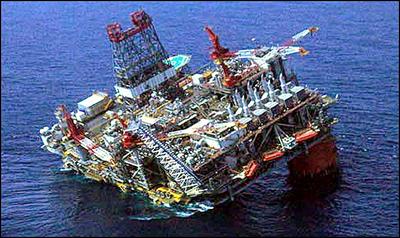
that should give you a clue that something is not quite right. After all, if there is so much oil still left; why are "they" out there in the dangerous waters trying to suck up from deep under?
There are simple tests for this. If I say to one of my kids (5 and 8) "thermodynamics", they will say "what's that?", and really want to know. If I say the same thing to a typical American, they will get a look on their face like I'm trying to pull one over on them. The same thing would happen with "marginal return", or "energy return on energy invested", etc.
The problem is that if you think you know how things work, but really think of it as a form of magic and 'understand' it in that way, then you have a huge mental barrier to thinking of it in a different way. It's a form of cognitive dissonance.
Most people 'understand' that oil occurs naturally in immense underground tanks. People take the oil out of the ground and send it to refineries, where it gets turned into gasoline. The gasoline is then either sent by pipe or truck to gas stations. People pull up their truck/car to the gas station and fill the tank with gas. They pay for the gas, then drive around. Big, expensive, high-status trucks/cars with more power use more gas. Small, tinny, low-status cars with little power use less gas. There are other forms of magic that can change some of this a bit, like ethanol and diesel, but this is how the world works.
So all of our discussion about different types of crude, depletion rates, EROEI, Carnot limits, demand destruction, etc. are outside of their 'understanding' of how things work. We are first requiring them to revert to the level of a child so that they can unlearn part or all of what they 'know'. It isn't hard to see that they will resist that. It's much easier to assume that their understanding is correct and someone is trying to pull a fast one on them.
Great picture but the hurricane did not cause that damage. A valve was in the wrong place and the Ballast Control Operator was constantly correcting the problem. When they evacuated It sank on that side. It was an engineering flaw that caused that and an engineering miracle that kept it afloat. (BP Thunderhorse)
Matt
If indeed there is so much oil still left to keep us going for another 100 years, what are we doing out there in the middle of the hurricane infested waters, teetering on stilts?
But I know we have plenty of large deepwater deposits left. If some geologist proved there was oil on the top of everest, we'd be lashing drillpipe to sherpas. As long as there is profitable oil to pump we will find a way to get it. If you look you could find pictures of all sorts of damaged rigs throughout the years. It is a dangerous enterprise. Google Piper Alpha if you are not familiar. The fact remains we are in a black gold rush and the powers that be are willing to spend money and lives to get it.
Matt
I agree. Your book is a better 'faceslap' for the average joe without computer access, but studying Dieoff.com, LATOC, TOD, EnergyBulletin, etc is much better for a computerized person's daily reality dose of a '2X4 beating' to offset the Iron Triangle's incessant feel-good advertising.
Bob Shaw in Phx,AZ Are Humans Smarter than Yeast?
This is such a common sentiment, and a powerfully misleading one. I've been having a debate with a few friends about technology, whether the rate of progress is accelerating or declining. Of course, computers are always touted as evidence of progress (and by extension that technology will always save us from ourselves), i.e. since IT works this way, everything else must follow its own sort of Moore's law. for your aerospace engineer, however, travel can be given as a counter example.
consider the example of someone wanting to travel from NYC to California. 200 years ago it was nearly impossible. If you did it at all it would take months and there'd be a good chance of death or injury. 100 years ago, it could be done in a couple days by train with virtually no risk of death or injury. A substantial improvement. Since the middle of the 20th century when the average person could drive 65 mph on the interstate freeway system and commercial flight became available, there's really been no substantial progress in travel. The advantage of plane or automobile travel over train is less profound than the advantage of train travel over foot
horse travel.How about today? it takes just as long as it would have 50 years ago. In fact, by plane, it may take longer to travel from for NYC to cali travel than it did 50 years ago considering security, flight delays, etc. Similarly with automobile travel, it may actually take longer due to traffic delays. So if your Aerospace buddy so is sure that technology will save us, why hasn't long distance travel improved significantly over the last 50 years? It is no faster and is in fact less comfortable and convenient than it was 50 years ago. Where's the progress?
GREAT analogy regarding the traffic. I'm going to borrow that one. Thanks.
Best,
Matt
Seems to me you ought to give ol' PG a cut of what you make off it. This would increase your social capital, you know.
Best,
Ed
I've interjected this info before, but here it goes again. According to Al Bartlett's peak oil presentation the amount of oil per capita (world) peaked in the 1970s at 2.2 liters per person (per day) and by 2004 had fallen to 1.7 liters per person. So the mitigation of oil scarcity per person has been going on for about 30 years.
If these numbers are correct, the world is using less oil per person each day than previously, while "global economic expansion" has continued. World population growth has already not been limited by oil.
http://www.washingtonpost.com/wp-dyn/articles/A41324-2005Mar16.html
Even the US Commerce Department admits that wages - per person - have declined (adjusted for inflation ) over the last five years.
The probelm with measures such as GDP is that they don't reflect how the average person is doing. Also, in the case of the US, GDP includes a huge rise in military spending. Iraq has been the 'beneficiary' of such spending - to put it very mildly.
From reviewing news reports, it appears for the average person in Nigeria, Indonesia, Sudan, and other countries income per person is not only dropping - but falling fast. Not surprisingly, the poorest and/or most mismanaged feel the effects of PO first.
With the wikipedia numbers the U.S. (46.6) is less than one standard deviation (10.4) from the mean (40.2).
This reminds me of the way that North Carolina is 48th or something on the S.A.T. tests, yet the mean score is about 2% below the national average.
The U.S. should be considered "average" on this measure.
Is a man that is 5'7" tall "far shorter" than an exactly average height man?
From wiki:
So one number is supposed to represent a "curve". A lot is being lost.The U.S.'s number since 1970 or so has been going up. This may go back to the idea that income is going to the highly educated in this country while less-skilled labor has been exposed to globalized competition.
The contrived situations in which a Gini index would lose its value are irrelevant to the realities of the world we live in.
Significant increase in the index began only after 1980, and has been on a scale with no parallel in other rich countries, though global competition has affected them all.
When I lived in Columbus, GA my neighbour across the street had 4 children and recieved housing assistence WIC money for food and around 470$ a month. I earned about 2k amonth but my housepayment was 780, another 250$ for utilities, and after my car payment and insurance and food my discretionary was about 200$. I worked 60 hours a week and she stayed at home (all children were school aged).
Matt
Perhaps Corrado Gini himself was trying to do the same thing (wikipedia):
How about this ... the Gini index is only an indirect measure of what we really want to know (the condition of the poor).
What we should look at are direct measures: homelessness, starvation, and disease, etc., as a function of income or wealth.
... need to dig in to make a fact-based assessment.
http://www.lcurve.org/images/LCurveFlier2003.pdf
Yes, the green revolution has faded. But the biotech revolution seems to have only just started.
From my post yesterday:
The question, if #3 is true, is how much bang do we get for the lower pesticides and watering requirements?
Actually, I think we're bumping up against the practical technological limits of jet engines and internal combustion engines. We may be able to tweak them a little bit but travel will not substantially improve without a major paradigm breakthrough. The new technologies in the works- hydrogen fuel cell, electric engine, etc.- are not improvements over the internal combustion engine. They are likely to be less powerful and will be less convenient to recharge or fill up than existing vehicles.
If there aren't enough people demanding to get across the country in less time then no one will provide that service
As far as the demand for an improvement, the market would certainly be there if the technology existed. If someone created a technology so that I could commute to NYC in 30 minutes from my home in Ohio, I'd go to manhatten three times a week for dinner and a play. Others would chose to live on say the oregon coast and commute 45 minutes to Chicago. The problem is no such technology is on the horizon to improve on the 100 year old paradigm of the internal combustion engine.
My point is that I don't think we can say technology is constantly improving our lives in all areas. In many ways we're reaching a point of diminishing returns. If all areas of technology improved exponentially as many engineers seem to believe then we would have gone from 3 mph travel in 1800 to 15 mph travel in 1850 to 60 mph travel in 1900 to 300 mph travel in 1950 to 2000 mph travel in 2000. However, although computers are doubling their operating speed and memory every 24 months or so, this does not translate into exponential improvements in other areas in our lives.
Another example is antibiotics:
Penicillin discovered in 1928.
in the 40's through 70's several new antibiotic classes were discovered each decade. in the 80's, 90's and so far this decade only 2 classes have been discovered (and were deemed safe to come to market) and these have a narrower scope of use than the older antibiotics. Most of the new antibiotics coming out today are just slight variations on previously known classes.
I'm saying the market is saturated by revenue.
I'm not sure what you mean by this. Can you elaborate?
Just like with oil fields, the low hanging fruit is explioted first. To make the next improvement in any technology is often technically more difficult and significantly more expensive relative to the return. After all, energy efficiency and safety peaked with the perfection of the diesel engine locomotive 50 years ago. The car and the airplane are less safe, more expensive (when all costs are considered) and far less fuel efficient per person-mile travelled. Given traffic considerations, the car is hardly faster than the car. Apparently the shortcomings of the car are outweighed by convenience, privacy, the ability to live and commute from the 'burbs, etc. in most people's minds. Also, it is apparent that whatever the next improvement would be after the internal combustion engine, it must be too expensive and technically difficult to displace the current paradigm.
oops should read the car is hardly faster than the train
Get anywhere in the nation in a few hours. Walk out your door, grab the frequent tram nearest to yout home, take it to the rail station, board quickly without taking off your shoes, etc. and arrive at your destination, take the tram and walk a few blocks to your destination. Plenty of time to read or work on one's laptop along the way in quiet, smooth, roomy comfort.
That is a new paradigm.
The antibiotic comment caught me. It is very realative to the nursery trade- disease and insect populations develope resistance to chemicals as well. There are documented cases of chemical resistant strains of botrytis in circulation. I find the converging of all the peaks and resistance of meds and chemicals to be a little scary. I currently pay almost $125 per pound for any Ag chemical. Some are more very few are less. When I hear people complaining about farmers and chemicals I just tell them that when you are ready to have worms in your broccoli and scabs on your apples then chemicals will disappear overnight. They are expessive and nasty to apply let alone buy and everyone would love to keep the change. This seems to escape thier thought pattern- that chemical use is an economic decision based on market realities.
I do find healthy plants resist disease better than weak ones. Ants are a pain in the ass- they carry Aphids around to other areas- The aphids excrete "honeydew" ( sweet poop) which the ants eat. This is why your car will be covered by sticky mold if you park under a paper birch tree....rambling here but yes we are getting into a multi head bind- resistance to chemicals.
The change in the past 50 years is that everybody travels coast to coast all the time and at a very low cost.
This is not the same thing as progress.
Fifty years ago air travel was glamourous and expensive.
Think of just which car from 50 years back you would want to sit in for a coast to coast road trip. Me, I'd want a Packard, and might settle for a Caddy or a Hudson. Actually those are probably still, 50 years later, the vehicles I'd choose. Now almost any vehicle in the national fleet will get you where you want to go (at the cost of severe boredom).
Techno-progress hasn't stopped, it changed direction.
Tell me why it is that almost all of us still live in a 1956 mindset. We all still understand, and in some ways, live in, the world of The Honeymooners, I Love Lucy, Father Knows Best, etc. In 1956 even old folks didn't think much of the popular entertainments of 1906, and the young couldn't understand them at all.
So yes, it could be done, but it just isn't worth the extra cost.
William Jevons in his "Coal Question" discussed in a very interesting way the rate of innovation. His conclusion was that economic growth - increasing coal (energy) use - accelerates also innovation, and innovation rate is slow when the economy is slow. He used the steam engine as an example here. So he thought that technological innovation is not the real driving force of economic development but rather a consequence (and facilitator) of increasing energy use.
I see that the present situation corroborates Jevons' ideas here. There are also some empirical research that show diminishing returns on R&D and slowing down of innovation. In fact, it seems that R&D input growth is stalling. This notion can also be supported theoretically - research needs a lot of resources and the realization of its results needs new investments. So it is not reasonably to expect that the Peak Oil will cause a burst of innovations - on the contrary.
neccesity is the mother of invention....as we need alternatives more people will research the field. IT may slow down and gene therapy research may too, but more money (grants) will go to percieved profit/neccesity.
The only historically really new invention in the field of energy is nuclear power. It fits nicely in the Jevonsian theory - it was developed during the very strong energy growth after the WWII. It was already available in the '70s when it helped to mitigate the consequences of the oil crisis. Breeder reactors are also an invention from that time and might be useful now. Fusion energy is not avalable now and it is quite possible that it will never be.
In fact, we should already see more alternatives research in countries with very low energy self-sufficiency, like Japan. The Japanese would really need some alternative energy sources, they have the technology and money, too. But no.
There will be innovativeness in some fields, mainly in conservation. It will require a lot of creativity to manage with less energy. Not so much breakthrough technology, but everyday ingenuity. But that time is not yet.
Reno,
IIRC you are in the transportation business.
So your assigned specialization is "trucking".
Your brother's assigned specialization is "engineering".
You were violating one of the speciality-assignment Laws of Adam Smith by intruding into a specialization area other than the one officially assigned to you by society (via the handing out of diplomas, degrees, certificates, licenses and other indicia of officialdom).
It is very understandable therefore that your brother was upset. Imagine that you might know something about science that he does not! How arrogant of you. One should stick to one's own knitting. :-)
BTW, is your brother EE, ME, ChemE or CS ? Just curious as to what subspeciality of engineering he peeks out at the world from.
Perhaps I should have informed by brother I picked up a peak oil engineering degree at the university of TOD!
And he's an IE by education from ISU. He's the first of two brothers that graduated with IE degree's. The other brother believe in Winning the oil endgame. He believe's we should build 400 more nuclear power plants.. That's an interesting discussion..
Between ethanol and nuke plants, why we have the whole problem licked. Send in the engineers.
(After that, send in the lawyers to resolve what to do with all those spent fuel rods that have no final resting place to go to. Yucca Mountain here we come, ready or not.)
Thanks reno.
a. forget to plug it in (kind of a silly excuse to me) and b. travel beyond the range of the electric drive system,
you never burn gasoline (at least not directly).
If you did forget, or have to take a trip, then the gasoline engine kicks in to drive and recharge the system.
I suspect peoples' memory for such items as plugging in the car will improve dramatically as the cost of gas continues to rise.
Please google power outages in Africa and elsewhere--symptoms of Duncan's Olduvai Gorge Theory coming true:
http://dieoff.com/page125.htm
Plugging in your car is pointless if no juice is coming out the plug. The massive complexity of maintaining electrical distribution grids is the first thing to go as importing countries go postPeak. Here is an instructive link:
http://www.andnetwork.com/index?service=direct/0/Home/recent.fullStory&sp=l36715
excerpt:
----------
Zimbabwe : Power cuts set to persist
Zimbabweans have to adapt to living with the inconvenience of power cuts because the country's electricity authority, Zesa Holdings' electricity generation and distribution capacity has been severely reduced by a combination of an ageing distribution network, vandalism of equipment and low tariffs, a senior official said yesterday.
Rafemoyo said the distribution network had outlived its lifespan and needed urgent refurbishment. "The system we are running in Zimbabwe has seen its days and to a large extent by now should have been rehabilitated, but this is not possible due to lack of funds," he said. Eng Rafemoyo said low tariffs that were being charged by Zesa had compounded the problem of the load-shedding which was being applied on an average of 350 megawatts during peak hours.
Rafemoyo said the ageing distribution network made it difficult for the power utility to advise customers in advance of the possibility of a power failure. "We also have a huge problem of vandalism and our loss control people are working flat out to try and contain the situation, but this is a huge challenge," he said.
----------
My advice: Don't sink any money into a plug-in electric auto as these will be very expensive to purchase, juice up, and maintain. You would be better off, and money ahead to buy your own generator and/or PV panels to power a small electric moped or scooter, then use the saved funds to buy the gasoline to keep your older auto fueled for infrequent trips. During blackouts, use your genset or PVs to power your refrigerator or other essential appliances.
A properly run electric utility should be raising prices far faster than rising costs so that adequate funds are available to outbid other utilities for the ever decreasing supply of industry-specific equipment and energy. That also means not having brownouts or blackouts: purposely shedding customers by a high price regimen to keep from over-loading the grid. Cost-accounting for future security from vandalism and theft loss needs to be done now by any proactive electric utility.
Sales of gensets are booming: consider that many people in hurricane areas have one or more to help protect their families until the storm passes and the grid is restored. Sales of gensets to the wealthy in third world countries is booming too. They could care less that their poor neighbors have no power-- are you willing to pay your neighbor's electric bill? I don't think most people are willing to pick up their neighbor's tab. Lastly, consider Richard Rainwater's survival farm: 500 gal underground water, and 500 underground gallon diesel storage for his gensets.
Bob Shaw in Phx,AZ Are Humans Smarter than Yeast?
Just a quick note to please google 'copper thefts' to get an idea of how difficult it will be to keep the electrical grid up in a postPeak world. Here is one to pique your curiosity:
http://www.mercopress.com/Detalle.asp?NUM=8003
----------
Booming black market for stolen copper
A black market for stolen copper cables has begun to flourish throughout Chile in recent months as delinquents attempt to cash in on the commodity's record high prices.
Through May of this year, about 850 people have been arrested for stealing or attempting to illegally sell the red metal. Lured by a black market price of between 4 and 8 US dollars per kilo, criminals are honing in on construction sites, telephone lines and copper wires of any kind.
According to electric company attorney Jorge Alvarez, several boroughs on the outskirts of Santiago are the worst affected by crimes of this kind. Copper cable thefts in neighbourhoods such as Lampa, La Pintana, San Ramon and Conchali have spiked more than 500% this year, he reports.
Consumer headaches and hefty company losses are the most frequent consequences of this kind of criminal activity.
CGE Distribution, Chilquinta, and Telefonica Chile report they have spent 50 million US dollars replacing stolen copper cables in the first four months of 2006. To put things in perspective, 50 million amounts to one third of what Chile is planning to spend on hospitals, police officers, and social assistance this year as a result of the nation's windfall copper profits.
Meanwhile, consumers often face interruptions in telephone and electricity services as a result of the theft.
Chile is the most important copper producing nation in the world, accounting for more than one third of all production. Half of the country's exports are copper.
-------------
Does anyone doubt Duncan's Olduvai Gorge Theory?
Bob Shaw in Phx,AZ Are Humans Smarter than Yeast?
Yes I do. I ran the figures for electricity supply which he fingers as the real problem. Using BP's statistical review and US Census figures I ran population from 1994 and electricity production against 2004 population and electricity production a while back. In every region there was actually more electricity available per person in 2004 than there was in 1994.
Just to run totals:
BPs figures for total energy generation
- 12852 megawatts (megawatts is what I assume they are measuring - BP didn't actually label their graph)
- 17452 megawatts
Divided by population:1994 population 5.6 billion yields 2295 megawatts per billion
2004 population 6.3 billion yields 2770 megawatts per billion
As you can see whatever BP was actually measuring the trend is up.
His predictions may eventually be right sometime in the future but so far his theory has fallen flat and he has consequently been ridiculed by people like JD from peakoildebunked.
bados
What I like about electricity as the end-use is that there are many ways to create it, and the end-use is essentially non-polluting. You can tell from my screenname and previous posts what my personal favorite way is. Solar (and to a lesser extent, wind) is positioned to allow a decentralization of the grid, which reduces the load on the powerplants.
I'm a bit more optimistic than you on PO and how it will affect us, so I think a switch to HEVs and PHEVs is a more likely and viable scenario, rather than jumping right to the scooter. There is SO much waste in the current system that we can do just fine with so much less by just being more efficient. There is no sane reason to drive an 8mpg Hummer. None.
So you're right, just switching over to plug-ins without an increase in efficiency and decentralized power would further overload an already stressed grid. There needs to be a comprehensive attack on this problem, which involves development and improvement of sustainable sources, increasing the efficiency of the devices we currently use, and reducing our consumption through conservation whenever possible. I believe there is a solution point that is sustainable without reverting to to Stone Age. We just have to recognize the problem and get on with fixing it.
It isn't quite as elegant as a hybrid, but I can't see why it wouldn't get me around town.
It's a human / electric bicycle. The bike was about AU$1200 and the DIY electric assist was about AU$200.
-Probably enough fabrication and design work to make you cry. Unless you've got a car with a solid rear axel, and are a seasoned warrior with fabrication and welding I'd leave that one alone. It is a good idea though, and one I've thought about...but the technical snafoos would be many. A better idea I believe would be an electric motor assist under the hood. That is to say, take a 15 or so horsepower electric motor, use some existing mount (like where the AC compressor should go) and make some brackets for the motor to mount there, scavenge up the pulley, and use a phase in trigger system (sort of an on/off switch) to just manually switch it on when accelerating and cruising.
"It isn't quite as elegant as a hybrid"
-Might not be elegant as a Prius,Insight,etc but it is indeed a hybrid.
OK for long distance travel during daylight BUT not for more than 30 minutes with headlights (w/o larger battery, which dead weight defeats purpose).
SWAG, adds 1 mpg.
Perhaps alternator can just be unplugged most of the time and rechraged via cigarette lighter at home (PV in windshield kits are available).
Since when has any of the "unconventional oil" been economic? Not until now really...
I have no idea what the EROEI is on SAGD...
The Oxford Institute for Energy Studies has long-standing links with the Venezuelan oil industry. One of their (former?) senior research fellows, Bernard Mommer, is a principal oil industy advisor to Chavez. Perhaps they are cheerleading :)
The tar sands in Alberta, Utah and Real and Uvalde counties, Texas and the oil shales in Colorado are totally secure, so they will be developed before anything in Venezuela or most of the rest of the Developing world will be produced or mined. But Venezuella might be able to sell the deal to China or an Indian venture capital group because they want reserves overseas.
http://www.climateark.org/articles/reader.asp?linkid=56819
Regarding coal sequestation (sp?) dreams:
Now for the funny part:
Of course Mr. Boyce does not point to a specific instance in our history, when pollution was limited by "the market" and without goverment regulation.
And some silver linings in the end:
But this is all talk before coming to office isn't it...
To sum it, prepare for coal. If you believe in Global Warming (I do) maybe it is also about time to start looking for adaptive startegies instead of spending resources on doomed causes like restricting emissions.
So in the end, we will do whatever is cheapest to implement, and/or makes the most money for those who with connections to those in power.
Whatever we talk about it all comes down to the money. Always.
Sanctions Could Lead To $250/Bbl Oil - Iranian Lawmaker
Does anyone really think the UN will impose sanctions on Iran?
If these new oil markets succeed, it will be another case of blowback to US foreign policy. We'll find out on June 8 and afterward when the Russian bourse, trading in rubles, gets started.
Watch the birdie.....
As to expensive oil, that is why we have the Strategic Reserve along with the rest of the 1st World. $100 a barrel might not be a bad idea anyway.
The latest from Iran, courtesy of that right wing news service Reuters:
Germans should stop feeling Holocaust guilt: Ahmadinejad
Reuters
BERLIN - Iran's President Mahmoud Ahmadinejad told Germans they should no longer allow themselves to be held prisoner by a sense of guilt over the Holocaust and reiterated doubts that the Holocaust even happened.
In an interview with Germany's Der Spiegel magazine, Ahmadinejad said he doubted Germans were allowed to write "the truth" about the Holocaust and said he was still considering traveling to Germany for the World Cup soccer tournament.
"I believe the German people are prisoners of the Holocaust. More than 60 million were killed in World War Two ... The question is: Why is it that only Jews are at the center of attention?," he said in the interview published on Sunday.
"How long is this going to go on?" he added. "How long will the German people be held hostage to the Zionists?... Why should you feel obligated to the Zionists? You've paid reparations for 60 years and will have to pay for another 100 years."
German Chancellor Angela Merkel and other leaders have said his previous remarks questioning whether the Holocaust happened were unacceptable. Denying the Holocaust is a serious crime in Germany punishable with a prison term of up to five years.
Six million Jews were killed by the Nazis and their allies in concentration camps.
In the rare interview with Western media, Ahmadinejad said if the Holocaust really happened Jews should be moved from Israel back to Europe.
"We say if the Holocaust happened, then the Europeans must accept the consequences and the price should not be paid by Palestine. If it did not happen, then the Jews must return to where they came from."
- Ahmadinejad did not deny Holocaust. He just casts a doubt. A lot of people doubt it. A lot of people doubt other things like Bush doubting Global Warming, but this doesn't represent a crime in a free country, at least IMO.
- Ahmadinejad did not say "Jews should be moved from Israel back to Europe". He said "Jews should go back to Europe". The first claim implies force, which is implying that the Iranians will do it. The guy just says what he thinks it is fair, and I agree with him - since Holocaust is an European deed, Europeans should pay for it. And he is also right about the double standarts - who is talking today about the 20 million russians, 3 million poles, 1 million serbians, 1 million gypsies etc. etc. killed by the Nazis? Who is compensating them?
FWIW Ahmadinejad never said that famous "Israel should be destoyed" words. This was another twist by the Western media. What is really bad is that all of this is now being seen in the muslim world, and people there are really mad at what these clowns in the media here think they are achieving. And then we will wake up someday with another US city burning and asked innocently "God, why do they hate us?"The Israel question is one of those tough questions that one finds hard to have opinions on without getting cast into one extreme or the other -- sort of like the immigration issue. Knowing what I know today, if it were 1948, I would oppose the creation of Israel. But you could push that back to the Balfour declaration, since Britain had such an early hand in things. Having said that, today things are different and Israel has to be dealt with in more realistic terms. It seems to me a much more balanced (less blatantly pro-Israel/anti-Palestinian) stance would actually do more to guarantee Israel's security. My reading of history has the Arab world around Israel dealing with Israel on more realistic grounds in the 1950s when Eisenhower definitely had a more balanced approach to the issue.
Won't get into the Israel-lobby issue, another hot button topic.
Bottom line is, I can't see being an apologist for Ahmadinejad based on nuanced reading of his words. I believe a more balanced US policy in the area would settle down a lot of the extremists and allow some moderate Arabs to gain more power.
I could also say that there is little doubt Israel would have the Palestinians "wiped out" if they had the power. Every Arab would say he would want Israel gone, I think it is obvious. But "wanting" and "doing" are 2 different universes, and here is the task of the media to convince us that Ahmadinejad actually intends to threaten Israel.
there is little doubt that he is a holocaust denier
I'm not getting that impression from his words. For an averagely intelligent person it is clear that by 'denying' holocaust (actually playing around it) he scores points in front of his own people. Again the media is manipulating and doesn't feel ashamed to play again on this 60 years old feeling of guilt to amplify the message.
Overall I can qualify Ahmadinejad as a moderate and a little sly nationalist and populist. Nothing more - nothing even close to that Hitler ancestor they are trying to present him as.
With the need of much more balanced approach of course I entirely agree; what I fear of is that by bullying Ahmadinejad we are playing with fire and risking a real radical nationalist to come to power. Unless this is the whole point of the exrcise.
On your earlier remark, the quote that caught my eye is:
"We say if the Holocaust happened, then the Europeans must accept the consequences and the price should not be paid by Palestine. If it did not happen, then the Jews must return to where they came from." Of which 150,00 came from Iran and were not compensated for lost property. How many would their families now total? 400,000? 800,000?
Ahmadinejad is indeed a nationalist and populist, but moderate? He is the leader of a revolutionary movement, a movement that is acting outside of the world diplomatic system. Now there may be some in Israel, and I know there are, who would like to kill all Palestinians, but they are not leading or even in, the Israeli govt.
The whole point of the exercise is to keep nuclear weapons out of the hands of revolutionary religious zealots. Or at minimum delay it. If sanctions or a blockade are not implemented - someone will be warming up airplanes and loading missiles and bombs.
And what kind of "revolutionarist" is he? I know some Iranians - they are telling me (first hand experience) that nothing is changing in this country. Let's face it - he is just a second-hand player, turned into a much more significant figure by our propaganda than he is. Ironically provides fuels him with additional support in his own country and the whole ME. We are currently producing our next Anti-American Hero, just like we produced Bin Laden and Saddam Hussein. Hope we are not that successful this time.
And stop with this nuclear scaremongering... this is so ridiculous and so detached from the realities of the day that it makes me wonder where is the point of discussing it (Iran with 1 yet-to-build-in-10-years nuke threatening Israel with 150 nukes or USA with 10 000 nukes???).
We waited 50 years for the russians to do it. Thanx god, this preemptive ideas were not implemented that time. A little more sanity people... is this too much to ask?
This video is what The Oil Drum would look like as vaudeville act! Very entertaining and informative, lots of smart laughs -- 5 stars
A Post-Oil Man
Now this is funny!!
I've been a really disillusioned doomer for quite a while, but for some reason that video hit me like a ton of bricks. Probably it is the realisation that I really should get busy preparing a lot more actively, but I don't really see where to start, living in an apartment with very limited means and a wife that I love more than anyone else in the world but who thinks I'm overreacting on PO. Oh, how I wish that I had a house with a decent garden and a little more money, so that I really could get started! I just hope that things here in Sweden will be slightly less brutal in the short term than how I envision things in the US - no offence.
I would be nice to have a "tipping point" in all this, but that's something else you can't count until it's hatched.
What I never got back to posting was that, though I think Local markets are going to be the way of the future. I do also think that we won't be going straight back to the stone age either. To many people with just enough good practical knowledge about things, for the world to just drop straight into the stone age, even if there is a massive war killing millions, or even billions.
Everyone talks about "The Powers That Be" as if it really is a single group of people running the show. I think It is more like a "MindSet". A genetic trait in some humans to be leaders, others to be followers, but some followers can be leaders too.
In a limited population, IE a small villiage setting, where folks do things locally, and markets are every weekend, and/or everyday, The leaders of old might crop up again from the masses. I have seen it happen first hand in small settings. In any group a person or persons are seen as the leaders, but sometimes the folks that also are usually followers can lead just as well. It is a "MindSet" not a "Group TPTB".
My Dad and I are both Trained Chefs "School of Hard Knocks" We both recently found that the MindSet of control is working in small groups more so than a TPTB control pattern. Peak Energy is going to limit the area of a holding capacity for towns and cities, and the general population is going to be led by people with the "mindset" of power, rahter than a group called the powers that be.
I guess I got real wordy saying that I do not believe there is such a thing as some central planning officer from TPTB central command, guiding how I use energy and hoping that the UN sancition Iran so the price of Oil will profit folks.
It was basically--> Cheap Oil--> Big Stores came and ran small guys out of business --> Expensive Oil -->Big stores go under--> small guys come back (local)
So it will come full circle.
I also do not believe that we will end up in the dark ages. However, I do plan for the worst and hope for the best. I have my family debt free (aside from our home that we have up on the market for sale.) We will rent while we save enough money to purchase 40-100 acres of land with a simple ranch style home / well water and spring water running on property is a must.
This is what I want to retire to anyway so it serves two purposes...retirement and a soft landing. I grew up on a dairy farm so I have much experience with farming (cattle, hogs, chickens, and gardening) even though it's been over 20 years since I've done any of that... It's like a bicycle right?
Fact 1, I got rid of a lot of my life's junky clutter, Planned a move for a while, Moved, did the job, Some things worked some did not, having a lot less stuff I am staying a while in My parent's house. It is more cluttered than what I just gave up. I ask why they have something and don't get a logical answer. I see the backyard where I grew a Garden for 12 years, Planted with Shed's. Now isn't that something! My own Old Farm, now a House farm! Albeit a Shed farm, with junk in every shed, kept for a rainy day.
How many People Have 2 Car garages that now only fit one car, or no cars, because of junk.
We have literally filled our lives with things, Collections. Torn up Farm land to Build House farms.
Little Rock is getting into the High Rise Condo market, Right at the Edge of the Housing Bubble, Though now the X-burbers can Move to Town again, and feel upscale still.
I think of it like corporate farms vs small farms. Large farms have much higher output vs inputs than small farms. Volume is efficiency. Somebody wrote a book recently called "The $64 tomato" or something about what it costs to grow your own tomatos.
It became a sad reminder that even the small towns get this way when I found a Wal-mart and a Home Depot in Sterling last week, Big box stores for a Small town. The Store where I bought my Hammock frame, Made in China, was filled with Fishing and Camping gear, Made elsewhere for US market buyers.
It just saddens me that everywhere I go I see the expansion of House farms and Know the Bubble is just about to burst, just has not yet, but can't be sustained much longer. It is hard to write a rosy future Sci-Fi story and know that we will never get there.
I hope that I can get my finances in order so that I can purchase land there before it's all gobbled up... (Hopefully next to a forest preserve).
Price implies scarcity. Something that costs a lot tends to be scarce, but you knew that. Those groups who are already on the margins will be priced out and they will die. Do you feel better? I thought we knew that.
I don't think food isn't correlated to oil, but the prices needed to stop a farmer from farming are still far off.
On the macro scale we have too much food in this country anyway (corn). When you throw in other externalities such as food for fuel (corn), all the variables change and it becomes harder to form a realistic picture of what happens in the US.
Either an increase in food production or decrease in food export.
Net result:
- more will go hungry - lack of food
OR
- I don't really see a downside to increased food production to offset
Of course I could totally be missing your point :-/
If food exporting countries experienced an oil/natural gas supply drop of 10%, what would the effect be on the world?
What I'm looking for is answer like...5%, 10%, or 25% less food exports, or whatever.
If the raw materials availability dropped by 10% then prices would have to rise in proportion to that supply loss. Whatever the "equilibrium" price is at 10% less oil available.
Now if we are the largest exporter, then we will still farm at max capacity. When we go to export it, we will price it accordingly. Due to the heavy subsidizing by the American Taxpayer, I bet this could go on for some time before anyone stops to see the forest they are in.
However other producers who rely on heavy packaging may be forced to adopt different packaging requirements and his need for oil will fall. Even though less is available producers adjust their use as they are priced out of the oil market. So food producers may not produce less, but more at higher prices or the same at a higher price. It will take some time before we are yielding less even as prices climb.
Have you caught up on some of gold posts and other junk that have been running around here this past weekend?
When the price of food increases more or less in concert with the price of energy, might we more likely see the quantity of food consumed to largely remain constant but the overall quality of food consumed to decline?
In other words, most of the nutritional problems of poor people (in the US at least) are not the result of too little calories, but rather of not enough nutritional diversity and food quality. This is why many of the poor in the US are overweight rather than skinny.
So, should food prices suddenly skyrocket, I would expect to see more people buying more and more food that is filling but of poor nutritional quality. More processed high-starch food from big agra-business.
Should be good for corn growers, though.
Joule - That's is a Great point! As food in general becomes more expensive, you would think producers would adjust to fulfill the lowest end of the income by reducing their costs, rather than increasing the price. They may do that by simply finding more ways to increase the use of high fructose corn syrup. There's one hangup though and that's this damn ethanol debate.
Unfortunatly I think this country is going to buy into ethanol in a big way because it makes all of us warm and fuzzy. So I think corn will be in demand. This will cause a reallocation of resources to the best use cause. I mean should people eat or grow it to burn it? When parts of America suffer widespread famine, do you want to pump this corn into your car or eat it?
It's hard to answer this definatively though. It's hard to know how the system will work, when you put stresses in different places. Is america going to ship food around the world if/when we are struggling ourselves? Look at island economies though and they eat mainly fish and rice or some other complex carb. That is their staple and the people following it in parts of Japan live long, healthy low energy lives. I think convenience is the reason for such poor nutrition. Will we experience the great depression again? I don't know, but I'm putting things in order so that I can move outside this country if need be.
Do you have any articles about our poor who are fat? That's interesting. I have a rather harsh opinion of the homeless, not necessarily just poor, but outright homeless.
You guys seem to be talking at crosspurposes. What wstephens is asking IMO is if the oil & gas inputs of an agricultural producer dropped 10%, i.e. 10% less oil & gas available for fertilisers, fuel etc. at whatever price, what would be the effect on their food production.
Are there non-fossil substitutes for required inputs (in volume)? Or, will we shift to producers who are much more efficient than the distribution of ones that we've got now (i.e. intra-industry shifting)? Where is the non-linearity?
The 10% drop in fuel available economy-wide would result in large price increases for fuel. In the first year, that may induce a drop in food production, as farmers decide it isn't worth farming that year because of low food prices and high input prices. However, by the winter of that year, food prices should have risen substantially because of the lower supply of food from reduced production. The next year farmers will see the higher food prices and decide it's worth farming again, and use the fuel they didn't use the prior year.
You can think of food production in this way like a spring that helps to dampen out a reduction in supply over time. Agriculture is a big enough part of the fuel market to have such an effect. The first year it absorbs the shock of the supply reduction by cutting back on fuel use. The second year it increases fuel use due to rising food prices. It should keep oscillating like this in smaller amplitude each year until a new food/fuel equilibrium is reached, assuming the supply shock doesn't increase. This is one of the ways that higher fuel prices get translated into general price increases. It is probably also part of the reason that food prices are removed from the CPI to get "core" inflation.
So if too many farmers opt not to farm, the prices the following year would tend to raise significantly for those who gambled and remained in the game. Now the next year, if prices are stable for gas, then many of them decide to farm and the next year the market takes a mini crash and prices are lower than the last year, but higher prior to the 10% increase in gas.
Now to make things even more interesting is that prices are going to continually rise. They will no go down in the next five years. So do those farmers who are priced out this year, get priced out again next year b/c gas costs 21% more than two years ago (2 years of 10%). What do they do now?
That's why I truly believe that producers will continue to produce as long as they can pass on the costs to consumers. The irony is that we need producers to opt out to induce increases in price which in turn creates higher prices, which creates an incentive to enter the market by those who left. Classic economics talking in circles. Once consumers start resisting price increases, then the game gets interesting.
Lastly the reason we have a CPI is to make us feel good. Nothing more.
So if the supply is cut by 10% the natural market reaction will be to price the remaining supply higher. This will effectively reduce current demand by the price being higher and some people can't afford it. In this case we are talking about farmers. Farmers tend to farm and keep on farming because there will always be a need. ALWAYS
#1 This is a bad example, but say I had a refrigerator and set the energy input to "X", and the refrigerator then made ice, but if I lowered the energy input by 10%, and the refrigerator stopped making ice altogether, then I could conclude that a threshold condition exists relative to the output of ice -- i.e. it's non-linear.
#2 If I have a farm of 100,000 acres, and I have a tractor that must traverse those acres 3 times (seeding, fertilizing, and cropping) and that this consumes 3000 gallons of fuel. If I lower my fuel consumption to 2700 gallons (10% lower) then will I necessarily have to farm only 90,000 acres?
This is the direction that I'm going.
Yield-High = 110.37 + 1.142 x N - 0.00347 x N^2
Yield-Med. = 89.46 + 1.185 x N - 0.00346 x N^2
Yield-Low = 76.13 + 0.898 x N - 0.00258 x N^2
They show a corn yield that is a non-linear function of the pounds of input nitrogen fertilizer (notice the N-squared term). Apparently the different yield equations are weather dependent.
For parts of the yield curves that I saw, you could drop fertizer by 50% and yield would drop only 15%, but other parts of the curve if you dropped fertilizer by 50% then yield would drop by 75%.
Keep in mind you said we are cutting back fuel 10% so we are going to have 300 gal less. If avg mpg is flat there is little you can do but cut back how much farm you cover. Otherwise you will plow 100K acres and not be able to harvest all of it. So how do you cover the rest? Could you use animal power? Manual? Or does it die because he runs out of time anyway trying to get all the acres he can before the season is done? Each case will be different. So to voluntarily try and cut back your use by 10% you will be self-limited by the 2700 gal of fuel.
Keep in mind the motivation to farm with 10% less fuel. No one would farm only 90K acres if the marginal profit sitting there is higher than the cost. That's stupid.
So you would necessarily be limited to only farming 90K acres. I'm sure with some creativity you could squeeze a little more than 90K, but I suppose with 1% more improvement in efficiency, that may translate to being able to farm 1% more. I don't know the correlation though, so this is just thinking aloud. But I still say this will not happen when your marginal profit is higher than the cost.
I'm coming to the conclusion that the depletion response should be linear -- that it's better to give up acreage than slide down the non-linear fertilizer curve (by the way you can find these curves at state ag web sites like the university of kansas, etc). However, I'd bet that some companies may decide to take a chance on good weather, by dropping down on the fertilizer curve, and run the risk of dramatic drops in bushels. In other words, they would lower the given cost in hopes that the weather gives them a free boost. If this becomes prevalent then the grain markets could get price spikes as a result. This is consistent with, say, hedge funds -- if performance is ordinary then they leverage-up hoping to get a "free" boost.
I've heard anecdotal info that there are "organic" fertilizer solutions out there -- will they have the volume to substitute for fossil-derived fertilizer? At what price?
So, long story shortened, I could make an argument that as the price of, say, natural gas goes up that the price of grains will go up linearly (of course there are lots of simplifications in that model), but that weather becomes a much larger factor is grain yield because businesses will start to take chances.
Now I know fertlizer is influenced by the prices of NG. But once again, we are back to prices influencing decisions. In the end as general prices rise, I don't think they will farm any less. Keep in mind I said as general prices rise...if we see spikes then all bets are off. I think there will be far more that is sowed and lost, than simply not planting the extra acres.
The next step (which you were jumping to :-) is to try to figure out what will happen when to world supply of natural gas drops by, say, 10% or 20%. What "demand" will get destroyed? Fertilizer/food? Home heating? Or one of the many other things made with NG? Hmmm.
And if the drop is mainly in the food production, will that drop mostly affect exports? Hmmm again.
The net effect would be that all supply chains would be renogotiated/become more complicated and the effects would be unpredictable.
Agricultural interests are well-organized politically and will get what they need easier than most. In a crunch everyone will understand the primacy of food.
If there is a 10% drop in available fuel will importers have cash? Who will conserve grain by going vegan?
You can't predict this stuff. It will be interesting.
At risk of mis-stating their conclusions -- they are bearish (i.e., expect prices not to increase) -- prices should remain fairly stable. But do take a look, if at all possible. Da*n subscription walls... To paraphrase Reagan, "Mr. Capitalist Publisher, tear down this wall!"
I will look up at Tulane library.
http://www.worldtribune.com/worldtribune/06/front2453885.978472222.html
Pass it...pass it....
Yesterday I attendend the exhibition part of http://www.elmia.se/worldbioenergy/ in search of technology and ideas for wood pellet manufacturing and I found some new machines and nice people. And the worst US salesman I yet have met, selling "total solutions", "the first pelleting machine design for wood pelleting" and "solid fuel air conditioners" while almost bragging about not knowing anything about the products. Selling by insulting customer intelligence?
During the conference I got the news that the old "energy agreement" between our socialist party and the one party of the opposition aliance who since a very long time wants to abandon nuclear power has been broken. That the Centre party is replacing getting rid of nuclear power with "keep what we have" and even stating that replacement reactors could be ok is obscure for the rest of the world but it is major news in Sweden. This could be the biggining of the end of our 30 year long political deadlock regarding nuclear power. My guess is that we will have a combination of reinvestment in nuclear power and large investments in biomass power.
There were also some chinese at the conference and then I saw a press release about them not only investing in buying oilfields but also in developing biomass power.
Cut and paste:
China invests in Swedish bioenergy
The State Grid Corporation of China, which is the largest energy company in Chinaand the world, plans to invest in Swedish bioenergy via its subsidiary National Bioenergy. In conjunction with World Bioenergy 2006 in Jönköping three agreements were signed -cooperation agreements and letters of intent - between National Bioenergy and Swedish players in the bioenergy field. The collaboration was facilitated by Svebio.
One cooperation agreement concerns the staffing and operation of power plants, and the Swedish partner is Ena Kraft in Enköping.
Another agreement concerns the production of forest fuels, and the partner here is Sveaskog. The biggest project is a bioenergy complex in Härjedalen, Sweden, where the aim is to produce both electricity and heating in a heating plant combined with pellets production and ethanol manufacture.
At the same time as Chinais investing in Sweden, Swedish bioenergy companies will help to develop bioenergy in China.
Why have the Chinese chosen to work with Sweden? And who will benefit from the collaboration?
"It's a win-win situation, but Sweden wins the most," answered Mr Liu Zhen Ya, who is president of the State Grid Corporation and in practice is China's highest ranking politician in the energy field. He spoke at the press conference that followed the signing of the agreements. The reason why Chinaselected Swedenis that Swedenis a leading nation in utilising bioenergy.
Mr Liu was one of the opening speakers at World Bioenergy 2006 in Jönköping. The conference is being attended by about 1,100 participants from about 60 countries.
World Bioenergy 2006 is a joint project of Svebio and Elmia, and consists of an international bioenergy conference, an exhibition featuring about 100 bioenergy companies, a large number of seminars, and a number of study visits and excursions to Swedish bioenergy facilities. World Bioenergy 2006 continues through Thursday in Jönköping.
For further information contact Kjell Andersson, Svebio, tel. 070-4417192.
It looks like the Swedish are slowly beginning to think nuclear power isn´t so bad after all, and I´m afraid they may be taking the cue from our government here in Finland. Our fifth nuclear power plant, the construction of which is underway, was sold to the parliament as part of a package which included promises to invest in renewables... Needless to say, those promises have been broken, and now the business elite is openly calling for yet more nuclear plants (well actually just one for now...) to be built!
I´m extremely worried about the geopolitical aspects of our current energy policy: we rely almost entirely on Russia for oil and gas as well as nuclear fuel, and I really am at a loss to figure how the very same (generally right-wing) people who want us to join Nato because they consider Russia a military threat can advocate policies that do nothing to reduce our dependence on Russian energy (we even buy lots of electricity from them). Either these people know nothing about the coming energy crisis, or they think that somehow Nato will provide us everything we need in case Russia decides to cut us off (dream on!!!).
By the way, I remember reading earlier that you thought Sweden may be more "peak oil resistant" than the US. Well, I don´t know about Sweden, but I live in central Helsinki and I think even minor fuel shortages could make life hell for us, especially if they took place in winter. Even though our grand-parents did manage to live without electricity in the countryside, our society today is very energy-intensive, and just a short blackout in winter would leave most of us sitting in the cold and dark, helpless to do anything much... Also, our food production could't really function without lots of easy fuel.
Jussi
One could expand domestic storage of oil, but that will be expensive and one can add only a few more moths worth.
Natural gas is more troublesome. I doubt that Finland has good geological structures to store, say, a years worth underground. Building a LNG recieving terminal but not using it (take chepaer Russian gas instead) might be the best option.
And more domestic renewables will add to Finland's energy security. I think Finland has plenty of "good wind" and they can get a few % from your forest production waste.
A half dozen years ago, didn't Finland abandon a tram line outside Helsinki ? Bad choice. Build more now.
You are FAR better off than we are.
I also suspect that we have cultures that are fairly good at recognizing physical needs and then building what needs to be built. This makes us peak oil resistant.
Electricity black out resistant is another problem. We are slowly getting better at that in Sweden but the progress in cablification, icelanding capability and so on is not keeping up with peoples expectations and the general computerization of most everything. I do wish we still had the massive civil defence we had during most of the cold war. We had the capacity to feed the whole population for a year or three while running wartime industrial production with close to zero international trade, all that is now gone.
What kind of renewable investments were promised? You should have a good district heating, combined heat and power production and wehicle fuel from black liquor potential.
As an American, it greatly vexes me to see yet another example of the current pattern - while the US is busy making war, China is busy making deals.