


Is Nuclear Power a Viable Option for Our Energy Needs?
Posted by Prof. Goose on August 8, 2006 - 3:34pm
In the middle of the last year it became clear to me that the Australian Government was interested in having a debate about Nuclear Energy for Australia. I decided that we, in the School of Physics, could make a positive contribution to the debate and organized a study group to investigate this. We constructed a wiki-based website (http://nuclearinfo.net) where we placed our findings. We went live last December but have updated the website as we've learned more about energy issues and Nuclear Power.
In this post I draw heavily on website and restrict myself to talking about light water fission reactors. There are a variety of different and more advanced reactor schemes that could be addressed in a future post. There are more details on our website on all of the topics covered here.
Nuclear Fission Basics
A nuclear fission reaction occurs when a 235U or 239Pu nucleus captures a neutron, splits into two smaller nuclei and releases 2 - 3 more neutrons. These neutrons can be used to initiate further reactions. From an energy standpoint, the significant feature is that the release is around 200 Million Electron Volts per reaction. A typical chemical process such as the oxidation of hydrogen, emits 20 electron volts per reaction. Thus nuclear fission provides around 10 million times more energy than chemical processes. This factor of 10 million sets the scale of Nuclear Power.
Natural Uranium consists of 99.3% 238U and 0.7% 235U. Conventional light water reactors utilize fuel with an initial 235U concentration enriched to at least 3.5%. The energy released from these reactors comes from the fission of 235U and 239Pu (which is produced via neutron captures on 238U). The heat from the reaction is used to drive steam turbines with a conversion efficiency of around 33%. Typically the fuel is loaded at 3.5% 235U and replaced once the 235U concentration has fallen to 1.2%. A 1 GW light water Nuclear Power Plant consumes 30 tonnes of fuel per year. A coal-fired plant of the same magnitude consumes 9000 tonnes of coal per day.
World Uranium supply
Given that this website is devoted to the study of peak oil, I think it's appropriate to first look at the prospects for using Uranium as fuel source for at least the rest of the next century. Uranium is not a particularly rare mineral. It has an average crustal abundance of about 2.7 Parts Per Million (PPM), which about the same as tin and zinc. There is an estimated 40 trillion tonnes of Uranium in the Earth's crust. To date we have mined less than one ten-millionth of this (as opposed to about half the world's conventional crude Oil). A typical 1 GW Nuclear reactor requires around 200 tonnes of natural Uranium per year. Current world consumption of Uranium amounts to some 65,000 tonnes per annum. Current world supply is around 40,000 tonnes per annum. The mismatch is maintained by the drawn-down of stocks and the use of fissile material available from the reduction in Nuclear Weapons in the USA and ex-Soviet Union. The combination caused a decade-long depression of World Uranium price. These stocks and secondary sources will be exhasted by the middle of the next decade. In early 2003 the price of Uranium was $23 per kg, it is currently at around $110 per kg. This price increase has triggered a rapid increase in exploration activity around the world. At $110 per kg, the price of Uranium Ore contributes about 0.22 cents per KW-HR to the price of Nuclear generated electricty.
Reasonably assured reserves (or proven reserves) refers to known commercial quantities of Uranium recoverable with current technology and for a specified price. The terms additional and speculative reserves refer to extensions to well explored deposits or in new deposits that are thought to exist based on well defined geological data.
As of the beginning of 2003 World Uranium reserves were:
- Reasonable Assured Reserves recoverable at less than $US130/kgU (or $US50/lb U3O8) = 3.10 - 3.28 million tonnes.
- Additional reserves recoverable at less than $US130/kgU (or $US50/lb U3O8) = 10.690 million tonnes.
As of the beginning of 2005 World Uranium reserves were:
- Reasonable Assured Reserves recoverable at less than $US130/kgU (or $US50/lb U3O8) = 4.7 million tonnes.
- Additional recoverable Uranium is estimated to be 35 million tonnes
The substantial increase (almost 50%) from 2003 shows the results of the world-wide renewed exploration effort spurred by the increase in Uranium prices which commenced in 2004. This increase in activity has continued through to 2006. Thus, the provable uranium resources amount to approximately 85 years supply at the current level of consumption with current technology, with another 500 years of additional reserves. It is worth noting that the numbers above do not reflect the considerable increase in Uranium exploration that has taken place in 2005 and 2006.
It is interesting to speculate on the ultimate size of the world Uranium resource, if it were to power light water reactors. This can be estimated by comparing the energy produced by a nuclear plant to the energy required to mine and refine the Ore. As one moves to lower grade Ore, the energy cost the mining and refining increases. However the total resource size increases at these higher dilutions. If we assume the rate at which the energy cost increases is inversely proportional to the Uranium concentration in the Ore we can estimate the ultimate size of Uranium resource if consumed in light water reactors. The Rossing mine in Nambia is a large, low grade Ore deposit. It produces around 3000 tonnes of Uranium per year. The energy cost of this process is 1 PetaJoule. Now 3000 tonnes of Uranium provides 15 GigaWatt-years of power which is about 470 PetaJoules of energy. So the energy gain from Rossing is close to a factor of 500. The grade of Uranium at Rossing is 0.035% by weight (about 350 ppm). Deffeyes & MacGregor have estimated the distribution of Uranium in different types of rock and show that shales and phosphates contain 8000 times as much Uranium as current Uranium Ore bodies at a concentration of 10 -20 PPM. These rocks are potentially minable with an energy gain of 15-30.
Consequently, unlike conventional Oil, Uranium resource exhaustion will not be an issue for the foreseeable future.
Energy Lifecycle of Nuclear Power
The performance of Nuclear Power can be compared to other energy sources by calculating the total energy required to build and run a Nuclear Power plant and comparing it to the total energy it produces. The following set of calculations is also taken from the independently audited, Vattenfall Environmental Product Declaration for its 3090 MW Forsmark nuclear power plant in Sweden. A more detailed description is here. Vattenfall have also made available the aggregated data set as a spreadsheet. You can download it from here. Vattenfall is a large European Energy utility that operates a variety of energy generation technologies including Nuclear, Hydro, Natural gas, Coal, Oil, Peat, Biomass, Wind and Photovoltaic. We chose this because it had been independently audited, and includes the entire lifecycle of the processes which includes the eventual long-term disposal of the waste. Sweden and Finland have perhaps the most developed nuclear waste disposal plans of any country.
The following table displays the source and the amount of energy required to produce 1 KW-Hr of electricity. The table includes the energy used in construction of the plant, mining the Uranium, enriching it, converting it to fuel, disposing the waste and decommissioning the plant. The plant is assumed to run for 40 years. There is an additional 0.026 grams of Uranium consumed in generating this one KW-Hr of electricity. This 0.026 grams includes the Uranium used to generate power and the Uranium consumed by the French Nuclear Power plants that produced the electricity that enriched the Fuel.
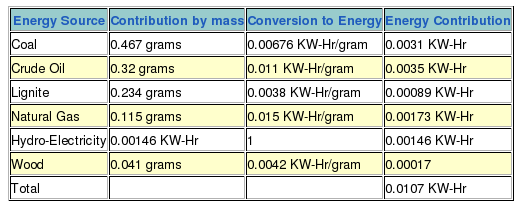
So the Plant produces 93 times more energy than it consumes. Or put another way, the non-nuclear energy investment required to generate electricity for 40 years is repaid in 5 months. Normalized to 1 GigaWatt electrical capacity, the energy required to construct and decommission the plant, which amounts to 4 Peta-Joules (PJ), is repaid in 1.5 months. The energy required to dispose of the waste is also 4 PJ and repaid in 1.5 months. In total this is less than 0.8% of the all the electrical energy produced by the plant.
Greenhouse Gas emissions
Although the processes of running a Nuclear Power plant generates no CO2, some CO2 emissions arise from the construction of the plant, the mining of the Uranium, the enrichment of the Uranium, its conversion into Nuclear Fuel, its final disposal and the final plant decommissioning. The amount of CO2 generated by these secondary processes primarily depends on the method used to enrich the Uranium (the gaseous diffusion enrichment process uses about 50 times more electricity than the gaseous centrifuge method) and the source of electricity used for the enrichment process. It has been the subject of some controversy. To estimate the total CO2 emissions from Nuclear Power we also use the work of Vattenfall.
Vattenfall finds that averaged over the entire lifecycle of their Nuclear Plant including Uranium mining, milling, enrichment, plant construction, operating, decommissioning and waste disposal, the total CO2 emitted per KW-Hr of electricity produced is 3.3 grams per KW-Hr of produced power. Vattenfall measures its CO2 output from Natural Gas to be 400 grams per KW-Hr and from coal to be 700 grams per KW-Hr. Thus nuclear power generated by Vattenfall, emits less than one hundredth the CO2 of Fossil-Fuel based generation.
Nuclear Costs
The cost of generating power via nuclear energy can be separated into the following components:
- The construction cost of building the plant.
- The operating cost of running the plant and generating energy.
- The cost of waste disposal from the plant.
- The cost of decommissioning the plant
Quantifying some of these costs is difficult as it requires an extrapolation into the future.
Construction Costs
Construction costs are very difficult to quantify but dominate the cost of Nuclear Power. The main difficulty is that third generation power plants currently proposed are claimed to be both substantially cheaper and faster to construct than the second generation power plants now in operation throughout the world. The Nuclear Industry says its learned the lessons of economy-of-volume demonstrated by the French Nuclear Program, and that these will be employed for the new power plants. For example Westinghouse claims its Advanced PWR reactor, the AP1000, will cost USD $1500-$1800 per KW for the first reactor and may fall to USD $1200 per KW for subsequent reactors. They also claim these will be ready for electricity production 3 years after first pouring concrete. This should be compared to second generation plants which, in the U.S.A., had construction costs up to $6000 per KW and generally took more than five years to complete.
Meanwhile the Chinese Nuclear Power Industry has won contracts to build new plants of their own design at capital cost reported to be $1500 per KW and $1300 per KW at sites in South-East and North-East China.
Operating, Waste Disposal and Decommissioning Costs
Operating costs are much easier to quantify and are independently verified as they relate directly to the profitability of the Utilities which operate them.
Since 1987 the cost of producing electricity from has decreased from 3.63 cents per KW-Hr to 1.68 cents per KW-Hour in 2004 and plant availability has increased from 67% to over 90%. The operating cost includes a charge of 0.15 cents per KW-Hr to fund the disposal of radioactive waste and for decommissioning the reactor. This fund is currently capitalized at $24 billion dollars. The Swedish Nuclear Industry has charged 0.5 cents per KW-Hr for waste disposal and decommissioning. Sweden has well developed plans for these which appear to be adequately covered by these charges. The US plans for waste disposal at Yucca Mountain remain highly controversial. It may be that the charges levied by the US NRC are insufficient.
Sensitivity Analysis of the cost of Nuclear Power
In our study we performed a sensitivity analysis of the cost of Nuclear Power. We employed a simple model which gives a reasonable guideline to the cost in US cents of electricity per KW-Hr based on various assumptions for construction cost, operating costs, interest rates and construction time. The plant is assumed to have a 1 GW capacity.
If we assume a 7% interest rate and 4 year construction period, US operating costs in the second best quartile, the cost of electricity production for plants that cost $1.2 Billion, $1.5 Billion and$ 2.0 Billion US dollars would be 3.3, 3.8 and 4.4 US cents per KW-Hr respectively. If the AP1000 lives up to its promises of $1200 per KW construction cost and 3 year construction time, it will provide electricity fully cost competitive with Fossil Fuel based generating facilities.
Safety of Nuclear reactors
The chain reaction that provides the power-source of nuclear reactors, is controlled by adjusting the neutron multiplication factor, k. The parameter k is the overall fraction of neutrons from one fission generation that initiate further fission reactions. If k > 1 the number of neutrons grows with time and more power is generated. If k < 1, the reaction decays with time and less power is generated. In a steady operation k is adjusted to be almost precisely 1. This is possible because round 1% of the neutrons in a reactor are emitted after a delay of a several seconds even though the typical cycle time between succeeding generations in a light water reactor is of the order of 10 milliseconds (these are initiated by prompt neutrons neutrons directly from the fission). The multiplication factor is adjusted by changing the configuration of control rods which absorb neutrons within the reactor.
In addition to this active control two natural processes provide negative feedbacks which stablize the reactor. The first of these is a negative temperature coefficient. As the temperature of the fuel increases, the vibrational energy of the 238U increases which increases the rate of neutron absorption. Thus k decreases and the reaction rate slows down. The second is what is called a "negative void coefficient". What this means is that if the water that is used to cool and moderate the neutrons decreases in mass (for example via steam bubbles forming voids), it no longer is an effective neutron moderator which also slows down the reaction rate.
So light water reactors are inherently stable to first order. Of course things can and do go wrong over the course of time. These are normally corrected by routine adjustments of the reactor parameters. However the worst thing that can happen is for a massive loss of core coolant via a catastrophic accident. If this happens the nuclear reaction will stop but the fuel itself will continue to generate heat from the radioactive decay of fission products. Without the cooling water, the fuel elements will eventually melt. Should this occur, the fuel is contained within the extremely strong shell of the containment vessel. The melt-down will destroy the economic value of the reactor, however the public remains protected. To prevent meltdowns, current second generation reactors employ multiple backup cooling circuits driven by active components like pumps and valves. These are active safety systems and modern reactors are projected to have 1 major core damage incident per 100,000 years of reactor operation.
In contrast, new designs such as the Westinghouse AP1000 employ principles of physics such such as phase change and gravity to maintain cooling water in the event of a catastrophic loss. The design is simpler, smaller and safer and cheaper than current reactors. The American NRC estimates 1 major core damage incident per 2 million years of reactor operation for the AP1000.
There are been numerous reactor incidents over the years. Some more serious than others and most recently at the Forsmark complex cited above. However Three Mile Island and the Chernobyl catastrophe are the events that most people associate with Nuclear Power accidents. The Three Mile Island accident resulted in a contained melt-down. The Chernobyl event was the result of a fundamentally unsafe reactor design (the graphite-moderated, water cooled reactor has a positive void coefficient at low power as well as no containment vessel) together with a complete lack of safety culture. The following links provide excellent descriptions of the Three Mile Island and Chernobyl events.
The Three Mile Island accident caused the US NRC to re-evaluate Nuclear Plant designs and in many cases ordered changes. These changes were both expensive and time consuming to fix but have increased the safety of US plants.
It is a condition of entry to the EU that Chernobyl style plants be shutdown.
Nuclear Waste
Spent Nuclear Fuel (SNF) from a reactor is highly radioactive. The activity can be broadly divided into two classes. Fission products, (nuclei created from the fission process) and Trans-Uranics. These are nuclei that are heavier than Uranium and are created when 238U captures a neutron. Fission products are generally short lived while TransUranics can have half-lives in the range of tens of thousands of years.
Once the SNF has been removed from the nuclear reactor it is placed in interim storage at the reactor site. Usually this consists of putting the nuclear waste into large pools of water. The water cools the radioactive isotopes and shields the environment from the radiation. Nuclear waste is typically stored in these supervised pools between 20-40 years, although this could be reduced to 5 years. As the SNF ages the radioactivity decreases, reaching the point where can be placed in dry storage facilities. Throughout this time there is a great reduction in heat and radioactivity and this makes handling of nuclear waste safer and easier. However the TransUranic component of SNF must still be isolated from the environment for 100,000 years or more. The fission products typically reach background levels after 500 years.
After this "cooling off" period the high level waste can be handled in different ways. It can be reprocessed (which invloves extracting the Uranium and Plutonium) then disposed of permanently or directly disposed permanently in a geological repository. There is also very active research into "burning" the TransUranic's in either advanced reactors or accelerator driven subcritical assemblies. However this technology has not yet been developed to work on a large scale. Finally it could be left in dry casks for "interim storage". These are predicted to be safe and stable for at least 1 century.
The most advanced concepts of long-term disposal of Nuclear waste is for deep geological burial. The Nordic countries, Sweden and Finland are perusing solutions which employ multiple barriers to provide isolation from slow-moving groundwater. Finland has selected a site for disposal, Sweden is choosing between two locations for their facility. The earliest start up date for the repositories is 2017.
Nuclear Proliferation
The Uranium enrichment used for light water reactors is not sufficient for a Nuclear Weapon and while light water reactors produces hundreds of kilograms of plutonium during operations, the plutonium produced has too much 240Pu for a useful Nuclear Weapon. What happens is that the 240Pu builds up in a reactor with operation. In a light-water reactor, the 240Pu exceeds useful concentration (7%) after 4 months of operation. Nuclear fuel is normally left in place for over two years. After this time the 240Pu concentration is 25% which is well beyond the militarily useful range.
For this reason, light water reactors are called proliferation resistant. Normal operations preclude the production of militarily useful Plutonium. Abnormal operations are easy to detect.
Conclusions
Technically, there appear to be no show stoppers for a considerable expansion of Nuclear Power throughout the world. It is a low carbon energy source with abundant fuel supplies. The technology works and has much potential for improvement. Whether or not a large scale expansion eventuates depends on how it competes with Coal on economic grounds and with the public on political grounds. This in turn will be determined by the performance of the nuclear industry over the next few years as these purportedly cheaper and safer plants are built.
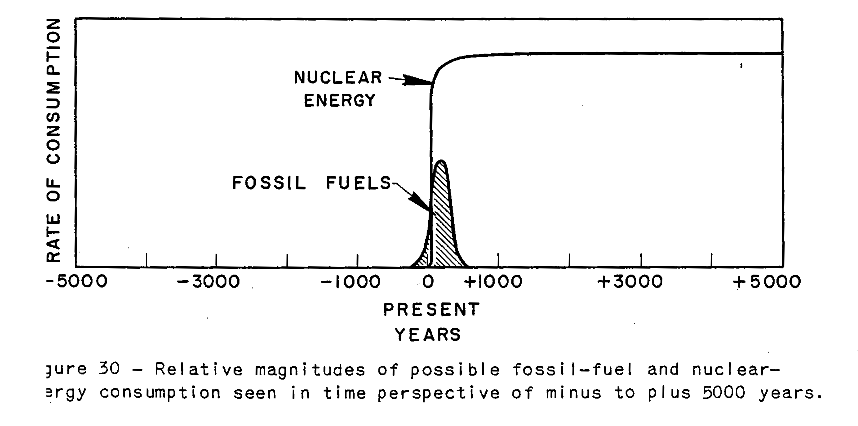
I think it is worth showing the final graph from M. King Hubberts' seminal paper "Nuclear Energy and the Fossil Fuels".
Contact
- Content: editors at theoildrum dot com
- Tech support: support at theoildrum dot com
License

This work is licensed under a Creative Commons Attribution-Share Alike 3.0 United States License.
Until this question is answered I dismiss nuclear power as viable.
If you mean to ask the question, "how do we dismantle nuclear power plants with fossil fuels that will be increasing in expense and decreasing in availability over time?" (we're not going to be without fossil fuel for a while, or don't you read the site much?)...well, I think that's a much more apt question.
I read this site much, and clearly understand we won't be running out of FF anytime soon, or ever, maybe. I did read the piece and am open to a discussion on nuclear power. I apologise if my comment suggests otherwise.
However:
By no means it is clear that what are now the major population centers that at present consume a lot of energy and which are the locations for future nuclear power plants, will have access to any FF in 60 years time.
Despite suggestions that we will have the equipment for mining , processing and transporting minerals for nuclear power plants, and the equipment to decommission these, all running on electricity, this underlying infrastructure is nowhere in place as far as I can tell. This will require a complete redesign, replacement, and extension of all present machinery used for these processes. Keep in mind that if we intend to get a good part of our electricity from nuclear power, we need to build many more stations then we have now.
I have also trouble with the costs that are mentioned. First, estimating now the costs of building a plant that will take several years to have completed is guaranteed to overrun the proposed budget.
Second, calculating 15 cts. per KwH for decommission costs 60 years from now is based on todays' economics and thus hard for me to see how it can apply to a situation so far ahead (though obviously something should be calculated).
Third, in calculating the costs for a nuclear power plant it is asumed the underlying infrastructure, i.e. the electrical grid to transmit the generated electricity, is in place. It is now, but it's old and vulnerable already. I think the grid needs some serious upgrading if men is to switch to more electric power (be it nuclear or otherwise) and less FF. All in all the economics seem a bit doubtfull.
Finally, the waste. There probably are ways to deal with this. Clearly stuff with a half life of thousands of years should be put away properly, and not like here in Holland at http://www.covra-nv.nl , which is at sealevel. Despite all the protective measures eventually these will wear out.
Nuclear power will probably stay part of an energymix if we intend to peacefully and gradually powerdown, but it has no future in the long run, and frankly, I feel it is a bit like playing God.
Use hydro, wind or solar generated power to melt down steel & other metal into metal that is not exposed to people (concrete rebar comes to mind). Use air jack-hammers to break-up concrete and use for roadbeds or other "scrap concrete" use.
IMHO, "once through" fuel rods will be retrieved from storage after a century or two and refined/reprocessed for their platinum group metals (plus gold, silver, germanium, etc.).
The degree of employee health safety measures might be excellent in 2138, or they may not be.
What to do with the zirconium though ? (Nuke fuel rods are often built of zirconium from memory).
Simple enough for you?
um, using electricity? How about producing hydrogen with the nuclear power and then making methanol from that?
This is the most tired argument around... "The CEO's limo runs on gas, therefore without gas the CEO can't show up to work, therefore nuclear power isn't viable without gas...."
The solutions are entirely obvious. Only willful ignorance would make it otherwise.
The reality of the matter though is whether you want the reactor in your back yard, or someone else's... Thats where the issue arises.
PTB = Powers That Be
TLA = Three-Letter Acronym
OTOH, IMHO, PTB -> BTL.
Other problems with nuclear:
-the possibility of a meltdown and the NIMBY syndrome
-the superheated water coming out of a plant tends to kill wildlife and acquatic ecosystems. (This applies where steam is circulated back into the water source, instead of being let out the vents.)
-contrary to popular belief, even disregarding the nuclear waste, they are not 'green' energy, as they spread some radioactivity in the surrounding environment.
-it takes about ten years to build and approve one nuclear reactor, which is dependent on fossil fuel use. Do we have that much time?
I have also seen two studies (don't have the links, sorry) that suggested we could make enough nuclear reactor power stations to supply all the world's energy -for about a year. That's how long the fuel for that many reactors would last.
Finally, nuclear is only good for generating electricity, which accounts for about 30% of our power use. Where does the remaining 70% come in?
Well some of us have a fallback to the "silver bb" position, which is that maybe there isn't one big technology to save us, but enough samll things to add up.
On that front, I wouldn't be sure that nuclear requires fossil fuels. In a world with many small energy sources, nuclear might be important enough to pull energy from somewhere else. I mean, if you've got some biodiesel, using it to build a nuke plant might be one of the better ways to leverage that fuel.
The best propaganda is.
Here's a pointer towards the existance of someone who thinks there are some issues with the Gandhi PR.
http://www.tv.com/penn-and-teller-bullshit!/holier-than-thou/episode/415462/summary.html
Things can change -- often for the better.
Yet many times they change for the worse. The dead tend to stop complaining however.
The best propaganda is.
Here's a pointer towards the existance of someone who thinks there are some issues with the Gandhi PR.
http://www.tv.com/penn-and-teller-bullshit!/holier-than-thou/episode/415462/summary.html
</yawn>
ooooh, Ghandhi wasn't a saint. Who would have thought!? Did you know Martin Luther King slept around and Thomas Jefferson had slaves too? That they are imperfect doesn't take away from their accomplishments and importance to history.
I think I'll base my opinion on Ghandhi on more than what a couple of two-bit magicians say.
Like a movie ment to entertain?
So when Prodigal Son says "things get better" and cites an example where "things got better" by a certain group of people getting more energy then they had previously, that is not really applicable to our situation as there ain't going to be more energy to gotten fore anybody unles you mean steal it from whoever has it.
Sonny Boy also believes there is nothign wrong with the federal reserve.
In the same way he tries to handwave away questions as a couple of sleight-of-hand artists opinions (my far more insulting dismissal of their comments BTW), he also hand ways away questions 'bout the Federal Reserve as 'conspiracy theories'.
I'm waiting to see how the Gandhi belief of 'passive resistance' will be applied to the US Dollar when no one wants to exchange it for oil. (You know, applying the valuable lessons from the movie) Then I can have my own Schadenfreude about how useful and correct the Federal Reserve is. I'll be to busy not having any oil-based products, but one has to take what little joy they can get in an oil-less system.
Also boiling that conflict down to just being about "energy" is really just absurd.
All of those problems, though true, are literally insignificant next to problems of Peak Oil and global climate change.
As fossil fuels get more expensive, then people's use of electricity to replace fossil fuel use will increase.
Also, "total energy" may be counted in a potentially improper fashion.
For instance, if you count, e.g. megajoules of heat in petroleum, and then compare to megajoules of electricity as delivered to customer that is handicapping electricity.
Because of thermodynamics, the combustion of petroleum in various forms only provides a moderate fraction of total heat energy as work, whereas nearly all of electrical energy can go to work.
More fair (but still rough) would be to compare total BTUs available in petroleum to the total heat inputs provided by the nuclear reactors (or other electricity generating sources) into the generating turbines.
In short: compare heat to heat, or work to work.
Why? Nuclear energy IS dependant on energy to build, maintain, dismantle the plant, but why does that energy need to come from a fossil fuel? It doesn't. It will come from nuclear energy, because electricity from nuclear will replace fossil fuels as the baseline energy source.
"Finally, nuclear is only good for generating electricity, which accounts for about 30% of our power use. Where does the remaining 70% come in?"
The remaining 70% will need to transition to electricity. Electric cars replace internal combustion cars, electric cooktops replace gas cooktops. OK, maybe 65%. The other 5% that cannot use electricity (airplanes for example) can use synthetic fuels produced with energy from electricity.
you created a feedback loop that kills your argument.
to move say the entire car infrastructure to electric would cascade increased requirements throughout the system, furthermore to ask that the energy requirements for the tools to build these systems to be run on electricity as well does the exact same thing. to build you need electricity, to get electricity you need to build. the current system will not support the current 30% usage today AND the increased load of you moving the other 60% over to electricity, while at the same time accounting for growth.
i also know your going to say
but thats exactly whats happening now with oil so your wrong
this is not true because oil is a energy source and electricity is a energy Carrier
as to the article this is article like it or not goes into much more depth.
http://www.stormsmith.nl/
this is a very nice record of so called safety.
http://www.lutins.org/nukes.html
please keep in mind nuclear energy is just a very complex way of boiling water to produce steam to turn a turbine which makes electricity. it was and always has been a secondary use of reactors, primary being nuclear weapon material production or depleted uranium(dirty bomb) material production.
i already know i have been labeled a troll for not having a pair of rose colored glasses(shouldn't you have turned those in at the desk before entering the realm of peak oil?).
Build more/larger nuke plants!!
That's right, back in 1906, who would have concieved a ship made to haul 50,000,000 gallons of oil?
The nearest nuclear facility to me currently has 3 reactors, and is begining construction on a fourth. It can currently produce about 3 gigawatts. Interestingly, when the site was built over 20 years ago, it was designed to have the capacity for up to 16 reactors....
Also, reguarding your comments on electricity being an energy transmission medium and not a storage medium... Well, technically you can't draw those boundries... One could write a very long essay debunking such notions, but let me summarize it with one simple equation: E=m*c^2
That's right, that sunlight on your arm is the same thing as the electricity in the powerlines, and the gas in your tank... in fact as the keyboard under your fingers. If you want to really warp your mind, think that traveling at speed causes mass...
I don't expect you to have rose colored glasses, but I damn well am not giving up my indoor plumbing to save an endangered tree frog.
The nameplate generating capacity of the US grid is over 970 GW; the average demand is less than half that, at ~450 GW. The "cascade" goes as far as additional fuel required for existing generators, and comes to a screeching halt there. Since electric generators can be far more efficient than vehicles, this additional fuel could be obtained by diverting oil in the short term.
The bulk of the system is already built to handle peak loads, which are ~2x the average load and 2.5-3x the minimum. The generators are already built. One big change that would be desirable would be to convert from simple-cycle gas turbines at ~40% efficiency to combined-cycle turbines at ~55%; this change would be enabled by the flatter demand curve created by off-peak charging, and cut the overall fuel requirements substantially.We could easily find 70% just through efficiency gains and through modification of lifestyle. However, what I expect you're saying is where does the transportation fuel come from. Ultimately peak oil is a liquid fuels crisis. To consider nuclear as a replacement for oil you would have to add the step where you convert the electricity into a liquid fuel equivalent, (eg. hydrogen).
As Switzerland showed during WW II, one can operate a decent democratic society with electric railroads, urban rail, trolley buses, bicycles and shoe leather. Current technology would allow limited range EVs as well. The only truly essential need I see for liquid fuels may be ambulances outside urban areas. (Very limited police use as well, if one discounts military needs. Farming with bio-gas & electricity will be difficult in many areas, and liquid fuels may be a better option). Air travel is EXTREMELY "nice" but not required for civilization.
Yes, it is "different" and will require changes, but it *IS* doable !!
Nuclear makes electricity, true. The US uses about 100 quads of energy per year, perhaps 40 quads of it from oil. Some decent batteries would allow the replacement roughly 80% of gasoline (~18 quads) with electricity. That's 14-15 quads, and you're up to 45%. Diesel for trucks? Electrify the trucks or move to electric trains; you're past 50% (and over half of petroleum). Space heating? Electric heat pumps replace gas furnaces.
While I would never suggest nuclear as a panacea, it's completely wrong to suggest that it cannot replace lots of other energy supplies.
A bit over 20 years ago I sat through the environmental hearings for expansion of an existing nuclear power station. I had to be there throughout the whole proceedings, with my principle learning point being this:
The anti-nuclear lobbyists came to the hearings with their minds already made up. No fact, no information presented was going to change their beliefs. They left the hearings, which they too sat through, about as ill-informed as when they arrived. Such a shame.
As an old anti-nuke guy, I understand what you are saying. Working in solar in the 1970's and seeing huge stipends from the govt. going to nuclear was very frustrating. But I do not think we were not listening. It was obscene, and still is to some extent, to think that we would create nuclear waste that would last longer than the history of civilization. It is and was a blasphemy before God.
As to ill-informed, we did have 3 mile island. To error is to be human.
Now, because of the mess we are in, I will grant that nuclear can be a bridge to the future. But it is not a lasting solution given today's technology, as if we should have mini-suns in every state of the Union. Renewables and solar are the ultimate solutions, but we need the bridge for now.
Thousands of people a year are dying and many more are being crippled by the toxic waste generated today and this legacy will endure. Why is the very small possibility of a leakage from underground disposal of nuclear waste some long time in the future that might, or might not, make a relatively small area of the planet risky to live in so much more obscene than rape and poisoning of so much of the planet that that our present energy system involves and the even worse rape that will stem from the alternatives being promoted such as tar sands, oil shale, sulphur and vanadium contaminated very heavy oil and the massive expansion of coal extraction.
It will doubtless bring wrath on my head to say it but in the end radiation poisoning is just another way to die and although a horrible way to go not the worst. If it was a pure choice between incurring a small risk of such deaths and not doing so we should avoid it. It is not however not a pure choice. We have to do something about our energy use. Inaction will lead to mass starvation and all the alternatives carry great risks including promoting resource wars.
What does it take to get people to rationally access the risks and benefits of the various options?
In terms of damage to biological tissue, probably it isn't so hard to get a common scale. We might use some measure like average years of life lost per gram of toxin ingested. These numbers are probably around someplace. One of my colleagues had a nuclear engineering textbook with some numbers along these lines - plutonium dust outranked all the other radioactive toxins by orders of magnitude, but the charts just had radioactive toxins - no comparison with e.g. lead dust.
Any kind of chemical toxin is obviously active chemically. So an interesting possibility is that a chemical toxin could be made a lot safer by compounding it with some other chemicals that bind to it more tightly than biological materials would. In general, it seems like a chemical toxin has this possibility to be deactivated chemically. Whereas we really don't have a way to neutralize the radioactivity of plutonium. If it gets into your body, that's bad news.
I would love to see any kind of encyclopedia of toxins to understand the various chemical and mechanical pathways into the body. Perhaps there is some way to chemically compound plutonium in a very stable way so it just can't cross into biological tissue. But I don't think anybody knows any such way.
Another monster problem with radioactive toxins like plutonium - the radioactivity damages any kind of containing vessel. So you might have a tightly sealed leak-proof vessel one day, then a few hundred years later the steel is all pitted and corroded and starting to leak. Again, there is no way to chemically or electrically treat the radioactive waste to prevent this kind of damage.
So you're right, to make any kind of rational decisions, we need to be able to put plutonium and arsenic on some kind of common scale, to be able to weigh them and compare them. The problem seems to be that plutonium really is very dangerous. Not that it kills people any deader than arsenic, but that it is a lot harder to stop it from killing people than it is to stop arsenic.
That's true. But what you can do is to use actinide burners, nuclear reactions and reactors to transmute the long lived transuranic elements to ones which decay in hundred-year timescales.
Over this timescale, you can easily overbuild the container to be very safe, given that the amount of nuclear waste is very small for the amount of energy (and hence economic value) which it produced.
Remember, the best is the enemy of the good.
We have people dying, today, from coal mining and coal-caused pollution. We will have people dying by the thousands to millions from the accelerated global warming from the burnup of coal and tar sands.
Not that it kills people any deader than arsenic, but that it is a lot harder to stop it from killing people than it is to stop arsenic.
This isn't really true: plutonium on its own is not that radioactive.
Either way, arsenic dust or plutonium dust is very bad news. The solution is to keep it solid, and in a box, and don't eat it.
Arsenic goes into some processes of making high speed microchips----in the factories and research labs they even use gases with arsenic.
Just in the next building over from me (I am at a research university) there is a semiconductor fabrication laboratory which uses phosgene and arsenic all the time.
Can you imagine the approvals necessary to get a plutonium laboratory in an academic engineering lab? And yet that level of danger is well accepted for semiconductors.
Good insight. I had never thought about it quite that way.
But I work in a business where we do re-mediation from time to time and I'd rather do the Lead than Nuke Waste. And when we dumped a load of mercury in a river, it would sort itself out in a hundred years (if not added to).
Nuke Waste is different.
Dont despair, I have been anti-nuclear.
A nuclear power complex which includes reactors, generators and ancillary equipment ought to be maintainable, with significant sustained maintenance effort, for a very long time.
It ought to be designed so that components inside of them can be refurbished and replaced. Eventually that may include reactors as, I hope, new designs which are safer and produce less long-term waste (actinide burners/accelerator based) are invented.
If we find ourselves unable to replace nuclear reactors because of a total lack of liquid fuels then we will have enormously greater (civilization-ending) problems, like not being able to build a building more complex than a dirt burrow.
I envision high energy input (e.g. from nuclear or wind or non-fossil sources) production of biofuels as possible in the long run. At some basic level we ought to be able to take the heat or electricity from nuclear power and infuse it into useful chemical form. This is not going to be necesessary for about 150-200 years.
Given the amount of coal and feasibility of coal-to-liquids (which is going to be inevitable in the short run, given petroleum depletion), I favor rapid expansion of nuclear and wind power to replace coal-based electricity generating and satisfy new electrification demand. The alternative is climate catastrophe with coal-to-liquids.
If we find ourselves unable to replace nuclear reactors because of a total lack of liquid fuels then we will have enormously greater (civilization-ending) problems, like not being able to build a building more complex than a dirt burrow.
"
This is the end result I personally hope for. While the Amish seem to do a bit better than dirt burrows, let's count them out for the moment and consider this. People in our civ. work their whole life, run their life away on the treadmill, to own, maybe, if they're lucky, a house. Pre-civ people build one. Illness, marriage break-up, etc or simply a mis-filing of papers, is disastrous for the "happy homeowner" (more like happy home-owned) in our civ. Pre-civ people just build another one. There was a Navaho guy on this radio show I was listening to one ranting about this, and it was hilarious. You break up with da wife, she gets the hogan - you go build yourself your own one. "And no halfers" as he put it, she got the "stuff" you had too. No problem since "stuff" is easy to get and make again. Bunch of other stuff, essentially pointing out how fucked-up our civ. is and how much richer those poor-ass Navajos really are in a lot of ways.
People have experimented with everything from teepees to the kind of half-dug-in round houses the ancient people in England lived in and the old house types seem to work pretty well. Especially when you don't have gobs of petro-energy flowing in. The only people I've ever heard of actually living in a dirt hole in the ground was in one of the Little House On The Prairie books, they lived in a "dugout" in the side of a dirt hill, until they could build something more Civilized and draftier.
Let's see.... who else lived in a hole in the ground? Oh yeah, the Unibomber's brother, the guy who turned him in. You see, Uni's younger brother was also interested in self-sufficiency, and went out and lived in what was described as "essentially a hole in the ground" for a few years with his Mexican wife. He did that for a while, then returned to mainsteam society, and worked or works, with disadvantaged kids. Apparently as warm and human as Uni is a cold, schizo, freak. Uni on the other hand lived in a plywood shed, just about the worst type of building I can imagine for that land and climate, and contrary to his self-sufficient beliefs, didn't seem to do that well on the land. He really should have ended up fat, dumb, and happy if he's paid more attention to his hunting and gathering. Instead, that took back seat to reading scientific books and probably muttering at them, and building his bombs. But at least he didn't live in no hole in the ground!
The advantage of designing and building them yourself is that things are done right with no cheapo shortcuts and they all included energy efficiency as part of the design process. Our current one, that I built about 25 years ago, still grossly exceeds mandated energy efficincy codes.
And FWIW, I had zero significant building experience other than being involved with chemical plant construction as the start-up manager.
Todd
As I recall, the complex at Yucca Mountain is to be designed to remain stable and safe for 25,000 years. That sounds like a long time, until one realizes that glaciers last covered the area roughly 25,000 years ago.
In addition to fuel waste, I wonder if the Australians have adequately looked at raw material production and waste. Canada, one of the largest producers of Uranium, has plenty of U-related environmental disaster zones. Increased exploration, particularly in regions with lax environmental regulation (as with gold or oil or any material from the earth) will result in more environmental harm.
Personally until I hear more talk about conservation than about "alternatives", I won't buy into any replacement for carbon.
The logistical problems of transitioning away from the collapse of petroleum will mean that there isn't enough time. We have to start on everything, now, that isn't climate death: wind, conservation and nukes.
Electrification of transportation will create major new demand, so even with strong domestic conservation {which I favor 100%} we will need significantly more electrical capacity. I don't want it to be coal.
Of course there are local environmental screwups from mining---but without nuclear it will be coal in real reality for baseline power---and that's much worse.
Consider: what is the volume of coal waste (fly ash) versus nuclear waste? What is the volume of coal mining versus uranium mining? What is the half-life of the heavy metals in the mountains of coal ash being produced? (Infinite) What will happen to them in 25,000 years? They will still be toxic.
Are these mountains of coal ash going to be expensively buried in a single highly-monitored location? (no, they're dumped on the ground, outside, and they pile up.)
Re nuclear waste: we need really worry about 200 years, not 25,000 as that's the time it is particularly dangerous.
Further actinide burner cycles in reactors, though not in production now, can burn up that high-half-life nuclear waste and result in waste which decays much faster, therefore obviating the need to make predictions in geological time. So we need now make waste repositories which are decently secure, and from which we can retrieve the cans to fix them.
Common sense suggests there is something wrong with that as a long term (decades, centuries) scenario.
So? Think more. Holler at each other a lot less.
I think what you intended to say is that software, music, and literature, constantly evolve.
You can deny that Beethoven was a greater composer than Britney Spears, but most folks will consider that to be silly. (OK, OK, for all I know B.S. doesn't call herself a composer, fill in the blank however you please.)
I agree. IMO, we should replace the payroll tax with a tax on energy consumption, especially at the pump, combined with a crash electrification of transportation program and a crash wind/nuclear program.
From nuclear + fossil fuel sources, we use the energy equivalent of one Gb of oil every five days.
We use the energy equivalent of the Prudhoe Bay Field every two months.
We use the energy equivalent of all of ExxonMobil's proven oil and gas reserves in less than four months.
This is why I think that our best hope is to slow the rate of decline of total energy production--until at some point things stabilize. I can't see how we can grow the energy supply.
Why not with wind and solar (not to mention wave and biomass)?
The US has about 2 terawatts of wind potential, which is enough to replace all of our coal generation AND power all the light rail and EV's that we might want. Wind has an E-ROI of 35:1 to 65:1. Planned wind generation is 30% of overall new generation in 2006 and 40% in 2007 (adjusted for capacity factor (these numbers are a bit lower than my previous numbers, based on a higher capacity factor for NG)), and this trend is likely to continue. Wind could easily handle all new generation in the US within 5-10 years.
Wind at about 5% per kwhr is already cheaper then nat gas, and is pretty close to coal (cheaper if you include even a portion of external costs like pollution, GW, occupational health, etc). Wind will be very easy to expand, as there are a lot of farmers just dying to get a wind farm or expand the one they already have, and manufacturing of wind turbines is a pretty straightforward thing to expand. Not overnight, which is why wind developers are currently limited by the turbines they can lay their hands on, but pretty straightforward.
Solar? The earth receives 100,000 terawatts continously from the sun, and humans use the equivalent of 4.5 terawatts on average.
Solar costs are now around $.25/kwhr. Given that solar competes with retail electric rates, this is actually competitive without subsidies in some places: So Cal and Japan in particular (though subsidies are growing in So Cal, and phasing out in Japan). Solar costs are dropping about 10% per year, which puts it at $.125/kwrh in 10 years, and $.06 in 20 (this is a cost-reduction path which is reasonably well accepted among experts in the area - actually, it may be much faster, with things like Nanosolar happening).
Biomass can provide all the chemical feedstock we need.
So, in the long run there's plenty of energy. It's just the transition...
I agree that at some point the total energy supply will stabilize, and perhaps start growing again. The problem is getting from here to there.
Our non-renewable energy use of the equivalent of one Gb of oil every five days is an incredible amount of energy.
If we found an entire new Saudi Arabia, it would increase our nuclear + fossil fuel energy production rate by less than 5%.
Bad to swallow you whole
Kick the clay that holds the teeth in
Throw your trolls out the door
If you're needing inspiration
Philomath is where I go by dawn
Lawyer Jeff he knows the lowdown
He's mighty bad to visit home
I've been there I know the way
(Can't get there from here)
-REM, "Can't Get There from Here," Fables of the Reconstruction (1985)
Besides, you don't have to grow the supply if you can just improve the efficiency (grow product with the same supply). Direct-carbon fuel cells are my favorite example of that. Current cellulose-ethanol schemes are about 48% efficient, feeding vehicles which are about 15% efficient for field-to-wheels efficiency of 7.2% at best. Charcoal production is also ~50% efficient (not including heat and chemical energy in the off-gas), but DCFC's are 80% efficient for ~40% field-to-wheels. That's more than 5 times as good.
I've run the numbers and found that we could replace roughly half of gasoline with ethanol from our 1.3 billion tons/year of cellulose, or more than the USA's entire net energy consumption from motor fuel using charcoal from that cellulose and burning it in DCFC's. Would you consider that growth, or shrinkage? I call it improvement!
Nuclear breeders are where it's at - thousands of years of supply of U238 sitting around - right now we have so much of it that's been depleted to make U235 we're making bullets out of it(as a conveniant heavy metal).
It's 2006, and we've yet to breed even a reasonable fraction of a single fuel load in all the breeders ever built.
I understand your optimism, but it's kind of like basing civilization on something as expensive, complex and fragile as the space shuttle.
Lately I've been thinking most folks don't want to believe that SUVs are on the table when Peak Oil hits, but even the table is on the table when Peak Oil hits.
Even LWR's breed a substantial amount of fuel (just not as much as they burn). I found two references to the Shippingport reactor's test on thorium in which it yielded a breeding ratio of 1.01.
No, if we had one of those we wouldn't need to be messing about with reactors at all, would we. ^_^ I'll have to think about what I'd actually do with that wand to solve the energy problem. My first impulse was not to populate the world with breeder reactors, but that's my bias.
My point was specifically about the output of comercial fast breeder reactors, which have had a less than stellar operational history. I'd love to see figures that show
the actual net fuel gain of those plants. (Anyone?)
Yours is interesting point however. Clearly some of that plutonium came from reactors specifically tasked to producing it, and some from re-processing spent fuel rods. The question is again was there a net gain in fuel, or was the cycle developed to convert uranium to plutonium with a net loss because plutonium was a better weapons material?
You also need to quantify what's actually used vs. what's lost in conversion. The USA uses about 26 quads of motor fuel per year, but delivers perhaps 6 quads of energy to wheels. Total replacement of motor fuel would probably require less than 10 quads of electricity even before allowing for greater efficiency. If you can supply half of that with wind and nukes and the other half with oil-fired CC plants at 60% efficiency, you're down to ~8 quads or less than a third of current ground-transport needs.
We have started on all those. The difficulty is in working out how all the non-linear functions (including a few exponential curves) add up.
Currently transportation uses 0.19% of US electricity (NYC subways (8,000 cars) and the NorthEast Corridor are the two biggest users). A 10% reduction is US oil use by substituting electrification of transportation would require less than 3% (probably less than 2%) because of the efficiency gains.
A WW II Swiss level of electrification (travel volume dropped during WW II) might, SWAG, require 15% to 20% of US electricity for transportation (current levels of electricity, reduced transportation miles). Conservation OR wind can each supply that much. Add EVs and another 10+% of US electricity is likely to be needed, even if EVs fill in a supplementary role.
- 0.19% compared to what percentage of other electrical usage. yes you have already proved that right now the subway uses less energy and is more efficient then personal transport.
- apples to oranges. not to mention with efficiency comes more users, which increases demand, which needs more capacity. see how this cascades through the entire system?
sorry at most you bought a few years and at the end your worse off.in your titanic analogy the people you persuade to get onto your pool table with plywood nailed to the sides(no word on where they would get said plywood) would not be rescued because the rescuers mistake them for debris. this is of course assuming a pool table, or any other table with the sides only nailed on could not only float but hold people.
http://www.lightrailnow.org/features/f_lrt_2006-05a.htm
My -10% reduction in US oil use had two "hard" points and three "hand waving" add-ons. The first hard point was electrify our freight RRs AND transfer 1/2 of truck intercity ton-miles to rail (via free market & gov't forces, like tolls on interstates).
I took oil used by RRs, 220,000 b/day for 27.8% of ton-miles, and increased it by half of the 32.1% of ton miles trucked (+16.05%) and came up with a bit less than 400,000 b/day to carry 43.85% of US ton-miles.
I converted diesel to kWh and divided by 2.5 (a conservative estimate of energy savings diesel vs. electric locos; remember regenerative braking). This came to a bit over 1% of US electricity useage.
(Someone please confirm data !).
For enough Urban Rail to reduce US oil consumption by 4%, I just took the 0.19% of US electricity currently going to transportation and multiplied by 3 or 4. Take the Urban Rail we have now (see NYC, Chicago, et al) and tripling it would a MASSIVE improvement.
Together, the -10% savings in US oil use should use less than 3% of total US oil use, and possibly less than 2%.
As for a WW II Swiss level of private oil use applied to the US; it is quite hard to guess how much electricity would be used to "save" most of our oil use. Thus my SWAG.
In actual, empirical observation, what is the exposure to mercury on the population now due to coal plants?
It's quite significant; especially as it enters aquatic food chains. Why else the warning for pregnant women to not eat tuna?
What is the exposure to radiation on the population now due to nuclear power plants? Very small.
I choose nuclear, as I will get much less radiation than mercury from coal.
But the choice is really mercury and rapidly accelerating climactic catastrophe, or a small amount of radiation.
http://www.ornl.gov/ORNLReview/rev26-34/text/colmain.html
http://www.uow.edu.au/eng/phys/nukeweb/reactors_nuc_v_coal.html
When the coal process fails, someone dies in a mine or a boiler explosion.
When nuclear power fails, you have not only the mining and boiler, but you have the option of radiation and the risk that if you have oil, someone ELSE will accuse you of making bombs.
Someone you know has probably been sickened by coal air pollution. Everyone will feel the pain from CO2-assisted climate change.
- Live near a coal plant.
- Live near a nuke plant.
- Live with only the energy you body can provide.
I pick the nuke plant; I'd rather have one of those in my backyard than a coal or NG plant. (P.S. - I've been in the vicinity of an NG plant when they were doing some type of maintenance to it... very dirty; think cloud of soot rolling in)I think the high level waste will be quite valuble within a few decades. I would be happy to get more nice second hand fuel bundels to bury in our own bedrock. But not that US mixed liquid sludge from the cold war military programs.
James Kunstler, "The Long Emergency" (141)
For a near-doomer, Kunstler concedes a lot when it comes to nuclear power.
In Ontario where I live (population 13M), nukes produce half our electricity.
In which case we are back in Bartlett's exponential paradigm... and a lot less than "100 years" of uranium...
But I am impressed by the fact that some writers with a near-apocalyptic view of the future see nuclear as viable for many decades going forward. (in addition to Kunstler, there is James Lovelock).
It is a proven technology (with significant but not crippling problems) that we can ramp up now to mitigate PO effects.
Personally, I'd prefer conservation, but that's not civilization's way.
If we want to hurry up and end life on earth, we can hurredly build an obscene number of coal plants and choke the planet to death.
or we can responsibly build , secure and maintain nuclear plants.
It seems to me we have been so irresponsible with our use of oil during the past 100 years , we have left ourselves no option but to increase the use of nuclear power going forward.
There are certainly options. All of them uncomfortable or unpopular..
One you didn't mention above is to 'Hurriedly build an obscene number of Reactors, sidestepping lengthy safety reviews and town planning meetings, given the dire need for our Precious power'.. and then see what happens.
I don't propose we increase (or even continue) our coal-to-electricity habit either, but I am very slow to jump onto the Nuclear wagon for a number of reasons.
- I'm going to have to wait to see how this promise of Thousands of Years of fuel plays out. There's still plenty of oil in the ground, too, but we won't be able to touch most of it. (If profit is still a motive)
- Simplicity v. Complexity. Wind, Solar Electric, Solar Heat, Composted Methane, BioDiesel are VERY simple technologies, most parts can be installed, troubleshot and repaired by the user. Distant Mining, Refining, Massive Reactors and 50xCivilization-long Waste-management schemes, plus increased dependency on centralized power through a grid as we face who-knows-what in upcoming climate events.. (That was a nice, simple bullet-point.. as my brother likes to observe.. 'There's a lot to be said about brevity')
- Monopolistic Power Structures. I hope there's a couple good scares early enough to get people to find themselves ways of taking control of at least some of their own power requirements. (Water and Food, too) I think part of the Big Nuke push, like the voices pushing Hydrogen and Ethanol, is that it is easily 'productized'. I don't think it's exactly 'The Man' setting us up, it's just a loyal continuation of the business model, which bears no responsibility for the common good, and so really doesn't look at the problem the same way.
Good enough for now.. I'm tired.Bob Fiske
Oh, I was hearing my little BS detector going off when the Article talked about projecting 'Two Accidents every 100,000 years' or whatever it was. There's something magical about hitech toys that make their promises seem golden.. until you're halfway down the street, putting your wallet away, and thinking.. 'Wait, did he really say that?'..
You misunderstand my thought if you believe "we have left ourselves no option"
has the same intended meaning as :
"It seems to me we have been so irresponsible with our use of oil during the past 100 years , we have left ourselves no option but to increase the use of nuclear power going forward. "
I did not say moving forward with nuclear precludes pursuing all other avialable options either. I believe we must honestly and aggressively move forward in many areas to reduce our societies dependence on oil.
Conservation, nuclear, alternative energies , biofuels,, but coal is the option I am least comfortable with.
Regards
Sorry for oversimplifying, there.
I guess my main reaction was that the options you mentioned had Nuclear being done responsibly, while coal was haphazard. I think the downsides of Nuclear get downplayed, and that the 'diminishing returns of complexity', as well as the many recognized dangers of Nuclear power make it a Faustian Bargain, in my mind. It is this promise of great power, wrapped up in a 'Neat little package'..
I think access to cheap and overwhelming power has done us great harm, and brought out the very worst in our nature. If I am indeed one of those who 'wishes' in some way for powerdown scenarios, it is because I think that being required to use our own powers, Muscular, Social and Intellectual will give us a chance to be a better people. I just spent the summer working in Vegas, and the thought of a Reactor looks exactly to me like a One-armed bandit, a magical machine that promises quick wealth, but really eats up your wallet with no real quarantees of safety or success.
Regards,
Bob Fiske
The worst case scenarios for a nuclear power plants are indeed horrible and I share your concerns about them.
Regards
People aren't any more evil than pigeons or oak trees. We just are. I'm happy for our past success and hope that we can find a way to continue to prosper.
They make anti-depresents you know, talk to your MD.
But yeah, a hunter-gatherer burning a piece of oak while pigeons fly overhead is a much more pleasant future than say.... Venus.
"All in a line, marchin' through time,
Millions of species strong.
Doin' our best, adaptin' to stress,
And passin' our genes along.
Philogenes growin' like trees,
Nary a missing link!
And except for a few in an epoch or two
We'll all become extinct!"
- Dr. Jane Robinson, "The Evolution Drinking Song" (from memory and my imperfect ear, no lyrics available).
There was a time before oak trees, and humans. There will almost certainly be a time after oak trees, and humans. But trees and intelligence in general look to have far better longevity than any specific instantiation.
The earth is only formed within the universal process of self organization. The positive feedback that is part of self organization processes provided the energy to form the earth, bio-diversity and human civilization for instance. All guide by the maximum power principle.
Maximum Power Principle During self organization, system designs develop and prevail that maximize power intake, energy transformation, and those uses that reinforce production and efficiency.
The result of self organization is a hierarchy of matter and energy. For example in the forest, coral reef, governments, corporations, the power grid etc
A big difference between all those self organizing systems is the timescale at which the pulse. That is; the rise and fall time of systems.
In some systems is there another state between rise and fall period of the system, which we call equilibrium. Then process of self organization seems to have stop form the observer viewpoint. But within the system the rise and fall time of hierarchically lower parts work on the same time scale. The result is a steady state from the observer viewpoint.
In my opinion, it's this century all about bringing energy, economy and ecology in steady state. But our society has big difficulties in realising such steady state. Because it's focused on the rise periods of almost any systems we humans develop. It will take a major paradigm shift to see what is needed to work along the guidelines of the maximum power principle and reach such steady state. Our current living arrangement certainly doesn't.
Although it is hopeful that many recent Nobel Laureates in economics challenged, in very fundamental ways, the basic existing paradigm of conventional neoclassical economics. Peak Oil will probably have a major impact on the way we see our world. Economic theories such as substitution and the politician ideas of decoupling energy use from economic growth will have a hard time defending themselves. It's the earth and the sun that provides us with real wealth.
To hell with that. 'Mother Nature' has spent most of its time trying to kill us. Keep her in prison.
(answer, at this rate, we'll all die out.)
Can civilization be made better? Yes. Is 'American' civilization flawed? Yes. Is 'turning' to some romantic notion of being 'one' with the Earth by embracing fantasy notions of how 'primatives' lived a solution to our problems? No.
Mother Nature is a cruel bitch that has inflicted misery and death on mass numbers of people. I'm glad she's in chains. Motehr Nature is like a cow. You lock it up so it doesn't shit all over the barnyard, but you don't keep it so chained up and stressed that it produces bad milk.
My point? A happy medium can be established.
Lessee..... some Navajo on my mom's side, how has civilization helped them? Seems our civ did its level best to kill 'em all off. How about my Dad? Relatives in the DAR and all that...... means to me they were probably shipped over in chains LOL as indentured types outta England, the king's sheep worth more than them and all that.....
Oh yeah my parents did not have all the $$ in the world, our births were pretty damn natural. Including the one who naturally didn't make it. Civ allowed one of us to be born in the back of a taxicab whee.
The rewards of civ.... hmm.... .well, I needed glassed due to reading too much and mainly it seems due to the narrowing of facial structures seen in half-fed kids, the kind you get in civ........ tends to cause dental and eye problems (eye misshapes that result in near-sightedness). I got along OK though was a pretty good forager and fisher. I finally got glasses at age 17, and needed 'em to go embark on a life of working my ass off to benefit everyone else and just, only just, keep myself alive.
I could go on and on.
When our civilization happily ate up the American "Indians", the Pacific Islanders, and every other pre-civ group it could get ahold of, our civ's lovely diseases killed a lot of them, and our holy God's duty to burn 'em at the stake, shoot 'em for sport, starve 'em and then potshoot 'em for taking a cow or sheep, etc., but a lot of them just flat out gave up and decided to die. The difference between living as humans are evolved to live and living as part of the machine is so large, I consider that a rational, logical, response.
Anyway, what happened to the Native Americans was pure Darwinism. They were, in fact, merrily going about butchering and conquering each other before the Europeans got here. The Europeans just had guns and smallpox.
The full title of that social/scientific manifesto is:
The Favoured Races, you may be assume, were members of the British Empire, American Empire, etc...
So yes, PS, you got that exactly right.
You know, I was going to flame you for being against 'progress' because it tramples the environment. However you are against 'progress' because it tramples your fellow man. That I respect.
There is an interesting thing about averages and capitalism. If you take the average as your centerpoint, you can notice a trend. For every person that is richer than that point, there is a person that is poorer. Likewise, if a person becomes extremely rich, several people may be forced to be much poorer. One would see an interesting disparity if one compared average income with median income... Furthermore, to build the power and wealth of the U.S. and entire world has been impoverished.
And Mother Nature is not a cruel *itch. She operates according to her own laws and, while they are merciless, unalterable, and her judgement is final, they have served her well for the 12 billion years the universe has been around.
Justice and fairness are humankind's unique inventions, and they are worthy and noble; they are, I believe, two of the greatest ideas which we have developed.
As for Mother Nature being in chains -she has never been in chains and never will be. That arrogant attitude has caused more human deaths than her Laws ever have. Look at Mt. Saint Helens, the Indonesian Tsunami, the Black Plague, or any of numerous other examples.
The idea of 'chaining' Mother Nature is pure fantasy, and believing she is chained is a dangerous illusion.
VS one's fellow man....I'll take the risk of Mother Nature over the actions of my fellow man.
cheers
Nope, its close to 0.01 swedish crowns per kWh, about $0.001 per kWh, your a factor five too high.
Source and additional information:
http://www.skb.se/default2____16817.aspx
The research effort is done in cooperation with Finland who will use the same process for encapsulation and final storage.
Werent you suppose to get rid of all nuclear plants in Sweden. Whats up with that?
The three alternatives were in short:
- Complete all 12 plants and shut them down when alternativs are found such as it does not hurt our economy or make us more dependant on oil.
- Complete all 12 plants and shut them down when alternativs are found such as it does not hurt our economy or make us more dependant on oil. And look realy hard for new alternative power.
- Stop using the 6 running plants within 10 years.
1+2 won and the getting rid of the plants were started by completing all 12 plants wich probably were a few more then we actualy needed but that were very good since those were very good designs that after a few years were uprated from 1000 MW to 1200 MW and in a few years will be uprated to 1400 MW.The excess capacity led to a fire sale of electricity and lots of electric heating replacing oil in industry and for heating houses. Our economy expaned and a few years ago it had absorbed the excess capacity.
The greens were not tricked on the research part, billions were used for all kinds of energy research and mostly biomass replacements were taken on line. Mostly district heating plants and combined heat and electricity plants. This research is also connected to all the different biofuel efforts in Sweden.
Two reactors, both of the Barsebäck plant, have been mothballed waiting for dismantling due to our and the Danish greens. This did not follow the letter of the referendum since it did make us use and import more fossil power.
The other ten have gotten or are within a few years getting life lenght extensions and upratings that by coincidence about equals the two closed plants. We have not had as much investment in nuclear power since the plants were built.
Global warming is a major issue in Sweden. Peak oil is becoming a major issue. Nobody wants expensive electricity exept power plant owners, of course. Our field and forest farmers are no longer especially afraid of nuclear power as a competitor when oil replacement for heating and wehicle fuel is providing a very large market. But manny are afraid of competition from natural gas pipelines.
If the trend continues I expect to see new nuclear plants to start building in about 6 years. That will probably be the final end of this political charade, seems like the pro side is winning.
The sadest thing with this struggle is that we had a very good industry for building nuclear powerplants about 10 years ahead of the Japanese BWR:s in technological sophistication. Most of it is gone now and foreign owned, perhaps it will be rebuilt? We did at least get a number of well tended nuclear powerplants with plenty of life left and something keeping the alternative power research and industry going while oil were realy cheap giving us a headstart for handling peak oil.
I'm curious about the effect of global warming on inhibiting the ability of centralized power plants to use rivers and lakes as heat sinks.
I recall that in the last few weeks several nuclear plants in Europe were shut down (Germany, Sweden) and some French plant operators had to get a waiver to dump heat.
We seem to be in a vicious cycle - planet getting warmer, residents and business owners susbtstantially increasing electric demand to rid heat from their homes and offices. So we build more large, capital-intensive power plants which also generate significant amounts of heat (and heat-trapping gasses). So round and round we go.
The hotter it gets, the more heat (and waste) we generate, the more expensive it gets to keep our planet habitable (and I'll assume that we do want to keep it habitable for species other than just our own species).
At what point do we evaluate whether this model makes any sense?
Perhaps their are saner, more ecologically sound alternative investments - integrated land use & transportation, decentralized generation coupled with thermally active technologies, garden roofs that reduce solar gain, create habitats and reduce stormwater runoff, etc etc.
We seem to be stuck on quads rather than being engaged in a deeper quid pro quo with the larger community of life of which we are but a junior member.
Climate change is insensitive to actual amount of heat produced by humans---that is irrelevant next the change in atmospheric equilibrium from greenhouse gases.
The nuclear plants in Europe were designed for a certain climate; this is not a fundamental physical limitation. If you have cooling towers like power plants in all hot locations it works OK.
We will need both ecological improvement and lots of cleaner new "quads".
Building nuclear reactors is very hard---but changing enormous current investments in buildings and habits of 6 billion people in a sufficiently rapid fashion is the equivalent of a "government suppressed free energy" delusion.
We need to start on both ASAP, but it is foolish to believe that absolutely everything can be done with "conservation"---which if really rapid and imposed will be "enforced poverty". The problem with that is people will fight: result is not a world of happy earth-loving kibbutzim but warlordism.
There is unlikely to be either a rapid rampup in nuclear power plant building or a wholesale change in land use and transportation, building design and power generation models. But the latter approach could be more rapidly adopted than the former.
The top 3 regional issues recently identified by a meeting of chamber of commerce leaders in our area were transportation, growth management and affordable housing. A rational land use and transportation strategy meaningfully addresses all 3 issues. Increased investment in nuclear power addresses none of them. So one could generate greater political support for such a policy shift. Greater energy efficiency meaningfully addresses affordable housing and I've never heard anyone passionately oppose conservation. My last suggestion was for distributed generation (DG). The government could require market rate net metering nationally. This would encourage private investment in DG (though likely it would be vehemently opposed by the utility companies).
I do not believe that either approach - gung ho on nukes or recreating environments where there are a greater range of transportation choices by encouraging pedestrian-fiendly designs, high perfromance building design for new construction, heating and cooling districts to optimize economies of scale and increase energy productivity thru the use of waste heat, and encouraging competition and additional private investment in the power sector - should be forced by government fiat. Each alternative future should be intelligently discussed in public forums and the relatives costs and benefits carefully weighed.
All Swedish nuclear powerplants use sea water as heat sink.
As far as I know none has ever been shut down due to too hot water but those with surface water intakes have sometimes had to reduce their capacity due to the water being warm.
The seaside loaction were due to logistics and free cooling water. All the powerplants have their own harbours and heavy components were shipped by barge when they were built and that is still done for heavy components for maintainance and for the waste.
The heated water is popular for taking a swim as the sea usual is fairly cold and at Oskarshamn they have annular canoeing contests. Our greens have critizised the change of the natural habitats since the plants now have a few km2 of sea area where odd mostly mediterranean species thrive. I regard that as a curiosity and a chance to understand what global warming might do to our seas.
But this does point out, reactors make HEAT - a lot of it. The heat drives turbines and yadda yadda.....
A side benefit in cooler climates is that the warm water plume around a thermal generating station can be used to enhance aquaculture. This benefit can be obtained with at coal-etc.-fired stations as well.
First, the energy and the CO2 "costs" of constructing a nuclear plant (Generation III+) are not trivial. For every 100 pounds of limestone (CaCO3) you process to make cement, you release 44 pounds of CO2 in converting it to CaO for the next reaction in making cement. This does not include the CO2/energy required to start the reaction in the first place. And nuclear plants require huge quanties of steel and cement compared to other fossil fuel based designs.
While comparing nuclear plants to a comparably sized gas-fired power-plant puts the nuke plant at a large initial disadvantage, the additional energy and CO2 costs, compared to a coal-fired power plant, are also substantial. The nuke will start out well-behind the coal-fired power plant of comparable size every time.
People who support the argument that nuclear power has no greenhouse gas emissions are correct only in the sense that the actual process of running the reactor and "burning" the nuclear fuel does not produce CO2 at the plant.
However, this argument completely ignores the first and secong laws of thermodynamics as the uranium ore does not "self-concentrate" to the enrichment levels needed for the reactor. This takes a great deal of energy (and presumably fossil fuels) to accomplish some of the metallurgy of not only the uranium, but also the cladding and the metallurgy of the fuel rods and bundles/assemblies (though once to a certain purity point, you are mostly talking about requiring electricity to complete the refining process in fuel pins, rods and bundles).
Finally, and this is perhaps the most critical aspect of all the nuclear advantage arguments, there is an underlying assumption that the ore concentration remains relatively constant and that average ore value (and recovery costs) do not change appreciably over time. But it takes 10 times more ore at 0.02% than at 0.2% uranium oxide concentration just to get to the same starting point where we are today. This will make a big difference in energy requirements, the energy balance AND the CO2 emissions from fuel production.
A substantial increase in ore demand to feed the higher "burning rate" of more and larger nuclear plants may quickly push us towards the lower quality ores. And although I haven't confirmed the math (yet), it seems highly plausible that by the time you are left to extract the ores in the 0.015% range or less, you may end up consuming more electricity than can ever be produced from the finished reactor fuel.
What this suggests is that a modest increase in nuclear power is all that may be available to us to offset other fossil fuel energy uses. Furthermore, the other side of our fossil fuels use, notably petrochemicals made from oil and gas, cannot be "made" from electrons transmitted down a set of wires from the terminal end of a turbine/generator set using nuclear power as the heat source.
To meet our exponentially growing demand for electricity (either in the US or globally) will quickly test our ability to move resources at the magnitudes required. Ultimately, it comes down to a magnitude problem associated with exponential growth and falling/failing energy supplies.
Mike
India, which has very limited uranium resources but extensive thorium, has an active program intended to culminate in heavy-water reactors that burn thorium. Thorium fuel use has been demonstrated on an experimental scale for existing CANDU reactors, and the advanced CANDU design will also support the use of thorium.
However, they pose a problem that is almost as great as the waste problem (or at least one as troublesome for local processing). How to transport and store the "excess" enriched plutonium? A secure, sub-criticality repository poses an interesting design challenge to put into real-life even for military uses.
This means that you want reprocessing technologies that dont give pure plutonium as those developed for the military use and then used for civilian needs.
See the work of Jan Willem Storm van Leeuwen and Philip Smith. Which is also the basis of David Fleming's perhaps more readable paper: Why Nuclear Power Cannot Be A Major Energy Source [PDF].
Storm and Smith address the CO2 issue in this chapter: The CO2-Emission of The Nuclear Life-Cycle
This is their summary, clearly at odds with the original article:
Click to enlarge.
No, it can't. It can run on natural uranium, 0.7% uranium-235. It can run on spent fuel from a light-water reactor. It can run on mixed oxide fuel of various sorts. It can run on thorium-232 if that's seeded with something fissile. It may even be possible to operate it as a breeder reactor to convert uranium-238 to plutonium-239, but there has to other fuel to kickstart that. But it can't run on pure uranium-238.
Storm and Smith had a really interesting idea and pioneered the the concept of ultimately receoverable energy resources. However the data they employed for estimating the cost of Uranium mining is out of date. If you use currently operating mines the ultimate resources is thousands of times greater than there estimate, even with conventional light water reactors. We also have issues with their estimates of the energy cost and CO2 emmission of the Nuclear power lifecycle. If you use the same methodology, you find Nuclear Power has approximately the same CO2 emission rate as Wind and a bit better payback time. In any case both are about one hundreth that of fossil fuels.
See here:
http://www.nuclearinfo.net/Nuclearpower/WebHomeEnergyLifecycleOfNuclear_Power
Storm has responded to this we to him. You can can follow the dicussion from the links at the bottom of the page. Storm has yet to respond to our latest post.
Should we, for example, be comparing the energy and CO2 costs for cement and steel specific to the nuclear cycle, compared with the refractory and steel of a coal-fired boiler? Yes! Has it been done (yet)? Supposedly it has, but I can't seem to find it published anywhere.
I recognize, for example, that certain aspects are going to "cancel out" (or nearly so like steam turbine/electrical generator set or a cooling tower) between coal and nuclear. So, we really are looking at the net effects. There may also be (eventually) other reactor designs but they look to be well over the mid-term time horizon.
Finally, we must decide what level of resources (energy and otherwise) we are willing to put forward for any effort to alter our current renergy resource usage. If there is no problem now or in the near-term with energy resources, can we pretty much ignore the need to changeover to some other approach? Not necessarily, because the rate of change that comes with exponential growth may exceed our ability to deal with it at some point. But, if there is both a need to change AND we try to maintain historical growth rates, we've got a problem. It's a resource magnitude problem and with continual growth, it's not pretty.
Petrochemicals cannot be made from purely electrons. However petrochemicals are merely hydrocarbon chains. There is plenty of carbon in the air (CO2) and hydrogen (H2O) is abundant on the surface of the Earth. It is "merely" a case of putting enough juice to break the oxygen bonds and manufacturing hydrocarbons. We do not do it now because it is uneconomical.
To me, we should be moving all current electrical production to nuclear and renewables, in order to save the coal and gas for Fischer-Tropsch. This plus biofuels could fill the transportation gap until higher technology alternatives such as electric vehicles, or direct solar production of fuels can get in place.
There are many rich and diverse streams to this conversation.
But there is one distinct element that seems easily lost - we live in a bio-sphere - a living world.
If we had UNLIMITED AND FREE ENERGY we do not have the carrying capacity to support the current game plan. For every 10% increase in impervious surface there is a step function decline in the diversity and abundance of a given watershed.
Look at a Wal-mart parking lot - how much biological activity do you see? How much heat is generated in such a lot vs a grass field? Earlier someone wrote: "Climate change is insensitive to actual amount of heat produced by humans---that is irrelevant next the change in atmospheric equilibrium from greenhouse gases." The first part of the sentence is false. Micro-climate changes are quite real and pronounced and a sufficient degree of micro climate changes generate a macro-climate change (look at the Aral sea).
In most of the comments posted the quality of life in specific areas (like places we all live) is totally disregarded. Let's pretend for a moment that Quality of Life doesn't mean a bigger house or nicer car. Let's imagine that there is a real-world living system that we've somehow become deeply alienated from. And our energy policies reflect that alienation.
Imagine we wanted our energy investments to align with our love for this place we call home (assuming that we actually love it above all else since it is the only place that all of our values, dreams and ideas can actually be expressed, embodied and lived).
Our investment strategies and choices would be fundamentally different if the whole community of life mattered. If we dare recalibrate our value systems to what matters most deeply the first thing we might notice is that our current decision-making process is quite out of balance since the most important thing, life itself as a distinct and unique reality, is rarely ever part of "real-world" decision-making.
The business at hand is to ground an ideal - that life itself is sacred - with a business, political and economic value proposition that is sufficiently achievable within a given time horizon given the current urgency.
Any highly centralized, capital-intensive solution that requires huge government subsidizes (we'll exempt you from insurance and take care of your waste at taxpayer expense) and increased militarization of civilian activities and that supports the current full-steam ahead model is probably not the right approach.
For CO2 costs, your coal-burning power plant is going to burn about 10,000,000 tons of carbon every year. Compare this to the approx. 50,000 tons of concrete and steel in a nuclear power plant. I don't see how a ton of concrete or steel would require 200 tons of coal for fabrication, so your statement seems incorrect.
If you apply the concrete/CO2 protocol to hydroelectric power, then it looks fairly shaky. The Three Gorges dam has about 100,000,000 tons of concrete in it, a very large CO2 debt in your accounting book.
And 3 Gorges will produce a large amount of power (perhaps 7% of current Chinese national demand) for a long time.
Still, 3 Gorges was NOT and ideal environmental project.
At the Hydro conference, there were discussions about safe ways to minimize the use of concrete.
And therein lies the problem with this whole argument, it presumes that fossil energy must be used to mine ore, smelt metal, and most especially to run centrifuges that enrich fuel. Do you not see that this is a silly chicken-and-egg argument?
Just to take the simplest part of this, electricity to run centrifuges can come from nuclear plants themselves. Just because we currently get most of our electricity from coal doesn't mean we need to assume that that continues in a nuclear-powered future. A more correct analysis would be to look at the net contribution to CO2 from the plant, deducting any electric power requirements for the fuel cycle from the output of the plant itself. That would give you a more accurate picture of the CO2 impact of adding a nuclear plant versus doing something else.
Seems like three components: mechanical, chemical, radiological.
Mechanically, plutonium dioxide forms a really fine powder that can easily blow in the wind and get sucked into lungs and go deep into the lungs.
Chemically, plutonium gets bound into biological tissue and into bones.
These pathways would be the same for 239 or 240 Plutonium. But then what about half-lifes and decay modes? Is Plutonium 240 any less (or more? damaging to tissue if it happens to decay in say one's bones or lungs?
There's more that one military use of plutonium. Would a dirty bomb with Plutonium 240 - e.g. conventional explosive surrounded by plutonium dioxide - be any less lethal than one made with Plutonium 239?
The radioactivity in the nuclear waste comes predominantly from the fission products anyway.
The measures you have to take do not really depend on how much PU240 versus 239 there is, except for weapons proliferation.
this adds a very large layer of costs.
Keep in mind that over 10 tons of Pu was vaporized and released into the atmosphere during nuclear weapons tests over 30 years ago. I don't know of any reported long term health effects attributed to this release. Pu is toxic, but society deals with much larger quantities of more toxic materials every day. Try researching methyl or dimethyl mercury, or arsenic trioxide.
I sure don't know how to compare the toxicity of plutonium versus arsenic, mercury, etc. I would love to see some sketch of the pathways of such toxic elements in the environment. Where are these elements typically found in rocks etc. - are they very stably locked up there? Once they've been mined and isolated and combined into more reactive forms - probably they can cycle through biological tissue for a while, and then will gradually get locked back up in chemical/mineral stable structures & taken out of the biological cycles.
Information like this will of course be more difficult to guess at with plutonium, since we can't look at existing geology to see where plutonium wants to settle.
Radioactive toxins are different than chemical toxins like mercury. For example, mercury can occur in chemical forms that aren't so toxic - e.g., whatever form the mercury takes in tooth fillings. Whereas the danger with plutonium comes from its nuclear decay, which doesn't change with chemistry. The only thing the chemistry does is help or hinder the plutonium getting into the tissue.
But it's true, we really need to be able to put these kinds of risks in perspective. E.g. the mercury from coal burning power plants. If it turns out that this mercury will float around, cycling through biological tissues, for tens of thousands of years before finally getting locked up geologically somehow, that would be comparable to the half life of plutonium.
Nuclear seems to share one of the issues that other "alternative" energy sources have--quick scalability. The general decline in nuclear energy has left us with little design, engineering, manufacturing, building, plant operating, or uranium mining capacity. That takes many years to rebuild.
We'll need nuclear. If we start pushing hard today, plants will come onstream when-starting in 2016, or later? Let's hope we're competent and careful as we rush to make up for wasted time.
I have a very hard time believing this is true. It is so much higher than oil's 5 to 1 EROI that the Sasquatches would have abandond mangos and the black swamp long ago.
If the value does not include enriching the U235, then quoted the energy return is pretty useless. I wish people pushing a technology would not fudge the numbers. In the long run the truth makes it out and the author just loses credibility. (the link is broken (for me at least), so we cannot really see what does get included)
Please explain why the $ is so magical that it should trump physics?
http://www.altonsa.co.za/rossing/reports/Rossing%20Stakeholder%20Report%202004.pdf
For information on enrichment, I went to Wiki:
http://en.wikipedia.org/wiki/Uranium_enrichment
Using these numbers, the plant produces around 10^16 joules per year. The energy needed to enrich the 210,000 kg of NU to the 25,000 kg of LEU is about 10^10 joules. The energy for enrichment is only 10^-6, 0.0001%, of the energy produced. Assuming electricity costs about $0.10, then about $1,000,000 of electricity is used to enrich the uranium.
I think we can take the Rossing numbers to be close to the energy gain, the enrichment energy is a small fraction of their energy cost, so it can only change the gain number a fraction of a percent.
In general, I think that many people who are uncomfortable crunching a few numbers tend to transfer their numeric frustration and distrust onto the subject requiring them to go quantitative.
A specific example of closing the loop is the proposed four-fold expansion of the Olympic Dam uranium mine in the outback. They need a water desalination plant and pipeline from the coast 300km away, as well as explosives and massive amounts of fuel to run machinery. Power it all with a reactor I say.
We are even building more capacity in offshore wind in the North Sea. By 2020, 25% of the electrical power will be generated from wind power.
If there was a viable technology to produce transportation fuels from electricity, we would gladly do so. However, it is still cheaper to produce hydrogen from natural gas in a steam reformation process. That might change, but even then, there are a lot of technical problems yet to be solved.
Nuclear energy is no longer a viable option, a INES-7 event, even though very unlikely, it's just too risky in central Europe. What if a terrorist blows up a nuclear plant?
In the deserts of Australia, that might not be a problem, though.
A terrorist action on a nuclear plant is a legitimate worry. The worst I could imagine is that they blow up the spent fuel holding facility. That would be very bad for the environment, but it is a relatively low likelyhood event. What I think is much more likely is that another war occurs and the opponents target each other's nuclear facilities. Yikes!
What are the failue modes and what is the outcome of those failure modes.
When you ask this question of nuclear propoents, thye call the question "unreasonable fear".
Summary in English:
The impact of hijacked aircraft could destroy indespensable parts of the cooling systems and thus trigger a meltdown, releasing immense amounts of radiation. Another risk are extremely hot kerosine fires.
The study itself is secret.
The recommendation were to increase the physical security against ground level terrorist threaths and that aeroplanes should be made more secure agains highjacking. The later is a lot easier then trying to protect all possible targets.
If the doomers are correct about peak oil effects this problem will disappear togeather with the jumbojets. ;)
It is easier to attack large sporting events, city centers, public transportation and so on if the goal is assured mayhem.
What makes nuclear power a tempting target is probably that so manny people are scared about nuclear power.
Previous incidents have not had any large negative impacts on the public opinion and the methodical security work and that nuclear power now is routine have slowly and steadily given larger support for nuclear power.
Our tabloids published the powerplant and authority press info alongside the greenpeace rant and self proclaimed expert opinions. Other papers have published longer pieces and I have so far seen one regular newspaper article written on the information I recently reposted here on TOD. Technical newspapers will write deeper articles and if something is realy dumb it will rescurface in the ordinary papers.
I have a newspaper article feed via my memebership in environmnetal friends for nuclear power www.mfk.nu but I dont have time to browse it. I might have missed articles but I read the major newspapers websites. Got to have some info when I dont have a TV.
My guess when comapring to previous incidents is that the incident will have no public opinion impact.
It has not even made nuclear power a big issue in the election campaign although our socialist party had to mumble about getting rid of nuclear power to not loose support from the small left(communist) and the small green party. Our socialist campaign on getting rid of oil to 2020 and have to muble about gettng rid of nuclear power at the same time wich does not add up and it isent popular in their siamese twin, the national labour union, whose members would like to keep their industry jobs.
But it probaly is an odd incident since it is well published here in the oil drum. Perhaps it is odd to within an few days make large ammounts of technical info regarding an incident public?
The Forsmark incident was quite hyped in Germany, all major news programmes covered it.
I tried to investigate the issue a bit.
From the SKI report:
So, the plant had 4 diesel generators, two of which did not start when the power failed and the reactor was shut down.
With only two generators, apparently, the reactor was heating up, pressure was increasing, so that pressure had to be released through those relief valves. The staff was prepared to release pressure again, because pressure was increasing again. Now, if the two remaining diesels had not been started, it appears that the reactor could not have been stabilized?
cin@forsmark.vattenfall.se or cin@forsmark.vattenfall.se should work, they have at least answered my questions within a few days.
The core were obviously cooling down from the recent scram and that energy has to go somewhere and the designed outlet for it is thru spring controlled higher preassure blowdowns into the condensation pool in the bottom of the containment or by manually opening valves to blowdown tubes at lower preassures.
I cant say if the inflow of water plus the inventory of water inside the core were enough too via the periodically released steam flow carry away the constantly shrinking ammount of decay energy produced in the core. If it is too little you get fuel damage and if it is much to little you can start to get a melt down and additional chemical energy from fuel cladding metal reacting with steam. I cant say how large the margins were since I am far from an expert, I only got some general knowledge.
Which again points to failue modes.
So how will things fail and what will be the effect?
Without a growth in energy, the capitolistic system will enter a failue mode due to a lack of growth to support an expanding money supply.
Without a check on CO2, the earth would enter a failure mode and, well, kill humanity.
A major power grid fault occurred which caused the plant to disconnect from the grid. As was normal practice, the plant was able to keep drawing internal power from the main generator as it coasted down, shutting the reactor down during this time.
Emergency power circuits were able to take power from the main generator and also from the grid - however generator power was fading and the grid was in its death throes. As a result, UPS systems activated to support the emergency circuits. There are a total of 4 UPS systems, each backed with batteries and a diesel generator. Each UPS supplies a different bank of circuits for a different part of the plant.
Preliminary investigation suggests that as the power faded, all 4 systems switched to battery power and started their generators. But, these UPSs were an upgrade (an advanced electronic system) - not the original equipment (banks of batteries, electric motors, generators and flywheels) - and they had a design flaw. It's typical for heavy-duty electrical systems to have multiple layers of protection to prevent overload, or other fault which could cause fire, explosion or damage to expensive equipment. The problem appears to have been in the design of the protection systems. Ideally, you would want the system that detects a power fault and activates the UPS to be much more sensitive than the system that causes the UPS to shutdown due to a critical fault somewhere on the circuit. It appears that as the main grid voltage was thrashing about under fault conditions a massive power surge occurred as the fault was corrected - this caused the 2 of the UPSs to shutdown due to a massive overvoltage spike.
Without UPS backup, 2 of the main plant emergency circuits were left without power - the batteries were useless because the UPSs had shut down, and the generators were automatically shutdown because the UPSs were unable to accept power from them.
2 emergency circuits was sufficient to cool the reactor adequately - and there was never any concern over heat build up. Additionally, standard safety systems such as depressurisation and containment water sprays were activated (to mitigate the effect of a meltdown, should it have occurred).
What was a huge problem was that not all the instrument panels in the control room worked. For redundancy reasons, different panels get power from different emergency circuits. So that, while the control room would normally have multiple pressure and temperature gauges, etc. they were reduced to only one of each. More importantly, however, the indicators showing whether the reactor control rods were in shutdown position were partially powered by the dead circuits. This meant that the staff could not confirm whether the reactor was truely in safe shutdown mode (every control rod fully home) - although it was later very obvious from temperature and pressure readings that the reactor was fully shutdown and cooling normally.
The big concern was that this appears to have been a significant design fault - that could easily have affected all 4 UPS systems (why it only affected 2 is a mystery). In retrospect, it seems strange that a power surge on the 'battery charger' side of a UPS, should cause the 'discharge' side of the UPS to trip out as well. Urgent investigations are ongoing.
The other problem is that this same UPS upgrade has been installed at several other plants - until the exact reason for the trip is found and the design of the UPS modified it would seem unwise to continue using plants that depend on them.
On a related note: The physicists and nuclear engineers I know are--almost 100%--gung ho on nuclear power for generating electricity. The people who hate it the most seem to be those with relatively little or no background in hard sciences or engineering--e.g. my sociologist friends, some of whom can barely do ninth grade algebra, or my lawyer friend who could only multiply up to six times six in his head and counted on his fingers for more higher numbers until I taught him the rest of the multiplication table. In other words, my perception is that the most knowledgeable people favor nuclear energy--with all its costs and risks--while those in oposition are vehemently opposed based largely on ignorance or inablilty to think quantitatively.
Undoubtedly mathematical skills are quite valuable but it would be a mistake to assume that the best quants are the wisest among us.
I do assert that ignorance is rife amongst the innumerate.
(You can give attribution if you wish, not required.)
I have one foot with the "insight" people, i.e., those who have deep understanding but cannot do algebra. I have one foot with the "quants," who can crunch the numbers but who have little knowledge of psychology, literature, sociology, or what makes people tick. It is an excruciatingly difficult stretch to be in both camps simultaneously.
The famous sociologist, Max Weber, said the gap could not be bridged. Those who understood deeply could never be objective, and those who were "objective" and quantitative could never do "verstehen" [deep understanding, grokking] of human group life.
Because I do not agree with Max Weber on this point (although I agree with him on almost everything else) I am at heart an optimist.
Hey, I can do LaGrangian multipliers. Oh yes, and I'm a quick draw with the Bordered Hessians, too. This impresses the quants in economics no end. But the people who are most important to impress, the school children and the college freshmen, those I impress with true stories--i.e. anecdotes and fables that just happen to have happened to me.
My most successful college classes were when I cancelled class to go kite flying in the fall and in the spring. From kite flying I made metaphors to whatever subject I happened to be teaching.
Direct to your point, your initial assertion was that "the most knowledgeable people favor nuclear energy." You seemed to imply that the most knowledgeable people were physicists and nuclear engineers, or at minimum those in the hard sciences and engineering. You then broaden your assertion by stating: ignorance is rife amongst the innumerate. Will Rogers said that we're all ignorant just in different subjects.
The substanative question is: should we substantially increase our investment in nuclear energy vs alternative strategies or investments.
It seems quite odd to suggest that scientists and engineers are the best qualified to answer the question.
They may be well-qualified to answer technical or quantitative questions (assuming that they do not have a vested interest or professional bias). But the challenges we face collectively seem more qualitative rather than quantitative in nature.
Most of the people I know cannot do ninth-grade algebra.
I value the opionions of people I believe to be well-informed on a particular issue. For example, I personnally know more than one hundred people who have subscribed to "Bulletin of the Atomic Scientists" from the time it began publication. These people know a lot and have thought a lot.
Just like, if you can't string a sentence together how are you supposed to be president of the US. Oh, wait, that already happened.
Bullshitting the ignorant masses into voting for you is a different problem (dammit!).
Most often those risk assessments are based on historical data. If an event has never happened it would certainly be difficult, if not impossible, to assign some credible level of risk to it. Or if we are in the midst of a dynamic system-level shift, historical data, say the intensity and frequency of hurricanes, may give us a false sense of security. More often, risk assessments are just plain wrong. I remember that after the first NYC blackout in the mid '60's we were assured that the odds of this ever happening again were 1 in a billion.
But there is an entirely different calibration of risk/reward when we move from the realm of quantities to the moral realm. By moral I am not referring to who's sleeping with who but the recognition that actions, ideas and investments have real effects on others - the ecological health and economic vitality of communities.
Our decision-making framework for large investments often takes the current system as a given and then quantifies the shareholder rewards at the expense of the many (the ratepayers and taxpayers who often heavily subsidize these investments and insulate the shareholders from real-world risk through a variety of schemes and mechanisms).
The real question is not whether we should use risk assessment as a valuable tool to gain insight into the potential up-sides and down-sides of various choices: we certainly should do so.
The question is how do we actually evaluate the various alternatives. If the only question we raise is how to produce more electricity, nuclear has a strong case (though we've clearly moved from addressing the liquid fuels issue). If we ask, what energy strategy, investments and policies would support the greatest returns economically, ecologically and socially that question may generate a richer suite of alternative scenarios and investments.
The challenge right now is that the choices are quite artificially and deliberately constrained: a. live near a nuke, b. live near a coal plant c. go dark, hungry and cold.
I thus find it reasonable to compare those two.
There are of course other alternatives if you dont concider the poor billions need for better living conditions and the rich billions want to not become poor. Here we probably have the largest moral failure for manny of the local Swedish greens. Their thinking ends at our border and assume that everybody belongs to one of the richest countries in the world and can forsake much of that and that the rest of the world realy dont need our heavy industry export products.
My understanding is that the discussion is on the question "is nuclear energy viable for our energy needs". The Oil Drum community is particularly focussed on what many perceive is an imminent "liquid fuels" crisis. We are not indifferent to Global Warming - it's just not the primary thrust of the site.
Liquid fuels is a transportation issue. Plug-in cars and electrifciation of rail are seen as reasonable solutions which is how I understood how nuclear fit in to addressing our energy needs. Clearly different land use and transportation policies and investments might yield substantially higher ecological, economic and social returns than either coal or nukes.
But if we take just the coal or nuke choice at face value the question would be can we substantially reduce the impact of coal (since no one believes its going away any time soon) and the answer is clearly yes. Can we substantially and cost-effectively increase the performance of new residential and commercial buildings? Another easy yes. Are there other well-established alternatives to electric power generation other than coal and nukes? Yes, but most of these alternatives are not suitable for the current business model of incumbent power providers. Mainframes are still around but they've moved from center stage to a supporting role as a decentralized computing paradigm provided more flexibility and resiliency at lower cost.
Given sufficient investment in transmission (the current T&D network is still primarily analog vs digital), the rules of the road (market rate net metering), and plain ol' ingenuity and private investment (vs. the incredible largesse the nuclear industry receives), we could address the power industry challenge of providing clean and renewable power sources.
I am well aware about numerous alternatives, we need them all and then some, or rather a lot.
Small and medium size production in the form of wind powerplants and combined heat and power production is becomming very popular in Sweden and that is probbaky due to two factors, regulations making "green" electricity and coal electricity more expensive and our hydro and nuclear powerplant owners enjoying the opportunity to make gigantic profits.
There might be need and capital floating around that could build an additional nuclar powerplant or two but the slowly changing nuclear politics do not allow that yet. These money now goes into importing cheaper power from Russia, a slice of a new nuclear powerplant in Finland and numerous smaller and more expensive investments in Sweden.
I dont think there are any kind of conspiracy with powerplants being large, large powerplants are more efficient.
you got served.
Or medium-well-done?
John McPhee's Curve of Binding Energy does a pretty good job of sketching out the negatives.
Not impossible that nuclear power is the lesser of evils, that is very hard to say. But it is not a pretty thought.
Anybody know how many tons of plutonium waste we already have sitting around? The fundamental issue is, how cautious should we be? The toxicity of this material is well established. Lots of folks seem to want to talk about the dangers of standing next to a cannister of waste. But the real problem is if/when the cannister leaks or is otherwise breached, and the plutonium becomes dust and gets into people's lungs.
What's the probability of this happening if we bury the stuff in Yucca Mountain? Truth is, nobody can really say. Maybe in 10,000 years that area will become very popular and they'll build a subway system through there and put those casks into a museum because they'll be utterly clueless what's inside.
Back in college there was an old cyclotron in the basement & they would give tours of the facility to freshman. One of my buddies found these baby food jars along the wall, with old targets inside. Highly radioactive! But all this from before the days of tight regulation. Did any of those freshman get curious about those baby food jars?
How much should we inconvenience ourselves today to alleviate some unknowable risks to people 10,000 years hence? If somebody thinks their expertise in physics or engineering will really give them the tools to answer this kind of question - that would be good evidence that smartness and stupidity can thrive together in a single skull.
Egypt collapsed
Rome collapased
Mayan govenrment collaped
Aztec government collaped
The Confederacy collaped
Tzarist Russia collapsed
Civilation doesn't have to collapse....if the government "in charge" of the waste collapes, how will the maintence of said waste be continuted?
I'm asking a separate question: does anybody think that managing the Yucca Mountain depository would be an insurmountable or even particularly difficult problem for a going technological society?
Yes. In the same way CO2 levels are going to require energy/effort to manage them, radioactive sources will also require energy/effort.
Some future humans may have all the book-learn'n they want... LED lights a plenty, PV cells, well insulated homes, small computers running text on a packetized internet. (for 57 mA at 4.8 volts you can get a text-based machine that can move text to/from the internet Newton 2100) The future earth you see is going to have the excess energy and will to watch over the waste we create now?
Followed by two giant electrodes pumping megawatts of electricity to turn the dirt into molten material which cools into a mixed glass solution - which is geologically stable.
My question is A) How much energy does it cost to vitrify 99% of the radiation on a light water reactor, as I understand this is not done now due to cost, and B) How are the decay products contained in vitrified waste.
http://en.wikipedia.org/wiki/Chauvet_Cave
The oldest cave drawings are about 30,000 years old, no management necessary. If these drawings can be accidentally placed in such a stable environment, doesn't it seem reasonable that we should be able to create such an environment for nuclear waste?
Don warns about the flaws of the autodidactics, and here he shows why.
If this is your assumption, you are most sadly mistaken.
I have had the good fortune to take both physics and chemistry from Nobel Laureates. In one class I got the second highest grade. Three guesses about the other one.
Quotes from A Fish Called Wanda:
Wanda: To call you stupid would be an insult to stupid people. I've known sheep who could outwit you. I've worn dresses with higher IQs, but you think you're an intellectual, don't you, ape?
Otto: Apes don't read philosophy.
Wanda: Yes they do, Otto, they just don't understand it.
Thank you for asking;-)
Thanks for writing this Martin. As you are a physicist (does f= m*a or what?) I thought I would inject the human element into the discussion.
First, I'm not necessarily a "No Nukes" person. My Dad worked at the Westinghouse Bettis plant for 35 years as a metallurgist. He (actually, Westinghouse) holds patents on parts of the control rods for the first Nuclear reactor at Shippingsport and he worked on the Nautilus, the first atomic submarine.
Here's my problem and it's really simple. Can you or anyone else guarantee that
You see my point. I'm all for electric transportation options (trains, trolleys, cars) and I'm against burning coal. Natural gas (at least here in North America) has a supply/price problem and really can't effectively compete with coal. Using nuclear sounds good from this perspective.
I don't expect you to address my concerns -- you are, afterall, a physicist who has just told me about the science & technology, not a social scientist who knows something about human psychology. That's not meant as a slight. I just think the whole picture needs to be taken into account. Oh, these wily hominids....I am not at all confident about them. I have no trust.
Thanks for the post.
best, Dave
Your post perfectly represents my concerns, as well. Any technology is only as "good" or "bad" as we choose to use it, and the track record for our ability to manage the entire lifecycle of nuclear power is, to be exceedingly kind, a bit iffy.
Someone on the 'net observed that if Julius Caesar had had nuclear power plants, we'd still be managing the waste. I think that neatly encapsulates the issue. I'm not saying it can't be done, just that I'm skeptical of our ability to perform every step of the process for every nuclear plant close enough to perfect that we have no non-trivial accidents.
There was an article in a science magazine (similar to Technology Review) some time back--late 1980's, I think--about the herculean efforts it took to move the containment structure for the first commercial reactor from Pittsburgh to Washington State. I wish I could find the article, but I haven't been able to locate it. It was a sobering reminder of how hard it can be to undo something.
- Engineer, testing a circuit, causes a small short circuit
- Short circuit causes control rods to "scram", initiating shutdown proceedure
- Reactor shutdown proceedure automatically causes brand spanking new auxillary generators to start.
- Paint on brand spanking new exhaust manifold catches fire, very smoky fire.
- Smoke enters reactor control room.
- All, that is every single one, of the reactor operators runs out of the building.
Did someone ask about the human element of nuclear power?Its not that the plants are perfect, they were not built 100.00% to specification wich have been discovered during checks over the years. And there have been minor accidents or mishaps every year and it will probably allways be so.
But the plant owners obviously dare to tell us about major and minor problems, they get fixed, a few times it has taken months with several reactors out of order due to common weknesses. To show your weakness in this way is very hard, sometimes quite expensive but it slowly builds public confidence in the industry and it is probably the only way to get real safety.
Secrecy and being afraid of loosing face is the enemy of real safety. This probably makes good nuclear safety harder to achive in some cultures. You have to give the employee who finds the problem and shuts down you billion dollar plant for a month and cost you ten million dollars in lost electricity and hurried upgrades a cake, tell the staff that he has done the right thing and promote him faster. But as bugs are worked out of the systems they get more relible and produce more electricity.
Re: This probably makes good nuclear safety harder to achive in some cultures.
Yes! We here, at least in America, are not Swedes, Finns or French. Nor are cultures in Russia, China... (name almost any country here).
Do you know about the Brooklyn Bridge? Through bribes, a fellow was given the contract to make the twisted steel cables. But
The contractor kept submitting the same good cable over and over again for inspection while he was really using poorly constructed cables at lower cost. They had to add more cables to make the bridge work.I get the impression that Japanese companies have had repeated problems with people not telling anyone about problems or lack of knowledge leading to incidents such as nuclear fuel plant workers pouring togeather a critical mass by carrying fuel solution in buckets to a too large container. They are at the same time world leaders in nuclear technology among other technologies and have all the tools and knowledge needed but they have to get the problems to the people who can fix them. They will probably fix this cultural problem in some way since they tend to do what needs to be done. If they have done so I will probably not hear about it since I read far too little and only is curious about the industry and mostly bad news reaches me thru media.
I would be worried about nuclear reactors in most arabic countries.
I got the impression that the US safety culture got a lot better after TMI. This is an area that needs international cooperation and encouragenments so that no country or region falls asleep at the wheel.
I forgot to add that we are living in a time of steeply increasing capital costs for everything -- witness the tar sands. This no doubt would affect ramping up nuclear power to generate electricity.
-- Dave
was fun, but G-d it was hot.
Unfortunately, the current US administration seems to be pursuing an alternate approach, one of concentrating power and increasing secrecy.
We seem to be getting sucked into a vortex where increasing danger and increasing secrecy feed off each other.
Magnus, your point about different cultures having different capabilities to ensure the safety of the plant facilities is well taken. As you say, it is the kind of program that would really benefit from global support.
As many here state so often... predicting the future is hard.
The risks associated with nuclear waste go far beyond our ability to meaningfully predict. Who's to say what cultural influences will impact upon our societies over the next 1000 years?
Thinking more broadly, it is not just cultural variation through time which provides a challenge to our ability to service risk on managed nuclear waste.
(IOW, what's more important, the bottom line or a little extra safety?)

Myself I completely disbelieve anyone who assures me anything is going to happen as advertised. Change death and taxes to death and bullshit.
Suppose nuclear is scaled way up worldwide - would there be enough competent expert humans available willing to operate these plants who will potentially expose themselves to deadly health hazards? How many of you super-smart TOD geeks would like to work alongside Homer Simpson in a NPP? Imagine dealing with the bureaucratic management politics as an employee in one of these facilities? Sounds to me personally like a workplace from hell. Dave, I imagine your Dad liked the challenges, but did he do actual day to day work at an operating facility?
A question I have related to the above is - if because of a greatly growing demand for workers due to massive scale-up there ends up being a large percentage of educational dropouts desperate for some kind of income to do the day to day ops and management at these facilities...will they have the ability to do the right things when a 'situation' arises? It doesn't matter how good procedures are if personnel collectively are incapable of following them. If a true emergency condition at a plant happens only once in 20 years, can we really be confident that all the right things will be done to prevent an accident when there has been no practical experience in dealing with that rare situation?
I'd also have to wonder if the risk of serious mishap increases as plants near the end of their service life, and wear and tear takes its toll (as we are seeing with the Alaska pipeline).
The late Garrett Hardin explores such issues with this problematic technology in the book "Living Within Limits - Ecology, Economics, and Population Taboos". The chapter is titled "Nuclear Power - A Non-Solution" (his view of NP is pretty clear I'd say!).
No problem, trust us, we're from the government and we're here to help
(Warning: link is to a PDF file)
Hiroshima bomb, no, but how about a dirty bomb? Here in the US, our best idea of disposing of the waste is to stick it in a fault zone (Yucca Mtn, in the Basin and Range) More logical disposal sites, like perhaps in the craton somewhere, have severe NIMBY issues.
There's an interesting book about the effects of the Chernobyl disaster called Wormwood Forest. It recounts how the forest has reclaimed much of the area, including a return of wildlife rarely if ever seen in the decades before the disaster. Yes, they show varying degrees of radiological damage, yet it's interesting that a radioactive contamination from a nuclear disaster is still less destructive (from the wildlife POV) than people living there.
Yawn.
I don't think a significant increase in nuclear (and the associated assumption that nuclear can feed our energy growth habit into the future) is economically viable. We'll see if private companies buy into the hype or not.
Tony
This means that we should start building prototypes within a few years and run them to find their weknesses and improvements to be on the safe side for indefinite large scale power production.
You might consider Thorium based reactors, which don't have a meltdown problem and are now built in South Africa and China.
These reactors are smaller in terms of kilowatts, which makes them less risky for the grid when there is a failure.
I see nuke as necessary but less desireable than hydro, wind, geothermal, solar and even biomass; but better than GW fossil fuels.
There is another risk with over reliance on nuke; common design risk. A major fault discovered in the dominant design in France would endanger over half of their electrical supply (think of a nation running on Babcock & Wilcox nukes after Three Mile Island).
Ideally, I would like to see 20% to 25% of US electricity from nukes; and the rest renewables. Ideal is unlikely to happen though.
The article fails to mention the thorium cycle (breeds U233). One good possibility is to build a CANDU (heavy water reactor from Canada) on a site with a couple of existing nukes. The CANDU can burn the waste fuel from the light water reactors without reprocessing AND breed some thorium (not 1:1, perhaps 2 breed U233 for every three U235/Pl burned or even 1 breed U233 for every two burned). This CANDU could run for quite some time on waste fuel, and the thorium could force a fairly complete burn.
This would reduce waste and require no new uranium fuel.
The trend is towards very large (1.6 GW) light water nukes and I am unsure if that is the best option. The impact of a shutdown can be extreme.
Nuke is not a very reliable source since it comes in such large chunks. The California energy crisis started when both Diablo Canyon nukes went down (one refueling, other forced) and ended when both came back on-line.
BTW, I recently attended a presentation on Grand Inga (>39 GW, + 5 GW from Inga 1,2,3) on the Congo. Energy can be transferred elsewhere (ammonia seems best medium). Another energy source. 5 GW Rampart Dam on Yukon River in AK has similar potential. More big hydro projects elsewhere (I missed presentation of all 10+ GW hydro concepts).
I wonder what other details he might have glossed over.
A solution has been found. Make it into bullets and fire them at someone else. When turned into fine powder after hitting something hard, the circle of life is completed.
(ashes to ashes, dust to dust all we are is dust in the wind )
"Nuclear power is complicated, dangerous, and definitely not the answer"
http://www.grist.org/comments/soapbox/2006/08/08/cohen/index.html
If the Swedes would have found such a great nuke waste solution, they'd be very rich people now. And celebrities. Instead, their present claim to fame is they closed half their plants last week. And nobody has a waste solution.
M. Sevior can get a lobbying job tomorrow morning, if he doesn't have one yet.Last year, the Economist said the nuke industry got over half of all OECD energy subsidies in the past few decades. No lack of lobbyists, but another voice seems forever welcome. Lots of goodies to be had
Oh, and, Yucca is under court order to assure safe storage for 1 million years. The US nuke industry lost more money than it ever made, and now sues the Feds, for many many millons, for not providing storage space.
Please read for instance Storm van Leeuwen's "ENERGY SECURITY AND URANIUM RESERVES", at oxfordresearchgroup.org.uk, or go to stormsmith.nl, and then come back.
http://www.skb.se/default2____16759.aspx
Our greens are trying to delay it by asking for deep level and extremely wide bore drilling to 2 km in the bedrock instead of the planned tunnels on 500 m depth. But this fails the criteria that the waste should be hard but not unreasonably hard to get to for reuse or repackaging if better technology is developed.
The canisters have been designed, the production technology tested, they have been placed with simulated electrical heating in a deep level test cavern and reclamation of canisters have been tested.
I am sure the technolgy can be exported, unfortunately I am not selling it myself, I only like to brag about good solutions and further technology I like.
http://www.nuclearinfo.net/Nuclearpower/WebHomeEnergyLifecycleOfNuclear_Power
We have had an exchange with Jan Willem Storm van Leeuwen. You can find the discussion at the bottom of the page.
Storm van Leeuwen and Smtih pioneered the idea of ultimately recoverable energy reserves, but their data for the energy cost of Uranium mines is out of date.
I wish a lot of pageviews for your website!!!
It may be approachable to 'manage' spent fuel, but has anyone researched the toxicity of a battery's life-cycle? Attendant to the conversion of transportation from petroleum to electric will be the order of magnitude increase in production of storage technology to power mobility. At the end of that five year life-span of the whiz bang Li-ion unit, what is to become of the Lithium, Nickel and other heavy toxic metals that are not recoverable? What of the toxic cocktail that is required to manufacture them in the first place. The mind boggles
The above omission begs my second and perhaps only question that should be approached: just because we can, should we? It is the question that should have been asked at the advent of atom splitting. Yes, nuclear science has contributed to many aspects of modern life, but what of the specter of all out annihilation due to the exchange of atomic weapons? Would not mankind have lived a better existence without that shadow?
It seems to me that most of the speculation and desire for a transition is driven by the inability of most to fathom that the modern existence is no more gratifying than that which was experienced prior to industrialisation. Critics of this viewpoint will be apt to counter that the advent of modern medicine is something that no person should ever be deprived of. How could one possibly be against the obvious shift in life expectancy garnered over the past 100 years. Well, I do not have exact recall of the study, but that argument is dubious. There is credence to the idea that what medicine actually did was predominately lower infant mortality, and that has accounted for the lion's share of median life expectancy. But that is neither here nor there. Of greater import is the aspect that even though people are living longer, the actual quality of life experienced at the end of that extended range is negligible. Then there are those who will be quick to counter that anyone supporting the lifestyle of a pre-industrial nature does so without the full realisation of the nature of that existence.
I have lived off the grid. I have lived in a less than permanent structure during that time. It was arguably the most difficult existence I have experienced. It was also the most rewarding to date.
I implore you all to search your motives for seeking any level of continuation of comfort provided by the industrial lifestyle. It is most likely you do so out of fear of the alternatives. But that is a travesty and betrayal of what it is to be human. It is fear which has brought us to this point. It is fear that clouds our vision and threatens the very existence of life on this planet. You may want to reach for the self comforting belief that your goals are altruistic in nature as you only want to preserve a portion of this comfort to survive for the benefit of those barely alive or the promise of their offspring. Again do not find solace in deception. My own reality points to a calculus that life is rewarding and fulfilling without the trappings of modernity. To dogmatically intern the future to the perpetuation of the industrial way of life may not in the end be in the best of interest of mankind. Just a thought. Take time to weigh its veracity.....
http://www.agron.iastate.edu/courses/agron342/diamondmistake.html
http://www.rainbowbody.net/Finalempire/
There is evidence that agriculture itself is environmentally destructive by nature. If so, civilization is not an ideal to strive for, so much as it is a kind of fire that destroys anything humans can burn and/or eat.
There is nothing you or I can do personally to change this fact. As fossil fuels deplete, humanity will continue to use all that's available, all the way down to the bottom. Along the way, we will burn every last tree, too.
The best that you and I can do is to predict short-term ups and downs. Buy on the downs, and sell on the ups, but accept the fact that the overall trend is down, forever.
Bryan
Thanks for the links. I just looked at the Final Empire's table of contents but read the Diamond article. I see the Diamond artilce as a metaphore for nukes et. al, that is we are going from "simplicity" to greater complexity. It is like the change from a simple hunting-gathering society with low complexity to "farming" with it's attendant complexity.
What drives me nuts is that all the emphasis is placed upon maintaining a status quo that cannot be maintained.
Todd
What is the current energy consumption of the United States government (all nonrenewable sources)? I realize that in some cases you would use a reactor in the short term to replace an oil-burning generator plant for private power supplies, thus making an energy trade, but how much energy does the government use each year?
I imagine that someone here has the number at their fingertips, but my search was not very helpful.
George Phillies
It has squiggly lines for radiation, circles roughly representing different size nuclei, with time running left-to-right and potential energy from top-to-bottom. The little tadpoles are neutrons. The fission products at lower-right are the things you have to watch out for.
thank you.
Folks, plutonium is Supertoxic, and no, that's not my designation, it's EPA's. Sure, stick it in the dirt, drop it into marine subduction trenches if you like, that'll take care of it - for a while. When it re-emerges and begins bioaccumulating, then it'll be too late. No matter how sorry we are, there will be nothing we can do to get the genie back in the bottle.
But let's review the basics here: Plutonium is a dead ringer for iron, chemically, so it crosses all the relevant barriers: blood-brain, placental, what have you. Once inside, it decays, changing its chemical identity, even as it's irradiating the host with particularly destructive (albeit nonpenetrating) helium nuclei. Now it's become something else, and no organism has evolved the capacity to purge or otherwise deal with these shape-shifting elements. Oh, yeah, it's an element: No chemical change can render it nontoxic, unlike dioxins, pcb's, or methyl mercury.
And one more particularly nasty detail about alpha emitters: The large mass of the ejected particle causes the plutonium-bearing dust mote or whatever, to recoil in the other direction, which drives it into and through any surrounding material. Your containment vessel will thus become embrittled and highly contaminated in a matter of a few centuries, and it will all have to be repackaged into larger containment, again and again. Now let's project forward a modest economic inflation rate over a few hundred MILLENIA, and tell me what the true cost of keeping the genie in the bottle really is?
I have heard about hydrogen embrittlement but never ever about dust mote embrittlement. Please tell me more about it since I am quite sceptical after this short explenation.
http://en.wikipedia.org/wiki/Minamata_disease
Some people are so sure that Pu is supertoxic, when there has not been a single documented death due to Pu poisoning. Methyl mercury has killed and maimed thousands, and affected millions.
If you like, we could try and set up the Leonard Cohen challenge. You could decide on the size of largest tablet of nicotine you would be willing to ingest. Then while you swallow your nicotine, I would swallow a same-mass pellet of Pu239/Pu240. Unless you have a death wish, or didn't study your LD50's, we both should come through it fine. I think alot of people would get a better understanding of the toxicities, and be more willing to support nuclear power.
As to getting rid of "waste" Pu, the best solution is to burn it in a fast spectrum reactor.
You sort are using the Daniel Yergin arguments to talk up the supplies of Uranium. It comes down, as always, to growth and finite supplies of energy. The scale of nuclear power plants required to mitigate global warming would overwhelm the supplies of uranium eventually as per the maths lecture that you posted recently.
As to proliferation as soon as Iran can have a peaceful nuclear program then I will regard the proliferation problem solved. The point is that nuclear weapons programs cannot be monitored as is shown by the fact that Pakistan, India and Isreal have all developed nuclear weapons from civil nuclear power programs.
Finally on nuclear waste as other posters have said there is not way to ensure even deep underground storage facilities are safe for 10 000 years. Additionally not one kilgram of waste is presently stored geologically despite 50 years of trying. All of it is presently in dry aboveground storage awaiting a miracle storage solution. With Yucca mountain not due to come on stream untl 2017 at the earliest what do we do with all the waste from the new reactors? If nuclear power is to mitigate enough CO2 emissions to make a difference then you would need 10 or 20 Yucca mountains to contain the waste - who finances these? Who pays for the insurance guarantees like the extended Price-Anderson act?
A lot of unanswered questions when the solution is use less power, renewables and electric transport as storage. No real need for nuclear at all.
I've been trying to put words to my thoughts on this all afternoon, and you've just done it.
I'd really feel so much better about building more nuclear power plants if there was a larger body of evidence on the future of uranium supply.
BTW the Australian government (I am and Australian) does not want a debate - it want nuclear power and is using this as a smokescreen to get what it wants.
Our coal mining government wants to appear green by becoming a uranium mining government. Our Prime Minister, the garden gnome John Howard, also has delusions of grandeur and wants to become a big player on the nuclear table. To do this he needs a nuclear industry in Australia.
All this in the country with possibly the greatest renewable energy resources on the planet. Makes you sad to be Australian sometimes.
should be solved now, before fossil fuel depletion proceeds
too far: otherwise the problem might not get solved. As a
resident of Las vegas (god help me) Yucca Mountain looks to
be about as good as it gets. In 10,000 years Las Vegas will be an archeological dig at most. Fossilized slot machines---
Great post. I am a big proponent of nuclear power and I wrote a piece on it a couple years back.
http://jameshudnall.com/blog/modules.php?name=News&file=article&sid=4
As far as I'm concerned the debate over nuclear power plants is as irrational as much of the Climate Change arguments made today. But the bottomn line is, if environmentalists hadn;t opposed nuclear power in the 70s, many of their current CO2 whinings would be moot because millions, if not trillions of barrels of oil would never have been needed and our oil dependancy on foriegn sources would be much, much less than it is today. Moreover, the pollution from FF burning plants would have become a non-issue.
Environmentalists are in fact, responsible for pollution by opposing clean energy like nuclear power. The waste is manageable if we allow proper disposal facilities and recycling plants. In our lifetimes, we will probably develop the nano-technology to break down nuclear waste into harmless, inert substances.
Meanwhile, Climate Change is the latest boogieman of the Greens. Every decade they have a new one. Global Dimming, which contradicts Global Warming, is probably their next one when Climate Change gets played out.
Environmentalism is big business. And the money comes from scaring politicians and well meaning suckers into forking over huge grants and tax dollars.
Simply repeating a well worn but false statement doesn't make it true, although your statement is the sort of thing that the chairman of Exxon would love to see repeated more often.
Which industry gets more in government grants - the fossil fuel industry, or environmental industry? Answer: fossil fuels.
Which industry is making all time record profits right now? Hint, its the ones that dig and pump stuff out of the earth.
If you're an oil company in this environment you will make money, and you can say/do/diversify as you wish.
If you're an academic you need to attract funding for your research. You need to compete against others for limited grants.
Who's got the greater incentive to overstate their case? (I suspect its the academics..)
Although having said that, most scientists are surprisingly cautious with their language in the academic papers, until the press/politicians etc. get hold of their research and exagerate it freely..
No good deed goes unpunished, eh?
We also oppose Mountaintop removal, Unregulated Powerplant Emissions.. (I live in Maine, I eat America's emissions for lunch. So does my daughter.) Dirty Trucking via emissions waivers, Depleted Uranium as a foreign policy tool, Littering, .. etc.
The waste is clearly not solved if you're still looking to NanoBots or the 700th generation to save the day, the Tailings from the mining ops is always going to grow, and the potential for the 'Next' accident to do something really bad is just inconcievable to the believers..
Take a moment and thank Ralph Nader for your once-clean drinking water (if you're not in a mining state).
"And the money comes from scaring politicians and well meaning suckers into forking over huge grants and tax dollars."
Sounds more like a Pentagon or Price-Anderson reference. Follow the money.
(this assumes all are relicensed for total of 60 years).
I find it very hard to accept that a country that must order reactor vessels from Japan Steel Works because it can't build big stuff anymore will have the dozen nuke plants underway each year that are required merely to fill the dent in our power deficit. And the plants are the simplest part of the task, they only step on NIMBY toes. We must electrify our transportation infrastructure to avoid going far down the dead-end GTL and CTL routes (and there are serious $$$$ promoting those routes). And we must remain sufficiently socially cohesive to train competent people to execute all these tasks while the rest fight our resource wars.
Good luck to other countries, they may be able to pull it off. I'm a former nuclear physicist now astrophysicist, and I can't see a much bigger role for nuclear power in the US. If we'd continued 25 years ago, yes. Today we have no "culture" of nuclear power here, our education system might train some Naval ROTC folks who could eventually watch the (now digital) dials, but it's not going to churn out the engineers the NRC needs to manage all the construction (they're hiring, I tell my students to check their website), and I think that we're too close to Hirsch's "cusp" to rebuild all that we've lost in time, and are too broke to afford it from others. Most universities haven't even figured out that there is an energy problem, their faculties, administrators, and students are still drugged by the powerup into stuporous navel gazing.
If one is really worried about dying from radiation poisoning, then you should worry far more about a global resource war deliberately or inadvertantly going nuclear than you should about nuclear power plant accidents or the improper disposal of nuclear waste.
Nothing is without its own set of dangers and problems, and it really gets down to choosing the least of many evils. The formal term for this is risk/benefit analysis.
If continuing on our present level of fossil fuel usage will lead to a global resource war (and I am thinking more and more that it will), and if nuclear power can sigificantly reduce the global competition over fossil fuel resources, than nuclear power will reduce rather than increase our risk of coming to a bad end.
Even without peak oil, the U.S. inevitably will be launching major nuclear power initiatives just to make a go of keeping current per capita levels of energy consumption level as the next 100 million people get tacked on to America's population.
At the end of the day, after you've worked your way through nuclear, coal, alternative energy, energy-efficient technologies and plain old conservation/deprivation, all that's left is population control. You can get as creative as you care to get in solving that problem. But that's the bottom line of peak oil.
HAS! Not that is isn't going to get a lot worse.
But Joule, look at the issue with Iran! They are trying to develop nuclear energy -- and we are getting ready to bomb them.
Not just nuclear energy, but also nuclear bombs.
For full artilce go to:
http://www.timesonline.co.uk/article/0,,2089-2300772,00.html
Iran's plot to mine uranium in Africa
Jon Swain, David Leppard and Brian Johnson-Thomas
IRAN is seeking to import large consignments of bomb-making uranium from the African mining area that produced the Hiroshima bomb, an investigation has revealed.
A United Nations report, dated July 18, said there was "no doubt" that a huge shipment of smuggled uranium 238, uncovered by customs officials in Tanzania, was transported from the Lubumbashi mines in the Congo.
Tanzanian customs officials told The Sunday Times it was destined for the Iranian port of Bandar Abbas, and was stopped on October 22 last year during a routine check.
The disclosure will heighten western fears about the extent of Iran's presumed nuclear weapons programme and the strategic implications of Iran's continuing support for Hezbollah during the war with Israel.
It has also emerged that terror cells backed by Iran may be prepared to mount attacks against nuclear power plants in Britain. Intelligence circulating in Whitehall suggests that sleeper cells linked to Tehran have been conducting reconnaissance at some nuclear sites in preparation for a possible attack.
As far as I can see, the time scale required to build a nuclear power station (at least 10+ years) will preclude a significant number being built before the world is so far down the down slope. Remember you also have to build heavy water plants or enrichment plants or the stations will have no fuel. So discussing if Nuclear Power is good or bad is rather pointless.
Yes but what will be the consquences of burning all that coal? It is not only Al Gore that says global warming is a problem.
Australia's problem is that is exports the emissions however the emissions still happen. Australians are amongst the highest emitters of CO2 per capita in the world. It is only our small population that makes our emissions small however this does not let us off the hook. As Kyoto holdouts we serve as a really bad example to other countries.
We could be a renewable energy example of sustainable energy instead of coal mining hold outs clinging to 19th century ideas with a government stuck in the 1950s.
On the waste subject, let's do a thought experiment. What if oil is close to peaking and peaks round about the time that the new nukes come on-line. We haven't come close to switching the economy to all-electric yet. If society and the economy starts to fall apart, are we likely to manage the waste is the best manner?
Tony
Thank god. Finally, a real analysis of nuclear power, not the usual "But the CEO's limo runs on gas, so how are you going to run the plant if the CEO can't arrive in style..." sort of argument.
Notice all the commenters ignoring the facts and just bashing away anyway. You go anti-nukes. Like Scalia, the model of consistency, always reaching the same conclusing regardless of the facts or law.
It will be nuclear or coal. Nobody is going to live in a cave if they don't have to. If you love the environment (as I do), then make sure it's nuclear. If its coal, god help us all.
The problem is that nuclear presumes an industrial and resource base that will be difficult to sustain in the coming decades. Engineers cannot guarantee the continuance of the social infrastructure that will allow the maintenance and continuation of the nuclear option.
This is the big contradiction I see in Lovelock -- he acknowledges the need to retreat from our heavy dependence on underground resources, yet he supports nuclear. Nuclear will oblige us maintain an infrastructure that we will not be able to support at some point in the future.
Moreover, the proliferation of nuclear plants that would be needed to cover the decline of other sources of energy presumes a vast multiplication of nuclear plants, and each of these, all of these must be dealt with safely far into the future. And the future will not have the resources to deal with this.
The nuclear advocates have not yet addressed this concern. It's analogous to a problem that I've created for myself. I was a programmer. Now I'm old and not as sharp. I can no longer deal with some of the stuff I created ten years ago. It's not an exact analogy, but it might suffice.
There are other issues, but that's my main one.
Tony
I'm also inclined to think that if they haven't got fast breeders right yet they never will. Let's assume no technological progress in nuclear, solar PV, wind generation, compact energy storage and so on. We should use the time and energy that we still have nuclear to overbuild these alternatives. This is so whoever is left in 100 years time may be able to live in a low EROEI world.
But as with the most large projects of this kind, I'm missing one key factor in its calculation. What about public liability costs?
Is there any insurance company willing to cover every potential risks, or is the utility industry making a good profit while leaving the risks with the general public?
It should not be acceptable to run any atomic power station and the associated industry without full liability cover.
Regards,
R.Klein
And how do you build up a big enough global warming fund?
Indeed. In the UK Blair's recent pro-nuclear statements have been criticised as currently new nuclear energy is expensive compared to renewables and fossil fuels, and energy companies have said they wouldn't invest in it for that reason. Blair's preference is incompatible with the energy market unless he sneaks in some more-or-less hidden subsidy, which may be public adoption of liability and/or disposal costs. Full-cost accounting should be applied to all energy sources.
Nuclear energy should not play a large role for economic and environmental reasons (absent large improvements in nuclear technology). One exception is that thorium-based reactors could be used to consume existing plutonium stockpiles without creating long-lived waste (and useable thorium is much more common than uranium), however the technology needs more development.
My understanding of the fission options could be improved - is there a concise online list of all the fission pathways and reactor configurations?
and
http://en.wikipedia.org/wiki/Graphite_moderated_reactors
should be good starting points.
This means EPR = 96 or EROEI = 95:1.
If this is true how can Nuclear power be more expensive than Coal or Gas, after 60 years of development?
I should remember the numbers presented by Charlie Hall at ASPO-5 that gave a best case EROEI of 10:1 to Nuclear. I should also remember that during his presentation Charlie Hall asked Pierre René Bauquis about the veracity of this particular figure for Nuclear; Pierre Bauquis agreed.
A graph summing up the work of Charlie Hall and his student Nate was published by the Peak Oil Review in July 17 of this year.
I will not follow Jeremy Legget's words calling Nuclear "Insanity", I do favor Nuclear, I just do not like misleading words.
Nuclear powerplants are very expensive to build and cheap to fuel. Gas powerplants are the other way around wich untill the gas price got a lot higher made them much more suitable for an economical climate where investmets are short term.
Coal seems to roughly be medium expensive to build and fuel.
Nuclear power makes sense if you plan for decades and think about millenia.
As you point out the lower EROEI figures for Nuclear only make it suitable for long-term planning.
I do not think the Nuclear fuel to be that cheap, enrichment takes its toll. And don't forget that when you go for lower grade ores you'll be going down the EROEI ladder.
Energy for bulk distribution (electrical power typically) vs portable fuel. However good the former, we will still need some of the latter, probably in fluid form (fossil based or not).
Civil planned risks and costs of the former vs mis-use of technology by those with anti-social intent. The latter is a question of management.
The planned risks and costs of new generation nukes (The Chinese & South African PBMR technologies) present a totally different landscape to all those with three-mile island and chernobyl memes worrying their brains. They are much smaller, much cheaper and much safer - to build, operate and decommission. (It helps to understand the engineering here.)
Apart from an argument that "no risk is acceptable, ban all risks" where is the downside in this ?
I can only suggest that here - restraining overall consumption and a policy of a balanced mix of sources are the key.
I say, any race to an alternative to oil, be it coal or nuclear or anything else will much increase the price of that energy that we percive as a solution (or "the" solution, as some people are saying). So this talk short term or long term benefits can be right, what is unavoidable is the economic depression of decades that is starting know and will completly rewshape the world we know.
But I have one more question to this debate, I strongly oppose nuclear on the grounds of my deepest oppositon to the new nuclear weapons being used right now in Iraq, Afganistan and Lebanon, the so called "mini nukes", also knowned "depleted uranium weapons". And nuclear proliferation is still an important issue. I feel very worried that this irrational and criminal use of nuclear weapons that especiallly the US army uses, but also Israel, in their war crimes beaviour will only be estimulated by the development of more nuclear reactors.
The big question remains, can we use nuclear energy without some governments like the US (wich arrogance in criticizing others is absolutly hypocritical), using it for military purposes that should absolutly forbidden?
All nuclear weapons should be banned, and that makes me oppose the nuclear alternative. And governments like the US and Israel should be the first to dismantle their weapons instead of threatening others. it's hard to defend nuclear with so much war criminals walking arround this days.
You know what i'm talking about, Bush, Blair, Ohlmert.
Are you from a Greenpeace think-tank?
No we can never completely separate the civilian and military uses of any technology. With that as an objective hardly any technology is possible. But it is reasonable to have nuclear power withouth nuclear weapons since the weapons require significant additional equipment and factories for their manufacturing and those can be monitored if the hosting country is cooperative. Non cooperative countries can develop nuclear wepaons regardless of what other countries do, it does not help a micron if we or the US stop using nuclear reactors for making electricity.
It would be like banning cars to get rid of the tank.
The reasonable solution is trying to get rid of reasons for having conflicts and that ce be very painfull if some of the reasons are old cultural traditions that encourages hatered or dont work well in todays world.
The article also claims that "...the processes of running a Nuclear Power plant generates no CO2...". I can immediately think of several sources of CO2 here: refining of the uranium, manufacture of the fuel rods, secure transport of the fuel from mining source to power station, daily transport of consumables and staff during the operating life of the station and during planned and unplanned maintenance of the plant. The fuel manufacturing process produces a compound (uranium hexafloride?) with a per unit weight climate-changing effect 10,000 times greater than that of CO2, which has to be contained securely into the future. The operation of a nuclear power station may - if there are no unforeseen leaks or accidents - produce low CO2 emissions relative, say, to coal but to claim that it produces no CO2 cannot be correct.
If fission delivers such good net energy, I believe we would have expanded it much more in the past, anti-nuclear protests notwithstanding. The main impetus for the development of nuclear was primarily production of fissile material for nuclear weapons. Humanity has always gone for the energy source with the greatest net energy, even when we were hunter-gatherers, we went for the mammoths early on as they delivered more food from a single kill. Likewise with oil, we went for the good net energy sources first.
I'm not sure that the Hubbert graph from 50 years ago adds much to the debate. Wasn't the nuclear industry claiming it would provide us with electricity too cheap to meter back then?
Why store U-235 depleted uranium hexafluoride when it can be converted to stable uranum oxide or metallic uranium and the fluoride reused for the next enrichment batch?
You dont need to store any of it for the indefinite future but you need to keep your enrichment plants from leaking.
This part of the David Fleming book referred to above expresses it better:
"Preparing the fuel
The uranium oxide then has to be enriched. Yellowcake contains only about 0.7 percent uranium-235; the rest is mainly uranium-234 and -238, neither of which directly support the needed chain reaction. In order to bring the concentration of uranium-235 up to the required 3.5 percent, the oxide is reacted with fluorine to form uranium hexafluoride (UF6), or "hex", a substance with the useful property that it changes - "sublimes" - from a solid to a gas at 56.5°C, and it is as a gas that it is fed into an enrichment plant. About 85 percent of it promptly comes out again as waste in the form of depleted uranium hexafluoride. Some of that waste is chemically converted into depleted uranium metal, which is then in due course distributed back into the environment via its use in armour-piercing shells, but most of it is kept as uranium hexafluoride in its solid form. It ought then to be placed in sealed containers for final disposal in a geological depositary; however, owing to the cost of doing this, and the scarcity of suitable places for it, much of it is put on hold: in the United States, during the last fifty years, 500,000 tonnes of depleted uranium have accumulated in cool storage (to stop it subliming), designated as "temporary". [reference 7 - See Ian Hore-Lacy (2003), "Nuclear Electricity", World Nuclear Association (WNA) website, "Nuclear Electricity", http://www.world-nuclear.org/education/ne/ne.htm, chapter 4, SLS, chapter 4, p 5; chapter 2, p 9.]
The enriched uranium is then converted into ceramic pellets of uranium dioxide (UO2) and packed in zirconium alloy tubes which are finally bundled together to form fuel elements for reactors.[reference 8 - See Ian Hore-Lacy (2003), "Nuclear Electricity", World Nuclear Association (WNA) website, "Nuclear Electricity", http://www.world-nuclear.org/education/ne/ne.htm, chapter 4; SLS, chapter 2, pp 11-12.]"
sorry my bad english, my native language is portuguese
First, this discussion is framed in a primarily Euro-American context. The world consists of a lot of people much further down the development spectrum, and the discussion seems to ignore that fact. PO is going to be a global problem, and nuclear development (if and when it happens) will apply only to those parts of the world that can support it technologically. Places like Bangladesh and Central Africa are unlikely to develop nuclear infrastructures. Battery-powered personal transportation is likewise a pipe-dream for these regions. We have to recognize that if the USA and Europe choose to follow the nuclear path in a depleting world. The fossil fuels required for nuclear plant and distribution grid construction will be acquired at the expense of the poor nations, further cutting them adrift. We will probably enter a period of diamond-hard realpolitik in which our response to their pleas will be, "Too bad, so sad", but we should recognize that the fallout (sorry) of plans like this are not confined to the purely technical or developmentally advantaged arenas.
My other thought is this. Say we do unravel the Gordian knot of the full nuclear life cycle. Say we get a thousand new powerplants on line before oil depletion bites us too hard. What then? Peak oil is an interesting problem, and it is IMO the largest and most immediate we face, but it's by no means the only one.
The Club of Rome's "world problematique" describes a complex, interacting set of global problems that has at its heart population growth. As well as oil depletion, the problematique identifies such issues as climate change, desertification, deforestation, species extinctions, biodiversity loss fresh water depletion, soil fertility depletion, oceanic fish depletion, soil, water and air contamination, economic instability, social stresses leading to constant states of war, the spread of debilitating psychological states such as anomie and depression, rises in pandemics, the rise of new tribalisms and extremist movements, and the list goes on.
If we do manage to introduce nuclear power as a large scale "solution" to our energy crisis, how will that solution interact with the other problems on that list? Will it help? will it make things worse? Will it give us time to solve some of them? If we do get that time will we even use it for problem-solving?
When placed in this context, I have a hard time accepting that nuclear power is anything except another puzzle to keep our monkey-brains occupied on our continuing Malthusian march. Sorry to be so gloomy, but I'm halfway through Catton's "Overshoot" and it's done a right number on my worldview.
I use almost exactly the same motivation with mostly Sweden and France as an example. We have built nuclear powerplants and displaced a lot of oil consumption for electricity production and heating.
The same could be done in the USA by changing from oil and natural gas heating to heat pumps, change from gasolene to the saved natural gas and by electrification of railways. Some fossil fuel is used while this is built and very large quantities are saved when they are running for several decades.
If the advanced countries build more nuclear power it leaves more oil for the rest of the world. The earlier it is done in a squeeze the better it is for everybody.
I hope you made a mistake in your reasoning when you wrote your post. If not it is downright evil to warn that a solution for a problem will make it worse and thus make the problem worse. It is like warning people of the cancer risk with nicotine chewing gum and thus get them to continue smoking.
I'm not even saying we shouldn't develop nuclear power. I'm enough of a realist to know that we will in fact develop as much of it as we possibly can. However, when we go down the path of increasing the energy available to help our species grow even more, we must do it in full awareness of the larger ecological problems our numbers have created, and the ways that this extra energy may contribute to some of those problems even as it ameliorates others.
We do of coure desperately need that those cultures who have plenty of energy, industry and knowledge and whose populations dont need to worry about such problems do plan and act for making our long term living conditions better.
The success with this varies a lot. :-/
I actually find the local nuclear industry to be good at such thinking and work. If most people who control significant physical resources and industry thought about those time scales and material flows, researched and acted we would have a great future.
Summary in English:
There was a severe incident in the nuclear plant Brunsbüttel (close to Hamburg) on Dec, 14th 2001. A hydrogen explosion occured dangerously close to the reactor pressure vessel. According to the department of energy, had the explosion occured 3-4 meters closer to the core, a meltdown would have been unstoppable. The incident was covered up. Two months later, a routine inspection by the authorities revealed the truth. If the reactor had been shut down immediately as required by the regulations, the utility running the plant would have had to buy replacement electricity for 2 million Euros.
First off, the enormous power output is due to enormous amounts of heat produced, which requires enourmous volumes of water to turn turbines, most of which is lost to steam or returned to a body of water, potentially destroying ecosystems. We may end up with climate control biuldings and stoves but no fish to cook.
Second, and I think that others have noted this, the plants are huge and must be kept distant from consumers, thus requiring large grid transmission systems. I am more inclined toward point of use power generation and maximum efficiency and conservation.
Coal powerplants usually are a steam cycle just like nuclear. That means they both need some sort of heat sink to dump low grade heat. These can be evaporative cooling towers, cooling ponds, or rivers, lakes, or an ocean. The heat released by either type of plant is about the same amount given plants with the same power rating.
Where coal powerplants really hurts us is with the CO2 emissions. The solar energy heat collected by the coal's CO2 is about 10,000 times larger than the heat dumped out of the powerplant's turbines. Climate change is due to the CO2, not the heat directly released.
The powerplants are huge, though there is alot to be said for the increased safety of medium or small sized nuclear powerplants. The thing is, there are some really big coal powerplants, and they have to be located very far from population centers. Even then, the stack emissions can be easily traced over long distances. Alot of our air pollution here in New England is sent to us from powerplants in the MidWest.
Nuclear does not have to be huge. Toshiba has a design that they would like to try:
http://en.wikipedia.org/wiki/Toshiba_4S
Uranium exploration and development is at about the stage oil exploration and development was in 1900. We have spent and are spending billions of dollars a year on oil exploration and development. Up until a year or two ago, we were spending a couple million a year on uranium E&P. We know we have only found a fraction of the minable uranium, so the current proven reserve is a very pessimistic number to plug into a scenario. It is like calculating the URR for the USA before Texas was developed.
It is money that decides who lives, who dies, who profits, what gets built etc.
Peak Oil is a liquid fuels crisis that will spawn an economic crisis.
In an effort to mitigate this crisis, our current infrastructure will be leveraged to whatever extent it possibly can, because that is the cheapest option. That means (barring some fanciful detours down the biofuel as a replacement for oil path) that we transition everything but air travel to being powered by electricity. That means our existing grid will have to be expanded on. Expanding our grid means, barring huge advances in inter-tie capabilities and/or breakthroughs in capacitor technologies, expanding base load generation. Solar and wind, while absolutely beautiful technologies, will remain bit players short term.
How do we expand base load generation? Coal, hydro and nuclear. Hydro is limited. That leaves coal and nuclear to power the rush for more electricity.
If you are unconcerned about global warming or the other severe environmental impacts of coal - vote coal you fool. Otherwise, nuclear, warts and all, should be pursued full tilt. When money rules the world, it's by far our best option.
http://www.nuclearinfo.net/Nuclearpower/SSRebuttal
Here are responses and counter responses to the rebuttal:
http://www.nuclearinfo.net/Nuclearpower/SSRebuttalResp
http://www.nuclearinfo.net/Nuclearpower/SSSRebuttal
http://www.nuclearinfo.net/Nuclearpower/SeviorSLSRebutall
My impression is that Storm & Smith have not been able to reconcile the difference between operating experience and their calculated costs.
The inclusion of nuclear power talk took surprisingly long to arise in the few threads I've seen here so far. But that's where our future lies, just as Hubbert predicted. As a grad student in Plasma Physics research over 40 years ago, people in the field were convinced the 1980s would see limitless fusion power, just from the little Deuterium in seawater. Researchers even hyped such to the press. Maybe the oil countries and companies felt a challenge then. How wrong we all were. Plasma behavior is far more complex than believed, even when reduced to the scale of laser ignition of fusible pellets.
So, here we are, finally listening to folks that predicted global warming and ocean acidification 100 years ago, like Arrhenius, the father of chemical processing; or reading Hubbert 50 years late. We're so slow. We put up traffic lights only after N people get killed. We repeat tragic international policies, failure after failure. But now, suddenly, it's in vogue (except with the Great Truthies like Rush, Savage[Mike Weiner], or Hannity) to actually assess the situation we've gotten ourselves in again (gosh Ollie!).
Nuclear power is indeed our future -- Uranium fission. But, things have changed since light-water reactors were deemed safest and measly U235 concentrations of a few % acceptable. What we should all be getting behind, knocking on our representativs' doors about, and enlightening Khosla on, is the class of efficient, fast reactors we can now make that don't pose radiation, terrorist, or disposal risks, and that use over 90% of the Uranium ore's content rather than just a few %. In other words, thousands of years supply of electricity, even counting demand growth. For a readable discussion, see December 2005 Scientific American. Enough said.
Now that the generation side of the problem is solved, we need address consumption. Stationary industry is largely electric now. Rail is going electric naturally. So is the military. Aircraft will need combustible fuel, so let that be. All-electric homes aren't an issue if we're already conserving petroleum, so that can be allowed to develop naturally, via economics. Feedstocks for plastics, fine chemicals, rubber, etc. will also be ok, if we're conserving, which includes recycling end products better, but we may have issues getting enough road tar! What we must do is address business & private vehicle transport.
Vehicles pose benefits and challenges -- a) benefits: regenerative braking gets about 10% of propulsion energy back and, where the rubber meets the road, we get pushed by over 80% of what we pay to store in the vehicle, versus the 30% or so that now doesn't just go out the tailpipe as heat; b) challenges: on board storage, pit-stop recharging time and electric-grid loading.
The benefits of electric propulsion have also been known for 100 years, but the "battery issue" has been the bugaboo. We must make, maintain and recycle storage entities safely and economically. I say "entities", because batteries are no longer the only choice. Ultra capacitors provide clean, if high-tech, electric energy storage now, and are progressing very well. Fuel cells and other battery-like systems will fall by the wayside for any but specialized applications, because they require specialized feedstock handling, though not as dangerous and expensive as Hydrogen.
Pit stops and grid loading remain to be solved but are far less difficult to deal with than the effects of our current combustible fuels, which includes all of what Khosla advocates, by the way. All the worries about biofuel soil depletion, land-use distortion, etc. remain, as do many of the climatic effects.
This brings me to a final point (whew) -- fuel burning, via combustion with Oxygen from the air, is untenable for the future. Thermodynamics limits efficiency to maybe mid 30%, as the very advanced, UK gas-fired plant was described achieving earlier in this thread. So, not only does combustion produce an oxide or two (H2O, CO2...), it generates heat, lots of it, in relation to the propulsive energy delivered (I know, owning 2 old, 5000lb Jaguars with 700lb engines :). It can also generate bad gasses -- water vapor is itself a greenhouse gas, so the "Hydrogen Economy" is flawed for more reasons than just worrying about typical customers using kilo-psi, flammable, cryogenic neighborhood gas-delivery pumps, managed by the folks we now see in fuel stations. Both the greenhouse gasses emitted and the >60% of input chemical energy lost as heat contribute to global warming.
Combustion also depends on what the oil companies have never had to pay to supply -- the air's Oxygen. That's been a kind of subsidy to them, because free O2 is absolutely essential to sell their product, yet their products, by releasing CO2, acidify the very ocean water that supports the life forms that produce most of what we, and our cars, breathe. Arrhenius predicted the Carbonic Acid effect in 1895, by the way.
So combustion as a vehicular energy source must quickly fade away to a low level -- a level well below that of current hybrids, which certainly do preserve owners' comfort via fast refueling on long trips, etc. Once the pit-stop recharge time issue is resolved (perhaps by ultra capacitors), we can indeed free ourselves from our naively self-destructive oil dependence.
To be fair to the grandly profitable oil companies, they only account for about 20% of world crude use. The various state-owned companies and royal families get the bulk of profit. Why should they? We can now change this picture, within years, not decades.
Well written. Thanks.
To summarize your observations: The Great Oh Oh of the 20th Century was realizing we couldn't make controlled fusion a reality.
Have you seen this re Global Warming blocking our ability to run existing nuclear plants? That may be the Great Oh Oh of the 21st Century.
Great Oh Oh Moments
(right click & View Image to see better)
"The only market actors professing any enthusiasm for new nuclear build are those who get transactional rewards--but none of those who would put their own capital at risk. In fact, the latest Nucleonics Week has a rather discouraging writeup worldwide on investors' view of the prospects for nuclear revival. To be sure, the Bush Administration and a majority of the Congress have just given more than $13 billion USD of new subsidies to nuclear--about big enough to pay the entire capital cost of the next six plants to be built, if any. However, Standard & Poor's then published two reports saying this would not materially improve the builders' credit ratings, because most of the risks the market is concerned about are still there. I concur. The new US subsidies will have the same effect as defibrillating a corpse: it will jump, but it won't revive." -Amory Lovins
http://www.corporateknights.ca/content/page.asp?name=lovins_nuclear
http://web.mit.edu/nuclearpower/
The availability of Uranium is discussed in the Busby report.
http://www.after-oil.co.uk/
David Fleming has an article on the possibilities of nuclear as well.
http://www.feasta.org/documents/energy/nuclear_power.htm
Seppo Korpela
Solar and wind, on the other hand, have been fighting a campaign against them until just recently. We've been told how they are not viable, even as billions more research dollars were pumped into nuclear. The result is visions of the future tend to overweight nuclear and heavily underweight wind and solar. NWS will be the big three of tomorrow's power mix, and by that I don't mean nuclear will be 90% and the other 10%, it's going to be a closer to even mix.
Let's move beyond the general myopia that concentrates on nuclear to the detriment of everything else. When is the next article on wind or solar power coming along?
Nuclear is not subsidized any more than solar, probably less. Nuclear operating costs are paid by revenues from electricity. Nuclear research is quite small and has decreased over the years, with many research reactors closing. Just in photovoltaics, there is a huge research effort in the relevant field of solid state physics. Also, there are tax breaks that solar installations receive.
Tell me, what is the maximum amount of wind/solar (in terms of %) that can be tied into a grid before operational stability becomes an major issue?
A solution to power storage would increase those numbers considerably. That's if we're willing to devote the land (or ocean) area required. Solutions exist now but are expensive. The best solutions are site-specific and therefore not scalable; pumped hydro is the most common, and compressed air is being deployed now. If your site doesn't favour those schemes, you are stuck with battery technology or flywheels at the moment.
Production of hydrogen is possible but incredibly inefficient if converted back into electric power - it's sensible only if you plan to use the hydrogen directly for something else (like producing fertilizer).
In the case of thermal plants (e.g. solar towers) some amount of energy can be banked before it's converted to electric power by storing the heat in a working fluid.
More far-out schemes include superconducting storage rings and ultra-capacitors (store power in an electric field, instead of electrochemically as in batteries).
FWIW there are some renewable sources that can deliver baseload, the main ones being hydro and geothermal, but also including some far-out ones like wave and tidal power, and deep-ocean thermal.
Most of the best hydro in NA is already built out, and even then there have been environmental issues. I'm somewhat dismissive of the ocean-based ones because they could have obvious environmental and aesthetic issues, and because they're still pretty experimental. I have scalability questions as well.
Geothermal sites are few and far between, unfortunately, but there are still some left that haven't been built. An MIT professor has proposed that artificial geothermal sites could be created using existing oil-drilling technology. If this turns out to be possible, it could scale to meet baseload requirements, as the earth's heat is a reliable, 24x7 power supply that's in theory available everywhere on the planet and with no forseeable upper limit to the supply.
The bottom line is that we would need a breakthrough in power storage or in a non-intermittent renewable such as geothermal. We should keep funding the research but IMO it would be foolish to assume such breakthroughs will be forthcoming while continuing to burn coal. For now, nukes sure seem like the way to go for low-fossil, low-carbon baseload.
I just read the article. As a long time holder in stock of Cameco and follower of the nuclear industry I wanted to share some thoughts on this. I think article is good in the sense it gives an understanding of the nuclear option. However there are some major concerns.
Here we are again confusing reserves with production. 1) Cameco sees a definte shortfall in reqd uranium by 2012 and that is if everything goes right.
- Russian mines are depleting very rapidly and no on really expects them to renew their HEU selling contract. This will make matter worse
- Production delays are very common, just look at cameco's news releases over the past year and a half. Ditto for increasing costs.
4)Uranium mines take longer to get online than most oil wells. The potential crunch by 2012 coupled with Natural gas and oil depletion could be extremely severe.But, of course the main reason that no Thorium reactors are working is that you can't make nuclear weapons with them to kill millions of people at once. Just look at the major nuclear plant producers, and look at the major nuclear weapon producers. Eerie how the same names appear on both lists, isn't it?
Once someone cooks up a way to make bombs out of Thorium you'll see countries start building Thorium reactors real soon I imagine. No matter what uranium-fed reactor you build, you can build megadeath weapons with all of them.
First of all, he talks about increased resources in the 2005 study.
However, on READING that study, we come across:
"it is important to note that the bulk of these increases were not the result of new discoveries but were the result of re-evaluations of previously identified resources in the effect of higher uranium prices on cut-off grades"
Let's pause and think for a moment. higher ore prices caused more resources to be economically viable in DOLLAR TERMS, but not in ENERGY TERMS.
In fact exploitation prices will in all reasonability have gone up with increasing energy prices, yet I find zilch evidence that this is factored in into this study.
So, Sevior's first assumption about increased resources comes from a faulty study, that by itself already admits that in reality actually little extra uranium was found.
Furthermore, I question the validity of his Energy return to Energy investment logic.
"As one moves to lower grade Ore, the energy cost the mining and refining increases. However the total resource size increases at these higher dilutions. If we assume the rate at which the energy cost increases is inversely proportional to the Uranium concentration in the Ore we can estimate the ultimate size of Uranium resource if consumed in light water reactors."
If 1 kilo takes more energy to extract than it produces in the end, then 1 trillion kilo will do just the same. The "total resource size at higher dilutions" is totally irrelevant. It would be just a matter of throwing more good energy after bad. Absolutely no benefit would come from a bigger production base.
In other studies, made by people who are NOT obviously pro-nuclear at any rational cost, the energy return on lower grade ores clearly became very negative. Ergo, no show for mr Sevior."potentially minable" sounds more like someone's famous last words..
The whole "energy lifecycle of nuclear plants" I find difficult to understand, other than the fact that it, again, contradicts other studies, and the fact that he mentions wind energy but then forgets to add the numbers on it. Which compare, btw, favourably to nuclear. Accident?
Also, the "Greenhouse Gas Emissions" part is also questionable and misleading, as actual gas emissions are dependant on uranium ore grade. Since currently only the best ores are mined this figure is bound to be low. Once lower grade ores will be mined one expect this figure to increase up to 100-fold.
I also question Sevior's conclusion as the declaration does NOT make clear if this is from energy production or plant construction:
"Transmission and distribution systems, plus the extra production needed to cover transmission losses in the grid are included in the production phase. The total emission of greenhouse gases from both production and transmission losses to a customer connected to 130 kV is 3.31 g/kWh."
Sounds quite not so clear does it?
Then come mr Sevior's assumptions about cost and safety, which are TOTALLY BOGUS, and he knows.
Not once has a single nuclear power plant be built on budget and on time, and most of the time not even within a mile of the original budget.
Yet he makes the standard pro-industry assumption that somehow, someway, the industry will perform better in the future.
Repeated blatant attempts of lying and propaganda by the nuclear industry has by now proven to the point of boredom that any attempt to include such statements as mr Sevior makes here are not merely techno-optimism but clear lying propaganda.
No sane person who knows the record of this industry can agree with mr Sevior's account of the issue.
Never mind the fact, to look more at bare facts, that there has been no public reassessment WHATSOEVER of the officially, stated costs of yet-to-be-built nuclear plants in view of the truly exploded costs of raw materials like steel, copper, zinc and concrete.
Nuclear plants require massive amounts of these materials yet all we know and see from the nuclear industry are calculations from years before, when raw material prices where extremely low. As an example, Copper has gone from under 3500$/Ton to over 8000$/Ton within two years. Yet we are to assume that the cost for a 1000 MW generator, which uses a massive amount of copper, has not increased?
I can continue almost endlessly with critique. Here's one:
"If we assume a 7% interest rate and 4 year construction period...."
... then also assume pigs can fly. No banker is going to give the nuclear industry a 7% discount rate. Think more like 10%, or higher. Especially now that the fed has upped the interest rate to higher than 5%. No banker in his right mind would lend money to a junk bond company at 7%.
Also, a 4 year construction period flies in the face of the historical record of the nuclear industry. Considering the risks, both technical and financial, it is not a even reasonably close. It is also not close to current events: The nuclear plant under construction in Finland is already 9 months behind schedule. Perhaps mr Sevior would like to explain that delay for us?
Then his account of "safety of nuclear reactors" is so misleading it's a disgrace. Just because a nuclear reactor becomes less active when the water level drops doesn't mean it's safe. Dozens of accidents have occured where emergency cooling pumps, control valves and safety systems failed, not just due to design flaws, but mostly due to human error, bad administration, management decisions to cut corners, and just plain old murphy's law. For instance, that the nuclear reaction is stopped when the water recedes is nice, but that still leaves the superheated uranium rods that can be literally red hot glowing and disintegrate. Unless safety pumps spring into action at the critical moment (something the historical record of the industry tells us is really, really far from certain), the core will melt or be damaged.
Industry propagandists, of which mr Sevior is clearly one, tend to focus heavily on how western reactors differ from Tchernobyl type reactors, in an attempt to take the focus away from the real problems inherent in their own reactor designs.
In all, there are still considerable "show-stoppers" for nuclear power, the biggest one of them being the real economics of nuclear reactors.
Well, you can start with the fact that fuel costs for reactors are a very small fraction of total operating costs and go from there. The current figures for the high-grade ores including the enrichment are a fraction of a cent per kwh. If the EROEI on a fuel source were truly awful, requiring high fossil inputs, wouldn't you expect it to approach (if not exceed) the cost of just directly using the fossil source for power generation, which are 20x or higher (I've seen 4.5 cents for coal, 7 cents for NG)? Resources that are exploitable at 2x, 3x, or more of the current mining cost just won't reach those numbers even if all of the cost increase was due to fossil energy requirements.
...he mentions wind energy but then forgets to add the numbers on it. Which compare, btw, favourably to nuclear.
So does coal. So what? Is wind ready to meet baseload requirements at those cost levels? No? So, then, we should keep burning coal for baseload until the energy fairy delivers a perfect solution that'll last forever, is low cost, is on when we want it, will scale to meet our needs, and has no environmental impact.
Never mind the fact, to look more at bare facts, that there has been no public reassessment WHATSOEVER of the officially, stated costs of yet-to-be-built nuclear plants in view of the truly exploded costs of raw materials like steel, copper, zinc and concrete.
And those costs are not going to be massive for diffuse renewable sources such as solar thermal, which requires plants covering 1000x or more land surface area?
Also, a 4 year construction period flies in the face of the historical record of the nuclear industry.
And we're to assume that the "historical record" is due entirely to industry screwups and not in any measure due to endless legal stalling tactics by rapid anti-nuclear activists? And that the reason the construction risk premiums and interest rates are so high because of the dangers of nuclear power, as opposed to the dangers of having your assets tied up in a construction project mired in litigation?
Wind: http://www.awea.org/faq/cost.html
Solar: http://www.volker-quaschning.de/downloads/VGB2001.pdf
Coal: http://www.eia.doe.gov/cneaf/electricity/epm/table4_10_a.html
Nukes versus other non-renewables:
http://www.cameco.com/uranium_101/electricity_sources/
http://www.uic.com.au/nip08.htm
Summary: coal and nukes are in the 2 cent range, wind in the 5 cent range without a tax subsidy, the 2-3 cent range with the subsidy, oil and gas used to be below 4 cents but are rising to 5-6 now, solar thermal is 12-14 cents but could reach 8 cents in 5 years. Fuel cost for nukes is 0.5 cents, of which half is the ore and half is enrichment and fuel assembly; the dominant factor is construction, decommissioning, etc. Exactly the opposite is true for fossil power, where fuel costs dominate. Wind and solar of course is zero.
Uranium supply:
http://www.uic.com.au/nip75.htm
You can see that there's plenty of under $40/kg U, and that the reserve increases have come from under $80/kg U.
There was very little uranium exploration between 1985 and 2005, so a significant increase in exploration effort could readily double the known economic resources...
This is in fact suggested in the IAEA-NEA figures if those covering estimates of all conventional resources are considered - 10 million tonnes...This still ignores the technological factor mentioned below. It also omits unconventional resources such as phosphate deposits (22 Mt U recoverable as by-product) and seawater (up to 4000 Mt), which would be uneconomic to extract in the foreseeable future.
Widespread use of the fast breeder reactor could increase the utilisation of uranium sixty-fold or more.
Thorium is reported to be about three times as abundant in the earth's crust as uranium. The 2005 IAEA-NEA "Red Book" gives a figure of 4.5 million tonnes of reserves and additional resources, but points out that this excludes data from much of the world.
http://www.canelect.ca/en/Pdfs/HandBook.pdf
Covers every option except solar thermal (heh - it's Canada after all!). Shows the costs of different options, load characteristics, impact and use characteristics, etc. Cost figures will be in Canadian dollars.
Blessed with huge hydro and nuclear resources, with expansion still possible. Likely to be, um, warmer in the future. Time to move to Canada?