


Peak Oil and Climate Change
Posted by Chris Vernon on January 21, 2007 - 7:35pm in The Oil Drum: Europe
Other key contributors to this discussion include Jeremy Leggett who brought the subjects together in his book: Half Gone: Oil, Gas, Hot Air and the Global Energy Crisis [Amazon.co.uk] and more recently Richard Heinberg who wrote an essay titled Bridging Peak Oil and Climate Change Activism [EnergyBulletin.net]. Below the fold, my thoughts:
The "depletionists", those subscribing to imminent peaks in the availability of oil and gas (some predisposed to environmental issues and some with little concern, even perhaps doubting the arguments for anthropogenic climate change mechanisms) instead point out that the officially stated fossil fuel resources are exaggerated and as a result the global economic growth forecasts and resulting emissions are also exaggerated. Activists focus on the ramifications of shortage and advocate proactive measures to curtail our reliance on a resource soon to be troublesomely scarce.
I’m squarely with the depletionists on this one. The IPCC business as usual projections are as preposterous as the CERA (Cambridge Energy Research Associates) oil forecasts [The Oil Drum]. The science is good but the assumed inputs are off. Garbage in, garbage out. The concept of global oil/gas peaks within a decade is incompatible with the anthropogenic emission driven ~900ppm CO2, >+4°C from 1990 by 2100 IPCC forecast.
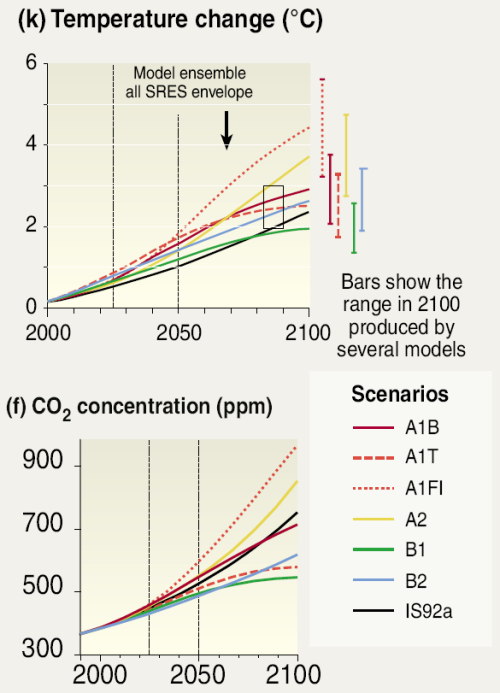
IPCC Scenarios
Source: IPCC 2001: Summary for Policymakers (.pdf)
For reference the A1F and A2 scenarios call for emissions from fossil fuels of 30.3 GtC/yr and 28.9 GtC/yr respectively compared with 1990 emissions of 6.0 GtC/yr. Even the lowest A1T and B1 scenarios double 1990 emissions by 2050 before returning to a little below 1990 by the century’s end. Source: IPPC: Emissions Scenarios (.pfd)
I’m also deeply sceptical of any efforts to proactively reduce oil/gas consumption below that described by the depletion curve – it’s just too useful. To suggest we can choose a level of oil/gas consumption below the depletion curve is to say that the reductions imposed by, and the impacts of peak oil, are so trivial we would actually choose greater reduction i.e. lesser consumption? No way. I am pessimistic about choosing a lower consumption and have no faith at all in choice/reform “beating” the depletion curve down.
The climate doesn’t care how we emit what we emit but just what the emissions are. It is hard to believe the oil/gas originated emissions will be anything other than solely determined by the depletion curve.
Absolutely it would be better if we chose to reduce consumption/emissions rather than be forced by shortage, the more action by choice/reform the better. But I see that as a peak oil issue, trying to maximise energy services as resources deplete, not a climate change issue.
Climate change activism should be about total CO2 emissions (and sinks) – I just don’t see how activism targeted at oil/gas can impact the CO2 emissions.
Peak oil activism should be about minimising the hardship created by reduced oil/gas availability.
So I’m left in the position that all the oil and gas will be burnt as fast as possible. We can’t do anything about that. However, luckily, that alone won’t spell the climate disaster the activists warn us of.
That won’t spell climate disaster? No, well not according to the acclaimed climate scientist James Hansen of NASA’s Goddard Institute for Space Science. He presented [The Oil Drum] this chart at a recent lecture, it shows the cumulative atmospheric concentrations of CO2 attributed to difference sources:
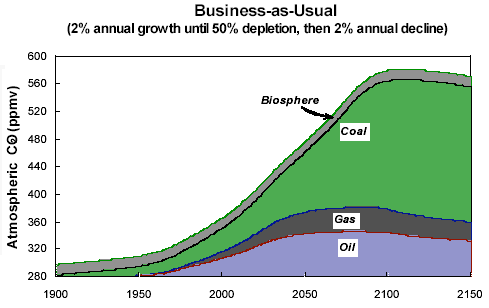
Atmospheric CO2 concentrations by source
What Hansen is saying is that the remaining oil and gas can be burnt whilst limiting atmospheric CO2 to ~450ppm and incremental temperature increase to only 1°C, which really should be the limit unless we want to live on a very different planet. The challenge is that the oil and gas combustion use most of the 450ppm limit, the key therefore is CO2 sequestration or abstinence from coal and unconventional fossil fuels.
Whilst Hansen doesn’t think we are going to reach peak oil next week he does expect peak within 20 years in which case he said we can live with the oil/gas CO2 contribution.
The only potential to cause climate disaster is from burning all the coal – this is very hypothetical though as whilst there is enough carbon contained in the coal reserves do we have the logistical ability and economic demand (given peak oil/gas) to exploit it? I’m doubtful.
My doubt isn’t due to the magnitude of oil/gas physically used for coal mining – that’s tiny. It’s more to do with demand. I think peak oil/gas will destroy demand. Think about the Chinese example of building a new coal power station every 5 days – the only reason they are doing that is to run the factories manufacturing stuff for the West and to fuel the increasing Chinese “quality of life”. Both these sources of demand are directly funded by Western economic growth. If you subscribe to peak oil/gas resulting in economic depression then energy demand (including electricity and coal) will fall. Coal use is a function of global GDP, if peak oil/gas causes global GDP to fall then coal demand will fall too.
I don’t think it’s possible to maintain growth by replacing depleting oil/gas with coal to liquids and electrification. That’s the only scenario that would see increased coal burn in the face of peak oil.
So, to be intellectually honest I would like to see climate change activists ignore the emissions from oil/gas – ignore cheap flights, airport expansion and SUVs and instead focus primarily on coal burn. That is electricity consumption and low/zero CO2 generation of electricity. This is an easy battle to fight as there is massive scope for reducing electricity consumption and massive potential for low/zero CO2 electricity generation. The climate change activist should also focus on land use (deforestation etc.) and be mindful of the depletionists' points and theoretical threat of non-conventional fossil fuels.
The depletionists on the other hand should primarily focus on energy security, that is, minimising the loss of energy services as oil and gas availability decreases. This involves reducing the oil/gas intensity of what we do and where the anti-SUV, pro-light rail, reduced “economic reliance” on flying etc arguments should be made. Whilst supply side solutions based on non-conventional fossil fuels are likely to be considered, the depletionist should remain mindful of the CO2 intensity of such solutions – in any event non-conventional fossil fuels are unlikely to prove viable or amount to anything significant.
There is perhaps a difference between being an intellectually honest activist and being an effective activist though! As the general public and politicians now accept CO2 as “bad” and as increasing aviation for example is recognised as being a significant source of increasing emissions, the depletionist campaigning for reduced economic reliance on flying could cite CO2 emissions to add weight to their argument. Effective as this may be I don’t see it as totally intellectually honest.
Conclusion
My thesis is that all the oil and gas will be burnt as fast as possible, however imminent peaks in production constrain emissions within a Hubbert-style envelope. Oil and gas consumption doesn’t represent a degree of freedom for impacting emissions so time, energy and political capital should not be spent attempting to reduce oil and gas consumption in the name of reducing total CO2 emissions. Efforts are likely to be futile.Instead, the degree of freedom we do have available to address emissions is coal – through reducing electricity demand and increasing low/zero CO2 electricity generation. This is where effort should be focused.
That isn’t to say reduced oil/gas reliance shouldn’t be pursued aggressively through efficiency and behavioural change, it should but not under the illusion that it will deliver reduced total CO2 emissions. Pursue reduced oil/gas reliance in the name of imminent peaks, to mitigate some of the negative impacts of imminent shortage.
Unfortunately wide acceptance of imminently peaking oil and gas supplies is not yet with us, severely limiting the effectiveness of the peak oil arguments. Although not strictly intellectually honest, arguing for reduced oil and gas reliance in the name of reducing total CO2 emissions is likely to be more effective.
Personnel
Editors
Contributors
Peak Oil Primers
Archives
- November 2010 (3)
- October 2010 (6)
- September 2010 (4)
- August 2010 (7)
- July 2010 (6)
- June 2010 (7)
- May 2010 (2)
- April 2010 (8)
- March 2010 (4)
- February 2010 (6)
- January 2010 (3)
- December 2009 (5)
- November 2009 (8)
- October 2009 (12)
- September 2009 (6)
- August 2009 (5)
- July 2009 (11)
- June 2009 (8)
- May 2009 (16)
- April 2009 (10)
- March 2009 (7)
- February 2009 (10)
- January 2009 (15)
- December 2008 (9)
- November 2008 (9)
- October 2008 (9)
- September 2008 (13)
- August 2008 (10)
- July 2008 (14)
- June 2008 (23)
- May 2008 (16)
- April 2008 (12)
- March 2008 (16)
- February 2008 (9)
- January 2008 (13)
- December 2007 (13)
- November 2007 (16)
- October 2007 (22)
- September 2007 (8)
- August 2007 (9)
- July 2007 (16)
- June 2007 (8)
- May 2007 (7)
- April 2007 (7)
- March 2007 (10)
- February 2007 (10)
- January 2007 (12)
- December 2006 (9)
- November 2006 (15)
- October 2006 (4)
- September 2006 (5)
- August 2006 (5)
- July 2006 (9)
- June 2006 (5)
- May 2006 (10)
- April 2006 (9)
- March 2006 (13)
Vital Trivia
License

This work is licensed under a Creative Commons Attribution-Share Alike 3.0 United States License.
Consider this a reminder to positively rate this articles (using the icons under the tags in the story title) at reddit (note the new reddit counters! just click on them and hit the up arrow to help out), digg, and del.icio.us if you are so inclined. (email me at the eds box if you have questions about this).
Also, don't forget to submit this to your favorite link farms, such as metafilter, stumbleupon, slashdot, fark, boingboing, furl, or any of the others.
I can assure you that the authors appreciate your efforts to get them more readers.
Climate change activism is all very well; and it is true that awareness has increased exponentially in 2006. However, when it comes to actually doing something, very few people actually are prepared to put their money where their mouths are. For a whole bunch of reasons: disbelief, denial, inertia, cost blah blah blah.
Not enough has been done, or will be done in time and we have probably tripped a couple of important tipping points already. I was disturbed to read today that "dozens of carbon measuring stations around the world" have recorded higher carbon levels than would be consistent with the use of fossil fuels in 2006. Maybe that melted tundra is releasing large volumes of CO2.
This doesn't mean that we must stop. On the contrary we must redouble our efforts! But it is hard, because it is probably futile.
So it is with oil depletion. People just do not accept the hypothesis. Moreover, they certainly will not change their lives to live more frugally. Gas prices are down. The bone headed journos are telling them Peak Oil has been proven wrong. Toyota has seductive new ads for its SUV's. Try to take people any further down the Peak Oil story and one begins to sound like a single issue nut case.
In summary, I think it is too late. Both on oil and on global warming. I drive a 50mpg car. I have signed up for 100% renewable electricity. We have low wattage light bulbs and we turn lights and equipment off. But I still fly. And I still consume. It probably is far too little far too late.
The concept of global warming is a lot more politically tenable than saying we have used up half our oil and growth is over. Global warming is something the whole world can work together on (hypothetically). Peak Oil, is more choosing sides geopolitically. I expect global warming will morph from politically annoying to a politically expedient in the years ahead.
Since the answer to both global warming and Peak Oil is less consumption, the political juggernauts will find global warming a much more reasonable rationale for recommending( requiring?) curfews, odd/even driving days, rationing coupons, etc for fossil fuels than telling the straight truth about depletion (that would be too real and scary)
I expect there will eventually be policies under the guise of mitigating climate change that are really driven by energy constraints.
Nate,
Although I agree that the correct responses to Peak Oil & Gas can fulfill the concerns of “warmers”, I do not subscribe that idea of “lying” to the folk. We should, and can, work together for a better world, but let’s not do that on the basis of falsity and dishonest intellect.
Well, it's not entirely a lie.
But it would be better to try and steer the GW activists towards campaigning for coal reduction, while telling the public that oil reduction is the cure. Two birds, and all that.
Maybe?
When a person involved in the oil industry lies he/she is merely behaving in a natural manner for that industry. The oil industry is not well known for either its honesty or its great concern for the environment.
Nor, for that matter, is the oil industry very well known for its humanitarianism. The oil industry has committed so many crimes against humanity that oil is always tinged with blood.
Peak Oil is a good thing specifically because it will drive the oil industry out of existence. My only regret is that the Earth possessed oil, not that the Earth will run out of oil.
I think that a carbon tax, based on the carbon content of the fuel, mitigates both peak oil and global warming; it encourages fossil fuel conservation overall, but taxes coal more heavily than oil, and oil more heavily than natural gas, which sends the right economic signals for lessening global warming impacts, too. If coupled with a payroll tax reduction, as I recall Al Gore proposed, it encourages replacing fossil fuel inputs in the economy with labor inputs, which is good peak oil prep as well.
Sorry Chris, must differ on the side of pessimism. There is zero probability that coal burning can be controlled planetwide. I have no doubt that people will eventually burn all the coal available with +EROEI. Nations that tap the power of coal will be able to out compete those limited to nuclear and renewable energy sources. CO2 sequestration will be done only in rare situations. Even in "clean, green" New Zealand, opening a coal power plant is the most likely solution to Auckland's electric power crisis.
While coal is not as useful as oil or gas, it is already being used for coal to liquids. Many plans for mitigation of the decline in oil production are based on massive coal to liquids projects. Coal energy will also be tapped to make ethanol and to replace natural gas for electric generation. If it gets hot enough so that air conditioning is needed in Alaska, coal will be burned to power the air conditioners. When worst comes to worst, look for coal powered steamboats and railroads again, maybe even coal powered steamer automobiles.
I am with Lovelock on this one. The planet is going to get roasted, and nothing can be done about it on the macro level. On the personal level, one could buy subpolar land for the grandchildren.
However, agree that all the political drama about the evils of air travel is pointless.
You have very little faith in the climate change activism! It appears there is significant momentum building at the moment with even Exxon shifting their position slightly, US evangelicals met with Hansen and others last week and made positive noises and the British government is hinting that Bush will bring up CO2 emission targets in the State of the Union on Tuesday. I think things are moving fast.
My thinking regarding coal over the next few decades goes along these lines: Can coal substitute for declining oil and gas enabling business-as-usual and GDP growth to continue through the 21st Century? I say no. In that case we have contraction, falling global GDP. In that situation I can't see where the demand for this massive coal burn is going to come from. During depressions energy consumption falls, whether the depression was caused by peak oil isn't really relevant, if we have depression coal demand is likely to fall inline with global productivity.
Climate change activists always ignore or dismiss human nature. The fact is we will not accept any restrictions on our rights to the lifestyles to which we have become accustomed, including the right to breed. That means when oil and gas become scarce we will burn coal, wood, garbage, old newspapers, and anything else we can find to keep warm. It means when the lights go out we will do anything to make them come on again. And it means when the cars and trucks run out of gasoline we will find some other means to keep them running. So the planet is going to get baked, fried and london broiled. That's human nature.
Well, look at what the Kim family did - they burned their SUV's tires! They got out on a little-traveled road, city people trying to take on the rather trackless Northwestern US wild, and the wild won. So they ended up burning up their SUV's tires to keep warm, they didn't form a "nest" out of their clothes and sleep huddled naked together which would have been toasty-warm, restrict their moving about to the warm hours, and do some foraging, they didn't discover the hunting/fishing cabin about a mile away with provisions, they burned their SUVs tires. Mr Kim eventually took off on his own to try to find help, Mrs Kim and kids stayed put and were rescued.
The reason I find burning the SUV's tires to ironic is, it's very polluting, they'd have had to do it outside of course, which means most of the heat wasted, and what if they'd been found by some kid with an ATV or motorcycle who could have gone and gotten 5 gal's of gas and driven 'em out of there? Nope they rendered their vehicle useless.
I see this as a microcosm of how humans, not just American humans but most humans will act.
Fleam,
With all due respect, I think the problem for the Kims was starvation, not heat. They had no food and they were slowly starving to death. Also, I believe there is an ongoing investigation by the Oregon police department as to why the search for poor James Kim (deceased Silicon Valey high tech guru) and his wife and 2 children was so botched up.
But yes, I agree that the Kim saga is a warning to the rest of us about how unprepared and uneducated we are.
Unfortunately true. We need nukes, because burning uranium is much less globally destructive than coal.
Of the Socolow and Paccala 'wedges' which Al Gore alludes to in An Iconvenient Truth, 1 wegde = 1bn tpa of carbon abatement in 2050.
Current emissions 7bn tpa. 2050 emissions, business as usual, 15bn tpa.
That is equivalent to 1000 new nuclear stations (to replace the existing fleet which will be finished by then, and build a net 500 new reactors).
So yes nuclear is part of the solution, but only 1/8th of what is required to stabilise CO2 emissions at their current level. I don't know of any reasonable nuclear engineer or scientist or economist who thinks we can build more than 20 reactors pa, worlwide.
Carbon Capture and Storage on large coal fired power plants is another wedge.
Why? They're only about 1-2 billion in a 50 trillion dollar economy.
It may be a 50 trillion dollar economy but I doubt my hairdresser (who contributes to that economy) would be able to contribute much towards building a nuclear power station!
She cuts the hair of construction crews and engineers that would otherwise be working on coal plants.
If you are including the cost of the construction crew's haircuts then the power stations cost more than the 1-2 billion you mentioned.
.
Chris Vernon wrote:
BUT what if peak is more like a plateau with a slow squeeze on economic growth as Stuart Staniford has argued? In that case, no depression, maybe not even a permanent recession.
Further, our transition to dirty coal might emit enough extra CO2 to offset the lower emissions as a result of shrinking GDP based on cleaner fuels.
With GDP falling, I don't see climate activism amounting to a hill of beans. The only reason it's enjoying a surge now is that people think they can afford it.
The only reason it's enjoying a surge now is that people think they can afford it.
It's not even that - the only reason it's enjoying a surge now is that people are not asked to pay for it. Even affordable but somehow reducing the standard of living price will be deeemed unacceptable - as we are witnessing in Germany and Denmark for enxample, where green enthusiasm is waning as costs grow and reality starts to kick in.
If the recession is due to lack of oil (meaning high prices), then there will be someone who cures this lack offering CTL oil for a slightly lower price.
Only if the recession is caused by other factors, raising the oil supply obviously will not make a difference and therefore not be employed.
Cheers,
Davidyson
Nations that tap the power of coal will be able to out compete those limited to nuclear and renewable energy sources.
This depends. France which is mostly nuclear and renewable (hydro) powered features one of the lowest electricity rates in Europe at 13.6 c/kwth. Its mostly coal powered eastern neighbour - Germany enjoys almost 20c/kwth price and has 65% higher per capita CO2 emissions (10.3 tonnes CO2/capita vs 6.2 tonnes/capita, source).
The key is government engagement with nuclear power in France and the correctly persued policy of mass-producing and incrementaly evolving the best nuclear reactor designs. My only hope to fight climate change is doing something similar on a world scale. Peak Oil does not bother me (aside from the dangers of resource wars).
LevinK-"The key is government engagement with nuclear power in France and the correctly persued policy of mass-producing and incrementaly evolving the best nuclear reactor designs."
Contrast the US system. No standard design and varied types [boiling water v pressurized water, etc]; frequent mis-understandings because procedures, training, manuals, are often a local matter; competitive and defensive attitudes are invited by lack of an impartial, mandated standard by which to monitor and assess performance, thereby putting emphasis on merely the appearance of "looking good"; even the language/jargon/definitions vary from plant to plant.
The US system is "industry" driven with government oversight on the model of the FDA. Regulation is mostly self-regulation. E.g.-Even record-keeping reflects the conflict of interest inherent in self-regulation. Sure, ink is used rather than pencil to discourage alteraton, but then alteration occurs simply by writing a new "original" record and tearing up the original "original". Such is done to make the record appear neat and clean as it is permanently kept for or by the NucRegCommission [looks good] but "original" logging of data is lost and sometimes inadvertantly altered.
Despite the handicap of the US system being poorly-standardized, by limited personal experience over several years, I have always observed good intentions and honest best-efforts by all employees with whom I interact, with exceptions being minor and within tolerance for large groups.
The standardization levels in France would seem to give them much greater freedom from unneeded distractions so they keep more attention on doing what they are doing, thus minimizing potential catastrophic "events".
But catastrophic near-misses keep occurring and we have have been lucky. I assume France has its near-misses, too. The concept of "downwind", in fact, covers endless territory.
BTW, both Chernobyl and 3-Mile Island "events" involved management over-riding [control-room] operators' attempts to shut-down when the operators recognized potential, out-of-control situations that deviated from their plan.
Regarding the nuclear-power option, what do readers of this board thing of Dr. Ernest Sternglass' work [Secret Fallout]on low-radiation effect on populations, especially the lowering of IQ test scores? I read it years ago and wonder if his data was ever refuted?
And consider this: If you can create radioactivity but you cannot uncreate [stop] it, can you really control it? E.g.nuclear "waste".
You want us to research yet another anti-nuclear pseudoscientist that misconstrues data with an agenda?
We can uncreate it at some cost through neutron irradiation and actinide incinerator reactors. Its just not worth it. Controlling it is as easy as encasing it in concrete for the next five or ten decades.
Despite Three Miles Island I find the record of the nuclear industry in the US almost impecable. Which is an achievement worth highest level of recognition - given the deficiencies of the system we are talking about. Consider the number of death cases from nuclear incidents in the history of US civilian industry - 0, nada. Now compare this to the coal industry which scores number of deaths in the coal mines each year. BTW it is notable how the coal mine death in public perceptions are somehow separated from the elictricity we are valuing so much.
But catastrophic near-misses keep occurring and we have have been lucky.
It is not luck it is active precaution that keeps this from happening. The same planned precautions which save lives daily and we are accepting as a normal part of our live - like wearing a seatbelt for example.
Well, there is a bit more to Germany's high consumer electric prices (industry enjoys a very low rate) - look at the EU fines coming from abusing the market, which the electric companies are not really happy about, but after the offices were searched, and the files seized, it is a bit out of their hands - as reported, one of those companies will have fines in the 'large' or 'major' range.
Quite honestly, the major reliance on coal burning does disturb a lot of Germans, which is why laws have been passed mandating efficiency/conservation, and in forcing renewable energy to bought and distributed by the electric companies, which hate this process deeply - they would rather apply for more permits for new coal burning plants (EnBW), then a couple of weeks later apply for a permit to keep their oldest nuclear plant running, saying it is out of concern for global warming.
No one here actually trusts or believes the energy companies have any interest but their own for anything they do. But since Germany still has a somewhat functioning democratic system, the energy companies don't always get to write the laws, and they still have to follow them the ones they don't approve of.
Of course, many people hold simplistic views which are not well thought out in terms of energy - but the energy companies have a very simple view - profit, regardless. And many of their customers would like a chance to do things differently.
I think you are being quite one-sided on this one.
Yes, utilities are large, beurocratic and sometimes autocrative mastodonts. But this is nothing new - they are like that everywhere around the world. What is more important is there are certain reasons for this, and the reasons fundamentally lie in the nature of the industry - which requires it in order to achieve economies of scale and in order to effectively manage the grid, which is in the end is only one for all. This is the nature of the technology and we don't have any others... so far, dispersed small local grids are present only in countries like Kenya and the observed quality of service is not very good.
And of course utilities will rant at whatever mandates they are coerced to obey. Mandates are the worst possible tool in government policy - they force some business decision on the companies and eliminate any competitive element. They are much like additional tax burden, because the company has to absorb the costs associated with them without being credited anything else than not being closed down. BTW I admit experiencing sardonic pleasure watching the latest EU idiocy of trying to break down utilities - knowing how this affects prices and reliability of service wherever it happens.
the energy companies have a very simple view - profit, regardless
I find this absolutely distructive. The idea that energy companies are our "enemies", which need to be faught with is leading us to nowhere. We are the ones that created energy companies because we are the ones demanding their product at reasonable cost - why not just stop using it if they are so "bad"? I know it is giving a convenient scapegoat to the public, but this is not the way to make them become better. We need to try spending sometime in their shoes too.
Germany is a strange case - before the electric market was 'liberalized' (which in this case essentially means restructured into large scale monopoly power in the hands of a few, where before it was local monopolies in the hands of a fairly large number), much of what is under discussion here in terms of structure didn't really exist - that is, the 'Stadtwerke' were generally responsible for water, sewage, electricity, district heating, etc. As these Stadtwerke tended to be somewhat bound to the community, they made decisions based on local conditions.
A large, centralized monopoly utility may have certain attributes which fit the technical conditions of maintaining a complex framework - but as happened here, even when other energy companies attempt to sell electricity which is generated using renewable electricity only (the customers naturally pay a very high price), the charges for handling that customer's 'free market' choice become absurd - or some reason is given why it can't be done. And of course, if one barrier is overcome, the company just invents another. (In a related area - the accounting tricks used by a gas company to justify their billing where so outrageous that they were publicly ridiculed for the absurdity of it - but that didn't stop them from continuing to charge that rate. A judge might, though.)
I could go on about EnBW/Yello - when the market was first opened, all the large monopoly companies created cheaper, nimbler units, to try to expand their business into other monopoly regions. As it turned out, they were so clever at finding ever more creative (and illegal) ways to block any competition, that their less expensive divisions were never able to go beyond their monopoly market - it is amusing to see how Yello pays a fee to its parent to be able to use its parent's system, while still providing electricity at a lower price - the whole thing is absurd, and having watched it play out over a decade, amusing is about the only word for it, unless you need an object lesson in how a 'free market' works in a capitalist system, with politicians that are also available for the right price.
The heads of RWE or EnBW care about nothing but profit - and they are so well set politically, that even major or minor corruption scandals (things like handing out free World Cup tickets and just hanging out with the minister in charge of regulatory decisions) don't make the tiniest difference.
An adversial relationship is about the only type they understand, to be honest, while they cry about how unfair it is they are punished for breaking the law repeatedly, and abusing their 'natural' monopoly position.
But the point that they are not the enemy is not wrong - just the people currently running them, in many cases.
AFAIK you can't buy sub polar land.
1. who knows what ownership rights will be in 50 years time? One is postulating the death of most of the planet's population (or at least its migration).
2. Canada. The land is owned by the state, mostly.
Russia-- well we know who owns Russia's land (it ain't the people who live there).
Alaska I am not sure.
Which is an argument for Carbon Capture and Storage.
For coal fired power stations, coal to oil facilities and chemical plants in general, this can be done-- and it will be.
The world has survived big phase shifts in energy sources before (from wood to coal, from whale oil to geologic oil). It can again. It might be wrenching, but it is also inevitable (exhaustion of geologic resources of coal).
O.K., I might as well get in trouble again with what I say and continue my long tradition at TOD...
In astounds me that most "environmentalists" have never understood that the best friend they EVERY HAD has been light sweet crude oil and natural gas.
They somehow manage to ignore and sometimes even willingly push out of thier mind the spectre of Pittsburgh, London, and Coalbrookdale before the age of cheap and easy natural gas and oil, and assume that people will sit in the dark and freeze before they will return to that type of coal blackened hell.
Other's at TOD have explained it well, and I have discussed it before in other posts....there are only two ways away from oil/gas in relation to having a viable liquid fuel, and that is up the chain on the hydrogen chain (more Hydrogen/less Carbon and or down the chain (more Carbon, less Hydrogen). I once call it the C and H balance. Now once you go above natural gas, there is NOT much room left to the top side. Methanes and straight unattached Hydrogen is about it, but unattached Hydrogen does not exist naturally, it has to be shaken loose or detached from something else (other than fossil fuel, the most common place is water in which it has to be detachad from Oxygen, at this time NOT cheap or easy, but technically it can be done.
Down the chain on the C and H balance is what we know to be the messy stuff.....coal, tar sand, heavy oils, oil shale, peat. IF oil and gas get expensive and hard to get, make no mistake, these WILL be used, Kyoto and the melting of Greenland be dammed.
Interestingly there is another rapidly developing path, but one has to be VERY CAREFUL what they say to avoid being misunderstood: The biofuels path is technically viable, and has the possibility of vast imputs of relatively clean or "carbon neutral" energy. BUT, we must make sure that we are not seen as talking about ethanol per se, such has been the victory of the ethanol lobby that many now see ethonal and "bio-fuel" as synonyms.
Ethanol is only one of a family of alcohols, which is one of a family of bio-fuels. Methane recapture and such advances as Biobutanol
( http://www.butanol.com ) offer the prspect of stretching the portable liquid fuel supply of the nations of the world, while solar, wind and conservation can reduce the residential and stationary use, while at the same time reducing CO2 discharge, but at the end of the day, we need a hook....it seems that neither global warming nor peak oil are causiing the people of the nations of the world to be willing to make sacrifice and change to reduce overall energy waste and to develop low carbon options......what will work
My bet: We need to play to the national securtiy issue of each individual nation. As each country feels a real threat, not as much from peak or warming, but from being bled to death by the fossil fuel providers, they will be more inclined to look for real and workable decentralized options.
Or......there is a risk that we are now getting just too old, too tired, and too fat to change, and intend to ride it on out to the finish, and hope the brats can handle it.....after all, it will be thier world......but interestingly, the young seem less interested in this whole discussion than even the old.....go figure.
Roger Conner known to you as ThatsItImout
Yep. As I have treated some Waikato coal miners for respiratory troubles, so they could go back to work, never underestimate what people are willing to suffer out of necessity.
Did the old-time Maori, excellent specimens of health, consider that coal a necessity?
The Maori population at the time of European contact was about 100,000 and the limit of carrying capacity. The various Iwis were waging wars in which the losers were eaten. The current NZ population is 40 times that now. It is just barely possible that the current population could be supported with organic farming. Britain, with similar land area fluctuated from 6 million population in good times to 2 million to bad times before fossil fuel inputs.
Mr. Conner, I am an environmentalist and I just want to affirm the above statement. The oil and natural gas industries are the best friends that the environmentalists have ever had. These two industries have singlehandedly driven Homo sapiens to the edge of extinction and it is my sincere hope that these industries keep on working hard so that they can accomplish that noble and glorious task.
The oil and natural gas industries are not the enemy of Nature. No, not in the least. Homo sapiens are the enemy of Nature. Humankind is a walking, talking, tool-making, allegedly-intelligent natural disaster. The oil and natural gas industries have only served to make humankind a more powerful self-exterminator and for that I thank the industry for its contribution to the long-term health of the planet.
My advice is very simple: Burn all the oil, burn all the natural gas, burn all the coal! If you succeed at this task there is a pretty good chance that Homo sapiens will go extinct within a millennium and for that Nature will bless your memory by preserving a memory of humankind as a fossil in the sedimentary rocks of this era.
I love the environment, I love Nature, and I love the oil industry: Thanks for all the smog! Thanks for the Exxon Valdez. Thanks for the tar sand industry -- there's plenty of pristine Canada available for burning, so burn it all up!
I want plentiful, cheap gasoline and I am inclined to let you people burn up the entire Earth for me. I am the consumer and I love my addictions. Did you know that there are hundreds of miles of Florida beaches which are still protected from the oil industry? How is that possible? I want gasoline and I don't care how oily my toes get at the beach ... just get me that oil!
Let's burn it all up. The sooner that humankind goes extinct, the better. The Universe doesn't need us and the Earth is a better place without us. So let's just burn it all up. We live just for today so who cares if humankind goes extinct tomorrow?
David Mathews
http://www.geocities.com/dmathew1
Well, two things:
1) Humans ARE Nature. We evolve from within everything you see around you.
So the burning of oil is an act of nature.. ;-)
2) Don't worry for the rest of nature; The earth has seen greater disasters than man.
Hello Roger,
Humans are an animal, no better but certainly a lot worse than the other animals.
The rest of Nature can, and will, take care of itself. Humankind is busy committing global suicide. After humankind is gone, Nature will repair our damage and life will continue for at least a billion more years without us.
God doesn't care if humankind goes extinct. Nature would prefer to remove the primate plague. Humankind is working very hard at suicide and our species is succeeding.
In other words: The human problem has a human solution and that solution is humankind's extinction.
So keep on burning that oil, natural gas and coal. At this point it doesn't make any difference because humankind has already inflicted the fatal blow to the species. Extinction is both inevitable and inescapable at this point.
Nature is not an anthropamorphic force...
And civilization will encase the earth in glass and steel and go on to eat the stars before its course has been run.
Hello Dezakin,
Here is a religious opinion, a matter of faith, and an indication of an animal in deep denial about its real place in the Universe.
Homo sapiens is a primate which has not existed very long so I urge great caution among those who would like to place the mantle of immortality on our species. I am looking at the Earth today and have grave doubts about our species' ability to survive for another ten thousand years.
And the notion that humans will voyage to the stars is pure delusion and science fantasy and nothing else. Have you noticed that a large number of the fiction associated with this thought possesses magical, fantasy qualities? That should tell you something, but few people notice what they would rather not know.
Humans are primates, nothing more nothing less. Humans are just an animal and for that reason the species has no claim to immortality and no hope of conquering space. We will go extinct and that will constitute the end of the human tragedy.
Dave, I completely agree with you.
I am a Christian and of course disagree with the metaphysical statement that humans are nothing more than primates. However, I'm inclined to agree with the conclusion that we will not conquer space.
In space travel, we have two basic physics problems. The first is that being on the surface of the earth puts us in a gravity hole, and it takes a tremendous amount of energy to get out of that hole. Converted to dollars, the cost to put a payload in space (payload does not include the cost of the rocket) is around $10,000 per pound. That's $10,000 per Big Mac. Some rockets may do a bit better than that, but until we achieve some currently unimaginable improvement in the ability to generate energy to escape earth's gravity, we won't be able to go very far in space except in very high-priced programs. The second problem is travel time. The nearest star after the sun is 3.9 light years away. The speed of light is the universal speed limit as far as we know. We can't travel anywhere close to that fast anyway, so as far as traveling to the stars, even with nearly infinite energy, we still essentially can't get there. I loved Star Trek. On that show they solved the energy problem with "dylithium crystals", and solved the travel time problem with "warp engines". Those technologies are still in the realm of magic as far as we are concerned.
This isn't a reflection on the energy cost so much as the high labor low throughput nature of the industry. Costs will eventually come down (over the next several centuries), and its not like we're short of energy either.
You could reduce costs several orders of magnitude by flying several launches per day and amortizing costs. Fuel for the rockets is cheap, its the infrastructure and labor that is expensive.
This isnt a problem for civilization, its a problem for interstellar space opera. The solar system is ripe for conquest, and the stars are a matter of the long slow expansion through the kuiper belt and beyond. It just wont happen over several episodes.
Well, we dont need warp drive to escape earth, and nuclear power will serve the energy needs of space travel for some time.
I have to say that I am [conditionally] with NASAGuy on this one. The current technology of sending loads into space is just damn too ineffective. If I recall correctly over 90% of the fuel goes for lifting the fuel and the fuel tanks.
And with the little troubles down the road we are discussing, I simply don't see significant space exploration - not this century IMO. I too don't believe energy will be the problem, it is just the technology which is too far behind - and short of a breakthrough we're going to stay grounded.
But fuel isnt even close to 90% of the cost.
If you noticed, I allready said over the next several centuries. Its not just technology. Its lack of a demand for spaceflight, and lack of a global economy large enough to afford it.
"But fuel isnt even close to 90% of the cost."
The point was that 90% of the space vehicle weight is pure waste. With bigger weight come huge thrusters, support structures etc. Overall you need a 1000 tonnes rocket to send 1 tonne of useful load into space - and the 99.9% fixed component gets pricy. For example, if we could launch space cargo with some kind of elecromagnetic thrusters here on Earth, each kilogram send to space would cost just $2 - the cost of the electricity to reach escape velocity.
Oh sure, ten thousand years from now humans may be much more rare, with all of the sentient machines demanding ever larger shares of resources.
Right, like all the other industrial species that went extinct over the ages.
Dezakin,
Here is proof positive that Humans will eat stars.
We also consume Lucky Charms, cocaine and State of the Union adresses.
Here's to the stars, to ethanol, and beyond.
Cheers. Bottoms up. :-)
I totally forgot.
"We" are the only creatures in the universe that have brains and use tools to improve our environment.
Our most powerful tool is the tool of denial and delusion --our amazing ability to convince ourselves that we are "special", that a diety who gets "tired" after less than 7 days of work in one small corner of the Universe chose us to be the special case, the exception.
When in doubt, post a picture of a monkey and a bunch of non-sequiter self important nonsense I guess.
You got it. It's called a mirror.
Peace. :-)
Geez, David (dmathews1), I'll bet you're a lot of fun at a party, eh?
Everyone has an axe to grind. I disagree with so many points in this article, also the tenor of the message itself. For example:
The only potential to cause climate disaster is from burning all the coal...
My pov? Climate disaster is now inevitable, even if we stopped burning coal altogether. To suggest that we can run through the rest of the natural gas and oil with limited consequences is irresponsible. Yes, it is inevitable that oil and gas will continue to be used, but that is not the point. Already the effects of global warming and sea level rise are being felt across the globe. Human activity is undoubtedly exacerbating the problem. This makes it sound like if we stop using coal and go green with solar, wind, and nuclear everything will be just peachy. I strongly disagree. Conservation is the answer, reduced consumption is the only way. If we do not start conservation efforts immediately they will be going CTL and coal gasification whole hog before mid-century. Mark my words, if they don't cut back now, it will be a catastrophe, maybe it will anyway, but at least with conservation the world has a fighting chance.
Irresponsible? The limited consequence is a logical result of the limited resource base. Hansen shows the potential atmospheric CO2 concentration from burning the remaining oil and gas - it appears to be of limited consequence, no? You agree that the combustion of oil and gas is inevitable but say it's not the point? I say it is exactly the point, we should channel the energy, political will, activism away from this futile goal and towards coal utilisation where there is real and easy progress to be made. I suspect electricity consumption could be reduced by a third within a decade and low/zero CO2 emission generation also has massive potential.
My point is that the present rate of liquids consumption continues to rise. Running out of oil will not change this. Witness the tars sands and CTL projects. The rate the world decides to burn liquid fuels will be maintained no matter what. Therefore, ergo, we should cut down on our consumption of liquid fuels now and forever. Nothing is constrained by peak oil and gas. They will keep using at increasing rates with ethanol, CTL, biofuels, whatever, until exhaution of every means possible. Unless the consumption rate is curtailed environmental degradation will only get worse.
Petropest
You get it. Most here don't. If those living this "winter" in Europe aren't getting it, they won't.
I should have prefaced that statement with a comment on scope. I'm purely considering direct anthropogenic CO2 emissions and a loose definition of climate disaster of CO2 concentrations over 450ppmv. There are of course many other mechanisms for climate disaster to occur such as the limited warming thus far driving feedbacks in albedo change, CH4 release from permafrost, rainforest drying out, the effectiveness of CO2 sinks degrading etc... if we are past these so called tipping points then perhaps anthropogenic CO2 emissions are no longer the key driver and all bets are off.
No way. I am pessimistic about choosing a lower consumption...
and then:
But I see that as a peak oil issue, trying to maximise energy services as resources deplete...
So then we can't lower consumption, but if forced to we can manage? Not to mention that 70% of the oil we use isn't even ours.
I just don’t see how activism targeted at oil/gas can impact the CO2 emissions.
Yeah, concentrate on coal and leave us alone.
Peak oil activism should be about minimising the hardship created by reduced oil/gas availability.
Nice of you to tell the activists where to focus their attention.
So I’m left in the position that all the oil and gas will be burnt as fast as possible. We can’t do anything about that.
Maybe not, but we can lead the way to lower consumption, maybe others will follow. How can we know that they won't, given that we have the highest per capita use in the world?
Q: How do you know the long run limit is 450 and not 400, or 350?
The only potential to cause climate disaster is from burning all the coal...
Whatever you say. (rolls eyes)
Coal use is a function of global GDP...
Yes, a bogus monetary system are partly to blame for higher consumption, this is true.
...if peak oil/gas causes global GDP to fall then coal demand will fall too.
Faulty logic.
I think peak oil/gas will destroy demand.
Conservation will destroy demand, peak oil/gas will only cause people to look for alternatives.
I don’t think it’s possible to maintain growth by replacing depleting oil/gas with coal to liquids and electrification. That’s the only scenario that would see increased coal burn in the face of peak oil.
You can't possibly know this.
...I would like to see climate change activists ignore the emissions from oil/gas – ignore cheap flights, airport expansion and SUVs and instead focus primarily on coal burn.
I bet you would. This smacks of a person who wants to run through the world's oil and natural gas as fast as possible for nefarious reasons.
electricity. This is an easy battle to fight as there is massive scope for reducing electricity consumption...
Oh, I see, conservation of electricity is easy, conservation of oil is stupid.
My thesis is that all the oil and gas will be burnt as fast as possible...
So why try, eh?
I think some of your comments are a little unfair.
So then we can't lower consumption, but if forced to we can manage? Not to mention that 70% of the oil we use isn't even ours.
Well, if forced by depletion we’ll have to manage won’t we? What we can do is try and reduce the negative impact by reducing our reliance. Isn’t ours? All my arguments are from a global point of view rather than national, I happen to be from the UK.
Yeah, concentrate on coal and leave us alone.
I have no affiliation with the oil industry at all and personally would like nothing better for mankind to find a way off oil by choice in advance of depletion – that’s the Holy Grail is it not? I just don’t see how it’s possible yet see opportunities to reduce coal use and given there’s a lot more coal the ultimate reward for avoiding coal burn is bigger than avoiding oil burn
Nice of you to tell the activists where to focus their attention.
I am one of these peak oil activists myself and whilst I chaired our local Friends of the Earth group last year I was certainly a climate change activist also. I’m not so much telling anyone what to do, rather sharing my opinion.
Oh, I see, conservation of electricity is easy, conservation of oil is stupid.
I wouldn’t say conservation of oil is stupid, from the point of view of mitigating the impacts of peak oil it’s vital. However I do see conserving say 30% of electricity consumption as easier than conserving 30% of oil consumption and I also see conservation effort applied to coal delivering greater CO2 savings than that same effort applied to oil.
Q: How do you know the long run limit is 450 and not 400, or 350?
The only potential to cause climate disaster is from burning all the coal...
Whatever you say. (rolls eyes)
I’m only working from what Hansen told me last year – but sure maybe the 450ppmv concentration limit is too high and as I said earlier the scope of my comments limited to considering direct anthropogenic CO2 emissions and a loose definition of climate disaster of CO2 concentrations over 450ppmv.
You can't possibly know this.
No, I don’t know with certainty that it’s not possible to maintain growth in the face of peak oil by replacing depleting oil/gas with coal to liquids and electrification but it is what I think and I don’t think I’m alone.
This smacks of a person who wants to run through the world's oil and natural gas as fast as possible for nefarious reasons.
That isn’t fair – All I’m saying is that there’s more potential for reducing CO2 by focussing on coal rather that oil – I’d love us to find a way off oil and gas! :-)
Maybe I was a little hard on you. It is easy for misunderstandings to occur on a blog.
We waste a lot of oil and natural gas in Amerika, there is lots of room to cut back, they just don't want to. Our whole economy is built on wasting fuel. They won't even raise the cafe standards, 4x4s are too good for business. Growth is not a concern of mine, only bankers worry about growth.
Try this one:
The warmest twelve years on record have all occurred in the past thirteen years.
Can you recognize a pattern?
How likely do you think it is that thirteen years hence it will be possible to make exactly the same statement? And that the current top twelve will all have been eclipsed?
It is really not possible to make a statement like the 12/13 statement except when events are coming very quickly and momentum is gathering. If you think it's a fluke the odds are truly staggering.
It is very late in the game.
Such bold sentence deserves the proper reference.
Greenhouse gas concentrations in the atmosphere will increase during the next century unless greenhouse gas emissions decrease substantially from present levels. Increased greenhouse gas concentrations are likely to raise the Earth's average temperature, influence precipitation and some storm patterns as well as raise sea levels. [link]
Here at TOD we are just trying to tell people that if such thing appends it wont be on the account of Oil and Gas.
Your original sentence didn't have such doubts.
Finally I miss the disaster part in this quotation.
Your original sentence didn't have such doubts.
Yeah, I realized that when I reread it. I sometimes forget to add the "if we don't change our ways" part. Rising sea levels might not seem like a disaster to someone living in Colorado. If you lived on a Pacific atoll or in Bangladesh you might feel differently.
On the other hand, Colorado with a significantly reduced snowpack will:
- not have a skiing industry (or one much smaller)
- have serious water shortage problems
On the other hand, Colorado with a significantly reduced snowpack will:
- not have a skiing industry (or one much smaller)
- have serious water shortage problems
- have to deal with the potential impact of millions of displacees from 1. California (utterly dependent on snowmelt for its water supply) and 2. Mexico.
I can't imagine another wave of Mexican and Latin American immigrants into the US will cause disruption ;-).
Chris, sorry but I have to say this but the view that coal usage will be limited by some persistent oil-driven recession lacks understanding of how the economy and human incentatives work.
Yes there will certainly be oil-driven recession. It's also possible it causes some temporary dip in coal demand. What you fail to understand is that recessions are the way economies restructure to a changed environment. Simply when oil becomes scarce people will try to replace it. And this is where it gets messy because the most scalable, immedeate and easy-to implement replacement of oil at this point of time is Coal to Liquids - a well known and tested technology that fits our infrastructure. You can see that I don't subscribe to a permanent recession - I only subsribe to a relatively hard period in which the economy adjusts to the new environment.
It sounds pretty hopeless but that's how market economy works - if something becomes scarce, the next cheapest alternative is developed. And coal will remain the cheapest alternative for long. The only hope to prevent this scenario from unfolding in my view is some breakthrough in electricity storage technology, coupled with government driven effort to create/upgrade our infrastructure before the scarcity period has kicked in.
That's an awfully big statement to make without corroboration--do you have anything to back it up?
Of course - for example the last slight recession after 2000 was due to overinvestment in IT and the collapse of the .COM bubble. The economy was in a state of overinvestment in IT (which grew to madness at some point) and had to adjust to a more sustainable state. The oil-driven recessions of the seventies were also obviously caused by changed environment. But we adapted (one way or another) and continued BUA, didn't we? The recession of the 80s was result of overly strict monetary policy etc.
It is always some kind of adjustment to something new. The earlier you are to adjust (ahead of the curve) the less painful it will be. I bet many people during all of these crises had seen it coming long before that, but the herd market mentality of favouring short-term over long-term gains prevented the ship drom taking a different course.
There are some other issues that can affect outcomes:
-Heinberg makes much about the EROEI of coal dropping dramatically in the coming years. If EROEI drops below one it doesn't matter how much there is.
-Nobody so far has mentioned nuclear. If there really is as much Uranium and Thorium as some are saying we will have a building program like you have never seen if TPTB get their way.
-Complicating issues even more is the fact that water depletion is real, as is depletion of topsoil. It may be that a food crisis will put an end to both climate and energy problems.
What is clear, as we say here over and over again, exponential growth simply doesn't go on forever. Too many of the limits on this poor old planet are approaching. Which horseman will arrive first? Nobody really knows but the probability of it (them) arriving in this century is pretty close to 1.
Heinberg makes much about the EROEI of coal dropping dramatically in the coming years. If EROEI drops below one it doesn't matter how much there is.
I strongly object counting on this. The limiting factors on coal are only logistical. And you can always fix logistics - building a new railroad is far cheaper than building a new nuclear power station.
-Nobody so far has mentioned nuclear. If there really is as much Uranium and Thorium as some are saying we will have a building program like you have never seen if TPTB get their way.
TPTB are not that blunt and independant as you seem to think. They always choose the policies that infer least costs, while bringing greatest benefits. In the case of nuclear, negative public opinion is genuine and overcoming it represents significant costs in both time and money. Coal is much easier to sell. It is funny because it started up as an opposition from a handful of greens, who had very valid concerns, went through greens who used it for their own political agenda (quitely applauded by the coal lobby in the background) and now seems to live a life on its own - it simply got out of hands. Propaganda and fearmongering tend to do so.
-Complicating issues even more is the fact that water depletion is real, as is depletion of topsoil. It may be that a food crisis will put an end to both climate and energy problems.
Yes... add to this depletion of fisheries... it is all one and the same cause - unbrindled capitalism leading to the depletion of the commons. If we don't do something about it it will end with distaster or more likely series of disasters.
"Heinberg makes much about the EROEI of coal dropping dramatically in the coming years. If EROEI drops below one it doesn't matter how much there is.
To which LevinK replies:
I strongly object counting on this. The limiting factors on coal are only logistical. And you can always fix logistics - building a new railroad is far cheaper than building a new nuclear power station.
LevinK calls it exactly right, and coal and the tar sands, as well as possibly oil shale all have it in common.....if you are willing to look aside on the environmental issues, you can theoretically use 10 or 20 tons of the raw material to extract and create one liquid ton of fuel to give to the intrepid SUV owner, who must of course come first in all considerations. :-)
Given that the raw material is essentially free if the government gives domain rights, except for the cost of capital to get the machinery in, for fossil fuels EROEI considerations mean far far less than they do for renewables.....another case I have often made, but that never seems to be taken into consideration.
Renewables are and have always been held to a COMPLETELY DIFFERENT type of accounting on EROEI than fossil fuels have. Of course, if the developer of the fuel had to pay any kind of real fee for the carbon release, then the EROEI would matter more, since carbon is released not only from the consumption of the fuel itself but also from the fuel used to develop the fuel, which amount would become greater and greater as the raw fuel became rarer and harder to find.
Some use the tar sand example, and say that to get out of the massive natural gas consumption, all you do is replace it with the bitumin to drive the process. Now bitumin is essentially coal, so that makes the tar sand a coal driven industry! How could you justify the massive carbon release? Well, they say, we could sequester the carbon, as we convert the bitumin to liquid, but now what you have is a tar sand+coal+coal to liquid+ sequestering industry !!! All this would be funny if it were not so potentially tragic, but people are actually coughing up hard earned investment money for these type of scams, which will be a not only a carbon nightmare, but which will defy all economical sanity, as they will be barely 1/10th to 1 EROEI balanced. We could go through the last remaining remnents of quality coal, tar sand, and finally, trying to use nuclear power we would go after the oil shale, in which case we could have, (hee, hee) a nuclear+shale oil+shale to liquid+carbon sequestering+nuclear processing+nuclear waste disposal industry! :-)
My guess is that we could keep the last generation of the organ transplanted boomers who were not ashamed to be seen in SUV's driving out past the triple digit age, or as long as they could see a few dozen yards in front of the truck, before they left the Earth in the bliss of having spent thier last few days in an SUV driving around MIami......and all at an EROEI balance of something below one one hundredth to one (1/100 return on invested) BUT, HERE'S WHAT MATTERS.....WE WOULD HAVE PROVIDED LIQUID FUEL TO THE END!
Brief aside: Heinberg's assertion is only one more reason I stopped reading Heinberg. He has never understood energy but dreaps of catastrophic collapse to fulfill his dream prophecy of a back to Earth primitivism fantasy which is NOT going to happen.
(by the way, after look at the "land of 1000 conversions, are you still laughing so loud at that sun to hydrogen thing? :-)
I agree. The primtive life which was possible a few centuries ago is impossible now because humans have destroyed the ecosystems which made that life possible. Since the primitive life is impossible it is evident that human life will become impossible. Extinction is a very real possibility, a well-earned and just fate for the abuse that humankind has inflicted upon the Earth.
But until extinction comes, of course, there are trillions of dollars to be made by further polluting the Earth. How much money do you expect to make off of transforming the Earth into humankind's sewer?
David Mathews
http://www.geocities.com/dmathew1
And beyond. After all the coal/shale is gone we'll be making diesel fuel from limestone and water.
I agree. That's why being a pro-nuclear activist is essential for saving human civilization, because the current path of least resistance is straight to climate catastrophe.
Unfortunately the people who are inclined to challenge TPTB on climate and pollution are the least likely ones to support the dominant part of the solution which might work.
Pro nuclear gets it from both sides: traditional environmentalist and the Powers That Be who prefer dirt cheap dirty coal because there's more money in it.
I am adamantly opposed to nuclear power under any & all circumstances including the threat of losing human civilization. Nuclear energy is terrible, horrendous and utterly unacceptable.
Human civilization is a myth and a delusion and little else. I see very little reason to preserve it against Nature's wrath which is fast approaching.
Nuclear power is only a continuation of the crimes & outrages which humankind has committed against Nature. I'd much prefer that humans live without energy rather than build thousands of nuclear power plants to continue this unhealthy, planet-destroying delusion for several centuries longer.
What I propose: Shut down all of the nuclear power plants, natural gas power plants, and coal power plants. Cease all oil production, shut down all the refineries, and allow the automobile to go extinct.
That is the only solution that appeals to me. If humans don't do these things voluntarily now, Nature will do it for us by driving Homo sapiens to extinction. You know ... "No humans, no industries, no pollution, and no war". The Earth without humans is about a billion times better than the Earth with humans and civilization.
David Mathews
http://www.geocities.com/dmathew1
I am adamantly opposed to nuclear power under any & all circumstances including the threat of losing human civilization.
Civilization will fight you, and win.
Nuclear energy is terrible, horrendous and utterly unacceptable.
why? Nuclear power plants managed with existing technology will not destroy the biosphere. They'll pollute a miniscule fraction of it which is enormously better than the present situation. And then they'll get even better as actinide burners will greatly shorten the radioactive lifetime of the waste.
"The Earth without humans is about a billion times better than the Earth with humans and civilization."
ok, you go first. Before the suicide, give it a tiny whirl by shutting down your internet, since surely the toxic waste from al the semiconductor processing used in the electronic innards of everything is a crime and outrage against Nature, probably much worse than anything caused by nuclear power plants.
The price of civilization winning is humankind's extinction. Human civilization is a self-extinguishing fire.
The computer industry has done horrendous damage to the Earth. Nearly all industries have committed great harm to the environment.
If Homo sapiens want to survive the species will have to abandon its bad habits. Since humankind is the sort of animal that cannot give up its bad habits, Nature will exterminate the species from the Earth.
The human problem is self-correcting. A blessing for Nature but a terrible tragedy for humankind.
I never understood these neo-primitives opposition to nuclear energy at all. When it works right its cleaner than coal. When you have an accident, you have an instant nature preserve. Only humans live long enough to worry about increased incidence of cancer from a seriously bad nuclear accident. The neo-primitives should really be pushing for unsafe nuclear power and nuclear war.
I propose nearly all of humanity ignore your silly proposals.
Wishful thinking doesn't make it so. I wonder when he supposes this is going to happen.
Why stop at humans? Wipe out all life and then you wont have any capacity for misery for any of the remaining animals. Cold bare rock, just idly meditating on eternity.
Seriously, where do these people come from?
Hello Dezakin,
Yes, you really don't understand the viewpoints of those opposed to nuclear power. That much is certain.
Nearly all of humanity will ignore these proposals and that is why Homo sapiens is a species which shall soon become extinct. Too bad for humanity. The most foolish, violent, destructive and wasteful animal on the planet will have a quick exit from existence.
The extinction of Homo sapiens will occur in a long time relative to the manner in which humans judge time but within an extraordinarily short time relative to the geological time scale. Nature is patient, humans are not.
The animals are not miserable. Only Homo sapiens are miserable. Humans are the worst possible animal. In all the history of life on this planet, Homo sapiens are the most terribly destructive and suicidal animal to ever evolve.
Some humans have their eyes open, Dezakin. Some choose to live in an oil-addicts hallucination.
"The animals are not miserable..."
(Perhaps leaving aside for some other more suitable blog the entirely metaphysical question of whether or not there is really anything there in the animals capable of actually experiencing the misery.)
Levin,
You made very bold statements about Coal. What drives you to consider Coal as an able substitute for Oil and Gas?
Well there is both scientific an anecdotal evidence. On the scientific side I put the 1 trillion tonnes of world coal reserves, which according to DOE is equivelent to 4,786 billion BOE - enough to replace both current coal and oil consumption for 100 years. I know that some people will frown but 100 years is still a lot of time. We can even entertain the scenario: If oil decline rate is 2% this means 1.7 mln.brls/day decline each year. This can be replaced with 34x50,000 bpd CTL plants per year from the type Sasol is building in Shenhua, China. At $3bn. each this amounts to $102 bn/year - hardly unimaginable task for the $40,000 billion world economy. For the renewable energy dreamers - 1.7 mln.brls/day is 8 times Brazil's ethanol production and contain 10 times the combined energy produced by wind&solar per year. One can only contemplate how much it will cost if we pick those instead of coal - in fact I can not even imagine us even trying to do it - it is simply not the way people and market economies work.
The anecdotal evidence is that every country faced with insufficient liquid fuel supply so far has turned to coal - Germany during WWII, South Africa and now China. And the call to authority evidence is that we have CTL officially recommended as a primary mitigation technology in the Hirsch report.
Personally I don't believe coal production alone can sustain the pressure it is going to be subjected to for a very long time. Everything has its limits, and so will be coal production. But the next in the economic feasibility line are tar sands, oil shale and heavy oil - which are more or less equal to coal. And they all have technically or commercially proven processes for exploitation. All of this of course will start kicking in when the oil price gets higher and stays this way for long enough time to assure the investors... and I suspect we won't have to wait a lot.
One may argue that this can not last for too long. I agree, but it will certainly last more than enough - simply the resource base we are talking about is vast enough. On the longer timescale for the humanity it is not neccesary to be sustaining a high-carbon economy for thousands of years. It is enough just to "try" to do it for only 50 or 100 years.
The penny has to drop on increasing coal use. Right now the public is not making the connect. After all the aircon still works on hot days, the smokestacks are far away and the electricity bill is still affordable. My recent expose of local peak hydro/cheap off-peak coal power via HVDC cable has been admitted by the higher ups. Nobody is outraged. Even after freak weather things soon return to normal with just a few permanent losers.
I think we'll hit the panic button when it is too late. At least the frog in the pan never wakes up.
This is a great topic with excellent discussion (so far).
I agree with Chris that Global Warming is currently a popular distraction that might be a useful tool for Politically-minded Peak Energy Activists (too whom I say, "good luck!").
Global Warming may, or may not, be an real threat for our descendents depending on the levels of population and the industrial activity AFTER the Peak Energy Wars and revolutions, famine, etc, etc.
The climate disaster is already here, Mr. Vernon. We're living in the global sewer of fossil fuel pollution generated by the oil, natural gas and coal industries. Needless to say, burning the rest of the fossil fuels will not make such a great difference at this point. Humankind's extinction is fast approaching and a well-deserved just punishment for destroying the Earth.
The oil industry has committed horrendous crimes against humanity and Nature. I hope that all of those people who have profited can sleep well. Has oil made you wealthy? How much money do you have invested in the oil industry?
Destroying the Earth is a profitable business, indeed. Look at the Earth that the oil industry has created: Pollution of the land, pollution of the water, and pollution of the atmosphere. How much money is a living planet worth? What value do you place on the survival of your grandchildren?
The oil industry is a crime against humanity. But I cannot complain: Gasoline costs $2.14 a gallon and I love to drive. Often I drive from one desolate lifeless parking lot to another. I can thank the oil industry for that: The driving and the desolate lifeless parking lots. I can also thank the oil industry for all of the plastic debris that I see floating in the ocean and littering the streets.
Does it make any difference at all at this point what humankind does with the rest of the oil, natural gas and coal? Not in the least. Homo sapiens are a walking-dead species already. Nature will eradicate us (and the oil industry and all industries) from the Earth and the Universe will become a better place by our absence.
Burn all the oil, burn all the natural gas, burn all the coal ... who cares, you won't live long enough to experience the consequences. Collect all those billions of dollar in income, buy an SUV, buy a big house, fill it with a lot of useless frivolous possessions, and spend your life fat & happy. The good life is provided for the most reckless, irresponspible, selfish, destructive humans on the planet. And the rest? The impoverished can just die. Future generations of humans can die, too.
So burn it all up. By destroying the Earth you are eradicating the Earth's most terrible plague.
dmathew1,
just curious...so do you get invited to lots of parties? :-)
Mr. Conner,
I do whatever I want to do, go whereever I want to go, live however I wish to live, and have no regrets whatseover. How do you spend your time, Mr. Conner? I fear that you have spent too much time sniffing the fumes of the oil industry.
dmathew1 asks,
"How do you spend your time, Mr. Conner? I fear that you have spent too much time sniffing the fumes of the oil industry."
Well, not that it is that thrilling to regale you with stories of my exciting life, I spend a fair amount of it working, some eating, some sleeping, and an occasional party, but mostly keep at least some sense of humor (it is a good fuel for human beings when all the others are in short supply) :-)
As for the fumes of the oil industry, I am a Kentuckian.....more likely to smell the dust of the coal industry...and trust me if you have to deal with one compared to the other (and unless you aim to off yourself or somehow get to another planet, you will) the oil is my choice to put up with compared to the coal...but like Edison, in the longer haul, I put my bet with solar....don't dis it just jet, things are happening faster than most folks know....:-)
(we just need to avoid all these damm coal plants, because once they get invested, they will be here for an easy half century, no matter what else happens...:-(
Roger Conner known to you as ThatsItImout
P.S.S to dmathew1
by the way, disregarding my sense of humor, I am willing to call a truce....we have too many friends in common....Florida, Dunedin (location of the home office of my employer) and Tampa Bay to name a few :-)....(it is a fact that folks who get to see that kind of coastal beauty every day take the global warming threat in a much more personal way than us inlanders who only get to go as time allows....sad perceptual lapse by us in the outback, but true....damm, I try to imagine how pretty Dunedin must have been before all the people got there..:-)
RC known to you as ThatsItImout
Hello Mr. Conner,
I live in a beautiful place, on the most beautiful planet in the Universe, and in a Universe which is itself stunningly beautiful. Every day I cannot help but notice that I am entirely immersed in beauty.
But only small, imperfect fragments of Florida's beauty still remains. And the human population of Florida rarely even notices that much. Such is the tragedy which is humankind.
People who live along the coast have no choice except to take global warming seriously. A sea level rise of two feet would constitute a catastrophe for the residents of Florida. A sea level rise of 20 feet would destroy most of St. Petersburg and the low-lying sections of Tampa, and much of the rest of Florida's coast.
I know Kentucky, too. I have visited that state several times and love its beauty, too. Cumberland Falls, Mammoth Cave, and those lovely mountains. I have a great appreciation for Kentucky's beauty.
dmathew1,
Thank you for the kind words regarding the beauty of Kentucky, and indeed it is a beautiful place. However, it is becoming less so and in grave jeopardy of even more catastrophic damage fast:
http://en.wikipedia.org/wiki/Mountaintop_removal
http://windpub.com/mtr2.htm
The US Geological Survey reports that in the year 2000 the state of Kentucky was the leader in the United States in the use of explosives. The state consumed high explosives and blasting agents at the astonishing rate of 1,400 metric tons (3 million pounds) per day, most of that being used for surface mining.
Thus is described the methods of blowing the mountaintop off to reach the coal, without the expense of having to dig your way to it.
What it does is effectively change the "EROEI" and economic discussion of extracting coal by way of excavation, and makes it extraction by explosive.
It is catastrophic for the mountains and any living thing unfortunate enough to be living on it, and that is a lot, given that the hill country of Kentucky has one of the most varied biosphere in the world (both plant and animal, only behind the tropical forests in richness.
Coal is catastrophic as a fuel at the back end (due to release of sulfur and carbon) and catastrophich to the areas from which it is removed at the front end (due to water and soil destruction and pollution and the newly developed mass demolition of whole biosphere's by way of explosive)
The problem is, time is running out for the hills of Kentucky even faster than it's running out for the climate at large.
And make no mistake, if mountaintop bombing (and that is what it is) is allowed, developers are already looking at the method for removal of tar sand by blasting the survace away and blasting the mountains of the rockies to get at coal and shale oil. We are getting first in Kentucky, but we won't be last.
Roger Conner known to you as ThatsItImout
Roger (Conner): Just saw your comment above--after I posted the same today on another thread. Clearly GMTA.
--sf
Well Mathew, two things:
1) Humans ARE Nature. We evolve from within everything you see around you.
So the burning of oil is an act of nature.. ;-)
2) Don't worry for the rest of nature; The earth has seen greater disasters than
Roger From The Netherlands
Hello Roger,
Burning oil is about as natural as breathing carbon monoxide. And the results of these behaviors are the same.
The level of ignorance in climate models related to the potential strength of positive feedback loops, especially with respect to release of carbon stored in soils and forests and grasslands, is very high.
For example, right now reports are coming out that greenhouse gas levels (esp. co2) are rising faster than expected. Where is this coming from? Quite possibly those mysterious soils.
And how about the surprising speed with which polar ice is melting? Not really understood by those models.
Therefore, to be so at ease with just burning all our oil and natural gas is pretty astounding to me.
Some political leadership better find a way to get over the idea of perpetual economic growth and get up the courage ask people to sacrifice or we can probably kiss the future goodbye.
Prince Charles just called off his ski vacation! Hey, there's something to celebrate.
I agree. The melting of the permafrost in Siberia and Alaska and Canada may be one of those tipping points beyond which we can't retreat. Melting of arctic ice may be another. Warming up a half degree or more is bad enough. I dread some nonlinear effect such as the Gulf Stream or another current changing directions or perhaps the jet stream will adopt some new pattern with unforeseen consequences. Or perhaps rather than melt in place the Greenland ice will simply slide off into the sea and float south to melt.
I am of divided opinion as to whether the world population can react to deal with these problems. At times I am very pessimistic and feel that even if most people "get it" there will be enough individuals who don't care who will still burn coal, develop tar sands, etc. It also seems that these problems are rushing at us very quickly while most behaviors and population and the installed base of cars and homes and factories are only slowly altered. I also wonder if we haven't already crossed one or more tipping points with respect to the climate.
At other times I feel there is a glimmer of hope that people are waking up. If there is concerted pressure from the public then the government will react. If carbon sequestration is required, if strict conservation is mandated, if alternative energy sources are developed and implemented and if population is controlled we might pull through though with a very different world. The climate will still be a wild card.
Yes indeed--it would be *so* much worse if the Greenland ice floated south before it melted. (/facetious)
--sf
dbl post
Over 26 Nations collaborated on the acceptable baseline scenarios. There are 14 Global Circulation Model teams from around the globe contributing to IPCC AR4. Some of the models are so complicated they take weeks to run. The runs started in July 2004. There are over 400 scientists analysing that data and more and writing the 4 Reports.
To Jason: If u think u have a better mouse trap, why don't u send the UN your proposal?
Oh yes, u tried.
As interesting as your work was three years ago when the IPCC Working Groups were accumulating content, i told u at the time your studies were mickey mouse from an analytical point of view. Your foundations were based on DIEOFF. You mocked their population expertise. You had Richard Heinberg on your team who was going around north america telling us all to start building shoe factories cuz china would not be able to afford to ship us anything by the end of the decade. It was based on immenent Peak Oil. And let's not forget Olduvai Gorge by Duncan. But let's forget that his per capita energy production premise had already been breached. It was going up instead of down by 2004. And u wanted us to all live like Mennonites.
Anecdotal and subjective. Very little in empiracal or abstracts support. And I guess they (UN IPCC) thought so too, eh. Not quite fair to throw popcorn from the cheap seats unless you are going to give full disclosure...
Are the models perfect? Indeed no. But u knew they were refusing DISASTER SCENARIOS and yours was worse than that. And based on not a single peer reviewed abstract. Oh, i'm sorry. Mea culpa. You did use the infamous Deer Study.
HI Freddie,
Well, I did speak to some folks who worked on the SRES reports and they agreed with my assessment. The problem, it appeared to them, was political. They were not allowed to consider possibilities that didn't involve perpetual economic growth. I was asked if I wanted to help with the next round of SRES inputs but quickly lost interest in doing that. Would have been hitting my head against a wall repeatedly. Soon afterwards, the IPCC just went ahead and kept the old SRES models anyway.
Since I consider perpetual growth of any kind to be impossible, and I would hear things like "sustainable growth" at climate change conferences, I pretty much gave up working at that level.
Do you need a peer reviewed reference that perpetual growth forever is impossible?
I agree that my analysis was pretty much "mickey mouse" compared to what is involved in the detailed econometric and energy models used for the SRES reports. But that is not the point at all Freddie. It is about the starting assumptions and how the models are related that is important. I don't care how many scientists are involved and how complex and computer intensive the models are if they can't get their premises and "meta-structure" correct then I don't know what to make of them.
I do believe in some sort of dieoff or dieback or population reduction of some kind. I don't know when it will happen or how severe it will be. But when a population goes into overshoot that is what happens. I can site some peer reviewed journal articles regarding overshoot if you need that.
Jason, thanx for your comments. I agree that there are some stretched definitions of sustainability floating around that have wandered into the vocabulary. I also agree that few people realize the evenutal limitations of finite natural resources. U are no doubt aware of my opinion that Peak Oil is only the start. One by one society will be faced with the realities of depletion in minerals, food, water, wood, etc etc.
We are on the same side and i mean no disrespect of your worthy goals. My sole point, is that like Peak Oil and Global Warming (GCC), the discussion and awareness efforts are not helped by introducing a sense of urgency that is disproportionate with the realities. One only has to look backwards in long term history to see overshoot and dieoff are empiracal at distinct levels that can be models for our future.
But it is necessary to keep perspective on the magnitudes within the stated time frames. In that sense, we see at TOD and elsewhere the nihilists and defeatists dominating discussions and thereby causing the well intentioned messages to be dismissed. And frankly, Ron Patterson types promoting the immenency of global mass dieoff and economic Depression by 2027 is not helpful.
Your issues with IPCC go further than being "political". As i said above, their guidelines prevented "disaster" scenarios. Your premise of a 2020 Peak for food and energy production in your presentations was a death knell. It goes against all known projections based on good science. Again, your message was tainted by your bias (not science) and offered too much too soon.
A tempered message would take your credibility skyward. Unfortunately a lack of urgency does not provide notoriety. One must choose. Whether intentional or not, MK Hubbert used a 1995 Oil Peak to get a spread in the 1976 Nat'l Geographic. He had his 15 minutes. And 1995 came and went. And much of the movement's credibility.
Not having seen your current presentation, perhaps u have modified it over time to bring in the realities that i wish to see in it. I sincerely wish u well in your quest.
In my population decline slides I was referencing the World3 model of Limits to Growth and the GUMBO model of the Gund Institute.
I find the assumptions of these models correct, but don't know much about the timing of any specific scenario. If peak oil and peak water and peak gas, etc. are coming soon, then a population peak around 2020 might be valid as those events could correspond to peak food and it is hard to grow population with less food (though of course we use our current food so inefficiently, blah, blah).
I really don't know what the best "tone" of a message should be. Sometimes urgency seems to work, sometimes it turns people off.
Have you ever listened to my radio show Freddie? How's my delivery? Am I credible?
Jason, your profile does not have a link to the radio program; but i'd be glad to listen.
For your pop'n scenario to be credible, its foundations must also be. At the moment, it seems to be dependent of the "big if". I have a problem with that; but this is not aimed at your efforts exclusively obviously. The Peak Oil Outlooks are easily accessible. My Scenarios presentation is a compilaton. The AVG shows us that Peak is likely in 2020. In another thread, we found for TOD poster Reno that the Supply rate in 2030 will be 87-mbd. The same rate as 2007 by coincidence.
Thus it is hard for your presentation to predict overshoot in 2020 when those features are not happening today. I know this is a simplification, but methinx u get my drift. In short, u have chosen a Peak Oil scenario that suits your hypothesis, not one based on concensus. That makes for good conversation, but not good science, from a peer review standpoint.
Freddie vs. Jason? Why does that sound so familiar?
Temperature at the poles is falling.
It is true that Antartica is experiencing lower temperatures due to specific atmospheric conditions (possibly as a result of climate change). The Artic is most certainly not getting cooler! Where did you get that idea?
Satellite images.
Yes, but the ocean temperatures at the continental margins are rising, even while the interior temps (of Antarctica) are rising. The effect is to weaken the ice shelves. Since these ice shelves may act to hold back the slide of the continental ice it could get ugly if they degrade rapidly.
Get away from the South Pole, and the upper latitudes in general are heating up very quickly. That's why the Polar Bear is now threatened with extinction. Not enough ice.
Polar Bear ---> Arctic
Penguins -----> Antarctic
Polar Bear + Penguins ---> Gary Larson cartoon
Which is what he said! ie 'upper latitudes' includes both the Arctic and the Antarctic.
Let me take my hat to you Chris, this is a great post indeed, very sane and honest.
I’ll just emphasize that the Jevons Paradox will prevent consumption reduction up to the Peak epoch. But reduction efforts for importing countries like the EU can have beneficial effects before the peak, although the oil/gas spared here will be consumed elsewhere (say, Asia).
I’d like also to point that continuous Coal consumption growth up to the XXII century is wishful thinking, to say the least.
The timeline for coal is hard to predict with the factors at play including
1) coal as a substitute for oil
Coal-to-liquids will boom but some say it won't keep pace with oil depletion in the early years. Coal will generate much of the electricity for PHEVs and light rail with a small CO2 saving relative to oil. The price of imported gas means older coal stations could be brought out of retirement.
2) coal as a complement to oil
If people stay home due to reduced mobility, less transport of goods and less disposable income there is less need for city lights, concrete for building and numerous other ways coal is used as an energy input. Lack of liquid fuels will cause a general economic slowdown taking coal demand with it.
3) diminished EROEI
Lower grade, deeper or more remote coal will bring on an early peak. Mandatory CO2 capture will require much more coal for the same net electrical output which is why it will never happen. Unacceptably low EROEI relative to renewables could come with decades, not centuries.
4) losing the PR battle
Cheap manufactured goods from big coal users in Asia could lose favour with consumers. In the US there are issues with Virginia mountaintop removal and the proposed TXU plants; in Australia the Anvil Hill litigation could set a precedent. Another Katrina type event can't be far away and the public will look for a scapegoat.
Still I think coal has another 10 to 20 golden years because it's cheap and cheap wins every time.
"Chris, sorry but I have to say this but the view that coal usage will be limited by some persistent oil-driven recession lacks understanding of how the economy and human incentatives work."
This is a great article raising some interesting questions about honesty in environmental campaigning. As for the comment above, I think I have to agree to some extent. If you have a house with oil, gas or electricity powered heating and the cost goes sky-high, what do you do? If you have a house with an old-style fireplace (even in UK it's surprising how many still do, or could open one up), you could run one or more coal fires. These are inefficient and polluting to various degrees depending on the style of fireplace. It doesn't matter what state the economy as a whole is in, you will still be warmer with a coal (or wood) fire and colder without one.
As for transport fuel, the same will apply but to a lesser extent. In the next decade while most people still have jobs and have to travel to the food and DIY store by car, whey will want fuel. If a company campaigns to build a CTL plant and says the alternative is fuel rationing, what are most people going to support?
I fear the "burn-everything" scenario is one that cannot be dismissed - many people will try to maintain the American (and European, Japanese and maybe Chinese) "way of life" in spite of peak oil and gas.
I live in a 100 year old house in a downtown neighborhood of Ottawa. Over the years this house has been converted from coal to oil to natural gas.
The house has two fire places in small rooms and would have originally burnt coal. Today we more or less "live" in the small rooms during the winter and burn wood, with the thermostat set at 65.
However, the fireplaces are incapable of keeping the pipes from freezing. If the natural gas supply were to shut off we would be in deep kimchee.
Not thirty miles from Ottawa it is pretty much normal for residents to put away 40 or 50 cords of wood each winter. Logs are delivered in the spring and residents reduce it to firewood themselves. Before moving back into the city a little over a year ago I relied on firewood as my primary heating with electrical backup. I could not rely on electricy for primary heating; too unreliable as well as expensive.
If you had to, you could remodel. It would cost like the blazes, but it can, and has been done.
Reinsulate the walls (making the rooms smaller) or building an insulated shell around the outside of the house.
There's almost certainly enough room in your loft to double the attic insulation. There usually is on those houses. You can probably get to something like R60 in the roof, using modern insulation.
(this is more or less what a close relative did, in Rockcliffe Park).
There would then be enough heat in the house, normally, from your fireplaces *if* you are using airtight wooden stoves (fireplaces (open) can be worse than nothing at all due to the flow of hot air out of the house and cold air in).
Keeping the pipes unfrozen is trickier, but again they could be insulated and an electric heating wire run along them. It shouldn't take a lot of juice.
I'm not saying you will do these things, or that they are economic, but it is possible.
When i first moved to the Yukon, we heated with two woodstoves. Most of us use 6 cords/yr. And it is crappy spruce and poplar with alotta smoke. When i lived in Waterloo, we used maple and beech with lotsa btu's and long burnings. Sorry, but even a tent could not use 40 cords.
John McFadden,
I have used wood for primary heat for better then a decade, and have never used more than 4 cords of wood.
I am an active poster on Hearth.com; That site has many contributors from all over the planet, and nobody comes close to "40-50" cords of wood usage per year, including families from Alaska.
The most I have ever read anyone burning is 12 cords a year... in an uninsulated 3000 sq/ft, 150 year old farm house with a central boiler in New England.
Chris, very well done and I agree with your conclusions about which mitigation areas to be effectively active in. Good work!
I still can't get on board with this, I'm sorry!
I agree that the backlash against cheap flights and SUVs is somewhat unhelpful and is even breeding an anti-environmental outlook in some otherwise concerned people, but any cuts that can be made are useful and important. The two things that keep occuring to me are: Both commentators and climate scientists are campaigning for between a 60-90% cut in emissions before 2025-30. Is a 90% cut by 2030 'beating' the peak curve, I would think it conceivably is? Those who believe this is the only way to avoid climatatic disaster don't think that "the reductions imposed by, and the impacts of peak oil, are so trivial we would actually choose greater reduction i.e. lesser consumption". Many aren't on side with peak oil - they therefore must believe that reform is possible to a 90% cut. Maybe this is an issue of timescale, but I still think there has to be scope for people to choose efficiency savings of oil and gas and the more the better. If there are virtually painless alternatives to the superfluous gas and oil use - and I think there is, we should support it as climate change activists and as peak oil activists. Peak oil makes the adoption of more energy efficient transport infrastructure more urgent but again efficiency savings should be important where-ever they can be made?
The other thing I can't quite get on board with is a belief in the infallibility of the peak oil theory. I agree the evidence is compelling, and I am convinced, but it seems somewhat complacent, and even intellectually naive to assume there is absolutely, utterly, and completely no scope for there being some inaccuracies. If you believe that the theory is infallible, perhaps it would be safe to completely abandon the conservation of oil and gas as a climate change activist, but promoting complacency makes me very uneasy. I would also like to see climate change acitivists step up their involvement in preventing the burning of coal but I don't think that it has to compromise helpful initiatives to encourage the adoption of efficient transportation.
Louise,
Don’t be sorry, this was always going to be a highly controversial post. :-) 90% and indeed a 60% cut by 2030 would certainly represent beating the depletion curve but is it feasible? What would it take to beat the depletion curve down like that?
All I can think of is global demand reducing so much that the price falls such that it is no longer profitable to pump oil. With prices that low, foregoing the benefits seems unlikely. A global government legislating to reduce extraction rates could do it but that seems impossible, a war destroying significant oil infrastructure or bird flu decimating the population but the last two are hardly something to campaign for! I guess we’re left talking about the first of these four but this comes back to my point about oil and gas being simply too cheap and too useful to forego its use – especially given the 50% population growth we’re expecting and falling agricultural capacity. To suggest it is possible to choose (remembering how democracies work) to beat the depletion curve down is also to suggest that peak oil can be a non-issue, that we can agreeably mitigate all the impacts of scarcity without unacceptable hardship. If the hardship became unacceptable we’d turn back to the cheap oil.
Given the stakes I probably am betting to much on the depletionists early peak scenario being right (not to mention Hansen being right) – if we really do have 4 trillion barrels (rather than the depletionists 2Gb) of ultimately recoverable oil fuelling several further decades of supply growth we’re in trouble. I can’t see how the depletionists can be significantly wrong but you’re right, it is a risk.
I guess what I would really like to see is coal and specifically coal generated electricity move up the climate change agenda – ahead of cheap flights, ahead of green beans from Kenya, ahead of SUVs etc. as that’s where I see the most potential for reform delivering CO2 results.
I don’t want to suggest we shouldn’t campaign to reduced oil and gas reliance – but it’s just that I see the justification for such campaigning as to maximise the utility from a scarce resource, to avoid waste, to reduce the hardship of making do with less as we inevitably will have to rather than reducing global CO2 emissions.
What I would prefer is: No coal, no airplanes, no SUVs and no more obese Americans gobbling up the last crumbs of the Earth's resources (literally) over the dead bodies of the impoverished people of the Third World.
There's no reason for environmentalists to confine their fight to just opposition to the coal-fired power plants when the SUVs and airplanes continue to pollute the atmosphere. Environmentalists need to fight all of these evils tooth-and-claw because the forces arrayed against humankind's survival are more powerful than those advocating sacrifice and self-restraint.
Extinction is more profitable than survival, hence humankind's extinction is inevitable.
David Mathews
http://www.geocities.com/dmathew1
I think you are on a fundamentally wrong path, even if accepting your ethics.
Destruction of human civilisation and the extinction of our species is going to be the worst event in the history of this planet. It has been demonstrated well that even discounting nuclear weapons we have the capability to bring the whole biosphere down with us, maybe down to microorganism level i fnot lower - in a blink of the Gods eye. What you fail to understand is that we will do it if civilisation collapses. We will simply eat up/nuke up everything on our way before we give up. In this regard civilisation has no alternative - we either try to preserve it and fix it or you may kiss the whole planet good-bye.
Quote of the day !
So, we bet the ranch on Hansen: Accept that conserving oil is impossible; just continue to consume it, full tilt. After all, even if we reach peak within the next ten years, we still have room to spare for global warming.
If I didn’t know better and were not the cynical sort, I would think this was a nod to the oil companies to get on board with global warming, which they may appear to be doing.
Oil guzzling, full speed ahead.
The thing that worries me is that every time I turn around, I hear that the problem with the environment is worse than we thought. Think about it. When have the effects or timing of global warming been pushed back or not as bad as we previously thought. Has there ever been news from Greenland that we overestimated ice melt? Seems to me, all the news has been just the reverse. How recently did we hear that fish stocks might crash, well before that oft magical date of 2100? Have we checked the tundra lately for methane release? Have we checked the vulnerable points in the food chain lately?
At some point, we will go on a wartime footing. Guess we just have to wait for that.
Chris, good to have this discussed. My current research focus is indeed: "Can peak oil stop global warming?" I asked Richard Heinberg this question when he was here in Sydney last year and his answer was "no". Here are some preliminary thoughts:
(1)Hansen has no safety factor in his calculations. In engineering we apply a safety factor of 3 when total collapse is possible. So if Hansen says that we should not have more than 1 degree further warming, we have a limit of 0.33 degrees to be on the safe side. However, we already have 0.6 degrees warming in the pipeline from past emissions (even if we stopped burning fossil fuels tomorrow). Therefore, we have already committed to go past the safety limit in future. In fact, with every Gt of CO2 we are eating our way deeper through the saftey margin. Only 0.4 degrees to go and its completely gone. Have you not realized that climatologists have rather UNDERESTIMATED the speed at which global warming proceeds? We have CSIRO scientists here in Australia who say they see impacts of global warming now which they expected for 2050. With Europe having no real winter at all this year, the possibility of abrupt climate change seems to come closer. I am therefore not comfortable with saying we can burn all oil and gas without problem
(2) Chinese economic development, which is coal driven, may already be beyond the point where it needs ever growing exports to grow. The domestic market is huge.
(3) I plotted Colin Campbell's depletion curve against the 450 ppm CO2e stabilization curve of the Stern Review
http://www.hm-treasury.gov.uk/media/987/6B/Slides_for_Launch.pdf
and found its shape rather to be similar to the much more dangerous 550 ppm CO2e curve (assuming that all emissions will go down linearly and proportionately with oil decline)
(4) Only Bakhtiari's decline of 30% by 2020 matches the 450 ppm CO2e postulate that emissions should me made to peak in 2010 and then decline by 60% by 2030 (twenty thirty, NOT twenty fifty)
(5) Peak oil around 2010 may only stop global warming riskfree to acceptable levels if oil production decline rates are steep enough not to allow a return to coal and follow more or less Bakhtiari's depletion curve
Re: I’m also deeply sceptical of any efforts to proactively reduce oil/gas consumption below that described by the depletion curve – it’s just too useful. To suggest we can choose a level of oil/gas consumption below the depletion curve is to say that the reductions imposed by, and the impacts of peak oil, are so trivial we would actually choose greater reduction i.e. lesser consumption? No way. I am pessimistic about choosing a lower consumption and have no faith at all in choice/reform “beating” the depletion curve down
Well put. Absolutely right.
continued....
(6) The dilemma with peak oil and global warming coming simultaneously is of course that peak oil - especially since we are not preparing for it - will damage our economy immediately and will therefore reduce our financial capacity to do the necessary investments in renewable energies. All these coal fired power stations will have to be REPLACED which includes DECOMMISSIONING. A huge job even in good economic times.
(7)Profitable future projects will only be those projects which mitigate peak oil AND global warming at the same time. Rail electrification is among this type of projects. All genuinely renewable energies produce electricity, not fuels. Since energy densities of renewables are low, our transport system must compensate this by being more efficient by an order of magnitude and this can only be done by public transport
(8)It is an untested assumption that geo-sequestration of CO2 ("clean coal") can be made to work in sufficient quantities even if technically and economically feasible. In Australia, only 25% of coal fired power plants would be close enough to geologically suitable rocks for geo sequestration.
When we can't get oil or natural gas to heat our homes, we'll be burning up all the trees. There's no coal in my back yard.
It's a political problem rather than a technological one.
If the cost of Carbon is $100/tonne, across the whole economy, then some activities will get very dissuaded/ find new technology (especially metals smelting, cement, plastics) and some will be relatively unscathed (automotive).
Start at a price of $100/tonne, ($28/tonne CO2), and work towards $300/tonne in 20 years.
Alternatively set a limit on Carbon emissions (say 7bn tpa) and sell the rights to emit by auction. Lower the number of carbon permits by say 1% pa (halving in 72 years). The market will decide the correct price of carbon.
Those who find it easiest to abate carbon (lowest marginal cost of avoidance) and those whose consumers are most price sensitive, will make the greatest efficiencies.
The economy will find ways to save that CO2.
What we need now is the political action to put those solutions in place.
Peak oil is a somewhat separate problem, in that coal is the best available substitute for oil (other than natural gas) and that has particularly grievous CO2 consequences.
I find Chris Vernon's model of declining coal use due to economic contraction quite persuasive. Frankly, it's the only mechanism I've seen that strikes me as probable. I don't think the world will voluntarily rein in its coal consumption as long as the demand is still there. The only way I think demand will be reduced in the short to medium term is by a recession or depression.
This got me wondering how a Peak Oil driven economic contraction would affect CO2 concentrations over time.
I built a small Excel model based on the BP Statistical Review fossil fuel production values, and projected the oil, NG and coal use based on the following assumptions:
You can argue with the assumptions, but they seem to represent one realistic possibility.
Here is the result:
It looks to me like an economic collapse driven by Peak Oil and Peak NG has the potential for keeping us from blowing over 450 PPM. It's a steep price to pay, but to my mind it's better than the alternative.
The Doomers save the world :-)
I have another suggestion: why not just detonate the 20,000 or so nuclear warheads we have at hand? This will magically bring fossil fuel consumption close to nil. As an extra the nuclear winter will more than compensate for Global Warming.
You guys have to be joking - the suggestion that people will simply sit around, absorbing continuously deteorienting standard of living and do nothing about it is the weirdest idea I have heard of.
Oh, I suspect we'll do lots and lots of things. I just don't think that any of those things will keep an economy that's increasingly short of transportation fuel from declining.
This model isn't prescriptive by any means. It's just a look at what the numbers might do if this set of assumptions were to hold.
I think you will be surprised at how resilient the economy is and how quickly alternatives will be ramped up once energy reaches prices that truly hurt. Call me an optimist or a pessimist - depends on the point of view I guess.
The key IMO is the decline rate - a higher decline rate may truly break the economy for a very long period, while a slower one can be adapted to without major efforts IMO. Our future may very well depend on the difference between 2 and 3%.
One main difference between our interpretations is that while you believe that "alternatives will be ramped up", I am convinced that there are simply no feasible alternatives to oil as a transportation fuel - especially not that can be rolled out on a global scale in a time window of 10 years.
As you point out, there's a Catch-22 in play either way. If you're right we will continue spewing CO2 till it kills us, if I'm right the economic crash gets us. This is not a comforting train of thought.
So economic shrinking is the same for you as mass murder? That's telling about your value system.
No that is your reading of my value system which you obviously don't understand well.
I was just trying to point out that normally people don't deliberately hurt themselves and try to avoid pain and hardship as much as they can. According to GliderGuider there is no way out (we can not help ourselves) and "nothing can replace petroleum as transportation fuel". In my view this view lacks enough imagination. There are a number of alternatives which now appear as impossible to replace oil but is this going to be valid in 5, 10 years? It is simply too early to tell - we are way too far from the moment of realisation and the tar sands/oil shale/CTL/GTL rush has not even started yet. But we are definately seeing large companies positioning themselves for it - just follow the money as they say.
And the envirnmental objections... just wait and see them being swept under the carpet after the first week people need to wait for hours at the gas stations.
I don't think there is any requirement for a sucessful bid to continue global economic growth for there to be continuing development of CTL and coal based electricity generation. Short of a rapid near-term global trip down Olduvai Gorge people are still going strive to cling onto and even achieve the highest energy lifestyle they can. We don't have to be "sucessful" for us to make things worse.
Well, I took your comment as meaning "a low-energy society is unacceptable (and hara-kiri would be preferable)" rather than "a low-energy society is hard to accept/impossible to construct voluntarily".
A lot of alternatives can be imagined, but they must be implemented. We might face a collective version of the story of the man who tried to salvage as much as he could from his burning house, and died. Clinging to old habits and customs, old privileges and old methods can suck up most of the resources that should be applied to imagine alternatives.
I think that your idea has a lot of merit, but not to say that is the total picture. I did something similiar projecting population decreases due to a combination of plagues caused by a break down of an economic system. It actually predicted an increase in the amount of oil available to the survivors even with depletion of the oil reserve. That was with only a 4-5 percent population loss per year, nothing near the death rate in several instances in recorded history.
With an economic depression and scarce oil, it seems that the ability to produce and move food and other life essentials long distances slows. If the farmer has land but can't provide the inputs needed to produce food, and it is not possible to transport output over long distances, areas of high population density areas will break-up. Some sort of semi-agarian civilization will emerge. It will still have the energy that is available from solar, wind, nukes and hydro etc. What it won't have is a lot of 10 million population cities, but a declining population with a lot less energy intensity life style.
A model like this (especially one done in a single evening) makes a lot of ceteris paribus assumptions and never addresses the broader picture. The simple assumption of an economic downturn begs questions like "How fast is the downturn?", "How resilient is the rest of the system?", "What discontinuities might the downturn introduce into the system (like running out of money to decommission nukes and coal plants or to train the operators)?" and "What failure cascades might we see into other areas of the system?"
Keeping CO2 below 450 PPM may well turn out to be the least of our worries.
I think it is extremely unlikely that it would play out as you suggest.
Peak Oil would simply accelerate coal production. Even in a scenario of economic recession, coal production would increase (and biomass, and wind, and solar, and nuclear etc.).
So CO2 emissions would keep going up.
There might be a dip in the growth rate (see the end of the Soviet Union, when their economies shrank by 50%, and world CO2 accumulation slowed down) but it wouldn't be an ending.
Another factor would be increased deforestation (more wood for fuel, more farmland for biomass etc.).
We have to tackle the problem of CO2 emission head on, and sooner rather than later.
Sitting around waiting for a maybe Peak Oil event to 'save' us by crashing the economy is kind of like waiting for the Second Coming to prevent nuclear war.
It all depends on how steep the decline is.
A "slow squeeze" where we stay on a gently subsiding production plateau for a dozen to twenty years would probably be the worst possible outcome. We would have the awareness of the impending crisis, and would still retain the economic capability to act. We would realize we need fuels, and would be able to massively ramp up coal usage. Say goodbye to the species.
A "fast crash" is, in the long run, much more humane. A sudden and sustained oil and gas production decline of 4%-10% pa would probably shock our socioeconomic system into collapse, thereby hampering our ability to do the large-scale engineering needed to wreck the planet.
I don't think we'll be "tackling" anything, certainly not on the scale required to make a difference to the planet.
If we have a 'fast economic crash' then we will have war.
WWII followed, as night follows day, the collapse of the world trading system in the Great Depression.
Unlike the 1939-45 war, however, lots of players have nuclear weapons this time.
In the meantime, the biological resource of the planet will be quickly exhausted, whether through overfishing, coal production, deforestation, soil erosion, etc.
Recession or Depression is just not a way out, because it will freeze our technology and invested capital where it is, rather than allowing us the room and time to change it.
I think we will tackle the problem of excess CO2 emission. Whether we do so fast enough is another matter.
one man with a wheel barrow, a pick axe and a shovel could produce how much coal in a 12 hour day?
enough to keep a family of 4 warm overnight?
what would the EROEI be for this scenario?
I would have thought dramatically more - a month maybe? Depending on the climate! I'm thinking about a UK winter.
Here's a chart from the UK:
Source (.pdf)
It suggests that in 1918 - (wheel barrow, a pick axe and a shovel era?) the UK produced some 240 million tonnes with 1.05 million miners. Assuming the miners worked 6 day weeks that's 312 12 hour days or a grand total of 3,931,200,000 man hours. 240 million tonnes divided by that gives us 0.061 tonnes per hour or 0.73 tonnes per day.
Here's some more recent data from the US:
Short tons per miner hour
Source (.xls)
Great to read logical, scientific discourse from Chris Vernon on Peak oil. One thing never discussed is the paving over of our land in U.S. in pursuit of our sprawling "cities". Knowledgeable professors have told me that we have 300 to 350 million acres of arable land, i.e. suitable for growing food; and that we are paving it over at rate of one million acres a year. When I mention that to my friends, they say "well, why worry, we have 3 centuries to worry about it"! (Which, I suspect, would be the reaction of any powerful politician.) We will ultimately be forced to build/remodel cities to look more like Manhattan, with a central park everyone can enjoy, and hi rise living. I'm not sure there is another city in the U.S.where you can live well without an automobile. Elevators and light rail/subway are the most efficient people movers we have, and 72% of our population live in our metropolitan areas, most of which are significantly dysfunctional. (We are not unique in that respect - the last parking place in Rome was taken 20 years ago, and 10% of Rio's population lives in unimaginable squalor,etc.etc.) I suspect we have learned nothing from the massacres of the bison and carrier pigeon, and that we will eventually wind up bull dozing thousands of McMansions, abandoned due to infrastructure failure or impossible tax rates, if not bankruptcy.
By and large, people in London don't live in high rises.
With 8.5 million people, London has a similar population to Manhattan and the 4 burroughs. According to Wikipedia about half the density of NYC.
(from wikipedia)
Greater London
Area: 1,579 km² (609 sq mi)
Population: 7.5 million (2005 est.)
Density: 4,761/km² (12,331/sq mi)
Wider population
Urban area: 8.5 million
Metro area: 12-14 million
- City 1,214.4 km² (468.9 sq mi)
- Land 785.5 km² (303.3 sq mi)
- Water 428.9 km² (165.6 sq mi)
- Urban 8,683.2 km² (3,352.6 sq mi)
- Metro 17,405 km² (6,720 sq mi)
Elevation 10 m (33 ft)
Population (2005)
- City 8,143,197
- Density 10,316/km² (26,720/sq mi)
- Urban 18,498,000
- Metro 18,709,802
The average Londoner lives either in a house (a flat as part of a house converted into apartments, hence 'flat') or in a low rise building (purpose built). About 40% live in their own houses.
The difference being Londoners, by and large, share their walls with their neighbours.
If you look at the Metro numbers, though, you see that the discrepancies in density with NYC are much less.
The difference is the American suburb, with its very spread out conditions.
*that* is the difference in urban form between the US and European cities.
The future is less New York or Hong Kong, perhaps, than Amsterdam or Munich or London.
Probably nobody here realizes this, so I would just like to point out that the high population densities in Hong Kong have nothing to do with the small size of the place, and everything to do with revenue policy and the interests of property developers. While we think of Hong Kong as the ultimate urban conglomeration, most of it is actually national parkland. People live stacked atop one another in highrises because the government only releases a small amount of land for development every year (i.e. they keep the market in land very tight - this is because they auction it off, and receive a substantial portion of government revenue this way). The result is that developers pay large sums for small parcels, and then make a fortune charging large amounts for small apartments crammed into a small area.
Hong Kong looks the way it does essentially because of government revenue considerations and the results of that in the property market, not because of geography, population or spatial limitations.
Great to read logical, scientific discourse from Chris Vernon on Peak oil. One thing never discussed is the paving over of our land in U.S. in pursuit of our sprawling "cities". Knowledgeable professors have told me that we have 300 to 350 million acres of arable land, i.e. suitable for growing food; and that we are paving it over at rate of one million acres a year. When I mention that to my friends, they say "well, why worry, we have 3 centuries to worry about it"! (Which, I suspect, would be the reaction of any powerful politician.) We will ultimately be forced to build/remodel cities to look more like Manhattan, with a central park everyone can enjoy, and hi rise living. I'm not sure there is another city in the U.S.where you can live well without an automobile. Elevators and light rail/subway are the most efficient people movers we have, and 72% of our population live in our metropolitan areas, most of which are significantly dysfunctional. (We are not unique in that respect - the last parking place in Rome was taken 20 years ago, and 10% of Rio's population lives in unimaginable squalor,etc.etc.) I suspect we have learned nothing from the massacres of the bison and carrier pigeon, and that we will eventually wind up bull dozing thousands of McMansions, abandoned due to infrastructure failure or impossible tax rates, if not bankruptcy.
Since learning about peak oil, I always felt that PO gives both added momentum/justification to act on CC and, importantly, added nuance to the CC arguments: particularly your point about the need to focus on cutting down coal burning. I do feel pessimistic about this, as I feel that the powers that be are so hooked on keeping the show going now that they will not be able to resist burning any coal with a +ve EROEI. As you've identified in the past, we saw this last winter when the UK increased its coal burn to get over the gas shortage.
That said, as Heinberg pointed out in his recent museletter, there is a large overlap between the CC and PO to-do lists. Acting intelligently and carefully (to use his words again) does also mean acting based on all the facts, i.e. looking at the whole PO/CC picture.
It is popular to term the polar bear endangered, but we need to remember that during the Eemian interglacial, approx. 120kya, the entire Greenland ice sheet disappeared, and the polar bear survived.
Polar bears are fierce predators, wide ranging and opportunists. 120kya
there was a far wider range of megafauna at high latitudes to be a potential
food source. Neanderthal man (although adapted to a cold climate) did
not have the technology to confront polar bears directly, or to seriously
deplete it's likely food sources, and had negligable impact on the environment. At the time, modern man was still evolving on the plains of
Africa.
Now, the polar bear cannot move south to find new food sources because
1. Megafauna are much thinner on the ground.
2. They are likely to be shot as a danger to humans.
3. I suspect change will be so rapid, the bears will not have time to find
a new niche in the food chain this time, even if there is one to be found.
And let's be honest, homo sapiens is the most prolific candidate for the new staple food for polar bears :p
Kudos to Chris for a great analysis.
I was struck by Chris's juxtaposition of PO and GW, and it occurs to me that it's very likely that these two problems will solve each other even if humans do nothing 'unusual'. Specifically (as I think Chris may have already noticed), if world oil output does flatten in the next couple of years (if it hasn't already) it's likely that this will cause CO2 to level at a rate far lower than the GW alarmists have predicted.
Moreover, I think the slow divergence between world oil output and worldwide oil demand will be gradual enough to give enough time for most economies to adjust with far less dislocation than many fear.
Coal use may not be goosed much because we'll have time to switch to *just enough* EVs to keep transportation demand in line w/ flattening oil production. In advanced countries most new electrical capacity will be wind-powered, with less *new* coal and NG than many expect, simply because wind power can be 1) erected in small units; 2) in a matter of weeks; 3) with no permitting delays worthy of the name; whereas coal and NG plants are necessarily big and impact-y.
Similarly, developed nations will discover that they can donate wind turbines to developing nations and train local maintenance people quickly, bringing electricity to more people at lower cost than centralized plants.
The commenter above who wrote that (most) people wouldn't just meekly accept a lower standard of living was right on the money: Human ingenuity will find a near-optimal path that will enable most people to keep doing what they want to do.
Certainly we're facing a big unknown for a couple of decades--an uncomfortable situation for most humans. But I think we may just luck out.
--sf