


Does the Peak Oil "Myth" Just Fall Down? -- Our Response to CERA
Posted by Dave Cohen on February 4, 2007 - 10:00am
With the release of Why the "Peak Oil" Theory Falls Down — Myths, Legends and the Future of Oil Resources by Peter M. Jackson, Cambridge Energy Research Associates (CERA) attempts to cast doubt on the credibility of those with imminent, empirically-based concerns about our future oil supply.
CERA's "Decision Brief" requires a response because since 1870, the health of the world's economies have hinged on a secure, dependable and growing flow of "conventional" oil. Their forecast, shown in Figure 1, predicts that the oil supply will continue to grow and sustain economic growth.
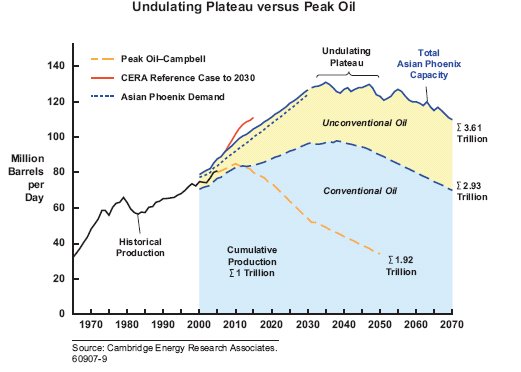
Figure 1 — Click to Enlarge
We shall have much more to say about CERA's forecast later. For now, it is sufficient to note that CERA's analysis is lacking. The world's oil supply will not continue to grow to meet ever-rising global demand, and worse, the consequences could irrevocably damage global economies. Such an outcome would have harmful effects on people's lives. So, this debate is not "academic" — much depends on a correct analysis of the future oil supply.
1. What is "Peak Oil"?
Peak Oil is the theory, with resulting hypotheses, tested with data, that the world's incremental production of conventional oil over time will reach some high water mark and decline thereafter. There are a number of ways to define "conventional" but, for our purposes here, such oil consists of crude oil, condensate and natural gas liquids.Conventional oil production is measured as the quantity extracted over time. For example, the United States produced 6.88 million barrels per day (mbd) of conventional oil in August, 2006 according to data provided by the Energy Information Administration (EIA). The world as a whole produced 81.55 mbd during the same month. The peak oil hypothesis claims that world production will reach an apex and decline, analogous to the production profile shown in CERA's graph for the United States in Figure 2 below.
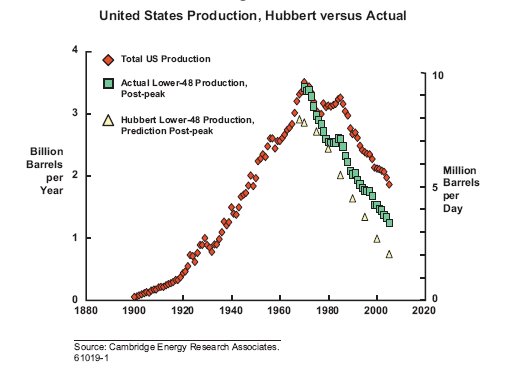
Figure 2 — Click to Enlarge
As Figure 2 clearly demonstrates, the peak of United States oil production measured in billion barrels per year for crude oil plus condensate occurred in 1970. We will have more to say about CERA's analysis of this graph in section 3 below. Notwithstanding any subtleties of interpretation, it is impossible to deny that the U.S. peak did occur and thereafter, production never reached the 1970 high water mark ever again.
No one, including CERA, doubts that a peak in world conventional oil production will eventually occur; it is only a matter of when it will occur. As Figure 1 shows, CERA believes that the apex of production will happen circa 2040. Those putting forth the peak oil hypothesis simply disagree about the timing. Although estimates vary, most of us agree that the peak will occur sometime before 2015, a scant 9 years from now. Within that range, some think the current plateau in oil production signals that the peak is now while others put the peak elsewhere in the coming decade. If this hypothesis is correct, the world will have little time to mitigate the problem, as outlined in Peaking of World Oil Production: Impacts, Mitigation & Risk Management by Robert L. Hirsch (SAIC), Roger Bezdek, (MISI) Robert Wendling, (MISI) published in February, 2005.
A final word about what peak oil is not: the hypothesis set forth here is not a catastrophist prophecy that the world is running out of oil. Once the world production does peak, views vary as to how severe the decline rate will be thereafter. Many reputable people from the oil & natural gas industry and elsewhere are concerned about peak oil. We are not a doomsday cult.
[editor's note, by Dave Cohen] It will not be possible here to cover all the necessary arguments which a neutral observer might wish to see in order to make a judgement in this debate. In particular, aboveground political risks that might "limit upstream investments" as CERA put it, such as in Russia and elsewhere, are not covered here. Nor have we addressed potentially explosive geopolitical situations such as the Iraq civil war or Iran's nuclear ambitions —Middle Eastern tensions could have catastrophic effects on global oil production. We have not been able to include logistical concerns eg. the global shortage of drilling rigs. The alarming trends in world oil exports and declining discoveries which cause us genuine concern are not covered either; for example, conventional oil discoveries peaked in the 1960's and, as a result, the world's largest oil fields, which were found first, are now decades old and aging more with every passing year.
2. Reserves Versus Production Flows
The question of recoverable reserves estimates versus production flows is central to the argument about the timing of peak oil. CERA states that "Reserves/Resource Definitions and Estimates Cloud the Debate". We agree. You will note that our definition of "peak oil" above does not mention reserves at all but, rather, focuses on production flows measured as the quantity extracted over time. Recoverable reserves are almost orthogonal to the debate outside the simple observation that these must exist before any oil can be extracted. The peak oil hypothesis focuses on realistic geological, technological and economic constraints on current & future oil production. A detailed example pertaining to future production will suffice.Great fanfare in the press accompanied Chevron's successful Jack #2 test well in the ultra-deepwater Lower Tertiary basin of the Gulf of Mexico. Press accounts such as Business Week's Plenty of Oil--Just Drill Deeper The discovery of reserves in the Gulf of Mexico means supply isn't topping out highlighted the estimated recoverable reserves numbers, which were given in the range 3 billion (Gb) to 15 billion barrels of oil with emphasis on the latter figure. Press releases related to the new "Decision Brief" have been similar, for example MSNBC's World oil supply still plentiful, study shows in which it is stated that
Cambridge Energy Research Associates said in a report that the world has some 3.74 trillion barrels of oil left -- enough to last 122 years at current consumption rates and triple the amount estimated by "peak oil" theorists.Although CERA states that huge reserves estimates cloud the debate, they continue to promulgate them.
Reading the "fine print" about Jack #2, it became apparent that there were extremely challenging hurdles to overcome in order to actually produce this oil. These included, among other things, the need for drilling equipment beyond the limits of current technology, huge capital expenditure requirements before first production could begin and the further necessity of doing additional tests to find out whether the geology of the reservoirs would permit sufficient oil flow rates to make the play economic to produce. At this time, Chevron and its partners will do additional appraisals next year. No decision has been made yet as to whether development of the Jack field will go forward.
So, it was with some surprise that CERA asserted the following in a press release dated September 6, 2006, based upon their August, 2006 Private Report Expansion Set to Continue: Global Liquids Capacity to 2015.
The most material new resource in the deepwater Gulf of Mexico is the Lower Tertiary Eocene.... [includes the Cascade, Chinook, Saint Malo, Jack, Das Bump, Stones, Hadrian and Great White fields]As the text quoted indicates, with its private clients, CERA does not focus on reserves. The 800/kbd is a production rate, not a reserves number. However —these are the take home points— CERA has added in productive capacity from the Gulf of Mexico, as shown in Figure 3, for the Wilcox play although it is not clear yet whether some of these fields will even be produced given the constraints on production mentioned above. Furthermore, CERA's production flow estimate is at least 300/kbd higher than any other independent estimate we could find for production in the 2013 period.A production test [Jack #2] is under way to assess the producibility of the deep Wilcox reservoir. Assuming a successful test, a capacity of 800,000 barrels per day [kbd] is projected from the Eocene trend of fields by 2013-14, plus capacity from any subsequent discoveries. [passage from the CERA report referenced above]

Figure 3 — Click to Enlarge
What Figure 3 highlights, which is not found anywhere in the CERA's peak oil "Decision Brief", is their assumption —shared by us— of a 5% decline rate in existing oil production over time. As you can see, what CERA calls the "Upstream Oil Challenge" is a race between bringing new conventional oil production on-stream and declining production in existing oil fields such as Mexico's giant offshore Cantarell field. The assumed global decline rate is crucial. The hard & expensive problem of bringing new oil production on-stream is compounded over time by an exponential decline rate which requires the world to run faster to stay in-place, let alone move forward to meet increasing demand. Moreover, some of the conventional oil CERA is counting on to meet the demand challenge involves fields under appraisal or "yet to find" resources — this is oil that does not yet exist. Of the 3.74 trillion barrels of oil CERA claims remains to be exploited —see section 3 below— 0.758 trillion barrels comes from "exploration potential" ie. it has not yet been discovered but, presumably, is recoverable despite unknown geological, technological and economic constraints on production of a non-existent resource.
For Saudi Arabia, now the world's 2nd biggest producer, Kjell Aleklett, President of ASPO (Europe) has this to say:
As an example, CERA thinks that Saudi Arabia needs more than 2 million barrels per day from fields that not have been found today. Shaybah is the latest giant field that Saudi Arabia started up in 1998 with a production capacity of 500,000 barrels per day. In principle, CERA is saying that the production equivalent of 4 Shaybah fields will be found and put into production during the next 9 years in Saudi Arabia.As you can readily see, there is more to the peak oil problem than meets the eye as detailed in CERA's latest "Decision Brief". The peak oil hypothesis is both complex and worrisome.
3. Unconventional Oil — Substitutes
As shown in Figure 1, the ability of the world to bring substitutes for conventional oil on-stream figures prominently in CERA's analysis both now and in the future. They define these substitutes as follows —However, demand for refined products could outstrip conventional crude oil production. Conventional crude oil production excludes liquids production from heavy oil sands, ultra-deepwater oils, gas-related liquids (condensate and natural gas liquids), gas-to-liquids (GTL), and coal-to-liquids (CTL).* This means that additional sources of liquid fuels will be needed in abundance and in a timely manner, assuming relatively strong global economic and oil demand growth. Technology will promote a widening of the concept of conventional oil, as has occurred over the history of the industry.Let us get some clarifications and additions out of the way. First, in our more generous definition of conventional oil, condensates and natural gas liquids are already included. Second, whether ultra-deepwater production is conventional or not is a red herring —it makes no difference to the debate. Heavy oil sands —sometimes called tar sands— refers to both the production of oil sands in Alberta, Canada by means of in situ heating or mining methods and the production of heavy tar in Venezuela's Orinoco Basin. Additional substitutes CERA considers include ethanol from cellulosic biomass or corn, from sugar cane (as in Brazil), diesel fuel from soybeans, and the like. Also not mentioned directly in the quote above is future production from oil shales. Taken altogether, these new sources plus additional conventional oil production are the source of the numbers quoted in the mainstream press.
CERA believes that the global inventory is some 4.82 trillion barrels of resources of which about 1.08 trillion barrels have been produced already. Therefore, there is as much as 3.74 trillion barrels of conventional and unconventional resource remaining, and this order of magnitude of resources will allow productive capacity to continue to expand well into this century.Although CERA asserts that "those who believe that a peak is imminent tend to consider only proven remaining resources of conventional oil, which at present they believe to be approximately 1.2 trillion barrels", any cursory glance at stories on The Oil Drum or much of the published peak oil literature will readily reveal that substitutes for oil are analyzed all the time. The reason for this is both simple & compelling —since we believe the timing of peak oil is sooner rather than later, we are very concerned about whether substitutes will be available to ease the transition away from conventional oil to create a different energy mix in the future.[Note: for example, CERA estimates 0.707 trillion barrels to be produced from oil shales]
Unfortunately, our analysis reveals the same worrisome pattern over and over again for substitutes. The three principal problems with substitutes are listed below.
- Scalability by volume —new liquid fuel resources can generally only provide a small percentage of the total volumes of liquid fuels supplied by conventional oil. For example, a National Academy of Sciences report came to the following conclusion.
The real risk from all these planned ethanol plants is that they'll use up vast quantities of corn. America's entire corn and soy crop could supply fuel volumes equal to just 12% of gasoline demand and 6% of diesel demand, notes a University of Minnesota ecology professor, David Tilman, an author of the July 25 Proceedings article.
- Scalability in time —even where there is a vast resource, liquid production flows from substitutes are slow to ramp up. As a result, in the case of exponentially declining oil production not replaced by new conventional oil sources, substitutes will not make up shortfalls incurred in the short-term. To make matters worse, similar remarks apply to production of new conventional oil eg. recovering stranded oil by means of CO2 injection enhanced oil recovery (EOR).
- Low Energy Returns —this refers to energy returned by a production process for a fuel divided by the energy required to produce the fuel —standardly abbreviated as the EROEI. Both substitutes and, increasingly, new conventional oil production, have lower EROEIs tending toward the limit = 1. The closer one gets to the limit, the smaller the marginal returns. The EROEI term need not be confined to fossil fuel energy inputs but may include all of the economic costs associated with developing an energy fuel resource, depending on where the boundaries for the calculation are set. The general idea here is that the world is not like Spindletop in the Southeast of Texas anymore. You can not just sink a drillpipe and get a gusher anymore. The so-called "low hanging" fruit is gone and what is left is energy-intensive to develop & produce.
In an example of points #1 & #2 above, CERA believes that "GTL and CTL collectively may well represent 6 percent of global productive capacity by 2030", an unimpressive fraction of liquids production as estimated for that time period. Obviously, in the shorter term within the next decade, the percentage of gas-to-liquids or coal-to-liquids that will substitute for conventional oil will be negligible. Similar remarks apply to oil shales. If you believe, as we do, that the peak of production will come sooner rather than later, there is genuine cause for deep concern.
CERA explicitly acknowledges the scalability problems as the timescale of Figure 1 indicates. Despite their belief that the economics of unconventional substitutes is favorable, however, CERA does not seem to take net energy returns into account. There are already problems with the production of the oil sands in Canada, our most successful substitute so far. Capital expenditure costs are soaring to support new incremental production measured in increments of 100/kbd, thus making it harder to attract capital investments. Total production from the sands may be in the 2 to 3/mbd range by 2015, although estimates vary given the ongoing environment, logistic and net energy concerns there.
The bottom line as shown in Figure 1 from the CERA "Decision Brief" is that conventional oil production will conveniently increase until substitutes are ready to come on-stream much farther down the road, thus providing a seamless transition to the new liquid fuel sources. If CERA is mistaken about that production, substitutes will be of little avail in making up shortfalls.
4. Peak Oil Modeling Theory & Data
CERA berates those concerned about peak oil, labeled peakists in their document, for using questionable data and analysis methods. This passage is worth quoting in full.We are also struck by three characteristics of the current debate:Here we must take exception to CERA's characterization of peak oil research, especially here at The Oil Drum. Not only have we tracked CERA's bottom-up project- by-project analysis in the past —a complete list of stories is too long to enumerate here— but we also avail ourselves of whatever data we can find, such as the Megaprojects Database compiled by Chris Skrebowski, editor of the Petroleum Review.
- The peakist argument is not grounded in a credible systematic evaluation of available data.
- The peakist arguments cluster around the questionable model described by the late American geologist M. King Hubbert. This is a technique that fails to recognize both that recoverable reserves estimates evolve with time and are subject to constant and often significant change. It also underplays the far-reaching impact of technological advances.
- Some of the peakists are, interestingly, shifting their emphasis away from running out, in terms of physical resources, to issues that we believe are significant--infrastructure and aboveground risks.
Space limitations preclude going into much detail here, but suffice it to say that it is a bit disingenuous for an organization such as CERA, a wholly-owned subsidiary of IHS Energy, to charge money for it's reports for paying clients and then turn around and tell us that we are unfamiliar with the current & future oil production data. This points up a larger issue which Matt Simmons has brought to the forefront of public attention: data transparency in the world's oil industry. Just as we can not see some of CERA's field-by-field production projections, we also can not see an historical production profile or this year's monthly production data for Ghawar in Saudi Arabia, the world's biggest oil field. For an issue so crucial to the health of world economies, the lack of readily accessible data is scandalous. A pro bono approach would make data available to independent organizations that have an interest in analyzing it.
CERA's critique of Hubbert modeling is quoted below.
Despite his valuable contribution, M. King Hubbert's methodology falls down because it does not consider likely resource growth, application of new technology, basic commercial factors, or the impact of geopolitics on production. His approach does not work in all cases--including on the United States itself--and cannot reliably model a global production outlook. Put more simply, the case for the imminent peak is flawed. As it is, production in 2005 in the Lower 48 in the United States was 66 percent higher than Hubbert projected [see Figure 2].M. King Hubbert's logistic production curve is not a physical model, so naturally it does not take into account technology, geopolitics or economics. It is simply a modeling tool which provides one more independent line of evidence that peak oil analysts use to investigate their hypothesis. Other lines of evidence, as discussed above, do take into account "real world" data. We accept CERA's criticism that such production data do not always follow the logistic (bell) curve that forms the basis of the model. However, unless some geopolitical perturbations occur or the oil producing region is relatively immature, it is usually the case that deviations from the logistic are seen in the tail end of the curve after the apex of production has already occurred. See the Graphoilogy weblog for additional information.
However, the criticism that the United States does not follow Hubbert's predictions does not hold water. While it is true that Hubbert did not foresee Prudhoe Bay and other Alaskan production, or the deepwater developments in the Gulf of Mexico, it is nevertheless the case that 1) U.S. production did indeed peak just about when Hubbert said it would and 2) despite reserves growth during the subsequent period in the tail end of the curve, actual oil production never again reached its 1970 peak —it has declined ever since. These are the salient observations to bear in mind.
Moreover, CERA makes some observations that cast doubt on their understanding of Hubbert's methods and further refinements to it. CERA makes the following claim:
Hubbert's method also requires an accurate knowledge of the ultimate recoverable reserves of any area. However, numerous studies point to the fact that, during the life of oil fields, resource estimates often increase as understanding of the field improves and new technology is applied.In fact, a Hubbert Linearization based on cumulative production yields an estimate of the ultimately recoverable reserves (URR) —these are not known in advance. For example, this linearization for Romania indicates that the URR will be 6.2 billion barrels and that there is a decline rate of approximately 6.7%.
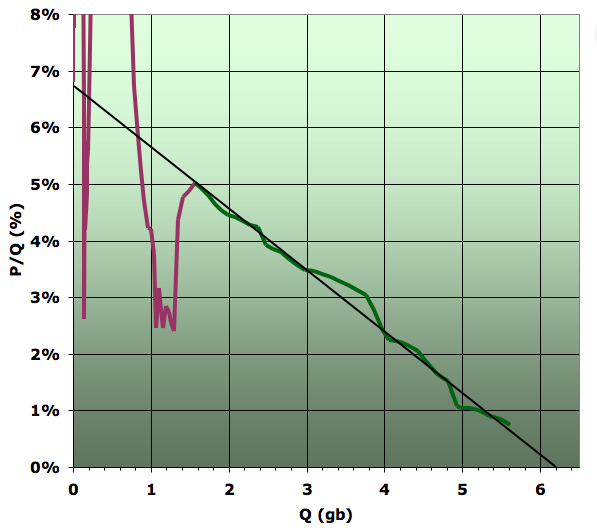
Linearization of Romanian production (the y-axis
the ratio of annual production to cumulative
production, x-axis is cumulative production.
Linear fit is to the region for 1955 on (green
data - plum data is prior to 1955). Click for
larger version. Source: American Petroleum
Institute (courtesy J. Laharrere) for 1857-1958,
and BP for 1965-2005 (includes NGLs). Production
data for 1959-1964 is linearly interpolated
between the two data sets.
Figure 4 — Click to Enlarge
Kuwait provides another important example of using the Hubbert linearization to estimate recoverable reserves.
At the Oil Depletion conference (hosted by the Energy Institute) held in London on 7th November, Dr Kenneth Chew, a Vice President of IHS Energy [CERA's parent company] reported proved and probable reserves (2P) for Kuwait of around 52 billion barrels... This is approximately 51% of the proved reserves reported in the BP statistical review that stand at 101.5 billion barrels. This tends to support recent reports of Kuwaiti reserves being substantially overstated.A linearization for Kuwait yields an estimate of 40 billion recoverable barrels there, an number more in line with IHS Energy's conclusions than OPEC's "official" estimate of 101.5 billion barrels.
The bottom-line is that those studying the peak oil hypothesis are not wedded to Hubbert's theory, which has been refined over the years. However, these mathematical tools provide a sometimes startlingly accurate model of real world production data, especially where the data set is completely known such as in the United States and Norway —which is also in decline.
5. Our Conclusions
In Figure 3, CERA shows current productive capacity at 88.7/mbd. This number was set in the Spring of 2006 and has not changed since, to our knowledge. In fact, according to the EIA, actual conventional oil production (as defined here) was 81.55/mbd in August, 2006, a figure which excludes the category other liquids —these include refinery gains, biofuels, etc. We can not know the source of the discrepancy between the two numbers. However, if actual production bears the same relationship to productive capacity in the future as it does today given CERA's projected demand, there appears to be genuine cause for worry belying their rosy forecast.To quote CERA's Peter M. Jackson once more:
In these times of relatively tight supply, high and volatile oil prices, and anxiety about energy security, the peak oil debate is raging once more. This debate reflects one of the most important issues facing not only the energy industry, but the world at large. Those believing in a doomsday scenario argue that peak oil is near and that the world is ill prepared for it. If world oil production were to enter a sharp downward spiral in the next several years, the ramifications for the global economy and geopolitics would be severe and potentially catastrophic.We are concerned that CERA has "maintained a consistent contrary view" and not taken the peak oil hypothesis seriously until now. We can only agree that "this debate reflects one of the most important issues facing not only the energy industry, but the world at large." We hope our response demonstrates that the peak oil hypothesis is anything but simplistic. Furthermore, no one here or elsewhere is claiming that conventional oil will "run out" anytime soon. Rather, the peak oil view is an evolving, sophisticated take on conventional oil production and the viability of substitutes to replace continuing demand for this paramount fossil fuel in the face of inevitable declines in available supply. Only the timing of such declines is at issue here. We can also only add that denial in the face of potentially very threatening events is a powerful force in the human psyche.For many years CERA has maintained a consistent contrary view. CERA does not agree with the simplistic concept of an imminent peak in oil production nor with the idea that oil will "run out" soon thereafter.
In conclusion, the peak oil debate is still alive and well, not moribund, as CERA and some mainstream media accounts would have you believe. We at The Oil Drum are not persuaded in the least by CERA's often —and disappointingly— weak arguments which, ultimately, depend on many assumptions we consider unrealistic.
Dave Cohen
TOD Senior Contributor
News Contacts: theoildrum @ gmail.com
The Author: davec @ linkvoyager.com
Contact
- Content: editors at theoildrum dot com
- Tech support: support at theoildrum dot com
License

This work is licensed under a Creative Commons Attribution-Share Alike 3.0 United States License.
Also, we hope that you will also spend some time talking about this subject on your own blogs, sending this post to as many media outlets you think will publish or respond as possible, and sending this post to your public and/or elected officials.
Simply put, we must come to achieving a better understanding of our energy supply--the geopolitical, political, and social aspects of a plateauing supply with ever growing global demand could have an impact on the daily lives, especially of those who are less fortunate.
TOD will also be putting out a press release on this topic next week; we hope that you will also send that around as well when it is ready. It will be shorter and more consumable for those not exposed to this mode of thinking.
Just a quick idea, but getting press attention for the issue tends to require the 'good story'. CERA achieve this by pushing a view which is contrary to the accepted wisdom and very palatable for the general populous to believe in.
A suggestion would be to challenge CERA to a wager - say the $1000 they charge everyone to get hold of the words of 'wisdom'. CERA take their optimistic predictions of world oil production, TOD one that reflects the peak oil hypothosis and predicted data set. Whoever gets closest to the mark over a defined time period (say the whole of 2007) wins the bet.
The story is good and would get coverage, and I'll bet that given the reported mismatch that is already in their predictions, CERA would decline to take part - telling its own story.
If we are so flush with energy, then why is it that today I received the third mailing from my local utility company offering a $25 energy credit in return for allowing them to install a device that periodically shuts off the air conditioner during times of peak usage? I also received a telephone call from a pushy company rep with the same offer.
The utility company must have sent that letter to all their customers.
You don't need to keep your house at 65F durring the summer while your not even home. Turn it off or turn it up and save some energy.
The topic of the main posting is that CERA and other like minded groups are implying that ff production capacity is not reaching its limits and can meet projected demand. If that is the case, then it does not follow that utility companies would be worried about not being able to meet demand. The large metropolitan area I live in already had an incident last winter when the utility company was forced to shut off power to large areas due to lack of natural gas. Personally, I see this as a harbinger - but that is my take.
I understand that utility company problems are multifactorial, but this was beyond the scope of the simple point I was making. You were not even on the same page. Heck, you were not looking at the same book.
Try not to be so overreactive. Your views may be in the minority on TOD, but having a thoughtful and polite tone will go far in allowing others to consider any valid points you may make.
I would like to point out your original post is irrelevant. There are many reasons for electric companies wanting to reduce demand during peak periods, many of them financial.
And your story about your utility having to shut off power because of a natural gas shortage? This post was about liquids.
PS. I agree that Hothgor was rude.
ImSceptical was right. This kind of program has very good justifications that are unrelated to fuel shortages.
It's called "demand management". It can be much cheaper to pay people to allow the utility to turn off their demand at peak, versus building new generation capacity just for peak demand.
in any case, i applaud energy conservation efforts for whatever reason.
The WSJ had a short note yesterday about the American Petroleum Institute (API) sending a letter to Congress warning them that if they raise taxes on the oil and gas industry it will hinder the industry's efforts to bring on new supplies of oil and gas and new alternative energy sources.
I actually agree with the API on this point, but I disgree withe the semi-cornucopian way they (and probably CERA) are trying to combat higher taxes. IMO, we need a much higher tax on energy consumption, offset by a cut to the Payroll Tax.
If you have time, could you please explain a little more about what you say here? I'm just not sure I'm reading this correctly. 1) Are you saying that the industry efforts to bring on "new alternative energy sources" would be hindered by raising taxes on the industry itself? 2) And when you say you agree with API...do you see a difference between "...taxes..on the industry" and "...a higher tax on energy consumption"? Or, do you see these as being essentially the same? 3) What do you see as actions that would promote (rather than hinder) "...new alternative...sources"? (I just realize I'm assuming by "new...sources", you mean - actually, which new sources are you including when you use this word?) I apologize in advance if I've not understood your previous posts on this subject. Thanks.
Full disclosure: I am an energy producer. In any case, I don't think that taxing energy production is going to help. I think that we need to tax energy consumption--in much the same way the Europeans do. Total energy consmption per capita in the US is twice what it is in Europe.
However, the API is taking the cornucopian approach. Just leave us alone and everyone will continue to be able to drive their SUV to their suburban mortgages.
BTW, the weekend WSJ has an article that goes into considerable detail on the effect that forced energy conservation is having on Africa.
WT,
As long as we continue to offer oil companies corporate welfare, they will take it. With Exxon receiving the largest profit in corporate history (any corp), I doubt that increasing taxes and eliminating subsidies will hurt it much.
As they get prodigiously richer, the oil execs will be the only people who can afford to drive SUVs to their mortgages.
I agree that consumer taxes are necessary, but we must not forget the super-wealthy corporations. I am, of course, assuming that when the MSM says "profit," they mean money left over after all operating expenses, including research and exploration dollars.
Personally, I believe that we must immediately begin taxing the bejeezus out of all the rich and especially the corporations. They have gotten too much from the commonwealth and returned too little or have caused actual damage.
I have little sympathy for rich people who cry crocodile tears when they only have a couple of million dollars left to live on. BOO HOO.
This sort of selfish behaviour earns the applause of right wingers who claim it is precisely this "evil" behaviour that produces all the good things we currently enjoy. Unfortunately, for this argument, the good things have been available since time began. I.E. food, water, and air. (For how much longer, I don't know.) Corporations do not account for environmental costs, effectively off-loading these costs onto the commons. When a person gets sick from pollution caused by a corporation hundreds of miles away, society picks up the tab. This is nitpicking on my part, using the terminology of the economic categorizer, please forgive me. I must wash out my mouth with organic soap. The overarching truth of pollution remains: it is killing the planet. Does not matter how we slice the fictional economic pie, that group over there, better known as XYZ Corp., engages in murder; therefore, such selfish, evil behaviour must be stopped. That is why we must tax the bejeezus out of the rich. We need to clean up their selfish messes.
A tax on a corporation is a tax on its employees, its shareholders and its customers.
A corporation is just a legal construct, it isn't an end user in economic terms.
The actual fraction of say a $100 tax might be split 33/33/34 or it might be split very differently.
It depends on how competitive the markets in which the corporation operates in, and how competitive the suppliers are, and the employees.
So a company like WalMart is incredibly competitive, dominates its sector, dominates its supplier *but* it makes sub 10% margins.
Any new tax on WalMart is passed through to its employees, its suppliers and its customers.
Any proposal to 'tax' corporations has to recognise this transparency.
In practice, what the US should have is a low rate of corporate income tax (I would argue 25% or lower) but *no* exemptions. This would have the least distorting effect on tax revenues, and might actually raise corporate tax revenues.
Good thoughts, tho' I'm not an economist enough to agree or disagree..
As long as the 'no exemptions' part doesn't just get painted as a 'new tax', I think this would have a prodigious effect.. almost a corporate Flat Tax. So in the same corner, do you have a take on a US policy direction that would also deal with the virtual 'offshoring' of corporations to avoid our taxes? Would it be better to have a policy DISincentive to being outside the border (ie, Tariffs and other int'l Trading costs?), or some other kind of INcentive to keep a firm flying the Stars and Stripes? Membership ought to have its priviledges..
Bob Fiske
Dave-I understand the new Congressional commitee on energy is skeptical of the CERA report, stating they felt Cera's use of USGS data was erroneous. Should get them a copy of your work. Sorry I don't recall/have the links, just I recall an AP wire story read yesterday.
These CERA-related stories were probably earmarked elsewhere here at TOD:
http://www.tetrahedron.org/articles/new_world_order/bush_nazis.html
This could be worth some digging.
Oh boy...
http://www.nndb.com/people/460/000060280/
Now, where did I leave my tin foil hat?
I need a tin foil coat to go with my hat
The fact is who pays CERA's bills is quite relevant perhaps more so than the organization's claim for objectivity. These analysts are ultimately hired by corporations (often through industry trade groups)for one reason: to promote either the company(s) that hired them or the individual that signed the contract. CERA's job is to make petroleum-related industries and people look good. I didn't pay their way. Perhaps you have?
There is one maxim that will drive any successful political or business investigation: follow the money. I say do it.
And when did CERA become the "contrary" source to the conventional wisdom? I feel they merely reinforce the status quo more than anything else.
CERA states: "The new report describes CERA's liquids supply outlook as "not a view of endless abundance."...Global production will eventually follow an "undulating plateau" for one or more decades before declining slowly...During the plateau period in later decades, according to the CERA analysis, demand growth will likely no longer be largely met by growth in available, commercially exploitable natural oil supplies.
As far as I can tell the Norwegians are at the forfront of recoverability technology, and they admit that only injecting water or gas is the best technology so far. When you inject water or gas, the well lasts longer but output declines -- it is a bump on the bottom of the decline curve.
The Norweigans describe their technologies to improve recovery: 1. injections of water or gas, 2. use of foam combined with WAG (FAWAG) and of microbes (MIOR) (which hasn't worked well so far for Norway) -- the NPD does not know of other other methods that work but suggests research should be done to improve recovery. Does anyone know of any advances in recoverability technology?
If one thinks about the processes involved, a long lasting trickle seems reasonable.
Alan
"The underlying analytical model formulated by the late M. King Hubbert both fails to recognize that recoverable reserve estimates evolve with time and are subject to significant change, and it also underplays the substantial impact of technological advances...
"The peak argument is an incomplete and therefore misleading analysis because it ignores the role of development (vs exploration) projects in expanding reserves, fails to understand economic factors that can point company and national strategies to emphasize development vs exploration work."
I study IOR (improved oil recovery) and EOR (enhanced oil recovery) when I work on this stuff and post on it frequently.
It's insulting for CERA to say that. If you click on the link I provide in the last paragraph of my post, you will see an article by some of our ASPO-USA colleagues -- one of whom is Jeremy Gilbert, former Chief Petroleum Engineer for a small oil company that nobody here has ever heard of called British Petroleum. I'm quite sure he knows nothing about IOR & EOR.
Help me out here. My level of sarcasm doesn't seem quite up to the task.
Keeping our cool we can see that they provide ammunition for counter-arguments, such as you provide by talking about Mr. Gilbert and the other oil people who contribute. You are doing a great job. We can ask them to explain how all these factors haven't reversed the path of decline in any region yet, but they continue to cling to the belief they somehow will? Their reliance on fantasy technologies, fantasy oil fields, fantasy reserve growth and fantasy energy positive unconventional sources to arrive at their fantasy numbers is what's really amateurish and despicable.
To do otherwise, leaves stranded URR and that my friend is an oxymoron. We are not talking of micro advancements of IOR.
The "distortion cloud" clings closely to one cleverly concealed place: CERA's database.
Obviously it is a matter of national security to make sure that no one knows the truth and to embed notions of mistrust and confusion in the ranks of those few scientists who have figured it out anyway.
Rumor has it that CERA's secret database is located in a remote and fog-shrouded island somewhere between the North Pole and NeverNever Land.
Who cares if history proves them wrong 15 years in the future? Such reports / statements have a very short half-life. Only Mr. Yergins' reputation might suffer a bit, but he's a public person. And the most important thing about someone in public is that he gets press - good or bad only matters if you're up for election...
Used the German, which means "if" and "when".
Happens sometimes..
I really don't want to go. The Sheik's third son has really got it set up pisser for me. And I really think his third wife's sister's [screeech]'s bodyguard's [yo don't say that] with the big o' [yo!] is working out real good. I'm serious. She smells good, too.
When I went to digg (or was it reddit?) this article, a different menu popped up, and it wanted me to tell it about the article, including a category. So is it
- business/finance?
- environment?
- world news?
... it doesn't quite seem to fit any one digg category.It's been three months or so since I did a Peak Oil column in for my suburban Dallas newspaper group. I'll do something sometime before the end of the year.
If a story gets enough diggs it will make it to the front page.
* Now this is where TOD really would get a huge volume of hits. *
This, and several other articles are classic -- is there a collection of them somewhere? Has anyone converted them to PDF?
Thanks for all the hard work
Tom Duncan
Excellent summary and rebuttal to CERA. Keep it up.
None of the graphs enlarge when clicked. Just halfway through the analysis (looks great) but frustrated by fact cannot read the "fine print."
Cheers!
Power = Work / Time
Time = Money
Therefore: Knowledge = Work / Money
Id est Money is inversely proportional to Knowledge, explaining why TOD writers work for free whereas CERA do not!
Then you would have the equation:
Money= Work/(technical.knoweledge)
and that would explain why Dilbert & freinds makes so little while their pointed-hairdo manager makes more.

In a Forbes column published on 11/1/04, Yergin predicted that rising oil production would force prices down to $38 by barrel by 11/1/05, in order to equalize supply and demand. I am not aware of any statements by Jackson refuting Yergin's view.
Boone Pickens and Richard Rainwater took a contrary view. They invested large sums of money based on the premise that flat to falling oil production would force oil prices up in order to equalize supply and demand.
Note that Jackson & Yergin have so far been wrong, while Pickens and Rainwater have so far been correct.
Following is a link to an open letter that I wrote to the publishers of the Dallas Morning News and the Fort Worth Star Telegram regarding Mr. Pickens' views and Mr. Rainwater's views on Peak Oil.
Interestingly enough, on 11/1/05--the very day that Yergin predicted that oil prices would be at $38 per barrel--I gave Mr. Pickens a copy of some of my early work on Hubbert Linearization (HL), based on Deffeyes' description of the method. Mr. Pickens' assistant was on the phone with me the next morning at 8:00 A.M., asking me to come by and brief Mr. Pickens' staff on the HL method.
http://www.energybulletin.net/14606.html
Published on 3 Apr 2006 by GraphOilogy. Archived on 3 Apr 2006.
Open letter to Texas newspapers about peak oil: 'Why aren't you listening?'
by Jeffrey J. Brown
Freddy/Hoth's contributions to this site are not worth the distortion that they introduce. These guys (guy) are masters of pure sophistry. Please, please, just kick them off and make them at least create new IDs. Whatever these guys are ( trolls, obnoxious SOBs, or just very, very socially awkward miscreants ) they just dont need to be here. I agree whole heartedly that discident voices are needed but these guys aint it. The most effective and most damaging propoganda is that which is laced with half-truths.. Just enough to sound credible but completely destructive to real understanding.
Junk'em!!
I kind of agree with your sentiment but until we get some good models to replace some of the cheap heuristics that we rely on excessively (such as the bloody non-physical Logistic equation) we may well deserve the distractions. I would hate to continuously try to justify empirically derived evidence in the absence of a good physical and mathematical model. In my case, years of schooling have indoctrinated me to stay away from rank empiricism. I can see the temptation though.
And regardless of how many 'false peaks' there have been, it certainly seems as if the USA, Britain, Norway, Romania (which definitely had a double peak not based on massive new discoveries as in the USA), and many others have peaked.
Though it may be an interesting academic debate about how reliable/predictive HL is, depletion is non-stop.
To a certain extent, this argument has gone beyond if oil will peak, and to a certain extent, even when it will peak, to when will the maximum amount of available energy provided by liquid fossil fuels be achieved? There is absolutely no way that Saudi Arabia's current infrastructure for water injection/water removal, combined with the increasing amount of heavier, sour crude being produced is returning as much energy in terms of transported oil as was produced in 1980. And how much oil 'production' is being consumed to pump the produced oil? I would assume that much of Saudi Arabia's oil infrastructure uses oil for its energy - could it be that a produced barrel is then consumed to produce further barrels, but only the produced number is publicly available - in other words, how much increasing oil consumption in an export land like Saudia Arabia or Russia is not consumption in terms of consumer use, but the amount required to keep production at its current level? (As pure speculation, this could even explain Saudi Arabia's first public fuel oil purchase - where before, they could use fairly high grade crude/lightly refined crude as fuel in a brute cost effective method, what they now pump is simply too low quality/costly to use/refine that way.)
Peak oil is a lot more than a discussion of HL. But hey, let's keep discussing the validity of statistical methodology and data gathering variances instead of confronting some seriously challenging analytical problems - for example, does 'barrel' represent a meaningful comparison of energy available between 1980 and 2005? It is hard enough to get information about how much oil a project is actually producing - but how much energy is used at Prudhoe Bay to pump the barrels which count as production? I think it is reasonable to assume more energy than in the past, but by how much? Obviously, .1% is meaningless, but what if the number is 6%? This would then make depletion a much more interesting discussion, as the true economic value we are interested in is the energy available for economic activity, not merely the volume of oil itself.
To be simplistic - assuming you have a motor which runs all three, would you prefer to pay $1 for a gallon of diesel, or gasoline, or ethanol? In the end, it is the amount of work you get out of the dollar of fuel that is important, not the volume/price per se.
In the end, this is not really a discussion about oil as much as it is about energy. It is just that oil allows for wonderfully bounded discussions, seeing as how it is so critical and hard to replace in various transportation infrastructures.
What I wonder is how much (if any, of course) of the peak oil debate is no longer based on comparable numbers, and in how the oil which is likely used in oil production is counted - for example, I have a hard time imagining Saudi Arabia uses much of anything for energy but oil and natural gas - the idea of them importing coal, or using nuclear energy is quite boggling. And considering the cost of renewables, why should people sitting on something which costs them less than fresh water bother with PV or wind turbines?
Aren't peer review and constant correction important parts of the scientific method?
There are always anomalies, and no method is perfect. However, most of the premature peaks, e.g. Iran and the UK, have been due to political or technical problems.
The method does seem to work pretty well on large producing regions that have been producing serious amounts of oil (measured in millions) for serious amounts of time (measured in decades).
The following regions have shown lower production after crossing the 50% of Qt mark: Texas; Lower 48; Total US (secondary lower peak after Alaska); Russia; North Sea; Saudi Arabia and now the world (everything but total liquids).
As I have previously pointed out, the method was quite accurate in predicting the post-50% of Qt cumulative production for the Lower 48 and Russia.
When we integrate a production rate versus time graph, we get the URR, or what Deffeyes called Qt.
IMO, the HL method is the most objective way of estimating Qt. 50% of Qt is the point at which a region has produced half of its estimated URR. As noted above, the post-50% of Qt cumulative production for the Lower 48 and Russia has basically been exactly what the HL model predicted it would be, using only production data through the 50% of Qt mark to predict the post-50% of Qt production.
Check out the following EB headline. Mexico just crossed the 50% of Qt mark (Khebab's work):
Mexico's energy crisis has arrived
Annette Hester, Macleans Magazine (Canada)
Is it possible to find any examples there the HL Method produce a very bad result?
If you went back in time to Texas, it would have predicted a peak about 20 years before it actually occurred.
Bad response. This isn't a game with somebody keeping score.
Take a look at the curves on Khebab's site:
http://graphoilogy.blogspot.com/2006/09/hubbert-parabola.html
Thanks these plots was just what i searched for. I was thinking that if the HL Method did not work well for very few countries it is probably a good tool.
In dec 04 I began studying energy issues and discovered aspo. Deciding they were on to something, I jumped in with both feet, bought ard/gmxr warrants, and quadrupled my ira in 05. Had I instead listened to cera, I might have sold oil or ng short, with different results. I wonder if anybody buying their pap actually invests based on what it says, or if all purchases are how cera is paid to misdirect the public.
This whole CERA business is irritating me - it is obvious that they have some serious MSM support.
I thought about it and put a website of mine on Google Adwords - if you search for CERA or "Cambridge Energy Research Associates" on Google, you should get a link to afterpeakoil.com on the right of the page.
AfterPeakOil.com is a semi-dormant website that links back to some more interesting things - including TheOilDrum.com
I hope that helps even matters a little bit.
Well, Alfred, what can I say? I guess we should be glad for your input. To be honest, nobody really gives a fuck what you think, but hey, this is TOD.
Here's some advice guarranteed to work.
- Don't read TOD
- Develop thicker skin
- Take up heroin-injection as a hobby.
- REALIZE - TOD vs. CERA is like Vampires vs. Zombies.
Godzilla vs. King KongAlien vs. Predator
The ultimate confrontation. The ultimate showdown.
Aaaaarre you reeeeeaaaaaddddy to Rumble! ???
No getting irritated allowed. Either fight or run.
Such a post is TOTALLY out of line here. I'm a frequent reader and don't post much - that's because I know when I have something to contribute and if I don't I shut up. Posts like the one above are nothing but trolling. There should be a zero tolerance policy for this. First a probationary ban, then a permanant one. Combined with some kind of built-in way to automatically delete such gutter posts. I'm looking forward to when the editors roll out the updates that I've read about, hopefully, so that there will be a framework implemented to address this now on-going problem. We need to maintain freedom of debate but such postings just hinder it in the first place.
The primary purpose of the HL method is to estimate the area of a production rate versus time graph, which is URR, or Qt. The method is much less accurate in predicting the actual production rate at a given point in time. Note that CERA did not comment on Hubbert's prediction for cumulative Lower 48 production. Also note that the farther away one is from the 50% of Qt mark, the less accurate the method is.
From my 7/7/06 post on the HL Method (on post-50% of Qt Models for the Lower 48 and Russia):
In other words, the HL method accurately predicted the post-50% of Qt cumulative production for both the Lower 48 and Russia. The world is now right at the 50% of Qt mark for both crude + condensate and crude + condensate + NGL's. And the most recent EIA data show that both measures of oil production, as predicted by the HL method, are flat to lower relative to late 2005. Only Total Liquids, which counts everything, including ethanol, is up over late 2005.
Thank you for explaining this. I was going to ask you about production rate predictability this morning. Detractors like CERA are trying to attribute prediction capabilities not intended by the HL method. This is a favorite tactic of conservative talk radio. They attribute a related but not accurate position to the "bad guy" so they have an easy argument against him.
I believe your message we all need to downsize as much as possible can not be repeated enough.
As I have frequently said, if you follow my advice and if I am wrong about the proximity of Peak Oil, you will have less debt, more money in the bank and a lower stress way of life.
The implied message that Yergin and Jackson are conveying is "Party on Dude." Go ahead and buy and finance the large SUV to drive to and from the large suburban mortgage.
Well if that's the only part of our life you want to look at, then of course you'd reach that conclusion. It might be the Faux 'Norman Rockwell' picture that some part of the corporate culture has painted into their advertisements, but there is a lot more to who we are, and the variety of people that live here than this 'Consume mass quantities' stereotype. It seems to me that making such a sweeping statement is to exactly buy into that manipulated image of the US. It is a factor, but there are aspects of this culture that can and do counteract the ones you mentioned.. such as, the counterpart to this 'Self-gratification' is our continued calvinistic insistence on overwork, killing off most peoples' chance at having any time for the gratification they 'think' they might be struggling to achieve.
~~~~~~~~~~
Doctor
'What would you say if I told you you weren't the Don of a great Villa, but were a patient at a psychiatric institution?'
DeMarco
'I would say that is a very sad and limited interpretation of this situation'
-Don Juan de Marco (very loosely from memory)
American Mania: When More Is Not Enough - Peter Whybrow
The Cultural Contradictions of Capitalism - Daniel Bell
and the outstanding BBC series: The Century Of The Self - available on Google Video.
Regarding the calvinistic impulse to work, why bother except to acquire more stuff? Look around, you see it everywhere.
We are mired in consumerism. It's the water we swim in, and everyone is wet, but that doesn't mean that if someone lives in a development, or they drive a big Pickup or an SUV, that they are bought and sold by the ideology.
To paint the whole society as this orgy of greed is as much a part of our 'deep roots' as is the consumer behavior itself. Attacking it is the (again) puritanical bashing for being 'Lazy, Greedy, Slothful and Mean'.. are there people like that? Sure. Is it a really useful portrait of the society? I have to say that it is not, since it is framed as this all-out condemnation, and if you want to work out the enormous problems we need to correct, then the view has to include a fair assessment of the varieties, and the productive parts of the US culture. We have our Lois Armstrongs, our Granny D's, our Steinbecks and our Amory Lovins, and you and me on this forum, joined by scads of others. (You British or Yank?)
I don't deny that we have a massive consumption problem, who could, but to whitewash the whole shebang is to lose track of the keys to finding a way out.
We often play with this age-old adage, "What's wrong with this picture?".. but the game often becomes circular and goes nowhere. I think we might give ourselves more chances at finding solutions by asking 'What's right with it?', since there will lie the potential routes to channel our energy towards, instead of perpetually spinning in disgruntledness..
-Bob .. proud American malcontent!
"You've got to accentuate the positive
Eliminate the negative
Latch on to the affirmative
Don't mess with Mister In-Between
"You've got to spread joy up to the maximum
Bring gloom down to the minimum
Have faith or pandemonium
Liable to walk upon the scene
(Johnny Mercer / Harold Arlen)
This is a problem - because our hearts our pure, we have the strength of ten men, and our SUVs have the exhaust of a bicycle?
I do agree on mass condemnation being counter productive - unless of course, what you are condemning is worthy of it.
I did read on a GlobalWarming Denier site that the Author thought a Hummer was greener than a bike.. something to do with how much extra food the cyclist was eating. I wonder what his Body Mass Index is?
Thing is, I'm not championing our strengths to justify our prodigious wastefulness, but to say that there are positives that can be focused on and amplified, to fill the yearning empty space in the garage where the Explorer used to sit.
But to slam the door on the whole scene is like an overly righteous preacher simply declaring you a sinner.. end of story. To get people out of a bad set of habits, you have to give them somewhere to go TO, not just call them names and wag fingers at them..
The only German slogan I could yank from errinerung was..
"Wenn vor Fliegen fliegen Fliegen, fliegen Fliegen' Fliegen nach.."
- Obey your Thirst!
This is one reason it is so easy to believe in doom, at least in an American context.
And one reason some people see peak oil in such dramatic terms.
Personally, I think a lot of things will either be returning to their long term mean (housing prices/debt ratios/stock prices), or changing from what they have been over the last 10 or 20 years (the climate has actually been very friendly for a good half generation). These changes will happen, regardless of what individuals believe or do. How we handle those changes is another matter.
My high schooler is being forced to read the The Great Gatsby (1925 by F. Scott Fitzgerald) and as usual, I am forced to swim into the book myself. Written before the Great Depression and while Fitzgerald was oversees, looking back on the Roaring 20's culture of his expatriated country, the author already senses that something is not quite right, that the American Dream (that dim green light which is forever out of reach of Jay Gatsby's outstreched hand) is unsustainable, and already it is too late.
In the last page of the book (here), Nick the narator lies down on the sands of Long Island Sound and through osmosis with the ground he sucks in three centuries worth of history and an understanding of the ClusterFucked Nation that is about to be:
Haven't been able to reread the book since.
Gatsby (written in 1925) is a tough book for high schoolers IMO. They don't have the historical background to understand what the Roaring 20's was like in America, to understand about Prohibition, about gangsters, about fixing the World Series ... or about the Market Plunge that was about to hit the "Happy Times are Here" cornucopian crowd shortly after in 1929. Often English teachers are ill equipped to teach the historical context. Instead they focus their energies on asking students to discover vivid white and ghostly colors in the text and to write 20 page essays on that literary crayon technique.
If you think about it, aside from the glamorous parties that take place at Jay Gatsby's palacial Long Island beach house, the book is also about America's love affair with the automobile (
yellow cars). The love-struck Gatsby and flippy Daisy are a bunch of "bad drivers" who join forces to bring death and destruction to all around them. And then Daisy moves on, without so much as glance back at what she contributed to. Very American."The sentimentalist is he who would enjoy without incurring the immense debtorship for a thing done." We are a nation of sentimentalists.
If we move away from using oil and start using a more expensive energy source, we are reducing productivity and stunting growth. Reducing growth and productivity is painful, too. As for which one is more painful, doomsday scenarios always sound more painful.
The same thing happens for global warming. If we implement steps to curb pollution without increasing productivity for the global economy, then we will stunt growth.
The idea that implementing drastic solutions will not cause harm is a false comfort. Of course, for individuals who spend less, this is all good. For a company to spend more to improve energy efficiency and not be able to recoup the added costs, then this company will be hurt and may lead to layoffs. When looking back at 20/20 hindsight, the extra investments were a waste of resources.
So as you can see, the economy is sensitive to drastic regulation changes. There are methods to implement energy efficiency without reducing productivity, so it is not all bad to believe in Peak Oil or Global Warming. But drastic regulations must be carefully thought out and definitely, we should not fall into a the false myth that these types of regulations have no pain.
increasing productivity for the global economy is a false comfort
we should not fall into the false myth that productivity and growth have no pain.
Oh, OK, enough of that. "Believe in Peak Oil or Global Warming"!?! How 'bout we just look at the data and evidence all around us.
"It's not a matter of principle. It's not a matter of belief. It's a matter of recognition" C.T. Canon
It's the belief in the ultimate good of growth without end that has got us into this colossal mess.
Productivity and growth are what we need less of. And we'll get less of 'em both in the most painful way possible thanks to our collective heads being in the sand all this time.
As for PO and GW, I do believe in those, too. Yes, it is a belief as these are theories and not facts. I am talking about the idea that peak oil and global warming are eminent and solutions need to be drastic. If you are talking about oil will peak any time in the future with no time line, then you are right and that is a fact and not just a hypothesis. Same with GW, if you are saying the temperatures are rising, then that is a fact, but if you are saying higher temperatures will lead to changing our lives, then it is a hypothesis.
Reducing productivity and stunting growth is not a disaster. It is a discomfort.
Displacing a billion people who live in coastal areas and potentially shifting the climate in the corn belt is an unprecedented disaster.
There was a few posters who said implementing changes away from oil will not cause major grief, which is simply not true.
I have specifically call it that it is a weighing of which one is more painful and I said doomsday scenarios are more painful.
This is why CERA's opaque, arrogant, but insistent stance on there being no problem is really setting us up for the worst of all possible scenarios.
Thus my banging of the drum for more Urban Rail. A relatively low cost "carrot" that will enhance the lives of the minority of early adopters.
In the later stages, Peak Oil will be a hammer and not a stick. Urban rail and their surrounding communities have the potential to be a shelter from those hammer blows, partially deflecting them. The alternative is to be pounded to death by the hammer.
If PO is long delayed, then the minority will enjoy their "alternative lifestayle".
Best Hopes,
Alan
A lot of people still use incandescent light bulbs, which are completely energy inefficient. Switching to a flurescent or LED light doesn't result in one having any less light, it only results in less power being used. This is just one example, but it shows how we can use energy more efficiently without it in fact impacting our lives negatively. I believe in the grand scheme a similar, more or less painless, substitution can be accomplished in the vast majority of circumstances.
Your choice to focus on poor people who will suffer (go without health care?) is a bit odd. People are already going without health care for reasons other than energy. You're focusing on a very specific issue and attributing the entire problem to energy, when the situation is much more complex. For example, the United States could spend (waste) 400 billion less on the military, and use that money to easily foot the cost of increased health care for everyone, while also increasing energy efficiency.
So, anyway, there is something to what you are saying. As you can see in the past paragraph I suggest taking money from somewhere else, which does imply there is a price. But I disagree with you that there's always a hefty price to pay. In many situations there really is not. I simply don't accept that telling people not to run their computers 24/7 is a serious hardship. Most people are just pissing power away, so I think it's hard to call curtailing such behavior as being a hardship.
My example was to show how reducing energy availability will cause hard ship. This does not mean this is the primary cause of hard ship, which it is not nor does it mean that lots of low cost energy will prevent hard ship.
The best estimate of the cost of decarbonising (stabilising CO2 at 500ppm) is 1% of world GDP in 2050. See the UK Treasury Stern Review.
Now the range is large,(it is even negative on some estimates) -3% to 10%. The difference being what happens to the resources that you divert from burning high carbon fuels.
If we take 4% say, as being 4 times the Stern Review cost.
Then we are saying world GDP in January 2050 will only be what it would have been in June of 2048. That GDP in any case will be 2.5 times what it is now ie around $100 trillion (or about $10,000 per person on the planet) vs. $45 trillion (approx) now.
I think that is a price the world economy can afford to pay.
The reason we have to get started *now* is the cost of damages, the risk of uncontrollable climate change (positive feedback loops making human action irrelevant) and the cost of switching long life capital assets (coal fired power plants etc.) grows exponentially over time.
Let's say that relative to the alternative, it is discomfort. It is the difference between amputating a toe, or amputating both legs. When you weigh the risk, best to be very, very conservative.
I have no qualms with that answer.
Earlier posts stated people were better off implementing PO mitigation regulations, even if PO never happens. This is incorrect.
Now, you are saying the costs are justified. That is different than saying there are no costs.
What value does reducing his auto deaths and life altering disabilities have ?
What value does reducing air pollution have ?
What value does reducing our obesity crisis have ? (With the coming epidemic of diabetes ?)
What value does living in a socially complex urban area over suburban isolation have ?
What value does bicycling to work, school or shopping have on good days ?
What value does being able to get to work by any means after the founding of the Islamic Republic of Arabia have ?
All these values should be considered when deciding whether to fund Urban Rail.
I realise it may sound offending but if your ideas take off there is a great chance USA may become a human-friendly (as opposed to car-friendly) country. Or probably revert to that state, I'm not sure...
But one cannot easily "sell" that idea. How does one sell what others cannot easily comphrehend ?
And Urban Rail does not automatically create such neighborhoods, but they often break the suburban isolation. I hope what you say is true, for we could have a better quality of life post-Peak Oil.
Best Hopes,
Alan
I just want to point out one negative fact. In San Francisco, public rail service is three times slower than cars/taxis. It takes 45 minutes to commute from the outskirts of SF by rail(MUNI) to downtown. People can drive that distance in 15 minutes during commute or even 5 minutes when no traffic and speeding. The 45minutes commute is pretty bad when you think that people who live in suburbs can have shorter commute than people who live in the city's outskirts. These people are living less than 7 miles away from downtown and take longer than people who live 10-20 miles away.
The rail systems for the suburbs who live 10-20 miles away take about same time as cars/driving. So from time perspective, cars are so much better- you get there fast with no hassles, even with traffic as long as no accidents. San Francisco area also have lots of rail accidents or malfunctions, so it is not like rail service is more consistent in meeting schedules. Also, parking fees in SF downtown are expensive, but rail costs are not cheap either. They tend to offset each other with rail being cheaper the closer you live to the city.
I think this is systematic issue.
I am coming from European country and I can safely say: the time I'm losing here for driving, finding parking places, car maintainance etc. is more than the time I was spending for transportation in my home country, where I dod not own a car.
The money I was spending there for transportaion were some 10-15% of my income (which was some $350/month), and here I'm spending the same percentage of my income for transportation, though it is close to a magnitude higher. Both places I was going wherever I wanted to go.
The only thing I seem to "gain" here, is some convenience - the 10-15 minute walk+waiting at the bus stop or to the taxi stand is replaced with 2-3 minute trip to the car. I can also drive to wherever I want to without spending the time to research which are the buses that go there.
In the whole Europe the question is resolved uniformly - the bulk of personal transportation is by some form of mass transit - bus, rail or plane plus the most natural one - walking. Cars are for recreation purposes and for the more affluent. Generally they are seen as socially adverse phenomenon and are heavily taxed because of that. Coming here I easily understood the rationale behind it.
Having said all of this, I realise that "fixing" the current US setup is a very hard task (the word "fixing" I used is my opinion I don't want to offend anyone). Mass transit simply does not fit well in cities that were not built with a transit oriented development at the first place. The whole development is predicated on the readily available access to huge resources - energy, material etc. It has been created in a way so that big businesses can benefit from economies of scale as far as possible, but the idea that the resources to maintain it will not be enough has obviously never occured to its designers. Pity...
Does this include car payments or just public transportation?
I spend $200 for monthly train and parking pass. I drive to train station to commute. Most people think I pay too much. People like to spend $50 or so, but may end up paying close to $100. Sounds like EU gets better transportation because people are paying more for it.
I disagree. Just take a look at our current energy consumption. 90% of it goes into non-essential activities - driving, flying, having A/C etc. etc. You are basically idolising the term "growth" and hiding the essentials which are in the details. Is 2% growth of the US economy of the same "value" as 2% growth of poor countries like China or India? I don't think so. Any effort to mitigate global warming must be also fair and socially acceptable. It must not hit the essentials and the most vulnerable groups. I will not agree a poor peasant in China to be paying the same price as a Holwood millioneire. For that purpose carbon credits must be established based on the number of the population, not on some artificial constructs as GDP.
But of course the affluent countries will never agree on that. They are more than happy to put the blame on countries like China or India because of their normal desire to reach some decent standard of living, conveniently forgetting who is in fact the biggest sinner in the house.
"There are methods to implement energy efficiency without reducing productivity..."
I am saying exactly what you are saying that it is possible to implement energy reduction without hurting people, but the idea that drastic energy reduction does not hurt people is wrong. And I am not only limiting to developing world. This is a known issue for even Americans. If you put a carbon tax, the people that gets hurt the most are the people who can ill afford it. So you must balance that out by giving them support.
What I am saying here is something that most economists and public policy officials already know and do implement. I have no idea why so many people here find it hard to swallow.
I would suggest that history does have precedents. Greenland Vikings, Mayan civilization, Khmer civilization, Anasazi civilization and more.
Alan
"Fertilizer shortages can be a real problem."
A real problem?
Think of it this way if you will.
Corn without fertilizer. 30 bu/acre or less.
Corn with fertilizer 150 bu/acre or more.
The sooner high fructose corn syrup is removed from our diets the better.
An interesting story on that. I have been a 2 Coke a day guy for a long time. Hate coffee, but need the caffeine. So, I was having my physical exam for my overseas assignment, and the doctor says "Your blood glucose is a bit high." I was alarmed, so I cut the Cokes and all refined sugar out of my diet. I lost 6 lbs in 3 days and dropped 10 points on my blood glucose. I wasn't overweight to begin with (11% body fat) but I was amazed at how fast my weight dropped after cutting out the sugar.
But round about, you have hit on it, my friend. metabolism is the word and the new paradigm. Don't touch the mike, baby, don't come near it.
This is for you, Paulus, and JKissing.
Read Tertzakian's 'Thousand Barrels.' If you already have - Do it again, but alone, relaxed, with notepaper in hand, no internet or computer near you, and preferably a good bottle of Mearns-recommended Red by your side.
So much better than Twilight. And I've read both four times. Still. Nobody asks me to review them.
And for God's sake, read "The Prize" at next opportunity. Just don't tell anyone here.
http://babyandkidallergies.com/high_fructose_corn_syrup.php
http://seattletimes.nwsource.com/html/health/2002658491_healthsyrup04.html
http://www.ajcn.org/cgi/content/abstract/79/4/537
My prediction: soon obese diabetics will be in court suing the HFCS industry much as smokers have been suing the satanic tobacco merchants. And predictably the denial industry is busy.
Thanks,
Alan
This means you harvest 3 crops in a 2 year time frame.
Now this is always not the rule and some will not go into wheat maybe, depending on the futures and the market. But its usually wise to always get the nitrogen fixing via legumes such as soybeans. They factor that in of course. Its part of their planning.
Now as to the comments above on frutose. This shows a lot of out and out ignorance as corn is a very very healthy and useful grain. IMO far better than wheat.
You want to bitch about something? Bitch about the bran that is not in the white processed flour.
Corn has lots of energy. Southerners , no matter what the yankees say, eat healthy food.
There are many studies that prove what I say and so copious that I don't intend to list them. Harvard has an excellent one. Niacin is plentiful in corn. This is very beneficial for chlorestrol control.
We also drink lots of ice tea. Full of anti-oxidents. Lots of fish as well. and so on...yada yada...
However to stop growing corn? Silly.
For my part though we could pitch the soybeans.Yuk.
No. It's not population.
It's population *with resource use and environmental pollution as we now have it*.
145 million Bangladeshis do less damage to the world's environment than 10 million Americans.
The average Bangladeshi eats something like a 10th as many raw calories as the average American. Half as many calories per person, but far, far less animal protein.
What we need to do is evolve systems and ways of living that maintain or increase our current standard of living (no one is asking us to give up cancer therapies!), but are less stressful on the ecosystem and emit less Co2.
If you just contrast the average Swede with the average American, in terms of ecological footprint, you can see how much can be achieved.
I choose Sweden because on any measure of well being, Swedes are better off than Americans. GDP per capita is about 80% of US levels.
If the near-peak thesis holds, then at the very least we're likely to experience severe economic distress of one sort or another over the next couple of decades, and as always the politicians will be looking for some fall guys to deflect any accusations of negligence on their own part.
I only hope for CERA's sake that if the worst case scenario transpires that they will be able to demonstrate complete objectivity on their own part, with no evidence of their analysis being influenced by considerations of vested interests.
This is why this rebuttal of Dave's is so important. It lays out logically why CERA are playing footloose with both facts and evidence, and playing a PR game which could prove disastrous for us all.
Hear, hear!! I couldn't agree more. These arent games that are being played - how people interpret/hear of CERA's report has concrete, real world implications. Hiding behind an opaque wall makes it appear to me to be akin to a PR stunt or, conversely, a very serious attempt to sway public opinion by someone. I lean toward the latter.
I fear for the future.
Todd
One can also ask "so what if the gloom componentof TOD is wrong? Well, what about those that cocooned in 1991 and went to live in the mountains? And all those every year thereafter. They'd be quite pissed off. Or at least their wives and kids would be...
History since the mid 70's shows us that it is as irresponsible for the doomers to be wrong as the optimists. Life is about failed opportunities for both.
Not necessarily. Maybe they' be thrilled that they hadn't been trapped into the suburban-SUV-student debt racket like their counterparts.
The hubby might be in much better physical shape if he's not being exposed to all the estrogen-mimicing chemical in the food and water supply. He would thus retain his virility much longer then his suburban living, SUV driving counterpart. And this would likely keep his wife happy too. =)
Speaking of the wife, she might not have breast cancer like so many of her suburban living, SUV driving counterparts which have been linked to the various chemicals that you can't get away from unless you do go live in the mountains away from society.
You're still assumming that our "way of life" is superior to something simpler and less complex. It's like if you pulled your head out of your ass the light might hurt your eyes and you'd want to go back to the great sights and smells of your previous arrangement.
CERA seems happy enough to do so as well.
Bravo. You've sniffed them out.
What our IHS embeds (Freddy & Hothgor) seem to be saying is that it is a capital idea to keep pumping noxious combustion byproducts into the atmosphere decade after decade. But now I understand why they can't smell the coffee. They inhabit a dimension of sights and sounds that would repel the more civilized amongst us.
Here is a quote: "The next oil crunch will not be so temporary. Our analysis of the discovery and production of oil fields around the world suggests that within the next decade, the supply of conventional oil will be unable to keep up with demand."
Is Freddy going to argue that conventional oil, referred to by the authors as "readily accessible crude", has not peaked?
But as said in an earlier thread: nobody cares. Nobody cares about conventional oil stats. "All liquids" has been the accepted definition for almost five years.
This should be your second strike - and I haven't even finished reading the thread. NO PERSONAL ATTACKS. This isn't a grade school pissing match. Kick him off.
Look, I consider myself pretty novice, but it seems obvious that touting "all liquids" is a straw-man of sorts. The definition does not, to my knowledge, account for the fact that ethanol and other biofuels require the input of fossil fuels to make; thus untill this is sorted out, the growing "all liquids" category is cooking the books by double counting.
I've never made such prediction! My opinion is that peak for Crude Oil + Condensate + NGPL is somewhere around 2012 +/- 5 years.
Freddy's statement is without meaning. In reality the consumer cares about price. It is the relationship between the quality of the energy resource and the consumer's ability to pay, which obviously eludes Freddy and his new sidekick.
LOL. Why do you think the ethanol industry needs all those subsidies? Because with the horribly low ERoEI of Ethanol you can't get it at a comparable price to gasoline.
And how many barrels of ethanol do you imagine will get produced in the future when we run out of NG to make fertilizer. How about zero.
To include the average driver's purchase decisions in a 'total liquids' question is a red herring. The price at the pump doesn't tell the consumer how many barrels it cost to get that fuel out of the ground, or how much political or military finnagling it took to secure it. There is some awareness of the broader issues of energy and politics, but private citizens can't cast that vote at the Quicky Mart, they apply that pressure, if they can, in the ballot box or op-eds, etc..
But, within the stability of the US electorate, this was a seachange (1994 Gingrich revolution was +54 House seats and a handful of Senate seats from memory. That is a "revolution", not a "sea change").
Best Hopes for understanding by Canucks :-P
Alan
This kid is punching so hard he got Westexas to sit down and take a breather for a few days.
Strike #3 What did you just contribute to this discussion? Zero. Go away please.
Oily,
Pretending you are someone else is not going to work. We can smell your writing style from a mile away. Is your new moniker an encryption for something else? The Gamide of Oz? Why disguise yourself? Just be yourself. But be sober. Keep it real. Thanks.
From a very shallow reading of blogs and news reports, I get the impression there are three major groupings of peak date predictions: 2005-2009, 2010-2015, and 2035-2045. Is that correct, or are there significant numbers of predictions that fall in the 2015-2035 period?
Our article which uses Texas and the Lower 48 as a model for Saudi Arabia and the world.
Peak Oil Update - October 2006: Production Forecasts and EIA Oil Production Numbers
I agree with your grouping of forecasts, note that they also differ on the fuel category they are trying to model (All Liquids, Crude Oil, etc.).
The next update is due in the next few days.
http://www.trendlines.ca/
In 1990 I asked a Shell Oil lobbyist about the veracity of Hubbert's Curve and the forecast date of peak. He wouldn't tell me a date of peak, but he did say the world would effectively run out of oil by 2060. The only forecast that comes close to that is Chris Skrebowski's.
Dave, a great summary. I would just like to add a comment about reservoir energy in relation to production flow rates.
Reservoir energy has three main components:
Bouyancy of the oil - floating on water beneath a seal
Aquifer drive the ability of the water to flow into the reservoir and displace the oil
Dissolved gas that expands during depressurisation, helping force oil up a well
In a good field with a good reservoir and light oil, these factors combined may lead to single well flow rates of 50,000 + per day.
One thing that is happening to global oil production is that reservoir energy is being depleted on a global scale. We now have tens of thousands of aging fields in production, where the natural reservoir energy is spent, many fields where the watery oil needs to be pumped at relatively low rates. There may be plenty oil left in the ground (reserves) but without the reservoir energy flow rates will fall.
Gas cap expansion drive reservoirs are a subset of the Dissolved gas set.
Note that as an oil column thins between an advancing water leg and an expanding gas cap, it is very easy for water and gas to bypass the oil, so at this stage of production, continued high production rates--even in super giant fields--is quite detrimental to the remaining recovery.
This situation--a rapdily thinning oil column between a gas cap and a water leg--is precisely the problem facing operators of the two largest producing fields in the world, Ghawar and Cantarell, which at one time accounted for 10% of world crude + condensate production.
The obvious way to avoid it is to slow the drawdown to where this vortex does not form.
Take, as a critical example, Ghawar. Production was cut dramatically (per reports, KSA Aramco does not do field by field monthly production reports) for several years as oil prices hovered in the $12 range.
Matthew Simmons quotes a paper that discusses the natural increase in reservior drive at Ghawar during that time.
In my mind, I imagined that things "settled down" and gas/oil/water layers evened out naturally. Low pressure areas near the wells were balanced with higher pressure areas further away.
What this means is that we have a Hobson's choice.
- Produce as much oil now as possible, with steep declines within years to a decade, or
- Produce less now, and maximize the total oil recovered with a much more modest decline rate "later".
Worried,Alan
This thread refers to the Haradh sector of Ghawar... http://www.theoildrum.com/comments/2006/2/8/233314/5260/3#3
Forties wouldn't have produced what, 2.4 billion barrels of oil (and, OK, several billion barrels of water) in 30 years without some help from WI. Maybe in a few centuries... the Forties aquifer is pretty big.
Favorite line of the week.
I can't think clearly without sketching in my notebook first. I won't kill for raw data, but I'm not afraid to piss people off if I think they're dragging their feet on turning round a log analysis or some such. Once I've got the data, I treat it with the suspicion that all oilfield measurements deserve. I try to frame problems geometrically in whatever space seems convenient; if that doesn't work, symbolically. I explain stuff in human terms - this unfamilar thing is as big as that other thing you are familiar with (the 20 MMbbl that the US consumes daily is equal to the bulk volume of the Twin Towers - golly gee). I picked this stuff up over decades of working with operating oilfields and winning and losing arguments with the people who keep them running. I've seen waves of technology come and go and leave a slowly accumulating residue of what really works on real reservoirs. I don't flatter myself that what I write on TOD will do anything other than entertain or offend.
¿Ya Basta?
Don't underestimate yourself, your comments are one of the sharpests you can find on TOD. I wish you could comment more often.
I second Khebab's comment.
Cheers!
You can add an additional dimension to the TOD POV & analysis !
Alan
FYI: I keep a notebook too. Need those visuals.
Think anyone noticed yet?


Having written that, I decided to go back and check. Here are numbers in annual average billion cubic feet per day - consumption for countries, gas injection in Prudhoe Bay.
- USA 61.3
- Russia 39.2
- UK 9.2
- Canada 8.8
- Iran 8.6
- Germany 8.3
- Japan 7.8 (mostly LNG I guess)
- Italy 7.6
- Prudhoe Bay 7.5
- Ukraine 7.0
- Africa 6.9 (the whole continent!)
- Saudi Arabia 6.7
I can't be bothered getting that table to line up. I know consumption and injection are different things, but only eight countries consume more gas than Prudhoe Bay injects.Seeing this from a different perspective, though a bit hypothetical :
If the USA were to collapse alone without too much "collateral damage" that will make a LOT of breathing room for the rest of the world.
And, may be, just may be, that will be some sort of a "lesson" for the rest of the energy hogs, hmmm...
Just dreaming!
IMO the CERA report is also fatally flawed in two other ways. The "unconventional oil resources" that they use in thei reserve estimates are bitumen(tar) and Kerogen (oil shale, neither of which I would consider oil but rather precursors to synthetic fuel. Oil is a liquid hydrocarbon at 70 degrees , so farenheight, so is condensate.
The logic of my position is proven by the case of coal which can also be extracted and refined to a syntetic oil. The only reason that CERA and Exxon don't rename coal as unconventional oil and add them to the reserve base is people would laugh at this and then question their other sourses that they call "unconventional oil". Its a big lie andwe need to call them on it.
The other serious flaw that you fail to call them on is the price of extraction. If or when oil rises to $200/bbl we'll see a huge gain in recoverable reserves. An operation like the East Texas Field, which currently produces 4200 gallons of salt water for every bbl of production then m makes economic sense producing 12000 gallons of salt water for every bbl of oil. There might be as much "economicially recoverable" oil as was originally in place! Of course this is ludicrous, but I'm following their logic on field expansions. Just because our economy has collapsed and gasoline costs $10/gallon doesn't mean we've run out of oil, its just no one can afford it. That will really soften the slope of Hubbert's graphs!
Two things that bother me most are the claims in their Press Release:
1) "It is not helpful to couch the debate in terms of a superficial analysis of reservoir constraints."
TOD has frequently discussed the geology of reservoir constraints and the means of dealing with these constraints. Are the analysis here "superficial" ? Does CERA ever analyse these geologic constratins and offer (publically or privately) something more than "superficial" analysis?
2) "It will be aboveground factors such as geopolitics, conflict, economics and technology that will dictate the outcome."
Isn't it CERA that is being "unhelpful by couching the debate" in terms of things we do not have control over (geopolitics), unproven/untested technologies, and projections of available sources of oil from unconventional resources?
They seem to be saying ignore what you are seeing (actual data, declining giant fields and failed CERA projections) and the current known technical limitations, and instead bet on our ability to forecast based on unknowns and uncontrolable forces.
I could rephrase what they say like this:
How's that? I'm getting sick & tired of these guys distorting our position. I also find it insulting that CERA talks as though they think we're not smart enough to figure all this out.Give me a break.
Dave,
First off, Great Post.
Obviously you've been up all night cobbling it together.
Now that you've finished (a masterpiece) ... it's time to "step back" and ask yourself: "Why did I do this?" or more to the point, for "whom" did I do this?
If your answer is simply to impress the regular readers at TOD, then you have done a good job. But then again you are the prima baritone in our choir and of course we will always applaud each of your in-church performances to us, the choir.
On the other hand, if you think that CERA presents itself as being in "a debate" with us and as willing to do a point, counterpoint with us regarding the merits of Hubbert Linearization, you are sadly mistaken.
CERA doesn't care what TOD regulars think. They are talking past us as if we were ghosts in the room. They are talking eye to eye with the MSM journalists. They are hoping that the journalists will parrot their words to the unsophisticated public. And if that happens (as it has), then they have pleased their masters. That is really all CERA cares about.
Now if your true intent is to get MSM attention, then you need to speak eye to eye with them, not with fellow TOD posters.
MSM journalists are, of course, notoriously lazy. They don't write their own story. They get you to write it for them. Then they copy tanatlizing snips of it into their MSM columns.
You've got to make it easy for them by including all the help they can use, like a Table of Contents (ToC) that features tantalizing headlines:
- Why is the brewing fight between CERA and TOD crucial to the growth of Western markets?
- What is OIL (of the crude type), and why should you care?
- Why is the timing of peak production so important?
- ... (I haven't thought it out this far ahead yet)
But let's get back to headline #1. This gives you an opportunity to pose some further questions: 1a. Who is CERA? 1b. What are their credentials? 1c. Who pays them and why? 1d. Who is TOD? 1e. What are their credentials? 1f. Who pays them and if not why do they do all this for no money (are they nuts)?CERA has more power and money to support their postion in this "Information War" and therefore will win the battle in the minds of public sentiment except for the few that actively go find their own sources like here at TOD.
How do we, TOD, who is the underdog, the "insurgent" in this battle go against such a formidable antagonist?
Today is Milton Friedman's day. (RIP)
Great Post, Dave!-- I will go to Reddit shortly to help promote it. Dragonfly41: how true, we need to engage the MSM to see us as 'data-driven insurgents' against CERA.
Now I am no legal-beagle, but if enviros can sue the President for not actively engaging GW-- can TOD initiate a class-action suit against CERA/IHS to release their proprietary database? At a minimum, can Matt Simmons, Colin Campbell, and Chris Skrewbowski be legally given a brief peek at CERA's dataset to report to the world at large?
Ideally, can the United Nations sue for full data transparency of global fossil fuel resources in the Hague? I agree with Dave and Simmons that Peakoil is too important for crucial data to be held back by the key players.
Even if a series of lawsuits ultimately ended up going nowhere, it sure would generate MSM interest in the CERA/TOD debate. There has got to be some lawyers somewhere willing to tackle this issue--they got kids that they want to help survive postPeak, too.
Bob Shaw in Phx,Az Are Humans Smarter than Yeast?
I think it is safe to assume you are reading this keythread by Dave Cohen. Daniel, if you are so confident of your predictions based upon your proprietary dataset: why don't you volunteer to let Simmons, Campbell, and Skrebowski examine this dataset in detail? My guess is that an appropriate non-disclosure legal agreement could be worked up that meets the requirements of all concerned.
We TODers just want to know that
our dataset mostly mirrors yours. Would you be averse to Khebab or Stuart Staniford evaluating your dataset if your legal requirements could be met? Please send an email reply to Prof. Goose & Dave Cohen to start legal negotiations.Bob Shaw in Phx,Az Are Humans Smarter than Yeast?
Furthermore, I think it safe to assume your
Corporationregularly downloads and datamines the info here on TOD--which possibly gives TOD a legal pretext to sue under the violation of "fair use of info posted on the WWW". Your use of TOD infofor profitis, IMO, on very shaky legal ground. Class-action lawsuits are expensive, time-consuming, and messy: we TODers would much prefer to have SS & Khebab be invited to evaluate your dataset. Quid Pro Quo is much cheaper and effective legal solution. Again, please email the TOD principals your non-disclosure legal requirements. Thx you for your prompt reply.Bob Shaw in Phx,Az Are Humans Smarter than Yeast?
Sorry.
Most think-tanks get it wrong, and the leaders of the think-tank have gotten the past wrong. Better to drag up the past mistakes by a 3rd party and make sure anytime they have a press release, the 3rd party has a press release that says 'they were wrong here, here and here. Why should you believe they are right this time?'. That effort would get ya farther than a lawsuit.
I see an "abuse of process" countersuit here. chill.
Okey-Dokey, no problema'. I just think that if all the various factions [2005-2009, 2010-2014, 2015 to infinity]could somehow agree to pool the FF data--it would take the discussion level up a notch-- nothing more than trying to achieve the maximal amount possible of the full data transparency that Simmons advocates for in his book.Bob Shaw in Phx,Az Are Humans Smarter than Yeast?
Of course anyone with $150 can file a lawsuit here in Texas, and its easy to find the right forms at the library. I just think it is a useless ploy! Now if we find out the Department of Energy is paying for studies to bolster a Cornucopian view for the Bush League its a different matter. But I have no reason to think thats true.
Thxs for responding, I, too, have no legal expertise. I just hope some attorneys on TOD can post a response to my mini-thread as to its legal validity--AMPOD, ENVIRO-ATTY?
At some future point, I believe the issue of FF's data transparency will move to the Courts and the Hague so that scientific debate, and the resulting policy decisions, can be more narrowly focussed, then disseminated to the World. IMO, this is far better than the full-on nuclear gift exchange. If Enviros can sue for Global Warming, we TODers should be able to sue for Peakoil.
Unless revocation of the Constitution and the Bill of Rights occurs under the Patriot Act-- the World has a right to know the best estimation of just how much is left in the
Detritus Commons. That way we can better prepare to optimize the decline to try an avert the fullTragedy.Bob Shaw in Phx,Az Are Humans Smarter than Yeast?
Howdy folks, been away helping to set up 'TUE':
http://www.dylan.org.uk/utopia/utopia.html
so not had much online time. Good to see CERA are being consistent, they are always useful in showing me the (contrarian) truth, I look forward to their predictions on economic and geopolitical matters.
On, perhaps, a more serious note (and AMPOD might want to comment as a lawyer), It would be interesting were someone on TOD to attempt to buy the report. My guess is that they have "conditions" as to who they sell it to such as "a credible company with a need to know" or some such. The price I saw was $1k but were it $100k I'd chip in a hundred bucks.
Why do this? First, if CERA refused to sell it's report it could be legally attacked (I believe) for refuing to sell it's product. In other words, it placed unrasonable conditions on the sale of its product. Second, it would clearly violate copyright, and I'm sure other clauses in the report to post excerpts, but it would give the reader an understanding of the algorithyms that CERA used in devloping the reoprt. Like patents, it is possible to probably work around this
If they refused to sell the report, then a legal attack could be mounted with AMPOD volunteering to do it pro bono. Hell, man, think of all those chicks who would want to, um, join the commune if you won.
Todd
Come on. You just quoted stuff from the press release whereas we have all agrued, "Where's the transparency" WRT to how they quantitatively arrived at their projections. You provided the qualitative stuff, more growth.
Todd
I think we want to
compare databaseswith CERA. Base facts, lowest common empirical denominator, etc.Second thing second, the only cause of action you might have is for "undulating asshatery" and I don't know where you're gonna file that suit.
And, correct me if I am wrong, but a) aren't there two Ts in asshattery? and b) shouldn't it be capitalized...simply because it looks better that way?
I was thinking and here is a theory on why CERA released this report now, with Democrats in Congress.
The report appears directed at politicans --
CERA has now framed the debate in terms of eventually declining oil supplies. The only question is when and what will it look like. This at least will get lawmakers thinking (hopefully).
This report may be aimed to reach lawmakers who have already made up their mind that peak oil is wrong, or don't know much about oil but assume oil supply will continue to increase forever (this second oppinion is I think widely held). Most people don't read both sides of an argument -- once the see a headline most people will only read views that confirm their opinions.
They will read the first paragraph and say "Ah ha!" Then they will read the rest of the report and realize that CERA at its most optimistic states that oil will "plateau" for a decade or more and then decline -- realizing that at most optimistic oil is finite and relies heavily on oil sands and enhanced recovery even to stay even.
You could be on to something here. I will keep an eye out for more PO "conditioning" being placed sporadically throughout the MSM to see if this is the underlying purpose.
Could it be?
Less oil is really the same oil if we use it more efficiently, and if high enough prices convince enough people they don't really need so much of it.
In short, your wish for a more steep net depletion after their 126-mbd peak is the truer picture. As a footnote, we can justify the undulating (126-mbd) plateau until 2053 before we applied our 2.72% net depletion rate.
They have told the US People what they want to hear and that is keep on motoring , buying, commuting because there is no problem.
Why?
Supposing CERA came out with a report that said we are at peak, the USGS backs up the data, Exxon's board declare the same and POTUS goes to the podium and says yes, the party IS over.
Markets would panic, crashing all over. The futures market for oil would ramp. Depression would be triggered, governments would fall. All the terrible, post peak, possibilities routinely discussed here would happen even quicker.Chaos, anarchy, starvation and war would happen.
And that aint good for business.
They KNOW the truth about PO and GW and IMO They know there is sweet fanny adams that they can do about it.
Its not that they dont care. Its just bigger than any human problem do date and engineering a solution for 7 billion souls is not feasable. They would care if they could, but they cannot change course. It is about 50 years and 3 billion people too late for that.
They dont want the boat rocked until they have worked out who / which nations will be in the life boats and who wont.
Look to Cheney's secretive oil conference, look to Iraq.
step back,
I think the problem is that the MSM these days is concentrated on those racks around the checkout counter at the grocery store and features the hybrid offspring of assorted has-been celebrities with purported extraterrestrial life.
There have been a few articles tucked safely away in media like The WSJ, Scientific American, and Nature, but there's a lot of pressure on even these august publications to be "fair and balaced" and "present the other side". Problem is, our message just isn't all that palatable to the main stream, such as it is. It's a consequence of media consolidation, of giant multinational companies' marketing departments, of overpopulation, of the iron triangle mentioned here before. There's a lot of inertia to overcome, and it won't happen without a major cataclysm.
I just picked up my latest issue of National Crude Enquirer from the news stand (next to the macho nude motorcycle babes rack). Here is the latest headline:
The inside scoop shows Hollywood celebrities cozying up with Daniel Yergin to learn how they too can spice up their dry reserves by using words of enchantment. Here are the hot details:
- Learn how Undulate Your Plateaus for extended longevity
- Learn how to quickly respond to aboveground questions as to timing and openness of investment, infrastructure development, and the impact of technological change in response to demand for oil.
- This and much much more under our behind the paywall covers!!
I can't wait to digg into it when I get home tonight.Step Back,
The MSM cannot be spoken to eye-to-eye. Journalists go for stories in one of several ways. First, the news release, info packet, or other appeals sent by people desperate for attention. These are the PR packets that fill the inbox and are scanned for "cool" stuff. Second, the assignment editor. He or she simply assigns what you will be working on. Usually a range of stories. Third, breaking stories. This is a subset of assigned stories. An event, such as a fire, an earthquake, an explosion occurs and word spreads quickly. Journalists are assigned to the story and everyone scrambles. And finally, the freelance spec work. When freelancing, you might work a story with a pub or two in mind. These tend to be either ongoing stories that you know will have a great shelf life. In effect, editors will remain interested for some time, giving you time to sell the story.
What will finally get the attention of the MSM will be one of a several things. First, an authority to big to ignore pounds it home in a public forum, making dire predictions. This might be a conservative Senator or the President. All others need not apply. Even Roscoe Bartlett has trouble making press. Secondly, a sudden precipitous drop in oil availability, followed by a pronouncement by someone in authority that this is the result of peak oil and not some temporary factor such as an hurricane, war, embargo, etc. Third, the MSM decides that it is somehow in their best interest to spontaneously start reporting this debate beyond dismissive bs.
Maybe my lyin' eyes were deceiving me again, but was that Roger Smith on MSNBC right in the middle of Super Bowl 2007 talking about Peak Oil and other commodity issues right there on MSM TV?
Fact:
Firms requiring large energy inputs are relocating from areas with scarce reserves (USA) to locations with significant reserves (middle east). This suggests the following:
Premise:
1a) That increasing amounts of value added economic activity will be captured by producing nations. Plastics and fertilizer will be produced in the middle east and exported to consuming nations. This process is already underway.
1b) That there will be an economic incentive to relocate more of the value chain to areas of high energy availability. If you make plastic widgets then you will relocate the Ohio widget plant to the middle east. The outcome is a transfer not just of financial wealth but a transfer of a wide range of economic activity; this transfer will result in increased economic growth in the producer nations and a "hollowing out" of the consumer nations. This process is already underway.
2) That the outcome of the above is a producer nation population increase and an associated energy intensive lifestyle. Imagine all the joules required to build and run new desalination plants and other required infrastructure. Increased producer nation domestic energy demand will further reduce the energy available for export. This is the basic outline of the Westexas export model (WTxM).
3a) The consuming nations will face future markets of reduced energy supply. This is not taken into account by CERA. This implies the price of energy will be bid to ever higher levels and this further increases the wealth transfer to the producer nations.
3b) The consuming nations will increasingly be purchasing both raw inputs and finished goods from the producer nations.
3c) The above implies a balance of payments problem with the devaluation of consumer nation's currency relative to producer nation's currency. Consumer nations will experience this as a further increase in the price of energy and in the price of all goods with a high energy content. This includes such basic products as cement. These financial issues are not accounted for by CERA but they are significant issues.
3d) Wealthy nations may be able to absorb some of this cost increase. Poorer nations will not be able to absorb such increases. Intra and inter-nation competition for increasingly scarce resources will result in an increased global level of conflict. An increasing level of global instability will therefore be likely and this will result in a risk premium associated with the uncertainty of energy supply. This will also result in some reserves not being produced due to conflict. This will add a risk factor to energy prices. Energy unavailability due to conflict is not accounted for by CERA.
If we revise the WTxM with financial, conflict and risk factors we end up with something along the lines of [WTxM (Ff) (Rf) (Cf)]. These factors must be taken into account in making an assessment of future energy availability. CERA does not take these issues into consideration.
Cheers!
Note that we started this year with the two largest oil exporters, Saudi Arabia and Russia, showing flat to rising exports. We are ending this year with the two largest oil exporters--as I predicted in January, 2006--showing falling exports. And the Total US Petroleum import numbers since the start of the fourth quarter suggest that we are going to have to bid the price of oil and of refined products up if we want to keep consuming at our current rate.
I wanted to expand a bit on your net energy comment.
One vital misconception in mainstream oil data, and particularly apparent in the latest CERA release is the lack of differentiation between a `gross resource' and a `net resource'. Oil used to be like on the Beverly Hillbillies show -nearly bubbling out of the ground, easy to harvest, refine and distribute. Now it requires many dry holes to discover new finds, drilling in deeper and more remote places and more refining due to lower viscosity and higher
sulfur. All these things require additional energy, which from a planetary perspective, is directly or indirectly taken away from the gross energy procured from the oil production process itself. The opportunity cost of this energy is economic growth or use in other areas.
In some Scandinavian countries, the highest marginal tax rate is over 90%. So to boast that one earns $1,000,000 a year misleadingly glosses over the fact that one has less than $100,000 available to actually spend. This is the difference between 'gross' and 'net' which is not mentioned in the latest CERA release.
One central definition yet to be re-inserted into the mainstream energy discussion since its discovery in the 1970s is net energy analysis - or how much energy we receive for a certain energetic investment. Some recent research (Hall, SUNY) suggests that at some point in the next two decades, it will take more than one barrel worth of energy to extract, refine and distribute one new barrel of oil. At that point, even if oil were $60,000 per barrel, it would not make sense to extract. We'd be using more of our above ground energy to retrieve less of our below ground energy. It would be like having an income tax rate of over 100% - who would want to work?? Of course, if we were using one BTU of oil to turn it into something more valuable, this might be OK for a short time, but oil pervades and is critical to our system.
Granted, as oil becomes scarcer and requires more energy to extract, technology may improve. We continually are in a race between improving technology vs deteriorating ease of resource. So far, technology has been losing this battle - in the 1930s oil had net energy of 100:1, in the 1970s it was 30:1 and now it is estimated to be 10-20:1 (Cleveland, Boston U.) despite major improvements in oil extraction technology. Can the future improvements in technology that CERA professes, offset their own energy use? Shale oil (kerogen) was said to become economically feasible at $4 a barrel/oil in the late 1960s. Now its $30-40. When oil is $200/bbl it will be significantly higher still. The fact that higher energy inputs make everything else cost more suggest that a great many of the 3.74 trillion barrels of resources CERA claims, will not be extractable.
Gross versus net resource - the first half vs the second half
The above graph shows a theoretical total resource which is the entire area of the curve (A+B+C+D). (This is from a planetary perspective, not from a profit and loss threshold of an indiviudal oil project.) Clearly, the discovery, extraction, refining and distribution requires energy (the refining step alone is about 11-13%). This DIRECT ENERGY cost is the "D" above. Also, we need roads, and health care, and hospitals, and government infrastructure, etc to maintain the systems that procure the oil - this too takes INDIRECT ENERGY in the form of "C" above. Finally, there are environmental barriers, some of which are insurmountable and others are large EXTERNAL COSTS to society, such as water constraints, climate change, and ecosystem service losses. These need to be accounted for as well and are represented as "B" above.
As can be seen, when we have access to Beverly Hillbilly-type oil, these costs exist but are not so significant to be of concern. But as we begin to access the 2nd half of oil, the tougher half, the energy left over for society, "A", starts to decline. Depending on ones boundaries, A (the amount of oil left for society)is significantly less than A+B+C+D. *Note, if one doesnt care a whit about the environment, we can expect to get resource A+B.)
So a critical question people should be asking CERA is: of the 3.7 trillion gross barrels you claim exist on the planet ( a figure I disagree with for many reasons mentioned by Dave Cohen), how many can actually be used productively by society, after energy COSTS are considered? (and by society I mean, hospitals, individuals, culture, art, and general civlization other than oil companies)
This is something I wanted to emphasize as well. As I commented to someone by e-mail, CERA is making assumptions that we will get a fair amount of oil from shale. I don't think it is at all clear that we will ever get oil from shale, and if we do, the net energy is not going to be good.
From my perspective, this is similar to suggesting that there is no energy problem since there is enough methane in the solar system to power us for thousands of years. All we have to do is fly out to Saturn's moon Titan, and fill up from its methane ocean. See, no problem. But like CERA does with shale oil, I am ignoring net energy. YOU CAN NOT IGNORE OR HANDWAVE AWAY THE ISSUE OF NET ENERGY.
:lol I love this! What a great, sarcastic comeback.
See http://www.energybulletin.net/22156.html
Better geophysics and seismic analysis has reduced the % of dry holes in recent decades. Far less energy to run a supercomputer than a drilling rig.
A technology gain in energy efficiency :-)
Best Hopes,
Alan
As I stated, net energy is critical, but entails many factors.
There is:
- The inherent quality of the resource (oil sitting in the ground vs. ethanol or wind or sun)
- The energy required to harness/harvest it.
- The energy required to convert it to a useful form
On points 2) and 3), we are in a battle (in case of oil) of better technology vs worse resources. Can efficiency and seismic overcome the change between drilling at 1000 feet vs 27,000? Yes, but only to a certain extent. Could that change? Yes, but I dont see strong evidence of that shift yet.I agree entirely with the points you make and with the emphasis you place on them. I think though that net energy analysis also has to include a layer of analysis that tackles the matter of the quality of the net energy, or as you might put it, the quality of the energy converted into a useful form. For example, transportability. What is the energy cost of transporting the net energy? (net, net energy).
As we peak in oil, unless the transportation system goes electric somehow, liquid fuel will jump electricity as being the highest quality energy.
Good point, but I think this will largely happen anyhow, and electricity will be only used by the rich and powerful. As for myself: I will gladly sit in the naturally occurring after sunset darkness if the ever-decreasing liquid fuels are being dedicated to transporting the very basic foodstuffs to my nearest grocery store.
Bob Shaw in Phx,Az Are Humans Smarter than Yeast?
In one area of Russia where I worked the Russians were booking reserves left and right. However the rock quality, crude quality, heterogeneity of the sands etc. made it VERY questionable whether those reserves would every be recovered. However this level of detail , though very important, is lost upon policy makers and think tank types. :-)
The linearization method used for Romania is a very old trend technique used by Petroleum Engineers. We use this in Material Balance calculations and other forcasting situations.
However all should remember this fact, an oil or a gas reservoir is not a TANK or a large BARREL. It is not a put a straw and suck the fluids operation. It is a spaghetti of very very small tunnels which often has dead-ends never reaching an oil well. Hence that oil/gas never gets produced. :-)
At the very least, this will continue to be a source of confusion for the general public. The general public will not be studying this in sufficient depth to come to any firm conclusions about peak oil. Therefore, they will default to business as usual as they prefer the "easy motoring lifestyle".
Is the debate worth it? I hope so, but I think that the point should be driven home that we must make a transition beyond fossil fuels regardless of whether Peak Oil was yesterday or in 30 years.
One thing is clear. We will not reach "peak sun" or "peak wind" anytime soon. And we have not even begun to plumb the depths of conservation. One thing we can hope for,however, and that is that we will reach "peak population" soon.
Exactly the real danger from both Peak Oil and Global Warming is responding to the problem too later. The underlying reason its a huge danger is we have a population well in excess of the carrying capacity of the planet without support from extensive and growing supplies of fossil fuel.
Underlying any switch away from oil either by design or forced on us is the underlying need to reduce our population and stabilize our economies on a global scale.
The later we wait to do this the greater the percentage of the world population thrown into a horrible existence.
I actually think it is to late for Africa for example Bangladesh is also probably a dead country.
It looks like we have chosen the route of least resistance which will result in at least 70% of the worlds population falling into desperate poverty. Killing billions of people to drive a SUV for a few more years will be the most chilling and horrific acts of murder ever conceived.
This is the result if rosy reports like CERA's are wrong.
I am always at a bit of a loss when I see stories about how "peak oil myth" has been debunked or those crazy oil conspiracy nut jobs have been proven wrong again. The best argument supplied as part of this proof is invariably that there is some more oil, enough to last x more years, x being 10 years or 50 years or 100 years maybe.
Why this gets me is that this does not even remotely "disprove" anything, even using the highly questionable numbers presented and given the invalidity of the reserves/production estimates of "years of oil left". It just moves the date a little (even 100 years is actually a very short time by most measures, just 2 or 3 generations really). Virtually no one, even those who decry the "peak oil myth", can seriously suggest oil will never peak. And only the most extreme cornucopians suggest it will peak after 2050.
So, by anyone's estimates, the problem for our spiecies remains. It seems the discussion should be what to do about it. But alas, not a week goes by without another "Peak oil Proven Wrong. Stop worrying." story.
You can say that again. I came into this world in 1935 and here it is almost 2007. I doubt very seriously that anyone borne today will live nearly as long as I have, and even if they manage to, it won't be much of a life.
Basically, you won the humanity lottery, and possibly got to live your entire life at the absolute peak of advancement.
Congratulations.
Here here. I'm 27 and the existential predicament left by global warming and peak oil are killer. I'm closing in on three decades of my life having lived at the pinnacle of human civilization, and my last days may be spent with its undoing. For one, that's kind of too bad because of what we really have to show for it. But all the same I am grateful for the incredible luck and hand that I've been dealt, so far.
I'm teaching English in the rural outback of Japan. Last week I just recontracted for third year. This week the new IPCC report came out...as if I didn't have enough qualms about it to begin with. My life is comfortable. I save money and consume energy more efficiently than if I lived in the US. But I need to get my ass to grad school. Thank god for Roger Conner. That guy always peps me up.
That's it. I'm out.
This piece should be laminated and placed in the window of every SUV sold.
Unfortunately for us and the world, CERA's opinion is not only the opinion of the corporate elites, it is the opinion of the masses. There is one important caveat: the corporate elites, I presume, do not believe their own propaganda. Why should they? What they believe in are the vast profits to be made if they can keep the rubes wrong-footed. The corporatists use the same techniques when playing down global warming.
Anyway, because of the iron-fisted control the corporatists have on the MSM, the truth shall remain muddied at best, just as we have seen with global warming. While the rest of the planet seems to agree with the idea of GW, our lame-brained media still insist on airing "opposing" viewpoints. Ironically this standard is not applied to many social issues where opposing viewpoints would often help the debate -- universal health care comes to mind.
Do not hold your collective breath, people. Your opinions will only be appreciated (notice I did not say "heard") long after it is too late to do anything about the crisis in a timely fashion.
Anyway, good luck. Keep up the good fight.
I suspect the elite mirror the peasants. Ie, if you talk to 1,000 members of the peasantry how many will be aware of these problems? Maybe 5-to-25. I suspect if you talked to 1,000 members of the corporate elite, only 5-to-25 would understand these problems.
Every group woould fit within those ranges. The majority of TOD members believe that a technological solution will fix everything, ie "All we need to do is throw money and tax everything, and we'll be just fine".
Switzerland, Sweden and a few others may "get by" with minimal negative effects due to long standing efforts but I have no hope of the US being that fortunate.
Alan
You're using an annoying straw man argument here because you're trying to use one extreme to discredit people who disagree with you. There's a huge amount of grey area between "just fine" and "total dieoff".
To be honest, I don't understand the point of those with a total doomer point of view even following Peak Oil. If you think everything is going to end in futility, then why not take steps to protect yourself. Buy a far in the middle of nowhere and work to become self sufficient. Or if you feel totally powerless then just throw yourself off a bridge. What exactly is accomplished by trying to convince people that everything is futile and that we're all going to die?
That is exactly what I have been suggesting for quite a while. Serious changes won't happen until the crisis begins, and probably 90% of the enacted changes wouldn't do a darn thing, because the people making the decisions are unqualified and will be biased to public opinion (ie they want to get re-elected, and they will remain in a state short termism). For instance how many TOD believed in the biofuel "solution" before Rober Rapier came to set the record straight?
>You're using an annoying straw man argument here because you're trying to use one extreme to discredit people who disagree with you.
No. Just trying to point out the obvious and human nature.
heh! My intuition is quite different. I suspect not too many busy, ordinary people who get their news from TV to be aware of `peak oil', though I'd still expect it to be higher than 10 or 15%. Obviously that number will vary greatly between, say, Denmark (all that wind..), the US, Spain, Israel, and so on, following education, gas prices, green politics, resources, and many other things.
Same for the elite - what elite, where? - but besides that, the elite basically all know. They may not pay it too much attention, and may not be able to explain properly, it may seem rather removed from their present lives. But they know.
The elite are powerful, and they are informed, that is partly why they are what they are. (Of course hangers-on and wannabees may not quite be up to scratch..). The owners of newspapers /media, top people in the US Gvmt., heads of any big corporation, people in the in-group, such as directors of think-tanks, all of the financial bozos, top military brass, DoD contractors, etc. -- they know. No need to name names.
How that knowledge is assimilated, integrated, used (for personal gain, for foreign policy, for strategy, for whatever) is another matter.
If there really was some sort of Illuminati conspiracy guiding us then we would be in so much better shape it's not even funny. The fact is, a lot of our problems are due to the completely ignorant and chaotic nature of our social system. A lot of the people at the top are total boneheads. Just look at George W. Bush.
What this comment suggests to me is simply that you have no ideational model or thought world that allows you personally to make sense out of events.
To begin with, I don't know what it means to call a social system "ignorant." Last I heard ignorant means to be lacking education. Since it makes no sense to talk about a social system being educated or not, to call it ignorant appears to be no more than misplaced rhetoric.
To call our social system chaotic is to suggest that there are no discernible relationships, connections, causations, between events. Yet, it is quite possible to make those connections - indeed all of the "social sciences" are built upon that possibility. Some may be more explanatory than others, some more predictive than others, but they nonetheless do not posit "chaos." So please, do not let your lack of understanding lead you to think that there is no explaining our social system. Instead, let it encourage you to develop the sort of thought world that will help you to explain it.
Education refers to a process. Ignorance is a quality referring to a lack of knowledge.
I can think of a goodly number of people whose education has done little to help them overcome their widespread ignorance.
You are right to include knowledge generally. I was being over specific, though most definitions will include education as well as knowledge in the description of ignorance.
Still, does not change the point, to talk about a social system as being ignorant makes no sense.
Your quip, though, disguises the real meaning of ignorance. Someone who has gone through an education program, but remains ignorant, has not become educated.
It is a very common (and very old) mistake to look at a system and assume that its behaviour must come from a hidden intelligence at work. Elites are not directing the system any more than an ant, even the Queen, directs a colony. They (and us) are part of the system, and as subject to the whim of the system as we are.
Even Warren Buffet eats McDonalds for lunch.
And while I do know that Warren Buffet does do the grocery shopping with his wife, eating at McDonalds for lunch is far from a cultural prerequisite.
I agree with BobCousins and like him understood the point about the ignorance of the social system. Yes, it might have been stated otherwise.
I live among the programmatically educated. They are without doubt, well processed. All have some knowledge, some of which may have been obtained via education.
To pick up the literal meaning of chaos .. no, knowing the connections is not sufficient, in a chaotic system, to predict its future behavior.
The classic example is the double pendulum. It is a fairly simple system. We can see all the connections. We can describe all the forces ... but we cannot predict the position/speed of the device very far into the future. The basic reason is "extreme sensitivity to initial conditions."
I gather that you think our social systems should be predictable because we can discern relationships, connections, causations ... I'd harken back to that blinking light experiment.
Sure we can "see patterns" ... but we have to step back and judge the confidence we put in those patterns. For a human brain, I think that second step is the hard part.
(some more general stuff on chaos and prediction is here)
However, evolution needs only short term prediction capability (minute-to-minute, or at most roughly 30 years till offspring are viable on their own --with post graduate degrees :-)
The blinking light experiment shows that we are all easily fooled by randomness and by our belief that we can see the pattern anyway.
(Thanks for the link to the chaos manor site.)
The more you socialize with the elite, the less you believe they are better informed.
Depends on the issue and depends on how you define corporate elites. It is easy to obscure the issues for high level workers since our society has such a high degree of compartmentalization and a lot of time and effort is required to understand complex issues.
Noam Chomsky's simple explanation for "manufacturing consent" is a small elite in the loop using their influence over the media to persuade the top 20% or so of Americans with a relatively high education level to go along with the game plan. The rest are already too distracted with sports, "smackdown" wrestling, Jerry Springer, and celebrity trivia to follow the debate.
According to Chomsky, real change will not come from new information presented in the main stream media. It must come from grassroots activism. I strongly agree and believe that our best tools for such activism include forming community discussion groups and alternative media (internet and radio). To that end we need to support and promote sites like TOD and LATOC.
I, for one, am eternally grateful for the important and heroic work done by Dave Cohen, Jeffrey Brown, Matt Savinar and others. Thanks guys.
Yes, exactly!
The lure of dictatorship..
I remember talking to one guy some years ago (very wealthy) who was convinced that the 68 Democratic convention demonstrations were entirely created by Soviet agitators.
Some are not so detached. Warren Buffett comes to mind. But on average they believe things that are astonishingly out of touch with reality - they live in big echo chambers of repeated misinformation.
They just don't think about it. Conversations are about golf, vacation houses, maybe a bit on other professional sports, some politics, some jokes -- the old saying goes, the higher up the corporate ladder you are the less you talk about the details of business and more you make small talk.
My name is Danna West, and I work for the Strategic Research Institute.
This year we are holding our 5th annual Gas Shales Summit on November 30 - December 1, 2006 in Denver Colorado.
I strongly recommend any investors interested in this type of unconventional oil to come and listen to key speeches by our speakers.
Topics on hand include:
-High Gas Prices
-Natural Gas Shortages
-Productivity in the Barnett Shale
-Technological Advancements in Drilling and Completions
-And many more!
This conference is an excellent opportunity to network with key company executives involved with the Gas Shales Play.
If anyone is interested or have any questions, please contact me:
Danna West
(212)-967-0095 ext 284
dwest@srinstitute.com
http://www.srinstitute.com
Are hecklers welcome, or only investors?
In any case, I doubt I could make the conference.
The USA is already approaching bankrupcy with the profligate neocon spending coupled with our huge imported energy bill
We've just about globalised ourselves out of a manufacturing base, and white collar jobs and tech jobs are being "outsourced" at an alarming rate. Now they're talking about more of our imports coming from Canada. Even our low paid service jobs are being done by illiterate peasants from the less developed nations who come here illegally.
I really have no good solution. Its like being in the back seat of a car falling off a cliff with childproof locks on the doors. And CERA is saying were not off the cliff, we're on a plateau that will last until 2050 or so, long enough for me to die.
I have a personal plan or two. Some interests in oil production and a skill that is just about guaranteed employment. I live in a town that should do OK in a peak oil environment. But my question is insoluable-How can I do OK and feel good while my neighbors are desperate?
I found this:
http://www.thebarnettshale.com/
Interesting, though long and a bit too technical for me. If anyone has the patience to read the whole thing and understands it, try to answer two questions:
- Is the NG being produced in situ through anaerobic activity?
- What is the process by which they produce the hydrogen?
I'm just curious because both of these ideas don't quite pass my smell test, but I don't have the expertise to evaluate intelligently.Info and opinions appreciated. Thanks!
Become a capitalist.
Global warming and remaining oil supplies may be closely linked. The reasoning is quite simple. Most of the current oil was deposited during periods of high atmospheric C02 levels.
Assuming that the overall carbon level is a constant and that geologic/environmental forces cycle carbon at a constant rate.
Results in a fairly small percentage of the total carbon that can exist in oxidised or reduced form. This remaining carbon is biologically sequestered under certain climates and released as the climate changes. Volcanic activity and geologic and natural forces have been the only historical way to perturb this equilibrium. But it seems our planet is capable of globally switching from C02 production to C02 sequestration once the C02 levels rise beyond a certain point. The overall oil/coal reserves represent the percentage of carbon not currently in the atmosphere.
This means we can actually calculate the amount of reduced carbon potentially present on the planet. Since the vast majority of this carbon is probably present as methane hydrates and coal beds the total amount of remaining oil deposits cannot be that large. The amount of this oil present in large fields is small and finally the number of fields that can be produced is smaller still.
So I think it is possible to derive a reasonable estimate of planetary oil reserves starting from the total carbon available and successive subtraction of carbon cycles sinks and sources to determine the reduced carbon.
This approach can give a upper bound on oil supplies and is not dependent on assumptions of future discoveries. Probably the only missing piece is a good understanding of the amount of carbon present as methane hydrates.
I'd guess that things will be a mite more complex than you suggest, the carbon cycle is far from simple. There should be ways of estimating the total carbon in this planet, the amount in the crust / atmosphere / biosphere, and its distribution in different forms. I think this is well worth persuing.
We need info from astronomers who specialize in solar system element distribution and relative concentrations; geologists who can provide data on the relative and absolute distribution of carbon in different forms in the Earth's crust; chemists / biologists / biochemists who specialize in the carbon cycle.
My gut feeling is that any answer would have a probable range that is too wide to be useful in predicting how much oil might be there, but we won't know until we try. I have some links on geological biochemistry that could provide basic info and potential contacts but I must sleep now so will try to post here tomorrow.
Thanks Dave for your great post about the latest CERA 'position'. It is a sad reflection on our media systems that a few glib and unsubstantiated cornucopian comments from organisations whose predictive performance is woeful receives a hundred fold or more attention than the excellence of research and balanced analysis that you and others here show.
I don't like the CERA approach for some reasons.
First of all, you can't discard a scientific model because it misses an outcome by a few percents. Since we don't deal with exact science we will always have an error in our predictions. If we have it right (say x barrels/day on that date) we are probably very skilled but most of all very lucky. You stated this and more in your article.
Second, the bottom-up analysis in a field to field manner seems for me very suspicious. While such an approach makes a good diagnosis of the state of the industry, I doubt you can make good predictions :
If you make a prediction for production from a field, there is an error margin. Say for next year production from field F1 is estimated to be x1. More correctly we should say production from field F1 is estimated to be x1 +- dx1. dx1 reflects the uncertainty not only for your prediction method (which we know to be large for an individual field) but also for the uncertainty of the measure of present production. For field F2 we will have x2 +- dx2. So production from field F1 and F2 will be x1+x2 +/- (dx1 + dx2). The error margins add. Extend that to 1000+ fields and the sum of dx n will be great.
This is why I prefer the hubbert model, a global method, which has a good historical record and I accept an error margin if it is lower than the sum of dx n.
Am I correct ?
This is incorrect if the errors are randomly distributed. If the errors are randomly distributed then on average the + errors will balance the - errors and the overall estimate will be pretty good.
If the errors are systematically biased (mostly + or mostly -) then you get a convincing looking answer that is wrong. AKA Lying with statistics.
Every undergrad should have to read the Best book AND a research methods/design text...followed closely by a decent calc class.
The world would be such a better place. (snicker)
I should go a bit further. I think the problem is like measurement in physics.
Of course the summation of dx seems dramatic but it isn't. If you have to measure a quantity by measurement of a succession of subquantities, your error intervals add but if you use the same method, the percentage for example doesn't change. If you measure twice a quantity of 5 with an error margin of 10% than dx=0.5. The sum of dx will be 1 and the error margin of the total will stay 10%.
Indeed, successive measurement of a same quantity can enhace precision through balancement of errors. But successive measures of different quantities have error margins which add leading to a sort of ponderated average of errors in first approximation.
This is why I think that the bottom-up analysis is less powerfull than the global method, because the error margin of individual fields, and most so for the biggest of them, is quite large.
One delta (IMVHO) is time scale.
Assuming we had better data
Assuming everyone supplied Norwegian quality info, Bottom-up would be very good for predicting next month's production (Ok, al Queda in Iraq, what are your plans for the next 30 days ? KSA Aramco, what do you plan to do with that increasing water cut @ Ghawar ? Maintenance schedules everyone ...).
But the quality of bottom-up predictions declines sharply with time. Marginally useful for even a dozen years out, the quality of the bottom-up estimates (and their systemic biases) distort the predictions. And that is the time frame where HL shines.
Note that Norway could not predict their own decline. Honest, competent, limited # of fields, good quality data, but they missed it !
Bottom-up estimates that depend upon "Undiscovered reserves" are laughable. And even "in development" #s are close to useless. As Jack #1 & #2 show, we do not know if they will be produced at all. Zero or 15 billion barrels ? Both are possible !
Alan
http://www.epiccs.com/Publications/CIM2004_272.pdf
While reading, please make careful note of the fields and dates and technologies referenced....
As an industry guy, I would be wary of all statements concerning reserves of any kind. That is why all corporate estimates include the "forward looking satements" verbage. What grows corporate value, and what our bonuses are tied to, is reserves. CERA should have the "forward looking statements" disclosure on their documents, by my 35 years of experiences.
I would just mention this anecdote...recently we booked some major reserve additions. When the fields went to production, the production costs were more than the fields could bear. These reserves stay "booked", even though they will never be realized due to their high production costs. Why? Because they add asset value to the corporation in the event of a sale, and they ALWAYS boost stock price.
As for the CERA stool leg above, you might note that all of the referenced fields they cite as having substantial reserve growth were depleted using standard EOR methods, not high volume recovery, which is now the defacto standard in industry.
Based on what I know about how the innards of oil companies work, any sailor on our oil sea better take the most conservative estimates as the most likely to be accurate. Everything else is queered by all of us going after our yearly bonuses, corporate level bonuses, and stock prices....
So are you saying that reserve growth did occur in old fields as an artifact of immature technology at the time of discovery? In other words, fields found 50 years ago did experience "reserve growth" bc/ of applying new technologies decades after discovery but a field discovered in 2000 will not experience such growth bc/ the new technology was already being assumed when the field size was calculated?
A link to a .gov website would be good enough. Or a respected accounting source.
Alan
http://www.sec.gov/litigation/complaints/comp18844.pdf
As Shell shows, even SEC stated reserves can be overstated. There is a powerfil push inside the E&P & IOC companies to overstate reserves. The 90% rule is an effort to push back that trend by the SEC.
So to claim that reserves of producing fields only grow (- annual production) is niave.
Alan
That is completely misleading, you have responded with an equally "GROSS over simplification" (sic).
Of the reserves that IOCs report to the SEC, those must be proved reserves. But the rules for non-SEC filings are not as strict. Outside that they are free to announce whatever probable reserves they feel they can get away with - as long as they don't claim they are "proved". As I am sure you are aware, Shell has been found out not once but twice with overstated reserves.
Additionally, SEC proved reserves must be economically recoverable based on current costs and operating conditions. If those costs change making recovery uneconomic, while the oil is still there, they are no longer SEC proved reserves.
There are no "simplistic" statements that can be made about reserves, you need to go into the detail.
Even if supply and demand remain constant, prices will increase because of the higher cost of extraction. If prices drop below the extraction price, then supplies will quickly shrink until the price returns to a higher level. Even if the CERA presentation proves to be true, prices are most likely going to be forced upwards. New technology or not, you're not going to be producing the Jack #2s of the world for as little as you could produce a Ghawar.
Right. Certainly not. When oil gets so expensive to produce, the EROEI is getting so low we won't have much left over. Might as well switch to algae while we're ahead.
Good work, as always.
It seems to me that the simple story is: CERA mixes conventional oil with the alternatives. Only half of conventional is easy to get. Much, much less of the other is. So while the bell curve might apply to conventional oil alone, it does not apply to a heterogenous mix of conventional plus alternatives. So no matter how large these alternative reserves are, the difficulty of getting them is not going to move peak very far from where it would be otherwise.
Unfortunately, the effort to postpone or flatten peak via the alternatives will wreck the environment we have left to work with when we come to our senses. If CERA were the least bit responsible, they'd say: we think the peakers are wrong -- but acting as if they were right can only help us prepare to avoid a catastrophe further down the road, whereas if we are right, and the band plays on, then there will be catastophe mid-century. So even were CERA right, they are wrong. But they are not right, and are therefore more than wrong.
As far as predicting the future of oil, I find it is difficult because of the large unknowns on both the supply side and consumption side. That is the reason for the popularity of this blog, because we are all searching for an answer
I monitor environmental issues in which opinion is ruthlessly manipulated by public relations groups. Think global warming and the well-paid network devoted to blowing smoke.
What are you bitching about? If something like the CERA report were released about global warming, then we would be dancing in the streets!
- CERA has signed on to the peak oil theory, disguised only by a few face-saving reservations.
- The few difference with peak oil seem to me half-hearted and relatively easy to counter.
- They have said some nice things about peak oil people (albeit in the $1000 report), and have invited a dialogue.
And as David Roberts points out in a post today at Gristmill, most people could care less about the technical points. Peak oil today, peak oil in 25 years... it doesn't make much difference in terms of practical politics. The appeal of the CERA controversy is that it is a technical subject, with which many of the heavy-hitters here are comfortable. Fine, let's use the CERA report as an opportunity to get the PO concept publicized. But it's not something to get hung up on.We need to think strategically, not be led by impulsive reactions. What are our goals? What is the terrain?
The public (well -- 60 odd percent of it) is painfully aware that life and death information can be manipulated, it's not a reach to ask if the billions and billions of barrels of oil CERA says are Yet To Be Found™ might be in the same place as those Yet To Be Found™ WMDs.
Step 1 of the program is at:
http://www.lightrailnow.org/features/f_lrt_2006-05a.htm
I saw the potential of TOD (best technical analysis, good ethics and user base) and decided that I should persuade them first, and they would then help me spread the meme.
I do enjoy the site, but my ulterior motives come first.
Now, I need to spread the meme further.
I recently got this from the National Petroleum Council
Dear Mr. Drake:
Thank you for the copies of your proposed plan. As you may know, we are soliciting a broad range of energy forecasts to better inform the analyses being conducted by the current NPC Study on Global Oil and Gas. I am forwarding your information to the study's Demand Task Group for use in its
work.
Again, thank you for your contribution.
Sincerely,
John Guy
NPC Deputy Executive Director
................
This is just one of many efforts. I would appreciate any constructive critique of my efforts.
I am looking for the lever and the fulcrum to "move the world". I attached myself to TOD as one part of the effort.
Best Hopes,
Alan
Outstanding that you got a response from the NPC--Kudos!You are indeed a National Treasure, seriously. I gladly defer my woeful engineering acumen to your vast knowledge, but I wonder if you have been thinking about my
Spiderman Systemas a possible addition to your excellent ideas of RR + Mass-trans. Please read my latest elaboration near the bottom of today's Drumbeat, and if you have time, post any thoughts there. Thxs and BIG CONGRATS!Bob Shaw in Phx,Az Are Humans Smarter than Yeast?
To which I can only add how it all reminds me of the quotation you sometimes sport in the upper righthand corner: "Man argues, Nature acts."
Have you all considered the pity of it?
"But the pity of it, Iago.
O Iago, the pity of it, Iago."
Nick,
Great qoute...I think I'll use it. I often think we too are in that chamber...
Tim
See this article which uses the CERA report to SLAM Peak Oil folks from left and right and center. They say Yergin at CERA is the most knowlegdable person worldwide and all others are completely in his shadow.....they quote Yergin as slamming Hubbert with flaw after flaw after flaw starting with predicting 66% less US oil production in 2005 than was actually produced; completely missed the fact that oil would be discovered in Alaska and in the gulf of mexico; World Oil production vastly higher in production than he predicted; ignored the huge influence of price on demand. He went on to warn against Democrats who will be kean to "kill the goose that lays the black golden eggs" and the only FEAR we should have is of these misguided 'peak oil' folks who will completely screw up the country if we listen to their misguided voices.
This is not friendly stuff (in fact these are fighting words)---------you should post the IBD editorial in quotes as a new 'subject'.
Hilarious reading, I wondered if IBD is a spoof like The Onion, but I don't think so. God help the people getting their advice from the IBD.
Alot of people have been mid-directed by Daniel Yergin's authorship of a prize winning book over the years. Close study however, of Yergin's numerous TV, radio, and other broadcast appearances reveals someone simply unequipped intellectually to grasp many concepts, especially the future. The world is filled with many types of talent. Many brilliant people simply lack a talent for the future. After watching Yergin over the years, it's fair to say he would have been totally out of his depth, say, in a public debate at the ASPO conference. When someone signs their name to a report like this, in which the total Reource Base is held up as a strong rebuttal to depletion, believe the author at his word. In other words, don't believe that Yergin has some secret position that he has held back from his public remarks and CERA-issued reports. Take him at his word. When he opens every radio interview by smirking that "this is the 6th time we've run out of oil in the last yada yada years", you better believe that's the best he's got. He is firing all the ammo he has.
Again, let me remind people that most professions are stuffed with people whose understanding of their field is shallow. And many of these are brilliant people. Wall Street for example is stuffed with all kinds of people who do not understand interest rates, money supply, earnings, macro pictures, etc. Very, very few in money management for example have a real genuine talent for the future--which is to say for making money consistently over the years, in the markets.
CERA obviously realizes the story of global oil depletion has gained favor among myriad players--and especially among those who cannot afford to be wrong: traders and investors who lay real cash on the line--not spacey, petulant 14 page reports. The ASPO conference was not chock full of money people because they all wanted to attend a Church Meeting. They were there to get the goods. The extraordinary people now gathering under the ASPO tent from so many different fields are truly delivering the goods. CERA is not. And they know it. But they just are not able to figure out how to offer a better product.
It's an old story.
Gregor
Watching Dan Yergin totally out of his depth in this linked video from 2003 gives great insight into Yergin's true abilities. It's a dinner table conversation between Yergin, Marc Faber, and Jimmy Rogers. Needless to say, I'm sure Yergin decided to never get in over his head like this again.
There's a very nice consistency that Yergin demonstrates here, that flows all through his public appearances in the years since--and in CERA reports: the man carefully avoids saying anything meaningful at all times, or, that is not easily derived from other mainstream sources.
Riverside Conversations: (there is very brief intro in German, but the entire conversation takes place in English).
http://www.vpro.nl/programma/tegenlicht/afleveringen/10443446/items/10764697/media/13717558/?bw=bb&a mp;player=wmp&media=13717558&refernr=&hostname=www&portalid=programmasites&x=47& amp;y=12#
Gregor
Dave Cohen, that is an excellent rebuttal to the CERA Report. I can’t help think of how fast, necessarily, you put it together. Lot of work. Reading the excerpts of the CERA Report provided here, it doesn’t seem sloppy, but a premeditated hit piece. And a thousand bucks a copy makes it sound valuable at the same time it making it effectively unavailable.
Liferaft makes an interesting point, I hadn’t heard it distilled quite that way before. And there is a (difficult to quantify) degree of truth in the statement. I wonder if it's these hidden mechanisms that make concepts like peak-oil seem obscure. A population concerned on satisfying their needs should be predisposed to the serious nature of a diminishing vital resource. But if a people stay focused on their desires, perhaps reality tends to remain blurred.
I also can’t help speculate on the timing of the CERA Report. If peak-oil is near (a logical deduction), then it’s a national security issue on top of everything else. I think the reports entire purpose, as Step Back’s humorous email implies, is to discredit and obscure. Obscure the concept of peak-oil and discredit those doing painstaking, credible work; like The Oil Drum.
Thank you for the plug.
I think the design of the CERA-bell-numbing attack piece is far more sinister than you give it credit for.
Click here to back track into a discussion with OldHippie, Southpaw & mwa about how Marketing people, armed with the latest in the neuro-manipulative sciences, are creating consumerist desires rather than leaving it to the random chances of a free market. We live in dangerous times.
Be afraid for your mental freedom. Be very afraid.
Free will --- ha ha -- tickle me with another lie Pinocchio.
Gregor
We witness the synthesis of a myriad of camps, positioning for & against Peaking Oil, the Camelot (village movement), sustainability methodologies galore. Then, the technofix gang, right out of the pages of POPULAR MECHANICS & MECHANICS ILLUSTRATED -"written so you can understand it..."
My head spins at the sheer number of options, from hope to despair to devil-may-care. But Yergin has spoken once again, no doubt Jerry Taylor from CATO, a few other market-demands-excrete-oil types will round out the CERA assurances. Funny how the market guys don't seem to notice the inexorable steady climb in the price/bbl!- There is a message there too!
I am a simple minded person, with a simple approach- put back the "Post Roads" railway net, "Second Dimension Surface Transport Logistics Platform". Connect the dots again, rehab the branchlines, get victuals warehousing with rail/trucking interface back to the local scene. I live where the trains go, freight trains.... Close enough so I hear them. I know that if the long-haul truckers get into a fuel allocation scenario, the rail connection will help keep the goods flowing in my neighborhood. If you are too far (more than 5 miles or so from a rail load/unload facility), then I suggest you think about ways & means of getting yourself and/or the rail option closer together.
The Federal "Post Roads" statute comes into play in a national emergency- rail is priority transport. Rail will be focus of security assets, and you will be better situated if your food & life necessities are already associated with rail haul as close to your point of purchase as possible... That's the way its going to be. and may be for decades when the "Long Emergency" closes in on us.
The renewable energy effort can hitch itself to electric railways in a more assertive way- this is a simple thing technically, and politically correct too! This is not astrophysics- find out where the closest rail warehousing is to you, then see what remains of old rail footprint. Contact "Rails To Trails", check the Library, historical society,etc.
Talk to your local representative about the rail option in the Oil Interregnum. Get info from Rep. Roscoe Bartlett's & Matthew Simmon's websites, respectiveley. This railway tool is not meant to replace R & D for new ways to meet the challenge- just a guarantor of Societal & Commercial Cohesion while the fancy solutions are being worked out... So you can eat!
I like the idea of reposting "classic" essays, but I'd suggest that you clear the comments - that is, make a new posting which is a copy of the old one, but without comments. You could include a link to the old copy of the posting so that people could read the old comments.
Nobody wants to add to a topic that already has 340 comments - it's too hard to find the new ones. The people on the board today are a little different from those who were reading in November and might have new thoughts and opinions. Plus circumstances have changed and new comments would reflect the current situation.
The essay says that CERA see a peak around 2040. From the chart, it actually looks like they predict a peak in 2035. More interestingly, their "undulating plateau" appears to show a catastrophic decline of about 6 million barrels per day, within 4 years after peak. That probably represents a shortfall of over 8 million barrels, assuming projected demand growth of more than 1% per year. And yet they appear to think that an undulating plateau means we have nothing to worry about during that time. So, not only does this analysis show the CERA position to be flawed, the CERA people are also underplaying the position that they, themselves, predict.
Like CERA, Credit Suisse forecasts an oil plateau except that it starts from now until the end of this decade.
http://www.mees.com/postedarticles/oped/v50n04-5OD01.htm
This is an additional Credit Suisse reference discussing oil plateaus.
http://www.csfb.com/home/research_and_commentary/html/docs/38768395.pdf
"Additional substitutes CERA considers include ethanol from cellulosic biomass or corn, from sugar cane (as in Brazil), diesel fuel from soybeans, and the like."
Do you mean that CERA is counting projected production of these and like items as "unconventional" oil in their graph and projections? I think that is dishonest. "Oil" in the sense of Peak oil is generally understood to mean fossil fuels, not plant oils. The questions of when peak is hitting, and what other fuels we can use, while obviously related, are logically separate and it just clouds the issue to conflate them.
BTW, I want to thank posters here for responding to questions I have posted in comments. This seems to be a quite responsive community.
www.simmonsco-intl.com/files/JAD_Platts%20Conference.pdf
Ok, now Simmons says in his U.S. gasoline outlook '07 that oil market are "well supplied". How can we know who to believe when even the peakers(who usually seem to haev the better argument) contradict themselves?