
 | Conservative Party plan for Greenhouse Gases in Canada | The Oil Drum: Canada | The Round-Up: May 8th 2007 |  |
Peak Oil, Carrying Capacity and Overshoot: Population, the Elephant in the Room
Posted by Stoneleigh on May 7, 2007 - 9:25am in The Oil Drum: Canada
This is a guest post by GliderGuider.
At the root of all the converging crises of the World Problematique is the issue of human overpopulation. Each of the global problems we face today is the result of too many people using too much of our planet's finite, non-renewable resources and filling its waste repositories of land, water and air to overflowing. The true danger posed by our exploding population is not our absolute numbers but the inability of our environment to cope with so many of us doing what we do.
It is becoming clearer every day, as crises like global warming, water, soil and food depletion, biodiversity loss and the degradation of our oceans constantly worsen, that the human situation is not sustainable. Bringing about a sustainable balance between ourselves and the planet we depend on will require us, in very short order, to reduce our population, our level of activity, or both. One of the questions that comes up repeatedly in discussions of population is, "What level of human population is sustainable?" In this article I will give my analysis of that question, and offer a look at the human road map from our current situation to that level.
As I have mentioned elsewhere, the concepts of ecological science are the most effective tools for understanding this situation. The crucial concepts are sustainability, carrying capacity and overshoot. Considered together these can give us some clue as to what the true sustainable population of the earth might be, as well as the trajectory between our current numbers and the point of sustainability.
Sustainability
A sustainable population is one that can survive over the long term (thousands to tens of thousands of years) without either running out of resources or damaging its environmental niche (in our case the planet) in the process. This means that our numbers and level of activity must not generate more waste than natural processes can return to the biosphere, that the wastes we do generate do not harm the biosphere, and that most of the resources we use are either renewable through natural processes or are entirely recycled if they are not renewable. In addition a sustainable population must not grow past the point where those natural limits are breached. Using these criteria it is obvious that the current human population is not sustainable.
Carrying Capacity
In order to determine what a sustainable population level might be, we need to understand the ecological concept of carrying capacity. Carrying capacity is the population level of an organism that can be sustained given the quantity of life supporting infrastructure available to it. If the numbers of an organism are below the carrying capacity of its environment, its birth rate will increase. If the population exceeds the carrying capacity, the death rate will increase until the population numbers are stable. Carrying capacity can be increased by the discovery and exploitation of new resources (such as metals, oil or fertile uninhabited land) and it can be decreased by resource exhaustion and waste buildup, for example declining soil fertility and water pollution.
Note: "Carrying capacity" used in its strict sense means the sustainable level of population that can be supported. This implies that all the resources a population uses are renewable within a meaningful time frame. An environment can support a higher level of population for a shorter period of time if some amount of non-renewable resources are used. If the level of such finite resources in the environment is very high, the population can continue at high numbers for quite a long time. Though some ecologists may cringe, I tend to think in terms of "sustainable carrying capacity" and "temporary carrying capacity". In this article I just use the single term "carrying capacity" to indicate the population level that can be supported by the environment at any moment in time. While not strictly correct, this does simplify and clarify the discussion.
An increase in the carrying capacity of an environment can generally be inferred from a rise in the population inhabiting it. The stronger the rise, the more certain we can be that the carrying capacity has expanded. In our case a graph of world population makes it obvious that something has massively increased the world's carrying capacity in the last 150 years. During the first 1800 years of the Common Era, like the tens of thousands of years before, the population rose very gradually as humanity spread across the globe. Around 1800 this began to change, and by 1900 the human population was rising dramatically:
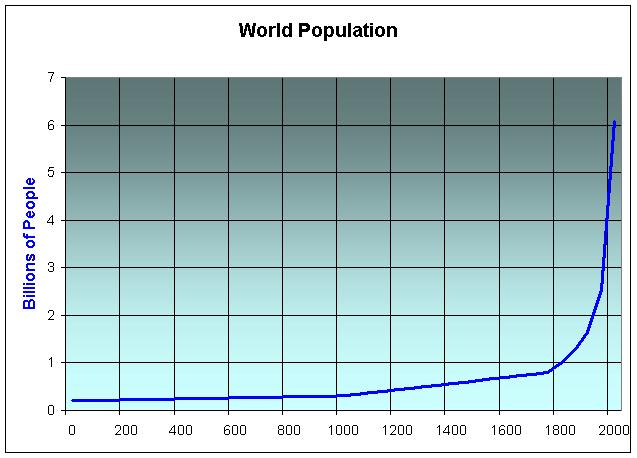
Click to Enlarge
Part of the early phase of this expansion was due to the settlement of the Americas, but the exploitation of this fertile land in the 16th to 19th centuries would not seem to be enough on its own to support the population explosion we have experienced. After all, humans had already spread to every corner of the globe by 1900. There is something else at work here.
The Role of Oil
That something is oil. Oil first entered general use around 1900 when the global population was about 1.6 billion. Since then the population has quadrupled. When we look at oil production overlaid on the population growth curve we can see a very suggestive correspondence:
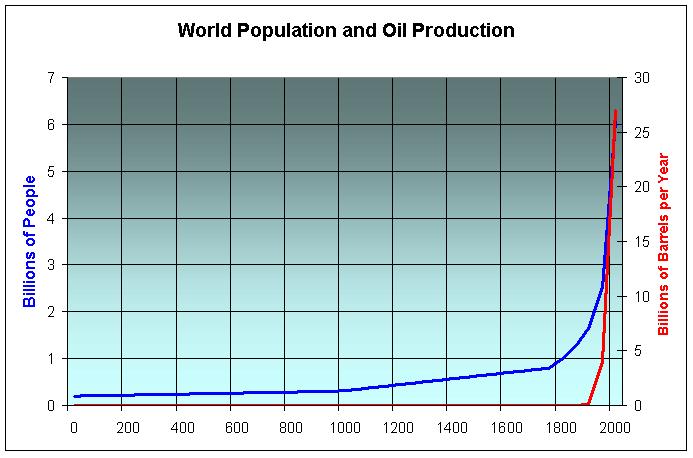
Click to Enlarge
However, we have to ask whether this is merely a coincidental match. A closer look at the two curves from 1900 to the 2005 reinforces the impression of a close correlation:
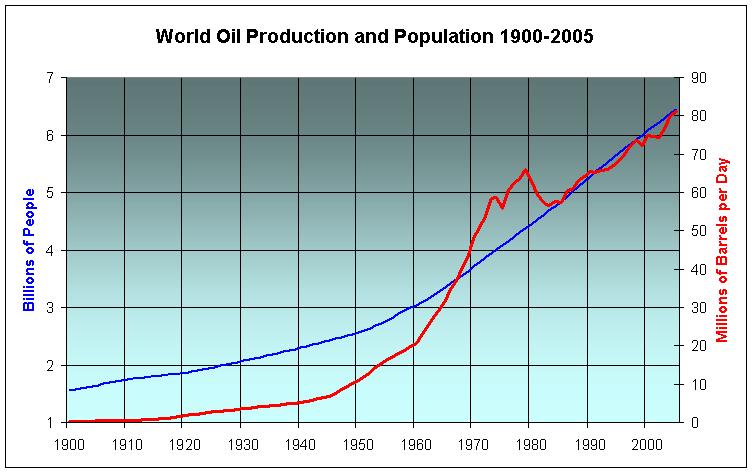
Click to Enlarge
The Food Factor
Are there other factors besides oil that may have contributed to the growth of the Earth's carrying capacity?
The main one that is usually cited is the enormous world wide increase in food production created by the growth of industrial agribusiness. There is no question that it has caused a massive increase in both yields and the absolute quantities of food being grown worldwide. While it has been celebrated with the popular label "The Green Revolution", there is nothing terribly miraculous about the process. When you open up that so-called revolution, you find at its heart our friend petroleum
Here's how it works. Industrial agriculture as practiced in the 20th and 21st centuries is supported by three legs: mechanization, pesticides/fertilizers and genetic engineering. Of those three legs, the first two are directly dependent on petroleum to run the machines and natural gas to act as the chemical feedstock. The genetic engineering component of agribusiness generally pursues four goals: drought resistance, insect resistance, pesticide resistance and yield enhancement. Meeting that last goal invariably requires mechanical irrigation, which again depends on oil.
Even more than other oil-driven sectors of the global economy, food production is showing signs of strain as it struggles to maintain productivity in the face of rising population, flattening oil production and the depletion of essential resources such as soil fertility and fresh water. According to figures compiled by the Earth Policy Institute, world grain consumption has exceeded global production in six of the last seven years, falling over 60 million tonnes below consumption in 2006. Global grain reserves have fallen to 57 days from a high of 130 days in 1986. After keeping pace with population growth from 1960 until the late 1980s, per capita grain production has shown a distinct flattening and declining trend in the last 20 years.
At its heart the "Green Revolution" is yet another example of the enormous usefulness of oil. Without large quantities of cheap oil, this revolution could not have occurred. The simple fact published in a University of Michigan study in 2000 that every calorie of food energy consumed in the United States embodies over seven calories of non-food energy (and other studies that have placed the ratio at 10:1) make the linkage clear. The United States currently uses over 12% of its total oil consumption for the production and distribution of food. As the oil supply begins its inevitable decline, food production will be affected. While it is probable that most nations will preferentially allocate oil and natural gas resources to agriculture by one means or another, it is inevitable that over the next decades the food supply key to maintaining our burgeoning population will come under increasing pressure, and will be subject to its own inescapable decline.
Carrying Capacity: Conclusion
Oil and its companion natural gas together make up about 60% of humanity's primary energy. In addition, the energy of oil has been leveraged through its use in the extraction and transport of coal as well as the construction and maintenance of hydro and nuclear generating facilities. Oil is as the heart of humanity's enormous energy economy as well as at the heart of its food supply. The following conclusion seems reasonable:
Humanity's use of oil has quadrupled the Earth's carrying capacity since 1900.
Overshoot
In ecology, overshoot is said to have occurred when a population's consumption exceeds the carrying capacity of its environment, as illustrated in this graphic:
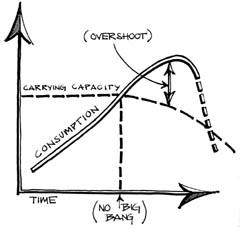
When a population rises beyond the carrying capacity of its environment, or conversely the carrying capacity of the environment falls, the existing population cannot be supported and must decline to match the carrying capacity. A population cannot stay in overshoot for long. The rapidity, extent and other characteristics of the decline depend on the degree of overshoot and whether the carrying capacity continues to be eroded during the decline, as shown in the figure above. William Catton's book "Overshoot" is recommended for a full treatment of the subject.
There are two ways a population can regain a balance with the carrying capacity of its environment. If the population stays constant or continues to rise, per capita consumption must fall. If per capita consumption stays constant, population numbers must decline. Where the balance is struck between these endpoints depends on how close the population is to a subsistence level of consumption. Those portions of the population that are operating close to subsistence will experience a reduction in numbers, while those portions of the population that have more than they need will experience a reduction in their level of consumption, but without a corresponding reduction in numbers.
Populations in serious overshoot always decline. This is seen in wine vats when the yeast cells die after consuming all the sugar from the grapes and bathing themselves in their own poisonous alcoholic wastes. It's seen in predator-prey relations in the animal world, where the depletion of the prey species results in a die-back of the predators. Actually, it's a bit worse than that. The population may actually fall to a lower level than was sustainable before the overshoot. The reason is that unsustainable consumption while in overshoot allowed the species to use more non-renewable resources and to further poison their environment with excessive wastes. It is a common understanding of ecology that overshoot degrades the carrying capacity of the environment (as illustrated in the declining "Carrying Capacity" curve in the above figure). In the case of humanity, our use of oil has allowed us to perform prodigious feats of resource extraction and waste production that would simply have been inconceivable before the oil age. If our oil supply declined, the lower available energy might be insufficient to let us extract and use the lower grade resources that remain. A similar case can be made for a lessened ability to deal with wastes in our environment
It is important to recognize that humanity is not, overall, in a position of overshoot at the moment. Our numbers are still growing (though the rate of growth is declining). However, we are getting obvious signals from our environment that all is not well. These signals seem to be telling us we are approaching the maximum carrying capacity. If the carrying capacity were to be reduced as our numbers continued to grow we could find ourselves in overshoot rather suddenly. The consequences of that would be quite grave.
An Image of Overshoot
The predicament of a population entering overshoot is illustrated by a short scene from the children's cartoon series about Wile E. Coyote and the Road Runner.
As the scene opens, our hero, Wile E. Coyote, is zooming hungrily across the top of a mesa, propelled by the exuberant blast of his new Acme Rocket Roller Skates. Suddenly a sign flashes into view. It reads, "Danger: Cliff Ahead." The coyote tries desperately to change course, but his speed is too great and rocket roller skates are hard to control at the best of times. Just before the edge of the cliff the rocket fuel that was sustaining his incredible velocity runs out; the engines of his roller skates die with a little puff of smoke. The coyote begins to slow but it's too late, his inertia propels him onward. Suddenly the ground that moments before had ample capacity to carry him in his headlong flight falls away beneath him. As he overshoots the edge high above the canyon floor, he experiences a horrified moment of dawning realization before nature's impersonal forces take over.
Peak Oil
As we all know but are sometimes reluctant to contemplate, oil is a finite, non-renewable resource. This automatically means that its use is not sustainable. If the use of oil is not sustainable, then of course the added carrying capacity the oil has provided is likewise unsustainable. Carrying capacity has been added to the world in direct proportion to the use of oil, and the disturbing implication is that if our oil supply declines, the carrying capacity of the world will automatically fall with it.
These two observations (that oil has expanded the world's carrying capacity and oil use is unsustainable) combine to yield a further implication. While humanity has apparently not yet reached the carrying capacity of a world with oil, we are already in drastic overshoot when you consider a world without oil. In fact our population today is at least five times what it was before oil came on the scene, and it is still growing. If this sustaining resource were to be exhausted, our population would have no option but to decline to the level supportable by the world's lowered carrying capacity.
What are the chances that we will experience a decline in our global oil supply? Of course given that oil is a finite, non-renewable resource, such an occurrence is inevitable. The field of study known as Peak Oil has generated a vast amount of analysis that indicates this decline will happen soon, and may even be upon us right now.
Individual oil fields tend to show a more or less bell-shaped curve of production rates - rising, peaking and then falling. Once a field has entered decline it has been found that no amount of remedial drilling or new technology will raise its output back to the peak rate. The theory of Peak Oil says that the world's oil production can be modeled as a single, enormous oil field, and will therefore exhibit this same production curve. It is intuitive that if all the oil fields in the world enter decline, and insufficient replacement fields can be found and developed, the world's production will decline.
The signals of Peak Oil are all around for those who know what to look for: the continuing two-year-old plateau in the world's conventional crude oil production; the crash of Mexico's giant Cantarell oil field last year; the U.K. slipping from being an oil exporting nation to a net importer in 2005; the fact that three of the world's four largest oil fields are confirmed to be in decline; the analysis on The Oil Drum of Saudi Arabia's super-giant Ghawar field that indicates it may be teetering on the brink of a crash; the fact that over two thirds of the world's oil producing nations are experiencing declining production; delays and cost overruns in new projects in the Middle East, Kazakhstan and Canada's tar sands. To make matters worse, according to several analyses including a very thorough one (pdf warning) done by a PhD candidate in Sweden, the addition of new projects is unlikely to delay the terminal decline by more than a few years.
Understanding the role of oil in expanding the earth's carrying capacity brings a new urgency to the topic of Peak Oil. The decline in oil supply will reduce the planet's carrying capacity, thus forcing humanity into overshoot with the inevitable consequence of a population decline. The date of the peak will mark the point at which we should expect to see the first effects of overshoot. The rapidity of the decline following the peak will determine whether our descent will be a leisurely stroll down to the canyon floor or a headlong tumble carrying a little sign reading, "Help!"
Time Frame and Severity
The first questions everyone one asks when they accept the concept of Peak Oil is, "When is it going to happen?" and "How fast is the decline going to be?" Peak Oil predictions are hampered by the lack of data transparency by many oil producers. They are reluctant to publish verifiable reserve figures, field-by-field production numbers, or observations of the performance of individual oil fields. As a result the fully correct answer to both questions is, "We don't know yet." This isn't the whole answer, though. As with many predictions we can specify probable ranges based on the current evidence, observed trends over the last few years and published future development and production plans. The guesses are becoming more and more educated as time goes by.
Several "heavy hitters" in the Peak Oil field have said the peak has already happened. These include Dr. Kenneth Deffeyes (a colleague of Dr. M. King Hubbert), major energy investor T. Boone Pickens, energy investment banker Matthew Simmons (who first sounded the alarm about Saudi Arabia's impending depletion) and Samsam Bakhtiari, a retired senior expert with the National Iranian Oil Company.
The steepness of the post-peak decline is open to more debate than the timing of the peak itself. There seems to be general agreement that the decline will start off very slowly, and will increase gradually as more and more oil fields enter decline and fewer replacement fields are brought on line. The decline will eventually flatten out, due both to the difficulty of extracting the last oil from a field as well as the reduction in demand brought about by high prices and economic slowdown.
The post-peak decline rate could be flattened out if we discover new oil to replace the oil we're using. Unfortunately our consumption is outpacing our new discoveries by a rate of 5 to 1. to make matters worse, it appears that we have probably already discovered about 95% of all the conventional crude oil on the planet.
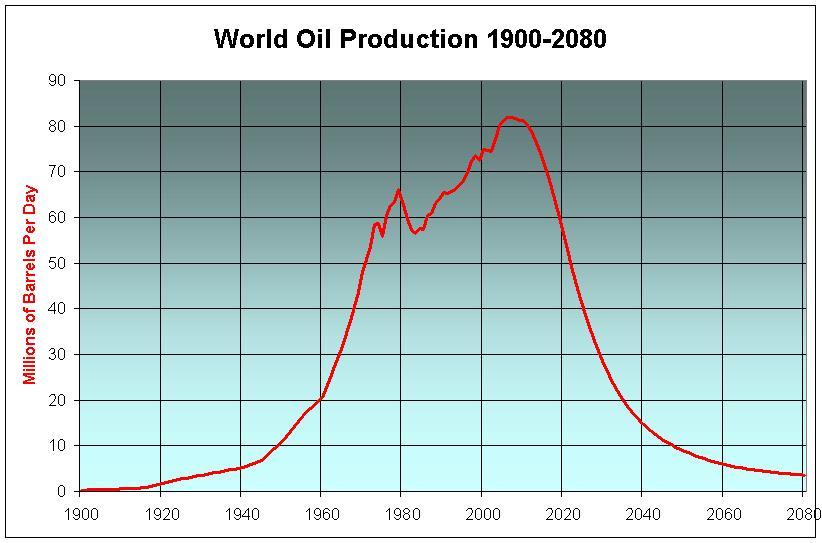
A full picture of the oil age is given in the graph below. This model incorporates actual production figures up to 2005 and my best estimate of a reasonable shape for the decline curve. It also incorporates my belief that the peak is happening as we speak.
Click to Enlarge
Maintaining Our Carrying Capacity
The consequences of overshoot might be avoided if we could find a way to maintain the Earth's carrying capacity as the oil goes away. To assess the probability of this, we need to examine the various roles oil plays in maintaining the carrying capacity and determine if there are available substitutes with the power to replace it in those roles. The critical roles oil and its companion natural gas play in our society include transportation, food production, space heating and industrial production of such things as plastics, synthetic fabrics and pharmaceuticals. Of these the first three are critical to maintaining human life.
Transportation
Peak Oil is fundamentally a liquid fuels crisis. We use 70% of the oil for transportation. Over 97% of all transportation depends on oil. Full substitutes for oil in this area are unlikely (I'd go so far as to say impossible). Biofuels are extremely problematic: their net energy is low, their production rates are also low, their environmental costs in soil fertility are too great. Crop based biofuels compete directly with food, while cellulosic technologies risk "strip mining the topsoil" at the production rates needed to offset the loss of oil. Electricity will be able to substitute in some applications such as trains, streetcars and perhaps battery powered personal vehicles, though at significant cost in terms of both flexibility and economics. There is no realistic substitute for jet fuel.
Food
Oil is used in tilling, planting, weeding, harvesting and transporting food, as well as in pumping water for crop irrigation. Natural gas is used to make the vast quantities of fertilizer required to support our industrial, monoculture agribusiness system. As oil and natural gas decline, global food output will fall. This will be offset to some degree by the adoption of more effective and less resource-intensive farming practices. However, it is not clear that such practices could maintain the enormous food production required, especially as much of the world's farmland has been decimated by long term monocropping and will require fertility remediation to produce adequate crops without fertilizer inputs.
Heat
In northern climates the fuel of choice for building heat is natural gas. Gas is on its own imminent "peak and decline" trajectory, made worse by the fact that it is harder to transport around the world than oil. The only realistic replacement for natural gas is electric heat. It is quite possible that the rapid adoption of electric resistance heating in cold climates could lead to a destabilization of under-maintained and over-used distribution grids, as well as localized shortages of generating capacity. While there are technologies that will allow us to increase the generation of electricity, they all have associated problems - coal produces greenhouse gases, nuclear power produces radioactive waste and is politically unpalatable in many countries and solar photovoltaic is still too expensive. Wind power is showing promise, but is still hampered by issues of scale and power variability.
I think that we will strive mightily to produce alternative energy sources to maintain the carrying capacity, but I am convinced we will ultimately fail. This is due to issues of scale (no alternatives we have come up with so far come within an order of magnitude of the energy required), issues of utility (oil is so multi-talented that it would take a large number of products and processes to fully replace it), issues of unintended consequences (as is currently being recognized with biofuels) and issues of human behaviour (a lack of international cooperation is predicted by The Prisoner’s Dilemma, and behaviours such comfort-seeking, competition for personal advantage and a hyperbolic discount function are planted deep in the human genome as explained in Reg Morrison’s “The Spirit in the Gene” and in my article on Hyperbolic Discount Functions).
We will be able to replace some small portion of the carrying capacity provided by oil, but in the absence of oil it is not clear how long such alternatives will remain available, relying as they do on highly technical infrastructure that currently runs on oil like everything else.
Conclusion
Given the fact that our world's carrying capacity is supported by oil, and that the oil is about to start going away, it seems that a population decline is inevitable. The form it will take, the factors that will precipitate it and the widely differing regional effects are all imponderables. Some questions that we might be able to answer (though with a great degree of uncertainty) are "When will it start?", "When will it end?", "How much control will we have?", "How bad will it be?" and "How many people will be left?" The rest of this article is devoted to a high-level population model that attempts to address these questions.
A Simple Model of Population Decline
To set the parameters of our model, we need to answer the four questions I posed above.
When Will The Decline Start?
This depends entirely on the timing of Peak Oil. My conclusion that the peak is occurring now makes it easy to pick a start date. The model starts this year, though a start date five or ten years from now would not affect the overall picture.
When Will it End?
Given that oil is a primary determinant of carrying capacity, the obvious answer is that the situation will stabilize when the oil is gone. The oil will never be completely gone of course, so we can modify that to read, "When oil is unavailable to most of humanity." We know that point will come, because oil is a finite, non-renewable resource, but when will that be?
Based on the model in the figure above I chose an end date of 2082, 75 years from now.
How Much Control Will We Have?
Will we be able to mitigate the population decline rate through voluntary actions such as reducing global fertility rates, and making the oil substitutions I mentioned above.
I have decided (perhaps arbitrarily) that the oil substitutions would not affect the course of the decline, but would be used to determine the sustainable number of people at the end of the simulation.
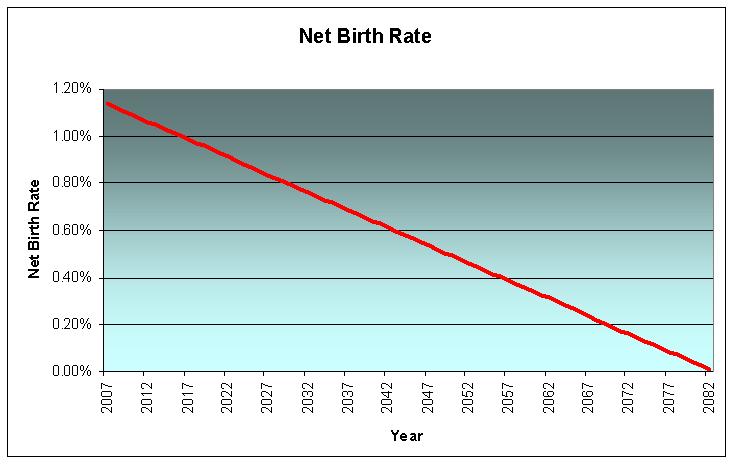
Fertility rates are an important consideration. The approach I've taken is to model the net birth rate, the combination of natural fertility and death rates that give us our current global population growth of 75 million per year. I modified that by having it decline by 0.015% per year. This reflects both a declining fertility rate due to environmental factors and some degree of women's education and empowerment, as well as a rising death rate due to a decline in the the global economy. I do not think that traditional humane models such as the Benign Demographic Transition theory will be able to influence events, given that the required economic growth is likely to be unavailable.
How Bad Will It Be?
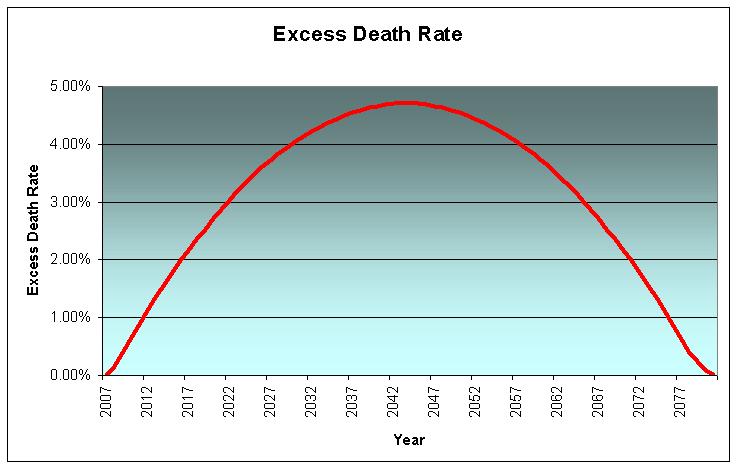
This question comes from the assumption that the decline in net births alone will not be enough to solve the problem (and the simulation bears this out). This means that some level of excess deaths will result from a wide variety of circumstances. I postulate a rate of excess deaths that starts off quite low, rises over the decades to some maximum and then declines. The rise is driven by the worsening global situation as the overshoot takes effect, and the subsequent fall is due to human numbers and activities gradually coming back into balance with the resources available.
How Many People Will Be Left?
Taking the carrying capacity effects discussed above into account, I initially set the bar for a sustainable population at the population when we discovered oil in about 1850. This was about 1.2 billion people. Next I subtracted some number to account for the world's degraded carrying capacity, then added back a bit to account for our increased knowledge and the ameliorating effects of oil substitutes. This is a necessarily imprecise calculation, but I have settled on a round number of one billion people as the long-term sustainable population of the planet in the absence of oil.
Comments
The model is a simple arithmetical simulation that answers the following question: "Given the assumptions about birth and death rates listed above, how will human population numbers evolve to get from our current population of 6.6 billion to a sustainable population of 1 billion in 75 years?" It is not a predictive model. It is aggregated to a global level, and so can tell us nothing about regional effects. It also cannot address social outcomes. Its primary intent is to allow us to examine the roll that excess deaths will play in the next 75 years.
The Model
We will start by graphing the net birth rate over the period 2007 to 2082, incorporating a 0.015% annual decline: As you can see, the net birth rate declines to zero by 2082.
Click to Enlarge
Is it possible that this declining birth rate will get us closer to our sustainable population goal of one billion?
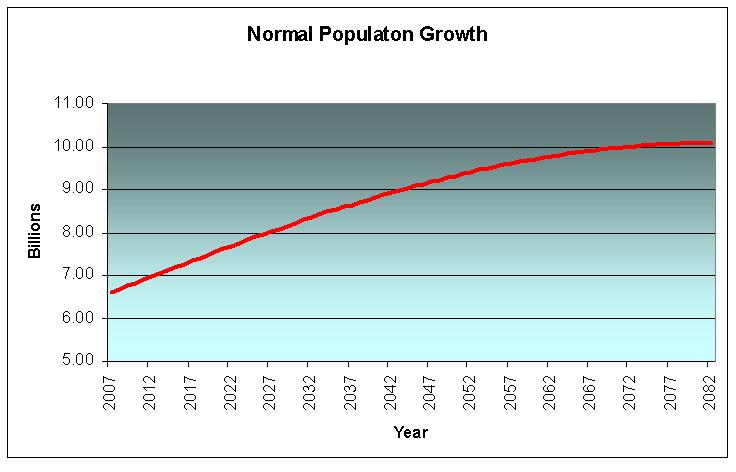
The following graph shows our population growth with the effects of the declining net birth rate shown above:
Click to Enlarge
As you can see, my assumption about declining birth rates leads to a stable population, but it's still 50% larger than today. In fact, this projection is remarkably similar to the one produced by the United Nations, which estimates a global population of 9.2 billion in 2050. The message of this graph is clear. If we need to reduce our population, simply adjusting the birth rate is insufficient. There will be excess deaths required to reach our target.
The following graph shows the excess death rate rising and then falling as described above. I will reiterate that the origin of these excess deaths is not considered in the model. It is sufficient to understand that these are not the result of old age or the various "natural causes" we have come to accept as a part of our modern life. These deaths may be due to such things as rising infant mortality rates, shorter adult life expectancies, famine, pandemics, wars etc. Some of these deaths will be from human agency, but most will not.
Click to Enlarge
Applying the above excess death rate to our current population yields the following curve. As you can see, the number of excess deaths per year increases quite rapidly (consistent with the effects of overshoot) and then falls off as the population comes back into balance with the resources available. The peak rate of deaths comes much earlier than the peak in the percentage death rate shown in the above graph because the population starts to decline rapidly. A lower percentage death rate acts on a larger population to produce a higher numerical death rate. As the population declines so does the numerical death rate, even when the percentage rate still increasing.
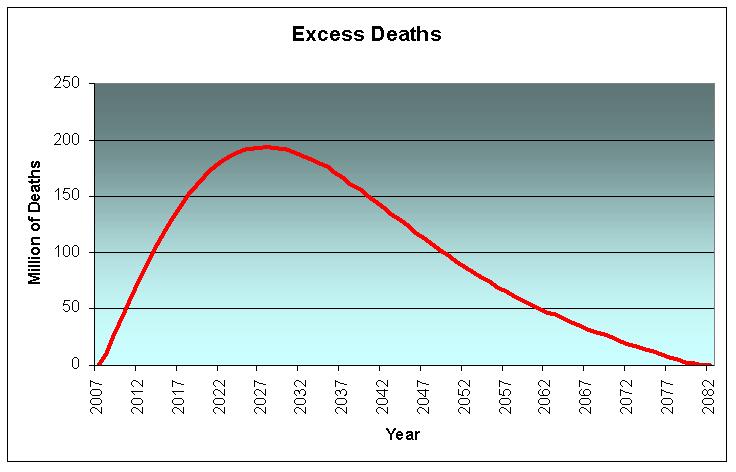
Click to Enlarge
The final graph is the outcome of the full simulation. It starts from our current population and shows the combined effects of a declining net birth rate and the excess death rate due to falling carrying capacity as described above. The goal of the model has been met: it has achieved a sustainable world population of one billion by the year 2082.
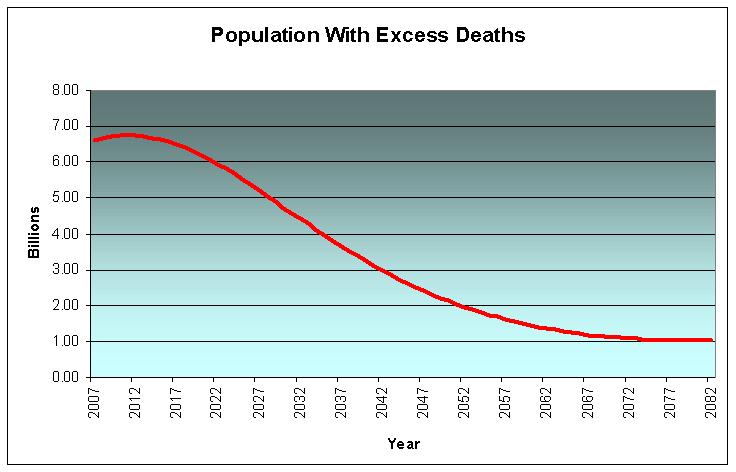
Click to Enlarge
The Cost
The human cost of such an involuntary population rebalancing is, of course, horrific. Based on this model we would experience an average excess death rate of 100 million per year every year for the next 75 years to achieve our target population of one billion by 2082. The peak excess death rate would happen in about 20 years, and would be about 200 million that year. To put this in perspective, WWII caused an excess death rate of only 10 million per year for only six years.
Given this, it's not hard to see why population control is the untouchable elephant in the room - the problem we're in is simply too big for humane or even rational solutions. It's also not hard to see why some people are beginning to grasp the inevitability of a human die-off.
Summation
One of the common accusations leveled at those who present analyses like this is that by doing so they are advocating or hoping for the massive population reductions they describe, and are encouraging draconian and inhumane measures to achieve them. Nothing could be further from the truth. I am personally quite attached to the world I've grown up in and the people that inhabit it, as is every other population commentator I am familiar with. However, in my ecological and Peak Oil research over the last several years I have begun to see the shape of a looming catastrophe that has absolutely nothing to do with human intentions, good or ill. It is the simple product of our species' continuing growth in both numbers and ability, an exponential growth that is taking place within the finite ecological niche of the entire world. Our recent effusive growth has been fueled by the draw-down of primordial stocks of petroleum which are about to deplete while our numbers and activities continue to grow. This is a simple, obvious recipe for disaster.
This model is intended to give some clarity to that premonition of trouble. It carries no judgment about what ought to be, it merely describes what might be. The model is likewise no crystal ball. It offers no predictions and no insights into the details of what will happen. It presents the simple arithmetic consequences of one set of assumptions, albeit assumptions that I personally feel have a reasonable probability of being fulfilled.
There are factors that will affect the course of events that have not been considered in the model. Readers may legitimately take me to task for not considering or summarily dismissing the various ways humanity is already trying to alleviate some of the foreseen dangers. For instance, my model does not mention global warming or carbon caps, and dismisses most alternative energy sources as ineffective. The model also does not address the regional differences that are bound to expand as the crisis unfolds. While such criticisms are justified and are well worth exploring in the context of oil decline, the purpose of this article is to take a high-level look at the global population situation, considering the entire planet as one ecological niche with a single aggregate carrying capacity supported by oil in its role as a facilitator of transportation and food production.
The model warns us that the involuntary decline of the human population in the aftermath of the Oil Age will not happen without overwhelming universal hardship. There are things we will be able to do as individuals to minimize the personal effects of such a decline, and we should all be deciding what those things need to be. It's never too early to prepare for a storm this big.
Peak Oil, Carrying Capacity and Overshoot: Population, the Elephant in the Room
PDF version
356 comments
Peak Oil, Carrying Capacity and Overshoot: Population, the Elephant in the Room
PDF version
356 comments
Personnel
Archives
- December 2008 (1)
- October 2008 (1)
- July 2008 (2)
- June 2008 (2)
- May 2008 (6)
- January 2008 (2)
- December 2007 (8)
- November 2007 (9)
- October 2007 (11)
- September 2007 (14)
- August 2007 (14)
- July 2007 (10)
- June 2007 (9)
- May 2007 (11)
- April 2007 (9)
- March 2007 (11)
- February 2007 (11)
- January 2007 (11)
- December 2006 (12)
- November 2006 (16)
- October 2006 (13)
License

This work is licensed under a Creative Commons Attribution-Share Alike 3.0 United States License.
I recently posted this somewhere else on the vast intertubes, but it's a more "optimistic" look at the same thing:
"Consider that if it is assumed that 5 billion people is an upper limit to the population that can be sustained (which is optimistic in the extreme by everything I've read, but I want to be optimistic sometimes), and we started trying to get back down to there from where we are (6.7 billion or so), it would take 23 years of a net loss of 200,000 people a day. Right now, about 150,000 people a day die, with 400,000 or so being born. Those numbers would essentially need to reverse. In all seriousness, and a minimum of morbidness: any ideas?"
Now, I acknowledge that 5 billion is likely a ridiculously high number, although I think 1 billion is too low (I've seen 2 billion argued well in the past), but the actual number declined to is almost unimportant. Society can't stop producing young people, especially where manual labour is needed. Discussing this type of thing with people who haven't had the same sort of thoughts is almost impossible. As you say, there's no rational solution here (barring miraculous technology, which I refuse to rule out as possible, but also refuse to count on happening). Living in Canada, which may be one of the few countries living below it's long-term carrying capacity right now (hey, we've got farmland and water everywhere), it's an easy problem to ignore for now. I think one of the assumptions that most people in the world make is that if we really tried to feed everyone, we could (and this is of course true right now). This is another in a long line of assumptions that will change in the near future.
What, are you trying to build a "consensus"? It's not like people will get a vote in the matter. There will be no "stable" population level, simply because it doesn't work that way. It (population ) rises slowly but at an ever increasing rate (exponential) until there is too many for the environment ( local or global ) to support and then there is either a mass migration often leading to warfare between newcomers and existing residents ( ring a bell? - immigration ), a mass die off for whatever unforeseeable reason, or both. Well documented throughout archeology and anthropology, and throughout nature generally.
You think "modern man" can outwit this? Ha! Evolution requires this process to weed out the losers. It's ugly and bloody, and violent beyond comprehension. And NOBODY, NOBODY can predict any of it, including the outcome. Read up on the recent examples (last 2000 years ) in the America's. Is your genetic code up to the task? Will 'your" line survive or perish? That's the only pertinent question.
Our species was down to less than 100,000 individuals (<20k according to some estimates), 65,000 years ago or thereabouts.
Wow, Gene, looks like your about ready to sign folks up for the new Nazi party.. So long as they dont fall in that "losers" category, right?
Watch out. We'll be seeing more and more people coming out of the woodwork with attitudes like this.
That's not how I read his comment at all. He's taling about evolution and genetics, not ideology. Try reading it again while holding your knee still.
You are correct sir. Ideology has nothing to do with it. Except perhaps as a response to whatever environmental conditions exist. I'm using "environment" in the broadest possible sense, not just in reference to any single resource or climate condition.
Cultural anthropology is an interesting field of study which addresses this. Typical question might be; "Why did the Maya practice human sacrifice?" Typical answer might be; "To please the gods."
The real answer goes much deeper than that, and was usually related to the environment in some way that we often cannot fathom today because the culture either no longer exists or has changed dramatically. So the default position is to ascribe such behavior to religion.
Same goes for most food taboo's, and other group behavior. We are a product of our environment, then and now.
An excellent book on what makes human cultures what they are is; "Cannibals and Kings", by Marvin Harris .
Worth reading, especially if one wishes to know the foundations of our modern cultures.
Who are the Mumi's today?
Your right. It is a knee jerk reaction. And my knee is still jerking... Nazism IS the ideology of genetics and evolution.. Remember? Now, if you want to place that ideology in a nice little, sterile container and talk about it as an expression of natural biological imperatives, be my guest. You can focus (morbidly so, in my opinion) on the destructive competative tribal response, but I think it misses half the picture. I would argue that cooperation and restraint are also survival responses to a changing (resource depleted) enviornment. Thats the power of compromise and rationality. The magnitude of the 'population correction' in the face of resource scarcity will be greatly influenced by these factors as well.
Sorry, dabble_doomer, but you are mistaken.
Nazism is an "ideology" that uses so-called social darwinism.
It understands Darwinism not as a process of natural selection of the fittest (not necessarily the strongest!) as originally described, but as an imperative to actively pursue the dominance of a supposedly superior (in case of German nazism arian) race.
Selection of the "fittest" by natural forces, on the other hand, is completely unideological and can just as well affect human beings as any other species on the planet. Humans have no official or god-given grant to be bypassed by natural selection.
That does not mean that humans cannot use their individual intellect and social behaviour to try to mitigate threatening factors. There is just ample evidence that when times get harder, many people tend to abandon social behavior...
Cheers,
Davidyson
Very interesting paper. I guess this is why the government isn't so concerned about saving Social Security.
I put two tomato plants in the ground and one already died. The strawberries look puny as well. I don't think I'm going to make it!!! 1 down, 5 billion to go.
jt
I don't think the government can do much about it
Paul, congratulations on writing a fantastic article. However I have very serious problems with one line of the text:
What is overshoot? There are several definitions to be found on the web, but one very good one is found here:
In other words, we are getting very strong signals from the environment that we are into overshoot but they are not yet strong enough to force and end to growth.
And this great article from The Energy Bulletin:
Can our numbers still be growing though we are in overshoot? Of course! Overshoot occurs when a population exceeds the long term carrying capacity of its environment. Like the reindeer of St. Matthew Island. They were probably in overshoot when their numbers reached 1000 but they continued to multiply until their numbers reached 6000 before there was a total collapse.
While they were in overshoot, the reindeer completely destroyed their support system, the lichens they were living on, so their numbers plunged to under 30. We are currently deep into overshoot. Were it not so we would not be destroying the environment. We would not be drawing down the water tables, drying up rivers and lakes, destroying the rain forest, destroying our topsoil, over fishing the oceans, causing deserts to expand, driving thousands of species into extinction, polluting our water and atmosphere, and a thousand other things.
But things are far worse than that. I am saying, even with our current consumption of fossil fuel, we are still deep into overshoot; else the above things would not be happening. But look close at The Energy Bulletin article. “Overshoot happens when a species encounters a rich and previously unexplored stock of resources that promote reproduction.” We are in overshoot because we found a rich store of detritus, or fossil fuel. This enabled us to produce massive amounts of food which enabled our population to explode.
The long term carrying capacity of Homo sapiens, if fossil fuels never ran out, would probably be somewhere between two and three billion people or four at the most. But the long term carrying capacity of Homo sapiens without fossil fuel, including coal, is probably less than one billion.
So according to my estimation we are either three billion into overshoot, if our fossil fuel lasts forever, or about six billion into overshoot if it does not.
Ron Patterson
Ron,
Carrying capacity and overshoot are slightly tricky concepts to define both formally and accessibly. If we accept the first definition you gave, humanity may be in overshoot, and this is what all the hoo-hah on the Internets is based on: some people (we'll call them "idiots") disagree that the signals indicate an imminent end to growth because we are not (quite) yet being forced to end our growth due to resource limitations. I used that construction to avoid getting into a bunfight over interpretations of the significance of the signals. Many people intuitively but incorrectly understand carrying capacity to mean the level of population that can be supported by the current level of resource usage, with no other caveats. I admit I pandered to that definition.
I agree that we are in overshoot relative to the long-term carrying capacity, and this is reflected in my comment, "While humanity has apparently not yet reached the carrying capacity of a world with oil, we are already in drastic overshoot when you consider a world without oil."
I attempted to clarify my usage in the note under Carrying Capacity:
I agree with your final numbers more or less - we would be in very serious but perhaps not species-ending overshoot with an infinite supply of fossil fuels, due to Liebig's Law applying to other resources; and we are in enormous overshoot when you consider that Liebig's Law applies to to petroleum as our scarcest essential resource.
We are in drastic overshoot of carrying capacity of a world with oil. Look at one of the key side effects - climate change. Nevermind all the other side effects. Just consider that one.
We are in overshoot, period, end of sentence.
Ghawar Is Dying
The greatest shortcoming of the human race is our inability to understand the exponential function. - Dr. Albert Bartlett
Yes, we are indeed in overshoot. I'll have to figure out how to communicate that so a layman will get it, and will also understand how serious that is and that there is no technofix that can possibly alter that situation.
There is nothing to communicate to the layman. He's dead or his children are dead (prematurely, of course). The odds are very high that every one of us reading this will be dead either naturally before that or directly as a cause of that. What do you want to tell him? That he and 95%-99% of the rest of humanity are toast? Does that help you get anyone through the bottleneck? Your comment below is a most insightful statement - that we need to increase the inequalities between regions in the hopes of creating islands of survivability - but what does that do to every traditional measure of humane behavior? More than anything else, we need to consider how to maximize the number of people through the bottleneck. Bob Shaw has some fanciful ideas but I don't think Bob really grasps what is about to happen. In fact, I doubt that any of us can really grasp the magnitude of what is going to occur. It's beyond our emotional understanding even if we understand the facts behind it.
This is why homo sapiens stands at the precipice of extinction. The environment in front of us is extremely dangerous and will consist of situations we have never encountered before. This is why Stephen Hawking harps about humanity establishing colonies in space. He's not concerned with the well being of the bulk of those living right now or even getting a significant fraction off planet. He's worried that we'll make ourselves extinct. And space colonies would impose on their inhabitants from moment zero forward an awareness of sustainability and limits.
Can we actually build them? Technically we could but can we politically? I doubt it. And thus my gloom about humanity's future remains.
Ghawar Is Dying
The greatest shortcoming of the human race is our inability to understand the exponential function. - Dr. Albert Bartlett
On this issue, many of those with the power to direct actions like refuge creation are indeed laymen. Educating them just might help get a few more through the bottleneck, even if ripping the scales from the eyes of Joe and Jane Sixpack won't. Call this forlorn hope the dying gasp of my humanism.
I saw SF author Spider Robinson at a conference in Toronto last year. He seems to understand that we're facing a global crisis, but he still spoke wistfully of space elevators and L5 colonies. I was appalled at his naivete. If it was indeed ever in the harbour, that ship has long since sailed. We are here for the duration.
It's solely a political problem (space colonization). The energy involved is not that large compared to the global consumption. The resources involved are minuscule. The problem is purely political because how do you tell everyone else that you are going to save a few million people tops in colonies of 25,000 to 50,000 so that the species can live while they die?
That ship hasn't sailed yet. It is still in the dock because we lack the courage to face what needs to be faced. We are collectively cowards.
Ghawar Is Dying
The greatest shortcoming of the human race is our inability to understand the exponential function. - Dr. Albert Bartlett
Why would we even contemplate creating refuges in space?
For someone who is so hard-nosed about the coming situation here on Earth, you seem casually confident about our ability to create very large closed space colonies that would have the ability not only to survive over the long term but to secure and spread our species (presumably without terrestrial support). Given our proven inability to use technology without falling afoul of either our own insufficient understanding or the law of unintended consequences, what makes you think such an enterprise has a sufficient chance of success to be worth spending precious and dwindling resources on?
The Earth itself isn't going to go poof. If we want to create species refuges with those resources, we're much more likely to succeed here on Earth. To think of doing it in space strikes me as magical thinking at its most extreme.
You miss my point, it seems. Very often the discussion here at TOD and other places focuses on the technical aspects of a problem. The technical parts are not the problem. I am firmly convinced that we could technically create a sustainable society that could do a 1 or 2 century controlled descent to a sustainable level and stay there. I am firmly convinced that we could technically build space refuges and succeed.
But the core problems are not even technical problems. The core problems are political, psychological, and sociological. They are governments lying about oil reserves, governments believing oil production will rise despite years of decline (Texas and Great Britain as examples), about people believing that if they solve the technical problem then everything must be ok. The technological side of the equation is actually very well understood. We have the technology. What we do not have is a collective realistic understanding of who and what we really are, how we behave, why we do the things we do, etc.
So it boils down to politics, psychology, and sociology. We could have built the PV cells to change the world but we haven't. We might even still have time if all we had was a technical problem. Why don't we? Because the problem is not technical. The problem is who and what we are, not peak oil. Not resource depletion. Not climate change. Those are all side effects of the core problem, overpopulation, which is driven by who and what we are.
Ghawar Is Dying
The greatest shortcoming of the human race is our inability to understand the exponential function. - Dr. Albert Bartlett
On edit:
Ah, now I get your point. I agree that the barriers to action are all human factors. I also agree that around here we focus on the technical aspects of our problem set. I disagree with any suggestion, though, that the solution set is or even could be likewise technical. All the evidence before us indicates that the box we're in is of technical construction, and simply applying more technical tinkering to it will merely redecorate it, not tear it open.
The focus on technical solutions is yet another inevitable manifestation of our dualism - a clever-monkey response illustrated in this article:
So, if the solution can not be technical and a variety of hard-wired psychological factors keep us from even assessing the problem domain rationally, we're back to square one. Any solutions can only apply to very small subsets of the population: those that can recognize the danger, have the resources to respond as well as the will and freedom to respond in time, and can cope psychologically with the implications of their own personal survival in the midst of a general collapse.
There you go.
There you go.
You completely hit the nail on the head. That`s exactly whats going on. Nobody I talk to seems to understand it and those few who do just say "Technology will save us".
Best regards,
Joerg
Hello Grey,
Thanks and
re: "I am firmly convinced that we could technically create a sustainable society that could do a 1 or 2 century controlled descent to a sustainable level and stay there."
Would you be willing to list out exactly what you see as the "technically sustainable society" - i.e., something about what it looks like?
And/or what to do, in a realistic sense, today. Who needs to do what. I'd be very interested.
Example: Immediate stop of all new highway construction. Immediate placing of X dollars to the construction of solar projects, with the following priorities:
Or however, you see it. (If you don't see it, I'm asking if you might please try as an exercise for backing up the sentence above.)
Hi Aniya,
I don't know about GreyZone's view of this sustainable society, and I find it extremely unlikely that we will convince even a fraction of the people required to make the necessary changes, but here is a quick overview of how I think this society might look:
If we could get everyone to do all of these, we might be able to achieve a controlled descent. If we did that the world economy would probably collapse overnight - who knows what would happen if that were the case...
Even if we could get everyone to agree, get through the transition out of capitalism and avoid global war - it's still pretty unlikely we could avoid some loss of life.
Wow, that's a big one. Where to start... Well, everyone needs to reduce their energy usage; at home, at work, travelling around...
There's a start for everyone. As for politicians, anything that would encourage the above. Educate the masses, stop any construction, heavy taxes on fuel, redistribute the land to the people, anything else to reduce our impact. This would take an entire post to go into detail.
We could reduce the impact - but I doubt it is ever going to happen on a large scale.
First want to say I agree with the overall premise of this thread - the human population explosion is the root cause of all the disasters converging upon us.
However I think your hubris is showing here if you feel there are no technical problems to building 'space arks'. In addition to the obvious lack of any political vision and desire to do this, there are MANY unresolved technical problems to doing this! For example you may recall the 'Biosphere 2' project which failed miserably at creating an isolated environment here on Earth:
http://en.wikipedia.org/wiki/Biosphere_2
And you think we could somehow do better in space at this point?! Fact is there remain many technical problems with any permanent space stations. It would have to be an evolutionary process - one that we have not embarked upon.
When you factor the cost and the fact we are on the cusp of implosion I think we can agree no human outposts in space are going to save the species from extinction at this point. To bring up this issue just clouds the issue - at this point is we can't somehow get our ducks in a row here on Earth it's not gonna happen in space.
GliderGuider:
When you say: "there is no technofix that can possibly alter that situation"
Are you forgetting this one?

Nope. That's figured into my "declining net births" assumption.
"It is important to recognize that humanity is not, overall, in a position of overshoot at the moment. Our numbers are still growing (though the rate of growth is declining). However, we are getting obvious signals from our environment that all is not well. These signals seem to be telling us we are approaching the maximum carrying capacity."
This was taken from the main text document ( I apologise as I do not know how you neatly put it in a box) and above you agree we are in over shoot, this may be in a no oil scenario you discuss, however in the WWF Living Planet Report 2006 it clearly shows that we have exceded earth's carrying capacity even with oil.
Not being an expert and there are obviously numerous definitions of "Carrying Capacity" in the report they are seriously worried as we have dipped into Earth's Capital by 25%.
This may downloaded from their website and following the links.
I produced a graphic comparing "short term" versus "long term" carrying capacity here:
http://coexploration.org/biodiversity/html/EarthDay2004_files/v3_documen...
Look about half way through the presentation to the slide titled Long-term/Short-term K
I'd be interested to see more stuff like this. Of course, around here and elsewhere all the models are about population growth....need more homes, more roads, bigger water systems, more stores, bigger sewer plants...all to handle the inevitable increase in population...blah, blah, blah...county general plan....ad infinitum absurditum.
Jason,
An excellent and compelling presentation. I've tried to argue your point of view before, but I generally get blank stares or "climate trumps all" responses.
Have you spoken with anyone connected to the IPCC? Would love to know their responses.
The question I'm struggling with is whether or not sustainability is possible given our biology or are we doomed to overshoot?
I think one of the main points of "Limits to Growth" is that overshoot is almost impossible to avoid if the resource base erodes while it is being used to boost population. Oil is a perfect example of a worst case resource base.
What has to happen is that population must be restricted by policy *before* there is any clear danger of there being too many people. Since anyone who cheat gains an advantage, it turns into a tragedy of the commons scenario very quickly.
The IPCC is a giant operation. It includes scientists, economists, and political appointees. I have spoken to folks only a little bit in each of those above categories who have contributed to parts of the IPCC reports.
The scientist tend to stick closely to their own zone of comfort, so they have been afraid to confront the economists. The economists seem to assume growth is necessary, inevitable, and must be dealt with technically. The politicians are nearly unfathomably ignorant, and tend to lean towards making sure growth can continue and the message has as much optimism as possible.
Privately I have had government insiders tell me they are very worried, get what my point is, but are not sure how to talk honestly within the system. Some scientists have also said I understand you but we have to deal with the politicians who fund all of this, and by the way I don't know much about economics.
Hi Jason,
Thanks.
re: "...get what my point is, but are not sure how to talk honestly within the system."
Well, do you mean, they are afraid to lose their jobs?
Or, that they are afraid to bring up issues at all? Don't feel they can say "Hey, this is a huge problem! We have to do something!"
Or, do you think it's that they don't have a "solution" or (perhaps even a direction for a solution) to propose?
It seems that just saying "something" can't be that difficult. I mean, unusual, yes. But what are the risks? Do they feel they are at personal risk?
Do they want to be able to have group discussion?
So, perhaps put "intersection of 'peak oil' and GCC" as a meeting topic?
Humans evolved as social animals. We like to be part of "ingroups" and dread being labeled as "outsiders." To bring up a topic that contradicts the basic assumptions/belief systems/plans/expectations of your ingroup can result in an individual being thought of as not part of the tribe, shunned, expelled, considered odd, etc.
Even though there may not be the immediate threat of job loss and denial of the shared resource base the group provides, the social tension that results and the potential isolation of the individual produces a great deal of emotional stress on the person.
So all your points are valid, but they operate at an emotional level the reduces an individuals perceived fitness in their social context. This has physiological effects that can be severe. Males shunned socially may have lower levels of testosterone, lower self esteem, lack of confidence, loss of motivation, etc.
Much more fun to say what everyone wants to hear and get positive social feedback and feel your hormone system swell! That's why and how alpha males strut around like big roosters. Everyone is rubbing their egos and they feel so darn powerful! Why let reality get in the way of something so good?
I really do not see this thing as a problem. Problems are things that have solutions. This has no solutions. It must be endured. For example if Eta Cari nae went pop tomorrow and inevitably sterilised one hemisphere. What could be done about it? Nothing.
Rots of ruck reroy.
St Matthews island in the Pribs and its relativley recent deer introduction are often cited in discussions of overshoot. For a more lengthy observation, I suggest the Soay sheep in the St Kilda islands, an island group off of the Outer Hebrides of Great Britain.
Soay sheep were first introduced to the island group (St Kilda, Soay) in neolithic times, and have been predator-free and evolving naturally ever since. Beginning in the 1950's, scientific studies began on the populations of Hirta island. From an original introduction of 107 animals , the herbivore's population cycle builds to a high of about 1700, and then crashes to about 750 animals. This cycle repeats itself every 3-4 years.
http://www.kilda.org.uk/soay-sheep.htm
http://www.zoo.cam.ac.uk/zoostaff/larg/pages/SoaySheepSurvivalSite2.html
http://www.amazon.com/Soay-Sheep-Dynamics-Selection-Population/dp/052152...
Actually, according to "The Limits To Growth: The 30 Year Update" we entered overshoot in the eighties.
Oh goodie. When do we get to point fingers at how wrong they were?
10 years? 30?
The point is they weren't wrong. But their work can be taken out of context, mere extrapolating exercises talked like failed predictions, etc... Their work is qualitative not quantitative.
Right... So they predicted nothing then?
When do we start bumping into these limits? Are there any circumstances where you would declare the club of rome clearly in error?
Have you even read the thing?
In "Limits to Growth" non-renewable resources are modeled as decreasing EROI. (or decreasing resource extracted per unit of energy).
Thus the limits are subtle, much like the real world. We have already seen EROI of fossil fuels drop from 100+ down towards 5-10 and trending lower via Tar sands etc. That first 100 to 5 is not so bad, but as you drop below that value, the energy surplus crashes.
Several comments:
1) Of course, everyone should understand that when you are working with models and simulations, your future projections are going to be smooth curves, but the real world won't actually be that way. Just as the left side of the curve for oil was jagged during the 1970s, so there will be discontinuities on the right side of all your curves.
2) With particular regard to your projections of excess population death rates, even if one accepts all of your assumptions and methodologies, it is likely that such excess deaths will occur in episodes rather than as a constant phenomenon. Examples of such episodes are easy to imagine: pandemics, major wars, tsunamis, hurricanes, earthquakes, famines, etc. The right side of your population curves might thus end up looking more like a stair step than a smooth slope.
3) I do question, however, your assumptions with regard to circa 1850 global population as your assumed non-oil carrying capacity. In 1850 much of North and South America remained unsettled, as well as Australia and a few other places. Furthermore, petroleum made very little difference to the world until more around 1900 or so. During the last half of the 19th century it mostly was being used as a substitute for a depleting whale oil supply. While it is true that every thing we have done in the past century and are likely to do through most of this one will somewhat degrade the natural carrying capacity of the Earth, we also have a huge increase of knowledge on our side to more than offset that fact. For example, we know how to make efficient wind generators and PV panels and geothermal generators. We know how to make devices to do jobs with much lower energy inputs than we used to. While not always applied consistently in a world of too-cheap energy, we do know how to produce food sustainably and at higher sustainable yields than we did a century ago. The list goes on and on. Thus, I think you are being much too pessimistic with your 1 billion figure for your end scenario global population. I am thinking that at least 2 billion is at least possible, and maybe more.
4) The trouble with applying the Hubbert peak oil model to global oil is that is masks some things that will be going on at a global level that do not go on at the level of an individual oil well or field or even an entire nation. In particular, on the right side of the peak, global oil prices will be rising inevitably and inexorably as supplies decline. This doesn't happen when an individual field or even an entire national inventory of fields go into decline. When an individual well or field or nation goes into decline, consumers just shift to supplies from another producer, with little or no impact upon prices or upon levels of demand. However, when there are no other sources of supply left to switch to and prices go up, then there is going to have to be some conservation and energy efficiency. Based upon our experience in the 1970s, we can assume that when we enter into an episode of big and continuing price increases, there is in fact going to be some elasticity of demand. This in turn will serve to somewhat mitigate the pressure on prices. The post-peak oil situation might thus turn out to not be quite as catastrophic as some imagine it to be. Worse than the 1970s, probably, and without end for much of the century. But that may be just barely manageable enough to allow for a somewhat softer landing to a somewhat higher sustainable carrying capacity than you anticipate.
In regard to 3) - it matters little whether I choose 1 billion or two (or even half a billion as others have suggested). The message is identical in each case. Ending up with two billion might lower the average annual excess death rate to 75 million from 100 million. It's not enough of a reduction to generate much optimism.
I maintain that the post-peak decline rates that are foreseen by many will be sufficient to swamp attempts at efficiency improvements, just as they will swamp attempts at substitution. I hope I'm wrong, but the signs are not good.
I don't agree with you on number 4. Your right that some conservation will ensue but in general for western nations conservation would now involve capitol expenditures on all levels.
On a personal level it means selling the SUV and getting a more efficient car or moving closer to work. Buying more efficient appliances. Or making your home more energy efficient. Under the conditions of peak oil economic growth will at a minimum be slowing while resource costs will be rising and wages probably lowering.
So the individual will quickly be in a situation that they are unable to invest in conservation since they simply won't have the money. Also the value of the current assets that they wan't to exchange for more efficient assets a SUV and home in the ex-suburbia will be dropping rapidly in value.
Companies are in exactly the same situation as individuals.
And finally the worst part of the situation and what a lot of people don't quite understand the significance of Oil companies themselves will be under the same conditions as any other company. The worsening economic conditions from peak oil and wavering demand will cause oil companies to not invest the billions needed to get the "hard oil" that is left even as the price of oil rises and falls dramatically.
The problem is that as we peak oil prices will not rise in a a steady fashion the will be highly variable. This variability will freeze the ability of most of the major oil companies and NOC's and they won't be willing and in many cases able to make the massive investments needed to keep the oil supply up. As they pull back and become conservative as prices change monthly they simply make the problem worse.
Oil companies are themselves of of the biggest users of energy and resources.
KSA latest public statements have indicated that they have made the mistake of taking this conservative route either because we are correct and they our out of oil or they are greedy and place to maximize their income as the rest of the world peaks. In either case for all the oil producing nations the "golden age" will be short and quick a few years at most and the world unwinds. If they have oil that the think they will conserve 99% of it will not be pumped for thousands of years at least if ever.
It seems that many of the NOC's and a lot of the Major oil companies have become conservative in the face of high prices simply because of the previous glut as oil production expanded globally. The end result is that the oil production companies themselves will quickly fail to even produce the oil they could causing a vicious feedback condition.
A lot of people recognize this and attribute the current condition to above ground issues and don't recognize that this situation is exactly how the oil companies will respond to peak oil. Not by aggressively producing and expanding refining capacity and tank storage but by pulling back as the future becomes uncertain causing certain destruction.
The problem is you simply can't do the trillion dollar investment needed in the face of FUD.
'much of North and South America [and Australia] remained unsettled' in 1850
To the contrary. They were highly settled. I believe the evidence in the Midwest is of at least one city of 100,000 people. In fact they had been much more so in 1491, but the succession of plagues brought by the Europeans had decimated populations in the millions.
The idea that North America was an 'empty continent' is akin to the myth that the White Man found South Africa to be empty. Just that, a myth.
What is true is that a combination of disease and genocidal war wiped out the societies that inhabited those areas that the White Man intended to settle.
Note in Australia, as they are finding now, the aborigine was superbly adapted to an incredibly harsh climate.
The nGuni were colonising southward through South Africa when they came up against other colonists going north, the Afrikaaner. They had their own mini Limits to Growth. The result? uChaka Zulu and the Umfikani (Time of Madness) The Zulu slaughtered everything that moved in the Transvaal. The veldt was empty when the Afrikaaners moved north. This is why they found it easy going.
This pattern repeats in Africa. Do you remember Ruwanda? It is the African Solution.
As for Australia, they had their crash 40 thousand years ago and were living with the consequences of it. Australia has a very low carrying capacity. People invent all sorts of excuses for the poor soils, but if you keep burning the bush for 40 thousand years you will loose nutrients. The Aborigines are also humans.
There are another people who were naturally constrained by their environment. The Vikings. This lead to inbreeding and with ruthless selection of babies(because they had to) they eliminated all pathological recessive and dominant genes. Guess what language we are speaking on the net? It is a Germanic one.
This is the way of the world. The population builds up. There is a collapse. With luck there is a Keyhole through which a few individuals squeeze through. They form the new species. We will be replaced. A winnowing if you prefer, in which only a few grains are chosen for the basis of the next crop.
Now, we can either do the selection ourselves or leave the dice to fall where they may.
Sorry, but your eugenic fantasies aren't very well supported by reality.
In particular, your implications about the superiority of the Norse based on their active culling appear to contradict available evidence. Here, for example, is a discussion about targetted healthcare dealing with genetic defects in Iceland, one of the great bastions of "pure Vikingness". This is a study examining the characteristics of Danish and Norwegian patients with cystic fibrosis - an autosomnal recessive genetic defect.
So, basically, the evidence does not support your beliefs.
Of course, that's hardly a surprise - arguments for the genetic purity of Germanic peoples have a long history of irrationality.
I was paraphrasing the Encyclopedia Brittanica on their article about the forces of in-breeding and out-breeding that massage human evolution.
As for "purity" or "superiority" I leave evolution to have the say on that.
But what I will say is that we are as malleable as dogs where it comes to breeding.
I also hold it to be a self evident truth that no two humans are equal by any measure at all.
Evolution is about to work on those differences, to produce our successors.
Measure: is a sentient being.
Yes/no answer, and yes = yes.
So all we learn from this is that your belief on what is or is not "self evident truth" is poorly founded.
Dogs, chimps, dolphins, and elephants are also sentient.
Sentience has levels. Can you expect someone of severely diminished mental capacity to grasp the phrase, "I think, therefore I am"?
"Is a sentient being": not a measure.
Each human is developmentally and environmentally unique, and usually genetically unique (where multiple identical births aren't involved).
This variation is fundamental to the evolution of life on this planet.
Depending on your definition. If you'd like to use a more permissive definition, simply replace the measure "is a sentient being" with "is human".
True, but irrelevant. Rights are socially constructed, so the measures by which rights are apportioned are also socially constructed. And that social construction, in modern society, is egalitarian -- one man, one vote; one man, one set of human rights -- and holds that any deviation from that (other than a sanctioned few which are temporally non-egalitarian - lesser rights for children, for example) are abhorrent.
Ain't my decision - that's the way modern western civilization works. You don't get more rights for being "better" by any kind of quantitative measure - human is human, and all humans get the same rights. Any other measures are pure window dressing from that perspective.
I don't see any eugenic fantasies here. Only statements of fact. The selection of who makes it and who doesn't can happen willfully before the fact, or it can happen by default.
I see it happening overwhelmingly by default, because of the irrational association with eugenics and the Nazis.
Despite the fact that on the battlefield, triage doctors make these decisions all the time, about who makes it and who doesn't, based on the available resources.
Despite the fact that when things get really, really bad, virtually everyone reading here will be actively working (choosing) for the survival of ourselves, our own families, and our communities, damn the rest of humanity. Me included.
Then you weren't paying attention.
One statement of not-fact is that the Vikings culled genetic defects out of their population. That's simply nonsense - as my cites showed.
Moreover, the poster I responded to was talking about how to "massage human evolution". That's eugenics.
What you are talking about is somewhat different - it's known as "triage", and is an approach to crisis-management. The question "who can we save?" is rather different from "who should live?" Less active, for a start, and killing someone is morally rather different than being too busy to save them.
great article. depressing how few comments this has gotten today. I did a presentation on food production related to peak oil & I could not get my mind off the pop. chart. Eventually that was the only chart I used. Especially when you overlay with FF it is so telling. Nice job breaking down the 3 components re oil/ng to food. One fact that stood out in my research was that rice was the primary grain to benefit from the green revolution. Bodes ill for some of the most populated parts of the world & I have read China's use of chemical fertilizers has increased significantly.
Irrigation & the tractor + fertilizers has allowed the use of many marginal lands. Of course our lawns might be a small compensation for this if we are smart enough to put them to use. We have mined our soil & it too will have a depleton curve.
I allow some sense of the pressures that overshoot will bear upon us to come through from reading your article; however the death rate parts-well conceptualized- are difficult to take in.
Good job.
Creg, I wasn't thinking to make a commment, but since you mentioned the lack of comments I'll try to articulate why I didn't feel the need to.
1) Glider Guider did a very concise but complete job of discussing the relevant factors. I don't have anything to add.
2) The expected outcome is so overwhelmingly tragic that my usually-babbling monkey-mind was silent for a change. This situation goes beyond "biblical"; I'm guessing the last ice age was the last time humanity faced a global disaster of this magnitude.
I just thought of one last, sad irony: humans experiencing the last ice age had no advance warning; we have advance warning of our disaster but most folks just don't want to think about it. It's uh, like, you know, a bummer, man!
Errol in Miami
The scope of the problem really is enormous. Over the span of probably a couple of decades we are likely to see peak oil, gas and coal, but at the same time we are facing a looming global financial crisis that will hobble our ability to mitigate the consequences. The propensity towards conflict during times of great upheaval is considerable, which would mean precious resources in short supply would be thrown away on counterproductive endeavours. Ordinary people could be largely priced out of the energy market by a combination of rising prices and falling purchasing power.
Also in this century, the effects of climate change should become increasingly apparent. Humanity has never faced such a confluence of circumstances, and to do so at a time when we have substantially overshot the carrying capacity of the planet does suggest a very significant impact on population in a relatively short space of time.
Yeah, it's much more fun to speculate and argue about the motives of the Saudis than it is to contemplate the "elephant in the room." Not even our enlightened crowd wants to hear about it. What an interesting time in which to be alive...to be able to see the beginnings of the end of the oil/endless growth era. Great post, Guilder Guider.
Homo sapiens arose during and because of the last ice age. Before that there were hominid relatives to homo sapiens but they were not "us". From Neanderthal going backwards, they were simply other hominids, usually tool using. The last ice age is what produced sufficient pressure to result in the evolutionary adaptation called homo sapiens.
And here we are, in full fledged denial of what is to come, like WNC Observer, looking for any magical way out of the box that allows for at least a "soft landing". But he still doesn't get the mathematics of this. Even if sustainable population is 4 billion, we have to have a dieoff so massive that it makes the combined disasters of the 20th century pale in comparison. Even a 7 billion sustainable population means an additional 70-80 million deaths per year just to freeze the population where it is. We've never achieved that for more than a brief fraction of time, yet we need that to go on forever.
Lunacy. Sheer lunacy on the part of anyone who believes this thing can be stopped and result in a "soft landing". You see it right here in these replies from people who refuse to accept the plain mathematics of the situation. Somehow we humans are "special" and exempt from the laws of physics. Somehow we humans are special and will come up with ingenious ways to defeat this problem. This clinging to magic and myth here is incredible.
The only hope you have is to prepare for the survival of yourself and your loved ones. You cannot save the entire civilization. It doesn't even want to be saved.
Ghawar Is Dying
The greatest shortcoming of the human race is our inability to understand the exponential function. - Dr. Albert Bartlett
"The only hope you have is to prepare for the survival of yourself and your loved ones. You cannot save the entire civilization. It doesn't even want to be saved."
To me, this is the most incredible thing. I hang out on several survival/prep forums and it amazes me that even people who are into surviving just talk the talk but don't walk the walk. People come up with every rationale under the sun as to why they can't take serious action. Further, even those who plan to do something "eventually" can't seem to get it through their heads how long it takes to develop the skills and infrastructure to even have a shot at surviving.
So, one last time: If you plan on surviving, start today. And, if you plan on moving to the country remember that it will take you 5-7 years before your homestead is really functional. That's 2012-2014...and that's if you get your butt in gear tomorrow morning!
Todd; a Realist
Todd, how true, there is so much to be done and as you learn you really begin to see how much there is to be done.
A few days ago I decided to enlarge the growing area of my vegetable plot. I rotavated an area near a fence that hadn't previously been touched (the rest had been used to grow wheat in the past). Only then did I see the difference between the two areas of my plot. The area previously used to grow wheat was totally depleted in comparison to the untouched land. It was completely devoid of organic matter and texture, reduced to a coarse clay. It will take years just to get the depleted soil back into condition and require an extensive infusion of organic material robbed from some other part of the environment to do so.
As I drive through the countryside and see the thousands of acres of fields, I now also see the enormity of the problem facing agriculture. I dare say that most farming is now done on sub-soil, with yields totally dependant on fertilisers, etc. Without those industrial fertilisers, agriculture would collapse completely, the soil is no longer the productive medium in the system. A return to organic agriculture just isn't feasible on a large scale without decades of preparation. Add climate change and the problem increases many fold. I'm finding water is already an issue and it's only the beginning of May.
Time for planning has finished. To have any chance at creating a productive environment in which to live (survive?), then people need to be doing it now. Waiting for confirmation that PO, economic collapse, climate change, etc. is actually here before acting, is akin to the frog in the saucepan waiting to see if the water will boil before moving.
After the dieoff, there will be plenty of land available for restoration.
My belief is that we should all get comfortable with death. I've been spinning my brain trying to prepare, but how can any of us expect to prepare for all possible outcomes?
Tom A-B
BUT HOW CAN ANY OF US EXPECT TO PREPARE FOR ALL POSSIBLE OUTCOMES?
I agree, one can´t prepare for everything, but if you do the WT ELP model, then you are way ahead of the crowd.
Forgive my ignorance... But what is the WT ELP model? It was only recently that my attention was directed to the peak oil situation, so I'm still trying to learn all I can about it, including what I can do to survive it with extremely limited income (to the tune of just over $1k/month). Being 27 years old, I get to look forward to much if not most of the collapse, assuming I survive that long, so I want to learn all I can now...
"May you live to see interesting times." ~An old Chinese curse.
WestTexas proposed the ELP (economize, localize, produce) as a strategy for preparing. Here it is in detail:
http://www.theoildrum.com/node/2446
LOL, yes get comfortable with death. There is no "hope" for you and your loved ones, the only possible outcome is death. Its only a matter of when and how and you have very little control over either. This should be obvious.
Enjoy yourself while you are here, and if you give a damn, leave something worthwhile for those (that you won't know, and who likely won't know you) that follow you.
Hi Grey,
Thanks.
re: "You see it right here in these replies from people who refuse to accept the plain mathematics of the situation."
Several times you've mentioned that a softer landing (so to speak - don't have your exact words), is possible, technically. That the "real problems" are cultural, social, psychological, etc. - Yes?
So, I've asked for an elaboration, a description of something - of what this might look like. I'm interested. I don't want to keep "bugging" you, as it's both a tough question and one you've said you weren't in the mood to think about (you mentioned this once, I think.)
I'm wondering...do you take my asking for more about this as somehow a negation of the other facts presented?
re: "It doesn't even want to be saved."
What does this mean?
I've posted the beginnings of a reply on my blog, Aniya. It's not complete but discusses the kinds of problems that have to be addressed right now and without equivocation. Unfortunately, very few people seem willing to discuss those issues in anything other than market terms - winner take all.
As for the comment "It doesn't even want to be saved." - it means exactly what it says. Out civilization does not want to be saved. We are so addicted to the ideas of infinite growth that we would rather collectively ignore the laws of physics than change. That's a culture with a death wish. Of course, that fits Tainter's view of civilizations as problem solving entities that are adept at solving a particular class of problems but which when faced with new problems that do not fit the old paradigm leave that civilization grasping at old solutions which do not work.
Ghawar Is Dying
The greatest shortcoming of the human race is our inability to understand the exponential function. - Dr. Albert Bartlett
I re-ran the simulation for target populations in a range of 0.5 to 3 billion, and for the maintenance case of 6.5 billion. The results are:
Two things pop out at me here:
The first is that the difference in rates required to go from 2 billion to half a billion are relatively trivial. To me this implies that the risk of outright species annihilation is quite real if our population starts dropping as fast as it would take to get us back to a couple of billion people.
The second is that even maintaining our current unsustainable population level would involve horrifying changes, on the level of giving humanity a permanent case of Spanish Flu.
Some perspective: The great calamities of the 20th century - two world wars, the regimes of Stalin and Mao, the Russian and Chinese civil wars and the 1918 Spanish flu - produced a total of 170 million excess deaths. If they had all happened simultaneously, they would have produced a peak rate of about "only" 70 million excess deaths per year, with 50 million of those from the Spanish Flu. That is below the average yearly number my simulation says would be required to reduce our population to 3 billion in 75 years.
Have I mentioned that numeracy sucks? It's no wonder so many avoid it like the plague...
All the calculations presented here have a fatal flaw: You talk of excess death only, and not of births missed. In humans, ovulation becomes irregular and then stops during famine. This effect is exacerbated in periods of stress, and is caused completely without contraceptives.
Therefore it would be not 48 million excess deaths to keep population constant, but 48 million of combined missed births and excess deaths. That's quite a difference. Also, population is declining in large areas of Europe without any "excess deaths", just using modern contraception. If a crisis would be perceived by a large number of couples, child wish would go down even more, contributing an even larger decline of population in the better-off countries than present.
Two points:
The declining net birth rate I assume does in fact incorporate missed births, as it's intended mainly to model declining fertility. That decline was incorporated into the population maintenance scenario as it was in all the others. The 48 million excess deaths is in addition to that declining fertility.
The idea that we could survive if we just stabilized our population at its current level is ludicrous on its face. We're already deep into overshoot, our resource base is already eroded, the planetary toilets are already overflowing, and the oil is about to start going away. We can't make a deal with Mother Nature at this point just by saying, "OK, we get it - no more extra kids."
Nice post.
A thought for you and others about the coming die off.
The world is not currently uniformly populated. I agree that a die off is coming concurrent with peak oil. I do not agree that rate will be the same everywhere.
Fully 1/2 the worlds population is now in China and India. I postulate that die off there will be much worse than in Northern Europe or Canada.
I don't dispute your numbers of how many must die between now and 2080. I just suggest that most of that die off will occur in extremely populated regions. That is where the most extreme overshoot exists. By default the 100+ million extra deaths that must occur yearly must occur where the population is in the billions. Otherwise, the entire north American continent could go to zero and it still wouldn't have much impact on global population.
I am not even convinced the percentage needs to be the same everywhere. Population must regress to carrying capacity. But how much change must occur in central North America vs. Mexico City vs. Sao Paulo vs India vs China? Each location has a different set of problems.
I agree completely. the problem is that a model like this essentially aggregates the variations of all the global regions. It's a view from 2 parsecs out, if you will. It provides a starting point, though. If we agree that we'll see 100 million deaths a year globally, we can then ask, "How will they be distributed regionally, given that the initial population and carrying capacity of regions will vary significantly?"
One of the other influences to keep in mind is that regional variability will be enhanced if the global economy decouples into relatively isolated regional economies. The faster that happens, the more likely it is that regions with high carrying capacity will be able to become the "refuges of survivability" I talked about before. According to Resilience Theory, that will enhance species resilience and promote overall survival. The more global interconnections we retain the more uniform the decline will be, and the less resilient we will be during it.
Except right now we have the tangled web of the global economy with most of our factories in the far east in areas with limited resources outside of the coal in china. In general our manufacturing base is no longer located near the raw materials for the factories. Not to mention no region manufactures a 10'th of what they need for their factories. I've been in the factories in China and the bulk of the equipment inside the factories is still manufactured in Europe Japan Korea and the US. Very little of the advanced machinery is made in china itself. Then the components these pieces of equipment are made from come literally from around the world. And everything has a micro-controller or cpu in it. Often the controlling software is closed source and not available.
So the world is also in technical overshoot just as much as it is in population overshoot this implies a crash in the technology level well below what we had in the past in many regions simply because they cannot create the modern equipment we have and it will take some time to recreate say 1950's style equipment. I happen to think the best solution is to continue forward with our computerized equipment overall it is more efficient but this means that regions with silicon fabs will be fairly important. Along with of course ball bearing manufactures etc.
Which ever course you take or even probably more realistic the creation of new approaches you have this technology conversion problem that is just as troublesome as the population problem in a declining environment.
And like population no one is that well off. Europe and the US probably come out fairly well since we still build the lions share of manufacturing equipment so it more a matter of conversion but its debatable since we would have to build the factories themselves and say the chinese have the factories and just need to keep the equipment they have installed running a easier problem. No one has all the resources local so basically no where in the world today is it possible to run a fairly closed modern economy.
Hello GliderGuider,
Well Done! I lean towards the more pessimistic 95% plus decimation level of James Lovelock's Gaia Theory, but certainly not advocating for it.
A few million wretches huddled on the shores of Hudson Bay and Northern Siberia waiting for the next mild temperate global climate cycle. Hopefully, no Toba-like volcanic event will push them to the very brink of extinction.
The general collapse of global communications, along with the ability to gather and dispense these horrifying statistics, will keep most people uniformed on what is happening on the global scale. Besides, I speculate that they will be too physically exhausted; too busy trying to eke out a mere existence to have much time to seriously and psychologically contemplate global devastation concepts. Finally, a full comprehension of deaths in such huge numbers would drive anyone mad.
Bob Shaw in Phx,Az Are Humans Smarter than Yeast?
As I sit here right now by my, computer reading this post, a tear runs down my face. A great disaster awaits my children and grandchildren. The think tanks of the TPTB are probably also gaming this die off scenario. Can we even think of the mischief that is going to come our way as the world fights to maintain itself?
they probably think they can ride it out in modified nuclear shelter's they built during the cold war.
I hadn't even considered that I wouldn't be watching nightly news updates of the die-off (while suffering from hunger and disease myself). I just goes to show how accustomed I am to my way of life...
Sure, There's mass death, but the news still gets through on the boob tube.
Well, OK, maybe not.
Tom A-B
I was just thinking the same thing. Maintaining all these servers in redundant acre-sized datacenters uses an incredible amount of energy and will probably be the first things to go. After all, Google won't be dispensing ads when the consumers have nothing to consume.
After 25 years of programming these damn things and watching TV to entertain myself, perhaps a long, long break would be nice.
I was also thinking of all the chores I could get done while the power was out. Ironically, when I most need to learn how to garden, I'll have the most time to do it.
I don't see how this makes sense - server farms aren't powered by oil. They're powered by electricity, which can be generated from hydro, nuclear, coal, gas, geothermal, solar, wind. Declining oil will impact so many other things before the server farms energy usage.
I begin my peak oil writing topic by showing my students Albert Bartlett's phenomenal presentation. He says, "Zero population growth is gonna happen." It's like peeling the skins off their poor, innocent eyes.
All of Shake-speare's tragic heroes, too, have to face the dreadful import of their actions. "Howl, howl, howl!" All art is prophetic.
Our great tragedy is that, like the proverbial coyote, we can see what's about to happen to us. Blessed are the yeasts, without eyes or brains.
Our fate's awfulness lies in its simplicity: we will be embarrassed AND humiliated. Like Oedipus, we have done something stupid but understandable: he tried to run away from the Curse of the gods, and we have thought we could evade the laws of nature. Sorry, but you just can't do that. Not in this universe.
The laws of thermodynamics, population theory, etc. are as well known as the curse of Oedipus. Yet we simply turned our backs on them.
It's not that we're no smarter than yeasts: that's a diversion. The issue is control: we simply have not been able to control our numbers. Curtain.
Who of us will be able to face the next ten years without gouging our eyes out?
P.S. My only objection is your subtitle: Should read "herd of elephants in the room."
GG
You're missing the real elephant in the room:
1) Changes of this magnitude are rarely gradual and proportional. Instead they are concentrated in events.
2) The sooner the absolute number decreases, the better off the remaining souls are.
3) Removing first world numbers has more effect than removing third world.
4) Disease is the most effective agent. There are lots of knock on effects that can increase the total numbers, as well as reducing per capita resource numbers even further.
5) There is first mover advantage in forcing the event to your timetable and liking.
Someone will have recognised that...
I agree that the changes will come in jerks and convulsions, precipitated by collisions of national, regional and sectoral forces. Those upheavals will be hard to predict accurately, and my opinion we will not see the first one coming - it is likely to hit us from a completely unexpected direction. Economics, food supply, disease and war are the usual suspects, but there's a lot of room for legitimate debate over how those might intersect.
How it happens is really a secondary issue, though, don't you think? The big deal is the scale and utter inevitability of it. No matter what the specific precipitating mechanisms turn out to be, we are facing a cataclysm greater than any in our species' history. There are many ideas being explored about how we might secure personal and tribal advantages though early preparation and action, but it all starts from a point of awareness and acceptance of the true nature of the situation.
I think you missed the gist of what I was describing.
It seems that you're speculating that those who have the knowledge of what's coming and the power to act on a global scale might try and shape the crisis through a controlled precipitation. Yes, "they" indeed might.
That could even be a good thing from a species perspective in that the erosion of the carrying capacity would theoretically be minimized by starting the decline early. IMO it wouldn't make all that much difference to the outcome, though. The idea that we can shape our fate to any significant extent springs from the same inexhaustible well of hubris and dualism that got us here to begin with.
You never really know until you try ;-) Also, if it is hubris for someone to try and alter the fate of humanity for their own selfish ends, is it also hubris for someone to try and bring about a more unselfish course, or even to consider alternatives, like we do here at TOD? I would argue that it is a lack of "hubris" that has got us where we are now, a lack of vision and awareness, and a lack of will to do the simple but difficult things (like limiting fertility) needed so that we can regulate ourselves. We have our current situation because we have tended toward the easiest and most expedient actions.
We are struggling with history and our inner nature; we need "optimism of the will" if we are going to get anywhere in such a struggle.
i got you the first tme. Point well taken.
Enforce existing immigration law, the population is reduced by 20 million and the birth rate goes way down.
When you can't go for quantity you go for quality, problem is that the subject is too PC to discuss openly.
Im surprised no one has brought up the whole AIDS being engineered to do just this....
Or The Case of the Mysterious Microbiologist Murders...
Between May of 2001 and May of 2005, more than sixty scientists have died in accidents, under suspicious circumstances, or been murdered. These scientists have been primarily biochemists and microbiologists, many of them specialists in infectious diseases and bioterrorism.
I'm just sayin'...
Anyone who wants to explore a real nightmare, instead of the toy stuff we've been playing with here, should read two pages. First read this speech transcript from China and then The Case of the Mysterious Microbiologist Murders I linked above.
Ask yourself about engineered pathogens that attach to racially-linked genetic markers. Ask yourself whether, if two more-or-less racially distinct, adversarial nations with dreams of global dominion were working such things, what the chances would be that the first one to complete the development wouldn't use it? Ask yourself what the chances are that we clever monkeys wouldn't be able to come up with such a bug. My intuition whispers that I have two numbers pretty close to 0.
Compared to stuff like this, Peak Oil, Global Warming and Islamic Terrorism are nosebleeds.
Allow me to introduce you to The Law of Very Large Numbers. Simply put, extremely unlikely things happen all the time because the world is so big.
The fact that 60 scientists died under odd circumstances is not at all surprising - there are lots of scientists, and a small-bit-finite chance of any random person dying under odd circumstances. In fact, we should expect some scientists to die under odd circumstances; probably at about the same rate as the average population.
Without information about whether that rate is statistically higher than is to be expected, a simple count of "OMG, sixty!!" is useless. Great for irrational conspiracy theories, though.
Allow me to introduce you to the results of an actuarial analysis of these deaths. While I have no way of confirming the accuracy of this finding, it's been put out there, so it could presumably be verified or denied through replication, just like a real scientific result.
The result pertains to the deaths through June 2004, and the conclusion is as follows:
Now that's a really big number. And there were further deaths in the same pattern through 2005.
"Put out there" in a tiny entertainment magazine in the column of a guy who pushes 9-11 conspiracy theories, who rants that his tiny magazine is one of the last bastions of free press in the USA, he raves that fluoride in toothpaste is to make us docile, and similar nonsense.
That's actually worse than just saying "I read it on the internets, so it must be true!!"
And it's a completely bogus one.
That's not "an actuarial analysis" - that's some nutjob columnist multiplying a bunch of irrelevant numbers together and thinking he's done something useful.
What he's done is completely wrong, and it's trivial to see why. Suppose there are only 10 possible causes of death, and each one is 10% likely. If 10 people out of 1000 die in a year, this guy's method would say there's only a 10%*10%*...*10% = 1-in-10,000,000,000 chance of that happening. In reality, 1-in-100 deaths per year is not unusual, and everyone had to die of something, so it's an error to say there was only a 10% chance of whatever the cause of death happened to be; it was 10% of being a particular cause, but a 100% chance of being one of them.
It's like flipping a coin 30 times and saying there was only a 1-in-a-billion chance of seeing that precise sequence of heads and tails, rather than a 100% chance of seeing them, since they already happened.
Basically, the guy you're referring to is talking utter bullshit, and you swallowed it whole. If that's the kind of thing you tend to fall for, you'd be well advised to read up on statistics and probability.
As Stanislav Lem once wrote AIDS dieoff is to slow to stop population growth. Just can`t find the link right now.
Influenza will do, though :-((
Joerg
Never attribute to malice what can be attributed to incompetence.
...or just plain bad luck.
Bird flu worries me not because I think its attributed to malice, but that its an ideal cover for someone with an idea. We know what the genetic structure of spanish flu was, we know what the structure of bird flu is. We can genetically reengineer the 1918 virus from virtually nothing.
We even have vaccination programmes which emphasise 'key workers'.
Beware the country with a well developed vaccination capability and a burning desire to maintain a status quo.
Even so, influenza is unlikely to result in more than 350million deaths which is a pinprick in these terms. The transition from animal to human transmissibility usually means at least an order of magnitude reduction in lethality. If it doesn't this time round, ask questions of those countries which do well.
The fact remains, if you are looking at billions less people as your solution to sustainability problems - biology is your first port of call.
"We can genetically reengineer the 1918 virus from virtually nothing."
Yep, talk to these folks:
http://www.scidev.net/pdffiles/nature/nature04230.pdf
Re-introduction of the 1918 flu might not be as bad as one might think. Once the H and N influenzas started with the 1918 flu of H1N1, future H/N flu strains were less deadly bc/ those most susceptible to this strain had already died off. H1N1 (the 1918 flu) had a death rate of 2.5% to 5% and this was in an era of no antibiotics (secondary bacterial pneumonia was the most common cause of death in 1918 to 1920) and no iron lung or ventilators. If someone wanted to kill off a large number of people, re-introducing an old virus would not give as much bang as engineering or hastening the next influenza genetic shift.
The last sentence reminds me of the movie "Twelve Monkeys" http://www.imdb.com/title/tt0114746/
(and the inspiration for it: http://www.imdb.com/title/tt0056119/)
This movie seems more and more frightening to me every day.
And more or less prophetic :-((
best regards,
Joerg
I recently rented the DVD of "Children of Men". The director did an excellent job of portraying social collapse - definite doomer material. (Attention doomers: read Antony Beever's "The Fall of Berlin 1945" for a chilling factual account of what happened at the end of WWII as the Russians took their revenge. A terrible tale.)
One thing that jumped out at me in Children of Men though, was that, even with the world in collapse, no one seemed to have any problem buying gasoline and driving around on well-maintained roads!
Question for our experts: I've been wondering, does asphalt have any value for anything else besides road building? Is there any likelihood that people in the future might consider ripping the roads up by hand and doing something else with the asphalt (e.g. refining it for heating fuel or something?) when the road surface becomes too difficult or expensive to maintain?
Yes. It can be made into carbon fiber. Here is the recipe:- Cook at 300C to drive out volatiles.Extrude through pinhole. Heat with inert gas to 3000C and stretch. Voila!!Carbon fiber.
Any sulfur atoms in the long chains will weaken it.
This also ignores very recent population data, this time from Russia. Russia's population has gone down involuntarily due to the economic collapse in the 90s, and this was a gradual event stretched out over more than 10 years. It combined lower birth rates (same as everywhere in the former Communist countries) with a higher death rate particularly in middle-aged to older men.
Really cheap vodka in Russia is their other means of population control.
Russia's demographics are a one-off event, not generalizable to any other nations. The population may decrease further due to HIV, IIRC.
''5) There is first mover advantage in forcing the event to your timetable and liking.
Someone will have recognised that...''
Then it is likely that the game players in the first world will have a superior understanding of this urgent requirement for this 'final, final solution' than those in the developing world.
And the means to deliver...
So...
6.5 Billion cannot be sustained. Maybe 1.5 Billion can. The first world cause all the problems, but the developing world want what the first world have. And of course the natural human instinct is to keep what you have grabbed.
Nothing new here... Except that someone, somewhere must be rationalising this, gaming it, probably with first world supercomputers.
Conclusion?
First world exterminates the developing world. It has the means, motive and opportunity.
Now I dont advocate or agree with the above conclusion. I am not an uber-fascist, But someone, somewhere must have gamed this. Logically, somebody must have thought the unthinkable. The Human race is actually quite good at rationalising extermination of fellows. You start by regarding them as children of a lesser god. You must first rationalise that they are subhuman. You de-humanise them (Shaved, tattooed, striped clothes, clogs) We are very good at this. We are tribal. We have managed minor dummy runs in the past with alacrity.
And ultimately your point of view will all depend upon which side of the razor wire you and your loved ones are.
Or whether you and yours are on the list for the vaccine...
So, now you have had time to think about this, which intrinsically superior human stock would be selected for life, and which would be selected for 'night and fog'?
Skin Colour? - Good favorite. Played well in the past.
Religion? - Always a crowd pleaser.
Envy and fear? - Kulaks well... nobody likes them 'cept other Kulaks...
No , next time around, TPTB will base it on economic usefulness. Does an economic unit (formerly known as a human being) have utility?
Naah, if this is the best we can come up with, then we are better off going the way of the Ammonite (and I dont mean an obscure biblical tribe)
Mass them at Chinese/Indian border and set off a low altitude blast. Prevailing winds miss Alaska and most of Eastern US. Seems like the most likely scenario. IMHO.
It is like we made a bargain with the devil. We got everything we asked for, not realizing we would lose everything and our soul when the clock struck midnight.
But it is also like the Titanic. Once the ship hit the iceberg most of the people were dead men walking, but not everyone. Some lived. And it is worth understanding this better so as to maximize the survivor ratio.
What is an oil driven die off going to look like:
If I understand W. Catton's point in Overshoot correctly, what we can expect is that there will be crop failures in one area, and lacking transportation oil, crop surpluses will not be transferred (as they are today) and the population collapses. They eat the seed corn. They eat the live stock. And the carrying capacity of the whole region drops to much below what it first was. Not sure how this can be eased without any oil.
That increase in number of deaths per year figure is not huge, so it might happen in more subtle ways. (we need a demographer).
What if childhood mortality increases? Hmmm. Probably the fertility rate will climb to offset that. So even lots of young deaths won't reach this result.
What about deaths among the older population? That would not change the fertility rate either.
So these extra deaths that are being discussed are really extra deaths of people in their prime child bearing years. Women actually. That makes this extra horrific, because if healthy adults are dying, then the mortality rate of children and elderly I expect to be more severe.
Does anyone know the difference in mortality for women between medically assisted child birth and unassisted? I know several women who would have died without medical assistance. I wonder if that rate is 4% higher. That is not much change, but would account for the whole population drop.
If that is true, the key would be education for women, medical aid, and more birth control. Trade voluntary reduction for extra deaths.
Anyone have a copy of the computer simulator that comes with "Limits to Growth"? I just ordered a copy but it is not here yet. It would be worth exploring some scenarios.
"Each year more than 150 million women become pregnant, and more than 15%—23 million women—develop complications needing skilled treatment.1 Each year, over half a million women die from causes related to pregnancy and childbirth.2 The risk of dying varies from country to country: the lifetime risk of dying from causes related to pregnancy and childbirth in Africa is 1 in 23, compared with 1 in 4000 in North America.3
The risks of childbirth are higher when there are other health problems such as high blood pressure, heart disease, malaria, and diabetes. Pregnancy also carries a higher risk for relatively young and old women and for women who have many babies in a short space of time."
http://www.bmj.com/cgi/content/full/315/7118/1301
It looks like that child birth related mortality is huge. The shift from less than 1% (NA) to 4% (Africa) would account for a large number of the projected deaths. Not all though, because already so many people are living at the Africa level.
I think we will see the population turn and fall in small ways like this. Not any less horrible for the people involved however. Just trying to understand how it might play out.
(Thanks to GliderGuider for prompting us to think about the unthinkable.)
Several female relatives of mine would have died in childbirth had not modern medicine intervened. One had placenta previa and needed a caesarian, an emergency hysterectomy and massive blood transfusions. Another had eclampsia (toxemia of pregnancy), needed an emergency caesarian, spent a month in intensive care and has been on blood pressure medication ever since. She was told not to have anymore children. A third relative simply didn't dilate at all after more than 20 hours of labour and needed an emergency caesarian. None of them were particularly old or young or had any other known risk factors beforehand.
I worry about my daughters and what their future might hold.
A stroll through the older portions of graveyards, esp those interred before about 1910, shows an inescapable pattern. Women died from about age 18 to 30, if they lived past childbearing, they lived to ripe old ages. Interesting in the old graveyards I have walked, the men often died before 50. It's like they were used up.
That's pretty interesting to know. Thanks for the background. I bet the men were all doing hard labor, such as working in the fields, in coal mines, in construction. Very unlike that 104 year old Brit gardener who just kicked the can.
I'd love to start preparing and be a survivor, "but" my gf would think I was crazy.
This does beg the Martin Luther King quote, where he said "even if I knew the world would end tomorrow, I would still plant a tree today."
I'm trying to do just that through my work, by making more people mindful of their footprints, and to become more sustainable.
See examples here: www.howgreenisyourcity.com and www.sustainlane.us
Good luck all of you!
Cheers,
Ken
[QUOTE]
I'd love to start preparing and be a survivor, "but" my gf would think I was crazy.
[/QUOTE]
Just do what I do:
Garden => Fresh veg all year round, no pesticides etc...
Insulation => Lower heating bills
Passive Solar => same
Then educate yourself in skills needed for survival: Gardening, building basic technology (alternators etc but also woodwork, roofing, maconery (?sp)), I'm also taking up archery (for hunting) and a martial art (escrima) just in case.ther, if/when TSHTF, I'll have a reasonable shot at making it.
David
Nothing to look foolish about, but when put toge
IMHO, "maximizing the survivor ratio" is the wrong way to think about how we should respond. The survivor ratio is, in the end, going to be largely out of our control. We will be able to lower it (through a good old fashioned nuclear war or perhaps a newfangled engineered plague), but we won't be able to increase it. The upper bound will be set immutably by the planetary carrying capacity.
What we will be able to do, and what might be perversely helpful, is to maximize the inequalities between increasingly isolated regions of the planet. This will have the effect of making some regions more survivable than they otherwise might have been, and will maximize the chances of the inhabitants of those regions making it through the bottleneck. Essentially, we create refuges of high survivability - but necessarily at the expense of marginal regions. As a lifelong advocate of social justice this notion distresses me to the core, but the thermodynamics of it make sense. It's also what will probably happen naturally, given humanity's poor track record on social justice and equality and our instinct to maximize personal advantage.
Well, if your theory that the population growth is due to extra food that is made possible by oil is correct, then I would agree with you, population will follow the oil back down.
But, it might not be that simple. It might be that oil (or coal initially) allowed cheap wells and sewer pipes and that is the primary driver of population. (just a wild guess as to why the population ticked upwards before mechanization was in widespread use).
Or it might be access to medical care for women. Or something else. If it is something else, then it might be possible to ration whatever it is long enough to give some fertility reduction strategy time to work.
Sigh. Sadly, I think your last paragraph is the truth though. Instead, we will demand "our" oil from those who have it. Build walls around "our" countries to keep out those who want part of the wealth. And refuse to spend "our" tax dollars handing away contraception that could ease the population back down to a sustainable level without horrific numbers of deaths. The fight between selfless and selfish is written in our genes, so there is no sense in shying from the fight because there can never be a decisive battle!
Yes, our natural instinct is what will (and should) prevail, all the artificial programs worldwide is what caused much of the problem to begin with.
Let me interject here with an important point. It seems that there is an underlying assumption that someone else is going to do the dying, namely developing countries. Whereas, it is most likely that those countries with maximum dependency on the existing system will be the ones hardest hit.
For example, the West has a very sick and weak population, namely due to the intervention of the medical profession in our evolutionary development. Should something happen to that artificial medical support system, say caused by economic collapse, then the regression to the evolutionary mean would entail significant mortality in the West. For the majority of those left, they may well find themselves too weak (both physically and mentally) and unsuited to the new environment, greatly increasing mortality rates. In a sense, civilisation has breed a hybrid population adapted to its own internal environment and unsuited to life outside of that environment.
The least developed countries may well be better situated to deal with what is coming, because they are less dependant on the system that has brought us to the cliff edge. Also, over-population in certain countries may be counter-intuitively beneficial to them. Genghis Khan turned over-population and the adverse effects of climate change to great advantage. In fact history seems to be littered with examples of the less civilised (less developed) benefiting from events that collapse the more complex (ie. more dependant) civilisations.
I again get the feeling that the discussion here on TOD is becoming too narrow, being dictated by underlying cultural assumptions, and as a result missing areas which may well have a greater impact on our future.
And don't forget heavily dependent on the distributed world economy and just in time manufacturing and delivery. We have reached to point that minor events in far off places can have a major impact around the world because of the complexity of the interactions. I agree with you as far as lifestyle goes the western nations will probably feel a lot more pain then people realize. But because the population densities are generally a lot lower and the education level is higher I think in the longer term they might come out a bit better.
But when your talking the type of die offs that this article is proposing I suspect we simply cannot comprehend how this unfolds and the horror everywhere will be so great that who ends up surviving is of little consequence.
Note that in a lot of the US and I'm sure Europe at the regional level most of the population is actually in overshoot as bad and any third world nation. Take Los Angles as the poster child 6 million plus people living in a desert with massive water works required. A breakdown of government makes most of America's south west barely habitable not to mention the proximity of the Mexican border. And even now in a lot of the US people "migrating" from California are not well liked esp in the midwest. And of course we still have significant racism in the poorer regions of the US.
IMO you would have huge problems in the major US cities, and long before things become really critical. Very large demographic discrepancies combined with a sense of entitlement guarantee a bloodbath.
People don't want to discuss it because it isn't politically correct. I say you either prepare for realistic scenarios or you are wasting your time.
All you have to do is look at images from Greenfield KS (totally destroyed) and NOLA.
Hi musashi,
Thanks for your comments.
re: "I say you either prepare for realistic scenarios or you are wasting your time."
Do you have some examples that might explain this further? (Preferably w. some references?) And, when you say "you" - are you thinking "you all", or something else?
Reality doesn't give a rat's ass about social justice. There is only physics and the results therefrom. It's not even a "take if or leave it" proposition. You had no choice from the moment you were born. You were inducted into the physical limits of the system whether you liked it or not.
But let me go one step further, GliderGuider. You are arguing for a couple hundred million "controlled descent" in population per year. I want you and everyone else to think about what I am about to tell you - to wit, from 1930 to 1945, a period of extreme hardship and global war that killed tens of millions of people, we grew population from 2 billion to about 2.5 billion.
Now think about that. Ask yourself what kind of world can reduce homo sapiens population by a few hundred million per year, year after year. And now you have some tiny vague remote inkling of what is about to happen.
Ghawar Is Dying
The greatest shortcoming of the human race is our inability to understand the exponential function. - Dr. Albert Bartlett
This is precisely the point I'm trying to make. To most people, global thermonuclear war is the most horrifying, devastating, cataclysmic event they can conceive of. What is waiting for us outstrips that by an order of magnitude - outstrips it so far that I can comfortably dismiss the contribution of global nuclear war to this scenario as inconsequential.
I may care about social justice, but Mother Nature in all her Gaian glory sure as hell does not. She just gets the job done.
Which makes me question any estimate of significant production of oil much past peak especially considering that most of the worlds oil is in countries that are already fairly unstable.
The rate of oil production will decrease dramatically very early as the first few tens of million die and this will lead to an exponentially increasing death rate as regions are literally slammed back into the stone age with AK47's. Somalia is probably the best model for the future for most of the world.
Iraq for example is already toast regardless of what the US does and Iran is probably next, again regardless of what the US does this is a hell of a lot bigger than US foreign policy.
So at least these two oil producing nations will not survive long. The list of oil producing nations that will quickly cease to exist much less export oil is long the only question is the order.
Thermonuclear war is far too dirty.
It is quick, but screws up the use and enjoyment of the planet for the surviving elite.
It will be a manufactured bio-weapon with a restricted vaccine. Oh, and by the way, the restricted vaccine will be just that.
As Strangelove said: 'Ve vill need a cross section of der population mit der neccessary skilsss'.
Dont assume that a cobbler will have less value than a C++ programmer...
In the brave new world, most of us wont have much utility for the elite.
Read about the Black Death. Killed 40-60 percent (total mortality in some areas). BUT: The survivors had a great time, legacy wealth, larger farms, telling the local cheese where he could stick his minimum wage job etc. Laws were enacted to supress wages. God Dammit! they even had to bring in 'sumptuary laws' to stop villeins and serfs dressing like gentlemen. These people just did not know there place.
But it did kick - start the renaissance and the long walk away from God
That's why in my darker moments I wonder about all those dead microbiologists.
Hmm, it sounds like a plot from Serenity/Firefly, or the Gulag Archipelago, or Terminator 1/2...or the Matrix?
In seriousness, not fun.
I've been interested in demographics for some time and have finally found a decent source of information for plotting timelines and noting correlations at
EarthTrends .
The correlations between population and food, and population and crude oil (read: energy) use are striking. But when I looked at some other correlations, I was struck by some that came up being totally counter-intuitive. For example the rise in calories per capita since roughly the beginning of the 'green revolution' has correlated in an almost perfect negative way with the drop in birthrates. If one uses total fertility, the negative correlation is even more striking.
Sorry for the thumbnail, I haven't figured out Imageshack yet, but you can click it to get the big picture.
I haven't yet graphed the figures, but my suspicion is that the best correlate with dropping birthrates is population density, even though, I'm sure, many factors such as education act as 'enablers' for lower birthrates.
It is figures like this that make the population picture more complex. The overall population is still rising because of the 'shadow' effect of a large number of child-bearing age women, even though each woman is having on average fewer and fewer children. Basically this gives lie to the mantra that the more well fed 'people' are the more children they have, as long as we look at the individual case and not the entire population. Also striking is the fact that the birthrate and tfr drops are happening across all socio-economic-cultural groups, ruling out a wealth effect and other effects particular to a given culture or religion. In my opinion, this also rules out attributing the drop to something like General Adaptation Syndrome as one would be hard put to demonstrate an increase in physiological stress level on a global scale.
So, what does this negative correlation mean? I don't know, but I think it at least indicates a close look at population issues and possibly refraining from making simplistic stereotypes likening humans with mice or yeast in their demographic behavior.
I'd seen that graph before, and I too found the correlation hard to explain initially. However, it's obvious when you look at national fertility numbers that the countries that have the lowest fertility rates are the wealthiest, and are also therefore the best fed. So this is simply an illustration of the Demographic Transition Theory. Both calories and birthrates are dependent variables, with per capita income being the independent variable in both cases.
You can get all kinds of odd results when you graph dependent variables against each other without realizing it.
I believe that a more instructive way of looking at total fertility rate (TFR) is to look at the rate of decline of TFR within a given group and not the absolute TFR at any given time. Most wealthy nations have reached replacement level or below and won't decline much more at all, or, if their TFR declines more it will be at a very slow rate, whereas countries that have a high TFR right now are in the process of rapidly declining at a higher rate than the wealthy countries.
There are IMO too many counter-examples to be able to accept the 'Benign' Demographic Transition theory. For a while, I was enamored of Virginia Abernethy's Economic Opportunity Hypothesis (pdf) but lately I've come back to thinking things are much more complex than that. What isn't complex though, is the universality of the declines in TFR and birthrates regardless of wealth or any other single factor. I think, as I said, the strongest correlate is population density because the countries with the highest population density have more rapidly declining TFRs unless they are low already, like Europe.
I'm not sure what you mean about dependent variables as they are all dependent. How is per capita income more independent than birthrate or caloric intake?
What I'm leaning toward is the simplistic notion that people actually (gasp!) think about and plan how many children they have and are very much influenced by the many factors in their environment, including what is going on in the rest of the world. One encounters, especially in Western countries like the US, a fairly elitist attitude that while I am making an informed decision to have 0, 1 or 2 children, the rest of the great unwashed are simply breeding like yeast in a reactive and uninformed fashion. This kind of attitude, I believe, these statistics give lie to.
Which is exactly what you have done to produce your thesis. Of course, when it works in your favour, you are willing to overlook the error ;)
Can you show that global carrying capacity is independent of oil supply? My claim is that it's dependent, and I've offered my reasons for saying so. I'd need more than your drive-by assertion at this point to change my mind.
It is very well known in India that there is a very strong correlation between female literacy rate and fertility rate. When women learn to read and write and go to College, they have fewer babies. It has nothing to do with being "wealthy". In Indian states of Goa and Kerala where the literacy rate is well over 90%, fertility rates are at W. European levels (very close to or below replacement levels). In backward Indian states where female literacy rates are low, fertility rates are high.
I once drafted a story about a population crash and a subsequent reordering of the world economy. What triggered the collapse was a series of random sinkings of cargo vessels and tankers caused by a group of terrorists gaining use of a few submarines. The high rate of insurance claims lead Lloyd's of London to end its centuries long practice of insuring shipping. Without insurance international shipping drops to near zero. Crop failures in one area cannot be compensated for with food imports so mass starvation follows. Civil wars breakout and half the world's people are living the nightmare of Iraq. Wildfires incinerate most of the world's large cities. It would only take a few months to wipe out 90% of the earth's population. Peak Oil was not a factor.
Oh jeez. This is just an awful trite portrait of doom laden with many unwritten assumptions that we have no reason to beleive...
First and foremost, that there aren't energy substitutes for fossil fuels. These have been discussed ad-nausium from the most obvious contender with exojoules of proven performance and thousands of years of fuel avaliable, nuclear power. Then theres wind and solar as plausible sources for industrial scalability. The only question is if the rapid infrastructure change is inflationary to the global economy... There aren't existential risks of global population even in the cards.
The second assumption being made is that the correlation between per-capita energy use and population is causal and necissary. Even in the wildly implausible world where we cant ramp up as much in energy substitutes as we have today its still incredibly unlikely that we cant support the basics of health and nutrition on a lower energy budget for the global population.
I certainly hope you're right. Nothing would give me more joy than to look back from my bed in an old age home and contemplate what a gullible idiot I had been.
I doubt I will have that sublime pleasure, but if I do I'll gladly buy you a beer in 40 years.
I'm not so good that I wont gloat.
But when we see my expectations materialize I'll gladly take you up on it, and we can argue or argree on the naivitee of the next generation of doomsayers; For there will allways be those prophesies of doom just around the corner.
Dezakin you seem to have studied the Nuclear angle more than the rest of us and I wonder if you have insight into a few questions?
Dennis Meadows listed the EORI of nuclear power at about 10 to 1 in an ASPO presentation (but gave no reference).
H.T. Odum did an emergy analysis and came up with 4.5 to one.
These are roughly consistent because emergy tends to include more inputs (like how much energy needed to train a skilled engineer).
Have you studied these EROI analysis? Can you link to any that are around 10 to 1 and give us some help in understanding how they arrived at these numbers?
I know there are other studies with higher values (vattanfall) but they don't do an item by item accounting.
There are also lower ones (that claim no break even) but that seems too low or nuclear electric power would be even more costly.
Given the generating cost of nuclear powered electrical today(above lignite coal but below wind) a 10 EROI is not unreasonable. But it would be nice to get the best possible answer to this question. Nuclear is the only fuel source with anything close to a chance to replace fossil fuels.
Thanks!
Here is a detailed analysis of all the inputs from constuction to decommisioning of an actual plant showing an EROEI of 93.
Is Nuclear Power a Viable Option for Our Energy Needs? (see Energy Lifecycle of Nuclear Power)
Yes, I have seen that one. There are no details of how that number was achieved. It is also far, far higher than any other estimate.
An EROI of 93 would make nuclear the cheapest form of energy generation that currently exists. And it is not, so there must be an error in the analysis somewhere.
Why would you dismiss the Vattenfall example when your standard for including a source was that you saw it in a presentation that gave no references? The Vattenfall example has a detailed spreadsheet:
Energy Inputs
How do you know that nuclear is not the "cheapest form of energy generation that currently exists"? Give those of us that support nuclear some credit for some intelligence. Do you think we would be making this case if the EROI were really something ridiculously low like 5? It is not hard to accept that nuclear has an EROI of near 100 when you consider the tremendous amount of energy that is released by the fission reaction. The people that come up with those low numbers do not care what the facts are. They want to kill nuclear no matter how much it could benefit the world and they are repeatedly willing to spread such disinformation even after it has been shown that what they say is not true.
Nuclear is not being built now in the United States because there is strong political opposition to it. Coal now seems cheaper because they do not need to pay for waste disposal (GW CO2 mitigation). If we properly counted those costs, nuclear would be seen to be the cheapest form of energy generation. With oil and gas peaking and coal peaking in 30 years or so, nuclear is clearly our best option.
My understanding is that the knocks on nuclear are economic: while operating costs are low, initial investment is very high and the lead-time is long. So companies don't want to make the investment unless they believe that the price they can charge for electricity will remain high enough for long enough. Also, there's significant legal/regulatory risks (NIMBYism, will the govt change the rules about insurance, etc) and uncertainties about waste disposal/decommissioning costs.
All that, and still there's a resurgence of interest and planning. I think if costs of CO2 were properly levied on coal, we'd see a real nuclear boom.
peace,
lilnev
Nuclear itself is not so CO2 friendly:
http://www.peakoil.org.au/nuclear.co2.htm
Wow, a link with a bunch of pictures of people using diesel trucks for mining with the bald faced lie at the end that the CO2 footprint of a nuclear power plant is equal to a gas fired power plant of the same size.
My local power utility ranked them. Believe me, they are not trying to kill their nuclear plant.
I don't dismiss the Vattenfall example, but it seems unrealistic and if peak oil has taught me anything it is that corporations are willing to outright lie (Exxon saying there is no such thing as peak oil).
What I have not been able to find, and what I have requested, is other peer reviewed EROI calculations from individuals that are not directly employed by the nuclear industry. Odum and Meadows are well respected academics, but I would still like to see complete studies.
We all have a vested interest in the truth here. We cannot afford more ethanol type dead ends.
Did you just contradict yourself in the same sentance?
First, the guys at the university of melbourne aren't.
Second what you're asking for cant exist. EROI is a nebulous term that people want to allways redefine depending on how they want to paint the picture. If you're doing strict energy accounting you only include the direct energy costs for the capital. If you're trying to cook the books, you include the energy costs for putting the engineers through school, paying for their home entertainment system, the energy consumption of their barbers, lawyers, and hookers. If you extend the net wide enough, any energy source has zero energy return because, tada, society consumes the energy!
And I suspect what you really want is vindication of the misplaced belief that nuclear power is an energy sink.
Say what?
These are the same guys that say this?
'Nuclear energy is now mainly subsidized with fossil fuels and barely yields net energy.'
Were that the case, France would have the highest electricity prices in europe rather than nearly the lowest. They're respected?
If there were other studies then we could compare to see which was the outlier. My intuition is saying it is the vattenfall study, because the 10 to 1 value is consistent with EROI studies of oil, coal, and wind that I have seen.
The guys at the university of Melbourne don't crack open the analysis and figure out why it so badly disagrees with competing claims. What is needed is some work where the two analysis are put side by side and points of agreement/disagreement clarified and resolved.
I have not seen such an analysis, have you? Is your position based entirely on the vattenfall study? (this is not a criticism, I am looking for more data).
I am not claiming nuclear is net negative. Neither is Meadows or Odum (see upthread for those 10 to 1 EROI and 5 to 1 net Emergy values).
The foresight of the French (nuclear) and the Germans (wind and solar) will no doubt save millions.
Most studies end up tracing back to the same bad assumptions; Using gasseous diffusion technology for uranium enrichment for example, if not just citing storm/smith outright.
They sure as hell do. They crack apart the storm/smith analysis because it has such wild claims.
The foresight of the Germans? Are you kidding? These are the guys who are phasing out their nuclear program in an area that is both solar and wind deficient. Even Alan, one of the bigger wind advocates on this site, thinks its foolish.
No surprise that they're finding they have to replace the dwindling nuclear capacity with 26 new coal plants.
Anything with an energy return above 20 can be twisted to have arbitrarily higher or lower energy returns just by tweaking the study a bit. For instance, by using only heavy water reactors you completely eliminate the need for fuel enrichment and multiply the energy return several fold... but also at high energy returns you're dealing with marginal benifit because energy return just isn't the same as economic investment.
You assume that energy return is directly proportional to the cost of an energy; It isn't. Thats not to say that there isn't an effect certainly, but its apparent at lower energy returns. At higher energy returns the dominating costs are capital and labor.
Very true, Dezakin. And this also shows how cheap fossil fuels have been such that they also have tended to be dominated by capital and labor costs. It's only now as fossil fuels begin to rise as we approach or pass peak that we begin to see that change for fossil fueled based energy generation.
By the way, you dismissed comments about iron or aluminum because the crust is literally made of the stuff but it's not that simple. As ore grade goes down, energy expenditure to get finished product goes up. This remains a problem so long as we don't address the energy side of the equation. This is why we need solar, nuclear, wind, and every other longer term and renewable source, even if we do learn to control our population. We will simply need higher energy inputs to maintain our lifestyle, let alone increase it, until we reach equilibrium by processing the lowest grade ores.
Ghawar Is Dying
The greatest shortcoming of the human race is our inability to understand the exponential function. - Dr. Albert Bartlett
Look, with lead or copper or uranium its a talking point that we can consider; But its just not the case with iron or aluminum.
Iron is the second most abundant metalic element in the crust at a full 5%, and aluminum is the most abundant metal in the crust at 8%. The energy cost isn't ever going to be dominated by anything except deoxidizing the metals, they're just too damned abundant. If you want to talk about other metals, fine we can get there, but that wasn't my point.
These are silly. Where do you draw the line? How much energy did it take to build up industrial civilization so we can engineer such plants might eventually brought up.
And then you can start making arbitrary assumptions to skew your study however you want. Its bad science and lying with statistics. Draw a hard fast line and separate labor.
What expectations would those be? One where we have a world with billions of more people, with a much higher GDP to support and an infrastructure even more greatly dependent on the same finite resources of today, but will by then be consumed at rates even more astronomical than now?
Tell me also how do you intend to provision for the cornucopian world vision of the future when even today fully 80% of all resources are consumed by the affluent 20% of people? How do the other 80% lift themselves up from the "muck" since we only have one planet's resources to plunder?
Yep. It'll keep moving along for some centuries.
Trade; Its happening now, with India and China growing at two to three times the rate of the west. It happened to Japan allready.
Buddy, conventional development for the Third World is not possible because there are nowhere near enough resources for all people to rise to the levels of resource consumption the rich countries have. In fact it will not even be possible for the rich countries to sustain these levels for very long because we live on a finite ball!
Having workable replacements for oil that will scale to an America/Europe scale don't get you from here to there. The Global South is being forced from the oil market by prices. If they fall into collapse, refugee flows will get unbelievable. We can't stop economic refugee and smuggling flows over our Southern Border now (granted, we could reduce them), how are we going to hold them back when folks are literally running for their lives?
Solve that, then you have to deal with Peak Aluminum/Iron/topsoil/fossil water, each of which gets more difficult as you have less wiggle room on other resources to get through. Other shocks get harder to deal with as well with less wiggle room, thus leading to a higher "preventable" death rates from disasters, pandemics, war, and such.
I suspect 1)the author is overly pessimistic on oil decline rates as well as replacements and 2) that being wrong to low side as good as it is for me and mine in the near term may not be good news for humanity in the long term.
The notion of peak aluminum or iron is more than a little ridiculous, given that the crust is literally made of it.
just like oil, the amount does not mean there will be no peak, it just defines how big the peak is. other factor's; ore grade, ore concentration(the earth is damn big place), energy needed to refine. will be the determining factors. though you do seem to be blind on such things.
For iron, ore grade of average rock is so rich (5%) that its not even worth discussing. The only problem we face with iron is molten oxide electrolysis is immature at temperatures for deoxidizing iron, and so we use coal for extracting iron. For aluminum, ore grades are 8% from average rock, and electrorefining of aluminum is a century old technology.
What exactly am I being blind about?
Um, don't you need huge amounts of electricity to turn aluminium ore in something useable? And in a global crash, that just won't be available.
There's currently a stink going on here in South Africa since our parastatal electricity supplier has cut a sweetheart deal to supply subsidised power to Alcan.
Extracts from a press release by Earthlife Africa:
Yeah, which has been part of my point. The cost of electricity needed for refining aluminum will allways outweigh the cost of getting the ore; Ore bodies aren't being exhausted and can't be with how plentiful aluminum is.
A seperate conversation, but I hold that such a crash just isn't gonna happen. We'll have enough money and electricity to drive aluminum refining for centuries at least.
Yes, the earth's crust has much FE (iron) and AL (aluminum). I could go out in my backyard garden and test the soil to find some small pecentage of FE )(probably 0.1% or less). the problem is that over most of the earth's crust the concentrations are so low as to make recovery uneconomical if not nearly impossible. In only certain places is the concentration high enough and close enough to the surface to mine and smelt. No company would mine from deep underground 1000 tons of rock, then process it to get one ton of FE that is worth $1200 on a wholesale level.
So, just like with oil the easy metals are being extracted and refined. The "hard to get at and far from the processing plant" metals will remain. This means higher cost and in a world with fewer workers, less ability to extract and process them.
Dont post half cocked. Iron has average crust abundance of 5%. Deoxidation costs will allways outweigh any mining cost in whatever hypothetical situation you care to toss out, and the same goes for aluminum at 8%. If you want to make arguments about copper or tin, we can discuss that, but iron or aluminum isn't even worth bothering thinking about in terms of ore or resource exhaustion.
The governing factor is mining and prepping lower grade ores and then finding the energy to smelt it.
Iceland may become a smelters paradise, assuming it can get the ore shipped in.
The answer I get stuck on is irrational, right? How about we erase the line on the map that says Mexico and now it's all the US? Solves the immigration problem and brings in a whole slew of voters too!
Just as long as you don't try that trick with your northern border, fella. We burned Washington before, and we can do it again!
A projection is only as good as your initial assumptions. I would certainly agree that in a couple of centuries we will be back down to a sustainable population, one way or another. But I am skeptical about the ferocity of the decline you depict.
You are not accounting for waste. Today's waste is tomorrow's opportunity to improve efficiency.
Our oil-use at present is extremely inefficient. In a post-peak world of mass starvation (as you depict) there would be very powerful incentives to conserve and to improve efficiency. Look at how fast weapons technology improved during WWII - and imagine the same energy and ingenuity applied to finding way to grow more food with less oil.
And remember that oil would be diverted from non-essential activities into food production.
You also ignore the potential for coal to provide energy and chemical feedstock to aid in food production. People won't be worrying about carbon emissions if they are starving.
Thus food production would decline at a much slower rate than oil production.
If we are to believe in things we cannot see or touch, how do we tell the true belief from the false belief?
"And remember that oil would be diverted from non-essential activities into food production."
What we are seeing is just the opposite. Despite grain shortfalls we are seeing food converted into fuel for powering inefficient ICE vehicles. Not just in the US but countries like India also.
And recent surveys of coal reserves estimate that energetically the US is already past peak, and that the world has little spare capacity.
Sadly, people are already starving because of coal emission (CO2) caused drought. To ignore it, is just to lower the number of final survivors. It would be like burning the lifeboats on the deck of Titanic to warm the passengers. Tragic shortsightedness got us into this problem. More shortsightedness will not get us out.
A few comments on this:
1) Cuba following the collapse of the Soviet Union - which supplied most of its oil and export markets - is a good example of how a fossil-fuel dependent society can feed itself if it really has to. Obviously, there would be a huge increase in the number people working on the land to replace machinery. At the Soil Association conference in UK in January Richard Heinberg said that UK would need 10 million extra farmers by 2025 - about a quarter of the able -bodied adult population. But not many people would starve.
2) Such a transition would mean much greater localisation of food production. People in UK and other northern countries must accept that the days of fresh fruit and green beans from Kenya, Venezuela and Thailand in the dead of winter, are coming to an end. But 50 years ago they made do with tinned produce, winter-growing veg and what was stored from the summer. But not many people starved.
3) As somebody commented, governments in developed countries will prioritise oil supplies for agriculture, even if it means rationing of fuel for private use. Governments that do not do this will not get re-elected by starving people.
4) Some people WILL starve. Sadly, as world food prices increase, those in the poorest countries will be priced out of the market for fungible food crops (most grains, etc.) as they have been for oil. Doubled prices for basic foods would be an inconvenience for most people in developed countries. Many might have to resort to buying basic food ingredients and actually doing some cooking, or even forgo one of their vacations. They would probably be healthier as a result, just has British people were in WWII under rationing. But they would not have to starve.
5) There WILL be die-off of some, in developed countries also. Those dependent on high-tech medical intervention and expensive drugs to keep them alive, would be goners. Again, I would expect resources to be prioritised for urgent medical cases. By mid-century I would expect medical care to back where it was maybe in the inter-war years.
6) Effects of climate change would be a big wild card. Already Australia has a desperate drought situation. The same could well happen to even more vital crop areas like mid-west USA and southern Asia. Then you are talking serious trouble. That's another reason why nations and regions should aim to secure their supplies of food and basic goods within their boundaries.
Having said all that, I have no doubt that things will end up being worse than they need to be because so many people and governments will not see the problem until it is actually happening all around them.
I have a feeling health care will not be as efficient as the interwar period. I have seen two political science terms used here today and yet none used since I've been here. odd.
Health care is on life support in terms of it's ability to effectively and cost efficiently save lives. Im sure you've seen the papers touting the medical care in Cuba as on par with America. I haven't read these at length, but the point is we're running in place and paying through the nose. That has to stop and all the plastic medical equipment will have to be replaced/recycled with something lasting a bit longer. Deflation will have to enter into the healthcare market to realign resources. The fundamental problem is companies choosing providers instead of people. Tax benefits shouldn't be tied to your employer because it's easy to admininster.
Regarding the UK. The references to the UK in the Second world war and rationing during the battle of the Atlantic. Yes the Brits made a sterling effort . But there were 45 million of them
Not 62 million.
Oh, and I forgot:
The USA and Canada were major sources of food relief during the Battle of the Atlantic. Of all the things that Churchill was most concerned about, the Battle of the Atlantic came top. Without US and Canadian supplies, we would not have met the calorific needs of the population. We would quite possibly have had to sue for peace.
Add to this, the effect of the US arrival in the war and the development of the Sunderland and Catalina, the convoy system and Liberty ships.
I dont think many people realise just how close the Brits were to going under in 1942-1943. It really was 'a dam close run thing'.
Next time around, they (US-Can) may have problems at home and not much of a surplus. As will other nations.
As each nation or region looks to cope with the depradations of POGW (cute eh? pronounced pogwa...) then the import export business of foodstuffs will die out.
Furthermore, what exactly will the UK have to trade for food anyway?
Arcane and esoteric financial Instruments from the City of London?
Legal Services?
Fashion or Brit pop or Brit art?
Short of Lovelock, Hanson and Kunstler, I really dont think we have even yet grasped the enormity of the problem we face.
I once thought I'd write a book on this subect as if it was an event in our future. Then it occurred to me that it has begun. So I took a look at this world from my garden in Seguin, Texas and asked questions no one wants to hear. In spite of being a published writer, I could find no home for the book and was forced to self-publish.
Ruminations from the Garden
Buy it. Don't like it? I'll buy your copy.
Want a free electronic version?
Shoot me an e-mail.
I did inhale.
UC,
Awfully hard to request a electronic version whilst you did not publish in YOUR ACCT your email address.
Ok , I tried your website BUT being on a dialup and most , for some odd reason, web monkeys assuming EVERYONE is on broadband,I did not have to time to wait it out,plus it wanted to apparently load a song or mp3 or whatever.
Out chere in the real outback weuns is still on slllooowww dialup.
My email address IS published so if you like send me a clue as to how I get it and I promise to read it. I am a book junkie anyway. I like prophetic material, IF properly written.
regards anyway,
Airdale--not the dog,the navy verison
Sorry. I thought it would be in my profile. Failed to realize this is the Canadian version of the site.
My address: unrepentantcowboy(at)yahoo.com
Look in your mail-box. I would have sent a poorly written version, but there isn't one.
I did inhale.
One of the issues that hasn't been considered enough is how a society that is shrinking would be organized economically.
All the current popular ideas postulate permanent growth and limitless resources. This is the basis of capitalism. One invests now and gets a return with interest later. The interest can only be generated by exploiting some resource that is not be used currently. With a steady-state or declining population base there is no growth to pay the interest.
Since most economists get their support from the business community (either directly or indirectly) there is little incentive to work on a design for a society which will limit business opportunities.
I've taken a stab at what a no-growth society would look like:
Planning for a Steady-State Economy
As an aside, my estimates are that the current US population could be sustained if we scaled our standard of living back to that similar to Bulgaria. This is livable, but not what people in the US are willing to contemplate.
I wonder whether population decline might not be rather steep. We know that the die-off of yeast is relatively quick. I think we may hit several problems that are likely to contribute to quick die-off:
- climate change affecting what can be grown in an area
- water shortages
- pollution issues (just one kind could wipe out large numbers of people in an area)
- monetary problems, so food cannot be purchased, even if available
- war over remaining resources
- lack of basic skills needed to live without fossil fuels
Gail, the dieoff presented here is rather steep. Look at the growth curve. Look at how short the transition is from 2 billion to nearly 7 billion. What he is proposing here is a reverse transition of the same order of magnitude in both size and time (about 6 billion less people over a roughly 75 year time frame). Plot it on a graph and it is indeed steep. And this is a "controlled" descent!
Imagine how much more horrid an uncontrolled descent might be - say, 6 billion dead in 1-2 decades total. That's literally a cliff.
Ghawar Is Dying
The greatest shortcoming of the human race is our inability to understand the exponential function. - Dr. Albert Bartlett
I think you are right. Our reaction to this event will compound the problems. Already has. Take a look at Iraq.
Changing climate/natural disasters are not taken into the equation. Throw in a war that'll make anything previously known to man and the death rate will be measured in billions, not hundreds of millions.
In fact, things could get so bad that oil flows freely onto the ground unused in one place while others starve to death for lack of fuel and fertilizer in another.
I did inhale.
I didn't explicitly factor in all the other challenges we're facing simultaneously: climate change, soil fertility decline, fresh water depletion, depletion of ocean fish stocks, biodiversity loss, extinctions and persistent chemical pollution. Just considering oil and food made the outcome worse than most people can bear to contemplate. Adding in these other factors really boosts the probability of a sudden massive collapse happening fairly soon.
Once a collapse begins, we would see the other less predictable factors such as economic collapse, wars and pandemics entering the equation. Any of those shocks could dramatically escalate the toll and compress the time frame.
The loss of required survival skills is at least as great a threat as any of those, and it's a totally predictable influence on the downslope.
Yes. Exactly.
I did inhale.
Nice work, thanks for your efforts.
As other said there are many assumptions behind your analysis. The main one being that the use of fossil fuel acted like a steroid on the human population growth increasing dramatically the carrying capacity. However, other factors had a huge impact such as breakthroughs in medicine (antibiotics, vaccination campaign, hygiene, etc.), the access to clean water, to name a few.
Our global use of oil is roughly constant around 4.4 barrels/capita/year but of course with huge regional differences (US around 25 b/c/y and third world countries <1 b/c/y). So it's not easy to define a minimal threshold that would avoid a population contraction. Note that that we are now using 20% less barrels per capita since the 70s peak without a slowing down in population growth.
IMO, the big question mark is how demand for petroleum products will adjust once past the geologic peak. It's very obvious that burning oil derivatives for personal transportation is a very wasteful lifestyle that would have to disappear. More worrisome is our dependency on fossil fuels in order to grow food. I'm not an expert but I believe that natural gas is used in the production of fertilizers mainly as a source of nitrogen, can we find substitutes?
The big question is what is our minimal need for oil/natural gas (once all the substitutes and changes in lifestyles are taken into account) in order to ensure the availability of food to all. Also oil will no disappear tomorrow, for instance syncrude from tar sands will be available for a long time but with a modest flow rate so there will always be a trickle of oil for some basic needs.
And antibiotics, vaccination, hygiene, etc., are all dependent on *drumroll* fossil fuel inputs, either directly or as the energy source that makes them possible.
Take a look at how the world is coping with very limited fossil fuels in Zimbabwe or Somalia.
Are there energy sources to replace the energy side of the fossil fuel inputs? Yep, but globally we are not implementing them. We're continuing to depend on fossil fuels.
There are many positive feedbacks in this global system of ours, Khebab, and I don't think any of us has a clear handle on all of them.
Ghawar Is Dying
The greatest shortcoming of the human race is our inability to understand the exponential function. - Dr. Albert Bartlett
I agree that it is a hugely complex and non linear problem. One issue is the Hysteresis effect, i.e. once the input of crude oil will fade away what will we be the new equilibrium state? it won't be stone age and assuming that resource wars won't start. What will be will be the state of the new modern medicine and agriculture?
Perhaps we could manage to capture all the urine from the millions currently wasting water pissing into it multiple times a day. That might add up a little right?
"I'm not an expert but I believe that natural gas is used in the production of fertilizers mainly as a source of nitrogen, can we find substitutes?"
NG is a cheap source of hydrogen which is used to capture nitrogen. Hydrogen can also be produced from water using electricity, eg: generated by windmills.
However, plants need a lot more than just nitrogen to grow and if the population continues to grow exponentially we'll need exponentially more food. See Al Bartlett to understand why this doesn't work!
Xeroid.
A work friend of mine has a small holding and uses sea-kelp as a substitute for fertilizer. As well as being organic/'renewable' unlike pure fertilizer it is rich in minerals and makes for healthy soil so his cows are healthy too...
The die off scenario sounds like a replay of the old Malthusian prophecy. If the political will can be found there are many ways to circumvent a crisis IMO. Using sea based resources could be one way (OTEC, Sea Kelp, Algea -read The Millenium Project by Marshall Savage).
And yes, I think it will still 'get messy'...
Regards, Nick.
Sure can and close to hand in fact. How world problem solving it would be is another question.
http://lists.ibiblio.org/pipermail/permaculture/2001-March/012708.html
Two other major players: Potassium and Phosphorous:
The world's largest potash producer is the Potash Corporation of Saskatchewan. Many other areas, however, have the resources for potash production. Today, 14 countries produce the world's supply of potash. The main producers are North America (mainly Saskatchewan, with two-thirds of the world's recoverable potash located there), Russia, Belarus, Germany, Israel and Jordan, (the later two both using solar evaporation pans at the Dead Sea to produce carnallite from which potassium chloride is produced).
http://www.fertilizer.org/ifa/statistics/indicators/ind_production.asp
Data assembled by the US government show that mines in the US contribute 28% of the global annual production of phosphate rock. However, their reserves - defined as phosphorite that can be mined profitably for $60.per ton - comprise only 11% of the world total. In other words, PCS and US companies like IMC-Agrico and Cargill Fertilizer are extracting relatively small geological deposits of phosphorite at a very high rate ! Back-of-the envelope calculations suggest that US reserves will withstand about 30 years of production at current extraction rates. More sophisticated projections by Herring and Fantel (1993) suggest that the US deposits will be producing at only 50% of 1993 levels by 2015 and remain at that level or lower for another 15 years. Declining reserves will certainly compel a North American transition from net phosphate exporter to major phosphate importer.
http://www.eos.ubc.ca/personal/grimm/phosphorites.html
Potash Production in Northern Sweden: History and Ecological Effects of a Pre-industrial Forest Exploitation
L. Östlund, O. Zackrisson, and H. Strotz
http://www.erica.demon.co.uk/EH/EH415.html
It's a long way back to the garden.
Great post, GliderGuider.
This is a difficult subject to embrace, even harder to discuss.
Your straw target of population of around 1 billion Homo Sapiens is probably in the neighborhood.
The takeoff of population seems to predate the onset of oil - it was probably coal.
North and South America were already fully populated when the Europeans arrived. That Was the long-term sustainable population.
We entered overshoot when we exceeded the sustainable population. As I am fond of saying, overpopulation is not something that may happen someday unless we do something, it is something that happened 100 years ago. Or 200.
The thing I observe in discussions of sustainable carrying capacity is that people uniformly dismiss the non-human world. Yes, if every hectare of land and every drop of the ocean, every beam of incident sunlight were reserved for H.S. and our favored domesticated crops and livestock the sustainable population might be as high as 2 billion.
But we have never had a sustainable population in the absense of a healty, intact ecosystem of non-humans.
Our ecosystem is certainly not healthy now, but H.S. population is being sustained by fossil fuels.
The sustainable population of H.S. in the absence of F.F. and a wrecked environment might be - zero.
I for one do not recommend the experiment.
Happily, none of us (and no-one, really) will determine some target population and act to reach it.
This is not a discussion about what should happen, but about what will happen.
I suspect that H.S. population will drop to around a half-billion. That will take enough pressure off the non-human world that the rate of species extinction will come back into balance with the rate of spontaneous speciatio. H.S. will slowly rebound to the one billion level over a period of (several) centuries as we figure out how to live sustainably on a ravaged Earth.
Another way I have of visualizing this is in terms of that big tsunami we had a couple of years ago. There were 200,000 excess deaths in one day. A horrible tragedy. We can expect three or more times that level of excess deaths, every day, from now on.
As others have commented, the simulation produces a smooth curve, and the reality will be irregular. Since some times the mortality rates will be lower, other times they will necessarily be higher.
The lowest rate of mortality will likely be the population who is in the 17 to 25 age bracket when the overall mortality rates peak. Call it 15-20 years from now. Look at the little ones. The 2 to 5 year olds may have a 5% chance of survival. The rest of us, not so much.
Just based on biological dieoffs from yeast to reindeer, we tend to see 97-99% losses in population with the resulting population stabilizing near that vastly lowered number for a long time afterwards.
Because of that, my expectation is about 200 million survivors (97% dieoff, as optimistic as I can be given the circumstances). We should stabilize there for a long time. This was the state of the world immediately prior to the Roman Empire - about 200 million total. Given the current state of our ecosystems, that population might rise again to roughly the 650-750 million that the world experienced for centuries prior to the onset of the Enlightenment. Personally though I doubt the world can sustain that many so I'd guess closer to 400 million.
However, if we do enough damage then we might get 60 million survivors, or even less (in excess of 99% dieoff). And it might take close to 100,000 years or more for the eco-system to even begin to repair itself.
We have so decimated the species on earth that the evolutionary explosion in the next million years after homo sapiens collapses should be astounding. Who knows what amazing creatures may arise to fill the niches in the new ecology?
Ghawar Is Dying
The greatest shortcoming of the human race is our inability to understand the exponential function. - Dr. Albert Bartlett
You may very well be right. There are a few mitigating factors, however.
We have propagated every useful (to H.S.) plant and animal species to every part of the world they can thrive in. This is a significant improvement to the Roman-era sustainable population level.
We have (and may be able to preserve) valuable aspects of knowledge, even technology.
We know the nature of infectious disease. We know the need for clean drinking water.
We can make and use electricity at a pretty primative technology level. For example, we might preserve wireless communications, if only Marconi sets and Morse code.
We have maps of the world, and know that trade is possible with wooden ships and sails. We know that railroads are possible (and might still be useful).
We know the periodic table.
Topsoil will naturally regenerate over a period of centuries. It can be made by motivated people in a few years.
Much depends on just how the timing plays out. The Earth is still a functioning community. If H.S. impact were to drop suddenly in a few years, it would be able to recover to a surprising extent. A hundred years from now, that would no longer be true.
You presume that knowledge will not be lost. This is directly contradicted by the historical record. Knowledge is often lost in collapsing societies.
The critical point you make circles around knowledge. Preserve that, and you have a shot at anything else. Lose that and how far we fall is open to speculation. A critical process then ought to be how do we preserve knowledge in a form that will remain readily available to future societies even thousands of years into the future. Lovelock suggested metallic plates engraved with whatever we think is worthy of saving but clearly most other forms of media are pretty lousy at long term propagation.
Ghawar Is Dying
The greatest shortcoming of the human race is our inability to understand the exponential function. - Dr. Albert Bartlett
"pound pastrami, can kraut, six bagels–bring home for Emma"
Walter Miller Jr.'s "A Canticle for Liebowitz" has frightening resonances in it. The preservation of knowledge is central to the book.
Strictly speaking, I'm hoping some degree of knowledge is not lost.
Any form of digital media is toast.
It is possible that literacy will be a luxury of only a handful, but it seems unlikely that all ability to read will be extinguished.
A map printed on paper, or laminated paper, would be useful for some time. It is useful to anyone who grasps the concept of a map, whether or not they can "read". Particularly sailors.
Rather than trying to engrave things on "permanent" media (stone works pretty good), it will be preserved the old fashioned way: serial copying.
But simple things like clean drinking water, hand washing, occasional bathing, soap making can enter folklore and be preserved orally. Cultures (here we are talking hundreds of people) which preserve and follow customs like that will out-survive cultures that lose them.
Knowing enough to quarantine the sick can provide dramatic improvements in survivability. IIRC, villages in Africa knew enough to quaranteen themselves during smallpox outbreaks.
Each of the things I mentioned above would tend to improve the sustainable level of H.S. above what we saw in the Roman period. That is why I am hopeful for a half-billion or so peeps.
That number would need to be adjusted down for environmental degredation.
What is the scientific reasoning behind modeling human population changes as a function of reindeer population changes?
The scientific reasoning is that thus far human population has changed in ways that mirror other living species, including both yeast and reindeer. Having thus far mirrored those changed, and having in the past done exactly the same sorts of population changes regionally that other species do, it is completely reasonable to model the human population this way.
Or are you ignorant of both history and biology? If so, broaden your education while you still can.
Ghawar Is Dying
The greatest shortcoming of the human race is our inability to understand the exponential function. - Dr. Albert Bartlett
Mind providing some evidence to back up that claim?
Just to counter the evidence that shows our population growth rate is slowly and smoothly - and apparently largely voluntarily - declining, rather unlike the theoretical "yeast in a jar" populations.
"We have so decimated the species on earth..."
You said it. Those who haven't should go and just read the links at David Ulansey's extinction website:
http://www.well.com/user/davidu/extinction.html
Eye opening, chilling, sobering...
Don't forget that the area of land available for growing
food could well be sharply reduced by rising sea-levels
due to global warming, hence limiting the population
carrying capacity of the Earth.
Jay Hanson predicted that bio-weapons would be used to
sharply reduce population to sustainable levels, this
being justified as a "new start and golden future for
mankind".
Guess who the chosen survivors will be?.
Just watch out for any signs of politicians, the rich and
powerful, senior members of the armed forces, judiciary,
etc.(plus their families), being vaccinated.
The Die-off will likely be uneven spread around the globe. Due to populationdensity, water recources etc.
Also one important factor will likely be, how politically and governementally stable different countrys are. If the governemental system collapses, then it´s game over. Also the stable countrys must be prepared to defend its borders from refugees, otherwise they collapse anyway.
If i talk about Sweden, which since long is a stable country, i am still wondering how we will manage. During WWII we were about 6 million inhabitants as i recall it, and then we had food rationing because of the blocades. Now we are 9 million because of a huge immigration. Can we really feed 9 million people? I have no answer, because i am not an expert on AG matters.
Personally i am glad that me and my wife have no children. We are in our 60-ies and have done a good deal of preps. I wonder if we will be 85 or so?
6 Billion could live the way India and China currently do on 30 million barrels of oil. This is all BullS*** about a die-off. Yes it does happen in the most likely sceanrio where the rich countries hoard it for their extravagant lifestyle but it has ZIP, ZERO ,NADA to do with carrying capacity. Look at India and its population growth. True millions starve yet population increases on such small amounts of per capita oil. If we used India's figures we could have 6 Billion on 18 million barrels of oil.
Yes, we will reduce oil consumption voluntarily to 30 million barrels per year. Sure we will. Yes, homo sapiens is special. Nothing this bad can happen to homo sapiens! After all, we're special!
Now stop fretting and go back to bed. Ignore that boogeyman in the closet. He doesn't really exist after all...
Ghawar Is Dying
The greatest shortcoming of the human race is our inability to understand the exponential function. - Dr. Albert Bartlett
Going Solar
The topic of sustainable energy has been continuous in this group. while some people published about solar photovoltaic cells, there is a cheaper form of solar energy that is gaining credibility.
There is technology available to collect heat in solar collectors and create electricity through pressure differntial driven turbines.
http://www.israelnationalnews.com/News/News.aspx/45123
Yes it is not only solar PV but regular heat exchange based generators that can make use of solar power to generate electricity too. This is a single example that demonstrates the point that we have technical solutions to many of our problems but it is the "psyposo" (psychological, politcal, and sociological) factors that stand in our way.
Ghawar Is Dying
The greatest shortcoming of the human race is our inability to understand the exponential function. - Dr. Albert Bartlett
Hey Greyzone. You missing the point. I am saying that WE CAN live on very less oil. It has nothing to do with carrying capacity. It CAN be done. 6 billioN can live on 18 million barrels per day. It will obviously not happen.
ALL of this die-off BS has no scientific backing.AGain I am not saying that it will occur, but that carrying capacity of the planet is far higher than what most pessimists put forth.
Amount used in agriculture is so little that it is a joke that people get obsessed over it. Life expectancy in India and US is not that dramatically different considering how much more sophisticated medicine is over here. BTW considering your chronic pessimism,I think you should change your ID to Blackzone or blackhole.
Bull***t, to use your very own phrase. India cannot continue in its current state. Its aquifers are collapsing. Its topsoil is eroding away at record rates. Surely you are not seriously holding up India as an example of sustainable civilization???????
But keep on denying the truth, fireangel. You are a prime example of exactly why we can never apply the technical fixes we have. You are exactly part of the political, psychological, and sociological disorder that prevents rational reaction.
Ghawar Is Dying
The greatest shortcoming of the human race is our inability to understand the exponential function. - Dr. Albert Bartlett
The purpose of the article was to draw a corelation between fossil fuel use and population. That is complete nonsense. Now if you want to throw in "oh my ***..topsoil is depleting and oh my *** global warming is here" then thats a different story. As for rational reaction, you suggesting that may be down 99% from our current levels is rational?
And what technical fixes do we have that we cannot apply because I think that the carrying capacity is higher than what people think. I am not saying we should not conserve. I am not saying we should not try to stabalize and eventually reduce the population.You think you are going to inspire people with your bibilcal apocalypse nonsense?
I guess you are going to say "Look here is some complete idiot that is saying that a billion people can live on 3 million barrels of oil...but me so rational me think only 1% will survive..lets implement mass suicides right away so that we dont land up running out of graveyards in the future.
No it is not a different story. It is part of the same story. Fossil fuels enabled the explosion of population which in turn is driving these other effects. You can't willy-nilly separate them. They are inextricably intertwined.
I never once said implement mass suicide. You are projecting your own bull***t fantasies again. Get real. I said that you should concern yourself only with saving yourself and your immediate loved ones. The rest of it doesn't want to be saved, at least as a civilization.
You apparently still believe the situation can be saved. You apparently still want to believe in the technological silver bullets. But the problem never has been technology. You don't even begin to grasp that and thus cannot see that there is no technical solution to the problem. Any solution to the problem must be psychological, political, and sociological because that is where the problem lies. Will we use technology if we come up with a psychological, political, and sociological solution? Damn right we will, because we are a technological species by default. We are tool users and always have been. But the problem isn't figuring out which tool to use.
By all means feel free to tilt at windmills, fireangel. Go forth and save the world. Get China to reduce its emissions or get the US or heck get your local town to reduce its GHG emissions, reduce oil consumption and control population. Get back to me when you succeed in that, ok?
Ghawar Is Dying
The greatest shortcoming of the human race is our inability to understand the exponential function. - Dr. Albert Bartlett
Firstly when the hell have I ever said that any technology will fix anything? Get up from your reverie. Find the comment where i said that ever.
I hate to agree with you on anything but yes the problem is psychological, political, and sociological.
You may not have advocated mass suicides but dont think for a second that your pessimism solves anything.
We are not screwed because we exceeeded the planets carrying capacity but because we made a lot of wrong choices.
Do you believe we would be in the same level of trouble if in 1980 we made a goal to a have solar panels on every roof top in america. How about if we decided that we would keep whatever good arable land we have left in the suburbs for farming rather than build mcmansions on it?
As for succeeding at what I am doing, as a famous quote on this website goes, not everyone fights battles only when they are assured of success and few fight them even when assured of failure.
Why all these cute little * anus marks? The end of the world is coming and we are going to die and we use * marks?
I think it's true that Americans in particular can live on a lot less oil, first through low-hanging fruit conservation efforts and then through heavy investment in greater energy efficiency. At the same time, however, a much bigger percentage of our overall energy consumption is tied up in food production and distribution than people think. If you include everything in the picture: energy inputs into petrochemicals and mechanized farming plus transportation of commodities to food processors plus the energy used to create the highly processed and expensively and excessively packaged foods Americans tend to eat plus the energy used to redistribute those highly processed foods back out to the grocery retailers plus the energy used to refrigerate/store perishable foods plus the transportation energy Americans use to drive to their grocery retailers to pick up those foods, etc., then it's much bigger than the percentage of oil used in agriculture alone.
What we're talking about is the need for massive overhaul of the food production, storage, distribution system as a whole.
Still, the potential for energy savings is enormous. Start with the fact that most Americans consume far more calories than they need. Peak oil will certainly solve our obesity/diabetes epidemic in a big hurry.
Absoulutely, Should read a book called farmers for forty centuries, from the Rodale press, or atleast a review of it on Amazon. It is about an American who visits China around 1900, and chronicles the yields etc of every crop in China, Korea and Japan. It is about intensive agriculture without FF inputs, takes a lot more people for sure.
Then about India, in 1947 the pop was 330 million 550 in 1971 and about 1.1 B now. Upto 1980 there was minimal use of FF inputs, and even now, most energy would be used for pumping water rather than fertilizer inputs.
You should also read about the State of Kerala in India(and other southern states) where literacy, and other measures of quality of life are very high for the amount of energy used.
It is possible to have music arts and culture, law and order and civilised society on 1/20th of what is used in Western countries.
It is true that in Kerala the literacy rate is very high. But Kerala also has a very high unemployment rate and a very high migration rate. A large number of people from that state have migrated to other parts of India, middle-east, US & Canada. Kerala also has the highest suicide rate in India. Kerala is far from sustainable without the opportunity for a significant fraction of their population to migrate.
I think you raise a good point. The question is not just a question of population level, but what level of wealth is sustainable. What seems to put the bejeepers up some North Americans is the prospect they may have to reduce their level of wealth to something more like the global average.
Unable to comprehend a lifestyle where they don't use 5 times the global average energy use gives them fits of hysterics, claiming that "99% of people will die". Rational discussion with these people is more or less impossible.
Anyway, I'm off to consume more sugar and excrete alcohol. Some of my neighbours are still breathing.
Glad that someone can see my point of view. Sustainable really depends as you so elequoently put it "level of wealth". I think we are in deep doo-doo because of the way be live and what is likely to happen in rich countries as well as in oil exporters (westexas export land model).But I think we can comfortably sustain 3 billion people living simple lifestyles. Not going to happen. But I think this whole die-off thing is reaching hysterical proportions. That somehow we have far exceeded some inherent carrying capacity of the planet, and were only able to do so because of fossil fuels. I think we are running into limits to our growth on many fronts but that does not mean that the population will decrease by 90%.
Fire: Basically, you are correct. The difficulty of actually lowering the global population is underestimated. A lack of fossil fuels will not reduce the population by 90%, you would need some sort of highly contagious deadly disease a la THE STAND. Currently the global life expectancy is approx 64 yrs (down slightly from 1998 estimates). Countries with life expectancies of 35 years are increasing their populations, so a guesstimate would be a global life expectancy of less than 30 years would be necessary for the great "die-off". Could happen, but unlikely, IMHO.
I agree. Population survival is really going to depend on prioritizing resources for need versus want. I think in times of difficulty every govt becomes a communistic one. Still it will be difficult.
Have you factored in a handful of nuclear explosions? Diversions of resources to fight an unprecedented world war? Natural disasters due to climate change? Famine?
I am a farmer and I can tell you, in the United States, we are on a diverging path toward sustainable food production, with less farmers doing more and more on less land; the entire process is absolutely dependant on cheap and abundant supplies of oil and natural gas products.
Period.
I did inhale.
No, that's basically wrong. Disease is already running rampant everywhere, held at bay by the following:
1. Refrigeration and cooking of our food -- requires gas and/or electricity
2. Frequent washing of our bodies and clothes -- requires gas, heating oil, and/or electricity
3. Waste treatment and disposal -- requires gas, heating oil, and/or etc.
4. Antibiotics, pharmaceuticals, and other healthcare for when the previous preventative measures don't work -- requires petroleum, gas, and/or electricity and sufficient cultural infrastructure (hospitals, ambulances, teams of doctors and nurses)
5. Quarantine in the event of an epidemic -- requires all of the above, plus even more cultural infrastructure (governing bodies, absence of other social chaos, ability to enforce quarantine)
From an ecology perspective, taking the point of view of the bacteria and viruses that we call "disease", Homo sapiens is a food source to these bacteria and viruses. Our monoculturally bred food stocks are also a food stock for disease (eg., grain under attack from super rust, spinach from E. coli). The more food there is, the larger the population will grow. The more people there are, the more disease there will be that feeds on us and our food.
It's easy to see what happens to disease when, given the decline of fossil fuels, we can no longer sufficiently preserve and cook our food, pump or heat water, sanitize or sequester our bodily wastes, manufacture and deliver antibiotics, and manage outbreaks.
Bacteria and viruses are our natural predators. Overshoot began well over 150 years ago (probably further back than that) with the advent of germ theory, when we began fighting our natural predators with hygiene. Petroleum has only (temporarily) made us far more efficient at fighting them off.
Dude obviously rein deer are a much better example than other groups of human beings. What were you thinking? Why do you hate Santa Claus?
I think this prediction is completely wrong.
The projection of population and deaths is for an immediate doubling from the current 57 million deaths per year to 110 million (the current 60 million + another 50 million) by 2012.
Look at the changed death rate.
http://www.prb.org/pdf05/05WorldDataSheet_Eng.pdf
http://www.earth-policy.org/Indicators/Pop/2004.htm
So the prediction is that by 2009, 2010 we should start seeing an additional 10 to 20 million deaths globally.
I am willing to put up $100 that this will not happen. We can negotiate the terms of the bet(s).
In the USA
the 1980 deaths of 1,989,841 was a death rate of 0.88%
the 2003 deaths of 2,448,288 was a death rate of 0.84%
the 2004 deaths of 2,398,343 was a death rate of 0.82%
So total deaths is falling now to go along with a falling death rate (falling for decades).
=====
http://advancednano.blogspot.com
Did you miss the part where I said this wasn't a predictive model?
You have pointed us toward standard demographic projections that assume falling death rates and rising populations out to 2050. That is a notion I reject (as do many others here, apparently). The reason is that the loss of oil is going to stand all our demographic expectations on their heads. that you cannot accept this possibility does not speak to its truth or falsity.
Keep believing the standard population models if you wish. Be aware that they are presenting a view that is more and more divergent with reality, though. There are other factors loose in the world that they do not recognize.
What part of your model are you willing to put to a test and a bet ? Apparently your immediate die-off projection was just to try and get some attention and you do not really believe it either.
I think the while thing is complete crap and is wrong and I am willing to put money up against it. I think you are wrong and I think the people who are agreeing with you in the comments are wrong.
If you are saying only the part 40 or 75 years out is right then there will be evidence of it sooner.
So what part are you willing to put the test ?
===================
http://advancednano.blogspot.com
You can say what you like, your model creates a prediction.
Denying things that are obviously true really doesn't help your credibility!
Are the models in Limits To Growth predictive? Are those of the IPCC? It's a slippery term. I will agree that my model predicts an excess death rate at any point in the next 75 years, as long as its assumptions are precisely met. Given that any reasonable person would agree that the probability of those assumptions being met that exactly is 0, it's obviously worthless as a predictive tool. It is valuable as an illustrative tool and as a conversation-starter, as this thread attests.
As for my credibility, I have none in this field. This article is the semi-disciplined musing of a dilettante, an amateur who is just figuring this stuff out himself. The discussion it has provoked is more important in every way than the article itself.
the Limits to Growth were put to a bet
At least Ehrlich had the guts to put his money where his mouth is.
So the new predictors of excess death and doom are not willing to out any money (which would not worth that much in the event they are right) at risk.
Zero money willing to say this is true. Zero value to the statements.
A worthless discussion because it is a discussion based on something that will not happen.
There are plenty of web debates on worthless hypothesis. Lots of web discussions on the fiction and fantasies of Star Wars and Lord of the Rings.
Noise on the web is also not a rating of the validity of the topic.
A credible futurist should be able to make predictions that have some sort of correctness. Correctness in the general, correctness in a trend, or correctness in some of the details. Something that has none of them means that futurist needs to learn how the world works and figure where they went wrong. There should be accountability and record keeping behind predictions.
I have public predictions.
http://www-static.cc.gatech.edu/~pesti/roadmap/
http://www.longbets.org/266
You should go back and get more discipline and get to the point where you are able to make more predictive statements that have some error range that is worthwhile.
Zero excess deaths to 95% of the projected population over the next 75 years is silly.
=================
http://advancednano.blogspot.com
If it's a worthless discussion, what are you still doing in it?
Just confirming and proving that you were not willing to stand behind your ideas in any way.
Also, showing that there can and should be accountability behind predictions. My task is done and you can carry on with your deathist fantasies around developments that will not happen.
==========
http://advancednano.blogspot.com
[T]here can and should be accountability behind predictions. My task is done and you can carry on with your deathist fantasies around developments that will not happen.
I do think thou protests too much.
After all, aren't you predicting "US War with Iran" in 2007 and "US War with Syria" in 2008?
These strike me as no less than the "deathist fantasies" you've accused GG of harboring.
How many deaths are required before it becomes such an alleged deathist fantasy prediction?
Perusing your other prediction link I found you willing, under a "Wildcards" heading, to fantasize the following:
"Millions dead from Africa and Asian poor riots 2010-2020
Nuclear war with North Korea 2007-2015
Nanotechnology weapons used in war, over 500 million dead 2025-2035
Megadisaster: Supervolcano alters climate and creates tsunami that kills over 100 million 2006+
Megadisaster: comet strikes earth, kills 99.9% of all life 2006+"
How is any of this worse than what is being contemplated here?
Talk about hutzpah!
Wildcards are possible but lower to very unlikely probability events for any timeframe. Supervolcano exist and could go off but the odds of it happening in any particular year are small. Asteroids could also hit at any time but with low freqyency. Those are wildcards (random events). This discussion is about events that have no provable probability and are being placed as inevitable. I think War with Iran and Syria are possible events. I do not claim that they are inevitable nor am I claiming any kind of doomsday result if the wars did occur. the Iran war would be mostly an air campaign. The probability is going down on those events. North Korea war is possible but unlikely as North Korea is just shaking down the world powers for a few billion dollars.
Riots do occur. It is just a question of size.
http://en.wikipedia.org/wiki/List_of_riots
I am not disputing that bad things can happen. Clearly they can and do. I am saying that an inevitable global downturn prediction has to have more facts and basis and probability around it for it to be useful or believable. Especially if it orders of magnitude beyond any prior result.
I am perfectly willing to be held accountable for my predictions. Like a baseball hitter, a good predictor is a relative thing of how many hits to how many misses relative to other predictors. However, there is the quality of the cuts that a hitter takes and the training and effort to prepare oneself to be a good hitter.
The wildcard predictions are low probability events. But I am comfortable with the scientific basis for comet strike probability as well as the basis by which I made the other predictions.
=====================
http://advancednano.blogspot.com
advancednano wrote:
"I am saying that an inevitable global downturn prediction has to have more facts and basis and probability around it for it to be useful or believable."
What you've failed to comprehend is that GliderGuide's essay is NOT a "prediction" as you keep insisting it is. GG made it quite clear within the essay and in reply to you that such a "prediction" laden reading was mistaken. Yet, from your own obstinate position you've compounded your errors. Among them are the following:
"This discussion is about events that have no provable probability and are being placed as inevitable."
Yes, it's true that some here are discussing our present and future human demographics in a way that seems inevitable to them. But you've confused them and their discussion with the essay! Worst was your accusation against GliderGuider for harboring or promoting "deathist fantasies." This was completely out of line, IMHO. Hence my perusal of your own futurology. And as far as I can tell there is no difference except in your own self-serving ego.
IMO, upon examining your latest effort at rationalizing your own future predictive fantasies of death in comparison to GG's essay is plain BS. All your talk about "very unlikely probability", "accountability", "correctness", etc., is self-serving semantic crap. I think because you spend so much time daydreaming of the future and all the nano-tech-marvels that will be, your need to discount all the bad things happening right now is great, as they present a very strong reality based counter argument to any such future as you like to imagine/predict.
Hence your over-reaction to this population topic as you appear unwilling or unable to accept the following "facts and basis and probability":
Human population of 6+ billion is largely the result of what may well be the short-lived vast and easily accessible energy principal in the form of oil and gas that underpins the industrialized green revolution of excess food, means of transporting it globally, mechanized irrigation of underground aquifers, and drinking water supplies, as well as many medicinal/health benefits. Should this energy supply falter, as it will do being a finite resource, it is not at all unreasonable -- based on these facts alone -- that the probability is high that all these oil energy based population boosting goodies will suffer in decline and human population will follow too.
Factor to this all the other natural capital resource depletions, of clean air, water, and land (i.e., not poisoned, polluted or otherwise degraded), species and bio-diversity decline (it is real & happening before our very eyes), climate change, chemical & waste contamination, coral reef die-off & ocean acidification, political/social impoverishment & wars, anti-biotic resistant diseases, etc.; All of which are increasingly undeniable "facts and basis of probability" (albeit all wildcard factors) impinging upon our 6+ billion human prospects, that cause many to think the case for a highly possible ("inevitable" even), surprising, sudden, and steady decline in our human numbers -- sooner than later -- is not at all unrealistic.
But what is unrealistic was your insistence upon foisting upon this discussion that anyone make a short term time "prediction" pronouncement that can be bet on. Firstly, there are just too damn many known wildcards, and possible unknown ones yet to come (including some highly improbable miracles even), in play to make such a prediction as you would have it. Secondly, despite the discussion (and debate) no one wants to bet on the ghastly nature of this game as you wish it. But just because you don't like the thoughts of some folks, don't expect that they'll want to turn their discussion into a prediction game.
AFAIK, your sole prediction that carries with it a bet is a rather minor one having to do with computing power. Oh boy, that's really extending yourself. All the rest of your predictions, while they've been published in some obscure online tech journal, does not exactly constitute being "held accountable" as you like to tout. It certainly is no better than GliderGuide's willingness to publish his essay here and submit it and himself to all the questions and barbs that he has here and now. Looking over your own blog reveals that hardly anyone ever comments upon your musings/predictions. That's a mighty big hole right there in your accountability.
But here's my prediction: You'll fail to comprehend all this just as you've failed from the get go. Go figure.
advancednano, I think you may have a gambling problem and should seek counseling. You are very fixated on making "bets".
This thread is devolving into a "trial by fire" which is not productive.
I, for one, understand the episodic nature of such wrenching changes as those that are predicted by the model, because of the inherently stochastic nature of drivers like weather, war, and disease.
Demanding some quantitative prediction from GG of death versus time is at best missing the point, and at worst utterly ghastly.
Question: When are we going to have flying cars?
No flying cars, but the reindeer promise to carry us in flying sleighs.
Oddly enough the swing to the right and religiosity in the United States is probably due to ecologically minded people coming of age in the 70s deciding not to have children -- leaving the children of religious zealots to inherit the earth. This is also happening in Europe and Russia with the muslim populations. It's the prisoner's dillema. In China right now if you can pay the $25,000 fine per child you can have as many kids as you want. Now that's social darwinism codified in law!
Interesting point, worthy of its own thread. I had never thought of this... I think, however, it is not so much ecologically oriented having fewer children so much ad better educated women having fewer, and this is true world wide. And, while some elitists like to think that the religious right are uneducated, this is hardly universal... catholics, for example, are usually pretty well educated, to the point that they, too, are having fewer children, much to the chagrin of rome.
Interesting point, worthy of its own thread. I had never thought of this... I think, however, it is not so much ecologically oriented having fewer children so much ad better educated women having fewer, and this is true world wide. And, while some elitists like to think that the religious right are uneducated, this is hardly universal... catholics, for example, are usually pretty well educated, to the point that they, too, are having fewer children, much to the chagrin of rome.
"...better educated women having fewer (children)..."
I have wondered on occasion whether so-called "better educated" women having fewer children reduced or increased their inclusive fitness. Do they have fewer children, but those that they do have fare better at surviving to reproductive age and reproducing themselves?
If not, then I have reason to question the usefulness of the term "better" educated. I.e., what is the universal standard used to define a "better" education? In the absence of any universal standard, I suggest it might as well be defined as "an education that increases inclusive fitness."
Perhaps culture, in some way, has modified what formerly was an adaptive level of education to the detriment of our own fitness? Put another way, perhaps culture saw a little education as a good thing, but culture was too inflexible to realize that a lot more of it might be a bad thing?
Hmmmm...is that the hops or the barley talking? :-/
An interesting point that Mike Judge (creator of Beavis and Butthead) made into a feature film... "Idiocracy." The movie begins with a voiceover explaining this exact phenomenon and then goes on to examine the resulting future.
Not high brow entertainment by any measure but a lot of fun nonetheless. Certainly very subsersive material for a release from an American studio.
This is happening in for example Sweden. I saw a calculation(true or not true), that if the population trend in Sweden is linear, Sweden would be a muslim country in 40 years.
But that ain´t gonna happen. With a deep long depression caused by the Kondratieff winter and PO, the european poor masses could very likely once again turn to strong mans, and be looking for scapegoats. The muslims could face a somewhat similar fate as the jews in Germany. Or there could be some kind of civil/ethnic wars. Guess which ethnic groups would win such wars?
The problem with overpopulation, especially when considering energy issues, is absolutely staggering, no doubt. The human interactoins make it all the messier. I imagine with millions of "extra" deaths going down, people aren't going to be sitting back watching. Cataclysmic social disruptions seems inevitable. Sort of a positive feedback.
This seems like a factor that is almost impossible to gague.
However, I was wondering if in your model you could take into account the reduction in life expectancy. Without the extreme medical and pharmacological interventions taken for granted today, typical life expectancies would have to drop at least 10 years, I would guess a good bit more (not even considering further reduction due to malnutrition and so forth). Some number (my guess would be not that much, but not insignificant) of the "excess deaths" you mention could be an effect of this reduction.
This would affect developed countries in particular. In Japan for instance, by 2020 about a third of the population in projected to be 65+. Factor in a suddenly much decrease life expentancy, the Japanese population could be in freefall pretty quick without even factoring in the food and energy shortages.
I should mention I am not making a value judgement and the relative worth of the lives of older people. The increase of life spans over the past decades have, however, required huge energy and technology inputs that won't be available in the future in the same way they are now. And I suppose you could claim Mother Nature doesn't consider any of us much use after we have reproduced, thus serving our genetic purpose.
I don't make life expectancy or infant mortality explicit factors in the model. They are both subsumed in the "excess death rate" curve, and some rise in infant mortality is part of the declining net birth rate as well. In a scenario like this I'd expect life expectancy to drop dramatically, as we are seeing now in Africa, though I'm not enough of a demographer to say how far.
We didn't get where we got by dying after reproducing.
What about child rearing, educating, nurturing, and general social interaction? With life spans of less than 38 years this becomes a real problem. Look at Zimbabwe with a current life expectency of less than 40 years. The country is in social and economic freefall.
Population will not continue to increase should a country's life expectancy fall below this level. Who will do the educating, growing crops, building dwellings, providing security in a population that has a scarcity of able bodied men and women? The declining life expectency will surely have the greatest effect on the world's ability to carry the current population numbers and will in effect cause them to decline.
I would like to make the point in passing that populations in the developed Western world (Europeans and Japanese) are everywhere declining, and have been for some time.
This appears to be an inevitable byproduct of what was termed in the article "women's empowerment and education," ie, primarily, the entry of women into the workplace as careerists.
I don't personally mind the idea of a moderately declining population, though of course everywhere but Japan this is presented as a crisis (both to the sustainability of the pension system and the continuation of economic growth), and everywhere but Japan the “solution” offered is essentially unlimited importation of foreigners (as it were, dissolving the people and electing another).
National suicide is rather beyond the limited scope of proper discussion on a message board like the Oil Drum, but even confining ourselves to the physical demographic problem of increasing numbers it is obvious that the West could stop population growth cold in its territory by keeping non-Westerners out. This would not address growth globally, of course, but it could mitigate the effects in the West locally by confining them elsewhere. (Actually, contrary to some of our more hysterical open borders “environmentalist” advocates, I think this would act to slow population globally too, denying both a safety valve to increased growth in the Third World and minimizing the extent to which that population could continue its explosive expansion by feeding directly upon the resources of the West.)
Now, the only people likely to be receptive to population control on a personal level are the people least responsible for the problem – namely, morally overwrought Westerners who will react by restricting (or eliminating) their own reproduction (while hectoring the rest of us about our duties to the planet, no doubt). These people don’t have that many children anyway, and they will simply be replaced by those who do. (I recommend the vegan diet to those among them who want to speed that process up.)
On another note, it is amusing to me how someone can talk about billions of “excess deaths” as the unavoidable consequence of resource scarcity while dismissing potential mitigations of that scarcity for reasons that would seem, ahem, less than compelling: if you really believe that billions of people are about to die, wouldn’t stopping that be somewhat more important than preventing “greenhouse gases” from coal or “radioactive waste” from nuclear power?
I somehow suspect that people outside of the Global Warming/Peak Oil echo chamber will be hostile to the idea that greenhouse gases and nuclear waste are more of a problem than staving off mass death.
The reason I dismiss the mitigations that are currently available has nothing to do with making a straw-man choice between GHGs and starvation. In fact I think humanity will do everything within its power to develop alternative energy sources including coal and nuclear power. The reason I am dismissive is that I am convinced that none of the available alternatives can work in the time we have left. Wind and solar suffer from an order of magnitude scaling problem, biofuels still compete with food (and have very low production rates), nuclear power will be opposed until it's too late to overcome the construction lead times for the capacity required, and coal will simply kill us faster. I frankly don't see how we can do it, even if we throw all caution to the winds.
Good answer. I share your dim view of solar, wind and biofuels, though I think you overstate the problems likely to be encountered with nuclear and certainly think you exaggerate the toxic effects of coal. Coal got it all started, not oil. Liquefied or scrubbed it’s not really that bad, and in any case, we don’t have a meaningful choice.
E
James Lovelock (Gaia)said that the sun has increased its output by 20% over the lifetime of the planet. The planet responded to this increase in temperature by sequestering carbon dioxide from the air. It is now down to 4%. The planet cannot use this negative feedback loop anymore. It is breaking down. The breakdown in the feedback has resulted in swings in the planets temperature. We call these swings the glacials and interglacials. They are a recent phenomenon.
It will be suicidal to put the carbon dioxide back into the air.
Venus is a planet that failed to maintain its temperature. There is evidence of Granite on Venus. My understanding is that granite implies water, and water must be sustained by life.
(Hydrogen is split from oxygen in the presents of magma. Life has to bond the hydrogen back to the oxygen. It therefore sustains the oceans.)
Just because we can find more hydro-carbons does not imply that we should burn them.
Remember Titan has oceans of hydrocarbons.
We are a part of this planet. It is in the process of developing a brain. Brains develop by producing a surplus of neurons and then trimming out the excess.
It is no secret how to cut population growth to Zero--
You just grant women equal political and economic rights--
This works across cultures and religions, every time.
So, what is the problem? Other than religion and culture, I mean----
What's the problem? Cutting the population growth to zero isn't going to be enough. That's a pretty big problem.
I think that giving women all the rights and power they are willing to accept is the only right thing to do. However, even if we got that past all the men who don't think it's the right thing to do, it still wouldn't be enough. The species actually has to shed numbers.
I'd still like to see us go over to a matriarchal model while we declined - it might just make things a little more bearable.
Glider--
Totally agree. I was just pointing out that social factors dealing with religious and cultural traits should also be taken into consideration.
To think that the current population came be maintained is absurd.
The second law of thermodynamics really doesn't care what we think.
We are bumping against the petri dish, and our leaders are doing this last man standing routine, while Rome burns.
Hi Glider,
Good article, but too bad about its being (a bit) late (by about 100 years). #:-)
About agriculture, I think that quantity of food production by oil or by organic means would result in a near dead heat. (though soil degradation would be very great in our oil based Agi compared to organic.)
I think the greater effect oil has had is the concentration of populations through its use as a means of collection transportation and redistribution of food (through non agi work).
Looking at your graph of pop and oil, one could also add a line graphing numbers of people on the farm against those in the city which might fit well against population increase?
All this is quite academic as far as the overall resulting overpopulation collapse is concerned but I think would suggest that the collapse could be better controlled where the population is agi based rather than city based. Unfortunately to benefit by a slow collapse one needs the energy to get there. (nothing short of a nuclear blast needed here?)
Malthus triumphs in both situations but where agi is damned to slowly go by foot to Olduvai (with only a slight chance of a reprieve), industrial society, with concentrated population and degraded land, will get there on a one way street by Cadillac. ( Late post ,this, as I got lost on the freeway and mistakenly posted on Drumbeat yesterday, might as well have stayed lost, all the above amounts to is a slightly different view of the same dead body). I think I will go plant a parsnip now, as at least they are very good energy producing and storing items.
I think the greater effect oil has had is the concentration of populations through its use as a means of collection transportation and redistribution of food (through non agi work).
We might want to keep in mind that prior to tractors and other mechanized farm equipment... it was necessary to keep 20 to 25 percent of our available land in pasture to feed draft animals. The release of that land to commodity farming: corn, wheat, soybeans, etc... allowed our population to expand commensurately AND ALSO to urbanize.
The irony of ethanol is that we're about to re-dedicate that same 20 to 25 percent of the land to feed machines.
When Greyzone said upthread:
hit the nail squarely on the head.
Hi Will,
Never tried a slice of Tractor but there was still a butcher shop that sold horsemeat in Vancouver in the 70's. Also,try this for a comparison of farming methods:
http://www.news.cornell.edu/stories/July05/organic.farm.vs.other.ssl.html
also
Where do we come from? What are we? Where are we going? might interest you.
It was called art and people used to do this sort of thing for other than mere money.
There was a great deal of mechanization before the era of oil. I would, very seriously, invite all of you to attend one of the old time "Threshing Bees" or "Pioneer Power shows". You will get a chance to see lots of wood fired steam engines doing all kinds of practical work from plowing to generating electricity.
A population at a Sustainable Level will be able to do very nicely with a very wide range of "Wood Fired" technology.
For many many books on this level of technology try going to the web site of Lindsay Publications. Lots of neat stuff.
Those who survive to a sustainable level should live very comfortable pleasant enjoyable lives - If they can keep the population at sustainable levels?
Growth in Quality is Good;
Growth in Quantity is Bad.
Thank you, GG:
The comments here seem to be embroidering the edges of your work, mostly; no one has much of a counter to your conclusions.
I'd like to add to what others have said about the inhomogeniety and nonlinearity that we're likely to realize in the real world, in contrast to the smooth curves of your models.
Half the people on the planet live in just three countries, all of them in Asia. You think it'll be bad here in the US when the tankers are no longer delivering crude? China is dependent on shiploads of soya from Brazil and Argentina for its daily bread, and there will be no escape for them when the food stops coming. The huge oceans that have protected North American countries so well may save our bacon yet.
After famine, the next horseman is pestilence. Words cannot describe the crush of humanity across southern Asia, and that density will prove lethal when they begin to fall ill. Did anyone catch the NYT article today about the mass die-off of the hogs in Guangong province?
http://www.nytimes.com/2007/05/07/world/asia/07cnd-hongkong.html?ex=1336...
Nothing happens in a small or local way under the kind of population pressure there is in southeastern China. Just as the 13th-century Europeans carried the Plague with them as they fled the affected areas, so too will those who are still able to move spread the pain as far across the land as they can walk.
One other point: The population graph looks like a single exponential to me, and though it has a few minor zigs and zags to it, we don't need the Green Revolution or anything else to explain the kneee in the curve around 1880. It's just the nature of the function.
You echo my own thoughts. As weakly positioned as they are due to various issues, North and South America may come out of this better than any other locations and especially better than Asia. And that is largely due to (relatively) low population density coupled with physical isolation. Asia to me is a dead continent waiting for the message to arrive at the brain. The great variable there is high tech warfare while such is still possible.
On your last point, about the graph, the Green Revolution kept the upturn in the exponential in play after about 2-2.5 billion. Lacking that the dieoff would have been in the latter half of the 20th century.
Now it is still possible that we may come up with both energy sources and agricultural processes (GMO crops anyone?) that further extend the exponential. That just means the crash is harder and even farther than it would be right now. That also would mean we would further trash the biosphere even worse, leading to even greater chance of extinction.
Ghawar Is Dying
The greatest shortcoming of the human race is our inability to understand the exponential function. - Dr. Albert Bartlett
GZ,
Agreed, glumly and entirely. TPTB have a vested interest in continuing business as usual for as long as possible, meaning that the crash will be that much worse when it happens. Ironically, there will be voices like those upthread saying "See? See? Toldya so," each time the ever-worsening day of reckoning is put off by one more hour.
It's as if our 747-of-State is being flown straight at the ground, and all our political leadership can do is order the digging of a hole under it to delay the moment of impact.
Looks can be deceptive. A worthy exercise is to try to fit a single exponential to the population data--it is a lousy fit!
There is considerably more going on in the recent historical past than simple exponential growth. A big part of the population increase is a result of declining death rates (relative to say 100 years ago).
May I recommend Joel Cohen's "How Many People Can the Earth Support?" for a discussion on this matter. The best thing I picked up from his book is that nobody seems to do a great job predicting the population as close at 10 years into the future. His discussion of historical projections is excellent.
Well, that does it then. If there were any lingering doubts then this outstanding article should put them to rest, for there's clearly only one rational thing left to do: Nuke Iran.
Cheers,
Jerry
For this post I have left the signature line in.
"So, one last time: If you plan on surviving, start today. And, if you plan on moving to the country remember that it will take you 5-7 years before your homestead is really functional. That's 2012-2014...and that's if you get your butt in gear tomorrow morning!"
http://photos1.blogger.com/photoInclude/x/blogger/6604/2572/1600/996636/...
This is 25' long 8' in diameter...and 15 feet below it is a lake. It is filled nearly to the top with MREs, legumes, cases of seeds, ammo, clothes, sutures, books, water etc.
It took me 5 years to get where I am after visiting Jays' dieoff.org.
I have entirely alienated myself from my family, "friends" and my children (b11/g13) struggle with my behavior.
Will I move through the pinch point with my kids...who knows...
Pehaps I will meet one or two of you on the road to olduvai...
Save enough rounds for yourself and those you love is really all I can advise.
8 outta 10 gotz 2 go
In the graph World Oil Production and Population 1900 to 2005 there is no correlation between oil production and population between 1945 and 1985, a time frame that includes the 1973-1980 oil crisis. Therefore, the seeming correlation 1985 - 2005 is likely coincidental (caused by the scaling of the graphs). If oil production would have declined further 1985 to 2000, population would not have followed.
In short: population was increasing and did not care at all about the decline in oil production 1980 to 1985. What is the evidence that it will do from 2005 forward? What is the threshold per capita oil consumption for a population decline to occur etc.? All these questions are not answered.
There are many posts closely correlating oil and food production. Excess food is the primary contributor to overshoot in wild populations, and it is the mismatch of populations and food that leads their eventual collapse. The increased trend in oil production from 1830 onward correlates strongly enough to show the relationship, but the real explosion that is more signficant is between 1950, when population was 2 billion, trippling in a period of 50 years. Unprecedented. It would be as if we were yeast dropped into a vat of sugar. And in fact, the oil introduction to agriculture, the 'green' revolution is preceisely what happened.
With the correlation now so complete, the eventual decline of oil will likely pair with a decline in population. When one looks at Sudan, Congo, Zimbabwe, I believe we are beginning to see the precursors of a correction to overshoot. These countries are not even correctly reporting their populations right now. Not even close. But one can extrapolate the excess deaths in these countries. The process of converting food to fuel will accelerate this process. Already the UN has been halving rations to many refugee regions of the world. It is happening before our very eyes.
Ethiopian famine in 1979
Uganda 1980
Drought and Famine in Africa, 1981-86: A Comparison of Impacts and Responses in Six Countries - Leonard Berry and Thomas E. Downing
Further Ethiopian famine from 1983-1985
Darfur, Sudan 1984-1985
From this:
I don't think we'll see famine approaching the wealthy West for quite some time. But I do believe this year or the next or the next could see a large episode in a poor, overpopulated country or two.
The beginning of rapid population growth in the 19th century, before the use of petroleum for agriculture, was probably due to the invention of steel plows.
Which correlates to coal, which is a fossil fuel. As Westexas is fond of noting, fossil fuels are a continuum from least desirable (coal) to most desirable (natural gas).
Ghawar Is Dying
The greatest shortcoming of the human race is our inability to understand the exponential function. - Dr. Albert Bartlett
I think there may be a fundamental misconception that our population growth is due to a higher birth rate when in fact it is due primarily to a greatly decreased death rate. That decrease could be due, at least in part, to greater availabilty of food, but it is also just as much a result of greater sanitation and treatment of disease.
The so-called 'demographic transition' in which birth rates fall could be seen as a response to lower mortality, but either way, as the article makes clear, those are the choices before us if we are to avoid collapse: greatly reduce birth rates, greatly increase death rates, or both.
More to the point, if we don't make that choice then it will inevitably be made for us and, one way or another, our numbers will be reduced.
Cheers,
Jerry
The rich get richer and
The poor get children
In the mean time
In between time
Ain't we got fun?
...I guess the second line will need to be changed
Yellow Gold (bullion)
Black Gold (oil)
Green Gold (land)
Human Gold (your children)
.... will you still need me, will you still feed me, when I'm sixty four?
Great post Stoneleigh.
As part of my Masters degree I recently submitted an assignment covering food and oil. My conclusion was that to maintain food production at current levels that oil is needed and any reduction in oil inputs will result in a reduction in food production, but such reduction is not likely to be linear. There are a host of other problems with food production including soil degradation, increased resistance to pesticides, water availability etc etc, but the conclusions are the same.
Food or fuel is an incredibly contentious issue. Crops grown for fuel tend to be grown in richer areas of the world. People in poorer countries are already dying while new SUV's are sold every day. Expect this problem to get worse.
The die off has begun. The resource wars in the Middle East, people dying of starvation in Africa and other poorer countries etc etc are evidence that this is so. Our climate is also changing, so things can only get worse.
I differ slightly with Stoneleigh, but only on timing. I think the production plateau we are on could be maintained for a while yet and then production will decline more slowly. I think the bell curve will be assymetric - on the way up we had as much as we wanted without restraint so the curve is very steep. On the way down people will work very hard to maintain utility by any means, so JH Kunstlers book title "The Long Emergency" is most apt.
Without attracting too much heat; and with the benefit of a strong and detailed understanding of the first and second laws of thermodynamics, I would contend that we humans might even find a way out of this pickle.
We might just learn to live with fewer kids, a lot less energy, find new ways of living sustainably using local resources; and find we cannot afford the energy to wage war, thus we might also live in harmony.
It is a very long shot, but we humans are nothing if not resourceful.
I didn't write this post SailDog - GliderGuider did. All I did was format it. It certainly has sparked a worthwhile discussion, although I'm not sure I'll sleep very well tonight after reading it all.
Sorry for getting the names wrong GliderGuider and Stoneleigh. Nevertheless you both did a great job.
Good , tough work on this, GG.
A year ago I gave the following testimony at the Portland City Council meeting which later created the Peak Oil Task Force (report available here-- http://www.portlandonline.com/osd/index.cfm?c=ecije
Thought this would be a good time to share it:
We often eat more oil by weight now, than we do the food itself that’s produced by its energy and fertilizer. Measured in calories, it’s at least seven, maybe ten to one, oil to food. We are eating our children’s future. And we face an uncertain future ourselves. We won’t be able to afford this. If gas prices triple in twenty months, as some have estimated, prices for food may triple as well. And if the world economy collapses, --it’s dicey now with the Strait of Hormuz so narrow— whether we eat will depend on how close the food is to us, and whether we have food security. We can grow a lot of our own food, but not if we eat the seed corn. We need to start banking two or three years’ worth of food to keep us going, while we make the necessary changes.
We’re downriver here from two river systems which carry themselves through great farming country. But there is a move afoot to remove the locks on the Willamette near Oregon City, for some reason. We’ll need those locks to return to cheap river transport, to keep ourselves fed. We’ll need rail as well.
Food security is the most important thing.
But as a musician, I’m reminded of the musical equivalent of the burning of the Library at Alexandria: the death of the harpsichords, during the French winter of 1790, instruments from the Palace at Versailles and elsewhere, the pride of Handel, Couperin, Rameau and the Bach family. Peter Paul Rubens painted scenes on some of these. They were split into kindling by the dozens, hacked, splintered and burnt, -- a fragrant night fire of spruce and maple, fifteen or twenty flickering faces lit up around it -- and these instruments were burned in joy (can you believe it?) in the winter of 1790, happily burned by tuneful cockaded peasants, who wanted only not to freeze to death that very night.
Can I blame them? How on earth do we think we can avoid doing exactly this kind of thing, or worse, when cheap energy is gone, and it gets cold?
Are we just naturally a warmer people?
The commenter's obsession with the death rate disturbs me. If extremely bad economic times are coming, it will have a catastrophic effect on the birth rate. We saw this in the Depression of the 1930's, when the population of a number of countries, such as France, actually declined. Or take a look at the decline in Russia since the breakup of the Soviet Union; the decline in both longevity and the birth rate was precipitous. Simply the fact that we can now control human fertility in ways that were unthinkable a hundred years ago, should enable at least some countries to have a rapid controlled lowering of their population. Labor-intensive scientific organic farming can probably sustain a population of far in excess of one billion for the earth, but at a low standard of living.
The article is very good for stimulating discussion, but is too pessimistic and speculative, even if it is couched in a lot of facts and figures. We need to get much more specific and scientific, and not just get caught up in general theories and models. The biggest danger in modeling is to oversimplify very complex phenomena.
The reason I'm "obsessed" with the death rate is that if I'm right, then just messing with birth rates can't give us a soft landing. A species like ours can't lose 85% of its population in less than three generations by jiggering with the birth rate. If you feel we won't lose that many, that's a different discussion.
I agree that we need more science brought to bear on this, but I have my doubts that many reputable demographers are going to risk their grant funding by parameterizing an uncontrollable dieoff for a peer-reviewed journal. For now we're stuck with the amateurs and the speculators - at least until we need to turn to the scientists for an explanation of what's already happening.
No that's fine you amateurs and speculators just keep on truckin'. After having seen a 45 minute interview with such experts as Daniel Yergin the quality of this discussion is mighty refreshing. A similar critique surfaced today about the investigative work surrounding Stuart's 'A Nosedive in the Desert' article and I had the same reaction.
http://www.evworld.com/article.cfm?storyid=1247
We have the highest priority issue in the world facing us and how often in MSM can one find an 'expert' even talking about it? I think mitigating the loss of FF inputs into food ala http://www.communitysolution.org/cuba.html in Cuba for instance is going give us the best chance to preserve our humanity in a desperate situation. Let's address that one on CNN or at the presidential debates. No, see it's too real to make good TV.
Someone mentioned there is a dearth of retired oil engineers surfacing at sites like this and found it surprising. Personally I feel we are pretty well 'provisioned'. I also wonder if experts and specialists aren't sometimes hampered in coming to grips with something as broad and unprecedented as PO.
No you folks just keep on doing what your doing and let the experts just keep on advocating corn ethanol and predicting $30 dollar a barrel oil. We'll just go ahead and make plans based on who we believe as well.
The commenter's obsession with the death rate disturbs me. If extremely bad economic times are coming, it will have a catastrophic effect on the birth rate. We saw this in the Depression of the 1930's, when the population of a number of countries, such as France, actually declined. Or take a look at the decline in Russia since the breakup of the Soviet Union; the decline in both longevity and the birth rate was precipitous. Simply the fact that we can now control human fertility in ways that were unthinkable a hundred years ago, should enable at least some countries to have a rapid controlled lowering of their population. Labor-intensive scientific organic farming can probably sustain a population of far in excess of one billion for the earth, but at a low standard of living.
The article is very good for stimulating discussion, but is too pessimistic and speculative, even if it is couched in a lot of facts and figures. We need to get much more specific and scientific, and not just get caught up in general theories and models. The biggest danger in modeling is to oversimplify very complex phenomena.
France in the 1930s is less about the Depression, I think, than about what happened in 1914-1918. France lost roughly half its cohort of men aged 18-30 in that time.
A better example would be Canada or Australia in the Depression, when the birth rate did indeed drop.
My own view is that if we really believe in an 'overshoot' then we are toast, in any case.
8 of the world's countries have nuclear weapons (US, Russia, China, France, UK, Israel, Pakistan, India) and a number are either close, or immediately capable of same (North Korea, Japan etc.).
The idea that we could manage a population drop to say, back to 1.5 billion, when there are over 20,000 nuclear weapons around, without advertently or inadvertently getting into a nuclear war, strikes me as very unlikely.
I have two points. The first is that your claim that the carrying capacity is somehow linearly related to energy production is flawed. The second is that positing that we cannot maintain or increase our energy production in the future doesn't seem to be a sound judgement.
If you claim that the carrying capacity is related to energy productino in a linear (or very close to linear) manner how do you explain the growth in population in China between 1400 and 1850? The population grew from 60 million to 430 million.
http://afe.easia.columbia.edu/china/geog/poptrend.gif
This statistic (barring the growth of energy via some other mechanism) indicates that there are other possible reasons for increased carrying capacity. Increased technology is a prominent contender. There is nothing to indicate that the pace of technological advance is slowing.
There is every indication that extrapolating current advances in solar energy we will be able to exceed our current energy consumption. Simple calculations based on current technology show that doing so is a problem of logistics, not science.
http://cohesion.rice.edu/NaturalSciences/Smalley/emplibrary/120204%20MRS...
This ignores the advances in fission of lower weight components (i.e. thorium) and developments in fusion.
This report also ignores the incredible growth in educated brainpower (possible to estimate by #PhD's) that is available to attack advanced fusion/fission development.
As the price of energy rises a large section of the exploding population of highly educated individuals will be directed to solve the problem both of energy production and conservation by increased efficiency.
In the face of this intellectual explosion you maintain that our efficiency will remain flat? That cars 30 years from now will still get 25mpg? This is an impossible assertion. The reaction of individuals to the fuel crisis in the 70's shows that we can adapt to lower fuel usage.
Any model of global energy usage/production will very complex but your model seems more about predicting doom than modeling the likely reaction of the world's population to declining oil given current technological capabilities and likely advances (including robust implementation of current established techniques)
While I can't present a model for my intuition, I suspect significant advances in solar energy will make it cheaper than current oil prices per kilowatt (common measure). Given this assumption as well as increasing efficiency I think it highly likely there is adequate time to implement practical fusion technology.
Ben
I maintain that the fossil fuel energy has given us a one-time windfall that has allowed us to escape the Malthusian trap that was laid for us before 1800. If we had not learned how to exploit fossil fuels we would have started a die-back much earlier. There is no need to explain the growth of the Chinese population - the whole world was growing as humanity expropriated more and more of the biosphere for its own use. Without fossil fuels this would simply have come to an end much sooner.
On your other point, I don't believe you can exchange resources for ingenuity as easily as you think. It's an economist's argument, and I really don't buy it. It fails to take into account the multi-faceted usefulness of oil, the degree to which it has penetrated our civilization, or the speed with which it will deplete. I think oil is truly a unique, irreplaceable resource within the context of the civilization we have built around it.
Worse than that, I think that even if we could replace oil with other energy sources, that might be the very worst thing we could do for the planet and every other species that lives on it. 90% of the big fish are already gone, extinction rates are 1000 times the expected natural rate, fossil aquifers are being sucked dry, soil fertility is half what it was 100 years ago. We are near the end of our ecological tether, and I don't see how coming up with more energy to keep the party rolling would help matters.
I think you may have not looked at the graph of chinese population. If the growth was a part a continued expansion you would have seen a noisy exponential across the entire graph. What you instead was a stable graph from 500-1300 between 40 and 60 million people. That's 800 years of stability. Then suddenly the population exploded.
http://www.jstor.org/view/00104175/ap010017/01a00060/0
indicates that it was primarily the introduction of new crops that led to this development. Thus this is primarily a technology development that caused this growth, not just 'expropriation of the biosphere'.
Oil is not unique. It is simply an energy storage mechanism. As soon as nanomaterials that store elecricity more densely than it's oil kilowatt equivalent and we have adequate generation capacity oil will be as outmoded as parrafin.
If we create adequate new technologies to produce the energy we need we will be able to manufacture materials instead of cutting down trees. It will be possible to turn arid land into agriculture supporting land. This will free up nature preserves. Cheap clean energy can mean no more smog. Whether we will simply take this cheap energy and simply grow beyond is unclear. The declining birth rates in developed countries indicates that stability may be possible.
Either way, while there may be peak oil, peak energy as used by humans will not be due to this peak.
I don't think I've seen it mentioned anywhere here, but population growth may well have been stimulated by the introduction of new foods such as the potato (it took a long time to become established as a food staple). I read somewhere that the slave trade was made possible by the introduction of maize into Africa, which resulted in a population boom subsequently preyed upon by the slavers.
Fossil fuels weren't the only new resource. Also, population control was important in past times and birth control was practiced through social controls. It is certainly possible, that with the removal of resource restraints via the introduction of new food sources and the resultant loosening of population control by society, population growth was induced. Fossil fuels certainly assisted in the population rise, but may not have been the cause. Likewise with the Green Revolution, fossil fuels played an increased role, but the higher yields due to new plant types and methods probably accounted for the resulting population increases.
This in no way diminishes the importance of fossil fuels in agriculture, but they're only part of the story. Likewise on the down slope, plants adapted to fossil fuel based agriculture and soil depletion will probably be a bigger problem than the reduced supply of fossil fuels. The adoption of GMO foodstuffs in response will probably speed up population reduction and implode the healthcare systems faster than PO/economic collapse will.
Great work, GliderGuider!
I agree with your last statement:
The chart below might be of interest.
World Population and World Crude Oil & Lease Condensate (C&C) Production Scenarios to 2100
Actual population data on the chart below shows an upward trend which follows the upward C&C production trend. A simple convex growth curve was used to fit the actual data and to forecast population.
The world population is forecast to peak at 7.1 billion in 2024. Afterwards, the population follows a downward trend to 2.5 billion in 2100, in line with the downward trend in C&C production. Let’s hope that people find other forms of sustainable energy.
Click to enlarge (Thin black line is actual world population to 2006; Thin red line is the convex growth formula fit)
Thanks GG. I was expecting to see this graph from EIA, or something similar:

If we look at BTUs from all sources, I bet we can explain most of the rest of that population curve. It doesn't change your conclusion much. Oil is currently 40% of US BTUs; don't know what percentage it is of world BTUs. We can replace those BTUs with various other energy sources, but we're also in the declining EROEI era that Nate pointed out a few posts ago. Things may get quite ugly.
sorry wrong spot
I think you left out a possible scenario that has worked well to avoid overshoot for populations on highly restricted land with highly restricted resources, like the Polynesians... Cannibalism. You have to admit, it solves two of the biggest problems in one go.
The current global death rate is 58 million a year (sourced from the https://www.cia.gov/cia/publications/factbook/index.html, but not confirmed). Assuming that holds as a good long-term average, in the next 93 years, roughly 5.4 billion people will die. If we all stopped having babies today, our population would be just over 1 billion by the end of the century. So that level of population could, in principle, be reached without a level of mass die-off any worse than we have today.
Obviously we're not all going to stop having babies. Currently global fertility is a somewhat over replacement rate. Let's assume it drops from 2.5 now to a little over 1 by 2100, for an average rate of 1.7. If the population is 6.5 billion now, and the current death rate would reduce it to 1 billion by 2100, then I would think that would give us roughly 3 or so billion births in the mean time (need to check this, it assumes some linearisation that is obviously an approximation). So by 2100, assuming a very simplified extrapolation of current trends, the world's population could be 4 to 5 billion.
So a very simplified way of looking at it would be to say we have 93 years to find alternative energy sources and modify food production technology sufficiently to allow the Earth to support 4-5 billion people. Let's assume that we're able, using nuclear, coal and renewable sources, to be able to generate a decent percentage (80%+)of the harnessable energy that we can now. In addition, there will inevitably be new farming techniques (e.g. sky farming, automated organic farming), and modification of our diets to move to more energy-efficient foods (i.e. less red meat, less food in general for many of us). 93 years is a long time - considering what we've achieved in the last 93, even if economies crumble, and our rate of technological progress is dramatically wound back, it seems more than acheivable.
Yes, there will be a lot of starvation, disease, warfare and deaths from accidents and natural disasters: but there always has been.
Conservative governments just don't 'get it'; they think PO and GW will be solved by tokenism. Tonight Australia's government http://www.news.com.au/story/0,23599,21691128-2,00.html
will announce extra grants for rooftop PV installation as well as carbon credits for tree planting. The PV no doubt will become the latest status symbol in upper crust suburbs and the tree credit is just rural pork barrelling. I expect neither to make a meaningful difference.
I assume then you're labelling the ALP as "conservative" too? ;-)
Yes Wiz I do. I agree with Howard on nuclear but
he'll never bring in 'serious' carbon charges (over
$US20 per tonne of CO2). This is the dilemma of
2-party contests ..what if they both suck?
Here's my prediction for our dear leader
1) tonight - Howard the green warm and fuzzy
2) when Hicks gets back from Gitmo - Howard the Strong Leader
3) after drought breaking rain fails - Howard needs to get serious about the environment.
On the heels of your work Glider,
COMBAT CLIMATE CHANGE WITH FEWER BABIES – OPT REPORT
Perhaps these ideas can filter in to the mainstream??? (and everyone will logically nod their heads and agree while their emotions drive just them and their partner to have another baby, whilst everyone else demurs....)
Attempting to reduce fertility rates in countries with already low rates is not without consequences. It would probably mean having to increase the retirement age in order to keep the ratio of working to non-working citizens sustainable (yes, there would be fewer kids in the latter group, but substantially more retirees). It's also obviously not a feasible long term plan, and various population studies have shown that's quite difficult to recover from sustained low fertility rates.
Tackling fertility rates in countries where it's still high is a more obvious priority: we know HOW to do it (access to contraception, better education of women), but we're stuck with absurd political/religious obstacles. Eventually, lack of food and spread of disease will do it for us - and worse still, those who have pushed the anti-contraception, anti-female-liberation agenda will never accept any blame for the consequences.
You could remove migration barriers globaly, and then poor immigrants would be raising their children in the richer societies where they would be strongly disinclined to have many children of their own.
But if theres one thing that people in industrialized societies find distasteful, its poor foreigners doing menial labor in their neighborhood.
But those fewer children would still be consuming resources and energy at first world levels far in excess of what their ancestors enjoyed.
So who would end up doing all the menial stuff like street cleaning, waste treatment and grave digging that needs to be done? You?
Sure; Thats only an issue if we're facing an immediate shortage, which I among many don't believe.
Poor foreigners willing to work and better themselves; But just because I believe free trade (of goods, services, capital and labor) advances the general human welfare doesn't stop the Lou Dobbs types from spewing their veiled racist xenophobia at the drop of a hat.
This is your problem. Your belief is faith based. Because Malthusian limits have been overcome till now, since the availability of fossil fuels and the exploitation of the natural world by fossil fuel fed machinery, that this trend will continue ad infinitum with no consideration for the fact that we have been drawing down the larder of nature's one time gifts, whilst our population has exploded and increased its dependence on those very same irreplaceable resources.
Spare me your self righteous conceit. Your problem is you believe the end of oil gives you a front row seat to the apex of civilization and its inevitable slide.
You're in for a disapointment.
Not just the end of oil but the end of all fossil fuels, biodiversity, topsoil, fresh water, stable climate. Peak oil on its own may be a problem that can be solved technically given enough time, energy and money for the transition. However when you put together all the ecological problems perpetual population and economic growth are causing the environment the probability of not just doom, but substantial doom is virtually certain. You must be either a fool or an economist if you can believe that infinite growth can continue within the parameters of a finite world. Even if I’m wrong what have I lost? Nothing. Even if we take steps now to Powerdown perhaps we can avert some of the issues heading our way – better late than never. At the very least we may get a saner society that’s not fixated on being just a collection of consumption droids that breed like bunnies. However if we keep adhering to the received “steady as she goes” viewpoint that you so cheerily embrace and we do suffer crises can you at least leave an address where one of Bob Shaw’s “Earth Marines” can come by and settle accounts on behalf of all the victims of your insufferable optimism?
Not everyone wants to live in your neo-primitive utopia. For most people, the consequences of a voluntary "Powerdown" - or even a voluntary "ELP" - would be substantial.
And, since they haven't made those changes already, we can deduce those changes would be largely negative from their perspective.
Maybe you fantasize about a return to "simpler times", but look at the world around you - most people want the opposite, both in the developed and developing world. So claiming that a random person following your advice will lose "nothing" is nothing more than self-delusion on your part. If you fancy that kind of lifestyle, have fun, but don't assume everyone thinks like you do.
Ironic, considering your unwavering faith in your beliefs regarding where we are with respect to the earth's carrying capacity.
I have seen zero dieoff predictions that were well-supported by evidence. Dieoff proponents accusing anyone of "faith-based reasoning" is nothing but hypocrisy.
Read any world population projections in the last, oh, 40 years? Nobody is predicting infinite growth in population.
And, without that, production at a fixed rate lasting forever on a finite resource base is theoretically possible (1% per annum efficiency increase, recycling-inclusive), and millennia-scale economic growth is also possible.
Likely? Who knows. But saying it's impossible is nothing more than a statement of faith about the future of human society, not about physical resource limits.
Immigration has generally been shown to have no net effect on the balance between workers and non-workers. In principle you could have a immigration policy that directly or otherwise allowed only young workers in, but for whatever reason, I'm not aware of a country that has successfully implemented such a policy.
There are potentially other issues with low-fertility rates. Education and training, necessary to maintain a higher technology society, works far more effectively on young minds than older ones. Likewise, the 21st Century will see the need for human society at large to change a great many preconceptions, and those changes usually come from younger generations, less "set in their ways". The other biggie is that lower fertility rates = smaller families = less efficient to house and feed. In response to this, one change I expect to see (to some degree it's already happening) is that many traditional nuclear families of just Mum, Dad & the 1 or 2 kids will no longer be able to afford a house just to themselves, and will be forced to share, whether it's with Grandparents or other i-nlaws, or whoever you can agree to get along with. But a single house for 7 or 8 individuals is invariably far more efficient than two houses for the same, not only for basics like construction, maintenance and heating/cooling, but even for supplying with food and consumer goods: less packaging, less duplication, less waste.
Thats not the point. The point is to move poor workers from a less productive part of the world that encourages high fertility to a more productive part of the world that encourages low fertility. It will happen gradually anyways as trade encourages global economic growth, but free migration would make it happen just a bit faster.
Bravo! Great to see a post dedicated to "the elephant in the room"!
The folks that will probably get through this the best are those that are already living in subsistence-based situations: Andean potato farmers, fishermen on Ponape, Greenland seal-hunters, a few Papuans, etc. In fact, they may not even notice that the world had a problem other than for some weather anomalies. The numbers aren't large but quite a few are truly "off the grid."
I have visited the Oil Drum forum on a fairly regular basis for quite a while now, but this is the first time that I feel compelled to comment myself on an article.
The model that GliderGuider presents is a shallow model. It does not attempt to describe the cause and effect relationship of population growth vs. dwindling resources. It sets a “goal” of 1 billion people in 2082, and describes how we can get from where we are to where we “want” to be within the next 75 years.
Shallow models are useful, precisely because of their simplicity. It is very easy to explain how they work. Yet, they don’t possess any predictive power, i.e., we cannot conclude from the model that this is what is truly going to happen. The “goal” of 1 billion people is a premise, not a consequence of the model.
Some of the statements that GliderGuider made are simply wrong. He claims that “if the numbers of an organism are below the carrying capacity of its environment, its birth rate will increase.” There is no compelling argument for that statement. As long as the numbers of a species are below their carrying capacity, the birth rate will be higher than the death rate with the consequence that the population will grow exponentially toward the carrying capacity. In a finite world, any species will eventually outgrow its resources.
Yet, the human birth rate has not been increasing ever since the beginning of the industrial revolution. On the contrary, it has been constantly shrinking. As little as 200 years ago, most women gave birth to 10-12 children. They had one child after another from the moment they got married until they died at age 35 or so, not much different from the birds who nest in our yards or from the cattle in our barns.
The population explosion that started with the industrial revolution has not been caused by an increase in the birth rate. It has been caused by a dramatic reduction in the death rate. The population explosion wasn’t caused by the availability of fossil fuels, or at least, it wasn’t caused directly by it, but rather, it was caused by improved hygenic conditions and the advances of medicine.
200 years ago, most children wouldn’t live to see the age of five, and of those who survived childhood, the majority died at a young age either of an infectious disease or of the consequences of a wound. The average life expectancy was somewhere around 35 years.
GliderGuider shows a strong positive correlation between oil consumption and population, hypothesizing that the population is controlled by the available oil. This hypothesis is once again not compelling. Correlation doesn’t imply causation. In fact, I would argue just the other way around. If n people consume x resources, then 2n people living under similar economic conditions will consume 2x resources, i.e., it is the population explosion that has led to an increase in the consumption of the available resources.
Let us now do two things. Let us start by assuming that the underlying assumptions of GliderGuider’s model are correct, and discuss the necessary consequences of these assumptions. In a second step, we shall then analyze whether the assumptions are reasonable or not.
GliderGuider has convincingly and correctly shown that, manipulating the birth rate alone within a reasonable range (e.g., using the Chinese “one-family-one-child” control model) will not lead to a decrease of the population to a level of 1 billion within the next 75 years.
In order to “achieve” this “goal,” the death rate must be increased dramatically. He showed that, in order to achieve our goal, we require annual excess death rates of 3% and more over a period of 50 years or more. What precisely does that mean?
Let us look at Iraq, for example. We read every day that 100 Iraqi die a violent death. Multiplied by 365 days, we get 36,500 dead Iraqi every year. Multiplied by 4 years since the invasion, we get 146,000 dead Iraqi. Yet, we read that the true number of Iraqi who have died since the invasion is closer to 600,000. That would be four times as many. Okay, so probably the daily deaths are underreported and, in reality, the number of Iraqi dying a violent death every day is closer to 400. So now, we have 600,000 dead Iraqi in 4 years, i.e., 150,000 dead Iraqi per year. Iraq has a population of 27,000,000. This gives an annual excess death rate of 0.56%.
In order to get an annual excess death rate of 3% or “better,” we would need, on a global scale, a situation that is worth than that of current-day Iraq by a factor of six, and we would need to maintain these conditions for 50 years in a row.
Let us look at world population statistics of the 20th century:
What happened during WW-I and WW-II? In spite of the horrors of these wars, the world population kept growing. All of the horrors of these wars didn’t even make a dent.
What about the Spanish flu of 1918? We don’t know exactly, how many people died from that flu, but the best estimates are roughly 50,000,000. This corresponds to 2.5% of the world population. So for once, we came close to our “target” of 3%, and yet, there wasn’t even a dent left in the curve, because we didn’t keep at it for sufficiently long.
Even Adolf Eichmann had to learn that killing millions of people and getting rid of their corpses, that’s very hard work. Reducing our population from 6 billion to 1 billion in 75 years, that’s hell come to Earth.
Does this mean that it won’t happen, because it is “too hard to accomplish”? Before I answer that question, i.e., before I answer the question of whether the assumptions underlying GliderGuider’s model are reasonable or not, let me bring up another point.
Are we currently already beyond the carrying capacity of this planet? This question has been answered convincingly by Mathis Wackernagel of the Global Footprint Network. Mathis created a metric of human consumption, called the ecological footprint. It measures, how many hectares of land a person needs (directly and indirectly) for producing the goods (food, energy, clothing, etc.) that the person is consuming on a sustainable basis:
Taking the total available arable landmass of the Earth and dividing it by the current population, we get a sustainable per capita footprint of 1.8 hectares. The average per capita consumption by all of the people on this globe is currently at 2.2 hectares. Hence we are already beyond the carrying capacity of the planet, and have been beyond it for approximately the last 25 years.
This is possible by either consuming non-recoverable resources (like buring oil), or by consuming recoverable resources at a rate faster than the globe can reproduce it (like fishing out the world’s seas). Yet, it cannot be done in a sustainable fashion.
Let me now return to the second question: Are the assumptions on which GliderGuider’s model are based reasonable? Can collapse happen, and will it happen? The anser to the first question is a definite yes. Collapse can happen. The answer to the second question is probably yes. Collapse is quite likely to happen.
In order to justify these assertions, one needs a deep rather than a shallow model, i.e., a model that investigates cause-and-effect relationships. A person who has worked for more than 30 years on such deep world models is Dennis Meadows. Dennis is one of the authors of the book Limits to Growth, which is now in its 3rd edition, and still is an easily digestable, inexpensive, and worthwhile read.
Dennis doesn’t set a goal for a final (steady-state) population. He simply formulates a set of internally consistent statistical relationships between such properties as birth rate and per capita income, for example. In India, the per capita income is low and the birth rate is high, whereas in the United States, the opposite is the case. Dennis postulates a set of such relationships, and creates a plausible model that can be simulated to produce potential future outcomes. In many of his scenarios, collapse does happen, whereas in others, it doesn’t, or at least, it doesn’t happen within the next 100 years.
Unfortunately, we have a tendency of letting market forces drive the world, rather than making conscious decisions about where we want to go. Market forces drive the model invariably to collapse. The reason is that we are already beyond the carrying capacity of the planet, and market forces try to perpetuate that situation for as long as they can. In order to live well today, we need to continue borrowing money from the future, and this can only be done by continuing within the framework of an exponential growth pattern.
For this reason, collapse can happen and most likely happen.
---------------
A Powerpoint presentation of mine about these and related issues can be found at the web address http://www.inf.ethz.ch/personal/fcellier/Pres/AGS_07.ppt
Thank you, Francois.
But the pie-in-the-sky types won't believe you either and thus we remain on the road to insanity.
Ghawar Is Dying
The greatest shortcoming of the human race is our inability to understand the exponential function. - Dr. Albert Bartlett
Just curious, what does "The average per capita consumption by all of the people on this globe is currently at 2.2 hectares" actually mean? I'm also wondering how we can so surely define what "arable land" means. Our cities and suburbs, for instance, are full of potentially arable land - is that counted?
And as anyone worked out, for instance, if every last square foot of arable land on the planet was used to create food in the most efficient possible manner (i.e., less or no cows, sensible crop rotation etc. etc.), using today's technology (including the input of fossil fuel energy), how many people could be fed at adequate rates? I would be willing to bet that it could be as high as 15 billion: and with some innovative new farming techniques (or rediscovery of older ones), possibly higher.
Now fossil fuel energy isn't going to disappear completely in the next 50 years, but let's assume it drops to 40% of current availability, and we can supplement that with the same amount of renewable energy, meaning that the total energy available for producing food drops to about 80% of what we have today. If there was a simple linear correlation, then I'd suggest in 50 years time it should be at least in principle possible to feed 12 billion of us.
Even the highest estimates from the UN now put the maximum expected population in that time frame at around 9 billion, so while we'll have a lot of work to do to restructure agriculture to enable feeding that many people, I don't see it as impossible. We will continue to manipulate nature with various techniques and channelled inputs of energy as long as we are Homo Sapiens, so to assume that the only feasible outcome is for our population to reduce dramatically within 80 or 100 years due to some externally-imposed "carrying capacity" seems somewhat unjustified. I would expect a more realistic outcome is that we will - just - be able to support something close to 8 or 9 billion the UN projects, placing of course a tremendous strain on the planet in the mean-time, and then the naturally decaying global fertility rate will eventually allow our population to subside back to significantly smaller numbers. Hopefully by then we'll have learnt at least something from our mistakes.
These are all valid points. This is precisely why the concept of an ecological footprint is more sound than that of the carrying capacity. How many people can live in a sustainable fashion on this planet depends on how well they choose to live.
The 2.2 hectares per person were simply computed from the current lifestyles of the people now living. There is a chart in my presentation that explains the composition of the footprint. If you look at that chart, you discover quickly that we aren’t living drastically beyond our means yet except in one particular aspect. The footprint contains the forested areas that would be needed to remove the excess CO2 from the air. We only have about half of those forests left over, and therefore, the CO2 contents in the air is growing. If we stop releasing as much CO2 into the atmosphere, which we inevitably shall do once the fossil fuels are used up, we won’t require as much forested areas any longer to maintain our atmosphere.
For this reason, the proposed target population of 1 billion people or possibly 2 billion people (a number that is being circulated more frequently) is problematic. The Earth may be able to feed more people in a sustainable fashion, but more people won’t be able to live as well. They may have to live on a diet of tortillas and beans rather than on one of steak and asparagus.
There are, of course, physical limits to what is possible. To illustrate this point, let me discuss the case of Switzerland during WW-II. Switzerland was surrounded by the “axis” powers, and could import very little during the war. At the beginning of the war, most of our farm animals were slaughtered, precisely because more people can be fed on potato and wheat than on beef and chicken given a fixed agricultural area. The only places where animals were allowed to graze were the Alpine highlands, where nothing but grass will grow anyway. There were no more lawns and flowerbeds anywhere in Switzerland. Everyone with a yard was forced to plow it under and grow potatoes. Those people who held a regular job had to work in the fields during the weekend, and those who didn’t, were forced to work in the fields all week long. In this way, Switzerland was able to feed its population throughout the years of the war a diet of 1800 calories per day and per person. The food wasn’t very good, and it certainly wasn’t rich, but at least, no one went hungry.
During WW-II, there were 4 million people living in Switzerland, and 15% of the people were farmers. Today, 7.5 million people are living in Switzerland, only 2% of the people are still farmers, and 50% of the land that was used to grow food during WW-II is now urbanized. Will Switzerland be able to feed 7.5 million people after the end of globalization, i.e., once we must once again grow our food locally? I don’t believe that this is possible. Some people will have to emigrate, or else, some people will die.
If a die-off is going to take place, who will die? GliderGuider suggested that the poorest among the people will die first. On the other hand, it was also suggested that those who don’t consume much fossil fuels now are also the least vulnerable. They may not even notice that there is a problem.
The answer to this question is not as simple. Cuba is in a fairly good position. They are living in a sustainable fashion already now under poor but not excessively poor living conditions. They have fairly decent health care and a good educational system. The fact that they are being ostracized by the 800 pound gorilla next door, may actually work to their advantage. Since American companies aren’t allowed to do business in Cuba, the local guys aren’t forced to compete for products with people with much deeper pockets. As long as Cuba can keep its population under control, they may survive a global die-off relatively unscathed.
Sub-Saharan African nations are not as lucky. They could continue to live for a long time as they did in the past if only they were left alone. Yet this is not happening. Already now, corrupt multi-national companies buy huge land masses in Africa to be used as toxic dump sites. Other companies buy land for uncontrolled logging. Yet others buy land of questionable quality to grow bio-fuels for a few years. None of these companies is paying any attention to issues of sustainability. They operate on a hit-and-run philosophy.
In general, I would agree with GliderGuider that those people with the least buying power are the most vulnerable in a global economy. If a corn field can be used to either produce tortillas for Mexican campesinos or ethanol to fill up the gas tank of an American SUV owner, who, do you think, will be able to offer a better price for the crop?
Terrific presentation. I encourage everyone who has time to take a look at Prof. Cellier's presentation. One graphic that struck me was showing how the carrying capacity was much better for the poorer nations as opposed to Europe and the US. It seems we keep bumping into this point from various angles. I'm not going to argue that this means that Africa is better off than Europe in a die-off scenario. With disease, famine, war there are just too many variables. It does brings up a point.
What it seems to suggest is that a substantial lowering of the standard of living in industrialized nations and a reversal of the trends in industrializing nations will potentially mitigate the die-off by reducing the numer of planet equivalents needed for a given population. In short if the US becomes Cuba the whole world gets a break.
Is it possible that peak oil and the interruption of extraction/export/overconsumption will provide this effect and potentially smooth or flatten the worldwide population collapse severity?
Another illustration puts it another way. A carbon tax is a way of reducing FF use in a high CO2 producer economy. This makes the nation poorer (or reappropriates) via $$ and FF consumption and lightens it's footprint globally.
The resulting short term reduction in local 'quality' of life is in exchange for a longer term benefit for the planet. Since many nations don't seem to voluntarily want to do this perhaps PO and the slowing of the consumer economy will have a contribution to make. (Less overconsumption thus reducing resource/energy hungry projects improving ecological capital where ever those projects were taking place.)
Thanks, xburb. Most of the material in that presentation is actually not mine. The presentation contains my reflections on some of the highlights of this year’s annual conference of the Alliance for Global Sustainability, a collaborative research effort of Chalmers University, ETH Zurich, M.I.T., and the University of Tokyo. I put this presentation together for an internal seminar here at ETH Zurich that I offered to our students after my return from Barcelona.
Francois,
Maybe you should prepare a few posts here at the oil drum.
I second that.
I think that Francois's post deserves more eyes.
Francois, if you are interested in a guest post, please contact me:
Khebab@TheOilDrum.com
Francois,
You comment that oil usage growth is not necessaryly the one-on-one reason of population growth. Fair enough.
However, I feel there is a good case fore causation between oil usage growth and economic growth. Oil is a very nice productivity-enhancing resource.
So I would expect, if oil supply dwindle, the economy would stop growing (with a time delay of some 10-20 year) and then follow the decline. Maybe not declining equally fast, but by then I would assume growth is over.
If (world) economic growth stops, currently it is some 4-5% according to The Economist, and then decline, that would have a lot of impact on other factors. Birth rate, resource usage, pollution etc.
In your ppt you show some simulations about a possible scenario. Did you include something like this in your calculations?
How dependent is our economy really on fossil fuels?
As someone pointed out in this thread, you can produce fertilizers also in different ways. Fertilizers are being produced using fossil fuels simply because this is the cheapest way of doing it. Similarly, lots of fossil fuels are currently consumed for producing cement. There is no need of doing so. The production of cement simply consumes lots of energy.
For this reason, it may make sense to convert our overall energy consumption to equivalent power units. We are currently living in a 13 TW (terawatt) society, i.e., the entire planet is consuming currently 13 TW of power. One slide in my presentation uses a value of 420 EJ/yr (exajoule per year), which is simply a different power unit. It is equivalent to 13 TW.
If we divide the power consumption by the current world population, we obtain a per capita power consumption of 2 kW. Here in Switzerland, the per capita power consumption is currently 5.5 kW. It was 1 kW in 1950, i.e., shortly after the end of WW-II. At that time, there were hardly any cars; there were no computers and no TV sets; the average household had one single radio; many houses didn’t have central heating yet, only the living room was heated; etc.
The newest buzzword here in Switzerland is that of the 2000 Watt Society that we should be able to reach by 2050, i.e., the current plan is to reduce the per capita power consumption by a factor of 2.75 over the next 43 years.
Switzerland is in a fairly good position w.r.t. electricity production, because 65% of our electricity is produced from hydro-electric power, 30% is produced from nuclear power, and the remaining 5% are produced from everything else. In particular, less than 2% of our electricity is produced from fossil fuels. Hence our electricity production is not much affected by Peak Oil. Yet, electricity covers currently only a relatively small portion of our overall energy needs.
Recently, I attended the annual meeting of the Swiss National Academy of Technical Sciences (SATW). At that meeting, Charles Rognon, a meanwhile retired former CEO of the electricity company of the Canton de Neuchâtel made a presentation about Swiss energy politics.
Rognon showed a graph, in which he added up the “proven” energy reserves available in 2050. He assumed that we shall have the same amount of hydro-electric power available as today (which may or may not be true, depending on whether our glaciers survive that long or not), and he relied on the (somewhat optimistic) Road Map (PDF) that suggests that Switzerland should be able to double the production of alternative energy (solar, wind, geothermal) by 2050. Yet, fossil fuels may not be available any longer by 2050, and nuclear energy will be out because of political pressure.
Taking all these sources of energy together, he ends up with a total available per capita power of 1 kW. There is still a gap of 50% to even attain the envisaged “2000 Watt Society.” Evidently, the underlying message was that, without nuclear power, even the 2000 Watt Society is a pipe dream. In fact, we would need to double the available nuclear power by 2050 and raise the efficiency of its usage from currently 33% to 50% (by heating nearby villages with the excess heat produced rather than our rivers) to be able to support the 2000 Watt Society.
Similar considerations will be needed on a global scale. Solar power has good potential, albeit not using photovoltaics, but rather relying on mirrors for concentrating the heat. Solar towers have a good potential for generating large amounts of electricity. Someone should tell the Saudi and the Libyans to invest some of their oil revenue in the production of such solar towers in their respective desert areas, so that they can extend their revenue from energy sales beyond the end of the fossil fuel age. Some of the excess electricity could be used up in electrolysis plants for producing hydrogen out of seawater that can then be used in fuel cells.
The problem is that developing the power plants to produce the energy of the future itself consumes a lot of energy; thus, unless we start with it at a time when that energy is still available, we may no longer be capable of diverting the necessary amounts of energy to their construction until after the crash, i.e., until after the population has been reduced to sufficiently small numbers to free up enough energy once again, assuming that the technology is still available by then.
I am still not convinced that the crash must take place, but it will take place, unless we undertake serious efforts to prevent it, and at least so far, I don’t see any signs that this is indeed happening.
Francois,
Just a small remark:
Actually, they did. The Saudi's set up a solar power station near to Riyadh, in 1980. But it turned out that the results were not so good. The system was plagued with technical hickups and never really delivered what it promised. I believe that they switched back to FF to provide electricity. (I'm quoting from memory now, but a google search shows a number of reports/evaluations)
In the mean time, the Saudi's are still investing in R&D for solar and a dozen or so projects are being done. I don't know the size of it, though.
Technology has advanced since the 1980's so maybe it's different this time around.
By the way, if you want to produce hydrogen, you need to solve the transport problem. I think that's more difficult than generating the hydrogen in the first place.
Indeed. Hydrogen technology isn't mature yet. A solution to these problems is technologically feasible. Whether it is also economically feasible remains to be seen.
Also, we must not forget that fossil fuels are not the only commodity that we are running out of. Some solutions are technologically feasible on a small scale, but become unrealistic, when scaled up to a global scale.
For example, the electric car is a perfectly reasonable (and much less futuristic) alternative on a small scale, but we run into troubles when we try to scale that solution up. The car batteries that are needed contain so much copper that we would be running out of copper rather quickly if we were to convert the entire car fleet to electric (irrespective of the question of where we would take the electricity from to feed these batteries).
Solar towers look promising in the sense that this is just about the only technology out there on the horizon that can conceptually produce enough energy to replace fossil fuels. The problem is that the energy produced by these towers would need to be stored over time and transported to the place where it is needed.
Hydrogen technology at least looks somewhat promising in the longer run (20 to 40 years from now) as a means to storing the solar energy.
Will the technology be ready in time to prevent the crash? I don't believe anyone has a definite answer to this question. It will depend on how long we can stretch out the existing resources, which in turn depends on how much longer we rely on exponential growth as a means to continue living beyond our means.
Only in the sense that it will be useful for synfuel production.
Thanks GG. as i said earlier great post & reality check.
TOD has been needing this grist for our minds since Stuart's concrete use in china post & i believe one on pop. that got a lot on food production.
re food production i do think with plenty of organic material production per acre can be better than mechanized/chem techniques. This takes numerous hands many hours. the only caveats is irrigation & stable climate; so i am not saying this is really possible but it is in some local circumstances( actually mechanized agri is more dependent on stable climate).
as said upthread this is primarily a soc/psy/pol problem. we need more of this & nate's work.
great to see editors move this post to get the discussion this needs & deserved.
I don't think it's so much that organic farming can't beat mech/chem techniques on a per acre basis, it's that they can't touch the total acreage. Canada has about 160 million acres of farmland. This scale of farming is only maintainable through large scale mechanization (leaving aside irrigation and fertilization), or dedicating most of the population to it I suppose. And of course, the stable climate caveat is looking less and less likely.
One consequence of global warming that may have been addressed above (wow, this thread grew since its humble beginnings on TOD Canada) is that while the temperate "growing region" may stay near the same size as it moves north, the topsoil isn't there. The plains of North America are so fertile now because they have been in the growing region for so long. Tundra and the Canadian Shield are not plausible places for large scale agriculture as it is currently known.
Thank God for the queers. No new babies there.
I did inhale.
This is my first post on The Oil Drum!
First of all, I just wanted to thank you for raising this important subject. However, I also wanted to note a few things.
1) Your third figure, "World Oil Production and Population" doesn't mean much by itself, other than to show that "both world population and oil production have increased substantially in the time period". They match up pretty nicely because the 83 million bpd is set to the 6.5 billion people we have now, but no matter if our current production had steadily risen, but only risen to 23 million bpd by now, or if it had risen even more to 123 million bpd, both lines could still match up well if you set the 123 million bpd point to the 6.5 billion people we have now. Of course, oil has let this growth take place (I don't dispute that at all), but the graph doesn't show much more than simply that. What I mean is that I would caution people that a drop in 25% of oil production would not necessarily correlate to a drop in 25% of the population, as can be seen in the early 1980s, when a substantial drop didn't even make a slight indent on the population. (See note 4.)
2) You state that "Those portions of the population that are operating close to subsistence will experience a reduction in numbers, while those portions of the population that have more than they need will experience a reduction in their level of consumption, but without a corresponding reduction in numbers." I'm not sure that it's quite as simple as that. Perhaps in some cases, those closest to subsistence aren't using so much oil, so the lack thereof would not be as big a shock. However, in places like the United States, where the whole country is far above subsistence but completely relies on fossil fuels, I would expect more death. Once you can't fill up your car, and tens of millions of others can't...and they can't find jobs or buy food (which can't be produced anymore), there will be a downward spiral of death. And most people living close to subsistence level at least live in warm climates, where they don't need artificial heating to survive. Thus, I would expect the population of New Guinea to remain more stable than the population of North America.
3) I think we can throw future birth rate figures out the window. Assumptions about increasing education of women, etc, would not be a factor when nobody can eat, much less women go to school for longer. One thing I should note is this - if, theoretically, none of us on earth had any children from now on, there wouldn't be a rising death rate, as by 2080, there would be almost no people left on earth at that time. Of course, that won't happen, but I can imagine some things that could. Pregnant women, far from empowered, will fear for their lives. Any new baby will take something away from those already here, so pregnant women will become targets. Imagine the U.S. Some white people are starving. They've lost everything. And then a Mexican woman comes by with two children and a large belly. Xenophobia (more than now), racism, and a genuine will to survive will become far more pronounced, and that woman might find that showing herself in public has cost her her life. If more new people means less for us, expect those who create more new people to be faced with violence and death. And remember, survival of the fittest has never meant survival of the nicest, or even survival of those with the best organic agricultural skills. It often means the survival of those who trick others or even kill others for gain. I do not condone that in any way, and I would rather die than commit certain crimes, but mother nature, in reality, is soul-less. (A side note: Hmm...maybe if governments could slip some birth control into the water supplies...)
4) The excess death rate starts from now (or very soon) in your figure, but that would not be the case in reality. Witness the oil shocks. By the early 1980s, the amount of oil produced was lower than before, but people got by. Now, if it had continued, then we would have seen an increase of a death rate. But I would not count on a large increase in the death rate until at least 10 years after peak oil, by which time we will have run out of ways to get by using less.
5) A final note is that I am a vegetarian for moral reasons, but check this out. I believe that soon, choosing to eat meat will not just be a choice to sentence an animal to death, but also a choice to sentence another person to death, too. Here is some information from Wikipedia's "environmental vegetarianism" entry (which quotes other sources):
"According to the USDA, growing crops for farm animals requires nearly half of the U.S. water supply and 80% of its agricultural land. Animals raised for food in the U.S. consume 90% of the soy crop, 80% of the corn crop, and 70% of its grain." (~Hmm...probably less corn now because of ethanol, but still...)
"According to the vegetarian author John Robbins, it takes roughly takes 60, 108, 168, 229 pounds of water to produce a pound of potatoes, wheat, corn and rice respectively. A pound of beef however, requires 12,000 gallons of water."
"A Cornell University ecologist states that 'animal protein production requires more than eight times as much fossil-fuel energy than production of plant protein while yielding animal protein that is only 1.4 times more nutritious for humans than the comparable amount of plant protein.'"
"Cornell scientists have advised that the U.S. could feed 800 million people with grain that livestock eat, although they distinguish 'grain-fed meat production from pasture-raised livestock, calling cattle-grazing a more reasonable use of marginal land.'"
"'One personal act that can have a profound impact on these issues is reducing meat consumption. To produce 1 pound of feedlot beef requires about 2,400 gallons of water and 7 pounds of grain (42). Considering that the average American consumes 97 pounds of beef (and 273 pounds of meat in all) each year, even modest reductions in meat consumption in such a culture would substantially reduce the burden on our natural resources.'"
Some things to think about...
-Charrick1
I agree that feeding food fit for humans (grain) to livestock is a poor idea, (but not quite as bad as turning it into ethanol). However, cattle utilize land that is not fit for cultivation and will more than likely remain a source of food.
I did inhale.
Will there be meat-eating in the future?
Yes.
Will there be 9 billion chickens raised and slaughtered in the U.S. every year in the far future?
No.
Will people use the "marginal land" reasoning to keep chomping away at animals (most of which DO take unimaginable resources to raise) without a care in the world?
Yes.
Can everyone in the world afford to have that attitude?
No.
Has anyone considered this?
When the dieoff starts I doubt that people will just lay down and die of starvation. They will first go-a-hunting for animals. All kinds of 'em. Horses, dogs, zebras, bears, dolphins, birds, anything that moves. So what do you think happpens when billions of hungry people start eating all the animals they can find? This might be a pretty empty earth in 75 years.
Domestic animals should be considered that can free range.
I'm thinking chickens and goats. If one has a pond then stock with catfish. Learn what is eatable that grows in the wild.
jerome in Phoenix
That is why you hope and some people are probably planning for a catastrophic collapse. My goal will be squirrels and then right to people. According to Idi Amin Dada they taste like pig. I will keep the chickens for eggs.
You bring up a good point, which I have worried about, myself.
I think that wild animals have no chance. Forget deer season coming to an end. They will be extinct within a few years. (There are way more people in the U.S. than deer, so not even every person would get some before they went extinct.) Of course, killing off all the deer would further lower our carrying capacity in the long run, but with lawlessness, it would happen, no doubt. Also, the remnants of the forests that are left would be gone...turned into fields because we'd need more land, and also wood would need to be burned again to create energy. (Coal came to be used partly because Europeans had basically run out of their wood supply by that time.) In the end, this would also reduce our total carrying capacity.
In the end, the great extinction that has already started now because of humans will have completely run through its cycle. I doubt it will be pretty.
Like I said. It makes little sense to turn a product like corn into beef. Cattle do however, gather feed from areas we can't. They are relatively poor converters, but the figures fail to take into account that much of what they eat comes out in mannure which returns nutrients to the soil. Also produces methane, which contributes to global warming.
So you want to kill all the cows?
Or keep them as pets?
Don't kill them they keep eating and they keep shitting.
I did inhale.
To unrepentantcowboy:
Far be it from me to force any of my views on anyone.
The human population will become sustainable in the long run, no matter what our choices. Now, it could become sustainable with far fewer people using more resources, or it could become sustainable with far more people using fewer resources.
I'm not saying there will be no herding in the future. In fact, I believe that in the future, we will continue to see livestock raised using crops that could be grown for humans. You see, even in turmoil, most people will try as hard as they can not to change their lifestyles, even if it means that others will suffer the consequences.
I don't really understand your reply in the first place, because one of my quotes noted that "they distinguish 'grain-fed meat production from pasture-raised livestock, calling cattle-grazing a more reasonable use of marginal land.'" With that already mentioned, I don't know how your comment saying the same thing added in any way to the discussion.
I have a few guesses, though, as to why you posted. If "unrepentantcowboy" was not a big enough clue, I would guess that you, like most people, would want to use the "marginal land" reasoning to go on doing what you're doing with no change. Will you demand organically-grown beef raised on marginal land? Or will you keep on living like you're living, trying to put your mind at ease by knowing that "there is at least SOME portion of the food I eat grown on marginal land", although the figures I stated above speak for themselves? Another clue as to where your sympathies lie can be gleaned from your "Or keep them as pets?" comment. Like anything I've stated should make anybody believe that we should keep farm animals as pets. Of course all animals alive already would be eaten, but the smart thing would be to not continue to breed them. I don't even think we should keep cats and dogs as pets (unless they can do specific jobs).
It's like what James Howard Kunstler has said, that the first question from people who have learned about peak oil is "What are the different ways I'll be able to run my car in the future?" In other words, they will cling onto their lifestyle for as long as possible, and in the end, that will hurt us all. The better question might be, "How can we save the most lives?" and then determine if EVERYBODY owning a car is a reasonable use of resources. Sure, people will eat meat in the future. Don't worry. But except for hunter-gatherer and nomadic herding societies (both of which have an extremely low population density), the amount of meat in average people's diets throughout history has been extrememly low compared to what we witness today. (And besides that impractical use of resources to raise MOST animals, you might not even have a refrigerator to store meat.) In the end, it doesn't much matter to mother nature if there are extremely low populations of herders and hunter-gatherers, or a higher population of plant farmers. I think that anyone could agree that factory farms, at least, are out of the equation.
I welcome discussion, but I think that, despite our own political and moral standpoints, we should all be arguing about how we can save the most lives, not how we can all continue to drive cars by some other energy source, or how we can still all eat meat, despite the fact that the number of animals raised on marginal land would not allow all of us to eat meat, and those who ate meat would eat much less of it.
I am a farmer and a rancher.
Oddly enough with mixed feelings about eating meat.
I eat it. Sell it to others so they can eat it.
In a perfect world I wouldn't. Problem is, I'm stuck in this one.
I did inhale.
That's not a conclusion. That's a wild-assed guess, making everything you wrote afterwards nothing more than idle - and dubious - speculation.
The amount of oil used in farming by the US - perhaps the most notoriously over-user of petroleum in the world - is not evidence of the earth's "true" carrying capacity (this suggests China uses an order of magnitude less oil to produce more food). The proportion of energy currently supplied by oil and natural gas is not evidence (and, since natural gas has different supply constraints than oil, undermines the "sudden single peak" idea), since that only tells us what energy types are cheap now, not what will be available later.
And, of course, your graphs confusing "correlation" with "causation" are not evidence of anything. You appear to be asserting that more energy consumption led to more people, yet it seems rather more likely that more people led to more energy consumption. In that case, all your graphs show is "more people use more stuff than less people!", which is hardly noteworthy.
In general, your article is riddled with similar logical gaps; I'll just point out a few:
Does not follow.
You've said:
1) CAP(oil) > CAP(base)
2) CAP(oil) cannot be continued.
Thus,
3) POP > CAP(base)
Non sequitur - you've provided no evidence that population is over the base carrying capacity. That it has grown since the introduction of oil use is a post hoc ergo propter hoc fallacy, and is no more valid than the classic "I have a rock that repels tigers" argument.
Does not follow.
Your argument requires the additional assertion that we are currently right at the utter limit of the earth's carrying capacity with the current level of oil consumption. Otherwise, there's no demonstrated reason why the earth's capacity couldn't be, say, 10B with the current level of oil consumption, meaning it could fall substantially before we'd hit the (reduced) limit.
And considering how incredibly inefficient our current use of oil is, it's fairly silly to assume we're right at the boundary.
Again, does not follow without the further assumption that we're already straining to maintain current production. 90% of the world's oil is not used for food, meaning there is no need for food production to decline until a substantial period after oil peaks.
By assuming that we're already pushing our limits, you're effectively begging the question and assuming the "fast-crash" result you want to conclude. Great for speculative fiction, but not so useful for anything else.
*****
And a few more problems of various types:
Nonsense. Hubbert Linearization says that; peak oil requires no such thing. Which is good, because that claim hasn't held up very well in the past.
He doesn't validate his model at all with the available data, so his results aren't any more reliable than anyone else's informed opinions.
This model embodies another wild-assed guess, and hence pushes your conclusions even further into the realm of your personal beliefs.
It's also perhaps the most pessimistic graph I've seen from any peak oiler, making one question the reasonableness of your assumptions.
Unsupported assertion.
Unsupported assertion, probably because it's a false assertion. Solar, for example, could provide many times the total energy we currently use. Your argument against it is that it's "too expensive", yet one might counter that with "so's mass starvation".
*****
I won't comment on your population decline model, simply because your assumptions for it guarantee its end result. Change the assumptions - mostly referred to above - and the result changes to match.
Basically, you could summarize everything you've said into a simple statement of your core belief: "I am convinced we will ultimately fail."
Forgive me if I don't believe you without evidence.
Awesome summary. Totally agree. See posts above.
Yes, I would have to agree with many of the criticisms. See my post above - Cuba and China are two examples of countries where large amounts of food are produced with little oil/gas input. So was Uk in WWII. What would change would be the huge amount of human input to replace the fossil fuels. Richard Heinberg has commented on this. This would not be popular with young people looking for easy, well-paid desk jobs but they would do it if starving were the alternative. There will be SOME die-off (chronically sick, some in Africa, Asia).
A worrying trend is so many lining themselves up in USA, UK and other countris, to be the chronically ill of the future by being sedentary, obese, etc. Those with circulatory illness, diabetes, collapsing joints, etc. from these causes will be low priorities in a future collapsing health service. Even this will cure itself - more physical activity in food growing, self-care of health, high veg / low meat diet. A very different life for most but not Armageddon.
Actually, the UK provides an interesting opportunity to test one of the article's base assumptions, namely that oil consumption is what led to the 20th century's population increase.
From here, we see that the population of the UK more than tripled in the 19th century - from about 9m to over 30m. The 19th century saw industrialization take hold in the UK, but was before the age of oil.
Historical evidence, then, tells us that an industrializing country can rapidly increase its population with no oil whatsoever. Accordingly, it seems likely that the population increases of the 20th century are due to similar industrialization factors to those seen in 19th-century UK, rather than to oil per se.
The argument "peak oil = peak people" really doesn't have much supporting evidence. It's an idea worth exploring, but doing so requires evidence - people's opinions and fantasies on the matter aren't useful.
I'm a farmer and I can tell you, we can do nothing without oil and fertilizer produced by natural gas. Takes 40 gallons of petroleum to grow one acre of corn.
In these parts, the average farmer tends around 1,500 acres, utilizing huge machines that run on diesel, with tires and hoses made of rubber. Most peticides are made from oil and the biggy is fertilizer made from natural gas, which by the way, has become so expensive it's almost cost prohibitive.
North Korea got cut off of fertilizer when the Soviet Union collapsed. In the early 2000's, three millon people starved to death. Because the country is totalitarian, for the past two years, the entire country, evey able bodied man, and most of the women were sent to the fields to avert further starvation.
Basically, you don't know what you are talking about.
And you are the one making unprovable assertions.
Inform yourself before you speak.
While I can't prove this to you, time will do it for me. And it won't be long.
I did inhale.
Your error is in believing that everyone farms the way you do.
China's farmers used 12Mbbl of oil in 2005, and out-produced the US. 12Mbbl for 600M tons of food = 1.2 tons of food per gallon of oil. Compare that to your 40 gallons for ~160 bushels = 100kg/gallon.
Maybe you need 10 gallons of oil to produce a ton of food, but Chinese farmers can do it with less than one. So don't assume that your way is the only way, much less the best way.
Yes, but in order to do this we will need to repopulate rural areas and go back to hard physical labor. We are headed in the opposite direction. You ready to pick up a hoe?
40 gallons of oil for one acre of corn.
My point is that our way is not the best way. It's non-sustainable, but such reasoning is met with scorn by American farmers and the corporatists that own Western agriculture.
I did inhale.
Pitt,
First, thanks for your comments. Informed and strongly-held critique is invaluable on issues like this. I will be doing a second edition of this article for my web site, and your comments will be very helpful in improving it.
Second, it doesn't look like the article met your needs or expectations. That's completely understandable. There are any number of TOD participants for whom this style of speculation seems worse than useless, perhaps even frankly dangerous. That's OK, it's a big Internet with lots on it for everyone.
Thanks again for commenting.
The concept of overshoot is completely misapplied here. Overshoot requires insufficient time to adapt but humans adapt very very rapidly in ways that make a mess of the whole concept.
The core variable here is productivity per acre for food, and the article barely mentions fertilizer production. Yet fertilizer production is only tied to natural gas as a matter of habit, it is not itself a hydrocarbon. It can perhaps better be produced using solar power avoiding the Haber-Bosch process all together.
But, the largest failing of the article is that it takes entirely the wrong approach. To look at this issues one takes the demographic projections and asks the question "How do we manage this?"
Malthus was wrong and so is this.
You need to explain further. How is it misapplied. Yes, overshoot requires insufficient time to adapt. That people are more adaptable does not argue for a misapplication of the 'concept.' I think what is being argued is that there will be insufficient time to adapt.
That technology exists to help us adapt more quickly than wild populations gives comfort. It probably explains how we have been able to marshall a finite resource like oil into something very unlike it, food. So our overshoot can be amazing. The peak oil is not a cliff, I can certainly see that. The way up will probably look very much like the way down, and with technology adaptation is probably very likely.
But here is where this conversation is lacking. Half of the human population lives on $1 per day or less. I am not convinced that technology works in a global context. Yes, technology can help the FIRST world adapt. I can imagine that the United States, Europe, Japan, probably China and parts of Brazil will adapt. But here is the real ethical question, in adapting will we in effect pull in the life boats. Will we cut off the THIRD world - where the majority of all the worlds population lives - and let the 'die off' occur there.
Overshoot is an entirely valid concept in a global context precisely because the vast majority of people alive today probably DO NOT have time to adapt, and those that do will not extend that extra lifeboat, which will likely mean a lifestyle sacrifice.
Think I am over morbid. Aren't we today plowing nearly a quarter of the United States corn into ethanol so that we can run it in our vehicles and not have to sacrifice the 'convenience' of our cars. Never mind that this spring the UN has had to cut rations to Darfur refugees in half because the price of grains was too high and the first world countries were not coming forward with donations to cover the rising price. What happens to those people. Yes. They starve, and die, and fight on the way down (do you expect them to just lay down and die).
Nigeria is running with chronic power shortages because of unabailable oil - even though they are a producing country. Zimbabwe has probably half the population they are reporting after year after year of famine, after the white farms were taken. Uganda has no Diesel. Ghana has electricity maybe half a day. Costa Rica is having problems. What does it take? I see it all happening NOW. And we are now consuming more oil than ever before.
Organic farming is great, but it produces about half the food oil-based farming does. Solar based fertilizer sounds great, but how does it get onto the field? Add global warming to the picture. Peak oil and shortages of water. Drought and lack of fuel. Start combining these issues we face and the question becomes very very relevant.
Do we have time to adapt?
This is an amazing question, and one we are not asking ourselves. The die off happens to people we who live in the First World never see and barely hear about.
In Eating Fossil Fuels: Oil, Food and the coming crisis in Agriculture Dale Alan Pfeiffer compared two countries that were left without fertilizer prematurely: Cuba and North Korea. Cuba made the transition to sustainable organic farming while North Korea didn't.
To do this will require repopulating rural areas, learning sustainable methods: things like growing legumes for nitrogen fixation, crop rotation etc. The learning curve is slow, but Cuba successfully made the switch and has abundant and higher quality food than before.
And no, I am not a communist and I don't like most of the things Fidel Castro has done.
We, however are headed in totally the opposite direction and time is getting short. Less farmers farming more land with bigger machines and massive amounts of fertilizer.
The dude above saying we can make fertilzer without natural gas better get to building plants fast, for we will be in short supply in a matter of a few years.
People thinking oil can be replaced by solar power simply haven't done their homework. Where are they going to get the copper? Especially without using machines that run on diesel. Building infrastructure takes time.
People holler for proof and then offer unproven hypothetical solutions to the problem.
I did inhale.
I don't understand your question about copper. Are you asking
about mining?
OK, I think from going over some oil drum ramblings that you must be persuaded that copper is the only conductor of any use. I would suggest that you learn more about conductors as well as recycling. You'll note that this does not mention copper at all. It is conductor agnostic.
Cowboy,
It's also rather cold in NK. Much more than in Cuba. Stuff does not grow so fast there.
I agree that the rush to ethanol was short sighted and the effect on food prices may dampen people's interest in renewable energy at a time when transitioning should be managed adroitly. However, the other issues you raise are social justice issues rather than supply issues. It is not that donor nations cannot affort to increase donations, it is just that they choose not to. Similarly, our reserves of food are getting low, not because we cannot grow enough to maintain adequate reserves but because we are pursuing a foolhardy policy.
It is to be noted that living on a dollar a day likely means that buying oil is not in the budget in any case. Where technological transition gets applied to the largest extent is where oil is used the most.
I did not mention organic agriculture, just nitrogen fertilizer. Organic yields can actually be higher than factory farming but the methods are more labor intensive. Since the Sun shines everywhere, there needn't be a large distance between fertilizer production and use.
We have time to adapt, though we're just building up the will to adapt now.
Donor nations are giving the same amount of monies and it is buying half as much foodstuffs. They can obviously give more, but they are not. On the ground you have refugees eating half what they did one year ago. Is that adaptation? I hope not.
Individuals living on $1 a day cannot afford oil, but that is not the issue. The countries populated by $1 per day people provide significant public services in support of these people, things like subsidized fuels for cooking, electricity, fertilizer. And these ARE oil products. Half of electricity in African countries are produced by burning oil (unlike the first world). These countries are therefore being priced out of electricity, cooking fuels, and fertilizers.
Finally, all of your 'solutions' are sort of a soft pie in the sky hopefulness. Don't get me wrong, I like that, and we should hope for the best. I looked at the 'solar' fertilizer and it is not even in test development, it is a sort of on paper idea. We have lots of those. Do you have any idea how MUCH fertilizer needs to be produced. Oh, and the copper is needed in one of the steps of the solar process and the question is valid - where do we get the quantities needed of this now scarce metal. There is also a heating process, does that require some sort of fuel??
I don't want to be argumentative and I do not mean to be. But the problem is huge. To use another example, Australia is facing its worst drought probably in a 1,000 years. This year there is a water rationing program that leaves one group out - agriculture or industry. Guess who gets cut. That's right - agriculture will be cut. They will not be allowed to irrigate this year if the drought continues. The same is true in Southwest US, ag is getting their water cut so it is preserved for cities. See where this is going.
Drought cuts water to ag, leading to less production of a food product increasingly used for fuel. Exports in the producing countries will go to zero. Third world countries utterly dependent on first world exports get nothing. Meanwhile, they lack electricity, diesel, and fertilizer to make their own crops. The droughts from global warmingimpact Africa, India, China and Australia the most and to a lesser extent portions of Latin America.
Now start ramping available oil down about 1% or 2% a year.
The question remains. And i ask it again - How do we adapt?
I need to ask more about the idea that copper is needed for solar. Are you talking about a consumable or something else?
Aluminum is the metal mentioned with regard to fertilizer and it is recycled rather than consumed.
I have to say that renewable energy has not been as fully developed at this point as it might be largely because of subsidies for fossil fuels. There has also been a certain amount of poor planning. Support for the development of fusion, for example, has been scaled to 1970's estimates of remaining fossil fuel reserves. This did not, I think, anticipate difficulties in extraction past a certain point.
An approach that did not include such brinksmanship might have been wiser. Nevertheless, solar and wind are sufficiently developed now to go with these while battery technology is close enough to not make a difference so that transportation can get off fossil fuels quite rapidly, and it is mainly oil that is of concern since natural gas is quite easy to synthesize. If we drop our demand for oil 80% in the next 20 years, the price of oil will actually fall I think.
In any case, pie in the sky is the appearance of any technology for which development has been neglected. In the specific case of fertilizer, this is a new idea, so it is a bit different. Solar photovoltaics are catching on now and it does not require an effort even on the scale of past efforts to make that go, and rapidly. Keeping ahead of the fossil fuel supply curve is both easy and less expensive.
A number of people I've spoken with feel the drought in Australia is connected with climate change related to global warming. The early effects of climate change are estimated to boost agricultural productivity globally so the specific regional effects may simply be that.
I've posted a rebuttal to the original article here.I hope this helps to clarify my views on the fundemental problems with its approach and analysis.
Although the overshoot idea certainly is correct, there are a number of issues with this particular view.
Nobody knows the sustainable level of population, for the obvious reason that there is no such thing.
Those people who say it's close to 1 billion are envisaging large tracts of uninhabited land and sea where wildlife can flourish. Others take all arable land as a matter of fact and come up with figures 2, 3 or 4 times that high.
Peak oil is also not the full picture, as claimed by the author above. The discovery of oil in 1850 was not the start of a massive population growth; this was already well underway as a result of the industrial revolution, which was powered by coal, not oil.
So any projection into the future should take into account all fossil fuels, including uranium and thorium. It must also take into account the poor use we as a race make of these resources (for instance thorium only cannot power a reactor, it has to be 'ignited' by a uranium core).
Also, studies show that:
A: 15 to 25% of all food is lost to pests before it reaches the retail sector
B: In a country like England, up to one-third of all food from the retail sector up to our own kitchen doesn't get consumed but is waisted.
So, roughly speaking, there's considerable room for improvement in those figures. People in Africa starve simply because food is too expensive for them. Any massive die-off will start in Africa and follow-up in India and, only later, in Latin-America. Oh yes, and poor people in the US of course. The poor will suffer the most, as always.
My educated guess is that a lot of people are being overly pessimistic and sustainable levels of humanity can easily be 3 to 5 Billion. It's just that first we will use up all the fossil fuels, simply because we can and because we're stupid enough to do so. Once all fossil fuels are gone we'll have to start using our brains more. But there's still a lot of fossil fuel left, so lots of (poor) people are going to die.
Can I point out that your 'optimistic' sustainable number is still 2 billion to 4 billion below where current population levels are at!!!
About 10-20% of our energy goes to producing food.
Food is very important to people, significantly more than driving an SUV.
Therefor reduction in oil usage will first be done by stop driving your SUV.
Before we are unable to produce the food we need because of fossil fuel shortage, it will be a very, very, very long time.
And then we will first produce less meat, because to produce meat, you need a lot of corn. And if food becomes expensive, meat will become even more expensive.
So I would say: Before fuel shortage will drive the population down to 1 billion, will be maybe +200 years from now, not 75 year.
I think a collapse scenario is likely, but due to pollution and the inability of people to voluntarily slow/scale down. It seems to be in our nature.
I think that FF depletion has only a limited contribution.
This is good, but the 4-year-old article "Eating Fossil Fuels" is more complete and better researched.
http://www.mnforsustain.org/oil_eating_fossil_fuels_pfeiffer_d.htm
This guy has done his homework, as some of the critics commenting here have obviously not.
I think the big issue that is not really being hit on here is the degree to which the carrying capacity of the Earth has been and will continue to be reduced by mechanized agriculture and overconsumption. Basically, the soil is so poor that we now -need- fertilizer and big tractors to produce crops on it- the seas are fished out, the forests are gone, the large herd mammals are decimated, etc. So post-industrial humans would have a much harder time "living off the land" than pre-industrial humans.
None of this is permanent- in geological timescales. Hundreds of thousands of years. The planet will heal. But over the next century, when it's going to matter, there's going to be no ecological recovery. If real sustained famine strikes, people are going to be eating the last of everything remotely edible. Dust bowl time.
Also- if you don't think the richest Americans are going to let 100 million poorer Americans starve to death so they can keep driving their cars on ethanol, you haven't been paying attention.
I've mulled this post over for some time and now I'm pretty confident on predicting the chain of events that will lead to collapse. With this I can answer the following questions.
0.) Trigger
1.) Where
2.) How
When is dependent on knowing where and how so if you can solve for where and how you know when.
The trigger 0)
Where is actually caused by a combination of two factors peak oil and global warming. The vital role that peak oil plays is fairly simple Subsidies. When the price of oil remains at a sustained high price countries that practice subsidies will suffer bankruptcy. So the key trigger is a combination of countries that have subsidies and will hit bankruptcy.
How part 1.
How is not peak oil related but caused by a global warming induced natural event. Either a major earthquake from changes is the weight of seawater over a fault or a typhoon or drought or volcanic eruption again related to the interaction of plate tectonics and the changing ocean. In all cases the how is directly related to global warming. So the second major trigger is not oil diretly but a related convergent catastrophe.
How part 2.
The second part of how two involves the previous loss of government from peak oil destroyed subsidies so this region that will experience this natural catastrophe must have initially effectively lost a government control because of subsidies. It need to be in a anarchic state.
How part 3.
The final effect a the real killer is infectious diseases I realized in this thread that we have not considered conditions that would result in long suppressed diseases becoming virulent the combination of civil war and a mega natural disaster ensures that the population is either immediately susceptible to easily cured diseases or that it would become a breeding ground for new virulent forms that are not easily controlled the original anarchic conditions ensure that modern medicine simply cannot reach the population thus nullifying our technology. The key point is a bio-engineered pathogen is not required although the introduction of one would certainly increase the death toll.
You don't need a conspiracy.
Now Where.
The general era for where is pretty obvious the combination of high density urban population and oil subsidies occurs in south Asia. From the Philippines to southern China then over to Bangladesh. This is the region that has the right conditions Africa is actually lower since they simply don't have the urban densities required to be the trigger but certainly India/Africa/Pakistan represent the second stage triggers followed but China. My favorite trigger for the end of the oil civilization is the Philippines followed closely by Bangladesh its a toss up between the two depending on when the natural disastier and social situation collide.
In any case the region is certian but the timing is dependent on a intial collapse of goverment before a natural disaster oocures to ensure that easy access to modern medicans is denide to a dense population. At that point simple virulent mutations will ensure the emergance of a super bug you don't need a biologist.
So this leaves when since in my secario when is a dependent variable of where and how when can be predicted once the initial condition are met, Since the key driver is a large population of starving people without access to medical care we actually have some time between the trigger events and the actual event which is the domino effect spreading of these diseases overwhelming any attempt to get medicines into areas that are war zones.
So from the time of the initial trigger event you coul have up to a year before the SHTF. So I predict that world population will actually undergo a significant decent of say by 30%-50% right at the beginning as the combination of disease disorder and the resulting starvation wipes out a large part of the third world population. Western nations with a lower population will suffer less but considering the magnitude of the problem we are talking about losing 10-30% of the population vs third world so I think less is relative and beyond comprehension in any case. After this regions that have reasonable local resources for food production will go in a steady decline until that undershoot
local resources.
So I'm pretty confident that we can predict where and what the triggers we need to be vigilant for and better we actually have some time 6 months to a year between the initiation of the collapse of the oil civilization and when it becomes hard to use the resources of this civilization to do anything no matter where you are.
This would mean that its a must to at least purchase land and get electric and septic tank installed. You can wait till fairly late if you don't have the money and install a nice trailer as a temporary home. In my opinion thats the min that you should seriously consider over the next 3 years at most. I can't see the triggers not combining within 5 years at best.
Obviously enough land to farm and potable water are the most critical good shelter can easily be met with prefab. A alternative electric generation method is way up their.
Modern mans agenda is some what changed.
Water
Food
Electricity
Shelter
Clothing.
Now to wait.
A simplistic idea I had a while back I feel is appropriate on this subject.
Everyone alive tody will be dead in a 100 years. Population can theoretically be reduced to zero simply by drastically reducing the birth rate. This idea is covered rather badly in the movie "Children of Men"...
http://en.wikipedia.org/wiki/Children_Of_Men
...an masterfully in Clarke's classic "Childhood's End".
http://en.wikipedia.org/wiki/Childhood%27s_End
Idea is as follows - split the human race into say "alpha genesis" and "beta genesis". Choose a date, everyone alive at the time is part of the "alpha genesis". After that date, only some people can procreate, and their children, born after date X, enter *the program* and become "beta genesis".
We are all part of "alpha genesis", which messed up the planet but also produced a vast knowledge base. Our sins may be forgiven and viewed as "growing pains" if we are able to wholeheartedly apply drastic birth-rate reduction.
Say, one out of 20 or 30 fertile aplha females during their lifetime can bear a child, or 0,05 childern per female. Optimum rate over time can be modelled mathematically. In 50 years or so no "alpha" female would be fertile any more, and "beta" need not have draconian restrictions if their population is bred to the optimum size. Avoid all racist, nationalistic and otherwise cretinous selection criteria. (Though as long as there *is* a selection, eugenics might finally get us rid of the worst hereditary diseases.)
Babies born into "beta genesis" would have all imaginable resources and care made available to them. Best nutrition, best schools, most stimulating environments, best of the best of the best that we can now provide. All of us here today would be their carers, until we die.
Over time, ratio of "beta" to "alpha" would shift, and it would be important to minimize the burden us aging "alphas" place on "betas". When I'm no longer able to take care of myself, I shouldn't expect that my money will buy some "beta" youth's time and energy to care for me.
Of course, there is no way to *convince* ALL of humanity to join such a...not mass suicide, but conscious species reduction. Women will want to have babies. For all the talk of educated women having fewer babies, I find that giving up children alltogether is still a harder sell to women than men. But any such newborns would be illegal. Sorry, there are good and simple reasons for that. Simple math. Thermodynamics. Illegal children, illegal adults, no rights, shoot on sight. If 10% refuse to participate, that would create about 7 million extra "alphas" per year. Horrible? Yes. Better than 200 million excess deaths per annum through starvation and violence? 28,6 times.
Falling oil extraction and general energy availability might not prevent us in such a project if excess and ludicrous consumption is curbed. Without private cars or air travel, with FF only available to food production, i suspect we could manage a hundred years without TSHTF.
In this way, a CONTROLLED population reduction/crash is achieved to a sustainable, chosen level in a century. Ideally, with NO excess or premature deaths. No wars, no hunger, only people dying of natural casuses and old age.
And the remaining population and it's civilization could still be an advanced, industrialized, space-faring one. Much smaller, but small is beatiful.
I think my scenario above is more likely basically it boils down to the day the world does not respond to a disaster. We have come close to doing this over the last few years with the Indonesian earthquake and Katrina. Some time in the next few years a region will be left to its own devices. Then another.
Its much easier to simply ignore a disaster then to try to create a level playing field.
I believe we will see many more stories like this one from the UN in 2004:
The size of Zimbabwe's population may decrease by as much as 23% between 1992 and 2010 due to the country's HIV/AIDS epidemic, according to a report published Thursday by the country's Institute of Development Studies Poverty Reduction Forum, Xinhua News Agency reports. According to the report, which was funded by the United Nations Development Programme, the country's population could have grown from 11.8 million in 1992 to 16.6 million in 2010 without HIV/AIDS. However, because of the disease, the country's annual population growth rate is expected to become negative by 2010. A 40% reduction in the number of people under age four is expected, along with a 17% reduction among people ages 15 to 17 and a 28% reduction among people 65 and older, according to the report. Because the disease has most severely affected "reproductive and productive adults," it has "distorted the country's population pyramid," the report said, according to Xinhua News Agency. As a result, between 20% and 30% of children under 15 will be AIDS orphans by 2010, according to the report. However, the most serious impact of the epidemic will be on the country's life expectancy, which is expected to drop to at least 35 years by 2010, according to the report (Xinhua News Agency, 5/6).
This results in approximately 9 million by 2010. Added to this is drought, absence of fuel, electricity (they are down to four hours per day). A recent review of the country is now estimating population is closer to 7 million (which includes an immigration of about 1 million to South Africa.
So today Zimbabwe is moving toward a population that is half what was projected for 2010.
This country is a precursor of peak oil and global warming for the third world.
I was born there.
My favorite straw that is
"Are we living on a finite world with finite energy?"
See http://www.aias.us/
and search "Steorn"
http://www.steorn.com/
I am allowed my fantasies,not?
http://www-formal.stanford.edu/jmc/progress/population.html
argues that the current population, while sustainable in a general sense admits that certain areas (china) are over populated. As immigration is strongly limited, you can't talk about overpopulation of the world in general, only specific regions.
This article also assumes nuclear energy is freely available to produce the population limit of >10B (probably false).
on the flip side, at current growth rates (1.2% per year) http://www.chaos.org.uk/~eddy/when/2005/Population.html calculates that the earth would be absolutely full (entire earth at 1/10 pop density of Manhattan) in less than 400 years.
The other thing that isn't discussed is in a full earth, who would want to live at current 'average' conditions, let alone with the resources available in a crowded world.
just 2 different points of view, rather than the 'omg 100 million people a year are going to have to die' doomerism that it talked about above.
(for the record i do believe that the current population is not sustainable, but its a longer term problem, and PO will undercut western society before population density becomes an issue, as the net growth rate in most western countries is roughly 0, china on the other hand might have a few issues with the depletion of their water table)