


Implications of "Peak Oil" for Atmospheric CO2 and Climate
Posted by Chris Vernon on May 22, 2007 - 9:00am in The Oil Drum: Europe
 Slashdot It!
The title is that of a paper recently (20th April 2007) submitted by James Hansen and Pushker Kharecha. The complete paper can be downloaded here:
Implications of “Peak Oil” for Atmospheric CO2 and Climate
James Hansen is a physicist, adjunct professor: Earth and Environmental Sciences, Columbia University and director: NASA's Goddard Institute for Space Science. Outside the scientific community Hansen is probably best known for accusing the Bush administration of trying to silence him after he gave a lecture in December 2005 calling for prompt reductions in emissions of greenhouse gases linked to global warming.
In this paper Hansen and Kharecha consider “realistic” (they use EIA data) reserves for oil and gas and conclude that due to approaching peaks it is feasible to keep atmospheric CO2 from exceeding approximately 450ppm as long as coal and unconventional fossil fuels are used responsibly.
Introduction
The twin problems of peak oil and climate change are rarely considered with respect to one another, in fact some leading climate change campaigners advocate not talking about peak oil at all (see George Monbiot’s recent speech here and my response here). The problems are closely related and the best course of action must fully consider the best thinking on both subjects. For this reason I applaud Hansen as one of the very few climate scientists who does fully integrate an understanding of peak oil (and gas) into his work on climate change.In this paper Hansen briefly introduces Hubbert’s notion of peaking oil production rates when about half of the economically recoverable resource has been exploited, going on to mention subsequent work highlighting geological and geographical constraints that similarly lead to the pattern of growth, a production peak followed by declining production of minerals, natural gas and coal.
This seemingly obvious fact of life does not feature largely in today’s studies of climate change:
Despite the obvious relevance of “peak oil” to future climate change, it has received little attention in projections of future climate change. For instance, in the CO2 emissions scenarios outlined in the Special Report on Emissions Scenarios (SRES) of the Intergovernmental Panel on Climate Change (IPCC, 2000), socioeconomic and technological changes are employed as determinants of future energy use, without explicitly addressing the consequences of peak production of fossil fuels.The focus of the paper is the relevance that the magnitudes and production rates of remaining fossil fuels have to avoiding “dangerous anthropogenic interference” which is taken as likely at CO2 concentrations of 450ppm and possibly lower.
Reserves
This chart illustrates the fossil fuel reserves Hansen is working with. They are expressed in terms of their carbon content rather than energy content.

Fig 1. Historical fossil fuel emissions (Marland et al., 2006; BP, 2006), current proven conventional reserve estimates for oil and gas (EIA, 2006) and coal (IPCC, 2001a), reserve growth estimates for oil and gas (EIA, 2006), and possible amounts of unconventional resources (IPCC, 2001a).
CO2 Pulse Response
In addition to the magnitude of stated reserves this analysis also depends on how carbon emissions relate to atmospheric CO2 concentrations. For this Hansen uses the following parameterisation of the Bern carbon cycle model:CO2 (t) = 18 + 14 exp (-t/420) + 18 exp (-t/70) + 24 exp (-t/21) + 26 exp (-t/3.4)This pulse response function for anthropogenic CO2 emissions illustrates the proportion of CO2 that remains airborne t years after emissions and looks like this:
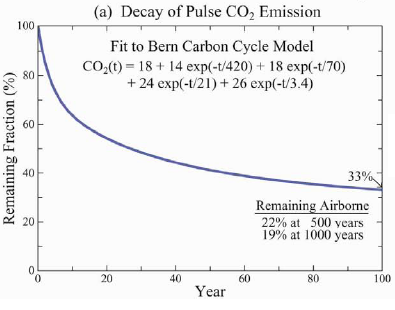
Fig 2. Decay pulse
[the expression] implies that one-third of anthropogenic CO2 emissions remain in the atmosphere after 100 years and one-fifth after 1000 years.Hansen also points out that this should be considered as a “lower bound” as the uptake capacity of the oceans decreases as the dissolved carbon increases and there exists the potential for feedbacks to make additional CO2 emissions. On feedbacks he makes this observation:
However, the nonlinearities and climate feedbacks do not appear to have played a large role in the increase of atmospheric CO2 from 280 to 382 ppm, so their effects may remain moderate if further CO2 increase is limited.We hear a lot about feedbacks these days with many mechanisms proposed however there seems to be little direct evidence that such nonlinear responses start now apposed to say 30ppm earlier or perhaps 30ppm later. This is a critical point, if feedbacks are not yet playing a critical role as Hansen hopes then perhaps we have a little linear “breathing room” to mitigate dangerous climate change through controlling our emissions. However if feedbacks are now critical climate drivers then there seems little scope for mitigation through anthropogenic emission control – in a feedback dominated system anthropogenic emissions are simply no longer the dominate variable, rendering much of this analysis academic.
Testing this pulse response with known anthropogenic emissions from 1750 to 2005 against measured CO2 concentration increases shows an underestimation of approximately 15ppm – this Hansen ascribes to deforestation and soil disturbance.
Scenarios
Four scenarios are modelled based on realistic reserves, the CO2 pulse response and varying exploitation responses.In the BAU scenario peak oil emission occurs in 2016, peak gas in 2026, and peak coal in 2077. Coal Phase-out moves peak coal up to 2022. Fast Oil Use causes peak oil to be delayed until 2037, but oil use then crashes rapidly. Reduced Oil Reserves results in peak oil moving from 2016 to 2010, under the assumption that usage approximates the near symmetrical shape of the classical Hubbert curve.Coal phase out modelled thus:
Coal Phase-out, is meant to approximate a situation in which developed countries freeze their usage rate of coal by 2012 and within a decade developing countries similarly halt increase in coal use. Between 2025 and 2050 it is assumed that both developed and developing countries will linearly phase out emissions of CO2 from coal usage. Thus in Coal Phase-out we have global CO2 emissions from coal increasing 2% per year until 2012, 1%/year growth of emissions between 2013 and 2022, flat emissions from 2023-2025, and finally a linear decrease to zero CO2 emissions from coal in 2050.The results of these scenarios are summarised in this table and detailed in the following charts:
| Scenario | Peak emission | Year of peak | Peak CO2 level | Year of peak |
| BAU | 14 Gt C/yr | 2077 | 580 ppm | 2100 |
| Coal Phase-out | 10 Gt C/yr | 2017 | 440 ppm | 2050 |
| Fast Oil Use | 11 Gt C/yr | 2025 | 460 ppm | 2050 |
| Less Oil Reserves | 9 Gt C/yr | 2022 | 425 ppm | 2040 |
Projected CO2 emissions:
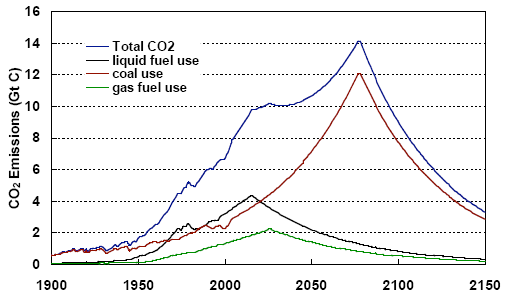
Fig 3. CO2 emissions: BAU
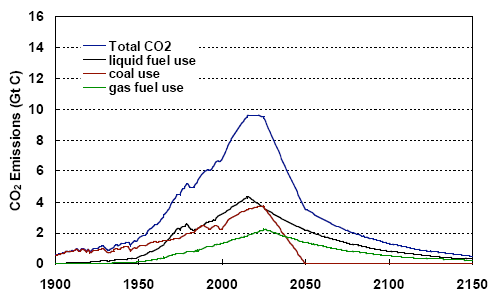
Fig 4. CO2 emissions: Coal Phase-out
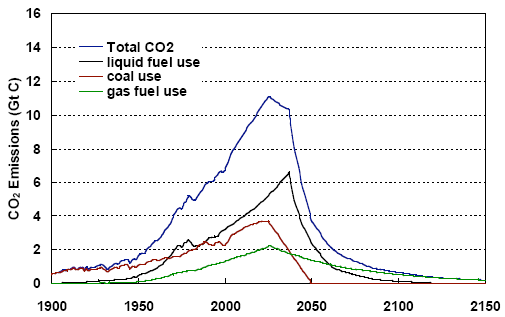
Fig 5. CO2 emissions: Fast Oil Use
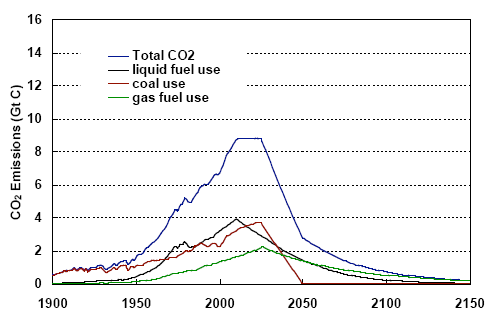
Fig 6. CO2 emissions: Less Oil Reserves
Projected CO2 concentrations:
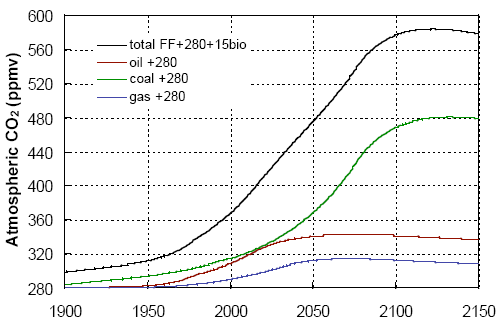
Fig 7. Projected CO2 concentrations: BAU

Fig 8. Projected CO2 concentrations: Coal Phase-out
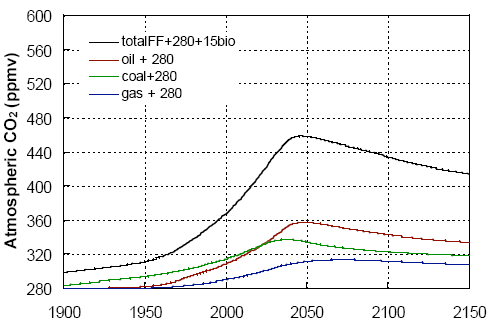
Fig 9. Projected CO2 concentrations: Fast Oil Use
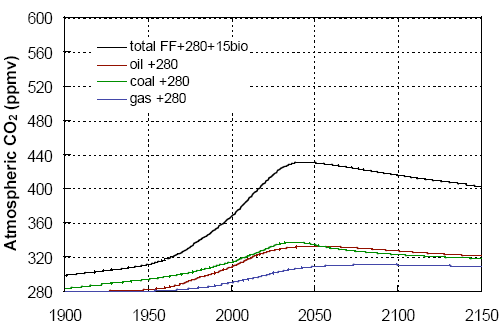
Fig 10. Less Oil Reserves
Comparison with IPCC
The lower chart shows the atmospheric CO2 concentration resulting from the CO2 emissions scenarios outlined in the IPCC’s Special Report on Emissions Scenarios (SRES). The Fourth Assessment Report (2007) has updated the temperature forecasts slightly from this chart however it's the CO2 concentrations we are most concerned with here.
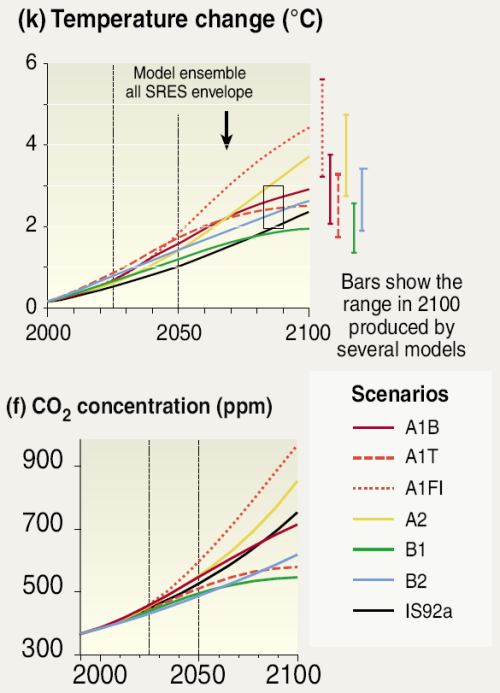
Fig 11. IPCC Scenarios
Source: IPCC 2001: Summary for Policymakers (.pdf)
For reference the A1F and A2 scenarios call for emissions in 2100 from fossil fuels of 30.3 GtC/yr and 28.9 GtC/yr respectively compared with 1990 emissions of 6.0 GtC/yr. The shear magnitude of fossil fuel reserves required to steadily increase emissions to approximately four times what they are now is incredible. Even the lowest A1T and B1 scenarios double 1990 emissions by 2050 before returning to a little below 1990 by the century’s end. Source: IPPC: Emissions Scenarios (.pfd).
Compare these emissions with those in Hansen's table above. Note how most of the IPCC scenarios produce CO2 concentrations far higher than even Hansen’s BAU scenario when he considers realistic fossil fuel reserves.
By comparing the two BAU scenarios we can see how Peak oil is clearly good news for climate change. Hansen's Business as usual scenario tops out at 580ppm compared to the IPCC's over 900 and rising. In fact reading back from Hansen's CO2 concentrations to the corresponding IPCC temperature change curve suggests less than 3°C.
Hansen Interview
Kate Sheppard from the environmental news and commentary website Grist have an interview with James Hansen this week. The full text can be read here: Clarion Caller: An interview with renowned climate scientist James HansenWhen asked what needs to happen in the next few years he replies:
A moratorium on coal-fired power plants and phasing those out over the next few decades. I think that's perhaps the most important thing.On oil and gas Hansen adds:
Then we also need to conserve the liquid and gas fuel so that we can develop the next phase of the industrial revolution because we're going to have to find energy sources that don't produce CO2. In order to give us time to do that, we need to use oil and gas, which are precious fuels, as if they were precious.Critically he's not taking about CO2 from oil and gas here - he's talking about gaining maximum utility from oil and gas, making best use of the finite resource.
Later in the interview he explains how the CO2 in oil and gas is all it takes to get to close to 450ppm adding “It's pretty clear we're going to use those fuels…”. This means we can't afford to burn much coal in a CO2 free manner. He also says:
A molecule of CO2 from coal, in a certain sense, is different from one from oil or gas, because in the case of oil and gas, it doesn't matter too much when you burn it, because a good fraction of it's going to stay there 500 years anyway. If we wait to use the coal until after we have the sequestration technology, then we could prevent that contribution."Sequestration of CO2 from oil is likely never to be feasible but might work for coal. From a CO2 point of view it doesn’t really matter when the oil is burnt, any policy driven changes are only going to be on the order of years whereby CO2 atmospheric life is many decades, even centuries. The timescales don’t correlate.
Activism and Conclusion
Whilst in this paper Hansen limits his recommendations to a moratorium on “free CO2” (my shorthand term to represent non-sequestrated CO2) exploitation of coal and unconventional fossil fuels and establishing a price on carbon emissions I have some further observations to make. Hansen’s analysis suggests that oil and gas production is going to peak soon and as a result carbon in remaining reserves is relatively limited. Less than the IPCC scenarios assume and likely not enough to cross the “dangerous” threshold of 450ppm CO2 atmospheric concentration. It follows then, that the climate change challenge we face is not so much to reduce oil and gas demand through policy and behavioural changes – to put it bluntly – we can leave natural depletion to reduce CO2 emissions from these sources.As we move into the post peak era, annual oil and gas combustion is determined by supply rather than demand, with increasing unsatisfied demand any achieved demand reductions will likely be absorbed elsewhere in the global economy leaving the global combustion and therefore emissions unchanged from what they would otherwise have been – the maximum that can be supplied. To suggest otherwise is to suggest that in the post peak era, policy decisions will further reduce oil supply from the geological potential.
Where mankind does have a degree of freedom to influence CO2 emissions and the resulting concentration is in the exploitation of coal and unconventional fossil fuels, these being demand rather than supply limited for the time being. Primarily this means addressing electricity as that is where the vast majority of coal is used. This brings me back to environmentalists, not just the extreme who advocate against talking about peak oil but the majority who advocate addressing oil consumption as the number one response in the name of climate change. In light of Hansen’s work I am unconvinced that policies addressing oil demand will influence the CO2 contribution from oil, the bulk of which I expect to be burnt following the envelope of Hubbert’s curve over the next few decades.
The mainstream view seems to be that aviation and driving, particularly SUVs are climate change enemies number one and two. This misconception arises from failure to consider the implication of peak oil. Whilst advocating reduced aviation and driving is a thoroughly good thing for a wide range of reasons it is not an effective response to climate change, the most serious of threats. We are not making the best use of available time, money and political capital that would be better spent on combating coal and unconventional fossil fuel exploitation.
Hansen shows us how an appreciation of realistic fossil fuel reserves is necessary to drive an effective response to climate change, this analysis is current lacking from the IPCC and from leading environmental NGOs in their lobbying of governments, leading to a less than optimal response to climate change being proposed.
Professor Kjell Aleklett
Professor Kjell Aleklett, Uppsala University physicist and president of ASPO, The Association for the Study of Peak Oil & Gas, has recently written along similar lines considering oil, gas and coal peaks in comparison to the IPCC emission scenarios and finds the reserves wanting. Full text here: Global warming exaggerated, insufficient oil, natural gas and coalIn the present climate debate, however, the amount of available fossil fuels does not appear to be an issue. The problem, as usually perceived, is that we will use excessive amounts in the years ahead. It is not even on the map that the amount of fossil fuels required in order to bring about the feared climate changes may in fact not be available....
We do not have to discuss or doubt the established historic rise in temperature, but we have to discuss and doubt the future temperature increases that the IPCC scenarios project and the fossil resources that IPCC assumes in its prognoses.
We need a new assessment of future temperature increases based on a realistic consumption of oil, natural gas and coal.
Previously on The Oil Drum
IPCC Summary and Fossil FuelPeak Oil and Climate Change
Dr James Hansen: Can We Still Avoid Dangerous Human-Made Climate Change?
Greenland, or why you might care about ice physics
More Coal Equals More CO2
Climate Change and Electricity From Biomass
Personnel
Editors
Contributors
Peak Oil Primers
Archives
- November 2010 (3)
- October 2010 (6)
- September 2010 (4)
- August 2010 (7)
- July 2010 (6)
- June 2010 (7)
- May 2010 (2)
- April 2010 (8)
- March 2010 (4)
- February 2010 (6)
- January 2010 (3)
- December 2009 (5)
- November 2009 (8)
- October 2009 (12)
- September 2009 (6)
- August 2009 (5)
- July 2009 (11)
- June 2009 (8)
- May 2009 (16)
- April 2009 (10)
- March 2009 (7)
- February 2009 (10)
- January 2009 (15)
- December 2008 (9)
- November 2008 (9)
- October 2008 (9)
- September 2008 (13)
- August 2008 (10)
- July 2008 (14)
- June 2008 (23)
- May 2008 (16)
- April 2008 (12)
- March 2008 (16)
- February 2008 (9)
- January 2008 (13)
- December 2007 (13)
- November 2007 (16)
- October 2007 (22)
- September 2007 (8)
- August 2007 (9)
- July 2007 (16)
- June 2007 (8)
- May 2007 (7)
- April 2007 (7)
- March 2007 (10)
- February 2007 (10)
- January 2007 (12)
- December 2006 (9)
- November 2006 (15)
- October 2006 (4)
- September 2006 (5)
- August 2006 (5)
- July 2006 (9)
- June 2006 (5)
- May 2006 (10)
- April 2006 (9)
- March 2006 (13)
Vital Trivia
License

This work is licensed under a Creative Commons Attribution-Share Alike 3.0 United States License.
It's good to see someone considering the whole picture on the problems created by fossil fuel use - and the even bigger problems implicit in ending fossil fuel use.
Too often you hear that the key to reducing CO2 emisions is to rely more on natural gas - the sooner we realise that isn't an option the better. Don't hear it so much in the last 12 months.
I think a lot of people are still in denial about the extent of our reliance on coal. People are quick to demonise coal and call for coal plants to close down - not so quick to admit how totally dependant we are on it for electricity generation at the moment, rather slow to acknowledge the vast amount of work required to put a workable alternative in place.
In the context of global warming I think focusing on liquid fuel use is a distraction. It's not that relevant, except to the degree that a switch to biofuels accelerates deforestation. SUVs make easy targets, but they also represent an opportunity for an easy win - drive something smaller.
The really hard work is in finding a replacement for coal, but people still avoid admitting that nothing else comes close to it yet.
If we are to believe in things we cannot see or touch, how do we tell the true belief from the false belief?
The really hard work is in finding a replacement for coal, but people still avoid admitting that nothing else comes close to it yet.
It's because it's not true.
Uranium (and 2050 and on, thorium) fission is a direct replacement for coal-burning plants.
I said "yet".
I personally think pebble-bed reactors have a lot of potential, and I'm optimistic about fusion by the end of the century.
However I wouldn't be the first one to point out that there are problems getting fission to scale up with current technology within a useful time-frame.
And you do actually have to get the plants built in a real-world physical location, with the agreement of the local planning authorities. I don't think these are insurmountable challenges - just challenges.
I'm more sympathetic to nuclear than my comment might have indicated - my real thrust was to get across that people don't like to admit that we are dependant on coal because it has a lot of useful characteristics(technically simple, cheap, easy to build,baseload power), and it's hard to find something else to replace it.
Yes it has some horrible side effects. But if it didn't have a lot going for it we wouldn't have become addicted to it in the first place.
My point is that the first step to kicking an addiction is to admit you are addicted. Admit that coal is filling a need, be honest about the dimensions of that need. Then look for alternatives.
If we are to believe in things we cannot see or touch, how do we tell the true belief from the false belief?
"I personally think pebble-bed reactors have a lot of potential, and I'm optimistic about fusion by the end of the century."
As am I (especially once the military gets out of research and we can concentrate on decreasing the half-life of spent fuels instead of Mt of TNT).
However, where are we going to get the helium from if we are past peak NG? Especially if we don't develop Thorium reactors (i.e. really good technology for making alpha particle streams).
Waste is still quite a problem for HTGRs, as the pebbles need some pretty harsh treatment (similar to MOX rods, as I understand it) to be able to be put into Synrock.
Please look at IEC fusion, whose lead researcher is Dr. Robert Bussrad, we may know by the end of this decade if he has as reactor design @ proof of concept.
http://www.emc2fusion.org/
http://www.youtube.com/watch?v=XiHsSAS_SQw
http://www.youtube.com/watch?v=rBfsq80EgOs
http://www.dailykos.com/story/2007/5/12/171119/055
http://www.askmar.com/ConferenceNotes/2006-9%20IAC%20Paper.pdf
Intriguingly, though, the current designs of nuclear power plants relies on massive quantities of cooling water (as to a lesser extent do coal fired plants).
This means in areas where drought is increasingly realistic, meaning it is being experienced now, and with models suggesting such conditions remain likely into the future, an existing nuclear plant in southern Europe or Australia is unlikely to be very useful.
And this should not be equated with the environmental concerns (heating rivers leading to fish die off, for example) which prompted nuclear plants to throttle back in Europe during several 'extreme' summers - in the concrete case of both southern Europe and Australia, the physical quantity of water is insufficient.
Don't count on the world's current investment in nuclear power plants to be as useful as expected. And as for building more of the same - let's just say there is a lot of interest in ensuring profit streams for a number of very well connected large companies, and intelligent debate is not very likely.
Of course, we can discuss other designs and ways to generate electricity using fission - unfortunately, this is a discussion roughly on par with powersats - technically feasible, finacially achievable, and not available today. And very unlikely to be available in a decade either.
If water is an issue, secondary coolant condensers are a very easy solution for new plants. Dump the heat into the air or, better, into a community hot water loop.
Proper thermal management of our lifestyles is a relatively easy step in cutting back home energy use to a small fraction of what it currently is. There are a thousand things you can do to a home, but also things you can do to the cement plant on the other end of town.
We waste FAR too much fuel generating updrafts.
In Australia the problem is trivially easy to address. Most of the power requirements are on the coasts, which is where ample supplies of cooling water happen to be. People love to invent doomish problems it seems.
I agree, when reality sets in, the NIMBY attitude will evaporate, methinks. Also, HGTRs would be really useful in Australia for desalination (hey, we could even pump it inland to wash away the last few inches of topsoil!)
Trivial? The "coastal location" is not decisive. What matters is if power plants are cooled by water from rivers (affected by global warming - more evaporation and less rain) or by sea water. In New South Wales, coal fired power plants (12,000 MW) are cooled as follows
20% from Cox River
40% from Hunter River
40% from sea water
"The water shortage across eastern Australia is now so acute it has begun to affect power supplies, and the country is at risk of electricity shortages next year."
http://www.smh.com.au/news/environment/power-cuts-bigger-bills-on-the-wa...
Duh.
This has little bearing on future siting of australian nuclear power plants.
Hi Expat,
Would you mind commenting on the Candu re heat dispersal?
CANDU plants (such as the Darlington station near Toronto, Ontario) use a discharge-diffuser system that limits the thermal effects in the environment to within natural variations.
I imagine there are other systems and solutions and even some positive uses for non-utilized heat production. I wouldn't mind living near a plant if I could use some of that heat to grow a rutabaga or two in winter.:-)
If we begin with the premise that we shall not exceed 450ppm co2, we need to construct a trajectory that keeps that from happening.
We need a moratorium on new coal plants and a phase out of exising ones. Combined with serious conservation, we take care of the deficit for awhile with solar, wind, and some biofuels. If nuclear is excluded, the real challenge is how do we maintain the minimum necessary baseload to backstop the intermittent renewable.
Yes, there is drought, but does that mean nuclear is not an option everywhere. Will the whole world be in drought? I don't think so but would like to see some projections
Further, if we can fall back on sequestered coal, are there water issues there, too.
Honestly, is it all just hopeless?
No, it is not hopeless. Once people understand the seriousness of the situation and the viable options, nuclear will not be excluded. It will become the world's primary energy source. Today's objections to nuclear do not have strong factual foundations. Once the crisis hits, society will make the tradeoffs in favor of preserving civilization.
It may be a bit late by then. It takes 10 years from the inception until a nuclear powerplant produces electricity. By the time we truly feel the crisis, we'll be so for into the slope that we won't be able to get our act together any longer.
That's old, non crisis, thinking. That assumes all the opponents can tie up the permitting for years and delay the construction. Using standard designs, I have heard that they could build the plants and go into operation in about three years. If we could break through all the nimby and obstructionist objections in permitting, that should not take more than a few years. We could build a lot of plants in 10-20 years if we gave it the urgency and resources of a world war. Just look at the hundreds of billions, soon to be trillions, the US has wasted on Iraq and that was not important for its national security. If the French can do it so can the US.
If China is complete one coal plant every week, can't we finish one nuclear plant every month?
Large scale coal generators also require major infrastructure as well---especially the titanic trains coming in with the astonishing quantities of coal, and the trains going out to dump the fly ash waste into non-sequestered unsound 'storage' as pounds of crap with infinite half-lives.
And yet---when there's motivation they get done.
I'm also pro-wind as well. But we need to be realistic about the import of the laws of physics and geophysical facts, with oil, gas, coal, wind, biofuels and nuclear.
Of them all, so far nuclear and wind seem to have the least bad downsides by basic physics, and some modest (wind) to major (nuclear) potential.
Apparently we would need about 10,000 reactors (about 20 times what we have now) to supply the equivalent of the world's total current energy consumption, a large but not unimaginable number. We could take a generation or two to build them. The world could survive with a lot less than the current level of energy consumption and still avoid a catastrophic die-off that would wreck the world.
These reactors would power the current electrical grid but also most transportation and the chemical/fertilizer industry using the remaining low grade hydrocarbon feed stocks. It would take a monumental construction task but does not seem out of the realm of possibility, if the world put in a World War II level effort for 20 years.
Wherefore the popularity of defeatism? We have no reason to suspect that it will be 'too late,' whatever that means.
Unless you really are trying to start yet another death cult.
To build a nuclear power plant you need two things: Time and Uranium. We don't have too much time. A Nuclear Boom would be required. Do you see that coming? I don't. And to have Uranium you have to dig for it. Check out the Uranium production graph for the past years and tell me in the face that Uranium is an alternative, when it is facing a clear bottleneck in production.
Another point on nuclear, as global construction slowed dramatically after Chernobyl and the collapse of USSR we are approaching "peak nuclear decommission rate" as the existing fleet reaches end of life. We'll be doing well (from a nuclear generating point of view) just to hold global generation flat over the next 10-20 years in the face of this decommission.
"A Nuclear Boom would be required. Do you see that coming? I don't."
If you do not see it, then perhaps you are not taking the crisis seriously. No, it is not happening RIGHT NOW, although there are about 30 applications now in the works in the US after not completing any plants since the 70s. Right now the world is in denial. But when it finally becomes inescapable, people will look at the real options and do what they can to save their lives. Sure, we will build wind and solar as fast as we can. But, our main hope is fission.
I think mankind will rise to the occasion. This is what the start of a boom looks like. Peoples' minds are being changed.
There may well be a financial "boom" for those making their money in the nuclear industry... the rest of the world - we shall see...
"You can never solve a problem on the level on which it was created."
Albert Einstein
Uranium is an alternative.
It is absolutely nothing like peak oil. The equivalent in petroleum would have been as if all oil exploration had been shut down for 30 years, and oil production heavily curtailed (all from the four or five known in place oil fields), with the bulk of oil consumption satisfied for years from surplus military strategic reserves.
The uranium industry is but a gnat compared to the oil industry---and if just a fraction of the capital invested in oil would go to uranium (which it will under energy conversion scenarios) the amount of available uranium would be far higher.
There's a bottleneck now for the next 2-7 years. After that, it's only a matter of capital put in.
There is quite recently (3 years) an enormous explosion in uranium exploration and mining. This is real and on-the ground already.
Uranium is not rare, unlike petroleum. And we are using the most uranium-inefficient fuel cycle now because uranium is still so cheap.
The global uranium reserves correspond only to 10 years of the actual power extracted from oil. Uranium is not less rare than oil.
Breeder reactors pose a number of problems that are not yet solved. Letting thousands of tons of plutonium travelling around the world is simply unthinkable, and U-Th process is far from being mastered. Furthermore, there is a maximal rate at which you can construct breeder reactors because you need first to generate fuel, which does not exist in the nature; there simply no way of replacing the decline of oil in real time, not to speak of the very different use (power generation vs transportation).
Hello. A few points on the subject:
1. I understand the choice of IPCC of not mixing the subjects of Peak Oil and Climate Change. Politically speaking, Peak Oil is still Taboo and if you want politics on your side, you better hang on to what is politically correct than to cling on increasing numbers of Taboos. Is it the right thing to do? Probably not, and History will teach them that, but it is understandable. It's called pragmatism.
2. Hansen is too much optimistic about the future of CO2 emissions, like his sentence suggests: as long as coal and unconventional fossil fuels are used responsibly. This is the main issue. The moment this planet understands that oil is in scarcity, it will start to burn coal to produce oil. Perhaps not in the US, but I bet China will do it. Environmental questions will be put on the shelves as people think that to mantain global economic from meltdown is more important than the planet they are living within. And those who think that a few US laws will forbid it, I say that "brown revolution" will begin / continue in the third world countries and USA will have no choice if they want to keep up.
3. Coal "Phase Out"? You must be joking. We are within Peak Oil in few years time. People here in TOD are talking about the time when TSHTF, prospects of Blackouts are one of those nightmares of it, and Hansen calls for coal "phase out"? He's dreaming. Or perhaps making an "Earth Sim" for himself. He's not talking about the real world, where nations battle economically (and warfarily) with each other, where magnats fight for power control, and where population won't understand why are there so many blackouts if there is so many coal that it isn't being used for "environmentalists concern".
4. The really hard work is in finding a replacement for coal, but people still avoid admitting that nothing else comes close to it yet.
Alright, we're talking now. But it is not a question of "hard work". It is a question of existence. It doesn't exist, period. Any renewables are still far off in the future before reaching today's coal levels, ignoring any "growth" people would like to witness. What's left? Uranium? We have 40 years of it. We DON'T have a choice.
Unless perhaps we shut the lights out and phase out... the entire economy.
5.In the context of global warming I think focusing on liquid fuel use is a distraction.
No it isn't. I couldn't disagree more. It is devious, but as you said, PO and GW are closely related. Well, if you can't switch your oil-based economy to something sustainable in a short time, you will need a heavy substitute for it. And, like I've said and you've said, only Coal is up to the task. So they are damn right in fighting oil "addiction" for these two reasons:
- avoid the most dangerous consequences of Peak Oil;
- start mitigating an entire oil economy so that the switch to another kind of economy doesn't ask for too much Coal.
My two cents. And I'm no expert.
The moment this planet understands that oil is in scarcity, it will start to burn coal to produce oil. Perhaps not in the US, but I bet China will do it.
They will both do it, maybe USA will lag a little because of public opposition, but shortages will end this one very quickly. The absence of this point - the substitution of oil with coal is a yelling weakness of the report. It is simply assuming that after oil is gone people will stop driving and flying... what a shame - given the otherwise high level of the analysis.
What's left? Uranium? We have 40 years of it.
You need to check your numbers. Try 1 trillion tonnes divided by 65,000 (the current consumption) or even 650,000 if we increase it tenfold. Should be enough for million years or so. Uranium is not a fossil fuel and we have orders of manitude more from it (as energy content) than from FFs which are of biotic origin. Developing it is just a question of time - and will inevitably happen IF there is the political will to go nuclear. It's simply a matter of choice, political will and a hard work - that is if we still have a choice with respect to Global Warming.
Because of scarcity, the price of fossil fuels will grow much faster than the cost of producing them. Thus, the oil companies will have lots of cash on hand that they may be willing to invest in carbon capture technology.
Burning coal with carbon capture to produce electricity is a pretty decent proposition. Liquifying coal with carbon capture is not such a good idea (because we'll produce more CO2 later in burning the oil), but it's certainly better than without carbon capture. Burning coal without carbon capture is a recipe for disaster.
Carbon capture is the perfect boondoggle technology. There is NOT A SINGLE power plant that demonstrates it on industrial scale. And yet we hear about "clean coal" and "carbon capture" as nothing less than the solution to our climate change threat... the same way we have listening for hydrogen for decades. At the same time there are hundreds of coal power plants on the drawing boards, and NONE of them features carbon capture, nor intends to. And of course there are thousands more that are already operational for which carbon capture will never be applied to for obvious reasons. In short for the foreseeble future it is entirely fictional idea. I'd rather place my bets on fusion than it.
Is it? Look at the following Wikipedia article. In my view, it is realistic to expect larger numbers of coal firing plants with carbon capture technology to come on-line sometime after 2020. It probably won't happen without regulation by law, but it is both technically and economically feasible.
Hello Levink
You need to check your numbers. Try 1 trillion tonnes divided by 65,000
Well then, I suggest we both check our numbers. To produce enough nuclear power to equal the power we currently get from fossil fuels, you would have to build 10,000 of the largest possible nuclear power plants. That's a huge, probably nonviable initiative, and at that burn rate, our known reserves of uranium would last only for 10 or 20 years.
For a wide picture of this, check this out.
The truth is, 650,000 tonnes is nothing compared to what we generally spend in power. So that spoils the nuclear "silver bullet".
1 trillion tons divided by (10000 gw reactors * 200 tons each) is 500000 years. This is for once through cycles with light water reactors alone.
With molten salt breeder regimes its 120 trillion tons (we can use much lower ore grades) used at 1 ton per gw year. That should last some 12 billion years.
Try again.
There's something pretty wacky going on when one person can say we've 40 years left and another 12 billion years. How can we develop this argument, terms of reference?
Theres not much point. They're filled with absolute strait lies.
Its 40 years from mines currently open,
Several hundred years from anticipated reserves at current prices at constant demand through the once through cycle.
Several thousand years at constant demand with reasonable price limits from speculative reserves with the once through cycle.
500000 thousand years from ore bodies of 20ppm up in the once through cycle... but at prices that are rather too high to be directly competitive, so fuel stretching from reprocessing and extra enrichment are required. This actually multiplies the resource base by 4-8 times....
Now of course breeder reactor regimes become reasonable to pursue in this price regime since we have to do reprocessing anyways. This multiplies the resource base by some 100 on fuel efficiency over LWR cycles and opens up all ore bodies of uranium and thorium, which multiplies the resource base by 120, for a total multiplication of 120000.
Now if you assume growth, it has to stop at maximum radiative capacity of the earth, somewhere around the level of the solar flux. If you burn the nuclear fuel as fast as possible our 120 trillion tons will only last some 16 million years.
The bottom line is we wont run out of nuclear fuel.
You should join the PR campaign.
http://www.prwatch.org/node/5833
"You can never solve a problem on the level on which it was created."
Albert Einstein
key words: anticipated reserves, speculative reserves, breeder reactor
Very well laid out.
Unfortunately I'm afraid that whatever you say or however you say it, doesn't matter at all. The "40 years" strawman will be repeated again and again without those guys bothering to read spare to respond your arguments. 40 years, 40 years... they need to repeat that 98 times more and it will surely turn into truth, will it?
Nevertheless I have to congratulate you - in this summary you managed to send such a clear message that the only thing that one of them could say is that you have to join the PR campaigns. I liked it - going ad hominem is the final stage of denial, so maybe a bit of realisation will be coming along shortly.
Actually, it is more that the pro-nuclear arguments lean heavily on theoretical possibles, whilst those who are opposed are usually (or should be, since there are a lot of theoretical possibilities) more concerned with reality. In reality there are always human problems, unforeseen or ill-considered issues, and industry sweeping whatever it can get away with under the carpet.
To have an intelligent debate would require non-industry funded studies that are completely independant and consider all aspects of a nuclear programme. Even government commissioned studies usually include funding by the industry, often have panel members from the industry and get information from industry groups such as NEI (see criticism of the recent UK energy paper where these issues are raised). This is not unbiased information. It is called propaganda. Yes, I suggested he join their PR campaign because that is the level of the arguments, not because I was making a personal attack. Use your "going ad hominem is the final stage of denial" catch phrases if you want. It doesn't change the fact we live in the real world.
"You can never solve a problem on the level on which it was created."
Albert Einstein
This is just ridiculous. You add up the numbers for nearly any uranium use scenario with uranium resources and you have such a vast resource base to make the whole argument moot. We have measured reserves from deposits above 200ppm in the hundreds of millions of tons, and reprocessing with double enrichment is proven to multiply the resource base by more than four times at a reasonable cost. Theres 200 years from 10000 light water reactors right there before we get into very reasonable advances in technology and lower grade ores. Extrapolating molten salt breeder reactor regimes or thorium utilization or shale mining isn't stepping off into some fantasyland how you imply... These are demonstrated technologies and the resources are clearly measured and even the Storm/Smith team had to note this.
So what? This has little to do with the vast resource base of uranium or the demonstrable fact that we wont be running out of it this century.
Hold up the mirror to the storm/smith report and their cascade of lies.
You can fact check numbers and analysis that isn't from the 'industry.' Deffeyes & MacGregor aren'te industry shills, neither is the University of Melborne. This is simple ad-hominem nonsense.
It doesn't change the fact you're using simplistic ad-hominems and ignoring reality altogether.
Really? See references in my post below showing the reality of current mining numbers. You still continue to cling to theoretical possibility, whilst ignoring real world dynamics. Good luck.
"You can never solve a problem on the level on which it was created."
Albert Einstein
Dezakin,
Nuclear power is one of the keystones to getting through the peaking of fossil fuel supplies. As you note, the supply is vast so the problem is not uranium as a fuel but the conversion to uranium from fossil fuels. This is not an activity that a feudal society could easily accomplish. This is not an activity that an even more primitive society could hope to accomplish. Technological civilization must bootstrap itself from where we are to where we need to go.
This is why I have always maintained that peak oil is not a technological problem. It's a political problem. It's a psychological problem. Yes, we could build those reactors. Will we? On the one hand we see the beginnings of movement in that direction. On the other hand we see asinine crap like the Congress of the US passing laws to let the US government sue OPEC.
And this is the core of the problem - we need a certain amount of time to safely transition from fossil fuels to other sources (including nuclear). The overriding question is will we get that time or not?
By the way, did you ever read Joseph Somsel's article on processing nuclear waste? That's an excellent example of how politicians are failing us all even as the scientists and engineers could solve a particular problem. The politicians are in the way there, not helping. And politicians make the world go round, not those of us in technical fields.
Ghawar Is Dying
The greatest shortcoming of the human race is our inability to understand the exponential function. - Dr. Albert Bartlett
Great article!
I assert we've got plenty of time, the only questions are the costs. If we start now with building nuclear and wind farms with pumped hydro storage for dispatch we can avoid the inflationary effects if we wait thirty years. If we wait sixty years there will still be enough energy to build a reactor fleet, but most of the developing world will be in dire straits or simply perpetually poor. The knowledge wont vanish, nor will the resources to do infrastracture adjustment.
It will just be a matter of cost.
Hi Grey,
Thanks for your comments.
re: "And politicians make the world go round, not those of us in technical fields."
Okay, let me see if I can take this one step at a time.
1) "Peak" is a political and psychological problem, not a technical one. (In other words, the technical paths are available.)
2) At the heart of the matter is the time needed to "...safely transition..." Will we get this time?
3) Politicians will determine the answer to this question.
4) Q: Because "...those of us in the technical fields..."
a) Cannot have political influence?
b) lack the will to have political influence?
c) Cannot find a way to work around the role of politcians and politics?
I'm trying to focus on this because I'm struck by the similarities in this type of argument and those used to justify and perpetuate the Cold War nuclear arms race, back when.
It runs something like this:
1) Those who are in a position to know and understand the dangers are "merely advisors" or "merely scientists".
2) The politicians are merely responding to the people.
3) The people are ignorant of the scientific and technical issues, and perhaps rely on the information given them by politicians.
4) Each group places the potential locus of change elsewhere.
From Dezakin:
They're filled with absolute strait lies.
I won't deny what I don't know much about. Perhaps you are right, and we have much more than 40 years of Uranium left in the world. But, excuse me, 120 trillion tonnes?!? Come on!
I don't believe it when I read someone even saying: "it has to stop at maximum radiative capacity of the earth, somewhere around the level of the solar flux. ". Are you serious? And you want to be dealt with any seriousness?
EROEI. Energy 101. If you spend more power dissolving a tonne of granite and turning it into uranium (and you must do the maths FROM the energy cost of building the nuclear plant, extraction of granite, transportation, deployment, containment of radioactive stuff, etc) than what it generates, its out of the equation. This limit is way far below your ridiculous thousands of years assumption, but we'll discuss it below.
Environmental consequences. You're worried about coal, but you couldn't care less about the granite mountains you are about to devour to get some uranium kilograms. The impact of such venture is way past acceptable conditions.
To give a picture of this: if you dig out the 2 trillion tonnes that are thought to be in granites, with a concentration of, lets say, 5 ppm, you would have to dig out some 100 thousand trillion tonnes of granite! (For a comparison number, the world now produces a whooping 100 million tonnes a year of granite). This is insane! The current rock extraction rate is widely considered an environmental doom, and you don't mind throwing another giant into the playroom!
What freaks me out is that you really believe we can take out the entire uranium that is within the Earth's crust!! You are forgetting that in order to do so, you have to dissolve it, dig it, explode it, rotate it, and dissolve it even more. But, ooops, it happens to be the crust we are sitting above....
You disregard if the granite is 1 km below surface or 10 km. I guess you don't mind to dig out millions of tonnes 10 kms below surface, but you'll have to explain "how" is that possible. It's not the same thing to extract granite and to extract oil, you know?
You disregard that volcanic ores are a little bit "difficult" to get.
Also, you forget that the most uranium you are referring to is going to suffer from the same fate as shale oil: it is too slow to take out to keep the demand expectation. So, yes, with that point of view, uranium is forever. Because no one will sanely try to take it out to use it.
The "40 years" strawman will be repeated again and again without those guys bothering to read spare to respond your arguments. 40 years, 40 years... they need to repeat that 98 times more and it will surely turn into truth, will it?
Rethoricalize all you want. Breeder reactors have still many problems. So it's still a "promised land", or eventually another brown revolution painted green. Mainly, your arguments are worthless a buck. They remind me of those people claiming there is still 10 trillion oil underground. Such people were so mouthfull a few years back. Now that we're within peak oil, I'll ask them, where is it? Where is such richness? Nowhere.
Lets have your numbers in a closer look, shall we?
You claim that there is at least 120 trillion tons of fuel left. Bull*hit. Even from your own source, the maximum the planet has is 39.6 trillion tonnes. In your paper, granites are the last resource with an EROEI that is believed to be positive. So it is not quite an optimistic scenario but a "fantasy" scenario, disregarding all I've been saying, but EVEN if we take it as it is, your "120 trillion tonnes" are now down to 2 trillion tonnes.
In fact, 2 trillion tonnes are way up higher than the 4.7Mt present measured sources , to give a good picture of things. I don't believe this figure to rise more than 10 / 20 Mt in the following hundred of years.
Today, current usage is estimated at 66.500 tonnes per year. But this is to power a market that is at least 13 times higher. Like you said, to cover up oil usage, one would have to give at least 650.000 tonnes per year. And if you want to power your future car with it, try 1.000.000 per year instead. Now if you look back at the reasonable numbers, (not at Star Trek ones), 20 Mt divided by 1Mt equals twenty years.
And I'm disregarding a doubling time of 30 years in world electrical consumption.
Let's view fantasy scenarios? Sure.
1. With a growth rate of 2.3%, with a base of 1Mt per year, in 100 years you'll have used 380 Mt.
2. In 200 years, 4 Bt.
3. In 300 years, 40 Bt.
This is 10.000 times the present measured sources. Sources yet to be discovered or to be viable economically. And I'm not even talking about Uranium Peak.
Dezakin can rips you a new one on his own but I have a few minutes.
Check this out:
Uranium Distribution
That says that there is a trillion tons of uranium (8 x 10^11) that can be mined with EROIs of between 16-32. That EROI is comparable or better to today’s coal power plants.
The part about the burn rate of Uranium being less than the solar flux is an attempt to determine the theoretical maximum rate that uranium could be used. Faster than that the earth could not dissipate the heat. That is an attempt to determine an upper bound of consumption to come up with the minimum time that the resource would last.
The amount of rock that would have to be processed would be at the end of 16 million years burning it at the rate of the solar flux. I think that would require tens of millions of reactors. In other words, that last bit of rock, using a real burn rate, would be mined in hundreds of millions to billions of years from now.
The other part that you missed was that he came up with 120 trillion tons equivalent resource by including Thorium, which is 3 times as plentiful as Uranium and by different fuel cycles that use more than the very small portion (<2%) of the available energy in the fuel that we now get out of the once through cycle in light water reactors. Some of that technology is not completely mature but it has all been demonstrated and right now it is not required economically. It is entirely reasonable to think that it will all be part of the equation no more than 50 years from now. This is not fusion.
All his numbers are entirely reasonable and he has put them out here many times in the past to face scrutiny. The absurd numbers are the ones that you are using that purport to show that we could run out of fission fuel in the short term.
Actually his claims are the misinformation, as are yours. You continue to spout theoretical numbers, not ones that bear any resemblance to the reality of mining.
From Dezakin above...
"Several hundred years from anticipated reserves at current prices at constant demand through the once through cycle."
Really? By anticipated reserves do you mean RAR? Here's a reference to those numbers (PDF WARNING):
http://pubs.usgs.gov/bul/b2179-a/B2179-A-508.pdf
Anticipated shortfalls are between 800,000 tons and 3.7 million tons by 2050 for Uranium.
Borat and co. may be able to help stave off some of the shortages:
http://www.world-nuclear.org/sym/2004/dzhakishev.htm
This is only assuming a very modest growth - ie one that would only satisfy a small percentage of world energy needs. In fairyland you may process as much of the earth as you want, but not in reality... thankfully!
"You can never solve a problem on the level on which it was created."
Albert Einstein
The only Uranium that is currently being mined is from high grade sources because the total resource base so far exceeds the demand. In addition, the US and Russia have been dumping a great deal of blended down weapons material, which has further suppressed the market. Nearly all the mines in the US have shut down because they cannot compete with the high grade sources. There has been hardly any exploration for 30 years.
Once peak oil does become apparent and we begin a nuclear boom, mining companies will once again begin to look for and develop new deposits. They have a lot to work with because current plants have EROIs of near 100 with fuel costing only 2.5% of operating costs. As they come to rely on lower grade ores, the resource base expands dramatically without noticeably effecting operating costs.
Unlike fossil fuels, which are distributed in a few deposits in just a few areas of the world, fission fuel, created by an ancient supernova, is distributed throughout the crust. Because fission fuel has such enormous energy content, we could in the future use ores of dramatically lower concentration than we do now and still have a very good energy balance. If you want to understand the long term potential of fission, you need to consider ores that are not economically competitive today with existing ores as long as using them would conceivable be viable compared to other (non fission) sources of energy.
Dear mr. Sterling,
"The part about the burn rate of Uranium being less than the solar flux is an attempt to determine the theoretical maximum rate that uranium could be used. Faster than that the earth could not dissipate the heat."
Again we're back at Star Trek. This is not our problem at all. I could claim that there is enough thermal energy in the Earth below the crust to power a civilization until the end of times. I can say that Solar Power will fuel the future. I can say these things and more. In this kind of fantasy-thinking, I agree that Thorium nuclear reactors will save the day and after it, fusion.
But check the dates. UIC is very commited in deploying the first wave of "new technology reactors" in the time-span of 2015-2030. If the first Thorium reactor comes online as soon as 2015... how long will it take to bring those techs into mainstream, and build a thousand of such reactors, two thousand, etc?
Twenty years? Thirty? To build a nuclear plant isn't exactly to build a windmill. You need public approval - that will only happen after the effects of Peak Oil are all too apparent; you need locals approval; and most of all you will also need zillions of dollars in infrastructures;
Mostly, you need trucks and machines fueled by oil we won't have to dig out the uranium you so claim there is plenty. You forget that in an oil-scarcety society, EROEI's will fall substantially, and to claim that all the shales and phosphates will be used on uranium production is the most ignorant thing you could ever say. Apart from the fact that people care about their own local environment (or do you want to live in quarries?), the impact of it in global environment would turn laughable our present concerns about what we are now doing.
"Check this out:
Uranium Distribution"
Yes, you've all the same papers. Even the UIC is so positive in its thinking, as is the WNA. From their own papers (they are equal, I don't know who first wrote them:
"Conversely, the exhaustion of mineral resources during mining is real. Resource economists do not deny the fact of depletion, nor its long-term impact - that in the absence of other factors, depletion will tend to drive commodity prices up. But as we have seen, mineral commodities can become more available or less scarce over time if the cost-reducing effects of new technology and exploration are greater than the cost-increasing effects of depletion.", ending saying that "From a detached viewpoint all this may look like mere technological optimism. But to anyone closely involved it is obvious and demonstrable." (bold is mine).
So here it is, we should all think positive... like these guys, right? Ok, I agree. Let's see then their numbers:
"This is in fact suggested in the IAEA-NEA figures if those covering estimates of all conventional resources are considered - 10 million tonnes (beyond the 4.7 Mt known economic resources), which takes us to over 200 years' supply at today's rate of consumption. This still ignores the technological factor mentioned below. It also omits unconventional resources such as phosphate/ phosphorite deposits (22 Mt U recoverable as by-product) and seawater (up to 4000 Mt), which would be uneconomic to extract in the foreseeable future."
So, with a cheerful smile and while being very "optimistic" about mineral extraction, they are far more honest than you are by claiming 30-50 Mt at the most (considering thorium).
They are obviously ignoring the fact that nuclear is thought to be salvation against oil, and that consumption should rise tenfold, as well as growth in consumption, geometrically. And then, as if the oceans aren't already in the brink of environmental collapse, the proposal of filtering all the ocean's water is obviously put there for fun.
But hey, we could develop that idea. Why not? It's so Star Trekky! Let's imagine we would "dig" 100k tonnes a year from the sea. Not much if we remind ourselves that today we consume 65k. How much water you would have to "filter"? Given 0.0005 ppm, and that water is 15 times lighter than uranium, you would have to filter 13x10^12 tonnes per year. That's a whooping thirteen thousand cube kilometers of water. And all this to only double our current production. No wonder it is not economically viable, despite the fact that you don't have to dig much for it.
So everytime anyone comes and says "but there's so much uranium on the water!", slap him in the face. He deserves no less than that. And if anyother talks about shales... ignore him. Those people are exactly the same who talked so much about shale oil. We know how that story ended.
Like president Bush almost said: "fool me once... shame on you, fool me twice... shame on me!"
PS:"It is entirely reasonable to think that it will all be part of the equation no more than 50 years from now. This is not fusion."
This is not fusion? 50 years? Do you even know how fusion schedule is going? Because in twenty years they haven't been late in any part of their schedule. It so happens it is too much complicated from the engineering point of view. In thirty years time you'll have the first nuclear fusion reactor economically viable built. Fusion reactors don't have the public opinion against. It seems to me that you are talking about the same time spans of Fusion.
Sorry to spoil your point somewhat, luisdias, but the reserve figures quoted from the WNA are for uranium resources available at less than $130/kg. The current spot price is almost double this value. Short term logistical problems in getting new mines up and running do not equate to long term shortages of this abundant, ubiquitous resource.
Of course it's not. It's an attempt to define a limit to how much nuclear power we could conceivably use. Using ridiculously large values to calculate a limit is hardly novel and I'm surprised you have so much trouble understanding this.
Well, that's the thing then. But if you think that by doubling price you'll get double reserves... I really think you're plain wrong. And don't forget the influence the energetic sector prices has in all extraction industries. We could be looking at the influence of nuclear boom but also an indirect consequence of oil price rising. 130$-economical uranium reserves isn't a fixed "tag", we have to consider heavy energy inflations.
The other thing is that the opponents of nuclear have to be willing to consider scientific evidence and evaluate it in a hard headed manner. Right now they are impervious to the facts. They keep repeating such howlers as "nuclear has low EROI" and "we are running out of Uranium". This is a serious issue and we need to consider our options seriously. Once proven wrong, they need to stop using those thoroughly debunked arguments. These people let their irrational fear of nuclear cloud good decision making. They need to concentrate on good arguments, if they have them.
Good arguments? For instance, tell me about residues, after 50 years of nuclear reactor operation, no country has been able to deal effectively with them.
Or why no private insurance company wants to insure a nuclear power station against civil damages (the Price-Anderson Act was extended in 2005 for 20 more years by President Bush).
Or costs. 60 to 75% of nuclear kWh cost is financial. Do not fell into the trap of comparing current nuclear costs with future alternative sources costs. Current reactors were build when energy was plenty and cheap. And the newest Finland’s reactor cost increased 10% in one year due to raw materials price increases. And not all costs are internalized. Can you predict interest rates over 40 years.
Congratulations. Thanks for not falling back on thoroughly debunked arguments.
I think reactor proponents made a mistake in thinking we should bury spent fuel. No matter its technical merits, it is a public relations loser. The long lived wastes really scare people. On a practical level it is not a good idea because the spent fuel is too valuable to bury. It still has most of its available energy. The technology is not yet available, or economically needed, to reprocess the spent fuel as well as to burn up all the long term waste, but its feasibility is well established. So we let the spent fuel pile up at the reactor sites. Is that a problem?
The spent fuel is small in volume, less than the size of a car for a year's worth of 200 tons. It is no problem to keep it on site for 50 to 100 years until the facilities are in place to use the rest of the energy and eliminate the long lived wastes. There is no good reason to build a central waste repository in addition to the political problems with that idea.
The Price-Anderson Act solves your liability objection. This is a serious crisis and government involvement is entirely appropriate. No one would insure coal plants either if they were subject to suits for civil damages for their waste cleanup (CO2 mitigation and all the deaths these plants cause).
Your last objection is actually a benefit of nuclear. The costs are mainly up front with nuclear because the fuel costs and hence operating cost are so low. Yet they are still cost competitive today in spite of having their cost driven up but intense but largely irrational political opposition.
I am not suggesting that one cannot raise reasonable objections to nuclear, as you have. I do not think there are any objections that cannot be answered adequately. If peak fossil fuels leads to a big die-off, the desperation of the soon to die will wreck the entire world. Those are the stakes. If there are better options than nuclear, their proponents have not made that case. I am also in favor of building non polluting renewable sources just as fast as is possible. I am in favor of everything that works.
The bootstrap problem you imply is to me the biggest issue for any proposed mitigation of the energy problem. As the immediately available energy resources decline, how do we completely rebuild the transportation and power infrastructure? That's why I think we need a World War II level mobilization of the world for a generation. The good news is that the world does have virtually indefinite available energy resources, if we can survive the transition.
Then we will have to deal with the population problem. The only thing that has worked so far, in those countries that have reasonable growth rates, is development. A big die-off is not the answer.
Hi Sterling,
Thanks.
re: "level of mobilization". I'd like to see an entire article (and more focussed discussion here) outlining some scenarios for what this might look like. Do you have any ideas?
re: "The long lived wastes really scare people."
Here's one argument against long-lived wastes: it assigns a known problem (with known, high costs) to future generations, without providing them the resources to deal with it. In a sense, it consigns future generations (or, at least some segment of same) to slavery. Something we consider illegal.
PS: And if your suggestion is to burn Black Shales and Granite, well then, for the pollution you would generate with it, I'd rather have Coal burning big instead.
You don't "burn" Black Shales or Granite to get the uranium out, the uranium mills are using chemicals like sulfuric acid to get it out of the uranium ore. Of course there are certain waste issues with the residues, but they are contained under proper management. In contrast with coal - once you burn a ton of CO2 it goes in the atmosphere and stays there for all practical purposes forever.
"sulfuric acid"
That seems oh so very green to me...
The "burn" word was a metaphor.
And one problem being those "certain waste issues" are not managed properly even today... how would we fare in a ramped up version of this?
"You can never solve a problem on the level on which it was created."
Albert Einstein
Thank you, Chris, for bringing up this important topic.
A few questions:
1) I saw this reference, which may not be the most definitive, although it does point to the problem of COs emissions from hydro-electric plants.
Graham-Rowe, Duncan. 26 February 2005. Hydro’s dirty secret revealed. New Scientist.
I'm wondering if and how climate scientists assess the GHG contribution of hydro in the overall picture?
2) re: "This brings me back to environmentalists, not just the extreme who advocate against talking about peak oil but the majority who advocate addressing oil consumption as the number one response in the name of climate change."
Do you have specific persons or groups in mind? My exposure is limited, so I'd be interested in hearing more examples, if possible - (?)
3) "The mainstream view seems to be that aviation and driving, particularly SUVs are climate change enemies number one and two."
So, do you mean that these two "enemies", even if "eliminated" - or, cut back as end-use factors - would not help the GCC picture?
It seems to me, though, if one is making a case for using gasoline and aviation fuel - (and/or their energy and/or monetary equivalent - ?)- in order to address effective methods of CO2 sequestration (?), then such a policy of conservation should be a cornerstone of a successful GCC policy.
Am I saying this well? Let me try again: I imagine the ideas you bring up here require some way to talk about money and energy in equivalent terms. How we spend our "energy", or something along these lines. I'm not just sure how such an analysis might proceed.
Still, as we've often discussed, the oil input to economies (or global economy) does fuel economies. So, when you say, for example,
"We are not making the best use of available time, money and political capital that would better spent on combating coal and unconventional fossil fuel exploitation."...
I guess my question could be phrased as:
What is the intersection between oil/gasoline/aviation fuel use and the "time, money and political capital" we need to expend on the most direct methods of addressing the CO2 problem, (namely "coal and unconventional FF exploitation.")?
Or, put yet again another way, how do we direct the "time and money" - take it from where? And put it...where?
Or, I could say "Has anyone looked at how much it would cost to do the optimal CO2 sequestration?"
4)re: "...this analysis is current lacking from the IPCC and from leading environmental NGOs in their lobbying of governments, leading to a less than optimal response to climate change being proposed."
Do you have any ideas of how to begin? And/or how to encourage others to begin?
5) Any comments on the idea that more wood will be burned, along with charcoal, etc., post-peak?
Methane levels are measured in a few parts per billion whereas CO2 is measured in 100s of parts per million which are units 1000 times larger. In total methane emmisions are almost irrelevant compared to CO2.
You are forgetting that methane is 21 times more potent as a greenhouse gas.
Non-CO2 Gases Economic Analysis and Inventory
Exactly. Look at the following Wikipedia page. Although the absolute amount of CH4 in the atmosphere is much smaller than that of CO2, the effects as a GHG are almost of the same order of magnitude (4-9% for methane and 9-26% for carbon dioxide). Also, the percentage increase of methane has been even larger than that of carbon dioxide.
Most of the methane emitted is a biproduct of agriculture. A significant portion is caused by farmers pouring liquid manure onto their fields.
This issue is less directly related to oil (powerstations don't emit methane), but it becomes related in the context of developing biofuels.
Yet this is another story for another day.
All of those farmers could build small-scale digesters to harvest the methane prior to returning it to their fields. This would reduce CH4 emissions and provide the farmers with their own supply of natural gas. The technology is very low-tech and already in use worldwide.
This by itself will not save the world, but is one of many small steps that could and should be taken.
Agreed.
Methane has been brought up as a reason to not build hydroelectric dams. The coal lobby wants us to keep burning coal. It's a case of choking on methane gnats while swallowing CO2 camels.
Methane is actually a pretty decent fuel. It is considerably more efficient than gas, as it has 130 octane in comparison with 95-98 of liguid gas. In an engine optimized to run on methane, a reduction of about 30% of CO2 emissions can be obtained per unit of driven distance in comparison with regular gas.
Argentina runs most of its cars on natgas (mostly methane), but they don't use specialized engines. Any engine that can run on regular gas can also run on methane, but will do so less efficiently.
Also, the catalytic converter is optimized for removing pollutants from burning regular gas, not methane. A catalytic converter for a methane-burning engine should contain three times more precious metals (platinum, palladium, and rhodium).
I agree that methane is a clean fuel but how do we collect it from rice paddies, lake bottoms, and bovine burps??? If we can replace fossil fuels then methane from these resources won't be a serious problems.
As I wrote earlier: there isn't a silver bullet. Methane won't solve our fossil fuel problems ... not by a long shot. Yet, anything that can be done do alleviate the problem, should be done.
Zurich is already using methane-powered public busses on some of its routes (and so do a number of other cities). This is simpler that converting private traffic, because public busses run on a fixed route, i.e., they only require one gas station per route. The public loves these busses, because they are considerably less noisy than the regular diesel engines (due to the higher octane).
ETH Zurich and EMPA Switzerland are working with Volkswagen to develop a new VW Touran that is optimized for running on methane.
Methane is pointless for mobile transport versus Propane, Butane. They can be compression LIQUIFIED at ambient temps, to carry a useful capacity around.
This is true ... but unfortunately, these substances have a much lower octane number (their carbon chains are too long -- which, of course, is the reason that they can be pressurized liquefied at room temperature).
Argentina is pressurizing their natgas at 200 bars. They keep the gas in bottles of between 35 and 80 liters. Some bigger cars use two bottles. The bottles are placed in the trunk, which unfortunately removes much of the storage space otherwise usable for luggage.
An Argentinian friend of mine is driving an old Ford with one bottle of 70 liters and a second bottle of 35 liters. He can drive for approximately 200 km, before the car runs out of natgas.
Of course, the motor in his car is not optimized for running on natgas, and like all cars in Argentina, there is also a regular gas tank.
Usually, cars are "programmed" to run on regular gas during startup, i.e., while the engine is still cold (methane is inefficient when burned in a cold engine). The car switches automatically (on the fly) to natgas (called GNC in Argentina) once the engine has reached a normal driving temperature, but the automatic "programming" can be manually overridden. Once the car runs out of GNC, the driver can switch back to regular gas (called NAFTA in Argentina) and continue driving.
Here in Switzerland, the current methane-powered cars are also pressurizing the methane to 200 bars, but there is a discussion going on to increase to 400 bars. This would certainly help with extending the range to a more meaningful traveling distance.
A dual-use engine diesel/methane is more problematic, because the mixture is explosive. A company in Bolivia has developed a controller to allow safe dual-use of diesel and natgas, but this system isn't commercially available yet.
I need more time to study this, but didn't Drumbeat link to an Energy Bulletin article suggesting an FFs peak by 2025? Figure 8 above suggests intervention is needed just to get that peak by 2050. If I recall the EB piece by Aklett(?) said the IPCC 'A' scenarios were now unrealistic.
While I'm checking this the obvious question is whether there is enough time left to replace this energy in a smooth path.
"is enough time left to replace this energy in a smooth path?"
Probably not. There is going to be a significant contraction. But if we do what Matt Simmons says we must, begin a World War II level world wide mitigation process using say, 25-50% of national income, then we might avoid a big die-off and not wreck the world. But that's what it would take. And that means building a lot of fission reactors as fast as we can.
I am very glad that Dr. Hanson is wading into this vital area. I would like to know how people view this in relation to the recent analysis by the Energy Watch Group showing peak coal in the 2020s.
Do you see this as corresponding to a considerable degree to "Coal Phase Out" with CO2 ultimately stabilizing around 450 ppm?
If so, could this indicate that if projections for peak coal 2025 are accurate, that Anthropogenic CO2 emissions might, more or less on their own, flirt with dangerous territory, before slowly retreating back to 420 by the end of the century? (and heading gradually further south with each decade)
I realize this is an unpopular position, essentially advocating that Global Warming might be self limiting. But on the other hand, might it help to focus people's attentions on making a transition to a renewable energy civilization, rather than promoting deadlock until things collapse on their own?
Obviously it has to peak sometime. There have been some claims made that much of the coal in North America is low grade sub-bitumous coal that does not have a high energy content, thus we will peak soon in terms of net energy from coal.
But that just means that as you switch to the lower grades, you have to burn a lot more to produce the same amount of energy. So from a C02 perspective it is not a good thing at all.
I lean more towards the view that there is enough low-grade coal out there to push C02 levels over 1000ppm, if we burn it all.
If we are to believe in things we cannot see or touch, how do we tell the true belief from the false belief?
There have been two studies relating to coal suggesting that the coal will peak far sooner than widely accepted. Richard Heinberg discusses here: Peak coal: sooner than you think
If these studies turn out to be accurate and it's still too early to say, I think confidence in this work is considerably lower than that on peak oil, then it's certainly good news for climate change as even Hansen's BAU peak coal in 2077 will be impossible.
In its own way, that stuff quoted by Heinberg is far scarier in the short term than Peak Oil itself. I have come to a point where I very much doubt that Peak Oil will spell 'doom' (major difficulty, yes; doom, no). But Peak Coal is even more serious unless sufficient alternative energy capacity is developed before it happens.
Of course, having enough coal might translate into frying the planet. Either option is extremely unpalatable.
(Oh no, I've stumbled onto the world's upcoming greatest doom meme. I think I'll do this site a favour and start up 'The Coal Bin', thus drawing off the current crop of doom-porners and head-for-the-hillsers to newer and more productive pastures.)
What is more scary is continuing down the garden path under the assumption that coal is infinite. I don't think running out of coal is scary; I think abundant coal is scary and I wish that all those big coal users like the Americans and the Chinese would be convinced as soon as possible that we need to make a transition as soon as possible while the resources are available.
We still proceed under the paradigm that since coal is the cheapest power source, excluding its ill effects/externalities, that we should build as much coal as possible until wind and solar are clearly as cheap or cheaper than coal. I think we should proceed with solar, wind, and nuclear despite the problems and the economics. When TSHTF and we either run out of coal or the planet fries, will everyone will be happy with themselves that they followed their economic analysis with the least cost solution.
Folks, as a companion to this post consider reading the guest post Peak Coal – Coming Soon? by Shaun Chamberlin.
I have not been as alarmed about global warming as some of my colleagues for precisely the reason that Hansen brings up.
CO2 emissions are almost entirely proportional to productivity.
I recently attended the annual meeting of the Alliance For Global Sustainability (AGS) that was held in March 2007 in Barcelona. After the official AGS meeting was over, a separate "Spanish AGS" meeting was held for an afternoon.
To that meeting, they invited CEOs of companies involved with the building industry, like cement manufacturers, for example, to discuss the growing CO2 emissions. From 1990 until 2004, the CO2 emissions in Spain have not decreased, but rather, they have increased by 46%.
The sector that has grown most is the construction sector. Construction of new primary homes is up by 30%, whereas construction of new secondary homes is up by 52%. Hence the bulk of the additional CO2 emissions were caused by the building industry.
What happened was that, as Spain joined the EURO in the early 90s, its economy started growing madly. As many Europeans, especially the British, like to have a retirement home in the sun, lots of new buildings were constructed and a lot more money ended up in Spanish hands.
The building boom caused the housing market to explode. Prices for houses and appartments in Spanish cities like Madrid or Barcelona increased in value by a factor of 8 to 10 over the last 15 years.
The Spaniards had to reinvest their additional money, and they did so by constructing secondary homes for themselves.
To make a long story short, the Spanish stock market grew by roughly 46%, which led to a roughly 46% increase in production, which consumed roughly 46% more energy, which led to roughly 46% higher CO2 emissions.
After Peak Oil, less energy will be available, which leads to a cooling of the economy; less goods are being produced, and consequently, less CO2 is emitted.
Thus, I am in complete agreement with Hansen on this issue. However, the quantitative models that Hansen uses make no sense whatsoever.
He uses a model that depends explicitly on time:
This model makes no sense whatsoever. What does it mean that 18% of the CO2 remain in the atmosphere? 18% of what? Which time instant is time 0?
Any meaningful "forgetting" model must be set up such that, when I restart the model at any point in time, the forgetting curve continues in exactly the same fashion. Hansen's model violates this simple truth ... and as a physicist, he should know better.
I really don’t see it. This expression will yield the same curve for, say t > 20, if you started it at t = 0, t = 10 or t = 20. Could you explain it a little further?
Interesting view on industrial output and CO2 BTW.
There is no absolute time. His model starts arbitrarily at some point in time, let's say in the year 2000. He takes the CO2 content in the air at that year as 100%. According to his model, 18% of that amount will stay in the air forever.
Let us say, we are not emitting any CO2 into the air any longer. Hence the CO2 content of the air will follow his curve.
Let's say we now are in the year 2050, and consider that year the year when the model starts. We draw again a CO2 decay curve for the next 100 years, i.e., until 2150.
That curve will look different from the original one. In particular, it will conclude that 18% of what was in the air in 2050 will remain in the air forever.
This makes no sense.
The exponential terms are okay, but the constant term is not. Exponential curves have the property that they are independent of absolute time. Let me explain.
Given an exponentially decaying function:
y1(t) = a1*exp(-t/b)
where a1 and b are two constants. Evidently:
y1(t=0) = a1
is the initial condition.
Now, let us define a second function that is shifted in time by the amount t1:
y2(t) = y1(t-t1) = a1*exp(-(t+t1)/b)
Hence:
y2(t) = a1*exp(-t1)/b)*exp(-t/b) = a2*exp(-t/b)
The new curve has exactly the same form as the previous one except for the changed initial condition.
A sum of exponentials is also okay due to linearity (superposition principle). Yet the constant term is a show stopper.
Well François, that expression is supposed to model how a certain amount of CO2 remains in the atmosphere, from the time instant it was emitted.
Say you there were two emissions, one of x at t = 0 and another of y at time t = 5. The amount of CO2 left in the atmosphere at time t = 20 will be given by:
CO2(20) x + CO2(15) y
Formalizing a bit more, if you have n years of emissions and want to know the amount left at the nth year you use something like:
SUM(i=0; i=n) [ CO2(i) ei - n ]
Where ej is the amount of CO2 emitted at time frame j.
I’m not claiming that the expression is correct (that 18 forgotten there is really strange) but I think you are misinterpreting it.
François I spent some time in understanding this formula, but I think it's ok.
The CO2 is absorbed by different reservoirs at different rates, which are further coupled (for instance the surface of the oceans absorb rapidly the CO2? and the transmit it to the deep ocean). This leads to a set of differential equations, which is linear if one makes the simplfying assumption that the coupling times keep constant (which may be not true in case of non linear feedbacks).
The mathematical solution of a set of coupled linear differential equation is the following : you find that each ton of CO2 you inject in the atmosphere can be split in severals parts that are absorbed exponentially with different rates (the rates being the eigenvalues of the characteristic matrix of the linear system). This is expressed by the Bern Formula : the time t is here the time following the release of a given amount of CO2 in the atmosphere. The final CO2 concentration curve will be a mathematical convolution of the production rate with the Bern formula (which is also known as an "impulse response " of the system, the way the system react to a single short input).
Indeed it means (under the simplfying linear assumption) that 18 % of the total amount of CO2 will NEVER be absorbed, because it will have permanently shifted the steady-state concentration in the atmosphere coupled with oceans.
BTW I posted on a French forum (http://forums.oleocene.org/viewtopic.php?t=4622&start=0) a similar calculation showing that if one relies on the amount of proved reserves of all fossiles types, the CO2 concentration will never reach more than 550 ppm, with rather large estimates of coal reserves (peak coal around 2060, URR = 800 Gtep). If the coal is to peak well before 2050 , then there is no real concern about GW.
The most important thing to remember is that the 2100 concentration is almost only dependant on the total amount of fossile we will extract. The details of the curves are immaterial. It all relies on the amount of recoverable reserves.
Indeed, hence a sum of exponential terms.
The model can be corrected easily by adding another much slower absoption rate, i.e., rather than using the constant 18, you use an exponential decay curve of the form 18*exp(-t/5000) or whatever, i.e., something that decays, but does so much more slowly.
Over the short term, there will be hardly any difference in the graph of the curve, but over the long term, it makes all the difference in the world, because when you restart the model in say 2050, the initial condition (multiplication factor) will have changed from 18 to 18*exp(-1/100). In this way, the model will remain valid.
Not exactly. The Bern formula does NOT give the decay law if you stop abruptly CO2 injection. In fact the evolution of the CO2 concentration depends on the whole history of the system, not only on the present concentration and the future emission of CO2. This is not as strange as it appears at first sight, and this does not violate causality : it's because you have also to take into account the amount of CO2 stored in all reservoirs (oceans, vegetation) that depends on the whole history of the system.
So you cannot start the calculation from 2050 while ignoring the past history of the system : you must either start from the beginning (i.e. the pre industrial era with an almost constant CO2 amount), or start in 2050 but include the amount of CO2 already stored in all reservoirs (not only the atmosphere). If you do that properly, then the solution will be mathematically the same.
It may be that another reservoir absorbs the excess of CO2 on longer time, but it is not a necessity. The equilibrium can be permanently shifted by the fact that we have released a large quantity of fossile carbon which was before stored without interaction with the other reservoirs.
Think of an insulated tank containing water and ice at equilibrium. If you put a finite amount of heat in it, the equilibrium will be displaced permanently.
I'd add there's no real concern to worry about anthropogenic emissions directly driving CO2 concentrations over 450-500ppm. That's not to see we don't have to worry about global warming though as anthropogenic emissions to date may already be enough to cause serious problems and feedbacks may become the dominant factor.
Actually, I think we are already experiencing impacts that have/will cause serious problems for certain species, including the human type, especially in places like Africa. We have also have other impacts from destroying rain forest. Also, release of methane may bite us seriously as it is released from places like the tundra. And fwiw, I would rather see no further temperature increases, but that it not going to happen regardless of what they do.
Having said that, and even assuming that coal will peak rather soon, we will still be dumping mass quantities of co2 for decades even on the other side of the peak. Given that CO2 levels are cumulative and take so long to be disappear from the atmosphere, it may be premature to be sanguine about this issue.
In any event, utilities need to transition away from coal regardless of whether it will have disastrous impact or will peak. Either way, putting your electricity in the coal basket is a recipe for disaster. Either you totally destroy the planet or end up putting your customers in danger of being in the dark.
Effective sequestration could change much of this analysis but it is too early to assume that this will save us.
It's clear that the contributors to TOD are much more conversant with peak oil, or even energy in general, than with global warming. Hansen has done some very questionable things in the global warming field, so it is nice to see him get one right. Since the TAR in 2000 I have done comparable calculatuions several times, (and argued to no effect with the SRES authors)updating as new info becomes available. I have a shorter atmospheric half life for a pulse of CO2 than Hansen, (Based on extrapolation from data, not from model formula), and earlier peaks for all three contributors, but come up with very similar results. It is very unlikely that we can raise atmospheric concentrations above 560 ppm barring development of carbon clathrates which seems very unlikely, and 450 ppm is a very reasonable expectation given clean coal and modest sequestration. At least several of the respected climatologists now accept that the warming effect varies logarithmically with increasing CO2 concentration, so even getting to 560 ppm would cause only about 0.3 degrees C further warming. IPCC alarmism is groundless. Murray
When do you see coal peaking? And do you have a chart or table for this? Either way, whether CO2 concentration reaches alarming levels or whether it doesn't because of declining coal availability, utilities/relevant policy makers need to define a transition plan away from coal. Does anyone have such a plan or a global or more local level?
I would think this argues for more solar and wind even if, in the near to mid term it seems to be not the best investment alternative. Also, Hansen is not arguing that we just let coal just take its course.
What is "modest sequestration"?
I'm inclined to agree with this. Even if there is the coal reserve available the impact of peak oil could shrink global economies (perhaps reducing oil demand further than geology reduces supply) and reduce coal demand along with it. The economic collapse of the Soviet Union has a good lesson when looking at energy consumption, Co2 emissions and productivity of economy. If we accept that peak oil will cause global economic contraction I don't think follows that coal demand will necessarily increase.
Regarding the CO2 curve, are you considering this is a pulse response rather than a modelling of total CO2 decay? It just describes the behaviour of a given "impulse" at t=0.
It doesn't matter, which way you look at it. Any impulse response of a linear system can be translated to a response of the same linear system without any input at all, but with a corresponding initial condition instead.
True, but as I said above, the "system" is in fact N reservoirs, not only the atmosphere. If you specify the amount of CO2 in each one as an initial condition, the solution is the same whatever initial time you choose. It is a N-dimensional coupled dynamical system.
I think the answer is that it is an approximate fit of phenomenological Ansatz, likely over a finite time interval, of a nonlinear model. Read the graph caption again.
Hence the fact that there are unphysical mathematical properties (if taken literally) isn't necessarily fatal as long as you use the approximation only in its domain of validity.
One presumes that the more physical underlying model does not have such unphysical construction.
The model is adequately explained by Hansen and the other relevant papers, perhaps you should read them instead of dissing Hansen ... as a scientist, shouldn't you know better?
Chris - this is great stuff. The fact that Hansen is now considering fossil fuel depletion in his CO2 scenarios is a triumph.
I'm sitting in Aberdeen Aiport - baking hot outside and its May - awaiting a flight to Gatwick. The book shelves here are still crammed with "End of the World as we know It" books.
Francois's comment about "peak oil will cause a cooling of the economy" brought a huge grin to my face. But I think Francois's comments about the building industry in Spain epitomises all that is going wrong with our energy economy. Single occupancy flats and two home families are not the stuff of sustainability.
Behind the scenes in recent months I have had a disagreement with Richard Duncan, via Nate, about his Olduvai theory. My basic position is that I see no a priori reason for Oil, Gas, Coal and U to all peak together. However, Hansen's charts seem to be promoting Olduvai ++, albeit delayed by a decade or so. With naturally falling use of oil and gas and a moratorium on the use of coal what does Hansen see the world using for energy? It would be an interesting exercise to take his fossil fuel consumption charts and calculate the global per capita fossil fuel consumption rate.
Sorry for all the spelling mistakes.
Euan
That could happen on the wake of a major Transport System failure in consequence of Peak Oil. As we've discussed countless times, it'll come slowly enough to avoid that kind of collapses.
It'd surely be interesting to hear Hansen directly on all this.
"My basic position is that I see no a priori reason for Oil, Gas, Coal and U to all peak together."
There is no reason why they should peak at exactly the same time, but there is a very good reason why they should peak within a few decades, as all other commodities.
This reason is that the modern world is based on exponential growth, with a characteristic growth rate between 2% and 5%, that is a doubling time somewhere between 15 and 35 years. And as for instance the Club of Rome and others repeatedly pointed out, an exponential growth hits any given finite limit within a few doubling times , the exact amount of "a few" depending only logarithmically on the exact value of the limit. Remember that half of the total amount of already extracted oil has been burnt since 1984. So it's vry natural that almost all natural resources will be exhausted within the same century...
Perhaps that explains why temperature rise really took off in the 1980s and not much earlier. If use of all fossil fuels tracked closely to oil then the amount of fossil CO2 in the air has doubled in less than 25 years.
This is simplistically naive. When you consider uranium's vast resource base of millions of times more energy than from all the fossil fuel thats minable you can paint a picture even with the ludicrous assumption that curve fitting of the past is genuine eternal exponential growth.
With 2-5% growth the resource base has to be only different by 50-20000 for the peak in production to be within two centuries. We have no reason to assume that the resource demands are within the same order of magnitude or even close, and ample evidence exists to the contrary.
There is no dispute that limits exist, but the limits of uranium production aren't going to be approached anytime in the next hundred years, and we have no reason to assume that energy demand growth will continue forever untill collapse at the breakneck pace that curve fitting places it at over the past century.
Euan,
I'm not far from your intended destination. I would fancy a meet up. Let me know.
jimbo at soundimages co uk
Damn good question, but I think that has to be the starting premise for any mid to long term plan. The planning has to start yesterday. For those who have set goals to reach 80% carbon reduction by 2050, what are the specific strategies to get there. As a starting point, I would say that we need to massively beef up now with nuclear, wind, solar, small scale hydro, and maybe some biofuels. Overlaying this must be massive conservation as part of every process and every sector.
While utilities might not embrace global warming, their buttons might be pushed by thinking they are setting themselves up for mission failure is they just stumble into the future with more and more coal because it is cheap.
Nice work, Chris. Thank you. Figure 3 is labelled Gt CO2; shouldn't it be Gt C as in the table above it? We are already at about 30 Gt CO2...
Quantitatively everything is in Gt C. Hansen labels his charts CO2 though - I guess it should be read as Gt C in CO2.
Al Gore is calling for a 80% reduction in CO2 by 2050 (Monbiot wants even more drastic reductions). This is approximately 2% (fixed amount) per year. Coal will still be at about current levels in 2050; Oil and Gas will be down 37% (ASPO). This is less than 1% (fixed amount) reduction per year, much less than the 2+% required. I think Hansen is way too optimistic. See also this Wiki entry.
I am also a bit more optimistic. The reason is the following.
In my example of the Spanish building industry, 46% more money translated to 46% more fossil fuels being used. The reason is that the increased demand for energy could still be filled by the oil industry. The price per unit of energy remained more or less the same throughout the entire period.
On the way down it will be different. The reduced consumption of energy will not be driven by a reduction in demand, but rather by a reduction in supply. Consequently, the price of energy will increase.
Because of the higher price per unit of energy, new processes will become economically attractive. For example, it should be economically feasible to implement carbon capture technologies once a barrel of crude costs more than $120. Solar technologies may pick up a bit more of the load also.
Taking all of these factors together, we may indeed see an annual reduction of 2+% at least in Europe and in the U.S.
The big problem is China. China still produces more than 50% of its energy from coal. They are still quite a bit behind Europe and the U.S. in terms of per capita wealth. Will they be willing to sacrifice a part of their economic growth potential for installing carbon capture technology in their coal firing plants?
Finally, the entire chain of thought so far assumed a more or less constant number of consumers. What if the number of people starts to decline after 2035? Will the remaining people simply consume more to make up for it? Will the energy consumption continue to be driven by supply rather than demand?
To answer all of these questions with increased confidence we would need to create dynamic models that take all of these factors properly into account. This is not all that difficult. The WORLD3 model already contains variables reflecting industrial production as well as agricultural production. What hasn't been done is to add a module calculating the greenhouse gas emissions resulting from the different forms of production.
I know that CO2 models exist separately from the global world models, but I don't have access to those myself. I'll ask a colleague here at ETH to see what he might have available. It should be fairly easy to couple those models with WORLD3.
"On the way down it will be different. "
Based on your observation about CO2 and the building industry, we have overbuilt so much, both there and in North America, that there should be no reason for much further construction; thus, there should be disproportionately less CO2 creation during contraction/energy descent.
True enough, but that's not how people operate. As long as the people have money in their pockets, they'll always invest it in what they currently see giving them the highest return, i.e., they'll invest in the biggest bubble.
The future of the residential construction industry in North America:
1. Energy conservation and renewable energy retrofits
2. Infill development to increase densities in urban areas
3. Conversion of large single-family residences to duplexes & multi-family residences
4. Deconstruction, salvage & recycling of building materials from abandoned suburban and arid communities
Thank you, Francois, for your comments.
re: "Because of the higher price per unit of energy, new processes will become economically attractive. For example, it should be economically feasible to implement carbon capture technologies once a barrel of crude costs more than $120. Solar technologies may pick up a bit more of the load also."
Could you perhaps explain a little further why this should be the case?
I thought some objections to this argument have been raised previously - ? Wouldn't the costs of, say, sequestration technologies actually rise, along with the price of oil? In a scenario of overall economic contraction, wouldn't the pressure be in the opposite direction? (And sequestration become an economic "luxury"?)
Possibly yes, and I don't expect this to happen without regulatory intervention. However, the economic contraction will not be immediate, and won't affect all sectors of the industry to the same extent.
In particular, the oil industry will benefit from a substantial (albeit temporary) windfall. Of course, the price of producing FFs will constantly rise as the cheapest fuel sources get exhausted and as the EROEI for new reservoirs shrinks.
However, since there won't be enough FFs for everyone any longer, a bidding war will take place among the richest buyers. Consequently, the price of crude will rise more rapidly than the production cost.
Consequently, the oil companies will make a lot of money (at least for a while), money that governments can force them to partially spend on upgrading fuel processing technology.
Of course, the oil companies are not necessarily the same companies that run the powerplants, i.e., money for carbon capture technology will be needed by different companies than those who benefit primarily from the scarcity of the product, but regulators can solve that problem by charging the oil companies a CO2 removal tax that can then be reinvested in carbon capturing technology.
The author whose name I misquoted earlier was Aleklett http://energybulletin.net/29845.html
The coal output curve in the de Sousa post above is 'fat tailed' not symmetric with a steep decline. So we may not be saved by the bell in the form of a bell curve. Apart from the climate arguments for immediate carbon constraints I'm getting an impression that business attitudes are changing. Big Coal and Big Gas have started to think about their own mortality and may want to conserve for the future provided they have a share of the action. We may have already seen this with OPEC. It's conservative politicians who are holding out on carbon cuts.
I understand that the ocean surface is not taking up as much CO2 as previously due to increased mixing of lower and upper levels,this the result of current warming. (Lower levels having less ability to absorb CO2). Anyone have an idea as to how great a factor this is?
The wildcard is really deforestation (~25% of GHG emissions). When fossil fuel will peak (~2050) we can expect deforestation to dramatically increase especially in poor countries.
Hi Khebab, mind if I add that the increase in El Nino intensity and duration has resulted in forest fires in the rain forest.
I agree. When we get to peak oil and gas, people will start to get desperate. That makes me skeptical that we can prevent all the coal from being burned, and all the forests too. I would expect deforestation to accelerate once fossil fuel sources peak.
On a related note, it looks like Hansen is considering CO2 only, not CO2 equivalent. My understanding is that we've already reached 440 ppm CO2 equivalent. When the CO2 concentration reaches 440 or 450 ppm, the equivalent value will be over 500 ppm. While I applaud Hansen for looking at these issues, this particular analysis strikes me as overly optimistic.
Hansen actually says that the limit for dangerous climate change is LESS than 450 ppm.
"So we're pretty confident of climate sensitivity, and what that sensitivity tells us is that if we want to keep warming less than one degree Celsius additional above that of today, we had better keep CO2 less than 450 parts per million, and perhaps even less than that"
http://www.abc.net.au/7.30/content/2007/s1870955.htm
The Stern Review has a stabilization path of 450 ppm CO2eq (which includes other green house gases) and that would be less than the 450 ppm CO2.
http://www.hm-treasury.gov.uk/media/987/6B/Slides_for_Launch.pdf
On this 450 ppm CO2eq path, emissions must be made to peak around 2010 and then be reduced by 60% by 2030 (not 2050)
Watch this:
James Hansen talks about the urgency of the climate crisis
http://www.youtube.com/watch?v=f0hHlxaYNb0
A Slippery Slope: How Much Global Warming Constitutes "Dangerous Anthropogenic Interference"?
http://www.columbia.edu/~jeh1/hansen_slippery.pdf
I tend to think that unless humans die off in some unexpected way like a plague, deforestation is pretty inevitable in poor nations, and pretty much all nations with significant population will be poor at that point. Everyone knows how to chop and burn wood.
Convincing humans to just not burn coal, or to be diligent about sequestering the CO2 from it, is unfortunately unrealistic. Short-term local interest will always trump long-term global interest; the underlying tragedy of the commons isn't going away any time soon.
In many places there will probably be a return to the use of coal for primary heating in individual homes once the wood runs out.
If you step back from things and see humanity as it actually functions, it is clear that our stated rationale for burning everything we find is irrelevant, be it building vacation homes, buying plastic salad shooters from china, whatever. The fact is that our current civilization and cultures have figured out increasingly irrational reasons to burn more. The limit has for some time been extraction rate and the finite speed of industrial expansion. Once oil and gas are out of the picture, we will probably 'evolve' our society toward burning the max amount of coal, because it will probably always confer a short-term local advantage. The only natural limit may be when coal can no longer be mined with stuff derived from coal, or more likely run up against some other constraining factor. That will, unfortunately, be a long time coming. The inevitable dieoff will create a dip in CO2 output, but I reckon it will then remain fairly high as long as coal can be mined. Sequestration and environmental laws won't last another 25 years, IMO.
Looking at peaking fuels is necessary to really model GCC. To the extent "peak fuels" is used as a rationale to downgrade worries about GCC, though, it's premature and probably counterproductive.
GW is undoubtedly a serious issue and will play out over the century. PO is, however, playing out over the next few decades. To some considerable extent GW is being used to obscure the immediacy of PO. The alternatives to oil (and gas) all involve a sharp increase in use or abuse of other resources - air, water, soil, metals.
The nuclear option, in addition to that, presumes that our industrial infrastructure, on its present scale, can remain viable. But there are few grounds for believing it will -- leaving aside the controversy over supply. The applies even more to fusion should it ever pan out.
We are at, beyond actually, the limits of exploitation of the planet in many, many areas. There is no technological magic cure that can save us. Science can help save us: we need to look at the whole picture, the earth system and all it parts, figure out what the planet can likely sustain, and cut back to that as humanely and collaboratively as possible.
The science IS gradually developing, however disjointedly. We will undoubtedly go through a lot of suffering before the collective political will develops to promote, develop, and implement the science such as it is. The danger from overestimating the problem we face is far less than underestimating, (except that it discredits the science -- perhaps I should say the danger of acting upon.)
Sustainability means eventually consuming no undergound non-renewing resources and using above ground resources within the limits of renewablity. There's just no getting away from that. We've got to learn and re-learn how to use the services nature provides us for free, and to improve on those services while being on guard against blowback and conscious of limits. That's the new kind of technology we'll need to develop. We need to become intelligent custodians of the planet rather that its arrogant master. I'm not a doomer: I think it can be done. I also dislike suffering, but that I'm afraid is unavoidable and is the sole means by which we will develop a species consciousness and will to act.
The only alternative is a mad, mad gamble that somehow, some way, technology (our current form of it), can rescue us. Of course there's the even madder gamble that we can corner the remaining resources for ourselves (or for "our" elite) and push all problems beyond our own personal time horizons.
Of course there's the even madder gamble that we can corner the remaining resources for ourselves (or for "our" elite) and push all problems beyond our own personal time horizons.
It's not mad at all. That "mad" game is happening right now, with wars in Iraq and Darfur for Oil. USA, ironically, is losing it, and thus all the west. We live in a new Cold War age, where China and USA battle for the last sources of oil, and while Americans still pursue their SUV lives despite the prices of oil, poverty, hunger (ethanol, anyone?), disease (medical experiences), and war "collateral damage" (that insane word) spreads in third world countries. Peak Oil consequences have already reached many parts of the world.
The simple truth is this: unless we, as a species, can agree collectively to work TOGETHER to cut emissions of GHG and to use fossil fuels sparingly and to the common good, we will not be able to stop this slow motion trainwreck.
It is inconceivable that this will happen, since it would entail an agreement from first world people to lower their living standards and expectations by a reasonable amount to allow poorer people to raise theirs substantially (otherwise why would those poorer people agree to the scheme?).
I therefore simplistically conclude that we are f*cked because of our inability to work collectively for the common good. Please excuse the "dooomer" point of view - I am having "one of those days".
I think there are a lot of very good reasons to have a doomer point of view but I am interested in starting from the position that there is some theoretical mix of low/no carbon renewables, extreme conservation, and maximum efficiency that could sustain us for at least a century and not wreck the planet doing so.
While it is understandable that the optimists have been ridiculed and even driven from this web site, it might be useful to lay out a plan that seems workable given present and reasonably projected technology and then go from there. The politics, as always, will be the hard part, but one has to start somewhere.
I know about "one of those days". I vacillate between severe depression and skeptical hopefulness on these issues.
Hello t,
Thanks.
re: "I am interested in starting from the position that there is some theoretical mix of low/no carbon renewables, extreme conservation, and maximum efficiency that could sustain us for at least a century and not wreck the planet doing so."
I support your effort to pick a "start position" - to look, in theory, at what the best possible positive mitigation path/paths might be.
Regarding the social and political aspects, it seems to me to be not exactly a rational stance to simply declare these "impossible".
For example, when one starts to look closely, there are already in the world, more than 5 million small non-profits devoted to social justice and environmental concerns. There was the largest world-wide anti-war protest in the history of the world, prior to the Iraq invasion. Etc. Just to put out a few facts, (not to get into a theoretical discussion.) There's such a huge network, internationally, of things like women's health and economic organizations, etc. In other words, there's a ton of "hard evidence" on behalf of different ways of doing things.
There is an important consequence of Hansen's type of calculation. Once admitted that conventional reserves are far to low to cause catastrophic GW, it suggests that the simplest way to protect us is simply forbidding the extraction of unconventional resources: that is, act directly on supply instead of trying to act on demand.
* It's much simpler because unconventional resources are concentrated in special places, most of them in western countries (tar sands, oil shales, Methane clathrates) , or require the skillness of western companies to be extracted (heavy oil from Orenoque). All these companies are perfectly legal and need legal authorizations to work. On the opposite, acting on demand needs the control of billions of Chinese and Indian people, and even some american, not easy to convince ;).
* Contrary to incentive measures to reduce demand, acting on the supply side is 100 % efficient.
* Forbidding the extraction of unconventional resources will act exactly like a tax - the market insuring the rise in energy prices which will in turn help developping alternative energies.
* If the measures aiming to conserve energy are efficient, it means that we won't have the use of unconventional resources : we will first (and only) finish the extraction of conventional ones, the easiest to extract. So if it is the same final result, why not begin from here.?
Very confusing.
IPCC consensus calculations seem to indicate a need for 90% cut in CO2 emissions. Many other GHGs we can't control so directly (some yes, but there are issues).
Let's take the 90% cut as granted for now.
How to achieve it?
Monbiot details various methods in his book "Heat - How to stop the planet from burning"
This pretty much includes:
- cutting all air travel
- moving mostly to muscle powered vehicles and mass transit
- complete re-insulation of housing and overhaul of construction standards
- redesigning most industrial production flows (for energy and material intensity)
- cutting down domestic electricity consumption to a fraction
- eating mostly vegetarian, locally produced food that is done on a sane energy diet (i.e. mostly seasonal, not over-fertilized/herbicide/pesticide)
... to even approach the 90% level cut, as not all execution is going to be flawless.
Now, let's consider fossil fuels.
IF for some reason:
- conventional fossil fuel reserves are bigger than expected
- development and use of non-conventional fossil fuel resources is faster than anticipated (it surely will be if we do not conserve)
(after all, all estimates have inaccuracies and fairly high error margins)
Then we run a significant risk of losing valuable time, IF we play into the: let's burn all fossil fuels, SUVs, three-thousand-mile salads and a lot of air travel is "mostly harmless" or "inconsequential".
It's a very bad PR signal to the masses.
People don't react to "yes, you can cut down on this consumption, if you want, it's not a biggie."
They react to: "you do this for 30 years and you are directly responsible for the slow death of your own children and grandchildren."
Note, I'm not advocating for the latter.
I'm merely pointing out that this kind of soft-balling on a very serious issue which should probably be dealt with a precautionary principle, may have significant and important time-delaying effects on getting critical mass to start implementing energy savings (and associated GHG cuts).
And energy savings is what we need, both due to PO and due to GW.
As such, I'm very confused by all the people who cheer at news like "Whee! We can keep on burning fossil fuels till they run out and still beat GW".
BTW, there are so many positive feedback loops not included even in the latest IPCC report estimates.
There are way too many wildcards (global dimming, thermohaline changes, GHG sink saturation, methane hydrate releases, etc). Also in recent years, many of the changes have been tracking the previous upper range (worse) scenario limits of IPCC and this is all without any of the positive feedbacks having kicked in (at least that we've noticed).
I feel the game is too complex and the risks too high to play dice on this one.
Also, I think Hansen pretty much said that we need to conserve the highest energy density/quality fuels (oil/natgas) for later, to enable the transition to better fuels.
That means that for PO it makes sense to conserve
AND
for bridging to a cleaner alternatives (if any will exist) for the sake of the climate we should conserve.
Both oil and natgas. This means not only SUVs and air travel, but every other use as well.
And of course, speed up clean coal tech (if it ever works), rather than increase coal emissions.
In summary, I can't understand how this does anything, but strengthen the notion that conservation is not only sound, but also in dire need.
And I haven't even factored issues beyond PO/GW into this. For those, one has to read Lester Brown's "Plan B 2.0".
Let me be clear : we need in any case energy conservation. Conventional resources alone correspond approximately to the B1 scenario , which is one of the most economical. What I'm saying is that if we succeed in cutting off 90% of CO2 emissions, then we don't need any unconventional ressources at all, so it's simpler to forbid them from the beginning.
Now I'm not saying we should stop there and make no other effort to further save energy.
. But the other side of the thinking is : is it realistic to think that we could not use the remaining part of easy oil and gas? I think not for three obvious (for me) reasons.
First, all the needed extraction infrastructure is already in place, and oil and gas is flowing through the pipes at its maximal rate. So if we strongly cut our consumption (even with - 10 %), then the immediate response of the market will be : oil and gas prices crash, another oil counter-shock. Very difficult to continue energy savings after that.
Second 20 % of the mankind uses 50 % of the resources. If this richest part cut by a half their emission (which is already a great effort), it offers the opportunity of the remaining 80 % (including thirsty chinese and Indian people) to raise their consumption by + 50 %. How can we prevent these people, who live with half of a average european consumption or 5 times less than an american, to increase their consumption by 1,5 ? Do we have this moral right? what about the state of ultrapoverty of 10 % of the world population? can we prevent them to seize the opportunity of low energy prices to live a little less bad?
Third, maybe the most important : as long as oil and gas reserves are less than 100 ans, saving doesn't really matter for CO2. It's because the only thing that matters is the total amount of CO2 injected during the century, and saving doesn't change this quantity : it changes only the time during which we emit this CO2. Now assume that we have solved the first two points (not an easy task !) and actually succeeded in cutting our GHG by 50 %. Basically, it means that we have 50 % more time to use them, that is about 60 yrs for oil and 80 years for gas. The net effect on GHG is negligible, because there is no reason why we would stop to use them after 30 years and after having done this huge effort to be energy efficient. If you pay 10 000 $ to insulate your house, you don't stop heating it when you have spent half of the fuel you would have burnt without insulation, do you?
I'm not advocating that we are not committed to any effort, of course. Energy conserving is very nice for a lot of reasons : it prepares gradually the transition to the unknown post -fossile world, it is fair for the poorest part of the world ti allow them to take a (bit) larger piece of the cake, and it helps not further destroying the nature. But for GHG, it is largely immaterial, again what matters is the total amount , not the rate. Most probably we will use all the easy conventional resources, and the only hope is to use only them. I think Hansen is basically saying the same.
I agree. The answer is simple.
We don't need to "conserve energy' just to conserve.
We need to never use coal.
Eventually, coal mining ought to be considered 'crime against humanity' prosecutable with unlimited jurisdiction.
If we keep coal in the ground and yet not 'conserve energy', we win.
If we conserve energy but eventually use up the coal, we lose.
Energy conservation might be a useful goal to make the halt in fossil fuels less painful at first, but it is a secondary step, not the primary.
Excellent points! Thanks, Gilles!
I concur with your conclusions. However, the situation is worse than that. We cannot even consume all of our conventional resources without creating a huge GHG problem.
I agree with Hansen that PO and PG will save us from a giant GHG problem (it won't save us totally, but at least, the damage will be limited), but only if we refrain from consuming all of the remaining coal afterwards. PC will come too late to prevent a major disaster.
I also agree with some other comments that preventing people from using the available coal once oil and gas are gone will be very difficult, if possible at all.
Does this mean that we should simply give up and cry on each others shoulders? I am not willing to do so. I rely on both the will and the ability to using the remaining coal "responsibly." Carbon capture technologies are both technologically and economically feasible, and I trust that legislation will be enacted to make them mandatory.
"We cannot even consume all of our conventional resources without creating a huge GHG problem."
So we are in real trouble : it is not enough to forbid unconventional resources. We have also to forbid the use of secondary and tertiary extraction techniques by water or gas injection, the prospection of new fields, and the construction of new rigs. If all this remained allowed, energy conservation won't prevent anything.
Rather unlikely IMHO. We'd better think of how to manage a "huge", (but non "catastrophic") GHG issue together with resources depletion. After all, mankind has never lived in a perfect world since we left the Eden ;-).
Good points. A lot of this comes back to where we should be focussing our efforts, demand or supply. Trying to constrain global demand through policies seems to me harder than constraining supply – certainly in the case of oil and gas. It's the difference between trying to influence the choices and behaviours of billions of people, the vast majority always falling outside the jurisdiction of any given government or trying to influence the behaviours of a few hundred legal corporations. If a corporation want to exploit tar sands, oil shale, build a coal to liquids plant etc – they need permission. If denied then CO2 from these sources has effectively been mitigated.
Given that conventional oil and gas is near peaking anyway I think it's reasonable to assume that this will all be burnt, getting us close to 450ppm and locking in at least 1C increase (from 2000 average temperature). Therefore a degree of management/adaptation is absolutely necessary.
This also suggests that any policies attempting to reduce demand for oil/gas won’t actually reduce global CO2 emissions from oil/gas from what they would otherwise have been. The same amount will be produced as determined by the declining production rates post peak.
Nice one Gilles. Interesting to think that if the USA, Canada and Venzuela worked together in the right way, the problem might be solved.
Isn't one of the issues what level of emissions is safe? George Monbiot has been arguing that the safe level is 450 ppm of CO2 equivalent gasses, and that we are already over this level. This is an article talking about Monbiot's position, and quoting some studies saying that the safe level is 450 ppm of CO2 equivalent gasses.
It seems like Hansen is using a cutoff of 450 CO2, not 450 CO2 equivalent.
Good point Gail. IIRC, 450 ppm CO2e is about 380 - 400 ppm straight CO2. Which is where we are now in 2007. What are the IPCC saying: 450 CO2? 450 CO2e? 550 CO2? These are important numbers...
And as I pointed out in a post above, Monbiot calls for a 2%+ annual reduction in CO2, but available fossil fuels (including coal) are declining at most 1% annually by 2050.
Hansen's always talking about straight CO2 concentrations not CO2 equivalents in this work.
Climate change: Is this what it takes to save the world?
http://www.nature.com/nature/journal/v447/n7141/full/447132a.html
The article is an interesting one. It points to the problems with a space based solution: that it would not deal with regional variations in temperature; i.e. that the artic is heating up a lot faster than the tropics. Plus, at an estimated cost of US$5 trillion (more likely cost: double or treble that), it's a tad on the unaffordable side. You can do a lot of energy saving and renewables for that kind of money!
The other 'sulphates' option - spraying it up from locations in the artic doesn't deal with the other effects of elevated CO2: increased acidification of the oceans.
And, of course, neither idea addresses the little problem of the peak of oil and the other finite resources.
Other than that, they had a lot of merit.
Not going to happen. That would be bad for business.
cfm downplume in Gray, ME
The Federal governments in Australia, US and Canada will approve every coal fired plant on the drawing board. The applicant just has to say 'it's capture-ready' or maybe that they planted 2 acres of trees as an offset.
Chris Vernon:
"Whilst advocating reduced aviation and driving is a thoroughly good thing for a wide range of reasons it is not an effective response to climate change, the most serious of threats."
Why is that?
Figs 6 and 10 above show very clearly that emissions from coal and oil are of the same magnitude. So it is equally important to reduce emissions from oil, even below the oil-geologically achievable level. But not only that. We need to set aside oil for all these CO2 reduction projects. Imagine we have to bring 1,000s of solar panels or mirrors to their sites in a desert and we have no diesel to do that.
In fact, our atmosphere is already overflowing with CO2. If we define the climate of the 20th century as the optimal climate to support a population of 6 billion then the CO2 absorption capacity of the atmosphere has already peaked 30 years ago without us noticing it. With every Gt of CO2 we are coming closer to that unknown threshold temperature at which our ice sheet dominos start to fall.
Hansen says 1 degree warming is dangerous as sea levels will rise several metres as happened in one of the last interglacial periods. And it can happen fast as in melt water pulse 1A, 1 m every 20 years. He also says 0.6 degrees further warming are committed from past emissions. We don't even know which nasty climate change events that will bring. We are getting more alarming feed back loop news by the month and in general we get the impression that global warming proceeds faster than previously thought. In fact, we are doing a life experiment with the world's climate. We must stop this ASAP.
Indy
Perhaps we should be considering this:??????
Molten-salt Fueled Reactors
The classic MSFR has been very exciting to many nuclear engineers. Its most prominent champion was Alvin Weinberg, who patented the light-water reactor, and was a director of the U.S.'s Oak Ridge National Laboratory, a prominent nuclear research center.
The power reactor design produced by Weinberg's research group was similar to the MSRE, which was designed to validate the risky hot, high-neutron-density "kernel" of a "kernel and blanket" thorium breeder.
The advantages cited by Weinberg include:
* It's safe to operate and maintain: Molten fluoride salts are mechanically and chemically stable at sea-level pressures at intense heats and radioactivity. Fluoride combines ionically with almost any transmutation product, keeping it out of circulation. Even radioactive noble gases come out in a predictable, containable place, where the fuel is coolest and most dispersed, the pump bowl.
* The Thorium fuel cycle, so impractical in other types of reactors, produces 0.1% of the radioactive waste of a light-weater reactor. As Thorium captures neutrons, it first becomes U233. Each following neutron produces a heavier isotope of Uranium, or splits the Uranium. Since all the fuels are Uranium, they all have similar, short-lived fission products very similar to those of U233. A tiny bit of Neptunium is produced from the tiny fraction of U238 produced at the tail-end of this process. The Neptunium can be separated by the fuel-salt reprocessing, or left in the salt and fissioned by excess neutrons. The resulting wastes are pure Uranium fission wastes with half-lives less than 30 years. The waste is therefore less radioactive than natural ores in 300 years.
* The Thorium breeds to U233, a fuel, in a reactor that breeds fuel but has low-energy neutrons and therefore much safer characteristics. It is not a touchy, fast-neutron breeder, as the uranium-to-plutonium fuel cycle requires. The Thorium fuel cycle therefore does not require enrichment facilities.
* A molten salt reactor's fuel can be continuously reprocessed with a small adjacent chemical plant. Weinberg's groups found that a very small reprocessing facility can service a large 1Gw power plant: All the salt has to be reprocessed, but only every ten days. Society's total inventory of expensive, poisonous radioactives is therefore much less than in a conventional light-water-reactor's fuel cycle, which moves entire cores to recycling plants. Also, everything except fuel and waste stays inside the plant. The reprocessing cycle is:
o A sparge of fluorine removes U233 fuel from the salt. This has to be done before the next step.
o A 4-meter-tall molten Niobium column separates Protactinium from the fuel salt.
o A small storage facility to let the Protactinium from the Niobium column decay to U233.
o A small vapor-phase fluoride-salt distillation system removes salts of fission wastes. The amounts involved are about 80kg of waste per year per GW generated, so the equipment is very small. Salts of long-lived transuranic metals go back into the reactor as fuel.
* With continuous reprocessing, a molten-salt-fueled reactor has more than 97% burn-up of fuel. This is very efficient, compared to any system, anywhere. Light water reactors burn up about 2% of fuel on a once-through fuel cycle (current practice, 2007).
* With salt distillation, an MSFR can burn Plutonium, or even fluoridated nuclear waste from light water reactors.
* The molten-salt-fueled reactor operates much hotter than LWR reactors, from 650C on conservative designs, to as hot as 950C on aggressive designs. So very efficient Brayton cycle (gas turbine) generators are possible. This is also very efficient, a goal of "generation IV reactors" that has already been achieved by MSRs. This reduces fuel use and auxiliary equipment (major capital expenses) by 50% or more.
* MSRs work in small sizes, as well as large, so a utility could easily build several small reactors (say 100Mwe) from income, reducing interest expense and business risks.
* Molten salt fuel reactors are not experimental. Several have been constructed and operated at 650C temperatures for extended times, with simple, practical validated designs. There's no need for new science at all, and very little risk in engineering new, larger or modular designs.
* The reactor, like all nuclear plants, has little effect on biomes. In particular, it uses only small amounts of land, relatively small amounts of construction, and the waste is separated from the biome, unlike both fossil and renewable energy projects.
Combining the above, some form of molten-salt thorium breeder could be the most efficient well-developed energy source known, whether measured by cost per kW, capital cost or social costs.
There are some design and social advantages:
* Thorium's fuel cycle resist proliferation in two ways.
o It's verifiable because the epithermal thorium breeder produces only about 5% more fuel than it burns in each year. Building bombs quickly will take power plants out of operation.
o Also, an easy variation of the thorium fuel cycle would contaminate the Th232 breeding material with chemically inseparable Th230. The Th230 breeds into U232, which has a powerful gamma emitter in its decay chain (Tl-208) that makes the reactor fuel U233/U232 impractical in a bomb, because it harms electronics.
* Thorium is more abundant than Uranium. The Earth's crust has about three times as much.
* Thorium is cheap. Currently, it's US$ 30/kg.
* Control of the salt's corrosivity is easy. The Uranium buffers the salt, forming more UF4 from UF3 as more F is present. UF3 can be regenerated by adding small amounts of metallic Beryllium to absorb F. In the MSRE, a beryllium rod was inserted into the salt until the Uf3 was the correct concentration. [1]
* Extensive validation (fuel rod design validation normally takes years and prevents effective deployment of new nuclear technologies)is not needed. The fuel is molten, chemical reprocessing eliminates reaction products, and there are tested fuel mixtures, notably FLi7BeU.
* There's no need for fuel fabrication. This reduces the MSR's fuel expensive considerably. It poses a business challenge, because reactor manufacturers customarily get their long-term profits from fuel fabrication. A government agency could, however, type-license a design, and license it to utilities.
* Molten-fuel reactors can be made inherently safe: Tested fuel-salt mixtures have negative reactivity coefficients, so that they decrease power generation as they get too hot. Most fuel-salt reactor vessels also have a freeze-plug at the bottom that has to be actively cooled. If the cooling fails, the fuel drains to a subcritical storage facility.
* Continuous reprocessing simplifies numerous reactor design and operating issues. For example, the poisoning effects from Xenon-135 are not present. Neutron poisoning from fission products is continuously mitigated. Transuranics, the frighteningly-long lived "wastes" of light water reactors, are burned as fuel.
* A fuel-salt reactor is mechanically and neutronically simpler than light-water reactors. There are only two items in the core: fuel salts and moderators. This reduces concerns with moderating interactions with positive void coefficients as water boils, chemical interactions, etc.
* Coolant and piping need never enter the high-neutron-flux zone, because the fuel is used to cool the core. The fuel is cooled in low-neutron-flux heat-exchangers outside the core. This reduces worries about neutron effects on pipes, testing, development issues, etc.
* The salt distillation process means that chemical separation and recycling of fission products, say for nuclear batteries, is actually cheap. Xenon and other valuable transmuted noble gases separate out of the molten fuel in the pump-bowl. Any transuranics go right back into the fuel for burn-up.
The Th/U233 molten salt reactor is not flawless. Known problems include:
* Since it uses unfabricated fuel, basically just a mixture of chemicals, current reactor vendors don't want to develop it. They derive their long-term profits from sales of fabricated fuel assemblies.
* Uncooled graphite moderators can cause some geometries of this reactor to increase in reactivity with higher temperatures, making such designs unsafe. Careful design may fix this, however.
* High neutron fluxes and temperatures in a compact MSR core can rapidly change the shape of a graphite moderator element, to require refurbishing in as little as three years.
* Some slow corrosion occurs even in the exotic nickel alloy, Hastelloy-N used for the reactor. The corrosion is more extreme if the reactor is exposed to Hydrogen or Sulfuric-acid, both of which form corrosives with Fluorine. Mere exposure to water-vapor causes uptake of corrosive amounts of Hydrogen.
* When cold, the fuel salts radiogenically produce poisonous Fluorine gas. The salts should be defueled and wastes removed before extended shutdowns. Unfortunately, this was discovered the unpleasant way, while the MSRE was shut-down over a 20-year period.
* The salt mixture is toxic, and water-soluble. The reactor design must therefore isolate the salt from the biome. This is a normal reactor safety requirement.
FYI
INDY
I remember reading this article in Scientific American.
http://www.nationalcenter.org/NuclearFastReactorsSA1205.pdf
"Smarter Use of Nuclear Waste". I wonder how feasible the ideas discussed in the article are?
Good thread, but I was surprised that not one person addressed the problem of receding horizons, which has been discussed here before:
Receding Horizons
TDP: The Next Big Thing
And here's a recent TOD/Canada thread in which someone actually attempted a mathematical expression of the receding horizons problem:
Nuclear Power for the Oilsands
The receding horizons problem, IMO, is far more likely to inhibit the growth of nuclear generation than the availability of fissionable fuel. We have already seen major oil and gas projects getting cancelled or delayed around the world due to that very problem; why should it not affect nuke plant development as well?
As oil prices continue to rise, and construction projects continue apace esp. in China and India, the price of steel and concrete alone can make projects economically unfeasible, and the limited availability of construction materials and skilled construction workers will make building hundreds or thousands of nuke plants far more difficult and slow than anyone here seems to realize.
As was intimated in the comments above, one has to simultaneously solve for GHG emissions AND various fuel mixes AND their costs in the *future* AND the economic effects of all of the above, before one can make a serious projection of energy generation and emissions. In reality, demand destruction could play a far more important role than any pure consideration of various fuels and their emissions.
Unfortunately, it seems to be an impossibly difficult calculus to make, with too many variables. And that will work against any effort to mitigate demand, because the uncertainty is too high--much higher than the uncertainty about climate change alone, around which there is enough uncertainty that the U.S. can still resist making any commitments to limit its emissions.
Therefore it seems to me that price, availability, and feasibility will continue to be the true limiting factors, not scientific assessments of technology or emissions. The questions won't be "should we do it?" but "can we do it?"
--Chris Nelder
Energy consultant, writer, blogger GetRealList
I wonder if Global Dimming has been factured into your numbers. If not, it seems to me that that would cause an underestimation of the impact of CO2.