


Living for the Moment while Devaluing the Future
Posted by nate hagens on June 1, 2007 - 1:12pm
The debate on the realities of both climate change and Peak Oil has moved from 'are they real?' to questions concerning timing, magnitude and impact. At the same time, expanding research in 'temporal discounting' in economics (called 'impulsivity' in psychology), is shedding light on how steeply we value the present over the future, a trait with ancient origins. Knowing this tendency, how can we expect factual updates on peak oil and climate change to behaviorally compete with Starbucks, sex, slot machines, and ski trips? Science is rapidly increasing our knowledge about the planet. To affect change however, we might have to become equally knowledgeable about ourselves. Below the fold is an overview on human discount rates, their evolutionary origins, and their relevance to the mitigation and adaptation to climate change and peak oil.
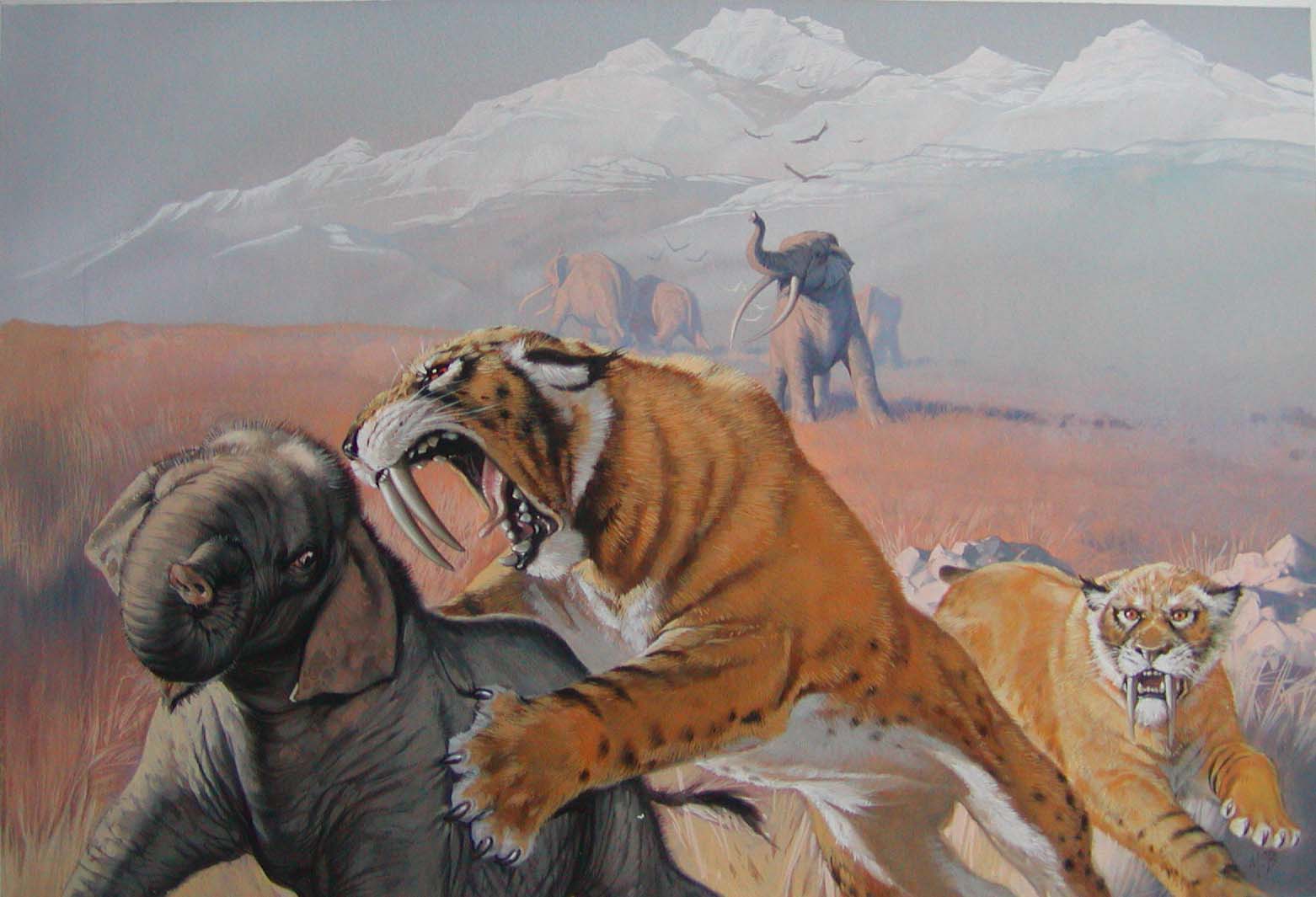
"Dumbo, caught obsessing about higher planetary CO2, did not leave any descendants"
INTRODUCTION
Much analysis and effort is being made in environmental science, ecological economics, energy analysis, and grassroots blogging (including and especially on theoildrum.com) to improve and refine data on our natural resource problem. But is "education" enough? Can reading Khebab's and Euan's posts about the upcoming peaking in world oil production push us to make forward thinking policy choices while we are still buying $2 gasoline? Would a report raising the value of the Amazon basins ecosystem services from $1 trillion to $10 trillion make a difference to those who read it? Why or why not?The understanding and application of behavioral economics and evolutionary psychology will play an integral role in the battle with the two-headed monster Peak Oil / Climate Change. This first of several 'demand related' posts will highlight our innate bias to place more weight on the present than the future via steep discount rates.
Before some definitions, lets start with an example.
AN INTERVIEW
Following the release of the initial segments of the recent IPCC report, I called a good friend to get his reaction. (After I told him I would post his responses, he requested anonymity – lets just call him Thomas)
Nate: What do you think about the IPCC report that came out today stating by the year 2100 global temperatures will rise between 3-7 degrees? And sea levels will rise by between 17-34 inches?Though the above conversation is of course only a sample size of one, it effectively highlights two prevalent evolutionary concepts that are related to environmental externalities and oil depletion. The first is the biological concept of inclusive fitness popularized by Richard Dawkins in "The Selfish Gene" and related to ecology in the famous "Tragedy of The Commons" by Garret Hardin. The interrelationship of individual selection and group selection in a world of declining resources and sink capacity will be covered in my next post. The interview also highlights how distant events seem not to intrude on ones daily thought process, until they become close enough in time to affect our normal routines. I assure you my friend Thomas is not losing sleep over Peak Oil or global warming.Thomas: I read "State of Fear" by Crichton – most of those scientists are just playing with models – they really have no idea how its all going to play out. Plus we are in a general warming trend anyways.
Nate: I disagree with that, but let's assume the scientists are right, even conservative, would you change your behaviours or view of the world.
Thomas: Dude that's 100 years from now. I'll be dead. My kids will be dead. Its someone else's problem.
Nate: Ok – what if instead of 17 inches, there would be a 17 foot sea rise by 2100?
Thomas: Well, I'll still be dead and it will still be someone else's problem. Though I imagine the world would be a wild place were that to happen. That's alot of water.
Nate: Ok – what if instead of 2100, the 17 foot sea level rise would happen by 2050, maybe not in your lifetime but definitely in your childrens? And what about their children?
Thomas: It depends if it happened all at once or was gradual. If it was all at once, I'd either be prepared or deal with the consequences. I'd certainly tell my boys to buy land inland Oregon and California around 2045 though. Still - a long way off for me to worry about it.
Nate: Ok – imagine that it happened in 2015 – a 21 foot sea level rise.
Thomas: Dude – you do realize that Dennis Quaid movie was fiction right?
Nate: I know – just hypothetically
Thomas: Well, I'd probably move pretty soon from New York somewhere to the Rockies. I'd start moving my retirement assets out of stocks and into bonds because 17 feet is going to cause a hell of a recession, not to mention global upheaval. I wouldn't change my job or anything but probably would prepare my children a little better to face a chaotic world. Would everyone know it was going to happen or just me?
Nate: Ok what if the Greenland ice sheet melted this summer and there was a 17 feet sea level rise this August?
Thomas: Well now you're getting plain nutty. But if that happened, I'd liquidate all of my investments, take my wife and kids on some expensive trips to Africa and other places that might be changed forever, then hunker down. Probably get stocked up Y2K like, just in case, and just enjoy life as best I could - what can I do anyways? These things all have a momentum of their own – nothing me or my family could do would make much of a difference. I like eating meat and I like my SUV. Nate you should work for Greenpeace or something.
THE EVOLUTION OF THE HUMAN BRAIN
"In the distant future I see open fields for far more important researches. Psychology will be based on a new foundation, that of the necessary acquirement of each mental power and capacity by gradation."Just a decade ago, an observant generalist could see cracks in the foundation of the standard social science model(SSSM) (and for that matter standard neoclassical economics). It is now apparent these models have fatal flaws and that we are in the liminal space defining what will supercede them. The SSSM posits that we are born a blank slate and during our lives culture infuses us with our language, instincts and behaviours. We now know that we have been shaped through millions and millions of years of mutation, migration, genetic drift and natural selection and that we are not born a blank slate but a creature optimized for activities leading to resource acquisition and reproduction. Culture is very important, but it is the mortar, not the bricks. Nature and nurture are inseparable, and both play a role. But we unequivocally posess genetic leashes - some are long (what do I want to eat for lunch?) and some are short (if Jennifer Garner kisses me, I will like it.). This post will attempt to go beyond economics and psychology and first look at why we so strongly value the present, an answer found in biology, Darwinian ecology and evolutionary psychology.
-- Charles Darwin, The Origin of Species, 1859
In "The Adapted Mind", Leda Cosmides lays out 5 core principles of Evolutionary Psychology:
1. The brain is a physical system. It functions as a computer. Its circuits are designed to generate behavior that is appropriate to the environmental circumstances.2. Our neural circuits were designed by natural selection to solve problems that our ancestors faced during our evolutionary history.
3. Consciousness is just the tip of the iceberg; most of what goes on in your mind is hidden from you. As a result your conscious mind can mislead you into thinking that our circuitry is simpler than it really is. Most problems that you experience as easy to solve are actually very difficult to solve-they require very complicated neural circuitry.
4. Different neural circuits are designed for solving different adaptive problems.
5. (and the famous one) Our modern skulls house a stone age mind.
Though the revolution started with Darwin, the last decade is making large strides in explaining who and what we are as humans. There are still some periods with missing links, but from the small mammals that survived the Chicxulub meteor sequence 65 million years ago, through Proconsul 20 million years ago, to the chimp/human split over 5 million years ago, the compounding of slight changes that improved mating, reproduction, and survival of offspring success have honed us into the most successful species on the planet (by some measures in any case). I'm not sure what is more amazing, the fact that we evolved from proconsul, or that we have managed to figure out we evolved from proconsul.

The ancient civilizations of our history books are only 5000 years old, a time period of 1/5th of 1% of the time since our ancestors first sharpened stones (2.5 million years ago). Genetic data suggest that our species was once as endangered as the mountain gorilla today (Stringer/Mckee). At that bottleneck and others, what stood between human extinction and the 6.5 billion of us today? What behaviours were selected for and selected against? Everyone reading this post today is descended from the survivors of that and subsequent periods.
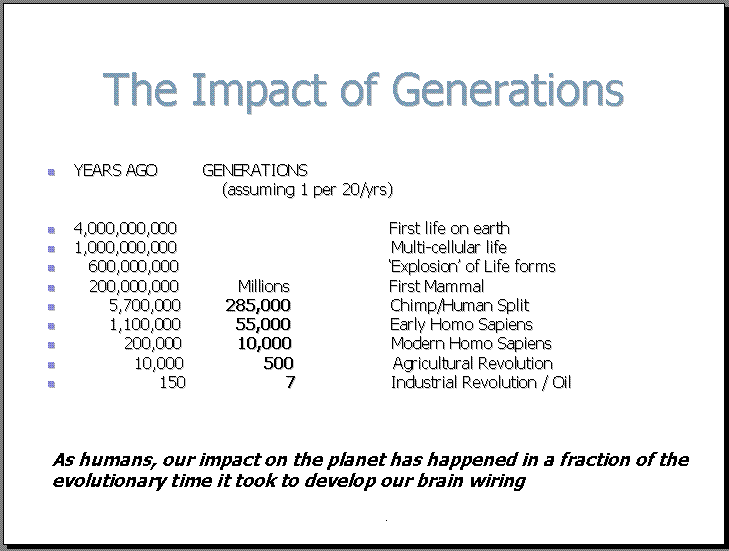
The relentless progress of brain and behaviour
"The human brain bears the stamp of 400 million years of trial and error, traceable by fossils and molecular homology in nearly unbroken sequence from fish to amphibian to reptile to primitive mammal to our immediate primate forerunners. In the final step the brain was catapulted to a radically new level, equipped for language and culture. Because of its ancient pedigree, however, it could not be planted like a new computer into an empty cranial space. The old brain had been assembled there as a vehicle of instinct, and remained vital from one heartbeat to the next as new parts were added. The new brain had to be jury-rigged in steps within and around the old brain. Otherwise the organism could not have survived generation to generation. The result was human nature: genius animated with animal craftiness and emotion, combining the passion of politics and art with rationality, to create a new instrument of survival". E.O. Wilson - "Consilience"We actually have 3 overlapping 'brains' within one (termed the Triune brain, shown below). About 1,000,000,000 years ago, multicellular life started to form on the planet. Simple 'brains' that responded by moving towards or away from stimuli gradually evolved into more and more complex forms until they reached the stage of reptiles and amphibians, about 600 million years ago. Since the brain never sleeps, each subsequent mutation or new species added incremental layers (through the 4 mechanisms of natural selection) on top of what existed before it. The 'reptilian' or primitive part of the brain controls basic instinctual survival behaviour and thinking. It is here that our 'board of directors' reacts to fight or flight stimuli, without us consciously being aware of it. (Indeed, research by Benjamin Libet has shown that our decisions are made 500 milliseconds (1/2 second) before we are consciously aware of them. "Culture" presumably has the remaining 400 milliseconds to veto the decision since we need 1/10 of a second to process the behaviour). With the eventual arrival of what we now call mammals 200 million years ago, new structures had been 'added on' to brains - the amygdyla, the hippocampus and hypothalumus. With the emergence of this mammalian brain (also called the limbic system) organisms showed emotion, memory and feelings that led to associated behavioral response patterns. Finally, in the higher mammals, apes and humans, the neo (or new) cortex developed. This is where 'rational' thoughts are integrated and processed. This brain region controls higher order functions like reason, speech, oil decline rates and debt-to-GDP ratios. But human emotional response patterns depend on the neural pathways that link the right hemisphere of the neo-cortex to the mammalian brain which in turn links lower down to the reptilian brain -a map of our past if you will.
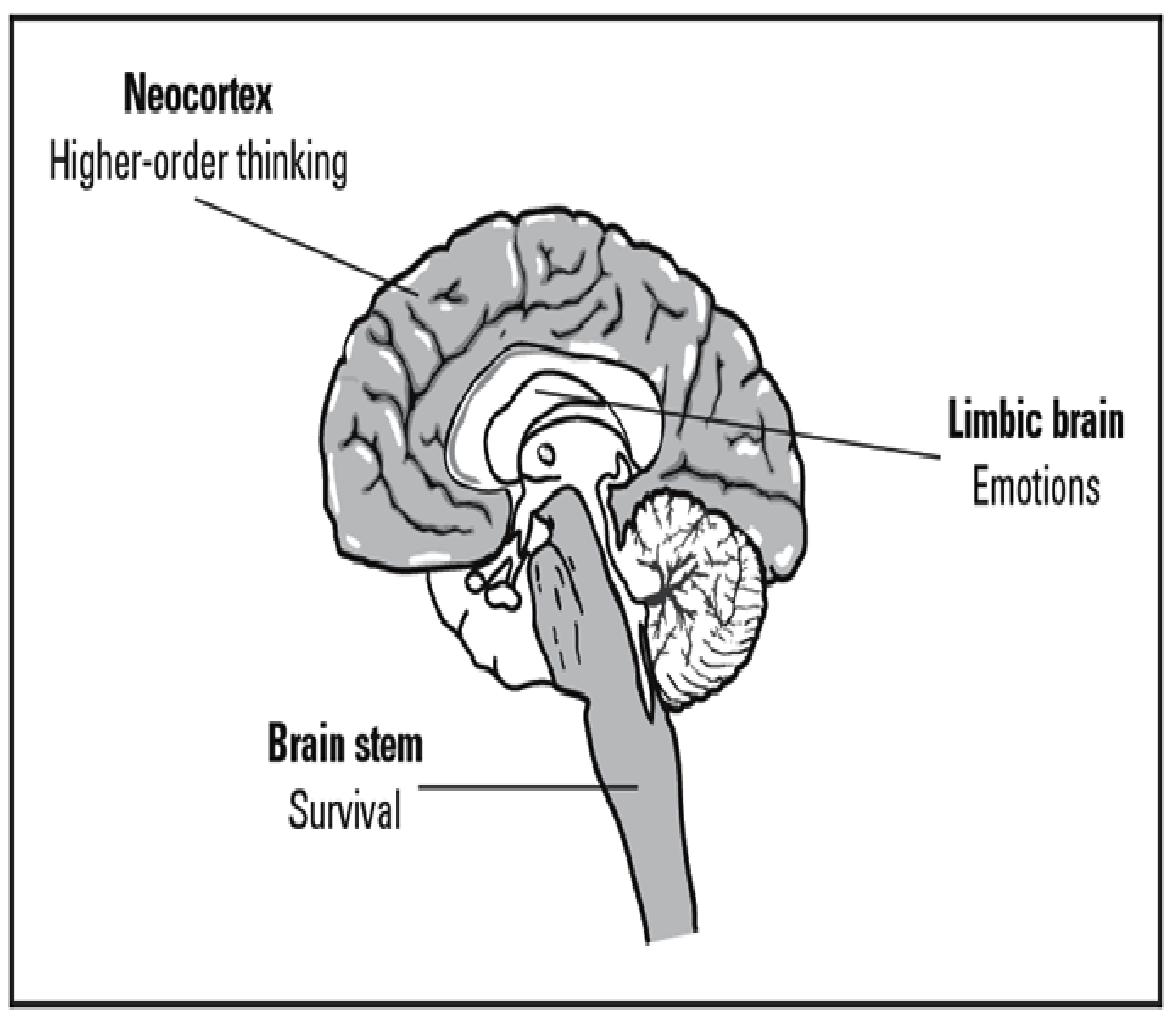
The Triune Brain (Mclean 1959)
THE MECHANISM
The mechanism between brain and behaviour is the pursuit of a similar mixture of neurotransmitters that allowed our ancestors reproductive success in periods of privation. Dopamine, a core neurotransmitter plays an integral role in our short term desires. If you've ever bought a pair of shoes you'd been wanting for 6 months or hit three 7s on a slot machine, or been the first customer at a Starbucks when they opened, you know what dopamine activation feels like. A relevant medical story has been in the news of late. Parkinsons disease results from not enough dopamine in certain areas of the brain - a drug Mirapex is given to Parkinsons patients that increases dopaminergic activity. In the last few years however, dozens of Mirapex patients have checked in to Mayo Clinic with bizarre symptoms - church pastors were having extramarital affairs, normallly conservative people became compulsive gamblers - one person lost $100,000 gambling in a very short time. Apparently, it is not easy to find the right dosage of Mirapex and many of these patients were now receiving too much dopamine.
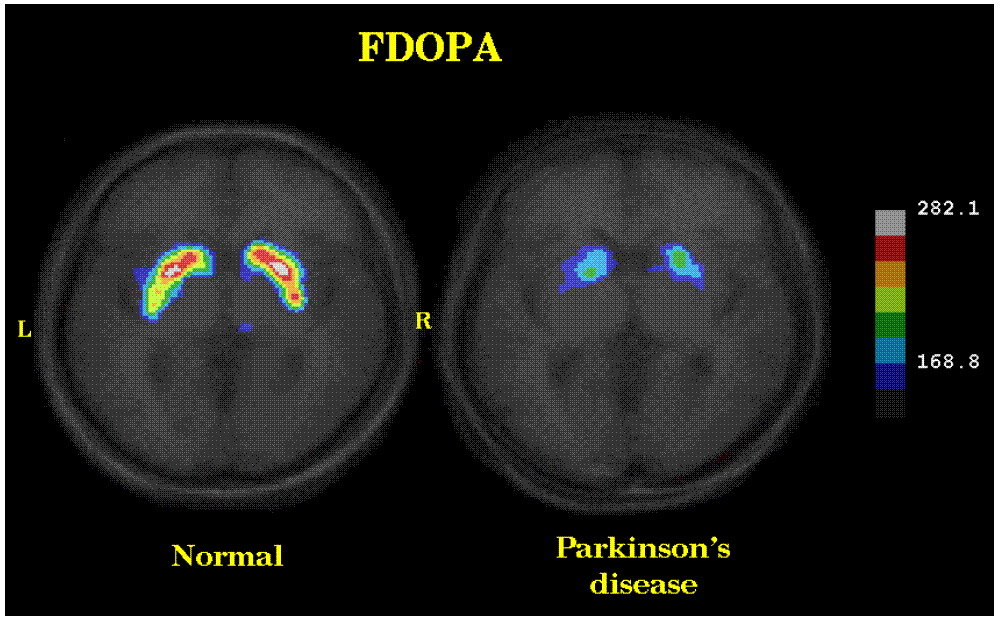
Functional MRI showing dopamine activation in normal patient vs Parkinsons patient
This is concerning, considering Dr. Peter Whybrow, one of my thesis advisors, and the author of American Mania, suggests Americans, due partially to a genetic bottleneck favoring ambitious migrants, and leveraged by our frenetic culture are becoming 'dopamaniacs'. The dopaminergic system is clearly is one of the drivers of our short term behavior. In short, more dopamine craving means less concern about Peak Oil and hard to imagine environmental problems (e.g. climate change).
(**EDIT - This mechanism is explored in greater detail in Status and Curiousity - On the Origins of Oil Addiction)
MALADAPTATION?
Our culture presents a smorgasbord of options that allow us to 'feel' like our ancestors did when they were successful. Neuroscientist Robert Sapolsky likens the physiology of two grand master chess players to a marathon runner - the body is experiencing the same neurotransmitters (presumably, they did not have chess back on the Pleistoscene). Many of the options available to us that engage our neurotransmitters are maladaptive. Pornography, fast food, arcade games, lottery tickets, etc. all give us feelings identical to those our ancestors were good at pursuing. But now they often trick our brains into thinking they too will lead to evolutionary success.
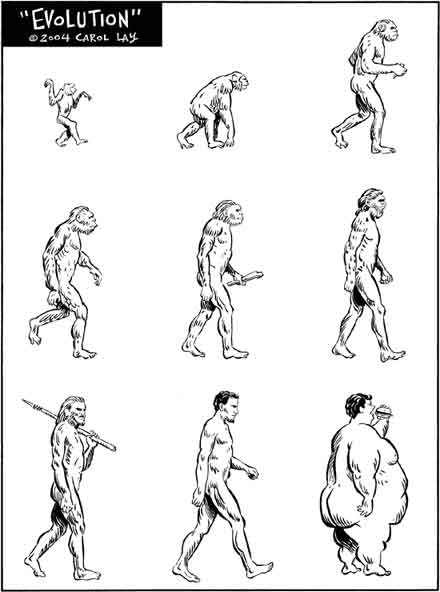
Cultural Options - Maladaptation?
SO WHAT IS A DISCOUNT RATE?
Everyone is familiar with the 'discount rate' in the financial markets. It's the rate that the Federal Reserve charges its member banks. Its also the rate that a stock analyst might use to handicap a companies future earnings stream back to the present. Imagine a company whose entire business plan is to sell a product in 10 years – say at the Olympics – they make no money until then but a lot of money in that one year, say $100 million. How much would investors pay for this company? Certainly something less than $100 mil, as that money wont come for 10 years. They would determine what the risk was of actually getting that $100 mil 10 years hence, then determine what an appropriate rate of return would be, say 15% per year. Discounted at 15% per year, $100 mil is $24.75 mil- that is what they should be willing to pay if they want to earn 15% on the project. So in this example, the discount RATE is 15% and the discount FACTOR is 24.75%, or how much something in the future is worth today. The higher a discount rate and/or the longer the time frame, the lower the discount factor will be. A discount rate approaching 1 means things in the future have no value at all in the present moment. A discount rate of zero means that $1 dollar in 2050 is worth $1 today.
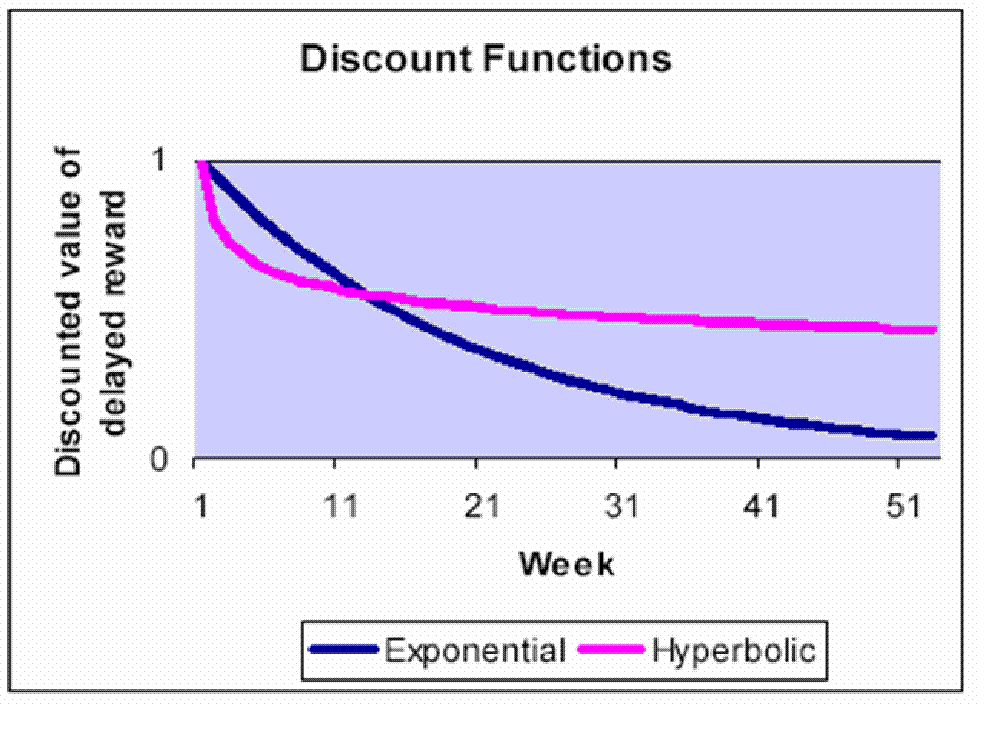
The Human Hyperbolic Discount Rate
The original neoclassical assumption was that the discount rate curve was exponential, meaning that we discounted the same from period to period. Actual economic experiments however show that the shape of the discount curve is hyperbolic, or as Harvard economist David Laibson prefers quasi-hyperbolic. This means that the early periods have much steeper discount rates than later periods. Laibsons research indicates that peoples discount rates are 12% during days 0-5 but drop to 4% in days 20-25. We REALLY prefer the present.
Animals (and humans) have their own internal discount rates exogenous from the market on how they choose between the short term and longer term options offered them in life. Since many animals have short lifespans, they have been shaped through evolution to gather resources and reproduce quickly before they die (this is not a conscious motive – they innately pursue behaviours that were historically successful). Different species have different discount rates, though all are steep, much steeper than our financial systems rates. If you leave for the weekend and give your goldfish 3 days of food at once, you will probably return to a dead bloated goldfish - they have discount factors close to zero and discount rates close to one. One reason humans discount rates arent quite as steep is probably due to our sunk costs. If we didn't have mortgage payments and college funds for our kids, our discount rates might even be steeper. The origins of this behavior are quite logical – animals that deferred opportunities to eat, might come back and find their food stolen, or they might have been eaten themselves in the interim – the long arm of selection would have favored organisms that valued immediacy over those who preferred to wait. The way they were 'favored' is via the incremental crafting of biological neurotransmitter response pathways.

Humans care more about Peak Oil than rats or pigeons
Researchers on animals and humans measure discount rates using the following technique. They offer a small short term reward (SS) as well as a larger long term reward (LL) with differing time delays depending on the experiment. To calculate the discount rate they repeat the experiment until the subject is indifferent between the 2 choices – based on how large the future reward must be, they can compute a discount rate and discount factor, similar to the business example above. With animals, the discount rate tests are almost always food, while with humans they are often money or drugs (e.g cocaine addicts). A recent study on two different monkey species suggests an ecological basis for differing discount rates. Two monkey species, similar genetically and in habitat but differing in diet were studied using food rewards. One species was a gummivore - it scratched on trees and waited for the sap to ooze out which was its main food source. The other species was an opportunistic insectivore, grabbing whatever insect it would see and could catch. As hypothesized, the monkey whose feeding behaviour had evolved to require patience had lower discount rates than the other species in laboratory tests. How cool is that?
A famous study from the 1970s showed that children who were able to effectively delay short term gratification (getting 2 marshmallows if they waited instead of 1 marshmallow if they didn't), correlated with better outcomes much later in life, such as academic and social competence. New York Times columnist David Brooks has cited this study and inferred that most social problems are rooted in an inability to defer gratification. He argues that for people with poor self-control "life is a parade of foolish decisions: teen pregnancy, drugs, gambling, truancy and crime."
NEURO-ECONOMICS
Neuro-economics is a rapidly expanding field that combines traditional economics experiments with fMRI or PET scans. Economist David Laibson has made an amazing observation. During economic games, subjects who choose the LL (larger long term reward) had their prefrontal cortex activated. Those who chose the smaller short term rewards showed neural activity in the limbic system, or emotional mammalian brain.
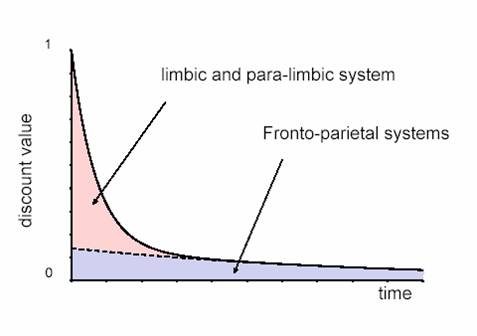
The discount rate measured by the two different active neural regions
This graph shows that humans in effect have 2 discount rates. The blue line shows our 'thinking' discount rate whereas the steeper red line shows our emotional discount rate. This is clearly suggestive that we make decisions in different parts of our brain. It also proves (not that we needed proof) that emotions have the ability to trump reason.
DISCOUNT RATE STUDIES
Some people balk at evolutionary psychology because they feel it is deterministic and doesn't apply in all situations. I agree. However it does give an accurate general template for how people interact with eachother and the world. If I say that 'men are taller than women', that doesnt mean that ALL men are taller than ALL women, just that on average this is the case. (Not the case on TOD staff, fyi). I have shown that our evolutionary origins tilt us towards valuing the present more than the future. Not as much as lower animals, but much more than purely 'rational' beings. The table below shows some research results suggesting certain demographics of society have even steeper discount rates than others. Specifically, those who smoke, do heroine or cocaine, gamble, are mentally ill, consume alcohol, or are young. Of import is studies on cocaine addicts show that not only do they discount cocaine steeply versus the future - but they discount other things as well. In other words, if you have are addicted to something, you tend to value the present more than the future in other areas of life too.
Not on the table is a study by anthropologists Wilson and Daly showing that when shown a pretty female face versus an average one (activating the limbic system) men's discount rates increase and they subsequently make irrational monetary decisions. Women, by contrast, made equally rational decisions whether they had been shown pictures of handsome men or those of average attractiveness. (7) Somehow I believe this study.
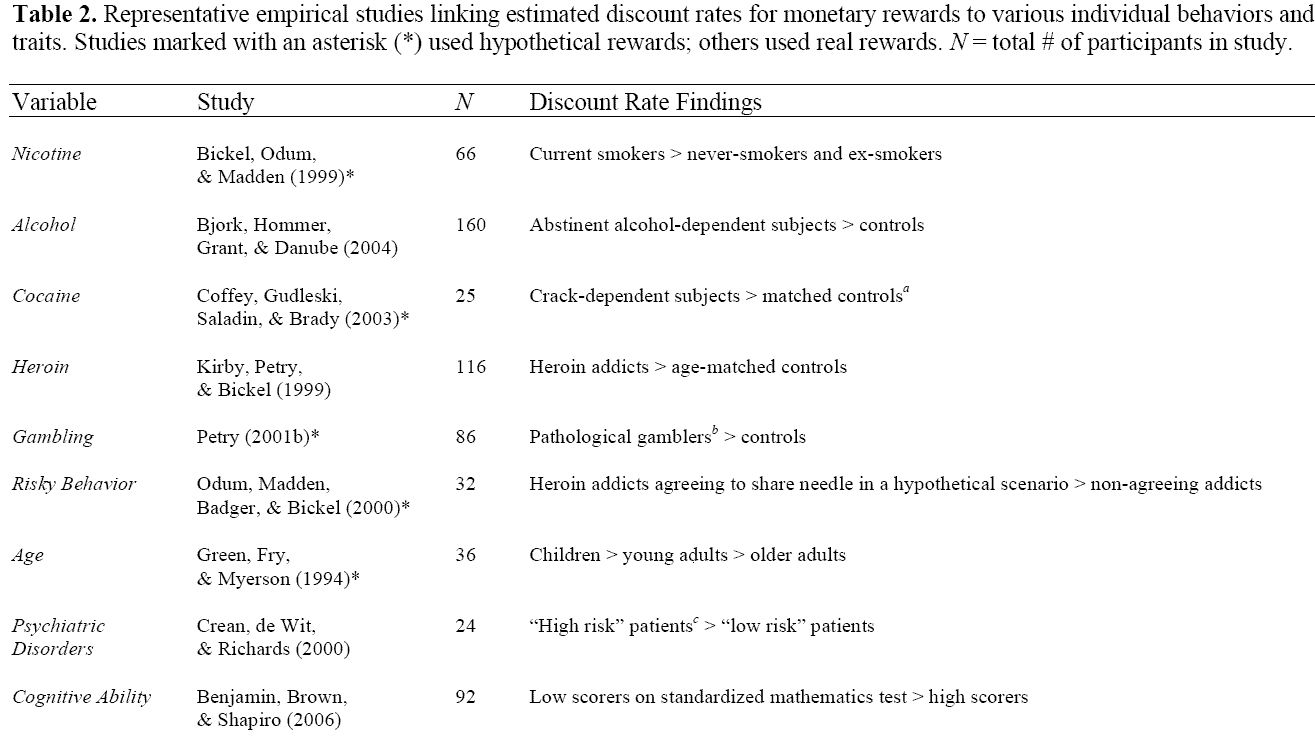
DISCOUNT RATE STUDIES (2)
Increasing research in the side fields of economics is painting a clearer picture of our tendency to value the present. Anecdotally, I originally promised Professor Goose I'd write this piece a month ago, but perhaps since I'm single, male, drink wine and coffee, play poker on the internet, and have been called 'crazy' by some of my friends, I wrote the entire post in the last 24 hours. Its a good thing I don't smoke or do cocaine or it would never have gotten written. However, since I am aware of my own steep discount rates (also called procrastination in favor of other more fun and intersting things), I devised a solution. I decided to consciously email the entire TOD staff and alert them this post was in the queue this week. In effect I made a social contract and would have suffered embarrassment that I let the team down if I blew it off. More research in this area is necessary - social contracts may provide solutions for a society driving towards a cliff but addicted to driving.
THE FUTURE EATERS
Australian biologist Tim Flannery has called the human species "The Future Eaters". Indeed, paleo-anthropology suggests many historical societies collapsed due to resource depletion even though they must have been aware of it. The example made famous by Jared Diamond is 'what was that Easter Islander thinking that chopped down the last tree'? The best documented recent mass extinctions of flightless birds and other large mammals from New Zealand and Madagascar show that humans were to blame. Though Neandertals and early Homo Sapiens did hunt game without hunting it out, upper Paleolithic hunters were more numerous and better equipped for mass slaughter - 100,000 horses killed at one site, a thousand mammoths at another. Given the millions of years of shaping of our neural circuitry, it is hard to imagine that our mental structure has changed that much in the last few thousand years. Indeed, for those who are not high on the oil subsidy banquet and need food stamps to survive, scientists have shown a 10-15% decline in caloric intake during the month, implying a steep discount rate exists when food is the primary concern.(1)
WHAT THE HECK DOES THIS HAVE TO DO WITH CLIMATE CHANGE AND PEAK OIL?
If you're still with me, Im impressed, as the above diagrams and verbage are quite disparate. Yet so is our situation. Environmental icon Gus Speth, in "Red Sky at Morning" laments that the single biggest failing of his generation of environmentalists was that they just 'talked'. We have tens of thousands of well intentioned environmentally minded scientists and activists in this country and others. I pose no answers in this post, because I don't have them. But I am certain that a fusion of the brain sciences and evolutionary biology into the environmental and energy discussions will be a large step forward.
Ultimately we are after impact. If we spend 99% of our efforts on educating people on the facts of energy depletion, yet nothing happens, perhaps it would be better to spend 50% of our efforts on education but 50% by example. For instance, researchers attempted to persuade young students not to litter either by teaching them about ecology and pollution or by telling them they were neat and tidy compared to other students -only the latter had a positive effect.(4) E.O Wilson suggests "A stiffer dose of biological realism is in order..The only way to make a conservation ethic work is to ground it in ultimately selfish reasoning. An essential component of this formula is the principle that people will conserve land and species fiercely if they forsee a material gain for themselves their kin or their tribe." All of our past environmental successes (DDT, Ozone depletion, unleaded gasoline, etc.) had some sort of smoking gun - an emotional trigger. The problem with climate change/peak oil, is when we do get the emotional trigger, it may be a gatling gun on full bore and all the benign mitigation possibilities will be superceded by immediate needs.
THE BOTTOM LINE
1. Education about oil depletion and future environmental exernalities is not enough. We need to incorporate how people react to information. If companies like Daimler Chrysler are using neuromarketing to sell more cars, an equal effort needs to be made on the environmental and energy front.
2. The potential negatives of two of the planets largest problems - climate change and energy decline - lie in the future. As such, our aggregate evolutionary derived penchant to focus on the present lacks the discipline to think and act ahead. Either accelerating the expected 'bad news' or making the expected bad news 'worse' are both ways to increase the weight we place on these events.
3. We can't easily reduce our discount rates. But having a team of middle aged female monks running the Energy Information Agency may not be a bad idea (I'm only half kidding).
4. There are many scientific disciplines running parallel courses. Somehow we need to integrate them into a logical framework that makes sense and is practical. I don't expect President Bush will soon appoint a Secretary of Darwinian Ecology but the time is now to combine the sciences.
5a. Though it's difficult, we can learn from our mistakes. Those on Easter Island, Rome and the Mayas and Aztecs were neurally not dissimilar from us. To recognize they valued the present even when they could forsee the future (cutting down the last tree) means we have to acknowledge ahead of time that our intelligence will be trumped by our emotion, and plan accordingly.
5b. In writing this post, it dawned on me that much of the work we do in raising peak oil awareness is received by readers as kind of an interesting horror movie. Yes - tell me more scary facts and I will sit at my computer and read them. But its the rational brain that is receiving this information. And its not budging behavior much.
5c. Understanding that stress increases peoples discount rates suggests to me that the events surrounding peak oil, financial overshoot, and perhaps climate change will reach an inflection point. We need to hit the emotional triggers well ahead of peak oil. Once people are stressed and things become difficult, accessing peoples rational minds will be all the harder. Plus, greater awareness of resource depletion might trigger increased consumption, as people try to get their share.
6. I think steep discount rate is another term for addiction. Humans are addicted to life. Some more than others.
7. Have we, as a culture, lost the ability to wait for the second marshmallow?
REFERENCES
1. "Is There a Daily Discount Rate? Evidence from the Food Stamp Nutrition Cycle"(pdf), Shapiro, Jesse, et al, Harvard, November 2003
2. "Intertemporal Choice" (pdf) Chabris et Al, The New Palgrave Dictionary of Economics 2007 (to be published)
3. "The Ecology and Evolution of Patience in Two New World Monkeys"(pdf) Stevens et Al,
4. "The Evolutionary Roots of Our Environmental Problems: Towards a Darwinian Ecology" Penn, Dustin, The Quarterly Review of Biology Sep 2003 Volume 78 No 3.
5. "Separate Neural Systems Value Immediate and Delayed Monetary Rewards", Mclure, Laibson, et al SCIENCE Vol 306Oct 2004
6. "Why Be Nice? Psychological Constraints on The Evolution of Cooperation" Stevens et al TRENDS in Cognitive Sciences Feb 2005
7. "Do Pretty Women Inspire Men to Devalue the Future?" Wilson, M, Daly, M. Biology Letters May 2004
Nathan John Hagens
The University of Vermont
www.theoildrum.com
email thelastsasquatch@yahoo.com
Contact
- Content: editors at theoildrum dot com
- Tech support: support at theoildrum dot com
License

This work is licensed under a Creative Commons Attribution-Share Alike 3.0 United States License.
If all biological nature is driven by Darwinian evolution and brain chemicals then what higher purpose could there be than obeying one's selfish genes? My serious reaction to reading all this stuff about Darwinism and brain chemistry is that it makes me want to have lots of children. To me, this article says that not having children just means that I'm either genetically defective or my brain has been "infected" with unhelpful memes.
There is a subtle but important distinction. Doing the things that met with evolutionary success may or may not lead to success in our current, resource constrained generation. Getting monetary assets to move up on the mating/resource ladder gives us the neurotransmitter mix that makes us 'feel good'. We have to recognize that we seek this 'feeling good', but that the cultural metric is flawed. In this sense, our brains (hardware) have been infected with the wrong program (software) on a planet full of desirous people.
But youre right - it ultimately gets down to the meaning of life, and how one spends his/her time. Writing this article is a prime example - I will not have children - I consciously know this. I also have a girlfriend, enough money, etc. I spend my time on this because it 'feels' like the right thing to do. Is this maladaptive? Im not certain, but I do know that the more people that are aware of our evolutionary derived tendencies, the more likely we can access the rational aspects of behaviour that we will need to defer consumption.
Really good article Nate!
It's a profound dilemma...
Those people with less steep discount rates, and who are more capable of modifying their behaviour as a result of rational realisations are also those who tend to sacrifice themselves for the 'greater good' (by for example, not having children).
If there is a strong genetic component to discounting, this leaves the remaining population with progressively steeper discount rates, and thus less able to deal with the problems they face.
Beware with this evolutionary reasoning. Selection also happens on the level of the group, otherwise every trace of altruism would long have been eradicated from the gene pool.
Its still up for debate whether multilevel selection occured, though biologists now are developing (for monetary gain) cooperative shrimp, cooperative chickens, etc. that when raised in tight quarters do better (in total weight) than the 'selfish chickens'. Mike Wade and David Sloan Wilson are writing on this topic.
But altruism (in the truest sociobiologic sense termed reciprocal altruism), fits very well within a selfish gene framework of a social species. People 'do' altruistic acts, especially small ones, because their mind does not immediately do the payoff calculus, but in ancient times, living in small communities where everyone knew one another, helping, sharing and playing tit-for-tat had evolutionary advantages -so that altruism was a form of cooperation that had mutual benefits.
The modern world where people can pick up and move half a continent away and start over, sometimes short-circuits these altruistic tendencies, as oil at 18 cents a cup allows alot more people to 'cheat' this neural system designed for social give and take.
Though I dont want to derail this thread with a long debate with Ron Patterson ...;), I actually agree with you - that we did have historical bottlenecks where group selection was active - but still with individual selection at the core of long term evolution. But the majority of modern biologists, after George Williams blasted VC Lynne Edwards group selection hypotheses out of the water 30 years ago- conclusively do not believe in group selection (though it is making a comeback.)
I also think that genetic fitness is not only determined by the effects the genes have on their bearer, but also the possible offspring that they generate. In other words, the quality of the offspring is also a relevant factor in the selective pressures. A "perfect" genome is a lot less useful if a few slight mutations/interbreedings reduce the genebearers to crippled wrecks a generation or two hence. So there is more to the picture than meets the eye: a lot of influences are influencing natural selection, and we most likely don't know them all.
Applied to altruism, that could mean that completely selfish bastards are evolutionary maladapted: if they outcompete the others, a population will turn into selfish bastards in a few generations. Obviously, these will do badly since they used to be dependent on others for most of their resources. So moderate bastards might do better in the longer term since the next generation would have a better balance of selfish/altruistic individuals.
To think that one obeys one's selfish genes is to misunderstand what a selfish gene is. They don't give orders to phenomenes in real time, and no one suggests that they are even aware of the phenomene that carries them. Secondly, you could think of your brain as "infected" by unhelpful memes but this too is a distortion of the concept of a meme. Memes are neither helpful nor harmful to genes in a direct fashion. Assuming one accepts the concept of a meme, then their operational impact is through the phenomene, and so their operational impacts are concluded in total unawareness of a gene. There is also nothing contradictory about the operation of a meme, even if it generated your feelings of not wanting children, and the functioning of your genes. What it perhaps does illustrate is your awakening political awareness that all is not right in the world in a broad sense including both the ecological and political spectrums.
And yet, who cares?
To paraphrase Steven Pinker, your genes can go jump in a lake, if they don't like your plans.
Actually, the situation only gets me to be all the more glad I never had kids. After all, who would want to have kids in an environment where they will be worse off than any of us are in now? Why have kids when our government policy is to overpopulate the place by unbridled immigration? We have essentially outsourced child birth! Were it not for the 1965 immigration law change, our population would have stabilised around 230,000,000. But no, it's topping 300,000,000 and climbing like a jet plane on steroids. Any wonder housing is unaffordable?
Had that law not been made, we would have just for starters a lot less of an oil pinch like we have now. We would still be around the oil peak but not yet having gasoline at $4/gallon - with a hurricane threat of WAY higher prices at that pump.
Second, housing costs would not be orbital. Forget mere stratospheric! I mean 6-digit prices for studio condos just to start.
Petrol prices high enough yet? Just wait!
Nate, great piece!
The great mass of humanity isn't smart enough to either understand this information or to devote enough time to actually change. Its the flaw of our republic, and most of the rest of the world that the leaders respond to what their constituency wants to hear, not what is best for them. And, since I believe we are definitely in population overshoot, the conclusions and proper actions will be unpaletable to say the least.
I'd like to think I'm a rational person, but a cold, hard look at my own behaviour shows me I'm a master at ex post facto reasoning and justification. And, I'm a recovering addict and alcoholic to boot, male, and a smoker addicted to the worst form of compulsive gambling-oil and gas exploration. My discount rate is off a cliff!
I don't have a good answer for adjusting to peak oil. I'm preparing my home, trying to get more oil and gas income based on production, and trying to get totally out of debt. I think WT's ELP program makes the most sense. But, if I get totally off the grid and my neighbors have nothing, will I get killed? If I predict peak oil and educate my neighbors, will I suffer the fate of Cassandra? Sometimes its worse being right than stupid.
Re oilmanbob:
I dont believe that 'the great mass of humanity' is getting this information so their intelligence is irrelevant.
I dont believe that our current administration is 'responding to what their constituenccy wants to hear.' If they were then why did my congressman stop answering my letters and why are both parties ignoring the results of the 06 elections?
I dont believe that 'most of the rest of world leaders are responding to what their constituencies want to hear.' Many of them are tyrannical dictatorships that loose the cops and/or the army on any sort of demonstration by their 'constituents' who are attempting to register their opinions, usually about the basest necessities of life.
I do believe that the world is in a state of population overshoot and the outcome has been predicted by many that are much more qualified than myself. Gaia will work it out.
I would like to think that I am a rational person but if I were I would not have bothered to write letters to a congressman. So far my only solution to peak oil has been to keep about sixty gallons stashed in the shed behind my house...thats not rational either for I live in the lightning capital of the US and might get blown to smithereens at any time. My only other preparation has been to stash ten large jars of Jif peanut butter and a bunch of crackers which are still edible even when stale.
By the time my gas and Jif run out I feel sure that FEMA will have come riding into town to my rescue.
River, I think intelligence and education have a lot to do with perception. It may sound elitest, but the people who write on theoildrum and read the blog are definitely members of the elite of the western world. I live in a very mixed urban neighborhood on Galveston Island. Believe me, most of my neighbors don't care-they don't vote. They're concerned with where to get money for the rent, what to eat and whats on the tube. They've allowed the glowing phosphors to lull them and dull them. They don't read, don't participate in community activities.
And its probably worse for the great mass of humanity. The illegal aliens that come to Galveston are the best people of Central and South America. They're ambitious, and willing to do any kind of work and send money home to their families saved from the pittance they've made. Same way with the illegal Africans and Asians in Houston-but they are totally disenfranchised. And its worse in their own countries.
In my opinion the US electoral system is totally screwed. The elections in 2000 and 2004 were stolen, and all the incumbents in 2006 thought they had the system wired so that they wouldn't loose, both republicrats and demicans. But the thing to remember is most of my neighbors did not vote. And they lacked the cojones to get in the streets when the elections were stolen. But, the most important thing to remember is nearly half of the people that voted in the last two elections supported the megalomaniacs in in office! They actually passed an amendment to the state constitution to prohibit gay marriage, which is purely irrelevant. I mean really, I'm a lot more concerned about my sex life than anyone elses.
I quoted Confucious in a comment down the thread because I think its important. We stand at the apex of a pyramid of altruism. The sum total of good in this world is the result of millions of our ancestors trying to be good. The sum total of knowledge, of improvement, of kindness and love exist because of other people trying their best to be better, to do better. And the world has definitely improved-we've officially abolished slavery in the last 200 years, and except in totally collapsed societies most people live longer and eat better than ever before. And, its all a sum total of most of the people in the world trying to be good for thousands of years. And its what gives me hope for the future.
Sure, there are monsters, and many of them gravitate to positions of power. But there are also many saints, and not just religeous ones. Look at the example of Che', or Einstein, or Richard Dawkins, or even the editors here trying to get out the truth in a free debate without pay, or the millions of teachers trying to help children at low wages. I know the saints far outnumber the monsters.
Oilmanbob, I certainly agree with you about the posters on TOD being elitist but I have a difficult time understanding why the word 'elitist' has become a tag that has often been hung on those that want an education and want to continue learning throughout their life by those that would rather spend their time watching the tube or frittering away their life in some other wasteful manner. Of course most of us spend some time frittering but I am refering to those that spend the large majority of their time wastefully. I live in an older upper middle class neighborhood in Ormond Beach Florida. The majority of my neighbors have owned their homes over ten years and some like my wife and I over twenty years. In my neighborhood we are a fairly close knit group and I would say that most are aware of peak oil, global warming and the real condition of our economy. The local newspaper, Daytona News Journal, is a little left leaning but by reading the letters to the editor it is evident that few if any of the letter writers are aware of any of these issues. The letters are primarily about skyrocketing home taxes, skyrocketing insurance costs, and the occasional yay or nay comment about Iraq. Recently as gas prices have gone up their has been some complaints about that as well but the letter writers fail to do their homework prior to sounding off and it shows. I think it is fair to say that most of them are sleepwalking their way through life but if Simmons is right they might get a wake up call if gas lines suddenly appear. Most of them need a wake up call.
We have a lot of 'illegal aliens' in this area and they started out cutting fern and picking citrus and vegetables but have moved into the construction trades in the past few years. You are right, they are hard working and family oriented and I dont have any problem with them staying in America. My take on the matter is a bit different...I believe that President Polk stole their lands in what is now the Southwestern US but was originally part of Mexico...they are simply taking back what was stolen from them.
As a great newspaper man for the Baltimore Sun once said 'eventually Americans are going to get exactly the government they deserve.' I believe that he has been proven right. When the common term for Americans changed from 'citizen' to 'consumer' I knew we were in trouble. Politicians use hot button issues like gay marriage and abortion to get out the vote. I dont see any need for legislation that reaches into the citizens bedrooms if they are consenting adults. I dont see a need for government to tell a woman what she can do with her body or fetus. These issues are for the reactionary one issue voters. They go to the polls vote the way that their pastors advised them and then go directly back to the tube without considering the looming issues that are really going to effect their lives.
I dont have much hope for the future. We have a lot of bad eggs in politics and I see no chance for a real leader to get elected. If we enter another era like the great depression then perhaps a real leader might get elected. Our current administration has turned the good will of most of the world against us at a time when we face peak oil, global warming and economic meltdown. I believe that the best possible outcome that we can hope for is to avoid a nuclear holocaust and become something resembling a banana republic. Strong governments stand on three pillars: economic strength (being a lender nation instead of a debtor really helps), strong alliances won through fairness, honesty and diplomacy, and last...military strength. We are teetering on the pillar of military strength because our government was taken over by idealogues that set out to use American military power against any and all nations that opposed our American ideals. These American idealogues believe that they have the right of military intervention to topple any regime that does not go along with American economic dominance of their economies. This approach has convinced all world governments that do not have nuclear weapons that they better damn sure get some if they want to avoid an American invasion. Our American idealogues have a wrong headed approach and they have landed our country in the situation that we find ourselves.
I agree with you that their have been many shining lites throughout world history. I read a lot and enjoy everything from history to microbiology. I admire many men of the past in all fields and there are currently some very brilliant people at work in the world but unfortunately none are working in our government and we are being overtaken by events that seem larger than any or all of us. I certainly hope I am wrong for I have six grandchildren that I would like to see get a good education and enjoy a rewarding life.
River,
I've pondered a lot of the same questions. I don't see most of the folks as elitest, but as definitely part of the elite. Spiro T. Agnew's "pointy-headed intellectuals". The disparaging reference is quite intentional, because of the way that the great mass of people react to people who are intellegent-we threaten them.
Intelligence is distributed on a bell curve, and what is described by standard IQ tests seems to be pattern recognition and the speed of learning and thought. If you are fairly bright you think and learn at a greater speed, and that threatens the vast majority. But, since its described as a bell curve, its important for anyone who is smart to recognise that he or she is just as big a freak as a retarded person. The subjective result of being intellegent is the bright person thinks or emotes more quickly than others, and it may even be a type of mental aberation that is most commonly associated with other mental aberations like alcoholism or addiction, depression, bi-polar disorder, schizophrenia or creativity. It behooves all of us to have this humility.
At any rate, when a person has a peak oil epiphany they've made connections not available to the common mass-that oil depletes, that its totally necessary to our society, that we might not find a substitute as good-and this threatens the powers that be as well as the herd. Nobody wants radical change in their whole lifesyle, so they blame the bearers of the news. Global warming becomes the fault of the environmentalists, depletion is the fault of the peak oil cultists because we are pulling back the curtains that show the Wizard at the Machinery. This will really kick into action when the US reaches the anger stage of its greif over the demise of fossil fuels. Even the arch fiend George W. Bush said we are addicted to fossil fuels, and the recovery process will have a lot of similarities. Maybe we need a 12 step program for automobiles! We admitted we were powerless over gasoline and that our lives had become unmanageable...
Let's look at what happened to the Grecco-Roman civilisation and compare it to modern history. It was built on the backs of slaves captured in conquest, just as we use the 25,000 hours of work equivalent stored in a barrel of crude as our slaves. Their democracies were destroyed by the need for conquest to keep slaves coming, just as ours is by the need for oil and the militarism connected with it. And, when the conquest stagnated, the empire collapsed, just as ours is threatening to do. It was overwhelmed by oriental religeons and the nature of the elite changed. Christianity might very well do the same for us. Our founders were diests and atheists, and our new tyrants are christian right, just as Constantine converted to Catholicism.
I don't have an answer. Nearly half of the voters alligned themselves with the Neocons-and maybe 30% still do. The coup by the Supreme Court and crooks may be the last of free elections in America. We might be facing a population collapse and descent into barbarism. Or, universal education and communicatios advances may raise the great unwashed masses to a new Utopia.
Oilmanbob, I have thought about the problem that is created by the disparity of intelligence of people but this is one of those subjects that is almost never discussed. I believe that many intelligent people purposely 'dumb down' as a means of camoflage because they dont want to be seen as 'different' than whatever group they find themselves in. After all, to be different is usually a cause for one to be ostricized. These smart people have chosen to remain in the tribe over seeking knowledge that they dont have and sharing it with those in the tribe that really need it so that all can make informed decisions. I suppose that acting dumb to remain a member is a survival instinct but it also puts the entire tribe at risk. I think it is a better action to give the tribe the information that they need than to remain silent and humble. That is probably an altruistic view. I read 'The Bell Curve' a some years ago and found nothing in it particularly disturbing and then I was astounded at what an uproar that book caused in the population. I dont know if the information contained in that book was all accurate but I supposed that it was since it was written by people knowledgeable in their fields. In any case, there are very smart people of all ethnicities and some not so smart. I remember as a child hearing the preamble to our constitution for the first time and even at that early age there was something about it that did not ring true. Later in life I realized that it was the line 'that all men are created equal.' I didnt buy that as a child and I dont buy it now. A person with intelligence and armed with knowledge in a modern society is not equal to one without those assets. One of my favorite scientists and writers is Sir Fred Hoyle (unfortunately he is no longer with us). Mr Hoyle was sort of a maverick but well educated in Physics, Astronomy, Genetics and Microbiology ..
an all around curious type of person, he was. Mr Hoyle was one of the formulators of the 'steady state' theory of the universe when the 'big bang' theory was being embraced by most scientists in the field. Mr Hoyle wrote many books but one of the most interesting was 'The Intelligent Universe', in which he took on Darwinisim. Its difficult to summarize such a book but basically Mr. Hoyle thought that evolution was caused by the earths constant bombardment by microrganisms that can do everything from give us a common cold to causing great leaps in evolution. Not only that, Mr. Hoyle after a lifetime of study, stated that their was no way that life originated on earth and that the enzymes in our cells are far too complicated to have arisen by chance (he likened the odds at a nine followed by forty pages of zeros to one)...he claimed that an intelligence must have been behind the complicated objects that are cells and the very complex structures within them. Mr. Hoyle also advised back in 1955 that the earth had finite resources and that once they are used up that no other society following us would have the resources to accomplish what we have. I would say that was pretty good reckoning for 1955. Mr hoyle also believed that in some cases disease was beneficial for it had occasionally turned ordinary students into extrodinary scientists. I am glad that Mr Hoyle chose not to be humble because he has given me much to ponder even if I dont agree with him on all that he said. I feel sure that is what he intended to do, make us think.
My wife and I recently watched an interesting documentary on Link TV. It was titled 'Who Killed The Electic Car.' It was a murder mystery that was solved during the course of the documentary. My first guess prior to seeing the show was 'big oil', turns out I was wrong. The electic cars were on the road for about ten years and they never needed anything. It turned out that the auto manufactures were the culprits for the electric car would have destroyed their business model...dealerships and the repair trade. Worth the watch if you have the opportunity. BTW, they were loved by the folks that had the opportunity to lease one and they had the equivalent impact of reducing gas costs to sixty cents per gallon. The electric car served the needs of 90% of the population when they were introduced in 1996 and acheived 60 miles at highway speed prior to needing a recharge. By 2006 their range of new experimental versions had been increased to 300 miles. Another great feature is that they can be recharged at night when our electrical grids are sitting idle. I would think that the developing world would see the advantage of electric cars and manufacture them on a large scale and if they do maybe we will get a shot at buying one from China? Are you listening, China? I know Detroit isnt!
I think you are right about what we are in store for when the realization dawns on people that their station is out of gas and they dont know when or if more will arrive. If just the 30% that are in a coma and still support Bush go ballistic then we are in for quite a time! Of course we have to discount that percentage because some of those people are so overweight that they will be incapable of causing much havoc. I walk a lot and have been riding motorcycles since a child so I dont use a lot of gas. I also have a good bicycle that has seen use for over 30 years and a couple of overhauls. I think the first few weeks of the chaos will be the worst and reccommend holing up during this period if possible.
As you well know and observed democracy and empire cannot coexist for long. The Rubicon has already been crossed by the numerous misdeads of this admistration. Suspension of habeus corpus is the most vile of all to me, just ahead of torture. Bush is definitely expecting trouble from the population, otherwise I dont believe that he would have placed all states national guard under his command instead of the state governors. I wish it were not so but I think as you do, tsigthtf soon. I dont see the 'unwashed masses' suddenly giving up their humvees and sitting down to computers for a bit of enlightment. Just typing that line gave me a good laugh!
"2. Two of the planets largest problems, climate change and peak oil, are in the future. As such, our evolutionary derived penchant to focus on the present lacks the discipline to think and act ahead. Either accelerating the expected 'bad news' or making the expected bad news 'worse' are both ways to increase the weight we place on these events."
Is peak oil "in the future?"
If one accepts your premise about discounting, it might explain why climate change is way down my list on things to worry about. I believe that we are engaging in a great carbon experiment and that I would sooner not participate in that experiment ... but that results aren't in & won't be for perhaps a few thousand years; the models may not be worth a hoot; and everything observed to date may be the result of other factors.
Peak oil on the other hand is here by 2010 in my opinion, but if not [based on any plausible fact sets I have seen] will occur no later than 2030. Given lead times even a 2030 date means that as a practical matter peak oil is upon us.
Given the hyperbolic discount rates of 20-25% over 1 month that Professor Laibson at Harvard suggests - even events 3 years in the future carry ZERO weight.
QUESTION: Seriously - how many people reading this website, (excluding those who have been long time homesteaders, self-sufficient types), have dramatically or even moderately changed their daily routines based on the things theyve learned from this website about peak oil? And if they haven't changed - what would it take to change?
I have made a few changes, but mostly of the silver bb sort.
1.) I considered getting a pickup truck for general use, and nixed that idea.
2.) I have installed CFLs.
3.) I walk more / drive less by consciously evaluating the alternatives rather than complusively hopping in my car.
4.) I made my choice in residences based on proximity to work and play opportunities.
5.) My motorcycle will be on the roads again shortly after a lengthy hiatus. 50 or so MPG and more fun.
6.) My propensity for repairing versus replacing has become more pronounced.
7.) I turned the heat on only two nights last winter [not that big a deal as I live in Southern California.]
8.) I live well below my means.
Bigger changes?
1.) Much higher fuel prices [although I am also a net producer -- higher costs of energy greatly impact my marginal operations a lot of which basically trade electricity for oil.]
2.) Extensive civil strife / chronic shortages.
3.) A little more evidence that peak won't be in the 2015 to 2030 timeframe but NOW.
"3" is probably more evidence for discounting. I should be preparing now.
Well good for you. But of course, you are a reactionary so I would have expected it....;)
And of course, the DEFINITION of peak oil is also relevant - if the GROSS liquids peaks in 2020, the NET liquids available to non-energy producing society might peak a decade earlier, or quite possibly already. The IEA admitted in their last book that conventional oil requires 5-6% of the energy to produce and that heavy oil requires 20% of the total energy. So why they arent concerned about where that extra energy is coming from is a (scary) mystery to me.
Thanks for making those changes. Im sure you realize, that consistent with our wiring, you wouldnt have taken those meaningful steps if someone had told you to - you did it because you think it will improve your life..
What would it take to change?
Draconian measures, starting with announcing that for next year, all rations of gasoline will be cut in half. I think prices signals, especially when we depend solely on the gyrations of the market are not adequate for most people, except those truly on the economic edge. I already use way less than half of what most people use, but I think if I had to I could cut my usage in half again.
Raising gasoline prices with taxes to at least $10 per gallon would probably cause significant change as well, but I think that is a very inefficient way to effect change. Besides, those with higher incomes would not change their behavior one wit.
When James Hansen announces that we may, I repeat may, have ten more years before we go beyond the tipping point, isn't that enough to get the government to take radical action? Well, if by radical action, we mean massive subsidies by Obama and the like for CTL, then I guess so. But somehow, that's not what I had in mind.
An interesting question, though, is why do some people have extremely low discount rates for the future while most people have very high rates. And, does "living in the 'now' mean you have a very high discount rate?
I have always been concerned about the future, including my death, as far back as when I was 10 years old. Can't explai why, though.
Further, isn't it irrational to worry that much about the future, when you are not going to be around.
Some of us are changing alot...
My wife and I:
1) moved into the city (Atlanta)
2) paid off our credit cards
3) bought bikes and stopped driving
4) added insulation to the house
5) bought a wood stove
6) moved some assets to precious metals
7) changed our political affiliation
8) got a tankless water heater
9) started urban gardening
The biggest thing we have done is try to spread the word to everyone we know. I have the oil poster (oilposter.com) prominently displayed on the wall in a public area.
We don't know anyone who has made quite as many changes as we have but have seen alot of our aquaintances make small changes and more importantly start thinking about the issues.
I am trying to make some big changes. In order of Priorities
1. Bought Guns and Bullets
2. Bought Gold and Silver
3. Paid off all major debts
4. Trying to buy a piece of land out in the country. Have to get my house sold first. Would like at least 40+ acres to start a sustainable farm. Will have much longer commute until TSHTF but not too worried about commuting after that.
EJ
"DD"
When I learned of "Peak Oil" in Jan. '05 I did the following.
1. Converted my IRA to gold bullion coins (my broker thought I was nuts).
2. Installed a 5000 watt solar power system (with rebates and tax brakes the
cost was around $14,000).
3. Installed a solar hot water heating system.
4. Bought a 90 days supply of "dry pack" food (I will be getting a 1 years
supply for 2 people-25 year shelf life- shortly).
5. Bought guns, ammo, and body armor.
6. Paid off my credit cards.
7. Paying down my mortgage as fast as I can.
8. Built a solar powered "water" still (generates about 3 gallons of distilled
water a day).
9. Joined CERT (Community Emergency Response Team).
10. Bought an electric tricycle for commuting to work.
11. Bought a water purifier (gravity run) that "cleans" 1 gallon an hour.
I am 60 years old and now have no retirement due to this situation.
I live in Phoenix Az and I am trying real hard to survive 10 more years.
I really hope the guns and armor are not needed but there is a real possibility
that a lot of angry and hungry people will be running around here in the next ten years.
DD
ANSWER:
1) Started commuting by bike.
2) Started using 1/2 of take-home income to invest, pay down mortgage, and/or pay for expenditures related to reducing energy needs.
3) Increased income and cashed in on a booming housing market by taking a job in a field related to oil & gas production rather than staying in a comfortable field.
4) Moved to a small town with agricultural roots where all services are within walking distance and work is a short bicycle trip away.
5) Bought a large piece of agricultural land within commute-by-bike distance of town in 4.
6) Put in a small garden on land in 5. Doubled its size this spring. Will double it again next spring.
7) Started a flock of ducks on property in 5. Learned some skills (ie. electric fencing) to make this possible.
Sheep and an off-grid home are in the works for the next couple of years. Should be debt-free with a nice nest-egg by the time we move in.
A caveat: Although, living a fairly typical urban life before learning about peak oil, I was already leaning in the direction of sustainable living. Learning about the probability of resource and energy crises just gave me a reason to get started. The run-away rise in housing prices (and widening differential between where we were and where we wanted to go) gave us the funds to make the move.
Thank you all for your answers to that question - I suppose that might make a good post in itself - what TOD readers have done, if anything (I suppose that all the ones who have done nothing, are unlikely to put up a post saying "Nate, Ive dont squat"
For those people who have made some changes, notice why you made them in the face of the business as usual system still working - what triggered your decisions? I suspect that in many ways, taking these steps allow you to live in the moment AND prepare for the future at the same time. The act of preparing and being ahead of the curve feels good, but to do so, your belief systems had to change, alot if you were new this stuff, or maybe only a little, if as Markincalgary said, he was already leaning in the direction of sustainable living. The key is that I doubt many of you are doing these things to save the planet - you are doing them to improve your own perception of your own future - whether your actual future is improved is at this point irrelevant - if you think youve improved it, thats enough, until/if you get too large a negative feedback.
So how do we get more people to change/live locally/live smaller energy footprints?
Nate, I was expecting more people to list the changes they made, and even expected some to say "Nate, I've done squat." If only three TOD readers have made significant changes to their lifestyles... Well, that would be a sad commentary. (Perhaps because the story is a repost, it isn't getting the readership for many people to answer your question.)
What triggered my decision? Selfishness and fear definitely played their roles. More usefully, your emphasized sentence is applicable. Honestly, I was more amenable to these issues than most for many reasons. I had already (mostly) rejected the consumer culture and was concentrating on a very early semi-retirement. Long views have always been my focus, possibly to a fault. Climate change and population growth issues were known to me at a very young age and reinforced periodically through my education. So I was already aware that problems were looming. I'm also not religious and somewhat relatedly don't think that mankind is particularly special in relation to other species, at least not in a way that lets us ignore resource issues.
But I think the key elements were that I had a fairly strong background in science, so I was used to trusting evidence rather than my intuition, math, so the Hubbert curve was easy to understand, and ecology, so I was aware of population overshoot and was already beginning to think that mankind was in the middle of one.
Ultimately, I don't believe that the majority of the population will be convinced that there is a problem until energy prices are breaking them. Your post supports this view. How do we get people to change? Wait until the abstract and long-term become concrete and immediate. It would be nice if we had appropriate support systems (ie. sustainable agricultural systems) tested and ready to deploy at that point. That is where my energy is focussed.
I have slowly evolved into my current position in life over a number of years.
1) I live in one of the premier walkable neighborhoods in the USA, the Lower Garden District on New Orleans. I rent and also own part of a rental house on Coliseum Square Park 5 blocks away.
2) I use less than 3,600 kWh/year (and could push it down to less than 3,000). CFLs & LED bulbs. Highest efficiency window heat pump Freidrich YS09J10. Just bought new computer, Apple MacMini, with energy consumption a major factor in the decision.
3) I drive my pristine 1982 Mercedes Benz 240D, manual transmission a couple of times/week (almost 87,000 miles on the odometer). 6 gallons/month at 30 to 31 mpg in the city. My post-Peak Oil and evacuation car :-)
4) Much of the work I do is related to renewable energy (hydro) or energy efficiency. The homes & businesses that I have helped rebuild have ended up with significantly better energy efficiency.
5) I founded a local advocacy group, Streetcars Desired Everywhere.
6) I developed and am pushing a plan to reduce US Oil use by 10% in ten to twelve years.
http://www.lightrailnow.org/features/f_lrt_2006-05a.htm
http://www.lightrailnow.org/features/f_lrt_2007-04a.htm
7) I eat a LITTLE less meat than before (and significantly less beef).
8) I post too much on TOD !
Best Hopes,
Alan
Well, if you'd like a broader distribution of odd answers I'll chime in... I've done squat since becoming a regular reader of TOD. This is largely because I figured it out broad-brush in the early 70's and abruptly quit my oil-industry seismologist job during a moment of clarity in '74 to go save the world. My lifestyle changed long ago.
I've had quite improbable successes, though if the world turns to toast it will render them inconsequential. While I have nothing against individual survival, it is less interesting to me than trying to pull off "mission impossible" types of victories for the planet.
TOD is great for specifics, honed by a quite intelligent readership; the comments are the best part. Specifics are useful when trying to think of approaches to solving problems, and solving 'impossible' problems, moreso.
It is redundant but not inappropriate to note that individual survival is ultimately less likely than planetary survival. The odds of my surviving into the indefinite future are zero; while there are huge degrees of freedom still possible in what we do to the earth, and the status of life in this solar system in 10,000 years, a million years.
So I'm a far outlier on the discount rate bell curve. I don't discount the future at all; seems like I live in a "Billy Pilgrim" tralfamadorian block-time sense with regards to my priorities, and I recommend it.
Mind you, I have stored food and a shotgun and various contingency plans, but these are as inconsequential as making sure toilet paper is on my weekly grocery list. No survival plan will survive contact with the societal meltdown. Likely I will survive longer than others, but it will be due to a protean ability to read the situation and adapt, kinda like surfing. And then something will kill me one day and I'll have the last laugh on my genes, not having reproduced.
Until that day, I'll try to stay focused on what the planet needs.
I;ve cut my footprint down and continue to work on it. Gas consumption, electricity, and more. And as I own my own business I've decided to consider and make choices on not taking jobs that would encourage consumption. That is hurting my income potential.
Because of the second choice, it makes me work on the footprint and cut down from that choice.
I've done most of things mentioned above.
Quid Clarius Astris
Ubi Bene ibi patria
Well, I changed lots of things in my life (basically flying on instinct) and then accidentally found this website.
Bits of information here and there fine tune my approach and/or help in estimating the timing of events and looking a little at the big picture.
And I stare with morbid fascination as the Decmeber 2012 oil futures contract breaks to new all time highs today over $69 (it was at $60 last year when front month approached $80). The sooner and higher this gets, the more it will trigger our 'we better do something' collective mentalities. Gas tax would help as well.
The evidence is building. OTOH we do have a very odd situation with the pricing of spot WTI versus Brent / OPEC basket / Tapis.
The WTI/Brent discrepancy was clearly explained by Robert, Euan and others not too many weeks back. Basically available capacity that draws from Cushiung, OK (where WTI is delivered) was well below expected ranges, allowing a build of WTI to occur (since the refineries were down). As the refineries come back online over the summer this discrepancy should clear out. Also, if/when Cushing has additional pipeline capacity installed to draw excess oil away OR some existing pipeline flow is reversed, we will see further convergence between WTI and Brent.
Simply put, local factors at Cushing, OK, created a situation that could not be resolved without the price of WTI dropping until the local factors were themselves resolved.
Ghawar Is Dying
The greatest shortcoming of the human race is our inability to understand the exponential function. - Dr. Albert Bartlett
Maybe ... but that explanation only takes me so far.
I sell some production [a very miniscule amount of oil] to Sunoco Logistics which buys in a number of states including inland and Gulf Coast locations.
WTI FOB Cushing may be knocking down the North Texas and Oklahoma prices which are nearest to my pocketbook, but I don't know that this logic holds for Michigan or the Gulf Coast [where Gulf Coast oil is clearly more mobile / fungible and Michigan which isn't tied into in the same stream.]
Maybe the tanker fleet is maxed out, otherwise loads heading for the Gulf Coast would be going elsewhere over longer distances?
Maybe it is because Sunoco Logistics has always pegged prices throughout their gathering systems to WTI as the differences between sweet oil at in the various areas has been stable over time [force of habit or just because they can for at least a while?]
Maybe there is a squeeze underway as shorting Brent and going long WTI looked like a no brainer a while back?
Maybe the posted prices for Gulf Coast production are a little more flexible than the usual contract price based on posted price plus a negotiated bonus?
Maybe the cause is something else entirely?
I don't know the answer.
http://www.sunocologistics.com/customers/customers_crudeprices.asp?r=daily
Have you tried getting price quotes from some other independent purchasers? Gulfmark, formerly Adams Resources would probably give you a quote. Their division order department would likely accept Sunoco's title work. Also try Ballard. I've never sold any production through them, but I've known Les Ballard for 40 years and he's a great guy. A firm quote might get Sunoco to get off its butt.
My personal thought is that so many refineries are down right now that the WTI prices are being supressed by an oversupply.
Thanks Bob.
You and Grey Zone are probably right. A few months of imbalance in global prices is not an indication that something is wrong. However, it does make me wonder about how long it will be before the short run becomes the long run.
Recognizing the bonuses are negotiable, are the current spot prices you are seeing on the Gulf Coast as closely linked to WTI as Sunoco's posted prices make it appear?
I read somewhere that PO "Can't be true" otherwise all the traders would bet on oil going up and the futures contracts would be sky high...
Haha, Let's watch 'em rise?!
Is it possible to have a futures graph here too as well as spot price? That way we would be able to 'smell the fear'!
Some traders may be betting on a crash in demand. The housing bubble or hedge fund foul play could cause a prolonged deep recession. The Chinese stock market could fall due to dubious investments. There may be many more reasons for not betting on a price rise. Crude prices did experience a 20% drop over the winter. Some bet prices go up and some bet prices go down. Either way the bookies get their cut.
...and some bet it will go both ways -a 'straddle' if I can correctly remember my Option terminology (been a while.)
My point is that the futures market is meant to be the first to react to any positive/negative signs and will thus be a good 1st indicator of 'bad times ahead'.
Of course if you KNOW that TSWHTF then you can make a killing. Which makes me ask how many POs here have bet money on Oil depletion? (I'm starting to see posts of people making changes in their lives -personally I'm considering a Prius and doing a Masters in Renewable Energy Technologies...)
Nick.
If TSHTF, who will enforce that contract? What are the odds of getting my money back by then?
I have bought option contracts as a hedge, though not depending on them. Only under some special circumstances would they pay off.
Unfortunately, comodities markets have little to do with rationality. I'can't figure out why oil futures climbed when all the refineries went off line. Don't the options cowboys know that refineries use oil?
here is a chart of december 2012 futures. I got it at www.freecharts.com where they have all tradeable months on all commodities.
Sheesh ive been hanging out at theoildrum a long time - they now have futures out to december 2015 on oil- used to be Dec '12 was the longest dated.
Dec 2015 at $68 seems like a no brainer, though there will be a recession or 3 in the middle..
Futures cost a lot; I'm too poor for those. Options are cheaper, which is why I've gotten a few.
You are limited a bit... there really aren't any available options as far out as 2015, at least not on the NYMEX trading floor. There are a lot of trades that settle, but there are very few offering 'call' options on crude dated far into the future, and they get to largely set their own risk premium.
That's OK with me, since I wouldn't want to bet the farm on 2015 anyhow. Not only would it cost a lot, but that "recession or three" could wind up being a full-on depression... I'm not willing to bet that the NYMEX will even be operating then, at least not with anything like current liquidity.
You can get call options out to 2010 or 2011 fairly easily. If oil stays low, I'll lose all the money I've put in. If it goes up significantly, there could be quite an upside to the call options.
I only gamble when I think the odds are unfairly in my favor. We shall see.
I live a mere 10 miles from work. In theory I could use a bicycle back and forth, but with stupid SUV drivers out there, it would require being a daredevil. I would just about as soon drive a car-bomb and blow myself up as ride a bicycle in traffic. My car has a hole in the exhaust system, making it loud like a motorcycle outside the cabin. I have to replace it but I'm considering making a hole on purpose in the replacement to re-make it controllably loud - for the same reason motorcyclists like loud bikes. Loud pipes save lives! Given the car's enclosed cabin, the "Concorde Syndrome" applies - The noise of a vehicle never inconviences its pilot. (the extreme case of Concorde Syndrome is a space shuttle. The astronauts don't go deaf though they sit in the rocket)
Idiots in SUVs don't seem to care about blind areas their vehicle has. Since a bicycle is nearly silent, they have no idea you are there until it's too late - to your detriment. Like a motorcycle, a normal car can easally hide in a blind area necessitating the loud pipes that motorcycle users like.
While some of us have made good choices (like giving up driving) in Chicago due to funding woes, more people are liable to be forced to re-take up driving. I re-took up driving due to the worful Pace buses in Chicago's suburbs. It was not worth it to get into an altercation for a crappy seat. As that risk got too great I bought a car, the one I now drive.
Petrol prices high enough yet? Just wait!
There are so many examples of maladaptation in our society - you pointed to only a couple, but there are many others. Many of these come under the heading of "instant gratification", which you don't explicitly mention, but is sort of implied in here. Some people seem inclined to seek out instant gratification much more than others, and it isn't clear to me why this might be the case.
I think we are pretty well hard wired to instant gratification. Think of our ancestors: Hunter gatherers could not / did not need to think much beyond this seasons game herds / fruit / berries. Beyond that season and the next winter, It did not matter much. If the game failed and if you could not find new sources of game that very year, your tribe was in great difficulty.
Pretty much the same for early farmers. Crop failed? well tough. Your settlement might not make it.
For at least the last four thousand years in Europe, not many people had much time to think about the winter after next or beyond. And before them, the Hunter Gatherers were pretty well concerned about similar, annual conditions.
Look at the mechanisms for governing human settlements: Stone Calendars for calculating Solstices.
We are conditioned by genes or culture or both to get through the next winter. Crops good this year? Eat it! put some fat on. Enjoy summer, the wolf-months may be bad.
As farming communities became better organised, and surpluses occured, then Local management allowed for storage of surplus crops. But even this was no buttress against famine and crop failure.
Bottom line is we are designed to discount the future. The survivors over the span of Hominid times are the ones who discounted the future, mated with other discounters and produced reinforced discounters.
We now know fats and sugars are bad, but does that stop us from gorging?
Ever carved a Turkey as the head of a table at a family meal?
Ever thrown a slab of steak on a barbie?
Feels good doesnt it?
Thats your inner cave-man coming out.
That makes you a 'winner'. And Winners get the breeding opportunities.
Well, later on, religions and other organised and imposed values came along and basically sold 'defered pleasure'.
Be you an early christian, an ascetic or a spartan. A lot of these tenets emerged when local populations started to hit local constraints. Self control and defered pleasure became one response. The other response was selective access. Beef goes to the warriors, kings, priests. (yes, I know the spartans lived on gruel, - or maybe thats what they told the helots...)
Then, along comes oil. It blows the lid off normal constraints.
And out comes the inner cave man.
Maybe, soon enough we will go back to the default, factory setting for the human race: Living season to season, mostly hungry, gorging when we can.
Yes, the fun started when the people of ancient Egypt started stockpiling food, so that some folks could become priests and spend their days pondering the stars. That's the process we've been perfecting ever since, although it seems like Brangelina are the only stars pondered by many of my countrymen.
The purpose of life is more than to keep playing, which is all that breeding offers. Especially in the context of overshoot and collapse, why would we bother? Because it feels right, of course, just like that steak on the barbie, or buying cheap oil futures. But don't we learn more, and more of value, when we're pushed out of our comfort zones?
The light's hurting my eyes as I'm chased out of Plato's Cave, and I know I'll have to find some psychic insulation soon if I'm ever going to get a good night's sleep again. But in the process I've learned to take those shadows on the wall less seriously, because they're an illusion, like everything else I perceive.
The Buddha said that everything we "know" is illusion, and that there's no ground under our feet. No God, no evolutionary prerogative, no meaning of life, no ground to stand on, and there never was. Get over it! We can still gain insight and understanding in spite of it all, and articles like Nate's help immensely by pointing up our collective blind spots.
Great post. Prett scary, explaining why nobody is paying attention. 5 b&c implies serious problems.
IMO we will do little conserving before we have to, but selfish investors are already rushing into solar, wind and ethanol. Our future depends on selfish individuals... most gov will not see a good return on investment, ie getting reelected, with a major green push... and anyway their ability to pick winners is really bad because gov is bribed so easily, and further is poor at measuring success and holding to schedules, not true with an investor investing his own money. On the plus side, so far, gov is not actually getting in the way.
Not to be picky, but I know how everyone here feels about perpetuating false notions, so:
Mammals are not actually evolutionary descendants of reptiles. The ancestors of mammals and reptiles/dinosaurs/turtles diverged in the late Paleozoic. So in this statement from the above article:
"from fish to amphibian to reptile to primitive mammal to our immediate primate forerunners."
It would be more correct to delete that reptile step.
Food for thought.
Yeh, and I'm sure that future paleantologists will clasify 'fat guy with burger' as a sub-species too, there's gonna be plenty of those big bones about :o)
Nick.
Actually after re-reading that joke it has a rather morbid but possibly true feel to it, Mmmmm.
Irish - That quote was directly from Edward Osborne Wilson, one of the preeminent biologists of our era, though it is now almost a decade old. And while mammals didnt come directly from reptiles, the important point is that the reptilian brain did carry forward into subsequent morphologies. The brain never took a few generations of vacation - it just built on top of what had worked in the past.
And you are welcome to be nitpicky. Thats also called contributing, collective wisdom, group effort, etc.
I cover alot of ground in some of these posts. When dealing with the brain and biology, we often cant have the precision we find in other sciences (like how many carbon atoms there are in a crude oil molecule, etc.) But if one steps back, all the brain and behavior dots are now painting such a picture that we can be reasonably certain on alot of things that would have shocked us a generation ago. If I was younger and know what I know now, Id have been hard core biology major instead of finance/wall st etc. (But then again, if I hadnt have studied finance, perhaps I'd now have a burning desire to give up biology and become a stock broker at 38..Onward!)
If you then raise awareness on climate change and peak oil, does that raise the sense of deprivation and increase our discount rates? How do you raise the issue but at the same time bring out what is good in them? The answer seems to lie in the EO Wilson quote. We need build social networks that support reinforce positve change not just educate. I think a good model is the wind farm project in Holland that went nowhere until the community was allowed to invest (and profit) from the project. All barriers fell away.
People who I mention things like peak oil and the climate to seem to listen more intently if I am doing something in that regard. Lately Ive been building a greenhouse made of scrounged glass so is quite cheap and also, as I don't mind it being made like Topsy, it was easy to build. I think it has made some perk up their ears, that normally wouldn't, about why I am doing this sort of thing. (monkey do, monkey see etc?)
carrots grown here safe from carrot root fly
easy to build that's another hobby horse of mine, we've bought the experts only attitude which kills doing things for ourselves, even manure simple things like growing vegetables and building greenhouses.
Confucious said that if you wish to correct the world, you must first correct the state, and if you would correct the state, you first must correct the family, and if you would correct the family, you must first correct yourself. And correcting yourself is of the only importance.
So with that in mind, these are the things I've done:
1. Bought a house 4 blocks from the ocean in Galveston. Its easy walking distance from my favorite fishing area. I'm about 10 blocks from two grocery stores, a 1/2 mile from the library, less than a mile to downtown
2. Not purchased a new car. I can more than afford it, and my old car has 200,000 miles, but I'm going to thoroughly use it up before I get another. It has a 4 cylander engine and gets 33 mpg highway and about 28 city.
3. Put in window units rather than central air and heat, as I don't run the ac unless I am in the room. I'm getting a potbelly stove, and have gas space heaters. I have 6 ceiling fans
4. I have a seabreeze, and live in a town where heat is seldom needed as temperatures seldom drop to freezing. I've only needed AC one night so far this year, but that will end this month until late September
5. I'm putting in an on-demand water heater. I've replaced the light bulbs with florescents.
6. I have a bicycle and ride it on small errands. I'm planning my grocery shopping to hold down on small trips.
7. I'm researching solar and a small scale wind turbine
Professionaly, I'm generating small prospects for oil on salt domes, some reentries and some will need new wells. I'm still contemplating whether I should sell 'em or operate the wells myself. I think redeveloping abandoned leases is a sure thing in the future in Texas, and many other places.
Hey man oilmanbob,
Good for you, but when reading one, two, three, many, came to the kicker about you going prospecting for oil.
Give me the goods, how do you reconcile those good works, you a good and worldly wise Oil Drummer, and moiling for oil?
BTW hows fishing there. Here in southern Vancouver Island there has rally been a change in the past 25 years I've stopped fishing for ling cod in our area as it is mostly under size and as far as red snapper forget it. I remember catching snapper that had been feeding on prawns that would taste that day as if they were solid prawn, but if you cooked it the next day would just taste like regular cod. Anyway, good fishing to you.
Do you think that stopping oil production immediately is a good thing? Bob is helping to manage the right side of the curve in U.S. oil production.
If we stop the drilling efforts necessary for maintaining at least an orderly decline in production we are truly and royally screwed.
BTW, the stuff Bob is doing is probably not something that the majors can make money on even at 100 dollar oil. They just don't want to mess with anything that is not of considerable size.
RW Reactionary,
I really don't know if stopping the production of oil would be a good thing. Time will tell. I do think though, it is not a question to get bent out of shape about. I know I can do nothing about stopping or continuing oil production and I also doubt either you or Bob can do much either. You can also turn that question around and ask me why I continue to use the oil that Bob might be producing.
Now for argument's sake, what do you say to the possibility that not stopping production results in the maximum use of the remaining oil in the shortest period of time and results in not only a continuation of a capital focused economy but in the end a dead planet. Would you consider this a possibility?
What I would say is that using oil results in less environmental damage than coal in terms of carbon and surface damage. If we don't produce the oil, we will use more coal. Maybe it doesn't have to work that way, but it will. We need a bridge to renewables and nukes.
You are right that neither Bob nor I can do a lot in terms of boosting production. My yearly production runs the world for only a few seconds. We can and are doing something in terms of managing the right side of the production curve.
If the primary focus is on peak oil, I don't see myself as the bad guy.
If the primary focus is on carbon, oil production is at worst the lesser of two evils.
This isn't really a hypothetical. Bob was asked how he could be both conservation conscious and part of the oil industry. The implication was it wasn't possible and my inference was the question was framed to make Bob appear to be evil. Is that worth getting bent out of shape about? Maybe not, but it was plainly accusatory.
Neat - rather than pluck wild flowers from my garden this evening I decided to sit in and read this masterpice, albiet somewhat rambling.
How does the Human race get from a bottle neck of near extinction to 6.5 billion? I'd guess some mutational freaks in the bottleneck contained the DNA code that set us on a course towards the Hubble telescope and on line poker.
The free flowing energy of fossil fuels is no doubt part of the equation and the OECD's love of recreational travel is no doubt part of the CO2 problem. But how do we get to 6.5 billion?
Vast numbers on the planet cosnume very little fossil fuel, live close to starvation - but benefit from the health care and food benefit programs of the OECD - the "irradication" of small pox for example. All those Africans kept alive when I was a kid have multiplied and seem to be worse off now than then.
Somehow, we have grown to set a very high value on being alive. Half the residents in my street are over 70, and I am 176 years old as those who have read TOD long enough will recall. In the OECD, we do everything possible to keep old folks alive - and I suspect the same is true throughout the rest of the world. Why is that?
Many of us also love to have sex (at least during the first 100 years or so of our lives;) and I think it is fact that many new humans come in to being through love of sex rather than a desire to reproduce on behalf of either or any of the parties involved.
The recent post by Francois Cellier highlighted the fact that human population growth has marched on in the face of massive dieoff associated with WWI, WWII and the Spanish Flu etc - barely made a dent. Controlling human population through increased mortality, therefore, would require truly cataclismic circumstances that are quite hard to imagine. We see scenes of starvation and war on our screens every day - but it seems pretty much the same now as 30 years ago.
I suspect, therefore, that nature may exert human population control via the more mysterious route of falling fertility - how? - need to ask God about that one.
I am more optimistic now about our energy future than since I first started reading TOD about 1 year ago. No doubt fossil fuels are depleting, but we are adaptable. There are near infinite supplies of U and solar energy. It is simply a matter of adapting our energy systems and economies to capture and use these energy sources. Given the choice of the cataclysm or adaptation, I'll bet on humans opting for the latter.
Thanks Nuea,
I too am more optimistic, but I used to be very pessimistic, now only less so. I am more optimistic primarily in the sense that humans will adapt and there will be strongholds in areas/regions/countries that will actually thrive. Bill McKibben at our conference last year said that to predict that Peak Oil will cause a societal collapse presupposes that society was a success to begin with... I have no doubt that after some years (decades?) of pain, and possibly a lower population, the next generation will be as happy or happier and live more fulfilled lives because their days will be more similar to those of our forebears without the daily distractions of oil's wheel of fortune.
The recency effect combined with steep discount rates makes us think that no other trajectory is possible - if we go through a period of contracted energy use/famine/recession/rationing, etc. people will learn first hand they dont need 450 foot yachts, 3 vacation houses, etc. to access the most important and satisfying moments of life on this spinning orb. If they realize that, then those no longer become the cultural standards. Its already happening at the edges.
Why do we use all this energy? Because we can.
Unless you think peak net liquids is 2015 or beyond, I cant be as sanguine as you on solar and nuclear - solar is too diffuse and nuclear takes too long to scale - Then there is the issue that you Euan, understand very well - how can a society built on a 10-1+ energy gain run on diffuse solar, heavy oils, biofuels and nuclear when the infrastructure requires higher energy gain and energy density systems? At the crux of this lies another question - how long can society exist without the neighborhood bullies getting in a resource grab/playground fight over the best remaining energy dense reserves? Will we just sit around and let NATO map out our average energy descent from 10-1, to 9-1 to 8-1 etc. I seriously doubt we are gonna kumbaya our way out of this - the other evolutionary driver - relative fitness, will rear its head -
Thats where i think sociobiology can really be the special sauce of the peak oil dilemma - if we understand our drives to compete, value the present, etc. we can steer people into activities that once they are doing them (growing gardens, living close to work, riding bicycles, etc.) they will realize they are happier than they used to be flying to Switerland heli-skiing, for one example..
Note: My energy footprint is still higher than the average american, and MUCH higher than the average human. However, I have probably cut it in half, at least, and have already (truly) modified the things in life that make me happy - i am also growing approx 30% of my own food (would be 35% if it werent for the dang deer)
Regarding rambling - ya Im aware of that - I do my best...;)
Homosapiens have high-graded the worlds energy stock - using biomass first, and then fossil Solar - and now we face the challenge of capturing those more diffuse energy sources of solar and nuclear. When I first started reading about this stuff a year ago and came across the work of Duncan and Olduvai it scared the pants off me. Was planet Earth really going to run out of energy? And I've since learned the answer is definitely not. I've since learned that the oceans contain sufficient U to power a global nuclear industry for thousands of years, and that wind and direct solar power both have eroei of 20 or more. Each of these sources is sufficient to power the planet many times over, and combined they leave planet Earth and Homosapiens bathing in an energy bounty. It’s just that we don't yet have all the technology or infrastructure to access these sources - but I think we are marching slowly in the right direction.
One aspect of your work that perhaps needs greater examination is how individuals perform within groups and to recognise that in fact our consumptive behaviour is largely moderated by our democratic political systems interacting with the media. What chance does a political leader have of being elected on a platform proposing the abolition of motorcars? Well of course motorcars don't need to be abolished. Liquid fuel consumption just needs to fall by 5% per annum, and this can be achieved by stealth using a variety of different measures. And incremental changes will result in a substantial proportion of the population driving hybrids and electric cars in a decade’s time. At first, the blunt instrument of high energy costs will be allowed to work, but eventually governments will legislate on motor efficiency and engine size - its been done before and will happen again. I know that Hirsch said we need 10 years to adapt - and maybe we only have 5 years to go to peak. But slowly rising energy prices will cause people's behaviour to change - folks will share cars driving to work and simply drive less.
A key question therefore, is to what extent our democratic institutions and market forces can manage the transition from a fossil fuel based past to a solar / nuclear future. It has already been recognised in the UK that our media led democracy has many shortcomings and incremental changes are being made to our government institutions at an alarming rate. The way our local government is elected has just been changed, and as is often the case the reasons given to the public mask the real reasons for change. New legislation is also being introduced to make it easier for companies to build nuclear power stations and wind farms and for individuals to modify their houses to accommodate micro-renewables. Much of this is being done in the name of CO2 reductions; however, I have a growing feeling that the UK and European governments are only too aware of the energy security perils they face.
Talking to Kjell Aleklett the other week, it was clear to see that he has influenced Swedish Government thinking on energy policy and looking at the ASPO list of distinguished speakers, it is clear to me that energy depletion and energy security is being taken seriously at government level in the UK and Ireland – even if extensive and definitive actions have not yet been taken:
http://www.aspo-global.org/aspo6/Speakers.cfm
Oxburgh and Hardman are UK establishment, Hirsch has an international reputation and there are a number of industry heavy weights. So you are in very good company Nate in being invited to speak at this conference:
ASPO 6 – September 17th and 18th – Cork, Ireland – the land of Guinness and folk music!
I was going to go on and write about energy prices, inflation, debt, ethanol, government intervention and starvation – but will leave that for another day.
But I've been making some new pictures...
Hey! Don't forget those dang deer are good to eat. We 'uns have been eating deer for longer than we can count. My family eats at least two a year, and those and our chickens are more than enough. We don't buy any meat.
But on another plane- I am just another human, most humans are fungible. So why shouldn't I care for all? I, them, us, all the same.
The purpose of life is to keep going. My purpose is to make this one and only human home planet better for me in the future. I personally won't be around much longer (if at all!) so I am hoping I/ me/us in the future will grab the nice l little slice of the planet I have at the moment and do better with it --- and so on and so on.
What we need right now is a really squeezy-narrow bottleneck- enough to block out the sub-morons, morons, and maybe up to one or two sigma above. Then we (they!) might have a decent chance.
Now, you might ask, how does that last little drop of venom jibe with all the fungible crap that came before it? I leave it as an exercise for the student. Due on Monday.
Re: It is simply a matter of adapting our energy systems and economies to capture and use these energy sources.
No sweat. We'll do the change-over and have that fixed up next week. I'll let you know.
Re: opting for
I think the question is what humans will "opt for" (choices). Circumstances dictate the terms. I'll put it this way:
Have a good one, Euan --Dave
PS -- Are you going to Ireland in September?
Hi Dave - yep, I plan to go to Ireland - promissed to buy Luis all the Guinness he could drink. And you?
re: "No sweat. We'll do the change-over and have that fixed up next week."
Good - I'll sleep better....
The serious point I'm trying to make is that in my opinion there is a huge difference between having ample energy available but un-tapped and having insufficient energy resources to tap into. It seems increasingly likely to me that there is no shortage of U and solar that can be tapped at high eroei and that we will adapt to access these sources. No doubt there may be some bumps along the way - and the curent dash for bio-fuels is not an encouarging start.
I don't think people discount the future so much as think of plausible milestones eg
will my newborn kid ever drive a car?
if I join the army will I get a college degree?
When the answer looks negative to some of these
questions it influences behaviour. Mother Nature
could be doing us a favour with early warning signs
like storms and drought. Otherwise the solution
gets postponed. Nobody will vote for a carbon
tax unless the benefit is plausible and near term.
Nate - thanks for the post bro.
Single dad - 41 - 2 kids (b11/g13) - bunker in ground - filled with every piece of PO Prep Crap (POPC) I have ever read on any list.
At the time I was filling it I thought what a clever little monkey I am...running round snatching stuff up that I thought was going to get me and my kids through the 21 Century version of Toba.
Well it's filled and know what - I still may get run over by a drunk tonight.
I read ALL DAY LONG (except when I am driving to the bunker). I read about how the four horsemen have arrived - and are leaving the livery stables once re-shod.
I read how Chindia are gonna take over and how Shrub is stroking himself on Directive 51 as king chimp if anything goes down.
I continue to read how WT7 is the smoking gun; how the bees are dying; greenland is melting; housing imploding; something wicked this way comes.
I look forward to the release of What a Way to Go - to get my next fix of Doom Porn.
If the first 5 words of any article speak to how things are improving - I stop reading and move on.
And through all this I know that the sun, when compared to Arcturus, is not very significant at all. Yet somehow I think I am important enough to squeeze through the pinch point with my two kids in tow.
Last week I spoke before my city's Mayor and City Council on Peak Oil...deer in the headlights look.
A month ago I paid 300 dollars to have 1500 flyers delivered in my neighborhood...one call and one email calling me a jackass.
I have alienated my family, friends, co-workers, and almost my kids.
For what Nate?
As far as I am concerned - there is zero hope for the human project - and the sooner we swallow this jagged pill the better off we will be.
Yes yes...Mauk Mauk and Stuart S. say the same shit..."you first".
It is unimaginable for me to end it and leave my kids to fend for themselves at this point...yet it mystifies me why those without kids would want to hang around.
Don't post much here because I can't compete at the level you boys do, but every once and a while there is an opportunity to say something...is it of value...who knows...who really cares?
Roccman,
There seems to be another smoking gun so to speak. And, it seems to be. Its totally bizarre, and I mean bizarre.
Ask yourself why they put dirt all over the place starting as soon as possible "after". Thats right plain old dirt. Truckloads and truckloads of it. WHy why why. and I will have to leave it at that. There is a reason it seems, and it fits with other. Plenty of photo prove, and until a sharp eye caught it and "other" it would have gone unnoticed.
FYI on the sly.
, crap now I'm going to perhaps to start dodging 'things" again, truth is truth and without it, this country is doomed. the thing that most people don't wish to accept, is that many want it that way. How else can you explain such BS and manipulation.
Quid Clarius Astris
Ubi Bene ibi patria
Roccman, in answer to:
"... yet it mystifies me why those without kids would want to hang around."
I have no kids (influenced by Limits to Growth early 70's). My attitude is like that of one of our posters who says something about popcorn and watch the show. This is The Show at the End of the Universe. where humans blow their chance at immortality. This has surely played out on other planets (ever wonder why we've never been contacted by "advanced civilizations"?) and is a once-in-the-history-of-each-habitable-planet singularity. A Greek tragedy with a cast of billions put on a show - troopers right to the end - wouldn't it be insufferably rude of me to change the channel?
I used to be conflicted about PO-prepared persons maybe "facilitating" other persons' participation in the dieoff, but I now realize that is a mandatory part of a system that has been in operation for millions of years. If you insure the survival of your kids, and thus your genes for future planning, you have done well. It seems our genes are our destiny, and it is my destiny to learn how that collective destiny plays out.
Errol in Miami
It is unimaginable for me to end it and leave my kids to fend for themselves at this point...yet it mystifies me why those without kids would want to hang around
I am enjoying life and the journey that I have chosen (and fate has lead me to). I am happy and fulfilled.
I do not believe that the future is truly knowable, but I can determine what will help under almost any scenario.
I have seen the end of my world as I knew it. I see human misery and human spirit, human connections and human mercy and kindness. I have seen those at the limits of desperation joke about their fate.
I have had a friend tell me that if he was down to his last bowl of rice, he would split it with me.
I have driven alone down abandoned 6 lane streets covered in darkness, without even stray dogs wondering about, with the stench of death and untold other smells still in the air.
Germany exists today, despite losing 3/4s of her population in the 30 Years War & Black Death. And losing two generations of young men in two World Wars, and seeing his cities pounded to rubble. And more.
Life will continue post-Peak Oil and post-Global Warming. What we do today can make that future world just a little bit better.
Best Hopes for Both Today and the Future,
Alan
I guess I'm a bit different I wonder if my child will get a chance to plant his own rose garden or fruit tree. So to me is will the future give us a chance to stop and smell the roses.
Memmel,
are you familiar with the story of George Washington and his escape from New York after his disaster there. About the "fog" and the miracle crossing, and the timing.
About a single man with a purpose and his drive to bring cannon to the hills above Boston, under circumstances, and terrain that all though impossible, in a time frame even more impossible. When the British awoke and saw the guns overlooking the city and trained on them, that was that, and they got in their boats and left.
Such things show that hope and drive and in the case of the "fog" that saved the Continental Army more in some minds, especially those men that were saved that day/night.
Those men wanted those things for their children and their childrens children, and so on. Very few "Americans" were part of the fight for liberty. There were probably more that were against leaving the Crown, and many more that didn't care one way or the other.
Its those that have vision and drive and purpose that lead.
here's to your children.
Quid Clarius Astris
Ubi Bene ibi patria
The mood in Australia towards Global Climate change shifted abruptly during the recent drought in the Southern States. People saw the link between climate change and well-being.
I always expected Peak Oil would hit home first as the price of petrol will get very high in the short term but actually peak oil awareness is nowhere near global climate change in Australia. I think it is partly because there is no natural polical party that promotes peak oil. The various Green parties never cease to talk about climate change though. I guess also because most professionals don't see a problem with oil supplies.
I have been PO aware since 2004, and made preps like many described above in the thread.
One of the preps is a food hoard for one year, mainly canned food.
One thing that i am interested in is how long the actual shelf life is for canned food. On the can a best before date is printed. But then i have read somewhere, that canned food can be stored almost indefinetly, and that you don´t have to bother about the printed shelf life!!!
Are there any differencys between for example corned beef cans, fish cans and vegetable/fruit cans????
Is there someone more in the know of theese matters, who could write about this? I am sure, that it would be of interest for most of us TODERS.
Perhaps it could be a topic of itself in a new post?
Hey Swede...
A couple good sources for this info is at:
www.peakoil.com
and
runningonempty2@yahoogroups.com
These groups will tell you what to put in your bunker, but TOD will tell you when to dive into it.
"DD"
Canned food will spoil. Most have relativly short shelf lives ( around 3 years max).
For long term shelf life go to this site - http://www.nitro-pak.com/product_info.php?cPath=224_225&products_id=166
These foods have shelf lives of up to 25 years.
DD
DD,
how about a link to the info that canned food only will last 3 years.
Thats not what I have been told or my recollection from my college years.
Perhaps it comes from the same sources that the drug industry used to claim the shelf life of many of their drugs was a year or less.
The US armed forces were spending a fortune on keeping a supply then dumping because of the label that said how long they would last.
so they conducted tests. Guess what, it was BS, most have a much longer shelf life. Turned out the drug companies just made it up from what I recall. No testing etc. made for larger profits to say it would turn bad.
Canned food is sealed in a vacuum. unless that vacuum is broken the food should stay good. The taste good change and not taste as good, but go bad.
Like to see the link, and if it does go bad, why is there not a label with a date for removal. I don't see any on canned food.
Quid Clarius Astris
Ubi Bene ibi patria
PrisonerX
http://www.cfsan.fda.gov/~ebam/bam-21a.html
"Canned food is sealed in a vacuum. unless that vacuum is broken the food should stay good. The taste good change and not taste as good, but go bad."
The only "vacum sealed" can goods are dry or have very
low moisture content (i.e. coffee).
There is no set spoilage date for most products but the longer you wait the greater the risk. The chemicals and or acids sealed inside the cans can and do create various health hazards as time passes.
Help can become a problem as the social structure fails.
Why risk it?
I prefer to deal with "dry" packaged goods to reduce these issues.
I hope that web site helps you.
DD
DD
I agree with your comments on shelf life.
I am watching WE WERE WARNED on CNN this evening.
I too live here in the Valley of the Sun...Phx, Az.
I am 73 and have prepared for my wife and I plus my son and daughter and their families who live nearby.
I could write a ten thousand word post on my life as it relates to survival preperation..................another time.
I do own bug out land south of the city as well as NE in the mountains.
I will mention in apassing a couple of things I did a long time back......I picked up a couple of dozen 42 gallen plastic barrels from Pepsi....and I canned a lot of dry food at the Mormon Cannery in Mesa.
I have lurked on TOD for a long time and learned much.
Best to all
Jerome of Phx
D2
http://www.fda.gov/bbs/topics/CONSUMER/CON00043.html
The Canning Process
Food-spoiling bacteria, yeasts and molds are naturally present in foods. To
grow, these microorganisms need moisture, a low-acid environment (acid
prevents bacterial growth), nutrients, and an appropriate (usually room)
temperature.
Dennis Dignan, Ph.D., chief of FDA's food processing section, explains that
foods are preserved from food spoilage by controlling one or more of the
above factors. For instance, frozen foods are stored at temperatures too low
for microorganisms (bacteria, yeasts and molds) to grow. When foods are
dried, sufficient moisture is not available to promote growth.
It is the preservation process that distinguishes canned from other packaged
foods. During canning, the food is placed in an airtight (hermetically
sealed) container and heated to destroy microorganisms. The hermetic seal is
essential to ensure that microorganisms do not contaminate the product after
it is sterilized through heating, says Dignan. Properly canned foods can be
stored unrefrigerated indefinitely without fear of their spoiling or becoming
toxic.
The Canning Process:
Old Preservation Technique Goes Modern
by Dale Blumenthal
The steamboat Bertrand was heavily laden with provisions when it set out on
the Missouri River in 1865, destined for the gold mining camps in Fort
Benton, Mont. The boat snagged and swamped under the weight, sinking to the
bottom of the river. It was found a century later, under 30 feet of silt a
little north of Omaha, Neb.
Among the canned food items retrieved from the Bertrand in 1968 were brandied
peaches, oysters, plum tomatoes, honey, and mixed vegetables. In 1974,
chemists at the National Food Processors Association (NFPA) analyzed the
products for bacterial contamination and nutrient value. Although the food
had lost its fresh smell and appearance, the NFPA chemists detected no
microbial growth and determined that the foods were as safe to eat as they
had been when canned more than 100 years earlier.
If the can is imperfect or the process then its a hazard, but that is possible with an product, note the fresh lettuce episode recently.
The page listed above is also a govt. source. The page you listed appears to talk about canning processes that were imperfect and how to find that.
Quid Clarius Astris
Ubi Bene ibi patria
Swede, don't forget the Vitamin C...remember the sailors at sea...they had enough fish.
You realize, of course, that the bitter irony in all of this is that most Americans (and many people of other nations - definitely most OPEC nations) don't believe in your basic premise - that is, that there is a such thing as evolution in the first place.
Yes Im aware of that - its most striking in the United States, where 2 years ago a Gallup poll showed 53% of Americans believe in creationism - that the earth was created 6000 years ago, fully 1000 years after the Sumerians invented glue. Frankly I doubt the majority of that 53% understood the question they were answering. The vast majority of western culture is asleep right now - the more I write and research, I am uncertain that Im that keen to have them waken.
But then again, Im an elitist...;)
Paradoxically enough, it is our wasteful ways that will soften the blow for us here in the U.S. If one looks at energy consumption per capita, per dollar of GDP, or whatever, the U.S. uses roughly twice what European countries do. It will take some stiff price spikes and gas lines to get the lumpenproletariat (and the lumpenaristocracy) to shift our discount rate behavior, but when that happens there is a lot of slack to be taken up.
Consider that back in 1970 your average American drove half the number of miles per year compared to today. Ok, the hairstyles were laughable and "burnt orange" was a viable color for carpeting, but we were roughly the same society we are today. We weren't living in caves and spearing mastodons. Or, for that matter, living in bunkers and eating freeze-dried beef teriyaki stolen at gunpoint. Cutting American driving back to 1970 levels would equal roughly a 5% drop in world oil demand.
I'd call it "The Involuntary Simplicity Movement." I see it as a combination of carpooling, less driving in general, lower thermostats, window quilts, weatherization, buying less plastic crap from China, and so on, and so on. The main influence will be not so much high tech as high cost. The solutions will be mostly behavioral, with the application of existing technology.
It will be a step along the way to a society with near zero fossil fuel input, but not a sudden descent into Hobbsian dystopia. The following step down the ladder will be tougher, from a "First World" European mode to a "Second World" mode. We should study the Cuban experience, because that is where we are headed.
My brand new old saying for the day: Biodiesel is the transitional transportation fuel between gasoline and sandwiches.
MH
http://www.minor-heresies.com
We can change. I want to believe that.
I think one mental change that we are capable of, that is occurring, is putting a higher value on the natural world - not just seeing it in terms of how it serves us, but also, how we serve it. Consciousness-raising, I guess.
I have seen an interest in the outdoors translate gradually into more and more determination and dedication, again and again. How to get people to take that first step, to go to that local park, to take that wonderful trail, to look, really look, at that oak tree - and to go back a second time?
Been reading the posts at TOD for sometime now and have been hesitant to respond. Unlike most here, I am not a scientist nor highly educated. I am however, a keen observationalist and feel compelled to make a few points.
Wisdom = Knowledge Applied
Knowledge alone cannot and will not get us out of this mess. Only until knowledge is applied can we say we have gained the wisdom necessary to make real changes in our behaviors.
Sometimes gaining wisdom can be a very painful experience.
Fear breeds Fear
The formula "Like attracts Like."
If everyone decided to stockpile goods and hoard resources they are ultimately announcing " It's me against you"
This automatically sets up defense mechanisms within yourself and anyone you come into contact with.
Agreeably - taking care of your own should be your first priority. But do so in a way that foster IN-clusion instead of EX-clusion. This will serve you better in the long run. It's been my observation that the guy with the biggest gun ultimately gets shot by a guy with a bigger gun.
Spock was right - "The needs of the many outweigh the needs of the few."
Become a Teacher - not a Preacher
Show people how rather than tell them how. Live by example. Share your failures as well as your victories. People who fail are real. Be open to new concepts, use what works for you in your situation.
It Takes a Villiage.........
One of the most important things you can do is to know your neighbors. Believe me, when all of this comes down your going to want to know who's around you, what they can do and what they have. If you've never built anything from scrap lumber or preserved food, your going to need someone who can teach you, lend you tools or share resources.
Life is going to become very simplified. Our focus is going to be food, shelter and clothing. All of our time and energy will be used obtaining basic necessities. At the end of the day, we will be to exhausted to worry about anything other than sleep!
As a species, we are resourceful, resiliant and in most cases, intelligent enough to find a better way. We will survive this. Unfortunately, there will be those who will fall and won't get back up. This is possibly an argument for natural selection -I'll let the scientists debate that point.
The writitng is on the wall......We have a very short time before everything goes south, use it wisely. Learn basic skills - gardening, preserving food, plant identification, basic first aid. Network with others, know your community, get out of isolation. Be open to new ideas and be willing to change your beliefs and your behaviors. For those who haven't done much to prepare, read Mother Earth News. This bi-monthly magazine if full of information regarding sustainable living and resources to get started.
Thanks for the great post Nate. Don't forget there's no need to think about the future, the government is taking care of everything.
Homo sapiens will acknowledge the inevitability of population overshoot and make preparations to insure his survival in the chaotic environment of peak oil and global warming. He will realize that regardless of energy sources discovered or conceived that Homo shrek will continue to reproduce, consume and despoil to achieve his next feel good moment, while the government and private financiers, institutions of con, steal most of his “moolah”. Between the most hilarious episodes of comedic vomiting and flatulence Homo shrek will look up from his television screen to sniff the air for danger like a rat, but he will retire again to his cushy pad, his primitive olfactory ganglions content with an oversized bag of cheese curls. He is content in the idea that someone else is thinking for him........and, most certainly, someone else is thinking for him.
The big wake-up for Homo shrek will be a beeping emergency warning that interrupts the latest episode of American Idol. He’ll stare intensely at the orange screen reading each word of the emergency broadcast system. “The Department of Homeland Security – Level Red - Severe - Massive Explosion - New York City”, or it could be anywhere for that matter. He’ll point to the T.V. screen, the hair on the back of his neck will stand on end, adrenalin will rush through his body and he’ll think “What the f%@* is going on?” “This can’t happen to the U.S. of A. We’re gonna kick some butt.” He calls the family into the room for a intense prayer session. They close their eyes and squeeze them shut real tight just like they saw Pat Robertson do. The tighter they squeeze their eyes, the stronger their prayers become. Homo shrek's son mumbles “damned Muslims", but he'll get his chance when The Decider determines his fate.
Homo sapiens, always thinking far into the future will have already divested himself of his vulnerable paper assets and will not even hear the news on his foreign shore until the next day. It won’t surprise him, he expected it. He listens attentively, his radar tuned to decipher the nefarious fabrications of the Great Decider. Homo shrek’s retirement fund will be wiped out the next day when the markets crash and days later he will be laid off for an indefinite period. His anger overwhelms him. He awaits the Great Decider to appear on his television, he’s perplexed, he needs someone to think for him again, tell him what to do.
Unfortunately, Homo shrek, even though awarded a college diploma, was never taught to think. Like most dissipative structures formed over millennia within evolution’s crock pot he just wanted to get a good job, have sex and have plenty of feel good. He never learned to think, never wondered where the oil came from or the composition of the atmosphere or so many other things. No. He just wanted his engagement in life to be limited to his immediate needs. The energy had been flowing steadily his whole life, no need to think things would be any different in the future, after all, the government would certainly be way ahead of any problems. The government plans for the future, that’s why he could still trust in the Social Security system.
Homo shrek serves the needs of millions of tiny cellular dissipative structures bonded together into a clueless whole. He exists and behaves for them. He must obtain their energy and throughout his life that has been his main objective. It’s always been that way, for all organisms and their cells. But Homo shrek does not realize that he too is embedded in even larger dissipative structures whose main goal is also to obtain energy for its clueless constituents lest they also run down and die.
The Great Decider appeared on the television. Although at times giving the appearance of being related to Homo shrek, he was definitely of the sapient variety. His advisors had told him what happens to a dissipative structure when there isn't enough to eat, especially what happens to the likes of Citibank, Chase, Goldman Sachs, Exxon, BP and the like when energy no longer flows into them. The Great Decider opened the menu of the world and at the top - recommended by all - the Middle East - Muslim tartar served with extra sweet black gravy.
If Bill Hicks were alive, I would swear that you stole that rant from him. Bravo.
Interesting article. Cueing Bob Shaw of Phoenix and his tagline now.... :-)
Nate,
I read the article and most of the comments, it seems like no one has adressed what I see to be your main point, that you are advocating mass mainupiulation/psy-ops to prepare the populace for peak oil.
I actually think its a good idea and that you are right. Otherwise people aren't going to prepare for it. But are you planning to do it yourself? Who would you have to do it? Seems like all the people with expertise in this area are spooks, corporate marketing specialists, the kind of people highly invested in the staus quo.
Would you be part of a think tank for some powerful group of people composed of bankers, world leaders, corporate execs, politicians etc. Like The Bilderbergs, CFR, etc?
A couple commenters mentioned 911, if it is an inside job, those are the types of insiders needed to mass manipulate the populace into preparing for peak oil. Its not somthing that will happen through the democratic process as it is. But leaving it up to the power elite would also be choosing power elite solutions, like the market state etc.
I've ben following Peak oil fopr a few years. My preperation is that I have not gone into debt, not gone back to school, not really done anything that involves faith in the future. I am an outdoors type. If it came down to it, I would probably squat somewhere on federal land. I am think it might even be rational to get in debt now, charge useful tools to a credit card I will never pay back and build a cabin that will eventually be out of range of Rangers. I really doubt that in the event of a huge economic depression and rationed oil, etc. there will be big budgets for rangers to fly out to remote areas to prevent illegal cabins in the wilderness, fishing without a licesnse etc.
The frontierts might open up again.
But one thing I predicted with peak oil, is that the demographic of people concerned about it would shift. It started out only socially conscious left wingers and survivalist type libertarians focused on it, eventually I thought more mainstream people will catch wind and also people powerful enough to take decisive action. The solutions these people come up with are not going to be the ones Left wing social activists and staunchly individualistic libertarians will like.
Well anyway, if you are interested I just wrote a response to this article on my blog.
Free Range Organic Human
Nate may be arguing for something else entirely.
Ghawar Is Dying
The greatest shortcoming of the human race is our inability to understand the exponential function. - Dr. Albert Bartlett
There's a problem with this entire approach. Individual psychological tendencies, no matter how well documented, tell us nothing about the diversity of human societies. Some societies have behaved much more sustainably than others. The track record of large societies is particularly poor in this regard. But a theory based on individual psychological causality of global trends is rationally and scientifically absurd on the face of it.
The current focus on individual psychological causality is rooted in a deeper problem in the social sciences. The social sciences follow dominant political trends, not lead them. The history of that is clear enough. The modern social sciences were born in the Victorian era, when Social Darwinism was ascendant. Modern sociology and psychology has its roots, in the U.S., in the “Conference on Charities and Corrections” that was carried on in the late 1800s. The use of “corrections” is the same as “Correctional Facility,” as in prison. The belief was that poverty was self-inflicted. With the rise of the unions, Socialists, Communists, Greenbackers, and other populist movements at the turn of the 20th century, the social sciences “discovered” that poverty was linked to unemployment, and that both were linked to many common social ills, such as street crime. With the close of WWI, there was again a shift to the right in politics, and the social sciences followed behind with renewed focus on individual “neurosis” as a factor that limited a person's abilities, and thus caused poverty. New Deal liberalism again turned the focus back on social causality of behavior, only to be reversed, briefly, toward individual causality again in the Eisenhower years. The trend focused back on social causality in the tumultuous 1960s, will a plethora of books and studies demonstrating how all manner of social problems relate back to economic opportunity. Then the oil crunch of the 1970s, stagflation, rising commodity prices, brought in Ronald Reagan, and – can you guess? -- a renewed focus on individual causality for social trends. We are still living in the Reagan era, as demonstrated by the dominance of conservative political forces, and the ascendancy of individual causality in the social sciences. This can clearly be seen in the plethora of theories that attempt to explain human behavior on biological grounds. We see this as “new” science. There is nothing new about it. It is part of a cycle that has been repeated over and over again. Focusing on individual causality allows us to not see the tremendous impacts of conservative politics on the lives of real people, a most critical political sleight of hand. .
Individual psychological tendencies tell us very little about human societal behavior. Many human cultures were quite conservationist. Ours is not. Is greed “human nature”? MOST human cultures, historically speaking, disdained greedy and boastful behavior.
Is is human nature to breed like rabbits? Malthus was a conservative, a Social Darwinist in his own era, who thought the poor were morally and sexually degenerate. Numerous anthropological studies indicate that many stable, pre-colonized human cultures had strict population limiting practices. Real social science would seek to understand this diversity, in it's environmental context, just as we seek to understand animals in their own environmental context.
What if we had a theory of biological evolution that attempted to explain the biology and behavior of specific animals separate from their specific environment? That would be absurd. And yet that is precisely what individual causality, as it is applied to global human culture, attempts to do.
Peak oilers, of all people, should understand the extent to which large groups of people are capable of useful delusion. The problem with getting people in the U.S. to understand Peak Oil. It contradicts too much of our modern mythology. Our social scientific delusions are equally profound.
The state of our social understanding is so poor that we do not even conceive of a real social science. It is possible, not even terribly difficult, to understand our culture, our social evolution, in a much deeper and more extensive manner than we currently do. But it is, like and understanding of Peak Oil, an inherently politicized undertaking. And focusing on individual psychological tendencies does little to take us in that direction.
Alexis Zeigler
conev.org
Mr Zeigler:
No its not - the predisposition to heavily value the present over the future is ubiquitous - certain cultures can moderate this. Culture certainly plays a role, but our genes stand there waiting for signals from culture -there would be limits.
I totally agree, and am not a fan of either sociology or psychology for this reason. Everything Freud said (much of which was flawed) can be explained by the broader net of evolutionary psych.
From your website:
Hopefully the majority were science based!
Regarding:
"the predisposition to heavily value the present over the future is ubiquitous - certain cultures can moderate this. Culture certainly plays a role, but our genes stand there waiting for signals from culture -there would be limits."
That's true, but also fairly meaningless. Aggression is ubiquitous, as is the desire for peace. Greed and altruism, hunger, lust, -- you name it, these are universal human traits (genetically coded in large measure) that cultures choose to amplify or squelch depending on their adaptive strategy. The problem is that the primary adaptive strategy of modern industrial civilization is imperial dominion, a fact that neither liberals nor conservatives want to face. That drive to global dominion drives our consumption, not some deep human trait.
As far as my having read a lot of books, I would never be so presumptuous as to say such things about myself. That's a review of my book written by someone else. Such reading as I have undertaken has been "science based."