


CO2 capture and storage: The economic costs
Posted by Rembrandt on July 30, 2007 - 9:55am in The Oil Drum: Europe
Capturing carbon dioxide from coal (and gas) fired electricity plants. Subsequently transporting the carbon dioxide from the plant and storing it underground in (abandoned) oil/gas fields, in other geological formations or on the ocean floor. It seems like an excellent solution for continued fossil fuel use in the coming decades.
The European Union wants to have 12 large CO2 capture and storage demonstration projects in place by 2015, requiring an investment of 5 billion euro. The expectation is that this development will lead to significant cost reductions, making the technology affordable by 2020. There are however two large drawbacks, it will keep costing large sums of money and the process is quite energy intensive. In this post the economic viability of the process is scrutinized. In a previous post the impact of the extra energy cost of the process on coal depletion was quantified.
Not so long ago, I visited a discussion evening about possibilities for the Dutch economy in capturing and storing carbon dioxide. After two interesting talks, one outlining the technical possibilities for storage in the Netherlands and the other the commercial possibilities, one of the other participants made a remark that was spot on. No matter how wonderful the idea of capturing and storing carbon dioxide may sound, it will always be costly to do so.
The additional costs are estimated by the IPCC in their special report on carbon dioxide capture and storage at 1 to 5 dollar cents per kilowatt-hour. The difference depending on the type of power plant, the technology employed for capturing, the reservoir in which the CO2 is stored, the transporting distance and so on. The largest share of the costs originate from the extra energy needed to capture a pure stream of carbon dioxide for storage. The IPCC estimates the costs from a broad range of publications for different power plants as follows:
“Application of CCS to electricity production, under 2002 conditions, is estimated to increase electricity generation costs by about 0.01–0.05 US dollars per kilowatt hour (US$/kWh), depending on the fuel, the specific technology, the location and the national circumstances. Inclusion of the benefits of EOR would reduce additional electricity production costs due to CCS by around 0.01–0.02 US$/kWh”
More specifically:
“The application of capture technology would add about 1.8 to 3.4 dollar cents per kWh to the cost of electricity from a pulverized coal power plant, 0.9 to 2.2 dollar cents per kWh to the cost for electricity from an integrated gasification combined cycle coal power plant, and 1.2 to 2.4 dollar cents per kWh from a natural gas combined-cycle power plant. Transport and storage costs would add between –1 and 1 dollar cents per kWh to this range for coal plants, and about half as much for gas plants. The negative costs are associated with assumed offsetting revenues from CO2 storage in enhanced oil recovery (EOR) or enhanced coal bed methane (ECBM) projects. Typical costs for transportation and geological storage from coal plants would range from 0.05–0.06 dollar cents per kWh.”


Presently the Industrial base price of electricity in the Netherlands resides around 7 eurocents per kWh or 9.6 dollar cents per kWh. This is in the high range relative to other European Countries. For the most likely application, a pulverized coal power plant, the additional costs of capture & storage would amount to 20% to 30% on top of the industrial base price. This is confirmed by a recent study yet to published in Energy Policy, volume 35, Issue 9, September 2007, pages 4444-4454: “Cost and performance of fossil fuel power plants with CO2 capture and storage“. The authors, E. Rubin et al, come up with a cost increase figure of 15% to 30%. They base this on a wide range of previous publications.
To cover these costs, companies are looking at two distinct options. Firstly they hope that carbon capture and storage will become a part of the European emissions trading scheme. Secondly, they are investigating the possibility of enhanced oil recovery by carbon dioxide injection in oil fields.
The European emission trading scheme is an initiative under the Kyoto protocol. It provides Europe with a market to trade greenhouse gas emission allowances or emission reduction units. Each individual company is given an assigned amount of Kyoto Protocol Units or Carbon Credits which can be increased or decreased through several mechanisms. Every carbon credit is equivalent to a reduction of one ton of greenhouse gas emissions. Within the trading scheme, a party is allowed to transfer their carbon credits to or from another party. An unlimited number of units may be acquired by emissions trading while only a limited number may be transferred to another party. At the moment, carbon capture and storage is not incorporated as a possibility for mitigation under the emissions trading scheme.
Thus far the European carbon credit market is in it’s test stages and will become effective in 2008. During the test stage it has not functioned very well because too many credits were handed out, thereby putting a downward pressure on the price of a ton of carbon. We can see this in figure 3 below. In april 2006, when news came out that countries had a surplus of credits, their value dropping significantly.
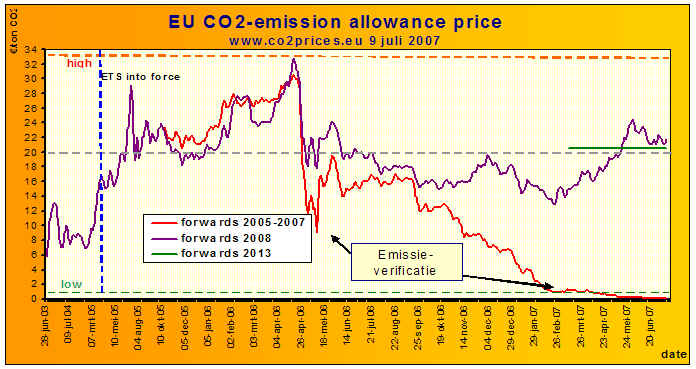
Currently the price for a carbon credit resides between 20 to 26 dollars euro’s per ton CO2. In relation to the costs of carbon capture and storage this is too low. In table 2 the cost estimates from the IPCC can be read for a pulverized coal power plant. Giving between 30 to 70 dollars per ton CO2 or 20 to 50 euro’s. The present price would make the technology only economically viable at the cheapest locations. It is difficult to predict whether the price of carbon will increase because of the development of the market is heavily dependent on political negotiations. For instance, are more countries outside the European Union going to join in the trading in the future? Will the air transport sector be incorporated in the emissions trading scheme? And most important for carbon capture and storage, will it be added as a full possibility for mitigation under the trading scheme?
Next to emissions trading there are high hopes for enhanced oil recovery. To my opinion overblown hopes, given that the technique can only be applied commercially at very few oil fields. This was recently highlighted by Statoil and Shell. The companies dropped plans to store CO2 at the Draugen oilfield in Norway because economic analysis showed that it was uneconomical to do so. Nonetheless, enhanced oil recovery is often considered as a possible option as explained in the case study below.
Pioneering Carbon capture and Storage: Rotterdam Harbour
One of the 12 large CO2 capture and storage demonstration projects that the European Commission wants to develop by 2015 could very well arise in the Dutch harbour of Rotterdam. Recently the environmental agency of the Rijnmond Region, in which Rotterdam Harbour lies, has calculated that it would be possible to capture and storage up to 20 million tons of carbon emissions from the region Rotterdam annually for only 24 euro per ton of CO2 (PDF in Dutch, 3.6 MB, 56 pages). A price that is much lower than normal thanks to efficient usage of energy. A significant amount of heat created by the local industry is wasted which can be applied for usage in the capture process. The environmental agency has assumed that this waste heat can be utilised for free as input in the capture process, hence the huge reduction in costs for capture and storage. However, it still remains to be seen whether the local companies will comply with giving away their waste heat for free, no one has asked the companies formally thus far.
If the price of 24 euro’s per ton of CO2 proves to be real, then it would be viable under the current price in the European emission trading scheme. Additional funding could be gained by the application of enhanced oil recovery according to the environmental agency of Rijnmond. Their basic assumptions being two additional barrels of crude oil production for every ton of injected CO2. In their cost/benefit an oil price of 30 dollars per barrel is assumed. However, this income flow is very variable. When applicable at an oil field, the injection of carbon dioxide will only be maintained for a few years. Beyond that period it does not deliver additional production benefits slowing down and halting the income flow. Also time is running out, because many fields that appear to be suitable for carbon dioxide injection will be closed down in the period of 2008 to 2012. By 2018, very few oil fields will be available for injection purposes.
Summarizing
While the idea of carbon dioxide capture and storage seems excellent, the costs are a large hurdle that might cancel this option altogether. Only with continued political support will this technological mitigation option for climate change become viable. The best option is full support of carbon dioxide capture and storage in the European emissions trading scheme, to make pioneering projects such as the one proposed at Rotterdam harbour viable. For larger application beyond a few projects, the price of a ton of carbon needs to increase, or the costs of capture and storage will need to come down significantly.
Personnel
Editors
Contributors
Peak Oil Primers
Archives
- November 2010 (3)
- October 2010 (6)
- September 2010 (4)
- August 2010 (7)
- July 2010 (6)
- June 2010 (7)
- May 2010 (2)
- April 2010 (8)
- March 2010 (4)
- February 2010 (6)
- January 2010 (3)
- December 2009 (5)
- November 2009 (8)
- October 2009 (12)
- September 2009 (6)
- August 2009 (5)
- July 2009 (11)
- June 2009 (8)
- May 2009 (16)
- April 2009 (10)
- March 2009 (7)
- February 2009 (10)
- January 2009 (15)
- December 2008 (9)
- November 2008 (9)
- October 2008 (9)
- September 2008 (13)
- August 2008 (10)
- July 2008 (14)
- June 2008 (23)
- May 2008 (16)
- April 2008 (12)
- March 2008 (16)
- February 2008 (9)
- January 2008 (13)
- December 2007 (13)
- November 2007 (16)
- October 2007 (22)
- September 2007 (8)
- August 2007 (9)
- July 2007 (16)
- June 2007 (8)
- May 2007 (7)
- April 2007 (7)
- March 2007 (10)
- February 2007 (10)
- January 2007 (12)
- December 2006 (9)
- November 2006 (15)
- October 2006 (4)
- September 2006 (5)
- August 2006 (5)
- July 2006 (9)
- June 2006 (5)
- May 2006 (10)
- April 2006 (9)
- March 2006 (13)
Vital Trivia
License

This work is licensed under a Creative Commons Attribution-Share Alike 3.0 United States License.
This looks incredibly cheap to me. Electricity only has to become a third more expensive to mitigate most of the CO2 emissions? I'm firmly of the belief we could cut our electricity consumption by 20-30% within a decade with relatively simple and politically acceptable moves (incandescent lamps, appliance standby load, industrial motors etc.). Such efficiency improvements would pay for CCS?
Hansen has shown how coal (rather than oil) is the critical issue for climate change (Implications of "Peak Oil" for Atmospheric CO2 and Climate) and if we can aggressively deploy CCS to coal infrastructure and leave unconventional hydrocarbons largely untouched we stand a very good chance of keeping emissions below 450ppm. Can it really be as easy as paying 20-30% more for our electricity?
If you could apply Carbon Capture and Storage (CCS) to the world's 2,000 largest fossil fuel power plants (about 90% of them coal) you would reduce world CO2 emissions by something like 25%.
I am assuming in this:
- that electric power production is c. 40% of world CO2 output
- that coal is about 7/8ths of that (coal is 1/2 US electric power output, and about 80-90% of CO2 output for the US electric power sector; it is c. 90% of Chinese electricity output, c. 80% I think of Indian, I can't remember the Russian fraction (about 20% I think), about 30% of Canadian, about 60% of Australian, 40% of German, 90% of Polish etc.
- that CCS, including the additional energy costs, would reduce total CO2 emission per plant by about 70%
(sorry for all the handwaiving, I haven't done a good model)
This would cost something between $100-200/tonne of carbon abated (might be as high as $300 or $81/tonne CO2).
Now it's likely that in the early stages, costs would be at the upper end, or beyond, what the IPCC estimates. The IGCC (Intermediate Gasification Combined Cycle) technology is relatively expensive and tricky, compared to Ultra-Critical pulverised coal technology.
The MIT coal study also shows that the technology pathway is not entirely clear: it's not certain that IGCC with CCS is better than conventional pulverised coal (PC) with CCS. We need to build the plants and find out.
As you point out, a systematic programme of improving building efficiency (c. 30% of greenhouse gas emissions) could sharply reduce the demand for electricity at the same time. It's entirely within current technology to double current building efficiency on average (new buildings, 80-90% better ie using 10% of the energy they do now; retrofitting buildings up to 50% better).
It's really quite sad, because that says we could reduce world CO2 emissions by 35-40%, simply by doing what we already know how to do, and by fully developing CCS technology. We could do that in 30 years (time to replace all power plants and bring all buildings up to standard).
By contrast, transport is much, much harder. There is a 'quick win' (US passenger vehicles) but after that, abatement costs per tonne of carbon are quite high.
(saving the rainforests is actually cheapest: as little as £10/tonne of carbon. Even cheaper is stuff like insulating your home or changing to CFLs, which have *positive* costs ie they *pay* you to do them)
Having watched the UK drown this summer (having nearly melted 2 summers ago) and watching Greece burn, and noting the continued disbelief in global warming in the US (and the prevalent belief that GW has something to do with Al Gore's political ambitions ie that it is a partisan issue) my conclusion is things really haven't gotten bad enough. Humans need much bigger threats to make them change their ways.
In 20 years time we'll be ready for these solutions. But we'll do everything to drag our heels in the meantime.
This week's Science Magazine (? couldn't find the cite, it might be Nature) has a debate between Sir Nicholas Stern and William Nordhaus. Nordhaus, the doyen of sceptical environmental economists, basically argues we should concentrate on economic growth, and making the future rich. Then they'll be rich enough to do something about global warming. He doesn't think our obligation runs any deeper than that, ie to do what we would normally have done.
The world, and the IPCC, as James Hansen points out in New Scientist this week, may be massively underestimating the risk of accelerated glacial melt.
Let's hope the earth's climate gives us that time to make up our minds to do something.
If you could apply Carbon Capture and Storage (CCS) to the world's 2,000 largest fossil fuel power plants (about 90% of them coal) you would reduce world CO2 emissions by something like 25%.........
OK - where do you put the CO2??
It doesnt matter if we capture it. If you burn 1 km3 of coal per year where do you put [x]000km3 of CO2..
answers on a postcard please
...well the oxygen I can live with -we don't want to get rid of that!!
Also, we don't necessarily need to get rid of the carbon from the atmosphere at the source -just remove it from the carbon cycle. That's after all how the carbon got down into Ghawar and the like in the first place.
A problem with any CCS idea is that is uses energy from the very fossil fuels it aims to cut the emmissions from. Therefore the pie either needs to expand ("oops1" after PO) or we get less energy out the end ("oops2" after PO).
In his book "The Millenium Project" Marshal Savage envisages using Ocean Thermal Energy Conversion (OTEC) to power and overproduce algae blooms that are then encassed and sunk to the sea floor. The OTEC gets it's power from outside the current non-renewable system so it expands the pie, not decreases it.
I really think that unless we can come up with a solution that does not detract from NET energy then once we hit PO the GW thing will just take a back seat as we scramble to merely keep the lights burning...
Nick.
Hello everyone,
I just wanted to make sure Terra Preta was included in this discussion.
I am from the American site and we are talking about the current energy legislation (or lack thereof) and the prospect of a recession resulting from the sub-prime fiasco. If there is a recession and it spills over into the global economy then the chances of GW and PO being addressed are going to be slim.
So, I wanted to bring up Terra Preta because it is cheap carbon capture. Essentially Terra Preta is the practice of making charcoal and working it into the ground as fertilizer. Some of the carbon is released into the atmosphere during the process but the rest is sequestered in an inert form in the soil. Grow a tree, turn it into charcoal, bury it, repeat. I think this is going to be important because it is cheap, low tech, accessible to individuals and small groups, and it pulls the carbon directly out of the atmosphere instead of at the source. These are all going to be important factors should governments and industry fail to act in time.
Additionally, I didn't see any mention of algae photobioreactors using the flue gas from the coal power plant. A decent amount of biodiesel can be generated this way. It doesn't keep the carbon out of the atmosphere, but the carbon gets used twice. Once for electricity and once for liquid fuels.
Cheers,
Tim
The IPCC looked at this if you look at the report.
Roughly speaking this would be 2 bn tpa of carbon or 7.3bn tpa of CO2.
There is enough subterranean storage. Bottom of ocean storage is far fetched, but may eventually be practicable.
Nordhaus, the doyen of sceptical environmental economists, basically argues we should concentrate on economic growth, and making the future rich. Then they'll be rich enough to do something about global warming. He doesn't think our obligation runs any deeper than that, ie to do what we would normally have done.
What a jerk.
Here's what's going to happen---based on what is happening now.
Global economic growth will enable a few people to get even damn richer. At that point, they will be personally better off by buying property in those regions least affected or beneficially affected by global warming.
They'll be strong demand for those so you'll have to be rich.
Large scale socialized (i.e. taxed) schemes to alter global warming for generations in the future will be seen as irrelevant (since by then global warming will be an irreversible train) and fiercely fought by the people who have all the money (since that taxation (of the rich of course, since they have the money) will strongly hurt their ability to ameliorate global warming now for themselves and their families.)
Everybody else will be encouraged to go f@ck themselves.
By the way, that argument of Nordhaus---if you assume continuous exponential growth in prosperity endlessly---appears superficially to be a 'time-free' operator, in that it will give exactly the same answer at any moment in time: "do it later".
E.g.: Well, with enough economic growth I guess we'll be able to cure cancer for (inflation adjusted) 25 cents a head, so why bother working and worrying about it now.
And later: 25 cents? Why bother? In a few years it will be only 1 cent.
I've mounted a few desultory searches for the source of the efficiency loss numbers, and not found them. How do we know, f'rex, that an IGCC plant would actually become less efficient than a PCC plant with recovery?
An IGCC plant could become far more efficient through the use of a few recent but simple technologies. Take, for example, Acrion's CO2 Wash process. This is a fractional distillation system designed to remove CO2 and contaminants from landfill gas, but it would work equally well to remove CO2, H2S, COS, H2O and the like from a syngas stream. This leaves mainly H2, CH4 and CO. This in turn could be fractionally distilled (a la air separation plants) to remove the hydrogen. Carbon monoxide and methane go to solid-oxide fuel cells ($500/kW sometime soon), with the spent fuel gas sent to sequestration. The air stream for the SOFC's is the combustion air for the gas turbine of an IGCC plant, heated by the hydrogen after exiting the SOFCs (to reach optimum turbine-inlet temperature).
I haven't taken this concept apart far enough to calculate a net efficiency for it, but my SWAG is it ought to be well over 50%. Nearly all of the carbon, plus 99.9%+ of the sulfur and all the condensible pollutants such as mercury, will be removed from the combustion fuel stream in the two separation steps. Energy supply for the separation is mostly as low-pressure steam to run the refrigeration system for the first distillation.
All we need is for the sub-$500/kW SOFC to come through, as Delphi and others have claimed they can do. The rest is mostly re-plumbing a gas turbine.
The place to look is the MIT sequestration study (came out this year).
http://web.mit.edu/coal/
IGCC is, from memory, about 42-44% efficient, v. about 32% for a supercritical coal station, and maybe 35% for an ultra supercritical PC station. (I'm doing that out of memory).
What MIT says, is that it is not clear whether IGCC is the best technology for sequestration, and a strategy of subsidising IGCC stations *without sequestration* for future retrofitting, in preference to USC PC, is wrong. That was the main 'new news' for me.
I'll have to look at that. Unfortunately, I'm swamped with work this week (just when I need to look at that energy bill). :(
Since this is driven by Big Coal and their captive legislators it needs careful monitoring. We’ve recently seen double counting in tree planting offset schemes since the promoters figured people wanted the feelgood factor, not hard numbers. I’ll just make a couple of points now about some conflicting claims. First CCS will speed depletion. If a world coal peak without CCS was expected by 2025 it will come sooner if extra coal has to shovelled into the furnaces to power the scrubbing, compression and pumping process.
However coal peak deniers say in situ gasification will exploit all those hard-to-get seams or maybe left-behind pillars. Huh? Either gas stays below the surface creeping into hidden layers or it rushes up towards the well head. CCS and UCG are therefore opposite so I don’t see we can have both.
My third point for now is that surely a well head steam boiler has to be cheaper than enhanced oil recovery using CO2. I know ‘green’ dry cleaners use liquid CO2 rather than fluorocarbon solvents. Their customers are cashed up yuppies, not labourers. To me the EOR line sounds like another greenwash so I’d like to see some comparative cost figures.
This could be mitigated by achieving 20-30% electricity consumption reductions. Say coal burn per kWh increases by 20-30% but electricity consumption reduces by the same amount then coal tonnage burnt remains the same.
'peak coal' is tendentious, although perhaps an article of faith amongst some here.
Global Warming is real, and now.
If we've run out of coal in the 22nd century, then we'll find an alternative source of energy.
The problem is going to be getting through the 21st century without cooking the planet.
Only a fool would take the mid point of the IPCC case, and not worry about the right hand tail of the distribution.
What chance do we need of a 6 degree C rise in temperature to panic, now? 1%? 0.5%
With the usual 'thank you' to those who make the effort to post stories..but a pile of prices tells me nothing.
I cant be bothered to revise the chemistry. Can anyone actally say how much CO2 we could realistically stuff underground [athough it sounds a complete waste of energy to me] and the FUNDAMENTAL answer to this - how much stuff do you burn to make this much CO2/pressure?
Thanks in advance
The energy costs of CCS are covered in the previous article: CO2 Capture and Storage: The Energy Costs
Thanks for the reply, but what Im asking is:
How much ff produces the volume of CO2 that is envisaged being stuffed down the wellpipe to squeeze out oil? Is it 1000 draxes or 1/1000 drax?
As some inspiration I offer this useful site:
http://www.cockeyed.com/inside/howmuchinside.html
OK I did it myself, because none of the propaganda 'lifestyle' sites which appear on a google search of Carbon give any facts:
I reckon that coal~graphite therefore:
2267kg per m3/1.98kg per m3 = 1144.95
1144.95 x 44/12 [allows for the weight of O2 in CO2]
= 4198.15
So for example 1 km3 of coal gives 4198.15 km3 of CO2
Of course this may be wrong because I am supposed to be doing other things now anyone else?
I think you've got too much carbon per m3 there.
There's some good information from the EIA on CO2 and coal here: Carbon Dioxide Emission Factors for Coal
Which includes this:
Seems the CO2 emissions are just over 200 pounds of CO2 per million BTU. Which is absolutely meaningless to me but it also corresponds to just over 90kg per 300kWh or 0.3kg/kWh. That's kWh of heat not kWh of electricity. This also ties in with the0.43kg CO2 / kWh UK grid average for generated electricity (considering the thermal efficiency of the plant and the mix of nuclear and natural gas).
Anyway - one tonne of coal produces 2.86 tonnes of CO2. The density of a coal is between 1.1 and 1.5 tonnes per m3, lets assume 1.4 as we're working with good stuff here. The density of CO2 at standard temperature and pressure is 1.98 kg/m3 so coal is 707 times denser.
In volume terms then 1 m3 of coal will produce 2.86 x 707 = ~2000 m3 of CO2. I guess the trick is not to store at standard temperature and pressure?
2000m3 sounds feasible - especially if Graphite =~4000m3 CO2
So..if we burn 1km3 of oil per year and [x]km3 of other ff that's... what? 10000km3 of CO2 per year?? bloody big hole that is...per year..
What's your pressure assumption?
CO2 liquifies under pressure.
Fair enough, the volume may be 1000 times less [made up number] at depth, but mother nature gave you oil/gas at 10000 psi because of plate tectonics. You have millions of tonnes of rock crushing the impervious dome that squirts out oil when you make the hole. You have to remake that pressure to inflate the void. And its not lined with rubber - it has collapsed once, so now it has fissures and leaks. I skimmed a bit of the IPCC report [Chap 5]. I havent turned google furlongs and terrapascals into meaningful units but I dont have to..Look at their diagram of a well head with huge flanges and gaskets, and their diagram of how to cap old wells - welded steel dome and 3 concrete plugs. You think there is much energy from ff left after we have compressed CO2 to those pressures? It talks about dissolving CO2 in water etc, so now we have acid groundwater, carbonate erosion..
Sorry to be argumentative, but I think focussing on 'capture technology' misses the flaw in the plan
ref your comments on CO2 storage options
There are basically two options out there, re-use of depleted oil / gas fields and injection into aquifers.
Both have merits, there is far more volume available in aquifers, but oil fields may be most practical in the first place. Aquifer storage is the longer term best but there are more uncertainties regarding the long term fate of CO2 and its migration will need to be more carefully monitored. Statoil are doing this in the Ut Sira formation in Norway today and it is not treated as such a big deal to be honest.
The comments made on oil reservoirs collapsing as the oil is produced is only semi correct, it depends on
a) the strength of the rock matrix (may not collapse)
b) the mechanism by which pressure is maintained as oil is produced
A lot of fields have compacted to some extent, particularly chalk fields, and non-consolidates sandstones etc. This does not mean that all the pore volume is gone.
There will be an energy requirement to compress CO2 to a high enough pressure to pump it subsurface. This is however still quite a bit less than the energy consumed in the capture processes (today).
A lot of the reasons we have high focus on caåpture technology today is that it is rather inefficient and as the biggest energy consumer, has the most potential for improvement as technology is developed.
Storage is important though - and probably underfocussed by the power / energy industry as it is not such known teritory. Research in this area is also going on, and real tests are being done (eg. Zerogen in Aus.)
I go on the basis of how much natural gas do we extract every day, week, month, or year. If we extract 10 trillion cubic feet of natural gas per year, then I would say that is about how much CO2 your could store. I envision an network of pipes, much like natural gas pipes, that go back to extracted wells.
OK that works for natural gas because 1 x CH4 = 1 x CO2, what about the CO2 from coal? Where do we put that??
Another question would be:
Couldn't CO2 be used in another reaction providing some kind of energy, like methane or something like that? I don't know the specifics, but if it could be used rather than be put underground, the co2 price would fall even more.
This one I do know. You have to add energy to turn CO2 to methane. If you could do it 100% efficiently [impossible] then you would add exactly as much as you get when you burn the methane to make CO2 - you see the catch??
CO2 to Methane is exothermic. Its creating the Hydrogen thats endothermic.
Methogens actually use this reaction for energy. The hydrogen comes from reduced carbon sources.
So the correct answer is you have to add hydrogen. The reaction itself however produces energy.
Co2 is a recognised industrial gas, and piped or shipped long distances for same (packaging, and things like electronics manufacture).
The main use is enhanced oil recovery. The Weybridge project in Saskatchewan pipes CO2 from the US coal gasifier in North Dakota (built during the 70s Energy Crisis as a demonstration project) under ground to enhance oil recovery.
Largely though, CO2 is a waste gas.
There is a problem, which is going to make Carbon Capture and Storage (Sequestration) -CCS a serious political problem.
CO2 is heavier than air, and in concentrations above 10%, AFAIK, lethal. It also *sounds like* Carbon Monoxide, which is lethal in very small concentrations (and kills people with cooking stoves, all over the world, all the time).
Near Lake Cameroon, a CO2 leak (geologic) caused the death of several thousand people.
So you are going to have pipes with a lethal gas (which will leak, from time to time) running hundreds of miles to put the gas back underground, where it might leak.
Now the world accepts this with natural gas (CH4) because natural gas is heat. It accepts that we ship petrol around and store it, even though it is explosive, forms deadly vapour at room temperature, and causes horrific burns.
But humans are not rational in weighting risks. Tell someone of a new CO2 pipeline, which sounds a heck of a lot like a carbon monoxide pipeline and you can bet the NIMBY brigade will be out in force. Unless the government underwrites the industry liability (as it does with the nuclear industry) to an accident, it ain't gonna happen.
I'm a big fan of CCS, but if, as a society, we find it impossible to build windmills because they are ugly, then CSS really will be a tough fight.
If you talk to people on the street, they think:
- global warming is something that is just happening, not something they can do anything about
- global warming is inevitable
- it's something to do with the ozone layer and spray cans
- it's a plot against China
- it's a plot by socialists to stop them driving and enjoying life
- it's something our kids will worry about
- CO2 couldn't cause global warming
- it's another massively overstated environmental panic, a la the Population Bomb or the Y2K
- humans don't cause CO2 to rise in the atmosphere
I've been told these things not just by Daily Mail readers, but by businessmen, with degrees in engineering and geology, people who manage billions of dollars in the City. If you rhyme off scientific facts to them, they just quote you back some sceptic argument they heard on Channel 4.
It's ironic, we're quite capable of polluting the planet with nuclear waste for 10s of thousands of years, but when it comes to something like CO2 (naturally occuring), we are incapable of saving the planet from our CO2, in the next 200 years.
(you'll notice that people love nuclear power: businessmen are quite prepared to overlook the subsidies, and they think it is just Greeny politics that complains about the waste)
That creature that started climbing, at Olduvai Gorge, has more or less reached the limits of his ability, I suspect-- we're so high up in the tree, that when the branch breaks we will finally fall to earth. The brain case just isn't well adapted enough to a global environmental challenge.
I 'feel your pain'. It is frustrating. I think some of the finest minds on the net are right here on TOD, looking at practical ways of solving problems. They do, however, see things with the typical human viewpoint: To a man with a hammer, everything looks like a nail. To oil industry technicians, everything looks like increasing demand and a problem to be solved with pipes and pumps.
The problem of CO2 isn't a matter of how much of the carbon we use makes it into the atmosphere; it's that we are digging or sucking the carbon out of semi-permanent storage in the first place. Most of the activity of the human race is simply wasted effort to create more effort (can you say "job creation" and "market creation", "price war" and "free market"?).
Increased prices are necessary to assign the proper value to the resource being used (all resources are currently under-priced because of petroleum-enabled technology). Cheap food has destroyed farms and sterilized soils via cheap oil. Cheap oil has devalued the planet to the point of destruction (mountaintop removal?). As long as people think they can get things for little or no cost, they don't care about how it is obtained, or what it does to their children's future. Cheaper gasoline means they can save more money to send their kids to college to become automobile engineers.
"If you want Change, keep it in your pocket. Your money is your only real vote."
You mean Weyburn.
Let's say that it would cost the consumer 20% more for this. Let's says that 25% of the power comes from coal fired power plants that are using the new methods. That might mean that the consumer might have a $100 per month electric bill go to $105 per month. Would the majority of average consumers be willing to pay $5 more per month to get this? I think the answer is YES! But they will not get the opportunity to chose because the choice is not being offered. This is called policy at the national level and so far we have been lacking the leadership required in this area.
It ain't just the consumers energy bills, it's the cost of absolutly everything to some extent... that increase, whether 5% or 20%, would hit every commercial enterprise too - and while electricity might not be the biggest bill companies face, all the other services or materials they have to buy will also cost more.
Ultimatly, the full gross cost of the increase must be bourne by consumers - not just the fraction that is residential power.
I've no idea what percentage of electricity is non-residential use?
--
Jaymax (uber-techno-conucopian-doomer)
Let's say half of all electricity used is non residential and 10% of the cost of producing a product or service is the cost of electricity. It is easy to see that a 5-20% rise in the cost of electricity would not raise the prices much for services and goods.
Look at fuel prices increasing 100% in the past 5 years. The same could be said for the percentage of the cost of delivering goods and services and this seems to be factored in over that period. My point being, we can pay the price, the question is are people willing to pay the price to slow Global Warming and Climate Change?
Are they willing to pay the price for the extra insurance or are they going to roll the dice and buy into the propaganda that there really IS no problem? They are told that coal is the cheapest fuel, so lets build more plants without sequestration. They are told this because the corporations can make more money without sequestration and they will charge you higher prices for electricity anyway, because they can.
This has been looked at in some detail.
One industry (aluminium smelting) has a very high electricity content (something over 1/3rd of total costs). That is why they are building a huge smelter in Iceland (cheap geothermal power).
The other industry that will be hit fairly hard is server farms-- again why Google is moving some to Iceland, so is Intel.
but broadly electricity is 5% of production costs at most. So a rise of 2.5%. Big range: some industries (papermaking) it might be a 20% rise in total cost, many it will be relatively small.
Again, the US is a strikingly inefficient user of electricity. Since 1980, California per capita electricity use has been static, whereas the US as a whole it has risen by over 40%. So there is lots to go for there in terms of efficiency.
Which brings up the subjet of geothermal, I understand the DOE has dropped research into the idea of deep well geothermal, why so? It should be worth the effort.
I think the rationale is that geothermal is a 'proven' technology, and therefore no longer in the DOE mandate.
The reality is more subtle (of course):
- the Administration made a lot of song and dance with the 2005 Act about more energy R&D. But those budgets have not been put forward (this is a common pattern with this Administration in a number of areas). They actually zeroed out a number of areas of energy research.
- the tax cuts have put pressure on US government spending. You can bet it is not ethanol subsidies or vital cotton subsidies ($800k per recipient farmer) that are squeezed, it is R&D
- if you don't believe there is an energy crisis, or global warming, then why subsidise solutions to a non-existent problem
The solution, of course, is to throw open more of the US to exploratory drilling: Gulf Coast, ANWR, coastal California, Rocky Mountain national parks, etc.
More supply is the only solution.
That type of response was exactly what the quoted study aimed to achieve. And it obviously succeeds!
The truth is that at this stage CSS is no more solution to obtaining carbon-free energy than controlled fusion is. It is simply damn too hard to do it! The technical difficulties - projecting the equipment, producing it, installing it, building the pipeline infrastructure, handling all those known and unknown problems that will come on the way - this will take 20 to 30 years at least before the technology goes to large scale application. It will take a coordinated government effort (a new Apollo program) and serious investments ($ billions) to do it. Do you see anything like that on the books? I don't.
But the nuclear scale up is on the same magnitude (or larger) and timescale.
So is the solar/ wind one.
In practice, we will have all of them.
In practice, we
willneed to have all of them.If I had to bet what we will have I would bet coal. Without CS.
LevinK
CCS is technically possible today - it is not too hard to do. You could go to Mitsubishi Heavy Industries and order a plant today. Coal IGCC works is known technology and can be build today. Storage of CO2 is already being done in the North Sea. There are no real technical barriers.
The key issue is political, and societal willpower. Are we worried enough about CO2 to want to pay to reduce it. If we are willing to pay $50/T + to get rid of it, then there is a viable business here. The overhead on electricity in Europe is probably only 30-40% on prices - we should be able to afford that I guess.
Unfortunately the market will not take care of this issue initially - it will require political intervention to kick start things. Perhaps this will only occur when there have been a few very nasty surprises. Like a 2m sea level rise for example, that would focus the mind, of course too late.
hope not.
If it is so easy why nobody does it?
Because there is no incentive to.
CO2 emission is (almost) free. If you are a large powerplant owner, in Europe, you get given your CO2 permits for free.
US of course there is even less incentive.
If your retail electricity bill is 10 c/kwhr it would go to 15 c kwhr.
For ref, I think California retail now is about 13 cents, and some southern US states are about 6. (one of the reason's Al Gore's electricity bill is so high is he is Tennessee Valley Authority, which has some of the highest rates in the US).
So a 1/3rd rise in electricity bills. But for most households, that rise could be offset simply by efficiency measures and investments.
Rembrandt,
A few cents extra per kWh, wouldn't that make wind and solar competitive?
Wind yes (especially onshore), Solar no that's still more then 10 cents per kwh.
The fog around the crystal ball just faded away long enough to tell me there will never be a large (1GW) clean coal power station. Nor a mass produced hydrogen car.
However I think I saw plug in hybrids in the future. Since the fog came back I have to guess how they will be charged. My guess is there will be older coal stations brought back in service and slightly modernised but with carbon taxes-lite, plus some new IGCC plant without carbon capture. Atmospheric CO2 will go into the red zone (450 ppm) probably around the time of the world coal peak. Then people will get serious about low carbon energy because there's no alternative.
My crystal ball tells me more CHP, Hydropower, wind power and nuclear power in Sweden and the nordic grid. I am still unsure about electricity -> hydrogen + oxygen -> biomass gasfication + fuel synthesis but it might work out.
CHP = Calfornia Highway Patrol
CHP = Combined Heat and Power.
Efficiencies up to 90-95 %.
[quote]
The fog around the crystal ball just faded away long enough to tell me there will never be a large (1GW) clean coal power station.
[/quote]
Notwithstanding the US one (FutureGen), I think there will be at least one by 2015, and maybe as many as 20.
We are in a hurry, and it's coming. We need this technology, we have all the building blocks, and we will do it.
Hydrogen cars is a different question-- it depends on fuel cell breakthroughs we don't have. There is lots of mileage (pun ;-) left in hybrid technology.
My own view is we might go back to steam cars: the original choice not to use them was an accident of industrial history, rather than of technological superiority.
I don't believe there is any meaningful world coal peak. And in any case, we'll go into the atmospheric red zone (450ppm) long before then.
People will get serious about low carbon, when enough people, white, rich people in advanced countries, have died.
I have my fingers crossed for the mother of all hurricanes, that rends ferocious destruction. I mean Katrina-squared or cubed. That is a terrible, awful thing to say or even imagine, but until we have that, we do not have public opinion, and political will.
Droughts in Australia can be explained away-- the 1 in 100 year, I mean the 1 in 1000 year. So can record flooding in England, and record heat waves in Europe in 2003 (sorry, 2007) which only kill a bunch of old Greek and French people and burn a few forests.
Psychologists talk about the absence of a 'strong affect' in global warming. People just can't visualise what it means to them. They don't have a tangible set of images and feelings to connect to the reality of global warming.
As your Tim Flannery points out, warm is a nice feeling. People like warm. A warmer world is just not an emotional threat.
What we need is dead rich white people. Then vox populi, vox dei. And God have mercy on my soul for saying that.
I fear by the time we do something substantive, it will be far, far too late. The world's smartest primate may have climbed onto his last branch.
Read Mark Lynas' 'Six Degrees' for a snapshot of what our world is going to look like. Or James Lovelock 'Revenge of Gaia', if you really want to scare yourself.
'Darkness' by Lord Byron
I have an idea that will vastly reduce the cost of CCS. I was wondering if someone reading this thread knows a person or department in the EU to contact regarding CCS?
Regards
joe
You want to talk the sequestration people at MIT, they have a whole group devoted to it.
You could contact someone in the ZEP group. Zero Emission Power plant
http://www.zero-emissionplatform.eu/website/
This is the EU group which is developing the competition for the 12 demo plants to be ready by 2015.
Talk to someone on the advisory council.
I am working on a power project with post combustion (amines) linked to conventional fossil fueled plant - we would be interested in energy savings in this area.
regards. Chris
I predict we will talk carbon dioxide capture and storage until we run out of fossil fuels to burn; but very little carbon will actually be sequestered.
I agree but also I think its too late to avert the climate change since large natural sources of C02 such as peat beds are now warming so I think C02 from these sources will overwhelm man made sources. Basically we initiated a natural greenhouse cycle that now has to run its course. Uncontrolled man made C02 will increasingly be more a factor in the rate of increase of C02 and less of a source issue as large natural sources become mobile.
Next I suspect we are close to saturation of a lot of the remaining carbon sinks so again even current natural sources will lead to bigger increases in the atmospheric levels.
Its out of our control at this point outside of the rate.
No, we can still stop it. A shot of aerosols in the stratosphere will slam the brakes on the warming trend and reverse the CO2 release by both reducing stress on forests and increasing the equilibium concentration of seawater. But the longer we wait, the harder it will be and the more damage will happen in the mean time.
Such a solution (like any of the other various proposals to deflect sunlight) is hardly without risks. It smacks of efforts to reduce pest populations by introducing new pests (think Cane Toads in Australia). Almost all known man-made aerosols are serious pollutants in their own right, responsible for acid rain, interference with formation of rainclouds etc. etc.
Unfortunately, I suspect it's the path we're most likely to end up taking, as there's just no evidence that the U.S., China and India are likely to make the necessary changes to drastically reduce GHG emissions in the next decade or so.
If sulfur was used, the amount required would be far less than is now dumped into the atmosphere at low altitudes. The lifetime of the particles can be ~2 years, so the quantity required is a few million tons per year; this gets spread over a large part of the globe. Previous and current acid-rain problems are due to the emission of hundreds of millions of tons and deposition relatively close by.
Compared to the known damage from warming and consequent ice melt and drought, I'll risk the sulfur. We can't shut down the GW emissions with it, but we can use it to preserve our forests from drought and shorelines from sea-level rise until we can get the cause under control.
It seems to me CCS will always be more expensive than nuclear power, especially as peak oil will push the price of coal and gas upwards.
So why bother?
Let's just build reactors and windmills.
Depends how you cost the nuclear waste disposal.
And the government subsidies the reactor operators require before they will build new plants.
And of course the terrorism and proliferation risks.
Nuclear power has never been cheap, and never will be.
You also can't scale nuclear power on the level we are talking about. It is 8% of world electricity generation now (on about 450 operating reactors). Double the number of reactors (a number which would require numbers of technical people and scarce resources that just don't exist) will take you 40 years at least (that's 22 new reactors a year).
That gets you to 16% of world electricity (your 3rd Gen reactors are bigger, but of course total output is bigger as well).
Britain is talking about new reactors, to the tune of up to 5GW by 2020something, vs. system capacity *now* of 60GW. It'll still be a smaller nuclear sector than we have now.
Its dirt cheap. You seal in concrete and stick in the lot on the side. In fifty years some politician starts going apopoleptic about it and has it all moved to a different parking lot, but discounting makes this very affordable.
Sure theres the tax for the nuclear waste repository in the US and I imagine other locales are similar, but this hasn't been crippling.
A carbon tax is all thats needed. Today operators look at the oportunity cost of nuclear versus coal, and often just pick coal.
Proliferation doesnt have a damned thing to do with domestic nuclear power. A foreign government with the will to develop weapons isn't going to be any more or less likely to do so based on your civilian power plants. As for terrorism, soft targets will allways be a better choice for someone determined to wreak destruction.
We've heard this before, but I really dont think this is grounded in fact. Nuclear power plant operators can be trained quickly (several years, well within the construction window of plants) and the rest is mostly just construction overhead which doesnt have any spectacular specialty requirements. The biggest is the supply chain pipeline for very large steel fabrication, which I cant imagine being an insurmountable obstacle.
After all, France went from nearly entirely coal in the late 60's to nearly entirely nuclear in the late 80s. Where did all the French nuclear workers and plants come from? It must have been impossible.
I'd read it was currently 16% of world electricity generation.
What is true is that current rates of nuclear power plant construction are insufficient to allow nuclear power to retain that share, let alone increase it. Depending on how long you can extend the life of currnet nuclear power plants, then yes, we should be aiming to build new plants about around 24 a year. Given China, with a population of ~1.2 billion, can build a coal power plant a week, or around 50 a year, then I don't see why the world world (pop 6.5 billion) can't build 24 nuclear power plants a year.
450 existing civilian power reactors?
So replace those (none will be around in 30 years).
Then double the number. Assume growth in world electricity demand matches growth in reactor size (roughly from 650MW average to 1250MW average for 3rd Gen).
So 900 reactors, to hold nuclear capacity at 16% of electricity consumption.
42 years to 2050 (less time than that, because none of them will be even started before 2012, but say).
21 reactors a year. The world currently is building (I don't know how many) but around 6, I think (one or two 3rd Generation).
A nuclear reactor is almost an order of magnitude more complex than a coal fired station. The capacity to build those coal fired stations exist, and any medium technology country can do 90% of the fabrication. that's not at all the case with nukes. Just think about the size and time it takes to pour the containment vessel.
Nukes? Complex technology. Very skilled manpower. An old labour force. Very specialised components (60% of the world's power station valves did come from one valley outside of Turin-- a large number of small manufacturers). This is really high spec stuff, even higher spec than aerospace.
I don't know what the US reactor completions were at the peak (about 5 a year?), but this would be a scaling up on that of 5 fold.
Someone mentioned France. But France's electricity consumption is less than 1/4 of the US (something around 1/5th I believe). And they took 30 years to do it.
The 6.5 billion people in the world are effectively irrelevant as a calculation. What you have to look at is the top 20 or so countries + India, China. Which have big numbers of people, but whose technological economy is much smaller (particularly India).
I can see, in fact expect, a world where China has 100+ power reactors, and India 50 or more. That's saying that China, in the next 40 years, builds more reactors as the US has done (to now) in the period 1962-2002. But that would only be around 10% of Chinese consumption. Maybe they have 200, and it's 20%, more or less.
It's a titanic number. Over 20 reactors a year for the industry, across the world. Hope the Japanese don't have a bad quake in the middle of it, that their plants weren't designed for.
There is also a problem finding the uranium to fuel all these reactors-- but we'll assume there is no Peak Uranium, because this is a Peak Oil website ;-).
Another poster has suggested there is no such thing as a decontamination liability. I can tell you, from a UK perspective, that there is a £70bn decontamination liability (we had the first domestic nuclear power industry, so we are the first to shut it down), and people on the inside have told me that £140bn is a real liability.
On top of that there will be the 'where do we put the waste?' which is unanswered.
You will probably be surprised that currently there are 32 reactors under construction world-wide and 74 more are planned.
When completed these reactors will have a power rating of 25 GWe and only they will produce 50% more energy than the total wind power which has been installed up to date in the world (which at ~50GWe is equivalent to ~17GWe nuclear/coal).
I'm sorry to bring that news to you but nuclear is the future. Everything else could be just an auxilary source at best or a dangerous distraction at worst.
Note however 32 reactors under construction at any one time, given a 5-year build time, is still less than 7 completed a year. To be completing 24 reactors a year requires at least 120 to be simultaneously under construction.
During the 70s the world was building 20-30 reactors per year. Google it if you doubt it.
Yes, maybe we'll need some time to pick it up but in 20-25 years we may very easily reach this rate and beat it if we need to. Actually I believe that once the Chinese learn how to build nukes by themselves, they alone will be able to do it.
On the other hand we are still in anti-nuke environment and yet building 7 reactors per year - which energetically is higher rate than wind, despite all the subsidies and political posturing around it (7 reactors ~ 7GWe; last year wind additions ~15GWe, equivalent to 5GWe nuke).
I bet some will. Sure reactors occasionally have to be replaced, along with pressure vessels and, more rarely, turbines.
Er, then how come they dont cost an order of magnitude more to build? The most I've heard is 2-3 times the capital cost. Not 10. Or did you mean a binary order of magnitude?
So what it really boils down to is price of coal and interest rates.
Der... turn brain off I suppose and you can believe it. Nevermind the trillion tons of recoverable uranium in LWR economics today or the 120 trillion tons of fissionable utilized 100 times as efficiently if you move to liquid fluoride breeder reactors.
Yah, we'll never find the uranium, especially not in flyash, phosphates, fifty years worth of spent fuel, or all the DU lying around that we didn't bother to enrich further because uranium was allready dirt cheap and everyone was using expensive gasseous diffusion.
This one allways gets me. Why do you have to put it anywhere? Dry storage is good enough for several centuries, by which time discounting makes the problem cheap enough to repeat, come up with a different solution, or the whole world has gone to mad max in which case we have bigger problems than spent fuel in dry storage casks.
My impression of turbine replacement is that it is standard, all the 20-30 year old nuclear powerplants in Sweden have gotten or are getting new turbines.
The blading wears down and about a decade ago there were a break thru in 3D computer modeling of flows making it easy to get an extra percent of efficiency by new blade shapes. And you can get a few tenths of percent by new optimization ideas for the steam flow within the turbine casing. The nice thing with this extra efficiency is that the same ammount of fuel gives more more electricity and thus more $ out of a fixed cost or better EROEI. And since you anyway need to renovate the turbine it is a great idea to up the efficiency.
This idea has been taken one step further. After 20-30 years there is need for replacing some piping and valves due to wear and electronics due to them becoming outdated. And since the plants were built best practice for security systems have become more stringent and the powerplants need to be updated to keep up with the code. Since you anyway need to change a lot of components and update systems all of the running nuclear powerplants in Sweden have been recalculated by their owners for larger steam flows and they are being uprated in power. This has meant that not yet worn out generators and transformers are being replaced for larger units but it is still less expensive per MW then building a new powerplant.
This uprating is probably possible since the original powerplants were built with generous capacity margins and that nuclear fuel bundels have become denser and able to give of more MW per m3 then the ones available when the powerplants were designed.
Uprating with more efficient turbines is possible in hydro powerplants but often to a smaller degree since the original designs are closer to the ideal ones wich probably is due to the near uncompressability of the liquid medium and slower flows. The larger gains can be found in turbine inlets and outlets if they have been designed badly and restricts the flow.
Another idea that has been tried in small scale is to remove the transformer between the generator and high voltage line and wind the generator to directly give high voltage. This avoids the losses in the step-up transformer. But there have been too few test installations and the idea has not realy taken off yet. It has resulted in some sales of high voltage motors, oil free transformers/coils and it is probably the inspiration for removing a transformer step in rotating frequency and 3-phase to 1/2 phase power converters for railways.
I'd like some technical explanation of how carbon sequestration could possibly reduce the efficiency of a coal plant by only 30%. The volume of the stream of waste gas that in present operations is just vented free into the atmosphere is huge. Sequestering it strikes me intuitively as something that would be plagued with unexpected difficulties. Every time the exhaust pipes clogged (so to speak), the combustion cycle would get mucked up, wouldn't it? This technology has been talked about for years--are there any commercial coal plants with CO2 sequestration presently operating anywhere in the world and if so, what are there operating efficiencies compared to a typical American base load plant?
They can just feed the CO2 to algae, gasify the algae and use the synthesis gas in combined cycle turbines and Combined Heat and Power. Get the most out of every BTU that you have.
That would be solar power then..
Best bet is the MIT study
http://web.mit.edu/coal/
see the appendices. The MIT Sequestration group has a wealth of papers on the subject, and links to the technical journal articles.
The IPCC report also has a chapter on the technologies (Oxy Amyl, gasification etc.).
Research done here in Australia by the major govt research institute (CSIRO) shows that CCS CAN'T be back-fitted to existing coal-fired power stations- it has to go on NEW ones! Hence, like hydrogen cars, unlikely to help us with immediate issues of climate change. We have to use less energy, oil...
I've been in contact with some of the CSIRO CCS guys, and that's the first I've heard that it definitely "can't" be done, just that in most cases it doesn't make sense, given the expense, and the average lifetime of those plants.
I do tend to agree with J. Hansen however that all new coal plants must have CCS fitted by law - unfortunately there are way too many people with way too much money invested in existing plans for that to be realistic anytime soon.
Isn't coal the very last option?
I don't see coal playing a particularly expanded role. Renewables and nuclear have to be the first and second options and I'm of the opinion that they can provide most of our non-liquid energy needs.
Australian TV just ran two shows on energy topics at the same time, Carbon Cops http://abc.net.au/tv/carboncops/about.htm and the panel show Insight http://news.sbs.com.au/insight/. This latter show really gave clean coal supporters the third degree and cast considerable doubt over the concept. It also floated the idea that big energy users (like aluminium smelters) run their own private power plants to free up the domestic grid from a heavy baseload requirement. I’d agree provided a carbon cap applies to everybody in the country and there is some kind of downside to offshoring the smelter to China or wherever.
I've yet to see anyone really tackle the issue of how to ensure energy-intensive industries like smelting can remain competitive here if there are to be hefty energy price hikes. Having them move to China or India would be counterproductive from an environmental point-of-view (GHG emissions may be no worse - but there's more to environmental damage than GHGs). This is the closest attempt I've found:
http://www.tai.org.au/documents/dp_fulltext/DP44.pdf
But while reasonably thorough and well-researched, it's now a little out of date (2002), and published by a largely left-wing think tank, so is almost certain to contain a certain amount of bias.
Instead of all the complexity of carbon capture at source, why not remove it from the atmosphere across the planet?
Agrichar (aka biochar) is a carbon negative process and locks up carbon in soils for millenia, while reducing fertilizer need and making biogas too. Its a win-win-win situation.
The process is pyrolysis of biowaste and produces 50% bio-energy, 50% agrichar. It is scaleable from small holder to agricultural super company or municiple recycling plants - even home pyrolysis is possible instead of composting.
A good article is http://sciam.com/article.cfm?articleid=5670236C-E7F2-99DF-3E2163B9FB144E40
This will probably be considered a foolish post; but I can live with that, and please feel free, good editors, to remove it if you like.
There's a lot of very good technical discussion here and I've found it interesting and generally quite good.
So saying, and perhaps to state the obvious, the carbon is sequestered just fine right now. We should leave it in the ground.
If that sounds hopelessly silly, it is also utterly more logical than digging it up and burning it simply to get the world further into unsustainable overshoot and closer to other Liebig limits while dancing on the edge of huge positive feedback systems for plantary warming. That is, simply, stupid. Cosmically stupid. Ice-cream-cone-into-the forehead stupid. Russian-roulette-with-an-automatic-pistol stupid.
I realize that a number of the readers of TOD would agree with that in principle but note strongly that it's naive to think that coal won't be used in any case. Good point, but I don't concede it. The stakes are too high to shrug it off. The fate of the planet may literally hinge on it.
CO2 seqestration is interesting in principle but technically challenging in most areas: there will simply not be the political will or infrastructure to keep it going. Foresight and self-deprivation under pressure are not human strong points. Once brownouts and blackouts are happening, once affected populations have to do without enough power for a winter, rules about sequestration will be tossed along with all other environmental rules. "Why should we go without when China isn't doing it?" (and China won't be). While a legitimate technology pressed by sincere people, it is in effect going to in retrospect mostly have been a fig leaf to quell cognitive dissonance during permitting and building out of coal plants. A rationale for doing the easy thing.
Arguably the sequestration which is most important is keeping the monkeys away from the black rocks. Shipping our accumulated nuclear waste to the coal mines might be a nice start. Won't happen, but there's the problem to be addressed: how to keep the monkeys away from the black rocks. Be as creative as necessary.
Kudos to the good people, and posters, who are working on this technology with the best of intentions. But I fear human use of coal is equivalent to a good-sized asteroid on a collision course with earth. Negotiation with it may not be fruitful. To the extent it is even started, significant CO2 sequestration will be abandoned once the time of easy living is behind us.
Yes, that would be great. Just two problems:
We're ultimately going to stop burning fossil fuels because we'll run out, and we're going to have to pull carbon out of the atmosphere to restore it. The question is, how do we get there from here?
Respectfully, our current economic system is almost certainly going to collapse anyway, it's just a matter of when and how far. An economy based on perpetual growth cannot do otherwise. And as you say, ultimately we'll run out. Our current living planet and biodiversity may or may not collapse. It would be better if it didn't.
Your point #2 is nonsensical to me if it is meant to rebut leaving coal in the ground, which is the point of my post.
Your final comment, that we will create the CO2 and then extract it from the air at a later time, also makes little sense to me if it is a critique of my point.. Not only are we certainly near or beyond positive global heating feedback thresholds which could NOT be run in reverse gear, but it would be thermodynamically more efficient to prevent it than to capture it later, unless one assumes some radically wonderful new way of doing so and posits that the infrastructure to do so will reasonably be implemented.
See above, RE monkeys and black rocks. That is a rigorous statement of the problem. The solution won't be easy, but that is the problem I seriously suggest we try to address.
I like the nuclear waste plus coal mines idea no matter how crazy it is. Two birds in one shot.