
 | The Economics of Oil, Part I: Supply and Demand Curves (Detached Comment Thread) | The Oil Drum | Hurricane Dean Update: Here's What We Know about Mexico's Oil and Gas Infrastructure and Supply |  |
The Economics of Oil, Part I: Supply and Demand Curves
Posted by Prof. Goose on August 19, 2007 - 11:20am
This is a guest post by Robert Smithson, a portfolio manager at a London based investment fund.
This is part one of a two part article on the economics of oil price demand. The second part looks at the economics of peak oil, and how the oil fits into an overall energy demand curve.
Introduction
“The world is consuming more oil than it is producing.” --The Economist, July 14-20 print edition.
Wow, that’s a shockingly foolish statement. Each day approximately 84 million barrels of oil are extracted from the earth, and approximately the same amount is consumed. It can be no other way: inventory space is limited, and could not be extended significantly by “excess production” or indeed drawn down for long by “excess demand”.
The problem is a basic lack of understanding of economics. And The Economist is hardly the only culprit.
Take the IEA’s latest Oil Market report:
Global oil product demand is expected to rise by a robust 2.5% to 88.2 mb/d in 2008… Non-OPEC supply in 2008 is forecast to reach 51.0 mb/d.
But of course, as any economist will tell you, there is no simple supply number and demand number: there is only a demand curve and a supply curve. And the key to all of this is to understand that demand can never outstrip supply, there is never a supply “gap”, there is only the price at which the market clears.
Supply and Demand
The study of supply and demand inside a market is known as micro-economics. (This differs from macro-economics, which is the study of inflation, unemployment, and the like.) So, let us take a simplified market; it has a demand curve that looks like this:
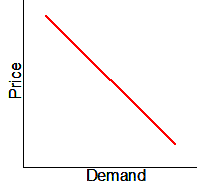
The x-axis is the price, and the y-axis is the demand. There is an inverse correlation between price, and quantity demanded. If we pretend this is the car market, then we see that at lower price levels, people who couldn’t previously afford (or justify) cars can now buy them, and that some families which previously owned one car, will spend on a second. Demand varies with price. And the same is true of supply:
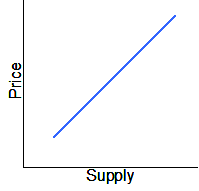
If the price rises, so will supply. At first, this can be difficult to appreciate; surely supply is a function of how many factories make cars? But supply is “elastic”, it does grow with price. In the short-term, higher car prices encourage factories to run with two or three shifts and to pay over-time. Longer-term, higher-prices will feed into firms’ capital expenditure decisions: new machines will be bought. Higher prices mean more supply.
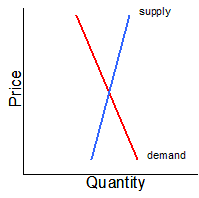
Economists put these two curves together, the demand and the supply to understand a market:

The market price is the point at which demand meets supply. That is, there is a price level where the level of demand is equal to the level of supply. This point cannot be emphasized enough: the market will clear. In any normal market, there cannot be enormous inventories of unsold products, or millions of people willing to pay the prevailing market price… yet unable to do so. An excess of supply, or shortage thereof, is merely another way of saying that the clearing price is moving. And markets will clear.
Oil Supply and Demand
The market for oil is unusual, because – in the short-term – both demand and supply are highly inelastic. Irrespective of what petrol costs, your car cannot easily switch to another fuel. Ships and aeroplanes cannot move from diesel oil and kerosene for their propulsion. If it’s freezing cold, and you need to heat your house, the only option may be to pay more for heating oil. Likewise, if the price of petrol was to halve, you would not drive twice as far, or turn the thermostat up from 22 to 44.
The result is that the short-term demand curve looks like this:
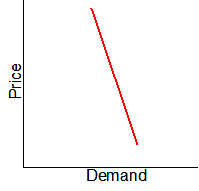
In other words, a large change in price only has a small impact on demand.
Supply of conventional oil is also relatively inelastic, although for a different reason. The actual cost of pumping a marginal barrel of oil is relatively low, once the capital expenses of prospecting and building an oil rig (and associated infrastructure) has been put in place. An oilfield will cost roughly the same to operate whether it is producing at 50% of capacity or at full capacity. Given this, once you have an oil field in place, producers will tend to pump at their maximum sustainable rate. Of course, there is always some flexibility: old wells can be “uncapped”, scheduled maintenance can be postponed, and greater concentrations of gas can be pumped into the well. But these have costs, and oilfield owners are loath to do these, unless the price of oil is high enough to justify it.
The result of this is that the oil market is one where small changes to the supply or demand curve cause large changes to the clearing price.
The Oil Shocks of the 1970s
This model can be applied to the oil price shocks of the 1973. Following US support for Israel in the Yom Kippur war, the newly founded OPEC announced it would stop selling oil to the US, and would restrict its overall oil output. Because OPEC supplied so much of the world’s oil, this had the effect of changing the shape of the supply curve. In other words, for any given price level, there would be less oil supplied:
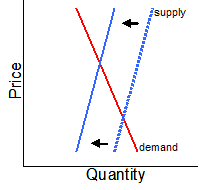
As can be seen from the chart above, this restricting of supply caused the blue supply curve to move to the left, and – as the market must clear – the price rocketed. Dropping out of theory and into practice, we see that this is exactly what did happen. The price of Saudi Light oil jumped from under $3 a barrel in 1971 to almost $40 by 1980.
Other Short-Term Changes to Supply and Demand Curves
It is not only sellers’ cartels that affect the oil price. When Hurricane Katrina knocked out production in the Gulf of Mexico it had a similar effect: the supply curve was shifted to the left and prices rose.
The rise of emerging markets has also changed the supply and demand dynamics. As China, India and the like industrialize, and their emergent middle classes buy cars, then the demand curve moves to the right. For any given level of price, more oil is demanded. As the chart below shows, this has exactly the same impact on the clearing price of oil as does reducing supply: the price moves, and sharply.
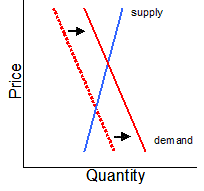
Long-term Supply and Demand Dynamics
But this analysis misses one key point. Oil demand and supply may be inelastic in the short-term, but in the long-term, they are remarkably elastic. Hurricane Katrina does not cause a long-term change in consumer behaviour; but if long-term expectations for oil prices rise, then both the demand and supply curves will shift.
Nowhere is this clearer than in the study of the results of the 1970s oil shocks. In the US the government responded by introducing a 56mph national speed limit, and mandating strict new efficieny standards. In 1975, the average American new car had 136 horsepower under its hood; by 1982, that number had fallen to under 100. Consumers shifted to more fuel efficient cars (a boon for Japanese makers, and a bane for Detroit), and the demand curve moved to the left. Similarly, electricity generators chose to build nuclear or coal-fired power stations rather than oil-fired ones. EDF, France’s national generator, now supplies the vast majority of its electricity from nuclear power stations.
In the three years following the first oil shock in 1973, oil consumption continued to rise – despite soaring prices. Yet from a peak in 1976, consumption began to fall, dropping eventually 15% from its highs. And, again, consumption continued falling for three years, even after oil prices peaked in 1980 and after the world economy began recovering. Moves towards energy efficiency and towards alternative power sources are slow to ramp up, but their effect on the demand curve cannot be over-stated.
Rising prices had another effect in the 1970s, they spurred investment in exploration and production in areas that had previously not been cost efficient. Building rigs in the hostile waters of the North Sea, or in the wilds of Alaska, made little sense while Saudi crude was available for $3 a barrel. But if the Saudi’s oil was restricted, and the price had shot up north of $30, then a lot of new oil suddenly became competitive. And because the key expenses are upfront – building the infrastructure in the first place – then once the new oil came on stream then it was unlikely to be removed, irrespective of the price of oil. The oil supply curve moved to the right.
The impact of a supply curve that moved right (more supply at any given price), and a demand curve that moved left (less demand at any given price) was a collapse in the market clearing price. By 1985, the oil price had fallen back to $10. On an inflation-adjusted basis, oil was as cheap as it had been before the 1973 oil shock.
The lesson here is simple: there is no “over” or “under” supply, there is only the price at which the market clears. And over the long-term, high oil prices will tend to encourage consumers to either reduce energy consumption or shift to other forms of energy. Similarly, investment in either inhospitable areas or in developing technologies will result in greater quantities of oil or synthetic crude coming on to the market. Each boom in the oil price sows the seeds of its own destruction.
Contact
- Content: editors at theoildrum dot com
- Tech support: support at theoildrum dot com
License

This work is licensed under a Creative Commons Attribution-Share Alike 3.0 United States License.
http://reddit.com/info/2gmrl/comments
http://digg.com/business_finance/The_Economics_of_Oil_Part_I_Supply_and_...
http://slashdot.org/firehose
if you are so inclined...
(also, there's an old comment thread for this piece here: http://www.theoildrum.com/node/2891#comments ...sorry to make you click back and forth.)
Depends on what The Economist means by producing. We can obviously consume no more oil than we extract.
Smithson makes a mistake in that oil companies 'produce' oil. What they produce is refined products from extracted oil. They sell refined products to the consumers. I have no desire to put West Texas Intermediate in to my tank. It would gum up the filter in very short order if it doesn't foul the plugs first. I want the gasoline which could come from any of several sources and processes. Being in Iowa it is only polite to use a little ethanol out of consideration for my neighbors.
The US alone has total product storage currently 1.7 BILLION barrels and there's that much more again in the rest of OECD.
http://tonto.eia.doe.gov/dnav/pet/pet_sum_sndw_dcus_nus_w.htm
Production could go to zero and demand could still be met for a long time.
I like three egg omelettes, but I only have two chickens. Fortunately, supply and demand are still in balance because I had a dozen eggs in the fridge.
Long time being defined as a month. The purpose of the SPR is so our military can fight long enough to capture an oil field.
I like three egg omelettes, but I only have two chickens. Fortunately, supply and demand are still in balance because I had a dozen eggs in the fridge.
What do you eat on day 13? A two egg omelette? What do you eat after your chickens die of old age? You turned all your eggs into omelettes and none into chicks. I know, you can eat chicken for a long time.
Do you work on wallstreet teehan? Sounds like you'd be perfect for buying mortgages and selling synthetic CDOs and taking your salary out of the price difference.
What this misses is that there are "minimum operational levels" for commodities vital to the operation of our civilization. A growing population and envionmental distruction causes the MOL to rise. For example, subsistance farmers finding their land without water as rivers run dry move to urban centres, putting more demand on food and energy from the global pool. Under supply results in parts of the "Globalized Civilization" failing. People dying. War.
Demand destruction doesn't follow a smooth curve. In a complex system when parts fail it can have an unpredictable knock-on effect to other parts of the system. Or even cause complete collapse.
I think that demand destruction is simply to simple of a concept for oil. A much closer idea would be food our water.
Oil is now as critical to people as food water and shelter.
So I agree 100% that the concept should be minimum operating levels for various types of economies before they begin to fail. The concept of some sort of slow squeeze makes no sense and is not justified by any historical comparison. Societies can restructure to operate at lower levels of oil but since this restructuring itself require leveraging the existing oil infrastructure it doubtful that it can be accomplished without foresight.
The issue is how a complex system decays. Using the Arctic melting as a guide and the collapse of previous civilizations suggests that it happens fast several times faster than the underlying reason the system is decaying.
So for example if we are at say 50% of the current production levels in 20 years we can expect the actual collapse to occur in less than 5 years. The limit on complex systems seems to be how fast the can collapse once they fall into positive feedback but in general they collapse as fast as possible.
As and example the Greenland Ice sheet can only collapse as fast as the ice can move this asserts that the collapse will quickly be limited by this factor. Oil seems to have about a 3-6 month delay factor in its distribution. Thus a collapse of the oil infrastructure is measured over at least a few years given a reasonably slow underlying decline in production. But it seems obvious that its less than a decade and more on the order of years before the society that cannot change collapses.
Robert:
I have taken some micro and macro economics courses, but am by no means an economist.
Lets agree that:
1) At any given time Oil "supplied" = Oil "demanded" = Oil "produced" i.e. that we are using the economists definition of these words, understanding that there are other definitions extant in the language
2) Oil sells for a particular price at any given time. I know there are several standards traded in the markets, but lets simplify it to pick 1 as they seem closely related to each other.
This being said it seems to me that there is little point in saying much about supply and demand curves unless they have some predictive or explanitory power with respect to the amount of oil produced at some time, or its price. i.e. can we use them to decide what level of taxation would reduce global carbon emissions a certain amount, or explain why oil consumption was growing at about 6% year over year just prior to the 1973 embargo?
Wherever I have looked for this info. I have failed to find it, so I was wondering if you could provide [a link to] actual supply - demand curves for oil for any time in say the last 100 years, or speculative curves for any time in the future, and the data / methods that were used to construct them.
Thanks
Me Robert? I'm not an economist either. I don't know what the quote posted by Prof. Goose really means but I'm suggesting a non-silly alternative.
If you call a cow a chicken, how many legs does it have? Four, because calling a cow a chicken doesn't make it one.
No, sorry, Robert Smithson the author of the original post
Darn it Milton,
You are confusing "the comments markets".
I posted an answer here (at the other thread).
I wish we could get to a place where we could admit the truth that this kind of economic analysis has no relevance to an oligopolistic market in which a few players control supply and the availability of supply to meet demand is NOT a free market clearing process. My greatest fear is that Professor Goose may be teaching this nonsense to our college kids.
There are many ways of looking at the world. This is one of them.
I teach my students to learn the many sides of arguments and to think critically, not to live by one dogmatic or normative view.
So, in that regard your greatest fears have indeed been realized. I hope you sleep better at night.
edspievack
What king of nonsense do you mean? Classic economic theory? or the "myth" we live in a free rather than an oligopolstic market?
82% of the oil production in the world is by national oil companies rather than multi-national companies, and as we import about 1/4th of our gasoline and some national oil has refining in the US and about half of the refining is by companies without production or marketing of their own,a very small part of the US market are in what I think you are calling oligopolies .
I agree that classic economic theory is screwed up, there is a physical limit to resources that it is ignoring. But you need to examine your "facts" if you think prices are controlled by big oil companies.
Bob Ebersole
I don't know why I seem to be responding to your comments so often, Bob; maybe you say things that I'm interested in...
I am curious about how much of the infrastructure of these 82% national companies is really built and maintained by branches of the IOC's. I also wonder how much of the oil handling is done by the IOC's for those national interests, but not in name. In other words, how much of the '82% national oil companies' is in name only? How many people are really making decisions about poking holes or opening valves? Are the IOC's really proportional in their influence, or do the talking heads making recommendations get all their information from IOC representatives, then the Wall St. representatives and boardrooms of the NOC's take their cues from these ("Exxon's not drilling, why should we?")?
This is critical when making evaluations of the influences which 'control' the flow of oil and the flow of cash from oil. If most of the oil money ends up plastered around in the offices of Wall Street when all is said and done, then calling the Kettle a "Black Oligopoly" might be appropriate. It doesn't mean that the prices are 'controlled', but perhaps the System which we think of as competitive is simply part of a much larger System of Systems which has taken on a life of its own that has no decency for the living world that created it (RE: Collective Corporate Charter Mores).
The Blue Pill may simply be the illusion that we can put the genie back in the bottle at any time before the market 'clears'.
What I don't understand is, what causes supply and demand curves to shift? And what are the actual supply and demand curves for oil right now? Can anyone give me a chart like:
Supply curve:
10 mbd at $10 per barrel
20 mbd at $20
30 mbd at $28
40 mbd at $44
50 mbd at $49
60 mbd at $58
70 mbd at $64
80 mbd at $69
84 mbd at $72 (current situation)
90 mbd at $80
100 mbd at $120
110 mbd at $150
Demand curve:
120 mbd at $10 per barrel
110 mbd at $15
100 mbd at $40
90 mbd at $60
84 mbd at $72 (current situation)
80 mbd at $100
60 mbd at $150
25 mbd at $250
15 mbd at $500
How could you compute a REAL set of numbers like this? If we had real numbers like this, we could say "Okay, if world oil supply drops to 80 mbd from Hurricane Dean, oil producers will be willing to supply 80 mbd at $69 per barrel, and people will be willing to consume 80 mbd at $100 per barrel (as per the chart above)...so...how do you resolve this into one price? Average the two? 80 mbd at $84.50 per barrel will be the new equilibrium? Am I understanding this correctly?
And why do they present themselves along one set of particular curves, and not shifted to the left or right respective to where they are now. It seems like supply and demand curves give a plausible explanation for shifts in price, but how can they be used to explain the starting price?
The problems are twofold.
First, the bivariate relationships are not linear, but are usually shown that way for simplification. If anything, they are asymptotic S-curves. So, if you took 1MB, 2MB, or 5MB out of the system, you would not get a 1:1 price reduction for each of those, but some other larger logarithmic factor.
Worse, the concepts "supply" and "demand" hide a lot of other concepts that are endogenous to them. Most of those terms are "informational," but they also have myriad causes in their variation, which sometimes take a lot of time to get sorted out, reflecting an imperfect price signal.
Since we live in an imperfect information environment, sometimes the market does not function as it should...
Economics works under a certain set of assumptions. Criticize the assumptions and imperfections of the model? Sure, absolutely.
But understand that there are some insights to be gleaned as well.
Yeah.
But what insights do we gain from an "Economist" saying that the world "produces" oil and that the amount of production is not in line with the amount of "consumption"?
That humans are irrational?
Yes.
That Economists are fooled by their own con game?
Yes.
That all of us humans are fooled by the way our language frames the situation?
Criticise the assumptions? Economics is simplified, temporary, rules of thumb taken beyond any domain of applicability - then worshipped by those that know no better.
Its more useful to say the markets are complex, adaptive and evolving systems in which you might occasionally be able spot repeating patterns. Those patterns, however, will never quite repeat, and will disappear when anything interesting happens. If instead you want to understand fundamental things about markets you need to examine underlying drivers, not its outputs. Economics virtually never does this.
Oh, and if an economist ever used the phrase "its an economic law" in front of you, you're allowed to laugh in his face. That includes when someone says "Jevon's Paradox says that ..."
Markets, just like human brains, and other complex, adaptive and evolving systems have emergent properties, well worth understanding in themselves, even when isolated from the fundamental inputs.
I'm not replying to this post by analysing your neural firings. Reductionism is interesting, but sometimes less useful than the systems view.
--
Jaymax (cornucomer-doomopian)
Mathematical equations for supply and demand curves, while they exist, would be pointless and impossible to create. For example, the demand curve for oil is the sum of every single person on the planets personal demand curves, so we are easily talking about trillion+ variable equations assuming each of our personal demand curve has only a limited number of variables. Secondly...such an equation would be out of date instantaneously.... as they are continuously changing. With physics or chemistry you can take a formula, plug in your known variables, and with great precision predict what the value of the unknown variable will be should you carry out the experiment. If you expect that out of economics, then you will be disappointed, as many on this thread seem to be. Economics can not be that precise simply because it is too complicated... way too many variables to forecast reliably or accurately. But that doesn't mean economics is useless. It allows us to create logical, simplified models that can reveal trends and give us insight. For example, one logical insight from the supply curve is that higher prices will encourage suppliers to produce more, with an important qualifier.... "all else being equal." As we know, all else is not equal, and that geological and political constraints will ultimately trump higher prices. The supply/demand curve, with it's two axis simply can't model this, it's a simple model with two variables....price, and quantity demanded. Clearly there are limits to economic models...the primary limiting factor being the human mind. People here are often quick to blame sub-optimal outcomes on free markets when the blame actually rests with sub-optimal human decision making.
The base of economics is resources.
Mathematics is used to describe the endless variables.
All of this is decided in more numerical mathematics of which this eventual medium is called value.
Value needs a means of identification, which is called money (a medium of exchange)
Value also needs something called preservation of usefulness, especially when the meaning of the word is singularly directed/concerning this means of "money".
Value certainly means scarcity when it relates to money. And, this is because money relates to this means of exchange economics. And, this is because those economics relate to resources, that of which, provide the scarcity and value because they are not an INFINITE MATHEMATICAL NUMERICAL EQUATION. Sorry.
There can be no basis of any sound policy of direction (energy or bingo) when the variables of the "value" of money are infinite, meaningless, and unaccountable.
I tend to simplify problems. Perhaps it causes problems in the outer ripples of faux fiat details? Then again, maybe it resolves/requires minds to ponder the REAL cause of all those outer ripples they so blindly trust to make these grand fiat elaborations upon.
All of the energy in this wonderous blue marble world is 93 million miles away and it is about time we give some serious real-time effort to this wasted energy value beyond the bullshit of valueless fiat directives.
Fiat = somethin' fer nuthin'.
A very minor quibble and a question:
It is disconcerting to me to see the x-axis as the vertical axis. Is that a common usage in economics?
Yes, unfortunately it is. This can be traced back to Alfred Marshall's 1890 textbook, Principles of Economics. From what I understand, he considered it more intuitive to do it this way, but it has caused a lot of confusion since.
This is a very interesting post. Unfortunately, I am running behind on project work or I would add to the discussion. Instead, I will point you to a couple of useful links:
http://www.mees.com/postedarticles/oped/v49n44-5OD02.htm
http://www.mees.com/postedarticles/oped/v49n44-5OD02.htm
Note the reverse "L-Shaped" supply curve shown in the second linked article. I mentioned verticalization of the supply curve in an earlier post http://www.theoildrum.com/node/2757#comment-214106, but haven't looked into this in detail. I would be interested in finding empirical research that supports this (for oil or other non-renewable resources).
Oh, the fallacies in here!
Let's start at the end.
The first statement there is true but probably not in the way the author intends. When there is no more, humans will reduce consumption because they have no other choice.
The second statement in there is more problematic. It displays the erroneous notion that more investment always equals more supply. This may or may not be true in the current case but is not true forever simply because oil supply is finite and cannot be reused once burned.
The third statement is equally erroneous because of the assumption in the second statement. The boom in oil price does not necessarily sow the seeds of its own destruction. This first assumes that potential production does not decline which is patently false. This also assumes that potential demand declines at a rate greater than production declines. Mr. Smithson might look back at the potato famine and the price/demand response there, or back at whale oil usage and the price/demand response there.
This is classic, a perfect example of the falseness of economics, leaping to conclusions without either a theoretical or data basis. Throughout the last several paragraphs, Robert Smithson makes the classic mistake of assuming that the future will be exactly like the past rather than applying real scientific principles to the problem. I am going to guess here but I'd bet that Don Sailorman would have a cow because of the static assumptions made by Smithson that do not consider the alternative scenarios that I outlined (plus many others).
In my opinion, Professor Goose posted this to demonstrate what classic economic thinking produces, what assumptions this engenders about the future, and thus why those assumptions might have the completely wrong outcome if we have actually reached a global peak in crude oil production that is to be followed by a steady decline.
People like Smithson are part of the problem and before we can hope to change civilization, we must counter the mindset of Mr. Smithson or else be ignored even while Rome burns. If we cannot change Mr. Smithson's mind, then the existing global civilization is going to do an Easter Island and "cut down the last tree" anyway. This is the central problem facing those of you trying to save civilization - mindset.
"The greatest shortcoming of the human race is our inability to understand the exponential function." -- Dr. Albert Bartlett
Into the Grey Zone
Right on !
Also of course we obviously don't live in a free market economy this has become clearer everyday. The only issue is when will confidence erode in our fiat currencies. Or better when will people begin to loose faith in the controllers of these currencies.
The underlying problem is without growth our current debt based economic system fails. And peak oil ensures that intrinsic economic growth will stall then decline.
This contraction must have a negative impact on our ability to finance and extract oil so at the highest of levels a nasty positive feedback loop is obvious.
Treating the pillar of our society as some sort of simplistic supply and demand problem makes no sense this is not about economics its about survival.
Sure would be nice if y'all would agree about the future. Then maybe a plain old country boy like me could make some plans. ;)
Maybe I'll just follow the well-dressed man's advise: "The best way to predict the future is to create it." :)
The best move is it have a number of plans A,B,C,D.
And if your in LA get out.
:) Currently on plan B. Seems to be working so far. Did you mean LA the city or LA the State? Used to live in LA the City. Didn't like it much. Drove thru LA the State a few times. Nice place. But I like my place in MS better. It's where I've been creating my future.
Los Angles its a riot.
I think Mississippi if it can overcome its racism can do well post peak. I'm from Arkansas and lived a long time in Holly Springs MS. My mom was a social works in MS and I saw a few things as a child that will live with me for a long time. I should have stayed in the car at a few houses.
But in general MS has a lot going for it in a post peak scenario. I think a lot of the US will end up fairly quickly in the same circumstances as MS without the rich agricultural lands. I just worry that the southern states will fall back into rampant racism as times get tough.
And by racism I don't just mean white vs black it goes both ways I assure you. Since I only go back a few times a year I'm shocked by the racism still present in the area.
Good luck if anything MS has little to lose and a lot to gain post peak if it tries.
I got a speeding ticket in Holly Springs once. Doin 130 in a HemiDodge on Hiway 78. Comin back to Memphis from a beer delivery a bit further south. This was way back in '70 and most of the state was dry. As for the racism thing, the difference between the South and the North, is that down here we don't pretend it doesn't exist. Unlike some parts of the country, that go to great lengths to demonstrate their hypocrisy. In any case, MS is like most states in that it cannot be be easily placed in a well defined bucket. It's as diverse in both demographics and other categories as any other state or region. Don't let the image (of MS as a 3rd world country ) confuse you.
You know, in some parts of the world being called a racist is a compliment and something to be proud of. Sort of like being called a Catholic, Baptist, Democrat, Republican, etc. US citizens are often quite provincial in their outlook. We often fail to understand that large parts of the planet left the stone age literally less than 200 years ago and some cultures are still there. Think about that for minute.
Ohh man I used to live in Asia so I assure you racism is alive and well and in Utah which I won't comment on. So I agree 100%. Its just that if the south was able to rise above its racism it has a lot of potential. Its one of the few places that we really haven't destroyed. The soil is still fertile and the forests have been fairly well managed. Lots of water many navigable water ways the Mississippi being the largest.
Not to mention the oil and gas which is more then enough to support local industry for quite some time.
The south was/should/could/will be a wealthy agricultural region with a fairly well educated populace also heavily involved in light manufacturing given its natural endowments. Also because of the lumber industry I guess a lot of the rail is also still in place.
I got a speeding ticket in Holly Springs once. Doin 130 in a HemiDodge on Hiway 78.
He only gave you that ticket because you are White. Or Black as the case may be.
By economic theory, people would like to consume an infinite amount of oil. We just don't do it because we don't have the choice. At infitiny, that argument is clearly wrong, but it is very close to the truth on more realistical scenarios.
We alread just consume what we do because we don't have the chioce.
Not to say that it would be very bad if (when?) oil production decline to very low levels, but economics isn't concerned if people die because of shortages of if they just save the money to buy something more important. It just wan't to know if people buy the comodity or not. No sentiments are alowed here.
Economy clearly states that there is a maximum level of production. But their effects are quite complex to explain on a short post. I can understand why the author didn't want to do so, since he would have no post otherwise.
On a crude explanation, more investments always lead to more supply, but the increase normaly gets smaler and smaler as you further invest. Because of this, products have a theoretical maximum supply, but it doesn't really matter, because people will never invest all the way into it.
But even on that simplistic explanation on the article, you didn't quite understand what was said. The production curve is being shifted left, so we aren't able to get as much out of our infra-structure as we used to get. What more did you want him to say?
Oh, no, he is right. He just didn't say if it is a good or a bad thing, as no economist would say. Economist tend to not judge values, just state facts and theories, and they have a reason for that. As you said at the first paragraph, if oil production declines, people will use less oil. They don't have further choice at it.
It may be shocking to some people, but competent economists know have they are talking about. Ok there are lots of talking heads at the MSM spreading stupid information on this topic, but on what subject things are different?
Horse manure.
Smithson could have very easily qualified his statement but he did not. He did not say "will probably" or "might" but simply said "will result". He left no alternative explanation. Now he didn't have to explain it but if he had qualified it, the statement would have demonstrated understanding. Instead the statement implies faith, faith in the infallible market to solve all problems. Pure and utter bullcrap.
The rest of his article is of the same caliber, which is to say theological extremism, as faith in the markets can only be described as such. The entire article is telling peak oilers to shut up and not worry because the market will take care of everything. This is so stupid as to boggle belief given that the "market" only "works" when it is growing. And when the market fails we're facing potential catastrophes, not of simple dollars and cents, but of real human lives.
His assumption that potential demand will decline faster than production is based on his 1970s worldview which is only one of many possible scenarios. What if production falls faster? You also cannot improve efficiency infinitely. There is a lower bound on the amount of energy necessary to do a given unit of work and there is a lower bound on the amount of work necessary to sustain human civilization. When you reach that bound production will still decline but potential demand can then only decline via loss of human life.
"The greatest shortcoming of the human race is our inability to understand the exponential function." -- Dr. Albert Bartlett
Into the Grey Zone
Indeed.
What could be simpler. extracted from the other thread:
high prices -> more exploration -> but still no increased supply -> high prices
or
high prices -> lower demand-> but depletion continues -> still high prices
And then throw in the Geopolitical constraints of the Export Land Model, Russia, Resource Nationalisation.
Peak Oil may kick conventional economics and supply-demand curves into the dustbin of history.
So.
You get two economists in the same room. How many outcomes are there?
4.
Each Economists outcome
The one they finally agree on
The Physicists final word.
Economics is not a Science.
It doesnt even pass muster as a pseudo-science. You can tell by the amount of MBA Psycho-babble in the posts on this thread. Econo-Psycho-Babble got Wall Street into the hog-whimpering hole that happened last week. Shills, Hucksters and CDO Whore-mongerers screwed the system. Sure, they all have 'explainations'. They all have 'excuses', 'reasons' and 'expert opinions' many are now saying 'it was a bubble' . Where were they last Xmas when I pulled stumps and pulled out and went on deposit?
It just did not add up...
When assholes tell you to invest more, it is time to bail out...
Foocke Economists. And all that 'supply-demand' BS. Truly, like 'sociology', and 'psychology' these are merely pseudo sciences of the 20th Cent.
Economists couldnt find their own Arseholes with two hands, a torch and a mirror - let alone predict the future.
We are now living in a new paradigm, a world where none of us has walked before.
Economics is now 'Junk Science' It can tell you nothing, It cannot teach you anything - except that Economists are experts after the fact. It is as accurate and relavent as Phrenology
There will be a lot of that in the next few weeks. Talking heads on why they 'always believed that a correction would come'...
Sign of the times on the Bob Brinker radio show here in the US (Brinker has a good track record in calling stock market changes, and he is very Peak Oil aware).
In any case, this afternoon he warned everyone to pay attention to the FDIC limits on deposit insurance for US banks.
what'd he say re: the next shoe, etc.?
No - you just don't understand his argument. The key to his (correct) statement is that energy infrastructure changes more slowly than prices.
As the price of currently-available oil increases, it will eventually pass the price of a major alternative. Since ramping up production of that alternative takes a substantial period of time, the price of oil will continue to rise beyond that threshold. Accordingly, once the alternative becomes widely available, the price of oil will be higher than the marginal price of the alternative, so the price of oil will fall back down to that price (or lower).
All he's saying, really, is that price changes more quickly than supply or demand.
It still holds true in a peak oil context. If the overall supply of oil is declining, its price will rapidly exceed[1] that of approximate substitutes (electrified rail, electric cars, electric heat pumps, etc.), and those will start being manufactured more rapidly. As creating and deploying those physical products takes substantial time, oil prices will continue to rise even as its market is being clawed out from under it. Eventually[2], demand will fall to the point that oil prices will start to fall, continuing until they reach the price of the most expensive alternative whose function cannot be reabsorbed by the remaining oil production.
Some notes:
[1] Yes, exceed. While most products include oil somewhere in their supply chain, the price determining factor is usually elsewhere. A product whose price is 10% oil will see its price double in the time it takes oil to go up 1000%.
[2] Note that exponentially-decreasing oil production means that oil production declines by a smaller and smaller amount each year. By contrast, manufacturing[3] typically sees volumes increase each year, meaning at some point alternatives will be coming online faster than oil production is declining.
[3] Increasing manufacturing (as practiced now) requires increasing oil consumption in the supply chain, which would further push up the price of oil. As manufacturing's share of oil consumption is relatively low, there's plenty of scope to do that - effectively transferring oil consumption from other sectors to the alternatives-manufacturing sector - even with lower oil production than exists at present. Moreover, if the price of oil to manufacture oil-replacing alternatives became a substantial part of the cost, the manufacturing process would increasingly use alternatives (e.g., electric heat instead of oil-derived lpg) to reduce that cost. Note that industrial use of petroleum is largely for heating (see, for example, p.29 and here).
Of course, that assumes society doesn't collapse into a raging mass as soon as the price of oil shoots up. The developed world has weathered massive oil price increases in the past - 1,000% in the 70s and 600% recently - so evidence suggests it's more resilient than some of you believe.
But there is no lower bound on the fraction of that energy that needs to come from petroleum.
The problems you're seeing in his argument are largely the result of errors in your own implicit assumptions.
And that's why those of us trying to save civilization - a group in which I note you did not include yourself - eventually learn that doomers aren't worth our time.
Someone who's convinced civilization will - must! - die - and who will make shit up to support his deranged worldview - has very little to offer the rest of the world.
This assumes that there are alternatives that can be brought on-line in sufficient quantities. That is a huge assumption. I'd agree that, providing society can hold together, there will be a time in the future when alternatives to oil will increase faster than oil declines, but not that such alternatives will ever be able to ramp up to the energy levels that oil, gas and coal give us now (never mind projections for future growth). At the crossover point, we may already be consuming a tiny fraction of the fossil fuels that we do now.
Spot on, Pitt The Elder!
Pitt "the Elder":
I disagree with the intent & conclusion of your argument, and agree with Grey Zone's mindset.
You make the assumption that all "Doomers" are "deranged" and "convinced civilization will - must - die".
Actually, I believe the majority of doomers (disclaimer: I'm one of them) are quite rational people, and after examining a lot of the evidence, have come to their conclusions for good reasons.
I wouldn't be a "doomer" if:
Our government (the US) started raising public awareness of the "possibility" of peak oil, and preparing for it by immediate rationing and mandating heavy investment in sustainable alternative energies... instead of waiting for so-called "free market forces" to do that & spending that money on a war in Iraq and preparing for another one with Iran, coincidentally 2 of the oil-richest countries in the world.
Other facts that make me a "doomer":
Mr. Bush still has 30% support ratings. Ms. Clinton is in the lead, and if she becomes the next President, that will be a 24-year Bush-Clinton family dynasty - and you probably think we live in a "free, enlightened democracy" where the will of the people prevails and is unaffected by media, corporate, or political interests. The US government is unwilling to sign Kyoto or take any significant action to reduce its environmental impact on the planet, because it might "hurt the economy", when of course, all economies are ultimately dependent on the earth. More extreme weather events are occuring such as droughts, hurricanes, etc. as well as more obviously man-made events such as declining water resources, fish stocks & soil resources, etc. Not to mention that the US government is $8 trillion in debt in a consumer-debt driven economy, and yet still can find $500+ billion to spend per year on the military. etc. etc. etc. Is this the USA that we want? Is this truly the will of an educated, enlightened majority, or the will of a self-interested, privileged, powerful, ignorant few?
Your life might be getting "better", because your retirement account is growing, you have a new LCD TV, or whatever.
But when you look at the world as a whole, things have been gradually getting worse, not better. And they can't keep getting worse forever - since all systems have a maximum overload capacity, at which point they will collapse.
You deny the possibility of a civilizational collapse, when any brief look at human history reveals a clear unending stream of civilizations that collapsed, whether it was the Incas, Mayas, Romans, etc., due in large part to overexpansion, expensive wars, environmental destruction (self-induced ecosuicide), external natural catastrophes.
And guess what - they all shared a common trait with you.
None of them thought their civilizations would collapse.
And the reason why? They thought they could overcome any problems they had, since they saw themselves as the smartest, most advanced civilization around. Overoptimistic, misguided hubris. And that hubris is what blinded them to how their own civilization was growing the seeds of its own destruction.
Do you know what can mitigate & avert peak oil consequences? If everybody actually took peak oil seriously enough, and believed that yes, if we don't dramatically alter direction & change our ways, then civilization has a high possibility of collapsing or at least taking a dramatic turn for the worst.
There need to be more so-called "doomers" who are willing to critique ourselves, rather than optimists who always prefer to critique nothing or something else (but usually not themselves). Optimists are the vast majority of the population, including most importantly, our political & corporate leaders. This is because optimism sells, and it's what people want to hear - even though it may not be the truth.
Which of course, will be our downfall.
People don't like looking at the dark side of reality, especially when after looking at it, you have to draw some unpleansant conclusions - like everyone is responsible, and we all have to drastically change our lives. That's why it's easier to be an optimist - you don't have to shoulder any responsibility for change. You can do your own "little part" however you define it, and leave the bigger stuff to government, technology, human ingenuity, or whatever else you put your faith in. Which is why & how we got ourselves into this peak oil conundrum in the first place: greed, ignorance, and misplaced faith.
Evan "the Younger"
As fuel prices rise people also have the choice of buying less of something else like jeans or Big Macs. Most households are locked into using a certain amount of gas each week just to get to work and essential shopping. As Walmart has noticed people cut back on other things before cutting back on gas.
This will continue. I have a lot of friends from Eastern Europe and two things come up as important. If they have a car gasoline and a mobile phone. I've seen this in every poor country I've been in. The number one item is a mobile followed by a scooter/car and buying gasoline. Surprisingly food in general is fairly cheap even given the wages in theses countries. And rent is generally reasonable although the living conditions suck.
So I cannot see the US being much different from any other place on earth. The problem here of course is the lack of public transport and cheap taxi's. Most other countries I've been in you can pretty much treat the car as a luxury item.
With the caveat that if you have extra money and can afford a car you buy gasoline after paying your mobile phone bill.
Thats why I think we will go into gasoline shortages/ recession long before gasoline prices cause a significant drop in demand since people will give up everything else until they lose their own job because people are not buying what they make. Only when a person is jobless/carless/homeless will they quit buying gasoline.
Also if you can get info on how many prepaid mobile cards are sold that will give you a good idea of how people are faring. When people can't afford to keep paying their mobile bill they move to the prepaid cards.
Yes, classic economics can surely bear no relevance to oil consumption and supply, once production starts to be constrained by geological factors and also because of societies' complete dependence on the stuff.
I think the words "demand" and "consumption" are assumed to be synonymous, though even non-oil markets throw up counter-examples. Excess demand can produce waiting lists. Only consumption can never exceed supply but demand (the desire, and even perceived "need") surely can.
We've already seen oil price movements that are surely much larger than classical economics would allow. Indeed, up until last year, production even exceeded consumption, so why was price even rising then?
No, I don't think the oil situation can be modelled using economic theory.
It can not be modeled in any economic theory because the value is monetarily priced/subjected in forward infinite terms.
The perceived need has to do with fiat pricing...
Value and classical economics are built on resources, worth, and energy.
Fiat is built on great lies, ever morphing more lies to sustain nothing but the fabricated growth of the wonderous expandment of fiat itself. It destroys logic and any human form of discipline. It undermines thinking and reasoning with the faux central power of provoking rewards for laziness.... Easy come easy go.
Easy resources with a growing greater demand = fiat nirvana/Cbanker heaven.
Smaller lies, will = lesser resources and more endrophily efficiency.
I really do not see such a big deal in all of this other than we have managed to provide ourselves with a mediated elixer that whispers those sweet little lies into our well trained dumbo ears.
If we attack that point of propaganda, then I believe this nation can still do an about face and shock the world with something beyond missile guided destruction.
Tomorrows real fight will revolve around sustainment and every needed change that that entails. It will be through the wardumb bizness end of a loaded barrel of stealing the liquid mobility of decline, or it will be accomplished with brighter eyes trying to see beyond those oily cross+hairs.
Robert, thanks for your well set out and comprehensible article. I want to address just your final concluding paragraph, and am borrowing and echoing from comments already made by others here...
With the exception of government regulation, sure - and probably only the US government could impact a sufficiently large segment of the global oil market to impact global oil prices?
Switching assumes other forms of energy are actually available at equal or lower cost. That's a pretty big assumption, especially if restriction/depletion on the supply side of oil is keeping up the demand side of all effective alternatives.
Reducing energy consumption, as Roger put across so well, and as the prior oil shocks show, truly can mean a reduction in liberty, to quote "WHAT PRICE LIBERTY?"
This sentence looks like to me the very essence of what Colin Campbell calls flat-earth economist thinking? It makes no allowance for whether the market is capable of bringing on new supplies faster than depletion, whether synthetic or mined.
This unsubstantiated assumption that the oil supply curve is capable of moving to the right (or even standing still), expressed as a fact, is the essence of the problem as perceived by many.
"will result" Of your entire article, it is only this penultimate sentence that has me going nyargh!!
Well yes - taking the extreme view - investment in fusion, fuel-cells, tidal dams, etc etc will ultimately truly substitute for oil for the remaining population eventually - but for this boom to end, a lot of people have to give up a lot of liberty AND/OR oil supply must be meaningfully substituted by increased non-oil energy supply.
I suspect this boom has a very long time to run before seeding it's destruction, and those seeds will take longer than the three years delay of '73 to bear fruit. The land is massively less fertile, and the market hasn't as yet any real idea what crop to grow.
Finally, to echo Khebab, thanks - we need this kind of challenge around here.
--
Jaymax (cornucomer-doomopian)
In nominal terms, oil prices increased about 1,000% from about 1972 to 1981.
Texas oil producers responded to the price signal with the biggest drilling boom in history, and production fell from 3.5 mbpd in 1972 to 2.5 mbpd in 1982.
Based on the Texas model, one could argue that higher prices cause oil production to fall. By the way, note that the North Sea, since 1999, has shown declining crude oil production in response to a generally rising price environment.
In reality, Texas and the overall Lower 48 had simply consumed more than half of their recoverable reserves, based on the mathematical Hubbert Linearization (HL) model. The oil price could have been $10,000, and it would not have made any difference to production from the East Texas oil field, the largest oil field in the Lower 48, which is now producing 1.2 mbpd of saltwater, with a skim of oil.
Based on production data through 2005, and using Texas and the Lower 48 as models for Saudi Arabia and the world, Khebab and I posted the following graphs in an article published in May, 2005, which basically supported prior work by Simmons & Deffeyes. As we warned last year, Saudi and world crude oil production are both in decline.
In regard to nonconventional oil, Canada is the #1 source. However, their rate of increase in net exports over the past six years, has only been about 60,000 bpd per year. They have to double this long term rate of increase--just to offset Saudi Arabia's current rate of increase in domestic consumption.
I'd think with the oil boom Canadian oil demand should be increasing ?
Or is it following closer to England with basically static demand ? NG/Electricity usage is also interesting.
2005 to 2006 showed a bigger increase in net exports, but as the Canadian article down the way noted, declining conventional production is going to cause problems and in the short term, there have been, for whatever reason, some large production declines.
In any case, to show increasing net exports, there are a huge number of hurdles for Canada to overcome--and this is the Great White Hope for nonconventional oil.
By the way, since 1999, Brent crude prices have increased by 18% per year, through 2006. In response to the price signal, North Sea crude oil production has declined at about 5% per year. I have a new economic theorem--rising oil prices cause falling production.
Of course, the North Sea--like the Lower 48, and now the world--started declining because about half of their conventional crude oil reserves had been consumed.
Correction: Note that our Texas/Lower 48 article was published in May, 2006:
Texas and the Lower 48 as a Model for Saudi Arabia and the World (2006)
http://www.energybulletin.net/16459.html
Oil used to be 10 dollars a barrel in 1996. How high can it go?
I recall visiting Costa Rica, one of the wealthiest Central American nations. The only traffic light I remember was near the airport. They did not afford street signs on most of their streets. Some of the roads marked with solid lines on the map were dirt two lane roads crossing streams with shallow fords but no bridges. Some rode horses into town and walked along roads when they did not have rides.
In Mexico I walked past a hardware store where they sold a basalt two piece grinding stone set, mortar and pestle for grinding roots or grain. People stood in crowds at the bus stops waiting for the buses to go to and from work. There was evidence of population growth and hunger. An old woman shaved little pieces of a prickly pear cactus paddle and put the slivers of pulp into plastic bags to market as a salad ingredient.
Without energy more primative lifestyles might emerge.
Minor correction--the $10 oil price low occurred in late 1998 and early 1999 (I remember it well), which triggered the infamous Economist Magazine 1999 cover story suggesting that we would see $5 oil for years to come.
BTW, last year the Economist Magazine stated that Saudi Arabia could produce at the current rate for about 70 years or so:
Westexas why are you trying to confuse Robert's elegantly simple explanation with reference to actual production figures? Can't you see that trying to introduce aspects of reality is just muddying the waters of our elegantly simple theory? ;)
Seriously -and I mean no disrespect to the original poster- but this is why I couldn't stomach a lot of social science in uni. Unless I misunderstand what the OP is implying is that the dangers attributed to peak oil are exaggerated because the market will automatically adjust to balance supply and demand. Ergo, as oil supplies tighten:
(a) Consumers will reduce demand in response to higher prices
(b) New technologies will reduce energy demand
(c) Alternate fuels will displace demand for petroleum
(d) Exploration in new regions and new drilling methods will increase supply
I'm not going to respond to each of these assertions in detail because they have already been very thoroughly discussed both here and elsewhere. Suffice it to say that those of us who think peak oil is a serious problem have already considered and rejected these arguments.
As for the microeconomic theory that underlies the arguments, anyone who has taken an introductory course in economics knows that this theory is packaged with a truckload of caveats, some of them completely unrealistic, for example the assumption that market participants have perfect pricing information. I could go on and on about the very serious (and highly relevant) philosophical problems this raises but this isn't the forum for that discussion. I will limit myself to suggesting that while the model has some use as a heuristic device it also has extremely serious limitations, and those (all too common in he social sciences, unfortunately) who do not respect the limitations are in mortal peril of reification.
Texas and the North Sea do represent some "Inconvenient Truths" for both economists and major oil companies.
Both regions were developed by private companies, with virtually no restrictions on drilling locations, and despite the best technology, both regions have shown net decline rates of 4% to 5% per year, which does not mean that we stopped finding oil in Texas and the North Sea. We just can't offset the declines in larger, older oil fields.
I think we will see with the Canadian Tar sands how well this works post global peak. I suspect tar sand production will collapse in the next two years.
Well, bad luck. We all know how "theories" work. They are oversimplified mind mechanisms for us to understand better the world. It's called "patterns" and we are all very good pattern observers. That's why there are so many in here interested in a certain curve by Hubbert.
Despite the fact that it is oversimplified. Get it?
I always liked the multiple equilibrium theory for the oil market, with a partially perverse supply line. It gives an explanation as to why under rising prices, oil producers may not even have an incentive to increase production (& applies rather well to Venezuela now).
A (very) old article from the eloquent Paul Krugman, from when he still cared about economics more than politics, explained the concept rather nicely. Link below:
http://www.pkarchive.org/crises/opec.html
(I can remember reading this article while at university - it really is a long time ago, but none the worse for it! Hope I'm not front-running Part 2..)
It seems to me that simple supply/demand/price economics are not suitable for the current international oil situation. For example, consider the speech of Milton Copulos before the Senate Foreign Relations Committee in March 2006 where he determined that the cost of securing the US imported oil supply is in excess of $800 billion dollars a year or $3 additional per gallon for every gallon of gas pumped in the US.
http://www.senate.gov/~foreign/testimony/2006/CopulosTestimony060330.pdf
Where will this appear in the equations?
On the supply side, if I put myself in the place of the ruler of a Middle Eastern country with a nationalized oil resource, I might very well ask myself -- "If I restrict the flow of oil to maximize my profits through price increases, at what point is this counterproductive because of economic damage, sanctions or possible military action?"
Where will this appear in the equations?
On the demand side, the US could decide to put in place an emergency gas rationing data base. They could use this as a demand weapon to protect their economy against oil price spikes. Knowledge of such a data base might deter artificial restrictions on the production side.
Where will this appear in the equations?
Microeconomic theory is just that, theory. It almost never applies in an accurate way to the real world. It is a model where if everything worked as it should, would come close to explaining things, but it never really does. There are too many factors and too much dynamism for anything this simple to describe much of anything.
The present gasoline price situation is just testing the pain point. How high can they raise the price, until people start to substitute. They already found out that they can go past $3 with NO reduction in consumption. Next they will slowly try for $4 per gallon and see how that goes.
I believe that gasoline is around $7 to $8 per gallon in Norway.
$7.44 in my UK location.
I rarely hear it discussed, but I believe the explanation for a lack of demand destruction in the US is that most US consumers have a substantial consumer surplus. So what is a consumer surplus? The consumer surplus is the difference between what the consumer is willing to pay for a product, and the market price he actually pays. One way to think of it is like a “Dutch auction” on EBay. In a Dutch auction, the seller has a finite amount of a product, say 1000 gallons of fuel which he is offering for sale. However, instead of each of the top 1000 bidders paying what they bid, they all pay the same price… the price of the 1000th highest bid. So while Bill Gates may have bid $100 to ensure he received his gallon of fuel, he only pays market, say $3. He has a $97 consumer surplus. Clearly the global oil markets are more complex than this, but the concepts remain valid. In the global gasoline market, most US consumers are in the top tier of the auction, so even as prices have increased, they get the gasoline they want, even though the market price is higher (consumer surplus is lower). This may not continue, for the numerous reasons often discussed at TOD, but at present, those willing to pay for gasoline are able to get it. In the future, as supply declines, instead of the top 1000 bidders, maybe it will be the top 500, and the resulting price will be much higher as the lower tier bidders are knocked off the ladder, and the top tier bids up prices, reducing the consumer surplus.
Market forces will ultimately bring down US consumption. I don't know when, or what the price point will be, but neither does anyone else. I suspect thousands of predictions will fail before someone gets it right.
Thanks for that post moneyman, best and most accurate so far in this thread in my opinion.
Excellent post !
Except I take the view that most demand destruction will be caused by outright shortages. Thus you have 2,000 buyers and 1,0000 gallons. The difference is a shortage.
Otherwise I agree 100% I just don't think price will ever be a big factor rather absolute shortages. In the poorer countries they are unhappy about the loss of subsidies for oil but shortages seem to be a bigger problem.
In the scenario you lay out, the price would need to rise high enough to knock off the lowest bidders. In the short term, shortages are possible, but over the medium term, assuming the market remains free and unrestricted (quite possibly a bad assumption) "shortages" (as economically defined) should not last. Of course, this may just be semantics.... the economic definition of shortage vs. the publics definition of shortage. For example, I would like to drive an Aston Martin (who wouldn't). However, the market price is quite a bit higher than what I can afford. I am being outbid by those with a lot more money. While I may think there is a shortage, economically speaking, a shortage does not exist. In the future, oil will be a luxury product. This is the free market solution.... the richest people who are willing to pay the most will get the remaining fuel. Clearly, to many, this is will not be an acceptable solution, even if it is the optimum economic solution. We are used to progress, moving backwards, even if inevitable, could cause many problems, as is well documented on this site. I tend to think that the economic solution is probably the best attainable solution possible... the least worst of many bad options. If we had a well educated population and a competent government, better solutions could be devised, but we don't, so I think these solutions, however well intentioned are infeasible. My SWAG is that the market will ultimately be circumvented by governments or by mobs, but it, and civilization will survive longer than many here beleive. As for who's SWAG will end up being correct, well, we'll just have to wait and see.
Thanks for the SWAGs, I can never get enough of them--and I love pronouncing my own. Really when someone says to me "conservation" when discussing energy, I always just respond "you mean demand destruction, right?" People love to rag Jevons Paradox, but even ideologues for Forbes crib the idea--so I know I can't be wrong just because I'm a "liberal" this time! The market does indeed need to respond to peak oil. The hiccup is that it can't "respond" until there is catalyst that impels it to cancel auto-pilot. It seems as long as there is any doubt at all that peak oil has or is occurring--onwards and upwards. I think the markets are free to the extent that the human beings behind them are "rational."
I'll just reference the granddaddy fruitcake of them all, Keynes:
Life in America is not one big Dutch Auction. People need fuel to get to work and back. A certain amount of fuel is a necessity, not a luxury. That is why I advocate rationing as soon as possible. If people were told that each registered vehicle could only buy 10 gallons per week, we would reduce our consumption and no Dutch Auction for the rich would be allowed. Maybe some have a "surplus", but most are just trying to get by the best they can.
Rationing should be on a per capita basis(and something similar for businesses), not per vehicle. This would make it fair and not provide an incentive to register more vehicles.
Clearly it is much more complicated than one big dutch auction, but the concepts remain roughly the same. Just because people bitch and moan about $3 gasoline does not mean no consumer surplus (as economically defined) exists. The fact that gasoline is over twice this in much of Europe suggests to me we have quite a ways to go.
Because of the many problems with rationing, my policy tool of choice would be an energy tax, offset by an income tax credit. For example, say it was determined that the average family uses "needs" 1000 gallons of gasoline per year. A $1 per gallon tax on gasoline could be perfectly offset by an income tax credit of $1000. Thus, our average family is no better or worse off than before, but now they have an incentive to use less fuel. If they only use 500 gallons, they still get the $1000 tax credit, but they only pay an additional $500 in gasoline tax. They are better off by $500. However, the odds of our government, regardless of which party leads it, enacting coherant energy policy seem pretty long to me.
And if you make too little money to pay tax?
For this reason, rather than a tax credit, I've favoured a check (but I suppose the tax system could be restructured to allow these credits to make their way into a refund).
I don't have a problem with that.
I don't think a compensating tax credit would be an incentive to use less fuel. Sure, you can gain money by using less, but you always could. And where will the tax income come from, for the subsidy, if people are taking the incentive you suggest?
There may be problems with rationing but, if it can be done effectively, it is fair and it can guarantee a continual reduction in overall fuel use. I think we need to solve the problems with rationing (per capita) rather than keeping fingers crossed over tax incentives.
I think the idea we have to get across is that fuel will become scarce, not that it will become expensive.
A while back in a conversation on The Oil Drum with Seth, he produced this graph:
Seth, if you are listening, can you tell us the original source of the data? Thanx.
His point at the time was that per cap consumption had been very stable for a couple of decades and he didn't see it falling even in the face of high prices.
But the graph shows, as Robert mentioned, that it took a few years of very high prices to convince government and people to cut back. And then they did.......
EDIT: I would add that the vehicle buying habits over the decades of the older members of my extended family map very well onto that graph. And, yes, after the switch to Toyotas and Volkswagens in the 80's, there has since been a gradual drift to larger vehicles. In Canada, the fall of US dollar has served to cushion the affect of oil's rise. In addition, Canadians are richer than they were in the 70's. No real price pain yet.
This is a lucid and thoughful introduction to our modern understanding of the economics of oil supply and demand. It is also a waste of time to anybody who is concerned about the possible effects of "Peak oil" in the decades to come.
This post sheds no light whatsoever on whether or not modern economies and institutions will survive a downturn of fossil fuel production (that is the relevant question, isn't it?); it only serves to illustrate what would happen if the market were allowed to operate freely...and illustrate it does, if you read in between the lines. It quite clearly shows you that no matter how greatly the middle class collapses, or how swiftly an "X amount" of people living in the western world either die off or sink to a state of abject poverty, a market allowed to move freely will always find equalibrium.
My frustration mounts as I read yet another arguement that allows it's most crucial conclusions to be implied. Mr. Smithson never actually comes out and says "It's all gonna be OK," but with statements like "high oil prices will tend to encourage consumers to either reduce energy consumption or shift to other forms of energy" he obviously has no problem leaving us with that impression. If the poorest 30% of western Europe suddenly found themselves living like the poorest 30% of Ethiopia, isn't it so nice to know that they will be "encouraged" to shift to burning dung for heat...
This doesn't soothe my fears. Unless we intend to graph starvation on an x-axis and revolution on a y-axis to plot the supply of rich people and the demand for their heads on the next installment we should probably be more clear about what point it is we are trying to prove.
"The future is uncertain and the end is always near."
Have some coffee, and let it roll...
Whoa - kill an economist day! I don't really see any problems with the article - increased price does typically increase supply in an unlimited system. Economics doesn't seem to handle limits that well. What's new? This snippit is interesting, though:
After the embargo ended, consumption decreased. [Is that per capita or nationally or globally? Over the very long term - one might imagine US economy matching per capita use in Europe - that's 50% right? John Howe's analysis suggests getting down to 1/8, or 12% of current use AND a crash investment in solar and wind [and he'd add ocean I think].
A long term change in elasticity - does that even make sense conceptually w/r/t the whole concept of elasticity?
cfm in Gray, ME
Lee, Ball Jr., Tabors "Energy Aftermath-How we can learn from the blunders of the past..." copyright 1990.
They make the point that fuel is consumed by high capital cost equipment. Cars, steel mills, air conditioners, refrigerator, aluminum production, aircraft,etc. We don't go out and buy a new car if the price of gas goes up fifty cents. Therefore the effect of high oil prices is seen in demand only with a delay. But it is seen. They claim the reduction in fuel consumption after 1979 was due to the FIRST oil shock in 1973. This isn't my field, I just repeat what I read.
Good to remind readers of basic economics. Frustrating for you is that many toders assume that such basic rules don't apply to such things as a finite resources.
All of the following are true:
- higher prices increase production, but only compared with what they would have been had prices stayed at the lower level. Texas is a prime example - the extra drilling in response to the higher price must have produced more than what would have been produced had the extra holes not been drilled. It is a mistake to assume that this rule means higher prices increase production in the absolute sense, even tho some economists, and many toders, apply this interpretation.
- higher prices of anything - gold, water, oil, etc, reduce consumption. Some things have a longer lag than others. The seventies are a perfect example of less consumption not leading to a fate worse than death - we got more efficient cars and lower speeds, etc, and this could easily be repeated.
- higher prices bring about substitutes. An example in the seventies was coal/nukes for oil, currently tar sands and ethanol. Naturally ethanol subsidies encourage more production than would have occurred in the absense of the subsidies.
- higher prices encourage innovation. An enormous amount of money is being poured into solar, wind, bio fuels, tar sands. IMO, solar is closer to being cost competitive to coal than is realized... and, rooftop collectors, while more costly/unit output than large arrays, avoid the higher cost billed to the consumer, eg $.14/kwhr paid in CA. Further, most states now force utilities to credit all power returned to the grid, avoiding the problem of storage while reducing peak demand because solar produces exactly when air conditioning load is at max.
- higher prices will not much dent globalization. The fuel element of today's shipping costs is very small; 10x oil prices will not much boost walmart's costs, tho such a price increase would crush the avg commuter, maybe even bringing about car pooling, still a fate worse than death to most.
BTW, imo the Economist meant to say that we are producing more than we are finding, possibly a new thought for the Economist but something known by toders for some time.
This is patently false in a finite system. Physical limits on supply cannot be broken regardless of the price offered. No matter how much I might offer for for a barrel of oil, I can't get any if there isn't any to be gotten.
Again, this is false when you get to the limits of a system. If an item is required for life, it will be acquired or consumption goes to zero. At that point, the whole question of economics becomes moot because the participants are dead.
This is true to an extent. All the innovation in the world can fail to find a solution to some problems. Human history has been marked by relentless progress upwards in the energy density of our fuel. All of the solutions listed result in a significant drop in energy density. They are not going to replace the current system.
I really hope that this is not true.
- Scott
"Try sour grapes; you might like them."
artaxt,
Excellent response ...
and a good showing of how framing issues in "Economic" terms can distort one's appreciation of a situation to the point of death. Can you picture a sophisticated trader on a dessert island selling his last ounce of fresh water to the highest bidder because "the price" and the ROI are too good to pass up on?
Same thing for oil.
At what point in the export-land model will the exporters decide they are no longer willing to sell more to outsiders no matter how high the bid price is?
Good to remind readers of basic economics. Frustrating for you is that many toders assume that such basic rules don't apply to such things as a finite resources.
All of the following are true:
- higher prices increase production, but only compared with what they would have been had prices stayed at the lower level. Texas is a prime example - the extra drilling in response to the higher price must have produced more than what would have been produced had the extra holes not been drilled. It is a mistake to assume that this rule means higher prices increase production in the absolute sense, even tho some economists, and many toders, apply this interpretation.
- higher prices of anything - gold, water, oil, etc, reduce consumption. Some things have a longer lag than others. The seventies are a perfect example of less consumption not leading to a fate worse than death - we got more efficient cars and lower speeds, etc, and this could easily be repeated.
- higher prices bring about substitutes. An example in the seventies was coal/nukes for oil, currently tar sands and ethanol. Naturally ethanol subsidies encourage more production than would have occurred in the absense of the subsidies.
- higher prices encourage innovation. An enormous amount of money is being poured into solar, wind, bio fuels, tar sands. IMO, solar is closer to being cost competitive to coal than is realized... and, rooftop collectors, while more costly/unit output than large arrays, avoid the higher cost billed to the consumer, eg $.14/kwhr paid in CA. Further, most states now force utilities to credit all power returned to the grid, avoiding the problem of storage while reducing peak demand because solar produces exactly when air conditioning load is at max.
- higher prices will not much dent globalization. The fuel element of today's shipping costs is very small; 10x oil prices will not much boost walmart's costs, tho such a price increase would crush the avg commuter, maybe even bringing about car pooling, still a fate worse than death to most.
BTW, imo the Economist meant to say that we are producing more than we are finding, possibly a new thought for the Economist but something known by toders for some time.
Hello everyone. I've been reading this blog for some time now and have to say that this is some of the most intelligent, informed discussion that I have read on peak oil. Great posts!
I am with those who see a disconnect between economic theory and physical reality here. When refering to energy, shortages are not merely a transitional phase on the way to price equilibrium. Shortages are an actual, physical limiting factor on economic growth which both India and China are struggling to overcome. In some cases, such as Africa, economic development means literal survival. In other words, market forces are only in effect when there is a general surplus of energy. When there are energy shortages, markets are managed or even suspended so that supplies can be allocated according to priorities set by government. When shortages become acute, nations go to war. Would you say that there are no water shortages? Only the price at which water clears the market?
Yes. There are no water shortages. Just shortages of government subsidized almost free water that you can make million by growing vegetables if you only had more almost free government subsidized water.
This may be nit-picking, but world _has_ consumed (2) and _is_ consuming (1) oil faster than producing.
1) We are consuming natural gas liquids, because crude can't meet our needs anymore.
Of course to an economist all that may just be more of the same 'oil', but to anyone in production who looks at potential yield curves into the future, it's a different commodity.
2) Also, we've temporarily drawn from our stocks recently. More so than many times in the past. That is consuming more than producing, even if only temporarily.
If we take a long enough view, yes, they are approaching infinitely elastic. Even cosmologists would agree with that. However, at the time scale there will be no actors, no supply and no demand.
Oil supply can only be highly elastic when there is a geological reality to support continued production at any price level.
But the geological reality wished by this argument does not exist (ask a geologist, not an economist).
In real terms this means low price elasticity of oil supply in the long term.
I cannot see how it can be any other way around, if you look at the geological facts, and not economic theory.
When there is no oil left, it is impossible to produce. Supply can only go down.
(all this in the _long_ term).
Past performance is no guarantee of future profits.
Extrapolating (linearly) to the future based on historical causal explanations is not science, it is educated guesswork.
-sigh-
In a way you are of course right, but it is highly academic.
What happens when the seeds of the peak oil price boom will be sown? Destruction of the oil boom? Destruction of economic activity as we know it? Destruction of world trade? Destruction of suburbs? What? Nobody knows. Not even economists. But probabilities do remain.
Most of us here aren't interested what happens to demand when price hits, say $500/barrel (in current dollar value).
We are interested what happens to food, water, electricity, world economic system, way of life, ghg emissions and whatnot.
We _know_ there is a very real (physically analyzed) likelihood of alternatives not scaling at ANY price level.
If so, this can only mean one thing: consumption must go down, even if there is a direct every-day survival demand for that commodity in order to stay a live.
But how much? How soon? For how long? At what rate? In what areas? In which sectors? With what consequences?
Debating that markets just resolve the the supply/demand issue through price is too academic, if one doesn't factor in the underlying physical reality we live in.
Underlying in most of those academic debates are various assumptions or over-simplifications:
- price elasticity of oil demand is fixed
constant even if we calculate it from different
starting demand levels
- going 1%, 3%, 10% or 50% below current demand level
is all the same and has equal level of importance
- supply is always elastic (e.g. tar sands, oil shale, off
shore, abiotic oil, rabbits out of a hat when you throw
enough money at it)
- somebody will break the laws of physics and invent a
primary energy source that is 100% interchangeable with
oil
- the magic of markets will just miraculously switch over
to this alternative in a period short enough to avoid all
possible major disruptions that might hinder the whole
switch altogether
- this is another 70's oil crisis all over again, we'll
just improve efficiency, switch usage to other fuels
and pump more oil (although at higher price)
This reminds me of my friend's pet annoyance: it's next to impossible to debate scientifically (e.g. consider falsifiability) with most economists. When their theory is proven inaccurate by empirical facts, what they claim is an anomaly in the way reality operates and refuse to fix or abandon the theory. The actors are acting irrationally or sub-optimally. Theory is correct. Actors are wrong. Ad hoc wins.
Good grief.
I for one try to remain fixed in the reality and try not to break laws of physics by throwing money at the problem.
And then some still wonder it's called the dismal science.
PS All this does not mean that price elasticity of gasoline demand may not be quite high in the range where price differential is five times the current consumer selling price and starting consumer demand is roughly at what it is today. All that excess wasteful use (in OECD countries): good riddance. We need that correction fast.
Well, you're making a lot of assumptions yourself. Like:
- this peak oil may jeopardize the entire substructure of our economy, turning it into shreds, so any "economy theory" is therefore destroyed
- I know more about economy than the entire array of economists, who only know "theories"
- That if economy theories "explain" something, it means people think we're alright. It doesn't. Theories are agnostical. Specially, economical ones.
- If markets work, but only delayed, it means that people think we're alright. No it doesn't. It's precisely this delay that can send us to the cave age.
I can't stress this enough: Economic Theories are not made to counter doom-and-gloom minds. They exist in their own and what people choose to do with them is their own choice. So, if you happen to see a lot of economists that are cornucopian, tough luck. I happen to know a lot of economists who are well aware of the destructive path we're into, even before of peak oil knowledge. Pay no attention to media FED payed eCONomists.
Concluding, there's no harm at all in learning a little of economics 101. I've learned myself at school some time ago and I loved it. It really opened my eyes at a lot of stuff.
No, I'm not making doom or gloom assumptions.
I argument that the probabilities do remain even for the difficult scenarios, even if we cannot analyze their exact probability.
What we are interested in is looking at _all_ the possible options, even the hard ones that nobody wants to look at.
Excluding options, because they do not fit theories that have been proven to be broken, is not a scientific way.
Sure, I'm all for ruling them out, if and when data supports it.
Do not mistake me for a doomer.
As for knowing more than other economists, of course not. That is a straw man argument. You should yourself understand that. I won't touch it further.
But do understand the philosophy of science economists operate on. It does not approach hard physical sciences.
That is sad and it too often shows in how the theories are operated and applied to modeling.
I don't want faith in doomerism (that'd be silly and implied by you, not me), but I don't want faith in theoretical market mechanisms either.
I want scientific analysis of all possible outcomes until we have data or enough practically sensible foresight to rule out otherwise.
It is called the approach of multiple hypotheses and it is the only scientific way to approach this dilemma.
PS I've done my Econ101 years ago. The question remains: have the economists done their physics101?
I've misrepresented you. Sorry ;).
I don't even think that they should learn physics, though. I think they should go through a big depression to see what economics is really all about.
Hello TODlers. I've been a reader of TOD for a long time, but this is my first comment. I'm a student in computer science (programming) so the usual excuses for poor understanding of both economics and oil production.
(I may be repeating the stuff already said)
It was a nice article in basic economics, but what I would like to know is how will the change in TOTAL energy availability affect the global economy and how will it affect the alternative energies? If I understood correctly, the high oil prices will cut demand (demand destruction?) and generate alternatives when oil is high in value.
The amount of total energy available will fall indefinitely (the rate doesn't matter for this argument) and the global economy with it (I assume economy can't grow without increasing energy). With my basic understanding three things will follow :
a) Economy will shrink.
b) Liquidity will disappear because loans are funded with the promise of future growth.
c) Investment will diminish because there is no liquidity.
Now how do those alternative energies look now? Considering they are just extensions to the fossil fuel burning infastructure (biofuels, ethanol and even solar and wind). The economist see growth in new forms of energy because the price of oil will surpass it's true value to some extent, but where is the money to do it? It's an huge task and requires huge inputs (and it will still not work without the oil infastructure).
Go easy on me and explain it in simple terms. Thanks.
dilavni,
Since you are a student, I'll try to go easy.
2. Mother Nature does not care about your excuse that you did not "major" (specialize) in the study of physics, chemistry, etc. and that you chose to major (to concentrate) your studies only in computer pseudo-science. When the electricity goes out, your IF/ELSE statements will be no more useful than the poetry of a sidewalk liberal arts major (maybe less useful). So you don't get a "pass" for not knowing all the stuff outside of your area of specialization. None of us do.
Don't give up on learning just because some of this may seem harsh.
Touche, what a brilliant answer. Altough I don't quite see the relevance of pointing out the uselessness of computer 'science' (no I don't think its a real science either, it's just what they call it) in an net energy decline world.
I hope you slam my argument more next time. Your answer was that net energy is somehow too abstract and there is this dubious "useful" energy that we should concentrate on instead? And by that you mean gas? Maybe I'm just simple (even simpler than you assumed?) but I'm totally lost by your answer. But thanks for the try!
And whats with the hostility towards computer science anyway? That's what the TOD is build on for one :P
ps. noted, will continue learning.
Yes you are and I kinda guessed you would be. Nothing personal. It's just that you confessed to being a CS major.
No hostility to the profession itself. I used to earn my living as a programmer. However, with regard to how CS is taught in colleges now a days; yes, hostility. I see too many CS majors coming out of schools with the insane notion embedded in their gray matter processors that programming is some abstract pure and clean thing detached from the realities of science, physics and chemistry. I'm angry at the schools for doing such a crappy job.
I said "gasoline", which if you did study chemistry or will (I hope you do), you would know to be a medium length hydrocarbon. "Useful" energy is released when we break the C-C bonds and C-H bonds to thereby release the energy of disassociation as concentrated heat and pressure inside the containment volume of your piston chamber (PV=nRT). Every object whose temperature is above 0 degrees Kelvin has "energy". So that is an overly simplistic way to view the world.
As I said, I do hope you keep studying and learning.
You need to crawl and walk before you can run.
Your first home work assignment (to be completed on the honor system):
1. What is "energy"?
2. Why are most forms of "energy" not useful?
3. Why does ethanol have less energy per unit volume than gasoline at room temperature?
Dear step back, please step back for a moment. I have no idea why are you telling me about the effectiveness of hydrocarbons when I'm talking about economics.
My original point was to counter the economist argument that high oil price would always seed its own destruction by demand destruction and by generating alternatives. Altough I agree on the demand destruction part to some extent, I do not agree alternatives will be created (to have a serious effect). I tried to reason how investment is nullified by the loss of liquidity.
As you pointed out, hydrocarbons have a huge energy return, something that can't be rivalled by any other energy form. Therefore the total amount of energy available for future growth (electricity by any means and fuels in all forms) and the economy would be in terminal decline aswell. I'm not that confident in my economics so I presented this as more of a question.
And yes I know why there is so much energy in hydrocarbons, altough I have very little chemistry background, but why are you telling me that? I wasn't making a argument to the contrary. If you are telling me ethanol is hogwash as are most other alternatives, I couldn't agree more. That was not my point at all.
So once more : my point was how economic stagnation combined with high oil prices will not generate alternatives (are they effective or not, for this argument I do not care)
So read my original post again OR once more explain what the heck are you on about?
ps. You don't have to make excuses for your hostility, my ego is untouchable ;)
oh yeah, and the homework
1. The ability to do work (in the fysical sense)
2. useful for what? microwave radiation is useful for heating a tv-dinner for one. I guess what you are after is that we need to use it when we want and where we want. That's why we have to have electricity or some kind of fuel (or the means to convert fe. radiation or kinetic energy to electricity). is that good enough for a point?
3. My knowledge is not sufficent and I don't feel like reading for this.. but let's say that because ethanol production takes huge hydrocarbon inputs it's highly useless on it's own.
how did i do? don't give me an F, i can't stand disapointment :(
You get a B+ for trying and for rightly calling me an ass.
Apparently I misunderstood you.
Such is the nature of inter-human attempts at communication.
The reason you don't get an A is due to the ethanol question. Ethanol has the general chemical formula C2H5OH, meaning that each molecule only has one C-C bond, only 5 C-H bonds and one hydroxyl bond (C-OH). Gasoline on the other hand has the general chemical formula C(5-12)H(2(n+1)), meaning that each molecule has that many more bonds of association to break and that much of additional energy to release in a dense space.
Additionally, as you correctly note, Mother Nature does not gift us with large underground "reserves" of pre-formed C2H5OH which we can then drill into at a relatively low EROEI and extract.
You are not that much of a neophyte after all.
As for "economics" ... don't get me started on that dismal excuse for a pseudo-science.
Economics has very little to do with whether one or a few innovative humans come up with new technologies for getting us out of this mess.
Maybe ... even as we speak ... some unknown college undergrad at some unknown university has a desktop cold-fusion reaction going at above break even; not because of the marketplace and "competition", but rather because he/she was curious, tried something new, and could afford to try something new.
Dear step back, thank you for turning the heat off, I was starting to cook. Also, thank you for the simplified reminder of the molecylar differences between ethanol and gasoline. Even a CS major could understand it (maybe because I couldn't avoid it in the earlier levels of schooling)
Also I agree on economics being a pseudo-science (as badly as computer science), but I thought the approach was appropriate considering the original thread. Economics is about expectations and we can keep on running off the cliff like the coyote after the roadrunner, if we don't look down. But eventually we look down, and we fall. (Don't quote me on that, it's not mine)
"Maybe ... even as we speak ... some unknown college undergrad at some unknown university has a desktop cold-fusion reaction going at above break even; not because of the marketplace and "competition", but rather because he/she was curious, tried something new, and could afford to try something new."
This quote I find particularly heart warming. But can we our plans be laid on an assumption of future scientific discovery? Even though one is bound to come eventually? In my opinion, we must hope for it, but leave it out of the planning. That's why my view is so pessimistic. Current alternatives do not give significant EROEI's (thanks for reminding, I forgot about this useful acronym)or easily scalable or movable solutions like the sweet gasoline.
Although I mangled some of your words, I think we basically agree.
Economics has to do with "expectations" and intentionally "not looking" at things that are inconvenient to look at, like the fact that oil is finite and getting harder to get at, the fact that except for pipe dreams like break-even fusion, humanity has no equivalent substitutes and the fact that population continues to increase at an exponential rate ... gee just like compound interest.
Maybe it should be better named as "Ego-nomics"?
"population continues to increase at an exponential rate"
No, population is increasing world-wide in a roughly linear fashion. Fertility rates are below replacement in most of the world, so growth rates are falling.
Nick,
"Historically it is exponential."
True, it was. Now most of the world has hit the demographic transition, where birth rates fall below replacement, and the population growth rate slows down and stops.
Italy is a fascinating example: young people can afford to move out, but young men simply are choosing not to - too comfortable at home. Similarly, in Japan women don't want to have children, not because of economic limitations but because marriage and family life is too traditional for them. So, in both countries fertility has plummeted.
Wait... is this argument about me not defining what I meant by energy more specificly? When I said "total energy" you thought it might aswell mean the potential energy of a rock on the top of mount everest or the heat energy of a black pavement on a sunny day? Come on now, you are being an ass :D You are clearly intelligent enough to realize I meant energy generally usable to the functions of economy, electricity and fuels for the most part. If oil is in decline, the total of those energies is surely in decline aswell.
My english output is generally a little weak, especially when I'm not concentrating on it (I live in the nordic countries and english is not my first language) and I apologize for that.
"We know of nothing that can replace that energy density and portability."
Not true. Electricity (from wind, solar, nuclear, etc,) will do just fine.
Batteries don't have to be as dense as gas/diesel, just dense enough, which they are.
Nick,
We all wish that was true. But with current technology it is not. Electrochemical batteries suck by comparison to the energy density and storage capabilities of petro.
"with current technology it is not. Electrochemical batteries suck by comparison to the energy density and storage capabilities of petro."
Ah, no. Sure, batteries are less dense, but it doesn't matter. 900 pounds of batteries in the Tesla only increase it's weight 2-300 lbs over the Lotus Elise on which it's based, and give 0-60 in 3.9 seconds and 200+ mile range.
Electric motors are 6x as efficient, on average. They weigh much less than ICE & supporting equipment.
Batteries are good enough.
Hello delavni.
From one neophyte TODler to another, I agree with your analysis with the exception that the total amount of useable energy will not necessarily fall indefinitely, although it must fall if alternatives in the aggregate are less efficient than oil in the amount it is currently used. However, with regard to our current economic perpetual growth model, total usable energy doesn't have to fall indefinitely. It simply has to reach a limit beyond which further physical economic growth cannot go.
I think you're right on target with Wall Street's future as we approach those limits. On the face of it, there has to be a physical limit to economic growth because such growth depends upon energy inputs which, from whatever source you choose, are limited. I believe this to be axiomatic. It is incumbent upon those who disagree with this first premise to demonstrate anywhere in nature unlimited, infinite growth (I don't mean to set up a straw man here. The logical conclusion of some economic theory is infinite growth). Instead, what you see in nature is a tendency toward equilibrium.
As I observe China's frantic global shopping binge for energy resources, which is eliciting outrage in Washington (dang Chinese are trying to secure energy at its source)I can't help but wonder where the energy to lift even 5% of their population to a standard of living comparable to ours, will come from. And we haven't even considered India.
The scientific community is doing incredible things with alternative energy and I'm grateful. But unless we're willing to adopt a steady state economic model, I don't see how we're going to avoid catastrophic international conflict over energy resources. That's a point I was trying to make earlier. Supply and demand as a function of price becomes irrelevant when physical energy supply is insufficient to maintain what a nation perceives as its survival. As you pointed out correctly, global infrastructure is mainly adapted to oil and natural gas. On the scale that it currently exists, it cannot be changed rapidly enough to accomodate alternatives before serious shortages hit. That is an extremely dangerous bridge we have to cross before we adopt new economic models to fit new physical realities. I'm no physicist either. But if my house is on fire, I don't have to be a physicist to understand what will happen if I don't put it out. You have a good grasp of the situation.
Thanks Arlo for the informative answer. Maybe the energy will not fall indefinitely, I was oversimplifying.
It comes increasingly clear as I learn more, that the global economy will largely fail and the answer is in local economies (sure the net energy can increase locally, I didn't come to think of that). It's like entropy in reverse, it must increase in total amount, but it can decrease locally (to oversimplify, embracing my flaw). Also if we redefine our lifestyles and economy, ever increasing net energy might not be that essential.
Ofcourse all of this has been discussed in detail. Getting back to topic...
dilavni & Arlo,
Thank you to both of you for having the guts to come out of the woodworks.
For every confessed "neophyte" who speaks up, there are probably dozens out there who read TOD but find the discussions way over their heads.
Not because they are stupid, but because they don't have the educational background. Peak Oil is a very complex subject. It embraces all the devil-of-the-details that threaten our complex civilization.
To understand why we (civilization) are/is in deep sh*t, you first have to understand some basics of thermodynamics.
It is way too simplistic to talk about abstract "energy" and "local" versus global "resources".
Crude oil represents chemically-stored sunshine that was collected over millions of years, concentrated into liquid form and filtered through the bed rock to appear at our doorstep as a "gift" (and a curse) from Mother Nature.
Despite the fact that this is the "21st Century" and we have computers and other "high" tech, we humans are basically imbeciles. We do not know how to store sunshine (on a sufficiently massive and efficient basis). We do not know how to make oil on our own.
As for our "high tech", it's mostly all "high" in the hat and not much cattle.
"It is incumbent upon those who disagree with this first premise to demonstrate anywhere in nature unlimited, infinite growth (I don't mean to set up a straw man here. The logical conclusion of some economic theory is infinite growth). "
And yet, unwittingly, you have indeed set up a straw man. What you're talking about is infinite growth in resource consumption. There are no economic theories that assume that, even if there's the occasional talking head apparently willing to defend things that look like it.
Now toss in this The conspiracy theory that Portland could possible be nuked by own our rulers....
Portlanders are crazy, eh? There's no way that our leaders would go to such lengths...
I thought this was a great introductory article about simple economic theory. It is amazing how many people don't even understand this much.
For example, in Calgary (Canada), where I live, there is a housing crisis. Lots of people moving here from other provinces for the great jobs. The rents (and home prices) are going through the roof. So the clamoring has started for "rent control", and the nightly news regularly shows some grandma getting evicted, and invites us to have a cry about it. To be sure, it is sad when these things happen, but then they cut to some nut claiming "rent controls" are the answer. Our provincial government even passed legislation restricting the number of times per year a landlord can increase the rent. (Guess what the predictable outcome of that well thought out law was ... landlords just have one huge rent increase, rather than a bunch of small ones).
I’ve tried to explain to people that letting the rent prices go up will help on two fronts: 1) it will discourage people from moving here, because the rents are high, and 2) it will give incentive to people to build new housing (or maybe fix up their basement, and rent it out). The free market will fix the problem, if they’d stop screwing with it. (Of course, there will be some short term pain while everyone adjusts, but long term, it is the only way to fix the problem.)
I guess it proves there are no capitalists in a foxhole.
Here in Ireland, the price of potatoes is going up.
Some people want the government to step in and do something.
Others say big government is bad and the free market will sort things out.
Of course in short term there may be some "pain", like thousands of people starving to death while "everyone" adjusts. But in the long run, once all the sub-elite humanoids are dead and gone, the "problem" will have been fixed. It is the "only" way to fix the problem. Got it.
Actually, free markets weren't working at all in Ireland. They were growing quite a few potatoes, but they were being exported, and the Irish farmers who grew them couldn't eat them.
That's feudalism, not free markets.
The scarce potatoes went to the highest bidders in the market, who just happened to be located outside of poor Ireland. That is global, free market capitalism.
In the global competition for scarce resources, the poor Irish just couldn't ante up to match the rising global prices. Tough luck.
Free market capitalism allows for social Darwinism --not only survival of the strongest, but also the flip side: demise of the financially weakest.
I wasn't talking about capitalism, just free markets. Who said capitalists liked free markets?
I had the impression that the Irish tenant farmers grew enough potatoes to survive, but that the English landlords expropriated them, leaving not enough for the farmers. What was needed in the longterm (after emergency, short term potato rationing) was land reform, to expand property ownership to the farmers on the land, and in effect free up labor/production markets. Hmmm...that may be pushing the comparison a bit too far - labor & commodity markets are pretty different.
Well, what's my point? That the plight of starving Irishmen doesn't give us a lot of insight into the plight of carpooling commuters, and that free markets work a lot better than rationing.
I'm from Canada. We have socialized medicine. We don't let our people starve to death or not have insulin. We actually have a socialist party (NDP) with members in parliament. Even our most right wing party is still left of the US Democratic Party. If I appear right wing, let me clear that up.
All I'm saying is if we're going to have a free market, then let it work. In my opinion, the only point of government is to put a price to morality. Starving is bad, hence why we (and businesses) pay taxes and have publicly funded welfare. Pollution is bad, hence why our government fines companies that pollute. There aren't any variables for morality in economics, so governments have to convert morality into costs.
The point I'm making is "rent control" (which is the topic I'm talking about) doesn't help and, in fact, makes the problem worse. If we control the amount landlords can charge, then people will still move hear and no one will build new housing. If the government is going to do something, it should offer subsidies for people to build low-cost housing, or it should build more homeless shelters. These things don't affect the whole market.