


DrumBeat: September 30, 2007
Posted by Leanan on September 30, 2007 - 9:13am
Saudi Arabia expected to meet rising oil demand
Ghawar is hence crucial to continued Saudi production and meeting the galloping global requirements. People like Matthew Simmons have been arguing for years now that Ghawar is on decline. That is a cause of major concern to the energy fraternity.Stuart Staniford is another sceptic. He recently undertook computer study of the publicly available information on Ghawar. After going through the available data on Saudi production before 1980, Staniford infers that the depth of the remaining oil column in northern Ghawar at that time was about 500 feet.
And with water level rising by about 18.4 feet per year, Staniford extrapolates that the northern part of Ghawar by now is quite depleted.
Iraq and Angola oil output will soar in two years
The oil output of Iraq and Angola, two members of the Organisation of Petroleum Exporting Countries (Opec), which are outside the Opec-10, is set to rise over the next two years, according to the International Energy Agency (IEA).
Algeria says OPEC output rise would not halt prices
Any decision by OPEC to expand oil output further would fail to stop crude prices from climbing, the Algerian official news agency APS quoted Algeria's energy minister as saying on Saturday."I think a further production rise would not stop oil prices from soaring because geopolitical problems still exist," APS quoted Chakib Khelil as saying.
Black gold turns grey as Western giants prepare to draw from the wells of Iraq
The big oil multinationals thought the prize was theirs under new production-sharing agreements in the war-torn country. But the 'Iraqi wealth for the Iraqi people' movement is growing amid internecine conflicts and trade union resistance.
“Black Rush” in Sakhalin: For a Dramatic Discovery of Oil and Natural Gas
Skyrocketing oil prices since 2000 have triggered global companies to dive into the oil and natural gas fields in Sakhalin. The so-called “black rush” was initiated by Exxon Mobil which started digging up 100,000 tons of oil a day in the Sakhalin Oil Field 1 in 2005. For discovery of the “black gold,” not only major global oil companies such as Exxon Mobil, Royal Dutch Shell and BP, but also government officials from countries around the globe including China, India, Japan and Turkey are paying frequent visits to Sakhalin.
Costly Fuel Is Never Far From a Match
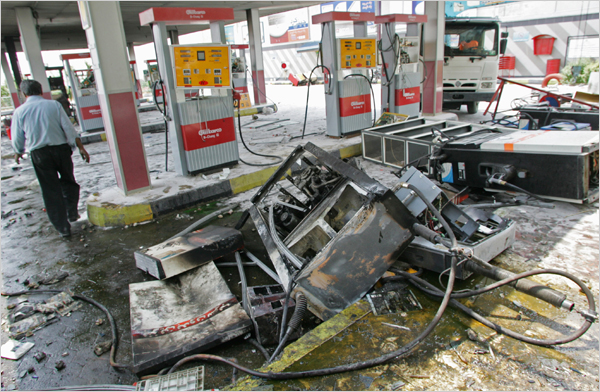
THERE are deep roots to Myanmar’s current unrest, pitting its repressive regime against Buddhist monks, but the immediate spark was the junta’s unexpected decision in August to double fuel prices. Overnight, diesel prices skyrocketed, and compressed natural gas rose fivefold.In this respect, Myanmar is not an isolated case. Rising oil prices in recent years have created all kinds of headaches as they have rippled across the world. Many governments, especially in the developing world, have had to choose between raising domestic subsidies to offset the increases or letting the people bear the brunt.
How Economy Could Survive Oil At $100 A Barrel
The world economy has managed, with some indigestion, to swallow the rise of oil prices past $80 a barrel. How well could it survive $100 a barrel? The answer is quite well -- so long as several conditions still hold true. The price rise would probably have to be gradual. Inflation couldn't get so bad as to force big interest-rate hikes. Oil-rich nations would need to pump their profits back into U.S. and European economies.
Does BP have licence to drill?
The price of oil adds to the intrigue. Four years ago you could buy a barrel of the black stuff for $25. It trebled in price in the next 36 months, then fell from $75 to $50, only to climb above $80 this year. Oil price volatility is a headache because it makes BP’s exploration investment decisions more risky. But by and large the upwardly mobile oil price has helped, and masked, BP’s disconcerting company-specific problems.
Riding an Israeli electric car to peace
Cornucopians are becoming extinct; scientists, engineers, politicians, and oil tycoons have recognized that we have used 50% of the world's oil supply in less than 150 years, and with China and India ramping up their industrial economies we may run out of our most used energy source in far less time. A full circle energy solution would include fully renewable sources of energy such as solar, wind, geothermal and hydroelectric along with efficient machines to plug into those systems. In other words, the West desperately needs a futuristic approach to life without oil. Enter Israel.
Wind power only part of the solution
Kunstler, a New York author and frequent speaker at environmental conferences, said he sees more similarities than differences between the "greenies" and the giant corporations, land developers and others they oppose.What they have in common is a belief -- a delusion, Kunstler says -- that the current way of life can be maintained; the only difference is that "green yuppies" think they'll have to pull up to the filling station and put something other than gasoline in their fuel tanks.
Oman crude oil prices up 7.5pc for November
Middle East crudes climbed this month as refiners snatched up cargoes on concerns that maintenance at fields in Abu Dhabi would limit supplies for October and November. Royal Dutch Shell Plc's buying of a record 310 Dubai partials contracts through the oil pricing system of Platts boosted prices.
Corn-to-Ethanol: US Agribusiness Magic Path To A World Food Monopoly
Eight years of Biofuels (ethanol) policy and legislation has cemented in place the first world wide food cabal, which promises a humanitarian disaster, a famine more serious than those caused by any tsunami, earthquake or drought. This crisis is not in the dim future, it is here.
Mandelson told to halt biofuel flood
BIOFUELS firms are demanding the British government and the European Union take action to stop American rivals exploiting subsidies to flood the European markets with cut-price fuel.
A series of bad blows -- high corn prices, intense commodity speculation, a shortage of crushing plants and excess production capacity -- have formed a "perfect storm" for the fledgling Texas biodiesel industry.At least two small biodiesel production plants in Texas already have ceased operating for lack of feedstock, says an industry source, and it's likely that across the nation more will be shuttered, energy economists say.
The International Brotherhood of Electrical Workers has stepped into the fight over whether to renew the Oyster Creek nuclear power plant's operating license.Chip Gerrity, president of the IBEW's state chapter, says his union's support of relicensing reflects the Lacey Township plant's economic importance for the state, along with its contribution to limiting greenhouse gas emissions and providing an alternative to importing oil.
As Prices Soar, U.S. Food Aid Buys Less
Soaring food prices, driven in part by demand for ethanol made from corn, have helped slash the amount of food aid the government buys to its lowest level in a decade, possibly resulting in more hungry people around the world this year.The United States, the world’s dominant donor, has purchased less than half the amount of food aid this year that it did in 2000, according to new data from the Department of Agriculture.
THE squeeze on the ordinary American promises only to get worse as the world price of oil goes up, the U.S. economy fails to create jobs, mortgage foreclosures increase, and the value of the dollar falls against other currencies.
Operators balance safety with production
Any storm, small or large, has the potential to shut down all production in the Gulf of Mexico, or about 25 percent of the nation's oil and gas production.And even a small supply interruption could easily trigger panic buying across the nation, resulting in a critical shortage, Shell Oil President John Hoffmeister said this month in a speech in New Orleans. Hoffmeister said the country is just one hurricane away from that scenario.
Nigeria loses ground in OPEC in face of unrest
Oil output in Nigeria has plunged by a quarter since the start of 2006 in the face of political unrest in the Niger Delta, reducing the country's influence in OPEC and limiting the effectiveness of OPEC itself.
New oil law is not in Iraq's interest
Iraq's draft oil and gas law, which was approved by the Iraqi government in April and which is scheduled for parliamentary approval, is one of the most dangerous laws issued since the occupation of the country began in 2003.The permanent constitution, passed in 2005, is another dangerous document that threatens the future of Iraq.
China to invest vast foreign reserves
The Chinese government launched a company Saturday to invest $200 billion from its vast foreign reserves, creating one of the world's richest investment funds at a time of rising scrutiny of such state-run entities.Financial analysts are watching to see where the new company invests and the impact on financial markets, especially demand for U.S. Treasury securities, in which Beijing holds a big share of its reserves.
Big, bad oil in all its glory: Stupid to the Last Drop: How Alberta Is Bringing Environmental Armageddon to Canada (And Doesn't Seem to Care)
William Marsden's book, Stupid to the Last Drop, paints a darker picture of the oilsands. Not only does Marsden argue that Alberta's oil business poses significant environmental risks, he tries to portray the industry and its supporters as somewhat thick.
It's the oldest and most cliched of metaphors, but when it comes to global warming, it's the only one that really works: We're in a desperate race. Politics is chasing reality, and the gap between them isn't closing nearly fast enough.
L.A. County calling for lights-out hour
Coordinating with San Francisco's plan, officials are urging Angelenos to agree to a voluntary blackout one day next month to help conserve energy.
Others have moved past their oil addiction
While Brazil didn’t have enough fossil fuel, it did have a wealth of sugarcane. Sugarcane was found to be an efficient source of biofuel, much better than the corn kernels we use. The switch to biofuel was an instant success, and cars running on alcool quickly hit the market.
Controlling costs key to keeping biofuels competitive
Ethanol needs to be able to compete with oil prices in the $30-$50 range, James Woolsey, former CIA director and now an advocate for renewable energy, said during the recent Renewable on Parade conference.
Hoping that federal regulators follow the lead of states like Florida and California, the solar energy industry is launching a major effort to persuade Congress to extend tax breaks and other incentives they say are critical to keep the industry's recent momentum going.
ANOTHER week on a changing planet. Australian farmers struggling through the worst drought on record are offered $150,000 by Canberra to walk off their land. Federal police chief Mick Keelty declares climate change - not terrorism - as the greatest threat to national security (a position doused down yesterday to an "equal" threat). Scientists drop a red-hot report forecasting catastrophic wildfires as a regular hazard of Australian summers. Suburbanites spooked by drought-inflated grocery bills contemplate a return to the vegie patch, but how to water it?
Research into the use of algae to capture carbon dioxide from the air is changing the negative reputation of these organisms, often seen as a plague associated with agricultural fertiliser run-off.
At Climate Meeting, Bush Does Not Specify Goals
President Bush said Friday that the nations that contribute most to global warming should all set goals for reducing greenhouse-gas emissions. But he did not specify what those goals should be and repeated his stand that nations should not be held to mandatory targets for capping carbon dioxide emissions.
Contact
- Content: editors at theoildrum dot com
- Tech support: support at theoildrum dot com
License

This work is licensed under a Creative Commons Attribution-Share Alike 3.0 United States License.
Alan FBE(if you're out there),
I don't recall seeing it mentioned in your electrification of rail the potential for dual purpose infrastructure. With solar, and particularly solar thermal in mind, the vast resources are located in the southwestern US. The main problem with that, of course, is that not everyone in the country lives in the southwestern US. Thus, to bring the power generated there to everyone else would require a vast transmission infrastructure which doesn't exist. Why not combine the HVDC rail electrification with HVDC renewable energy distribution infrastructure? If you want to get even more creative figure out a way for the cable/telephone/communications industry to get a "subsidized" ride on the infrastructure as well with cheap tower access or right of way privileges. The more parties you can get interested, the better chances you have.
Just back from DC a few hours ago.
HV DC cannot be used directly to operate trains (Low Voltage DC 600 V to 3 kV DC, is used, but 500 kV DC cannot be transformed down to usable DC voltages).
I have heard that US railroads East of the Mississippi should be electrified at 25 kV AC, and 50 kV AC West of the Mississippi and in Canada.
One can push these voltages only a few dozen miles, so a high voltage feeder is required.
One thought (not my area of expertise) is 500 kV DC in the corridor with "drops" (inverters to AC) every hundred miles or so to 150 kV AC which is then transformed to train voltage (25 or 50 kV AC) every dozen or two miles.
Using rail corridors for electrical transmission is a substantial value added to rail electrification.
Best Hopes
Alan
I would definately like to see someone answer this question. Most of the transmission voltages out here in the west are.
500KVAC
345KVAC
230KVAC
115KVAC
and 69KVAC down to distribution voltages.
I doubt seriously HVDC will be used much out here in the west due to all the varying HVAC lines already in existance. Not to mention that those "Inverters" if they make them at that voltage aren't going to be cheap.
old hermit
"you can cure ignorance, but you can't educate stupitidy"
There is already the Pacific Intertie HV DC in operation from The Dalles outside Portland OR to Los Angeles.
Northern Lights proposes an HV DC line from Ft. McMurray to San Francisco and another twin line from Montana (one leg) and Wyoming (other leg) to Las Vegas where it splits into legs to Los Angeles and Phoenix.
Sweden runs a complex grid mixture of HV AC & HV DC transmission lines. Mix & match works well.
Alan
If HVDC lines are used in the Los Angeles area, could stray leakage from the lines be used to ionize the air so that smog particles would charge up and head for the ground?
AFAIK, this would be very similar to the cleansing effect a good electrical storm would do.
I hope not - they could stick to your lungs at ground potential.
I would like to know whatever happened to the HV power line vs humans debate. It raged for a decade with conflicting results until some brightspark decided to include wind direction and bingo it was not the fields which made you bad, it was the drift of charged airborne crap that poisons you. Since that very logical result was suggested there has been no MSM reporting of results, no data that I have read [and I do read EEngineering texts]. Is the truth out there??
Thanks for the insight on the charged particle theory - it sounds a helluva lot more plausible to me than the field theory about getting sick around power lines.
If ANYONE gets sick from fields, I should have been among the first in line. I have been playing with RF, high voltage, and magnetism since I was in elementary school. Neither me, nor any of the like-minded friends that have the same affliction for this kind of technology have noted any increased likelihood of our demise from messing around with our toys, albeit we have all definitely noted our type do not attract women, nor do we develop the kind of "people skills" required to stay employed in a corporate environment. But then, we are not trying all that hard to be richer than everyone else or reproduce. Physics, not politics, is the "video game" of addiction for me.
I saw how fast I could clear a room of tobacco smoke using nothing more than a few parts I scrounged from an old TV. I noted how fast I could make all the cigarette smoke in the room head for some tinfoil suspended from the ceiling suspended from fishing line. It cleaned the air but made a really sticky mess on the tinfoil. All it took was a few -5KV emitters and one big +20KV "attractor".
If some old TV flybacks barely loaded would clear a room like that, I could just imagine using power lines for emitters, and placing a few "attractors" where I wanted the majority of the airborne gooey stuff to go.
Steve
Everyone is using the "Wiley Coyote" metaphor. He goes out over the cliff but doesn't drop right away.
I think that visual is perfect. AND it explains why some of us can't believe it has taken this long, (we thought he should fall right away cause of gravity, but we didn't realize we were living in Cartoon financial reality).
Here's the timetable I put together using the scenes in the Road Runner "Over the cliff" joke as phases.
----
He went out over the cliff about 4-x years ago.
18-24 months ago he stopped.
12-18 months ago he looked down
6-12 months ago he looked at the camera
Now -6 months ago he puts up a sign or waves with a sad look
and his feet start dropping down. (this was bears stearns moment)
Soon - 6mos (by 1st qtr 2008) the body and head will disappear.
6-24 months from now the camera follows his fall.
THAT IS WHERE WE'RE AT
I agree with the basic image, but I think it may go a lot slower than that. It's a big system, and there's a heck of a lot of inertia.
I'm not ruling out an imminent crash, but I wouldn't be surprised if it took a decade or decades to play out fully. Nobody wants a financial collapse, so they'll all be doing their best to avert it or at least slow it.
Another image is Wiley facing a speeding train, a bullet, a bomb etc. We are right now facing competition as far as what will be the key overshoot condition that causes our economies to crumble. GW,Peak Oil etc etc.
Whats amazing to me is that its fairly easy to access all these issues and become concerned that we are facing potentially dire situations in the near future.
Yet the world seems hell bent on ignoring all this and its party on. And to me the real tragedy is how our elected officials are handling this. One thing that is now missed is that part of being a leader is making unpopular decisions that are the right thing to do. This concept has been completely abandoned and I think its one of the key reasons why we will not recognize or problems until its too late.
Both our political and our economic systems are very short-sighted. One of the most depressing articles I've come across is the one where a survey of CEOs showed that they are all very worried about high energy costs and climate change, but they aren't doing anything about it. Basically, they are hoping that it won't happen on their watch. The politicians are doubtless doing the same thing: just hoping it will hold off until it's someone else's problem.
And why not? It's always worked before. As the cornucopian types like to point out, people have been warning that we'll run out of resources since Malthus, and about climate change for 30 or 40 years. But business as usual has gone on, more or less as usual.
That does not mean it will go on forever, but it does give people reasonable hope that when TSHTF, it will be someone else's problem.
It may be that politicians, even if they are PO aware will be reluctant to speak out. When confronted with an unusual challenge or novel threat, the most common response of administrators is to ignore it. Errors of commission are seen to be worse than errors of omission. In business and public administration it is always good to be correct, but if one has to be wrong, it is best to be wrong at the same time as everyone else and if you don't do anything you can't do anthing wrong! From their point of view it is a no-brainer.
Tom Whipple put it this way:
Maybe W will announce peak oil as a parting gift to his successor. That could set up a chance for Republican victories in 2010 and 2012, because of the economic downturn that would likely result.
I can see how governmental members might not want to publicize PO or threats of economic collapse. However, they should be making quiet preparations. For example, we could have heavily funded NREL (National Renewable Energy Laboratory) for the last decade or more. Just like Kennedy set a goal of putting a man on the moon we could have set a goal of XX% of electric power generated by the sun. We could have been building a series of 1GW solar power plants as experiments. We could have been slowly ratcheting up CAFE standards. None of this has to be related to a public sense of panic or fear.
On a side note, this administration has had no qualms about scaring the public with threats of terror, mushroom clouds over American cities, etc. Recall the advice to go out and buy duct tape and plastic sheeting?
When you get right down to it someone is going to have to do without. Without energy, food, medicine, something, and this will cause death. This holds horror to most peoples sense of decency, so avoiding it makes a lot of sense to me.
Publicly and privately we do not want to play god and choose by conscience thought who gets to live and who gets to die. There are exceptions to this - usually people who have not witnessed war vs vets such as the ones on Ken Burns latest special on WW ll.
I just finished the book called "The Road". Fiction about post nuke war. Most chilling was the actions between the groups of survivors. Kill or be killed, hide, steal, all rules leave, as the search for food was paramount.
Nature will choose for us who lives and dies, I guess she always has.
PO, GW, etc. is getting more mainstream press notably in National Geographic. The last two years of articles are dealing more and more with the problems we face.
The last issue deals directly with biofuels. There is no bio anything that will save our current auto life style here in the US. The powers that be are trying to hang on, I fear that common sense will be the least common sense in the future and we will suffer more than necessary. I would not want to be a Hispanic in the US today. I think they will become the scapegoat of the coming collapse.
As so many are keen to point out we can build a new future. Sustainable buildings (high thermal mass, airtight construction and heat recovery ventilation) We can design communities intelligently and avoid the need to consume as much energy in the first place. Things are looking bad now but 5 - 10 years down the line they could very easily be infinatly worse, thats why its so important to make this a big issue. We need a way to reform our economies that takes into account energy, emissions, health and hapiness. The bigggest health issue in the 'civilised' world is obesity. With a better diet and excercise many health benefits would come. This issues ties up so many others and gives us an oppotunity to work out so many things in hopefully a short space of time. Video conferencing, teleworking and web 2.0 allow ideas to spread so fast to so many people.
Does 'waking up' (to use the matrix analogy) more people actually speed us towards economic problems as they no longer take part in the race? As good as the ELP plan is would it cause problems if implemented by many people on a short time scale. Low skilled local jobs are going to be a big area, I see large groups of volunteers tending to farm land, renivating large housing into multi person housing, teaching and caring for children as jobs and travel are likely to be harder to come by. I guess the point I'm trying to make is that we can build strong local economies where everyone plays a part especially the pub land lord :)
Population decline could be managed without a lot of excess deaths, if we lived in a rational world and could employ a little foresight.
Those people are out-bred---and eventually that means their resources appropriated---by religious fanatics with none.
...and never, ever (according to Don Sailorman) discount the FED's ability to defy gravity. I'm not saying I place a lot of faith in this ability to avoid the inevitable, but it is amazing to me what they have been able to prevent. Of course, with omniscient abilities to do whatever they want to "fix" the market playing field, how would anyone really fail?
I can't believe Don Sailorman ever said anything like that - although I have not been able to keep up on TOD posts for quite awhile now, so I might be mistaken.
He did not say that verbatim. He said the FED has many tools at their disposal to keep the economey humming and they will use them. Sorry if my interpretation sounds different, but there it is.
If you like, I can go search the TOD archives to pull out relevant Sailorman posts.
What I said was that the Fed and other central banks have the power to prevent deflation. But we can have plenty of other economic problems in the absence of deflation that the Fed can't do anything about--such as Peak oil.
Kudos to you, Don, and welcome back. I recently reread No Deflation! Lots of Disinflation then Inflation over at ITulip.com. I had read this over a year ago but forgot all about it until recently. It seems to capture better my concerns about deflating assets while the Fed is ensuring that we don't deflate universally. Janszen opted to call this "disinflation" - deflation in some aspects of the economy while inflation roars ahead in others. The full idea is nicknamed the "Ka-Poom" Theory and actually has been reasonably accurate since it was first put forth in March of 2006. This idea better captures (for me, at least) the notion that some parts of the economy may become essentially worthless (moving to near zero value) while other parts explode in price as inflation goes through the roof. Have you read Janzsen's position on this? If so, what do you think?
Also, my father-in-law, who experienced the Great Depression, has asserted the same thing - to wit, that the Fed will do anything, even destroying the dollar via hyperinflation rather than let a deflationary depression set in. Because of his background he is still not convinced the Fed can accomplish total avoidance of a deflationary collapse but I understand why he worries about that, having lived through it once before.
"The greatest shortcoming of the human race is our inability to understand the exponential function." -- Dr. Albert Bartlett
Into the Grey Zone
so they didn't realize that if they put the plug in the drain the sink would fill to over flow?
also
they don't have a clue what might happen when they pull the plug?
BS
I understand that this is simplistic but all the armchair analysis of economics is mental masturbation on par with the sports enthusiast Monday morning QBing. (which is encouraged by TPTB as well as espn).
I am so disappointed in seeing otherwise top notch posters entering into the “inflation/deflation” bs.
It’s like saying “ oh! KSA didn’t know what advanced tech ( econ equilivent of new forms of Collateralized Debt Obligations and Structured Finance ) might do to oil reserve estimates.
Yeah, I buy that. (not)
Look I understand ya’ all are raking it in on your “investments” but surely you understand this is sucking out of the system without reasonable productive value?
I read (sorry no links right now) that less than 30% of stock market transactions actually benifit business finance/capital liquidity for productive society. Over 70% is just money juggling between entities and sucking or draining of profit/future profit of real time business activity.
I would argue that this is the #1 reason for Americas demise.
That you can be so pedantic about PO, GW, and economic collapse, and choose to ignore this the biggest real time manifistation of what is the problem just floors me.
Oh right, "thats the structure under which we are currently operating and how we will operate in the future so work with it”.
BS
TODers get down on folks for wanting a better world but being unable to release the drive everywhere, SUV thing.
Well, you can’t expect fundamental systemic change and at the same time be able to CASH IN on it. CAPICE?
I am really not even sure what you are saying, souperman2. Care to elaborate, perhaps in clearer language?
"The greatest shortcoming of the human race is our inability to understand the exponential function." -- Dr. Albert Bartlett
Into the Grey Zone
Sorry, I just listened to round table talk on the dollar over at financialsense and what is happening just pisses me off to no end yet nothing will ever be done about it as long as there is money to be made.
http://www.financialsense.com/fsn/main.html
Antal Fekete's Can we Have Inflation and Deflation All at the Same Time? article is a fascinating one. In it he points out the distinction and disconnect between electronic money/credit creation and the real physical stuff/FR notes/T-bills. The ongoing crunch in the ABCP realm is one such manifestation we are witnessing of this sort.
Now I'm not smart enough to know exactly how or which way this whole financial house of cards will fall, but I do think Fekete's analysis is illuminating as to how we can have both in the ongoing fiscal crisis.
I'm of the opinion that despite the Fed's best efforts to inflate, all this loose electronic credit will eventually sputter to a stall. For the beleaguered populous, who are already stressed out in debt (on higher energy, food, medicine and educational costs, versus falling home equity, recessionary job & wage pressures) lessoning one's debt, not taking on more in the uncertain times ahead will be a huge influence. As will the increased premium that lenders will request despite the open flood gates of credit from the Fed.
In short, we will likely have a fair share of both inflation and deflation (iTulip's "disinflation") so long as the powers that be can keep this mess of global financial imbalances in relative check. Probably through the next year, but not much longer after is my 2¢ bet.
It is sort of the way I was thinking it might go.
Some of his points go right over my head as I'm more of a "street economist" :>), but the basic underlying reasoning seems sound on a gut level.
The basic underlying problem is the insolvency of the consumer as shown in the rapid increase of credit card debt without a equivalent increase in sales.
http://globaleconomicanalysis.blogspot.com/2007/09/bank-balance-sheets-a...
IMO the only thing Fekete is missing is that he assumes the FED will act within the law.
If they are, and I'm not holding my breath, then the lower rates and $ devaluation would be a bluff designed to suck physical FR notes into the economy.
The 64K$ question is "would you bet your own money that they will act within the law?"
Hey Don...wondered if you were lurking around or back on the boat for awhile. Good to have you back. So what is your assessment of things since last you were here...Northern Rock, Bernanke cut, NetBank, etc?
I'm trying to read the leaves for the 4th QTR this year and even though things have not fallen through the floor, there is still plenty of nervousness.
Yes, Don Sailorman was right on in his analysis of what was going to happen. Much more accurate than others on this site. He didn't downplay the seriousness of the situation but said that the Benny and the Feds would do whatever it takes to avoid a crash. The only option is to inflate our way out of this if at all possible.
I wish he was around to tell me what's next.
-Don
I don't think anyone is right yet. It's only just beginning. I think the jury is still out on whether the power of the Fed can do anything against the economic forces rolling toward us. They'll try, certainly. Whether it will work is a whole 'nother kettle of fish.
Yes, Yes...this is the correct answer!
Less than 6 weeks since the initial subprime/ABCP SHTF...FED "PANICS"...yes, panics...and starts buying MORTGAGES and still is in mass...to the tune of 22 BILLION on Friday alone.
This isn't over barely getting started. But, of course, everyone and anyone will do ANYTHING to stop this house of cards from collapsing.
But one thing is obvious from analysts, the confidence is NOT back yet. And, confidence is key.
Flushing the USD doesn't inspire confidence.
And good 'ol Benny is definitely flushing it...USD Index closed 77.69 on Friday. CAD is nearly 1.01(1.007).
http://www.fxstreet.com/rates-charts/usdollar-index/
Next support level appears to be 77. That doesn't inspire confidence either.
But, yes, they will try anything to keep the economy floating...just barely...recession is Guaranteed!
That link just blew my "firefox" completely out of the water. had to start all over, and as a concequince lost all the new post tags.
old hermit
"you can cure ignorance, but you can't educate stupitidy"
It is either Java or Dhtml/activex that loads thier graphs.
Java and some big byte commercial stuff, takes a fast connection.
Thanks Leanan, a rational voice among the cornucopian multitude. The game has not begun. The national anthem is being played. The Fed has cut interest rates, pounding the dollar, prior to the start of the real financial hell to come. Dont count your chickens before they hatch! A bird in the hand is worth two in the shrub! The Messiah is returning to save us all from our own stupidity. Thank you Don! Lead us from this financial wilderness, into the promised land of stable petro dollars based on...nothing? Oh Well, no matter that its just worthless paper...Ben will find a way. I loaded up on Bell Helicopter stock...Ben has ordered a shit load of them! Bell, not Ben or Don, will save me from this melt down.
Have we forgotten what happened to the Japanese ecomony not so many years ago? It was stagflation...And you can bet your bippy that the Fed is going to try to avoid it at all costs. Helicopter Ben is going to push on a financial string and all will be well...And Santa will probably get stuck in my chimney come Xmas.
River,
Thanks for that rational analysis.
-Don
Since Bernanke seems to be in the driver's seat, I went looking for some insight into how he thinks, by reading old speeches and publications.
The man really seems to thing that inflation will solve all our problems.
http://www.cato.org/pub_display.php?pub_id=3438
http://www.federalreserve.gov/boarddocs/speeches/2002/20021108/default.htm
http://www.federalreserve.gov/BoardDocs/speeches/2002/20021015/default.htm
He even quotes Friedman about the great depression:
“Germany had been insulated by her hyperinflation and associated floating exchange rate."
At the same time the people happy about a strong dollar (like the Chinese) are going to get really shrill in their dislike of his policies. After all, pegging your currency against the dollar, is now the same thing as tying an anchor around your neck and jumping overboard.
http://news.xinhuanet.com/english/2007-07/24/content_6425467.htm
Of course, we all are forgetting(omitting) the other freight trains headed our way at the same time.
But if we just focus on the strength of the US economy...we should be very afraid of ANYONE who thinks that HYPERINFLATION would be a good thing and save us.
HYPERINFLATION will guarantee the dissolution of the USA.
Most incomes have not kept up with "government" inflation numbers since 1980, and those are not even the real inflation figures.
Let's see how long before total anarchy sets in when we inflate the price of a loaf of bread 5x (let alone 1000x in the HYPER case).
That scenario is more frightening than some of the PO doom scenarios.
Now, close your eyes, and imagine the other freight trains headed straight at us. The BIG PICTURE should scare the crap out of you.
"Let's see how long before total anarchy sets in when we inflate the price of a loaf of bread 5x (let alone 1000x in the HYPER case)."
That might actually push people to do what would be common sense to do now on many levels... ignore Federal Reserve notes and start bartering
"You can never solve a problem on the level on which it was created."
Albert Einstein
Barter what?
The great majority of service and financial people in major cities have no skills whatsoever in producing non discretionary goods.
The only situations in which bartering is used are those of hunter/gatherers, or people so poor they don't have any currency, as happened in some places during the 30's depression. Barter is such a poor way of exchanges that any fiat money will be used instead if possilbe
-
James Gervais
Without wage pressure we can't have hyperinflation attempts to inflate will just slow the economy further leading to a depression regardless of the value of the currency. I think this is the way we are heading. Wages cannot go up cost of production is increasing and monetary inflation is in force.
Note that inflation without wage increases means deflation the value of fixed assets such homes cars etc. The profit margin will quickly go to zero for these goods.
Unless we see wage inflation attempts at inflation will simply make matters worse. And I cannot see any sort of real wage inflation since to many jobs will still be shipped overseas.
To get down to the level of China your talking a average income closer to 7-10 thousand dollars a year. This is like making the dollar 5 times weaker than it is today.
You can see that monetary inflation could go for a long time before we would see pressure on wages. And without wage increases inflation attempts just weaken the economy faster.
I can't argue that...I don't believe they can create a hyperinflationary situation without COLLAPSE first/simulataneously.
See Greyzone's post above on disinflation...deflation of some things...inflation of others.
I too agree this is what is happening NOW/ALREADY.
Once again, Friedman shows his ignoring of reality. The reason that Hitler was elected was a promise to cure Germany's economic ills.
True, no one wants a financial collapse (caused by the world becoming aware that oil supplies must now decline...forever). So they are denying that peak oil will take place anytime in the next 30 years. And everyone is sure that by that time science will have developed "some other form of energy".
And they are doing absolutely nothing to avert it because they are in total denial. They don't believe declining oil supplies will make any difference whatsoever so it's "party on dude."
Ron Patterson
I don't know?
I look at this chart by GliderGuider
if we are down another 2.5 mbpd of exported oil in about 6 months as this curve shows then we may have problems??
But looking at the EIA import data thru May 2007 the OECD has been getting about the same amount of oil for the last year. At about 27,000 mbpd (http://www.eia.doe.gov/emeu/ipsr/t34.xls)
So the 2.5 mbpd drop in exports so far has not hit the first world as of then!
I do hope that someone will start pumping an extra 5-10 mbpd in the next year but I don't see where it's going to come from.
Edit:to fix graph
Ed
Off Grid, Off Mainland, current profession:Beach Bum
Exactly. Someone will have problems, but it may not be us.
I think many peak oilers expected there would be more problems than there are. But so far, we able to win the bidding war for oil, and not change our lifestyles much. This may go on for quite awhile longer. Even though we're buying the oil on credit.
My concern is that the monetarty situation puts China, who is not really our friend, in the drivers seat, as to when they pull the plug. The OECD can not start to go down in stages without it impacting the US economy directly. A fall in Japan's economy means they can no longer continue to fund our debt at the same rate. Without the outside funding of our debt, the house of cards falls. This is the plug China could pull which would eventually result in conflict.
Yes. I think China has signaled that they want a soft landing, but also that they won't be left holding the bag.
China can't pull the plug without causing a lot of pain for themselves. But I think they are willing to do it if they see it as necessary. Far more willing than a democratic country would be.
Still, I think they'll avoid it as long as possible. Meaning the party could go on for quite awhile longer.
In 1956, during the Suez Canal incident, the US told Britain to back off or else. Britain asked "Else what?" and Eisenhower replied that we would (a) cut oil exports to Britain (we were the swing producer of that era) and that (b) we would dump British debt that we held. Britain initially reacted with amusement and claimed that for us to do that would hurt the US rather badly. Eisenhower's response was yes, it will hurt us, but it will destroy you. Britain looked at the cards they were dealt and then folded, withdrawing from the Suez Canal and forcing France and Israel out as well.
Ref: Wikipedia: The Suez Crisis
It would be rather foolish to assume that someone else might not be willing to make the very same threat that we made, no matter how difficult the results might be.
"The greatest shortcoming of the human race is our inability to understand the exponential function." -- Dr. Albert Bartlett
Into the Grey Zone
Top World Oil Net Importers, 2006
Rank Country Net Imports
1 United States 12,220
2 Japan 5,097
3 China 3,438
4 Germany 2,483
5 Korea, South 2,150
6 France 1,893
7 India 1,687
8 Italy 1,558
9 Spain 1,555
10 Taiwan 942
11 Netherlands 936
12 Singapore 787
13 Thailand 606
14 Turkey 576
15 Belgium 546
Total 36,474
*Oil production includes crude oil, lease condensates, natural gas liquids, other liquids, and refinery gain.
These countries consititute 91% of the total. The USA is 30.5% and has slowly been increasing over the time period.
The question is who's been getting it in the shorts for the last 2 years?
Someone around here began to keep a blog of all the news stories of nations experiencing fuel crises in varying degrees. I checked that blog a few times but forgot to bookmark it. That would be one way to see how is "getting it in the shorts" these last few years.
"The greatest shortcoming of the human race is our inability to understand the exponential function." -- Dr. Albert Bartlett
Into the Grey Zone
Also if you think about it demand is seasonal for the most part so we have spikes and valleys so at least until now what may have been happening oil exports are now more steady over the last two years in the past with buying constant and reserves rising and falling. Their is enough slop in a sense in the global oil economy that we probably won't really feel the pinch till we are down about 4mbpd or so. And of course the poorer countries have almost constant stories now about oil issues.
Another concept I have is right now we may be experiencing a rolling shortage some country runs low then makes panic purchases this sends another country into problems. This seems to be happening if you watch the stories since it will be a different country every few weeks to a month with fuel problems. This again limits the effects of shortages for any given region but world wide some country is now always in a state of crisis because of oil.
Needless to say none of this is stable in the least and we won't need much more of a drop in production before these mechanisms are no longer effective and some place will experience a persistent shortage.
My concern right now however is this concept of a double export land model where oil is exported to countries with excess refining capacity and the finished products re-xported the US is a major beneficiary of this. One would expect just like the oil export land model that finished products will drop the fastest. So I expect of to see problems as early as next summer with importing gasoline into the US. God knows what the third world will be like with the US trying to suck in all gasoline exports.
The really big problem for us in having a bunch of poor countries absorb the shortfall is that when they reach rock bottom, the rate of decline will be much greater than it is now. That means we could be met with something like a hammer-blow, rather than a slow squeeze.
I am familiar with the figures for the UK and USA for imports as a percentage of their consumption eg: ~0% for UK and ~60% for USA ... but what are the figures for these other major importers?
The graph in the thread above for net exports has a 'business as usual' best fit line falling away very fast ... so, this isn't 'business as usual' at all ... it looks to be the recession from hell ... it's a 'depression with knobs on for importing' countries!
Initially I thought the net export line, going forward in time, was likely to be a major exageration! But, having seen exports from real world countries such as the UK
fall away to zero in a handfull of years (and quicker than ELM theory would suggest!) now I'm not so sure.
Please can somebody allay my fears?
Xeroid.
Of course, there are other cartoon images that fit the current circumstances.
For example, the image of the cartoon character standing on 2 small boxes (one on top of the other). The cartoon character then grabs the lower box and quickly places it on top of the higher box and stands on it. Then, grabs the lower box again. This repeats very quickly to carry the cartoon character high into the air, thereby defying gravity.
This could be a much more accurate representation of the current circumstances. And everyone will be helping to keep this gravity-defying animation going for as long as possible.
I became aware that global warming was going to whack us but good about ten years ago ... its taken ever so long for the effects in that system to really start showing up such that everyone can see.
The Great Depression started in October of 1929 ... but the bottom came in 1934. Assuming the credit market freeze of two months ago was the Black Thursday of this bubble we've got a while to go before it fully ripens. We'll see "direct kills" over the next year as those ARMs hatch out, then we'll go into a period where most companies are grimly hanging on, hoping their competitors drop the week before they do.
Cow Tipper, IMHO the Great Depression started in 1926, when a hurricane popped the Florida real estate bubble.
Perhaps the evolution of our economic system will be by punctuated equilibrium; a Black Swan creates a shock, the system then re-equilibrates at some lower level until the next shock, rinse and repeat.
I am agreeing with you that the unwinding of the petrodollar/debt party will occur by fits and starts over a period of years. And I believe that Leanan is correct that almost everyone in the world now has something to lose if our present system unravels and so will cooperate to keep it limping along as long as possible.
PLAN, PLANt, PLANet
Errol in Miami
Yep...that's globalization. Financial systems of various different countries are integrally tied together. This is why it is much harder to have any one of them fail, but when things do go south, they go south for all the players tied to the global system.
I believe that for any country right now to pull their support for the US economy means they have to pull out from being a global player and become more isolationist.
It is a game of chicken and no one wants to be the one that brought down the entire house of cards, so they stay at the table and deal.
But sooner or later someone will decide to go ALL-IN and hope to end up with the winning?? hand.
And some player may be beginning think that being the first player to go all-in may be better then being the second.
Ed
Off Grid, Off Mainland, current profession:Beach Bum
The Prisoner's Dilemma.
If everyone keeps playing the game the same way, they all don't do too badly. The first party to spill the beans, so to speak, gains a huge advantage, and screws the other players.
Who has the most to lose, would also have the most to gain. The US? China? India? A small cadre of multinational corporations?
Fascinating.
Hehe...makes me want to get out photoshop and edit in a nice little sign...like "Oops...Peak Oil" or "Peak Everything"
Nice visual...those canyons were always so deep when he fell.
A more MTV-nation appropiate way of saying "1-minute to midnite"
Epilogue:
Camera pans to a little tiny speck far far away in a dusty canyon.
Camera zooms in on a furiously speeding Road Runner in a huge cloud of dust.
Road Runner screeches to a halt looks into the camera, morphs into Woody Wood Pecker, gives Woody's hall mark laugh, morphs back into Road Runner and disappears into the sunset as you hear the staccato Woody Wood Pecker laugh fading away in the distance!
That's all folks!
Samsara, could you add one more dimension to your projection?
If you could, add geography - a map for a country or the world, showing changes over time and place in population and standards of living (stds of living based on hours of electricity, sewer and water availability, food availability, crime rates, housing market, etc, whatever).
The map could show changes in grey scales or symbols or whatever. We could see certain cities and regions succumb gradually with others relatively unscathed... and then over time the whole map gradually becoming "3rd World" with maybe a few first world-islands or pockets left here and there .
Something like that?
Or something like that Map Of Europe during the middle ages showing the spread of The Plague each year and including regions that were relatively unaffected.
Something like this might help get people to stop thinking in terms of The Transition as a simple, global and simultanious "Civilization-to-Stoneage" and begin seeing the range of likely possibilities.
We could see certain cities and regions succumb gradually with others relatively unscathed...
Yes, exactly.
The best cliche that I've seen describing this was:
The Future is Already Here, It's Just Not Uniformly Distributed Yet.
Or George Carlin's
I'm not afraid of All Hell Breaking Lose,
I'm More Afraid of Only a Part of It Breaking Lose and Nobody Noticing
The Coyote time table was for the Financial Markets from what I have been reading.
John
I keep seeing a game of musical chairs every where I go now. Specifically a game I remember playing in at about five years old in the basement of my preschool. I think it was the first time I had ever played and was quite alarmed by the panic when there were about 5 players and 4 chairs left. I had been out of the game for a while but was still facinated watching. Some things never change.
Recipient of AA, Alberta Advantage
Pan Down....
There's a group of people down there who are rigging a safety net and a ladder back up.
Will they get it together in time?
That's the real question.
Or "Are you doing your share of net/ladder building?"
Perhaps that's the most important question....
No there is not. There is a group hanging on the edge of the cliff grabbing change out of peoples pockets as they fall. There is another group at the bottom of the cliff waiting to pull gold teeth from the corpses after they hit.
That is about it.
Some of us plan on using the corpses as compost.
To highlight what I consider technical overshoot thats highlighted in the lead article.
I now think that our future production may actually be a lot less than even predicted by HL although its not yet possible to put a number on this.
The reasoning is simple technical advances have allowed us to keep the production rates high in many fields around the world. In almost all cases increased production from technical advances is mixed in with the "natural" production rate of the field based on its age. This lead to a overestimation of URR since in general the technical advances are simply allowing us to pump oil faster in effect robbing Peter to pay Paul with a dubious increase in real URR especially and a high production rate.
Given this I feel that the URR estimates even from HL may be grossly exaggerated especially if data from major shifts in technology are mixed without weighting the data for this technical effect.
As and example its wrong to do a simple merge of production data for Canterell pre and post nitrogen injection. This leads to inflated URR estimates.
In any case I'm beginning to think we are way off base on our URR estimates and HL results are skewed because they include and expectation of rapid technical advances continuing to ensure production rate can remain elevated even though we have effectively hit a wall where the production rates of watered out fields cannot be increased significantly regardless of the calculated remaining URR.
I think we have grossly over estimated remaining URR
even with the pessimistic HL method.
Memmel - A lot of your comment is more sophisticated than my simple knowledge. The industry has developed technology which basically constitutes better straws which not only get the oil out faster, they get more of it. Norway's early peak is a good example of this, and a lot of the other North Sea production. I can't put any technical information with this, but it is a lot of what bothers me with some of the big production numbers. The crummy leases I produce were drilled using technology developed before 1930, for the most part, and most were drilled in the 80's. Sure, mud programs and logging helped with better completions, but for the most part, the wells just produce URR faster. That now includes higher URR's, due to the better technology, but still faster. That has to be adjusted for in any evaluation of the field to get the URR, and I am sure that it has, but there is still too much optimism on the part of the producers that they will be able to keep production up. It is worth it, and all of this will extend the plateau, whether that is good or bad. If you look at it from the standpoint that it takes pressure off peak oil, OK, but the concept that "the present value of a dollar today is a dollar and tomorrow it is not" is the driving force which really keeps companies looking at technology.
I am not capable of evaluating the THAI process discussed recently, but it will certainly throw all of our historical information off if it really works, like on old fields, such as the East Texas or Cushing fields. That is where something like that could make a big difference in peak oil terms.
woodychuck,
My conlusion is that the THAI process is suitable for solution gas sandstone reservoirs, but not for waterdrive reservoirs or the limestone in the Permian Basin fields.
The temps are too high for limestone, it cooks into cement and the connate water gives new meanings for the term well cementing (bad joke) while at East Texas the sands have too great a water flow. But CO2 seems to work good on limestone. Maybe surfacants or microbes would work at East Texas and other Woodbine fields. Jim Baldauf at ASPO was telling me about a microbiological process thats really gotten good results at Rankin field in Harris County. If it will work on waterdrive Yegua it might work at East Texas, but I'm no engineer, I'm a landman. I'm thinking that THAI might be perfect for fields like Minerva-Rockdale, which is an old solution gas Navarro field on the Luling fault zone.
I'm thinking that redeveloping old fields has the most promise of any "non conventional" oil process. I have a hard time believing that it will add more than 2 or 3 million barrels a day to the current US production, but thats definitely worth doing. I'm currently working on a Gulf Coast prospect like that. The field produced between 20 and 25 million barrels in the period 1920-1960 and was abandoned before waterflood became common in the late 1960's. The US Department of Energy says that fields like that got an average of 10% of the original oil in place, while modern production gets between 50% and 65% of the OOIP. That means there may be as much as 100 million barrels recoverable from the same field at shallow depths with great old miocene and frio sands. The economic risk is the flow rate, and $80 prices will sure make a lot of this kind of stuff more valuable and less risky. Even a 5 bbl/day 1,000 ft well will pay out at those prices.
If you're going to be at ASPO-Houston Oct 17-20th I'll show it to you. I'm trying to raise lease buying money right now, I've got $80 K so far and I think its going to take about $500K. That's why I'm looking at tertiary methods, they might really make old fields a great value, and there are dozens if not hundreds around. My email is Bob Ebersole (lower case run together)two thousand and four(numerals) at Yahoo.com
Yes, thats right, I'm shameless. I really think this is going to be a big part of the solution to peak oil and the horrible economic crunch that's started. A couple of silver BB's in the shotgun shell. But no solution works if we don't get busy, and with 68% foreign imports its the real national security problem, not a bunch of religeous fanatics in caves in the hills.
Matt Simmons seems to agree. He thinks the new high-tech methods not only do not increase the total amount of oil produced, they actually decrease it. Slow and steady is the way to get the most oil out of the ground.
I'm sure the actual results vary by geology. But I think we're going to find the backside of Hubbert's Peak is steeper than expected. The oil being produced now is being produced in areas where there's incentive to do it fast, because of the expense. (Deepwater, for example.)
Logging while drilling (on horizontal wells with steerable tools especially), 3-D seismic, and logging tools have resulted in increased production, and in development of fields/wells not capable of exploitation otherwise. Mapping programs have enabled redrilling of old production, like a friend of mine did in Cooke Co., TX with fairly wide original spacing on a waterflood, finding new oil horizons and getting more out of the old productive zone. I am not sure you could find good prospects without those types of technologies. I am not sure about the ultimate profitably of the projects like directional drilling in 3 foot thick coal seams, but they have resulted in additional production we wouldn't have otherwise.
Recovery factor is calculated from two things: the amount of oil (or gas) originally in place, and the amount of oil recovered.
In smaller fields and in areas with lower level of technology (e.g. many parts of the onshore US), people mostly assume that the amount of oil in placed is a known quantity without much uncertainty. They may also assume that once an existing well reaches a break-even production rate, that the field is fully depleted.
There is plenty of experience to show that reservoirs often have greater complexity than is initially assumed in pancake-type geologic models. Likewise, because of mis-use of things like porosity cutoffs, oil in place can also be underestimated.
These and other factors create conditions in some fields, (but not all fields) where recovery factors are in error because the denominator - oil in place - is too low. Drilling new wells in between old wells (infill drilling) can in some cases recover some oil that was not known to be available for recovery. I think this is especially the case in highly heterogeneous reservoirs, such as exist in the onshore US, Canada, and other places.
This effect I think has the potential to make some older mature reservoirs last longer. Overall, though, it may only reduce slightly nationwide or worldwide decline rates; it does not have the potential to reverse decline except in a few cases which will usually be smaller and geologically poorer fields.
Directional drilling in 3 foot thick coal seams:
Sounds like coal bed methane drilling to me as methane de-sorbs from the coal. Useful in places for local electricity generation. US is quite big on this.
Enhanced seismics, infill drilling, directional and horizontal drilling have all played a major part in keeping mature fields alive. Without these tools, The UKCS North Sea would have died a quick death between 1995- 2000.
BUT: as useful as they are, they cannot reverse a regional decline trend. Once the Kings and Queens are on the decline, no amount of 'puddle sucking' will reverse the trend.
To reverse the trend, one would have to find another oil province of equal URR to KSA , Russia, North Sea. Lower 48.
Many People, mostly Non TODers forget this, or perhaps dont really understand how important the supergiant discoveries of the middle east and SU were and making up the depletion will be impossible. You can crush as much shale or hose sludge out of sands as you like: It doesnt change the tempo of decline.
A large operator has done some of the 3' coal seam directional drilling in Osage County, OK. I think they wanted to try it and see if it could be done, and the actual cost and effectiveness that could be accomplished. I saw some information on the results, and don't know the end use of the gas, but they had a nice operation on their conventional drilling.
True, also, that the things I mentioned are not the solution to end all of our problems. BUT, this is going to be a process spread out over some period of time, and everything we can do to supply ourselves is going to help. It will not effect the world's markets all that much, and thus should not bother KSA, but might irritate the Russians. KSA would probably be happy to take China's oversupply of US currency anyway.
(By saying spread out over time, I am not in anyway discounting the ELM work done by WestTexas. It may end up seeming like it was just overnight later, but will be a drawn out process. Kind of like a "friendly" divorce.)
But I think we're going to find the backside of Hubbert's Peak is steeper than expected.
Kinda like the whole world doing an Oman type slide.
If I understand Simmons' reasoning correctly, it is not exactly the technology, but simply the rate of production.
No simple metaphors on hand, but the balance seems to be between maximum rate and maximum amount. What has happened recently is that the ability to drill precisely and model the reservior has allowed a lot of oil to almost magically appear due to technology. However, the balance remains unchanged, even if technology seems to have created a lot of new oil, and allows for a deceptive confidence that technology will keep pace with depletion.
I could be wrong, of course, but his point seems to be that we have collectively chosen maximum flow, and damn the torpedoes. And we are about to find out what that means. Especially considering how the ship lacks lifeboats, and nobody has been tending the engines for years.
Exactly and HL is actually not sensitive to this change in technology and thus gives a higher URR estimate then is real.
Maximum production at maximum technology actually leads to a inflated URR estimate. KSA which has been a bit more conservative might have a better estimate.
The key point is once a technology is no longer effective at keeping production high for example a horizontal well waters out then production drops like a rock and URR estimates drop also. HL will adjust as the data comes in and the "dogleg" region is past.
These techno boosts could well be what is causing some instability in using HL for a predictive tool.
But I think we can feel comfortable or probably more apt uncomfortable that the HL analysis may have over estimated URR because of the super straw effect.
Sure its complex and some real URR increases are their because of new technology but I think that production capacity increases are significantly greater than URR increases. Credible evidence that real URR increase have happened vs production rate increase would be useful.
I don't have handy links, but I recall Jean Laherrere making the point a number of times that advanced oil exploration and extraction technologies have much more effect on the rate of extraction than on the URR. Another artifact of advanced oil-field mapping technology is the drop in 'expandability' of reserves as time has gone on. The newest technology is better able to form a more complete picture of a given field's resource than in the past, leaving much less room for future reserve additions.
psst (that is called gravity drainage or gravity segregation and is most definately rate sensitive)
and as a general rule the following recovery factors apply
solution gas drive: 10 to 25 %
water drive or well managed waterflood: 40%
gravity drainage : 65 %
i havent seen much in the past 30 or so years that would convince me otherwise
and i agree with the poster below yours ,piccolo, ooip can easily be over or under stated
I guess that I am better at doing it than saying it - The portion of the OOIP that we can produce is the URR. The technology which enables us to get additional oil out of a previously P & A waterflood, which seemed to be fully depleted (Shell was the operator) yielding an additional couple of million Bbls is good resource management, and I'm not sure that the friend is that much smarter than the Shell guys. He was, and is, far more persistent and thoughtful. There are many more of these situations out there, and they will not stop the peak. They will mitigate it. They will help the local economy and the payoffs will seem almost unreal. Drill a nice sized little high of a couple hundred acres here in the US and spend your money, get some nice little wells, and at today's market you have made some nice money. Of course, the sales price would be denominated in dollars, so take it with a grain of salt.
Well put.
I noticed that Nansen Saleri and the article about Ghawar doesn't specifically say that overall production from Ghawar will increase - even with the new Haradh increments.
Granted oil output by field is a state secret, but you would have thought that Saleri might have stated something like overall Ghawar production would increase.
Anyway, kudos to TOD for forcing Saleri to show his weak hand.
I thought TOD ran a link to a statement by al-Naimi that the existing wells in Ghawar were declining at about 8% but infill drilling was holding the actual decline rate to 1-2%. Does anyone else have a recollection of that article (Leanan?)?
That's just about right. Ghawar was specifically mentioned as declining 8% per year in the older sections, but new drilling was expected to hold the decline to 2% per year.
I don't think there has been update or confirmation from them on this statement since the early 2006 statement.
Here it is, embedded in this article I wrote some time ago.
I have been thinking about Saudi Arabia and their depletion and/or decline rate. In fact I have thought of little else for some time now. It occurred to me that there are two terms at use here. There is the term “depletion”, and then there is the term “decline”. These two terms are used almost interchangeably but in fact, they have two entirely different meanings. And I have been as guilty as anyone else in confusing these two terms and often using the term “depletion” when in fact I should have been using the term “decline”, or vise versa.
Depletion starts as soon as the first barrel from a reservoir is pumped and continues until the last well is capped. Depletion rate is always the annual extraction rate divided by the total remaining reserves. And since the exact remaining reserves are never known exactly, the depletion rate is always just a guess.
Decline rate is an entirely different thing and can be measured exactly, no guesswork involved. Decline rate is simply how much a country, company, field or well produced this year verses last year.
But I have not been the only one guilty of incorrectly using these two terms interchangeably. The Center for Strategic and International Studies makes the same error. On page 16 of this document:
http://www.csis.org/media/csis/events/061109_omsg_presentation1.pdf
CSIS makes the same error. That slide is titled Saudi Oil Field Depletion Rates They start off using the term depletion correctly. They tell us their estimation the Kingdom’s average state of depletion then they name three fields and give us their estimation of their state of depletion.
Then they switch gears and start using the term decline, and here they use that term correctly also. They tell us that the average decline rate of Saudi fields is 8%. However with an extensive drilling program the decline is mitigated to a number close to 2%. Okay so far so good. Then in the last sentence they completely screw everything up. I quote:
These depletion rates are well below industry averages, due to enhanced recovery technologies and successful “maintain potential” drilling operations.
Wrong! The figures 8% and 2% are not depletion rates, they are decline rates. In fact, here the two rates, depletion and decline, are going in opposite directions. That is, by decreasing the decline rate, they are increasing the depletion rate. If a field has a natural decline of 8% then it will be depleted by 50% in just over 8 years. If the natural rate is only 2%, it would take 34 years for 50% depletion to be reached.
If the natural decline rate is 8%, but you drill a lot more wells and suck the oil out a lot faster in order to decrease the decline rate to 2%, you will not increase the amount oil in the ground, you will only dramatically increase the depletion rate and set the field up for a catastrophic collapse, most likely within a decade of the initiation of such an extensive drilling program.
But what causes a field to decline by 8%? If the pressure in the field is kept constant, then the volume of liquids produced by each well will also remain constant. Saudi injects, as of a few years ago, about 7 million barrels of water per day into Ghawar. And presumably they remove about 7 million barrels per day of oil and water. The oil from the field will decline as the oil to water ratio declines.
Water is always injected on the periphery of a reservoir, and deeper than the oil well depth. Ideally water encroaches on the wells from two different directions, in from the periphery and up from the bottom. I say ideally because this is the best of all possible scenarios. Sometimes fractures cause the water to bypass the oil and go directly to the well. The wells near the periphery will always have a higher water to oil ratio than those nearer the center. If you can pull more oil from nearer the center of a reservoir you can actually decrease the water to oil ratio….for awhile. If you draw a graph of a field declining at 2% and another declining at 8%, they both will meet at zero. This means at some point, the field declining at only 2% must turn sharply downward in order to catch up. That is, of course, unless God decides to put more oil in the reservoir.
In any reservoir, there will always be some wells that produce better than others, that is more oil and less water. If you drill more wells in these “sweet spots” and pull more oil from these spots you can slow the decline in a field. But make no mistake, by decreasing the decline rate you are only increasing the depletion rate. Sooner or later far more wells on the periphery will water out and water will begin to encroach from the bottom. At that point, the 2% turns into 20% or better and the field goes into catastrophic decline.
Ron Patterson
not trying to pick a fight darwinian, but a field producing at 50 % of it's initial rate is possibly, but not necessarily 50% depleted. the rate could reach 50% of initial at anytime (not necessarily at 50% depletion). and i dont think you really meant to say 50% depleted.
The backside of previous, old local and regional peaks, in the past, was being subsidized by cheap energy still entering the system elsewhere on the frontside of new, yet-to-peaks.
The backside will not look like the front side.
Couple of comments on marquee stories up top:
Hold onto your wallet
This last paragraph is an excellent synopsis of what we must do.
L.A. County calling for lights-out hour
I've seen more municipalites around the world do this and I think it's an excellent idea. Not only does it give people the sense of what they could be facing longer term, it forces people to disconnect from technology for a brief period of time. Not a bad thing if it forces some folks to go outside, talk to a neighbor, and break the electrically-hypnotic buzz of white noise and information in their lives.
[edited - teaching myself some new html code]
Just to reference, the petrol tax in the UK increases by 2p tonight (approx 2% increase), with further increases due in April. That will push diesel to at over over £1 a litre, or $7.65 a US gallon. Unleaded petrol is slightly cheaper, but not by much.
Most people haven't remembered.
The UK's massive petrol tax hasnt really decreased use, its probably helped slow it however. The state of the train network here is criminal, improving it should be firmly on the political agenda.
UK 2007 energy statistics
Check out the North sea decline rate scary as hell and no one has mentioned it.
http://www.berr.gov.uk/energy/statistics/publications/dukes/page39771.html
Nat gas CHP should be a must for any new development that can make use of it. We put as much energy up our cooling towers as we use to supply all our heating needs.
We need 43 nukes between now and 2025.
Or its Game Over for UK PLC...
See we could do that. Do them as 'mass' produced and its perfectly possible to build 43 nuke stations. However we do need to get started yesterday. No mucking about with 10 year inquiries and commercial funding.
Oh, and build that Severn barrier and the offshore wind farms as well.
The Severn barrage is very interesting. Tidal lagoons could offer a better solution as they dont completely block the water and will allows multiple basin storage, there are good grid connections in the area to due to Bristol/Western being one side and Cardiff / Swansea on the other. Would be ideal for mounting wind turbines on too. Marine current technology is IMO going to be big, its simpler than wave, predictable and can be used in combination with offshore wind, you could have 5MW of wind and 5MW of tidal from the same base in the water. We need to start thinking of building things with everything we need in them, cant the fridge/freezer heatpump be used to preheat hot water, or shower water used to flush the toilet. Our use of resources in many instances is simply insane.
Replace traditional hot water heater with on demand unit fed by water pre-heated by refrigerator ... the unit stays the same size but surrender twenty or thirty gallons worth of space in the base for a water based heat sink?
And in this part of the world we don't need all that much refrigeration for a good third of the year ... outside air does most of the work and maybe actually have to be warmed for January and February.
Wind, sunlight, moving water, and natural temperature differentials can free us ... but no multinational corporation benefits from that ...
I'd like to point out that there is a big difference between inflation caused by scarcity of a 'good' and inflation caused by an increase in the money supply or velocity. Attempting to restore a certain price by the usual inflation fighting methods when the problem is not the supply of money but the geological availablity of the good will produce a deflationary situation.
Deflation is just another term for demand destruction; okay, I stuck my neck way out there, but if there is no possibly supply side response, printing more money won't change things. At the moment, we seem to have already committed this error. When it is politically expedient to be thick, the highly paid get thick. I'm tempted to say it's a thick world, but....where's my Sarcanol...
Deflation is not demand destruction. In a deflationary environment prices decrease but demand decrease faster. The means of production are well in excess of demand. Thus workers are laid off and a vicious cycle starts until your down close to a survival economy in a full blown depression.
Demand destruction is inflationary in the price inflation sense more money is going to pay for energy and not for other tasks. This results price inflation in goods and services even as demand decreases because of less money for goods and services. This lead to layoffs and lower demand etc. But its nastier than a deflation since in this case demand is being destructed because of price so you don't get much price relief on the way down. Think of it as a depression with price inflation and monetary and massive asset deflation as money is diverted to necessities.
We are attempting to inflate and grow our economy to avert this situation but the problem is its leading to major outflows to oil exporting nations. Only the fact that they are recycling the petro dollars back into the economies of their customers is keeping us afloat. But this is imperfect and eventually the magic will end. The key here is both the Middle East and Asian central banks have been willing to absorb huge losses effectively subsidizing the US to date.
China has also subsidized US consumption. They have massive reserves of dollars and have pegged their exchange rate to the US dollar. They've done this to keep us buying and to keep their people employed. But how long can this go on? I suppose the US will become a smaller component of their exports over time. But at some point, either they will unpeg their exchange rate or demand higher interest on dollars to keep buying more of them. So really the Fed lowering the funds rate isn't going to amount to a hill of beans.
They still need to find something with a one trillion dollar price tag and a sucker who's willing to accept dollars for it.
During the early stages of the subprime crisis, the price of gold was falling, suggesting panic selling by investors trying to meet margin calls. I suggested that Chinese merchants would be glad to take that gold off their hands for dollars. But now gold is way up. There just isn't enough gold for sale.
There's Chinese deals popping up in every new oil province and the tar sands too. But a lot of those governments are too smart to take US$.
I guess as a last resort, they could pool their assets and buy up the US banks that will start folding. Will Congress intervene then?
China destabilizing is the wildcard over the next nine months. We fret about our economy being knocked back to 1940s levels but that could cause their population to get knocked back ...
Somewhere in all of this we're going to give up Taiwan to head off some sort of confrontation ... but we'll have to be a whole lot weaker before that comes.
Isolationism will kick in before we let the Chinese buy up our finance industry. We had quite enough trouble when times were relatively good and Japan, an ally, made inroads here.
Your making the mistake that China wants Taiwan.
If they invaded or took it by force then they would have 30 million more poor Chinese.
You know damned well if things got that tense anything worth money including all the national treasure would be removed and probably most of the machinery in the silicon fabs.
Whats left are a bunch of poor Chinese and Taiwanese without dual citizenship. An on that note a LOT of Taiwanese hold dual US or Canadian citizenship so a good percentage of Taiwanese are actually American citizens.
They may want Taiwan but only under a peaceful political settlement similar to Hong Kong taking it by force is stupid. Taiwan the island is beautiful but worthless.
A lot of good points today! Just an addition memmel: They do it out of self interest. Must keep the patient healthy to subsidize ones own growth. Yes, how long can it continue?
An OPEC member has once again raised their price to the far east, a possible result of the U.S. presence in the middle east, making one wonder how long before we get a more direct confrontation between the major powers.
It looks for all the world that we may be just beginning to see a real dip in crude output off of the peak. The slow motion accident continues. Someone elsewhere mentioned inertia of the system. Will it pick up speed soon?
Trying to extrapolate out I was thinking 2010-2011 before we see the problems really start to feed on themselves, now I am tending to think sooner possibly. The production wall started it driving the price up, now we see feedback effects- defaults, banks struggling (with layoffs), home builders ditto, car sales dipping. Major appliances next? Probably. Employment numbers finally beginning to dip ever so slightly.
Short HVAC makers like Lennox? Maybe find a more pure play, Lennox also does service.
The time lag between perception and results is boggling, hard to see that a lot of big money seems to be behind the curve. Must be the pension funds. Bet they get left holding the bag. Seems that at least some smart money has parked in gold already. Again, thought that gold would move more sharply by this point, slow motion still.
We urgently need a public outcry to CONSERVE immediately. It could delay deletrious effects long enough to get moving on societal change. How? 99% of people I talk to on this subject still have blinders on.
Lots of room for innovation in appliances as has been mentioned elsewhere - replace existing refrigerator/hot water heater with refrigerator using water based heat sink and demand hot water heater - less material and much less energy gets used for this device.
Of course, these things have already been conceived, designed, and built ... but internally. Releasing them would have cannibalized existing product lines ... or is that too tin foil hat?
Such a product would require massively rerouting plumbing and changing the way appliances are organised throughout the house. It could be workable in new houses though - but all of those are McMansions.
I knew that by not writing a short novel I was going to get into trouble. Deflation is rather unfamiliar area because we have experienced so little of it. Demand destruction is an unfortunate term as well. We are attempting to describe in a few simple words something which is, like electricity, rather hard to define in an accessible way.
The relationship you refer to as deflation in which prices fall but demand falls faster is due to the drop in monetary velocity. Much like the sawtooth drop that accompanies every bubble pop, velocity can react far faster than increasing or decreasing the actual supply of money. We're seeing this today in the velocity of the housing market. While each of us is personally concerned more with his own supply of money, markets are very dependent upon velocity. Because credit can be modulated far faster than actual money, it is the control most used to regulate economic activity. Deflation doesn't have to happen as you describe, but it seems to have done so in most cases.
My point was that energy is a good which has a knock on effect on most every other good traded. Is the price rise to $80 a sign of inflation or a cause? I think both, and in this way we are headed towards the stagflation situation that pertained after 1973. Greenspan seems to be predicting this in his obscure way, with no apologies for his part in the train wreck. He only threw the switch but wasn't driving the actual train. The thick part refers to the repetition of the remedies that proved self defeating then and will probably do so again. It's a bit like having another drink to cure your hangover. Seemed like a good idea at the time. Maybe there isn't a better one.
Deflation can be achieved by reducing the velocity of money or reducing the supply. Either one will detroy the ability to pay which is really what is at stake here. I have never been comfortable with the term 'demand' and, judging by an earlier long thread on the term, am not alone. Wants, needs, ability to pay - all three get mopped up in this loose term of demand which is so beloved of those who take a numerical and non human view of the economy. If you think that people are there to serve the economy, then you probably don't have an 'issue' with the term. If you think the inverse, then you probably do.
My point is that inelasticity of supply must be countered by elasticity of 'demand'. How you get there is a very important question, and I can tell you that fooling about with interest rates and money supplies will only muddy the water and add to the confusion.
I'm sure you mean well, but this is nonsense. When something gets scarce, and people subsequently are willing to pay more for it, that has nothing to do with inflation.
Inflation is a phenomenon that occurs throughout an entire economic system, not just with a single commodity.
Same error. Deflation reflects an shrinking supply of money or credit, or even debt if you will.
And if people have less money, yes, they will demand less, but you can't just turn that around because it sounds kind of plausible. First: less buying power. Second: less demand. Deflation is NOT demand destruction, that misses the point by a mile and a half.
Maybe that's easier to see if you turn it on its head, and say that "inflation is just another term for demand creation." That might be a more obvious non-truth, because we all know that inflation does not make us demand more, it devalues what we have and forces us to pay more for what we don't.
Thanks for making my point; that's what the government does - measure a basket of goods and derive an inflation factor from it. That's what the public thinks is inflation and is therefore the newspeak definition. I second your motion. It IS nonsense, but officials quote the results to point one percent regularly and Wall Street jerks it's collective knee.
When a single commodity such as oil, which is a component in most everything we do, inflates in price and/or becomes scarce it operates throughout the whole economy and has similar effect to inflation - especially if is largely imported. A glut of money or a scarcity of oil will both raise general prices, but one is classic inflation and the other is not an economic problem in the pure sense; it is technical, political and geological but only secondarily economic.
We also use deflationary measures as a method of demand destruction; stopping short of actual deflation is the trick. While deflation is not another term for demand destruction, it has done a pretty good job of it historically.
Whether you see it that way or not, from my point of view we are in agreement.
PT,
Inflation is never caused by scarcity of a 'good', as you claim it is or can be, it never can be, no matter whether you talk about oil or Cheese Doodles, and:
Deflation is never just another term for demand destruction. The two have no -causal- connection.
To put in simplistically: Inflation and deflation are defined by available money, not by available goods. And you try to argue the opposite.
You can't seem to resist the temptation of linking inflation to the rise in price of one or more commodities, and that is fundamentally wrong. Today's rising oil prices have NOTHING to do with inflation. Any connection between the two is accidental. To prove a link to inflation, you'd have to prove there's an increase in money supply. Looking at all kinds of funds and banks that can't even meet their short-term obligations anymore, that makes no sense. Sure, Fed and ECB poured a lot of 'something' into the system, but far more has evaporated, and that was just the national anthem. Game on soon.
Easy to see: while rising oil prices due to (perceived) scarcity may lead to higher prices in anything that is produced with oil, calling that inflation is flatly wrong.
Inflation is the kind of phenomenon that pumps up all boats. But there is no reason why the value of real estate couldn't go down in the present situation (and it does!). Hence, a valid method of measuring inflation may well churn out a negative number. All you need for that is a home price decrease of 20%, while oil (and products linked to it) goes up 10%.
That is not inflation, it's closer to deflation in the way you try to define it. In reality, though, for the time being, it's just a shift in purchase preferences.
Inflation would mean rising home prices. Yes, that's right, that's what we've seen for 10 years. Hidden inflation, covered up by the Fed's interest rate interference. In reality, inflation has risen as fast as the credit supply.
And that is why (hyper-)inflation will not happen now. It already did, we just didn't see it, we missed it completely. All the Fed had to do for that was to push the interest rate down. That pulled a curtain over our heads, but just becasue we didn't see it, doesnn't mean it didn't happen.
So, no, with all respect, I was not making your point.
I'm for getting the grey areas out of the topic, not confuse them.
Being classically correct is a position I could probably take as eloquently as you are doing. I am reminded of an old joke, 'the operation was a success, but unfortunately the patient died.'
If you'll add ' [hyper] defolation will not happen now' then we'll all sleep easier. I also hope that demand and prices will magically decouple from inflation and deflation for the reat of your stay on the planet.
[hyper] defolation
aka Fall ..
Triff ..
While on the subject of economics, permit me to ask perhaps a rather naive question regarding economic concepts.
And that question is: Is there an economic analog to the scientific concept of entropy? As an engineer, I understand the concept of entropy quite clearly. While energy can neither be created nor destroyed, as it cascades 'downhill' from use to use, it becomes less available to do useful work.
Now back to the economic analog. If a single person has a million dollars, he can do all sorts of things: buy a yacht, buy ten super cars, a really nice house, art, etc. But as he spends that million dollars, it gets spread over a wider and wider band of people, each of which have more limited possibilities for which to spend that money. Theoretically, if that million dollars gets evenly spread among 100,000 people, they each have but 10 dollars to spend, which might mean two meals at McDonalds three magazines, etc.
So then, do economists have some way of defining and quantifying this sort of entropic degradation of money as it gets diffused within the economy? Or perhaps money really doesn't really get degraded, but only gets perpetually recycled around and around.
If this is a dumb question, I will not be offended to be so informed.
I think your model demonstrates that money does not behave entropically. You simply left out the second half of the cycle where the million dollars starts to clump together again in the form of profits for the companies and individuals who earn it back. It then regroups to form a million dollars again and continues the cycle.
Perhaps inflation can be described as the amplitude of the cycle getting larger, while deflation would be the amplitude of the cycle getting smaller.
-Don
Yes, but what I don't understand is that if that original one million dollars is now spread out amongst thousands of people, then how does it really 'clump' back together again? It is still more diffused than it was when it first started its journey.
And by 'diffused' I mean that it is no longer under the control of a single person, a person who can make very large and creative singular purchases. As the money gets spread out, the number of people using it increases, while the size of the purchases made by those people decreases. Whether some of this money eventually winds up on the profit side of some companys' balance sheets does not seem to me to change the fact that the money is being diffused and thus entropically degraded ... in the narrow sense that the original million dollars can no longer be 'collectively enlisted' to buy something that the original million dollars could have bought.
In other words, the original single person with a million dollars can buy a million-dollar yacht (and not a very big one these days), whereas 100,000 downstream people have the exact same amount of money, but they are hardly likely to pool all there money together to buy a million-dollar yacht.
In other words, when Louis XIV built Versaille, he created something unique (perhaps worthless, but unique nonetheless). Now, the money he spent on Versaille eventually found its way down the economic ladder to thousands of tradesmen and laborers, who in turn spent most of that money on food and other essentials. While the same amount of money still exists, those thousands of workers could not in any realistic way band together to build another palace at Versaille. Hence, my suspicion that money has a certain entropic quality .... as least with regard to how it is used and the things that it can buy.
Again, this is just an engineer reaching into something he probably has no business reaching into.
But the thousands of laborers and tradesmen spent their labor energy building the palace rather than spending their energy building farming infrastructure, plowing fields, researching horticulture, doing science, discovering germ theories, etc. etc. etc. The money/labor was 'dissipated' on a hubristic boondoggle similar to the pyramids.
ET -
Well what you said sort of gets into what I'm groping at. Paying somebody to dig a hole and then fill it back up technically increases out GDP, but in actuality it obviously doesn't contribute to anything. Arguably, paying defense contractors to build Hummers that get blown up in Iraq is the contemporary equivalent of digging a hole and then filling it back up.
Getting back to my loose premise ... that there is a certain irreversability of monetary flow, roughly akin to the physical concept of entropy, a pharoah can build a pyramid, but the people (presumably getting paid) who are building it cannot realistically pool their resources to do the same.
This is not inherently a bad thing, for if money were perfectly distributed amongst the world's 6.5 billion people, probably no major infrastucture projects would get built.
Is it possible for money to undergo something analogous to a 'heat death' in which everything is at zero potential energy and nothing gets done?
But perhaps I am extending the entropy metaphor in an
unrealistic way. Maybe what it really gets down to is that I just don't understand money.
Well I don't understand money either but I like nontraditional thinking, such as the notion of a concept similar to entropy for money, even if none exists. Fun to speculate on.
If you look at entropy in information terms, one way of defining it is probably a measure of the loss of possible choices in what can be done. Indeed, I suspect that looking at it that way will ultimately make more sense out of measures like EROEI (which is otherwise deficient in some crucial ways).
If so, there could be an analagous situation with regards to money: there are more things you can do with a billion dollars lump-sum than you can do with a billion separate dollars; there are thresholds for many things. Moreover, I suspect that there is a Tainteresque finite 'overhead investment' in any real human transaction which might render a billion separate $1 human transactions inherently less efficient in aggregate than a single billion-dollar one.
I suppose if you looked at it in those terms, there would be a cumulative reduction in quality. And just as in a physical system, you could re-collect it (analagous to re-distilling dirty water) but there would be a cost to do that as well.
I hope you continue playing with the concept.
The laws of thermodynamics do not apply directly to money.
Money is a confidence game.
Money is a promise.
When your boss pays you at the end of the work week (or bi-week or month), he (she) is basically making you a "promise": Take these credit units (quantums of money) out into society and the units will provide you with "value" equal to or greater than the value of labor you performed for me.
As long as you believe that promise, you will have "confidence" in the economy and in the funny tokens we call "money".
Once you stop believing it, you will stop accepting "money" as a renumeration for the labors you performed.
(P.S. Econmists do have a term: it's called "trickle down". Wealth supposedly trickles down from the rich to the poor according to the much esteemed Ronny Raygun.)
Of course the original million dollars does not clump together again, the money regroups from different sources. I don't think it would be possible to track the course of a single dollar through the economy so it doesn't matter where the individual dollars come from or go to. It's the statistical result that matters.
-Don
One aspect is as you said - his purchases cascades around, and creates a factor of "K" times his spending in GDP.
Now, if he decides to put some of that money on deposit in the bank instead, then the bank can leverage that and make additional loans against it.
Say the bank is required to maintain 5% reserve ratio, then they can loan out 2 million dollars for every $100,000 he deposits. And that 2 million will cascade around as well.
Money breeds money in a fractional reserve fiat system. There is NOTHING like it in physics.
Francois.
Uhh, neutron capture by U-238 yielding Pu-239?
Yeah, I'm a contrarian investor, too :-)
Yes - you are right. And if it happens to often it all explodes - just like the real economy.
Francois
Entropy is defined for informational systems like social networks, computer networks, and evolution (and possibly money?), but the behavior is described differently from the conventional layman's description of the entropy of energy.
(Leaving aside the problem that the layman's understanding of entropy of energy is usually pretty distorted...)
Systems comprised of information progress to the highest degree of complexity, characterized by ever greater possible combinations or states in the system, but with greater proportion of these available states inaccessible to the system, due to 'constraints' on the system. This is exactly equivalent to the behavior of energetic entropy, tending towards systems with the least usable energy.
Some examples of informational entropy that are intuitively understood, but rarely viewed as expressions of entropy:
I don't have any background in economics, so I haven't even tried to understand how this formulation of entropy might apply to monetary systems. I do know that money has different constraints than some other forms of information, which will govern how the entropy laws are expressed. It may be that inflation and deflation are both expressions of entropy in monetary systems, for example. The social activist in me often speculates that the distribution of money is likely to be governed by entropy: as wealth increases, and the population of wealth owners increases, the distribution of wealth becomes inexorably less and less even. But this is pretty weak, based only on the observation of the history of the world :-), rather than actual math...
This formulation of entropy is based on my dim understanding of the work of Prigogine in unifying informational and energetic entropy, and the extension of his work by Brooks and Wiley in the Hierarchical Information Theory, ("Evolution as Entropy"). Plus some of my own muzzy-headed noodling... Don't take it too seriously :-)
CW
Hindmost -
Thank you for that very interesting and well thought out explanation regarding my thoughts on the possibility of a monetary entropy.
Your descriptions of systems tending to increase complexity while at same time increasing the constraints within such systems probably comes a lot closer to what I had in mind than trying to build an analogy based on the entropy of energy.
While I still believe there is a certain irreversibility to the way money ripples through the economy, the system does have a sort of reversing mechanism in the form of banks. In simplistic terms, banks take a lot of this highly diffused money and cause it to agglomerate, wherein it can then be made available through large loans to start the downward journey of money once again.
But just as a system requires an external infusion of energy to reverse its entropy (such as sunlight allowing plants to chemically go from a less to a more organized state), so do banks require an infusion of 'energy' to cause this reversing process. That energy might be in the form of the money require to run the bank.
I find all this to be interesting stuff, mainly because it is something I frankly don't know too much about.
Hi all, I've been gone a while.
Yes, like a lot of small businesses in the Bay Area, mine imploded - not collapsed, sagged, downturned, failed, but actually imploded - that's the only term I can use to accurately describe how fast it happened. Ebay sales went down over 50% very quickly, then continued (and continue) downward. The "just in time" payments on things and no savings insured that things went down fast.
I didn't think electronics test gear would crash this quickly, but it's been sagging the last couple of years, and it turns out engineers don't buy stuff as enthusiasticsally when they're about to be foreclosed. Go figure. I kept going as long as I could, rang up a lot of debt, which soon went to 30% interest rates. I will be lucky to make minimum wage for the rest of my life, so screw 'em. They seem to want people to declare BK.
I'm in the chino valley, arizona area now, back with an old friend. I have a roof over my head, dial-up, very simple food. I do a little weeding and stuff. If you're in the area and run into a mediocre caricaturist, that may be me if I can get up to mediocre.
None of the friends and business associates I knew out in California would rent me a room cheap (I'm sure I could at least make a few hundred a month rent and my food etc needs out there at the various farmers markets and doing street music even if I don't draw or play THAT well at first) but even those with more than one house etc., would not charge less than $750 for a room. Plus utilities.
Hearing about Bob Shaw's troubles (Totoneila on here) has caused me to post. Bob, I don't know what your situation is, but there are no homeless as such in the Prescott and Chino Valley areas. It's very hard to be so poor that you can't camp somewhere, sleep in a van and have your stuff in storage, etc. People here are nice. The weather is nice. We're not too far from notable Peak Oilers like Monte, and real estate prices are going down nicely. It's not too hard to get a place just for taking over the payments and there are lots of foreclosures. Very easy to rent or buy here. I'm not saying the place is super-great, but it ain't phoenix.
I hope we can keep Totoneila in our thoughts and offer what help we can.
I packed up and got out of town right after the 7/5 PEMEX bombing; people said "just like Nigeria" and I heard that loud and clear.
I had just started a new gig that was going to yield $5,000 - $7,500/month ... it ran at half speed for two months and then no more. Different for me though, twice in the last year I've had customers outgrow my services - I'm in the crazy hot VoIP arena. I think this one ended because they hired a full timer to do my thing. No hard feelings on my side, and those poor illegitimates are in Las Vegas ...
Given my skills and location I just might get to keep a technology role post bust, but we shall see ... interview Tuesday for my first "job" in nine years. We shall see how that goes.
I chased after a house that was on the market here last week - four bedrooms, $7,500. Yeah, I typed the number correctly - if you don't mind cleaning and painting something old there are treasures here. This one (3.25 acres, three bedrooms, five solid outbuildings, running water) has a $28k mortgage on it. Mom had heard it was worth $150k ... that might have been true last spring but now it'll go for the $49k for which it is appraised. I itch to get ground loop cooling done, but I don't own it and she doesn't approve ... hence the lazy pursuit of alternatives ...
I had a chat last week with a friend who recently moved from Omaha to San Francisco ... he got laid off about six weeks ago and he said he and the wife would be frantically packing 9/29 and driving back home if he didn't find something. He asked me if there were agricultural jobs available here ... and I don't think he was kidding. This guy is a java wiz and he used to adjunct professor at the four year state university in town - not a slouch in any sense of the word.
I cringed when I read Bob's post - I had a similar discussion with my ex about global warming six or seven years ago - "Honey, lets pay this one off and get a house in the country." We could have easily managed it at the time ... but she insisted on living beyond our means, then went on to live beyond her means after wearing me out. Her mother's recent death and receiving a sizable inheritance saved her from being one of those ARM foreclosure fools ... and she has an MBA from a good school(!)
I called her when I moved, told her why I was doing it, and asked if she'd like to get a little place up here. I was "stupid and reactionary".
I bet she has a seven digit net worth today ... and it'll all be in dollar denominated securities, which means she'll be here with the kids begging to be let in within twenty four months. The kids can come right in for dinner but she and I are going to sit on the back porch and have a discussion about the definitions of the words "stupid" and "reactionary" ... even if its January.
*sigh* We are living in interesting times, and I'm hoping all of that good karma I've accumulated picking up and feeding hitch hikers over the years starts to ripen for me ...
I hope Totoneila is finding some comfort where ever he may be tonight ... and he is going to have plenty of company in coming months as the mortgage scam unwinds :-(
SCT I am amazed at anyone who can make good money pressing buttons on a computer. I swear digging ditches pays better. I'm convinced that if you want to have a good living learn to cut hair, fix sick animals/people, cook, fix cars, dig ditches, something that's damned hard to offshore and still likely to be around in a Depression economy.
I should have kept working for that vet I worked for once, I hated the work and becoming a vet or vet-tech sounded awful, but I've been back to the place and wow was biz booming.
I am impressed that even in the depression of the late 1970s, people were willing to pay at least a little for some drawing or painting. Or a nicely forged car safety inspection sticker (I was proud of those, you can't show brushstrokes) or a sign or a drawing of their house or place of biz. Of course it helps to be willing to do yardwork, cleaning, etc too, and I by no means think art would keep me out of duties hoeing potatoes.
Just in the couple of months I've been here things have gotten a lot scarier - the stock market being kept afloat by HUGE "injections of liquidity", the bear stearns thing, a few bank runs. Old friend here says "Depression, hell that's not coming, it's here - our money's worth nothing these days".
The "economy" is a trainwreck, a very slow-motion one, but it is wrecking. I'm going to my appointment with yes, my welfare worker, tomorrow for the low-income health ins. program (I never had health ins. while working) and well, guess they're going to kick me some food stamps (ebt card) too. Get used to seeing people on the 'stamps buying staples like oatmeal, coffee dried milk etc., because those are staples around here. No DiGeorno pizza around this place. Mainly I've applied to get health ins. just in case something happens.
I hope Totoneila is OK and he knows that he can sign in here from just about anywhere, takes not long at all to get a library card then you can use a computer at the library, during "slack" times of the day you can often stay on longer than an hour. Free wireless access points are here and there, takes a laptop to sneak around and get into 'em though - I was using the wireless at Embry-riddle at first here. At least even in phoenix the weather's getting less hot.
Hi fleam,
I'm glad to hear from you! I was wondering what happened to you. Good you've landed on two feet.
In Sunday's LA Times, there was an article about how a lot of ag programs are hurting for students.
If a person is into it, this might be an opportunity. I imagine more money is available. One of my ideas is to start a non-profit to funnel money to fund education of young farmers, esp. in organic/sustainable. There are actually a lot of opportunities and grants if you look at the ATTRA site (I'll try to find it in a minute). Here it is: http://attra.ncat.org/
Meanwhile, just for general info, here's the article.
http://www.latimes.com/news/local/la-me-farm29sep29,1,6863964.story?ctra...
"Fight Heavily Armed Villains. Invent New Snacks. Save the Planet.
Agriculture schools in California and throughout the nation are hoping fresh slogans will cultivate interest among high school graduates who don't know wheat from Wheaties.
The same universities that a generation ago churned out legions of agriculture professionals today largely struggle to woo students. And many students who are studying agriculture are clamoring for cheese class and wine-making seminars, shunning traditional fields such as soil science and crop production. Even the Midwestern states have felt the pinch.
Many schools are wrestling with declining enrollment, as a large portion of the agricultural workforce is nearing retirement.
In California, one-third of the public and private plant doctors who monitor the health of the state's $32-billion agriculture industry will retire in 10 years or less."
It is very late(for a Sunday at least)...but just checking my watches before I hit the hay.
Tropical Weather Update:
Both Karen and Melissa got torn in half by High level extreme wind shear zones. So, off the radar (so to speak for a while). Karen may refire as it drifts westward south of PR.
But the news to watch for us OIL peeps is a subtropical zone off of the east coast of Florida, south to Cuba. Has potential to become a TD as early as Tuesday(of course, who knows)...then transit WESTWARD into the Gulf and straight at Texas (models show now...but again (grain of salt) this can change).
Just a heads up as it is close and threatening.
I may repost this tomorrow AM, as this is late, and after the morning updates are posted.
For late night readers, since I know Leanan will have news of this in Oct. 1 Drumbeat:
Volcano Erupts Off Yemen
http://ca.today.reuters.com/news/newsArticle.aspx?type=domesticNews&stor...
The nice thing about solar power in California, Nevada, Arizona, and Utah, is that we have the ability to build lots of it because the transmission lines to move it to the rest of the country have already been built. The lines are now moving about thirty thousand megawatts into California every day and can move power back out just as well as in.
That's a lot of natural gas power generation that can be idled to conserve gas, or hydro power that can now be used to back up intermittant power sources like wind instead of being used for peaking power like air conditioning.