


Six steps to “getting” the global ecological crisis
Posted by Prof. Goose on November 4, 2007 - 10:05am
This is a guest post by John Feeney, Ph.D. Trained as a psychologist, John is today an environmental writer and activist in Boulder, Colorado. He began investigating environmental issues while fighting destructive residential development in a small Iowa town where he and his family lived for two years. His research pointed inevitably to the interacting roles played by population growth, the drive for economic growth, and our reliance on fossil energy in fueling the ecological crisis we now face. His website is called Growth Is Madness.
Some of us who examine and discuss environmental matters are constantly puzzled and frustrated by the seeming inability of elected officials, environmental organizations, and environmental and political writers to “get” the nature of our ecological plight. Could it be they’re simply unaware of the ecological principles which enable one to understand it?
Since some undoubtedly are getting it, and in light of the warnings in the UN’s latest report on the state of the global environment, below is a brief list of axioms and observations from population ecology with which everyone should be familiar. Most are taught in introductory level ecology and environmental science classes. They appear sequentially, so the reader can step logically through a progression which should make clear the nub of the global ecological challenge before us...
- A finite earth can support only a limited number of humans. There is therefore a global “carrying capacity” for humans. A basic definition of carrying capacity is “The maximum number of people, or individuals of a particular species, that a given part of the environment can maintain indefinitely.”
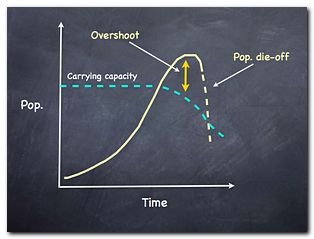
- It is an axiom of ecological science that a population which has grown larger than the carrying capacity of its environment (e.g., the global ecosystem) degrades its environment. It uses resources faster than they are regenerated by that environment, and produces waste faster than the environment can absorb it without being degraded. Some definitions of carrying capacity include this element of environmental degradation. Such a population is said to be in “overshoot.”
- Al Bartlett sometimes writes, “A SELF-EVIDENT TRUTH: If any fraction of the observed global warming can be attributed to the activities of humans, then this constitutes positive proof that the human population, living as we do, has exceeded the carrying capacity of the Earth.” The same can be said of much of the rest of the extensive and growing human-caused ecological degradation we see today, including the breakdown of the web of life indicated by the ongoing Sixth Extinction. It is symptomatic of having exceeded the earth’s capacity to sustain our current numbers for the long term. It is, in fact, proof that under current conditions we have done so. [1] [2]
- It’s axiomatic, as well, that a population can only temporarily overshoot carrying capacity. It will subsequently decline in number, to return to a level at or below carrying capacity. That is, though a population may grow in size until it is too large for existing resources to sustain it, it must subsequently decline.
- Because it degrades it’s environment, a population in overshoot erodes existing carrying capacity so that fewer members of that species will be supported by that habitat in the future.
- Our extraction of nonrenewable resources such as oil and coal has allowed us temporarily to exceed the earth’s carrying capacity for our species. As these supplies are drawn down, our numbers continue to increase, and ecological degradation progresses, the number of humans will, of necessity, come down. Whether we have a hand in voluntarily and humanely bringing them down, or simply let nature manage the whole thing for us, is up to us.
It seems unlikely anyone could fully comprehend the six steps above, and still deny we face a grave, worldwide ecological crisis. But for some, self gain or political ideology tied closely to self-image might be enough to fuel such denial. For others, I hope this little essay is informative.
For an in-depth analysis of the same and related issues try William Catton’s Overshoot.
_______
[1] Obviously, not all environmental degradation is proof of overshoot. An individual example of ecological damage may have nothing to do with a species having exceeded carrying capacity. Those examples, however, which reflect our society-wide ways of living, such as CO2 emissions, overfishing, and habitat destruction, do offer such proof.
[2] For humans, carrying capacity varies somewhat as a function of how we live. Yet no matter how we live, we cannot eliminate carrying capacity constraints. It seems unlikely, for instance, that even a hypothetical complete switch to renewable energy, as essential as it ultimately is, would, in itself, drop humanity back to within the limits of carrying capacity. In a time when groundwater depletion, habitat destruction, and the depletion of other non-energy resources constitute a large portion of our ecological challenge, we would likely remain in overshoot due to our sheer numbers.
Contact
- Content: editors at theoildrum dot com
- Tech support: support at theoildrum dot com
License

This work is licensed under a Creative Commons Attribution-Share Alike 3.0 United States License.
http://science.reddit.com/info/5zswo/comments/ (resubmitted 10:40 EST)
http://digg.com/environment/Six_steps_to_getting_the_global_ecological_c...
thanks for your support...
PG,
Money always seeks the highest return. Oil is the densest form of energy. It is thus more profitable to invest in new killing technologies to fight over the oil than anything else.
Those with the most money control the newspapers, the university endowments, who gets elected, etc.
It's pretty simple why people don't get it. If your university, for instance, starting telling the truth, the money from the drug lords and weapons makers would dry up.
But Matt,
WE get it.
The information is out there (or in here, as it were.)
So why don't intelligent, otherwise informed, well-meaning people do a modicom research and figure it out?
It contually puzzles/frutrates me.
Confederate,
One needs to be aware of the term "peak oil" before one can look it up. The same applies to other problems.
Tim Morrison
You can't choose what's not on the menu.
True Tim,
But everyone on this site has figured this out.
Somehow we made the leap.
However in my personal life I know not one soul aware/interested in any of this.
I find the complacency incredulous.
I greatly appreciate these articles/discussions.
I have mentioned PO to some very intelligent people, but they instantly have reservations about its importance. I think people need to either be very curious about the subject and spend time studying it, or else have a reasonable amount of foundational knowledge to "get it" - to make the leap that you mention. I also think people are afraid of being duped or caught up in unfounded concerns, conspiracy theories, doom-and-gloom cults or whatever. Others perhaps just can't be arsed looking into it deeply.
"You can never solve a problem on the level on which it was created."
Albert Einstein
Exactly.
Even experts do not of necessity have "foundational" knowledge.
You have to be an obsessive compulsive type to sweat the details. Not everyone does.
I'm not OCD by a long shot, but I do sweat details where they matter to me. And one of those details is that carrying capacity is not a fixed quantity. It can go down, and it can also go up.
This has been established already. Consider the Amazon societies which created terra preta. This amendment turned easily-leached tropical soils which rapidly become sterile after a few cycles of annual cropping into nutrient-holding soils which remain fertile year after year. These greatly increased the carrying capacity of those lands.
Could we do the same, in that way and others? It seems likely. We have the benefit of broad historical knowledge, depth of scientific analysis and technological expertise to do many things. We can already build zero-energy homes which slash the non-food footprint of a family to a fraction of an acre. The question is less "can we?" than "will we?"
I don't think there is a clear line of separation between "can we" and "will we".
If we did not have the evolution-limited brains we do have, then "we can" do many great things: end hunger, end injustice, end wars, bring on utopia and the singularity, etc., etc.
But the fact is, as Donald Rumsfeld might say in one of his snowflakes:
You come into this world with the brain you do have rather than the brain you would prefer to have.
It is that brain and its many severe limitations that blur the line between "can we?" and "will we?".
The Rapture as it is known by 10,512 different names will not happen to save your butt.
We are going to have the die off, enough said.
Prepare for the living. That is what I do, if you are willing to be helped then I am willing to help you.
Seek, Knock, Ask, are all proactive actions.
Read my works, I have them published.
The Bible is a mirror site.
Laughs My Ass Off.
Charles.
God Grant you peace.
God Grant you Love of your fellow man.
God Grant you Faith and Trust.
Write in Candidate for President 2008.
Free Right Now party. No donations.
Term limits for congress, Min wage for them too
Charles Edward Owens Jr.
“In a way, the world-view of the party imposed itself most successfully on the people incapable of understanding it. They could be made to accept the most flagrant violations of reality, because they never fully grasped the enormity of what was demanded of them, and were not sufficiently interested in public events to notice what was happening. By lack of understanding, they remained sane. They simply swallowed everything, and what they swallowed did them no harm, because it left no residue behind, just like a grain of corn will pass undigested through the body of a bird."
~George Orwell, 1984
"In our society, those who have the best knowledge of what is happening are also those who are furthest from seeing the world as it is. In general, the greater the understanding, the greater the delusion; the more intelligent, the less sane.
One clear illustration of this is the fact that war hysteria increases in intensity as one rises in the social scale. Those whose attitude towards the war is most nearly rational are the subject peoples of the disputed territories. To these people the war is simply a continuous calamity which sweeps to and fro over their bodies like a tidal wave. Which side is winning is a matter of complete indifference to them. They are aware that a change of overlordship means simply that they will be doing the same work as before for new masters who treat them in the same manner as the old ones. The slightly more favoured workers whom we call 'the proles' are only intermittently conscious of the war. When it is necessary they can be prodded into frenzies of fear and hatred, but when left to themselves they are capable of forgetting for long periods that the war is happening. It is in the ranks of the Party, and above all of the Inner Party, that the true war enthusiasm is found. World-conquest is believed in most firmly by those who know it to be impossible. This peculiar linking-together of opposites -- knowledge with ignorance, cynicism with fanaticism -- is one of the chief distinguishing marks of society.
If human equality is to be for ever averted -- if the High, as we have called them, are to keep their places permanently -- then the prevailing mental condition must be controlled insanity."
~George Orwell
In the book Bury Me Standing, about the Gypsies, it's observed that the Gypsies didn't seem to notice that WWII was anything remarkable, maybe they were treated a little worse than usually, but not so much worse that it made a great impression on their memory.
Nineteen Eighty Four is one of my favourite books. However, I seem to need to read it less and less nowadays. I can just observe society. Interesting that your prudent observation comes from a book within a book, so to speak. Nevertheless, Winston Smith managed to get a copy, so should we all.
Perhaps the author could draw another Orwellian analogy between energy depletion, economic adversity and environmental degradation - supporting the idea of collapse like "three sheaves of corn".
My theory is that "1984" happened in 1974 and after that, none of it horrified us anymore.
confederate,
is any of "us" among the people who run the show? Among those who enjoy privileges, have lots of money, appear on TV? Among those who admire such people and would like to have similar lives? Or even among those whose creature comforts do not exceed a McMansion, a large SUV and a job as a Regional Sales Director for a blow-dryer company? For these people, "informed" and "well-meaning" as they otherwise might be, "the information" means their whole living arrangements are pretty much worthless. Why should they even want to listen to it? It probably scares the sh** out of them somewhere on the lower floors of their mind, but we've all heard of Freudian repression.
People revise their world-views in a dramatic way when they have a religious conversion or the like, but where is the church that teaches the Gospel of Overshoot?
Berend Ohm,
..."church that teaches gospel of overshoot?" Ha! very good.
Well T. Boone Pickens is wealthy and influential, and Matt Simmons, Richard Rainwater, Roscoe Bartlett, Simon Rich... I've been known to host a Senator or two at my coastal home.
So I'm not so certain its cuz the wealthy and influential aren't talking.
But I apreciate your response and will think on it.
"The information is out there (or in here, as it were.)
So why don't intelligent, otherwise informed, well-meaning people do a modicom research and figure it out?"
Confederate, if I may...
I work with a lot of fairly well educated folks (many with advanced degrees in the sciences, PhD's, MD's) and I am struck by something one of my colleagues once said to me. This woman, a physician whom I had known for a number of years, who is articulate and intelligent and a good doctor, was surprisingly ignorant of these very profound, serious issues such as have been discussed here on the board. In her mind, she worked hard taking care of patients in the local medical-industrial complex (ie academic teaching hospital/university medical center) and at the end of the day, she didn't really want to think about "all those things" but rather just go home and watch TV or go on skiing trips or engage in other similar diversions. They just don't want to hear about it.
SubKommander Dred
Sub D
"They just don't want to hear about it"
Amen to that
(&, I should have written "modicom OF research")
There is a reasonable hypothesis from evolutionary psychology - that the group will believe the myth espoused by the leadership in the face of evidence, because group solidarity was of survival value to the tribe.
As an extension from this, the group will go into denial for as long as it can in the face of extreme threat. This is because maintaining group solidarity is usually of survival value for more everyday threats but extreme threats that are likely to wipe out the tribe are rare and behavioural patterns to cope with them have not evolved and are not instinctual - as distinct from fear of strangers, foreigners and plagues, for which group dynamics are easily mobilised.
Hence to declare a "War" on terrorists and run off to steal other people's oil is easier than saying - the world as we know it is about to change drastically.
Group solidarity is also of extreme survival value to the individual.
You basically have to be a sociopath to begin a discussion about rocking the boat.
Ah, evolutionary psychology. Always full of reasonable hypotheses - but also notoriously poor in evidence.
Strictly anecdotally, my cousin on my fathers side, who is a psychologist, was rather anti-evolutionary-psychology, until she met me at age 30, at which point she re-evaluated her position pretty rapidly - which I think was a bit embarrassing for her with her colleague-friends.
I hadn't had anything to do with anyone on my fathers side, including my father, since I was 2 yrs old see, and yet in my approach, my debate, the things I moaned about, she saw my father.
Strictly anecdotally of course. If you want method based evidence, there's plenty of twin studies etc to be found now, I gather the evidence base has changed somewhat in recent years.
--
Jaymax (cornucomer-doomopian)
The hypothesis you brought up, that "The group will believe the myth espoused by the leadership in the face of evidence, because group solidarity was of survival value to the tribe", is a typical just-so story with very little (if any) testability. EP can probably be useful if done properly, but this is closer to crank etymology.
In my understanding of the evolution of the human species, the "leadership" you talk about is a prominent feature only of large civilizations. Smaller tribal cultures, where humans have spent the majority of their evolutionary existence, did not have the same kind of "leaders" that we do today.
Mythology on the tribal level could not be handed down from up on high, because there was no one in a small group that could maintain the position of being up on high against the will of the entire group. The beliefs and understandings would be arrived at by the group as a whole, in order to maintain group cohesion and survivability.
Dissidents would have been a threat to that leadership, but those dissidents were also necessary to the survival of the group in other ways in terms of skills and knowedge, so dissidents must be dealt with in such a way that maintains the cohesion of the group. Which would mean that even dissidents played a part in shaping group mythology.
I think people go into denial when facing a threat because the threat is a challenge not just to one idea or belief, but a threat to a whole system of ideas and beliefs upon which a way of life is founded, and a threat to emotional experiences attached to those beliefs.
The first "leaders" you experience in your life are called your "parents".
You have no free will. You are born to whom you are born to.
They pass down their mythologies to you.
They train you in what information you should be receptive to and what you should filter out.
"Denial" is kind of a broad carpet for sweeping under it all sorts of fine details about how people's brains operate, what they are "receptive" to, what they are not.
The tyranny of parenting, if any tyranny actually existed, in tribal society was temporary.
If the mythologies passed down to you didn't work in your world, you could challenge them.
How many mythologies can we count in our world that do not work from our own experience that we have no ability to challenge? Under the umbrellas of infinite growth and salvationist religions, there are plenty of ideas regarding our world that are just plain wrong, that most of us were raised with, that we here have abandoned ... but we haven't challenged the system to change the mythology, we have left the system and are beginning to adopt new ideas and complex understandings.
I know I don't have free will, and neither do you. But I do have complex self-awareness and self-organization. As do we all.
http://video.google.com/videoplay?docid=-2637635365191428174
A good video for those who think they exist in this society on their own terms...
==AC
Thanks. I have seen all these ideas, piecemeal. This provided a nice historical perspective. It is difficult to grasp that so much has passed so quickly and violently.
I believe Cap & Trade is the solution to the big problem.
Using the Gangsta' defination of Cap.
http://www.urbandictionary.com/define.php?term=cap
Hey Matt, did you see that LATOC made the Blackwater Newsletter? Disaster capitalism on the march!!
I cannot believe how often seemingly highly knowledgeable people make statements like this.
Energy Density from Wikipedia in Mega Joules / Liter
U235: 1,500,000,000
Gasoline: 34.6
You do not like nuclear so you pretend it does not exist?
I believe in Peak Oil. I also believe that nuclear energy is an answer. One of the reasons why public opinion dismisses Peak Oil as nonsense is because so many of Peak Oil's advocates reject obvious solutions like nuclear energy.
Why believe in the message if the messenger is an idiot or a fanatic?
I sometimes think that myself. We may only lack the will to overcome this adversity.
"We may only lack the will to overcome this adversity."
It's tough. The basic facts supporting Peak Oil speak for themselves. However once you buy into the facts, you find yourself grouped with some remarkably idiotic people.
There is this issue of "guilt by association".
If most of the people around me are idiots then this implies that I am also an idiot. Assuming I am an idiot, is my initial judgment about Peak Oil correct?
I do not think it is most of the people. Whenever you say anything positive about nuclear, there are several people who try to shout you down with insults (not having the facts with them). But I think most of the people here have already gained great insights into the problem. It's just harder when we turn to solutions. Many people just sink into this hopeless doomerism. And there are a lot of these environmental and growth orthodoxies that people have trouble subjecting to critical analysis.
Which goes a long way to explain my drift from cornucopian towards a more doomer outlook. It's not that there arn't a bunch of technical solutions that collectively would offset a 4% annual decline in oil, it's not that humans arn't sufficiently ingenious to come up with solutions.
We, collectively, can't save our collective souls, not because we can't but because we won't - so therefore we can't. Is there any real difference, between "can't do" and a "won't do" that can't be changed?
However, I think it's utterly unfair to talk about sink into hopeless doomerism. Because, while I used to share exactly that perspective, with an element of doomerism has come a really strong sense of empowerment, a realisation that there ARE things *I* can do, changes *I* can effect - and I find I am actually much more hopeful now than I was before - just expecting society to choose a different path. I also believe I'm being more realistic, but then everyone says that of themselves, so I'm not sure it means much.
--
Jaymax (cornucomer-doomopian)
Well then I guess then that yours is not hopeless. But then I am also not sure why you call yourself a doomer. Where is the doom in that?
Because I believe that things are about to get very very nasty. A lot of things about our lifestyle, and probably a lot of people are doomed. That doesn't give me joy, and my hope is very much of the end-of-tunnel variety.
Society is incapable of solving what we face - much is doomed ==> I'm a doomer.
Human technological progress will ultimately come up with solutions ==> I'm a cornucopian.
Just don't ask me to punt at how bad things will get, how many people will die, or how long the turn-around will take... A decade? A century? Longer?
That might not sound 'hopeful' - I can't really explain why it is so - except that if it wasn't for the insights and preparations of hopeful doomers, we'd be solely dependent on the high-stakes and probably unrealizable dreams of the cornucopians.
--
Jaymax (cornucomer-doomopian)
Interesting. I sort of agree with you. It could really get nasty but I am not sure that is necessarily has to if we can mobilize society the way I imagine we can. I have posted a number of times of a Word War II level process that devotes some large portion of national income to mitigating the problem over 20 years or so. In 1944 the US spent 38% of national income on the war effort. So 10% for 20 years would be about $30 trillion for the US alone.
Will that happen and will that happen in time? Who knows? A lot depends on how long we stay in denial and whether we have the will to survive.
On the other hand, it is good to know that there are energy options in abundant supply so that if we do summon the will there is a way out. That's not to say I think it could be easy or painless.
Sterling said:
I agree with Sterling's comment. It's difficult to get people to not simply bark back pre-canned orthodox responses. Particularly if people are pursuing hidden agendas. Peak Oil demands a meaningful response. Laying on the floor with a paper bag over one's head, moaning about impending doom is not a meaningful response.
I think nuclear energy coupled with coal based synthetic petroleum is a meaningful short term response to Peak Oil. Eventually biotech will have to replace anything that is coal based since coal is close to peaking. What concerns me is this approach probably requires 10-20 years to ramp up to full production. We should have been converting over to nuclear energy and synthetic petroleum when President Carter first proposed it. Now the economic pain will be much greater and we'll have to fight some unnecessary wars in the Middle East that we could have avoided.
I also believe that nuclear energy is an answer.
How do you think all that oil got there? Via the power of fusion and a few years of putting it under the dirt.
I'll remind you again: U235 does not exist in nature, except as 1% of Uranium, which itself occurs in nature chemically bound in oxides which are a tiny percentage of the source rock.
Excavating the ore, breaking the chemical bonds, concentrating the U-235 to ~3% so it's "fuel," converting the radiation to steam heat, driving turbines with the steam heat, and distributing the electricity on a grid, all lose enormous amounts of energy.
Natural petroleum contains 10-30% pure gasoline. All you gotta do is heat it up, and the gasoline distills out.
Yes but since U-235 has 43,000,000 times the energy density of gasoline by volume, it is still possible to build nuclear power plants that operate with EROEI of 93 considering their entire lifecycle. See Energy Lifecycle of Nuclear Power (about half way down).
It also appears that the world has an essentially unlimited supply of fission fuel. So nuclear should be central in our consideration of how to replace oil.
Uranium is also peaking.
The idea that creating power plants with 93 EROEI is specious at best, dangerous at worst.
We will not see a "solution" in nuclear fission or fusion, unless you want to call it the "final" solution.
Why can't some people come to grips with the idea of an interconnected world. All the fusion and fission in the world cannot replace soil, fresh water, or the fish in the sea.
More cheap energy means more people fighting over dwindling resources that cannot be replaced by cheap energy.
The techno-fantasy means death, planetary degradation, a dwindling standard of living, and ultimately the end of humanity.
Give up your childish desires and dreams. Give up your toys. Be an adult. Be a part of the planet, not apart from the planet.
http://www.populistamerica.com/stop_calling_me_a_doomer
Wrong.
http://www.americanenergyindependence.com/uranium.html
Current estimates of “economically recoverable” reserves apply an upper price/cost limit of $135/kg for uranium ore. This price cutoff does not sufficiently appreciate the lack of effect that ore cost has on power cost. It corresponds to a power price increase of only ~0.25 cents/kW-hr, versus today’s $40/kg ore price. Uranium sources that cost up to $500, and perhaps even ~$1000/kg (which would increase nuclear power’s cost by 1-2 cents/kW-hr) can still be economic, especially in a CO2-emission-constrained world, and/or a world where gas and oil have started to run out. Even at $1000/kg, advanced nuclear plants should be able to produce power at ~6 cents/kW-hr or less. The cost of power from post-production-peak gas or oil plants, or from coal plants with full CO2 sequestration, is likely to be higher than this. Finally, it should be noted that (as discussed later), at a uranium price of $500-1000/kg, breeder reactors become economical, and the uranium supply effectively becomes infinite.
That's before there were any automobiles. I calculated in a post a few weeks ago that potential Uranium bearing volumes of the Earth's crust have received about 1/120,000 the intensity of exploration that have potential oil bearing volumes of the crust. What does this suggest about how much of the resource we should have identified by this point? Those phoney analyses that the anti nukes use all the time suggest that only about 65% of all the Uranium in the accessible crust has not been identified. Is that plausible? Of course not. With the amount of exploration that has been done, it is impossible the we have identifed even a small fraction of 1% of the Uranium the exists in the top three kilometers of the entire land surface of the world. We have to use the general distribution of different rocks and their average Uranium content as cited in my link down thread to get any idea how much resource is out there.
Geology of Uranium Deposits
http://www.uic.com.au/nip34.htm
Richard Wakefield
London, Ont.
No one is ahead of their time, just the rest of humanity is slow to catch on.
Can you do better than quoting an obviously biased source? Pretending that the URL didn't make the website's bias obvious, their header picture is a collage of the American flag, a bald eagle, and the statue of liberty. That kind of intended appeal to patriots (in the worst sense of the word) has to make one's spider-senses tingle.
Not that I'm saying you are wrong, but that website won't help your case. At least, not here.
What kind of bias is on display there that suggests that we cannot believe the argument? If a site was obviously an environmental site, would you say the same thing? That site seems right wing and in favor of resource development. So what? The question is does he make a credible argument. Are we going to have political tests for who can post here?
The anti nukes use obviously biased sources, like the notorious Storm and Smith report, all the time.
Rich. From one of the most consistently foolish people to post on this site.
It's also carefully documented and peer reviewed. It must be horrifying to read ideas that suggest we might escape the demise that you so eagerly await.
There are one trillion tons of recoverable Uranium, enough for 5,000,000,000 reactor years, plus three times as much Thorium, plus another factor of 50 times as we move to other fuel cycles. Uranium Distribution
It is certainly false to say that an intentionally misleading website has been peer reviewed.
Chris
Well, they claim it has. I cannot find evidence on the site that they do not believe everything that they put out there or that any of it is not true. I am sure there are some mistakes because there is a great deal of material there.
You can lead a man to knowledge, but you can't make him think.
Linear thinking got us into this mess, and linear thinking will lead us straight off the cliff into oblivion. Linear thinking like "Market forces and technology will create a bridge, get us jet-packs, build a huge pillow at the bottom of the chasm, provide us with new bodies immune to damage and pain, or rearrange the laws of gravity."
Because of receding horizons the price point for breeder reactors, and the price point for mining lower percentage uranium deposits, will never be economical. This is not doom, this is reality.
" ... effectively become infinite ... " The only way out of our energy problems is powering the world on human ignorance and stupidity, the only truly infinite sources of energy.
You're assuming that steel mills and uranium mines can't run on electricity. This is almost certainly wrong; "mini-mills" have been using arc furnaces for years, and a great deal of mining equipment used in the coal industry (both below and above ground) is electric, including bucket wheel excavators and draglines. If the system can supply all the energy required for its supply chain, the cost-escalation collapse model isn't valid.
I agree, E-P, but the problem is not one of "can we" but one of "will we". And in that I don't have much faith yet.
"The greatest shortcoming of the human race is our inability to understand the exponential function." -- Dr. Albert Bartlett
Into the Grey Zone
No, the problem is one of "can we:
* given the petroleum-dependent global infrastructure we have in place
* in the time frame available
* with the current prevailing public level of understanding and awareness of energy and resource issues
* considering all the other things that humans need for survival that come from the energy we want to use to accomplish (insert plan requiring Manhattan Project effort here)"
Will the pesticide required be available to grow the food that the electrical engineers require to design and build more electric smelters?
Will the asphalt be available to pave the roads to truck the mining byproducts away?
Will the plastic anything-and-everythings be available to research and manufacture petrochemical antibiotics to combat escalating worldwide infectious disease, prevention of which is necessary to ensure a stable society capable of solving technical problems?
Will the increased resource and effort allocation take away from more critical systems, human, production, or ecological, elsewhere on an already strained planet?
Can we ensure all of this by 2010 at the latest, assuming oil didn't already peak two years ago?
Will there be broad acceptance of massive social and industrial dislocations necessary to accomplish any short timeframe initiatives?
So ... can we? No.
Prepare for the alternative.
Can't make him think, or can't make him think for himself?
"You can never solve a problem on the level on which it was created."
Albert Einstein
Or can't make him see things your way if you do not have a strong case.
Profit of doom!!!! my God the name change.
Animals have insect sex, incest sex and bee sex all the time.
Humans forbid, incest, insect and bee sex all the time.
I am christ like.
Give it up you loose.
er louse, live lice, mice, rice in the lice.
Lose, the second rapture is the bigger ones.
I am the devil in my lies.
Thighs lies, delta trailed in the back seat the lies of the ront front. the guys and the boys do not procreate. gays inthe military should we allow.
not my problem.
I have slept, I hame came, I am.
The Great I AM. Aim, to please. Not MIA.
God Grant you peace.
God Grant you Love of your fellow man.
God Grant you Faith and Trust.
Write in Candidate for President 2008.
Free Right Now party. No donations.
Term limits for congress, Min wage for them too
Charles Edward Owens Jr.
Great post!
Facing the realities of Peak Oil will move people, government, and organizations, toward conservation, risk management planning, and agricultural solutions etc.
I really doubt that anyone (perhaps, with the exception of the doomers) or any organization is going to be moved to do anything until peak oil comes up and bites them on the ass. Further, and I agree with Chimp here, nothing noteworthy is going to happen until those with the bucks decide it's time to do something. My guess it will parallel the Shock Doctrine rather than all the warm-fuzzy stuff. And, I'm going with the SD in lieu of an out and out fascist state.
Todd
Penetrating denial will require persistent education integrating new data with prior knowledge. As the data piles up, more will understand. The more we are able to show the data in graphic forms, along with visual images (photos and videos of change in habitat, migration patterns of animals, species extinctions), the more change we will see. On, PBS, I saw a piece in which scientists accompanied evangelical Christians on a tour of Alaska, so that all could see the drastic changes that were affecting peoples who hunt and fish for food. Dramatic changes in attitudes accompany full-face exposure to climate change. Those individuals have become advocates for change within their religious communities. In addition, the documentary itself is very powerful. I'm not sure how we do this with peak oil issues, but as data accumulates (IE inability of peoples who used to buy petroleum to do so, documentation of drastic changes in their lives). My point is that very few people will lose their denial by data presentations alone. Along with the data, deniers need to see the impacts on real people.
"It's a Recession if your neighbor loses his job; it's a Depression if you lose yours". - some genius
Ad agencies have long known that people relate best by far to "personal" examples. This has given us the Maytag repairman, all those personal stories selling things, etc.
This is also why Orwell chose to explain the kind of society we're in by having us live alongside Winston Smith in "1984" or as an animal among animals in "Animal Farm" rather than just writing up dry tomes.
Peak Oil and the utter bogusness of the constant-growth system are obvious to us. It's up to us to make them obvious to the masses by giving them personal examples and stories about the new reality.
Untill the number of 'worry worts' becomes > the number of 'lazy sosers' nothing will be done to prevent a contituation of overshoot.
In addition, it is not the sheeple that need to be convinced that action should be taken, but the shearers.
People mouth a lot of platitudes about 'the future of our children', but in general, I dont think most people really care about what sort of future their children face...Based on my general observations of the actions taken by people during my lifetime and by reading quite a lot of history.
People are basically followers because that is the path of least resistance and does not cause them to stand out from the group...from which they do not want to run the risk of being excluded.
The majority of people are lazy and would rather do something that gives them pleasure than do something that does not...So they will continue to enjoy themselves, as best they can, untill tshtf.
Once the shearers are convinced that impending disaster looms in their near term futurers they will take mediating courses of action to cover their posteriors, probably disguised in lies, to insure their well being...The sheep will be on their own except those that are needed to tend to the needs of the shearers.
All talk of 'educating the masses' in order to make them see the impending overshoot disaster is just a lot of hot air. The masses do not want to hear it...So, they will not.
Imho the global carrying capacity for humans on earth is impossible to fix. So the theory around that issue is good (Catton, "overshoot" is a best book) but the devil is in the details..
Does it allow for humans driving a Suv, living in a mansion, with pool and mex maid, and bringing Junior to Karate lessons?
Or living in a hut without heat or hot water and just 1.5k calories a day pp, scraped off a small holding?
Or being a slave worker in factory making bras, position embedded into a complex mesh of global trade, with 3 sparse meals pday, and a bed in a dorm?
Or living in a society where *some* survive after 5 years go on to 20, 25, and then die?
Or being groomed and fed to grow up to fight, kill enemies?
Or living in a society (that is pp day use of energy) that maintains a huge guzzling army, tremendous war like structures and matériel?
Overshoot - sure. But measured how?
A better approach is suggested in the article.
Rather than worry about what population at what living standard, worry about population x living standard.
This makes it much simpler to measure and act.
It is easier to measure because you need only consider ecological consequences. Specifically, instances of global environmental degradation (rising CO2 in air, oceans; depleting global fish stocks; anomalous rates of extinction) constitute evidence of overshoot.
It is easier to act because you are not tied in to reducing either living standards or population. Rather, a balance can be struck depending upon the ethical considerations you would like to apply.
The requirement is clear, however. Population multiplied by consumption must be reduced until increases in global environmental degradation reverse. In the end, this is what will happen.
It's clear that we're in a major ecological crisis, with wholesale extinctions, and climate change, and facing some serious resource issues.
But...we'll continue to get resistance as long as we frame it in this unrealistic "overshoot" framework.
Our population won't change quickly, without deeply unethical measures. The most effective and ethical measures, such as women's liberation, we should pursue in any case.
It's possible (if very difficult) to reduce our impact on the earth to something sustainable, and that's where our efforts should go.
Yes, the overshoot framework is a limiting case that requires too many variables in the case of humans to evaluate. It far more complex than Peak Oil itself. Too much certainty...
I think it is a mistake to see the "overshoot framework" as a narrow effort to argue for population reduction.
Rather, it is an effort to bring in to focus the interplay between population and consumption.
People generally find the idea of human population control abhorent, and that's great. That's exactly the point when it needs to be said that it's either that or lower consumption.
It is very hard to inspire the majority to lower consumption voluntarily, but if it is to be achieved, then maybe something so powerful as this idea, that it really is an either/or proposition regarding population and consumption, that may provide the motivation.
Dot,
I agree with this and another of your comments above. But I do want to note that I think it's more "both" than "either/or." As I hinted in the essay, I have strong doubts that we can reduce consumption of such things as land, water, minerals, etc. enough in the context of 7 billion people and growing, to get us back to within the limits of carrying capacity.
The problem of species extinction is one of the key items which keeps bringing me back to this concern. It's hard to imaging that the growth of our numbers, from the millions during almost all of human history, shooting into the billions in just the last tiny fraction of a percent of that history, can go on without being at the expense of other species. And we depend on them in the web of life.
But if we focus intently on both consumption and population for an extended time, then barring collapse taking care of it for us first (which I certainly don't rule out), we might get there.
John
http://growthmadness.org/
"But...we'll continue to get resistance as long as we frame it in this unrealistic "overshoot" framework."
But Nick, it's realistic in the sense, at least, that people need to understand it. (I realize TOD readers mostly already do.) That was the main thrust of the essay -- to push for more understanding of what's going on ecologically. Admittedly, this particular essay does emphasize the population side a bit (versus consumption).
"Our population won't change quickly, without deeply unethical measures. The most effective and ethical measures, such as women's liberation, we should pursue in any case."
Probably population won't change quickly without draconian measures. I'm not positive of that; there are some who think it could be done:
http://www.skil.org/position_papers_folder/aintlikeitusetobe4.html
(Not sure that's the best representation of his ideas. I haven't yet thoroughly explored his site.)
And there are instances such as Iran, where surprisingly fast drops in fertility rates were achieve, apparently through humane measures.
But assuming you're right on that, I still see no reason not to focus on both population and consumption.
Yes, we should be focusing on things like empowering women anyway. But we're not. Not nearly enough anyway. People need to know there's another hugely important reason to focus on such things. The more we can slow population growth, ultimately reversing it, if possible, the better. It will help in the short term, and even more in the long term. It works hand in hand with technological and other approaches to reducing consumption
Programs aimed at reducing fertility rates are also very cheap in the scheme of things.
John
http://growthmadness.org/
"Probably population won't change quickly without draconian measures....I still see no reason not to focus on both population and consumption."
In theory, I agree. Everything would be easier with fewer people. And, as long as you present population issues positively as preventing unwanted children, and improving women's education, etc, it will help.
"Somewhere in the country, every 30 seconds, a woman gives birth to an unwanted child, and we have to find her and stop her!"
But, the majority of the world is already at or near replacement fertility. This battle is already mostly over, and to reduce fertility dramatically would indeed require draconian measures, which would be an enormously unproductive use of time and energy, and probably counter-productive.
If we were to reduce fertility by even a dramatic 50%, would that reduce population more than 10% in 20 years? We need to reduce CO2, for instance, by 80% by then. That's doable (just barely, with an enormous effort), and would have much more impact (well, 8x as much).
I also find that the analogy with animal populations misleads a lot of people. The dramatic reduction in fertility due to the Demographic Transition has absolutely nothing in common with the kind of thing animal populations suffer when they run out of food in a population overshoot.
I would concentrate on educating people on the various converging sustainability problems, and their solutions.
"This battle is already mostly over"
I don't think so. Adding a projected 40% more to the global population is pretty huge. If we could make it even just 30% more by mid century, then enable a reduction thereafter, it would eventually pay off tremendously.
"If we were to reduce fertility by even a dramatic 50%, would that reduce population more than 10% in 20 years? We need to reduce CO2, for instance, by 80% by then. That's doable (just barely, with an enormous effort), and would have much more impact (well, 8x as much)."
Again, though, there's no reason to think of it as either/or, especially when influencing population is, by most expert accounts, much cheaper. And if we don't do so (humanely) beginning now, then we've just lost that much time down the road. To have a very large impact on later population size we need to begin as soon as possible. Most likely, we'll later be sorry if we don't.
We might think of it this way: If it cost absolutely nothing to bring down fertility rates, even just modestly, wouldn't it be worth pursuing? Well, compared to new technological development, I think it's safe to say it costs next to nothing.
It would seem highly risky not to shoot ultimately for something much smaller than 9 billion. Yet people resist the idea as though it would hurt something to do so. I don't see that.
"The dramatic reduction in fertility due to the Demographic Transition has absolutely nothing in common with the kind of thing animal populations suffer when they run out of food in a population overshoot."
Yet it's misleading to give the impression that we are exempt from the principles which govern other species. I mean, I'm not sure we can prove it either way, but it seems mighty dangerous to assume we're exempt. Which way would you bet on it?
It's worth noting, too, that the areas of the world experiencing the greatest population growth (India, Africa, part of the Middle East) are among those most vulnerable to its impacts. One could make a case for helping them (and many such countries are concerned about their population growth rates) lower fertility rates purely as a humanitarian action.
John
http://growthmadness.org/
"Again, though, there's no reason to think of it as either/or, especially when influencing population is, by most expert accounts, much cheaper."
Absolutely - let me be clear, I agree. My point, though, is that your presentation suggests that population and per-capita foot print are equally important. Clearly, if we're talking about a 10% reduction in roughly 50 years, population is much, much less important than per-capita impact.
Again, I agree that population planning is very valuable, especially for poor countries and poor families. China, for instance, has helped itself enormously. For poor families, access to family planning can make the difference between grinding poverty, and a much better life.
But, in the context of 1st world discussions about sustainability, I think a population over-shoot model can be very misleading: there seem to be a substantial group of posters in The Oil Drum who think that population growth is the key lever for improving our future, or that the world is in relentless exponential population growth, which will lead to Inevitable Doom (for instance, another poster asked if humans have the ability to change their fate, unlike animals, as if that hasn't already been proven by the Demographic Transition).
It seems clear to me that humans have the ability to reduce their per-capita ecological impact to a sustainable level, though I'm not optimistic that we will actually do so in a way that will prevent enormous 3rd world suffering.
Further, given just a little time such a transition can be very painless and cheap. For one important example, plug-in hybrids can reduce oil consumption by 75-100% at no additional cost, given an extended switch-over (15 years, or so). For another, wind is now cheaper than natural gas for electrical generation, and both wind & solar are dropping in cost quite quickly: it doesn't take much effort to include external costs (pollution, war, etc) to see that they are the cheapest alternatives already.
"My point, though, is that your presentation suggests that population and per-capita foot print are equally important. Clearly, if we're talking about a 10% reduction in roughly 50 years, population is much, much less important than per-capita impact."
I'm not sure we really disagree. I'm mainly thinking long term. Ultimately, it seems we'll need to go well beyond what we can do in the next 50 years. Seems we should get started now for those living a couple of centuries from now. So long term I think population does seem roughly as important as per capita consumption. In the meantime, we might save quite a few lives with even modest reductions in the near term. Plus, we really don't know how much we can do re population. We've so far invested so little in it.
John
http://growthmadness.org/
We have nothing to say about population long term. In a few centuries, serious demographic projections suggest population decline. This is owing to development which appears to reduce fertility. What people think about population then will be entirely up to them. What we can do for them is to figure out ways to live sustainably now with the projections as they are, anticipating 9 or 11 billion people. If we can manage that, then they will have pleasant options.
There are many development efforts going on now. Often they are countered by corruption such as the way Shell has behaved in Nigeria. We have amazing opportunities to help people jump past fossil fuels. I recall a company conference call where a Nigerian came on asking about opportunities to bring solar power to his country. Those will be there, first through partnerships with development NGOs and later as we remove systems from roofs here. But, we really need to get our own transition rolling to have the capacity to help in this way. There are many peices to this puzzle. You might want to read up a little on what the UN has been doing on sustainable development.
Chris
"We have nothing to say about population long term."
By your logic we have nothing to say about sustainability long term.
You mention the UN. I would counter that you might want to read up on what they're saying about population. These folks too:
http://www.sciencemag.org/cgi/content/summary/315/5818/1501?maxtoshow
http://www.appg-popdevrh.org.uk/Publications/Population%20Hearings/Heari...
John
http://growthmadness.org/
You are correct that we cannot bind future generations to living sustainably. We can only do so ourselves to allow them the choice. And, by choosing to do so, we also provide a record of how we have done it which may also make future choices easier.
I found a fairly glaring error in the Science Perspective:
"You are correct that we cannot bind future generations to living sustainably."
Using the word "bind" is deceptive. We can take actions now which improve their chances of living sustainably.
"Otherwise, focus on women's empowerment seems to be the key thing."
Yes. it's definitely thought to be one key to bringing down fertility rates.
John
http://growthmadness.org/
I thought we were in agreement that we are powerless to control the decisions of those living several hundred years from now.
We are surely in agreement that we may, by our actions, provide them with atractive choices.
Feminism is one of the Green Party's key values. You might be interested in some of the positions in the party's platform. This press release that we worked on this weekend may also interest you.
Now, lets back up say 15 years when the effects of warming first became a little noticable, not just a temperature trend, but impacts. Let's say that everywhere in the world, at that point, births were the same as deaths and on to the present. Would things be much different? I would say that the market forces at play would have led to about the same increase in emissions over the same time period. In other words, we cannot attribute warming to the places where population is growing the most quickly. Warming is owing to those who use the most fossil fuels, not those with the highest birth rates. So, warming is a consumption problem not a numbers problem. It has the potential to become much worse if consumption patterns shift into the large numbers, as is happening, but this really represents a failure to go back and negotiate further in Kyoto when the Senate indicated it would not ratify. The changing consumption patterns over the last 15 years might have been different.
So, it is very very difficult to blame warming on numbers.
Chris
Chris, I'm not saying anything complicated - only that our decisions today, including taking action to lower fertility rates, can improve the chances of sustainability for those in the future.
FWIW, I think the Green party platform should include more discussion of the link between women's issues and population, and more frank discussion of the need to address population growth as resulting partially from women's oppression and other factors, and as a cause of ecological degradation.
Issues such as child survival, economic issues, and others are also related to population. The Quinn/Hopfenberg/Pimentel food linkage has not been adequately explored. But there's no reason no to - and good reason to - explicitly acknowledge the links between these things in making the case for better addressing them.
"So, warming is a consumption problem not a numbers problem."
No. That consumption is itself the product of population times per capita consumption. True, the US, for instance, consumes much more per capita. And the US population grew about 19% in the last 15 years. So that growth multiplied by an exceptionally large per capita consumption added quite a lot to emissions. Add to that the growth of populations in places with booming economies (~fast growing per capita consumption) such as China and India, and population looms even larger.
If we go back farther in time, it looms especially large, owing to all the (pop x consumption) growth of the US, Europe, etc.
John Holdren, last years president of the AAAS, published a paper in the early '90s in which he compared the contributions of per capita consumption and population growth to total energy consumption in the US and worldwide. He found them to be fairly comparable. I don't think the paper's available online, but here's a look at it from me which gets into data not available in the abstract:
http://growthmadness.org/2007/02/16/population-and-consumption-both-majo...
I can't read your mind, Chris, but from your blog post which I read yesterday, it seems there's something very distasteful to you about applying population numbers to environmental issues, or about simply saying there are too many people. I've certainly had discussions with some who feel that way. Even the word "overpopulation" has become distasteful to some. I think it involves compassionate people who take the "over" or the "too many" to mean finger pointing at some particular surplus people. To me, nothing could be further from the truth. I'd elaborate, but I may be off base in my guess to begin with, so I'll stop there.
I don't disagree at all with the things you point to as important. I merely urge you to consider that sheer numbers are quite important as well. And I think we agree that anyone suggesting draconian measures to reduce them should be subject to draconian measures. :-O
John
http://growthmadness.org/
I think that China would benefit from a truth and reconciliation process regarding coerced population control, but I do not support the use of execution as a further means of coercion.
A population plank was offered for inclusion in the 2004 platform. But, if recall, it could not be worded in a way that was consistent with the party's core respect for people.
And, this is part of shedding old ideas which have led to the environmental problems we face. The subjugation of people is a part of the thinking that included subjugation of the environment. At this point, it looks as if the old ideas have put us in the position where we will need to sequester carbon from the atmosphere because the ecosphere can't keep up with our waste. We are in a position where we must nurture the ecosphere and assist it. A'ohe hana nui ka alu'ia is a Hawaiian proverb that means no task is too large if we all work together. But this task seems large enough that it really will take all of us.
The footprint approach has some merit, but it is possible to have a footprint which is less that zero and when you consider how that might work, many people with a footprint slightly less than zero is likely to be more tractable than having a few people with a footprint much much less than zero, epecially if there is some urgency, as there seems to be. In other words, leaving the problem we have created to too few people to solve lays too much responsibility on each of them.
Increasing mutual respect will lead to reduced fertility so that what you see as a problem is addressed in this way, but more importantly, it provides the grounds on which we may come together to first reduce our waste and next unmake it. Industrial society may contribute most to reducing the waste stream, but subsistance farmers may, through the introduction of terra preta and reforestation, contribute most to cleaning up after industrial society. That portion of the solution to the problem is not yet clear but it does seem as though those with a small footprint presently have an easier path to a negative footprint than those with a large footprint.
Chris
Again, I'm all for the actions you suggest. But I'm not for the intellectual dishonesty of pretending population is not, itself, a problem.
(I'm not saying you're dishonest, Chris. Your view is a compassionate, well meaning one. But it's been driven by folks who have built in a kind of evasion of the truth to promote their own causes. See below.)
"But, if recall, it could not be worded in a way that was consistent with the party's core respect for people."
I remember seeing somewhere in the Green Party platform (maybe just the US Green Party?) some wording on population which was almost identical to the wording used by Betsy Hartmann and her colleagues who represent a particular faction of feminists. It's doublespeak. I wrote a two part essay on my disagreement with her on the handling of the population issue:
http://growthmadness.org/2007/03/10/admit-it-betsy-we-agree-part-2/
I also exchanged one email with her, but she did not reply to my follow up in which I challenged her view a bit more.
Here's the view of a feminist who sees it more as I do:
http://www.alternet.org/environment/50216
The trend away from frank discussion of population was in large part the result of the 1994 Cairo conference. Decisions there were heavily influenced by groups espousing the Hartmann line. I believe they felt population was a distraction from issues in which they were more interested. That Science article I linked to came out of a major UK report, which solicited the input of scores of scientists, population experts, and others. Their conclusion was that the switch away from direct discussion of population had been a major environmental and humanitarian setback.
And that's not to mention the intellectual dishonesty involved. The latter is why I think the approach coming out or the Cairo conference is starting to lose it's grip and why there's something of a resurgence of interest in the population issue. Here's a writeup I did about the report:
http://growthmadness.org/2007/07/01/after-a-lost-decade-experts-call-for...
The Greens could word the population issue completely humanely and with complete respect for people. I'd be happy to help. It's easy.
"Increasing mutual respect will lead to reduced fertility so that what you see as a problem is addressed in this way . . ."
See, this is the avoidance of the truth of population, Chris! Yes, mutual respect, involved in such things as empowering women worldwide, will do a lot to reduce fertility rates. But it's not likely to do enough if we don't specifically keep the population issue in mind as well. There's nothing disrespectful of people in saying, "Population is a problem. Let's work to solve it by addressing the oppression of women, poverty-related issues, child survival, and so on, realizing that those are all important issues in their own rights." It's just a matter of not shying away from straight-forward discussion of population as it is.
John
http://growthmadness.org/
I think this language from the platform pretty much covers the issues raised in the Science Perspective:
Notice that is speaks of honoring the desires of the country in question.
I know that Virgnia submitted its proposal both to GPUS and Green Party of the USA, a smaller group. It did not pass for GPUS.
From your links, I would say that any discussion of population is not at all straight forward. Going after Japan, for example, seems quite strange. A debate that we are having on the EcoAction Committee is about response to climate refugees with some feeling that current immigration is putting stresses on bioregions that they may not be able to handle and others arguing that we both bear responsibility for the anticipated refugee status and that our planned energy transition will need a lot of labor and will at the same time reduce stresses on bioregions. This issue is complex indeed.
In the end, I see the vantage of viewing population as a whole as unhelpful. To me, the key is to recognize how to best live in a bioregion in a way that enhances that region. Local knowledge and preferences are key to accomplishing this. Zoning and food security tend to be the policy tools that most affect population density and there are many parameters involved there as well. Local solutions may vastly multiply the sustainable population density or people may decide that they like to keep things at a lower level.
EDIT: I was not able to read your first link earlier. On immigration into the US, because the mode of immigration is assimilative, this does in one generation what may take three in the country of origin with regard to fertility. The US requires education through the 12th grade for both sexes. Building this type of education system may take as many as three generations where it does not exist. This is because you need teachers who have been taught by teachers who learned where they live. Students who go abroad and return to teach may start the process, but it is the students of their students who establish it. So, from the point of view of changing global average fertility, immigration into assimilative societies with gender neutral education at an adequate level works faster than development alone.
Chris
I think we agree entirely on pop planning.
My disagreement lies in the overshoot presentation. I believe that it is an unrealistic comparison with animal populations, and scares people unnecessarily. Further, I think it's not the most effective way to sell pop planning, and in fact is probably counter-productive. I think there are extremely strong ethical grounds for providing both the social improvements as well as the pop planning programs (education, contraceptive availability, etc), and that those grounds are the most effective.
The damages we do to the earth (mass extinctions, climate change, etc) demand a massive response. But, there is no concrete evidence that they will reduce the carrying capacity of the earth below the level of population. I don't see how even the flooding and displacement of 10% of the world's population associated with the worst climate change predictions would do that. The assumption that mass extinctions will do so by damaging the interdependent web of life is also highly speculative - not impossible, but highly speculative.
Ultimately, I think the truth serves us best, and I think the truth here is that projections of overshoot require exaggeration of possible dangers, and speculative leaps of logic.
In particular, let me ask you a basic question: in a world where 80+% of grains are used to feed livestock; cash crops such as coffee, coca, tobacco, etc are a large % of farm acreage; and lawn acreage outnumbers grain acreage in the US by 3x1, how can we suggest that we might run out of food?
"In particular, let me ask you a basic question: in a world where 80+% of grains are used to feed livestock; cash crops such as coffee, coca, tobacco, etc are a large % of farm acreage; and lawn acreage outnumbers grain acreage in the US by 3x1, how can we suggest that we might run out of food?"
Well, there are a number of angles to this, but let me just point to one which also speaks to your comment about species extinction. There seems to be an expert consensus that we could potentially lose as many as 50% of all species by the end of this century. Now, for a moment, suppose we lost virtually all other species. Would that seriously impact humans? Yes. No web of life, no life support system; we'd be gone.
And an inability successfully to grow food would be one of the steps along the way. So if you accept that a loss of all other species would be catastrophic for us, where do you draw the line? Perhaps we would survive a loss of 50% of all species. But what kind of word would that be? And what level of loss would we not survive? We just don't know and are playing with fire to even think of testing it.
There are of course concerns about future food production in light of groundwater depletion happening in the three largest grain producing countries - India, China, and the US. There are concerns about climate change induced drought affecting food production. There's massive overfishing. There are some serious issues concerning soil erosion. (I'd provide solid links to support all these assertions, but I have an article up today on the BBC's Green Room and am being bombarded with email, so just don't have the time. Sorry.)
So while I acknowledge your points, and the current food issue is mainly one of distribution/politics, we do need to look ahead.
One last thing:
"I believe that it is an unrealistic comparison with animal populations, and scares people unnecessarily."
This seems to border on saying, "Humans are separate from nature." Some do firmly believe that, but the more I've thought about it the more I've leaned the other direction. Too big a topic to try to cover here and now, but an important one for people to grapple with, I think.
John
http://growthmadness.org/
"There seems to be an expert consensus that we could potentially lose as many as 50% of all species by the end of this century. Now, for a moment, suppose we lost virtually all other species. "
That's an enormous leap!
"suppose we lost virtually all other species. Would that seriously impact humans? Yes. No web of life, no life support system"
Actually, I'm not clear on that. I understand that we need bees to pollinate about 1/3 of our fruits and vegetables, but I'm not familiar with specific research that says we need a complex ecology for grain production. Actually, it might be easier to farm without all those insects eating the crop...
I can imagine you rolling your eyes. Bear with me.
"Perhaps we would survive a loss of 50% of all species. But what kind of word would that be?"
It would be a terrible world.
"And what level of loss would we not survive? We just don't know and are playing with fire to even think of testing it."
I suspect it's a real risk. I would never suggest that we test it. But if we have no real data, then we should acknowledge that.
"There are of course concerns about future food production in light of groundwater depletion happening in the three largest grain producing countries - India, China, and the US. There are concerns about climate change induced drought affecting food production. There's massive overfishing. There are some serious issues concerning soil erosion. (I'd provide solid links to support all these assertions, but I have an article up today on the BBC's Green Room and am being bombarded with email, so just don't have the time. Sorry.) "
I agree. There are a lot of potential problems with food production, but what do you think of my basic question (especially relative to livestock)? Doesn't it appear that our potential food production capacity is at least 5x what it is currently? If all of these problems reduce our maximum potential capacity by 50%, doesn't that leave us with 2.5x what we need?
"This seems to border on saying, "Humans are separate from nature." "
I don't think so. There is a big difference between that, and my point, which is that humans have control over their population decisions, and animals don't. Currently population growth is decelerating, and looks likely to stop entirely in a few decades. That looks nothing, absolutely nothing like an animal population logistic curve.
Nick,
Some owl species are sufficiently territorial that their populaton level self-regulates. Having lived in Taipei, I can say that humans adapt to very high population density in extraordinary ways. The precision of the driving there, centimeter clearances, is amazing to see and definitely feels like an invasion of space to me, but is completly non-agressive.
Chris
There are a bunch of links on this topic at the foot of a piece I wrote earlier in the year:
http://growthmadness.org/2007/02/22/the-specter-of-mass-extinction/
It's worth watching the video from the Species Alliance as well. It includes interview footage of Richard Leaky and Paul Ehrlich.
Here's a quick quote from paleontologist,Niles Eldredge, through link to the article at AcionBioscience.org:
My main point about this is that we don't know what level of species loss would threaten us. But most experts in that area seem to concur we do depend on the web of life just as other species do.
Here's something I came across by chance just today:
http://www.truthout.org/issues_06/110607EA.shtml
[Edit:] There was also an article in Science about a year (?) or more ago in which the author speculated we could survive the loss of something like 50% of species. The letters in response that I recall came from other experts who pretty strongly rebuked that conclusion. Interesting reading. No time to look it up, but I think the letters are available online. Maybe later.
Sorry I don't have more time right now.
John
http://growthmadness.org/
Hmmm. Interesting - that will take a little time to review.
In the meantime, what do you think about my question about maximum potential food production, and my comment about the analogy between human and animal population growth?
Here was your food comment:
"in a world where 80+% of grains are used to feed livestock; cash crops such as coffee, coca, tobacco, etc are a large % of farm acreage; and lawn acreage outnumbers grain acreage in the US by 3x1, how can we suggest that we might run out of food?"
And... "Doesn't it appear that our potential food production capacity is at least 5x what it is currently? If all of these problems reduce our maximum potential capacity by 50%, doesn't that leave us with 2.5x what we need?"
We simply can't know. But if we reach a scenario where we have to limit livestock production (or the market shifts things), cash crops, and turn lawns into gardens, it would seem we'd be in a pretty bad food situation. It could by then involve many processes such as climate change impacts and species extinction issues which may compound one another as we see with other combinations of ecological issues. Might a hypothetical remaining 50% of production capacity then descend quickly lower? We can't know; at this stage we can only speculate. At the very least we would then be in a much less resilient situation, much more vulnerable to any new impacts on food production.
But considering the concerns expressed by credible authors (e.g., the Limits to Growth team, Lester Brown, the UN - including indications of the decreasing per capita grain production, water issues, etc.) there seems to be a non-zero and non-tiny chance of very serious consequences barring much more decisive action than we're seeing so far.
So I would doubt we would ever "run out" of food, but there are legitimate concerns. I fully expect some level of more decisive action, but can't predict more than that.
"humans have control over their population decisions, and animals don't. Currently population growth is decelerating, and looks likely to stop entirely in a few decades. That looks nothing, absolutely nothing like an animal population logistic curve."
It's true we have some control. That's what gives me hope. That control is limited, though, influenced by rather unpredictable social variables. On the other hand we're subject to the limits and laws of nature just as other species are. So where are the limits of our control?
I need to reiterate, as well something I mentioned in the thread under GliderGuider's paper not long ago. The UN's (and others') projections are far short of a guarantee population growth will level off in a few decades. The authors take pains to point out the projections shouldn't even be viewed as "best guesses." They're just extensions of looks in the "rear view mirror." Much on that here:
http://growthmadness.org/2007/01/13/the-un-population-report-misundersto...
http://growthmadness.org/2007/04/06/no-comfort-from-the-un/
I don't know of anything we can confidently use as a "best guess." But even if we cheat and view the UN's figures that way, they're still just guesses, and the authors also point out how vulnerable they are to very small changes in fertility rates which we can't predict. So I just don't think we should be at all complacent about future population growth. (Not to mention that some think we'll never make it 40% higher, to 9.2 billion [a projection which was recently bumped up from 8.9 billion], as they assume too much environmental stress from continued overshoot to allow for it.)
It's hard to say how the human pop growth curve will ultimately look. It went from almost flat and linear for nearly all of human history, to suddenly, in the last instant of our history, exponential and superexponential, and now possibly linear again, but with pretty vigorous growth continuing for the time being. It may not level off nicely at K like a logistic curve, because K is more variable for us, though at present we seem to be above it. I don't know what the heck the curve will end up doing. :-/ I certainly hope it won't look like the one I used in my essay above.
Perhaps the most interesting thing here is that we seem to be both at the mercy of the laws of nature and at the same time in possession of more control than other animals. How that will play out is certainly debatable. I'm hesitant though to bet against our being subject to essentially the same laws as other species.
John
http://growthmadness.org/
Well, I think we're in pretty close agreement.
I think that my main point would be that the nuances and uncertainty that you mention here need to be in any presentation. A lot of people don't get that: they think we're facing certain doom, as opposed to risk management.
I can't count how many times I've had people present the chart of population growth over a 2,000 year (or more!)scale, which obscures the current dramatic drop in fertility, and talk about how we're in limitless exponential growth...
I would note that Gliderguider has sharply revised his presentation based on the feedback to his recent TOD article. It's now much more nuanced. You can see the later version on his website.
I think we do pretty much agree. Not every essay or presentation will provide a perfect balance, and sometimes it's the risks I want to highlight, but in the end we do need to provide as accurate and rounded a picture as possible of what's known and what isn't.
I know about GliderGuider's revision. This comment of his, however, is worth a read as well :-) :
http://www.theoildrum.com/node/3148#comment-255358
John
http://growthmadness.org/
"I think we do pretty much agree."
That's great.
"sometimes it's the risks I want to highlight"
Well, I think it's important to tell your audience when you do. As long as you do, then what the heck...
"This comment of his, however, is worth a read as well :-) : - http://www.theoildrum.com/node/3148#comment-255358"
hmmm. I'm not quite sure what to make of that. I agree with the idea of providing information in small chunks. The thing is, you have to do something like that in an intellectually honest, respectful way. What do I mean? I mean that you have to listen to responses, and engage with them. For instance, with gliderguider I tried to address his experience with the telecom bubbles, as it informed his estimates of growth for renewables.
In the end I was frustrated with his approach. He wanted to lead his audience through a chain of logic, and he did indeed work very hard to listen to objections. I was very, very impressed with his willingness to revise his first version. But we had a long correspondence after the TOD article, and when we got through it to the end, he wasn't ready to change his basic conclusions that energy was going to be seriously constrained in the medium term (20 to 50 years out), despite the loss of the underpinning to his argument. He just has an intuitive feeling that there won't be enough energy, despite a complete lack of evidence (in brief, he arbitrarily chose a projection for renewables in which their current high growth rate stalls out after a few years).
I don't know as much as I'd like to about some aspects of our sustainability, and some aspects like climate change and extinctions look quite grim to me. But energy, I believe, I know well, and after much analysis I've concluded that the problem is really in the short term transition away from fossil fuels. When an author fails to recognize that (like Gliderguider, and one of the primary authors of Limits to Growth, who stated publicly that "fossil fuels are impossible to replace"), they lose credibility with me.
"But energy, I believe, I know well, and after much analysis I've concluded that the problem is really in the short term transition away from fossil fuels. When an author fails to recognize that (like Gliderguider, and one of the primary authors of Limits to Growth, who stated publicly that "fossil fuels are impossible to replace"), they lose credibility with me."
Well, I'm no expert at all on energy. But while your conclusion may be a reasonable one to reach, aren't there analysts with a good deal of expertise who've reached a different one? I haven't closely examined the details of the stances of various peak oil analysts (and related folks) but among Simmons, Campbell, Catton, Bartlett, Deffeyes, Lundberg, Heinberg, Darley, and others, aren't there a number whose conclusions differ from yours? (I know, some probably don't, some you may see as lacking credibility, etc., but you get the general drift.) What I'm getting at is that if they assert a particular view that differs from yours, well, there seems to be enough ambiguity and contradiction in the evidence that that can legitimately happen.
I can't speak for GliderGuider, and didn't look closely enough at your exchanges with him hear to speak to specifics. (I did look at quite a bit of the thread and could see the general thrust of criticisms from you, Pitt and others, and his responses to them.) But my sense is he has seen other data and engaged in additional thought and analysis which supports something at least somewhat akin to his original view, but hasn't yet synthesized it all to the point of being able to offer a new presentation on the scale he attempted in his first WEAP model. He does, however, appear to be working in that direction and has a new paper now on his site dealing with energy and national economies:
http://www.paulchefurka.ca/WEAP2/Energy_GDP_2050.html
I haven't read it yet. I commend him though for engaging in this ongoing process of analysis, revision, and exploration. It's thought provoking even if one's own investigations don't lead to precisely the same conclusions. And GG could tell you that I questioned some of his conclusions from the first time I was exposed to them. I'm still probably more "optimistic" than he. (not the best word really, but...) But I find his ongoing journey fascinating and valuable.
I'm belaboring this, but I'm wondering if there's an issue of the potential criticisms of a particular report or presentation versus those of an ongoing process that may not fully clarify itself until a larger body of work can be viewed as a whole. Not sure if I'm being clear.
John
http://growthmadness.org/
"aren't there analysts with a good deal of expertise who've reached a different one?"
Well, Deffeyes, Simmons, Goodstein and Campbell (IIRC) agree with my conclusions.
Bartlett's analysis is 30 years old. IIRC, so is Catton's. In the world of renewable energy, that's prehistoric.
I haven't looked at Darley, but I did look at Heinberg's remarks about renewables, as well as several others (Kunstler, Hanson, and some others) and they were very, very superficial.
"there seems to be enough ambiguity and contradiction in the evidence that that can legitimately happen"
Well, that's not my conclusion, after looking in detail. Renewables are scalable, growing fast, have no significant component supply resource limits, have high E-ROI, and are competitive price-wise are are very close with costs that are plummeting.
Anyway, logically, at a minimum, if you're going to make strong, sweeping statements about the insufficiency of a resource ("renewables can never replace oil!"), you have to provide some evidence. The pundits which make such statements routinely don't.
Re: Gliderguider. He and I engaged in a lengthy email discussion of his analysis of renewables, and the final result was that he modified his projection modestly upwards, but retained a polynomial equation (apparently provided by a function in Excel) which doesn't fit the underlying growth curve. It's a 4 term 3rd order polynomial which grows quicky at low numbers, but whose growth rate drops quickly later. That fits GG's intuition that renewables will fade in the stretch, but there's absolutely no evidence for it. On the contrary, wind and solar growth rates have been accelerating for decades, show absolutely no sign of decelerating, and there's no reason to expect them to until demand for them is satisfied.
"I commend him though for engaging in this ongoing process of analysis, revision, and exploration. "
I do too. He was far more open and flexible than many people in his position. Unfortunately, ultimately he was unable to accept that he had no basis for his intution going in the exercise that renewables would be insufficient to replace Fossil Fuels, and chose to keep that assumption in his projection. He acknowledges that this assumption is his personal intuition....
" I'm wondering if there's an issue of the potential criticisms of a particular report or presentation versus those of an ongoing process that may not fully clarify itself until a larger body of work can be viewed as a whole."
I know what you mean, and I think there may be, in a certain sense. As far as Fossil Fuels vs renewables goes goes, I think GG has finished his analysis for the moment. I think he sees overall resource limits, and is reluctant to drop the assumption that energy is among them, as he suspects that would weaken the persuasive power of the overall argument. I think that's the wrong approach - truth is more important, and the other parts of the analyis will have to stand on their own.
"Bartlett's analysis is 30 years old. IIRC, so is Catton's. In the world of renewable energy, that's prehistoric."
Depending on just what analysis you're referring to, this isn't quite accurate. Some of Bartlett's papers are fairly recent. e.g.,:
AN ANALYSIS OF U.S. AND WORLD OIL PRODUCTION USING HUBBERT CURVES. Mathematical Geology, Vol.32, No. 1, Pgs.1-17, Jan. 2000
Point being just that he's still looking at these things. [Edit:] Oh, and he's many times updated his "Arithmetic, population and energy" talk.
I don't know exactly what his conclusions are on renewables, but from a recent interview I heard, I would think he'd differ with you somewhat. It's probably not a black and white difference; he keeps any reasonable options open, I think. But I know he still runs analyses concerning some of these issues, and don't think he's substantially retracted any of his major arguments.
Catton has certainly written things more recently as well, though perhaps not with as much content on energy as his book. (Some here: http://www.mnforsustain.org/author_catton_william.htm ) I haven't seen anything to suggest he doesn't still hold roughly the same view. (There are snippets of interviews with him in the film, "What a Way to Go.")
I'm about 98% sure Jan Lundberg holds a view different from yours.
And there seem to be some decently well informed posters here who do too.
But maybe I'm grasping at insubstantial stuff. You may be right on renewables and I hope you are!
A question I'm actually more interested in concerns the ecological implication of a full switch to renewables. I don't know of a way to conclude anything firmly about that. It's what I speculated on in footnote #2 of the essay above. Probably too much to try to get into now, but it seems an important question because so many people assume all our energy and ecological problems would be solved by such a switch. Yet that seems like an unjustified leap to me. Catton's point about humans having become "homo collosus" as a result of our access to huge amounts of energy, and the resulting environmental damage (apart from fossil fuel emissions) still seems relevant. This is a reason I believe it would remain important to address population.Any thoughts on that?
John
http://growthmadness.org/
Well, the thing I would stress about these so-called experts is that you don't need them. My technical background and energy work experience helps, but you can figure this out for yourself.
2nd, many of these pundits aren't expert in energy, and especially not in renewables in particular. As for individuals, here's what I know:
I looked at Barton's latest version of his talk, and it wasn't much changed. Moreover, he said recently that he hadn't seen anything to warrant substantive changes since he formulated it 30 years ago. Given how much renewable energy has changed (not to mention how much more evidence we have of the demographic transition), that's a grave error.
I looked at Catton's 1998 paper on Malthus: not much on energy, but I noted this quote " Malthus believed populations would inevitably doom themselves to starvation by growing exponentially". Well, that's my principal complaint about the overshoot/ecology analogy, because it's clearly not true. It is conceivable that we have effectively overshot the earth's population carrying capacity, but there's no question that Italy, Japan, and most of the OECD have taken control of their population destiny.
I've read just a bit of Lundberg, and she(?) seemed to know a lot about oil, but very little about renewables. Oil industry experts seem often to have that kind narrow focus.
On FF-enabled ecological damage: There's no question that FF's have accelerated economic and pop growth. OTOH, Europe (including the UK) were clearly growing and expanding significantly using wind, water and wood. The early industrial revolution started before coal, and the exploration of the new world was done with wind. Would slower growth have enabled better managed, kinder-to-the-earth growth? Possibly, though the 1st inhabitants of North America 10,000 years ago,and of Australia 30,000 years ago both certainly managed to extinguish a lot of species.
No, I think it's simplistic to blame FF's, and way too indirect to attempt to manage our impact on the earth through population. Our impact on the earth is not a necessary function of economic growth - we can ruin the earth accidentally (and occasionally, pretty deliberately) with a low population, and provide stewardship of the earth with a high population.
We need to work directly to reduce CO2, save habitat, and use resources sustainably. It's easy to expect too much in the short-run, and too little in the long-run, so it's easy to think we're growing up too slowly as a species - certainly we will do a very saddening amount of injury to the earth and its inhabitants before we do - but I'm hopeful we'll get there eventually, and even go back and restore things to something close to what they should be.
Well, I'm definitely hopeful about renewables, though I'm simultaneously concerned about the ecological impacts of humans continuing to have at our disposal huge (ultimately potentially even greater?)amounts of energy. Not that we should necessarily deprive ourselves, though some capping might make sense for some energy use. But it's something needing attention.
"It is conceivable that we have effectively overshot the earth's population carrying capacity, but there's no question that Italy, Japan, and most of the OECD have taken control of their population destiny."
I agree it's great those countries have come to replacement or sub-replacement fertility rates. (Unfortunately, some of those countries' governments are upset about it and trying to use incentives to bring fertility rates back up. That's pure insanity.)
But expectations are that we'll still see global population grow by more than the entire world population of 1950 over just the next 40 years. I'd like to see that amount reduced, and then a shrinkage through continued sub-replacement fertility rates.
I'm sure it's a bit simplified to say FFs alone caused the huge jump in population in the last two centuries. There were clearly other technological factors, medical factors, and the math of exponential growth at work too. (If I revise the essay above, I'll soften that statement.) But how would we have achieved anything like today's industrial agriculture if it weren't for fossil fueled machinery for farming and distribution? Imagine trying to distribute today's volumes of food by horse drawn wagon, sailboat, etc.
"Possibly, though the 1st inhabitants of North America 10,000 years ago,and of Australia 30,000 years ago both certainly managed to extinguish a lot of species."
I don't think that's a valid counterpoint. They certainly hadn't triggered a "sixth extinction" as we apparently have. Sure there's always been environmental damage caused not only by humans but other animals as well. But the scale now is vastly greater.
"...way too indirect to attempt to manage our impact on the earth through population."
Well if that were the only approach used, sure it would be to ignore all sorts of other necessities including everything that falls under "per capita conumption." I'm not sure it's an "indirect" approach though. After all, the only way you can have zero consumption is to have no person.
"Our impact on the earth is not a necessary function of economic growth"
If we can get all physical components out of economic growth, I agree. Otherwise it's a simple conflict of endless physical growth on a finite planet.
" - we can ruin the earth accidentally (and occasionally, pretty deliberately) with a low population, and provide stewardship of the earth with a high population."
[Edit:] Re the stewardship, yes, up to some point. There is some limit on sheer numbers beyond which no drop in per capita consumption (which can't drop infinitely) or technological advance can keep us out of overshoot. We may be past that point now. We don't know that, but well, I've already touched on the simple observation that in the last instant of our history we've shot way, way past our previous population levels to this seemingly anomalous spike of billions. In any event, it's a whole lot easier to ruin it with a large population. I reiterate that I agree, and always have, that we must also address per person consumption, switch to renewables, etc. I often emphasize population simply because it's a fundamental and gets way too little attention -- though I think that's starting to change.
"We need to work directly to reduce CO2, save habitat, and use resources sustainably. It's easy to expect too much in the short-run, and too little in the long-run, so it's easy to think we're growing up too slowly as a species - certainly we will do a very saddening amount of injury to the earth and its inhabitants before we do - but I'm hopeful we'll get there eventually, and even go back and restore things to something close to what they should be."
Absolutely. I would only point to my concern about your last sentence. We can't expect ever to restore the many species being lost today.
John
http://growthmadness.org/
John, you are a nihilist. I was wondering why I kept thinking of Turgenev when conversing with you.
With just a little effort people can have negative net consumption. This is the basic role of farmers. There are many farming practices that enhance the environment, provide improved habitat and leave susbstantially better soil to future generations. Humans can be, and often are, very beneficial to the environment.
Chris
I may to some degree be a nihilist, at least in the way I approach these questions. When assessing an issue such as population, I think we need first to put potential emotional biases aside as best we can . After that, perhaps we can find a way to incorporate them with what we've come to understand.
Many others, OTOH, simply speak directly from those biases. I've been seeing that in the last day or two as I've had many people tell me that if I want fewer people I should lead by example and kill myself. :-/ Anyway...
Sure, yes, you're right that a person can be beneficial to the environment. I should not have said what I did without qualifying it. It's very tough to accomplish that, though, leading a modern industrial life today. If we can eliminate the physical growth aspect of economic growth, that will help a lot.
Maybe you can convince me, but I'm not at all sure that even an organic or permaculture-practicing farmer living an otherwise modern lifestyle is seeing net negative consumption. Also, would it not be possible for such a person to have net negative consumption by producing one resource but still consuming some other resource to excess? And, in any case, does it not seem more than unrealistic to expect billions of people to adopt such a lifestyle during this century?
In fact, even if they did, at today's numbers we might then see their "contributions" become harmful as they changed soil compositions on such a vast scale as to alter the global ecosytem. It's not so tough, however, to implement programs that reduce fertility rates which would ensure less consumption, no environmental harm, and wouldn't hurt a flee.
And I stand by my statement that there is an upper limit on our numbers beyond which we cannot help but damage the global ecosystem no matter what we do short of leaving the planet.
Finally, something I keep meaning to say but forgetting is that I'm intrigued by the resistance I'm getting to the simple idea that one fundamental way we can help reduce ecological damage is to reduce population growth. I'm not advocating harming anyone or anything, so what's the big deal? I see absolutely no reason whatsoever for people as intelligent as most TOD readers to object -- nihilistically speaking, perhaps. :)
[EDIT:] Worth a mention that today humans are estimated to be globally appropriating somewhere between 25% and 40% of all the products of photosynthesis.
http://www.pnas.org/cgi/content/abstract/0704243104v1
http://dieoff.org/page83.htm (sorry for the "doomer" reference, but...)
John
http://growthmadness.org/
I suspect that what we need to do is boost the fecundity of the ecosystem, bringing diversity and balance back to regions where we have reduced it. There is a chance that we might do this so well that we reduce the concentration of carbon dioxide in the atmosphere below the holocene level and start a cooling cycle, but I think that this is a problem that is a long way down the road if it happens at all. The introduction of european earth worms, for example, seems to place a check on the rate at which north american boreal forests retain carbon in the soil. But, it seems clear that we have placed our hand on the thermostat and if we simply withdraw now the thermostat may not adjust back to its previous setting on its own. You might argue that three billion people made the inital mess so three billion ought to be enough to clean it up. But, I don't think that this is known, and it might well be that it will take the concerted efforts of eleven billion to bring things back into balance. We do know that with more people there are greater opportunities for creativity to emerge and that this is a non-linear effect. Owing to our faculties of empathy and compassion, the non-linearity might take the form of permutations (factorial) rather than just the square. Our habit of attempting to retain wisdom may boost this further. Capitalizing on this by ensuring that everyone can read and write and share what seems to be working for them all around the world would seem to me to be a big priority. As it happens, what I see as a priority for boosting ecosystem fecundity also turns out to be the one thing that brings human fertility back to the rate we are evolved to. So, celebrating the potential of each child to contribute to unmaking our waste and restoring our climate is not just a matter of having many hands but of non-linearly more relationships, interactions and encouragements to find better solutions. This latter is a core human characteristic and likely defines, in many ways, our niche in the ecosphere.
Chris
I'd like to know more about the potential for net negative consumption. Do you have a link for evidence that a person farming in a particular way, yet living an otherwise modern industrial life, can show net negative consumption, and that this will not involve negative consumption of some resources and excessive consumption of others?
"You might argue that three billion people made the inital mess so three billion ought to be enough to clean it up."
I don't want to let this comment go by without mentioning that while three billion contributed to it, 6 billion made it far worse than it would otherwise have been.
"But, I don't think that this is known, and it might well be that it will take the concerted efforts of eleven billion to bring things back into balance. We do know that with more people there are greater opportunities for creativity to emerge and that this is a non-linear effect."
There are also more opportunities for people to remain in poverty...
http://allafrica.com/stories/200709040700.html
...more opportunities for people to contract disease...
http://www.usatoday.com/news/health/2007-08-23-UN-world-health-risks_N.h...
...and more opportunity to wipe out a huge percentage of the earth's remaining species, as if we have some divine destiny to be the dominant species at the expense of all others. From the UN's most recent major report on the environment:
“The drivers of environmental change include population growth, economic activity and scientific and technological discoveries. . . . A sixth major extinction is under way, this time caused not by natural disasters but by human population growth and consumption patterns."
http://www.unep.org/Documents.Multilingual/Default.asp?DocumentID=519&Ar...
Your argument, Chris, sounds remarkably like the cornucopian icon, Julian Simon who said: "More people and increased income cause problems . . . Those problems present opportunity and prompt the search for solutions. . . . In the long run the new developments leave us better off than if the problems had not arisen. . . . We have in our hands now--actually, in our libraries--the technology to feed, clothe, and supply energy to an ever-growing population for the next 7 billion years. . . . The ultimate resource is people"
http://www.cato.org/pubs/policy_report/pr-so-js.html
I don't know how else to say it; it just ignores the limits of a finite earth.
John
http://growthmadness.org/
I had to chuckle at the Simon quote. If accurate he presumes that we know already how to shift the Earth in its orbit to accomodate the moving habitability zone as the Sun evolves.
Recall that I accept demographic projections that suggest population stabilization near 11 billion. The reducing rate of population growth seems consistent with this.
I read that some portion of the Amish community is picking up on (and contributing to) developments in organic farming. They use little fuel, so that is not quite your criterion of retaining modern industrial life, but I hope you understand that the energy sources of modern industrial life have to change before emissions go below zero. If you grant that, then those practicing agriculture that builds soil would have a net negative consumption.
Chris
"I'm simultaneously concerned about the ecological impacts of humans continuing to have at our disposal huge (ultimately potentially even greater?)amounts of energy."
I'm not sure what you mean. If energy is non-polluting, then our concern shifts to the general question of how we use it, i.e., how we live our lives.
"I agree it's great those countries have come to replacement or sub-replacement fertility rates. ...But expectations are that we'll still see global population grow by more than the entire world population of 1950 over just the next 40 years."
My point was a narrow one: I'd like to see people like Catton acknowledge that the experience of countries like Japan is proof that pop growth can be ended by something other than resource limits.
"I'd like to see that amount reduced, and then a shrinkage through continued sub-replacement fertility rates."
I agree.
"But how would we have achieved anything like today's industrial agriculture if it weren't for fossil fueled machinery for farming and distribution? Imagine trying to distribute today's volumes of food by horse drawn wagon, sailboat, etc. "
Electric trains and smaller local vehicles work quite well. Shipping using wind and solar, with battery and limited liquid fuel backup would work very well.
"the 1st inhabitants of North America 10,000 years ago,and of Australia 30,000 years ago both certainly managed to extinguish a lot of species." - I don't think that's a valid counterpoint. They certainly hadn't triggered a "sixth extinction" as we apparently have. Sure there's always been environmental damage caused not only by humans but other animals as well. But the scale now is vastly greater."
But their damage was far disproportionate to their numbers. They managed to extinguish a lot of animals, like the mammoth. Think of the near-extinction of the buffalo: if there had been fewer hunters, it just would have taken a little longer, but it would have happened all the same.
" the only way you can have zero consumption is to have no person."
I'm concerned about the vast in-between.
"it's a simple conflict of endless physical growth on a finite planet."
See, here's the fallacy that I hear so often. The fact is that resource consumption levels off, while economic growth and progress continue. For instance, light vehicle sales peaked in the US 30 years ago.
"There is some limit on sheer numbers beyond which no drop in per capita consumption (which can't drop infinitely) or technological advance can keep us out of overshoot."
Sure. The question is, how close are we? Wouldn't we be likely to be ok if we reduced land and resource consumption by, say, 95%? That's certainly doable: just recycle. The only(!) inputs necessary are labor & energy, and I would argue that we have enough of both. In fact, it won't take a full FTE of time to recycle the consumption of one person, so it wouldn't be hard for people to be net-zero consumption.
Imagine all organic human waste recycled into food via industrial processing (kind've like the kind that happens to some extent to most food these days...). All inorganic waste recycled to manufacturing. It's certainly doable, we just don't bother yet.
" would only point to my concern about your last sentence. We can't expect ever to restore the many species being lost today."
Sure, but we'll have to try our best, and I think we'll have some success. Just as with geo-engineering, it's far, far inferior to preventing the damage, but I think we'll have to do both.
[EDIT: I don't feel the comments below are very well organized or presented. So here are the Cliff's Notes:
While I agree we absolutely need to work toward a complete switch to renewables, that doesn't eliminate population growth, the other juggernaut which continues moving forward as we speak. It is not without consequences unrelated to fossil energy use. I think if we don't give plenty of attention to both we'll likely regret it in the long run.] Okay on with the mish-mash of comments...
" "I'm simultaneously concerned about the ecological impacts of humans continuing to have at our disposal huge (ultimately potentially even greater?)amounts of energy."
"I'm not sure what you mean. If energy is non-polluting, then our concern shifts to the general question of how we use it, i.e., how we live our lives." "
That's a big piece of it, yes. What you're suggesting is a an ideal to strive for, but one requirement to prevent continuing and serious environmental damage will/would be a sweeping re-engineering of how we live. Human behavior is involved. It will be a colossal challenge, and to the extent we don't fully succeed we'll still have humans, perhaps many more than today, continuing to do destructive things with hugely greater amounts of energy than we had through nearly all of our history, or than is possessed by any other species. My point is, it's not necessarily an impossible challenge, but is a very serious one needing more attention. If we simply develop massive amount of renewable energy and say, "Here it is," it could easily be grossly misused.
As I mentioned in another comment, estimates of our usurpation of the earth's products of photosynthesis range from about 25% to 40%. As that grows, it has to be at the expense of other species.
Nor is there much talk of the potential effects on the biosphere of diverting from it's normal flow, to human use, vastly greater amounts of solar energy. Maybe it would help with climate change. Who knows. But it's another unknown we'll be tampering with.
Then there's the historic correlation between energy consumption and population growth.
I'm just saying that a lot of people think, "If we simply solve energy, we're all set." Clearly, we have to solve a lot more, and one easy way to help with that is through addressing population.
"I'd like to see people like Catton acknowledge that the experience of countries like Japan is proof that pop growth can be ended by something other than resource limits."
Yes, while my understanding is that the demographic transition has not been "proven," (there have been reasoned refutations) I agree it's a worthwhile point. I too would like to see what Catton would have to say about it.
" "But how would we have achieved anything like today's industrial agriculture if it weren't for fossil fueled machinery for farming and distribution? Imagine trying to distribute today's volumes of food by horse drawn wagon, sailboat, etc. "
"Electric trains and smaller local vehicles work quite well. Shipping using wind and solar, with battery and limited liquid fuel backup would work very well." "
No, I was referring to the past, making some link between FF use and past growth of agriculture.
" "If we can get all physical components out of economic growth, I agree. Otherwise it's a simple conflict of endless physical growth on a finite planet."
"See, here's the fallacy that I hear so often. The fact is that resource consumption levels off, while economic growth and progress continue. For instance, light vehicle sales peaked in the US 30 years ago." "
It's not a fallacy to speak of such a conflict as long as there remains a physical component to economic growth which exceeds the earth's regenerative and absorptive capacities. (I also think the notion of the Kuznets curve is weak, limited at best.) And the idea of, say, a 100% information economy seems to make little sense. There's some good info on that in this article by Herman Daly. I think he understand this issue better than just about anyone:
http://growthmadness.org/2007/09/03/can-we-grow-our-way-to-an-environmen...
" "There is some limit on sheer numbers beyond which no drop in per capita consumption (which can't drop infinitely) or technological advance can keep us out of overshoot."
"Sure. The question is, how close are we? Wouldn't we be likely to be ok if we reduced land and resource consumption by, say, 95%? That's certainly doable: just recycle." "
Already addressed this some above and elsewhere. But what's your method for reducing land use by 95%? For farming, it would seem to involve one massive contraction! And for human living space it would seem to involve going up and increasing density. This may work to some degree, but is not necessarily what we're best adapted for. There is increasing concern, for instance, about a link between new pathogens and the vulnerability to them created by increasingly large, dense and mobile populations:
http://www.sas.upenn.edu/~dludden/ecologydisease.htm
[EDIT:] I don't know that there's an easy way to tell how close we are to the limit on sheer numbers beyond which no drop in per capita consumption or technological advance can keep us out of overshoot. However, if one looks at how incredibly our numbers spiked in just the last instant of our history, add to that that our numbers tend to increase at the expense of other species, the estimates of carrying capacity from ecological scientists (not the economists and demographers) which are often in the range or 2 billion or so, depending, and the fact that while in overshoot we've been further eroding carrying capacity, well, as a one time professional gambler I can tell you I wouldn't bet on our being able to sustainably increase our numbers much, if any, beyond where they are today. Wouldn't want even to bet we're not beyond that limit already. :-)
There's also an important time element here. How long would it realistically take to implement something like recycling everything? Yes, we should work toward that ASAP. But we're seeing mass extinction and a host of other serious eco problems now. With regard to population I don't think we can afford not to give it plenty of attention just as we do every other piece of the solution. I think we agree on that. And that kind of comes full circle to my original point from somewhere back there. :-/ [/EDIT]
John
http://growthmadness.org/
John,
You've hit two contradictory themes here. First you worry that too much renewable energy would be a bad thing, that it would be somehow destructive. Then, you wonder how to reduce land use for agriculture, while at the same time claiming that it is use of fossil fuels in agriculture that boosts yields. Pretty clearly, if energy costs about one fifth the effort we devote to it today, we'll likely channel some of it into growing food at higher density. This project, for example uses surface area sparingly. Both wind and solar also use surface area sparingly compared to rooted plants.
Chris
I don't believe there's any contradiction. Here would be a better way to summarize my previous concerns:
:-)
At any rate, yeah, I'd thought it might involve, in part, vertical farming. That points to my concern about the time factor. It would be one of the most massive undertakings in history to convert most farming to vertical. A good thing to do, maybe, but something for which there would ultimately be far less need if population were effectively addressed. This is from the front page of the site you linked to, a part of their argument for why vertical farming is needed:
"By the year 2050, nearly 80% of the earth's population will reside in urban centers. Applying the most conservative estimates to current demographic trends, the human population will increase by about 3 billion people during the interim. An estimated 109 hectares of new land (about 20% more land than is represented by the country of Brazil) will be needed to grow enough food to feed them, if traditional farming practices continue as they are practiced today."
So, yeah, I say go for it and renewables and everything else. Just don't ignore the fundamental element, population. Aight? :)
John
http://growthmadness.org/
It would be following an old tradition:
But really, we are talking about converting a fraction I think. Organic methods tend to fit well with a diverse ecosystem and do not require putting more land in cultivation to support a larger population. I think we will see some vertical farming in urban areas just because it is nice to have really fresh food. In large though, I think that we are more likely to play with light cycles, using short season crops closer to the equator and extending daylight with artificial light to match the long days closer to the poles. Being an astronomer, I don't like the idea of extending daylight much but this would likely substantially reduce the amount of land under cultivation leaving more room for wilderness and telescopes. I'm not quite sure which way the sunflowers will point though. The timing for this is fairly short since renewables are likely to replace conventional fuel-based sources of electricity in twenty years or so while the manufacturing capacity will be available to do much more.
Chris
I read that US wind expects to install 4 GW in 2007, about 60% year-on-year growth. A 1.5 GW solar fabrication plant is going in Singapore as well. They'll have their own silicon refining. $0.80/Watt production cost?
edit: fixed first link.
Chris
You present a generally accurate picture of our interaction over the role of renewable energy in my revised scenario. I would take gentle issue with your characterization of the reasons I refused to adopt holus-bolus your opinions about the infinite potential of wind and solar power, though.
If, as you claim, there is no evidence that the rate of global penetration of renewables will decline over time (perhaps a less loaded term than "fade in the stretch"?), there is likewise no evidence beyond current events to say that your desired exponential growth will continue for any extended period of time. I feel that my projection maps more closely to the realities of the world as I understand them, but that's really beside the point. Our positions are both shaped more by our personal understanding of the world and our own expectations than by much "evidence" one way or the other. Time will prove one of us more right and one of us more wrong. I'm content that others may have opinions about the future that differ from mine.
Regarding your statement that my belief that the resource limits we face include fossil fuels, and that I am reluctant to drop this position for fear that it will "weaken the persuasive power of the overall argument," I'm afraid it's worse than that. That position is the core of my argument, though I am trying to be as intellectually honest and objective as I can in developing that hypothesis into a theory.
"You present a generally accurate picture of our interaction over the role of renewable energy in my revised scenario."
Thanks. I tried, in a brief description, to come as close as I could to where I thought we arrived. Doing so gives one the best basis for further progress towards resolution of differences, I think.
"If, as you claim, there is no evidence that the rate of global penetration of renewables will decline over time (perhaps a less loaded term than "fade in the stretch"?), there is likewise no evidence beyond current events to say that your desired exponential growth will continue for any extended period of time."
Well, I was oversimplifying. Really, there's evidence both ways, which I'd be delighted to discuss. What I really meant to say was that effectively nothing substantive was discussed.
"I feel that my projection maps more closely to the realities of the world as I understand them, but that's really beside the point. Our positions are both shaped more by our personal understanding of the world and our own expectations than by much "evidence" one way or the other."
Well, I think you've described what I call intuition. And, I think we can do much better than that. I believe, in fact, that my opinions are based on the information I've learned over years of experience and research, and I'd be happy to discuss that info. I think it would change your perceptions.
Here's a start: as chris/mdsolar noted above, growth of wind in the US continues to accelerate, and stands at about 60% per year for new installations (the growth rate of the installed based always lags behind a bit). PV worldwide new installation growth continues to accelerate, and is estimated at 100% for 2008.
Oil is geologically constrained: you have to explore to find it, there's a limited supply, and pumping rates are limited. Wind and solar are manufactured, so the constraints are the speed of manufacturing expansion (currently somewhere between 40% and 100% per year, due to the speed with which such factories (and factories for purified silicon feedstock) can be built - it takes about a year), and the availability of sites, which presents no foreseeable limits in the US.
Wind capacity plans presented to the major ISO's in the US: 125GW! This capacity is presently constrained by wind turbine manufacturing capacity. The current install rate of 4GW can grow a great deal...
Solar cells are now about $1.15 per watt, and solar manufacturer profits are skyrocketing, as runaway demand keeps prices and margins high. When capacity catches up with demand prices will crash, and a new wave of demand will arrive. As PV costs fall below utility pricing, the problem for the utilities will be in how to deal with plummeting demand for their central power.
Nick I can't remember where I read it but reduced fertility in the developed and industrialised world is due to prosperity.
Two family members working. Long female careers. Family planning. Contraceptives. The desire to start a family later. Tertiary eduction delaying marriage. Smaller families so as not to intrude on a consumer lifestyle.
There is though, a reduction in general of the male sperm count and fertility. Quite a few reasons have been postulated, ranging from, diet and pesticides and heavy metals in food, to deodorants and tight underpants.
The reduction in fertility in developed countries was not a conscious decision by families to save the planet, as usual for humans it was personal self interest. And it is personal self interest why couples in the third world have more children
You say "the majority of the world is already at or near replacement fertility".
You must be not be including, China, Brazil, Mexico, India, Pakistan, Bangladesh and many countries in Africa. They contain the majority of our population.
Total Fertility Rate 2000-2005
Bangladesh 3.25
Brazil 2.35
China 1.70
India 3.07
Mexico 2.40
Pakistan 4.27
Note that all of these have TFR that have fallen since around 1950, except for China which has probably reached as low as it will go. China is definitely into negative territory in terms of replacement but still growing overall because of the number of child-bearing age women in the population.
This graph from Wiki shows the main driver here. Look at Saudi Arabia's fertility: above 4 per woman.
The outliers are interesting! SA, of course, is a misogynistic hell hole, but is it really the only one?
In Israel there is a demographic race going on, with both sides knowing that having more babies wins the land eventually... but I hadn't thought it would show up so clearly, particularly since I thought the fertility rate in jewish Israelites was still pretty low. Yikes.
Note that there ARE countries in the $5-10K per capita GDP range that have fertility rates every bit as low as the high GDP countries. That 5-10K range is in the range of where a sustainable economy would have to be.
The real fertility problem (with the exception of a few outliers) is with the countries with per capita GDP < $5K. This yields an important point: It is not necessary to raise a society to US/W European/Japanese levels of development in order to transition to lower levels of fertility. Merely bringing them a notch up from grinding poverty will take them most of the way there.
Remember, there are as many as 30 million illegal aliens in the USA right now. Imagine how much easier the commuting and public transit problems become when the urban areas and bus/train lines are no longer full of people that the majority population moved to stay away from.
I don't know what the deeply unethical measures would be but politically therin lies the problem.
I've seen it opined on TOD previously, that a democracy will not be able to make the changes and I fully agree. A democracy has "the media", a political party's greatest fear. Then again could a benevolent dictatorship achieve anything really positive?
When the present world energy and climate situation is discussed in any party room, the only consideration is the economy and how it will affect being re-elected.
Politicians' are just like everyone else, you and me included. They know trouble is coming but they think they (personally) will be all right, they think, they and their families, community, state, and country in that order, will be among the survivors.
Hard choices must be forced on a politician, the public must see sacrifice as being unavoidable.
The New Deal could never be invoked without the depression.
The USA couldn't get into WWII without Pearl Harbor.
Defence spending required the cold war and 9/11.
What will it take for action to be taken now?
Probably war or economic collapse.
Of course by then it will be all academic.
The human race achieved our present world dominance because of our overall psychopathic behaviour.
If we had at any time in our brief history considered the consequences of expansion, considered other life, the future or environment we would not be in our present predicament.
We will not change. We can't, it's in our genes. In 5000 years after all that is going to happen, happens and if the human race is still surviving, we will still exhibit the same traits.
FYJ is in all of us to some extent. Personally and in groups.
That is why there are poor people and enormous local and world inequality.
Pure altruism is rare. The reason it is exhibited is because there is a perceived or innate positive outcome for the donor. That can lead to a whole new discussion.
It is best to dig the well before you are thirsty.
Not so. I find it easy to imagine well intentioned courses of action having disasterous unintended consequences. Especially, I worry about building nuclear power plants, but not enough to keep society from degrading to the point where these existing nuke plants cannot be properly maintained. And then multiple Chernobyls. No intent to murder, but many deaths. This is just one scenario. I'm sure there are many more. Too many to be confident that we can foresee all of them and plan adequately for all of them.
Of course, you may have been assuming that building many nuclear power plants is, itself, deeply unethical. I don't (and in fairness, you didn't make any such assumption). I think about what is happening now in Pakistan. This happening has nothing to do with peak oil, just the normal human condition.
The problem with arguments relating to 'carrying capacity' is that IMO we don't really have any agreed upon method for computing the numerical value of the carrying capacity number. And if we did then there might very well be ethical problems in building knowledge of this number into our resource planning models.
So, I conclude that the population can change very quickly for unintended, but not unimagineable reasons.
Your comment,
suggests that you regard humans apart from nature, or that knowing what a logistic curve is somehow makes it possible to avoid following one.
I used to think like this, and I still want to, but there is no evidence whatever that humans can restrict their actions on a global scale. Coal and oil consumption curves, population, even the the money supply follow the logistic equation, even when the smartest people know whats coming.
Here is a graph of M3,
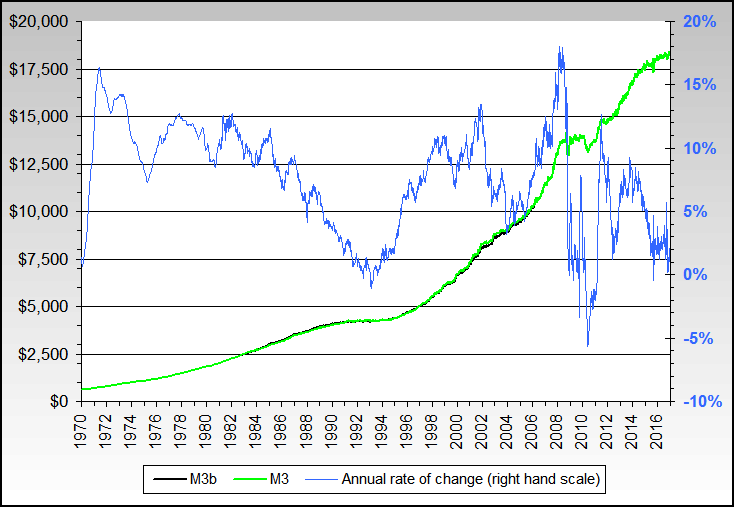
Look familiar?
half full,
"suggests that you regard humans apart from nature, or that knowing what a logistic curve is somehow makes it possible to avoid following one."
Very good point, and I can't really dispute it. I think Catton might say the same thing.
It's very tough, though, not to keep going back to the notion that since we can use our brains to do a lot of things, and even to influence large numbers of people, we might be able to influence the entire human population in a particular direction.
At any rate, it would still help a lot for people to understand better what's going on, and even things like bringing down fertility rates somewhat more than we are now would be a good thing -- if only to soften the landing.
http://growthmadness.org/
John,
I'm curious about this point. If we are not apart from nature, if our big brains don't allow us to move off the logistics curve then what level do we stabilize at? Or, more precisely, at what population level does the die-off cease. I know it depends on how degraded the environment becomes but I'm wondering what what the model predicts drawing on other species.
Tim Morrison
Peak oil, global warming, and economic collapse are not the problems, they are the result of the problem. The problem is a collective action problem and an inability to make good long term plans.
Tim,
"Or, more precisely, at what population level does the die-off cease. I know it depends on how degraded the environment becomes but I'm wondering what what the model predicts drawing on other species."
I think it varies quite a lot. I'm hoping we can actually avert a massive die-off. But if not, it will depend on all sorts of things. Henry, below, posts some interesting stats regarding carrying capacity. That's hard enough to zero in on, even trying to specify a range as a function of standard of living. It seems to me specifying the degree of die-off is even harder.
GliderGuider has posted analyses here previously which put it settling at 1 billion or so. But he freely admits it's very speculative, subject to changes in many variables. James Lovelock (apparently more informally) comes to a final number around 1 billion as well. But I don't think we can really rule out the possibility of averting such catastrophic outcomes. It's all a big unknown. I just try to stay open to the possibilities and allow my thinking to keep evolving. :-/
John
http://growthmadness.org/
John,
By saying that we can't avoid a downturn, I am not being totally pessimistic, just that new technologies and money systems must be designed for a bounded and depleted world.
People may be very happy, if things stabilize, and the population reaches a steady state vs oscillating.
To plan, one must ask what a "stable" population really means. Women will still be capable of bearing 15 children, and some will. Some won't have any. The selective pressures that apply to other animals will apply to humans. Is it possible to design negative feedbacks sufficient to damp oscillation without "interfering" with evolution, or trying to "direct" it?
I think "sustainable" doesn't necessarily mean "steady state". In considering steady states and chaos, most living biological systems are found in the complex area between a chaotic system and a steady state.
The steady state in biology usually equates to death, so a "sustainable" population would at least vary about a mean, and could even have complex oscillations.
We, however, are right now way beyond any sustainable oscillation. Being 6 to 13 times above the carrying capacity, contributing to global climate change and other species extinction, we are closer to a single pulse.
I regard a steady state biologically not as death, but as a stability in various measures of structure and function.
For example, a steady state in an individual might be the period between when physiological growth ends and genetically determined cell death begins.
At the level of ecosystem it could be measured by stasis in standing biomass and average energy flux over a year. At this level changes do occur within populations, i.e., individual organisms live and die, but the ecosystem structure and function doesn't fluctuate dramatically over time.
In terms of a human economy imagine zero population growth and the flow of solar energy as the basis for production.
The only way the population will be brought down to sustainable levels is through nature, through an immense die-off.
All the pretty graphs and rationalizations in the world will not stop that.
http://www.populistamerica.com/stop_calling_me_a_doomer
Don't worry- That M3 graph doesn't even show money velocity.
If you took a look at money velocity you'd be shocked to see almost a straight line up since 2000- for all currencies.
We are entering the age of mania, of panic, of insanity! things are just getting interesting. We are at least 10 years from actual massive die off, but I think the wealthiest nations have a chance to make it, relatively intact through that period.
whatever the case, just waiting for 2012. After that, its just really peak oil we gotta worry about. We can handle peak oil, we can't handle something completely unforeseen that just flips everything upside down.
Question concerning "logistic" deleted. Google rules.
From the chart above, the recent M3 annual rate of change is 16%/year. The last time it was this high was in the mid 1971. Does everyone remember what happened after 1971?
It was stagflation and interest rates exceeding 15%/yr.
US Economy Sliding towards "Stagflation"
http://www.321gold.com/editorials/sirchartsalot/dorsch100407.html
A Monetary Explanation of the Great Stagflation of
the 1970s (47 page pdf)
http://fordschool.umich.edu/rsie/workingpapers/Papers451-475/r452.pdf
from the report
Then also in 1973 oil prices went up five times in response to the 1973 Arab Oil Embargo. Peak oil might have a similar effect on oil prices. If 2004 is considered as the earliest part of the peak oil plateau then a five fold increase in the $40 oil price in 2004 would give a price of about $US200.
click to enlarge
The following is going to sound a little cold and selfish, consider it a 'devil's advocate' type of argument, and not necessarily one I agree with.
One thing John Feeney's argument didn't consider is that we may be replacing the Earth's natural systems with systems that support humanity. This would naturally be very bad for other species. It is not necessarily bad for us.
Most likely it would be very bad for us.
When we engineer things, we systematically reduce redundancy and margins of safety in the interest of efficiency. Normally the systems are highly reliable, but occasional failures result.
Failure of the global life support system is likely to be considered "not good."
On top of which, we don't really understand even 1% of the systemic interactions.
WHAT!!!
Without other species- there is no us.
We own the Petri dish when we go it all goes! Hubris speaking?
Maybe this:
"Creatures of the world there will be a slight halt to the progress of this evolutionary bus while an unruly passenger is ejected, the management apologizes for any inconvenience and species loss"
I tend to agree with some of the other commenters here that the OP's biggest weakness as a tool of persuasion is its omission of the changeability of the earth's human carrying capacity depending on humanity's collective 'mode of production' (or the variability of any individual's impact on the carrying capacity depending on their lifestyle, as Noizette points out). This is, I think, really a fundamental problem with the argument when used as a political tool to try to get people to modify their behavior.
I want to be clear here: I am not questioning the fundamentals of the OP, or maintaining that humanity's position is anything less than dire, or that some technological innovation just over the horizon will allow humanity to live happily with an 11-digit population. (Indeed, it's not entirely clear how sustainable 10-digit populations are.)
But I do think that those who oppose the analysis — particularly pollyannas and/or neocons — will gravitate strongly towards this omission in their rebuttals. Their public responses will likely follow the lines of, "Sure, that's our carrying capacity now, but who knows how big our carrying capacity will be once we get [insert technological fix here]." Privately the more realistic ones will be thinking thoughts like, "Oh sure, a billion people not like me might starve or be flooded, but I'm sure those of us who matter (i.e. have money) will still enjoy a good life."
To really be persuasive, the argument somehow needs to address this complex but key issue.
ballgame,
"To really be persuasive, the argument somehow needs to address this complex but key issue."
Yes, I agree. I tried to touch on it in footnote #2, but need to build it in better and in a more persuasive way. There is a widespread notion that if we can get consumption levels down far enough, we can just ignore population. That's obviously wrong. But proving it isn't simple.
[Edit] I shouldn't say "obviously wrong." If you believe global pop will level out at 9 billion+, as some projections suggest (but of which we have no guarantee), it might not be "obvious." But that 40% increase still makes it pretty close to obvious, I'd say. It would be challenging enough at 6.6 billion to try to reduce consumption of all resources enough to drop back under carrying capacity. But 9 billion? Whew!
John
http://growthmadness.org/
Privately, they are probably thinking thoughts like: "Well, by the time a dieoff happens, robotics and artificial intelligence will have progressed to the point that most of the human population will be surplus anyway. Life on an uncrowded planet, catered to by robots - what's the downside for me and my descendants?"
For an entertaining Grade B read on this future robot-mediated life scenario, I highly recommend the story "Manna" by Marshall Brain, which is free on the net.
You'll never look at McJobs the same way!
Have you read Marshall Brain's take on peak oil?
He doesn't seem to understand the issues.
Please leave him a comment...
http://brainstuff.howstuffworks.com/2007/11/01/is-there-a-cure-for-peak-...
Oh yes Marshall Brain has his head up his ass with regards to PO, but his book, "Manna" is a neat little story. It ends on a nice cornucopian note, but I like it best for the beginning of the robot takeover, it starts with a kid working at a place called Burger-G......
Look at http://marshallbrain.blogspot.com/2005/06/peak-oil-will-be-non-event.html
I think this shows that he is delusional on a large number of technical issues. A quick note to set him straight would be a waste of time. He needs serious therapy. Maybe PO will be a non-event, but not for any of the 'reasons' that he enumerates.
This problem is simply not solvable by the same who created it.
Mother Nature will fix it, and it won't be pretty.
Understanding that Growth is Madness is vital to our survival, but I believe relatively few will take the trouble to understand because your first statement contradicts a core conviction that most Americans hold dearest: that they have a get-out-of-jail-free card given to them by the divine to go forth and multiply. In America, this metastisizes into American Triumphalism.
TOD is a secular site--and I've no desire here of arguing whether spiritual insight is "real" or not. But at the core of the majority of our population is a sense that their needs will be taken care of by the divine. So when they read your first assumption:
They immediately know that you are not "one of them"--and you lose their respect and attention. You can argue, discuss, and debate as much as you like, but it's pointless because you're not understanding these people--and the harder you try, the more foolish you look to them.
To reach these people you have to ask a very difficult question--difficult to the religious because it's spiritually challenging and difficult for the secularist because it requires taking something seriously you don't understand. In order to "get it," the religious in this country (of which I am one), have to first ask themselves:
Would the Divine allow a die-off?
For those who are not Rapturists, this is a profound spiritual question. (Rapturists may be completely unreachable on this issue.) I know it's absurd for me to talk this way on this site, but the core spiritual experience of the religious is the sense that the Divine is Infinite Resource. What the religious often do not "get" is that this knowledge they have of infinite resource is spiritual resource, NOT physical resource. The religious respond to a call of being stewards, not to a statement that there is a lack of resources.
What secularists do not "get" is the experience of divine infinite resource. To speak to those who say they love God, you need to understand their language, assumptions, and experience. As long as you don't, they won't even start to take what you're saying seriously--as I imagine most on this site don't take this post seriously.
Excellent point Ric,
The secular data driven analysts on this site are going to have a difficult time communicating with the spiritual and religious community. So, could you please elaborate on
as I agree with this mindset. But I don't know what it means to the religious community.
I'm looking at the world population marching itself toward very bad things. I want to tell them about the consequences, what the data looks like, how the models respond, etc. How would you frame the debate? What is going to be an effective message?
Tim Morrison
Peak oil, global warming, and economic collapse are not the problems, they are the result of the problem. The problem is a collective action problem and an inability to make good long term plans.
Tim,
Just Google: climate change Christian steward. A lot of people are trying to reframe the discussion into the ethical issues we face with each other and nature.
As far as suggestions about how to reframe the debate, I can't help much. I think a lot about it, and at some point I'll write an article on die-off titled something like: "Spiritual Responses to Resource Depletion." The theme of the article, though, goes decidedly against the grain of easy spiritual or secular conversation and is perhaps best left for discussion after peak. FWIW, here's some thoughts:
1) Focussing on the Divine is the greatest good.
2) When our will is focussed on personal gain, we're not living with the Divine. As long as money follows the highest return, as the Chimp reminds us, there's not much hope for societal survival.
3) When our will is focussed on the Divine, we're on a narrow road where our personal survival is not the issue. Caring for others is central, but above all we love the Divine.
4) Living with the Divine is our decrease and the Divine's increase. (John 3:30)
#4 is the main issue--and it's the sort of thing that can only be understood by those who have lost everything. Thus it goes very much against the grain of most in our society and I don't believe will be of much public use until after peak. Just my 2 cents....
"Would the Divine allow a die-off?"
Interesting question. I will ask them Monday.
I can guess part of their answer right now. If the bible doesn't preclude it, then the answer is probably yes. They tend to practice literalism here in the south.
Unless you're one of them, you might generate more heat than light. The question is a problem for those who experience/know the Divine as infinite, personal love. I've no idea how literalists would look at it.
I doubt it will cause any heat.
My coworkers are use to having a godless agnostic/atheist(me), quiz them about their beliefs like a bunch of lab rats. We have worked together for 10 or 20 years, they are use to me. Kind of like Jane Goodall and the chimps.
"Kind of like Jane Goodall and the chimps."
taken in context, the funniest line on tod, ever.
beer out the nose
Wendell Berry from Christianity and the Survival of Creation:
That might be a more Catholic POV than many in the religious community would espouse; I don't know. [Atheist myself, but brought up Catholic - won't ever be able to or even want to shake that.]
Like Berry, I'm not entirely comfortable with stewardship; it seems presumptuous. We cannot know what every bug and plant does; but we can understand they all have a place in the web of life. Rather, if we are making a measurable impact on the planet, then it is too much and it is not sustainable.
cfm in Gray, ME
What a great quote--thanks. I'll look up the book. I particularly like:
I've always been sorry that religion and science often don't understand each other, because it takes religion to approach nature with devotion and science to provide the context of our impact. You're right, though about the presumption implied by "steward." Used without a devotion to service, it's an arrogant word and that's a real fault with it's current use.
Regarding Catholicism, I appreciate your humor and honesty. I'm definitely Catholic, but saddened by the childish way people regard spiritual life. As far as my bringing all this up on TOD goes, I appreciate the cogent responses I've received. It's my view that some people know the Divine in unsaid ways, but because of their upbringing they say they want nothing to do with religion, while all the while they face the unknown within and without with all their integrity and heart. This is true of my wife and also my sense of many people here--and from where I sit, this is the essence of religion. But among such people, it's also good manners not to mention it, so that was my misstep..... ;-)
no.
these are good posts by you in general, though.
I'm an atheist, but acknowledge that mythology could ultimately prove more durable than a scientific mindset. And perhaps more useful, if we could evolve religion in that direction.
I want to second these thoughts. I just read this comment:
"it takes religion to approach nature with devotion"
It appears insulting to me as an athiest. I hope you misspoke, because otherwise it is very narrow-minded also.
I would also like to thank you for beginning this thread. I agree wholeheartedly that failure to understand religious language and thought processes is probably central to the failure of outreach into these communities.
I for one take the initial post very seriously and hope you may provide further insight in this direction.
Dot
I find it insulting too.
I think if there was a survey carried out and the answers were honest , I would bet that the vast majority of anti-doomer's would range from religious (believing in a god) to religious freaks.
I guess it angers me because the very same religious freaks, that reject science when it comes to evolution, stem cell research and contraception, wholeheartedly embrace it (unreasonably) to save the world.
They claim windmills, solar, nuclear and electric everything will save their god fearin' asses. I've even seen it stated here that maybe we are destined to inherit the earth literally at the expense of all other creatures. That to me is the scariest thing I have ever seen written.
Then there are the anti-doomers like me, who feels urges to run away screaming when people try to prosyletize me. ;-)
The sort of mind which compartmentalizes and does not or cannot connect facts has no difficulty with this. Just echoing the dogma received from the authorities is simple, takes little effort, and bonds the individual to the group. Daring to question that dogma can get one shunned, or worse. Thus has it ever been.
People who compartmentalize don't realize that truth is all interconnected. They have no concept that you can't delete one part without damaging the whole, and you can't convince them of this without re-educating them.
I think, and this seems to be backed up by the ex-religious, that it takes something approaching atheism to hold nature in the highest awe.
Take any creator-god out of the equation, and nature itself becomes the creative force, lain out in front of one to be awed at, inspired by, humbled by -- not only what has been created, but the very creating itself, right in front of you, under your feet, in your nostrils -- the stuff that many box up, and put elsewhere, somehow separate, named, invisible.
I apologise in advance that my belief is, I suspect, heretical to many religious folk.
--
Jaymax (cornucomer-doomopian)
Stewardship can be a humble recognition of responsibility. I think the accusation of presumption is a reaction to texts like:
"For thou hast made him a little lower than the angels..." (Psalms 8:5)
or:
"And surely, We created you (your father Adam) and then gave you shape (the noble shape of a man ), then We told the angels, "Prostrate to Adam", and they prostrated..." (Qur'an 7:11)
Where Man's position is stated to be well up in a hierarchy. But arrogance on this point is not well supported because it is usually conceded than Man does not manage to live up to the honor very well.
Here is what some US churches have said recently. I am a little critical of the focus on the revenue stream in Lieberman-Warner when carbon trading in Europe is not accomplishing its goals very well, but it does express proper concern for the effects of global warming on the poor.
Chris
E.O. Wilson, writing in his book "The Creation"
"...religion and science are the two most powerful forces in the world today, including especially the United States. If religion and science could be united on the common ground of biological conservation, the problem would soon be solved. If there is any moral precept shared by people of all beliefs, it is that we owe ourselves and future generations a beautiful, rich, and healthful environment." (p.5)
But also:
"The human hammer having fallen, the sixth mass extinction has begun. This spasm of permanent loss is expected, if it is not abated, to reach the end-of-Mesozoic level by the end of the century. We will then enter what poets and scientists alike may choose to call the Eremozoic Era -- the Age of Loneliness. We will have done it all on our own, and conscious of what was happening."
Wilson is a scientific prophet of Bibilical proportions.
We have set before us a choice between life and death. we can choose to conserve life or to continue to force the mass extinction we have triggered. To address the problem, science and religion must cooperate.
http://www.amazon.com/Creation-Appeal-Save-Life-Earth/dp/0393062171
beggar,
"To address the problem, science and religion must cooperate."
Yes, approaching it as Wilson is is about the best (and only) answer I can give to the questions concerning the religious issue.
John
http://growthmadness.org/
This may indeed be the clincher for us. Religion's hold on the masses. I've delt with this many times years ago when I was on the front lines fighting creationism in the 1980s' You really do not understand how these people think until you get deeply involved with them. The utter fantacies, including suspension of physical laws, in order for their belief system to remain in tact would make any other person's head spin. But to them it is completely rational. And there are few who will be changed. They usually have to change on their own. It appears the more you push them, the more they dig in their heals.
But even the more rational religions have their hands dirty when it comes to population. The Catholic Church would rather have more starving and suffering souls to pack heaven with, than a quality of life for those living. This is why they refuse birth control in out of control countries.
Then you have the "out-breed-them" mindset that has been one of the weapons of war for thousands of years. You either keep cranking out warriors (or suicide bombers) to overwealm your enemies, or once conquered, you allow your troops free hand in inpregnating as many of the locals as you can in an effort to outbreed them.
There are still places in the world where this is going on today. And there is no solution to changing these people.
The bottom line is there may be some "relief" in the rate of population growth, but there is still a huge push from many quarters, including religions, to keep the population rising. Recall in their mind this current existance is but a preparation for the real perminent life -- heaven. Thus, to them, ultimately, and ironically, this planet is secondary to the main goal for these people and that is to get into heaven to get as near to God as possible and stay out of hell. It definitely is a mindset that the rest of us cannot grasp.
Richard Wakefield
London, Ont.
No one is ahead of their time, just the rest of humanity is slow to catch on.
The passage in Genesis doesn't just say "Go forth and multiply" (which is the one biblical commandment that has been obeyed in full, to the point where we can now say "done!"), it goes on to say "and subdue the earth."
Throughout the Christian community, there has been a glaring lack of serious and informed meditation upon what is meant by "subdue the earth", and what its implications are for us now.
"Subdue the earth" does not mean to rape the earth, or to lay waste to it, or to render it unfit for habitation by humans or anything else. The phrase is meant to suggest the same thing that happens when one domesticates a wild plant or animal -- a kind and gentle caretaking, gradually transforming what was once hostile and unsupportive of human life into something with which we can live in peace and mutual benefit.
Christians need to be understand that if they are to take anything away at all from that passage, it is that their mission should be to treat the entire world as a garden, and we are the gardeners. We are to be caretakers, not plunderers.
What a different world we might be living in today if Christianity had not been hijacked by rapacious, greedy people who (probably deliberately) got it wrong.
Little late in reinterpreting "subdue" in light of the damage already done. I think the passage is very explicit. When you subdue someone you incapacitate them as best you can. Oh, humans got the message from that passage very clear alright. Subdue is exactly what the human race has done to the planet.
Richard Wakefield
London, Ont.
No one is ahead of their time, just the rest of humanity is slow to catch on.
No, you're interpretation is what many have chosen to think that it means. However, the context was that they were in a garden and directed to tend it, so I think that my reading is quite sound.
Yeshua of Nazareth clearly advocated a lifestyle of radical simplicity and contentment with little. This seems to me to be fully consistent with the idea of being caretakers rather than plunderers of the earth.
You are right, though, that most of the religious "leaders" and "authorities" have led most people within the Christian community to think that it means what you have implied. This, unfortunately, is what happens when people don't read and think for themselves.
Whether we are talking about climate change, peak oil, air pollution, or whether the moon landings were real, you always have people willing to froth with religious fervor that, “it is not true”. I work with some of them, and it is interesting to probe their thought processes.
Generally I find four root causes for "not getting it":
1) Selfishness: Some are quite open about this. The high performance/luxury vehicle makes them feel important and special. They will not give it up, no matter what the cost to others.
2) Hatred of the group promoting the issue: If party “X” is promoting it, then it must be bad.
3) Fun: They enjoy being a troll. It give them a sense of power. Here in the south I see a lot of this. People hang a rebel flag or act like a redneck, just to piss the rest of the country off. They love to watch the liberals dance in anger. It almost has reached the status of a sport.
4) Delusion: Never underestimate the need for people to delude themselves. Life can be really hard. Sometimes insisting that a perpetual motion machine works is part of their coping strategy for dealing with the loss of their job, loved one or social status. I see this with some of my evangelical friends. They were on a path to self destruction till they found “X”. Now that they have “X”, “It is in god's hands”, but they can at least function in society.
Let's face it, peak oil and climate change are pretty overwhelming problems, with no apparent answers. Even I am feeling like a rat trapped in a cage.
It is an axiom of ecological science that a population which has grown larger than the carrying capacity of its environment (e.g., the global ecosystem) degrades its environment.
It seems to me that this statement is an empirical observation that accords with common sense rather than an axiom. The most famous example of ecological overshoot is the reindeer population on St. Matthew island. Ninety-nine people out hundred people who read about this example will instantly nod their heads and say “Yep. Got it.” Invoking ‘axioms of ecological science’ adds very little to the common sense force of this example.
The question is why aren’t people applying this same common sense idea to the human population of the earth? This question has a twofold answer. First a lot of people are concerned about population growth. I have talked to a number of people who are not really peak oil aware who nevertheless think that it would be a good idea for the earth’s human population to stabilize and then decline. The problem is that they are completely clueless about how to take any practical action which would bring about this result, and they are far too busy earning money in order to obtain security for themselves and their families to spend much intellectual energy thinking about the problem. The second part of the answer is that the earth is a really large place and human technological ingenuity is formidable, so it is hard to know for certain how close we really are to the earth’s carrying capacity. I think that if you asked people if they though that the earth was capable of supporting a human population of one trillion people almost everyone would say ‘no’. But in spite of the fact that danger signs exist, the claim that we know for certain that 6.5 billion is near or over the limit can easily be disputed. In fact there are a number of intelligent posters on TOD who vigorously argue that we are not anywhere near the limit yet. Of course one could argue that even without certainty the precautionary principle alone should be driving us to action, since this is a matter that we don’t want to be mistaken about.
In my view the percentage of people who do not understand the concept of resource limitations is a far less significant barrier to effective action than is an economic system based on the competitive accumulation of wealth by individuals and families. People in agrarian have lots of children because children are form of wealth for the family. Of course children, in proper numbers, are a form of wealth in all societies; We all need a new generation of worker to be trained. But when the emphasis is on private wealth rather than community wealth, then the long term implications of population growth are ignored. In the OECD countries birth rates have dropped significantly and in a number of cases have gone well below the replacement rate. This drop in birthrate does not result from greater virtue or greater concern about the environment on the part of the developed world. It results from the twofold fact that in highly developed economies children have become a financial burden at the level of the family and because educated, empowered women choose to spend their time and creative energy in other ways than the raising of children. However, in spite of our relatively low contribution to the increasing human population of the world, we are resource devouring monsters who are contributing mightily to ecological degradation and resource depletion. Again this behavior is driven by the imperative of private wealth accumulation. If we paused for a moment in our efforts to increase the size of our collective pile of toys, our company would loose market and share, we would be out on the street looking for job, and our drive to obtain middle class financial security as it is conceived of in the developed world would be stalled.
If we have any hope of reducing our resource consumption we must create an economic system in which the security of individuals and families is tied to the security and sustainability of community wealth rather than to the accumulation of private wealth. If I am a computer engineer and I work myself out of job by figuring out how we can manufacture a lot less computers and still get adequate computing services, I should be rewarded by the community as benefactor rather than be deprived of the right to consume economic output. We need to develop a fundamentally different conception of the process of economic production, and until and unless that new conception is developed and implemented all the psychologizing in the world do will nothing to halt the destruction of our resource base.
Roger,
I see much merit in a lot of what you're saying. There is definitely an economic dimension to this which gets too little attention. Even I have gotten a bit away from it recently, but I've tried to promote ecological economics a good bit in the recent past. I was even lucky enough to feature a guest essay by Herman Daly on my site. Your points though, are an interesting angle on it. The issue of individual and family competition for wealth versus community security is under-examined.
Let me just clarify a couple of items:
First the thing I called an axiom is both an axiom and common sense, I think. i.e., it's an axiom if you define "axiom" as "a proposition regarded as self-evidently true." Either way, though, it's pretty clear, no?
"But in spite of the fact that danger signs exist, the claim that we know for certain that 6.5 billion is near or over the limit can easily be disputed. In fact there are a number of intelligent posters on TOD who vigorously argue that we are not anywhere near the limit yet."
Well, note my use of the phrase, "under current conditions," and Al Bartlett's words, "living as we do." Living as we do, I think there's essentially no question we're in overshoot. Things like climate change and other aspects of ecological degradation resulting from society wide ways of living are essentially "proof."
The question, then, as I hinted in footnote #2, is whether even "solving" energy would, alone, be enough to fix this. I doubt it, for the reasons I've mentioned in other comments. How much can we reduce depletion of non-energy resources in the context of 6.6 billion people and growing? Would we be able to do so to such an extent that (a) we continue to have ample water, mineral resources. etc., and (b) to such an extent that the "sixth extinction" ceases?
But to extend it, a common sense view of this is one I see another commenter (Henry) has put in a statistical light below. But simply consider that for 2.5 million years humans (including some ancestors) numbered in the millions. I think it was under 10 million prior to agriculture. Then, in the last 0.0008% of our history, we've shot into the several billions. So it seems that to conclude the earth's carrying capacity for humans is over 7 billion, is like saying, "Well, our numbers were only in the millions for about 99.999% of our history. After that, after exceeding 1 billion, we commenced serious ecological damage. Okay, I'm going with an estimate that the carrying capacity for humans is over 7 billion."
Not proof, no, but... :-)
Anyway, yeah, I agree there are some serious economic issues which need addressing.
John
http://growthmadness.org/
William McDounogh's solution to the pile of toys problem is to be sure that each toy enhances the environment as a design requirement. Then acquisitiveness is put to use just as an oak makes used of the practices of squirrels. If the latest and greatest television, when distributed, were also phosphourous fertilizer then that surpassing the Joneses spirit might be put to ecological use.
I think we can look back to economic systems that were more specifically geared to livelihood rather than competition but these have been criticized for crushing individual initiative. It is not clear that Bach, for example, in his living as an organist and music director, felt crushed. But that is one of the issues that keeps us from accepting enough as opposed to more and more. I doubt he considered his children a form of wealth, but some of them certainly understood their own value since they were able to create.
Chris
IIRC, squirrels eat the embryos from acorns before burying them; this makes them useless to oak trees. Jays also bury acorns, but cannot chew off the embryos first. This makes jays far more beneficial to oak trees than squirrels are.
Funny, today my cat caused a squirrel to drop its haycorn. Boy was he mad. You may be right, but squirrels probably manage to help out sometimes. McDonough sets a challanging design problem. He wants everything to be food for something else.
Chris
And you have a number of people who absolutely refuse to accept the earth is at capacity. For example, a couple of us around here have been trying to get that message across on a local forum londoncommons.net. It is run by a bunch of radical far left wing students. Whenever we give any hint of population control or immigration control we get labeled as right wing nazi barbarions.
Most of them feel Canada can take in many millions more and feel no harm. It's our "duty" to do so to get people out of impoverished areas of the world. They also reject any notion that these immigrants use more energy here, hence increase Canada's energy consumption and CO2 foot print. Oh, no that's not allowed to be talked about.
Some think Canada should take in as many as possible, including a SEVERAL HUNDRED MILLION people now from China to releave the pressures there.
Thus you also have an ideological barrier to the issue of over population. Because of this and the others I can't see any way of curbing the growth in human population on our own initiative. It will take too long for it to make a difference even if we could.
That leaves Nature dishing out the cull. Yep, doomer as that's what the reality points to.
Richard Wakefield
London, Ont.
No one is ahead of their time, just the rest of humanity is slow to catch on.
Agreed that the earth may be able to sustain a larger population for a while. But the simple fact remains that we are currently degrading the environment. That, in turn, is reducing its ability to support us. That is overshoot.
Some people may want to argue that we have degraded the environment in past centuries without global consequence, but that degredation has been localised and/or temporary, restricted to only a few resources and has eventually curbed human activity. Today the degredation is on a global scale, and involves many of our vital resources. Again - overshoot.
I like your ideas on developing community wealth vs private wealth, although fear it will be a tough sell.
"You can never solve a problem on the level on which it was created."
Albert Einstein
Excellent. Population numbers follow the characteristic relaxation oscillator curve.
What that means to you and me is the ride down is a lot steeper than the ride up, and we may not end up back in Year 1840, we may end up in Year 1040.
you know, thinking about how 90% of the world would react to apocalyptic die off, I could see us going back even further than 1040...lol.
Honestly, if TPTB get on the ball and make a move before 2010 that gets things under some control, such as birdflu, Cumbre Vieja going off, or get lucky and just get a 1 kilometer diameter meteor impacting somewhere in central asia/india/africa/europe/n. America then Population might be able to be reigned in around 5-6 Billion for a decade allowing humanity to prepare for a 'minor' die off to around 4 billion and an extremely dystopian house of horrors.
I actually prefer just a massive die off. We more than deserve it. To even describe the evil of humanity would take words that don't exist. To add to that, 90% don't realize what they're doing is evil, which makes it even more evil. So when they perish, it wasn't 'their' fault and its a 'tragedy'. Kinda ironic. Will the icecaps just melt already? I'm tired of waiting. Hopefully the Amish and indigenous tribe peoples, and a few cannibals survive to carry on humanity. Somehow I feel like this has happened before- 70,000 years ago. But look where we are now!
Myndless the world at large US Empire to rural India, Eskimo country to Micronesia, seem to be on your wavelength. The aim seems to be to consume as much as possible, buy the biggest SUV possible, travel as much by air as possible, breed as many kids as possible, etc.
The ONLY times people are diverting from this goal is when a stone wall in the form of untenable cost, lack of credit, disease, violence, etc actually prevent them from doing so. Examples range from the American Yuppie tribe which is limiting its children due to the high cost of raising each American Yuppie child, the family of newly-arrived Micronesians in Hawaii who own only one SUV in the family because they simply can't afford two - or they'd get two, or six! Or the family in Russia who'd happily have 12 children but TB and starvation are limiting them to 4, or maybe 2, or 2 survivors out of the 4.
No one but no one is gearing back voluntarily. I'm not, you're not.
Actually, if you don't realize that what you're doing is evil, then it's less evil, not more. Evil requires intentionality; otherwise, it makes no sense. You could accuse, well, yeast of being evil.
ignorance is the ultimate form of evil-
Oh, the nurse just killed 50 infants by giving them the wrong dosage but didn't know what she was doing. Even though she should have.
The airplane mechanic, not knowing how to tell a broken part from a working one, overlooks it in his inspection. The plane crashes and 50 infants die.
again, ignorance is the ultimate form of evil because you SHOULD know. Its even worse in modern countries because individuals DO know what they're doing, but are ignorant to the scope of it all. If they weren't ignorant from Mass Media, 'political correctness' and societal norms they'd realize what they were doing was inherently evil, and would probably stop. Ignorance is the ultimate form of evil.
The point is beaten into the ground around here that the problem with the human race is that we aren't designed to process the entire scope of it all. That's the basis of the "humans are yeast" argument, isn't it?
It's not even clear that what they are doing is "inherently evil."
Namo I suggest you read a book called "The Banality Of Evil" and learn what the term "little Eichmanns" means.
Hitler meant well.......
And he was a friend of the animals!
Yes, Hitler was a vegetarian, nonsmoker, and may well have been the most "environmental" ruler, ever.
The whole "Health Foods" movement has these really Conservative with a very large C, right-wing roots.
This is not to say that Health Foods are wrong, but it's interesting to know the roots of the consciousness - I believe it was originally the Left who wanted to raise engineered foods in vats and all that.
Bwuh? He restored German industry...
Nuh-uh. First you have to show me that the result *is* evil, before you accuse anyone of doing it "banally".
By the result, of course, I mean human technological consumption, for lack of a better word, which is what is being accused of being "inherently evil" as I understand the argument.
It's not even clear what is meant by ignorance being a form of evil.
"The Law" doesn't consider lack of knowledge of the law a defense, as in "ignorance of the law is no excuse", as a matter of efficiency. Otherwise, ignorance of the law as a defense would be abused.
But that's just a matter of efficient
exploitationprocessing. It is not a matter of validity, because some people really don't know what the law has to say in a given environment. They don't know, and they don't know that they don't know. They are ignorant of their own ignorance.Given the sheer volume of knowledge to be digested in the world, ignorance is inevitable. Wouldn't this mean humanity as a whole is fundamentally flawed and evil?
Very few people agree with you.
Your hypothetical nurse would be charged with criminal negligence causing death, at worst - it's entirely possible she'd simply be fired and barred from working in healthcare again. By contrast, if she'd done the same thing intentionally, she'd be international news, and tried on 50 charges of first degree murder.
If most people thought that actions through ignorance were worse than actions through malice, the law would likely punish people more heavily for the former than the latter; instead, we see precisely the opposite, and anecdotal evidence - public outrage over "killer nurses" who murder patients as compared to virtually no coverage of the tens of thousands of accidental medical deaths per year - tells exactly the same story.
You may think that ignorance is the worst evil, but hardly anyone seems to agree with you.
But not until a number of dead cat bounces occur before we get there.
Richard Wakefield
London, Ont.
No one is ahead of their time, just the rest of humanity is slow to catch on.
Another good report to keep track of re: ecological overshoot is the one The Footprint Network publishes in conjunction with the World Wildlife Fund.
http://www.footprintnetwork.org/gfn_sub.php?content=global_footprint
This year they calculated Ecological Debt Day (formerly Global Overshoot Day) as occurring on October 6. On that day, we have used up the resources that the earth can replenish in one year. After that, we begin using the capital i.e. taking more fish than naturally restock, clearing more forest than can regrow, degrade soil thus removing it from useful production, etc. It's very interesting to read the process they use to arrive at that day. It's quite a task.
The page on Ecological Debt Day is here:
http://www.footprintnetwork.org/gfn_sub.php?content=overshoot
Those who are interested can calculate their personal footprint. Last time I checked, if everyone lived as I do we would require six earths. I've taken steps to reduce that but I don't think I've gotten it down by more than a half earth, to be honest.
http://www.earthday.net/Footprint/index.asp
As people on this forum are keenly aware, overshoot can be sustained only briefly before the system collapses.
-----------------
Andre' Angelantoni
Preparing for a Carbon-Constrained World, No Charge Online Briefing Every Week
www.InspiringGreenLeadership.com/preparing-carbon-constrained-world
It's interesting to note that about half of the calculated footprint is due to "carbon footprint". So peakers should see this as a temporary problem - declining fossil fuels means declining carbon output means declining footprint means increased sustainability, even with no decrease in population.
Indeed, according to their numbers we're in 25% overshoot and carbon footprint accounts for half of our ecological footprint, meaning that a 40% reduction in carbon output would put us back at the sustainable level, and I daresay most doomers see us at under 60% of current fossil fuel use within a few decades.
So if you're a doomer, the WWF is saying pretty optimistic things about carrying capacity. But I guess doomers wouldn't see it that way. ;)
If one calculates the standard deviation for anything, height in a given population for example, only a small percentage of the population falls three standard deviations below the mean, and only a small percentage falls above the third standard deviation from the mean (2.5% in each case). This is basic statistical theory.
This same concept can be applied to a time series, and the mean and standard deviation can be both calculated statistically. The mean can also be approximated by fitting a line to the time series. The value for the position of the calculated line for todays date would approximate the current value of the mean. Taking the world population data set from 500 AD and applying these principles, our precarious position is obvious.
Depending upon differing formulas for calculating the current value of the mean, this approach yields values between 600,000,000 and 1 billion. The statistical calculation of the mean yields 931,600,000. The standard deviation is 766,600,000 so three standard deviations equals about 2.3 billion; at 6.5 billion current population we are clearly well above three standard deviations from the mean, however you approximate it. All you need to do to realize the magnitude of our deviation from norms is to look at the chart of population starting 500 AD or anywhere before that. Until we started to use stored fossil fuels the population growth curve had a very small upslope, from which base we began an unprescidented, most likely unsustainable upward march.
There is another statistical principle sometimes referred to as "return to the mean". Simply stated, there is a tendency to snap back to the mean whenever deviations occur, the greater the deviation, the more likely the snap back. If your average score during a basketball season is 20 points per game, that is your most likely score in any given game; if you score 40 points in one game, the best bet is that in the next game you will score 20 points. Furthermore, in order to have a 20 point season average, you are going to have scores distributed both above and below 20 points over the course of the season and that distribution will follow statistical principles.
My points, in support of Prof. Goose's post, are: (1)The statistical evidence indicates the carrying capacity is below 1 billion, probably closer to 500,000,000; (2)We are out on a limb at 6.5 billion and cannot expect to remain here for long; (3)We should expect a snap back to the mean, and an overshoot to below long term trend position for human population growth.
This sort of behavior can be seen in many data series, the crash of the NASDAQ stock market a few years back being an example.
This is entirely consistent with Richard Duncan's application of the patterns of development and discharge of electrical spikes to the spike in human population; the underlying principles are the same.
When you step out of the world of numbers and just look at the cause of the great human population expansion, and the impending withdrawal of that cause, the horrible implications are obvious.
Henry,
I like your more rigorous way of painting a picture similar to something I said in a reply above:
"[I]t seems that to conclude the earth's carrying capacity for humans is over 7 billion, is like saying, 'Well, our numbers were only in the millions for about 99.999% of our history. After that, after exceeding 1 billion, we commenced serious ecological damage. Okay, I'm going with an estimate that the carrying capacity for humans is over 7 billion.'"
John
http://growthmadness.org/
Regression to the mean
That assumes the underlying distribution does not change, however, which is not a reasonable assumption for human population levels. Technology is clearly quite different now than 1500 years ago, so there's no reason to believe that the "mean" population now should be the same as the "mean" population then.
Humanity is not a stationary process.
The idea of return to the mean is really the more common sense idea that things eventually return to normal, whatever normal is, even if they get really out of line for a while.
In order to determine what normal likely is, I took various approaches rather than to only calculate the statistical mean on the data set of human population going back to 500 AD. I also fit both straight lines and lines calculated with polynomials of different degrees. These calculations yielded different normals for the last 1507 years, placing normal somewhere roughly between 600,000 and 1 billion. Had the data set been longer, the normal would be lower. Had the data set been for only the last 400 years (characterized by increasing fossil fuel use) the normal value would be much higher.
I was not looking to trick myself into a conclusion which just misleads me about the future. So I considered that we are facing the question of what is normal without fossil fuels and with fossil fuels, which is essentially the question for which we want the answer, given that we appear to be facing an immediate future of progressively less and less fossil fuel availability, but by approaching this from a statistical point of view I want to also know if the numbers indicate that 6.5 billion is not normal for human population.
Since most of human history, before we started using nonrenewable fossil fuels, occurred before 1650, I fit a line to that human population data and then extended that line to 2007 which gives a 2007 value of about 580,000. This tells me that had growth of human population continued without fossil fuel a normal level for 2007 would be 580,000. It does not matter much how far back data is used because the slope was very similar even if the data set is extended back much further.
Even including the data after 1650 only raises the slope of the line enough so that the 2007 value is at the 1 billion level. One could manage this answer somewhat by shortening or lengthening the overall number of years included in the data set, but a reasonable conclusion to my mind is that the fossil fuel age only increased the normal human population level by about 420,000 human beings. Given the huge difference between the current population level and these normal estimates, even rough estimates suffice.
If you want to step away from the historic numbers as an way to invalidate the answers that analysis of the numbers yields, and instead argue that technology has changed the normal to just what occurred during the last 350 to 400 years, (making all human history prior to that abnormal) then you must also be able to provide reasonable evidence that this change in the way we support life is a permanent change (as compared to the way we supported life before this technological boom).
My view of technology is that it is knowledge applied to resources. The historic result has been an increasingly rapid use of resources, with very, very few discoveries resulting in less resource use. This allowed for greater population levels or higher per capita consumption levels or some combination of both which we witness as lifestyles today. Knowledge without resources to apply the knowledge upon, or resources without knowledge of how to manipulate them would not give us the same population levels or the same standard of living we now have. So in a future without adequate resources we really don't have technology, we just have knowledge, only half the definition of technology, and even that would soon be lost. Unless knowledge increased dramatically to allow us to manipulate what dwindling resources remain, or have not yet been exploited, in a manner sufficient to replace the life supporting characteristics of dwindling fossil fuels, then the population will decrease as fossil fuels and other resources become progressively less available, and the normal population levels will be those calculated as I have concluded at under 1 billion, not the much higher norm for just the short period of the technological (industrial) age.
I think that arguing that the average of only the last 400 years is now normal is a weak argument given the basis upon which the population is supported, and it is much more reasonable to look at the larger picture. To argue that the last 400 years represents the normal is like arguing that the peak years of the NASDAQ stock market were the norm; plenty of people make that argument and lost large sums.
I stand by my previous post.
Henry,
I found your analysis interesting in many ways and had not seen this type of approach to calculating carrying capacity before. I have a few issues, however, with the assumptions on which it was based and how the argument was structured.
First let me say that my unsubstantiated opinion is that human population at 6.5 billion is likely above world carrying capacity. However, the variables that determine carrying capacity and their interactions are perhaps more complex than those that determine climate change. To obtain an accurate and defendable estimate of the human carrying capacity of the earth will require a diverse group of experts to catalog the factors determining carrying capacity and assign them weights in some kind of computer model. This model will then have to be run against some sets of known data, the discrepancies observed, the model tweaked, etc until there is a reasonable certainty that the numbers being generated are reasonable.
I could see that your approach to this issue would have value in the calculations. But as it stands now there are many factors which need to be included in your analysis as they could substantially alter the numbers you have arrived at. Perhaps not of course, but the likelihood is there.
Those that occur to me at this time are (in no particular order):
1. Overshoot often results in the new carrying capacity being below the original. I think that one could say there is a possibility that we humans may have already put ourselves in this situation.
2. Was the human population at the dawn of industrialization already at carrying capacity? I am pretty certain that it was not. At that time there was still vast amounts of arable land that was essentially unpopulated and the fisheries of the world were essential unexploited. How much additional population could those items have supported in a sustainable mode.
3. Conversely to #2 above, how much of the areas of the earth occupied by humans at the time of industrialization was already past carrying capacity. This needs to be factor in as well.
4. Determining carrying capacity at this point in time will get a different result than calculating it for the year 500 AD, for the year 2000 BC, etc. Humans have been altering the environment, local ecosystems, and the native animal populations for the entire time of our existence. When those alterations reach the point that they cannot be reversed then you have a new baseline you have to calculate from. For example, you cannot reverse the extinction of a species so it is not possible to return to the state that existed before that extinction. The arroyo country of the American southwest which was significantly caused by poor farming practices of the Anastasi (sp?) cannot be restored. Poor irrigation practices in various locations over history have permanently (or near so) altered local land fertility.
5. Sadly we have eliminated a large amount of the native animal life of the earth over the last couple of thousand years. A side effect of this is that the carrying capacity of the world in human terms has been altered from its original state. But was the net positive in that we now have a greater share of the resources for ourselves. Or is the net negative in that the overall fertility of the world is so degraded that the carrying capacity for humans is actually reduced. I have seen strong opinions expressed on both sides of the argument. I don't know what the answer is.
6. Technological advancements are impossible to predict and their impact on carrying capacity are also hard to predict. However if we have the time before these crises overwhelm us advancements in alternative energy developments have the potential to move the carrying capacity baseline to a different level. Fossil fuels will not be exhausted for a long time and efficiency/conservation improvements have the potential to extend our window of time to reach sustainability.
7. Biological science has generated tremendous changes during the Green Revolution (albeit mostly for industrial agriculture) and we have surely not exhausted the potential for this part of science to move the baseline to another level. Though my daughter the biologist informs me that progress has slowed dramatically over the last 20 years. But then I ask what could we accomplish if all those research dollars were put toward improvements outside of the industrial sector. Might there be a few pieces of low hanging fruit left?
8. One problem associated with assuming that the baseline from even 500 years ago has not moved is that it ignores the vast improvements in crops available for human consumption. Just one example among many is the "discovery" of the potato in the New World dramatically changing the carrying capacity of Europe. Plus farmers, through natural selection of desired features have modified native crops and we now have varieties that are far more productive than their natural brethren. These factors also changed the baseline.
9. Human understanding of soil fertility, composting, soil types, pest/disease issues, best irrigation techniques, cover cropping, companion planting, beneficial insects, crop rotations, required micro nutrients, etc is far superior in today's world than at any time in the past. These factors also change the baseline. Think for instance (as unpleasant as it might be) of the number of positive effects of composting all human waste for recycling back to nature.
It is easy, of course, to point out a host of human activities that are rushing us towards an unpleasant outcome if we do not choose to adapt. The way we deal with the looming crises' and the rate at which we adapt will determine a new carrying capacity. If collapse overtakes us then the carrying capacity will be significantly less than if we mange, however difficult it may be, to maintain a semblance of civilization during the transition to a sustainable existence.
Being a farmer I know for certainty that significantly more food can be grown in the world than is being grown today. We simply are choosing not to do so. Just from the windows of my house I can see about 100 acres of good land that is not being used at all and another 50 that is only being used to graze cattle and harvest hay. On this land there are two large springs that could supply enough irrigation water to adequately supplement rainfall. Going by the estimate of 13,000 lbs of vegetable production per acre on my land that I posted in another thread a few days ago you could see if we used 100 of the acres and used the rest to generate compost that it might be possible to as much as 1.3 million pounds of food that is not currently being produced. And we would have the side benefit of removing a small amount of cattle production thus lessening another problem.
I am sure that many of the TOD readers could add, to what I have posted here, extensive detail on factors which both increase and decrease the ultimate carrying number. How do we include all of these things into an analysis that can arrive at a more rigorous answer. And would it be productive if we did?
Wyo
And none of them have anything to do with the physical situation in question.
You've given no evidence that fitting various curves to historical population data makes any sense at all as a way to predict future population levels, no evidence at all that you're capturing any of the key variables driving the situation, and frankly no evidence at all that anything you've done is at all useful.
Knowledge is technology. The three-field system was little more than a different way of doing things, but it radically changed European farming.
A lot of good thoughtful comments here. I especially like the George Orwell quotes, and Rics admonishion about the different way that the highly religious think, and hence the fact that one message does not fit all people.
I think the problem of carrying capacity, is that its level is going to be highly infuenced by the level of technological civilization, as well as the living standards of the inhabitants. Clearly the human carrying capacity for hunter gatherers, is lower than that for agriculutural societies. Also the time span for overshoot to happen can vary enormously depending on the kind of constraints that are violated. Some simple examples, if oil were truly necessary for a given type of civilization, then the ulitimate carrying capacity would be the rate of geologic creation of the resource, divided by the per capita consumption. This would obviously be a pretty small number. But a population at say twice that value would take a very long time before resource depletion became noticable. If energy were the constraint, and fusion worked, the long term carrying capacity might not be greatly increased, but it would take millions of years at current consumption to run into that limit.
So I think the need to acknowledge upfront that our aim should be to choose a technology that in some way maximizes the long term benefit (some combination of population and standard of living), and work towards acheiving it. Otherwise we are likely to see the population divided into two classes, doomers, and denialists. That political bifurcation brings us no closer to a solution.
This is a point that bears repeating (and I've tried to make, but not so well). For instance, a pond growing algae to feed fish like tilapia appears to have a very high productivity, and the required technology isn't much more than hand tools (albeit one hell of a lot of labor to construct one pond).
It's going to be a large toolkit of technologies, but otherwise I couldn't have said it better.
That someone does not agree with you does not automatically mean that either they don't understand or they're self-deluded. The most likely reason is simply that they disagree with your opinions on the topic.
And, make no mistake, much of what you've written is opinion. Let's go through your "six steps":
#1: Carrying capacity - sure.
#2: Overshoot - sure.
#3: Some guy says that something is a self-evident truth? And you expect me to believe that's "taught in introductory level ecology and environmental science classes"? When somebody calls something "a self-evident truth", that almost always means it's something they have no evidence for but really, really want to be true. It's an enormous red flag for lack of objectivity.
As for the statement itself, there's an enormous and hidden simplification in there: our current population level and behaviours are damaging the environment, meaning that either population or behaviour needs to change. It's reasonable to argue we can't (I disagree), but it's not reasonable to pretend that population is the only variable in the equation.
#4: Overshoot is temporary - sure.
#5: Overshoot lowers carrying capacity - sure.
#6: Unsupported assertion - you've provided no evidence that fossil fuels have artificially increased the earth's carrying capacity. Indeed, the only argument you've made with respect to them is that they've allowed us to damage the earth's carrying capacity, thanks to rising CO2 levels, but dwindling supplies of fossil fuels entails dwindling anthropogenic sources of CO2.
Point #6 is nothing more than a bald assertion.
You need some evidence to support that point, and the most common argument is that farming relies on fossil fuels. That argument is very weak, however, as global farming consumes only 3% of natural gas production for fertilizer and 0.1% of oil production for pesticides (src). Accordingly, you have much more work to do before you can reasonably say that it's unreasonable to disagree with you.
Indeed, your footnotes are pretty explicitly opinion ("it seems unlikely"), so I don't see why you're so surprised that not everyone agrees with you. An opinion, no matter how strongly held, is just that - an opinion.
Population overshoot and collapse are simple logic.
in their will to survive the carrying capacity will be devastated as a result. Japan will destroy the world's oceans for example- Obviously simply trying to survive will be the cause for many not too-
I'm sure when there were very few trees left on Easter Island, the government and elders wanted to protect them, but desperate people just trying to survive cut them down for the selfish purpose of survival. And they doomed their children to cannibalism, who in turn doomed their children for I haven't the faintest idea.
Obviously thinking like this will lead to 'insane' actions.
I'm sure you really, really want that to be true, but the depth of your desire is not a compelling argument.
First, how can you possibly be sure about anything to do with what people wanted on Easter Island? It was a non-literate society that's been dead for centuries! That itself is pretty strong evidence that what you're "sure" about is nothing more than your personal beliefs.
Furthermore, Easter Island may not be the doomer-paradise it's always made out to be:
"The human population probably reached a maximum of about 3,000, perhaps a bit higher, around 1350 A.D. and remained fairly stable until the arrival of Europeans. The environmental limitations of Rapa Nui would have kept the population from growing much larger. By the time Roggeveen arrived in 1722, most of the island's trees were gone, but deforestation did not trigger societal collapse, as Diamond and others have argued."
Peer-reviewed research from last year (the author's papers on which the article is based were published in Science and Antiquity).
Pitt, I'd love your thoughts on Diamond's presentation on the estimation of population ...
(Collapse, p.90)
The paper refers to a probable maximum of 3,000. In which case, why did this maximum population build 1,233 chicken houses, "20 feet long [...], 10 feet wide, 6 feet high"? (Collapse, p.91)
That would be 1 chicken house per third person on the island at the time of European contact.
I don't know where Diamond's data is from, so I really can't do much to comment.
Some of the methodology sounds a little odd, though - why should we assume that 1/3 of archeologically-identified house foundations were occupied simultaneously? That seems pretty arbitrary, unless he provides some reasoning to back it up.
In general, that kind of rough estimation is easy for bias to creep into, and there's a multiplicative effect (i.e., bias in number of houses x bias in number occupied simultaneously x bias in number of persons per house = bias^3 in population estimate).
Those kinds of problems with methodology are what peer review is meant to resolve, though, which is why I tend to put more stock in the Science paper than in Diamond's mass-market book. I'm not saying he's fudging any numbers, but he had fewer people looking hard for hidden assumptions and biases in his book than in the published papers.
Pitt,
Diamond's sources are listed on p.531-3 of my Penguin edition, and appear to come mostly from peer-reviewed journals or University published material, with the exception of Roggeveen's accounts. So he (like you and I) are working off the basis of other people's fact checking.
The reason we could assume 1/3 simultaneous occupation is the ratio of population to landmass and especially the argument given in the Science paper that the population arrived much later than previously thought (1200AD as opposed to ~800AD). The later date would mean that the population would have 400 fewer years to occupy the same number of sites, and yet they built everything in this shorter period, with the lower population. Let us assume then 400 stocked chicken houses at one time. Number of laying birds per house would have to be only 10 (in things those size) to give every person in a 3,000 population two eggs every day. I suggest the chicken houses add up to a higher human population, pointing to a greater ecological load, than is suggested in the 'rats ate my island' scenario.
That's a circular argument - we're using occupation ratio to estimate population, so we can't use population to estimate occupation ratio.
I don't see why 600 years of habitation means 1/3 of the buildings should be used simultaneously. Medieval European houses, for example, only lasted 20 years, so an enormous number of buildings could potentially be constructed in a short time. A 20-year building lifespan would mean 1200 buildings spread evenly over 300 years gives only 80 buildings standing at any one time.
Going from 100 to 15,000 people in 500 years (1200 to 1700) would be a 1% annual rate of increase, and keeping a constant building-to-person ratio of 1:37.5 during that time would see the need for 42,000 building-years of capacity. For 1200 total buildings, that would suggest that each lasted about 42000/1200 = 35 years; by contrast, capping the population at 3,000 would see the need for 21,000 building-years, implying a building lifespan of 15-20 years, which is much closer to what it was in medieval Europe.
That doesn't prove anything, of course - it's likely that construction techniques differed substantially between the regions - but it shows that the lower population suggested by the Science paper is entirely consistent with the number of buildings observed.
Pitt the Elder,
Why so combative?
Anyway...
"And you expect me to believe that's "taught in introductory level ecology and environmental science classes"?"
First, I wrote, "Most are taught in introductory level ecology and environmental science classes." Most. But still, I do believe the one you object to is included in that, if not as pervasively as some of the others.
In fact, some of the links are from those or similar classes where you can likely find it. (If not those links, a little googling should turn up some credible references.) Some show as well that some definitions of carrying capacity include a stipulation like, "...without causing deterioration or degradation of that habitat."
From that, you can pretty well figure it out yourself. It takes only a bit of thought to realize that while not all ecological degradation is proof of overshoot (Someone might start a forest fire, etc.) those instances reflecting society wide ways of living are. [Edit] Or are you arguing against the observation that overshoots causes environmental damage?
We can alternatively define overshoot in terms of "load" rather than population numbers alone. That brings consumption into it and is as good or better, depending on one's purposes. (I wanted to stick with the more common definition for this rather basic little essay.) Perhaps that would make it clearer. Are you suggesting the current anthropogenic load on the planet is not excessive or is not causing environmental degradation?
"there's an enormous and hidden simplification in there: our current population level and behaviours are damaging the environment"
I thought I spelled that out pretty explicitly.
"but it's not reasonable to pretend that population is the only variable in the equation."
Who's pretending that? Obviously population multiplies with per capita consumption. I plainly touched on that, and have written about it elsewhere. This particular essay puts the emphasis on population to clarify points specifically about it, but certainly doesn't suggest it's the only variable.
"and the most common argument is that farming relies on fossil fuels. That argument is very weak, however, as global farming consumes only 3% of natural gas production for fertilizer and 0.1% of oil production for pesticides"
That tells us little about how dependent industrial agriculture has been on fossil energy. Anyway, I suspect others will respond in more detail to that, so...
"Indeed, your footnotes are pretty explicitly opinion ("it seems unlikely")"
Did I say otherwise? I've said quite plainly in these comments that I'd like to firm up the argument made in footnote #2.
"so I don't see why you're so surprised that not everyone agrees with you."
Again, where are you getting this idea? I'm not the least bit surprised. You seem to be creating straw men to knock down. Of course one could post a peer reviewed paper from Science here and get all sorts of disagreement. And then some just like to argue, so in those cases it wouldn't matter much what I wrote, would it? ;)
John
http://growthmadness.org/
Perhaps because you insinuated that anyone who didn't agree with you was mentally deficient. That isn't a terribly good way to start a dialogue.
Phrases like those are just as meaningless as "it's a self-evident truth".
I don't agree with your conclusions - due to the flaws I pointed out in two of your premises - and saying I should agree with them if I think about it is little better than saying "you'd agree with me if you were smart enough". I understand the situation, but I don't agree with your conclusions, for the specific reasons stated previously.
If you don't understand what those reasons are, let me know - perhaps I didn't write them sufficiently clearly.
Uh, no. You didn't mention it at all, that I can see, so it certainly wasn't clear or explicit.
Moreover, spelling that out derails your argument. If we can stop being in overshoot simply by changing our behaviour, it is not a foregone conclusion that "the number of humans will, of necessity, come down."
Uh...from your opening paragraph?
Unless "constantly puzzled" and "Could it be...?" are expressions you use when you're "not the least bit surprised". In that case, simply swap out "surprised" for "puzzled", and I don't see why you're so puzzled that not everyone agrees with you.
Of course, quibbling over choice of words is nothing more than a distraction from the flaws in your argument. You assert that only someone who doesn't understand the situation could "still deny we face a grave, worldwide ecological crisis", but the problems with your points #3 and #6 prevent your argument from being compelling. An alternative argument, with just as much support, would be:
#1: same
#2: same
#3: CO2 is rising, so we need to burn fewer fossil fuels.
#4: same
#5: same
#6: ecological considerations will increasingly transition world power generation to non-fossil-fuel sources (e.g., wind, solar, nuclear) and world transport to non-internal-combustion methods (e.g., electric cars, electrified rail). All of these already exist in forms that can be mass-produced, but the prices are usually slightly higher than their fossil fuel counterparts; accordingly, if the expected rate of price decline for those technologies is not achieved, there may be a small decrease in living standard.
Your solution to increasing CO2 is for lots of people to die; this solution is to drive electric cars, even if we're stuck with 50km/h NEVs. Some people believe that most folks will choose the NEVs over death, and hence do not agree with you.
Does that make it clearer why people can disagree with you without being morons?
"Perhaps because you insinuated that anyone who didn't agree with you was mentally deficient."
Nope, again, you're reading things in that aren't there. I suggested only that political ideology or personal gain or lack of information might be involved, depending on the instance.
The rest of your attempt to argue about things such as whether I'm "surprised" is just silliness. One can be puzzled and frustrated without being surprised. The rest isn't worth bothering with.
"Your solution to increasing CO2 is for lots of people to die"
This sort of nonsensical statement makes me wonder about your motives.
Why on earth would I want lots of people to die? Instead, I think it would be a good idea if lots of people weren't born. In that way, we might even prevent a lot of deaths.
As for point #3, I just posted something about it below. I'm pretty sure most here would agree it's true. But I'll admit making the argument tighter there would be a good thing.
[Edit:] I forgot this:
Pitt: "there's an enormous and hidden simplification in there: our current population level and behaviours are damaging the environment"
John: "I thought I spelled that out pretty explicitly."
Pitt: "Uh, no. You didn't mention it at all, that I can see, so it certainly wasn't clear or explicit."
In the essay I say: "For humans, carrying capacity varies somewhat as a function of how we live." To me that seems pretty explicit. Perhaps we just disagree. I didn't go into detail on it because my purpose in the essay was to highlight some points specifically about population and carrying capacity.
One more thing. You could take out the bit about oil and coal in my point #6 without much weakening the whole argument. Nevertheless, I do think there's a pretty good case for it. Again, Catton is a good source for that. His line of thinking seems basically compatible with that of Pimentel and Hopfenberg who suggest population has simply risen along with food supply.
John
http://growthmadness.org/
And I'm not the only one - see the reddit thread - suggesting that your words are perhaps not communicating your meaning as well as you'd like.
You're reading things in that aren't there.
I haven't said you want people to die; I've said that you conclude people will die, as "the number of humans will, of necessity, come down".
To be fair, you don't say that the level of overshoot is such that lowered birth rate cannot solve the problem; that is almost invariably asserted, though, so to my eye your phrasing suggests it.
None of that changes the basic flaw in your argument, though, which is that none of your axioms require the population to decrease. No matter how hard you try to ignore that flaw and change the subject, it's still there.
I'd missed that, buried as it was in a footnote - my mistake. Burying key qualifiers in footnotes rarely makes for clear writing, though.
Moreover, you then go on to dismiss it, as if it were something less than a key point that potentially invalidates your "population must decrease" argument. Here's how I see what you've written:
a) Energy use is raising CO2, so we're in overshoot.
b) Well, we could stop using as much energy, or use cleaner energy.
c) "we would likely remain in overshoot due to our sheer numbers."
Your argument for "population must decrease" is - when this footnote is included - explicitly based on what you consider likely. It should not be puzzling that not everyone will share your views on what is or is not likely, and hence will disagree with your entire argument.
1) Correlation vs. causation. Simply noting that both have gone up tells us little about which one is the driving force, and hence little about whether one or the other can continue to increase.
2) You'd still need to show that food supply is going to drop before that could be considered as evidence that population needs to drop. Overfishing has been a problem for decades, for example, yet food supplies continued to increase.
Look: I'm not saying you're wrong, I'm just pointing out why your arguments are not going to be at all convincing to many, many people. You said you were puzzled and frustrated when people didn't agree with you - well, here are some reasons, so there isn't much more need to be puzzled.
If you want to stop being frustrated, too, then your best bet is to tighten up the holes in your argument, in particular removing all trace of your personal opinion. It's up to you whether you want to, but if you truly do care about convincing people, that's what you need to do.
I'll skip a bunch of our quibbling over trivialities and just go with the substance:
"To be fair, you don't say that the level of overshoot is such that lowered birth rate cannot solve the problem; that is almost invariably asserted, though, so to my eye your phrasing suggests it."
As I said in another comment, I'm open to both the possibility of averting catastrophe and the possibility of a die-off. Neither you nor I knows what will happen. My hope is that we can bring down both population and consumption enough to avoid the more dire scenarios.
"Your argument for "population must decrease" is - when this footnote is included - explicitly based on what you consider likely."
I've already admitted there was an element of opinion in my argument. (There's not as much as you think, and I'll get to that shortly, possibly in a reply to another of your comments). I never pretended otherwise. My wording, as you know, was "It seems unlikely, for instance..."
I intentionally emphasized population numbers over per capita consumption, providing only basic ecological principles concerning population overshoot, because there are a lot of folks out there focused intently on consumption, and mistakenly dismissing population. I hope to provide a little balance.
Now, note that "population must decrease" is not the whole of my argument. It's contained in the entire essay. I guess in a nutshell it would be, "We're in overshoot. That's a huge problem. We'd better see if we can do something about it."
Sure, it's true our numbers might not have to decrease because we might be able to get out of overshoot through reduced consumption alone. While neither of us can prove our side here, I'm satisfied that my assertion that our numbers would have to come down is far easier to argue and more amenable to common sense. On the simplest level, it's as I've posted elsewhere in this thread:
"[I]t seems that to conclude the earth's carrying capacity for humans is over 7 billion, is like saying, 'Well, our numbers were only in the millions for about 99.999% of our history (including some human ancestors). After that, after exceeding 1 billion, we commenced serious ecological damage. Okay, I'm going with an estimate that the carrying capacity for humans is over 7 billion.'"
The Hopfenberg reference was just an aside. I'll just mention that I pointed out the correlation vz causation issue to him, and his response was:
I appreciate your generally more friendly air today. On to another comment...
John
http://growthmadness.org/
In that case, I don't see why you're puzzled that people don't agree with you after hearing your spiel. You give them your opinion, they don't agree with it - what's to be puzzled about?
Really, that was my main point - that your argument is based on opinion, so it's pretty obvious why people can reasonably not agree with you.
No, but it's the main part I see as unsupported by your argument, which is why I'm focussing on it. The parts of your argument that are fine don't need that same kind of tire-kicking.
That argument is statistical nonsense, as I posted in response to the original. Regression to the mean tells you nothing if the mean is rapidly changing.
Those studies typically control for other effects, such as common causes, and have much clearer causal relationships. If people delved into those issues when discussing the food/population relationship, they'd be on much firmer ground.
Thanks, although I'm not sure it's changed that much. My initial post really wasn't all that combatative. At least compared to my personal mean.
"I intentionally emphasized population numbers over per capita consumption, providing only basic ecological principles concerning population overshoot, because there are a lot of folks out there focused intently on consumption, and mistakenly dismissing population. I hope to provide a little balance."
John, it is a big mistake to emphasize something beyond it's real importance, in order to achieve balance. I understand why you would do that, but you'll get a lot of argument, like mine above.
Now, if you explicitly say this in your presentation, you'll forestall a lot of unnecessary argument.
You may still get argument. Personally, I think the whole concept of "carrying capacity is wrong: the damage we do to our environment is unnecessary. It's not an essential part of living on our earth. We're just an adolescent species, doing damage with our skateboards. That's not to say we may not accidentally bash in our heads in a skateboard accident (to strech the metaphor a bit), but it is avoidable.
2 things:
It can't in the short term. Even the one child per family rule will not start to reduce the population until one of the parents dies, which could be 50-60 years. Thus this whole notion of "replacement level" is folly because of that huge time lag from birth of children to death of parents. In the mean time the population grows. Though slower, it still grows. We don't have the time to wait for lower birthrates to reduce the population "humainly".
That does not appear to be the case. Food reserved are falling to the lowest levels in 30 or more years. Fish prices are so high now that few people buy it as much, so they go to other foods instead which puts more demand on other foods. Now we have the biofuels driving up the costs of grains, and squeezing supplies for food consumption.
Couple that with soil depletion, water shortages, and soon natural gas depletion and it's fairly self evidence that the future of food production is negative. Population will have to follow.
Richard Wakefield
London, Ont.
No one is ahead of their time, just the rest of humanity is slow to catch on.
Not really. The death rate is about 8-9 per 1,000 (src) as compared to a (gross) birth rate of 20 per thousand. If the birth rate is cut by 60% to 1.1 children per woman, the population would start decreasing pretty much immediately, as not enough children were born to replace people who die.
The odds of that are roughly zero, though.
It may not seem so, but it's true - the UN FAO's 2005 report on food shows a reasonably steady increase in output of about 2% for crops and livestock (fig 6) and about a 1% yearly increase in per capita food production (fig 8), neither of which seem to have slowed down in recent years.
Appearances can be deceiving, and anecdotal evidence - which is typically all we get unless we make an effort to seek out statistical datasets - isn't a good basis for judgements.
According to the chart shown below and the associated data, per capita grain production has been on a plateau or a slight decline since 1980 or so. I wonder why there's such an apparent discrepancy between this and the data you linked?
"An alternative argument, with just as much support, would be:"
Although I think there are merits to point #6, I agree they have not been argued well here. I would argue that the crux of the problem lies in points #2 and #5, and that your quibbling over point #6 is nothing more than a distraction from the issue
Environmental build-up of heavy metals/pollution, over-fishing, soil degredation, fossil water depletion, deforestation, etc. show that we are degrading our environment and/or that our environment is changing in a way that is reducing its capacity to support us (through climate change). I think the behavioural changes that would be required to stop this degredation would be so extreme that your "small decrease in living standards" is a pipe dream for those of us in the developed world.
"You can never solve a problem on the level on which it was created."
Albert Einstein
To me, point #3 is especially interesting, I guess because while it seems certainly true, I do realize I haven't provided airtight proof of it.
There's no debate (I hope) on the point that basic ecological texts, glossaries, and the like make the point that overshoot causes ecological degradation. (See the definition of carrying capacity provided in point #2.) And that seems essentially self evident -- which is not the problematic assertion Pitt's proclamation would suggest. :)
So, sure, it's a bit circular to say, therefore, that ecological degradation is proof of overshoot. I tried to address that a bit by stipulating a certain type of ecological degradation, that caused by society-wide ways of doing things.
Is that enough? Maybe not. We could go another route, and look at something like available resources versus resources used as they do with the ecological footprint in coming to the same conclusion. But I suspect there's a way to be rigorous enough in stipulating what sort of degradation indicates overshoot, much as a physician would "know" that certain symptoms are extremely strong indicators -- proof, if you will -- of certain conditions.
If we ask, say, "What does climate change indicate with regard to carrying capacity?," can we not say it tells us that, living as we do, any measure of carrying capacity which encompasses population and per capita consumption has been exceeded? How can it be interpreted differently?
John
http://growthmadness.org/
If we had planned it, and since the science has been known long enough, we might have, one might interpret AGW in the same way we interpret beavers building lodges: to get warmer.
In fact, we did not plan it. And, aspects of the science, the details, are only beginning to fall into place to understand some of the consequences. A number of indicators are running ahead of model prediction.
But, AGW is a result of some fairly large scale planning and action. And, because of this, reversing it can be a result of large scale planning and action.
Your ideas about carrying capacity and overshoot are really only useful when planning is absent. These sorts of ideas can form the basis for broad scale equilbria without intention as with the gaia hypothesis. But what is going on with AGW involves intent and thus is not captured in your concepts. Since they are misapplied, you can not really say anything except that they are unhelpful.
Why do the ideas about carrying capacity and overshoot work for reindeer? Reindeer don't build boats and neither do wolves. If you set the reindeer up to fail they sometimes will. On the island of South Georgia, the reindeer population appears to be stable. The story about the reindeer is a story of poor husbandry first and foremost.
A much better analogy for global warming is the conversion from open sewers to waste-treatment plants. An increase in medical knowledge promted the understanding that improved hygene reduced disease. Building those closed sewers and treatment plants is much more expensive than just digging ditches, but we do it. We've caught on that burning fossil fuels also produces dangerous wastes, so we'll fix that too.
Chris
"Your ideas about carrying capacity and overshoot are really only useful when planning is absent."
I'm not sure I get what you're saying, Chris. No species plans to overshoot carrying capacity. We seem like the rest in that regard.
I agree with you that AGW can be reversed through large scale planning and action. At least I sure hope so.
There gets to be this grey area regarding humans' separateness or lack of same from nature. As you point out, we can plan on levels other species can't. I hope a part of that planning will involve planning to come down out of overshoot. That will include reducing our numbers.
Yet, it's going too far, I think, to say we're so different that concepts such as carrying capacity and overshoot don't apply to us. Catton, for instance, points out that other species are different from one another as well. Deer are vastly different from algae, but both are at times vulnerable to overshoot. It seems dangerous to assume somewhere we passed some special point which separated us from nature. In fact, science is progressively finding we are less different from other species than we'd imagined. One example:
http://www.powells.com/biblio/1-9781577315025-0
So while I agree with your analogy that we may fix AGW, I don't think that provides a different way to interpret our having inadvertently created it to begin with. If we simply say population times per capita consumption have caused it, then that's essentially saying that, living as we do, we're in overshoot. At least it seems so to me. I'm open to other interpretations though.
John
http://growthmadness.org/
The difficulty is that you are transfering what is a mathematical term into a situation where the maths do not apply. Such solutions arise under fixed boundary conditions but humans make their own boundary conditions through moral action. Ralph Nader, on Saturday at the Power Shift 07 conference, used the phrase "omnicide" to describe what is going on. This is much more acurate and useful.
Applying "objective" language, your "oveshoot," to a moral situation is itself immoral. For humans, once an unintended error is recognized, it becomes a wrong if continued. We are at the point of recognition that fossil fuel use is wrong. So, the word omicide fits and the word overshoot does not.
And, if you think about it, ecosystems that are evolved to balance don't see a lot of overshoot. The example of reindeer is a case of cruelty to animals first because the animals were introduced and then adequate culls were not performed. In some traditions, responsibility to livestock trumps even observance of the Sabbath.
Chris
Chris, you miss the whole point on natural populations being in "balance". This is only true in stable environments. In a stable population the members produce far more offspring that can possibly survive. Example, you have a pair of Starlings. Each year for 10 years or more they produce a brood of 4 chicks. Yet after those 10 years the population is still stable even though the pair have produced some 40 chicks. Obviously some, if not all, of those chicks must not have made it at all to reproduce on their own. To make the human population that same stability would require the same action. That few in a family would make it to adulthood. In fact, prior to modern civilization that happened to humans. Certainly not something people today tollerate (the number of TV commercials asking for money to save children is a prime example).
Second, overshoot happens and the result of which is often speciation. It occurs when the environment changes such that the once stable population goes into collapse because their food resources (for one) fall off. For a short time the population handles the stress, but eventualy they find themselves in overshoot, not because their numbers are increasing, but their carrying capacity was pulled out from under them. The population will crash, and those who make it through the crash often become new species.
For humans we get the overshoot in both directions. From a continued increase in the population and a carrying capacity that is already starting to be pulled from under us.
Richard Wakefield
London, Ont.
No one is ahead of their time, just the rest of humanity is slow to catch on.
As stated that represents a commonly held myth about ecology. It depends exactly what you mean by "balance" and "overshoot", neither of which are formally defined. If you include significant oscillation of population about a longer term mean in your definition, then it's sort of true.
Early ecologists assumed that natural systems should achieve a "natural balance", and dismissed evidence of chaotic populations as being "noise". Studies have also found some ecosystems as a whole are dynamic, e.g. changing from forest to grassland and back again.
It depends to an extent on whether species is r or K selected, but the model of population (our friend the logistic function) is fundamentally chaotic. Even a simple predator-prey system is likely to be chaotic.
r selected species deliberately overshoot, it's an adaptation strategy to overwhelm predators. e.g. plagues of locusts. Obviously, a vast majority of offspring do not make it to adulthood, but that is actually an evolutionary advantage.
Unfortunately, like some other fields, ecology has been subject to a lot of anthropocentric assumptions based on relatively short lived observations which don't capture it's true dynamic nature.
Humans who attempt to manage ecosystems based on steady state assumptions invariably mess things up, the wildfires in the US are a good example.
Ecosystems evolve to diversity with evermore complex and robust webs of interdependence. Some species become so specialize in their niches that as the system evolves and modifies their niches they will go extinct. This accounts for much of the background rate of extinction. This is not overshoot. The ultimate fate, for example, of the head louse will have little to do with its effect on humans unless we manage to exterminate them before we ourselves become extinct. Otherwise, they'll go when we do.
Overshoot, here, means the mere fact of the population size implies its crash, and this is quite rare outside of low diversity ecosystems or in the case of introduced species. Population fluctuations are not population crashes. Nor are life cycle related crashes overshoot. Locusts feed on perennials so they do not destroy their food source. They can swarm again when their diet nutrients happen to favor swarming again.
Chris
Most species don't plan, so it's a little disengenuous to generalize from models developed for yeast and reindeer to modern humanity.
Indeed, you yourself are evidence that humans are better at recognizing and attempting to head off environmental problems than other species - you've recognized that a problem is possible and are communicating with others to assess the extent of the problem and possible solutions, which I suggest is more than any other species we know of can do.
More useful is to ask how big the problem is, how fast it needs to be solved, what the resources are to deal with it, and what the likely available resources will be, based on how people act and react.
For example, regarding CO2 and climate change/ocean acidification:
- What reduction in fossil fuel use would be necessary to mitigate what level of change? (Quite a bit)
- What would be needed to replace the energy we get from fossil fuels? (Surprisingly little)
- What would be needed to replace the infrastructure currently powered by fossil fuels? (Rather more)
Being inherently quantitative, these sorts of questions tend to be more well-suited to argument by objective data, rather than by subjective opinion, and hence may form a good base for an argument that's convincing outside the circles of the already-convinced.
I said, "But I suspect there's a way to be rigorous enough in stipulating what sort of degradation indicates overshoot, much as a physician would "know" that certain symptoms are extremely strong indicators -- proof, if you will -- of certain conditions."
Just wanted to note that the Limits to Growth material I linked to in the essay is clearly an example in that direction:
http://www.sustainabilityinstitute.org/limits/symptomsO.html
"Primary Physical Symptoms:
Resource stocks fall, and wastes and pollution accumulate. . ."
John
http://growthmadness.org/
I can't say as I agree that they're being particularly rigorous. For example:
Building sewers is a sign of overshoot? They take resources and labour to build, and compensate for the lack of space in cities, so they'd fit the definition. But they've been around for about 4,000 years, which is a pretty long time for overshoot.
More importantly, though, it's a huge assumption to say that artificially doing anything that nature used to do is necessarily evidence of overshoot. It could simply be that a more valuable use exists for those natural resources, so the cost of having nature perform the service (zero) is higher than than the cost of performing the service artifically minus the value of the alternative use.
For example, one could let 100 hectares handle a town's sewage, or one could use 10 hectares and some effort to do sewage treatment, and then use the other 90 hectares for a super-fun theme park.
Some of their proposed symptoms are pretty vague, too - enough so that I think they could be easily misinterpreted. For example:
There's certainly an argument to be made here - landslides, for example, can be made more likely due to loss of groundcover - but they appear to be substantially overstating things. Earthquakes, for example, are unlikely to be a sign of overshoot, but will appear to be more frequent as population increases, simply because it's more likely more people will be in the area hit by the earthquake.
So I agree with you that their list is a step in the right direction in terms of identifying symptoms and building a case for overshoot, but I'd argue that there's still a substantial distance to go to make it rigorous enough to stand up to skeptical scrutiny.
It's not circular, it's just wrong.
The basic point is that overshoot implies degradation:
1) IF (overshoot) THEN (degradation)
What you're arguing is that degradation implies overshoot:
2) IF (degradation) THEN (overshoot)
Those two statements are not at all equivalent. Consider:
1) IF (John Feeney) THEN (human)
2) IF (human) THEN (John Feeney)
The first is true, but the second is not, and similarly for the overshoot/degradation argument.
Perhaps, although it would be a much more involved argument to establish that degradation X strongly indicates overshoot. I think this would be a more promising approach, though.
For a start, it needs to be shown that a changed climate will have a lower carrying capacity than the current one. Without examining the data, how are we supposed to know whether farmland will be turned to desert, or whether Russian and Canadian tundra will be turned to into farmland?
The IPCC report on climate change is probably a good place to find information on that, and some other research came out recently (although mostly focussed on ground-level ozone), so those are reasonable places to start.
The information absolutely needs to be there to make a convincing argument, though, and needs to be sufficiently authoritative that the reader will believe it - "it is self-evident" is only useful for preaching to the choir, and that's not the place to make converts.
Well, I already addressed this. It is indeed a bit circular in an obvious way. (I'm not talking about the formal definition of circular logic, but just observing informally.) To use a medical analogy, we can say:
1) If you have a broken arm you feel pain.
But we can't say:
2) If you feel pain you have a broken arm.
That's why I became more specific in noting "society-wide ways of living." The analogy might be:
2a) If you feel pain emanating from a place on your arm where you heard a snap and you see a splintered piece of bone sticking out of a wound, you have a broken arm.
And you seem to agree with the general idea of moving in this direction, so I'll leave that part there.
More important is this:
"For a start, it needs to be shown that a changed climate will have a lower carrying capacity than the current one."
Though I could argue that most climate scientists would agree that if it progresses far enough climate change will threaten many lives, I don't think I need to. Recall the definition of carrying capacity:
The maximum number of animals that a specific habitat or area can support without causing deterioration or degradation of that habitat.
Now, if we agree that increasing CO2 concentrations are in large part the result of our burning fossil fuels, then we know they are a reflection of our total consumption of those fuels. Since total consumption = population size x per capita consumption, then if we agree that the growing CO2 levels constitute "deterioration or degradation," we can say that, living as we do (per capita consumption), our numbers are in excess of carrying capacity.
Maybe you'll argue that the rising CO2 levels are not "deterioration or degradation," but that seems a stretch. It's interesting to consider various ecological problems, particularly the human-caused mass extinction. I could apply essentially the identical logic to that to show we're in overshoot, and it would be tough to argue that isn't absolutely degradation or something that will ultimately lower carrying capacity.
In this light, I think Al Bartlett's assertion and his labeling it "self-evident" starts to look pretty sound.
Better? :)
John
http://growthmadness.org/
No - I'll argue that you need to argue rising CO2 levels are deterioration or degradation, rather than simply asserting it. He who makes the claims provides the evidence.
I think it's likely that you're right about this, but what I think is likely is neither relevant nor persuasive, and so this isn't something that can be simply assumed a priori without undermining the argument as a whole.
uhhmm..
I'd rephrase that.
I think there's no question that rising CO2 levels are deterioration or degradation. The real question here, due to the poor framing of the original post, is: do rising CO2 levels reduce human survivability?
Rising CO2 hurts a lot of species, but will it hurt food production, overall, enough to make a real difference in human survival? Probably not.
IIRC, we could reduce farm production by 90% and still feed everyone just by elimination of livestock and cash crops, such as tobacco,, coffee, coca...
As I showed just above, if you accept that rising CO2 levels are a form of degradation, then the statement in my point #3 holds true. That's the case even if climate change didn't directly threaten our survival, though if it goes far enough I don't think there are many climate scientists who would say it wouldn't.
I think the original post was not so much poorly framed as that two or three of you have asserted certain points need more support. On some I agree, others not. My view is that for point #3, for instance, the support is there and that there are limits, in a very brief essay, to the need to spell it all out.
John
http://growthmadness.org/
We can say, however:
1) If something is physically wrong with your body (which doesn't involve interruption of nerve impulses), then you feel pain.
2) If you feel pain, then there is something physically wrong with your body.
This is not a circular argument, it's a nonlinear relationship.
Overshoot and degradation are similarly related.
Rising CO2 and pollutant levels are deterioration of the atmosphere's capacity to further absorb more CO2 and pollutants.
It's also like saying "physical hunger implies ongoing lack of bodily nutrients" and "persistent lack of ingested nutrients implies physical hunger".
Actually, you can shoot down #1, Carrying capacity and #2, overshoot as well. In many ways, increased population leads to increased production. Man is in a particular situation:
It is not possible to overgraze. Everything requires labor and planning. The concepts of mechanical creatures multiplying mechanically in a mechanical environment, that are amenable to coupled differential equations to give an adequate analysis, provide essentially no insight. The problem is not captured in these concepts.
Chris
Once again Pitt the Elder enters into a deftly fought round of logical fisticuffs and knocks TOD groupthink down cold in the starting seconds of the first round. Bravo!
Franz - Pitt offered up his opinion.
When he gets around to posting links to back him up....then you'd have a shot at being right.
I'm disappointed to see you say this, as you are usually rather sharp. No, he didn't offer up an opinion, or at least not primarily that: he showed why the thesis being put forward fails to necessarily convince. And he doesn't need links to do that, only to point out the pitfalls in the argument. Which he has already done, with the usual concision and aplomb.
Face it: no one has to agree with this stuff. It _necessarily_ fails to convince because the argument is not tight enough.
Or in bar parlance, he called BS, BS.
It is a pity that arguing is not more like fighting, where everyone can see when the loser has been floored. But unfortunately for us, the subtleties of logical argument are lost on most spectators. Be honest: the argument fails. That's the truth.
Hey, I don't like it either. I'm a doomer myself by temperament. I actually _want_ everyone to go extinct. The only reason I intend to tough out this crap existence until I am seventy-odd is so that I can sigh when the evidence is finally in and say 'Sucked in, f*ckers!' That, however, is clearly faith, of a sort. It doesn't mean I have to go in for shoddy arguments.
Face it: no one has to agree with this stuff.
If one is going to create a credible challenge, one has to have some evidence. Data to be reviewed.
Data on habitat destruction by man is plentyful. If one has a different POV, then by all means show it.
One can't counter a poor argument with hand waving.
I can sigh when the evidence is finally in and say 'Sucked in, f*ckers!'
Yes, but what about the reverse case - as bad or worse than projections?
Not if the challenge is to the logic of the argument.
Data showing that this requires a decrease in human population is absent, at least from this discussion.
"D'oh!"
Hear, hear!
I hate to admit having learned from this - that the problem is neither global warming, nor peak oil, nor both - it's a worse crisis = overshoot, with a vengeance. And I've read Overshoot and it made me sick for a week. But this post reminded me, thanks.
imho, Politicans basically CANNOT alert the public, or so they firmly believe, so either we need a Pearl Harbor event or the public has to raise the issue first. Gore's movie is one approach to rousing the public so they will "act". Another (used by leaders) is to leak hints here and there, and if one reads EnergyBulletin one finds a steady flow. But people will intake any news into some existing mental "category" and many of us attach these hints onto "gas prices" or "dependence on foreign oil".
Maybe rather than complain about leaders we should try to come up with ideas / things to do. Maybe one is to get Overshoot reprinted in hard-cover and placed in every sizable library.
"hate to admit" - but one should admit that alternatives partialy solve the problem. What do you think of that?
wood pellets suppliers
wood pellets boilers
"Some of us who examine and discuss environmental matters are constantly puzzled and frustrated by the seeming inability of elected officials, environmental organizations, and environmental and political writers to “get” the nature of our ecological plight. Could it be they’re simply unaware of the ecological principles which enable one to understand it?"
What about ordinary people? Don't you care about convincing them? If you do, then you need to do a whole lot better than this post. As one of the ordinary persons on this site, all this post says to me is that you are an environmental extremist. Why? Because you make absurd statements like:
"If any fraction of the observed global warming can be attributed to the activities of humans, then this constitutes positive proof that the human population, living as we do, has exceeded the carrying capacity of the Earth.”
Do you really believe this?
Heh, that's not my statement. But if you think it through, you may come to believe it.
John
http://growthmadness.org/
If you believe in overshoot, could you be accused of being immoral for not participating in a premature die-off?
I have a good friend who is dying from colon cancer. Despite all the evidence suggesting something was not right he ignored it for two years. I use to think he was a highly intelligent man. He still is but his refusal to step back and look at the obvious will shortly cost him his life.
I think that the same circumstances are at work in regard to Peak Oil. The reality is too horrendous to confront so many do the ostrich and stick their heads in the sand. Sad but true.
Here in New Zealand the politicians are beginning to make noises but like any politician it revolves around the next election and never shall reality stand in the way of re-election.
My feeling is that any elections in the next three years are ones that would be best to lose, as when the crunch comes, the public is going to be very hostile.
Cheers
I know this goes against the grain of most opinion on this site, but...
I don't see energy as a critical carrying-capacity constraint. The ratio of our current rate of energy consumption to the planets solar insolation is roughly one over ten thousand. That is an overwhelmingly small number. It is only that our current energy infrastructure is horribly primative, based largely upon the digging/pumping and burning of hydrocarbons. There are multiple physical processes on our planet which have flux larger than our needs, and which are tappable. To name just a few; solar, wind, ocean waves, tides. As well as long lived minable energy sources, such as geothermal and fission. With a little bit of restraint, and technological development, we should be able to meet many times our current energy consumption. The key is getting us to change our methods fast enough to limit the damage due to
resource depletion and environmental degradation.
Now there are probably other constraints on the earths human carrying capacity which will become critical before energy. Discovering what these are, and avoiding exceeding them is a very important task.
There just isn't an "easy" button like there is for fossil fuels.
I do not have a lifestyle that is sustainable for everyone on the planet. There was such a person living in China, coal was found under his house, the coal was dug out causing his house to sink and colapse. He was then moved to an apartment where he can no longer live in a sustainable way. I think www.zeromotorcycles.com is neat
No - that's a good thing.
Almost anything can be believed when it goes unchallenged. When a belief is called into question, when one is forced to defend it, when one actually has to muster the hard evidence to back it up, that's when you see whether it's a belief worth holding.
Recent studies have shown that people believe things by default when they hear them, and only reject them after a process of evaluation (which can potentially be nearly instantaneous). If that evaluation doesn't happen - perhaps because the belief comfortably fits in with pre-existing beliefs - then the assertion will be believed by default, regardless of its merits.
Unexamined beliefs are effectively worthless, and it's all too easy to accidentally let some of those slip in.
Accordingly, having people come in who disagree with us and challenge us on those beliefs is great, since it pushes us to do some ideological house-cleaning (if we're honest with ourselves, at least).
Oh my, yes.
Energy is easy - it would take a year's worth of manufacturing capacity to kit us (the world) out with enough wind turbines that we could stop burning any fossil fuels for electricity (calculations are in GliderGuider's carrying capacity article, for the interested). Fresh water is trickier - you need much bigger pipes to transport it - especially if there are substantial shifts in rainfall patterns due to climate change.
And, of course, a lot of today's transportation infrastructure is built to rely on oil, and retooling that infrastructure is actually a substantially bigger problem than replacing the energy of that oil (again, see GliderGuider's thread). Fixing that infrastructure in a hurry may be difficult, and may cause a certain amount of unpleasantness if it's not handled well/peacefully.
Simply getting energy, though, that's easy. For people concerned about the future, figuring out how to generate electricity is practically the last thing they should be worried about. Compared to retooling the transportation infrastructure, shifting our electricity mix is almost a solved problem.
it would take a year's worth of manufacturing capacity to kit us (the world) out with enough wind turbines that we could stop burning any fossil fuels for electricity (calculations are in GliderGuider's carrying capacity article, for the interested)
And yet you can't be bothered to post the link.
Well, no - I hadn't thought it was that difficult to go look at a recent thread.
Here is the start of that discussion, comparing (with links) the cost of wind power, the amount needed by the US, and how much of that could be built using only the manufacturing capacity currently devoted to cars, and here is the end of the discussion, with logistic models fit to real-life wind power installation data and compared to world manufacturing capacity.
The basic argument is simple, though. Wind is about $1500/kW to put on the grid, and has a capacity factor of about 30%, making it roughly $5000/kW received by the grid, or $5000 per 9000kWh per year. At about 11,000TWh of fossil-fuel-derived electricity per year, we'd need 11,000TWh/9,000kWh = 1.2 billion of those installations, for a cost of 1.2B*$5000 = $6T, as compared to $7.5T world manufacturing capacity.
We couldn't actually do that in a year, of course - there'd be bottlenecks, and not all manufacturing capacity is useful for building wind turbines. The point of the analysis is simply to show that replacing the energy derived from fossil fuels is really not such a big problem when taken in context, and that the difficulty of replacing the infrastructure that uses that energy is much larger (~10x larger for ground transport, as per the linked discussion).
The US currently produces about $200B of cars annually. At $1000/kW for grid-connected wind power, that level of manufacturing capability could crank out somewhere in the neighbourhood of 200GW of wind generation capacity in a single year.
So let me get this straight. Your 'grand plan' is based on comparing money to money? Based on 'global manufacturing figures'? That number has, say Microsoft, Cisco, the drug companies taken out? Because unless you know something I do not about Pfizer's fermentation tanks - I don't see how that liquid slurry and gene splicing will be useful in making a wind turbine.
Where is the *ACTUAL* analysis of the copper, steel, concrete consumed, for starters. The upgrades to the power grid to handle the additional power/the newer more distributed model?
The point of the analysis is simply to show that replacing the energy derived from fossil fuels is really not such a big problem when taken in context,
Then actually GIVE an analysis, not vague handwaving. I'm sure the TOD staff would gladly publish a work showing how shifting global production to wind while forgoing new home construction, home repairs, no new cars, restricted rubber, restrictions on new electronics, how the land will be obtained for this grand project et la.
What grand plan? I haven't advocated doing anything.
What I have done is compared the quantity of manufacturing required to produce wind turbines to replace fossil fuel generated electricity with the quantity of manufacturing generated in a single year by the obvious metric - value of production.
It's an approximation, of course, but there's no indication whether it's conservative or liberal, and the required level is low enough that it really doesn't matter unless the error is enormous - like about an order of magnitude. If you have evidence that it is, I would be interested in seeing it - I have no personal investment in these numbers, and am just interested in finding facts to work from.
Why would Microsoft be included in manufacturing statistics?
Take a look at this breakdown of gross output by sector. I would expect software to be under "services", rather than "manufacturing", just as I would expect drugs to be under "health care".
You seem to care quite a bit about this issue, so why don't you produce one?
It is an analysis, simply one based on proxies rather than direct analysis and not in as much detail as you'd like. If you want a more detailed one, I suggest you get to work.
Why would Microsoft be included in manufacturing statistics?
http://www.alternet.org/columnists/story/18079/
I suggest you get to work.
So when asked to provide proof - you back down. Good to know.
You might want to reflect on the difference between "planned" and "enacted", not to mention the difference between "credible source" and "some guy ranting about possible future events on alternet". Considering this guy's other columns include "Is a Presidential Coup Under Way?", his opinion column can hardly be considered an authoritative source on manufacturing data.
Nonsense, for a variety of reasons.
First, let's review what happened:
- I made a claim and provided an analysis to back up that claim.
- You asked for a more detailed analysis.
- I have neither the time nor the interest to give one.
- You start whining about lack of proof.
It's a gross misrepresentation of the situation to suggest I'm not providing evidence - indeed, I'm the only one of us who has. While a more detailed analysis would provide stronger evidence that the amount of manufacturing needed to product wind turbines to replace fossil fuel power plants is roughly one year's capacity, the fact of the matter is that there is zero counter-evidence so far, meaning that the ball is by no means in my court.
Moreover, the simple fact that you're complaining about "proof" shows that you're either not arguing in good faith, or you're simply ignorant. "Proof" is not a concept that can meaningfully apply to this kind of physical construction effort, as "proof" means "cannot fail to be true". All that is possible is varying degrees of evidence supporting a contention, and evidence I have certainly provided.
Perhaps that evidence is not strong enough to convince you, and that's fine. The fact of the matter is, though, that the evidence presented - my cost-based analysis vs. your nothing - suggests that the manufacturing required to replace fossil fuel power plants with equivalent wind plants is about one year's worth of global output, and your complaining does nothing to change that. If you think I'm wrong - and I very well might be, which I have no problem with - the onus is on you to provide evidence that counters what I've given. A good place to start would be looking for shortages of critical materials.
Expecting me to provide evidence for your claims, though, is just silly.
Typical thinking when looking at the world.
x=10
y=10
Therefore x=y
Sadly few people are willing to face the real world and admit that x is only presented as 10 out of convenience, and similarly y only looks like it equals 10 out of convenience, and that x and y are not only different, but may actually be mutually exclusive. Try getting people to understand that, though...
"You can never solve a problem on the level on which it was created."
Albert Einstein
No easy button: non fossil energy is not as easy as the fossil energy versions. Thats one reason our energy bills are increasing. At least the price versus time curve for most renewable forms is pointing in the right direction. And we will likely end up either using less energy, and/or having to contend with significant time variability of its supply than we have become accustomed to.
Its going to take significant public enthusiasm to voluntarily increase our cost per unit of energy consumed, and to fund sufficient research to develop the non-fossil energy forms to a state where they are up to the challenge. But energy is doable.
One and Two above are only true if you assume a lonely earth floating naked and alone around the sun. The truth is that we live in a solar system rich with resources (read the book "Mining the Sky" by Dr. John Lews, or "Moonrush" by this author.
Just the resources in metal from smallest metallic asteroid that we know of exceeds by a factor of ten all the platinum group metals available on the earth (3554 Amun) (about $30 trillion dollars). The asteroid 216 Cleopatra has a billion million times more than Amun.
The Planet Neptune's atmosphere has enough Helium III to power our civilization for the next 4 billion years.
We do not have a shortage of resources, we have a shortage of direction in terms of doing what is necessary to transition away from a hydrocarbon economy to fusion and a hydrogen economy. The two go together. Critics are right that the hydrogen economy dependent on hydrocarbons is not a good one, but with an advanced fusion program, ten times as much effort than the current ITER effort will get us to where we want to go.
It is interesting that this article does not reference "Limits to Growth" the original tome on this issue, that has been proven by time to be completely wrong about growth limits even within our existing one world system.
The flawed premise behind "Overshoot", "Limits to Growth", and "Earth in the Balance" is that we are enslaved to only obtain resources from the Earth. This is what we term a "geocentric" mindset that is as limited as the flat earth mindset that limited mankind a thousand years ago.
Working for the future
I've long be tantalized by the resources available beyond the earth, and think we probably had a chance to expand beyond it.
Had, past tense. Misplaced investment and receding horizons.
We were a potential spacefaring race which could have cared for our home planet. Unfortunately, we will likely eat each other while burning the earth.
Kinda helps makes sense of the Drake equation, but it's an enormous shame.
Far from using Neptune's Helium-3, we likely won't even finish using up the oil on earth. And I'll sell you my share of the asteroid belt for a dollar. (Canadian dollar, I'm not daft).
I've been glued to the oil drum for 4 months now since I found it. I'm like a dear caught in headlights. I want to go back into the matrix.
I've been reading it off and on for the past year or so, and been glued to it for the past couple of months. It's exciting, no? Testing a theory in real time.
Yes, it's very exciting and scary. My freinds and family think I am insane... But is all makes too much sense to me.
I'm in the same boat
Tim Morrison
Where's that stupid blue pill
Arraya,
LOL!
I have wondered if there were people who found TOD, LATOC, Energy Bulletin, Heinberg, etc., read it all, "got it."
Then decided "F-- it, going back to my life."
And never looked back.
Out of the five people I have tried to enlighten. One has stuck with it, thank god for him. The rest just figured it was too much and actually do not even like me to speak of it.
Somebody has go to make a movie about this soon. It's just to big!
Did you see this video game. I assume some video game designer read Knustler hench the long emergency reference
http://video.google.com/videoplay?docid=4511339713439034891&q=peak+oil+v...
Yikes! arraya,
An amazing post-peak scenerio in a video game no less. Very interesting. Reccomend highly.
Keep in mind that there's a tremendous difference between trying to enlighten someone as to the facts of the matter and trying to "enlighten" someone as to your opinions on the matter.
The basic facts - oil is finite, production will eventually peak and fall, supplies are tight right now - are pretty uncontroversial, so if you have trouble getting people to agree with you, it's possible that you're injecting too much of your own opinion into your evangelizing.
You can lead a horse to water, and all that - stick to the facts, let them draw their own conclusions, and you'll probably have more productive discussions.
Productive?
That's a joke. Right?
My experience is that most "discussions" are just grooming acts between hairless monkeys.
It doesn't matter what you say as long as you snort and grunt in a manner that respectfully mimics the noises and postures your fellow primate.
How 'bout them Red Sox! Right on dude.
Have you seen the documentary A Crude Awakening: The Oil Crash? It's excellent and does a great job explaining Peak Oil etc.
For those who have posted oppositional comments or arguments with the premises and conclusions of the original poster, thank you. You've done a fine job convincing me (yet again) that humanity would really rather die than change. I imagine that probably 60-80% of the population of the US would firmly oppose the obvious implications of the overshoot and collapse model or axiom or however you'd like to put it. (Yes, that's a WAG...)
These same exact arguments were made in a 1972 book "Limits to Growth" by Dan Meadows.
Out of the 17 predictions he made about the availability of resources in 2005 he was wrong about 17 of them.
That is why this article does not reference that book. It is truly an inconvenient truth.
Working for the future
That's rubbish. Donella and Dennis Meadows et al. made no such predictions in that book. If you think they did, you have obviously not read the book.
The Limits to Growth analysis is an excellent one, IMO. I think I may vaguely recall some predictions in an earlier edition. Don't recall the specifics. I think, though, that analysts have erred in offering specific predictions because there are just so many variables at work to allow for any reasonable certainty when you're talking about relatively narrow time frames. But the general thrust of that book as well as Ehrlich and others has clearly proven true as we've degraded the ecosystem tremendously as a result of surpassing its limits.
I mean, a person can go with the few naysayers here and deny that, but to throw out the conclusions of everyone from the "ecological footprint" guys and Meadows et al, to a majority of nobel laureates in the sciences seems a bit reckless to me.
John
http://growthmadness.org/
It's interesting to read that link and consider what's happened in the intervening 15 years. For example:
The problems they identify are:
- ozone depletion
- ground-level pollution
- acid rain
What has happened with those problems in the 15 years since?
- Ozone-depleting chemicals have been sharply constrained due to action such as the Montreal Protocol, leading to declining atmospheric concentrations of the compounds and expected near-term recovery of the ozone layer.
- Air pollution has decreased substantially, at least in developed countries, due to action such as the US's Clean Air Act(1990).
- Acid rain-causing emissions such as SO2 and NOx have been reduced substantially, despite rising use of fuels, due to action such as the US's Acid Rain Program.
In other words, the problems were addressed, with substantial success. Accordingly, it seems plausible that current and future problems will also be addressed with a substantial effort, meaning that any predictions for the future either need to take those efforts into account or provide a strong rationale for why they're being ignored.
And for those who assert that humans "would rather die than change", recent historical evidence simply does not agree with you, so you have a great deal of work to do before your assertion is worth taking seriously.
"The problems they identify are:
- ozone depletion
- ground-level pollution
- acid rain"
Well, that's just one of their categories. Who wouldn't think there would be progress in one place or another? Overall, though, degradation has become worse.
They go on list many more problems:
-- Problems with water resources
-- Soil problems
-- Overfishing
-- Deforestation
-- Species loss
Most or all of those are worse today than at the time of the report.
John
http://growthmadness.org/
I think that if you have a to do list, and some items are checked off, then it is pretty clear that progress is being made.
Now, lets look at the rest of your list:
Water resources: One example might be pumping aquifers to depletion. Where I live, limits on impermeable surfaces have been imposed to help recharge at the state level and at the county level, industry is required to use surface/gray water. The state seems to be remaking the county rule just now, but steps are being taken to preserve aquifers. This tends to be a local issue. Warming could lead to dramatic changes in precipitation so there is a global aspect as well.
Soil Problems: My county has strong incentives to use no till methods and fallow/wild margins. Some bachelor farmers don't like the new fangles ideas, but they are taking hold. Other local efforts may have similarities or may take different approaches.
Over Fishing: The idea of preserves is begining to take hold in addition to seasons and catch limits, but without a global treaty, local efforts may not do more than delay collapse in may cases. Our largest local problem is agricultural runoff and sewage both of which are being addressed. I even get taxed for my septic system.
Deforestation: A Peace Prize has been awarded on this issue and I heard at a biofuels conference that Brazil is getting serious. Also, sustainability standards are being written which would pretty much shut down palm oil production that occurs on deforested land.
Species loss: The endagered species act, international treaties and NGO preservation efforts are making some headway. But, warming could well make many of these efforts moot.
On each issue there are signs of progress. You are correct that none has been solved, but that does not mean that no solution will occur.
Chris
But we went from essentially no to do list to having one. That's the problem.
Sure efforts are being made. But they're not close to enough.
Most of those problems have grown generally worse over recent decades. There are bits of progress here and there, but also continued degradation elsewhere. By many accounts the latter is overwhelming the former.
I'd like to be a cornucopian; I really would. But as I weigh the evidence from an array of sources, keeping in mind the earth is finite, I can't just say, "Don't worry, we'll find ways to solve all of this without addressing basics such as population."
John
http://growthmadness.org/
No, that's part of the solution. There were still problems before that list came out, we just weren't paying as much attention to them.
You keep saying that, but the evidence keeps contradicting you. Do you have any hard evidence that back up this claim of yours?
Dig up hard numbers on all the problems you see, and all the possible solutions. You'll find that the situation is not as dire as you suggest.
That's not to say there's no problems - there certainly are. They're just not as overwhelming as they're often made out to be, and more of them are improving than is often believed to be the case.
For evidence of that, see my response to your "list" post - we haven't yet seen evidence that any of those problems is getting worse, but we've checked four, and found that all four are improving. Not the most doom-inspiring record.
"There were still problems before that list came out, we just weren't paying as much attention to them."
I'm not talking about the early 1990s. Go back far enough and there was no environmental to do list.
"You keep saying that, but the evidence keeps contradicting you. Do you have any hard evidence that back up this claim of yours?"
Seems to me the evidence contradicts you. (Is this getting anywhere?) How about a typical major report gathering the findings of many studies which we can use as a synthesis:
http://www.unep.org/Documents.Multilingual/Default.asp?DocumentID=519&Ar...
etc... And there are similar findings reported in the reports from organizations such as the WWF, the Millennium Ecosystem Assessment, etc.
No doubt we could play competing links, but that holds true when debating AGW, for instance, as well. I don't want to go back and forth forever when you and I both know there is plenty of credible evidence of increasing ecological degradation in recent decades. I or anyone can find bits and pieces of data which provide an appearance to the contrary, but that does not make it so.
John
http://growthmadness.org/
Considering the Sumerians had problems with flood-irrigation salt buildup on their fields, you're talking pretty far back. It's really not at all clear that the state of the world 5,000 years ago has much bearing on our current environmental problems.
How can it? All the evidence I've cited supports me and contradicts you, and you haven't provided any evidence. Saying otherwise at this point is simply willfully ignoring reality.
However...
NOW we're getting somewhere. Was it really that hard to provide some evidence to back up your assertions? That's all I asked for!
Don't misrepresent the situation - all I asked you for was some evidence to back up your claims. You're acting like it's a major imposition that people on the internet don't automatically believe everything you say.
None of your links challenge mine; none of my links challenge yours. This isn't "playing competing links"; this is gathering evidence. If you consider that an irrelevant hassle, how can you expect anyone to take you seriously?
Bad analogy - there is an obvious mismatch regarding the authority of available links on the two sides of the climate change "argument". Not all links are created equal.
How do you feel yourself qualified to say what I know? As far as I can tell based on this list of problems and whether they're getting better or worse, you're barely qualified to say what you know, at least in an epistemological sense (belief+truth).
I have no interest in your rhetoric, and it won't stop me from asking for evidence to back up questionable assertions. If rhetoric is what you rely on, you're dooming yourself to be dismissed out of hand as a wanker by most people with a technical background. (At least based on the tech people I know. If you think I'm being harsh, you should see how top labs in my field rip into shoddy research papers.)
You're implying that when the data proves you wrong, it's somehow an outlier. That's simply not true - most of the links I've provided have been from authoritative sources - the US Environmental Protection Agency (x2) and the UN Food and Agricultural Association - so implying that only "bits and pieces" of data provide an "appearance" to the contrary is utterly misleading, and appears to be intentionally so.
As far as I can tell from reading your article and subsequent responses, you're much more used to using rhetoric to support your point than hard evidence. If you actually give a damn about convincing people there are serious environmental issues that need to be urgently addressed, you should know that that's likely to be a failing strategy. I agree with you that these problems exist and need urgent action, and you still sound like you're spouting BS to me, so imagine how you sound to someone who actually needs convincing!
Frankly, when you have trouble convincing people of something, 99% of the time you can find the problem by looking in the mirror. I really think your presentation style needs work - more data and less attitude would be a good start. And if your goal is to educate, and not simply to "be right" in meaningless arguments on the internet, that's feedback you'll be happy to get and to use. It ain't fun to hear your presentation style has problems, but it's worth it to better communicate an important message.
"Considering the Sumerians had problems with flood-irrigation salt buildup on their fields, you're talking pretty far back."
No, we're talking about large scale environmental issues, even global ones. We needn't go back that far to find a point when there was no such to do list. Even just 50 years ago the list was much less substantial. Still, even going back to before the Sumerians can of course have a bearing on current issues.
This is another instance in which I'm almost sure you well know what I'm saying is true. Yet for whatever reason you'll stick to your guns. If you're seriously going to argue the global environmental situation today is not substantially worse than it was, say 150 years ago, well, I'm not sure what to say. It's common knowledge. And providing links to support it is almost like providing links to support the statement, "Today's society is more technologically advanced than that of a century ago." Nevertheless I provided the UN report link, so maybe it's a moot point.
"How can it? All the evidence I've cited supports me and contradicts you, and you haven't provided any evidence. Saying otherwise at this point is simply willfully ignoring reality."
Nope. I provided a link to the World Scientists' Warning to Humanity containing quite a few items which flatly contradict you. You plucked one or two which didn't (ignoring CO2, but...) and ignored those that did.
"NOW we're getting somewhere. Was it really that hard to provide some evidence to back up your assertions? That's all I asked for!"
To elaborate on what I said above, another reason I don't always provide links for everything is because I sometimes assume another person, or for that matter most of the readers of a site, have already read comparable references. If you haven't already at least looked over reports like the Milleneum Ecosystem Assessment, the annual WWF reports, or the recent UN report I provided, I'd be amazed. Anyone with any sort of serious interest in this stuff has likely at least looked them over. And aside from those, there are scores of other credible articles and books on these things which list a variety of environmental problems which are today worse, or no better than 15 years ago. I strongly suspect the average TOD reader has seen enough of those. Hence, links in this case are a bit redundant.
"all I asked you for was some evidence to back up your claims."
Yet, in addition to the above, another time no link is necessary is when logic can prove a statement. I believe (not positive) you asked for links to support my point #3. I don't recall if I provided any, but ultimately I showed with logic, I think conclusively, that it was correct.
As long as I have the time, I do provide them in this sort of venue to support things that don't match situations like those I've described above. That is, I pick and choose where supporting links will be necessary. It sounds as though you prefer posters to follow a stricter rule of simply providing them all the time. To me that's unduly rigid and not expected by most readers, technical background or not.
Now, were this a professional journal article there might be more formal expectations. Even in my essay above, since that's more "formal" than discussion comments, I did lace it with a fair number of links.
"Bad analogy - there is an obvious mismatch regarding the authority of available links on the two sides of the climate change "argument". Not all links are created equal."
Ah, but sometimes an AGW denier cherry picks an item from a credible source. Even two people discussing in good faith may be wed to their positions and end up posting link after link from credible sources which happen to contradict one another. It was plain enough that you were going to look for links to support a position I'm not even sure you believe.
"If rhetoric is what you rely on, you're dooming yourself to be dismissed out of hand as a wanker by most people with a technical background. . . . you should see how top labs in my field rip into shoddy research papers."
I've pretty much addressed this, but if they read carefully I think most technical people looking in on a forum like this can see when a link is really needed and when it's not. Nor are these comments or my essay research papers. The latter was merely a stringing together of several elements from ecological science with a dash of speculation thrown in, aimed at prompting some thought. I think most technical people can appreciate anything from a peer reviewed paper to a pure opinion piece. You, my friend, may be an exception. :) (BTW, though I could make the effort to publish in professional journals, I am so far opting not to because as a writer and "activist" I feel I can achieve far more bang for the buck writing pieces that will be seen by many more people.)
"You're implying that when the data proves you wrong, it's somehow an outlier."
Sheesh, your data haven't proven me wrong, certainly not about the question of whether the global environmental situation is worse today that some decades ago. It really seems to me that you are the one appearing intentionally misleading if you suggest otherwise. It seems we're seeing this somehow so differently that maybe we won't resolve it. Perhaps we just have to accept that we're not the most compatible of discussants.
"I really think your presentation style needs work - more data and less attitude would be a good start."
Not sure exactly what "attitude" you're referring to. But that's your opinion, Pitt. I'm striving to reach the largest portion of citizens I can, not that small fraction already doing research or reading the professional journals on these issues. There are far more of the former, and they have more power to do things such as moving elected officials to act. Besides, I think if you were to read my other pieces you'd see my style varies from drier and more straight forward, to far more impassioned than the essay above. More often I strive for the latter. But it depends.
All that said, don't thing I haven't appreciated your feedback. I have, and will benefit from some of it. But also don't think you've got it all figured out and that you are the final arbiter of what has value or of the "correct" way to present an argument. We all have our biases and might even learn from one another, eh? :-)
John
http://growthmadness.org/
Having a to do list is also a function of recognizing problems. The Romans probably should have put changing out lead linings in their plumbing high up on their to do list but they did not know that it was important.
You might want to take a look at this UN Agenda to see how population issues are being addressed.
Chris
Chris, I'm all for the gender equality discussed in the UN agenda. I think you and I very much agree on this point. :)
John
http://growthmadness.org/
Yes, the first one.
After looking at their first category and finding that the objective evidence showed that all of their concerns in it had been substantially addressed, I noticed a trend and stopped looking.
Evidence, please?
It's not that I don't believe you, it's that I don't believe anyone on the internet - it's too easy for a mistake to become "common knowledge" within a subculture.
I picked "deforestation" at random from your list, and came up with this:
"The annual net loss of forest area between 2000 and 2005 was 7.3 million hectares/year...down from an estimated 8.9 million ha/yr between 1990 and 2000."
So the first one of your "worse than before" list than I checked is, in fact, better than before, just like the ones I provided evidence for, and for exactly the same reasons (various programs, for example).
So evidence strongly suggests that some of your beliefs are mistaken, and that you need to do some serious checking that what you "know" is actually true.
Deforestation was, in fact, my reason for qualifying my statement. I vaguely recalled some stat such as the one you provided. The drop you cite, however, is small comfort considering the still massive rate of deforestation.
Aquifers are being depleted, species are undergoing mass extinction,and climate change is appearing progressively worse. In another reply, I provided a link to the recent UN report which mentioned those. The general thrust is far more important than each and every detail here, but for your benefit I'll try to be more precise: Some are getting worse, some are staying intractably the same, and here and there are of course some signs of improvement. Overall, indications are that, environmentally, things are pretty bad.
John
http://growthmadness.org/
You always come up with many great links, thanks.
In the example of deforestation you cite it would indeed seem more accurate to describe the problem as 'worse than before' since deforestation has continued, albeit at a somewhat reduced rate.
It depends on what you call the problem, I guess.
The way I see it, I term the problem as "better", since (a) the problem is that trees are being lost, but the magnitude of the problem (number of trees lost per year) is smaller now than it was then, and (b) the problem is actually recognized as a problem now, meaning people are actively trying to solve it.
If one were to describe the problem as "we are N trees below the number we should have", then the size of the problem is larger (N is larger). That's not how I usually hear about deforestation, though, but YMMV.
Rate of deforestation can decrease because there is less forest left to deforest, Pitt. You cannot make the conclusion you just made without facts to back it up or your position is no better than those you criticize (which is true anyway).
"The greatest shortcoming of the human race is our inability to understand the exponential function." -- Dr. Albert Bartlett
Into the Grey Zone
Really, the Club of Rome made predictions, 17 of them, all wrong? Can you list them for me? You must have a different copy to mine since as far as is known The COR in the Limits to Growth, despite your assertions to the contrary, made no forecasts about the future that are disprovable before 2070.
Thanks for the great post John Feeney. I think there is another important link to be made from your analysis...
You write "Our extraction of nonrenewable resources such as oil and coal has allowed us temporarily to exceed the earth’s carrying capacity for our species." This is undoubtedly true, but leaves unsaid how, exactly, our use of nonrenewable resources has allowed us to overshoot so drastically. The answer is that these nonrenewable resources (among other things) have allowed us to almost exponetially increase the amount of food available for human consumption for the past 10,000 years (i.e. since "the agricultural revolution"), which has allowed us to almost exponentially increase our population.
I commented on a post by Jason Bradford a few months ago, and mentioned the work of Daniel Quinn, particularly his book Ishmael. I have posted my thoughts again below, because EVERYBODY who reads this website should read Ishmael by Daniel Quinn, if they haven't already. In my opinion, it is the most illuminating book ever written in terms of understanding the scope and scale of our current predicament.
There was also a great powerpoint recently produces by Russell Hopefenberg (Duke University) about this issue, available at this link: http://www.panearth.org/panearth/
Here is my original post, which is meant to be an introduction to the idea that WORLD POPULATION GROWTH IS A FUNCTION OF FOOD SUPPLY.
I am wondering if you are familiar with the work of writer Daniel Quinn (the book Ishmael) and Dr. Alan Thornhill (PhD Conservation Biology)...
They point out that one of the fundamental laws governing all ecosystems is that as the population of a species grows, its food supply diminshes. As the population of the species shrinks, its food supply replenishes. Then the population of the species grows, in the abundance of food, and its food supply diminishes, etc. This is a classic negative feedback system, one of the hallmarks of evolutionary development and healthy ecosystems, that keeps "things" in balance. The result is a constant oscillation between population growth and population contractions, dependent on food availability. Or, said differently, that population growth is a function of food supply.
They point out that for the entire evolutionary history of our species, we, like other species, followed this pattern. Where we are unique is that, beginning with the agricultural revolution 10,000 years ago, we began to control the amount of food available for our consumption through intensive agriculture. So instead of population growth being limited by what food was available, we began to increase the production of human foods (at the expense of other species), and began to control the amount of food available for human consumption. More people meant more food being produced by intensive agriculture, which meant more people, which meant more food production, etc. This is a classic positive feedback system.
Fast-forward several thousand years, to the 20th century, and this pattern is still being exhibited, except on a massive scale. I believe the last doubling of the human population, from 3 billion to 6 billion, took approximately 37 years. This doubling coincides with (and could only be possible because of) the industrial revolution, increased use of pesticides, increased use of fertilizers, etc... all factors which have enabled us to rapidly increase food supply. We tend to think of it as "how can we produce enough food to keep up with a rapidly growing population," instead of "the more food we produce, the more people we will have."
Obviously modern medicine and other factors that have prolonged our longevity, or reduced death rates, have played a role. And clearly an abundance of food in one geographical location doesn't necessarily mean population growth (Japan, Germany, etc). But that is not their main point. Their main point is simply that food supply, beyond anything else, is the driving or limiting force behind population growth, for our species and every other.
Can you comment on this perspective? This would align with your "Competing scenarious for global human population" graphic, because as peak oil and climate change come to fruition, we simply may not be able to maintain the level of food production necessary to sustain six or nine billion people.
This tends to be a controversial subject for many, because it questions the deeply held belief that human beings are not necessarily subject to natural laws like every other species, but I would be very interested in hearing your thoughts as a biologist. Many thanks...
Joe,
Yeah, I agree Quinn's ideas and Hopfenberg's work etc. need much more discussion. I was fortunate enough to have Russ Hopfenberg respond to readers' questions on my site:
http://growthmadness.org/2007/05/03/special-guest-dr-russell-hopfenberg-...
I played devil's advocate a bit, and certainly learned from the exchange. He may be back to answer follow up questions one of these days.
John
http://growthmadness.org/
Some may call growth madness but it is a basic principle of evolution. Without it there would be no struggle for survival. It is in the stress of overshoot that nature discovers it's future, which is not predetermined. It is in the struggle for survival that the adaptive changes are discovered and made. This process is a never ending one for the world as a whole. But for individuals and sometimes whole species who can not adapt quickly enough to changes, it is the end.
Yes, it is an undeniable truth that human consumption is growing at an expodential rate and that resources are finite. But Bartlett didn't discover this, Malthus did, almost 200 years ago.
So why didn't those idiots in 1800 realize the world was about to come to an end?
Jack, we did. The Irish found that out in 1847. The population collapse was viewed in London as a field demonstration of Malthus' work. Emergency food supplies would, the learned believed, have caused the same failure on a larger scale a little later.
Then the steamship allowed the European poor to be shipped to the New World at the same time as mechanised agriculture was developed, and we had a 150-year breathing space.
The "carrying capacity" is not a fixed number since it depends on the available technology which has historically been improving. It is obvious that the planet can carry many more farmers than hunter-gathererers, and more Prius drivers than SUV drivers.
What is interesting is that in the past people seem to have used the historical increase in carrying capacity to have even more children instead of, say, to increase their quality of life. Think of the population growth in Africa compared to its agricultural production : if the continent had managed to maintain the population level of 30 or 40 years ago, famine may not even exist today.
For the future, this suggests that even if a new miracle renewable fuel is found (thus increasing the carrying capacity), the effect would be to boost the population until a new constrain (like available surface) is not only reached but also exceeded!
In short, in my view the issue of population and carrying capacity is a deep issue goes well beyond the current "mini-crisis" (in historical terms) of PO.
Cheers,
AK
For the future, this suggests that even if a new miracle renewable fuel is found (thus increasing the carrying capacity), the effect would be to boost the population until a new constrain (like available surface) is not only reached but also exceeded!
For an infinite renewable fuel potable water and fertilizers could be extracted from waste streams and oceans. But the endpoint would become the excessive heat trapped within the envelope of the atmosphere.
If peak oil was not a problem, peak water, peak Phoporsus look to be physical limits. Peak Debt for the US of A Government seems to be the breaking point before the other 2 peaks - if there was no peak oil.
...is not a problem right now, given the objective facts of the matter.
The US federal government's debt is about 65% of GDP, which is about the same level it's been at for the last 20 years, is only about half its peak level (just after WWII), is actually dropping right now, and is lower than most other major countries, including a majority of the G7.
When looking at problems, it's important to take their context into account. What may be an unfathomably vast problem for one person may not be so terrible for 300 million - or 6.6 billion - people to tackle.
Yes, but does that ratio hold true when factoring in debt issued by STATE & LOCAL governments as well? Here in the "no interest group left behind" state (CA), we're issuing new state bonds as fast as suck-- er, "investors" will buy them.
Also, I seriously doubt that consumer debt : GDP ratio was as high back in WWII as it is now, considering that we now have a negative savings rate. Not saying the sky is falling, just that the federal debt : GDP ratio may not be telling the whole story.
Yes.
US federal debt includes a bunch of odd stuff, like debt to itself because it spent money that was collected by unemployment taxes rather than normal taxes. That's about half of the total.
When you include only public debt - what a government owes to someone that isn't itself - then the OECD keeps track of that for most developed countries on a "total government sector" basis. And, by their count, the US debt is about 65%.
Funnily enough, it's basically total coincidence that those two numbers are close to each other - they certainly haven't always been - and that leads people to sometimes confuse one for the other when talking about other countries, where they can often be very different.
Absolutely - I just mentioned it because someone else was saying odd things about it.
Personally, I think the high levels of consumer debt - mostly mortgages - are going to cause some pain in the next year or two as housing prices grind slowly lower. I don't believe the chicken littles who squawk that the US economy is going to crumble (largely because they always say that regardless of what's going on) and I'd be surprised to see housing prices lose more than 10% off their peak, but even 10% combined with an unusual level of foreclosures due to bad loans is going to be unpleasant for a lot of people who overextended themselves financially.
Which, of course, is why one shouldn't overextend one's self financially.
Considering how many people want to provide their young-and-growing family with their own home, though, and how absurdly expensive that'd become in some areas, I can't say as I'm not sympathetic to some of the people who'll get hurt. Still, those are the people who should be most likely to have a bank willing to renegotiate their mortgages - they're good risks - so hopefully it won't be too bad.
Flippers'll get screwed, but that's the risk they took.
"The US federal government's debt is about 65% of GDP"
Really? Nice "belief". The US Comptroller General disagrees with you. The fiscal gap in government debt obligations has been linked for you before.
"You can never solve a problem on the level on which it was created."
Albert Einstein
Yup.
...is irrelevant to this discussion.
If Medicare costs - which represent about 80% of the gap you refer to - continue rising at enormous rates, and the US medical system continues to be enormously inefficient and wasteful, and the US government continues to pay those costs, then there will be this enormous gap.
So it won't happen.
Either medical expenses will stop rising as quickly, or the government will start rationing the care it pays for, or it'll reform the system to be more efficient, but the US government won't pay the calculated amounts. What's more, it won't need to - that's not debt, so it has no obligation not to change the laws regarding Medicare, trim down how many thousands a year it will pay for drugs for a single patient, and erase those absurd sums from the books.
So it's irrelevant to discussions of US government debt.
Medicare, Medicaid, Social Security and debt interest obligation are the main drivers of government debt obligation, and reducing Medicare, Medicaid and Social Security would indeed reduce federal obligations - of course that would move those obligations to private individuals, which would be entirely unrealistic in your "small decline in living standards" scenario you touted in a post up-thread.
"So it's irrelevant to discussions of US government debt."
I disagree. Currently the debt obligations are there. To say they are irrelevant because the government could dodge those obligations is roughly analogous to saying that private debt is irrelevant because one can declare bankruptcy. All it means is that the debt is transfered to someone else (the lender). The debt doesn't go away.
We often make arguments that are very compartmentalised... but the real world is not a series of insular events.
"You can never solve a problem on the level on which it was created."
Albert Einstein
"Medicare, Medicaid, Social Security and debt interest obligation are the main drivers of government debt obligation,"
Debt interest is very different from the rest. Not paying interest is defaulting on a legal obligation. Reducing the others is just a discretionary change in government benefits.
"To say they are irrelevant because the government could dodge those obligations is roughly analogous to saying that private debt is irrelevant because one can declare bankruptcy"
Not at all - see above.
"All it means is that the debt is transfered to someone else (the lender)."
No, Social Security, etc are benefits, not obligations or debts. Further, limiting them is choosing not to INCREASE benefits, not reducing them.
Sure, you can think of them as "promised" benefits, and call that "promise" a debt, or obligation, but legally they're very, very different.
If the US lowers Medicaid benefits, no one in Europe, for instance, is going to think of that as a sign of reduced credit-worthiness. Actually, they'd be likely to think of it as a positive sign of reducing our likely Federal deficit...
First, the interest debt obligations will end up being the largest of the debt obligations if spending continues on its current path - what the GAO calls "the most realistic scenario".
Second, legally a promised payment may be very different from debt, but that still doesn't change the fact that the spending that would have otherwise been made by those benefits will (a) have to be made by private individuals or (b) be a loss of revenue for the medical system and/or other services dealing with those on social security. Are you really suggesting that social security and medicare are redundant benefits that can be done away with without affecting the those who would have otherwise received them?
"Further, limiting them is choosing not to INCREASE benefits, not reducing them"
Actually, it has more to do with the an ageing baby-boomer population that will be "coming of age" and gaining the CURRENT benefits.
The debt obligations are not irrelevant.
"You can never solve a problem on the level on which it was created."
Albert Einstein
"the interest debt obligations will end up being the largest of the debt obligations if spending continues on its current path "
Really? I was under the impression that Medicare was the largest. If you have a link I'd be curious.
"that still doesn't change the fact that the spending that would have otherwise been made by those benefits will (a) have to be made by private individuals or (b) be a loss of revenue for the medical system and/or other services dealing with those on social security. Are you really suggesting that social security and medicare are redundant benefits that can be done away with without affecting the those who would have otherwise received them?"
Well, let me speak to Social Security, as I know that better than Medicare. SS is a rising benefit because lifespans are increasing: people are living much longer, and suffering much lower rates of disability in old age than when SS was created. The logical solution is to postpone retirement age. That will keep a reasonable ratio of retirees to wage earners.
Now, whether that reduces benefits is a matter of interpretation. My interpretation is that people are healthier, living longer, and should work longer, while enjoying a somewhat longer retirement (just not quite as much longer as would happen with the status quo). IOW, the benefits of increased lifespan should be shared between the pre-retirement and post-retirement periods.
http://www.gao.gov/new.items/d07342t.pdf
Figure 5 is what the GAO assumes to be the most realistic under current conditions. Of course, those conditions can change - which is what they are advocating.
Will people continue to live longer, healthier lifestyles? There are many here who would argue we are going to be hard pressed to see a rise in living standards in the next few decades, and may well see a slip in average living standards. I think the debt obligations (incl. benefits), will prove to be another symptom of a failing system...
Time will tell how it goes.
"You can never solve a problem on the level on which it was created."
Albert Einstein
"http://www.gao.gov/new.items/d07342t.pdf
Figure 5 is what the GAO assumes to be the most realistic under current conditions. Of course, those conditions can change - which is what they are advocating."
If you look at page 10, you'll see a breakdown between taxes, SS & Medicare. It's clear that Medicare is by far the big problem, and that a very recent increase in Medicare drug benefits is the single biggest problem.
"Will people continue to live longer, healthier lifestyles? "
Well, if not then there won't be nearly as many retirees. Much of the projections for higher Medicare and SS expenditures are due purely to longer lifespans.
This recent increase?
http://en.wikipedia.org/wiki/Medicare_Part_D
For the year 2006 it is, but eventually, as noted by the GAO, debt obligations will be. As for the current concern, Big Pharma is one of the most influencial industries in the world. I wouldn't count on their policy influence to dry up without some drastic intervention.
"Much of the projections for higher Medicare and SS expenditures are due purely to longer lifespans."
But if health decreases overall, younger people will want more medical/pharmaceutical intervention - so some of the dedt obligation is avoided, and instead the new expenses fall to individuals or else affect services that depend on their spending, in return reducing their ability to pay taxes. Other services that depending on the spending of retirees also suffer under this situation... just a thought experiment of course, since no-one knows what will happen, but I don't see the hole that has been dug being resolved under the current system.
"You can never solve a problem on the level on which it was created."
Albert Einstein
“It is difficult to get a man to understand something when his salary depends upon his NOT understanding it.”
–Upton Sinclair
Speaking of sustainability, this is the most sustained high level of discourse that I think I have ever read.