


POLL: Theoildrum.com readers and food growing...
Posted by nate hagens on December 21, 2007 - 8:46pm
After reading the comments on Jason Bradford's post today "Does Less Energy Mean More Farmers", I noted, as in the past, the number of knowledgeable agricultural comments in the thread. I'm curious as to the breakdown of TOD readers and time spent growing food.
Here is a Poll and open thread on the topic...Also 2008 grains made multi year highs today Dec 08 corn closed above $4.60 a bushel. Beans at $11.
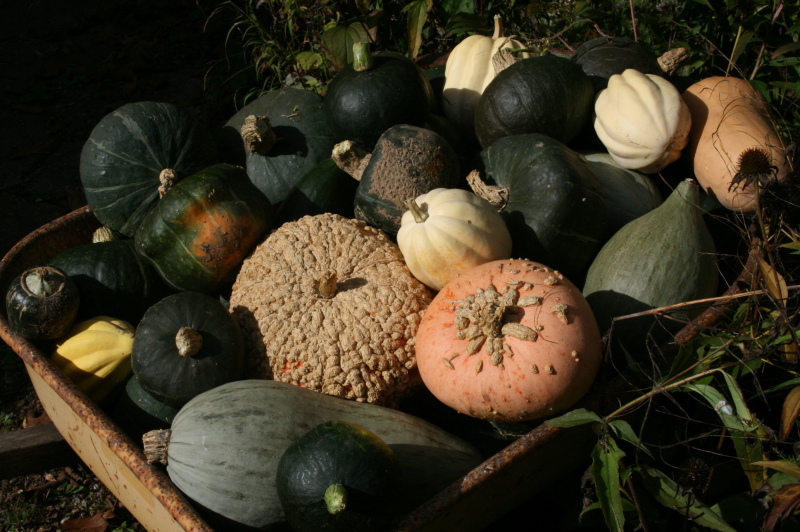
I'm having Galeux D'eysines squash tonight(yes thats really what they look like) with brown sugar, half and half and cinammon (I grew only the squash...)
Here is the Poll (same link) and questions:
1)- 75-100% We are largely self sufficient.
2)- Over 100% - but we sell it all to the open market and use the money to buy our actual food
3)- 25-50% - We grow a fair amount but still need to supplement it
4)- 5-10% - We have a small hobby garden and it supplements our grocery store trips
5)- Absolutely zero. My time is better spent trying to make money and buying food. Comparative advantage and such.
6)- Less than 5%. But I would grow some if I had more time, space or experience
Contact
- Content: editors at theoildrum dot com
- Tech support: support at theoildrum dot com
License

This work is licensed under a Creative Commons Attribution-Share Alike 3.0 United States License.
7) Absolutely zero. What are all you doomers going to do when the oil runs out and the world doesn't come to an end?
My wife has a vegetable garden where she runs up our water bill drowning cucumbers, lettuce, and tomato plants.
What are all you doomers going to do when the oil runs out and the world doesn't come to an end?
The world will still be here, though under the scenario you imply, civilization assuredly wouldn't be.
We have a medium-sized garden (20'x80' in raised beds with companion plantings and cold frames) from which we obtain about 10% of our nourishment, though we also raise and sell lambs (about 2 dozen/year), hence our total output would be equivalent to the 25-50%. Sheep 'fertilizer' makes the garden flourish to an extraordinary degree. Over the last two years we've completely redone the landscaping, planting 45 disease-resistant fruit and nut trees following permaculture (edible landscaping) principles. Collected rainwater provides a large portion of the needed water through a drip irrigation system. When these trees begin producing, our own level of self sufficiency will reach an equivalence of around 75% (as we will continue to 'export' much of our produce).
The world will still be here, though under the scenario you imply, civilization assuredly wouldn't be.
Thanks for knocking the stuffing out of the "anti-doomer" straw man.
Unfortunately, the acronym TEOTWAWKI leads to misconceptions. People conveniently forget the AWKI.
So when people snidely say, "The world won't end," I reply:
"You got that right. We should be so lucky. The world's going to still be here, and we're going to have to deal with it."
Now that's doomerism.
Growing your own food is the same argument as the food-miles concept.
I guess it all comes down to the following question:
Yes, I would like to hear at what world million bpd do large numbers of people start dying of calorie malnutrition in the United States or Britain or Italy?
I don't expect that to happen to substantial numbers in Western countries.
I also do not expect financial panics to prevent investments in substitutes for oil.
What I want to know: how many nuclear reactors would we need to build for fertilizer manufacture to replace the fertilizer we now make from natural gas?
That's not really the issue is it? People suffer from hunger and malnutrition in the US right now and there are plenty of calories. The real question is this - how many of us trust that the *economy* as we know it will be there, and that we will remain among the rich and priveleged people who always have enough money to buy food and medicine, shoes and dinner? The reality is that most ordinary people in the world are comparatively poor, and sometimes run into those hard choices - that the rich world mostly hasn't (and that mostly is an important note) is a product - of cheap energy. So if we choose not to have gardens, we are betting our lives that we're always going to be rich, that our pensions and kids will be there for us in old age, that we'll never experience an impoverishing medical crisis, and that we'll always have security. That seems like a risky bet to me personally.
Sharon
I have a difficult time answering this because I specialize in vegetables. Though I may participate in growing enough veggies for 20 families, and am mostly self-sufficient in veggies, my family has to purchase everything else: dairy, meat, grains, legumes, sugars, oils, and luxury items (e.g., coffee, tea and chocolate).
By the way, a totally righteous looking squash.
That was my biggest upside surprise this year - i grew 9 varieties of squash. Frankly they all taste the same when mixed with butter and brown sugar but I didnt know that - Ive eaten 1/3, have 1/3 cooked and frozen and 1/3 still in 'squash' form, in the garage, where it is slightly above freezing...they should last at least another month or two
Here's a great recipe
http://www.elise.com/recipes/archives/001439spicy_pumpkin_soup.php
good with any winter squash
"i grew 9 varieties of squash."
a local asian restaurant grows food practically in their parking lot. they grow all around the property in a very urban environment. he grows chinese(or asian or hong kong I forget) squash that doesn't touch the ground and is about 2 feet long.
Try making soup.
Your storage is probably *way* too cold. "Putting Food By" says to root cellar winter squash the same as pumpkins, which it says should be in dry air at about 55 F. "Root Cellaring" says the same, but acorn squash like it a bit cooler, 45 to 50 F. Both say that at temperatures below that you'll get chill damage; probably first soft spots then quickly rotting. The damage may be done by this point, but do yourself a favor and get them out of that cold fast!
Well please tell me how to get rid of squash vine borer!!
Our squash yields have collapsed the past few years because of the #@$#@$ things. I've tried to excise them from the vines with a knife - the only solution was growing squash in manure so that it can outgrow the buggers (for a while anyways).
I just microwave the squash and eat it raw. Acorn is nice but buttercup is best - firm, dry and sweet. Butternut with sautee'd onions and garlic makes a great soup.
Squash cookies - 1c buttercup, 2c whole wheat flour, 1/4c sugar <1/4c choc chips, 1tsp baking soda, 1tsp baking powder - 350F for 15 min.
Our best squash always seem to be the volunteers that get into the soil via the compost - not the ones we start indoors and keep safe until the frost is over!
We've found that injecting Bt into the hollow of the stems works well. They sell "garden syringes" for this. I buy a pint of Bt Kurstaki concentrate every few years (I have a bottle of Bonide "Thuricide" Bt in front of me right now.) When I see frass, I inject diluted (per instructions) Bt into the stems every few feet. This is completely organic BTW, and you don't have to bury the stems afterward.
You can also spray the Bt on the stems early in the season and hope that the larvae eat some as they're burrowing in. This takes more time, since you have to do it after every rain and you may still have to inject. However, it takes only a few minutes per week and may solve the problem.
Another good method is to just wait until after the borers have flown in your area. (That's part of the reason your volunteers do so well.) You might even plant a single squash to throw away and after you see the frass, plant the rest of your squash. The adult borers only fly for a few weeks and then they're done for the year. That means that covering up the plants during that time fram so that the borer can't get to them would also work. The borers don't look at the calendar to decide when to fly, unfortunately, so you have to have a bait plant or leave it on for a month or so to be sure.
Oh, and make *sure* you get rid of any borers at the end of the season. Vines must be either composted well or burned. We chop ours up into 2" chunks to compost or just put them in our city composting bins. It doesn't hurt to stir up your beds that had squashes to look for pupal cases, either.
Thanks for the BT advice. I'm also going to try succession plantings next year.
We got the borers something awful in central Texas. They don't seem to have such a short season here. I tried the Bt method but apparently just don't have a feel for how to do it. Or the bottle of Bt I bought was no good. Sometimes we can get a few fruit off of them before the borers kill 'em off though.

i just did a little reading on the local "coyote gourd" or more commonly known "buffalo gourd" and the seeds are edible, and the stuff's a weed here. I think I'm going to snag a few next time I drive by a local patch of them and plant the seeds around our lower lying land here ..... the gourd is basically poisonous, but makes a decent soap if you have no other, the seeds can be roasted and eaten, and the dried gourds can be used to make things. And, you can do stuff with the root - get starch or brew white lightning lol.
The seeds, the way the stuff grows so well with no attention, and the way the dried gourds can be made into things, are enough reasons for me.
You mean this cucurb. It's one of my favorite native plants here in central Texas.
And probably also the natural reservoir of those ^%$&$%%! squash borer moths.
Thanks for the link to the borer, what an interesting looking bug! If I didn't know it's a moth, it'd fool me into not messing with it, since it does look like a wasp. But looking closer, it doesn't have a thin waist, and it has "tail feathers" instead of a sting.
I'm going to be on the lookout for those and "frass" on coyote gourd plants to see if they're around here.
I've never seen anyone consciously grow the coyote gourd around here, it just grows here and there as a weed. And it does well when everything else is struggling.
I haven't actually noticed any damage on the buffalo gourd plants I've examined. It just seems that the borers find our cultivated squash so quickly there must be some natural source of them. I think the wild gourds are quite resistant to that sort of attack -- non-hollow stems for example. And being poisonous probably helps.
The tuberous root of the buffalo gourd allows it to survive a hot dry spell long after most of the other non-succulent plants have died or gone into diapause.
Growing those might not be a bad non-agricultural post peak business, given lack of other petroleum based items and our cultural addiction to more
praetzel,
Be thankful if you don't have carrot root maggot, their life cycles seem to be continuous starting in mid spring to mid fall. Looking at the life cycle of that moth of yours, a covering of remay cloth, for the month I read they were active, might help.
http://ohioline.osu.edu/hyg-fact/2000/2153.html
We like to prep our Butternut or Acorn by slicing them into 1/4"-3/8" slices, then coating them with oil or butter. Try not to slice your fingers off though! Then just cook them on cookie sheets. Goes with almost any meal and makes for great snack food the next day. Oh yeah, almost forgot my favoite part, leave the skin on and coat it too as it can be very tasty and not tough at all (depending on the squash}.
I really liked these 2 food related posts. Led to something very positive in the comments. Well done!
I grow a few sets of zucchini but I love sweet potatoes more.
I usually bake them but they are good fried.
A new recipe suggest cutting them into spears and baking them then dipping in a apricot sauce. Haven't tried it yet.
I have my sweet potatoes sitting in my living space. They need the warmth to further cure and this way I can keep my eyes on them. Ditto my dug potatoes. With these two items and shelled corn plus some combined wheat(soft red winter) I think I could survive til next season if everything shut down today.
I am planning on building an outdoor Pompeii type Italian outdoor oven. This will wean me from gas/lp. I will put it in my enclosed back porch. I also must brought 3 wood burning stoves for the same reason.
I was going to vote 75-100 but as yet I still buy some items yet I am about 80% for full time shutdown. I have a few more projects first..such as a full blacksmithing setup with charcoal and gathering piles of scrap metal of which I already have a large amount.
I have been a blacksmith for the last 30 yrs but my anvils and forges left with the last auction. I am starting over but it a far different direction this time. This will be my main means of surviving in the hoped for barter system.
I was going to put a shower in my new living quarters but decided that its not necessary and a waste. My grandparents never had them. In the summer when one perspires you can use a simple garden hose and its already heated by laying in the sun.
I am gathering up a large used satellite dish to make a solar collector and then check out the stirling engine so the heat can run it and power blacksmithing tools such as grinder,lathe,drill etc.
airdale
airdale
Hi Airdale,
Grew a few sweet potatoes up here on the B.C. coast and they came out much nicer tasting than the original seed potato I bought in the vegetable aisle of our supermarket. Cheated though, grew them in the greenhouse.
I think I could survive where I am too if everything shut down but I might have to eat my next door neighbour to do it. Just kidding, he is much to old and stringy but I might have to use the garden he hasn't bothered with.
One thing I am preparing to do this year is to buy large quantities of seed and freeze them (using a desiccant to dry them first). One can keep seed for long periods at a reasonable price if buying from a seed producer that caters to commercial growers. I am going to try Johnny's Seeds this year as I have heard good word about them and one can buy in quantity.
http://www.johnnyseeds.com/default.aspx?source=google_johnny_s_seed_e&gc...
Seeds in a can
Survival Garden Seeds #10 Can
Seed Varieties Included in Each Can:
1 Sweet Garden Corn -- Golden Bantam 5 oz.
1 Pole Beans -- Blue Lake 5 oz.
1 Sweet Garden Peas -- Little Marvel 10 oz.
1 Carrot -- Scarlet Nantes 6 g.
1 Onions -- Utah Sweet Spanish 10 g.
1 Cabbage -- Golden Acre 10 g.
1 Swiss Chard -- Lucullus 8 g.
1 Beet -- Detroit Dark Red 8 g.
1 Winter Squash -- Waltham Butternut 6 g.
1 Tomato -- Ace 55 VF 3 g.
1 Zucchini Squash -- Black Beauty 6 g.
1 Lettuce -- Barcarolle Romaine 4 g.
1 Pepper -- Yolo Wonder 5 g.
1 Radish -- Champion 10 g.
1 Spinach -- Bloomsdale Long Standing 10 g.
1 Cucumber -- Marketmore 76- 8 g.
Totals: 659 grams of Open Pollinated Non-Hybrid Vegetable Seed
*Non-Hybrid seeds can be collected from the crop after harvest and used the next season for replanting. Many store bought seed are "hydrid" varieties and will not produce their own seeds.
http://www.nitro-pak.com/product_info.php?products_id=1340&osCsid=8db954......
and sprouting seeds don't need to start in jars; they can be planted...
http://www.captaindaves.com/shop/sprouts.html#109
Errr, Ummm, Hmmm...Nate, looks for all the world like coprolite. Heres hoping that it tastes better than it looks.
You need more choices in your poll. I voted number 1, completely self-sufficient, although that's not completely accurate. I produce more than I need May-October and sell the excess. Similarly I have excess milk and yogurt when my cow is lactating which I sell, but buy dairy products when she is dry. And I have excess eggs to sell in the spring and summer but buy eggs in the winter months. Also we always buy things we can't produce like sugar, cooking oil, white flour, etc.
My gardening efforts have been meager and little supported by others and little rewarded.
But I sense a change in this.
The squirrels in my neighborhood have enjoyed the fruits of my gardening labors almost as much as we have.
The squirrels eat blossoms and fruit.
So ... squirrel-proofing will be high on my list of gardening tasks.
We're growing great peppers, bells and anaheims, plus some potential Serranos from a bush I rescued and brought inside, inside the house. The Bell plant and Serreno plant are both amazing producers.
We feed the birds because birds are cute etc etc but I can imagine eating them, especially the doves, in hard times.
No one grows anything around here outside of a greenhouse. Hard freezes in May, hail the size of golf balls, winds 50 60 even 80 miles an hour, even the greenhouses take a beating.
The Indians here gardened, horticulture'd, and hunted/gathered of course. Acorns were a big crop although of course no one will touch them now and I have reasons to believe the good eating ones are gone, either trees harvested for wood or diseases killed them off. The little ones around here are nasty.
This is just not natural farming country. Way too harsh.
Fleam, the indian method of processing the acorns to make them edible was somewhat complicated. First they washed them many times and let them stand in water a long time, occasionally changing the water. Then they ground the acorns into a powder and threw them away...And ate the acorn shells.
The best way to eat acorns might be via ducks or pigs. If you can get the shell off for them, ducks LOVE acorns. I'm sure pigs do too, and I doubt that you even need to shell it for them. People here in Appalachia used to just let their pigs free-range in the woods. While they mostly fattened on the chestnuts back in pre-blight days, I'm sure they also ate a fair amount of acorns.
Shagbark hickory are the ones that produce edible nuts.
Other hickory nuts can be bitter. I haven't found any sweet acorns as yet but haven't tried.
I picked a bunch of the hickory nuts but haven't cracked any yet. This is what I read. If you google it you will find that hickory nut juice and syrup is very very expensive and highly prized by chefs.
The indians made hickory nut milk out of the nuts and cooked with it. Again said to be extremely delicious.
Shagbark are common in my woods. Some call them Scaly Bark.
The nuts this year were quite large and very few worm activity.
airdale
I never had Hickory nuts until I bought my property. Hickories aren’t as common in Northern Illinois as in the southern sections of the state. They are very delicious and they are now my favorite nut. I have some very nice large Hickories on my property and they make up about 20% of the large forest adjacent to me. I found a very choice Hickory tree specimen on the side of the road down from me sitting by itself next to a field with no other tree for hundreds of yards. It has very large nuts with great flavor. I was the only one collecting nuts from it. I took about 40 nuts to stratify them in the fridge to plant this spring in nursery binds. I know it will take a long time to produce nuts, but the tree the nuts came from was only about forty feet high and producing nuts by the bushelful. Hickories that are cultivars are discovered, not bred. I might have found a unique one hiding in plain sight. I just ordered some Pecan trees from Nolan Tree Nursery in Kentucky for planting this spring to shade the house and provide an additional source of nuts. I also ordered an American persimmon and a choice Hickory cultivar for shading my house and as a source for future grafting material. This nursery stock is adding up. But I think of it as a very long term investment.
That sounds a lot like the community garden where I have a plot. In the early season, the ground squirrels have a voracious appetite for tender greens. I will know things are starting to get serious when the animal rights advocates are outvoted by those who seriously want to grow food and don't mind lethal means of control.
A good compromise is to get a few of the small Havaheart traps and relocate the critters. Or, as I said before, maintain a community garden cat - provide it with food, water, shelter, and vet care, but give it free range of the gardens. The ground squirrels will soon find other places to be.
Really all you need is a pellet gun and a good frying pan. This method works for all small varmints and your neighbor's cats as well :-))
(When even so backward a place as Bullhead City Arizona is enacting a leash law for cats, the writing is on the wall for these songbird-eating pests.)
I have three "free-range" cats, and have never seen any evidence of their having caught and ate any songbird. They do have high hopes, I'm sure, but I've belled their collars, and that is enough to tip off all the birds.
My cats have caught PLENTY of voles and mice though, and do a good job of keeping my garden clear of these.
You keep your pellet gun well away from my guys!
Hm, I have a "catserole" planned if I can catch any of the feral cats around here, yours included although I think you're far away enough that it's not a problem.
Come on over for "fried chicken" someday though!
Cats are a plague.
Un-neutered ones certainly are a plague. Mine have been "fixed". And they are not ferral, they just prefer life outdoors, which is fine with me.
He he he.
We were hardening what few squash we managed to grow and one of those 2#$@#$%! squirrels found that there were seeds inside a squash. Within an hour everything we had was decimated; and then they weight after other gardens in the neighbourhood.
I went vegan - but I'm starting to wonder what squirrel tastes like because they go after my pears, apricots, peaches, plums to boot.
Squirrels are very tasty; especially prepared in a stew with dumplings. I ate a lot of them growing up which may be why I am a little 'squirrely'.
Make a roux. Sautee your cut up and lightly floured squirrel in seperate pan in crisco (or whatever is handy) till brown and nearly cooked through, add to roux and continuing stirring till the bisquits are baked, serve the squirrel and roux over the open bisquits with a couple of eggs over on the side. Works for breakfast, lunch or dinner.
If you have older, tougher squirrels, par boil them about 1/2 hr, or untill tender, before browning...although this will remove a bit of the great flavor.
PS...Make sure to remove all the #6 shot before cooking or you might crack a tooth. :)
Two words for you: Brunswick Stew
Somewhere between 3 and 4 so I chose 4 to be conservative. I'm uncomfortable with the "hobby garden" designation, since we do not consider this a hobby but try to grow as much food as we old folks can in a difficult environment.
I love squash, but my partner can't/won't eat it. I can't eat all the output myself, so it is not grown here. We grow beans, tomatoes, okra, lettuce, spinach, peppers, asparagus, apples, blueberries, and a few other things I forget just now. We have tried potatoes and peas, but the chipmunks devour them. (We have fenced out the rabbits, but fences do not deter chipmunks.) Fortunately the deer have not yet discovered the garden.. The dog helps with that.
This year we are going to try live-trapping and relocating the chipmunks. (In tougher times we might eat them.) Then we will try potatoes and peas again, which I thought were wonderful fresh from the garden.
For some reason carrots and radishes just do not form here. Have tried over and over and gotten nothing.
A pet cat or dog with free range around your garden will soon eliminate your squirrel problem. Cats will take care of any voles as well.
This poll raises a pet peeve: the term "self-sufficiency."
I'm sorry, but another myth. I marked 25-50% because of the sheer volume of food we have, but for me the percentage is impossible to calculate because the term itself is deceiving:
We're dependent on a whole web of farmers and artisans, even if we grow most of our own food: seed and animal breeders and sellers, equipment makers, electricity for pumps. As you can imagine, the list is endless.
Here, here. We grow a lot of food, but until we grow at least three times what we need, it isn't close to being self-sufficient. I have no desire to make steel tools, and working without them would shoot down our food growing.
I didn't vote, because none of the categories fits my situation. I grow less than 5%, but "absolutely zero" isn't accurate. If was just zero, I guess I could have picked it and claimed rounding error, but "absolutely" zero doesn't really allow that. :)
I am an apartment dweller. And I'm upstairs, so the only thing I can grow is stuff in pots. I grow kitchen herbs, mostly. Sometimes tomatoes or strawberries. And there's an old apple tree outside my window. (This was an apple farm not that long ago.) It produces delicious (if rather wormy) Cortlands in the fall, but I can't really claim to grow them.
My dad is an agronomist, so I have spent time on farms (including working on them in my teenage years). I used to try to plant gardens when I was a kid living at home, but wasn't very successful. Japanese beetles ate my strawberries, fungus killed my watermelon and pumpkins, an early frost killed my corn. My dad wasn't much help. He would just say, "Farming is a tough life. Stay in school."
I guess it was a cobbler's children going barefoot kind of situation. My mom was always upset that our yard didn't look as good as the neighbor's. But after messing around with weeds, pesticides, fertilizers, etc., all day at work, it was the last thing my dad wanted to do at home.
I have changed the categories slightly due to excellent reader feedback...
Thank you, Nate, for another poll. I believe these type of polls will help build traffic on the site and hope to see them as a regular feature.
I choose over 100% and selling it to buy my actual food.
While I feel corn is not technically human food in it's raw form, most posters here insist that it is when used for ethanol. So I'm playing along for the moment. I don't grow veggies and such, but use the proceeds from sales of corn and soybeans to buy what I need.
Here in Central Wisconsin I am also including foraging such as harvesting various animals either by hunting or by securing some that experienced inappropriate and unintended vehicular contact. Apples and pears are also easily foraged. I also favor crawdads with a nice side of pigweed, milkweed or especially asparagus. Man, that is an ugly squash.
“Our lifestyle is completely negotiable” I said that.
Not to get too far afield, but here is my late night deer-cam last night. He would need to have inappropriate vehicular contact to tender him up. Ive counted 11 different bucks on the property here (and they all have names) This one is the 'Sheriff'.

US has about 100 million cows (I believe 10 million dairy and 90 million for beef). I will point out that the US whitetail deer population is currently between 30 and 35 million - in 1900 it was under 1 million. Large scale ag has been good for the deer. Wisconsin has a herd 1.7 million strong -which is one deer for every 3 people. One wonders what post peak means for deer...
nate
todd[the first one] & others have said shortly after the great depression they almost disappeared. i know my son killed one for us last year & i went this year[first time in 40 yrs.- got a shot the last day & was relieved when i missed].
yeah the deer are thick but about 1/10 got killed by
blue tongue[a mite virus -i think - enhanced by drought]so less here + i am near an urban area & corn has been replaced with sod. let's see if that continues with the housing problems.
nice buck!
I should mention that I also included in my vote the fact I also produce ethanol (C2H6O not the dimethyl ether version) from found apples. At the moment I do not use it for fuel in my Subaru but do use it to provide personal energy to wade through TOD. It is fuel well spent I might add. Nate, could you give me the coordinates of that night cam? I apologize for the jocularity, but I did once see a mention for humor on this blogsite.
“Our lifestyle is negotiable”
Hey Nate:
I purchased a 14 acre farm nearly 2 years ago outside Nashville. I have chronicled our experience in a short blog: http://almostselfsufficient.com
This will be our 3rd growing season.
It is much harder to be self-sufficient than we thought, and we started out with no delusions. We are meat eaters, and I must say that the most difficult thing is to grow enough food for our animals.
my apologies. the blog is:
http://almostselfsufficient.blogspot.com
maybe 25% now. i am practicing growing food that stores easy over the winter. corn to grind, beets[store in cool & damp area- root cellar], sweet potatoes- dry cool storage. i figure winter, early spring will be tough times in tough times so i'm practicing for such.above crops did well but lots of watering required, & sweet potatoes long & skinny.
very late freeze got most tomato starts[actually i was depending on neighbor] so i didn't put up any. butternut & acorn squash failed. i did soybeans last year & did well; some still frozen.
neighbor provides turnips & winter greens. limited time last spring but now am unemployed & will reemploy as little as possible so i am trying to eat /cook from stored food as much as possible & will expand next spring.time to plan now[some excitement].
got the pond dug with drought & leaving 15yr. job in july. was my last [do they ever end]huge po project.
I grow all my own food. I was lying, I don't. I employ farmers to do it for me, but it on my own land. ok, I was not being truthful there either. so I guess by working I grow all my own food!
Hello Nate,
I voted [zero %] because I own no land, and the homeowner where I am renting a bedroom is in complete denial. I offered to rake up leaves and start a compost pit--no go, put it in the trash--breaks my heart to see this hauled by a city trash-truck fifty miles outside my Asphalt Wonderland to be buried in a landfill with all kinds of toxics. Such is life.
Bob Shaw in Phx,Az Are Humans Smarter than Yeast?
I used to grow a garden for the deer who would jump right over the 5 foot fence and blink at me as they chewed. Now I've been growing cucumbers on the deck in pots about 12 feet above the ground. They are very thirsty because of the small pots so they don't yield a lot since I don't keep up with them enough. But, they are tasty. With the price of oil so high though I've started suplementing my heat with twenty 23 watt CFLs illuminating peas, beans, lettuce (I finally found my seeds) carrots, tomatoes, basil, chives and parsley. The peas are up. Since I've arranged the illumination to be twice as bright as the Sun (in the optical, not the infrared) and I intend to leave the lights on most of the time, this is mostly an experiment to see how these plants grow at high density in the extra light and to figure out what the pollination requirements are for the peas and beans. The Miracle Grow Organic Garden Soil promises twice the growth so this should be interesting. I'm keeping a control planter above the illuminated ones to compare the growth with only our wane winter sunlight.
So, I'm nowhere near self-sufficient, but I am gardening on Winter Solstice with lots of little green shoots. "It came a fowerette bright, amid the cold of Winter When half spent was the night."
Chris
mdsolar
deer are tenacious! my great pyrennes has been my biggest sucess; but the first year she guarded the corn
not penetrating the temp fence until the corn came in & then she promptly pushed thru the fence & ate almost
all- or took one bite- of the corn.
I knew two dogs in Hwalien on the East Coast of Taiwan who ate rice, beans and spinach. Only vegetarian dogs I've ever met. But, yours sounds like there might be a convert in the works.
Chris
150 million dogs and cats in US also dependent on just in time food delivery....;) (well the cats maybe not...)
Not to get even FURTHER afield, but I used to live in Taiwan, and its the ethanol time of evening, so I will share this. As you know, they eat dogs in Asia, especially in winter. There were alot of stray dogs in Taipei and the dog catcher would always be out with his loop, trying to catch homeless dogs, which would then be eaten by local police - but locals would search for them too. One got eaten that I was 'taking care of'. Made me sad - but different cultures have different mores. Apparently (so my chinese friends tell me), there is some chemical in dogmeat that raises ones temperature - hence they prefer to eat them in winter.
I remember eating goat in the winter for the same reason. Goat is considered yang (as opposed to yin) and promotes chi, a circulation of energy. This is also what is manipulated with acupuncture. It is curious that I was give lamb chops for Christmas yesterday. Perhaps the concept is getting around. I'm too dense to register the chi stuff but in Hawaii there are young goatfish ('owama) that run for a week or so every year on the North Shore of Oahu. Eating these is suppose to give you strange dreams and this is what I've experienced. What you eat can make a difference.
Chris
Im clearly not into the mumbojumbo stuff either, though sea urchin sushi gives me wild dreams and thats no joke. Perhaps there is some as yet unknown truth to goat/dog during winter thing.
Goatfish (weke) may contain a toxin that can cause hallucinations. 'Oama (juvenile goatfish) won't send you to the hospital, but I wouldn't be surprised if they had enough to give you strange dreams.
We ate young Goat Fish when they ran in Guam in the 1970's (amazing amount) I never noticed unusual dreams, but everything was quite unusual. I remember coming home (a structure in the jungle, no electricity, plumbing, lighted by kerosene) and my fellow companions had installed human skull candle holders
(from dead WWII japanese)--
So dreams from young Goatfish might not of registered.
We always caught 'oama when they were running, but never ate them. We used them as bait to catch larger, more desirable fish.
Dang it, mdsolar let me get you on the right track here ...... OK Goatfish is called weke in Hawaiian. There's the white goatfish, that's the one that will give you nightmares - don't eat that buggah.
Then there's the well-named weke moana or beautiful weke, all pink and orange and black and yellow, and the best fish on the planet as far as I am concerned. I have caught and eaten many, and also swam among them quietly and watched them eat, quite fun to watch them use their feelers. The O'ama is a baby weke moana, and that explains why it's so delicious. Fishing for them is more of a sport, meditation, and social occasion (you can get stand in a circle with your friends) than a subsistence thing.
IF you want to try weke moana, surprisingly, you can find them in the market there, whole. A large one is maybe a lb. Scale, gut, and fry, they are heavenly and the skin makes a nice flavorful sauce.
The 'Owama I'm thinking of are about three inches long and run on the North Shore for about two weeks a year. I thing they run elsewhere as well. Your fry them and eat them whole or if you are delicate you can sort of gnaw the sides off and skip the bones. They are great for teaching young kids to fish because you use a small hook that does not hurt that much if you get it stuck in you. I recall some like to use several hooks on a line and pull out six of so fish at a time. The point about the dreams is that I don't feel chi the way some people do but I did get some dreams from the 'owama. With dog or goat meat I kind of have a feeling that it is the stew that is warming and there is a bit of sympathetic magic going on (the word for goat sounds like yang in yin-yang) but I don't fully discount a chemical theory since I do have experience with the fish.
Chris
I remember the o'ama runs in Waimanalo when I lived 3 houses down from the place they ultimately shot "magnum p.i". The neighbor kids would all be down hooking them, and there would be a fire going at the beach with a grill, they'd grill them alive - not humane but very fresh - and you'd eat them whole, took a bit of chewing. I never got high from them, but didn't eat 'em a lot. Also, despite their numbers, didn't seem to be huge biomass and was very seasonal. In the evenings some very large carnivorous fish - ulua and others - would come into water 12 inches deep after them, swimming on their sides around our ankles. Probably small sharks too. I always got the idea that the bigger ones, the "nightmare weke's" probably were bioaccumulating reef toxins. Dunno though. Good times, but not much more than a minor protein source.
Chinese sympathetic magic is a crock. Hell, they probably would pay a lot for crock pecker if they could get it. There is seemingly no endangered animal in the world who doesn't have at least one vital organ that the Chinese believe will cause an erection if eaten. Like China really needs more erections...
My backyard grows a huge amount of food all on its own, and it won't matter because so few other backyards on Oahu have anything but grass. I reckon when push comes to shove it'll be huli-huli haole & long pig laulau, with a bit of coconut milk for seasoning. There will be coconuts for seasoning since they look so ornamental. Tons go into the trash every week, though not enough tons to feed the population here...
Being the only one growing food is not necessarily enviable. We'll see how it goes. Capt. Bligh had the right idea: if every yard here planted a breadfruit tree and tended it, within 25 years the island could be relatively famine-proof. If you started a program to do it here now though, you'd run into opposition.
And PS: our vegetarian border collies get fat if we don't feed them kibble, from scarfing avocadoes, bananas, coconuts and other stuff in the back. We have them trained to run down and retrieve avo's after a windstorm and fill buckets with them, but in between times they get to eat them all for now and gain weight in season. After the recent winter storm, we've been putting up huge amounts of guac... just mix the downed lemons and avos together with a bit of garlic, and keeps pretty well.... dang good too...
I would laugh out loud if this werent so true....(but if I REALLY believed a crock pecker would provide wonders i might shell out the dough as well. So what needs to be done is some scientific disproving of all this and then marketing. Show healthy man with woman and healthy rhino. Show unhealthy man with no woman and rhino with horn cut off - to get the imprint in amygdala..
In any case, post of the day...;)
I used to go up to Tantalus after dropping my daughter off at the Priory just to walk around and shake off the drive from the North Shore. The thought kept coming back to me as I looked out towards the Harbor how the islands were so dependent on the ships that brought all the packaged food. Food security is something that needs quite a lot of thought when it comes to Honolulu.
Chris
I used to have a few groups of deers stationed in my backyard and it was almost hopeless to grow anything that is remotely edible. This fall, I somehow killed a doe with a pellet gun which normally had difficulty to kill a squirrel at a distance. So far, I found all the deers have had good sense to stay away from my pellet gun's range.
Hmm you guys and your deer, and my "birds" post makes me think .... grow stuff deer/squrrels/birds/etc like then harvest the critters.
I plan to do some serious investigation of the crawdad fishing here when the weather warms up.
I eat something I wild harvested everyday.
It is mushroom time in Northern Cal. It is a "cornucopia" of delights
on every walk. Fish in the surf, still a few berries around. Deer are rats with good press, they are so common.
I am horrified Joe Six pack cannot harvest a wild mushroom,,or know if huckleberries are ok to eat.
More for me--
Oooo, I can't wait for spring and morels and fresh ramps. My woods and the surrounding forest is prime territory. I also planted some more mushroom varieties from Fungiperfecti.com and I’m already seeing good results. Took some Hen of the Woods a few weeks ago on some stumps I inoculated last fall.
Being born vegetarian, that is a tough one for me, but if our life is completely negotiable, then I could consider fish.
http://www.usatoday.com/news/health/2005-10-12-world-food-prize_x.htm
This guy got the nobel prize of food in 2005, teaching people to grow fish in ditches etc,
It is amazing that the 'poorest' countries get all these good people,like this one and the Grameen bank Mohammed Yusuf ,
his speech http://jayab.blogspot.com/2006/12/mohammed-yusuf-noble-price-speech.html
who are activist,and generally dedicate their lives while just making a salary, while we get to keep all the hedge fund managers.
it takes 100lbs of soy protein to get 1lb of beef. The chinese have gotten the ratio down to slightly over 2:1 with farmed catfish (though that may mean carp). Thats a pretty good return - but they have to import the bean meal...
>>it takes 100lbs of soy protein to get 1lb of beef.
Garbage. It may be that standard feedlot practice would use 100 lb of grain (I think it's actually 10), but it would be mostly be corn.
In any case there's no need. Cattle can still be raised on grass. The big feedlot profits were based on subsidized corn prices. When corn sells for production cost grass farming is quite profitable.
But that grass could conceivably be put in a biodigester, along with the cow itself and obtain more energy that could be devoted to other food products. Meat and milk are nice but come at a cost. I will find the 100:1 stats somewhere...
Nate Hagens -- those crazy-ass jumping fish, that are a pest (and a danger) in US rivers in the Southeast, are a delicacy in China! They got over here somehow, and since US'ians don't eat them much so far, they breed like crazy!
But in China, they're considered a big treat, and are pretty rare because of this.
me, I'd be proud to try a fish that jumped right into my boat!
I've seen video of people shooting them out of the air with bows and arrows. Probably some clips of it on youtube or something if you search on jumping carp.
crazy-ass jumping fish, They got over here somehow,
Thank a now-dead Congressman and his fish farm.
I was talking to a guy that had a garden in the Texas Hill Country. He said that they had a fine mesh to keep the birds out, and the sprinklers were keyed to a motion sensing device to scare the deer away (he had a shallow prolific water well).
#6 - %5 or less. **
Very small community garden plot. Our second year, and only planted after a house next to it blew up/burned down from a gas leak, and was shoveled onto the Garden in Mar/Apr.. took til June before new soil and fencing got brought in, and even then the hedgehog (Fleam, it might have been a 'possum, if that gives it more poetic flair.. but more critters at the table, nonetheless) got much of the early growth.
** But it's worth adding that we are buying from a CSA, local dairy, local meats, stocking with many other locally produced foods, while our Jobs are largely locally based as well. As Bendzela said (sort of), there are a lot of ways for one to be living sustainably within the immediate communities, such that there is a good, resilient network with a variety of somewhat specialized producers. There is a strong emphasis towards a 'survivalist' movement where many people suspect that when the Fan starts really spraying it, that we're all on our own. I don't buy it, and I won't resign myself to preparing for such a solution.
One of the Agriculture issues that's always on the tip of my tongue in these discussions, is that there ARE farms that will need to sell their produce. It might make sense to come up with some contingency plans to be able to quickly apply forms of local currency and local food crediting, so that 'in a pinch', farmers can be moving their produce, people can eat, and there is a way to bypass a shortage of cash, which should be no reason to keep those material flows from moving.
How does the farmer buy the next batch of seed, or make payments on the Farm, etc..? I have no idea. But creative minds should be able to propose some contingencies that could be developed.. like the 'Mainers sharing a few heated homes' idea from the other day. It might be uncomfortable, but it could keep people alive. My thought has been to put solar heat and electric on the schools (and churches or other larger public gathering spaces).. where the supply can help the budget of these institutions in normal times, and then can provide a heated shelter for lots of people when there's a downturn..
Just a thought..
Bob
One thing I was told on my recent visit is that heating oil is up 60% or so this year over last. I couldn't help but think that Maine is gonna be hurtin' when it goes up some more...
Maine is hurting.
Some people were getting LAST YEAR'S fuel on Credit. This year, the state, churches and social agencies are getting record requests for fuel assistance. We've already had three good dumpings of snow, and colder temps than last year.
MANY folks hanging on fingernails.
Bob
Yes, it's ugly.
And it isn't even Christmas yet. Winter's just beginning.
No, what you see is opportunity, Milton Friedman would say. And as long as people can keep shopping, no problem.
Besides, beer is best enjoyed at 55deg.
cfm in Gray, ME
I think a good PO skill is to learn to make brew your own beer. people will always trade you something, probably anything to have some beer in bad times.
potato vodka is easier
in the real down time (30 years into the greater depression) malting grain will be a great skill
That's why I own a homebrew shop(beer-wine-soda-cheese making supply store), we also have a 2 bbl brew system. The down side is that barley comes from out west, at least we have wheat, wild rice and hops that is grown here in Wisconsin.
We are starting a new 5 ac. vineyard next year, but this is a 6 year process. We also have raspberries, apples, peachs, watermelons, and cherries, all local, and all great to make wine with too.
Learning to make your own beer or wine is a great hobby, plus in tough times you can trade beer or wine for other items.
Cheers
Jon
Give a man a beer waste an hour, teach a man to make beer waste a life time.
agreed. homebrewing is so easy that even a caveman could do it! cheers!
I grow a small veggie herb and berry garden on .01 acre and in pots. So the rest is 'locavore' sourced when possible: farmers market, CSA, and Amish grocer. I bought a case of Ball jars and am learning how to safely put up food.
Could probably dig out a couple ornamentals to replace with more food crops. But it still wouldn't be enough. Instead I help start up community food gardens for other people in the region. [Attention apartment dwellers: set up a community garden space arrangement with your management company.] Can't wait til my own HOA is ready to convert the lawn spaces for same. I give 'em about three years.
Happiness is...a peaknik in his victory garden.
I've been away from TOD for a long time before coming back recently. Had anyone conducted a poll from the TODers regarding the best places to be when TSHTF? I noticed someone advising people on PO readiness has decided to move himself to Mexico though I am clueless on the reasons behind and which part of Mexico.
Here's the problem we are facing:
http://www.washingtonpost.com/wp-dyn/content/article/2007/12/20/AR200712...
Humans are breeding like rabbits. And we think that it's a good thing. If you are a food producer better get the shotgun ready. Lots of "midnight harvesting".
Up until a few years ago I/we were 100 % food self sufficient but we were considered wierd and now I am maybe 25% with a new partner and 2 kids. It was a very different life and I have found that those who talk about sustainability and food self sufficiency don't really have any idea what they are talking about
I have a degree in Agriculture and have sold off most of my land.
2000+- calories every day from your land/garden is not a life folks would understand or want to live. Believe me I have been there and it was a beautiful life, but most would not want to make the adjustments.
We did trade for elec. to pump water and pay taxes , but did not buy any food.
25% with a new partner? How'd you pull that off?
She has a job
I have to agree with you. I lived in an off-grid home in the foothills of Colorado for 13 years, grown big gardens, harvested wild meat (some by dubious means) and tried hard to be a man of the soil. I love the PV panels and all the challenge (my wife got real tired of Rattle Snakes) but the truth is America is not ready to power down. I now live in Wisconsin and am employing many of the things I have learned to stay close to the earth but in the end it is all about community. Not about individuals. Not about “hanging in there” by yourself. I believe that all efforts should be communal. Even in the cities it will be about communities. Planning for that change is a necessity. Understanding the change is a necessity. Thus TOD. My squash last until March. Don’t put them in a moist basement. Cool and dry. Learn how to make a distillery. George Washington became rich with his prior to oil. I’m not kidding. We have a local micro Brewery. God has blessed us. I know how to malt grains. Merry Christmas and long live the Good Life.
D Wright
3)25-50% My gardening was pretty successful this year using Mel Bartholomew's Square Foot Gardening method. In my small corner of Colorado the soil is mainly gravel and clay. Terrible stuff. I previously tried ammending the soil for years to no avail. I have been simply amazed at my results with the Sq. Ft. method! It was more work to setup but the best garden since I lived in Illinois. I still have greens growing (ice arrugula, kale & such) in an improvised cold frame cover, and I still have carrots in the ground that I pull out when we need them. I also have 30 gallons of wine fermenting from fruit in my yard (apples, rhubarb, grapes, and cherries). MY herbs are doing well inside now along with a sampling of tropicals (lemon, fig, bay, cherimoya, coffee and black pepper). I am practicing wiht seed-saving too.
I also had great success with squash. My pink banana squash grew on a trellis and were outrageously huge (visualize 2.5ft long and 10" dia) They are keeping well at room temp. I'm doing some sample plots of winter wheat, barley and oats, just to see how they do. Lastly, after some unsuccessful starts, I got my hops growing now so beer won't have to be too sweet after the crash ;-)
This past fall I ripped out our front yard and put in a semi-permaculture mixture of fruit trees and berry bushes. It looks nice and our front and back yards are only tiny urban ones (about 250 sqft in front and perhaps double that in back) but provide a fair amount of food.
I also hunt, and this year my son & I put 2 deer and 2 elk in the freezer. That plus miscellaneous small game meets about 85% of our meat needs. We buy chicken, some fish and small amounts of pork. I'm going to try my hand at raising some urban chickens and bee keeping next year.
I'm pretty serious about preparing by practicing skills before we need to rely on them. I've had experience with gardening and still had lots of mistakes and lost whole crops. That could be disastrous in a crisis. IMHO there's a big humbling gulf between reading about and thinking about actions versus doing them. To me, personal skills, knowledge and tools are more valuable now than money in the bank, so that is where I have invested my time. I actually quit my engineering management job last summer to better prepare and to take care of family needs (we also have a daughter with disabilities that requires a lot of support). It takes a lot of time to do the gradening and other work that wasn't happening when I worked 50hr weeks and commuted an hour each way!
Happy holidays to all the OilDrum readers!
'personal skills, knowledge and tools are more valuable now than money in the bank'
yup! way to go.
Love that bit about trying to make the mistakes now. Yup
More than half but less that three quarters is not an option in the poll, huh, but I might be there. By volume, easily. By calories I doubt it. How does a gallon of olive oil count? Or a quarter wheel of cheddar cheese? It might be as many calories as all my potatoes.
Root crops, beans, squash, dried veggies - I'm going to be bored and cranky by spring.
Coffee - because there are next to no calories in black coffee, I'm not even counting it as food.
cfm in Gray, ME
None of the classifications fit me exactly, but I checked over 100% because I am a farmer/rancher and probably feed several hundred families beside my own with what I grow, but I don't sell all we produce. I'd guess somewhere between a third and half of what we eat is grown on our place--the rest comes from the grocery store.
#2 for now.
We were ranchers, growing alfalfa commercially. First cutting would yield 600 tons and we'd get 4 cuttings a year.
We weren't self sufficient, but we could easily have been.
Now with the ranch sold, we're down to our city home where we have a 120'x80' garden deer fenced. Last summer we grew tomatoes (63 plants)of 7 different varieties, chiles, corn, squash, celery, beets, melons, etc. With canning and drying, we fill our pantries for the year. Meats we have to buy.
I'm gonna plead guilty to number 6, with an explanation. Prior to my divorce about 6 years ago, we were on the Farmers Mkt circuit, (CCOF certified organic) and grew a good deal of our food. I tried to muddle thru the first season, but it was just too difficult timewise, and I made a decision not to grow until I quit work. Gardening wasn't terribly compatible with 3 or 4 12 hr night shifts/week, combined with 2 hrs of commuting.
When farming, we grew all our seasonal produce, plus what we sold. Didn't do much canning; just tomatoes, I think. We also had about 100 chickens, and 5 hives of bees, along with 2 angora goats, and for a while, angora rabbits.
I'm retiring by the end of next Oct. If TSHTF before that, I'll quit sooner, but, as of now, I am not planning on a spring garden for next year.
I have maybe 100 fruit trees, mostly apples and pears, with as few plumps, Asian pears, almonds, and a non-producing walnut or 2. Tried cherries and peaches, but have a lot of trouble in our rainy climate. Have a large variety of trees, to try and extend the season as much as possible.
The garden had about 50 raised beds (100 sq ft), plus maybe 200 linear feet of raspberries, and some grapes.
Was pretty much pure John Jeavons, except the time constraints meant I was using sprinklers instead of overhead watering by hand. Dripped the berries and the trees.
Double dug all the beds by hand; had a U-bar built by the local blacksmith, and could do a bed in about an hour. The time constraints came at harvest; could have grown more, but had no time to pick it all, and no hired hands.
I also grew a few beds of wheat each winter, for practice, a cover crop, and goat food. Managed to grow about half the goat food for 8 months of the year, by harvesting the paths in the garden, + corn stalks, etc.
I've got my seeds, I have my beds and my trees. Next year, I'll have the time again. Probably hold it down to about 10 beds, until I need to go full tilt boogie. If that happens, I'll be growing for my kids, so they will be working out there, too. In the meantime, I have a lot of preserved food and canned seeds, + wheat, a variety of beans, buckwheat, and barley seeds I can plant. Have some split peas, too, but don't think they will grow.
No plans for chickens and bees again.May have to trade with folks I know who are already producing these. Plus, there is a herd of cattle next door, so I may have to trade produce for meat with them.
Oh...learned how to graft trees along the way. Had fair success with that.
Oh; reminded by VtFarmer's post...I have one sugar maple, maybe 20 years old. May not be big enuf to tap for another 10 or 20 years, but somebody on the West Coast will have maple syrup.
Rat
Rat or other Jeavons experts,
I only have a small "decorative" garden of a bit more than 2/5 of an acre with rather stoney sand/loam soil and am only allowed to grow eadibles on 700sf in the most remote corner (started with 200sf the last few years for tomatoes etc), that I have now mostly double dug to the intended depth of 20-25 inches.
I read "Growbiointensive" Jeavons and always wondered about one point in the book (besides some of his time or "profit" calculations). By planting closer he gets the same amount of plants on 1/4 of standard ag practice. And he states that the yields from low to high are 1x to 4x standard practice but it never is clearly stated what the reference land size is, is it the 1/4 or the standard ag practice unit of 1, meaning that if you are perfect, i.e. is then your yield the same as in the modern way on the same reduced land base or will you have 4 times the harvest "standard modern ag practice" gets from 4 times the land (row planting) i.e. a factor 16? In the tables of his book "Grow more..." however the reference size is 100sf for both yields (bio and standard) and the high yield for Jeavons on average is about 4 times standard US harvest, but considering that one already uses 4 times the plants in the 100sf this does show no improvement at all! What was your experience?
I also started beekeeping this summer but a month ago my bees vanished, but I will start over again.
Thank you!
First, a disclaimer. I have a copy of the first edition; got into it when Jeavons' research was at the XeroxPARC in Palo Alto. His figures were based on the local climate. Don't know what is figures show now that he is in Willits, (Jason might) but overall yields for me were not as good because the climate is so much more harsh. In PA, I could put out tomato transplants on St. Paddy's Day. Here, even with row covers, heat traps,...maybe a month later. Some years, nobody gets tomatoes until Aug.(And we were always the first at our local FM). There, I could start corn every 2 weeks, beginning in mid March, thru maybe mid July. Here, maybe mid Apr- 7/1. Then we can get another problem not down in the Bay Area...we may have a drought from Jan- 5/15, and then it can rain every day for a month. Doesn't do a lot for crops.
As far as his figures go, my understanding is that he compares acre to acre, or 100 sf to 100sf. So 4x is the answer.
"considering that one already uses 4 times the plants in the 100sf this does show no improvement at all! " Sure it does; I now have 300 sf I can use for something else. It's the land area that counts, not the # plants, unless you are way low on seeds. And, if you are, too bad... you still only get one lettuce or one corn stalk with 2 or 3 ears/ seed.
====
"rather stoney sand/loam"
I envy you. I'm not sure what the previous owners had where my garden is; think it may have been a horse corral, or may have been a logging deck. Anyway, a large flat area was cut out of the side of the hill. When I started, it was blue goo clay and rocks. So many rocks I was able to make about 15 check dams on a small gully between the house and the garden. Stabilized the gully almost instantly. But
the dirt I had took "tons" of compost. The clay just sucked it up. Took maybe 4 years to get decent soil.
Thanks, well it just appears strange to me that with all that bed preparation and soil enhancements it should only be the factor 4, meaning that the indicated fruit size / weight / quantity increases stated in his recent editions text would actually not exist on a plant per plant comparison (which I would still find hard to believe, as the quality of food is much better if grown a la Jeavons.)
I agree your soil is much worse (and your climate too).
howdy mr. rat!
you already know most of this but i have to answer the poll......
1) I have almost everything in place to be completely self sufficient if I need to be. Irrigation water is good and has water rights dating back to the late 1800's. Pumps are all fixed and ready for spring. Two generators for electicity to pump in case of outages of electricity. I have a small ram pump to fill a 5000 gallon ex-buried diesel tank. (i know it would never make organic certification but it was used in my tree nursery for fifteen years as a supplemental water storage for the sprayheads that watered the perennial section of the retail yard. when i closed that business i hauled it to the ranch.)
Water, sun and manure are all plentiful. lined up shavings from the horse ranch the rich folk from Aspen make with their fancy quarter-horses.
Ready to make diesel with grease from an acquaintance that owns the local waste oil company. Still have some work on the bio-plant to do but have ALL of the pumps and materials purchased and stored.
All the tracors are diesel and one of the generators.
Been storing pieces and parts for fifteen years or more. Tractor (John Deere) has plow, disc, mowing deck, blade, ripper, loader and rototiller (4') and makes great soil after composting heavy from the pile.
Made over twenty cubic yards of compost this year. Have ten ready for spring and another twenty yards started for spring. Its cool now but with new manure in springs will heat right up and finish in thirty days. Plenty of time to make late spring plantings.
Gardens are all tilled and manured. Deer are eating out of the compost pile. Last night a four point mule deer stood looking at me from the side of the pile giving me that just try to kick me out of here look...... A 9 mm shot would have ended that look...... but i have not shot a deer in years. not that hungry.
Deer fence goes up this spring when the ground thaws. I have all the posts laying and waiting. Fence given to us by the BLM years ago to keep the deer out of the nursery. Now I will use it for the garden.
The theme here is that getting as far as I have has taken a LONG time. And if TSHTF soon and one has not been working towards independence for YEARS then you better be able to rely on someone or something else.
Because if you get hungry.... You will submit, to whatever the person that has the food, wants.
So I am ready for Number 1.....
but I live Number 3.
Hey, Buddy. Good to see you. Merry Xmas/Happy NY.
"The theme here is that getting as far as I have has taken a LONG time. And if TSHTF soon and one has not been working towards independence for YEARS then you better be able to rely on someone or something else."
This is a point my "neighbor" Todd has been stressing. It takes time to get your soil ready,it takes 6 or 7 years to get anything from a fruit tree, it takes time to develop your skills.
Water is always a problem; leaks, critters chewing holes in pipes, loosing siphons from gravity- fed ponds, pumps dying. We spent 15 months, a weekend or 2 a month, just to get this place livable. The water was kaput. they had a doughboy for seasonal storage, but it was gone. The redwood tank leaked like a sieve. Etc, etc.
OT story...we came up in April,86 (moving on 7/1,right?; resignation already in). Finally figured out my patching wouldn't hold the tank together any more. Last chance to do something. Went down to the building supply. Never been in there B4.
Quick we need a tank, or we will have to carry house water for 6 months.
Fred-OK, but it is Sat and we can't deliver.
Rat-Damn; do you think we can tie it to the (mandatory hippie) van?
Fred- Where do you live?
Rat-Uh (think fast, what were the names on the signpost?:>)
Fred-OK; here are the keys to my truck
Wow, I'm home.
http://www.cowboylyrics.com/lyrics/griffith-nanci/i-love-this-town-15109...
==
Roads; Todd never talks roads, but dirt roads are a myriad of problems.
Time, patience, practice, experience, time.
BTW, I wish I had it as together as you do. Always thought you were a bit ahead of me. I lost at least have my ability with my divorce. Lots of skills went bye-bye.Better with a gun. My VDub mechanic, the prime beekeeper,the chicken/goat/spinning-weaving-dyeing skills. (And desserts)
Wharfie
Nate--
Aren't you supposed to take the styrofoam packing peanuts off the squash before you cook it?
As far as your poll, I am less than 50% self-sufficient although that is the ultimate goal. This last year was dedicated to getting the house finished and its energy systems, but I am mostly self-sufficient with it (my PV meets most of my electricity needs and I heat with a masonry heater with a geothermal heat pump as a back up). I produced enough maple syrup this year to last me two years so may not sugar this year. I am still in the infrastructure development stage as well as in over my head with animals for which I am not yet prepared. I grew squash, peppers, and tomatoes last year in the garden and put in an orchard and other perennials which are not yet producing (but lots of roadside apples with which I pressed cider for freezing this year). But I am getting enough eggs from my small flock for my own use and to give to friends; my steers are putting on mass, and the cow is advancing nicely in her pregnancy; my ram had a major injury which may have prevented him from fulfilling his duties with the ewes; and my draft horses are eating but not yet working (since I am still in the learning mode of teamstering). If the sheep are pregnant, I will milk them after they lamb to make cheese and will start milking the cow soon (although I am leaving the calf on her since I don't need that much milk and that way I am not committed to a twice a day milking). This summer I will expand the annual garden and should get up to about 50% self-sufficiency. I should get trees felled this winter to mill into timbers and lumber this summer with my sawmill to build my outbuildings over the next two years and will get firewood cut and split earlier this year. It's a slow and evolving process.
If the question is about food self sufficientcy or self reliance then it comes down to raising grain or grains to get the 2000 calories per day year round. I have never heard of anyone doing this in the usa.
If anyone feels that this is important then they should figure what grain it is they want to eat daily
If grains started to become hard to get, I would start growing some field corn. That is traditionally what people grew and relied upon around here.
That is what we grew and ate every day for about 12 years.
In adition we had..... beans - squash - almonds - apples - figs - wine grapes - year round greens.
To that we added the most important food from the old world - olive oil.
So it was a coming together of two worlds .... the new world (americas) and the old world (Europe)
Calorically dense vegetables can substitute for grains - it may not be our preference, but potatoes and sweet potatoes and other roots can subsitute for wheat, rice and oats as dietary staples. It may even be better for you, depending on which nutritionists you believe.
Hand cultivation of potatoes outyielded industrially produced grains well into the green revolution, and I would tend to suspect that root culture will probably be more important than grain culture. along with corn.
Which means major dietary changes - getting used to eating a lot of roots is a big change. But in terms of ease of culture, roots have it all over grains, so I'd suspect most small scale producers will emphasize calorically dense vegetables.
Sharon
Tubers can be a great source of calories .... the only down side is that they don't store as well
Here's a modern version of my favorite song from the 1970's. Seeing as how we're to repeat the '70s n all. I kept parts of it, but changed places to make it fit today's world.
The preacher man says it’s the end of time
And the oil wells there a goin’ dry
The money supply is up, and the buyin’ power’s down
And your gonna freeze to death if you live in town
I live back in the woods, you see
My woman and the kids, and the dogs and me
I got a shotgun, a rifle, and burn E-85
And a country boy can survive
Country folks can survive
I can plow a field all day long
I can catch catfish from dusk till dawn
We make our own whiskey and our own smoke too
Ain’t too many things these ole boys can’t do
We grow good ole tomatoes and homemade wine
And a country boy can survive
Country folks can survive
Because you can’t starve us out
And you cant makes us run
Cause one-of- ‘em old boys raisin ole shotgun
And we say grace and we say Ma’am
And if you ain’t into that we don’t give a damn
We’ll outlive the very last of the coalmines
We'll outlive Abqaiq, Ghawar, and the EPA's fines
And we can skin a buck; we can run a trot-line
And a country boy can survive
Country folks can survive
I had a good friend in New York City
He never called me by my name, just hillbilly
My grandpa taught me how to live off the land
And his taught him to be a businessman
He used to send me pictures of the Broadway nights
And I’d send him some homemade wine
But he was killed by a mob that took to riot
When gas got too high they just couldn't buy it
Id love to spit some beechnut in them dudes eyes
And shoot 'em all with my old 45
Cause a country boy can survive
Country folks can survive
Cause you can’t starve us out and you can’t make us run
Cause one-of- ‘em old boys raisin ole shotgun
And we say grace and we say Ma’am
And if you ain’t into that we don’t give a damn
We stay the hell oughta California, and away from DC
Lord help the poor bastard who tries to mess with me
And we can skin a buck; we can run a trot-line
And a country boy can survive
Country folks can survive
Call and Response..
(I do like that song.. do you know who wrote it?)
In terms of some 'other' country folk..
A Mainer and a Texan are exchanging notes on their 'Ranches'. The Texan says 'I can drive my truck all day, and never reach the end of my property.' The Mainer, staring at the ground nods, 'Yep. I had a truck like that, too.'
The Texan tells him that he has some longhorns where you could stretch 10 to 12 axhandles between the points of the animal's rack. The Mainer takes this in, and replies that in the middle of the town square, there is this big, steel drum,
'.. and that puppy's GOT to be at least 19 axhandles across.' He exclaims. The Texan is a little derailed by the comment. 'Well what are ya gonna do with a big old tank like that?'
'Well, we could cook your cow.'
First the vote: Currently raising zero % of my own food. Maybe this spring I will add a veggie garden,,,or maybe not.
Now my more substantive comments. Having read or skimmed this and the previous post on farmers and farming and the over 200+ comments I feel the need to add a perspective I have on this debate, one which Jason has heard from me personally and I have railed against professionally.
Any discussion by Heinberg and others on transitioning to a low energy system of food production dependent on many more farmers is premature unless the very contentious issue of LAND USE / LAND REFORM is discussed. As some of you know, I am a land use planner with a strong background in this subject area. In many, if not all jurisdictions in the US (as well as a number of other countries) what you do with your land and how it is arranged and configured is governed by a basket of rights commonly called zoning. Currently, most locations that maintain an agricultural designation, restrict the minimum parcel size and the number of units permissible on the property. For large scale ag, this isnt a problem as most commercially profitable operators operate well in excess of the typical minimums. But for those new small scale farmers that many of us envision, there simply are no properties available that are correctly sized and larger ones are unable to be collectively purchased and split down to a more useable size since the designation prohibits this anyway.
At the same time a compromise solution that would preserve parcel size minimums but allow collective ownership and residency--one I floated right here in Jason's backyard--was shot down by the local planning commission in a fairly contentious and well attended hearing by small scale farmers back in April. THis set of proposed allowances (which you can read if you click here: http://www.co.mendocino.ca.us/planningteam/pdf/GPU_070419_SR.pdf and scroll down to Item K on page 12) to encourage small scale farming were modest and entirely voluntary.
Oddly enough (or maybe not) allowances for farmworker housing continue to remain on the books. So while 10 small scale farmers are not able to band together and jointly farm a large holding in an equitable manner, a single farm owner can oversee a 10 subservient resident employees (or "independent contractors" as many farmers have taken to referring to their help as legally).
And speaking of ownership in general, land ownership in the US has gotten increasingly consolidated in rural areas due in no small part to cheap energy which makes farming thousand acre farms an afterthought. Well as cheap and abundant energy dries up but the land ownership patterns remain the same we have another problem that we do have historical references for: what will happen to the "landless" poor. We already know our zoning codes frown on collectivism but approve of (neo)feudalism. We know that landowners historically do not give up land willingly. We also know large mobs of landless poor are hugely destabilizing and have given rise to both the Lord-vassal relationships as well as the forced (often violently) removal of the land owner and redistribution of their holdings.
If we are indeed forced down Jason's curve, how are we going to get all our required farmers onto their lands--and under what ownership structure? It is great to talk about the nuts and bolts of farming but failing to address the legal, political and historical challenges to increasing farming in this country renders this discussion premature in my mind. I know we can sustainably farm small properties and provide a decent respectable standard of living for those farmers. The real question is will we be allowed to?
unplanner
this is a topic I know very little about. Please consider writing a short guest post for our archives on the issues involved, pros/cons, and recommendations.
Good comments, but remember that not every place in the US is as strict as what you are used to out in California. Many of our Appalachian counties have no zoning at all, for example.
Consider, too, that if people like Kunstler are anywhere near right, there are going to be a number of essentially abandonded, bankrupt suburbs. The houses are going to be striped, and probably eventually dismantled for salvage materials. At some point there is going to have to be some arrangement made to get all that land into the hands of someone that can do something with it.
Siwmae pawb (Hiya all)
Fleam, you said that your area is not really right for growing things. To this comment, and to everyone else struggling up the early years of the grow-yer-own learning-curve (like me) may I offer these useful discoveries:
* Whilst there's still time, do an in-depth study of the ideas of permaculture. This does take time and repeated annual experience to get going up to a really sophisticated level, and we may not have much time left before the S really HTF. But once you have it going, it fits into any weather/soil/water/wild-things pattern you can think of, and still shows yields. Sophisticated permaculture plans commonly include 'wild' -- that is, volunteer -- inputs to your total yields. One of permaculture's most empowering rules-of-thumb is that -- if you look hard enough and think about it carefully -- every problem can turn out to be a benefit. No shit: this works, in the real practical sense. Bill Mollison’s magnum opus ‘Permaculture’ gives lots of examples. For North Americans, probably David Blume at www.permaculture.com is the most useful source, and certainly deeply inspiring for anyone who wants a hard, practical, time-served and proven demonstration of what's possible. Breathtaking yields! Permaculture works on any scale from big spreads to Cuban-style apartment-block survival roof-gardens.
* Investigate 'no-work' (really, low-work) cultivating. It makes the difference between back-breaking, quit-causing labour and bearable-labour inputs. Google Ruth Stout mulch-gardening; and/or Masanobu Fukuoka no-work farming.
* Take a look at The Scythe Connection website. The old wonder-tool who's time is returning. And no, I don't mean the heavy, dispiriting curved ash tools commonly known to North Americans and Brits, but the design used commonly a little further east in Europe. Sometimes called the Austrian scythe. I make these for my own use. And as the man says at the Scythe Connection, the old experienced mowers of an earlier generation were right: when you gain the knack of using them right, you can actually REST yourself when mowing. The Tai Chi comparison is no daft idea. It really can re-energise you as you work. For harvesting small/medium grain stands, animal fodder, and general mixed mulch materials WITHOUT being tied into the complex-machinery/high-energy-demand system, the scythe is a wonder tool.
* Another rule of thumb in permaculture is that no-one has a plague of slugs, snails, insects, (name your own pest). What you actually have is a dearth of ducks. Investigate Campbells and -- particularly -- Muscovey ducks. Muscoveys don't even need lots of water. A shallow pan does for them. Prime meat/egg/safely-reared-youngsters/pest-control, both of these species. And both can support themselves without supplementary food, if they can range in safety. Which leads to……
* If you have enough ground to be growing livestock, even small stock like ducks, rabbits, etcetera, then you need -- almost certainly -- a shepherd dog. (Not at all the same thing as a sheep dog) Nothing from a hawk to a Kodiak Grizzly gets past your shepherd dog to your livestock. Thieves don’t raid. Wild herbivores don't devastate your plants. A good shepherd dog is never off duty. Two are even more impenetrable. I've kept Anatolians for years, and know this to be true. True also of Maremmas, Pyreneans, Kuvasok, Ovcharkas, Gamprs, Kuchis, and many other local landraces of the whole Eurasian shepherd dog family. A big success story amongst stock farmers in North America since they started to be introduced by the Koppingers (Ray and Lorna) in the 1970s. Google Erick Conard in Texas, and Robert Denlinger at Denstar farm in Kentucky for detailed insights. Robert is particularly interesting, because as well as keeping shepherd dogs very successfully -- and telling fascinating stories about his and their joint learning curves -- he also farms with draft horses, and only has minimal machine needs. Both Erick and Robert can claim that they are the ONLY farmers in their respective neighbourhoods who've lost no livestock whatever to coyotes since they got their shepherd dogs. A shepherd dog – of either sex – dotingly mothering a bummer lamb born out in the field on a harsh February night and then mislaid by a silly ma is a sight to behold.
What has this-all to do with energy? These agricultural practices are the wave of the very near future, as the energy-famine starts to bite. I support my friends’ local CSA farm, and I know how they worry already about the cost of fuel just to keep their tractor running. The group-labour input of their consumer-subscribers is their lifeline, more and more, to keep the crops growing. I’m just off to the farm’s Winter Solstice social for all subscribers this afternoon. Great! Community trumps collapse….
Cofion gorau ac Nadolig LLawen I bawb (Best remembrances and Merry Christmas to all), RhG
What language is that? Welsh? Urdu?
Sounds like good starting-out advice. I've enjoyed reading Ruth Stout for a very long time.
Some very good reminders of the benefits of Wisdom and Patience over Power! Thanks!
Bob
"Adventure is just bad planning." - Roald Amundsen (1872—1928).
(Interesting Quotes Site!) http://www.gdargaud.net/Humor/QuotesPolar.html
"For scientific leadership, give me Scott; for swift and efficient travel, Amundsen; but when you are in a hopeless situation, when there seems to be no way out, get on your knees and pray for Shackleton." —Sir Raymond Priestley.
"If there really is a pole at the North Pole, I bet there's some dead explorer-guy with his tongue stuck to it." — Bob Van Voris.
Drought, floods, frosts, bug infestations, galinsoga, voles, mice, deer, fungi, are "benefits"? Bullshit.
(I bolded "empowering" as a red-flag buzzword.)
Ha, ha. You either work cultivating, or you work acquiring and laying the mulch (which I prefer to cultivating). This does NOT mitigate the need to pull weeds from around plants.
Got the grass to scythe? How big is your plot? You cut the whole thing by hand, and "rest" while you do it?
I've used a scythe. They're interesting tools. But a "wonder tool"? Stop it. A mower is much, much more efficient.
Ducks don't eat all pests. They don't even eat a fraction of them. And they tear the shit out of leafy crops, and they crap on everything, and they flatten it with their feet.
Dream on. The industrial paradigm will be here a long, long time. When "the energy famine starts to bite," energy will simply be diverted from recreational uses to agricultural uses. This won't be pretty, but a wave of permaculturalists is not in our future.
How big's your larder? Do you have a cellar full of food? Or do you just philosophize about it?
The proof is in the produce. I use standard "organic" so-called techniques (digging, composting, mulching, etc.) because I like to, not because I think I'm superior to any other farmer.
And I've got the food to prove it.
PS: Diesel is now at about £6.10 a gallon here = something like $11 for the slightly smaller US gallon. And it's dawning on everyone slowly that we haven't seen the top of the ramp yet......
UK diesel av £1.08/lt
x 3.88 = £4.19/US gall
x 2.01 = $8.42
Still not pretty by US standards, but not $11...
4)- 5-10% - We have a small hobby garden and it supplements our grocery store trips
we have a perma-culture type character living in house now. The tomatoes where plentiful and yummy. I doubt full cultivation of our garden could get us to 3) maybe close?
it was a wet summer so very little water was needed from the tap infavt i think we watered the tomatoes only once!
Boris
london
3a around 50%. Not enough considering in dry weather I use 200-500 litres of water a day via a solar pump and apply insecticide 2-3 times a week. I have a shadehouse, 14 or so fruit trees plus a similar number of semi raised beds 4X1.5m in terraces on a hillside, each with a chickenwire enclosure to keep out critters including the pademelon.
There's a lot I don't understand; why for example
this year is good for several crops including corn, pumpkins and strawberries, average for potatoes and lousy for cabbages. I have to work out what I'm doing wrong. Maybe the war time victory gardeners already had years of experience and just scaled up.
This news is probably a better place to post this than the Drumbeat since it discusses preserving seeds in the ultimate world seed bank.
I saw this article in my latest issue of "Popular Science". I've loved this mag since I was a kid and understand most of it is fantasy (especially in a post peak world) but every once in awhile there's a gem in it. The article I'm talking about is in the January 2008 edition and it's called The Gatherers.
The Global Crop Diversity Trust and the Norwegian government will open a huge seed bank vault in February 2008, called the Svalbard Global Seed Vault. It is dug 400 feet into a mountainside and will store 4.5 million seeds.
I tried googling the article itself and couldn't find it on the internet, but I did find this one on the Canadian Global Research website that adds more to the story than Pop Sci did:
"Doomsday Seed Vault" in the Arctic: Bill Gates, Rockefeller and the GMO giants know something we don’t
Now...this article is mostly aimed at why people of power are deciding to create this vault now and concludes evil intentions and is probably stretching quite a bit.
The Pop Sci article is a more balanced story about the scientists gathering the seeds around the world and is worth grabbing the January edition to get it in full.
(edited last paragraph)
...and the Svalbard Global Seed Vault is protected by a squadron of Ice Bears I hope?
Poll: 6+ i.e. as close to 0% as you can get and still be doing something. 4 Roma tomato plants in half barrels and a 6' square patch of kitchen herbs.
Our house sits on a 25' X 70' urban lot, and there is a 1 car garage (workshop) on the lot as well, so there is really not a lot of free space, what there is is covered with wonderful ornamental plantings which are my wifes thing.
I did try a community garden plot for 2 years, but it was an 8 mile round trip commute to get to it, and when I figured the $ costs of what little my "black thumb" had been able to produce they were almost 1/2 that of a share from a local organic CSA farm, so that is what I do now.
Your poll has a gap between 10 - 25%, which is too bad because that is probably about where I'm at right now.
I put down the one below it because we were probably closer to just 10% this year. We had that horrible late hard frost last spring, so we lost all of our fruit crops. Then the drought started, so some of the vegies didn't end up yielding quite as well as I would have liked. This was also my first year at our community gardens. I have two plots, each 300 s.f., this first year was kind of experimental; I have a better idea now as to what to grow there. I did a good job of getting spring and summer crops, but not so good with succession planting for a fall crop; I've learned some things and have a better plan for next year. I also only had time to get 1/4 of it double dug; as I double dig more of it, I'll be able to do more on an intensive basis and the yields will go up. The gardens are a couple miles away, so I'm trying to focus my efforts there on things that do not require daily attention. All of my root crops are grown there, along with all of my brassicas (cabbage family), winter squash & sweet potatoes, and corn; each group takes up 1/4 of the total, and are on a 4-year rotation plan. I'm going to try the old Cherokee practice of interplanting pole beans with the corn next year. I mulch heavily, but even so with the drought I had to make more frequent trips out there than I wanted to just to water; we need a return to more normal precipitation! (The water there is free! We're right next to a river and have a pumping system; the plot rents paid for that and the fuel to run the pump.)
I'm going to trim some overhanging branches that have been increasingly shading my home vegie garden (that's another 300 s.f. at the moment), and am going to try to get some better production out of it. I also plan to grow a number of things (tomatoes, squash, peppers, eggplant, cucumbers, strawberries) in containers on my deck (the sunniest place on my property) next year. I also plan to plant more fruits (blueberries, blackberries, currants, another apple). I'll be learning beekeeping this year in preparation for setting up my own hive in 2009. I then plan to be set up to raise rabbits by 2010 or 2011. Longer term, once I am no longer working a full time day job I plan to take down some trees and create another 600 s.f. garden in my side yard. Chickens may have to wait until I'm no longer working full-time and have the time to care for them, too. If milk prices go high enough, we might also just be able to squeeze in one dairy goat, which could pasture on the front yard (which we want to keep shaded with two sugar maples).
If (when?) times get really hard, I plan to approach several neighbors with the idea of letting me share-crop their yards - I grow garden vegies, and split with them on a 50:50 basis.
My goal isn't to reach 100% self sufficiency, but rather to simply reduce our vulnerability and thus strengthen our food security. Somewhere in the 50-75% range should do it.
Of course, there is another dimension to this, too. Even for foods one doesn't grow oneself, there are things you can do yourself to lessen your dependence. For example, I bake my own bread instead of eating store-bought. Eventually I'll probably get a grain grinder so I can just buy wheat instead of flour. I'm also in the process of starting to make my own yogurt; home-made cheese will follow soon. I could buy fruits & vegies in bulk in season at the farmers markets and can them myself; I've sometimes done that in the past and could do more of it.
"I'm going to try the old Cherokee practice of interplanting pole beans with the corn next year."
Good. Now go further and take advantage of your air space. Try to go as vertical as possible to increase production, and even to protect produce from ground crawling buggies like sow bugs. Pole beans, climbing peas, cucumbers, meleons will all grow on trellis netting.
Lots of vendors
http://www.google.com/search?hl=en&q=trellis+netting&btnG=Google+Search
I grew a smaller percentage (tax man took the garden last year) but pay sub $600 and get a bushel of veggies once a week over the growing season. What land I control grows 'other' stuff - like Jurslium Artichokes, ground cherries and Luffa gourds.
I still end up processing lotsa veggies. Nothing like canning squash/potatoes/other veggie bits/spices then to make 'food' place in blender and poof! A soup!
Oh, no option for hunting. (latest "toy" .75 cal muzzleloader for deer. Puts both ends on their butts)
Otherwise buy the base materials and make my own meals.
Its not 'traditional' - but the simplest is to take the pulp from veggie juicing, combine with other veggie bits and pulp in a champion juicer, mix with spice and a bit of fat - veggie gruel! When people comment I say "One day you'll be saying "remember when we had veggie gruel to eat?""
The poll's results so far are very interesting. As I suspected the majority of posters here do not produce most of their own food. What I find interesting is that the opposition to ethanol so often heard at the TOD probably comes mostly from this group. They are voicing their own self interest and at the same time frequently condemning corn growers and ethanol supporters as seeking only their own self interest. Seems to be a double standard to me.
Thank you, Nate, for an excellent poll.
I disagree..
I feel that anyone who trys to grow all/some of there own food have an understanding of Entropy and the energy it takes to grow a crop and therefore understand the futility of all bio fuels.
How many people were in group 1 ? How many were 100% ?
I'm not totally against biofuels, I just know that the EROI is better for biodiesel, and that if we're going to do anything with biofuels, we should be concentrating on biodiesel rather than ethanol. Corn farmers COULD switch to oilseeds.
Horsepucky, Prac.
The opposition is to the FUEL and subsidies that haven't justified themselves. You conflate it into an attack on farmers. You running for office somewhere?
When you say 'self interest', what do you mean? Wouldn't it make more sense to say that someone's opposition to Ethanol is their 'conclusion' more than their self-interest? What people are doing here is trying to identify viable directions to work on, so suggesting that 'nongrowers' are opposing ethanol because they have 'something to gain' by defeating it, or promoting other sources is an unfounded accusation.
Bob
Fascinating discussion.
I've done some intensive gardening, but now feel that that is not the most effective way to spend my time/energy/money.
Learning how to shop, scavenge and prepare food seems to be a better use of my resources. Gardening or farming by themselves are not the only answers.
For example:
Persimmons and pineapple guavas grow in our area. Many people don't like those fruits, so they are eager to give them away. Great eating for those in the know.
Soups, salads, and stir-fries - wonderful ways to use leftovers. My grandmother got me into the habit of making broth from chicken bones.
Oatmeal plus water/milk/yogurt and fruit/nuts, hot or cold, tastes better to me than boxed cereals.
Greens are cheap, easy-to-grow and fantastically nutritious. People throw away greens (like beet greens). In our area, chard grows like a weed.
Bart
Energy Bulletin
Nate - We here in middle world pacific north west are great fans of the Delicata squash. Sweet enough that you do not have to add sugars, (I still slather them with butter though).
We keep a couple big boxes around and when ever the oven is fired up we throw a few in.
When you think about it, it always seems like the oven is about 90% empty when in use, even with a couple sheet pans of baked goods are in there. Stick a couple squash in as soon as you turn it on to pre-heat and leave them in after.
There are several varities of pumpkin that are very sweet and can be eaten "straight up". My kids will CHOOSE these dishes over most junk food, (but I guess that makes them freeeeks eh!).
My restaurant is about 25% local grown. I take all the stuff that the local "Organic Farmers" don't sell at market and therefore pay less (still way more than dist.)
I think those were the ones Jason was telling me about - that you can eat skin and all? I will plant some next year - thanks....
those are the ones. skin and all....well, i scrape the seeds out.
We heard about a technique to extend the tomato season
and tried it for the first time this year. In SW Okla
we will be having fresh tomatoes with our Christmas
dinner. Here's how: Just before the first killing freeze
pick all the pink tomatoes and take into the house.
Get a shovel and dig up some vines with green tomatoes
attached. Brush off the dirt on the roots and put the
whole thing upside down in your cellar. Over the next
couple of months, the vines will wither up and dry out,
but the green tomatoes will turn ripe. I was amazed.
I posted a reference for that a few months ago..
http://www.theoildrum.com/node/2949#comment-237182
For the months from June through the end of September, probably 90% of our produce comes from our garden. We are still eating potatoes, and they should last through to mid January. We canned 14 quarts of applesauce from neighborhood trees. They were free, as the neighbors just let them rot. We also canned a considerable amount of chokecherry jelly and 7 quarts of pronghorn. I got a mountain goat this year, and my son and I each got a pronghorn and a deer. We are going elk hunting at the end of the month. Next year we plan to plant more winter squash, and we may dehydrate some of the excess summer squash for use as a pasta substitute in lasagna. The book we found most helpful has been; Gardening When It Counts by Steve Solomon. It is available at the LATOC bookstore and the complete organic fertilizer is highly recommended. Saving urine has greatly improved our compost! I would love to get chickens, but there are too many bears in our neighborhood :( I would recommend The Omnivore's Dilemma and Animal, Vegetable, Miracle for inspiration.
7 quarts of pronghorn?
Saving urine?
Are you Klingon?
Clearly I write too much and need to get out more....
Pronghorn are Antelocapra americana, not a true antelope, and the only horned animals that shed their horns (not antlers) each year. These are the "antelope" of "where the deer and antelope play" fame.
The saved urine goes on the compost! I can assure you this is much easier to get your spouse to consent to, rather than saving all humanure.
I thought that human waste was not advised for compost, due to leftover Prozac and such....?
So don't take Prozac and such. Won't be there if TSHTF anyway.
Maybe grow some weed.
My web show is dedicated to the idea of growing food at home.
We can do it if we want to, but it's not like I get my nutritional needs from the small yields I get. It's stupid to think everyone can do that. No, I see work camps in the future, but none of us truly knows, do we?
Nate,
Those are some pretty nice looking squash. Wish I could do the same. We have a bug here called a "squash vine borer". It's hard for me to control since physical removal of the bug is the best way. I don't have time to sit in the garden all day waiting for the bug to appear. If you have any suggestions on how to control this pest I'm all ears.
Thanks,
Rich
There are some tips on exactly that, higher in this thread.
Siwmae bechgyn (Hiya boys),
Some responses:
@DIYer: The language is Cymraeg, the oldest continuously-spoken language in Britain (English people call it Welsh).
@b3NDZ3La: “Drought, floods, frosts, bug infestations, galinsoga, voles, mice, deer, fungi, are "benefits"? Bullshit.”
Don’t know what galinsoga is. All the others are dealt with in – for example – Mollison’s ‘Permaculture’ . Wherever I can follow his principle in my climate/soil/etc. it works for me. It takes time and inventiveness, but until you try it seriously, you’re in no position of knowledge to knock it. Get a hold on the principle and TRY it, extensively. Then report back. (You’ll like it…..) Mostly I use cow shit, actually, in odd loads. Not many bulls near me.
“Ha, ha. You either work cultivating, or you work acquiring and laying the mulch (which I prefer to cultivating). This does NOT mitigate the need to pull weeds from around plants.”
Having done dig/weed cultivation, mulching and sward gardening, I can tell you that I’ll never go back to bare-earth dig-weed: the hardest, most disruptive, most anti-natural method of the three. The other two together equal far less work, and are far more comfortable than cultivating. More harmonious with the way things want to go, too, and less massacring of all the other creatures that I want to keep living on my patch, to keep everything balanced. Direct experience. Works for me. Mulching +properly+ means no weeding, period. Different approaches, perhaps?
“Got the grass to scythe? How big is your plot? You cut the whole thing by hand, and "rest" while you do it?
“I've used a scythe. They're interesting tools. But a "wonder tool"? Stop it. A mower is much, much more efficient.”
Nope. Once again, let me refer readers to ‘The Scythe Connection’ website. Study, try-out, see for yourselves. I make my own scythes, including blades to my own design, with hand tools, a simple stick welder and an angle grinder. I like scything. And yes, the Tai Chi re-energising thing is real, but not learned in five minutes. Till you have it, don’t knock it. My ‘official’ piece of ground is small. My access to much larger areas nearby, officially owned by some multinational corporation based on another continent who don’t give a shit about us locally, or our landscape, so long as they can hold on to the mineral rights here, is much larger. There I do guerrilla gathering and harvesting of a range of storable foods and other goods, such as ALL my wood fuel needs for total heating and cooking for over a decade. No other fuel acquired at all for these purposes over that whole time. None needed. Both wood and a wide selection of mulch materials are available in great superabundance, simply for the mowing/gathering. Both processes are a pleasure rather than a chore. And you wouldn’t catch me screwing up my pleasure, or my freedom from extra-money needs, by buying expensive, hitech, noisy, stinky, hi-maintenance machinery and somehow getting it into those neglected, footpathed, abundant landscapes. Once I worked briefly for John Dankworth (that one!) at his place. He had seven mowers, all buggered one after the other, on which he’d just given up because of the difficulty of keeping them serviced and running. More efficient? Considering total carbon footprint/financing demand? Not in my experience. And I keep my scythes running easily for virtually no money and very little time.
Lots of self-sown volunteer apple trees in my nearby ‘neglected’ lands. Abundant cropping from some, if not all, every year. Old-fashioned varieties, similar to those recently discovered by a New Zealand study (sorry, reference not immediately to hand) to be much richer in health-preserving organics than modern commercial varieties. I do nothing whatever to cultivate these ungrafted full-sized volunteer trees, beyond giving them the odd respectful gifts of tree food from my own stashes, about once a year, as practical gratitude. Superfruit, which I shall be layering out in numbers next year, outside my official patch of ground, in the ‘neglected lands’, for me and anyone else to harvest as and when. At the moment, no-one else seems to bother. But I think a lot of us Brits will be departing from the Pampered Twenty Percent of the Earth’s population soon, like lots of USAmericans. People may appreciate those volunteers then.
“Ducks don't eat all pests. They don't even eat a fraction of them. And they tear the shit out of leafy crops, and they crap on everything, and they flatten it with their feet.”
Sure, they eat a fraction of them: part of the whole. My serious problem previously was multitudinous slugs/snails, thriving in this ‘neglected’ landscape. Now they are a valuable resource (See what Bill means?) as free, high-protein duck-food that I don’t have to do anything to either cultivate or control. That’s duckwork. And gastropod damage to my food plants is now negligible, without me doing anything about it, beyons getting in the ducks. The veggies, in raised beds made from an abundance of dumped bus tyres from a coach firm half a mile across the fields (free), are spared the tearing and trampling at ground level, but benefit from the slug-patrol anyway. (The black tyres are also excellent heat conservers/sunheat harvesters, keeping the mulch’n’compost-based deep-loam terra-preta soil within warmed against frosts. Occasionally, when late frosts are forecast, they get glass covers over, in the form of scavenged throw-out window units in perfect order from the – still, for the time being --profligate suburban townsfolk a moderate bike-ride away.) The ducks’ day crap just goes into the soil on my patch wherever it falls, feeding the heavy-clay base soil; the night crap falls from their self-chosen roosts in the evergreen trees here, onto collecting trays on the roofs of the dog kennels under the trees. Muscoveys are canny birds; mine know that the dogs are their protectors from all comers; they seek them out at any alarm, and roost above them spontaneously at night. I didn’t have to do any more than place the kennels under the best roost tree, following Mollisonian principles of prolonged observation and clustering of functions. The crap they dump at night I feed into my composter bins, which also take the periodic emptyings of my composting toilet/household veg-cleanings bin, plus wood-ash and charcoal harvested from my heater-cooker stoves periodically, for making terra preta soil in the beds. (The composter-john is very efficient and inoffensive when managed right, with a handful of sawdust from my saw-horse, or forest-floor litter gathered from the local woods, thrown in after each use.) I consider that I would be mad to not have my good ducks!
As to other pests: I’m so hemmed around by ‘neglected’ land, where everything organises its own balances, that I don’t seem to get anything much. I suppose that so-called pests do explore my food plants. But then, so do their predators. And I don’t do monoculture of anything. All food plants grow cheek-by-jowl with all the others, in the beds. So nothing tempting is concentrated in long, multiple rows. (Deeply unnatural; asking for trouble) And I’ve already started trying out Fukuoka seed-balls, which I shall extend into the ‘neglected’ lands next year, to begin just gently pushing the natural balance of plants there towards accommodating more ‘wild-living’ harvestable food plants, in amongst the wild volunteers, in the beginnings of a multi-layer, roots-to-canopy forest garden. Classic permaculture strategies.
“Dream on. The industrial paradigm will be here a long, long time. When "the energy famine starts to bite," energy will simply be diverted from recreational uses to agricultural uses. This won't be pretty, but a wave of permaculturalists is not in our future.”
Ten (in gold bullion) will get you fifty that it is. No dream. Just a bet. Anyway, it’s here now for such as me, and coming on steadily for my CSA farmer friends five miles away. If Dieoff.org is right about industrial ‘civilisation’ being a once-only giant-pulse event in Earth’s history, then that long, long time might not be so long. Right behind peak oil, right now, looms peak everything……
“Do you have a cellar full of food?”
Outdoor sawdust-filled bins for roots (pest-proof, weather-proof containers such as converted big gas bottles, steel drums, pre-fab concrete fuel bunker, all scavenged from hereabouts free; big stash of prime clean, dry sawdust scavenged from nearby wooden-building factory half a mile away) So many assorted roots and ‘roots’ in fact that I suspect I’m going to have to give some away soonish, when I have to make room for the next early crops. Multitude of jars of various sugar/salt/vinegar-based preserves also. Setting up a sun-driven insulated, double-glazed (see scavenging note above), thermo-syphoning, insect-tight dryer cabinet for lotech, natural dehydration of various foods right now, ready for next season’s gluts. I did dried apple-rings this Autumn, hung above my stove, to preserve some of the wild apple glut, and they're just delicious: instant snacks, re-hydratable, etc.
These examples above are just a sampling of the way permaculture works to organise a supply of all essential, not just food, whilst promoting enhanced respect and reharmonising with the living Earth: and absolutely essential survival need for arrogant humans, if we are going to have a future.
“The proof is in the produce. I use standard "organic" so-called techniques (digging, composting, mulching, etc.) because I like to, not because I think I'm superior to any other farmer.”
Me too. But no-dig. Too lazy. Superior? Me? Shit, no. Still bumbling up the learning curve. Till death, I imagine.
@rj1122:
Diesel price at my nearest filling station is £1.14/litre. Sorry, I was hazy about just how much smaller the US gallon is.
Hwyl fawr i bawb (Cheers to all), RhG
I've listened to an interview with Mollison a few times. He is very observant. The interview will likely be rebroadcast at some time but if you aren't as patient as he is you can get an mp3 here for a couple of dollars.
Chris
PS: Forgot to mention:
The raised beds are peppered about under the fruit trees-in-grass which my good neighbour and friend planted here when he had active use of ‘my’ home patch. He’s too old and crippled now to be active, but of course he and Ruth still get fruit and nut tranches every Summer. So long as the fruit/nut trees/shrubs aren’t let to get too thick-canopied, they nurse the raised beds by giving dappled shade, which keeps the food-plants photosynthesizing throughout the daylight hours, instead of shutting down in the heat of the Summer sunlight between about 10 and 4: a trick learned from David Blume, who in my book is as impressive at permaculture as Bill M and David Holmgren. The grass is patrolled comprehensively by the ducks, and having had geese before, I think I shall now get three or four more, as they keep grass well-mown, and short. The degree of untidiness/paddledness of the turf depends on the stocking density, and whether the birds can get over/through the perimeter fence to range outside, in the ‘neglected’ lands. My local wild small predator friends are now all pretty sophisticated about the devil-dogs here, and keep a good distance, even when they see the tempting birds. I actually see this dog/duck/fox/badger interaction happening now and then. Fascinating. Benign balance is the name of the game, I suppose.
Also planning to try out Fukuoka’s no-till micro plots of grain growing in the upcoming year, planted in pre-mulched patches in a nearby, very secluded, thorn-thicket surrounded ‘neglected’ three-quarter acre. They will be very small patches of mixed grains, mainly oats, dotted ‘invisibly’ amongst the wild volunteer plant arrays. Total aggregate area of grains probably less even than Fukuoka’s standard quarter-acre plots. For hand harvesting with minimal tools, for storage in dug-out bin(s) similar to the kind that archaeology says were working well here, and evidently popular, in the Iron Age Celtic period about 2.5 millenia back. The heavy clay subsoil here seems to be the right stuff to line the bins, and seal the roofs, so that the natural exudation of CO2 from the stored grain pools into a preservative, pest-suffocating atmosphere inside the bin. Each bin needs a little rain-shedding roof over. Apparently thatch in the originals. If that screws up, then more improvised above-ground closed bins, like for the roots. I haven’t done grain growing before, so this will be a try-out/screw-up/learn and try again process, I suppose, as usual. Deer – mostly the little imported and gone-wild muntjacs -- will be a problem I suppose, because the patches will be outside my perimeter fence, which is mainly to keep my ‘dangerous’ (according to some locals) shepherd dogs in. So I’m currently mulling how to do a Mollison on that problem and turn it into a balanced benefit. Venison, dried to pemmican, maybe, and accept some grain loss…….? Also an extension of the fruit and nut orchard into this wild land seems a good idea, so long as they’re layered or grown from gathered seed, and don’t cost me any cash or much labour.
At night, erratically, I let the dogs go outside the perimeter fence for the odd hour or so – pour encourager les voleurs – and they can, and have, killed deer, as well as foxes and badgers. Shepherd dogs, being exceptionally intelligent, have an impressive capacity to learn what is permitted game, and what mustn’t be touched. I can walk my adult dogs off-chain through local farmer-friends’ lambing paddocks, for example, without them even spooking the ewes and lambs, though they know they’re ‘strangers’: not ours, and they could kill them easily. They also harvest their own food regularly, in the form of wild rabbits. Lots here. Except for a few neighbours, known and accepted by the dogs, human visitors don’t penetrate into the ‘neglected’ thicket-lands just near our home patch, so this seems to be a balanceable method. Hmmm; try it and see….. Ran Prieur is very interesting on the idea of guerrilla hunting/gathering/cultivation/invisible forest-gardening on ‘neglected’ lands, as a necessary and benign strategy for people meeting TEOTWAWKI constructively. He’s trying it out around his own formally-owned patch in a secluded forest area in the Pacific North-West. (Google his name)
In a nutshell, whatever fits precisely into the given conditions of your home patch, and might work, is worth a try. And terrifically absorbing to watch happening, screw-ups and all.