


Bread and Oil: Rising Food Prices and the Middle East
Posted by Stuart Staniford on March 3, 2008 - 11:00am
Abstract
The use of food crops for biofuels is one of the key factors driving a dramatic increase in the global price of cereals. As Stuart Staniford demonstrated here in the past few weeks, this trend is set to intensify. This article will look at the potential implications of rising wheat prices for countries in the Middle East, taking Egypt and Morocco as examples. Government food subsidies in both countries have so far protected the poor urban population from much of the global hike in cereal prices. However, as food prices continue to spiral, subsidies will demand a growing share of national budgets. Subsidies cuts seem inevitable, leading to riots and political instability.The further development of biofuels could make food too costly for millions of poor in the Middle East, and destabilise the region which supplies most of the world’s oil exports.
Introduction
Stuart Staniford’s article Fermenting the Food Supply exposed the dangerously rapid manner in which food crops have been diverted to biofuels in the USA, and the likelihood that this pattern will be copied elsewhere. Staniford attempted to gauge the impact of price rises on the global poor. Looking at the elasticity of food expenditure, he suggested a grim possibility of 60% of the globe’s population priced out of the food market within the next five years. In a later article, Death Rates and Food Prices he considered the mitigating effect of subsistence farming, which could support a considerable part of the global poor.Staniford established convincingly that the impact of biofuels on food crops will be almost immediate – that is, within the next decade or even five years. However, within such a short time span, assessment based on universal parameters will give a very limited picture. I believe that a more detailed attention needs to be given to specific regions and countries. Which ones are most at risk?
The Middle East is my home region, with which I am familiar personally and professionally. It is natural for me to be interested in the dangers for the region’s population. But furthermore, a food crisis in the Middle East may have far reaching consequences, due to the importance of the region for oil and natural gas exports.
My starting assumption is that countries that import a large percentage of their cereal utilisation will be more exposed to the rising prices. Where hard currency has to be paid for cereal, the increase in price will be most visible. By this criterion, the Middle East is especially vulnerable. As the chart below shows, out of 20 countries that import 10% or more of their cereals, 7 countries are found in the Middle East: Saudi Arabia, Algeria, Morocco, Egypt, Iran, Iraq and Sudan.
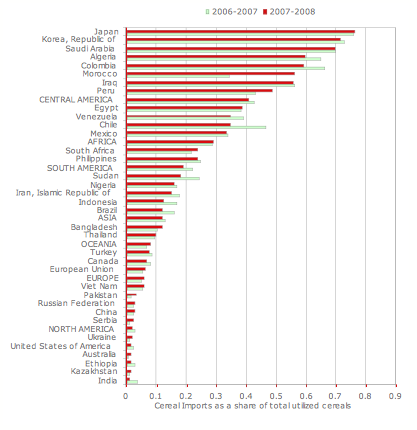
Imported Cereals as share of utilized cereals in selected countries. Source: FAO, Food outlook. Data for 2006-2007 is estimated; data for 2007-2008 is projected. The data is selective and probably includes only countries with substantial population.
Outside the rich pockets of wealth in the Gulf, poverty is widespread in the Middle East. In Egypt, 45% of the population are estimated to live on US$2 per day or less (2007). The population in the region spends on average a third to half of its income on food. Poor urban households are in a precarious position to begin with, and they will be affected badly by any prices increases. However, the price of bread is not dictated directly by global cereals prices, because of generous government subsidies. Before examining the possible implications of the crisis by looking at the specific cases of Egypt and Morocco, a few words on the economics and politics behind food subsidies in the Middle East.
Oil and Food subsidies
Government intervention in the food market is a crucial mitigating factor that has to be taken into account when trying to assess the impact of the current price hike. In virtually all countries in the Middle East and North Africa, governments offer generous subsidies for food and, in most cases, for fuel. There is an unwritten pact between governments and peoples in the region that guaranties that the price of bread and fuel remains affordable, and any cut in subsidies is seen as a direct attack on people’s most basic rights.The IMF and various other global consulting bodies have persistently preached against subsidies, arguing that they are not an effective means to alleviate poverty. The argument has merit: the subsidies benefit poor and rich alike; they encourage corruption and waste. This is especially true with fuel subsidies, of which the middle classes take full advantage. The IMF has consistently called for replacing the subsidies with other mechanisms that would support directly the population in need, such as cash transfers. However, the population in the region has real concerns about such suggestions: Will cash-grants be sufficient? Will they rise with inflation? Will they reach everyone in need? Will governments be competent enough to administer the scheme? The general sentiment is that the answer to all of these is ‘no’; a recent survey showed that 88% of Egyptians are opposed to any subsidy reform, fearing that ‘reform’ would mean in effect elimination.
The subsidies form a considerable part of all national budgets in the region, but for some countries they are a bigger strain than others, especially as the bill is getting higher. The rich oil and gas producing countries – Saudi Arabia, UAE, Algeria and others – are able to pay the rising price with high revenues from hydrocarbon exports. Other countries are in a far more precarious situation: these include not only resource-poor countries like Jordan, Tunisia and Morocco, but also oil producers such as Egypt, Iraq and Iran, which, for various reasons (resource depletion, internal strife or failing infrastructure) are fiscally vulnerable. Egypt, which has a substantial fiscal deficit, is expected to spend 30% of its budget for 2007/08 on subsidies.
Middle Eastern governments have been wary of eliminating food subsidies or replacing them, as it is clear that the issue is politically explosive. Subsidy cuts lead to riots. This has been the case in Egypt (1977), Sudan (1979), Morocco (1981, 1984, 2007) Jordan (1989, 1996), and Tunisia (1984). The riots are perceived as serious challenge for the regimes. In some cases (Morocco 1981) hundreds of demonstrators were killed. After clampdown of arrests and emergency measures, governments usually back down from the subsidy cuts. We have seen this happen in the last bread riots in Morocco (September 2007). This scenario will become increasingly unlikely as the subsidy bill becomes much more costly. As prices of oil and food go up, removing subsidies will become politically impossible, but sustaining them could become economically unviable. Whatever happens, subsidies are unlikely to be eliminated completely, and global price rises will be mitigated and not hit the population in their full toll. Famines are therefore not to be expected in the immediate future. Yet political unrest is unavoidable. Even if governments succeed in repressing food riots, popular disapproval will remain and the political situation will be much more volatile.
Egypt
Egypt has the biggest population in the region – 77 million people, and a high growth rate. The country is also one of the biggest wheat importers in the world, importing about 38% of its cereals in 2006-7. The price of bread is very low – less than one cent in 2007, and subsidised bread is available mainly for the urban population, which made 42% of the total population in 2007. In 2007 rising wheat prices cost the Egyptian government an additional US$ 2.5 billion in subsidies. The government could afford this because of windfall oil and gas revenues, and strong economic growth since 2004 in non-oil sectors. In 2007 Egypt had a US$ 5 billion trade surplus. In the recent Davos conference, Egypt was hailed as a success story for liberalisation reforms, and as one of the next emerging economies.But in 2008 things are set to change. Egyptian oil production peaked in the mid 1990s. Oil consumption is growing strongly, due to economic growth. In 2008, Egypt is set to become a net importer of oil for the first time. From a dwindling source of income, oil will become a substantial fiscal burden. The government would have to import oil and sell it at a subsidised price – which would be a heavy burden, since fuel subsidies already made 20% of the government budget in 2005/6 (source: IMF).
Will the Egyptian government sustain bread prices at their current levels? After announcements of possible changes to the subsidy system, the Government recently announced that no major reform will take place. The current system will continue and will be extended. But can the government afford it to sustain bread prices at their current levels? Natural gas exports will continue to bring hard currency, but subsidies cuts seem inevitable. In 2007 the price of fuel went up by 30%. Further rises are no doubt on the way.
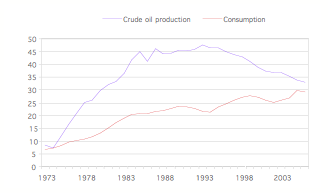
Egypt’s production and consumption of crude oil, in million tons, between 1973-2006. Source: BP
Morocco
Morocco has a large agricultural sector and therefore is in a better position to fall back onto subsistence farming. However, in recent decades Morocco has been plagued by recurrent droughts, in what is widely seen as the effect of climate change. The frequency of droughts has increased from once every five years to every other year; the length of the growing season has shortened considerably. (Source: Karrou). Yields vary considerably between years, and in 2007 they were especially low. As a result, Morocco is forced to import a growing share of its cereals: about a third of its cereals in 2006/7, and in 2007/8 it is expected to import about 56%.Both fuel and food subsidies in Morocco are much lower than in Egypt. To give some indication, in 2004 the retail price of a litre of gasoline was US$ 1.10, compared with 28 cent in Egypt. Diesel was 70 cent compared with 10 cent. (source). Bread is sold at 1.20 Dirham or US 15 cents. Yet oil and food subsidies still made up about 10% of the government budget in 2007; if they were to double, this would create a considerable fiscal strain.
There are some early signs of crisis. In September 2007, just before the month of Ramadan (in which bread consumption rises) the government raised the price of bread by 30%. Bread riots followed, and after clashes between police and demonstrators, the government backed down and restored the lower price. The decisions on subsidies cuts, interestingly, was taken by the Ministry of Interior, in charge of internal security. (source: ecomaroc.blogspot.com, French).
Also there are indications of falling demand for oil. The volume of crude oil imports in 2007 was about 2% lower than in 2006. However, when November 2007 is compared to November 2006, we find an alarming drop of 43% in the volume of oil imports. (source: Moroccan Statistics). With no substantial hydrocarbon industry, a more urbanised society (60% urban compared with 42% in Egypt), and greater dependency on wheat imports, Morocco seems more vulnerable to the impending crisis than Egypt.
Conclusion
Cereal prices in the Middle East are mediated through state subsidies. So far, the urban poor have not been exposed directly to the rise in prices. It seems inevitable, however, that at some point the price rises will be passed on to the public through subsidy cuts, either in 2008 or in 2009, in countries such as Egypt, Morocco, Tunisia, Iraq, and Jordan. Subsidy cuts will, without doubt, result in immediate riots. The urban poor will not wait until they reach a starving point: they will act immediately, as they have done before, against what they will see as the government betraying its fundamental duty to provide affordable food prices.Egypt and Morocco are among the US’s closest allies in the region. Belonging to the so-called “moderate Arab/Muslim countries”, they have been the most accommodating in terms of supplying the US with intelligence and military cooperation against Islamist groups. In return the US has supported these regimes militarily and economically, through direct support (Egypt) or Free Trade Agreements. Political instability in these countries will put in serious risk the position of the US in the Middle East. The notion that food prices have gone up because of American (and other developed countries’) use of biofuels will not make the US more popular among people in the region.
The American policy on biofuels is repeatedly presented as a means to improve US national security, by reducing dependency on imported oil from the Middle East. Articles on Ethanol production here in the Oil Drum (by Robert Rapier and others) have shown this to be a fiction at best, because of ethanol’s poor EROI. Now it becomes clear that the subsidising of biofuels will make the world less safe for the US, by destabilising “friendly regimes” in the Middle East and beyond.
A few more words. Egypt, Morocco and other Middle East countries are regularly covered by Western Media, because of their economic and geo-political importance, as well as their proximity to Europe. Other countries – for example in sub-Saharan Africa – may be even more vulnerable, as many of them depend on cereal imports (although perhaps not to the same extent). It would seem likely that governments in sub-Saharan Africa have less power to mitigate price rises through generous subsidies. However, many such countries are off the radar for Western media, and the developed world will learn about the problems only through news of famines or refugee crises.
To forecast the impact of cereal price rises, one should take into account food subsidies (where they exist) and the ability of governments to sustain them. In the Middle East, it seems, the political consequences will be almost immediate, and will come before actual food shortages. In other regions it may take a different course. In Mexico, for example, subsidies have been eliminated long ago. But as I am no expert on Mexico, I will leave this for others.
If this short article dealt with the problem in strategic terms, in grand summaries of numbers (population, oil, food), it is important to remember that behind all these are people, real people, and many of them. Poor families in Egypt and Morocco, for whom life is already very difficult, and who survive on the bare minimum, are going to be badly hit in the next two years, when even a pita bread will become too expensive. The important issue here is not the survival of certain political regimes, but rather the survival of these families.
Sources:
- IMF latest report on Egypt
- IMF latest report on Morocco
- Akhter U.Ahmed, Howarth E. Bouis, Tamar Gutner, and Hans Lofgren (2001). The Egyptian Food Subsidy System: Structure, Performance, and Options for Reforms. International Food Policy Research Institute.
- Bread, the (subsidized) stuff of life in Egypt, International Herald Tribune.
Contact
- Content: editors at theoildrum dot com
- Tech support: support at theoildrum dot com
License

This work is licensed under a Creative Commons Attribution-Share Alike 3.0 United States License.
"Now it becomes clear that the subsidising of biofuels will make the world less safe for the US, by destabilising “friendly regimes” in the Middle East and beyond."
Hello CIA, etc., are you listening?
Thank-you, Yair Wallach, for a very informative piece.
Though no friend of US biofuels, I remain unconvinced of this.
The big wheat exporters are US, Canada, Australia etc. There are not many others. More than half of all exports come from the three countries named.
In other words, high food prices could force some Middle East countries to come to terms with their dependence on the West for food. Then they might do more to dampen extremist elements within their borders.
The US already supplies substantial aid to Egypt and a big chunk of the wheat imports.
Hi George, would you mind defining who are the extremist elements within their borders? I am a bit fuzzy there as I would think it is one big extremist outfit outside their borders that is the problem.
Also your idea of food as a weapon in Western political policy sort of smacks along the line of war crime or worse; genocide! Wouldn't you think?
I sincerely doubt many people are going to be allowed to starve. We are not talking war here.
But food aid used as part of foreign policy.....yes, that is likely.
I also doubt very very much that you personally would allow them to starve if you could help it, but there seems to be a disconnection when we are able to allow our governments to do exactly that for political purposes. You can look to the aftermath of the first Gulf war and the embargo, according to the following from Wiki:
The estimate from the study indicates more than 46,900 children died between January and August 1991.[40] A 1998 UNICEF report found that the sanctions resulted in an increase to 90,000 deaths per year.
Withholding food or essentials for political reasons in time of peace is in my opinion as, or more reprehensible, than it would be in time of war.
BTW you did not respond to my first point, not that you are required to, but in the heat of the moment you might have overlooked it?
Chrystal, an embargo is rather extreme and, for all intents and purposes, an act of war.
I suspect the West could get a lot of mileage out of its food exports edge, if necessary, without resorting to embargo.
>>BTW you did not respond to my first point...
I think your point was that the Americans are extremists. In some ways, maybe, but I can't see how the world food situation gives us means to pressure them!
Using Crystal Radio's definition of embargos and war crimes, it sounds like OPEC should be the target of his/her anger.
Sorry Jack, you are way over my head with that. I know you must be, as all I can manage to decipher out of it is that OPEC is starving the west by not supplying needed oil to run their children ... all the little SuV's and Hummers?
NO! NO! that way lies madness ... must rest my head now, go to bed, dream of bunnies and butterflies...nite, nite :)
OPEC does not supply oil exclusively to the US or the West. People do die from lack of energy.
I think your point was that the Americans are extremists. In some ways, maybe, but I can't see how the world food situation gives us means to pressure them!
Not extremists but understanably a bit blind, just like Canadians are in not opposing a war of aggression in Afghanistan.
About agressive war, I have this about Nuremburg ( though not what I was looking for which was a more complete definition of aggressive war, I am surprised I cant even find the complete wording of the UN charter which as I remember made no bones about the business of war).
: The Nürnberg Tribunal condemned a war of aggression in the strongest terms: "To initiate a war of aggression . . . is not only an international crime; it is the supreme international crime differing only from other war crimes in that it contains within itself the accumulated evil of the whole." It held individuals accountable for "crimes against peace", defined as the "planning, preparation, initiation or waging of a war of aggression, or a war in violation of international treaties, agreements or assurances, or participation in a common plan or conspiracy for the accomplishment of any of the foregoing...." When the United Nations General Assembly unanimously affirmed the Nürnberg principles in 1946, it affirmed the principle of individual accountability for such crimes.
-----------------------
On this:
I suspect the West could get a lot of mileage out of its food exports edge, if necessary, without resorting to embargo.
The problem I see here is that it still involves the innocent along with those that are considered guilty, not exactly cricket eh? (but then cricket isn't what it was since it was played in Iraq, I think:P
Show me where this has worked in the Middle East previously. I believe that the only prior case you can make for moderates actually solving their extremist problems was Turkey, nearly a century ago. More recently we have Iran falling to fundamentalists when the US backed Shah fell from power, Afghanistan falling to fundamentalists after defeating the Soviets (and who appear to be driving back towards ruling Afghanistan yet again), Pakistan beset by fundamentalist uprisings, Lebanon ripped apart by civil war and then seeing the fundamentalist Hezbollah rise to power...
In fact, based on the historical record, I would strongly expect revolution led by fundamentalists to be the most likely response, leading to authoritarian governments that are openly hostile to the US. Yes, Egypt might deal with its extremists. But the historical record suggests strongly that the extremists will instead deal with the moderates and deal with them violently at that.
Egypt is a good example here of a nation that became more peaceful partially because of a food aid deal.
What would they eat? Even Islamic fundamentalists have to eat?
Although they have some success, extremists actually regularly get outmaneuvered, bought off, held in check, and sometimes outright defeated.
Iran has both oil and quite decent food production per capita (compared to Egypt). The regime has many more raw resources to play with compared with Egypt. So, it's not a good counter example, should one choose to cite it.
Pakistan just had an election. The secular parties were no longer banned by the US supported government, and the voters promptly deserted the fundamentalist parties for the secular parties.
There are no secular parties in Islamic Republic of Pakistan. No one in Pakistan openly calls for separation of the mosque & state. Everyone agrees that Pakistan should be an Islamic state with laws & constitution that are based on Koran. Everyone agrees that Islam has all the answers and that an Islamic state is an ideal state. The ex-prime minister Nawaz Sharif - whose party won the second largest number of seats - was considering implementing Sharia (chop limbs, heads, stoning, flogging, etc.)just before he was ousted by Musharraf in a coup.
The only debate is over how far to go in the process of Islamization. The "moderates" will tolerate movies, TV and music. The extremists want to recreate 7th century Arabia.
The question is not one of "dampening extremists".
Subsidy cuts in Jordan, Egypt, Morocco, and other countries are inevitable, especially if price hikes escalate, and this means serious political instabillity, whatever "dampening" measures are taken.
The people who will go out to the streets are not extremists - they're just people who want affordable prices. It is true thatIslamist groups will probably try to take advantage of the situation.
http://reddit.com/info/6ap1w/comments/ (science)
http://reddit.com/info/6ap1k/comments/ (politics)
http://digg.com/business_finance/Bread_and_Oil_Rising_Food_Prices_and_th...
Thank you for your support. Your participation in this exercise helps us get new readers.
A PHD candidate should be able to think better than this. I will only criticize some of the logic errors Yair Wallach has made in this poorly thought out piece.
The wheat shortage is the result primarily of weather difficulties in Australia, Canada and Ukraine as well as some other places. It has nothing to do with ethanol production since it is not used to produce ethanol. Corn is an animal feed which when fed to animals results in a dramatic loss of energy. Corn production for ethanol increased dramatically in 2007 from about 10 billion bushels to about 13 billion bushels more than enough to compensate for increased ethanol production, at least for now. The author supposes that oil which is the energy supply for over ninety percent of agriculture production is not the most significant factor in rising food prices. Instead it is postulated that an animal feed which is used to produce about 6% of liquid fuel in the U.S. is the cause of rising food prices worldwide.
What are American farmers who raise corn to do? Sell corn below it's energy value to be used as animal feed? Those who want to subsidize the high birth rates of Middle Eastern countries as the governments of the region do by stopping ethanol and depriving American farmers a legitimate return on the expensive fuel inputs they must pay are short sighted indeed. The problem is the culture of the Middle East that does not allow women other opportunities and keeps them in the role of baby makers par excellence and with out rights comparable to men. To suggest that somehow other countries are responsible for the enevitable collapse of such a food poor region with such a culture is the same as to say that Saudi Arabia is responsible for the collapse of the happy motoring life style of the U.S..
Furthermore the author uses the discredited concept of EROEI which does the same comparing of apples and oranges that he does with the comparison of an animal feed, corn, to a human staple food, wheat. Apples and oranges can not be compared because the the whole point of analogy is to find like things that are similar in many ways so as to deduce another characteristic. When two things that are insufficiently alike are compared it is called a false analogy and no valid deductions can be made. While Wikipedia says we make apples and oranges comparisons all the time, that does not make it is any more correct or logical. Whether comparing corn to wheat or oil to ethanol or apples to oranges, the comparisons while in the same general classification of items are not sufficiently alike to draw an valid conclusions. In any case analogy is a weak form of argument. In the case of EROEI the comparison analogy error is further compounded by the omission of price which is a critical factor in deciding which resources should be deployed to produce which products. The author better go back to his freshman logic class and start over. A PHD is too much for him now and should be denied.
That's a bit harsh, but only a bit.
How the wheat crop got dragged into the biofuels debate is screwy. Wheat and corn are usually grown in different areas. US wheat planting/ production, driven by rising prices
has been rising at 10% a year since 2005. 2008 US corn acreage is set to decline. Soybean acreage driven by high world prices is increasing.
http://www.farmdoc.uiuc.edu/marketing/weekly/html/022508.html
The biggest cause of the wheat crisis is probably Global Warming. A drought in Australia reduced wheat production by 42%. There is also a new wheat 'super-blight' sweeping East Africa.
http://allafrica.com/stories/200801070597.html
Another factor is the de-regulation of wheat prices in some countries is causing world prices to rise in sympathy.
I find it ironic that biofuels(particularly ethanol) which reduce GHG and thus mitigate GW in a small way are being blamed for what is at least in part a GW problem.
"How the wheat crop got dragged into the biofuels debate is screwy."
Wheat is one of the worst crops to grow.
It uses marginal land almost by default.
The growing season is long, Oct-June.
And it takes fertilizer. We won't grow it for less than $20 the bu.
Once cut, the stubble must be removed immediately-hence burning,
to get double cropped soy in behind it.
After June 15(?), you lose a bu/acre for every day's delay.
Then you must have irrigation, and on and on.
We said this from day1.
All crops compete with each other. Now watch cotton go to a $1
the lb.
HUH? Seen a lot of Hard Red Winter grown here in Kansas and am not familiar with burning off the fields to double crop, maybe further east in the soft red areas of Il. and AR... Irrigation not so much. Wheat is a dryland crop here if you irrigate you raise corn,alfalfa, maybe soy or sorghum. You are correct it can be raised on marginal land but usually its a rotation crop and is as tough as any weed. Agree wheat has been dragged into the bio fuels discussion as it competes for acreage with corn, beans, and sorghum. In this area of South Central Kansas (the hard red wheat belt) we have seen a large amount of switching into corn the past two years at the expense of wheat. Mainly our below average wheat crops the past 3 years have been due to fall drought (poor germination) and late freezes (last year when the wheat was heading). This years crop was again a victim of inadequate fall rainfall. Lately however we are very wet. Unfortunately you can't make grain with no plant. Typically very wet crops result in larger crops with lower protiens but with increased riks of rusts that can lower yields and prices to the farmer. (protein is money). This year the stands are quite thin. I have made a couple of trips into Tulsa in the last couple of months and have made a point to take the side roads back to evaluate the crop and check out some land for purchase in the number one Hard Red Winter county in the U.S. Sumner County. I don't like what I see...we have had a hard winter regionally speaking so the wheat is not looking very robust. Like I indicated earlier its tough as a weed so it can rebound as long as there is a plant to rebound with.
Very good, KC.
Here in NW AR, we've had the same and thanx for the Tulsa/wheat info.
And Protein is the key.
Ever thought about canola?
Another axiom-
"Substantial data show that in corn, wheat and soybeans, the higher the yield, the lower the protein and oil content."
Good luck,
James
HUH? Seen a lot of Hard Red Winter grown here in Kansas and am not familiar with burning off the fields to double crop, maybe further east in the soft red areas of Il. and AR... Irrigation not so much. Wheat is a dryland crop here if you irrigate you raise corn,alfalfa, maybe soy or sorghum. You are correct it can be raised on marginal land but usually its a rotation crop and is as tough as any weed. Agree wheat has been dragged into the bio fuels discussion as it competes for acreage with corn, beans, and sorghum. In this area of South Central Kansas (the hard red wheat belt) we have seen a large amount of switching into corn the past two years at the expense of wheat. Mainly our below average wheat crops the past 3 years have been due to fall drought (poor germination) and late freezes (last year when the wheat was heading). This years crop was again a victim of inadequate fall rainfall. Lately however we are very wet. Unfortunately you can't make grain with no plant. Typically very wet crops result in larger crops with lower protiens but with increased riks of rusts that can lower yields and prices to the farmer. (protein is money). This year the stands are quite thin. I have made a couple of trips into Tulsa in the last couple of months and have made a point to take the side roads back to evaluate the crop and check out some land for purchase in the number one Hard Red Winter county in the U.S. Sumner County. I don't like what I see...we have had a hard winter regionally speaking so the wheat is not looking very robust. Like I indicated earlier its tough as a weed so it can rebound as long as there is a plant to rebound with.
The (ethanol based) premise may be false, while the conclusion (quoted below) is most likely correct:
"The notion that food prices have gone up because of American (and other developed countries') use of biofuels will not make the US more popular among people in the region."
The Middle East is even more of a Conspiracy Theory hotbed than the US...
...whatever happens 'The Street' will blame someone, in fact the sooner the US gets knocked off the #1 spot the sooner it won't be them that gets blamed! :o)
Nick.
That is fair... I've seen people doing the second accusation several times :)
And we're off!
First. We're gonna need sources for this:
"Corn production for ethanol increased dramatically in 2007 from about 10 billion bushels to about 13 billion bushels more than enough to compensate for increased ethanol production, at least for now."
I've got us at 300 MMT corn production for 07. Give or take.
Although the large-scale and long-term potential for corn ethanol production is limited, it will be an important part of the transition to even cleaner forms of ethanol. As of the end of 2007, roughly 20 to 25 percent of our corn crop was used for making ethanol, yet this displaced less than 3 percent of the gasoline we used for our cars and trucks. Even if we used all our corn to make ethanol, with nothing left for food or animal feed, we could only displace about 12 percent of our gasoline demand. Clearly, today’s corn ethanol is not a sufficient long-term solution to our oil dependence."
http://www.ucsusa.org/clean_vehicles/fuel_economy/ethanol-frequently-ask...
25% x 300 = 75 MMT.
The stockpiles are gone.
And wheat can be substituted for corn.
Mac, we produced 13.1 billion bushels of corn in 07'.
http://usgovinfo.about.com/od/censusandstatistics/a/2007corn.htm
After allowing for distillers grains we get about 2.8 x 10/6 = 4.66 gallons/bu. To get 6.5 Billion gallons we would divide 6.5 by 4.66 = 1.394 bushels
1.394 divided by 13.1 billion bu = 10.64% of our corn crop
We use about 144 bil gal of gasoline/yr.
6.5/144 = .045, or 4 1/2% of our gasoline demand.
Our year end ing stockpile was 1.4 Billion bushels. That's up from 1.3 billion bushels in 06'.
No way on the 4.66 gallons/bu. NCGA says 2.8 gallons/bu (and they're paid to hawk the stuff, so we can be fairly confident they aren't underestimating). So you're off by a pretty factor.
The other thing is of course a gallon of ethanol is not equivalent to a gallon of gasoline, and his percentage calculation didn't take that into account.
But what he is doing is taking credit for the DDGS, and saying that effectively you used less than a bushel to make the ethanol. However, that is double-counting on the DDGS. In the energy balance calculations, the USDA already dumped a lot of energy inputs into the DDGS in order to inflate the ethanol energy return. So if you now want to take credit for the DDGS above, you get hit with a serious energy penalty, such that the net fuel production is approximately nil. Can't have it both ways.
Robert, I read where Poet said they're using about 24,000 btus of nat gas per gal of ethanol produced in their newer refineries. I saw no evidence that they were holding back btus to allocate to the ddgs.
It does strike me, however, that the btus of nat gas used in the production of fertilizer should be adjusted appropriately. I mean, the farmer was going to raise the cattle feed (corn,) anyway.
I think this should be done this way: Adjust the 25,000 btus of nat gas input into the fertilizer required to grow a bushel of of corn by multiplying it by 6/10. This would yield 15,000. Divide that by 2.8 = 5357 btus/gal.
So, I figure you add 24,000 btus (per Poet) for refining + 5300 btus for fertilizer, and approx 1,000 btus for Diesel (farming) and you come out with about 30,000 btus/gal inputs.
As for equivalence to gasoline: Well, we've seen in the link I provided that 3 out of the 4 cars tested achieved HIGHER mileage with an ethanol blend. Also, we're going to be seeing more and more cars with higher efficiency burning ethanol. The first crop comes out this year with the new Chevy HHR.
As for equivalence to gasoline: Well, we've seen in the link I provided that 3 out of the 4 cars tested achieved HIGHER mileage with an ethanol blend.
Yet the DOE has done literally hundreds, maybe thousands of tests that show just the opposite. Go figure.
I was under the impression that all of the DOE/EPA tests were done with care running E85, or E10. Can you direct me to some DOE tests using E20, and E30, as these were?
Rest assured that the DOE and EPA are trying to replicate those results right now. If they do, then we can talk about it. Right now, you have something that looks like cold fusion. Even one of the big ethanol organizations came out after that test and said "Hmmm. We can't really come up with any mechanism that could explain those results."
So instead of taking one study that contradicts every piece of work ever done in this area, I think I will wait until we get some 3rd party confirmation before I start counting ethanol as equivalent to gasoline. Maybe that's just the scientist in me. (And if it were real, I think you would already be seeing 3rd party confirmation).
Stuart, you get 30% of your corn back in the form of ddgs. Those ddgs have been shown in tests to give a 10% greater weight gain (when fed in a 30% ration) than a diet of straight corn. Put this together, and essentially, you've recovered 40% of your cattle-feeding potential with the DDGS coproduct; hence the 10/6 x calculation.
2.8 x 10/6 = 4.66
No. And add in water belly, the runs, and Ecoli,
with mold. And must use w/in 6 days.
Of course in the South warm weather makes it prohibitive and cattle really shouldn't be eating straight corn anyway.
Just grass.
But we're so far away from that.
You make a good point X-
why people continually don't see the havoc they sow on Farmers in this nation is beyond me. Even with Ethanol few of them make money. Its not like cutting Ethanol production is going to solve this problem in 5 years. So, we should expect farmers to pay more for fuel and fertilizer, more for labor, and more for basic living expenses that we expect of the people they'd be feeding? What kind of standard is that. I think anyone who proposes something that hurts farmers anymore than they already have been, should at the very least grow their own food-
Most dogs don't bite the hand that feeds them. But around here, when they do, there is a solution. The real world is not some university lecture hall or a urban socialist cabal. I am getting more and more ashamed of some of the sentiments I read, here and in other places everyday. Its more than upsetting, watching some of the most intelligent individuals in this area continually dissapoint me. At least display common sense. Maybe study history. Put the corncucopian pipe down and realize what that means. Few have and its obvious, even here.
Practical,
When you first started posting you said you felt Ethanol was a solution to peak oil and that you wanted to help avoid die off.
Now you are arguing that property rights are so important that you should be allowed to cause die off if that increases your profit margin.
What happened to you? Are you really saying that no human has any obligation to another? That if more money can be made looting corpses than feeding the living it should be done?
If your concern was just paying off your farm and getting decent wages for yourself, why not spend the time arguing for improved subsidies. I already pay extra for organic. Many, many others are willing to do the same. (fair trade coffee etc). Why do so many have to die for you to make a reasonable living?
Sigh. Game theory has shown over and over than people with nothing to lose should not be trusted. This is a perfect example. No country should have signed the non-proliferation agreement. Clearly not Egypt. I expect many countries will find ways to remind others that property rights are just paper agreements that promote harmony and smooth operation. And that the world is not a zero sum game. It can go very deeply negative for everyone.
Of course there is another side to unfairness. Those countries who are having more than replacement level children are trying to take extra slices of a limited resource base pie. They have a responsibility as well.
Now now.
The article is not from the field in which he is making his PhD in.
Should you have been denied your PhD, because you took a wrong logical turn at the grocery store and didn't optimize your energy expenditure?
We all make mistakes, esp. in the fields we are still learning.
BTW, next time when you try to attack somebody with such vitriol, you'd probably be more balanced if you did it under your own full name and not a pseudonym 'x'.
Also, the errors you claim are mostly in the hypotheses, not in the logical inference part, which is something a freshman logic course cannot cure.
It takes a life time for that and it's trial and error...
As I said, biofuel is one of the driving factors.
Joachim von Braun, Head of the International food policy research institute recently estimated that the price rise of cereals is due 50% to growing demand for animal feed in China, India, 30% to biofuel and 20% climate change.
http://www.guardian.co.uk/environment/2008/feb/26/food.unitednations
See their Food Policy Report - http://www.ifpri.org/pubs/fpr/pr18.asp.
Maize is a staple cereal for many people in Africa and Latin America, so the diversion of corn to ethanol has a direct effect on them. But there are important knock-on effects on other cereals, through the allocation of resources, and because many countries are starting to panic about food security. So they stop exports.
This is the story behind the dramatic rise in rice prices - India stopped most rice exports because they were getting worried about wheat prices. The result is massive price increase - 60% in 2007 alone - while there is no shortage and rice hasn't been used for biofuels yet.
The problems are already there - unsustainable population and economic growth, climate change - all true - but if we are to see a take-off of cereal-based biofuels, pressures on resources will accelerate in a very dangerous way.
Boy, hard to improve on that comment. But, :)
Okay, the American taxpayer has been, through price "supports" paying farmers to produce way too much wheat, which has kept the price of wheat artificially low. This has allowed NGO's, and foreign governments to give it away. Meanwhile, the 70% of the world's poverty-stricken that are subsistence farmers can't make a living, and have to beg for handouts, also.
All this so the Saudi Royal Family can charge me $4.00/gal for gasoline and put the money in a Swiss Bank account.
Stop the ride! I want OFF! I want to take my tax money and invest it in an ethanol plant and let them eat/drink their own damned oil.
Kdolliso,
Besides being able to take a page directly from Stiglitz, what we need is some common sense. U.S ag subsidies do not cause drought in Sub-Saharan Africa. U.S ag subsidies do not cause people to go hungry in other nations, they go hungry because their government imposes consumption subsidies, which allow a food-poor country to grow beyond its means in many different ways. Now, is it fair to expect Farmers to give up, what little they have left, so that the situation can go on longer? This is BASIC common sense.
If you think, for a second, a sitting U.S politician will cut Ag Subsidies, during potential oil shortages and war, you're sadly mistaken. This isn't a case of rallying up support anymore. Its getting out of the way of an immovable force. I hope none of you were given advanced degrees in anything. A simple reading of the Bible and other ancient texts will tell you what you are obviously missing. Life is nasty, horrible, and short. It has been. It always will be. You can't change reality, so stop trying. You're not helping. And we need all the help we can get. Find a way to pump more oil and keep the markets open, at the very least. The day they close/stop, will be doomsday for billions of people, and hundreds of millions more they decide to bring down with them.
And if you want to be oh, so noble, take your Family's food ration and send it to some village far, far away. I'm sure you're family will think the most of you for it. I don't know what has happened to some of you people, but my will for self preservation is quite strong. All this piece is doing is politicizing the issue, and the obvious slant is disgusting to me. Tilting at windmills are we? You can go have your fun with Sancho, as far as I'm concerned this is just a waste of time. fiddling while Rome burns. man, I'm just disgusted, good day. There's not many left. No matter what you do.
Being contrarian...
Biofuels account for a miniscule % of tot world energy. Calcs and % vary: definitions, type, accounting. Etc. Between under one % to 4 %, depending. Basically, it is minor BS, hyped today, though some local uses may be appropriate.
Of course, Americans are sensitive to it, because US corn is collared for ethanol, maybe to the tune of 20, 25 % of corn produced there - insignificant from a world perspective.
Agri prices are UP due to, not in order:
a) economic problems, strife, war: farms abandoned because they can’t be kept up or earn a profit - India, Iraq, Africa, etc.
b) failing or “too expensive” inputs - irrigation, electricity, fertilizer, oil for agri machines, piping, barns, seeds, etc. (see a)
c) local agri. decimated in favor of the big agri producers / exporters, Australia, US, etc.
d) desperate and unusual weather - drought, floods, fire, sliding terrain, etc.
e) in link with territory - zoning, suburbia, towns, deforestation, concrete encroaching, top soil degradation, river diversion, water depletion, gradual destruction of the biotope, etc.
f) The profit motive - growing what can be sold for profit to the West or anyone, neglecting local subsistence crops, thus destroying local agri, exchanges
g) the long tradition (1950 - 2000 as a rough time span) of keeping agri producers small earners, subservient to Gvmt. policies and subsidies, not listening to them
h) other. fill it in.
'h) other. fill it in.'
Population.
Rough figures for Egypt.
1985 62 Million
2007 80 Million.
2025 98 Million.
2065 114 Million (at which point it is supposed to flatten out)
98% of the population live on 4% of the land surface of Egypt.
20% are at or below the poverty line. Though the subsidy of Aesh Baladi is not just limited to this fraction.
60% are in the reproductive cohort 15-45.
When I first lived in Egypt 22 years ago, Egypt was producing 900 000 new Egyptians a year. Looks like the figures more or less bear this out.
You could get pretty much the same kind of figures from all over the Arab speaking world. Populations have catapulted way above non-oil carrying capacity all over, but especially so in this region.
Subsidised bread is regarded as a 'right' in this part of the world. The author is quick and correct to point this out. So too are food riots which are rarely far behind and always follow any attempt at reducing subsidy. This will get worse with time as more mouths chase less grains.
Ironically, as many Americans believe the price of oil is maintained by Opec keeping oil off the market, so too the man in the Arab Street will believe that coming food restrictions are being used as a weapon.
What do you do if your people are rioting? How about blaming an Enemy without? . Oh, and expect militant fundamentalism to be proffered as a way out for the increasingly desperate masses that will feel that pro-western governments such as that of the A.R.E have failed them.
David's dream of Seven Fat and Seven Thin Cows was never far away from the truth in Egypt.
Joseph not David - but your point is well taken.
Yes - Egypt is a pointed ex. I was kinda thinking along power point lines, for a ‘west audience’, bullet points badly organized.
When subsistence, and expectation of rising subsistence, or ‘que sera sera’ attitude, is present, birth rates continue high, or rise.
Humans are fantastic energy conversion machines - there is always some ‘added value’ to be grabbed, because they are smart. Superior to some crappy sandy scratched solar panels, or an iron camel (motorbike).
Children work the fields, the markets, have jobs (as they are exploited they can at least be in the work market, where adults cannot), represent capital, a stake for the future, in many ways.
Traditional societies, and all religions (?), cultural networks, etc. stress the importance of children, meddle in birth control and keep women subservient to fulfill that function (in different ways, soft or hard) because children are efficient, if fed to ages 8 - 13.
At worst, they might fight, serve as cannon fodder. At best, success of one or the other will feed the whole family, contribute to the tribe; the hands present may plant and harvest / work / earn more dollars / branch out, etc; or the tipping demographics may afford advantages, domination. (E.g. Israel/Palestine.)
Their EROI is high, or imagined as the best going round, maybe fantastic, in any case mandatory, without children, literal death, or social marginalization, grudging and temporary acceptance...
Cold and cynical? Yes. Discussing this is not politically correct; the first human right is to marry, have children.
Thanks for the good article. Even in the United States there is growing awareness that the ethanol program is contributing to higher food prices. The awareness has not yet caught up to the Presidential candidates, but one can hope that within a short time, we will see an end to ethanol mandates and subsidies.
Unfortunately, even without the misguided biofuels programs, we are likely to see rising food prices in the long term. Factors including rising oil prices, climate change, and depletion of topsoil and water tables. And even without subsidies, a significant amount of biofuel production, though probably not corn ethanol, will be economically viable. These are chronic problems, though I don't know if they are as critical as some of us imagine them to be.
Yair, Thank you for this very interesting post. TOD is always enriched to receive views and insights on energy and food from corners of the world too seldom represented on these pages.
From some of the comments above you will gather this is a a very emotive and controversial issue.
In Europe, bio-fuels are promoted mainly with CO2 reduction in mind. Unfortunately, temperate latitude bio fuels with eroei less than 2.5 are an inefficient way of conserving CO2 emissions. In USA, the policy is in part driven by energy security and here you need eroei > 7 to run society. So temperate latitude biofuels in their current guise fail both policy agendas.
Whilst I agree with you entirely that bio-fuels are the main culprit in current food price inflation there are other factors to bear in mind:
Growing global population
Growing prosperity in E Asia and the Middle east resulting in more meat being eaten
Climate change and drought in certain areas
We have a perfect storm in global food supplies brewing.
One of the main things I learned form your post that I didn't know before is the system of food subsidies throughout you region. These combined with farm subsidies in the US and EU provide yet further fuel for another perfect storm.
Subsidies are never a great idea and I can't help feeling that as this situation unravels in the coming months and years that the situation will get very messy.
Thanks for your post - I learned much today.
Fascinating! Do you have a reference for that, Euan, or is that just the EROI of a single malt? ;-)
Single Malts do not market themselves on EROEI.
They serve a much higher purpose.
The number 7 is anecdotal but originally from Charlie Hall I believe, I don't have a reference.
I've posted this a couple of times already (folks may be getting sick of seeing it) but what it shows with eroei below 7 the amount of energy available for society declines exponentially. This would not be an issue if the total amount of energy was rising. But imagine this in a context of declining total energy (see Luis' Olduvai post) and rising population. The net energy per capita would collapse beyond 7. I need to try and adapt this chart - not easy placing a time scale on it. Note the x axis is scaled from 1 to 50.
The other way I think about this is the number of people involved in the energy industries. 1 in 7 seems a doable figure. For every person working in energy industry we may then have a retired elderly person a child and 4 workers to drive the economy and perform all other tasks.
As Mudlogger correctly observes with certain special fuels it is vital to calculate the energy quality multiplier (Hagens and Mearns in preparation). After several years of empirical work we have discovered that the Malt whisky constant varies between 7.3 and 9.6 depending upon the location of the distillery, the energy sources used and the quality of the final product. With input eroei's for single malt that vary between 2.6 and 3.1 this gives a nominal range in eroei for single malts from 18.98 and 29.76. It is a remarkably efficient beverage. (all calcs exclude external transportation costs of the finished product).
Thanks for the hints.
>>...not easy placing a time scale on it.
Maybe we'd best leave that to the doomers. There are too many unknowns like how much of the dirty stuff is left, how good will we be at conservation, efficiency finding, developing new tech etc.
I'd bet, if you engineered it from the ground up, you could run an advanced society on 1/10 or less of what we currently use per capita.
The point is that there is no need to aim for 1:10 - when wind delivers 20 and thermal solar likely higher than that and nuclear probably similarly endowed - we have no shortage of net energy positive technology at our disposal. What we do have is an obsession with inefficient liquid fuels that are dragging us into a net energy sink.
Don't stop showing the EROEI curves, Euan. In fact, email a copy to every congressman in the U.S. capitol. This curve shows the same exponential effect for an oil replacement as the EROEI goes below about 3 or 4:
The barrels are barrels of BTUs, so it doesn't count the lower energy content of most oil alternatives, which would steepen the fall off the net energy cliff in terms of physical barrels.
Yet most of the array of alternative fuels being worked on have estimated EROEI falling below this critical area around 3. I did a survey of congressional focus on various oil replacements last year and found that the amount of attention a fuel was getting from our politicians is inversely proportional to its EROEI. I even plotted it up on a graph here showing that the popular choices being mandated cluster below the critical EROEI area with corn ethanol being the lead offender.
Corn ethanol, with an estimated EROEI at 1.3 on the chart above, displaces essentially no oil at all. That means we are paying $umpteen million billion of tax money and many many hours of work by millions of people to accomplish nothing but the catastrophic food inflation we now all face.
This chart is deceptive. An energy cliff occurs if we are forced to move from high return energy extraction processes to low return energy extraction processes in a short period of time. If we had 100 reservoirs of fuel with EROEI ranging from 100 to 1 and we exploited one reservoir per year, our energy descent would be linear. An energy source with an EROI of 7 does not represent a cliff if there is enough of it available to last for a long time. We may indeed be nearing an energy cliff, but the graph you have posted does not demonstrate this fact.
Let's do the math.
Give us 10,000 reservoirs with energy return on investment from 100 to 1, that is, East Texas to Utah shale.
We use the first 101 reservoirs to get 100 reservoirs worth of fuel.
We use the last 166 reservoirs to get 100 reservoirs worth of fuel.
Doesn't seem so bad. The price of gasoline only goes up around 66 times.
Until about year 75 when we fall off a cliff.
East Texas was discovered in 1931, wasn't it?
That's an understatement.
EROEI-1=(Eout-Einv)/Einv
Consider an EROEI of 20 with 10 units required; this means that 1 unit is invested to get 20 unit of output or if 10 units are required then .5 unit is invested. Add them together an you get a total of 10.5 units.
Try it with an EROEI of 10; 10+1=11 units
Try it with an EROEI of 3; 10+10/3=13.33 units
Try it with an EROEI of 1.5; 10+20/3=16.66 total units of energy.
(At a EROEI of 1.11; 10+9=19. But I don't know an energy process that runs that low)
So going from an EROEI of 20 to 1.5 raises the
total amount of base energy extracted to maintain an output of 10 units would have to increase by only 59%--(16.66/10.5)-1.
The amount of low EROEI unconventional oil (for example) in the world is probably 2 times greater than conventional oil in the ground. There is still enough total energy to makeup for the drop in EROEI and still maintain the current levels of production given sufficent effort.
The object of energy production is to produce energy, not worry about EROEI.
"The object of energy production is to produce energy, not worry about EROEI."
Really? I would have surmised that the object of energy production is to produce energy to fuel the economy, and that the object of the economy is to increase utility.
I, for one, am not interested in spending more and more time bringing wood to the fire at the expense of the time spent around the fire enjoying life. I prefer to spend a short time insulating the walls of my hut so that I can spend a long time around a smaller fire simply enjoying the short time my spirit knows this material existence. Frankly, I think the evidence is that most people want the same as me.
Aside from your apparent lack of concern for the environmental implications of declining EROI, you seem to not understand its (other) economic implications, notably the opportunity costs of the 'sufficient effort" of which you write.
So going from an EROEI of 20 to 1.5 raises the total amount of base energy extracted to maintain an output of 10 units would have to increase by only 59%--(16.66/10.5)-1.
Hold up a sec, because you have a problem. I see what you did, do you? This can happen when you try to get too "creative" with the math to prove a point. Work your problem in reverse. If you produced 16.66 units of energy at an EROEI of 1.5, then your inputs were 16.66/1.5, or 11.1. So, you have a much lower net than the 10 you were trying to produce.
But even using your incorrect math, let's look at the conclusion. Today the world uses 85 million barrels of oil a day. Using your 59% above, to maintain the net supply at today's value "only" requires us to increase total oil extraction to the equivalent of 135 million barrels (of energy dense oil, not ethanol) a day. Piece of cake, eh?
Now, try some eye-openers. Here is what it takes to get 10 units of energy (gross, not net) at various EROEI values:
20/1 EROEI takes 0.5 energy inputs to get 10 out
10/1 takes 1
5/1 takes 2
2/1 takes 5
1.5/1 takes 6.67
1.3/1 takes 7.69
So, dropping from an EROEI of 20/1 down to 1.3/1 takes over 15 times the energy inputs to gross the same amount of energy. But here is what so many fail to understand: Look at the net.
At 20/1, we invested 0.5 and got 10 back out. Our net is 9.5.
At 1.3/1, we invested 7.69 and got 10 back out. Our net is 2.31.
If we wish to net 10, then at 20/1 we have to produce a total of 10.53 units (you are solving 2 equations here; EROEI = Out/In and Net = Out - In; For EROEI = 20, Out = 10.53 and In = 0.53). We need an excess of 0.53 units to run our economy on a net of 10. Now drop the EROEI to 1.3. We now have to produce a total of 43.33 – an excess of 33.33 - to get the 10 we need to run the economy (Out = 43.33, In = 33.33; EROEI = 1.3 = 43.33/33.33; Net = 43.33 - 33.33). Thus, the requirement from dropping the EROEI from 20/1 down to 1.3/1 requires a production excess of (33.33/0.53), or over 60 times the high EROEI case.
That’s why you can’t run the economy on a low EROEI energy source. Yet so many don’t grasp this concept. If they did, they would understand the very serious concern of a falling EROEI.
I guess you didn't follow what I was doing.
I was just producing 10 units of output.
EROEI is a measure of energy waste. If I
have an EROEI of 1.5, it means I produce 1.5 units of output for 1 unit of energy investment, I add them together to make 2.5 units of basic energy. This isn't 'creative', this is addition.
If I want to make 10 units of output, I multiply 1.5 units by 20/3 and 1 unit by 20/3
and 2.5 units of basic energy by 20/3 and adding thus you get 50/3 units or 16.66 units.
Similarly if an EROEI of 20 would take .5 units of energy investment to make 1 unit of energy output, then the total energy would be 10.5 units of basic energy.
The percentage gain of additional basic energy is 16.66/10.5=1.587... or a 59% gain in basic energy to hold make the same 10 units of output.
There is no reason for reversing the logic as you suggest. We need basic energy, not efficiency. And EROEI is not a static number, but changes with changes in technology.
It takes basic material and effort to make energy. On the input side, a 59% increase means more mining, more drilling, etc. for the same output( and more depletion--however, strangely this is not part of the EROEI argument). But everyone knows that there are times when you have to work harder for the same output. The world is not going to collapse if humans have to work 59% harder. If you look at the most productive industries like energy, the number of humans working at it is tiny compared to the yield.
Sarcasm aside, we DO need 135 million barrels(59%) equivalent of heavy oil, bitumen and shale oil,(plus a titantic investment of capital) to continue our current energy splurge at current rates.
Of course, we are energy spendthrifts and energy slackers at the same time. The problem exists because of the availability of cheap energy, which encourages consumption/depletion at a high rate.
Let's try it at an EROEI of 1.3( although the dreaded corn-ethanol has an EROEI of 1.67 according the government and higher). To get 10 units out we need to invest 7.692308 units, so the base energy is 17.692308.
20/1 gives use 10.5 total base units for 10 units for society. So the increase in basic energy required to make the thing go is 17.692308/10.5=1.684982 or an 68% increase in resource depletion to get the same 10 units out. An effort which could be met by a adding, over time, 70% more workers, 70% more infrastructure and 70% more mining.
Of course, bio-ethanol is not mining but what evidence is there that ethanol is not profitable in poorer Brazil?
Your argument is that energy investment per unit cannot be increased and that's bunk.
68% increase in resource depletion is a lot more effort at extracting energy but not 60 times.
People CAN work harder(especially if they are not distracted)! They do it all the time.
Now resource depletion(not part of the EROEI argument) is different--there is no cure for that. Switching over to a totally different energy source like windpower is a serious problem, not just a matter of pluging into alternative system(which we don't understand).
So many don't 'grasp' it because it's silly.
Let's try it at an EROEI of 1.3( although the dreaded corn-ethanol has an EROEI of 1.67 according the government and higher). To get 10 units out we need to invest 7.692308 units, so the base energy is 17.692308.
No, your math is wrong. You still don't see what you are doing wrong. Reverse it and you will see. Hint: You are treating the energy investment units as free energy. That's why you are seriously underestimating your energy inputs, and that underestimate gets much worse as the EROEI gets lower. Plug your answer back into your original equation, and you will get an inequality. Just divide your "base energy" by the 1.3, and you will see that you don't get your net of 10 - which is what you need. The base energy that you have created is meaningless.
There is no need to outsmart yourself. The math is very simple. The world uses a certain amount of energy (energy to produce energy plus energy for end uses). What happens in a declining EROEI situation is that the energy to produce energy goes up exponentially.
Do this exercise. It's straightforward, and makes the problem clear. To net out 10 units of energy, how much total must be produced at an EROEI of
1). 20/1
2). 1.3/1
3). 1/1
And the 1.67 - totally bogus. I had addressed it here, but it involved the USDA getting cute with their calculations:
http://i-r-squared.blogspot.com/2006/03/how-reliable-are-those-usda-etha...
Between 2002 and 2004, the energy inputs actually got worse (they figured out they had underestimated some in 2002), but the USDA claimed a better energy return. How? They sunk energy costs into the byproducts. Does that sound legit, or does it sound like someone with a political agenda?
So many don't 'grasp' it because it's silly.
You might not think so if you grasped it. So far you have not. If you understand EROEI, you understand pretty quickly that a falling EROEI poses a pretty big problem, and that it will become exponentially more difficult to maintain energy supplies as the EROEI falls below about 5.
I do net energy arithmetic using a parameter which I call the energy utilization rate u. I define this parameter as the fraction of the gross output energy which is left over after the energy used for the production of energy is subtracted out (u=[EROEI-1]/EROEI). If the gross energy output is G then the net energy output is u×G. Suppose that we have two energy producing processes with energy utilization rates u1 and u2 respectively. The net energy produced by each process is given by N1=u1×G1 and N2=u2×G2 respectively. Equating the net energy from each process gives:
G2 = (u1/u2)×G1
So multiplication of effort is given by the ratio the energy utilization rates. If u1=0.9 (EROEI=10) and u2=1/3 (EROEI=1.5) then u1/u2 =2.7.
Of course the total energy extracted is not the whole story of the economic comparison between two energy sources. If we start producing oil from oil shale not only will we have to produce more total barrels in order to produce the same amount of useful energy, we will also have to expend more non-energy related resources (labor, fresh water, etc.) per barrel extracted. The costs will go up by a larger factor than is indicated by the above calculation.
You're not as 'unhinged' by EROEI as R^2 seems to be( 60 times more energy-LOL), but
you're throwing in the kitchen sink by bringing in water as a limiting resource
(water is typically efficiently recycled) and even considered as a limited resource is can be 'EROEI'-ed as well: ie. How much ADDITIONAL (fresh)water do I have to add to
an energy process,etc.
EROEI-1=(Eout-Einv)/Einv: Eout is fixed.
BTW, I don't consider Einv to be 'free' per R^2. I add it in to the base energy total every single time.
The problem is you see Einv. as fixed number and that 'fixes' everything( so you can continue with ratios, etc.), whereas what is really fixed is the basic resource. When you say that cost will go up more than I have indicated, I would agree with that--based on human greed. But based on simple arithmetic
if I need 50% more coal to do something, I should increase coal mining etc. by 50%.
I am not throwing in the kitchen sink. Water supplies in the arid west are an important finite factor of production. Almost no water from the Colarado river reaches the sea because of the demands made on the yearly flow for various economic uses. If a large new user of water appeared demand and cost would go up.
In general, one cannot calculate the economics of energy production from net energy consideration alone. Suppose for example that a magical biocrop existed which grew and harvested itself without human intervention. At the end of the growing season you can go to a storage tank and get 'free' fuel. It is impossible to judge the economics of this process unless you know the output per hectare. If the output was 10 gallons of gasoline equivalent per hecatare this process would be an economic loser because of the high opportunity cost of using farmland to produce fuel rather than food.
With all due respect...Pah-lease!
Memphis, Tennessee $14.16
Phoenix, Arizona $16.27
Charlotte, North Carolina $17.52
Dallas, Texas $20.04
Austin, Texas $23.15
Portland, Oregon $23.44
Louisville, Kentucky $23.47
Houston, Texas $26.49
Milwaukee, Wisconsin $27.86
East Bay MUD, Oakland, California $31.13
Let's say that less than a half a cent per gallon. An ethanol plant needs 3.5 gallons of water per gallon of ethanol.
http://www.agobservatory.org/library.cfm?
It takes 480 gallons to irrigate an acre of corn that produces 130 bushels/acre x 2.6 gallon per bushel or 1.42 gallons of water per gallon of ethanol.
http://www.ecoworld.com/blog/2007/06/04/corn-ethanol-water/
So far you're up to 5 gallons of water per gallon of ethanol costing 2.5 cents. And the price of ethanol is say $1.10?
Your point about carrying capacity is quite correct and the one I was making.
Even if it was desert with no opportunity cost, nobody would do that. Because 10 gallons in a hectare, too small a resource, really zero. People don't mine diamonds in Arkansas for the same reason. There's (almost) nothing there.
This is where (low EROEI) unconventional oil comes in. Tar sands give you something like 10 gallons of bitumen(70#?) for a ton of oil sands 3.5% by weight. Iron ore is about 40% iron, bauxite ore is about 30% aluminum, uranium is something like 6 pounds of yellowcake for 1 ton of ore(3%).
Clearly our technology can economically recover fairly small percentages of valuable commodities, but there is a point where (almost) nothing can be recovered and the commodity becomes 'unavailable'. We aren't at that point with tar sands or oil shale.
You may not know it but before there was petroleum there was 'cannel coal' from which kerosene was distilled(in Scotland)for lamps.
It's also called oil shale.
Below is some text from a report on the impact of oil shale development on the Colorado River basin water resources. I do not claim to know if the concerns raised are valid. I do not have detailed knowledge about oil shale extraction processes or about Colorado River Basin water resources. However, I do not have any a-priori reason for dismissing these concerns as trivial. I did not make any comments about the water requirement of Midwestern ethanol production.
Shell's Stage 3 Mahogany is 160 acre project.
The previous project was .3 acres and yielded
1700 barrels of shale oil. It seems the next step should yield a 750000 barrel two year project. The permit seems to be for
4 acre feet a day, just 30800 barrels of water, basically a 1.3 million gallon 'water tower' tank. So that would be 30 barrels of water(21 cents a barrel) for a barrel of oil($100?). And I would guess that at least some of water would be recycled. But who knows..it's all rather vague.
It should be remembered that the Green and Colorado Rivers flow through the middle of the oil shale deposits, so it's not like water has to move hundreds of miles.
And Hoover dam has 30 million acre feet behind it and Lake Powell holds 24 million acre feet behinds it.
However, I await the government study to determine the possible water problems.
"Opportunity Cost?"
You mean I might lose the "Opportunity" to pay farmers $50.00/acre (with my tax money) to keep 36 Million Acres OUT OF PRODUCTION?
The opportunity cost of using farm land to produce fuel depends on how much total fuel you are trying to produce. At present when the percentage contribution of ethanol to transportation fuel energy is in the single digits this cost may be low. But if we try to produce 50% or 80% of our transportation fuel from this source the story may be quite different.
"if I need 50% more coal to do something, I should increase coal mining etc. by 50%."
EDIT: snip the jab.
Edit: I note that you remain oblivious to the arithmetic Robert is trying to show you. Let's try another tact: How does increasing coal mining, etc(??) by 50% get you 50% more coal? Literally how? I won't even ask you to deal with variables such as the grade of coal (energy content), its depth, distance from consumption point, or various environmental externalities. But I will ask you to remember that you are mining the coal [in order] 'to do something' [with it].
You're not as 'unhinged' by EROEI as R^2 seems to be
Yet if you plug your numbers back into the EROEI equation, you get an inequality. Why do you think that is?
60 times more energy-LOL
Now, now. Let's not stoop to dishonesty. That's not what I said. I do notice that you didn't attempt to show that there was any problem with what I did show, though. I guess "LOL" is your rebuttal to the math? But you did parrot the ole USDA line about 1.67. That is a LOL.
BTW, I don't consider Einv to be 'free' per R^2. I add it in to the base energy total every single time.
And you get an inequality when you plug your numbers back into the equation. I will ask you once more to do the following exercise. Take your time, but please do it and interpret the answers. It may help you to understand EROEI.
To net out 10 units of energy, how much total must be produced at an EROEI of
1). 20/1
2). 1.3/1
3). 1/1
Now, bonus question. How much energy is devoted merely to producing energy in Case 1 versus Case 2?
"Now, now. Let's not stoop to dishonesty. That's not what I said...."--R^2
(But I'm quoting you!!!)
Inequality..inequality???
Screw that!
Where did the extra energy go to?
Now YOU'RE the one who's violating the First Law of Thermodynamics!
..
1). 20/1 To get 10 units out you need 10.5 total
2). 1.3/1 To get 10 out you need 17.69 total
3). 1/1 To get 10 out you need 20 total.
Now, bonus question. How much energy is devoted merely to producing energy in Case 1 versus Case 2? Einv for Case 1 is obviously
.5 units. Einv for Case 2 is obviously 7.69 units.
(I can't wait for your devastating reply ;-P)
But I'm quoting you!!!
I see that either dishonesty is OK by you, or you still don't understand what I said. I didn't say "60 times the energy", which is what you "quoted." I said that when you go from 20/1 down to 1.3/1, the amount of excess energy required - that is to say the energy used to produce more energy - goes from 0.5 to 33.33 if you are trying to make 10 units. That is 60 times the excess, and is mathematically accurate. So, LOL all you want, but them's the facts.
1). 20/1 To get 10 units out you need 10.5 total
2). 1.3/1 To get 10 out you need 17.69 total
3). 1/1 To get 10 out you need 20 total.
Now, bonus question. How much energy is devoted merely to producing energy in Case 1 versus Case 2? Einv for Case 1 is obviously
.5 units. Einv for Case 2 is obviously 7.69 units.
Wrong on all 3 counts. We can attribute the first one to a rounding error, but 2 and 3 are badly wrong. You apparently still don't understand what you are doing wrong. Let me help you. Your "total" is a meaningless number. Take the 3rd answer. You need 20 total? Really? If the EROEI is 1/1, then your net is zero. In other words, if you produce 20 total, then your input was 20. The answer to the 3rd question is infinity - you can't net 10 units if the EROEI is 1. You only output what you input. Question 2 is just as wrong (OK, not "just as wrong", since you missed Question 3 by infinity).
Look at the EROEI equation again. EROEI = Energy Output/Energy Input. Take your answer to #2 - 17.69 as the output and 10 as the input. Then 17.69/10 is 1.769, which is not the EROEI of 1.3. Your math is simply wrong. The answer is as I gave you before. At an EROEI of 1.3, the energy output is 43.3, the energy input is 33.3. Then 43.3 - 33.3 is the 10 you were trying to create, and 43.3/33.3 is the EROEI of 1.3.
Soak on that. Get it clear, and then you will understand why EROEI is important.
I can't wait for your devastating reply
Well, you got it.
To be honest, I can't figure out the whole 33.3 to .5 thing you stated so I'll drop that one.
My objection is simple. If I need an output 10 units and the process has EROEI of 1.3,then I would also have to invest an additional 10/1.3=7.6923 units.
That's what EROEI means.
EROEI-1=(Eo-Einv)/Einv or EROEI=Eo/Einv
Where is the energy going to come from to get that 17.6923 units? It has to come from the energy from raw materials,Ep.
Out of the total resource a certain percentage will not be wasted--n1. Out of the Einv feeding back to the system, a certain percentage will not be waste--n2.
Ep*n1 +Einv*n2 = Eoutput + Einv
Einv=Eoutput/EROEI
Ep*n1=Eoutput x(1 + (1-n2)/EROEI)
The ratio of output energy to potential energy is therefore
Eo/Ep = n1/(1+(1-n2)/EROEI).
The biggest factor indetermining how much energy you get out of raw materials is n1, the least important is EROEI.
Assume n1=50% and n2=50% then if the EROEI is 1 the overall efficiency is 33%, if the EROEI is 49.975%.
Eo/Ep = .5/(1+(1-.5)/1)=.33, 33% of the Energy potential goes into the output.
That's the bottom line.
OR
Eo/Ep= .5/(1+(1-.5)/1000)= 49.9750 ~50%
The big EROEI improves overall resource utilization by 51%..wow.
The ratio is 50%/33%=1.51, 50% more for the 1000 EROEI case over the 1 EROEI case.
EROEI just doesn't make that much difference.
Look at the case of an EROEI of .5(negative net energy), with n1=n2=50%, in that case
Eo/Ep is 25% and the ratio is 50%/25%, a factor of two going from a positive net energy, EROEI of 1000 to a negative net energy of .5!
My objection is simple. If I need an output 10 units and the process has EROEI of 1.3,then I would also have to invest an additional 10/1.3=7.6923 units.
No! No! No! As I said above, you are treating those 7.69 as free inputs. In fact, it also took energy to get those. That's the problem with the way you are trying to work it.
It's simple. EROEI = Output/Input. Plug your numbers in, and they don't equal 1.3. That's what I mean when I say you have an inequality. Further, your net energy has to equal 10.
It's simple. You are making it complex to try to get around the conclusions.
Where do you think energy comes from? It comes from nature--this amount EROEI says is free. All that matters in your theory is 'refined energy', i.e. a surplus which 'keeps the system going'. There are limits to nature's energy, particularily
the laws of thermodynamic(heat engines, friction), which I have roughly included as n1,n2 in my formula Eo/Ep=n1/(1+(1-n2)/EROEI). EROEI ignores all of this 'stuff'. It also ignores the effect of resource depletion/scarcity of Ep and the costs of pollution such as the cost global warming CO2. EROEI supporters deny this but then seem to wander around endlessly wondering if the various EROEI calculation made really included ALL the costs, etc.
In the light of depletion, the greatest danger to our world--far greater than 'efficiency', I think we should think of energy based on the ratio of Eo/Ep, not Eo/Einv.
Euan
I trust that your studies on the EROEI of single Malt production will consider the vexed question of "Granite over Peat VS Peat over Granite".
The engineering works to protect the productive regions from the melting of the Greenland Icecap are unlikely to be able cover all regions, so this factor should be determined well in advance.
Here's lookin' up your kilt
Merv
It's only a controversial issue to those who suck at the public teat of farm subsidies. Note exactly who replied negatively and how they replied. It's the same tired crowd crowing the same tired bullcrap without one shred of data to support their whining. Apparently some of these farm-boy whiz kids don't understand thermodynamics, don't understand economics, and even want tax dollars spent to build ethanol plants (kdolliso)!
Prices are dictated at the margins!! Yes, at the margins! So when the price of corn shoots up, the cost of all other grains will rise in direct relation to that. Grains are largely fungible and interchangeable. Corn goes up, so demand for wheat goes up to replace corn, which drives up wheat prices. Furthermore, consumption has exceeded production globally for 7 of the last 8 years meaning we're drawing down cereal stocks to play this biofuel game. We've drawn down stocks from over 110 days of cereal supply to under 57 days of cereal supply.
As long as biofuel demand is driving corn prices (and other agricultural product prices) upwards, you can expect the remaining cereals to rise as well. You can deny that all you want but it is true and its basic economics. The only way that prices can go down is if excess production exists yet total acreage of arable land is finite and has stagnated for over three decades. This leaves you trying to increase production per acre but there is zero evidence that we can grow production per acre at any rate approaching population growth rates to 2050 and hope to lower prices at the same time plus produce massive amounts of biofuels. Then on top of this social bonfire we throw the fuel of biofuels (pun intended)?
The fuel crop revolution isn't a bad thing per se. What is horrendous is the bungling, premature attempts by government to use food as feedstock. Why hasn't it occured to them to wait untill the high EROEI, nonfood feedstocks are developed that will not infringe on food cropland? These idiots are going to make fuel crops public enemy #1 by the time the workable feedstocks are ready.
This is fairly spot on netfind - but I actually doubt that we will ever see temperate latitude liquid biofuel with eroei getting close to 7 - and the whole initiative is simply diverting our attention away from the redundancy of the ICE and building electric infrastructure.
Fuel crops with oil-like EROEI are indeed a wish and a hope at this point except maybe for Brazil's tropic sugarcane version. This is why the U.S. Congress going to seed over bio-fuels is so dangerous. We may focus all that money and time and never have high net energy, large scale fuel crops. In the mean time, that same focus on electric, LNG, coal, and the other options that don't have the "cliff" problem could be helping greatly.
Euan, you are quite right in listin these other factors, and I'm not even sure that biofuel is the main one *yet*.
Even without biofuels, the situation is set to get worse - high oil prices will have their effect, and the growth-rate of the population is not sustainable. Water is of course a huge issue.
But all these pressures are building up gradually, while biofuels could aggrevates the situation in an immediate way.
It should be added that in the past various international bodies were able to bail-out countries in similar situations, with loans or food-aid. But the scale of the impending crisis will make this very difficult.
Wow -- the reactions to Mr Wallach's piece are as interesting as the piece iteself.
Mr W noted that maize and rice prices doubled in 2000-7 -- it's not just wheat. Cropland is shrinking due to global warming, no doubt, but acreage which is devoted ethanol is not available for food crops. And there are many other attacks on cropland (actual and potential) as well: development, mining, etc. Water is another very serious connection.
Food prices are not just an issue for the Middle East -- they are an issue for the poor here. It does little good to start making derogatory comments about practices in the Middle East.
Food, energy, water, climate, population are now all world issues. We are all in one boat, although perhaps in different parts of the boat. The question is, what is the name of the boat? Does it begin with a T? Mr W has shed some light on one part of the boat. We all have a common interest in the fate of the boat. It is going to take ever greater mutual effort and coordination to stabilize the boat.
I can't help myself: The Middle East is even more of a Conspiracy Theory hotbed than the US.... The ME has yet to come up with a conspiracy theory that equals the one invented here "19 suicidal hijackers organized by a guy in cave ...". So, no, the ME has not caught up with us yet.
This was a fine addition to the discussion of biofuels and the links to decrease food available for poor countries and the predictable starvation that will result. Food prices are rising very fast in the United States also and this will probably play a (small) role in the upcoming major recession here.
The comment, "I'd rather drive my SUV than feed starving people", is something that will be broadly presented in code words in the US media, which I find terribly depressing.
...There is only one plant we should be growing for biomass, and raw industrial ingredients.
There is only one plant that can meet our needs...as it is the only one that did it before.
And you guys here never talk about it...
HEMP!
Face it .. Biomass is and needs to be part of the solution, and NO other plant can meet our demand for Biomass... Period.
Not only will it meet our needs for biomass on its own, rather easily, and on farm land that we are currently paying farmers to NOT use, and beyond... It will meet our needs to REDUCE our dependence on Petroleum products, which is another pressure valve that is often overlooked...
Especially with the half ass, absurd futile patches to the problem people with a vested interest keep coming up with...
I do not own a farm.. I do not own a textile company... I do not own a bio diesel catalyzer or ethanol plant... I do not own a mill which I could extract the most perfect essential balance of EFA's found in a renewable source not to mention a tasty source of protein... I do not own a paper company..
No my interest in seeing humanities most useful plant restored to the status is was pre-1935, before the puritanical racist Hoover wanna be Anslinger, greedy forest owning yellow journalist Hearst, Scummy petrochemical Dupont, and disgusting banker that owned them all Melon, turned the screws on it.. MY only vested interest is my children, the species, the planet, justice, and seeing humanity use a TINY bit of common sense once in a while... Or in my friggen life time.
HEMP...
"I don't know if Hemp will save the world, but I tell you this..It is the only plant that can" - Jack Herer
Any links to the value of Hemp in this regard?
I think it would be nice if Hemp growing were made legal for it's use in practical things like rope, and even food. But any data on producing biofuels from Hemp?
If what you are saying is true, Hemp would be good for a smalltime farmer but far from a solution for all our problems (needs higher EROI). Though, in a fairly rural state like Wisconsin, it may be reletively workable. States like North Dakota, Minnesota, Wisconsin could probably survive such issues with a with a high arable land per capita (as opposed to Florida, Nevada, New Jersey, California, etc.). Btw, I'm pulling these numbers out of nowhere. Does anyone have per state arable land data?
It really is too bad industrial hemp isn't grown in the US. It would really help get us off of a lot of hydrocarbon materials. Before WWII farmers were paid to grow it.
A few have been posted... and I can't pull anything special verses what would pop up for anyone in a simple google search.
Alot of the information is the same over and over.
And I can certainly recommend picking up the thoroughly sourced (half the book is sources and materials)
The Emperor Wears No Cloths by Jack Herer
-
Interesting to note that N.Dakota Farmers are fighting the Federal Government right now to grow the sinister narcotic and destroyer of human beings known as Industrial hemp!! =*/ .. :rolleyes:
Its pathetic.. and stupid..
During WW2 farmers were paid to grow it.. :D
http://video.google.com/videoplay?docid=-6234815658481845054&q=Hemp+for+...
To me.. The issue is symbolic of the greater problem.. both on the industrial use. and medicinal and recreational use of it..
And yeah not to get too far OT.. We all know about its medicinal use for glaucoma, MS, Aids, CP, ALS, Parkinson's, Arthritis, Stroke recovery, etc, etc, etc...
But please watch the following...
http://www.sethgroup.org/project.php?project=cannabis
and..
http://www.youtube.com/chrychek - it is in 7 parts.. and it and more information regarding that documentary is to be found at
http://www.phoenixtears.ca/
Be Well...
tis funny, it's rarely talked about here.
I think it used to be illegal not to grow it.
I've read that the emerging petro-chem co's unleashed big $ and lobbyists to get the stuff off the markets. The biggest pro hemp lobby, the bird seed industry.
sorry no references.
spelling edit
You must be smoking too much hemp to actually believe some of the claims you make. According to the Journey to Forever website hemp isn't even a good source of biodiesel and absolutely worthless as a feedstock for ethanol. Out of 36 potential biodiesel feedstocks listed 28 yield more fuel per acre than hemp. No part of the plant is rich in sucrose or even starch which could be fermented for ethanol. It is a good source of strong natural fiber which makes too valuable to be used as a boiler fuel. As a feedstock for making manufactured goods it has great potential but as a fuel source it is a big loser.
Well allow me to deal with the negative ignorance first..and perhaps I will answer some of your other questions with my dealing with thomas deplume
First off.. You can not get any effect other then a headache from smoking HEMP.. Second... What is with the inane and (seriously incorrect) Cannabis propaganda that has been disproved in legitimate ways 1000 times all the illegitimate ways they have attempted to link "Cannabis" consumption to brain damage.. your ad-hom is pathetically stupid, and totally revealing as to what level of mental paradigm you operate in.
Case in point.. You cant not even read a friggen graph from your own source.
You said
In 2 minutes of casual reading on your own source anyone with any semblance of reading comprehension could decipher exactly what I said was and is TRUE...
Everyone.. please open a new tab and go to the following web page to confirm the following.
http://journeytoforever.org/biodiesel_yield.html
The first chart lists the plants in ascending order
Crop kg oil/ha liters oil/ha lbs oil/acre US gal/acre
corn (maize) 145 172 129 18
cashew nut 148 176 132 19
oats 183 217 163 23
lupine 195 232 175 25
kenaf 230 273 205 29
calendula 256 305 229 33
cotton 273 325 244 35
hemp 305 363 272 39
soybean 375 446 335 48
coffee 386 459 345 49
linseed (flax) 402 478 359 51
hazelnuts 405 482 362 51
euphorbia 440 524 393 56
pumpkin seed 449 534 401 57
coriander 450 536 402 57
mustard seed 481 572 430 61
camelina 490 583 438 62
sesame 585 696 522 74
safflower 655 779 585 83
rice 696 828 622 88
tung oil tree 790 940 705 100
sunflowers 800 952 714 102
cocoa (cacao) 863 1026 771 110
peanuts 890 1059 795 113
opium poppy 978 1163 873 124
rapeseed 1000 1190 893 127
olives 1019 1212 910 129
castor beans 1188 1413 1061 151
pecan nuts 1505 1791 1344 191
jojoba 1528 1818 1365 194
jatropha 1590 1892 1420 202
macadamia nuts 1887 2246 1685 240
brazil nuts 2010 2392 1795 255
avocado 2217 2638 1980 282
coconut 2260 2689 2018 287
oil palm 5000 5950 4465 635
----
Now check that list.. Sure .. Oil Palm is the highest in yeilds!! WOW LETS GROW PALM TREES EVERYWHERE!! That will save us Right?..?..? Oh wait.. Canada can grow Palm Trees?..We can get 4 crops of Oil Palm in California per year?.. 2 in Wisconsin.. N & S dakota?~Minn? Michigan? The UP???.. Comon man WAKE up and learn how to READ and apply data in a logical and rational way to the really real world...
Look at CORN.. The WORST!~!!!!!
And my favorite aspect which is rarely ever taken into account is the petrochemicals required to grow, weed, and pesticide the crop..
Hemp needs virtually none of those chemicals.. although it would not shun a fertilizer.. (and we have plenty of animal waste!!)
Hemp grows so dense..so fast.. and so tall (10-15 feet in 3 months) that no 'weeds' stand a chance to get a foothold.. unlike the only other real viable crop in the list that barely beats hemp on the bio diesel Gal per acre Soybeans.. which besides being a GMO .. requires way more water, and tons more herbicides in order to get a tiny bit more..(according to the list)
z
Now to sum up the list in the whole.. We need to seriously look at the plants they are talking about.
When you look at those crops.. you should be able to deduce that none of them can compete with hemp.. period...
None of them can grow in as many locations.. all of them need more tending too.. and most of them require way more energy input.
And that .. is merely for biodiesel.
As for your statement regarding Hemp being worthless for Ethanol.. It is so egregiously wrong.. That it labels you a total shill for some vested interest and you are lying!.. or total pompous cretin..and you love to toss your crap around with absolutely nothing to back it up...
(we have already seen your reading comprehensional abilities)
Take your pick.
Via your stated - yet unlinked source
http://journeytoforever.org/biofuel.html
No other plant can produce as much biomass in as many places as hemp...
It spanks all plants in every way conceivable... It has some of the highest percentages of cellulose on earth... 1 ton of hemp and 1 ton of corn = hemp with a 30% higher yield of ethanol (which is from cellulose)and its remaining biomass produces 10 times the methanol!
Hemp also produces a far more nutritious food then corn, soy, and any of the other plants listed could...
In fact if you studied your history you could deduce that Hemp actually played a big role in saving the human race during the bubonic plague.. as its perfect balance of essential fatty acids (via seeds) were often eaten by the poor and shunned by the wealthy.. well when you have a good source of efa .. your immune system works better!
Hemp also produces way more products them just FIBER..(Industrial uses get to around 40,000+ at last count)
As I stated.. Hemp can play a major role in savind the world and our civilization.. Yet it cannot do it on its own.. It needs you!
All of you!
To end the madness .. to end the paradigm of the fools!
I'm reminded of this (taken at the Glastonbury festival - credit Guy Moberly)
The van (nicknamed Mr. Trippy) ran on hemp diesel and sold nothing but legal hemp based products. The ice cream was lovely.
Well done RDuke. I support your effort entirely and even now am enjoying my brunch of fruit conserves, rice milk, walnuts and 4 heaping tablespoons of hemp seeds(14g of protein, etc. etc). When passing through mid-life, I developed intolerances to most grains, cow dairy and sugar and was forced off the beaten path leading to the regular grocery. What a joy it was to discover the wonderful nutritional qualities of hemp seeds. Energy for hours and hours.
I note that you are a recent member of this community and though I'm hardly the innocent, I would recommend that you contain your frustration with the ignorant, the self-interested, the self-aggrandizing... The shills are here, every day, but I don't think they fool many. Stick to your message; the rest of us will make up our minds based on the value of your evidence and argument.
I have lurked for a long time, as I have been aware of this issue for a long time...I just could not, pass up not being a member and had to toss in my 2cents, as I do live in Wisconsin and we are a major corn producer... You can imagine my frustration when all I hear on the radio is Corn, Corn, Corn, Switch Grass, Corn..
I apologize for venting the frustration through the keys,..even though I tried to reign in my outrage.. some certainly did slip out, and I do not wish to do damage to hemp's message because of my ego.
I do have a wish to see the species continue.. I want my children to grow up in a world that is green and healthy, with less wars, less harmful chemicals.. and more solar panels, biofuels, and locally produced food..
As that is in my mind the only way we as species will survive the coming years, and it seems to be exactly what those in power do not want to see.
There is tons of fuming frustration...and that is apparent to all of us who know. Our collective wheels keep spinning and spinning...
Once again I apologize, I would rather be part of the solution then add to the fuel feeding the problem.
Hemp food is quite delicious, as long as it is done correctly.. there is some stuff that is out there that is ..bleegh.. but it is so useful and so flexible, and so much better for you then soy (which is not really good for you)... I just would like to thank you for making the investment into hemp food! I know it can be a bit steep.. as it is not widely grown as you know.. and its demand is quite high.. It has been a growing market with 10-20% gains each year since the 90's.. and as you also know it is still illegal to grow in the USA..
However your investment in it fuels the market.. which will fuel demand.. and hopefully we can use the greed of those who control what laws are made and so forth against them and in our benefit for a change. Making hemp a very affordable, and superior food and industrial staple once again.
Have you tried the ALP snack yet?.. Really excellent!.. There is also Hemp milk showing up on the shelves!..
Be well..
Hemp for Victory!
You chided me for saying that hemp contains nothing that can be fermented into ethanol and try to refute me be citing a statement on its ability to be thermochemically converted into methanol. Just about anything that burns can be converted into methanol but only sugar and starch can be fermented into ethanol. Please enlighten me about how much sugar or starch in contained in hemp. I agree with you on your claim about how useful hemp is as an industrial material which is why I believe it is too valuable to be burned. I also believe America's attitude toward marijuana is rooted in paranoid racism. We have more important things for our police to deal with than arresting people who self medicate with marijuana.
Thomas,
We make ethanol from corn with a EROEI of .8-1.1 to 1...
http://www.c3mn.net/index.asp?Type=B_BASIC&SEC=%7BCF8BB634-97E6-4B79-814...
Hemp-- has more cellulose than corn..
http://feasthouse.wordpress.com/2007/02/03/hemp-lobby-launches-chronicle...
And its EROEI is 3-1 - and you do not need the petro chems ..(which would make corn even worse)
http://books.google.com/books?id=UEaTaDYGl2UC&pg=PA73&lpg=PA73&dq=cellul...
We get far higher yields per acre.. and we can grow it in more areas..
We can line the roads..with it.. the middle of the highways.. and all the other areas of land that are wasted... We could also allow people to grow a patch themselves in their yard..and allow them a bit of a tax credit, instead of using more gas and energy mowing GRASS..
We will have an over abundance of fiber (which I am sure we will find many uses for).. and one of those could be to line the sides of the roads in bio-degradable 12' high netting so we can try to avoid those 150lb road rats from running in front of our vehicles.. (not a fun time!)
I apologize for bring on the vitriol a bit.. however I have very little patience for ignorance regarding this subject in its entirety.. especially when a person says that I must be consuming too much of this plant in order to have anything I am saying be reality.
When it is.
I am happy to read your sentiment on the drugwar..
and happy to read your position on the industrial value of Hemp..
Just be aware that we could grow enough to meet our needs for it..
It does own the name "Weed" after all .. and as any gardener, lawn owner or farmer can tell you .. nothing beats the tenacity of "Weeds"
Any how.. Glad to see you are where you are .. Be well!
Remember this about the ME economies. many of them are very small and the oil money has been pouring in by the hundreds of billions to oil exporting countries. on top of that they are often linked to the dollar by way of a currency peg. this is in part why inflation is surging in the ME.
I would say the other part of it is the the natural boom and bust cycle of mineral wealth. Good examples I can think of are Spain between 1500 and 1600 was pulling in something like 80% of the world's total production of gold and silver from Central and South America. Commodity indexes skyrocketed, going up 3.5 times in that period. Where the Spanish Crown had the most powerful army in Europe at the beginning of this, by the end the government was running a perpetual deficit and had lost a lot of it's possessions (Netherlands, Portugal, failed in most of their aims during the 30 years war, and failed to invade England altogether). During the California gold rush, world-wide inflation increased by about 5-15% globally. The middle east has been sitting on the biggest pile of money in the world for so long, I'm not surprised that there's huge inflation. It is sort of amazing that the Saudi Arabian government is running a deficit though, but then it was probably amazing for that to happen to Spain as well.
Since the US is the breadbasket of the world, supplying many foreign countries with cereal grains, particularly the Middle East, and we are seemingly at the whim of skyrocketing oil prices, maybe we should artificially raise grain prices to outrageously high export levels, and use the added profit to offset the cost of oil.
Then maybe there would be sufficiant motivation from OPEC to raise production and lower the price of oil. Then we would in turn lower the price of staple grains.
Are you serious?
1. That would be genocide...
2.How much can OPEC actually raise production, not much for not longer.. I gather
3.OPEC probably doesn't have the ability of a swing producer, only a swing producer has the ability to control oil prices..
4. #2
....
Not quite so. Only a swing producer has the ability to lower oil prices by raising production to meet demand. In the absence of a swing producer, any producer can raise oil prices by lowering their own production which cannot be matched.
This is a critical point missed by the majority of MSM commentators.
very true, oops, What I meant to say is that only a swing producer has the ability lower prices.. thanks Euan
Energy and food are both essential resource inputs that enable people to survive and prosper. Limiting oil exports (OPEC) isn't really any different than limiting food exports.
I think you are also throwing the word genocide around in a way that makes it virtually meaningless. I am sure the using land to produce cotton, sugar, alcohol, and tobacco has taken much more caloric potential out of circulation that biofuels. So they must be geneocide too. And if you weren't wasting your time selfishlessly typing away here, you could be producing food for poor people, so you are a murderer.
I am not trying to say that.. Limiting food exports IS different than limiting oil exports because people can't eat oil and will die without food. limiting oil exports would not directly cause people to die to the same extent as if food were limited. although they would raise food prices, which could price people out of the food market, but in the United States, I believe that if this situation of limited oil were to occur then food subsidies ect could be put in place because it would be politically proper to do so. If we stop sending grains to the middle east then we could cause the price of bread ect to above what subsidies already cover and even cause a shortage of food which would directly result in malnutrition related deaths. All I was saying that suddenly limiting food exports to those in the middle east would starve a lot of people and cause them to riot, in order to what, get them to raise their oil production which is something they might not be able to physically do. I am saying that this act would be pointless and would cause a lot of people to die if It did happen, a lot of people dying is genocide, If you look at it from a non emotional stand point. Perhaps, genocide isn't even the best term to describe is, I'll just say "lotta people gonna be hungry for no reason."
If this short article dealt with the problem in strategic terms, in grand summaries of numbers (population, oil, food), it is important to remember that behind all these are people, real people, and many of them.
Thanks for taking on a complex and provocative issue. It's time we considered the consequences of driving a vehicle which can outconsume 50 to 75 human beings in food energy. In doing so almost as much fossil fuel will be used to produce it's 'food' as would be needed to power it directly. The land taken out of production for other uses is not taken into this accounting. (hence we cry "negative EROEI")
Enhancing the survival of that vehicle may be noted by some in the world community as being over and against those 50 humans.
Is it the populations of North Africa or the SUV's that populate North America that need controlling?
The further development of biofuels could make food too costly for millions of poor in the Middle East, and destabilise the region which supplies most of the world’s oil exports.
Someone should tell them to stop pumping out so many kids.
Hi, Keithster100.
I agree and would add that the ME is not the only region that should consider adding less people to the planet.
U.S. population growth: 0.894% or just under 30 million per decade giving us ~420 million by 2050, all other things being equal.
https://www.cia.gov/library/publications/the-world-factbook/geos/us.html
I don't have the source handy, but apparently 2/3 of that growth is live births (i.e. not immigration). Might be possible to derive that number from the page above.
And looking at world birth rate rankings is quite interesting:
https://www.cia.gov/library/publications/the-world-factbook/rankorder/20...
Best,
André
Indeed it's possible. The page says:
Birth rate = 14.16 births/1,000 population (2007 est.)
Net migration rate: = 3.05 migrant(s)/1,000 population (2007 est.)
Which would make births responsible for something like %82 of population growth. Assuming the figures are accurate. I have doubts about some figures available through that source (see, Iraq death rate) although US figures are probably reasonably close.
I believe that a majority of the children born in California are the children of immigrants. I think the number is running 60%.
Biofuels has only highlighted the problem of too many people and not enough resources - the energy cliff will cascade to make this a global problem...
Agreed! It is too bad that the world did not figure out the problem and act on it long ago. Now it is difficult to see a way around the problems we have made for ourselves. By using huge amounts of fossil fuel, we have allowed the world's population to overshoot the world's carrying capacity.
Oops,
Pioneer expects to increase the yield of corn and soybeans by 40% in next decade:
http://ethanolproducer.com/article.jsp?article_id=3781
This, plus the couple of Billion Acres of unused/underused land lying fallow around the world, belies, I'm afraid, the Doomer thesis.
Guys, it's all about Governance, not the capabilities of the land. Google: Malawi/fertilizer
It would be nice if the countries who can't feed themselves reduced their population, but I doubt they will.
It would also be nice if countries that relied on oil imports reduce their consumption, but I doubt they will.
I know I am bitter and disillusioned, but this article seems a lot like whining about other peoples flaws while ignoring your own.
I only see a real solution to this conundrum in a post WWIII scenario with an ensuing global ration card for births, energy, food strictly enforced by a global military or similar govt. to ensure "never again" after the dieoff through global thermonuclear war, or whatever can be reaonably expected out of the current self sustaining ideological system called globalized market capitalism based on quick and unsustainable exploitation of all earth's resources to the detriment of the biosphere's future.
Various interests are here in play:
1) Human (against all other life forms)
2) Racial or continental -White/Black/Asian-mostly continents(NA+Europe/East Asia/Africa) playoff aginst each other
3) National -USA/China/Russia/EU ,etc.-specific governmental players
5) Class(mostly money but also traditionally/educationally enforced caste systems)
6)Religion-overlapping all others somewhat.
Food/Water/Soil/Fuel are the common denominators to keep Biosphere One going for the biota of which we humans are an integral part.
"We must hang together or we will all hang separately"
"In the three decades to 2005, world food prices fell by about three-quarters in inflation-adjusted terms, according to the Economist food prices index. Since then they have risen by 75%, with much of that coming in the past year. Wheat prices have doubled, while maize, soya and oilseeds are at record highs." http://www.guardian.co.uk/environment/2008/feb/26/food.unitednations
Three decades ago, the Nixon Administration pushed for an end to production controls and put US agriculture on an export market focus. Commodity Credit Corporation loan rates (which determine the value of grain as collateral for operating loans) were lowered and continued to drop, as measured in constant dollars, over the years. If grain prices were lower than the CCC loan rate, farmers would default on their loans and the US government take ownership of the grain. For years, the US CCC loan rate effectively set the bottom of the world grain market. A small deficiency payment subsidy was instituted to make up part of the loss to farmers. The overall flow of subsidy, as the above quote demonstrates, was from farmers to consumers.
The US corn and wheat belts overlap very little. The reason is climate. It has to do with "water budget" (average annual moisture accumulation divided by potential evaporation). Where the water budget is below 80%, you are in wheat country. It is also based on growing-degree days and the number of nights above 50 degrees Farenheit. Corn needs a lot of heat units, especially at night; wheat is a cool weather, dryland crop.
Wheatstraw has not been burned after harvest for over two generations, since the invention of strawchoppers for combines, high trash clearance tillage equipment, and the near universal adoption of dwarf wheats, a breeding program originally developed by Norman Borlaug at CYMMIT, which formed the basis for the Green Revolution.
Wheat is human food; corn is primarily animal feed. US corn exports have been increasing as corn use for ethanol production has increased. It is not for lack of trying by US farmers that grain prices have increased worldwide.
A good historical account of world food habits is Fernand Braudel's THE STRUCTURES OF EVERYDAY LIFE: Civilization and Capitalism 15-18th Century. On page 132 is a pie chart of the expenses of a stonemason's family in 1800 Berlin: 44% of total income went to buying bread; 11% for vegetables and 15% for animal products. On page 135 is a graph of the real price of a quintal (hundredweight) of wheat as measured in hours of labor for the years 1400 to 1950. From 1400 the price rose steadily from 7 hours in the early 15th century to 200 hours in the early 18th. After that it began a steady drop, ending at 3 hours in 1950. By the early years of the 21st century, it was down to one hour. Even today's high wheat prices only take us back to 1950 levels.
Biofuels have a part to play in the runup of world grain prices, but their part is small. Much larger is the role played by the successes of globalization in the developing world, resulting in greater income and a demand for higher quality food, especially meat, which is feedgrain intensive. World wheat stocks have been hammered by successive Australian crop failures, and for poor people, wheat is a step up from coarse grains such as corn, millet, barley and rye. Poland in the Middle Ages was a wheat exporter, but not because the peasants had excess to sell. They were eating rye. The landowners sold the wheat to support their lavish lifestyles.
Another large impactor on grain prices has been the steadily increasing role of investment funds jumping into commodities markets as a hedge against the dropping value of the dollar. Oil and grain commodities markets have seen a big uptick in trading, resulting in much higher price increases than the small disparity between supply and demand would normally cause. As we used to say on the farm, any fool can make money on a rising market.