
 | Andris Piebalgs : getting a sense of proportion | The Oil Drum: Europe | Shell Sponsoring Peak Oil Communication? |  |
Continuing the Nuclear Debate
Posted by Chris Vernon on April 3, 2008 - 10:35pm in The Oil Drum: Europe
- Skip Meier - Nuclear Waste
Bill Hannahan - We have yet to design the Model T of nuclear power plants
Charles Barton - Thorium Reserves
John Hutton's latest reflections on nuclear power demonstrate how rapidly British energy policy is regressing to its default mode - dig it up and burn it. At the same time as we are promised the nuclear pipe dream, we are also set to have new coal-powered power stations without carbon capture and storage. This comes at the same time as we have fought for one of the lowest renewables targets in the EU, are languishing third from bottom in current renewables provision out of 27 EU states, and are announcing yet another microgeneration review.The message Hutton's department seems to want to promulgate in its energy policy is to reassure everybody that no serious change is needed, that we should carry on increasing our demand for energy and that climate change isn't as urgent as some people make out. One can only conclude that the Department for Business, Enterprise and Regulatory Reform is utterly unfit for purpose and should have the title Department for Fiddling While Rome Burns.
Colin Challen MP
Lab, Morley & Rothwell
Nuclear Waste
Skip Meier70ish Theoretical Physicist with educational studies in the mid 1960's to 1973. Ph.D. work in General Relativity and Quantum Field Theory during the early days of attempted quantization of GR; Thermodynamics of Black Holes. Taught at various colleges throughout the US including the Navajo Nation College at Tsaile AZ. Continuing independent collaboration with others on problems in Gravitational Quantization vs Superstring Pseudo-theories. Presently wandering the canyon country of SE Utah and the Colorado Plateau - in the middle of Superfund sites from the last uranium boom and within 20 miles of the only US licensed and presently operating Uranium mill. People here are still dying from the last round of careless unconcern for proper handling (and processing) of radioactive materials, including HLRW.
Introduction
There are at least three expressed goals for the increased use of nuclear fission to provide us with useful supplies of electrical energy as fossil fuels go into decline and anthropomorphic global warming becomes manifest and increasingly more threatening.
- To quickly increase the number of nuclear power plants and electrical output from them over the 21st C. allowing coal and natural gas fired plants to be phased out while sustainable and renewable sources of electric energy can be developed and employed. Moving into the 22nd C. and beyond, we can then begin to phase out nuclear power based upon fission energy.
- To develop sufficient electric nuclear power generation as quickly as possible to provide base load requirements into the foreseeable future.
- To quickly adapt nuclear power as the predominant source of energy while moving to a *all electric* society.
(12) The term “high-level radioactive waste” means—I will not be addressing the issues of the actinic (and transuranic) fractions of the spent fuel but only the fission decay products - the high level radioactive waste as defined in (12) above.
(A) the highly radioactive material resulting from the reprocessing of spent nuclear fuel, including liquid waste produced directly in reprocessing and any solid material derived from such liquid waste that contains fission products in sufficient concentrations; and
(B) other highly radioactive material that the Commission, consistent with existing law, determines by rule requires permanent isolation.
(23) The term "spent nuclear fuel" means fuel that has been withdrawn from a nuclear reactor following irradiation, the constituent elements of which have not been separated by reprocessing.
The Physics of Nuclear Fission and Power Generation
For every Kg of fissile fuel that undergoes fission approximately 850-950 gm of highly radioactive waste isotopes are produced.
1 GWe continuous power generation will produce 8.76 GKWhe energy (1 GW Year), consume about 900-1000Kg of fissile fuel and produce about 850-950Kg of high- level radioactive waste (HLRW) per year. This waste is a mixture of isotopes with greatly varying half-lives (decay rates) ranging from fractional seconds to 1My+.
The daughter isotopes will each undergo radioactive decay following the exponential decay function given by A(t) = A(initial)e^ct with c being the individual decay rate of each and related to the half-life by c = -0.693/(half-life in years). However, and this is critical to the understanding of the problem of HLRW, while the fission products undergo their individual decay rates and deplete, more HLRW is being generated at the rate given above - about 850-950 Kg/(GW Year).
The exponential decay function must be reconsidered and modified when the isotope undergoing decay is also being produced. For simplicity, if the rate of production is held constant and is represented by “S”, then the amount of that isotope present after a time t is given by the exponential function:
where c is as before.
Because c is negative -S/c is a positive quantity and e^ct will go to 0 with increasing time, leading to the constant value -S/c for the amount of HLRW accumulated and eventually maintained with a constant yearly production rate.
As stated above, each fractional isotope in the HLRW has a different half-life (HL); each will accumulate to a different limit as time progresses; but a feel may be obtained for what occurs by using an average HL of 50 yrs. (based on the assumption made by many that after 500 years the HLRW is ‘harmless’.) Assuming this gives c = -0.014/yr (from c = -.693/HL).
A value of S = 900Kg/yr. and the c above gives an eventual steady state value of:
It is certainly true that the 900 Kg produced during the first year will have been reduced to 0.9 Kg. after 500 years but there will be 63 tonne requiring isolation.
Let us consider the single HLRW isotope Cs(137) - which is both a beta and high energy gamma emitter with a HL of 30 yr. and therefore very dangerous. Cs (137) makes up about 3.5% (by mass) of the fissioned nuclei and therefore has a yearly rate of production of about 31.5Kg/yr. for each GW Year unit of energy production.
For Cs(137), c = -0.023 and with S = 31.5 this gives an accumulated steady state value of:
Associated Health Risks
High level radioactive waste does not exist in nature (at any measurable level), is partially composed of isotopes of elements, for example cesium, iodine and strontium, that are easily incorporated into the chemical and physiological structures of organisms - they are readily taken up and, if not isolated, will pass up the food chain - in both land and water - from plant/algae to herbivore to carnivore (becoming more concentrated with progression); as they decay within the longer lived higher organisms, cellular and organ damage can occur as well as DNA modification leading to cancer some time later.
Additionally - and very important - some are extremely dangerous without ingestion; merely being in proximity can be very damaging if not fatal. Since ‘proximity’ depends not only on ‘closeness to’ and which isotope (and amount thereof) is present but also on time of exposure, it is very difficult to protect against accidental exposure without permanent isolation of the HLRW; this will become exceedingly more difficult as we increase our nuclear power generation output and the total amount of accumulated(-ing) HLRW which include some second (and third) generation isotopes of the original HLRW - for example, Cs(135) with a half-life of 2.5 My.
A review of the radiative characteristics of (some) the HLRW products can be reviewed on the following two links (Wikipedia sites, not complete):
Fission product
Fission product yield
We have yet to design the Model T of nuclear power plants.
Bill HannahanEach new technology has a life cycle. It starts with an idea, then a prototype. If the technology involves high energy and/or hazardous materials, the prototype is often the most dangerous example, but there is only one prototype, so its risk to society is low. Risk to the public is greatest when the immature technology is first deployed in large numbers.
We have frozen nuclear power technology at its most dangerous stage of evolution for 30 years, yet it safely generates about 20% of our electricity in the U.S., 80% in France. Next generation plants will have fewer parts and passive safety systems, including the ability to contain a full meltdown.
General Electric ESBWR
Nuclear News on the ESBWR (.pdf)
Westinghouse AP1000
Areva EPR (.pdf)
Today we should be designing fourth generation nuclear plants, building third generation plants, living off the energy of second generation plants and converting our first generation plants into museums. In fact, no two nuclear power plants are exactly alike. We have yet to build the Model T of nuclear power plants.
Imagine that Boeing built airplanes in a swamp, outdoors, far away from any attractive place to live, using minimal tooling and equipment. Workers and equipment would be exposed to rain snow dust heat and insects. Very high salaries would be required to attract workers away from their families to work in harsh conditions. Productivity and quality would be low. The airplanes would be more expensive, less clean, less safe and less reliable than modern factory built planes. That is the way our first generation nuclear plants were built.
We should build facilities to mass produce floating nuclear power plants. They would consist of a canal 600 feet wide and a mile long, enclosed inside a building equipped with high quality lighting, heat, air conditioning, fire protection, communication systems, cranes and tooling, that provide a comfortable safe efficient work environment.
The process begins with a dry dock where a massive steel reinforced concrete barge is constructed. It is floated down the canal for installation of modular equipment. Employees will have safe, permanent, high paying jobs in an attractive coastal location. The application of assembly line techniques will dramatically reduce man-hours, construction time and cost, while improving safety and quality. The completed plants will be towed to coastal or offshore sites, prepared in parallel with plant construction.
The biggest single element in the cost of conventional nuclear plants is the interest on the loan to build the plant, about 1/3 of the total cost, due to the long construction time. Floating plants will be produced initially at the rate of two per year ramping up to about six per year, eliminating most of the interest expense.
A facility to mass produce floating nuclear power plants was actually built, for details see here.
We can make clean safe inexpensive energy available all over the world, have the high paying jobs and control the technology. We can design the plants to be highly resistant to acts of terror and the diversion of nuclear material, insist that plants be subject to international inspection as a condition of sale or lease and sell or lease these plants at a cost that is much lower than traditional construction methods, eliminating the fig leaf of energy production to hide a nuclear weapons program.
Cost
Reducing U.S. emissions now is of minor importance. If we eliminate all of our greenhouse emissions tomorrow, the developing world would gobble up the savings in a relatively short period of time.
The most important goal for the U.S. should be to accelerate the use of our technical capacity to develop energy technology that is less expensive than fossil fuel and can be implemented quickly all over the world. People will make the switch quickly and voluntarily, not kicking and screaming.
This is why the U.S. should increase R&D spending for non-fossil energy sources from $3.00 per person per year to $300.00 per person per year, $90 billion per year.
We should be pushing every technology as hard as possible and building demo plants of each as it becomes possible.
What are the odds that a submarine reactor on steroids is the best way to produce massive amounts of commercial nuclear power? There are dozens of ways to split uranium and thorium atoms, here are a few examples.
2.25 cents per kWh would raise $18 billion each year from our existing nuclear power plants, more than enough to build at least one demonstration facility to mass produce floating nuclear power plants and several prototype reactors using advanced technology. That leaves $72 billion per year for non nuclear energy R&D.
Mandating the widespread use of expensive energy systems has resulted in the highest electricity prices in the world, Denmark, 41 cents per kWh, Germany, 30 cents per kWh (Electricity prices for EU households and industrial (.pdf)) yet they still get most of their electricity from fossil fuel.
We pay 9.5 cents per kWh in the U.S... A year’s supply of electricity costs the average American $1,260. Mandating expensive energy systems could easily double that figure. Technology mandates are far more expensive than the cost of developing better technology.
Letting a bunch of gray haired law school graduates in Washington DC try to cherry pick energy technology is a formula for disaster.
France is 80% nuclear, most of the rest is hydro, and they pay 19 cents per kWh. France runs its nuclear power industry like the U.S. runs the post office, and they are building windmills now to show more renewable energy, so their cost will likely rise in coming years.
Our nuclear power plants have been paid off for a long time and they help keep prices down. The operation and maintenance cost for U.S. nuclear plants in 2006 was 2.0 cents per kWh (link) including the fuel assembly cost of 0.5 cents per kWh, of which the uranium cost was 0.19 cents per kWh.
Expensive energy systems will not solve the world’s energy problem because most people cannot afford them.
If we spend 2.25 cents per kWh on R&D for a decade or so we can solve the energy problem and save over $1,000 per person per year for centuries. Accelerating the development of low cost, clean, safe energy systems is the greatest and cheapest gift we can provide to future generations.
For more details go to: Bill Hannahan's essay on energy.
Download the PDF and spreadsheet (mid page).
Thorium Reserves
Charles BartonCharles Barton grew up in Oak Ridge, where his father was a reactor chemist. Barton learned about Liquid Fluoride Thorium Reactors from his father, who spent nearly 20 years researching them. A retired counselor, his blog, Nuclear Green focuses on the history of nuclear research, and on the potential role of thorium cycle reactors in providing the world’s energy needs.
In 1962 a team of Geologists from Rice University in Houston, Texas, took a few months to explorer the Conway Granites of Vermont. At the time Rice Geologists were usually involved in a search for oil, but these geologists were under contract from Oak Ridge National Laboratory to look for Thorium. ORNL Scientist had the crazy idea that they could build a thorium fuel cycle reactor that could produce a billion watts of electrical power for a year from less than a ton of thorium.
The Rice Geologists J. A. S. Adams, M.-C. Kline, K. A. Richardson, and J. J. W. Rodgers reported:
The costs of extracting the uranium and thorium from the Conway granite are estimated by workers at the Oak Ridge National Laboratory to be less than $100/pound, or at most five to ten times the present costs of nuclear raw materials. This source of nuclear fuels, therefore, is currently uneconomic compared to the sources now being utilized. In terms of total energy content, however, the Conway granite represents an energy resource several orders of magnitude larger than the lower cost material. In the long-term future, when supplies of cheap uranium and thorium may start to be exhausted, sources such as the Conway granite may become increasingly important and necessary.They concluded:
Thus the importance of the present work on the Conway granite lies in the indication that tens of millions of tons of thorium are available when the need for vast amounts of higher-cost nuclear fuel becomes pressing. These amounts may be compared to the few hundreds of thousands of tons of previously estimated thorium reserves. It is reassuring to know that the long-term future of nuclear power is not limited by the supply or by a prohibitively high cost of fuel. Furthermore, the Conway granite may become even more important considering the likelihood that improved extraction techniques may make the thorium available at costs well below the $100/pound estimated in preliminary laboratory experiments. It is also possible that larger amounts of lower-cost thorium might be realized by locating high-grade ore reserves such as the Lemhi Pass, Idaho, area may prove to be, or by finding a large granitic batholith more economic than the Conway.”Last year the a rumor began to circulate on the Internet of a remarkable geological find at Lemhi Pass in Idaho. Recently the USGS has estimated the United States Thorium reserve at 160,000 tons, but the story that was circulating claimed an assured reserve at Lemhi Pass alone of 600,000 tons. Thorium is a heavy metal. Like Uranium 238, Thorium 232 is fertile. Thorium absorbs neutrons, in reactors and other neutron rich environments. The neutron triggers a transformation process that converts Th233 into U233. U233 is fissionable like U235 and Pu239....
“Finally, it should be noted that the statistical and exploration techniques developed in the present work and described above, particularly the portable gamma-ray spectrometer, may make it possible to explore for thorium and develop reserves far more cheaply and rapidly than was the case for uranium.
Thorium Energy, Inc., the major holder of the Lemhi Pass thorium vein, recently posted on the Internet a report on its Lemhi Pass finding:
Thorium Energy, Inc.™ owns the proprietary mineral rights to the largest claim in this region, representing what is believed to be one of the single largest privately owned Thorium reserves in the world.Why is this thorium reserve just now being discovered? An Australian Government, Geoscience Australia report states:...
The Company’s reserves consist of 68 separate resource claims, each consisting of approximately 20 Acres, located in the Lemhi Pass Region, which is situated along the border between Idaho and Montana. Included in the Company’s claims are significant mining veins, which contain 600,000 tons of proven thorium oxide reserves. Various estimates indicate additional probable reserves of as much as 1.8 million tons or more of thorium oxide contained within these claims. The Company’s claims also include significant deposits of rare earth metals.
...
Metallurgy tests conducted in the region estimate that the average mine run grade is approximately 5% or more of thorium oxide (ThO 2). In fact, vein deposits of thorite (ThSiO 4), such as those that occur in the area of the Lemhi Pass, present the highest grade thorium, mineral, and are believed to contain approximately 25 to 63 percent thorium oxide (ThO 2) per ton of raw ore. Thus one ton of thorium ore could potentially yield as much as 500-1,200 lbs. of high grade thorium oxide (ThO 2), as compared with less than one percent of raw Uranium ore that is typically utilizable. The deployment of Lemhi Pass Thorium represents a more economically feasible source of nuclear grade ore than Uranium deposits.
“Exploration for thorium to date has been minimal and there are no comprehensive records of resources, mainly because of a lack of large-scale commercial demand.”
What is true of Australia is also true of the United States, and indeed the rest of the world.
Research has demonstrated that it is possible to design reactors that will convert thorium 232 to U233 very efficiently. 800 kg of thorium 232, under a ton, converted into U233 can produce a billion watts of electricity for a year.
See Liquid Fluoride Reactor (Wikipedia)
The 600,000 proven tons of thorium at Lemhi Pass represent enough energy to power the United States for as much as 400 years. 1.8 million tons of thorium contains enough energy to power the United States for well over 1000 years. The tens of millions of tons of thorium that Rice University Geologists reported in 1962 finding in the Conway granites of Vermont could last the United States for a very long time.
Personnel
Editors
Contributors
Peak Oil Primers
Archives
- November 2010 (3)
- October 2010 (6)
- September 2010 (4)
- August 2010 (7)
- July 2010 (6)
- June 2010 (7)
- May 2010 (2)
- April 2010 (8)
- March 2010 (4)
- February 2010 (6)
- January 2010 (3)
- December 2009 (5)
- November 2009 (8)
- October 2009 (12)
- September 2009 (6)
- August 2009 (5)
- July 2009 (11)
- June 2009 (8)
- May 2009 (16)
- April 2009 (10)
- March 2009 (7)
- February 2009 (10)
- January 2009 (15)
- December 2008 (9)
- November 2008 (9)
- October 2008 (9)
- September 2008 (13)
- August 2008 (10)
- July 2008 (14)
- June 2008 (23)
- May 2008 (16)
- April 2008 (12)
- March 2008 (16)
- February 2008 (9)
- January 2008 (13)
- December 2007 (13)
- November 2007 (16)
- October 2007 (22)
- September 2007 (8)
- August 2007 (9)
- July 2007 (16)
- June 2007 (8)
- May 2007 (7)
- April 2007 (7)
- March 2007 (10)
- February 2007 (10)
- January 2007 (12)
- December 2006 (9)
- November 2006 (15)
- October 2006 (4)
- September 2006 (5)
- August 2006 (5)
- July 2006 (9)
- June 2006 (5)
- May 2006 (10)
- April 2006 (9)
- March 2006 (13)
Vital Trivia
License

This work is licensed under a Creative Commons Attribution-Share Alike 3.0 United States License.
Skip Meier indirectly points to a major advantage of the thorium fuel cycle. A thorium cycle reactor will produce less than ton of fission byproducts a year, most of which can be recycled by industry as soon as it comes of a reactor because it is no longer radioactive.
Most of the fission products produced in a thorium fuel cycle reactor have half lives of under 2 hours. Thus most fission products will have ceased being radioactive within a few days of being produced.
http://www.cns-snc.ca/branches/quebec/NWMO_submission_Table_1.jpg
If the thorium fuel cycle is well managed the only actinide it will produce will be Np-237 which is easily extracted from a liquid fluoride fuel carrier.
Np-237 is not fissionable, and hence is not a proliferation danger, but it's eventual radiation is a long term hazard, and should be disposed of with care.Neptunium is fissionable with fast neutrons, and is a proliferation risk. It should be burned by some fast neutron process, either in a liquid chloride nuclear waste disposal reactor, or as a target material in a spallation thorium breeder.http://www.world-nuclear.org/info/inf35.html
About 20 pounds (9 kg) of Np-237 will be produced for every GWy of electricity generated by a thorium fuel cycle reactor.
In addition to NP-237, the thorium fuel cycle produces seven long lived fission by products. A very small amount of Tin-126 is present among the fission products, It has a half life 230,000 years, but then decays into Antimony126 a strong gamma-ray emitter. Other long lived radioactive daughter isotopes are weak radiation emitters. Several are biologically inactive. This does not mean that the long lived fission products should be treated carelessly, but it does mean that they are not a danger to life on this planet, or to human lives.
The thorium fuel cycle produces a tiny fraction of the waste generated by the uranium fuel cycle. The waste from the thorium fuel cycle does not constitute a proliferation danger, and the long term radiation emitters are not highly dangerous. Most fission products from a thorium fuel cycle reactor are not radioactive by the time they come out of a reactor, and can be recycled by industry.
A truly incredible amount of information on the thorium fuel cycle, and on the Liquid Fluoride Thorium Reactor can be found on Kirk Sorensen's blog, "Energy from Thorium."
http://thoriumenergy.blogspot.com/
In addition to an amazing document repository, Kirk's blog contains what is undoubtedly the most extensive discussion-dialogue about nuclear technology found on the internet. Reading Kirk's blog is an absolute must for anyone who wishes to be literate on nuclear issues, or wishes to make informed comments on nuclear energy. I claim for my own blog, Nuclear Green much more modest accomplishments. However, I do try to maintain a complete list of links to blogs that write on nuclear related topics.
http://nucleargreen.blogspot.com/
I'm surprised that the Oil Drum has granted Charles Barton a guest spot, given that he has no professional expertise in the subject area ("retired counseler" who questions the details of other's professional credentials) and calls Chris Vernon "a world class idiot" (which makes one wonder how effective a counselor he must have been).
Ditto.
That blog doesn't even have a vaguely professional feel to it, let alone any actual expertise...
Hey! Don't you go dissing unprofessional and inexpert blogs, we have fun! :p
Mind you, if I were going to have a whole blog about nuclear energy, I should probably try not to confuse fission and fusion, as for example in the title here, "Long half life fusion products"?
Still, I've based my entire fame on being unprofessional and inexpert! So be nice...
Will Stewart, I am a listener who repeats what he hears. That is what a good counselor does. Since my father, was a nuclear scientist, I got much of my information from a good sources. I am nuclear literate, and I defer to scientist and engineers on technical issues. That is why the substance of my post is born by the voice of people who know what they are talking about. I also acknowledge who I am.
> I am a listener who repeats what he hears
A parrot does the same, as do the uniformed when manipulated with disinformation, so that hardly provides you with any qualifications. Your style of denigrating others who disagree with you, notwithstanding your complete lack of credentials, destines your 'contributions' to the dustbin of the internet archives.
My father was a geologist with the USGS, and I learned much from him, but that neither qualifies nor motivates me to deride those with an opposing viewpoint to mine on geology matters.
Surely if his writing is so uniformed and unqualified it ought to be easy to tear it apart, rather than just calling him a poopyhead.
I mean, if you said, "You are wrong because of X, Y and Z, and therefore are a poopyhead", I would not complain. But you're just saying, "you are a poopyhead." Your critique lacks substance.
I'm the last person who can criticise others for making personal attacks. I'd only say, put some substance in them, let the personal attack be the salt to bring out the taste of the rest of the dish. A mouthful of salt alone isn't so tasty.
"poopyhead" is your term, not mine; you missed the point completely, as I did not critique his content, merely his style. The 'salt' you refer to is more like dung to the rest of us, so don't be surprised when we spit it back out.
And frankly I'm in favor of nuclear being part of the overall energy mix, as well as significantly higher percentages of renewables and substantive demand management and, above all, conservation; cooler heads will go farther in this discussion.
So he's right. You have not a single argument against the article, except how easy it is to read.
It baffles me how anyone would admit in a conversation he has no points to contribute, and somehow find pride in this ?
Welcome to the real world. Here "reality bites" and style is optional. I'm not entirely sure you'll like it here.
tomc has been here all of 1 week and three days, and professing, "Global warming is a fantasy". His version of reality must always be the right one, we must assume...
Will, I bet you know a whole lot more about geology than the average Oil Drum commenter. What I deride is nuclear illiteracy. Not knowing enough to make intelligent comments, and not knowing what you don't know. Many of the critics of nuclear power simply repeat slogans that were invented in the 1970's. I don't mind hearing from well informed, consistent critics of nuclear power, and I respect their views. I am quite willing to have dialogues with well informed and thoughtful critics, because I share many of their concerns. I am aware of the technological short comings of light water reactors, and I think that the problem of nuclear waste should be solved. I would appreciate dialogue on how to do that. What I object to is people who oppose nuclear power, and who also reject any solution to the problem of nuclear waste by reciting a bumper sticker slogan.
Update: I have been a very bad boy, and I have been kicked off Tho Oil Drum:
luís de sousa said...
The Oil Drum Europe gets seventy thousand (70 000) visits per month. If you don't read it it doesn't mean that others don't.
I suggest next time you submit your article to some place else.
Luis, how could you? My eyes are so stained with tears.
Thanks to the Oil Drum for having Charles here. What Charles does is very important, making a narrow field of a technical substance accessible by a much larger share of the interested population. Expertise without the communication of it to others has no value, so Charles adds important value. I appreciate what Charles does and respect the quality of his work.
Charles has value, makes a worthwhile contribution, stimulates interest, shares knowledge and raises the wisdom of lots more people in a conflicted field. I'll post you, Charles . . . We've quoted and linked to you and Bill already. At about a third of TheOilDrum's visitor count in just the first 9 months, with a neutral to positive position about energy and fuel, common sense and a positive outlook has a good following too.
Charles is respectfully mentioned here: http://newenergyandfuel.com/http:/newenergyandfuel/com/2008/03/21/2000-m...
I'll be happy to link to Charles and Bill anytime. They offer really good stuff for people's screen space.
By the way, all this debate is rather "behind the curve" anyway... http://newenergyandfuel.com/http:/newenergyandfuel/com/category/fission/
...tee hee hee...
...sorry.
Name-calling mere obscures the facts. Both sides, ANY side should stay away from it.
That being said, your Thorium article is old news. I could nitpick about the details, but the essence is the same for all nuclear energy: too expensive.
I'm not bothered at all about the fact that nuclear reactors around the world produce nuclear waste. Stop bringing it up, it's not the point.
The only real issue in nuclear energy is that those who would like to build new reactors want taxpayers money to pay for it. That's why there's so much lying and cheating and lobbying and deceptive pr around.
For example: stop mentioning how France gets 80% of it's electricity from nuclear energy. Period. The French electricity company is a state-controlled and state owned company. No known full accounting exist of the true cost of electricity in France. By not mentioning that you are telling half-truths. A half-truth is a full lie. Charles Barton, I'm calling you a liar. You know I'm right. Stop it.
This knowledge (about French nuclear energy) has been around for many years,if not decades now. As is the knowledge that EdF (the energy company concerned) has massive debts that are guaranteed by the state. Yet you parrot disinfo like there's no tomorrow.
I have no problem with Thorium, nor with a reactor that works on it. Go ahead and do it.
But you're trying to lie your way into getting politicians to give you MY money to do so.
And I DO have a problem with THAT.
If you are serious about Thorium energy, convince the industry to put their OWN money in it. Not MY tax money. Somehow, I don't see you doing that. If Thorium is so nice, or nuclear energy as a whole for that matter, how come nill reactors have been built without tax payers money?
That's my central issue with nuclear energy: the people involved are a bunch of lying, cheating, stealing bastards who wouldn't invest a DIME without a taxpayer bailout. And they know it.
You want nuclear energy? Put up YOUR money. Not mine.
where is the energy source that is not subsidized ?
Solar ? Subsidized (feed in tariffs, tax breaks, research subsidies etc...)
Wind ? Subsidized (feed in tariffs, tax breaks, research subsidies etc...)
geothermal, biofuels, oil, coal, natural gas ? All subsidized.
Every energy producer is taking taxpayer money.
by your own definition, a half truth is a lie. I would not be that harsh, I would say research your assumptions. Let's look at all energy sources as critically as we look at nuclear power.
http://nextbigfuture.com/2008/02/feed-in-tariffs-support-for-renewable.html
http://nextbigfuture.com/2008/01/energy-costs-with-externalities.html
Nuclear lobbying is less than coal and oil.
http://depletedcranium.com/?p=480
Every energy producer is taking taxpayer money.
Is that justified? No.
Does that make it Ok for nuclear energy to do? No.
Nuclear lobbying is less than coal and oil.
See above. You do not invalidate my arguments.
Crusty, Are you the clown from the Simpsons? You certainly made me laughed, You denounced name calling and then called me a lier. What was most funny, is that you called me a lier over the cost of French nuclear power, and no where in my post or in my comment did I mention the cost of French nuclear power. If we assume that the use of carbon based fuels carries a hidden economic cost - and I would argue that it actually carries several - then there are hidden savings from the French use of nuclear power that ought also to be considered.
Crusty, Are you the clown from the Simpsons? You certainly made me laughed, You denounced name calling and then called me a lier.
Well I've come straight out and called you a liar.
I'm not sure what a 'lier' is.
hidden savings from the French use of nuclear power that ought also to be considered.
So now your are going to argue with SECRECT data? Hidden data, hidden magical data?
What a weak argument: you have identified you do not understand the technology you make claims about and NOW you want people to consider data that is 'hidden'?
What was most funny, is that you called me a lier over the cost of French nuclear power, and no where in my post or in my comment did I mention the cost of French nuclear power.
Halt. You apparently even fail to see that you are a liar. Here's some reasoning 101:
By putting forth the French nuclear energy program, you implicitly and explicitly use it as a showcase for the succes of nuclear energy as a whole. Understand this part?
You don't have to give the French energy program as an example if you want to show that something is technically feasible. You could do that with ANY nuclear energy plant anywhere in the world that works. You implicitly want to show it is economically feasible.
Now, the problem is, you will find very few people, apart from a few rabid treehuggers, that will argue that nuclear energy cannot work at all. If you pour endless amounts of money into it, as has been done in the past 60 years, of course you can make it work.
However, just because something is technically feasible, doesn't mean we should do it. And it most certainly doesn't mean you get to use my tax money to do it.
By continuously trying to portray the French nuclear energy program as a succes story you are trying to put forth a technological succes story as an economic succes story. Which it isn't. By doing this, you are a liar. QED.
Like I said before, stop being a liar. It's no shame to stop.
Crusty, I do not wish to involve myself in further debate, because we have worn through the issues of disagreement. I have in a post at the end of the comment section of this blog, pointed to some areas of agreement shared by commenters on both sides. I have suggested that nuclear power in not going away, and that critics of nuclear power might better use their energy by seeing that their concerns are not ignore in the future development of nuclear power. I suggest you consider this, if you wish to have a voice on issues like nuclear safety.
I would share with you some information on French nuclear power.
NUCLEAR NEWS FLASHES - Friday, March 14, 2008
INTERNATIONAL NEWS:
--NUCLEAR REMAINS FRANCE's CHEAPEST BASELOAD GENERATING OPTION going
forward, although the costs of all options have risen "significantly" over
the five years since the French administration last studied the issue, the
head of the French energy office, Pierre-Franck Chevet, said March 13.
Chevet said that the upcoming 2008 "reference costs" study - part of a
series issued periodically by the administration to guide choices for
future electricity generating plants in France -- will show that a new
large nuclear power plant will produce baseload power more cheaply than the
alternatives considered -- plants based on fluidized bed coal technology
and on pulverized coal (coal slurry), and on natural gas. Chevet said at a
meeting of the French Nuclear Energy Society that the 2008 study confirms
the order of competitiveness of the technologies available for baseload
power plants to start up in 2015, with nuclear the cheapest, then
fluidized-bed coal, followed by pulverized coal, and then by gas. The
estimates do not include any carbon tax or trading mechanism, and Chevet
said a 20-euro-per-metric-ton carbon tax "accentuates the effect" of
nuclear's competitiveness for baseload power generation. In 2003, the
reference costs for generation of baseload power (330 days a year) were
estimated at 28 Euro-cents per kilowatt-hour for a 1,600-MW EPR nuclear
power plant, 32 cents for fluidized-bed coal, 34 cents for pulverized coal,
and 35 cents for gas. The reference costs study, long delayed, is due to be published by May.
===========
NUCLEAR NEWS FLASHES - Thursday, January 11, 2007
INTERNATIONAL NEWS:
--NUCLEAR POWER SAVED FRANCE 16 BILLION EUROS (about US$20 billion) in energy import costs and at least 128 million tons of CO2 emissions in 2006, the French industry ministry said January 11. France's nuclear electricity production in
2006 was about 430 terawatt-hours. Had that generation come from combined-cycle gas-fired plants instead, the ministry's Energy Observatory calculated, the
country's 2006 energy import outlays would have been Eur 62 billion, or 3.6% of
gross domestic product, instead of Eur 46 billion (2.7% of GDP). The total extra
cost includes Eur 13.5 billion for additional natural gas imports and a loss of
Eur 2.6 billion in electricity export revenues. The carbon emissions savings
equal the annual emissions allocated to French industry over the period 2008-
2102, and half of the credits to German industry, Industry Minister Francois
Loos said at a press briefing. Had coal-fired power replaced the French nuclear
kWh, the additional CO2 emissions would have amounted to 250 million to 300
million tons, Loos said. Counting exported electricity, French nuclear saved the
European Union 150 million tons of CO2 last year, he said.
In that table, note the bottom line: "Smaller contributors = 8". In other words, there's eight megawatts' worth of radioactive strontium and cesium and whatnot. Hardly a negligible load of long-lived isotopes. And probably typical of the fission products for any actinide burner.
Charles, I doubt very much you need any support from me - you seem to be fairly thick-skinned, which I'll assume you get from your councillor experience.
That being said, it appears that when unable to discredit the technology or ideas, opponents (of any issue really) go after the person to salvage what’s left of their paradigm.
Some time ago, several colleagues and I were sitting around the office on a Friday afternoon discussing yet more good news regarding nuclear power (not sure if it was another COL in the USA, more environmental impact assessments being initiated for nuclear plants in Finland, South Africa's contemplation of 12 large nuclear plants, or yet another deal struck by Sarkozy lead France - but it doesn't matter). Someone made a comment about how the thread of positive nuclear news (from our perspective) would be impacting anti-nuclear activists. The idea came up about Elisabeth Kübler-Ross and her stages of grief. They are:
It seems to fit doesn’t it? I blogged about my thoughts, but here again I see a lot of anger. We will just have to be patient and work through it (not intended to be as patronising as it may sound).
Thanks for you time, energy and posts.
Thanks for the comment. As a scholar of nuclear science, I am more a historian than a scientist. I am interested in who are these people - the scientist - and why do they think the way they do. That requires me to understand enough about nuclear science to interpret their thoughts. I have high regard for many nuclear scientist like Alvin Weinberg and my father, who I regard as highly intelligent, competent and creative men who had astonishing vision, and great integrity.
I am certainly not a scientist. I am also a grump old man, who is inflicted with the pains and indignities of an aging body. Professionally I counseled drug addicts, and that very often counseling is a battle of wills. I learned that when facing an irrational client, it was better to let go of my anger than to try to keep it pent in. I have little patience for people who justify craziness. I might not be the best person to argue this post, but I will do my best. I have stated on more than one occasion that i am more than willing to dialogue with anyone who is willing to listen to what I say. It is quite obvious from some comments here have closed minds, and are only looking for excuses that nuclear power is bad. When I read comments that appear to deny basic facts. How could someone who pretends to be an informed participant in a debate on nuclear power ignore the fact that U-239 is fertile? I confess that I get annoyed. Is he for real? He presents himself as an expert on nuclear matters. How could he make such a blunder? Either his is claiming to be an expert on a subject about which he actually knows nothing, or he is using arguments which he knows to be phony, and hoping he won't get caught at it.
I'd really like to see us have these discussion threads in a civil fashion, without the personal attacks, insults and so forth.
I'm a big fan of MSBR/LFR technology, using thorium as the fuel, or using U/Pu fuel.
That said, I do have to say, respectfully, that I think Charles's comments like this are certainly potentially a little misleading, if not a little inaccurate:
"A thorium cycle reactor will produce less than ton of fission byproducts a year, most of which can be recycled by industry as soon as it comes of a reactor because it is no longer radioactive.
Most of the fission products produced in a thorium fuel cycle reactor have half lives of under 2 hours. Thus most fission products will have ceased being radioactive within a few days of being produced."
Yes, as with any reactor, even current uranium-fuelled LWRs, there is a lot of activity in the fuel that will decay very quickly - but there will still be quite a lot of activity in the fission products for a very long time.
There will still be lots of activity in the form of reasonably long lived fission products - Sr-90, Cs-137, Tc-99, I-129 and everything like that, for example - just as there is with current reactors.
There will still be lots of activity in the form of reasonably long lived fission products - Sr-90, Cs-137, Tc-99, I-129 and everything like that, for example - just as there is with current reactors.
Thank you for the clarification.
I have some questions, what about the costs of electricity produced in a MSR? Is the price even comparable with the price of 1kWh produced with a LWR (LWR electricity costs include waste deposit and buildback which should not be necessary to the same extend with a MSR if i understand the concept correct)?
As uran prices are rising, the cost of one kWh of power from a LWR will rise too, is there a point of break even in costs per kWh electricity compared to the MSR, or, not to be looked over, a CANDU.
Uranium extraction from seawater costs ~250$/kg of pure uranium (not yellow cake), so a cap is set to the maximum price uranium will achieve in the foreseable future.
Is the point of break between the costs of electricity produced with a MSR compared to a PWR even achievable with that fact in mind?
Uranium prices have almost no bearing on the cost of nuclear power; Its all wrapped up in capital and only slightly operation.
MSR's are potentially more economic because they have higher operating temperatures and thus higher efficiencies, no fuel fabrication costs, and potentially much lower capital costs (low pressure operation means massive pressure vessels aren't required.) Their risks are development, licensing, and costs of maintenance of a hot primary loop.
In regard to the Model T idea, if it was easy, it would have been done already. You need to remember the high capital cost of these plants along with long construction times (~4-5 years) create an incentive to make design changes. Technology advances so rapidly and commodity prices fluctuate so much that changes are almost a necessity. Not every power company needs new capacity at the same time so the plants will be built in increments and with every increment there will inevitably be changes.
Another comment on the constant comparison to France. It is not a good idea to have 80% of your electricity from nuclear power (at least with current technology). The first reason is that nuclear is best suited for baseload power, which is less than 80% of needed capacity. The second reason is that if you rely on a single source of power, you hold your economy hostage to the price of the fuel. Yes nuclear fuel is dirt cheap comparatively, but you don't know if it will always stay that way. Electricity is like investments, you must diversify into coal, nat gas, renewables, hydro, and (gulp) oil. I believe a goal of 30-40% nuclear generation is a proper and realistic goal for the next 30 years.
And finally, the ultimate solution for energy, probably hundreds of years away, is the ability to store electricity in mass quantities.
The fuel price would have to go up more than 50 fold before you started to notice a price difference.
You mean pumped hydro?
Pumped hydro is one means of storing energy, but there are plenty of others, for example :
- graphite, molten salt or even just hot water, as used in all the solar thermal plants that are now springing up
- flow batteries
- ultracapacitors (potentially), especially if the vehicle-to-grid idea can be made to work
Check out a good review of the field here :
http://www.greenhouse.gov.au/renewable/aest/pubs/aest-review.pdf
Its worth being wary about uranium price rises - uranium prices have been very (and artificially) depressed by the disposal of Russian weapons material in the past decade. The supply is dominated by a few large companies (even fewer if BHP succeeds in taking over RIO) and we've seen how successful they have been at pushing up other commodity prices on the back of Chinese demand in the past year or two.
You can expect that to be the norm if there is a large shift to nuclear - there's nothing like a captive (and desperate) market for your particular type of dirt (one of the primary benefits of renewables is the economic freedom they provide once constructed).
Big Gav, I have looked at the price of energy storage. Large scale energy storage is not less expensive than nuclear power. As with all energy schemes involving the large scale storage of water, there is a certain risk to human life involved in pump storage.
certain risk to human life involved in pump storage.
And yet, the failure mode of such does not have a history of staying a threat for an extended time after a failure.
No, it just kills a lot more people in one go...
A depressed price means that no-one has seriously been looking for more for ages.
As most of us agree with the idea of Peak oil, and indeed feel that we may have already peaked, it is worth while considering the characteristics of oil and uranium to see how they compare.
One of the danger signs for oil was that more and more exploration was leading to ever smaller amounts of oil discovered.
For uranium the exact opposite has occurred, and massive new finds have happened recently as soon as anyone started looking - not really a sign of any peak there.
In addition to that there are good possibilities to increase the efficiency of use by factors of 50 or so - that is not a possibility in the case of oil.
Oil is also difficult to substitute, save for some purposes by the also hard to get gas.
Thorium is an easy alternative, and is four times as abundant as uranium.
The use of lower grade ores is only prohibited by what appear to me entirely fanciful EROI calculations -
http://nuclearinfo.net/Nuclearpower/WebHomeEnergyLifecycleOfNuclear_Power
I really find it difficult to believe that any sensible person would do anything other than conclude that the Storm-Smith calculations are other than worthless, and indeed as sensible a person as Hubbert foresaw no peak for nuclear resources on any human time scale.
In short uranium and thorium exhibit none of the characteristics of peaking that oil has in the past.
Nor has coal, yet people don't try to imply that it's infinite :)
Actually, coal exhibits a number of the same characteristics as oil and gas:
It is only formed in highly specialised circumstances, rather than being a substantial component of the crust, reserves estimates have been heavily downgraded, and to my mind it looks as though those who argue that we could run into shortfalls fairly soon have a very strong case.
Uranium and thorium reserves do not need to be infinite to make a huge contribution to our needs in these times when it is urgent to reduce CO2, but renewables are still immature.
In practise though, whilst not infinite, they are so huge and the potential to use them more efficiently so great that for the next couple of hundred years they might as well be infinite - which is handy as it gives us plenty of time to develop renewables so they can be used without breaking the bank.
DaveMart,
Even in in the face of overwhelming evidence to the contrary, you still insist that we will run out in a few hundred years. Uranium & Thorium is not stored solar energy like fossil fuels, it is stored super nova energy from earlier stars. The geothermal heat of the Earth is the result of radiation released from uranium & thorium. Is geothermal now suddenly not 'renewable'? You can also use low-grade ores, which are exponentially more abundant. Sorry man, you could just as well argue against solar power by saying that the sun's fuel is finite.
http://www-formal.stanford.edu/jmc/progress/cohen.html
http://www.ans.org/pi/ps/docs/ps74.pdf
deuterium what you don't understood is the energy differential between nuclear fuel and fossil fuels. M. King Hubbert states, "1 gram of U-235 releases 2.28 x 10⁴ kw-hr of heat, which is equivalent to the heat of combustion of 3 tons of coal or of 13 barrels of oil. One pound of U-235 is equivalent to 1400 tons of coal or 6000 barrels of oil. Within narrow limits the same values are valid for U-238 and for thorium."
The energy ratio between uranium and coal is 280,000 to 1. In terms of absolute weight, there is far, far more recoverable uranium and thorium in the earths crust and in sea water, than there is coal. Thus if a given weight of coal will provide all the energy used by people for one year, the same weight of thorium or uranium will provide the same amount of energy for 280,000 years. Thus the recoverable uranium and thorium on the earth provide all the energy people need for millions of years. You are right that this is a finite resource, but the number of the days which people will live on the earth is also finite. The finitude of our days on earth is smaller that the finitude of recoverable uranium and thorium.
Um, I think you mean "the energy ratio between U-235 and coal is..."
Since U-235 makes up 0.71% by weight (1 part in 141) of the uranium found naturally, we then get not 280,000:1, but 1,9858:1; let's be generous and call it 2,000:1.
And then we must consider that potential energy is not work done, so that the potential energy of anything - uranium, coal, sunlight - won't all be turned into useful work done. So for example fuel rods might be uranium enriched to 3.5% by weight U-235, after one cycle it's about 0.8% U-235, so that 77% of the U-235 has been used, and 77% of its potential energy released. Thus in practice the 2,000:1 then becomes 1,540:1.
This of course assumes that getting fuel rods ready for a reactor takes exactly as much energy as does getting coal for a coal-fired station.
Barton wants to tell us that an 11-step process requires only as much energy as a 3-step process. Plainly it does not. Unfortunately the variations in the mining/crushing step due to richness of ore are too great for us to get a good number comparing the energy requirements of the two. But we can confidently say that coal:uranium is less than 1:1, so that the 1,540:1 uranium:coal energy-by-weight ratio drops significantly.
Uranium still looks pretty good, if you consider only energy by weight as an important factor; but it's not 280,000:1.
As with Hannahan, I advise you to check your sources very carefully and think things through. You can make a very strong argument for nuclear without making things up, or making absurdly grand claims. We've moved on from May 1940 when U-235 was first isolated and people thought it had five million times as much energy as coal.
They should have got someone anti-nuclear like me to write the article; when you're against something, you're familiar with the arguments against it, and will look very critically at the arguments in favour of it, so paradoxically can actually argue for it better than those supporting it.
Well, better than these two did. Again I say: poor Skip. It's not your fault, mate.
If all our electricity came from coal the average American would need 14,200 pounds per year. If it all came from uranium it would be 0.723 pounds. See page 2
http://www.nuclearcoal.com/ENERGY%20REV%20X1.pdf
See cell B 26 and cell K 94 of the spreadsheet
http://www.nuclearcoal.com/ENERGY%20CALCS%20REV%207.xls
The ratio is 19,600 for our primitive first generation reactors.
Converting 5.4 ounces, cell E83 (0.34 lb) of Uranium to fission products will release enough heat to generate a lifetime supply of electricity for an average American with no CO2 emissions. Our primitive first generation nuclear plants split less than 1% of the Uranium mined to fuel them.
In order to produce 5.4 ounces of fission products we mine 58 lb, cell H95, of Uranium.
Breeder reactors can split 60-99% of atoms mined, depending on which technology is used. Six to twelve ounces of uranium will provide a lifetime supply of electricity, equivalent to 1,140,000, cell F26, pounds of coal. The ratio is between 1,500,000 to 1 and 3,000,000 to 1, not 2,000 to 1. High temperature reactors will be even better with a higher thermodynamic efficiency, so your newspaper clipping is fairly close.
Not a good assumption. Fuel cost for coal plants is 2.3 cents per kWh vs, 0.5 cents per kWh for reactor fuel assemblies, of which the uranium cost is 0.19 cents per kWh.
http://www.eia.doe.gov/cneaf/electricity/epa/epat8p2.html
Manufacturing reactor fuel requires expensive facilities run by a well paid staff. How do they manage to make money while selling the fuel so cheap? Especially if it takes so much energy to make reactor fuel? The secret is that one foot of fuel rod less than a half inch in diameter can make 5,000 watts of heat for four and one half years.
How many steps to make a box of cereal? The number of steps is no indication of cost.
If you don't even know the difference between "uranium" and "U-235", and confuse fission for fusion as in your mate's blog title here, "Long half life fusion products" - then honestly I really am not going to bother to go through any of your other calculations, or bold assertions about breeder reactors, etc.
First get the basics right, then we'll listen to you about the more complicated stuff.
I do not believe Charles’ ‘error’ was in fact an error at all. He used total uranium – and rightly so provided he assumed the deployment of breeder reactor technology as is used in the Thorium fuel-cycle – the very subject of his contribution above.
As for the other numbers in Kiashu's post - I don't know where to begin, but to say they are wholly inconsistent with application of an actual nuclear fuel cycle.
Kiashu, you seem very confused. You have a number of fundamental misconceptions.
U-238 is fertile, and is converted into Pu-239 in a reactor. This happens in Light Water Reactors as well as breeder reactors, as any basic text on nuclear energy will tell you. It is not only possible, but highly desirable to extract the energy of U-238, if we are to use a uranium fuel cycle.
LWRs extract a small amount of the energy of U-238. But they are very inefficient at the breeding process. Efficient extraction of the energy of U-238 requires faster (unmoderated) neutrons. Any nuclear process that does not take advantage of of the energy potential of U-238 is wasteful, and is the biggest source of the problem of nuclear waste.
I have criticized the concept of a Liquid Sodium Fast Breeder Reactor, but there are other nuclear technologies that would allow the safe and efficient conversion of U-238 into Pu239. This should be the topic of other posts, however.
I regard the thorium fuel cycle as advantages when compared to the Uranium fuel cycle for reasons outlined by B.D. Kuz’minov, and V.N. Manokhin of the Russian Federation State Science Centre, Institute of Physics and Power Engineering,Obninsk: http://nucleargreen.blogspot.com/2008/03/introduction-this-russian-paper...
Your description of the fuel processing of nuclear fuel assumes that nuclear fuel is to be used in solid fuel reactors. Many reactor designs do not require enriched U-235, even when they use the Uranium fuel cycle. I have already stated my preference for LIQUID fuel reactors, which have significant advantages in fuel processing/reprocessing. Back in the early days of reactor development reactor chemist complained about the problems created by using solid fuel in a reactor. The result was the MSR. The first MSR used Uranium fuel cycle nuclear fuel, but the MSRE used a variety of fuels during its history and burned U-233, U-235, and Pu-239 at the same time.
You need to read a basic text on the use of thorium in reactors, WASH-1097 "The use of Thorium in Nuclear Power Reactrs".
http://www.energyfromthorium.com/pdf/WASH-1097.pdf
I suggest that you try to understand this text, rather than simply look for excuses to oppose nuclear power.
I think you have missed my point - I am simply arguing a least case scenario.
As critics of nuclear power often argue that it is not worth while developing nuclear power as we will run out of it, I am simply responding that even if this is the case, it is still a very worthwhile investment.
Personally I agree with you that nuclear power supplies will last for huge periods of time, and that it could certainly be extracted from seawater at reasonable cost in both energy and money, but I don't really need to make that case but the far more modest one that nuclear resources are adequate for long enough to make a real difference.
I agree with you in the sense that uranium does not need to be infinite in order to make large contributions to the realm of alternative energy sources. According to a previous post by Professor Sevior, uranium is as abundant as tin or zinc and to date we have only mined less than one-ten millionth of an estimated 40 trillion tonnes of uranium. Uranium is a finite resource, regardless, we have tons of it. Ultimately, this fact shouldn’t support continuous mining of the resource until it runs out. I assume, at one point or another, people believed oil to be virtually limitless and now we’ve reached an era of multiple crises due to energy depletion.
My concerns lie not in the sustainability of nuclear energy or the ability to meet the capacity of oil, but the political implication nuclear energy has on the international system. I believe that the transition from fossil fuels to alternative energy that includes a heavy dependency on nuclear energy might actually significantly alter the forms of warfare for the worse.
In other words, how many of you think Iran is a nuclear threat?
I believe so. Nevertheless there are those who believe Iran’s nuclear ambitions have been solely for civilian use. There has been substantial evidence which demonstrates that much of Iran’s nuclear activity includes that which is not necessary for the production of nuclear energy, but which is necessary for the production of a nuclear bomb. Then again, this is mainstream media, and we all know mainstream media has a propensity to exaggerate and sensationalize stories. Nevertheless, BBC has claimed that uranium conversion plants in Isfahan, Iran, is producing metals not needed for the reactor’s fuel, but is used in the core of nuclear bombs (http://news.bbc.co.uk/2/hi/middle_east/4617398.stm). I’m certainly not an expert on nuclear energy or nuclear warfare, and these are solely my observations, but that seems a little suspicious to me. Other scholars argue that Iran would be much better off investing in fuel-efficient cars, for example, because of the costs of nuclear energy which can be prohibitively expensive. Some scholars (Kaveh Ehsani and Toensing) believe that Iran’s nuclear proliferation can be a “nuclear tipping point,” creative incentives for other states to partake in nuclear proliferation. Another perspective argues that nuclear proliferation is a disease that will spread like cancer, subsequently the US has every right to intervene in Iran’s activity and “eliminate” the Iranian nuclear threat. Once again, this brings issues of security dilemmas, states acting preventively all at once – potentially creating one large nuclear frenzy.
The consequences? Perhaps another Cuban Missile Crisis, except the part where it ended peacefully.
In other words, how many of you think Iran is a nuclear threat?
I believe so.
So is MAD (mutual assured destruction) a bogus concept?
Sorry, but coal is showing a logistics production curve worldwide and has gone to nearly zero production in several once major producers such as Britain and Germany. Dave Rutledge at CalTech has done the Hubbert Linearization for coal world wide and it looks like it will peak in about 15 years.
> Pumped hydro is one means of storing energy, but there are plenty of others,
Indeed, there are a number of others, with a mix of short, mid, and longer term storage;
- Compressed Air Storage (CAES)
- Flywheel storage
- Superconducting magnetic energy storage
- Even hydrogen, in large underground reservoirs
Come on! We need to find solutions for the entire energy system. Those solutions will not serve tens to hundreds of millions of customers any time soon.
Because you say so? Sorry, that's not good enough.
You are the one making incredible claims about the scalability of technologies, some of which are totally unproven on any significant scale. Therefore the burden is upon YOU to provide proof for your incredible claims before anyone should bother believing you. Just because you say so is not good enough reason to believe it to be so until you provide that proof.
> You are the one making incredible claims about the scalability of technologies
Show me where.
Note I didn't say any one of these would provide the whole solution in isolation, as no one has defined what the whole problem is (I would be happy to entertain your thoughts on how to define/specify it). And as I mentioned, demand management and conservation would be major parts of the answer, something foreign to most of the pro-all-nuclear arguments I've seen. I'm actually pro-nuclear myself, though not as 100% of the solution, but as part of a healthy mix with various renewables.
Hydro storage has also been mentioned, and there are many sites available for storage that might not be appropriate for typical hydro power generation (i.e., over 100 pumped storage facilities are now in existence, with many over 1GW, some over 2GW).
CAES is existing technology, with some plants built as long as 30 years ago and others now in the process;
http://www.bine.info/pdf/publikation/projekt0507englinternetx.pdf
http://www.isepa.com/about_isep.asp
http://search.nrel.gov/query.html?qt=+compressed+air+energy+storage&char...
http://www.espcinc.com/
Flywheels are in partial use now, and banks of them are feasible at any number of locations throughout a grid's control area. They need to address scalability, though again, I've seen no full definition of the requirement, though they add capacity when used as frequency stabilization;
http://www.energystoragedemo.net/cec/fess/fess.asp
http://www.beaconpower.com/products/EnergyStorageSystems/index.htm
The link at www.greenhouse.gov.au does not work. Can you provide the title of the report?
The_Dude wrote:
What you fail to understand is that there is no technical reason that nuclear plants need to be 1000 MWe+ behemoths. The choice to move to enormous scale machines was a deliberate one that is based on the often professed "economy of scale", but there is a lot of evidence to show that it was a bad choice as the only path forward.
There was a time in the distant past - when I was just a couple of years old - when the US funded an atomic fission power plant, designed it, built it in a factory, disassembled it, transported it to Antarctica, reassembled it using a small team of soldiers and then operated it for a number of years. The time lag between funding and operation in Antarctica was just about 18 months.
The trick in economical production of all technology is to work out the kinks in low volume production and then to replicate the successes over and over again. I sure wish that nuclear engineering textbooks would teach about the economy of mass production - a technique that is as old as the cotton gin and certainly closely related to the success of the Model T.
BTW - I happen to know a company that has plans to apply this design philosophy to atomic power.
Rod Adams
Founder, Adams Atomic Engines, Inc.
"In regard to the Model T idea, if it was easy, it would have been done already. You need to remember the high capital cost of these plants along with long construction times (~4-5 years) create an incentive to make design changes. "
So true! Just think of those hand assembled, room sized vauum tube computers from the 60s that were good for nothing but a little algebra. Thank goodness we did not invest in that idea. Some nitwits actually though there was a general business application for computers. My slide rule and logarythm table tucks nicely in my shirt poctet, thanks!
Before this discussion gets rolling to far. I would want to point out that the discussion on nuclear power should not be an assessment made where nuclear power is compared against some hypothetical and fictional alternatives that are without waste, without risks, without deaths and which can be built in a timely fashion. The current energy mix has wastes, risks and deaths and what has been and is being built is far from the ideal.
I have a snapshot of the big energy picture http://nextbigfuture.com/2008/03/big-energy-picture.html
Of the 100 quadrillion BTUs that the US uses 85% comes from fossil fuels. (It coincidently means that 1 quad BTU is about equal to 1%. World usage is a little over 4 times more with a slightly different energy mix)
(Dept of Energy figures for 2006)
40% of that is from oil (20-22 million barrels per day about 12-13 million barrels per day imported, recent high prices have dropped oil usage by 400,000 or so barrels per day, which is more than all geothermal, wind and solar combined)
23% from coal (mainly supplying 50% of electricity)
23% from natural gas
8.2% nuclear
3.3% wood based mainly, waste and biofuel
2.9% hydro
0.35% geothermal
0.27% wind (3 year wait for a new turbine if you order today)
0.07% solar (years to make factories, roof systems do not pay back costs to buy and install)
Energy use is currently close to evenly split between residential home (electricity and heating), industrial and transportation.
My energy plan recommendation is a work in progress and is at
http://nextbigfuture.com/2008/04/energy-plan.html
I will be adding more on better biofuels and discussing the timeframes for localization and adding more rail and mass transit (those will take a long time and the rail and mass transit has the issue of getting to higher usage.)
I have also looked at solar power.
http://nextbigfuture.com/2007/06/solar-cells-with-407-efficiency-made-58...
==
On nuclear waste.
Skip,
What is the number of deaths from the nuclear power plant related superfund sites ? Do you have the sources for those figures. How do they compare to other energy sources ?
It seems pretty much all of the nuclear waste is isolated and stored at the plant sites and are not killing anyone.
Looking at the list of US energy sources above. The larger ones than nuclear are oil, coal and natural gas which all have far higher death rates and actual deaths. Plenty of related superfund sites and just general air and water pollution.
Wood based sources of fuel. Lumber industry workers have the most dangerous occupation.
Hydro has had deaths. Deaths constructing dams. Deaths from hydro dam accidents.
Wind and solar also have associated deaths.
but all of the other non-fossil fuel energy sources are not in the same league of deaths as coal and oil. Natural gas is also dangerous from accidents and pollution but not as bad as coal and oil.
As the numbers of nuclear installations rise and the amount of HLRW increases, the number of safety related incidents will increase, as will the likelihood of a major incident. This increase should be factored into decisions about nuclear build.
There are some horrifying stories here from the LA Times about the impact or uranium mining in the US on the Navajo community - http://gristmill.grist.org/story/2006/11/22/115626/76?source=daily
Mining certainly needs strict regulation - the overwhelming majority of it is for coal, and that has had massive effects on health.
The current state of play is that those states like Germany who have elected to try to cut down or out the nuclear option are not able to replace it with renewables, and are in fact burning more coal to make up for it - Germany is considering applying for a relaxation of CO2 emission requirements so that it can phase out nuclear energy.
I have little doubt that just like coal mining, or some of the mining for rare elements needed for solar arrays, that much of the uranium mining industry has been poorly regulated, and we would all like to see that improve.
Production of PV panels and lithium batteries is causing grave environmental damage in China.
Are you arguing that both should be stopped?
I don't think so, so this is special pleading.
The uranium mining industry needs proper regulation, not banning.
It would however minimise the need to mine such vast quantities of iron, as construction of nuclear plants is much more economic in that resource than, for instance, solar thermal plants or wind turbines - and it would also minimise the coke needed to turn that into steel.
The article is interesting, however it is inadvisable to take one source which is not audited by, for instance, the American Medical association (apologies for the lax terms - I don't know the appropriate bodies in the US) as gospel.
For coal mining though you could multiply the damage by 100.
IMO one of the main reasons why the whole nuclear/radioactivity thing makes people so uneasy is that it is perceived as an 'unseen' danger -at least you can see cigarette smoke, coal smog, etc. The thought of something slowly building up in you and affecting your children is deeply disturbing to many people. One two headed baby shock story trumps a million silent pollution-induced deaths so to speak...
I always thought of France as being one of the leading countries in respecting the health and quality of life of its people yet they are top of the charts for nuclear usage. I think policymakers should look there for lessons learned on 'how to sell nuclear to a wary public'.
Nick.
Most locally grown food in France is identified by the location that it came from. I have heard that food from areas with large #s of nuclear plants sometimes goes by different names.
Alan
Alan,
I have heard lots of things too, that doesn't make them true. A banana emits more radiation than a nuclear plant. The potassium-40 in the Banana is radioactive, and eating one exposes a person to .01 milirem. People living near nuclear plants are exposed to .009 milirem per year. For coal plants, .03 milirem.
The issue was public perception and how the French had accepted nuclear power. I gave a counterpoint (years ago article in major newspaper).
EdF has to bribe those close to it's plants with cheaper electricity, so all is not 100% publicly accepted in France.
I also seriously doubt your numbers.
BWRs do emit significantly more radiation than PWR reactors, so "one # does not fit all".
And any excess potassium in bananas is excreted with a few hours, so your banana sounds VERY much like BS.
Alan
Any excess potassium in bananas is excreted from the body... and so is any excess caesium, iodine, strontium, or anything like that.
There's nothing magical about radionuclides that make them subject to biomagnification.
Iodine is selectively and efficiently scavenged and concentrated in the thyroid.
There is bio-selection for different isotopes of the same element, or even different elements. I believe that Strontium is preferred over Calcium for bone deposits as one example. Sometimes the bio-preference is for the non-radioactive isotope, sometimes the radioactive one, sometimes no preference.
Alan
There's a difference between the body *uptaking* say, iodine, just like the potassium in a banana is uptaken, and biomagnification in the food chain.
Read my longer explanation here:
http://enochthered.wordpress.com/2008/03/17/bioconcentration-and-biomagn...
"There is bio-selection for different isotopes of the same element"
"Sometimes the bio-preference is for the non-radioactive isotope, sometimes the radioactive one, sometimes no preference."?
Anybody with a basic knowledge of basic chemistry, physics and biology knows that that is complete nonsense.
Can you provide any scientific argument to back up such a claim?
Quick and Dirty Google of biological isotope selection
http://www.springerlink.com/content/t541861r64334114/
http://www.agu.org/pubs/crossref/1996/96GB02345.shtml
http://earth.huji.ac.il/data/pics/TransitionMetalIsotopes.doc
Alan
France imports almost all of their uranium, which is why there is little uranium mining impact in France. The US also imports pretty much all of it, and much of the rest is ex weapons material. Less domestic mining, less domestic impact, better to sell to the domestic public. Don't fool yourself though, the impact is there and many uranium mining industries are in need of heavy regulation.
The real problems with nuclear power right now, I'm afraid, are cost and financing.
The gen3+ are supposed to be evolutionary designs to improve economics, but reality so far is that the project costs are shooting through the roof, even in coutries like China where regulation are, well, not always strict. Light water reactors have historically been on a negative cost trajectory, despite significant advances in the technology. Producing reactors en masse in facturies is largely unproven and so are floating nuclear powerplants (Russia is not a good example - cheap nuclear power at the cost of the environment and people's health is not acceptable.) They are no more realistic than large scale renewable energy schemes.
Decommissioning the entire UK reactor fleet has been costed by the Nuclear Decommissioning Authority at about $ 12,000 per kW, maybe in the ballpark of $ 6000 per kW after discounting. To be fair, a large part was military related although it's difficult to disentangle the costs.
France is able to export cheap baseload nuclear. This is not an option for Europe as a whole, as you can imagine, it doesn't work when everyone does it. The same is true for the US as a whole. Increasing the nuclear share sacrifices capacity factor due to miscorrelations with the daily/seasonal electric demand, which will further increase the cost of nuclear power. There are a few ways to deal with this, but no one appears to be working on it seriously.
Nuclear power is important, it will help with lowering various emissions, it is proven that it can be safe and clean. What is also proven is that safe and clean comes with a price tag. Nuclear power that is safe, clean and cheap is unproven.
I was sent an estimated build cost of $8000/kW that Florida Power and Light has been considering:
http://www.psc.state.fl.us/library/filings/07/09467-07/09467-07.pdf
Taken together with your estimate that is $20,000/kW without the cost of fuel.
Chris
Given a load factor of 80%, that'd make it $20,000/kW / 0.80 = $25/Wdelivered.
Hmmm... some rough figures for comparison, they're from some recent Aussie projects:
- natural gas, $750,000/MW, load 85%, $1/Wd [source]
- geothermal, $4 million/MW, load 98%, $4/Wd[ibid.]
- wind, $2 million/MW, load 35%, $6/Wd
- concentrated solar PV, $420 million/154MW, $2.7 million/MW, load 20%, $14/Wd [source]
The geothermal and wind load factors are as per the source; I think they overestimate to make it look shiny, and it'll be more like 90% and 30%. The 20% for the solar PV is pretty standard, you only do worse if you're in northern Europe, which the reference one ain't. Still, it wouldn't change the overall picture much. Seems like, in terms of delivered energy, from most expensive to least, it's,
Nuclear
CS PV
Wind
Geothermal
Natural gas
Coal probably goes just between gas and geothermal, but the fuel's really cheap. Hydro varies a huge amount so we can't really say. I wouldn't know about solar thermal, and there aren't really enough tidal plants in the world to judge, it'd probably vary like hydro does.
Pretty clear why various governments prefer natural gas and coal, or wind if they're of a greenish tinge. Just on cost nuclear seems to fall. And no wonder we're not seeing many solar projects in Australia...
A few caveats.
The $ 12,000 per kW is not an overnight cost, it is back-loaded so can be seen as running costs, and a small amount of interest on the decommissioning fund could be allowed (but not risky funds, the money has to be there at the end!). However, I've found out that the 12,000 per kW is fully attributable to civil nuclear power, not to weapons as I previously mentioned. 80% CF sounds reasonable for a fleet average over it's lifetime.
Here are the figures I found for new nuclear projects in the US:
Moody's estimated $5000 - $6000 per kWe.
The FPL 2200 MWe project has been revised to $5780 - $8071 per kWe.
The FPL 3040 MWe variant has been revised to $ 6256 - $ 8005 per kWe
The NRG project, based on FPL ABWR, but for 2700 MWe is estimated at $ 5062 - $ 6488 but they include some transmission costs, so substract a couple hundred.
Progress Energy: $ 6300 per kWe. (7000 minus 10% transmission and hookup IIRC)
About capacity factor. It's better to think about how well the power delivered correlates with demand. CST with some storage scores really good here. Nuclear not very good, and wind is quite awful (although wind can achieve better correlation by aggregating multiple independent wind sites, it's still not really good).
For example, the US consumes roughly 4 Exa-Watt-hours of electricity with roughly 1 Terra-Watt installed. That implies an average aggregate capacity factor in the ballpark of 45% (give or take a few percent).
On top of that comes the daily load curve, which is far from flat, and pretty much all of these daily load curves tend to have a very significant daytime peak.
These two factors suggest a flexible fully dispatchable power plant capable of 40-60% capacity factor (ie load-following) would be ideal for high penetrations in the US grid.
That's why I like the Ausra analysis so much. They realize the importance of correlation with the load. They take a system perspective, which is important - the consumer pays for the system, not just the individual power plants.
A high penetration of baseload nuclear powerplants could become problematic. However, when a large number of plugin-hybrids are charged at night, the nuclear powerplants could maintain higher capacity factors.
I think the most objective way to analyse is to look at the levelized energy costs, including all costs and the time value of money as well.
With capital costs of 5-8 USD per Watt installed for nuclear powerplants in the US, the payment on capital alone could be in the order of 15-25 cents per kWh. Faster build times and lower interest rates could lower that a bit. But we still have to add one or two cents for running costs, plus at least one or two cents to pay for legacy & cleanup, unless in the case of the US the decommissioning costs turn out to be substantially lower (possible).
These new nuclear projects are not cheap, there's no doubt about it.
Well, I assume that most of the sites will never be fully decommissioned, anyway. Someone will bugger off with the cash, declare the company bankrupt, the government will put a lock on the fence and a warning sign up, and that's that.
The world has a pretty poor history with these things.
But even the build cost puts them up there as the most expensive option.
Not that I'm that worried about cost, as I said before. The way I see it, physical limits are the most important. If we're keen we can afford just about anything, but we can't avoid the physical limits.
I mean, just look at the leaps in the price of oil - and everyone just keeps on truckin'. If you'd asked people ten years ago what'd happen if oil were $100+ a barrel, they'd start talking about Mad Max. And yet here we are, with no great dramas. I don't see why electricity generation would be different. We're just so dependent on it for our particular chosen lifestyle.
I mean, our state government here is seriously considering spending $8 billion on 16km of road tunnel under the city, going between two points almost no-one travels between. If we'll pay $500 million/km for a tunnel we don't expect to be used, I don't see why we wouldn't pay however many billions for power plants of whatever generation type we choose.
For the Third World, cost is an issue. Not for us.
You're not following this through. At the end of the month, someone has to pay the bill. Most people will not be willing to pay 20 cents a kWh if they can get it for 10 cents a kWh elsewhere - especially if both options are low-polluting. I'm afraid that something that costs $ 8000 per kW doesn't scale very fast even if it runs for free after the initial payment.
If you don't have an alternative, then cost is less relevant. This is not the case for generating electricity.
If one contractor says 8 billion for the road tunnel, and the other, also a respected company, says 7 billion for the exact same tunnel, who do you think the government will licence the contract to?
Alternatively, if another respected company says they can build a bridge for 5 billion, then that lower cost would have to be compared to the benefits of having a tunnel. If the benefit of the tunnel (eg low visual impact) doesn't outweigh it's costs, then the tunnel won't likely be built at all.
Money is not infinite. There are capital restraints in every market. If gas turbines had an order of magnitude greater capital costs, do you really think that so many had been built in the US?
Indeed, a good case can be made that cost, in particular capital and levelized cost, is the most objective parameter in analysing the potential of a technology to scale up fast.
The thing is that one way or another, governments set the rate/kWh. Across the West, it's pretty rare that a particular city will rely entirely on a single generator. So you get several generators putting their power into the grid. The price, then, is not a factor of any single generator and its costs, but is a sort of stew of the costs, subsidies, tariffs and speculation of the different generators, retailers, and so on.
For example, my own state has coal, gas, wind, hydro and solar generation happening. So it's not really a matter of saying what'll be cheaper or more expensive. If they put in more coal and gas then electricity prices will go up because coal and gas are becoming scarcer and more expensive; if they put in renewables the price will go up because those are more expensive to build than coal and gas. Same's true of nuclear.
I mean, the government just draws revenue from taxes and federal grants and loans, and then decides what to spend it on in any given year. So if they build a $1,000 million gas plant instead of $6,000 million worth of wind turbines, they're not going to say, "okay, tax bill is lower this year."
Sure, money's not infinite, but here in the West there's more than enough for whatever power generation we happen to choose, so long as we're not absurdly greedy about the amounts we want.
Stepping aside from Australia and its wasteful spending on useless stuff, let's look at an example everyone knows - USA.
Subsidies to coal, oil, gas and nuclear electricity generation = $3 billion
Subsidies and tax breaks to biggest five US oil companies = $18 billion (compared to $123 billion profits)
Losing the war in Iraq = $123 billion
Money lost due to subprime mortgage and derivatives crisis from April 2007 to March 2008 = $200 billion
US trade deficit in Jan 2008 = $58.2 billion - that’s just for January. So that'd give us $700 billion for the year.
Money spent on Joint Strike Fighter Project so far, without a single plane being delivered = $300 billion
If money is not infinite, you wouldn't guess it from looking at that list.
There's so much money flowing around that's being pissed away utterly unproductively that I really can't get excited at some electricity generation method costing $2 billion rather than $1 billion.
Worrying about the cost of nuclear compared to solar (or whatever comparison you like to make) is like worrying about a punch in the nose when your femoral artery is gushing blood out onto the floor. Honestly.
No offense, but I kind of stopped taking you seriously after the first sentence. If you have a thorough understanding of macro-economical concepts, you're not showing it in the above post.
If it is too expensive, it does not scale. As the Engineer-Poet has said: we can run a few cars on perfume, but not the entire fleet. Hydrogen faces a similar problem. It's only slightly more realistic then converting all our vehicles to run on Chanel nr 5.
Well, since nuclear power has federal govenment backing through infinite loan guarantees, you want to multiply cost estimates by π, or π2 if it is double backed as with the too big to fail TVA.
Chris
US Dept of Energy analysis of central power costs
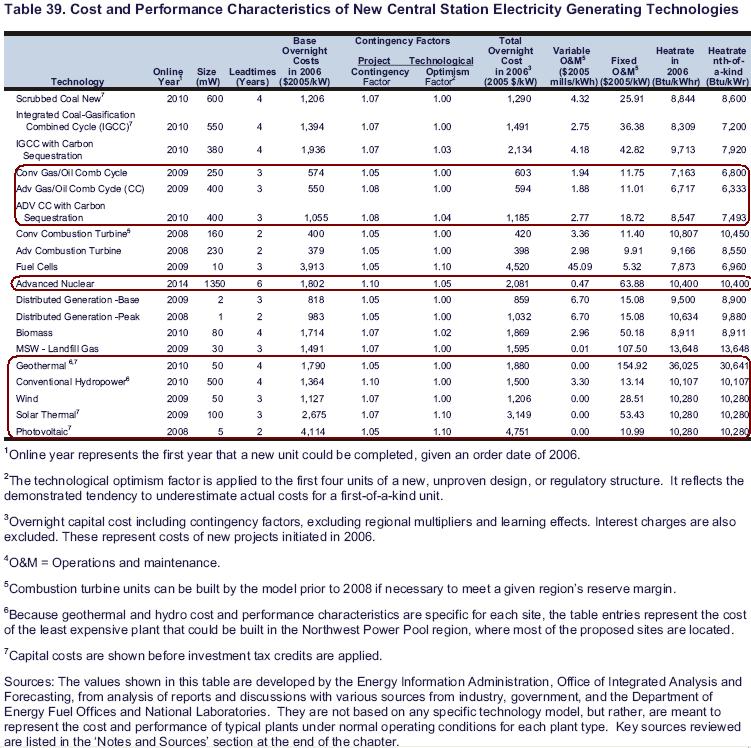
Naturals gas needs to look at the cost of fuel. Most of the costs for natural gas and coal and oil are from the higher operating and fuel costs.
Nuclear has 90% operating load.
Your quoted cost per KW for nuclear is about 10 times higher than the DOE figure which I present in an image of a table in this thread on cenral power source costs. (Because you are perhaps unintentionally making massive accounting mistakes.)
You are also not comparing the same numbers. You are comparing grossed up numbers for nuclear that take into account inflation over construction and allowance for funds used during construction (AFUDC). AFUDC is subsequently recovered through depreciation and is allowed a return through its inclusion in the rate base.
http://www.nysscpa.org/cpajournal/old/08033870.htm
Any decommissioning costs would need to be adjusted by taking the present value of the costs. So if the plant lasts 60-80 years then reduce the anticipated decommissioning costs by that amount. Also, all other energy sources would need to have full life cycle pollutant adjustments and decommissioning costs built in as well for a level comparison. Decommission costs for most plants is less than 1 billion. If reduced for the time value of money it would be about $30 million to set aside money in a fund with long term investment rates to get to the needed money.
Plus the set aside would not happen until X years of plant life + time to construct.
60 years at 6% = 31 times less
40 years at 6% = 10 times less
40 years at 8% = 20 times less
60 years at 8% = 94 times less
70 years at 8% = 202 times less
80 years at 8% = 427 times less
We do not pay full decommissioning costs before the plant is built or it is operated.
So your decommissioning costs are too high and they do not adjust for when the decommissioning happens.
Naturals gas needs to look at the cost of fuel. Most of the costs for natural gas and coal and oil are from the higher operating and fuel costs.
The cost of fuel has to be heroic to justify 5-8 bucks a Watt nukes just on that basis.
Nuclear has 90% operating load.
80% is more realistic for a larger penetration rate of nuclear power. France is ~80% nuclear but exports a significant amount, allowing higher capacity factor than usual. This does not work for the US as a whole nor for Europe as a whole, due to the broad similarity of load curves everyone will want to export at the same time. And even then France can only get ~77% capacity factor. It's much less if you take into account the fact that the average load factor of the US grid is lower than France's, combined with the aforementioned factoid that exporting power benefits don't apply.
Your quoted cost per KW for nuclear is about 10 times higher than the DOE figure which I present in an image of a table in this thread on cenral power source costs. (Because you are perhaps unintentionally making massive accounting mistakes.)
Nope, your reference has become obsolete. It's figures are no longer correct; my figures are the latest updates on real projects being commissioned/built right now.
Any decommissioning costs would need to be adjusted by taking the present value of the costs.
That estimate was also made by the NDA. The 12,000 figure is lowered by discounting, but still bigger than $ 6000 per kW. You cannot do discounting twice; if you allow discounting on the decommissioning fund you can't use the adjusted $ 6000 per kW figure.
So if the plant lasts 60-80 years then reduce the anticipated decommissioning costs by that amount.
No. I use proven figures. The longest operated nuke in the US operated for 35 years. 60-80 is possible but unproven and therefore it would be biased to use such figures.
So your decommissioning costs are too high and they do not adjust for when the decommissioning happens.
Cost is cost. It's accurate. It has to be paid. Yes, it's not front-loaded, and I already mentioned that. But the figure is accurate.
All energy construction costs are rising with the commodity price rises.
http://www.edisonfoundation.net/Rising_Utility_Construction_Costs.pdf
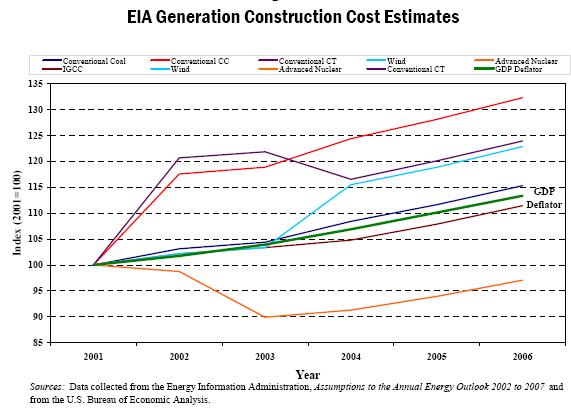
From the Sept 2007 Batelle, Edison foundation report. Nuclear power costs have been staying more stable than other kinds of energy. Nuclear is the lowest line, which means prices moved the least.
Oyster Creek has been operating since 1969. 40 years of operation and it is getting extended to operate for another 20 years. Half of the plants have had license extensions for 20 more years to 60 years. To pretend that they will not keep running to the end of the 60 year extended licenses is biased and blatently misleading.
The NDA is the UK's decommissioning authority and they have had the poorest performance on decommissioning and have a reactor type that is more costly to decommission. An OECD survey published in 2003 reported US dollar (2001) costs by reactor type. For western PWRs, most were $200-500/kWe, for VVERs costs were around $330/kWe, for BWRs $300-550/kWe, for CANDU $270-430/kWe. For gas-cooled reactors the costs were much higher due to the greater amount of radioactive materials involved, reaching $2600/kWe for some UK Magnox reactors.
[If I am not building a gas UK Magnox reactor then decommissioning costs are a lot less, which they are not in Florida ]
You are cherry picking and mixing data. You have not discounted once and are mixing up reactors.
Financing methods vary from country to country. Among the most common are:
Prepayment, where money is deposited in a separate account to cover decommissioning costs even before the plant begins operation. This may be done in a number of ways but the funds cannot be withdrawn other than for decommissioning purposes.
External sinking fund (Nuclear Power Levy): This is built up over the years from a percentage of the electricity rates charged to consumers. Proceeds are placed in a trust fund outside the utility's control. This is the main US system, where sufficient funds are set aside during the reactor's operatinig lifetime to cover the cost of decommissioning.
Surety fund, letter of credit, or insurance purchased by the utility to guarantee that decommissioning costs will be covered even if the utility defaults.
In USA, utilities are collecting 0.1 to 0.2 cents/kWh to fund decommissioning. They must then report regularly to the NRC on the status of their decommissioning funds. As of 2001, $23.7 billion of the total estimated cost of decommissioning all US nuclear power plants had been collected, leaving a liability of about $11.6 billion to be covered over the operating lives of 104 reactors (on basis of average $320 million per unit).
In USA many utilities estimates now average $325 million per reactor all-up (1998 $).
http://www.uic.com.au/nip13.htm
http://en.wikipedia.org/wiki/Nuclear_decommissioning#Cost_of_decommissio...
http://www.nrc.gov/reading-rm/doc-collections/news/2003/03-125.html
http://npj.goinfo.com/NPJMain.nsf/0/e3cbea48edde388d86256c3700638f70?Ope...
All energy construction costs are rising with the commodity price rises.
Already dealt with that - the argument doesn't hold up to scrutiny as the increases in cost are monstrously greater than just the rise in raw materials. Think about it. Wind uses far more material than nuclear, but hasn't risen nearly as strong, as your Edison reference shows. This undermines your argument. It has more to do with advanced reactor technology and more advanced (non-commodity) materials and expert labour being undersupplied compared to recent increases in worldwide nuclear power plant builds.
To pretend that they will not keep running to the end of the 60 year extended licenses is biased and blatently misleading.
To pretend that nuclear power plants ALL last 60 years when NONE of them have EVER ran that long ANYWHERE on earth is biased and blatently misleading. I base my analysis on empirical data. You base yours on predictions and projections. Yours is not a very objective analysis Brian.
From Wikipedia:
Consumers Energy had previously announced that Big Rock Point's operating license would not be renewed when it expired on May 31, 2000. However, economics proved in January 1997 that it was not feasible to keep Big Rock Point running to the license's expiration date.
An OECD survey published in 2003 reported US dollar (2001) costs by reactor type.
For someone who calls himself a futurologist, you are using surprisingly antiquated data. That's ironic, don't you think?
for BWRs $300-550/kWe
Big Rock Point cost an order of magnitude more than that. Decommissioning cost vary so wildly that it is difficult to state such a thing without being misleading.
The NDA is the UK's decommissioning authority and they have had the poorest performance on decommissioning and have a reactor type that is more costly to decommission.
Well there are various other costs as well, such as chemical contamination of sites etc. which are significant, and were underestimated previously. The Magnox design is more expensive to decommission, 2600 per kWe is the claim. Well it turned out to be a bit more than that, and it could be that the estimate gets raised again in the future, if history is any lesson. So why should I trust your obsolete sources?
You are cherry picking and mixing data. You have not discounted once and are mixing up reactors.
The NDA estimate is for the entire fleet. It's 12000 per kW and still more than 6000 per kW after discounting. You don't have to believe me, just check the NDA website. You show me just one nuke, Oyster Creek. It's you who is cherry picking data Brian. I've given you multiple real project costings in the US as well, and I didn't even take into account decommissioning for the US reactors, so no, I am not mixing things up.
In USA, utilities are collecting 0.1 to 0.2 cents/kWh to fund decommissioning.
Based on the average decommissioning cost so far. That may not prove to be the best assumption.
Let's see, 0.1 to 0.2 cents/kWh based on 325 per kW. For the UK, it's $ 12,000 per kW so that means 3.7 to 7.4 cents/kWh. Or 1.9 to 3.8 cents/kWh when discounting is taken into account. (give or take, depending on exchange rates etc, check the NDA website.)
Look, decommissioning cost is reasonable if done well in a fund with interest. My point here is, if you assume low costs for decommissioning you can get into trouble in the end. It's better to pay a bit more, and have a bigger financial buffer at the end. What can go wrong? If there's any money left, then that's great, it can be used for new projects and stuff.
By the way, I'm not too happy with you quoting interest (nuclear) groups.
What goes wrong is that nuclear then looks too expensive, and people have even more reason not to build it.
Since the nukers want to see the things built, they'll always understate the costs.
Also, you are not comparing overnight costs for each source. Every power generation has to add in other owner costs like land and site prep. Will the other power sources not need land or connection to the grid ?
The overnight costs quoted in the FPL are from $6.7 billion, or $2,444/kW, to $9.8 billion, or $3,582/kW.
In March 2008 Progress Energy published estimates for building two new Westinghouse AP1000 units on a greenfield site in Florida. If built within 18 months of each other, overnight capital cost for the first would be $5144 per kilowatt and the second $3376/kW. The costs include land, licence application, initial core load, cooling towers, owner's costs, insurance and taxes, escalation and contingencies. This would appear to be a wider scope for overnight capital cost than usual. Interest adds about one third to the combined figure - $3.2 billion, and infrastructure - notably 320 km of transmission lines - about another $3 billion. The units are expected on line in 2016 and 2017 and are expected to save customers some $930 million per year relative to natural gas-fired generation.
http://www.uic.com.au/nip08.htm
China contracted for $5.3 billion for four AP1000 in 2007. Construction started. The contract was for $1,130/kw
http://www.climateark.org/shared/reader/welcome.aspx?linkid=65127
four AP1000 in the USA, contract in 2008 $13.7 billion, $2927/kw
http://news.smh.com.au/toshiba-in-talks-on-lucrative-us-nuclear-plant-de...
Also, you are not comparing overnight costs for each source. Every power generation has to add in other owner costs like land and site prep. Will the other power sources not need land or connection to the grid ?
I've mentioned it, but it's a small part of the cost. More relevant is that the interest during construction is significant and has to be paid during that time, so a loan is required for that as well, and is thus subject to regular discounting. If not then that can be seen as a fiscal benefit ie a hidden subsidy. It's best to compare total project cost of nuclear with total project cost of other power sources, as that gives the most useful comparison - all project costs are front loaded.
You can get the updated figures in the tables here. Check out Table 3: Comparison of all-in cost estimates. Total project cost for Progress energy is $ 6300 per kW.
Oh, and you might want to be careful with Chinese power plant figures. I've done some research there. The available data is notoriously unreliable.
We will discuss the real costs of these projects further when they are 100% finished and operating fully.
Big Gav, Yes indeed uranium mine safety practices during the cold war were poor, but current uranium mining practices are much more in tune with safety issues. Worker's safety is best protected by strong unions, and by an aware public that will not tolerate shoddy and unsafe practices.
That makes 2 strikes. Have you not noticed the trends in the US for the last 30 years? Progressively weaker unions and fewer and fewer regulations on big businesses and industries of every type. What on earth makes you think this trend will suddenly reverse? Additional question is what makes anyone think we will clean up the existing mess from coal before we go on, full sail, into nuclear power? What makes you think that the energy producing industry will tolerate stronger unions and more regulation?
Please, come back to earth!
fewer and fewer regulations on big businesses and industries of every type.
Are you sure on that? Or is it regulations are subject to selective enforcement?
Well then you're just screwed because all that iron, coal, bauxite, indium, copper, lithium and other neat minerals you're going to need in obscene amounts aren't inherently cleaner to mine and process than uranium.
And do you really want farmers to toss all that uranium right where food crops are grown instead of co-mining it with phosphates? (to the tune of ~100 g per tonne of phosphate rock).
And do you really want farmers to toss all that uranium right where food crops are grown
The fertilizer, which the company describes as treated raffinate, is processed from wastes at Kerr-McGee's Sequoyah Fuels Facility here, one of two plants in the United States that purify milled uranium, a step in the process of making nuclear fuel rods for power plants.
http://query.nytimes.com/gst/fullpage.html?res=9B0DEEDB1E31F935A25752C1A...
(So it seems the government and farmers do nor care - next?
I believe it's ammonium nitrate solution... great fertiliser!
Phosphate rock, and phosphate fertiliser made from it, has significant amounts of uranium and daughter nuclides and heavy metals in it, you know. Probably a lot more than this stuff does.
Ironically Gov. Shwarzenegger announced plans to remove California's ban on building new nuclear plants a few weeks ago. The LA times has been leading the crusade against nuclear, although most other newspapers, even the New York times, have been running very favorable editorials.
http://www.nytimes.com/2008/01/24/opinion/24cohen.html?ref=opinion
What I'm wondering is, where are the stories about the tarsands, and their exponentially larger impact to tribal lands in Alberta TODAY? Or coal mining deaths that occur every year, not just in the 1940s? If something is a million times as energy dense, you're mining much, much less.
And of course, there is no mention that today we mine the stuff using in-situ leaching.
Gav? This post again?
The radiologic health protection practices during the early years of intense uranium mining (to principally feel the nuclear arms race) were abominably tragic, as was the Chernobyl accident and (financially for the utility at least) Three Mile Island.
But these were all decades ago. Today mining standards are significantly more evolved, robust reactor designs are the global standard and operational practices, transient response and accident mitigation training and procedures are mature.
While one must remain aware of the history as justification for the better practices of today, I fail to understand the broader relevance to a modern, objective consideration of nuclear power.
If you’re really concerned about energy related deaths due to unsafe practices today; I suggest you become a mining standards activist in China and park yourself and your picket sign outside one of their many coal mines.
Posts such as this serve only one objective and I doubt it has anything to do with finding a solution to any energy or climate related challenge.
I am sorry if I come off as aggressive, angry or offensive; but I am beginning to wonder why you have been charged with the maintenance of this blog.
Remember that the nuclear advocates are talking about a significant ramp up in nuclear generation. Regulatory regimes will become more thinly spread and some unscrupulous companies and nations may well try to cash in. After all, economic growth is our god, and we must worship it, at any expense.
As nuclear ramps up, it is simple statistics that the number of incidences will increase and the likelihood of a major incident also increases.
That is why inherently-safe reactor types must be the ones developed and deployed in mass quantities. The liquid-fluoride thorium reactor is not capable of catastrophic failure due to the inherent self-regulation of the reactivity, as well as the fail-safe nature of decay heat removal.
Even if the incidences went up a lot, nuclear would still be much safer than any other major source of power. The industry is way over built now from a safety perspective due to the relentless unjustified attacks on it over the last few decades.
The industry is way over built now from a safety perspective
That attitude is precisely why I hesitate to support nuclear power (I somewhat reluctantly do, but ONLY if done right). *IF* Zimmer or Bellefonte could have gotten an operating license (see attitude above) I would oppose nuclear power.
The industry MUST (and can) build safer as the number of plants increase.
Best Hopes for keeping the pro-nukes out of policy making,
Alan
nuclear would still be much safer than any other major source of power.
So safe it puts guards asleep?
http://www.google.com/search?q=sleeping+wackenhut+guards+nuclear+plant
Nuclear power is ba far the safest source of electricity. There are more deaths associated with windmills than with reactors despite the much smaller installed generation base. Dams and pump storage facilities are notorious killers. They can be far more dangerous than reactors in the number of human lives that are in harms way. Finally no one has kept track of deaths associated with solar generation of electricity. PV production is a notorious source of environmental pollution, the Chinese dying like flies from PV related pollution, and solar advocates are doing a good job of covering the problem up. In addition no one knows how many people died from falling off a roof while installing a solar panel, solar advocates don't have enough fingers and toes to count them all.
Charles, you are talking about what the industry is like now. All I'm saying is that those who advocate a big build out in nuclear must accept that the absolute number of incidents will thus increase, even if the percentage remains small, or even decreases. Some of these increased instances will be significant and a few are likely to be very significant. That's just the nature of anything we do. There are associated risks and nothing can be made 100% safe. So an increased incidence rate must be factored in to decisions on a nuclear build up. To ignore that would be foolish.
On a related topic, we should also consider that unstable societies may increase the rate of significant incidences. Is it unthinkable that previously stable societies may become unstable in the foreseeable future?
sofistek, Risks are risks. If you increase the scale of solar or wind power generation you proportionately increase the risks. Empirical evidence suggest that more people are going to die per MW of generated electricity from windmills, than from nuclear. We don't know what the risks are for solar because no one is keeping track of the accidents and deaths. It is possible to lessen the risks associated with nuclear in two ways:
1. To build in superior safety features like passive emergence cooling. Examples include the AP-1000 and the ESBWR. The probability of core meltdown with the ESBWR is once every 29 million years, and the ESBWR has superior containment features in the very unlikely event of a worst case core meltdown.
2. To build inherently safe reactors like the Pebble Bed Reactor, or the Liquid Fluoride Thorium Reactor.
Little effort is being made to improve the safety of solar or wind power generators. Indeed there is a virtually universal denial that there are any safety, health or environmental problems associated with renewable power.
What empirical evidence? Would a significant incident have global repercussions? Would it leave hundreds of square kilometres uninhabitable? Would it have long term effects? Would it increase terrorism risks?
You mentioned "inherently safe" again. Why do you do that? Nothing is inherently safe. It (the design, not the construction) might be inherently safer but not inherently safe.
Do you think all companies in all regions in all countries are bound to have the same ultra standards of safety that you seem to think is a given?
All I'm saying, and what you appear to be side-stepping, is that an increase in numbers of nuclear plants (some are advocating even more smaller plants) will, without doubt, increase the overall likelihood of safety incidents and of a major incident. It would just be a matter of time.
Yes, there are reactor designs that are inherently safe. They are incapable of the type of radioactive release that concerns you. Learn more about them.
Yes, there are reactor designs that are inherently safe. Learn more about them.
So nice of you to provide pointers to these wonders.
He said that the reactor designs were safe.
Designs are always safe, it's just the thing itself that mightn't be :)
There are a few "Generation IV" designs which are supposed to be utterly safe, can never melt down or explode or anything like that... but they're just on paper. I'm old enough to remember the Space Shuttle was supposed to make putting things into orbit just $500/lb, and lead to 24 launches a year... Its design on paper said that was what it'd be like. And yet...
Kiashu says
Sign. Kiashu, several commenters have discussed liquid core reactors. Melting down is not a problem for them because they are designed to run with melted fuel. Melt down is part of the design and is well controlled. Nor is it possible for a LFTR to explode. Now the LFTR is more than a concept on paper. As I have pointed out two Molten Salt Reactors were built during the 1950's and 1960's and proof of concept experiments were run with them.
Uri Gat and H.L. Dodds discuse the safety of MSRs here:
http://weblog.xanga.com/bartoncii/605511152/molten-salt-reactors---safet...
Gat and Dodds state:
Gat and Dodds point out a passive safety feature of the MSR, the freeze valve:
Gat and Dodds point out the advantages of a molten fuel, in the event of an accidental release, it freezes, thus containing radioactive products within the frozen fuel matrix:
I will call your attention to the rest of the Gat and Dodds' paper which outlines more safety features of the MSR if you are interested in further investigation.
The pebble bed reactor is also inherently safe. Its coolant gas can be shut off and its chain reaction immediately ceases. While the fuel of the PBR remains very hot, its fuel does not melt down nor does it explode. Again this is not just on paper.
http://en.wikipedia.org/wiki/Pebble_bed_reactor
A proof of concept PBR was built in Germany, and operated successfully for 21 years until the German Government shut it down for political reasons in 1988. A second Pebble Bed reactor was constructed in Germany and operated for a short period of time before the politicians shut it down. Research on PBRs continues in South Africa and in China.
Coal plant designs are not safe.
They are designed to allow air pollution and mercury pollution.
Oil and natural gas facilities are also designed for air pollution.
Regular no accident operation facilities are designed to spew thousands of tons of pollution.
Even the CO2 sequestering designs would only use CO2 scrubbers and allow the other particulates and pollutants through.
The statistics show that nuclear has been as safe or safer than all other power sources on a terawatt hour generation basis. The new plants should even be even safer.
Space shuttle launch prices were based upon high volume of launches which did not happen and the entire design got bastardized by the political process. In hindsight it is also clear that the costs also do not come down without reducing the army of people needed to launch.
Nuclear power already has a substantial amount of volume and there is no doubt that there is volume demand for energy. To get to lower space luanch prices besides supplying vehicles to make the launches cheaper there needs to be more demand for space launches. Demand has to be generated with policy or business plans. A chicken and egg problem.
Plus nuclear power plants have 435 that are operating and already have competitive operating prices for energy supplied. So it is a matter of making what is already working even better and if the attempts to make a better design do not work out there are the incremental improvements to existing systems.
6 competing GenIV options, the gen 3.5 designs, modification to existing processes with new fuel coatings and geometries.
Were there already 400+ successfully operating reusable space ships in the 1970s? Did they have competing refinements to successful rockets that might also deliver cheaper performance ? Once the space shuttle design started showing that it was not going to deliver were there competing options to switch to ?
Empirical evidence for our ability to let the longer-lived isotopes cool down is non-existent. Impact of the dissemination of extra nuclear particles throughout the environment is very difficult to quantity.
> Nuclear power is ba far the safest source of electricity.
and
> no one has kept track of deaths associated with solar generation of electricity. PV production is a notorious source of environmental pollution, the Chinese dying like flies from PV related pollution, and solar advocates are doing a good job of covering the problem up.
Can one be any more biased than this??
How is that possibly biased?
Nuclear power is by far the safest source of electricity. That's not bias, it's a simple statement of a fact.
The manufacturing of Si photovoltaics in China is causing widespread dumping and pollution of silicon tetrachloride wastes, because there's no environmental regulation.
Solar PV manufacturing is more energetically and chemically intensive, per GWh of electricity delivered, than manufacturing nuclear fuels.
> Nuclear power is by far the safest source of electricity.
And people espousing these statements say, "and you can't count Chernobyl, because it's not really nuclear power" or somesuch. Sorry, widespread use of nuclear power is going to involve nations that choose to approach safety in any manner they see fit, and 'fool-proof' is an oxymoron, especially when software is involved.
> The manufacturing of Si photovoltaics in China is causing widespread dumping and pollution
The manufacturing of everything in China is causing "widespread dumping and pollution".
You focus only on the manufacturing of fuels, not on the waste products, mining, and decommissioning, so your bias is showing through with your emphasis.
Again, I support an increase in nuclear along with renewables to eliminate coal burning, but believe that nuclear zealotry will backfire in the faces of the zealots.
And people espousing these statements say, "and you can't count Chernobyl, because it's not really nuclear power" or somesuch.
This time around it was "Consider only the American case".
Will Stewart, it seems your arguments involves something of a contradiction. On one hand you would count Chernobyl against nuclear power, despite the weak safety standards of the Soviet establishment. On the other hand you wish to not count pollution of the Chinese PV industry against PV power generation because of the low safety and environmental problems of the Chinese establishment. And then you accuse someone else of bias.
You have misrepresented my statements, creating a strawman. Please read my posts carefully before responding next time.
And the mass production of nuclear power plants would be different how exactly? That's not inevitably linked to solar power per se, but to the production methods in China and the externalization of productions costs throughout the capitalist world.
Could we have a source for that, please?
Wind generated accidents here. The American nuclear industry has not had any deaths associated with reactor operations in many years.
http://www.wind-works.org/articles/BreathLife.html
Most of those deaths appear to be related to the construction or moving of wind turbines. What was the mortality rate during mining and processing of uranium, and during the construction and maintenance of nuclear reactors?
What he said.
This suggests that the problem is not with wind turbines themselves being inherently dangerous, but with the US having poorer workplace health and safety practices than than Europe.
So what we learn from this is not that wind turbines are deadly, but that the US needs to improve its workplace health and safety practices. Which is not going to come as a surprise to many people at all.
If a parachutist fell into a nuclear reactor's steam outlet I daresay that'd kill her, too. Again, the problem here is not specific to wind turbines.
Nuclear power is ba far the safest source of electricity.
So long as you ignore how when the man made machines that attempt to harness fission experience certain failure modes the land becomes un-inhabitable, the miners die off/health problems, how man has failed to dispose of what was created, (and on and on)
And the testament to your veracity:
Finally no one has kept track of deaths associated with solar generation of electricity. PV production is a notorious source of environmental pollution,
I see. So the deaths and damage from the mining, processing, and use of depleted uranium are *NOT* worthy of your attention, yet you are claiming:
the Chinese dying like flies from PV related pollution
'dying like flies' - What an appeal to emotion VS actual argument with data. Man up and show data.
'from PV related pollution' - I see. As the 'knock off' effects you claim matter - there are plenty of the dead and maimed in Kosovo, Afagainstan, and Iraq suffering from the use of Depleted Uranium.
solar advocates are doing a good job of covering the problem up. In addition no one knows how many people died from falling off a roof while installing a solar panel, solar advocates don't have enough fingers and toes to count them all.
Now here you claim others are ignorant, yet:
You expressed success of a project you 'wondered' about.
You use language to attempt to claim many deaths - yet you have not produced proof that you are right. Then you claim the 'other side' lacks data.
YEa....Why again should anyone care about what you say?
eric blair, There are mining and processing deaths associated with renewable energy too. No one keeps track of them as far as I can tell. As has been pointed out elsewhere in the comment section of this blog, the is currently no uranium mining in the United States. Statistics on mining deaths in foreign countries are hard to come by. People do keep track of accidents and deaths in the wind in the wind industry. We can compare the mortality rate associated with wind generation and reactor energy operations for that reason. Since 1975 there have been no deaths associated with power reactor operations in the United States.
Paul Gipe states that there have been 13 deaths associated with wind generation in the United States.
http://www.wind-works.org/articles/BreathLife.html
So you are not willing to defend your statements with numbers, data - and you will let stand that your position is based on emotional appeal.
That's fine.
Since 1975 there have been no deaths associated with power reactor operations in the United States.
Peak Oil is a worldwide problem - yet you cherry pick the data to support your position. No references for YOUR positive claims - just feel good words.
"when the man made machines that attempt to harness fission experience certain failure modes the land becomes un-inhabitable"
Is, say, Harrisburg, Pennsylvania uninhabitable? No!
Is Kiev, Ukraine unhabitable? No!
Are Hiroshima or Nagasaki uninhabitable? No! - and no nuclear power plant can ever, possibly, remotely come close to doing that!
The geological disposal of radioactive waste has been a solved problem, well, ever since two billion years ago when nature started doing it at Oklo.
Are there deaths occuring, today - not in the 50's during the race to mine uranium for the arms race - from mining uranium for commercial nuclear power?
The use of uranium in munitions used in war has got nothing to do with nuclear electricity generation - it's irrelevant.
So, how many "safety related incidents" are there actually happening in the world today involving commercial nuclear electricity generation that actually hurt or harm people or the environment, for real?
When was the last time HLW from commercial nuclear electricity generation actually harmed or hurt people or the environment, for real? (Don't bother talking about, say, Hanford, which has got absolutely nothing to do with nuclear power.)
What is the "likelihood of a major accident" predicted to be? Even when a "major accident" happens, what do you foresee actually happening, in the real world, for real? What is actually going to happen?
The deaths from commercial nuclear power generation in the United States today are... zero.
Outside of the Soviet Union, in fact, I'm not aware of any deaths resulting from the use of commercial nuclear power generation, ever.
A man was killed by exposure to uranium hexafluoride when a cylinder of UF6 burst once, in the US - but I consider that an industrial chemical accident, not something related to nuclear energy - it's not the uranium or radioactivity or nuclear properties that make UF6 a dangerous chemical.
The Tokaimura accident in Japan involved 19% enriched U-235 for an experimental fast reactor research prototype - when you start dealing with very highly enriched U-235, obviously you've got to be a lot more careful about accidental criticality - 19% is far more dangerous than the 3.5% or so used in current LWR nuclear power technology. So, I don't consider that a commercial nuclear power accident.
You forget the increased deaths from cancer et al related to increased radiation exposure. A small # of deaths, but NOT zero.
And I worked with a scarred electrician whose helper died in a nuclear power plant accident. High voltage industrial accident, but it was in a nuclear power plant. One of many I am sure.
Alan
Yes, accidents involving, for example, high voltage electrical systems, and steam systems, for example, are not uncommon in the energy generation industry.
They're certainly far, far less frequent in the nuclear industry than in the fossil-fuelled generation industry.
But even, say, electrical accidents do happen in the nuclear industry, I won't call them "nuclear accidents". If somebody is killed by nuclear generated electricity in a tragic accident outside the plant fence it's not a nuclear accident - and if the same thing happens inside the plant fence I don't think it's a nuclear accident, either.
"increased deaths from cancer et al" might not be zero, quite true - but it's a very, very small number - IF you assume that the LNT hypothesis is factually true. Remember - LNT is a hypothesis in (almost) the same sense that Intelligent Design is a hypothesis. Even if you assume LNT as true, it's so darn difficult to quantify the number.
If we average out the very small positive number resulting from LNT analysis with the negative numbers resulting from applying Hormesis models, I think we can safely say zero is a good working number.
If you say that nuclear power saves lives by replacing far more dangerous, more risky fossil fuels, that's an indisputable fact.
They're certainly far, far less frequent in the nuclear industry than in the fossil-fuelled generation industry.
I would judge the opposite. Higher quality equipment is required for safety related systems, true (same quality for non-safety systems) but the level of testing and maintenance is one or two orders of magnitude higher in a nuke than a FF plant.
The more you mess with it, the greater the number of accidents, is my judgment.
Alan
Discussion on this issue is certainly important and worthwhile but numbers are sorely lacking for many reasons. I'm not begging off; I'll look for definitive links.
Other energy sources? They are presently worse. Folks rightly point out that our present methods of energy and fuel production and use do cause serious damage to the environment as well as direct death and shortened life spans of humanity - and that very little will be done about it, one reason being that it would be too costly to remediate the dangers. True enough, as pointed out by Wallerstein in his essay that, I believe, was linked to on TOD.
Thus my concern with the *next big thing* in fuel and energy production; now is the time - as we move onward with our seeking of sources of both - to realize that if we *don't* pay close attention to protecting the environment and public health while investigating and implementing the replacements for what now exists, then we will have likely created a situation nearly identical to the one we now have. Namely too late, too expensive and lack of will to remediate the almost certain known *unintended consequences* of wholesale development of future power sources.
Re: your last statement above- It is my belief that it is universally understood that 'nuclear waste' should be permanently isolated in deep geologic repositories. But this is not happening and it should before we increase the amount being generated. Is it is really not "killing anyone" now? Are you sure?
I am not sure that this is 'universal'. There is at least one small dissenting voice - mine!
It seems to me that nuclear power has made a rod for it's own back by hasty development mainly in the interests of the weapons industry, and that we should aim for wastes which are dangerous in terms of hundreds of years.
It is also my understanding that this is possible, if some part of the reactor fleet is appropriately designed.
Even if more expensive this seems to me to be the option we should go for.
I believe that nuclear waste (unburned fuel) should be temporarily stored in containers as they have for the last few decades and then used as fuel for new high burn reactors. All of the components should be productively used.
A much better solution for now it to place large signs on the waste with the names of the Senators and Congressperson who were in office when the waste was generated together with the skull and crossbones and other signs indicating the danger. Images should appear at the beginning and end of every TV program broadcast together with mornful music. When Calvert Cliffs is refueled, an airplane trailing a sign saying "More Steny Hoyer poisonous lethal nuclear waste" should be flown all over the 5th district for a month. Same for plants in other districts.
More reactors is definitely not the solution. If you are in a hole and want to get out the first thing to do is to stop digging. Shut down the nuclear power plants.
Chris
So, what exactly is your argument?
Why isn't nuclear power a solution to our energy needs? What's your problem with it? Why should we shut down nuclear power plants?
I thought we were going to put our carbon dioxide in those? :)
SkipinBluff wrote:
Skip - do you really believe that there has not been any work done on this issue with regards to protecting people and the environment from the effects of large scale use of nuclear fission technology? I have dozens of books in my library that discuss the health effects of radiation that document numerous studies conducted over many decades.
If you want to do some research in this area, you could start with the thousands of papers that are available at Radiation, Science and Health.
The next big thing is here. We know that fission power related health effects are enormously lower on a percentage basis than the health effects of continuing our massive dependence on combustion and we are pretty sure that continuing our present course of pouring all kinds of pollutants into the atmosphere is putting our collective survival at risk.
Don't you think it is time to move on and work to replace as much combustion as possible? Right now, fission is limited to the large scale electrical power market and a few specialty transportation applications like aircraft carriers, ice breakers and submarines, but there are a number of near term applications where the characteristics of nuclear fission power are well suited to directly replacing various fossil fuels including coal, oil and natural gas.
There might be some better technology available sometime in the distant future, but right now I can see no prospects of finding that ideal energy source. For my money, well designed fission plants are already superior to all other choices and there is plenty of room for improvement.
It may be true that nuclear energy carries less overall health risks than fossil fuel energy - I doubt it, but I suppose if you broaden the "health risks" enough to include the war in Iraq and car crashes and the like then at some point it becomes true.
But let's assume nuclear is heaps safer than fossil fuels: are these our only two choices?
Geothermal

Tidal
Hydroelectric

Solar PV

Solar thermal

Wind turbines

I exclude wave power because it's not commercially-proven, it's all experimental, and biomass because it's not been shown to be done in a sustainable way.
So actually it turns out that it's not either fossil fuels or nuclear, but that we have a few other choices. Amazing, that, that the world doesn't split evenly between black and white.
Precisely.
Skip - do you really believe that there has not been any work done on this issue with regards to protecting people and the environment from the effects of large scale use of nuclear fission technology?
Still waiting for one of the pro-nukers to explain
http://www.google.com/search?q=sleeping+wackenhut+guards+nuclear+plant
Don't you think it is time to move on and work to replace as much combustion as possible?
Yes. But if sleeping guards can't have actions taken via proper channels, why should the process of fission power be trusted?
Well?
I have described nuclear plant security with an extra picture but here is the bulk of the info for those who do not want to click through.
Some anecdotes of incidents where no one died and nothing actually happened.
Plus the people were sleeping "in the ready room".
They were not at the time supposed to be guarding anything.
similarly if a surgeon fell asleep in the operating room that would be one thing but if they were in the break room then the impact is ??
In this case there were other guards at the necessary points.
http://neinuclearnotes.blogspot.com/2008/02/thoughts-from-rod-adams-on-p...
http://atomicinsights.blogspot.com/2008/02/sleeping-guard-video-from-you...
Report on security guards for critical infrastructure.
http://fas.org/sgp/crs/RL32670.pdf
5000-8000 guards among the 67 nuclear sites. (some with multiple reactors)
So about 100 guards per nuclear site.
Say 20-30 per shift.
If I have 15 on active duty and 5 taking a break, does it matter if the 5 are on the toilet, eating or sleeping ?
Guards are not the only layer of security.
http://www.gao.gov/new.items/d06388.pdf
Detection. At all four sites, the owners installed additional cameras throughout different areas of the sites and instituted random patrols in the owner-controlled areas.
Delay. The sites we visited installed a variety of devices designed to delay attackers and allow security officers more time to respond to their posts and fire upon attackers. The sites generally installed these delay devices throughout the protected areas so that attackers would have to defeat multiple security systems before reaching vital areas or equipment. For example, the sites installed fences outside the buildings housing the reactors and other vital equipment and blocked off entrances to make it more difficult for attackers to enter the buildings. Similarly, the sites installed a variety of delay devices within the reactor and other buildings, some of which are permanent and others that security officers would deploy in the event of an attack.
Response. Each of the four sites we visited constructed bullet-resistant structures at various locations in the protected area or within buildings, increased the minimum number of security officers defending the sites at all times, and expanded the amount of training provided to them.
the new vehicle barrier systems consisted of rows of large steel-reinforced concrete blocks, or (at one plant) large boulders weighing up to 7 tons in combination with piles of smaller rocks. (See fig. 3 for an illustration of a vehicle barrier system.) The vehicle barrier systems either completely encircled the plants (except for entrances manned by armed security officers) or formed a continuous barrier in combination with natural or manmade terrain features, such as bodies of water or trenches, that would prevent a vehicle from approaching the sites.
While in many cases it may be true that increasing guard numbers can make a
facility more secure, in other cases the relationship between guard deployment and facility security may be less clear. In guarding, quantity does not necessarily ensure quality. Analysts have suggested several reasons why increasing the number of guards at a given facility might not make it more secure, or might even make it less secure.
- Guards can only meet “guardable” threats, such as physical intrusion
or surveillance by potential terrorists. Any number of guards could
not be expected to prevent attack by a commandeered airliner, or a
remote cyber-attack on facility safety systems.
- If the nature of a terrorist attack is potentially “guardable,” but
guards are not trained to recognize it, additional guards may be no
more likely to respond to it effectively than fewer guards.
- If an increase in the number of guards at a facility is accomplished
by making the existing force work more hours, the guards may
become fatigued, disgruntled, and, consequently, less effective.
- Increasing the size of a guard force may lead to confusion about
individual responsibility and reporting relationships, which may
reduce guard effectiveness.
- Expanding a guard force may increase opportunities for hostile
“insiders” to infiltrate that force. Having a larger guard force,
however, might make it more difficult for such an insider to
successfully conduct hostile activities.
I will not be repeating this reply across the dozen times that you posted this non-incident.
Some anecdotes of incidents where no one died and nothing actually happened.
Hrmmm lets see. Sleeping guards, reported up the chain of command, where nothing was done UNTIL videos were put up on the web - THEN action was taken.
Are you going to next claim that the sleeping was within the operating policy set up to make sure safe operation of the plant is maintained?
I will not be repeating this reply across the dozen times that you posted this non-incident.
Thank you for at least responding. I only posted it many times because none of the pro-nukers were responding to a simple failure of the safety policy.
This thread is a summary of what was to be 'Part 3' of my original submission of 4 weeks ago...
Review of the Literature - New Reactor Designs
Views held by many include:
“New Designs produce no nuclear waste.”
“After 20 half-lives have passed the waste is no more radioactive than the original ore” - or some such equivalent statement. This is a meaningful statement only after all nuclear reactors have been shut down - and then for some fission products, 20 HL’s is millions of years, 10 HL’s also.
Addressing the first view I’ll use the example often mentioned - the MSR.
Charles Barton provided the following link (from 1970) to advances in this technology:
NAT_MSBRfuelcycle.pdf
I quote (my emphasis added):
“One of the most important aspects of the
Molten-Salt Reactor (MSR) concept is that it is
well suited for breeding with low fuel-cycle costs,
and it does so in a thermal reactor operating on
the 232Th-233U fuel cycle.
And...
“The peculiar suitability of the molten-salt reactor for
economical thermal breeding stems rather from
the practical possibility of continuous removal of
fission-product wastes and 233 Pa, and virtually ar-
bitrary additions of uranium or thorium, without
otherwise disturbing the fuel.
The stated advantages are: 1) Thorium can be a fuel; 2) More fuel can be added without disturbing the reactor core or operation of the reactor; 3) HLRW can be continuously removed. NOT that none are produced.
His link to this very recent (Feb. 2004) site on Advanced MSR’s:
Advanced Molten Salt Reactors (.pdf)
contains the following image and clearly shows the off-gas system (in yellow) for the collection of the HLRW gasses being produced and the white tanker-truck representing HLRW containing fuel salt to be processed for removal of the HLRW and the addition of purified salt containing additional fissile/fertile fuel.
There are still technical challenges to overcome before Advanced MSR’s become economic or viable (as of the date of the above paper) but progress is being made. The above papers and designs refer to MSR’s that are scalable up to 1-1.6GWe.
The following link is to a very large PDF file that reviews (January 2007) the status of small reactor designs (<300MWe) including non-conventional designs, Fuji being one discussed in Annex XXX of that paper. It is very important to realize that ALL reactor types mentioned are either in design or prototype, with a very few in ‘pilot’ phase, none commercially available.
Status of Small Reactor Designs (.pdf)
It is universally recognized that solid fuel reactors require fuel fabrication facilities while liquid fuel reactors do not - but do require facilities that ‘purify, liquify and blend’ the fuel. It is also universally recognized that some solid and liquid fuel reactors ‘burn’ nearly 100% of the fissile fuel while other types do not - in all cases the ‘waste’ contains HLRW material and needs eventual disposal in deep geologic repositories for permanent isolation.
The approach taken at the above link (in Annex XXX discussing the Fuji) to both prepare the liquid fuel and to reprocess the waste is the development what is called a THORMIS-NES (Thorium Molten Salt Nuclear Energy Synergetic) System and is based upon adopting the first goal stated at the beginning of this (my) discussion (and seems to be the position of many here as well.) It is described in detail in Section XXX-1.5. It produces liquid fuels Thorium based MSR’s as well as processing the waste from MSR’s and traditional LWR’s as well.
Here is a configuration of a possible THORMIS-NES system (fig. XXX-4):
FIG. XXX-4. Schematic of the thorium molten-salt breeding fuel cycle system; green colour envelopes the fuel cycle facilities located within regional fuel cycle centres.
The AMSB breeder reactors are accelerator driven MSBR that treat the fertile salt and produce U(233) from Th(232). Note that the spent fuel from traditional LWR’s and the ‘dirty’ salt from the MSR’s (both Fuji (200 MWe) and large MSR’s are fed into the chemical processing plants - and the F.P. (fission products-HLRW) are then routed to the Radio-waste plant for disposal. Also note that the entire green area is to be heavily safeguarded.
The above accelerator driven MSBR's are scaled down versions of ADR's that are to be produced as 'stand alone' power producers - not just breeders of U(232) for use in MBR's. To my knowledge, the accererator beam current necessary for continuous power generation is higher than the present prototypes are generating. See the link below:
Accelerator-Driven Nuclear Energy
Somebody probably already posted this which shows the technical pluses and minuses of thorium cycle reactors.
http://www-pub.iaea.org/MTCD/publications/PDF/TE_1450_web.pdf
Still, along with the euphoria I think we should examine the desirability of a continuation of BAU
under nuclear power or if we shouldn't reject the whole growth-without-limits mentality which has brought us into the current mess.
majorian, I am very much in favor of thinking in terms of sustainability. In terms of nuclear power, I would welcome well informed dialogue. It is certainly ok to be critical if you understand what you are talking about.
I would not wish to launch society on a line that would leave us without resources after a few years. Actually the document you point too, looks at pluses and minuses for various approaches to the thorium cycle. Some approaches are clearly superior in terms of benefits and costs.
If it can be used, it will be used. This history teaches us with precious little in the way of counterpoint. Thus, if you plan a nuclear future, you will get a nuclear future. The transition to non-nuclear will occur *only* when it must. Thus, since we can power ourselves differently, we should. I would, given my original supposition, suggest nuclear be used only where it truly is the only, or far and away the best, choice.
If you don't accept the original supposition, you will naturally come to a different conclusion.
Nuclear clearly far and away better than coal, oil and natural gas.
It is cheaper than solar and more scalable until solar gets more technology breakthroughs.
Wind is also limited in speed of scaling for the next decade or two.
Sustainability in terms of an attempt at treading in place has always failed as a strategy in the past. The societies go into decline.
And that equals far and away how? And, are we left to assume that economies of scale do not, suddenly, reduce per unit costs?
This is utter BS. You, and so many others, refuse to see a paradigm other than BAU, just with different energy sources. Screw BAU in any form, I say, and open your eyes to the area outside the box. As I've noted repeatedly, if a 14 year old, uneducated African boy can build a working windmill to power his home, virtually anyone can. This is being done by others, too.
Distributed networks, 200 dollar windmills, communities pulling together to provide their own power with materials at hand... think smaller, yet bigger, and free from Big Business and the government deciding what you can and cannot have and for how much.
We can give every home in the US some sort of independent energy production for as little as 1/6th the cost of building enough nuclear for the US to run on - if not less. It would be safer, not being made with poison, and just as reliable since it would be millions of distributed nodes rather than a small number that could be destroyed or damaged relatively easily.
Etc.
Cheers
If you read what I said. Far and away better than coal, oil and natural gas.
I indicate it is cheaper than solar. I believe this is true and you do not present a counter to that claim.
I indicate that it is more scalable than solar. If you look at the solar and wind adoption figures from the DOE.
You can see that the increase in wind from 2002 to 2006 was 0.153 quads.
Nuclear was up 0.065 quads during a time when no nuclear reactors were built. Which was about the total generated from solar.
Nuclear power generated more than doubled since 1985

and quadrupled from 1975.
Nuclear in 2006 was 31 times more than wind power.
The 14 year old boys windmill. 39 feet tall and power 10 six-watt light bulbs, a TV set and a radio.
A total of 60 watts of light bulbs. (ten six watt bulbs.) Probably prividing a radio which could be battery powered and a TV that is also likely small.
sounds ilke 100 to 200 watts of total power.
This is a depowering of 20 times from the US level.
Smaller windmills are more inefficient. What is the EROEI for the small windmills ? Small windmills are not as cost effective as the 3MW+ units. Big windmills can come close to the costs of nuclear but small windmills do not.
Your plan simply does not come close to working.
They are having trouble building a windfarm out in the bay near Ted Kennedy. You are proposing a windmill for every house and apartment. Not only will it not happen on a large scale you cannot even get one town or city to agree to it. Try starting with Berkeley first. Even there it will not happen.
There is a 3 year waiting period for any new order for one of the efficient and practical windmills.
There is business as usual and there is change within the range of the possible. You are not near the range of the possible. No aspect of your plan intersects with reality.
Scalability has nothing to do with adoption rates by corporations. From the information you provided, between 2004 to 2006, nuclear power dropped in electricity production, while wind grew by over 80%.
> There is a 3 year waiting period for any new order for one of the efficient and practical windmills.
A reliable source on this, please?
> Smaller windmills are more inefficient.
Sources, please? And how much more inefficient? And what are the consequent extra fuel costs associated with said efficiency delta?
> No aspect of your plan intersects with reality.
Groundless assertion.
3 year waiting period
A reliable source on this, please?
I know that the wind turbine maker I work with has a 2 year wait on the towers.
Permitting and design may very well be a 3 year+ process.
No data or research to back your points up. No attempt to show calculations or programs.
http://answers.google.com/answers/threadview?id=272316
it has been confirmed
from various studies that the larger the wind turbine, the more cost
efficient it is. Studies have shown that the economies of scale start
to affect the cost per KW from around 500 KW turbines to larger
turbines. It means that the larger the wind turbine, the less the cost
per KW (More info – 3)
3. Wind Turbine Cost
http://www.windpower.org/en/tour/econ/
**Information on turbine costs and economies of scale. For example, the cost As you move from a 150 kW machine to a 600 kW machine, prices will roughly triple, rather than quadruple. The reason is, that there are economies of scale up to a certain point, e.g. the amount of manpower involved in building a 150 kW machine is not very different from what is required to build a 600 kW machine.
CONCLUSION: The larger the Wind power turbine, the greater the economies of scale.
http://www.windaction.org/news/14138
http://www.independent.co.uk/news/business/news/backlogs-threaten-govern...
February 15, 2008 by Danny Fortson in The Independent
Ambitious plans to erect more than 10,000 wind turbines across Britain and around the coast by 2020 are at risk of being derailed by a critical supply bottleneck. The German engineering giant Siemens, which is one of the leading wind turbine manufacturers, admitted yesterday that it had a four-year backlog of orders for its largest machines. "Supply is indeed tight, relative to demand," a spokesman said.
http://www.windaction.org/news/13205
Also talks about transmission upgrades delaying projects. Nuclear would face similar issues but the multi-year build for nuclear allows parallel track development of transmission where needed.
And the Hokkaido Japan based forge can only produce 4 new containment vessels/year (they are looking at increasing that to 8/year). That is WORLD wide capacity.
Outside of Russia, the only source for over 500 ton forgings. France can make smaller ones that might be welded together.
http://www.bloomberg.com/apps/news?pid=20601109&refer=home&sid=aaVMzCTMz3ms
Siting new nukes next to old nukes can help with transmission. Often two nukes were planned (with related transmission) and Unit #2 lies rusting, 28% complete and abandoned. Building an all nuke at that site can use the surplus transmission available.
In other cases, existing transmission lines can be upgraded or expanded (or just duplicated with a second line some yards away).
Alan
AlanfromBigEasy, true, but a number of other companies intend to add capacity to forge containment vessels.
http://www.bloomberg.com/apps/news?pid=20601109&refer=home&sid=aaVMzCTMz3ms
Babcock & Wilcox Co intends to forge containment vessels in small sections and weld them together. They built reactors that way in the past. I of course favor moving to a more efficient reactor technology which does not require containment vessels.
In short the so called containment vessel issue is not an issue for the future of nuclear power.
In short the so called containment vessel issue is not an issue for the future of nuclear power
It is for at least the next dozen (plus) years.
Alan
Er, pressure, not containment vessels that are a unique requirement of some PWR designs.
My error.
Does GE Advanced BWR require such large forgings ?
I think AP-1000, Mitsubishi and Areva do, but not sure in all cases.
Alan
Alan, I amy well be mistaken, but my understanding is that it is essentially a design choice as to whether to use one large forging or two, and that a number of reactors have been built in that way.
Obviously the single forging design is preferable, but presumably other measures to strengthen the design can be used where that option is chosen.
Stupidly I have not kept the references, but I understand that both Areva and the Russians intend to enter the market to produce large forgings, together with one other, if my memory serves, but the name escapes me.
I understand it as a significant bottleneck in ramping up nuclear reactor production globally because the PWR designs assume single forgings. After speaking with a nuclear engineer, they dont technically require single forgings, but then you have to certify a design that is multiple forgings or use existing designs that use multiple forgings. (CANDU's for instance)
Which takes time of course. If the world goes for nuke in a big way, there will be some utilization of multiple forging designs, and huge investments in heavy forging facilities.
I don't think thats going to happen though. I suspect there's enough coal and inertia such that coal will be the major power producer in new power for decades, with wind and nukes showing strong but largely insignificant growth.
That is what I would have thought, but check out some of the posts and articles here about limits to coal - it looks like there is not that much of it:
http://www.theoildrum.com/node/2697
The Oil Drum | Routledge
http://www.theoildrum.com/node/2785
The Oil Drum | Coal reserves and economics
I now see nuclear in temperate regions and solar in warmer climes as being the likely course.
You keep making the same mistake. I have said repeatedly that centralized systems are not an answer precisely because they are vulnerable to decay under conditions involving terrorism, not to mention collapse. You ignore this, yet it is far more important than efficiency. As has been pointed out in past discussions, robust trumps efficient when discussing survival. This is a deal breaker, a show stopper. So, quit talking about efficiency because it is a non-issue. DO address my point about robustness and vulnerability.
This is getting irritating. Answer the points raise, if you've the stomach.
Your arguments are nonsensical. You state rates of current supply of energy from various sources... why? It is meaningful in what way? It isn't. Red herring.
Regarding de-powering: duh! That is exactly what we are all about, no? Powering down. Using less. Saving more for the future. That young man built a system equal to his needs and wants. I would expect others to scale accordingly. Using his output as a measure of what all outputs would be is disingenuous.
Absolutely nothing you stated supports this. You ignore the point raised about reusing and recycling materials to build power generation. Factor in ZERO cost of materials to build the windmills and see where your cost-benefit and efficiency measures are then. Let's see, free to build, energy extracted from a free medium (wind, solar, water) and energy flowing into your home for.... FREE!
Can every household achieve zero cost? No. Can many? Yes. Can many more achieve low cost? Absolutely.
Now, for the final time, either address distributed networks with regard to security, robustness, safety and low-cost production via recycling.
Cheers
ccpo, excuse me, but I haven't the slighest idea what this comment is about.
You state:
Outside of the fact that this appears to be as expression of an overly emotional state it is hard to make heads or tails of what this means. You seem to be repeating something you believe you have said before, but it is still hard to understand what you mean, and you offer no evidence that would tie this statement to reality.
You state:
Oh wow, I did not know that windmills tore themselves down. I did not know that it cost nothing to recycle used building materials. I did not know that used solid concrete would jump back into cement trucks and could be poured again, that rebar could unbend itself, and that the used parts of old windmills can be reassembled into new machines without processing and without costs!
It does cost money to decommission windmills/parks, but the gains from material value (recycling) make up for most of this cost.
It would be a bit optimistic to assume they will cancel each other out, although some projects being commissioned right now do assume this will be the case.
I don't think decommissioning windmills/parks costs more than $ 100 per kW, especially if you take into account new recycling methods as well as increases in raw material costs.
At any rate, it is definately cheaper than decommissioning a nuclear fission powerplant.
Compare it to the NDA estimate of $ 12000 per kW to decommission the UK nuclear fleet.
Doesn't the NDA estimate include weapons development sites also? Come back when you've split that out. And I believe that they are playing accounting games with their estimates since there were defintely whispers of a clean-up figure about half their highest estimate as the "true" cost.
In any case the decommissioning cost is irrelevant provided that it's included in the cost of electricity, which has been the case certainly for UK and US, despite interference from governement in the resulting funds generated.
Doesn't the NDA estimate include weapons development sites also? Come back when you've split that out
Yes, I mentioned that already, but it's really difficult to disentangle the costs. One report on the NDA website does imply that the majority is public-sector civil nuclear related, with about $ 6800 per kW, but this is an older estimate and doesn't take into account the more recent cost overruns.
EDIT: it appears the sole purpose of the NDA is the decommissioning of civil reactors and related legacy. So the full $ 12000 per kW is attributable to civil nuclear power, not to weapons.
In any case the decommissioning cost is irrelevant provided that it's included in the cost of electricity
It's important that it's included into the levelized cost, but not irrelevant as it does affect the economics of nuclear power. When one assumes a decommissioning cost of $ 300-500 per kW or something and it turns out to be an order of magnitude bigger, then one may find the financial models are not as rosy anymore.
I was astonished by the cost of dismataling British reactors, which greatly exceeds the cost experience for dismantling American civilian reatcors. I have to wonder if this is due to the British government having allowed their Nuclear nesearch establishment to go to seed. Having shut down their top center of nuclear technology, British government "experts" are trying to figure out how to decommission reactors with limited understanding of the task. Stupidity is truly expensive. Of course there is also problems with the original British reactor technology, and the low status of engineers south of Hadrian's Wall.
One shutdown estimate coming early in the decade, estimated reactor shutdown costs. as follows:
Western Pressurised Water Reactor (PWR)L $200-$500/KWe
Magnox /gas cooled reactors Up to $2600/KWe
http://www.uow.edu.au/eng/phys/nukeweb/decom_cost.html#ref
A 2002 estimate put the total decommissioning cost Maine Yankee at $635 million. Other American Nuks have been commissioned for less.
I think dealing with the radiactive graphite is a relatively big part of the cost estimate. The NDA's estimate has almost doubled since the beginning of the decade. Big rock point was a BWR which proved much more expensive to decommission. So I don't know if the PWR estimates are correct either, since they are not that different from BWR's. Some large nukes were really cheap to decommission. I wonder why there are such large differences even within the same technology. There were a lot of non-radioctive related (chemical) cleanup costs involved in the UK fleet estimate.
I prefer heavy water reactors myself.
Thanks for the response here Cyril. While I don't doubt that this figure is as published, I do doubt its justification. The agency in question was set up as part of an effort to dismantle the nuclear industry and has no interest in showing low costs.
Even if we take the figures as the best effort to clean up the sites concerned, I would not see these figures applying to new build.
I agree that the cost of decommissioning, however funded, has to be taken as part of the economics of nuclear power.
The agency in question was set up as part of an effort to dismantle the nuclear industry and has no interest in showing low costs.
The opposite is true: one of the main reasons the NDA was brought to life is precisely to find out ways to lower the cost of decommissioning. The estimate has been increased despite that, because there was also significant chemical contamination which had to be dealt with properly, and the technical difficulties (and thus, cost) of decommissioning in general were underestimated.
Even if we take the figures as the best effort to clean up the sites concerned, I would not see these figures applying to new build.
That's the risk here - we just don't know what it'll cost. Hopefully, the industry will benefit from learning of the decommissioning of the current reactors, but it is a future liability nevertheless.
I'm all for renewables ie specifically solar CSP, solar PV,
and wind ; either utility scale where appropriate and small
scale widely distributed as well; but I'm under no illusion that
we can continue BAU on the back of renewables alone ..
Fossil fuel depletion and potential restrictions on carbon emmissions
aside; it's clear that we're facing having to replace coal, oil,
and gas generating facilities ..
I'd prefer to move up the energy density ladder for that task and support the build out of next gen nukes for that reason ..
Long term the thorium cycle sounds like the best bet for base load ..
Anyone know if any of the proposed designs are generating any
serious commercial interest from either potential owner/operators or the financial community ??
Triff ..
This appears to assume a no-collapse future. No?
Sure. If society collapses, we have much more existential concerns than decaying power plants.
Won't it be a nice gift to leave for them - radioactive metals for them to make into shivs!
Nuclear clearly far and away better than coal, oil and natural gas.
Great! Now - make that argument as to why Iran should have a reactor or 2 as others are arguing no in the public sphere.
How do you propose stopping them, and what has that got to do with how vigorously we should pursue a civil nuclear program in the West? - The East is already a done deal.
So your position is there should be a difference between 'west' and 'east'?
Why?
I am simply asking you what effect you think your disapproval of an Iranian nuclear reactor will have,- how do you propose stopping them?
By war?
How is a nuclear program for civil purposes in the West going to effect an Iranian build?
I suggest, 'not at all'.
I am simply asking you what effect you think your disapproval of an Iranian nuclear reactor will have,- how do you propose stopping them?
And what basis do YOU think I disapprove?
By war?
Not even the US of A will do that. War needs an declaration by Congress - do you see the US Congress doing that?
How is a nuclear program for civil purposes in the West going to effect an Iranian build?
I suggest, 'not at all'.
So then YOU have NO problem with Iran having reactors that produce power for civilians? How about North Korea? Syria?
Civilian nuclear reactors aren't a remotely effective way to produce a bomb; not even covertly.
If you go the highly enriched uranium route, that can be done with centrifuges and a whole lot of time.
If you want to go the Pu-239 route that can be done with a simple graphite pile like the x-10 graphite reactor, designed and built in 10 months at oak ridge in 1943. It takes natural uranium without enrichment and is unburdened by having to produce power or submit to any kind of inspection; nobody's watching so you don't have to worry too much about worker safety either. The fuel rods must have very low burn up or you will get unacceptable quantities of Pu-240, which is why civilian reactors are so unsuitable for this; you look very suspicious changing fuel rods all the time and moving your slighty used rods away for reprocessing. Getting the plutonium out is as simple as chemical reprocessing without centrifuges.
Why do you think stopping Iran from having a civilian reactor in any way prevents them from developing a bomb? Why do you think you can stop them from developing civilian nuclear power?
Your assumption is that nuclear power is not sustainable. I have pointed to evidence that the proven Thorium resources in one locality, Lemhi Pass are enough to power the American economy for at least 400 years, and possibly for well over a thousand years. Other thorium resources are known to exist, and have yet to be explored. Very competent geologist say that the thorium deposits in the Conway granite of Vermont exist in the order of tens of millions of tons. We are talking then about a horizon that extends out for many thousands of years. Compared to the century or two run of oil. Thorium is sufficiently abundant that recoverable deposits will remain when the last human being dies. That is quite enough for me right now. That is virtually sustainable.
Actually, that wasn't my argument. I responded too quickly above and rather awkwardly. However, I will gladly point out that population growth will be making many more things scarce in the future. What, don't know. Someone here likely does.
But your silver bullet doesn't exist yet, does it?
Let me do point out that motivated aggressors won't have much trouble putting nuclear plants out of commission for weeks or months at a time, if they get serious about it. Would this be a problem with millions of household/community based power systems?
Cheers
The silver bullet may not exist but the thorium bullet does! The thorium is there in the ground, and the technical means to convert thorium into electrical energy exists as well. Just take a look at Kirk Sorensen's blog "Energy from Thorium."
http://thoriumenergy.blogspot.com/
Nuclear power plants go out of service all the time for refueling and servicing. There needs to be redundancy in any power producing system. If terrorist have to power to destroy all of the nuclear power plants at the same time, there are other, far more vulnerable targets that they might pick. But to ascribe to terrorists such massive power is at least right now implausible.
Much of the security arrangements for nuclear plants is confidential for obvious reasons. We can speculate about those arrangements, but is speculation a substitute for informed discussion? Rather than offering vague speculation about terrorist threats, critics of nuclear power need to monitor the NRC to make sure that rational security standards are in place, and that reactor operators are continuously monitored for compliance to those standards.
You answered one part with a fib and the other you didn't answer. The Fib: Thorium bullet doesn't exist. The point, the casing and the powder may theoretically exist, but none of them exist anywhere but on paper or in crude form.
You are making the same mistake DaveMart makes in ignoring time. I don't see where the time exists for the nuclear option. That alone disqualifies it as a serious part of the response. Part of the response? Fine. A major part? Sorry, but we don't have 20 to 30 years.
The Non-Answer: I didn't ask how hard it is to put a nuclear plant out of commission, I asked if terrorists could put a distributed network of millions (actually tens of millions) of home-based power plants out of action.
So? (Rhetorical question.)
The correct answer is: "No. That is a strength of your suggested approach, but I still prefer the nuclear option because.... blah, blah, blah."
Cheers
ccpo, Your account of the time problem assumes that we are going to continue to do business as usual. We no longer have that luxury. The history of the Manhattan Project illustrates what can be accomplished if the constraints of business as usual are lifted. How many years would it have taken to build the first reactor, had not the constraints of business as usual? Looked at what was accomplished with reactor development in a few short years. No one had conceived of a reactor before the late 1930's, yet In December 1942 the first reactor went critical. By late 1943 the X-10 reactor was operational in Oak Ridge. By 1944 the even more advanced Hanford Reactors were coming into service. By mid 1945 enough plutonium had been produced at Hanford to build two atomic bombs. That could not have been accomplished by business as usual. How many years would it have taken to build the first reactor if business as usual processes had been followed?
As for the Fib bullet not existing, I wonder then what my father was doing when he worked on the two successful MSR reactor projects at ORNL in the 1950's and 60's. I wonder what all those documents that describe the two molten salt reactors are all about. Was that some collective fantasy by ORNL scientist? Were the suffering from delusions when they concluded that they had made the things work?
Your account of the time problem assumes that we are going to continue to do business as usual. We no longer have that luxury.
So will you also be an apologist when some fission plant fails? How about if the failure was due to 'a moron in a hurry' and the rules/regs were ignored - or the rules/regs were removed in the interest in 'getting things done'?
(1979 brings us the legal 'moron in a hurry' statement)
http://www.google.com/search?q=techdirt+moron+in+a+hurry
I wonder then what my father was doing when he worked on the two successful MSR reactor projects at ORNL in the 1950's and 60's. I wonder what all those documents that describe the two molten salt reactors are all about.
You 'wonder'?
http://www.google.com/search?q=molten+salt+reactor+failure Amazingly these days *YOU* do not have to wonder - if *YOU* want to take the time for *YOU* to remove your ignorance over the happenings of the past. *YOU* can use the internet and search engines so *YOU* not longer have to wonder.
And *YOU* are claiming "two successful MSR reactor projects" - on what *ACTUAL* basis is there success? That all the design ideas worked as expected? Or that the whole damn thing didn't become slag when turned on? Reports show the ORNL reactor was not functioning for a few months due to the failure of a part - so is that a success that things did not become a pile of slag or a failure because the system was off?
eric blair, Jeeze Louise. Does this sound like a failure? From the Wikupedia entry on the Molten Salt Reactor Experiment:
http://en.wikipedia.org/wiki/Molten-Salt_Reactor_Experiment
eric blair, Jeeze Louise.
http://www.thefreedictionary.com/Jeeze
So are you shocked or just annoyed that you have been called out?
You 'wonder' about something - in a time when knowledge is no longer bound by having to make a physical copy to move that knowledge. Are you annoyed that someone DARES to call you out on your 'claim of wonder'?
Does this sound like a failure?
Considering *YOU* as an advocate has to 'wonder' about the success - I'd call your attempts to use rhetoric to persuade a failure. Oh and a failure in showing your claim of success is correct, what with the whole matter being a source of wonder.
Now I will attempt to provide you with an education so your ignorance can be removed.
For a project to be declared a success or a failure - there has to be a starting set of parameters. Then the outcome gets matched VS that starting set.
For you to claim the project is a success - you must have had access to not only the starting set of parameters, but the outcome results as well.
So:
1) You are yet another name on the long list of liars
2) You are ignorant about how one can claim success
3) You have information that you have not shown (But this is not an option as you "wonder" about the project)
Which is it? You were ignorant about how a project can be declared a success, or you are a liar who's now been called out and are 'annoyed or surprised' over the call out?
Feel free to redeem your position - show the design goals as originally stated, then how the data of the building, operation, and decommissioning were shown to meet the expectations of the design goals.
Remember: You are the one who claimed 'success' and yet expressed your lack of knowledge of the project via your expression of 'wonder' as to what happened.
http://www.thefreedictionary.com/wonder
(note - Mr. Barton has opted not to provide data to show how the project goals were ment - ergo he is allowing the liar charge to stand. So keep in mind his 'wonder' while claiming 'success' of the same project - if Charles lies here, where else has he lied?)
It does?! Friend, you're not a good mind reader. You are failing at it. My account assumes TS is gonna HTF sooner rather than later; that collective action in the face of a massive economic downturn, geopolitical instability, famine, water shortages, energy shortages, etc., is highly unlikely; that GW is going to come at us faster than many think.
I thought he told you all about it?
;)
Seriously: are there, now, currently, existing on this planet, working thorium reactors? I was pretty clear inn stating the essential components probably exist, wasn't I? And I never indicated they didn't work, did I?
The problem with an agenda? It affects how you perceive your world. Take off the radiation-affected glasses and read what is written, not what you want it to say.
Cheers
ccpo, you fail to distinguish between proven technology and its implementation.
Because of their large thorium reserve, the Indians have an on going and successful R&D program with thorium fuel cycle reactors. They built three thorium cycle research reactors between 1971 and 1990, and in 1998 they built a 500 keV accelerator to research accelerator-driven thorium breeding.
Two other test reactors at the Indira Gandhi Centre for Atomic Research at Kalpakkam are being used to investigate the thorium fuel cycle. The Kamini (Kalpakkam mini) reactor is being used to breeding U-233 from Th-232. So clearly then there are are reactors in India than now, in April 2008 use the thorium fuel cycle. The Indians are researching the use of the thorium cycle in CANDU reactorsand are developing their own Avanced Heavy Water Reactor (AHWR).
In addition a 500MW thorium/uranium.plutonium fast breeder is under construction at Kalpakkam. The intent is to use plutonium to get large scale thorium breeding started. Indian development thorium breeding fast breeder technology is a major issue in the Us-Indian nuclear talks.
http://www.rediff.com/news/2006/feb/27bush10.htm
The Indians fully intend to have a large number of thorium based reactor running by 2020.
http://www.world-nuclear.org/info/inf62.html
http://www.iaea.org/inisnkm/nekr/fnss/fulltext/0412_7.pdf
http://www.india-defence.com/reports/3390
http://www.energy-daily.com/reports/Thorium_Reactors_Integral_To_Indian_...
There have been numerous other thorium fuel cycle based reactors.
The original Pebble Bed Reactor the AVR (Atom Versuchs Reaktor), which operated for 21 years at 15 MWe, almost all of that time, 95%, with thorium based fuel. It was shut down for because of the political opposition of the anti-nuclear lobby, not because of a technological failure.
The German 300 MWe THTR (Thorium High-Temperature Reactor) reactor in Germany was developed from the AVR and operated between 1983 and 1989 shut down in 1988 because of the crazy political opposition of anti-nuclear fanatics.
http://en.wikipedia.org/wiki/THTR-300
The 20 MWth Dragon reactor at Winfrith, UK, which conducted successful Th232 to U233 breeding experiments from 1964 to 1973.
The General Atomics' Peach Bottom high-temperature, graphite-moderated, helium-cooled reactor (HTGR) operated between 1967 and 1974 at 110 MWth, using high-enriched U-235 with thorium.
http://www.osti.gov/energycitations/product.biblio.jsp?osti_id=6310141
The Shippingport experimental light water thorium breeder reactor (1977 and 1982):
http://www.inl.gov/technicalpublications/Documents/2664750.pdf
The Elk River (Minnesota) Reactor, the Indian Point (N.Y.) No. 1 Reactor, and
The Fort St Vrain reactor:
http://www.americanscientist.org/template/AssetDetail/assetid/25710/page/2
In addition to the reactors listed research involving the use of thorium in reactors has been conducted in France, Japan, Russia, Canada and Brazil.
Research followup to these projects were in no small measure blocked by the political opposition of the anti-nuclear lobby. However at present numerous companies, universities, national laboratories and research establishments are actively engaged in Thorium Fuel cycle R&D. According to IAEA reports and other sources these include Brookhaven National Laboratory, Idaho National Engineering and Environmental Laboratory, and Framatome Technologies and Westinghouse, Inc., Argonne National Laboratory, The Center for Advanced Nuclear Energy Systems (CANES) at MIT, Purdue University, the University of Florida, Chalk River Nuclear Laboratories, Atomic Energy of Canada Ltd (Canada), Centro de Desenvolvimento da Tecnologia Nuclear, Belo Horizonte (Brazil, Tohoku University, Sendai (Japan), Korea Atomic Energy Research Institute, Taejon, British Nuclear Fuels plc, Sellafield, Seascale, Bhabha Atomic Research Centre, Mumbai, State Scientific Center - Institute of Physics and Power Engineering, Obninsk (Russian Federation), Ben-Gurion University of the Negev, Beer-Sheva, Gazi Universitesi, Ankara (Turkey), Commissariat a l'Energie Atomique, CEA/SACLAY, Gif-sur-Yvette (France), Toyohashi University of Technology, Toyohashi (Japan), Kyoto University (Japan), Institute of Nuclear Energy Technology, Tsinghua University Beijing, Nuclear Research Institute Rez plc, Rez (Czech Republic), National Science Center 'Kharkov Institute of Physics and Technology', Kharkov (Ukraine), Technology Department, Turkish Atomic Energy Authority, Ankara (Turkey), Institute for Experimental Physics, University of Vienna, and the Kurchatov Institute in Moscow.
http://www.iaea.org/inisnkm/nekr/fnss/abstracts/abst_te_1319_web.html
Finally two major business organizations, Thorium Power Ltd., and Thorium Energy, Inc., are actively engaged in selling thorium based fuel to reactor operators and manufactures.
http://www.thoriumpower.com/default2.asp?nav=our_company
http://www.thoriumenergy.com/index.php?option=com_frontpage&Itemid=1
The German 300 MWe THTR (Thorium High-Temperature Reactor) reactor in Germany was developed from the AVR and operated between 1983 and 1989 shut down in 1988 because of the crazy political opposition of anti-nuclear fanatics.
That thing had an upfront capital cost of more than $ 10,000 per kW in today's USD. It wouldn't have been financially viable anyway, and it was a large plant ie it already benefited from economics of plant size. Cost reductions would have had to come from technology development, which is risky.
Cyril R, the THTR was an experimental prototype. A lot of money was spent on R&D. The decision to scrap it had nothing to do with the R&D costs, or excessive cost of further units, it was strictly political. I don't think that the South Africans or the Chinese would be continuing R&D on the Pebble Bed Reactor concept if they regarded the technology as too expensive to use in commercial power production units.
http://en.wikipedia.org/wiki/Pebble_bed_reactor
http://en.wikipedia.org/wiki/Pebble_bed_modular_reactor
http://www.abc.net.au/catalyst/stories/s1854362.htm
http://www.wired.com/wired/archive/12.09/china.html?pg=1&topic=china&top...
Yes, it was experimental. And no, it wasn't just about politics. Among other things, the use of thorium yielded some issues. The THTR concept was found to be unworkable as a commercial design, and was dismissed in favour of the PBMR. The public resistance to the project was not completely unfounded; the THTR wasn't nearly as safe as existing nuclear plants. The PBMR has had some development succes, but is not yet fully commercialized. So we cannot yet discuss it's potential objectively.
I didn't realise that was Barton's aim.
His claim was that politics were the sole cause for the failure of the project, thereby suggesting that the design itself had potential. You have to read between the lines. My point is that the technical and economical potential is unproven; what is proven is that it released much more radioactivity into the environment than PWRs or BWRs, and that is was also really expensive, in the order of $ 10,000 per kWe. Although it was a prototype, it was also a full size commercial plant (300 MWe).
Making these comparisons for a prototype reactor just isn't fair. For instance, they used gasseous diffusion to deplete the lithium for purposes of expediency where any larger reactor project would be far more likely to invest in centrifuge enrichment or chemical methods (possible at such low z-values) What is telling about the MSBR experiment is that it was far more successful than most other prototype reactors of the era. While LMFBRs suffered criticality excursions, sodium fires, and other rather unfortunate learning experiences, the MSBR showed minor problems with tellurium interaction with hastelloy that was easily addressed. The only major problem came decades after funding was cut with salt disposition because they didn't fluoridate it for storage.
Reading between the lines is a polite euphamism for a strawman. While I believe the MSR has far more potential after development than light water reactors, what killed the MSR research was politics, while funding continued to pour into silly things like liquid metal fast breeder reactors and light water breeders.
I was talking about the THTR not the MSR and especially not the LFTR. LFTR has great potential. Much better than THTR.
Before you start reading between the lines, you might want to consider actually reading the lines themselves first.
Since you mention my name, it is incorrect to assume that I am not aware of time constraints- already detailed in this thread is a link to my web page detailing come of the conservation efforts I think we should be making as a matter of urgency.
It is also rather difficult to see how my response would be more tardy than another's, as I also favour the utilisation of renewables wherever practical, so the only difference between myself and some others is that they would have less options as they rule out nuclear.
Where we do disagree is that I feel that it is relatively unclear what consequences will ensue in what time order, but that makes no essential difference to the argument as my proposals would be more speedy, not less than alternatives as I retain more options.
You have to make the renewables actually work though - a lot of the initiatives like some of the proposals for solar thermal in Algeria are mainly about burning fossil fuel, in Algeria's case natural gas, with a light veneer of renewables on top.
I must have missed your webpage. Could you put a link in your profile, so we can always find it?
Here is the meat of it:
http://energy-futures.blogspot.com/2008/02/conservationour-best-route-to...
Please note the following information which was not to hand when I wrote this web-page:
The cost of the 33GW nameplate build for UK offshore wind is not estimated at around £66bn, not the £45bn I gave on this page - I like to give any proposition I wish to argue about the best possible chance, and give the best figures for them that I can come up with, but unfortunately estimates are now much higher.
OTOH, Wind power in the UK tracks use very well, as this report indicates:
http://www.eci.ox.ac.uk/publications/downloads/sinden05-dtiwindreport.pdf
sinden05-dtiwindreport.pdf
I am afraid that unlike you, I do worry about cost, so the tracking ability makes me more favourably inclined, but the total cost still horrifies me.
Please note also that my remarks are specific to the UK - renewables by their nature are location specific, and in Australia for instance I would be much more enthused by solar power - I understand that many areas there are even sunnier than the UK! ;-)
Unfortunately it seems that water use is far more of a problem for solar thermal than I had imagined, and without breakthroughs would use water for cooling on the same scale as a coal or nuclear plant, which is difficult as the best places for it are hot, dry, cloudless areas.
Residential solar thermal is though a great idea, at least for sunny areas like much of Australia, and debateably for areas like the UK - I really waver on that one for here.
However, PV will hopefully shortly provide a substantial input to Australia's needs, in my view almost certainly for peak power at least.
I just object to putting PV installations where it ain't sunny!
Finally, in reference to wind power, it should be noted that my objections to it are in relation to offshore wind, which costs around half off-shore, and will certainly provide a lot of power in many areas of the US, for instance.
This piffle from the fellow who has failed to EVER address my evidence and suggested approach individual and community-based massively distributed systems?
Nuclear for the US: 1000 x 5,000,000,000 = 5,000,000,000,000. (5 trillion)
Distributed systems made with at hand/purchased materials: 105,000,000 hh x $1,000 to $5,000 = $105,000,000,000 - 525,000,000,000. (105 to 525 billion)
Hell, give every household $30,000 (3 trillion, 150 billion) and it is STILL cheaper, faster, more effective and safer.
And don't say, at least in relation to me, that you consider more options because you are lying when saying so. I have said clearly the current backbone can be maintained in the short term to cover the massively distributed build-out then shifted, and that nuclear is part of the solution. But I ALSO add in the personal, i.e. distributed, network. So, the one exploring the most options friend, is not you.
Pull your head out and address these points or be quiet already.
You are far beyond any reasoned debate, nor should I dignify your ad hominen attacks and accusations of lying with a response.
I passed over your 'ideas' out of kindness, because you patently have no idea of what you are talking about, but whilst you were in a relatively lucid phase I actually read and to some degree entered into dialogue with you - I should have just accepted that rational discourse with you is impossible, after all, you have amply demonstrated that in the past, as well as in your present ill-mannered and ill-informed rant.
The reason I don't usually respond to you is because I don't usually bother to read your posts.
As for your latest figures, I gather they are based on some fantasy that everyone generates a substantial proportion of their own power by means, presumably, usually of solar power and wind power.
Let us assume that we are going to generate all power by renewables, what is the best means of doing this?
If you placed a PV panel on the roof of a house in England, in the winter when you need it most you would get a tiny fraction of the amount in the summer - a typical 5kw nameplate installation would generate on average per hour during Dec, Jan and Feb only around 300 watts or so.
If you placed the same power in the Sahara in massive installations and built power lines to transport it you might get 600 watts or so, minus transmission losses which are small for DC lines.
For your housetop wind turbine, you suffer from ground effects, and much lower average wind speed than at the 80 meters height of a typical modern turbine, so are vastly more inefficient.
So even on their own terms you ideas make no kind of sense whatsoever, and show that you have no knowledge at all of the subjects you purport to address.
If you would stop fantasising you might have the time to research properly, and be able to make some comment which it is worth while responding to.
There are vulnerabilities in all kinds of infrastructure.
Oil refineries, pipelines, coal plants, gas plants, hydro dams, industrial plants, the grids, high rise buildings, hospitals, bridges, sports stadiums.
Even during all out war (WW2) how much successful sabotage was there.
Where is the realistic scenario where the US or Europe sits back and allows sabotage/terrorism to go unchallenged ?
Meanwhile more deaths, more environmental damage and property damage, more costs from air pollution.
60,000 deaths per year in the USA and over 200,000 death per year in Europe. 3 million per year worldwide (World health organization statistics)
Way more than the terrorists have ever done. Way more than Cherobyl. Way more than the Iraq war. Way more than Hiroshima and Nagasaki.
Bad plans are made if you are unable to distinguish a rabbit from a bear.
You are ignoring the bear. Air pollution, acid rain etc... which kills more.
And focusing on the rabbit (nuclear power) and pretending it is more vulnerable to sabotage or will kill more people under various scenarios when it does not.
You scream about the rabbit while the bear kills all around you.
Of course it isn't sustainable. When finite resources are consumed, the amount decreases. Clearly consumption of the resource is unsustainable. Didn't we learn that with fossil fuels and fossil water?
What you hope is that the right kind of reactor becomes the norm and that the fuel needed can be economically (in both financial and energy terms) mined at the required rate for as long as you want to worry about, and without significant environmental consequences.
That might be a reasonable position (though I don't, personally, think it is) but it relies on estimates being correct and it most certainly doesn't amount to sustainability.
Its not sustainable in the way that solar power isn't sustainable. Eventually the sun dies.
The timescales are likely very different, though I know that you don't think so.
"The timescales are likely very different"
Not exactly. Even geothermal is powered by the radiation of uranium & thorium. It is almost everywhere in low-grade ores, granite, coal, even ocean water. And the energy-density is on the order of 7 magnitudes higher than a carbon atom.
http://www.sustainablenuclear.org/PADs/pad11983cohen.pdf
There are 40 trillion tons of uranium in the earth's crust and at least 120 trillion tons of thorium. One tone of either will provide on billion watts of electricity for a year. 60,000 tons of thorium and/or uranium would provide the world energy at the level that the United States now consumes it. One large American uranium deposit, found in Chattanooga Shake is estimated to contain 6.5 million tons of uranium, enough to last the world for over 100 years. Than amount pales in comparison to the thorium reserve in the Conway granite. We are talking about enough thorium to last the hundreds of years. There are many other large uranium and thorium deposits in the United States, enough to keep the world economy going for thousands of years. But that is just American deposits. There many other large deposits scattered around the world. In addition there are 4.5 billion tons of Uranium dissolved in sea water. Uranium is extractable from sea water in a low energy process. So uranium can be dawn from the sea. Will the amount of uranium dissolved in the sea decrease as more and more uranium from the sea? The answer is no, because as uranium is withdrawn from the sea, more uranium leaches out of the crust of the earth and the sea bottom to replace it.
There are 4.5 billion tones of recoverable Uranium dissolved in sea water. The interesting thing is that if uranium is extracted from the sea, new uranium will replace it, because more uranium is constantly being added to sea. There is an equilibrium point at which more uranium is added to the sea, and equal amount will precipitate out of it. If uranium is removed then the uranium level of the sea will rebound How long would it take to exhaust the uranium? A very long time. No remember that there is at least 3 times as much thorium from the earth's crust.
What is the point of resource exhaustion. We are projecting some event that is very far in the future. How are people in the future going to cope with it? I don't know, but I think that human ingenuity will not diminish. We are talking about an event so far away that we should not worry about, certainly not in terms of the well being of the next generation. Generations in the distant future should take care of themselves, the next generation is dependent on us.
Citing big numbers doesn't prove that it is extractable at positive EROEIs at rates sufficient to meet demand for centuries to come (some even claim millions of years to come) and without detriment to our habitat. Your last paragraph implies that you know the future. This is blatantly untrue. No-one here knows that enough fuel will be extractable at needed rates without environmental impact. No-one here knows that future generations will eventually be able to sort out the problems we leave them with. You are playing the wishful thinking card. No more.
If "the next generation is dependent on us", then don't we owe it to them to ensure that they don't have to sort out our mess for the generation after them? Don't we owe it to them to try and find a way to live within the means provided by the earth (not just in energy)?
EROEI, sigh. A lesson in logic. The argument "No-one here knows that enough fuel will be extractable at needed rates without environmental impact" is an appeal to ignorance. Any logic textbook will tell you that appeals to ignorance are fallacious.
If you had read my original post you would have noted a report of a thorium deposit so large that it could produce all of the energy that the United States will use for 400 years, and so pure that 4 guys with shovels and a pickup truck can dig enough in a day to produce a billion watts of electricity for a year. The letters "EROEI" are a shibboleth in the Oil Drum. An excuse to not deal with the information at hand.
Technology exists to extract Uranium form sea water.
http://npc.sarov.ru/english/digest/132004/appendix8.html and
http://npc.sarov.ru/english/digest/132004/appendix8p1.html
Also see here, http://www.ans.org/pubs/journals/nt/va-144-2-274-278
The process is safe, relatively inexpensive, and requires low energy input. The seas contain 4 and a half billion tons of uranium, and that is renewable. I know that Jay Forrester did not tell you that, but there are a lot of things that Jay Forrester did not know.
I have supplied statements about the potential thorium found in the Conway granite of Vermont. The known thorium reserve of the United States could provide this country with all of its energy for hundreds of years. The potential thorium reserve of the United States could last for thousands of years.
EROEI, sigh. A lesson in logic.
You are 'now teaching lessons'?
The seas contain 4 and a half billion tons of uranium, and that is renewable.
Right - sure.
Rhetorically you are treating the aqueous solution as 'one whole' - but inspection of the actual case shows as the U would be removed, the solution dilutes. So over time, getting that whole 4.5 billion ain't happening.
I'd ask what the 'plan' is to prevent the depleted Uranium getting back into the ocean - but really you are not good with actual data to support your position. You are better with "feel good" claims like:
4 guys with shovels and a pickup truck can dig enough in a day to produce a billion watts of electricity for a year.
Why would we want to prevent it from getting into the ocean? Uranium ore is much more radioactive than the natural uranium by itself, and natural uranium is more radioactive then depleted uranium.
Millions of tons of uranium ore wash into the sea each year due to erosion, that is how the seawater became saturated with uranium in the first place. Excess uranium and decay products precipitate out on the sea bed all the time. The tiny bit of uranium that we mine for our reactors would have ended up in the ocean had humans not evolved.
If we discover a better energy source than fission we can convert the depleted uranium we don’t need into oxide pellets and bury it under the seabed where it would have gone eventually.
eric blair You quite obviously are unaware of the role of logic in debate. It is of course a fair debate tactic to point out logical errors.
You ask:
It is a misconception to see U-238 as "depleted." As I have mentioned on a number of occasions, the energy potential of U-238 is similar to that of U-235. The plan is simple, run U-238 back into a reactor, and breed it to capture its energy.
My plan for getting uranium back into the sea involves using the natural erosion process to carry uranium into the sea where some of it will naturally dissolve. This has already been happening for several billion years, and I don't expect it to stop. My plan would also involve the use of underwater volcanos and hot springs which bring uranium up from deep inside the sea to the sea bottom where it dissolves into sea water. These are processes that have been going on for several billion years. Between the land and undersea sea sources of uranium, I would expect the amount of dissolved uranium to remain constant in the sea no matter how much uranium is withdrawn.
It is a misconception to see U-238 as "depleted."
That is the common term.
The plan is simple, run U-238 back into a reactor, and breed it to capture its energy.
Key wording here is 'plan'.
These plans - they include sleeping security guards? IS that how safe plants will be, guards can sleep?
http://www.google.com/search?q=sleeping+wackenhut+guards+nuclear+plant
Here are some quotes from the article that you think proves the level of reserves, along with the rates of extraction.
"Various estimates indicate" ... "estimate that the average mine run grade" ... "are believed to contain".
So you are saying that beliefs about the resource constitute certainty enough to go full pelt with a thorium reactor building program, that itself has not been commercially proved (as far as I know). Sorry, but that should not be sufficient, given our woeful history in official estimates of reserves (and it should not be sufficient anyway, as fuel source alone should not be the only factor).
You then talk about the seawater extraction, saying that the technology is here now, based on a single experiment. Dr Michael Dittmar gave a presentation (PDF) that calculated the fuel for a single reactor would need seawater to be processed at a rate of 10,000 cubic metres per second, to produce the required fuel. And yet nuclear proponents are talking of many hundreds of reactors.
It is not a fallacy to argue that we should not progress with a strategy until we are very clear about the practicalities, the impacts and the benefits. You, and many others, appear to think that we should go full pelt on the basis of beliefs which may or may not turn out to be true, and disregard any negatives.
The thing is, some people believe in Jesus, some believe in Mohammed, and some believe in Science! or The Market!
Few seem to believe in people, in our ability to use what we already know works well - rather than what may work if we're lucky in the future - and apply it to solving our problems.
People seem inclined to believe in abstract forces beyond themselves, rather than believing in themselves.
Science!
Remember: "It is not too much to expect that our children will enjoy in their homes electrical energy too cheap to meter..."
Always, grand claims. You get this not just from the nukers but from renewable fans, too. "My favoured technology has no problems, or if it does have problems they're easily solved, and future advances are inevitable, things which are just designs on paper will work perfectly. But the other lot has many problems, not easily solved, future advances are impossible, and those designs on paper will never be practical."
An honest approach would be to reject anything that's not currently commercially-proven, to acknowledge that each approach has its problems but that some problems are worth paying the price for the benefits they give.
But neither the nukers nor the renewable fans are keen on honesty, in general.
sofistek wrote:
It might not be a fallacy to argue that we should not make a decision until we know all of the future impacts of that decision, but that recommendation ignores the fact that failing to make a decision is a decision of its own. If we do not move forward with nuclear power the alternative - which we have been following - is to continue burning about 83 million barrels of oil each day and burning about 4 billion tons of coal each year. (I do not have the natural gas figures at my fingertips.)
My analysis tells me that the known (present) and potential (future) negative impacts of those activities are far greater than the known and potential negatives of what we do not yet know about nuclear fission power.
Of course, any path that we choose for implementing nuclear power is not a "forever" decision; I am sure that we will continue to adjust our forward progress as we learn more and develop improvements and refinements. That is the way that technology has been developed for several thousand years and I am pretty sure that it is the way that it will continue to be developed.
Sometimes my friends in the pro-nuclear world get involved in providing complicating information - the fact of the matter is that there is plenty of uranium in already identified and developed mines for our current needs and there is every prospect that we will find more. In addition to the yearly production from mines, there is a good possibility that we will finally recognize that the world's stores of depleted uranium and used nuclear fuel also represent a huge energy resource that is already inventoried and stored above ground ready for use. I will not provide any specific links, but I find the information papers at the Uranium Information Center to be easily understood and based on verifiable sources.
If we combine our existing, already mined stores of fertile material with the world's store of nuclear weapons materials we could develop enough self-sustaining high converter/breeder reactors to make a huge dent in our current and future consumption of fossil fuels. Fissioning weapons materials in a power reactor is one of the only ways to actually destroy that material and remove it from being a weapons threat.
A massive increase in the use of fission would also allow us to expand energy services to a much wider portion of the world's population and we could quit talking about how conservation is going to solve the problem that is caused by the fact that about 2 billion of the world's population use essentially no energy at all right now and live short lives full of struggle and sickness from the effects of not having any reliable energy sources.
I have no qualms at all in saying that there are ways to provide nuclear power to undeveloped areas safely and securely. Moderate training and education programs can make this possible without any threat of new weapons developments. Nuclear reactor proliferation is a very good thing and something to be encouraged, not avoided.
Rod Adams
Editor, Atomic Insights
Host and producer, The Atomic Show Podcast
Founder, Adams Atomic Engines, Inc.
Proven reserves of uranium would last only 40-70 years, depending on where the bar is set in terms of price. And that is only at current consumption rates. Current production rates are below consumption and so stocks of weapons grade uranium are being used. Production rates may decline, of course, allowing a longer availability time but at reducing rates. More reserves will become economically proven, there is no doubt, but how much, and at what rates of production, requires some crossed fingers.
You fall into the group of people who thinks that the only way is up, when it comes to energy (which is only one of the many limits we face). Another way is to reduce our energy use, stop wasting so much and moving towards sustainable societies. Unfortunately this would require a contraction of the economy and that would be unthinkable - ever.
sofistek at least you read what I wrote, However, I usually keep a few aces ready.
You state
First lets first look at how confident we can be about the Thorium Energy claim about its Lemhi Pass thorium. Thorium Energy did not post its claim about the Lemhi pass resource untill after a February 26, 2008 session of the Society for Mining, Metallurgy, and Exploration’s annual national meeting entitled “Industrial Minerals: Rare Earths-Mining, Geology, and Metals.” At that scession geologists Richard Reed, a consultant with Idaho Engineering & Geology, Inc, and Dr. Virginia Gillerman of The Idaho Geological Survey presented a paper entitled, “Thorium and Rare Earths in the Lemhi Pass Region.” based on their geological research.
Jack Lifton who attended the scession reported:
http://www.resourceinvestor.com/pebble.asp?relid=40784
James Hedrick is the USGS resident expert on thorium reserves. The USGS standards for establishing reserves are very conservative. I would say that we that we can believe with some confidence in the thorium reserve statement by Thorium Energy.
I have offered an account of of the history and current R&D on thorium based reactors. I have pointed out that two legitimate businesses are involved in R&D, as well as sales of Thorium cycle reactor fuel, and the fact that India operates a variety of thorium fuel cycle reactors, is involved in a vigerous research probram, and expects to have thorium based reactors producing 20 Billion watts of electricity in line by 2020.
http://europe.theoildrum.com/node/3795#comment-326829
You still offer hopes rather than definites, even if the outlook for Thorium looks a little rosier. The USGS may sometimes be conservative but their World Petroleum Assessment could be considered rather optimistic, at least on the discovery side.
I'm not denying that some companies have plans for the Thorium industry, but then companies also had plans for the hydrogen industry 28 years ago. So it remains a hope rather than a fact. Not all companies with business plans turn out to be successful.
So bang goes solar power?
Considerable environmental damage has been caused in China in the production of PV panels.
I would be against any form of energy where the practicalities are not clear and where the impacts are not properly assessed.
Wow, that eliminates wind, solar, cellulosic ethanol, carbon sequestration, fuel cells wave power, geothermal etc.
About the only low carbon proven technology left is nuclear.
Hehe, good old double standard :)
"You've set an impossibly high standard for things. Luckily, my favoured technology fits it, pity about the rest."
Awesome :D
"You've set an impossibly high standard for things. Luckily, my favoured technology fits it, pity about the rest."
Impossibly high? Those are your words. Are you disappointed that positive outcomes which should be properly and decently impossible by your lights have turned out to be attainable?
No, I was paraphrasing.
Whether
"I would be against any form of energy where the practicalities are not clear and where the impacts are not properly assessed"
actually means, as Hannahan said,
"Wow, that eliminates wind, solar, cellulosic ethanol, carbon sequestration, fuel cells wave power, geothermal etc."
I don't know, because exactly what "practicalities are not clear" and "impacts not properly assessed" is left vague, sofistek doesn't tell us. Plus either Hannahan paraphrased it or sofistek went back and edited it, I dunno - the quotes don't match. But Hannahan obviously thinks it means "impossibly high", which was my point: a pro-nuker is saying that some particular standard excludes renewables, but -
"About the only low carbon proven technology left is nuclear."
That is, a pro-nuker thinks some standard which he considers to be a high standard excludes renewables, but allows nuclear. That the standard is vague and ill-defined does not of course bother him. "How big's the yardstick? Doesn't matter! I can't see the yardstick or feel it, but I know renewables fall short and nuclear passes! Yay, nukes!"
sofistek's fuller comment, by the way - for context, was here, in which he says some vague things casting doubt on recoverable uranium reserves and links to some bloke Dittmar, then says,
As I said, sofistek leaves the "practicalities... impacts... and... benefits" undefined, except that we could say that by implication he's mentioning fuel reserves.
So sofistek made a vague statement about being sure of where you're going before heading off there, and the only part defined even by implication was concern about fuel reserves; DaveMart replies that this condemns solar (I was unaware solar panels used fuel to generate electricity), and Hannahan replies that it condemns "wind, solar, cellulosic ethanol, carbon sequestration, fuel cells wave power, geothermal". Wind does not use fuel, nor does solar; cellulosic ethanol often uses fossil fuels and thus is subject to resource constraints; carbon sequestration is not a generation method so I don't know why Hannahan put it in here, nor are fuel cells an energy source; wave power does not use fuel but is unproven; and a particular geothermal site is depletable but geothermal in general is not.
In sum, sofistek said, more or less, "we should look before we leap", and Hannahan and DaveMart then replied, "what, so you're against renewables and you support nuclear?! Awesome!"
Seriously, it's really weak. "Haha, you secretly agree with me without realising it," is not a particularly strong debating tactic.
Our human-decided standards have to be compatible to what is possible in nature. Most pro-nukes are so because they've recognised the advantages of the power source.
It's always possible to dream of even better, ever more compact, safe, potent power sources, or imagine a world run on sunbeams, right up to any arbitrary standard you want to fantasize about. The world in which we manage our bread and butter has some constraints, though. It is a world where you must work with what you are given, and should recognise an opportunity where it occurs.
Considering the practicalities of the last twenty-five nukes that broke ground in the USA, the results may be clear, but they are not positive.
Geothermal can bring quite a bit of power on-line in a hurry (oil companies want the same damm drilling rigs !) and small hydro is underexploited in the USA.
I would say that a new wind farm faces far fewer uncertainties and potential delay/cost overruns than a new nuke in the USA. By an order of magnitude.
There are reasons to build new nukes, but certainty is CERTAINLY not one of them. It is a major gamble.
Alan
Nuclear doesn't fit either. But it doesn't rule out any form of energy, it just means that the case needs to be made for the energy form, in general, or for specific projects. If research or proving needs to be done first, I'd support that, if there were good prospects of success.
If you disagree, then you are saying that provided the beliefs are strong we should go ahead and invest the resources into producing that form of energy, keeping our fingers crossed that the beliefs hold out.
Considerable environmental damage has been caused in China in the production of PV panels.
Sources beyond the claims of Charles?
China has dumped radiactive waste directly into the environment. Chinese coal plants came on line without critical pollution abatement equipment.
PV is the least of your worries.
What mess do they have to sort out?
With regards to fission product waste, that component of which is actually significantly radioactive, fairly long-lived, and can't be re-used for productive applications, deep geological storage is a technologically solved problem - once you put the waste in there, it's a solved problem, with the repository designed and engineered properly, it requires no supervision or maintainence by future generations - we close the book on it, and nature, our science, and our technology keep it closed.
There's no such thing as an infinite energy resource. In an isolated system, there's no such thing as "renewable energy".
That's the second law of thermodynamics.
Sooner or later the uranium runs out, sooner or later the radiological geothermal heat in the Earth runs out, sooner or later the hydrogen in the sun runs out... and sooner or later, the free energy of the universe runs out.
Minerva-
Slow down, back up, silence the 'know-it-all' attitude, please.
You are overindulging in 'Pump and Dump' - there is far too much of that here already.
More links to more blogs *in defense of nuclear power* to *drown out* (paraphrasing a statement on your blog) the *anti-nuclear crowd* is pure noise.
Enough.
And this too-
From your blog (or is it?) you state that you are an undergraduate physics and computer science major.
You have been posting various generalized statements concerning physical laws claiming that they actually are correct and actually pertain to and support nuclear power over all other electric energy production sources.
They have been wrong or meaningless and are seemingly based upon your interpretation of physical law. Your apparent understanding of physics (based upon what you have quoted here) is *very weak and incomplete*. But that is to expected of an undergraduate, so take heart... but be willing to listen and learn.
Ask questions - don't proclaim.
And keep this in mind - Physics, as a science and practiced today, is a Natural Philosophy of the Universe expressed in the language of Mathematics
Nice slapdown, Skip!
Whoa. Now, there's no need for anything that even potentially looks or sounds like an ad hominem argument.
My posts - just like everybody else's posts - are open to a kind of peer review - that's kind of the whole point of the discussion thread.
If I post something that's scientifically flawed as an argument, then by all means, show me where the science is wrong. I'm listening, and learning.
I was simply pointing out that the all-too-common cries of "nuclear power is a finite resource" are deeply flawed - it's only unsustainable in exactly the same sense that energy from the sun is unsustainable - and I was by no means the first person to post to that effect.
It is finite both in quantity and rate. The longevity and peak production are open to much debate, as we've seen. You can believe what you want and you can use arithmetic to show theoretical limits but beliefs and wishes should not form the basis of an energy strategy, especially if that strategy is potentially catastrophically dangerous, relies on stable societies and is environmentally damaging.
Renewables have limits also, since the harnessing of energy source requires the use of finite resources. Most nuclear advocates think that we must replace fossil fuels, at the same level of energy, that we must be able to expand that indefinitely, run at a much higher energy level for ever and that no other problems exist, nor will exist. Most appear to have absolute faith in nuclear.
Some here are not open to honest debate, why I am uncertain. Energy should always be used efficiently and not wasted, and if we ramped it up to a thousand times our current use we may slowly draw down the uranium in seawater at a faster rate than it is replenished, if fusion isn't commercialized. However, to simply insist that Bernard Cohen's calculations are lies is ridiculous. And they don't just boil the water off, they use a fabric-adsorbent submerged system that can extract uranium at only $250 a pound-- only twice the price of high-grade ore in may 2007 when it peaked at $138 a pound.
http://electronicdesign.com/Articles/Index.cfm?AD=1&ArticleID=15861
You are simply creating a strawman.
Please deal with the arguments as they are actually presented to you, without this heavy re-interpretation.
To take them one by one:
I can only speak for myself, not 'most', but I can see problems with nuclear, especially in it's use by incompetent third world countries.
However, whether we use nuclear power in the west for civil purposes or not will have little influence on this, or rather if we develop safe technologies here that should help.
If we can provide ample power for everyone, including those who have little access at the moment, without excessive damage, why not?
It is apparent that you have basically, I would guess, some kind of dislike of current civilisation. Apologies if I have misinterpreted.
I don't think that most, or at any rate me, nuclear advocates think that anything expands forever, however I do think that we can provide enough power so that people who are currently desperately poor and do not have access, for instance, to power to keep medicines cold enough to be effective.
Well, this is simply rhetoric.
Again, speaking for myself and not the vast great heterogenous body of people you wish to speak for, or rather characterise, it certainly seems that having enough energy to provide power, for instance, to adequately treat sewage and incinerate waste will help rather than hinder.
I believe the term is 'necessary but not sufficient condition'
Again, personally, I deal with the alternatives which we at present have a pretty fair idea of how to do.
If other technologies become available at reasonable cost then I will happily employ them - for instance, we can greatly reduce electricity usage by the use of heat pumps.
OTOH, it seems perfectly clear that we can run society at similar levels to today using nuclear energy, so we really don't need to go to all the arcadian fantasies that some here offer.
What does seem true of your critique is that perhaps many nuclear advocates feel that at least as far as energy is concerned we can provide enough for a technological civilisation - of course, the efforts of some to hinder may mean that we have a really rough transition, as in places like the US a lot of expertise has been lost, or we may suffer consequences from global warming because they burnt coal instead of using nuclear energy.
How much damage to the climate has been caused by opposition to nuclear energy, and how many are likely to die from that compared to even the worst fantasies of anti-nuclear folk?
My apologies if you think I'm doing that. But I see this in many forums where the nuclear "debate" is joined. I suppose we see it on both sides but look at what the most fervent advocates post. Every single problem posed has an instant solution. The fuel is virtually inexhaustible at whatever rate is needed. There are no environmental problems connected with the mining or processing of the fuel that can't be easily overcome. There are no safety issues regarding waste, because it can be easily [place solution here]. Risks may increase with increased build but we can (and, of course, will) use "inherently safe" designs. Terrorism risks are baloney. Risks of societal collapse are hooey. This kind of attitude is rife, it is not a straw man to say so.
That's true. Unless the nuclear advocates are talking only about increased nuclear use in developed nations, however, they should at least acknowledge the risk of that.
Generally, I agree. But how do we determine what is excessive? There is also a risk assessment to be made of increased accidents and incidents as the number of installations increases. I guess there is also an increased risk that nuclear material can get into "the wrong hands" and that installations may become terrorist targets. If we don't get the resource use and environment plan right, there is also a risk from unstable societies (from impacts of climate change and resource depletion). Lastly, there are risks of not being able to supply the increased installations with enough fuel.
But what is "ample"? It seems that the assumption is that ample means at least the level of energy use that developed nations now enjoy. Not only that, but that energy use should increase to support economic growth.
I think many nuclear advocates act as though the economy can expand forever, even if they know it can't. Your second point could be a complete discussion in itself and may overlap with population overshoot. All I can say is that I don't think it will be possible to make life great for everyone and certainly not 6.5 billion, never mind the 10 billion that is forecast. Is there a limit to what standard of living you want everyone to have?
It seems that way but do we actually need energy to return sewage to the soil, and isn't "waste" a term invented by us? It also seems that we can get by with less energy and it would be good if those advocating a switch to dependency on another finite source of fuel could direct their energies to moving to a more sustainable (perhaps even actually sustainable) societies.
I don't know about perfectly clear though there does appear to be some support for that view. I don't think it is clear enough that we can do that, or that the risks are acceptable enough or that it is even desirable.
I don't know. Do you? How much damage has been caused by an endless pursuit of endless growth?
Wow, I always thought that climate change was caused by carbon dioxide, methane, nitrous oxide, and CFCs.
And all this time it was caused by a loosely-organised political movement.
I guess I better head out and buy an SUV. If anyone asks me to pay a carbon or congestion tax, I can just tell them that DaveMart said to send the bill to those guys at Greenpeace.
If only we'd all had nuclear. I mean, it was once said that the country producing more nuclear energy than anyone else in the world, the United States, at the same time causes more carbon emissions than any other single country. But since DaveMart says that if you have nuclear energy then you can't possibly be causing climate change, I guess the billions of tonnes of carbon the USA has pumped into the atmosphere were all harmless.
It's awesome how countries with nuclear all have really low carbon emissions. Like the US, Japan, France, UK, China, Russia - famously "green" countries one and all. But hey, carbon emissions don't cause climate change anyway, it's those commies at Greenpeace.
Poor old USA. Largest nuclear energy fleet in the world, and at the same time the largest carbon emissions. If only there'd been more DaveMarts in the 1970s, the US could have an even larger nuclear fleet and... um... still have the largest carbon emissions.
Ahem.
Damn, it's a bummer when the facts interfere with a conspiracy theory.
I wasn't entirely serious, Kiashu, as other factors have entered into things, like at the time oil, gas and coal was cheap, so no one was too interested in nuclear power.
Just the same it is true that if we had pushed on with nuclear power, then we would not have produced as many CO2 emissions as we have.
It is also true that Germany, for instance, produces was more CO2 per person than France, as to date nuclear has been much more effective in reducing CO2 emissions than renewables.
They are going to contribute a lot more in future, particularly in hot climates, but anyone who fancies powering up the UK in winter with solar is in for some cold tootsies! :-)
It's dirty old coal I really object to, Kiashu, and both nukes and renewables do far better on CO2, not to mention other unpleasant emissions
I just don't see it.
I just don't see any country in the last fifty years since we've worried about soot, and the last twenty years since we've worried about climate change, where some country has built a nuclear power plant and then closed down a coal-fired plant before the end of its natural life.
If you add nuclear, they just keep happily burning the coal, oil and natural gas, too. A day or two back we had some Swede here, Magnus-something, apparently involved in politics, he was talking about how they had to increase their electricity generation, they just had to. And the Swedes have the second highest per capita electricity generation in the world already, it's around 25,000kWh each. About twice the US, even. But that's not enough, they say, they want more.
So I just don't see anyone closing down fossil fuel plants after building nuclear. They'd just keep them all going. You'd need a carbon tax. I mean, given that Western governments these days tend to ignore their people and be somewhat indifferent to their health, the real reason we're not building nukes isn't the will of the people or the safety, but the stupid expense of the things. So you'd have to tax the hell out of carbon before anyone would shut the things down.
Now, the same may prove to be true of renewable energy - but to be fair, we should give renewables the half-century nuclear has had. And the hundreds of billions of dollars spent on it and research for it, too. Give it a chance to displace fossil fuels. At least give it the same chance nuclear's had. It's only fair, and a free market ought to be fair.
where some country has built a nuclear power plant and then closed down a coal-fired plant before the end of its natural life.
Ontario Canada.
A combination of rebuilding a shut down nuke plus new hydro ($1 billion 14.5 m tunnel at Niagara Falls reduces friction and increases flow to the power plant during high river flow, adds about 200+ MW) plus wind will allow early shutdown/mothball of coal fired plants.
However, new nuke that reduces coal fired operations from, say, 82% capacity factor to 47% capacity factor is a major plus !
Best Hopes for Less Coal,
Alan
Sweden is about 50% hydro, 50% nuke. Effectively no FF.
"will" allow. I didn't say I didn't know of anyone planning to shut down a coal-fired plant in favour of a nuclear or renewable one, just that I didn't know of it ever having actually happened.
For example, Sweden voted to be rid of nuclear reactors in the 1980s, yet they still have them. They get about 25,000kWh annually; if as you say they're 50/50 hydro/nuke, then they could shut down all their nukes tomorrow and be left with about as much electricity per person as the US has.
Apparently that wouldn't be enough, they're not shutting their nukes down after all...
Honestly I think a country could have 100,000kWh or 1,000,000kWh per person available, and nobody would shut anything down unless it was about to fall over anything.
I am not promoting a massive build up of nuclear power, but this same argument can be applied equally well to a build up of solar and wind energy. If we want to cut carbon emissions we have to abandon our commitment to constantly increasing standards of living. If our economic goal is to produce a decent standard of living with a minimum consumption of resources then we can devise an energy strategy that helps us meet this goal. However, energy technology choices in and of themselves do not address the fundamental problems of our economic system.
I agree with Minerva. The public term 'renewable energy' can be misleading, because no energy, once used, can be regenerated. This is the basis of the first law of thermodynamics, conservation of energy.
President Bush has actually been questioned for calling nuclear power "renewable," and I can see where the confusion comes from. It is true that geothermal is fueled by uranium & thorium, and terrestrial sources by fusion within the sun, but the public isn't aware of this. I think we should switch from the misleading term "renewable" energy to "sustainable" energy, of which fission & fusion would easily qualify. Whether the energy comes from a reactor or is harvested from the environment, the energy is very sustainable.
I find the above statement to be the height of hypocrisy given your prior comments here on TOD since you've been posting. You, sir, are a shill for nuclear power.
Ummmm.. go ask the average Indian or Chinese person about the merits of growth. You have to have a pretty affluent lifestyle before you start wanting to go primitive again.
Great stuff Chris, thanks for pulling it all together.
Skip,
It's Anthropogenic global warming, not Anthropomorphic.
And if you're so worried about radioactive waste, you should be critiquing our coal plants, not our nuclear plants. Coal plants produce far more radioactive waste, which leeches into the environment from slurry dams.
http://www.sciam.com/article.cfm?id=coal-ash-is-more-radioactive-than-nu...
Nuke lovers do like pushing this crock-o-shite. Your 'evidence' is a piece by a non scientist [..an M.S. in magazine writing] who talked to nuclear payrolled sources. And you guys keep re-referencing it
Lets re-interpret this article:
"estimated radiation doses ingested by people living near the coal plants were equal to or higher than doses for people living around the nuclear facilities" - said a guy from Oak Ridge [a nuclear place] in a report..
I thought nuclear sites were supposed to manage radiation??
[BTW, what was that half life mentioned up top again for waste storage:- "Cs(135) with a half-life of 2.5 million years" ]
Another 'balanced opinion' from someone at the same nuclear lab that wrote the report above says: "that health risks from radiation in coal by-products are low" - but then starts touting sulphur dioxide and nitrous oxide problems. If you know your science you can see where this is coming from. Hell, even an 'MS in magazine writing' should be trying to dig a bit deeper.
So the risk from from dispersed rock residue is respiratory damage so small that it is only visible in regional statistical data. The sort of fodder for lobby groups everywhere: catalytic convertor industry, platinum suppliers, RoHS gravy train, etc etc.
There is no comparison with guarding "1.4 tonne for each GW Year" of
Cs 137.
I know which one I wouldn't want to 'roll off the fork lift and burst on the floor'
Here is a summary of nasty nuclear events [accuracy unknown] that dont really compare to risks from widely dispersed rock residue - [just for balance]:
http://en.wikipedia.org/wiki/Nuclear_accident
I am not a nuclear scientist, but an electronic eng. I do, however, recognise the failings of humans interacting with complex technology.
Amazingly, it really is true. Coal pants produce over a million tons of solid waste per year, about a million times more than the 1.5 tons of high-level (non transuranic) spent fuel. So overall, it is significantly more radiation. Not that radiation is a huge problem for coal plants, the 0.03 millirenm the public is exposed to is still much less than background radiation. The vastly larger problem is greenhouse gasses, acid rain, or mercury, which causes brain damage to 60,000 fetuses per year.
Gabbard's paper is science and data, subject to the scientific method - can you argue with the science?
ORNL is "a nuclear place", huh? What does that even mean?
The author of that paper is a scientist, publishing science - can you provide a scientific counterpoint to the detailed quantitative explanation that coal-fired energy generation is a much more grave source of radiological exposure to the public than nuclear energy?
By the way, a container of Cs-137 - even of the scales of the Cs-137 sources experimental physicists handle in our hands in the lab all the time - can not and does not "roll off the fork lift and burst on the floor".
pondlife says,
One of those Guys from Oak Ridge was R.E. (Bob) Moore, a long time associate of my father. Moore along with J. P. McBride, J. P. Witherspoon, and R. E. Blanco published their finding on coal in article "Radiological Impact of Airborne Effluents of Coal and Nuclear Plants" in the December 8, 1978, issue of Science magazine. A publication in Science is a sign that the research of exceptional quality and importance.
My father wrote about Bob Moore: "Bob had an unusual ability to combine his knowledge of mathematics, physical chemistry and computer programming." Considering the quality of scientist my father worked with, this is high praise.
http://nucleargreen.blogspot.com/2008/01/bob-moore.html
You are discounting the work of some very good scientist, and that says a lot more about you than it does about them.
Don't worry, I want to ban coal mining, too :)
Fear not, I may be unreasonable, but I am consistent!
Yup... you're right.
I frequently anthropomorphize "Anthropogenic"...
...perhaps out of guilt?
Nuclear power is highly capital intensive and highly dependent on our current industrial and technological infrastructure. It's proliferation on a scale anywhere near that needed to replace the energy we currently use would be a gamble of historic magnitude, and if lost, would leave succeeding generations with gigantic problems they could hardly hope to cope with.
Engineers can draw up a set of procedures which, if followed, allow a reactor to operate safely. Let's grant that for the sake of argument. But can they guarantee the societal stability that will ensure the following of those procedures? They cannot. We are witnessing advanced infrastructure decay HERE (US). More is on the way. France, Japan and perhaps a few other countries might be able to handle this stuff for a few more decades, or perhaps just years, depending on the outcome of escalating military tensions. Outside of those countries, what are the prospects?
If nuclear cannot supply the energy that will, increasingly, not be supplied by hydrocarbons in the coming few decades, we will be left with the worst of all worlds. Much of the energy supplied by hydrocarbons is for transporation, including mining. If the nuclear advocates are wrong about the ability of nuclear to make up the shortfall, then the result will be catastrophe since the infrastructure that supports the nuclear business will decline and fall, bequeathing the future an endless nighmare.
This is an important point, though not as originally intended. It is by now well known that Anglo-Saxon nations, primarily Britain but secondarily the US, simply are getting worse and worse at engineering. Clever? Great. Do law or finance. More money and hence more girls (cue Nate Hagens!). Hey, the same even applies in many parts of (Anglo-Saxon) influenced Asia (like Hong Kong), where engineers will quickly figure out that they can make twice as much money in management and finance ... and they make the move accordingly.
I don't think it is an accident that France can do nuclear successfully (80% FFS) but the UK and the US can't.
These nations, which once literally built themselves upon their engineers and workers, have just lost the plot. They have a (temporary) ability to make 'money' out of a largely BS world economy. That is changing. (Not a Peak Oil thing IMO by the way).
To me, it doesn't look like a technical issue. It's social. You build a culture where success is based on lawyers and financiers, and look what you end up with.
But I ain't grieving. Bad luck, Anglo suckers. MUHAHAHAHAHAH. I look forward to a world ruled by the French and the Japs ... and hopefully the Germans, if they only overcome their Birkenstock phase ...
I see this daily. I'm a British engineer, working in the UK but for a French company. I'm continually impressed by the level of technical excellence from my French colleagues and also to societal differences. Being an "engineer" in France means something. In the UK the word doesn't mean a thing.
One thing's for sure, any new nuclear build in the UK won't be designed and built by the British (we have difficulties getting airport terminals to work right!). Luckily it looks like we're still smart enough to give the job to someone who knows what they are doing - the French.
I thought I would never hear such words from the mother country.
"We can't do it properly, let's ask the French."

"That would be a brave decision, Minister."
How is it that a one of Her Majesty's Ministers can even say such a thing in public without being pelted with cold chips and bits of friend haddock?
Chris, Probably New British reactors will be built with American reactor designs by French engineers. The British government performed an act of nuclear self immolation by shutting down Harwell. Talk about shortsightedness.
Inherently safe, fool proof reactors have been designed and even built. We can have such technology if we want. But the critics of nuclear power ignore the fact that safe technology is possible, and only are looking for excuses to discount nuclear power. There are lots of things that can be done to control the cost of building nuclear power plants. Reactors are not that expensive to build, but complying with government regulation is.
Alright, so if the critics of nuclear secretly know that it's safe, what is it you think motivates them to oppose it?
He didn't actually say they secretly know it's safe, just said they ignore the fact. Read any drumbeat comments and it's obvious that some people have picked a position, for whatever reasons, then find things to support that position. This can include ignoring evidence that contradicts it.
P.S. I am not making any statement on the argument itself, just saying that both the proponents and opponents of nuclear are guilty of this. Very rarely here have I seen an opinion genuinely change when presented with new, reliable information. People usually just change their angle slightly or pretend they weren't actually making that point at all. They may not even realise they're doing it.
This is one of the best posts all day.
Kiashu wrote:
At the risk of being labeled a crackpot or a conspiracy theorist, I believe that there are financial motives for at least some of the people who ignore every good thing that they hear about nuclear fission power.
The world's oil, coal and gas industries are involved in what is arguably the most lucrative enterprise in the world - supplying controllable heat. Energy industries have achieved their status by supplying a commodity product that is extremely useful. However, the wealth and power achievable from supplying a useful commodity is not automatic - the commodity also has to be viewed as being in short supply in order for the suppliers to have pricing power.
When the new, clean, abundant source of energy called fission became readily available, it threatened the wealth and power of the established energy business. A close analysis of the energy market during the period from 1975-2000 - the building period of the first Atomic Age - shows that fossil fuel companies had some challenges in maintaining their pricing power as nuclear power plants introduced the energy equivalent of 12 million barrels of oil per day into the world's heat market.
Since wealthy and powerful people are able to attract many friends and supporters, the established energy companies have found plenty of people to work hard to limit the entry of this new energy source into their heat supply market. Since oil, coal, and gas industries are inherently deeply connected into government agencies, they also have learned how to use political influence to shape policies to their liking.
Many of the organizations that are part of what is often referred to as the "nuclear industry" have at least as much interest in the fossil fuel business. Most of them have much larger fossil interests than nuclear interests, so they have not done much to make nuclear grow at the expense of fossil. Companies that produce wind turbines and solar panels also do not have much love of emission free nuclear power. It would make their subsidies disappear due to lack of public support if there is a cheaper, safer, more reliable, alternative that happens to be just as clean.
Fortunately, you can fool some of the people all of the time and all of the people some of the time. It is very difficult to fool all of the people all of the time. Count me as one who is not fooled by propaganda and marketing.
Rod Adams
Editor, Atomic Insights
The nuclear industry has no one to blame but themselves !
You and you alone are responsible for the halt in new nukes plants in the USA.
"Building" Zimmer did more than TMI to turn boardrooms against new nukes. A 98% complete nuke scrapped because of poor quality control.
Add WHOOPS ($5 billion wasted in 1980s $)and TVA ($11 billion wasted in 1980s $) and many smaller utter fiascos and no sane company would start building a new nuke.
Casting about for scapegoats rather than looking into your own industry is wrong.
You screwed up and screwed up B I G time !
Best Hopes for self-flagellation of the Nuke Industry before we start building more,
Alan
The nuclear industry has no one to blame but themselves !
http://www.google.com/search?q=sleeping+wackenhut+guards+nuclear+plant
Yup.
Nothing is "inherently safe". There are always risks. As nuclear build increases, the overall risk increases. This higher risk level must be taken into account.
"Nothing is "inherently safe". There are always risks. As nuclear build increases, the overall risk increases. This higher risk level must be taken into account."
Even without further improvements the risk level is much lower than the fossil fuels we have now.
Even without further improvements the risk level is much lower than the fossil fuels we have now.
So is you position that - if fission power was used at the same level as fossil fuels - the safety factor would be the same?
You *ARE* going to address http://www.google.com/search?q=sleeping+wackenhut+guards+nuclear+plant in your white paper - right?
Inherently safe, fool proof reactors have been designed and even built.
Oh look! A claim!
Ok. PROVE your claim.
We can have such technology if we want.
Err, given you claim 'success' without providing proof, you won't mind if others find your position questionable, mkay?
looking for excuses to discount nuclear power.
Rhetorically you have not proven your case. As I started reading this thread, the non-uranium based reactors sounded to me like they may actually address some of the waste disposal issues. Then YOU, Charles Barton, started your misdirections and showed that you find the actual technology 'magical' - a source of wonder to you.
So why should you be believed - given you find the actual technology 'magical'?
For more on the original usage of the expression "inherently safe" google "teller red schoolhouse". There was once an inherently safe nuclear reactor on the UCSB campus. It was closed and the nuclear engineering department was disbanded many years ago. I also recall that Edward Teller once recommended underground siting.
davebygolly,
If, over the next 50 years, we built a thousand one-gigawatt nuclear power plants in the best known way, we could simultaneously: 1) meet all of our energy needs at reasonable cost, 2) operate them more safely than any other large-scale technology ever deployed, 3) reduce greenhouse gas emissions to a fraction of their current rate, 4) solve the waste disposal problem, 5) have a fuel supply that would last forever, and 6) add nothing to the risk of nuclear weapons proliferation. Gen-IV fuel cycles mix materials in ways which would make recycled fuel undesirable for weapons design and dangerous to handle.
http://www.energytribune.com/articles.cfm?aid=340
Shhhhhhh! If you carry on talking like that you'll have the 'run for the hills' doomers running for cover.
-It would certainly lower Matt 'LATOC' Savinars revenues at the very least and I own stock... :o)
Nick.
Perhaps the reason why labour has come to embrace nuclear is because the alternative is wind? Utilities are seriously concerned that wind will cause frequent blackouts and brownouts, even in Europe's windiest country. Denmark, which generates 20% of its power from wind, doesn't even use most of it. Shadow stations are also required for back up generation, which operate at lower efficiency in their utilization of coal due to on/off fluctuations. It is debatable if the turbines have even yielded net-energy as a result. Coal consumption in Denmark has not decreased at all, and the wind turbines are not lasting as long as once hoped. They require steel and concrete, which also uses fossil energy to produce. Is this an alternative to fossil fuels, or a derivative of fossil fuels?
http://www.energytribune.com/articles.cfm?aid=842
Just a couple of comments regarding Hannahan's cost arguments.
This corresponds with a use of $1,260 / $0.095/kWh = 13,263kWh annually, or 36kWh daily.
It should be emphasised that this figure was apparently got from dividing the total electricity generated in the US by the number of people living in the US. However, a bit less than a third of the electricity used in Western countries is used domestically, as for example in California,
Let's round it up to a third for the sake of easy conversion. So we get something like 4,421kWh annually, or 12kWh/day being the actual per person use domestically, and the cost being $419 annually, rather than $1,260. This is an important difference, since if,
There's a big difference between your bill going from $1,260 to $2,520, and from $419 to $838. The former will cripple those on lower incomes, and give pause to those on middle incomes; the latter is relatively less hurtful.
Of course, the electricity used by other sectors, the cost will ultimately be paid by the consumer in other ways. But it's less direct, and won't hurt as much. If my household electricity's cost doubles, then that's it, my bill doubles; if the price of electricity for agriculture doubles, the price of food is unlikely to double, since electricity is only part of the cost of it.
So a doubling of price of US electricity is not necessarily as crippling as it first seems.
Secondly, while the French, Danes and Germans pay more for their electricity than do Americans, it's worth mentioning that
a) they use less electricity, and
b) they don't earn more, but they have less poor people who'd be hurt by a price rise.
Looking at nationmaster's list of countries by electricity production per capita, we see that,
US, 13,213kWh
France, 9,025kWh, 68% of US [for some reason they're not on the per capita list, but other parts of the site give their total electricity generation and population]
Germany, 6,880kWh, 52%
Denmark, 7,928kWh, 60%
It seems fair to assume a similar proportion in those countries of total electricity going to households, about a third. It might be more or less but there's a limit to how much research I'll do for one comment among hundreds that'll be forgotten within days ;)
Given that, let's take the US figure of 11kWh/day of consumption costing $390 when at $0.095/kWh, and I'll take Hannahan's figures of Germany with 30c/kWh and Denmark of 41, and France 19. We get then,
US, 4,404kWh @ $0.095/kWh = $418
France, 3,008kWh @$0.19/kWh = $572
Germany, 2,293kWh @$0.31/kWh = $711
Denmark, 2,642kWh @$0.41/kWh = $1,038
So what we see is that the countries with lots of nuclear or renewable, and which have higher rates per kWh, they actually have quite lower consumption. So even if the rate you're paying doubles, that doesn't necessarily mean your total bill doubles. The Danes are still paying the most, but they're not paying four times as much.
As to incomes, we can consider that while the the US a higher median income than France, Germany or Denmark, it has a relatively larger proportion of people under the median income, as described here. The US has 17%, Denmark 9.2%, France 8%, and Germany 7.5%. So a price rise of electricity in the US will have proportionally a larger negative effect than in the latter three. As I understand it, the three European countries also have programmes of energy subsidies for the poor; the poor pay less.
In conclusion, we can see that the total domestic use of electricity isn't as high as presented by Hannahan, and that therefore the bill isn't as high as he says; and that a doubling or even quadrupling of the price per kWh does not necessarily lead to a doubling or quadrupling of the total bill, since people can and do just use less.
This makes the cost issue not as important as it first seems. This speaks more in favour of both renewables and nuclear, both of which have been thus far overall more expensive than fossil fuels.
There are reasons to prefer nuclear over renewable, or vice versa, but total end cost to the consumer is not really one of them. Everything except burning coal or just reducing electricity consumption is stupidly expensive.
You buy one third of the electricity that supports your life directly from the utility company, who pays for the rest? You do, every time you spend money. When you buy a loaf of bread you help pay the electric bills of the grocery, the baker, the farmer who grew the wheat and everybody else who contributed to creating that bread.
If you install enough solar and wind power equipment on your house to go off the grid, you replace one third of your electricity, 13% of all the energy that supports your life. You still have to pay, the same as everybody else, for the remaining 87%, which comes largely from fossil fuel.
To be fair the total cost per person will be somewhat less than I showed because the commercial rate is less then the residential rate. If the price of electricity doubles a family of four needs to come up with another $4,000, poor people will not be able to pay these energy cost increases. They will need energy subsidies, so if you are rich or middle class get ready for a double whammy.
That $4,000 per year per family is going to come out of other parts of their budget, health care, education, nutrition, heating and cooling. They will have to drive a cheaper, older and less safe car. As you point out they will be reducing their electric power consumption as they cut corners in their budget.
Expensive energy is dangerous and uncomfortable.
Energy can be abundant and cheap or limited and expensive, limited and cheap is not an option. Abundant energy can be used to reduce the environmental impact of each human, for example treating drinking water with UV rather than chlorine, eliminating coal plants, restoring wild rivers, preserving land and water for food production.
There is still the quality of life vs. quantity of life issue. You can plot those parameters on a graph, actually a family of curves with each curve depending on the level of technology assumed. By improving the technology you can shift the population up to a higher curve, not that I offer that as an excuse for overpopulation, just a humane thing to do under the circumstances.
Spend $300 /year on R&D for a decade or so and save thousands per year for centuries.
Not if you also grow a your own food and capture your own water.
Certainly. But the cost is spread out over many consumers, and is less than if you were to bake the bread in an electric oven yourself. You may be familiar with the term "economies of scale".
I don't recall suggesting that anyone do that. Again, economies of scale - a 1.5MW wind turbine will provide electricity more effectively than 1,000 rooftop 1.5kW wind turbines, with overall less use of materials, less maintenance, etc.
These larger wind turbines would not send electricity merely to homes, but could power trains, factories, offices, streetlights, and so on, just as fossil fuel plants do today.
I'm not sure where you get the figure of, if the price doubles a family of four needs another $4,000 for their power bill. Again, you seem unaware of economies of scale - a couple living together don't use twice the electricity of a single living alone, nor does a family of six use three times the power of a couple.
For example, at the moment my woman and I are both on our laptops, while each uses 120W and we use them separately, the light in the loungeroom lights us both. If the 300W tv is on, its power consumption does not become 1,500W if 5 people are watching it.
For this reason, a family of four's power consumption can't be assumed to be simply be 4x per capita consumption. It's more likely to be about 2.5x per capita consumption, but may be as little as 1x it.
I think that before you can talk about costs, you have to understand them better - you have to get a handle on
- how much people are actually paying in their electricity bills
- what increased rates/kWh actually mean for people, they're not as bad as you describe, as demonstrated by the comparisons you brought up with Germany, Denmark and France;
- the idea of economies of scale, both in production and consumption of electricity, and
- the idea that people can reduce their electricity consumption in response to higher prices, without sacrificing quality of life; unless of course you wish to argue that (say) Germans have a worse quality of life than Americans or Australians...
I certainly agree that it's good to spend a consistent amount of money on R&D. We Anglo countries have been really rather slack about R&D in recent years, even if we did invent something we just sold it overseas.
Hello,
Just as an aside, my electricity bill is sitting in front of me. It is from ÉDF, the main French electricity company.
The price per kWh is 0.0787 euros. That is the cost of the electricity itself, before taxes (local, VAT, etc.). It is possible to find a bit cheaper, but not much.
In USD, that works out to 0.1228 USD at 1.56 USD to the euro. But that strikes me as not particularly realistic economically speaking. I unfortunately do not have data, but a truer "purchasing-power" comparison would be about 1.20 USD to the euro, in which case the cost of electricity in France for homes would be 0.0944 USD / kWh.
Ciao,
FB
Huh? You don't like the actual exchange rate on the dollar, so you make an exchange rate up to suit your biases??
The Purchasing Power Parity rate is 1 euro = US$1.12
Based upon consumer purchasing.
Alan
Even without that, his electricity bill comes in as US$0.1228/kWh, compared to the US$0.19/kWh Hannahan gave.
Again, I don't Hannahan researched or thought very much about the "cost" part of the article he wrote. Presenting a US$0.1228/kWh would change
US, 4,404kWh @ $0.095/kWh = $418
France, 3,008kWh @$0.19/kWh = $572
into
US, 4,404kWh @ $0.095/kWh = $418
France, 3,008kWh @$0.1228/kWh = $369
That is, discovering the actual rate the French pay would let Hannahan argue that a predominantly nuclear electricity generation gives you a higher rate, but with the ensuing lower consumption gives you overall cheaper supply than fossil fuel, and certainly renewables. It'd strengthen his cost argument.
So the point remains, even without FB's imaginary exchange rate, that Hannahan's figures were wrong. Had Hannahan researched the issue properly and thought about it, he could have had a stronger argument on the basis of cost.
But thought and research are hard, I suppose.
Kaishu, my rate per kWh is 5.597 cents per kWh without fees and taxes. If I used that number for the entire U.S. it would be a nice looking analysis but wrong.
The question I addressed was, “What does the average citizen of a country pay for all of the electricity that supports their lifestyle, including taxes and fees”. The residential electric cost is only about 1/3 of that.
You are asking and answering different questions and pointing out that I have provided the wrong answer to your questions.
If your electricity cost doubles do you really believe that the cost of goods and services you buy will remain unchanged? Who do you think will pick up the extra cost of providing those goods and services?
Your link to the prices of electricity worldwide goes straight to The Oil Drum at time of my writing this post. So I can only assume you made the figures up. Why not then use your own power bill? It would at least then have some basis in reality, if only anecdotal.
But they were the figures you gave, so I used them. The real figures would have strengthened your cost argument, it's pure laziness not to have used them.
Certainly if the price of electricity rises, the price of other things rise, too. But in economies not built on endless debt like that of the US, what you find is that the price of other things declines, and wages rise. And even without that, as price rises consumption decreases. Which you may recall was my original point: the countries where power costs more than the US also use less energy. So when you talk about the bill doubling, it's not accurate.
I think also that when assessing the worth of someone else's suggested policies, you have to consider them as a whole, not just bits and pieces. And what you find is that renewable energy advocates in general also advocate more electrified mass transit. So while we'd be spending more on domestic electricity, we'd be spending less on transport.
The economy and technology, the nature of these things is that you can't just change one thing and everything else holds steady. As I said, if we change the way we produce electricity, we're very likely to change the way we use electricity, too.
In your comprehensive plan.
How long to make how much renewables ? For which countries ?
Which renewables ? Solar and wind only ?
How much electrified mass transit ? How long to make it ?
How much ridership ? What percentage ?
Where is the support and policy momentum toward any parts of the plan.
It's difficult to make a plan for the 200-odd countries of the world, each with their own conditions, their own advantages and problems.
But I think that any plan needs to begin with certain goals. And my goal would be,
a high quality life, as measured by HDI, for all on the planet, using currently commercially-proven technology which does not use depleting resources, nor uses renewable resources in a depleting way
That's the goal, and obviously it'd take time to achieve it. Each country's different. For example, here in Melbourne we already have quite a large train system, but it's poorly-run; we had more passengers in 1927 than today, and twice as many services in 1952 as today. So the task here would be to improve management. Most of it's already electrified, so what we'd do would be to put renewable energy in to power it.
But somewhere like Adelaide with relatively little trains would have to lay some tracks. And then somewhere like Ghana would be better off with things like this. Different countries have different advantages, needs and problems. But the statement above I'd keep as our goal.
In your comprehensive plan. For which countries ?
Yea, what about nations like North Korea or Iran - what's YOUR 'nuke plans' for them?
Feel free to post the answer upthread:
http://europe.theoildrum.com/node/3795/326036
Expensive energy is dangerous and uncomfortable.
Then nuclear in the US is getting more and more dangerous and uncomfortable.
Perhaps the $1,260 figure was per household? 12 kWh/day is quite high, per person. Our household use with 2-3 people is about 14 kWh/day, though the average, in New Zealand, is about 35 kWh per day, per household. If that's the average in New Zealand, I doubt that the US average is significantly lower.
No. Hannahan said,
and in his response to me above, he did not correct my comment, nor make any mention of wanting to edit his piece. He claims that a four-person household, if the rate/kWh doubled, would have to pay an extra $4,000; implying a current 4-person household cost of $4,000, corresponding to a household consumption of 42,100kWh annually, or 115kWh daily.
As I said earlier, he confuses total consumption with household consumption, ignores economies of scale in household consumption and the indirect consumption through other purchases (such as his "if you buy a loaf of bread, you have to pay for the power to bake it" example), ignores that the countries where the rate/kWh is higher also have lower electricity consumption so that the higher rate isn't as crippling as he implies, and so on.
I just think he hasn't really thought it through or researched it much. It would have been quite easy to do so; he could have said,
"Roughly-speaking: Compared with the US which is essentially entirely fossil fuel in electricity generation, with largely renewable energy as in Denmark, price quadruples but consumption halves, leading to twice the power bill; with largely nuclear energy as in France, price doubles but consumption halves, leading to about the same power bill. So nuclear gives us the same power bills with less greenhouse impact and fossil fuel use, while renewables double our bills and also give less greenhouse impact and fossil fuel use. Nuclear thus has a cost advantage over renewables."
That would have been accurate and honest.
For reference, the Aussie household average of electricity consumption is 14kWh/day, with 2.6 people per household. Obviously hotter and colder areas tend to higher consumption, and temperate areas to lower. The riot for austerity, which aims to reduce individual impact to about 10% of US average, claims the US household electricity consumption is on average 11,000kWh annually, which would be 30kWh/day.
Again this is probably just derived from total electricity consumption divided by population, not accounting for how much goes to industry, etc.
Wow, I am completely surprised by a figure of 14 kWh per household. We manage that (with 2-3 people) but only by replacing all commonly used light bulbs with compact fluorescents, turning down water heating a notch, having short showers and switching off anything that is not used (when we remember). We have no air conditioning and little electric space heating. I can't imagine most households are as conscientious as we are (and we're a long way from perfect).
It was stated on a programme that looks at wastefulness, that the average household electricity consumption in NZ is about 35 kWh per day.
Well done Australia! Though I don't know how they manage it.
In Australia, a lot of hot water heating and cooking is gas. That'd make the difference.
For example, in my somewhat greenish home of two people half the year and three people the other half, we use 5kWh/day of electricity, but 30MJ/day of natural gas. 30MJ is 8.3kWh, so that'd be the minimum extra we'd have if our water heating and cooking were electric; in practice electricity is around half as efficient at heating than gas, so it'd probably be 16kWh extra, bringing us to 21kWh/day.
To illustrate and expand on your point, you give a figure of 12KWh per day per capita for US domestic electricity consumption.
I live in the UK in a family of four and our domestic consumption is 6KWh. That is 1.5KWh per capita. We have a modern, reasonably high tech lifestyle (computers, flatscreen tvs etc. ). If we were to face severe economic limits, we could still reduce our consumption by half and lead a comfortable but less passively entertaining existence.
In other words, with economic incentive, a little intelligence and modest investment, we could dramatically reduce domestic electricity demand in the developed world. I doubt that other uses of electricity could be reduced quite so easily, but I am sure a total saving of 50% would be possible by energy efficiency measures alone. The investment needed would a stimulus to the economy with an excellent payback in energy savings. Except with all that extra money, people would spend it on energy consuming gadgets.
Of course, this really highlights the core problem that we are all living in a consumption driven society. If we don't consume, and consume exponentially increasing quantities of resources including electricity by default, the economic model collapses. We are really asking the wrong question - We should be asking how long before the economic collapse? Because we know we cannot expand the total energy supply even in the medium term. Nuclear energy only makes sense in a business as usual world, it not only presupposes a stable economic environment for decades to fund the infrastructure building, it assumes a stable social environment for millennia to manage and maintain the high level waste. I think we only need to look at the former Soviet Union and their rusting nuclear powered fleets to see how badly we will manage nuclear waste in the event of global economic collapse.
We can live a comfortable , high tech lifestyle on the electricity and other energy available from renewable sources. We cannot sustain our current economic model.
Total U.S. electricity production divided by total population works out to an average of 1,550 watts per person. One third of that is residential.
Economy of scale is included. If industrial bakeries used as much electricity per loaf as a home oven the number would be higher.
The sun delivers over 20,000,000 watts of power per person all the time, so our energy consumption has no impact on earths energy balance, it is the emissions we are producing that may adversely impact earths energy balance by increasing the retention of solar energy. A 1% increase would be 200,000 watts per person.
France produces most electricity from nuclear and hydro while Denmark gets most electricity from fossil fuel. Reducing emissions is more important than reducing energy consumption. That is why we should focus on creating low emission sources that are cheaper than fossil fuel.
I checked out a few sites on electricity consumption and it seems that the figures vary a lot and much depends on whether piped gas is available. I found a statistic that the average UK household consumed 4,600 kWh of electricity in 1999, but 20,500 kWh of gas. When I lived in the UK, our gas bill was a lot lower than our electricity bill but I guess that doesn't reflect on the proportions of energy use. In New Zealand, the average household uses about 10,000 kWh per year (that's a rounded number from a few years ago) and the total amount of gas consumed (in energy terms) was about a quarter of direct electricity use (in 2000). In New Zealand, a rough calculation of total electricity divided by population (in 2000) came to about 9,000 kWh per person per year.
I think natural gas use needs to be taken into consideration, as that is also due to peak within years or a few decades, at best.
However, for the United States, Canada and other places with higher per capita power usage any plan that involves "change the USA and Canada so that they use the same power per capita as Germany or Denmark" is a multi-decade change.
So the current facts on the ground have to be recognized.
Different infrastructure, city/suburb layouts, less rail, different road layouts and spacing means that depowering takes a long time and it has not been shown to happen. Germany and Denmark had slower energy usage growth over decades. No country went up to the US/Canada/Australia levels and then got efficient and went down to lower levels.
Energy substitution has been shown to work historically (France 80% of electricity 30% of total power, US (20% of electricity and 8.2% of total power). Before that there were shifts from wood to coal, coal to oil and natural gas.
There is no historical example of an orderly and successful depowering of a nation.
Also, part of the success for California and Europe in holding energy usage flat is to outsource energy intensive manufacturing out to China. The goods manufactured there are for usage of the citizens of the USA and Europe.
If you are trying to solve for the world energy situation, then such shifts are not real solutions, they are book keeping games.
I don't know that it's so difficult to change. In my home we reduced our own energy use from 12kWh electricity and 80MJ gas daily to 6kWh/30MJ without any expense or discomfort, and did it within a month. We just cut waste, and in the meantime have saved money.
In Australia there's been a sustained effort by the government to reduce domestic water consumption. A combination of advertisements, trivial restrictions (no hosing down your driveway, etc) in Victoria reduced domestic consumption by about 25%; advertisements plus progressive pricing (you pay more for the second thousand litres than the first, etc) got a reduction of I think 40% up in Brisbane.
If it works for water, I don't see why it wouldn't work for electricity and natural gas. Advertisements plus restrictions plus progressive pricing - naturally combined with subsidies and rebates for lower income people - could halve domestic consumption of energy.
If domestic electricity use is one third of all, then halving it gives us 1/3 of 1/2 = 1/6. That is, total electricity demand reduces by 17%. So the US goes from 13,213 to 11,000kWh, still not at European levels - but I think it's fair to imagine that industry and commerce could find at least half the reductions that we do domestically. And so we get 1/2 of 1/2 of 2/3 = 1/6 again. Thus the total 13,213 becomes 8,800kWhr. And there you are, at European levels.
The water consumption reductions in Victoria and Queensland took about five years to happen. We could be really pessimistic and assume this 1/3 reduction in electricity consumption takes twice as long. Still, that's not bad, it's 3.3% a year reduction - it means that you'd not have to build any new power plants to meet extra demand, instead you could just replace old ones with new ones of your choice - whether fossil fuel, nuclear or renewable - as the old ones are due to be replaced anyway.
That no-one's tried it doesn't mean it's impossible. There used to be no example of an orderly and successful reduction of water use...
Out of curiosity I did a TOD search for hormesis and found few links, none since 2006. Reviewing these quickly I found no comprehensive discussion of radiation hormesis. As a retired radiologist (but not a certified radiobiologist). I pose the following question. Is there more evidence for the linear no-threshold hypothesis than there is for radiation hormesis?
There is a good discussion about hormesis and LNT on the most recent Atomic Show podcast:
http://atomic.thepodcastnetwork.com/2008/04/03/the-atomic-show-088-the-l...
FWIW I've owned a tube of yellowcake (oxide type) for about 20 years, containing perhaps a few milligrams of U235. Admittedly I keep it in the garage. My health is excellent.
Robert,
I have been a hormesis fan since the early 1980s, when a colleague of mine at the European Commission introduced me to Luckey's classic. My colleague, a health physicist, had to play the linear dose game because that's the way 'regulatory science' works -- but he never took regulatory science to be scientific science.
You might be interested in:
www.belleonline.com
and in particular the latest edition of its newsletter (January 2008):
Needless to say, the idea that small doses of ionising radiation are potentially lethal (rather than good for you) is part of the 'Greenpeace' gospel. So beware -- you might be burnt at the virtual stake for heresy if you continue in this vein!
I first encountered a discussion of T.D. Luckey's initial book while reading the late Petr Beckmans' energy newsletter,Access to Energy (AtE) circa 1980. I found a copy of the Luckey book in the UCLA library. Petr was a prolific writer, among other things he published The Health Hazards of Not Going Nuclear. Years later Luckey wrote a second book which dealt more on the health effects of ionizing radiation on humans, including radiologists.
Here is an interesting hormesis paper by Dr. Bernard Cohen.
http://www.ajronline.org/cgi/content/full/179/5/1137
His energy book is also good.
http://www.phyast.pitt.edu/~blc/book/BOOK.html
The AJR (American Journal of Roentgenology) is one of the two top peer reviewed US radiology journals, the other being Radiology
Bill, thanks for the references -- happy to encounter a few kindred spirits!
I am surprised that there have been no posts supporting the linear no-threshold hypothesis.
I see that nuclear proliferation was hardly mentioned above, so I presume that is no longer an issue, and for that I am grateful. I would certainly like to see Iran and N. Korea allowed to continue using this "clean, safe" form of power. I applaud this development.
No, no, you don't understand! Nuclear energy will be just for us enlightened white Christian nations (plus the honourary white Christians in Japan and Israel), not those countries full of little dark-skinned people who really should return to their place as our colonies.
Next you'll be saying things like that Ghanans should get a fair price for the coffee they grow, that Australia should stop subsidising the most profitable industries in the country (mining minerals and fossil fuels), and that the rich should pay taxes, too.
That's just crazy talk.
Kiashu "Honorary whites," like the Chinese and the Indians are increasingly committed to nuclear energy, as are the South Koreans. Ditto for Southeast Asian states. South Africa is working on its own nuclear technology, and other African states are expressing interest. Where do you get off suggesting that there is some racial issue at work here?
In this case, it is understandable and acceptable: SK has virtually no natural resources and imports 100% of it's oil. Wind and tidal could possibly see some success here, though. Solar is a tough sell as it's always hazy here and there is a yearly monsoon season.
Cheers
Neither North Korea or Iran have commercial nuclear power – and no one is denying them that. In Iran, the better part of the world is working to secure sensitive technologies such as enrichment on the front-end of the fuel cycle and reprocessing on the back-end. It is these technologies that are linked to weapons technology proliferation. Power generation is not. In fact nuclear power plants are being offered to North Korea as an incentive to abandon their weapons programme.
Enrichment levels for fuel used in nuclear power plants (~5% maximum) can not possibly be used in nuclear weapons.
Elimination of all nuclear power plants will not impact weapons proliferation risks anywhere – similarly expansion of power programmes will not inflate it. The focus is being correctly placed on enrichment and reprocessing (GNEP and other multinational efforts to – for example – create an international nuclear fuel bank).
Proliferation issues must be well managed – but their links to nuclear power programmes are baseless.
Neither North Korea or Iran have commercial nuclear power – and no one is denying them that.
No one? Not a single person wants to take actions or deny them?
You sure about that?
You are sure that the set of treaties and laws that were the outcome of the peaceful atom discussion/debate of the 1950's are all being honored and therefore your position would be the governmental policies of the effected nation-states?
I am pretty confident in my 'no one' comment - but have a look for yourself. I suppose that by speaking in absolute terms, I've opened up myself to a semantic argument. So I deserve what I get in that regard.
Unfortunately for those out there who would deny Iran, the existing treaties actually guarantee their right to a nuclear power programme. Ironically, it is the Treaty on the Non-proliferation of Nuclear Weapons, Article IV, paragraph 1 that guarantees their right.
The additional protocols (signed by Iran in late 2003) give the IAEA even more inspection authority. The current disputes involve Iran’s verification that their enrichment programme is peaceful, nothing to do with the right guaranteed them above. The nuclear proliferation concerns related to Iran have nothing to do with nuclear power because Iran has never operated a nuclear power plant.
This is one reason why and international nuclear fuel bank (as is being proposed by Germany and other countries and organisations around the world) is important - it removes the justification for national enrichment programmes.
And with respect to North Korea, it is difficult to argue there are efforts to deny them nuclear power when it is being offered as a reward.
So I deserve what I get in that regard.
It is important. If some people within a government structure have thoughts and take actions that are contrary to the official, stated policy or laws (expressed as treaties or via lawmakers or case law precedent)
Example:
Rhetorically - If someone says the CIA is involved with drug running and some of the testimony to congress shows that some staffers took an active part, while others opt to take no action (when action should be taken) - does that mean the CIA claim is true? How about if one claims the US government is involved in drug running - based on the same testimony?
I have no doubt that within any of the governments of the nations without fission/fusion weapons there are elements who'd like to have 'em. And of that set, a subset has the ability and is taking what steps they can to make it happen. Does that mean 'the nation' is 'seeking' such weapons or is it 'a few bad apples'?
Unfortunately for those out there who would deny Iran, the existing treaties actually guarantee their right to a nuclear power programme.
Why is it unfortunate for these people? They going to be somehow punished?
http://www.armscontrol.org/act/2000_01-02/rhchart.asp
Shows how some nations who are not signed up to the Nuclear non-proliferation treaty are getting aid (or not) due to wavers.
Others on the internet have claimed that Pakistan and India are obtaining aid in violation of various laws.
http://www.cjr.org/behind_the_news/the_timess_threeyear_silence_o.php?pa...
(now here they are arguing why they should be helped and are claiming China/US relations are in violation. I did not know that China/US was ALSO in contention - the source may be spinning.....but I am aware of the Clinton/China/missile tech debate)
http://www.iranian.com/Sepahpour/2006/December/Sanctions110/index.html
(India itself notes disputed points here)
http://www.indianembassy.org/newsite/News/US%20Media/2006/84.asp
And plenty of heat and rhetoric about the weapons that are 'alleged' to be in Israel - and why various known states should trigger various changes in aid state.
A history of violations of treaties then a lack of punishment for violation does not instill me with the same confidence you seem to have.
And with respect to North Korea, it is difficult to argue there are efforts to deny them nuclear power when it is being offered as a reward.
South Africa 'came in from the cold' - So might North Korea.
(In doing more digging on the laws and the status of fission systems in a few nations being discussed I've learned enough to know there are questions to be furthered explored - but I also know that I can not expend the years of time to make good arguments for/against the various positions. I'm hoping the better informed on such discussion(s) can point to some well informed summaries. Such should get discussed VS the DaveMart position of 'west gets power - East go pound sand')
Proliferation is not an issue for North Korea, they already have nuclear bombs. They got the nuclear tech years ago from Khan of Pakistan.
Iran also got the tech from Khan of Pakistan. They also know how to make nuclear bombs and are just getting the material. Thus their thousands of centrifuges.
Neither of them have nuclear reactors for commercial power. Yet North Korea has the nuclear bomb.
Almost all of the nations got the bomb first and then they got nuclear reactors for power. If you want a nuclear bomb then nuclear power plants are an unnecessary waste of time.
Yeah yeah, anti-Kim BS. OK the guy is a dictator. Well it's up to the Koreans to sort out, isn't it. It's none of your effing business. Have you ever thought that having a nuclear deterrent (note absence of scare quotes, usually mandatory) might have something to do with seeing your country levelled by the USAF in the 1950s, for no reason at all? (Hilariously, in spite of that it still turned out a 'draw', i.e. a defeat for the Yanks).
Some effing people might think the treatment of other effing humans by their effing leaders is their effing business whether it's in their effing country or not. I'm not saying we should level the effing country, but you can't deny Kim is a complete effing c**t the way he treats his effing people.
Mamba, Critics of Nuclear power make a big deal of proliferation. Since I was limited to a thousand words, I could not write about the proliferation resistant features of Liquid Fluoride Thorium Reactors. Rest assured there are easier and cheaper ways to build nuclear weapons, than the diversion of U233 from a Liquid Fluoride reactor. The North Koreans demonstrated that it is quite possible for a third rate country, with a modest industrial base, and a university where chemistry, physics and engineering are taught, to build a Pu-239 producing reactor and construct working nuclear weapons from it.
Bruce N. Hoglund writes about the proliferation resistant features of the Liquid Fluoride Thorium Reactor here.
http://weblog.xanga.com/bartoncii/600779788/molten-salt-reactors.html
The Atlantic Monthly published an extensive account of the A.Q. Kahn criminal nuclear proliferation organization in its November and December 2005 and January 2006 issues:
http://www.theatlantic.com/doc/200511/aq-khan
http://www.theatlantic.com/doc/200612/langewiesche-nukes
http://www.theatlantic.com/doc/200601/aq-khan
It is quite clear that the proliferation genie is out of the bottle and that building power reactors has nothing to do with the problem.
The North Koreans did not need a modern and very expensive reactor to build nuclear weapons, they simply built a World War II style graphite pile. For technical reasons, graphite piles can produce weapons grade plutonium (pure Pu-239) while power reactors do not. While it is possible to manufacture a nuclear weapon from reactor grade plutonium, doing so probably would exceed the technical resources of North Korea, and would be so much more expensive than the graphite pile approach that it would not be worth while.
Or the old argument of Mutual Assured Destruction. Under MAD, should not the enemies of the accepted fission/fusion weapon holders also have fission/fusion weapons?
Its a good thing that fission plants are no longer a target by them thar terr-O-ists, thus sleeping guards are OK.
http://www.washingtonpost.com/wp-dyn/content/article/2008/01/03/AR200801...
It is unfortunate that transuranic actinides in spent fuel were not discussed, as they can be utilized to extract over 100 times the energy from the original uranium feedstock. This may eliminate the need for geologic repositories. After all, these are the long-lived elements, which would have to be stored for the longest period of time.
http://www.energytribune.com/articles.cfm?aid=340
Charles, in his original comments, quoted below, spoke of last years rumor of the Lemhi Pass find:
Only the rumor is new.
Thirty years ago ORNL (Oct. 1978) released an environmental assessment of airborne radiologic contaminants from the mining and milling of Thorium. The Lemhi Pass thorium deposits were listed there as the largest thorium deposits in the US...
What is well worth the read in that document is the description of the chemical and physical steps in the milling and refining of the raw ore to fertile fuel as Th(NO3)4•4H2O with descriptions of the process and the tailings ponds. Modern MSR's would not use this product as fuel but it is still interesting. Why?
To realize that milling and processing rock ores requires chemical stocks that are presently reaching some peak in supply - thus again ringing bells of concern for limited resources that are not just fuels. And that mining, milling, refining and (re)processing also has health and environmental risks and dangers. Not just the spent fuels or the HLRW.
Charles- I don't have a link to the paper but perhaps you might be able to run it down (or the original document; it has reference number ORNL/TM-6474).
I have it as a scanned PDF file of some 140 pages (11 Mb in size) but I'll be glad to privately email selected pages if any are interested.
I'll continue to look for a link - I DID download it, but some time ago.
SkipinBluff. Thank you for the comments and the offer. The Lemhi Pass thorium resource has been known for a long time. What is new is the verification by geologists of the size and purity of the thorium deposit. I chose to devote my 1000 words to the Lenhi Pass find because I know that Jay Forrester followers would argue that we are about to run out of nuclear fuel. Lemhi Pass demonstrates that nothing like that is in the offing.
The Geologists also verified a large reserve of rare earths at Lemhi Pass by the way, The thorium and uranium fuel cycles are complicated by the use of oxides. This is why ORNL scientists like my father developed the fluoride salt fuel/coolant/carrier approach.
See? Another cheap shot, unsubstantiated AT ALL. This is the sort of person who is going to be doing keyposts at TOD now? Have you even read Limits to Growth, Barton?
As for TOD, you've chosen to damage your credibility by giving the keypost spot to people like Barton. He is not qualified to write about thorium reactors. There are no thorium reactors working today. All this is just a hodgepodge wishlist of his and you've given him a platform for his ignorance. Meanwhile, the existing energy crisis continues to grow. Thorium reactors cannot even hope to provide any solution to the current crisis. At best they are 10-15 years away if not further, due to design issues, capitalization, regulatory concerns, and actual build times.
Any nuclear solution, at least for the next two decades, will involve current reactor designs. Thorium reactors are almost as pie-in-the-sky as fusion. In fact, given the anticipated delivery time of the first production fusion reactor in Europe, we may as well scrap all concerns about thorium reactors and ignore them since we ought to be able to transition from fission to fusion reactors shortly after the time we'd even begin to put thorium reactors in production.
I'd far rather see USEFUL key posts about existing nuclear technology than this sort of crap.
Huh?
http://www.nuclearfaq.ca/brat_fuel.htm
Can? Which ones ARE? Come on, DaveMart. Show me. Don't tell me that it CAN do such a thing. Show me one production nuclear reactor that IS doing such a thing. Or is that so hard?
I happen to believe that nuclear power has to be part of any solution that is not going to involve massive dieoff over the next century. But issues for the next 2 decades CAN NOT and WILL NOT be answered by thorium reactors. And that is the current window of peak oil and probably of peak natural gas.
I agree that thorium reactors will not provide huge amounts of energy over the next two decades.
However the primary interest in thorium is because some are concerned about uranium shortages. There is no prospect of uranium running short over the next couple of decades with any conceivable build, and it is clear that longer term thorium can supplement it, so under those circumstances I am at a loss to understand what difficulty you are seeking to highlight.
I think he's seeking to highlight that planning a reliance on commercially unproven technologies is not a particularly smart move.
An excellent point then.
So solar, and wind turbines for more than a few percent of power, and dry rock geothermal and extensive conservation beyond present practise are not smart moves?
I don't think that was what he was trying to argue, but rather to present a relatively minor technological change as a major road-block.
The changes needed in the nuclear industry to use thorium are trivial compared to the major technological breakthroughs needed to power much of our society with renewables.
So you know what I think, DaveMart? You read minds now? You're an arrogant bastard, aren't you?
I've long made the point that nuclear must be included in any solution that is going to avoid a hard collapse in my opinion. However, I've never once argued for pie-in-the-sky unproven technologies that have never once been advanced since they were abandoned over 40 years ago, like thorium. Nuclear has numerous ugly issues, from safety, to waste disposal, to risk management, to security, and even to proliferation. All the hand waving by people like you has done nothing to give me any peace on those issues. You can point to an accident with a dam or a coal mine but a massive nuclear accident would not be a one time thing - it would persist for generations. And remember, I am the one with a relative who has worked in nuclear, both as a submarine officer and now for the NRC. And he, a clear proponent of nuclear power, took the hand-waving by the "useful idiots" like you as pure shilling for the nuclear industry. In fact, he agrees with Alan Drake - many of the nuclear industries own problems, especially in the US, are of their own creation by doing shoddy work, abandoning projects, etc.
Unfortunately, despite all its warts, nuclear appears to be something we'll have to accept if we want to avoid large scale collapse. And even then, avoiding the collapse is only temporary unless we reform our entire culture to look at problems differently. Growth, at least in the sense of population and material goods, needs to be controlled. Material growth has a clear environmental cost that is horrid and needs to be cut back drastically before we destroy our entire ecosystem. That doesn't mean that we cannot still have growth in some non-material areas, like knowledge itself. But any society organized that way is going to look far different than what we have right now.
Most of you who promote nuclear seem to do so with an eye towards maintaining business as usual (BAU). BAU is killing us all, poisoning the planet, destroying species by the dozens per day, and undercutting our biological diversity which we need ourselves in order to survive. BAU has to give way to a new paradigm. I don't know what that paradigm is but BAU is not it.
All the hand waving by people like you has done nothing to give me any peace on those issues.
*clap* *clap*
How long does air pollution persist ?
How long does mercury in the environment persist ?
How long does the twenty thousand tons of uranium and thorium spread from burning coal persist ?
How long does excess CO2 persist ?
How long will it take the 7% of the Appalachian forest to recover from being blown up for mountain top removal coal mining ?
How long will it take to clean up the sludge and water pollution ?
How long do the excess deaths from air pollution persist ? The people stay dead forever.
Show me some nuclear proliferation deaths. (none)
Show me the connection where any nuclear weapons have been made from commercial nuclear power plant material.
Countries get nuclear weapons first and then nuclear power plants.
Thorium as has been pointed out has been used commercially in the 80's and 90s. It is being developed now as well. (India, thorium power inc, French, Japan and US work)
How pie in the sky is the research for making solar power cost competitive which it still is not ?
Nuclear even in its current form is less ugly and dangerous than coal, and oil and natural gas by a factor of about one million in terms of total deaths. And at least one hundred times by conservative measures.
And I'd far rather see USEFUL comments than this sort of bombastic rant and invective filled crap. I think the TOD's credibility also takes hits from sh*t throwing and general a**holiness. Perhaps the quality of discourse on TOD could be improved in other ways???
My God what is it about discussions on the role of nuclear power in our energy future that seems to bring out the worst in people? What is so wrong about exploring our technological options for the future? Why can't we just stick to the facts and the science? If there is a possible viable nuclear technology path forward in the decades ahead, one that is sustainable and addresses proliferation and waste concerns, I think it is valid material for discussion - without rants and ad hominem attacks.
And I'd far rather see USEFUL comments than this sort of bombastic rant and invective filled crap.
Well, when one is confronted with 'this technology was a success' with no actual proof of success, and actual statements that the technology is 'magical', what do YOU think should be done?
How about when they express shock that they got called out?
Or claim 'death like flies' - Last I knew - humans are not being eaten like a large portion of the biomass of flies are. Unless dragons are real. (that is how many flies die - spiders, frogs, lizards, birds, Dracula's assistant Renfield)
My God what is it about discussions on the role of nuclear power in our energy future that seems to bring out the worst in people?
When the defenders are honest when trying to persuade with rhetoric - there is less yelling.
GreyZone Yes I read the Limits of Growth in 1972, shortly after it was published. I probably still have my copy in storage. At the time I read it, I had just finished working on a project to create a comprehensive 3-D computer model of a county in Tennessee. This model was wildly over ambitious for the computer technology of the time, and the method of generating data was highly suspect. But one thing I learned from the experience is that the world cannot be modeled as if it were a single point. As soon as I saw that the Forrester-Club of Rome model was a treated the world as if it did not exist as a spacial object, I realized that that the model had no validity. When I was at ORNL the Forrester-Club of Rome model was already know. The ORNL rap on the model was that it failed to consider the possibility of resource substitution. There was resource research in Oak Ridge during the 1970's, and it confirmed that Forresters assumptions were wrong. http://www.osti.gov/energycitations/product.biblio.jsp?osti_id=5045860&q...
I assumed that everyone by now knew that Forrester's model had been discredited, but when I started reading the oild Drum I realized that this was not the case.
Limits to Growth was definitely misrepresented but you're right that the original model was incorrect (aren't all models?). It was trying to present scenarios. The models have been updated since and there have been two updated versions of the book, since. I assume that you assume the authors learned nothing from their past work and have simply repeated their errors, ignoring any criticism? I would find that hard to believe.
Your implication that all resources are infinitely substitutable (and with quality equivalent substitutes) is incredible. If that is the wrong implication, then you accept there is a limit to substitutability. In which case you must accept that there are definitely limits to growth.
sofistek, The fundamental problem with TLG was pointed out by F. A. von Hayek many years ago.
http://nobelprize.org/nobel_prizes/economics/laureates/1974/hayek-lectur...
I have pointed to evidence of far more energy resources than "the Limits" would allow. By Karl Popper's method I have falsified "the Limits" model, because I have demonstrated that it was built on false assumptions. Von Hayek complained, in effect that the Limits model is psudo-science because it is advanced without empirical tests. The limits model failed to acknowledge resource substitutions. Contrary to the model's predictions many forms of air pollution have fallen rather than risen. In order to make the model work, you have to deny the potential of nuclear power. This is crazy. This is not a scientific attitude at all. What I get back from you is a description of my information as a "hope," by which word you intend to discount it. My view is not that "all resources are infinitely substitutable," but vital resources exist in such vast quanities that they will still be around after the human species leaves the planet, some time in the very distant future. That is the magnitude of the resources needed to sustain human life on earth at a high material level for a very, very long time.
I'd have to look at the latest version of LTG (not TLG) to check whether you are correct.
I don't discount any argument but those that rely on wishful thinking (perhaps a harsh phrase but, I think, accurate) need to be made more robust. This may be impossible, of course, and then it becomes a gamble (which may or may not pay off).
There may well be vital resources that "exist in such vast quanities that they will still be around after the human species leaves the planet" but that does not mean we should aim to exploit those resources as though they are infinite. There are two aspects to this. One is that the rate of exploitation may be limited. The second is that it implies that there are no other limits which exploitation of the near infinite resource may cause us to hit. This last point is probably one that occurs most often in these discussions - advocates of a particular energy solution do not consider what the negative effects of a continued growth in harnessable energy may be, assuming such a growth is practical, or how other limits may affect their favourite solution.
If you read Limits to Growth then your comment about Forrester is a clear lie. Yet another lie by Charles Barton as he shills for the nuclear industry. Why am I not surprised?
In response to Skip Meier's intereting analysis, I'd say he is understating the HLRW storage quantities. Although by the time the fuel is reprocessed (maybe ten years after leaving the reactor), the quantities may be a little lower than stated because some of the short-life fission products have effectively expired, the exponential decay doesn't have much effect thereafter. The waste products, if they are simply stored, will be left in decay storage en bloc without further processing. So basically let's say that there would (eventually) be 500 years worth of 1 tonne of fission products per GW.year nuclear capacity. Now for electricity production for the whole of humanity... I'll estimate we need 4000GW of nuclear electicity production, some solar for the day-time bulge, filled in with hydro and some combustion for peaking and other systems - geothermal etc. That 4000GW of nuclear eventually gives 2 million tonnes of HLRW in decay storage.
This is an easily handleable quantity for industrial society. Assume that the containing/handling systems bulk it out to 1 cubic metre per tonne of HLRW - that's 4 metres deep, 1000m x 1000m, half the space empty for access corridors. A large warehouse.
Most of the concerns over radioactive waste storage are for over the very long term.
Two points need bearing in mind here - the most energetic components of fuel rods decay relatively rapidly, so that taking the whole of the fuel rod rather than looking at the individual elements emissions are down by a factor of 1000 over around 40 years.
As Skip very rightly says, that does not mean that you can be cavalier in the treatment of the remainder, as it contains some very nasty stuff indeed.
For a long term problem though it is surely legitimate to consider long-term solutions, provided they are practical not fanciful.
We already know that we can burn these long-lived wastes up in the right design of reactor, and we have most of the engineering in place to do so.
It is surely not unreasonable to think that in a future with substantial nuclear energy, as it will have regardless of what the West does as India and China are going to go right ahead anyway, that some small percentage of those reactors might be devoted to burning up these wastes.
I feel the debate should be on making the best contribution to improving safety and getting the fuel cycle right that we can in the West, as the world is certainly going to have large amounts of nuclear power, and by turning our backs on it in the West we increase the likelihood that many places will use more dangerous designs and fuel cycles.
Joffan, the problem of nuclear waste is largely a function of the economics of current uranium fuel cycle technology. Light Water reactors do a poor job or burning nuclear fuel, and an even poorer job of producing new nuclear fuel. The big problem with "nuclear waste" is unburned fertile and fissionable isotopes. There is enough energy left in "reactor waste" to power the entire United States economy for nearly 2000 years. "Nuclear waste" is waste because it is carelessly discarded, not because it is something of no use.
This comment strikes me as using the same rationale and logic as anti-Malthusians when stating that 10 billion people are no problem because they can all fit on an area 100Km by 100Km and each occupy 1 meter square-
Well, I'm glad you saw my main point, but really, your response is just bizarre. What is the point you're making here? Does radioactive waste need entertainment, sustenance, creative outlet? No.
OK...
Defining the 'size of the pile' is a mere bagatelle...
Knowing the size of pile might seemingly trivialize but it certainly doesn't define the problem or indicate a solution to the problem.
It's a vital step. Of course it doesn't solve the problem but it shows the relative scale required and gives some idea of whether the problem is really soluble. If the size had come out as 100 cu km, the solutions would have to be different. Storage on the order of a moderately large industrial unit, for the entire world's HLRW for as long as we choose to run fission reactors, is not a big technical problem.
Besides which, the pile of high level waste is a minute part [0.1%?? - a guess] of the medium and low level waste that will pile up. Since we are [typically] incapable of working out what to do with carrier bags and nappies, where are you going to dump gloves, packaging and sweepings??
As I noted last time, Drigg nuclear dump in the UK is now about 250 metres from the sea. Guess which saps will foot the bill for clearing it??
The liquid-salt nuclear reactors appear to be engineering nightmares even by nuclear standards; beryllium fluoride is nastily toxic, you get all sorts of interesting problems with radiolysis releasing free fluorine, and the various processes for removing fission products from the salt mix combine the limited delights of fluorine chemistry and of handling concentrated radioactives.
I don't know how much tritium you get from neutron decomposition of the lithium fluoride in the mix; I'm always a little suspicious that the use of lithium in nuclear contexts is at least in part driven by the thermonuclear weapons people.
Thorium tetrafluoride is fairly benign as heavy-metal fluorides go, but after a little while you have UF6 and PuF6 in the mix, both of which are really noxious chemicals.
Tom Womack, ORNL built and operated two, liquid-salt reactors. None of the scientist and engineers who worked on these projects appear to have regarded the problems as "engineering nightmares". There were, of course, technological challenges to be overcome, but there are technological problems to be over in any new technology. You have radiation releasing products in any reactor, and extracting tritium (and Xenon) from the fluid fuel is both possible and necessary. This is one of the significant advantages of the liquid core reactor approach. Xenon and tritium that have been extracted cannot escape in the event of an accident.
ORNL scientists believed that the fluoride salt fuel/carrier/coolant approach makes the reactor chemical problems easier rather than harder. You point to the challenges, but if they can be successfully performed what you end up with is a neat package.
I ask Ralph Moir, "[Edward] Teller appears to have had a long time interest in the molten salt reactor. How important did Teller think the development of the Molten Salt Reactor was?"
Moir responded,
"Teller had a long term interest in seeing fission reactors built for man kind's benefit. His interest was to encourage that end rather than work directly in pursuit of reactor development. He strongly favored thorium and thermal reactors and undergrounding them. He periodically over the past 25 years of his life would call on me to review the characteristics of various reactor types. I always treated all of them but ended by saying I preferred the molten salt reactor. He finally agreed with me and we wrote the paper together. In other words he was not a strong advocate of the molten salt reactor over a lot of years. He thought the program must have been terminated for good reasons. After examining the reasons for terminating the program he came up with the phrase, "it was an excusable mistake." He believed building a small molten salt reactor to get the development going and get deployment going was most urgent because our energy options are running out (especially natural gas)."
http://nucleargreen.blogspot.com/2008/03/interview-with-ralph-moir-part-...
And there you go again! More pie-in-the-sky nonsense!
if they can be successfully performed
And if Man had a history of success - you would find more support.
What???
And have you noticed that you're using a computer powered by electricity to access the Internet, which can tell you about superconductivity or space missions or gene therapy or...?
What???
You must be new here.
And have you noticed that you're using a computer powered by electricity to access the Internet,
And I've noticed that I had to buy a new one last year - cuz the old one failed. Last week (or the week before) the grid power was out. And last month the Internet connectivity 'went away'.
Man's machines fail.
Now - care to show machines of man that do not fail?
I cannot eric but if it becomes possible nuclear power plants will be much cheaper. Why build backup cooling systems and containment buildings to contain a meltdown if a meltdown will never happen?
On the other hand, why not use fission if the loss from an extremely rare event is only financial?
Now - care to show machines of man that do not fail?
I cannot eric
Exactly. The 'promises' made about how the fission industry would be run have not delivered on.
There would still be some people opposing Fission - but Man and the fission industry made promises they failed to deliver on. So why should they be trusted THIS time around? How is *THIS* time gonna be different?
Cuz some wack-job who calls his favorite pet fission project 'a wonder'?
On the other hand, why not use fission if the loss from an extremely rare event is only financial?
All losses are financial, right? The dead from 9/11 - were not checks written to 'settle' the matter?
You have a strange notion of success, eric.
http://www.google.com/search?q=sleeping+wackenhut+guards+nuclear+plant
Successful sleeping? Is such behavior 'successful' fission plant operation?
ORNL had pilot/experimental MSR's - 'proof of concept' demonstrations; nothing ready for commercialization.
As we know, India is now attempting to move from 'experimental' to 'commercial' with thorium fueled reactors of various design - it is NOT a smooth journey.
Quoting from the following link (March 2008):
Thorium
you get all sorts of interesting problems with radiolysis releasing free fluorine
Free fluorine is only released by radiolysis when the salt is frozen and rather cold. In liquid form free fluorine is not released.
I don't know how much tritium you get from neutron decomposition of the lithium fluoride in the mix; I'm always a little suspicious that the use of lithium in nuclear contexts is at least in part driven by the thermonuclear weapons people.
The lithium used in fluoride reactors is heavily depleted in lithium-6 to minimize tritium production--the absolute opposite of what you want for thermonuclear weapons use.
Thorium tetrafluoride is fairly benign as heavy-metal fluorides go, but after a little while you have UF6 and PuF6 in the mix, both of which are really noxious chemicals.
UF4 and PuF3 are the forms of uranium and plutonium stable in the salt mixture, not the hexafluorides. A well-designed liquid-fluoride thorium reactor won't have any plutonium at all.
Numbers, percentages....it is fascinating to watch them tossed like chips on a gambling table. Who got them? How were they calculated?
For example, AdvancedNano gives percentages of energy sources. Kiashu counters Hannahan's estimates. Hannahan says that only 13% of the "average" users electricity use comes from the electric company. How did he compute that? I would agree in principle that my shoes, my furniture...everything I have...entails energy cost. Obviously, the electric company does not supply all my energy needs. But how did Hannahan arrive at 13%? Guessing? He knows the numbers to crunch? Are they available? Most importantly, Is the methodology available?
I do not mean topick on AdvancedNano or Kiashu or Hannahan. But can we have a focused discussion on some of these numbers: How they are obtained? The numbers are critical to all discussion.
Consider how much work OilDrum has done to obtain actual oil production field by field. Do not all the numbers surrounding the argument among the various proponents deserve as much effort?
I frankly am not interested in any arguments "from authority" unless that authority can tell me how his/hers/its methodology.
So....how are all these percentages and costs actually derived?
Stormy, Electricity production accounts for about 40 % of all the energy that supports our lives. Residential electricity production accounts for about 13 % of all the energy that supports our lives.
go to
http://www.nuclearcoal.com/energy_facts.htm
download the PDF and the energy calcs. spreadsheet. midpage.
Review the first four pages of the PDF.
Review the spreadsheet. The 13% is calculated in cell F 456. By double clicking on the cell you can see how it was calculated and work backwards to the source data.
I cannot speak for the others, but for my part I gave links for all my numbers, and where there were calculations, I performed them in the comment. :)
The numbers I didn't provide a link for were in the original article. I think that if the numbers provided by someone making an argument actually show something different to what they want to say, well you don't really need to go looking for other numbers.
I gave links, I cannot really help it if people demand sources then don't go and look at them. I realise that's the trend of internet discourse, but...
The percentages are from the United States Department of Energy. Energy Information Administration.
Note the sources listed on the bottom of this image which is a snapshot from the EIA annual report for 2008 with 2006 as the last data.
http://www.eia.doe.gov/cneaf/solar.renewables/page/prelim_trends/rea_pre...
http://www.eia.doe.gov/emeu/aer/ep/ep_frame.html
http://www.eia.doe.gov/emeu/aer/pecss_diagram.html
http://www.eia.doe.gov/emeu/aer/contents.html
http://www.eia.doe.gov/emeu/aer/renew.html
the EIA and european governments and Canada and many other countries have clear data breaking down how energy is used and from what source.
The advantages of building floating nukes VASTLY overstate the advantages. Once the shell is up on a conventional reactor, the electrical wiring, complex mechanical work, etc. are done inside without "mosquitoes" et al.
The cost and engineering constraints of a floating base and unique hazards of a marine environment (MAJOR hurricanes have hit Long Island) make it a generally bad idea.
It is smart to build 2,3 or 4 nuclear reactors to a common design at a single site, to gain series production advantages and economies of scale for operation.
The USA has a VERY limited work force to build nuclear reactors with. Shipyard construction will not change that.
IMHO, designing a new design for a ship, getting certification, constructing a shipyard, building a prototype, etc. will divert resources from building conventional plants and slow the rate of new nukes coming on-line.
Alan
When somebody actually builds a floating nuke or a full-sized MSR that works and has an actual cost and schedule associated with it, that will be the time to actually pay any attention to stuff like this.
Most concrete work, heavy equipment and welding are done before the roof goes on. Even inside the work can be very hot or cold depending on climate. An indoor facility would always be comfortable.
Such a valuable facility would be designed to survive the environment in which it is built.
I agree, it is smart to build 6 plants per year every year at one site.
Having a reliable high paying long term job in a comfortable environment from which you can go home to your family every night is very attractive to most workers.
You don’t need a lot of engineers once the plant is designed.
Most of the jobs would require a high school diploma followed by a few months of specialized training in construction practices and skills, followed by a few months of on the job training. It will take time to build up an experienced work force, but that is true with any solution.
The demand for new power plants would support ramping up to three shifts for round the clock production.
" When somebody actually builds a floating nuke or a full-sized MSR that works and has an actual cost and schedule associated with it, that will be the time to actually pay any attention to stuff like this. "
I agree, that is what the R&D money is for. The same applies to all unproven technologies.
There is a fundamental political question at the base of the discussion: do we want a democratic way of producing energy, based on the diffusion of renewable fonts,all around the world, or an energy sistem based on the control of few people and few states?
It's a different approach to the question: have the etich yet a sense in the 21th century?
zeitgeist, Is centralization really the issue? Advocates of solar and wind grand schemes advocate a highly centralized "smart" grid, with energy production highly centralized to a few desirable locations. Texas oil man T. Boone Pickens is a big investor in West Texas wind farms. It is the supporters of nuclear energy who advocate such innovations as small reactors that can be used for both electrical generation and industrial or space heat, and sited anywhere. Solving the energy problem is going to require more than a windmill in the back yard, or a PV panel on the roof, hooked up to a battery.
Sun and wind are spread all over the world.
Thorium and uranium not. With the spread of nuclear energy, there will be the same wars we see in our times to control the resources concentrated in few places on the Earth. And there will be the same problems of proliferation of nuclear weapons that we see in North Corea.
With renewable fonts,instead, every country, also in Africa for example, can theoretically become indipendent. Nobody can control all the solar or the wind energy!
It's a question of democracy and peace, things that Bush's administration and great corporations don't care a lot.
zeitgeist actually uranium and thorium are spread around the world too. Both are present in very large amounts in the earths crust. The amount of recoverable uranium dissolved in the sea water, is is virtually unlimited. Thorium is at least 3 times more abundant than Uranium. I have pointed to geological reports indicating a thorium reserve in the United States that can provide this country with energy for thousands of years. This IAEA study (http://www-pub.iaea.org/MTCD/publications/PDF/TE_1450_web.pdf) states"In recent years, there has been renewed and additional interest in thorium because
of: (i) the intrinsic proliferation resistance of thorium fuel cycle". Do you think that Hans Blix and company don't know what they were talking about?
Cheap non-fossil energy will be a boon to humanity only if we form the intention of living within the ecological budget of the planet. Without such an intention new sources of cheap energy are only more rope to hang ourselves with. Ecological intelligence is never going inform the activity of an economy driven by the desire of money to make money. Eliminating this desire means alterning the fundamental power relations of society and not just making lifestyle choices.
I am not opposed to the present development of new energy sources. We will need the technology in the long run. I am relatively confident (and thankful) that no technology currently under development is going to prevent a global financial disaster in the next decade or so. It is quite clear that a financial implosion is a necessary precondition to intelligent thinking about economic organization. Of course one could argue (with substantial support from the dialog on this website) that intelligent thinking about economic organization is not likely to occur ever at any time. Still, one can hope that necessity will be the mother of invention in the social sphere as well as in the technical sphere.
This might be more convincing if the proposed reactor designs were anything more than vaporware. Or is there some full-sized third gen reactor operating somewhere you can point to?
Here is some substantial vaporware.
Next generation plants are modest evolutionary improvements based on extensive experience with existing plants.
http://pepei.pennnet.com/articles/article_display.cfm?article_id=45806
http://www.gepower.com/prod_serv/products/nuclear_energy/en/new_reactors...
This blog is a blatent "Pump and Dump". I do not believe that I have seen so many untruths, misinformation, or ignorance in a nuclear article.
Suffice to say, thorium alone will not fuel a nuclear reactor. Th-232 is fertile and there are no fissile thorium isotopes (thorium 232 can be fissioned by very fast neutrons produced in a fusion bomb. Like U-238 fissions in the third stage of a high yield H bomb, fission-fusion-fission).
A thorium reactor as the reactor proposed by Rickover requires addition of fissile material to start the reactor (plutonium-239 or uraanium-235). Thus a conventional nuclear industry is required to fuel the thorium reactor. Pu-239 is usually proposed to avoid addition of lfully enriched U-235. Both of these materials and the U-233 produced by neutron capture in Th-232 are fissionable and can be fassioned into A-bombs. The thorium cycle is not proliferation resistant.
As a little known fact, so called fast breeder reactors are slow at breeding. Over twenty years is required to make enough fissile material to start the next reactor.
The pump and dump ignores the technical difficulties, great expense, and environmental releases caused by reprocessing nuclear fuels. While everbody bemoans the toxicity of the trans-uranics or the high curie count of strontium-90 and cesium 137, the limiting radio-isotopes for reprocessing and geologic disposal are iodine-129 and technetium-99. I-129 and Tc-99 are water soluble, mobile in the environment, and biologically active. These two isotopes are the limiting isotopes in the current attempt to clean up the Hanford nuclear production site. The academic studies and proposals in the past have not identified the packaging and disposal of these isotopes. Hint, the current fuel cycles do not sent these to Yucca Mountain with the "High-Level Waste". Generally the I-129 is released to the local environment.
(Note: I spent 40 years in the nuclear industry dealing with real problems and not paper exercises.)
How does that work in relation to French reprocessing, and do you think concerns over shortage of fissionable fuel are well-founded? Your critique seems to merely indicate that you would still need uranium, but presumably the thorium would 'stretch' the available uranium supplies.
Thanks.
Existing reactors could soon be using thorium fuel rods. It would be a mix of Uranium fuel and Thorium.
http://www.technologyreview.com/Energy/19758/?a=f
Each fuel assembly carries a mix of two different fuel rods. The majority are rods containing pellets of thorium oxide. The thorium can't sustain a chain reaction on its own like U235 can, but it can absorb neutrons to form another fissile isotope of uranium that will: U233. In Thorium Power's design, these neutrons are supplied by the remaining rods, which are solid alloys of zirconium and fissile U235-enriched uranium.
Thorium Power plans to test this fuel system within three years (by 2010), starting in a pressured-water reactor in Russia. The tests will be conducted in partnership with the Kurchatov Institute, a nuclear research center in Moscow. The institute has been testing the endurance of Thorium Power's fuel materials for four years while simultaneously scaling up a uranium-zirconium extrusion process to produce the 3.5-meter rods used in the Russian reactors.
If the rods endure, experts expect that Thorium Power's scheme will succeed because the hybrid thorium-and-uranium fuel concept is already proven. Several early gas-cooled nuclear reactors of the 1950s and '60s used a seed-and-jacket fuel scheme conceptually similar to Thorium Power's. And a few early water-cooled reactors such as the first reactor at Indian Point, NY, operated in the 1960s and '70s with fuel rods filled with a thorium-uranium blend.
=======
Converting to a thorium fuel cycle would take time (but anything large scale does too). However, there is the nuclear material to seed the first reactors.
There are stockpiles of U-233 and enriched U-235.
Combinations of "electro-breeding" and U-233 breeding in chloride reactors could provide the U-233 that is needed.
Here is a 23 page paper on converting to a thorium fuel cycle
http://www.energyfromthorium.com/pdf/Furukawa2007.pdf
I just got an email from my brother-in-law who works for the NRC and was a submarine officer in the US Navy aboard a nuclear sub during his military career. He's been reading TOD off and on since Christmas. This keypost just killed his interest in TOD. He felt very much as you do, that this entire keypost is utter garbage and therefore since this keypost is so bad about a field that he personally knows, he now suspects the quality of the entire rest of the blog because of this.
TOD has damaged its credibility with this keypost far, far more than they will ever understand because of this article.
It would seem to me a good thing for this blog to present a variety of views, even if I don't agree with some of them.
I don't understand why you appear to wish to restrict this to some sort of 'approved view'.
If you are incapable of understand the difference between pump-and-dump garbage and a well researched, factual article, then there's not much point in us discussing anything else, DaveMart. By the way, I await your examples of production nuclear reactors running on thorium fuel.
Still waiting...
If you do not wish to engage in debate, then don't.
However, I have supplied links to the fact that CANDU reactors can run perfectly well using thorium as part of their fuel.
The reason they do not do so is because uranium is so cheap, but it puts concerns about fuel shortages into perspective.
Other than rhetoric, have you a point you wish to make?
You are making claims that have NO substance in reality. Just because you claim it can be done does not mean it is easy as others have already pointed out to you. Stop the baloney, because that's what it is. The energy issues of the next two decades are not going to be solved by thorium reactors. At all. Period. End of debate. Planning, financing, regulatory issues, and actual build times will ensure that this is so, and that is assuming that all existing work on thorium reactors goes pretty smoothly, which some of the links others gave you is already a problematic assumption.
Now if you want to discuss existing reactor designs, as opposed to pie-in-the-sky thorium wishful thinking, then by all means do. For better or worse, the reactors to be built over the next decade will almost all be of existing designs.
This is not about me debating you. This keypost is, as others have noted, junk. Pump and dump is one term used. All of those terms fit the nonsense that Barton is tossing about.
In my opinion, TOD desperately does need serious discussion about nuclear power. Serious discussion about nuclear power has been lacking from TOD in the past. Most of the things you trumpet as salvation are experimental at the very best and definitely unproven in production.
As the referenced link noted (and it is dated March 2008):
That paper further notes that some of these issues might be solved with molten salt reactors but these are also unproven at the moment. So you propose to solve one set of real problems with one theoretical technology with another theoretical technology that has other issues of its own?
Don't get me wrong, I'd love to see serious advances made in energy generation but betting the entire future on unprovens? That's like betting on fusion. If you bet and have a hard deadline ahead you might lose.
Our immediate energy needs are going to have to be largely solved with existing technology. Will thorium fit in the 2030 energy mix? Maybe! 2020? Maybe but maybe not too. But 2008? 2009? No freaking way! So you need to stop pretending that pie-in-the-sky is useful today. The discussion needs to focus on what can be done in the next 5 years because nations like Britain are already staring dead ahead at serious energy shortfalls and thorium won't help them one bit.
I agree, and I feel that present designs are quite adequate.
The reason thorium is interesting is because it plainly can be used to power nuclear reactors, and that should serve to counter those who feel that reserves of fuel will run short anytime in the fairly near future..
My own feeling is that nuclear power makes it's own case just fine with what we are doing now, and that concerns raised regarding fuel availability of uranium are in any case ill-founded - but that even supposing they were correct, then nuclear would greatly help whilst we develop things like solar power.
Conservation in the near term is what will help, but we have made such an almighty cock-up that we are in deep trouble anyway - my guess is that in practise they will build more coal plants - and I really, really do not like those.
It's just that it's poorly-written and argued.
It's not what it's saying, it's that it's saying it so poorly. As we can see from my critique of Hannahan's "cost" talk, researching the actual figures and thinking things through would have strengthened Hannahan's argument; he could have said "nuclear is cheaper for the consumer!"
I mean, I disagree with him, I think nuclear is madness, but even I can argue in favour of it better than this. And I can do it with facts and figures, all sourced, and by thinking things through.
So much for Hannahan; the other pars of the article have been well-critiqued by others in the comments.
It's just poorly-written and argued. It really doesn't help the pro-nuclear lobbyists. It's like having a drunk guy slur at you about climate change.
Edit: I should add that Skip's contribution I have no criticism of in its quality or rigour. He was just unfortunate to be slotted in with the other two. The other two are so awful that he's been forgotten in all this discussion. Next time let him do a solo act :)
GZ
I understand your frustration, particularly because it involves a personal relationship - but if the Wall St Journal or NY Times had a crappy article once in a while, would people stop reading the other regular columnists?. Think of TOD material as a large normal distribution. We are all volunteers - some of our posts take more work and effort and are more insightful than others. Many are excellent. Some are weak. Some guest posts are awesome. Some are mediocre and some slip through the cracks. Thats life. And that's also how we get closer to the truth(s)
I have learned recently that sometimes arguments are crystallized and advanced when people have really opposing views on a topic. After my brief skim of this post, I have learned not to be overly optimistic on thorium. That thorium stock he mentioned is on the pink sheets and apparently hasn't traded since May 31 of last year...?
In any case, sorry that your brother-in-law found some bad fish on our plate.
May 31st of last year? Ha! That speaks volumes, doesn't it?
I will try to bring him back around to reading TOD but may not have much success until I see him this summer in person. Your point is well taken but TOD's masthead says "Discussions about energy and our future", not oil or fossil fuels. If this blog is about energy and you make a faux pas of that magnitude, it's going to resonate with people who have prior knowledge of that field.
I'd trade 10,000 Charles Barton posts for one good Stuart Staniford, Robert Rapier, or Nate Hagens post. Especially when there is controversy involved, the writer has an obligation to make their case. TOD has a history of doing substantive work. This keypost definitely fell far below that standard.
And...
Thanks for your post...
Two comments...
Most here seem to be unaware of the validity of your first comment and the 'difficulties' when attempting to breed U(233) from thorium; that the intermediate step in the decay from Th to U is the formation of protactinium and that protactinium, if not removed from the reactor soon (and then allowed to decay to U(233)), will absorb a neutron and become stable - no longer useful.
In addition to I(129) and Technetium(99) there is the secondary fission product Xenon(135), a short lived gas, that decays to Cesium(135) with a HL of 2.3 My. Cesium in not very radioactive but it is a beta emitter, reacts violently with cold water, is readily absorbed by living creatures (thus passing up the food chain) and is the major radioactive hazard at this time around Chernobyl - where it is becoming concentrated in the longer lived life forms. Xenon is presently also 'released' to the local environment.
Operating reactors release very little Xe-135 - because of it's fantastically high neutron capture cross section, it all gets consumed.
Of course, if a MLFR strips out the Xe from the coolant - which it does, to remove the negative reactivity due to Xe-135 - you can collect a concentrated source of Xe-135, and therefore Cs-135.
It's Cs-137 that is significant around Chernobyl - not Cs-135.
Your claims about Cs "passing up the food chain" are false:
http://enochthered.wordpress.com/2008/03/17/bioconcentration-and-biomagn...
http://www.world-nuclear.org/info/inf62.html
Some real reactors.
In India both Kakrapar-1 and -2 units are loaded with 500 kg of thorium fuel in order to improve their operation when newly-started. Kakrapar-1 was the first reactor in the world to use thorium, rather than depleted uranium, to achieve power flattening across the reactor core. In 1995, Kakrapar-1 achieved about 300 days of full power operation and Kakrapar-2 about 100 days utilising thorium fuel. The use of thorium-based fuel was planned in Kaiga-1 and -2 and Rajasthan-3 and -4 (Rawatbhata) reactors.
With about six times more thorium than uranium, India has made utilisation of thorium for large-scale energy production a major goal in its nuclear power program, utilising a three-stage concept:
-Pressurised Heavy Water Reactors (PHWRs, elsewhere known as CANDUs) fuelled by natural uranium, plus light water reactors, produce plutonium.
-Fast Breeder Reactors (FBRs) use this plutonium-based fuel to breed U-233 from thorium. The blanket around the core will have uranium as well as thorium, so that further plutonium (ideally high-fissile Pu) is produced as well as the U-233. Then
-Advanced Heavy Water Reactors burn the U-233 and this plutonium with thorium, getting about 75% of their power from the thorium.
There were commercial reactors in the USA, Germany that used thorium.
The 300 MWe THTR (Thorium High-Temperature Reactor) reactor in Germany was developed from the AVR and operated between 1983 and 1989 with 674,000 pebbles, over half containing Th/HEU fuel (the rest graphite moderator and some neutron absorbers). These were continuously recycled on load and on average the fuel passed six times through the core. Fuel fabrication was on an industrial scale.
The Fort St Vrain reactor was the only commercial thorium-fuelled nuclear plant in the USA, also developed from the AVR in Germany, and operated 1976 - 1989. It was a high-temperature (700°C), graphite-moderated, helium-cooled reactor with a Th/HEU fuel designed to operate at 842 MWth (330 MWe). The fuel was in microspheres of thorium carbide and Th/U-235 carbide coated with silicon oxide and pyrolytic carbon to retain fission products. It was arranged in hexagonal columns ('prisms') rather than as pebbles. Almost 25 tonnes of thorium was used in fuel for the reactor, and this achieved 170,000 MWd/t burn-up.
Two commercial 300, 330 MW reactors operated for 6 years and 14 years. I believe they generated more power than solar and wind power in those years in the USA and Germany.
Norway is also very interested in Thorium. The European accelerator driven reactor project might also involve thorium.
Another real world reactor.
http://www.atomicinsights.com/oct95/LWBR_oct95.html
August 26, 1977, the operators at the Shippingport Atomic Power Station began lifting the central modules of the experimental breeder reactor core into the blanket section. At 04:38 am, the reactor reached criticality. During the next five years, the core produced more than 10 billion kilowatt-hours of thermal power - equivalent to about 2.5 billion kilowatt hours of electrical power....A report on the experiment was quietly issued in 1987.
From:http://www.ats-fns.fi/archive/esitys_wallenius.pdf
Thorium cycle: Trick or treat?
Janne Wallenius
Associate professor & Head of division
Reactor Physics,
"The Bad News
U-233 must be recycled if thorium cycle is to be sustainable
Thorium oxide is insoluble in aqueous solutions, existing industrial facilities for reprocessing cannot be used!
Pu seed for first core load and U-233 for consecutive loads would require
remote fuel manufacturing, due to presence of U-232 in fuel.
Positive void coefficient for Th-U233 fuel in LWR geometry.
Fuel cycle facilities in total more expensive than for MOX recycle, which today is four times more expensive than UOX fuel.
Although driver fuel may be proliferation resistant, weapons grade U-233 can easily be fabricated by use of a Th blanket in a well thermalised spectrum."
Note "Positive void coefficient for Th-U233 fuel in LWR geometry." Translated, this means another Chernobyl type safety problem. Minor issue.
If we use high temperature breeder (fast) reactors, we have hundreds of thousands of U-238 tails available for the fertile component...we do not need to mine thorium to replace the U-238 we already have.
And, the current owner of the Lehmi Pass deposit:
http://www.thoriumenergy.com/index.php?option=com_frontpage&Itemid=1
I knew there must be a reason breeders aren't legal.... So, let's get real. 60 years of fuel left at the present rate of consumption. How about if we just stop using the fuel and leave some for the future if all the problems ever get figured out. If they don't we won't have created the maximum possible amount of waste at least.
Chris
U-233 must be recycled if thorium cycle is to be sustainable
Yes.
Thorium oxide is insoluble in aqueous solutions, existing industrial facilities for reprocessing cannot be used!
That is why the fluoride form of thorium is so much preferable in a thorium-burning reactor. Low-melting-point mixtures of thorium tetrafluoride and lithium and beryllium fluorides exist, are chemically stable, and facilitate extremely simple reprocessing. Essentially the only step required to separate bred U233 from the thorium-bearing fluoride mixture is fluorination. U-233 will shift in valence from UF4 to UF6, which is gaseous and will come out of solution. UF6 can then be introduced into the core salt easily through reduction with gaseous hydrogen, downshifting the uranium back to UF4 which is stable in solution.
Pu seed for first core load and U-233 for consecutive loads would require
remote fuel manufacturing, due to presence of U-232 in fuel.
Pu is the worst option for starting the reactor, U-233 is best, HEU is in the middle. Again, a strong argument for fluid-fueled reactors that don't require fuel fabrication is the presence of U232 in the fuel, which is a strong deterrent against proliferation.
Positive void coefficient for Th-U233 fuel in LWR geometry.
Reactor-specific argument.
Fuel cycle facilities in total more expensive than for MOX recycle, which today is four times more expensive than UOX fuel.
In oxide form yes, in fluoride form no.
Although driver fuel may be proliferation resistant, weapons grade U-233 can easily be fabricated by use of a Th blanket in a well thermalised spectrum."
Not so easily. It's extremely hard to keep ALL fast neutrons out of the blanket, and some of them will get in there and form U232. It only takes a very little bit of U232 to form uranium that is orders-of-magnitude more difficult to work with than weapons-grade uranium or plutonium. One of the basic reasons why after 60 years of knowing that U233 is fissile, no nation has ever made an operational nuclear weapon from it, despite the global abundance of thorium.
Note "Positive void coefficient for Th-U233 fuel in LWR geometry." Translated, this means another Chernobyl type safety problem. Minor issue.
Again, reactor specific. There are an abundance of fluid-fueled configurations with strong negative temperature coefficients of reactivity. Translated, no excursion possible--self-stabilizing under all conditions. Big issue.
If we use high temperature breeder (fast) reactors, we have hundreds of thousands of U-238 tails available for the fertile component...we do not need to mine thorium to replace the U-238 we already have.
Thorium can sustain "burning" in thermal-spectrum, inherently-safe reactors. U-238/plutonium can't and requires fast breeders with much thinner coefficients of temperature reactivity. The ability to "burn" in a thermal neutron spectrum is the profound advantage of thorium as a nuclear fuel.
Boldtswagon, I have no doubt that thorium does not work well with LWRs, but I never said I wanted to use it with LWRs. Thorium does does form a chemical bond with fluoride, and the resulting chemical is a salt, that can be dissolved in other liquid fluoride salts. Because we are using liquid salts as carriers, and indeed salts with well understood chemistry, we can perform chemical manipulations on the thorium and other isotopes that are dissolved in the liquid salts. This solves many of the chemical problems associated with thorium in LWRs. There is a negative void coefficient in Liquid Fluoride Thorium Reactors. As the chain reaction of a LFTR increases, its core temperature rises. Fluoride salts expand as they get hotter. As the Fluoride salts in the core heat up the expand and are forced out of the core. Since the fuel is dissolved in the carrier salt, the less salt in the core, the less fuel. Hence the nuclear chain reaction slows down drops. Hence LFTR are self regulating, and in fact are inherently safe. Homer Simpson could operate one, because it would be impossible for him to cause an accident. Fast breeders are very expensive, and are inherently unsafe, because of the use of sodium coolants, There are several other disadvantages of fast breeder reactors. The thorium has several efficiency advantages over the uranium fuel cycle, and the nuclear waste problem is easier to manage.
"Thorium oxide is insoluble in aqueous solutions, existing industrial facilities for reprocessing cannot be used!"
Uranium or plutonium oxides aren't soluble in water, either - even where aqeuous-phase PUREX type reprocessing is used, of course they dissolve the fuel in nitric acid - it's not as though it dissolves in water! (You couldn't have a solid fuelled water cooled reactor if it did!)
So, you're saying that aqueous PUREX reprocessing can't be used with Thorium-based FLiBe MFBR fuel?
Well, of course it can't. I thought that was obvious - and nobody ever stated that it could.
Boldtswagon Actually most of the fission products in a LFTR would come out of the reactor no longer radioactive. There would be no reason to dispose of them, and indeed the presence of rare and highly prized minerals would make it desirable ro recover them. There are techniques for handling long half life radio-isotopes than should be researched.
The same long lived radioactive byproducts will come out of a Thorium reactor as from a Uranium reactor. Nasties such as Iodine with half lives of over 1 million years (your body selectively and efficiently absorbs iodine and concentrates it in the thyroid).
The only delta is the % yield from each fission. Higher or lower, I do not know.
Best Hopes for Honesty,
Alan
Inspection of the fission yield curve in (the first google hit I looked at) :
http://www.kayelaby.npl.co.uk/atomic_and_nuclear_physics/4_7/4_7_1.html
reveals the fission yield of I-129 and Tc-99 from U-233 is virtually identical with the fission yield from U-235.
The google search also brought up interesting articles on the non-proliferation ability of the the Th nuclear cycle. U-233 is suitable for a simple gun type assembly device.
"Despite the gamma and neutron emission drawbacks, U-233 is otherwise an excellent primary fissile material. It has a much smaller critical mass than U-235, and its nuclear characteristics are similar to plutonium. The U.S. conducted its first test of a U-233 bomb core in Teapot MET in 1957 and has conducted quite a number of bomb tests using this isotope, although the purpose of these tests is not clear. India is believed to have produced U-233 as part of its weapons research and development, and officially includes U-233 breeding as part of its nuclear power program."
http://nuclearweaponarchive.org/Nwfaq/Nfaq6.html
Also see: http://www.princeton.edu/~globsec/publications/pdf/9_1kang.pdf
From a proliferation standpoint, no one would use U-233 in fielded weapons simply because Pu239 is far superior in terms of servicability.
I'm sure India has done some research into weaponization of U233, like everyone else. And like everyone else, has abandoned it as a giant headache that isn't worth the effort.
U-233 works well if you have really good robotic handling, and if you want to build one to use basically tomorrow - after a month or so the thing is stuffed.
So I suppose if you were fighting a nuclear war as they imagined in the 1950s, with nuclear artillery shells and the like, U-233 would look alright. Just pump 'em out, fire 'em, forget 'em.
If you want to build one and then keep it for years like a normal more-or-less sane country, then yes, you're better off with Pu-239 or U-235.
Its at terrible idea simply because U233 is still more expensive to make, maintain and produce for weapons regimes. It only makes sense if you have stockpiles of the stuff and no other weapons material around.
And any country with a weapons program isn't going to do that. They'll pursue uranium enrichment for peaceful purposes if they want plausible deniability.
Indeed.
This simply isn't true. Liquid fluoride thorium breeders produce no transuranic waste, and very little radioiodine. The largest radiological hazard over several decades is Sr-90 and Cs-137, about several hundred kg per GW/year, less than 1/200th the waste
I dont know what the emotional effect of long half lives is supposed to communicate but technically it means its radioactivity is lower than short half life isotopes for the same decay energy.
Tc-99 and I-129 both have significantly large cross sections for neutron capture - neutron irradiation is an ideal means to destroy them. Furthermore, transmutation yields valuable materials, like Ru-100: so much for turning lead into gold - you've just turned nuclear waste into a material several times more expensive than gold.
Then, why do we have such a problem with I-129 and Tc-99 produced with U-235 generated neutrons?
Scientifically and technologically, the great big unsolved problem of HLW doesn't actually exist - it's solved.
Come to Hanford. The problem with I-129 has not been addressed.
I don't think it's quite fair to use Hanford as an example in the context of nuclear power.
The chemistry of the stuff (raffinate from early bismuth phosphate Pu extraction, stuff like that) is completely different to the chemical forms in which surplus radioactive FP-containing waste from the reprocessing of power reactor fuels today are stored.
Plus, we're not dumping huge quantities of the stuff in hastily constructed steel single-walled tanks next to the river.
But we have the same Department of Energy that is not addressing the containment, packaging, and geologic disposal of I-129 while treating the legacy wastes (including wastes from the Purex process that processed ThO2 fuel for U-233 production in two campaigns).
Er, PUREX is plutonium extraction, not uranium extraction.
Er, PUREX is Plutonium URanium EXtraction.
I should know, I worked in both the REDOX and PUREX plants and worked on design of three other reprocessing plants.
And, for your confusion, the PUREX plant was modified to process ThO2 targets for U-233 recovery in two campaigns. The U-233 was used to fuel the Shippingport light water breeder reactor using thoria fuel and U-233. I was there.
Then you'd know that with uranium processing its referred to as simply UREX.
Its a rather confusing thing to me why anyone would bother with such nonsense if they just want uranium extraction when fluoride volitility is far simpler.
And the General Electric reprocessing plant in Morris, IL was completed, tested in cold runs, and never taken hot due to reported difficulties in the final decontamination cycle using fluoride volatility.
Far simpler on paper and resulting in loss of millions of dollars in application without ever reprocessing any actual fuel.
Sure, but you don't actually believe that using hot wet chemistry with criticality problems is a less expensive process?
The problem is simply that the market for any reprocessing is quite small, and almost entirely devoted to weapons systems where purity is placed on a premium as opposed to the power market.
I keep forgetting to mention it, but this part,
The electricity prices just links to The Oil Drum. But since I could use his own given figures to critique his argument, I didn't question him :D
Here is the link I submitted for European electricity cost.
http://epp.eurostat.ec.europa.eu/cache/ITY_OFFPUB/KS-SF-07-080/EN/KS-SF-...
Here is the link I submitted for U.S. operation and maintenance cost of electricity production.
http://www.eia.doe.gov/cneaf/electricity/epa/epat8p2.html
My apologies for not checking them.
In fact, now is about the only window for reducing emissions. Providing leadership by example is also the only way to get a cooperative effort on this internationally. What you are arguing for is a climate disaster.
This turns out to be one of the most important arguments against nuclear power in response to global warming. It is not the most important argument against nuclear power, but it does show that the nuclear power industry is just greenwashing on this issue and is not serious. Nuclear power is not ready to reduce emissions on the timescale needed. It may not even be ready to do replacement level activity over the next 15 years not to mention keep up its share of generation which is declining. Because we really are in a planetary emergency, we can't afford to waste resources on new nuclear power. We should be shifting what is left of the nuclear industry work force, aging as it is, to renewable energy, which can meet the need. Some skills will certainly be transferable. Our best investment in the nuclear industry right now would be to provide retraining opportunities to its work force.
Chris
OK, I did it. Stayed up too late and read every single coment.
I still don't understand the "anti" position.
Argument: Its pretend technology that won't work.
Response: Then let them try and fail.
Argument: The waste is too dangerous.
Response: Its a big country. We can find a spot nobody is using. I
Argument: Areas around plants are too dangerous.
Response: I don't see big health problems in France (that stand up to scrutiny).
Argument: I like windmills and solar panels better.
Response: OK, you use those things, and I'll use reactors.
Argument: The capital investment is too big.
Response: My government pisses away $2 trillion a year on vitamin pills for the senile, deposing foreign dictators and bailouts for investment banks. I'm willing to take a chance on this one.
None of this is sarcastic. If it weren't for those a-holes at Chernobyl, I think we'd be importing half as much oil today.
Wow, a nuclear reactor you can fit in the back of your car?
Nuclear gets used to make electricity; oil gets used to make transport.
If you were to have electrified mass transit, then the amount of nuclear you have might affect oil consumption. Otherwise, not at all.
In my experience nuclear advocates do not tend to be very friendly to mass transit...
Coal power companies with a shrinking market would have had to find something else to do with all that coal, like making liquid fuel. Given the prevailing conditions at the time I don't think they'd have any trouble doing that from an environmental point of view.
And in my experience you're wrong.
I like mass transit, but I recognize that it takes a long time to build rail. Less to get more buses. I also recognize that mass transit usage for many countries and states and cities is tiny. LA will not become as mass transit friendly as Hong kong, New York or Toronto without 40 years of massive changes.
Nuclear can effect oil consumption and definitely can effect coal and natural gas.
Oil is used for factory and office heating. Some of that can be substituted with electric heating. Similar to the nuclear power for the oilsands.
Oil is still used for heating homes in North east. Those places should be converted to electric heating.
Electrification of cars can happen on a slightly better time scale than mass transit.
Hybriding and all electric.
Ten years for a significant rollout.
I recognize that it takes a long time to build rail.
Then you are wrong. You mistake the US policy of "ration by Queue" for fundamental realities.
The French plan to build 1,500 km of new tram (Light Rail) lines in the next decade, and they are building 3 new TGV lines as well. All while taking the month of August off.
The Chinese opened three new subway lines in Shanghai in two weeks, a total of 17 are planned. The Spanish recently built out a new subway system in Madrid in an impressively short times.
Written in 1999
http://www.encyclopedia.com/doc/1G1-58678008.html
http://en.wikipedia.org/wiki/Madrid_Metro
An the USA built subways in all of her larger cities and streetcar lines in 500 cities and towns in just 20 years, 1897-1916 (with 1/3rd the population and 3% to 4% of the GDP, and no advanced technology).
without 40 years of massive changes
The USA last made a massive change in their urban form in just 20 years, roughly 1950 to 1970. We managed to trash almost every bit of prime commercial real estate (downtowns) and many established well built neighborhoods in two decades.
I think that we can do it faster next time, with the winds of post-Peak Oil blowing,
Best Hopes for EVs under trolley wires and on rails,
Alan
People seem to be proposing electric mass transportation as a replacement for cars and trucks.
Where is the ridership on mass transit that shows that this is anywhere near a complete solution. Adding new lines is one thing, but where is there a dramatic shift from 5% mass transit usage to something a lot higher. The plans that I have seen is to add more transit and hope that over a decade or two the usage can go from 5% to 8% in the SF bay area for BART.
http://www.transitcenter.com/uploadedFiles/Transit_Resources/IndustryInf...
while roughly 12 percent of workers in the U.S. rely on mass transit and five percent use car or vanpools, the 2000 Census showed
that, in the United States, 78% of all trips to and from work are in single passenger vehicles.
http://www.greencarcongress.com/2008/03/us-use-of-publi.html
http://www.apta.com/research/stats/ridership/riderep/documents/07q4cvr.pdf
http://www.apta.com/research/stats/ridership/ridetrnd.cfm
Trend in transit ridership steady decline since WW2. Recently slight turnaround.
http://www.transalt.org/files/newsroom/streetbeat/askta/020520.html
http://www.heritagetrolley.org/articleTennyson.htm
From the Onion a bit of humor: 98 Percent Of U.S. Commuters Favor Public Transportation For Others
http://www.theonion.com/content/node/38644
For new york 2 in 7 commute
http://www.nytimes.com/2006/09/02/nyregion/02commute.html
http://www.sfgate.com/cgi-bin/article.cgi?file=/chronicle/archive/2001/0...
"Wow, a nuclear reactor you can fit in the back of your car?"
No, a battery... dipsh*t.
Electric cars have thus far not exactly been commercial smashes. The $100,000 price tag perhaps has something to do with it.
You might also want to consider the infrastructure required to recharge the batteries of - what does the US have? - about two hundred million vehicles. The current designs for electric cars mostly require high current carriers; household wiring won't handle it.
Again, electrified mass transit looks the better option if you want to move everyone by electricity and thus remove oil imports. While electrified mass transit would require a big ramp up of your total electricity generation, 200 million electrified cars would require a much, much bigger ramp-up.
It's simply those economies of scale again.
Before you go calling anyone else "dipshit", you had best have a good look at the difficulties of the plans you propose.
Research (with google and wikipedia even those against nuclear power can do it) Open another window when you have one for oildrum and another for pulling in facts and references. The US is not the only place and even in the US there are some electric cars.
50,000+ electric cars in the USA
http://en.wikipedia.org/wiki/Electric_car
Israel's Shai Agassi has reached agreements with Renault-Nissan and the Israeli government for a plan called Project Better Place to install recharging and battery replacement stations nationwide and put 100,000 electric cars on the roads beginning in 2011. Israel is considered a practical choice for the first large-scale use of electric vehicles because 90 percent of car owners drive less than 70 kilometers per day and the major cities are fewer than 150 kilometers apart
http://en.wikipedia.org/wiki/Project_Better_Place
Denmark also looking at big electric car push
Small countries and islands are the most suitable for the new project better place type model.
Renault will be mass producing electric cars.
Innovative business model: For the first time in the electric vehicle business, ownership of the car is separated from the requirement to own a battery. Consumers will buy and own their car and subscribe to energy, including the use of the battery, on a basis of kilometers driven. This model is similar to the way mobile phones are sold, with an initial purchase and a monthly subscription for the mobility service.
40 million e-bikes and scooters in China
http://www.nsf.gov/discoveries/disc_summ.jsp?cntn_id=110714
http://jcwinnie.biz/wordpress/?p=2220
http://www.planetizen.com/node/24704
http://nextbigfuture.com/2007/08/electric-bicycles-and-scooters.html
http://www.projectbetterplace.com/renault-nissan-and-project-better-plac...
I don't think the anti-nuclear position is meant to be understood. It's more something you feel, or so it seems.
Still, you've got to give them points for creativity. It must take quite some skill to dance around the issues with the nimbleness the better quality of anti-nuke commenter displays.
The personal attacks directed against Charles Barton are eloquent testimony to the bankruptcy of the anti-nuke position. If he was wrong, it wouldn't matter who he was. The arguments against his claims would be simple and devestating. No such arguments have been forthcoming.
Yeah, that's right, the pro-nukes never descend to personal attacks.
I was called a dipshit by a pro-nuker just a few posts up :)
"I was called a dipshit by a pro-nuker just a few posts up :)"
So you were, but that's a minor scuffle compared to the sustained attack on Charles' credibility.
Charles Barton did not make the stuff about MSFRs up. It wasn't his work. The people you're really attacking are the ORNL scientists and engineers who pioneered the technology in the fifties and sixties. Without doubt, they were some of the most competent minds of their generation. But given Charles' family and personal connections, he is in a very good position to provide us with his treasury of documents, anecdotes and historical pieces. Attempting to undermine his arguments by dismissing him out of hand as a non-scientist is massively dishonest.
Finrod:"I don't think the anti-nuclear position is meant to be understood. It's more something you feel, or so it seems."
Very true; it's fundamentally a religion. Debating with them is like debating a Creationist; there is not the slightest chance they will ever understand, and the more overwhelmingly obvious the illogicality of their position becomes, the more fanatical they will become.
The anti-nuclear movement came about because of the Cold War and the resultant paranoia about nuclear weapons, which for many became an obsessive hatred of all things nuclear. What started out as an anti-war movement gradually turned into a merely anti-energy movement when its original target (weapons) no longer preoccupied the public attention - religious zeal is hard to let go, and no crusader ever admits that her crusade has become obsolete.
The average anti-nuclear activist has no more knowledge of science than can be gleaned from watching Doctor Strangelove or Godzilla, and, back in the Seventies when most of them were first recruited by the cult, few non-scientists clearly understood the difference between nuclear power plants and nuclear arsenals. (Some still don't.)
The point in bringing up facts and logic is not to change the minds of the cultists; one cannot "win" an argument with a parrot. The purpose is to present the evidence to those onlookers who are actually willing to think. There are people who are willing to defer taking a strong position until they have learned something, and there is always a chance that one of them will be reading. It is to them that the logic and the facts are really addressed, or should be.
------------
Here are a few facts to think about, for anyone who feels the freedom to think about them:
Coal kills hundreds if not thousands of people every year in mining accidents - not to mention the millions who have died indirectly as a result of air pollution, the forests devastated by acid rain, or the unknowable consequences of global warming. Coal has killed more people than nuclear weapons.
Everyone knows that oil is a limited resource; what many people don't think about is that oil is the raw material for many things, not just gasoline - plastics, chemicals, asphalt, many medicines, etc. When we use up oil, we're losing more than just an energy stockpile.
Wind power can never replace coal plants, because it cannot produce steady, reliable power. For every watt of wind power, a watt of reliable power has to be kept ready somewhere - and right now, that usually means a coal power plant running at less than full capacity - and therefore less efficiently.
Solar is not a "green" energy source. It requires huge land areas - hundreds of thousands of square miles of delicate desert ecologies would have to be literally paved with solar panels to supply the world with energy. Furthermore, manufacturing these vast panels would entail enormous amounts of mining and chemical processing to obtain the rare metals necessary - with all the concommitant mine tailings and chemical residues. Large scale use of solar power would cause massive environmental damage.
Bio-fuels are not renewable. Most people know that biofuels produce only a modest net gain in energy; the truth is much more ugly. What little is left of the rain forests is being destroyed for increases in agriculture that aren't necessary and don't even make a significant contribution to energy. The limited fertility of the forest soils is soon exhausted - and everywhere in the world, agricultural sustainability is a problem. Irrigation, cultivation and cropping cause gradual (and sometimes rapid) salination, soil compaction, erosion, and nutrient depletion. Every crop that is grown for fuel drains away our most precious resource - the fertility of the soil. More cropland is lost to soil degradation every year than was lost to the Chernobyl accident. Bio-fuels accelerate this.
Bio-fuels are not green. They are the most environmentally destructive source of energy ever invented. They greatly accelerate global warming, not only through the burning of millions of acres of forest but through the nitrous oxide inevitably released as a by-product of nitrogen fertilization (nitrous oxide is 300 times more potent a greenhouse gas than carbon dioxide, besides being toxic). High-yield farming also dumps huge amounts of fertilizer runoff, herbicides, pesticides, and eroded silt into rivers and lakes. We can't avoid these consequences, for the forseeable future, but we can avoid growing unnecessary crops that don't even help us.
Bio-fuels cannot make any major contribution to our energy supply, even if we accepted the horrible consequences of trying. The earth has nowhere near enough land to supply us, even if we all stop eating.
Many countries have nuclear power, and none of them except the U.S. has a problem with nuclear waste. They reprocess and reuse their spent fuel, and the unusable residue is such a small amount there's no difficulty storing it safely and permanently by vitrification. No underground complexes are necessary, and the vitrified waste is harmless after a few hundred years - not tens of thousands.
Any of these facts can easily be verified with a few hours of Google and a pocket calculator - that's how I found them. I certainly didn't take anyone's word for any of them; I crunched the numbers myself because I didn't like nuclear power. I wanted to show that solar or biofuels would work, instead.
The facts and the numbers changed my mind.
Wind power can never replace coal plants, because it cannot produce steady, reliable power. For every watt of wind power, a watt of reliable power has to be kept ready somewhere - and right now, that usually means a coal power plant running at less than full capacity - and therefore less efficiently
Wrong. In the case of Denmark, they use Norwegian hydropower. Likewise any area with substantial hydropower.
Pumped storage would work as well. A theoretical wind/hydro/pumped storage grid is quite possible and economic.
The spinning reserves of coal (or NG or hydro) required for wind are *FAR* less than nuclear requirements for the same type of spinning reserve. The grid must be able to accept the immediate, sudden loss of it's biggest power plant. That is a nuclear power plant in every case where nuclear power exists.
Nuke and not wind determines the requirements for spinning reserve ! Nuke requires massive coal plants at half load, NOT wind.
Also nuclear power requires a fossil fuel (usually coal) spinning reserve as well. Note the French coal consumption for electricity.
Nukes, once turned off, reach half power in about 5 days and full power in two weeks. The French are screwed if ever they have a blackout.
best Hopes for Truth,
Alan
Ah, I knew I'd seen another pack of lies that I hadn't dealt with yet. Here goes.
It should be obvious that you don't need to back up 100% of the power on the grid - unless it's wind power. If you get all of your electricity from, say, 100 nuclear reactors, then at any one time only a few of them would be shut down for maintenance - a 4% reserve of power would be plenty, and it could easily come from other nuclear reactors (not coal) or from hydropower (if that's available, which it generally isn't). With wind, on the other hand, you can easily lose virtually all of your power at once, and with very little warning. Thus the much greater need for backup power.
Pumped storage has its uses, but it's very expensive - it's been tried here in the U.S. and found to be uneconomical. It's also (like hydropower) potentially quite dangerous. Far more people have been killed by dam breeches than nuclear accidents.
Wind power is already uncompetitive, even without paying for expensive, dangerous, and inefficient pumped storage that would still run out in a prolonged calm.
Europe didn't give up wind power for steam because they liked the taste of coal soot on the breeze (although I'm beginning to wonder about some modern Europeans). They gave up wind because it's an inferior source of power.
A nuclear plant (or any power plant) can go off-line in a single cycle (1/50th of a second). Thus that amount (1 GW to 1.7 GW) of spinning reserve MUST be kept on-line at all times.
ERCOT has to keep over 2 GW of spinning reserve up just for Comanche Peak & STNP.
Geographically diverse wind does not go off "all at once".
Since the largest wind turbine is 5 MW, it is easily taken care of. And wind goes off line slowly. ERCOT is creating a new class of interruptible power (10 minutes warning) to supplement the 0 second warning power that can be shed. And 10 minutes is long enough to bring a cold NG plant on-line.
Bottomline: Nukes keep the coal fired plants spinning at half power (2 GW in Texas), NOT wind turbines. Simple fact of utility life. You have your facts wrong adn you know nothing about utility operations.
Alan
BTW, why does France still burn a lot of coal to generate electricity ? I know, but do you. A quiz.
I'm glad to hear you live on a planet where the wind never dies down unexpectedly. Here on Earth, things like this http://www.wind-watch.org/news/2008/02/28/power-grid-narrowly-averted-ro... happen.
From the article you linked to,
So in 2006 the shortages were the result of unexpectedly high demand, rather than a fall in wind supply, and also by bad management, with several plants down for maintenance at once - good management spreads maintenance out over time; and the more recent event was caused by a loss of wind and other sources at the same time.
When demand is unexpectedly high, and when several different power sources fail at once, then we have problems.
This is not a problem with wind specifically, but with demand and maintenance management of generation.
Another question to ask on all this - other than the tradition of 'always on power' - why spend the extra $ just to have that?
Electricity is an amazing thing. Why not just take pleasure in having it at all, vs 'always there in as much as you want' quantity?
(Yea, yea, some industrial processes expect always on otherwise the cycle costs kill ya. Like a steel plant. Or a refinery)
Without pumped storage, large hydro or places to sell power late at night (EdF sells 18% of their power), nukes are limited to about 50% of the grid.
Raccoon Mt. pumped storage (about 1.6 GW) was built as part of TVA's nuclear dreams/nightmare.
Pumped storage is the friend of nuke and wind and solar.
Alan
Why is that? How do nuclear powered aircraft carriers and submarines do it?
Entirely different reactor designs for USN nukes and civilian power reactors.
First I dispute your statement:
Nuclear plants can follow a load as well as any
There are no operational load following reactors on the grid today. The French tried with a couple of reactors and poor results.
Thermal stresses, and the much greater concern about components in a nuke, mean that commercial nukes are best operated in an "On-Off" mode.
The graph above overstates the role of nuclear power in the French grid. since EdF sells 18% of their generation as exports. It is reasonable to assume that 18% was surplus nuclear power late at night that is sold above marginal cost but below full cost.
If EdF could load follow with nukes (see claim above) or even load follow with nukes + 10% hydro, would we see that red band ?
The source of the following is a design under review and no firm sales (yet) in the USA AND the oddball BWR in a world of PWR:
The TG has base load and load following capability.
10.2.1.3.3 Load Maneuvering Capability
The plant is capable of daily load following with control rod drive operation between 100% and
50% of rated power on a 14-1-8-1 hour cycle and with ramp rates up to ±1%/minute (16 Mw / min).
It is dramatically less than what is needed for load following, but more than what operational nukes do today. Still it would help in a high % nuke grid to have a ramp up from 50% to 100% from 6 to 7 AM and ramp down from 10 to 11 PM.
And even "warm" nukes would be the last units back on-line if I were black starting a grid, but warm nukes might be at 100% in a restarted grid in 6 hours or so instead of 2 weeks.
Hydro is the best way to restart a grid due to quick response and quality of electricity generated (able to deal with LOTS of reactive power, an issue with a restarted grid). Nukes have lots of inertia and respond slowly to changes, not ideal. Wind I suspect (do not know) could be also useful in a black start to absorb VAR issues due to their high mechanical inertia. I suspect that I would bring at least some wind on-line before bringing back nukes, just because of their high mechanical inertia and the stability that gives. (Hydroelectric turbines without water will be spun in air during a black start just to add mechanical inertia to an unstable grid).
I am BTW basically pro-nuke. I would like to see that eight new nukes in a decade in the USA, which is what the DoE thinks we have the labor force to build. And a higher build rate after that.
Having seen the hari-kari of the nuclear industry before I do *NOT* want to see a repeat. The worst enemy of the nuke industry is not GreenPeace, but are supporters like Abgrund.
I have also challenged the over blown claims by mdsolar about solar power.
Alan
'
Alan,
ALL french nukes were designed to load follow. The problem was never an egineering one, it was a financial/efficiency issue. The french nukes load follow. It takes longer to follow but it's done, and done regularly. The design incoporated extra long control roads and controls to to deal with the xenon poisoning that occurs (Military nukes are designed, in fact, for almost instant load following...to move a sub from zero to over 40 mphs in a few minutes).
All this not relevant to Charles excellent contribution hear since LFTRs can load follow very easily if designed to do so. It's a whole different ball game with liquid thorium in fluride solution.
David
Please note the red band in the graph above.
Despite 10% hydro (much of which can be scheduled) and exporting 18% of electricity generated, EdF cannot load follow with a combination of nukes, hydro and exports. It still needs FF.
France "paused" in building new nukes for a decade. If French nukes could load follow, why did EdF not build #5, #6, #7, #8 and #9 N4 reactors and narrow that red band to almost nothing ?'
Alan
Alan,
Just to check, you are bothered by the idea that PV might have 50% efficiency in 2050?
Chris
I'm not Alan, but I am about as bothered by that than by the prospect that the laws of gravity will be suspended by wishful thinking. Sorry to burst your bubble.
They can't reach 50%. Not ever. It would violate the laws of physics.
In any electrical power source, wether it's a battery, PV cell, fuel cell or whatever, the maximum electrical power is extracted when the impedance of the external load matches the internal impedance. At that point you can extract 50% of the primary power the source provides. The other half is burned up as heat in that internal impedance. PV cells are not normally operated like that because they would overheat without active cooling.
But then a 50% efficiency on a PV cell would mean 100% of the solar spectrum would be converted to electricity. Which means EVERY single photon, no matter what photon energy, would create an electron. Including X-Ray, UV, far infrared down to radio. Not possible within the laws of quantum mechanics or thermodynamics. Yes, it is possible to reach 40% in the lab with some tricks. Like active cooling, lighting a cell with concentrated light of an optimized spectrum and so on. Not with sunlight. It also means they need to be blacker than any substance known (no reflection or light scattering) with cover glass of 100% transmissivity (also not possible).
Realistically, what's possible with the materials in the periodic table of elements, which is all we have, is about 20-30% max. That's where we are pretty much already.
Pumped storage has its uses, but it's very expensive -
Much less per MW than the average cost overrun on a nuke !
Raccoon Mountain cost TVA $300 million. OTOH TVA wasted $11 billion on nukes.
Alan
Abgrund,
The Northeast USA had a blackout a few years ago that forced 9 nukes off-line.
Five days later those 9 reactors had only managed to get back to half-power and it took two weeks to get back to full power.
What do you do with a predominantly nuke grid after a blackout and black start ?
Alan
Old nuclear plants have active safety systems that generally require three or four diesel generators and multiple sources of offsite power, any one of which can maintain operation of the safety systems.
If the grid collapses they are required to shutdown until offsite sources are restored.
Nuclear plants can follow a load as well as any, they have fast control systems. It is required to avoid over speeding the turbine after a grid disconnect, as with any steam plant.
Modern plants have passive safety systems, so they do not require offsite power. They can transition to hot standby after a grid collapse, with no reactor trip, and help bring the grid back up.
Don’t try that with windmills, they depend on conventional power plants for stability.
Here are some excerpts from design documents;
“The TG has base load and load following capability.
10.2.1.3.3 Load Maneuvering Capability
The plant is capable of daily load following with control rod drive operation between 100% and
50% of rated power on a 14-1-8-1 hour cycle and with ramp rates up to ±1%/minute (16 Mw / min).
Power maneuvers within the capabilities above do not require isolation or bypass of
condensate/feedwater equipment such as feedwater heaters.
The TBS, in combination with the reactor systems, provides the capability to shed 100% of the
TG rated load without the operation of SRVs and without reactor trip.”
http://adamswebsearch2.nrc.gov/idmws/ViewDocByAccession.asp?AccessionNum...
Bill Hannahan is referring to the ESBWR. Unfortunately, there are exactly 0 Watts of this ESBWR installed today. So he is incorrect about them following a load. They do not follow any load whatsoever - indeed, they produce no power at all.
They are expected to come online by 2015. After they have been set in load following mode for a couple of years, we will discuss how well they can actually follow the load.
Untill that day, your argument that nuclear power plants can follow a load as well as any other is fallacious.
I am overwhelmed by the weight of your many references.
http://en.wikipedia.org/wiki/Nuclear_power_in_France
It would be nice to live in a country where nuclear power was so plentiful that nuc plants had to follow load. By the time that happens most plants will be of advanced design.
For a more technical discussion try this;
http://www.cessa.eu.com/sd_papers/wp/wp2/0203_Pouret_Nuttall.pdf
I am overwhelmed by the weight of your many references.
Why should I bother to give you references, you'll just misinterpret them, just like you did to your own ESBWR reference, which clearly stated that there are no ESBWRs on the grid today.
You've even misquoted me. My statement was Untill that dayyour argument that nuclear power plants can follow a load as well as any other is fallacious.
There are no load followers on the grid today. It has been tried in France, and did not work as it were supposed to. There may be load followers in the future. When that day comes, nuclear load followers can be further assessed.
Bill, do you understand the difference between "what we have on the grid today" and "what is expected to work soon"?
Nuclear power in France has a total capacity factor of around 77%, which is considerably low due to load following,
Their capacity factor would have been lower if they couldn't export to other countries, which will be the case when the majority of Europe switches to baseload nukes. They do not follow diurnal loads. Some of them close down during the weekends. "shutting the plant down during weekends" is not load following Bill. Some pulverized coal plants also shut down during the weekends. That doesn't make them load following at all. If you don't understand the concept of diurnal load following, then perhaps you should ask youself if you're qualified enough to post here.
but availability is around 84%, indicating excellent overall performance of the plants…
84% is not excellent at all. It means that on average, they cannot be relied upon for almost four hours on a day. The only reason it's sufficient is that there are many nukes on large grids, so they have good aggregate reliability. But 84% is not good in itself. For example, the parabolic trough plants commercially operating in the Mojave have 98-99% availability which is a lot better than the French nukes.
It would be nice to live in a country where nuclear power was so plentiful that nuc plants had to follow load. By the time that happens most plants will be of advanced design.
Wishful thinking doesn't constitute good policy. Nuclear diurnal load followers have been tried in France and found unworkable. Saying that they'll be available in the future and will work fine and prove cheap is like saying "we'll have cheap, reliable, abundant electric storage by the time renewables take over a larger part of the grid". Yeah.
I'll stick to empiricity if you don't mind.
PWRs are the most widespread design in the world6 and are inherently able to load-follow…
Nonsense. None of them are operating in load following mode. If it was easy, they'd be doing it already, because load followers can get much more revenue per kWh than inflexible baseload plants.
It is very important for you to distinguish between what we have today, what has been tried and failed, and what we might have some time in the future.
We will discuss the issue further when diurnal load followers come on line and have operated for several years in such a diurnal load following mode.
Provide reference
Wow, solar plants can produce 100% rated power 98% of the time including at night and during cloudy weather? Provide a reference.
The evidence I have seen indicates an average output of 25% in the desert and 10% on the east cost.
http://soltrex.masstech.org/systems.cfm?systemid=S00000000259
http://www.greenwatts.com/pages/solaroutput.asp?d=8/14/2007#Tracking
http://soltrex.masstech.org/systems.cfm?systemid=S00000000223&sortby=sit...
Nuclear plants run continuously at full power because fuel cost is only about ½ cent per kWh. Most down time is for refueling and maintenance.
" • • The longest continuous operating run for Unit 1 is 506 days, 17 hours, and 33 minutes, from 6:27 am May 15 2006, to midnight October 4 2007.
• The longest continuous operating run for Unit 2 is 512 days and 16 hours, from November 18, 2000, to April 14, 2002. "
http://www.google.com/search?q=nuclear+plant+continuous+&ie=utf-8&oe=utf...
During the summer nuclear output is 10% above average because outages are scheduled for spring and fall.
Provide a link. Also keep in mind that if storage becomes affordable nuclear plants will be able to take better advantage of it than intermittent sources because they can obtain a full charge/discharge cycle every 24 hours.
By that time there will be nothing left to discuss. If all humans insisted on employing only technology that was well proven in commercial service we would still be living in caves.
My recommendation it to increase R&D by two orders of magnitude to $90 billion by adding 2.25 cents per kWh. Push every technology as hard as possible, build prototypes of everything as it becomes possible and publish the data. 80% of the money would be used for non nuclear R&D. Let the utilities choose the best technology to buy.
What is your recommendation?
Denial is not just a river in Egypt. You're evading the issue:
There are no commercially operating diurnal load following nuclear power plants on any grid anywhere in the world. Some close down during the weekends. As you can see in another thread below, France still uses the same amount of fossil fuels for electric generation as it did before it's nuclear programme, which indicates a miscorrelation with the load. France's nuclear plants are better than baseload but not quite a full load following solution either:
http://europe.theoildrum.com/node/3795#comment-327311
All US reactors operate in what, 85-95% capacity factor? So they are clearly not diurnal load followers. The average aggregate capacity factor in the US is under 50%, although some local grids might do better (e.g. grids with large amounts of heavy industries such as aluminum smelters, they would be more suitable for a larger percentage nuclear baseload).
You're the nuclear advocate. How about you provide a reference of one nuke that actually does it, with clear data on loads during the day. Just one solid example. Maybe with a graph or table of output. Not "they can do it" or "they are inherently able to", just point me to a reference that shows a nuclear power plant load profile that indicates diurnal load-following operation, one that is feeding kWh's into the grid right now.
To be honest with you, I could not find such a reference.
You are right that bulk storage advancements could be used for nukes, and that would be a good solution. It would increase the cost of nuclear power beyond baseload generation costs, although it may be cheaper and more practical than load-following, so I think this option may prove to have more potential.
Your recommendation looks good. The amounts we spend on energy R&D and novel pilot projects is so low it's no wonder we're in so much trouble now. Energy funding is at least as important as military funding. And the current nuclear power plant design philosophy is indeed not optimized. However, we may also need a different design. I do not think light water reactors are the best nuclear technology in the first place.
One other thing about your essay: you could improve on it by taking a system view instead of just one powerplant. Correlation with the load is more important that just getting a high load factor.
You could quantify the costs of a 100% nuclear scenario, load followers maybe, or maybe bulk storage is better as it allows the nuclear plants to operate in baseload. Pumped hydro is limited so CAES seems the only realistic option. Using natgas is not preferable, so one of the no-fuel CAES systems would have to be used. You'd have to take into account the extra nukes that have to be built to cover losses in storage, which increases system costs, as well as the costs of the storage. On the other hand, a large number of plug-in hybrids could be charged during low demand (stimulated through large differences in time of day pricing) which could allow less storage, so could be beneficial for the economics of a 100% nuclear grid.
The solar and wind costings would be lower than what you suggest, as demand isn't nearly as high as baseload. On the other hand, a solar and wind dominated grid incurs more storage costs, although the costs of developing an aquifer for CAES is relatively modest. Plug-in hybrids could also be beneficial for a renewables dominated grid.
So these benefits would have to be quantified, so that a more objective system analysis could be made.
What do you think?
Nuclear plants are not used in load following mode because there is no other baseload power plant technology with fuel cost less than ½ cent per kWh. When somebody discovers and implements such technology and all coal plants and natural gas plants are shutdown, nuclear plants will start load following. I have provided two references, here is another.
" A HIGH LeVeL oF oPerATIoNAL
MANeUVerABILITY
In terms of operation, the U.S. EPR is designed to provide a high
level of maneuverability. It has the capacity to be permanently
operated at any power level between 20% and 100% of its
nominal power in a fully automatic way, with the primary and
secondary frequency controls in operation.
The U.S. EPR’s maneuverability is a particularly well adapted
response to scheduled and unscheduled power grid demands
for load variations, managing of grid disturbances or mitigation of
grid failures…
94% AVAILABILITY FACTor oVer
THe eNTIre PLANT LIFe
The U.S. EPR is designed to achieve greater than 94% availability
on average over its entire 60-year design life objective. This high
availability is made possible by shorter outage durations for fuel
reloading, in-service inspections and maintenance, and by reduced
downtimes attributable to unscheduled outages.
The high degree of equipment reliability and the decrease in
unplanned reactor trips (in particular due to special EPR design
features) means unscheduled unavailability not exceeding 2%.
The quadruple redundancy of the safeguard systems allows a large
part of the preventive maintenance operations to be performed while
the reactor is at power.
The typical duration of a regular outage for preventive
maintenance and refueling is reduced to 16 days. Duration
of a refueling outage only should not exceed 11 days.
Decennial outages for in-service inspection of main
equipment, turbine overhaul and containment pressure
testing are planned to last 30 days.
"
http://www.areva-np.com/us/liblocal/docs/EPR/U.S.EPRbrochure_1.07_FINAL.pdf
This is a non issue for utilities. Show me a quote from a manager or CEO saying that they are not considering nuclear because of load following issues.
Wrong, your reference does not go back far enough. France was half nuclear in 1984.
I think solar and wind are more problematic than most people realize.
Authors of The Grand Solar Plan
http://www.sciam.com/article.cfm?id=a-solar-grand-plan
think that by 2020 solar might cost as little as 10 – 15 cents per kWh in today’s money.
http://science-community.sciam.com/topic/Solar-Grand-Plan/Solar-Grand-Pl...
Now it is much higher than that. If we guaranteed nuclear power that rate a new 1.5 GW nuclear plant could pay for itself in 5 years and pay for another new plant every five years.
I do not believe that making solar affordable, safe and reliable is possible with existing technology, however a sustained R&D effort may make it practical in the long run.
The computer is becoming increasingly recalcitrant, it is time to move on.
Wow, a nest of non-sequiturs above! I won't even waste my time with it. You've also ignored my advice on the system perspective. It's a shame, it could be a significant improvement in your essay.
If the French plants operated in load following mode they would not have such a high load factor, even if you consider nuclear power exports. Simple deductive reasoning.
New nuclear projects in the US have been costed at about $ 5000 - $ 8000 per kWe. That's not exactly cheap either.
So nuclear power that is cheap may also not be an option anymore. I think nuclear is much better than coal, but at this price, well I don't know. Private investment won't likely be available at reasonable rates. The gov't will have to foot the bill (no pun intended) and that gives rise to controversy about the role of the government etc.
That said, I think it's great that a lot of new nuclear projects have gotten off the ground. Project cost has to come down a lot though. No doubt you are as optimistic about that as the nuclear interest groups' information pages. Well, we will see about that. I'm not putting all my eggs in the nuclear basket.
You were rather holding on to the terrorism issue over at SCIAM. It may be a problem, but a nuclear dominated grid wouldn't have a competitive advantage there. Think about it. If the terrorists are organized and resourceful enough to sabotage a large number of 1-2 GW HVDC lines, they could also sabotage lines from nuclear powerplants which are about the same size. We'll just have to stop large scale global terrorism, challenging as that may be.
Abgrund-
From your opening remarks beginning with the following down to the dashed line are *opinion* only and therefore there is no need or desire on my part to respond excepting this (my) statement:
The remaining remarks down to the following excerpt from your post (but not including it):
are deserving of a response and, therefore, I offer one.
The first three are correct and everyone realizes that - so why post them, considering the tone of your post?
The next, on solar, is based on (at least) three unstated assumptions: that power production must be concentrated and not dispersed; that our present production capacity and therefore, use, must never decrease and perhaps even increase; deserts are the *only* places for solar collection. Why didn't you present your assumptions? Why are you assuming that your assumptions are not assumptions, but statements of fact and that they will remain so into the future?
The next two on biofuels are true if adapted with the intent of having biofuels totally replace our current (and future) demand for liquid fossil fuels and are provided by global corporate agriculture.
Your last statement (quoted above) is not quite factual and is certainly not guaranteed to hold true *if* nuclear power is expected to provide all our power (or even a major part) with no universal large reduction in demand for power generation.
In short, your post did not provide support for nuclear power as a *solution* to our energy need - as for 'Googling for enlightenment', well, good luck. As for 'crunching the numbers'... that is also what economists do. What you have stated is this -we are in trouble if we expect no decrease in demand for useful energy. Fifty years after coal, crude and hydro became universal suppliers and/or fuels for the energy needs of the industrial world, there was little or no expectation, understanding or concern for the damage to health and the environment that has been caused by the explosive growth of power demand associated with inexpensive energy that then became available.
Today, there is a much greater focus being made on these issues - it is necessary. Likely *unintended consequences* are being examined; similarities in processes are being pointed out as well as differences. They should NOT be openly dismissed as concerns of *misguided, untrained/uneducated fanatics*.
This is should not be a battle between *pro-* and *anti-* nuclear proponents; it cannot be a battle between *growth* and *no growth* advocates simply because the battlefield is in constant flux (not under our control) and is the final judge, jury and executioner - it is the planet Earth.
We are expected to walk quietly, tread lightly and drop all sticks - or we will certainly be evicted.
and the unusable residue is such a small amount there's no difficulty storing it safely and permanently by vitrification. No underground complexes are necessary, and the vitrified waste is harmless after a few hundred years - not tens of thousands
SO WRONG !
Long lived radioisotopes
First number is MILLIONS of years half life
Second number is percentage yield (what % of fissions result in this isotope) i.e. over 6% of fission byproduct waste is Tc 99
99Tc .211 6.0507 294 β
126Sn .230 .0236 4050 βγ
79Se .295 .0508 151 β
93Zr 1.53 6.2956 91 βγ
135Cs 2.3 6.3333 269 β
107Pd 6.5 .1629 33 β
129I 15.7 .6576 194
BS nuclear propaganda !
"Nothing to worry about with friendly nukes".
Alan
Alan, I see you didn't point out the amount of any of those isotopes that are produced. That's because it's negligible; we routinely dump larger amounts of highly toxic chemicals into the environment.
Surely this is merely a case of your failing to give the matter any thought, because I'd hate to think you'd be deliberately deceptive.
The amounts require geological disposal. He claimed, falsely, that they did not. "safe enough in a few hundred years" I believe was the misleading claim.
It is estimated that up to 1994, about 49,000 TBq (78 metric tons) of technetium was produced in nuclear reactors,
Add amounts produced since then plus future production as nuclear power increases, and we are looking at over 1,000 tons of intensely radioactive metal to be disposed of.
Iodine, since we humans efficiently scavenge iodine and concentrate it in the thyroid, is an even more difficult problem ands MUST be permanently (for roughly 100 million years) isolated from the biosphere.
Doable (or use repeated neutron absorption) to geologically dispose of, but a non-trivial problem.
Lesson Learned: Do not trust claims of pro-nuke advocates.
Alan
"A thousand tons! Wow!"
That must be impressive to kindergarteners. Of course, in the adult world, a thousand tons is not at all a large amount. It takes up negligible space, at a few cubic meters per reactor.
EDIT: Since I have a calculator, I ground a few numbers that might be interesting to anyone actually thinking about this.
The radiation from 78 tons of pure technetium 99 is about 1.7 million Curies. That must be a lot, right, because a million is a big number? But if we dissolved it all (chemically) and dumped it in the ocean, it would raise the background radiation of the oceans by about 0.0003% - probably too little to even measure.
I'm not suggesting we do that, because we don't need to, but it's an indicator of how little problem is actually posed by technetium - and how easily a few minutes with a calculator and Google can erase a myth.
Technetium is an unnatural synthetic element and we have no way to know how it may be incorporated into biological pathways (current or those that may evolve in the future, THAT is how long it lasts)
78 tons was the figure 14 years ago, how much by the time we fission as much uranium as you advocate ? 1,000,000 tons ?
Since we do not know, geological storage or neutron absorption are the only viable options.
Iodine we do know, it is VERY efficiently scavenged and concentrated in the thyroid. Radioactive iodine MUST be kept out of the biosphere for about 100 million years !
Alan
This is simply ignorant of radiotoxicity.
I-131 is incredibly radiotoxic with a high biouptake, and represents one of the most serious dangers of nuclear power accidents and fallout. However I-131 has 5 times the decay energy of I-129 and less than 1 billionth the general radioactivity of I-129. Its radiotoxicity from a pure radiological standpoint is similar to another radiotoxic chemical that has incredibly high biouptake that happens to be everywhere: K-40
I just ran across this again...
Let's look at some big and some very, very small numbers too with a 'back of the envelop' calculation -
Tc(99) has a HL of some 2x(10^5) years.
Sr(90) has a HL of some 30 years.
Both are nearly the same atomic mass so equal masses have (nearly) equal numbers of atoms.
So with equal masses, Tc has about 10^4 less decays per sec than Sr.
If 78 tons of Tc produces 1.7 million Ci then 78/10^4 tons of Sr will also produce 1.7 million Ci... which is about 7.8 Kg Sr.
Now, a homework assignment for the *calculator*:
In Utah, the max contaminant level in drinking water for Sr(90) is 8 pCi/liter (p being 'pica' representing 10^(-12). How many liters of water will have an MCL of 8 pCi when contaminated with 7.8 Kg of Sr(90)?
AlanfromBigEasy-
Abgrund made the remark below, not me. And he is clearly delusional.
What is the half life of mercury, arsenic, cadmium, uranium, NOx, sulfur dioxide etc… Why is it acceptable to dump toxins of infinite half life into the air, but those that self destruct are intolerable under any conditions?
Converting 5.4 ounces of uranium into fission products will release enough heat to generate an 80 year lifetime supply of electricity. Less than one ounce will be radioactive at end of life.
Actually most of the decay occurs in the early years, as shown in the graph on page 5 of this report, page 18 of this PDF.
http://www-pub.iaea.org/MTCD/publications/PDF/TRS435_web.pdf
The bottom line shows that the toxicity of fission products drops 90% in the first 90 years. The fission products will be less radiotoxic than uranium ore in 270 years. The calculation of radiotoxicity takes into account the biological factors you are concerned with.
Notice that the radiotoxicity of uranium ore is about 230,000 Sv/t spent fuel.
Now look at the graph on the right side of page 2 of this reference, page 10 of the PDF.
http://www.neutron.kth.se/publications/library/DanielMSc.pdf
The author has not included the reference line for uranium ore but you can visualize it at 230,000 Sv/t spent fuel. Notice that the radiotoxicity of Tc 99 and I 129 are about 70 and 50 Sv/t spent fuel.
When spent fuel comes out of the reactor the Tc 99 is only 1/3,280 times as toxic as the uranium ore from which it came.The I 129 is only 1/4600 times as toxic as the uranium ore from which it came.
But, toxicity and risk are two different things, which is more important, toxicity or risk?
The average person gets about 1/3 of his radiation dose from radon gas, a uranium decay product.
Suppose that a small deposit of high grade uranium ore is located under your house and is exposing you to 100 times the average persons background radiation dose.
Suppose that a few hundred pounds of freshly separated fission products sealed in a rugged container have just been implanted under 300 feet of dense mud, under 10,000 feet of ancient sea water in the middle of the ocean.
The fresh fission products are millions, perhaps billions of times more radiotoxic than the ore under your house, but the ore exposes you to almost infinitely more radiation than the fission products buried under the sea. Which is the greater risk, what is the risk ratio for these two sources? What will that ratio be 270 years from now when the fission products are orders of magnitude less radioactive, and the toxicity of the ore under your house, if your house still exists, will have changed very little.
The toxicity of waste is not the end point of the analysis. It is just one factor in determining risk/benefit ratio.
We produce enough chlorine to kill everyone in the U.S. several times each hour. Is this grounds for shutting down the chlorine industry? No, few people are killed by chlorine and many lives are saved and enhanced by its use.
Nuclear power will make the world less radioactive and less toxic for the vast majority of its remaining years.
Suppose that a few hundred pounds of freshly separated fission products sealed in a rugged container have just been implanted under 300 feet of dense mud, under 10,000 feet of ancient sea water in the middle of the ocean
I argued *FOR* geological disposal of nuclear waste (seabed disposal is outlawed by international treaty) so saying "it will all be Ok if we dispose of it in a way where it will likely be isolated from the biosphere for 100 million years" is exactly what I was arguing in favor of, versus the pro-nuke "no worries after a couple of hundred years, just dump it in the ocean" argument.
You fail to note, in balancing costs vs. benefits, that a couple of generations benefit from nuclear power and long lived radioactive waste will exist for as many generations as homo sapians exists (100 or 1,000 more generations, 10,000 generations ?).
The I 129 is only 1/4600 times as toxic as the uranium ore from which it came.
Given the bio-availability of iodine, and that I do not routinely eat uranium ore, that calc appears to be in serious error.
Alan
The laws of nature seem to be fixed and immutable whereas the laws of man change continuously and sometime irrationally.
Trying to formulate energy policy that is consistent with both could easily drive a person crazy. I propose solutions that make the most sense consistent with the laws of nature, and suggest we modify mans law in the same way.
Good point. Removing toxic uranium from the earths crust will save lives for many generations.
http://www.phyast.pitt.edu/~blc/book/chapter11.html
See how nuclear power plants save lives, table I
http://www.phyast.pitt.edu/~blc/book/chapter12.html
Assuming low level radiation is actually dangerous, not beneficial.
http://www.ajronline.org/cgi/content/full/179/5/1137
Perhaps you missed my note that the calculation of radiotoxicity includes the biological factors. Do you eat spent fuel?
What is the correct ratio? Provide a calculation or reference please.
Read your links... both. From beginning to end.
You are cherry picking - very dangerous indeed.
It is late so I'll come back to this tomorrow...
Low-latitude deserts are in fact the only plausible location for large scale use of solar energy. Even there, of course, they're not worth using, but they'd be a lot worse in Seattle or Iceland - and covering up land area with them would do at least as much environmental damage - so what's your point? That we can find even worse places for solar than deserts?
Where do you propose to get biofuels other than global corporate agriculture? Will Santa Claus bring them on his sleigh?
You can get a little bit from waste that's generated anyway, but it's not much. Sewage treatment plants, for instance, can produce methane - typically just enough to power their own pumps. Using agricultural waste is dubious - the best use for that is to plow it under and return the nutrients to the soil. Biofuels, like wind, can produce only very limited amounts of power, and (unlike wind) they also pollute.
Nuclear can produce effectively unlimited power, and it can do so without releasing any waste into the environment. This is just as true of ten thousand reactors as it is of one hundred - the amount of waste generated is so small that storing it will simply never be an issue. Fossil fuels, on the other hand, produce waste far in excess of what can be stored, and it's simply dumped into the air.
This is indeed a battle; it is a battle between those who genuinely want to preserve an Earth worth living on, and those who are too reflexively afraid of anything nuclear to accept the truth.
When this claim is made by an individual (emphasis added):
"delusional" is the word that describes the message.
One had better find suspect the belief system that promotes such a response.
Abgrund's belief system is fairly well outlined by these remarks in the above post (quoting):
To support the delusion label, we have by his/her admission that he/she became converted to *the truth* from the education learned by Googling blogs and the *calculator* - without once supplying a single link the 'words of the prophets' of the ether(net).
To seal the delusion, we need only to peek at the unspoken assumptions underlying all - that 'distributed production' and reduced consumption is either not possible or shouldn't be allowed; and that unlimited growth is likely, good and perhaps even essential.
So much for reasoned discussion and sharing of knowledge.
'Black box' engineering is hopelessly trapped in the cranking out of weak structure in both reality and future fantasies.
Skip Meier-
Good substitute for an argument, Skip. And by "good", I mean "lame". But hardly unexpected.
I would like to focus my two comments on the first two contributers. Skip Meier raises an important point regarding the integration of radiation into the living environment. The radioactive decay that is then incorporated into the chemical and physiological structures of living organisms should be considered. How widespread is this integration, what are the levels that we are seeing in organisms around us and what are the longterm outcomes likely to be?
Secondly, I also enjoy the fact that multiple perspectives were presented through the three contributers, and that Bill Hannahan worked towards a future in nuclear technology. I agree to a certain extent that the technology being developed and integrated into the nuclear arena will be much safer than what we saw happen for example at Turnoble.
To quote David Sandborn Scott (excerpt from CBC's Ideas):
"The Share institute in Switzerland has run analysis all over the world of the safest and most dangers for loss of life ways to generate electricity. Nuclear has come out top by a factor of 10 over the next which is natural gas and by a factor of 100 over oil. That means that for every kilowatt hour you generate you kill a hundred times as many or ten times as many people."
Regarding the Uranium Supply
Historically, the spot price of U3O8 has been under $80 / pound with two big spikes and a large dip while weapons grade uranium was being destroyed in large quantities.
http://www.uxc.com/review/uxc_g_hist-price.html
That dip depressed the mining industry and now, as the weapons supply dries up we see a spike that is jump starting the industry. The spot price has peaked.
http://www.uxc.com/review/uxc_g_2yr-price.html
Utilities are conservative by nature, they generally buy uranium on long term contracts. When the spot price bottoms they are paying more than the spot price and when the spot price peaks they are paying less.
http://www.eia.doe.gov/cneaf/nuclear/umar/summarytable1.html
The oceans contain 4.6 billion tons of uranium, half of which is sufficient to support 10 billion people for 400 years using first generation reactors and over 30,000 years with breeders (cell B-221).
http://www.nuclearcoal.com/ENERGY%20REV%20X1.pdf
In reality the oceans are continuously supplied with uranium by the erosion of land, so the uranium supply is effectively unlimited.
Reports in the 1970’s estimated the cost of extracting uranium from sea water at $1,500 to $2,000 per pound. R&D has reduced that to about $200 per pound, of uranium.
http://npc.sarov.ru/english/digest/132004/appendix8.html
http://www.taka.jaea.go.jp/eimr_div/j637/theme3%20sea_e.html
http://www.jaea.go.jp/jaeri/english/press/980526/ref01.html
Is $200 / pound of uranium really expensive? We only need 0.72 pounds / year (cell K-94) with our primitive 1st gen reactors, 0.35 pounds / 80 year lifetime with breeders (cell E-83) .
A year’s supply of uranium at $200/pound costs $144. A years supply of coal cost $218 in 2005 (cell B-37), and is much higher now and climbing. A year’s supply of natural gas costs $850 (cell B-70) in 2005.
For a year’s supply of uranium to match the price of gas, uranium prices would be $1,180 dollars per pound.
Using breeder reactors a years supply of sea water uranium costs 88 cents per year. For a years supply of uranium to match the price of gas uranium prices would be $194,000 dollars per pound.
The average American paid $1,100 for electricity in 2005(cell H-17), more now. Uranium cost is a small fraction of what we pay for electricity, uranium price spikes have little effect on our bill.
Sea water uranium in a once through fuel cycle can provide ten billion people with the U.S. level of electricity consumption for 400 years, so we do not need breeders now but we should move forward with R&D to reduce mining and waste volumes.
Sea water uranium is very important because it puts a cap of $200/pound on the maximum sustainable cost of uranium for thousands of years.
Sea water uranium does not have to supply all of our uranium in order to cap the uranium price at $200/pound. It only has to replace the percentage of land based uranium sources that cost more than $200/pound, and that percentage is zero for the foreseeable future.
In thirty years R&D has reduced the cost of sea water uranium from $2,000/pound to $200/pound. Continued research may bring that price, and the price cap, down even more.
Adding 2.25 cents to the cost of each kWh can raise $90 billion of R&D money each year. Using that money to develop clean safe low emission energy sources makes far better sense than mandating expensive energy systems that most people cannot afford and will resist implementing.
Taxing the poor to pay for nuclear R&D that should have been done thirty years ago sounds like a bad idea to me. What if instead we tax the profits of the oil companies who are benefiting from our poor judgment?
That would be far better than following the model of Denmark and Germany by adding 30 to 40 cents to the cost of each kWh while continuing to use mainly fossil fuel without solving the global energy problem.
As a regular reader of TOD, you should know that the oil companies who control by far the bulk of the oil are national companies.
It's a bit hard for (say) the US federal government to tax a Saudi oil company selling oil to a US refinery, or an Iranian oil company selling to a Qatari refinery which then sells diesel to Japan.
Also, what does a business do when its costs go up? It raises the price, passing the costs on to the consumer. That applies whether the costs are more expensive extraction, CEO bonuses, shareholder dividends, new rigs, and yes even taxes...
Whatever you do, the poor will pay.
That's why civilised countries have rebates and concession rates for energy for the poor.
The link to the spreadsheet in my previous post should be
http://www.nuclearcoal.com/ENERGY%20CALCS%20REV%207.xls
Bill you and I are the only ones who are still posting. If occupying the battlefield after the battle is a sign of victory, I think we won. Not bad for a couple of AARP rejects. - Charles
Charles, are you declaring “Mission Accomplished”? There may be a few diehards left.
Perhaps you are unfamiliar with one of the laws of internet discourse: he who declares that he's w0n teh d3bate really hasn't.
Bill you and I are the only ones who are still posting.
What joy do you get out of being wrong?
If occupying the battlefield after the battle is a sign of victory, I think we won.
Naw, winning is where you actually persuade others to your point of view. Considering your description of a main rhetorical technology as 'magical' or 'something you do not understand' - if declaring victory makes you feel better, go right ahead.
Not bad for a reject. - Charles
You win a debate by winning over the audience, not the opposition.
There's no poll here for readers to express their opinions, but perhaps we can look at the growing pro-nuke sentiment of the general population as an indication of the trends in the public's thinking on this matter.
You win a debate by winning over the audience, not the opposition.
I see. Interesting position.
There's no poll here for readers to express their opinions, but perhaps we can look at the growing pro-nuke sentiment of the general population as an indication of the trends in the public's thinking on this matter.
Pro nuke sentiment? On what basis?
I'm betting the masses won't care until it directly effects them. Then they will care.
How's that winning feeling working out for ya Charles?
Are you a winner because you can not provide proof for your claims when asked?
Check out this link.
http://jolisfukyu.tokai-sc.jaea.go.jp/fukyu/mirai-en/2006/4_5.html
If this is correct, then the technology already exists to extract uranium from seawater at a cost of ~US$250/kg. The Japanese are alledgedly aiming for parity with the cost of the most dilute ores currently mined within a couple of years.
Thanks for the link Finrod. The uranium price cap continues to fall. We may see commercial sea water extraction plants sooner than I thought.
Do you have some information about the extraction of uranium from seawater other than the commonly known webpages?
Mainly i search for information about the following things:
* is the adsorbend dangerous to handle after it absorbed the uranium? It contains 1g uranium/kg adsorbent=0.1% uranium, more than most uranium ores processed in the moment.
* what about dangers to seacreatures or created by these creatures who will unavoidable settle on the braid of adsorbent, will they be able to dissolve uranium out of the adsorbent? Will they concentrate uranium in there bodies and thus produce a hazard to the enviroment?
* what about proliferation, is the low-tech/easily produced uranium a hazard?
* what about wastes which will be produced by the leeching of the uranium out of the braid of adsorbend? How much waste is to be expected?
If anybody can point me to some answers i would appreciate the effort :)
April 06, 2008 Energy can be abuntant and cheap or expensive and limited,,, limited and cheap is not an option,,,[[[ In the 1960's 70's and 80's I supported the enviro green movement, Living down river from two paper mills and the largest textile city in the state of maine it was good news to hear that these groups had mustered enough legal clout to force these big companys to stop dumping a large number of toxic wastes into the river that I lived next to [[ BUT ]] most people can live with LIMITED amounts of paper or shoes or wool or yarn or cotton products, VERY FEW people can live with limited amounts of electricity,,,, The enviro green movements proposed energy policy in my opinion is totally impossible to manufacture and install in a timely fashion [ solor panels and windmills] therefore they have no realistic energy policy, But what they have learned how to do very well is to shut down paper mills and textile mills and now little by little our electric utility companys are being forced to raise electricity rates becouse of the legel battles that these groups are very affectively wageing against coal, and atom powered electric utilitys, forcing them to use oil and natural gas, these are cleaner fuels but they are also UNSUSTAINABLE and are going to become more and more expensive, this is a NONE ENERGY POLICY, that is being rammed down everybodys throat,,,,,,,,, Another enviro green movement proposed energy policy is to dismantile our hydroelectric dams to allow the fish to travil up and down streem past these dams,,,haveing been involved in the construction of one of these dams, I found that after it's completion the fish ladder that was incorperated into the dam worked very well, it seems to me it would be much wiser to add fish ladders to existing dams than to further cripple and destroy electric energy sources.Our electricity grid is projected to be unable to meet demand [ google, duke energy, nc ] and then I can formiliy say to these green enviro save the earth groups THANKS for killing me and my children and my grandchild with poverty and cold and starvation, well done..... IF I were president / dictator, looking out for the interest of the usa I would ban any environ green movement from interfearing with the energy policy of the usa,,,electricity and oil are critical for our lives to function.oil is becoming very exspensive,,,, atom power is proven and will give us the time we need to develop and install these new energy systems [ choose those you like ],,, we don't need people watching fictonal horror movie TV deciding our countrys energy policy. Thomas Gray. in response to kiashu,,,atom power is not stupidly exspensive but most alternatives are.
Maps of continents/countries with nuclear facilities marked by th international nuclear safety center for the Argonne Laboratory of US DOE.
http://www.insc.anl.gov/pwrmaps/map/world_map.php
http://www.insc.anl.gov/pwrmaps/
Near my home in Hamburg Nulcear plant Kruemmel with all details from same site(wall thickness, etc.):
http://www.insc.anl.gov/cgi-bin/rperl/sql_interface?view=newrx_data&qvar...
From US Nuclear Regulatory Commission Post 9 -11 Security issues:
http://www.nrc.gov/security/post-911.html
Letter from same NRC to Senator PEte Domenici on security issues:
http://www.nrc.gov/reading-rm/doc-collections/congress-docs/corresponden...
About typical US bomber specs:
http://usmilitary.about.com/od/bomberaircraft/Bomber_Aircraft.htm
B1B bomber information:
http://usmilitary.about.com/library/milinfo/milarticles/blb-1b.htm
How to protect yourself in case of attack on nuclear power plant in your area:
http://pro-resources.net/nuclear-terrorism.html
Whether in times of conventional war, which may or may not return in the furuter or due to terrorism, nuclear power has special risks and the walls are only so thick(check the wall thickness of Kruemmel-163 mm- above and then ask would that withstand a 2000 lb conventional us bomb in time of war).
Despite th technical or irrational arguments of pro or antinuclear activists it must be admitted that no major war scenario has occurred in a country with nuclear power plants (carpet bombing,etc.) as occurred routinely in WWII, not to mention routine sabotage. It gives room for thoughtas to waht would happen.
I have participated in internet debates on a variety of subjects including anti-semitism, and anthropogenic global warming. In the first debate I found that people who took anti-semitic positions directed anger and hate against the Jewish people and their institutions. Almost inevitably they used distorted information to support their case. They reported false statements as true. They altered statements of Jewish leaders to prove that Jews had evile intention, and they ignored important facts. They also reported events out of context. Behind their arguments was a belief that Jews and their institutions were evil, and that hat for them could be excused because of the bad things that Jews had done.
The second internet debate I participated in focused on global warming. I have know about CO2 and global warming for a long time. I have told the story many times how in 1971, I sat in on an informal conference of scientist at ORNL in which Jerry Olsen gave a briefing on increasing CO2 concentration in the atmosphere, and the long term implications for global climate. A generation later the attack on Al Gore for voicing an idea that I had accepted in 1971 came as a shock. I have little doubt that the PR campaign against the idea of global warming was paid for by oil, coal and natural producers. Indeed I tracked the flow of money from oil and coal produces to right wing propaganda factories, and then on to well known global warming skeptics.
In debating global warming skeptics I noted that the same thinking pattern that I had noted in anti-semites. There is virtually no science behind the global warming skeptics position, and most skeptical "scientist" are not doing peer reviewed research. Indeed one of the most often quoted skeptics, Dr. Fred Seitz, was 20 years ago judged by his previous paymasters in the tobacco industry to be "not sufficiently rational to offer advice."
What I discovered as I debated global warming skeptics was their willingness to distort information, and their underlying anger and rage.
So what do we find in the Oil Drum Debate on Nuclear power?
Will Stewart charges that I am not credible because I am not a scientist. Of course I try to back up my statements with the work of highly credible scientists, so as Finrod pointed out, "The people you're really attacking are the ORNL scientists and engineers who pioneered the technology in the fifties and sixties. Without doubt, they were some of the most competent minds of their generation."
Critics of Nuclear power during the Oil drum debate demonstrated an astonishing degree of scientific incompetence. For example, I had argued:
Kiashu shot back,
I was astonishing by Kiashu's ignorance. Kiashu appeared to not have the slightest understanding of one of the most simple concepts of nuclear science.
Kiashu was completely unaware of his blunder, In the same comment he wrote,
Surely the source Kiashu blunder is his attitude toward science. In another comment Kiashu stated,
It is difficult for me to not feel anger when I encounter such a combination of ignorance and self approbation.
One of the intellectual errors is what I call ahistoricism, taking events out of their historical context. Thus Big Gav cited as evidence against the nuclear industry the health problems of cold war Native American uranium miners. Mine health and safety practices have changed dramatically since the cold war era, but big Gav does not mention that.
Some of the information distortion by the antinuclear side came from a failure to understand the information that debaters on the nuclear side used. In an exchange with Eric Blair, Soylent asked,
Blair answered
In fact, the link that Blair provided,
http://query.nytimes.com/gst/fullpage.html?res=9B0DEEDB1E31F935A25752C1A...
did not refer to phosphate fertilizer at all.
The problem of uranium in phosphates fertilizer is well known.
http://sofia.usgs.gov/publications/papers/uranium_and_sulfur/uranium.html
One would expect that people who worried about problems like radiation from reactors and the disposal of radioactive "nuclear waste" would also be concerned with the presence of radioactive heavy metals in fertilizer. But this does not appear to be the case with Mr. Blair, who seemingly does not understand the issue.
Some of the critics of nuclear power assumed that we were headed for disaster. ccpo stated,
I would characterize ccpo's view as extreme and unwarranted pessimism, a willingness to give up without making an effort.
ccpo added:
I responded with a long discussion of the history of reactors that used the thorium fuel cycle, the current Indian thorium fuel development program including Indian reactors that currently use the thorium fuel cycles, reactors that the indians are building, and Indian plans to build thorium cycle reactors capable of producing 20 GWs of electricity by 2020. ccpo did not respond to my last comment.
Despit my original post, which demonstrated a supply of thorium capable of providing all of the power the united states needed for 400 years, anti-nuk commenters continued to argue that we are running out of nuclear fuel.
sofistek tried to rely on an argument about what no one knows.
By basing an argument on what "no one knows" sofistek uses an argument form called an "appeal to ignorance." Appeals to ignorance are fallacious, and arguments based on them are invalid.
http://en.wikipedia.org/wiki/Argument_from_ignorance
Beyond the problem with logic, sofistek seems to believe that we will fix things for future generations by living within the means provided us by the earth. Of course what those means were was the substance of my argument. sofistik argue
sofistik's argument ignored my post which provided evidence of American thorium reserves would last for at least 400 years and quite possibly thousands of years. This is denial, a refusal to accept information that is avaliable, a refusal to accept a better future than sofistek had assumed.
Confronted with strong evidence about the thorium reserve, sofistik argues
sofistik attempts to diminish my evidence with words like "hopes rather than definites." Probable reserves might be counted as hopes, but proven reserves are more than hopes. At this juncture it is safe to say that 400 years of American thorium reserve exist Lemhi Pass. This is a truth beyond a reasonable doubt, not simply a hope. The comparison of a thorium industry to the hydrogen energy is bogus. sofistik has not pointed to any basis for his false analogy between thorium technology and hydrogen technology.
One of the debate tactics of the anti-nuks was to discount scientists simply on the basis of where they worked.
pondlife said,
I responded,
One of those guys from Oak Ridge was R.E. (Bob) Moore, a long time associate of my father. Moore along with J. P. McBride, J. P. Witherspoon, and R. E. Blanco published their finding on coal in article "Radiological Impact of Airborne Effluents of Coal and Nuclear Plants" in the December 8, 1978, issue of Science magazine. A publication in Science is a sign that the research of exceptional quality and importance.
My father wrote about Bob Moore: "Bob had an unusual ability to combine his knowledge of mathematics, physical chemistry and computer programming." Considering the quality of scientist my father worked with, this is high praise.
http://nucleargreen.blogspot.com/2008/01/bob-moore.html
I could go on with this account, but I think by now I have sufficient evidence of the intellectual caliber of the anti-nuclear party to leave it at that. At least some in the anti-nuclear party want to believe that we are running out of all sorts of energy. Any effort to show tham that substitute energy sources exist is dismissed out of hand. Some in the anti-nuk camp have a low oppenion of science and of scientists. Some claim that the fact that research is done by scientists in Oak Ridge, automatically discredits it. The anti-nuclear camp seems to discount the very idea of technological progress. Some in the nuclear camp argue that if proven technology is not already in commercial service, no effort should ber made to do so. People who hold this view appear to wish to terminate all efforts toward technological progress. The anti-nuks have use any argument no mater how weak, counterfactual, irrational, illogical, and dishonest to further their case.
For reasons that ought to be obvious, this Jew takes offence at Barton's by implication comparing himself with a victim of anti-semitism. Suffice to say he won't be getting an invite to Shabbat dinner anytime soon.
It's a common tactic in debates online that people who feel their opinion is unpopular, or who feel their arguments have been strongly attacked and undermined, will compare themselves to some persecuted minority from today or history. "You can't attack me because I'm just like the Jews! Attacked by everyone!" It's all rather overblown.
Yes, Charlie, we are all poopyheads. You smart, me dumb.
Now, setting aside the self-pity and the weak flailings at abusing us all, let's look at Barton's quote again:
The quoted figures mentioned the energy content of U-235 by weight compared to coal, a ratio of 280,000:1. Barton then went on to speak of this as the energy content of uranium as a whole, even though U-235 makes up but 0.71% by weight of the element.
It's a simple sort of mistake to make, and easily corrected. I'd also pointed out the mistake where in Barton's blog article he'd titled it, "long half-life fusion products". He's now corrected this, but funnily enough hasn't thanked me for pointing out the mistake. Perhaps he thanked Greg who commented on his blog pointing out the same thing, I don't know.
In being so eager to speak of these issues, it's easy to get caught up in the excitement of writing an article or a comment, and being so keen to present your favoured technology in as positive a light as possible, momentarily forget to multiply the 280,000:1 by 0.71%, still less to consider other losses along the way, or to confuse fusion for fission in a title. Maybe Barton had been reading about the long-fabled and hoped-for "fission-fusion hybrids", so that fusion was on his mind.
When we make simple mistakes like that, simple mistakes which show we're human, the adult thing to do is say, "woops" and go and fix them.
Considering that U-235 is but a small part of uranium, that it does not fission completely in a reactor, that much of the energy is lost and not converted to electrical energy and so on, we're still left with a very favourable uranium:coal energy ratio, if only the weight of the fuel is considered, and extremely variable things like the energy input of mining are omitted. It's still very favourable to nuclear - on the basis of weight alone.
It's not clear exactly why weight matters at all in this discussion, but there it is: nuclear fuel weighs less than fossil fuels for the same amount of energy.
Had Barton simply written that, I don't see how anyone could have spoken against it. But he wanted to give an exact number, and an inflated one at that; this required a confusion of U-235 for uranium generally.
But between not wanting to admit making a mistake and being concerned to present the most favourable case possible, Barton's made the classic mistake of overstating his case.
It's quite possible to make a strong argument for nuclear without overstating it, without mixing up numbers and making claims for it that don't stand up to a simple knowledge of isotopes.
As for my knowledge of what happens inside a nuclear reactor, I can honestly say I've never stepped inside a core to watch. Nonetheless, the last time Barton and I discussed thorium reactors, he expressed no critiques of my knowledge, except to complain that I'd not heard of a neutron facility they've not finished building yet (though it's already doing some research). He was also unhappy that I was sceptical of "fusion-fission hybrids", an imaginary reactor design based on a technology nobody has managed to make work for more than five seconds. They want to clad a fusion reactor with Th-232 to make U-233, yay, let's add some gamma rays to our tokomak, that'll really help.
In defence of this latter, he posted a link to a paper from 1981 which says (amusingly or depressingly, depending on your point of view),
"Breakeven" - more energy coming out than going in - is pretty much the definition of useful power generation. Well, actually the minimum useful is 5:1 since the plasma must be heated and contained, but let's imagine that's all done by magic or something, so all we ask for is breakeven. Ain't happened.
We can't be sure, but it seems like that by "soon" the guy did not mean, "more than 27 years from now." I mean, there are now people getting their PhDs on achieving breakeven in fusion who were only born the year the guy said that.
Also since fusion was meant to be this wonder power source that would supply much more energy than humans will ever need just out of seawater, I'm a bit puzzled as to why you'd have to be messing about with fission fuel wrapped around it. Wouldn't getting fusion mean we could forget fission?
I don't know, it's all rather muddled. Uranium is mistaken for U-235, fission for fusion, people arguing with you online for the persecution of the Jews... muddled.
Kiashu, I wish I could answer you, but I am laughing so hard at the absurdity of your claim that by implication I was comparing myself to a victim of anti-semitism. I am of course Jewish, and was pointing out the level of irrationality I have found on Internet debate. My point was defenders of the anti-semit position, global warming skeptics, and critics of nuclear power, all defend their positions by committing multiple intellectual errors. I pointed out numerous thinking errors which I had found committed by the anti-nuk side, including you. That does not mean I think that the pro-nuk side does not commit thinking errors, but I believe that your position rests on thinking mistakes, and if you got your thinking straightened out, we could talk reasonably. Rather than trying to prove the pro-nuclear side wrong, why don't you explore the possibility that there are common goals, like nuclear safety, solution to the nuclear waste problem, and greater energy efficiency from nuclear power that we could work on together?
You must be aware that there are several methods of breeding nuclear fuel from U-238, and Th-232. We have had this discussion in the past. I have pointed you to LMFBR's a technology that I don't like very much, but one which some designs appear to be sucessful.
http://en.wikipedia.org/wiki/Fast_breeder_reactor
The Russians have opperated LMFBRs for a long time, and have sold the design to the Japanese.
http://en.wikipedia.org/wiki/BN-600_reactor
I recognize you are angry. No one likes having his or her mistakes exposed.
The new fuel in most power reactors contains 95% to 99.3% U 238. As the reactor operates, some of those atoms absorb neutrons and transition to Pu 239. Many of those Pu 239 atoms absorb a neutron and fission.
In our first generation reactors about 40% of the energy comes from the fission of plutonium atoms. U.S. electricity is about 20% nuclear, so about 8% of all our electricity comes from plutonium fission.
First generation reactors breed plutonium, but we generally reserve the word “breeder” for those that breed more plutonium atoms than they consume U 235 atoms, that is, for those that have a breeding ratio greater than one.
I want to add, read the ORIGINAL post here by Charles. Charles is talking about thorium reactors. The amount of fuel that can be used is so small that it would take about 5 lbs a day to run it. This is because of the breeding that can be done. It is NOT a FAST breeder or an accelerator breeder, it is, actually, a very simple, already proven form of hermal-sprectrum breeding.
Now, someone pointed out that it would take "20 years" to breed enough excess U-232 to use as a starter charge. Really? My count is about 9 year. But, it misses the point altogether. Given the fact that we can use already refined plutonium, weapons gread plutonium, we do not need a great breeding ratio to keep a reactor running for a life time of 80 years...we only need ONE charge of plutonium! That's it. ONE. For life. Get it? We don't need over 1 to 1 breeding, we need ONLY that 1 to 1 breeding.
If we need more, we can very simply enrich uranium U235 out of ore or, out of spent nuclear fuel. It simply is not a problem.
Charle's LFTR is a thorium bullet because he's proven there is already enough thorium in it's natural state to run thousands of LFTR for thousands of years. I might add that the US gov't has alrady mined 3000 tons of thorim oxide that could run the first 30 1000MW LFTRs for 100 years! Since the LFTR and it's associated online reprocessing and meltdown proof reactors have already been tested, it's a question of political, not technical skill, to get a program for LFTR to get going.
David Walters
left-atomics.blogspot.com
Since the LFTR and it's associated online reprocessing and meltdown proof reactors have already been tested, it's a question of political, not technical skill, to get a program for LFTR to get going.
Meltdown proof? Given the past claims from the fission power people and their execution on these promises - there is a justifiable skepticism. Not to mention the whole concept that a machine of man can not fail.
There is a reason the US of A has Price-Anderson - no private insurance scheme is willing to cover the losses.
Reprocessing has been a 'shove it to someone else in the future' operation - so why should people accept that THIS time it will be different?
A set of claims were made for fission in the past. And the industry has failed on many of those claims. With many of the failures being 'political' - exactly how are they going to be magically addressed? How will the pressures that caused the failures be removed or the machine of politics be changed so that the pressure no longer causes failure?
Elsewhere someone was claiming $5 to $8 a watt costs for fission - that is within spitting distance of straight up PV. If this is the case, exactly why should fission be chased after?
There have been various prior claims about $1/watt installed from solar power PV. That has not happened either. Daystar Technology may be reaching $3.00-$3.50/W installed price in 2007 with their Gen II production if everything goes right. They are achieving 20% efficiency in the laboratory. Daystar plans on reducing its installed price to the range of $1.00/W when its Gen III production is tuned up in 2009. Daystar is currently in financial trouble.
Coal industry made some promises to get cleaner. They have fallen short.
Oil industry made numerous predictions and promises on price - They were wrong.
http://www.energytribune.com/articles.cfm?aid=676
amory lovins : new nuclear plants are simply unfinanceable in the private capital market, and the technology will continue to die of an incurable attack of market forces—all the faster in competitive markets. This is true not just in the U.S., where the last order was in 1978 and all orders since 1973 were cancelled, but globally.
Yet, insurance (which has never been paid out) or government support is irrelevant. What matters is what gets built and used and delivers power and the effects of that power generation.
http://www.world-nuclear.org/info/reactors.html
35 reactors being built around the world. (350+ reactors in the world development pipeline)
Reactors being extended in operation for decades
Most reactors getting power uprates.
The world reprocesses over 10% of the nuclear waste/unburned fuel (France, Japan, Russia, UK).
Why isn't the coal and oil industry paying insurance for my asthma ? allergies ? How about for everyone else made sick by pollution ?
How about for acid rain damage to cars and buildings ?
How about for 60,000 pollution deaths per year in the USA? Any payouts ?
How about for 3 million pollution deaths per year worldwide ? Any payouts ?
Won't an insurance company cover it ?
How about the government ?
Amory lovin predictions:
1. Renewables will take huge swaths of the overall energy market. (1976)
2. Electricity consumption will fall. (1984)
3. Cellulosic ethanol will solve our oil import needs. (repeatedly)
4. Efficiency will lower consumption. (repeatedly)
In 1984, Lovins told Business Week that “we see electricity demand ratcheting downward over the medium and long term. The long-term prospects for selling more electricity are dismal.” During the same interview he said, “We will never get, we suspect, to a high enough price to justify building centralized thermal power plants again. That era is over.” Except that it isn’t.
America’s electricity production has jumped by about 66 percent since Lovins made his declaration, rising from 2,400 billion kilowatt-hours in 1984 to just over 4,000 billion kilowatt-hours in 2005. And to meet that demand, utilities have built dozens of centralized thermal power plants.
The final – and most important – area in which Lovins has been consistently wrong is his claim that efficiency lowers energy consumption. And when it comes to arguing the merits of energy efficiency, Lovins’s prime nemesis is a dead guy – William Stanley Jevons – a British economist who in 1865 determined that increased efficiency won’t cut energy use, it will raise it. “It is wholly a confusion of ideas to suppose that the economical use of fuels is equivalent to a diminished consumption. The very contrary is the truth.” And in the 142 years since Jevons put forth that thesis, now commonly known as the Jevons Paradox, he’s yet to be proven wrong.
Meltdown resistant is true.
What is also true is that nuclear is already far safer than coal, oil and natural gas and hydro.
Fission should be used because it is better than the current alternatives at the necessary scale.
It is better than the other big energy build that is being ordered in the world now.
solar less than 0.1%
Wind about 1-3%.
What else are you going to build that is better and that we can make enough of to meet actual demand and not some fairy tale reduction ?
Its nice that you've replied - but the original point
So your response:
There have been various prior claims about $1/watt installed from solar power PV. That has not happened either.
Makes it look like yet another dodge by the pro-fission people. The reality of commericial fission has been un-met goals. Your answer looks like yet another dodge.
insurance (which has never been paid out) or government support is irrelevant.
Oh really? Either the statement about the insurance is true or it is not. From a debate standpoint, calling it 'irrelevant' is hand waving.
If your position is true - Then support the repeal of Price-Anderson. I've yet to see anyone who is calling the insurance issue irrelevant who is also calling for the repeal of Price-Anderson.
So show me by actions that 'irrelevant' is right.
Meltdown resistant is true.
And I'm willing to believe that. Thank you for your honesty.
Today they shut down a nuke plant because someone thought they overheard 'I'm gonna blow up the plant' - Conditions can be created in many systems to cause a meltdown-type failure.
http://news.google.com/news/url?sa=t&ct=us/0-0&fp=47fc238c1d291b12&ei=fx...
Why isn't the coal and oil industry paying insurance for my asthma ? allergies ? How about for everyone else made sick by pollution ?
And you can prove this? How about the reason for your ills being:
March 3 - Sick People or Sick Societies, Part 1
March 10 - Sick People or Sick Societies, Part 2
http://www.cbc.ca/ideas/podcast.html
How about for acid rain damage to cars and buildings ?
How about for 60,000 pollution deaths per year in the USA? Any payouts ?
How about for 3 million pollution deaths per year worldwide ? Any payouts ?
Won't an insurance company cover it ?
How about the government ?
To dodge (wink) just like you have:
One has to start change somewhere. If its a bad plan, its still a bad plan even if others ALSO have a bad plan.
More to the point from my post (and thanks to all you you to get me to be able to come up with the 1st draft of the question)
The "insurance" that is underwritten by the government has never been paid out.
The government and society have had no costs.
It is not relevant in terms of no costs.
I am saying it is not relevant because not one penny has been paid out under Price Anderson. I am waiving at zero actual dollars.
Commercial fission is meeting the goal of being the largest clean energy source. There is no dodge. You dodge because you do not answer the question what energy can be provided that is better. When do you propose that we replace coal and oil and the air pollution and deaths that they cause ? With what energy source ?
The political and policy adjustments are being made already to enable more nuclear. The 2005 US energy act. The new climate change bills when they pass. That is why there are all of the new applications to build nuclear. The choices are already being made. Many changes are past tense. Pressure does not cause failure. The recognition is already being made that nuclear is one of the best options. China, Russia, India and others are already accelerated their nuclear build. In the US the guarantees and policy have been adjusted to ensure the success of the first 30 or so reactors. I want the nuclear built and more of it faster, so if that is Price Anderson and loan guarantees and cost recovery (which are in place) then so be it. There will be no failure because of those policies.
Proof of air pollution linkage to health effects and societal costs
EPA, CDC (center for disease control) every major university, World Health Organization and many papers indicate the link between particulates (from coal and oil pollution) and human disease. Plenty of european and asian studies.
Linkages to heart and lung disease. Linkage to asthma and allergies. Linkages to more hospital stays. Linkages to missed days from work. Linkages to increased death.
Plus the superclear cut deaths to miners, people hit by coal trucks and trains, plus the deaths from mountain top removal coal mining. The sludge dam breaks that wiped out towns and killed rivers.
New England journal of medicine. More pollution means reduced lung function
http://content.nejm.org/cgi/content/short/357/23/2348
Dominici F, McDermott A, Daniels M, Zeger SL, Samet JM. Revised analyses of the National Morbidity, Mortality, and Air Pollution Study: Mortality among residents of 90 cities. J Toxicol Environ Health A. 68(13–14):1071–92. 2005.
http://www.ncbi.nlm.nih.gov/pubmed/16024489
Revised analyses of the National Morbidity, Mortality, and Air Pollution Study: mortality among residents of 90 cities.
Dominici F, McDermott A, Daniels M, Zeger SL, Samet JM.
Biostatistics, Johns Hopkins Bloomberg School of Public Health, Baltimore, Maryland, USA. fdominic@jhsph.edu
This article presents findings from updated analyses of data from 90 U.S. cities assembled for the National Morbidity, Mortality, and Air Pollution Study (NMMAPS). The data were analyzed with a generalized additive model (GAM) using the gamfunction in S-Plus (with default convergence criteria previously used and with more stringent criteria) and with a generalized linear model (GLM) with natural cubic splines. With the original method, the estimated effect of PM(10) (particulate matter 10 microm in mass median aerodynamic diameter) on total mortality from nonexternal causes was a 0.41% increase per 10-microg/m(3) increase in PM(10); with the more stringent criteria, the estimate was 0.27%; and with GLM, the effect was 0.21%. The effect of PM(10) on respiratory and cardiovascular mortality combined was greater, but the pattern across models was similar.
http://jama.ama-assn.org/cgi/content/abstract/295/10/1127
Fine Particulate Air Pollution and Hospital Admission for Cardiovascular and Respiratory Diseases
There was a short-term increase in hospital admission rates associated with PM2.5 for all of the health outcomes except injuries. The largest association was for heart failure, which had a 1.28% (95% confidence interval, 0.78%-1.78%) increase in risk per 10-µg/m3 increase in same-day PM2.5. Cardiovascular risks tended to be higher in counties located in the Eastern region of the United States, which included the Northeast, the Southeast, the Midwest, and the South.
Conclusion Short-term exposure to PM2.5 increases the risk for hospital admission for cardiovascular and respiratory diseases.
http://epa.gov/pmresearch/pm_research_accomplishments/01_disease.html
Numerous studies have shown that short-term exposure to PM can adversely affect human health. Generally, exposure to PM is associated with illness and premature death independent of the effects of other, gaseous pollutants in the atmosphere. The very young, the genetically predisposed, the elderly, and those with pre-existing heart or lung disease are most susceptible to the adverse health effects of PM. Striking findings also suggest that extended PM exposure can lead to chronic disease and/or a shortened life span.
http://airnow.gov/index.cfm?action=static.health
AIRNow is a government-backed program. Through AIRNow, EPA, NOAA, NPS, news media, tribal, state, and local agencies work together to report conditions for ozone and particle pollution. State, Local and Tribal Partners.
Ground-level ozone and airborne particles are the two pollutants that pose the greatest threat to human health in this country. You can find information about these pollutants in the documents listed below. Ozone, also known as smog, can irritate your respiratory system, causing coughing, irritation in your throat or a burning sensation in your airways. It can reduce lung function, so that you may have feelings of chest tightness, wheezing, or shortness of breath. Ozone can aggravate asthma and trigger asthma attacks. People at greater risk from ground-level ozone are people with lung diseases, such as asthma, and children and adults who are active outdoors.
http://airnow.gov/index.cfm?action=static.brochure
http://airnow.gov/index.cfm?action=particle.airborne#3
Particle Pollution and Your Health
Airborne particles, the main ingredient of haze, smoke, and airborne dust, present serious air quality problems in many areas of the United States. This particle pollution can occur year-round and it can cause a number of serious health problems, even at concentrations found in many major cities.
Particles contribute to haze, such as this brown haze over Boston.
What is particle pollution?
Particle pollution is a mixture of microscopic solids and liquid droplets suspended in air. This pollution, also known as particulate matter, is made up of a number of components, including acids (such as nitrates and sulfates), organic chemicals, metals, soil or dust particles, and allergens (such as fragments of pollen or mold spores).
The size of particles is directly linked to their potential for causing health problems. Small particles less than 10 micrometers in diameter pose the greatest problems, because they can get deep into your lungs, and some may even get into your bloodstream. Exposure to such particles can affect both your lungs and your heart. Larger particles are of less concern, although they can irritate your eyes, nose, and throat.
Small particles of concern include "fine particles" (such as those found in smoke and haze), which are 2.5 micrometers in diameter or less; and "coarse particles" (such as those found in wind-blown dust), which have diameters between 2.5 and 10 micrometers.
Are you at risk from particles?
People with heart or lung disease, older adults, and children are considered at greater risk from particles than other people, especially when they are physically active. Exercise and physical activity cause people to breathe faster and more deeply and to take more particles into their lungs.
Man at Risk to Particle PollutionPeople with heart or lung diseasessuch as coronary artery disease, congestive heart failure, and asthma or chronic obstructive pulmonary disease (COPD)are at increased risk, because particles can aggravate these diseases. People with diabetes also may be at increased risk, possibly because they are more likely to have underlying cardiovascular disease.
Older adults are at increased risk, possibly because they may have undiagnosed heart or lung disease or diabetes. Many studies show that when particle levels are high, older adults are more likely to be hospitalized, and some may die of aggravated heart or lung disease.
Children are likely at increased risk for several reasons. Their lungs are still developing; they spend more time at high activity levels; and they are more likely to have asthma or acute respiratory diseases, which can be aggravated when particle levels are high.
It appears that risk varies throughout a lifetime, generally being higher in early childhood, lower in healthy adolescents and younger adults, and increasing in middle age through old age as the incidence of heart and lung disease and diabetes increases. Factors that increase your risk of heart attack, such as high blood pressure or elevated cholesterol levels, also may increase your risk from particles. In addition, scientists are evaluating new studies that suggest that exposure to high particle levels may also be associated with low birth weight in infants, pre-term deliveries, and possibly fetal and infant deaths.
How can particles affect your health?
Particle exposure can lead to a variety of health effects. For example, numerous studies link particle levels to increased hospital admissions and emergency room visits—and even to death from heart or lung diseases. Both long- and short-term particle exposures have been linked to health problems.
Long-term exposures, such as those experienced by people living for many years in areas with high particle levels, have been associated with problems such as reduced lung function and the development of chronic bronchitis and even premature death.
Short-term exposures to particles (hours or days) can aggravate lung disease, causing asthma attacks and acute bronchitis, and may also increase susceptibility to respiratory infections. In people with heart disease, short-term exposures have been linked to heart attacks and arrhythmias. Healthy children and adults have not been reported to suffer serious effects from short-term exposures, although they may experience temporary minor irritation when particle levels are elevated.
CDC report linking national health to air quality.
http://www.cdc.gov/nchs/data/series/sr_02/sr02_145.pdf
EPA research summary on particulates
http://epa.gov/pmresearch/pm_research_accomplishments/pdf/EPA_PMresearch...
http://www.ncbi.nlm.nih.gov/pubmed/15550600
The effects of particulate air pollution on daily deaths: a multi-city case crossover analysis.
Schwartz J.
Harvard School of Public Health, Exposure, Epidemiology, and Risk Program, 401 Park Drive, Suite 415 West, Boston, MA 02215, USA. jschwrtz@hsph.harvard.edu
BACKGROUND: Numerous studies have reported that day-to-day changes in particulate air pollution are associated with day-to-day changes in deaths. Recently, several reports have indicated that the software used to control for season and weather in some of these studies had deficiencies. AIMS: To investigate the use of the case-crossover design as an alternative. METHODS: This approach compares the exposure of each case to their exposure on a nearby day, when they did not die. Hence it controls for seasonal patterns and for all slowly varying covariates (age, smoking, etc) by matching rather than complex modelling. A key feature is that temperature can also be controlled by matching. This approach was applied to a study of 14 US cities. Weather and day of the week were controlled for in the regression. RESULTS: A 10 microg/m3 increase in PM10 was associated with a 0.36% increase in daily deaths from internal causes (95% CI 0.22% to 0.50%). Results were little changed if, instead of symmetrical sampling of control days the time stratified method was applied, when control days were matched on temperature, or when more lags of winter time temperatures were used. Similar results were found using a Poisson regression, but the case-crossover method has the advantage of simplicity in modelling, and of combining matched strata across multiple locations in a single stage analysis. CONCLUSIONS: Despite the considerable differences in analytical design, the previously reported associations of particles with mortality persisted in this study. The association appeared quite linear. Case-crossover designs represent an attractive method to control for season and weather by matching.
A bad plan is to make a case about zero dollars or about no deaths and ignoring 60,000 dead per year in the USA, 250,000 dead per year in Europe, 3 million dead per year worldwide and not starting to ramp up the next largest energy source that is not fossil fuels and is not killing anyone. Nuclear over 100 times more power than solar, more than 30 times more than wind.
The "insurance" that is underwritten by the government has never been paid out.
The government and society have had no costs.
It is not relevant in terms of no costs.
I am saying it is not relevant because not one penny has been paid out under Price Anderson. I am waiving at zero actual dollars.
Interesting. So then when I go to pay the insurance on my home, because its never paid out - I should look at at the premium as $0 cost? Them thar greenback leaving my hand sure feels like a cost.
Or is the argument that things only have a cost if money changes hands?
And again - the insurance industry, based on past failures and the cost of failure, either does not offer or offers insurance at such a high price that the government has to step in and, by fiat, offer up that coverage.
And at any given time the sovereign can change or opt to not honor the law. Not honoring agreements has been done in the past - go ask the Cherokee nation for their opinion on the matter.
If you want to show data contrary to: the insurance firms either do not offer coverage or the coverage is too expensive to make commerical fission power possible if plants had to have full coverage - then please do.
ramp up the next largest energy source that is not fossil fuels and is not killing anyone.
Sorry - every power source contributes to a death total. (With any arguement being how does one tally death) So your wish can not happen.
(And I find the 'argument' over deaths being interesting. Cars, military force, even stress lead to lives being shortened. So how should one value life, what with a dead homeless person or a starving African being worth $0 it seems, a standard issue GI can have a policy of $250,000, and a 9/11 corpse being of variable 'worth'? A whole 'nuther set of meta discussion, no?)
Nuclear over 100 times more power than solar, more than 30 times more than wind.
On a cost per watt basis? This is what started the whole conversation:
Your podcast of sick people or sick societies is not online anymore.
I found reviews of it, basically linking health with social status and poverty.
Extreme poverty does have a linkage to health problems, but it is not the only effect.
Plus many of the poor in other places burn wood and coal and shale indoors. Those kill 1.5 million. (not part of the 3 million from outdoor pollution.)
Half of disease is caused by lack of access to clean drinking water.
Fossil fuel pollution contributes to lack of clean drinking water and mercury and arsenic in water.
the 60,000 air pollution deaths per year in the USA and 250,000 in europe are not because of poverty of those individuals.
I showed the vast research linking air pollution to disease.
I found reviews of it, basically linking health with social status and poverty.
Extreme poverty does have a linkage to health problems, but it is not the only effect.
Look for a link in the drum beat (if I can find the online copy)
The far more interesting part is how much control (you think you have) over your life.
I showed the vast research linking air pollution to disease.
So its wrong - so why do another wrong? Upthread this was said:
The key being political - your complaints show a lack of 'political will' to stop the air pollution. Every day someone posts how X has happened and either asks or says the outcome could have been different if only humans acted different.
Fission has some nasty dangers - the by-products, the operation, external threats. So exactly what's the plan to change the (social/political) environment so the demonstrated failures of the past won't happen again?
There is wrong killing a lot of people now and something that people believe could be wrong but is not.
You talked about my handwaiving your whining about "insurance" that has never been paid out and costs ZERO dollars and now you hand waive 3 million deaths per year once you admit that air pollution is wrong. You get the sense of the relative scale of the problems ?
There has been some political will and some action but it has not been complete and there continues to be some movement. I am doing what I can to get the real facts and information out to change more minds and get people focused on the right problems and to mobilize faster action and more political will.
There has been the clean Air act and some improvements especially in the 60s, 70's and 80s. But reducing different types of pollutants by 20-80% then gets swamped by more volume. If I can help budge the overall global needle on action by one day that is eight thousand lives. Twice the US total of war dead in Iraq after 5 years. Over one hundred times the dead from Chernobyl after 20 years. Fission "nasty dangers" are a relative joke. "Nasty dangers" that caused one million times fewer deaths over the last thirty years. Air pollution 180 million (over 30 years) versus nuclear less than one hundred.
The nuclear changes were already made - do not use reactors with no containment domes and with void coefficients prone to meltdown. For costs, use more standardized reactor designs, pre-certify the designs, simplify and reduce components and complexity.
Yet you and others are part of the problem. Opposing fighting the real problems and making up fears and problems.
There is 3 million people per year wrong versus almost no dead and irrational fears. So the difference my actions and position is to work to actually save lives while yours are to block part of the solution costing lives and stoking irrational fears.
The hundreds of billions in health damage make the medicare problem worse and sap the economy.
and now you hand waive 3 million deaths per year once you admit that air pollution is wrong.
Human life *IS* cheap - based on actions of others. VS the talk.
Sorry - but that is the reality.
There has been some political will and some action
The sleeping guards at the fission plant fall under will or action? How about the British Sellafield site?
If fission power had 30+ years of following their own rules, rules that exist because many of the failure modes are problematic, I'd have no qualms about supporting it. But the history of failures - why should they be trusted?
This will be last post on this fading thread.
Your posts show how bankrupt your ideas and position is.
It is not even internally consistent within posts.
Human life cheap yet sleeping guards failure modes problemetic.
If human life were cheap how would failure modes be a problem.
Why trust ? Why trust something that has a history that is well over 100 times safer than the fossil fuels used for 86% of current energy.
Human life is not cheap. Not just for obvious moral reasons, but also because of the associated medical and business costs which I have already identified. People and society do pay for medical care. Increased disease increases medical costs. More hospital visits more medical costs. Missed days of work has a business/economic cost and the costs are well over one hundred billion dollars per year in the US alone.
This is not true, but I'm sure you'd like it to be. I am not trying to prove something is true because it can't be proven false. I'm saying that to base future energy strategy on the basis of unproven hopes is a gamble. You may ignore consequences in your own personal life, but to argue that whole societies should do it is wrong. You may choose to make decisions about your own personal life based on what you hope, and may have some reasonable grounds for hoping, of future resource availability but to gamble society on those hopes is wrong. This is not remotely like an appeal to ignorance.
I did not ignore it. I even said that looks hopeful. I realise that there is a tendency to read into something what one wants to see and this is what you've done.
You haven't shown this. You pointed at a report with uncertainties in it and to the fact that the USGS (which you falsely characterized as conservative when it came to energy resources) are now planning to reassess their stand on thorium reserves. None of this constitutes proof, though I admitted it looked hopeful.
Of course I did. You indicated that some companies had high hopes for thorium. This doesn't constitute any kind of proof, just as companies that had high hopes for hydrogen 30 years ago doesn't constitute proof that hydrogen would make it big (which, so far, it hasn't).