


DrumBeat: July 6, 2008
Posted by Leanan on July 6, 2008 - 9:02am
UK: Government asks stores to stockpile food to overcome hauliers strike
Ministers are in talks with supermarkets about emergency food reserves in case fuel protests lead to shortages at shops.The government wants to ensure retailers and suppliers can continue to sell basics such as meat, bread and milk if hauliers bring the country to a halt.
They have asked supermarkets to make contingency plans “in case the infrastructure of the country breaks down”.
German truckers plan to join world fuel-price protests
Hanover, Germany - Truck operators in Germany are planning to follow the transport industry in other countries, demonstrating for government relief from soaring fuel prices, an industry leader said Saturday.Separately, a market-research company said 51,000 medium-sized German companies were close to failure because of rising costs. The companies say they mostly have fixed-price agreements with their customers and cannot pass on their cost increases.
OPEC president warns no end to oil price rises
ALGIERS (AFP) - OPEC president Chakib Khelil warned Sunday that oil prices will continue to rise because of the falling dollar, in an interview in the Algeria-News."The price of oil will rise again in the coming weeks. We have to follow the evolution of the dollar, because a one percent fall in the dollar means four dollars more on the price of oil," Khelil, who is Algeria's minister of energy and mines, told the independent daily.
In 2004, Mexico exported 50% of the oil extracted. Some years ago, Mexico reached its peak production and if we estimate very conservatively that production is declining at a rate of 5% a year, in four years – from 2004 to the present - production must have declined by 20%.In the meantime, Mexico 's own consumption of oil has increased. So that by 2014, Mexico will have no excess oil production available for export. Galland conjectures that by 2014, not a single barrel of Mexican oil will be exported.
Kazakhstan Seeking to Export Oil to Europe via Iran
TEHRAN (FNA)- Kazakhstan, which already transports oil through Russia, Azerbaijan and Iran, gives a preference to the last one as an alternative route for deliveries to Europe, a Kazakh diplomat said.
Shell may pull out of Zimbabwe - report
LONDON Thomson Financial - Oil giant Royal Dutch Shell may pull out of operations in Zimbabwe, the Observer newspaper reported Sunday.
TNK-BP Russian Partners Say They Face $370 Million BP Lawsuit
(Bloomberg) -- AAR, the Russian partner in the TNK-BP oil venture in which BP Plc holds 50 percent, said today it is being sued for $370 million by BP.
Nigeria: Shell recruits 4,000 to protect oil pipelines
Nigeria's subsidiary of oil major Shell has recruit 4,000 people to help protect its network of oil pipelines in the country's oil producing Niger Delta region, company officials said.The manager of pipeline operations in the Shell Petroleum Development Corporation (SPDC), Mr. Godwin Idoko, said the people would provide intelligence reports to the company, which will then forward such to security agencies to prevent the incessant vandalisation of the firm's pipelines.
ASPO Newsletter - July 2008 (PDF)
1057. The Flat-Earth Refrain loses its appeal
1058. Impact of High Prices on Reserves
1059. Falling Demand
1060. Economical with the Truth
1061. Peak Oil : A Turning Point for Mankind
1062. An Atlas of Oil & Gas Depletion
1063. A Remarkable Shift of Position
1064. Saudi Net Crude Oil Exports
1065. ASPO-USA Conference
1066. A Matter of Saudi Mindset
In recent weeks, China, India, Indonesia, and Iran - countries where the government sets the price of gas - have all raised prices.And now analysts disagree on what the impact will be. Some say that gas consumption - and worldwide oil prices - could actually go up.
"Their lifestyle has changed so much for the better, it's not going to impact them that much if gas prices go up 20%," said Nauman Barakat, an energy trader at Macquarie Futures, the trading arm of Macquarie investment bank. "They are willing to pay more so they don't have to wait in line."
At $100 for Tank of Gas, Some Choke on ‘Fill It’
Bryan Carisone, a heating and air-conditioning contractor in Raritan, N.J., “absolutely loves” his new GMC Denali XL, an extra-large sport utility vehicle with televisions built into the leather seats. But in June, one week after he bought it, he pulled into a station on a near-empty tank and watched the total climb higher and higher — to $109.“It just about killed me,” Mr. Carisone said.
Four things President Bush could do to lower oil prices now
While people want to argue whether drilling for oil in protected areas will help ease our long-term energy problems, maybe we should deal with a more immediate question: What can we do about the prices we are paying now?
Pumped-up oil prices hit at home, too
The soaring price of oil doesn't just show up in your gas tank these days.Thousands of products - from diapers to deodorant, CDs and computers, shampoo, shaving cream and even the plastic lid on your takeout morning coffee - contain oil.
America's love affair fades as the car becomes burden of suburbia
It is known as the Inland Empire: a vast stretch of land tucked in the high desert valleys east of Los Angeles. Once home to fruit trees and Indians, it is now a concrete sprawl of jammed freeways, endless suburbs and shopping malls.But here, in the heartland of the four-wheel drive, a revolution is under way. What was once unthinkable is becoming a shocking reality: America's all-consuming love affair with the car is fading.
America's middle-class collapse
But what makes this coming decline in economic security different from the one visited upon American families in the 1970s, for example, is that we are much less well positioned to withstand the financial buffering. The work of Harvard law professor Elizabeth Warren indicates there is a coming collapse of the middle class and she can prove it with a raft of scary statistics and charts.
Oil prices make it hard for U.S. to pressure Iran
CNN: Is the situation with regard to Iran getting more serious?Zakaria: Well, the efforts of the United States and Europe to put Iran in a box, because of its refusal to suspend its uranium enrichment, are facing two problems. First, it will be very difficult to get a new round of even stiffer sanctions through the United Nations. Second, with oil at $140 a barrel, the Iranian regime is likely to be impervious to economic pressure.
South Korea: High crude costs make industries mull surrender
There seems to be no end to surging energy costs as companies raise the white flag of surrender.
Indonesian workers demand cancellation of fuel hike
Around 80 people demonstrated under the banner of the National front for Indonesian Workers Struggle (FNPBI) outside the headquarters of ExxonMobil and the national parliament building to demand that the government cancel the increase in the price of fuel.Protesters also demanded the nationalisation of the mining industry and repudiation of the foreign debt. They called on the Indonesian people to not re-elect those political parties that are pro-foreign interests and supporters of the fuel-price rise.
Blackouts put fish business in poorhouse
Recurring blackouts have cut production at some Mekong Delta fisheries over 60 percent as the country’s power shortage continues to hinder development.
One of the big issues for auto companies is adequate supply of hybrids, and GM says it is winning that battle. "Hybrid demand and availability continues to build, and we're seeing really positive momentum with the Chevrolet Tahoe and GMC Yukon 2-mode hybrids," LaNeve added. At the same time, GM is still planning to roll out the Chevrolet Volt, a plug-in electric vehicle that will run on battery power rather than gasoline, in late 2010 despite some skepticism about whether the lithium-ion battery will be ready for the road.
GM seeks tax break to spark Volt production
PONTIAC - General Motors Corp. is asking Pontiac city officials to grant a major tax break to help in the effort to create a cost-efficient car.The City Council scheduled a public hearing for 7 p.m. Thursday on the request for a 100 percent tax break under Act 328 for 25 years on new equipment needed to produce the Chevrolet Volt, which is expected to be on the market in two years.
Three types of doomers and fantasy collapse
s it “impossible” to stop this collapse? Many thoughtful scientists whisper to each other what they can’t address publicly for fear of spreading panic, but what they see is terrifying: hundreds of species dying each day, a vanishing polar icecap, areas of the world, now unrecognizable, are deserts or flood plains. Vast plastic “islands” in our oceans have become “dead zones” or worse. Part of the frustration is the incredible senselessness of it all.Yet Doomers are the ones that are considered “crazy,” while magical thinking (“We’ll come up with something. I know…let’s trade ‘carbon credits!’ That way, the market will resolve it all!”) passes for a sane and constructive discourse.
A How-To Book for Everything From Water Filters to Fly Traps
A new guide to public health has just been published by the same foundation that 30 years ago issued “Where There Is No Doctor,” a simple but comprehensive how-to medical book endorsed by the World Health Organization and used by hundreds of Peace Corps volunteers.The book, “A Community Guide to Environmental Health,” took eight years and $1.6 million to put together, said Jeff Conant, one of the authors. It is published by the Hesperian Foundation in Berkeley, Calif., and goes on sale Tuesday for $28.
The 600-page book is written in simple English and has hundreds of drawings showing, for example, how to disinfect water with boiling, bleach, sunlight or lime juice and how to make filters from sand, clay and charcoal. It has numerous designs for stoves that use less fuel; it has schematic drawings of simple fly and roach traps and bicycle-powered grinders and blenders. It devotes almost 40 pages just to toilets.
Q&A: A full-tilt battle over electricity
While $140-a-barrel oil gets the front page, America uses just 15 percent more of it today than in the energy crisis from the early 1970s. Electricity consumption, on the other hand, is up 115 percent. Just wait until we plug in all of our cars, a goal we all support. The reality is that the region's options for baseload generation are limited. Wind, while a superb renewable resource, is intermittent. New nuclear power is illegal in Minnesota. There is no more hydro, and biomass for power production will remain a niche. That leaves natural gas. If the Big Stone owners are forced to build a natural gas plant instead of coal, at today's natural gas prices, the annual penalty to consumers would be more than $300 million.
As the cost of fuel soars and the pressure mounts to reduce carbon dioxide emissions, several schemes for a new generation of airship are being considered by governments and private companies.
Seasonal Factor Seen in Melting and Ice Shifts in Greenland
A Dutch study using 17 years of satellite measurements in western Greenland suggests that the movement associated with the meltwater is not as rapid as had been feared. The acceleration appears to be a transient summer phenomenon, the researchers said, with the yearly movement actually dropping slightly in some places.
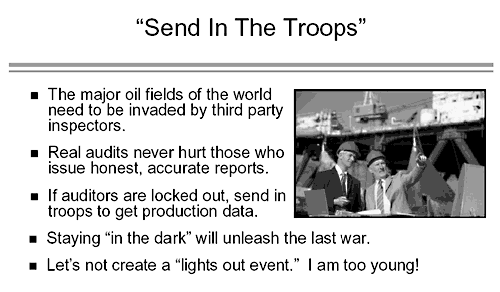
Presentation by Matthew Simmons: School's Out: Let The Summer Begin (PDF)
Despite rocketing prices, outlook is bleak for oil majors
DESPITE record crude prices, the major oil companies are struggling to access resources that are being jealously guarded by national companies with whom they are forced to establish partnerships.As paradoxical as it may seem, high oil prices do not mean a golden age for the likes of ExxonMobil, Chevron, Totalor BP.
Of course, with a barrel of oil at more than US$140 (S$190), they are seeing major profits, but the future has never seemed so uncertain.
The problem is access to reserves. The oil majors now control less than 10 per cent of world resources of gas and oil, against 70 per cent in the 1970s, according to figures released by the office of Ernst and Young at the World Petroleum Congress in Madrid.
South Korea announces first oil contingency measures
SEOUL (Reuters) - South Korea said on Sunday it was implementing a multi-stage contingency plan aimed at reducing energy consumption before the skyrocketing oil prices push Asia's fourth-largest economy into a full-fledged crisis.Prime Minister Han Seung-soo told a televised news conference the government would restrict driving of cars owned by public organizations as part of the measures, adding a tougher set of steps would be adopted if oil prices rose further.
In a March Atlantic article, Christopher B. Leinberger, a visiting fellow at the Brookings Institution and a professor of urban planning, contended that yesterday's new suburbs will become "the slums" of tomorrow because high gas prices and the housing meltdown will force Americans back to the urban core. Leinberger is not alone. Other pundits, among them author James Howard Kunstler, who despises suburban aesthetics, and New York Times columnist Paul Krugman, see the pain in suburbia as a silver lining for urban revival.Not so fast. The "out of the suburbs, back to the city" narrative rests more on anecdote than demographic or economic fact. Yes, high gas prices and rising sub-prime mortgage defaults are hurting some suburban communities, particularly newly built ones on the periphery. But the suburbs remain home to a majority of Americans and a larger proportion of U.S. families -- and people aren't leaving those communities in droves to live in cities. Even with economic growth slowing, many suburbs, exurbs and smaller towns, especially those whose economies are tied to energy, are continuing to do better than most cities in terms of job creation and population growth.
Russians up the ante in row over BP oil venture
BP's Russian joint venture partners are poised to take legal action tomorrow against TNK-BP chief executive Bob Dudley in six jurisdictions, including Russia. If successful, Dudley could be ousted and barred as a company director.
Russia May Cut Baltics From Oil Route
Russia may stop using ports in the Baltic states by 2015 to export oil and instead use a new $3.3 billion pipeline, a government official said.Currently, Russia exports roughly 80 percent of its oil products through ports in the Baltic states, RIA Novosti reported Saturday.
Saudi cuts Aug light crude prices to Asia, US
DUBAI (Reuters) - Saudi Arabia cut its official selling prices for August for light crude oil to customers in the United States and Asia, state oil firm Saudi Aramco said late on Saturday.
Profits dwindle for gas-station owners even as fuel prices soar
Longtime operators say this is the most difficult year they have ever seen. They face nearly nonexistent profits on gasoline, rapid growth in credit-card fees, and new competition from nontraditional sources of gasoline such as grocery stores.And yet, the most vulnerable people in the business -- operators who have only one station -- are the fastest-growing category of ownership. Their numbers are rising because large oil companies are fleeing the retail side of the business and selling locations.
The Road Already Taken: How the British colonialists tried to run the Middle East
The importance of Kingmakers for a wide American audience emerges slowly. At first, the book appears to be a quaint reminiscence of eccentric and often familiar British colonials of the early 20th century, strutting across Middle Eastern deserts in pith helmets, instructing the benighted native tribesmen about the fundamentals of governing. But as this beautifully written and researched book proceeds, it becomes abundantly clear that these skilled English soldier-diplomats are the progenitors of (and in some cases, role models for) the current crop of American diplomats and soldiers on the same turf. The issues that this country is now debating -- how to exit Iraq gracefully, how to protect American interests in the region after withdrawal, how to keep Arab insurgencies in check, how to continue the essential flow of oil, how to maintain American presence without the appearance of colonialism or occupation -- these issues have all been addressed before.
Summer officially started two weeks ago, and already consumers, oil companies and state officials are bracing for the heating season.
Helium, which turns to liquid at 452 degrees below zero, helps create strong magnetic fields for magnetic-resonance imaging machines and superconductors. It's also used to make optical fibers, solar panels and liquid-crystal television displays.Industry observers say helium prices have risen by double-digit percentages in each of the past two years, mainly because the world's 15 helium production plants haven't kept up with demand.
"The reason for the tight market is the failure on the production end of things, rather than extremely rapid growth," said Phil Kornbluth, executive vice president of Matheson Tri-Gas, a helium supplier in Bernards, N.J.
Ignoring Peak Oil Theories Could Leave Nation Stuck In Neutral
WELCOME TO the world of peak oil. This was once the realm of fringe Doomsday theorists on the Internet, but it is now openly discussed on the Web site of The Wall Street Journal.
AUSTIN — It's a sort of gas-station roulette: Thousands of inaccurate pumps every year give Texas motorists either more or less fuel than the amount for which they pay.More than 5 percent of the 109,369 pumps inspected last year in Texas — 5,778 of them — either gave the wrong amount of gasoline or had other problems that put them out of commission until they were fixed.
Lobbying increases with oil prices
WASHINGTON — Amid a national backdrop of steadily rising gasoline prices, oil and natural gas interests have pumped up their spending on lobbying while working aggressively to thwart Democratic initiatives in Congress.The lobbying tab for the industry jumped by nearly 62 percent between 2004 and 2007 — from $51.1 million to $83.9 million — according to disclosure reports analyzed by the Center for Responsive Politics, a nonpartisan research group that tracks money in politics.
The Philippines: Strategic energy planning
One of the most influential proponents of the oil-is-running-out scenario is Matthew Simmons, an adviser of President George W. Bush on petroleum policy. In his book, Twilight in the Desert, Simmons wrote: “Saudi Arabian oil production is at or very near its peak sustainable volume [if it did not, in fact peak almost 25 years ago] and is likely to go into decline in the very foreseeable future.”
Hitchhiker's guide to gas prices: Don't panic!
Gas prices have gone down in the past. Why not again?Two words: Peak Oil.
Or make that three: Peak Oil blather.
We Need A Declaration Of Energy Independence
On this 4th day of July, 2008, when oil rests at its highest price on record (just above $145/barrel), the time has come for a Declaration of Energy Independence. Government seems unable to take any meaningful action, so, maybe the world wide web can be the action ground. Let us use something like a reverse Ponzi scheme, where each person reading this post sends it out to ten friends, who in turn... No, nothing terrible will happen to you if you don't, unless you count the double hammer of Peak Oil and Global Warming as the implied enforcer.
New Zealand: Last blast of big rigs
Indeed the real winners of Friday's action were the environmentalists and greenies. This was the preliminary meltdown that most had been predicting as peak oil starts to bite. The days of cheap fossil fuels are over and the big rig has always been their especial fetish decoy.For them the truckie protest was like the last gathering of the dinosaurs.
Certainly there is a growing sense of bewilderment that the greenies might be right after all.
Learning about world oil reserves
Should the U.S. increase domestic oil production by drilling in the Arctic National Wildlife Refuge and currently prohibited areas of the outer continental shelf?Many consumers, frustrated by high gasoline prices, are now saying yes to both, thinking that drilling will significantly reduce what they pay at the pump. The media and pandering politicians, marching in lockstep with Big Oil, promote this conclusion.
Going green? Maybe when there's money in it
CLIMATE change is going to make investors act in different ways: that's the new logic … and it's true, but not in the way you might think.
Former Bush adviser Matt Simmons, chief executive of the Houston energy consultancy carrying his name, claims that as oil runs out, the economic process of globalisation is over. BP, with a big presence in Texas, reports global oil production fell in 2007 for the first time in six years, while consumption continues to grow.
Why Baghdad isn't pumping more of its oil
Reacting to domestic and international pressure, Baghdad has moved to restore Iraq's oil infrastructure and give production a badly needed boost.But the government's plans depend on a long-stalled oil law that is both crucial to future development and so contentious that critics say it would mean open season on Iraq's economic crown jewels.
Political spins blurring energy realities
WASHINGTON — When it comes to the raging national debate over energy policy, reality is often in the eye of the beholder.
Gas flaring fuels environmental fears
Rising environmental concerns and high gas prices are finally forcing oil companies to confront one of the industry’s most intractable problems: how to deal with unwanted gas production.
Colombia finds biofuels bonanza in sugar cane
El Cerrito, Colombia — Between breaks to sharpen his machete under the equatorial sun, Gregorio Hurtado laid waste to row upon row of 9-foot sugar cane stalks.Like plantation labor of a bygone era, the cane harvest remains a backbreaking task. Even though Hurtado earns just $3 for every ton of the fibrous stalks he cuts, he's happy to have a job amid the chaos of Colombia's sugar industry.
For that, he can thank several new ethanol plants towering above the sea of green cane fields that cover this patch of western Colombia. Even as low world prices and the weak U.S. dollar have hurt sugar exporters here, Colombia's biofuels industry is growing by leaps and bounds.
EU ministers 'discover' biofuels not an obligation after all
PARIS (AFP) - European Union energy ministers said at an informal meeting Saturday they had been labouring for 18 months under the false impression that an EU plan to fight global warming included an obligation to develop controversial biofuels.What seems to be a stunning misreading on the part of policymakers in Brussels comes at a time when the image of biofuels has shifted over a matter of a months from climate saviour to climate pariah.
Australian climate report like 'disaster novel': minister
YDNEY (AFP) - Heatwaves, less rain and increased drought are the likely prospect for Australia, according to a new report on climate change which the agriculture minister said read like a "disaster novel".The report, by the Bureau of Meteorology and the Commonwealth Scientific and Industrial Research Organisation, found that the world's driest inhabited continent is likely to suffer more extreme temperatures due to climate change.
It said that exceptionally hot years, which once occurred every 20 to 25 years, were more likely to hit every one or two years. And the hotter weather could begin as soon as 2010.
Contact
- Content: editors at theoildrum dot com
- Tech support: support at theoildrum dot com
License

This work is licensed under a Creative Commons Attribution-Share Alike 3.0 United States License.
Today's NYT has a chronicle of the U.S. political and business efforts to ignore the problems of our oil imports.
American Energy Policy, Asleep at the Spigot
There's quite a bit of the history included, but some of the main points are missed. The biggest point they missed is Peak Oil, that is, oil production isn't likely to increase further from here on out and is likely to decline rather rapidly. There have been many warnings from the academic and environmental side of things about the problem, but TPTB ignored those of us who presented the message. Now, we find ourselves confronted with a collapsing economy and the average man and woman wants a scapegoat to blame. Well, lets be sure that the blame is placed squarely on those responsible for this tragedy. I suggest that the politicians (especially the Republicans) and the executives from the automotive industry were criminally negligent in their blatant disregard for the facts. Off with their heads! Let them walk the plank! Better yet, take all their wealth and let them live under a bridge with the poor huddled masses.
E. Swanson
Black_Dog...It is easy to play the blame game but 'the people' that you seem so anxious to let off the hook for ignoring the fact of PO were warned, and long ago, by President Jimmy Carter.
'The people' did what all people throughout history have done when they have been presented with access to excess...they took advantage of it. 'The people' of America have acted no differently than the citizens of Rome did...bread and circus. 'The people' took advantage of cheap energy to party hardy and spend their wealth on the most foolish extravagances.
I have absolutely no sympathy for 'the people' that are now anxious to point fingers at everyone except themselves. They have accumulated McMansions, SUVs, boats, airplanes, etc, all with money that they had not yet earned and did not posses. The money that 'the people' were spending was borrowed from foreigners to purchase toys on credit. The people are now being served the bill for their excess...it will be a whopper!
If the people were truly concerned about PO and their collective futures they had ample opportunity to show up at the poles and vote. The people had opportunity to save instead of spend. The people had opportunities to opt for more economical vehicles. The people had ample opportunity to pay attention to what was going on with their governance and demand change where needed...instead, the people opted to watch NASCAR, the NFL. The people opted to continuing to run up thier credit cards. The people continued to spend what they had not yet earned.
Of course the government and financial sectors are complicit but without consent of 'the people' the economic disaster we now face would not have occured.
I do not feel sorry for people that failed to act responsibly.
Perhaps before we declare economic collapse, there should be at least one quarter of negative growth. Not saying it isn't coming, but even a great depression is not societal collapse.
I agree with you on who is responsible.
Hi Daniel...I have never predicted 'societal collapse'. Please do not put my foot in my mouth.
If you have an insight into how the US will avoid a depression, or bad recession, I would be interested in hearing it.
I have and do.
Collapse is economizing and I don't see how anyone can read Leanan's
DB everyday and come to a different conclusion.
Us Dirty Phuckin Hippies have been screaming since Reagan's "Trees cause polution" remark and been punished for it.
back when I thought that the PTB were actually looking for a sustainable solution.
Even now bringing up Carter's "Malaise" speech gets shout downs -though the shouting
is alot more quiet.
Watch the Baltic Dry Index. Dryships as proxy. It's having cardiac arrest.
ships are sailing not fully loaded.
And just an aside, am I getting neg ratings for mentioning derivatives and
deflation in the same sentence? Just curious.
James
Mac, if you have access to Shadowstats.com it would be helpfull...I don't and am not going to pay the price for it. Ocassionally I get some Shadowstats info from other economic sights. The last stat I saw for M3 (calculated as it was before suspenion of publication by the Fed) was 18-23%, which would be about a doubling of the supply every 3 years.
As for the neg ratings...to hell with them. The damn rating system that they have created here is for beans. Only nitwits would use the ratings to downgrade a post for content and no one at the site is doing anything about misuse of the ratings. Maybe they are former government employees?
Maybe they are former government employees? BWHAHAHA ;}
"Have you ever wondered why the CPI, GDP and employment numbers run counter to your personal and business experiences? The problem lies in biased and often-manipulated government reporting."-shadowstats
You're right, the Fed is pushing inflation as hard as they can.
Then, after the election Obama's Volker jacks up rates to 10%
to bring the $ stability.
Dr Housing Bubble has taken the lead in predicting IMHO:
"
It must come as no surprise that prices are falling off a cliff both nationwide and in California. The reason California carries a lot of weight is that taken alone, California would be the world’s 8th largest economy. California is also the hub of the mortgage bubble. We earlier reported that prices in the golden state were off by 27 percent but have to update that since the C.A.R. recently came out saying the median price drop now stands at a stunning 35%! Given the $500 billion Option ARM implosion which will be one of the major stories in the second half, we can nearly predict the next few months.
Nationwide prices are down 15.2% which is the steepest drop ever. Even worse than the drop during the Great Depression because of the speed in which prices are correcting. What once seemed a mere impossibility, the forecasts for nationwide drops of 20 to 30 percent almost seem like foregone conclusions. We should be seeing 20 percent this year and if prices accelerate, who really knows. These forecasts were for bottoms in 2009 and 2010 at least if we are to look at futures markets but a 35% drop in California in one year is even shocking bears like myself. The ferocity of the correction is stunning."
http://www.doctorhousingbubble.com/
"Even worse than the drop during the Great Depression"
Mc: His interesting comment is that even a guy like himself who predicted this is still shocked. IMO the same phenomenom will happen with oil supply and prices-it is very clear what is coming yet it will still be shocking to knowledgeable observers as we are all influenced by the MSM which plays into our desire to engage in wishful thinking.
It goes without saying that the home equity loan is going extinct. But how far down are we from 2004, when those loans pumped close to a trillion $ into the US economy? And what was the multiplier effect of each of those borrowed $ in further economic activity? If each loaned $ created $3 more in GNP that year, then won't we soon be seeing a $4 trillion reduction in the (inflation-adjusted) GNP? Is there any place left where we can (foolishly) make up the loss?
I'm not sure what to make of it either, but I respect their desire to address the high number of comments.
I'd like us all to allow them some space for experimentation. If this doesn't work, they'll yank it and try something else. No need to be mean to people who are volunteering their time to give you a space to have your say.
-André
Do you mean this:
It doesn't seem to have a very good track record of forecasting recession on its own.
Any other indicators one should be looking at?
Funnily enough, even LEI seems to indicate that US might not be heading into a recession, but in fact recovering (barring financial meltdown of course). LEI appears to have a fairly good track record in predicting recoveries (but not downturns).
Now, I am not an economist/trader/financial analyst, so insert your favorite disclaimer here.
BTW, you get a vote up from me almost very time you write about derivatives deflation in the same paragraph. While the discussion on that is still raging, it does look like monetary deflation being masked by commodity price inflation. The derivative bomb seems in the process of exploding/defusing (dependin on one's POV).
Yes, of course. Thank you for the pic.
"It doesn't seem to have a very good track record of forecasting recession on its own."
Note flat line until we invade Iraq. The final straw. Price of bunker fuel becomes unmanageable.
"this is turning into a comedy skit."-Dr Housing Bubble
“We shouldn’t, in a sense, be surprised when the data are, are, soft,” Swagel managed to say.
Does the economy need another stimulus package?
“I-it seems, you know, it seems like that’s, that’s enough, uh, enough.”
What might trigger another round of economic stimulus?
“I don’t, I guess I don’t have an answer, I mean, you know, beyond saying we look at all the data and, um — so, my usual line.”
(On the 127 000 jobs lost last month.) 62k + fake BLS Birth/death #'s.
"This is actually becoming a comedy skit. How long can we keep telling Americans the economy is fine without being chased out of Washington with a revolution?".
The real question is how will gov't reacts to deflation. Obviously if the economy were permitted to run its natural course, it would be deflation, but rarely does this happen.
I believe that the gov't will put out all stops to prevent deflation. If that trigglers hyper-inflation so be it.
Last week Steve Liesman (CNBC economist) said that if he was given a choice of deflation or hyperinflation. He would choose hyperinflation as the lesser of two evils. I personally would prefer deflation. Hyper-inflation always results in deflation in the end, and creates even worse misery. Pay now, or pay much greater later.
http://www.bad-money.com/ (Kevin Philips)
"Wall street has privatized the profits, but socialized the risks". I couldn't put in any better. The financials rack in the profits creating bubbles, but when the bubble pops and profits turn to loses, they go to the Fed and Congress and demand that they pick up the pieces at the taxpayer expense. What a racket!
You call it deflation. Our working-class ancestors called it time to wave red flags and march for revolution. Let's be very careful about bringing back the kind of Darwinist economics that force people onto the streets.
Then again, don't be careful. I'm ready to march.
off the top of my head. usually decline in home sales, decline in home values and some other indicators like car sales. links are always changing though. here is a quick search of calculated risk.
Recession: CRE and PCE
http://calculatedrisk.blogspot.com/2008/02/recession-cre-and-pce.html
Recession: Mild or Severe?
http://calculatedrisk.blogspot.com/2008/01/recession-mild-or-severe.html
New Home Sales: Cliff Diving
http://calculatedrisk.blogspot.com/2008/01/new-home-sales-cliff-diving.html
Best Shot (no guaranties) to avoid a Depression ?
A massive switch from consumption to investing in long lived capital goods that will help, in one way or another, in the coming energy crisis.
Best Hopes,
Alan
Best hopes of aquiring financing for investing in long lived capital goods. If I were trying to line up that sort of deal I would skip the banks (they are already broke) and go straight to congress. Some large campaign contributions might grease it. Good luck.
Some "capital goods" are at the personal level.
Insulation & better windows, high efficiency appliances (including heating & cooling), bicycles that will last generations, high efficiency and fairly small in-fill housing near transit, etc.
Alan
Alan, you got me there. I assumed that you were talking about city transportation investment...since you do spend a lot of time on that subject.
As for personal capital goods I took care of that long ago and continue to add/improve as time passes. Anyone that is not prepared for the economic storm that is coming is in for a rough time. Living in Florida for thirty years has given me plenty of opportunities to find out what weeks of life without electricity, water/sewage treatment, groceries, no roof, and access to bank funds is all about. Hurricanes are a great teachers.
Consider the cumulative impact if solar water heaters out-sold flat screen TVs, ultra-durable bicycles had more status then megaSUVs, $8 CFLs (I just ordered some) were a topic of conversation, the only new pavement poured by local gov't was for bikeways (properly built, almost zero maintenance for a century). Segways were common, etc.
Such changes could cushion the coming "reduced economic output" IMO.
Best Hopes for a Change in Values,
Alan
I have a question about this. So my understanding is GDP is a measure basically of how much money was spent. Well 1. 'Things' are more expensive. So to buy the same amount of stuff this month as you did last month you have to spend more. And 2. Supposedly the M3 supply has been growing like crazy since the fed quit printing the number.
Wouldn't this mean that "negative growth" would be hidden by inflation and growth in money supply. I mean we could see GDP 'grow' right up to the point where something finally gives and the economy does crash, right?
I guess I don't trust government 'economic indicators' and hope there is another way to measure the problem.
'Gross domestic product
From Wikipedia, the free encyclopedia
Jump to: navigation, search
"GDP" redirects here. For other uses, see GDP (disambiguation).
CIA World Factbook 2007 figures of total nominal GDP (top) compared to PPP-adjusted GDP (bottom).
World map showing GDP (PPP) per capita.The gross domestic product (GDP) or gross domestic income (GDI) is one of the measures of national income and output for a given country's economy. GDP is defined as the total market value of all final goods and services produced within the country in a given period of time (usually a calendar year). It is also considered the sum of value added at every stage of production (the intermediate stages) of all final goods and services produced within a country in a given period of time, and it is given a money value.
The most common approach to measuring and understanding GDP is the expenditure method:
GDP = consumption + gross investment + government spending + (exports − imports), or,
GDP = C + I + G + (X-M)'
http://en.wikipedia.org/wiki/Gross_domestic_product
i have argued for a loooooooooooooooooong time that much of gdp growth is inflation in drag.
Yes. Real GDP has been declining in the USA for a while. It is hidden by the manipulated low inflation rate. According to polls, 90% of Americans think the country is economically on the wrong path, yet, as the poster above notes, the USA is supposedly not even in a recession. This blatant propaganda will probably persist.
Brian--real GDP is likely up---since energy consumption is up. Electricity use is up about 2% year over year. Oil consumption is, perhaps down 1-2%, but Natural Gas, Coal, and Nuclear is up. Thus I assume GDP is also up.
GDP is spending minus (official government) inflation. Shadowstats provides inflation calculated by the same algorithm used in 1990, when the government most recently fudged the number. He also provides alternative GDP based on his alternative infaltion. By the standards of 1990, there has only been a single quarter (1Q2004) in GWB's presidency with positive economic growth.
You can view his alternative data series (including the GDP numbers) for free here.
I suspect Shadowstats numbers are closer to "reality" than the offical government
pacificationnumbers.In fairness, new perversions of inflation calculations were introduced during both Clinton's second term and Bush Junior. I tend to split the difference between the Shadowstats figures and the Feds'. It seems to me that as bad as things are now, we're only in the 1972-73 stage of this crisis; maybe 8% real inflation and 8% unemployment. Worse is to come, and you'll know when it's here when people act the way they did in the late '70s: always assuming that all the things they buy will be more expensive next month and a lot more expensive next year. Weimar Germans didn't need CPI announcements to freak out.
The GDP is the value of all goods and services produced within a country. Nominal GDP would be at current prices and real GDP would be at constant prices (1981 or some such year as the base).
Let us say that the US produced only two types of goods - Apples (A) and Oranges (O). Let us say that in 2007 it produced 5 apples and 10 oranges. And in 2008 it produced 7 apples and 9 oranges. As apples and oranges cannot be added it's hard to say if the output actually is up or down. If one orange is worth more than 2 apples it is down and vice versa. So it is usual to convert everything to a dollar value.
In the previous example, let us say an apple costs 1USD and an orange costs 1.5USD in 2007. In 2007 the GDP would have been $20.
Assuming that apples cost $1.10 in 2008 and oranges cost $1.60 in 2008, the GDP would have been $22.10. This is the nominal GDP. Nominal GDP growth would be about 10%. But out of this $1.60 came just because of price increases and not out of physical output growth.
Assuming prices remained the same in 2008 the real GDP would have been $20.5 or about a 2.5% growth.
Given the millions of products being manufactured the above exercise is impossible to do. So the nominal GDP is divided by a GDP deflator that tries to estimate the inflation in prices and that is used as an estimate of real GDP. So the real GDP can be overestimated if a lower deflator is used.
I would it not put it past Bush and his economist friends to fudge numbers.
Srivathsa
The ISM Manufacturing Survey is as close as you'll get.
See the BLS birth/death model and Mish's description of it
for details.
bottom line, the gov't never used the word depression from
Oct 29 to Dec 7.
Daniel, I for one, have been predicting economic collapse for about ten years now. Funny that you should think we need a quarter of negative growth before taking a stand. My stand is based on the fundamentals that got us where we are and where those fundamentals will lead us. That is the rise in the use of fossil fuels and their eventual demise. A quarter of negative growth will show nothing new.
My prediction has always been based on the long term outlook. ALL fossil fuels will eventually go the way of liquid petroleum and it will happen in this century, with the most serious impact happening in the first half of this century.
I have been thrashing this straw since the mid 60s. That is the explosion in population growth and the environmental problems brought about by the attempt to feed this growing population. Then about ten years ago it hit me like a bolt of lightning, fossil fuel depletion will be the trigger that causes the eventual total collapse. That is, an abundance in cheap fossil energy enabled this population to happen and our vast population cannot possibly survive the disappearance of that cheap energy. It is all laid out in this essay, written about thirteen years ago. Energy and Human Evolution. Of course many other essays have appeared since then, explaining it all very well, this is just the best of them. Well, the best unless you want to read an entire book on the subject. In that case the best would be "Overshoot" by William Catton. Ant the second best would be "The Spirit in the Gene" by Reg Morrison.
But you can wait for your one quarter of negative growth before taking any action to help your chances of being among the survivors. After all, the problem has been ignored for half a century so why should anyone be concerned today. But by you saying we need a quarter of negative growth before we can assume anything you are essentially saying, I must see it before I will believe it. Which makes you absolutely no different than perhaps 99 percent of the world's population.
Ron Patterson
I was making a political point, which I still maintain. As most people do not have an intellectual framework for placing events into a larger context, most cannot judge your claims. This directly leads to my belief that most are guided by experience, they have to learn the hard way. It’s starting to happen now. Admittedly, not much to base hope upon – but better than nothing.
I wasn’t as foresightful as you, but my activism regarding non-sustainable growth began about 5 years ago related to global warming. Talk about a hopeless political battle; no direct feedbacks and a 20-50 year lag to impact. Political action has been a joke – my political activism has been a joke. Peak oil is the only thing beginning to change behavior and limit CO2 emissions. Peak oil is in the political drivers seat and TOD has a major role to play. At least someone somewhere is putting forward potentially viable solutions in an accessible way.
Don't you think that, at least in the short term, the impact of peak oil on climate change is likely to be most negative? As i see it, a move back to coal seems far more likely than a radical restructuring of society around sustainable levels of energy use...
How can it be worse than coal+oil+natural gas? Keep the coal in the ground and a viable strategy is born. Easier in the West, but if we are to ask sacrifice of others we have to start at home. Really good firsts step is to stop mountain top removal.
That's the best essay about the coming collapse you can find??? With lines like "The human species may be seen as having evolved in the service of entropy..."?? I mean sure, the human species can be seen that way, but that would be a stupid, anthropocentric, teleological way of thinking. Useless at best, indicative of a third rate mind at best. The essay appears to be a one-trick pony: it identifies a simple truth, that the energy we are currently using accumulated over millions of years and won't again accumulate fast enough for our use. Everything the essay has to say follows from that. But, that is not enough to conclude much, nor is it much of an insight. I hope the books you recommended are better.
The US Air Force did a study back in the '80s estimating that the Space Shuttle would suffer a catastrophic failure about once every 70-odd flights. It did not even get that far before the Challenger explosion - which is when everyone found out about the study and took action. Except that there were even fewer flights before the next crash. So I agree that we have the ability to know that a complex system has a probability of failure. We have no excuses.
It's a well known fact that the average American has little understanding of science and technology. My complaint wasn't with "the people", but with their so-called "leaders". Both the politicians and their bosses in corporate America are responsible for repeatedly presenting the illusion of infinite growth to the fools sitting in their LazyBoys in front of the daily blur of mindless TV entertainment. Corporate America (and that includes the information media) has made great efforts to spread the American Dream. Well, now the Dream has become a Nightmare and we are awakened at night with a sense of nameless dread. The People will respond by seeking revenge against the scapegoat de jour, hacking it to pieces and burning it's remains. But, the MSM is spreading disinformation about just who to blame for the mess, so the People, who are still being mesmerized by their HDTV's, will conclude that the blame should be placed on the very people that tried to warn of the mess.
We had a chance to choose a different path, back in the late 1970's and early 1980's after the two oil shocks sent prices thru the roof. But, those were temporary shocks and after those storms had passed, we all were lulled back to sleep. I would lay the blame most heavily on the Republicans, since they were effectively running the U.S. Government most of the time since Carter. Reagan had a golden opportunity to change direction after the Saudis flooded the oil market, driving the price down in 1986. La De Da, Happy Days and Cheap Oil Forever seemed to be his response. If he had used his brain (what may have been left of it) and put a floor under the price of gasoline by increasing the tax or transportation fuel, I think we would not be in this situation. Of course, his buddies in the Texas oil companies were screaming about the fact that they weren't making enough money to pay their bills and Texas was in a severe Recession, so that didn't happen.
We had another opportunity after the Asian Crisis in 1997, when the price of oil again dipped. By then, our Congress was dominated by the Gingrich Republicans, whose Neo-Con Free Market philosophy saw cutting taxes as the prime directive. OK, now it's Pay Back Time. It appears that quite a few of The People are going to find that living on the street isn't such a fun thing, even if you have a camper. (BTW, I did that for a while). Throwing rocks at a scapegoat won't solve the problem. Writing letters and sending e-mails to politicians won't solve the problem, as most of these never make it to the elected official. As I see it, the only solution is to throw the bastards out and hope that the next crew will do it right. The People won't get it until things are so bad that they are living under that proverbial bridge, living hand to mouth on what ever they can scrounge or steal. Somewhere along the way, I expect that bullets will start to fly...
E. Swanson
I doubt flying bullets any time soon. Americans seems peculiarly adept at self-censorship and paralyzing gloomy thinking.
Repression is a way of life here, but it is hidden behind soft porn on TV and the phony freedom of "consumer choice."
The people in charge are just salesmen themselves. They had to sell themselves as a leadership product to get into office or the corporate boards. They had to convince themselves that the future would always be better. Why should we expect that they understand reality any better than us?
I can't imagine anything in this country would be different right now if we had simply appointed used car salesmen to every office of influence in every sector of the economy and government. Tell me what the opposite of a used car salesman is and I'll tell you who to hire as a replacement.
I go back and forth in the blame game. Surely the people elected the leaders that ruined them. But how were they to know when the MSM continually gave them propaganda rather than information. And yet, how is it that people are able to believe the MSM?
Gay. You have to register to read it. Hate that crap!!!!!
Today's "OPUS" comic strip by Berkeley Breathed really highlights the changing attitude in the US away from the super-sized uber-vehicle (SUV). Check your Sunday morning paper.
Today's strip is not up yet at comics.com (keep checking), but last week's strip is (June 29th), and it is the prelude to todays. It is worth seeing it at
http://www.comics.com/wash/opus/index.html
as it deals with the "stages of grief" of the death of the SUV.
When things like this make it into the Sunday funnies you know that the change is already well along - otherwise not enough people would get the humor...
I was reading Matt Simmons today on aging energy infrastructure, and thinking about the credit crunch, and thanks to some of Memmel's comments had a horrible epiphany.
What happen's to post peak decline rates if we can't afford any new projects? Suppose the rigs we currently have are all we are going to get, and they will be used for infill on existing projects - suppose it becomes so hard to get funding that greenfield projects simply do not happen.
This would mean that once the Depression really hits, we enter a period where we are powerless to bring any new fields online to offset declining fields.
I posted something similar today but I'd like people to take apart my logic:
It's all about discount rates. When interest rates are high - for example, 20% back in 1980 under Volker - investors will demand a risk-adjusted return on investment of at least 20%. This means that the value of all current income streams is marked down until you get a 20% return on investment. It means that the FUTURE is discounted at a rate of 20% - hardly any projects with a 5-10 year lead time are worth undertaking under those circumstances, because a risky project needs a COMPOUNDED risk-adjusted return of 20-30% to get off the ground.
If you announce that oil is in short supply, and prices are about to rise dramatically, this implies that growth in the world economy is about to stop or go into reverse. It implies that economies based on consumption and cheap energy such as the US and UK will see a drop in consumption, and reduced profits , and unemployment, etc. So it is negative for the stock market and housing market. And it is negative for credit risk. And the for safe return of funds lent to the US goverment.
So once the end of cheap oil, and the fact of a declining supply, is publicly known, investors should demand a much higher return for lending funds - somewhere north of 15% - to compensate them for the risk of lending in an economy that is likely to be flat or declining in the long term.
Once a 15% return becomes the norm, all stocks, bonds, houses, projects etc must be discounted until returns match or exceed 15%. This implies a catastrophic revaluation of the stock market - down to DIVIDEND Yields of 15% and P/Es of about 7.
It also means that all future infrastructure projects must make sense even when funding costs are 15% or higher. And it means that the future is discounted at 15% or higher.
A project with a 5 year lead time, which then returns income for about 15 years before ending, must produce returns of better than 15% compounded over 20 years including the 5 year dead time.
So if the project costs $1 billion, it must return $16 billion by the time the well runs dry in 20 years just to break even. At least $20 billion to get funding.
So unless the value of the oil produced over the lifetime of the well is 20 times the initial cost of the project, it is never going to happen.
If interests rates go to 20%, the project must return 50 times the initial cost over 20 years in order to get funded.
In other words, once you start discounting the future at 20%, there are , for all practical purposes, no long-term projects that make economic sense,. None. Zero. Nada. We've already done everything with a 50 to 1 pay-off in the easy oil days.
So there will be no commercial funding for oil projects.
Why would rates go to 15-20%? Because investors realise that the party is over, they have to re-evaluate their understanding of risk and demand returns of that rate of loans because they are lending in a very dangerous economic environment.
If the combination of a housing crash and expensive oil tanks the US economy, and the stock market crashes down to P/E's of 7 as people realise growth is not coming back any time in the forseeable future, oil projects will have to make sense even with debt funding at 15% or 20%. Which means they won't make sense - deep water will be a loss-maker unless there is a 20-1 or even 50-1 payoff, thanks to the magic of compound interest.
Which means the western majors will be looking at 15% decline rates on offshore rigs, but won't be able to justify funding the projects to slow that decline.
In other words, the low interest rate environment of the last 20 years existed because investors believed growth could go on forever. The belief in growth led to low rates, which created growth. A self-fulfilling prophecy.
Once investors stop believing in growth, they will demand higher rates of return to compensate them for risk. Which means the future will be heavily discounted. Which means little or no funding for energy projects. Which kills growth stone dead. And worse than that, cuts off the funding for new projects which might slow the decline.
So a couple of years from now when the Depression is in full swing, all commercial funding for new megaprojects dries up, and production falls off a cliff as nothing new comes onstream to offset declines.
Comments? (I know I glossed over "discounting the future" and 'net present value" a bit).
TenThousandMileMargin...excellent post.
I believe that you can find the answer to Memmel's challenge of yesterday here:
http://www.dailyreckoning.com/index.html
I have excerpted a small portion from the site...It is well worth a full read and is not overly long.
http://www.dailyreckoning.com/index.html
...snip...'T. Boone Pickens calls it the "greatest transfer of wealth in history." He's referring to the oil market, where Americans take money out of their pockets and use it to buy gasoline; the cash ends up in the hands of the oil exporters - notably Russia, Venezuela and the Arab states. But the transfer of wealth goes back further than today's high energy prices…
It began with the easy money policies of the Fed following the crash of '87…and the free-spending habits of the American people and their government. The more Americans borrowed and spent…the more money ended up in the hands of foreigners. Normally, the mountains of American cash building up overseas would have caused inflation at home and landslides in the currency markets. But Asian exporters could make things cheaper and faster than American manufacturers. This, combined with technological improvements and just-in-time inventory techniques, tended to hold prices down. Prices looked so stable, central bankers thought they were geniuses and continued to pump out cash and credit. Then too, the strangers were exceptionally kind; normally they would have dumped their dollars on the world market - provoking a currency crisis. Instead, the Asians lent the cash back to the United States - thereby giving Americans even more rope to hang themselves. They could use the credit to buy more stuff - from the Asians. They didn't need more stuff. They didn't need bigger houses. And they didn't need big SUVs to drive them to distant jobs and shopping malls. But that's what over-reaching is all about - buying things you don't really need with money you don't really have.
Gradually, the Chinese developed more industries and more infrastructure. Soon, they were competing not merely on price…but on quality too, just as the Japanese had before them. And then, as they accumulated more and more money, they began to compete with the developed countries not only far raw materials - but for food. First, the price of oil shot up. And then, Americans (and Brazilians) tried to replace fossil fuel with fuel made from corn and sugar cane. This pushed up the price of grains. Corn has risen 64% in 2008 alone. Soybeans are up 37%. Oil itself is 50% more expensive.'...snip...
TenthousandMileMargine
Overall a very good post on why we are in for a real shock and not a cyclical dip in stock prices and BAU starting 2-3 years from now. A structural change is on its way. I have a hunch the EROEI fits in somewhere into your model. Can't lay my finger on it, but it is probably in the payoff ratios.
It appears that you have used Gordon's model for stock valuation. With it comes a double whammy. Discount rates go up AND revenue growth rates will go down for the economy as a whole. Which means P/E ratios go down even more.
One way of overcoming the problem of no investments going into long term infrastructure is that the government nationalizes oil and also controls its uses. The government can use discount rates lower than what you have laid out. But you would need a solvent government to do that and GWB is doing his damndest best to leave your government broke.
Srivathsa
SOME electrified rail projects could meet that threshold.
Buying a bicycle could for many Americans.
Alan
Hi Alan...Would that be a bicycle made in China? :)
The bicycle partner to my 1982 Mercedes Benz 240D.
http://www.jollybike.com/bicycles.html
Best Hopes for Quality Bicycles,
Alan
The Dutch are strange. I swear they measure their bicycles by the amount of children they can carry.
I thought the Dutch didn't have children anymore.
probably because of all that bike riding...
Deleted repeat message
There is also the highly durable Worskman Rush Hour Cruiser,
http://www.worksman.com/rhcruisers.html
Made in Ozone Park, NYC.
Here's my beast:
"Here's my beast:"
no offense but you'd never catch me near that bike.
What is with the double top rails? Also doesn't it hurt having your seat adjusted with the front up? I love leather seats as once they are broken in they are the most comfortable to ride on - I use a Brooks Swift on one of my road bikes.
The really cool thing about this bike is something hard to see in the photo - the front rack is connected to the down tube, so it doesn't move when one turns the handlebars. You can put quite a load in that basket and the bike steers just fine.
It's built as a serious load-carrying bike. The double top tube is just extra strength. Stainless steel rims. The whole affair weighs 60 pounds! But you can load it up with 100 pounds of whatever and not worry about potholes.
The seat angle does look odd but it's very comfortable. I started off with something more conventional but I felt like I was sliding off the front. I think the deal is - on this bike, you sit upright.
http://clevercycles.com/?p=193
I suspect that the geometric relationship of the seat to my pelvis is about the same as it is on a bike with drop handlebars etc. where one has the seat roughly horizonal. It's just that the seat-pelvis combination is rotated together about 30 degrees or so.
It's a big bike, and then I am sitting upright. I look Hummer drivers in the eye! Surprises the heck out of them, to see me way up there in the clouds with them!
Now why would I want to haul 60 lbs. of steel around just to go from place to place ;-)
Probably for the same reason that people like to drive around 7000Lbs of steel to get to the corner store!
"The seat angle does look odd but it's very comfortable. I started off with something more conventional but I felt like I was sliding off the front. I think the deal is - on this bike, you sit upright."
My former San Fransisco friend (see DB some days ago) pointed this out, most americans don't sit upright on their bicycle. Unless you're trying to race the upright position is much safer.
Is yours the pink one with flowers?
Reading the Drum Beat responses a couple days ago I couldn't help thinking about the connection between BO (body odor) and biking as I bike to work every day. Of course in Hamburg it is like in Amsterdam, flat as a pancake with constant moderate temperatures year round so I just ride in my suit and tie and have never really considered the whole thing at all. I grew up in Alaska where only my "insane" father, who learned to drive late and hated driving rode to work on a bike in deep minus territory in winter. Otherwise I personaly biked to school and college only summers after snow melt although ice biking is pretty cool actually but snow drifts are a bitch (even in London sometimes believe me and wind there in January is trotally freaky too for bikes).
Anyway today's inspiration is about sweat and culture. Now some time ago during the anti-muslim hysteria worldwide we read in Germany in our tabloid press that somebody caught a Turkish Imam preaching in a mosque about "The stinking Germans who don't shave their underarms". Now this caused a stir among the undreclass in their bars and pubs calling for certain unspecified measures against stinking turks which I need not repeat but anyway, I recall that my brother, even as I was still living in Alaska repeating this stereotypical truism about even German women not shaving their oxters.
After coming to Europe I have discovered that the total body (arms and legs) shave by adult women is an American novum which the French female Disneyland employees successfully resisted but which Warsaw Hilton hotel employees had to acquiese to due to a lcak of union power in the east bloc. I stray off topic again, sorry. So my wife said since I don't like to use Deoderant (stick or spray) that I should try shaving my underarms as it is faddish anyway now among younger men (like makeup by young Japanese men I suppose as I saw in the news). So I did that a few times and as it grows back it feels rather unpleasant to say the least and I always forget to repeat it so that it only lasts a few weeks. Again, due to the moderate climate and flat roads it does not seem to be impoortant here as one does not sweat so much.
My wife however has forced me to stop carrying a backpack as my suitcoat gets sweaty and they have to be drycleaned which is quite an expense. I just put my stuff behind my saddle in a carry bag like for a laptop now(A wife's postiive influence!!). The actual idea behind this post comes from the Papillon film. You might all remember the scene ( I read the book too by the way) where Charriere (Steve Mcqueen in the film) was with those half naked brown beauties (nudity on TV screen at prime time was extreme rare in 70s pre-cable days so you can imaginge my interest as a teenager and memory of the event now). who managed a permanent depillation of his chest with various herbs according to their custom and also to get a better look at his butterfly (papillon in French for the overeducated) tattoo, which the old chief was interested in for himself, explaining of course Papi's survival as outsiders were usually killed immediately as unwanted intruders (only way to survive for the remaining wild peoples).
So I have long since believed, being a non driverm, who only uses a bike, that an encouragement to cycling would be a great help to the global energy deficit and since perspiration seems such an inherent barrier in our sterile society that total body depilllation (head hair can remain if desired) with subsequent pore blockage would solve a huge social and energy problem of humanity, not to speakof cultural misunderstandings between Americans, Europeans and Muslims and native peoples everywhere. Bicycling and other unpleasant physical activities associated with sweatiness, which we all rely on our machines to do for us now (at least in the industrial countires where FFs are widely used) would be destigmatized. Pore blocvkage is not that hard I believe although perhaps one would explode so it might not be recommended by medical authorities but permanent depillation is quite a simple process. Now if I can just find the page in my dog-eared copy of Papillon where he mentions the particular herbal mixture the nubile beauties applied... Ah no matter, I am sure we can figure that out by ourselves.
The whole previous concept occurred to me upon awaking this morning and so I thought also "1/3 of our lives is wasted sleeping, if only we could eliminate this terrible waste so we could do so much more as we have so little time...". If anyone has an idea how to eliminate the need to sleep so that we could have more time each day to figure out ways to save ourselves from the fast approaching PO train wreck please post it urgently as the time really is getting short. I have heard over the years that Edison took only cat naps and antelopes and giraffes, of neccessity do this, to stay alive, sleeping on their feet, so to speak. Earlier I have had interest in yogis and tibetan monks who according to reports were very advanced in meditative technique which elminated their need for dreaming, the main use of sleep. Apparently only half of our sleep time is neccessary for wear and tear. 8 hours is much too much sleep. Cave man always woke up in the night and went out of the cave to see that no wild animals were lurking. He was no deep sleeper and was much more in contact with his dreams. It was a sort of flowing connection between dream and physical reality where the one and the other were not so clearly separated as he always recalled the dreams and presumed this was a message from nature gods about danger or about opportunities, plants,etc. I guess this is why Edison took cat naps only. So he was not really really a genius at all but extremely clever, having rediscovered cave man techniques for utilizing subconscious creativity of the fastest computer on earth(human brain) to its maximum output. Ok so I am rambling and I guess I have answered my own question. Sleep is ok, but not too much as it is a waste but just what we need to get the subconscious dream connection so we can solve our massive problems by "human inventiveness" like Bill James so eloquently proposed in his post the other day.
I knew somehow, someway, Peak Oil was going to make my life very uncomfortable. Now I know how.
I just have to give this post a thumbs up...underarm hair and peak oil, now that's really some serious stream of consciousness. Awesome!
Bikes are the Holy Grail of the greenier-than-thou crowd, but the $850 150cc scooter accomplishes quite a bit more without many drawbacks. It is real work to go more than 5 miles (one way) on a bike, particularly in bad weather. Also, tough in business clothes. A scooter (think Vespa if it helps) can easily go 20 or even 50 miles, with baggage or a passenger, with a comfortable legs-together position and without breaking a sweat.
Isn't the answer to ditch business clothes??
evaluating oil and gas projects based on discounted present worth is not, imo the best way to evaluate such a project. i doubt that many financial "experts" would agree with me on this.
discounted pw economics has generally lead to production, or attempted production in the case of waterflooding, at much too high a rate, to the detriment of ultimate recovery. i doubt you will find many petroleum engineering "experts" who would agree with me on that either.
it seems to me that the reason for the high stock market p/e and artificially low interest rates are brought about by the same thing - too much money in the system. i dont see the us or any other major economy putting a stop to money creation anytime soon.
"i dont see the us or any other major economy putting a stop to money creation anytime soon."
I do. Here's why. All derivatives in trillions only exist as bytes.
Actual cash in the US is about $400 billion.
Everyone has noticed the move away from mark to fantasy paper.
See UBs/Parmalax fraud for details.
And into actuals that you can hold in your hand.
Which is why the Fed has been dancing like it's barefoot on hot coals
for exactly one year.
This stuff is vaporizing just like housing prices.
And computer digits representing actual cash no longer is trusted.
Show me the money is the MO today.
The NY Fed has about half a trillion in cash (US currency) in its warehouse. I wouldn't doubt that the total combine cash held in all the Federal reserve banks exceeds a Trillion USD notes.
The gov't can easily crank out big notes ($500, $1000, $5000) in a flash. They have the printing plates ready to print big notes. While economic activity is falling and prices on assets are falling, these events do not mean that deflation is a sure thing. I very much doubt the Fed and Congress will permit deflation:
1. Congress just passed the $300 Billion farm aid bill
2. Congress is working on a $300 Billion housing bailout bill
3. Senate is working on a much larger stimuleous package ($50 to $80 Billion).
Congress is just getting started, We'll see a lot more bailout and stimulous money. I don't see the gov't following the rules once the game turns against them. If you bet on them playing the rules until the end, you might find yourself in a heap of pain.
FWIW: I am not betting my future either way, but I am strongly biased towards hyper-inflation.
If you check out the history books, you will find that for long periods the real interest rate was around 5% - it usually moved between 4-6% and almost never strayed outside that band.
The reason we have great economic dislocation is that the real interest rate has been negative for a very long time.
This chart shows that nominal interest rates should be around 12% at present (7% + 5%) if Bernanke were serious about reducing inflation - the federal funds rate is currently only 2%
Personally, I think it is only a matter of time before interest rates in the USA will go to 12+%
You should add-and the entire USA economy and all USA guvs go bankrupt. The overall debt levels were miniscule in the past compared to today. A lender would get a few initial payments at 12%, but that would be it.
BrianT,
I am sure that you are correct, but that is what is happening right now in any case. I mean, expecting people to save money and to lend it to you for -5% (2% - 7%) is unreal. They, obviously, prefer to spend it or speculate with it.
I realize that the biggest lenders are foreign central banks and that they have political reasons for wishing to maintain the status quo. I guess that when they think the time is ripe, they will pull the rug away.
Unlikely. Despite the Fed talk of hikes, they're more likely to lower rates further. Don't assume that the fed and the gov't is playing by the old rules. They're running out of rope and will almost certianly change the rules to keep the game going for as long as possible.
If you look at a chart of the Peak interest rates since the 1980s the peaks are declining. In 1982, interest rates peaked at 14%, then they fell and started to rise and peaked at 7.25% in 1987-1988, Then they fell and peaked in 2000 at 6.25%, the fell and peaked in 2007 at 5.25%. If the rates do ever manage to go up. they'll probably peak at 3.25-4.25% based up on the trend. The rate changes appear to be folling an expotental waveform delay. Pluck a Guitar string, and the amplitude decays while the frequency increases. The Fed's rate changes follow this pattern pretty good. The changes between peaks and valleys are declining (Amplitude) and the frequency of the changes is increasing.
Personally I think the next Fed move will be a rate cut to 1.75% before the November election. Housing prices are falling, auto sales are plummeting, unemployment is on the rise. Except for great depression, the Fed has never raised rates under these conditions.
Yes-the level of debt in the economy sets a ceiling on interest rates. Crack the ceiling and the whole house of cards tumbles very quickly.
The more knowledgeable can correct me, but I assume that reducing the interest rate in that fashion will lead to the dollar collapsing and the oil price and commodities going through the roof?
If that is correct, the Government debt should be unsaleable.
I'm thinking an October melt-down?
Well hell, who will notice once we're carpet-bombing Tehran?
They have been trying to hold together an orderly decline in the value of the US dollar for a while now-it is easier said the done. When one looks at the numbers, the only possible way out is through a dramatic devaluation of the USA dollar and thus accumulated debt. Luckily most Americans view the US dollar as a constant.
I'm not looking for any tipping point, here. Another quarter point will make things worse, but not that much more so than the last quarter point. The larger issue might be that at this point the market thinks the Fed has quit cutting, so it might have greater psychological impact.
Eight more quarter-point cuts left in the ammo belt, Ben! How are you going to use them?
I would bet you a week's salery, if I were working, that you are wrong. Everyone is blaming the weak dollar for a lot of our problems, including the high price of oil. Lowering interest rates would just cause the dollar to drop further, worsening the current situation. The very next action by the Fed will be a rate hike.
Some very notable names in the financial world are calling for a rate hike. I believe the Fed is listening. There are always reasons for lowering rates as there are always reasons for raising them. The heavy weight of evidence this time is on raising them.
Ron Patterson
Our buddy Ben is on a tightrope. On the left is a pit labeled "Damned if you do" and on the right is a pit labeled "Damned if you don't". Rate-wise, I think he may just stand there with his balance pole and sweat for a while. Meanwhile, the wind is picking up and the rope is swaying...
lol Talk about painting a vivid picture. Wow
If the Fed was going to hike, they would have last week. Ben and several other high-level fed members talked about raising rates all through May and June. But when push came to shove, all we got was a bunch of hot air.
"When you gotta shoot, shoot! Don't talk"
Eli "Tuco" Wallach. from "The Good, the Bad, and the Ugly".
When you gotta raise rates, raise them, don't talk.
Consider that commodities are rising because of strong Asian demand. As long as price controls and Asian Central Banks maintain low interest rates, Raising US rates by 25 to 50 bps isn't going to do a thing. The Fed would probably have to raise rates by 200 to 300 bps to make an impact, and we know that just isn't going to happen.
Prices are already causing demand destruction which will have affect on prices in time. I suspect the Fed will rely on global demand destruction to cool of the commodity markets. I think the Fed is much more concerned about the credit crunch which is getting worse by the day (perhap by the hour). By Auguest we'll probably see the weekly unemployment figures in the 425K-450K range. No way the Fed is going to cut when companies are laying workers off left and right.
I think you meant raise, not cut. However I will make you a gentleman's bet that you are wrong. The next move will be a raise in interest rates, not a cut. So let's just drop it until they act, then I will remind you that you were wrong. ;-)
As I said earlier, the Fed is being pulled in two directions. I am predicting that the reasons to raise will override the reasons to cut, that's all.
Ron Patterson
However I will make you a gentleman's bet that you are wrong. The next move will be a raise in interest rates, not a cut. So let's just drop it until they act, then I will remind you that you were wrong
Fair enough.
Why Bahktiari said all mega projects not 65% complete should now be abandoned.
Don't ask me to source because I can't find the link.
either his talk to the Ozzie Leg or in his discussion with Byron King G&W
and Transitions (1-4). We're in T2 now BTW.
Yes, Ali Bakhtiari and I discussed this point in several emails. Bakhtiari was not categorical about "all" projects. But he was in favor of a real scrub -- project by project, looking at the amount of oil/energy, from an EROEI standpoint.
His concern was the energy-investment that large projects will require a few years down the road. When energy sources get really tight, the financial cost -- as well as the "political" cost of diverting fuel from, say heating homes to running large offshore drilling ships -- will be too much.
One of Bakhtiari's favorite comments was along the lines of "We have to do the easy conservation right now. Really, we could cut oil usage 40% and still maintain most of our standard of living. Yes, we'd feel it but we'd barely feel it."
Too nad that Bakhtiari passed away last fall....
Wow, the world lost something on that one.
Best, BWK
Hi BW,
Thanks.
I'm curious
re: "Really, we could cut oil usage 40% and still maintain most of our standard of living."
Did he Bakhtiari/(or you?) specify the "how" for this 40% usage and did he/you/anyone talk about the possible impacts on employment and how that might enter in?
Ali Bakhtiari used the 40% number kind of as a throwaway... It had shock value. People would hear it and say "Huh??" Then he could hold a discussion.
Bakhtiari's attitude was that people in the West (and in the oil-rich, gas-subsidized energy-producing/exporting world) just plain waste a lot of energy.
Bakhtiari was critical of US/Western Europe energy use, for all the familiar reasons. Once he asked me if I "live in a McMansion in the distant suburbs." I reassured him that I live in a modest home in an old neighborhood of metropolitan Pittsburgh, just two blocks from an electric streetcar line. He was glad to learn that.
Bakhtiari was quite critical of energy subsidies. One time, he said something like "Look at Iran or Venezuela. The people pay almost nothing for gasoline and diesel. It's ridiculous. They drive around wasting fuel like there is no tomorrow. Well, for a country like Venezuela that's true. It will take a century or more for wasteful consumption to catch up with an oil rich land like Venezuela. Iran has far less time than most people think. And meanwhile it also reinforces bad cultural habits that are all but impossible to break down the road."
Bakhtiari admired the Japanese quite a bit. "They have built a formidable economy and export machine, using energy with world-class efficiency. Oh, if the rest of the industrial world could burn oil as efficiently as the Japanese, we'd not have these energy problems. At least, we'd be able to delay our time of reckoning by several decades. And by the time we arrived at the next energy transition point, we could do worse than emulate the Japanese."
Overall, I think that Bakhtiari was very optimistic that the world could technically confront the energy issue. On the political side, he was quite pessimistic. I think he viewed the world as an assemblage of cultures, where some will do better (much better) than others.
He admired the "old" American culture of development. He and I discussed the likes of Col. Drake at Titusville. ANd he was a scholar of the financial backers of the original Titusville developments. And Bakhtiari was fascinated by people like Andrew Carnegie and John Rockefeller. (I actually did some research for Bakhtiari on these people, and sent the results to Tehran... don't know what ever happened with that.)
But Bakhtiari was of the opinion that the current culture is suffering from energy-gridlock. Everyone has their sinecure, their rice bowl. In order to make any headway, something has to happen to break the lock. And any more, it takes a crisis to spur action, so we get crisis-solutions instead of well-thought out plans.
Best, BWK
Dude, this is old news. We've been here a while. The cost of money for a project is always significantly higher than the interest rate. You're competing with the 15-20% ROIs that hedge funds have been offering; and you actually don't have to do anything to get that.
There are very few things that involve pouring concrete that pay out in 3-4 years, which is what a 15-20% ROI works out to.
15-20% ROI for doing nothing is a Ponzi scheme by another name.
It's all coming unraveled, and the game now is to pick the survivor. Is there any legitimate business anywhere in the world these days?
You don't have to do anything, other than kiss your money goodbye.
That may be true now, it remains to be seen. It certainly has not been true in the last 20 years. There's a reason over 40% of corporate profits in the U.S. were financial services.
Savings (or the lack thereof) is the key. If people's savings can beat inflation, they'll save. That money then becomes available for investment. That's how you drive a healthy economy for the benefit of everyone.
Our (the US' and most of the world's) economy is based on debt. A debt-based economy allows the creation of an infinite amount of wealth by creative financial instruments. Financial services can skim a percentage of that (pseudo-)wealth and show a hefty profit, for a while, until the ponzi nature of the scheme inevitably collapses. That's how you drive a sick economy for the benefit of the bankers.
One of the reason I think we're hosed is that the debt-based wealth-creation machine is broken, but we have not made the transition to a savings-based investment regime. And we're not going to make that transition as long as the central bankers are trying to revive the status quo ante by dropping interest rates below the level necessary to support savings.
I don't know if that's culturally conditioned and not so true any more. I know the reverse is true for me: since the economy has started to look like it might lead to high inflation in the near future I've started spending a more money than I used to. But a lot of the people I know wouldn't start saving on those grounds, in my opinion because they tend to believe that if they are willing to work reasonably hard they'll always be able to find a job that makes them a good living. (Why save money for a rainy day if you think you'll be able to avoid rain for the entire future?) If they had a perception that we might be heading for a situation where there just isn't the money/energy to pay for work to be done regardless of a jobseekers enthusiasm then they might save more for the future.
I don't know that I would say it is cultural rather than economic. It hasn't made sense to save in the US since Reagan was president, and so Americans don't save.
That was a necessary step to transform the US from a save-and-invest mentality to a borrow-and-consume mentality. I think if the same economic factors that led to the death of savings were reversed, we would see a return to savings. However, that is very much NOT what the TPTB want to see, which is why they handed out "stimulus" checks with the directive to "go spend"; if the people individually aren't willing to go into debt to spend, then let the government go into debt on the consumers' behalf.
Hey TJ, fraid we are going to need a source for that bit of data. From when to when were 40% of corporate profits from financial services? Was that sometime in the 50s or 60s? Right now the financial services are the worst performers of all, most of them are going broke. They are suffering HUGE losses with no end in sight to those losses. Bear Stearns was a financial service, look what happened to them. Merrel Lynch may be next.
Most stock funds tumble, tumble, as oil is trouble
Ron Patterson
I'll have to look up the links. The 40% is a number I saw on the Angry Bear blogsite for 2006 that stuck in my mind. Obviously it wasn't true in the 60's, and may not be true now (no figures yet)
It is difficult to locate it but here goes Business Situation April 2005 (PDF) on page 4. Table shows Corporate Profits Financial 294 Billion of dollars non-Financial 456 billion - for 2004. This indicates that financial profits were 39% of total.
For some reason, I could not find more recent data.
Here is a chart showing the earlier period.
This data ends in 2000, seven and one half years ago. That was well before the sub-prime crisis. The sub-prime losses have made huge losers of previous winners, the financials.
My vote is for Lehman down the tubes next. Although yea, Merrel is trying hard, rofl. So far, Citi has been an amazing short!
TTMM - The only fault I see is in the implication that the game will then stop, like the toy I had when young.
It was a stamped tin hockey football field and when you plugged it in it vibrated like crazy and the players went all over the place supposedly running plays but truly random. When nothing was moving around any more you unplugged it and everything stopped. We cheered and shouted as if their were some elements of skill involved but in truth we knew the outcome after running the thing a few times. Not unlike capitalism, democracy, fiat currency, war, etc.
I just don't see TPTB, especially the military reacting to economic collapse by saying "ahhh shucks",game over" and slumping on home.
P.S. Maybe not a good analogy but it was a cool toy back then because it was the first ELECTRIC toy anyone ever got
;{]
P.P.S I case no one gets that emoticon it's a smiling me with a mustache, winking.
Fascinating.
You asked for holes - perhaps if one should step out of the economic system you describe, then you can argue that a command economy may produce rigs and drill wells where the traditional financial ROI is not considered.
And perhaps this is where we are headed for the reasons you describe - once the world loses faith in continual growth, TPTB are planning to switch us a different stick and carrot system.
Francois.
The key problem with your scenario is that people have to put their money somewhere even if it is under the mattress. The investor who sees increased risk in lending in a declining economy will have to take the inflation risk of holding cash. When the credit dries the government will step in and turn on the printing press so that they can invest where the private investor doesn't see a return. Eventually the inflation will creep up to such a point that the private investor is forced to chase any sort of rate of return even if it is risky because the alternative is seeing their money quickly disappear due to inflation.
Unless the gold window is closed there remains that option...gold. I have held and traded physical gold since the 60s and have managed to avoid the worst of inflation. Gold is a store of value and is especially usefull in times of high inflation, like now. Of course gold can be manipulated by central bankers but not as easily as fiat currency or other paper. Another aspect that I enjoy is trading below the radar. No capital gains, no taxes period, out of sight out of mind. I don't care what happens to fiat money. Gold is very simple, buy the troughs and sell the peaks.
BTW, if the government 'turns on the presses' to monetize the debt they will at the same time be driving out foreign investment. Not a good idea for an empire that is already on the ropes.
Huh? You have to pay capital gains whever you convert gold back into cash. Now you might have illegally avoided paying capital gains, but that leaves you exposed to penalties, lawsuits or even jail time if your caught. This is also true if you own gold stocks or other forms of electronic gold. Plus transfering cash into and out of physical gold requires brokers fees of about 6% to 8% each way. Finally there is state sales tax (jewerly, coins, etc) unless you happen to live in a state without sales tax.
Gold pawning is huge today. I see lots of ads in the papers as well as radio and TV ads offering people cash for gold. People are selling there jewerly, coins to pay for gas, food and the rent. I am sure this is true overseas and not just in the US. This will likely put a cap on gold prices. A Central bank gold sell off of a dozen tons would likely send gold tumbing.
No such thing as a free lunch, and nothing is without risks.
there may be a sales tax on bullion, i dunno. i know for sure there is no sales tax on coins. and if i sell those coins for a profit, how is the government going to tax that ? a capital gains tax on money ?
As far as I know, there is no federal sales tax on bullion, though state and local taxes might apply. However, if you buy anything and sell it at a profit, you have capital gains. You owe taxes on that gain, unless there is a specific exclusion, such as for the sale of your primary residence.
Disclaimer: I'm not a tax accountant; that's just my understanding of the tax code.
shargash
good guess - there is no federal sales tax on anything.
I started to type exactly that, but then I thought maybe there's some obscure sales tax on something. The tax code is too labyrinthine for me to know more than the little corner of it I need to know to file my (overly complex) tax form. So I hedged.
"there is no federal sales tax on anything"
not a sales tax pe se, but an excise tax on some things, phone service, i think , for one.
gasoline and diesel, another. it is not called a sales tax, but it walks like a duck.
A Central bank gold sell off of a dozen tons would likely send gold tumbing.
No such thing as a free lunch, and nothing is without risks.
A few dozen tons? LOL
I forget the exact figure; my aproximate figure I remember is ALL Gold worldwide would fit in a cube about 100 foot accross.
1 Cubic foot of gold is approximately 1000 pounds FYI
Anyway 100 cubed=1,000,000 cubic feet
A dozen tons would be 24 cubic feet.
Selling 12 tons in a market with 500,000 tons world supply would be trivial.
To sell 1% of gold world wide would be astonishing, but if it happened it would have a large effect.
In the past sell offs of Gold reserves measured in a few tons, caused worldwide prices to fall. I think the last CB gold sale was England back in 2001 or 2002. A sale of CB gold, plus the weight of rising pawned gold hitting the market might be enough to send gold tumbing. By how much, I don't have the foggiest. But the risk is real. Some googling for CB gold sales should provide you some insight on how CB sales effects the price of gold.
If you sell to a broker, they report sales to gov't just like when you sell a stock. When you make a profit, your suppose to claim it on your tax return. Whether the gov't decides to audit you of if you slip under the radar is is up in the air. I suspect that there is a dollar limit that broker must file a 1099 for your sale. I haven't the foggiest what that amount is. Ask a PM broker.
http://www.goldprice.org/buying-gold/2006/03/tax-free-gold.html
US Gold coins are exemnt from state sales tax, but jewelry is and I think Bullion is also subject to state sales tax.
This article states the the capital gains tax on PM is 28%, where as capital gains on stocks, bonds, etc is 15%. Ouch!
http://preciousmetalzone.blogspot.com/2007/10/capital-gains-tax-higher-o...
TechGuy...Of course there is nothing without risk. Yes, the sale of gold bullion by central banks would/might send gold prices down for a short time.
What really strikes me about your post is that you believe everyone declares every transaction that they make. Get real.
How long have you been dealing in gold? I have been doing it for about 45 years. I don't pay taxes on any trade, I don't pay commissions on any trade.
It is a matter of being connected to the correct network and maintaining trust with the people one deals with.
If you don't mind being screwed by the stock/bond markets by insider trading and meddling by the FED, holding CRE (yes, I have a couple of rental houses that are not paying their way), playing dice in commoddities, holding fiat currencies that always, yes always, end up at zero worth, then by all means you should invest in those areas.
I have dumped the last of my stock, GE. My wife and I have owned GE stock since the 60s and it was decent for a long time. We remarked long ago that if GE goes into the tank then the US of A is dead meat. Guess what? GE is going into the tank because it became a financial company disguised as a manufacturer...Thanks to that glorious hero, Jack Welch.
So you pay your taxes like a good lad. Fill out all the forms while you listen to the latest lies from investment/commercial bankers. Listen to GWB, Paulsen, et al, tell you that they are in favor of a 'strong dollar' as the dollar continues to tank. Watch the socialized bail out of the financials and construction. Meanwhile, I will continue to trade gold and make money...and when the dollar totally tanks I will have gold to do with as I wish.
Please explain how you purchase physical gold or electronic gold (which ever method you use) to purchase and sell gold without incurring either commissions or taxes, including defered taxes via retirement investment plans.
Thanks
Well actually GE the financial company was built up by Gary Wendt (CEO of GE Capital), which was nearly operated as an independent entity of GE. GE like much of US manufacturers got clobbered when globalization took off. I am not saying that Jack didn't make mistakes, but the decline of GE has a lot to do with globalization. FWIW GE might have gone bust if it wasn't for GE Capital that really kept the company afloat during the early and mid nineties.
What happened in 1933 with FDR and gold? I doubt gold is going to protect you. I never said the dollar wasn't going to tank nor to I subscribe to Paulsen, the Fed or the rest of the crowd, but I don't think gold is going to protect you. If there is away to screw over the working class, you can be damn sure the gov't will find a way!
I pay them because the other option is jailtime or penalties. Maybe your under the radar, or just lucky. But if you don't pay your taxes eventually they will come after you. Especially now that the tax revenues are falling and the gov't is desperate for cash.
Comment moved further up.
Srivathsa
10,000milemargin
There are different classes of investors. Let's take Grandma's money, who is 70 years old. What is prudent for her - CD's, T-bills, Treasury bonds. She is an interest rate "taker." No "demanding" higher returns here - like I think she should invest in an oil well. So, if the market (the FED) gives her 4%, that is what she will take. Now an investor up the chain has access to 4% money to invest. How much do they need to "demand" to pay Grandma and net a profit for themselves? Not necesarily 15% or 20%. If the Fed gives Grandma 12%, then you would be right. I do not know what will happen. But, a depression usually entails deflation, so I suspect that the answer will be lower rates. Back in the 70's, PE's dropped to 7%, but GREAT dividends generally did not exceed 5-6% for the drug companies, GE, AT&T, etc., even though inflation was running over 12%. You could get 14% on a 30-year Treasury Bond, because no one (investors) wanted them - they WANTED to risk their money in oil and gas exploration because the anticipated returns were greater - a HUGE number of drilling funds (killed by the 1985 tax reform act). But, no matter, most of the drilling funds did not work out - but the 30 year treasury bonds made a lot of people rich.
Hi, tenthousandmilemargin.
I don't think things are going to play out that way because it assumes that money will have value.
But money only has value because it is, somewhere down the line, represented by the energy available from oil (and the other fossil fuels, but for our purposes oil).
When the oil disappears, the work that a unit of currency can perform disappears with it.
My call is that the rich with lots of money squirreled away in bank accounts all over the world will realize that their money is this ephemeral concept tracked by computers that has no inherent value at all. Its only value came from the foundational notion that oil was available to perform work and thus make an investment realize the promised returns.
What good is the trillions of dollars the Chinese have? The Middle East? Who will accept their money if there is no oil to do the work?
In retrospect, we'll look back and see that money will have disappeared in a puff of logic.
-André
If no projects are feasible at an irr of 15% or greater (and I won't argue the point) then the only possible projects left would be charity projects, forced labor government projects and war projects.
Exactly - I was hoping more people would pick up on that.
A 15% IRR implies the western majors will let their production gradually decline. But state-controlled companies - like the Chinese or Russsians - will maintain investment for strategic reasons. Because the Party says so.
So the west is likely to bear the lion's share of the decline. While Chinese companies operating overseas increase production. This has obviously implications for the future transfer of power to Eurasia.
RE: Simmons' "Send in the Troops"
Is it possible that he has been a neo-con storm trooper all along? Blows my mind.
The EIA first began to believe in the possibility of a near term peak in crude oil production sometime in late 2005 or very early 2006.
The reason we know this happened is that they dramatically revised down their high price case projection for "conventional liquids" in 2006.
But the peak doesn't show clearly because conventional crude is lumped in with natural gas plant liquids which they likely forecast to soar. To get the breakdown of what portion in the future will be crude and what portion will be NGPL check out this EIA presentation from April.
http://www.eia.doe.gov/conf_pdfs/Monday/Sweetnam_eia.pdf
I've include page 3 of it below. It shows clear nearterm peak in conventional crude.
Was the breakdown similar back in 2006? If so, there have peak oilers at the very top for several years now.
It's possible that Simmons had the administration's ear from quite early (at least parts of it). Note that "addicted to oil" was uttered by the President in early 2006.
Datamunger...below is a list of participants at Cheney's 'Energy Task Force' meetings in 2001. If you scroll to the bottom you will see Simmons name.
http://www.sourcewatch.org/index.php?title=Cheney_Energy_Task_Force
'Participants
Between late January and April 4, 2001, when "representatives of 13 environmental groups were brought into the Old Executive Office Building for a long-anticipated meeting" with Cheney, a "confidential list prepared by the Bush administration shows that Cheney and his aides had already held at least 40 meetings with interest groups, most of them from energy-producing industries. By the time of the [April 2001] meeting with environmental groups, according to a former White House official who provided the list to The Washington Post, the initial draft of the task force was substantially complete and President Bush had been briefed on its progress."[1] "In all, about 300 groups and individuals met with staff members of the energy task force, including a handful who saw Cheney himself, according to the list, which was compiled in the summer of 2001."
An earlier document obtained by the Washington Post in 2005 "was based on records kept by the Secret Service of people admitted to the White House complex."[2] "This person said most meetings were with Andrew Lundquist, the task force's executive director, and Cheney aide Karen Y. Knutson."[3]
Andrew D. Lundquist was then Director of the U.S. Department of Energy.[6]
The names of participants cited on the lists[4][5] include:
Eli Bebout, "an old friend of Cheney's from Wyoming who serves in the state Senate and owns an oil and drilling company", visited in March 2001.[6]
Red Cavaney, "president of the American Petroleum Institute, also met with Lundquist"[7]
Jack N. Gerard, "then with the National Mining Association, had a meeting with Lundquist and other staffers" in February 2001.[8]
Wayne Gibbens and Alby Modiano, U.S. Oil and Gas Association.[9]
Alan Huffman, "Conoco manager until the 2002 merger with Phillips, confirmed meeting with the task force staff."[10]
Kenneth L. Lay, then head of Enron, "came by for the first of two meetings."[11]
Bob Malone, BP regional president, and Peter Davies, chief economist, and "company employees" Graham Barr and Deb Beaubien.[12]
Steven Miller, Shell Oil chairman, "and two others."[13]
Sir Mark Moody-Stuart, Royal Dutch/Shell Group's chairman.[14]
James J. Rouse, former Exxon vice president. In 2005 Rouse "denied the meeting took place."[15] In 2007, Rouse was revealed to be "One of the first visitors, on Feb. 14, [2001] ... then vice president of Exxon Mobil and a major donor to the Bush inauguration".[16]
J. Robinson West, "chairman of the Washington-based consulting firm PFC Energy and an old friend of Cheney's" met with Cheney.[17]
Daniel Yergin, "chairman of Cambridge Energy Research Associates and author of The Prize, a history of the oil industry", met with Cheney and Lundquist.[18]
"One advocacy group that visited was the Council of Republicans for Environmental Advocacy, founded in 1998 by Grover Norquist and Gale A. Norton, who became Bush's first interior secretary. Later, the group was run by Italia Federici, who was involved socially with Steven Griles. Griles, then Norton's deputy at Interior, was recently sentenced to prison for obstructing a Senate investigation of disgraced lobbyist Jack Abramoff.[19]
Not named in the document released in 2005 was MATTHEW SIMMONS.' (caps mine)...snip...
My comment above might be clearer if the title of the graph was changed to "Conventional Liquids" instead of "Conventional Oil".
Conventional liquids includes conventional crude, natural gas plant liquids and refinery gain.
Note that the projection for 2006 is basically flat out to 2030. However, if NGPL was projected to increase hugely over that period (as it is in their 2008 projection), then the 2006 high price case does in fact forecast a near term peak.
It's a stealth peak.
Your graph is marked in 5 year blocks out to 2030. Where is 2010 for instance on the 0,0 or on the first tick? do you have 5 data points on those lines or 20? The data you marked shows conventional crude rising 12 mbpd out to 2030, but you talk about a peak ?
The data you show has conventional going from 71 to 83, but your graph shows it going from 85 to 80?
The EIA does not lump conventional in with NGPLs. They release separate spreadsheets on a monthly basis that completely separate the two.
The numbers are also somewhat misleading the way they are grouped. Oil sands and biofuels are actually viable liquids transportation fuel, and NGPLs are not, leading to the question of what exactly "conventional" and "unconventional." Deepwater oil is considered unconventional even though it the same as the oil found anywhere else.
[edit: I didn't see your comment above, yeah, makes more sense]
They do in their International Energy Outlook.
Here is the data:
http://www.eia.doe.gov/oiaf/ieo/ieopol.html
Look at table G5 for their projection of conventional liquids. There is a 5-year gap between the values.
The major division is between conventional and unconventional. Unconventional is broken down further. Conventional is not, *except* in the Sweetnam presentation linked to above. That's key. We would be somewhat in the dark without that presentation.
The Sweetnam presentation contains the EIA's preliminary high price case. The one they published on June 25 is a little more optimistic but still shows a near term peak.
In my graph above, the value for 2010 is centered over the number "2010", not at the tick.
Yeah, I was referring to their monthly t11 and t14 spreadsheets. I guess you are talking about their forecasts. I wouldn't place much faith in those. It's pretty clear from your graph that they just change their forecasts every year based on the very recent past.
In 2004, production had been rising very quickly so they just assumed it would continue to do so at the same rate. Now they've had a few years of horrible predictions behind them so they are quickly changing their tune.
I think what is significant is that EIA are now peak oilers.
Deffeyes claimed conventional crude would peak in 2005. The ever overly optimistic EIA now says 2010.
Over the past couple of years there has been a mind-blowing shift in outlook at the EIA (at least part of it).
The IEA did the same thing about a month ago. They dropped their longterm forecast from 116 mbpd to something like 100. I was surprised it didn't get more attention.
On the flipside, there is a good chance straight C+C production with the recent Saudi increases will exceed 2005 production and Deffeyes' and Simmons'(see his PDF presentation in this thread) peak by 600,000 to 1 million barrels per day (for the year). Average production for the first 3 months of this year has already exceeded May 2005 by 200,000 barrels per day.
"Is it possible that he has been a neo-con storm trooper all along? Blows my mind."
when is saw that slide (p32 of the pdf, i think) i thought simmons had really lost it.
i think you can blame that on leanan's mischievious side.
i dont think that slide adds anything of value to his presentation.
Look at the picture of "the troops". The troops Simmons wants to send in, I believe, are geologists and auditors. I think he fears that if actual troops go in eventually then we're all doomed to fry in a nuclear holocaust. Elsewhere in recent presentations he suggests we need to (literally) melt down the military to rebuild infrastructure.
How do you interpret:
followed immediately by:
So we have "troops" clearly distinguished from "auditors" used in the context of "the last war".
Dunno but seems pretty clear.
Well it's just a power-point slide. You'd need to know what he actually says while the slide is on screen. However as he adds "I'm too young to die!" (in the last war), I can't see how he can be actually advocating military action against Saudi Arabia.
Still it would be nice to get clarification from Simmons on this.
AFAICS, I read that without skipping a beat. If the state of Gharwar et. al. are, bluntly, a matter of supreme importance to the fate of our civilisation (and if not, we're all flapping our jaws a lot over nothing), then it's worth getting the auditors in by force if necessary. Not to seize the oil, but to find out how much is (still) there. Because we need to know if we're looking at at 3, 4 or 8 percent decline, and we need to honestly know when is the latest the decline will start.
Dropping your customers in the brown stuff over your inability to tell them how much stock you can deliver isn't the act of a trader who wants to stay in business.
I'm really lost by this line. SA is only in the business of selling the oil that is in the ground under SA. Once the oil is gone they will not be in business any more. They can't stay in business, ie make more oil so why should they tell you anything.
Ed
Not only that it's commonly accepted business practice that you keep up the pretense that everything is perfectly fine even to your own staff right up until the moment you go under. (I once spent five minutes standing on the street looking at property listings in an estate agents window before wondering why it was so dark inside and there wasn't any furniture, then walked around to the door and saw a "we've gone out of business" note. Clearly anything of value had been picked up and sold by the liquidators but other than that the place had clearly just been abandoned mid-workday one the inevitable was accepted by the owner.)
Why should we expect oil exporters in the Middle East to act better than we (in general) do?
.... there is always the intelligent way Lanterne rouge ! ;-)
That is : US, Europe and beyond COULD JUST assume the worst (say a 8% decline) starting tomorrow, everyting less than 8% should be viewed at as a bonus!
I thougth Robert Hirsch delivered a particular and purchased report on those (PO) issues, way back in 2005 .... to this socalled "President" GWB. Did he read it ? Did he understand it ? .... did he get any avvices on it ? What smart has that "president" ever done for the Merikans, let alone for this planet ???
NO F***** THING! How long is it to November ?
"we are addicted to oil ........ " , that's how far he got before the shortcircuit took him. Jezzzz!
Hi Undertow,
I like your suggestion to fact-check w. Simmons himself.
re: "Still it would be nice to get clarification from Simmons on this."
I wonder if there's any chance of that? (Some of the more well-connected of the editors might?)
In any case, I also wonder about the logic and I'd like to ask him about it. (I hope someone does.)
As Paal says, there's a logical way. In fact, there's more than one.
Yes, there is the Hirsch report. Yes, we can put bounds (probabilities?) on the numbers and dates. (This has been done, has it not?)
What more is really needed?
The other thing that puzzles me about what Simmons writes (not says, as you say - we don't know) - Yes, the difference between the best and worst case is significant, on one hand. We may have more time to act. If the correct actions were known. (Or, agreed upon. Or, let's just say - in progress.)
At the same time, knowing (and confirming the worst) could also have the exact same result as that which he fears coming to pass vis a vis the current lack of information.
How does he deal with this scenario?
More blowback from the mortgage crisis...
Foreclosed-on voters using old addresses could snag election
And of course, Florida and Ohio, the key states of the last two elections, have suffered disproportionately from the mortgage crisis.
Welcome to the nation of homeless people and people-less homes.
More than 5 percent of the 109,369 pumps inspected last year in Texas — 5,778 of them — either gave the wrong amount of gasoline or had other problems that put them out of commission until they were fixed.
I find this strange, this article points to inaccurate pumps like it is a conspiracy.
The reality is that a gas pump is made by humans it can and will fail. Only getting inspected every 4 years is a lot of time on any piece of equipment being used 7 days a week.
Pumps are inspected every 4 years?? (Sorry didn't read the article.) I find it hard to believe that only 5 % have problems. That's impressive.
The period varies by states. What is really scary is the looseness in measurement criteria. A meter at a terminal only has to be within 3.5 gallons on 1000 pumped according to most state regs. Pretty dang loose tolerance. The terminal would loose (or gain) it's butt by these tolerances,
Gas station meters aren't any closer spec.
The article stinks of the usual media distraction -- "look over here! NO! Over there!" Brittney Spears seems to be off the radar, we need some new salacious slop.
Good news roundup, again.
I also wonder what M. Simmons meant with "send the troops in". I hope he clarifies.
In the light of strategic importance of oil and KSA, I think it would be silly to assume that USA/China/et al don't have moles inside KSA production units getting them access to some numbers from the ground.
I think Simmon's presentation was very good round up of all the excuses, explanations and denials that pundits have claimed for the rise in price of oil.
And yet, they continue:
Khelil explained explained that the 'surge' in oil prices is 'linked to the August-September 2007 crisis in the United States, where the U.S. central bank took steps to bring down interest rates to activate the U.S. economy but these led to a devaluation of the dollar'
So, it's the falling dollar explanation. This
Now a question: what data, what proof would put the final nail in the coffin for the argument that oil price has risen only/mostly because of shrinking value of dollar?
I don't think this idea from Simmons is so unusual. The guy values data more than anything. And here we are, humankind, guessing about our most valuable global commodity because some choose to keep it a secret. I agree with him, if we cannot get others to open up about truth of their reserves...let's do more than we are now. I don't think sending in the troops should be the first option. It should be taken to the UN perhaps first. Is it possible for us to act as one world in this desperate situation we find ourselves in? Isn't it incumbent upon nations to assist with assessing where we are at in the age of oil? Or, let's just keep things as they are...and we'll know when we know...through the rear view mirror.
If some nation doesn't want to share data on how much oil they have, why not just assume they have none and act accordingly? Do you ask your neighbour how much he's worth and if you don't believe him, invade his house with accountants to assess everything?
Maybe I would if he was threatening my livlihood and way of life. Your analogy does not hold. We're talking about a commodity that runs the world here...I could give a crap about my neighbors net worth but if he was supplying the water for the entire neighborhood and we were running out of it..we would have issues if he doesn't fess up to what the true situation is.
If you're living beyond your means, how is that your neighbour's fault? It's just like getting into debt. If you get in massive debt, because of irresponsibility, you *will* have to change your way of life to fix things. You'll have to drastically cut expenses, get debt restructuring, etc. You won't be able to afford to eat out and buy expensive toys.
The best thing to do is not to get into debt in the first place. But once you are, the trick is to not make it any worse! Don't keep digging. So, I'm saying the same thing for the US. You've been irresponsible with oil usage and need to deal with the consequences. First step should be to try to reduce consumption, start conservation, develop alternatives, etc. The *last* thing you should be doing is *increasing* consumption.
Instead, you're basically saying if you completely screw up your life and get into too much debt, grab a shotgun, go next door and steal your neighbour's stuff!
your not getting it. Simmons is not saying we go steal oil. He is pleading for transparency so we can plan for the future. You are saying..let's just say we are out of oil and begin making alternative plans. And it ain't just the US we are talking about here..it is the globe. Ain't any alternatives coming our way that are going to bail us out of this situation quick. We aren't out of oil...but let's accurately assess when we will be out of oil or close to it. We do need to get to alternatives but ain't gonna happen overnight. Like I said...we can just keep on guessing I suppose...like we are all doing...hoping we are close to right.
I agree with the request for transparency, it makes sense and it's a good thing to ask for. But if they say no, you have to deal. (But the fact they aren't being upfront should be a big clue as to what the situation really is.) That doesn't provide justification to invade yet another country!
Hi Peak,
Yes, I agree. Simmons is pleading for transparency so we can plan.
It's possible, though, to go ahead make some statements that place the "non-transparent" facts in a context. One that paints a range.
Yes, the transparency is important.
At the same time, the lack of it is also significant.
And, further, the focus on transparency as a pivot-point (not that he does, necessarily) - this focus can dampen the real message, which I take to be the concern and the plea.
Try this on: "Transparency is critical, because we need to know exactly how serious the situation is. People who are less willing to talk about the gravity of the situation are people caught up in the continuation of this abundant ..."
Anyway, I'm just trying to say...there's a way to give it (transparency) it's due and still put the focus on the extreme seriousness of what we face, and on the ethical duty (for lack of a better word) on the part of those who understand the situation to convey it to the rest of the population. And to put in place by example (if nothing else) - ways to deal.
Fair enough.
How would you feel, if the Chinese army invaded US to get transparent numbers on the US financial institutions, that are hiding their crap in the Level 3 category books?
Or did the same to the Vice President's office on Pentagon's / NSA oil numbers?
Nobody likes being bullied, however high morals the bullier thinks it has.
Why has it always been so damn hard for nation with the biggest stick to understand?
See this comment from Paulson.
http://www.cnbc.com/id/25509433.
"The dollar has had a very small impact," Paulson told reporters in London, after a meeting with top British bankers and British finance minister Alistair Darling. "Take a look, the dollar has depreciated roughly 24, a little bit less than 25 percent, since February 2002. Oil has gone up well over 500 percent. It's gone up in every currency."
Srivathsa
Although it's been mentioned several times, I don't think the peak oil community has come to grips with fact that the EIA, in their high price case, now projects a near term peak in conventional liquids production. (2010 approx)
If we had separate projection for conventional crude oil, it would show a much sharper peak.
Again, check table G5
http://www.eia.doe.gov/oiaf/ieo/ieopol.html
And remember, those values include natural gas plant liquids which they project to soar. So the peak in conventional crude is much sharper than it appears there.
Can you think of any reason why that G5 table does not include historical data for 2007? It says it was released in June 2008, and they've already published all the production data in other tables, so they obviously have it. Just seems a little odd.
You are right about the peak thing, but even CERA as far back as 2005 basically said this about conventional oil. There is a lot of hope for the deepwater and ultra-deepwater stuff, tar sands, and ethanol.
Yes, it certainly looks that way and thank you repeating this point. It is important, afaict.
Source: AEO 2008, EIA presentation 6/2008
Still, EIA's 'nominal price' forecast is very modest.
Oh, hold on, this changes things. I didn't realize the high price case shows the lower production. I thought the high-price was justification for greater drilling, exploration, capex and all that. What this means is that their models are demand driven.
And how can they determine twenty years out that the price difference would effect the percentage make-up of their categories in that manner? Same old nonsense.
What this means is that their models are demand driven.
Not entirely. For instance, from the 2006 International Energy Outlook (when their optimism wrt production in their high price case vanished):
They mean 15% smaller than USGS estimates.
http://www.eia.doe.gov/oiaf/archive/ieo06/oil.html
They also say:
Such a strategy is doomed to fail unless non-OPEC production has pretty much peaked (as OPEC learned).
Geological constraints are in the background here. Wouldn't make sense without it and I do believe their high price case is a coherent scenario.
What's up with that Saudi Price Cut in August? How does that fit in?
Yes that is puzzling. Are they nervous of demand destruction? Can't be. They have already said they have enough buyers for all their crude. Are they trying to show some leadership with dealing with the high prices? Could be. But I thought they were doing that buy increasing the supply. Makes no sense to me.
Wow, a whole 55c cut. That's generous :-(
So by end August if WTI is at $180 then the KSA will sell to US customers for $177. A bargain...
I want to take this opportunity to thank the Valiant Troll Slayers of yesterday.
IMO you do a great service to the community by tirelessly explaining away the nonsense that muddles the minds of the general public and I salute you.
Cheers!
I’ll second that! I wonder if it is time for a housecleaning.
More oops!
From the Sunday Times:
http://business.timesonline.co.uk/tol/business/economics/article4276592.ece
Is Britain falling into the abyss.
But China is doing us a favour…
http://business.timesonline.co.uk/tol/business/industry_sectors/natural_...
But then maybe not:
http://www.timesonline.co.uk/tol/sport/olympics/article4276469.ece
There is also one other article in today’s Sunday Times, but regrettably I cannot find the link.
It goes like this…
Legalised Brothels in the State of Nevada are undergoing a marked downturn in business due to the high price of fuel. Down turn is 19% and is blamed on a lack of truckers.
Special offers and discounts abound. Spend $500 and you get $100 back for fuel at the Shady Lady….
Herewego – we gotta link (just type Shady Lady into the Times search engine.)
http://www.timesonline.co.uk/tol/news/world/us_and_americas/article42144...
From The Times
June 26, 2008
Oldest profession adds more frills in US as fuel prices rise
Chris Ayres in Los Angeles
The oldest profession is one of the few sectors that is generally immune to global economic problems. But high oil prices are another thing — especially when many of your regular clients are truckers.
According to the Nevada Brothel Owners' Association, revenue for houses of ill-repute has dropped by 20 to 45 per cent since the energy crunch began — the worst economic crisis in prostitution in almost half a century.
“Old George or Jimmy out there, he's got to take care of Momma and the groceries first, and he's got to take care of fuel costs, and he's got other expenses, and he may not have much left over for having a good time,” George Flint, a director of the association, said.
At the Stardust Ranch in eastern Nevada, so many girls have been made redundant that only two are still working there, despite the management offering incentives such as free showers, overnight parking and coffee.
www.childfree.net
Next to abstinence (obviously), vasectomy is _the_ most reliable method of birth control available to either sex. Long-term, it is also the most economical and simplest to implement. A vasectomy typically is a single 15-30 minute outpatient operation, and the modern Chinese 'no scalpel' technique allows for negligible risk of bleeding or infection.
After the operation, provided secondary means of birth control are used for the first few months, to allow any remaining sperm to be cleared from the system, the reliability of vasectomy for birth control approaches 100%.
One guy can impregnate a great many women so why would you promote this as a logical solution to global population growth? Population growth comes from female fertility, not male fertility.
um, I don't follow your reasoning. If that 'one guy' becomes sterile, then there are 'a great many women' who wouldn't get pregnant. Male sterilization is also much quicker/easier/cheaper/safer to implement than female sterilization.
You missed the point entirely. Any one guy can impregnate many women so if one doesn't there are others who will. Post WW2 Russia saw a practical application of this. So many men were lost in the war that the sex ratio was affected. The government's solution was to encourage women to have children even out of wedlock. The birth rate was maintained despite the shortage of men.
Whether it is PC or not to say, the fact is that polygyny is more common than polyandry. The fact that the women needed encouraging to take more partners seems to reflect that. So on that basis it makes more sense to encourage male sterility than female in my mind.
No you still don't understand. If males are short the women do not take more partners they in effect have to share the men. That is the men have more partners, a kind of serial polygyny. The encouragement (cash in the Russian example) is to get them to have children without a husband to help support them.
Virtually all models of population growth use the number of women of childbearing age as the principal variable. They all have the implicit assumption that any woman who wants to get pregnant can find sperm.
I think you are assuming that in polygyny the male is able to control the females and prevent them from becoming pregnant if he is infertile. Even in societies where this is sanctioned by law and custom it is very hard to do.
I see your point now and how it would apply. Monogamy is still the norm (in western culture at least) though, and in that situation either sex can determine the couple's fertility. (that's how it works for me at least :) )
As my mathematical ecology teacher used to say "sperm is cheap". Actually I can think of only 2 commodities you need to pay someone to take; one is garbage.
The Sperm Bank of NY is paying up to $500 per 'donation'. This must make semen the most valuable fluid (per cc) of all, much more than printer ink! :)
You are right about that, the market price depends on the method of delivery!
On a BBC program once about this somebody did survey and tried to correlate variables to fertility. It found that the variable that most correlated to a decline in fertility was female education. The more girls were educated the fewer babies they went on to have.
The best and most effective way to reduce population is to grant women equal political and economic rights (and of course the ability to exercise these rights). You will have negative population growth every time.
Getting women into the workforce has certainly proved to be a very effective way of reducing the birthrate in Europe and the Anglo countries.
Not so good for debt levels and the frequency of bankruptcy - google "The Two-income trap".
Suburbs Not Dead Yet
I would encourage people to read the above article from the LA Times and go to explore the author and the New Geography web site.
http://www.newgeography.com/
The quote below states a basic fact:
If you are an end of suburbia type, as I am, we need to read these counter points of view forcing us to think about the nature of the suburbs and what the future will look like. Joel Kotkin argues counter to Kunstler and others in believing that the suburbs will change but will remain the foundation of American (and Canadian) society. This opinion is well argued and is founded upon a bit more thought and analysis than simply the "what is,is what will be" mindlessness of the MSM and the BAU crowd. I think he is right in believing that the inertia of the huge suburban investment will cause it to persist for some time, and he is also probably correct in thinking that these areas will try to morph into more balanced communities of residential and employment. However he seems to believe, and this is reflected in the web site, that growth will continue. I believe this is where he is wrong. Like many steeped in data and historical analysis they can not see the bridge out around the bend. But we should think about these things. Kunstler may be making soe excellent analytical points and be correct in his general belief in disaster. But he has never been too good at accurate detailed prediction or in suggestions that might work. Check it all out!
Jo: I read the article-I am not convinced JHK would disagree. The guy is discussing the greater LA area of maybe 14 million? Obviously it will never contract into another NYC, and it doesn't need to. The likely logical result is maybe as many as 10 separate "cities" or population centres even if these are not political boundaries. A city doesn't need to have a gigantic population to be a healthy structure.
For the longest time the intergovemental planners here in So-Cal have wanted to connect point to point via rail. After the Red line street cars were torn up for freeways its eventual rebuilding was a focus of politics and development - now areas that did not want to have public transport access are now asking for the connections. The major question is will we have the money to do this for commerical transportaion?
I think his graphs of population distributions by median income, ethnicity, and commute times will soon become irrelevant. But when I contemplate the urban/suburban/rural landscape and try to superimpose massive resource- and infrastructure- deficits on it I can't see the central city areas able to justify their existence, either. No matter how green, how many hybrids and solar panels, etc., the urban cores will only continue to exist to the extent that they support some meaningful industry. And the various paper-shuffling industries we have today (banking, insurance, real estate, legislation) are currently disintegrating even as we chat about it.
At the same time, I have a hard time visualizing farmers' markets, pubs, and hardware stores popping up in my neck of the 'burbs ... looking out at a sea of turfgrass lawns, swimming pools, and AC condenser units chugging away in the blazing sun. We are so used to jumping in our 6000-pound steel behemoth and traveling 20 miles to the Home Depot, Target, and Kroger to fetch supplies for our idyllic retreat ... it's gonna be a major major shock-o-rooney when the music stops. Presumably the city will stop picking up trash and patching potholes at some point as well. But then I don't see how they'll supply all those high rise condos they've built downtown, either.
Bottom line is, we've already overshot sustainable population limits. But by how much?
the urban cores will only continue to exist to the extent that they support some meaningful industry
What about port transfers (both ocean and river), rail transfers, ship building (much of it specialty for the oil & gas industry), fish processing, sugar refining, oil refining and petrochemicals, food manufacturing (coffee roasting and packaging, hot sauce, mayonnaise, chicken freezing for export, etc.), university and medical services ?
Best Hopes for New Orleans,
Alan
I agree totally?
ok, I was lying when I said I agreed. the world is not for Linearists.
http://www.tribstar.com/local/local_story_187211821.html
One great asset that the suburbs have that is often overlooked: garages. A wide variety of retail stores, offices, and workshops can and will be set up in these once the automobiles and the rigid zoning laws are mostly gone.
The swimming pools will be adapted for aquaculture.
The lawns will become gardens, orchards, and pastures
some other noteworthy articles about the suburbs.
Gas Prices Hitting Home? I Don't Think So (Do The Math)
http://www.cnbc.com/id/25367768
Will High Gas Prices Save Close-in Neighborhoods?
http://seattlebubble.com/blog/2008/06/23/will-high-gas-prices-save-close...
From "At $100 for Tank of Gas, Some Choke on ‘Fill It’":
The mind boggles. I sense a business opportunity retrofitting smaller gas tanks to SUVs so their owners can continue to live in denial.
(And a quick check shows the Land Cruiser actually gets slightly worse gas mileage than the Yukon.)
Couldn't we at least use some other sport as justification for driving around a bus sized vehicle...
Soccer gear ?
What the hell gear does one need to play soccer - shorts, shirts, socks, shin pads (all of which you could conceivably wear while in the vehicle - oh the horror) and a stupid ball (ok, ok - maybe a water bottle too).
Yeah - no way you'd ever fit all that stuff in a plain old car.
I play ice hockey and somehow manage to fit a bagful of gear (helmet, shoulder/shin/elbow pads, pants, jerseys, gloves etc etc) and three sticks into a Chevy Aveo. The suffering and hardship of doing this is nearly immeasurable.
People that need Yukons so they can go to soccer are idiots.
you forgot the players...this is a soccer mom we're talking about...probably sluffing along 4 5 kids too.
Right - I knew the players were included as well, but even so I wouldn't think these kids are 6'2" and 200 lbs. Just cram 'em in the car - one in the passenger seat and three in the back. Equipment goes in the hatch / trunk.
For cryin' out loud - they have to drive a few 10 yr olds around to soccer fields a few miles away yet they act like they're transporting cattle across several states.
Here's the Japanese version of the soccer mom's ride
http://www.cars-directory.net/gallery/toyota/noah/2002/toyota_noah_a1149...
She can carry 7 kids and their soccer gear and get more than 25 mpg to boot! Don't know if it would pass US safety regs or how much more or less strict the Japanese safety regs are.
While my sister and her family were on vacation here recently, we got three 6 ft. 3in. males, one 5ft. 11in., female a ten year old and a skinny ninety year old into the Nissan version of the above vehicle (23mpg). It was a little tight because, we also had all the luggage that my sisters family of 4 had brought for their 3 week visit.
US soccer moms only think they need a huge honking SUV to carry their precious cargo around in.
As for the safety of small cars
Smart Car does highway-speed triple roll. Driver unscathed, seeks orphan
Then there's this crashed VW van on sale on ebay
http://cgi.ebay.co.uk/ws/eBayISAPI.dll?ViewItem&item=220251081708&indexU...
The impact was enough to send the motor under the floor but apart from the deployed airbag there's no sign of carnage inside the cabin. By the way this van gets 34mpg(European combined driving cycle) on diesel. They are available with turbocharged diesel motors only but come in all sorts of flavors including minibuses, pickups, cab and chassis combos and even motor-homes. The German equivalent of the Ford Econoline but with much better milage. To be fair to Ford, their equivalent in europe is the Ford transit which compares favorably.
Just saying, soccer moms could do a lot better if they weren't hooked on size!
Alan from the islands
I came across this piece by Andrew McKillop - please forgive me if it has already been posted!
PEAK RESOURCE SUPPLY & WORLD ECONOMIC CRISIS Looking Back on the Race to the Summit
"It all started with rising gas prices, and it didn't get any better after that."
Is Cascadia ready for the invasion horde?
The e-book “A Community Guide to Environmental Health,” is available for free download here:
http://www.hesperian.org/publications_download_EHB.php
Scroll down to the bottom of the page and you can download the whole e-book in toto.
Is there any need to continue the discussion on "hoarding"? There was a time when a full pantry was considered an asset, and you made a trip to the store once a week. Wonder how much fuel could be saved if we emulated just these two old habits?
It seems, these hysteric comments over fuel and food prices have their origins in the US.
Here in Switzerland there is absolutely no such discussion. The reason is, we are much wealthier than you. We have not those debts.
No wonder, the tourists from the US almost disappeared. The US as a state is bankrupt. And the citizens there are heavily overdepted.
The average US citizen is not able to travel outside of their dreamland. They just don't have the money.
Many people here in Europe are quite amused about the financial status of the Americans. We feel absolutely no sorry for your current problem.
Nor do we ask for your pity.
I do. I ask for pity from Europe. Because that's the only thing that's going to make Americans furious enough to overthrow their current bosses. We are really, really, really poor losers. Once we know Europeans are looking down on us with good reason, we will form into two factions:
1. wacky Christian rednecks who will redouble their insanity to prove they were right all along
2. rational individuals who will broadly question the American way of life and hold it to empirical tests: why do Europeans have such low murder rates, homeless rates, starvation rates, bankruptcy rates, lawsuit rates, medical deprivation rates? Are we proud of ourselves for the wrong values?
Then we will shoot it out in the streets like 1861-65 and maybe the good guys will win. If they lose, the world will punish the winners fast enough.
I think many, especially in blue and purple states, have been asking those questions for awhile.
You missed the "nuke the Swiss and take their gold and cuckoo clocks" faction.
oh really?
UBS: The crisis at the heart of the Swiss bank
Last Updated: 2:19am BST 06/07/2008Page 1 of 3
Swiss banks are supposed to be boring but the crisis at UBS shows how one of Europe's most sensible companies threw caution to the wind. Lukas Hässig in Zurich investigates
http://www.telegraph.co.uk/money/main.jhtml?xml=/money/2008/07/06/ccubs1...
Swiss Regulators may require UBS, CS to raise $68 billion
http://calculatedrisk.blogspot.com/2008/07/swiss-regulators-may-require-...
ask Marcel Ospel if he's laughing.
you guys bought our garbage. wall street suckered you. wall street pawned some of that garbage off to Europe.
neither a borrower nor lender be...
http://www.findingdulcinea.com/news/international/July-08/Food-Shortages...
http://www.heritage.org/Research/TradeandForeignAid/wm960.cfm
Those two quotes speak volumes. There is some more good stuff about US-Swiss relations. In the second one. I'm sure $100 Billion loss to your economy won't do anything to your wealth.
With the IRS allowed to snoop around in your banks the money Switzerland used to make off being the worlds bank will probably shrink a bit.
PS If you look around you will notice you live on the same rock we do.
Greenpeace's SmiLE Project proved 70mpg was possible in 1995
What were those geenpeace nuts thinking? That they could save the world?
Alan from the islands
From: Heating Forecast? Painful.
Scothorne hopes legislators in Washington will allocate enough to make a difference, she said. If not, the outcome could be devastating.
"I'm concerned about people dying," she said. "I'm concerned about them turning down the heat so low that things are going to freeze. I'm afraid they're going to light candles. I'm afraid that they're going to use inappropriately vented space heaters, propane. Those are my fears because they're just not going to have the money. Even with assistance, they're not going to have the money."
That pretty much sums up what we face this coming winter. I don't know of many folks who can afford to pay $1,000.00 to fill their oil tank and do this four or five more times through the course of the winter. I love to offer various techno-fixes and it would be great if everyone were to properly insulate and air seal their home, and replace their older, less efficient heating systems with newer models and/or switch to other less expensive fuels, but we all know wishing won't make it so; sadly, many of these options remain beyond reach because we lack the financial means to do anything except the most basic (nice that we can indulge in the theoretical while others must content themselves with reality; btw, ever notice how faceless problems are so much easier to solve?).
On a somewhat more positive note, this link landed in my mail box earlier today: http://newamericanvillage.blogspot.com/
Best hopes for keeping a sunny disposition on days when you're just not mentally there. :-(
Cheers,
Paul
People of the magic-of-markets bent seem to forget that if you send what were once good paying jobs overseas that what remains are jobs that don't pay for $1,000 fill ups of the oil tank or the wherewithal to insulate.
well give me some links. give me some facts and figures about where you're talking about. jobs aren't really sent anywhere. we compete for jobs on a global scale.
You have been awake for the last few decades, haven't you? We compete for jobs NOW because our manufacturers and business gurus decided they could increase their bottom lines by sending jobs overseas THEN. Jobs were sent overseas by design, not because there were economic pressures to do so. The only driving force was greed, and lots of it! (However, the continuance of that greed has a limiting factor, namely cheap and abundant energy. That limiting factor has now come into play, and those overseas manufacturers and businesses will have to support themselves by selling to customers locally. So, you can forget about thinking or competing globally; the "big money" (such as we have remaining) will be made locally. But, under the circumstances, the labor will still be cheap, because few businesses will be able to afford to pay a living wage. What a relief, hey?)
my personal favourite was when we made a great leap forward and got the women out from their servitude in the house.
Of course, whingers argued that it greatly increased differences in income, with the fortunate few having high joint incomes, and others struggling to make ends meet with hubby having the benefit of competing against Chinese labour, while his wife was on minimum wage. No point in worrying about that now, as the money from the second income has been wisely spent on inflating house values, and so the second income is needed just to survive.
Of course, it was a bit difficult to bring up children with both at work, so birth rates tended to drop, but that was no problem as people form cultures in radical opposition to Western culture could be readily imported, which in turn nicely kept house prices on the up, to the benefit of the rentier class.
The story on "Tree types of Doomers" uptop is fun, nearling creating a Myers-Briggs type scale for those who actually get the situation.
I'm an Action-oriented Ecosophic Philosopher, it turns out. A DAPE, for doomer/action/philosopher/ecosophic.
Nate's new post today could probably generate a more basic system.
I was greatly disappointed in the article, "Three Types of Doomers." Disappointed because my type simply was not there. I am closest to Philosophical - Inaction. But inaction would be wrong and action would be wrong also. I am all for action in preparing yourself, and your loved ones, to be among the survivors. But I am not for action as far as saving the entire world goes. I simply believe there is nothing I can do. Well, not exactly as I am one of about 6.7 billion and that is the influence I have, one part in 6.7 billion. With that much influence in helping the world, then what the hell.
I see those who attempt to save the entire world as having great visions of grandeur, believing they have far greater influence on the world stage than they actually have, or ever will have. So civilization as we know it will soon collapse and there is not one damn thing you can do about it. But you should work like hell to save your own ass, and that of your loved ones. You can greatly improve your chances of being among the survivors, but you will need a lot of luck also.
There should be another category of doomer, Philosophical, World Inactive, Personally Active, or Philosophical - Survivalist.
Ron Patterson
Hi Ron,
I share your sentiments.
Differ slightly in this,
re: "I see those who attempt to save the entire world as having great visions of grandeur..."
Or, maybe they just want to save the world.
Or, save more than their own corner of it. Or, believe that it's only possibly to save the corner if it's possible to save more than the corner. Or, count themselves not rationally able to be saved, and so are trying to help others. Or, to try to quote AFBE, they want to make things "less bad". Or, believe there's a critical number of people in certain positions WRT their fellow humans that those persons acting might possibly just save a corner or more or make things less bad, etc.
I worry that if I save my own corner and there are sufficient numbers of people in close enough proximity to me who have not, their problems could become my problems. If you're the only person on the street with electricity or, food or fertilizer or a working electric car, you name it, you could end up being besieged by your hapless neighbors. Worse yet, you could become the target for marauding mobs if you were to become known that you had any goodies. I would feel unsafe if I felt I was the only person who, was in any way prepared, when TSHTF.
Alan from the islands
Yup
I agree.
In this context, we are helping ourselves by helping those around us. I'm less concerned about helping people the less likely they are to be able/inclined to return the favour. Sadly this seems to be the basis of altruism.
Again, see Jo'burg or Rio/Sao Paolo for clues on how to manage this.
It won't happen overnight - there will be a corresponding ramping up of law and order and you will have time to adapt.
In Jo'burg people started with alarms then bars on windows and ended up in fortified enclaves. Not nice but it keeps the starving millions at bay.
There just aren't enough people in the UK with an instinct for the kind of no-limits violence that makes this necessary.
History shows that people will do anything for food and freedom and that means towing the line and keeping their heads down.
Some will be naughty but any marauding won't get you far when there are armed police and a firing squad at the end of a brief emergency powers act judicial hearing.
I wish I thought it were true that there are not enough people in the UK with an instinct for unlimited violence.
The problem is likely to be that the extremely severe measures needed to control populations in times of severe shortage are unlikely to be introduced fast enough to keep control - during the lag then I would see the UK as being Mad Max in the cold.
Of course, it will not be too pleasant when the authorities re-assert control with harsh enough measures to compel a population at or below subsistence level - in England in the 17th century for instance a woman was pressed to death for stealing washing from a line, being fed a morsel of bread or a sip of water on alternate days until death intervened.
For an earlier period the Normans killed whole populations in the north, and their protection of game, ie food resources were based on merciless laws - with a population on the verge of starvation that is the only way they will be obeyed.
This is why I keep recommending that people forget about being considerably better off than their neighbors, and instead focus mainly on just not becoming worse off than their neighbors.
If you are growing much of your own food by gardening and your neighbors aren't, then you had best give some thought to helping your neighbors grow their own. For those that can't (elderly invalids, for example), you might need to be prepared to go into garden sharecropping, raising crops on their land and spltting the harvest with them; your surplus could then be sold if you can't use it. The neighbors are far less likely to be envious and thieving if you are the primary neighborhood resource for helping them all to grow their own food.
If you have an electric car and most of your neighbors have nothing still working, you had better be prepared to be very neighborly about offering people a lift and picking up things at the store for them. You might find yourself getting into a little transportation business, even. Don't think that you can get away with just waving at the have-nots as you drive by.
If you still have electricity and the neighbors don't, then guess who is going to be the central refrigeration and clothes washing service for the neighborhood. Best open yourself up for business along these lines, with cheap prices or barter accepted.
The African dictator and drug lord models indicate that it is good policy to flaunt wealth in impoverished societies, as you demonstrate your power and show that you are not to be messed with.
The peasants might even be thrown a crust if they are servile enough.
If you cover up the wealth you are showing vulnerability, and asking to be a victim.
And no, I don't like it either.
But that seems to be the way humanity is.
Hello TODers,
http://www.kbc.co.ke/story.asp?ID=51052
------------------------------------------
Hundreds of wheat farmers demonstrated along the busy Mai Mahiu -Narok road protesting over the escalating prices of fertilizer.
..They claimed that the escalating fertilizer prices would triple the cost of production and warned of a severe wheat shortage countrywide as they could no longer afford the cost of production.
-------------------------------------
I would suggest that they haven't seen anything yet in the true postPeak impact of rising I-NPK costs. They need to move quickly to full-on O-NPK recycling.
Recall the earlier link on potash for American farmers hitting $14,500/ton [inflation-adjusted] back in 1914. My 'dead-reckoning' guess is that, when the British Isles were 'dead-ahead' importing 3.5 million 'immigrants' per year, the cost for this O-NPK was even much higher.
Have you hugged your bag of NPK today?
Bob Shaw in Phx,Az Are Humans Smarter Than Yeast?
The British Islands are still eager to import immigrants albeit not 3.5 millions per year. Why that? Because only population growth provides economic growth. And without economic growth there is no profit growth within the companies. And without profit growth by the companies, tax revenues will decline. And declining tax revenues mean, that the politicians have less money to distribute in order to be reelected. That's the point. All politicians, regardless whether form the US or from Europe or from Asia belong to the same Mafia.
Hello Euro,
Thxs for responding, but perhaps you missed my earlier posting:
http://livinghistoryfarm.org/farminginthe40s/crops_04.html
--------------------------
By 1815, England was importing so many bones for bone meal that people on the Continent starting complaining:
"England is robbing all other countries of their fertility. Already in her eagerness for bones, she has turned up the battlefields of Leipsic, and Waterloo, and of Crimea; already from the catacombs of Sicily she has carried away skeletons of many successive generations. Annually she removes from the shores of other countries to her own the manorial equivalent of three million and a half of men...
...Like a vampire she hangs from the neck of Europe.
-------------------------------------------
I think it would be fascinating if a major polling of the American youth could be undertaken because the future belongs to the young, always has, always will.
Are they gearing up for the paradigm shift by buying fertilizers, composting, gardening, wheelbarrows & bicycles, so that we can have an optimal decline? Or are most getting mentally prepared to kill off the very young, weaker, sicker, and older Overshoot components WTSHTF?
Never forget Tadeusz Borowski, #119198
http://dieoff.com/page226.htm
-------------------------------
THIS WAY FOR THE GAS, LADIES AND GENTLEMEN
------------------------------
A recent report By the House of Lords, including a former chancellor, on immigration came to the conclusion that there was no economic benefit to it. While it increased total GNP what matters is GNP per head. Turkey has a higher GNP than Switzerland but it you wouldn't say thatTurkey is better off than Switzerland. The government has just lost control.
There is a major economic benefit to the top 1%-which is why it has always been promoted. Socialist countries such as Japan have never promoted it as it usually lowers the median quality of life. IMO immigration to the USA will be ramped up to an incredible extent as the post peak era unfolds-various reasons for this will be spun but the bottom line is the top 1% will need it.
deleted
The magnitude of OPEC spin is just insane.
They are about to get completely crazy. That's seems also be a part of PO.
If they were completely crazy, they wouldn't have all stashed money in Swiss bank accounts and bought lots of real estate overseas. The Arab aristocrats and the politicans in the other OPEC states have made their own personal preparations for collapse, leaving them free to keep lying to stretch the game out for as long as they can. Then will come a brief period where they will simply shoot their own people to stay in power, with or without US reinforcements. After about two years of that, they flee to devote more time to their golf games.
I assume that "x"'s deleted item concerns the extraordinary comment of the Chairman of OPEC, reported in today's Drumbeat:
"A one percent fall in the dollar means four dollars more on the price of oil,"
Can any of you clever TODers make sense of this.
I had thought that the Saudi king's claim that high taxes on fuel in certain countries were a major cause of high CRUDE prices represented the ultimate in cornucopian bovine defaecation, but I may have been mistaken.
Hello Leanan,
Thxs for the toplink: "UK Government asks stores to stockpile food to overcome hauliers strike".
As I have long suggested: any country would be better served to start moving 60-75% of the labor force into agriculture & permaculture, and the infrastructure to support it [Alan Drake's ideas, JHK's ideas, & possibly SpiderWebRiding?].
It will take decades to reskill the populace to achieve high O-NPK recycling and harvesting proficiency, thus my advocacy for the early stockpiling of I-NPK to help bridge the interim period. Recall that job specialization is only possible with food surpluses.
The UK Govt. asking stores to stockpile food is only a very short and transitive fix; it does nothing to increase permaculture knowledge, skillsets, and the resulting infrastructure productivity. Thus, in the fullness of postPeak time, it will only guarantee greater machete' moshpits over a fast shrinking food reserve.
Imagine if the UK Govt. had truly been proactive starting years ago. Picture huge fertilizer mega-warehouses jammed full of:
1. sulphur bought back when it was essentially free; you just had to pay the transport cost <$50/ton.
2. Phosphate fertilizer bought back when it was cheap, and then moved the relatively short distance from Morocco to the UK so as to be conveniently close to the topsoil. Now the beneficiation and transport cost will be increasingly prohibitive as we go postPeak.
3. Potash, bought long ago from the Canpotex or Uralkali Cartels, then moved and stored close to the UK topsoil.
As usual, again I believe full-on Peak Outreach to the huddled masses is the best way to jumpstart rapid change. Until then, I remain a fast-crash realist. My feeble two cents.
Bob Shaw in Phx,Az Are Humans Smarter than Yeast?
Gordon Brown: "Dammit, where are those Hobbits when we really need them?"
Minister of Agriculture: "Sir, we scoured the Shire under Disraeli to make way for factories. Their descendants now all work as the short men in British comedy teams alongside the tall descendants of elves."
Demand destruction at work!
ENERGY UNTAPPED: Low consumption hurts local power Co.
There was a government program that literally gave away thousand of CFLs provide by Cuba (Chinese origin) that, probably has something to do with that. This is the same utility that is complaining that their oil bill has doubled over the past 12 months. I guess they should be thankful it's not 22% higher!
Alan from the islands
Sullivan bracing for enormous rush by natural gas companies
Hello TODers,
Recall my earlier postings on Morocco & P-irates. Imagine in the postPeak future where purchasing their [P]hosphate will also include the option of an energy-slave to work your crops, or provide some other 1/10 horsepower purpose. Will Murkans again accept Overshoot exports? Or will we all gladly labor in the fields?
Or will it be the reverse as the postPeak Murkan Empire collapses to less than than a Bangladeshi or Zimbabwean lifestyle? Consider how many times recently where the cops have arrested parents trying to illegally sell their children, even though energy is still extremely cheap. Or rich people arrested for exploiting illegal immigrants.
U.S. State Dept Trafficking in Persons Report, June, 2008
http://www.gvnet.com/humantrafficking/Morocco.htm
---------------------------
Human Trafficking & Modern-day Slavery
Kingdom of Morocco
Morocco is a source country for children trafficked internally for the purposes of domestic servitude and commercial sexual exploitation. Morocco is also a source, transit, and destination country for women and men trafficked for commercial sexual exploitation and involuntary servitude.
------------------------------
Consider that the formal slave trading market in Essaouira, Morrocco, only recently closed in 1912, yet Morocco is the oldest American ally dating back to Thomas Jefferson, and the other Founding Fathers.
Will the future postPeak Founding Fathers have their Sally Hemings?
http://www.monticello.org/plantation/hemingscontro/hemings-jefferson_con...
Bob Shaw in Phx,Az Are Humans Smarter than Yeast?
For those looking for some good news, here's a post on fuel efficient vehicles that I wrote the other day:
http://truecost.wordpress.com/2008/07/03/fuel-efficient-vehicles-to-the-...
Many of these vehicles have been mentioned on TOD before, but since I received quite a bit of interest on this post, I thought I'd share it here as well.
Khebab's recently posted MegaProjects update shows a prediction of 60 million bpd production in 2020 (65mbpd I think if all liquids and refinery gains are included). Fuel efficiency and modest demand destruction can take world transport utilization quite a bit below that mark, and some of the vehicles above will hopefully help play a part!
"....Ministers are in talks with supermarkets about emergency food reserves in case fuel protests lead to shortages at shops.
The government wants to ensure retailers and suppliers can continue to sell basics such as meat, bread and milk if hauliers bring the country to a halt.
They have asked supermarkets to make contingency plans “in case the infrastructure of the country breaks down..."
Is this a quote out of a Richard Heinberg book, or the latest news?
I'm having a hard time differentiating between the two.