
 | Plan for Hydro-Fracture Drilling for Unconventional Natural Gas in Upstate New York | The Oil Drum | DrumBeat: July 24, 2008 |  |
CFTC Report on High Oil Prices - "Speculation My A$$"
Posted by nate hagens on July 23, 2008 - 12:00pm
| With a pending Senate vote on the "Stop Excessive Energy Speculation Act", it seems that we (not the TOD 'we', but the collective society 'we') continue the ongoing witch hunt to pinpoint any 'explanation' for our high oil and gas prices that is not related to finite geologic flow limits or Malthusian themes (i.e. benign). Greedy oil companies, dastardly OPEC plots, and off-limits drilling of the Arctic National Wildlife Reserve and Outer Continental Shelf are among the reasons oft floated in the conventional media for why oil has risen in price over 10 fold in the last decade. Yesterday, a report from a credible institution was released detailing why at least one of the high oil price bogeymen, 'the speculators', are not to blame. In this report, the Commodity Futures Trading Commission (CFTC), threw cold water on the recent rhetoric in Congressional testimonies and television commentary that high oil prices are primarily caused by investment speculators. |
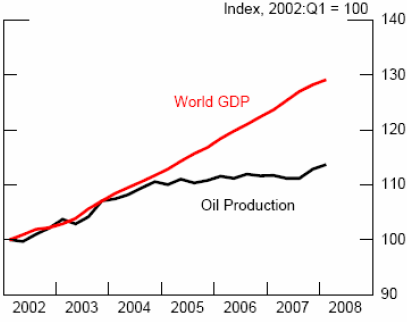
Excerpt from Figure 1 from CFTC Interim Report on Crude Oil - Click to Enlarge
This is a long and detailed report, with many graphs and data supportive of a)the tightness in global supply and demand for oil and b)the lack of correlation between speculative positioning and price increase. It is worth a complete read for those interested in this issue (which has seemed front and center in many CNBC debates on oil speculation). Below are some excerpts of the main findings of the report (italics/bold added).
From the Executive Summary:
The Task Force’s preliminary assessment is that current oil prices and the increase in oil prices between January 2003 and June 2008 are largely due to fundamental supply and demand factors. During this same period, activity on the crude oil futures market – as measured by the number of contracts outstanding, trading activity, and the number of traders – has increased significantly. While these increases broadly coincided with the run-up in crude oil prices, the Task Force’s preliminary analysis to date does not support the proposition that speculative activity has systematically driven changes in oil prices.
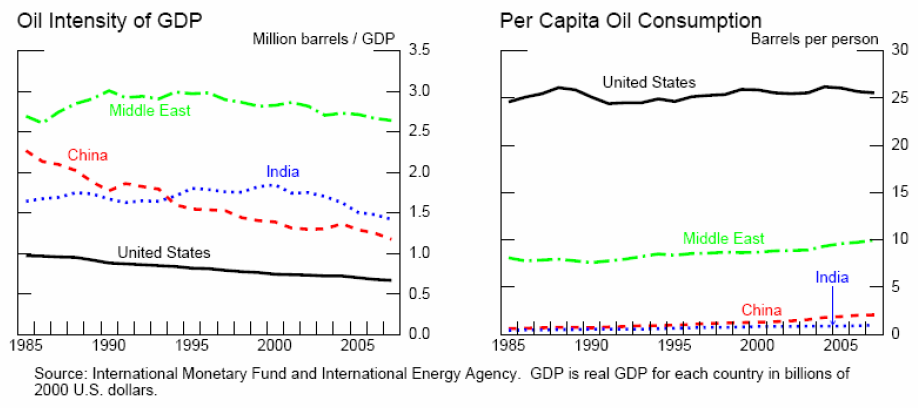
Figure 2 - Oil Intensity and Use by Country Click to Enlarge
The world economy has expanded at its fastest pace in decades, and that strong growth has translated into substantial increases in the demand for oil, particularly from emerging market countries. On the supply side, the production of oil has responded sluggishly, compounded by production shortfalls associated with geopolitical unrest in countries with large oil reserves. As it is very difficult to rely on substitutes for oil in the short term, very large price increases have occurred as the market balances supply and demand.
If a group of market participants has systematically driven prices, detailed daily position data should show that that group’s position changes preceded price changes. The Task Force’s preliminary analysis, based on the evidence available to date, suggests that changes in futures market participation by speculators have not systematically preceded price changes. On the contrary, most speculative traders typically alter their positions following price changes, suggesting that they are responding to new information – just as one would expect in an efficiently operating market.
This conclusion was discussed here in a post on Peak Oil and Reflexivity following George Soros and Michael Masters testimonies before Congress. In effect, at the end of trending cycles the tail eventually wags the dog. This can be seen in real time in energy stocks (down already 30% from their highs in the last month with oil still 'only' at $126).
More from the CFTC report:
On the demand side, world economic activity has expanded at close to 5 percent per year since 2004, marking the strongest performance in two decades. Between 2004 and 2007, global oil consumption grew by 3.9 percent, driven largely by rising demand in emerging markets that are both growing rapidly and shifting toward oil-intensive activities. Moreover, some of the fastest growing nations also rely on price subsidies that hold down the prices of oil and refined products such as gasoline, which further boosts oil consumption.

Figure 1 Click to Enlarge
While global demand has proven strong, oil production growth has not kept pace. In the past three years, non-OPEC production growth has slowed to levels well below historical averages, and world surplus capacity has fallen below historical norms. Preliminary inventory data also shows that Organisation for Economic Co-operation and Development (OECD) stocks have fallen below 1996-2002 levels. Moreover, supply disruptions have adversely affected both world oil production and exports.
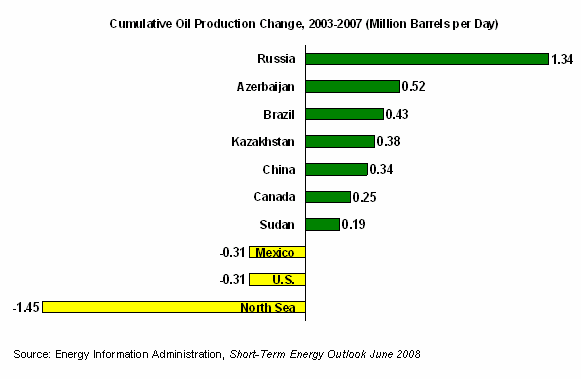
Figure 5 - Non-OPEC Oil Supply Growth
The imbalance between scarce supply and growing demand, and expectations that this imbalance will persist in the future, have led to upward pressure on oil prices and greater market reactions to any actual or perceived disruptions in available supply. Under such tight market conditions, it is often the case that only large price increases can re-establish equilibrium between supply and demand. Consequently, large or rapid movements in oil prices are not inconsistent with the fundamentals of supply and demand; such price movements, by themselves, do not indicate that prices have become divorced from fundamentals. Moreover, if speculative positions, rather than fundamentals, were pushing prices upward, then inventories would be expected to rise. To date, there is no evidence of such an accumulation; in fact, known inventory levels actually have declined.
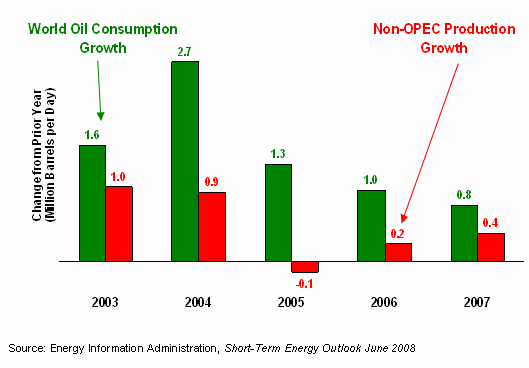
Figure 6 - Increasing Reliance on OPEC Production
Activity in crude oil futures and options contracts has been increasing since 2004. During that period, the number of contracts outstanding (known as “open interest”) has more than tripled, and the number of traders has almost doubled. The fastest growth in open interest has been recorded among non-commercial traders – often called “speculators” – holding spread positions combining long positions in one month with short positions in another month. Thus, while the long positions of non-commercial traders have increased, the short positions of non-commercial traders also have increased. Additionally, although the net long positions of non-commercial traders have increased somewhat since 2004 – which some market observers have hypothesized has pushed prices up – the proportion of those positions has been relatively constant as a share of open interest over the last few years, undercutting that hypothesis.
Much of the attention related to participants in futures markets has focused on the role of commodity index investment funds and the commodity swap dealers that often act as their intermediaries. During the period studied, January 2003 through June 2008, pension funds and other investors have increasingly used index funds as vehicles to participate in commodity markets. Some observers have suggested that this rapid inflow of investments through index funds has been a cause of oil price increases. The CFTC has issued Special Calls for data about this activity, but only partial responses have been received as of the date of publication of this interim report. An analysis of the data from these Special Calls will be made available in September.
The data currently at hand – which incorporates non-public surveillance information – includes positions held by commodity swap dealers. Commodity swap dealers offer institutional investors contracts whose returns are linked to a variety of commodity indices. Broadly speaking, after netting their index fund clients’ positions against the positions of their other clients, these dealers use futures contracts to hedge the risk remaining from this business. Thus, the activity of commodity index participants should become evident in the position changes of commodity swap dealers.
Non-public CFTC trading data shows that commodity swap dealers have held roughly balanced long and short positions in the crude oil markets over the last year and actually held a net short position over the first five months of 2008 – that is, swap dealers’ futures positions would have benefited more from price decreases than from price increases like the ones experienced in the last few months. Moreover, any pressure exerted by the long positions of swap dealers’ commodity index clients has largely been offset by the short positions of the dealers’ other clients.
The Task Force’s preliminary analysis also suggests that changes in the positions of swap dealers and non-commercial traders most often followed price changes. This result does not support the hypothesis that the activity of these groups is driving prices higher. The Task Force has found that the activity of market participants often described as “speculators” has not resulted in systematic changes in price over the last five and a half years. On the contrary, most speculative traders typically alter their positions following price changes, suggesting that they are responding to new information – just as one would expect in an efficiently operating market. In particular, the positions of hedge funds appear to have moved inversely with the preceding price changes, suggesting instead that their positions might have provided a buffer against volatility-inducing shocks.
From the reports concluding remarks:
Observed increases in the speculative activity and the number of traders in the crude oil futures market do not appear to have systematically affected prices. Moreover, if speculative activity has pushed oil prices above the levels consistent with physical supply and demand, increases in inventories should emerge as higher prices reduce consumption and investment in productive capacity is encouraged. Although this process may take time to unfold, inventories of crude oil and petroleum products, according to available data, have declined significantly over the past year. The view that financial investors have pushed prices above fundamental values is also difficult to square with the fact that prices for other commodities that do not trade on established futures markets (such as coal, steel, and onions) have risen sharply as well.
OK, at least based on this preliminary report, speculators are not the primary culprit behind high oil prices. Clearly SOME % of oils rise is due to speculators, in the same vein that some rise in corn, live hogs and SP500 is due to speculation - in the intermediate term fundamentals will always win. The year of production peak is largely irrelevant - what matters is cheap and abundant liquid fuels to power the economic system the world has become dependent upon - for all practical purposes we are already past this point. We are likely going to continue to witness denial of this obvious but threatening theme from the Wall Street -government-OPEC trifecta. Investment analysts will claim demand destruction, governments will blame speculators and OPEC will posit that the markets remain well supplied. There will be no end to how long these parties continue to use these arguments. Every year there will be a normal 20+% correction in oil prices and confident authority figures will say that peak oil is a myth.
What is it going to take?
Contact
- Content: editors at theoildrum dot com
- Tech support: support at theoildrum dot com
License

This work is licensed under a Creative Commons Attribution-Share Alike 3.0 United States License.
As a public service to the oil trader types, I have, from time to time, offered my interpretation of Yerginisms, and I coined the term "The Yergin Indicator," which suggests that oil prices will trade at about twice Yergin's predicted index price, within one to two years of his prediction. For example, about a year ago Yergin said that oil prices in (barring a geopolitical event) would be back down to $60 in 2008 (for more info, do a Google Search for Daniel Yergin Day).
Yergin has been noticeably reticent of late regarding prices, depriving traders of a critically important price trend indicator, so we have to go with secondary sources. Three talking heads were just on CNBC, and in their collective opinion, they agreed that we should be back down to $100 by the end of the year. So, I have designated a new indicator, the CNBC Consensus. While it will probably not be as powerful as the Yergin Indicator, it is probably a decent predictive tool. So, IMO, the CNBC Consensus suggests that oil prices will be closer to $200 than $100 by the end of the year.
WT, sometimes you make me laugh so hard my wife wonders.
$100 by the end of the year. That reminds me of the cartoon that you see in offices on the wall next to the photocopy machine with the guy laughing so hard he is holding his gut, saying "you want it finished by when?"
$200 per barrel if all goes well, higher if not. What was that guy Murphy saying about if something can go wrong it will. In this case there are many things that can go wrong.
We could easily be back at $100, or lower at the end of the year, and it would not invalidate any of the concepts we discuss here. We could also be at $200. Prices, as people must realize by now, have short term elasticity completely separate from long term fundamentals.
(btw, the implied vol in crude oil options suggests that seeing $100 again before year end is more likely to happen than to not happen)
I agree, Nate. I think it is good to keep in mind that most feel one of the symptoms/results of Peak is/will be extreme price volatility, as you pointed out. We need to keep in mind that demand destruction is occurring, though not yet net globally. Also, these ARE the peak production years according to Megaprojects. In late '07 some (many?) people here, including myself, were expecting some softness in price during the period through '09 or '10, no? (Of course, that was pre-Russian peak when they were responsible for something like 60 or 70% of net yearly gain in non-OPEC production.) Then there is the supposed 12.5 by '11 the KSA is claiming they'll have. Those not on board with the inevitable upward trend will take some of these things very seriously, and prices will be volatile.
Drinking the KoolAid, even if one's own (peakers), is always a bit of Russian Roulette, I think.
Cheers
I agree Nate, many of us peak-oiler's get a bit too excited when seeing price trends validate our personal models of PO. In reality, I think we will see an undulating plateau of supply with erratic price swings for several years. I view the whole price/volume system as very chaotic (in the true mathematical sense): it is extremely sensitive to minor changes and is wildly non-linear.
Has anyone considered mapping oil price as a chaotic system? I wonder if there is a strange attractor underneath this?
Lemme see.
1. The oil-producing nations would rather have higher than lower prices. 2. The oil-producing nations have huge mountains of money (sovereign funds) and expert financial advisors, and thousands of financial minion-quislings at their disposal. 3. Oil demand is inelastic in the short-run, meaning if speculators game the price up, demand does not wither for several years. 4. Any financial market can be gamed, and they have been gamed many, many times in the past.
But, oh no! No one ever manipulated the NYMEX! Never! Impossible!
Please. If I ran an oil-producing nation -- and our only real source of income was oil -- of course I would try to game the price higher. It would be a violation of fiduciary duty to my fellow citizens to NOT game the price higher.
So, we can assume oil-producing nations are gaming the price higher, through financial quislings. The gaming worked, as demand is inelastic in the short-run, defined as five years or less.
The gaming worked -- but the game has run its course. Demand is withering, in the medium-term, which we are reaching now. Automakers switching over fleets etc. Now, global demand will likely sink for several years. If prices hold long enough, then the long-term, and much greater elasticity begins to set in, bringing huge, decreases in demand.
What is fascinating is the OPEC-killer lurking in the wings. The death-ray for speculators. The GM Volt.
If such a car works commercially, it is game over for the oil boys and their minion-weenies. Who will need oil then? The world will be able to prosper at 40 mbd or less. Cities will be quieter and have cleaner air.
Tell me the downside in this, because I can't see it.
I agree that all the money sloshing around in our economic system is contributing to price volatility. But I completely disagree with any notion of a vast conspiracy or some "puppet master" that is pulling strings to consciously run up prices. The whole oil price system has lots of drivers from oil-producing states waking up to the real value of what they have in the ground, to worried investors who are starting to comprehend the house of cards that is the US economy. People in this system are like cellular automata's who are following their own interests. I think the influence by global actors like government, KSA, or even Exon Mobile is quite muted. As in calculus, all the little dx's add up, but you need to understand the underlying trends in order to add them up and make any sense of it.
As I see it, all this energy, fear, and money are racing around trying to find some stability point, yet they can't because it is a chaotic system. It keeps oscillating and chasing any hope for answers and stability... but there are no easy answers or safe havens. Climbing out of this peak oil hole will not happen easily or naturally, unless you are betting on Malthusian outcomes.
You're much more optimistic than I about the impact of the GM-Volt. I sure hope is has an impact, but I see it as too little, too late. By 2010 we're going to be in a vastly different world if we continue on current trend lines.
By 2010? Demand is falling now, but global production of liquid fuels is hitting records highs every months. Sellers of sour crude have no markets. Oil is plunging, and it may turn into a rout.
And conservation methors are just getting started.
Hi all,
Noticed a report in the Independant this morning that Nigerian "freedom fighters" were annoyed that a $6M pay off - sent by the Nigerian government had gone to criminal gangs instead of them. They promised to renew attacks on pipelines within the next 30 days as a result. I also note that the recent Iran / Eu "talks" have produced little of substance and that the US 2 week deadline to "think again" about their (Iranian) negotiating position expires shortly.
I'm sure both issues will exert some influence on fluctuating prices over the coming weeks.
I found my 6/28/07 post on The Yergin Indicator:
Jeff
Whilst we are in a creative mood i had a thought (dangerous). I thought we could improve the situation by creating a new acronym, WSD to describe an oil fields reserves, A WSD is "a World Supply Day". This has major advantages.
1/ Its is understandable by anyone, we all know what a day is, 1 billion barrels on the other hand has absolutely no 'meaning' to the general public.
2/ As consumption increases, Reserve Values Drop! 1 Billion barrels is currently 11.8 WSD, should consumption increase to 100mbpd then the reserve is 10 WSD
Imagine the press relese "ANWAR possibly contains 58.8 World Supply Days of crude!"
Its got to be better than POTUS or WOMD (Which I always confused with WOMAD)
Neven
Good Morning.
Um, this is for people like me, yes? Doesn't "WSD" sound a bit like "WMD"? But yes, I do like the idea, even though it would probably only appear on page 58 of the local rag, buried beneath the "Touched By The (Road) Toll" figures.
People don't service their washing machine; they just keep using it until it breaks down, curse it when it does and finally phone someone for help. I'm still crossing my fingers and toes that the "energy man" will have some answers for us when the time comes. I think that's the way it'll go.
Regards, Matt B
WT,
Yep...sometimes stochastics are better than knowledge. I have noticed that when folks are carrying umbrellas it's almost always causes it to rain. Let's hope Y does have a sudden philosophical shift.
I may self have just developed a great fondness for future traders. I've been wanting to buy one particular oil stock for a while but it's been priced high like most oils. Thanks to the pessimism of the future traders all the oil have quickly taker a dip. My target stock is now down 25%...and all the analysts liked it when it was at the top. Even when you're not a wolf it's fun to sit on the hill top and watch the sheeple run this way and then that way.
"the CNBC Consensus [indicator] suggests that oil prices will be closer to $200 than $100 by the end of the year."
You could be right, but currently oil prices are still trending down and I'm glad I sold out. Admittedly I wouldn't short into a rally to $136 any longer.
The speculators can affect the price in the short term, the front month contract doesn't close for another 3 weeks or so. So there's several weeks left for the speculators to squeeze out the overly leveraged longs, before supply/demand considerations come into play.
Question for all of you oil experts out there -- If we were to ramp up ethanol production tomorrow to full capacity, how far would the price of oil drop?
We can't get rid of oil overnight, but if we invest in clean, renewable fuels like ethanol, we can take a big step in solving this energy crisis. Count me in for American-made ethanol.
Ethanol would have virtually no effect on the price of oil. Diesel is what's driving the price right now.
In recent weeks, we've had a build in diesel inventory in the U.S., despite diesel shortages in China, India, South America, and even Saudi Arabia, in addition to a slew of smaller countries. It's the build in diesel inventory that is driving down oil prices here. (Plus a determination to cut oil inventories to the bare bones minimum.)
Meanwhile, most of the places with diesel shortages continue to refrain from buying due to price controls.
Essentially, much of the rest of the world (the part of the world with the largest demand growth) has started de facto rationing (many to "control inflation") even at the expense of their own economic growth. China, for example, recently organized its aluminum producers to cut production by 10% until after the grain harvest.
I think a huge part of the price volatility in the markets is coming from government interference in the markets, both in the U.S. (the spec witch hunt and threats to start emptying the SPR) and elsewhere (China's price controls, etc.)
The markets are becoming a place where, instead of betting on supply and demand, you're forced to place bets on the whims of politicians. It truly is becoming a poker game rather than a market, so governments are achieving exactly the opposite of what they'd want to achieve if they were smart. There's no way to get accurate price signals when you're betting on the moods of a handful of powerful people.
Without accurate price signals, oil producers can't plan risky production, and consumers can't make rational investments in efficiency.
A number of people around here have predicted that free markets would be an early casualty of the energy crisis. I think they're being proved correct.
I doubt very much that this CFTC report will change anything, since everything they said in this report has already been said in other recent CFTC reports.
I agree Muskie - ethanol production is a good start to ensure that we don't depend forever on foreign oil - it may not the be sole solution, but investing in biofuels and alternative energies are the way to go in this time of energy uncertainty.
Ethanol does not scale to the level necessary. Ethanol may play a very small place in stabilizing our energy future but we will not be able to continue the "happy motoring utopia" in which we have all grown up by using ethanol.
Change is coming whether we like it or not. We can either adapt to that change by choosing from the available paths to us or nature will select one path for us, whether we like it or not.
At least link to something to back up your slogan.
A billion tons of biomass would cover 30% of all US energy in 2030.
http://www.eesi.org/publications/Fact%20Sheets/EC_Fact_Sheets/Factoid1.pdf
A billion tons of ethanol stock would replace 50% (80 million gallons) of current US gasoline(150 million gallons).
http://www.ethanolproducer.com/article.jsp?article_id=3096
BTW..did you forget...neither does crude oil, foreign or domestic?
Some possible effects of new limitations on speculative participants, in oil futures markets. (People have already talked about a number of these).
First, my view is that speculators play the role of information aggregators. The CEO's of free market oil companies, the National Oil companies, government and institutional users--none of these are able to spend all their time aggregating information about global oil supply and demand. Prices are always imperfect. But, price is information. Less information, means the price is even more imperfect. So, if a good portion of speculators are driven from the US based oil markets I see the following coming to pass:
1. The marketing and trading departments of the large global integrateds will have a field day, because their firepower will no longer have an offset. They will use their new influence in a lower volume, lower liquidity environment, to gain advantages. That's not exactly a bad thing. But it will create choppy pricing. There is a good story of what Shell traders were able to do, about two years ago, when they squeezed the heck out of some players in the heavy-light spreads. Shell pounded the market with purchases of heavy sour stuff. Then they fed out the extra back onto the market after the price had spiked, and kept the rest. Again, this story shows how trading in front month is both fundamental but trading-influenced. Shell saw that the sour was underpriced, and they wanted some. But they also saw where players were positioned. So the markets will see more of this.
2. Commercial users will get hosed. Airlines, municipalities, and other commercials users who hedge usually by hiring a hedger will find that their activity is no longer passing through as much liquidity. The market will see them coming, and I would expect over time their purchases will more often go off at premiums. I would also expect expiry each month to get more volatile. Most importantly, there will be less liquidity out the curve. That will be terrible for commercial-users.
3. Small producers will find it more difficult to hedge out along the curve, thus making it harder to fund their expansion. We know the large integrateds don't trade as much out the curve. But all the smaller producers do. And it's the smaller producers who are actually successful at finding more supply. We might see a side-market develop between commercial-users and small producers, both looking to trade supply as a reference price point out 2-3 years. They could still record the trade at the NYMEX. But, neither would have liquid price action along the strip as a reference.
Finally, there's no question that trading would migrate elsewhere, to other exchanges. I could see Brent, and Arab Sour, and maybe even a Russian grade becoming new benchmarks. In fact, I would wager that Russia would love to host a new global oil exchange.
Gregor
Bonus comment for the day: https://twitter.com/gregormacdonald/statuses/866158163
Second bonus comment for the day: after I heard Michael Master's testimony, I did an SEC search for his investment fund, and was delighted to learn he was very long Airlines, Truckers, and Consumer Discretionary.
My sense is that Gregor is spot on here.
The rhetoric surrounding this issue suggests that the futures market sets price. But it only really reflects price, given that the cash market sets its contracts at a discount or premium to some futures benchmark. If it gets too out of whack with prices consistent with supply and demand, the cash market would deepen discounts so much that the futures contracts would no longer serve as a useful hedge.
It's pretty simple math, though, to see why it would be reasonable for people hedging against future prices to ask for the prices of the last half year. If there is war with Iran, there would not be any spare production capacity whatsoever. Any sizable disruption, from Nigeria or a hurricane or what have you, would mean a real shortage.
I suspect that on balance the market has decided that war with Iran will not happened. That Nigeria appears to be a little more serious about its problems. That many subsidizing nations are beginning to abandon or at least reduce subsidies--such as Nigeria. That even Chavez appears to think that historical determinants aren't with him at this very moment. And that Iraq's production levels are back at pre-war levels.
I too agree that Gregor's post is spot on.
The government murder of the markets will not be good for consumers or for rational solutions to the energy crisis.
Here was another of the 20 graphics from the CFTC report, showing term structure of crude oil futures primarily being in backwardation (long dated prices lower than spot prices) during the past 5 years. Expectations of higher prices in the future are generally viewed as a signal to build up physical inventories, which has basically not occured - hence higher price trends have been the rule.
There have only been a few occasions in this bull market when the full curve has gone into contango. As I am sure you are aware, a full length contango is very hard to maintain. It immediately attracts sellers in the distant months, who then buy the front months, in order to store. The sell pressure on the back end and the buy pressure on the front usually is its own undoing. And we have seen that at least two times in this bull market, possibly three times. Each time, the contango has dissipated as quickly as it appeared
This is why I have said that when and if we reach a point when a full length contango appears, and is sustained, it will "likely" mean that enough information has finally, finally been aggregated to determine with confidence that the chances of future supply growth are then falling rapidly, toward zero.
As we know that will indeed happen someday, it would be rather trite of me to say I think we are getting much closer now, to seeing a sustained full-length contango. But, I'll go ahead and say it anyway.
Gregor
What this demonstrates more than anything is the complete inanity of our political system and our ability to discuss much less do anything about any problem.
First, I'd like to point to a nice piece by the Financial Times, "Speculation must be defined before its blamed." Secondly, I'll define every investor as a speculator, we're all putting in money thinking it's going to grow, that is speculation.
Now, the report itself says:
In the last week, we saw the price of oil drop more than $20 a barrel or 15%, in a few days, that should speak for itself. Nothing nefarious, this is how the system presently works, it is in fact how prices are set.
Now a better word for Wall Street jumping on the bandwagon, the oil companies and various national governments reaping obscene profits from a problem with an essential commodity would be - PROFITEERING. But since the ascendence of neo-laissez faire in the last two decades, profiteering is no longer a societal taboo, it's just good business.
Now the oil industry has always been a rather primitive market at best, and for those who believe we are near peak, instead of arguing over semantics and beliefs, it would seem most appropriate to say that both our economic and political systems have failed in very fundamental ways.
Joe said, "What this demonstrates more than anything is the complete inanity of our political system and our ability to discuss much less do anything about any problem."
It should come as no surprise that government is incapable of solving problems. First, it was only delegated the power to secure rights (life, liberty, property), and govern those who consent. Second, the farqed up price system is partly due to the Federal Reserve Note (no par value). Third, government makes nothing but more government. Gives nothing but that which was taken from someone else. Until the "solution" creates more government and a mandate to expropriate more money and power, government will appear impotent.
Cynical, am I?
Certainly...
If you combine Fig 11 and Fig 10 you find that 50% of the WTI contracts were held by commercial swappers and 25% were held by hedge funds. Both these groups are speculators IMO.
If Southwest airlines buys contracts to offset the price of oil that's speculation too(they could have bought gold,etc.).
Notice how little of the WTI commodity market comprises producers and manufacturers--which is the traditional (agriculture)commodities market.
Yet the authors indicate the supply and demand is the real cause. They must believe we can't read their report.
GDP(PPP) numbers don't make a lot of sense.
http://en.wikipedia.org/wiki/List_of_countries_by_future_GDP_estimates_%...
If the US is 18% of the world at 3% growth( non-PPP have much more like 1-2% over the last 3 years and the EU is 20% of the world and grew at 3.2% and the whole world grew at 4.5%, that means the non-US,EU world grew at an impossible 5.5%, so Fig 1 looks wrong. Besides, such a high growth rate always means high inflation which drives up the prices of commodities--i.e. Fig 1 isn't telling us anything about a real shortage.
http://www.data360.org/graph_group.aspx?Graph_Group_Id=149
Looks like the whole thing is a PR stunt to give their employers, the commodities speculators, cover.
I think you have a fundamental misunderstanding of how futures markets work. High percentage of speculators are desirable because they add liquidity to the market. Can they bid the price up in the short term? Absolutely. Are they then stuck with an enforceable contract? Absolutely. So, unless they can find an actual end consumer to take delivery of the commodity at that price, they eat the difference--it becomes a self-correcting phenomenon with natural selection weeding out those who tend to bid up contracts higher than they can sell to end consumers. Likewise, they can bid down contracts too far, but then if it isn't worth it to the marginal producer to produce at that price, they will reduce production and supply and demand will find a new equilibrium--again, with the speculator eating the difference. The "problem" is that consumers are willing to pay these higher prices. That's the market definition of price--the equilibrium point where a producer is willing to sell and a consumer is willing to buy. Unless speculators are influencing one of these two points (such as buy physically hoarding oil), they are only creating short-term perturbations in price which will be resolved by market participation of producers and consumers.
Aside from that fundamental argument, I also disagree that there is a conspiracy to knowingly misrepresent the situation to the public. Is the CFTC to some degree structurally vetted to prefer more trading? Yes. Are they going to intentionally lie to that end? I certainly don't think so, but reasonable people can disagree on that point. A simpler, and more likely explanation in my opinion, is that they have the fundamental understanding explained above, and their report simply reflects that.
I thought I knew how commodity markets were supposed to work.
The example given is usually a farmer creates a contract with a 'speculator' selling his crop at a given price or a manufactures contracting with a 'speculator' to purchase his required raw materials at a given price. The immediate risk is transfered to the speculator, serving the interests of society by keeping the farmer or manufacturer up and running. That's fine.
But today's meta-speculators have turned an insurance policy into an insurance fraud.
Remember 'Double Indemnity'?
http://en.wikipedia.org/wiki/Double_Indemnity_(film)
You can never buy too much insurance, right?
A speculator may create a contract with another speculator, neither having anything to do with the farmer. In fact, as I understand it, there is no limit to the number of paper contracts that may be created on a given base of real product. All are 'side bets' (as long as the contract is speculator to speculator) as to how the real (spot) price is going to go.
Yes, there are scapegoats: Ben Bernanke and Masaaki Shirakawa. Hang them first!
The CFTC is not a neutral party. They have an interest, now that institutional investors have arrived with lots of money @ the commodities exchanges for the first time.
http://www.calpers.ca.gov/index.jsp?bc=/about/press/pr-2006/nov/pilot-co...
Whether these entities are 'speculators' or 'investors', I'll leave to others. At some point of perspective, the two concepts merge.
I find this particular story most appropriate:
http://www.economist.com/world/britain/displayStory.cfm?source=hptextfea...
The Bank of England is constrained by rising prices which would call for rise in short term interest rates. At the same time, the productive economy is stumbling which calls for an easing of rates. What will Mervyn King do?
He'll keep rates at 5%. Will it work ... and take Great Britain out of its 'Lesser Britain' funk? No!
Why, you ask? Because financial institutions are now international and can borrow American dollar funds (2.25%) or Yen funds (.5%). King can't close the barn door to keep the cows in or the foxes out because the door has been removed from its hinges!
According to Doug Noland's weekly update on the US money supply:
"M2 (narrow) “money” supply jumped $24.5bn to $7.699 TN (week of 7/7). Narrow “money” has expanded $236bn y-t-d, or 6.1% annualized, with a y-o-y rise of $442bn, or 6.1% ..."
http://www.prudentbear.com/index.php/CreditBubbleBulletinHome
With our economy growing at less than 1% where does that excess money go? The US just finished distributing $130 billion in subsidy (stimulus package). Where did THAT money go?
Oil, baby! Gold, too ... and into agricultural products and other commodities. America faces a second 'Great Depression'. Do you think people standing at the edge of a financial precipice are bidding up the price of something that they have been dependent on for their entire lives?
Think about it. The markets (did) reflect consumer participation more directly than stock or bond markets do. Why would broke people bid up oil to twice what it was last year? The reason is they didn't. The new intermediaries are not financially strapped, CalPERS has billions to throw around and can cause the price of anything to jump just by bidding in an exchange. From a yield standpoint, commodities are the only game in town. Stocks, bonds, and real estate are in bear markets. Direct investment in commercial enterprises requires a long term commitment, special expertise and a willingness to compete directly with (low wage) China and India. CalPERs isn't going to build a copper wire factory somewhere, they'll have their in-house brokers go long in commodities ... and give the brokers $500 million to do it with.
The runup in oil prices is similar to the runup in real estate prices here in the US from 1992- 2005. The rationalizations by both groups, real estate and oil investors are almost identical; "Prices will only go up because they always have. They aren't making any more (land/oil). 'Conditions are different now." The same crookedness and manipulations (and massive subsidies for highways, mortgages and house investments) kept prices rising even while the supply of houses expanded massively. The subsidies for petroleum are its tax- favored status and the depletion allowance. Well, you know ... house prices DO go down ... and the collateral damage is crushing!
To get prices under control, the US's and Japan's have to set short term interest rates in line with the ECB and the BOE. This will end the carry trade in petroleum and other commodities. Prices will fall in line with production, refining and distribution costs. Oil production currently is dirt cheap; less than $10 a barrel in the Middle East. YES, the cheap oil is maturing out of existance and replacement will will cost more than $70 a barrel, but that is a problem for the future. Resolution of the money/currency/interest rate imabalances will make it easier to fund solutions to the longer term supply and conservation issues.
According to Doug Noland's weekly update on the US money supply:
"M2 (narrow) “money” supply jumped $24.5bn to $7.699 TN (week of 7/7). Narrow “money” has expanded $236bn y-t-d, or 6.1% annualized, with a y-o-y rise of $442bn, or 6.1% ...
But let us not forget that the national debt is 9.4 Trillion. Ever wonder how one can pay 9.4 trillions with only 7.7 T?
Can you spell "K A P U T"?
"B A N K R U P T"?
What about all those outstanding mortgages, private sector debt and account holders?
Where's the "Beef"?
And, NO, the government can't just "print up more FRNs". Pursuant to Title 12 USC Sec. 411, each note is an obligation (debt) of the U.S. to pay lawful money. In order to authorize more FRNs, the Congress has to authorize MORE DEBT (Now you know why they just LUV that red ink...)
It's much worse - - - the national debt is denominated in lawful money (gold or silver coin). It would take a sum of gold bullion 85 times as much as the whole world's supply of above ground bullion to pay off that absurd debt. *(Silver is even worse - takes 17 times more silver than gold).
And you thought impossible contracts were illegal, immoral and just plain stupid!
Never underestimate the U.S. Congress, when it comes to Gross Stupidity...
NYT: Speculators Aren’t Driving Up Oil Prices, Report Says
More at article.
Giddaye Prof (are you really a professor?).
As a "taking an interest in behind-the-scenes stuff" newbie, I'm still not seeing headlines like, "Cheap Oil Hard To Find", or, "Current Energy Consumption Unsustainable". Instead, the talk on Aussie radio this morning is about, "Why don't fuel stations pass on cheaper pump prices more quickly".
There still seems to be the idea, "just increase the flow and all will be well" and I simply don't understand why we Average Joes and Janes aren't (or can't be) forcably made aware that crude oil is a finite resource. Then again, there's still plenty who believe a mystical being snapped some poor fella's rib off and morphed a chicky-babe from it (did she ever learn to speak, by the way?).
Regards, Matt B
No Matt, the one that does the speaking in that fairy tale is the long slithery creature with the forked tongue and the miraculous everlasting free energy apple. Then I think the oil runs out in the garden of Eden or something like that and they have survive by the sweat of their brows.
Matt--if you really want to know, you can look up in the staff bios section...
Sorry Prof, I keep forgetting about all those extra mouse-clicks available.
Regards, Matt B
PS. I read at the start of the year somewhere that the Big Boys are spending 100 million (or was it billion?) on exploration. How're they going with that? Any new North Seas out there?
http://www.financialweek.com/apps/pbcs.dll/article?AID=/20080723/REG/613...
While I don't entirely disagree with the premise, it should be clearly stated that the CFTC is an interested party with a bias towards more trading and not less trading.
Their facts and figures should be scrutinized at a level consistent with an Enron Annual Report.
That oil has dropped 20 bucks in a week, with a hurricane hitting Texas, should at least prompt consideration that non-geological forces can and do affect the price. Or, maybe 14% more supply came online since Thursday.
My take is that there was at least 20 dollars worth of speculation in the market price since nothing material has changed in the last two weeks with regards to supply and demand. And if one can concede 20 dollars, then perhaps 30 dollars is also possible, and so on.
I agree with your assessment about the bias in the study. Also, it seems that at least one supporting reason that the price of oil is being affected by nonsupply issues is the price of all commodities. Why is the price of gold (and corn and metals...) so high??? It is because investers cannot invest in the U.S. housing market, and no one wants to hold onto the sinking dollar so they invest in commodities, such as oil. To me this is pretty obvious. I believe that of the recent runup in oil prices, this investment/spectulation plays an important role.
The fact that inventories are low could be because that if the price of crude oil is high, why stock up, especially if you think that the price will soon drop.
When Bernenke eventually increases interest rates, which he eventually must do, we will see what happens with the price of oil - how much of the price is due to supply issues vs investors.
Retsel
I wouldn't be surprised to see the CFTC dismissed as a bunch of compromised Bush appointees as well.
Tom Whipple has written of no less than 90 nations experiencing energy shortages in the last few months. There's your additional supply.
http://energyshortage.org/
$20 to $30 of speculation in current price agrees quite closely with my estimates. But then what do I know?
You're incorrect--something material has indeed changed.
Prices have dropped because we keep building up diesel inventory.
Prices are dropping because in the past two weeks diesel inventory has gone over the 5-year average, after being below the 5-year average for many weeks.
Specifically, we added 2.4 million barrels of inventory last week. If any of the places with diesel shortages, like China, India, and even Saudi Arabia, would start buying, we'd see our inventories holding steady and oil prices holding steady too.
But they're not buying. They're essentially rationing through price controls. As a result, U.S. refineries are going to be cutting back production to prevent further builds. That means a serious reduction in oil demand. Part of this reduction will get taken care of through the decline rate. The rest means a price fall.
and so on, all the way to perhaps $120.
We all know Crude is an infinitely renewable resource on a ten-year timeframe. These high prices are just The Cabal squeezing consumers so they can fund their exponentionally-increasing porcelain figurine collections.
Kevin Drum over at Washington Monthly agrees with Da Sasquatch:
Also a good discussion of the speculation legislation that passed the Senate yesterday 94-0 that I somehow completely missed...and I am a political science geek.
More on the legislation:
CNN: Partisanship threatens Senate efforts to lower gas prices
And here's a link to the Senate legislation itself.
Nate,
Thank you for this. I love this site, and other sites that discuss these issues. This type of open discussion, with everyone allowed to voice their opinion, no matter how crazy it may seem I think is a huge driver to understanding, learning, enjoyment, and information needed to make decisions.
I wanted to comment on the drop in energy shares. I think that is for two reasons 1) energy shares get "marked to market" continuously based on the value of their reserves which is directly a function of the spot price of oil which is generally a reflection of supply and demand and money supply of course with some short-term variation as you discussed and 2) as the earning multiples of stocks contract in a bear market no stock is immune.
I do believe the real supply/demand issues are at the base. As the spot price goes down, the value of reserves go down and the energy stock price goes down.
The earning multiples of stocks are contracting because (1) debt to banks can no longer be serviced as more money supply is going to oil crushing banking stocks and (2) price increases in oil increases the price of consumables and products (i.e. price inflation not money supply inflation) and bond holders start demanding higher rates to preserve the value of their lending for future purchases of products. As rates go higher, one can get a good rate of return on bonds vs. earnings on equities and money flows into bonds instead of stocks lowering multiples. Case in point, in 1979 stock market multiples were about 6.5 and bond rates were very high.
Why speculate on likely poor earnings due to less money for goods & services since more is going to oil when you can get a pretty solid rate from a bond that likely will be higher than the earnings?
Pure speculation, but perhaps oil company stockholders forsee the future of oil prices and are taking profits?
Good points. But they would argue for energy shares (down 30% in last month) to outperform financial shares (BKX up 54% from bottom) going forward. Would you rather own ConocoPhilips at 6x forward earnings in an energy constrained world or JPMorgan at 12x forward earnings in a credit constrained world?
Nate,
You are spot on! I think energy stocks will outperform the rest of the market, but that doesn't mean that equities as a whole are not overvalued right now. Particularly financials.
But perhaps now is time to take profits at COP at 12X earnings and buy back these true value stocks (if you are a peaknik)when they drop to 6X earnings?
One of the best traders I know has always said that markets are completely irrational in the short term, and that's where quick profit can be made, but in the long term they are generally rational.
How many smart people are buying "oil is just speculators?" How many smart people think that the Treasury backstopping the housing market will stop the decline in the price of housing and turn the market around? How many smart people got fleeced in the April-May rally thinking the Fed could completely solve these problems? How much of this wealth is in Baby Boomer's hands who have "muscle memory" to buy on the dips since that has worked well for the last 25 years?
In my opinion, the housing bill will just increase rates on long term bonds making mortgages more expensive continuing to push housing prices down as the Treasury adds more debt & interest payments to its balance sheet. Tightening of rates is deflation in money supply to counter price inflation based on market conditions--like Volcker did when US hit PO in the 1970's and the US had not yet convinced Saudi to pump like mad in the 1980s.
Japan did government bailout of banks and they got a decade of deflation in asset prices--and a big cratering in the Nikkei with tons of bankruptcies at the end.
This is what I think Soros is talking about with the super-bubble. The super-bubble is the giant debt creation enabled by the suppression in oil and food prices for 20 years allowing people to afford to service more debt. Once oil and food prices rise, there is no longer money for this debt and the super-bubble must deflate as we are beginning to witness.
These are just observations, it will be interesting to see what happens for the rest of the year, and once the data comes in we can try and come to a better understanding of these things.
But perhaps now is time to take profits at COP at 12X earnings and buy back these true value stocks (if you are a peaknik)when they drop to 6X earnings?
COP is at 6X earnings. That's what Nate was saying. The PE based on the median estimate for 2008 is 6.6. To me, that looks incredibly cheap given their market cap is $126 billion, and they have reserves worth well over a trillion dollars.
Disclosure: Long COP for the past 6 years.
Robert,
Google is telling me different. It is saying current PE's are 10.57 and forward PEs are 8.70:
http://finance.google.com/finance?client=ob&q=NYSE:COP
Perhaps these numbers are bad, I don't know. They are what I use.
I'm not saying COP isn't a good stock. The company is outperforming every other major oil company in my opinion. If we have an equity cratering it will hold up better than probably any other stock. Warren Buffet is no fool. Warren bought when they were trading at 6, so did I.
The problem was the market wasn't pricing in future oil price increases at that time and therefore while selling at 6 and looking cheap, they thought the oil price would drop and so would the value of their reserves and so nobody was buying. Well I bought and so did Warren.
Now I think we have the opposite--trading at higher multiples because more money has moved into the stock. If oil prices shoot up, I think overall stock market money will go to bonds, and multiples will be lower but reserves will be worth more. So I don't think the stock can plummet like others, but I think it can still go down.
I've been long COP for the past two years myself and I just sold about a month ago. I think forward PEs were much higher then, so you might be right, they might be a better buy now.
Robert, with the time you have devoted to trying get the word out I'm glad you've had a pretty good past 6 years :). Hope you used some of it on your compost bin.
Down 30% in last month vs up 54% in last four days. Interesting apples and something else comparison.
Unless you feel we are at peak money, I would go with JPM for the long haul. After all, the premise of TOD is that COP will no have oil to sell at any price. Like the dot.com slogan, no S no E implies, COP is ultimately out of business. If oil really is peaking, people will see that, and maybe are seeing that.
If COP has no oil to sell at any price, clearly there is no JP Morgan.
Nice
Clearly, I'm afraid I still don't see the connection. JPM was around long before COP, or oil in general. The company is over 200 years old. I can see it now at the first board meeting. "What should we do?" "Sit around for another 50 or 60 years until someone finds oil".
http://www.jpmorgan.com/pages/jpmorgan/about/heritage
Life will go on, there will still be rich people, and there will still be some form of money, long after COP is gone. The world did exist before oil. A quick look at the left side of the peak from time to time wouldn't hurt. You'd see it goes on for some time back.
But hey, you may right! Everyone else seems to think so.
Here, 100 companies still in business, most of which existed hundreds of years before oil.
http://www.bizaims.com/Articles/Business+-+Economy/The+100+Oldest+Compan...
My favorites
6. Barovier & Toso – founded in 1295
Get that? 1295 and they have a website!!!!
http://www.barovier.com/
32. Zildjian Cymbal Co.
Cymbals
Based in Norwell, Mass.
Founded in 1623
14th generation
JPM and all modern banks worldwide are based on fractional reserve banking, i.e. lending the money deposited in them for an interest.
The existence of safe interest-bearing investments requires that the money supply grows at a similar rate. (*)
If REAL GDP does not grow at that rate, money supply growth just causes inflation.
Peak Oil and Peak Everything implies no more economic growth. Actually, it implies a decline in output until stabilizing at a really sustainable level. So, even a Steady State Economy cannot be achieved at the current economic output levels.
The banking system most appropriate for a Steady State Economy (as explained here) is 100% reserve banking, first proposed by Simons (1934) and Fisher (1935).
(*) which is only possible with fiat money. Hence the bibilical prohibition of interest when a precious metals-based monetary system was in effect. Explained at length here,
Nate,
Just a follow up. Long post please excuse.
Simply because its supply/demand + money supply doesn't mean that price won't move around like crazy. Here are some factors to consider as we move in Q4 2008:
Assumption: Diesel is driving the price
Facts in Support of Assumption: Diesel stocks are the only stocks that are at a decent level right now in US. Oil keeps coming down off inventory and diesel stays constant. Most stories about shortages talk about diesel shortages.
Still might be bad assumption.
Distillate Factors for 4Q 2008:
1) How cold of a winter will this be? I think this is the largest factor as diesel and heating oil compete for a barrel. Part of this depends on how much $4 heating oil from last winter caused people to change--I would think not too much since overhauling a heating system is very capital expensive especially for older bigger buildings.
2) When will the Jamnagar refinery come on line and how fast can it ramp up? This refinery is scheduled to come on December 2008 as of now with a 580,000 barrel per day capacity. This refinery is designed to take an API grade 24 feed which is on the heavier end of the spectrum. I believe Saudi does have spare capacity but it is of this heavier grades and is standing idle right now--once there is refining for these heavier grades they can increase output for this winter.
This refinery can process 12.5 MMPTA of diesel which is about 250,000 barrels per day in extra diesel. This would help the diesel situation a lot and so when this starts and how fast is an influence.
http://www.pakoil-gas.com/P2007/Day%202/Parallel%20Session%202%20(A)/Ashok%20Dhar_Islamabad.pdf
3) China. I think a big part of this drop is the Olympics will be over and the subsidization of prices was reduced.
4) Iraq. Last winter Iraq behaved like a swing producer. What might it do this year?
As far as the financial discussion here is my take on the whole situation. Of course this is all rampant speculation and I have no clue about any of it--it's just my attempt to make sense of events. It's probably all wrong, but here goes:
Last winter, when oil began its upward climb, it became clear to the bankers that there would not be money to service debt going foward especially when OPEC didn't pump enough to keep it down. The quick increase in the oil price was highly deflationary to assets like houses since people couldn't make their payments and it was clear that the value of those assets would fall quickly and therefore there would have to be huge writeoffs in the value of those debts.
Left unchecked this would create a quick and powerful deflationary collapse in the money supply. The Term Lending Facility was created as a quick stop gap but they knew they needed to be able to increase the money supply more. Bear Stearns didn't help out with the Long Term Capital Management bail out and therefore wasn't liked on the Street.
http://dealbreaker.com/2008/05/the_wall_street_big_wig_lunch.php
Bear has a lot of exposure to mortgages and was counterparty to JP Morgan on a bunch of derivative trades. Bear was selected for a takeunder and used as an excuse to create the Primary Dealer Lending Facility straining the authority of the Fed under the Federal Reserve Act. This allowed the Fed to re-inflate the money supply through the investment banks on top of the Term Lending Facility for the commercial banks.
Everybody was happy for a while. Then it became clear that the Fed's balance sheet wasn't unlimited and eventually it started to run dry. Lehman comes out with a note on Monday saying Freddie Mac and Fannie Mae are under water for 75 billion. They weren't the first ones to say that--many had been saying it for a while. Everybody sells off Fannie & Freddie stock. Friday things are looking grim for Freddie and Fannie and close to the end of the day a rumor is floated that Fed would open discount window to GSEs and Paulson talks about his plan to lend from Treasury.
I think that was a trial balloon sent out to test the bond market. The bond market jumped like a frog and the credit default swaps on US debt doubled in an instant. Bond market no likey.
Interestingly, the question arises: why does the Federal Reserve need to give the GSEs access to the discount window if they can borrow from the Treasury? Treasury can raise lots of money so why would they need to access the Fed? In my opinion, the GSEs become the conduit between the Treasury and the Fed to allow the Fed to increase its balance sheet with T-bills and agency paper to prop up the banks like the Japanese did. Basically complete nationalization of the banking system because the whole thing is leaning on the Treasury now.
Over the weekend Paulson and Ben talk to the other central bankers, particularly the Asian central bankers, and talk about thier plan. Some type of agreement was reached where the Asian bankers agreed to buy bonds at a crappy rate and eat the loss in purchasing power over time (they have already been doing this for a long time if you believe the CPI is understated--why do they agree? technology transfer, a consumer market while they build their industrial base). Maybe they offered to try free up oil for them too, who knows? Now, of course, they won't suck up these losses forever and rates will have to go up sometime. How soon or quick? Who knows.
Particularly, here is the answer to the question for bailing out the housing market of where will all the money come from? Asian central bankers. They have a ton of reserves of US T-bills. They will start to dump T-bills and buy agency securities. Rates on T-bills will go up, and so housing will keep going down but in a more controlled fashion, but Asian bankers get securities backed by real assets whatever their value is.
As some here have said, in a resource constrained world fiat loses its value. Issuing more doesn't create a Keynesian stimulus to go out and develop more resources to back that fiat so it holds value because there simply isn't more resources to develop--all it would do is result in more claims on goods and no more goods. We saw that with the check drop--all it did was increase the money supply and therefore the notional price of food and oil went up and it did diddly squat.
Securities without backing by real assets will continously lose their value in real terms as the amount of money supply(claim on goods) becomes much larger than the goods produced. So the Asian central bankers (and the Fed) gets to exchange fiat reserves T-bills for reserves backed by real estate which is likely to better hold its real value even if notionally the prices of houses are dropping--the income stream will be the same on the mortgage. $300,000 house at 6% = $1,800/month. $220,000 house at 9% = $1,800/month. Thus, they become our landlords in effect.
What do we get in exchange? Our multinationals get access to sell to a country of people who really want toasters, cars, etc. and are willing to work much harder for them than the US. The US is a low growth country now--moving on to greener pastures. Also, they enforce IP rights so we can sit back and collect royalties on the brands.
In my mind, the whole key to PO and its consequences is the decline rate and shape of the curve after peak. If 3% or more starting soon then its big problems time--I'm in the doomer camp. If its a plataeu or gentle decline like Stuart said in "slow squeeze" then we will have more time to adapt, implement alternative energy, and I think Leanan's view is correct--basically things are similar but we are poorer.
Anyways, like I said this is rampant speculation. And my opinions will probably change as more data comes in. It simply is just my attempt to make sense of the events of this past year. But I think the connection between oil and our financial problems is understated. The big debt bubble was enabled by cheap oil, and the big debt bubble will deflate as oil gets more expensive.
Interesting and insightful big pic. My main objection to bailing out the housing market is to the extent that it can provide financing for building new homes of the current variety. I don't object to paying out current Agency debt, I object to creating new Agency debt. No new Agency debt would certainly mean very few new mortgages which would cause a sharp drop in new home construction. Which, from a Hubbert's Peak-aware perspective, is exactly what the doctor orders.
Because construction of more suburban and exurban McMansions is just digging further in the already deep hole most of the US population is in, as higher fuel prices will turn those homes into traps for their occupants. The US would be WAY better if labor and (ever more scarce) resources were employed in a massive wind farm construction plan like Al Gore proposed recently.
Related to this, IMV the cars-on-natural-gas part of T. Boone Pickens plan is nonsense. Cars should go electric or at least PHEV (that's why the US needs so much wind power). Natural gas is too important for cooking and heating.
Beach Boy,
They don't need new houses to issue new agency debt. They simply need to package and sell the insane amount of mortgages they already hold on their balance sheet (they are levered 60 to 1) into agency securities and sell to foreign investors. A wind down of Freddie and Fannie into smaller beasts.
Here is how I envision it working. Foreign central bank sells T-bill on open market to raise cash--this pushes price down of T-bill and therefore raises the rate. Fannie & Freddie package those mortgages on their balance sheets (and new ones the banks dump into Fannie & Freddie per this bill) into agency securities--delever.
The time of levering up like we had for the past 25 years is over--because one can't service more and more debt when basic costs are going up.
Agency security is exchanged for cash from foreign bank. Cash is repaid to the Treasury on Freddie & Fannie's line of credit. Treasury lends that cash back out to foreign investors at higher rates of interest. Higher taxes finance this operation and these higher rates of interest.
Note the US has passed an exit tax--if you try to leave the US and renounce citizenship and you have over $600,000 then you will be forced to pay all taxes on wealth immediately upon exit. In my mind, this is a glaring signal that taxes will be higher for the wealthy and probably everyone else too.
This ensures the wealthy can't evade the coming higher taxes and ensures there will be tax funds to finance the debt windown. Plus, Obama intends to raise taxes and he appears to be the probable president.
For the last 25 years we have created a debt super-bubble as Soros, Ilargi, and Stoneleigh have noted based on cheap food and oil because of Saudi flooding the market allowing the amount of debt to be serviced to be greater and greater.
As we are moving out of this cheap oil phase, all of this "paper value" needs to be destroyed otherwise we have a huge amount of claims on goods and no more increases in goods. Such insanely rising prices would literally kill the poor--not that I think there are a lot of bleeding hearts caring about the poor, but they do care about riots and revolution. There are a lot more poor people than rich.
In my opinion, and like I said its pure speculation, is that the value of central bank holdings in T-bills will slowly be destroyed. As T-bill rates rise, the value of a 5% 30-year T-bill will continue to go down and down. Bill Gross, the billionaire bond manager, is hugely short T-Bills.
The foreign central banks would not accept this destruction of their wealth with nothing in return, so they can exchange their T-bill holdings for agency paper. In a resource constrained world, paper backed by real estate is much more likely to hold its value than pure fiat paper.
I've already read a lot of articles saying that these banks are already buying this paper.
Basically de-lever Fannie & Freddie by creating agency debt for sale to foreign central banks or for transfer to the US banking system (mainly the primary dealers and selected large commerical banks)through the Fed window.
Note the primary dealers who are connected to the Fed through the primary dealer lending facility now include foreign banks like BNP Paribas. It seems they are already extended to Europe and will be handled similarly. Fed has already floated the idea of accepting foreign collateral onto their balance sheet.
There is no need to build a bunch of houses. Plenty of mortgages right on the ol' balance sheet of Fannie & Freddie.
Pat,
I guess that's why they have horse races. I may self have just developed a great fondness for future traders. I've been wanting to buy one particular oil stock for a while but it's been priced high like most oils. Thanks to the pessimism of the future traders all the oil have quickly taker a dip. My target stock is now down 25%...and all the analysts liked it when it was at the top. Even when you're not a wolf it's fun to sit on the hill top and watch the sheeple run this way and then that way. I hope I'm running with the right herd.
I am a long time oil and gas investor and I sold 20% of my holdings last week. I was so far ahead that I had to take some profits. You do this long enough and you start to feel stupid if you miss the top.
Also I think you are right about interest rates and risk. When the Fed really starts to raise rates, watch oil prices drop.
I think it's starting to turn right now. Higher interest rates will cause the world economy will decline even further and it will require less oil.
Investors who have been forced into commodities by low interest rates will see new higher interest rates and make the jump to the lower risk bonds. If they made 30% in commodity speculation in the first part of the year, they will be tempted take profits and be happy to sit on low risk bonds for rest of the year and end with an easy 35% to 40%. Do this long enough and you know sometimes you have to take your money and run. I think this is happening now.
All those discussions about Chinese and Indian demand, will matter less as those countries have benifited greatly from selling goods to America. Demand from other countries will not make up for the decline in demand from America. The American consumer is tapped out from the housing crisis.
Jeff Rubin from CIBC is probably right that increased shipping costs will further reduce global trade. With reduced trade, Chinese workers will have trouble buying their first car.
Long-term oil will rise much as predicted, but there will be some choppy ups and downs for the next few years. Hang on, it will be a bumpy ride.
I am sorry that events on the ground
are confounding your cherished beliefs.
If it walks like a duck,
And swims like a duck,
And quacks like a duck - -
Then possibly, very possibly,
It is a duck.
http://www.dailykos.com/storyonly/2008/7/15/131157/509/631/545500
Now I know that I was just lucky in my timing with this.
I had been writing it for about a week,
And just happened to post it the morning prices broke.
So I don't claim Whoopi Goldberg's psychic powers.
Yeah - I know -
Go ahead and troll-rate.
Because it is plainly obvious that you are unwilling to consider the possibility that the price of oil will NOT go to $200 this year or any time soon. The sad thing is that people who hold to faith mantras - regardless of whether these are on the left or right, religious or secular - cause more harm to the causes that they purport to endorse.
I am laughing my arse off at present as oil continues to drop. Below $125 today. Consumption continues to drop. Additional production will be coming online soon - conventional in Iraq, Oil Sands in Alberta, expensive tertiary recovery that will require return on capital.
But nooooooo - you can include things like "My A$$" in your title and that is funny, yet if I make reference to a duck it is troll-ratable. Truly pathetic.
http://www.eia.doe.gov/pub/oil_gas/petroleum/data_publications/weekly_pe...
You've been a member here for three hours. I am guessing that it's your attitude as to why you are being downmodded.
Many around here, including myself, have been arguing that oil would break for quite a while. How far we are yet to see.
Your argument is not new or novel, nor is it unexpected.
I understand your point, but to be fair to johnnygunn, a newcomer to this site might not get that impression.
For instance, in comments regarding the poll you posted today, you said that in the last poll over 60% of responses thought oil would rise vs. oil 9% thinking it would fall from what were record levels. Those numbers say a lot.
The other point I'd like to make is that newcomers here (especially those who do not make a show of agreeing with the "oldtimers") seem to be treated quite poorly.
These seems to be this underlying notion that you shouldn't be commenting unless you have read and studied everything ever posted here. And if you might have gotten some first impressions by only reading say the last two days' worth of posts and comments - hey! that's your problem.
What difference does it make if he's been a member for three hours? Maybe we should put everybody's date of birth next to their name.
In fact, below, we already have "ccpo" making a weightless, unsubstantiated attack on the commenter rather than his statements.
Apparently breaking the rules is a privilege reserved for those with at least 32 weeks under their belts.
JAS, I fully agree with you. I've read JD's blog post and it is thoroughful and credible, very much unlike this thread post itself, where speculation has been "proven false", just like 1929's, 2000's, 2007's, etc. I guess. People here put blinds on their eyes to the very things they don't want to simply believe.
The most hilarious graph I've ever seen is the front one. Have it occurred to the authors of the post that:
- You could have done a similar graph with the same values but aligning GDP growth with oil growth since 2005? You only have to scale them;
- Even if we take the graph for granted (which is disproven hilariously some graphs below, where the plot of GDP/barrel clearly shows that it is a quite moving "constant"), shouldn't it prove for once and for all that GDP growth is almost completely independent from the barrels of oil we use?
PS: Mr Goose, this website is turning itself unto a porn doomer thread series, despite many positive things in it. Yes, I know, I've been saying this for ages now, but you simply don't seem to listen. If you want to turn the tide, so to speak, you should:
a) Abandon the "vote" system, which is only a measure of the sheepnessless of any given commentary, and erases the motivation to bring different points of views from the main cattle point of view, which will only increase your initial problem (positive feedback), rendering your site the ultimate doom feast. (I predict a peak on doom in TOD by in about a year, where it has superseeded LATOC);
b) Treat well people who disagree with your theories. Treat bad people who agree with your theories but acts like a bully. Like your pal here, ccpo, who strikes me more of a troll than anyone else by asking everyone who disagrees with him to get the hell out of here (but alas! he is in agreement with the msm, so he is protected);
c) Acknowledge the finiteness not only of oil, but of knowledge itself, and if anyone brings in more knowledge, even if you "heard of it before", perhaps many more people didn't, so you should welcome it. Or are you treating this site as useful to you only?
And ccpo, grow up.
luisdias,
I don't visit DailyKos, so don't known this new feller. And it wouldn't matter if I did. His post was churlish, childish and inappropriate. If he posts like a troll, he should expect to be treated like one. The good professor had the same reaction I did, so I consider that support that my perception is defensible. There was nothing childish in my post, but let me join you now in your childish response:
Mind your own business. Your perceptions are yours, mine are mine. I still call troll.
Cheers
ccpo,
Troll, from wikipedia means:
In JD's comment, I don't see an irrelevant off-topic message, I see disagreement and a link connecting to a comprehensive blog post explaining his position. Too much work just to "bait other users into an emotional response", if you ask me. I also can't see where it is "off-topic".
ccpo's reply?
Uncalled insult, false accusations without any evidence whatsoever, and failure to recognize a simple truth: that people may not register the exact moment that they discover the site. Many visitors are simply lurkers who will only register past several months.
From the moment you have posted this on an internet forum, and considering you are not a moderator nor anything like it, consider your wish automatically not fulfilled. Don't like it? My bad.
It the same troll re-joining over and over and offering his/her drive-by insults, almost certainly. Just joined, but claims familiarity with the overall consensus on these boards?
Go away JD, or whomever you are.
Cheers
johnnygunn has been an extremely active and popular diarist at DailyKos for over two years. I hope that he ignores this type of nonsense and continues to post here. I also hope JD continues to post on TOD as his comments provide a sometimes very useful counter-balance to ideas that often become dangerous doctrine.
(And no, that wasn't me that gave you the -1 rating.)
If Mr. Gunn should choose to post like an adult and not a 12 year-old, I'd agree. Thus far, the evidence is against. As for JD, I've read his site. He uses circular logic, non-science and non-scientists to support an agenda, nothing more. He serves no purpose because he is not applying the science to the situation, but is pursuing his agenda.
Cheers
Surely, the ability to guess other people's ages in internet comments is not your strength. Your accusation of "anti-science" is laughable, from a man who can only babble infamous rants against TPTB et al, if he is some kind of a troll, then what are you?
A super troll?
johnnygunn "I am laughing my arse off at present as oil continues to drop."
Prof. Goose "Many around here, including myself, have been arguing that oil would break for quite a while."
And some have been arguing the break will occur because of decreased demand due to economic collapse and the unwinding of a credit bubble that was fueled by fractional reserve banking. First comes the share market collapse (starting one year ago), then the economic collapse (happening now).
It might not be so funny if you, or someone you care about loses their job or ability to use credit as the result of a peak oil induced depression.
@JohnnyGunn -
I read your analysis on DailyKos. It was well thought-out and documented with graphs and the rest. I hope you continue to contribute here. Don't mind the negative feedback.
Admirable is your ability to attribute your post date to luck rather than a functional crystal ball.
I do however disagree with the notion that oil will move much past $100 towards $80 in the short term. I realize this is not exactly what you are proposing (you believe $80 is more a medium-term possibility, if I read you correctly). I also realize that your argument concerns systemic/bubble issues more.
But the argument against $80 oil goes like this: starting at $120-$115 OPEC will move towards cutting production.
They did this in September and October 2006, the last time this happened. At the time, oil had moved sharply down from $77 to $60. They were able to jawbone the market about their cuts and then actually implement those cuts quickly enough to stop oil at $50 on the dime and reverse its direction all the way to $148.
A similar move today would equate to oil dropping from $148 to $100 when their cuts would begin to bite.
When I say OPEC, of course, I'm basically speaking of Saudi as the swing producer.
According to McCain this morning, he credits Bush with the lower price of oil on the 'psychology' of having lifted the offshore ban on oil drilling by GWB, (originally put in place by his Father GHB in 1990), as the sole reason why oil price fell.
The lifting of the ban by GWB is purely symbolic because Congress must chime in to lift the ban beyond a symbolic jesture. So are encouraged by McCain to believe that a symbolic jesture, which even if it had come into fruition, wouldn't have translated into any pump price reduction for at least 10 years, scared savvy commodity traders into dumping oil to a much lower price for psychological reasons.
Yet this article spells out very clearly reasons to understand that the price of oil has ebbed and flooded due to the basic price fundamentals of supply and demand, which we are all familiar with from Econ. 101.
No wonder Gramm thinks we are all in a mental recession.
You know, there are powerful forces out there that might be gathering to make this a not so great idea, I for one wouldn't want to mess with them.
Just as when in the run up every single reason was pointed as the cause to the price increase, now every single reason is pointed as the cause to the price collapse.
And you should at least credit the author of that cartoon.
It's xkcd.
Luis, I agree.
As a loooong time reader of xkcd I usually make it a point of crediting them this time I just grabbed the embedded link posted on their site and added it to the HTML so it is still traceable. My apologogies to them. They are one of my favorite humor sites!
Why is it that some commodities such as coal, steel, and onions can thrive without a futures market while other commodities seem to require futures? The lessons from coal, steel and onions is that futures markets serve no necessary function and ought to be abolished. Why not let the people who actually produce a product and the people who actually use a product determine prices. We all know that the only ones to consistently profit from futures trading are the bookies who claim to be brokers. Futures trading is gambling and nothing else.
steel scrap is up from $185-190/tonne January 2006 to $650-660/tonne June 2008.
thermal coal is up from $46.30/tonne January 2006 to $171.20/tonne June 2008.
onion prices up 400% between oct 2006 and april 2007, from that high down 97% by March 2008, up 300% from then.
coal is traded on futures, for example, Central Appalachian Coal Futures contract (CAPP) on NYMEX.
steel has been traded on the LME since April, contract seems to have failed on the DME, either way, prices way up, wouldn't you say?
Exactly. Now, apply that logic to Carbon Trading... then kick your politicians out of office again.
I really like your posts Nate and I believe that we are close to Peak Oil if not there already.I also agree with your statement that speculators are not to blame for high oil prices but they may have effected the magnitude of the price increases. See reflexivity comment in your piece. Most people would say (maybe not TODers though) that $80/bbl is high but if speculators have added a $45 premium from an 'intrinsic price' of $80 I would argue they have increased prices a lot. Also, CFTC not the most unbiased source.
Speculators cannot set the price in the long term. Buffet's quote re the stock market: it is a beauty contest in the short term but a weighing machine in the long term applies to commodity markets as well. Basically the conclusion we can draw is that commodity price will trade around its 'intrinsic value' but many times be under or overvalued in the financial markets. Rarely the price will be wildly under valued (1998 for crude oil?) and rarely wildly over valued.
However, speculator's can obviously influence commodity prices short term. Sometimes dramatically. And the short term can last years. See Hunt silver buying as an example.
IMO there is an asymmetrical long bias right now due to mutual fund and pension fund GSCI (and others) indexing. This has occurred because of relatively recent research showing the beneficial effects of adding commodities to a stock and bond portfolio and the simple outperformance of commodities as an asset class. These funds have grown from a very small number to $200B+ over the last 5 years. These funds are a huge new player in the markets that will never be short. Most other speculators in commodity markets are flexible and will go long and short. The argument that speculation would lead to physical inventories going up is retarded in this case, these are financial players matching an index. The index rolls each month. They want to match the index. They do not want to have any tracking error. Deviating from the roll of the GSCI or whatever index they are tracking by storing would increase error.
To counteract this huge new player that is long only we would need huge amounts of new speculative capital to enter the market on the short side. CFTC says they have nonpublic information that this has occurred. I am not so sure. Many big commodity traders are trend followers and would not be short at a top. Many others will not step in front of a train. It is possible that new shorts have come in to balance the indexers but the case hasn't been proven to me.
Be that as it may, if Reid's bill passes in the current form that will force swap counterparties to adhere to position limits for these financial players there will be a massive unwind of long positions by every investment bank undertaken to hedge the swap agreements they have with the index funds. Depending on the position limits speculators would get under the new scheme and time frame the law would give to reach full compliance with the position limits crude oil and many other commodities could be locked limit down for days as soon as the market saw the law as highly probable. Unwinding $100B in these positions in any time frame counted in weeks or months could not be done without serious downward pressure on prices. See the unwinding of Hunt's silver positions for an example.
You are so right - and I suspect that is behind todays drop. Could you imagine if that happens and all the positions are then closed and oil goes to $60? Then everyone gets complacent, makes bad long term disneyland decisions, and China et al. come in and bid everything back up to right about where we are now...
But I'm sure if that is what does come to pass we will hear 'mission accomplished', as cheap gas will flow once more. Meanwhile, oil companies won't be able to obtain financing because their reserve values have dropped and alternative energy companies in wind, solar, etc. will go out of business...
It would be bad for society but I would view $60 oil in this context as a personal gift from God and buy a ton of it...
One would hope there would be a grandfather clause or some other sensible plan to bypass the mass liquidation scenario you outline, but one never knows....is that detailed in Reids bill?
One would hope there is a grandfathering provision. Actually one would hope it doesn't get passed. I do not know what is in the draft other than what is in the media and they do not get into the specifics of timing as far as I have found.
However, as a reminder as to what the regulators can do to a market when they want to break rampant speculation, see:
Silver '77-'81
Wow. What a ride that was.
While any futures market could potentially go into liquidation--or, better said, while we can observe any futures market that has had an example, of going into liquidation, the silver and gold markets are not very helpful examples when looking forward to the prospect of liquidation in the crude oil futures market. They are indeed examples. However, silver and gold are not industrial commodities anywhere close to the league in which oil is operating. A liquidation of the crude oil futures market wouldn't resemble at all a liquidation in the silver and gold markets. The process would be arrested by the value of oil long, long before that. Although, I would also agree that a liquidation in crude oil futures could indeed cause chaos in the short term and create all sorts of crazy price action. But here is one thing it would not do: create any extra supply of oil for delivery next month, or the month after, or the month after that. (I could even come up with scenarios that could suggest it would hurt supply).
Gold and Silver are also, largely, above ground markets. Alot of what's traded and can be delivered is already extracted.
Gregor
From online WSJ article linked in intro:
Clarifying this issue is critical since, from this item in today's drumbeat, there is still a high risk that the oil price rise triggers a witch hunt instead of acting as a wake-up call. Therefore I will try to provide additional support for this case.
The oil price can be thought of as a composite signal, resulting from a speculative signal superimposed over a fundamental signal. If we can determine the magnitude and sign of the speculative signal at each time, we can ascertain whether speculation was the main driver of the latest price rise or not.
To that purpose, an essential source of data is the weekly Commitments of Traders (COT) report from the CFTC. For the report, each trader is classified either as "commercial", if the trader uses futures contracts in that particular commodity for hedging (meaning they deal with the physical commodity in the spot market), or "non-commercial." Traders holding less positions than a specified number of contracts (different for each commodity) are "nonreportable". For "Nonreportable Positions," the number of traders involved and the commercial/non-commercial classification of each trader are unknown.
There are a few sites that allow visualizing the evolution of the COT report over a year. One of them is http://www.cotpricecharts.com/commitmentscurrent/. The charts show the net position of each group of traders, using this naming and color convention:
The brown bars are for the commercials. Since futures are a zero sum game, at each moment the net position of the commercials is the opposite to the algebraic sum of the net positions of the large and small speculators. Therefore,
Let's now compare the price action since 2006 (sorry, could not place the chart inline), with the COT report for 2006:
During 2006, the price tops of April-May and July-August matched the tops in speculative net long positions, meaning that there was a positive speculative price component. Its magnitude can be deduced by looking at the purely "fundamental" prices (i.e. when net speculative positions were zero) before the tops ($67 at the end of March) and after the tops ($63 at the end of September).
Looking at the COT report for 2007:
we see that the price was purely "fundamental" towards the end of February ($60). That the decline in the "fundamental" price from March 2006 to February 2007 was actually due to improvements in the supply and demand balance can be verified using the the IEA Oil Market Report (OMR), which shows total OECD closing stocks as:
We also see that that the speculative price component reached its maximum positive level on July 31, 2007 (corresponding to a historical maximum in the speculative net long position in crude oil futures), when the price was $78. If we now look at the 12 months ending on July 15:
we note a very interesting development: during the price rise of the last 12 months, speculative positions have always been LESS net long than on July 31, 2007. Furthermore, the speculative net long position decreased almost monotonously since March 04 (price = $100), until reaching zero on June 17. That is, the oil price on June 17 ($135) was purely "fundamental". (In fact for the June 24 price ($137) the speculative component was slightly negative, though in fact negligible, since commercials held 808K long positions and 803K short). Besides, the green line over the graph, showing the Open Interest (total number of futures contracts outstanding) exhibits a clear downtrend over the last 12 months, which is consistent with speculative pressure getting smaller, not larger.
As an aside, if someone is curious about the drop in commercial positions (long and short) last week, here is the explanation (scroll to the bottom):
This is exactly why the CFTC data and commentary should be looked at sceptically.
The analysis contained in the published report was run after correcting for the miss-classification.
$135 appears to be a reasonable estimate for a "fundamental price". Speculators can influence price and volatility in the short term but long term fundamental trends will prevail.
Oil price may go down to $110 but could just as easily go to $200 if any significant supply shortages occur due to hurricanes, middle east military/terrorist intervention, Nigeria militant action, planned/unplanned maintenance, rig shortages, labour shortages, unexpected pipeline leaks, increased oil company taxes, shortage of heavy oil refining capacity, or any other reason. Supply and demand remain in a precarious situation. My forecast shows a steady oil price averaging about $130 for the next year, before resuming its uptrend in late 2009. However, this forecast excludes weekly price fluctuations, induced partly by speculators, which could be extremely volatile during the next year.
Demand destruction continues to occur as smaller cars are being purchased and the global airline industry continues contracting. Demand destruction will occur in October 2008 as supply is highly unlikely to increase by 1.6 mbd to meet demand, as shown in the chart below. The recent price drop this month is also shown in the chart.
Supply, Demand and Price to December 2012 - click to enlarge
Note that the price in the chart is 'All Countries Spot Price FOB Weighted by Estimated Export Volume (Dollars per Barrel)' from http://tonto.eia.doe.gov/dnav/pet/xls/pet_pri_wco_k_w.xls
Forecast world supply additions roughly offset natural field decline production losses, further reinforcing a total liquids supply plateau. Consequently, the maintenance of a high oil price is required to destroy excess demand until it equals the supply.
World Supply Additions to 2020 - click to enlarge
source: annual tables from http://en.wikipedia.org/wiki/Oil_Megaprojects
Fascinating. Are you anticipating the October demand gains based on the historical jumps in your graph? What's with October demand gains?
The October forecast demand increase is based on 18 regions/countries and calculated from historical seasonal trends, IEA forecast demand and OPEC forecast demand. IEA total liquids demand in 4Q07 was 87.12 mbd.
http://omrpublic.iea.org/currentissues/full.pdf
1. Historical Seasonal Trends
According to the IEA, annual year on year demand changes for the 4Q06 was 1.5%; 4Q07, 1.7%; and 2Q08, 1.2%. Applying 1.2% increase to 4Q07 of 87.12 mbd gives forecast notional demand of 88.2 mbd for 4Q08.
2. IEA Forecast Demand
The most recent IEA 4Q08 forecast demand is 88.0 mbd.
http://omrpublic.iea.org/currentissues/full.pdf
3. OPEC Forecast Demand
The most recent OPEC 4Q08 forecast demand is 88.3 mbd.
http://www.opec.org/home/Monthly%20Oil%20Market%20Reports/2008/pdf/MR072...
The OPEC forecast October demand of 88.3 mbd is 0.3 mbd greater than the IEA's number. Part of the reason for this difference is that the IEA might not be increasing their forecast demand enough to compensate for increased production of lower energy density liquids such as ethanol and ethane. Ethanol has only 2/3 the energy of gasoline. http://zfacts.com/p/436.html
For example, the IEA may have underestimated Saudi Arabia's demand in 4Q08. Saudi Arabia has two yet to start large ethane/NGL projects of 0.60 mbd: Hawiyah, 0.31 mbd and Khursaniyah 0.29 mbd. Saudi Aramco has said that all of Hawiyah's output will be used to meet Saudi Arabia's demand as "feedstock for the Kingdom's petrochemical industry". Khursaniyah will be producing 0.21 mbd ethane but "sales gas and ethane are consumed by the Kingdom's utilities and industry". Out of 0.60 mbd new ethane/NGL, only 0.08 mbd might be available for export as 0.52 mbd will be used to meet Saudi Arabia's accelerating demand, shown below.
http://www.saudiaramco.com/irj/go/km/docs/SaudiAramcoPublic/FactsAndFigu...
http://www.theoildrum.com/node/4327/383424
Saudi Arabia Petroleum (Total Liquids) Consumption, 1980 to 2007
source: http://tonto.eia.doe.gov/country/country_energy_data.cfm?fips=SA
My forecast for world total liquids supply for October 2008 is 86.6 mbd, including biofuels. My forecast for October 2008 demand is 88.2 mbd, giving a supply demand gap of 1.6 mbd.
Can you provide an analysis or a link to an analysis of where you might have gone wrong?
I'm new to this game. Darwinian links to this site called Net Oil Exports. Is this any good?
Whoever does Net Oil Exports (he seems to go by "MFP" or "admin") publishes his revisions and where he went wrong.
He seems to consider predictions poison.
You seem to thrive on predictions.
What do you think?
Heheh. Nice.
But then, Ace is always wrong.
But I will bite. So you say there will be a surge of demand in october, and insufficiency on demand?
Now please explain to me how that equates to a lack of price response in your graph.
Sure. Which graph was that?
Sorry, JAS, I got lost in the tree of comments. My question of graphs was directed towards ace.
The following charts show the seasonal trend.
For spot prices, from the 19781218 - 20070222 period.
For futures prices, from the 19830330 - 20070301 period.
If those smaller cars are the first ones of new car owners (China, India, etc.), their purchase brings about demand increase, not destruction. My guess is that demand increase from new cars in these countries still far outweighs the current level of OECD demand destruction.
I should note that the third and last chart on my long post above is updated every week by the http://www.cotpricecharts.com/ site, usually on Friday around 4 PM ET (COT reports are released at 3:30 PM). Therefore, it will show "the 12 months ending on July 15" only until tomorrow Friday 25.
BTW, I expect to see a huge drop in speculative long positions in the next COT report, making the speculative position net short and taking Open Interest to the lowest level since 2006. Thus putting the final nail in the coffin of the "speculators-driving-up-the-oil-price" case.
Speculators are not responsible for high gas prices.
This video makes it clear who is responsible.
http://www.youtube.com/watch?v=EiTpS4MK3D8
lma$$o
Doh! And to think that, all along, the solution was simply to drill for more oil "in America"! The fools, why couldn't they have thought of that? Let's quadruple production overnight, that will solve the problem!
"Don't hope for more energy, vote for it."
Also International Energy Agency (IEA) recently clearly dismissed the blames on speculators and declared that the oil price is based on fundamentals. The OECD had asked them for an analysis of this question, which is explained on eight pages in this report.
Here is a short excerpt from its Medium-Term Oil Market Report - July 08:
While recognising that speculation can have a day-to-day impact on price moves, the fact that all producers are working virtually flat out and that there is no sign of any abnormal stockbuild gives a strong indication that current oil prices are justified by fundamentals. Similarly, while high forward prices may reflect concerns about peak oil or sus-tained demand growth, they too could only impact spot prices if they started to create a forward price premium sufficient to encourage stockbuilding.
History has generally shown that speculative bubbles occur when speculators cause or facilitate speculative physical stockbuilding – look at past bubbles in tulip bulbs, silver, or even housing. A check on oil stocks does not indicate this is happening. More to the point, what about the surge in other commodities such as spot LNG, coal, steel and rice, or the doubling of iron ore prices, where capacity utilisation is very high, stocks very low and where speculation is fundamentally difficult. Within this report, we welcome the announcement of a US Commodity Futures Trading Commission (CFTC) report on the role of fund flows on futures prices, scheduled to be released in September. In addition, our section on price formation tries to look at the debate from a different angle. The IEA has always argued that money flows and speculation can have a day-to-day influence on prices, but it is not one that can be sustained for any length of time without a market imbalance being apparent.
...
Some of these factors, such as marginal costs, are partly cyclical, while others could be rectified by more investment, better policies, improved dialogue between producers and consumers, better transparency and allowing the market to do its job. There is no panacea, but a simple look through the history of commodity markets should show that explosive price movements are symptomatic of an aggressive tug-of-war between supply and demand. Blaming speculation is an easy solution which avoids taking the necessary steps to improve supply-side access and investment or to implement measures to improve energy efficiency.
Together with several other analyses published in the last months I think that the "speculator" idea is solidly debunked. Those who still insist in it are probably in a serious stage of cognitive bias.
You mean like the US Democratic Congress? Mark my words, they will get thier burn the speculator bill passed.
There is an added complexity to all of this, which is what are the oil producers doing, if anything, to affect the market. It can't be lost on them that over the last year; the value of their assets has doubled without them doing anything. I don’t want to climb on the “I hate big oil” battlewagon and point fingers, but if I was a Big Oil CEO, I would want to know, just how inelastic is the market demand for crude? How much can the price run up before I start to seriously threaten economies or create demand destruction that decreases my revenue stream? Given the opportunity, I would certainly love to have some hard data to compare against my internal Peak Oil economic forecasts and computer models.
Many of us from California remember the 1999-2001 energy melt down, where speculators discovered that shutting down just a few power plants for “routine maintenance” could cause the price of electricity to double or triple. Certainly, the same could be done to portions of the supply chain, from wellhead to tanker. You know they have to have banks of folks looking at all aspects of this. Too high a price and you risk the BIG COLAPSE and global recession. Not enough guts, and your not maximizing your profit. However, just what course a Big Oil CEO would try to chart through all of this is not clear to me.
Is is possible to hold the position that oil prices have experienced a run-up and still be considered progressive? Because a fundamental problem exists if prices drop dramatically over the next six months.
Not only will funding sources for alternatives to coal/oil dry up, but the argument for a more rational energy policy will be called into question, as well.
Why must such a policy be hitched unswervingly to a Peak Oil framework? The concept of Peak Oil is unquestionable; however, the timing is like picking the date of the Second Coming. Google the ["Great Disappointment" http://en.wikipedia.org/wiki/Great_Disappointment] if you don't think religious folks have had problems in that area.
When one ties any argument too closely not only with a set of parameters but also the timing of those, as well - it is an invitation to ridicule. And it jeopardizes the entire range of alternative energies - most of which remain economically and politically vulnerable.
For a new arrival - you sure have a lot to say, without anything shown to demonstrate proof of what you say.
Since you are so certain that this is all a big speculative bubble, could you please refute (with charts and footnotes) Beach Boy's post above that demonstrates a decline in long future options during this run-up in price?
Otherwise you are just wasting everybody's time with "speculation" of your own.
Please refer to Rules #4 and #5 from the Oil Drum user guidelines. Although, having been a member in good standing for over two years, I'm sure you are already well aware of their content.
Should I provide a link to those guidelines? Or perhaps a graph outlining their salient points. Or would I be wasting everybody's time since you can probably handle that yourself?
Since pissing matches online bore me, I don't want to waste much on this - but I will point out that I was asking for him to follow rules #1 #2 and #3 - but in a less pedantic way
he has made a number of assertions without any of the sort of references that Beach Boy and Ace have in their posts - and doesn't seem interested in supporting his assertions with facts
and if you want to follow his posts around in support - perhaps you would care to refute Beach Boy's above post that demonstrates the actual numbers of long vs short futures during this price run-up and show us how those support the idea that speculators have driven the price up?
Guidelines:
Since he didn't cite any facts and was clearly positing an opinion of his own on how things might evolve, and even made sense, he clearly followed all the three rules, so you are simply full of it.
Your last paragraph is even more hilarious, for Johnny didn't mention speculation at all in his comment, so you are only making a straw man here.
They really came up with the name 'Stop Excessive Energy Speculation Act,' or "SeeSa(w)?" That's rich.
Evening TODers,
I just discovered the concept and implications of peak oil only two months ago and it hit me like a load of bricks. I have to say that this recent $20 downturn really put a damper on the mass education initiative I've been carrying out (linking friends to this site and other articles, distributing CJ Wirth's peak oil paper, and lending out copies of Crude Awakening). My incoming e-mails turned from "oh no, what do we do?" into "Hey buddy, where's the economic catastrophe? Oil is down.".
I'd like ask some of you more knowledgeable TODers if you believe the downturn is: 1) short term correction 2) simple market fluctuations 3) some evidence of economic destruction or 4) due to George Bush saying "drill, drill, drill".
Just kidding about that last one :)
All of the above, plus
5) noise.
It IS too bad that this drop will take some wind out of the sails of the renewable energy push that has been developing. How much we'll have to wait and see.
Evening Pico,
While I'm a relative novice at this too, I would say that when supply and demand reach equilibrium of a necessary commodity (like oil), market instability and rapid price fluctuations generally follow. This is because buyers who absolutely need oil will react rapidly to even small potential change in supply. Thus, when natives attack Nigerian oil facilities, or someone in the Bush administration takes the latest Iranian bate and threatens to nuke-em, the price can shoot up rapidly because of fear that future supplies won’t meet demand. Fluctuations like we've seen recently may go on for some time (years) and become even larger as various industrialized nations go into moderate recession, or wars, storms, terrorism or other events affect the current and future oil supply. Demand fluctuations will also occur like the recent reduction in U.S. consumption, which in April was around 4%, leading to even more instability.
Looking at the current price swing and past fluctuations, I would not even be surprised to see the price fall below $100 or even reach near Yergin’s (see Cambridge Energy Research Associates) price of $60/barrel some time this year. However, when discussing Peak Oil with folks, I always try go get across the following points:
Oil is a finite resource, so,
1) When will world oil production fall below global demand?
2) What will the annual shortfall between demand & production be when this happens?
3) What’s your plan for making up the difference?
Most of the talking heads on TV don’t have a clue or an answer for these 3 questions because the amount of energy lost will be so vast. To replace the oil lost by the projected minimum 2.5% roll-off is equivalent to having to build 45 one-Gigawatt nuclear power plants each year at a cost of about 3 billion each and each requiring about 10 years for construction (site selection to power on). That’s the same number that Senator McCain has proposed to build by 2030 to help sovle the energy crisis. And you would have to keep at that pace until you had completely replaced oil with electricity (not really advisable or possible) or found something else.
There are two schools of thought about this problem:
Cornucopians tend to use historical data from previous price rises and supply increase and feel that lots more will be found and that production will be able to meet demand. They also tend to feel that lassie faire market forces (ie., higher oil prices) will spur innovation, and substitutes will be found in time without any real impact on our industrialized economies.
Peak Oilers or as some now call us (Doom and Gloomers, End of Worlders, etc.) look at the available production and reserve data and feel that the peak will occur so rapidly (before 2020) and that the difference between production and demand will be so steep (at least 4% per year) that lassie faire forces will not have time to produce adequate substitutes or convert our industrial bases to both conserve and use whatever replaces oil without severe economic impact. That’s it.
I believe Matt Simmons has estimated that only 5% of the world’s “Proven Reserves” listed by the EIA, IEA and alike, have been audited by independent agencies like the SEC. So the projections of those who believe that world oil production will continue to meet global demand for the next 30 to 50 years are based on completely unverified data. Its always stunning to me when I run into a conservative wall-street type who doesn’t believe a word about peak oil, but would never even consider buying a stock without first checking its fundamentals and its SEC verified financial reports. By not looking into peak oil, he’s betting everything he owns on the equivalent of a completely unverified stock with multiple indications that their accountants have cooked the books (look into OPEC’s inflated oil reserves during the mid-1980’s).
In his book “Deep Survival”, Laurence Gonzales, who’s father in WWII survived a 20,000 foot fall in a destroyed B17, explored why some folks survive calamities: plane crashes, being lost at sea, getting lost in the wilderness, climbing accidents and alike, and why other don’t. The first thing he identified was the person’s ability to perceive that they were in a different circumstance, and that the world around them was not going to act and react like what they were used to. Those that didn’t and keep on trucking were the first to die. Those who did perceive a difference, and immediately started making new plans, either avoided the calamity altogether, or were able to respond rapidly enough to save themselves. Those who don’t feel Peak Oil is a concern are basing much of their reasoning on how the world has acted in the past. Higher oil prices have always spurred exploration and new oil supplies, so why shouldn’t they do so now?
What the folks who contribute to this website are saying is, based on the available data, we think that peak oil so close and the production-demand shortfall will be so large that the industrial nations will not be able to avoid hardship without a coordinated effort. If you (Cornucopians) feel differently, show us your data. So far to my knowledge, no Cornucopian organization (CERA, EIA, IEA, etc.) has produced any data that substantially refutes the peak's approximate timing (2005-2020) and the ensuing annual 4% production-demand short-fall (2.5% production shortfall + 1.5% annual demand increase).
Thank you for your well written reply. I like and understand your example of the 'conservative wall-street type'. You have written above twice about the peak coming at, or before, 2020 -You've been researching a bit longer than me ... in all your readings/ research would you care to take a stab at pinpointing a more specific peak oil year. My personal belief is right now +/- 2 years
Thanks for the complement Pico. I had planned an extend answer to your question, but I’m overly committed and this response is so late, I’m not sure you’ll see it.
I agree that there are many indications that the 2010 to 2013 time frame may be the peak, but I’m merely a student of this site and a large number of books (Start with Twilight in the Desert, Power Down, Beyond Oil, and especially Collapse by Jered Diamond.) I don't have access to the large oil field databases and/or years of experience in oil business to produce anything more refined than what has been published by those who have far more experienced than me. I would also recommend reading the posts here about reserve growth, EROEI, and Fredrik Robelius’ PhD thesis on large oil fields. It’s also a very good primer on oil field basics. You’ll find it at (http://publications.uu.se/abstract.xsql?dbid=7625) His best guess is around 2013. Jean Laherre guesses the peak for all liquids (Oil and dissolved non gas liquids (propane, etc.) at around 2020.
I invite other to add to or correct me here if they feel it’s worth their time, but the factors that will govern the peak include, but are not limited to:
1) Economic and political conditions which will determine the amount extracted over time. Slower economic growth reduces consumption and pushes the peak out.
2) What’s been produced so far. Here, the fact that most of the oil production well logs are proprietary basically means you can’t make accurate predictions.
3) The techniques used to produce the oil per field. If advanced production techniques are used on a field (EOR – Enhanced Oil Recovery) , the field’s peak production is sustained longer in exchange for a far steeper post peak drop-off. This is what Matt Simmons is so concerned about with the large Saudi oil fields. They have been using sophisticated techniques, and he is afraid that their prolonged longevity will come with the price of a very rapid decline. He uses Oman’s Yibal oil field whose production unexpectedly fell like a stone after EOR as a warning of what the future may hold.
4) How the many new smaller fields that have been developed around the world age. Their drop-off tends to occur after only 10 to 15 years.
5) Actual reserve growth in already recently discovered fields. Historical trends are used to estimate the ultimate size of a field. However, older fields show larger growth due to the less accurate technology employed when they were discovered in the 40’s through about 1980. After the early 80’s modern seismic imaging techniques have made reserve estimation much more exact. Thus, using historical trends may lead to estimates that are far too large.
6) The amount of reserve-double counting. When oil companies buy smaller fry, they add the reserves of the acquisition to their portfolio. This may lead to double counting by the USGS, IEA, etc, ,once for the smaller firm and again when they’re acquired, which could artificially inflate reserve totals
7) Energy Returned on Energy Invested, or how much do you have to spend to get a barrel out of the ground. At the turn of the century, it was 100:1. That is, you only needed to spend 1 barrel to extract 100. Today, it’s fallen to around 25 and is heading for 4 (tar sands in Alberta, Canada). When the number gets near 2:1, it does not matter how much is there. There’s no point in trying to extract it.
8) The timing and actual production of the larger oil fields that are coming on-line in the next 10 years. Delays in constructing their supporting infrastructure can affect the peak and its severity by several years.
9) Jumping to ready alternatives such as coal and natural gas.
I think what matters more is that we are completely unprepared for a peak before 2050, and will have to resort to gas rationing, and eventually an all hands-on-deck approach to solve the crisis. Unfortunately, no politician has stepped forward yet to lead the charge, because they know they simply won't be believed. It’s going to take a number of shocks before the 82%to 87% of the people who don’t really pay attention such things before they stop believing that there’s nothing to worry about. The first one has been crude oil’s rapid price rise. The next will probably come from some event that reduces daily production by some significant amount, like 500,000 to 1,000,000 barrels per day. After that, folks will be more likely to pay attention to those who are worrying about the problem.
Thank you very much for the informative reply. ...wanted to let you know your post was read ....
You can't expect prices to just monotonically increase. There are going to be fluctuations for all sorts of different reasons. Political unrest. Hurricanes. Unusually high or low inventories. An economy that is weakening or strengthening. And a number of others.
You really need to take the long view here. I don't know what gas prices will be in a month or so, but in a way it doesn't matter that much. Might be higher, might be lower. But next year - likely to be higher than this year. Go out 4-5 years? Definitely higher.
But more importantly is this feeling of certaintude that "Price" and Production rate of oil are inexorably tied together. They're not. That's the whole point.
We feel certain that increasing prices will make more oil come out of the ground and we feel certain that dropping prices mean the "crisis" is over. But we're wrong on both counts. It's just a "feeling". It's not reality. See Nate Hagens excellent point downthread about "feeling" certain (read the book excerpt).
First, I think that the problem is that very few people understand speculation and have very biased opinions concerning sound business decisions. If you sign a 5 year lease for a fixed amount, most people will say that is smart (as opposed to the landlord setting the lease rate daily). If coke's are on sale for $.05 a can, you buy a months supply. Smart. Business suits at 2 for the price of one - go for it. But, if you want to lock in your fuel cost - well, that is speculation. Or if a producer wants to lock in their sales price, same thing - speculation. In reality, just reading the financial statements from the oil & gas companies, they are more interested in SELLING. They, sell short future production to lock in what they see as a reasonable price.
Second, I think that most people (mistakenly) view the futures market like an auction. If you have a Picasso for sale, you want as many potential buyers at the auction as possible to obtain the highest price. In such a case, the more buyers there are, the higher the price is likely to be. But, the oil markets are different. After you auction off 1,000 barrels of oil, there is another 1,000 barrels for sale. Kind of like a Picasso auction with unlimited "clone" Picasso's. Suppose that after the first Picasso is sold, an identical 2nd is auctioned, out to infinitnity. Also assume a lot of buyers. Well, at some point the clones will not be sold, because a purchaser of the 1st, 2nd, 3rd or whatever will step forward and say - "wait a second, I now want to sell the one that I bought." In the case of the oil markets, long speculaters always have to sell to make a profit. So, at some point they step forward and say "here, take mine," rather than have a producer sell their production. It is a self-correcting mechanism. [The Hunt's with silver demanded delivery of all of their long positions - minimal storage costs. Just try that with oil!! Storing 1,000 oz of silver vs. 1,000 bbls of oil, lot's of luck.]
The speculators are just like the bettors on the Patriots to win the super bowl, or the bettors on Big Brown to win the triple crown. They do not play the game. They are just bystanders trying to make a buck. They do not make the outcome happen.
The speculators are just like the bettors on the Patriots to win the super bowl, or the bettors on Big Brown to win the triple crown. They do not play the game. They are just bystanders trying to make a buck. They do not make the outcome happen.
That is completely incorrect, and one of the most pernicious bits of misinformation on this topic.
Most crude oil is traded based on long-term contracts. The prices in those contracts are determined by a system called "formula pricing", where the price is set by adding a premium to, or subtracting a discount from, the prices of certain benchmark crudes, namely: WTI (NYMEX), Brent (ICE) and Dubai-Oman. Originally, the benchmark prices were derived from spot prices (spot WTI, dated Brent etc.), but in the early 2000s, depletion of the underlying crudes led to very thin trading, and numerous "squeezes" and other speculative distortions of the spot markets. To solve this problem, large exporters such as Saudi Arabia, Kuwait and Iran adopted a system where the futures price (specifically BWAVE) is used as the benchmark in formula pricing.
Futures aren't a paper bet on the direction of prices determined by some independent process. Futures themselves *determine* the price of most physical oil traded today. The futures price (+ or - the differential) literally *is* the price of oil.
These facts are all supported by detailed references here.
That's pure bullshit JD, and you know it. Producers can use whatever damn price they like. They apply discounts or premiums depending on what product they have to shift. If KSA really believed the spot price was BS caused by speculators they would just throw away the formula.
So why do producers use a price determined by the spot market? Because they believe that price is the fair market price, and do not want to undercut it.
You seem to have had a major intelligence bypass on this, JD.
But that's exactly what happened in the beginning of the century, and the main reason why Saudis et al endorsed futures market for their benchmark, bobcousins.
They did it, because speculators where driving the price down, and so producers got away from that benchmark.
But now the price is up, not down, so where's the incentive on the part of producers to change benchmarks? Perhaps they will tell us "oh, look out for the speculators, not that we'll do anything about it, just warnin' you know? At least we told you so..."
Oh wait, they did.
As others have said, the main function of this report is to protect the CFTC's Wall Street/hedge fund constituency.
Amazingly, the report clears everybody of responsibility. Manufacturers, commercial dealers, producers, other commercial traders, swap dealers, index funds, hedge funds, floor brokers/traders... None of these people had anything whatsoever to do with the price rise.
You can't blame the rise in futures prices on supply and demand for the simple reason that supply and demand are abstractions which don't buy/sell futures, and therefore can't have any effect on the market. Only people can affect the market, and since the CFTC has officially cleared all people of involvement, it seems the market just rose by magic. You know, pay no attention to that man behind the curtain. LOL.
The report doesn't settle anything because it fails to address the core issue: *who* drove the price up and how.
There are only two facts you need to know to understand the speculator situation:
1) When the price of oil rises, there is a group of cynical profiteers on the futures exchanges who make obscene sums of money.
2) The average Joe gets his wallet cleaned out.
Now, the Wall Street/hedge fund people and their toadies will try to tell you that there is no connection whatsoever between 1) and 2). That's how stupid they think you are.
The best approach is probably to enact extremely invasive reporting requirements, and publicly disclose the names and windfall profit totals for all speculators profiting on oil.
JD -I highly recommend you read On Being Certain - Believing You're Right Even When You're Not
An excellent treatise on the physical/neural reasons why some people cannot change their minds, no matter what the evidence.
Nate,
The point you're missing about the speculator issue is that it's not about "facts" or being "right". It's all about perceptions. When you have a small minority of filthy rich people getting much richer by sitting on their rear ends and investing in oil/food futures, while the vast majority of hard-working people are getting reamed at the pump/supermarket, what you have is a populist powderkeg. I'm just over here near the fuse, with a lighter. You can argue the "facts" til you're blue in the face, but it doesn't matter because Joe Average can't understand it anyway.
"I've got a mob with torches and pitchforks. What have you got?"
Hurrah for the demagogue! He will save us from expensive oil.
What a jerk.
Obviously, I get that you're a gentleman.
Not much.
Methinks you project too much, Nate.
And I am an architect. I happen to know about projects.
ld
my comment was directed towards JDs historical comments here an on his peakoildebunked site, not the particular comment he made in this thread.
In the end, the fact there has not been inventory accumulation explains the majority of this issue. If speculators were a dominant force, the producers would be overselling production and prices would decrease. While the CFTC nominally may not be an unbiased source, this report was commissioned by them and used many outside experts and in my opinion was a credible, largely unbiased analysis. Speculators are not to blame for this price rise, other than the fact that 'infinite dollars' trump 'finite resources'.
I strongly believe Peak Oil will initiate a major paradigm change in our globally connected society - I am aware that I believe strongly about this, and notice others (usually most people) have strong beliefs, but not in the middle, but on both spectrums. Thats why I read the book - to understand WHY we believe in what we do. If people don't understand this issue, how are we going to collectively agree on the best courses of action, if any. Though I disagree with JD, I respect him, which is why I recommended that book to him.
And what happens to the speculators when the price of oil falls?
If the futures markets are competitive (or at least competitive enough), any speculator who makes money on a trade has done a service by shifting production from one time when it is less precious to a time when it is more. Done correctly, this is good for everyone and the speculator can, and should, take home a profit. If the speculator is wrong, they've made things worse, but lose money. The incentive is to speculate correctly. The only way I can see an argument that this is not the case is by arguing that the markets aren't competitive. And there is some meat there.
1. Non-commercial speculative positions in NYMEX crude oil have been been dropping rapidly, for over one year. There are frankly not alot of "speculators" left in this market.
2. There won't be any "burn the speculator" effect from this legislation. Large funds have seen this coming for some time. I was predicting last year that if oil ever got above 100.00, that congress would outright ban trading or severely restrict trading in Heating Oil. Large investors are fully aware of congressional attempts to alter futures markets. They tried with Onions, in the late 1950's. No one who is running a commodity fund is unaware of this history.
3. I doubt very much that this legislation is going to force pension funds to sell their investment positions in oil, which they have surely taken in the out years from 2010-2015.
4. I believe that crude oil exchanges in Singapore, and the Mid-East will be happy to accommodate crude oil investors who need to take down positions in NY, and re-establish them elsewhere.
You cannot stop water from seeking its natural level. All you can do is disrupt. But disruption does not alter the landscape.
I'll make a few predictions.
1. Any legislation that passes will only affect any trading-funds that would typically try to go aggressive in front month and next month oil. All the longer-term commodity funds will be unaffected. They're the ones providing capital to oil and natural gas producers who sell forward production.
2. Obama and the Democrats will allow drilling. They'll finally realize it has nothing to do with changing price. And everything to do with monetizing the assets. We can use the cash to build public transport.
3. If there is any effect on the price of oil from the legislation, it will be reduced supply of oil as typically energy volatility makes planning for all energy producers more difficult. Making it more difficult to sell forward production by a small oil and gas company looking to expand, is similar to tax-rate and duty uncertainty.
The grand irony is that the high price of oil has dragged up the price of coal, worldwide--and that has made power generation from wind and solar economic. The irony is that oil above 100 is a gift. So we can conclude that this is all 100% political.
FYI: I remain a staunch, equal-opportunity critic of 90% of the views coming from both political parties on this issue.
Gregor
Great post, thank you. It's almost surreal how finance types tend to overlook both the importance of oil to the world economy and finite property. Oil isn't houses. Once it's burned, it's gone. I guess it was so cheap for so long that oil is considered just another commodity (like coffee). The really big players know this, know how to move markets, and have friends throughout the media to influence other speculators (both long and short). They're also smart enough to know that no one trumps geology, so the long side is where to spend most of your time.
To critics of the CFTC report,
Yes there are some shortcomings, but no biases. The CFTC had looked for six months for evidence that speculation was moving prices. That work looked solely at trading activity and consequent price changes. (It is important at this point for me to point out that speculation is not the same as manipulation. Manipulation is a concerted effort to move prices. Speculation can move prices but there is no concerted effort to do so.) It was realized that the trading activity work was not sufficient. The problem was that many were saying that the fundamentals hadn't changed in the last year but oil was well above its price last year. This prompted an expanded effort to begin consider fundamentals. The CFTC wasn't equipped to take on that role, hence the other agencies were asked to assist.
As for shortcomings, the most important is probably the use of day-to-day position changes to predict price changes on successive days. Were, for example, prices to fully adjust to position changes during the same day the positions were placed, the study would not detect a pattern of position changes moving prices. One need not be an efficient market maven to be willing to accept that prices might adjust (or just mostly adjust) before the bell. So there is considerable chance that speculators are moving prices and those price changes are being missed. Unfortunately, the data needed to run within-day tests are not available, but this problem is being addressed.
I'll add one piece of information that weakens the point just made a tad. Within several subsamples, the study group was able to find instances where the position changes of commercial firms did move prices. That result suggests that, at least for those groups, that prices do not always fully adjust within the same day. If the same price-adjustment speed holds for the speculative groupings as well, then the tests should have been able to detect periods where speculation moved prices. No such periods were found.
So yes, better work is needed but the published report is an objective read of the data and its implications.
He say it’s still conceivable that oil could quickly run to $170 a barrel if a major hurricane hit oil and gas fields in the Gulf of Mexico, or if Israel or the U.S. attacked Iran. But barring a catastrophe, Beutel says, there’s nothing stopping oil from retreating back to $80 just based on economic fundamentals.
And the mad rush to $145, as speculators poured into the market since March, could ensure that the current sell-off also turns into a mad rush to exit the market, some analysts say.
Why? Because speculators are only interested in playing the price trend, whichever way it’s going, said Larry Young, senior trader at Infinity Futures in Chicago.
"You can make money just as well on the short side when the price is retreating," he notes.
The next big test for chart-watching traders is the $121-a-barrel level, Kilduff said. If the price breaks through that mark, look out below, he says.
http://latimesblogs.latimes.com/money_co/2008/07/oil-prices-amaz.html
“We’re in a commodities liquidation mode,” said Richard Feltes, senior vice president and director of commodities research for MF Global in Chicago. “People are heading to the sidelines, basically saying ’let’s see how this turmoil is going to shake out.”’
http://www.msnbc.msn.com/id/25822463/
Is it possible that there was a certain percentage of oil price attributable to speculators, and the "Stop Excessive Energy Speculation Act" may be scaring them off?
Sure, the price of oil is for the most part dictated by fundamentals, supply and demand, however if an investor speculates that the rules of the game of commodity trading in oil is going to soon change from 5% margin to 50%, then couldn't that reduce the interest for investing?
Although McCain credits all the oil price downturn to 'psycological' reasons stemming from Bush's purely symbolic jesture to open up offshore drilling, it may actually be the energy spec. act that is doing the trick. In this case we can only hope Bush does not veto the bill, and have the backing of enough senators to reject the bill.
http://www.youtube.com/watch?v=6oGAX1g60HU
javascript:bringupPlayer(%22vid=vj.U_aoF8AY4%22,%22av%22,encodeURIComponent(%22Schork Says Oil May Drop Below $100 Before October%22))
hope link works
Stop the Presses! Manipulators get caught:
Optiver accused of energy price manipulation
More at FT.
Never mind the fact that: they made a whopping $1 million in profits, they tried 19 times, "succeeding" 5 times and this happened throughout 11 days... in March 2007 :)
Clearly all sorts of pundits will use this as a proof (sic) that spot prices have been manipulated as well.