


DrumBeat: August 24, 2008
Posted by Leanan on August 24, 2008 - 10:07am
U.S. and Global Economies Slipping in Unison
Economic trouble has spread far beyond the United States to major countries in Europe and Asia, threatening American businesses with the loss of foreign sales and investment that have become increasingly vital to their sustenance.Only a few months ago, some economists still offered hope that robust expansion could continue in much of the world even as the United States slowed. Foreign investment was expected to keep replenishing American banks still bleeding from their disastrous bets on real estate and to provide money for companies looking to expand. Overseas demand for American goods and services was supposed to continue compensating for waning demand in the States.
Now, high energy prices, financial systems crippled by fear, and the decline of trading partners have combined to choke growth in many major economies.
Labor Day travelers opt for trains, buses
NEW YORK (CNNMoney.com) -- More travelers will be crowding onto buses and trains for this Labor Day weekend, while car and airplane travel is expected to decline, according to a report released Friday by motorist group AAA.The bulk of Labor Day travelers - about 28.6 million people, or 83% of the total - are still expected to drive to their destinations, AAA said. But that's a 1.1% decrease in driving from last year.
Venezuela oil company PDVSA to open sports office
CARACAS, Aug 24 (Reuters) - Venezuelan state oil company PDVSA will open a sports office to train athletes after a lackluster Olympic performance, President Hugo Chavez said on Sunday, expanding PDVSA social efforts that already range from food sales to road repairs.PDVSA has become the financial engine of Chavez's self-styled socialist revolution, financing and carrying out a broad array of social programs that have made the leftist leader popular among the country's poor.
The overwhelming majority of Arctic oil and gas - 84 per cent - is located offshore, meaning energy explorers must brave everything from stormy seas to heaving ice shelves, massive icebergs, vicious winds and months of darkness. Energy companies are pushing the limits of offshore drilling technology to deal with such harsh conditions, but even at today's frothy energy prices, the risk might be too high in the near term for many players. "It's a long way from a desktop study on geological potential to producing reserves," said Pierre Alvarez, president of the Canadian Association of Petroleum Producers.See also:
Part 1: 'A new line on the map'
Part 2: Tough talk taps into national pride
Dominicans fume over blackouts
SANTO DOMINGO, Dominican Republic -- Gloom has descended over this Caribbean nation as Dominicans endure blackouts with such frequency and duration that tempers are flaring and the economy is foundering.With blackouts lasting as long as 18 hours in some areas, angry residents have taken to blocking streets with burning tires and stones in protest, and police have respondent with tear gas that have even hit homes.
In fuel-starved Nepal, filling tank is a full day's job
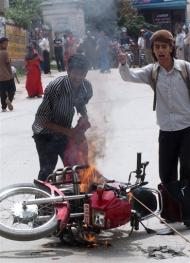
KATHMANDU (AFP) — How to get hold of petrol is one of the hottest topics in Nepal ever since its sole supplier, India, began refusing to sell fuel on credit a year ago to Nepal's state-run fuel monopoly, which owes it millions of dollars.The ensuing shortage has led to rationing and pump queues of several kilometres.
Suddenly, Sharing a Ride Looks Good
RANDI MITZNER watched in alarm as the cost of driving to work rose from $15 a week three years ago to $35, then $40. One day last spring, she had had enough. Ms. Mitzner, a senior director of human resources at Education and Assistance Corporation in Hempstead, popped the question to her co-worker Charlene Middleton: Want to drive in together?
Pakistan: Massive load-shedding as KESC faces 600MW supply shortfall
Massive power load-shedding plagued the lives of people in Karachi on Saturday due to the virtual breakdown and faulty working of the Karachi Electric Supply Company’s (KESC) power generation system.The electricity shortfall crossed the phenomenal 600 megawatts (MW) mark in the last 24 hours, causing continuous spells of power load-shedding in order to bridge the gap.
Pakistan refineries protest reduced products duties
KARACHI -- The Economic Coordination Committee (ECC) of Pakistan has rejected a claim by the country's refineries that they face loss under the reduced "deemed duty" (ad valorem surcharge) that they now are allowed to charge. ECC asked the Ministry of Petroleum and Natural Resources to submit each refinery's financial results separately to determine the impact of the reduced-duty formula on the refineries.Pakistan's five refineries have a total refining capacity of 267,000 b/d. A sixth is under construction and expected to begin products production for export, in spring 2009. Four of the refineries meet the country's domestic market demand for petroleum products.
India: ‘Uranium mining vital for country’s power needs’
In a bid to meet the target of generating 20,000 MW of power from uranium by 2020, India is making a serious effort to roll out mining projects in Jharkhand, Andhra Pradesh and Karnataka at a rapid pace.
Russia: Iran N-plant operational in '08
Iran's first Russian-built nuclear power plant in the southern city of Bushehr will become operational by the end of 2008, Moscow says."Russia is seriously committed to completing and running Bushehr power plant in the shortest possible time," Russia's ambassador to Tehran, Alexander Sadovnikov, said Saturday.
Iran Says Designing New Nuclear Power Plant
TEHRAN (Reuters) - Iran has chosen the site and started designing a new 360-megawatt nuclear power plant, a senior atomic official said in remarks published on Sunday.
Are we ready to deal with world food crisis?
Soaring world food prices have become a problem not only to developing countries but also to the superpowers.High fuel costs have resulted in higher agricultural costs. The drop in food stocks and using land meant for food production to produce biofuels are the other disturbing factors. The international community should help countries which are more prone and ensure some sort of relief for the poor.
Ron Paul: How Foreign Policy Affects Gas Prices
But how does foreign policy affect gas prices? One important factor is that oil on the world market has been priced in dollars exclusively since 1973. Only two leaders have gone against this arrangement – Saddam Hussein in 2000 and more recently Mahmoud Ahmadinejad with the recently opened Iranian Oil Bourse which trades in non-dollar currencies. But since oil is otherwise exclusively traded in dollars, this means that oil producers have vast amounts of assets held in dollars. Especially since the War on Terror and the PATRIOT Act, many oil-producing nations and banks are concerned the US government may freeze assets based on flimsy pretexts. This fear contributes to dollar weakness, and therefore also high oil prices.
World Bank increases fossil-fuel funding despite pledge
Once the new Tata Ultra Mega power plant in western India is fired up in 2012 and fully operational, it will become one of the world's 50 largest greenhouse-gas emitters. And the World Bank is helping make it possible.A year after World Bank President Robert Zoellick pledged to "significantly step up our assistance" in fighting climate change, the development institution is increasing its financing of fossil-fuel projects around the globe.
NEW YORK (CNNMoney.com) -- -- Gasoline prices fell Sunday for the 38th straight day, bringing down the nationwide average in a motorist group survey by more than 42 cents overall.
New Zealand: Drivers to pay for oil shock
Motorists should pay more to drive cars - including more expensive car parks, and fees to use the roads - if New Zealand is to survive rising oil prices, a comprehensive new report says.The increased costs would be coupled with investment in public transport, tax breaks for fuel-efficient vehicles, laws requiring new developments to provide showers and lockers for walkers and bikers, improved urban design, and encouraging businesses to swap company cars for cash or bus subsidies.
Ragtag Insurgency Gains a Lifeline From Al Qaeda
Today, as Islamist violence wanes in some parts of the world, the Algerian militants — renamed Al Qaeda in the Islamic Maghreb — have grown into one of the most potent Osama bin Laden affiliates, reinvigorated with fresh recruits and a zeal for Western targets.
At Conference on the Risks to Earth, Few Are Optimistic
ERICE, Sicily — This ancient hilltop town, rife with Roman, Greek, Norman and other influences, is hosting a very modern gathering: a conference on global risks like cyberterrorism, climate change, nuclear weapons and the world’s lagging energy supply.More than 120 scientists, engineers, analysts and economists from 30 countries were hunkered down here for the 40th annual conference on “planetary emergencies.” The term was coined by Dr. Antonino Zichichi, a native son and a theoretical physicist who has made Erice a hub for experts to discuss persistent, and potentially catastrophic, global challenges.
The participants were not particularly optimistic. They presented data showing that the boom in biofuels was depleting Southeast Asian rain forests, that “bot herders” — computer hackers for hire — were hijacking millions of computers, and that the lack of progress over handling nuclear waste was both hampering the revival of nuclear energy and adding to terrorism risks.
THEY are the arteries of the world, the waterways that keep our global economy alive.Two-thirds of all seaborne trade passes through these six narrow choke points, and half of the world's daily diet of oil.
Close just one down, for just one day, and the heartbeat of the industrial world would falter.
Block it for a month, and entire economies could collapse.
Nothing screams collective failure like the complete lack of a national energy policy. I find it inexcusable that it has been more than 30 years since the first energy crisis, but no administration – Democrat or Republican – attempted to plan for our nation's energy future. Nothing is more critical to our nation's very economic or political survival than energy independence. We have known that for a century, but yet done little.
Inflation Delivers a Blow to Vietnam’s Spirits
With inflation rising to 27 percent last month — the highest in Asia — and food prices 74 percent above those a year ago, Vietnam is suffering its first serious downturn since it moved from a command economy to an open market nearly two decades ago.Last month the government raised the price of gasoline by 31 percent to an all-time high of 19,000 dong ($1.19) per liter (or roughly $4.50 a gallon). Diesel and kerosene prices rose still higher. The country’s fledgling stock market, which had been booming a year ago, has fallen in volume by 95 percent and is at a virtual standstill.
Squeezed on all sides, people are cutting back on food, limiting travel, looking for second jobs, delaying major purchases and waiting for the cost of a wedding to go down before marrying.
As designers debuted their autumn 2008 collections on the runway earlier this year, a trend towards conservatism and the use of sober colours – including an overwhelming predilection for black – rapidly emerged. Now, as the season approaches and clothes land on showroom floors, a new undercurrent is welling up: echoes of the energy crisis are rippling through the fashion world, resulting in a raft of oily-finish fabrics from shiny-treated silk to liquid latex, glossy vinyl and other synthetics.
Americans think worst of 2008 oil spike over: poll
The poll of 1,089 likely voters found that just under 13 percent thought gasoline prices would rise a lot between now and the end of the year. About one quarter thought prices would rise a little, while one in three thought they would drop a little and 18 percent said they would stay about the same....Pollster John Zogby said the swift rise in fuel prices earlier this year had fundamentally changed U.S. consumer behavior, and a pullback below $115 per barrel was not sufficient to alter that.
"The lines are not forming to buy Hummers," he said, referring to the big luxury trucks that are notorious for their poor fuel mileage.
Opec set to cut oil supplies after weakening demand sparks sharp price fall
OIL cartel Opec is expected to reduce supplies next month following a sharp fall in crude prices on Friday.
Thirst for oil feeds Oman innovation
In Saudi Arabia, Oman's neighbor, oil production still can be as easy as jamming pipe into the ground and pumping up the oil, or standing back to let it gush forth from the pressure of the reservoir.But for Oman, "easy oil is over," said Khalid Jawad al-Khabouri, a petroleum engineer at the headquarters of Oman's state-controlled oil company in Muscat, the capital.
At Harweel and several of the country's complex, aging fields, Oman is going after oil the hard way. More than any country along the Persian Gulf, Oman provides a preview of the future of oil.
With Dubai's oil running out, the energy majors arrive
Since Dubai oil production peaked in 1991, the central question concerning energy matters has not been about production, but how much it needs to fuel its robust economy.
Georgia official: Train on fire after hitting mine
TBILISI, Georgia - A train carrying oil products hit a land mine near Georgia's strategic central city of Gori on Sunday, causing at least two tanker cars to burst into flames, a government official said.A television report however said 10 tanker cars were on fire about 6 miles east of Gori. Television footage showed large clouds of black smoke billowing from the site.
Oil and gas traveling through Georgia was supposed to free Europe from Russia. Not anymore....For now, this is a practical risk only east of the Atlantic. The pipelines through Georgia mostly feed Europe, and energy analysts don't see any direct threat to the American market. But oil prices, which had been declining, spiked again late last week on the news. And while no one believes energy was the main motive for Russia's incursion, it surely played some part in Moscow's thinking on the region. "When Baku-Tblisi-Ceyhan was constructed," says Costello, "you had a much weaker Russia that was more amenable to an energy dialogue. While Russia didn't like the existence of a pipeline that bypassed its territory, Moscow had accepted its existence. Now we're in a situation where Moscow sees the situation in zero-sum terms. A resurgent Russia will be less happy to see routes across Georgia expanded."
US warship docks in Black Sea port
The first US warship to bring aid to Georgia arrived in the country's main Black Sea port of Batumi on Sunday, in a gesture of support for the ex-Soviet republic in its conflict with Russia.The USS McFaul, a guided missile destroyer, is loaded with humanitarian aid including bottled water, blankets, hygiene kits and baby food for the tens of thousands displaced by the confrontation that erupted on Aug. 7-8 over Georgia's breakaway South Ossetia region.
The Russian power play on oil, natural gas reserves
Russia today has become more powerful relative to Europe than it has been since Napoleon, a situation that is all but certain to make the Europeans less willing than the United States to challenge Russian policies. Energy may accomplish for the Russians what the Soviet and Russian armies by themselves could not.
Iran to double oil reserve capacity
LONDON (IranMania) - Iran plans to start construction of four one-million oil storage tanks in Kharg Island in a bid to double its oil reserve capacity, PressTV reported.
China's Sinopec H1 net falls 77 pct on soaring crude
HONG KONG (Reuters) - Top Asian oil refiner Sinopec Corp posted a 77 percent fall in first-half earnings as soaring crude prices and caps on state-set fuel prices pushed its refining business into the red, despite government subsidies.
Ag secretary: Biofuels good for farmers, security
MITCHELL, S.D. - Expanded production of renewable biofuels promises newfound riches for farmers but also improved national security, U.S. Agriculture Secretary Ed Schafer said Thursday at the Dakotafest farm show."They are here to stay. They are part of our energy solutions," he said at a forum with Sen. John Thune, R-S.D.
"If we're going to cut our dependence on foreign suppliers, we must be committed to building this new energy portfolio."
Conference splits over deforestation emission cut
ACCRA (AFP) - Trading carbon emission rights between developed and developing nations caused a split Sunday between delegates at protracted international climate change talks in Ghana."The issue of reducing emissions from deforestation in developing countries under the carbon market mechanism has been a stormy one among delegates and observers," Nicole Wilke, head of German delegation told AFP on the sidelines of the UN framework convention on Climate Change (UNFCCC) conference in Accra.
Contact
- Content: editors at theoildrum dot com
- Tech support: support at theoildrum dot com
License

This work is licensed under a Creative Commons Attribution-Share Alike 3.0 United States License.
“Transition Sillyness?”
Two days ago, Leanan posted a link to John Michael Greer’s Archdruid Report A Tempo for Change. Greer stated: “we can expect to witness economic, social, and political turmoil beyond anything the industrial world has experienced in living memory.” One poster, Expat, called this "a bit too silly!"
Well yesterday another link was posted that dwelt a little deeper with "sillyness". It was called Peak Oil and Future History. The author, Peter Goodchild, referred to what he called “Transition Sillyness”.
Goodchild took the opposite view of the Expat, and many others, who believe peak oil will happen, or is happening now, but see it as something that we will all survive with not too much pain, at least in our lifetime. Goodchild reports:
Ahhh, the Big Picture! I have been preaching “The Big Picture” for years. I have posted, time and time again, that we are 1. deep into overshoot and the world can not much longer support such a population load even with fossil fuel and 2. few, if any, possess the necessary skills required to survive in a post fossil fuel world.
But even Goodchild is a little too optimistic:
One future variable that I believe very likely is that world oil exports will drop to near nothing in a decade or so. This will be due largely to hording, rampant nationalism that insist “Our oil be kept for ourselves”. There will also likely be resource wars as well as piracy on the high seas. What Goodchild sees for the executive’s grandchildren, I see for the general population of many nations with virtually no fossil fuels themselves.
But even in countries with some fossil fuels, the US, China, India, etc. the situation will be fare more dire than most realize. Two huge problems will arise. 1. as Goodchild points out, the land without the aid of fossil fuel fertilizer and farming tools, can support only a fraction of the population. And 2. a very large percentage of the non-farm population, unable to produce products to be bought by the masses, will be unemployed. They will have no money to buy food, especially at the exorbitant prices food will demand in a world of sever food scarcity. Two thirds less fossil fuel will employ two thirds fewer people. Goodchild's "modern executive" will likely be unemployed and desperately hungry.
Ron Patterson
Darwinian:
Under the circumstances, what would you recommend? Assuming you are correct, I cannot imagine any set of actions which would avert a total breakdown of society,mass poverty, and death all around.
After the mass dieoff, will any semblance of civilization ever be constructed out of the rubble? Perhaps there will be some island (not underwater) somewhere where people can fashion a subsistence level of living.
On the bright side, as mass dieoff gets into full swing, housing will be ultra cheap. Perhaps someone could write a post outlining the bright side of the coming apocalypse.
Anyway, nations everywhere should assume the worst given the current population and projected trends. One policy recommendation coming out of your world view would seem to be draconian population reduction everywhere. We could start with mass sterilization, abortion, and infanticide. Or does "life" trump future poverty, disease, mass war, and mass starvation? Those religiously oriented people still pumping out three, four, and more children tout the sacredness of life. Well, under your scenario, how sacred will life seem in one or two decades. Life will have the sacredness of warm spit.
What would I recommend? I have always recommended that one get together with like minded people and form kind of a "farming community" with all the houses in one place with everyone armed to the teeth. But even if you did this, what would be your chances of being among the survivors? They would be higher no doubt, but still probably not all that great.
Bottom line Tstreet, there is simply no way of knowing how the collapse will pan out. There is no way of knowing just how fast things will collapse but I think most people are way too optimistic. Of course they are. It is simply in our nature to see the bright side of things and expect the best. I am reminded of Monty Python's "The Life of Brian". As they were all being crucified they were all singing "Always Look on the Bright Side of Life."
I agree with creating communities of small farms, and no reason not to have some defensive capability in place.. but 'Armed to the teeth' starts painting a self-fulfilling prophesy. I think what you do to start preempting the likelihood of roving bands and worse, town to town (MicroKingdom) conflicts is to establish trading ties and develop 'community to community' diplomatic tools for heading off the growth of any kind of 'Warlord Society'..
If any part of Life of Brian comes to mind here for me, it would be the People's front of Judea battling in the imperial halls against the Judean People's Front for the honor of, what, kidnapping the Roman Legate or something?, while the Roman Guards stood on the side of the hall and watched them decimate each other. Feudal Futility..
'For life is quite absurd
And death's the final word
You must always face the curtain with a bow.
Forget about your sin - give the audience a grin
Enjoy it - it's your last chance anyhow.' -Eric Idle
(ps, while 'blind optimism' was the joke, it wasn't the entire message of the song, was it?)
Bob
The average global income is about $900 US a year. A guesstimate would be that the average income of a person reading your post is approx $60000 US per year (only 67X greater than the global average). You talk about the effects of oil depletion on the average person, but there aren't very many average humans (measuring in income or wealth) reading you or Greer. Rising energy and food costs cannibalize from the bottom up, which is why the elite are unconcerned generally.
your point is valid but the level of income needed in america to be a 'normal citizen' is way higher than in other poorer countries so the ratio is far lower than 67X
True, but "we" aren't mostly average humans (in terms of income or wealth). Anyone on this site that has even $200000 US (after liquidating all assets) could put it in a few Cayman banks-this would throw off at least $10000 a year in income-which would be more than enough to live in a lot of these poorer countries. Supposedly $48000 US per year puts one at the top 1% level in terms of annual income-my point is that we are living on an extremely poor planet and most of us are closer to the top of the pyramid than the bottom.
A friend once said that that there are two kinds of revolutionaries: Marxist and Gandhian.
What Darwinian is suggesting sounds Gandhian - if we take away the weapons, which, after all, define the Marxist revolutions. Again, the people with the average global income can not afford weapons, unless we are talking about sticks and stones.
Astroboy, I am not a revolutionary. I am proposing no revolutionary action whatsoever, Marxist or Gandhian. If I thought there were some revolutionary action that would fix things then I would be the world's strongest revolutionary. But the world is deep into overshoot, and no revolutionary action whatsoever will fix that. Sadly, nature will just have to take its course.
Even your $900 average is skewed. Most people on the planet daily experience energy and food shortages. Peak Oil nor Climate Change won't change this dynamic much; exacerbate it, yes; but change the basic dynamic, no. The people to be most effected will be those with the most prosthetic devices enabling them to enjoy the last months of the "Age of Exuberence." They/we have a very steep and tall cliff to topple over, while most of the planet's people are already at the cliff's bottom. As for the elite being "unconcerned generally," that is probably true due to ignorance, but their position depends totally on the ability of the lower classes to support them. Peak Oil and Climate Change will withdraw this support, and many current millionaires will be no better off than those already at the cliff's bottom. So, in the longterm, the elite are just as vulnerable as everyone else--especially WRT Climate Change as many have assetes that will be erased by sea level rise.
Optimism was possible during the Great Depression because it was a crisis existing during very visible abundance of food and energy, AND the federal government wasn't yet owned by Big War, and was thus far more responsive to the crisis. I do not beleive the same will be said of the current crisis, which has yet to be recognized as one by most people. For one, future availability of energy is already seen as iffy, and rising costs for food amid rising unemployment and declining expectations along with the recent examples of toxic food reaching the market show food security to be iffy, too. So the specter of Shortage is already present in people's minds. Current polls showing less than 10% approval for Congress and somewhat equal disdain for BushCo reveal that most of the citizenry understand, albeit at a superficial level, the federal government is no longer responsible or responsive. So it seems appropriate to loom for the coming signs of the Great Despair.
+1 greenie for your sentiment.
At the beginning of the Great Depression (so-called), the U.S. was at the pinnacle of its potential, and that power would be realized over the next three decades.
Now it looks more like the 4th century than 20th century
The foederati was the Roman idea of subsidizing those barbarian tribes Rome needed to defend the empire. In short it was a nice way of saying that the Romans were no longer willing to fight in their own armies so they were looking for others to work at the jobs the Romans wouldn’t take. We call it the hiring of mercenaries.
This policy had put a huge number of people on the Roman payroll notably the Attacotti, Franks, Vandals, Alans and the Visigoths (western Goths).
http://www.lewrockwell.com/case/case16.html
It is hard for old guys to be anything other than sad at the opportunities squandered. It is harder yet to generate enough energy to get out and protest this nonsense any more -- the criminals have beaten us down for good.
The Alans are now the Ossetians that do not want to be part of Georgia.
Alan
Does "Ossetia" mean "fromBigEasy" in some Eastern European language? ;-)
whose payroll are they on now? Not the Romans', it would seem.
Putin's
OK, smart ass, following your "logic" the Kosovo Albanians are on NATO's payroll. NATO even held joint military exercises with the KLA in northern Albania before the 1999 attack on Serbia. So much for all of your "humanitarianism" and professed belief in the "freedom of choice" and "democracy".
Never,I am at 53,and getting sorta old.I see the opportunities lost+,be I see many on the horizon,that,If the knowledge is not lost,may work society in ways we can only dream
I think the next great step will be biological,as that science can in many ways be done with smaller energy inputs than others I am aware of...and yes I remember the threads discussing this.
We may have a dark age ahead of us as a result of overshoot,but when we humans get our act together I still have faith we will reach the stars....ad astra
Hold that thought!
It will take huge effort to clean out the criminal element that runs our world. Of course, it can be done if people will only wake up. What will it take to throw off the blinders? Not force of reason, that is for sure. And efforts for reform are so often co-opted by the criminals and turned to their advantage.
One way I shut people up about my heritage, and that of everyone else, is to say I'm a German, that is a Spaniard, a region settled by/given to the Visigoths, that leads into a discussion/admission that we are all mutts, ethnicly, and then occasionally I end the conversation by bringing up the African Eve hypothesis that forces us all to admit we are black African at our core. This really twists some folks's knickers as they have no rebuttal.
My kin were citus and vineyard ranchers in Southern California before, during, and after the Depression; and I've collected interesting stories from them, although I wish I'd asked more questions before most of them passed away. I made the period a special point of study as I pursued my History degree, because you cannot understand why/where we are today without understanding that period, which for me also includes WW2.
Although I won't concede victory to "the criminals," I do admit they currently have the upper hand, but I do see their demise. Because they want all for themselves and refuse to be cooperative, they will eventually die off and become relics. The depletion rate of fossil fuels even provides a timeline. The coming paradigm change means evolve/adapt to the new circumstances and norms needed to accomodate them or die. A primary factor will be the change from competition to cooperation, a cultural aspect that the US and most OECD countries are illequiped to handle. One of the most famous songs from the Depression Era is Billy Holiday's God Bless the Child, but few today recognize its great satirical aspect. I find comfort in taking the long view and can imagine a great deal of positive change 5 generations (100 years) from now. In the meantime, I'll go fishing and grow my garden, while enjoying one of the best palces to be for the coming change--Oregon.
Although I'm better prepared than most people, my goal has been to buy time. As someone noted down thread, stuff is going to break and wear out. My preparations are a window of opportunity that permits me to make rational choices (I hope) as things devolve.
One point I have made before is to forget about "self-sufficiency" and, instead, focus upon "self-reliance." Sure, things like alternative energy systems may be important but, equally important, will be useful skill sets.
Todd
Great insights Todd.
Todd-- what do you include in the list of useful skills?
Gardening
Farming
Animal husbandry
Fiber production
Bee keeping
Food preservation
View,
I'd certainly include all of those and add a lot more. Some may seem out of place if things collapse but I believe will be useful non-the-less:
Engine mechanics (If push comes to shove I'll convert some of our stuff to wood gas)
Carpentry
Masonry
Plumbing
Electrical (AC/DC)
Hunting/gathering including fishing and trapping
Butchering
Welding/blacksmithing
Roofing
Tanning/sewing/weaving
Timber felling
Alternative medicine/EMT training
That's enough for now and far more than anyone can be fully proficient in. My point is that many of these skills (and the ones you listed) are "normal" for country people like myself. The only option in many cases is to muddle through. While a person may not have journeyman skill levels, they will not usually make serious mistakes.
And, of course, many of these have sub-specialties such as food preservation - hot water bath canning, pressure canning, dehydration, smoking, potting, juicing, etc.
Todd
This is a long list of skills for one person to be proficient at! I, for one, will be conducting a scavenger hunt for new friends with these skills. Bartering is really an underrated system ;) In all seriousness though, are we not talking about an eventual return to villages where you have a blacksmith, a butcher, a baker, and a candlestick maker (trying not to lose my seriousness!)
God forbid we have lives without one stop shopping...
"Things are always the best they possibly could be in this best of all possible worlds".
Prof. Pangloss, from Voltaire's "Candide, or Optimism"
There was a certain logic to Dr. Pangloss' optimism:
"They can't get any worse, and they won't get any better, clearly, it's the best of all possible worlds."
The only problem with that sort of "optimism" is that things most assuredly will get a lot worse.
In the immortal words of Molly Ivins:
"Texas liberals are different from other liberals...Texas liberals know it can get worse"
Except, that line of thinking lets far too many people in positions of power and responsibility get off the hook far too easy. The truth of the matter is that very different decisions could have been made by various key people at various points in the past, and those decisions could have resulted in a scenario that would look far less dire and stark than the one we are facing. Voltaire's whole point was that the world truly made life far more miserable for more people than things had to be, due to many people behaving badly when they could have behaved better. Realism might require recognizing that people do act that way, and thus thus the world is that way, but it need not require believing that people had no choice, and thus no responsibility, for their actions.
Well yes, Voltaire was all about satire.
And people do have choices, and choices have consequences. However, at a certain level, the consequences for criminal action are remunerative to the criminals, and the mass of people seem to accept that as "God's will" or some such. What is that all about?
Voltaire described it and satirized it -- I don't think he had any better idea than I do how to break out of it.
For years now I've made it known to my family and friends that I wish this song to be played at my eulogy.
I suspect that population decline will come to pass not in one fell swoop but through a number of episodes. Famines are likely to sweep across various regions; rising sea levels and various natural disasters will take their toll; natural and bio-engineered pathogens will sweep through human populations and through fields and livestock herds; and then there is crime, civil disorder, wars, and nuclear holocaust. We'll see the global population knocked down notch by notch, year after year. The future is likely to be most distressing and unpleasant, I'm afraid.
Along your lines, one reason I anticipate a fast crash is because of the complexity and interlocking nature of society. In many ways, it is similar to the situation of cascading cross defaults that were posited pre-Y2K. This is visible to some extent as credit has been drying up for businesses and some credit-worthy individuals.
On top of that, there will be a significant time lag before people recognize that the old paradigm is dead and come to grips with the new reality; one aspect of which is that Humpty Dumpty can't be put back together again.
Todd
There is a longer post below, but this is a good point to interject my major objection to so much of the American based thinking - 'recognize that the old paradigm is dead and come to grips with the new reality.'
What, the one where the farm fields around the town use minimal chemical inputs because of the ground water protection rules? That is decades old, here. Does this mean that the farmers that have been steadily reducing their chemical inputs for years - it is part of that horrible German regulatory burden (can't find the link - in an old Drumbeat somewhere) - will end up not using any any inputs? Essentially like the organic farmers, including a couple around here, whose output is still growing, under government planning that said organic farming should supply 20% of Germany's food by ca. 2015 (don't trust it really, but that was the planning at the time, and to my knowledge, it hasn't been altered significantly).
The U.S. will fracture, and since it has been a couple of years since I first used that phrase, let me add, quite possibly fracture horribly, but the U.S. is not the world.
I refuse to believe that the rest of the world, with centuries of experience in functioning (and yes, that functioning tended to be pretty awful for those at the bottom) without oil, are simply going to turn their backs on knowledge accumulated over that time, and collapse the way some Americans think the U.S. is destined to. An American collapse I have no real problem agreeing with, by the way, looking at it from the outside. It is just I have yet to be convinced of a global collapse at this point - in part, because a lot of the rest of the world never followed the U.S. into its post-industrial, service based, consumer reliant future. To put it a bit differently - the only 'malls' I live near are downtown in the city's center, and are best reached using the train.
Or to put it even more differently - nobody in Germany, and I mean nobody in the sense of 99.99%, would think that destroying orchards to build a few houses would be good for the economy, or that plowing under farm fields for a new shopping center is the correct choice for growth, or that wiping out a watershed to increase tax revenues is a simple trade off. And yet, that is what Americans have done to themselves. Of course it will collapse - a statement so obvious that it is hard to get Germans to even understand how the Northern Virginia I grew up in was 'developed' without them thinking I am crazy. The craziness was not on my part, I assure them.
Expat, the world has no experience of supporting 6.6 billion people without the aid of fossil fuel. And all those people with all that experience, the people with the experience of how to support a world population of half a billion people without fossil fuel....they are all dead! Peter Goodchild addresses your point in the before mentioned article:
Goodchild- "a doll’s-house mentality is a way of avoiding the truth."
And painting the people engaged in any of these related endeavors in such simplified and condescending terms is misleading in the extreme.
"The WORLD has no experience.."
There's more under the Heaven and Stars, Horatio, than is dreamt of in your philosophy..
Expat shows how others have made wiser preparations than we have, reminds us that much of the world has a different relationship to their energy supplies than we have devised.. he never says it will be painless, just possibly far less devastating than we and our Ideology-driven air-conditioned, highway-world will probably experience it.
You can be extremely didactic in your statements, Ron, with all sorts of absolutes. I know you're not a fool, but that sort of expression makes you seem foolish.
Best,
Bob
Jokuhl (Bob) quoting me:
Bob, the greatest sin, and meanest trick, of any debater is quoting out of context. To quote out of context means to quote in such a way that the meaning (context) is changed completely. In earlier years I used to debate creationists in the public forum. That was one of their favorite tricks. I saw it then as absolutely dishonest, highly unbecoming of a religious person trying to prop up his religion with the moral equivalent of just plain lying. I still feel the exact same way. Of course that is not why you did it but the analogy still holds.
What I actually said was:
Bob again:
Does the above full expression make me seem foolish Bob? Either refute my full statement or leave it alone. Don't quote half a sentence of mine in an attempt to make me look like a fool. I would think the foolish person would be the one who says the world does have experience in supporting 6.6 billion people without the aid of fossil fuel.
Ron Patterson
There is a huge population of essentially disposable people in all of the "advanced" economies of the world. They are in hospitals, nursing homes, assisted living facilities -- many of them are struggling along at home alone.
Cut out the incredible support systems, and they all die in a matter of days or weeks.
And that's just for starters. That 6.6 billion people can be cut down to size very quickly by cruel fortune-- where will the next Black Plague come from?
This planet will support a billion or so human beings without massive fossil fuel input-- and all that we have have been doing for the last couple of centuries will be stuff of legend for them-- the survivors and their children.
The transformation could be complete in 50 years.
Naomi Klein and Mike Davis both address that in their own work. The number of "surplus humanity" seems to be in the 30 to 40% range. I suspect that's only the first cut.
cfm in Gray, ME
It could be in 50 years. Or 100, or 10. I just don't know. I do suspect that by around 2100 or not too long thereafter, global population will be at or moving very clost to 1B, or maybe 2B if we're really lucky. I don't know what the curve that gets us from here to there will look like, though. Something with stairsteps or a sawtooth seems to me quite probable. I do know that the reindeer ate up all the lichen within a year or two, which is why their population crashed so suddenly following the overshoot. I don't see us suddenly depleting all of our petroleum and other non-renewable resources, or totally degrading our agricultural production capacity, within just a year or two, so I must be rather sceptical of the fast crash/die-off scenario.
I disagree about how many the Earth can support. We know how to grow enough food to keep a very high percentage of the current population alive, maybe all us. With no FF inputs. I encourage you to find a series of videos with Bill Mollison. The 2nd, Bill Mollison - Global Gardener 2 - Dry Lands, is particularly insightful in that it makes the impossible obviously possible.
Food need not be a cause of collapse for the current population. Note I am not saying it **will not be.**
Cheers
I suspect you are correct -- provided the existing land can be given over to food production and not "cash" crop plantations. If you believe Mike Davis, famines are caused by politics more often than the weather or other natural disaster.
Ron;
Sorry I only provided a curtailed chunk of that quote.. it was barely inches below the original, and I don't expect TOD readers to have so quickly forgotten what you said. It was certainly not cut short to try to de-emphasize the rest of your point. You are right in the sense that the World, if you want to consolidate it's experiences into a single factor, has never supported this many humans.. but it completely generalizes over the points being made by Expat, in which there are places that are making careful decisions, more cautious plans, and seem to take future resiliency seriously, while by and large US culture does not. As he points out, it surely seems that there are areas that will be hit MUCH harder than others, which is why he felt less concerned (but not unconcerned, it seems) that they at least have carved a 'chance' for themselves that the Denial-Driven Americans have not.
When you boiled it down to the Global population number, it sounds like you are suggesting that it is one, common problem, when it is many- as was being discussed.. and which will be dealt with in many different ways in places with widely differing abilities to handle and learn to handle it.
Yours wasn't all that extreme a statement in this case, but it was still the kind of riled-up simplification that sounds like you've gotten mad and are starting to make statements that don't do justice to you or the conversation.
I started writing this earlier, and had to go to work, so I dumped it.. Sorry, Ron. Certain things get us riled, and I let my buttons get pressed by this, I guess. I'll try to keep such opinions to myself in the future.
Best,
Bob
My concern here in America is that even those who have the skills, say of farming, have abdicated parts of the farming process that cannot be made up with skill. For example seed corn. In the entire highly productive agricultural county I live in there is to our knowledge not one single farmer/farm growing non-GMO corn (our included). One livestock producer who feed non-GMO corn has to bring it in from over 100 miles.
What does that mean? The corn in our bins and grain elevators is sterile. It could not be planted out next year. If there is some glitch in Monsanto delivering the seed corn that is grown out in Argentina this winter there is no corn to be planted.
Skill plays no part. We have given up control of the fundamentals of farming in the US.
Well said on a vital Liebig Minimum to bring things crashing down virtually overnight. Recall my posting series on Ft. Knox having the gold bullion reconfigured outside into machine gun bunkers to protect the seeds and I-NPK inside.
Expat makes the key point here - global collapse will be asymetrical over time and place, just as global "growth" was asymetrical over time and place.
There will very likely be regions of the world that continue a mostly fossil fuel-based economy for decades or even centuries to come.
And at the other end of the spectrum, there are regions of the world that are now developed that will return to the "stone age" - and fast. The survivors will join the ranks of the currently-rare tribes that still remain mostly unmolested by the rest of us in remote parts of the world.
I must empahticly agree. Venezuela, and by extension South America, is a case in point. The Orinoco has 1,000 Billion+ barrels of potential oil in its heavy deposits, and Chavez has just put forth a proposal for developing it in a highly integrated fashion. Further, his Bolivarian philosophy of uniting the whole of the continent will prevail in the longrun, IMO. I don't expect the Orinoco region to solve Peak Oil, but I do expect it to provide a very longterm hydrocarbon source for South America's use.
When looking at the Big Picture, it's clear that one contry in particular hasn't prepared for a future that is easily seen by those with eyes and a brain not distorted by the US Proaganda and Indoctrination Systems. The "collapse thesis" is a product of American Exceptionalism--If the US is going to collapse, then everyone else must too. If the US can't have its cake and eat it too, then no one else can either. This is not to say there won't be challenges; there are many. But the world got along quite well before stumbling onto the Americas, and the world could certainly get alomng without the US and its Empire.
Karlof, do you really think the US is going to collapse quietly, while letting others party on? Have you been paying attention for the last few years?
I wouldn't call raising millions out of poverty to a reasonable living standard still far below that of the contemporary US "party on". Nor do I expect the US to "collapse quietly." I expect to see lots of political upheaval--levels never seen during the Depression--as the US scrambles to construct the electrical energy generating machinery utilizing only the planet and its star's energy in order to supply the energy its citizens demand. Note this infrastructure can NOT be made while waging war for hydrocarbons--there isn't enough MONEY!!!
The US Empire faces an either or choice: Make war and suffer certain collapse. Or convert the militarism to electrical energyism, construct the needed machinery, and provide more than a semblance of a future for citizens.
"Or to put it even more differently - nobody in Germany, and I mean nobody in the sense of 99.99%, would think that destroying orchards to build a few houses would be good for the economy, or that plowing under farm fields for a new shopping center is the correct choice for growth, or that wiping out a watershed to increase tax revenues is a simple trade off."
I saw a special on solar engery and it showed a German farmer that had converted his field into a solar farm. I guess he's part of the.01%.
Sorry - did he, for example, destroy the top soil on which the panels were placed? Or did he cut down an orchard? Or, strange as it might sound, did he plan to 'rotate' the panels so as to leave a field fallow for a decade, then move them?
Of course, you are right - I have seen solar installations on farm fields and in vineyards. One of the largest German installations I have read about uses wood for its supports - because wood is renewable and causes no other environmental problems.
To add a bit of not completely unserious farce - does he have sheep graze the grass growing around the panels?
Solar PV requires space - and yes, some of that space will likely include farm land 'converted' to electrical generation.
Farms produce energy, food energy in most cases. So here we have a farmer still producing energy from his farm, albeit in a form that compliments food energy. I don't see any deviancy in his act.
I'm not sure if it is deviant, but it really does not make much sense to cover prime agricultural land at the latitude of Germany with solar cells - it still provides absolutely minimal power when it is most needed in winter.
Here is information on the scale and potential of renewables, in this case for the UK, but the conclusions will apply to any densely populated high latitude country:
http://www.withouthotair.com/
Sustainable Energy - Without the Hot Air (withouthotair.com)
Now Germany's investment in solar may pay dividends in making them a production base for solar cells for elsewhere, but shorn of huge subsidy there is no point in covering fine farmland in Germany with them.
In reality German power is coal and natural gas, largely Russian, and will be until they face up to the fact that they need nuclear power - conservation aside, the rest is expensive frills.
Hi Dave--Thanks for the link; lots to examine there.
Underlying all the above discussion is a question: Having been exposed to the byproducts of the "Age of Exuberance," how much comfort/ease will be considered minimal going forward as comfort/ease can be directly related to the quantity of energy produced? We discussed this around the dinner table a few nights ago and determined that we need enough electricity to provide at minimum refrigeration, cooking/food preparation (which would include storage other than refrigeration), and food production. Water, heating, lighting, and transport were deemed secondary given our locale. Lots of things including computers and the internet were deemed extraneous luxuries not required for the level of comfort/ease equated with "Industrial Civilization."
So the quantity of sustainable electricity generated by harnessing the power of the planet and its sun needed by any particular culture will be a product of what that culture deems minimum. Determining minimums will of necessity cause a redefinition of luxuries, with some luxuries deemed beneficial and others reconsidered deviant. This sort of assessment taking by a given culture I don't expect to occur until the need for a new energy paradigm becomes clearer for all to see. It will then be of interest to see what becomes "frills" and what doesn't.
Hi Karlof,
I would agree that a lot of serious thinking needs to be done about minimising energy use.
I should make it clear though that I have nothing at all against renewables, when they are used in the right location.
The results of using solar power should transform the prospects for a lot of regions, and I particularly like Nanosolar's idea of distributed power systems:
http://nextbigfuture.com/2008/04/solar-thermal-municipal-power.html
For communities in areas like the American Midwest, this combined with wind power and biogas might well provide the power to run huge areas using some of the technology in this experiment:
http://commentisfree.guardian.co.uk/jeremy_leggett/2008/02/renewed_energ...
Comment is free: Renewed energy
The areas where it is likely to work have the opposite characteristics to Germany - they are relatively low latitude, so have smaller variance of winter and summer sunshine, and have a much lower population and America's much better on-shore wind resources.
In areas like Northern Europe though save for what might be compelled by a state of complete unpreparedness, there is really no need to make vastly exaggerated efforts to economise on power, since there are well proven systems for generating all the power that is needed if some elementary economies are practised.
IOW if the French install air-source heat pumps and run electric cars instead of petrol, then around the number of nuclear plants they already have should be perfectly capable of running society without undue dependence on Russian gas if they are gradually upgraded.
Numerous solutions to the supply of nuclear fuel are already well known, and for the peak oil aware the pretty theoretical concerns about safety seem oddly misplaced, when without adequate power the death of billions appears inevitable.
So in my view the steps needed in northerly areas are perfectly clear, and range from building houses with decent insulation and upgrading the older houses to building nuclear plants and re-opening railways.
In the US just upgrading present nuclear plant locations together with wind power should do fine, and it is likely to have substantial contributions from solar, tar sands and so on.
On the subject of minimal power though it is pretty exciting what is happening in some of the low cost low energy alternatives, ranging from LED lights to windmills from scrap, and perhaps they give a little hope for Africa and other regions.
Expensive Frills, however, that ultimately pay for themselves, euro for euro, watt for watt, with very few additional inputs.
I don't know if they still have the set aside scheme in place, in which EU farmers were paid not to grow crops on a certain proportion of their fields. Perhaps the reality of food shortages has yet to catch up.
Set aside was set aside last year because of high grain prices.
"... a decade or so..."
There you go being wildly optimistic again ;-)
P.S. I thought the Goodchild piece was an great counterpoint to Greer.
I was going to avoid commenting on that second article, but now, well, why not? For example the flat statement that 'Electricity comes largely from coal or natural gas.' will be a surprise to the French, who regardless of their pretensions of being a rural society, are as about as industrial as any nation gets.
Or this - 'Since the decline of our present civilization will be marked by a loss of fossil fuels, followed by a loss in both metals and electricity, there may be no point in preserving the knowledge of subjects that only make sense when they are supported by present technology.' I find the cause and effect fascinating - I can imagine several very possible ways that our present industrial civilization could collapse that would leave most of the remaining accessible fossil fuels in the ground, for example. Or the idea that knowledge about electricity (not the example used, to be fair), whose science and widest applications essentially predate the internal combustion motor, will become useless in the future. The germ theory of disease, and the hygienic practices it engendered, have nothing to do with 'industrial' society - and that knowledge is unlikely to simply disappear because the oil runs out. If only because those groups aware of the importance of keeping their hands and food preparation areas clean will be much more likely to survive and reproduce over the long term than those that don't.
What I am trying to argue, and it is just an argument, is that the entire world is not the United States. For example, what I had hoped to write on was how truly silly the idea of an 'eco-village' is, apart from the occasional successful experiment possible in a vast country such as the U.S. It seems as if I am out of touch with the latest thinking in the U.S., and to a much lesser extent, the U.K., which defines the coming challenges as being best solved at a village level - maybe better, a gated eco-village?
But at least in what could be called 'northern Europe,' encompassing such countries as Germany, the Netherlands, Denmark, or Sweden, the planning and social frameworks concern 'eco-nations.' And please, none of these countries is even remotely an eco-paradise, and I can't imagine that ever happening, if only because Mercedes, for example, isn't planning on simply dissolving itself for the common good any time soon. The countries in the above list are attempting to meet the future, and have been doing so since the 1970s. Arguably, the Dutch have been doing it for generations - and yes, they might lose out to the sea in the foreseeable future anyways, regardless of how good their planning or engineering is. Welcome to the real world.
An example to include both extremes of optimism and pessimism. Arguably, the basis for the bicycle was invented in Karlsruhe by Karl Friedrich Drais in 1817 - http://www.media-bw.de/en/thema/thema_en_97325.html
Even more interesting is why he invented it - because 1816 was the 'year without a summer' - 'The period 1812-1817 was one of exceptional volcanic activity, and the sheer volume of volcanic dust pumped into the atmosphere by these volcanic eruptions caused a general, temporary cooling in the earth’s climate around this time.' Part of a good overview at http://www.dandantheweatherman.com/Bereklauw/yearnosummer.html
'Away from Britain, there were food riots in France and Switzerland and at least 200,000 died from hunger and a typhus epidemic in Europe whilst in Germany there was a sharp peak in rye prices in 1816 and 1817 and around Europe wheat prices also rose at that time. Meanwhile, near Iceland sea ice persisted into June. The unusual weather patterns of the summer of 1816 have also been blamed for causing or adding to the severity of a number of plagues and epidemics, including the 1816-1819 European typhus epidemic which was among the severest ever, a plague which affected south-eastern Europe and the Mediterranean between 1816 and 1819.'
His 'bicycle' was invented to replace the horse for personal transportation, actually, because at the time, peak horse was occurring. Or peak horse cuisine, depending on your perspective. Since if you can't feed a horse, at least it can feed you. In one German citation, Drais, like Adam Smith, found feeding a horse while people starved immoral - not that the practice stopped, of course. Those on top care little to nothing for those on the bottom, another constant over the centuries, but at least those that owned horses could enjoy a good meal before having to walk among the commoners.
There will be a lot of problems in the future, but then, that statement has been true for most people in most places for most of history.
But I don't think the art of bicycle manufacturing is simply going to disappear, even if we accept the premise of the last sentence of the article 'How many skyscrapers are we going to build when iron ore must be smelted in small clay cylinders?' Because honestly, a well built bicycle can last decades, and a bicycle is certainly within the skills of the same Alfredian blacksmiths that were capable of making swords and armor.
Expat, thanks for the reply. Electricity does come largely from coal and natural gas. Only in France does it come mostly from nuclear. Pointing out one single exception does not nullify the truth of the general statement. Also, nuclear power plants and uranium ore, like everything else from solar panels to wind generators, are produced with the aid of massive amounts of fossil fuels.
You are correct, knowledge will not run out just because oil, or even coal runs out. What we will run out of will be food!
No doubt there will be bicycles around for a long time but rubber tires will still be a problem. But as long as you insist on focusing on one or two exceptions you will never see the big picture. The problems will food, clothing and shelter. After all, we are talking about Peak Everything! Even coal exports will likely cease. As I stated earlier, the lesson learned from oil will not be forgotten when it comes to coal. Also natural gas will be around but spotty. Some places will have an abundance but most will have none.
Thanks, I have been trying to drive that point home for years. What about Japan with NO fossil fuels? Or Taiwan, or North and South Korea or the hundred or so other nations with little or no fossil fuels. When that part of the world falls into anarchy and starvation, no nation on earth will be able to escape the consequences.
Ron Patterson
I am not trying to get into an involved discussion, but not only the French have notable nuclear investments.
We agree, to an extent, on the problem of food. But I see that problem much differently - for example, if Americans were to adopt a modern Chinese or Indian diet (forget the meat, basically) and the world would adopt a harsh Chinese one child policy, the problem of food would not really be a problem. This is meant merely as an objection, not a plan - I don't see the rich giving up their privileges to eat well, since that has never happened in the past, nor do I see massive government programs of abortion and birth control becoming common. Which means that food will be a problem, no question.
But canning, and by this I mean the idea, not simply metal cans, is also a new idea. To what extent is our population growth supported by being able to preserve a much larger fraction of a harvest than even 150 years ago? The analysis of food supply tends to reduce itself to a few points - transport and fertilizer, for example. But what about people able to use glass jars and wood stoves to preserve food - this has nothing to do with oil, but is also a quite modern innovation. And that requires nothing more than the ability to boil what will be canned, and to make glass jars - a skill that stretches back for centuries before fossil fuels were commonly used. I am told that in today's Italy (by an Italian co-worker), it is still quite common for people to make their own tomato 'preserves' (the word 'sauce' seems wrong somehow) using their own tomatoes and spices from their own gardens. They most certainly will still be doing this in a future without much in the way of industrial food production. However, the Italians of 1750 most certainly were not doing this.
Again, this is not an involved discussion, and truly, major challenges are coming - and it is quite possible they will overwhelm us.
But this does not mean that no one will be trying to meet them, or that these challenges suddenly appeared one day, without anyone having done anything about them in the preceding decades.
The next decades will be a huge challenge, but to use Japan as an example - its population is currently shrinking, and its current population size is based on part due to longer lifespans. If Japan can master the next 30 years, will its population have shrunk enough to allow it to survive with some basic margin to allow it to remain civilized? I don't know, but the Japanese, for example, most certainly are not going to starve simply because their problems hit them unaware - after all, they need only to look back to 1945 to know what you are talking about.
Disagree. Canning is a very energy-intensive process, and would not have been possible before we started industrializing.
Metal and glass used to be extremely expensive, and for rich people only. They used to take down the glass windows of the castle while the lord was away. The Bible talks about how valuable gold, rubies, and glass are. Which sounds bizarre to us, but was perfectly understandable in the ancient world.
I see canning as at best a brief transition to something else. People who can't afford to heat their homes in winter aren't going to be able to afford to can.
We know how to make biogas from manure today. Enough for cooking (and occasional canning) and some minimal heat.
Today, several brick makers use landfill gas. Recycled or new glass makers could too.
Alan
Enough to make glass jars and metal lids?
Actually, I think we could do that...if we made it our number one priority.
But we won't. The number one priority will be the military.
At the risk of making this thread hard to follow - I basically agree with you, that in the U.S., the military is likely to be the 'winner' of the resource wars, impoverishing Americans in a way that the Founders would have predicted, having seen exactly the same process at work in Europe, and tried to prevent, by decrying a standing military.
But do you really think it will be different in Europe?
They have a long history of resource wars there, and no, I don't believe that means they've learned their lesson.
The War To End All Wars...didn't.
Long term ? War is part of humanity, it seems.
In my lifetime? I honestly don't know whether 'Europe' will engage in massive warfare. I do know that a certain number of European countries are very unlikely to view war as a way to solve problems - in part, because of very direct experience of what total war for total victory means. Whether such countries can be seduced to return to the militarism of their grandparents is the sort of long term question that those running America currently are completely incompetent to even frame, much less answer.
And considering that the U.S. basically spends half of the money on arms that the entire world spends, it just might be that the U.S. will go broke before other nations decide to increase their own military expenditures.
However, till now and much to the disgust of many Americans, Europeans continue to pull back on military expenditures - after all, there are universities and day care centers to fund, health costs keep rising, and improving infrastructure can be expensive - high speed rail networks aren't cheap, for example.
Expat--US spending for weapons/"defense" is equal to that of the remainder of the world, not "half."
Yeah, Big War isn't happy about that, which is why the Georgia dust-up. Europe realizes it's just an appandage of Asia and has an historical memory and schooling far superior to anything in the US. Peak Oil first and foremost means an end to the US Empire, and we are currently witnessing Big War's attempt to negate this from happening. But happen it will because the foundation for the US Empire is built on paper, not stone.
After Peak Oil (or Peak Everything), if the military remains the number one priority of the U.S., it's not likely that the size of the military will be any thing near what we have built recently. If things get so bad that people can't purchase jars and lids for canning, where is the money (and energy) going to come from to support the large military industrial complex we see today?
As far as threats are concerned, lack of fuel will translate into lack of commerce and thus our national interests will shrink to a very local level. The same would be true, I think, for the other military powers. For the U.S., it's not likely that another nation could mount a credible threat, given that the ships and planes of today might not move without fuel. We might well simply drift back into geographical isolation, with our only threats/interests being just next door. The larger problem might be internal security, assuming the Federal Government doesn't simply become irrelevant and fade to oblivion. As it is now, the U.S. can't control it's borders and stop illegal immigration.
E. Swanson
The US has never been able to control its borders from immigrants or emmigrants--never.
I agree, but our borders aren't the "front lines" to our defense establishment as yet. In Europe, those borders have long been the front lines, with conflicts arising as armies crossed them or defended them. If the U.S. finds itself no longer able to "project power" far across the oceans, our borders will likely become more important as lines of defense.
In addition, the U.S. industrial system still derives economic benefit from immigrants what cross those borders, such as those from Central and South America that come here to work, for which they receive low pay and benefits. If the U.S. rate of unemployment increases, I would expect there will be more pressure to resist the economic migration from those millions who can no longer find work, provided we are still a "democracy", that is.
E. Swanson
Well, I do suppose the borders could be controlled, but there is simply no intention of doing so. Big Industry makes too much money on illegal immigrants, and they can fund endless hypocrisy to make it seem like they really want to, really, really want to -- but they just can't.
There was a recent article in our local paper, can't find the link, about how the immigration tide has turned and become slightly negative. Maybe a bad metaphor, but the rats are no longer boarding a ship that looks like it will soon sink.
How about North Korea?
As the US declines economically, it won't be too long before the funds available for weapons procurement go away. Once that happens, many big changes happen. The military brass realize that the weapons that they already have are all that they are going to get, so conservation of assets becomes a prime directive. Expending precious, irreplacable hardware on dubious, counterproductive adventures halfway around the world is the last thing that the military will want to do, and they will TELL the civilian leadership as much, orders be damned.
Then will follow the great withdrawal as the US military pulls back to North America and its approaches, and adopts a hedgehog defense posture.
Never underestimate the protectiveness of the top brass toward their prized playthings.
Canning was invented by Napoleon I to feed his armies on their long winter expeditions. It is a war industry. I guess there will always be canning jars for the military.
In the early 1980s, I remember eating C-Rations canned during the early 1950s!! I've yet to sample an MRE but hear they are worse than C-Rats.
http://www.youtube.com/watch?v=dBPZkptvCFs
In Bartertown the source of energy was "pig feces" which produced methane gas which powered the community. The resource wars were local and required a "slave class" to keep things going for those above ground.
In a fast crash scenario could "Transition Towns" end up as despotic medieval outposts?
One thing Bartertown didn't show is where did all the pig feed come from since it was in the middle of a desert. We grow alot of pork here in Iowa because we can grow alot of corn due to our comparatively wet climate.
You're absolutely correct that George Miller failed to support his assertion of the viability of Bartertown because there was no resource base.
But Bartertown wasn't so much a vision of future dystopic communities but rather a metaphor of what devolution might mean for a return to despotic, feudal and brutal societies.
In Beyond Thunderdome the competition between Aunty Entity, the de-facto ruler of Bartertown, and Master, who ran the power station, would indeed play out in smaller non-egalitarian communities in the wake of collapse due to petroleum shortages.
What should be much more alarming to overfed Americans snacking on the fruits of hydro-carbons is what do their current land bases offer in the wake of resource shortages. Consider Los Angeles County with tens of millions of "consumers" who produce nothing of value. Even if those environments hadn't been denuded with toxic waste, asphalt jungles and massive development they could never support more than a fraction of those currently living there.
One visit to LA is enough to frighten even the most optimistic.
Who says they needed pigs? Feces is feces.
I understand your point - but look at the energy and glass that goes into every single car. Now consider that energy and material going into a household canning set-up - no problem at all, especially in comparison to the effort that some of us discuss involved in replacing entire vehicle fleets with new vehicles. Then imagine changing the zoning laws so that gardens become as routine as they are in Germany.
I am not really trying to be obtuse here - we need to change how we live, but in a lot of places, that idea is not treated as the active threat it seems to be in America. Which often, I think, leads to dismissing middle ways. As noted, apparently much of Italy (the region around Turin in particular, using my co-worker's information) wouldn't agree with you now - because even if they couldn't heat their house, not having enough food is worse. And again, that is not a theoretical argument for anyone with experience from before 1947 or so, or those who heard of their parents' or family experiences.
I keep getting this feeling, which Greer points out in his comment about the American middle class not having ever performed a day's worth of physical labor (which, stunningly, just might be true - especially when I discount all the military people I've known), that much of American society is really far removed from what much of the rest of the world considers to be fairly routine. Especially the generation that is not really the boomers - those born post 1960 or so.
If you're talking about a temporary thing, I could see it. But I don't think it's a long-term solution.
I don't think cars will be around forever, either, so the fact that canning may be more affordable than a car doesn't really enter into it.
I just don't see the EROEI on canning to be that good. I could easily see it as something lost in the Great Triage. We used to preserve food before canning was invented, and I suspect those methods will become more popular as energy grows more expensive.
There's someone at PO.com who lives in Italy and has shared some of her grandparents' stories about WWII. It sounded pretty horrific to me. Food was rationed, but it wasn't enough to live on, so people bartered their skills, and/or rode their bikes out to the farms at night and smuggled food back. She said people with practical skills did all right. Tailors, mechanics, carpenters, etc. The white collar workers starved, since office workers didn't really have any marketable skills.
I am not exactly talking about temporary, I'm talking about a shift in focus (as noted above, we are not discussing the aftermath of a nuclear war). As for return on investment - using wood to boil water is renewable. Solar pre-heating even more so. It is no problem to imagine a fairly efficient way to can food from a garden - having people do it is another problem.
And hard as this might be to imagine - Italy generally suffered less than a number of other countries in World War II (though some regions suffered as badly as anywhere else in Europe). Cold, disease, hunger - these are not theoretical concerns for most older Europeans, though that generation is starting to fade away.
Whether it's renewable or not doesn't matter when you're talking about EROEI. Firewood was renewable, but that doesn't mean "peak firewood" isn't a problem.
And what do you get in return from all that canning? The things most people can do not have a lot of calories. Grain and potatoes are the staples people need to get through the winter, and those generally are not canned.
I suppose meat is a possibility...but smoking or drying is probably easier.
Um - you get things like tomato sauce for your pasta or pears for your Kaiserschmarrn (sweet pancake with raisins).
In other words, tastier food. Of course, you can also make things like schnapps using pear or apples, but the process is very roughly the same in terms of EROEI.
Which is how Americans use to 'store' corn - as liquor. Wine and beer have much the same function, though wine, at least, is much less energy intensive.
Canning was simply an example of food preservation which allows a broader range of food to be enjoyed year long, without having to rely on a fossil fuel economy. I could have used jams and jellies, though in Germany, the sugar generally comes from sugar beets, and isn't quite as non-fossil fuel reliant.
Exactly. It's basically a luxury. It's not going to make a big difference.
And as a luxury, it may not be worth the expense, once crunch time arrives.
I suspect that I might still be doing some canning 25 years from now. I'm still building up my stock of canning jars, and even allowing for breakage most will last that long. I could probably stockpile enough jar lids to last me for 25 years as well.
Will people still be canning 100 years from now? I have no idea. Maybe not. But I'll be dead by then, so I still will have no idea.
Canning supplies are one of my major investments...w/3 pressure cookers.{I don't like boiling water baths unsafe unless you are VERY careful}
The fabrication{plant} of the tin tops,and of glass jars is not that difficult,but the capital to build said plant might be difficult.
Leanan,
My wife and I have been canning for a few years now but this year we have made that transition to something else . Actually two something else's, we have put up our first 5 gallon crock of sauerkraut and using solar have dried about a half a bushel of apples. Mainly just so we know we can do it, if and when we have to. (also have grown a couple hundred weight of potatoes. Potatoes apples and sauerkraut, what else could one wish for ... well maybe a little salt pork?)
Yes. Drying, fermenting and pickling were the ways people did it when "peak firewood" meant glass and even hot water to wash with were too expensive for the peasants.
The reason "salary" derives from the word for "salt"...
Recall that salt is already Unobtainium in Zimbabwe. As in the olden days: somebody will make a fortune in the future with pack camels moving salt & spices over the ancient routes.
Recall also that people were making sea salt, and probably trading it, long before writing had been invented to tell about it. It might be worthwhile to stock up a few years supply. Assuming that once it is no longer on the store shelves, it will never be seen again? I'm more sceptical about that.
Gee... Why are we still here if "canning is a very energy-intensive process"? To read this thread is to wonder if anyone has ever seen pithoi or has any knowledge of how pre-industrial cultures stored food for the longterm. This exhibits another form of Exceptionalism and reinforces my point that we lack the cultural tools to deal with the upheaval associated with the energy paradigm change.
Because energy is so cheap for us that we throw away glass as trash, when it was more priceless than gold and rubies in the ancient world.
That is my point. There are lots of lower-energy ways to preserve food. They may even be healthier. (There's some evidence that fermented foods are good for you.)
RE: Pithos.
Storing in oil is one of these lower-energy ways. Gotta have the oil though.
That's why you plant olive trees and construct a rudimentary press at minimum.
Alas, olive trees do quite poorly in New Hampshire.
Well then, you'll just have to plant a different oil producing plant, like rape seed. Perhaps hazelnut trees will handle the New Hampshire winter. Surely, some type of oil producing plant can be grown viably there.
I agree with the comments about glass and that canning is a relatively new technology. I'm reading my kids Little House in the Big Woods and they describe food preservation without refridgeration or canning. It involved salting, smoking, drying, cheese making, and food crop storage.
I'm learning canning myself this year (back to Todd's skill set post) and learned the hard way. I bought a pressure canner that holds 19 quart jars. When my stove proved to small to support this giant canner I retreated to the BBQ grill. I used a LOT of propane and still couldn't raise the pressure high enough. In the end I had to take 20 quarts of lamb stew out of the canning jars and freeze them in the deep freeze.
I'm privileged to be learning theses skills and lessons in a time when my life and my family's well being doesn't depend on it. Kind of the lesson we should be learning as a society as we move to peak oil
I wonder if a community canning facility might make more sense than each household having its own. Thomas Homer-Dixon sort of touched on this with his article about peaches.
In many parts of the world, there are still things like local mills and communal ovens...precisely because it's more efficient. Heat up the oven and bake the entire village's bread, rather than each family having their own oven.
That will work sometime, but not in a culture that believes that what is mine, is mine, and what is yours, could be mine.
"I wonder if a community canning facility might make more sense than each household having its own."
Been there.
Doing that.
Put up @ our shop by locals;
Tomato sauce
Green beans
Cherries
pear
apple
Ratatollie
tapenaud
Pickled;
beets
cukes
greenbeans
onion
..and more.
cheers!
My canning experience is thanks to a county or state extension office (I can't remember which). It was connected to the local 4-H club, and the local Future Farmers of America. They had a kitchen, and many community groups used it. It was inspected by the health department, and therefore you were allowed to sell items you made there. (You were theoretically not allowed to sell things made in your home kitchen, though I've never seen a church bake sale busted.)
In southern appalachia, where I spent may years, it was typical of the back-woods family to have a wood cooker on the back porch for canning season. There were often neighborhood and family-based 'canning parties' when certain crops came in and needed to be processed. Similar communal events happened with a lot of farm country harvesting. It is so obvious in farm country that cooperative spirit is beneficial that it is a wonder that the 'rugged individualism' notion ever took deep hold on american consciousness. The pendulum has swung way too far toward 'every man for himself' and it is going to be painful to go through the process of rediscovering family, tribal and neighborhood cooperative experience.
Not just community canning facilities, but community all types of different facilities, would make a good deal of sense. It would probably also mean fewer sales for the companies that make and sell junk to individual households, which is probably the main reason why Americans have been propagandized and brainwashed to think that such a communal approach is "communist" and "unamerican" and thus unthinkable.
Love your comment; it's quite true. The captain of the charter boat I like to fish from has an ethos that goes against the Fish and Game rules--once the "hot" fisher has made the bag limit, s/he is to continue fishing and share whatever is caught with those not as fortunate. When I explain this modal to unknowing customers, I often say "This is a Communist Boat; we share when we catch more than our limit." Needless to say, the "communist" line always provokes some response, but never the same. Oh, and I live in a communist county where all the utilities are publicly owned cooperatives!
Reminds me of a saying among some Eskimo groups, "The best place to store your extra food is in your neighbor's belly."
Lucky you! I can only dream. One of my dreams has all of the for-profit
leachespublic utilities going bankrupt, and local cooperatives being formed by the citizenry to pick up the pieces and keep service going. I can only hope.Doom and Mason Jars: A nice Sunday morning conversation.
I've never canned though my father did for many years. Not so much lately though. Now he freezes and dries and juices. I have appropriated most of his jars. Coffee, breakfast, beer and wine all flow nicely from a good WIDE-MOUTHED Mason jar.
Kids these days however... don't have a clue. Time after time, in coffee shops far and wide, I am asked "Hey, how many ounces (is that QUART) jar?" I usually say "22.7" or ""19" or "Just press the 'large' button". Onlookers gawk as I screw on the lid, some nod approvingly. I feel like a country hick amidst all the hipsters...
Really though, throwing the canning kettle on the fire and canning up a bunch of fruit or sauce or fish is not dependent upon fossil fuels. It's about as no-energy as you can get. Sitting around the yard, slicing pears or peaches, dunking jars in the kettle. Very time intensive, but that's what we'll have: time at home, around the yard, processing food, filling the basement with jars.
Just stash away a few boxes of lids before the apocalypse. That and 6 bicycle wheels (rims + tires).
The only hazard is putting hot water in your jar on a cold morning. That's how you tell when Winter's coming.
Here's how we'll know when the end is nigh: I'll start canning, and the world will build MORE fossil fuel (coal) power plants going forward, rather than less.
I am enjoying briefly perusing the comments today, as I canned tomato sauce last night, and today am putting up peaches.
By the way, not intending to be too pedantic, but in 1750 the Italians wouldn't have been putting up tomatoes because back then, the Europeans by and large still considered tomatoes to be poisonous. It wan't until late in the 18th century that tomatoes really even started catching on.
FWIW, I really do doubt that we're going to go back to thinking that tomatoes are poisonous again. There are limits to this idea about us returning to the past.
I have a horrible feeling that Norman Borlaug, the 'father of the green revolution' will turn out, in a roundabout way, to be the greatest mass murderer in human history. The world population has now more than quadrupled based on agricultural methods that have no future.
Haber and Borlaug will be viewed as the greatest contributors to the extinction of Home Sapiens.
The Sun is becoming a mature star, and we probably missed our opportunity to leave it's certain demise.
I agree about Borlaug. He enabled very poor people to make large numbers of babies so that some countries could have populations that went up by a factor of 5 or more since WWII. Now we get to see those hordes of people denude landscapes, wipe out lots of other species, and then go thru a die back as energy supplies decline.
Welcome to the Brave New World!
The world elites are clearly preparing for the collapse while academics debate tedious policies. The recent investment of 30 million dollars from the Bill and Melinda Gates Foundation in the Doomsday Seed Vault in the Arctic should give a clue that the people on this site aren't the only ones contemplating collapse.
I don't think any informed citizen of the world holds any illusions to what the deceptive label, ‘bio-technology,’means. It is actually Monsanto's new euphemism for genetically engineered patented seeds which the agri-business giants control.
As the doomsday projects of the 50's and 60's dealing with global thermo nuclear warfare was being prepared for by secret think-tank groups so is the decline of civilization in a post-petroleum world. IMO there won't need to be Nuclear War to bring about the change, they can simply allow Malthusian limits to growth whittle population and then move in and take control.
One basic problem is there are those who believe there will be winners...
This movie made by a French documentary maker.(don't worry it's in english) relates to this subject.
http://wideeyecinema.com/?p=105
edit: it would help to post the link. *baps head*
Well, I spent most of my life in Quebec where electricity comes 100% from hydro and wind. People heat their homes electrically and there is still plenty of power left over for smelting aluminum and for export. BTW, the main impediments to exporting hydro power lie on the US side of the border.
Also, I lived in Ontario for several years where about 50% of electricity generation is already nuclear and coal will be totally phased out by 2014. Much of the remainder comes from hydro and, increasingly, wind.
And, I lived in British Coloumbia for a while where power is generated by hydro and gas, both of which BC has in *enormous* quantities.
So now, I am living in Alberta where electricity is generated from coal (plus gas, wind and hydro). Whenever I go outside the city, the first thing that I see are NG wells beside the highway. The biggest coal mines are only about a three hour drive from where I live and a lot of what they produce is for export.
Last month, a company in Saskatchewan drilled a hole looking for diamonds and *accidently* found a coal deposit. We are *not* running out of coal - at least not in this neck of the woods.
I have no trouble accepting that the world is running out of easy-to-obtain light sweet crude oil. But that is a far cry from running out of *energy* - which can come from numerous sources.
If we have a Kunstlerian future, it will be because people went crazy, not because of absolute physical resource shortages.
In a few weeks, I will be giving a speech at a ceremony welcoming a new baby into this world. My message will be that the future is as bright now as any time that I can remember. Because, IMHO, that is the reality of the our times.
I'm too much of a realist to be a doomer.
IMO one of the greatest things about Canada is the acceptance of the importance of sustainable electricity. France is similar in this respect-I have no idea what KSA is thinking (but it sur isn't long term in nature).
Normally I avoid pedantic screeds, but one drill hole intercept, a coal deposit does not make! What they found was an occurrence, and it would only become a deposit when it was explored sufficiently and a determination could be made that the coal could be mined at a profit.
There are a bazillion(technical geologic term meaning "lots") coal occurrences which are not now, and will never become, coal deposits.
You may be "too much of a realist to be a doomer", but your coal "deposit" isn't realistic yet, and may never become so.
Depends on what you mean by bright.
There will still be plenty of opportunity to enjoy life in the rich West even as we collapse. Many people will be without shelter or will live in slums here (lose job == lose shelter), we will die earlier (lose job == lose health care) and many people will die in our winters but in my view it will be nothing like what will happen in the less developed regions of the world. Here we can cut out eating meat, reorganize and no one needs to starve. But I think the math is very much against them there.
However, unless you are very wealthy, it's a stretch to use the word "bright" for a future of increased wars, less mobility, less education and degrading public health.
"we will die earlier (lose job == lose health care)"
imo, you vastly overate us health care system.
Hi Calgarydude,
You left out Manitoba, 100% hydro electricity since about 1900, Winnipeg being the first or second major city electrified. So much so that electricity bills are still referred to as "hydro" bills.
Your post is refreshing. Most of the "doomers" just havn't done a few sums. Worrying about running out of steel or glass or chain saw blades or razor blades would be laughable if people were not so serious. Just look at the next curb-side junk collection to see how much metal, plastic and glass is thrown out. The US could easily maintain a very high living standard with 10% of current resource consumption. Its been using 25% of the world resources for 60 years! Nuclear and hydro account for about 25% of electricity and other renewable energy sources such as wind are growing by 25% per annum.
While 30% of US maize is used to fuel SUV's getting <20 mpg, I wouldn't be worried about running out of grits for food.
While 350 million tonnes of motor cars are parked in drive-ways I would be concerned about a steel, or glass shortage.
While millions of large homes are empty or have one occupant I wouldn't be concerned about living in caves.
There is really only one big problem for the next generation that going to be very difficult to solve, its PEAK OIL!,not no oil, not no electricity, not peak electricity, not peak energy, not peak food, not peak minerals, not peak fertilizer, not peak trade.
There are many paths to help solve it, all will involve keeping most of those 250 million passenger vehicles parked in driveways or crushed and re-cycled.
And in Brazil, most eletricity is hydraulic, at Iceland there are lots of geothermal, at Finland there are lots of wind and at Angola they use a lot of oil (what doesn't do they any good, but isn't coal or gas). Also, lots of the countries that make eletriciy from gas have reserves that will last decades if they stop exporting. The same holds for oil and coal. By the other side, there are countries that are in a worse position than the US.
Ok, no country will escape the consequences of peak oil+gas. But those consequences will have a giant variance.
"What about Japan with no FF?"
Have you ever visited Japan or lived here?
There is a lot of rain here at least. (Towels mold here because of the humidity and moisture.) One reason the population has managed to get so high is because of all the life-giving water.
The population is now going down. The number of 18 year olds peaked in 1992. Every year there are fewer of them. The birthrate is somewhere between 1.2 and 1.3.
I guess you could call this situation a slow "die-off". The elderly are dying off from natural causes and fewer people are left. The main reason people are having so few children is the expense. Of course that is related to the availability of energy. The term "die-off" sounds very dramatic, but this country is very peaceful and safe, or seems so. I'm actually not sure you can use the term "die-off" for the declining population situation here. Yet this population shrinkage seems to be based on declining energy availability, so why not? Older people need less and less food as their bodies age. Couple that with the declining population and perhaps things don't look so bad here.
Dmitry Orlov discusses individual preparation for post PO collapse in his latest book Reinventing Collapse: "The specific circumstances are impossible to predict and any sufficiently specific or realistic plan breaks down into minute details that are of little interest to anyone confronting even SLIGHTLY DIFFERENT CIRCUMSTANCES" (my caps.) Well, he's referring to individuals but it could just as well be countries, I think.
Japan has slightly different---well, OK very different-- circumstances from your country (I assume you live in the USA). Not just climate and demographics, but cultural attitudes, food traditions, laws, education, transportation, infrastructure, housing, family relationships, the economic and financial situation, history before FF, geography, govt., etc. etc. I know this because I've lived in the USA too. I think It is quite difficult to say with certainty what will unfold in any particular country or region in the world. But quick assumptions based on incomplete information may be incorrect.
I'm not saying things will be easy here. But it is very different from the US here.
I actually think Japan might do okay. As you say, the population is shrinking naturally, and they have a cultural history of limiting population (as many island dwellers do). They also have a long history of environmental concern, and are a lot more community-minded than Americans.
I live in Korea. The two are much the same. I don't know the numbers, but I do know Japan does not produce all its own food and I do know it is buying land in other countries to grow food. They would not be buying land elsewhere if they thought they could grow 100% of their own. Japan also has virtually no natural resources, just like Korea.
Japan - FF = hungry. Just like Korea.
Cheers
It looks like Japan can produce a subsistence diet at the moment from it's own resources - they just would not like it very much:
http://search.japantimes.co.jp/cgi-bin/nn20080226i1.html
Modest adaption to a lack of imports should mean that they could lift production well above danger levels, although the diet still would not be very interesting.
A big threat to Japan would seem to be the depletion of ocean resources, as it is an important part of their diet - I am not sure if that is part of the 2000 calories.
Increased fertiliser costs would also be important, but presumably Japan would be very capable of organising a return to the use of nightsoil.
EDIT:
It also looks as though if calories get important, switching more land to the production of potatoes would greeatly increase yields:
http://www.agnet.org/library/eb/556/
This solution also seems applicable to Korea - some tentative efforts have been made in that direction in North Korea, but the organisation has not been good.
Japan imports a lot of food, but they have also westernized their diet quite a bit. Japanese did not eat meat or dairy historically. Now McDonald's is a part of their lives. Also, they eat a lot of wheat-based noodles rather than the traditional rice. Going back to a more traditional diet could reduce their need for imports quite a bit.
If it all collapses tomorrow, yes, they'd be in big trouble. We all would. But if the collapse is more gradual, I think they have a chance of reducing their consumption to match their resources.
Japan produces 40% of its own food with 100% imported FFs. Take those away and even the traditional diet is out of reach, McDonalds or no.
This is a very small island that is vastly over populated with almost no natural resources of its own.
I love Japan, but don't have much hope for our long term sustainability.
But we're not talking about fossil fuels vanishing overnight.
I think farming will probably be the last to lose fossil fuel inputs (along with the military). Guns and butter. In Japan, probably more butter than guns. (Not literally, of course. Butter is not a traditional Japanese food.)
Japan has lots of natural resources. Perhaps most notably: water. That is how they've managed to be sustainable for so long. Over 70% of Japan is still forested.
No, but net exports are going to decrease a lot faster than total fossil fuel production. And as Japan imports 100% of its ff energy...
Japan remains forested because its been able to use the forests of third world nations while preserving its own.
I'm not sure what natural resources (outside of water) you are referring to. Remember Japan instigated WWII in the Pacific to ensure a reliable supply of imported natural resources, notably oil.
You might be right that farmers would have a secure allocation of oil supplies from the government. Japan has a long (post WWII) history of protecting its internal farm industry from external competition.
But just remember what happened to Japan at the end of WWII with the embargo imposed by the US Navy. The Kanto region was on the cusp of a major famine and only the timely introduction of US airlifted food kept a significant portion of the population from starving.
The population in Japan was a small fraction of what it is now.
Even today, with its protected internal farm industry, Japan is heavily dependent on food imports. Twice in the last five years Japan has had an indigenous rice shortage and has been forced to rely on imports just to meet rice demands. This doesn't even count all the other food imports.
I'm sorry, but I just don't see Japan as a stable post peak country. In fact I believe it to be the exact opposite. Please don't confuse modern Japan with the Edo Japan you read about in Diamond's book.
I don't see oil exports falling as fast as you do.
High prices will lead to conservation. And Saudi Arabia needs food even more than Japan does. What do they have to trade for it, other than oil?
I'm not expecting it to be easy, or a sure thing, but I think Japan has a chance. They must reduce their population, of course, but they seem to be well on their way.
I'm not sure what you mean. Do you really think that Japan is going to be trading food for oil with SA?
Japan will be lucky to provide a subsistence diet to its population post peak. We won't have anything to trade.
As for exports, I'm just going by what WT and Khebab have written in their papers. Seems steep enough for me.
I'm not sure you really understand what life is like here.
Not directly. But oil-producing nations will have incentive to keep exporting, even if it means cutting consumption at home. (Whether by rationing, as Iran did, or letting prices rise.) They cannot feed their people otherwise, and have given up even pretending to be sustainable in food.
While I don't discount the possibility of black swans (for good or ill), I suspect BAU will go on for a lot longer than the ELM suggests. Exports won't vanish overnight. Higher prices will lead to conservation, more drilling (as we saw with natural gas) and more alternate energy. I don't think it will be enough to keep the happy motoring going, but it might be enough to keep people fed.
Japan seems well-suited to becoming an alternate energy power. Instead of cars and consumer electronics, they could make solar panels and wind turbines. They've already cornered the market on nuclear reactor vessels.
Maybe for the US, but I think Japan is in a different boat.
Aside from a few small industries (like specialized nuke reactor vessels that China cannot yet do), Japan has outsourced all its production just like the US did in the 90's. We really can't compete with China if for the simple reason of environmental laws (much like the US).
There is nothing special about Japan or windmill construction that will enable Japan to continue as a manufacturing economy. Those days are long gone, dead with the cheap yen in the late 80's.
Again, I'm afraid you really have no first hand experience of life in Japan. Think back to that article a couple of days ago about conservation making an economy less flexible. Japan is very far on that curve, the economy here is very brittle wrt FFs.
But we don't know if that's true. I've often suspected it is...which would mean Europe, for all their trains and bikes, are more vulnerable than the US, with its gas-guzzling SUVs and suburban sprawl. Wouldn't want to bet on it either way, though.
The Japanese economy is no doubt brittle...but I think Japan can probably weather a fractured economy better than the US.
I would not want to be a foreigner in Japan when TSHTF, though.
I'm not sure what you are basing this on. Japan's complete lack of fossil fuels? Their gross overpopulation? Their inability to make enough food to feed even a fraction of their pop even with all the fossil fuels the farm industry desires today?
The economy here is almost completely dependent on services or exporting goods to the US/Europe. Think Banking and Toyota/Sony. Neither of these are going to weather a fractured economy well.
Japan has gone to war to secure energy supplies in the past and I predict they will do so again in the future. The first place that comes to mind are the disputed gas fields in the east China sea. You are going to see a very desperate Japan when Indonesia cuts off gas exports circa 2010.
Japan is very aware of its energy dependency. You think the oil shocks were bad in the US, they were crippling here in Japan. My mother in law still hoards toilet paper. A lasting legacy of the toilet paper shortage caused in the 73 oil embargoes.
With its nuclear industry a complete disaster I'm not sure where they are going to turn.
Hydroelectric power continues producing energy, even in stressed societies (North Korea, Albania when China was their only ally, WW II Japan, Afghanistan in recent years) and requires major maintenance every 50 years or so even in properly functioning societies (perhaps 200 years before complete collapse w/o major maintenance).
Niagara Falls alone could produce 4 to 5+ GW for a century, and support key industries (100% scrap into electric arc furnaces for good quality steel suitable for bicycle parts, rails, locomotives and rail car wheels & axles for example. Aluminum is useful as well). Quebec, Manitoba, Pacific NW (Cascadia) all have massive quantities of hydropower with smaller but significant hydropower elsewhere. In the EU, hydro is 100% of the electricity in Norway (with exports), 78% in Iceland (rest geothermal) 50% of Sweden & Switzerland, 10% in France, etc.
Enough for critical needs in many areas.
One VERY unrealistic part of Kunstler's "Long Emergency" is that both sides of Niagara Falls are abandoned. On the US side, 13 identical turbines & generators that were refurbished in 2006. This allows parts from one to keep the others going in a "long emergency". On the Canadian side they are building a 14.5 m diameter tunnel to reduce frictional loss and increase flow.
http://www.nypa.gov/facilities/niagara.htm
Best Hopes for Realistic Despair,
Alan
Why I focus on New Orleans.
The most strategic city in the US.
And the one most likely to disappear in the next 40 years.
All it takes is blowing the south levee at Gonzales/Donaldsonville
and the US Midwest is paralyzed.
The River must be held at all costs by the US/Army Corp.
Right where it is.
Everything else is expendable.
Even as New Orleans lies naked to any type of Hurricane/stalled
TS. And slides into the Mississippi Canyon.
BTW-With 26 inches, NO would have to blow levees to get the water out.
If they didn't give way somewhere.
A long list of factual inaccuracies. Too many to rebut in detail (better things to do).
You simply do NOT know what you are talking about.
Best Hopes for Understanding Engineering Reality.
Alan
PS: I have been through 20+" rains in New Orleans. Street flooding and a handful of homes. We have lost pumps, but we have the Napoleon Avenue project finished since then (2002 ?) and the I-10 underpass project (2004 ?) which added pumps since our last 20+" rain. Net about equal with failed pumps, but a changed distribution.
Why would the US Midwest be paralyzed? I see they wouldn't be able to export food efficiently but they have food and water...?
Ah Nate
Pleased to see that you have some hope for the Midwest. We have rainfed agriculture and climate models I've seen show this part of the northern great plains could have increased rainfall. So food should be ok if we can manage the skill set and basics of animal husbandry and low-tech seed production.
Well, historically, inland area were less wealthy than coastal cities. Transport is so much cheaper on water that trade and commerce in pre-fossil fuel eras was largely centered on waterways. It might be that the same will happen in the future.
But the seas have now been stripped of most of their wealth (fish and whales)
Alan, your bringing up North Korea really serves as a counter-example to those who prophesy oil production decline leading to civilizational collapse. The satellite pictures of the Korean peninsula at night show just how energy poor North Korea is. Yet the regime stays in power.
One could argue that less draconian regimes won't be able to hold it together as Peak Oil really begins to bite. But I'm skeptical on this point. I think people will give governments more power out of fear of marauding bands of looters. Society will become in some sense more conservative and driven by fear.
Unfortunately, bicycle tires don't last for decades. And I don't know of any alternatives to FF based tires. Anyone have any good ideas for this?
Natural rubber, synthetic rubber from organic sources, Recycled tires.
Alan
Actually, you meant 'comfortable' alternatives. Yes, this is a somewhat flippant answer, but it is also a true one. However, and without being flippant, rubber basically predates the fossil fuel age too - could a bicycle with rubber tires (instead of rags, for example) be the equivalent of a Porsche today? Sure - I am in no way defending the idea that the future will be filled with the visions of a consumer paradise, or a world where human brotherhood eliminates the very concept of selfish wealth.
Latex from dandelions especially a German variety. (NO KIDDING!)
http://www.columbusdispatch.com/live/content/science/stories/2008/07/01/...
Just to jump in the middle of your thread for a comment:
"Electricity comes largely from coal or natural gas.'"
Where I live all the TVA electricity mostly comes from coal.
My elec coop buys the electricity from TVA and distributes it to my region.
I was told the other day that they locked in this years coal at $27 per ton and were very lucky to get that some time back.
Then they said that the latest price of coal is about $127 per ton and we will feel those huge runups in price per KWH next year when the TVA starts burning that newer priced coal.
On another front my wife's aunt lives in the coal mining region of Southern Illinois and in fact her husband was a miner as is her son.
She was paying $90 per month on a budget plan and living in a very very small rented house. Maybe 900 sq ft.
So...last week she got a electric bill for about $1,000 for the month. She didn't have to pay it right away but they told her from now on she will pay $300 per month on the budget plan. I expect that this will even increase rapidly over time as coal becomes far more costly and precious.
She is a widower in her 60's and surely can't afford these prices.
She is worried. Her son is a welder for CIPL(or its join venture with UE of Mo.) and tells her that more is coming(bad news that is).
Some of this is he said-she said stuff but thats our grapevine and most of our means of communication out 'chere in the sticks.
Airdale
Wow-for all the media attention on gasoline prices, residential electricity rates aren't getting a lot of press. $1000 a month buys about 250 gallons of gasoline, which would allow the ave driver to travel about 5500 miles in that month, 66000 miles per year.
$1000 a month...
Would pay off a solar PV system in pretty short order.
The single biggest positive factor going for solar PV is rising electricity rates. Efficiency, rebates, incentives, WHATEVER. All that pales when compared to rapidly rising residential electricity rates (RRRER). Nothing makes it a more economical choice than those RRRER's. And there are reasons beyond mere economical considerations...
Then you can sit back and enjoy decades of free electricity. Plenty of time to hunt and gather, fight off the zombie hordes, can some fruit, cut some wood.
Perhaps you missed the point - she won't be paying $1000 per month for anything. She doesn't have it. There is a pretty big difference between $90 and $1000.
"last week she got a electric bill for about $1,000 for the month. ... they told her from now on she will pay $300 per month on the budget plan."
I'm astonished. Alberta has free-market electricity where the suppliers charge what they like, but we don't pay anything like $300 per month for electricity. (I'm assuming that $1,000 bill was the annual settle-up for her budget plan.) All Alberta buildings are heated with natural gas (about $125 per month in winter for an average house) and we use a lot of electricity in winter because furnaces are forced-air circulation models. Call it about $75 per month for the furnace electricity in winter.
Alberta's electricity is mostly generated by coal-burning plants, some natural gas, and a bit of hydroelectricity.
Airdale,
At $1000 what is the cents per kwh? That claim does not sound plausible unless she has some way to use a large amount of electric power in a very small area.
Nationally the US electric price is under 11 cents/kwh but rising (Illinois is slightly below the national average in electricity costs). At 11 cents per kwh that'd be 9090 kwh or 303 kwh per day. How could she use more than 1 kwh per hour?
FP,
I asked my wife the same questions. She spends a lot of time with her aunt but couldn't tell me for they knew nothing about such details.
I do know that for many years that area of Illinois enjoyed very good rates but that ended not too long ago. They now are paying far more than ever before.
Here in Ky since I built my home the rates have increased quite a bit and TVA has an automatic 'adjustment' built in with our Coop. So it can jump thru the roof and the quoted prices may still not reflect that.
I see folks around here starting to choke on their elec bills. Ditto in southern Illinois. Perhaps some who live there and are on TOD can submit more data.
What I have is just what I am told by others. Myself I had a $78 bill last month and I only have a small window AC and live in 900 sq ft.
My previous loghome had a ground source HP that I installed myself and the logs did a great job on insulating the house. For 4500 sq ft it was very cheap to heat and cool. The full poured concrete basment made a big difference but in S. Illinois the water table is so high that most do not have basements and if they do they must use a sump pump. Most older houses have poor insulation.
Airdale
Airedale,
I'm paying about 15 cents per kwh in SoCal. That's close to what the US EIA web page says to expect for California. Southern California Edison has proposed a 16% rate increase that'll put my costs up over 17 cents per kwh.
But I think the increase is tiered. Some SoCalEd customers will see 30% increases on already high rates!
I think the next time I visit my mom I'm going to switch her over to CFLs and otherwise conduct an energy audit on her house.
If it was truly a $1000 monthly bill all of a sudden, then I'd be willing to bet that the meter has been misread. I'll bet the meter had a number near to the point at which a significant digit rolled around. Take a look at what the claimed consumption is: if there is a huge rise all of a sudden, then tell the utility that, and they will almost certainly set the bill aside. If there has been an overpayment then they will likely send you a refund. They will probably also apologize.
At least, that's the way things work in British Columbia. Speaking of which, I have a small correction for a statement made above: BC's power generation is not "hydro and natural gas", it's "HYDRO, and natural gas". :-) It's more than 90% hydroelectric. There is only one natural gas fired plant.
Take a look at the names of provincial power utilities in Canada and you'll understand that the conflation of "electricity generation" with "hydroelectric generation" is widespread. For good reason - there's a lot of hydroelectric generation in Canada. (Note that "Ontario Power Generation" used to be called Ontario Hydro; it almost seems as if there's some "truth in advertising" here, as provinces without much hydroelectric generation do not use "hydro" in the utility name. Ontario became less "hydro" with the massive nuclear plant buildout of 30 to 50 years ago.)
http://www.bchydro.com/
http://www.hydro.mb.ca/
http://www.hydroquebec.com/en/
http://www.nlh.nl.ca/
And then there's wind power: even in Alberta, which has distinctly non-renewable electricity generation on the whole, there are lots of wind farms. Conditions are favourable on the foothills of the Rocky Mountains. The light rail system in Calgary is "powered by" wind. We all know that's a sort of accounting fiction, but the fact remains: it IS possible to have decent transportation systems that are totally independent of fossil fuels. Forever. (Arguably including maintenance.)
It's already 16.5 cents here at times.
http://www.srpnet.com/prices/pdfx/2008_ratebook_final.pdf
To other readers: He is referring to the Salt River Project district in Arizona. That 16.5 kwh is almost double the average Arizona retail electric cost of 9.05 cents per kwh which the EIA lists for Arizona.
darwinian
i think getting past the major nuclear war scenarios is the first hurdle; then we get to more locally have our resource grabs/struggles.
re soups
"... a decade or so..."
There you go being wildly optimistic again ;-)".
i'm thinking when enough big players really [u know the cheney & putins of the world end up fully in charge] realize what darwinian says is real , knowing there won't 'be enough' will trigger the major wars/grabs for resources, & we get sooner rather than a decade or so.
i hope the futility of war[using so many resources] & lack of fuels curbs this stage.
then well we get to ' work our fannies off, packing guns everywhere/always; if we are extremely lucky.
i think location will be extremely important; but that is very much a crap shoot too re wars.
This reminds me of the statement - was it Hubble? - that mankind has one and only one shot to get to the stars. If the path is missed, then it cannot be regained. Because all of the best stuff will have been used up.
Still, Greer and Goodchild are not talking about the same things. Goodchild is taking the long view and Greer is writing of those living through the period. I was wondering this morning how long I can continue my low-energy post-peak lifestyle - the 25 year old windows on my solar south wall are losing their seals and fogging up [I know how to fix that - but it's an example]. My post-peak preparations bring food and heat, but no income to speak of. That puts me in Greer's world. My small PV and large hot water arrays will sooner or later break and not be repairable. That puts me in Goodchild's world. And what about the 60mil EPDM flat roof on my home and barn? Another 25 year lifespan.
There is a thin line of preparations that if breached anywhere - the roof, the windows, the electric, the list is endless - leads to a rapid downhill slide. Maintaining those preparations means participating in the current economic paradigm - no, it means increasing my efforts there because of diminishing returns at every level - working harder and causing increasing amounts of gross environmental destruction to stay in the same place.
Leave that easy stuff aside, I think that how we deal with the decline is the most important. Not in terms of technology, but in terms of culture. If we are to pass through a massive die-off, how do we want to handle that? With authoritarianism or some sort of little-d democracy or communitarianism? If we keep passing the buck to authoritarians - as we do in US - the choices will be made for us and not for our benefit. We'll get the North Korea model, not the Cuba model. What model we get will feedback and shape the downslide too.
cfm in Gray, ME
It is no longer possible to walk over the Earth and see such geological marvels. The rich ore bodies were all exhausted long ago,
I see VAST quantities of copper just waiting to be torn out of the walls of Suburbia. Plus the a/c system is one big lump of useful metals (copper, aluminum, steel), the coins in circulation and in jars, etc.
Recycling is the future :-)
Best Hopes for Realistic Despair,
Alan
Alan - Excuse me for looking at the same glass and coming up half empty but where you see the future as recycling I see digging up the refuse of a dead civilization as scavenging.
Joe
I think the statement was made by Fred Hoyle.
expat: Glass jars? Who still makes glass jars in your community? Where are the old school blacksmiths, capable of utilizing a forge and tongs, hammer and anvil? Or farmers adept at small animal husbandry, skilled with both beast and land? Tanners? Tailors? The only tanners, tailors and smiths in America are those possessed of name only. Even if there is some still kicking around, are there masters to teach their crafts in sufficient numbers to make a difference?
Anyone thinking that “transition towns” are capable of springing into being without people capable and willing to do so is laughable. Perhaps when we Americans have our noses rubbed in it, that depletion is an undeniable reality as we see the coming downwards slide post peak, perhaps then there will be sufficient interest. But I doubt it. For people to attempt a “great sprint” down the post peak slide, a race to the bottom, if you will, and maintain a reasonable quality of life, without televisions and fancy plastic toys and all the rest, beggars belief. We will go kicking and screaming, clutching our modern conveniences until it is no longer possible to do so. Thinking around the issue in other terms is mostly moot.
Still, pontification has its place. Dryki, at least, is acknowledging the reality: even a low-energy lifestyle can only preserve the creature comforts for so long. Without high tech maintenance, all the solar cells and batteries and super-insulated windows won’t matter. When basic comfort services are untenable, especially the biggest comfort of them all, food, is gone, then people in America will react. We’ll put up with a lot, as long as our bellies are full. Food riots around the world have gone largely unnoticed by Americans, but our turn will most likely come. We’re too far removed from food production, both geographically and mentally, to handle the switch quickly enough to prevent widespread suffering.
This reality, for us, the comfort kings, is too horrifying to imagine. We will all be rapidly tightening our collective belts as we cling to our cars for as long as possible. We Americans, almost to a man, aren’t merely soft, but irrecoverably resplendent in the belief that life can continue without some serious manual labor. Individual survival, even if possible with a generous spread concocted during plenty, would be only a temporary respite from the inevitable.
So skip downloading all those e-books you’re never going to read and stock up on a few you will. Barring fire, books have a pretty good shelf life. I like square foot gardening and practical medicine. How about you?
Actually, we have lots of people with those skills here in WNC. We have one of the largest concentrations of traditional craftspersons in North America here. Right now, they are focused on making fancy schmancy stuff for the tourist trade in order to earn a living. However, if and when that tourist trade drys up and the canning jar manufacturers go out of business, could a local glass blower make a mold out of an existing canning jar, melt down the shards from broken canning jars, and blow new ones? I bet they could. Ditto with most other stuff (although actually it is the canning jar lids that would be more of a challenge).
I know of at least 7 artists blowing glass locally (sidework doing neon, etc.) and a wrought iron company (90+% of their work is balconies and fences) that could do other types of ironwork if needed. First class coppersmiths locally as well.
I have a first rate cobbler and tailor (Vietnamese woman who bought business from a Polish Jew, now in his eighties, who still works from 9ish to "lunch" and taught her all he knew).
Totally gone in much of the USA I know, but NOT everywhere.
Best Hopes for Old Trades,
Alan
Um - I live in Germany. And here, people are not planning an eco-village scale attempt to preserve their comforts. Instead, they build things like wind turbines - which they will happily export to any paying customers - or high speed rail ('old-fashioned' or mag-lev). Or build the world's largest - or second largest, the statistics seem oddly hazy - solar PV industry.
As for blacksmiths - no, I'm pretty sure even the Greens are now on board with the idea that raps (canola/rapeseed) can fuel the small diesel tractors common here. And though this might not be typical, I'm pretty sure that at least a couple of my neighbors have both the tools and skills to build pretty much any part for their tractors. If not, then a couple of the local machine shops are certainly capable of it. Not to mention the local companies that are suppliers to Mercedes.
I'm not interested in solar. When the lights go out, they're out and I'll use candles of tallow. No hot water, no problem. There is the creek outback and I'm up to a cold bath now and then. Who cares if there's a phone? Not me. No car? Well, I've got a couple of good mules.
My sister has lived on a very, very, remote ranch in the badlands of Nevada for 40 years now. She's never had a telephone, a refrigerator, electric lights, or a gas stove. She does have a large garden plot, and she does put up her winter food in jars, and a root cellar. Her boys have never seen the inside of a school house (home schooled) yet possess skills that may hold them well in the future. They can shoot, shoe a horse, dress a deer, kill a chicken, or a cow, and they know water you can drink and that you'd best stay clear of.
Sarajevo, host to the world's Winter Olympics, fell into utter and hopeless chaos over a few weeks. The veneer of civilization is astoundingly thin. Are New York City, Santa Fe, Las Vegas, Boston, or Denver any different?
It's the first of the hunting season down here. The elk and deer hunters have shown up for the open of the Bow season. 95%, or it seems, are here with their four wheeled ATV's (all terrain vehicles). It's comical to watch them cruising up and down the highway in the morning or the evening, complete with camo (sometimes their faces painted), hoping for a hapless deer or elk on the asphalt. It seems to me they're all great big fat guys who are incapable of walking 100 yards off of the road. Few deer are taken and fewer elk. I'm not worried about marauding hordes. Most of my associates could easily handle any of these fat, recliner bound bozos, even a dozen or two. But, here's the difference, when we were youngsters, hunting was walking 10, 15, 20 miles, and then packing a deer out on your back. We know how it's done and we've done it and can still do it. The typical guy from the suburbs can't pack his own beer. They're not prepared, incapable, physically, and mentally, of facing and overcoming hardship in any format, although, for the weekend, they think of themselves as hunters. Nobody sleeps on the ground anymore, or even in a tent. All have cozy trailers with heaters, lights, and a comfortable bed. None have wakened to a foot of snow covering their bed. I'm not sure any have even experienced cold feet. When I was in the service of the United States Army many of my friends were hillbillies from the southern states. I liked them for their resourcefulness, their toughness, and their close contact with the reality of the world they lived in. They'll do fine in the world that is headed this way. My buddy from Philadelphia, great guy that he is, won't do worth a damn. His great lines for the girls won't help him out. Too bad.
Right now, we're experiencing a freak thunderstorm. The monsoons should be over, but we're up for a gully washer or two today. Our last frost this spring was on June 15, but, November, last year, was very warm, very mild, and very unusual. We had little precipitation over the wintertime, but the wind blew hard everyday and the temperatures were cold. Our weather is changing, it's more and more unpredictable. We've had three 100 year rains (and consequent floods) over the past three years. Our hay hasn't grown this year like it usually does and everyone's garden is having a hard time. There are many more flies and mosquitoes than usual besides. We're in the middle of a drought.
So, in my opinion, we're soooo unbelievably unprepared for what may be coming from a number of directions; the economy, climate, and resource depletion. My observation is most don't have a glimmer of a notion of their vulnerability and maybe that's good, because there isn't much they can do anyway. Don't show the chicken the ax. Best from the Fremont
Hi Fremont,
I've worked in Nevada as a field geologist since the mid-seventies. And while I have seen some badlands-type topography, I never encountered a place actually referred to as the badlands(other than a golf course in LV - gag).
Where are the badlands of Nevada? No need to be exact. Are we talking that expanse of central/southern Nye/Lincoln county? Or off in the seldom-seen of northern Washoe/Pershing/western Humbdolt counties?
I have seen my fair share of very remote, though. :)
We call my sister's kind of country "badlands" around here. It's dry, it's hot, it's rocky ground, it's foreboding and forbidding. A place not suitable for the faint of spirit. She's located just across the Utah/Nevada border about 80 miles north of St. George. It's 40 miles of dirt road to get there, a couple of stream crossings, without the benefit of bridges, and some rocky stretches besides. Her place is in a little valley with some running water and a good spring up on the hill. They've experimented with hydro generation for electricity and have had a couple of kind of reliable systems over the years. Nothing seems to last with those systems however. The batteries go, the inverter goes, the bearings on the turbine go, the water pipe breaks, something always goes. So, for the most part, she's done without the convenience of electricity. She's still out there although her husband has passed on and her boys have left home. She'll die out there. It's her place and she truly loves it. Best from the Fremont.
I know the area, but I have never met her. I am up near Ely now, doing work in the White Pine range...nice view of Newark and Railroad Valleys. Does she go into Panaca or Pioche ever?
Just for reference, badlands(as a landform anyway) generally occur when soft, mostly unconsolidated and silty/clayey sediments are exposed with no erosionally resistant capping formation. What you get are a multiplicity of steeply incised drainages.
This link shows some photographs of badlands:
Your sister lives in bad lands, rather than badlands! Although, I confess to loving areas like where she lives. Lonesome desert is beautiful, especially early in the morning and late in the afternoon; my brother and I refer to Nevada as the "low-sun angle state".
City folks around here refer to it as God's County...cause no one else wants it.
Hello Bryant, Thank you for your response and questions. And, thank you for the clarification as to what Badlands are. I didn't know "badlands" meant anything other than tough country. We're correct in calling the country here "Badlands" because it's exactly what you describe, clay without a cap and lots of steep and deep ravines and washes. I'm over next to Capitol Reef and the Water Pocket Fold. My sister is out past Mataqua. When she goes to town, it's generally to St. George, which is closer, I think than any of the larger Nevada Towns. I also love the lonesome spaces in Nevada and as a youth, wasted my time in the Ruby Valley out of Lamoille. The Sagebrush flats and basins are beautiful, I think. Lamoille has changed a lot over the years. It's been subdivided and the horses no longer run free. I was over to Elko a few years ago for the Cowboy Gathering and enjoyed a visit to the Capriollas Saddle Shop. It hasn't changed much. A kid came in who worked for the same folks I once worked for, 50 years ago. He was looking for a saddle. Once upon a time, Capriollas made one of the best cowboy saddles around.
I have a Niece in Ely, and my favorite cousin lived in McGill for years. So, it's a small world. Most folks are not at all familiar with the beauty of the lonesome parts of Nevada, and so, Good For Ya. Best from the Fremont
That's so funny! I was in Capriollas on Friday, buying a new stampede strap for my straw hat. I bought my favorite set of reins from Capriollas back in the early eighties.
So is Water Pocket Fold over by Escalante? That is some seriously beautiful country.
If you get out this way, send me and email(bryant at icehouse dot net) and we'll get together and char some cow.
Hello Bryant, Yes, it is a small world indeed. Thank you for the invitation, and if I do get out your way I'll give you a holler. It's hard to get away from this place though. Too many critters to keep fed.
Yes, the Water Pocket Fold runs from east of Escalante, from Lake Powell, up to Highway 23 in south central Utah where it becomes the San Rafael Swell. Most of it is encompassed within The Grand Staircase and Capitol Reef National Parks. My little ranch lies on the western border of Capitol Reef. This country is some of the most beautiful to be found anywhere on earth. But, it's tough, inhospitable, and sometimes intimidating. If you get over this way, the drive over Highway 12 from Bryce Canyon up through Escalante, Boulder, and Torrey is spectacular. Maybe you've taken it. If you get over near Boulder, or Torrey, look me up. My e-mail is: gizmo4gizmo@hotmail.com Best from the Fremont
Nevada is actually the most mountainous state in the US.
Don't tell anyone, but the backpacking is superb, and the trout fishing great.
Jarbage is magical!
Fremont--Thanks for illuminating the need for cultural tools.
Several thoughts:
The odds are against my living much past 2030, and hugely against my living past 2050. Thus, something with a 40-50 year expected life span might be good enough for me. The people living in 2100 might not be able to fabricate a replacement. Sorry, that is a problem, but that will have to be THEIR problem - just one more among many, I'm afraid.
There has been a lot of talk here about preparing as quickly as possible. However, If something only has a 25 year expected life, and you think you've got a life expectancy of 30 years, then it could be a good idea to wait another five years before buying and installing said item. Of course, that assumes that said item will still be available in five years and that you'll have the means to buy it -- big "ifs", those.
Durability matters, and in light of what we are facing, it needs to matter a lot more. A metal roof that will last for 50 years might be a much wiser purchase than the shingle one that won't last more than 25 years at most, even if the metal roof costs a lot more. Simplicity and repairability matter, too.
Ron -- I am from a Midwestern farm family, and one thing we've been discussing among ourselves lately is how the conventional agricultural machinery is likely to keep running for a long time and this whole 'back to the land' migration that some envision is unlikely.
One farmer with modern machinery is just too much more efficient than hand labor to stop using tractors etc. Especially considering that it is quite possible for the farmers to grow their own biofuel crops and brew biodiesel locally, this is far more efficient than hiring 100s of untrained manual laborers to work the fields and will be for the foreseeable future.
The shortfall in fertilizer will be more problematic and will drive up prices, but as Airdale pointed out yesterday, more careful attention to what and when to plant can alleviate a lot of the need for artificial fertilizers. Leaving land fallow and keeping livestock to manure the land are other practices that will become much more important in future.
But of course. A lot less land producing a lot less food. And in the northern climates they will have sheep for wool clothing. In the southern climates they will grow scrub cotton (without fertilizer) for cloth. And what will the other six billion people eat or clothe themselves with?
Ron Patterson
The other 6+ billion (including most Americans) are going to live nasty, short, and brutish lives.
The thing I see making the difference is that we're likely to have an awful lot of unemployed people who need jobs. I could see the government deciding that "poor farms" are a better solution than food stamps.
better for them, too.
Farm equipment doesn't last forever. They need to be maintained and require replacement parts just like cars do. You can't fix everything that breaks down on the farm. From that standpoint, seeing GM flounder because it couldn't anticipate such a rapid shift to smaller cars is of little consequence compared to seeing John Deere go out of business - or any farm equipment manufacturer, for that matter.
May John Deere never die.
That multi-million dollar combine with 1500hp, GPS guided cruise control and auto-everything won't last forever. A tractor of the classic variety (2 big wheels in the back, 2 tiny wheels up front, 1 sunburnt farmer perched on top) has a lifespan best measured in decades. Breakages are usually of the heavy metal bits following behind (plow, etc), which any compentent farmer can field-repair with a welding torch and a hammer. And most of those breakages are from taking justifiable risks in the name of speed. If you can't replace it, you stop taking risks.
And if you took a hacksaw to a large 4x4 urban assault vehicle, fitted offroad tires, and put it in low range, I bet you could make an adequate tractor out of it too. Even using grain for alcohol to feed it, its probably cheaper than feeding oxen all year so you can use them for a few weeks.
I work on my farmer/operators tractors. His big ones are Ford 8870 and 8970s. These are mostly 'fly by wire' tractors with 5 big modules that control everything from the rockshafts,three point hitchs,transmission hydrostatic drive,all console functions and on and on.
What happens is the sensors take a beating out in the field and start throwing DTCs(malfunction codes) and in some of the scenarios will actually shut the tractor down hard. Or failing that the functions controlled just don't work anymore. Try running a PTO Ditcher with the 3 point hitch having a mind of its own!!!
This is not just one time intermittent problems. I can go into the system and readout many many codes that the operators just ignore or do a restart of the tractor or bang the hell out of something. Eventually the cause must be fixed and it takes either me with my equipment or a very very expensive tractor technician or they must get a lowboy and semi and take it to the dealer.
Same with combines and planters. Lots of radar guns for speed and proper seed drop. Lots of GPS. Lots and lots of what is way way way beyond the comphrension of most all farmer/operators.
The semis we haul grain in are the same. Computer(module) controlled. They can and will shut you down based on certain errors. I have had them shut my engine off coming thru a city. Even on a bridge. Same if the air system takes a hit. The trailer brakes lock up and your dead in the water.
All this is quite complex and requires extensive care and feeding.
My background is electronics technician and programmer. Been in this area for 40 years since the first analog computer lifted the rocket I taught off the ground. The ground checkout equipment for rockets is massive. Huge and tightly controlled by electronics. That was my job. Later it was IBM mainframe computers. So a tractor is not as complex as a rocket guidance system but its pretty close in complexity.
The old days are coming back. Yes a good John Deere properly cared for will last a long long time. The problem is parts. You need a tractor suppplier nearby. Oil,filters,etc. Lots of infrastructure needed.
Mules and horses will have to be what we use.
Airdale-could be wrong,,have been wrong before BUT not on what drives ag equipment...or Mack trucks.
The big problem with draft animals for farming is the amount of land required to feed them. What's the acreage required for a horse, is it 2 acres pasture plus another 2 acres to grow winter silage? It's likely that the yield per acre will drop when less fertilizer is used, thus there will be lots of pressure to plant crops in land used to feed horses. As food becomes more difficult to produce, only a few back woods types will be able to divert enough land to keep draft animals alive, as the good agricultural land will go for crops.
I think we are seeing this now, as ethanol production has diverted corn from it's usual uses, thus there's been a trend to move toward marginal lands. Around here this summer, there's many more acres in corn on bottom lands once reserved for grazing cattle or making hay. In your area, keeping draft animals may not be a big problem, especially if you have hilly land in pasture too steep to crop. But, there's still the winter silage problem.
E. Swanson
Around here (NH, USA), there is a lot of land in hay. Horses don't eat silage in the winter, they eat simple hay - dried grass. The land that is in hay is really not suitable for anything else.
The acreage of pasture needed is dependent upon the quality of the pasture, and of course the amount of hay and grain you can import (in my case, from right down the road).
A fairly large-scale agriculture was accomplished by draft animals, up to the early 20th Century. It was doable then, and it is doable now. Not overnight, though. Gotta ramp it up - though it's been ramping up...
I'm a retired rancher in southern Oregon. There is one creature that is the
worlds best in creativity combining the ability to rethink new and old problems, with the skills of an engineer, welder, machinist, carpenter, and an electrician.
Enter the farmer or the rancher, the guys who are forced to fix it themselves.
Rogue
I love this doomer porn.
A previous poster called it PDP Proper Doomer Porn
Repent! Repent! the end is nigh!
I think that part of the problem here is that many of us are talking past each other. It is not just a matter of doomer vs. cornucopian (with a range of intermediate scenarios), but also of time frame. Some people are looking big-picture, long-range, a century or more out; others aren't focused much beyond the next decade at most (which is still quite long range compared to the average CEO who can't think beyond the next quarter or the average politician who can't think beyond the next election cycle). It might be helpful to develop some shorthand beyond "doomer" and "cornucopian" to identify where people are coming from when they are posting.
Speaking for myself, while I am intellectually curious about the very long term time frame, my practical focus is on the time period between now and 2050, and particularly between 2012 and 2030, which I see as a particularly critical time. If I had to label myself, I'd refuse both "cornucopian" and "doomer", and maybe prefer something like "declinist". I do believe that the world economy & civilization in general, and the US in particular, are destined for a long-term, fairly drastic decline. I am quite willing to accept that just about anything that even the worst case pessimists write about the future - including Goodchild's comments - may very well come true in the long term (i.e., in the course of a century or more). We're bound to be just about out of non-renewable resources by then, and whatever population is left will be forced to live with whatever renewable resources they can still utilize, one way or another.
On the other hand, while I'm quite willing to concede that the worse case, fast-crash, doomer die-off scenario could come to pass relatively quickly, I by no means share their certainty about it. I am rather sceptical of claims that a decline in oil supplies of a few percentage points will knock the legs out of the economy and lead to an immediate collapse. Collapse might indeed happen, but I suspect that it will be much more likely to be a slow motion affair. I think this is a little along the same lines of what Greer is thinking. I do suspect that we might end up much worse off than what Greer anticipates, looking very long term (out beyond 2050), though.
Back around 1980, Hawkin et. al. did a book called "Seven Tomorrows". They presented seven different future scenarios. The one called "Chronic Breakdown" I believe describes very well indeed what we are likely to be experiencing over at least the next decade or more; that's my mental map for thinking about the next decade or so. After that, we might very well begin to slide into "The Beginnings of Sorrow"; if we're lucky, we can hold off until around 2030 or even later, if we're not so lucky we might end up seeing that even before 2020. That's not quite total collapse, but getting close. Things might get even worse from there, but before the 2030-2050 time frame? I'm not so sure. There will still be some oil avalable in the US, and maybe even still a trickle of exports available. Lots of other resources will still be at least partially available as well. Much industrial infrastructure will still be standing and could be at least partially operational. Lots of people may still be living with the knowledge of how to do things. We will definitely be on the way down, but I remain unconvinced that we will have already hit a crash landing by that point.
After 2030-2050? That is another question altogether, but one to which I haven't addressed myself sufficiently to venture any opinions.
Our fiat currencies are, to me, a very big wild card.
A sudden loss of trust in our currency would be a disruptive event that could stop most of the transactions we depend on, including those that bring the repair parts to the farmer discussed above. Eventually we would figure it out but the transition period could see a drop in productivity that catches everyone off guard.
True, but to some extent that is a wild card that could have come into play at any point at least since Nixon closed the gold window, and maybe even back to when FDR dropped the gold standard or even further back to the creation of the Fed.
We don't like to think about it, but there are a certain number of potential catastrophes that are always lurking in the background. Asteroid strikes are a big one, and so is a sudden mutation of a pathogen to create a deadly global epidemic like the plague or the Spanish Flu. I'm sure that Taleb would identify all of these as Black Swans (although not all Black Swans fall in this category). Much of what we are talking about here are exceptional contingencies above and beyond the background hazards. However, we should keep in mind that we just could be unlucky enough to be hit by one of these background catastrophes just when we are in the middle of all this other stuff.
I'm forecasting a significant easing of soft commodity prices over the next two years, with much of the benefits accruing most to developing economies, where inflation is breaking out. In my view, North America is already awakening from 3 years of higher prices, and is in the process of raising its yield. Now that the process has triggered, I expect it to unfold, even as wheat, corn, and bean prices soften. More importantly, exports are the only factor currently keeping the US out of official recession (I believe we are in recession once you deflate GDP through real inflation). So the incentive to raise yields has several supports.
I am also forecasting, however, that (sadly and perversely) this global easing of grains prices will be a significant enough offset to higher energy prices, that it will keep the global economy out of recession--thus boosting energy demand even further. I expect the coming call on coal, for example, to be rapacious. Forecasts for global LNG supply are way too optimistic, for 2009. In addition, North American NG remains imprisoned by geography (though pipeline export capacity to Canada and Mexico has now been built out). Frankly, I see a move coming in coal that is going to rip most forecasts to shreds.
On a comparative basis, solving food depletion is so much easier (in the near term) than solving the FF problem. I expected the supply response in grains about 2 years ago, at the same time I was expecting higher prices. In other words, I expected a spike and then an easing. Within the grains, there is also a moderately predictable cycle right now between wheat and corn. Regardless, North America is a monster awakened in the grains complex. (anecdote: I live in an agricultural/university area myself and am astonished to see how much land has been put into play this year. This is exactly what others predicted:planting fence to fence).
While I see an easing or a flattening of grains prices however, I see no let up in fertilizer demand whatsoever. Obviously, there cannot be a step-up in supply without it. Let me clarify: I do not see grains prices returning to previous cheap levels. I see grains prices at a higher level, as they have clearly gone through a re-pricing cycle. Marginal cost of supply in grains like everything else is now higher. What I see is a flattening of prices for about two years. However, I think the whole problem is going to come back at the world again, in about 24 months time, because we will have averted global recession--which means more build up of demand for everything. That's going to be a very tough moment. All FF prices will be much higher then. But, steadier grains prices will have offset that pain, to some extent (masking the pressure of higher energy costs via steadier food costs). But then I am forecasting a very nasty juncture as grains go through their next re-pricing cycle.
North America is going to increase production of grains until we get an over-production signal. The world will love the moderation of grains prices. If this causes farmland prices to ease, buy some. The next move higher will astonish.
G
PS: Here's a nice graphic if all the new cities being built in KSA:
http://graphics8.nytimes.com/images/2008/01/19/business/20080120_SAUDI_G...
I watched the closing ceremony of the Olympics last night. What a spectacle! This games has opened up “The Middle Kingdom” in a way that no other event has. The Chinese can pat themselves on the back for a job well done.
As the London bus unfolded and the world looked forward to 2012 I couldn’t help but wonder if these games were a metaphor for “Peak Human”. To the trained “peakist” eye the closing ceremony and the games themselves were also an orgy of energy consumption on an epic scale. They cost $42bn, or more than $2.6bn a day (six times as much as Sydney) and scores of Olympic and world records were broken, some comprehensively.
As I sat and watched the Brits roll out their cultural icons I couldn’t help but wonder what the world will be like in 2012. We already know London will spend less than China on the games. Will oil production have started to decline by then? Even if it hasn’t, what will the price of oil be? The trend line is not encouraging. How many athletes will attend; and from how many countries? Australia, a small nation by anyone’s standards had two jumbo jets on charter to take everyone home from Beijing. What will the state of the debate on Climate Change be? Will we have moved on from the intellectually moribund argument whether it is even true?
When I watched the game close in Athens in 2004 I looked forward to the Beijing Games with a sense of hope. Since then I have discovered Peak Oil, done a Masters degree in “Sustainability Sciences” (a fascinating course that covered climate science, energy, resource economics, environmental economics, environmental law and ecology). I now have a slightly deeper understanding of how the world works and cannot help but look forward to 2012 with a sense of foreboding.
It would have been better for our climate if those $42bn had been spent to decommission coal fired power plants and replace them with renewable energy.
In 2012, Europeans can still go by train to London but there will be less planes available and fares higher for those visitors from other continents. We know airlines are struggling when oil prices are between $100 and $130.
Here is what the IEA had to say in its Medium Term Oil Market Report in 2007:
”Despite four years of high oil prices, this report sees increasing market tightness beyond 2010, with Opec’s spare capacity declining to minimal levels by 2012"
http://omrpublic.iea.org/currentissues/mtomr2007.pdf
The only Brit cultural icons worth mentioning these days are aging rock stars. In 2012, Elton John will be 65, Mick Jagger 69, & Paul McCarthy 72.
To add to the wrinkle effect, if the Queen lives that long, then she'll be 86.
What a contrast with Beijing.
The dragon showed off its virility in 2008. It's breathing fire.
Welcome London 2012, the geriatric show. The lion is looking a tad bit mangy; the old cat has been dutifully pensioned off.
No one has a crystal ball on the future but like you SailDog, my foreboding is that these Olympics are a great hurrah at the sunset of an era.
As Ilargi wrote over at Automatic earth, http://theautomaticearth.blogspot.com/, for August 24th:
As the Chinese proverb expresses so well, "may you live in interesting times."
I think the next four years will be very interesting indeed.
Four one-million what?
Liters? Gallons? Barrels? Its makes a difference.
Without that information, this was a waste of electrons.
Iran plans no more floating oil storage sales
TEHRAN: "We do not have any crude in floating storage, light or heavy, to sell," Iranian oil ministry news agency Shana quoted Ali Asghar Arshi as saying.
Arshi told Reuters last week that less than six million barrels was still on the vessels, and would be refined in Iran within a month.
Last week, Shana quoted another official as saying that an increase in storage capacity at Iran''s main export terminal on Kharg Island in the Gulf had helped reduce the oil in storage.
A new million barrel storage facility at Kharg Island had taken total storage there to 19 million barrels, Shana reported.
Another million barrels of storage was under construction and would boost total holding capacity at Kharg Island to over 20 million barrels, Shana reported the managing director of Iran''s oil storage terminal company Moussa Souri as saying.
Iran has no onshore storage for oil produced at the offshore Soroush and Nowruz oilfields, so always keeps some crude on floating storage off its Gulf coast. ـReuters
Last updated on Wednesday 13/8/2008
http://alwatan.com.kw/Default.aspx?MgDid=661045&pageId=476
Economy forcing many to let go of luxury toys
http://www.business24-7.ae/articles/2008/8/pages/08242008_87a9c0ad9c6d4f...
UAE's oil to last 100 years and earn it $1.6 trillion
The EIA shows total liquids production of 3 mbpd for the UAE in 2007. As an interesting "What if" regarding 100 year projections. At their current rate of increase in consumption, the UAE would be consuming about 15 mbpd in 100 years. And of course the Saudis would be consuming 3,080 mbpd in 100 years--about 3.1 billion barrels per day.
http://www.uaeinteract.com/docs/Demand_for_water_and_electricity_to_grow...
Demand for water and electricity to grow remarkably in Abu Dhabi
It would be interesting to know where they will get the energy to sustain such energy intensive application such as water desalination.
The CEO of TAQA (Abu Dhabi's National Energy Company) already mentioned the answer an interview on August 8th on Forbes the following:
So basically, their solution is to burn more fuel or crude oil for electricity generation, with the shortage of natural gas in the area, as well the worldwide shortage of coal, I don’t see no other solution for the GCC countries to sustain their massive growth in electricity generation other then burning more crude oil, perhaps with time Qatar can supply them with more NG, or at some point they will develop nuclear or renewable energy, but for the foreseeable future crude oil seems to be the answer.
Regards,
Nawar
It would be interesting to see what refined product imports into the MIddle East look like.
What will happen to USA when the GDP drops 25% and gas prices almost triple?
Will US go the way of the Somalia or Sudan?
No.
Click to see an interactive map of GDPs and Gasoline prices
Finland has 25% less GDP and c. 2.5 times as expensive gasoline compared to the USA.
If US GDP goes down 65%, that is roughly modern Polish level.
So, with all the doom and gloom we have these days - even if it's warranted - we often forget how far we have to fall, until things really break down below basic daily sustenance levels.
My guess is that the challenge for many OECD countries is the disproportionate difference between the haves and the have-nots.
If things get bad economically for a longer period of time, my guess is that there'll be a lot of unemployed and hungry have-nots in some of OECD countries.
Now, will things get really bad with PO and Credit crisis still looking bad?
I don't know, but news like these surely aren't reassuring the average citizen:
Ex-adviser to China's central bank: Freddie, Fannie Failure Could Be World `Catastrophe,'
If that were all we had to worry about, I doubt anyone would be very worried.
The fear is that it won't stop there.
The Great Depression wasn't that bad. But what if it went on for 40 years, instead of 4?
Also, the world isn't just the USA, what about the people of Somalia or Sudan if their GDP goes down 65%?
Peak oil will affect each country differently - the poor in the countries with no FF resources and insufficient food will fare the worst.
Do not assume that people who have large debts are wealthy, they may actually have less net worth than many in poor nations, especially after many years of deflation.
Now, let's not start reading too much 'extra' into others arguments. I was talking about USA.
I'm fully aware of the plight in Africa in regards to oil situation and other converging issues, have written about it myself.
However, I think here most are concerned with what will happen to their way of life directly. Most of us live in the OECD countries.
With that said, I do think the situation in many poor overpopulated and resource starved African nations is particularly bad as it is already, and I don't see things getting a whole lot of better if investment money dries up and oil prices go through the roof.
And I'm not one of the people who think that biofuel crop farming will somehow save Africa from a spiraling food crisis, but in fact may even worsen such situation.
the difference is size. if you can't really understand the infrastructure difference between the two country's then you need to do some more research.
Strawman PLONK.
In Canada, the Great Depression was the genesis of social legislation that is still in force today. Tommy Douglas, the man who created the Medicare system, was a Baptist minister before becoming a politician. I think that in Western Canada there is still a lingering memory of those hard times.
I was born in 1946 and I can still remember life in the 1950's when the standard of living was much lower than it is today. People were just as happy (or unhappy) then as they are now. The way we lived then may return: milk was delivered to the house by a horse-drawn wagon, there were *steam* shovels and *steam* rollers, and all the trains were powered by magnificent *steam* locamotives. This isn't a future that I fear.
Adapting to a major downturn will mean sharing the pain. This is where the USA may have a problem, since wealth inequality is approaching the level of Mexico:

Also, incarceration rates are unusually high:
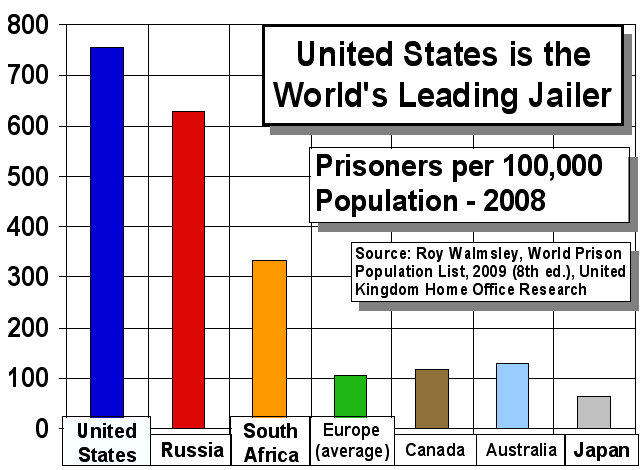
Peak Oil is going to bring technological and social challenges. We will likely face a decline in available energy which *may* lead to a substantial decline in living standards if we don't handle it right.
And *handling it right* will depend upon leadership and social cohesion much more than techno-fixes.
I dont have data in front of me but I suspect that the highest 'rate of change' in GINI coefficient (e.g China, USA..) might also have highest deterioration in life satisfaction and many of the countries that have lowering GINIs have higher well-being indexes - just a hypothesis. But think about China - all of a sudden there are billionaires running around and abject poverty still exists - the 'wanting' to catch up to those at top of society (in terms of goods, lifestyle, political and social connections, etc. has likely increased dramatically. I would predict that GINI is going to continue to rise for China irrespective of what happens to world economy - law of large numbers says it will be so. As long as the conspicuous consumption carrot drives world economy, this socio-economic push will not go away.
One must wonder if stories like this...
Russia's oil boom may be running on empty
...add any light to what Russia did and is doing in Georgia.
If Russia knows that they have larger production declines in their near future, they may be looking outside their borders to the "near" neighbor resources. Not to necessarily take those resource over for themselves, but to make sure they have a stake in those resources.
They must have concluded that the Neocons had a good idea regarding Iraq. One problem of course is maintaining control.
In any case, as they say, actions speak louder than words, and the major military powers are moving to increase their control over key energy producing areas and over the transportation routes for energy from the producing areas.
BTW, for the first five months of 2008, oil shipments from Iraq to the US are up by about 50% over the same period last year.
The biggest source of non-Russian oil in the Caspian (now or in the future) is Kazakhstan. This country is already in Russia's orbit (partly due to the fact that 50% of the population is Russian/Ukrainian). Georgia, unlike Iraq, has no oil. Blocking or controlling 1 million barrels per day through Georgia makes no sense.
Demographics of Kazakhstan
59.2% Kazakh
25.6% Russian
2.9% Ukrainian
2.9% Uzbek
1.5% Ughar
1.4% German
And emigration of Russians back to Russia continues, as does Kazakhs back to Kazakhstan. Add higher birth rates.
Kazakhstan wants to balance between China (see pipeline and new standard gauge rail line to China) and Russia with the USA & EU as third parties.
According to a Kazakh surgeon I know in New Orleans (getting Master's in Public Health) they do NOT trust the Russians and are wary of the Chinese.
Alan
PS: He improved his English in Montana, which seemed a bit like home. then, to quote him, "New Orleans is NOT like Montana !"
Thanks for the numbers, mine are out of date by over 10 years. I find the Ukrainian numbers a bit hard to believe considering the history of settlement in northern Kazkhstan. Whomever they trust or not, they are still part of the SCO and controlling the BTC does not make sense since it will not affect global oil prices and flows. BTW, the BTC is fully operational in Georgia and does not pass through the buffer zones around South Ossetia and Abkhazia. It is 100% controlled by Saakashvili's regime.
I know for a fact (from my wife's relatives) that those Germans were relocated there from Ukraine by Stalin. I suspect that he moved a few Ukrainians around as well.
I know about the Volga Germans forced resettlement. But I have never heard of resettlement out of northern Kazakhstan. The original Ukrainian settlement in northern Kazakhstan was much more extensive than the current numbers (if true) imply. Either Ukrainians are being put in the Russian category or the numbers are suspect. Forced collectivization famine in the 1930s affected everyone in northern Kazakhstan in the same way.
This must be their equivalent of the IOC's drilling for oil in the stock market.
http://www.nytimes.com/2008/08/24/business/24house.html?adxnnl=1&adxnnlx...
Calculated Risk highlighted a key part of this article, which I also thought was interesting:
David Streitfeld at the NY Times writes about Merced, CA: In the Ruins of the Housing Bust
The question is how long people that can make their mortgage payments continue to make them, in order to protect their credit rating--knowing that if they have to sell, they can't sell the house for enough to pay the mortgage, so their credit score at that point would be ruined anyway.
I think that one of the unexpected side effects of peak oil is that everyone will end up moving. Either moving home, or if they are lucky, ending up with a nearby job.
If you assume that the total number of jobs you could do for a living is proportional to the area you can reach by car, then a drop to half commute radius cuts the number of possible jobs by a factor of 4.
I think a density increasing feedback loop will form where people move towards the jobs and then jobs will move towards the people. Picking a place to live with an electrified transit connection to a major job center could mean keeping your home (and all those peak oil preparations).
Here is a map of Minneapolis with a 16 and 8 mile commute radius circle.
Which is a long and roundabout way of saying I think a lot of people who bought recently will end up walking away. They just won't have a choice. And the more that do, the more people will be trapped by upside down mortgages. So another feedback loop forms.
With creditors facing growing defaults with almost every type of loan that they make, and with large chunks of capital being destroyed with every new foreclosure, it would seem to me that we are headed at high speed for a cash/barter economy.
I live 1.1 mile from the largest office building in town (51 story One Shell Square), 2 to 2.4 miles form the Medical Center, 2 miles from Tulane & Loyola (all on streetcar line). 1 mile from Port HQ, nearest dock is <1 mile away (walk or bicycle there), 1.7 miles to port railroad HQ, etc. etc.
Why move ?
Alan
Right, you have a city built on a mass transit / walk scale. Sadly, too late to return to that for the rest of us (without major changes). Still, all cities will end up that way in 100 years, like it or not.
Alan:
I am curious. I haven't been to NO since 1951. I only remember great food and a significant party for an 18 year old.
Is it really below sea level? If Mr. Gore is correct, how much does sea level have to increase to go over any and all levees? If so where will the massive pumps pump to?
I don't think I would want to live there in the future though I'm sure for now it is quite nice.
Very little of New Orleans is more than 8' below sea level. The river and lake sides are above sea level (about 1' above sea level on my street, sidewalk +1.5') but storm surge can push "sea level" much above nominal. The center of the city is the lowest, think of a bowl.
Rotterdam is 28' below sea level by comparison.
Good engineering has made New Orleans invulnerable to river flooding (unlike the upstream cities) with two "pressure relief valves" to divert river water towards the sea (beyond worst case (much more than 10,000 year flood), blow the levees below New Orleans as was done in 1927, before the pressure relief valves were built).
Rain water flooding is just an input vs. output calculation. How much rain in, how much pumped out. Last rainwater flood was May,1995 20" (50 cm) in 12 hours on saturated ground. Only comparable rainfall flooding was 1927. 21" over 24 hours was a minor deal.
http://en.wikipedia.org/wiki/Drainage_in_New_Orleans
Katrina was the fault of the US Army. "Value engineering" cut too many corners and killed over 1,100 Americans directly and thousands more indirectly. The stress on the interior levees was significantly below the design limits. (The interior levees line the canals that take out the pumped water, these and the Industrial Canal Levees failed in New Orleans. Those facing the Lake did alright (also those facing the swamps in St. Bernard failed, malfeasance by building the levees below design).
New Orleans has a "tool" that no other coastal city in the US has. the silt in the Mississippi River. Even before Katrina it was a political priority to get funding for rebuilding the swamps around New Orleans (all new offshore royalties have been devoted to this for example).
Only two diversions have been built so far, which divert river water into swamps to rebuild them (Barataria & Caenervon). A dozen plus more are needed. Worst case, we could fill up Lake Pontchartrain with silt. As sea level rises we can build a rising multi-miles wide wall of silt around the city.
After the 1927 floods. one "pressure relief valve" was built at Old River. 1/3rd of the Mississippi was diverted down the Atchafalaya by this diversion. At the time, nature wanted to divert the Mississippi River via this short-cut but 75+ years of silt build-up in the Atchafalaya has again made the "path of least resistance" back by New Orleans.
The rate of sea level rise is the unknown (and just how much silt the rest of the USA sends our way, the volumes increased during the Dust Bowl). If we build the diversions, how fast is silt added vs. sea level rise ?
You should come back to New Orleans and experience the unique and valuable culture. For me, the most attractive feature is that there is no pressure to conform, one can be who they want to be, and I am judged more on character than money/status. One can spend hours at a party without anyone asking "what do you do ?"
Many other unique and valued features (food, music, architecture, Mardi Gras, the way people interact). I have no urge to travel or vacation elsewhere, FAR too much to do and enjoy within 3 miles of home :-)
To quote a friend "New Orleans is the only city that I have loved, and she has loved me back".
And the bumper sticker "New Orleans; Where we put the Fun into Funeral".
And local reporter, now host of the last hour of NBCs "Today" Hoda Kotb, recently told a local station "There is New Orleans, then San Francisco and then New York City. The rest of America is just McDonalds". Not likely to win friends, but living here I would agree (with a caveat to Boston & Philly).
If I am compelled to leave New Orleans, I will leave the USA and stop my efforts @ Peak Oil here. My loyalty is to New Orleans.
Best Hopes for New Orleans,
Alan
Yes, Best Hopes for New Orleans. Would miss you if you stopped your efforts at TOD.
BTW, I'm curious Alan, perchance are you Cajun?
Reason for asking: I'm living in a part of Nova Scotia (near Ste. Croix, in the Avon River valley, gateway to the Annapolis Valley) that was once the heartland of Acadia. These fertile marsh flats sustained countless generations of Acadians until their expulsion in the 1755.
There were more people here (from New England planters migration) one hundred fifty years ago than today. Interestingly, there were even more people living off this land 250 years ago (give or take a decade) than even 150 years ago.
Hate to think I might be sitting on land stolen from your ancestors. Then again, I'm very glad you're happy in New Orleans.
Cheers!
Unfortunately not. Scotch-Irish from Kentucky, I have only lived in New Orleans 15 years.
The three main sources of French blood are the Creoles, the Cajuns and the Haitian Creoles.
An interesting path to here :-)
Alan
An interesting path to here :-)
No doubt quite a story in itself. Thanks for replying. Cheers!
Jon,
Looks like most commuters in Minneapolis will be able to do a 32 mile round trip in a Chevy Volt PHEV on an over-night charge and still have battery power to stop off shopping on the way home. If your jobs on the opposite side of the city though will have to re-charge at work to get home.
Actually there is another reason that folks won't walk away that has nothing to do with credit score. In many states mortgages go from non recourse to recourse if the home is refinanced. Lots of people I know refinanced to pay off bills etc. So now that the house is worth less then the refinance, even if they sell the home they are stuck with the difference between what the house sells for and what they paid.
Tougher bankruptcy laws passed in Oregon not to long ago makes it even tougher to get away from this.
We discussed this not long ago. The laws vary from state to state, and as you said, I think that things can change with a refinancing. However, I think that it is easier to get out of a mortgage delinquency via federal bankruptcy than it is to get out of credit card debt.
I don't think that's true. And that's not what's motivating these people anyway. They're trying to avoid bankruptcy altogether...which they often can do, just by walking away from their un-refinanced mortgages.
This is the part of the article I found most interesting:
I suspect that's because they fear the borrower might walk away if prices keep falling...even if they can afford to pay.
Which means prices might have to keep falling until they reach a level where people can pay cash on the barrelhead.
In 2002 the United States had about 22 billion barrels of oil reserves. In 2007 the United States had about 21 billion barrels of oil reserves. The United States has been producing close to 2 billion barrels of oil per year since 2002. Thus production of roughly ten billion barrels of oil caused a roughly one billion barrel drop in reserves as new drilling replaced existing reserves. The lower tertiary trend may yield more than 10 billion barrels of oil. Alaska might yet yield 10 billion barrels of crude plus condensates. The Bakken oil field may yield in excess of 10 billion barrels of oil. Shale gas and conventional gas might yet yield billions of barrels of condensates plus NGL's. The U.S. is in a long term oil production decline.
According to the 2007 BP statistical review, the world had grown from about 910 billion barrels of oil reserves in 1987 to about 1239 billion barrels of oil in 2007. Many observers suspected OPEC of cheating. Several years ago Oman had to write off much of its expected oil reserves as one of its major water driven fields started to show precipitous drops in production. This country was thought to be using scientific methods previous to the premature decline of its production. Oman continued to observe declining production.
Mexico is one of the top ten oil producing nations in the world and its production is declining rapidly as was foreseen years ago. As more nations show peak oil production, or secondary peaks, the world moves closer to peak oil. Oil is not expected to run out over night.
"Thus production of roughly ten billion barrels of oil caused a roughly one billion barrel drop in reserves as new drilling replaced existing reserves."
Problem with "new" oil reserves versus "old" oil reserves:
EROEI is much lower with new oil so the amount of end product such as gasoline, diesel, petro-chemical feedstock is relatively less. 100B barrels of new oil may equal only 70B barrels of product.
The cost to produce new oil is much higher as witnessed by Canada's tar sands cost going from $23 per barrel four years ago to around $70 per barrel for new production.
More new oil is used in local economies of countries producing the oil, as seen by export land model (ELM), thus less oil for an importer like US to purchase in meeting 65% of its demand.
In the end the US will need to reduce petroleum consumption by 35 to 50% by 2025. Crashing economy with long term depression will help US adjust to less oil. Growing population of US and world will make this transition much more difficult.
The EROEI of new oil is yet much higher than that of ethanol. That is why Brazil is planning to risk 100 billion dollars on deep water drilling instead of in cellulosic or sugarcane ethanol projects.
Syncrude started construction of its tarsands mining operations in 1973; more than thirty years later it is expected to produce decades further. The high initial start up costs of tar sands mining may be spread over the life of the projects. Am not sure where you got your 70 dollar a barrel operating costs number. There are people all over the world who would by $80 dollar oil. It takes energy to make energy, the energy inputs are tarsands and there are a trillion barrels of it, however much of the thickest, purest deposits have been leased. One little company in Alberta has about 5 billion barrels of bitumen in place and the price of the shares of the company represent a price of under a penny per barrel of bitumen in place. (Alberta Oilsands Inc.) That is cheaper than coal reserves.
The coal reserves in the United States are larger than the oil reserves of the Persian Gulf in terms of BTU equivalents. After the coal will be gone, the oil shale may be crushed and burned like they do in Estonia, however much lower the EROEI is. Delivered coal is currently much cheaper than your oil in terms of BTU's.
With fuel substitution including CNG buses, plug in hybrids, and electric light rail (subway or above ground) transit, one should not panic. The price of PV solar electric technology may improve. Windmills were thought to be a credible source of energy, low operating costs, no fuel needed except to set up and maintain the system.
Living in Colorado I do fear that "the oil shale may be crushed and burned like they do in Estonia". When they stop trying their Rube Goldberg schemes of freezing/microwaving/etc the deposits to make liquid fuel and realize they can burn shale in thermal power plants like very low grade coal, I am afraid not much will stop the process. But the environmental impacts of extraction and combustion will be huge.
I wonder if they could come up with a way to fracture and burn in situ - NOT to extract oil (as in some proposed schemes), but just to produce heat for a power plant topside? It would seem to me that something along these lines would be just about the minimum cost and impact that you could have and still produce some worthwhile energy. My guess is that the EROI for such a scheme is about as good as you are likely to get for oil shale.
As I have previously noted, Lower 48 cumulative production since 1970 has been 99% of what the HL model predicted it would be, using production data through 1970 to generate the model.
Saudi Oil consumption, we haven’t seen nothing yet!
I have always found this Dec. 2007 WSJ article which is covering Saudi oil consumption fascinating, if what is written plays out, the world net oil exports are set for MAJOR declines, here are some excerpts:
To put the above in prospective, 70k bpd is equal or close to the oil consumption of Angola or Slovakia; however the smelter above is only a fraction of the size of the 7.6B dollar smelter also planned for Saudi Arabia as a joint venture between Ma'aden and Rio Tinto Alcan.
Further more, the kingdom decided last year to switch more crude oil toward Electricity production:
Can someone calculate how much crude oil the kingdom will burn to generate 55000 megawatts? A goal they plan to reach by 2014 according to the above.
The Saudi government has taken the decision to convert oil into jobs:
Here is the link to the article:
http://www.zawya.com/story.cfm/sidDN20071211018063/SecMain/pagSaudi%20Ar...
As indicated in the article, job creation is a key strategy for the Saudi regime to insure survival, and if they were to choose between survival or exporting more oil, I believe they will choose the former.
Regards,
Nawar
Saudi internal consumption in this comment, UAE consumption mentioned up above. With the Middle East's expanding population and move toward high-energy-input industries it's definitely time to review the larger trends of production and consumption for all of the Persian Gulf producers.
An example from the Energy Export Databrowser should make it clear why:
On the Oil side, SA is using more and more of it's own production to generate electricity. On the Natural Gas side, SA is using 100% of it's rapidly increasing production internally. (I believe the numbers from the 2008 BP Statistical Review constitute true consumption and exclude gas that is re-injected. Please correct me if I am wrong.)
If you use the databrowser to review the other nations of the Persial Gulf you'll see similar patterns that help to make sense of news items that mention, for example:
In the near future I hope to add uniform units (million tonnes oil equivalent) to the Energy Export Databrowser and another plot type that puts total fossil fuel production and consumption, broken down by source, on a single graph. That kind of visualization would, I hope, add some explanatory historical perspective to comment threads like this one.
Happy Exploring!
-- Jon
With the discussion of diverging and contradicting IEA, EIA and OPEC data, I was wondering if you could do comparative graphs?
I'm not sure how well the OPEC data is available in automatic machine readable format (e.g. cvs/xls through http), but I think the IEA data is.
This would add an additional layer to the analysis.
Granted, it is probably a lot of extra work - so just an idea to consider.
Hey Jon,
Would you consider putting a numerical indicator of the last years consumption, imports, exports, on the graph. It could be over in the key. I was using your excellent site to put together a presentation and it would be really nice to have numbers on the charts.
Jon,
Could you elaborate exactly what you'd like to see?
Would you want, for example, a table of the last 5 years consumption/production/export/import to replace the map situated above the charts? (Perhaps a "show table"/"show map" toggle button in the plot options?)
In general I'm trying to de-emphasize the presentation of numbers in favor of charts that highlight longer term trends. So I need a good reason to make the numbers available directly through the databrowser as opposed to the ASCII CSV versions I already provide on the data page.
I could also make table data available as a separate product that would allow users like yourself to cut and paste images at will.
What would make your life easier without cluttering up the simple message presented by the databrowser in its current incarnation?
-- Jon
You have done a great job with the visual clarity and I don't want to make a mess of that.
The trick is the scale bar only has a few ticks. There is some distance from the scale bar to the graph. And the first question that seems to come up is "how much is that exactly?" which I have to speak it aloud from notes. (or requires advancing to a next slide to get a numerical value).
A table with multiple years is not needed. Just the last years value rounded to 1 decimal place, over in the color key. Or possibly just putting a colored tick on the right hand scale to make a visual judgment easier.
Thanks! It is a great product just the way it is. Very handy. I love the integrated map.
If Ghawar is in decline or will soon be in decline and if its steep like I expect then Saudi Arabia is left with heavy sour crudes and natural gas. Given the worsening global natural gas situation they will either build refineries locally and export gasoline/diesel or have to export both to allow remote refining.
Or they can give up on selling oil for fuel and develop energy intensive industries.
Given that they are doing this it means to me the Saudi's have come to exactly the same conclusion I have its simply not worth it to convert heavy sour crudes and expensive natural gas to cheap fuel for private transport.
So if you don't believe me ask the Saudi's :)
Whats a really interesting side note is that they got the Indians to build a refinery to process the crude they can't even use thats high in vandium. And this was actually done to get around the Indian price controls on NG.
I just took a look at the BP database again.
In past 10 years (1997-2007) Saudi Arabia has:
-increased net oil exports from 8,059 to 8,259 barrels per day (peaking in 2005 at 9,224)
-increased nat gas usage from 4.4 bcf per day to 7.3 bcf per day and
-increased electricity use from 107.3 terawatt hours to 190.1 terawatt hours
Their GDP was 554 billion in 2007. At 2007 $73 average oil their 8,259 barrels per day equals 220 billion, meaning their 'non-oil GDP' was 334 billion, or 60% of total. In 1997 their GDP was $206.5 billion and average oil price was $18 - their oil exports would have been 53 billion leaving 153 billion for non-oil GDP or 75% of total.
So in ten years, KSAs economy has gone from oil being 25% of GDP to oil being 40% of GDP, exports are basically flat, both natural gas and electricity consumption have almost doubled. I sure wish I could see a breakdown of how much that nat gas and electricity use was in the energy sector. I suspect quite a bit. Data anyone?
Interesting. Something seems to be missing. I'd say the biggest is that consumption has risen strongly. So they are not producing more but building more infrastructure at the moment. However you may well be 100% right and a lot of this is energy going into the oil industry itself. I mean it makes perfect sense that of EROEI has declined like we speculate then yes it would be enough to show up in the case of Saudi Arabia which where oil is such a big part of the economy. At least with the data you presented it looks like a lower EROEI signal.
I'd have to guess that Iran is also suffering this to some extent.
Nigeria has similar stats.
http://www.eia.doe.gov/cabs/Nigeria/Background.html
http://indexmundi.com/g/g.aspx?c=ni&v=66
I don't have the complete stats but it looks quite similar energy usage doubled GDP when up but once you subtract the additional oil money then real GDP is pretty flat.
Maybe Nigeria could also show this EROEI effect. Maybe look at Norway or Great Britain.
You may be on to something here right now for the exporters its hidden by the influx of oil money however the US must be having the same problems with its domestic production. I've said that for a while that it looked like NG usage had gone up a lot for the advanced refineries but this could be true for the entire oil industry.
Saudi Arabia has a jobless rate of about 25%. Whatever that means for SA conditions...
They are already building those Megacities as I write this post. Interestingly, about 70% of all workers, which are engaged in construction are from abroad (Pakistan, India etc.). It seems, that the initiators of this theater don't find enough domestic workers to do this job. No wonder they can hardly find domestic workers for a 200$ monthly pay cheque.
At 18% efficiency, that means 2.6e16 J/day, or nearly 4 milion barrels per day.
But they are only planning to generate 60% of their electricity from oil; which means around 2.4 million barrels per day.
It is still a lot.
The calculation is not that simple. First off, that's 55000 MW of electrical generation capacity. One cannot assume that all power plants will be generating 100% of capacity at all times.
I searched through a whole lot of sources, but let's go with the figure provided by BP for the year 2000: 126.2 TWh.
http://www.bp.com/sectiongenericarticle.do?categoryId=9023768&contentId=...
(click on "electricity generation data (pdf, 50KB)" - the link is hideously long)
The article states that capacity in 2000 was 21 GW. 126200 GWh/21 GW = 6009 h at full capacity, whereas there are 365.25 days/year * 24 hours/day = 8766 h/year. Thus total production in 2000 was about 68.5% of capacity. I ran the same calculation with estimated numbers from other years and they are all in the same ballpark.
So, it is reasonable to assume that the 55000 MW capacity equates to approximately 37700 MW continuous. 60% of this is to be fired by petroleum, so now we're down to roughly 22600 MW continuous.
22600 MW * 24 h/day = 542000 MWh/day = close enough to just say 2 billion MJ. The energy density of crude oil is 37 MJ/L, so that's 54 million L per day. A "barrel" is 159 L, so that's 340,000 barrels per day.
Now that, of course, assumes 100% of the energy of the crude oil is converted to electricity. That's clearly impossible, but the suggestion that the conversion efficiency is 18% is, I think, way too low. Coal-fired plants are said to be on the order of 40-50% efficient. I think 40% is a reasonable number to assume. So, we need to divide by 0.4, which gives:
850,000 barrels per day.
Which, I will agree, is still A LOT, but it's a much, much lower estimate than what the previous posters suggested. Who is correct? I think I'm closer to the right answer, and you can see this by doing a sanity check: if increasing Saudi Arabia's electricity generation capacity by 77% (31 GW to 55 GW) raised their consumption for electricity generation to 4 million barrels per day, then their current consumption for electricity generation would be 2.26 million barrels per day. This is clearly impossible, as total current consumption in SA is less than this. Even my estimate seems high to me, as it suggests nearly half a million barrels per day for electricity generation, which is on the order of 1/4 of all current oil consumption in SA.
If I were in the Al Saud family, I would be building lots of solar thermal power plants. They could be the Saudi Arabia of solar power.
LOL
I remember years ago a TV report on Somalia, which described and showed the infrastructure damage by guerillas from pulling copper pipe and wire from various parts of the City, to pay for more arms and supplies. It seemed ludicrous because if you remove the guts of the infrastructure, then what good is it to fight over a City? It lacked foresight and I imagined it was just an isolated incident in that region.
However, I've recently been just as shocked by thieves pulling copper wire and pipes (amongst other things) from empty foreclosed homes right here in the US, as well as remote locations from high power lines.
With peak plateau since May 05 causing oil prices to rise to the point of initiating a slowdown in the world economy, tearing apart infrastructure may become common place. We may have to institute martial law to slow the destruction. In the end though it presents a vision with shades of a world gone mad. Because in the big picture, tearing apart valuable infrastructure for relatively lesser valued metals is pure madness.
I think we are starting to see that homo sapiens is not nearly as sapiens as we have fancied ourselves to be.
I have wittnessed huge shifts in behavior and thinking
in the past several years due to oil price fluctuation
(or peak oil).In an effort of brevity,I can say the
world in general has become a more dangerous place to
live. I see clearly and without abiguity that people
on the whole are more desperate. I say this because
They are, on the whole,acting more desperately.Of course the overwhelming vast majority of people arent
aware of the reason behind their anxiousness. They have a sense of foreboding they cant quite place in
perspective.They fear losing a job or material wealth
or position and prestige.The individual predisposition
is too internalize problems that are really monumental
in scope.
I believe Henry David Thoreau said it best "Most men lead lives of quiet desperation and go to the grave with the song still in them."
I have also been keen to observe that a small cadre
has been effective in ringing the bell of warning.
The collective is waking up alot faster then I would
have guessed. I suppose it doesnt take every cow in the herd to brush up against the electric fence to know it hurts.The argument is now evolving into how
bad it will get and who might survive.Looks like one
problem is gonna be solved though...kids wont be able
to say.."Mom Iam bored...theres nothing too do"
As an aside-I hope my written word is getting better, I am making an effort to improve.
"Even the bewildered herd knows something is wrong"
---Noam Chomsky
A congressional report on CCS:
As a general comment: IMO, it is very easy for the essential dispersion of fundamental knowledge to decline postPeak. It boggles my mind, but consider the previous weblinks of US soldiers being electrocuted to death in their showers in Iraq, despite the simple safety rules for grounding electrical systems being explained a long time ago. I guess the education system has now declined so far that if you can merely change a light bulb, you can now call yourself a highly qualified and certified electrical technician.
Do high schools even have general shop classes anymore so that, at a bare minimum, these kids are at least equipped to understand how improper use of electricity, hand tools, and power tools can be very dangerous? Our educational system needs to be reformed so that we are not just pumping out future Darwin Award Winners. Sadly, the National PTA never responded to my email asking them to go to Max Peak Outreach.
General shop classes? ??? ??????
ROFLMAO. Even when I was in high school in the big city, shop was limited, and I don't recall that there was much of anything about electricity or power tools, just some printing with a hand press (really useful skill, that) and very simple hand woodworking.
Given that a veritably Biblical plague of bloodsucking barratrous trial lawyers has long since reduced the good old US of A to a mass of gibbering morons forever frightened of their own shadows, I'd guess that most school boards nowadays would even less likely to touch any such thing with the proverbial ten-foot bargepole. Too much "liability" - the elf 'n' safety nazis are slowly getting their way and soon everyone will be strapped in bed for life. Heck, by the same token, in some colleges, you can't even take chem lab any more.
I teach cabinetry to adults at the local Woodcraft store. The first thing we do is to have each student sign a corporate approved “Release from Liability” form. I still think if someone gets hurt there, a court case will follow. I would teach woodworking in my shop but I can’t stand the liability insurance.
You're absolutely right on about shop classes even for adults.
That has all been replaced by classes on how to place condoms on bananas. Our schools are turning out kids who are real pros with that useful skill.
MOSCOW, August 19 (RIA Novosti)
"Russia’s oil exports declined 5.2% year-on-year in January-June..." (first six months of 2008)
This year Russia overtook Germany to become Europe's largest auto consumer.
Cheap oil is gone.
Just wait until the miners of P & K, the sulfur extractors, and the natgas producers of Haber-Bosch N, decide to start severely limiting their flowrates due to FF-depleting flowrates. Recall my postings on Federal Reserve Banks of I-NPK and ramping O-NPK recycling. One to Two percent of global energy is already dedicated to just making ammonia [transporting it not included]. In some inland regions of Africa: the transport cost is 4-6 times the I-NPK cost [see prior weblink].
Since the US is now import dependent on N, Russia alone could apply a big strategic hurt without missiles--12% of our N comes from them. Recall that Germany's 1914 potash[K] cutoff made the price rise to $14,500/ton until we found that New Mexico deposit, yet US pop. was much lower, and most farmers used local manures.
Potentially large storm in Gulf of Mexico by week's end! Heres a link to one of the computer models: Press FWD to watch the animation.
http://moe.met.fsu.edu/cgi-bin/gfdltc2.cgi?time=2008082418-invest94l&fie...
Potential Gustav could be a major issue come midweek.