
 | Damage Caused by Hurricane Ike - Open Thread | The Oil Drum | The Connection Between Financial Markets and Energy - Open Thread |  |
Implications of a Ten Day Refinery Outage
Posted by Gail the Actuary on September 15, 2008 - 10:24am
Where is our gasoline and diesel supply headed? Even before Ike hit, quite a few areas of the US were starting to see gasoline shortages. The impact of Ike can only make shortages worse. Most likely, it will take refineries at least a week or two to get production back to normal levels after a storm of this type, considering the impacts of electrical outages and flooding. In this article, I will examine some of the issues that seem to be involved. Based on my analysis, fuel supply shortages are likely to last well into October, and are likely to get considerably worse before they get better.
Insight 1. Even before Hurricane Ike hit, inventories were very low.

According to EIA data, gasoline inventories the week that Hurricane Gustav hit were the lowest that they had been since 2000, amounting to 187.9 million barrels, or about 21 days supply. Quite a bit of this inventory is needed just to keep the pipelines filled. EIA does not publish information as to how far inventories need to drop before we start seeing outages, but it is clear that we have now reached the point where shortages are developing.
Insight 2. Friday, September 12, before Hurricane Ike hit, there were already gasoline shortages in some parts of the country. These occurred primarily because of the earlier impact of Hurricane Gustav.
Even though Hurricane Gustav hit on September 1, its impact on petroleum product supplies were not felt immediately, because some inventories were still available, and because it takes a while for shortages to work their way through the pipeline. Gasoline traveling by pipeline from Texas to New Jersey takes an average of 18.5 days to make the trip, so it shouldn't be surprising that it took 11 days (from September 1 to September 12) for the Hurricane Gustav shortage to start to be felt.
Insight 3. Since Hurricane Gustav hit, there has been a drop in refinery output of 1 to 3 million barrels a day.
The Department of Energy releases daily reports showing the amount of refinery capacity in the hurricane area that is shut in and the amount subject to reduced runs.
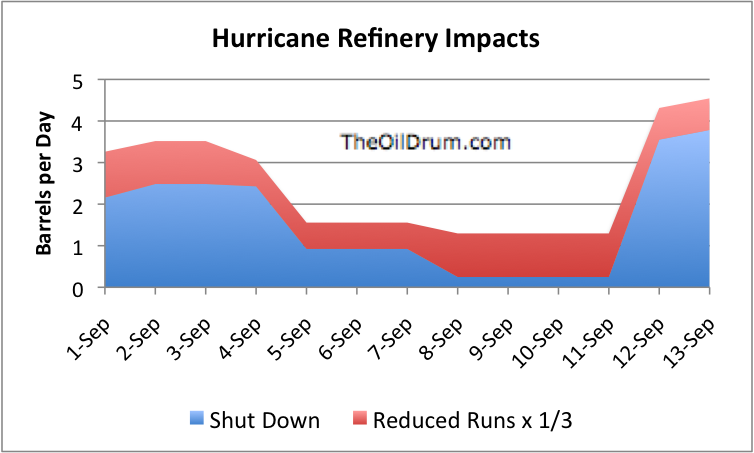
We cannot know to what extent runs are reduced. For the purpose of Figure 2, I have estimated that reduced runs have the impact of reducing production by one-third. The amount shown in the graph is a rough estimate of the amount by which refinery production will decrease. It is not exact because:
(1) We don't know the extent to which production was reduced under reduced runs.
(2) I haven't adjusted for expected refinery utilization rates, without the hurricane.
(3) The data is only for the hurricane area. It is likely that the hurricanes have changed refinery production elsewhere - some increases (greater use to offset shutdowns) and some decreases (because of unavailable crude).
Insight 4. It is likely that we will have product shortages for at least the next three to four weeks, because of shut in refinery capacity and reduced refinery runs.
I have said that it is likely to take a week or two to get refinery production up to pre-Ike levels. Suppose it takes 10 days. Adding 10 days to the date of the hurricane (September 12) brings us to September 22. If it takes an average of 18.5 days to get product from Texas to New Jersey by pipeline, it will take until approximately October 10 before supplies are back to normal. It could be a little shorter than this, or quite a bit longer.
Insight 5. One of the biggest refined product pipelines, Colonial Pipeline, is now reported to be shut down, because of lack of refined product input.
Colonial pipeline is one of the largest pipelines, with a capacity of 2.4 million barrels a day. It serves the Southeast and the East Coast.

Until Colonial pipeline is back to carrying full capacity of gasoline, diesel, and other refined products, there are likely to be shortages along the gulf coast and the Southeast. The Northeast may also begin to see shortages.
Other major outages have also been reported. Explorer pipeline, carrying 700,000 barrels a day of petroleum products from Texas/LA to Indiana, is completely shut down. Plantation pipeline, carrying 600,000 barrels a day of petroleum products from Louisiana to Virginia, is operating at reduced rates.
Insight 6. The lack of refined product (gasoline, diesel, jet fuel) is what is driving pipeline outages.
Until there is enough refined product, some of the pipelines will be short of products to ship. In the immediate aftermath of Ike, lack of electricity may also interefere with the operation of some pipelines, but it is too soon to have information about these disruptions.
Insight 7. Areas with pipeline disruptions are likely to experience shortages of all refined products, not just gasoline.
While gasoline is the product that is in short supply most quickly because of lower inventories than some other products, eventually diesel and jet fuel can expect shortages as well.
Insight 8. Regardless of whether price or some other type of rationing is used, someone, somewhere will need to go without refined product, if it is not available.
If there is not enough diesel to go around, some trucks will not be able to make deliveries or some road making equipment will not be able to operate. If there is not enough jet fuel for all of the airplanes, some flights will have to be cancelled. Some auto trips will have to be eliminated.
Insight 9. If 5 million barrels of refinery production is taken off-line, this is equivalent to a little over 25% of US refined product usage.
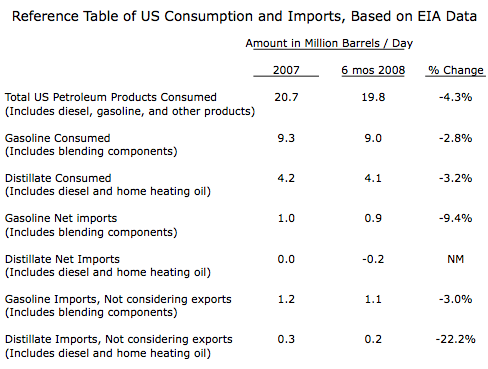
We would hope that the amount of refinery production off-line would drop fairly quickly, but it could be several days before it drops from the current 5 million barrels off-line. It will be impossibile to make up this huge shortage with imports of refined products from overseas, or the use of winter grade gasoline in summer. Edit: See reference table at the end of this article to see EIA data to compare to these amounts.
Because shortages are likely to vary by part of the country, depending on pipeline service to the area, it is quite likely some areas will experience shortages of 25% for several days, even if loss in refined product declines to "only" a shortfall of 2 million barrels a day, which equates to 10% of current usage. At 10% of current product usage, there would be a shortfall of gasoline of about 900,000 barrels a day.
Insight 10. Because some areas are likely to be very short of supply, it is likely that gasoline prices would need to rise to $10 a gallon or more in those areas, to cut back demand sufficiently.
In some areas, there may be temporary shortfalls of 25% of more of gasoline supply. To allocate such short supplies would take a very high price. Government officials are not likely to let this happen. Instead, we are likely to see many stations that are completely out of gasoline, and other stations with long lines, selling at most 10 gallons per customer.
Insight 11. The lack of diesel, gasoline, and jet fuel is likely to cause feedbacks to the rest of the economy.
If people are forced to cut back on gasoline use, they are likely to cut back considerably on trips to restaurants and other discretionary trips. Restaurants that were doing poorly before will find their business much worse. Restaurants on the brink of bankruptcy may be forced over the edge.
Some people will suddenly find their incomes lower (for example, gasoline station owners who have no fuel to sell; waitresses in restaurants; truck drivers whose trips are reduced). These people will find it more difficult to pay their bills than previously. Some may default on mortgages and credit card debt.
Insight 12. We will all get to see first-hand a little of what the impact of peak oil is likely to be.
When there are shortages of fuel, people can be expected to hoard supplies. This may cause shortages to be worse than they would otherwise be.
Co-operation could go quite a way to solving day-to-day problems. We will get to see to what extent this actually comes into play.
Allocation by price has long been advocated as the American way. We will get to see how long this lasts when there is clearly not enough supply at prices voters consider "acceptable".
Edit: Reference Table Added for Comparison Purposes
Contact
- Content: editors at theoildrum dot com
- Tech support: support at theoildrum dot com
License

This work is licensed under a Creative Commons Attribution-Share Alike 3.0 United States License.
I don't see any mention of panic buying in this article, and I think that it will have a big impact, especially as news of shortages gains traction.
But is that why the mass media is not reporting this impending shortage? Are they hiding news to prevent us from panicking?
They need to report the news accurately, and it is our job not to panic, but instead be constructive and elect leaders who may be capable of dealing with a crisis without just blowing it up. The polls I read don't give me the comfort I wish I could have for that.
Do any of you think it is better for the media to keep it quiet to delay and perhaps slightly smooth the shortfall?
LOL!
CNN is covering it. They have been covering the oil infrastructure angle, and have been since Gustav. They actually sent Ali Velshi, their oil guy, to report from the heart of the storm for both Gustav and Ike. (He usually reports on oil prices and such from the studio. I didn't know he even had legs.)
This morning, they are talking about how the refineries are shut down, and how they won't know how badly they are affected until the electrical infrastructure is inspected, which might not be for awhile.
They are also reporting that gas prices may rise due to these refinery issues - for weeks or months. But they're telling people not to panic, that by rushing to the gas stations now, they're saving only a few bucks at most.
They are downplaying the idea of actual shortages, and that's probably the responsible thing for a worldwide news service to do. If people panic and rush to fill up, it would suck the system dry, even if there were no production issues.
One of their talking hairdos (based in CNN headquarters in Atlanta) said she's running low on gas. She looked for a gas station on her way to work this morning, but couldn't find one with gas. She said she passed 12 of them, and all had their signs blacked out. Some had yellow police tape tied around the pumps. She said she has enough gas to get to work tomorrow, but isn't sure what she'll do after that if she can't get a fillup.
But is this a positive or a negative?
How many talking heads do we really need?
LOL
I thought that post was pretty funny, too. And look what time it was posted!!
Leanan gets more work done in a day than any three people, seems never to leave the computer terminal, and now we see, doesn't sleep.
Is this a human being?
So I guess the question should be: "does Leanan have legs?".
:-)
Does someone have the calculation on this? For instance, I filled both cars yesterday. Both were half-full to begin with. If cars on average are half full (which seems about right except for those too poor to put in more than a few dollars gas at a time - who mostly won't be finding extra dollars to fill up today either), and the average car is driven 1,000 miles per month, then if it's getting 20 m.p.g. that's 50 gallons, or 1.67 gallons per day. Assuming a largish tank, that's 3 fillups a month. So everyone topping off their tanks should use up about 5 days' forward supply.
However, once that's done, you're looking at the normal rate of consumption - or lower, if prices really surge, since people will conserve. In fact, people are likely to delay their next fill up until they see prices falling again. So on the back side there will be a lot of people running with less-than-half-full tanks.
Looks to me like the main effect of filling up now is getting ahead of the gas stations posting higher prices on what's the same gas whether I put it in my car yesterday, or four days from now when I would anyway. The belief that good citizens should wait to buy when prices go up strikes me as the opposite of good economics, except of course for those selling the oil.
The general assumption here is that 96 hours is what the system can handle - and your figures, which sound quite reasonable, lead a one day shortfall.
We will be able to see how it works out over the next couple of weeks.
Driving will be cut back, but I don't think 'conservation' will be the prime element. It will be a lack of gasoline that will lead to driving being cut back - not exactly a replay of 1979, but along those lines.
Edit - the shortages causing cutting back being primarily the southeast/mid-Atlantic. Regions such as California and Pacific Northwest shouldn't have any problems in terms of supply.
Yes, this is a sort of Social Darwinism. Let the people who read The Oil Drum rush out FIRST and buy gas and fill up some 5 gallon containers. They can sell the 5 gallon containers for $100. You read it first here.
A good shortage now will open up the possibilities for positive public policy and private decisions.
A pinprick now to reduce the impact of a near fatal body blow later.
All good as far as I am concerned,
Alan
I think panic food buying will exceed panic gas buying.
Recently I have reconnected with an estranged relative who works in food service.
Only after speaking with him about his work am I able to appreciate how far flung our food distribution network has become and how much demand it places on our fuel stocks.
Food shortages will follow unbelievably quickly upon the heels of any disruption to liquid fuel availability.
Based on recent UK experience it takes about 3 days before food stocks on hand are depleted.
The impact of this will be interesting. Instead of entering a "visual cornucopia" with the implied promise of everything available in any desired quantity, the food shopper will experience bare shelves and picking over other people's leavings.
My hunch is that this will have a very significant negative impact on citizen psychology. Not sure how this will play out in the elections. Cannot wait to hear what the presumptive US "Energy Czarina" has to say.
What recent UK experience?
I haven't noticed any food shortages.
You did have a transport strike in the past year or two.
The reporting on this side of the pond indicated that there were shortages of most goods within three days. It was posted on the DB at the time and there were a number of comments in regard to how the urban public was lacking knowledge of JIT inventory and of their exposure to stock problems with any impairment of transport.
"shortages of most goods"? I don't think so. The problem is nowadays one or two people find a shortage then it gets picked up by bloggers and the media who make it seem like the end of the world. In fact it was just shortage of a few goods, experienced by a handful of people.
I tried to explain at the time to guru carolyn baker that reports of food shortages were severely exaggerated, but the testimony of one who actually lives in the uk's second city just along the road from plenty of supermarkets didn't qualify for her as evidence that the media reports of some national shortage situation constituted hype.
In my experience there are regularly shortages anyway of the things I want to buy because the store has the "clever" idea of selling them half-price regardless of the fact that a regular customer such as myself would be happy just to get my regular this and that for any price.
My memory of the event was of no shortages in my area, but that the government gave in to the protestors when they were informed that widespread shortages were one day away, after seven days of disruption. There were reports of some fresh foods being hard to find, but certainly no-one went hungry.
Although I don't have the numbers before me, my state(MI) alone rivals the land mass of your fair isle.
http://www.world-map.nl/maps/political-world-map-2007.gif (big file)
Hell, even our cities are huge, the Detroit metro area is sprawled over 3 counties, it takes a solid hour, with favorable traffic, to cross it in any one direction.
That is why when I responded negatively to the poster a few days ago who was commenting that the Chevy Volts' 40 mile range was overkill compared to Toyotas plan for 8 mile ranged vehicles, a 40 mile range aint squat.
Add to this the almost total lack of any public transportation means that even should fuel allocation preference, in a disruption scenario, be given to food distribution, folks are still going to have a time getting to food.
An even better bet would be that there is NO plan held by the government for such an event.
The 40 mile all-electric range of the Volt would be very nice to have.
The question is though whether it will be affordable, as the financial environment looks......interesting.....
Drive or Starve Americans
Those that, even if given food stamps, cannot put food on the table without driving. Much less get to work.
What GM hath wrought,
Alan
I hadn't realised some of the pressures within the American planning system which favour extensivity in building:
http://seekingalpha.com/article/95447-housing-bigger-isn-t-always-better...
Let's hope some of these pressures reverse soon - after all, if you need public transport to get to work, it is a lot easier if you live in a relatively dense neighbourhood, so perhaps people will be more welcoming.
Cannot wait to hear what the presumptive US "Energy Czarina" has to say.
That's easy:
"God will provide."
"God will provide."
i propose the former and unqualified chairperson of the alaska oil and gas commission would say:
"god will provide, provided that man(or woman) will drill, drill, drill, screw the moose, caribou and polar bear they are not likely to vote for me, me, me and we all know it is all about me, me, me"
We know that all Western media, right down even to small town newspapers, are now owned by a very few establishment Moguls, who have a vested interest in not panicking the sheeple.
Intellectually, it would be better for the "Truth" to be told. Practically, however, Orson Wells in the 1930's proved that the sheeple are incapable of intelligent reactions.
ALL business is in an Unconscious conspiracy to have the truth bent for their maximum advantage. I wish it were otherwise.
As always the top 10% always seem to gain advantage over the other 90% no matter which way the game is played.
Graham
Grain shortages may not be apparent while the harvest is yet underway. They might be realized before next summer, but after the harvest, if they will occur. The cost of meat might rise. Consumers might switch to bread and bakery products, hot breakfast cereal grains, and cereal to get a more efficient use of grain. It takes about eight pounds of grain feed to make one pound of beef.
The United States has low corn inventories due to increased exports and use of corn for ethanol production. This year's corn harvest is expected to be worse than last year's harvest when inventories were higher.
The world wheat harvest was expected to be increased this year.
The United States had problems with unemployment and famine during the great depression. Unemployed people had to go to houses to beg for food, or to try to do odd jobs in exchange for food. We have seen a rapid rise in unemployment this year.
I am a futures trader. Today (Monday) front month futures are off around 20 cents at around $2.57 per gallon. Roughly speaking, you add about 1.00 worst case to arrive at the pump price which would be $3.57 a gallon.
So based on this analysis of a looming shortage, the futures markets are wrong, and I'm wondering if anyone would like to speculate as to how the front month futures price will reconcile with the pump price.
The RBOB delivery point is NY harbor. Pump prices in NJ are in the 3.30s and 3.40s today. DC up to New England hasn't topped $4 at the pump yet (after Ike).
This morning the price of gasoline jumped by 11 cents / litre in Nova Scotia, from C$1.32/ltr to C$1.43/ltr.
Rough translation, that's $5.41/gallon (3.785 litres per U.S. gallon, so $1.43 X 3.785 = C$5.41/US gal.)
Price hikes like these impact quickly on household budgets.
Meanwhile, transportation costs get passed on to the price of goods.
Airlines are already feeling the pinch.
Even with the price of oil going down on international markets, Ike's timing couldn't have been better for a perfect storm on the economy in North America.
My impression, however, most people have no idea what's coming. The experience of Katrina had already faded from the collective memory.
Not for long. The autumn of 2008 may be very well be one for history (pocket) books.
And it appears Nova Scotia Power will be granted a 9.3 per cent rate increase on Monday, the fifth rate hike in seven years -- the high cost of thermal coal is largely to blame.
See: http://thechronicleherald.ca/Front/1078558.html
Home heating oil, electricity, transportation fuels, food.... the pain will be widespread.
Cheers,
Paul
Paul,
It's interesting that on the Chronicle Herald feature page, one of the top watched videos is "Canadians angry about higher gasoline prices."
That's a no brainer. Higher prices raise tempers in people.
What is news is the level of disconnect between event A (Hurricane Ike in Texas) and event B (higher gasoline prices).
Expect a sharp rise in comments and level of unease if actual shortages start to appear.
And this in the middle of an election campaign.
Yes, I can hear it now: what are we doing selling all our gasoline to the Yanks?
Nothing like doing without to raise the national rhetoric. Should be interesting to watch unfold. Particularly with 11,000 Ontario manufacturing jobs disappearing in July and the announcement John Deere is pulling up and moving to Mexico.
http://www.reportonbusiness.com/servlet/story/RTGAM.20080902.wdeere0902/...
Don't worry, the Canadian government won't turn off the southern bound tap. NAFTA says that's a no-no. But the proportionality clause, a potential sleeper and spoiler north of the border, may receive public airing.
Cheers!
Tom
Hi Tom,
The extent of the disconnect is mind numbing; even my partner considers the recent spike in gasoline to be the result of "opportunistic price gouging". Sometimes it's better to nod your head in agreement and casually change the topic.
On a happier note, our firm recently completed a lighting upgrade at a local elementary school that will reduce their electricity needs by just over 110,000 kWh/year. In the course of our work, I discovered the school has four electric water heaters, including a 9.0 kW/450-litre tank equipped with a circulator pump that runs 24 hours a day/365 days a year. All four cylinders will be placed on timers to lock-out their operation during peak hours (an 18 kW reduction in the school's demand) and the circulation pump will be restricted to just two hours per class day. I estimate this will knock another 40,000 kWh/year from their bill (earlier this week I turned the pump off and the school's weekday usage fell from 780 kWh/day to a little over 600).
In dollar savings, placing the tanks under timer control will save the school board $1,784.16/year in reduced demand charges and a further $1,114.56 as the result of their improved load factor (i.e., more kWhs charged at the lower-cost second tier). Limiting the circulator pump to just two hours per day will add another $4,640.00 to the mix. Not a bad return from four $80.00 timers! Cherish the small victories whenever they come your way.
Cheers,
Paul
Ike may be clincher in ensuring energy frugality across the board. One can always hope. Thanks Paul for the tips.
It is worth noting that, in France, home timers for electric hot water heaters is standard in most homes. The timer is located right in the circuit breaker box. A two priced system for electricity makes it logical to bring the hot water heater up to maximum heat content during cheaper night hours. Most hot water heaters are very heavily insulated and maintain their heat for a long time. On can always over ride the standard setting if expecting company and heavier usage. Also many washing machines and dish washers come equipped with timers that allow usage during the cheaper night hours. A clothes dryer is a rarity in France.
There is a big advantage to the two price system for the supplier, EDF, as it smooths out demand over a 24 hr period.
In the UK too we have day/night rates - but you need to request them. They are deliberately made poor value by the supply companies for whatever reason.
For a start, its only from 01:00 to 08:00 [sometimes 12:00 to 07:00], then it's typically 30% - %50 of the regular flate rate at night, and 200% - 300% higher in the day!!
Hi bio1,
Shifting major loads such as water and space conditioning to off-peaks hours is a simple and cost-effective way to improve the utility's load profile and, by extension, lower its cost of service. In Canada, TOU rates and residential load control are virtually non-existent; only recently has the Province of Ontario moved in this direction. In Nova Scotia, to qualify for TOU rates you have to jump on one foot, blindfolded, hands tied behind your back while reciting the alphabet backwards (I'm exaggerating, of course... but only a little).
Next to the main water heater are the control switches for the school's massive air intake and exhaust fans. It appears they also run 24/7, even though the school is occupied perhaps 25 per cent of the time. The school is heated with two Burnham steam boilers that consume 70 litres of fuel oil per hour, each, and I'm left to wonder how much fuel could be saved simply by shutting down the ventilation system outside normal school hours (this is an older school with operable windows and so much air infiltration that an active ventilation system seems totally unnecessary).
On one hand, it's reassuring to know there are many ways we can reduce our energy use, at little or no expense and with minimal impact on our comfort and well being -- on the other, it's disheartening to think most will go unrealized.
Cheers,
Paul
I think you could teach a freezer to do the same trick.
A decent freezer uses something like 1 KWh/day with a COP of 1.5, that's ~5 MJ of heat per day that needs to be removed. The latent heat of fusion for sodium chloride(23%) + water eutectic is 0.23 MJ/kg. 22 kg of salt water eutectic embedded in the wall of the freezer could provide one day of storage at -21 degrees celcius.
With the proper incentives and programability it could soak intermittent electricity or off-peak baseload and provide additional protection from spoilage in short power-outs. It could provide an additonal load that can be dropped by the power companies in an emergency to protect grid-stabillity(they'll have to pay you for the privilege, just like they pay to be able to interrupt some of their industrial customers and it can only last for as long as there's eutectic to spare).
They use large commercial freezers in this way in the Netherlands, I believe - sorry, I don't seem to have kept the link
Large commercial and industrial customers that pay demand charges will often try to flatten their internal peak which, obviously, will not necessarily coincide with the utility's own system peak. Intelligent load controllers can do an excellent job juggling various loads so that they don't all run at the same time, often with no or only minimal degradation in service performance. What I'm doing in this case is installing time clocks to lock-out the operation of the water cylinders during normal school hours which, albeit a less elegant solution, technically speaking, is far more cost effective. Bear in mind that whereas a controller would actively monitor the school's total load and permit one or more tanks to recharge whenever there is sufficient "head room" available, a time clock offers no such accommodation and this increases the likelihood of run-outs on days of higher hot water usage.
Cheers,
Paul
Two hurricanes in about a week and the price of crude now hovers around $100. Go figure. I used to have some faith in the market to respond to reality...
I wonder if part of the low price of crude is the fact that refineries cannot use crude if they are closed. It is the price of gasoline that is increasing, since supplies are not available.
Even with the refinery's down if we only had to refine sweet light there would be no refinery issue... Its only an issue because heavy sour oil needs way more work to refine...
What should happen is a massive price differential between Light and heavy sour oil... There wont be because there are to many stupid traders...
It seems to me the market for oil has disconnected from reality. Wonder how long that can keep up??? The million dollar question..
As I said in a previous post, we learned from Gustave that hurricanes, unlike the past, now cause the price of a barrel of oil to go DOWN. The reason for this is simple: infrastructure is damaged, oil companies have additional clean up expenses, workers get paid while they are moved onshore and off. This means that the marginal cost of a barrel of oil goes up. But in this case, everyone is sad and depressed and that has a MAJOR downward force upon the futures markets as people's emotions are dragging the future markets below the cost of production. People want to GIVE oil away because they are sad and feel generous. This force, the 'invisible mind' is exerting billions of dollars of pressure on the futures markets as traders ponder whether or not there will be a future. They get sad thinking about it and we clearly have a downward spiral. Oil could plummet to a fraction of the cost of a bottle of seawater if the trend continues. Expect oil to sink into the 80s as everyone gets more depressed. This phenomenon has nothing to do with supply and demand. It is 'media-driven' and is far more powerful than these little hurricanes which are never as bad as the worst case scenarios, further exerting a downward pressure on future crude markets. This is the beauty of 'free enterprise'--just when it looks like something is going to get really expensive, people get sad, the markets get depressed, and the price of crude oil plummets. The invisible mind trumps the invisible hand.
I'm ready to take interviews on CNN to explain this to novices.
-Stiv
This is just one more little piece of evidence against Adam Smith's "Invisible Hand".
Invisible? Of course it is, it doesn't exist.
Actually, it looks like that invisible hand has just picked up a piece of lead pipe and is now swinging for the back of our heads...
Dred
I saw a cartoon titled: Why economists would prefer that the invisible hand remain invisible
It showed a dashed outline of a hand giving the bird to the viewer...sorry I can't find it to post, but i'm sure you get the idea.
It seems like a "Invisible fist" at the moment, delivering a blow to the chin.
No one said late stage capitalism would be fun.
Moose Burger anyone?
Gail, I always enjoy (feel informed) by your detailed analyses like this piece on the reasons why a gas crisis is likely imminent.
I have a friend traveling to Pittsburgh 8 hours away, leaving tomorrow night. I wish I could explain all this to him so he could use due caution.
To try to explain might make me seem like the paranoid one because the mass media does not seem to be reporting this.
Where do the masses, who can't all read theOilDrum, get this information they need??
Maybe we can get some local newspapers to print some articles about the subject, based on this article. If you know a local reporter in your area who might be interested, send a link to the article. You might also mention that I do have a real name I go by as well (Gail E. Tverberg), and that I can be reached at GailTverberg at Comcast dot net.
If the 'masses' read theoildrum, most of them would dismiss the information because it doesn't conform to their belief systems. But if they DID believe it, we might quickly morph from a just-in-time to a just-in-case social dynamic. The inflection point of this is tenuous. I'm not sure what our role is, other than to have an archive of analyses for policymakers, at all levels, to connect the dots. Perhaps they've connected them already and just don't have politically acceptable answers - I don't know.
To what extent the ruling class has achieved their top dog status thanks to their investments/job position/friends in an oil related company? To what extend for these people, to address peak oil means to cut the very tree on which they have climbed? Did you notice that the countries that are better prepared for peak oil don't happen to own a dominant oil industry? Perhaps it is not coincidence. I am really not sure the problem is one of connecting the dots, not when I see all the foreign policy adventures that just happen to target oil rich places.
thats a catch 22 - for concentrated wealth to have value, there has to be stability, reasonable equality, and things to spend it on..
and i kind of agree that there are nations better prepared for PO than ours... there are some worse, too (UK...)
Which nations are better prepared for Peak Oil?
I look at Europe and I see Germany phasing out nuclear reactors. I see a growing European dependence on Russia. I see a higher dependence on imports. Europe is further north and so solar works less well there. Also, they have higher population densities and so have less area over which to capture wind energy.
France has done well building a large nuclear fleet. Brazil has the benefit of long growing seasons for biomass energy. But few countries seem to have substantial advantages over the US.
But few countries seem to have substantial advantages over the US.
The primary advantage most countries have over the U.S. is that they use a lot less oil per capita. Thus, the magnitude of the demand side of the equation is much less daunting.
Europeans use a lot less oil per unit GDP than Americans, so any decreases in demand have a much larger impact than in the usa.
You know, that is where Kunstler steps in - Europeans have adequate infrastructure to actually imagine living with 20% of their accustomed amount of fuel - rationing would be imposed as a matter of course, priority given to such things as farmers or police, and there isn't much sympathy for those who 'need' to drive. It would be hugely disruptive, of course, but I would bet fairly long odds against riots breaking out at gas stations between normal citizens. Transport drivers organizing strikes/blockades is another subject, of course.
We will see how the next few weeks go, especially in places like the mid-Atlantic. It will be interesting to see how much of current American life is completely dependent on driving hours of each and every day.
"The primary advantage most countries have over the U.S. is that they use a lot less oil per capita. Thus, the magnitude of the demand side of the equation is much less daunting."
That's true Robert, but it can be looked at the other way around: We have so much energy consumption in the U.S. that is waste, we can afford to cut our consumption incredibly before we begin cutting into the "muscle" of the economy. We will simply be cutting fat and waste.
Europe on the other hand is already so efficient in many ways that it has little room to spare. Any major cuts will have to come out of the muscle of the economy and cut into wealth very quickly.
In the 1970's oil crisis, Europe suffered very badly. I fear for our European friends if this thing gets tight fast. Beside "case hardening" our own economy to oil shocks (through conservation, elegant efficiency design, renewables and energy diversity) we should work with our world trading partners to come to advanced and workable solutions to the world energy situation. The U.S. alone can do virtually nothing to change the peak oil situation. The U.S., Europe and Japan are not now the major sources of consumption growth, and in fact in many cases are either flat or declining in oil consumption. We should be working together to create a plan for the older slower growing but already wealthy economies (that is to say us, being Europe, U.S. and Japan) to transition smoothly to the new economic and energy order that we have long known must occur.
RC
I don't know if you have been to Europe, but the idea that it is so efficient in the use of energy that more savings would be difficult or impossible is simply incorrect - we are just a bit less inefficient than America.
Street lights, for instance, put a large proportion of their light up into the sky, increasing light pollution rather than doing anything useful.
On a more substantive note, just because Europeans do a lower mileage in more fuel efficient cars than in the US does not mean we have scratched the surface of savings.
For starters, much of the travel is voluntary, and higher prices would greatly affect that.
Here in the UK over 60's travel free on the buses, and many leave their cars at home most of the time for this reason.
10-12 seater taxibuses would also be fine for most European cities, providing convenient point to point service within minutes of their being ordered over the phone:
http://www.taxibus.org.uk/
Taxibus | Intelligent Grouping Transportation
Alan Drake has extensively documented the savings possible by using rail to move passengers and goods long distance, whilst even for those who think that financial circumstances will preclude a rapid switch to personal EV cars for most people, the technology can certainly be used to move goods from the railhead to where they are needed.
Various electric bikes and scooters can move people at a fraction of the energy use even of electric cars, which are themselves several times as energy efficient as ICE cars.
For agricultural machinery, bio-fuels can fuel that niche market.
Space heating uses a vast amount of energy, and solutions range from the use of air-source heat pumps which multiply the efficiency of electric heating by 2.5-4 times, to building better houses and insulating existing stock better.
3 million homes have almost no insulation at all in the UK, and 9 million are in the next lowest band! - That is half our housing stock.
Europe can improve efficiency many fold by applying known technology.
Good points, but you failed to mention the excellent tram systems of Germany and Switzerland and others (Poland, Czech, Austria ...) as well as superb bicycling systems (Netherlands, Denmark ...) As oil pressures mount, people can easily switch to the non-oil alternatives.
France scrapped their trams after WW II, and they are now rebuilding them. 1,500 km on the next decade, in every town of 100,000 or more.
Best Hopes for Non-Oil Transportation,
Alan
I leave the rail and tram commentary to you, Alan! :-)
It's a PIA to transport goods on a tram though, but they are fine people movers.
The main reason I get so excited by EV progress is that that will improve the basic battery technology we need to move goods around from the railhead, and to provide adequate personal mobility without needing the vast numbers of personal cars we use at present.
This will itself greatly reduce energy use, by taking out perhaps 90% of the automobile industry, and makes the spare resources available for materials for either renewables or nuclear technology build ups a very small proportion of the resources freed up.
To look at the figures a bit more closely, the link I gave previously indicates that London might need 30,000 taxibuses.
If we take the population of London at 8 million, and upgrade that to the UK population of 60 million, then you might need 225,000 vehicles or so.
Of course, many areas would be less suitable for the exact system named, as they are rural, but we can at least get some idea of scale from this rough estimate.
The UK has around 100 times that many cars on the road, and replacing all of those would be very difficult, certainly in our straightened financial circumstances, but 225,000 is a very different matter and should be do-able as hybrids or EV's in fairly short order.
If they were EV then fast-charge batteries would be needed, but some designs allow this.
Large numbers of electric delivery vehicles would also be needed, but again relative to the number of cars we are talking about small numbers.
There would not seem to be any show-stoppers to provide the goods and transport people need, although if most of our projections for the financial system are accurate, not for business as usual.
The more spread out suburbs in the US and Australia make things tougher, but if increases in waits were allowed then the number of cars needed per square mile decreases by a square function.
In practise, it should be possible to do quite a bit better than this, since reduced personal mobility should lead to clustering of functions near transport nodes, with shops and offices being built near rail or tram stops, and so most journeys would be from houses to these central points, a lot nearer than the city centre.
visiting other people's houses in these low-density suburbs would probably be limited to bikes or electric bikes.
Yes, but doesn't European freight basically go by truck? In that respect, we are better off in the US with some significant share (don't know what %) going by rail.
You are quite right Liz - and that is another area that Europe could save a lot of energy! An awful lot of the rail traffic in the States is coal though - Alan will know how much.
There is not so much coal here to shift around.
Coal is trending down to a third of US rail ton-miles (roughly). Low value commodities (coal, grain, gravel, bricks, etc.) are about 2/3rds of rail ton-miles (all from memory).
Alan
Yes, today. Although the EU uses coastal shipping much more than the USA, and their RRs are largely electrified.
There is a major push for a shift to rail, which will bear fruit. The Chunnel is rail (piggyback trucks or take a ferry) and the Swiss are digging a flat straight rail line between Zurich & Milan (for Germany-Italy shipments, among others) while competing trucks will have to grind gears over the Alps or go piggyback.
A rail & road bridge from Sweden to outside Copenhagen Denmark with an on-going link to Germany from Copenhagen under construction (rail only I think).
A new freight only railroad from Spain to the Baltic is under way as well.
Allowing multiple carriers on national railroads is also underway.
Best Hopes for EU Rail,
Alan
Yes, this is true ... however, ALL activities have consequences in the US economy. That large 'fat and waste' segments of US productivity are measured. Fatting and Wasting generates income! Should this activity be removed, it adversely impacts GDP.
The cutting process itself will also be measured - and fixed as an cost/expense to be held against the income that is generated by the fat and waste.
It is far more costly overall ... to conserve than it is to waste. Add the effects of compounding and the cutting of fat and waste leads naturally to an almost unimaginable economic collapse!
This is how energy and auto company lobbyists can tell Congress with a straight face that conservation will send Americans back to the Stone Age.
This truism is a key component to the political resistance to changing the overall energy paradigm--from NIMBYISM to vested corporate interests et al. When thought about, this is THE major factor why the US doesn't have an energy policy worthy of the name. Carter tried to illuminate this truism and was defeated by its constituent parts acting in their own selfish interest (amongst other things). The only politicians bold enough to ennunciate this truism are marginalized members of congress. Until the "disconnect" mentioned above is connected to the truism highlited here, there will be no effective movement toward an effective energy policy that in essence is also (for the time being and global warming aside) a transportation policy.
Moreso is religion, particularly Christianity:
"Go Forth and Multiply!" ( ... like rabbits) (Gen. 24:2)
"Trust in the Lord with all your heart, and lean not on your own understanding; in all your ways acknowledge Him, and He shall direct your paths." (In other words, don't believe your lying eyes!)(Proverbs 3:5)
"Blessed is the man who trusts in the Lord, and whose hope is the Lord. For he shall be like a tree planted by the waters, which spreads out its roots by the river, and will not fear when heat comes; but her leaf will be green, and will not be anxious in the year of drought, nor will cease from yielding fruit." (Jeremiah 17:5)
And so on and so forth. God made the world for our (business) purposes, we are obliged to exploit it to serve God and if things turn out to be 'not so okqy' to trust that this is all part of 'God's Plan'.
We all need hope, and Christianity and many other religions give us that. I am sure things were very difficult back in the time when those verses were written, and the verses from Jeremiah and Proverbs helped people get though the difficult times. The same verses help many people dealing with death, cancer, and other illnesses today. The verse about going forth and multiplying made sense back when death rates were very high, and few children would make it to adulthood.
I agree that there are people who interpret the Bible the way you suggest, but there are a lot of others who do not.
I would prefer that people stay away from religion bashing. Many readers find it offensive.
100% agreement.
Moreover Christianity, as well as other religions, is about community.
Something that we here at TOD try to embody.
Not shure that is really fair. People have been taught how to read scipture incorrectly, to approach The Divine through an intermediary - the cleric and the church. A Power and Control thing. The scriptures often are refering to "the spirit within" in a sense of direct relationship of Person to The Divine.
I think what I'm saying is: The Scrptures have been quoted out of context since the day after they were written.
In other places the scriptures had exhortations specific to the time period when they were written, Go forth and multiply was a survival instruction, and they have grown outdated with time.
There is a lot of knowledge hidden in the scriptures.
Well that's my non religious persons perspective.
It is not a person's belief and spirituality that is to blame as these often come from a search for a loving creator in a cold, dark, difficult to understand, universe. It is not a person's hope for life after death that is the cause of these troubles. It is instead the exploitation of hope for profit and power and the blackmailing of hearts by claiming 'only we know the way to heaven; follow us or suffer eternal death.'
I look to a person's faith and conviction as a sign of a good heart. Hope moves you forward. Belief strengthens hearts and hands. A search for justice and meaning gives value to ourselves and others. And the idea that benevolence is its own reward has immeasurable benefit to all.
It is in hubris, when we claim to know the way for others; when we claim to act in God's name, that we lose our way. For my part, I believe we would do better to let our charity and love be the best signs of our faiths -- our means of reaching hands out to others and inviting them to share with us in this strange, amazing journey.
"That's true Robert, but it can be looked at the other way around: We have so much energy consumption in the U.S. that is waste, we can afford to cut our consumption incredibly before we begin cutting into the "muscle" of the economy. We will simply be cutting fat and waste."
I think this is precisely incorrect, actually. I think the problem is that the fat and waste *are* the muscle of the economy - 70% of our economy is driven by consumer spending, and continual growth is required - a contraction in fat and waste sends the economy into crisis. I hear this idea that we can just stop our wasteful spending, and do only what matters often, but I think it is truly wrong - there is no way to easily or rapidly decouple waste and its economic power from truly useful economic activity.
Sharon
The economy can shift gears faster than you suppose.
Long lived energy efficient capital spending can become the focus of an economy in a half dozen years. Retrofitting insulation & windows & solar hot water heaters can take the place of new Exurban McMansions.
New Urban Rail and expanded & electrified railroads can take the place of new roads as well as consumer "goods".
Add a Rush to Wind, HV DC transmission lines and pumped storage can be another significant source of economic activity.
Quality before quantity can be the new focus for consumer goods. High end e-Trikes anyone ?
MASSIVE dislocation, but people can and do adapt.
Best Hopes for Better Economic Focus,
Alan
Alan, I think you are correct that these things *can* happen - the question becomes how likely they are to happen. I certainly would like to see them happen, but I think there are real questions about our ability to borrow enough money to make such a major economic shift - and it would have to be borrowed, I think. I also think the question becomes what kind of economy they can move. I don't doubt we could change our economy quite rapidly (although what that middle point would look like is another question).
But I do think there are real questions about what a sustainable economy that focused on durables would look like - and on long term economic planning issues - that is, we might, with a great deal of work and planning, make the shift to an economy based on insulation and rail and durable consumer goods. I can buy that. But then what does the subsequent economy move on? What happens when the rail is mostly built, and everyone has their good for 25 years trike and the house stays pretty warm with minimal fuel? That is, you are talking about a transitional economy - what is the long term sustainable model?
I think we're going to make major economic shifts, regardless - hopefully more as you describe than I suspect. But I also think that at the end, we're probably going to be poorer. In itself, that's not necessarily a horrible thing - our affluence has been a terrible, terrible thing for us in many ways. It has its pluses, of course, but the price has been too high for the world and the future. The question becomes how we get to an economy that isn't based on yet another big boom - whether it be in rail lines and insulation or nanotech - but on a steady state. And as deeply as I admire the steady state economists, I'm not at all convinced that they or anyone else has figured this one out yet.
Cheers,
Sharon
Even long term capital goods need replacement. Wind turbines have relatively short 25 year lives (new & improved ones perhaps longer, the towers & electrical infrastructure at least twice that).
Some long term & long delayed environmental clean-up efforts will take economic resources in the future.
I could see massive railroad tunneling and other civil projects keeping people busy for decades (we never double tracked the original Trans-Continental railroad through the mountains, the tunnels and fills built by Chinese coolies are still used today, although the bridges have been replaced).
Many opportunities for run-of-the-river hydroelectric projects for example. Trash recycling of our garbage dumps is an untapped resource, etc.
The pace of technological progress may slow, the direction will surely change, but it will not stop. Thus I think a completely "Steady State" economy will not happen.
New varieties of teff & quinoea, new hybrids of apricots and plums, new rail ties, etc.
Best Hopes,
Alan
I agree with you to a degree, Alan - I'm not suggesting that we will build out and then never need anything again. But I do think that the transition from a "next big thing" economy to a fairly stable, low level one, that mostly replaces durable goods and cleans up messes, is, even in the best case scenarios, something that probably deserves more thought and analysis than it has gotten. We know it has to happen - and that it will one way or another. But actually living in a less-but-still industrial society without large scale growth is something we don't have a lot information about.
Using current models, this would mean we'd be a lot poorer - and again, I'm not sure that's necessarily the worst thing that could happen, particularly if we can transition to a kind of self-sufficient poverty, the kind that people talk about when they say "I was poor, but I didn't know it, there was always food on the table, and Mom kept my clothes patched." But there's also the other kind of poverty - the kind we've been setting ourselves up for - that's the part where you don't have food, and are cold or hot and scared a lot of the time. And while I'm doing my level best, and you clearly are too - to get to the good kind of lower economic transition, and I think we both hope for one, I'm not sure that I believe we will (as opposed to should) make that shift in a short time, in a way that wouldn't be painful. Because we're working so hard going in the other direction.
Again, there's no question that I agree with you in many respects - I do think that we need to think a little more about the long term replaceability of technological infrastructure given that 25 years out, we would have to replace those turbines, and right now, we use fossil fuels to do it - our plans have to include that, and don't really. But generally, I have the same hopes you have, but some other fears.
Cheers,
Sharon
Alan, Sharon,
Rows are getting thin, so I try to keep this reply concise.
From my European perspective, the Wikipedia entry on the Republic of Ragusa [1] offers a glimpse at the underlying forces pertaining to the aforementioned hopes and fears, particularly the chapter on the relations between the nobility.
Carefully not trying to tread on sovereignity issues, I'll leave it to your appreciation of this reference to determine where to go from there.
Plus I'm not sure if this still fits under "Implications of a Ten Day Refinery Outage".
Hope this helps,
Serge
[1] as retrieved on Aug 4, but content seems to be pretty much stable.
But our waste is an opportunity as much as it is a problem. We have more easier ways to cut energy usage. We have more optional energy usages.
We can right now afford bigger cars and drive them. We can later afford to shift down to cheaper smaller cars. The Europeans already drive smaller cars. Granted, there's pain associated with that shift given the rate at which cars turn over. But the car companies can shift to just building compacts and subcompacts which higher mileage drivers can buy.
We also have more energy than Europe. We have much more oil, natural gas, coal, wind, solar.
A higher portion of Europeans already live in multi-unit dwellings with smaller numbers of square feet per person. We can make that shift. In some cases we can make that shift just by converting houses into apartments. I live in a town that has a lot of those conversions. So I see it is possible.
We also have more areas which have moderate climate. We have running a multi-decade migration toward moderate climate areas. Swedes in Sweden can't get away from cold weather without piling into southern Italy where they do not speak the same language. Mainers can move to Virginia, Tennessee, North Carolina.
On the other hand I guess Swedes have triple glazing and lots of hydro per capita and are more at home with cold weather than we'd expect anyway. Like why haven't people all left Scandinavia and Russia already anyway?
In Germany, you see the democratically expressed will of German citizens in phasing out nuclear power, recently given a boost due to the lying and incompetence of a not quite declared 40 year old nuclear storage area which is now being flooded - Germans have a real problem with long term problems, and nuclear waste is a long term problem. The recent accidents at a couple of French nuclear reactors didn't help the pro-nuclear cause either, by the way.
You also did not mention German efforts at home insulation, solar heating, PV, or wind - or the fact that the Germans hope to make money exporting such energy conserving or energy producing technology.
Whether measures will be taken in the future (many Germans have reasonable concerns against nuclear power, which could be allayed with reasonable solutions) about nuclear power is one thing, but the current fact is that Germany seems to be preparing for a future where the current assumed abundance of free energy will no longer be seen as realistic.
Both Germany and Britain seem headed for electric power generation capacity crises. Germany is phasing out nuclear power at a time when it can not afford to do so. Britain's reactors are also going offline creating a generation gap in the late 2010s.
France seems pretty well positioned by comparison. Its wind and solar will come on top of a huge nuclear base. So it will have the lowest vulnerability to fossil fuels.
Britain will be very vulnerable a lot sooner than that.
If there is a bad winter this year and restrictions on Russian gas exports cuts could happen this winter.
By 2013 or so then the vulnerability becomes extreme.
Here is a link to the decrease in nuclear power:
http://www.jaea.go.jp/04/turuga/tief/2004/images/S1_04.pdf
S1_04.pdf
Coal plants are also due to be decommissioned as some do not meet EU regulations and are ageing.
The contribution from all the wind turbines in the country currently equals the output from one small coal or plant or around half of one nuclear plant on average - the industry commonly states it's output as installed capacity, which hugely inflates it's output and puts it's costs in a favourable light.
http://www.telegraph.co.uk/opinion/main.jhtml?xml=/opinion/2008/09/14/dl...
Off-shore wind is an excellent resource for obtaining taxpayer's funds, but is hugely expensive - around three times the cost of the already far from cheap on-shore wind.
Germany has a phase out plan that lasts until 2025 - and the political pressure to keep the reactors running is high. Not supported by a majority, but still high - the energy companies would like to keep them running. Of course, at least one energy company EnBW, was arguing that they needed to keep the reactors running to reduce their reliance on coal, and begging to be allowed to keep them running. Then two days later, submitted paperwork applying for 10 new coal plants, regardless of whether the reactors were kept running. The energy companies have close to zero credibility in these debates.
Admittedly, a certain number of Germans are anti-nuclear for non-technical reasons - superstition concerning radiation (for lack of a better expression) is part of it, as is pacifism - most reactor designs have much more to do with military aspects than most people seem to realize (for example, there is no technical reason for commercial reactors to produce bomb grade materials, except for the fact that is how they are designed).
However, most Germans who oppose nuclear power base their reasons on concrete grounds - the unresolved issues concerning waste disposal (as is again on public display here - including clean up costs that are not going to be paid by the power companies, and which will not be included in their demonstrations of how 'inexpensive' nuclear power is), and the relatively fragile designs of currently running reactors. If these two issues could be resolved (some posters here insist these problems have been resolved), Germany would likely continue to use nuclear power. Especially if the issue of bomb grade materials could be resolved, as then many pacifists would have their major objection met.
German opinion is actually pretty evenly divided:
http://www.planetark.com/dailynewsstory.cfm/newsid/49280/story.htm
I believe the recent problems at Asse have shifted those polls a bit -
'The debate over Asse has particularly caught the members of the conservative CDU party off guard. Just a few weeks ago, CDU General Secretary Ronald Pofalla praised nuclear power as “eco energy” -- a statement that is now hard to reconcile with reports of leaky storage drums and radioactive contamination. “In order to proceed with our plan of extending the operational periods of nuclear plants, it is imperative that we make progress on the issue of a deep geological repository,” Podalla said.
For years, the conservatives have favored using another salt mine for final waste storage, the facility at Gorleben, which is geologically similar to the one at Asse. They have done this because pro-conservative energy companies have already invested a great deal of money there and because they fear that alternative sites could spark a wave of protest movements in their own backyards. This could happen, for example, in the region surrounding the city of Ulm, which belongs to the constituency of Germany's federal minister of education and research, Annette Schavan (CDU).'
http://www.spiegel.de/international/germany/0,1518,577018,00.html
The article is essentially political, but some of the technical details will be very damaging to the nuclear industry, such as this -
'König’s experts have been working for weeks on an alternative. They want to remove the old barrels of waste, or at least some of them. Nevertheless, such a retrieval operation would take time -- a factor that is lacking in the assessments made to date. Official reports state that the security of the mine is only assured until 2014.
In light of this extremely tight time frame, it comes as no surprise that a new leaked report from an engineering firm in Bochum has raised many people’s hopes. According to this paper, taking appropriate “security measures” with large amounts of concrete could keep the mine from reaching a critical stage for another 10 to 15 years. “The essential thing right now is to gain time to find the best possible solution for sealing the mine,” says König. If there is an opportunity to do this, then “we have to take advantage of it.” (Translation note here - 'security' is probably better read as safety or containment)
And remember, this is all at German taxpayer expense - the nuclear industry isn't going to pay a penny of it.
The nuclear industry continues to show a disdain for future problems which is simply not acceptable in Germany, and they will do anything to distract from their major weakness - the fact that in x number of years (at Asse, around 6, if nothing is done - first problems being noted in 1967, as documents are now reveailing), radioactive goo will be bubbling around in the biosphere.
The opinion polls have been pretty constant over a number of years.
I do not know what the fiscal arrangements in Germany are for disposal of waste, but in the UK the levy is £0.50/MW generated.
Since disposal costs take place in the future, discount rates make the charges relatively slight.
France reprocesses and stores it's wastes, and has much lower electricity rates than Germany, with no substantial evidence of subsidy bankrupting the French state.
In addition, in spite of Germany paying large sums in renewables subsidy, in practise it's energy is based on very dirty coal, and it's emissions of CO2 are far greater per person than France:
http://business.timesonline.co.uk/tol/business/industry_sectors/natural_...
The man behind the nuclear power shift - Times Online
The cost difference between German electricity supplies and French supplies with increasing shortages of fossil fuels may be assumed to increase in future with increasing costs for fossil fuels.
Plenty of radioactive goo is bubbling around due to releases from the coal industry which Germany has preferred.
I am certain there is more Spiegel information about the problems in German, but the main point is that the storage done at Asse was incredibly sloppy, to be charitable, or criminal, as will be determined by a court. And that the current stabilization - clean-up is being far to charitable again - is completely on the tab of the taxpayers, not the nuclear industry.
In Germany, the nuclear industry has pretty much lost whatever credibility it had managed to accrue for itself (mainly through massive amounts of money directed at media and politicians) again, because what is coming out of Asse is really unbelievable - basically, out of sight, out of mind is how the nuclear power industry has been handling the issue of waste.
The problem is, the stuff won't be out of sight for much longer, if nothing is done - and doing nothing is exactly what the nuclear companies have been doing since 1967, where the first reports of problems surfaced.
Germany will have to make hard choices - which is why so many houses around me are being insulated, and the installation of PV (regardless of efficiency, it is still electricity) continues at a fairly noticeable pace.
However, the same companies that want to keep the reactors running are the same companies that burn coal - it is not an either/or proposition. Which is why the Greens seem so radical at times - they are attempting to change how people live, and as time goes on, the idea of conservation is becoming less radical, except for the energy companies, of course. Homes are being insulated because it works out on a monetary basis for the owner, not because it is some moral or ethical statement. The same is true of solar water heating. However, viewed from an energy company perspective, the homeowner's gain is the energy company's loss. And considering that in most industrial countries, the companies have much more political power than normal citizens in terms of policies, Germany stands out.
Again, I am not really an opponent of nuclear power - I'm an opponent of 70s or earlier style power plants, and the problems of waste are still unanswered, in part because the nuclear power industry doesn't want to have bear the burden of paying for it, while complaining about how expensive alternative energy is.
Yeah, who needs an opposition to nuclear power, when the British and German industries do such a good job of it!
About ten miles down the road from me there is an industrial estate, where the rate of ill-health is noticeably higher than the norm, and in that area the chemical industry is large.
The coal industry routinely kills thousands or millions, and permanently damages the health of vast numbers of people especially in the third world with air-borne pollution, but that appears to be relatively acceptable.
There is a complete lack of proportionality from many of the critics of nuclear power, although of course any reasonable person would be cautious.
In Japan, an earthquake damaged some of the ancillary structures, and the main reactor was not in any danger whatsoever.
This was confounded with much more severe accidents, in the same way as renewables are almost invariably quoted by their installed capacity rather than their actual average hourly output, which is way lower, and lays bare how colossally expensive much of it is.
At least in Germany something is being done, houses are being insulated, they lead in Green roof technology and so on.
Here in the UK we have some of the worst insulation standards in northern Europe, little gas storage, both reactors and coal plants being taken off line over the next few years, and no apparent sign of any realisation of the gravity of the problem, let alone urgency to deal with it.
France is by far the best prepared major western nation to deal with peak oil.
Some years ago, communism died.
It is now apparent that laissez-faire capitalism is also taking a mortal blow, and French derigism has done a far better job.
Pakistan is well prepared for peak oil.
More than two-third of our population lives in villages and grow food almost the traditional way. There still are old people alive who have seen 1950s when there was no green revolution and agriculture was done in traditional way. Houses in villages are built with red bricks made of organic matter that both provide coolness in summer and hotness in winter. Almost every house in villages have life stock in form of a dozen buffaloes, cows, camels etc and five dozen sheep, goats etc.
One third population of pakistan that live in cities are used to of 12+ hours of no electricity at regular basis. Most work is done by hand in factories. Lot of loading work is done by donkey carts.
We have world's highest reserves of coal, 200 billion tons, 20% of world's total reserves. We are self sufficient in natural gas and have enough supplies of it to last for decades at our level of consumption. We produce one quarter of our petrol and can increase it to half if we get peace in region by american troops going back from afghanistan.
About half of our electricity is produced by dams which are supposed to stay there for 20,30 more years. We can produce enough electricity by making more dams such as kala bagh dam etc.
We have a large army, self sufficient air force, advanced navy, very very high tech missile technology, nuclear capability.
On international level we are the only friend of china, we have brotherly relations with arab nations, turkey, indonesia etc and friendly relations with iran.
We have enough power at all levels to swallow afghanistan once usa troops are withdrawn.
Our banking system is still intact. We not had any losses in sub prime mortgage crisis. We are not overly consumptive. We are not trapped by credit card loans.
The media can't fool us because we have variety of channels on our tv including cnn, bbc, al jazeera as well as vast and diverse local tv channels. We have a large diversity in newspapers available that cover voices from americans to talibans to arabs to chinese to russians to far easterners.
There is no unemployment in pakistan simply because we are not high tech and all work is done by hands.
A quick peruse of the data leads to an altogether different asessment.
Here are two charts from the Energy Export Databrowser. The top one shows Pakistan's crude imports measured in constant (2007) dollars. The bottom shows Pakistan's coal production/consumption and import/export.
I would say that Pakistan is particularly vlunerable.
Sure Pakistani fossil fuel consumption increased with time. Sure we are still an importer of coal but one can't deny that we have the world's largest coal reserves which amounts to 20% of world's total reserves. The decision of not extracting them is political based on perhaps the idea of not showing fossil fuel reserves to avoid an iraq-like invasion by looters. It still not change the fact that we produce quarter of our oil.
Whatever happen our friendly relations with both middle east and caspian sea countries and our geographical closeness to them guarantee us a secure supply of fossil fuels.
Huh?
According to BP Annual Energy review, Pakistan has 3/10s of 1% of world coal reserves - about 1% of those of USA.
Perhaps your leaders are 'smart like foxes' and are hiding these reserves from world geology experts, I couldn't know.
We recently (one to two years back) discovered 200 billion tons of coal reserves in thar desert in sindh province. It was reported by top local newspapers such as jang, dawn, ummat etc. BP annual energy review you quoted ofcourse is not always updated as we recently noticed many countries' coal reserves not being revised for as much as 50 years.
Perhaps pakistani govt is not utilizing the coal reserves in local industry to save the agriculture sector (that contributes to 25% in gdp and provide over 50% of jobs) from pollution. We not have that much industry anyways and we can't develop it at present given the wars in the region.
Anyways, its wise to hide your wealth in a robberer's world.
Congratulations on your country's discovery. I'm sure the Chinese are overjoyed.
Do you think the Chinese govt could call the nuclear bluff of the Pakistani govt? Would they invade by land right the way from North to South? Or by sea to the coast near the coal stores? Or would they form a friendly agreement, leaving India as the odd-one-out? Or might they all co-operate in peace while trashing the global environment for everyone else (or not)?
Nate Hagens, you said,
"But if they DID believe it, we might quickly morph from a just-in-time to a just-in-case social dynamic."
EXACTLY CORRECT.
But the "just in case" dynamic is not well received, sometimes not even among those you would think would accept it.
Not long after I started posting here on TOD, I posted several times on the idea of "case hardening" our culture for energy shocks in EITHER direction, up or down, increasing diversity of fuel supply and transportation patterns, and "real hedging" as opposed to the "mock hedges" being peddled by the hedge fund industry.
My posts were poorly recieved. The consensus here seemed to be that I was talking about "nationalism" (in one way I was, but not in the way it was percieved here) and my acceptance of the possibility of oil price declines as well as increases was dismissed as ludicrous. My ideas for transportation diversity and redundancy allowed for the continued use of the private automobile and truck haulage industry and was dismissed out of hand.
Now, views are beginning to change. It is being seen that if current models of peak oil as put forth by the guiding voices of the peak community are correct, the U.S. can do absolutely nothing about peak oil on it's own, it can only hope to stabilize and "case harden" the U.S. economy to energy shocks. This is not some old fashioned "nationalism", it is purely a statement of fact. We can best serve the world by doing what is best for us, that is, reducing and diversifying consumption patterns.
The idea that oil prices can indeed drop fast is now being accepted, as an economy once damaged by oil price increases is not being damaged by hedge funds who bet long and wrong (at least in the short term) on oil prices and other commodities. We have only seen the tip of this iceberg to this point. Pension funds, state and municipal pensions, university endowments, bank and mutual fund money are now tied up in these funds and their bets. A fast drop in oil prices could be catastrophic to an already weakened economy. Those who wish for a fast return to $40 per barrel oil do not know what they are wishing for.
The idea that the use of the private automobile and the tractor trailer can be ended quickly is equally ridiculous. It cannot be, and it should not be. The transportation system is a life support system in so many ways it is impossible to explain in any post that does not equal the lenth of a book. But kicking the legs out from under a system that relies on private and flexible transportation because the fuel price is now at some half price compared to what Europe has paid for years would be "throwing the baby out with the bath water" in the wildest possible extreme.
So, back to your basic point Nate, yes, a just in case structure using our common sense and reason is exactly what is called for.
Panic and hysteria will destroy us fromt the inside much faster than peak oil ever could IF we allow it.
"If you can keep your head when all about you....", you'v heard it before, but now is a good time to remember it.
RC
ThatsItImout:
"The idea that oil prices can indeed drop fast is now being accepted, as an economy once damaged by oil price increases is not being damaged by hedge funds who bet long and wrong..."
I believe you meant to type "now", correct?
Your right damfino, It was supposed to be "now". Sorry for the delay in correction, we just got electric power back in KY!
RC
It is irrational to believe that you can engineer societies or nations. We have an abundance of examples to prove that it can't be done. The idea rests on the notion that a very few know what is best for all the rest. That the managers are omniscient.
Disagree. If I understand correctly, Stalin dragged Russia out of the 18th century to the 20th in a couple of decades and thereby sprang a surprise on Hitler. And something similar with Mao in China and Castro in Cuba, notwitstanding how much these notions might stick in an American "democrat's" throat.
Sure, the process is imperfect, but the self-designing society of individuals isn't exactly proving too brilliant either just now is it? Worth considering Arnold Toynbee's point that civilisations were founded on the basis of a creative minority giving leadership. Just we now have the stage of decadent dominant minorities instead giving anything but leadership.
I think some people who live in cities take the attitude that since they can get away without driving that basically a pox on those who drive. But people who live in cities on average have less need for suburban houses than those who live in suburbs. Lots of young people go and live in a place like NYC and SF until they have kids. Then they suddenly rediscover the virtues of a house with a yard where the kids can play and safe neighborhoods where the kids can bicycle.
"........until they have kids. Then they suddenly rediscover the virtues of a house with a yard ......."
a prescription for continued unsustainable overpopulation.
That's not entirely true any more. Here in Brooklyn, NY, for example, scores of new families are choosing to stay in the cities. There are great schools, shorter commuting times, apartments with yards, and wonderful, walkable neighborhoods with parks, playgrounds, shopping and schools all within walking distance. People would rather stay in the city. The suburbs are lonely, isolating, and require long commuting times, most of which would be spent sitting in traffic. I suspect more and more families will be voluntarily choosing these kinds of communities, the more expensive and untenable the alternatives become.
Or perhaps they'd dismiss it because they don't like being condescended to by people convinced of their own superiority and infallibility.
If you have any interesting in teaching people, you need to be able to act supportive as they learn. If your main interest is demagogeury, though, ridiculing "the masses" to incite your "base" is a great start.
Nate there presented a perfectly relevant proposition, consonant with many peoples' experience. So-called "Pitt the Elder" then presumed to challenge it but failed to present even one jot of evidence or reasoning against its truth. I don't think Nate has much need of that advice about teaching people. Rather it is the pseudonymic commentator who could take some lessons from Nate's fine example.
Oh, and I also wanted to mention that there have appeared to be price spikes up to $4.50 / gal (from $3.69) here (Western North Carolina) and some closed stations or limits and also lines.
Apparently, though, the sheep around me are all buying "This is greedy price gouging!!!!!!," blaming the companies. Now, I will happily blame any corporation that is truly at fault, but it is disappointing to me that even most of my smart friends are too brainwashed even to grasp the concept of resource limitations. But the governors are shouting that price-gouging line -- I guess they think it will help their re-election. People seem to like it. Hope the truth comes out soon.
I guess they find out the hard way now?
I for one, haven't driven for many months given what appears to be the likely future of that particular endeavor.
I rarely drive as well. But I live somewhere that allows me to walk to work and I can walk to stores too.
We need higher prices in order to get people to change their behaviors. Better to have the higher prices now before world oil production starts falling.
$4 and $5 gasoline now serve a very useful purpose in telling people to start changing their ways. Live closer to work. Choose jobs closer to home. Ask for permission to telecommute. Walk to stores.
I posted this in the other thread, but even if the refineries in Baytown or Texas City are 'OK', how are employees going to get to work?
reuters.png)
Cable news has stated repeatedly that the Galveston shoreline was littered with wave-thrown debris long before the buildings started coming down. Videos show massive pieces of cement & brick facade strewn over the area post-Ike. The most prominent streets in Galveston appear to have been swept clean with backhoes sent out as soon as flooding died down. I expect that opening the highways (or at least one lane) will be the first priority, before even rescue & recovery - simply to get the National Guard in.
Wonderful photo! Thanks for posting it.
It is hard to think of all the things that can go wrong that act to prevent production from coming back on line immediately.
lets wait for a before and after pic - my over/under guess is 6.5 days for that highway to be all cleaned up. Never underestimate the industriousness of americans under pressure (as long as they have gas....)
Crystal Beach - before and after from storm2k
Whoa!
ouch! I feel sorry for the people but what a nonsense to build houses so close to the sea water levels.
Sadly this destruction extends for many miles.
http://www.guidrynews.com/story.aspx?id=1000011948
Another example
A lucky few stay afloat on sea of misfortune
Gilchrist, Texas
And here's the JP Morgan Chase tower in downtown Houston.
<< Now Therefore, it is hereby ORDERED by the CountyJudge of Galveston County, Texas, that:
all survivors located on BolivarPeninsula shall be and are hereby ORDERED to vacate BolivarPeninsula >>
So is this the new "mandatory" mandatory evacuation.
I thought that the first mandatory evacuation was enough, but I guess that the word mandatory really doesn't mean mandatory in some situations.
In my opinion, they should throw all those people in jail that are still in areas that were supposed to be evacuated.
Not only do they endanger themselves, but they make recovery efforts much more difficult, and they endanger the lives of those that need to now go out and rescue them. And on top of all of that, they increase the cost of recovery exponentially.
The smart thing to do would be to throw them in jail before the storm arrives. They would be securely sheltered and fed and the state saves on rescue and recovery costs. KBR already has the camps in place and the camps cost money to run filled or not. Filling them would likely save money and hassle in the long run.
Before a restart:
You need the utilities available: power, water, nitrogen, hydrogen, and process air.
You need the labor: operators, plus any specialized contract people you don't have on-site.
If the control system or any major electrical equipment has been damaged you may need vendor help.
If you are prudent, you will also want emergency services (fire, ambulance, hospital, etc.) that are not tied up with other activities or operating beyond capacity, just in case.
It shouldn't take too long to clean up. Why, that big boat is still on it's trailer.
Push it over, fill it up with all the crap laying around and tow it away.
What a mess. Why does the MMS always make the immediately claim that "we dodged a disaster". I remember NOLA post-katrina celebrated for almost a day before they realized what was going on.
because we DID dodge a disaster. west of port arthur missed the largest storm surge and the wind were only 90-95kt at landfall - 120-125 and west 15 miles and we are out 4mmbbl for months or longer...
"we DID dodge a disaster"
That depends on how you define "disaster." I understand the criticality of the oil production and refining infrastructure, and I believe you're right that, had Ike been a different storm, things could have been worse. But the "dodging-the-bullet" idea is true for most storm situations. I can imagine ways in which Katrina could have been worse, Gustav, Andrew, and so forth. Ike didn't boomerang offshore of Texas and shoot back into the Gulf, missing all interests. Ike's core actually landed directly over Galveston and then swept right into Houston. Direct hit.
A relevant question to ask: How often do gusts of 82 mph (KIAH) and 92 mph (KHOU) occur within the greater Houston area? Not very. And, indeed, these appear to be the highest in about 40 years of record, with the possible exception of Alicia; however the peak gust for KIAH is officially East at 78 mph for the 1983 hurricane (note: maybe some observations were missing from the 1983 storm due to extreme conditions, as in the 2008 storm). Damaging winds appeared to last for a much longer interval with Ike, compared to Alicia, and duration does have a bearing on the potential for damage. For Houson, Ike was perhaps a 3 to 5 sigma storm, if not even more extreme. (And Ike's storm surge was also fairly significant, even if it didn't match some of the extremes that appeared in a few forecasts.)
This points to a key concept with considering wind readings: Consideration of return intervals (frequency of occurrence) is important. A 100 mph gust at a coastal location where such a reading is repeated on an annual basis (Cape Blanco, OR, being an example) is quite a bit different beast than a 100 mph gust at an inland station where such speeds may occur on, perhaps, a once-a-century basis.
Maybe a useful way of looking at the situation is that Ike pointed to some frightening possibilities that could occur in a future storm. Best to be prepared.
-best,
Wolf
No you most definitely did not dodge a disaster. It was just slightly less catastrophic then it might have been but I'm sure there are many people in areas of total destruction who would love to have a word with folks saying "we did dodge a disaster".
The local media is definitely getting more upset and khou told of their furious arguments with shady "officials" who prevent their progress and turn their backs to the camera as soon as they're pointed towards them. Nobody wants to paint a picture worse than things are but it makes no sense to downplay it either. Unless there's even more to this than we're told.
The Red Cross, Salvation Army and media have all been "denied" access to hard hit areas today according to news broadcasts today. Yes the word used was "denied".
Local streaming tv coverage at http://flhurricane.com/ikecoverage.html (best to mute all but one channel at a time).
Before:
http://maps.google.com/maps?f=q&hl=en&geocode=&q=bolivar+peninsula&ie=UT...
After:
http://images.chron.com/photos/2008/09/13/13011508/600xPopupGallery.jpg
This is part of the Bolivar Peninsula, which flooded "early" and before some could get out. Many rescues are still underway here.
Remember that the dead, trapped, and isolated don't check in as quickly or as publicly as the "I'm an idiot but I'm OK" crowd.
Thanks for these most informative links.
"Remember that the dead, trapped, and isolated don't check in as quickly or as publicly as the "I'm an idiot but I'm OK" crowd." "
Well stated.
-best,
Wolf
This doesn't look good. I wonder how many more evacuations these coastal towns will have to endure. This is the frequency of storm/hurricane events:
From: http://www.nhc.noaa.gov/pastprofile.shtml
Bars depict number of named systems (open/yellow),
hurricanes (hatched/green), and category 3 or greater (solid/red), 1886-2004
18 May 2008
Climate Change and Tropical Cyclones (Yet Again)
http://www.realclimate.org/index.php/archives/2008/05/climate-change-and...
4 September 2008
How much will sea level rise?
http://www.realclimate.org/index.php/archives/2008/09/how-much-will-sea-...
Climatologist James Hansen: "The effects of a rising sea level would not occur gradually, but rather they would be felt mainly at the time of storms. Thus, for practical purposes, sea level rise being spread over one or two centuries would be difficult to deal with. It would imply the likelihood of a need to continually rebuild above a transient coastline." (page 23 in:)
http://www.columbia.edu/~jeh1/2006/CaseForVermont_20060907.pdf
I heard that Tesoro is gearing up some of their West Coast refineries to ship refined product to the Gulf/East coast - this is costly and difficult -I am sure it will help at the margins, but then do CA prices go up too?
Yes, wholesale gasoline prices should rise in CA. Prices will rise worldwide. Tesoro could replace product shipped to the US East with product ordered from Singapore. I am sure gasoline imports will increase in the US.
But how much spare refining capacity is there globally? I have a feeling that the 1 million bpd or so that is quoted is really just built-in repair/downtime that is labeled as 'spare capacity'.
I have no doubt we will get shipments from overseas to make up for some of the shortfall - but that is very expensive and takes time -there is also a limit to how much of their own buffers our friends in France, UK, Norway etc. are going to be willing to part with.
I can't seem to find the document but if someone has the IEA guidelines for product shortfalls could they please post them? IIRC, at a certain drop in production, there are mandatory 10pm curfews, odd/even lisence plate driving days, 4 day workweek implementations, etc. The US voted NOT to participate in these guidelines stating that we had a larger than average petroleum reserve and that such measures would be deleterious to our economy, etc. but I'm quite sure these bylaws still exist - anyone?
Finally, it's interesting that Russia and Venezuela have become chummy over the weekend as well...
One wonders if the hurricane would have been a Cat 4 and hit 10-20 miles east if it would have one day been referred to as "Archduke Ike"...
Nate,
There is a little spare capacity, but what I am talking about is bidding the gasoline/distillate away from other markets. The Senegalese and other poor, petroleum-lacking nationalities can tell you about having their normal supply being bid away. To put it in a variant of a Western US saying "Gasoline runs uphill to money." It's economics, the allocation of scarce resources--here by purchasing power.
Shipping time and ships will be a problem. Logistics is a slow beast to turn. I am always in awe that there are not regular gas shortages. It is a tribute to the industry that things flow so well.
As inventories drop, risks exponentially climb. A truck full of gasoline might not be able to deliver because it does not have diesel to run on, etc....
Our calculations showed about 3% global spare capacity in August. Right now with various outages here and elsewhere, global refinery capacity has taken a 5% hit in the last three weeks, so we are showing bit less than 2% global shortfall. Tough to get exact numbers since everybody in this business seems to fudge the truth on production #'s. --Chuck Watson
Nothing is going to work as well to cut demand as high prices.
Why not just let price do the rationing and let price cause the needed behavior changes?
Well, because poor people deserve to eat and get to work?
It is true that high prices will cut demand. But it won't cut demand as usefully as rationing will - those with income to spare who already use the most will not cut back, while those who are already cut near the bone may not buy less gas, so much as eat less food, or give up their medication. High prices aren't necessarily the most efficient way to bring about behavioral changes. Moreover, ever shift to high prices and slide back means people are less likely to make long term adjustments to high prices.
Sharon
Shipments between US ports are restricted to Jones Act (ie US built and crewed) tankers. There aren't many of those. It's much less trouble to import from Europe, but the problem is the time it takes and the availability of ships on short notice. Another issue is how much spare gasoline does Europe have?
Just one of the details we don't think about. Liebig's law of the minimum applies again.
Concerning the distribution of fuel, here is a graph I made of finished motor gasoline vs blending components in inventory:
As can be seen, they are in parity at the moment. These two combine to make the Total Motor Gasoline in the EIA chart at top. I'm still puzzled by the ramifications of this - since "blending components" is largely code for ethanol, which cannot be shipped in pipelines, is the actual gasoline entirely being moved around in pipes now while the corrosive ethanol dominates the rail/barge/truck segment of the system? The pipes have definite individual MOLs, after all - some gasoline/diesel which was heretofore truck shipped now must make way for the blending components, unless the whole inventory system has effectively increased in size. And how is that being played out in the current shortage - is it exacerbating the problem?
Maybe the answer is at http://www.adventuresinenergy.org, a very nice educational site I just discovered at pipeline 101. Recommended for kids of all ages wishing to broaden their knowledge of the fossil fuels industry, from the tiniest tot up to the Speaker of the House...
Blending components is mostly "RBOB", the stuff that is mixed with ethanol to make gasoline. It is shipped in pipelines.
Ooops, left out the RBOB. But why is it that EIA can track "RBOB with Alcohol," i.e.: "Reformulated gasoline blended with an alcohol component (e.g. fuel ethanol) at a terminal or refinery to raise the oxygen content," but not "Blended with Alcohol"? Some kind of inventory crutch - they can only tabulate it when the trucks leave the terminal?
Pardon my dullness. But it still seems to me we're more dependent on truck shipping now. When it was all fuels or oxygenates most anything could go through the pipelines, now ethanol has to be shipped by barge/truck. Perhaps there were feeder lines that could have done the job before - seems like another strike against ethanol's EROEI.
I think most ethanol moves by rail. The railroads are certainly rejoicing over the new customer.
Alan
Oil in rail tank cars was the norm wherever the branchlines & Interurban Electric rails went. During WWII, the smaller oil companies(local retailers) were encouraged to use trucks if they could, to free up tank cars for the cross-continent trains supplying the Atlantic war; England & Murmansk. At high point in 1943, over 1 million barrels/day were delivered by rail to the East Coast for the War. See the "Big Inch" pipeline project, which replaced the rail haul after 1943.
But history repeats in bizarre ways. Now we have good reason to reinstate local rail connections in the smaller towns and communities, to help and supplant trucking under energy supply & cost restraints. "RAIL TRANPORT AND THE WINNING OF WARS" by James A. Van Fleet,(Association Of American Railroads, 1956) is a dated yet eerily prescient read for the Oil Interregnum transport policy discussion.
I think I may have an overly simple idea of what a pipeline is like. I read your piece and then tried to liken the Colonial pipeline to a garden hose, but that seems inadequate. Can you or someone who knows dilate a little on how gasoline is allocated up and down the line so that the folks in Georgia or Tennessee don't bleed off that which should be destined for New Jersey. I presume it is controlled in some way, but it would be interesting to hear who does that and how the allocations are determined.
You raise an interesting point. How are decisions made about the distribution of delivery cutbacks along a pipeline such as Colonial (that is owned by a consortium of oil companies)? Who makes those decisions? Which states will be well-supplied and which ones experience shortage?
Furthermore, how do those decisions translate into price increases at this politically sensitive time? Jumps in gasoline prices will hurt McCain, no doubt.
pipeline 101, an excellent educational site. Also their pdf Notes on Oil Pipelines and their Role in Petroleum Transportation.
The thing that neither of the above links really talk about (unless I missed it in glancing through the site and report) is that energy is needed to pump the oil through the system and to pressurize the natural gas as it moves through the system. I believe in some cases crude oil is even heated, to make it flow better (hard to believe).
For oil pipelines, I believe the energy always comes from electricity. When there are electrical outages, someone needs to pull up a diesel powered generator to the pumping stations (I may have the name wrong), and get the pipeline started again. This was the big problem with Katrina--too little electricity along the Gulf Coast. I talked to one person who helped move one of the generators to the pipeline to get oil flow restarted. He said that they had armed troopers guarding the operation. I believe they used refined products from the pipeline to power the generator. If they could take refined product out, presumably others could also--hence the need for the armed trooper.
Natural gas pipelines can be either powered by electricity or by natural gas. All of the pipelines I saw when I visited Wyoming were powered by natural gas, since there is little electricity in such a sparsely populated area. EIA reports show how much natural gas goes into pipelines as well as what comes out, with the difference being the natural gas used to power the pipelines.
I very much doubt many AOPL members read Richard Duncan, Gail. The idea of prolonged fuel/electrical shortages leading to bootlegging of "hot oil" (coinage dating from the early days of the East Texas field) and widespread civil disruption would be considered beyond insane by your average industry member.
This is perhaps a problem with your Introduction to Peak Oil, too. I'm on board and consider it an excellent document overall, but asking people to consider life with regular rolling blackouts for months on end is still very unpalatable to 99% of the populous, which may deter from its utility.
What about importing to fill the domestic production shortfall? I was hearing Bush speak this morning that he was going to temporarily lift the EPA restrictions on the reformulated gasoline mixtures so that we could import more. Not sure who could fill the void though or if it could be done in time to avoid shortages.
Import from where? Probably Europe. Google tells me it is 3500 miles from London to New York. How fast does a tanker travel? Maybe 500 miles per day (I'm just guessing at 20+ mph)? That would be a week of sailing time, plus time to find spare tankers (lots of them), get them docked and loaded, then unloaded at the destination (which probably won't be the Gulf, yet), then perhaps ship farther via pipeline to the ultimate destination. Asia is much longer, since delivering to the west coast would not be very helpful.
I think we may be on our own for a while, maybe a couple of weeks, even if Europe sends products, and how much extra do they have to spare?
Robert Rapier just had a contrib in a prior thread (don't recall which) where he said his wife was telling him of current gasoline shortages in Europe. They saved us after Katrina with their gas exports to US, doesn't look hopeful they can do the same this time, although I have no definite knowledge.
Interesting to speculate that even if Europe ships extra refined supplies to the US, from where does it sure up its reserves? From Russia?
Perhaps a good time for the US diplomatic service to walk (and talk) very very softly.
Perchance a shining example of hurricane and election cycles producing opposite effects.
Robert is in Europe, his wife is in Dallas where she is seeing shortages.
But I also have no idea about product inventory levels, or surplus refinery capacity, in Europe.
This chart: http://omrpublic.iea.org/stocks/Fr_gs_ov.pdf
Shows France as having 6 million barrels of motor gasoline in June, and previous years show 2 million barrels (which can serve as a surrogate for MOL, I suppose), so if they could spare us all their gasoline (4 million barrels) that might tide us over for ... a day.
This chart: http://omrpublic.iea.org/stocks/Uk_gs_ov.pdf
Shows UK with 7.5 million barrels in June, with the lowest curve at around 6.5 (which seems too high to indicate a MOL, doesn't it?). So they might be able to send us a million barrels or two. Another half a day.
This chart: http://omrpublic.iea.org/stocks/ge_gs_ov.pdf
Shows Germany with 9 or less million barrels in June, which is the lowest inventory shown on the chart, so they may not have much to spare.
Maybe they should just keep their fuel and send us some high-mileage vehicles...
I can give an example from personal experience. Navigazione Montanari is an Italian shipping line specializing in transport of petroleum and chemical products in Europe and North Africa. Their tankers are typical of the type which would carry refined product from Europe to N. America. In fact, not long after Katrina one of their ships, the M/T Valle de Granada, called North America carrying a cargo of Jet A for sale to the highest bidder. Valle di Granada makes 15 knots, can transit the North Atlantic in about 7 days and can be off-loaded in one day, specifications are at http://www.navmont.com/files/fsmain-e.htm click on "fleet".
In case your interested, Valle di Granada was scheduled to call at New London but diverted two days out, presumably for a better offer, to Montreal.
Knoxville, TN has many stations without gas and others are at 5.50 per gallon. The local news says that the colonial pipeline saturday delivery didn't make it. Delayed until tuesday, but now thursday. The local storage tanks are empty. Local chain PILOT says they are trucking in gas from other regions to keep the gas flowing. Some panic buying, but mostly people are relaxing...like a snowstorm of sorts....much bikeriding and merrymaking! A good trial run for things to come maybe. Child'splay thistime.
The US already imports a lot of gasoline. Some of the "exporters" may think, "Hey you guys are takin' down our banks with that toxic paper you sold us and now you want more of our gasoline because you did not plan for a rainey day. I don't think so." The other thing to consider, too, is that today is Saturday. I suspect that "snowday" mentality may start to change come the first of the week when a lot of folks have to start back to work. John
That is a good point about this being Saturday. Once people need to go back to work, it becomes more of a problem. And if some paychecks stop coming in because of lack of fuel, it becomes a bigger problem.
The less gas people use, the less they need. Supply and demand will sort out this little problem. Soon, we will see people staying home, unemployed, not needing any gas even though the price has come down well-below $5/gallon. No need to worry, the price of a barrel of oil is crashing because people just don't 'need' oil like they once did. Read CNN and find out that demand for oil is dropping around the world. It's just not that big a deal anymore. It's gone "soft" and the more we worry, the softer it gets. I'm ready to go on CNN and talk about how DEMAND has peaked and from now on, people will want less and less of these sordid petroleum products. Nothing to worry about. I have a degree in economics from a prestigious university. Trust me, I know what's going on here.
The AAA Fuel Gauge report shows that the price of regular unleaded in the Knoxville area jumped from $3.92 to $4.24 which is a new all-time high for that metro region. This is the biggest jump among TN metro regions in the report.
Gas prices up at my corner Mobil station $4.29 from $3.99 from yesterday(Saturday).
I wonder what the week will bring.
We could cut off exports of gasoline to Mexico, but in all likelihood those were coming from Gulf refineries in the first place.
That'd be pretty stupid when you consider Mexico is one of our top crude suppliers (somewhere between 2nd and 4th largest--very little difference in the numbers between Saudi Arabia, Venezuela and Mexico).
Mexico was #3 in June, slightly ahead of Venezuela.
Didn't say it was sensible or fair. I very much doubt US Citizens will display much sympathy, and in an election year their elected reps will be that much more attuned to their desires, especially when cast as action against the IOCs they're convinced were the culprits in the first place.
Also the US is Mexico's largest source of finished product in the first place, and that profits from their declining crude supply are propping up the subsidies Mexican motorists depend on in the first place. In a bidding war for product the US will win out, Mexico's oil weapon in this case is a butter knife.
HELP US SPREAD THIS AROUND...
reddit, digg, stumbleupon, your other favorite websites, submit it as a news tip, whatever! This is crucial information--and I am not sure the media gets it quite yet.
Really great job Gail.
Particularly, send e-mails to your local newspapers about it. We need news media that will distribute the word to a wider audience.
Have done so, to the Knoxville News Sentinel. We shall see if they respond.
Excellent work Gail.
The Eastern US is about 6 days away from running out of gasoline. It could be less than that if panic buying really kicks in. Expect to hear lots of reassuring words from the government officials and the media about how there is no need to panic and that there is a wall of tankers coming our way from Europe. The trouble is that those tankers will take about 10 days to get here.
The stock numbers look impressive, but most of that is the contents of pipelines and the bottoms of storage tanks. The so called minimum operating level is allegedly around 170 million bbl for gasoline and 270 million bbl for crude. I don't know if anybody outside the oil industry knows the real number.
The bottom line is that Gulf Coast refineries had better restart quickly. If fuel supplies become unreliable people will try to keep their tanks full, and that could suck an extra 30 million bbl out of the system. We could be looking at weeks of shortages if that happens.
One other factor to consider. With no power, gasoline stations can't run their pumps. This could help to reduce demand but could also cripple the Houston area after a few days.
I am in a suburb of Atlanta, so I am sort of in the midst of this.
It seems like in not too long, we will start seeing flight cutbacks as well, since presumably jet fuel will be in short supply also.
"The Eastern US is about 6 days away from running out of gasoline. "
Definitely parts of the East Coast. DE, NJ, and PA combined have around 1.5 Mbpd of refining capacity however.
A quick Google search yields stories of gas shortages coupled with lots of local pols saying "spot shortages only; plenty of gas". I see pipelines restarting and refineries about to.......but no details about flow rates and deliveries for either.
Are things really mostly OK, or is this some massive game of chicken in that the pols hope the refiners get going before they have to deal with angry consumers, and the refiners hope they get going before they have to deal with angry politicians, and they both know that the slightest hint of trouble will mean a run on the pumps?
Will we (can we?) know before the shortage hits a particular area? How long will it last I wonder?
This is an updated graph of the refinery capacity off line. It doesn't look like much refinery capacity is being added yet:
The TX refineries are still down. I was implying that states like NJ, DE, and PA are less dependent on the pipeline because they have local refineries. The gas price differential between NJ and GA, for example, reflects the difference in the dependency (even when taking taxes into account). There might be shortages in some areas, but there will not be statewide outages (for those states).
Any new refinery news or production data for today? The threads I've browsed don't seem to give dates for completion of any refinery restarts.
Looks like gas prices continue to edge up in many states, but I haven't seen a lot of new shortage stories in the news yet.
Gail's post shows the folly of relying on only one form of liquid fuel for transport and having that form coming from a single area of the country especially one vulnerable to hurricanes.
Ethanol production is decentralized. If a few ethanol plants get wiped out no big deal.
The local farmers co-op is offering a special on E85 Monday. It will be priced at $1.85 per gal. from 10AM until 2PM with a 30 gallon limit. I plan on getting the limit for my flex fuel Ranger.
If more cars and trucks were flex fuel in the shortage affected area and E85 were widely available it would mitigate the after effects of disasters like this.
Oh well, if wishes were horses beggars would ride. At least George W. Bush got in one more disaster to add to his disastrous presidency before he leaves office. I'm running out of fingers to count them all.
Ethanol does not provide a sustainable solution, but as an emergency fuel it has some merit. As you note, we have all our eggs in one basket. Ethanol spread the risk a little, but at a grave cost.
LNG might be a better choice with the Pickens Plan.
A high efficiency Non-Oil Transportation System in parallel with our existing Oil Based System would be an even better choice.
1) Electrify, expand and speed up our inter-city railroads.
2) Build out Urban Rail#, using well proven designs, on a crash basis
3) Promote Transportation Bicycling
4) Promote Walkable Neighborhoods/ Transportation Orientated Development
#The four flavors of Urban Rail are Commuter Rail, Rapid Rail (example subways but can be elevated), Light Rail and Streetcars.
As the Oil Based system (personal cars, trucks, aircraft) comes under stress, a growing percentage of transportation can be supplied by the parallel non-oil alternative.
Best Hopes,
Alan
I am in favor of trying anything that can be done to increase transportation efficiency. I believe efficiency gains are practical and can be implement by private inventment (ie no taxpay subsidies).
We know long-haul freight can move a ton 423 miles on a gallon of fuel.. The actual industry average seems to be 436 mpg.
I believe radical improvements in efficiency will result if government switches it role from dictating how to build roads to setting standards for sustainable infrastructure (such as 100 mpg transport). Anyone willing to risk their own money to build, can profit if they can add more value than the cost to compete.
We seem to agree on most things except what the rails should look like. With the building of Masdar and Heathrow, we will have examples of ultra-light rail networks modernized since Morgantown. I will have our JPods demo in Sacramento the week of ASPO conference. You are welcome to ride on it.
You are doing your best to obstruct and delay real, workable solutions to our energy (and climate) problems.
You are in this to just make money, and unconcerned with any damage done to society by your efforts.
Alan
BTW: you earlier promised multiple times an operational system at the Mall of America. Apparently a 12' long rail and manually controlled jPod operating for the weekend in a corner of the garage counts.
Attempts to learn, even if we only learn what is not practical, are not wasted. When asked about his many failures to make an electric light bulb, Edison corrected that he "found 4,000 ways not to make a light bulb."
If your efforts are so weak they are impeded by our insignificant attempts, then you have much more grave problems than me.
We have not been able to get permission from the City of Bloomington to cross roads to build a commercial system yet. We keep working that. The State of Minnesota has now agreed. History reveals some pretty interesting innovations that come out of garages. Your insult is to me, a complement.
Totally agree. The reliance on our system of liquid fuels and concentration of refining in a small area due to economies of scale and efficiency make our system brittle and increases systemic risk (i.e. lower risk adjusted return for society in long run)
Also a true statement.
And create even bigger disasters by using more water, polluting underground water supplies with atrizine, having huge environmental externalities, using up natural gas and coal that could better be used elsewhere, etc. ad nauseum.
Mr. X - as usual, you are blind to the wide boundary negative impacts of low energy return/high externality situation with corn ethanol. Our biofuel mandate is making our system more brittle, not less, as natural resources and analytical talent are being wasted - by scaling corn ethanol, we are scaling both the assets and the liabilities of our energy balance sheet. As recent lessons on wall st have shown, once the punch bowl is taken away, the tiny return that is attempting to replace high return crude during an energy 'deleveraging' will be shown to have been a massive waste of time and effort.
But I'm pretty sure there is not a fact, a figure, and argument, or an angle, that I could take to persuade you otherwise. Your livelihood is connected to the ethanol industry so your mind is made up.
I wish I could click the up arrow more than once! Hey, how about TOD making some money charging for extra arrow clicks? Paypal? $1.50 a click?
Bryant,
A price on opinion????
It was clearly meant as a joke. Don't be too serious.
How about $5.00 for a political comment!
Yeah, I was only joking. Besides, if we had to pay for each post, who would bother with snark and humor? ;-)
I'd go broke in 24 hours if it was only a nickel per extra click.
The oil industry is concentrated on the Gulf Coast because that is where the oil is. Oh, and by the way, they are not allowed to drill anywhere else.
The refining infrastructure is there partly because of the oil, but also because of environmental laws which make it effectively impossible to get large energy projects built anywhere else in the US. The failure to get any new LNG terminals built on the East or West coast is a great example of why so much infrastructure is concentrated in the GOM.
I would also point to low labor costs, lack of strong unions and existing infrastructure as reasons why the Gulf Coast is so popular with refiners.
By the way, the majority of the "undiscovered" oil that the MMS claims is still available is precisely in the area of the Gulf of Mexico where companies are currently drilling, and are getting hit by storms frequently. It is also scheduled to be available for lease, in the next few years.
One needs to emphasize that this is "undiscovered oil." I have several tons of "undiscovered gold" in my backyard and several trillion in "undiscovered credits" in my bank account.
Given all the coke sniffing party animals staffing up the MMS do you not think that the oil industry would have found some way to gain access to these regions if they did in fact believe that there were significant amounts of "undiscovered oil?"
These are numbers on a graph, statistical findings, rumor oil, make the public feel better political numbers.
You want to find oil put the Energy Czarina out in the mid Atlantic with nothing more than a divining rod. If she sinks then there is no oil.
Actually the US Ethanol production is extremely concentrated in the US grain growing weather zone. Refineries will recover in days, weeks or months. Catastrophic drought requires one year or moreto recover. It will be interesting to see what happens in Brazil when it experiences its next severe drought.
(once hurricane season stops...) I am finishing a paper on Energy and Risk, outlining this exact premise. The 'risk-adjusted' energy return on ethanol is even worse than the nominal returns cited in academic press, due to period droughts or floods causing large volatility in yields. While oil depletion combined with technology still results in lower year over year flows, at least the last year or 2 is highly correlated with the following year. With biomass based fuels this turns out to not be the case.
I look forward to seeing your charts in your paper showing huge variability in biofuels production and a high correlation in year-to-year oil production for the oil fields(Prudhoe Bay-steady production until 1988 then a steep drop over the next decade).
http://energycrisis.org/de/lecture.html
Here's a report showing increasing or steady ethanol production in Brazil between 1978 and 1999 when there were several severe droughts such as in 1992.
http://www.inee.org.br/down_loads%5Cabout/SUGARCANE&ENERGY.pdf
re brazil: please post yields SINCE 1999
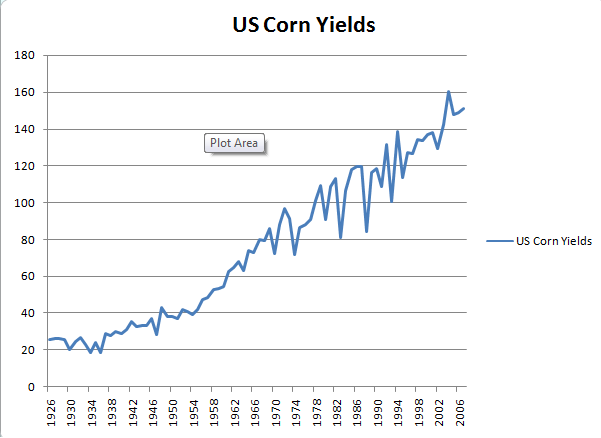
re corn ethanol here is graph of US corn yields for last 80 years (source USDA):
To measure risk vs oil production one has to compare apples and apples based on 'trend'. Oil production is highly correlated with the prior year, or regression of last several years EXCEPT at peak - we are using Monte Carlo simulations on historical volatility to get around this.
Without getting into too many details on this thread, the bottom line is that risk needs to be assessed in addition to mean.
We also have to measure systemic risk. Just like having Dell and Microsoft in your portfolio doesn't give you twice as much diversification, there are different energy inputs embedded in different energy technology processes. For example liquid fuels and electricity are very intertwined (witness todays refineries unable to start up due to power grid problems in La/Tx, not due to lack of crude oil or natural gas...)
The presentation below only shows a significant year to year (more than a couple percent) decline in Brazilian sugar cane production was in the single year 2000-2001 when there was a 20% decline, and by the next year production was only about 5% less than the previous high.
http://www.wilsoncenter.org/topics/docs/STRINI.pdf
The liquid fuel demand is very predictable. The 'dummy' stock safety factor is proportional to the amount of demand that may be backordered; for example, if 4% of demand may be backordered, that corresponds to an 8% probability event and would require a safety factor of 1.4, which would be multiplied by the standard deviation of forecast error per unit year to get the total size of the safety stock.
Since E85 vehicles can run on anything between 15% and 100% gasoline the amount of ethanol which can be practically backordered is very large, so the safety stock of ethanol can be reduced almost to zero, if in emergency conditions like a drought the EPA ethanol mandate can be suspended.
And if oil supplies are disrupted a large number of E85 vehicles would switch to E85, increasing the amount of demand for oil that could be backordered, reducing the size of the SPR, which of course needs to be filled.
I lost track of the other thread in which we were discussing the French breeder reactor program.
It is never my intention to evade genuine criticism, so I would take the opportunity here to acknowledge that you were correct on the scale of the Super Phoenix plant, and that it had substantial production difficulties.
Political considerations and attacks, including rocket attacks, by fascist members of the 'green' movement did not help, but in my view the chief consideration leading to it's closure was the low price of uranium.
However, there is substance in your critique and it would be less than candid of me not to acknowledge that.
Thanks for easing up on me!
I'm certainly very anti-nuclear but OTOH I don't favor closing existing plants right now.
I just don't see a vast expansion as suggested by McCain and even worried GW experts like James Hansen to be prudent. I am somewhat more sympathetic to nukes in Europe or Japan which lack fossil fuels but for the whole world to 'go nuclear' is insane IMO.
Energy intensive reprocessing/recycling alone will not extend uranium supplies due to the regeneration(breeder) ratio.
For example,
if you have a regeneration ratio of .65, the best you can get out of repeated recycling is 1+.65+.65^2+.65^3...=2.86, so the best you can increase your useful fuel by 286%. With breeder reactors, you actually increase the amount of fuel but practically speaking there are physical limits for doing so and even the theoretical limit is 1.66 based on the products of plutonium fission.
(A lot of lies are told about successful breed ratios over 1).
People talk about nuclear fusion but don't understand that nuclear fusion(deterium/lithium) would be a neutron source, to transform uranium into plutonium(or U233) for fissile fuel for regular nuke plants as Hans Bethe proposed.
IOW, we would still be limited to the supplies of uranium and thorium on this planet.
What's even more galling is that we're burning limited uranium up at just 30% thermal efficiency(higher efficiency experimental gas nuclear reactors were found to be too dangerous).
By the 1990s reality had set in. Nuclear energy is not an infinite power source. Chernobyl and other sites had shown that
nuclear power had more minuses than pluses. The move then was to power down the nukes.
Now we have an energy and GW crisis and nukes are back in fashion
yet the technology is the same.
Insanity: doing the same thing over and over again and expecting different results.--Einstein
Hi Majorian,
I have enjoyed the debate, which has been an honest exchange of opinion on both sides.
I'd agree that nuclear technology has not been progressed as fast as we hoped.
I am a pretty practical guy though, and can't really get excited about whether we have millions or billions of years of fuel left.
What we certainly have in my view is a way to generate very large amounts of power without too much CO2 emissions, for at least enough time to enable us to develop renewables far more, and maybe for much longer than that.
There are lots of arcane calculations about safety, but in reality France has been generating most of it's electricity by these means for years, and no-one builds reactors to Chernobyl-type designs anymore.
Any risk in my view is negligible compared to the billions likely to die from climate change or lack or access to energy.
Particularly in the northern, crowded countries there is no way that I can see a realistic way of providing the energy we need by renewables at any cost that could be done:
http://www.withouthotair.com/
Sustainable Energy - Without the Hot Air (withouthotair.com)
Maybe in a hundred years time if populations have dropped something of the sort could be managed, but there is simply no way at the moment.
Personally I am a fan of high altitude wind power, which should be do-able, but it simply has not been developed, so at the moment I would rather build more nuclear power stations than coal or do nothing.
All the wind power so far built in the UK only provides around the equivalent of a 600MW plant if you take the average hourly output, so even if cost is ignored there is simply no way of scaling up enough right now.
I'd just build whatever we can right now - wind resources are far better in the States.
I get a bit miffed as it looks as though we will shortly be freezing here in the UK because some have got unrealistic expectations either of importing LNG or putting bloody stupid little wind turbines on urban rooftops and so on - I know that you will be aware of how wind power varies by height and according to absence of ground effects.
Nuclear might be a stopgap, although I don't think it is, but given the alternatives stopgaps can be most useful if they keep you alive.
Reprocessing nuclear fuel would also require a police state to keep track of the ingredients. Reprocessing allows reactor operators to build bombs.
The 1975 “Barton Report” from the Nuclear Regulatory Commission admitted that a police state would be needed to safeguard the nuclear materials if “reprocessing” was used to “recycle” nuclear fuels for a complete “plutonium economy.” Any state or corporation with a nuclear reactor can make a nuclear bomb. India started its weapons program with allegedly peaceful reactors from Canada. The Bush regime made a nuclear technology trade with India despite that country's refusal to sign the Non Proliferation Treaty. But the NPT is not sufficient to prevent the spread of nuclear weapons, since the inspections are weak and any signatory country can withdraw from the treaty with a few months notice.
Nuclear reactors are the most stupid means to boil water that anyone has ever invented.
Nuclear waste created in reactors is fundamentally incompatible with creatures using DNA. We are no closer to being able to detoxify this waste than we were during the Manhattan Project.
The French state which reprocesses is not noticeably more of a police state than the US or Britain where they currently don't.
The high level waste is actually moved in huge stainless steel containers, which are some of the strongest ever built.
They deliberately crashed a train into an empty one, and barely dented it.
There are lots of dangerous things around, LNG tankers for instance, and life is a case of risk management.
Any risks from nuclear power are entirely trivial compared to the billions who would die either from climate change or the conflict ensuing on serious lack of power, and therefore the criticisms are not proportional to any who are eithe5r peak oil aware or GW aware.
In the real world we simply do not have the technology currently developed to run a country solely on renewables, and it is precisely the use of nuclear power which can give us the breathing space to develop them.
The actual hard choice is between a system which is proven to provide most of the electricity for a whole country safely and economically for many years in France, and resources which currently provide a tiny amount of power, which are extremely expensive and by their nature vary greatly in how effective they are from area to area.
Wishing will not make the winter in Germany or the UK more sunny so that solar PV is a practical means of providing power to the grid.
Unfortunately economies do not run on pure thoughts and pixie dust! :-)
Dave, I was curious about your reference to a rocket attack on the Superphénix site in France as I did not remember reading about it. Indeed, such an attack did take place, apparently by a leftist (not Fascist) anti-Nuclear group with roots in Luzzane Switzerland.
The first article is summarized below: http://fr.wikipedia.org/wiki/Superphenix
Le 18 janvier 1982, une attaque au lance-roquettes visa le chantier de la centrale nucléaire de Superphénix, sans faire de victimes [1]. Les auteurs de l'attentat ne furent pas identifiés, mais, en 2003, Chaïm Nissim, ancien député écologiste de Genève, affirma en être l'auteur et s'être procuré l'arme auprès du groupe du terroriste Carlos[2].
The second article does not quite give the same picture as the first: http://en.wikipedia.org/wiki/Anti-nuclear_movement
On 18 January 1982, five rockets were fired at the Superphénix reactor under construction: two reached the building. Magdalena Kopp, the wife of international terrorist Carlos, claimed to provide support. The objective of the terrorists was to halt construction of the facility.
Sorry for the confusion.
I tend to identify people according to their actions, not their words, and an attempt in a democracy to gain one's ends by violence is fascist as far as I am concerned, regardless of the overt political affiliations of the people concerned, but I appreciate that in the common reckoning only the right wing is fascist, so my terminology was confusing!
Nate,
Have you compared the same rish-adjusted energy return for biodiesel? We (group of citizens and University folk) are working on farm-scale seed oil and biodiesel processing. It looks like a reasonably price and output level for 4 mid-sized farms to jointly own.
As a result of reading oil drum, I've suggested we do an EROI analysis of this effort. Next week when I'm back at work, I'll send you an e-mail directly. In the meantime you could google our statewide efforts at Clean Energy Resource Teams.
we did it on corn ethanol and on rape/biodiesel and risk adjusted returns were higher on biodiesel. it also depends on whether the land is irrigated (using energy) or not. Irrigated land has much lower standard deviation.
But the whole flavor of the analysis changes if it is only for local consumption. Then it would provide a BIG baseline of energy (of course paying money for outside resources at cost to global commons but improving your own area). Corn ethanol might be a very valid energy source at small scales to supplement farms and communities, though I expect there will be other crops with much better energy return/negative externality ratio...
Thanks Nate. It is rainfed production and we producing the biodiesel for on farm consumption-- so it is as local as it gets.
Not only that but don't forget all that low EROEI Alberta tar sands syncrude being piped to US Midwest refineries at the rate of a bit less than 1 mbpd. Well, at least we don't have to drill, drill, drill in GOM for it.
There is may be more than a decade of outer continental shelf leases available for drilling due to a shortages of deep water drilling rigs. The Republicans who claimed there are not enough outer continental shelf leases available may have blundered in their calculations just as they did in calculating the costs of the Iraq war, in the cellulosic ethanol energy policy, and in a McCain plan to try to reduce social security payments in order to finance more tax cuts for the very wealthy as reported by Alan Greenspan recently.
Mining tar sands has a much higher EROEI than ethanol. The SAGD production of bitumen has a high enough EROEI to make it profitable at significantly lower oil prices than we are now seeing. Imperial Oil (IMO) has been using steam recovery methods for decades. They have made consistent improvements of their technology in order to increase amounts of bitumen recovered from their existing leases.
Is 3 'much higher' than 1.77 ??
I've heard all kinds of EROEI on tar sands from 2 to 4, which is no better than dry milled corn ethanol with coproducts which is 1.77(USDA-Shapouri 2004).
http://www.theoildrum.com/node/3810
http://www.ncga.com/ethanol/pdfs/netEnergyBalanceUpdate2004.pdf
Going into the event US demand is off over 1 million bbls per day vs last year. Refineries into Gustav were running at 87% capacity, Inventories are low because demand is poor. Plenty of slack to increase runs as most refiners were throttled back due to horrid demand. Short term spike , yeah, but the true picture is anything but bullish. Good luck to the fear mongers, they'll have their way for a few days.
Gasoline demand is only down by 150k bbl/day. Yes, runs can be increased when the refineries are operational again, but that may take a few weeks.
The oil industry has been very irresponsible to let inventories get this low during hurricane season.
Inventories are down because of the "hands off" approach of the current administration, the same hands off approach that has the financial sector in such great shape. Trust the market to do what's right... We are at war, in hurricane season etc etc and we act surprised when an interruption occurs. The answer is simple: make a portion of the SPR a refined products SPR, but doing so will reduce the spike profits of big oil and nothing I mean NOTHING will get in the way of that. Waiting for multis to "ask" for SPR oil when their global portfolio makes even more money off of local scarcity is comical, There should be no waiting, oil should be released to surge runs and restore product stocks, again a pipedream. Meanwhile, Joe 6 pack is more concerned about lipstick comments...We deserve what we are getting.
Nice job Gail.
I have been working on a report on Contingency Plans. A web site is structured for part of this at Economic Lifeboat. There is a wiki at this site if anyone wants to participate in this effort.
I will post when we have a draft of that report. There are few contingencies in place that have been practiced. The net is that implementing any non-price rationing will be very messy.
It looks like the article on Gas Lines this Fall is going hit harder than I originally expected.
All of this is contingent on getting the electrical infrastructure back operational quickly, which could be a problem. Estimates are that it could be a week or two before power is restored to the refineries. Their power requirements are far greater than emergency generators could supply. This would delay their startups even further. If you look closely at the Ike pictures on MSN especially of Seabrook, you will see these transmission lines running down highway 146. They feed all the chemical plants and refineries from Texas City to Baytown as well as south Houston. Those transmission lines are right on Galveston Bay. The out of gas signs may frustrate the public, but what will really set them off will be the out of food signs at the grocery/big box stores when the trucks stop rolling. Going to be a rough fall season.
When Chertoff referred to powering up the refineries as "challenging" that is what the subtext was - teh electric utility lost some inter-tie and backbone lines, not just the local power distribution lines to houses.
That is NOT a couple of linemen in a cherry picker service call - ERCOT reported 95 transmission lines down due to Ike - don't know what that means in terms of time but it can't be good.
ERCOT #s understate the problem, since ERCOTs border is between Houston and Beaumont.
http://www.ercot.com/content/news/mediakit/maps/ERCOT_Region_map_thumb.gif
Beaumont (outside ERCOT) is expecting one month before power is fully restored.
http://blogs.chron.com/hurricanes/2008/09/beaumont_region_can_expect_to....
Alan
Homes, pipelines and refineries all need power. How does the grid work? Is there triage involved when the juice is turned back on?
Who decides which comes back on line first? Leave homeonwers in the dark while we get the product flowing to the East Coast...or vice versa?
Tough call.
electric utility lost some inter-tie and backbone lines
The following Hutchinson News article managed to answer a few of the questions I was pondering:
Burying power lines an expensive idea.
Still, as the article is a bit short on detail about flooding issues, and about the only straightforward result from my search, I continue to feel bewilderment that electrical connections to refineries and other important infrastructures may not have been hardened, as reading of these comments seems to suggest.
Serge
George W. Bush, P.E.
Alan
while funny, that is a serious insult to those of us that are actually PEs. The probability of him passing the PE exam is about the same as the probability of me voting for McCain.
http://digg.com/business_finance/Live_on_the_East_Coast_Own_a_Car_Congra...
http://slashdot.org/firehose.pl?op=view&id=1167297
It would be valuable to have digg, facebook, etc links on every TOD article page. Many articles are worthy of much wider posting.
Bill, we used to do that all of the time...but it rarely led to anything, especially at digg or /.
Mostly--we get buried at those sites because of the content...at least that's the explanation that I have been given.
All we can do is keep trying.
I remember that from my lurking years. At the time many TOD users thought maybe we were wearing out our welcome on digg and /. by nearly spamming TOD's articles into the rankings.
I'm convinced that if TOD posted up-skirt photos of Brittney Spears TOD would be much more popular, the purpose of TOD be damned.
I suspect that that is indeed the problem. Submitting every article doesn't work. It just ticks them off, because we look like spammers. Especially if the people recommending our articles never recommend anyone else's.
OK. Maybe we can drive a few articles into higher awareness by collaborating. Put an 'up-tic' to rate articles or have editors recommendation saliant articles. As Prof. Goose did with this article, provide the links and ask everyone to help elevate them.
It is a noisy world out there. Getting attention is tough.
I agree with your statement re content. I have a non-petroleum background and it took me a few weeks of steady reading to become familiar enough with the content to really grasp some of the points being made. The articles themselves are usually clear and well written, but they make use of a technical writing format. This is appreciated when you want to understand a topic - but I don't think Joe Public wants anything but to be spoon fed - it may actually be better for wide distribution if articles were "dumbed down" - and the full article linked.
A balancing act may be needed - enough information presented in a serious enough manner to avoid being dismissed as a wacko doomsdayer vs not so much information that the average brain fed on CNN goes tilt and moves on to the next post.
Al
This may be correct but it forms part of the problem definition not part of the solution response.
Joe Public has got to wean him/herself off pablum. When he does so TOD is available to him. If he does not, he can rely on the MSM until such time as he realizes that his lack of appetite for understanding is a critical part of the problem. You made the jump. Congratulations. I think we can have confidence that others can do the same thing.
Destroy your schools and you destroy your society and no amount of defense spending or advertising can correct that. America is becoming the poster boy for what not to do if you have a genuine concern for your community or your nation.
And please do not underestimate yourself, or the breadth and quality of the work on TOD. I do have an oil industry background and constantly encounter articles which challenge my knowledge and understanding. The world is a very complex place; coming to grips with contemporary reality is not an easy task.
It's not part of the problem definition; it's part of the problem.
If "Joe Public" comes here and reads condescending, patronizing comments like the above, how exactly do you expect him to be receptive to whatever you're trying to tell him? You want to reach "Joe Public"? Not calling him "sheeple" is a good start. Nobody's going to listen if you're being childish and insulting.
One of the most damning indictments of the ability of people here to communicate effectively was back in the day when Slashdot linked to a TOD story...and the comments there were largely unimpressed. Instead of people here looking at the failure of their message to get across and saying "what's wrong with our delivery? How can we communicate it more effectively?", the comments here were overwhelmingly "what's wrong with them? Why don't they "get it"? I thought geeks were supposed to be smart..."
If you're convinced you know a "Suppressed Truth" and anyone who doesn't agree with you is either complicit or "sheeple", you're going to come across as a raving wingnut to just about everyone outside your own little group.
If you actually want to teach people something, assume that communication failures are always your fault. If it's your fault, that means you can fix it.
Thank you for the responses. I agree wholeheartedly that one must adjust one's communication to meet the expectations of those with whom one wishes to communicate. I guess I was being condescending with my "Joe Public" comment. Please understand that I very much consider myself to be Joe Public and have a great need to be weaned off bullet points. :-)
Having said that I would like to ammend my initial comment somewhat. I don't think that merely linking these articles to other discussion groups is an effective way to get our message across. I think that other groups have different communication norms and we would have to present the information using language and examples formatted according to those norms if we seriously wish to capture their attention.
I don't mean to insult the article - I think it is very informative - I just wanted to point out that maybe its style would not be compatible with the style of some other discussion groups.
Have I dug my hole deeper??
Al
The "Joe Public" quote comes from Alakazaam who has been a TOD member for 4 days and 9 hours.
I think it is perceptive and accurate comment. Five days ago Alakazaam was "Joe Public" and now he morphing into something else; I think that is great and tried to encourage him.
I don't understand why TOD should attempt to emulate /. If I wish to purchase the newest McGizomo I can go there and get a decent sense of the pros and cons in 30 seconds or so. But the topics addressed on TOD are much larger in scope and I honestly do not see how any one person from any singular discipline and worldview could possibly come to a full understanding of all the issues discussed. And, even if you could arrive at that point of all knowing, I do not see how you could render it in intelligible precis form. "Here there be monsters" is likely the best you could do. Or perhaps "Waiting for TODOG."
TOD is a challenge. Even if you have been here for a while it remains a challenge. My response to Alakazaam was an attempt to communicate that fact. For me, TOD's value lies in the fact that it is a process not a product. There is nothing here but debate, rebuttal, argument, insight, fact and counterfact. There are few neat packages and you are forced to draw your own conclusions and cannot simply place reliance on Leanan's talking hairdo with no legs.
"Suppressed Truths" and ad hominem attacks were not part of my comment so I fail to understand your reference.
hear hear! (except the part about leanans hairdo/legs..)
Nate:
Now I'm going to be in trouble with Leanan :-(
Upthread she had a great description of a TV host as a talking hairdo and she had doubts that another host had legs as he rarely moved from behind his desk.
Dear "Pitt the Elder" - not wishing to be offensive or personal but it is your own postings such as this one that are not contributing usefully to this site. Please just concentrate on energy-related facts and reasonings about them and you might have some chance of becoming as appreciated here as those you criticise.
I've said this before and I'll say it again. TOD can't be all things to all people. It is a unique resource for those willing to spend the time to learn the lingo and get a useful amount of expertise, to join in a quest for understanding with some real experts online here.
It can't do that and be an educational resource for people just dropping by. The popular education function might be best served by having one or more separate websites giving popularised (dumbed-down?) statements of what seems to be emerging from the discussions here. Quite who is going to do this or how, I admit I'm not sure (I myself am not in a position to contribute much here let alone there). But at the end of the day TOD cannot serve two radically different functions for two radically different audiences simultaneously. I think it should concentrate on its unique thing of being the open discussion forum for experts (with some would-be-experts such as Yours Truly hanging thereon!).
Oh exactly!!
I couldn't have said it better - in fact I didn't - :-)
Al
Great article, Gail!
The empirical evidence says that either there is almost no end-of-the-line storage, all such storage was sucked down by Hanna, or Gustav had already depleted inventory prior to Ike. Otherwise, why would a shutdown on Friday have caused shortages within just a day or so?
How much spare capacity is there at other refineries? I know here in Oklahoma we have numerous refineries, but I have no idea at what utilization level they typically run. Is there also an issue with crude distribution and/or cracking capability (say for SPR sour) that is contributing as well?
It will be interesting to see how much immediate demand destruction can be handled. It may be that a series of short, sharp, shocks like this is the best-case scenario to increase vehicle efficiency and reduce driving miles.
Suddenly a Civic CNG is looking pretty good.....
I'm glad I finished converting a bike to electric last week and built a bike trailer, it may come in handy until the first snowfall. Now if I can just lay in enough food........
From here: http://www.bloomberg.com/apps/news?pid=20601087&sid=aKvHPFyFpUNg&refer=home
The industry has clearly gone to a Just In Time inventory system for both crude and product. Actually, for crude it kind of makes sense, because of the SPR. But our only emergency product reserve is a small heating oil reserve in the Northeast, although there are some emergency product reserves in Europe.
Assuming a Minimum Operating Level (MOL) of 170 mb for gasoline, as of last week we only had about 46 hours of supply in excess of MOL. Of course, this is a nationwide number and even prior to the hurricane related shutdowns, there were shortages at the end of the supply line in areas like the Dakotas.
Since we are almost certainly below product MOL in a lot of areas, the system is basically beginning to partially shut down.
So, it's a question of how fast the refineries come back on line and how fast we can bring in product imports and how fast we can get emergency product reserves from Europe.
As I said on the other thread, I suggest that you start reducing your auto use to the bare minimum, e.g., driving to work and for food trips--car pooling might be a swell idea. If you can, you might try to take mass transit to work. The key point is to leave an emergency reserve of gasoline in your car.
this is kind of funny - like an op-ed pointing out our environmental and food crises using starving people in africa as an example and then later in the article articulating that overpopulation is one of our largest problems
You do realize that if everyone, in their individual interest, keeps emergency reserves of gasoline in their tank that this action alone will bring us well below the 170 million MOL...There are 210 million vehicles in the US (Hirsch Report pdf).
Fuel use in 1,000s of barrels 2003 -Hirsh Report
Lets assume (based on Hirschs numbers that 80% of vehicles are cars and light trucks (rest are larger trucks, buses, etc. that mostly used distillate) so roughly 200 million cars. If we further assume that people keep their tanks an average of 1/2 full (I bet its less) and use a small average for tank size of 15 gallons, that means that if everyone decided to store their share of the SPR in their own tanks, it would add up to 200 million *7.5 gallons =1.5 billion gallons, which is almost 10 times the MOL - if this happened over 6 months it might be manageable, but over a few weeks? Granted not everyone is going to do this, but it won't take but 10% of people to do it and government will have to restrict access/ration so as not to drop below MOL.
I have fully expected this to happen in next 5-6 years, but have had a probabilistic viewpoint- unlikely to happen this year or next due to megaprojects, slowing economy etc. However, I think the odds have increased...
The ocillations we talked about before will start growing.
I think you have a gallons versus barrels conversion factor error. However, MOL is really MOL, so the total may still exceed the spare inventory (or at least greatly hasten the shortage date).
Once shortages start in earnest, though, hoarding will increase and the numbers will greatly increase. I could store another 20 gal in mowers, gas cans for the generator, etc. without really buying more, and I easily could make that 100gal without greatly inconveniencing myself. I bet many others could as well.
A run on the bank cannot be stopped....prices will have to spike to extremes to counter the rush once it starts. Appealing to people to not hoard will only make it worse, given that Congress, the Administration, and Big Oil all have pretty negative reputations and zero trust.
JMHO.
Yup. So the situation is an order of magnitude better than I had thought!!
So, just to clarify, do you still have a problem with my recommendations? As I noted down the thread, my primary recommendation is to reduce your gasoline consumption as much as possible, while keeping some gas in the tank for emergencies.
I support your recommendations. In 2005 I replaced my 6-banger Toyota pickup with a 3 cylinder 1990 Geo Metro:

Gets 54 mpg on highway, about 46 in city. I don't let my fuel tank (8 gallon capacity) get below 1/2.
Nate,
If 10% of people topped off their gas tanks, it would have a 2% impact on total supplies.
1,500,000,000 gallons gas / 42 gallons per barrel = 3.6 million barrels
3.6 million barrels / 187 million barrels total stock = circa 2% of supply impact on supplies.
The impact of a run on gas stations is important. Based on 10% of people topping-off, the impact on total reserves may not be substantial. It could cause shortages at filling stations. Those persons, who topped off, if they perceive that the threat of a shortage has diminished, would allow their tank to lower to "half-full". Gas stations would quickly fill again.
If the run increases due to panic, it would collapse gas stations. In my view, this would bring the government to implement a gas rationing system.
My thoughts are, since supplies are already low and getting additional distillate from abroad would take time, the back-to-back hurricanes may exacerbate an already difficult fuel supply situation and provide a plausible public explanation for a “strain” at the pumps. I believe it is perceived that it is vital to society that peak-oil never be “sold” to the public, that it be debunked. The hurricanes may provide an important back-drop to explain reduced supplies at the pump and be used to once again underline our need for national energy security.
Time will tell how far this event pushes us closer to another cliff.
Storing gasoline for more than a month is not recommended, and can be extremely hazardous.
In 1998 I bought a 10kw gasoline powered generator as a backup for an all-electric home in North Carolina. It worked fine for about 10 hours on a single tank. Now I'm thinking of replacing it with a downsized (3 kw) propane powered generator. I feel a bit safer storing propane tanks. Any recommendations?
I would take a look at diesel gensets, especially long run models.
Check out the Kuboda GL series, GL7000 and GL11000. Diesel stores well and diesel engines can be adjusted to operate on a variety of fuels. I am saving my pennies for the GL7000 modified to run from a 50 gallon drum. $3500 may be more than you want to spend, but the hi-rev cheap gensets do not have very good fuel efficiency and their MTBF is short.
Thanks for the recommendation, I'll certainly check Kuboda out.
Hi Nate
Here is the EIA historical chart of gasoline inventories:

The historical comfort inventory (blue band) has prevented us from most outages. We are below that already yet above the 170. Since few businesses are carrying excess costs (inventory), my guess is the MOL is closer to 185 than 170.
What is the basis of the 170?
I'm going to go out on a limb here. Suppose at the time of construction, the pipeline companies' managements were not peak oil aware. There are a variety of ways that this could affect engineering decisions in regards to MOLs.
1. Larger than necessary down-pipe MOLs to allow for future expansion. (You've already got the ground bought and opened up, so why not increase possible down-pipe capacity and therefore future market responsivity for pennies on the dollar?)
2. Little incentive for redundant, smaller pipes when 2 pipes might use about 40% more materials to carry the same volume of oil (plus a redundancy in valves, pressure readers, safety hardware..).
Using Gail's 18.5 day estimate for the Colonial pipeline (seems reasonable), and 2.4 million barrels a day of capacity, one gets 44.4 million barrels in there. If you scale it back to where the carrying capacity decreases linearly along the way, there would be 22.2 million barrels.
However, New England is at the end of the line. It's likely that a significant percentage of that oil goes the distance (or close to it).
My best guess is around a 32-34 mbbl MOL. I'm guessing it's a lot of math like this that would bring one to 170 mbbl.
My guess is you are right in how MOL was estimated. That gives me considerable concern. The 170 MOL looks like what it claims to be, Minimum Operating Level, below which the wheels fall off the cart overall petroleum delivery system.
In other logistical systems, like our food distribution network, the wheels fall off its cart at some much higher Reliable Operating Level (to coin a term ROL). We cannot ship parishables unless fuel is reliably available for the entire trip. We have to ship perishables when they are ready. My guess is the ROL for gasoline is closer to 185 mbbls than 170. It could be as high as 190.
We have already dipped below 190. Small or temporary dips can be juggled temporarily. Food prices are likely to become unstable. We are also more able to hoard food than gasoline.
Of course, I think that the long term, and accelerating, problem is declining net oil exports. Here is a year over year snapshot of some key metrics from yesterday's post, comparing end of August, 2008 to end of August, 2007 (except for annual net oil exports). As I noted in the post, the trends are consistent with what one would expect to see assuming an accelerating decline in net oil exports. I expect to see smaller, less efficient refineries in importing countries--especially light, sweet refineries--beginning to shut down.
http://www.theoildrum.com/node/4525#comment-407224
I wish that EIA and IEA would report ELM. Next to disposable income versus ELM, ELM is the most single important metric for economic survivability.
As Paleocon noted, the correct number for gasoline tank inventory would be 36 mb, based on your assumptions, versus the MOL of 170 mb.
BTW, the 170 mb number comes from a prior estimate by the EIA, although they are not really sure what the exact number is.
In some respects, this does remind me of my long time advice for people to get the hell out of suburban Dodge, via my ELP advice. The problem is that if you sell your suburban McMansion and move to small, energy efficient housing along a mass transit line, your McMansion didn't go away. Some poor sucker, presumably a true believer in the Yerginite community, bought it.
In any case, my point about keeping an emergency reserve in the car is for unexpected events, e.g., a need to get prescription drugs for a sick child. If large numbers of people followed my primary advice, which you did not reference--cut car trips to the bare minimum, carpool, take mass transit, etc.--we could get through the short term crisis with no serious problems, freeing up more fuel for critical things like food delivery.
I've been keeping my car filled for a while now - I think it was Leanan pointed out she does that. This article convinces me to go fill up all my jerry jugs.
I don't use too much gas now, but maybe I can sell the cans at roadside.
cfm in Gray, ME
Minimizing car usage certainly is important, but it's just one part of the equation.
Here is what I would propose (with communal interests taking precedence over personal interests when they intersect):
- Minimize car usage.
- Minimize purchases of consumables. Everything purchased has to be trucked or flown in, which uses diesel and kerosene. It also takes diesel to collect and dispose of the rubbish which is produced by the purchases.
- Defer major purchases or capital improvements.
- Don't hoard gasoline. Besides reducing supplies for others, it is a fire risk (if stored in cans) or it reduces your fuel efficiency (if stored in your car). Either way, the extra trips to the pump and any longer lines to get to the pump will waste precious fuel.
Electricity is fine to use, as only about 1% of electricity in the US is oil fired and there are no imminent shortages of the main ingredients in electricity (uranium, coal, and natural gas).
PS: It seems that many of these measures are being put into place, albeit involuntarily, as we enter into a depression (or maybe just a steep recession) and as gasoline prices have soared in reaction to Ike.
The cell phone, laptop computer, home Internet, lasers in personal use (harddrives), and most of the stunning innovations of the last 50 years were unplanned. In 1984 America changed from a planned communication infrastructure reguluted by government and managed by AT&T to a Performance Standard based free market.
The rotary phone, analog networks of 1984 have been re-tooled twice, analog to digital to wireless. Waste/limitations of analog networks was preempted creating vast numbers of jobs and amounts of wealth.
To solve our oil problem, stop planning and start setting performance standards. Allow rights of way access to anyone exceeding those standards. For instance, set a standard of 100 miles per gallon and 10 times safer than cars. That is a trivally easy standard to achieve but 5 times the current CAFE plan.
The same approach can be applied to power generation.
Plans focus on getting better at HOW to do the known.
Standards focus on WHAT might be done.
If we want unplanned innovations such as Einstein's 1905 papers, vulcanized rubber, Google, etc..., we need to unleash the innovators.
If we had the answer, we would have solved the problem. We need, but cannot survive with better know-HOW; we need better know-WHAT. We should have learned from the Soviets that a planned economy is not nibble.
I'm talking about what can be done on an individual level in the case of an acute shortage.
I wasn't talking about economics or long term planning.
PS: Those graphics look awfully like wishful thinking, and the site they're linked from doesn't put forward very realistic ideas either. They certainly smell a lot like an investment scam to me.
Not thinking about long-term is what allows geologically slow events like Peak Oil to sneak up on us.
On an individual basis, planting a garden might also help.
P.S. A characteristic of speculative efforts is to look speculative.
Me, too.
To be a scam requires deceit. We fully disclose the grave risks in getting JPods built and making money. Besides, only me and a few others who work on the effort have put money into JPods.
POSCO has put an estimated $25-50 million into Vectus and seems very pleased with the results. British Airport Authority put about $15 million into ULTra. They are pleased.
If you do not want to invest, don't. It is very high risk.
The deceit is in claiming that somehow jPods/PRT, an unproven technology, will have a measurable positive impact on oil consumption in any reasonable time frame.
Your booth at ASPO-Sacramento is a scam.
Alan
I did not say I had a booth. I said that I will have the JPod in Sacramento.
By definition, innovation is unproven. Our current infrastructure is the cause of Peak Oil. I would rather tinker with to create a sustainable future than die, rigidly clinging to what is failing. You may do as you wish.
In extremis, the Swiss less oil in a year than the average American uses in a day. After three years of peace and normality the average Swiss used as much oil in a month as the average American uses in a day.
The Swiss managed to do this without jPods.
I want to build the systems that worked for the Swiss (and many, many others around the world). The USA/English speaking OECD nations are the exception to the rule among developed nations.
For Urban Rail:
http://www.lightrailnow.org/features/f_lrt_2007-04a.htm
Barcelona built a magnificent Metro system, the bulk in a dozen years, the French are building 1,500 km of trams on towns of 100,000+ in a decade, the Kazakhs are awarding contracts to electrify 2,700 km of railroads in 2009, etc.
The Swedes have already built a great Urban and electrified inter-city rail system. NOW they can afford to play around with gadgetbahn for some small, unfilled niches. The USA needs to just build the basics !
Alan
Build anything you want. I will cheer you on.
My career was in the telecom industry. While market deregulation in the 1990s created vast wealth and a boom in employment, it also resulted in a bust which shed nearly every job created, with primarily lower-paid non-union employees remaining. I also have a vague memory of a related event called the dot com bust.
The boom/bust nature of technology driven "innovation" cycles (starting with coal/steam engines) has proven disruptive to working people, with average income levels since the 1960s dropping as 'vast wealth' accumulates in the hands of the few.
I'm quite familiar with performance standard ideology, having worked in a six sigma company. Since leaving the industry, I've retooled and acquired permaculture certification. I am convinced that focusing entirely on the "what" has led to destructive practices such as mono-culture. In the more balanced permaculture approach, the "how is EQUALLY important to the "what", resulting in a diverse (and resilient) sustainable ecosystem from which a SMALL profit is extracted.
I do agree that it is important to measure performance - it's hard to improve something you don't measure - but there is much more to creating a sustainable environment than focusing sole on performance standards.
In all most everything I write about dealing with Peak Oil is the recommendation to plant a garden. But gardening is also inhibited by current Urban Plans.
Our planned infrastructure is the cause of Peak Oil. Last week I met with Albuquerque about their 2020 and 2030 Plans. They are very proud of them. When asked they admitted the plans were based on the assumption that gasoline would be $2.30 a gallon.
If you have confidence in your city's ability to plan, ask them their assumptions.
Venture capitalists also require plans but there is not reverence for those plans. They get many excellent plans, discarding most. Your city has one plan that is viewed with unchanging reverence.
I would rather have the boom-bust of an Performance Standards economy than Peak Oil's catostrophic failure of the planned economy.
I didn't get it about Robert Prechter's deflationary depression. Now I get it thanks to Gail the Acutary. I have a feeling the predicted wave 4 retracement in gold and the euro will be at least 62% and we have a full moon on Monday! Look out for the Lunatics this week!!
something that popped into my head while skimming this post
If I'm not mistaken Mexico is reliant on GOM refining capacity also, how will this effect Mexico and there subsidized transport liquids?
Also,
Nate would you please email me, it's about 30 days days till garlic/shallot planting here in god's country and I wanted to talk turkey
day john at digital path dot net
10 days? Pffft, that's nothing, you'll survive. Any business knocked over by that was going to go under in the next year or so anyway. I speak from sad experience!
You need some more resilience in your systems and yourselves if a 10 day shortage is going to knock you on your bum.
Gail, this was a good description of what might happen, also as a foretaste of what is to come after peak oil. It would be interesting to know how this rationing of e.g. 10 gallons per customer works. Is it decided by the owner of the filling station? Is it enforced by local authorities? Do motorists accept it?
I have no doubt that when shortages become wide-spread, rationing has to be introduced universally, for equity reasons.
"It would be interesting to know how this rationing of e.g. 10 gallons per customer works. Is it decided by the owner of the filling station? Is it enforced by local authorities? Do motorists accept it?"
I operated a Gulf gas station in the 1978-1979 oil crisis (fall of the Shah of Iran, Iran hostage crisis and Iran-Iraq war period)
In those days, the "10 gallon" limit was set by the station owner/operator, mainly to protect his own loyal customers. If your station has fuel, and others run out, your station will begin getting customers that you have never seen before and will never see again after the crisis. Thus it is only right that your loyal long term customers be protected so that they can get at least a minimal emergency amount of fuel.
"Do motorists accept it?" Not always. In those days I was screamed at, called names and even threatened. Oil shortages are not pretty.
We kept a pistol on premise near the cash register. Very sad was the plight of people at the lower end of the income scale who had to commute long distances (50 miles one way to Louisville KY) and were terrified of losing their jobs.
First lesson I learned: Corporate America does not give a DAMN about your transportation problems or your energy situation. If you can't get to work, fuel crisis or not, you can look for another job. That's still true by the way: Where I work, employees were recently warned against carpooling and ride sharing due to possible Human Resource/sexual harassment issues and false charges while ride sharing. We can't stop it, the management said, but it is "very frowned upon, I wouldn't do it."
RC
At least right now, the rationing is the choice of the station manager, and is pretty much voluntary. They ask people to limit themselves to 10 gallons, but it's kinda like the "10 items only" express lane at the supermarket. Most people honor the request, but if someone doesn't, they don't do anything about it.
OPIS has indicated that Valero has walked through thier units in Houston, Port Arthur and Texas City. It appears that power and personnel are going to be the limiting factors to restarts. The power thing begs a question, I grew up in the Woodriver IL area, home to several large refineries (COP is the only one left) in the old days, each refinery had its own power plant, heated by its burn off to run its operation. When did they all just get on the grid and become reliant on the local power and light company to give them juce.
Also, while I agree with the articles times estimates I do have to ask the question as to what has happened to the restart of the refineries in the New Orleans area? Theere wasn't any real reason for them to curtail ops in this instance and the LOOP should have been unaffected...
BTW current rack prices in Knoxville are approx $5.27 for 87UNL add local tax and freight you're in the ground at approx 5.69-5.75 which means to cover costs (a typical 10 fill up on a credit card costs the retailer $1.85 ur 18.5 cents/ gallon)one has to go to the strett at close to $6/gal to breakeven...consumers scream price gouging even when you post invoices at the pump to ptove you are not....easier to just bag em.
There wasn't any real reason for them to curtail ops in this instance and the LOOP should have been unaffected...
Just before Ike, LOOP was operating at one third capacity off generators (after repairs post-Gustav). Per Mayor of Grand Isle, Ike put 6' of salt water over Port Fourchon. So I assume most Gustav repairs have been undone.
LOOP is back up as is Colonial at reduced rates guess basically recovery is a function of people and power now
This is a link to today's DOE report. Tomorrow's can be found at this website.
It shows precisely which refineries are operating and which are not, by area. Most of the refineries near New Orleans seem to be shown as having reduced runs--presumably open, but not enough crude oil.
Refineries starting up often have "unbalanced" flows and what we may be seeing is just normal chemical engineering at work. RR could certainly expound better on this subject.
Alan
The PAD gasoline inventories were published by the EIA showing low to very low levels in most PAD districts:
Stocks of Motor Gasoline by PAD District (PDF)
Gustav caused a dive in total crude + products inventories, but the inventory levels were yet within the five year average range. Before Gustav total crude + products levels were rising faster than normal as the United States economy slows and prices were well above prices seen a year earlier.
What's the utilization of refineries in the EU?
In case it is not close to 100%, EU refineries can refine an 'extra amount' of distillates, resulting in increased demand for crude. If this is to happen, the price of oil should also go up. If not, oil prices should go down, based on decreased demand (refinery outages in the US).
Does anyone know the numbers as far as EU refineries are concerned?
What's the utilization of refineries in the EU
BP Statistical Review of World Energy June 2008
Page 19.
Serge
Thanks a lot.
I'm wondering what the impact will be in terms of additional gas consumption in the following situations:
1) Motorists will be driving extra miles looking for stations with gas to sell when many of them have run out.
2) There will be a 10 gallon limit, causing additional trips to the gas station.
Is anyone reporting on the setup for this exact situation? The oil companies seemed to have reduced refining utilization in the past 2 months on the premise of reduced demand. Now heading into the peak of hurricane season, before Gustav, Gasoline inventories were allowed to drop to the low end of the range. The government seems to preach preparedness for disasters, but this seems to only apply to individuals. A small handful of gigantic corporations can mismanage our fuel supply heading into the worst time of year to do so, and then give themselves the perfect excuse to gouge the country, and endanger livelihoods of the nation.
Granted, this exact mismanagement or greed, is what has this nation/world staring at peak oil, but to amplify the situation by blatant mismanagement is grotesquely irresponsible, and they should be held accountable. Prices should be frozen at yesterdays price, and rationing put in place. This way, they will sell less, and make less.
The following site (thanks to another TOD member for this) shows gas prices around the U.S.:
http://www.gasbuddy.com/gb_gastemperaturemap.aspx
I understand that many of the gasoline pipelines have been shut down from hurricane Ike, which can affect gas prices, but why are some states that are on the same pipeline in dark red, while others are in green?
For example, the Colonial Pipeline services much of the East coast:
But Georgia, which is near the start of the pipeline, is dark red, while at the end of the pipeline, New Jersey, Maryland, and Delaware are green.
Also, Illinois, Indiana, and Michigan are dark red, while North & South Dakota are green?
Does anyone know enough to explain why prices are so different?
The primary factor would appear to be the "End of the supply line blues," i.e., it's a primarily a question of one's proximity to refineries:
http://www.energysupplylogistics.com/refineries/
The strange thing is that Georgia is at the beginning of the pipeline...
If anything the converse seems to be playing out.
The official explanation was that stockpiles were already low in the southeast and Gulf Coast areas. Not sure why that was. Because of increased demand from hurricane refugees? Or does the southeast just routinely stockpile less gasoline than the rest of the country?
Makes sense.
Since the product is already in the pipeline shortages won't show up in the N.E. for the 18 days Gail mentions, however you're seeing the shortages happen in Georgia first because that's where they're starting.
It's kinda like the difference between having a full tank and running on empty, the full tank in this case being the pipeline headed North.
Don't see where you get this 18 days to shortage. When it stops going in, it stops coming out.
Cid
I'm with you on this, I thinks Gails reference to the 18 day transit time was totally erroneous, In fact any delay as a consequence of Gustav was probably due to the capacity of the receiving tanks at the end of the pipelines.
As Stravinsky7 posted this is where a significant amount of the MOL comes from. You actually start to appreciate how fragile the system is, ie if the refinery's (or finished product imports) stop (or even slow) you end up with a large amount of finished product sitting in pipelines.
I wonder if there is a strategic plan to flush them with water?
Neven
Hi Cid,
From http://www.pipeline101.com
"The principles of hydraulics" was the only reference to pipeline operating volume I could find so it looks like you are right about disruptions which will cause the flow to stop.
http://www.pipeline101.com/Operating/batching_model.html
I'm not sure what pipeline are you talking about. The Colonial pipeline (which flows from SW to NE) is reportedly shut down, and Georgia is at about the midpoint.
In any case, product is distributed by both pipeline and tanker truck. Zoom in on the map link above and note the lack of refineries in the vicinity of Atlanta.
That map just reflects the cost of gasoline. More than supply and demand affect cost. Taxes probably explain a lot of the difference you are seeing.
During Katrina, the northeast did not suffer much from the gas shortages. I think it was partly because they're at the end of the pipeline. That is, it took longer for the shortages to reach them. If the disruption went on longer, they'd have felt it more.
The northeast is not wholly dependent on the pipeline, either. They get gasoline via a port in NY, so they have that protection. During Katrina, a bunch of gasoline from Europe arrived via NY Harbor.
Looks like that is happening again.
Yeah. What she said. :)
From the article -
'Shipping sources say at least five cargoes of both Eurograde and RBOB are fixed to arrive in the Gulf in September, continuing a trend which began in mid-August.
But port closures and shipping disruptions could cause delays in some deliveries, shippers said.
According to government figures, total gasoline imports into the United States were 1.1 million barrels per day for the week ended Sept. 5. Of that, 14 percent, or 160,000 bpd went, to the Gulf Coast, some of which were diverted from the New York Harbor.'
I think there are two some parallel points here -
1. Closures and disruptions - I'm not sure that various Gulf ports are going to be able to maintain current operations in the next week or two, much less increase them. (After all, we are talking gasoline here, not crude - you don't cut any corners with gasoline.)
2. From an unquoted part of the article - Europe is already shipping what it can, in the pursuit of profit.
Point 2 should not be ignored, since profit is not everything. Germany's Bild newspaper (which has no direct equivalent in the U.S., but which plays a very major role in public opinion) has had a recent screaming headline (and for the Bild, that means something) about how gas prices were high while crude prices dropped - and how this was based on shameless oil companies exploiting the common people.
Now imagine the socio-political context when Germans are asked to accept a higher price at the pump so that Bush's America suffers less pain before electing McCain/Palin.
Right.
The world might be willing to lend Obama's America a hand, but Bush's/McCain's? No way.
Also the North East is receiving refined products from Canada There are refineries in Newfoundland, New-Brunswick And Quebec which supply the New England states and Upper New York.
David
Georgia experienced disruptions after Katrina which caused them to close their schools for 2 days, with very little notice. People were angry and upset. I'm guessing they reacted more to the possibility of shortages from Ike than in other states.
I assume the gasbuddy map reflects state-by-state tax differences? It would be useful if there was a similar map where state taxes or fees were subtracted out.
<< I assume the gasbuddy map reflects state-by-state tax differences? It would be useful if there was a similar map where state taxes or fees were subtracted out. >>
I thought that at first also, but it seems that the states with the highest taxes are actually the ones that have the lowest prices.
Here is a chart that shows the gas tax by state:
http://www.gaspricewatch.com/usgastaxes.asp
I believe that the Northeast gets the imported gasoline from Europe. They also have some refineries, and refine their own crude oil, so are not so dependent on the pipeline.
I mentioned a couple of other pipelines being shut down/operating at reduced capacity. They serve the Midwest. One of the crude lines serving the Midwest has also been shut down, so refineries in the Gary Indiana area may be operating at less than full capacity.
I hope I'm not being too redundant, but I posted the following comments under the Hurricane Ike thread yesterday, before Gail's excellent post came out. I think it is more apropos here than under the Ike thread. So, here it is again.
My water company does not practice "just-in-time" water delivery. Rather, it has a large reservoir quite capable of absorbing major imbalances in supply and demand.
My electric company does not practice "just-in-time" coal. Rather, its coal-fired power plants have mountains of coal stored on site, probably at least a 60-day supply.
The last time I visited a large steel mill (are there any of those still left in the US?) they had something like a 90-day supply of iron ore, coal, and limestone.
So then, why is it that something so inherently vital to the workings of the entire US economy, i.e., the oil production, refining, and distribution system, is evidently being operated in a just-in-time mode? That is the question.
Could it be that the US oil industry couldn't give a rat's ass about the predictable major economic disruptions due to hurricane-related shortages in refined product? Could it also be that rather than being hurt by major hurricanes, the US oil industry actually benefits by the sharp spike in prices caused by the predictable shortages? Could it be that not only does the US oil industry have no incentive to provide a storage cushion for refined product, but that it also has strong incentive to 'allow' shortages to occur?
So then, where am I going with this rant? Well, I am becoming more and more of the opinion that the entire US oil production, refining, and distribution system should be treated more as a public utility rather than just another little 'ol business. After all, I don't have much choice from whom I get my drinking water from, and I certainly don't have much choice from whom I get my gasoline from (the choice between Exxon Mobil and Conoco Phillips is not what I consider a real choice).
Why is the electrical energy supply and distrubition system regulated as a public utility, whereas oil, which serves much the same function as electricitity, perhaps even more critically, is not? What is different?
I think it should be abundantly obvious that gasoline supply disruptions due to entirely predictable seasonal hurricane activity in the Gulf of Mexico could be relatively easily mitigated by having a form of a Strategic Refined Product Reserve (SRPS) consisting of about a week's worth of gasoline and diesel. Such a reserve could be either government controlled or mandated as a requirement upon the oil companies. I could picture it consisting of about 10 major strategically located storage complexes at various locations around the US. Having such would prevent the price of gasoline jumping a dollar a gallon at the first whiff of a problem in the Gulf.
Why you silly Billy.
None of it should be "regulated".
Regulation is just another name for government getting in our way instead of standing by and watching as the free markets work their magic. Anyone who understands basic economics understands that regulation is bad while de-regulation and just-in-time delivery of all essentials is good because it brings efficiencies to our systems. Remember to cast your vote for Simple Sarah this November, because as a hockey mom and a true patriot she understands that efficiencies can be found under every bureaucratic rug you pick up. She understands that regulation should be swept away to make room for a truly free market. None of it should be regulated.
The ROI from oil/gas ownership is an order of magnitude higher than ROI from utility ownership which presumably would attract more concentrated interests and less regulation. At least historically...But you raise an interesting point...
In other news, gasoline futures on NYMEX open lower down 9.5 cents to $2.68 after being up .02 on friday. Distillate down 8 cents. Crude is down 1.5$ to 99.7 (9:05 CDT). I'm guessing this is more LEH/AIG related than the storm.
Also nat gas down .15 to $7.20
What is the record gap between NYMEX gasoline and real world (black market) wholesale gasoline prices? It is starting to look like 1970s Eastern Europe in some ways.
http://www.myfoxwghp.com/
I grew up on Galveston Bay just three to five miles from these refineries. My dad still isn't being allowed back to his home in LaPorte. I could drive my motorboat up the channel to these refineries and I have to say that I think the duration of the high winds may have a bigger impact than expected. I think ten days might be highly optimistic. People who live in Houston are saying that compared to Alicia, this was much worse. I was in LaPorte the day after Alicia helping my Dad clean up. The whole area was devestated but Alicia while a Cat 3 was a much smaller, tigher storm that passed in just a few hours. This storm took almost 24 hours to clear through. The high winds lasted for 12 hours which is much more than Alicia. Downtown Houston was hit much harder than in Alicia, the damage to the high rise buildings is amazing.
From the pictures I have seen, this storm was far more devestating than Alicia on a damage scale. Refineries are a different matter. I built levees in 1974 in the summer as a laborer for Brown and Root at the Exxon Refinery in Baytown. I believe that they are more protected from flooding than the surrounding area which is very low and which flooded out an entire neighborhood in Alicia that was never rebuilt. The storm surge was 12 feet at the mouth of the ship channel and I suspect the refineries could handle that. However, there was still flooding of all the surroundings and power is likely to be a problem unless they have adequate cogeneration to self-start. I know they all cogenerate but I don't know to what degree.
Anyway, I believe 10 days is optimistic. After all we are now at 4 days and no one is getting into the refineries yet....................
If the refineries are protected by levees from flooding from hurricane surges, what happens when there's a whole bunch of rain? Wouldn't those same levees tend to hold the water within the refineries until it's pumped out? But, without electricity to pump out the water, how would the operators be able to start the cogeneration plant to produce electricity locally? Wouldn't they be a bit like NO when the pumps failed?
E. Swanson
The effects of hurricanes Gustav and Ike raises some serious questions about the plan to increase oil supplies by opening up offshore leases.
Essentially, this proposal amounts to building more oil infrastructure farther out in the Gulf of Mexico and in deeper water where it is more vulnerable to hurricane damage.
These plans will probably make the oil supply more vulnerable and less reliable and are a waste of time and resources.
I can only wonder that no one has connected the dots on this issue.
Perhaps change is hard.
Hesus Christo. All this commentary and you guys are missing one of the most important concerns.
We've got all major refineries on the Gulf Coast shut down. We've got massive fuel hoarding thats going to evoke gasoline shortages. There isnt enough product produced to push up Colonial or Plantation PLs. This tops any fuel shortage we've seen in the past. Its worse than Katrina becuase we're 3 years deeper into peak fundamentals. Nationwide gasoline stocks bounced around in the 190k barrel range back then. We're now at 188 and on a fast track into the 170s.
But here's the key point gasoline futures have sold off over 20 cents a gallon since the start of the month! That's HOGWASH There's massive market manipulation going on and the spot traders started to recognize it midweek. We now have 54 cycle Colonial batches trading $1.50 / gal over the futures. The normal diff is a few cents under (because of the approx 3 cent/gal Colonial tarrif to NY). The system is rigged! The plunge protectors (with no checks, balances or disclosures) are on steroids. You want cargoes from Europe? There's got to be a financial incentive to finance the arb. The system is broke. The gig is up. We don't have legitimate markets anymore. How can you watch oil futures get pounded lower through 2 massive hurricanes (just like they did at the start of Katrina) and not be screaming about the market manipulating BS?
More commentary on the above:
http://downstreamventures.yuku.com/topic/2193
http://downstreamventures.yuku.com/topic/2199
As they say, even paranoids sometimes have enemies (and sometimes paranoids are just better informed), but I wonder if a primary contributing factor to the price discpreancy is what amounts to a global margin call as some individual and institutional investors are forced, or elect, to sell highly liquid assets like paper energy holdings?
i agree re margin call
but 'liquid' is a bit of a misnomer. The liquidity in energy markets is in the big stocks, many of which showed strong closing buying on both Thursday and Friday (energy stocks usually turn before the commodity)
Today, RBOB is down 14 cents (11:37 CDT) on 1100 contracts, which equates to 1.1 million barrels - far fewer than has been shut in the past 2 weeks. If there is a plunge protection team suppressing RBOB prices they are not running into much of a battle against smart institutional buying. Also, there is the possibility of force majeure for Oct contract - already has been announced for Aug and Sep NG. Tellingly, Nov RB down 8 cents and Dec only down 4 cents..
If this is true, the people selling the October contracts are going to be destroyed in a couple of weeks when the october contracts settle. How can this possibly be happening?
They're closing out longs, not entering into new shorts.
Downstreamer: I think you nailed it-nothing else even remotely adds up in any way. What is amusing is that there is an implicit assumption by many that massive market manipulation (using taxpayer subsidized funds) might be undertaken for many reasons i.e. help McCain, stabilize markets, etc. It is starting to look like the most obvious motivation-massive profit for the connected is the real one. Like when they asked that guy why he robbed banks-becausr that is where the money is. All this does not bode at all well for post peak USA in any way IMO.
First off, thanks for the excellent post. I was wondering if the oil flow problems are spreading from south to north. I live in Virginia where gas prices are $3.99/gallon, further south they are higher, especially in Tennessee and North Carolina, so I'm wondering if the Mid Atlantic and Northeast will begin to see further increases in the price of fuel this week.
(Those who cannot remember the past are condemned to repeat it. -- Santayana)
If you live in Northern Virginia or the Shenandoah Valley, I believe the Colonial pipeline is your source for fuel. The pipeline is a high priority - Cheney's office was very concerned to ensure that electricity was provided before other uses in 2005 - but it is not exactly being filled at this point.
Dulles Airport, for that matter, is also supplied from a spur of that pipeline.
It will be interesting to see if airlines will be able to maintain regular flight operations during this shortage. Of course, problems at one airport (which might be short of fuel) pile up at other airports where connections don't happen as expected.
I'm fairly certain that I'm served by both the Colonial and Plantation pipeline. Knoxville, TN is served by the plantation as well and they have $5/gallon gas now, yikes.
You are correct, but, the plantation really carries very little unbranded product into the Knox terminal complex mainly BP/Exxon/Motiva
Reuters report mentioned above said the Colonial Pipeline was down on Friday.
President Bush cites Colonial shutdown in his statement at 750 am EDT on Sunday, Sept 14:
http://www.marketwatch.com/news/story/remarks-president-after-receiving-...
What is being harvested ?
Harvests are usually time sensitive, and also put an annual stress on rural fuel supplies (planned for and usually meet).
Wheat combines move from Texas to Canada. AFAIK, corn harvested is often done with local equipment.
What is ready for harvest now, or scheduled in the next couple of weeks ?
Alan
As of 12:00 hrs RBOB futures are down $1.31 and oil down $1.95.
How do you explain this?
more sellers than buyers. beyond that it gets complicated.
and RBOB down $.13 (5%) not $1.3 (50%)
Very insightful-thanks.
Oops, sorry about the decimal point there.
I continue to wonder how much of futures is just paper and how much actually gets delivered by futures. I've heard numbers like 5% but got no good confirmation of same.
My view: its just like gold and silver were the paper market is completely divorced from the physical. Ten times more precious metal is sold via paper than physical actually exists, which means futures are basically paper mascarading as physical. You can take your paper and demand delivery, but the COMEX will hold you off three months before they give it to you.
I wonder why . . . wink, wink.
More urgency among sellers than buyers. When buyers sense sellers are urgent, they wait for a lower price to buy.
NYMEX is opened today. Can anyone here explain me why the price of Gasoline has fallen that much?
November delivery:
Last 2.5089
Settle 2.6051
Change -0.0962
Last Updated 9/14/2008 12:45:40 PM
Oktober delivery:
Last 2.6286
Change -0.1410
Last Updated 9/14/2008 12:50:32 PM
I don't know the answeer but I also have a related question-what is the record gap between the NYMEX short term price and the actual wholesale gasoline price, and what is the real world impact of an increasing spread between the two? Can this gap be sustained indefinitely and how large can it grow? What is preventing wholesalers of gasoline taking delivery of this October gasoline (is that even possible in this NYMEX market?). $2.62!!!
Third part: Where the hell is the seller of this contract supposed to get this gasoline from to sell for $2.62? Is this market totally virtual at this point?
The physical delivery point is NY Harbor, so the sources of supply there may not be as affected - European tankers, New Jersey refineries, etc.
Can you please expand on this a little. Where in New York Harbor, do oil products come in? Can you please provide a link or map?
nymex.com has the complete RBOB spec:
http://www.nymex.com/rule_main.aspx?pg=31
As one wit put it, "perhaps if we blow up the Alaska pipeline the price will go down to $50."
I think its undeniable now that Uncle Sugar and the PPT is working in overdrive. There are no more free markets, everything is now being pumped up with funny money. Say goodbye to the dollar.
The portent of all this is that the nation is on the precipice of financial disaster and Uncle is in panic mode. The net effect of this manipulation will be more or less permanent shortages as refiners refuse to sell at a loss (a la China), and then Uncle will have to step in with subsidies. The REAL problem is that the world is looking at all this with the realization that the US is toxic debt waste dump.
The word "volatility" is about to take on a whole new meaning: market chaos. We've reached a point where truth is dead and nothing is to be believed. Oh, how I would love to have a conversation with George Orwell now!
They did it with silver. Crushed the price using massive shorting on the Comex, and now there are shortages. Silver is dirt cheap and yet you can hardly buy any, everyone is out. It's a complete disconnect between paper price and the reality of physical supply and demand, which I suppose will continue until industrial inventories are exhausted, and manufacturers find themselves unable to purchase silver. They have also suppressed the gold price as a means of hiding inflation and maintaining confidence in the dollar, and again, there are now shortages. Oh, excuse me-- it's not a shortage, it's just a delay!
Also, the government is lying about both its gold and silver inventories, and its reasons for rationing gold bullion coins.
With the immenent failure of Lehman Brothers, and perhaps AIG and Merrill Lynch, the oil traders may be forecasting further unemployment and economic slowdown. Also, gas prices always fall off during the summer and rise again about January. I still say, oil at $180/bbl next year.
I don't think traders in the energy futures markets are forecasting much of anything fundamental at the moment.
The market has determined that we dodged another bullet and things will be hunky dory soon.
BLOOMBERG: Oil, Gasoline Fall After Refineries Escape Major Storm Damage
I you are trading oil futures based on Bloomberg reports you might as well be juggling sharp knives.
The contracts are for October and November delivery. Traders expect the refinery situations to be resolved by then and gas will be back to trading at normal levels.
CLICK HERE
Raven,
Did you not read Gail's analysis at the top of this thread? We are headed to record lows on gasoline stocks, record shortages and deeply record lows in terms of days of supply.
And gasoline futures are off another 14 cents today. The Sunday trading makes the shenanigans even easier. No spot market traders (the real deal) bidding things up $2 /gal over these bogus contrived NYMEX values.
Under Occam's razor, the simplest explanation is that all the head people at major wall st firms are in a pow-wow this weekend and Lehman and AIG may be going under. AIG is rumored to have had on a massive short oil swap vs long oil futures position and needs to unwind before congressional testimony this week. The financial folks in the know about Lehmans balance sheet might be telling others that there is going to be a forced dumping of crude and product futures coming and some of these others are front running - this has been happening for 10 days. (I don't know this to be the case but am just offering it as the simplest explanation.
A slightly more complex answer is that if Lehman doesnt find a suitor ALL markets will head towards equilibrium (i.e. go the opposite direction of how people are positioned) tomorrow.
A slightly more complex answer is that speculators bought thurs and fri expecting massive 3-6 month outages in refiners and now it looks like it will be more like days or weeks, so they are cutting losses.
(NOTE: conventional logic is still holding in natural gas market, which is up 8 cents in todays trading after Ike presumably went through some older rigs that Gustav missed, as well as another 100Bs have been shut in...)
A slightly more complex answer is that hedge funds are anticipating a much slower economy which equates to $80-$90 oil and $2.30 gasoline and the hurricane accelerated that view (e.g. the drop in nationwide 'business as usual' will offset any localized hoarding over the next month or so, once refineries are restored).
A slightly more complex answer is that big hedge funds are spending relatively few sheckels pushing the market down on a thinly traded Sunday, so as to get a running start on cheap prices Monday.
A far more complex answer, is that the government has a team of futures traders trying to 'hide our gasoline shortage' from the press via the NYMEX, while many gas stations are already empty.
In the short run, as I've said many times here, dollars trump energy - the amount of margin required to control a significant portion of supply/usage via the futures markets is a tiny drop compared to the buckets of concentrated 'power' in the hedge funds and institutional ledgers. Bottom line, a month or two from now, there will be an 'explanation' for refineries shutting down and prices ALSO going down that fits with your existing belief system, although it will also alter it somehow with new knowledge.
As you should know by now, on the upside and the downside, the marginal piece of information does not rationally translate into the latest marginal price movement - there is just too much going on...
And people ask me why I don't like to predict prices. I do think that that the oil price progression is best expressed as a series of doublings, because the net export math just seems too overwhelming, but I do not know what the time periods will be between the doublings.
I think of it in terms of triplings, followed by halvings, with both a cap (market system cannot function globally above a certain price threshold), and a floor (marginal costs keep increasing for both gas and oil so sharp price drops will be met with some shut in production and some cessation of drilling)
Behind these numbers, there is the truth, the truth that everyday we get closer to oil depletion.
I love this game. I predict that the price of X stock is best expressed as a serious of doublings, I just have NO idea what the time frame is. Please buy my financial advice!
Of course the time period between the doublings is the key factor!
WT, you have posted many interesting and insightful things on TOD. But, the statement above is not one of them.
respectfully
Dave
In the long (sometimes very long) term the market responds to fundamentals, which is why oil has gone from $10 or so to $100 or so over a decade and will eventually be $200, $250, $400. In the short term, traders are a bunch of wildebeests following the herd and multiplying volatility. At the moment, volatility is to the downside, and it will stay that way until some wildebeest at the front gets bitten by a fly and changes direction. News that reinforces the herd's direction has a significant effect, news that conflicts with the herd's direction is largely ignored (picture a bunch of wildebeest with their hooves in their ears saying "la-la-la can't hear you").
We would all like to think we can discern reasons behind market moves, evil or otherwise, but sometimes chaos is just chaos.
You are correct that there is a total disconnect between cash and futures markets at this point. However, this IMO is not a permanent condition. This is due to the fact that basically any gallons not utilized during the shortage periods represents a drop in demand that will never be recovered (ala if you miss a meal you don't eat two to catch up) Ergo, assuming that more unexpected events do not occur (Iran getting frisky again, the Russians shutting off the pipeline through Georgia or [place you global calamity here]) and assuming that the "speculators" as such have moved on to rape pillage and plunder eleswhere (I personally think that sometime during late summer CTFC quietly sent the word out that if the non-industry traders kept playing in oil they were going to be investigated) then, probably by around Thanksgiving, one should begin to see a reconciliation and some rationalization of the cash and futures markets as the supply infrastructure is built back up to capacity. This is due to the fact that it is in the best interest of all players, including major oil, to be able to hedge product against market volatility.
Having blathered all of that out, the fact is that one better batten down the hatches for the next few weeks because as Betty Davis once said "It going to be a bumpy ride"
"...any gallons not utilized during the shortage periods represents a drop in demand that will never be recovered."
I don't know what you are taking about here. Any oil jobber is pulling all the product he can because he knows its hoard mode and pipeline terminal shortages are coming (this is the implied demand we see on weekly EIA reports). Every consumer is topping off his car tank. We probably had one of the biggest Ike-related evacuations ever. This was on the heels of a big Gustav migration. These gallons were definately 'utilized'. Demand and actual consumption is way up over normal levels.
In terms of the margin call issue, you guys must be assuming there's predominately oil market length that would have to be covered. I dont agree. The oil market has sold off for 3 months. Its down about $50/ barrel. I seriously doubt the big boys are still holding big length. The open interest stats concur.
It seems to me that if you can quantify how much real oil is actually delivered by future contract you will have your answers. If, as I have heard (via an EIA article) but cannot confirm elsewhere, that 95% of all oil contracts are settled in cash, then futures have no relation to oil other than hedging. Anyone here know?
You can't pull what's not there Charlotte, Spartansburg, Greensboro, roanoke, Knoxville are all basically dry, consumers stop driving miles because they won't spend, can't afford the cost of fuel as short product is rationed by price. People will not go out and drive extra just because the price returns back to normal. Those miles will not be replaced later which is why I say that component of demand is lost. Hording is only effective if you have product to horde and most jobbers don't have the capacity to horde more than a few days of supply so that component IMHO is minimal at best. Draw whatever conclusion that you want, while I understand and accept that the next few weeks are going to be painful, I respectfully disagree with the tone that the end of the world is coming.
The big boys aren't the ones who drove the price down. It was the little guys who drove the price down on Sunday, on low volume.
N.B. This is from the eve of Ike.
Here is the press release from the Colonial Pipeline website published on Sept 10 regarding Gustav. (Nothing more recent yet.)
http://www.colpipe.com/press_release/pr_92.asp
Anyone else find it a little odd that we haven't heard from GeneralGreen since his last two posts?
and
Cheers,
Paul
Maybe he's out and about kayaking ... :)
**** GASOLINE INTELLIGENCE UPDATE ****
(from Sunday Sep 14)
"So I just got back from a 5:30 AM run to the local gas station here in the DC Area. As I pull up to the gas station, the gasoline tanker truck is there unloading its cargo , so I decide to ask the trucker what's up. The conversation goes a little like this:
Me: 'Hey, so I hear there's gonna be shortages from that hurricane down in Texas'
Trucker: (Laughs) 'There's already shortages!!'
Me: 'What do you mean? How high do you think prices will go?'
Trucker: Well I dunno much about the prices, but there's shortages. I normally pick up fuel out in Manassas (20mins away), but now I have to drive to Baltimore (1h15mins away) to get product. They are sending it into the Baltimore port on cargo ships.'
Me: Damn, well thanks for the info! Guess I better fill up while I can!
Trucker: No problem!"
This is more draining of storage - the tanker (barges) have always been a way to move fuel in coastal areas, but the problem becomes, where will the barges fill?
Bloomberg reports Colonial Pipeline is back.
"We are always at war with Eurasia."
-1984
Yes, but is anything flowing?
Ike destroys a number of Gulf platforms
HOUSTON - Hurricane Ike appears to have destroyed a number of production platforms and damaged some of the pipelines in the Gulf of Mexico, federal officials said Sunday.
Fly-overs revealed that at least 10 production platforms were destroyed by the storm, said Lars Herbst, regional director for the U.S. Minerals Management Service.
http://news.yahoo.com/s/ap/20080914/ap_on_bi_ge/ike_energy;_ylt=AkGz_1D2...
"Futures prices plummet as oil experts say this damage will reduce demand, weakening prices".
“In a way, the world-view of the party imposed itself most successfully on the people incapable of understanding it. They could be made to accept the most flagrant violations of reality, because they never fully grasped the enormity of what was demanded of them, and were not sufficiently interested in public events to notice what was happening. By lack of understanding, they remained sane. They simply swallowed everything, and what they swallowed did them no harm, because it left no residue behind, just like a grain of corn will pass undigested through the body of a bird."
"His mind slid away into the labyrinthine world of doublethink. To know and not to know, to be conscious of complete truthfulness while telling carefully constructed lies, to hold simultaneously two opinions which canceled out, knowing them to be contradictory and believing in both of them, to use logic against logic, to repudiate morality while laying claim to it, to believe that democracy was impossible and that the Party was the guardian of democracy, to forget, whatever it was necessary to forget, then to draw it back into memory again at the moment when it was needed, and then promptly to forget it again, and above all, to apply the same process to the process itself – that was the ultimate subtlety: consciously to induce unconsciousness, and then, once again, to become unconscious of the act of hypnosis you had just performed. Even to understand the word "doublethink" involved the use of doublethink."
– George Orwell
Orwells 1984 is so fitting. Winston Smith worked only a mile from his apartment, at the Ministry of Truth.
Take note of a lack of fuel for transportation! Also note the abject squalor surrounding the governmental areas Winston observes and relates. Think SLUMS just blocks from the White House in Washington DC. Do most Americans realise there exists SLUMS, just blocks from
the White House? Vast tracts of proles living in abject poverty. Do they believe the USA won Vietnam?
Korea? Do they accept eternal wars in the middle east?
Can they convince themselves the USA has always hated
Osama Bin Laden...when the CIA trained him and used him? Did they believe America always was at war with Saddam when in fact they installed Saddam and armed him to fight Iran? George Orwell yesterday or George Galloway today, its all to easy to fool the proles.
"Scientific societies are as yet in their infancy. . . . It is to be expected that advances in physiology and psychology will give governments much more control over individual mentality than they now have even in totalitarian countries. Fitche laid it down that education should aim at destroying free will, so that, after pupils have left school, they shall be incapable, throughout the rest of their lives, of thinking or acting otherwise than as their schoolmasters would have wished."
"Diet, injections, and injunctions will combine, from a very early age, to produce the sort of character and the sort of beliefs that the authorities consider desirable, and any serious criticism of the powers that be will become psychologically impossible."
"Gradually, by selective breeding, the congenital differences between rulers and ruled will increase until they become almost different species. A revolt of the plebs would become as unthinkable as an organized insurrection of sheep against the practice of eating mutton."
~Bertrand Russell, "The Impact of Science on Society", 1953, pg 49-50
Capitol, not the White House - but the point is valid enough.
"In some ways she was far more acute than Winston, and far less susceptible to Party propaganda. Once when he happened in some connection to mention the war against Eurasia, she startled him by saying casually that in her opinion the war was not happening. The rocket bombs which fell daily on London were probably fired by the Government of Oceania itself, 'just to keep people frightened'. This was an idea that had literally never occurred to him."
- George Orwell, 1984
Panic buying is definitely going to have an impact, but there's so many more variables that are going to affect how things look economically for the rest of the month as well.
Shortages of gas could indeed lead to shortages of other things as well, but largely it depends on how big the shortages are, how many of them there are, and how widespread the phenom is.
The price of oil per barrel I heard was below a hundred dollars now -- which is something OPEC had said they had wanted to prevent, yet if there are shortages and people are panic buying (which will incur more shortages) and they lower the price because they think the demand's low instead of rising...then that means they're trying to take advantage of the situation again.
This time it may be an okay thing, but only as long as the prices are down at plenty of pumps over the next couple of weeks...which since so many are super higher now and it could take that long to get things back to normal...there's no telling if this gamble of theirs will work. And if it doesn't work, they may raise the priceper barrel back up just to make sure they'll making profits again, which in turn could affect the prices.
If prices continue to rise, and there's no telling, then this will inevitably lead to shortages of other things.
Now this is much tricker than gas prices, because shortages of other things could raise the panic level from mild (which is what mainstream media is saying we're at right now) to high.
Which could spur MORE panic buying, which will help inspire more shortages, which creates a horrible cycle which I have no idea where we'd be at by the end of.
Of course, this is speculation, there's no telling right now. This is me following only one of the dozens of strains of logic that there are available to follow right now. I'm not even saying it's a doomsday scenario or even that it's likely. I'm just saying there's a decent chance for all this stuff.
If anything, the least we can say is this will be another serious level blow to our economy, when we've ben taking so many hits already.
One minor point of contention.
On point number 2 you said something about it taking 18 days or thereabouts for product inserted into a pipeline in Texas to reach New Jersy. While technically that may be true, when you consider the pipeline is already full of product, as soon as fuel is injected in one end, fuel is extracted from the other end.
Same goes for when the flow stops. The effect is immediate.
(Which leads me to believe we've had price manipulation.)
There is some flexibility in the flow rate-- it can be varied so that the transit time is from 14 to 24 days. Thus, if they are short product, they can slow down the flow rate to keep things going, and hide the problem for a while. There may also be some oil in reserve that helps even things out. Eventually, neither of these work.
Is it possible to pump the pipeline dry?
Nope...can't pump it dry under normal circumstances. Need to push it thru with the same or similar product.
Interesting situation with gasoline supplies in Houston. Just took a tour around the neighborhood. Much fewer stations open today then yesterday. On those open had 100 - 150 cars in line. And during the last two days I drove down to refinery row and have not seen one tanker truck on the road. They did have many tankers staged on the highways out of Houston to refuel evacuees on the way out.
Firstly, it is time for a new thread.
Second, here is an article from the New York Times.
http://www.nytimes.com/2008/09/15/business/15oil.html?ref=business
Third, this from Chevron.
https://upstream.chevron.com/StormUpdates/prid78.html
"Most all will happen is strong winds and water..."
so a storm surge is simply something to be dismissed?
the same goes for 90mph+ winds?
i would not want to be hit by an object carried by these winds. i don't think you would want to be either, or would it impress you?
Today (Monday) front month gasoline futures are down around 20 cents to about $2.57 a gallon. The rough equation is to add 1.00 worst case to arrive at the pump price. That's $3.57 a gallon.
So there are only two possibilities here....either the futures markets are wrong, or the shortage analysis is wrong. Would anyone from the industry care to speculate on this odd pricing situation. There certainly seems to be an arbitrage opportunity.
I'm also very interested in seeing which version of reality plays out over the next two weeks. Either our more or less shared 'reality-based' analysis is correct, or it is wrong.
Wrong in a fundamental way. Logically wrong, conceptually wrong, based on incorrect data... It is an interesting test -- if shortages don't develop, then hopefully the TOD community can figure out why and recalibrate the analysis.
Or, if that fails, then we can all relax and quit reading these excellent well-researched posts with their accompanying 300+ insightful comments. Either way it's a win, since we end up either with greater understanding... or a whole lot more free time!
I also have had these thoughts. It's like the surge forecasts for Gustav flooding NOLA and Ike flooding the refineries. Neither was as badly flooded as expected (though plenty bad for those affected), but the estimates were really pretty close. Another foot or two of surge or a few miles different landfall would have made all the difference in both cases between "scraping by with a mess" and "having a complete catastrophe" for those specific locations.
The same could happen here. All the analysis could be dead-on, but if the refineries start a couple of days earlier than expected we'll never know how close it really came. Or maybe they'll be a couple of days late, but the estimates were just a bit off, and we'll think the TOD estimates were wrong. Those will perhaps sap some confidence, but would still be "better" in many ways than being collectively right and having the shortages manifest (yeah, I know, there is also value from limited shortages in changing paradigms just like the oil spike this spring).
Transparency is wonderful luxury we never seem to have in sufficient degree.
The futures are wrong. Plantation pipeline is operating at 75% capacity if we are to take them at their word. Only a few of the refineries are back online -- They are not damaged badly, but many do not have power or workers. I think there are going to be retail gasoline shortages spreading very soon.
A few examples
----
Spreading effects
Ike's ripple effect on energy elsewhere also grew more apparent Sunday. Kevin Kolevar, the U.S. Energy Department's assistant secretary for electricity delivery and energy reliability, said gasoline inventories in the Houston region were "pretty healthy," and distributors said fuel was being diverted from other areas of the country to ensure Houston's motors keep running.
But other parts of the country that rely on crude processed by Gulf Coast refineries and transported by pipelines originating in the region are feeling Ike's ripple effects with higher gasoline prices and shortages.
For example, stations south of Interstate 10 near Panama City in the Florida Panhandle were running low. A Chevron station at an intersection of Florida 331 and Florida 20 had plastic bags on every pump, signifying tanks were empty.
The Colonial Pipeline, which transports gasoline from the Gulf Coast to the southeast United States, was shut down for Ike and reopened with reduced flow Sunday, the Energy Department said.
Tom Kloza, chief oil analyst with the Oil Price Information Service, called the Colonial the "aorta" of the nation's gasoline distribution system.
That line typically delivers 100 million gallons of refined product per day to customers in the South and East. The pipeline operated at a reduced rate for over a week after Hurricane Gustav and had just returned to full service Wednesday, only to have its gasoline pipeline go down again Friday because of Ike.
http://www.chron.com/disp/story.mpl/front/6001785.html
----
Gas Pipeline Through Greensboro Operating at 75%, Company Says
Last Edited: Monday, 15 Sep 2008, 4:19 PM EDT
Created: Monday, 15 Sep 2008, 3:24 PM EDT
The Plantation Pipeline -- one of two pipelines that supply fuel to gas stations in North Carolina -- is operating at 75 percent of its normal flow, according to the company.
Larry Pierce, a spokesman with Plantation, said the pipeline is ready to operate at full capacity, but refineries in the Gulf of Mexico are not completely operational yet. Pierce said the Plantation Pipeline was operating at 60 percent Sunday.
A message left with Colonial Pipeline, the other supplier of gas to the region, was not immediately returned.
The Colonial Pipeline runs from Houston through the Southeast U.S., into Greensboro and up the East Coast. The Plantation Pipeline runs from Louisiana through Greensboro and north into Virginia.
http://www.myfoxwghp.com/myfox/pages/Home/Detail;jsessionid=8E4ED8627E2E...
----
Greensboro Implements Fuel Conservation Measures
Last Edited: Monday, 15 Sep 2008, 4:57 PM EDT
Created: Monday, 15 Sep 2008, 4:57 PM EDT
GREENSBORO, N.C. (WGHP) -- Anticipating a disruption in the supply of gas, city employees filled up cars and emergency vehicles Friday. According to city officials, conservation efforts will not end until the oil pipelines and refineries are operating normally again.
In a memo, officials told city employees to restrict their use of gasoline-powered cars, limit idling and unnecessary travel and avoid topping off their tanks.
The city's fire department canceled training activities and practice sessions for the week.
"To the extent possible, you know, we're just trying to restrict the travel until the flow of fuel gets back to normal," said assistant fire chief David Douglas.
On Monday, a spokesperson for the Plantation Pipeline -- one of two pipelines that supply gas to the area -- said the company's line was operating at 75 percent of its normal flow.
The decreased fuel supply was still evident across the Piedmont Monday, with many stations removing prices from their giant signs and placing plastic bags over each gas handle.
http://www.myfoxwghp.com/myfox/pages/News/Detail?contentId=7436796&versi...
----
Sheetz chain says its fuel shortages could last days
The Associated Press
5:00 PM EDT, September 15, 2008
FREDERICK - The Sheetz convenience store chain says it could be several days before some of its outlets are restocked with gasoline after a supply disruption caused by Hurricane Ike.
The Altoona, Pa.-based company says 25 to 30 of its stores in parts of Maryland, North Carolina and Virginia are out of gas due to the temproray shutdown last week of the Colonial Pipeline from the Gulf Coast.
The American Automobile Association says the pipeline has restarted at a reduced rate.
The association says that until the supply issues are resolved, drivers can expect spot outages and relatively high prices at the pump.
http://www.baltimoresun.com/services/newspaper/printedition/sunday/ideas...
----
Most Tallahassee Stations Out of Gas
Posted: 6:42 PM Sep 15, 2008
Last Updated: 6:42 PM Sep 15, 2008
As more people rush to fill up, more gas stations run empty.
Petroleum officials say 80, maybe even 90 percent of the stations in our area are completely out of gas.
Drivers in Tallahassee
desperate for gasoline crowd into any gas station they can find that actually has gas.
One motorist, Stephanie Utroska, said, "I was kind of freaking out because I just went on E. I was hoping that this whole thing was like a big rumor, but I guess it's not."
It's no rumor. It really is hard to fuel up in our area.
President of Florida Petroleum Marketers & Convenience Store, Association, Inc. Jim Smith says more than 80 percent of local gas stations are out of gas.
This, Smith says, despite the fact that refineries in Texas did not sustain a great deal of damage from Hurricane Ike.
Therefore, the shortage is caused by the three to four times the number of people rushing to get gas all at once.
Smith said, "We also had a slow down of product from the pipeline in Bainbridge, Georgia where we get a bunch of our product. So that added to the travel time to either Panama City or Jacksonville, or in some cases Tampa to bring product back in."
The panic began Friday.
Even as some deliveries came in throughout the past few days, drivers were there in a hurry to suck it right out.
One BP Station on Tennessee Street ran out by Saturday.
Store owner Scott Heindle said,
"They were pretty crazy. People were...there were just long lines getting gasoline. We ran out right away."
It's going to take a little more time before all of the plastic bags come off the gas pumps. Smith says things should get back to normal in ten days to two weeks.
Smith says it would help if residents don't panic. He says drivers should try to conserve if they can and only get gas when they need it.
http://www.wctv.tv/news/headlines/28426104.html
Based on 20 years+ trading them, the futures are never wrong in teh short term. We assume they are wrong when their movement does not conform to our existing belief of which direction they move based on new marginal information (gas shortages, refinery damage), which means they are moving down for a reason not yet knows.
Thanks for posting all that pertinent information
Is that "insider trading" then?
In some of the other threads, i think we have been talking about a disconnect between paper futures and spot prices. This seems to be new.
Also, with differences in availability by area, there may be differences in prices across the country--or just plain shut down gas stations, with no fuel to sell at $3.57 a gallon.
Nate: You have been trading futures for a long time-how uncommon is the current large disconnect between the financial market price for gold, silver and gasoline and the real world price? For how long a period have you seen such disconnects persist and how drastic can they become? IMO these disconnects make supply/demand or inventory levels discussion somewhat irrelevant if the players determined to override the link between financial market price and real world price have enough capital to overpower the financial marketplace for said commodity. Other long term players claim to be quite surprised by the current rules of engagement.
Of course futures can be wrong. An example is backwardation (spot price above futures price), which can predict delivery default.
----
Gasoline prices will be “chaotic,” expert believes
If gasoline prices are high at your favorite San Antonio station and even higher just down the street, get used to it. That will be the norm for the next few days, an expert said Sunday.
Motorists can expect to see pump prices in any market vary by 50 cents to 75 cents a gallon or more in the next few days, said chief oil analyst Tom Kloza of the Oil Price Information Service, which surveys thousands of stations' prices for AAA.
“Incredibly diverse pump prices will be the norm, short-term, for a broad swath of the country,” Kloza wrote Sunday on his Web site, www.speakingofoil.com.
Prices in San Antonio are rising, with the average price of regular unleaded gasoline climbing by more than two cents a gallon on Sunday, to an average $3.61 a gallon, according to AAA. The state's average rose to almost $3.65 a gallon from $3.60 the day before.
Prices will be “as chaotic as a Fellini movie,” Kloza said, as traders and the industry sort out just how long refineries will be out of service. Some – especially chains selling unbranded fuel – will be forced to pay skyrocketing “spot” prices for gasoline.
Supply is the problem, Kloza said, as Hurricane Gustav first dealt a blow to the Gulf Coast's oil industry that was followed by Hurricane Ike's severe second punch. By mid-day Sunday, fourteen Texas refineries remained shuttered, the Department of Energy reported in a storm update.
Kloza said he believes some are underestimating the amount of time it will take to get shuttered refineries up and running again. John Kilduff, senior vice president of risk management at MF Global Inc. in New York, told Bloomberg News Sunday that he believes the plants “could be down for weeks.”
Valero Energy Corp. restored power to its Houston refinery on Sunday, but the plant remains shut down, as do the company's plants in Texas City and Port Arthur, spokesman Bill Day said.
Valero, based in San Antonio, is working on plans to restart the plants, he said, but it doesn't yet have a timetable for when the startups will begin or how long they will take.
http://www.mysanantonio.com/news/28373299.html
That's right,typically backwardation indicates a shortage. In other words, people are willing to pay a higher price NOW rather than a lower price later...because they need it now, because there is a shortage.
What I was really talking about is the fact that these are deliverable contracts. If wholesale and pump prices are high, and futures are low, then there is an arbitrage opportunity (buy the futures and sell the cash) and deliver on the cash contract to lock in a risk free profit. So what I was really asking was if there was someone from inside the industry to explain why front month futures (like OCT) with delivery in the time frame of the supposed shortage, and the CASH wholesale prices are so divergent.
The whole thing smells of market manipulation for lack of any other explanation, since there are apparently shortages already at the retail level, which would imply a solid bid on the wholesale cash prices, and yet the futures are going down in flames, down to 2.48 tonight as I'm writing this, implying a pump price of 3.48 a gallon.. It doesn't make sense. It's supposed to have to make sense because of the arbitrage opportunity.
I guess it could be that speculators who are unable to make or take delivery are causing the problem, and that the percentage willing to arb the trade is small enough so that it doesn't affect the widening spread.
That's right,typically backwardation indicates a shortage. In other words, people are willing to pay a higher price NOW rather than a lower price later...because they need it now, because there is a shortage.
What I was really talking about is the fact that these are deliverable contracts. If wholesale and pump prices are high, and futures are low, then there is an arbitrage opportunity (buy the futures and sell the cash) and deliver on the cash contract to lock in a risk free profit. So what I was really asking was if there was someone from inside the industry to explain why front month futures (like OCT) with delivery in the time frame of the supposed shortage, and the CASH wholesale prices are so divergent.
The whole thing smells of market manipulation for lack of any other explanation, since there are apparently shortages already at the retail level, which would imply a solid bid on the wholesale cash prices, and yet the futures are going down in flames, down to 2.48 tonight as I'm writing this, implying a pump price of 3.48 a gallon.. It doesn't make sense. It's supposed to have to make sense because of the arbitrage opportunity.
I guess it could be that speculators who are unable to make or take delivery are causing the problem, and that the percentage willing to arb the trade is small enough so that it doesn't affect the widening spread.
I agree -- it doesn't make sense to me either. Why no arbitrage? Perhaps those with the means and ability to do so (take delivery from the futures exchanges) and sell to Colonial and Plantation Pipeline, perhaps 1) these entities are unable to front the cash (or cannot access financing in the credit crunch), or 2) perhaps these entities are unwilling to take on the counterparty risk of a wholesale delivery default. Or 3) perhaps this entities are not inclined to do so for other reasons unclear at this time.
What is clear is there seems to be dwindling supply, especially in the SC, Texas, Georgia, Florida areas, based on local affiliate news reports. If retail tanker deliveries do not resume in these areas (SC, Florida, Georgia) soon (ie. 3-6 days tops), I think we can expect skyrocketing spot prices, and perhaps shortages if governments mandate price controls or rationing.
It is an unsatisfying scenario to have to wait to see if shortages get worse to determine whether option prices are unrealistic.
Some explanations might be:
1) Some sort of manipulation -- I never like this. "This makes no sense to me so it must be manipulation" smacks of the same ignorance as "I don't know why the sun rises and sets so it must be a god".
2) Poorly understood frailties in the distribution network. Big tanks full of fuel isolated from the network or stuck in the wrong area (surplus here, shortage there) would cause spot shortages without necessarily indicating a systemic shortage.
3) A secondary effect of some sort of market lock-up, either due to credit shortage or a market/trading system weakness, which makes the trading market inefficient.
4) Some relic of force majeure not unwrapping correctly, leaving delivery contracts open that can no longer be realized.
Is there any quantitative view of fuel shortage severity, and whether it is worsening or improving day by day?
Well we both agree that it doesn't make sense. I have read the argument that futures are just forecasting lower prices because of what is going on in the world or in the financial markets, but that argument still doesn't explain a widening spread between wholesale cash gasoline and near term spot month futures contracts.
It is indeed a very strange situation and I hope someone from in the industry (capable of making and taking delivery) can stop by and give their two cents as to why this widening divergence between paper prices and physical prices exists. I have been trading commodity futures for decades and I don't ever recall seeing a situation quite this unexplainable.
I know how to track national pump prices but does anyone here keep an updated list of cash wholesale prices from different delivery points?
I was out with a former Colonial PL guy last night who still has close ties there. I questioned how much product was actually going up the line and he said they were close to 75% with the inputs coming from Baton Rogue and the huge tank farm Colonial has in Collins MS. Collins is kind of a emergency reserve supply.
The arb isnt as easy as some other commodities because of time frame and locational differences. You cant take NYH devlivery and nominate it into a Gulf Coast origin pipeline. You can take a long NYMEX position and EFP (Exchange for Physical) it into Colonial barrels but you'd have to pay the current spot differential to do so. Time frames are also different. The $1.25 /gal over reflects the current Colonial cycle which will ship before the end of the month. Yes it'll deliver into the NE US in Oct but how much gasoline is being input now with more than a dozen refineries down? Over the last few days you wouldn't know whats gonna happen with Colonial inputs.
This still doesnt explain NYMEX gasoline values getting thrashed through 2 major hurricanes, most Gulf Coast refineries closing, record low gasoline stocks (especially in terms of days of supply) & hoarding. The Plunge Protector mechanics were set up in the late 80s. Without checks, balances nor disclosure requirements, they've gotten bolder with each passing year. Nothing precludes them from entering ANY market. And they are. These kind of things are never self limiting.
Consequently, oil markets are ALWAYS going to get pounded lower through hurricanes or anything they deam potentially harmful to the stock market and economy.
In '29 we had a stock market crash signal trouble. We now have elaborate protections to revent crashes so we have no such signal. But Bear Sterns was bailed out and 'in the club' Lehman wasnt because the problem is now too pervasive. They would have had to bail out Lehman, M Lynch and a dozen others (yes, its that dire) Now the derivatives time bomb, that Buffet warned us about 6 or 8 years ago is going to come unraveled. Are you going to count on a NYMEX physical product delivery arb in this kind of chaotic environment?
good answer. That makes a lot of sense to me.
Regarding the "plunge protectors", that also makes sense but at some point, there is a limit to how much they can push the futures around for the following reason.
The reason for the existence of the futures markets is so that people in the business can lay off risk. If the market ceases to perform that function, then it is useless except maybe as a covert price control mechanism.
In other words, say you are an airline and you have hedged your fuel cost exposure. Your risk is rising prices so your hedge is to buy forward in the futures markets. So if you have to pay high prices in the physical market, and your futures hedge is going lower, than you have no protection, and the market has failed in it's main function, which is to protect you from adverse price moves. On the contrary, if the spread between physical and futures widens, you have not protected yourself, you have lost more than you would have lost otherwise with no hedge at all.
Here's an analysis of the reason for the spreads in gold:
http://seekingalpha.com/article/95496-the-law-of-supply-and-demand-is-de...
The Law of Supply and Demand Is Dead for Gold and Silver - Seeking Alpha
The author contends that the same manipulations, carried out by the big banks but allowed by the regulatory authorities, are also at work throughout the commodities, oil and exchange markets.
I don't pretend to understand these markets, but much of the action does appear to be very counter-intuitive, and many have detected patterns in the prices which are difficult to say the least to explain without manipulation.
Is it possible that the futures are signaling that rationing will be required.If yes, then high prices will not be acheived yet the Oil Drum's forecast of shortages will be met.
Just a thought.
David
nope.
When futures prices signal rationing you have prices moving higher and extreme backwardation. It looks almost like a short squeeze.
Rightly or wrongly, right now the futures markets are forecasting a lack of demand and sharply lower prices going forward.
If that is the case, what is the incentive to hurry to restore refining capacity at all? I can see a political push to avoid obvious bulk shortages, but low enough inventories to drive up prices would seem to become a goal at the point that futures were too low. After all, regaining historical refinery margins would seem to be a reasonable expectation during low-crude pricing periods.
for a large vertically integrated oil company, if your input cost is low (it is) and if the retail pump prices are high (they are), the incentive is that you are going to make a whole lot of money because when all is said and done, your pump sales price minus your cost is your profit. With that spread maximized, so is your profit so long as you actually have product to sell.
I too have been trying to reconcile the sharp (and continuing, as of 9 AM EST Sept 16) decline in gasoline futures with (a) multiple refinery outages (at least for several more days, but possibly longer), (b) low gasoline inventories on an absolute or days-of demand-basis, partly due to the prior week's shutdowns from Gustav, and (c) measurably higher retail prices and reported service station out-of-stocks across wide areas of the Southeast and other regions served by Colonial and other Gulf Coast pipelines.
Best guess at the moment is that fund flows during an across-the-board liquidation of financial assets (commodity-linked ones in particular at the moment) trump fundamentals (as has been the case with many other financial assets recently), but I'm not convinced and don't feel good about my understanding of the drivers.
Reminds me somewhat of the first trading day after Katrina, when relief that the worst case (a direct hit) didn't happen, which led to a short-term retracement. But the outcome for refineries and gasoline supply still turned out to be pretty bleak anyways. Lack of power and other operating requirements was underestimated plus cold restarts aren't easy for units that in many cases date from the 1970s.
Most of the refineries currently offline in metro Houston and Beaumont/Port Arthur, are large refineries, much larger than the national average. Extended downtime for any one large facility should create an enduring supply problem. If it's two or more, much worse.
Cracks posted on Bloomberg are not that reliable for absolute levels, but usually reflect the trend and magnitude of moves well enough. USGC 3-2-1 closed yesterday roughly double where it was before people became worried about Ike, and, for comparison, roughly where they were in 2005 after the twin hits of Katrina and Rita.
Any thoughts appreciated.
"In other words, say you are an airline and you have hedged your fuel cost exposure. Your risk is rising prices so your hedge is to buy forward in the futures markets. So if you have to pay high prices in the physical market, and your futures hedge is going lower, than you have no protection, and the market has failed in it's main function, which is to protect you from adverse price moves. On the contrary, if the spread between physical and futures widens, you have not protected yourself, you have lost more than you would have lost otherwise with no hedge at all."Exactly right. All these airlines watched Southwest do it right on the oil price upswing and emulated. They're buying futures, buying physicals and getting absolutely hammered. Anyone holding hedged physicals are smiling. But all the statistical analysis on basis relationships are out the window. We've got an oil futures market thats a piss poor tool for hedging because of the short term crisis prevention of the Plunge Protectors. Mark my words- the airlines will be in liquidation mode by the end of this year.
"Best guess at the moment is that fund flows during an across-the-board liquidation of financial assets (commodity-linked ones in particular at the moment) trump fundamentals..." For this to responsible for this massive oil complex sell off, you are assuming the big boys had extensive length to cover. Since the oil market has been moving lower for 3 months and has dropped $50/ bl before the hurricanes, I really doubt this is the case.
"Reminds me somewhat of the first trading day after Katrina, when relief that the worst case (a direct hit) didn't happen, which led to a short-term retracement. But the outcome for refineries and gasoline supply still turned out to be pretty bleak anyways. Lack of power and other operating requirements was underestimated plus cold restarts aren't easy for units that in many cases date from the 1970s."
Its exactly like Katrina. What? These traders don't recognise that you shut most Gulf Coast mega refineries down and you are going to have shortages? Of course, they did.It was the same plunge protection game played back then. Anybody who got in with what would have been the correct position of length got their heads handed to them. But much of the oil rally 4th quater '05 & '06 was because fundamentals eventually prevailed. All the Plunge Protectors can do is take the panic out as the crisis unfolds. They did it during Katrina, with success, and they've done it again during Gustav and Ike. We'll see the same aftermath.
Ex-oil chief warns of need for gas rationing
David M. Dickson
Tuesday, September 16, 2008
One of the oil industry's most influential voices called Monday for a temporary 1970s-style rationing of gasoline in parts of the United States to help avoid hurricane-related shortages and declared that the Bush administration, the Congress and the two men running for president have failed to exhibit the courage needed to solve America's longer-term energy problems.
Address :
Gas rationing and gasoline futures prices going down in flames do not seem to be compatible events.
Are going to have a situation of long lines at gas pumps and prices skyrocketing while futures prices are being pummeled relentlessly?
Something is very rotten in the futures markets. They are departing from reality.
I'm going to go out on a limb here and just call it like I see it. This may be too 'tinfoil' for some of you, and if so, just disregard.
---
Price controls create shortages. This is a well known economic fact. I believe the the large money center banks (JP Morgan, HSBC) have the ability to control the futures exchanges through both direct positions and $trillions in notional derivatives contracts. I believe this banks are connnected to old and powerful financial interests which are 'international' so to speak and wish to see the United States, and indeed the world, enter a protracted crisis.
Assuming these large banks, representing so-called 'globalist' interests, have the ability to force commodities into backwardation, (through the COMEX, NYMEX, etc), then indeed they will also have the ability to CAUSE shortages. That is, the futures exchanges act as a price control so that the delivery price drifts down as the spot price drifts up, causing both shortages of commodity and an increasing cash price.
We are seeing this EXACT behavior in the gold, silver, and gasoline markets (backwardation). There may be other markets as well. The ultimate outcome if my theory is correct will be skyrocketing cash prices for gasoline, food, and physical gold and silver as the US enters a protracted crisis phase.
I am beginning to agree that what we are seeing is a form of covert price controls, just because there is no other rational explanation for futures prices departing to such a degree from actual physical prices.
The thinking must be that by depressing futures prices, they can influence physical prices, and prevent panic and maybe that is true.
That said, whoever is shorting this market whether it's a bank on behalf of the FED or whatever, has to reckon with the fact that in the face of a shortage, if you are short but don't have the product to deliver....and the other party (the long) stands for delivery (because they need it)...then what we could be setting up for is the mother of all short squeezes because shorts who can't deliver have to cover.
This situation is going to be very interesting to follow.
Goldman: Don't know if you are correct but recently I have started to question one of my (irrational) assumptions, which is that TPTB desire a solution to the current financial crisis. Glenn Beck made a good point on his show the other day-in that meeting on Sunday, who was representing the interests of the taxpayer and the nation? The short answer is nobody-they farmed it out to a guy who is leaving in a couple months and could possibly be working for the China Sovereign Investment Fund or some other interest tied to GS by December. In the long history of the USA, this would not be the first time TPTB purposefully drove the country to the ground for personal gain-I hope I am wrong on this one.
OK, some fair comments. What's your guess as to how it plays out and in what timeframe? 3 basic options as I see it --
(1) Convergence by futures reversing -- perhaps in a few days, when gasoline shortages become more widespread?
(2) Convergence by cracks reversing -- cracks converge with futures by heading south. Seems tough with crude falling, which should boost cracks.
(3) More of the same. Stays out of whack -- futures remain under pressure while cracks stay strong.
Your comments regarding post-Katrina/Rita seem more about crude than gasoline/cracks. Crude retraced from $70 after the storms to $55 in Nov, then hit $78 by summer '06. Gulf Coast 3-2-1 went from >$50 in late Sep/early Oct to zero in mid-Feb, then back to $20 by end of March (while wholesale gas went from $1.90 to $1.40 to $2.40).
What segment of the downstream biz are you in?
I'm not sure who the question was directed to but I'll take a crack at it :)
I think the working assumption must be that by keeping a lid on futures prices, they can prevent or minimize a physical price rise and then when flow returns to normal they can unwind the positions slowly and the market and phys/futures and crack spread relationships will return to normal....except at lower outright prices than would otherwise have been.
If shortages persist however for a length of time (say 3-6 months but I don't know the exact timeframe), I think people who are short without product to deliver will be forced to cover and it would cause a short squeeze in the spot month futures contract.
So in other words, if we are seeing price suppression to squash the speculative element, I think it can only work if the shortages are contained to the short term. If that proves to be an incorrect assumption, we will see some market fireworks and higher futures prices.
So it could be that this is a viable method for the government to "stabilize" markets against short term price disruptions...but that said, most market manipulation doesn't have a friendly ending.
The only way an artificially suppressed price can 'end well' , at least with gasoline, is if refinery output and gasoline in the pipeline distribution networks quickly reaches a sufficient levels before existing stocks are depleted. That is, if the refinery outage does not go beyond a few days. Then the futures 'price suppression', whether intentional or unintentional, has the effect of preventing panic buying, and gasoline prices will exhibit mean reversion and once again convergence between the futures and cash price.
However, if we are to enter an extended duration where gasoline is distributed at 20-25% reduced capacity (say 10-30 days), perhaps in the Southeast and Mid-Atlantic region, then an incorrect price on the futures exchange is a big problem because it will send the wrong price signals, possibly resulting in retail delivery defaults and product shortages.
source: NIST
source: Gasbuddy.com
September 15, 2008
Plantation [pipeline] is currently delivering about 60 percent of its typical volumes, although 100 percent capacity is available. Several of KMP's Southeast Terminals in North Carolina, South Carolina, Mississippi, Georgia, Tennessee and Virginia are experiencing tight gasoline supplies as a result of reduced refinery supplies. Diesel and jet fuel inventory levels generally have not been impacted. Plantation does not own refineries or refined products.
http://www.oilandgasonline.com/article.mvc/Kinder-Morgan-Assets-Not-Sign...