
 | DrumBeat: October 13, 2008 | The Oil Drum | Revisiting an April 2007 Forecast Regarding The Connection Between Peak Oil and the Collapse of the Monetary System |  |
Herman Daly on the Credit Crisis, Financial Assets, and Real Wealth
Posted by nate hagens on October 13, 2008 - 10:08am
Previously, Herman Daly wrote a guest post on the Steady State Economy, outlining core suggestions on how to overhaul our banking, financial (and value) systems. I encourage everyone to read it (if short on time, please read the conclusion). Professor Daly was Senior Economist at the World Bank before leaving to teach Ecological Economics at University of Maryland's School for Public Policy. He was also the catalyst for me to leave my own financial career and return to school to study the real economy (i.e. what we call the human economy is only a small part of a larger closed system). Below the fold are his thoughts on the current crisis (current being defined as last 30-40 years or so). (For comparison, here are links to what 'mainstream' economic icons George Soros, and Bill Gross are saying.)

The current financial debacle is really not a “liquidity” crisis as it is often euphemistically called. It is a crisis of overgrowth of financial assets relative to growth of real wealth—pretty much the opposite of too little liquidity. Financial assets have grown by a large multiple of the real economy—paper exchanging for paper is now 20 times greater than exchanges of paper for real commodities. It should be no surprise that the relative value of the vastly more abundant financial assets has fallen in terms of real assets. Real wealth is concrete; financial assets are abstractions—existing real wealth carries a lien on it in the amount of future debt. The value of present real wealth is no longer sufficient to serve as a lien to guarantee the exploding debt. Consequently the debt is being devalued in terms of existing wealth. No one any longer is eager to trade real present wealth for debt even at high interest rates. This is because the debt is worth much less, not because there is not enough money or credit, or because “banks are not lending to each other” as commentators often say.
Can the economy grow fast enough in real terms to redeem the massive increase in debt? In a word, no. As Frederick Soddy (1926 Nobel Laureate chemist and underground economist) pointed out long ago, “you cannot permanently pit an absurd human convention, such as the spontaneous increment of debt [compound interest] against the natural law of the spontaneous decrement of wealth [entropy]”. The population of “negative pigs” (debt) can grow without limit since it is merely a number; the population of “positive pigs” (real wealth) faces severe physical constraints. The dawning realization that Soddy’s common sense was right, even though no one publicly admits it, is what underlies the crisis. The problem is not too little liquidity, but too many negative pigs growing too fast relative to the limited number of positive pigs whose growth is constrained by their digestive tracts, their gestation period, and places to put pigpens. Also there are too many two‐legged Wall Street pigs, but that is another matter.
Growth in US real wealth is restrained by increasing scarcity of natural resources, both at the source end (oil depletion), and the sink end (absorptive capacity of the atmosphere for CO2). Further, spatial displacement of old stuff to make room for new stuff is increasingly costly as the world becomes more full, and increasing inequality of distribution of income prevents most people from buying much of the new stuff—except on credit (more debt). Marginal costs of growth now likely exceed marginal benefits, so that real physical growth makes us poorer, not richer (the cost of feeding and caring for the extra pigs is greater than the extra benefit). To keep up the illusion that growth is making us richer we deferred costs by issuing financial assets almost without limit, conveniently forgetting that these so‐called assets are, for society as a whole, debts to be paid back out of future real growth. That future real growth is very doubtful and consequently claims on it are devalued, regardless of liquidity.
What allowed symbolic financial assets to become so disconnected from underlying real assets? First, there is the fact that we have fiat money, not commodity money. For all its disadvantages, commodity money (gold) was at least tethered to reality by a real cost of production. Second, our fractional reserve banking system allows pyramiding of bank money (demand deposits) on top of the fiat government‐issued currency. Third, buying stocks and “derivatives” on margin allows a further pyramiding of financial assets on top the already multiplied money supply. In addition, credit card debt expands the supply of quasi‐money as do other financial “innovations” that were designed to circumvent the public‐interest regulation of commercial banks and the money supply. I would not advocate a return to commodity money, but would certainly advocate 100% reserve requirements for banks (approached gradually), as well as an end to the practice of buying stocks on the margin. All banks should be financial intermediaries that lend depositors’ money, not engines for creating money out of nothing and lending it at interest. If every dollar invested represented a dollar previously saved we would restore the classical economists’ balance between investment and abstinence. Fewer stupid or crooked investments would be tolerated if abstinence had to precede investment. Of course the growth economists will howl that this would slow the growth of GDP. So be it—growth has become uneconomic at the present margin as we currently measure it.
The agglomerating of mortgages of differing quality into opaque and shuffled bundles should be outlawed. One of the basic assumptions of an efficient market with a meaningful price is a homogeneous product. For example, we have the market and corresponding price for number 2 corn—not a market and price for miscellaneous randomly aggregated grains. Only people who have no understanding of markets, or who are consciously perpetrating fraud, could have either sold or bought these negative pigs‐in‐a‐poke. Yet the aggregating mathematical wizards of Wall Street did it, and now seem surprised at their inability to correctly price these idiotic “assets”.
And very important in all this is our balance of trade deficit that has allowed us to consume as if we were really growing instead of accumulating debt. So far our surplus trading partners have been willing to lend the dollars they earned back to us by buying treasury bills—more debt “guaranteed” by liens on yet‐to‐exist wealth. Of course they also buy real assets and their future earning capacity. Our brilliant economic gurus meanwhile continue to preach deregulation of both the financial sector and of international commerce (i.e. "free trade"). Some of us have for a long time been saying that this behavior was unwise, unsustainable, unpatriotic, and probably criminal. Maybe we were right. The next shoe to drop will be repudiation of unredeemable debt either directly by bankruptcy and confiscation, or indirectly by inflation.
Contact
- Content: editors at theoildrum dot com
- Tech support: support at theoildrum dot com
License

This work is licensed under a Creative Commons Attribution-Share Alike 3.0 United States License.
A superb piece, thanks.
I am glad to hear Prof. Daly's remarks on how the credit crisis should be handled. If we get rid of fractional reserving, derivatives, and structured securities, it seems like there will be vastly less credit. Also, the payback of loans plus interest in a slowly growing economy will take a big chunk out of company's (and individual's) cash flow. Unless the loans are used for only the occasional very productive project, they will be a big drain on the economy.
I wonder how Prof. Daly would handle the transition. It seems like there would be a huge drop in GDP at the time this change takes place. The lower GDP will make it even more difficult to balance the trade deficit.
Gail,
Doesn't your last statement imply we do one thing while the world does another? The best solution would seem to be for the world to do all the above.
I think trade imbalances will be primarily driven by the relative weighting of his last point -- how much bankruptcy versus how much inflation. This is really a critical question for each of us, as it affects where we should put our savings, whether into cash, commodities, or other equities.
I know food and tools, a house, and skills are always good bets, but beyond that it just isn't clear to me.
Anything in the financial sector seems like a very bad bet, in any case.
I could see a lower GDP will make the budget deficit and overall debt look a LOT worse, but wouldn't trade imbalance (for the US) be improved by a focus on tangible wealth generation like manufacturing?
While you're plotting to get rid of fractional banking, here in the UK we're just about to pump another GBP50bn ($80bn) into the banking system, details will be announced tomorrow morning before the markets open.
300,000 savers here found their savings frozen today when the Icelandic bank Landsbanki went bust.
The shares of our ex-second largest bank (Royal Bank of Scotland) dropped 40% today. A few weeks ago they were the tenth largest bank in the world.
Will this be "the week the banks went away"?
Helicopter Ben, with one blade rusting apart and the other increasingly covered in bird doo-doo, to the rescue!!
Read all about the latest unprecedented action here. So maybe 'the week the banks went away' will be next week instead...
It seems like the lower level of debt will reduce natural gas production. We have already seen cutbacks in planned drilling from natural gas companies, related at least in part to the loss of available credit markets.
It may also interfere with oil production and distribution, because there are many smaller entities (oil and gas service companies, gas stations, various kind of subcontractors) involved in the distribution chain, and they rely heavily on debt financing. Utilities are similarly likely to be affected. They are likely to have a more difficult time buying fuel and trading for electricity over the grid.
All of this is likely to lead to disruptions of many types--loss of electrical power, shortages of gasoline and diesel, and probably some interference with agriculture.
At the same time, we no longer have factories for a lot of basic things we need--repair items for the electric grid; new nuclear reactors; fertilizer; clothing and shoes; items to repair the cars we drive. One can think of a lot more.
With the disruption to fuel supplies and utilities, we will most likely have a lot less that we can manufacture or produce from agriculture. At the same time, our needs for imports will be as high, or higher, then ever before. How do we bridge this gap?
A working capital market will arise again, with or without gov't help. It'll cost more, for sure.
Beyond that, I think there will be some cases of VC-funding (but small scale, family and friends) and shoe-string entrepreneurship to address observed manufacturing niches, and re-purposing of some existing businesses. For example, about half of my wife's employer's business was related to luxury toys like personal watercraft and high-end motorcycles, and the rest to things like generators and lawn equipment parts.
Boats are down, but generators are up. Expensive motorcycles are down, but they're looking at a growing scooter market. Interestingly, they'll go for some shared-risk development with new companies, but not much credit-risk for any customers.
I fear, though, that the primary solution for the nation will be the same as for individuals as credit runs out -- they'll sell assets to raise cash to live. For the nation that means we may take outside investment to get some oil and some capital. That will only work as long as SOMEBODY has capital to invest. A spiraling decline could wash out a round of investments and close that spigot as well.
Your incorrect axiom is that we NEED those imports. Incorrect. We WANT those imports.
I think he's saying that the Financial sector of the Service economy is way too big, employs way too many people and that may be true of the Service economy itself! What do you do with all these people when they are no longer needed to produce real things, which itself has been exported from the US?
If we are not getting many imports, we suddenly will need to produce real things. What do we do when we don't have the facilities to produce these things ourselves, and loans are very difficult to get?
Gail points to some consequences of Herman's ideas. It does seem obvious that there will be less credit but it will take VASTLY less credit and debt to bring the system back toward a steady state. It is the sheer huge size of our combined government, corporate and individual debt about $50+ trillion vs our GDP $13 or $14 trillion) that daunts me.That is a ratio of 3.5 to 1. At the nadir of the Great D that ratio had soared to only 2.5 to 1. Most TOD ers believe that cheap energy has allowed the kind of productivity that has converted that oil drum into a drum of something more valuable but if that cheap drum of oil isn't replaced with another cheap drum of a different energy, then where will the productivity emanate from? If growth slows or stops or becomes negative, that debt will never be repaid unless the currency is expanded, ie inflation. I think we have here not a problem but a "predicament" as JM Greer has pointed out in his latest book,"The Long Descent." Greer points out that problems may have solutions but predicaments do not.We know what expanded debt and credit did to the economy when the expansion was out of phase with real wealth creation and we fear what the consequences of pulling the plug on debt and credit might be, but what other choices are there? The huge majority of the nation opposed the banking bailout by a treasury secretary who was a Goldman Sachs former CEO. The problems were created and advanced by investment banks and bankers such as Paulson and his tribe so here we had the ludicrous spectacle of a banker bailing out himself paid by us using a hurry up offense. He promoted the banking bailout to prevent something worse.But he advanced no evidence to support his assertions that something worse might happen. Something worse may happen anyway but at least his former bank and his former tribal members are sleeping better.The morons and crooks who devised and promoted this debacle are not being punished but most of their employees are, as well as most of the country. The wall street banking industry owned the government and now the positions are reversed. They have the cash and we have the trash. As to How Prof Daly would handle a transition......well how can we transition from a situation of debt and credit created wealth to wealth? We can't. There is no easy way to erase wealth. Most of our wealth was chimera. It was never there anyway. Should we punish the banking axis of evil? Of course. Would it yield much money? of course not but sending a horde of these bankers and buffoons to the guillotine would send a message.This hurried and poorly thought out propping up of a failed financial system just delays the inevitable collapse. The investment banks should have been allowed to fail. There would have been huge financial harm to all manner of people and not just the investment banks who were leveraging and trading their own securities but innocents like the Norwegian Teacher's union and pensioners in Japan and Korea and other banks and insurance and pension funds and even governments worldwide. But they bought those securities. I didn't nor did 99% of my citizens. You choose. You lose. Will the world ever trust the US financial system again? Not in my lifetime, with or without a bailout. Daly points out the obvious that for wealth to be real, it has to be real. Real wealth is created by people doing real work not pushing paper oops! I mean hitting a keyboard to create a CDS to insure against a default which the bogus insurer can't pay anyway. GDP will fall and fall hard. There will be no way to balance a trade deficit that is 70% due to our purchase of imported oil any more than we can have energy independence by drilling off Virginia or California. YOYO folks. You're on your own. Hugh in Jackson Hole.
I am always fascinated by the term "real work". What does that mean? Did Beethoven do "real work"? After all, who really needs music? Yet millions of dollars (in every currency in the world) in concert tickets and more millions of dollars in records and CD's have been sold based on the "work" of this one man. Could Beethoven himself have ever believed that Japanese citizens would someday go to concerts of his music...or people in China and Brazil, and that they would buy recorded versions of his work to play in their cars (says Ludwig, what's a car? What's a recording?
This is just one small example of "work"..."real work"? Who knows. It is now easy to hate banks. I live in a rural area where many folks are not so trusting of banks. I once knew a man who remembered the great depression, and was scared to put his money in banks. They'll steal it or lose it he said, so he kept it in the floor of his house under some loose boards.
He was beaten to death and the money taken from him in his old age.
RC
Hi Gail,
What I got from Prof. Daley's presentation is that the damage has already occurred. The debts exist. There is no mechanism for their removal nor is there remotely sufficient real wealth to do so even if a globally agreed procedure was already in place.
Not only will the GDP fall, it is already falling and has been for a long time now. The decline was simply hidden by statistics that treated imaginary products as though they were real ones, as if bushels of wheat were somehow equivalent to 'credit default swaps of securitized tranches of tax incremented municipal surety bonds' (i.e. indecipherably absurd financial instruments.) As for the Trade Deficit, the arcane relationship between real and hallucinatory production makes it virtually impossible to even calculate what the deficit IS, much less balance it.
The situation is comparable to Peak Oil in a lot of ways. We might like to go on driving big cars on limitless fuels forever (just like we would like to have endless pay raises), but we're not going to because gone is gone. Another non-negotiable constraint imposed by an utterly non-abstract world.
I personally doubt that any government or combination thereof has the power to stop the chain reaction that is accelerating at such a rate as seen in the past few weeks. It would require what? The simultaneous elimination of fear in many millions of minds? The suspension of hundreds of laws controlling the honoring of debts and contracts? How could such an engendering of faith in the faithless even be transmitted to so many people so quickly? To make matters worse, those who need their heads put back on straight are the same people who created the problem in the first place. If we passed a hat for enough money to really bail out the world economy, does anyone believe Hank Paulson or any of his ilk would chip in their own ill gotten gains?
There might still be a miracle. It will require nothing less.
What we are doing now (in discussions like this on The Oil Drum) is not so much proposing realistic solutions to fix what's broke, as we are hashing out the details of better rules-of-play should we ever have the opportunity to rebuild a civilization from the ashes of this one.
I followed Daley's comments in the direction of placing value on the real biosphere assets of the natural world. That is the "subset" the "economy" is part of. Real wealth in the future might be if you can breathe in your part of the world or step out into the sun without fear of cancer. Safeguarding what we have now is the real work that must be done. Transferring work energy from war, competition, and useless accumulation of goods to building an infrastructure of green technologies is a clear way to go.
We have spent enough time building the oil/chemical/pollution-based economy which is killing us and our biological support system. It is time to develop bio-technologies that actually co-exist with nature and mimic nature.
So maybe it sounds crazy, and I am no expert, but eventually we have to learn to live in harmony with nature or turn ourselves into cyborgs.
Read John Todd and the development of eco-machines and eco-cities. Restructuring our productivity based on natural systems, restoring our depleted soils, recreating our wetlands, supporting rather than limiting bio-diversity. There is a way to move into the future, just not the way the American Dream has been promoted.
Gail,
I'm a financial newbie, trying to learn fast.
As I understand it, derivatives are unsecured, or undersecured side bets. Credit default swaps are on the books for approximately 50 trillion, and total derivatives represent about 500 trillion.
CDS were often acquired as a hedge against paper such as sub-prime mortgages and a large amount of them have already defaulted. If the majority of derivatives are smoke, why hasn't the derivative casino started to unravel? Is this the 1000 lb rhino in the room that everyone ignores?
As Professor Daly has appropriately suggested, this practice should be ended.
That's all well and good, but if mortgages of various qualities have been bundled into securities and unraveling individual mortgages seems nigh impossible, I don't understand how derivatives could be unwound in any sort of organized fashion. This means that it all has to fall down, and then we start again with a new rule book that has some basis in reality.
As I said, I don't understand how the lie is sustained, but what event would be necessary for derivatives to implode?
This all sound pretty scary to me, so I invite anyone to point out the error of my ways.
Cheers,
Gail,
I think the profits in the financial industry are counted as part of GDP. If so, there should really be a huge drop. And if there were not, we wouldn't be fixing the problem. Or am I seriously missing the point? Of course some of the financial industry is legitimate useful work, and should be counted, but mostly it is toxic fluff.
Great post. You've nailed the real reasons for the crisis.
Another piece that is missing from mainstream discussion on the implosion of these "asset" bubbles is this: where has the money gone? People talk about the wealth that has "vanished overnight", but of course it was never really there (or at least not yet, until the growth fairy delivers it). But real money (OK, as real as it gets...) has been surely transferred -- from the people who bought on the way up to those who sold. A novel but rather impractical idea would be to get the money back from those rubes who benefited from this scam. What have they done with that money anyway?
Similarly, on the downside of the bubble, the media talks of investors abandoning equities for the safety of T-bills etc. But somebody is buying those forlorn equities; what are they abandoning? The staidness of T-bills?
A novel but rather impractical idea would be to get the money back from those rubes who benefited from this scam.
Why is getting the money back impractical? We have trading records (these are securities). We have financial auditors.
We could deploy lots-o-lawyers for a modest recovery percentage.
Getting the money back is much easier/cheaper than waging war in Iraq and Afghanistan. We didn't shrink from those patriotic challenges.
Sending the repo man to cart off the bonus Lamborghinis sends a powerful message.
Won't help much, I imagine, and in most cases nothing illegal was done. It's not crime for you to buy an inflated stock or me to sell it, if the inflation was due to a overgrown bubble driven by loose credit and 401K shilling. Sure, there may be a few billion in financiers' pockets, but not enough.
I think most of the derivatives money was borrowed from the Fed, and exists in T-bills. The game now is to rotate out of fiat-value equities and money and into hard assets, I assume. Then the value of the dollar will fall, and T-bills with it.
I'm no economist, but if I were playing the big-money game that's what I'd want to do.
I cannot see any way for this to end except badly or worse.
Of course nothing illegal was done. This is the American Way at its finest. Buy low, sell high. The myth is that those who buy high will, if they wait long enough, get to sell higher.
In the meanwhile, the cavalry rushes in to rescue the besieged townsfolk by inventing new money. Everybody wins!
(Everybody loses!)
This is why we need a simplified legal system. Don't have much time now, so just these two:
1. A minimum of laws. Say, ten.
2. Leave it to the jury to decide if intent existed and harm done.
Bank: Here is a loan. Here is a teaser rate. Here are your assets. They are insufficient. Here's the loan.
Mortgagee: Thanks!
Later....
Jury: You knew they would be screwed when it reset. You knew you most likely wouldn't let them refinance as you make more money from fees than from the mortgage. Taking it back and selling again makes you more money. You know markets don't go up for ever and that only so many homes can be re-sold at any given time, anyway.
Guilty of fraud.
And you: You knew you couldn't afford it and lied about your assets.
Guilty of fraud.
-------------
Cheers
"... in most cases nothing illegal was done."
Nothing illegal?
Fraudulently overstating value (via mark to model strategies) enabled billions of fees and bonus money.
We're due for the return of mis-allocated compensation. Letting thieves keep the loot is simply foolish.
What is most shocking is that the widespread rating agency fraud continues to be tolerated. Without the rating agencies on board a lot of these fraudulent schemes would never have gotten off the ground.
When the issuer pays the ratings agency there is a fundamental flaw. Another flaw is where the auditors of giant companies are selected from only four companies and those companies provide much more lucrative consultancy.
i will be interested to see if anything comes out of the AIG enquiry. IMHO for an insurance company to write Credit Default Swaps without the means to pay up is criminal, certainly to try and hide the extent of losses must be criminal??
It's not going to change meaningfully. After, this all got plowed through during the dot.com bust and then again with Enron.
I learned long ago that rating agencies reflect the inverse of the desire of the institution, but mostly as a lagging indicator. It changes from "neutral" to "buy" right after the raters bought in, and goes from "buy" or "hold" to "sell" right after they get out, or it crashes, whichever comes last.
.. during the dot.com slide, all the money made on the way down got locked in real estate. Bill Clinton said this when he was on Letterman the other week.
AIG isn't very popular right now... I mean, spending 440,000$ for an executive getaway with spa treatments just a week after being bailed out.. that's normal right?
Aren't some, maybe most, of these rubes non Americans. China, Russia, etc..?
We'll kill the lawyers first.
In a fractional reserve banking system, when a dollar is created -- through the issuing of a loan, say -- it isn't necessarily passed from hand to hand forever in the financial system. It can be destroyed.
When a bank lends against it's own reserves, it creates money. When the principle is paid off, money is destroyed.
Say a loan has to be written off because the borrower defaults and the price of the asset used as collateral has fallen drastically..... well, that means the banks reserves decline and it's money-creating powers decline also.
Now, say the guy from whom the borrower bought the asset in turn paid off a loan (using the proceeds from the sale) from a bank that, because of current conditions, is not really anxious to lend again. In that case, the amount of the principle was effectively destroyed. The money vanished overnight.
If you and I (or two banks) lend each other the same amount, has "money" been created? I suspect that a lot of the financial house of cards is built with debt that goes around in circles. (Thus the absurd "total" of the derivatives being in the hundreds-of-trillions raneg.) Thus I am not convinced that "deleveraging" will necessarily reduce the amount of money available for actual purchase of real goods such as oil - as opposed to the gambling in futures and such, with no intention to ever receive the physical asset.
Thank you.
But that money has an active life before it goes away in the paying off of a loan at some point. It's just a presumption on my part, but I would think that the sellers enjoying the windfall spend that money on expensive cars, boats, second houses. And the people that didn't sell but came to realize that their asset was worth more felt flush as well, spending more freely and possibly taking a second mortgage to buy even more. The bubble and deflate cycle would seem to promote a lot more mindless consumption.
Indeed. And some of the money supply isn't created by loans in the normal sense. So that money can float around in the economy for a long time.
But the sad thing is that it's just not possible to cover the damage by going after the scammers who benefited. Though, dear jesus, I hope it's attempted! With some corporal punishment to make up for the unrecoverable balance! :-)
The US has pushed the idea of fractional reserves much farther than in other countries:
LOAN TO DEPOSIT RATIO
3.5 to 1: United States
1.8 to 1: Russia
1.2 to 1: Germany
1.0 to 1: South Africa, Brazil, Japan, UK
0.8 to 1: China, India
See graphic at "How it got this bad"
http://money.cnn.com/2008/09/26/news/leverage.fortune/index.htm?postvers...
I hadn't seen that. That is really scary, though it leaves off hundreds of other countries so COULD be data mining - I will email Merril Lynch and see if I can get the report. It is quite possible that the United States DOES have the highest leverage...
Here is the graph you linked to:
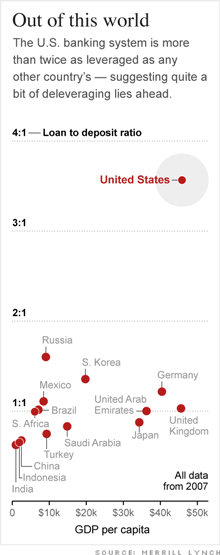
When I first saw this chart on the sidebar of some article I was reading, I came at it from the bottom. It took me a while to find the US as I was scrolled down and didn't realize there was more chart above the whitespace above 2:1. Talk about an outlier.
You forgot Iceland at 12:1. AS I write this the Icelandic krona is in freefall, the government has reneged on a takeover of one of the 3 big banks and the country is facing the prospect of national default. The authorities may have to decide whether to cut the banks loose or suffer national bankruptcy. Whew.
"cut the banks loose OR suffer national bankruptcy" how about replace or by and?
The British government has threatened legal action to recover deposits belonging to 300,000 British account holders with Landsbanki. "We are taking legal action against the Icelandic authorities," Prime Minister Gordon Brown told journalists in London. "We are showing by our action that we stand by people who save."
In the UK there are at least 20 local councils that had money in Landbanksi or one of its subsidiaries. Some investments are thought to run into the low tens of millions. I heard that Iceland has said it has no intention of meeting its responsibilities.
To owe tens of billions is not bad for a nation of around 300,000 fishermen with few natural resources, no wonder they have a reputation for good parties.
i understand that Iceland is seeking a 4bn Euro loan from Russia, if I was Putin I would be asking for a port and air base just for a laugh.
I think the Iceland thing is the one issue that may well sink the titanic.
Re the local councils, estimates are now in the hundreds of millions of pounds. So far 37 authorities have admitted having investments caught up in the collapse.
Meanwhile, Ireland extended its blanket guarantee on bank deposits to five foreign-owned banks on Thursday, in what critics say could cost taxpayers more than 600 billion euros. Well I suppose having already guaranteed several times the GDP of Ireland they might as well go large. Does it remind you of anything else?
I think we forget that a lot of the people who benefited from the bubble were people like ourselves, who really did nothing to create the problem. As a result of this bubble, a lot of people were able to qualify for mortgages who otherwise would not have; a lot of people were able to have credit cards who otherwise would not have; and a lot of students were able to borrow money and go to college who otherwise would not have been able to.
Businesses have benefited also. There are many more restaurants than there would have been otherwise, because businesses could finance their purchased of buildings and equipment. There are many more fitness centers than their would be otherwise, because they could get financing. Even in the energy industry, many of the players have borrowed money to buy their equipment, or depend on credit to buy electricity from the grid or gasoline from their supplier.
If credit significantly disappears, problems will be extremely widespread. The young couple who bought a house on credit will find virtually no one able to buy it, when they want to sell. Families will suddenly find that they need to save, if they expect their children to go to college. Some college professors will find their jobs disappear, because enrollments have shrunk so much that the schools no longer need their services. Even availability of oil, natural gas, and electricity may be affected.
I don't agree Gail its simply miss allocation of resources. Did we need the restaurants the houses the strip malls etc etc etc. Same to be honest with most of the college degrees granted and the debt the students to on.
This bubble growth was basically based on bubble growth no underlying reason.
As near as I can tell the real US economy flatlined back in 1995 only blowing ever bigger financial bubbles has caused the illusion of growth at the expense of burning tremendous quantities of oil.
All people should get is a chance to better themselves if they wish. This means ensuring no racial or or discriminatory barriers exist and ensuring that college is affordable without loans for those seeking a higher education. I'd suggest caps on tuition is more effective the ballooning college costs. A lot of the spiral was self induced with cheap access to credit. No credit no expensive state schools. Another part of this is a right to basic health care.
The US is a wealthy nation intrinsically if it provided its citizens with a chance to educate themselves at a reasonable cost and have basic health care at a reasonable cost and finally a real national retirement plan independent of employer then thats enough.
The Federal government need not supply any more support for its citizens nor should it ask for more than is needed for these programs.
Local government could if the wished added additional services such as housing for the poor but thats not mandatory in my opinion and its not something that makes sense from the federal level.
The Federal government should also of course probably continue to manage public lands.
Roads, housing defense etc etc are readily handled by compacts between the various states.
We can of course argue the details but the point is the Government in wealthy countries should only be responsible for ensuring some sort of minimum safety net and ensuring that people can make their lives better if they desire.
No more and no less.
All the benefits you mention about cheap credit turn out to actually not be benefits at all because underlying all of this we had to be robbing from the future to have something today.
What I'm suggesting instead is the concept that the governments exist in order to ensure that people can make the best contribution they can to todays society and ensure that the group supports those that can't at some basic level.
Thats what I envision renewable governments doing and most importantly the smallest organization which can handle the task or coalition of local groups formed to solved specific problems should be used. Very little filters up to the largest grouping.
Governmental ELP if you will with the only addition being that of the concept of safety net and opportunity.
This does not mean small government it means government with a very clear charter and clear budget. Maybe clear government ?
I agree about your ideas in the main but another basic safety net is good (not necessarily fancy) public transportation and public infrastructure that lets people walk and bike. Old, sick, disabled or young people can't drive cars. Poor people can't afford them. And cars are dangerous, actually I try to never let my kids in one! I hate being in them myself, and I was raised in a US suburb, ok, so I know about cars.
Also there are those people who are spaced out and shouldn't be driving or those who are bad at fixing cars and dislike the maintenance side. There should be a voice for the CARFREE BY CHOICE in the US Government. The people who say "HEY, WE HATE CARS! We want to walk and bike! We like trains! Help us!"
I didn't see anybody mention this but after the dot.com bust, all the money made on the way down got locked in REAL ESTATE. No less an authority than BILL CLINTON said this when he was on Letterman the other week. :)
A beautifully written analysis apparently meant for non-finance professionals like me!Thanks Professor Daly
It is a crisis of overgrowth of financial assets relative to growth of real wealth.
Yes, yes, and yes! Kevin Phillips in:
Bad Money: Reckless Finance, Failed Politics, and the Global Crisis of American Capitalism
goes deeply into this problem.
We are not going to buy our way out.
In case people weren't aware, Bad Money: Reckless Finance, Failed Politics, and the Global Crisis of American Capitalism by Kevin Phillips is a book.
That is such a critical observation. I'm not entirely clear on the "marginal" part of it though, because growth itself is a marginal activity, wouldn't it be appropriate to say the absolute costs of growth exceed absolute benefits and drop the "marginal"? It's the marginal growth of our economic activity, but maybe that's just semantics.
The only "smart growth" is shrinking. LESS - the four letter word no one wants to use. In the long run, because of where we are on the curves - Tainter has good examples - LESS is more. A smaller population using less means a greater share of the commonwealth.
And this is why any attempt to build our way out, to increase activities to deal with climate change, peak oil or environmental problems will only make matters worse. Virtually every proposed solution will make matters worse. The only solutions that can even be considered must address LESS.
That there is too much money - that's the game of musical chairs going on - where the fat-catters are trying to lock in real assets with their money all the while disenfranchising everyone else "...Increasing inequality of distribution of income prevents most people..." [Which is why Congress passed the Leave No Banker Behind Bill - because their real constituents are the two-legged pigs and fat-catters.]
A powerful analysis. Thank you.
cfm in Gray, ME
I agree with this quote. This is the trap that we are in now.
As and example lets say we build and extra million SUV's or houses today. These are not needed nor wanted and they represent a malinvestment. However the economy has become refined in producing products people simply don't need. As we return to a balanced economy all this malinvestment is now negative. If we produce these good we lower the overall price and the energy used raises the cost of inputs.
Maybe thats the best way to understand how peak energy and our economy interact. As you produce goods and services that are not really needed you raise production costs for everyone by competing for the declining energy supply you also decrease the purchasing power for the buyer as he must also directly pay more for energy. However you decrease the price you can charge since your in oversupply.
So your caught in a sort of trap where the market has to painfully discover where real money should go.
Since we are already heading towards quasi-nationalization of (at least) banking system, it would be wise to pay for this by taxing luxury goods and other products that do not contribute directly to basic needs. Basic needs can have some sort of subsidy. And while we go that far, lets tax more than two children and give subsidy to those who only have one (or none). At each step there is a right and a wrong relative to our current predicament - in small, or medium steps we have to move away from the wrong, and towards the right. Until the global population starts to compete for something other than money, our only choices are to steer people towards better choices using monetary sticks and carrots. Starting yesterday would be good. Instead we pass 500 page bills that don't remotely address heart of problem and add tax breaks for wooden toy arrow manufacturers. It would be a great movie script if it weren't the reality for the worlds (once) greatest nation.
Its interesting that you mention this. If you take it from a quality of life perspective and say treat well built electric rail as a postive use of energy/money and say creating a SUV or bailing out a bank as a negative use of energy/money then we have already gone screaming over this EROEI cliff.
It would take a while to work out the math and even longer to figure out the real units of energy/money and quality investments but you really don't need to. Its pretty obvious that the world economy is now no longer capable of much that people actually need.
And worse since this concepts embodies future gains the cliff is huge because we actually have no future its just a big abyss. The amount of money/energy going into stuff thats good for the future is so small vs the amount of money/energy going into dead end products services and financial games that its virtually zero.
To be clear, EROI is almost purely a supply side measure -how much energy gain we get for energy investment. (The ratio can change somewhat by demand-side decisions - for example if everyone was vegetarian, the EROI of corn ethanol would go down, as dried distiller grains couldn't be counted as an energy credit).
So you have 2 things occuring:
1)declining energy surplus on our energy investments
2)declining human utility from large energy consumption on 'stuff' as opposed to future infrastructure and basic goods. (remember Robert Franks example about house size preferences - the majority of folks just want to stay ahead of the Joneses - the absolute level of Jones is never really questioned.)
So the intersection of these two trends is indeed scary. Professor Daly has a right to be frustrated - he saw this and warned people about it decades ago. Thats the biggest problem here Memmel - lots of people 'get' it now - but our policymakers are being squeezed further and further inside a chinese finger trap.
Perhaps they should just relax....
Since the US government is now into commercial banking via the buying of commercial paper, I wonder if they will become full-fledged retail bankers too. Free checking? ATMs? Homeland Security would love that.
Having elected employee's in control of the banking system certainly makes bribery a lot easier.
Now you don't have to worry about the paper trail.
Expect a lot of money to mysteriously disappear ala Iraq. One of the biggest problems congress has faced in handling bribe money has disappeared.
I read another post about how we would now handle laundering drug traffic money. I suspect it will become highly efficient and streamlined with congress critters getting a automatic cut.
The Pentagon cannot account for 2 trillion dollars. 2.000.000.000.000 US $. It's really much less in Iraq.
This was made public in September 2001.
I believe the figure has been increased to 4 trillion now.
costs >> benefits
I believe this is Tainter's definition of collapse, or, more correctly, the environment that makes collapse the rational option.
I also keep thinking of the idea that: Not every problem has a solution.
All the flailing about could be avoided if some things were just categorized as FUBAR, and then moved beyond.
Absolutely, the banking system is now in a bistable state. If sufficient people decide the system no longer provides sufficient benefits, i.e. by withdrawing funds and keeping them under the mattress, then the complex system becomes unsustainable and collapses to a simpler state.
In our case, withdrawing from the system is not really an option, we are so tied up with it. There are few people who can sell off their house, car, give up their job and return to work on a homestead. The modern form of collapse is state intervention.
Whether the collapse can be controlled or not, I think we are in for many years of contraction.
Perhaps every problem has a solution - but Paulson and Bernake solutions haven't worked because they tackle problems in isolation. Why? Because this is a predicament, a catch-22, and horns of the dilemma. It is systemic. The system must fail because all that interest must get paid. But if the principle was created from nothing, then after time the interest too must be created. By it's nature, some loans must default. But with $600T in derivatives, it exceeds all money on earth - it must reset to 0 (or close to it). Watch: Zeitgeist: Addendum
Yes, but some have become so accustomed to the Emperor's new clothes, that they can't seem to live w/o them. But really, unless total Kunstler happens, we won't be going back to a gold standard. the leverage is being re-balanced, until the teeter totter moves back the other way.
I think this should read:
"Unless we go back to a gold standard or some form of steady state economy, a total Kunstler happens. Again and again and again."
Cheers
Folks, please help us spread Daly's work around. Just do what you do. This is exactly the kind of piece that people need to read to be educated on where we are right now.
Prof G. Let me quote a conversation I had, long ago, but not at all far away, when I and my buddy were faculty in a university, I in simple engineering, and he in mystifying economics.
"Hey, Charley, this guy Daly makes sense to me, and you don't"
"Sure, Daly is telling lt like it is, so primitive minds like yours can easily understand him".
"OK, you admit it! Your stuff is baloney. Don't you feel, Like.- Guilty?"
"Nah! Why should I? I am following the only law of econ that even you gotta agree with."
"What"s That?"
"I want to keep my job."
People need to be educated, all right. But do they really want to be??
One of my friends at Citi puts it like this:
The way it works is that you guys give us lots of money. We throw it away and then the government gives it to us again. With a massive bonus for our time and trouble. But the government doesn't actually have any money, it's yours really, so you give it to us twice -
clever, isn't it?
CW 2006
This is an excellent piece and I'm interested to see some comments suggesting prison for the perpetrators of this scam - I think the action of bankers certainly needs to be examined. In whose interest have they been acting? Savers? Shareholders? Borrowers? - all have been shafted. The fact that the politicians sat back and watched while the tax receipts swelled their coffers makes them accessories to this scam - jail the lot I say.
You have a quote somewhere PG about not solving problems with the thinking that created them. This I think is likely more true today than ever before.
Politicians need to think about this:
Are high property prices a good thing?
Are high energy prices a good thing?
Until the politicians get it straight in their mind that the answers are no and yes then we will have no solution to the current crisis.
I think I'd also be inclined to raise interest rates right now - after all we need to stamp out inflation to create confidence in sound money, we need to increase incentives to save and the last thing we need right now is more debt.
Welcome back Euan.
Exactly. We, as a species, and a modern culture, are incredibly myopic...i.e. steep discount rates - we will continue to focus on relieving short term pain at cost of greater future problems. Even people on Wall St willingly admit the core problems we are facing are too much debt, too much credit, too easy borrowing, too little responsiblity....But people are hurting - answer?
BRING OUT THE PUNCH BOWL!!!
Euan: good point but your suggestions illustrate the horns of the dilemma. Raising interest rates might help support the currency and reduce inflation but the cost of credit would go up. All those ARMs would reset at a higher rate. More defaults. I love the hurricane metaphor. We are in the outer bands without access to hurricane hunters to tell us the direction or intensity. Put on your Mae West and hope you fetch up in a nice tree
Perhaps you don't know that you can tell the direction of a hurricane by putting the wind on your left. The hurricane is coming at you from your front, if it's coming at all. You can tell that from the change of angle of the storm bands.
I suspect the direction and intensity of the current economic maelstrom is visible to those who can afford to see it, like perhaps those who have fuel, a generator and solar panels, and lots of food, with the firepower to save it.
I'll miss the Internet, though.
This is the real crunch isn't.
In a couple of years or so when the 'pundits' recovery should begin to start - we're going to
bump our collective heads on an even oil lower supply ceiling.
OUCH.
Succinct piece.
I've emailed it on .. hope others do the same.
Daly has been at this for 30+ years, explaining the impossibility of endless "growth" and exploring what a steady-state economy could be like. A voice in the wilderness, and an inspiration to me since I discovered his writings a few years ago. I sense a more angry tone in this piece than in his previous writing. I wonder if he's more despairing now of humans waking up to the hole they're digging themselves into.
A terrific article. I'm delighted to see it here.
Like Gail, I do have some questions about how the dramatic restriction of credit access might play out, necessary though it may be. The difference between older eras and the present is that instead of most people saving and few people borrowing, we have a society that depends routinely on borrowed money - partly because we are consumptive selfish twits, but also because the costs of a minimal US or Western Standard of living are beyond the salaries of most people. A rapid elimination of credit is likely to drop many, many people into poverty, unless the root issues of basic costs are addressed. And many of those costs are linked, one way or another, to energy costs that probably won't go down. While housing prices may come down to affordable levels - will heating and power prices?
My concern is that this post has much that is wise to say about how to limit the bank's power, I'm not sure it address the root issue of profound inequity. There's nothing in here about releasing consumers, for example, from their debts, or about how to either reduce the workforce or reduce energy dependence enough to make it possible for people to afford to live without constant influxes of credit.
These are not insoluble problems, but I do wonder if a "approach it from the top" banking regulatory approach that doesn't also think about the allocation of wealth can, ultimately succeed in creating a steady-state economy. In the end, governments will bow to the will of the people - and the people do need access to basic resources.
Sharon
Herman Daly has written about the necessary ingredients for a steady-state economy, and limits on inequality are part of that. He's proposed minimum and maximum incomes, with a reasonable ratio (10:1 or less) between them, for example.
There's no chance we'll see those in power moving in that direction though. I wish I could share your optimism that "In the end, governments will bow to the will of the people". Only under the influence of pitchforks, perhaps.
Oh, I was assuming there would be pitchforks ;-). Flaming torches too. I agree that the government won't respond to the will of the people unless they are very, very angry, but they will be, when they get hungry.
I think some of Daly's other work on income equity is great stuff - but I do think that any possible solution that involves even gradually declining moves is going to have to have as a central point the just allocation of what resources remain - not later, when we're determining wages, but early on. We saw a remarkable wave of anger at the bailout - that was a very early stage wave, when people really haven't lost much, and are just generally scared. That anger is going to increase quite rapidly, I think, and the only way to deal with it will either to be find a scapegoat and descend into great fascism, or, g-d willing, create a more just allocation of resources. That was, after all, the great choice of the Depression era, and I don't see things being wildly different now.
Sharon
Jubilee.
You know, a reset of things that liberates the poor and indentured wage-slaves from their bondage.
The US Government could do this -- a bottom-up, trickle-up solution could be devised.
My grandfather worked in the Civil Conservation Corps. There are other ways to do this.
Remove usurious rates from mortgage, small business, and consumer debt. This debt creates more false paper "wealth" than anything, and divorces the economy from any effort to create real wealth
This is actually the problem with money and power it naturally concentrates at the top and no mechanism exists to recycle it back to the the bottom.
Potlaches in the traditional sense of giving away wealth are a good method. Endowments etc.
The problem is of course we have gotten so good at it that huge fortunes are made in a single life time so traditional approaches to recycling wealth don't work. Splitting inheritance etc also works well.
Well I can't resist tooting my own horn here ;^)
It is gratifying that one of the top ecological economists in the world has a similar take on the situation. My only difference with Prof. Daly is that I put much more emphasis on the causative role of reduced energy flow through the economy. I also advocate a physical basis for money in the form of the amount of energy available to do useful work (e.g. net energy in a form that can drive our prime movers and processes). You can read my original analysis in Gail's post of Sept. 15.
You can read my follow up at my blog. Scroll down to the Sept. 15th entry. Also the Oct. 2nd entry pretty much reflects similar ideas as Dr. Daly has given above.
Of course, in the end I have to acknowledge Dr. Daly as a prime source/motivator for many of the ideas I have written about, especially the disadvantages of growth. The ecological economists are whole systems thinkers and really understand the nature of the human economy as part of the larger Ecos.
George
I agree with the general direction of what you say. But I think that when traveling it is important to keep in mind where we have to end up. And that is a society where we are no longer dependent on underground non-renewable resources, have a stable population, and are reconnected to the soil, which we enhance, not destroy.
The massive devaluation of assets is not just on paper -- we had a housing stock worth 20 trillion on paper. Much of that is the air coming out of the credit bubble. But of greater importance long term is the real devaluation of this property due to rising energy costs (never mind the current downward blip.) Location, location, location. A very great proportion of the housing stock is being and will be further devalued because it is scattered, surburban, energetically inaccessible.
Any program that realistically addresses the current crisis had to recognize this and embark on moving people into much denser small towns that are involved or become re-involved with agriculture and connected light industry, walkable, bikable towns. It CANNOT be a program that tries to rescue the status quo. This is the perfect time for such initiatives because this is (or will be) a time when people who otherwise have no hope might see hope in such a direction.
Needless to say, nothing remotely like this is on the table. Factions of the elite are battling to outmaneuver rival factions while planning on how to suppress the hoi polloi.
This crisis of capitalism differs from all earlier ones in that it is no longer possible to grow out of it. Previously, it was possible to mortgage the future. This time, there is no future (in terms of industrial capitalism) to mortgage.
The biggest single failure of the market has been its failure to properly price finite, non-renewable resources AND equally but oppositely renewable above ground resources like the soil, water, air, forests and so on. It is the latter that is what we will ultimately be left with, in who knows what condition, as we madly claw for the stuff underground. The financial crisis is to some considerable extent overshadowing this far deeper crisis, bad as the financial crisis is and will become.
But of greater importance long term is the real devaluation of this property due to rising energy costs (never mind the current downward blip.)
So land gets devalued unless it is close to urban centers.
Location, location, location. A very great proportion of the housing stock is being and will be further devalued because it is scattered, surburban, energetically inaccessible.
But shouldn't at least some remote lands become useful for crops which will at least generate some (food) energy?
What is better? Moving away from it all and becoming self-sufficient? or Moving together and leaning on each other for support?
With this perfect financial storm arriving just in time for the US presidential election, if I were running for president, I'd sure be having second thoughts.
McCain especially! If free markets have been all you have been preaching, how do you deal with the current mess?
Kill the Federal Reserve and let "the worst" happen. The faster the better. The banks implode, the people "lose" trillions. Bankruptcies and unemployment soars... Thing is, this is all going to happen anyway.
The problem with the true free market is that it isn't (ever) a politically acceptable solution. "The government must do something". Either fascism or socialism... same thing, take your pick.
McCain isn't a free marketeer.He's a fascist (or corporatist if you prefer) puppet, just like Bush.
Preach harder...
(ok, I'm being flip here. I'm just thinking about how Chicago School economists keep insisting on "pure" free markets...any deviation pollutes the ideology and compromises the results. Just imagining how a pol like McCain would rationalize...)
A problem for one is an opportunity for another. Take a look at the people offering alternative solutions to the Credit Crisis. It isn't just Democrats and Republicans.
I'll just point out that banking regulations have increased and increased over the last centuries, and the problems just get bigger... Simply more sticking plasters.
The freest of free trade advocates; the Austrian economists also advocate truly free trade for banking. That is, anyone could become a banker and issue notes and coins, credit and bonds.
It's only the (now 1.5 trillion?) support from government which allows bankers to get away with the recent idiocy. Remove the federal reserve, remove support for banking and watch them all collapse. The organisations which replace them would be unable to lend significantly fractionally because they wouldn't trust each other enough to allow the practice, and any bank failures would be both local and limited in scope... That is, a small problem not an issue of national security...
Still. It'll never happen. For exactly the same reasons there will never be any other monetary reform in the shape of full reserve banking, much as I agree with the sentiment.
Some good comments, except for one major misconception: there has never been any such thing as "commodity money". Money is credit, credit is money, going all the way back as far as the Mesopotamians and probably before. The idea of a certain commodity as being some sort of universal means of exchange is a misconception of 19th century economics that has unfortunately persisted to this day. For a good historical overview of this, read this:
http://www.ces.org.za/docs/what%20is%20money.htm
Well I don't agree I like my definition however its cash exchanged for real goods and services.
If debt is used at all its simply a way to lever a portion future goods and services produced to get the investment needed to produce said goods and services. This can itself create a bubble if used incorrectly but it tends to collapse quickly.
A very simple constraint such as disallowing credit for more than 3% of your production for up to five years is all thats needed this pretty much ensures no bubble.
If you wish to take on a large project then you have to go directly to concentration of wealth via aggregation you would be forced to convince a fairly large group of people that the project is worth investment.
This has a intrinsic effect of limiting losses since grand schemes would be forced to either be and obvious plus to the common good or pass through intermediate success points.
Using this approach most people would simply go the route of trying to just build something they can build without credit instead of chasing the little bit of credit available.
You can create all kinds of things with a minimal investment even advanced microchips in small batches are fairly trivial to create with a surprisingly small investment.
Not computer chips but you get the idea.
http://fabathome.org/wiki/index.php?title=Main_Page
I need time to read the link more carefully, by which time the thread will be dead. So I can only say that I am highly skeptical.
There was a recent article in the NYT about money in prison. Mackerel packages (macks) are the current currency. Before that it was cigarettes. There were other commodities.
I read the NYT article with great interest because I've long been a great admirer of Marx' Capital, and in particular his theory of the origin of money in Vol 1. I highly recommend it to everyone, no matter your political leanings. Marx does not claim originality in his theory of money or value -- he's simply developing the classical economic theory. Where he claims originality is in his theory of surplus value.
There are, beside prison, many anthropological examples of commodity money. I believe it was the Inca who some anthropologists claimed had no money. But they used linen as money, as a means of exchange, just like macks. Those anthropologists apparently identified money with gold coins. The Aztecs had lots of gold, but it was not money for them. Unfortunately for them, it was for the Conquistadors. "Universal" is relative.
Edit: Also, in the case of exchange between tribes where there was no credit, there could only be barter, exchanges of equal value. But if the exchange will still work even if the commodity exchanged is of no direct use but can still be exchanged with yet a third party for something that is. Embryonic money. The point is that commodity money works even when credit doesn't and can't.
If you look at that WSJ (not NYT) article very carefully, you will notice that mackerel is not, in fact, "commodity money", in that it is in and of itself worthless (nobody actually wants to eat it), but it is portable and impossible to counterfeit. It is thus ideal for keeping track of credits. Especially in an environment like prison where no one can be trusted to keep accounts, you need a physical medium that represents otherwise intangible credits and debits. This is the exact same reason precious metals were originally used for coins (although money, in the form of clay tallys, predates coins by at least 3000 years): gold is tough to counterfeit. In any case, coins have never represented more than a small fraction of the monetary transactions in any economy. In any economy with a modicum of trust in banking or merchant institutions, letters of credit or bills of exchange (in the midieval era, mostly represented by hazelwood tally sticks marked with amounts and split down the middle) are the primary means of commerce.
Thank you for pointing this out. I see so many people espousing the commodity money meme without understanding why it is insufficient. Using commodities as money never prevented economic collapse, and doesn't prevent credit creation.
The Romans used salt as payment, hence the word salary. Unfortunately this sophisticated form of financing didn't help the Romans much either.
I'm not a libertarian -- I don't believe that returning to gold or other commodity based money will solve anything. What I uphold is the Marxist account of the origin of money: i.e. that the commodity has two poles, use value and abstract value, that this polarity externalizes itself by dividing into use commodities and exchange or money commodities.
in re. "commodity money"
IMO, a commodity is something that is available in commerce for which to shipments of equal size are indistinguishable form each other and are deemed to be of equal value. 6-32 brass hex nuts are any example of a commodity. There are specialized 6-32 hex nuts, e.g. hex nuts with built-in lock washer, but they come in specially labeled boxes. In contrast, hand made oriental rugs are not a commodity product even though some can be of very low quality.
So money really MUST be a commodity. Otherwise, there would be haggling over which of two bills of a given denomination is the more valuable. Bills of different denominations should have value ratios that are simple intergers (paper money assumed so as not to get too verbose). Cans of mackerel are, within the confines of the prison, a commodity. At most only a few different brands and sizes of can are sold in the commissary. Every prisoner can recognize the cans that are used as money. It has nothing to do with eating. Although there must have been a small pre-existing demand for canned mackerel in the prison to have justified stocking it in the commissary.
You miss the point. The implication of "commodity money", particularly among goldbugs and other monetary cranks, is that there is a certain physical commodity whose market value is used as a measure of all others. (Incidentally, this is one of the main assumptions behind neoclassical economics, which has no real use for money or credit in its models and essentially assumes a barter economy.) But in the real world, anything used as "cash money" must have a "face value" greater than the market value of the underlying commodity. If the U.S. mint issued, say, a coin with a $100 face value that was made of an once of gold, that coin would never circulate because people would melt it down and sell the gold for $800+. Cash is a token. It is a generalized representation of credit (or debt, which is the same thing), which is all that money is or ever has been.
No discussion of "commodity money" is complete without reference to the stone money of Yap. These giant stones were actually shaped on another island and transported by canoe to Yap. They are so huge that when they change ownership, the stones are left in the same place, everyone knows who owns which one. Finally, "His Majesty O'Keefe" actually made counterfeit stones and attempted to trade them to the Yapese for sea slugs ("beche de mere") to sell to China.
Money is debt and debt is money. Calling debt "credit" makes it sound somehow less threatening. The monetary system as it exists is barely better than a Ponzi scheme.
Yes, debt and credit are just two sides of the same transaction. And you are right - all monetary systems are always in peril of becoming Pozi schemes (google "Hyman Minski" for a good overview of his Financail instability hypothesis, which basically states that all financial systems have a tendency to move toward Ponzi as people forget how risky the world is and get overextended)
Thank you, Professor!
Yours is one of the clearest explanations of our current predicament I've read in a long while.
What I find particularly tragic is that we have multiple problems enfolding in the 'real', physical world, yet we cannot begin to address these with any effectiveness without first removing the self-imposed shackles of our 'unreal', abstracted economy. Discarding the mindset which created the problem (to misquote Einstein) may be a greater problem than the problem itself.
Crash! Bang! Boom!
Looks like the $700,000,000,000 wasn't enough to alleviate world markets. As money goes "Poof", it is high time we look at the way the Internet innovation is presently acting as its own currency and market. If you will remember in March 2008 when I wrote the Trends-to-watch article regarding peak oil, I predicted that we would see the Internet moving in and encroaching on the government's territory.
The geeks of the world are becoming the new masters of the Universe, and the leaders of the world are miffed. They do NOT want to lose control of the masses - and we citizens can only ponder what military solutions they have in store for us as the value of American paper dollars become more and more meaningless.
The US Government is ready to deploy the US Army to fight back our own citizens, who are rightfully pissed off that their 401Ks have taken such a massive hit. But, there is risk in any investment, and it's not like people haven't been warned time and time again this crash was coming.
But let's face it - we must like George Orwell's 1984. Since its late arrival, we have grown accustomed to our "telescreens", and we know the government has us bugged. But as long as there is food, electricity, the Internet, sex, drugs, and rock and roll, we apparently aren't ready to fight for the Constitution.
So as the economy contracts and we start to experience fuel and electricity shortages, all sorts of funny human behaviors will start emerging. Who knows what our failed government has in store to control enraged the citizens of the US - only the biggest, most shadowy figures have the playbook.
What we do know, however, is that even as markets fail, Internet startups will continue to create and innovate. There are coffee shops loaded to the hilt with programmers and entrepreneurs teaming up in collaborations to unite local communities through social innovations.
The focus of the startups that matter are around real-world needs, including food, communications, community-building, hyper-localization and revenue sharing. Revenue doesn't necessarily mean paper money, either. Collaborations are forming based on shared value(s), meaning whatever the participants decide is worth something is becoming its own currency. That means barter and trade - just like the old days.
As America collapses Enron style, we will probably begin to experience hyper-inflation. That means "consumers" will continue to experience a serious wake-up call into what we truly need versus what we think we need to be happy. But hey - Ramen Noodles have got a lot of people through tough times before.
In case you are a government employee reading this and need to do something to help your local municipality or emergency responders deal with this crash, here are some of the nifty things that Bright Neighbor offers communities:
- Fast and easy searching for all things local
- Discover and meet people around you based on location and interests
- Safe & Secure - only your real community members allowed
- Food Growing / Garden system automation
- Swap & Share allows the community to lend, barter, trade and sell
- Add and discover community events, hyper-local news, views, and reviews
- Transportation & Ride Sharing tools
Bright Neighbor offers a strong solution to help communities deal with the new depression. It's going strong in Portland, and there are multiple new Bright Neighbor communities launching across the US.
As things get worse in the currency markets, we will be counting on the geeks to help the new farmers of the world.
Thats an intersting point - but IMO of more concern, is how the internet specifically (and high stimulation devices in general) are rewiring our brains to be more short term oriented. The Big Switch explores this concerning trend (without any acknowledgement of resource limitations).
Our neural hardware that was shaped to see slight movements on horizon and subtle color shifts in the bush has been hijacked by smaller and smaller intervals between new unexpected rewards. Thus its gonna be hard to make the above mentioned choices if we can't even read books or articles to learn about them anymore (on average). It's nearly impossible to convey these concepts in 2 minute sound bytes, unless you watch a series of them for 5 years, or your child writes for theoildrum....;-)
May I humbly offer a correction to this otherwise superb piece.
In a 100% reserve banking system, by definition banks do not lend, i.e. they keep as cash in their reserves the full sums left on deposit with them.
Credit can be provided by credit companies which fund themselves by issuing equity and/or debt. But not being banks, they take debt in the form of bonds, not "deposits", therefore they do not multiply the money supply. And the people who buy their stocks or bonds know perfectly that there is absolutely no guarantee on them.
What do Credit Unions do?
I thought that if credit union members deposit $X in their "accounts", the CU can loan out $X (or a large portion thereof) to others. But if a commercial bank gets $X in deposits, it can loan out N*$X where N is some number like 10, 30, practically infinity these days (up to a couple of weeks ago anyway).
If 1% of the loans the CU made default, it lost 1% of its money, but the interest paid on the other 99% of the loans covers that easily. If it pays a somewhat lower interest rate to its depositing members than it charges on the loans, it is pretty safe. If it also pays the FDIC a bit to insure against higher losses then everything's fine.
On the other hand, the bank, that made loans far larger than the deposits, can become insolvent even if only a small percentage of the loans default.
For every $1 of deposits, 9x that amount can effectively be created through the reserve system. 10 billion dollars can turn into 90 billion dollars. Most people have no clue about this. It's possible because even though they can be leveraged 10:1, each time new deposits come in they can wash, rinse, repeat.
Some of the larger institutions have found ways, through deregulation and exotic financial instruments, to be leveraged 30:1. The total debts may be as much as 1 quadrillion dollars.
"Some of the larger institutions have found ways ... to be leveraged 30:1."
Only 30:1, the wusses, they're not trying, Deutsche bank is 50:1
Haven't got the figures to hand but Iceland must be high.
Person P1 deposits $x. The bank or credit union loans $rx (where r is maybe 0.9) which gets used to buy something from P2 who deposits that $rx into a bank account. The bank can now lend $rrx to somebody else to buy something else from P3 who deposits that $rrx into a bank account. The bank can now lend $rrrx etc. etc. Once this has run its course, the sum of everybody's bank account balances will be
x + rx + rrx + rrrx + rrrrx ...
an infinite series that adds up to
x/(1-r)
e.g. 10x if r happens to be 0.9
Now if everybody wants cash right away, that will be a big problem! There was only $x in cash, but we have $10x in deposits!
It doesn't matter if it's a bank or a credit union or a big combination of many of each.
There is a funny asymmetry here. Folks expect to get their deposits on demand, but they don't expect the bank to call their loan at will. If banks really could get loans repaid on demand, the whole chain could unwind in reverse and there wouldn't be a problem. Bur the actual mismatch between deposits and loans means the bank makes promises that it cannot keep. Putting everybody at risk.
Look for the video called "money as debt", well worth the 50 minutes, here's one link:
http://video.google.com/videoplay?docid=-9050474362583451279
What do Credit Unions do?:
In addition to preceding answers, consider this: One can estimate, for an honest credit union, the amount of lending that is safe by examining the normal daily, monthly, yearly fluctuation in the total deposits, looking particularly for the times when there are dips in the total deposits. If the union trys to loan more money than the minimum deposit total, it will surely get into trouble. If it never lends more than a tiny fraction of the minimum deposit total, it is very unlikely to get in trouble. But no one knows a statistical law that applies to deposit fluctuations, so there is always an element of guesswork and 'prudence'. 10:1 sounds much too large to me, but the people doing CDS were using about 30:1. Not quite comparable, but indicative of the nonsense that was going on.
People are starting to wake up to this. Wendell Berry has been describing -and decrying - this for twenty years.
Bob Herbert in the NY Times gets it:
http://www.nytimes.com/2008/10/07/opinion/07herbert.html?hp
Satyajit Das gets it:
http://www.prudentbear.com/index.php/commentary/featuredcommentary?art_i...
Another approach by Umair Haque can be found here:
http://discussionleader.hbsp.com/haque/
The finance pyramid is collapsing. Isn't this a problem? We need funds from the future in order to replace our obsolete infrastructures, energy and otherwise. How do we get from where we are at this moment to where we need to be? We need to consider a future that is equipped with the tools needed to provide a decent standard of living for participants. Planning for a future of Americans as subsistence farmers is not an option. It is not a plan, either; it is total collapse and anyone calling it a plan is intellectually dishonest.
This will simply not work. It relies on a police power that Herman Daly himself acknowledges does not exist. The insurmountable problem is that all banking systems/economies are grounded in human nature and in any system there is Greshams's Law ... the bad (property,paper, money, derivatives, loans, etc.) drives out the good.
A cash or hard- currency non- yield regime would last about as long as it takes someone to say, "Ivan Boesky". The current fiat system creates a compelling illusion that great wealth is possible to all and can be achieved by wit rather than dumb labor. The current problem has to do with a long-term decline of yield or return on investment ... particularly at the bottom of the economic food chain, where investment would ordinarily provide good return ... rather than at the investment banker level. The problem of low yields cannot be solved by eliminating them, no more than an excess liquidity problem can be solved by adding more. Margin controls or limits on fractional lending simply reduce yield. If there was yield, there would not be a crisis and the financial system would be continuing to 'grow'.
Contradictions aside, fiat regimes are fundamentally democratic. Hard currency regimes are not and deflationary by nature, they constrain currency growth and concentrate wealth. The beneficiaries of hard currencies are the powerful few. Hard money regimes are a single step away from the 'archaic' pre-industrial 15th century feudal trading systems concentrated all wealth and political power in the hereditary military and clergy classes. Money lent at interest was a foundation stone of the Renaissance; the rise of the merchants and bankers accompanied their ability to conjure interest (yield) wealth out of thin air. In time merchants and bankers became those who mattered the most; while the cardinals and the noblemen mattered less.
Economic power became a counterbalance to the hereditary militaries' administrative monopoly while enabling (and rationalizing) the growth of real military power at the same time. Since national effectiveness is founded upon in military power, it is hard to see governments embracing anything that would cause the diminishment of this. Fiat currencies gave the governments something they did not possess prior - less expensive, more meritocratic force.
Governments have and will have monopoly power over their countries' economies. There is no 'alt economy' in countries other than the (illegal) drug and whore trade, which uses most of national fiat infrastructures. Countries whose economies are collapsing have alternative economies, but these are not good models for the future. While transnational money flows are outside of individual government intervention (For better or worse), the destinations are in firmly in hand of national ministries. The reserves in dollars that flow to China for instance end up in the Chinese Cental Bank and there they stay, with little to move them out other than a collapse in a Chinese derivative market that would require the expenditure of dollar reserves. In that case the reserves would simple evaporate as they are doing now in Russia and has happened in other countries and other financial crises in the past.
Hard money/regulatory regimes enhance the centrality of government authority within economies. Why? Because the greatest aggregation of 'currency' reserve and police power resides with the government! Governments 'R' fundamentally corrupt, what measures is the relative levels of corruption between one and another. Prof. Daly can suggest 'his' regulators will behave better than Clinton/Bush's, but historical evidence suggests otherwise. The shortcoming of the centrality of government authority is clear in our current situation. The 'De- regulation' leading up to our crisis is a mirror of the 'Bailouts' which are taking place now. Involved is the same cast of personalities; the same economic advisors: Lawrence Summers, Robert Ruben, Warren Buffett ... can 'Easy' Alan Greenspan be too far around the corner? These are Obama's economic advisors. The underlying principles derive from John Maynard Keynes on one hand and Milton Friedman on the other. Meet the new boss, same as the old boss.
For all its faults, the fiat/traded currency system maintains the illusion of open- ended opportunites. The American Dream is one of reinvention, that a person can create out of the raw stuff of their ordinary life any outcome that pleases them. The New American Dream is that a person can reinvent themselves as a landed European aristocrat. That this is unreasonable does not lessen its appeal. The trappings of the dream will change, the centrality of the dream itself ... won't. Americans do not think of themselves as 'part' of any group; they think first of themselves ... then everyone else, second. The American solution to peak commodity/anything is to accumulate enough money to afford what is needed, regardless of cost. The public be damned.
Socialism and communism are too close to the neo-capitalist model to provide much different outcomes while both rely overmuch on police power. What good is an economy that requires coercion to function? The answer is no good at all.
What is needed is a new approach altogether. One that allows persons to get rich by conserving. A system that has this outcome 'wired in' by incentives rather than by exercise of authority.
We need this now ... and it isn't likely to be uncovered any time soon.
In short:
There are three ways to repay debt:
1. Deferring future consumption.
2. Efficiency gains.
3. Consuming assets (incuding natural resources)
The last two are no longer feasible and the first is insufficient for the task at hand. The excess debt is worthless.
Pyramiding, or financial leverage, means that the losses will be many times the original debt.
First thanks for a fantastic post.
Posts like these make TOD such an educational experience to visit. I am not an economist by training, but posts like these and the quality of the comments matures and expands my understandings.
Shunyata,
I would add:
4. the creditor forgiving the debt (writing it off - USA did this to Brady Bonds in 1990s)
5. creating something with perceived value to pay the creditor (i.e inflate it away)
6. elimination of the creditor
#6 sounds a bit nasty. How does that work? Is this in the realm of feasibility?
Shunyata expanded on this comment in his guest post a little over a year ago called Monetary Policy and Weaseling Out of Debt.
What he said then is probably even more relevant today.
Lots of talk recently about martial law, George Orwellian stuff. I can see why so many ponder or worry about it going that way. I often catch myself seeing it manifest itself in many ways already. The way I handle it, I start by imagining who would be the individuals that would make up the group of oppressors and who would be the individuals making up the oppressed camp.
I have hope that, the oppressed camp, would be quite larger, more inclined to violence, impossible for any goverment to draw for its ranks, from the rank and file of the oppressed. I say this from an American perspective, realising that other countries have a more laid back and civil society, than what the USA is.
This leaves the only tactic that remains in the oppressive governments arsenal (If it comes to that)
FOOD. Hungry people tend to have the fight taken out of them pretty quickly, any commander knows, his army runs on food, and so does his enemy. Loyalty and discipline are major factors, food being used to discipline and subjigate is well documented.
Could American militia actually oppress or even kill en masse their own neighbors and relatives? Would they do so, in return for food and safety?
Typically, the inteligencia are the first to be targeted. Thats quite a few of the people on TOD running it. Luckily I couldnt be considered in that group. They target the smart ones, to weed out before hand, any potential leaders. They usually use the brawn against the brains to accomplish this, then dispose of the brawn at a later date.
Iam not saying this to scare anyone, Iam just saying, this is usually how it happens, see Russia 1917.
The military being deployed here at home is a new ability if I understand correctly?
http://www.cnn.com/2008/US/10/03/army.unit/index.html
The U.S. military "is not a Swiss Army knife," ready to fight the Taliban one week, respond to a hurricane the next and put down a major political protest the third week, Healy said.
The Army says the non-lethal training is an outgrowth of missions that troops have faced around the world in recent years.
"We need a lot more in our toolbox in order to deal with angry people on the street," said Col. Barry Johnson of U.S. Army North.
Heh?!
Straight from the horse's mouth...
http://www.armytimes.com/news/2008/09/army_homeland_090708w/
“Beginning Oct. 1 for 12 months, the 1st BCT will be under the day-to-day control of U.S. Army North, the Army service component of Northern Command, as an on-call federal response force for natural or manmade emergencies and disasters, including terrorist attacks…
… this new mission marks the first time an active unit has been given a dedicated assignment to NorthCom, a joint command established in 2002 to provide command and control for federal homeland defense efforts and coordinate defense support of civil authorities.
After 1st BCT finishes its dwell-time mission, expectations are that another, as yet unnamed, active-duty brigade will take over and that the mission will be a permanent one…
…They may be called upon to help with civil unrest and crowd control or to deal with potentially horrific scenarios such as massive poisoning and chaos in response to a chemical, biological, radiological, nuclear or high-yield explosive, or CBRNE, attack.”
I feel safer already.
Mash
Father, Farmer, Doomer, Engineer, Drummer.
I think another more rapid way to demoralize and shock a large portion of the population would be to somehow bring about electrical grid failure. This of course would deprive us of the internet, cramp phone communication to an extent, eventually eliminate running water and natural gas. It would make it difficult to cook any available food, and society would come to a standstill quickly. Hell, many people in large cities could not get in or out of their upper floor apartments. As you can tell, I have been reading way too much Oil Drum and Shock Doctrine.
Nephilim, your assessment of Americans as being perhaps more unruly than residents of other countries does not strike me as true. Would the people of Chile or Argentina, or Greece be easier to govern? I can tell you from personal experience that Greeks are stubborn, individualistic and proud, and yet, a CIA-backed coup in 1967 installed a military junta which lasted 7 years, and left a legacy of worsened corruption in all walks of life. It would be a big job to confiscate all the weapons in this country - suddenly I find myself pro-gun ownership (for others).
This is a country with staunch racism, and the last country on Earth where some degree of basic free health care for all is still not available. There is a population of Caucasians who have not managed to get ahead economically and blame it on the "illegal aliens" and on liberal policies. I don't think it would be hard to recruit them for a militia, and convince them they were capturing and torturing the "enemies of freedom".
Luckily, neither you nor I are in that group.
It is the mother of all market corrections, to say the least.
But I am still optimistic. We still have a cushion as we move from implicit to explicit decisions.
All humans are consumers of one sort or another. Consumer psychology is a larger topic on its own, look at these two types of decisions:
* Implicit decisions are those conclusions that people calculate on their own. For example, if you wanted a new car, you could naturally justify the need for 300 horsepower because you want.
* Explicit decisions are those conclusions made by people when they’re convinced. Continuing the last example, you would opt for the 40+ MPG car would be because you should.
So, as consumers begin to operate in "Explicit" mode, the drop in the markets and confidence in the pyramid could still last long enough for us to implement a happy, fun, Disneyland-like induced crash program.
So sorry if Americans have to turn off their TVs for a while as we concentrate our efforts on fixing this place. Some of you make it sound like we don't have a critical mass to achieve that... I call bullshit.
The irony is that the credit crunch makes the transition to a steady state economy more difficult. We need to decarbonise about 2% a year, that is 4% less in two years, 6% less in three years. But we need capital to invest in built efficiency, wind, solar and nukes to replace at least some of that carbon energy. JaP cites the case of wind power in Europe. Thus we are caught in the trap of using up our energy base and not having the means to replace it.
That transition is like a hiking trip where most are prepared to put in an extra effort to get to a destination. However a few spoiled brats refuse to make the effort and ruin it for everybody.
The irony is that the credit crunch makes the transition to a steady state economy more difficult.
Au contrair! What major transitions in life happen seamlessly? Virtually none. Look at the natural world: what major transitions can you name that do not involve destruction to allow for rebirth?
This idea that a smooth transition is even possibles seems like a fantasy built on the mirage of the fossil fuel-based non-reality of the last 150 years.
No, the economic collapse makes it possible, IMHO.
Cheers
Thank you professor Daly. Most enlightening.
Reminds me of evolution: animals and plants are societies of cells. Information-poor creatures combine to become information rich: animals.
Animals grow into societies, that become exponentially wealthy in information, compared to the relative "intelligence" of each member.
Ant Heap: Highly organized, units are mostly disposable, and very "stupid" as compared to the "intelligence" of the heap.
Human societies have become a huge, world encompassing, multiheaded Beast: Highly organized, units are mostly disposable, and most units have an exceedingly small part in the shattering impact the Beast has on its living grounds.
In general, humans have allowed the greedier part of society to take control, and the greedy have decided the Beast needs to grow indefinitely.
Growth requires a lot of food. As long as the oil kept flowing, the Beast could go on growing.
If the Beast persists in requiring growth, while its sustenance wanes, the Beast will have to eat itself.
The recommendation for 100% reserve requirements is a good one, however what are to be the reserves?
What are the reserves of banks today? Federal reserve notes (bills of credit) issued by the Federal Reserve Bank (printed by the Treasury) that are held in the vaults of banks around the country for one; checking accounts that banks around the country have at the Federal Reserve Bank or a correspondent upstream bank for another. All these are bank debts, so the system suggested does little to make banks safe. This still leaves open the opportunity for the Federal Reserve Bank to expand reserves by either making loans out of thin air to banks or by making loans out of thin air to others like the federal government to fund deficit spending. 100% reserves against expandable debt is like putting an adjustable governor on the engine of inflation, but not shutting it down.
If we have some banks that operate as warehouses for gold and issue either paper (currency) or electronic certificates (gold backed checking accounts) to the owners of the gold, plus act as transfer agents to facilitate transactions in the economy, there is little danger of loss by owners since each "certificate" is a claim on gold actually held in the vaults. A "bank holiday" as we now face is not very likely in such a system. Inflation of this money supply could happen in very small increments from mining, but the market would control the expansion of gold money by making gold mining profitable or not. Such a money system would be beyond the black hands of government.
This does not preclude "savings and loan" institutions which would take in gold from gold owners and loan it out to borrowers. Talking about 100% reserve requirements for such lending institutions is ridiculous because they would not be holding much gold, but would rather be an intermediary between savers and borrowers. There would always be risk of loss to savers, and the only way to protect against such losses would be prudent lending practices by the "savings and loan", due diligence by the saver in selecting a prudent "savings and loan" and minimum capital requirements and minimum reserve requirements (which could not possible be 100% or even close to it) for such institutions. Such an institution could not create money because they could only loan out a portion of what gold they took in from savers or other lenders of gold.
By isolating institutions that warehouse gold and facilitate transactions (banks) from institutions that act as intermediaries between savers and borrowers (savings and loans) the risk of system wide financial collapse is reduced. By recognizing gold as legal tender (as states are clearly required to do in the Constitution) the opportunity for devaluation of our money would be slim.
I can't understand why the author thinks gold is a bad money system, especially when compared to his suggested debt based money system, or the present debt based money system.
On a full planet lacking food and energy, its hard for me to imagine a currency backed by gold - you can't eat it and it only looks shiny and feels heavy. Energy and food are more likely backings.
Here is a link to the wiki entry on the Technocrats, who believed in an energy based currency, among other things. M. King Hubbert also promoted such a concept
The kilo calorie would work for both?
Except a kilocalorie of coal would be worth less than a kcal of diesel fuel?
Are 100kcal of potatoes worth more than 1000kcal of lettuce.
Quality matters.
You can get high eating a lot less than 1000kCal of lettuce..
I don't think the ability to consume something directly makes it good as money. What you are looking for is a medium of exchange and a store of value. Can you imagine having food as money and one year having a bumper crop and the next year a major drought with everyone eating all the money; hardly something that would give stability to the system of exchange; waves of inflation and the deflation; economic shambles.
When you use gold as money you take it off the market for competing uses. If you mint gold into coins or store it in bars in warehouses to 100% back certificates, then it is not available to that extent for use in jewelry or electronic circuits. The same would apply to food or fuels; you can't use them for money if you eat them or burn them, so if you encapsulated them in plastic to circulate as money, or stored them in warehouses and issued warehouse receipts against them to circulate as money, then you take them out of the food or fuel supply; we starve, sit, and freeze.
I don't know what Hubbard could possibly have been thinking! He should have stuck to where his brilliance shown.
Look at the myriad of articles describing the various human experiments with money, and how gold and silver floated to the top of the heap; durability, easy divisibility, scarcity (high value per unit), portability, readily distinguished from other commodities, and intrinsic value. Food an fuels do not come close when compared to gold and silver.
To my thinking, it is extremely sad that as we progress into the greatest disaster in human history (the end of the industrial age) that we are additionally hampered by the current predatory, unstable money system. The human suffering will only be greater for it.
Currency based on labor was already suggested below, so I only get to add land. Maybe all of the resources required to do work could act as back-up currencies: energy, land, commodities and labor. Of course someone would need to asses relative values, but that could be left to the markets. I guess one of the lessons of the current crisis is to keep the backing at 100%.
So, I should be able to borrow money if I give my future labor as a collateral. I guess the quantity and form of the back-up labor should be decided when negotiating the loan agreement, otherwise it might get too speculative. Due to the possibility that I can get handicapped before I've paid off my loan, I should be part of an insurance pool with other people who can take my commitment. Both the insurance pool and the lending agency should make sure that the collateral is not beyond my means. Lending agency should be non-profit or owned by the government to keep things in control.
I don't really know if money should be based on a commodity, debt, labor or energy or whatever. I do believe a trade system based on interest must run into problems. Interest is money that doesn't exist yet: it has to be made by the people who are indebted.
At 7%, principal doubles in about ten years (near 800% in 30 years)
All this money has to be "made" by the debtor.
When debtors become incapable of making money, creditors cannot lend, consumers cannot consume, business cannot sell, workers cannot work and debtors cannot pay.
When growth falters and stops, as it must, seeing oil is the mainstay of our consumer paradise, depreciation will and must occur. Essentials, food and heat will become value-rich, luxuries will lose value. Loads of money will disappear: it didn't exist yet, but the greedy bunch couldn't wait and whooped it up before it was made. And much of what was bought was without value. Now somebody will have to foot the bill, and guess who that will be: you.
As for the growth fanatics, it would be considerate to just die, please.
How low can it go? What stocks, if any can ride this out? My oil stocks have been hammered in the last few months. And this is just in anticipation of a downturn. Is cash the only way to go - and what does cash do for you if inflation heats up?
FiniteQuantity,
Oh, it can go VERY low. Remember, we have folks here on TOD talking about the END, the ABSOLUTE END of the modern world as we know.
Remember the go go 1960's? Cars, clothes, high fashion, big time sports, TV and Radio, suburban houses, more brats in college than anyone would have believed possible only a few years earlier...and in 1969, that primitive year that America put men on the moon...and in December of that year, the Dow Jones Industrial Average broke above the staggering price of....drum roll please....250. (that's right, it's not a misprint, it was not intended to be 2500, it WAS 250)
So, it can go MUCH, MUCH, MUCH LOWER and still have been the greatest investment in history if you look at the long view...but in the shorter term...it ain't called a "risk market" for nothing, pal.
RC
Regarding the need for regulation in the mortgage industry. If you allow loans to be given to anyone for any reason just to simply get the loan out there, then people that can't make the payments will cause the system to spiral out of control until the money available for loans evaporates. That's why regulations were put in place in the first place, so only a small percentage of loans default into foreclosure.
I use to work as a residential loan agent, and at the time Fannie Mae and Freddie Mac had strict guidelines for determinining a person's ability to repay a loan, requiring scads of documentation. Somehow those restrictions and docs got lost in the shuffle with this Administrations overarching goal of pursuing as many homeowners as possible.
It's so beyond foolish, it would be laughable if it wasn't so damaging to the overall economy.
The past two admins, actually. The rules changed in 1995, with support by both parties from what I have seen.
It's so beyond foolish, it would be laughable if it wasn't so damaging to the overall economy.
Yeah, it's just like Peak Oil - if you were a distant observer from another galaxy it would be fascinating and entertaining that such obvious problems could be overlooked. But if you aren't it's another thing entirely. And of course, I must add that the distant observers would be chuckling to themselves saying "and can you believe it, virtually every country is blithely increasing their population...".
I agree. Fascinating, entertaining, and sad.
C,
I agree with your characterzation completely. A huge segment of economic growth was gained thru those risky mortgages and the resultant building boom. But the blame is much more widespread. The big change in Fannie and Freddie regulations began with the repeal of certain laws signed by Clinton in 1999. But that's not to say this is Democrate created crisis. Both parties, at the Whitehouse and in Congress, overwhelmingly supported the looser lending rules. And if you don't think the PTB know it consider the 5 Congressional hearings scheduled between now and the election to "investagate" the source of our present misery: not one addresses the involvement of Fannie and Freddie in the current mess.
Hello TODers,
As usual, I find Zimbabwe to be instructive of what lies ahead:
http://www.channel4.com/news/articles/world/zimbabwe+blog+salvaging+pips...
-------------------------
..Two weeks before Zimbabwe's main planting season there is no seed maize or fertilizer to be found anywhere and village Headmen and Chiefs are calling meetings and advising people to reserve any maize pips that look good enough to plant.
Banks have become totally swamped with thousands of people desperate to withdraw the maximum daily limit of twenty thousand dollars.
The hunger is equally bad in urban areas where a cocktail of disastrous economic policies have virtually closed the country down.
Cheques are not accepted by any shops or businesses, electronic transfers have been stopped by the Reserve Bank, inter account transfers have been suspended and cash is almost non existent.
Banks have become totally swamped with thousands of people desperate to withdraw the maximum daily limit of twenty thousand dollars.
With your daily limit of cash, if you are lucky enough to get it, you cannot even buy one orange. A single 65 gram packet of two minute noodles is this week priced at 117 thousand dollars, requiring 6 days of queuing at the bank.
Most people have no choice but to queue at the banks where lines form as early as 2am. All day, every day the bank queues are being controlled by Police with dogs and scuffles are breaking out more and more frequently as tempers flare and desperation rises...
-------------------------
Recall my prior postings on Strategic Element Control. I would suggest that Mugabe's poor management of this plus his hounding off the land of the formerly successful farmers has contributed greatly to the misery.
So now, the postPeak question arises on how the US will handle becoming increasing reliant upon key I-NPK and sulfur imports as WT's ELM starts hammering home...Let's hope we can start massive O-NPK recycling to help keep imported I-NPK affordable for as long as possible.
http://ca.reuters.com/article/businessNews/idCATRE4917B920081002
-------------------------
Credit crisis gives world farm sector a jolt
------------------------
A container of urine has far more power than a paper piece of fiat currency.
Bob Shaw in Phx,Az Are Humans Smarter than Yeast?
Interestingly, Morocco and north Africa are home to the a great deal of the remaining quality deposits of phosphorus in the world:
http://business.timesonline.co.uk/tol/business/industry_sectors/natural_...
Interestingly, just across the Mediterranean is Europe, one of the most technically advanced areas of the Earth. Interestingly, the greatest bulk of potash output is from Europe and Canada and the Middle East, around the Mediterranean.
Interestingly, some Europeans and some North Africans and other folks around the Mediterranean have decided that they could build something in North Africa, Europe and the rest of the area around the Mediterranean:
http://www.trecers.net/
http://www.trecers.net/fullplan.html
Hmmm, energy, fertilizer, electric power for Africa...
What is needed is planning, something humans used to be good at, and investment….opps, that’s right, we gave the investment to the banks to pay off bad mortgages….silly us!
RC
Hello TODers,
http://news.yahoo.com/s/nm/20081008/bs_nm/us_markets_global
----------------------
Asia stocks drop for 5th day on unending crisis
..Not one effort by a government -- including a series of bank rescues, the establishment of a $700 billion U.S. rescue fund, emergency measures by European governments and massive injections of funds by central banks around the world -- has so far been able to stop the increasing dysfunction of the financial system or keep the global economy from a potential recession...
-------------------------
What will be interesting to see is if any of this will stop the hemorrhaging,
http://news.bbc.co.uk/2/hi/business/7658958.stm
B/c if this doesn't have any short term effect, the ruse is up. The patient is dead.
Zadok, my guess is it will have a VERY short term effect lasting maybe one day. It still does not fix the underlying problems of required transparency and capital (to reduce the excess leverage). I expect to see further interest rate cuts, so no acceptance that the patient is dead for some time, nurse 50bn intravenous, stand clear shocks.
Until we see transparancy nobody will have the confidence to lend. Similarly if providers of new capital fear that their capital could be seized by central banks in failouts they will not inject new capital into banks.
Also the UK will make at least GBP 200bn available for banks to borrow under the special liquidity plan and a guarantee of about GBP 250bn to help refinance debt. So together something like GBP 500bn or USD 875bn so more than the well known US "700bn" plan that is really 850bn with the added pork.
It's just a down payment, as i have said before printing presses to warp 9, maximum power.
Just a bit more on this. We have now had coordinated interest rate cuts and these will soon be seen to have failed, there will be a clamour for more interest rate cuts and more cash. I expect the next round of cash in the US to be provided on a similar basis to the UK, i.e. issued in exchage for some sort of preference shares or capital.
This week we should see some action regarding the Lehman's Credit Default Swaps as they are closed out.
Libor has again gone up so banks continue to hoard cash not lending at all. The TED spread has widened to a record 412 basis points (4.12%).
So, perhaps people are thinking how does this affect me?
Rising Libor means higher payments on financial contracts valued at $360 trillion -- or $53,500 for each person worldwide.
Let's take the example of a farmer - pretty fundamental to our wellbeing. Today on Bloomberg there were a couple of stories how farmers were being impacted. CIIF in the Philippines has more than $60 million of debt, or 70 percent of its working capital, linked to London interbank offered rates (Libor). The CEO says "You can't afford to be caught in the wrong position at any given time"
Russian farmers may need to repay as much as $10 billion of loans by the end of the year,'' said Arkady Zlochevsky, president of the Russian Grain Union. ``Many farmers probably won't be able to borrow money for the spring sowing.''
There is an old fashioned word for too much debt and too little assets. It's called insolvency, aka bankruptcy.
Is this just too much of a coincidence, but did not a huge energy crisis precede the last huge recession in the early 1980's? And so is it happening again for much the same reason: as Soddy said "arguing that “real” wealth was derived from the use of energy to transform materials into physical goods and services"
Global rate cuts now, doesn't really address the problem of solvency though. Just listening to William Poole on bloomberg and former FED official. They just don't get it, comparing past recessions with this one. Every previous recession was entered in a period with increasing energy supply, now we're entering a world with decreasing energy supply, a whole new paradigm. Even a swift recovery from here, would still mean we hit a limit and quickly!
Have you seen Kurt Cobb's note--
http://www.energybulletin.net/node/46647
While watching this week's turmoil in the world markets, I thought back to a piece Howard Odum wrote in 1974. In it he wrote:
... Worldwide inflation is driven in part by the increasing fraction of our fossil fuels that have to be used in getting more fossil and other fuels. If the money circulating is the same or increasing, and if the quality [of] energy reaching society for its general work is less because so much energy has to go immediately into the energy-getting process, then the real work to society per unit [of] money circulated is less. Money buys less real work of other types and thus money is worth less. Because the economy and total energy utilization are still expanding, we are misled to think the total value is expanding and we allow more money to circulate which makes the money-to-work ratio even larger. ...
I think what we are seeing is the convergence of colossal financial mismanagement with energy stringency. Not surprisingly the authorities think that only money is the problem, i.e., there isn't enough of it available to fill the holes created by the disappearing value of various types of financial instruments. But if energy stringency is also part of the problem, then merely filling the financial voids with new money will only add fuel to the already potent inflationary mix which I fear is about to ignite.
In saying this, I offer no solution to the problem as stated. The real solution is much harder: deep cuts in energy use, rapid investment in and deployment of alternatives, reworking the infrastructure including agriculture for a low energy society. I'm under no illusion about whether such proposals will be made at the highest levels since there seems to be little awareness of our energy predicament.
I title this piece, "The Last Bailout," because if we are at peak, then financial bailouts will do little to help us. In the past when society had rising energy supplies with large energy profit ratios, these financial bailouts could avert disastrous consequences. They would allow the economy to regain its equilibrium and await the next sustained upturn. But, what if there is no next sustained upturn? If that turns out to be the case, then even if additional bailouts take place after today, they will all ultimately be lumped together into one, namely, the last bailout. And, the last bailout will of necessity fail to work as advertised.
http://www.mnforsustain.org/energy_ecology_economics_odum_ht_1973.htm
original article in AMBIO
Odum, H.T., 1973. Energy, ecology and economics. Royal Swedish Academy of Science. AMBIO 2 6, pp. 220–227.
Jim Zucchetto's review in 2004
http://www.sciencedirect.com/science?_ob=MImg&_imagekey=B6VBS-4BJX1HY-B-...
Fantastic post.
And this is actually why we will never really see peak oil in the traditional sense of a long slow decline. We have a house of cards setting on top that will collapse first.
Fractional reserve banking is both deeply entrenched in our economic system and also based on very basic simple principles. To try to shift ourselves off such a foundation would be enormously difficult. Maybe that's medicine we really need to pull ourselves away from the brink, but wow that is a very bitter pill.
What is a bank?
1) a safer place to stash our bundle than our mattress.
2) a mutual borrowing and lending intermediary.
Maybe the fundamental problem is that we have blended these functions.
If we just want to deposit funds for safekeeping, then we should expect to get our money back on demand, and we should expect to pay some small periodic fee to cover the expenses of safeguarding my bundle.
If we want to invest our funds, to loan the funds and bring back some return on our investment, then getting our money back could be a lot trickier. Maybe somebody else would like to buy our interest in that loan. It would be like selling any sort of investment, e.g. the quicker we need to sell, the lower the price we should expect.
A separate question is whether a loan should return a fixed interest or whether the lender should just be paid a divedent which is some fraction of the profit the borrower is able to extract from the however they used the borrowed funds.
One big cause of these sorts of crises is that illusions can crumble suddenly. We think our deposits are very secure, but the bank has made all kinds of risky loans.
The mutual nature of many investments is another source of illusions prone to sudden crumbling. But even if we buy stock in a single corporation - they could be playing all sorts of stupic evil games not disclosed in their annual report or SEC filing. Still, single corporations tend to get only so big. The collapse of Enron was plenty nasty, but what we have now is worse. If the general economy continues to do OK, then folks caught up in any particular local collapse can always get started again. If the general economy collapse, how can anybody start up again? So maybe another issue is just that of scale. If any particular bank or mutual fund or corporation gets to be too big, so that its collapse would endanger the general economy - such institutions are dangerously large & somehow the internals need to be made visible to reduce the risk.
Note that it is only by confusing a deposit with a loan that banks acheive the instant multiplying of money. A loan to Peter takes the form of a deposit into Peter's account, or into the account of whoever Peter pays, which makes that money instantly available again to loan, except the small fraction held in reserve. If it took a separate action to turn a deposit into a loan, the multiplication would not be automatic.
One action that people can take when the conventional money system is broken is to set up and use alternative currencies. Hundreds of alternative local currencies sprung up in the US during the Great Depression. I wonder why we don't hear of such happening in Zimbabwe right now?
How about an alternative bank? Really it's just a mutual fund. Folks invest some of their savings to buy shares. The shares pay dividends, ant can be traded among investors. The fund can issue more shares or can buy back shares.
The fund can issue shares when it makes a loan. The fund sells $x worth of shares and then loans that $x. As loans get repaid, the fund can buy back shares, so the value of outstanding shares stays coupled to the amount currently on loan.
Loans could be kept local and small scale and coupled to productive work in the community. Shareholders could key their eyes on where their money goes, to make sure it doesn't go up in smoke. E.g. borrowers shouldn't be loaning out what they borrowed, but instead investing in productive assets and inventory.
Another useful principle: how to decide whether to loan somebody money and how much...
A) One way is to evaluate collateral - if this person defaults, what assets can be used to pay off the loan?
B) Another principle is: what does the borrower plan to do with the money they want to borrow? Will this money make the person more productive, so the increase in their profit is more than enough to pay back the loan?
Each of these involves risks - the value of the collateral could go down, or the anticipated increase in profit could fail to be realized.
I think A is a lot dicier and prone to pyramids collapsing - the decrease in value of one asset can cause the forced sale of another asset - a margin call - which lowers prices further.
With B there are no margin calls. Of course the borrower can misuse the funds or mismanage the business. The lender could require some on-going consultation on management decisions and could use punitive measures in case of misuse. In any case, the basis of the loan would be some increase in productive capacity. E.g. a person could buy a new house to be able to live near a better paying job. Maybe the bank should be stuck thinking about the risk if the person were to get laid off. Are there other good-paying jobs near-by?