
 | DrumBeat: December 5, 2006 | The Oil Drum | Council on Foreign Relations -"National Security Consequences of Oil Dependency" |  |
| Ukraine vs Russia: Tales of pipelines and dependence | The Oil Drum: Europe | Fuel duty and the effect of oil prices on the UK economy | |
Natural Gas: how big is the problem?
Posted by Luis de Sousa on December 5, 2006 - 11:11am in The Oil Drum: Europe
Doesn't this graph just chill you?
Let's try to have a broader look on the Natural Gas supply challenge that both Europe and North America face these days, with the help of Jean Laherrère.
Jean Laherrère presented an article entitled "Oil and Gas: what future?" at the Groningen annual Energy Convention, a few days ago. This article is available, as usual, at Jean's space in OilCrisis.com.
On the first half of the article Jean goes through the usual assessment of Discovery, Reserves and Production for Conventional Oil showing the same results as in previous papers, resulting of the merging of two major data bases: IHS Energy's and Wood Mackenzie's. In this latest paper he goes on and does the similar concerning Natural Gas.
Jean Laherrère's work is really priceless, in fact he has the data (which most of us hasn't) but he really knows what information to get out of it, producing excellent easy to read graphs.
Reserves
Jean explains that for Natural Gas the assessment of remaining reserves is more difficult, for both data bases concern different domains: Wood Mackenzie reports solely recoverable gas reserves whilst IHS Energy reports considerable amounts of stranded gas. Although not as reliable as oil data, the data for gas already yields a clear downward trend:

The peak in Natural Gas remaining reserves was crossed in the late 1980s (circa 6000 Tcf), just ten years after Conventional Oil. The cross point with political reserves happened in the turn of the century, equally ten years after the same event for Conventional Oil. This ten year lag is very interesting for it shows the same pattern of political under-reporting followed by over-reporting registered for Conventional Oil. The same story, happening ten years later.
Discovery
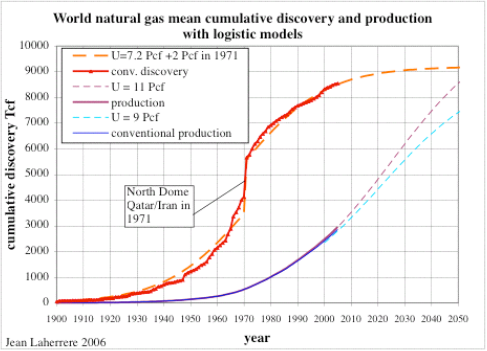
Modelling discovery is also harder, for in 1971 the North Dome gas field was found in the Persian Gulf (shared by Iran and Qatar), totaling circa 1500 Tcf (or 15% of the Ultimate). So Jean took this field out and adjusted a logistic curve to the remaining Cumulative Discovery, which fitted pretty good, and added back North Dome. Modeling it this way the logistic points to an Ultimate over 9000 Tcf; Jean indicates that this number is line with previous assessments that pointed to an Ultimate circa 10 000 Tcf.
Production
To forecast future production Jean added a cycle for Unconventional Gas, with an Ultimate of 2000 Tcf, and two for Conventional Gas: an early one with an Ultimate of 500 Tcf and a peak circa 1980 and another with an Ultimate of 9500 Tcf and a peak circa 2025.
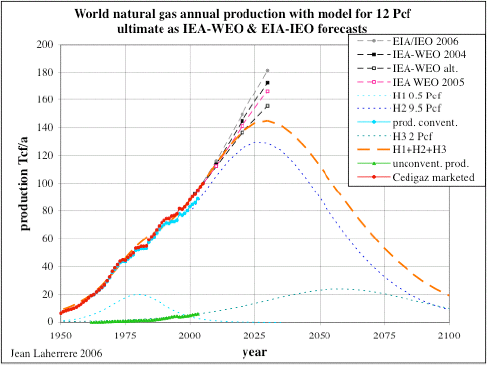
At peak production, All Gas (Conventional + Unconventional) will go over 140 Tcf/y, from the current 97 Tcf/y, an increase of 45% in little more than 20 years. Still, numbers from the IEA or EIA already disagree largely from this assessment, showing that neither of these two institutions is using logistic modeling techniques.
So far so good, right? Wrong. As probably most of TOD readers know, there's no such thing as a World Natural Gas Market, meaning that geographic regions unconnected with gas pipelines must be assessed separately. So does Jean.
North America
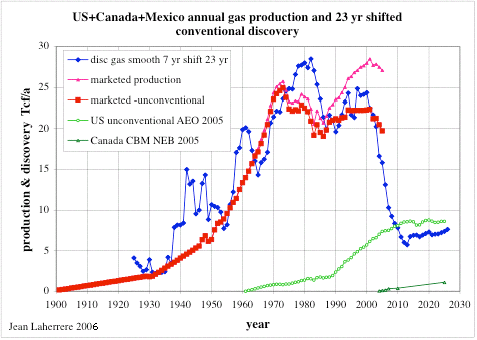
This is when things start looking grim. Production is neatly mirroring Discovery with a 23 year lag. This contrasts to Conventional Oil where the production curve doesn't mimic the discovery the same way. While Conventional Oil production at peak will be around 75 Mb/d, the discovery peak went over 120 Mb/d. Natural Gas Production looks like a smoothed version of Discovery, less noisy, but with the same background trends at the same yearly ratios.
Simply put, by 2010 Conventional Gas production can be half of what is today in North America, falling from 20 Tcf/a to 10 Tcf/a. Jean doesn't hesitate to say that shortages will soon occur in this part of the world. Production already peaked in 2001, declining 5% up to 2005, so a downward trend is already there, but will that cliff unfold? Unconventional Gas production has been rising too slowly to avoid the peak, can it avoid the cliff?
Europe
Europe is yet to go over the peak, and up to now, good neighbours (Algeria and Russia) have been helping sending all the gas asked for. Europe will shortly face its dependency; modeling production with an Ultimate of 750 Tcf, Jean shows this graph:
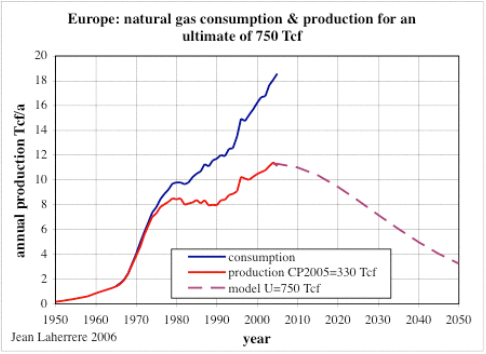
Consumption has been growing at a much sharper pace than Production, which to make matters worse is going into decline.
More good neighbours please.
FSU
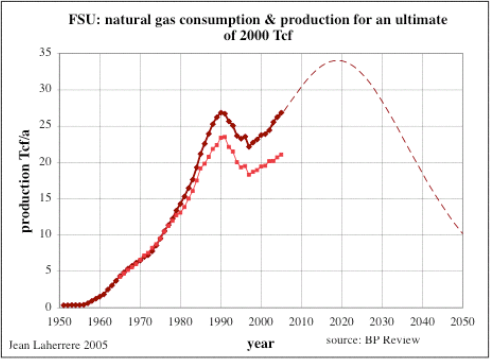
Last but not least Jean looks into production in the FSU, the big neighbour. Jean's estimate for the FSU's Ultimate is 2000 Tcf which means a production peak before 2020. Moreover, in spite of a growth up to a production rate of 35 Tcf/y, internal demand will leave by then a meager 10 Tcf/y to export. Finally Jean casts doubts on the will of Gazprom to make the investments needed to ramp up production in the years to follow.
The Importance of Gas
From Jean's work we get to know that both wealthy sides of the Atlantic are heading for trouble. With Peak Oil in site, all we needed was an even sooner Gas Peak. Let's have a look at what Gas means to our daily life.
First of all Gas is a much more effective way to generate heat at home than using electricity or oil products. Electricity is partially generated from Gas; there are losses in transport and losses in transforming electricity into heat. From Oil we have the overheads of transport and refinement. With Gas we just have a little overhead in transport; there are nearly zero losses and no refining.
Secondly Gas is today the best energy source we have to tackle the daily periodic variations in electricity demand. Whilst Coal and Nuclear provide the base energy, they do not allow for the sharp variations in output required when folks start to wake up or when they arrive from work and turn on all of their electronic gadgetry. Take the following graph, showing the supply and demand put to the Portuguese electric grid on a sample period of two days last Spring:
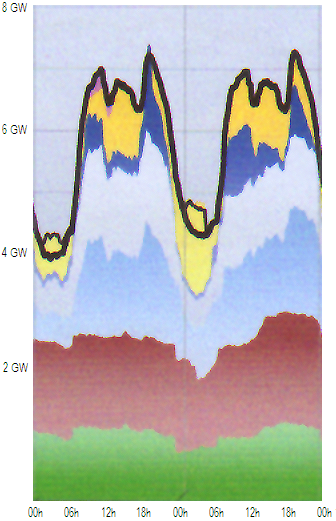
Electricity Demand and Supply on two sample days in Portugal. Red - Coal, light blue - Small Hydro, white - Gas, dark blue - Big Hydro, green - Other Renewable, yellow - Imported (Nuclear), magenta - Diesel Oil, thick black line - Demand.
The electricity generated from Coal keeps quite steady during the course of the day, while Hydro and Gas provide the agility needed to accommodate the variations. During the night cheap Nuclear energy is imported to fill the dams that discharge during the day. Hydroelectric generation is not always possible like this, during the Summer minimum flow has to be maintained and during the Winter maximum flow cannot be surpassed. So the real agility comes from Gas.
The use of Diesel Oil is also possible, recurred to on crisis periods where available Gas isn't enough and direct electricity imports are impossible (such was the case in the morning of the first day). As seen above heat generation from Gas is potentially more effective than from Oil products, making it a cheaper way to generate electricity. When the Diesel power plants are turned on it means that the immediate generating capacity is close to full. These periods are, to my knowledge, still rare. Portugal is probably different from the majority of the other OECD countries, but an interesting case, for every major energy source is used for generating electricity.
Mitigation
Options aren't many; the imminence of the subject makes it hardly solvable with new infrastructure: new pipelines from distant suppliers, new power plants using different sources of energy, more LNG terminal ports and more LNG tankers; they all take time to come on line. This side of the issue has been extensively covered at TOD (here, here, here or here).
We need a gaseous inflammable substance to use in our power plants and to send through the pipelines to our homes. That can be obtained by Coal gasification - what was formerly known as Town Gas. But this option might stump into constraints in the Coal industry, Town Gas might only be the translation of the infrastructure constraints from Gas transport to Coal mining (and gasification).
Still there is some electricity generation capacity from Oil, but it is unlikely that either Europe or North America will be able grow imports much more from what they are now. And of course, for home heating Oil doesn't help much.
The only mitigation option left is Conservation, will it be enough?
Luís de Sousa (fka lads)
Personnel
Editors
Contributors
Peak Oil Primers
Archives
- November 2010 (3)
- October 2010 (6)
- September 2010 (4)
- August 2010 (7)
- July 2010 (6)
- June 2010 (7)
- May 2010 (2)
- April 2010 (8)
- March 2010 (4)
- February 2010 (6)
- January 2010 (3)
- December 2009 (5)
- November 2009 (8)
- October 2009 (12)
- September 2009 (6)
- August 2009 (5)
- July 2009 (11)
- June 2009 (8)
- May 2009 (16)
- April 2009 (10)
- March 2009 (7)
- February 2009 (10)
- January 2009 (15)
- December 2008 (9)
- November 2008 (9)
- October 2008 (9)
- September 2008 (13)
- August 2008 (10)
- July 2008 (14)
- June 2008 (23)
- May 2008 (16)
- April 2008 (12)
- March 2008 (16)
- February 2008 (9)
- January 2008 (13)
- December 2007 (13)
- November 2007 (16)
- October 2007 (22)
- September 2007 (8)
- August 2007 (9)
- July 2007 (16)
- June 2007 (8)
- May 2007 (7)
- April 2007 (7)
- March 2007 (10)
- February 2007 (10)
- January 2007 (12)
- December 2006 (9)
- November 2006 (15)
- October 2006 (4)
- September 2006 (5)
- August 2006 (5)
- July 2006 (9)
- June 2006 (5)
- May 2006 (10)
- April 2006 (9)
- March 2006 (13)
Vital Trivia
License

This work is licensed under a Creative Commons Attribution-Share Alike 3.0 United States License.
The last time we switched gas supplies, from Town Gas to Natural Gas, we changed all of our household burner nozzles to accomodate the different gas calorific value.
I have a belief that it will be different this time. Rather than anerobically heating coal to obtain the gas (and then using the resultant coke for steel production) this time we'll use a pure oxygen entrained flow gasification process to yeild CO and H2 (Town Gas) and ash.
This will produce more gas for a ton of coal but will produce no coke.
Then, instead of changing the huge amount of gas infrastructure we've accumulated since the 60's, what we'll do is use a FT type process to produce methane (aka Natural Gas) with the Town Gas mix.
This will enable us to continue using all of our existing distribution and consumption infrastructure.
I would expect such coal gasification facilities to be based very close to coal import facilities such as the ports at Bristol etc.
I would also expect to see the complete decline of Natural Gas electricity generation. Plus many households may transition onto storage type heating using surplus Nuclear electricity generated during the night.
Of course, that assumes we have the gumption to build new nuclear facilities soon. Which I fear, we may not.
Oh, and we could do with a few million PassivHauses too.
Andy
Empirically it seems to me that changing the nozzles might be less expensive, and it's done just once. Going for methane an EROEI loss would have to be permanently accepted. The problem is that you can't change the nozzles at every place at the same time.
This is a very important observation, though I don't know any system that allows you to do that. Electric companies would have a much easier task if it weren't for the variations on demand from daytime to nighttime. If those curves on the last graph were straight lines instead, a lot of waste would be spared on the switch on/off processes.
This was exactly the problem we had the last time. People aren't allowed to modify or work on gas appliances. It has to be done by an approved technician.
In the 60's there were far fewer users of gas appliances than there are now. The changeover would be immense.
What would drive the decision would be the selling price of the gas. If it is high enough then it will be economical to build FT plants. If not then conversion might be cheaper. Remember what we're effectively doing here is comparing capital costs (for FT or conversion) with ongoing inefficiency costs. History has shown that lower capital costs will win if we can accept the higher running costs. Especially if these can easily be passed on to the final consumer.
There is also another issue with Town Gas. It is very poisonous. The CO content can easily asphyxiate someone if there is a gas leak. Indeed before Natural Gas ovens a common method of suicide was to stick your head in a gas oven and turn on the gas.
With Natural Gas all you get is a splitting headache and you'll maybe pass out, but you won't usually die.
Because of this I think there would be a central government & consumer preference for "safer" natural gas.
That said, I think there is definite scalability issue with this route.
"I would also expect to see the complete decline of Natural Gas electricity generation. Plus many households may transition onto storage type heating using surplus Nuclear electricity generated during the night"
"This is a very important observation, though I don't know any system that allows you to do that."
In the UK there are many common storage heating systems used in houses and flats. Indeed my house used to have a storage type heating system until I ripped it out and threw it in the local dump.
They operate on the priniple of heating up large heavy ceramic bricks and then allowing them to release their heat when electricity is expensive. Unfortunatly they are difficult to control and are ugly to look at.
Mine met their demise due to their age and cosmetics.
I now run direct heat electrical resistance heating. I try not to run it at peak periods.
Andy
What makes them popular of course is the price differential which is about three times higher rate for day vs night electricity usage. And then the underlying reason is that most of the generation comes baseload nuclear and coal. No natural gas in Bulgaria. Hydro is used for balancing, but the need for demand side management to smooth the peaks is also obvious.
Gas is burnt in domestic devices but squirting it through a first nozzle to produce a fast flow, sucking air through an adjacent aperture to mix with the gas by a venturi effect and the passing the mixture through a second nozzle and burning it as it emerges.
In this way you get complete combustion rather than just the hydrogen burning leaving some of the carbon as soot.
The gas air mixture has to emerge from the second nozzle at somewhat higher than the flame propagation velocity in that gas. As the gas spreads out from the nozzle it speed drops to be below the flame velocity. The flame point will stably sit at the distance away from the nozzle that the gas velocity equals the flame velocity.
If the gas emerges too slowly through the nozzle the flame will blow back through it to the first nozzle. If it is too fast the flame front will be too far away from the nozzle and be prone to being blown out by draughts.
I remember our house being changed over. It was done area by area and our house was without gas for about 6 hours while the change was made.
With good pipe insulation the efficiency of such systems can be more than 50% - higher than the efficiency of gasification + F-T conversion. In addition such systems can utilise the waste heat from thermal plants, the fuel maybe waste biomass etc.
With population continuing to concentrate in big cities, I see at least 50% of the households covered by central heating. The main obstacle is that someone will have to commit to spending the huge resources for it, but better do it now, while we are still not pressed to implement partial and ineffective solutions.
Thxs for this very informative keypost. The news is not good, that's for sure. I believe the
best use of natgas going forward is for making fertilizers, not electricity or heat, until relocalized permaculture and full recycling of all possible nutrients is accomplished. This transition to the new lifestyles cannot be accomplished overnight, but will take years to develop.I have posted before that
humans should be quite content with naturally occurring darkness if they understand that this tradeoff means that food and water is still available. This is the best way to reduce postPeak violence levels.The sheer levels of sunlit manual labor required postPeak will make most go straight to bed shortly after sundown anyhow. Recall that I believe 60-75% of the present modern civilizational labor force needs to move in this direction. Fertilizers will be key to farm and garden yields until full organic methods predominate.Vast energy savings can be accomplished virtually overnight if we have the combo of political leadership and citizen will and cooperation. That is why I continue to push for maximum Peakoil Outreach.
Bob Shaw in Phx,Az Are Humans Smarter than Yeast?
http://www.prosefights.org/coal/northantelope/northantelope.htm
This led me to vernon's natural gas posts.
regards
http://www.prosefights.org/shattuck/shattuck.htm
What, other than oil and natural gas, form of energy to make fertilizer do you suggest?
This process may not be economic now but there must come a time when rising oil and gas prices make it so.
My concern is that in the future where are they going to get all of the energy [BTUs] required to blast the overburder and coal? And diesel to transport the coal?
http://www.prosefights.org/coal/northantelope/northantelope.htm#overburden
Its almost impossible to buy glass cups, bowls, etc in the UK now that doesn't have made in Bulgaria, Romania, etc stamped on it.
I'd guess the same is true of the nitrate fertiliser industry too.
So the FSU countries are still exporting the gas, just in value added forms. Which should, in theory, be good for their economies.
Andy
You seem young. You should be dating. Banging girls like Spears. But you wanna get mixed up in this. That makes you crazy.
Other "options" are demand destruction and export of NG-intensive manufacturing processes. We have seen examples of this in the US and UK already, where companies and industries have tmeporarily suspended manufacturing production (ie NG consumption) at times of high prices, or have simply shut down their factories and shifted manufacturing processes to countries with NG in high supply (plastics, fertilisers, etc)
I think we need to look at the composition of demand to understand how much more industrial NG-demand can "offshore" itself, before we get down to the core demand of power generation and space heating
Whether you think that Russian gas will be altogether absent in a couple decades, or that Putin or others will withhold it for political reasons, the simple reaction should be to limit our consumption.
Instead, we push to "liberalize" more, a move guaranteed to structurally encourage investment in gas- (or coal-)fired plants as they are easier and cheaper to finance by the private sector. Insane.
I have yet to hear a politician say we need to use less gas (or less oil).
On the movie "Oil, Some & Mirrors", it is said that today's politicians are mere business men, deciding only on and for quarterly results. That's a remarkable remark.
I'd also note that from Socialists to Christian Democrats, passing through Liberals, the politics are the same: "liberalize".
I have no faith in democratic capitalistic societies to successfully cope with decreasing gross energy supplies.
Their solution is to increase supplies by building pipelines from North Africa and Caspian via Turkey. Increasing number of LNG trains and LNG receiving terminals. It seems like these avenues will satisfy natural gas demands for the medium term barring natural disasters or geo-political crisis.
I'm still trying to understand how a gas crisis in North America will effect Canadian tar sand production.
Does anyone have numbers. Off hand I'd think that NG shortages will probably cause problems.
On a similar vien the thick high sulfur oil use quite a bit of NG for the upgrade process. Agian not sure how much but I'd have to guess its significant.
And finally NG liquids have become a fairly important product in the oil process obviously they will drop as gas production drops.
In North America I assume the response will be to convert to coal for electricity generation. I'm not sure it will be fast enough to prevent shortages though.
Needless to say high natural gas prices will probably cause serious problems for industries that remain in North America.
It sounds like Europe will be right behind North America but its my understanding that Europe does not have the large coal deposits present in North America.
As for the Tar Sands, I've read at TOD comment threads that for each barrel of syn-crude produced 0.7 barrels of oil equivalent are spent in Natural Gas. I'm yet to confirm this from a technical paper, but this is in line with prof. Charlie Hall's assessment of Tar Sands as a net energy looser.
On Coal, in spite of having considerable reserves, the US is importing the stuff, just like it's done here in Europe. Anyway Coal reserves at least in Germany and Britain are still important.
In the end I think the crisis will be felt simultaneously on both sides of the Atlantic and I see both competing for the scarce NGL infrastructure.
Hughes_D_OilSands_Boston_2006.pdf
He had this to say:
Let's take those one by one:
- waste issue - a problem with a number of known and readily available solution. What makes it a problem is the NIMBYsm that does not allow to implement them.
- time-to-build - largely a problem because of licensing and NIMBYsm. Otherwise technological plant construction time is only 3-4 years.
- risk - every technology has its risks, and we have always traded risks for benefits.
- energy transmission to sites ??? This problem for nuclear is trivial compared to hydro or wind (per energy produced of course).
- NIMBYsm - speaks for itself.
So 4 from 6 reasons derive largely from NIMBYsm, and the other two are questionable. Now if we want to bet our energy future on such arguments and leave it to coal to fill the gap, then so be it. I just need to express my disagreement every time I am reminded to where this is pushing us.I can accept the possible need for nuclear power and I think that several styles of reactors are safe and feasible.
On the other hand I'd only support reactors as needed if there was a very strong wind/solar program and location of heavy industry near hydro or other plentiful sources. If at that point we still needed some reactors fine.
I'd much rather see a nuclear reactor than a coal fired plant.
But its insane to use a nuclear reactor to make oil. The concept is simply crazy.
I don't remember anyone suggesting that. Renewables and nuclear will start replacing oil indirectly - by electrifying the transportation, displcing natural gas (which can be used for transportation too) etc. There are many options we know of today, and many more will be invented in the course of action.
One thing I'm sure of - if we start a nuclear program today in 10 years we will be more than happy that we did. I'm not holding my breath though.
Its being suggested by many. The oil sands and shale oil require process heat and hydrogen to mine and upgrade the sludge to something you can put in a gas tank, and its sure more reliable than natural gas.
But liquid fuels will have a place for as far as I can see. Electric planes just arent gonna work.
And before someone makes a statement demonstrating failure to understand quantum nucleonic reactions, I suggest starting here for reference. Note that this is not a real nuclear reactor in that the core material ends in a stable state as a non-radioactive isotope of the original element. These reactors are potentially far lighter and safer than full blown nuclear reactors. These reactors shut down safely if the x-ray bombardment source ceases operation. In other words, there is no critical mass here so no runaway process can occur.
These reactors can be (and are) built today for various purposes. It becomes an engineering and political problem to extend them into application realms where they are not yet applied. These reactors would not eliminate liquid fuel usage in aircraft but they would restrict the need for liquid fuel usage to takeoff and landing. All cruising could be done off the reactor's energy.
Likewise, as I have said to others in the past, an easier application of these reactors would be to power rail. The rail application would be far less sensitive to the weight of the reactor (which is still trivial compared to fission reactors) than an aircraft application.
The potential of these reactors is immense, but like every techno-fix, it relies on additional engineering to make the energy deliverable to humans for use.
This is just one of several technical solutions to the energy needs of humanity. The problem is not with science but rather of political and psychological scope. The question is not whether we can solve these problems, because as this idea and others have show, we clearly have the capability to solve these problems. Rather, the question is whether we will choose to solve them before the problem spirals out of control?
Overpopulation and its attendant side effects including peak oil, are mostly problems of psychological and political will, not problems of science.
Let me join these words. Couldn't have said it better.
A little correction on this one I, I think. The article claims:
Seems that in the end we could be doing without liquid fuels at all. Similar technology could be applied in planes if we manage to develop high-capacity electricity storage, but this is a bit of extension.
Second, do you have any idea how hard it is to 'charge' a nuclear isomer? You might as well just make really big aircraft with a conventional fission reactor on board. Its a hell of a lot easier to synthesize kerosene from limestone and water.
Aircraft will be powered by liquid fuels for at least the next century.
I would even prefer having the grids disturbance emergency power source in the form of (an) additional nuclear reactor(s) and quickly disconectable electrolyzers instead of quick start gas turbines. But this only makes sense if the hydrogen is realy valuble. And if it would make sense I would be greedy and want to keep the old gas turbines anyway. :-)
I think it can make sense to provide the hydrogen part of oil with nuclear power, the carbon can be low quality fossil fuel such as coal or tar sand or from biomass.
Why ? It just brings on more global warming.
The point is that Nuclear Reactors used responsibly are not a bad idea adding to the C02 level is not responsible.
If you don't think we are in a heap of trouble start watching this url.
http://arctic.atmos.uiuc.edu/cryosphere/
Notice the slope of the graph.
We are adding a new ocean to the planet in the next 5 years.
I respect the work people have done on climate modeling but I'm sorry we really don't know what effect this will have on our climate. This is why I don't agree with crop based fuels we can no longer be certain of the productivity of various regions its to big a gamble.
Using nuclear to produce carbon based fuels is not responsible period.
If we are willing to use Nuclear power to stop this insanity then its not a bad thing.
Finally the best use of nuclear I could envision is to produce solar cells and if possible sell the electricity to subsidize solar cell development. Also of course it can be used to power windmill manufactures.
Eventually of course the plants could be decommissioned.
This approach would limit the time period we needed to use nuclear power.
Adding hydrogen from nuclear power to fossil carbon sources gives lower CO2 emissions then hydrogen manufactured from burning fossil carbon togeather with water vapor.
It is of course a lot better to add hydrogen to carbon from plats since you then syntehtisize fuel with atmospheric carbon withouth a need for building equipment that extract CO2 from the atmosphere.
Finding the best use for nuclear power is not the point, the point is to find manny helpfull uses for global warming, peak oil and healthy economical development in general.
Remembering the ice then, I was dumbstruck by pictures I saw of the ice earlier this year.
It was in around the early '70s when a US Coast Guard ship, accompanied by a Canadian ice breaker, made it through the north west passage. It sparked a lot of controversy over sovereignty. The US immediately declared the passage international water.
It wasn't a huge deal because passage was so difficult. None-the-less, Canada increased its presense in the artic to preserve sovereignty.
This year, with the ice pack receding, instead of the US and Canadian governments panicing over the impact of global warming on the ice sheet, they are back squabbling about the north west passage and sovereignty.
The natural gas situation in North America has been weighing much more heavily on my mind than peak oil. It has been becoming clear to me, and the lead post is very comfirming, that we are going to effectively run out of NG in the near term. For a country like Canada, in particular, that is a disaster. When water pipes in homes and businesses freeze, they quickly become uninhabitable.
I'm afraid North America is going to end up out in the cold. There doesn't appear to be time to fix our problems. North America, the US in particular, is being quickly faced with the 'perfect storm.'
Climate change is being translated into very real economic terms in the insurance industry, which has started in the past two weeks to refuse to insure vast coastal areas of the US. That will further exascerbate the looming housing market crash. The housing market is teetering on the edge due to sub-prime mortgages and unsustainable consumer debt.
The US current account is upwards of 6% of GDP on the negative side. That is coming into range of many countries which have defaulted in the past. Its economy is slowing to a standstill and many are calling for recession as early as next quarter. The Economist is saying it may be put off as late as 2009, but it is coming.
Then there is the energy crisis. In particular, NG for which there is not, and likely won't be a liberal global LNG market, nor is there the LNG capacity in NA to make any difference in the short term.
This time around, NA may stand alone in the severity of its problems. It is "stranded" without too many friends. It may not come out of this recession with the economic resources to be able to share in what is left of the fossil fuels of the rest of the world.
As a economically small country and net energy exporter, Canada is not quite as badly off as the US, but we are tied at the hip economically. NAFTA requires us to export to the US 60% of our production levels of the previous three years. We can't preserve our remaining resources for ourselves. If the economy really tanks, it will be interesting to see whether we honour our NAFTA agreements. On the other hand, with the civil unrest that is sure to accompany severe unemployment and energy problems, it will be interesting to see whether the US comes north to protect us and our energy province.
The tar sands, that's what they were called before they became "oil" sands, remain an open question. Alberta doesn't have the water to develop them fully. Canada's north is semi-autonomous and has a lot to say about a) a NG pipe line from the north, and b) taking all the water that flows to the north.
Like other nations that lack the economic resources to develop such enormous projects, Canada has very quietly entered into to Production Sharing Agreements for the tar sands. It is providing employment (at the expense of other provinces), but the royalty on the oil is only 1%.
Peak oil discussion seems to get the lime light in North America (amongst those who pay attention at all), but it looks to me like peak oil will be but the last nail in our coffin.
Thats what I was thinking. And anyone have the numbers on NG used to upgrade heavy sour oils ?
It must be comparable say half or a third of this number ?
Bullshit. I used to love Stuart.He took me srious for about 5 secs.
Now I gotta pimp this shit.
Whatever. My numbers scan. I just have to re-adjust. I own these islands. You fuckers are so slow.
SNOREFEST
An excerpt from an even longer post I did on my little group yesterday...
So, what is useful?
1. First, of course, we should be avoiding waste in everyway possible.
The adaption to efficient lighting and appliences needs to be publicised, and
let people
know that it is a way to save real money. There is already a major program in
place to
organize this:
http://www.energystar.gov
Every home and business should be encouraged to do this. It staggers the mind
as to how
much could be save if all shopping malls, groceries, and discount stores put in
programs
to reduce electric consumption this way.
2. There should be a major effort to use solar where we know it works best, that
is,
thermal heating of hot water beginning in the south and southwest.
3. On home heating, insulation, weather stripping, and possibly "movable
insulation" on
windows and doors should be a major program at all levels of government, and
social
activism among lower income households. In new housing, ground coupled heat
pumps
should be advanced, improved and implemented wherever it can be done. Housing
designs using earth bermed housing, and passive orientation of houses and
business
should be developed for newly constructed homes and businesses.
4. Use of sewer gas and landfill gas for methane capture is a huge possible
opportunity
and developments should continue to implemented.
As we can see, if the above 4 point program were actually implemented, and
understood
to be a national security and prosperity issue, and PUSHED through information
and
advertising, along with some incentive programs, natural gas consumption could
be held
down with no great pain to the public. But we must begin now, and keep the push
on
even when nat gas prices drop.
As we know from the discussion which began this thread, conservation of Diesel
fuel
waste will now have a direct impact on natural gas consumption, along with
improving our
situation on crude oil, a double benefit. The posibility of great savings do in
fact exist.
Recently WalMart began development of new tractor trailers, setting a goal of
cutting
Diesel consumption bu 15% in the next 3 years, and cutting it in half by 2015
http://www.walmartstores.com/GlobalWMStoresWeb/navigate.do?catg=349
Improving Wal-Mart's fleet-wide efficiency by just a single mile per gallon
could save the
company $52 million a year.
If WalMart succeeds, it puts pressure on all of it's competitors to do likewise.
Essentially,
it will create a situation where the higher the Diesel fuel price, the bigger
the competitive
advantage for Walmart. It also relieves some demand side pressure on both Diesel
fuel and
natural gas.
So back to Diesel. Can it be saved? The creativity of the manufacturers will
have to be
very strong, Recently, the French automaker Peugeot-Citroen showed off it's
newest ideas
for Diesel Hybrids. These are claimed to offer as much as 82 miles per gallon
on Diesel
fuel. Ford and Toyota have discussed similiar designs
http://www.businessweek.com/autos/content/mar2006/bw20060328_100063.htm
So, we don't really know where we could be in about 5 years. With the
diversification to
Hybrid Electric/Diesels, the increasing production of bio-Diesel fuels, and
advances in
plug hybrid autos, along with conservation of natural gas, the prices may come
to some
parity. But this still leaves the question: Using plug hybrid technology, the
gasoline, CNG
or LPG auto could be as efficient as a Diesel, but without the noise, smoke,
smell, and slow
acceleration, plus the price premium at purchase. The Diesel auto would still
be very
difficult to justify.
My pet is still LPG/plug hybrid, but of course, there isn't enough LPG for
everyone to have
one of those. That's why I am staying quiet, very quiet, about it....maybe I
can do a
custom one, put a big LPG tank in the yard behind my earth bermed passive and PV
solar
house, and sit back and let everyone else howl....:-)
Roger Conner known to you as ThatsItImout
Good ideas.
I'd also add one thing.
$5.00 tax per incandescent bulb. Would clean up that inefficiency in a hurry. Every time I move into a new apartment it's always incandescent bulbs (inside the apartment), because the landlord pays for the first lightbulbs but the tenants pay for the electricity. $50 takes care of that, but most people probably don't think of it and lose many times that much in electrical costs, to the detriment of all.
Sorry, I have to totally disagree! ok. I agree with your points, but unless you list list population and immigration as your #1 and #2 priorities, all the savings you mention won't matter because new growth or immigration will consume anything you conserve. You might want to conserve when it's economically practical and saves you money, but not just for conservation sake thinking that this is making the situation better... For anyone who lists conservation without mentioning population is just barking up the wrong tree.
Population is our first problem; conservation second.
Quiz question; which will attract the higher carbon tax per unit? I understand natgas is 80% CH4 but town gas is CO + H2 + other stuff. Personally I don't want it to come back. Electricity from renewables and nuclear is the way to go.
As long as I'm writing this, here's some history, courtesy of Perry's Handbook.
Town gas (called producer gas in a steel mill) - made by blowing air and steam thru a fixed bed of coal, result is only about 100 BTU/1000 SCF because of nitrogen content.
Coal gas (sometimes called town gas too) - made in coking ovens. High heat content, usually over 500 BTU/1000 SCF, depending on the coal used.
Water gas (sometimes called town gas too) - made by blowing steam thru white hot coal bed. You have multiple beds and cycle air and steam. Medium heat content, ~ 300 BTU/SCF, because no inerts.
Modern coal gasification - blow oxygen and steam simultaneously thru some kind of coal bed. ~300 BTU/1000 SCF.
The above are listed in ascending investment.
My guess is that almost pure H2 makes for smaller soot deposits then burning mixed H2 and CO and makes it easier to build a low NOx burner when you dont have to care about soot creation in low temperature/lean mixture parts of the flame.
You do realize that the declining NG will be replaced by coal, don't you?
If CTL and other wonder-laden coal tech ever make a dent in our energy supply, we are fooked.
I think you underestimate our current plight, good professor!
I just don't get the logic here. On one hand people say coal cannot compensate for decline rates of oil and gas, which is why PO is such a big problem. Then on the other they suggest coal will compensate for decline, which is also a big problem - but the complete opposite!
Both cannot be true, so which is it? I want to see the full TOD work up with charts and all ;)
Substituting NG for coal doesn't increase coal reserves, they are what they are. We already burn coal as fast as we can mine it, there is not that much scope to increase production. Peak Coal is reasonably estimated to be in the 2040-2050 range.
I can't see a point where we have so much energy that we will leave coal in the ground. That coal will be burnt up eventually, regardless, sooner or later. Does the timing really make that much difference?
If think in terms of true or false, of course they can not both be true. But like always truth is always in the grey area... substituting NG with coal is the easiest, readily available and immediate reaction we are going to see in electricity generation. Actually the process already started.
Substituting oil with coal is much more problematic, and I don't think we are going to see it on such a large scale.
Like you said - there are limits to coal poduction. There are two "buts" here:
- The limits, especially in the US are largely because of overstrained infrastructure. If, not if - when energy shortages begin all the chances are that the necessary investment in infrastructure will be made. Assuming business as usual of course.
- The coal reserves are truly enormous. We have not even tried to tap the reserves under the sea bed for example. Hoping for the "peak coal" to come and save the day is a devil's game.
At the end coal will definately not be able to replace all oil and NG declines. But we certainly can ramp it up enough to make all fears of climatologists come true. The net result for CO2 emissions will most certainly be increase, especially in the medium term.Yes, that's why I said all fossil fuels. In Europe, carbon caps should limit the CO2 emitted by coal fired plants. Might need acts of civil disobedience to prevent it in Texas.
The european approach reminds me of a totally incompetent boss that is determined to set ever higher targets for each quarter. At the same time he is cutting budget, closes most profitable departments, finances departments that do almost nothing and closes his eyes on his accountants cooking the books.
At the end of each quarter when the actual results of course are tragical he is making up some fake reasons and setting up even greater targets.
Anybody find that picture familiar?
Seems doubtful at present.
EC Worried by Forecasts of Russian Oil, Gas Production
Pretty much the same conclusion got by Laherrère: we are at peak, UK production will collapse hereafter. Jean's graph isn't so grim but still quite worrying. Action is needed now either towards conservation or alternatives.
But I should stress that the outlook for the US is even grimmer that this, with a possible plummet from 10 Tcf/a to 5 Tcf/a on conventional gas production.
http://www.aspo-ireland.org/newsletter/en/pdf/Newsletter72.pdf
Because our politicians, faced with reality, are panicking and looking for scapegoats to blame for their incompetence and lack of preparedness.
The UK seems to be squared away with Norwegian gas, France with African U - but what about Germany and Italy?
France has Norwegian, Russian, Dutch, Algerian and Egyptian gas, in that order, all under long term contracts.
Germany and Italy have a lot of Russian gas, all under long term contracts, and Gazprom is quite reliable (a lot more than Russia, and a lot more than the Kremlin. Nobody seems to have noted that in early 2006 Gazprom restored deliveries despite the fact that no agreement had been found with Ukraine, and after Putin had been forced into the fray, against his will, to support the brinkmanship of some of his lieutemants against Ukraine). Germany also has Norwegian and Dutch; Italy has Algerian plus quite a bit of LNG.
From eyeballing the ASPO graphs, UK natural gas production will decrease by about 45% from 2006 to 2010. And, by the looks of it, that makes up the majority of the total European fall of 18% in the same period.
So the question is, is there enough extra gas / LNG around to cover this fall?
Peter.
Realistically a graph that predicts no peak for 30 years gets no action because its way beyond their term and things are too uncertain (hello CO2).
A graph that predicts a peak in ten years might get a bit of notice - but only if there is little uncertainty and planned actions don't hurt party chances (hello Mr Carter).
A graph that predicts a peak in three years will get attention, but unless there is a politically acceptable route to maintaining current standards of living at acceptable cost (hello Hydrogen) - most of the action will be in making sure there is someone else to blame (hello OPEC and big oil).
A graph that shows a peak now, particularly if its new, will be ignored as scaremongering. TV movies will be made.
A graph that shows a peak 2 years in the past is too late to do anything other than give clues as to future decline rates, policy is made in a reactionary manner.
Policy isn't made off graphs.
Urged by relatively high ng prices, the us has already shifted 85% of us land rigs to ng production, so we do not have additional rigs to either wildcat for new fields or stick new straws into old ones. We are running flat out but production is declining because new wells produce less initially, and decline much faster, than those drilled a few years ago.
Meanwhile, almost all new power plants run on ng. Helping a little is the rush to move fertilizer and plastics precursor plants overseas, say qatar, where gas is cheaper, and helping a lot has been last year's mild weather. Even an average winter will cause a major problem. Note, for example, that we ended last winter with 700bcf more in storage than the year earlier, but entered this winter with only 200bcf more that nov 05. So, 500bcf of our surplus disappeared over 8 months due to a combination of higher non-winter consumption and reduced production.
LNG will not save us in the near term, it takes years to build the trains and ships, and virtually all lng is sold on long term contracts, mostly to japan/korea.
The us is already using less than it used to, but will have to conserve much more. IMO, tptb are not doing what they should be doing to prepare the country for the new epoch. Individuals can adjust now to reduced consumption and buy oil/ng shares, in both cases avoiding the rush.
We should remember that the weather plays a dominant role in natural gas supply/demand picture. Around November of 2005, there was great concern about the North American NG situation due to slightly declining production since 2001. NG prices went to record levels. However, the winter in North America was so exceptionally mild last year that it completely underwhelmed the lower supply, and allowed inventories to build to record levels. A lot will depend this year on what kind of a winter we have.
Luis/khebab/whoever! - do you think you could find out who might be able to do this?
Not that you haven't done good work!
Coincidence?
Not a coincidence, but because Dr. Duncan is a
vastly underratedpredictive genius on the same scale as M. King Hubbert.Bob Shaw in Phx,Az Are Humans Smarter than Yeast?
The timing of the two charts are nearly identical.
Its interesting that the updated Olduvai chart removed the "slide" and went directly to the "cliff". Now I know why the change was made.
Until I seriously read this site, I never understood the significance of the value of hydrogen in natural gas. I thought you just burnt NG for the heat!
Thank you for your reply, and input to this site.
It has to do with availability of electrical power. And that being the basis of modern civilization.
Since a good deal of electricity is generated with NG, a rapid decline of NG could be extrapolated to reduced electrical power gereration.
The downslope of the above chart jives with the Olduvai Cliff.
You could add a third reason, (3) gas is directly responsibly for keeping more people alive than oil is via heating.
Higher prices are bringing forward projects that would otherwise have begun at a later date, evidenced by the fact that 85% of us land rigs are looking for ng, only 15% for oil. So, the fall will be steeper than otherwise, and it looks as if it has begun.
I'm sure we are all reducing our energy footprint and investing in smaller e&p's still able to grow reserves, such as ard/gpor/gmxr. Well, I am.
lng is not coming to the rescue before 2010 because it takes longer than that to build the infrastructure, which is not yet on order, excepting what is needed for the new terminal south of san diego, meaning that southern ca might not be as bad as some regions.
This probably explaines part of the intrest in the natural gas using part if Swedish industry for Norwegian or Russian gas or even LNG. Natural gas is also used as wehicle fuel but the main buz for and building of such infrastructure is for fermented biogas of wich about 15 TWh might be possible. The current natural gas import is about 10 TWh but will increase du to the building of a few about 100 MW gas turbine combined heat and power plants. And it gives a new light to the intrest for building a wood gasification plant next to the new natural gas using heat and power plant in Göteborg.
First, forget worrying about how to keep personal automobile use going. It is going to die as the biggest energy waster we have. We need to try to push the options NOW. In Europe you still have the rail infrastructure to build on. Here in Canada we are SOL and if we do rebuild rail it will cost a fortune. Perhaps the best idea we can steal is the Cuban Camel bus. Maybe we can learn how to heat the trailer.
Second, world population reduction is going to happen in either an ugly or slow way. Economic migration is generally going to make the problem worse in Europe and I can't understand why the UK can add to its population now when in 25 years it will be reducing (ugly or nicely) big time. That is not a racist view but practical. We need to try and help the Poor Starving World (what spin doctor invented the sanitary "3rd World" label?)to obtain a real subsistant level and reverse population growth. In this case all the Pope's over the past 40 years ought to be charged with crime's against humanity for opposing birth control, which would have helped control STDs as well. We can throw in a few fundamental facist protestants from north america into that bin too. It looks better on the TV ads to be handing out school books and a new tin cup to smiling little orphan girls from Zimbabwe than to be giving boxes to condoms to her parents. It is probably too late now anyway. The naural gas based surpluse grain aid from north america will be stopping soon, bought by the hungry first and second world and then no surplus at all.
I said this was a rant. It is good to get the technical analysis of supply and demand for gas and oil, knowing is always better, but the Chevy is headed for the cliff,we aren't driving and the sun is in the driver's eyes.
The same was said about slavery in the Americas.
The world suffers from a population problem that will very soon get much worse because more people are being born, mostly in the third world, and resources are waning. The best way to combat this locally is to limit immigration, imo something long overdue in the us and, by all reports, this view is shared by most in europe (US population is growing 1%/year, but would be stable in the absence of immigration). THe best way to combat this globally is to ship birth control of all types to the third world; all other shipments, eg food and medicine, are counter productive and increase the misery index because they already have more people than their regions can support. Aids cocktails do help spread the disease but are a miserable and expensive form of birth control.
"The best way to combat this locally..."
If you don't understand the fundamental problem with this worldview, I can't help you.
"That is not a racist view but practical. "
The same was said about slavery in the Americas.
If that isn't what you meant then please explain.
Coal reserves are adequate for centuries of current use and there are extensive pine plantations for biomass generation.
On the other hand they might have to mine and razor wire the beaches to keep the dust bowl Aussie refugees out.
But seriously, buses have to be the most over-looked and under-valued component in reducing dependence on private autos. See George Monbiot's piece in today's Guardian:
http://www.guardian.co.uk/commentisfree/story/0,,1963958,00.html
Much as I love to use trams and metros when I'm visiting "real cities", I can't in good conscience endorse my own city's (Madison, WI) nascent streetcar and light-rail movements: We already have buses in place and the capital expense of expanding the bus fleet is negligible compared to a single streetcar line.
But the problem is that us white upper-middle-class office workers (the people in all those 1-passenger SUVs flooding the main streets twice a day) won't ride the bus: buses are for obnoxious poor people and for students.
Of course it has to be noted that there's a huge chicken/egg factor at work too: the current miserly routing and frequency of bus service means that it takes at least twice as many minutes to get from point A to point B by bus as by car, when it's even possible...
Larry
Go rail. It's hugely more efficient.
Merchandise transport, by road
Air transport
Passenger transport, by road
River transport
Package delivery
Public urban transport
Rail transport
More graphs and discussion here.
How do you separate package delivery from road, air and rail transport?
And maybe of course the non-fuel operating expenses of French rail might be sky high - train driver 100,000 E per year?
Fuel costs for air: 15%?
It must be those expensive security-controls..
The ONLY good thing about our being SO wasteful here in the US is that there are a lot of steps that can easily be taken---at least in the first stages of the coming gas crisis.
One is closing off rooms, not heating them. Another is using electric heat in one small well-insulated room. And even there, wearing thick clothing.
I live in a 69 unit condo and started talking about these things after the zoom up after Katrina, but after prices came back down I had to shut up. But I talk to myself a lot just to keep my mouth in good condition so I can start spouting again when the zoom resumes.
It works out well--we spend a little extra on electricity and save considerably more on natural gas. About the only downside is the reaction of unexpected visitors during the day--they step into the house and wonder why it's only 55F inside.
My guess, those able to pay the most will get the gas leaving east and central European states struggling perhaps? Not necessarily a good thing for European security. I also think the UK will need to join the Euro - to ensure our ability to pay.
Here we are with weather in the UK in Decemeber that is exceptionally warm, demand low, but during this 24 hour period, according to Bloomberg, supply will be below demand. I hate to think what will happen if we have a 2 or 3 week period of temperatures below zero that were common 15- 20 years ago. But then again perhaps its what we need sooner rather than later as a wake up call to a population that hasn't a clue.
There are various conditioons imposed on governments which join the Euro. Is the UK likely to be able to meet them when the time comes?
Peter.
Given the debt level, and the fact that "growth" has really been driven by growing debt, I think if we get to "very high interest rates" the UK economy will already be stone dead - with collapsing property prices and equities.
However, you are right that joining the Euro would not insure our ability to pay, and you are probably also right to point out that any window of joining opportunity may already be past. I just feel that going forward, the UK may be in better shape if we didn't have to worry so much about a sinking pound - making everything we import more expensive - and that will include growing imports of oil and gas.
The point you make about Euro rules and trade deficit is a good one - maybe we can never join?
Peter.
As for the €, I too think the UK would benefit in the mid/long term, but that would be the coupe de grâce to the $.
I could replace my existing forced-air gas furnace with a higher-efficiency condensing unit. But will NG be commercially available in 10-20 years time with which to heat my house?
I heat with gas too, and have been busy this fall insulating my 111 year old house. Blown in Cellulose in all the wall cavities, and 10" additional in the attic (on top of the 4" of rock wool that was there).
Installed a Programmable thermostat as well.
I want to replace my Hot Water tank with an "instant-on" model, but do worry about spending $3000 ($2000 on installation) if supply is going to become an issue. Home heat should be top priority, so I figure we'll have 20 years supply at least.
Still need to insulate the basement ceiling, and last will be windows.
It's expensive saving money! :)
Every spray product I've been able to find costs a small fortune, several times as much per R-unit as rigid board.
Date 2006 2005 2004 2003
22-Jul-05 -7 39 70 81
29-Jul-05 19 37 83 76
05-Aug-05 -12 43 72 84
12-Aug-05 37 52 78 77
19-Aug-05 57 60 84 53
26-Aug-05 48 58 81 67
02-Sep-05 71 36 80 99
09-Sep-05 108 89 99 101
16-Sep-05 93 74 68 100
23-Sep-05 77 53 69 101
30-Sep-05 73 44 81 84
07-Oct-05 62 58 67 77
14-Oct-05 53 75 64 85
21-Oct-05 19 77 26 55
28-Oct-05 -9 29 44 34
04-Nov-05 -7 61 34 32
11-Nov-05 5 53 -6 -32
18-Nov-05 -1 -8 -17 -1
25-Nov-05 -32 -49 -5 -59
sum 654 881 1072 1114
Kind of scary, however if you look at the previous 4 years not so bad.
Date 2002 2001 2000 1999
22-Jul-05 48 77 46 40
29-Jul-05 33 68 57 25
05-Aug-05 53 75 58 41
12-Aug-05 37 46 44 47
19-Aug-05 59 85 47 47
26-Aug-05 65 74 44 67
02-Sep-05 74 76 34 63
09-Sep-05 69 97 69 80
16-Sep-05 66 91 64 76
23-Sep-05 48 93 74 77
30-Sep-05 42 68 74 62
07-Oct-05 48 73 61 56
14-Oct-05 33 70 27 49
21-Oct-05 11 32 70 20
28-Oct-05 -27 32 69 10
04-Nov-05 -48 20 35 20
11-Nov-05 -1 35 -4 17
18-Nov-05 -49 33 -90 -15
25-Nov-05 -91 30 -148 13
sum 470 1175 631 795
If the US has a cold winter and a hot summer it is unlikely the summer build next year will carry us through the next winter.
I know of a few problems. The release of methane from the hydrates is endothermic, requiring added heat. And accidental release of the methane into the atmosphere could significantly accelerate global warming.
I have heard Japan is working to exploit this resource, and that leads me to believe that there is some prospect of success. Does anyone know anything more about what is being done, and why it may or may not succeed?
I'd have to guess it easier to exhaust our stranded NG reserves first. Next these deposits are basically stranded gas so liquidification is needed.
Since methane is lighter than air I had the idea of filling huge blimps and piloting them to where the gas is needed.
CH4 + 3O2 -> CO2 + 2H2O
What the heck do they teach in highschool these days?
Title: FIRE FROM ICE.
Authors: Stone, Alex
Source: Discover; May 2004, Vol. 25 Issue 5
I can't get a copy right now, because they're misers and won't provide full access to their journal even though my university subscribes for up-to-date full-text. However, I did read the article in the bookstore way back when, and it more or less said that there are all kinds of technical difficulties associated with extracting the stuff off the seabed and nobody has even figured out how to do it yet with a continuous process or on any kind of scale, let alone do it economically. I think there was something else about how it also comes up as a gooey, half-frozen bacterial mass. In short, fat chance that it will help with anything except accelerating global warming if (/when?) the oceans heat up to that depth.
I have tried the model on New Zealand NG and no reason that it wouldn't work on USA NG as well, but I don't like to see any artificial pre-processing of the data.
http://mobjectivist.blogspot.com/2005/11/new-zealand-natural-gas-peak-model.html
In any case, tonight I did give the USA conventional NG data (discovery and production) a shot with fallow, construction, maturation, and depletion rates of 0.133/year (which is a fairly standard 7.5 year mean) and I got the following dark line fit:

What do the 0.133 numbers physically mean? In a stochastic world, all it means that it takes, on the average, about 7.5 years to start work on a discovered field, 7.5 years to get construction finished, 7.5 years for it to reach maturation, and simultaneously add in a depletion rate of 0.133 volume per year. The aggregation of these terms is what causes the discovery profile to shift approximately 23 years to match the production profile. Understand that this analysis does not necessarily work on individual fields, but to first order (a Markovian process) it does explain everything you need to know on an aggregated set of fields, any one of which can vary according to its own specific numbers.
The deterministic, or shock, aspects to the model come about when political or economic effects are taken into account. Even though I did not add it to this particular model, rapid changes, due to collusion or world events or technology, can cause the extraction rate to adjust at certain points in the curve. This allows one to get insight into deviations from the general trend.
From the residual errors, you can see max deviations around depression/WWII, 1971, 1984, and 2000. These are candidate time points for introducing changes in the extraction rate.

'The Foundation I am consulting for will be funding ($1 billion/5 yrs) for building solar-hydrogen power plants to connect to the grid to replace the coal fired plants."
"solar-hydrogen?" Where does the hydrogen come from? What energy source?
best bill
Warren "Although, the refineries right now use over 4 billion cu. ft. of hydrogen via catalytic "cracking" of natural gas in their refinery processing of oil.
4 billion cu. ft per ? Day? Month? Year?
thanks
bill
Subject: Re: peak natural gas(6)
Bill: It is all in the terminology. The electric power comes from the sun either as windmill, solar Stirling engine or PV cells. The windmill power is the cheapest of any electric source. The North Dakota Electric Cooperative is building a large windmill-to-hydrogen power source.
The hydrogen comes from the electrolysis of water. Although, the refineries right now use over 4 billion cu. ft. of hydrogen via catalytic "cracking" of natural gas in their refinery processing of oil.
This is the pathway for the solar-hydrogen economy. Warren
wanna invest?
Did anyone else notice the change in the EIA website on Candian natural gas production?
About 6 months ago I was browsing their site, and in the natural gas section for Canada, it stated that at current rates of usage, only 8.6 years of natural gas remain under the ground.
A few weeks ago I visited the site again and that bit of information was gone.
Maybe BC offshore gas is looking more and more likely to come online, or could it be they just don't want to scare anyone off getting a NG hot water tank installed in their home...
Also, does anyone know the particulars of the energy agreement with the USA in NAFTA? Is it true that Canada is obliged to sell NG to the USA regardless of our production levels?