


Council on Foreign Relations -"National Security Consequences of Oil Dependency"
Posted by nate hagens on December 5, 2006 - 4:05pm
This post is a general summary of the report, along with some interspersed comments and conclusions.
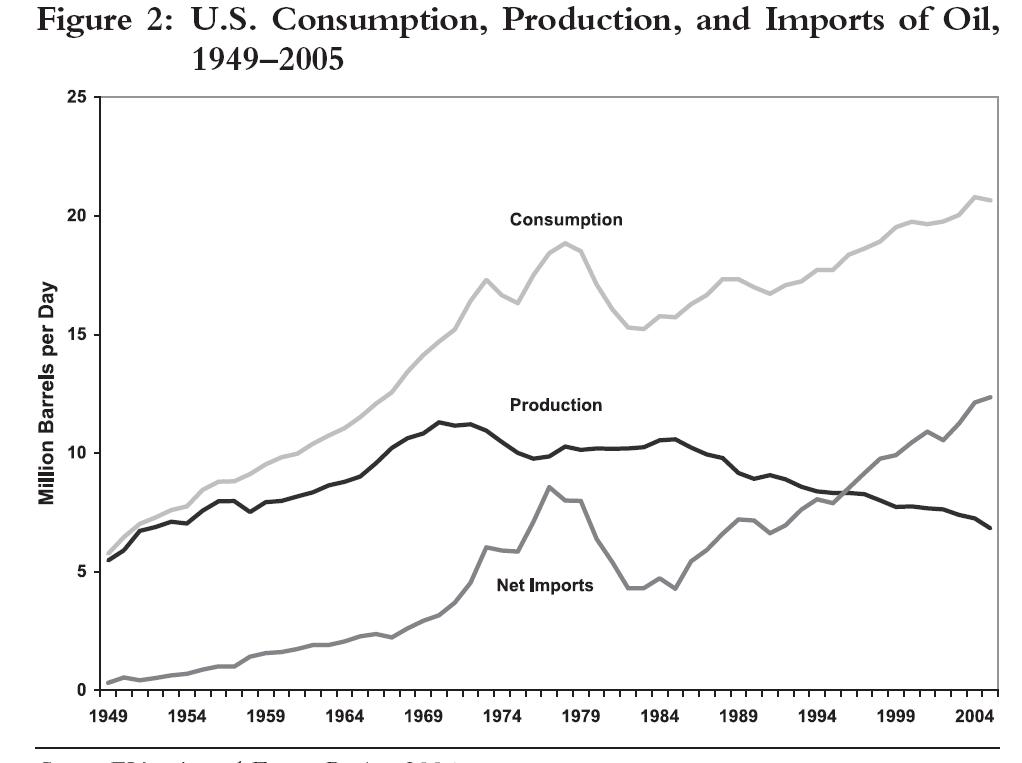
Our oil import dependency(pg. 31) (Click to enlarge)
Our ever vigilant energy/environment media hawk Leanan first posted a reference to this story here, but because of travel it wasnt until a few days ago that I had a chance to review the 90 page document. In my opininon, this is a watershed report, not so much for new analysis or information, but for the fact that a respected mainstream organization such as Council on Foreign Relations implies that the invisible hand of the market will not solve our energy problem.
INDEPENDENT TASK FORCE REPORT #58
The grey boxes below are quotes from the report, which is well worth reading.
"Founded in 1921, the Council on Foreign Relations is an independent, national membership organization and a nonpartisan center for scholars dedicated to producing and disseminating ideas so that individuals and corporate members, as well as policymakers, journalists, students and interested citizens in the United States and other countries, can better understand the world and the foreign policy choices facing the United States and other governments. The Council does this by convening meetings; conducting a wide-ranging Studies program; publishing Foreign Affairs; the preeminent journal covering international affairs and U.S. foreign policy; maintaining a diverse membership; sponsoring Independent Task Forces; and providing up-to-date information about the world an U.S. foreign policy on the Council's website, www.cfr.org.THE COUNCIL TAKES NO INSTITUTIONAL POSITION ON POLICY ISSUES AND HAS NO AFFILIATION WITH THE U.S. GOVERNMENT. ALL STATEMENTS OF FACT AND EXPRESSIONS OF OPINION CONTAINTED IN ITS PUBLICATIONS ARE THE SOLE RESPONSIBILITY OF THE AUTHOR OR AUTHORS
The council will sponsor an Independent Task Force when (1) an issue of current and critical importance to U.S. foreign policy arises, and (2) it seems that a group diverse in backgrounds and perspectives may, nonetheless, be able to reach a meaningful consensus on a policy through private and nonpartisan deliberations. Typically, a Task Force meets between two and five times over a brief period to ensure the relevance of its work.
...Task Force Reports reflect a strong and meaningful policy consensus, with Task Force members endorsing the general policy thrust and judgements reached by the group, though not necessarily every finding and recommendation. Task Force members who join the consensus may submit additional or dissenting views, which are included in the final report...."
It seems that our dependence on oil and natural gas was deemed a current and critical enough issue to convene a Task Force (#58), chaired by John Deutsch and James Schlesinger and directed by Stanford Professor David Victor. The Task Force itself was comprised of 27 members who read like a whos who of American politics and industry. In the Foreward to the Report, CFR President Richard Haass makes the following profound remarks (emphasis added):
In recent years, energy prices have surged. President George W. Bush, in this year's State of the Union address, warned of an addiction to imported oil and its perils. Yet there is no consensus on what should be done to shake the addiction. Virtually everything concerning energy has changed - except U.S. policy.The Council on Foreign Relations established an Independent Task Force to examine the consequences of dependence on imported energy for U.S. foreign policy. Since the United States both consumes and imports more oil than any other country, the Task Force has concentrated its deliberations on matters of petroleum. In so doing, it reaches a sobering but inescapable judgement: the lack of sustained attention to energy issues is undercutting U.S. foreign policy and national security.
The Task Force goes on to argue that U.S. energy policy has been plagued by myths, such as the feasibility of achieving "energy independence" through increased drilling or anything else. For the next few decades, the challenge facing the United States is to become better equipped to manage its dependencies rather than pursue the chimera of independence.
Though they appeal to different crowds, it seems Richard Haass shares some common ground with Richard Heinberg.
OVERVIEW AND INTRODUCTION
The Overview of this report is excellent. Here are some excerpts:
The challenge over the next several decades is to manage the consequences of unavoidable dependence on oil and gas that is traded in world markets and to begin the transition to an economy that relies less on petroleum. The longer the delay, the greater will be the subsequent trauma. For the United States, with 4.6 percent of the world's population using 25% of the world's oil, the transition could be especially disruptive.During the next twenty years (and quite probably beyond), it is infeasible to eliminate the nation's dependence on foreign energy sources. The voices that espouse "energy independence" are doing the nation a disservice by focusing on a goal that is unachievable over the foreseeable future and that encourages the adoption of inefficient and counterproductive policies. Indeed, during the next two decades, it is unlikely that the United States will be able to make a sharp reduction in its dependence on imports, which currently stand at 60% of consumption. The central task for the next two decades must be to manage the consequences of dependence on oil, not to pretend the United States can eliminate it.
This is eloquent and spot on. It is both easy and appealing to believe that we can replace our hydrocarbon usage, but such a belief takes away both the urgency and the drive that urgency creates. It was refreshing to read such frank language from a senior policy missive.
For the last three decades, the United States has correctly followed a policy strategy that, in large measure, has stressed the importance of markets. Energy markets, however, do not operate in an economically perfect and transparent manner. For example, the Organization of Petroleum Exporting Countries (OPEC), quite notably, seeks to act as a cartel. Most oil and gas resources are controlled by state-run companies, some of which enter into supply contracts with consumer countries that are accompanied by political arrangements that distort the proper functioning of the market. These agreements, such as those spearheaded by the Chinese government in oil-rich countries across Africa and elsewhere, reflect many intentions, including the desire to "lock up" particular supplies for the Chinese market. Some of the state companies that control these resources are inefficient, which imposes further costs on the world market. And, some governments use the revenues from hydrocarbon sales for political purposes that harm U.S. interests. Because of these realities, an active public policy is needed to correct these market failures that harm U.S. economic and national security. The market will not automatically deliver the best outcome.
Admission that the market has been an appropriate mechanism historically for energy but may not be so in the future was mentioned several times in this report. For a country built on the invisible hand, this is kind of a radical suggestion (though one I agree with).
The Introduction layed out several policy suggestions which were then detailed in the report. Among them were adopting a mix of gasoline taxes, stricter CAFE standards and gasoline rationing system that would cap the total gasoline consumed in the nation. The Report also advocated removal of worldwide subsidies for oil consumption, removing the protectionist tariff on imported ethanol, reducing oil infrastructure vulnerability, helping oil producing countries better manage their oil revenues, and the creation of an Energy Security directorate within the National Security Staff to coordinate interagency energy policy. It also concluded with a paragraph on global warming, stating that this was an important international policy issue but beyond the scope of this Task Force, other than that many of the answers to reducing carbon emissions were also answers for reducing oil dependency. The lead author, David Victor, had previously written another Report specifically on climate change.
FINDINGS: THE US ENERGY SYSTEM AND THE ROLE OF IMPORTED OIL AND GAS
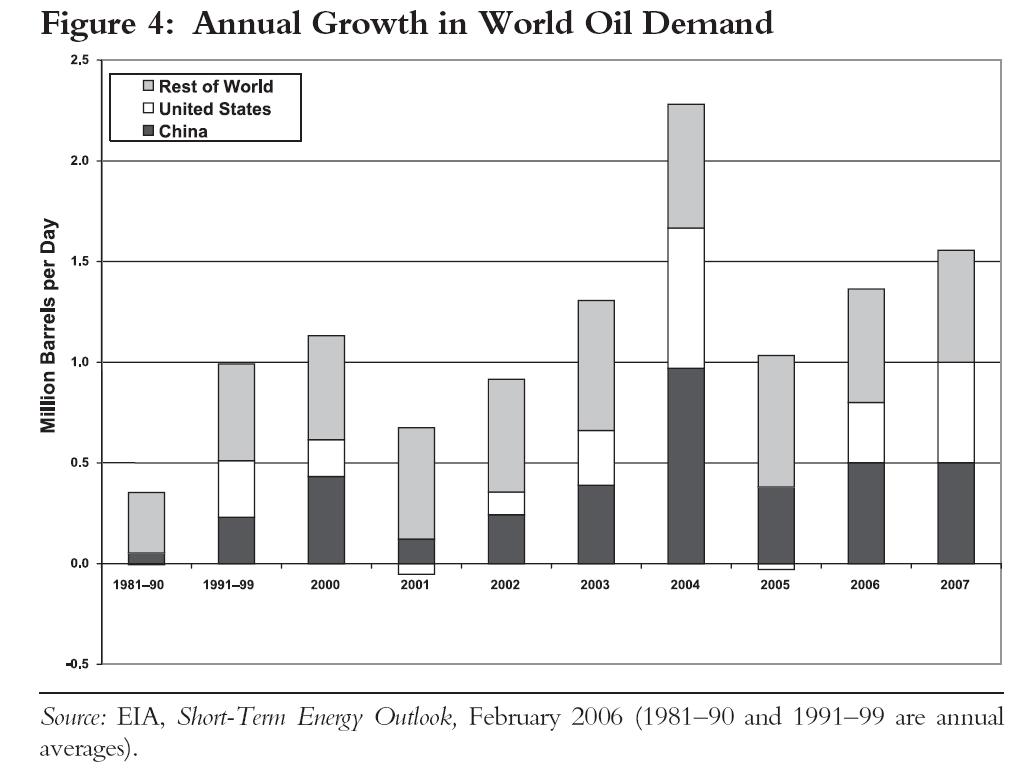
US Oil Imports vs Exports(pg. 31) (Click to enlarge)
One of the things I liked about this report was how bluntly they stated that their conclusions differed from some of the conventional energy rhetoric that has been common in the media recently. Given the large group of intelligent, connected people on the Task Force, this means these ideas will be gaining traction with our decisionmakers. They outline several 'myths' about energy along with supporting discussion:
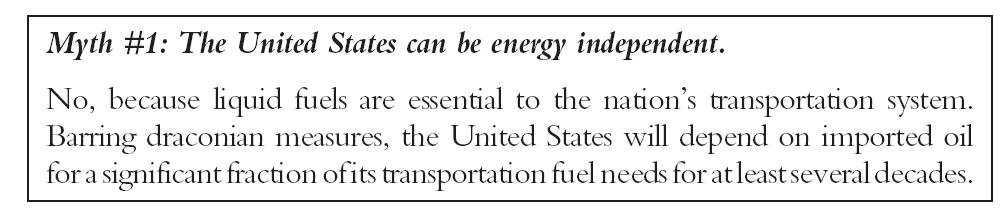
The report points out that, concerned about increases in oil imports to 50% of consumption in the 1970s, US curtailed consumption to only require 1/3 imports. However, this trend has reversed and our infrastructure is so dependent on oil, that coupled with continued declines in domestic production, import dependency is above 60% and expected to rise in the coming decades.

In other words, cutting demand is the key to reducing import dependency.
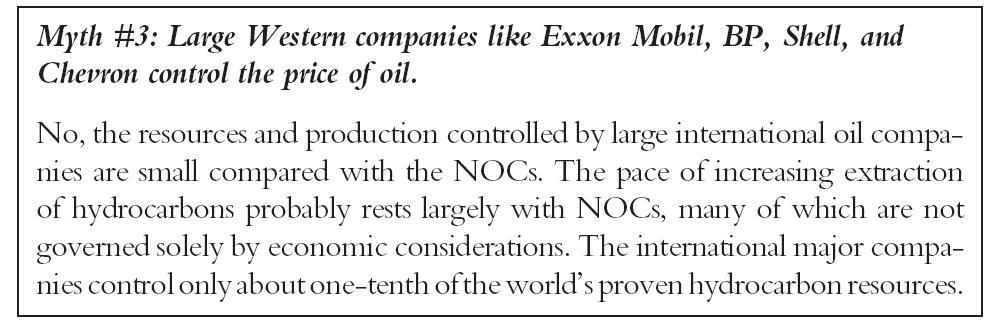
This was a big takeaway from the report for me. The fact that 90% of world reserves are controlled by National Oil Companies as opposed to market-incentivized public companies, belies the fact that dollar per barrel pricing will not necessarily dictate world oil flows. Publicly traded oil behemoth Exxon Mobil is only ranked 14th in proven reserves (below 13 national oil companies). An important distinction between public and private energy ownership, along nationalistic boundaries, seemed to be a big concern of the authors. With a nations security one day on the line, can oil importing countries rely on oil exporters to accept money in trade for energy?
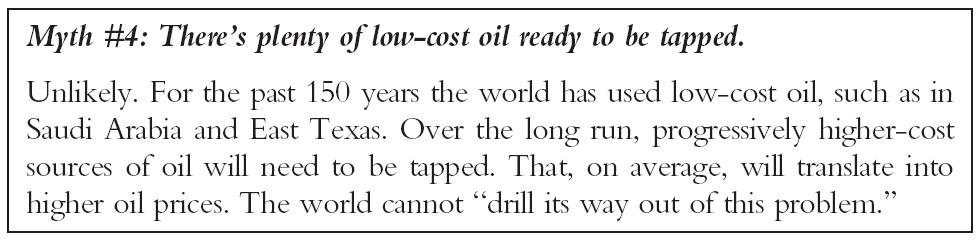
This has been a central them at theoildrum.com, and really the underlying logic of Peak Oil. There is a difference between productive capacity and actual production, and politics will couple with geology to dictate that spread. Also, as was discussed here, the 'best-first' principle will result in both higher prices and resources being taken away from the non-energy sector as we move into the second half of the age of oil. Net energy analysis should be incorporated into future energy policy discussions.

These topics have been the bread and butter discussions here at the oildrum.com. The Report was very clear that nuclear power will be a vital part of our energy future and needs to be increased in its % of the overall power mix.
FINDINGS AND RECOMMENDATIONS: THE CONDUCT OF US FOREIGN POLICY
In the concluding section, the CFR Task Force suggest five goals, with supporting actions for each, on how to manage our dependence on hydrocarbon fuels while pursuing our foreign policy aims simultaneously.
Expand Sources of Oil and Gas Production and Protect Transit Routes of These Fuels to MarketsEncourage Efficiency of Energy Use in All Markets
Promote the Proper Functioning and Efficiency of Integrated Energy Markets
Revitalize International Institutions and Collective International Efforts
Integrate Energy Issues into US Foreign Policy Apparatus
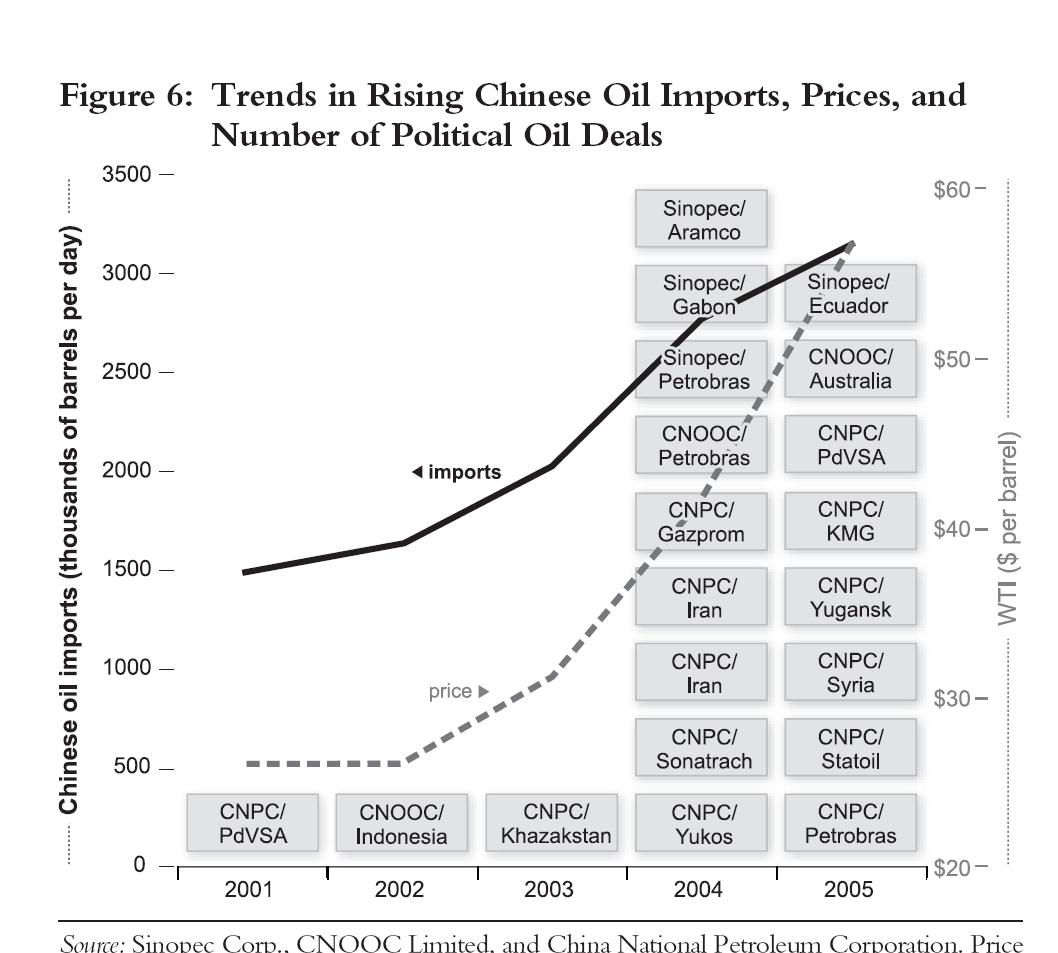
Several pages were devoted to the foreign affairs implications of developed and developing nations signing long term contracts for oil, thus removing this portion from the openly bid for export market. Of particular concern was Chinas locking up of long term contracts, and the rate at which this is accelerating.
The Reports conclusion was really laid out in the Overview and rehashed briefly at the end. Following the concluding comments, two Task Force members, Michael Granoff (CEO of Pomona Capital) and David Goldwyn (President of Goldwyn International), offered an 'Additional View', which is transcribed below (it has a particularly hawkish and urgent tone).
We subscribe to the report's analysis and recommendations, but the report understates the gravity of the threat that energy dependence poses to U.S. national security.Energy is a central challenge to U.S. foreign policy, not simply one of many challenges. Global dependence on oil is rapidly eroding U.S. power and influence because oil is a strategic commodity largely controlled by regressive governments and a cartel that raises prices and multiplies the rents that flow to oil producers. These rents have enriched and emboldened Iran, enabled President Vladimir Putin to undermine Russia's democracy, entrenched regressive autocrats in Africa, forestalled action against genocide in Sudan, and facilitated Venezuala's campaign against free trade in the Americas. Most gravely, oil consumers are in effect financing both sides of the war on terrorism.
Transformation in the use of energy, especially in transportation where oil is unrivaled, in our government's approach to energy research, development, and deployment, and in the way we conduct our foreign policy, is essential. Achieving this transformation requires efforts on at least three fronts.
First we must integrate energy and foreign policy. For example, we must engage China and India at a presidential level on the impact of their investment practices on regional stability and our common interest in a free market for energy; we must engage Europe on its growing dependence on Russian energy exports and Russia's monopolistic practices. We must also consider asymmetrical means, like support for power and water infrastructure to compete for political influence in Latin America and Africa.
Second, the United States must expand and deepen the collective energy security system forged by the United States and institutionalized in the International Energy Agency in 1974 - not least by bringing China and India into the system. The report endorses this effort but is not sufficiently precise on the best methods; it suggests that the International Energy Forum could be tapped, but that institution is ill-suited as it allows oil producers a veto on its activities.
Third, the United States should use its economic power as a component of its energy strategy. For example, we should consider ways to give preferential access to the U.S. market to producing countries that support a free market in energy. This instrument is blunt and difficult to wield, but among the steps we can take are to make access to energy transportation systems a condition of any new free trade agreement with the United States; limit the ability to access and invest in liquefied natural gas re-gasification facilities on U.S. soil to exporting countries whose markets are also open to U.S. investments; and pursuit of rules to govern fair access and competition within the energy sector as a priority in the next World Trade Organization negotiating round.
All told, an incremental approach to the challenge - as advocated in this report - will not be adequate.
THE BOTTOM LINE
This report did not contain a great deal of new energy information for a frequent viewer of this website. However, the fact that such a powerful group of people delved deeply into the Peak Oil issues, even if it fell under the guise of national security, gives me confidence that awareness now exists at the highest decisionmaking levels of our country(and Id like to think that's a good thing). Perhaps the grassroots message of Peak Oil, discussed here and elsewhere is starting to take hold. Though specific energy reports like CERAs may give the industry misplaced confidence due to confusion between oil production and production capacity, an acknowledgement that even in the best of scenarios, we need to start planning immediately appears to occuring behind the scenes.
To me, this was not a business-as-usual report. Explicitly stated was the suggestion that the energy market will not give the correct signals to solve this problem. The 800lb gorilla (again) was the dire implications for US (and world) economic growth that would presumably accompany reduced consumption, gasoline rationing, and conservation. I also was reminded, that as oil becomes more scarce on the world markets, there exists large factions of motivated, connected individuals who are used to wielding influence. Though conservation will play a role (it must), I get the sense from this document, that alliances and sides will be chosen through the international diplomatic arena, and that local and regional adaptation and mitigation to Peak Oil will be decoupled from the geopolitical game of Risk . The US, due to our dependency on energy imports, is not in the position of strength it once was.

Washington DC, and our nations leaders are being increasingly bombarded with a plethora of energy warnings and information. Sorting through the facts and rhetoric must be driving some people crazy, as this is a very complex subject not quickly internalized. It seems to me that month by month, the facts are emerging about our energy situation, from more and more credible sources, not the least of which was this recent analysis by the Council of Foreign Relations. As necessary infrastructure and demand-side change needs a long lead time (nuclear, electrified transport, import substitution for basic goods,etc.) we should not squander the opportunities we have now, while the international geo-political bear is still sleeping.
Council on Foreign Relations -"National Security Consequences of Oil Dependency"
PDF version
175 comments
Council on Foreign Relations -"National Security Consequences of Oil Dependency"
PDF version
175 comments
Contact
- Content: editors at theoildrum dot com
- Tech support: support at theoildrum dot com
License

This work is licensed under a Creative Commons Attribution-Share Alike 3.0 United States License.
These posts are a lot of work, and the authors appreciate your helping them get more readers for their work however you can.
Global free markets benefit the OECD countries in general and the US in particular. Why should not states outside the OECD act to secure their own energy futures? Why should they seek free trade in commodities if this is not in their national interest?
This trend is likely to be exacerbated by the fact of US intervention in Iraq and elsewhere (Alan posted a long list of recent US foreign interventions on a prior thread - he left out Iceland). America desires to be feared. And so it shall be. But fear does not present any incentive for any country to co-operate with the US in any way; the opposite applies and the Lillipudians will seek to tie Gulliver down. Restricting his energy supply is one way to achieve this.
I do not believe America yet fully understands all the damage Bush has done.
"I do not believe America yet fully understands all the damage Bush has done."
I believe you are correct here and it is too late to climb out of the hole short of desparate moves. Remember, animals backed into a corner are the most dangerous.
Several different ways.
The question is, do we have the political will to exercise the technology we have to prove it?
Interesting claim. Care to actually bother to back up your claim of 'wrongness'?
In a later message you make a statement about how a car that doesn't exist in production shows how CFR is 'wrong'.
A solution that doesn't exist is proof of 'wrongness' how?
Etc. Further, PHEV's will shortly exist in production. Enova is hybridizing school-bus drivetrains, to name just one. We can do this far better today than we could have in 1995, but had we begun then we would be much further along due to the impact of R&D. The current lack of production PHEV's appears to be due to industry intransigence, such as GM's gluing of the plug cover on the PHEV Saab.
* The USA cannot become energy independent.
* That the USA cannot sharply reduce its dependence on imports within 20 years
* That liquid fuels are a sine qua non for the ground transport sector (air transport is another matter)
In the sense that a collape or other countries refuse to sell oil to the US of A.../sure.
The 'we can fix things with new tech' arguments do not show what is being done with the old tech.
The 'replace the cars' arguemtn ignores the poor and their use of fully depreciated cars. And they ignore a desire to carry cargo (in the form of other people or actual items)
Now I haven't seen this point mentioned:
The policy makers 'listen' to orginizations like the CFR. the line "we create our own reality" echos in my head. It doesn't matter if the CFR is "wrong", what they have stated will be considered the reality.
CalCars can't move 2 600 lbs barrels of isocynate (a task needing to be done every 2 weeks or so) So should I rent a truck for 3 days every two weeks, or just have a truck and drive about all the time? Many people select their transportation not for the 90% of what it normally does, but on the 10% they need (or think they need).
Whne you claim 'the technical solutions exist so its not a problem' I don't see a electric transport that can move 1000 lbs of wet brewes grain 60 miles one way for 'disposal'.
On another 'politics is the issue':
Many here would see agenda 21 as a step in the right direction. Yet on other parts of the Internet the plan is a tool of the devil.
http://www.google.com/search?hl=en&sa=X&oi=spell&resnum=0&ct=result&cd=1&q=a genda+21
http://www.un.org/esa/sustdev/agenda21.htm
Having all kinds of 'technology can save us' plans won't matter much if you can't come up with a way to implement them. Something like agenda 21 is being fought by some.... so what's the plan to have calcars work?
You could probably do that today with a hybrid Escape. Add a PHEV battery pack, slap 1 barrel in the back and the other on a utility trailer (towing capacity is only 1000 pounds otherwise both would go there).
I don't have to come up with the implementations, other people are already doing that.
The $64000 question: will you buy the GM PHEV pickup when it comes, so you can move your isocyanate and whatnot and still get decent mileage for commuting? Or will you reject the idea as against tradition? (The whole idea of petroleum-powered vehicles was against thousands of years of tradition; perhaps it's not too surprising that we're being forced to reconsider in the short space of a century.)
I should go ahead, SELL the truck to someone else, have a new depretion schedule on s GM product? Not to mention pay more in insurance on the new shiney truck VS the less insurance I now pay. Which is nothing more than re-arranging the deck chairs on the titanic because the no longer needed truck was sold off? With the lesser towing capacity, I now have to make more 70 mile round trips to get the icocyanite off the loading docks.
And where is the $64,000 comiong from to buy this new truck?
Your "model" of "there is no problem, everyone just goes and gets new stuff" never mentions:
- Cashflow to get the new stuff
- The removal of the old stuff so it is no longer conuming the oil based products it once did.
- The additional costs of having 'new stuff' in tax rates or insurance.
Like the people in Washington DC, your ideas are rather free-spending with my money.And now a story:
Got a buddy, he bought a Durango 4 years ago. I said 'your gonna get killed on gas when it goes up in price' He said 'I said that to the wife. She says it's so the kids are safe.' Last year wife wanted out. So the buddy ran the numbers, and he figured that gas would have to go to $7.50 a gallon before the loss of blue book value VS what he owed on the dodge would make sense to dump it based on mileage. Not to mentiopn he'd loose access to the V8 for the towing he does 10 times (or less) a year. (he could drive 75 miles one way and get any of his old man's V8s for towing, so it is not like he lacks access per say) So he still has the Dodge. How does taking on a new, higher payment help him? How does his selling off the Durango to get the new techo-fix also stop that Durango from continuing to consume fossil fuels?
The technology plans people keep trotting out ignore the cash flows of existing business models based on old cheap oil. And I've not seen a transportation model with the autofleet that includes the destruction of the present stock to be replaced with magical new technology to achieve some 5 year plan.
Feel free to show a cashflow that gets me the same transportation level as I now have on a paid off and written down truck.
The truck will probably be worn out soon, definitely within 10 years. If you continue in this business you'll need another one. You'll have to fill your need from the options available at the time, either new or used. I'll rephrase the question so you don't feel quite so righteous in evading it:
Given a choice, will you buy a PHEV truck at that time or not?
My model recognizes the fact that some 17 million light vehicles are made in the USA each year and the average light truck is something like 6.9 years old. All the "new stuff" becomes "old stuff" within a relatively short time, and the cash flow to replace it certainly exists. The major question is what that "new stuff" is going to be like. We once decided that it was all going to slash exhaust emissions compared to previous practice, and within a few years all the new stuff was a lot cleaner and demanded unleaded fuel in the bargain. This will be no different.Sum up the costs of feeding your guzzling truck, including the war to try to secure oil supplies, and it looks more the opposite. How many PHEV trucks could you buy for $2 trillion? Even if they did cost $64000 apiece and you just scrapped the ones they'd replace, you could get 31 million of them. At a saner figure of $3000 incremental cost, you'd be able to pay to upgrade the next 667 million vehicles coming down the pike. At 17 million/year that's the next 39 years of production, even assuming no cost savings from the change.
He has my condolences.
And his analysis probably assumed the value wouldn't keep falling if gas prices rose further. (Which actually argues for selling now, and letting a bigger fool assume the risk of higher future gas prices.)
Essentially, he's screwed. But his situation doesn't bear on the question of what he SHOULD have done, or what a wise national policy would promote.
If he DID sell the Durango, it would probably be to someone who needs plenty of space but drives fewer miles (otherwise THAT person would buy the more-economical replacement). The other thing he could do is buy a beater econobox and park the Durango except for those times it's absolutely necessary. A parked Durango burns no fuel.
You're rapidly descending toward troll-dom,I'll rephrase the question so you don't feel quite so righteous in evading it:Given a choice, will you buy a PHEV truck at that time or not?
A choice?
Many factors make up a valid choice. Existance, cost, capability. Just the existance does not egual a choice. I could CHOOSE to have an airplane for transportaton, for airplanes exist. The cost stops that choice from happening and is considered a 'non choice'.
The magical PHEVs are a non choice if the cost is too high.
The truck will probably be worn out soon, definitely within 10 years. .......
My model recognizes the fact that some 17 million light vehicles are made in the USA each year and the average light truck is something like 6.9 years old.
I question your modelspace as the truck is 3 years old and gets 6,000 to 14,000 miles a year on it. That and your modelspace of a 'average of 6.9 years' doesn't jive with the 20 year fleet replacement rate as cited in the past on TOD.
If he DID sell the Durango, it would probably be to someone who needs plenty of space but drives fewer miles (otherwise THAT person would buy the more-economical replacement).
Now who's avoiding?
You keep speking of a 'lack of will'. Yet:
Sum up the costs of feeding your guzzling truck, including the war to try to secure oil supplies, and it looks more the opposite. How many PHEV trucks could you buy for $2 trillion? Even if they did cost $64000 apiece and you just scrapped the ones they'd replace, you could get 31 million of them.
So you go from a free market idea (include all the costs of oil in the price) to using tax flow to buy PHEVs?
Meanwhile a comment about the cssh flow of war over here (bolded)
http://tvnewslies.org/blog/?p=515
TV New Lies- And Readers of TV New Lies:
Well, I'm a veteran of the anti-war movement when Vietnam was the wizz-bang of the moral crusade against the communists, who were going to over run all of SouthEast Asia, and lots of Congressmen then were also making lots of money on the war then too.
It is not so easy to stop a war economy on the march.
None of this is new to me. And, while the time frames are likely going to be sped up, this war won't be stopped by writing letters, voting, marching in the streets, or praying either.
I've seen it all before.
I read recently, the Vietnam War wasn't ended until Congress cut off funding and Dick Nixon was forced to pull out the troops because they didn't have the hardware to continue fighting. This is true, and to get to that stage then took years.
The heart of the matter is WHY did Congress cut off funding? It certainly wasn't because Dick Nixon won the WHite House on a promise to end the war in Vietnam, which he did in fact.
It happened because the anti-war movement had been radicalized to the point where bombs were going off in this country, kids were getting killed at Kent State, the universities were being sht down, and the anti war sentiment was starting to hurt enough monied interests in this country in the pocket so THEY put pressure on enough Congressmen so that they then pulled the plug on the whole dirty mess.
Vietnam was a lie too. These people in politics are born liars. You know that.
Let me tell you how much of a lie this war is now.
When John Kerry stood up at the DNC and said, "When I was a young man, I defended my country." this was the biggest lie he could have uttered all these years later. He knew full well no one in Vietnam was defending this country, any more than anyone in Iraq is defending this country.
All those soldiers are pawns in a big game that is played with real hard cash being made by the barrel full, and much of it going into the pockets of those whom the author is encouraging us to write letters to in an effort to get this thing stopped.
Believe me when I say, no matter how much can be put at the feet of Bush & Company, they're heroes inside the beltway in Washington, heroes who are making all of those Congressmen very rich right now as it is their companies or companies in which they have an interest that are supplying the materials for the war effort through government contracts.
And the Democrats are absolutely not going to stop this war as long as it is their own personal cash-cornucopia, which is what it is since they took the midterm elections by storm. They have a mandate. And as far as they're concerned, that mandate is to get a bigger piece of the war profiteering pie.
Don Robertson, The American Philosopher
Limestone, Maine
An Illustrated Philosophy Primer for Young Readers
You keep speaking of political will, yet the above and documents like from the CFR do a far better job of addressing reality than a handwave 'its all solveable 'cept for the will to do it'. Reality has things like this:
http://www.devvy.com/notax.html
all individual income tax revenues are gone before one nickel is spent on the services which taxpayers expect from their government.
'Influence' of markets by the govenment requires a cash flow. Is this influence just going to be "willed" into existance? Where is the cash flow going to come from in a world built on way underpriced energy?
Considering that we were just talking about vehicles capable of carrying two 600-lb drums of isocyanate from loading dock to your destination (plant? work site?), it's utterly absurd of you to start talking about airplanes. Unless, perhaps, both ends of the trip have taxiways to them. I rather doubt this.
And the rest... you should add another layer to your tinfoil hat, they're clearly getting through to you.
The issue is no longer in doubt. You ARE trolling. And I'm done with you.
The issue is no longer in doubt. You ARE trolling
More name calling VS addressing issues.
Way to go.
You assume industrial capacities that are simply NOT THERE !
Building 20 to 30 million PHEVs/year globally is orders of magnitude (like 2, i.e. x100) more than component supplies can supply.
Yes, capacities can be increased (with markets assured) but that takes several years. Which would be time for 1st generation designs to be designed and production set up.
For a normal ICE, typically a 4 year process.
Best Hopes for Realistic Planning,
Alan
BTW, I would not buy a 1st generation PHEV, and only a Honda or Toyota 2nd generation PHEV. I expect just TOO many problems.
But if the, say, tantalum is lacking...how will this magical elecro-car world come into being? And what would be 'more important' - using silicon wafers for electrocars, X box 360's, embedded controllers, or PV panels?
clap clap
As for motors, we also make induction motors by the tens of millions per year. Adjusting designs slightly for new applications is something manufacturers do all the time.
This is the sort of thing which could be going full-bore within 5 years.
There is also the issue of vehicle design to deal with different issues. 4 motors driving 4 wheels, 2 motors driving two wheels or one motor driving 2 wheels through a differential is just one of several design issues. How to meet heating demand (fairly easy) or air conditioning demand (OOPS !)
I think I see your vision, but I am more of a skeptic (by far !) than you when it comes to the rate of adaptation. I see all the issues that have to be resolved, many of which just take time.
I also remember the sorry history of GM when it comes to innovation (Corvair, Vega, GM diesels, V-4-6-8).
If I bought an EV it would be a GEM ( http://www.gemcar.com )
Simple, easy, meets my needs for 90% of my trips, etc. And ALL proven technology :-)
Best Hopes,
Alan
BTW, have you noticed the standardization of laptop computer batteries ?
This spring i wrote a bit of an essay on the matter of the new global barter economy
Whether Putin is undermining democracy in Russia is arguable, ascribing such a direction to having enlarged FF incomes is a silly conjecture. Russia has sufficient history of strong centralized rule, that a practicing democracy like the one in the USA is highly unlikely for awhile.
Furthermore, the clear intention of the USA to surround and eventually attack Russia [see PNAC website and another article in Foreign Affairs advocating a nuclear first strike] is the most likely driving force behind the current political situation. The leaders of the Russian military are undoubtedly pushing for greater control, in order to forestall the possibility of givng the US an excuse [we had an agreement, you abrogated it] to attack.
That's the kind of apple-cart upsetter that ultra-high efficiency energy systems are (with or without renewable feedstocks). If every car in the USA became as good as a LoReMo, OPEC would be in deep trouble. If we sold such technology to the world, OPEC would be in tatters and Russia would be caught flat-footed, having to abandon an empire based on energy rents and get entrepreneurial.
I think we'd actually be in pretty good shape after 5 years of a program to require all light vehicles to be PHEV's. They'd be approaching 28% of the vehicle fleet by then, which is enough to provide a lot of flexibility in supply shocks.
Would this be like saying 'we want you to convert these dollars to gold and ship it to us' like in the early 1970's?
Or the trillions being borrowed to fund 'a playtime in the sand' when the money taken in via the IRS is never actually pays for government services, but just covers part of the debt?
I will REDDIT shortly, but I did a high speed brief scan of the PDF--looks mostly like a cut & paste from TOD--good for us!
The CFR does mention that they are slightly less concerned with NA natgas, but I think this is a serious oversight as Luis's recent keypost made clear.
Bob Shaw in Phx,Az Are Humans Smarter than Yeast?
They do mention natural gas as less of a concern because they have confidence that the amount of globally 'stranded' gas will eventually come to market. But again, this falls under the auspices of owned by NOCs - Id have to look but Id bet since the largest three natural gas countries are Iran, Qatar and Russia that reserves owned by public companies might even be less than oil...
Having said that, it is good to see that at least they acknowledge that we are not going to achieve energy independence by 'producing our way out of it', as some of an arch-conservative bent appear to believe.
Overall, though, their findings do not make me any more confortable about where the US is going regarding its presence in the Middle East. In my view their phrase 'energy security' is a thinly veiled code word for military dominance of the oil-producing regions of the world, or to put it a tad more quaintly, 'Kick their ass and take their gas.'
Furthermore, I notice that a CFR member, one David Goldwyn, in the report's 'additional view'. couldn't resist using the report to get in a pitch to have the US do something about Iran and Venezuela. I suspect Mr. Goldwyn is one of the pro-Israeli lobby's representatives at the CFR.
So, overall, I find the report to be little more than an effort to provide the intellectual underpinnings for more US military meddling in the Middle East.
From the same people who gave you Iraq.
As such, I do not see qualms that people have about the CFR as over the top at all. It comes down to the basic question of whether truth and justices have absolute primacy in human affairs or not. For CFR-types, as well as for the Kissingers, Brzezinskis, Skowcrofts, James Bakers, etc., who have the highest visibility among this class, the answer to this question is clearly no. For them, justice and truth are merely a charade.
If those concerned with Peak Oil are willing to concede the formulation and implementation of strategies and policies for dealing with energy-shortage to types such as these, then there surely is no hope for dealing with these issues in any fashion other than one which ultimately leads to the destruction of humanity.
http://www.libertystory.net/LSTHINKACTON.html
The main players are showing their true colors. Henry K can still find media to dote on him yet looks more and more like an old war criminal. CFR looks like consigliere to the mob. The players all look bad.
When the players look this bad new players come in. That can mean China and and that can mean us'ns at TOD.
Foreign Affairs has lost a lot of respectability. Few intellectual pretensions in its pages anymore. Just a cheat sheet for gangsters.
https://www.mega.nu/ampp/roundtable/CFRS-Zlist.html "not highlighted?"
search for yergin
this also.http://lobg2.blogspot.com/2005/02/meet-matt-simmons.html
our darling matt simmons was on chenneys secretive "energy task force"
Because he has a Jewish last name?
I concur. For those who haven't seen it, I recommend "The Oil Factor". The image of US military hardware stretching to the horizon in central Asian republics is telling, chilling, foreboding and haunting.
The US sees the game as 'last man standing', and its obsession with winning by that view means we all shall lose.
Only the seemingly quaint ELP approach - Westexas, Heinberg, Quinn (Megan and/or Daniel) et. al., offers any real hope, IMHO.
Oh, come on, you guys must be too young! :-)
http://www.flickr.com/photos/chinesejetpilot/sets/72057594051426761/
If you think the SUV rage is idiotic, take a look at the "custom van craze", one of the most psychotic episodes in American automotive history!
At least most SUV owners have kids, take vacations and have at least some justification for their highway barges. The custom van had only one, to act as a giant portable bedroom to shack women and smoke dope...in my hometown, there were a few dozen of them, and they were such a rage that custom shops and even the car makers began to go into the "van accessories" trade....just in time to see the whole madness crash with a thud. I knew people who had spent $10,000 plus (big money in the 1970's) to fix one up with the water bed and the crushed velvet and the onboard bar....only to end up selling it for $700 or $800 dollars a year or two later....many would up in yards, abandoned to rust away.
When the SUV craze ends, as it will, I only worry about what idiotic madness might replace it....no generation seems immune, witness cars owned by the youth of today with more hydraulic pumps and motors to jump up and down with than would be required by any sophisticated hybrid auto....but we say we can't do sophisticated hybrids because we lack the "technology" and it will take to long to make the change.
Idiots.
Roger Conner known to you as ThatsItImout
do I detect a touch of irony...? No, I wouldn't attribute all of it to the vans alone, that would be silly...there was a rebound in the economy post the recovery from the shock of the 73 crisis, but it is hard now to imagine what a rage custom vans and "4 wheelers" (the hip name for 4 whell drive trucks hyked a half dozen feet into the air with giant tires and wheels) were in those days.
To say it as straight as possible, the fuel consumption of the U.S. was absolutely horrendous in the mid 1970's, the demand side was insane, and due to the young not finding the oil/gas industry at all the glamour profession, and investors not finding it the hot area, investment in oil and gas infrastructure/drilling/exploration had been terrible....gee, kind seems like old times again, don't it? :-)
I would laugh, but it hurts too much....old age won't kill ya' but it a slow ya' right down....:-), lol, ouch, see, I told ya.....
RC known to you as ThatsItImout
but you aint to old to shift them gears
so says "lonesome george" thurogood
http://www.timesonline.co.uk/article/0,,2-2489222,00.html
Had to happen sooner or later.
http://research.stlouisfed.org/fred2/series/ALTSALES/Custom?cs=Medium&crb=on&cf=pc1&cosd =1976-01-01&coed=2006-10-01&seid2=HOUST&same_scale=1&cg=Go
The truth is that it is likely in the interest of exporters to develop their fields slowly so that they can extend their use and get a higher price.
The most disapointing thing I saw was that their recommendations didn't include a push to substitute electricity for oil for transportation. This crisis has a wider range of solutions if we can recast it as an energy problem instead of simply an oil problem.
Once I would have said this is probably ignorance, but I'm no longer so sure about that. If the CFR is anything like CERA, the report may be aimed at supporting the interests of the people who paid for it; the fact that there are possibilities which could decrease the demand for (and thus value of) oil is the elephant in the room. They may not be even hinting at that because to bring examination of that point leads to overturning all those applecarts and completely changing power relationships.
The people at the top don't want that to happen.
The report is entirely framed in the terms of there being plenty of oil and gas out there, the problem they see is how to ensure that the US can get access to it. Rather than there being a significant threat to US hegemony, dependence on foreign supplies is even seen as an opportunity to extend US control and influence. I call that BAU+.
Bob, do you drive to work or bring your lunch?
The words 'Peak Oil' mean many different things. To most on this site, it means a maximum in sustained oil production for the planet. To others it might mean the end of cheap energy, to others it might mean a shift in the hegemony they are used to.
So while the authors may not understand PO the way you and I do, they have connected enough dots (based on many many comments in the document), to know the energy situation is a threat to their lifestyle. They know finding energy takes energy, they know we cant replace our oil with corn ethanol; they know that EIA production forecasts are optimistic, they know that oil producing nations will wield more power than oil consuming nations. Whether they follow Stuart and Khebabs graphs or not, doesnt mean they dont understand the big picture. I thought the tone of this report VERY different than that of CERAs.
the situation of the USA could be pretty good. And Canada. And Brazil. (Middle East? Forget 'em.)
To Nate Hagens
I think BobCousins has a VERY strong point, and he did succeed in gaining a huge and pivotal admission from you:
"The words 'Peak Oil' mean many different things.:
Ahhh, do they? Because I was pretty much spit to the side of the road for saying that the words "peak oil" could mean even as many as one of two major things: Geological peak, or Logistical peak. I agree with Bob that I see no real evidence that the Council on Foreign Relations views peak oil in anything like the context that the folks on TOD do. They are instead talking about a geopolitical shortage, not a geological shortage. One would be dealth with in an entirely different way than the other. If the shortage is geological, you need a massive restructering of energy (not just OIL, but energy, two different things) policy. If it is a geopolitical issue, you simply play power politics and last man standing military strategy, a hopeless path if you accept a geological peak, since you will waste time and money on military games instead of on reducing consumption, altering technical structures, and diversifying energy sources.
We have discussed this issue before, when the French exploration chief of Total Christophe de Margerie declared, ""Numbers like 120 million barrels per day will never be reached, never," Of course, the "peak aware" went into fits of glee, here was a BIG TIME oil executive who was a peaker!
http://europe.theoildrum.com/story/2006/4/8/103641/9910
http://www.timesonline.co.uk/newspaper/0,,175-2124287,00.html
Of course, de Margerie was no more a "peaker" in the true sense than the CFR. He went on in fact to say that the oil is out there, "we" meaning the developed nations, not just the U.S. simply did not have access to it. He went on blame all the same villians, nationalism and the "ego" of oil producing nations. Recall if you will this was published back in April 2006, so I hope this "major report"by the CFR didn't cost too much.
Of course, I have always said that hooking the need for energy production/consumption revolution too tightly to the "peak now" star was a dangerous bid. Hooking it to national security is not a bad idea, as long as it does not reduce "mitagation" to a strictly "roll the tanks" and open up operations of subversion against a laundry list of oil producing nations policy, a grave danger.
What would be really cool is to have a group that would hook the energy problem to national security, and then take the path of endorsing the Plug Hybrid auto and other radical options of internal overhaul. And of course, we have exactly that:
http://www.setamericafree.org
Of course, they have been saying this for 2 years, " With little media fanfare as of yet", so don't get too dissappointed if the press don't exactly fall off it's chair over the latest CFR report.
We are now waiting with baited breath the coming NPC (National Petroleum Council) report on world gas and oil. A few more of these reports and we will be able to power America on the recycled copier paper they consume. We really need for one of them to say something original.
Roger Conner known to you as ThatsItImout
You are reading between the lines and looking at the "tone". I think you are projecting.
The rational response to PO is not to invest even more resources into chasing dwindling supplies the other side of the planet. If the CFR believed in PO, and assuming they are rational and have no political agenda, they would come to the opposite conclusion.
Politics is as much about knowing when the time has come for anything as it is about finding language to describe it in terms that actually have a chance of being heard.
The term "Peak Oil", as much as we all love it, has some connotations of gloom-and-doom that anyone who is seriously interested in getting things moving will avoid UNTIL it is safe to use. Someone will have to go first on that and this comission obviously thought it would be better not to be first.
And they might have been correct for their purposes. And their purposes are probably more directed towards the political self-interest of the nation than anything else.
The language used in this document does not tell me that these politicians believe as much in technology as I do. They do, however, believe enough in the power of taxation to give me some confidence that we will, eventually, see a serious change of the one dial that Washington has full control over: gas tax. They won't inch it up all the way... but they will (have to) start a death by a thousand cuts approach.
Perhaps that is true now. But 6 short months ago, a colleague and I organized the "Peak Oil and Environment" Conference in Washington DC. Our objective was to make the link between Peak Oil and climate change to the Washington crowd. We met with over 35 Congressional staffers, Congressmen, Senate aids on basically a door to door campaign. A ranking Republican from a Western state on the energy subcomittee actually laughed in my face regarding Peak Oil and said "you believe that crap is real?". Many others we met had read one or two short articles on Peak Oil that did not make the urgency of the issue clear to them.
So, no, before I read this CFR report, I would say a majority of government officials had 'heard' of peak oil, but only a small minority had connected the dots.
I think alot has happened in the past few months however and were I to return to DC again (god forbid),it may be a different story.
No offense, but I believe there is a real disconnect between specialist with real insight and politicians who are trained to do only one thing well: to cover themselves until the right issues and interest groups come along that get them elected and sweep them into power.
As for connecting the dots: it takes all but an hour for a reasonably intelligent person to understand what peak oil is, how it works and why it has the potential to hit hard without a warning. What is hard is to convice them if they are a politician is that they won't follow Al Gore on his way out once they take up the issue. The reson for that is pretty clear: the average voter is not a person of reasonable intelligence... thus arguing with them is not possible. And consequently politicians do not work by means of argument. The succesful ones can and will only take up issues that are emotionally playable. High gas prices and gas shortages, I am afraid, are not as well playable as fear of terrorists, gay people and illegal immigrants.
And for your meeting with that Republican energy subcomitee member... what did you expect? The man is there for one reason and one reason only... to pave the highway for his constituency... which is probably the oil companies... he wouldn't have that job if he would be of average intelligence and above average character.
The report still does not mean Congress and the Senate will do the right thing. They will probably explore every other route to get at more oil before they do the one thing that will really help: raise the gas tax by a dollar per gallon.
I think the smartest politicians are those who hear everything but can compartmentalize it into "popular" and "unpopular" categories and never make the mistake in front of the crowd to mention the unpopular items.
I don't think peak oil is in the popular category of anyone, right now.
They must have thought it was a really important point if they devote a whole footnote to it.
Warning: this comment may contain sarcasm
Contracts, like treaties in between nations are meaningless. If oil is $10 and the Chinese signed up for $60 oil they will just refuse to buy it at that price.
If oil is $600 and the Chinese signed it up for $60 the other country will try to back out of it (e.g. Bolivia). Oxychem and the Italian company did not have big guns backing them (inspite of the rants of the socialists on this board) and buckled. The Chinese may not fold so easily - time will tell.
You guys know I would just have to chime in as soon as I read the header with the CFR mentioned. ;-) ;-)
The clips below are only a few minutes each. They should demonstrate that the CFR is always looking ahead and has devised a plan that may help mitigate the effects of peak oil. It is in the best interest of every citizen of the US that we pledge our full support to this agenda. Dobbs seems to be taking a negative approach to the CFR's agenda but he is just "behind the times" if you know what I mean...
http://www.youtube.com/watch?v=ensmPJm5B5A&eurl
http://www.youtube.com/watch?v=QAeEc23_7Ig&eurl
http://www.youtube.com/watch?v=MBmFrYWPoG8&eurl=
Thank You,
==AC
It may be a bit too early to tell if SuperNafta is a done deal here in the ever-escalating political heat of the Asphalt Wonderland. Let's just say the 'Re-Conquista Movement' and the 'Minutemen' are not about to form a friendly bowling league here in the Southwest anytime soon. Our nationally recognized Sheriff Joe Arpaio incarcerates illegals so the Border Patrol cannot release them. A bad recession or depression could make things ugly real fast!
Bob Shaw in Phx,Az Are Humans Smarter than Yeast?
I kept thinking reading the CFR document, "How many of these authors were present when Cheney's Energy Task Force met?"
We are screwed, so prepare to apply for ration coupons in a year or so.
"Now the only thing that remains unresolved is the resolution of the problem."
The same way "democracy" is obtained through invasions and occupying forces and "peace" is obtained through killing people. Come on, broaden your mind.
It is happening in Europe for decades. And not one central European country with high gas taxes has any trouble providing a high standard of living for their citizens. Most of them have actually much better health care coverage than the US. It stands to reason that gas taxes are thus not the end of the world. But they might just be the end of the SUV, as we know it. Is that what Americans are afraid of?
I don't think that the authors of the (excellent, thoughtful, nuanced, deliberate) contributions to this site are in any way above or immune to the pervasive programming that underlies the assumptions resulting from our twisted words.
As an example, consider that Wealth of Nations contains the phrase "invisible hand" exactly once, where Adam Smith is calling on the power of the Creator to prevent foreign investment and its disastrous consequences. So much for the free-marketeers' bible! But like the rest of us, Mr. Hagens is merely repeating a meme that was absorbed in the distant past without question.
We in the medical industry face a problem analogous to the energy companies' right now, because Medicare is bankrupting the country, post haste. A question posed at a recent meeting regarding cost control went like: "What kind of business model has us giving away information to the government, so that they can help our customers to use less of our products?" The answer was: "Good question."
Wasn't it a Shell mouthpiece who famously said, "It may not be profitable to slow decline?" The CFR has seen the endgame coming for a long time, and its primary motivation in releasing this report now is not compassion for the disadvantaged. I agree with the above-stated opinion that it provides political cover for future aggression, but I also believe that it frames the debate to eliminate from consideration alternatives that call into question our underlying assumptions about whether nihilistic consumerism, laissez-faire capitalism, or amoral democracy - as practiced here - are necessary, desireable, or even sustainable models.
In other words, the CFR is not on "our" side. Yes, for the next couple of decades we'll be far better off living here than in the Middle East or Russia, but the sum total misery of humanity will inevitably be the worse for the contribution of the CFR. Do the math: Supply cannot be increased, so demand has to be destroyed.
Very true. Unless those words themselves are misleading. Here is the greatest opportunity for change. We assume that to 'destroy' demand is a bad thing. To 'destroy' something sounds negative. But to live lower on the energy pyramid might be an improvement for peoples lives - we just have to build that infrastructure so that people see it, and choose to reduce demand, before the choice doesnt exist. I know people who use far less energy than I do that lead amazingly happy lives. But we cant go from a 10 to a 3 on a scale fromwe ne 1-10 overnight, then people get reactionary. We need it to happen gradually, which requires time. I would never convince John Deutsch or the authors of this report to live life with a lower energy footprint because they'd be happier. But I might convince some of you. Even myself.
and no, i am not immune to cultural memes...
http://www.timesonline.co.uk/article/0,,1058-2488763,00.html
England's Brown and unpleasant land
ALICE MILES
Who wants a hyperactive, workaholic nation?
I'm not sure I like the sound of Gordon's Britain. It is a hurried place, where any suggestion of indolence and relaxation and beauty -- in other words, quality of life -- abases itself before the twin gods of productivity and national status. Today's Pre-Budget Report (PBR) has already told us more than the Chancellor perhaps recognises about what life under Prime Minister Brown would be like.
With all the talk at TOD regarding the vulnerabilities of the American financial system due to the housing bubble, petrodollars, fractional reserve banking, etc., I am surprised this never seems to get discussed more. Medicare is in far worse shape than social security. Politicians love to debate social security bc/ with a little tweaking, it can appear to be "fixable". No politician will even mention that there is a medicare problem.
Phineas Gage, MD
Thanks. Is there an article or two on the subject you might recommend? And, do you have any additional opinion on specifics? (problem, your take on any possible "fix", etc.?)
http://www.heritage.org/Research/HealthCare/HL797.cfm
I don't know that there is a good fix. I think that a national health plan in inevitable. THere are 46 million uninsured in the US. When this was a problem exclusively of the poor, politicians could ignore it. As health care cost continue to rise and more and more of the middle class ends up uninsured, I think politicians will be forced to listen. I just hope to goodness we don't end up with some joke of a system like the medicare drug benefit that protected the drug corporations above all else.
We could do a lot better while spending a lot less. Great Britian spends roughly half as much per capita on health care and its population is much better than ours. Here's a good summary of this point:
http://gladwell.typepad.com/gladwellcom/2006/05/us_versus_uk.html
I listened to the MSM blathering about: how tragic is was, that Pfizer had received a mortal wound, etc... but somehow
no reporter looked at the other side. Which is... we are off the hook for providing another over-priced, truly marginal drug.
Keep in mind - two centuries ago, life expectancy was about 35. What will it be without modern medicine?
One thing to keep in mind about life expectancy is that it is not so much that we are living longer, but that we aren't dying as children anymore. Two simple measures- cleaning up the food & water supply and childhood vaccinations- account for much of the life expectancy gains we've seen. If you do coronary bypass on a 70 year old and extend their life to 78, it helps the average a little. If you vaccinate a child who would have died of measles at age 2, and instead she lives to 78, you've dramatically increased the average. The average person born in 1800 who survived childhood lived nearly as long as we do today. AMericans spend 50% of all health care dollars on people in their last year of life where we get the least bang for our buck.
Today there are many cases where in 2 years a persons accumulated medical costs exceed their lifetime earnings and net worth.
A surgeon typically bills $1200 for an appendectomy, and that's the bill you see, but that surgeon will likely get a pre-negotiated $300 to $400 for the procedure.
The use of laparascopic surgery has been a success in only limited ways, and it is a great example of the law of unintended consequences. Laparscopic surgery was supposed to reduce overall healthcare costs because the hospital stay was so much shorter. Gall bladder surgery is a well studied example. Hospital stays did go from 6 days to 1 or 2 and people return to work now in 1 to 2 weeks rather than 4 or 6. However, bc/ the surgery is so much easier to tolerate, it is done much more often and this has counteracted any other cost savings. If you had gall bladder disease and your choice was a 5 inch incision, 6 days in the hospital, and 4 weeks off work, you'll try avioding pizza and burgers for a month to see if it'll get better. If you'll be in and out of the hospital in less than 24 hours, be left with no visible scar and be back to work in a week or two, you'll just have the darn thing out.
This is true with arthroscopic surgery too. It's so easy to treat torn cartilage in the knee that it's done just about every time the condition is found, whereas before when you had to have you're knee opened up and be on crutches for 6 to 8 weeks, few people had these type of surgeries unless they were a scholarship or professional athlete.
these days fail to notice. Infant (and very young childhood) mortality was much higher before the 'modern' age, and
anyone who survived past the age of three or four tended to
live a much healthier life on average than the typical person
today does (without all this modern medicine, the typical
person today would be in much poorer health than in most
previous eras!). Add to this that before agriculture,
hunter-gatherers lived a much healthier life, and aside from
the improvements bought at great extremes of effort in the
20th century which partially alleviate the awful conditions
created by 'progress', human health and lifespan have been
suffering and continually degrading from the march of
civilization.
Most medical activity now (and certainly most of the cost explosion) is a direct result of the fact that we almost all eat too much of an unhealthy industrial-age diet, exercise too little, and are under too much stress. The medical industry is trying to artificially patch us up to keep going in a fundamentally unhealthy regimen, and gains in life expectancy are now very marginal. It's probably going to get worse rather than better.
I can't prove this (yet). But if people grew a% of their own food, largely fresh vegetables, health would improve. Our diets are WAY too acidic- vegetables are alkaline, especially green ones. I can prove (theoretically) that this would reduce oil use.
I QUITE disagree. There is an aura of good food that maps the city and one lives in it. Yesterday, I wanted Indian food so I walked a mile up Magazine, contemplating the different dishes and their taste combinations at the well named Nirvana buffet (took the bus back). As I walked past other restaurants, flavor memories and recollections of meals with friends came back. The meal is not over till one has forgotten it !
Today, I shall meet a friend to help her select energy efficient appliances for her flooded home and I was wondering where to eat as I woke up. So my lunch has started already.
New Orleanians are well knowm for talking about eating elsewhere as we eat together. What is good, excellent and extraordinary (we have no food below "good") that you have eaten recently ? When will Mandina's reopen ? (A taste memory that defines Mid-City). Will Crescent City Steakhouse reopen ? (the first Ruth's Chris Steakhouse opened 4 blocks away and copied their recipe for steaks. No one asks about Ruth's Chris store #1).
Food as much as music, architecture, and the way we live and party together defines our unique culture. and creates the joy of living in New Orleans :-)
So you are absolutely, completely wrong in your quoted statement above. Good tasting food enrichs my life in a dozen ways :-)
BTW: One exercises so that one can continue eating good food :-) A price demanded by our bodies.
Best Hopes for Good Eating Locally :-)
Alan
hey - i ate a pizza while typing this monday night...;)
I have a number of fond memories of meals eaten a decade ago in New Orleans. A long term and not short term benefit :-)
Our cuisine is based on largely local ingredients.
I hope it was not a chain pizza (UGHH!)
I have learned to fast (with an apple and/or banana) instead of eating chain junk.
Best Hopes for Good Eating :-)
Alan
Youre not connected with Anne Rice in any way are you...?
And seriously Alan, I think you may be an outlier on this subject. I dont remember what I ate last week.
Other than that, no connection.
You do sound like the typical American. And given the slop that Americans eat, I would forget those meals as well.
I just had lunch today with friend before appliance shopping. I had some beef brisket (she had pulled pork) at a BarBQ place next to the US Navy base. Very downscale (owners dog was looking for scraps), good but not superb barbeque, excellent sauce, cole slaw was exceptional. Friendly staff. Ate out back on old wooden picnic table under trees al fresco. New Orleans has few good barbeque places (not "our" thing, more Mississippi & Texas) and this one is worth going back too.
My friend agreed with me that a "Meal is not over till it is forgottten".
I promise you that I am close to the norm in New Orleans, where we "Live to Eat, not Eat to Live". But I am surely an outlier in the Great American Culinary Desert ! And very happy to be one.
Taste is one of the 5 senses, and we appeal to that as well as Hearing our music and seeing our architecture.
Laissez les bons temps rouler ! :-)
Alan
I assure you, I am not a typical american....;)
plywood walls. I think the floor was dirt. MAN WAS THE FOOD GOOD!
New Orleans was dissapointing both times I went. It smelled like an open sewer. Drunk in public seemed to be the modus operendi.
I suspect there is fun to be had in New Orleans.... but the part that I saw seemed like a drunken Disney World for grown ups.
I do enjoy my Boozoo Chaves CD though. Zydico forever!
Prior to Katrina, the FQ tried to clean things up (I am a critic, I now go there far less often) by power washing "debris" from tourists several times a week.
Quite frankly I prefered the gritty version of the French Quarter, the smells were there 200 years ago (and worse then !), the sidewalks were not power washed, the bordellos legal, etc.
But the modern American tourist expects Disney for adults, so we are meeting market demand.
I wasted several years of my life in Baton Rouge, and their food is poor quality with only a half dozen restaurants worth eating at. You got one of those few. New Orleans food quality is orders of magnitude better.
And drinking in public is quite accepted, but being drunk is considered gauche'.
My point is your town is buried in morons.
Yeah I did get off Burbon Street.
I don't like Eh-too-fay.
I like etoufee, but I rarely order it. Other dishes that I usually like better :-)
Best Hopes for Fine Dining,
Alan
I like to cook and have a pretty good repertoire but my wife is a total natural. She can open the fridge, look over the often scant contents and whip up the most incredible meal. So I'm with Alan all the way. I've eaten in NO once many years ago and it was good, but almost every night a week I sit down to gourmet-quality food. And the kicker is, since moving to the country, I've dropped 20 lbs and am in the best shape I've been in a long while.
Down with junk food and junk lifestyle!
On the other hand, if all of us ate well, exercised regularly and did absolutely everything right, we'd still ultimately die of heart disease, cancer or whatever. If we went with the modern medicine approach, it would still be just as expensive, it would just occur 5 or 10 years later. There was a study that tried to prove that if people quit smoking, they would cost the system less. Turned out the cost is the same. If they smoke they have more bronchitis and pneumonia earlier in life, miss more work earlier in life and die around 70 of cancer or emphysema. If they quit smoking, they get less bronchitis and pneumonia but incur the typical minor medical costs for an additional 6 or 7 years and then still die an expensive death due to cancer or heart disease.
OTOH, our quickly growing (much worse today than 25 years ago) obesity will lead to high #s of diabetics who will poorly control it thus leading to blindness, limb loss, kidney failure/dialysis and early death. It will also lead to heart disease, increased cancer rates and other impacts. Yhink of all the transfats Americans eat today ! I suspect diabetes will be the largest impact of obesity on public health.
Best Hopes for Good Eating of Healthy Food and Exercise,
Alan
I'm mortified to think I sounded as if I was really disputing the contributions of pulic health measures, God forbid. Sorry for that ambiguous post.
That said, adequate food, shelter, sanitation and health habits are essential determinants of longevity (not advanced medical care). In that regard, I'm not disagreeing with anybody here.
I feel better now.
With the bonus jeopardy rounds from Overshoot, AIDS, STDs, pollution, etc probably similar to Zimbabwe.
runs very deep in the memes of the industrial culture.
However, I would like to point out some further details which
this myth has blocked out from common memory.
The typical lifespan of a healthy Homo Sapiens, a species
which has walked the earth for a quarter of a million years,
is about sixty years. Before the dominance of agriculture,
humans everywhere lived a healthy hunter-gatherer lifestyle and ate a healthy hunter-gatherer diet. Infant mortality was
high, which skews statistics quite a bit, but the adult
population was also significantly healthier than settled
agricultural people.
It was with the dominance of agriculture that people began
to suffer from poor sanitation, crowding, poor diets (a
diet of grains is one of the important causes of many of
the 'civilized' diseases, like diabetes, heart disease, and cancer- humans did not evolve to metabloize them, and while
we can survive eating them, health is degraded noticeably),
economic stratification and oppression, famine (only when
you have perturbed the population well above the natural,
stable carrying capacity can you also suffer from a famine
if theres any kind of interruption in your food production)
diseases of sedentary animal/human/animal cycles, like
cholera, mental and psychological disorders, and so on and
so forth, basically a whole lot of the miserable conditions
one sees a lot of people in today.
While the life expectancy in western civilization in the eighteenth and early nineteenth was indeed very low, perhaps
even in the vicinity of 35, this was a direct result of the
incredible squalor and pollution of emerging industrial-age
urban living. The common memory of the dominant culture on the globe today, that of western europe, gets very dim and hazy going out before the middle ages- a time when poor
diet for all, filthy conditions in cities and heavily oppressed conditions in the countryside, and the economic
and resource pressures of a population much higher than
the natural carrying capacity all conspired to reduce
the quality and duration of life. It only got worse when
all these factors were intensified with industrialization.
It is against this backdrop that the twentieth cnetury looks
like a shining beacon of glorious triumph- it's actually
only bought - at enormous cost to the future generations -
a temporary alleviation of the problems that the very same
industrial civilization causes.
Natural human life expectancy is about sixty years.
The more recent situation of shorter lifespan in the common
cultural memory of this industrial civilization is actually
caused by that very same civilization.
The only fix for Medicare is a single payer universal health care system.
http://www.youtube.com/watch?v=4t3pl5Wxgyg
On the positive side it takes the security and availability of energy, and particularly oil, supplies as a more serious issue than we've seen before from such bodies. It also suggests demand reduction as critical, the un-wisdom of relying on substitution by as yet unviable alternatives for transport and, at last, recognises the foolishness of expecting the market to solve the problem.
But what is its answer? The more effective projection of US military and economic force (the factions within the report only differ on the degree required). I think most here are wise enough to see where that leads, pity this CFR team were not. Let us hope this is but a step on the road to growing undertanding and that greater wisdom about how to respond comes soon. If not then may the Lord help us.
But realistically, how can the society function on a national scale on AN ORDER OF MAGNITUDE less energy per capita? Nuclear power plants, Priuses, sweaters, fine, right, better than nothing. But a sustainable lifestyle? NFW, IMHO.
Those mitigating steps unfortunately also reduce the urgency of our message without qualitatively changing the game, and this time, we can't consume our way out of our overconsumption problem.
I know a midwife who says, "If you always do what you always did, you'll always get what you always got."
There are a lot of places where the per capita use of oil is vastly less than the US. India uses about 0.8 bbl/capita annually versus about 25bbls for the US resident. There are plenty of people in India with cell phones, computers, nice cars, and nice homes with flat sceens. The rest of the population lives in a more humble fashion, with a small ecological footprint.
If you want to see what the US will be like in a few decades, tour India.
Hint, the grandchildren of the CFR members will still have all the stuff the CFR members currently enjoy, plus very low cost servants and organ transplants.
India is a mess, but it's always been that way. The Dalits are marching, but for them it's business as usual for the past milennium or two. So it's in a kind of equilibrium.
Not so in the US: Hard to keep 'em down on the farm once they've seen broadband. Our nation has hundreds of millions of fully actualized souls, in possession of educations, a sense of entitlement, and firearms. What manager or engineer is going to settle for abject poverty, while s/he still has ammo?
Agree with you completely, here and previous, except for this: "Our nation has hundreds of millions of fully actualized souls"
I'm no psych expert, but from my recollection of 'self-actualization', we have hundreds of millions who are anything but - myself included, I'm sure. What we have instead are self-medicated (alcohol, prescription...), hypnotized (TV and other mass media) drones (work 40-60 hours/week, 50 weeks a year, to earn those two of relief, to put the kids through college, to buy more stuff, more is better, consume, grow, repeat...)
Separate issue - my overarching reaction to this CFR discussion, and the WT/RR debate... frankly to most of the PO discussion at TOD and elsewhere, is that folks need to read Catton's "Overshoot". We are deep into it. PO is but a symptom of it, and may be the proximate cause of our ultimate demise. I think Totoneilia recognizes it as well as any here, and often states it well. Technofixes - like EP's growing biomass to replace our fossil fuelishness, thereby depleting soils even moreso than we already are and starving ourselves to feed our machines - ain't gonna save our asses. ELP to the max ... or perhaps that should be to the min. End of rant.
Getting real people to do it -- they'll die first.
Engineer Poet
Do you have a blog away from here? If so, give me the directions to it, I would like to see your work...I have been studying RR's bio-butanol work to the point that I go to sleep with little molecules dancing in my head....hydrogen, methane, butane, propane....now which one had the methane to carbon ratio, and the easiest to break down.....and the easiest to combine....at what temp a stable liquid, at what BTU per pound?...damm, I'm getting a headache! :-(
Roger Conner known to you as ThatsItImout
http://ergosphere.blogspot.com/
Jack
Thanks, just been there....got your whole bio fuel stuff, the fuel stuff is great, interesting stuff! thanks again, Roger
Roger Conner known to you as ThatsItImout
Wish I could be more positive. Not today.
Thanks for finding this report and posting it. I read the whole thing and it is excellent. There is something for almost everyone in it, though thankfully the lunatic fringe will be disappointed (just read some of the other comments to see what I mean). And even though the scope of this document is broad, it really comes to some focused conclusions.
Good catch; if you find any more reports like this please post them.
That may be correct. I hadnt thought about it in that perspective, but I do agree that if the average war protestor understood how much oil they use and the fact that 2/3 of the worlds reserves are within 1000 miles of Baghadad, they may not be so vocal.
p.s. I like your comments - editorially theyd be easier to read if you threw in a random carriage return once in a while..
Thanks for the post - and your comments, IC. In fact, (some work, but...) I'd like to see them expanded, w. references (and paragraphs :)). This might be a worthwhile thing to do, kind of like replying to CERA? Or, what do you think?
Nate says:
"I do agree that if the average war protestor understood how much oil they use and the fact that 2/3 of the worlds reserves are within 1000 miles of Baghadad, they may not be so vocal."
Yes, the crux of the issue, (in a way) ...the connection between individual behavior (which is constrained - understanding those constraints and categorizing according to mutability is another issue)... and the bigger picture (one eg.: "Where does oil come from?)
Another possibility: Or, once they see it, might support the energy plan that addresses it (should one exist).
Q: What would that plan actually be? That's my question. (One of them.)
Sorry about that.
I didn't mean to make my comment so long-winded and therefore didn't pay much attention to "readability". That you managed to read it all says much about your own ability.
Wars will not bring oil to the US; the fragility of the infrastructure has already been pointed out above. And besides, we'll also waste tons of money, technological wizardry, and irreplaceable lives by waging our desperate resource wars. And that's why lots of us plain folk won't go for it, not that it matters to our determined "leaders." What I and others will do, however, is hold accountable those in charge for their shortsightedness and greed. And for our trouble, we'll probably end up in those internment camps that Halliburton won the contract to build.
Well said. Your last sentence quote: "The aim of this is to slowly make the average citizen aware that the global grab for energy is not a want but a need, that way Americans will eventually decide that, for the sake of their own survival, it must take by force any advantage it deems necessary."
Of course. The CFR has never been interested in a smooth paradigm shifting, long-term
strategyof relocalized permaculture and detritus powerdown. The short-term, sure-to-failtacticof the '3 Days of the Condor' is their default position. Recall my earlier post where I suggested a stockpile of 150 million wheelbarrows would do more for multi-generational national security than a similar stockpile of 150 million rifles.Bob Shaw in Phx,Az Are Humans Smarter than Yeast?
Agreed. I have been anticipating and watching this shifting of purpose pick up speed over the last year.
In my mind, the notion that the CFR intends hegemony of the Middle East via militarism to be the centerpiece of its peak oil strategy is further strengthened by an article I read in my newspaper two weeks ago in which a spokesperson for the CFR and another military analyst were both calling for a new more aggressive initiative for granting American citizenship to foreign nationals in exchange for military service. Around this same time frame, there were also new calls for reinstating the draft.
There appears to be an increasingly candid expression of the expectation for an indefinite military presence in the Middle East and the gradual series of substituted rationales is approaching the end term: terrorism -> democracy -> global oil market and economy -> basic survival.
This is, of course, a vast subject to get into. Are the wheels starting to wobble on the wagon of our civilization? Can we really prevent them dropping off? I believe we should have started the transition to a different economic model at least twenty-five years ago, only we didn't. I think we will look back and regret the last quarter of a century as wasted time when we chose to take a long and very expensive nap - it's now time to wake up and face the cold light of dawn.
I think our long doze started with the era of Thatcher and Reagan and has continued up to the present day. I regard this era as a kind of "counter-revolution" in relation to the "revolution" of the sixties when so many "truths" were being questioned. I often wonder if the United States would today be in a far better position if, there had, indeed been a succesful "revolution". But there wasn't. Instead we got the so-called Thatcher and Reagan "revolutions" which we are all going to pay a very high price for.
The world is changing. The epoch of White American/European hegemony is drawing to a close. Our vastly disproportionate overconsumption of the world's resources cannot continue as before and without question. How we deal with a changing and uncontrolable world is going to be very interesting to watch.
And what will the oil price be a year from now?
$92.65
http://www.lewrockwell.com/lind/lind115.html
The jist of Lind's article it is that the US homeland could be subject to terrorist tactics not by Islamic extremists, but, ironically, rather by disgruntled, mained, and unemployed Iraq war veterans returning home with intimate knowledge of IEDs and insurgency tactics.
Something to think about when conjuring up scenarios for what things might be like after TSHTF.
An Energy Production and Efficiency Board could do the same thing now. Of course this would require a radical change in America's political climate. Free market strategies have never worked in wartime and the only way to win the so called War on Terror is by learning to live without fossil fuels.
My suggested 12 Step program for our fossil fuel addiction.
1) Mandate all road vehicles sold in the US to use hydrid drivetrains within 5 years.
2)Get serious about algae production as part of all sewage treatment plants.
I havent owned a TV in 5 years. However, I have 4 computers so Im using more than my fair share probably. (well, definitely)
The rest is much better, but I'd aim short-term at biomass-powered fuel cells and wind. If wind costs remain around $1000/kWpeak, we could build up to an installation rate of 30 GW/year for a mere $30 billion/year. At 30% capacity factor, that would roughly meet our growth in electric demand even if no efficiency measures were taken.
You've seen my projection of biomass-powered fuel cells. 1.7 billion tons = ~5000 billion kWh/year potential. The USA only uses about 4000 billion kWh/year.
Microturbines are already a mature technology and in a combined cycle come very close to the claimed DCFC efficiency. We already know the cost of a microturbine based system. How long must we wait for DCFCs to hit the marketplace. An entire fuel cell system has an array of filters, pumps, sensors, regulators, and a cooling system which all increase the parts count. Proponents of fuel cell seldom mention all the neccsary peripherals the make that simple electrochemical process work. Also a large number of those simple cells must be strung in series to reduce I sq R losses. A failure of one cell shuts down all of them.
Cost is correlated to parts count more than to part size.
The microturbines I've seen are 25-30% efficient. MCFC systems may be able to hit 70% at $120-$300/kW, and they'd be able to burn fuels from algae even more cleanly. A 250 kW unit, if sufficiently rugged, would be about the right size to run an over-the-road semi.
Turbines are the topping cycle of choice in current power systems, but it probably won't be long until they're downsized and used mostly to feed high-temperature fuel cells. A megawatt-electric DCFC would produce about 250 kW of heat running full bore, and be able to run a ~60 kW microturbine. At that point you're talking so little waste heat it probably wouldn't pay to squeeze it further.
And "may be" fuel cells will never be economic. They are still orders of magnitude away. They have had over 40 years to become economic, and I cannot think of another significant technology that took over 40 years from basic breakthrough to commercial application.
Dr. Benz > Model T
Wright Bros. > DC-3
Crick et al & Double Helix DNA > 1st GMO crop
E=mc2 > Trinity NM test
Franklin discovers lightning is electricity > Franklin invents lightning rod
I would also like to know status (link perhaps) of any algae growing in plastic tubes demonstration site.
Overall, I think your concepts are worthy of significant additional research, but are too "over the horizon" to be counted on.
IMHO, We need to plan on technology that works economically today or is within a few years of steady engineering progress.
Best Hopes for Realistic Planning & Engineering Progress,
Alan
Greenfuel just announced production of commercial-quality biofuels from CO2 scavenged from an Arizona powerplant.