
 | We Were Warned: The Spelling of the Word Has an Extra "u" That Many People Forget.. | The Oil Drum | The second quarter of the year is normally quiet |  |
Living Large in Exurbia
Posted by Dave Cohen on March 19, 2006 - 10:32pm

View It And Weep -- Figure 1
It started for me this week when National Public Radio did a series of stories about Phoenix Grows and Grows (audio) which according to the latest US Census Bureau statistics, is now the fifth largest city in America. But we're not talking about suburban sprawl. The hottest new demographic is the growth of Exurbia, the suburbs beyond the suburbs.

Development & Population in the US - Figure 2
This recent press release from the census bureau has been the source of a spate of news stories from the MSM. But the data they provide does not tell the most pertinent fact about this exurbia boom. We can get that from Metro area 'fringes' are booming from USA Today.
| ||||||||||||||||||||||||||||||||||||||||||||||


Stuart has done a long series of posts on the correlation between GDP growth and vehicle miles traveled (VMT).
Some of the fastest-growing counties in 2005 lie on the farthest edges of large metropolitan areas, stretching the definition of "exurbs" to the limit....More vehicle miles traveled! When you live in the Exurbs, you can't walk, you can't ride your bike, there's no buses, there's rarely a train service to get you to the city where your job is. Carpooling is impractical. You are completely dependent on your car and you spend a lot of time in it. You have no choice. Zero choice. That's the simple truth of it. It's a 90 mile commute to Washington, DC. from King George County in Virginia and 60 miles to Richmond, the 9th fastest growing county in the US."It's not just the decade of the exurbs but the decade of the exurbs of the exurbs," says William Frey, demographer at the Brookings Institution. "People are leaving expensive cores and going as far out as they can to get a big house and a big yard. Suburbia is moving much further out."
Rising gas prices do not seem to have steered Americans away from this outward push. Skyrocketing housing prices in major markets are a major contributor to growth in far-flung areas, Frey says.
Virginia's King George County, for example, is attracting people who commute 90 miles to Washington. The spillover began along Interstate 95 south of the capital and then moved east toward King George. The county grew 6.7% to 20,637 from 2004 to 2005.
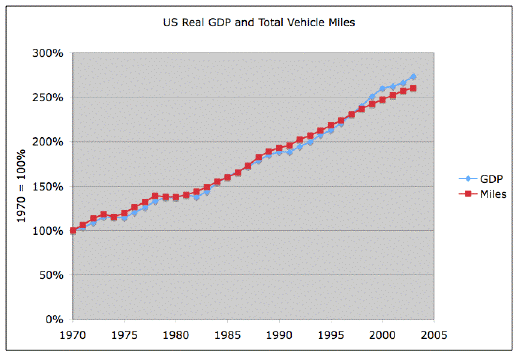
Stuart's Correlation of GDP and VMT - Figure 3
So does this mean, perverting Stuart's analysis altogether, that now that we are developing more and more of America's rural lands to build Exurban communities with a concomitant rise in VMT, that this will cause US GDP growth to rise? Exurbia is really a good thing for America. Just kidding! 
But maybe I should take this more seriously. As far as US GDP growth is concerned, it seems to be all about new home building, buying SUVs and cars, high-tech gadgets and pharmaceuticals. As Peak Oil arrives, increasingly all we'll have left are the toys (blackberries, ipods, cellphones) and the drugs. There seems to be some poetic justice in that. If the truth doesn't save us, what does that say about us? -- from Lois McMaster Bujold. Sigh.
OK, let's do some analysis of the Exurban boom. First its important to know that there is a set of huge land development companies behind the trek to Exurbia. One of these is KB Home and they've got it down to a science. From this NY Times article Living Large, by Design, in the Middle of Nowhere, we learn
More than three dozen other communities in Pasco County [outside Tampa, Florida], some bigger than New River, are in the works, promising 100,000 new homes in the next five years. A megamall is coming. And the first of the big-box stores, a Home Depot and a Sam's Club, had their gala openings not long ago.But if there were no demand for these exurban communities, nobody would build them. Give the people what they want.In the case of New River [Pasco County], that developer is KB Home, one of the nation's biggest and most profitable builders with $7 billion in sales last year, which helped make it sixth among all Standard & Poor's 500 companies in total revenues.
KB Home has 483 communities under development in 13 states and expects to complete more than 40,000 new homes this year. Yet it is just one of about two dozen such corporate giants fiercely competing for land and customers at the edge of America's suburban expanse....
Poring over elaborate market research, these corporations divine what young families want, addressing things like carpet texture and kitchen placement and determining how many streetlights and cul-de-sacs will evoke a soothing sense of safety.
They know almost to the dollar how much buyers are willing to pay to exchange a longer commute for more space, a sense of higher status and the feeling of security....
In its most recent survey of Tampa home buyers, KB asked people what they valued the most in their home and community. They wanted more space and a greater sense of security. Safety always ranks second, even in communities where there is virtually no crime.But the chief driving force is affordibility. Now that we've had inflation in housing prices, the housing bubble, for some years now--which you know as well as I do is going to burst--the tradeoff between commuting time and the cheaper prices in exurbia are still well worth it to these prospective home buyers, Particularly, they want all that space. These are McMansions, 4000 square feet or up. And apparently, they want more security. "Paranoia runs deep in the heartland" as a band from the 1960's once sang. Presumably, Al-Qaeda is expected to show little interest in Kendall County 50 miles outside of Chicago.Asked what they wanted in a home, 88 percent said a home security system, 93 percent said they preferred neighborhoods with "more streetlights" and 96 percent insisted on deadbolt locks or security doors.
Let's finish up by revisiting Arizona. Phoenix is not so much a city per se, it is a conglomeration of exurban communities like Tempe, Mesa, Scottsdale, et. al.

Phoenix Metropolitan Area - Figure 4
It's a desert and it gets very hot out there. Daytime temperatures are well over 100° for several months of the year. Our audio from NPR (cited above) notes that it is a heat island and in last few decades night time temperatures have risen 11° fahrenheit. In addition, it is expected that soon night time temperatures will fail to get below 100° during the warmest months. You can not live there without air conditioning--it is simply impossible. Where's all this electricity going to come from? And where's the water going to come from? Currently, it's from the Salt River described in this bizarre "no need to worry" FAQ document entitled "Phoenix in Drought". This is not what I would call an infinite supply source. Finally, this Greater Phoenix Economic Council document describes the projected population there out to 2020.

Phoenix Expected Population Growth - Figure 5
That would be 5,210,000 people in 2020. And what about the price of oil and gasoline in 2020 in an Exurban Paradise bigger than Los Angeles County that is entirely dependent on cars and trucks? $15/gallon? $140/barrel? And the NPR story quotes that the population is expected to be over 7 million some 35 years from now! It was at this point, listening to the story that I just burst out laughing. My immediate facetious thought was that the Phoenix Metro area would be able to comfortably support about 70 or 80 people at that point.
Real Estate developers can entice these consumers but most of the time people just fool ourselves. They are not aware of energy and other resource issues (eg. water). Impossible, unsustainable exponential growth issues simply do not exist for them. The post-World War II American Dream lives on and on for now until at some point in the fairly near future, it doesn't. For a few more years, these upwardly mobile Exurbanites will have what they consider the "good life". But nothing lasts forever. As John Maynard Keynes could have said about Phoenix, "In the long-run we are all dead".
Contact
- Content: editors at theoildrum dot com
- Tech support: support at theoildrum dot com
License

This work is licensed under a Creative Commons Attribution-Share Alike 3.0 United States License.
In the same way, we have to understand and appreciate the native ingenuity and creativity which will be spawned from a change in economic conditions. People are not going to be locked into today's way of life. If and when that way of life becomes impossible, they will create something new.
An obvious possibility is to move jobs nearer to these exurban communities. You mentioned Phoenix being structured more like a bunch of satellite cities rather than a single megalopolis. That is an ideal arrangement to reduce driving distances and allow people to live closer to where they work. I imagine that we will see similar developments happening throughout metropolitan areas. Suburban communities will become the preferred places for companies to locate. People will move to be closer to their jobs. We may see greater mobility, flexibility and dynamism in how people integrate their working and leisure lives.
Another possibility is to see greater use of telecommuting. Yes, this has been predicted for years without much success. But the truth is that for many of those jobs there is really no pressing need to bring everyone physically together. Most people today do service jobs and many of them can be handled remotely. What we need is improved communications beyond what we have today, so that two way view screens are a standard and ordinary part of the home office. You need to be able to chat with a co-worker as easily as at work, and managers likewise need to do the equivalent of walking past desks to see that everyone is being productive. This technology is nearly here and if the economic need arises, it can be efficiently implemented.
The point is that when things change, people change to adapt to them. I agree that it is unfortunate for people to be making fixed investments in real estate and housing if the basic economic circumstances are about to undergo radical change. As you know I am not as certain as most people here that this kind of radical change is truly just around the corner. But if it does, and most investments today turn out to be far from optimal, nevertheless I am confident that an entire population of motivated, intelligent and creative individuals will come up with much better solutions to their problems than a few people today can envision.
Which means the can be handled in India for half the cost.
Furthermore, most of those jobs invovle managing/accounting/distributing the hallucinated wealth created from buidling homes, cars, consumer goods, etc. You really think these jobs are even going to exist in the future when there is a lot less wealth to be managed and accounted for?
Best,
Matt
But let us suppose that growth slows by half and half of the construction workers are laid off. Soon, they will move on to greener pastures, vacating 10% of the housing, as well as many small offices. With a large influx of "new" hosuing (recently vacated) the demand for new construction will nearly evaporate, laying off 19% of the labor force (1% will always find some construction). They leave town after a period of unemployment. 19% housing vacancy. Housing prices drop, service industries from medical to car dealers (and especially banks) suffer. More layoffs, more move outs. More empty houses EVEN IF NEW CORPORATE TRANSFERS CONTINUE AT A MODEST PACE (perhaps 1/2 current rates).
Taxes rise, services and schools decline.
Add $6 gas and Phoenix suddenly seems less attractive. Corporations begin to move out ...
I can see Phoenix reforming around it's light rail line (s) with higher density. And retirees selecting parts of the Valley to move into cheap housing (leaving in summer.
The US abandoned much of it's preWW II housing after WW II, and the standard of construction and materials was FAR higher then. I am currently in Phoenix very close to Scottsdale, and the standard of construction here will not hold up well for most homes. 50 years and many will need lots of TLC & repairs. Boarding up and abandonment seem quite plausible to me.
Whith a gable suitable for building an extension if there is need for more rooms in the future.
And a large fraction of the construction labor is illegal aliens, who are:
- Much cheaper than US labor, thus driving the construction boom.
- Culturally alien and more prone to crime, thus increasing the attractiveness of "safe, distant" communities.
- Directly driving the explosion of population which is served by the construction.
If you fenced off the border and deported illegals even half-heartedly, this problem would end.This is a picture, my friend Dave took when he was stuck out in Phoenix for a year working at an auto repair shop and training to be an auto mechanic. He's now a video editor in NYC. Some of his stories of Phoenix are quite ridiculous, but true.
One of the financial gurus worried that the government would be pressured into offering another big social program: mortgage bailouts.
No one actually came out and said it, but implied in their analysis was that Kunstler is right: the suburbs will be the new slums.
I agree, this kind of mining for scrap occurred extensively in Lithuania after the Soviet Union fell apart, and it wouldn't be much of a stretch to see this happening in the exurbs. Occupied houses weren't disturbed too much, but a construction site that was only half-completed, and then abandoned, was fair game. In my wife's village (okay, former collective-farm settlement, to be precise), a building that was set to become a cafe/store was abandoned prior to completion. Within several years, it was looted for its metal fixtures, and its remains were privatized. The buyers broke down the walls, and used the bricks for other structures. The site is now basically a hole in the ground.
Same fate awaited the Soviet military structures that were not immediately put to use by the Lithuanian military.
The really adventurous thieves went after electrical transmission infrastructure.
I shudder to think of the chemicals released when you burn PVC pipe and treated lumber, but people are not going to be too picky when TSHTF.
I don't share your optimism at all, not in the short term at least. When this thing starts to crash, all that exurban and suburban property turns to kaka. Huge mortages, asset values dropping below the mortage, incomes threatened, the most fearful and isolated segment of the population, the least inclined to cooperation, goes under water: this is a formula for hell on earth.
Just the economics is frightening enough: this will be the largest asset devaluation in the history of the planet. I don't see how it can turn out any other way -- I am really trying to see it, but I don't. Even the warrior state cannot fend this off very long.
It is a mistake to just think of the physical side of things, alternate uses of the McMansions -- not that I think that there is any hope there either: what can they really be used for? No, these are financial assets, and their devaluation will have catastrophic consequences for the economy as a whole, the world economy I might add.
I think that would be a very good thing, after the initial pain. Lets face it, one of the reasons that Americans have a higher cost of living, and cannot compete with the cost of labor in other countries is the amount of debt we carry. This requires high salaries to sustain. If all mortgages and personal debt was wiped out, and easy credit was eliminated, the cost of everything would go down, and salaries could drop substaintially.
The real issue is that Americans don't want factory or any labor intensive jobs. Everyone wants a nine-to-five office job. Who wants to dig ditches and be exposed to freezing and sweltering temperatures when you can work in a enviromentaly controlled office?
Why have so many blue collar jobs moved overseas over the past 30 years? Not because "Americans didn't want that kind of job." It was because people would do it cheaper overseas.
No.
It was because one group of Americans could capture more welth if they laid off this group of Americans and hired that group of non-Americans to provide goods and services to those Americans who still had employment.
Where did China's capital come from? American investment. Who gets hurt if China revalues as demanded by the US government? American firms exporting fromm China.
Sure, overseas labour work's cheaper. Not because their labour is actually worth less, but simply because the environment from which they hail can sustain lower wages.
And any "right thinking" suit (this must be an oxymoron) would see this as a boon and make a dash to locate labour expensive activities to labour cheap locations.
As for Americans and "undesirable" jobs, if wages and benefits reflected the "nut" that needed cracking, then I cannot think of any group more willing to work than Americans.
jimbo
;-)
Try this. Go to the nearest office building and ask people entering or leaving if they would consider a farm or factory job if they earned the same pay as they currently do. I guarentee not a soul over 30 would consider it, unless they don't understand how hard it is. Working in a factory, or a farm is very hard work, boring and dirty.
On the other side, go to a working farm or a factory and ask the workers if they would trade their current job for an office job at the same pay. I bet the majority would consider switching.
The reason for choosing a profession career isn't just about financial benefits. Most educated people want careers, not a repetitive, back breaking job.
What is it that you do for a living? Do you work in a factory or on a farm? Have you ever tried a labor intensive job for more than a month? (No need to reply, just think about it.)
>Why have so many blue collar jobs moved overseas over the past 30 years? Not because "Americans didn't want that kind of job." It was because people would do it cheaper overseas.
Labor costs are certainly a strong reason for manufacturing jobs leaving the US. However, the trend started in the early 1950s as more an more Americans seeked out professional jobs. This was way before jobs began moving overseas. You can research the facts on the Labor department web site and see that the since the 1950s people seeking employment in farming and manufacturing has been in a steady decline.
BTW, I'm 42 and would gladly move to a farming job if I could make anywhere near the pay I do now as an engineering manager. And yes, I do know what is involved.
Somehow, I made it through and within two weeks was having the time of my life, working with some of the best people I've ever met and doing the most immediately gratifying, and perhaps more challenging work that I have ever done. This included sandblasting, painting, cleaning drydocks, removing sludge out of empty fuel tanks, etc. Dangerous and incredibly dirty, hard work.
It was really one of the most liberating experiences of my life after the petty politics of the electronics shop I had worked in for years. I worked (by choice) in this job for almost three years, only going back to the shop to work on equipment for which I was the sole qualified tech. Lest anyone think that I was just a malcontent who couldn't handle a technical job, I have been an electronics tech/test engineer for over 25 years at this point and have received nothing but accolades for my performance every one of those years.
No, I'm not really representative, I guess. When I go to my mom's on vacation, the first thing I do is rake manure from the barn. Therapy...
In any case, for most people, it's not a choice between a professional job and a factory job. The people who used to work at factory jobs are now working at jobs in the service sector. They are often just as boring as the dullest factory job, if not quite as dangerous. The pay is also lower.
I used to live in a small city that was known for its manufacturing. The last manufacturing company closed a couple of decades ago (a paper company). With the loss of the $20/hour jobs at the paper company, the area really went into a tailspin. The only other jobs people could get with their level of education were fast food or retail jobs. McDonald's, the mall, etc. A lot of people started dealing drugs, since that paid very well and didn't require a degree.
I find such work to be very rewarding and enjoyable, and have long tried to accumulate as much of such skills and knowledge as I can. I would not hesitate even a moment to trade my present career for one of these. I suspect I would be much happier. Next on my list are gardening and ironworking/blacksmithing (if I can find the time).
Most physical work isn't that hard, it is the boring that gets you. I got so bored while a grinderman that I took a power washer and cleaned 80 years worth of wood pulp off the machinery.
Farming is hard, physical work but it is also good exercise and low stress (I mostly did hay/straw baling and hauling).
My current job is much more draining from the mental exertion and stress.
I don't have to. At my office, we are about half deskbound and half out in the field (construction, maintenance, survey, etc.). And those who are out in the field doing physical work are there because they want to be. Some just hate deskjobs on principle. Some like the overtime available to people who are out in the field.
As for farming...I live in an area that was all farms not too long ago. Many of my coworkers own working farms. They plan to farm full time in retirement. They mourn the changes that mean their children who want to be full time family farmers will have a tough time of it.
Perhaps so...but a lot of people don't really want to be educated. If they could get a job that paid well without having to get an expensive degree, they would take that route.
I recently had to deal with someone who took a job as a "CADD operator" in our engineering dept. He was a good kid, but didn't want to work at a computer all day. Turns out, he thought "CADD operator" was some kind of heavy equipment operator. (Such people are often referred to as "operating engineers," so the mistake is understandable.) He eventually quit and took a job running an excavating machine for a construction company, and was much, much happier.
I am currently working as a civil engineer. I have worked at labor intensive jobs in the past, including farmwork. (It was my first job, and yes, it was grueling, but I wouldn't mind doing it again.)
I've worked out in the field before, and would do it again. Indeed, I asked for a field position when I was first hired; my previous job was as a bridge inspector. I was put in the office because that was where they needed people. I've stayed there because the office is only 2 miles from my apartment. If I went out in the field, I could be assigned to job sites who knows where. I don't want to spend four hours a day driving.
Or maybe the jobs available in farming and manufacturing began to decline? That was when machinery and automation really began taking off. Remember IBM's constant propaganda about how computers could never replace human workers? Hah!
Unfortunately these people aren't the norm. The majority of the American population lives in urban areas, and have no experience in agraculture. You're cherry picking a few people that you associate with and assume this applies to the entire country. Are there people that enjoy farming and manual labor jobs? Absolutely, but that doesn't imply the majority does.
>I am currently working as a civil engineer. I have worked at labor intensive jobs in the past, including farmwork. (It was my first job, and yes, it was grueling, but I wouldn't mind doing it again.)
Thats fine. I have as well, but it does mean the majority of the population has done it or would want to work on a farm, or would be willing to work as many hours as foriegner workers are willing to commit. Given the choice of long hours intensive labor jobs or easy 9-5 jobs the majority would choose the latter.
Here in the North East, many homeowners use landscapers to maintain their property. If they aren't willing to spend thiry-odd minutes a week cutting the lawn or trimming the strubs, they most certainly are not going to consider farm work.
Most Americans (that can afford it) have air conditioned homes. Why purchase, maintain and operate an air conditioner at home if you don't mind hot weather or working in a less than office like environment? The majority of Americans also eat out more than once a week rather than spend time preparing a heathly, lower cost, homecooked meal. Why do americans buy luxary cars and SUVs that they cannot afford? Why does the average american carry nearly $9,000 in unsecured debt? Does this group even remotely seem likely they would be interested in working harder? I think not!
>I recently had to deal with someone who took a job as a "CADD operator" in our engineering dept. He was a good kid, but didn't want to work at a computer all day. Turns out, he thought "CADD operator" was some kind of heavy equipment operator
Thats odd that your company hired someone who didn't understand what the job was. Usually that issue disappears during the interview.
>He eventually quit and took a job running an excavating machine for a construction company, and was much, much happier.
A heavy machine operator, is really a professional job. Most likely his work week is 40 hours or less and his job is more or less similar to a computer operator, that is operating equipment while sitting in a chair. The manufacturing jobs overseas are usually 60 to 80 hours a week, and farming jobs usually fair no better. The bottom line is that Americans are not going to put in the same long and hard hours as foreigners will commit.
To give you some perpective, from the mid nineteenth century up until the late 1940's the average American factory job was Ten hours a day Monday through Friday and Five hours on Saturday and had about half-hour lunch break. Prior to the 1920s they use to work the full day on Saturday. By the 1950's Unions began to win concessions and the work week eventully fell to about 40 hours. If Americans didn't mind the work, why did they demand fewer working hours, despite that they would have made more money since they were paid by the hour? Why not just demand more money per hour instead? The bottom line is that the majority of Americans don't want long, labor intensive jobs.
It was an entry-level position. We were willing to train a capable candidate. He was capable, but just not interested in sitting in front of a computer all day. That is many Americans' idea of hell.
Nope. You work a lot longer than 40 hours a week. Which is good, because there may not be any work available at all in the winter. You're also exposed to the elements, which you are not in an air-conditioned office.
Sure they will - if you pay them enough. Many American "professionals" put in those kinds of hours. It's worth it to them, because they are paid well.
Perhaps because they were rightly concerned about others who might want to work?
Americans have been working longer and longer hours for that past 20 years or so. The reason? It's cheaper for companies to force people to work longer hours than to hire more people. Especially since many "professionals" don't get any overtime for the extra work.
The offshoring of manufacturing was a tragedy for many Americans. (Billy Joel even wrote a popular song about it - "Allentown.") The factories didn't close because of a lack of workers. Far from it. People wanted to work. Desperately.
These are not people who could easily get professional jobs, even if they wanted them. They ended up in the service industry instead, flipping burgers for much less money.
Look at all those miners now who are defending their companies, despite safety violations and on-the-job injuries and even deaths. They are terrified that the mine will close and they will lose their jobs. Despite the long hours, hard work, and danger.
What kills me more than anything is seeing Labor unions declining year after year. They're keeping the blue-collar jobs equipped with a decent living wage, and the 11% or so of us who can live a middle class life outside of staring at a computer monitor all day. Once the Unions go, office jobs will be all that's left :P
I think you are underestimating the "initial pain". One could argue that the Depression was a good thing "after the initial pain" (which included WW2) -- after all, it was followed by the 50s! The only difference is that I don't see the segue into something comparable to the 50s. And truth is, WW2 was not devastating for the US even though soldiers lost their lives. But there's every likelihood that we will NOT go unscathed in upcoming wars and turbulence.
I am unable to envisage an optimistic short or medium term scenario - except that very great hardship will remold us into creatures more focused on building a sustainable and cooperative future.
You know, credit is not easy, but costs of everything are very low, and salaries have dropped substantially, in Sudan. Perhaps you'd like to go live there? You might think it's a very good thing, after the initial pain ...
Are you saying the pain is avoidable?
Are you saying the American "way of life" can continue, unabatted? Are you saying it should?
What, exactly, is you point?
Given the role the US has played globally since the Monroe Doctrine, maybe they deserve a little bit of Sudan right at home. Maybe not the "American People," but since they're the ones who rule the roost at the ballot box, maybe they ought to endure a bit of pain about now. They could have voted for a sane America. They chose to vote for their comfort and gadgets. Guess may get to feel a little of the harshness life can dish out. Maybe, God forbid, a little pain.
jimbo
;-)
As for the insanity, America didn't vote for it. The last 2 elections were rigged, remember? And as we all know the system is broke, no one has the guts to fix it, and gassing about it here changes nothing. Let's move on.
There is a way to avoid the pain of a second great depression. And we're doing it right now. Let the developing world continue to manufacture goods. Let America continue to manufacture debt. Let the foreign exchange rates be fixed by strongarming foreign central banks into inflating their own currency.
And let's all continue breeding like yeast in the barrel. Invent ways to turn all biomass into oil. Shovel what's left into the oceans along with all our other toxins. This way to the supercriticality ...
Mortality is a small price to pay for existence -- Bob Geldof.
Why would you idiots have not made Florida and Ohio irrelevant by controlling the ballot boxes in the rest of the bloody Union?
I rest my case. Comforts and gadgets. That sums up the "state" of the Union.
jimbo
;-)
A lot of the election reform groups are pushing for optical scan ballots instead. It's supposedly the most reliable. Tell that to the thousands of students whose SAT scores were incorrect. The reason? The optical scanners used to score the tests don't work correctly when it's humid, and the week the test was given saw wet weather in many parts of the U.S.
This is a classic example of Tainter's diminishing returns. All this expensive technology...that's too complex for the average Joe to use. Makes you wonder if we shouldn't have just stuck with placing a check mark on a paper ballot.
It was systemic, pervasive, and coordinated - and it did not need to be in all states at all, just the ones in play.
But like I said, gassing on here will do nothing to change any of that. The system is screwed, and the only meaningful vote is with your feet. America, love it and leave it.
MOST Americans did not cast a ballot FOR Bush.
The last 2 elections were rigged, remember?
Every election has some degree of rigging. This one has sets of data that make it obvious.
Oh, and welcome to TOD. Were you sick of The Blue?
Fine. Who the hell did they vote for?
More importantly, why, when the evidence and scope of manipulation was apparent, did the electorate sit on its fat arse and let the result go to Bush without a single mass uprising of any significance?
It's not whether you win, it's how loud you protest an invalid result. If it worked in Ukraine, in the bloody freezing winter, what would stop it from working for you and yours?
jimbo
;-)
Most of them didn't vote at all.
The rest voted for Kerry, Nader, other obscure candidates, or screwed up their ballots accidentally.
Read the construction again. It was set up to be inclusive of ALL Americans, many who can not vote, and the ones who opted to not vote at all. In addition to the green/Libertarian/Nader et la votes.
why, when the evidence and scope of manipulation was apparent, did the electorate sit on its fat arse and let the result go to Bush without a single mass uprising of any significance
If you have a job, are making enough to pay the bills, have a family - WHY woudl you stand up and complain and run the risk of not having a job, be unable to pay your bills, et la?
For your premis to be correct, you'd have to have Americans to be an idealisc lot who'd be willing to stand up to people in power.
When the mass of citizens are cold and hungry - have nothing left to loose, THEN you'll see many throw themselves into trying to effect change.
There is actually a town next door to mine with "messy" mixed business and residential. Why did they do it that way? Because it worked.
There are other cities built on swampland that have the same feature. Milwaukee comes to mind.
But what do you care, if it is not New York City, San Fancisco or New Orleans it is not worth saving.
http://www.theoildrum.com/story/2006/3/18/194843/888#39
True, teh only cities with unique cultural valeus worth preserving.
Really, we need to start evacuating those energy hungry Great Lakes states whilst we have the fuel to do so. MASSIVE winter heating requirements ! Do you knwo that it sometimes gets down to 0 F (-18 C) in Chicago AND they use MASSIVE amounts of energy removing snow almost every winter ?
Chicago is clearly not sustainable. Too much winter heating, too much snow removal.
There was an article in the paper today claiming that we may be seeing the death of ice-fishing. There's just not enough ice around here any more.
No, only true in your head.
Really, we need to start evacuating those energy hungry Great Lakes states whilst we have the fuel to do so.
And move them to where? The swampland of Milwaukee?
At least the infrastructure of Chicago hasn't been destroyed in a demonstation of how bad the idea is of building under the water line is.
Chicago is clearly not sustainable. Too much winter heating, too much snow removal.
And yet, somehow, the native Americans occupied the area. So the area can be occupided sustainably.
A builder who is in Madison is well known for his ability to put together homes that don't need a heating plant - passive solar can keep the building warm. (Strike one)
Too much snow removal? In the poorer counties, many roads go un-plowed. City allys go un-plowed. (Strike Two)
The cold weather keeps the termites away. I'm sure you have heard of termites, right?
So yea, a few should remain behind.
So one home (I assume with super insulation, very small windows and perfect orientation to the sun) can heat itself with passive solar. Well that means that 99.99996% of homes cannot. (by contrast, a majority of homes in New Orleans were built before the widespread advent of air conditioning, with high ceilings, transoms, whole house fans after the 1910s, etc.)
The rest of the homes (those with excellent solar orientation) should either be rebuilt or razed and new buildings with salvaged materials built in thier place for the few that remain behind.
Every winter, the infrastructure of Chicago takes a hit from winter. Your roads erode away from salt, frostheaves, potholes, etc. Water mains do not last as long, etc. Slow motion destruction resulting from the idiocy of living so far north.
Not plowing the streets fror snow ? A few will want to stay behind in their passively solar heated homes for a couple of months (in a severe winter) waiting for the spring thaw (hopefully no medical emergencies in that time).
Where to move them ?
Perhaps some to New Orleans. Very sustainable urban fabric, just get the US Army to do the task it was supposed to do since 1928.
The rest to new cities in Mississippi, Arkansas, Georgia, etc. but sustainably.
Assuming there is any snow, that is. Chicago might end up with the climate of New Orleans fairly soon.
Via
http://www.pastpeak.com/archives/2006/03/rising_ocean_te.htm
this Nature report
http://www.nature.com/news/2006/060313/full/060313-12.html
"We're looking at a much worse risk than people were thinking about a year ago," says Curry. And with sea levels and rainfall set to increase as a result of global climate changes, the risk of flooding from such storms will grow, she adds.
"Some people will not return to New Orleans. They'll vote with their feet," Curry says. "And some places are going to become uninsurable."
Your pro-New Orleans plan has the special government handout - flood insurance. If New Orleans is so worthwile, call for the end of government handoutsand pay for the insurance directly WITHOUT the government handout.
At least Worldchanging is approaching the matter in a rational manner w/o some kind of wierd claim that New Orleans is one of 3 cities that must be preserved "for the culture"
http://www.worldchanging.com/archives/004226.html
Places already damaged by storms stand every chance of being hit again, and political resistance to rebuilding at-risk cities will only grow with each big storm.
Abandon the city now, or spend a bunch of resources and abandon it to the swamp later.
99.999996%? Where did you come up with this 'basis' for your argument?
Is Canada cold enough for ya?
http://www.cansia.ca/downloads/factsheets/18.pdf
Ya see, if you were not able to buy/build a passive design, you can make an active design.
The key technologies are Evacuated tubes and radiant floor heating.
http://www.backwoodshome.com/articles/hackleman65.html
Your desire for the nation to 'save New orleans' blinds you.
Water mains do not last as long, etc.
!00+ years on xome of the water system. Ya know HOW they get 100+ years? They bury the material BELOW the frost line.
Slow motion destruction resulting from the idiocy of living so far north.
Idiocy? Slow motion destruction means one can put aside funds to eventually repair things.
VS placing ones property in the path of a hurricane - FAST motion destruction.
To own property in most of Chicago you don't need a federal government handout in the form of flood insurance. Living in NEw Orleans, flood insurance via the federal tit is needed so people can "afford" to live there.
BUT
Slow moving destruction makes one an idiot? What is the word for choosing to live in a zone of fast moving destruction AND needing handout from the 'idiots' to live there?
(by contrast, a majority of homes in New Orleans were built before the widespread advent of air conditioning, with high ceilings, transoms, whole house fans after the 1910s, etc.)
Do you have a point here? Buildings in Chicago built before 1910 have the same feature. It is the same way in Milwaukee. Or Minneapolis. Or Madison. Or Fargo.
Here is a hint about humans and heating: If a human is cold, they can wear more clothes. If a human is hot, there is onky so naked a human can get.
Colder climets are more livable because you can do things to be more warm (like add clothes) and humans in them have less parisites. I've got science backing my position, what you got?
If people really as intelligent as you seem to think, would they even be investing in the exurbs in the first place?
The answer is "no." They would see this living arrangement for what it is which is, even according to your optimistic outlook, a poor one. Intelligent people don't take out 30 year mortgages on less than optimal investments.
What makes you think people will behavor more intelligently in the future then they are currently?
As far as finding land with houses on them, we would NOT (if we're smart) make use of them if the costs (natural gas, cars for the commutes, oil for the cars, wars for the oil) exceeded the benefits. We would just let them sit out there unused. Or maybe we'd tear them down and invest the materials in builiding more optimal and profitable living arrangements.
Best,
Matt
I know it's more fun to think that you're smarter than everybody else, but studies have repeatedly shown that most people overestimate their own competence, skill and intelligence. This is an area where I think a little modesty is helpful in terms of getting a better understanding of what is going on in the world.
Herd thinking at it's finest!
The reason people don't understand Peak Oil is because they get their news/information from sources that have a vested interest in keeping them from truly understanding it. As Uptonn Sinclair said, "it's hard to get a man to understand something when his income depends on him not understanding it."
Best,
Matt
As far as "herd thinking", IMO the value of the common man is greatly underestimated. One of the books I've been reading is "The Wisdom of Crowds" by James Surowiecki. He provides a host of cases where aggregating the opinions of the great mass of people has been extremely effective. A familiar example is Google, whose PageRank algorithm exploits the enormous base of web links in an automated way to rank search results.
Another book I'm reading is "Expert Political Judgement" by Philip Tetlock - reviewed here. He ran a prediction experiment for over a decade and ranked experts on accuracy. They were consistently beaten by a random model tantamount to chimps throwing darts. One of the few factors correlated to performance was media exposure - the more often he appeared in the media, the worse the expert did!
Remind you of anyone? Speaking of Matt Simmons, everyone should take a look at today's entry at Peak Oil Debunked, which touts up Simmons' amazingly off the mark predictions for this past winter. You get special recognition for your helpful calculation that Simmons' predictions would imply gasoline prices of $12 to $25 a gallon these past few months.
Simmons is a perfect example of the kind of thing Tetlock warns against. The media love "experts" who give colorful, newsworthy quotes. Being right or wrong doesn't even matter. A more cautious expert who hedges his predictions with caveats and on-the-other-hands is far more likely to be correct but will never make it on the air.
Actually, Peak Oil awareness hurts your chances of survival at least in the short run which is what your brain prioritizes. (If you don't survive the short term, you never get the chance tos survive the long term.)
Think about it: once you are aware of these issues you become somewhat of an outcast even if only to a small degree. I have trouble, for instance, celebrating or enthusiasitcally discussing my friends' plans for big homes in exurbia and 401Ks I believe will be worthless someday. Would not have had any trouble bonding with people over these issues/discussions prior to finding out about Peak Oil.
I can fake enthusiasm for my friends "accomplishments" okay, but that's never as good as being sincerely enthused. Thus, I am actually less able to socially integrate into my peer group (my tribe) today as compared to my pre-peak oil days.
Back in the hunter gatherer days, this type of effect could have had disastorous results. Worse that happens to me in the modern day is (if I was practicing law) maybe me and the other lawyers working on a case don't have the same level of camradarie we'd have if I shared their interests and outlooks. That level of camadarie (morale) could have an effect on our success in the courtroom and in fact would all other things being equal. But worse case scenario, the other side eats our lunch.
Back in the old days however, that lack of camradarie could be the difference between life and death. Worse case back then was some animal ate us for lunch:
http://www.theadvertiser.news.com.au/common/story_page/0,5936,18262331%255E912,00.html
Hence, your brain tends to filter out any information (such as Peak Oil) that makes it difficult for you to integrate with your tribe as failing to do so lowers your chances of surviving in the short term.
As far as political predictions, I think you are correct: thing is 99.9% of the people making predictions these days are people like you who say all will be fine albeit there might be somb bumps. Just turn on the MSM.
Best,
Matt
------------------
Halfin,
Great then (at least for my argument not for our future), that means the scenarios I've put forth are most likely to be accurate models of the future as my site sits atop the google rankings for peak oil and for oil!
http://www.google.com/search?hl=en&q=peak+oil
http://www.google.com/search?hl=en&lr=&q=oil
Best,
Matt
Considering what happened to Hungarians in what is now Slovakia, since, that is not a bad illustration of why abandoning the herd is sometimes a very good idea. You are rarely right, but when you are, it pays very well.
But buying a home in the Arizona exurbs is not an attempt to solve a group problem. It's a selfish, rational attempt to satisfy individual preferences about home location, comfort, sunshine, humidity, temperature, amenities, culture, etc.
Homeowners in Florida, Texas, Louisiana have known for decades about the prospects for severe huricane damage, and Californian's know more than they care to about the San Andreas fault and the inevitable 'big one', but these certainties haven't stopped them from taking the risk of home ownership in these areas.
Peak oil and water shortages are to these land owners in Arizona, a problem for someone else, in some other era.
Best,
Matt
Possibly you don't count them because of majority of that majority that supported emancipation were black.
We're talking objective problem solving here, not prejudice and emotion.
You were the first to invoke the name "Hitler," therefore, you lose;-)
I do believe you are totally missing Matt's cogent point: The opinion of the majority is often wrong.
It does not matter how large the majority is, nor does it much matter how long the majority holds its belief: The world is not flat, no matter who says so.
Thus, people who argue for the "wisdom of the crowd" are committing the logical fallacy of "appeal to popularity," which, in turn, is a variation of the ad hominem fallacy.
You may dislike Matt's conclusions, but I do not believe you can fault his logic. If his premises are correct, his conclusions follow.
What I hope (but do not know) is that those premises could shift a little, but as of now, I fear they are highly plausible.
And no doubt, when a money mania takes hold, like the Nasdaq bubble a few years back, people can and do lose their senses (and their savings). Fear and greed do affect decision making, but I don't see how that plays out in a decision to live in Arizona or where-ever.
Surely you don't intend people to take you seriously when you posit that buying a home or picking a racehorse are not decisions loaded with emotions?
That was a joke I assume.
Best,
Matt
Sure, my first home was a bit of an emotional decision, but only within the constraints of how much I could afford, the general location, taxes, and condition. Most people are very analytical about such a big decision, and yes, emotion may play a small part, but you imply that analysis is outweighed by emotion. Not by a long shot.
As for picking a horse to bet on, all I know is that the public favorite (the one with the lowest odds in a race), over a large series of races, wins more often than any other categorization, and beats the expert selectors all the time, hands down. It's a fact. Nobody selects the probable winner in a horse race more frequently than the public. Sure, some folks pick a horse to bet on the basis of jockey, color, hot tip, high odds, name, number, etc., but most people go to the track to make some money, and these bettors, weighing the significant factors that determine the outcome of a race, put their money on horses based on analysis, not hope.
The odds on horses in a race reflect the probabilities of winning - those with low odds win more often than with high odds. Over a long series of races, the distribution of winners in odds categories reflect a horse's true chances. The public errs at extremes - the heavily bet favorite wins slightly more than the odds would suggest, and the longshots (more than 20:1 odds) win less often than the odds predict. I suggest that this is where the emotional aspect of racing is exhibited - at the extremes. Many horseplayers don't really care to bet a heavy favorite, so these horses tend to be slightly underbet. And those going to the races for a laugh tend to bet the longshot, making longshots overbet.
Analytical crowds display wisdom.
Best,
Matt
This may be more your speed.
Individual:"Ohhh, my stomach hurts! I think it's about 100."Crowd:"Zero! There are zero jelly beans in the jar."Anyone reading what he said realizes he stated that certain conditions could lead to the outcome he described. For example, a cold winter. He didn't predict a cold winter, he said if there was one, we could be in trouble with our gas supply, and he was right.
We just happened to have the warmest winter on record, so the conditions didn't apply. His warning (NOT PREDICTION)was not disproved at all. In England, where there are severe natl gas problems right now, such a scenario is playing out as we speak. Now the politicians are saying "no one could have forecast this" when indeed some did but few listened. Just like the levees in N.O. Every year prior to 2005, you could have said those warnings about the levees were hysterical, when in reality the experts were right but the big hurricane had simply not hit - a matter of luck.
The retired analyst for MI6 was asked how he managed to work his way up so high and get such a nice pension. His answer was simple. His record of prediction was almost perfect.
"Every peacetime year between 1910 and 1950 they asked me if the Germans were going to declare war on us, to know if we should mobilize first. I said no, and I was wrong only twice."
Yes, he warned us in quite hysterical terms, about something which didn't even come remotely close to happening. Oil prices were virtually flat. They did not rise to $100 or $190 or $500. Gasoline did not hit $10. It is important to inform people about warnings like these which don't pan out. That way they can evaluate his next warning more objectively.
What nonsense!
Ah yes, the same sources that had Saddam piloting the planes into the WTC while simultaneously connecting the circuits together for his ICBMs.
What we are really looking at is a tension between people's belief in the economy, and their belief in the bubble. When is it a bubble and when is it an economy?
It's tricky, because mass consumption with mass production does create wealth. But when that very pattern gets carried away, bubbles get created.
The people have just forgot, having been put asleep by television and bankers.
I don't know whether to laugh or to cry on that. Halfin, is the Sun going around the Earth or vice versa? Do you know that 50% of americans believe that the Sun is spinning around our planet (I guess for our pleasure)? Of course this makes this theory true, as the majority of the "rational market participants" are not accepting the ridiculous theory that the Earth may be revolving around the Sun. What do you say? Aaaargh this one is different because it is about this people's money? So wasn't it just 5 years ago "true" that we are had enter a new economy, a "virtual" economy, that does not depend on some idiotic fundamentals? What happened with that new economy, and how many billions were lost to people's stupidity and greed?
It seems obvious to me that greed and stupidity go hand by hand. That's why I always have to laugh when I hear that "rational... market..." tale being repeated over and over again. This so called "rationality" is nothing else than the individual perception of everyone in the bandwagon that he can unload to the next dummy when things start to bust. Therefore everyone is buying McMansions and will be to the very end - because everybody thinks he/she is smarter than the rest and someone else will be the one to pay the bill.
Remember when your Mom asked "if everyone else jumped off a building, would you do it too?" As time goes on, I care less and less for the consensus opinions of people in groups - in the end they're usually shown to be wrong, but they seldom ever do realize it.
The situation is different for questions like where to move, or financial planning over the next several years. On issues where the decisions really matter, people put a lot of effort and thought into them. Real estate agents know that location is the most important factor in selling a home: other problems can be repaired or changed, but the location is always the same. This shows that people are thinking hard and rationally about these problems and are not buying on emotional or superficial grounds.
As far as the Internet stock bubble, it's true, the public did not successfully predict the top, by and large. But investing experts know that these situations are almost impossible to predict. Few experts were able to call the top accurately either, and for those who did, it was almost certainly more luck than skill.
One person who did call the top quite well was Jeremy Siegel, Wharton School of Business professor of finance and author of "Stocks for the Long Run," who wrote a column in the Wall Street Journal on March 14th, 2000 titled "Why Big Cap Tech Stocks Are A Sucker's Bet." The fact that the column appeared just four days after the NASDAQ peaked was pure luck, but the column was prescient nonetheless. At the time of publication, Siegel was not an unknown but a highly respected professional in his field, and his reputation has remained intact to this day (his latest book is "The Future for Investors").
As a value investor and disciple of Warren Buffet for the past twenty-five years, I don't put much credence in the strong forms of the efficient market hypothesis. I mention this because your comments, Halfin, with regard to the "wisdom of crowds" and markets seem to indicate that you do believe in all three forms: weak, semi-strong, and strong. In other words, excess profits are exceedingly difficult to obtain no matter what you do, and technical analysis, fundamental analysis, and even access to insider information are all of no value. Is it fair to say that you believe in the EMH lock, stock and barrel?
Given that there exist some investors such as Buffet who have consistently demonstrated the ability to generate excess profits over several decades, would you entertain the notion that a sufficiently knowledgeable investor, operating apart from the crowd, could generate excess profits in the oil markets?
I also think there is no systematic way to predict when these "bubbles" will burst, and in fact in most cases there is no way to even tell if you are in a bubble. Look at the debate now over whether housing is in a bubble or whether low borrowing costs are making expensive houses more affordable. We will not know until after the fact. If housing levels off smoothly, we will say it was not a bubble. If prices collapse, we will say it was a bubble. I've read analyses claiming that there really is no way to say whether a bubble is occuring until after the fact.
Consider: Alan Greenspan warned of "irrational exuberance" in the stock market at a time when valuations had tripled in the previous few years. Was he prescient? Not exactly! He made this warning in December, 1996, with the Dow at about 6500. He already thought we were in a bubble. But the market went on to climb to 11000 and fell only to 7500 with the "burst". So we weren't in a bubble at 6500, we were only in the bubble at prices above 7500. The valuations at the time of Greenspan's warning held up very nicely. And of course now we are back up above 10000. What does that say about the "bubble"? Maybe it wasn't a bubble, maybe valuations were correct then and it was the fall to 7500 in 2001-2002 that was a glitch, and we are back to reasonable valuations today.
The point is, you can make up all kinds of stories about bubbles and crashes, but it is questionable whether there is any objective reality to them. There are those who argue that price movements are best understood as a random walk superimposed on long-term growth, and it is only our human pattern-recognition tendencies which force us to see these ups and downs in terms of patterns. It's like when we see castles in clouds or the Virgin Mary on a potato chip.
As far as Buffet, I haven't followed his career closely, but I have seen claims that he has just been lucky. Studies have found that there is little correlation between advisors who do well one year and those who do well the next. With thousands and thousands of investment experts and advisors in the media, a certain percentage will do well just by luck. He could be the tail end of a normal curve.
Buffett was not "lucky," because you do not outperform the S and P 500 for every single ten-year period for the past thirty-five years by "luck." Nor was his mentor, Benjamin Graham, "lucky."
Recommended reading:
Benjamin Graham, "The Intelligent Investor"
Also for some of the best writing about investments, go to the Berkshire-Hathaway website and read Buffett's annual reports. Also, if you like to rub elbows with multimillionaires, buy a share of Berkshire-Hathaway B stock and then you are entitled to go to the annual meeting in early May in Omaha. By far the best and most fun annual meeting anywhere--and the Berkshire-Hathaway stockholders are a fun bunch, too.
From Berkshire Hathaway's most recent letter to shareholders, which is here:
http://www.berkshirehathaway.com/letters/2005ltr.pdf
I do believe that 21.5% is statistically significant in terms of excess profits above and beyond any relevant stock market index, interest rate, inflation rate, etc. over the same time period. And Buffet is not alone. There are a small number of investors with similar records over similar multi-decade periods. The problem, of course, is how do you identify and select these managers prospectively? As you noted, the world is full of advisors who have a few good years and then flame out, taking their clients or shareholders down with them.
BTW, I don't think the Dow was in a bubble back in 2001. I think it just peaked and entered a bear market, and not as bad as the 1973/74 bear market at that. The NASDAQ, on the other hand, was clearly in bubble, dropping almost 80% from its 3/10/00 peak of about 5,050. Today it's about 2,300, less than half its peak.
Yes, "The Intelligent Investor" is excellent. And "Security Analysis," also by Graham. Never been to "Woodstock for Capitalists" in Omaha, though.
I am sick to death of the people like Kunstler and the other Apocalypticons telling us how humanity has never faced anything this serious, and then predicting in minute detail how freakin' awful things will be. How do they know? Why are they so intent on making these moralistic arguments about the downfall of modern civilization, etc.?
As I've said before, the people who live in the exurbs will, for the most part, be the ones most able to invest in energy-saving technology, whether it's solar panels or a diesel hybrid or a hydrogen fuel cell car in just a few years. Oh? Are people laughing because I used the H-word? Don't tell Honda, which will have a mass production fuel cell car on the road in 3 to 4 years, or Hyundai, which is saying they'll be selling a fuel-cell version of the Tucson in 2010.
Hydrogen is not the tangle of intractable technical problems many people thought. You can short-circuit the whole distribution problem with an in-home hydrogen generator that produces it from natural gas (as does the Honda Home Energy Station), or uses electrolysis to make it from water. But that's expensive and inefficient! Actually, no. Download the hydrogen spreadsheet from my site's downloads page (http://www.grinzo.com/energy/downloads.html) and see for yourself. Plug in numbers for the expected price of gasoline in 2010, and you'll see that per-mile hydrogen made with brute-force electrolysis, even at residential rates, is cheaper.
And that's just one partial solution. We've barely begun to tap oil conservation efforts across the US economy, we've never been pushed hard to make widespread telecommuting work, and we're just now getting serious about exploiting wind and solar. (If you couple wind with hydrogen generation via electrolysis, a solution that's getting a lot of attention, the intermittancy problem of wind power disappears and you get cheap, clean, renewable energy.)
Yes, PO will be a bitch, and there will be more than enough pain to go around for anyone who isn't wealthy. But Kunstler and all the other people (like, well, Kunstler) who predicted Very Bad Things for Y2K are going to look really foolish when we rise above this problem. And even if they don't, I'd rather be optimistic while I'm fighting like hell to help educate people, even as I imagine the day when I get to dance on the graves of the crappy ideas from Kunstler, et al.
I'm curious, do you have any numbers on the following:
The amount of our GDP that goes towards oil and natural gas coupled with the amount of our GDP that goes towards defense as compared to the amout of our GDP that goes towards renewable energy and alternative forms of transport.
My guess, and it is only that - a guess, is the ratio is probably at least $100 on oil, natural gas, and defense for every $1 on renewable energy and alternative forms of transportation. My suspicion is that it's far higher than $100 to $1.
If you want to know where we're heading as a society, just "follow the money."
Best,
Matt
Following the money (which we pay for ingenuity) is probably the best way to determine where our society's collective ingenuity is being channelled.
I have trouble seeing how people can remain optimistic about our society's future when you "follow the money."
Best,
Matt
"I have trouble seeing how people can remain optimistic about our society's future when you 'follow the money.'"
You have to follow the money with a grain of salt..
I am right on board with Lou Grinzo's post about Ingenuity. We've seen our fatal, human flaws again and again, greed, violence, irrationality, etc. But that's not our full nature, it's just the parts that we fear. I think it really depends on what you ultimately believe that people are. I don't buy Malthus, or the arguments that claim that the most pessimistic answer has to be the most 'realistic'. Doesn't wash with me. I've seen too many great human beings who've survived horrible things and come out smiling. A guy who, as a young boy, watched the Kmer Rouge wipe out his whole family, and is now one of the strongest and most optimistic people I have known.
"..Virtue is Immortal, while Evil must constantly respawn.."
Steinbeck, East of Eden
"..The World will be your enemy, Prince with a Thousand Enemies, and If they catch you, they will kill you. But first, they must catch you. Digger, Runner, Listener. Prince with the swift warning. Be clever, and full of tricks, and your people will never be destroyed."
Richard Adams, Watership Down
Great, I feel better already.
Forgive me if, instead of popping the underdosed cyber-prozac you just offered in this post, I simply try to position myself away from the oncoming horrors as best I can.
Best,
Matt
Of course you don't feel better. You don't sound like you want to. I really doubt that you're 'Positioning Away' from the horrors; you've got your head completely surrounded by them. It's not hard to get there, I admit it. I'm just saying that if I'm going to take any encouragement in our prospects, it will be that I see people as the resource we have a chance with. When the Shit's going down, I'm sure you'll have someone's back, and they'll be lucky for it.
If trusting in people is Prozac to you, then what is real? What do you believe in?
Bob
What I've sensed among Peak Oilers is they fall into one of two generalized but nonetheless accurate "minsets":
Mindset A: Mad Max/loner/survivalist/we're going to eat each other alive or
Mindset B: Ecotpia/community/we're all going to sing kumbaya together.
I'm saying you will see the best and worst of both at the same time. You will rely on your family members more - even the ones you don't get along with too well - but you'll also be ready to get tribalistic on those outside of your family/tribal group.
Best,
Matt
The suburbs and exoburbs of today will be the ruins of the future. I don't see anyone trying to live in them.
"The Lizards would be saved, he said, If they could be enlightened by the writings of the Helping Friendly Book. In all of Prussia only one existed, and Wilson had declared that any person who possesed it was a crook."
--Phish
Hydrogen can be produced by gasifying coal, but the amount of infrastructure involved is prohibitive. And don't get me started on electrolysis. If you're taking electricity as far as your house, batteries beat hydrogen by a huge margin.
If your rosy scenario doesn't work without hydrogen, it's unlikely to work, period.
As for electrolysis, as long as there is an infinite supply of electricity, H2 from electrolysis is a grand plan. We'll need to start importing dilithium PDQ though. You can't beat the laws of thermodynamics unfortunately.
(I really don't get the exercise of home nat gas to h2 conversion.)
Also, as someone who has worked with hydrogen on an industrial scale, you can have my own prediction FWIW. There will never, ever, be a mass-produced hydrogen car. Maybe a bus, but never a car. The safety considerations are such that you could not trust it to a normal consumer. The same goes for mini-reformers or electrolysis units.
No laughing. Just a head shaking and some tounge clicking.
A fuel cell that converts Hydrogen attached to carbon (and oxygen) from chemical to motion will be more efficent than the present heat cycle. (Tip of the hat for a long past mention of others who'd stated this by Engineer Poet) If I make some Hydrogen gas, I can't keep it for 7 years. Whereas Ethyl Alcohol I can keep it for 7+ years and it would be as good now as tomarrow.
you'll see that per-mile hydrogen made with brute-force electrolysis, even at residential rates, is cheaper.
Is this game we wanna play? "The Price of the market" amd "the invisible hand of the market" type crap?
Tell ya what. When your numbers stop ignoring subsized electric rates for home consumers, the government rebates/tax breaks/giveaways et la for energy production and have been adjusted THEN you can make the claim you are making.
Otherwise, you are claiming the invisible hand of the market is not covered by the gauntlet of government power.
Yes, PO will be a bitch, and there will be more than enough pain to go around for anyone who isn't wealthy.
'more than enough pain'? You make it sound like all the non-rich will go "Oh! Life is harder! Oh!" and that will be the end of it. A lack of faith in my fellow man make me think that the people who have wealth will end up stripped of it by mobs (if not killed), then government force in taxation for people to 'keep the peace',
crappy ideas from Kunstler, et al.
What idea? That the suburbs are a bad idea? That the resource consumption rate in the US is unsubstainable at the present price structure?
One final thought: my observation is that effective change in economic behavior is a generational matter and happens over the course of thirty to fifty years. Until people actually go to the pump and find it out of fuel people will not adapt to the new realities of flat oil production. To some extent price spikes will change short term behavior, but no one believes peak oil will effect them, until it does. I would say anecdotally that no one around here has substantially reduced their driving.
I don't see how this is "fingerpainting dark visions" as much as it is an honest, albeit generalalized, assesment of where our society is heading.
If we were speding 10% as much on defense and 1,000% as much on renewables as we currently spending, I'd see reason for a bit more optimsim.
Best,
Matt
Best,
Matt
I think anyone committed to an outcome now is being silly.
But I think the "superficial optimists" may not always be aware that they have committed to a single outcome.
Assumptions can be made, but the number required to come up with a solution (future scenario) are so large that some of the assumptions must surely be wrong (but which ones ?)
I have some money now. I would like to retain it's usefulness and value. Given the above, what to do ?
Multiple solutions (known as diversification). Each choice works well with one or more likely scenarios, but few with all possible scenarios.
In the past week, I have driven ZERO miles.
One year ago I would have driven no less than 150 in 5 days.
And could have driven as many as 1,000 miles in one months time.
So let me be the first to say, nope! You are Wrong.
Even my coming move will not change the precentage by more than 20% up, to only 75% of my previous driving.
Those houses aren't going to disappear. People are still going to want to live in them if possible. [...] Would we scorn it and turn away? No, we would find a way to use them.
So, let me get this straight. The plucky, people of Phoenix will stay out there in their desert homes, telecommuting (without electricity), keeping cool, (without electricity), drinking water imported from where? At what cost? A bottle of water would cost what? Let's see. Does anyone know how much bottled water costs now -- by the gallon? Hmmm. One 12 ounce bottle costs lets say, one dollar. With one hundred and twenty-eight ounces to the gallon that works out to -- drumroll please -- 10.67 dollars per gallon. That makes water worth more than two and one half times a gallon of gasoline. So, if gasoline goes to 10 dollars a gallon, water will be what? Twenty-five dollars a gallon? Well, that may be more a factor of the stupidity of people who buy bottled water than the actual cost, but I would not be surprised if it did rise significantly. It sure as hell ain't going down.
What we need is improved communications beyond what we have today, so that two way view screens are a standard and ordinary part of the home office. You need to be able to chat with a co-worker as easily as at work, and managers likewise need to do the equivalent of walking past desks to see that everyone is being productive.
Now that is a doozy. Yup. The only people who live in Phoenix are cubicle monkeys. Sure. We will all sit at home and electronically shuffle paper. And, I suppose we will contact the auto shop by email when the car breaks down and the mechanic will apply remote sensing technology to fix your car at a distance. And, let's see. Food. Fast food joints already have computers to take orders, we can just email them our orders and they will drive it right over. Groceries. Hmm. More deliveries I suppose. And, of course, food prices will never rise. Cause we are the plucky, people of Phoenix. How dare they factor fuel costs into food prices. So, I guess the telecommuters will grow their food on their lawn, right? So, more water. And oil? Where is the oil, natural gas and water needed to make all of this great computer stuff going to come from?
And don't forget all the poor people. You know, the ones who are not involved in the hallucinated economy. The ones who actually still do things, but get paid crappy wages without health care. You think they are going to stick around and starve or die of thirst or become homeless due to the real collapse of the hallucinated economy? No, they may be poor, but they are not retarded.
Halfin, I think you have a real moneymaker there -- that stuff you are smoking. I bet it's the same stuff ole Jiminy Cricket used to smoke.
I got HIGHHHHHH hopes, I got HIGHHHHHH hopes, high in the skyyyyyy, apple piyiyiyyiyie hopes...
http://www.eia.doe.gov/cneaf/electricity/st_profiles/arizona/fig1.html
As far as water, I don't believe Phoenix has its water supplied in the form of bottles. I imagine they have it piped in. Yes, there could be water shortages from time to time, in Phoenix or just about anywhere else in the west for that matter, but it doesn't have anything to do with oil. My local area had a drought a few years back, and it was made illegal to water your grass. Homeowners hired painters to come and dye their dead lawns green. People can and do deal with droughts and water shortages, in this country and all over the world.
http://www.commondreams.org/headlines06/0318-06.htm
Dude, thus far it seems your plan is for us to "telecommute and paint our way out of global catastrophe."
And people wander why I'm so pessimistic about our society's prospects.
Best,
Matt
Just cut Dave a check for (insert Dr. Evil style laugh) $125 for a guest post on my site. Plan on doing that more in the future as profits dictate. Wouldn't be able to compensate people for their work unless I was generating profits in the first place!
Same thing for my bulletins. The writers aren't getting rich by any stretch of the imagination but if our licenses our renewed for 12-to-18 months, the price per word will be comparable to what they would get from The Rollling Stone, albeit paid out over a longer period of time.
You want to hate on me for paying my authors, beyootch? Or is it only okay for the spinelss hacks in the MSM to get paid?
Best,
Matt
Where have you been all this time? Why have you only so very recently decided to stop "lurking" on TOD?
And yes, I know what they say about fighting on the internet. But given the level of intellect here and elsewhere in the peak oil blogosphere, it keeps the ole' neurons juiced and ready to go.
And it's a lot safer then arguing in public. Particularly in places like Florida where it's legal for people to blow you away for disgreeing with them:
http://www.washingtonpost.com/wp-dyn/content/article/2005/04/25/AR2005042501553.html
Best,
Matt
Phoenix is starting the bare framework of an electricity driven light rail system, but only a few % of the population can use it.
The rest need oil, and lots of it, to live and work. (Retirees who go out 3 times/week driving to shop or doctor need less).
Phoenix has very low winter home energy requirements, a major energy plus vs. more northerly areas. But the auto is essential for survival in most of Phoenix.
Phoenix could have built a low energy, semi-sustainable society in "the Valley", but they didn't.
Please smell what you are shoveling.
Even here I have a lawn of mostly seasonal native plants and a few others that I do not seed nor water, if it lives it lives, if if dies, something else takes its place. Right now I could go out (though it is a bit dark) and get at least several meals from the "weeds" That grow in my front yard. Not to mention that the Maples are in full seed production and they are an edible spring time feast.
But GREEN grass, in a Desert, Please give these people a lot of clues to what they should not try growing.
As to labor, 5 years at a desk, 20 years doing the harder jobs, and no educational degree. Married-devorced twice No kids.
The rich people in Phx have large green lawns because they can afford to hire illegals working for lawn-care businesses to mow them. They also seed a winter lawn-- so they have lush green lawns year round-- makes no sense at all! The golf courses for tourists and the fancy resorts spare no expense for winter grass. Many McMansions and upscale shopping malls have fancy water fountains and reflecting pools: all require water. Also, I think Phx leads the nation in swimming pools/capita. At 115 degrees, the water evaporation rate is something fierce. It takes a lot of water & energy to maintain these luxuries.
Phx just might be the most unaware of 'Peak Everything' of any American city. The abundant sunshine has totally fried everyone's brains!
Bob Shaw in Phx,AZ Are Humans Smarter than Yeast?
Arizona water supplies would have to shrink by 90% before we would start cutting down forests in New York to start farming lettuce there again.
You know, I spent three years on what was once a lettuce farm before the freeways made it practical to import lettuce from Arizona instead of buying homegrown produce in the summer. Which is why we got the property so cheap. No one was buying large upstate New York rural farmhouses in the sixties.
Just a thought.
And maybe some kind of electrical power source for air conditioning that would work especially well during those bright sunny days in the summer, when the sun is high in the sky for hours, and hours, and hours, and hours, and hours, every day.
It might be possible.
http://www.solarserver.de/solarmagazin/artikeljuni2002-e.html
This article is in english.
There is already a very energy efficient way of cooling available. The hotter it is, the better it works. As far as I can tell, it is already in use on the roof on some of the government builings a few kilomters away from here where I live in Berlin.
I am not an engineer, but this sounds really mezmerizing to me!!
Thxs for responding. My father died last Aug. at 96, my mom sick and frail at 83-- I am her primary caregiver. She is Peakoil aware, but prefers not to relocate. So I am stuck here in Phx hoping it all holds together till she is gone [Obviously, I want her to live forever].
My desire to relocate will be severely hamstrung by limited funds, limited skills, advancing age. Such is life-- billions will be in the same postpeak situation. I suggest that everyone should get used to the idea of dying in place. If millions start streaming out of the Southwest, the other states will be forced to cut them down at the state line.
Phx, and other desert cities will be a inverse of Nawlins. See my other posting on fire in this thread. I think people are vastly underestimating fire potential in a postPeak world. Think the Great Chicago Fire, extrapolate to cities worldwide. No fire trucks, no hydrant pressure-- bucket brigades are futile.
Here in Phx during the summer heat, a fire can rapidly scale to a three or four alarm. Not so much the size of the fire, but because other firemen have to be called to replace the initial firefighters. Wearing heavy protective gear in 115 heat, plus the flame heat exhausts them in a very short time [15 to 20 minutes].
Many housing developments in Phx are clustered very close: the joke is that you can hand a roll of toilet paper to your neighbor. Some rooflines are only 5-8 feet apart. A wind-driven fire could easily go on a rampage. AlanfromBig Easy can confirm this. I am sure he remembers the fires in Nawlins that burned because the fire trucks could not get thru the flooding.
Bob Shaw in Phx,Az Are Humans Smarter than Yeast?
Also [not that it adds a lot to the disucssion], but the table showing "Nye" county NV as 210 miles from Vegas is off by about 150 miles.
Las Vegas is spilling over the hill into Pahrump. A case can be made that Las Vegas itself is an ultra exurb of LA. A lot of people are clearly going to greater and greater lengths to get away from themselves.
A recent investment article whose URL escapes me now has predicted a property valuation fall of 57.2% in the San Fransisco to San Diego area and in the 50+% range in many other states within the next five years. Couple this with escalating energy costs, excessive debt and all I can see is Depression II as the upside.
Based on the Financial Sense interview with Kunstler and Heinberg, Kunstler certainly sounded like he was backing off from his "small communities are great" rap. Further, Kunstler only talks and writes about doing it when, in actual fact, he is only hot air.
Since I'm a fairly new poster, I think it's important to state that I am a doomer. In reality, I simply cannot see society reacting to these resource problems until it is too late to take meaningful action.
BTW, all those desert people could use swamp coolers or lots and lots of PV panels for the AC. I may not be in a desert but the only time I run our AC is when I can do it on our PV system.
Economics may force the average MPG of commuters up to 50 or 70 mpg if it compels 3 or 4 or more to ride in a single vehicle every day to get to work. And maybe four 10 hour days instead of 5 eight hour days? Or work at home type days, or at a 'work center' in the city.
In most large cities now, there ARE car pools, and organized parking lots for car poolers to let them park teir own cars at a common point, then carpool into the city. Most major cities have them to reduce traffic (and pollution). If gas hits 10 bucks a gallon, they will multiply like rabbits.
Kunstler hates the "Walmarts" of the world, but they still will likely have the lowest cost structure now and later. They likely also will have the resources to become more efficient more quickly. Walmart has built several stores to explore 'reduced energy needs' applications - including everything from wind power and solar, to insulation techniques, to better lighting systems. Who survives will come down to economics in the business world. The merchant on the corner is still going to have the same logistics getting food delivered, and the megafarms of today might not be interested in selling to 5000 little stores, but 3 major chains, and letting them decide how to truck the food to local stores.
HOwever, Phoenix has some severe water problems to address. Green lawns have got to go...just a matter of time.....That might be true in lots of places - just think how much water goes onto lawns in Los Angeles alone! In TX, it is billions of gallons a season....
IT might take a while to sort out, and who knows about housing - the price structure between urban, close in, and further out could change (or far out drop in price to make up for the commute). Then again, further out, you might have room to grow some food, while close in, maybe not?
telegraph, Dallas, TX
Remember people, oil and energy is fungible. Hike a price here, it hikes everywhere. Mal Wart is no exception. Its parasitic business model is about to deflate like a punctured condom and good riddance.
The sooner people quit this pollyanna BS and start thinking in terms of what will we do when the good citizens of Phoneix and all the other sunbelt hellholes finally figure out that they are lost in the desert without food, water, or energy, and decide to flee into other stressed areas of the country, the better. Nothing like twelve million people from various and sundry soon to be ghost towns migrating to a neighborhood near you. Imagine New Orleans times twenty-four.
Does this mean we northeasteners get our electoral votes back?
jimbo
;-)
Now your cost is even less.
Also, I agree about the parking lots. Some people could even walk or take their bike to them. It only takes about 20 minutes to walk one mile. Then they can still get rid of one car.
x
It was the same way in Roman times. They used to say, "all roads lead to Rome". Well, we say, "all banks are owed by the Americans". It amounts to the same thing because it means we are the ultimate hub of global trade. All the goods come to us, and we redistribute them as we please. There are occasional cross-trading relationships, but they're a lot harder to arrange than just continuing to do business with us.
You should think of the US debt - not just the 9 trillion dollar government debt, but the 40 trillion dollar domestic debt and the extra 80 trillion of derivatives on that - as the black hole of the world economy. Goods and political control fall in, and they can't get back out.
Everyone knows all that mummery about a free market is just hot air. We are Rome, and the rest of the world are our slaves. We've just got 'em caged in by bamboozlement rather than iron bars this time.
And there's another one born every ... well, much less than a minute ... good thing too! Work harder you goshfersaken furriners!
That's a lot of debt. I've read that credit card and mortgage dept have ballooned to around 11 trillion dollars (talk about things that can't end well), but where does the other 30 trillion come from?
Thanks,
-Bryan
Of course this is all business as usual. It's not possible for the world to ever demand we repay. So who cares if we don't?
". . . if and when gas gets much more expensive."
You seem to have at least a nodding acquaitance with economics.
Please describe to us a scenario in which
1. the global demand curve for oil does not shift up and to the right as time goes by or
2. the global supply curve for oil does not shift down and to the left as time goes by.
Thank you.
We could find more oil.Lord.
You know they recently discovered that Afghanistan has nearly 1.6 billion barrels of oil!! Wow! WE'RE SAVED!!! WOOOHOOOO!!!!
http://news.yahoo.com/s/ap/oil_afghanistan
No wait. We currently use how much oil per day? Eighty-four million barrels per day. Now, divide that into 1.6 billion and you have the number of days the oil can supply the world. Translates to nineteen days. Nineteen. At our current rate of economic growth and the rate of decline in current production, how many barrels of oil would we have to find to keep the world running at status quo for forty years?
Three Middle Easts? Four?
Doesn't matter. Cause we live on a sphere.
This message brought to you by the people who wish that the oil fairy was real, but know that she was hit by a Hummer last year in Phoenix.
We could fine more oil? That's a laugh. Very rich, Halfin! Going to switch careers to standup comedy? You have a future there.
Cantarell was a VERY unique geological structure (asteroid hit). Perhaps there are other QUITE unique structures that skew the distribution curve in unexplored areas. An 'Outlier" just completely full of high quality, low sulfer oil !
Almost lottery odds, but MAYBE !!
Hey, San Pablo Bay next to San Francisco could be a hypergiant oil field. You could slant drill into it from the refineries on the shore!
And a pony.
Thank you for your response.
"We" could have a recession. Does "we" include the whole world? And by "recession," could you please clarify just what kind of economic downturn you have in mind? If structural factors such as the increasing populations and industrialization of China and India are driving the demand curve up and to the right, then HOW BIG an economic downturn do you think it would take to counteract these and other structural factors that are pushing the demand curve Northeast?
Have you studied the history of the Great Depression? Do you think another downturn of the magnitude of the Great Depression would be enough to counteract the long-term structural factors?
Please show me some numbers.
In regard to finding more oil, please suggest some places to find oil that will not cost more than $100 per barrel to develop. Of course we will find oil: That is not the issue.
The fundamental economic point is that as the cost of developing and producing extra barrels of oil increases, then the supply curve shifts UP and to the Left.
Please consult your economics books and clarify your position.
Thank you.
It is an interesting sort of "detailed prediction" to assume that such bear markets (in homes or stocks) can never happen!
... so I don't even think you need to go to something as extreme as the great depression to find something the current mass culture has no experience with ... something that would upset their economic planning.
Anybody remember those apartment towers put up in a Monty Python episode? By a magician? They were OK as long as the tenants all believed.
As far as finding new oil, the USGS has identified a number of sites that have not been intensively explored. The Iran/Iraq border region is one of the most promising. See this post from Peak Oil Debunked showing the amounts of undiscovered oil estimated to exist. Also (for those who disparage the USGS) see this one on the USGS track record.
But let me ask you a question: if you are so sure that oil prices are about to rise substantially, why do you think people are making contracts now to buy and sell oil in 2010-2012 at the same prices as today? If those traders agreed with you, why would they commit to selling oil in 2010 at a loss? Last time I checked, most people were in the markets to make money, not to lose it. If someone were sure that oil would be selling for a lot more than $67 in 2010 there is no way he would commit to selling it for that low price. How about if you consult your economics books and then explain why you are so much smarter about the future course of oil prices than people who are betting their livelihoods on it?
You keep ducking the issues.
1. Today the price of oil between sixty and seventy dollars. Next year the price may be about the same or even lower. Neither of those facts addresses the fundamental issue, which you may (or may not) understand.
2. The reason I believe geologists when they tell me about the cost of yet-to-be-found or yet-to-be-developed oil is that they know more than I do. With all due respect, how many geologists do you have discussions with? How many earth sciences classes did you take in college?
3. The one thing we know FOR SURE about financial markets is that they are always and invariably wrong at turning points. We do not have to go back to Oct. 1929, just go back to Oct. 1929 and try to find one single Ph.D. economist anywhere who claims to be able to explain the 24% crash of the DJIA in one day on the basis of rational expectations.
Thank you and good luck.
Haflin,
I think you are intelligent and can learn; otherwise I would not respond to your posts. May I suggest that you study the history of financial markets? If you do so you will find:
1. Sometimes expectations are rational.
2. Sometimes expectations are adaptive rather than rational.
3. Sometimes expectations are wildly irrational.
The rational expectations hypothesis (REH) that you subscribe to cannot explain the cases where the financial experts were wildly wrong, as they so often have been, e.g. in Jan. 2000.
Try going back and predicting the future as it appeared in the past, if you think you can predict the future today.
1900-Rockefeller didn't expect Spindletop to destroy his oil monopoly, Russia didn't expect to get stomped by Japan, Britain didn't expect to spend years fighting the Boers, China didn't expect to lose the Boxer rebellion, etc.
1910-No one expected World War One to last longer than three months and cause them to run out of ammo, nor cause Russia of all places to go communist.
1920-Spain did not expect to lose the 20,000 troops wiped out in three days by the Kabyles, nor the destruction of farmland values by nitrogen fixation and the substitution of oil burners for hayburners.
1930-No one expected the depression to last ten years.
1940-No one expected France, Britain, Belgium, the Netherlands, and Norway to all be conquered by the Germans in six weeks, nor for Russia to get overrun in another six weeks, nor for Russia to wind up with half of Europe, nor for the Chinese communists to conquer China, nor for two Japanese cities to be destroyed by nuclear bombs, nor for antibiotics to change syphillis or gonorhea to minor nuisances.
1950-No one predicted the birth control pill that would liberate half of America.
1960-No one predicted that black people would get full civil rights in America within ten years.
1970-No one predicted that OPEC would tell America where to get off.
1980-No one predicted that the Afghans would beat the Russians so bad the Russians would pull out in despair.
1990-No one predicted that the Union would collapse overnight as Russia pulled out of the Warsaw Pact.
2000-No one predicted something that hasn't happened yet. Don't know what it is, but I do know that it will be important and unexpected.
As far as geologists, I believe them too, at least on matters of geology, and when we are talking about the consensus of the field. I don't believe Matt Simmons is a representative of the geological community, though! He is an investment banker. And while there are expert geologists among Peak Oil believers, not all geologists buy into that theory as far as I know. Or would you say that it is the widespread and well-accepted consensus among working professional geologists today that we are have hit or are about to hit Peak Oil? Do you have any evidence for that, such as survey articles in academic geology journals that say things like, "Of course, world oil production is expected to permanently peak in the 2006 time frame"? I will be very surprised if so.
And please tell me about these geologists who are talking to you about the cost of yet-to-be-found oil. How much do they think the oil will cost that is found in the Iran/Iraq region? Why is that going to be so expensive?
As far as market expectations, yes, there have been times when they are wrong. But surely you will agree that the times when they are right have been far more numerous. And perhaps you will even agree that throughout history, there have been minorities predicting near-term economic disaster. In virtually every case, they have been wrong. I have known people since the 1970s who were convinced that doomsday was just around the corner. Of course the most (in)famous recent non-event was the Y2K catastrophe.
Let me make another point about 1929 and 1987 that differentiates it from the present circumstance. In those cases, markets failed to predict market prices. But that is intrinsically difficult because markets are forward looking, hence people are trying to predict other people's expectations of what people are predicting. It's a deep and recursive problem.
Today, the constraints are difficult. This upcoming Peak Oil crash is not a matter of changing expectations. It is a matter of physical reality. You have to claim that oil investors are willfully ignoring clear and obvious physical evidence that will determine oil supply in the next few years. That's not a matter of failing to second-guess shifts in public opinion, as happened in 1929. It is a matter of ignoring physical reality, of not paying attention to simple and obvious facts that will give an investor a strong edge in the market and offer an enormous profit opportunity.
Willful ignorance of Peak Oil among oil investors, apparently including oil company executives and purchasing agents for oil-dependent industries, cannot be explained simply by invoking the ghost of 1929. If traders looking out six years don't see enough supply pressure to drive prices up substantially from those of today, you need to accept that your view of reality is substantially different from theirs. And since there are more of them than of you, and they are betting their livelihoods while you are (I assume) just filling time with Internet chat, I'd say their beliefs are more credible than yours.
http://www.postoilbulletin.com/PostOilBulletin/IssueNumberThree.html
Just scroll down a bit.
Best,
Matt
Instead of relying on a market theory that lets you down at critical junctures, why not look for an alternative explantion which does account for market crashes like 1929 and 1987? I'd suggest looking into Prechter's socionomics (see for instance The Wave Principle of Human Social Behaviour and the New Science of Socionomics), which is based on predictable human herding behaviour. It's a fascinating read.
I notice that you are careful not to answer the questions that I pose but rather avoid them, answer questions that I did not pose, and then (not having said anything you did not say before) you pose questions for me, and thereby "cleverly," you think shifting the burden of proof.
I have news. Geologists have a consensus. There is no more cheap oil out there waiting to be discovered in huge elephant fields. Yes, we can get a helluva lot more oil out of bitumen, out of shale, out of coal, and from deep drilling. That is not the point. The point is that the cheap oil is all gone--or sitting in proven reserves under someplace nasty in the Middle East.
Cost is the issue. As you probably know, the supply curve in an industry reflects the marginal costs (which of course are also opportunity costs) of future production. If costs increase--as every single reputable geologist of whom I am aware says they will--then the supply curve shifts upward and to the left.
What will the price of a barrel of light sweet crude be in six years? In real terms, correcting for inflation, I expect it to be anywhere from thirty percent to one hundred percent higher than it is now. But in NOMINAL terms I expect it to be fifty to five hundred percent higher.
O.K., write it down, and now let's wait six years;-)
In all seriousness, go to your nearest large university: Find the geology department, note office hours, sit down and talk to some people who do not leave home without a rock hammer.
Have you ever had a conversation with a geologist? Why not begin now?
Yes, I imagine that in today's interlocked trade society, if the U.S. sneezes the rest of the world gets a cold. Any economic slowdown is likely to be worldwide. As far as the degree of the slowdown, all that is necessary in order to meet my claim (that oil demand would not increase) is a sustained stagnation and not a major recession. I would point to Stuart's famous graph of oil supplied (which is also oil consumed):
http://www.theoildrum.com/story/2006/3/14/134941/956
It shows 12 to 18 months of essentially no growth in consumption. This accords with reports that Chinese oil demand has stagnated as well. See this article from Econbrowser about a 1.4% growth rate in Chinese oil demand for the first six months of 2005 vs 17% the previous year:
http://www.econbrowser.com/archives/2005/08/more_to_the_sto.html
It also mentions reports of gasoline shortages and rationing in China. In short, it seems perfectly reasonable to me to assume that high oil prices like those we are experiencing today can suppress the growth of even the Chinese juggernaut.
I have studied it somewhat, and it seems obvious to me that such an extreme downturn would be more than enough to suppress economic growth and specifically growth in demand for oil. What an odd question!
Sure: 18, 37, 44, hike. More seriously, see the references above.
I would go to the USGS estimates for where undiscovered oil is most likely to be found. This Peak Oil Debunked article describes the number one best spot, lying under eastern Iraq, western Iran, and Kuwait:http://peakoildebunked.blogspot.com/2006/02/228-usgs-most-undiscovered-oil-is-in.html
The USGS estimates that it contains 74 billion barrels, and since it is near an extensive oil infrastructure it should cost far less than $100 to develop. That will of course depend on some calming of the hostilities in the area but that is far from impossible. In 2001 and 2003 Iran announced discoveries in this area of fields of 26 and 38 GB respectively. There are prospects for considerably more oil here that can be produced for much less than $100, probably a tenth of that.
I do not regularly chat with any geologists. I did take 1 geology class in college at Caltech, in addition to two and a half years of physics and a great number of engineering classes. In addition, my father's entire working career was with Union Oil Company where he rose to VP responsible for exploration and development in the western US. I worked a couple of summers during college in oil fields and oil related industries.However I don't feel that this background gives me particular expertise in geology or oil development; rather, I have the ability and willingness to seek out primary literature and I would welcome citations to sources to document your claims. In particular I'd like to see citations that say there is no more inexpensive oil yet to be discovered in the world, as you claimed is the geologists' consensus. I would also like it if you could talk to your geologist friends and find out what, in their opinion, is the consensus in their field about Peak Oil, the claim that oil production levels will hit an all-time peak in the immediate future. And ask them for citations too.
Thank you for your response, and I am not being ironic here.
I have figured out, I think, a large basis for the disagreement between us.
You seem to be confusing "quantity demanded" with "demand."
Clearly, a higher price will reduce quantity demanded. By itself, a higher price shifts neither the demand curve nor the supply curve. If prices are allowed to move freely, in equilibrium there will never be a shortage nor a surplus. Granted.
The issue is price.
If a rerun of the Great Depression reduces global demand for oil (i.e., shifts the whole demand curve down and to the left) then price would fall. We are agreed there.
However, you seem to have another confusion--between amount consumed and "demand." You say that the "demand" by China for oil went up by only 1.4%. O.K., let us say that number is correct, but what you have neglected to notice is that the amount purchased increased by 1.4% DESPITE A LARGE INCREASE IN PRICE! Thus the demand curve shifted a helluva lot more than 1.4%. If the quantity demanded increased by 1.4% despite a large increase in price, the inescapable conclusion is that demand (the whole demand curve) increased by a great deal (assuming the supply curve did not shift a lot, and I do not think the evidence shows that it did).
Can I or any survey of geologists prove that 16 pink elephants are not dancing on a pin in heaven? No. But there is no good reason to think there is much cheap oil left to discover.
In case you have not been following current events, please note that oil from Iraq or Iran cannot be considered cheap--even in dollars, not to mention blood. The prospect of much increase in output from either of those two countries is dim.
Another factor you may not have noticed: As producing countries perceive the likelihood of greatly increased prices in the future, they may have a stong incentive to decrease output so as to increase prices even more. In other words, with relatively few exporting countries and increasing prices, there will be a strong incentive to behave like a cartel.
Cartels, we all know, generally fail. Nevertheless, insofar as even one or two major producers decide to shut some valves (which could be quite rational), then the global supply curve shifts down and to the left.
Can the amount of oil produced per year in the future be increased? Sure it can. But it can only be augmented at a large and increasingly large increase in cost and hence price.
There are unknowns. That is what the future is--unknown territory. But almost all of the unknowns are varieties of bad news--how many oil refineries will catch on fire, how many hurricanes will hit the Gulf of Mexico this summer, how fast Nigeria disintegrates, how many tankers hit a sandbank and sink, how many piplelines leak or blow.
On the other hand, the probability of any substantial good news (Hey, Mom, guess what: I just got cold fusion to work!) is small.
As far as geologists, I was not asking you or them to prove anything. All I was asking for was, what is the consensus of professional geologists? Why is that so unreasonable? You earlier implied that it was a widely accepted truism in the field that there is no more cheap oil to be found. You asked me where I thought we could possibly find oil costing less than $100, suggesting you thought it was impossible, and backed it up by implying that you had frequent contact with geologists. I am just asking you to confirm this and provide some evidence in the form of citations to the literature.
I do believe in the scientific and professional consensus. In fact, I can assure you that you have probably never met anyone more willing to be convinced by evidence of this nature. You have perhaps noticed my rather simple-minded devotion to economic dogma in terms of believing in market predictions. I give the same degree of respect to the scientific community. All you have to do to convince me is to show me that economics and/or geology professionals have within their field a widespread consensus on the truth of Peak Oil, and I will be a long way towards believing it.
You have made your position much clearer, and I do appreciate that.
Now, in regard to what geologists think: To find that out, I suggest talking to them, but above all, listening to them. People are much more likely to tell you their private opininions in person (if they have no reason to believe you will stab you in the back) than they are to put them in print.
Geologists have employers. The ones who are most free to speak are either retired ones (such as those prominent in the Peak Oil movement) or those with university tenure. Wherever you live, there is probably a major university nearby, and most likely it has an Earth Sciences or a Geology Department.
I believe you truly do want to learn. Therefore, go: Some will require you to make an appointment in advance, others keep an open door. The departmental secretary can help you to make appointments if such are needed. You can always tell them that you are interested in geology and would like to know what a major in this field is like. (And who knows: You might become a great geologist someday. Or a planetologist. Might be fun:-) After you establish some rapport, work the discussion around to Peak Oil, and see if you can elicit some off-the-cuff remarks. Another bonus of talking to profs is that he or she might give you some old textbooks that are gathering dust. (I've given away about two tons of books during three decades of teaching; why not? In my student days I used to accumulate libraries of books in various disciplines, just by asking for old ones.)
Most of what I believe to be true about the world I have learned not from books and not from Internet sources, but directly from people--people who have been places and done things. Geologists talk to and understand other geologists. They know way way more about oil, how much there might be, how hard it might be to get at, and what different kinds of oil there are than do commodity traders or economists.
In regard to what prices the Chinese purchased oil over the past few years, I have to wonder how much is known about the timing (month by month) of these purchases and also whether the quality of the oil has been the same over time. Given the fact of time lags, I think it is very likely, based on the evidence you have presented, that the large increase in oil prices during the past eighteen months has indeed acted to greatly reduce the quantity demanded below the quantity that would have been demanded had prices been flat during the past eighteen months.
The dynamic models are messy and unconvicing, in my opinion. Using just comparative statics we are severely limited in what we can conclude from the data we have.
Anyway, it's just my style, I prefer books and other sources that I can cite, over talking to people. Unless there's some conspiracy that prevents researchers from putting their thoughts onto paper, I don't see why I can't get a good picture of the conventional wisdom in the geology and economics communities by reading the literature. Textbooks are particularly good as they are both accessible to the layman and will focus on well established, consensus results.
I don't understand your logic here. You are arguing that DEMAND has flattened, but if there are shortages and rationing it would follow that demand was exceding supply. If demand was flattening you would not start rationing. Rationing is used to distribute a resource that is in short supply evenly to those that need it - to prevent hording by a select few.
The chart linked shows production numbers, but you refer to it as demand. During that 12 to 18 month flattening period you reference the price has gone up around 33%. If demand was flattening the curve, price would not have continuted to rise. If you disagree, please explain why you would have rationing at a time that demand was not increasing.
I think the flattening is caused by production (not demand) limits. There may be some non-geological limitations going on right now that could increase production numbers - but in the long run those limitations will be trivial compared to the geological limitations.
Kevin
I believe that, for a given quantity of oil available worldwide, the market price could vary by more than a factor of 2 (in real terms) depending upon the level of economic activity.
Light, sweet oil could be €105/barrel with world economic activity close to todays (US unemployment of ~5%) in, say, 2009. The same amount of available oil would result in a price of €40 if world economic activity was consistent with US unemployement of 12%. My observations are based on short term price elastcity of demand and the correlation of economic activity with oil demand and a good SWAG :-)
Peak Oil will place economic stresses on our economy and the reactions by central banks and the marketplace/private economy are hard to judge. Sky high prices will require (IMHO) a decent level of economic activity which I do not consider a given.
We could have less oil, and lower oil prices than today, coupled with a severe recession/depression. Or we could have reasonable economies and very high prices for oil. It "depends".
People whose incomes are based on quarterly evaluations can't be expected to make accurate long-term prognostications if doing so would hurt their quarterly evaluations. In most cases in the finance and investment world, an honest assesment of long term energy situation would spell "finito" for the person's quarterly evaluation.
When the analysist from Goldman Sachs said oil could "spike" to $105, there were some people in the media who went so far as to call for a criminal investigation of the guy! Most didn't go that far but the shitstorm it caused for the guy was more than you'd wish on a moderately hated adversary. (not your worse though)
You'd have to be dumb as shit to give good, honest, long-term analysis in that type of environment.
Best,
Matt
They would lay off 3000 people to make the 3rd quarter look good, only to hire 3000 back in the 4th quarter, and spend 6 months training them, because they needed the employees.
One of the biggest problems with companies today is their requirement to answer to Wall Street every 3 months. They are measured every quarter, and if they measure up they get a stock tick up (CEOs have options, lots of options). If they don't hit quartly expectations, stock down. . .All decisions are made for quarter to quarter performance numbers. Companies do not make true long term plans anymore.
Ahoy Don!
It might not even do it for short term structural factors. IIRC the Great Depression itself did not cause oil consumption to fall. Another Great Depression might cause oil consumption to decline in Europe, Japan, North America, etc. but in China & India? Where India / China are in the curve, short of a true SHTF scenario, demand [desire + means] will continue to grow.
Or a 330 MPG car:

Or an infinite-MPG car.
But Scooters do have some "utility". Mine (a Honda "Big Ruckus", Google Image Search will show you photos) will carry me, and my wife, at "near freeway" speeds (top end is about 68 mph) at I'm getting about 70 miles per american gallon. I could have done better than this with a smaller engine model, many of the 150 cc engine scoots get 80 - 85 mpg, but I wanted the highway speeds that the 250 cc engine in the Big Ruckus allows.
Scooters have electric start, automatic transmission and clutch, so the learing curve for the driver that you have with a conventional motorcyle is much smaller.
The engine is a 4 cycle, and the bike has a catalytic converter. I think the Non-CO2 pollutants produced are about the same as our other vehicle (a Toyota Echo) and I assume that the CO2 is a function of the fuel consumption, so probably lower than anything short of a "Smart Car" or Prius being driven "city only"
Price for the 2006 model of this scoot is about $US 5,500. Range between fill-ups is about 250 miles. Parts and service available at any motorcycle dealer, etc.
Not for everyone and not a cure-all by any means, but better than a second SUV :)
Slippery roads are bad, but the real problem is larger vehicles. On all two-wheelers, and more than a few times, I've had larger vehicles turn through my path, or change lanes as if I wasn't there. I once had to put my motorcycle down on a slippery road, sprianing both wrists, because some lunkhead turned left into my path. That was 1979 - before cell phones and SUVs - and effectively ended my motorcycling days.
I began riding motorcycles in 1957; I quit a few years later because most of my friends had bad accidents, and I spent way too much time visiting them in hospitals. However, over years of riding pedal biking I found pedal bikers also having serious and sometimes fatal accidents, even though (knocking on wood here) I've never been hurt on two wheels. As my age increased so did my paranoia, and I think extreme paranoia is the key to safe biking. Recently I began riding motorcycles again, and it is more exhilarating than ever.
Let me recommend an old small Honda, or if you can afford it, a brand new Royal Enfield 500 c.c. Bullet--the 1955 model now made in India by craftsmen trained by English masters. It is a simple machine, parts are widely available, and it may just stay in production for another fifty years. I know the importers for the U.S., and they are good people and likely to stay in business for years or decades.
Two wheels good, four wheels bad;-)
P.S. I.M.O., the best motorcycling body armor is made by Brosh.
I don't think I'm going to go to a motorcycle or scooter for some time though. The first reason is that they are rare here, and drivers don't keep a proper eye out for them. The second reason is that I like riding a bicycle. The third reason is that we're looking at one of those power laws. The severity of injury rises rapidly with the speed of a bike crash. 30 mpg is much worse than 20 mpg ... and 50 ... ouch.
FWIW.
Also, I am an enthusiast for motorized bicycles.
Have you taken a look at the Whizzer?
I looked at a picture of the Xebra, and it scared me bigtime. A thirty knot gust of wind on a wet street would blow you off the road, in all probability. There are some electric cars out there that are good, but they are heavy and not cheap--and have four wheels for good reasons.
Consider going on two wheels.
Vespa motorscooters are good and have been around since before I was old enough to drive. Lots of fun.
For more power you can get 600 c.c. or 650 Super Scooters (such as the Honda Silver Wing, or the excellent and popular Burgman) that will take you well over 100 m.p.h., if you should be so inclined.
Note that on two wheels you can lean into wind gusts, but if you have a lot of cross-section and three little bitty wheels, then you can get into a whole lot of instant trouble from which you cannot extract yourself.
Also, it has been my experience that designs that have been around a long time tend to work well. Beware of new trendy stuff, because typically it will break (if it does not kill you first).
Safety first.
So, unless you are making big bucks, a scooter is the way to go. That means suiting up against the weather, which is sure to be an adventure in winter up north or summer in Pheonix or Vegas.
I have never been to Nawlins, so I have no idea how to do comparisons between Phx and Nawlins for sustainability. AlaninBigEasy is currently in Phx--I am anticipating his wise comments.
I have been in Phx since '66-- unbelievable growth. The heat island comments are very true, but a swamp cooler is still a viable alternative, but nowhere near as comfortable as a/c when the humidity levels rises. If a/c had never been invented, many towns along the sunbelt would still be small from Florida to Southern Cal away from the seashore breezes.
If energy is ever rationed: the best way is to design some kind of relational comfort index to modulate home and workplace temperatures to a specific temperature range; to cooperatively share the pain. For example, if Phoenicians never cool off their interior temps below 90 degrees during the heat season, then all that saved energy can be used in the colder climes to keep more people's houses above 55 degrees. I defer to the medical experts as to what the optimum temp window should be so that we all suffer equally.
Bob Shaw in Phx,AZ Are Humans Smarter than Yeast?
How prevalent are such burbs in the PHX area? And what's the average subsurface temperature? They still need refrigeration, right?
A search on Google Images didn't turn up anything interesting -- some of the results pointed to architects' websites with mcmansions that would have made Kunstler retch. Guess they pile a little dirt against one side or another and apply for some kind of subsidy.
It's supposed to become an "Arcology", sort of like a city in a building, I think. Real touchy-feely ecology types involved. I don't know if they'll ever finish it though.
The image I was recalling was more sort of a standard developer's tract, but the houses were underground with just a narrow row of windows peeking out. If I wasn't just imagining it, it certainly hasn't caught on.
The reason you don't see many of them is that they are mostly self built. I have seen many of them in Arkansas and in the mountains of Utah and Wyoming.
They would be a great thing for the mcMansion folks to concider, because of the heating and cooling costs would go way down. Ground temps in most areas are fairly stable most of the year. If you need heat in the cold winters you can get it with smaller amounts of energy than you would with above ground walls to leak out the heat.
Again I ask, Anyone for Small houses.
How so?
I am one who believes that localization is likely to be a big part of the solution. The 1,500 mile salad is not sustainable in an oil-poor world. People are going to have to live closer to their food sources. This is going to be a problem in the desert.
I think a lot of Cali will be hurtin' fer certain, too. A lot of their farmland is irrigated desert.
But they have some advantages. The sea, which can both provide food and transport it. They have a lot of oil wells. They could always build more desalination plants. Though they may not need to; the weather pattern which is drying out the southwest seems to be dumping more rain on California.
A winter growing season is nice.
Actually, it will probably be the transformation of that food from bulk foods to industrial junk/frozen food that will slow.
It amazes me that a store as forward thinking as Trader Joes sells cooked/frozen rice. Nothing like cooking rice, and then shipping it frozen, to expand the "oil calories" needed to deliver "food calories" to a store!
Ah well, rice land isn't that far away. I expect 100lb bulk bags to be available into quite a few peak oil scenarios.
I think someone else is pretty dense..if you know what I mean.
The population density of Phoenix is high, compared to most of the high growth areas listed in the USA today list above.
Compared to Manhattan, obviously, no.
So maybe I'm dense, but not in a relative sense.
Not true unless my lying eyes are deceiving me !
Transportation walking (walking to get someplace in order to do something, like buy food) is truely rare in PHX (despite superb sidewalks). Reason, low density population and zoning & urban development patterns that discourage things like walking to buy food.
A five mile radius is not a "short distance" to spend most of one's time getting essentials and the activities of life, it is really a quite long distance to routinely drive several times a day.
Hey, when the illegals go home, the houses they abandon in the cities will be used by exurban types. Talk about instant gentrification!
I don't think there is much doubt that exurbia will be relatively disadvantaged by increasing real prices for energy, but clearly how much that disadvantage matters depends upon how high and fast energy prices rise.
For instance, I can't see how it would be economic to abandon existing housing in exurbia with less than a quadrupling of real energy prices, unless there is major population loss in an entire region. Certainly its price could fall (a lot) but I don't see it becoming worthless.
It would take less than that to make exurbia an unattractive place to build more houses. I personally doubt that long-term real energy prices will quadruple, but if supply drops fast and demand is less responsive to price than I expect it is, I can imagine it happening in the short term.
I am not inclined to be purchasing such houses.
My feeling is that the exurbs are just concentrated, pre-positioned 'cheap energy forests' that we will harvest to relocalize into walkable cities. Imagine millions of jobs where people pedal out from the citycore to very carefully disassemble these houses to use the materials in-town.
Others will be swinging sledgehammers, working prybars, and shoveling the concrete and asphalt by hand to uncover the topsoil underneath. Others will be tending intense permiculture plots. If 90% of the McMansions are gone, along with the big malls and their huge parking lots, the remaining 10% will be worker-hostels for those too tired to pedal home, and also house the guards that will protect the crops until harvest.
I prefer the idea of heavy equipment ripping up reinforced concrete and asphalt, but doing it by hand will create a lot more jobs to reduce violence. People will be just too tired to fight each other. A moratorium on exurb & suburb growth now would save us all a lot of hot work in the sun. Turning rich topsoil, enriched with humanure, is much easier than trying to reclaim steel rebar inside concrete.
Bob Shaw in Phx,AZ Are Humans Smarter than Yeast?
You have a great idea. Imagine how much energy we could produce burning those houses!!
Maybe enough to get those pesky cubicle monkeys a new home in Cubeistan.
RAD
Actually, I am a hardcore fast-crash doomer from the Jay Hanson School of Dieoff. My gut tells me that it will all be over faster than most of us can believe, but my heart pounds by looking for possible solutions by imagining the worst, then trying to imagine something less worse--> to hopefully optimize the squeeze through the Dieoff bottleneck. If I can somehow help the youngsters who will try to glean what little we have sown-- the loss of six billion will not matter.
My actual future imaging of Phx is very dire, but only time will tell if I am correct. With no water and energy to fight the flames, a housefire driven by hot summer winds could easily become a modern day conflagration torching off tens of thousands of homes. As you know, we don't need more heat when it is already 115 degrees out. It could easily create a series of huge, max. fujita scale fire tornadoes that would march from the city in all directions, with burning embers setting even the desert scrub and national forest ablaze.
No place to run, no place to hide! It would be worse than the firebombing of Dresden in WWII because it could scale to tens of thousands of square miles once it got loose among our untold millions of dead pine trees. Google upsetting info on forest fighters who cannot outrace a flame front driven by thermal winds. Usually the poor souls are caught racing uphill when they are overtaken.
Bob Shaw in Phx,AZ Are Humans Smarter than Yeast?
Or maybe peak-oil scenarios for the Rand Corporation ...
So you can have your dustbowl, but no fire tornadoes, sorry.
I wonder whether SimCity has a PeakOil module?
Thanks for responding. FIRE TORNADOES have happened before, they will happen again. Consider this link:
http://news.minnesota.publicradio.org/features/200211/27_hemphills_peshtigofire/
Excerpt:
-------------------
Everyone's heard of the Chicago Fire, back in the 1800s. According to folklore, it was started by Mrs. O'Leary's cow. It incinerated the city in a single night, and killed 300 people. But another fire -- on the same night -- was much worse. It wiped out the booming mill town of Peshtigo, Wisconsin, just north of Green Bay. More than 2,000 people died.
The town was at the center of a tornado of flame. The fire was coming from all directions at once, and the winds were roaring at 100 mph.
Some people in Peshtigo managed to struggle to the river. They stood in the water for hours. Some of them survived.
Leschak says at the center of the fire, the vortex of wind sucked the smoke up into the sky, so the air was clear and bright with flame. He says the people in the river experienced "something that very few people have ever witnessed, and lived to tell the tale. They're at the center of this hurricane of flame. Small wonder their hair was bursting into flame if they didn't keep ducking their heads into the water. And to have survived that is just amazing, just amazing," Leschak says.
----------------
Wisconsin is cool and green compared to Phx, and the potential fuel concentration inside the city of Phx is quite dense [wood, plastics, furnishings--you get the picture]. The summer monsoon is similar to supercells-- incredible wind & energy-- the temperature can drop from 115 to 85 degrees or more in mere minutes. Please check out the six pictures in this link:
http://phoenix.about.com/library/blhistoricstorm02.htm
This next link charts AZ tornados:
http://www.tornadoproject.com/alltorns/aztorn.htm
AZ has had F1 to F3 tornados, primarily during our monsoon season. So, as I mentioned in my earlier post: a postPeak summer monsoon urban fire, combined with insufficient water and fire equipment could cause a fire escalation to a 'critical mass' firestorm. Here is a link to a story & photo of a 150 ft fire tornado east of Abilene, and this is just sparse grassland [It totally destroyed the community of Kokomo!]:
http://ftp.shsu.edu/~pin_www/T@S/2006/RuffinFireHurricane106.html
excerpt:
-------------
He visited Cross Plains first and photographed slab after slab where houses had recently stood. "It took everybody by surprise. The fire broke out four miles outside town and, driven by winds up to forty-five miles per hour, roared to the northeast, simply demolishing everything in its path, but the territory was rural, with few buildings. Everybody in town thought they were safe.
--------------
Finally, a link to Wikipedia to add more evidence to my scenario. Never, never underestimate what fire can do.
http://en.wikipedia.org/wiki/Fire_storm
Bob Shaw in Phx,AZ Are Humans Smarter than Yeast?
Add to this the penchant in the Valley to live behind concrete walls (H'mm I wonder where that extra 10 degrees at night is stored thermally). However, they can also serve as firebreaks.
A five to seven lane concrete road, with concrete sidewalks on either side and these bordered by concrete walls is a VERY effective fire break. It also keeps a firestorm from developing even if blocks on either side are engulfed by flames.
I promise you that Dresden had so such firebreaks.
The appocolyptic picture of fire you painted reminded me of a story that an old rancher I use to hunt with told me about wildfire. In a nutshell, one of his buddies working the same grass fire for the BLM [in Western Box Elder County Utah], and driving an identical cat died with his hands on the still clutching the controls when the wind conditions changed. Nothing to mess with and proof nature prevails.
I have been watching people building in places representing extreme fire hazzards [oak brush in particular] for a long time. Score one for the yeast.
If the New Deal is gonna get a New Chance in these coming hard times, I see some of your idea in a revisiting of the WPA. Hopefully that won't include a new Hoover Dam project, but I don't doubt we'll have a lot of people available, and some huge infrastructure projects to undertake. I'm just worried that the way the emergency develops, combined with the tone we've seen from Washington lately doesn't end up with more of the 'Chain Gang' approach than the 'Working Class Hero' model.
Bob in ME
ps, how cool is the groundsoil in PHX? We built a house in Maine, 26 yrs ago with a 'Cool Tube', which brings air into a long, underground pipe before it blows into the house. Up here, it's cool air all summer (50ish), and warm air all winter.. (..50ish). It's less intensive than the 'HeatPumps' that everyone uses now, as well as less expensive. There's a skyscraper in Manhattan that uses 'Basement Sinuses' the same way.. not quite seawater, but I bet it works! I want my Father-in-law (in PHX/Glendale) to install 'Mock' Solar panels a couple feet over his whole roof, too. Just put the house into shade all the time.
My guess is the prison chain gangs get the chore of busting concrete and asphalt, the working class get the more glamourous jobs. Office jobs will be virtually non-existent--everybody will have a good set of hand callouses. On the brighter side: just imagine how sleek and physically attractive all the highly-toned women will look; obesity will rapidly disappear.
I have no idea what the groundsoil temp is here, but I bet you would need a fairly deep and long tube system to adequately cool any air without adding water. The energy required to move any air thru this system probably becomes prohibitive pretty quick too.
A swamp cooler, by drawing air thru damp pads, can create a remarkable temperature drop. Lick the top of your hand, then start waving it around to get a quick idea of what I am talking about.
Sorry, I am not an engineer to give advice on if mock solar panels are cost-effective vs equal sum spent on more insulation, dual-pane glass, planting shade trees, etc. Sounds like a good idea, but strong winds might quickly rip them off. My guess is all the pigeons flying into this shaded space to get out of the sun will drive your father-in-law nuts. Check on building codes & Homeowner Assoc. rules too. Buy a good BB gun-- harvest the meat!
Bob Shaw in Phx,AZ Are Humans Smarter than Yeast?
Just be sure to call it 'squab' or Rock-Dove.. Tastes better that way.
As far as cool tube power requirements. With a 4" tube, the friction of 100'-150' isn't so bad, combined with the natural draw created by warmer air convecting out the top of the house. If the structure is tight, you get cool air inputting without any fan.
Hot enough that where I used to live in high summer [say from June until the first of October] there is little need for a water heater when taking a shower. This was partly due to the fact that a lot of water lines are not burried very deeply due to a lack of frost related concerns and presence of desert hard pan or caliche [probably spelled that one wrong.] Caliche is such a bugger to excavate that when people put in pools they often actually insure against encountering the stuff. Worse than concrete as it does not break as easily.
My understanding is that folks want the big house and are willing to overextend themselves to get it. They have bought more house then they can afford as they are certain their earnings will rise expotentially tomorrow and the purchase will become more affordable in the future.
The basic premise is one of continued exponential growth with no limits.
These are people who were born and raised at a time of plenty; they have never experienced economic downturn, or true financial hardship. Making a half cup of butter last 4 years is not something they understand. Taking a wheelbarrow full of cash to the corner store to buy a loaf of bread is not something they understand. These are folk who believe all their security needs can be met by having more streetlights. From their perspective, TOD is a form of sedition which casts doubt on the American dream and should be shut down by the government.
Question 1:
Does anyone have knowledge of the thermodynamics of heat islands? Phoenix shows a 10 degree rise in average night time temperature due to the release of thermal energy stored in the built environment. But they also have green lawns, ponds, and golf courses, all of which would moderate the heat island effect due to the latent heat of evaporation. What is the estimated increase in temperature if this moderating effect is removed?
Question 2:
Conventional wisdom is that the peak demand for NG is associated with the winter heating season. My hunch is that the peak is shifting to the summer cooling season due to the changed population patterns and the use of NG fired peak generating capacity. Since we had a warm winter what happens if there is an extended hot, hot summer? How do you survive in a place like Phoenix without cheap electricity? How long do you survive with no eletricity at all? Are more streetlights the answer?
Coal, nuclear and hydro together produce 79% of the state's electricity. Oil accounts for less than 2%. NG shortages could cause problems at peak times but the base load generation capacity should be fine.
V FOR VENDETTA!!!!!
bwaahhahahahahhahah!
Question: if we looked at the number of jobs in American suburban/exurban areas, how many are directly or indirectly related to housing and/or autos? A lot of people have basically made this point, but I think that it is worth repeating. So much of our economic "growth" in the past few years has been related to "home selling/auto selling" model. What if most of our growth has simply been an illusion--a result of a symbiotic relationship between housing and autos?
Look at a partial list of the sectors involved: home construction & their subcontractors; real estate agents; mortgage brokers; title companies; appraisers; home furnishings; home repair; appliances; auto manufacturers and their subcontractors; auto dealers & salesmen; auto repair; etc. The list goes on and on.
Does anyone really think that most of these businesses are going to survive the end of cheap energy? But back to my original question. What if the majority, or a near majority, of the homes in the 'burbs are occupied by people who earn a living--directly or indirectly--from housing and autos?
Deffeyes decreed that last year was Peak Oil. I don't think that it is a coincidence that our national savings rate went negative last year for the first time since the Great Depression. American consumers are going into to debt trying to hold on to their Hummers and McMansions--not realizing that most of their neighbors are in the same sad, financial shape.
Meanwhile, the MSM--by and large--continues to mislead Americans. I heard a local auto talk guy in Dallas Saturday telling listeners not to worry about oil prices. He said Peak Oil is 50 years away, and besides that we have two trillion barrels of recoverable reserves in the tar sands in Canada.
USA Today has an article today about how the slowing real estate market is affecting the economy:
Slowing home market to ripple through job market
Throw in the auto-driven jobs, and it's much worse.
Might be interesting to do an informal poll. Do you think your job will be around after TSHTF? Mine probably won't. I'm currently working as a highway engineer. :(
Will people ask architects to retrofit their houses and buildings to be more efficient? I doubt it. Someone who used to post here, http://www.ab3energy.com/ seems to offer a quality service, but I worry about Joe's Window and Storm Door suddenly becoming Joe's Energy Remodeling. I also see lots of people running to Lowe's and Home Despot for quick DIY fixes.
I rebuilt a burned-out house a few years ago, and enjoyed the work immensely. I've been considering whether I could teach myself enough to do what ab3 does after TSHTF.
The economy hasn't gone south yet, so people still have money--and credit--to have me come in and assess their homes and make some improvements. As energy prices increase, they'll still need to hire companies like mine though.
If things get really bad and people are losing homes and jobs, I think my field is going to struggle too. In addition, a lot of my jobs involve spraying foam and installing 20 mil thick plastic liners in crawl spaces, stuff that's not made around here and has to be shipped to me, so the cost of those materials will skyrocket.
And yes, anyone who hires a company to come in and assess their homes and make recommendations for upgrades should thoroughly check out their qualifications. One good check is to find out if they have any certified home energy raters in the company or are members of (RESNET).
And of course, there's the one thing that you should do whenever you hire anyone to do work on your home: ask for and check their references.
I would recommend the Home Energy Rating System (HERS) training for anyone interested in getting into this field. You can find out about how to do that on the RESNET (link above) website. Also, there's the Affordable Comfort conference each year (5/22-26 this year, in Austin, TX). It's a great place to learn about the field called "home performance."
It makes sense for HVAC contractors to get into this field, though, because they have the technical backgrounds and understand pressure and air movement (well, the good ones do anyway). I think it's a matter of inertia that they haven't come in.
I haven't added HVAC to my business yet because I'm not going to get licensed myself (24 years of school is enough!), and I haven't found the right person yet to bring into the company who is licensed.
For those looking for some Peak Oil-related job-security, being a mortician or funeral home employee is quite recession-proof. Probably, it's even relatively depression-proof! How bad does an economy have to get before people stop paying for the costs of dying?
Not that I'm against moving. I just have no clue where. As you've noted previously, nowhere seems safe when you take climate change into consideration.
Excerpt:
<< I think that what we are getting here is stupendously delusional behavior. The ebullience in the (local) newspaper only tells me how much unexpressed subconscious terror lurks just below the surface of wished-for "normality.">>
As to my current job, I have none, I can become a Beat Poet for the out of work crowd to have something to listen to.
But right now I am living as close to the bone as possible, and still have a roof over my head.
There isn't really any reason that (in itself) is a bad thing.
Hypothetically, a green/efficient and symbiotic relationship between housing and autos would be lovely. It's too bad that isn't what we have now. It will be interesting to see if we can evolve to it.
What I see comeing will be a "redevelopement,of suburbs ,say every other home recycled into improving other existing homes.Families "denuculariseing",with alternitive type liveing arrangements,communities of likeminded folks beguining to"Tribe-up" to deal with food/fuel/shelter issues.Its almost instinct with us to form groups for protection when threatened.
I think there is a lot of cross-fertilization between the various peak groups that are forming.This leads to the ability of most people to get a good grip on peak,and what it will entail for the vast majority of americans.If the political animals are any kind of bright,this will be a major topic in the next election.
The information is slowly seeping into the publics mind,and the mis-trust of the public of this administration makes for fetile ground for a belief that one had better make their own arrangement....lots of people remember the near criminal actions of TPTB during the hurricain season last year.They put 1+1 together and figger they best have a way of dealing with the comeing petro-storm,that does not depend on the action of the .gov types.We shall see
That is the kind of ERoEI > ERoVI thinking we need more of. Good for you and your rural neighbors--we need all the Noahs and Arks we can get!
Bob Shaw in Phx,AZ Are Humans Smarter than Yeast?
If you buy the new toyota yaris, you get 40 mpg. If your current SUV gets 15 mpg, that means that gas prices would have to rise from $2.25 to $6.00 per gallon and you would still have the same bill.
Gas on the NYMEX is $1.85 per gallon. The rest is margin. To get to $6.00 per gallon, gas on the NYMEX must rise to $5.60. That would mean that oil would be $180 a barrel.
Now, there are a lot of things that will go wrong if oil is $180 per barrel, but driving to work is not going to be one of them. Just buy a smaller car. And you don't need new technology to do it, it's available right now.
A small car, or a big, cheap, SUV combined with a motorcycle, after SUV prices drop due to rationing, or because a currency collapse and a simultaneous oil war causes gasoline to be expensive.
They also owe $13,000 on that SUV and are only able to get $5,000 in trade-in. Even the dealership looks at this person's finances and isn't so sure.
That's all assuming that this person's job is relatively secure.
Why does everyone who plays this game assume that rising fuel prices have no effect on anything else? And worse that everyone's finances are currently excellent? Your hypothetical person is now financially bleeding to death and bankruptcy is no longer the option that it once was. There's a reason Kunstler calls it the "Long Emergency."
Remember when gas prices spiked last year, and used Toyota Priuses were going for more than new ones were? There was such a long waiting list people were willing to pay more for a used one, to get it right away.
DOOMER or Not?
There is little point in ranting at the infinite growth pollyannas, coincidence theorists, fascist christian jihadists and others who need to see reality in accord with the mainstream. Agreeing there is a problem, for some, means admitting to some personal guilt, which is difficult or impossible for many.
An interesting question is: why are such folks reading this site?
Change is inevitable, it has been since society began. I think many things will collapse, but I'd never call myself a Doomer because I know in my heart a never ending growth in population must meet it's cap somewhere, and peak oil, global warming, enviromental degradation, you name it, are all symptoms of overpopulation. Everybody writing in this newsgroup will die one day; does saying that make me a doomer? No. When change comes, we (or future generations) will look back and remark at how inevitable it was.
A Roman 2000 years ago would shudder if you told him/her that one day Visigoths would reduce Rome to a smoking heap of rubble. Do we now look back at those events and cringe at how "the world ended"?
Let those that deny the inevitable like Canute ranting at the tide meet reality when it is served to them. A light on the road to Damascus might we awaiting them.
I think it's better to remain realistically optimistic.
I guess I am a doomer. Physics is not the tooth fairy. You cannot escape that reality.
There are some Christian lunatics who feel either God will take care of them or that God will accelerate the apocalypse. They are arguing from the nut-job seats.
Then there are the techno worshippers. They feel that growth is unlimited with the right cool gadgets. Surprisingly the techno worshippers are often the least versed in simple physics. They are interested in the management of micro situations -- i.e. building underground air tunnels to heat and cool untenable desert habitation. They fail to look at the entire situation. It is analogous to remodeling their stateroom on the Titanic. A homeowner in Phoenix still needs work, food, water and energy to get to work. Holistically, Phoenix is a town that will collapse even as that house remains comfortable.
There are the other easily dismissed lunatics; free marketers, economists, the drill-as-fast-as-you-can group, the abiotic oil crowd, et. al.
To me the main problem seems to be the lack of global vision. Most of the arguments here revolve around people's pet theories or technologies. My favorite is the perennial hydrogen economy freak who envisions the limitless growth era through hydrogen. Most people here will agree that this fantasy is laughable at best, and dangerously diverting at worst. What many of those people, who do not see hydrogen as a viable option, do not see is the underlying reality of limited growth. Growth will stop. Population growth will stop. And when that stops ALL other growth dependent on population growth ends. PERIOD.
The problem is oil has allowed us to extend our natural footprint to cover far more of the planet than ever allowed under a natural checks and balances, thus resulting in human overshoot. Oil has allowed us to degrade the checks and balances of nature to such a point that systems we had once relied on to support us pre-oil are being and are degraded, though, due to cheap energy, we are able to ignore that serious problem. Once the cheap energy life support system begins to degrade, no amount of technology, religious BS, or Pollyanna hoohaa will save us from the completely natural end result of overshoot.
Thank's for articulating my own thoughts so well. Keep it up, and I won't be tempted to waste space with feebler efforts.
Move long distance freight from 18 wheelers to rail. Rail 8x as efficient as rubber. Electric motors about 3x as efficient as diesel. Use rubber for local xfer, but push warehouses back to rail spurs (5 supermarkets in New Orleans could be served directly by rail). So about a 20 to 1 energy savings with a shift from oil to electricity.
Stop building higwhays and build urban rail (with walking and bicycle feeders). Roughly 100 to 1 energy savings by switching from SOV SUVs to electric urban rail. Plus urban rail changes development patterns thereby reducing demand for oil.
Switzerland is building rail tunnels under the Alps to switch 40 million tons of freight from being trucked over the ALps to a flat straight rail path under the Alps. I guess a 40 to 1 energy savings (and hydroelectricity replacing oil).
All done with VERY mature technology.
BTW, since I grew up just outside NO, I wonder how you live with the almost certainty that y'all gonna get drowned again -and again- right quick?
As for flooding, IF the US Army will do it right the second time (as they promised recently) there will be several centuries between levee breaches in East Bank Orleans Parish, upriver of the Industrial Canal. And hopefully, decent levees with several thousand years between breaches will be build within a decade or two.
If I lived in Metairie, Gretna or Chalmette, I would be "out of here". Probably out of the US as well (I am disgusted by what our once great nation cannot do anymore). But the intense, unique rich culture of New Orleans is worth devoting most of the rest of my life to preserve. Add to this the sustainable urban fabric that is a post Peak Oil model par excellance and the beautiful architecture. And the best food in the world :-)
http://www.energybulletin.net/13737.html
The first paragraph of the conclusion:
"Throughout the 20th Century, the United States has been a profligate energy consumer. The rapid and expansive growth of the economy was based on cheap and abundant energy. Little thought and planning have been given to how to transition to the realities of the 21st Century when petroleum and natural gas resources will become depleted. The U.S. economy uses 50 percent more energy per unit of GDP than the other developed nations of the world (EIA 2004). The fossil fuel-based, automobile-centered, throw-away economy is not a viable model for the United States or the rest of the world over the long term. It is not sustainable."
The big idea here is that we might be able to, amongst car pooling, efficiencies, lifestyle changes, corner store introduction, etc.... save oil in a hurry through immediate rezoning while only using natural attrition of suburban homes to facilitate the change to the next big thing.
FOLKE GUNTHER'S REZONING IDEA
I am just wondering if anyone other than Folke Gunther has done work on the mathematics of rezoning laws? He has argued that careful LONG TERM town planning could, through the natural aging and attrition of suburban homes, rebuild the suburban landscape into the "next big thing" within 50 years! The Swedish average building demolition rate is 1.6% per year, which works out to 80% of suburban homes relocated in 50 years.
http://www.globalpublicmedia.com/interviews/583
I see certain cities heading into either Folke's rural townships model, New Urbanism, or even Richard Register's www.Ecocitybuilders.org depending on their existing critical mass of density and diversity and existing infrastructure.
ARITHMETIC PROGRESSION KICKS IN
Normally peakniks see arithmetic progression as a bad thing, as in the growth of oil consumption or the human population.
But how about using it to our advantage? Folke's rezoning concept could be used to help save oil in a hurry... at least in the suburban transport sector, freeing up some oil for essential services.
Look at it this way -- each family transferred into an oil-free lifestyle represents an accumulating annual growth in oil saved. Using the Swedish example of 1.6% natural attrition annually, within just 10 years we would reduce the individual transport fuel requirements by 16% -- growing each and every year! It would require some bold economic incentives, some careful rezoning, employing New Urbanism construction, Eco-city retrofitting, and scavenger crews going into old suburban demolitions to salvage some construction materials.
The end goal would be worth it! People moved into sustainable accommodation, oil saved, and exurbs sold back to local farmers or returned to national parks. (The details are up to State government rezoning programs with some Federal money kicked in. I'm just proposing the big idea of the potential arithmetic progression in saving oil in the private transport sector -- actually implementing this would be a lot of paper work. Not my area!)
I am glad Matt Savinar scared the pants off me nearly 2 years ago when I accidentally googled into his website. But now I'm hoping the "Dear Reader" phrase is true in that "Civilization AS WE KNOW IT is coming to an end soon." I hope that something better will be born, and that we will eclipse ourselves and not be eclipsed!
What are your thoughts on saving oil merely by rezoning the current rate of demolition? It's not going to save the airlines, avoid the "Greater Depression", stop an enormous amount of economic suffering, etc... but it with other measures might just prevent some of the dieoff scenarios I fear.
Anyway, very interesting discussion. I especially liked the quote from Watership Down! :-)
http://www.whizzermotorbike.com/
Just looking at the pics on the website it looks big enough to be the size they claim, and 2 hp is certainly enough for a motor assist bicycle, BUT
My 250cc scooter is rated at 21 hp. As a rule about 10cc of displacement per hp is a rough estimate number for the size of small modern engines (chinsaws and weed wackers up through motorcycles), so the numbers just don't add up in my opinion...
http://www.extreme-scooters.com/index.htm
has a Whizzer page that repeats some of the same info:
http://www.extreme-scooters.com/whizzerindex.htm
one model is quoted at 3hp and there is some talk of restrictor plates ...
Interestingly this is a revival of a 1939 brand?
http://www.angelfire.com/pa/whizzermotorbike/
Surely you appreciate the need for poetry: To be classifed as a motorized bicycle the Whizzer must claim to be low power and have a low maximum speed; that way you do not need to conform to the regulations that apply to motorcycles (license, insurance, etc.).
Go to a dealer, ride one, and see if you like it. If not there are some other hot motorized bicycles out there, one of which is alleged to do 100 m.p.h. on 49 c.c.
Of course I would NEVER do or advocate anything remotely illegal. Never. Quote me on that. Please.
http://www.thetruthaboutcars.com/content/11419551581955426886/index.php
I'll possibly go electric, if they can build something that makes sense for the price, but as far as I'm concerned, all gas engines are a bad investment.
http://www.wildernessenergy.com/
http://www.speedbykes.com/1500WattHi-PowerCycle.html
http://www.ecospeed.net/products.html
http://www.bionx.ca/
But the range is never all that far. The other thing that worries me about electric is the throwaway attitude that I see in many appliances. A few years ago, I bought a Clipulator solar calculator (attached to a clipboard). It stopped working a month ago. Last year, I bought a small Xerox solar calculator because it had a large display; last week it just stopped working. I feel like getting an abacus. If you have them, don't toss those old log and trig tables!
Here's the interesting part. While on the test drive I asked him what he did for a living since he had told me over the phone he ran his business out of his home. Turns out he fixes exercise machines - you know, like Nautilus. The diesel truck was a salvaged wreck he had purchased from a derelict alongside Pacific Coast Hwy two years ago. He has run his business out of that truck for over a year and never even changed the oil in it.
My question is this. How can a glorified mechanic who doesn't even maintain his own vehicle afford to live in a million dollar house when he can't even afford to buy a decent truck for his business? Maybe he's just frugal about transportation but this guy didn't strike me as frugal as much as clueless. He was apologizing for the lack of acceleration and claimed it was because he had a thousand pounds of equipment in the back. When I sell a vehicle I clean it and empty it before I advertise it. When I looked back in the bed I found it filled with non-descript junk. Not a toolbox in sight. He was a slob.
Maybe his wife has a nine-to-five and rakes in six figures. I didn't ask. The payments on that house surely amounted to $5000 a month so I hope those exercise machines keep breaking - for his sake.
My exercise yesterday consisted of shovelling mushroom compost into the bucket of my Ford 4500 tractor - it holds 2/3rd of a cubic yard. The compost was not dense and yet I was still exhausted by the time I filled the bucket. I thought, as I shovelled, that a lot of people would be better served by exercising in the service of a garden than by listening to their iPods while pedalling nowhere on a spincycle that will break only to be repaired by this clueless mechanic so he can make house payments he can't really afford to a bunch of international bankers who view us all as wage slaves.
One big question surrounding the suburbs and exurbs is what will happen to the HOA's when things turn sour. As we all know, Home Owner Associations are filled with bored, meddlesome and mumpish personalities whose main joy in life is exercising a Nazi like authority over their neighbors. There are exceptions, of course. But for the most part I don't think HOA's are going to be at the forefront of change when times get rough. Nor will the members be the first to sell when hard times befall. Yet, sadly, these are exactly the people who might make a big difference for the better were they of a different mindset.
As Dave's sprawl picture clearly shows, one of the main problems with burbs is that they have no open space for community gardens. The new KB homes being built in my area have no outdoor space at all. The box covers the lot to within five feet on the sides and twenty feet front and back. Not much of a garden will fit in that space.
Today's historical moment is much like after one hits the cue ball and waits. That there will be lots of action is certain. And, as in Pool, it will be a ball-breaker.
Dave is no doubt correct in saying that humans will attempt to make something of the burbs as transportation costs go through the roof. Humans attempted to make something of the HUD's housing projects too. They made dens of criminal behaviour. The solution was to dynamite them.
It may seem a stretch to compare burbs with HUD housing projects but there are similarities. They were both engineered to be human warehouses. Obviously a burbian home is more pleasant than the dark corridors of a multi-story housing project. Yet, when a kilowatt costs a dollar, and those Chandlerian houses are cooking in the hot Arizona sun the similarities will be more evident. Unlike previous human habitat, burbs exist solely to warehouse the people who work in commercial areas miles distant. They support no economic activity on their own. If lucky, one finds Home Depot, Costco, Staples, Safeway and their entourage of hair and burger joints within three miles. The employment zones are likely to be twenty miles away.
I'm all for thinking outside the box but figuring out what to do with burbs gives me a headache. Fortunately, it's not my problem. Aristotle started this and, as far as I'm concerned, he can find the solutions. Unfortunately for many of us, he's dead.
And the book's first part deal with Peak Oil. The second part deal with cristian fundamentalists and the third part deal with the debt. Philips say all three are preparating the Empire's downfall.
João Carlos
Sorry my bad english, my native language is protuguese.
i like to call them the American tali-ban because they want to put the united states under similar laws that the tali-ban put Afghanistan under.
IMO it depends on how fast the economy declines. I suspect that we're going to see energy shocks, like in the 1970s, but superimposed over an inevitably declining economy or slow squeeze. It will be hard to see the trend, because our leaders and the MSM will identify a scapegoat for each shock, ask us to tighten our belts, and promise a return to better times after each crisis.
If water and power continue to be supplied, and if their SS and IRAs don't get savaged, Boomer retirees could stay in the exurbs. There are entire towns now that live off of railroad retirement incomes. Younger families could stay in the exurbs while the breadwinner lives elsewhere to keep employed and making payments. Or parents and children might consolidate, with the retirees watching the grandkids in exurbia while both parents work elsewhere, and only visit sporadically. But all this presupposes that there are jobs to be had somewhere (Alberta, Montana, Iraq?). And some will get those jobs and keep up (or fall behind more slowly), while others will default quickly and move in wherever they can, probably closer to the cities.
Some houses could easily become makeshift shops, offices, schools and churches. A big garage would make a fine open air market or classroom. Deliveries to these shops would become more and more costly, though.
This situation could last for a while, but when and if the water and/or power supply fails, or when the retirement incomes evaporate, those exurbs will be abandoned. The houses might well be disassembled, or looted, for the masonry, lumber, insulation and piping, leaving piles of shingles, gypsum and other trash in the shallow foundations. Later scavengers should find some interesting communities of critters in those old foundations.
"If water and power continue to be supplied, and if their SS and IRAs don't get savaged, Boomer retirees could stay in the exurbs."
However, I fear that we are going to have a big financial crisis soon. All that budget debt cannot be paid and the governemnt will need print a lot of greenies to pay them. The greenies will lose valour and we will see a huge dollar inflation.
Big inflation erodes rapidly most savings that the people have (well, inflation will not erode savings made in gold or silver). I think that many Boomers will have serious problems with the retirement's funds. That will be not nice.
João Carlos
Sorry the bad english, my native language is portuguese.
We may get very lucky and stumble onto solutions as they occur, but hoping for that seems like buying a lottery ticket to make your house payment.
"Well that's what makes prediction so difficult. CO2, Water, Oil, Metals, Debt, War - depending on who you believe, too much/too little of one of these may happen soon, or several at once."
You can add bird flu and Iran's War to your list. If and when the flu's virus will have a mutation that will make it a pandemy is lotery's game for now. The problem with probalities games is that if you play it for long time someone eventually will win. So, there is a good chance that sooner or later a virus will "win" a mutation that made it transmissible human to human (well, the virus win, we humans lose...). And I fear that when the mutated virus start to spread between humans we will have few chances to avoid a pandemy. A pandemy certainly will be no good for economy (read my lips: recession). Well, ever there is a bright side, a recession can lower our oil comsuption... less CO2 going to atmosphere too can help to we have less greenhouse warming... but I continue to don't like the idea to have a recession.
And I really don't like the idea that US or Israel maybe atack Iran. Everything get wrong when Iraq get invaded, so I guess that a lot of things can get wrong with a war against Iran... and possibly worse things. If Peak Oil don't bring the oil price to $100, Iran's War will do.
The problem is that THERE ARE too many thing that can get wrong now and these things can work together, one bad thing can trigger other bad thing and we end dealing with a lot of bad things at the same time. I don't like the idea. We can deal with one or two bad things happening, but I am not sure how many bad things the system can support.
João Carlos
Sorry the bad english, my native language is portuguese.
First, unless your are a working PETROLEUM GEOLOGIST, your opinion is crap. Geology has lots of generalists, and a few specialties (petroleum geology, hydrology, vulcanology, etc.). If you work in the field, espousing anything outside the company line is considered career shortening, especially if you use your real name, go public and work for one of the majors. So let's put it in perspective.
Internally, we are ALL drilling more wells at higher cost faster than ever in history - and finding consistently less oil. Many of our companies have historically not tracked depletion curves as we were focused on finding. But of late (last 5-10 years), depletion has become a very big driver in exploration. If you look back over the last 10 years, you will see that reserve estimates have become much smaller for the same reservoir types, many reserves have been revised downward, and much of our activity has been focused on improving ultimate recovery and increasing production rates to meet demand. In short, we are a very efficient machine these days.
The majors (Chevron, BP, Shell, etc.) have traditionally born the brunt of wildcatting internationally. The independents then buy their "marginal" properties and produce and redrill them with reduced corporate overhead, squeezing the last drops out. Finally, Mom and Pop oil company get to buy into the dying fields.
Today, the number of big "marginalized" prospects is almost nil. For deepwater, it will be almost none due to improvements in technology and operating costs in deepwater. Everyone here knows no elephants have been found in recent memory. Everyone here should know that we have looked over most of the globe we have access to - that is why we are in West Africa.
The accepted opinion is that we are a few years shy of the actual peak, but that with supply so tight due to JIT management, the effects will be felt sooner rather than later. But we are also optimistic that as oil prices become realistic (over $100/bbl), technical things become possible that are impossible at $60/bbl, and people will slow their consumption. So while we may be at peak, it is more a problem of ever escalating demand due to economic growth combined with an imminent peak (supply peak if nothing else).
Historically, when oil prices surge, the world economy goes into the dumper because the world must adjust to the new price level. This hasn't happened - demand is still skyrocketing, which means the price still isn't high enough to slow demand. And this simply hasn't occurred before, so nobody knows what to expect. History tells us OIL BOOM = RECESSION.
I suspect that free and easy credit worldwide due to low interest rates is what has driven growth so madly over the last decade. Credit is still relatively cheap in historical terms, so growth continues. And since every world power WANTS growth, who knows how high the oil price will have to go before the inevitable correction ensues?
This is why I think PO is just a piece of the puzzle. If you look at history, OIL BOOM = RECESSION. Yet here we are, biggest boom in history, and no recession anywhere, just growth, growth and more growth.
I don't have all the answers, but we oilfield guys don't worry about PO - it just means long sought after job security for us, something we haven't had in 30 years. But we all see the same things you do - and when we combine that with what we see at work, it certainly looks like we are "at peak" in relative supply terms. Eggheads can argue about the date, but when KOC and Pemex said they were in decline, and Indonesia turns net importer, it pretty much means we are really close. As everyone here knows, it's the Aramco bunch that will signal the peak is passed. When they finally admit decline, it will mean the peak is well behind us.
But we keep looking for the inevitable follow-on recession....something is precluding that from happening, and most of us feel because it is somehow being artificially held in abeyance, when it finally hits, it will be a really big adjustment.
Speaking for a moment as an economist, the recession has been postponed due to
1. Enormous economic fiscal stimulus in the form of horrendous federal budget deficits and
2. A borrowing binge of epic proportions financed at unusually low interest rates made possible by aggressively easy monetary policy.
The longer and wilder the binge, the worse will be the hangover.
Note that once the rate of real GDP growth in the U.S. goes negative by a couple of percentage points, the unemployment rate will soar toward double digits as the budget deficits also [probably] at least double from current levels.
What is the Fed to do in this stagflation case? Accept a tailspin down into a deep depression--which would be the result of tight money to squeeze out high inflation that results from rising energy prices?
I don't think so.
However, my comment was based on published statistics, the official ones: When the official ones show real GDP going down two percentage points, and when the official ones show unemployment up around ten percent . . . .
By the way, if inlfation as measured by the Gross National Product Deflator is 4%, then the NOMINAL rate of growth in the GDP would go to minus 6% to reflect a negative 2% in REAL GDP growth.
Final note: The question of whether statistics as published are precisely right is much less important than the question of whether they show CHANGES of about the correct magnitudes. I think they do. Hence, pay attention to numbers and do not assume that they are meaninless or unimportant.
Then we are there...
A stock market crash is also a good leading indicator of a recession.
Rapidly rising interest rates often trigger recessions.
Big increases in oil prices, as you have indicated, typically trigger recessions too. The problem is that the time lags are unpredictable.
I fearlessly predict: THERE WILL BE A RECESSION!
Three things I do not know:
1. When will it begin?
2. When will it end? Perhaps "never," in the sense that a severe recession could trigger the fan to suck in immense quantities of fecal matter. Perhaps we will have a mild recession, as all of them have been since about 1982. There is no way to know.
3. What will be the response of the Treasury and the Fed to a severe recession? These are the wild cards.
http://www.weedenco.com/welling/Downloads/2006/0804welling022106.pdf
We were growing enough before that but the past 10 years have just been insane. We used to be a nice affordable place to live, if you could deal with the heat, but now we've turned into the large city, gridlocked, terribly expensive place that people used to move here to escape!
And this is with airconditioning functioning and potable water and sewage infrastructure and the roads all functioning.
I'd look for another place to live but aI have an elderly mother who isn't well enough to move and I don't have anyplace I really want to go either. The small towns in the higher country in Arizona aren't much better off than the PHoenix area is in terms of the population growth and the problems of water supply and electricity.
Thanks for your website!
No, seriously.... The conversation was heading yet again into car efficiency and I was trying to get back on the subject of talking about city design, which was the original point of this thread.
I fail to see how that is spamming. Sure I might not be a regular contributor here... I'm too busy running other projects downunder. However, that does not give you the right to call me a spammer. What am I promoting? A website that promotes other peak oil websites? Have you read www.eclipsenow.org? Have you noticed that I'm busy promoting other people's websites with posters, in case peakniks don't like my website or "solutions" or writing style! So I do posters for other sites as well. As a matter of fact, if it will make you feel happy I'll do a poster for The Oil Drum, so lets cut out the spam accusation right now. I just don't care about my site... I just want peak oil seriously addressed by western governments, not the sappy lip service we saw in the State of the Union address then retracted the very next day, or our Aussie Prime Minister calling peak oil a Labor party scare tactic!
This is for real for me... I can visualise my kids starving to death after peak oil, I practically witnessed it a few years ago when one of my kids nearly wasted away in cancer treatment. http://eclipsenow.org/facts/Who-am-I.html
Peak oil scares me... and I am merely looking for more information, for more ideas, suggesting various things to various people that might be able to brainstorm new concepts... please don't call me a spammer! As I said, you hardly know me, and don't have a clue what I have been through in the last few years.
PROMOTING NEW URBANISM
My idea was a possible means to promote New Urbanism as a means of saving lots of oil in a hurry. It is probably flawed in all sorts of political and legal practicalities. However, I was wondering if some of the experts here could run with it anyway.
What are the US and UK figures? How regularly are suburban homes demolished? After what timeframe? What average percentage of them are destroyed each year?
What kind of accumulative saving in oil would it represent if instead of replacing these suburban homes, we moved the population they represent into New Urbanist or Ecocity living? If Sweden demolishes 1.6% of suburban homes each year, surely that would add up to 16% of private oil consumption saved after 10 years? (Not counting saving oil in other areas, such as bio-farming locally, etc.)
It seems that having such a scheme thought through by the likes of Kunstler and town planners might help promote the economics of shifting to New Urbanism. There are all sorts of problems with the scheme, but at least this is a start -- an angle on which to promote New Urbanism. Imagine 32% of suburbia rebuilt after 20 years? That's 32% less oil used in private transport in 20 years... without any efficiency in car design, hybrids, etc... it's just a sheer promotion for New Urbanism and smart city planning that I am talking about.
This thread started on city planning schemes. I was not spamming, just brainstorming the actual topic. It's up to the experts to salvage this concept if possible. There are problems -- such as when is a suburb no longer a suburb? Once 40% of the suburb has been `rezoned' into New Urbanism, is there an incentive for the emergency installed `corner store' to remain there, requiring trucks to deliver food? Or will these suburbs become agricultural villages over time as the `critical mass' of their neighbours move out, freeing suburban McMansion lots for local agriculture? How long do we keep such a scheme operating? What financial incentives would there be for people to move, and how would we budget for that? Where do we start constructing New Urbanism corridors?
Or are some desert regions immediately unviable, requiring immediate tent cities elsewhere? Will Pheonix become the feeding grounds of the scavengers of the future, as local Eco-village construction workers salvage wood and other construction materials?
I don't know. I was just thinking through the long term impact of clever rezoning, using the EXISTING attrition rate in suburban homes to save oil. That's all I was doing, not spamming. I'll email The Oil Drum some posters advertising this great site here, so that people don't even have to go to eclipse to download them! I'm sick to death of maintaining eclipse... maybe I will even close it next year, and just email various posters directly to the better sites people might want to promote. Then I won't get called a spammer again!
Dave Lankshear
www.eclipsenow.org
Free peak oil posters for your local notice board.
www.sydneypeakoil.com
Raising Sydney's awareness of global oil depletion and the possible consequences
My post complaining about spam was just beneath yours, not indented. Therefore, it is not in reply to yours.
In fact, what happened was that my post was in reply to genuine spam. We're talking a huge block of links, selling everything from marble countertops to Viagra. Many of them not even in English. It was posted to a dozen or so different threads here.
Someone deleted the spam, which left my post seemingly complaining about nothing. Your post just happened to be above the now-vanished spam.
LOL! It's been a stressful few days here, and a bad few years personally.
Sorry for the rant. I'm a heart on sleeve kinda guy, which can be fun in a social context but annoying in forums. Sorry again!
Is there a way to edit posts here? I'd love moderators to delete my rants and maybe cut and paste the relevant paragraphs on promoting the idea that moving to New Urbanism might be financially viable and save oil quickly.
I am interested in how local and state governments and planning authorities might respond to peak oil, and whether anyone has considered the accumulative oil savings through the 'normal' rate of attrition, which will probably be massively accelerated after peak oil.
Has anyone proposed emergency planning measures as a "Plan B' to local governments?
There are stacks of submissions at a Federal Level to our Federal government... these make interesting reading.
http://www.aph.gov.au/Senate/committee/rrat_ctte/oil_supply/submissions/sublist.htm
However, I'm thinking of something much more specific and local. Any examples that anyone can think of?
This thread is pretty stale. You might try asking your question in a fresher thread.
Personally, I don't think we can rely on government. I suspect grassroots is our best bet. I like the eco-hood idea myself.
I was logged on when the multi-thread spam occurred, it was later deleted causing the confusion for Eclipse. Perhaps the webmasters after deleting spam could leave a note saying 'SPAM Deleted Here' to reduce further confusion. My two cents.
Bob Shaw in Phx,AZ Are Humans Smarter than Yeast?