


Chinese Oil Demand is Surging
Posted by Dave Cohen on July 4, 2006 - 8:38pm
Apparent oil demand leapt 13.5 percent last month from the year-ago level to 6.5 million barrels per day, according to calculations based on official data.This short report will focus on "apparent" oil demand, growing Chinese oil imports, where they come from and what is driving this demand surge.That was the fastest rate since 2004, when overall demand grew around 15 percent, and exceeded last month's 10.8 percent rise as imports of fuel oil surged and gasoline exports slumped, both indicators pointing to increased domestic needs.
Some analysts said the figures were also lifted by refiners stockpiling oil in hopes of more profitable sales later.
Apparent demand is based on refinery runs plus net product imports, but does not account for changes in inventory levels.
Are higher prices impacting consumption? If we are to take the data at face value this suggests demand for gasoline is running at 0.5% YTD, pretty lackluster given prevailing economic growth. Taking the data at face value can of course be extremely dangerous. With the transition to ethanol taking place this year data are likely being distorted. Readers with a technical aversion can skip to the next paragraph. The addition of MTBE in the past has been done at the refinery. Ethanol is intolerant to water, so can only be blended with gasoline at the distribution depots closer to the customer. Official data estimates implied demand by calculating product availability (production + net imports + change in primary inventories). During the transition to ethanol in gasoline, refinery gate deliveries of gasoline are likely lower for two reasons. First, MTBE is no longer present when gasoline leaves the refinery and ethanol for blending is not measured in total gasoline stocks. Second, refiners have estimated that the loss in gasoline yields/output from not using MTBE can be as high as 5-8%. As a result, it is possible that low product availability has muted implied demand growth as measured by the US Department of Energy.We find then that implied demand is demand as measured over the entire supply chain. This definition appears to contradict the Chinese statement at the top. Minyanville is more specific about the implied demand as compiled by Reuters for May:
- Crude Oil Imports up +20.5% yr-yr in May, re-accelerating, and spiking into positive territory from the (-) 1.8% yr-yr contraction posted in April.
- Domestic Crude Oil Supplied up + 9.7% yr-yr in May, accelerating from the rise of +2.6% yr-yr posted in April.
- Product Imports up +416.3% yr-yr, not a typo, up four hundred and sixteen-plus percent, soaring further from the already stratospheric pace of increase posted in April, at +69.5% yr-yr.
Bloomberg reports that Chinese oil imports were up only 19% in May measured year on year. All implied demand figures have an associated uncertainty. The demand estimate would also seem to contradict the standard assumption that Chinese domestic oil production is flat at about 3.4/mbd (2005). But let's move on.
While apparent oil demand was estimated at 13.5%, up from 10.8% year on year growth in April, this alarming story from China's People's Daily China's automobile output exceeds 3 million in first five months tells us where the increased demand is coming from.
China Association of Automobile Manufactures released statistics showing that in the first five months China's automobile output and sales hit a record high to 3.53 million units and 2.9743 million units respectively, an increase of 31.77 % and 30.84% over the same period of last year respectively....Perhaps the People's Daily is not the best source of information and have exaggerated the figures because the Chinese are no doubt proud of their economic progress. From the Asian Times Auto boom worsens China's energy crunch, we learn that 5.7 million motor vehicles were sold in 2005 but the prediction is for sales of 9.6 million in 2010 with a total of 140 million by 2020. I shouldn't neglect to add that the first Toyota has rolled off the factory at Nansha, west of Guangzhou, not far from Hong Kong. It was a Camry. The trend is clear. For some reading here, this probably represents their worst nightmare coming true. I do not mean to scapegoat the Chinese and other "Asian Tigers" as the media often does. They are doing what comes naturally and these figures still pale in comparison with the United States.In the first five months, China's automobile imports (including the complete sets of automobile spare parts) have soared to 87,000 units, up by 80% over the same period of last year, according to the statistics released by the General Administration of Customs. Analysts said the dealers increased car imports in the first quarter due to the coming increase of consumer tax from April 1st, but the imports saw a decline in April and further drops in May. Despite that, the imports in the first five months witnessed a surge of 80% because of the sharp increase in the first quarter.
Where is all this Chinese imported oil coming from? It is not for nothing that China has dubbed this The Year of Africa.
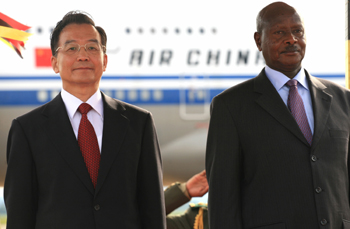
China's Premier Wen Jiabao (L) and Uganda's
President Yoweri Museveni watch the honour guard
Surprisingly, Uganda has no oil
The premier met with leaders of seven African nations which we can divide into two camps: Egypt, Ghana (oil), Congo (oil), Angola (oil), South Africa, Uganda and Tanzania. As Wen Jiaboa traveled, spreading Chinese largess throughout the African continent, he did not forget to make that all important stop in Angola.
China Petroleum & Chemical Corp (Sinopec) has acquired stakes in oil exploration blocks in Angola's recent licensing round through Sonangol Sinopec International (SSI), its joint venture with Sonangol, Angola's national oil company, the official Shanghai Securities News reported.Quoting from China's Portugal Connection, "In February 2006 Angola became the largest supplier of crude oil to China, beating Saudi Arabia and Iran into second and third place. Recognizing how Angolan oil can contribute to its continuing growth, China has embarked on a massive offensive to secure its vital position in the country". Perhaps it should have been dubbed "The year of Angola" but that would have been unseemly, too crass. Finally, I note that about 5% of Chinese imports come from the Sudan with expectations that exports from there will increase to about 9% of China's needs by 2010.SSI won stakes of 27.5 pct, 40 pct and 20 pct in blocks 17, 18 and 15 respectively, the report said. Sinopec holds a 75 pct stake in SSI.
In the interest of brevity, I'll cut this story off here. There's plenty to discuss.
Contact
- Content: editors at theoildrum dot com
- Tech support: support at theoildrum dot com
License

This work is licensed under a Creative Commons Attribution-Share Alike 3.0 United States License.
Nothing new.
His thesis is that prior economic contractions (following oil price increases) were caused by interest rate increases, and not by higher oil prices per se.
However, he predicted that the post-peak crash will be all that more severe, because of the economic boom preceding the arrival of $100 plus oil.
As oil prices rise, Russia's dollar earnings will increase. In order to keep down the value of the ruble (if it became too strong, Russia's other exporters could be hurt), Russia will have to print more rubles (it didn't used to have to do this as the ruble wasn't fully convertible). The effect of this money printing will be not just to increase inflation, but to increase Russian consumption, including oil consumption.
As a consequence, I wouldn't be surprised to see very strong Russian growth in the coming few years.
On the other hand, the Bank of International Settlements has recently recommended (http://tinyurl.com/llubu) that central banks increase their interest rates 'more forcefully' to 'control inflation', so we may well see another major economic contraction caused by interest rates.
"Zapata" George Blake http://www.zapatageorge.com/ has written and spoken extensively on the growth of the Chinese automobile fleet being a relentless demand engine outside of any practical means of control. He once recounted a phone conversation with an exec from an auto company that was building a new plant in China. He asked, "And will your cars have gas tanks?...Ok, that's all I need to know."
Poor Americans will have to ride the bus or bicycle so that newly middle class Chinese can drive. Other than viral genocide or nuclear armageddon, there are no other solutions. The question is whether the ruling US junta is willing to escalate to massive global crimes against humanity to defend the "non negotiable" American lifestyle or will they capitulate and let a growing fraction of the US population slide into third world poverty?
And
"we learn that 5.7 million motor vehicles were sold in 2005 but the prediction is for sales of 9.6 million in 2010"
Looks like China will have no trouble blowing past that number.
"Poor Americans will have to ride the bus or bicycle so that newly middle class Chinese can drive. Other than viral genocide or nuclear armageddon, there are no other solutions."
Schwinn or Huffy
How many Firsts, Bests, and Mosts will China pull off before Americans start noticing?
Then Putin showed up, threw the oligarchs in jail and formed military and energy alliances with China and other central Asian countries.
Talk about throwing a huge wrench in the works! Now Russia, China, Iran and Germany become the New World Order.
Who would have thought this would happen three years ago?
Oh good grief.
I guess the sentence that finally put it over the top was this one:
"How many Firsts, Bests, and Mosts will China pull off before Americans start noticing?"
We will wait for thier first First or best....and except for most mouths to feed, I would like to know of any of those too...this has now gone past the edge of idiocy.
If using semi slave labor to load the U.S. Walmart chain and auto replacement part business down with cheap shiit merchendise is now considered a "miricle deed", then maybe I have a false view of national stature and securtiy.
It amazes me that if the United States has autos and wants to continue trying to use them, that is EXACTLY proof that it is a filthy decadent nation of no real cultural enlightenment or advanced knowledge, but if China has a rapidly growing population of knock off sport utes and is laying highway by the tens of miles an hour, it is a sign they are a raging success!!
If Americans ride more bicycles, according to some posts on TOD, that is good and virtious and "environmental", while on another post when we discuss China, China leaving bikes for cars is proof of their overwhelming superiority, and us riding bikes is a sign we are becoming a "third world nation"!!
While America is going to "destroy itself and the world" with greenhouse gas emissions, apparently no one notices that China has two hundred fifty or three hundred million people, all it's shipping and most of its industry sitting in what will be coastal marsh if the glacial melt actually occurs!! Thank heaven they are exempt from the greenhouse gas their cars release!
The United States still, even long after our peak, produces more of our crude oil at home as a percentage of cunsumption than China, FAR more of our natural gas as a percentage of consumption than China, and is orders of magnitude better on energy consumption per GNP.
If the Chinese are our major competitor in who is best outfitted to survive a possible "peak" scenario, I feel better already.
So while we wait patiently for China to "pull off" its first or best, they have to keep an ever ascending amount of fuel coming to their nation, while hoping the world economy doesn't slow down and stop the money flow that buys that fuel, and plan for a billion Indians right behind them competing for their markets, their fuel, and their natural gas....oh, and one more thing...try to build some of them New Orleans style levees to protect a quarter of a billion people, and 50 or more New Orleans size cities and their associated industrial might from the inrushing "Al Gore" glacial flood.
Good luck.
I will gladly take America's "growing loserdom" any day of the week. (by the way, does anybody here ever have anything good to say about this country? I cannot begin to tell you the damage some of this completely non-sensical America bashing does to undercut the cause of educating people to the REAL critical issues of energy depletion. Non sensical praise of the non existent "miricle deeds" of China horribly undercut credibility if no one here will reply to them. I have no love lost for recent U.S. policy on many fronts, and we surely have our MANY faults and vices, but we should try not to go completely off the deep end in our attempt to prove American "loserdom" on every day, in every way....displays of rabid and irrational U.S. hatred cannot do much to win a wider U.S. audience, and often comes across as much more the point of discussion on the boards than any discussion about the WORLD energy problem.
Roger Conner known to you as ThatsItImout
Very well-stated!
I second your thoughts.
America-bashing (as opposed to constructive suggestions) is mostly childish mental masturbation, IMHO.
Shanghai has 17 subway lines in planning, the first 5 recently opened (3 within last 2 years from memory). Once completed, Shanghai will surpass London & NYC as the subway capital of the world, with Beijing a rival with London and NYC for #2. Many smaller cities also have major projects underway.
About 18 to 24 months ago, the response to rising oil prices was to add some kms to the 15 subway lines then planned fot Shanghai and add two more.
From memory, 30 nukes planned
Below is a listing for one Chinese river. Similar scope expansion in another couple of other rivers (upstream of 3 Gorges for example)
From a critic of Chinese dams; Three Gorges Probe
---------------
China is looking past coal. They have massive hydro plans Hydrolancang's existing and proposed dams along an 800-km stretch of the Lancang (upper Mekong) River in Yunnan province (from upstream to downstream):
Projects Installed capacity (MW) Dam height (metres) Estimated cost (US$millions) Status
Gongguoqiao 750MW 130m $625 Due to start: 2006 Completion: 2008
Xiaowan 4,200MW 292m $4,000 Under construction. Completion: 2012
Manwan 1,550MW 136m $473 Completed: 1996
Dachaoshan 1,350MW 111m $600 Completed: 2003
Nuozhadu 5,850MW 216.5m $5,000 Under construction. Completion: 2017
Jinghong 1,750MW 118m $1,000 Under construction. Completion: 2010
Ganlamba 150MW 65m n/a n/a
Mengsong 600MW n/a n/a n/a
Thank you VERY much for that wonder post. It is so nice to see that someone else thinks the same way.
I am also tired of the constant bashing of our Country and its political leaders. It seems most of the bashing comes from those that are convinced that there are major conspiricies going on all over the world.
They bash the large oil companies, but I wonder what they think will happen the first time one of those third world countries "Nationalizes" the expensive oil infrastructure that China has delevoped in their Country and orders them out of the Country like they have done to the large oil companies? Do you think they will just write it off like the oil companies or will they send in the troops?
I will forever remember the scene in "Braveheart" where they were ripping the insides out of William Wallace and his only verbage was "FREEDOM".
Freedom is not free. Its price is eternal vigalance and sacrafice. Those who advocate not working to contain violent agressive religously controlled dictatorships from getting accress to nuclear weapons would also be the first to complain about our leaders not protecting us when those nuclear weapons were used against us.
No one really knows what is going to happen when the oil shortages really begin to happen. There are as many different ideas (or more) than the number of people posting on this wonderful educational site.
But it seems that the educational content comes from just a few who focus on the problem(s) and the bashing comes from the many who provide minimal educational content.
My hat is off and I offer my many thanks to those who are spending the time and effort to provide the really great articles, charts and references.
Thank you very much.
The United States is a world laggard, the worst of the bunch (Australia may be near us) in planning for the future.
Even Uganda wants to build two more hydroelectric dams to get completely off oil for electricity. We trail Uganda in foresight and planning !
*The 1¢/kWh wind subsidy is doing some good (carryover from years past), but the Bush Administration's drop of federal matching for new Urban Rail from 80% to 50% does more damage than the wind subsidy did good. The Interstate Highway system was largely built with 90% federal matching subsidy.
In a little noticed move, the Bush Amdinistration rolled back the energy efficiency plans from the Clinton Administration for home central air conditioners from SEER 13.0 to SEER 12.0. Massive amounts of natural gas will be burnt in future years because of this one small change.
We are right now doing a little more then what is motivated as a "bonus work" while doing other things. Much of it is market driven investments presuming high and rising oil prices. For instance are our farmers large common organizations risking a large part of their capital on this.
And Ford is starting a hybrid technology reserach center in Sweden to continue Volvos work in hybrid technology and have promised to invest about $1.2G in this over 10 years. (And if Ford goes belly up the people and knowledge will still be there for someone to bid on. ) I also think manny people hope for these fields to be ha safe haven for new surprisning taxes. Our authorities could surely not kill these new industries when they are desperately needed? There would be a public outcry.
Our opposition alliance is proposing larger public investments that I interpret as focused on infrastructure, energy savings, research and development in cooperation with industry with a higher degree of corporate and researcher control.
Our current socialist government will probably propose larger public investments that I interpret as focused on infrastructure, energy savings, research and development in cooperation with industry with a higher degree of political control.
Either way the turn around if you sum up all the parts will probably only be about a percent of GDP. The socialist version will take the chance to increase the size of the government staffing and will probably use more tax money, the opposition version will probably try to attract a larger portion if private investments. The opoosition has stated to contuine the current large rail investments and use more money for road maintainance and building, our socialists will probably propose more money for even more rail investments.
And much of this additional effort is still only words, the result depends on what happens during the summer months, if PO becomes a big question it will mean a lot in the election and influence decisions. Either way no one want to get rid of budding and working industries exept our greens and leftist(almost true communists) who realy want to close down nuclear power and get rid of other things they concider dirty or distrubing the natural views.
What is proposed is more or less a go ahead for most half finished plans and researchers and companies who have bided the time using about a percent of GDP. That is far from being an almost maximum effert. A maximum effort is a mobilization comandeering some 20% of GDP or more. But this is not a war, this is two immediate problems, global warming and PO whos solution efforts can be combined with creating jobs and protecting our comptetiveness.
And we could be wrong! PO might not hit us with full force for 10 or 20 years, global warming might be controlled by some natural feedback loop or man made one. We would then look dumb if we made an almost maximum effort, it is better to do a reasonable one that gives attractive products in the short run, generally usefull knowledge and infrastructure that lasts for decades or a century. Perhaps we are only adding a layer of infrastructure and knowledge as done during earlier smaller energy and other crises? I would actually argue aginst a true maximum effort but it would be wise to draw up some plans for such an effort if it would be needed. (The lack of a good civil defence as the one we had during most of the cold war worries me.)
In a rich nation, 1% of GDP goes further. And Sweden and Switzerland already had, among other things, good non-oil transportation systems in place and they are just enhancing already good systems.
IMHO, 1% of GDP is close to the maximum effort that can be expected in the real world of today. I am amazed at the Thai level of effort !
If the US effectively devoted $124 billion/year towards solving these problems "we could get somewhere" in a decade.
Even 1/2 of 1% of US GDP; $62 billion/year would give is a fighting chance to effectively deal with both of these looming problems.
A lot of it is incremental costs as if a suburban landscape would be PO prepaired by being built with a 10% higer cost in insulation, heating/cooling heat pumps, preparations for subdivsion of houses if times turn bad and fruit trees instead of lawns. If you extend the loading gauge and axle load of a railway, how much of the investment is reinvesting the worn rails and bed below it and how much is new PO preparation for increased traffic? I could probably easily get my single percent by moving the goal posts. :-/
And then there are local decisions, our municipiality could on its own start about this level of investment for the local area by moving its capital from old more socialist era investments to new trolley lines, car roads and bicycle roads. (Yes we need some new roads for cars.) The trouble is that old nostalgic people are guarding the "democratic influence" on the day to day running of these investments even when that has lost all practical relevance and they would be better served by new infrastructure. I am trying to sow this idea, I hope it works. Manny but far from all municipialities have capital that can be moved around to finance infrastructure investments and most have good credit rating.
And most of the municipialities will go broke in about 20 years if we dont do something more efficient and market driven for fulfillig promised social benefits etc but that is another problem.
Said the car dealer to the old lady.
This is a meaningless phrase. Freedom isn't free, but neither must it be so expensive that other, vital national interests are not met or looked after.
Let us consider data on US military spending:
Military spending in 2005 ($ Billions, and percent of total)
The chart below might also make a few things clear:
Country Dollars (billions) % of total Rank
Source: U.S. Military Spending vs. the World, Center for Arms Control and Non-Proliferation, February 6, 2006
United States 420.7 43% 1
China 62.5 6% 2
Russia * 61.9 6% 3
United Kingdom 51.1 5% 4
Japan 44.7 4% 5
France 41.6 4% 6
Germany 30.2 3% 7
India 22 2% 8
Saudi Arabia 21.3 2% 9
South Korea 20.7 2% 10
Italy 17.2 2% 11
Australia 13.2 1% 12
Brazil 13.1 1% 13
Canada 10.9 1% 14
Turkey 9.8 1% 15
Israel* 9.7 1% 16
Netherlands 9.7 1% 17
Spain 8.8 1% 18
Taiwan 8.3 1% 19
Indonesia* 7.6 1% 20
Myanmar 6.9 1% 21
Ukraine* 6 1% 22
Singapore 5.6 1% 23
Sweden 5.6 1% 24
North Korea* 5.5 1% 25
Poland 5.2 0% 26
Iran 4.9 1% 27
Norway 4.7 0% 28
Greece* 4.5 0% 29
Kuwait 4.3 0% 30
Colombia* 3.9 0% 31
Switzerland 3.8 0% 32
Pakistan 3.7 0% 33
Vietnam 3.5 0% 34
Belgium 3.4 0% 35
Notes:
Figures are for latest year available, usually 2005. Expenditures are used in a few cases where official budgets are significantly lower than actual spending.
* 2004 Figure.
Source uses FY 2007 for US figure (and includes Iraq and Afghan spending). I have used 2005 to try and keep in line with other countries listed (but I have NOT included the Iraq and Afghan operations cost which would be another $75 billion).
A massive, standing military establishment in peace time is a relatively new phenomenon in our history. At first we justified the national security state that was built after WWII through our experiences in the two world wars and the shadowy threat Stalin's USSR represented. We've been without those justifications for over ten years now and (surprise! surprise!) we've not only not gotten rid of it but expanded it by using Islamic fundamentalism and terrorism as the new looming evil du jour. Am I mocking the threat Bin Laden represents? Absolutely. When you read the 9/11 Commission report it is clear Bin Laded succeeded more due to massive incompetence and ineptitude at the highest levels in the national security apparatus of the United States than to brilliance by religious fanatics.
So, what do we have? Billions and billions spent on a national security apparatus flummoxed by 19 men weilding knives. We've a war in Iraq sold to us by folks who reap all the benefits of military spending and military operations but bear none of the costs. If you read Sy Hersh, the gnomes tending the war machine in DC are still seriously considering dropping bombs on Iran.
Freedom isn't free, but we don't have to crucified on a cross of iron either. No one doubted European militarism and imperialism was driven by vested interests who had much to gain by such policies. Suggesting the same thing about the US, however, gets you tarred as being anti-American. A look at the data, however, suggest otherwise.
One U.S. Marine with his Kabar could have taken out four guys with box cutters in approximately eighteen seconds.
I disagree:
if conservation is your goal then the best place you can get the best impact is to cut the use by the military then use the savings there to convince the public to do the same.
1. Much of the frustration with these topics is that they are loosely related to oil if at all. A few posters have a compulsion to foment about their pet peeves to the detriment of the larger dialogue. Don't misinterpret all of the lack of patience with off topic rants as disagreement.
Sure, no doubt. But I think detaching the technical debate over how much oil is left is KSA from the geopolitical and social ramifications of peak oil is difficult if not impossible. You can't have a real discussion about oil without talking about US demand and consumption. 5% or so of world population using 25% or so of world production. America's use of oil and the entire society built on it is the elephant sitting in the room is it not? China, India, Europe, Japan, KSA...all important, but in the end we have the US consuming far more than anyone else.
2 It is pretty obvious that there are extremes in the US and that any statement by one extreme results in insults by the other. If you can't take the heat ...
I wasn't insulted, but, again...5% of world population consuming something around a quarter of world production! 43% of world military expenditures but next to no investment into programs or policies that would alleviate oil consumption! An invasion and occupation of an oil-producing Arab country coupled with the abandonmen of efforts to capture the actual people who attacked the US! A looming showdown with Iran over its nuclear program. Highway sprawl going deeper and deeper into the countryside. Gay marriage being given more credence as a political issue than global warming by our political elites.
What is one to make of this? It's clearly, obviously insane, but that's the reality on the ground. Something is out of whack here. Opinion polls reflect it and a lot of people can sense and feel it. Many are angry about it. But no one can really say what it is.
3 Vested interests gaining from policies is old, obvious and well documented. I don't see much opposition to this line of discussion until you get to some pretty extreme conclusions. Some of these are based in paranoia, some in politics and some in anti-Americanism.
Fair enough, but I think Americans are overly touchy to criticisms of their country and are way, way too quick to charge anti-Americanism and paranoia. 5% or so of population, 25% of world oil consumption and an economic, political, military, and cultural hegemon to boot. How can the United States NOT be a topic of conversation?
"detaching the technical debate over how much oil is left is KSA from the geopolitical and social ramifications of peak oil is difficult if not impossible. You can't have a real discussion about oil without talking about US demand and consumption. 5% or so of world population using 25% or so of world production."
Yes. social and geopolitical issues are just as important as technical. U.S. demand is clearly relevant, but your post was not about demand. It seemed like the boilerplate "The U.S. is an empire rant". I didn't see much effort to link it to energy issues. Sure the US uses 25% of energy, but has near 25% of the global economy. China and India are elephants knocking on the door too.
"Something is out of whack here. Opinion polls reflect it and a lot of people can sense and feel it. Many are angry about it. But no one can really say what it is."
The current U.S. administration is deeply unpopular, a sentiment that I share. But the causes are many. I don't think American militarism is the direct cause of an American malaise. However, I disagree with the hyper simplistic war for oil analysis. I have asked before, if people think Russia or France's support for Iraq was less about oil? How about China and Russia's support for Iran. I suggest in all cases all players have a mixture of economic and political motives. Oil is one of both.
"Americans are overly touchy to criticisms of their country and are way, way too quick to charge anti-Americanism and paranoia. ... How can the United States NOT be a topic of conversation? "
I agree that the U.S. is no less acceptable as a topic of conversation than any other subject. Are Americans more touchy than citizens of other countries? I doubt it. Most of the "anti-American" posters are Americans. Self-criticism is an American trait. I think the two extremes go overboard. Overly patriotic Americans see everything the country does as good, kneejerk critics see everything as bad. They are both wrong in my view.
My primary objection to your post (and the Israel one yesterday) is that the main thrust of the argument is external to peak oil (although contortions can be made to claim otherwise), the topics are endless, and they lead to brute arguments between two extremes.
I have come to accept that critics of America and the U.S. administration really do believe that these issues aren't being discussed often enough. I suggest you look around. There are many people with opinions that may not be much different than yours, or who would be convinced. However, they are so bored of people thinking it is reasonable to insert Bush comments or America is a dictatorship into every discussion. I have close friends that I have to make agree to not talk about Bush all night if we go out together. Do I disagree with them, maybe not. But I don't want to hear the same simplistic argument over and over and over....
I am not the site policeman. My opinion is no more important than yours. But I do think we improve the quality of this site if we stick with topics that are relevant or lead to something other than emotional arguments.
Chapter 7 is titled "Blood For Oil" and his case is that while the cold war was primarily about ideology, our near-future wars would be about resources.
Perhaps that book just captures a moment in time, but I think we came up againt that choice. Is war about peak oil? I think when it shows up in a book like that the case is stronger than just "contortions."
So, while I don't think I open these things, I don't think it's a good idea to swear silence either. Because, if oil is a cause, and we all just keep mum and pretend it's not ... we aren't helping.
http://www.theoildrum.com/story/2006/7/5/9404/59858#14
It's a PDF report, written by an Army Lieutenant Colonel, and hosted on a ".mil" site.
The title is:
"PREEMPTIVE ENERGY SECURITY: AN AGGRESSIVE APPROACH TO MEETING AMERICA'S REQUIREMENTS"
Now .... round and round? Maybe better that than, as I said at 5:40 AM, something we all ignore and hope it goes away.
China is going down a path which will cause it to suck up most of whatever is left in oil resources. This is a result of what I consider an ill advised policy of making the automobile one of the centerpieces of its development process. This seems especially bizaare in a time of peak oil and global warming. China was in a good position to choose a softer path, a more rationale path considering its limited oil resources and its huge population.
Europe seems determined to do something significant about energy consumption and global warming. Their efforts, however, will be dwarfed by China's increase in greenhouse gas emissions, not to mention the U.S. lack of progress. China need to be brought into the greenhouse reduction regime or the rest of the world's efforts will be pointless.
But what should be done if China refuses to hide behind their special status as a developing country? In part, we give them a pass because of the belief that they are entitled to be given a chance to reach a modern, industrialized world's standard of living. While there may be a certain logic to that, the Chinese path still seems insane and shows a truly blind disregard for what the automobile has already done to the Unites States and the planet.
The overarching reality is that we don't have enough planets for China to rise to the economic level of the United States or Europe. At some point, the game stops. At that point, what will the resource base of the planet be and how deep will many of the world's coastal cities be under water.
It is arguable that the so called western world does not have the right to dictate to the Chinese. We've got ours. How dare we say they can't have theirs. That's the key. We both can't continue to grow at the current pace. If China continues to expand, the rest of the world will need to contract.
Part of the answer, I think, is to recognize that China's consumption of resources is very much a function of our consumption. The statistics on resource consumption are distorted and improperly allocated. Looking at greenhouse emissions by country is distorted if one doesn't look at the indirect emissions. Future goals for reduction needs to look at those indirect effects. China needs to find a more energy efficient way to produce those exported consumer goods and/or the receiving countries need to cut their imports.
While we don't need to point fingers directly at China, I don't see how we can seriously address oil consumption, energy consumption, or greenhouse gas emissions without addressing goods consumption. But now we're really talking about the American way of life --- a way of life that has already been deemed nonnegotiable by the GW Bush.
Or are we to believe that all the energy that China and other countries put into producing exports to the US, and building the related infrastructure, would have been spent anyway if the US did not exist?
I was referring specifically to the situation of the 1950's: Russia's surprise Sputnik launch setting off an explosion of American self-analysis, a great transformation of our education system (from which I benefited directly) to focus on math and science, and a competitiveness leading, as I mentioned, to the Moon Race. I was expressing the wish that in our current complaisance China might trigger the same thing again, while hoping that the result would not simply be militaristic. The "Firsts, Bests, and Mosts" which seemed to have caught your attention are not my personal evaluation, but the media reports of Chinese "miracle-developments" that seem to be bombarding us every day. If I was bashing America I'm not sure what country I would hold up - but it would not be China.
We borrowed too much. We ate too much. We relied too much on our political/military muscle.
It was mostly underpinned by cheap oil. First our own and then somebody elses.
Now we are going to go on an energy diet. We seem to be at a point where we lack good national leadership on how this will be accomplised. But we can change.
I've come to appreciate that some of the ideas and character needed in 'our' country exist on this board. A few good men on both side like Roscoe Bartlett and perhaps that governor over in Montana are trying to sound the alarm in the political arena. But a lot of the changes will be grassroots and subtle.
The negotiation process will take time but the MSM is starting to 'get it'. A lot of people on the ground 'get it' and hopefully we'll get it turned around in time.
I don't envy the Chinese their smog filled cities and their
relentless 'progress'. In a way we will be watching a sort of replay. What I do know is that we (Americans) are starting down a new uncharted road and it is not he same one as the Chinese will be experiencing. I think it does mean we may be using some processes that are laying dormant in our collective experience.
For a time at least we will be learning how to do with less as they learn how to deal with more.
In Holland I got on my moped or the bike or went to the train station. I never had a car and went from the top of Sweden to Italy and even into East Germany. There were inclined railroads in Switzerland with trains running on cogs. Boat shedules and trains in Denmark and Sweden were timed to run together.
This was several years ago sure things have changed some but..in short it worked. It was connected.
My perspective is perhaps a little different being out here in a distant rural area. I do think we get a bit urban centered sometimes in our solutions. The cities here will still need the rural areas for survival. And visa versa. (I haven't figured out how to make a 3 ph. electrical contactor in my shop) The rural areas are heavily road vehicle dependant. The distances are vast. There are few trains, almost no passenger trains, and bus service does not penetrate to within 75 miles of here.
There are lots of places in the US where these things are true. This is why I believe our solutions will not fit a template of one country or another. We will 'borrow' ideas from other areas but I do not see government stepping in with big $$ to create a bunch of infrastructure like Europe has that we don't currnetly have. Not all transportation routes have a prayer of being profitable. I agree we are 'behind', partly because we are so utterly married to our roads.
A bunch of cultural ideas come to mind like collective transport for trade to the cities, cooperative purchasing, and ad hoc transportation systems. I sincerely hope we are not too embarrased to try different things. We have proudly driven our pick-ups everywhere, you know. Also I hope we dont over-regulate new ideas. My experience with incidents is that we will tend to expdite new ideas when push gets to shove. Clearly we are going into new territory.
If 'Europe' works, fine. I think we need to be aware that some of it could end up looking like Cuba too.
Just think how much better off the US would be if we i) forgave Saadam for his faux pas of invading Kuwait, and ii) if we had responded positively to several recent friendly overtures from Iran. Hell, we'd be swimming in favorable-rate Iraqi and Iranian oil today.
As it is, before the year is out the US will have 'invested' something like $400 billion on its Iraq adaventure and may very well be at war with Iran by then.
If only we had stuck with our long established policy of paying off dictators for favorable oil concessions. We'd get the oil, and Saadam and the ayatollahs would continue to oppress and abuse their own people. It would have been a win-win for all concerned (except for the oppressed and abused Iraqis and Iranians, but they didn't matter to the US then, and really don't matter to the US now).
As I've said before, while the Chinese are busy making oil deals, the US is busy making enemies.
Cheney deserves some credit for one thing, though. He enabled some of us liberals the ability to understand the virtues of pragmatism when it comes to world affairs and politics. The Chinese are not encumbered by our other need, to be the messiah for all those people yearning to be free and democratic.
Bush has been the perfect puppet because he actually believes all this twaddle about liberty.
The the long term costs of the war will be around $2 trillion dollars. Just think of all the people we could have paid off handsomely, for that amount. Not to mention all we could have done in the areas of conservation and alternative energy. Add that money to our petroleum bill and you will go along way to seeing the true costs of gasoline.
Easy motorin', America.
Right on!
I too have always felt that Bush is merely the vehicle by which a number of powerful entrenched forces in the US attempt to have their way. He probably truly believes his own bullshit, and a person who does that is a most dangerous person indeed.
I've heard it said that Bush bought his Crawford ranch less than a year before the 2000 election so that when (perhaps not if) he won, he'd already have a Hyannisport or San Clemente waiting to serve as the unofficial White House. What did these people know that we didn't? The circumstances surrounding the acquisition of the Crawford spread might be worth looking into, as it might further reveal who some of the important players really are.
Tis said (see latest Wayne Masden Report) that a former high-ranking DOD person believes there will be another 9/11-scale terrorist event sometime before the November elections, and that marshall law will be declared and the Halliburton detention camps will all set up to receive thousands of citizens of Middle Eastern origin, just like the way we rounded up Japs and put them into detention camps in 1942.
Paranoid ravings of the delusional ? I sure as hell hope so. But it seems that of late the paranoids have had a better record of predicting the future than the 'more rational' skeptics.
Dunno if SA is about to collapse then maybe the approach of killing off unstable goverments before the whole world goes unstable makes sense. A bit of a game of wack the mole but it may allow us to focus on forces on our south american friends later when the SHTF.
Consider if SA oil production is going to plumment within even the next five years probably say the next two by maybe 2 million barrels a day and say theres similar declines of say 500k-1million barrels in mexico and at least the same in russia. Maybe overall the world may be looking at a loss of 4-5 million barrels. The reason for this step function is the use of modern extraction methods which have been shown to cause significant declines before a new level of sustainable production can be reached. Burgdan/North Sea etc.
With this assumption what would America do ?
1.) Take out current enemies via either inciting civil war or replacing with friendly goverment.
If there oil producing the attitude is they either do it for us or not at all either outcome is acceptable.
2.) Pick your battles its easier to control Central/South America then be spread all over the world.
My guess is the US's primary target is Venezuela's Orinco reserves coupled with increased Canadian production.
Iraq and Iran are basically under either the sell us oil our we leave them in civil war.
I'm guessing we have given Iran/Iraq FSU oil to Europe and China to pacify them. It looks like the big losers are the Japanese and Indians along with South East Asia.
And of course poor Africa what happens there ?
In any case the underlying hypothesis is its basically a return to colonialism but with the high cost of transportation factored in physical distances are very important.
However a look at a map shows how some bright evil people are behind the latest banging of the war drums for Iran. With the adition of Iran the US will have well over 50% of the countries with big reserves in an empire.As some of you recall, we already have troops in Saudi Arabia and Kuwait.
This falls in with the Neocon tactic of drumming up patriotism and nationalism by Bush being a "war president"
All of this is evil and self-evident. I sure hope I'm wrong, but I really don't think I am.
Never assume that someone with a lot of money and power (U.S.A) is stupid thats a big mistake. There are plenty of very very bright people backing the US president. For example the WMD issue was obviously played and the president played the part of the fall guy with cleaning out the CIA a nice side effect. I assure you they have far more information and excelent anaylisis at there disposal then we do and know for example EXACTLY how much oil SA has. All we see is how they use it for political ends which is obviously not to bright.
But people forget Bush is urging the hydrogen economy et eal.
Big time which is a bit weird if the neo's thought oil was going to save the day.
My point is todays games are simply that its payback time before we get down to the real resource wars that are comming. Why not take out a few assholes before we need to really fight for survival ?
I don't think the real thing has started yet and as people mention we have SA and Iraq and Iran is a almost surrounded remember Afghanistan. So were looking damned good in the begining of the resource wars. We can take out old Chavez as needed ( We almost did ) but hey he still sells us oils so okay.
I think the neocons have done dammed well. Ohh it cost a trillion dollars so lets print more.
This is true. But in a larger sense - The United States does. In both cases. I leave the significance up to you.
We can, of course, argue about this - so I will simply put this forth. Iraqis and Afghans don't control their own countries. They have (at least at present) no control over whether the US military is there or not. So if not them, who?
The US is the occupying power. So, for good or ill, it does have control. How well it "controls" would be the real question.
One of the major, but somewhat muted, reasons many Germans were opposed to invading Iraq is that they that do have experience in the sort of control you are talking about. (Not that they really want to expose the source of their experience in public.)
And they didn't let any minor considerations about laws or international conventions get in their way either when fighting what the Wehrmacht/SS considered terrorists.
Different situations, of course, but occupying a country after invading it is generally nothing but a waste of time and money in German eyes, leaving aside all moral considerations completely.
Not too surprisingly, almost all of the English language media I read talking about German opposition to the war seemed to focus on monetary considerations (big contracts with Saddam), easily dismissed moral concerns (war is evil), a certain vague understanding that Germans are opposed to war for historical reasons, and the obvious political spin (Greens/socialists are Bush haters).
This completely missed the most common theme of the numerous conversations I had with older Germans, whose main point was that trying to occupy a place with a foreign culture whose people hate you is just pointless - regardless of how tough your methods are. Most of them being typically German, they didn't really care about the people being occupied, by the way - they pretty much only pitied their own horrible experiences at having to do the occupying.
We don't control Iraq anymore than the Iraqis do - and the Afghans have always been the people that control where they live. What we can do is blow things up - this is not control, it is destruction. And both the Iraqis and the Afghanis are able to do the same thing on a lesser scale.
I won't dispute that by most measures of external control, both the Iraqis and the Afghanis are controlled by the U.S. (It is a given that Iraqi oil is a fiction - it is American oil, pure and simple, as long as we are able to keep it flowing.) It is just that by most measures of internal control, the Iraqis and Afghanis have ensured that the U.S. can only use force as a means of motivation - which means the U.S. has lost control.
And at some point, both the Iraqis and the Afghanis know that the Americans will go home.
From a big-picture point of view, we will have used up the large majority of oil, NG, and coal in approximately 200yrs. There are going to be several big impacts from this.
First, we've released the carbon stored from these sources in what amounts to a blink of the eye geologically. We're learning that there are going to be some big impacts on the global climate, and we're only just beginning to understand what they'll be.
Second, we've built our societies (and population) around the availability of these fuels. If we can find some other source(s) to switch to, then I suppose it need not have any more impact than switching from wood to coal did. If not, there will be major changes for all of us.
Peak Oil is literally the time at which we achieve the maximum production rate of oil. For all the technical analysis, it doesn't mean much, other than in social impacts and that it may affect the timing of social reactions. And I think that the real social impacts will be when cannot get the energy they need to maintain their lives or livelihoods. It's the difference between what people need/want and what they can get, regardless of what rate we're producing. It doesn't matter if this is because they cannot afford it or because it isn't available, if they cannot get it that is when the big social problems will show up. It's possible it may show up sooner if the fear of it sets things in motion sooner than the actual supply problems would.
So articles like this one are the kind of thing I'm focusing on - big increases in demand from China help drive more difference between demand and supply (using those words generically), which is what will stir up the big problems. And of course it will release yet more of that carbon.
Simply put, if everyone lives as the Americans do, we would need N Planet Earths to support them -- I don't know what N has been calculated to be and I'm too lazy to look right now. But it seems clear that the one Earth we have is now past its carrying capacity and further unfettered development anywhere only makes this situation worse.
Yet the inexorable working of human nature puts us in a bind that we probably are not going to get out of. E.O. Wilson has called this "the bottleneck". Who knows what living on Earth will look like on the other side. Only time will tell.
The only official figures that China releases monthly are: crude imports, crude exports, product imports, product exports, crude production, and refinery throughput (however, refinery throughput covers only those refineries under the CNPC/Sinopec systems and excludes throughput at many independent small refineries). No data on inventory build or draw is released (except annually, about 2 years after the fact).
So, on the basis of this, you can calculate two demand formulas:
- Apparent Consumption. This is Crude Production + Crude Imports - Crude Exports + Product Imports - Product Exports.
- Apparent Demand. This is Refinery Throughput + Net Product Imports
Both exclude inventory change, which of course makes monthly figures fairly meaningless. And the second excludes some throughput at small refineries.Quarterly averages are a better way to look at consumption trends (and I prefer the term "consumption", since, as we saw last summer, there is unsatisfied demand at times because of distortions that the pricing system creates).
And be cautious about the word "automobile" in Chinese media reports. The Chinese use the word "汽车" (qiche) to mean all motor vehicles, but it is often translated automobiles or cars; for the cars that are equivalent to our personal cars, they use 轿车 (jiaoche), which means "sedan" (or, in their own translation, they use the British term "saloon car")
Currently, Chinese gasoline consumption is 1.05 mmb/d, 1/9th of the US level. They are not populating the road with SUVs--the most common cars now are 1.5 liter, and a new tax regime reinforces the trend towards smaller cars. There are many other drivers of oil demand in China beside motor vehicles.
Angola has a population of around 12 million people.
The capital, Luanda, has a population of approximately 4 million. But adding to these 4 million there's another million of Chinese workers!
They are just taking over the country in the construction business and other areas of low tech labor.
The same can be expected to happen in São Tomé e Príncipe.
Carlos Cramez (Petroconsultants, ex-TOTAL) says current known reserves in Angola will peak in 2009; adding new discoveries, the peak will be postponed to 2012 at the most.
The mystery of Wen's trip to Uganda is solved by this post in African web site- yes Uganda may have commercial oil reserves:
"Newspaper headlines in the last few days have been fairly dominated by reports of the discovery of commercial quantities of oil in western Uganda. First was the confirmation that one of the wells on which tests are being carried out, Waraga-1, had the potential to produce 1,000 barrels of oil per day. Then that figure was improved to 1,500 barrels, a few days later. And as if that was not already good enough, further tests have now shown a potential of over 4,000 barrels a day. That is something we cannot help but be excited about. "
http://allafrica.com/stories/200607030449.html
The current political leaders in America seem to prefer these issues to the dry, technocratic ones that are important right now:
- Energy policy
- Sound/sane fiscal policy
- International and domestic security (legitimate)
- Domestic development of resources and the economy
- Education, technology and brain drain
These five issues are the most pressing for the United States, vis-a-vis China and the rest of the world, to a lesser extent. The United States' greatest resource in the 20th century, after its industrial might was created in the World War II period, is its intellectual leadership and development of new ideas to create new markets, products and innovations.We are in the process of neglecting the last great American muscle - the mind, and more specifically, the free mind. We're entangling too much political whimsy (Terry Schiavo, Creationism debate) where there need not be any. We've forgotten the basics and neglected our intellectual heritage rooted in The Enlightenment and moved into a post-modern cum Middle Ages mindset that seems to have made us risk-averse and insulated to the point of being clueless (stick your head in the sand - peak oil will never come!).
The argument that many are making seems to be that America's decedance is slowing it down. It's many interest groups tugging for control, power and wealth to the detriment of the Republic. Instead of looking forward (technology, new ideas, rationalism and objectivity), we're looking back (family values, church, faith, unfounded idealism and subjectivity) and those values will not fight off the growing threat of resource depletion, of a weakening education system that develops new ideas and fight the oncoming storm of China.
China today is where America was circa 1880s - 1890s. Unless we realize the need to rise to the occasion and retake our position of leadership based on reality and driven by a solid moral compass, we are in danger of losing our friends, our economy and our livelihood. Now is not the time for wedge issues and political grandstanding - it is the time for intelligent leadership, focus and clarity. Our current political leadership, on both sides of the aisle, lack that courage.