
 | DrumBeat: February 14, 2007 | The Oil Drum | Anaerobic Digestion (AD) in Ontario – A Regulatory Obstacle Course |  |
DrumBeat: February 15, 2007
Posted by Leanan on February 15, 2007 - 10:11am
Big Oil sees big risks as it places big bets: Even biofuels attract a following
Until recently, you wouldn’t expect to hear much about conservation or alternative energy sources in a roomful of oil executives. But those were hot topics at this week’s conference, “Strategies for a High Stakes World,” hosted by the consulting firm Cambridge Energy Research Associates. With energy supplies barely keeping up with the growth in the demand, even the optimists were quick with sobering reminders of scope of the task.“People lose sight of the timing and the scale of infrastructure involved,” said David O’Reilly, Chevron CEO. “It’s a massive undertaking.”
Venezuela bolsters oil security after threat
Venezuela’s defense minister on Thursday said the nation would reinforce security measures after a branch of al-Qaida called for attacks on suppliers of oil to the United States.
Bodman: Risks from oil nationalism "unacceptable"
U.S. Energy Secretary Sam Bodman on Wednesday gave a sobering view of tight energy supplies and reservoir access challenges around the world, and called on global leaders to act to remove the "unacceptable risk" to energy security.Without naming them outright, Bodman took to task leaders in countries that have seized on their plentiful crude oil supplies as a way to further their national agendas.
Exxon Chief Cautions Against Rapid Action to Cut Carbon Emissions
The chief executive of Exxon Mobil, Rex W. Tillerson, warned Tuesday that governments should not rush into policies that could damage the global economy in order to limit carbon emissions.
Oil Prices, Imported Goods Push Trade Gap to Record
The U.S. trade deficit climbed to a record high for the fifth straight year, with 2006 imports exceeding exports by $764 billion, the Commerce Department reported yesterday. The gap reflects higher oil prices, which increased the nation's import bill, and American consumers' rising appetite for foreign-made goods.
NY students imagine city plan after global warming
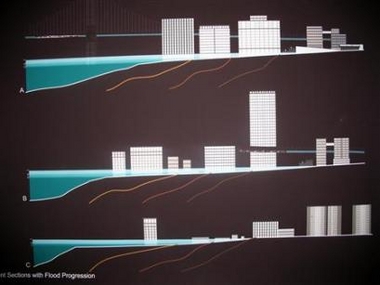
While the world's top scientists recently warned governments to take urgent action on global warming, a small group of Brooklyn students have designed their own plan for living with climate change.The students look ahead 50 years to how rising seas caused from global warming might flood the Brooklyn waterfront neighborhood of Dumbo, in a small exhibit called "Dumbo Under Water" on display at a Brooklyn gallery this month.
South Africa: Making sure it’s worth the candle
With peak oil a concern and electricity blackouts increasingly becoming a part of our daily lives, the question of energy security is high on the minds of many people. It is an issue that requires strategic thinking from government and demands a response that takes into account both the intended and unintended economic, social and environmental consequences. Decisions taken today will form the legacy of this government for generations.
Grease wrestling, the province of frat parties, late-night wishful thinking, and further unsavory intent, is getting a wholesome, "alt" spin in Ithaca this weekend. On Saturday, Ithaca Biodiesel is holding a fundraiser at The Haunt to help support the development of their organization and to let people know that vegetable oil can be used for cleaner gasoline and, for the day at least, wrestling.
The president's new budget is predictably bad for mass transit. Alas, the Democrats aren't all that much better on the issue.
Arcelor Mittal to Build Saudi Steel Mill
Aramco plans to spend US$50 billion (euro65 billion) over the next five years to build more refineries in Saudi Arabia and other parts of the world and boost the kingdom's refining capacity by as much as 60 percent over this period.
Brazil, Bolivia Reach Natural Gas Deal
President Luiz Inacio Lula da Silva and Bolivian President Evo Morales reached a deal late Wednesday on how much Brazil will pay for Bolivian natural gas, apparently resolving an issue that has deeply divided the neighboring nations for a year.
India: Greenbody asks government to increase tax on cars
Warning that the unchecked growth of cars are contributing heavily towards energy and environment insecurity, Centre for Science and Environment (CSE) Thursday said India must increase taxes on all cars.
Cease-fire line, battle line or pipeline? With the Russian presence in Georgia's breakaway regions, lines are blurred.
Feinstein Eyes Budget Process to Recoup Royalties
Sen. Dianne Feinstein (D-Calif.) wants to attach language to the Interior Departments's fiscal 2008 spending bill that would help the federal government recoup almost $10 billion in oil and natural gas lease royalties.
Deconstructing Dinner: Agri-Business Exposed I (Cargill Part I)
The Agri-Business Exposed Series on Deconstructing Dinner will explore the major agricultural companies whose names are rarely heard by the eating public. Part I and II of the series will take a look at agricultural giant Cargill.
Richard Bell: Stern Stern on Climate Change at Senate Hearing
The Cinderella Plant: Green energy from Africa
Africans used to think jatropha was a worthless bush. Now it may be an important new source of energy.
Running out of oil may not be the issue at all
All the talk of when the world will run out of oil could be rendered irrelevant because of geopolitical issues that block access to untapped reserves, the head of international exploration and production for Chevron Corp. said Wednesday.John Watson told energy executives and analysts that the so-called peak oil debate focuses on the level of resources below the ground. He joined the prevailing view of speakers at the Cambridge Energy Research Associates' annual conference in Houston that the planet won't run out of oil anytime soon despite opposing theories that a peak and subsequent drop-off in production is imminent or even ongoing.
"Every time we say we're about to be tapped out, we find new ways to squeeze more out of reservoirs," he said.
Oil Industry's Mega-Projects Face Looming Labor Shortage
Good project managers in the oil industry may be like rock stars, but they're becoming just as rare.As an aging generation of workers retires, industry experts say the resulting shortfall in skilled labor could lead to an increase in delays and problems on mega oil and gas projects.
Oil-Sands Producers Vulnerable to Cap, Rubin Says
Oil-sands projects are among the most vulnerable if Canada follows the lead of some U.S. states to reduce gas emissions linked to global warming, according to the Canadian Imperial Bank of Commerce.
No gas in GM's car of the future
It may be late to the game, but the maker of Hummer vehicles says it wants to become the global leader when it comes to green cars.And General Motors Corp. recognizes that means squaring off against the early leader and maker of the Prius hybrid vehicle, Toyota Motor Corp.
Demand grows, but data centers don't hog power
Data centers are sucking up more electricity as more people and organizations log on to the Internet. But there's been some disagreement over how power-hungry the servers running the nation's network are.
Hope for end of climate deadlock
Leading US politicians are meeting legislators from the EU, China, Japan and India to seek a breakthrough in the international climate deadlock.
Big Oil's Hot Air Show On Global Warming
The CEOs of Big Oil gathered in Houston this week to proclaim that they finally get global warming and want to be part of the solution. The problem, of course, is when there's so much money in black gold, it's sure hard to go green.
Cow Dung, Rotting Chickens Poised to Beat Oil, Natural Gas
First Reserve Corp., the biggest private equity firm in the energy industry, expects a fivefold gain from rotting chickens and cow dung.
Measuring the Uncertainty of Climate Change
Better models are rapidly defining the uncertainties ahead, says leading climate scientist Ronald Prinn.
UK wind industry joins energy elite
A snowy hill on the outskirts of Stirling in Scotland is the scene of a significant milestone of achievement for the UK wind industry when Secretary of State Alistair Darling switched on the turbine which pushed the UK into position as one of the top seven players in the global wind market.
Renewable energy to power Indonesian villages
Indonesia aims to have 2,000 energy self-sufficient villages powered by hydro, solar or bio-fuel resources by 2009, Energy and Mineral Resources Minister Purnomo Yusgiantoro said.
Germany Putting More Wind Into Energy
Germany is blowing more wind into energy with the setting up of new offshore facilities. Germany already has the world's largest installed capacity for wind energy.
Passenger jets get a radical green makeover
If passenger jets were a different shape, they would produce far less CO2. Danny Bradbury meets the high-fliers who are leading a green revolution at 35,000ft.
New Zealand: Biofuel target is only a beginning
Corn-based ethanol has fish, wildlife officials worried
Some are calling it a modern day gold rush, what with ethanol plants sprouting up like weeds across the Great Plains. The problem for conservationists and wildlife officials like Bogenschutz, more corn-based ethanol requires more corn production. And more corn production means far less wildlife habitat — habitat that produces a bounty of pheasants, ducks, songbirds and other wildlife, as well as decreases pollution into our waterways.
Belarus raises Russian oil transit fee more than 30%
Belarus will increase rates for the transit of Russian crude through its domestic pipeline network by more than 30% on average starting from February 15, the republican economics ministry said Thursday.
Brazil, Bolivia Reach Natural Gas Deal
President Luiz Inacio Lula da Silva and Bolivian President Evo Morales reached a deal late Wednesday on how much Brazil will pay for Bolivian natural gas, apparently resolving an issue that has deeply divided the neighboring nations for a year.
Saudi says no bar to nuclear cooperation with Russia
Saudi Arabia, the world's biggest oil exporter and a key U.S. ally, said on Wednesday the kingdom does not see any obstacle to cooperating with Russia on developing a nuclear energy program.
Contact
- Content: editors at theoildrum dot com
- Tech support: support at theoildrum dot com
License

This work is licensed under a Creative Commons Attribution-Share Alike 3.0 United States License.
Saudi Arabia on Track for 12-14M B/D.
I really liked to read that. No speculations about 2030 or so. They announce to virtually double their output within less than 24 months. So we will see soon. Either way, if they'll be able to fulfill or not, the outcome will be significant.
I didn't post this one up top, because it's subscription-only, but maybe someone who has a subscription can give us details...
Aramco Adds More Projects to Upstream Push
Greenspan on oil
So in two to three years time Saudi will be claiming around 7 million barrels a day of spare capacity in the midst of falling global production and rising demand!
Note the two caveats: Beyond that it's a bit unclear & 'though the exact number is uncertain'
Rad: Interesting headline- then in the article, KSA claims a minimum capacity by the end of 2009 of 12 mbpd, while claiming a current capacity of 11.6. I guess this headline is better than "KSA says production capacity will not decline before the end of 2009 as new investments are planned".
I think it is a double bluff. They have admitted to an unattended 8% decline on existing fields
which supposedly has been held to 2% decline via advanced recovery/increased rigs.
The double bluff is making people think that they wouldn't dare lie in reporting such outrageously high future production rates.
in my opinion.
Marco.
Note that the EIA C+C report for 8.8 mbpd in November and the Saudi report for about 8.5 mbpd in February are both consistent with a net 8% decline rate per year since 9/05.
I have previously pointed out how odd it is that the "voluntary" cuts in production are--so far at least--consistently in the 8% per year range.
And they will try to string out the misinformation for as long as possible (punctuated by the odd chime in from the MSM in agreement).
I can see the FT headlines already:
"oil tumbles on Suadi oil projections"
Marco.
I'm as bearish on Saudi production/reserves as you. This is one big bear that everyone wants to stick their head in the sand about. Once the cat gets out of the bag that Ghawar is producing close to 3.5mbd AND that position is made official, then people will realise what the current scramble is about. I will say no more.
Marco.
Can anyone link to the production graph of KSA including the increases in drilling rigs(@3x). I think khebab did it 2-5 months ago I don't know for sure. It fits well with the current discussion above. The chart is worth a thousand words.
I don't know how to search and link or I would do it.
Thanks,
D
I dont think there is much point in looking for an increased pulse in flow (just yet).
The ramping up of rigs - which is impressive started in earnest in 2006. The effects will take some time.
Some will be for in-fill and field enhancement drilling, some will be for workovers of existing wells, some will be for exploration and appraisal, and then development of any (if any ) newly discovered fields.
Infill and field enhancement has a small lag, exp , appraisal and development is less certain, and governed by proximity to existing infrastructure and the amount of development drilling that follows.
Infill, enhancement and workovers help sustain the life of a field, but does not increase beyond peak production / peak flow. Look to the North Sea : it keeps us alive for longer, but does not add oil flows that then exceed the 1999 peak flow rate.
No. Only successfull exploration can do that.
The only contrarian argument would be that KSA has been sitting on secret supergiants which are now going to be developed in the next 1-5 years.
So, that is the question: Have KSA held the best back for last?
As always, the proof of the pudding is in the eating.
I'm bullish on KSA production. Just look at their historic production profile (BP Stats) which has been all over the map as they have increased and throttled back production for various political and economical reasons.
OTOH I tend to be bearish on Russia. After all, it is the Russia Bear, isn't it? I do have difficulty with the notion that they can maintain their current production flows much longer.
"I'm bullish on KSA production. Just look at their historic production profile"
I've seen the production profile and one thing always sticks in my mind. That there is a new flavour to the current production. Multilateral with water injection, 3x rig count than a few years ago. These relatively new techniques only need to be employed when pressures drop and push the production from bell shape to ramp and cliff shape. Not to mention their apparent inability to effect a change in global oil price via production quota where before they were able to easily. It's all gone so frantic.
So maybe they are sitting on untouched supergiants, but I am 99.9% sure I know why they are not: they would not go to all the trouble/cost of secondary recovery if they were.
All my opinion.
" ...So maybe they are sitting on untouched supergiants, but I am 99.9% sure I know why they are not: they would not go to all the trouble/cost of secondary recovery if they were."
I hope that you are wrong. If KSA and Russia and Mexico all entered declines within the same year or two... along with export declines we would indeed be in for interesting times.
Since so much of this is not knowable until after the fact, I wish that our present administration would start educating us on energy efficency... a little preventative medicine.
Just driving about 10% less a year would mean about a 1 mbp/d decrease in our petroleum use.
Not many years ago around 60% of the American public smoked. Then the prices started going up and the tobacco industry was forced to attach the now famous warnings that their product will kill you. Now about 20% of the public smokes.
Certainly energy efficiency could be "sold" the same way. We could put warnings on gas pumps like, "Using this product may result in your kid dying in Iraq" or "Using this product will require you to wear a personal floatation device and breathe through a snorkle."
Hi Byron,
"Not many years ago around 60% of the American public smoked. Then the prices started going up and the tobacco industry was forced to attach the now famous warnings that their product will kill you. Now about 20% of the public smokes."
I appreciate your thinking about education/action. Maybe along the lines of http://www.nhtsa.dot.gov/people/injury/alcohol/DesignatedDriver/, we could have "Friends don't let friends drive..."
IMO: there is the proof of the pudding.
Why go to rig-intense, injection and infrastructure intense activity, if they are sitting on highly geopressured virgin reservoirs requiring fewer wells to generate high flows with minimum effort ? - this was the story of KSA from the 50's and beyond.
In the history of oil, we have always taken the fastest, cheapest route to the resource (low hanging fruit first)
At the end of the day, we will all know soon enough
Texas alone has over 54,000 wells. KSA barely has 1,500. A 3x increase isn't much when you compare the two regions like that.
Hothgor, glad to have caught you (off topic your current post, sorry). I want to take you up on your dismissal of DU in yesterday's Drumbeat, and of New Account's response to you suggesting you actually looked at it.
I'll repeat his link:
http://en.wikipedia.org/wiki/Depleted_uranium
and add the most recent I know review of studies on the teratogenic effects:
http://www.ehjournal.net/content/4/1/17
I would like you to read them thoroughly before you say anything about DU again.
I agree with you that uranium outside one's body in low concentrations is virtually harmless. However, once particles are ingested (oral or respiritory) the situation is very different. There are both radioactive and toxic effects.
DU projectiles are designed to vapourise and burn the DU on impact. That widely disperses the DU in small particulates, ideal for distribution and ingestion.
I also agree that the evidence and studies are far from conclusive, but there is sufficient evidence already to strongly suggest adverse effects. How long should we wait for conclusive results - the half-life of U235 (the active bit of DU) is about the same as this planet to date?
I'll leave you with the last sentence of my second link above:
"Regarding the teratogenicity of parental prenatal exposure to DU aerosols, the evidence, albeit imperfect, indicates a high probability of substantial risk. Good science indicates that depleted uranium weapons should not be manufactured or exploded."
Source and link ?
That is VERY different from my understanding of the role of the designed role of DU munitions. And absent PROVING this point, much of the rest falls as well.
Alan
From the wikipedia article
and
also
A pyrophoric substance is a substance that ignites spontaneously, that is, its autoignition temperature is below room temperature. from wikipedia
It's fully explained in the links I posted.
Thanks Rethin.
And thanks for bringing this forward to Hothgar's attention again. I gave up when he linked genetic birth defects to poor pre-natal training.
The radioactivity of depleted uranium (half life of 3+ billion years for the depleted fraction) is not a significant concern. The ore that uranium miners deal with everyday for decades is as radioactive.
I have read a number of articles on mortality & health effects of uranium miners (smoking & uranium mining is VERY bad for your health, lung cancer risk increases by order of magnitude ! 1950s era uranium miners that do not smoke have lung cancer rates slightly less than 1/2 pack to 1 pack/day smokers).
Given the long term exposure with minimal precautions (1950s/1960s) to high concentrations of uranium by miners, I am not overly concerned about the direct risks from single exposure except in vary rare exceptional cases (i.e. DU shell enters house and does not remain intact but burns completely). OTOH, uranium miners of that era were all male, and not a good measure of teratogenicity. One study of wives & children of uranium miners showed no negative effects (US) but another Australian study showed that effects on the edge of statistical signficance (vague memory, 90% but 95% significance). Exposure to poorly controled tailings (which contain daughter radioactive products not present in DU) in Australia.
Since uranium (not depleted) and daughter products are present in many environments naturally, I am not concerned about diffuse, long term exposure. Lead, Colorado residents (town with highest background radiation in US, much from uranium & daughter products) have greater risks.
Alan
Hrothgar:
They did not need to drill 54000 wells to find the oil.
54000 wells will not find oil where there aint any.
Thank god you aint in exploration: your oil company would go bust
For what it's worth
As I posted yesterday, I have been out of town for a week now and must drive across town to borrow my brother in law's computer to post. So if this note on Saudi Arabia was posted Sunday when it was fresh then I do apologize for the re-post. But in Sunday's Parade Magazine, there was a list of "The World's 10 Worst Dictators." Here is #5:
As I said, I apologize if this has already been posted. But I would just wish to point out there are multiple reasons that Saudi Arabia would wish the world to believe that they are sitting on the world's largest reserves of oil when in fact that is a complete myth. Well, it's a myth unless about 70 billion barrels are the world's largest reserves.
Got to go now. Hope to check in again in a day or two.
Ron Patterson
Why is the USA denying KSA all the benefits of Democracy?
Good question. The citizens of Saudi Arabia must look with envy at their northern neighbor and wish that the United States of America would perform a similar service for for the Saudis.
David Mathews
http://www.geocities.com/dmathew1
KSA's previously announced plans were to increase production capacity to 12 mbpd in 2009 and 15 mbpd in 2012. What I gather from this latest statement is that they are on target to meet the first goal, but that they are losing confidence in their ability to reach the 2nd goal. Instead of increasing production capacity by 3 mbpd during 2009-2012, they are revising that expectation downward to 0-2 mbpd in that timeframe.
Their stated post 2012 plans are not to increase production. They have said that they will plateau from 2012 onward. That's the part of their prediction that it most questionable. It's quite reasonable (not to mention alarming) that they will peak in the 2009-2012 timeframe, but do they really expect to avoid production declines for decades afterward?
Now that they are on record as bringing in their peak timeframe from 2012 to 2009, we may expect some explicit statement on post peak decline rates. So far they have been avoiding public statements about it.
I read it similarly. It seems (to me) to be saying that KSA now envisions an upper limit of 14 mbpd on its productive capacity in the foreseeable future, and may be unable to commit to above 12 mbpd.
U really should check the archives before posting silly stuff like this. Several Aramco and KSA documents have been posted in the last few weeks that clearly show that the 12-mbd MSC was scheduled for completion in 2016 (Presentation, CSIS-2004 et al). These are plainly rehashed reannouncements of their accelerated schedule that we have discussed ad nauseum.
2016. Read it and weep kids.
I must 'yes, but'.
The only new thing I felt from that is the 14 mbpd upper ceiling that KSA now seem to be suggesting - and it seems to be a 12-14 mbpd ceiling - in the foreseeable (10 year?) future. That does have implications.
2016? If PO is as late as then I will weep with joy - provided we (humanity) start getting our act together soon!
Also please consider the source, Agric. Obaid is a KSA Security guy. Altho informed (except on the diff betw decline & depletion ... much like our own RP ... which only proves anyone can make mistakes), we just has a flurry of KSA and Aramco presentations that i posted that are crystal clear on a 12.5-mbd MSC while Obaid's persuasive and detailed presentation was in early November.
As TOD scrutineers, are we going with the engineers or with the story from a Security guy at a CSIS event?
I prefer the 12.5-mbd MSC and the 10-mbd production rate. Methinx the KSA budget is based on $43/barrel. There is no need to ramp up when a stable and surplus based economy is already assured.
I can understand the accelerated pace. Surplus world capacity had evaporated. The rising price was most certainly going to bring on a global recession and that would have prolonged the deficit budgets that KSA were mired in only a short time ago. A secondary reason would be the available ample capital funds that were fleeing from the stock market and residing temporarily in bonds and other financial instruments.
Hello TODers,
Does anyone think we can ramp up biosolar energy alternatives as fast as detritus energy sources decline? Or will a very difficult transition gap arise? Jay Hanson makes some very interesting points for consideration:
http://www.warsocialism.com/
Do my past postings for building large, contiguous biosolar habitats make any sense to help bridge this transition period? Does Cascadia, New Vermont Republic, and the Terminator leading the Calif. charge into Legal Secession seem like trends towards this direction?
I would be interested in your thoughts if you feel so inclined. I will be back later.
Bob Shaw in Phx,Az Are Humans Smarter than Yeast?
Hi Bob,
Skipping the diefoff debate and recognizing that everything I have to say is a guess, here goes:
1. Energy, staying ahead or equal to the curve - it isn't going to happen for a number of reasons. First, there are too many vested interests in maintaining the status quo. Second, there won't be the necessary funding without cutting other special interests, i.e., defense spending, crop subsidies, etc. Third, any change would require a concomitant change by the populace which hasn't shown much interest in changing :-). Lastly, it would require the overthrow of the growth paradigm.
2. Secession/Balkanizataion - the question is whether the US tends toward some form of "dictatorship" as it appears to be doing today. Given the unlikelyhood that the Feds will be at all proactive about the future, it seems possible to me that there will be a Balkanization centering upon regional interests. This is happening to a small extent today where groups of states are suing the Feds over various laws/Fed actions. It is possible that the US will return to its roots as a republic.
Conversely, again assuming there isn't absolute Federal control to stop it, the US could turn into a number of smaller countries a la Ecotopia. There are clear advantages and disadvantages were this to occur. But there are far too many to broach the subject on TOD.
Were the Feds serious about the future, a logical thing to do would be to establish model communities trying different approaches to acheiving a stable-state society. These would include not only energy but also governance and economics.
One thing that might help people look at living differently would be to view Colonial House and that appeared on PBS some time ago. Besides seeing how important interpersonal are, they also allow one to see what existing technologies are of real importance.
Todd; a Realist
Somehow Frontier House from PBS got dropped from my post. It's also a good view.
Hello Todd and Don in Colorado,
Thxs to both of you for responding. My following essay's full credit to Jay Hanson and his Thermo/Gene Collision concepts which I have poorly tried to explain in previous postings. Unfortunately, Jay can concisely say in a sentence which takes me a paragraph [TODers are stuck with me]. =)
I have mentioned Thermo-Gene many times before: I am thrilled that Jay has finally and rightfully taken on this Thermo/Gene descriptor as his own; I believe it truly honors him and deservedly so. I wish his Thermo/Gene essay could be taught to everyone until they understood its full ramifications. If so, couples would readily agree to have zero or just one offspring till long-run sustainabilty is achieved.
I think a big part of our problem is the pace of humanimal evolution in the humanimal ecosystem far exceeds the pace of the underlying natural ecosystem; a biosolar human can quickly escalate the detritus ladder towards a consumptive detritovore maximation. Of course, natural reproduction to extreme Malthusian deprivation can only further add to our Overshoot problems.
Examples abound around the globe, from immigrants who arrive in the US practically penniless, and through much hard work become millionaires or richer, unknowingly locking themselves into FF upper level status. There have even been recently arrived illegal immigrants who have won the lottery--instant escalation to near-premium detritovore status; from humanimal gnat or gerbil to almost elite topdog predatory wolfpack status, maybe foxes or coyotes.
Of course, all kinds of other humanimal fauna exist along the spectrum of the humanimal foodchain. Some of us are fungi, mosquitos, bunnies, goats, elk, badgers, mountain lions [Richard Rainwater?], etc, as we each do our best to find our humanimal ecosystem niche to economically prey on those around us, and escape the economic predation by those higher in the foodchain. Now mentally extrapolate this phenomenom by globalization and FF-spiderwebs.
Our tendency is towards detritus-MPP, not biosolar-MPP, although I warm-heartedly congratulate both you guys for your long striving to be local leaders in your biosolar-MPP efforts. This is the Peakoil Outreach direction we need to go: the creation of a biosolar-MPP humanimal ecosystem; a 150 million Megan Quinns across the US yearning to push 150 million wheelbarrows, or pedal 150 million bicycles. Plus whatever other biosolar tech we can sustainably develop.
The problem and 'promise'[developed later] of humanimal topdogs is their detritovore reach. A real wolfpack can only instantly effect the ecosystem locally by downing an elk; the spreading ripple effect takes much longer, naturally. But Bush & Cheney can alter entire humanimal ecosystems [Iraq] and the underlying biosolar forces such as water and food availability too. Essentially, a former Iraqi inverted pyramid top-weighted with detritovores is being violently driven to a more normalized and smaller humanimal foodchain pyramid with a broad base of lower stratum humanimals to reduce their aggregate detritovore footprint.
IMO, the problem with this method is that forceful pyramid redesign doesn't include true concern, protection, and enhancement for non-human flora & fauna. In short, it makes Overshoot much worse from detritus-driven natural destruction. Hundreds of 60-ton Abrams M1 tanks and other military equipment manuevering through rural and urban landscapes; through cropland and natural habits alike, does needless damage to the varied biotic habitats/drainage basins, and topsoil. The firing of bullets, artillery, JDAMs, and Hellfire missiles doesn't help either.
I think it would be interesting for biologists to research the warzone extinction rate--my guess is that it would be truly worrisome. Most TODers are already aware of accelerating extinction rates in peaceful countries and offshore fisheries. Need I mention GW & polar bears?
So, as Churchill famously said, "We are now entering a period of consequences." Detritus decline is inevitable, any humanimal pyramid built of detritus blocks will crumble to dust. We should be seeking to build longlasting Biosolar-MPP pyramids as high as possible on top of the biggest and healthiest bases of biota and topsoil we can muster. The largest, contiguous biosolar habitats with Earthmarine protection we can muster: a future? example of optimized stick and carrot------> Cascadia and the Terminator to terminate detritus-MPP and german-ate biosolar-MPP sustainability in the Western US.
Detritus exergy is geologically thermo-limited, but we have never tried to maximize biosolar exergy/capita by Malthusian social norms and wise entire habitat biosolar-MPP.
I have posted this long before, but consider the biosolar-MPP alternative: if the US was not to rebuild, then rebuild again, then rebuild once again the local Iraqi detritus spiderwebs, but go whole hog on Iraqi Peakoil Outreach, maximize biota, and help them live very comfortably without their FFs. Flooding the country with solar panels, solar water-heaters, wheelbarrows, bicycles, mass-transit, humanure recycling systems, water filtering and rainwater collection cisterns, veterinary services, Eco-Tech housing, etc, etc.
The Marines would be Earthmarines making sure that the extinction rate was minimized in the outlands, and training the people on how to get the best results from relocalized permaculture, voluntary birth-control, bicycle maintenance, and so on. But dealing ruthlessly with anyone seeking to climb a 'detritus ladder' or overpopulate.
Establishing 'mutual coercion, mutually agreed upon' until Biosolar-MPP becomes the accepted and desired social norm; just as a real wolfpack, by making the elk and deer behave more biosolar efficient, optimizes their overall habitat too. I would argue that if this stick and carrot approach had been done from the get go in Iraq-- we would now be much further along in the 'Porridge Principle of Metered Decline', Iraqi exergy, biosolar-MPP/capita, overall long-run sustainability, and FF extraction to further drive this Paradigm Shift process.
Consider Mugabe's Project Murambatsvina [taking out the rubbish/filth]: just more ruthless beating the 'stick' with no mitigative 'carrot', thus driving the country into the worst scenario, or what I call the Zimbabwe Syndrome. It won't take long, from their previously documented history of newborn babies choking the overflowing sewers, to go to a national machete' moshpit like Rwanda, yet it does not have to be so. Early widespread Peakoil Outreach, and 5 million wheelbarrows and bicycles, could have done much to prevent the horrors that have already occurred and are bound to get worse. Now I wonder if Chavez, Calderon, and other leaders will do the same in rank ignorance of Thermo/Gene.
Us three older farts, along with all the other TODers we can muster through our efforts, need to convince Hothgar and his generation to turn aside from seeking detritus-MPP; to join Megan Quinn and other bright youngsters in maximizing biosolar exergy and minimizing births to optimize biosolar-MPP/capita.
It appears our present [all stick, no carrot] foreign and military policy does not seek to enhance long-term sustainable biosolar-MPP/capita in a foreign country in exchange for increasing our one time burn of detritus-MPP, and it also appears our leaders seem to prefer that we not be Peakoil informed on the full Thermo/Gene ramifications here at home. Yet, because one crude barrel = 25,000 physical man-hours, it appears to me that there has long been sufficient detritus net energy to achieve these paradigm shifting reforms a long time ago. Therefore, if a massive grass roots Peakoil Outreach campaign is successful, the anarchy of machete' moshpits and other worse scenarios of the Zimbabwe Syndrome can be minimized for the squeeze through the Bottleneck.
Bob Shaw in Phx,Az Are Humans Smarter than Yeast?
Bob, that makes a good deal of sense to me once I bent my head to see it straight, but it's a damn hard read. I intuitively comprehend what MPP means but what is it an acronym for?
I dunno if implementation of biosolar-MPP can viably be a priority in Iraq, but I definitely think it could and should be in USA. Perhaps that is the big problem - we can deal with this if we change, if we fail to change then we'll fail.
Hothgor's gun fires DU bullets and he'll shoot you first, you're alien (to him). He can shoot you before he starves, but then he more certainly will. The problem is in our heads, we can solve it but...
Hello Agric,
Thxs for responding. Oops, my apologies--I sometimes forget the importance of clarifying acronyms-- MPP = Maximum Power Principle
The Maximum Power Principle states that all open systems (Bernard cells, ecosystems, people, societies, etc.) evolve to degrade as much energy as possible while allowing for the continued existence of the larger systems they are part of. [[1]]
http://dieoff.com/page193.htm
Bob Shaw in Phx,Az Are Humans Smarter than Yeast?
Bob,
Have you thought about all these "ranchettes" that have been split off the old farms and ranches over the past couple of decades? I'm sure Phoenix/Flagstaff is a veritable corridor of mini-ranchettes. They are owned by retired urbanites and have a couple of horses and maybe raise a little hay.
Will these continue to exist in the age of ethanol and $20-a-bale hay?
Will they just become little fuel farmettes of the future, or could they play some role in a biosolar habitat community?
It's possible that they'll eventually be bought up and combined into huge fuel plantations.
Bob, I love the vision of bioregional "biosolar habitats" and all.
My guess is that Hanson is right about the way in which the political elites of various nations and regions will use whatever resources they have to manipulate people into various Resource Wars. Already we see CERA playing the role of propagandists for more resource war as they demonize national oil companies and represent their client multinational oil corporations as "God's chosen."
So many resources will be poured into war, and so many people will be killed, hurt, dislocated, and impoverished that there won't be any bright and sunny bioregions for anyone to inhabit.
We have yet to see the effect of multiple nuclear bombs being denotated around the world in a brief period of time, but it looks like we will get that chance soon, does it not?
We have yet to see what mass slaughter and imprisonment of various civilians in the USA will bring about, but we are also quite likely to see such events take place as people become more desperate and the Imperial Government becomes more violent in an attempt to keep order sufficient to keep the factories making military weapons and munitions going.
I think that you will find plenty of people who will refuse to see reality and will choose the Faux News propaganda "Resource War: Operation Endless Terror v.2.1" until you pry their cold dead hands from their TV remote.
Some of the things you talk about could happen after about 10 or 20 years of intense violence, ecological upheaval, and widespread famine and pestilence.
You know, the whole "Four Horsepersons of the Apocalypse Bring Long Emergency" scenario. After 5 out 6 people are dead and the human population has been reduced to less than a billion or so, then we get to do the biosolar habitat thing.
Sorry to be so Peak-Oily-Anna-ish. I know I make it sound like a cakewalk. I don't really mean to be so optimistic. Some people think we optimists are delusional, but we know better, don't we?
We do not control outcomes, only our own contributions to the future.
There is a new proposal by a team member of akasol in Darmstadt/Germany about E-Cars.
Felix von Borck finds that the basic technique should be developed with financial aid by the german government.
After proven suitable for allday use (his group wants to bring 1,000 Oscars (Open source cars) on the streets, automakers could start to develop individual models for the market.
After all, von Borck says, the state pumps billions in fuel cells or nuclear fusion, so why not boost EV-technology?
Ultimately, I think most cities should rid themselves of all cars and all personal mobility within the city should be provide by food, bicycles, electric bicycles, rail, and street cars.
However, a beneficial alternative or interim approach might be for cities to provide directly or through subsidy a fleet of small electric vehicles that could be rented on a short term basis within the city. This would make living or visiting the city a more pleasant experience, increase the use of transportation alternatives, cut down on energy consumption, and provide a kick start to the mass production of electric vehicles, thus reducing their costs.
tstreet
This would be a nice vision for the future. Did you catch the Madison, WI proposal in the lead stories 2 days ago? If not, it's here:
http://www.madison.com/tct/mad/topstories/index.php?ntid=118600&ntpid=1
I'm going to print off the article to send to my PO aware mayoral candidate and would recommend this for anyone else inclined to do so. Not that I expect any in charge to take such measures yet, but it'll get them thinking in the right direction... There's always most hope at the local levels.
Madison has got to be one of very few spots where you can talk about increasing bicycle use on hilly, icy, narrow, windy streets when the temps are below zero and still be connected to reality.
http://news.bbc.co.uk/2/hi/americas/6364507.stm
I think we will be seeing many more headlines with the words "delusional assumptions" in the future.
Relating to the power demand by Internet Servers, CNN had this a couple days ago. Hope I'm not reposting one that's already been done. I was looking for the story about the 1Mwatt+ installation that Yahoo(?) is putting up to support their power needs.
http://money.cnn.com/magazines/business2/business2_archive/2006/11/01/83...
"The end of solar's dark days
Silicon Valley's solar flare began smoldering during the dark days of the new millennium. In 2001 it seemed as if the plug was being pulled, in more ways than one, on the Internet boom that had made the Valley the epicenter of what was then known as the new economy. While tech startups watched their billion-dollar valuations vanish in a flash and the dotcom death toll grew daily, rolling blackouts swept the Valley as California's yearlong energy crisis intensified.
With the region in meltdown, some tech entrepreneurs began quietly starting solar companies. For instance, when Barry Cinnamon's online shopping site collapsed, he founded Akeena Solar, a solar panel installation firm. "Solar power is a real brick-and-mortar business," he explains, "with an incredible long-term demand built in."
Vinod weighs in for a blurb's worth..
'Still, some people worry that the solar market is in danger of becoming, shall we say, overheated. Khosla, who has pinned his venture fund's hopes on biofuels, thinks solar is overhyped. "Even with subsidies, solar is quite uncompetitive," he said in a speech in September.'
ahh, here we go..
http://news.monstersandcritics.com/energywatch/renewables/features/artic...
"When Mountain View, Calif.-based Internet search giant Google announced its solar project in October, it was touted as 'the largest solar installation on any corporate campus in the United States and one of the largest on any corporate site in the world.'"
.. just putting those in to consider that those Silicopians who work in Silicon Valley have not been totally remiss about taking advantage of using that element as a roofing/power option. There are also the low-power cpu's that are being developed by AMD and Intel, but I'm going to let someone else link to that, if they care to.
Bob Fiske
on the google article.
the pannels are only there to power their office worker pc's and not their data-center ones.
Weekly natural gas in storage in the lower 48 states dropped last week by 259 Bcf to 2088 Bcf: http://tonto.eia.doe.gov/oog/info/ngs/ngs.html
This was a large drop due to cold weather. Another significant drop is baked in the cake for next week's figures, as this has also been a cold week. Natural gas in storage is now 9% below last year's level, but still 14.7% above the five year average for this time of year. These percentages have been dropping rapidly over the last month.
In what way are natural gas storage levels rated at? I guess my question is the 14.7% number based on actualy Bcf or on days of supply?? If it is based on simple Bcf that number doesn't really mean anything if demand has increased correct? If it is based on days supply it would be accurate to quote that number as meaningful.
The 14.7% number is based on Bcf and not on days of supply. If you assume some gentle increase in demand over time, then the number would be a little lower than 14.7.
Average U.S. natural gas usage is 60 Bcf per day over a one year period, though the average January usage is almost twice as high as June usage. Looked at this way, that tells you that our storage as of last week (2088 Bcf/day) was about 35 days of supply.
The EIA reported this morning that 259 bcf of natural gas was taken out of storage last week. Total withdrawal over the last two weeks comes to 483 bcf.
In one week storage levels dropped from 25% above the 5-year average to 20% over.
Last week I wrote that next week's withdrawal number (2/22) should come in around 220 bcf. Based on this week's weather (highs in the teens, lows around 0F in Madison) I am sticking to that estimate. If next week's weather returns to normal then the withdrawal reported on 3/1 should be about 40 bcf higher than the 5-year average of 121 bcf. Still on track to seeing $10+/dekatherm by July 1. --BP--
Badger,
I am inclined to agree with you. The CNBC talking heads were all talking about Lower NG prices this morning. Very short term perhaps, but by summer it might look different when lower production takes a bite out of storage builds. If we have a cold winter next year, it might look really ugly.
If I lived in a cold climate dependent on either NG or heating oil, I would start thinking about a backup heating method, at least a wood stove.
I agree Westexas. I think the pain on the supply side is still to come. The NG service companies are a testament to whats happening.
Any predictions for end storage numbers Badger? Bastardi at accuweather thinks March could turn colder again. His record has been quite good. I think it is IMp as there will be a big difference if we end at 1350 or 1550 and March will decide that.
At 1350 we will like see prices top $10 rapidly. At 1550 I think prices should stay sub 8.50 for some time.
Fireangel--
We're only halfway through February. It would take the warmest March in U.S. history to keep storage numbers above 1550 bcf. Looking at the five year averages, the low point would be 1231, according AmericanOilman[dot]com. 20% above that would be 1231+246=1479. 10% above the low would be 1356.
If the tightness persists and the weather is neither abnormally cold nor warm, the heating season could end with storage levels within 2-3% of the 5-year average.
Thanks for the input badger.
If I remember correctly wasnt some supply in GOM still offline at this point last year. Does anyone know exactly how much we are producing as off late ( say December) versus last year. I know drilling wise we may be down whereas if some GOM production was offline last year and is not so now it may be even.
If we hit sub 1400 levels I think NG will stage a a ferocious rally. With hurricane season ahead, another extremely hot summer probably, canadian exports probably falling by 0.4 BCF a day ( I think that guy was optimistic he wasnt even factoring the decline in drilling) and no danger of topping out storage Ng should firm nicely.
The Talking Heads on CNBC attractive as they may be have obviously been instructed to spin the Bear case in the energy markets at every possible opportunity. Nice to see the day end rally and lends some credence to the fact that at least some of the people trading this market are aware of the depressing supply fundamentals. With the ending stocks for 2/9 being at 2281 BCF and the weather this week at least as cold as last I see an additional draw next week of at least 250 BCF that brings us down to 2031 BCF or around 111.5% of the 5 year average W/E 2/17. Even with warmer weather for the next week or so and if we see that Bastdardi lower temp forecast in March we could easily see a drawdown to 1431 BCF or 78% of the current 5 year average by late March. I really don't think you are going to see even replacement drilling by the producers unless they can hedge at +7.50 for summer. Rig counts have been well below last year since the fall and with the new wells depleting at 20% or better this market will be supply constrained come this summer if its hot and nail biting by next fall. This market should have a huge upside bias I think $10 is a very reasonable level to expect.
Yes electric heaters or wood stoves are a must. Funny no make that SAD thing as virtually everyone I know has ripped out there woodburning fireplaces and gone to a gas burning insert. Or put a gas burner in their new homes. I think I mentioned previously in a sub division of +$400,000 dollar homes a mile or so from my home a friend of mine was the only home on the block with a woodburning fireplace everyone else has Natty fireplaces.
KansasCrude--
I'm not sure where you got that 2281 bcf number. EIA's number for the week ending February 9 was 2088. All you calculations should flow from the 2088 number, making your argument even more compelling.
Don't forget solar water heaters as a precautionary measure. My solar domestic hot water system is estimated to save 128 therms/year.
Air drying your laundry in the winter is another easy way to save therms.
--BP--
I agree with much of this, including a shortage is coming, but rigs looking for ng are up around 1440 right now, avg for 06 was 1290. But, this increase is on account of rigs moving south from canada, they are down 160 rigs yoy, so NA is down a bit. Canadian exports to the us will imo be down around 25%, or 900 bcf in 07.
I thought that it was interesting that the decline in Canadian exports almost completely wipes out the gain from the Barnett Shale Play.
WT said:
Can you be this naive? Of course, Canadian export decline is the other side of the equation for the BarnettShale play. duh..
not sure about rigs in canada, but if you read the EIA update http://tonto.eia.doe.gov/oog/info/ngw/ngupdate.asp you will see that they note that last week the US rigs looking for gas was an all time record of 1473.
A natural gas outage during the winter in the cold parts of the country could cause a lot of pipes to freeze. Not only does a person need a back-up system, but a good enough system to keep the pipes above 32 F. Leaving the water dripping could allow the temperature to be a little colder, but still the temperature cannot be too cold. Kunstler makes the point that without reliable heat, it is very difficult to have indoor plumbing.
Incorrect.
Construction of the first and second cellulosic facilities are already underway.
Ground-breaking of the first BTL ethanol plant is slated to start soon in GA.
Amazing troll work. Your rebuttal took ten minutes to post.
That would be a correction - not a rebuttal.
A correction that could easily have made by you if: a) you worked in the biofuel sector b) knew Jeff or c) paid closer attention to what I write.
Syntec
I never disputed the error in the above article, as I posted this link here a few days ago: http://www.evworld.com/view.cfm?page=news&newsid=10986, which also named existing cellulosic plants.
My comment was aimed at the pattern of your posts here. You lie silent through numerous well-written articles and statements regarding ethanol, yet seem to magically appear the minute something is written which can be defended. I'd please request that if you are an expert consultant to the high powered events in Washington DC, and China, that you would make informative posts for us peons instead of attack style posts.
Since you are in "the know" please explain
1-the funding of these new plants to us (private vs. federal). Since cellulosic ethanol production costs are so high, I'm curious about how much private capital is being invested in hopes of a quick turn around for profitability (or hope for a subsidy). What percent of funding is grant money/government loan money and federal assistance at each of the plants?
2-If important advances in technology/enzymes have been made in the production process in the past twelve months, please inform us briefly what they are, perhaps with appropriate links.
3-What is your best estimate of when straw or switchgrass ethanol will be economically viable to produce (that is without subsidies)? (in year and/or gas price)
4-Please tell us which types of cellulosic ethanol you feel are most promising to pursue.
5-Please comment on ThatsItImOuts sugar beet hopes.
I'm sorry if corn ethanol has made me a cynic, as well as all of the experts who say that cellulosic ethanol will never be viable. As you've stated below, we don't have much time to mess around with roads to nowhere.
From Reuters:
“You lie silent through numerous well-written articles and statements regarding ethanol, yet seem to magically appear the minute something is written which can be defended.”
A load of BS and you know it.
Most of the articles here are pulled from EB or PO and 3/4s of them are hit pieces on ethanol and biofuels in general.
If my posts come across as being harsh it’s because sometimes I lose my pateince on the inanity of outling ad nauseum that not all ethanol is corn ethanol, that biofuels can be made in different ways from difference feedstocks or that tortilla prices have more to do with gouging middlemen than ethanol usage.
I’ve introduced the concept of a national gasification/Terra Preta scheme, Petroleum Input Ratios vs. BTUs and an organic corn mandate and have supported countless posts by the likes of Robert, EP, Eric Blair, Stoney et al.
I outlined Canada’s 2006 Energy Outlook and recently blogged live Senate proceedings and yet you’re the one who calls me the troll.
1 – Funding varies from project to project. DOE grants should be announced soon and Broin will likely be receiving matching grants on it’s $200 million extension. SunOpta is a public company that just raised $53 Million in a public offering. They along with Iogen, can also be expected to have applied.
2 – Nothing that I know of. Jeff stated before the Senate that everything was good to go in Iowa, however, the hurdles they face reside in securing traditional debt financing.
3 – When war breaks out in the ME, cellulosic ethanol will be economically viable.
4 – Enzymatic fermentation and BTL processes but keep in mind that the latter is not cellulosic ethanol per se; the press just covers it as such.
5 – Sugarbeet runs into a couple of walls a) subsidized corn b) the value of sugar to the food industry c) higher capital costs d) higher productoin costs e) restricted sugar acreage. Brazil can produce a gallon for .81 cents and the tariff on Brazilian ethanol just may come down soon. If you want to open a US facing operation, I would suggest building a molasses->ethanol facility.
"Construction of the first and second cellulosic facilities are already underway."
What company is that?
SunOpta/Celunol's US plant (1 of 4 internationally) is scheduled to be complete this summer in LA., while Broin is converting an existing fermentation facility for 09 operations in IA.
Around the world, private investors are putting money into stoves and furnaces that burn bio-mass for heat, hot water and electricity, a technology with an EROI of at least 10 - 1.
Except in Brazil, liquid fuels from bio-mass require taxpayer subsidy. Will the need for subsidy subside? I doubt it and think certainly not when natural gas goes into terminal decline.
A lot of people on this list are quick to diss Smith's 'invisible hand', often after misrepresenting the concept. For myself, I think the market mechanism is a social invention of great utility. People are right to point out that an 'invisible hand' is often claimed to be at work, when the facts point straight to market manipulation for the purposes of unearned personal gain.
Ethanol in Iowa or, as Iogen is insisting, in Idaho is truly an example of a very 'visible hand' at work in the economy. Collectivist goals, such as national security are invoked in defense of this offense to free market economics. Ironically, individual greed, laziness and social alienation lie behind the collectivist mantra of national security. Freedom is reduced to a full tank of gas, a private bubble, however fleeting, and a few freedom froms, such as freedom from exercise or freedom from sharing.
I wonder if those of you so quick to dismiss the 'invisible hand' are happy with the work of the 'visible hand'?
The invisible hand will not mitigate Peak Oil decline and given that oil is a finite resource of immeasurable strategic importance Smith's logic doesn't stand a chance - especially post-peak.
The biggest problem right now, is that the appropriate signals needed from a free market will not be received in time for the development & deployment of alternatives to petroleum in the geologic timeframes allotted.
Using China and the US to illustrate...
China -with its command economy- has arbitrarily ruled that food-chain feedstocks can no longer be used in the production of biofuels over and above current levels, while just this week, the NDRC allocated 32.9 Million acres to DEC production outright.
Today, I was invited to attend a sustainable fuel symposium in Beijing where the invitation states:
"Road, rail, air and sea transport all depend on fossil oil to keep on the move. When it has finally run out, or the price rises significantly - and it has been estimated that the crunch will come between 2010 and 2020 - what are we going to use to replace it?"
Compare China's actions with those can taken by the US government (domestically not militarily) as that's a different story altogether.
Take a good hard look at how the free market economy is preparing American citizens for Peak and the ensuing dislocation and you'll understand why those of us involved are calling for a national Peak mitigation strategy that rivals Apollo.
Perhaps interestingly I had a link to an article on China's Peoples' Daily site about 3 years ago where one of the top hierarchy was lengthly quoted as saying that China expected PO to occur around 2012. The link died about a year later, its appearance was about the time a french govt report predicted PO around 2013.
I'd guess that those who run China definitely 'get it' and have been doing rather a lot to prepare their nation where they can. It's becoming quite hard to believe that govts of countries like US and UK don't have a clue. While I would currently much prefer to live in a democratic country like US or UK I would also wish that my govt started to do somethings more constructive as precautions. Different political systems have different benefits and disadvantages in different circumstances, there is no conclusive evidence that US style democracy is the least worst in most situations.
"BEIJING, Jan. 25 (Xinhua) -- The Chinese government aims to develop liquid biofuels like ethanol and bio-diesel in rural areas to cut usage of refined oil by 10 million tons, or more than a quarter, by 2020, senior official said on Thursday."
http://news.xinhuanet.com/english/2007-01/25/content_5654543.htm
Why am I not surprised that you wish to model your program on Apollo, a bloated effort which accomplished less than that which unmanned flights can do at a far lower cost.
China in the future will largely depend on rail, water, bicycle and pedestrian modes. They will regret the recent and foolish investment in the automobile.
If you want an example of the market mechanism at work in the US, you might track the shift to intermodal freight transport in which fuel efficient rail is now steadily supplanting long-haul truck transport in response to higher fuel prices. Within this process, new infrastructure is being adopted, new procedures being learned. It is occuring despite poor market design which favours road tranport, such as an Hours of Service regime that works to provide trucking with cheap labour.
Markets work as well as they are designed. Many markets in the US are very poorly designed, especially in the transport sector. But this doesn't make the case for the type of government supported boondoggle for which you are an advocate, possibly an interested advocate.
There is plenty of room for government action. I would say a good start will be in establishing financing means for building energy efficiency measures. Public investment in public transit is also advisable.
Hi Syntec,
re: "...those of us involved are calling for a national Peak mitigation strategy that rivals Apollo."
Thanks and could you possibly fill in a little more about this strategy? (Can you outline it?) What have you (all) done? Before whom have you presented it? And how's it going, so far?
"Road, rail, air and sea transport all depend on fossil oil to keep on the move. When it has finally run out, or the price rises significantly - and it has been estimated that the crunch will come between 2010 and 2020 - what are we going to use to replace it?"
I would point out that the rail part of that equation can be (and in part is) electrified in China. I will also point out that is Switzerland the railroad has it's own hydroelectric facilities and transmission grid. (Switzerland gets perhaps half of their electricity from hydroelectric power, half from nuclear). Thus, Swiss rail transportation is independent of fossil fuels.
If I can assist, I would be glad to do so.
China is building up it's rail infrastructure at a good rate; as it also builds up an auto infrastruture. Once all plans are built out (2025 ?) Shanghai should be the #1 subway city in the world by any metric (passengers, pax-km (passenger-miles), km of track operated, # of railcars, and perhaps # of stations (unsure)). Their intercity rail is also rapidly growing and improving. Beijing will be competitive with London, NYC, Moscow & Tokyo subway systems.
Trolley freight (using containers in most cases) is an overlooked option in China. New construction should try to facilitate later dual use (pax & off peak freight).
Best Hopes,
Alan
I wonder how many staffers the DOE could hire with the money going into the 20,000 troop escalation in Iraq?
Leanan
FIrst, thanks for your good works.
It seems that drumbeat topics are becoming more numerous. How about, say, three different ones... one for fossil fuels production, one for biofuels/solar/nukes and other substitutes, and one for post peak problems/solutions?
THanks again.
http://biz.yahoo.com/bw/070215/20070215005503.html?.v=1
Exxon Mobil replaced more than 100% of its production. So take that Westexas, Heading out and the rest of you peakists.
Tongue in cheek of course
Reserves do not equal production.
You can't bring your car to the gas station and ask to fill it up with reserves.
Yet amazingly enough, people constantly remind us that global discoveries peaked in 1967, and we've been using more oil every year then we discovered since 1980 or so. You can have it one way, yet not the other? :laughs:
Sorry Hothgar but if you read the article the bulk of EM's replacements were already existing fields in the ME They merely were chosen to produce them. No new finds here.
So where ARE the new 1 billion bbl + finds then ?
Or are you trying to say that existing finds just keep on getting bigger?
Show me on the map.
Show me the many finds declared since 2000.
xom lists total boe, or barrels of oil equivelant. What is happening is that they are replacing declining mostly oil reserves with new mostly gas reserves, particularly in qatar and, i think, uae too. So, as is well known, as oil goes down ng is coming up... but, the replacement is much harder to transport and.or use for motor fuels, the major use for liquid fuels.
I belive those were not new oil fields but existing ones
From drilling on Wall Street.
Does anyone know the natural gas storage for Canada?
Canadian natural gas data is available here:
http://www2.nrcan.gc.ca/es/erb/prb/english/View.asp?x=449
This site has monthly updates. In January, Canadian natural gas in storage was 416 Bcf. U.S. storage as of last week was 2088 Bcf by comparison.
I think a key fact in the natural gas picture is the wells drilled vs. production figures. In 1998, Canada drilled 4991 natural gas wells and produced 16.1 Bcf/day. In 2005 they drilled 15,931 wells and produced 17.1 Bcf/day (down from perhaps a 2001-2002 peak of 17.4 Bcf/day). So basically they are having to drill more than three times as many wells just to maintain a nearly flat production level. The U.S. situation with drilling and production is similar. How long can this go on?
The us needs to increase rigs lookin for ng by 10%/y for production to stay even, about the same for canada. We now have around 1440 rigs looking for ng in the us, nicely up from the avg of 1290 in 2006, so us production should be ok this year. But, these rigs were poached from canada, now down 160 rigs yoy, so canadian production will fall, imo maybe 10%. Meanwhile canadian ng consumption is up sharply, not least for tar sands... imo we will see 25% less ng coming from canada this year, maybe 900bcf.
If the tar sands are attacked it might give Canadians another 4-6 years to heat their homes.
You realize that makes no sense whatsoever right?
It actually does make sense in a twisted way. Anything that threatens our immediate future with respect to fossil fuels, enhances our medium and long-term fossil-fuel future.
Anything that keeps the stuff in the ground, means more to burn later.
True, but the drift is not utter nonsense ;)
Actually my point was that natural gas is used to get the bitumen out of the sand. It is also used in the process to convert it to a usable product. According to the EIA Canada has about 8 years of natural gas, as of 2003, left. It would make more sense to just power the cars with natural gas.
Heheh, I took that for granted. My drift (not the drift I mentioned before) is that Canada should cease wasting gas on the oilgoo.
June 07 5886
CL Z08 6180 -137
CL Z09 6140 -151
CL Z10 6120 -127
CL Z11 6130 -79
CL Z12 6120
Yes so much to chew on. From "Running out may not be the issue"
http://www.chron.com/disp/story.mpl/business/4555120.html
Calling this the truck-sized loophole in the Cornucopian stance. CERA counts shale as OIP?? They do that???
"CERA argues that .....world has 3.7 trillion barrels of oil, both tapped and untapped, rather than the 1.7 trillion barrels estimated by some peak-oil theorists......
......outlook includes conventional oil, as well as....oil derived from oil-soaked sands, natural gas liquids and coal turned to liquid and shale."
If you accept that premise, what's to argue? Heading out to buy my oil shale futures now : )
CERA are clawing, scraping together any shreds of black coloured things they could burn to show the world that there isn't problem. It is actually rather comical.
Remember chemical Ali, Saddam's war adviser; "We are beating the infidel American and pushing them back" whilst enough NATO ordnance to blow up the planet Krypton was falling round about his head.
It's sort of that magnitude of denial CERA are now entering. They may be perfectly correct when they say there are 3.7T barrels but who wants it with such horribly low EROEI. Meanwhile the sheeple are getting story after story about this that and the next find without being told about the logistical problems associated. It is this planted misinformation that we have now entered a tactical war of words with. People are starting to take notice of energy depletion and the powers at be have started to realise that the people have started to take notice.
Marco.
Wow! It's like that National Geographic article about how much of the world is unexplored for oil. With those vast expanses out there why would the U.S. be crowding around that narrow little channel in the mid-east? Guess EROEI trumps 'unlimited resources under our feet' every time.
And ,to be fair, the article was somewhat open minded on peak oil. Just pushing the logistical/political aspects.
Have to come up with a Political Conflict Cost of Extraction term now.
the chemical Ali quip was priceless
Though it was actually Comical Ali, the information minister.
Poor guy. He apparently believed the stuff he was spouting, at least partly. Until everyone else ran away.
"I triple guarantee you, there are no American soldiers in Baghdad."
You must mean 'Comical Al' (Franken), the next Senator for Minnesota.
Do not worry, there is plenty of oil.
Perfect, just perfect!
We called him Bagdad Bob
"Guess EROEI trumps 'unlimited resources under our feet' every time."
This is the whole crux that I try to explain to friends and family. Another thing. I had a friend do some napkin calculations (actually he used a calculator). We specualated how much hydrocarbon might be in the ground now, that was not in the ground at the time the dinos raomed the planet ~ circa greater than 65million years ago - where climate record show C02 PPM up in the 2000-3000's.
Unoficially we came up with 20 trillion barrels of oil eqiv hydrocarbon - far greater than any optomistic estimates. The point is that there is an awful lot or earth down there to get through and explore, and EROEI plummeting beyond what me might call recoverable enrergy resource.
Marco.
Marco - An interesting line of enquiry. Did the napkin calculations take into account methane clathrates?
http://en.wikipedia.org/wiki/Methane_hydrates
Hi there,
No, we simply took the difference between todays C02 (400ppm) and dino days C02(3000ppm)and put that carbon in the ground. Whether it was CH4 C2H6 C5H4N12 C98H196 in the ground etc..was irrelivant to the calculation. Please don't put too much store in it. It really was very rough!
Marco.
In the Lithosphere, most fossil Carbon is stored in Carbonate rocks. The amount of storage in Carbonate rocks, is simply staggering.
The next highest Carbon storage system is Coal and this is a trifle.
The next is surface storage in peat, bogs, etc.
Liquid and Gaseous Hydrocarbon storage is actually very rare on a planetary scale.
Mobile Hydrocarbon Liquid and Gases are quite fugitive and require a source, a reservoir and cap in quite a shallow depth window. Hence the very highly localised nature of the oil provences.
Most mobile hydrocarbons ever trapped have probably escaped through geological time to be recycled.
The exception , i suppose are tar sands and oil shales. Not worth bothering about until now.
And if that is not a manifestation of proximity to global peak, then I dont know what is...
It really is rare and really was just too good to burn!
Shame we did not sus that from day 1. But I suppose like the incredibly exploitative species we are, we found an immediate use and gleefully threw the biggest energy fiesta since life began.
You gotta admit though, Hom Sap can throw a hell of a party...
The party to end all parties...
There's been something of a setback for UK govt potential plans to begin investing in new nuclear power, the judge agreed with Greenpeace (who brought the case to court) that the 2006 'consultation process' was basically a sham:
http://news.bbc.co.uk/1/hi/uk_politics/6364281.stm
From what I know I think the judge is right. However, despite being more in favour of renewable electricty generation, UK needs to get its skates on and replace several aging nuclear power stations quite soon - and nuclear is probably the most viable method for at least some of that capicity. So this news is both good and bad IMO.
http://www.theglobeandmail.com/servlet/story/RTGAM.20070215.wxocean15/BN...
Lest we forget.
Heading Out might take some comfort in the knowledge that there are Global Warming Deniers who are also evolution deniers. Don't think for a moment that the creationists are impoverished from the standpoint of possession scientifically accredited opposing voices to evolution:
Catastrophic floods on Mars and Noah's Flood on the Earth. I guess that means that the Universe really is less than 10,000 years old. Too bad the Bible fails to say anything about the great flood(s) on Mars. Planetary geologists could have utilized that sort of inspired information to interpret the detailed images of Martian landscapes.
At least the Bible provides enough clues to explain how the Grand Canyon formed. Besides the Bible, there are some books to fill in the details missing in the Biblical account:
http://www.amazon.com/Grand-Canyon-Geology-Stanley-Beus/dp/0195122992/sr...
I bought that book immediately after returning from the Grand Canyon in 1999. It is easy to think in terms of billions and millions of years while hiking on the Bright Angel trail. The West is good for such thoughts. I was outside of Zion National Park under the dark desert night sky observing thousands of stars and the milky way. A real spiritual experience only exceeded by observing the sun rise within Zion National Park. I knew the place was beautiful before I visited but photographs have their limits ...
On a more somber note, I had a bad experience at the bookstore today. I happened to read Smithsonian magazine and found a distressing article describing Europe's descent into the hell of war and the true costs associated with warfare:
The sad thing to learn is that after nearly a century of "progress" the soldiers in Iraq are suffering much more serious injuries. I had read about these just prior to reading the above article.
Such accounts are sickening. I am sick of all this violence. I am sick of all this war.
War will not go extinct until Homo sapiens go extinct. Such is the nature of humankind's illness and addiction to violence.
David Mathews
http://www.geocities.com/dmathew1
Well, we wanted TOD to get popular enough to get the word out, but of course being popular attracts nuts like this. Be careful what you wish for I guess.
Hello cynus,
Unlike the conversations which were occurring here six months ago ...
There are plenty of nuts at The Oil Drum. These nuts are oil-intoxicated technology-addicts who don't seem to notice how the entire world is going to hell under their watch.
Future generations will thank this generation for its global display of sanity. We released all of this pollution into the atmosphere for their benefit as an enduring memory of the oil age.
David Mathews
http://www.geocities.com/dmathew1
Hello Everyone,
Speak of a synergy between Creationism, Biblical Literalism, Global Warming and Environmentalism:
Wouldn't it be wonderful if America's millions of conservative Christians woke up to the reality of pollution, environmental degradation, and the destruction of Nature (which is a blasphemous destruction of God's own creation)?
If millions of conservative Christians woke up from this oil-induced delusion and looked outside their windows and noticed that corporations have transformed the living Earth to a desolate, lifeless, polluted, asphalt-covered wasteland ... millions of people might begin to stand up to the oil corporations demanding that they stop.
But I am only dreaming with these thoughts. These Christians don't seem to mind so much that American bombs & bullets are murdering Iraqi children, how then are they going to care about something so abstract as Nature and something so large as the entire Earth?
These Christians expect God to reward them with mansions and eternal life in heaven so they probably do not particularly care about corporations abusing, polluting and destroying the Earth. Too bad that Christians failed Christianity's ideals beginning pretty much at the moment in which these were first expressed.
I look at my own religion and mourn its long history of atrocities. If Christianity wakes up now it has woken up about two thousand years too late.
May God have mercy upon us all.
David Mathews
http://www.geocities.com/dmathew1
A question for TOD...
Due to the increasing popularity of the Drum and in consideration of the thread format utilized, I am finding it more and more difficult to wade through each thread -the Drumbeats in particular- as the load/refresh rate and general navigation is much slower than it used to be.
Today's DB for instance, has 37 talking points -good ones to be certain- however by the end of the day with 200+ posts, the thread will be very slow and we all know how topics can quickly digress to a degree whereupon the original DB talking points become moot.
To solve both the latency issues and the Drumbeat topic marginalization, would it be possible to have 2 daily subject threads i.e. a Drumbeat for topic only discussions and a new, daily Free-For-All?
Yes, WHY is it so slow? (Not to quibble, as I appreciate that this is an all volunteer operation which copes with a dizzying amount of data.) I am grateful to all who make TOD possible, but it takes so long to post a response that my reply appears way down thread and while waiting for it to post, I lose all track of the conversation.
I don't think they know why it's so slow, or they'd fix it. They're trying.
Part of it, I think, is that the whole page is refreshed each time you access it. (And you lose all the "new" tags.) This may be a Drupal thing. There may also be server issues.
The ads may also be part of it. They had a lot of trouble with them before, too. They finally found the right settings, and now have to do it all over again.
FWIW, I have the ads blocked with Firefox, and the site is not terribly slow for me. It is slower than it was before the switch to Drupal, but not unmanageably so.
If you don't log in, the pages are served quite quickly.
I don't know Drupal, but I suspect there is a database back there getting the crap beat out of it. CPU-wise, the level of functionality this site offers doesn't come cheap.
Thank you for answering, Leanan. I appreciate all that you and the others do.
and a whole section for d mathews (my god he takes up space) to where I count the lines across and follow them down (and past) to find relevency.
If one is looking for 'faster thread loads' the use of a back end Database, distributed front end page generation, and a distributed front end web proxie would accomplish your speed boost.
Just adding a squid proxy cache might help. (depending on page code)
But now you are busy spending someone elses money so you can have a faster experience.
Limited resources, their allocation and 'making due' are recurring themes here on TOD. I don't consider the service slow, I am just happy to see such a place existing and the good info (along with the not so good)
One day we may have to go back to a store and forward style system (like UUCP for email, INN/C news for forums) The quick, worldwide network we have right now will be local due to energy constraints.
Hello Everyone,
An article from the New York Times which reveals both human vanity and the subtle impacts of climate change already appearing:
Needless to say, insofar as hobbies go, the hobby of snowmaking appears about as interesting to me as that of watching grass grow. Other people's hobbies cannot help but appear strange and pathetic to those who do not share the same interests.
I mean, we live in a world where people really do argument about HL-plots and graphs and competing predictions every day. It appears like a strange hobby to me but I know that there are plenty of people who talk incessantly on their cellphones and devote all of their waking moments to shopping, talking about shopping, dreaming about shopping, and envying those who shop.
So the weather is getting warming, snow is appearing much later, but the techno-god has provided a solution: The snowmaking machine and the suburban dad who wakes up at 3 am to cover his lawn with snow.
Thank God for capitalism. Thank God for technology. Thank God for science. Homo sapiens are the best of the animals, that much is certain, but primates make terrible gods.
David Mathews
http://www.geocities.com/dmathew1
Hello Everyone,
In quoting the above article I somehow missed the most important statement:
In response to the impacts of pollution human problem-solving technologies generate more pollution. Wasting electricity and water in order to generate snow to replace that which Nature formerly provided for free is an act of insanity. We humans have made such a mess of the Earth that we are only beginning to witness the consequences. Future generations will face Nature's harshness without the technological crutches, I imagine at these people will suffer terribly.
On the subject of negative human impacts on the environment, there is also an article in this month's Smithsonian about Kenya's exploding human population (doubling since 1980) destroying the formerly pristine Kenyan forests, lakes and wildlife:
The rest of the article is not online so you will have to go to the bookstore or library to read the rest.
Very depressing stuff. It describes increasing human violence against humans, animals, forests and Nature in Kenya. Homo sapiens are terrible in any environment. Homo sapiens have a habit of eradicating any ecosystem that they happen to plague.
Homo sapiens make very poor gods. Fortunately Homo sapiens are not immortal gods.
David Mathews
http://www.geocities.com/dmathew1
Arrf oogaj kiytyoooo ahh bog nog id.
That was really funny,actually. LOL. Im in Europe and will finish my day. Thanks Marco!
Thuip yoind toimnd gonignotisl; in in in yum fo soime; weeeeee hoo ibb, (ib yong).
Ag hij ryut des tig nur nur eeeeeeeee.
Marco.
Hello Marco,
You have finally said something eloquent, Marco. Keep speaking this language and you will go far.
David Mathews
http://www.geocities.com/dmathew1
We're laughing at you, not with you, Dave.
Moo.
Hello MCrab,
Do you think I care, MCrab?
Laughter and sorrow are not so far separated as you imagine. Sometimes people laugh at the truth, too, because that is the only avenue of retreat.
David Mathews
http://www.geocities.com/dmathew1
Oh Dave, of course you care. Your desperate attention seeking in places you are clearly unwelcome trumps any denials you might make.
And, for the record, impersonating a deity is like pretending to be a policeman....it's got to be a crime. Best hope the spirit in the sky is more forgiving than you've made out, or you're going to be one toasty primate.
Moo.
Hello MCrab,
MCrab, I care about those subjects that I have always cared about. Your opinions, on the other hand, are not among those subjects.
Is there any particular reason why I should care about a particular person known as "MCrab" and his/her opinions? I cannot think of any. There are thousands, millions, billions of people that I haven't ever met. You are just one person out of 6.5 billion.
I am the sort of person who routinely associates with people whose opinions differ dramatically from my own. Such behavior is a profound display of my willingness to hear the a diversity of opinions including those which directly contradict my own.
Isn't it astonishing that Americans are so eager to separate into isolated tribes in order to avoid hearing any voice which might upset their carefully crafted worldview? I have always found this sort of behavior a demonstration of weakness, defensiveness, and intolerance.
As for myself, I seek out the full spectrum of human diversity of thought. I have done so from a very young age long before there was an Internet. This was the primary reason why I began reading the Scriptures of the world's religions and began talking to followers of all these religions and those who reject religion altogether.
Speaking on God's behalf is longstanding custom of the religions which I honor.
As for heaven & hell: I have no desire for Heaven, I have no fear of Hell.
David Mathews
http://www.geocities.com/dmathew1
"Speaking on God's behalf is longstanding custom of the religions which I honor."
I can roll with a lot of what you say, but you lost me there, chief. When someone tells me they're speaking on God's behalf, I get very worried and start looking for the exit. Get this straight: Neither you, nor anyone else, speaks on "God's" behalf, and if you truly think you do, you are, in my opinion, clearly delusional, and potentially dangerous.
Whatever "God" is or is not, it would seem to be perfectly capable of speaking on its own behalf.
But your mileage may vary.
Actually, I thought that Dave's last post was rather reasonable, certainly not out there in what could be considered the ozone. While a lot of people are not happy with the bandwidth that Dave's posts are taking up, just keep in mind that responses to posts that you think absurd are alos useless bandwidth.
At least he keeps it short.
Irony alert. I believe those guns require a lot of energy and cause a lot of co2 emissions. I also happen to know that they are very loud. Surprised the neighbors haven't shut him. down. Reminds me of Bush's administrations position that one of the answers to global warming is more air conditioning. And remember a couple of decades back when the answer to the vanishing ozone layer was sunglasses on dogs.
This is my post on this site, and I just wanted to add a few figures from an information source which seems overlooked here: the opec monthly report (http://www.opec.org/home, follow Monthly Oil Market Report). The last one was out today...it was the perfect occasion to have complete 2006 figures (even if the last quarter figure will probably be revised in the coming months).
To have a fair comparison from year to year, I put back angola figure in non-opec (with angola in opec, it seems to have a growing production...). 2004 values are extracted from the 2006 report, 2005 and 2006 from the 2007 one.
So we go...The figures seems to be CO+NGL, in mil barrels/day.
So, no world peak yet...but probably a KSA one: 2005=9.390, Q3/2006=9.133, 11/2006=8.751, 12/2006=8.688, 1/2007=8.675. No other opec-10 member has such a decreasing profile during that period but rather a mostly flat one (see table 17 in the report). Maybe that KSA wanted to take all the voluntary production cuts... with a little help fror Irak and Iran
Two points: (1) The EIA is almost certainly going to show a year over year decline in crude + condensate and (2) We are clearly seeing a decline in net oil exports.
For example, the one year increase in Total Liquids consumption by just Saudi Arabia and Russia (from 2004 to 2005, EIA) was in excess of 500,000 bpd. And it looks like we are seeing a comparable increase for 2006. So, even though Russia is still showing a (slow) increase in production, their year over year net oil exports have already started falling. And of course, Saudi Arabia, on a monthly basis, is showing an annual decline rate of 8% per year in crude + condensate production.
Denial denial denial.
IEA & OPEC show 2006 as a record Supply year. My past last week shows that the tardy EIA also revealed that 11-month avg indicates a Supply record in 2006. Will BP make it four for four?
Denial denial denial.
Hello Everyone,
Distressing news is found all across the nation today. From today's Washington Post:
Lisa Margonelli also has a little to say about Peak Oil. She spends more time speaking about the horrors of the oil industry such as pollution, human rights abuses, and the tar sands industry.
Her website: http://www.oilonthebrain.com/
Oil's crimes against humanity are not limited to Global Warming. The entire Earth is suffering from oil pollution in various forms from the floating plastic debris of the oceans to asphalt to the smog of the atmosphere to the bombs falling upon Iraqi children today.
Oil is a scourge, an evil, Satan's own blood, and a very effective means of exterminating a hubristic primate from the Earth ... so it does have some redeeming qualities after all!
David Mathews
http://www.geocities.com/dmathew1
Hello Everyone,
I would label this post "sleeping with the enemy" except, in this case, the United States' administration is already owned by the oil industry:
ConocoPhillips? ConocoPhillips? For some reason I have a feeling that this is an oil corporation which also has very explicit ties to The Oil Drum. That's just an intuitive thought on my part. Just a little wild speculation.
An oil corporation violating the Clean Air Act? How is that possible?
At least these oil corporations aren't messing up the global climate, as Heading Out has so amply demonstrated. they might smog up the local air but the global climate is far too complicated to suffer any ill impacts from pollutants.
Just another prime example of corporations and the government working together to look out for the public's best interests. I love the oil corporations. ConocoPhillips is wonderful.
Thanks for all the cheap gasoline. Thanks for the warm winter, too!
David Mathews
http://www.geocities.com/dmathew1
Release the hounds!
Come on David, give us a break. I hug as many trees as you, have shed a tear or two when I've seen an Iraqi civialian in 6 bits and think the environment I live in is secred. I have enough money to eat myself to 25 stone, fill 6 hummers with NO2 and eat truffle with my breakfast cerial but I choose to cycle 6 miles to work instead of use my car. I use energy saving lightbulbs, have built a wind turbine and have adopted furry animals and whales with 3 fins missing, but I generally do not post about that here.
We (a lot of) us are nice, reasonable people who understand all of the issues you write about. But as I do not use a blob of epoxy resin to brush my teeth as it is innapropriate, so I try (stress try as I oft digess briefly for no more than 4.3 sentences on average) to keep my posts relevant to peak oil.
Can you briefly state your position on peak oil and energy depletion for me?
Marco (slightly humourous).
Hello Marco,
I am in favor of both Peak Oil and energy depletion.
David Mathews
http://www.geocities.com/dmathew1
We can not democratically elect either scenario (peak oil or energy depletion - I emphasise the distinction) as they are the cards dealt to us by our collective existence on this planet. But what we can try to do is understand the mechanisms by which those scenarios unfold, make predictions on that basis and so learn how best to deal with the situation.
I would hope that all peoples input heres helps that understanding.
Quid quo pro; post on topic and you benfit aswell.
Marco.
Marco: Can you briefly state your position on peak oil and energy depletion for me?
David: I am in favor of both Peak Oil and energy depletion.
Just by chance I watched some Buster Keaton tonight and had many a good laugh. But to the devil his due: your quip made me laugh as much as Keaton's antics.
My position is that we have started on the slippery slope but the fact will be denied to the very last. In fact I will go as far as to say the world may never learn of peak oil because it will be smokescreened by war, polital tensions and many other stated reasons.
We are now at the stage when we know depletion statistics for some of the giants: where offsetting the decrease would be a mammoth task. Even if the artic is opened up it could be 10+ years before the oil comes on stream
Can you image what offsets would be required to bring in line with todays production, let alone projected [demand] in 2017? I shudder to think.
We are here. I know the future date peakists will scream "well we've had plenty of peaks before" but not with the advanced geophys, secondary recovery etc that we have been using currently.
My take on energy depletion is thus: We all have the ability to slash our energy usage without too much inconvenience. It is actually quite easy. With cuts on consumption coupled with increase in renewables and nuclear power we could make the transition less painful. Some people will say this cutting back is tantamount to recession but there is actually plenty of literature which describes various means of powering down! It doesn't mean the death of capitalsim. It's just something slightly different.
Marco.
Hi Marco,
Thanks for your response, especially for the idea you expressed earlier about coming to terms and making good decisions.
It's probably so late (this being Monday), that you won't see this, but I wanted to respond anyway:
Re: "It doesn't mean the death of capitalsim. It's just something slightly different."
Could you elaborate? I think this is where a lot of the controversy lies, and this is a crucial point. For example:
1) If we need to limit certain kinds of growth, would this not limit overall growth? (A form of Jevon's Paradox - where conservation gains are overtaken by efficiency gains?)
2) What does this "slightly different" thing look like and how does it function?
3) How do we convince the stakeholders who are currently spending money on things like bigger airports (just to name one), to stop doing that and start investing in renewables?
These are some of my questions. If you'd like to move this discussion forward, perhaps this would be okay with Leanan, I don't know.
While I would tend to agree with your post, just wait until we are flooded with CTL, if you think oil is horrible. We don't need to go to Africa if we want to witness the horrific. Just fly over West Virginia some time.
Some economic news...
Record home price slump
Manufacturing: Biggest drop in 16 months
If Simmons and Deffeyes are right, and peak oil is now, it may be obscured by a slowing economy.
It may be a tug of war between falling, or slowing, demand and falling production; however, the most recent EIA numbers show higher year over year consumption, and China/India are huge factors.
In any case, I thought the following headlines from Sprott Asset Management were interesting. Some of these have been posted, but notice the trend: new production projects delayed; accelerated declines in production and increasing demand.
If you were in the Oil Patch, would you rush your products to market?
You can sell Oil five years out on the futures strip at higher prices then you can sell it for today!
Garth
As I noted in another thread with a useless response to freddy, iea says that demand was 84.5Mb/d while supply was 85.2Mb/d. This means that 250Mb were produced but not burned last year. Good for the planet, but where did all this go? Separately they say that oecd storage is up one days cover, or around 40Mb, still leaving 210Mb in limbo.
OTOH, looking at eia data showing 84.6Mb/d production, and combining with iea demand of 84.5 Mb/d, leaves a more modest 37Mb to be explained... and, indeed, this matches up perfectly with iea guess that 40Mb was added to storage. So, on account of numbers lining up, my assumption is that eia is right on production, meaning that 05/06 was flat and we remain firmly on the plateau, and that iea is right on consumption and storage. The mystery, then, is 07.
Thanks for the update!
The Kashagan delay is significant because it has a high production capacity of 1.2 million barrels/day (Phase 1 - 0.45 mb/d, Ph 2 - 0.45 mb/d & Ph 3 - 0.30 mb/d).
Rigzone.com will have to revise their Kashagan project details again.
http://www.rigzone.com/data/projects/project_detail.asp?project_id=87
For my own production forecasting, a decline rate of -0.6%/year is assumed for crude oil & lease condensate production starting from May 2005(current peak) to Dec 2010.
A decline rate of -0.3%/year is assumed for total liquids production from Jul 2006(current peak) to Dec 2010. This decline rate is higher than that for C&C above due to a positive growth rate of natural gas liquids production.
We've mentioned here before the prize offered by Richard Branson "to encourage a technology that will remove ... carbon dioxide equivalent from the atmosphere ".
Today in Energy Bulletin there is a mention of that and a critique by Carl Etnier, who says:
While returning the carbon from its oxide back into its elemental form (or a hydrocarbon) would indeed take more energy than originally released from fossil fuels, there is the theoretical possibility of trapping the carbon in some other form, e.g., carbonate, without as much energy. Nevertheless, I would guess that capturing CO2 directly from the atmosphere, where it is very dilute, would be very inefficient and energy-intensive. That's certainly an "entropic" issue. It is much easier to capture it in the process of burning the fossil fuels in the first place. E.g., burning coal with pure oxygen instead of air, yielding amost pure CO2. (There are alternative approaches.)
And yet, even that is not likely to happen, because the energy cost of doing that, and then transporting the CO2 and getting it into some stable underground storage, is very high. It would not use all the power from the coal-burning power station, but a significant percentage of it, and thus would put a major dent in the profitability of the power station. Without very strong political will, that would not actually be done, and the political will is nowhere to be found today, and not likely to be found in future during an energy-famine situation. This is one way in which peak oil makes fighting climate change harder.
I have in mind a solar powered organism, which would use photsynthesis and some water to take carbon dioxide out of the atmosphere and convert it to wood. Do I get the money?
Is it patentable?
There is something it is called rubisco
http://en.wikipedia.org/wiki/Rubisco
think Red Algae
See, you genetically modify this
http://www.whoi.edu/science/B/people/ewebb/Syne.html
with rubisco, spray it in the atmosphere and wa-la.
techno fools, Mathews is right we do not deserve to inhabit nor inherit this earth.
It would of course take more energy to get the carbon back into the state it was in before being combusted (i.e. coal or oil), so the goal is to get it into some intermediate energy chemical state, or physical location, where it causes less harm.
Direct capture is expensive for fixed coal-burning e-generators and completely ridiculous for automobiles (side note: coal isn't pure C, so you wouldn't get pure anything by burning it with pure O2). Transport to a repository for either case is daunting, if nothing else than the fact that you have a lot more mass to deal with than when you started. Then, you need to compress and pump it underground, under the seabed, or maybe combine it with some minerals that you have to mine and transport from elsewhere. Silly me--I'm just not optimistic about this ever being practical.
Another approach is to capture it and then convert on site into something else using sunlight. Some of the algae-derived biodiesel ventures are going down that road, capturing CO2 from power plants and feeding it into closed solar bioreactors. The problem is that the biodiesel will eventually get burned, so the only way this sequesters anything is if you leave something else in the ground somewhere to compensate. I don't see that happening without a mindset change.
I have some ideas, but I think I'll go after the $25M prize and leave all this behind. Maybe later.
Yes, getting it from the atmosphere directly would be a mighty impressive feat and could actually enable us to not just mitigatge global warming but reverse it by reducing the total co2 in the atmosphere. Sounds like $25 million offer is rather paltry given the thermodynamics involved. Might even be a low risk offer if Branson offered a billion. But that would sure get those little grey cells moving and might even result in some interesting discoveries even if they didn't direclty solve the problem.
Of course we have spent a great deal more than $25 million if exercise that may be equally pointless, like the so far fruitless pursuit of hydrogen as what Bush calls "the fuel of the future". Yeh, the future. Always a good thing to point to, especially if your ass is going to be out of office in two years.
Has this been discussed?
The GW denialists are right. Climate models have problems. Unfortunately they underpredict the disaster that is going to hit humanity this century. While all the focus of the scientific debate has been on magical offsetting albedo from clouds the real problem, namely the mickey mouse ice schemes, has been ignored. The Greenland and Antarctic ice-sheets are not giant ice-cubes that take centuries to melt. They are dynamic systems that respond on much, much shorter timescales. Water is able to move through and under these ice-sheets taking the heat where it was not supposed to go.
Hello Gail the Actuary & Dissident,
I did a huge posting some time ago detailing subglacial lakes like Lake Vostok, super-joukuhlaups, the mind-boggling size & depth of WAIS equiv. to all of Mexico, detailed graphs of WAIS sub-glacial vulcanology, ice shelf basal flows and sedimentology, collapse scenarios and claculations of outflows, on and on, with detailed links, but it was deleted for excessive length back when I was a TOD newbie. Just from reading WIKIs & googles on Antarctica with a fast and loose, but full technicolor imagination will probably get you pretty close to what I wrote back then. Great fun too.
IMO, it was pretty good at making the hairs rise on the back of your neck, but obviously I am not a scientist who needs to secure future research funding for employment by writing circumspectfully. But I think it is interesting that more and more recent articles seem to point to alot of my earlier conclusions. But I have lots of wild & crazy ideas. =)
Bob Shaw in Phx,Az Are Humans Smarter than Yeast?
Hello TODers,
Stratfor link discussing whether South Africa will catch the Zimbabwe Syndrome in regards to land expropriation:
http://www.stratfor.com/products/premium/read_article.php?id=284435&sele...
-----------------------------------------
Global Market Brief: The Politics of South African Land Reform
February 15, 2007 23 00 GMT
More land expropriations, sometimes termed "land restitution," are expected. The move could, but does not necessarily, signal a South African trend toward disastrous Zimbabwe-style seizures of economically vibrant sectors. The South African government says it is not waging a Zimbabwe-style campaign, but merely seeks to redress land ownership inequalities and provide restitution to people dispossessed of their land as a result of apartheid-era laws.
-------------------------------------------------------------
The Thermo/Gene Collision makes it extremely hard to avert the Zimbabwe Syndrome because we are a political animal that seeks MPP. Recall that I emailed the South African Govt. to advise them of promoting Peakoiil Outreach and other mitigative measures-- no response so far.
Bob Shaw in Phx,Az Are Humans Smarter than Yeast?