
 | How a market for sustainable bio-energy is being developed | The Oil Drum | Wildcats & Tigers: China's Oil Acquisition Strategy |  |
DrumBeat: May 9, 2007
Posted by Leanan on May 9, 2007 - 9:06am
AccuWeather: Major Gulf Coast hurricane likely in 2007
There is an above-average chance that a major hurricane will hit the storm-weary Gulf Coast this year, leading hurricane forecasters predicted on Tuesday.If the predictions prove true, 2007 could mark a return to the destructive seasons of 2004, when four strong hurricanes hit Florida, and 2005, the year of Katrina, after a mild 2006 when only 10 storms formed.
World Oil Outlook: Markets Tighten, Continued Growth In Demand
World oil markets are projected to tighten this summer due to continued growth in oil demand and production restraint by members of the Organization of Petroleum Exporting Countries (OPEC). Despite the recent increases in world oil prices, global oil consumption is projected to grow by 1.4 million barrels per day (bbl/d) in 2007 and by 1.6 million bbl/d in 2008. About one-half of the projected growth will come from China and the United States.
Iraq oil workers set to strike over law
Most of Iraq's oil production and all of its exports are likely to stop Thursday as its oil union threatens to strike in protest of the draft oil law.
Geopolitics and oil supply disruption: Is India prepared?
What do we do when crude price touches $250 a barrel? Even with high foreign exchange reserves, India will have a very hard time to absorb such a high price. We could dismiss this as Doom's Day scare mongering at our peril. But then a study done last year by one of the international banks projects such three-figure oil price-line as bottom line case scenario, given the volatile potential for oil supply situation; given the potential for Iran-US confrontation getting a lot worse before it gets better.
Good Question: Why Not Build More Oil Refineries?
A new refinery would cost $2 billion to $3 billion. Today's environmental regulations help keep our air clean but also make it much more expensive to run a refinery. Finding land is tough because nobody wants to live near a refinery.
Driving Michelin's Zero-Pollution Car
Working in a skunkworks in Switzerland, researchers have developed the Hy-Light, a fuel-cell car that drives 80 mph and refuels at a solar-powered pump.
31 U.S. states form registry to cut carbon emissions
With pressure growing on the U.S. government to regulate greenhouse gas emissions blamed for global warming, 31 U.S. states will start a registry next year to track those emissions with an eye toward reducing them.
Govs want more time on oil shale
The governors of Wyoming and Colorado want federal officials to allow more than the allotted two weeks for the states to study and comment on a draft environmental review of commercial-scale oil shale development proposed in the region.
Japan to seek 50% global emissions cut at G-8 meet
Prime Minister Shinzo Abe will propose global steps aimed at halving greenhouse gas emissions by 2050 from current levels during next month's Group of Eight summit, and has already gotten U.S. President George W. Bush's promise to cooperate, sources said Tuesday.
Senate panel OKs bill to boost fuel efficiency standard
In a sign of congressional concern over near record-high gasoline prices and global warming, a Senate committee Tuesday approved legislation calling for the most significant increase in vehicle fuel efficiency in decades.The measure would boost the fleetwide average fuel economy standards to 35 mpg by 2020, up from 25. It now goes to the Senate, where a similar measure was defeated two years ago after heavy lobbying by automakers.
Oil markets ‘over-supplied, refineries are the problem’
World crude-oil markets are “over-supplied,” and high gasoline prices are the result of few available refineries, Qatar’s deputy premier and energy minister has said.“The problem is not the shortage of crude oil,” HE Abdullah bin Hamad al-Attiyah told reporters at a news conference in Washington yesterday.
“The problem the whole world is facing today is the limitation of refineries.”
4 U.S. oil workers reportedly seized in Nigeria
Heavily armed gunmen kidnapped four U.S. oil workers from a barge off the Nigerian coast near Chevron's Escravos oil export terminal, said security sources.
Moving New York City toward Sustainable Energy Independence
How creation of an Energy Shortage Plan will prepare the City for energy price volatility and accelerate the long-term transition to energy sustainability
A specter is haunting the world, but it is not a well-defined ideology, like capitalism or communism. And yet, since World War II, it has been responsible for more destruction than these ideologies, creating a civilization that is copied the world over, one that specializes in using up as much oil and coal, forests and land as possible. It is the specter of suburbanism, the idea that it is everybody’s God-given right to live as far away from work, shopping, recreation and friends and relatives as one wants to. Now that we are confronted with a virtually intractable set of global problems, what is the recommended path to global safety that seems to emanate from this “non-negotiable lifestyle”? Shopping, of course!
Bangladesh to import oil from India
Bangladesh has decided to import diesel from the Numaligarh Refinery in East India's Assam region following acute shortage of fuel, Indo-Asian News Service (IANS) reported Tuesday."Bangladesh would import 120,000 tons of diesel per annum from the Numaligarh Refinery due shortage of vehicular fuel," IANS quoted Pinak Ranjan Chakraborty, Indian high commissioner in Dhaka, as saying in Agarthala in Tripura region in East India.
Light-rail system would mean smoother travel for everyone
I propose that a regional, light-rail system coordinated with connecting Chatham Area Transit service and suburban park-and-ride lots might just be the pro-active solution for Savannah's parking problems. There are many cities that have proven that rail-based commuter systems are successful in getting large number of people into a metropolitan area with limited parking (New York, Chicago, Washington, D.C. and St. Louis, to name a few).
Jilin To Open First Clean Fuel Plant
"With a total investment of RMB509 million and covering 8 hectares, the plant will convert 300,000 tons of stalks into 300 million kilowatts of electric power annually," said Wang Lingfang, chairman of the board of Shandong Luneng Construction Group.Statistics show China produces 350 million tons of vegetable stalks every year, 24% of which is used as livestock feed, 15% as fertilizers, 40% as fuel, and 18.7% is discarded. The country has abundant biological resources, and together with its stalks production, it exceeds 720 million tons, of which 604 million tons can be used as energy.
India misses import target for gas by 67%
India was able to import only a third of the gas it wanted to ship into the country in 2006-07, owing to uncertainties in the global gas trade and inadequate infrastructure in the country to handle gas imports, resulting in a shortage of the fuel that affected several companies, including power utilities and fertilizer manufacturers.The country had originally planned to import 15 million tonnes per annum (mtpa) of gas, but ended up importing a third of that amount, according to a senior official at the ministry of petroleum and natural gas, who did not wish to be identified.
Geothermal heating a hot topic
Geothermally heated homes may be a rarity in Edmonton, but the Alberta Geothermal Energy Association hopes to change that.Consumers who are more aware of declining natural gas reserves and fixed income seniors facing out-of-control energy costs are sparking an interest in the industry, vice-chairman Don MacIntyre says.
The matter at hand was what to do when there is no more crude oil. Peak Oil is when the extraction rate of petroleum reaches its maximum and can no longer meet demand."The alternatives cannot ramp fast enough," John Easton of Sustainable Indiana said.
The mass media is back at it, trying to explain high prices at the pump to the average American. If their lack of understanding weren’t so scary, we could all have a laugh. This time its being blamed largely on problems at petroleum refineries. We Americans do like simple answers. If prices at the pump rise rapidly, we assume there must be an easy explanation. It couldn’t be a more comprehensive problem with the way we use energy and our reliance on a finite resource.
Nuclear power is on the verge of, well, exploding. The U.S. has 103 working nuclear power plants, but plans for 30 more are in the works with the Nuclear Regulatory Commission.To fully comprehend what a sea change this is, consider that the most recent construction permit was issued in 1978 – before Three Mile Island.
Credit this nuclear boom to large federal incentives, the soaring price of natural gas (often used to power electric plants), and ever-increasing demand for electricity.
Alternative Vehicle Trends as Gas Prices Rise
The next time you're on the road or in a parking lot, take a look around. What do you see? Despite the fact that gasoline prices are once again hovering near the $3.00/gallon mark, and our climate seems to be changing more rapidly than most of us can utter the phrase “global warming,” chances are that you don't see a disproportionate number of hybrid cars flitting in and out between monster trucks and SUVs large enough to have their own zip codes.
Ian Kuijt, professor of anthropology at the University of Notre Dame, has written extensively on social change in Neolithic villages 8,000 years ago. Of particular interest is the phenomenon of collapse. What prompts a large population center to fall apart abruptly as the people abandon their life ways and decentralize? One compelling theory, advanced by Kuijt, proposes that there are two triggers: the external, environmental cause and, more importantly, the internal one, driven by members of society.
U.S.’s thirst for liquid natural gas growing

Energy companies have proposed 35 new U.S. terminals in 10 states and five offshore areas near the coast. Eighteen terminals have been approved by the Federal Energy Regulatory Commission.The majority of the projects are proposed for the Northeast, which has seen huge price increases for heating oil and public distrust of nuclear power; California, where natural gas is in high demand for power generation; and the Gulf Coast, where LNG processors can easily plug the finished gas product into interstate pipelines.
Natural-gas powered cars: Who even knows they exist?
Imagine paying as little as $1.25 a gallon to run your car.Not for gasoline. Instead, you would pump a fuel that's readily available, North American-produced and virtually pollution-free. Many motorists could even fill up in their own garages every night just like they would power-up with one of the gas-electric plug-in hybrids still under development.
AP Moller Maersk believes oil production in North Sea has reached its peak
Management at AP Moller Maersk's Maersk Oil & Gas division believe oil production in the North Sea has reached its peak, daily Boersen reported.'Production is, under all circumstances, expected to decline during coming years, but our task is to counteract this as far as possible,' Maersk Oil & Gas deputy director Anders Wurtzen said according to Boersen.
However, the Danish Energy authority expects new technology will help increase oil production in the North Sea, Boersen added.
U.S. uranium sales down as price soars
As the price of uranium surged another $7 over the past week, the U.S. Energy Department may scale back its inventory sale and open a strategic reserve.Uranium prices hit $120 per pound Monday, the weekly pricing date, on the heels of expected growing demand and a new futures trading product offered by the New York Mercantile Exchange and uranium analyst Ux Consulting.
The price has jumped from $56 per pound last October. It was around $20 at the start of 2005.
Venezuela, Conoco spat continues
Just why ConocoPhillips remains a holdout remains a mystery. Officials at the company`s headquarters in Houston refused to speculate on the delay in negotiations when questioned by United Press International.
Oil discovery enough for 50 years extraction
"Density is the most important gauge of crude oil. The density of this oil field stands at 0.82 to 0.83 - a light to normal level. The reserve is not deep - at about 1800 to 2800 meters under the ground," says Jia Chengzao,Vice President of China National Petroleum Corporation.
One way to interpret this presumed myopia is to treat it as the product of a system in a highly complex environment. At the macro-social level Luhmann’s General System Theory provides insight into why we might expect offices such as the GAO and other governmental bodies to be restrained in their communication to the public about the Peak Oil phenomenon.
Upstream Oil Project Cost Rise Slows, Could Plateau In '08
Capital costs for upstream oil and gas projects climbed 7% in the six months to March 31st, compared with the 13% increase seen in the previous six months, suggesting cost inflation could reach a peak next year, IHS and Cambridge Energy Research Associates said Tuesday.
Uganda: Govt Explores Dar Option to Solve Diesel Crisis
The Ugandan government has resolved to import additional fuel through Tanzania after problems with Kenya's Mombasa-Eldoret oil pipeline caused a diesel shortage and higher pump prices.The decision comes after President Yoweri Museveni accused the Kenya Revenue Authority (KRA) of worsening the crisis by asking Ugandan oil firms to pay deposits on any fuel loads they collect from Mombasa.
State regulators order gas station to raise its prices
Despite soaring oil prices, Wisconsin has ordered a local gas station to raise its prices, saying it was breaking the "minimum markup" law by offering a discount to senior citizens and supporters of a youth sports league, according to the Wausau Daily Herald.
Texas: House OKs suspending gas tax
Relief from soaring gas prices may soon be on the way.The Texas House tentatively adopted a measure Tuesday that would suspend the state's 20-cent gas tax through the summer.
That would mean an immediate 20-cent drop in the price per gallon.
"The more cars you have, the more relief you get," said Rep. Trey Martinez Fischer, a San Antonio Democrat who added the proposal to an omnibus tax collection bill.
Contact
- Content: editors at theoildrum dot com
- Tech support: support at theoildrum dot com
License

This work is licensed under a Creative Commons Attribution-Share Alike 3.0 United States License.
35 terminals? Are there anywhere near the number of tankers available to supply that number?
Sounds like a Cargo Cult, doesn't it?
Without an LNG export terminal, an LNG import terminal obviously would serve no purpose to anyone. (Unless you got the contract to build it)
This seems to be based on the idea of "if you build it they will come".
Aren't the current handful of US LNG terminals only running at about 50% utilisation?
Isn't this due to spot market prices being too high, so the US can't afford the cargos to "feed" the terminals?
In order to justify more LNG terminals the US needs to have long term supply contracts for LNG.
Key questions: Do these supply contracts exist? Can the US afford them?
Currently, there are too many LNG tankers for the size of the market because there aren't enough terminals of both types. Yet, LNG tankers continue to be built because of the massive contracts taken between China and Qatar/Iran, whose yearly volume alone would require at least 100 LNG tankers for transport. Further, the US is way behind in securing longterm LNG contracts, which Bush administration policies haven't helped.
I calculated that we would need at least 8 tankers per terminal to run at near full capacity (more if the LNG comes farther afield).
That is 280 tankers. Just for the US alone.
The committee on homeland security sees some challenges with this as well:
Another type of skilled trade shortage...in the energy industry as well.
Perhaps a bit optimistic about the domestic production.
A 2002, EIA LNG export report:
I guess we will have to hope that they can continue to expand like mad, since the US alone will take half of this LNG down the road.
If you have access to yesterday's Financial Times (or ft.com), check out "Hedge fund banking on higher than predicted interest rate rises [by James Mackintosh p.23]. It's mostly behind a paywall, but the gist of it isn't:
Clarium Capital, the $2bn San Francisco hedge fund run by Peter Thiel, the Paypal co-founder, is betting that central banks will raise interest rates far more than most people expect after concluding that the global wave of liquidity is being generated by petrodollars.
Mr Thiel's thesis is simple, if unconventional. Oil-rich Arab states and gas-rich Russia are earning $600bn a year, which they are investing back into geared financial assets such as structured products, hedge funds and property, supporting global asset prices. The resulting liquidity is helping the price of assets from London homes to equities to emerging market bonds bubble up.
Oddly enough, one of the ways he suggests avoiding assets affected by these petrodollars is to invest in the oil industry, as petrodollars seek to diversify.
Another article worth reading is in the special energy section "FT REPORT - ENERGY IN THE AMERICAS: Riches beyond the wit of politicians" which notes that the US gets much more energy from the Americas.
Thanks for the tip.
Here's a link that's not behind a paywall:
Clarium Capital bets on rates to rise more
Today's FT had the above article. Obviously, not everyone is going to be a winner out of net loss of $1.5 trillion!
Do the Chinese have a Year of the Vulture in their calendar cycle?
Well, it's either going to go Thiel's way or "helicopter" Bernanke's way. If we had the answer we could afford to outbid the Bush family for their retreat in Paraguay.
Question is, are you willing to bet on the fed doing the right thing for the people of the US? Mr. Thiel seems excessively optimistic.
Speaking of Paraguay...
Hezbollah builds a Western base
Yeah, that tri-border area pretty much is like the Bermuda triangle, everything goes and no one has any real control.
The Argentine army going in there is like the LAPD going into south central, it can be done, theoretically. LOL.
The Hezbollah article is priceless. Washington is alarmed not because of terrorists going to the US from the Triple Frontier, but because they all bought property in the area themselves. Oh, and there's already a large Arab population there. Sounds like fun for everyone.
Why are they all so anxious? There is a very good reason to settle in the region: water. Meet the Guarani Aquifer.
And it gets better still, quote Wikipedia:
On the other hand the US is rapidly losing influence in Mercosur, they are not going to roll over and play dead.
The background info is there but these things are pretty fluid and some links are either recycled or outdated.
We live in interesting times.
The edge is getting sharper and we will fall off on one side or the other. I still think its a toss up.
History would point to "inflate or die" as the last gasp most societies take.
I take the position that the Fed is in a catch 22. raise interest raise to keep foriegn investment in US debt and stiffle domestic demand or cut rates to increase domestic consumption and loose foriegn investment. Screwed either way. I wonder if in the rear view mirror how close we were to cratering with Greenspan, and if now we are shooting over the top.
KSA and Opec are in a catch 22 as well. Tell the world oil is running out and start a panic or tell the world we don't feel like pumping oil, could cause some nasty problems as well. I see they are taking the course of blaming refineries. A very good move imo. But what are they going to do long term?
Eventualy both of these groups will have thier hands forced by circumstances beyond thier control.
May we live in interesting times....
Say, what's the deal on Paraguay, anyhow? Should we all be looking into it?
IMO you should look into an area along the lines of it, meaning really autonomous and under no ones direct control, or at least remote enough to be more then one tank of gas removed, but you need a knowledge on the lay of the land.
Most people would probably be better off playing the cards they know very well even if they are not the best cards.
Your typical urban US citizen would probably last about 24 hours there if he is lucky.
The Fed already should be raising interest rates a lot higher to counteract the plunge of the US$ against other currencies. But they know that to do that with the housing market already as it is, plus the millions already struggling to avoid foreclosure, would be a disaster for the US economy.
NOT a fun time to be a Fed governor!
One could say the Fed is impotent for the foreseeable future.
If he raises interest rates, he collapses the economy.
If he doesn't, the government cannot sell its bonds - finance crunch. Then they have to resort to helicopter drops/printing press mania (which is already underway) which devalues the US dollar further, inflating the economy and at the same time causing price inflation...which will likely crash the economy as well.
Wait...don't forget to throw in energy price spikes, hurricanes, war, general resource competition.
No way out of this one. But maybe they have something better in mind. Top secret like.
Here's hoping for some miracles.
That statement makes sense only when you assume the Fed is trying to "save the economy".
The assumption is, however, contradicted by just about everything the Fed has done over the past 20+ years (Alan Greenspan's reign). Now you can counter that by saying that they are grossly stupid, or he is, but that is an even greater assumption.
So why not assume the opposite: the Fed is in the process of deliberately destroying the US economy.. That fits much better with what is going on. Moreover, it paints them as being far from impotent.
The 1990's run-up to the tech boom was fueled with credit facilitated by Fed policies. Today's housing and mortgage bust would not have been possible without an even far greater supply of cheap credit and even lower interest rates. Both are Fed policies. In both instances the Fed could have taken action once damage was becoming clear, even if they wouldn't have foreseen it. In both instances they chose not to.
In 9/11 terms: they have come to the conclusion that, for the people they represent (hint: not you), it's not worthwhile to save the building, so they have decided to bring in Alan Greenspan, whose responsibility it's been to plant the explosives needed to "pull the building", in the financial equivalent of "controlled demolition".
You postulate a "what" but not a "why". Why would the Fed choose to destroy the US economy? What is gained?
Ghawar Is Dying
The greatest shortcoming of the human race is our inability to understand the exponential function. - Dr. Albert Bartlett
How about "crash the economy, and buy back all the Govt issue bonds out there for cents on the dollar"?
Debt reduced, ready to start again.
Or am I being way too naive here?
The problem of this scenario is that US will lose its status of debt-fueled empire. Nobody will ever trust the USD for international reserve currency again and the conveyor belt transferring resources, goods and services in exchange of paper dollars will stop forever.
I don't think that this is acceptable scenario for TPTB. Instead I expect a middle road to be persued, which is more like the combination of the two scenarios. In the medium term we will be seeing increasingly rampant inflation and continuing USD devaluation. At the point of time this starts to get out of control the FEDs will intervene by shooting the rates to the sky and saving the greenbacks even if this costs wrecking the US economy. In short we will see the 70s followed by the 80s again.
According to the "Separate Peace" article by Peggy Noonan in the WSJ about a year or so ago, the elites know the game is more or less up, if not now then soon. Old ones like Kennedy know they'll avoid it via lifespan. But in Noonan's article Kennedy sorrowfully notes he's glad he won't be around when the ship can no longer be saved.
There is a possible motive to squeeze the middle class down to sustainable levels and use the rest as a surplus (euphemistic, I know). It's an HG Wells sort of scenario. Not actually likely (I don't think they're that competent), but also not actually impossible.
ciao,
Bruce
I think to understand it better, you have to turn it around first: what is lost by destroying the economy? And the answer to that increasingly seems to be: not much. The US economy has become an unproductive monster. It no longer produces anything, because a much cheaper manufacturing base has been erected elsewhere.
At the same time, while not producing, US citizens consume more than anyone. And that is a big problem, of course. You can't consume without producing, other than on borrowed credit. Well, on every possible level there is more debt here than anytime in history, anywhere in the world. Encouraging, tens of millions to go into debt as far as they have predictably does not make for a healthy economy. But debt does give you power over those that owe you.
The only Americans who still own something substantial can, do and will just as easily move to Paraguay, Dubai or Bali: they have no geographic links left at home. In other words: "destroying the economy" is just a different way of saying "amassing as much wealth as you can, and then taking it out of the country".
The underlying reason is peak oil. America runs on oil, and without it can no longer function. If prices would even only double from where they are now, the machine stops, even the slow sputter will be gone. In the face of energy decline, this makes a lot of sense: demand destruction is the only solid way of mitigating the crisis.
Then all that is left is the biggest army on the planet, by far. And millions upon millions of soldiers to operate its weaponry in the inevitable and expanding resource battles that both are talking place already, and lie ahead.
Oil will become much more important than it is now, once reserves start running out. It will be the no. 1 issue, because all military equipment runs on oil, so ceding control over oil will be ceding all control.
Hey, I have no proof of all this, just blabbing. I find it heard to swallow, though, that the mightiest financial institution on the planet, which means the mightiest institution, period, would for 2 decades fail to execute any and all measures that would achieve its stated goals.
BINGO! HeIsSoFly has it exact. TPTB have no interest in saving any nation states, quite the opposite. The game is about garnering as much family wealth as possible so one can be a lord somewhere in the new global plantation.
Shhhh! You'll upset the people here who still don't believe the Federal Reserve is a private enterprise :-)
"You can never solve a problem on the level on which it was created."
Albert Einstein
This scenario only works until the generals figure out that with the biggest military in the world, they can turn their guns on TPTB and then THEY can become TPTB.
This story has happened so many times before in so many different places. America has thought that it is somehow unique and exempt. But we are rapidly on the way to becoming just another banana republic. No, change that -- we don't even grow any bananas to sell!
The Fed controls the US economy. Not Europe's. Not China's. Not Japan's. You talk as though there is one huge worldwide conspiracy that wants to knock down the US for the benefit of another region but that's not how it is. The Fed would be destroying the only thing of value to them.
In other words, you choose to believe in a grand conspiracy rather than simple human incompetence.
Whatever. I don't buy it and I doubt many others do either. Most of the forces at work against our species are not deliberate actions by human beings but simply gigantic trends that can be summarized by statistics and other mathematical models. And for me it is far easier to believe in human ignorance, stupidity, or greed than in a grand conspiracy.
Ghawar Is Dying
The greatest shortcoming of the human race is our inability to understand the exponential function. - Dr. Albert Bartlett
Amen.
Yummy deep thread profiteers of doom goodness!
The Fed is owned and run by banks. Who owns those banks? The Fed influences the economy for the benefit of banks, which means trying to keep the US economy from crashing entirely one would assume - but who are we to know for sure. Personally I don't BELIEVE they want to, but I don't know either.
But I do believe in conspiracy, despite the stigma attached to the word, simply because I know what the word means. Companies conspire every day (in the unlawful sense). Just look at the number of large corporations fined ever year and why they are fined. That's the tip of the iceburg.
The Fed may not be acting unlawfully (as far as we know), but the Fed board still conspires in secret (their public meetings are almost always closed to the public) to move things for their benefit. Call it greed if you want - if you're more comfortable with that word.
"You can never solve a problem on the level on which it was created."
Albert Einstein
I would agree, iff (if and only if) you could demonstrate that most politicians (and the fed chairman) understood their creation. They don't...it's black magic. They hope for the best IMO.
Deliberately destroying the economy is difficult to comprehend and a vile act from any viewpoint, IMO.
So, while conspiracy theories are all the rage, I suspect this is not the case...once again it is a combination of events such as lack of long term thinking, rash decisions, inappropiate models of the economy, FIAT money, and general stupidity.
However, even if you are right, I suspect it would be a bigger mistake since the destruction would be assured but the consequences are not so. NO ONE has any clue what the overall reaction to such an economic collapse would be.
I would suggest it will not be orderly...so even the RICH will not be SAFE.
They would be relatively safe watching from their penthouses if they can get all the ethnic groups fighting each other. Perhaps this explains out of control illegal immigration and it only is utter stupidity on the surface.
At some point Blackwater is going to need a new job.
How about balancing the books?
You could rescind the tax cuts. There is plenty of room for squeeze here, and it would be very patriotic of the rich to give and give again.
Or is mentioning that a treasonable offence in Bush's America?
The whole problem is that BushCo thought they would get away with a quick, cheap and profitable war in Iraq.
Cheap and plentiful oil was supposed to be flooding out of a newly created Satrap of Iraq by now.
Imperial overstretch can be a bitch. Especially when the rich of an Empire will not play a comensurate part in the sacrifices required. And that is the case here.
I thought the invasion/occupation's purpose is to set up a permanent military presence in the middle-east to prepare for the escalation of the oil war?
After reading everything I can get my hands on I just have to put in my $.0002 worth (inflation up the wazoo, but that is a digital two cents so I will leverage it 30 fold and tap into that "Great dark pool of liquidity"... hey now I'm stinking rich too, I can buy a McRancho next door to the Bin Ladens and the Bushes down south) anyway I digress.
I agree with HISF's assessment.
I am so sick if reading the money mgr, financial advisors, economists types hashing out the subtleties of the FED’s actions and how things didn’t go quite right, how they would have done it, or how they would address the situation now if it were up to them.
The directors, top financial minds of the century, are not winging it here. To not consider this when you try and figure out what is happening in the world these days is like
playing “Monday morning quarterback” without even having watched the game.
…or having watched the wrong game… or…. ah hell I’m terrible with metaphors.
The trouble with conspiracy theories these days is they are all to often being proved
true.
Now, let's see, what are the chances that the poorest farmers in the world will be the big winners?
These projects are incredibly difficult to 1) site and 2) get permitted.
http://www.energyandcapital.com/articles/peak+oil-tar-sands/415
By comparison, in 1999-2003/4 a flurry of NG power plants in and around the Phoenix area were "proposed" ....I think upwards of 15 or 20...at the end of the day...5 or so were actually built...lights on...and now those five are loosing thier arses.
Development schedules for LNG (soup to nuts) can be upwards of 10 years...
I am not convinced that even if all 35 were but within 5 it would really make that much difference as a transportation fuel for the private market as most cars trucks are not NG.
Now to fuel the military...I think this is the driving force as with bio fuels, CTL, GTL, etc. At the end of the day...you and I will walk beside the tank.
Of course Calif has elected to not purchase electricity from coal producers and looks to increase renewables by some 30% as well as pipe in 30 trillion cubic feet of NG from Alaska (stranded)...well we will just see how this all plays out as the clock continues to tick to midnight.
8 outta 10 gotz 2 go
FERC dictates the locations of LNG terminals, overriding any state objections, and FERC also decides where transmission lines are placed. They just take your land away from you. See: How the DOE can seize your property.
FERC was blessed with these powers through the Energy Policy Act of 2005.
Isn't it great to live in a democracy?
we never had lived in a democracy. it has long since ceased to be one.
it started when corporations were given equal rights as living people even though they are not(yes they are made up of real people but are not people themselves, just like your made up of cell's yet your not a cell). that was the deathblow to the democracy we were once(though there are some who argue that there wasn't such a thing to begin with and the rights in the bill of rights were only meant to be for the white rich land & slave holders which all of the founding fathers were, i do not think so), the wound then festered till post ww2 when it actually died, it died because you(as the general populace non-rich person) ceased to have a impact because the military-industrial-congressional complex out shouted your voice with $$$, short of a massive uprising or you suddenly winning the multi-billion dollar lottery you will no longer have a voice. the system has been set up that change cannot happen from within, it won't matter who you vote for because both sides are already in their pockets. Third party's are a joke because even if they did have the money and if it wasn't gotten by selling out, they would not be let in.
Yeah, the legal entity makes a mockery of democracy.
The Corporation (documentary) has some good basic history about how legal entities gained power through law changes over the last 150 years or so...
http://www.thecorporation.com/
"You can never solve a problem on the level on which it was created."
Albert Einstein
I deal with a lot of the recent, apparently endless, Iraq nonsense in this week's ASPO-USA column.
Iraq -- Land of Opportunity and Adventure?
I hope you like the quote from Blade Runner.
Moving on, I see that natural gas powered cars (Leanan's link above) are a good bet because natural gas is cheap and plentiful in North America. Now, I could produce a heap of charts & graphs to convince you that isn't the case, but I won't bother.
Moving on again, regarding the Chinese Bohai Bay oil discovery (link above), it is sufficient to note that according to the remarks of Jia Chengzao, Vice President of China National Petroleum Corporation — and with a little help from my handy-dandy calculator — oil output is expected to peak at 200 thousand b/d in 2012. China now uses nearly 7 million b/d. That is roughly 2.8% of their consumption, so therefore: CONTRATULATIONS TO CHINA are in order!
Is it me? Or is press coverage of oil & gas issues becoming more and more unmoored from reality?
Have a better one --
Agreed Heisofly,
These LNG terminals and transmission lines would need to be defined as projects of "national importance" (I believe).
That said - for FERC to override state or other Federal process ....those processes need to be completed first. Those processes can take upwards of 5-7 years.
So while FERC can (and more than likely will) have the final say...we will have spent 10 years jaw jacking about it first.
8 outta 10 gotz 2 go
I have a search in place for Nansen G. Saleri and lately the search has been generating increased hits for old stories especially the NYT article on revitalizing old wells. I wonder if someone is continuing to elevate these articles in the search algorithm?
A chart or two on natural gas would be very welcome. I am trying to convince a friend to upgrade insulation and windows.
It is an uphill battle. No one likes to think of the cold in the summer and the mild winters are working against me.
gTrout, check out Dave Cohen's keypost on Running With The Red Queen for the charts you are requesting on the natural gas situation.
Thanks!
If the SHTF and even if not, hang some sheets from the windows if you can. Cover them when cold. they do wonders compared to the insane cost of new windows compared to any return on investment.
Blade Runner is a fine film, not the least bit dated after all this time. Good quote and use of theme in your article.
What? Are these guys serious? What do they think is going to happen to the programs that they fund with this tax? This is pure idiocy. They should raise the gasoline tax to encourage conservation instead of temporarily eliminating the tax. Not to mention the fact that consumers will cry out when that $0.20 pops back into effect.
My favorite part of that article is what the Democrat who sponsored it said:
"The more cars you have, the more relief you get."
By not buying that $250,000 exotic sports car today I saved a quarter of a million bucks. If I don't buy that same car for the next three days then by the end of the week I should be a millionaire and qualified to be a member of the Texas legislature.
"The more cars you have, the more relief you get,"
You beat me to it, hilariously stupid
This is especially helpful for those who are capable of driving multiple cars simultaneously. Honestly, wouldn't we all be better off if Texas seceded from the union?
I would prefer it to be kicked out. :P
Please do kick us out! We'll keep the nuclear weapons on our soil, the army bases and associated equipment, the air force bases and associated equipment and aircraft, and the naval bases along with whatever ships are currently in port too. Maybe we'll join OPEC and sell you oil since you'll lose several million barrels per day when we take over the continental shelf that extends out from Texas as well. And we'll keep our refineries, steel mills, plastics manufacturing facilities, etc. Or maybe we'll cut direct deals with China instead of the rest of the US. After all, we know they will buy our oil without whining like spoiled brats.
Ghawar Is Dying
The greatest shortcoming of the human race is our inability to understand the exponential function. - Dr. Albert Bartlett
You'll be kinda hurtin' for water, though...
Not as bad as the rest of the US will be hurting for oil.
Ghawar Is Dying
The greatest shortcoming of the human race is our inability to understand the exponential function. - Dr. Albert Bartlett
Maybe we'll join OPEC
The Republic of Texas would not qualify as a member of OPEC.
Texas, even with the offshore fields, does not produce enough oil to feed the traffic of Houston, Dallas, Ft. Worth, Austin, San Antonio, El Paso, Corpus Christi, Lubbock, Amarillo, Waco, Wichita Falls, etc. plus the ranching and farming demands plus industrial demand (including oil burnt to extract oil).
THAT is how far down the depletion curve Texas is !
And a quarter million or so more Mexicans show up every year wanting to drive Texas streets and highways.
As far as military equipment (including the nukes) that issue was what started Ft. Sumter and was settled 4 years later.
Given the Texas born and bred Presidents that we have had, I would not be displeased by the removal of Texas from the American political landscape.
Best Hopes for Independence ?
Alan
I am just hoping for a reversion of the Louisiana Purchase
I am so proud to live in Texas today I could just spit...
On the first of July, the Austrian diesel tax will increase by 6 cent /liter, which works out as 30,78 US cent per gallon. On top of that the toll for trucks on motorways is increasing by 4,2 €cent/ kilometer (7,3 US cent/ mile).
These tax increases are welcomed by the trucking industry, because licensing fees for trucks will be cut in half. With the European union strange forms of tax competition became viable. It did pay for Austrian operators to get their license plates in Cyprus. A major motivation for the tax increase is "tank tourism". Foreigners filling up in transit in Austria, are hurting our Kyoto obligations.
"Peak Stupidity" strikes again!
Nonsense, we will never reach peak stupidity.
Mother Nature is so nice, she has a gift for stupid people called "Reality".
Yeah, I too found this move a bit short sighted, so I tried to look up what was actually happening.
Here is the bill:
http://www.legis.state.tx.us/BillLookup/History.aspx?LegSess=80R&Bill=SB...
It didn't start life as an emergency tax-relief bill, but rather looked like it covered a bit of a revamp of some of the fuel taxation (to prevent fraud), all in long boring "legalese" of course.
It looked like it stewed in committee for a couple of months then finally the price rise in gasoline got things moving quickly...
Here is the recent amendment reducing the $.20 gasoline tax:
http://www.legis.state.tx.us/tlodocs/80R/amendments/faspdf/SB01886H25.PDF
You can see from the first link that there were a few brave legislators who voted against this thing... which I guess is my point. There are some politicians out there who will still make a tough choice even though they know that future oponents could use it against them.
As the news article mentioned, I imagine once this bill gets to the other house someone will ask the sticky question of how to make up for the loss in revenue, to keep paying for the projects that would have depended upon the tax stream. And of course the original intent of the bill (to fight fraud) will likely get lost in all the lower-my-gas-price grandstanding added later.
This is democracy (Texas style) in action...
RV influx? :) BTW great overview.
There is one curve ball in this whole thing... I'm trying to delve a bit deeper here and it is somewhat related to tax policy as a means of influencing P.O. mitigation strategies...
The news article mentions that the Governor's top priority is reducing property taxes (see also his website where it is one of his long term goals.) Texas isn't hurting for revenues these days so the loss of $.20/gal won't send the state into the red, so there is plenty of opportunity for politicians to argue over reducing taxes - their favorite ones.
So if a state is running a surplus, where should taxes be cut:
1) gasoline;
2) general sales taxes;
3) property taxes;
4) income taxes;
5) capital gains taxes.
????
If you believe in using tax policy to implement larger social policy goals, then one or more of the above will get you different results.
I suspect most people at TOD would not recommend cutting gasoline taxes.
I'm not a Texan (perhaps WT could chime in here?), but it seems to me a reasonable thing to do would be to give small businesses and corporations tax incentives to implement energy saving measures and solar energy installations, and likewise for private home owners and rental unit owners.
I am a Texan, conceived in the back seat of a car somewhere between Mineral Wells and Abilene, born at the Naval Hospital at Quantico, Va. and raised in Houston. Rather than fund homes for the mentally challenged, we have a legislature. It is so constructed and filled with nuts as to make George W. Bush appear to be a consensus-building statesman.
My guess as to the real reason for the gas tax cut is to starve the Texas Department of Transportation for funds so the Legislature can privatise the Highways and make them all Toll Roads, a true victory for Free Enterprise.
Bingo.
I live in Texas, and think this legislation is not a good idea for obvious reasons. To understand the environment that gives rise to such a proposal, Texas has a balanced budget by law and no significant debt. We have no income tax, and periodically the legislature looks for other ways to give money back. For example, we have a no-sales-tax weekend in August every year. The legislature is just looking for something to do with money.
Yes, we do have a no sales tax weekend in August each year, however the savings of $8 for every $100 spent is 2 value meals at a fast food franchise. There is a frenzy, lord knows, i have seen it myself!
It is a nice gesture, so don't get me wrong. and its mainly for school related supplies and school clothing.
as noted here:
http://www.mommyneedscoffee.com/index.php/weblog/comments/tax_free/
You are correct about the state legislature looking for ways to give money back. Though I can't say I have noticed it! We (in Texas) may have no state income tax, but we pay for it via Property Tax. I don't know about you, but I just paid $4700 for a property valued at $270K. I didn't escrow, so i write a check each year! Ouch!
Tennessee property valued at $270000 has a property tax of approx $1200. (where do I sign the check) But then, TN has a 6% food tax! grrr!
as noted here! http://www.taxadmin.org/fta/rate/sales.html
Dan Patrick owner of KSEV 700AM, and state senator has been harping for years about property tax relief, He is pushing this property tax relief, the state legislature and well as the county and city officials (state wide) have been fighting him every inch, they don't want to lose their tax money coming in. (thus, a cigarette tax of $1 per pack), so the state is getting it's money from somewhere, it's all smoke and mirrors if you ask me) Dan says that our property value will double every 7 years based on the 10% capp on home appraised values. If % rate doesn't start to fall, Texas will lose homeowners who have no option but relocate to other states. Myself included! Certainly the option is on the table for me.
If you ask me, I think fast food should be taxed much higher. (esp. in Texas) Houston ranks #1 in fattest citys!
http://www.webmd.com/diet/news/20050105/americas-fittest-fattest-cities
yet there are actually 4 cities from Texas in the Top 25, Houston, Dallas, El Paso, San Antonio!
And I am from Houston!
sadly enough!
Of course the funny thing is, the reduction of $0.20 in taxes will decrease the price a little, which will stimulate greater consumption, which will in turn drive up the cost by probably about $0.20/ gallon.
This, I fear, will be an increasingly more common response by elected leaders to higher gas prices.
Here in Wisconsin we used to have an indexed gas tax. Starting in 1985, Wisconsin's gas tax automatically increased each year to keep up with inflation.
Wisconsin's elected leaders eliminated the automatic gas tax indexing about a year ago, primarily in response to high fuel costs (the high fuel costs focused the publics' attention on Wisconsin's relatively high fuel tax). Unless future elected leaders garner the political will to find other sources of revenue (they still have the option to increase the gas tax, but politically this is unlikely), Wisconsin's state transportation fund will lose purchasing power to inflation.
I fear that right when we should be making investments to make our transportation system more energy efficient, we are losing our ability to pay for these investments.
Hi americans
Here in Europe we have smarter politicos than you have. As you know, we have high taxes on gasoline. First we have an energy tax, and on top of that we have a VAT tax on the gasolineprice and the energy tax(yes you read right, we have a tax on a tax). When the gasolineprice goes up, this automatically results in a higher VAT.
Also when the politicos rase the energy tax it automatically races the VAT.
How about that? A little envy perhaps.
It is my understanding that a lot of Scandinavians are drunks. is this true?
Matt
Hi Matt
No it is not true. Central and southern europeans consume moore alcohol/capita than the scandinavians.
But there is a difference in the alcohol culture. The scandinavians tend to drink heavier on the weekends and not so much in the workweek, while the other europeans drink mostly every day without getting drunk, and sometimes also at lunches. In Scandinavia it is absolutely taboo to drink at lunches in working time, or drive after any alcohol consumption.
While the scandinavians drink lesser alcohol, some of them can drink themself drunk in the weekend, and i suppose that is why some foreigners sometimes believes that we have a lot of drunks.
Fact is that other europeans have moore liver deceasis.
Nowadays the scandinavians are moore and moore adapting normal european drinking style, spreading out the drinking on the whole week, and also drinking moore totally, so i guess we will have moore alcohol related medical problems from here onwards.
We were just thinking how GW is going to be job hunting soon and thought you might like to have him....maybe we could trade "politicos" until we get some sort of fuel or consumption tax.
What do you think you want him?
Thanks for the offer, it would be for getting lower taxes, but on the other hand, there is the spending with money that you don´t have. So i don´t know.
Must think about it.
Swedish elected officials (female) tend to be MUCH better looking :-)
OTOH, Finnish ones (female) can be look-a-likes for Conan O'Brian.
Best Hopes for ?
Alan
Interesting articles on the water situation in Australia:
Meanwhile, in Australia a global crisis arrives in the back Yard
http://news.independent.co.uk/environment/climate_change/article2491768.ece
Australia's epic drought: The situation is grim
http://www.zmag.org/content/showarticle.cfm?SectionID=56&ItemID=12655
It's interesting to note that priority is being given to the cities, rather than the farmers. Water is more important than food. The fact they're having to make such a decision indicates just how deep the problem is... terminal perhaps!
Again, it makes me think that oil may not be our biggest problem. Italy have just brought in water restrictions (the river Po is drying up) and France has brought in some regional restrictions too.
http://www.thestormtrack.com/
Andrea off the coast.
Ok, yesterday they say it hasn't got a chance because the water was not warm enough. Now, they name it. This is another storm that formed without warm water. The last one I recall was ZETA, the last storm in 2005 (in Dec) I think close to the canaries. Thats from memory. There was another tropical that formed in water that is considered by the model to cold to form tropical/hurricane.
The Australian water shortage story has a conspiracy angle to it.. being played out on some boards. A meeting has taken place to discuss how to evacuate Australia by politicos from the US and other countries. Supposed to have happened in the last couple of weeks.
Thats not much water in the reserve. 20 percent. Out by next year worst case. How long would it take to move the population of Australia. That is serious stuff.
How long do you wait if it does not improve.
ship/Tanker water in. Well it might be an interesting test case to compare to the volume of ships needed to do the task and the ability to do it. Where would the ships come from, the same ones that now ship NG to the supposed terminals.
one year,
Clarius Astris
Ubi Bene ibi patria
Something in reply from a cousin in Australia, April 2007.
Yes, there are severe drought conditions in many parts of Australia, though Perth isn't yet one of those places. We do expect that in the not too distant future there will be water shortages here too and longer hotter summers. That's one of the reasons to leave...
I remember reading somewhere that they use desalination to supply 18% of Perth's water and that they have started recycling waste water. The electricity for desalination comes from renewable sources (I don't remember whether it is wind or solar).
Australians are lucky; they have only 20 million people and plenty of sun. Why not build a farm of solar powered Sterling engines and use the electricity for desalinating sea water?
Thanks, I'll tell her not to linger. I guess as long as the water comes out of the tap it's (still) all good, well maybe, nearly. :-)
And if you can't afford a Sterling farm maybe a garden from Botswana?
Solar-Powered Desalination
A case study from Botswana
by
R. Yates, T. Woto,
and J.T. Tlhage
Article:
http://archive.idrc.ca/library/document/049547/
Diagram of Mexican still:
http://archive.idrc.ca/library/document/049547/#sec_3.1
solar powered Sterling engines
You'd have to have stirling engines to mount in sunlight. Not to mention 'hot sides' for the sunlight....Caterpillar at one time was a leader.
If there were only an economical way for them to tap into the Antarctic ice melt, their problems would be solved. Not very likely, though.
It appears that one consequence of GW is that the June-October window for N Atlantic tropical storms will have to be stretched to May - November at least.
The consequence of Global Climactic Change (my preferred label for the phenomena rather than Global Warming) is a shift to a new "normal".
What is difficult for many species of plants and animals is to adapt to the new normal. Some species (european honeybee?) may not adapt very well, whereas others will adapt and fill empty niches and perhaps go through population explosions (fire ants, africanized bees.
Wow. I wonder how New Zealand is going to react to millions of Australian climate-refugee boat people.
I suggest parking them on the island of Nauru. (little antipodean joke... and poetic ecological justice?)
The National Hurricane Center is calling Andrea a Subtropical Storm. Subtropical cyclones (depressions and storms) form over colder water as far as 50 degrees north. Sea surface temps for subtropical cyclones are normally in the 70 to 76 degree F range, giving them their characteristic "cold" core. Andrea is currently over the Gulf Stream, which has temps in that range.
Subtropical cyclones are not unusual. They are less well-known because most of them never become more than subtropical depressions, which only get letter/number names.
Hurricane season subtropical cyclones, especially storms, usually become tropical. Subtropical Storm Nicole in 2004 and a short-lived unnamed subtropical storm in early October, 2005 are the only two storms since 2002 that I recall that failed to become tropical.
Subtropical cyclones formed outside hurricane season seldom become tropical. However, Subtropical Storm Ana formed in April 2003 and went on to become Tropical Storm Ana, the earliest tropical storm ever recorded in the Atlantic Basin.
Subtropical Storm Andrea is unlikely to become Tropical Storm Andrea or to strengthen much before landfall. However, as with all weather forecasts, that can change.
BTW, Tropical Storm Zeta in 2005 was not subtropical. It never had a cold core and formed over water that was within the normal temp range, though at the lower end, for tropical storms.
OK, but they put up a Tropical Storm watch for Andrea. So why did they name it, I don't follow the NOAA position on this storm at all.
The link I have is to a private site run by grad students or moderated.
from the weather channel
What began as a mid-latitude or extratropical low pressure system has transitioned to a subtropical storm named Andrea. A tropical storm watch has been posted from Altamaha Sound, Georgia southward to Flagler Beach, Florida.
Zeta, I found out why it stuck out. It formed late of course in the season. Dec 30 of 2005.
It wasn't forecast to do squat. The temp of the water was given as a reason. however this tropical storm grew and almost became a hurricane. It's winds grew to 65 miles sustained. It was well on its way to becoming a hurricane from its growth, and the fact that sheer and other factors wouldn't have sufficient forces to inhibit its growth to hurricane status. Then suddenly 'overnight" it went away basically. Some wispy clouds.
Quid Clarius Astris
Ubi Bene ibi patria
From what I've read, Andrea now has a warm core that reaches up to about 850 mb, and is strengthening despite being detached from any frontal systems. This storm is sounding increasingly "tropical" in nature.
-best,
Wolf
Here's the drought situation in my neck of the woods:
http://www.srh.noaa.gov/data/warn_archive/TAE/ESF/0506_140604.txt
Andrea may be about to bring you a gift.
Maybe, but not according to
the AP via Bloomberg:
The forecast for rain from this "storm" is not expected to bring much relief. Not even supposed to help the firefighters with the big problem in SE GA, and I think Fl. too.
Quid Clarius Astris
Ubi Bene ibi patria
Has anyone else noticed weird things with logging in and out of TOD? It's not a problem such that it's a show stopper (aka non-critical), but it is an oddity. Sometimes when it seems the drum beat should be there, it's not...but if I log in, there it is. Now this is where it gets weird...if I log out, it goes away again. Similar things happen to comments - but not all comments. Sometimes I won't see some comments while logged out that are there when logged in. Even if I don't log in, the drum beats eventually surface and I think the same happens to the comments.
I have alot of trouble loading an article with comments. Sometimes it just won't load past the "digg" icon below the title. So the browser page says done when only the title and 4-5 icons have loaded. Even when trying different browsers, or accessing from TOD Europe, Canada, etc.
Since the software switch this winter, also a more convoluted process to post comments. After "post comment" is hit, I have to go back and reload the entire article with comments, rather than being brought to the comment thread with the post botton. This process the same with others?
It's not a bug, it's feature. ;-)
Someone requested that. It spares people on dial-up from having to re-load the whole page if they don't want to.
Unfortunately, there's some kind of issue with Drupal. It wipes out all the "new" tags, even though the whole page doesn't load. So you can't see the new posts that appeared while you were posting. Very annoying. IMO, they should go back to the old way, where the whole page is loaded after you post, at least until this bug is fixed.
It also reloads the whole damn page every time you hit the "back" button. I wish it wouldn't do that. It's gotta be as hard on the servers as it is on the users.
Hi Leanan,
My solution to this is to use your "reply in new window" which for me is a new tab. When done, close the tab and carry on reading in the original one. So no reloading unless I ask it to.
ciao,
Bruce
I do that, too, but it doesn't solve the problem of nuking all the "new" flags for the messages that are posted while you are posting.
I do the way Bruce above says and it doesn't wipe the tags out.
This is with Firefox though.
Or I'm misreading it? LOL.
Nuked with Firefox for me. Tags are all used. The posters who add pictures become the best way of re-finding my place in the thread.
I use Firefox, too.
It doesn't wipe out the tags on the page you are viewing. But it wipes out all the "new" tags that appeared while you were reading the thread and writing your reply. Because when your post appears, the database sees it as you re-loading the whole page. Even though you didn't.
OK, I see what you are referring to now and how one might miss a reply. I guess I post so little that it isn't a issue.
Gasoline inventories 400k barrels above last week still 14.6 million barrels below this time last year. Head to Texas & fill-er-up.
Summary of Weekly Petroleum Data for the Week Ending May 4, 2007
CNN reports: Oil prices fall after weekly energy report shows big rise in crude supplies. Refinery production in line.
When does TWIP get updated with the fancy graphs and all?
The 400,000 barrel rise in gasoline stocks was higher than any analyst survey and demand has definitely taken a hit, so on the face of it a good result. However, as I said in yesterday's Drumbeat, the problem is that stocks aren't rising materially. If gasoline prices now soften because traders believe the worst is over, are we simply going to see demand rise back up again?
The way things stand at present it looks as though gradually rising refinery utilization will offset rising demand into the summer. So, all in all things may well be okay as long as there are no major refinery outages or hurricane problems. All the same, a bit too tight for comfort in my opinion.
[These are weekly estimates, subject to revision. Data source - EIA. Week ending dates are for 2007 (2006 is a day more). Capacity is % of fully operable. Imports, production and demand are million barrels per day. Stocks are millions of barrels]
Thanks FTX,
With production level and, utilization, & imports down from last year, we got a 400K barrel increase because of DEMAND DESTRUCTION.
The imports number is not improving...
Yes, there was demand destruction. Compare per captita consumption for 2006 vs. 2007, for the same week of the year.
In the US gasoline consumption is, among other things, a function of the date. The time of year influences Americans' driving. So the enlightening thing to do is compare year to year figures for the same week.
This is two weeks later than what Robert Rapier had hoped for as a turnaround by the refiners. And he was even saying two weeks ago that he thought it might be too late to avert an ugly pricing situation in late May/early June. I wonder how he feels about this now? It would seem that the short term situation is especially unpleasant but that mid-July and outward ought to look reasonably ok for this summer.
Ghawar Is Dying
The greatest shortcoming of the human race is our inability to understand the exponential function. - Dr. Albert Bartlett
3 weeks ago I predicted we would see an upturn within 2 weeks. So, I was off by a week. But, we are still in very bad shape going into summer. Demand is just about to pick up, and unless imports pick up over the next few weeks then I think prices will continue to rise (although we may see some temporary relief after today's report).
I will have an update on my blog tomorrow. Right now, I am about to spend a 2nd night in a hospital in Aberdeen with a kidney stone (they told me it is 9 mm, which is pretty freaking big). This thing sent me to the hospital a month ago with acute renal colic (the most horrible pain imaginable) and yesterday it brought me back. I just got out of surgery about 2 hours ago, and will be released tomorrow. (The first thing I thought of when I woke up after the surgery was the inventory report). I don't have access to any of my e-mail accounts, nor to my blog, but TOD is one site the hospital doesn't have blocked. So this is my only chance to reach out and let anyone know where I am.
If someone has tried to e-mail me in the past 24 hours or so, it will be another 24 or so before I respond. I am about to head back to my room, and won't be in contact again until tomorrow. I am using the computer at the nurse's station.
Robert,
I'm sure I echo the sentiments of many people here when I wish you a very speedy recovery!
Garth
Take care, Heal well Robert!
re: inventory report
It does appear at this point to be about gasoline imports.
Look forward to your blog tomorrow.
Kidney stone:
Hopefully this was the last kidney stone in your life, get well soon.
Inventory report:
With the price differential between natural gas and oil the drop in NGL volumes seems strange to me. Any thoughts on that subject from an insider ?
Good to hear from you RR. Only TOD would have somebody posting from a nurse's station on their way back from surgery! We are the truly committed.
We
are the trulyshould be committed.:-)
Considering how often this keeps happening, have you considered looking into the theories about drinking lots of water to flush/having excessive calcium/playing with oH/adding herbs to your diet?
Hopefully modern medicine won't fail you now and you will experience less pain. Pain from stones.
They said it's the same stone that brought me in last month; it just never passed. It's so big it is having trouble getting out. So, they put a stent in yesterday.
Yeah, I pretty much have figured out the cause, and have drastically changed my diet.
I should be released here in 2-3 hours. It is 6:30 in Aberdeen, and as soon as the next shift comes on they should be getting my release papers together.
Thanks to all for their comments.
Robert, first the important stuff, take care of yourself and get well! :-)
On the demand picking up you mentioned, I am curious to see how much it does....I have friends who are compulsive travelers who are talking about cutting out a longer trip or two, and combining travel out of state...it could have an effect if it is going on nationwide. I was thinking of going to the U.S. Grand Prix in Indianapolis early this summer and Elkhart Lake Wisconsin late in the summer, but am now going to just do the Elkhart Lake trip if all goes as planned, and simply add a stop or two along the way to make it more interesting. And I drive a Diesel....demand is more flexible than many think, especially for "recreational" trips. :-)
Roger Connre jr.
Remember, we are only one cubic mile from freedom
Get better, Robert! Kidney stones are painful!
Ghawar Is Dying
The greatest shortcoming of the human race is our inability to understand the exponential function. - Dr. Albert Bartlett
Going to Jersey today for gas etc. and bringing my 6 gallon job. If there's a shortage i can sell my 6 gallons on craiglist for $200 to someone who needs to go to wedding upstate or something :)
Matt
LOL!
Better get my 5 gal can filled...
-best,
Wolf
I had always wanted a a spare can but it was something i could never justify actually buying for $15 bux or whatever. Last year i started doing walks at this park in NJ that has a ski area on it. Behind the ski area there was a midden where there were a bunch of old plastic gas jugs discarded. All of them had something wrong. Some were missing the nozzle, some had punctures, some were missing the vent caps. 6-8 jugs 2-6 gallons each w/ some kind of problem. In about 5 minutes I was able to put together a 5 gal one and a 6 gallon one since all the parts were interchangeable. Either it had never occurred to anyone to do this or they were too lazy. Can you imagine?
Matt
And now Hillary jumps into the fray.
US senator Clinton targets 'Big Oil'
GreyZone is right - the biggest danger society faces with regard to issues such as PO and climate change is lack of a rational response from legislators.
And, after all, who could see this coming?/ Wasn't everyone told that the last time gas prices rose was, indeed, the last time. Those suffering crippling price increases have absolutely no responsibility for their own actions. Hillary needs to bail them out immediately. In American, stupidity and lack of planning is always a perfectly acceptable excuse.
I don't see a lot of cripples out there; I just mainly see lumbering SUVs and big empty trucks commuting to work.
Yeah, well these guys are determined to make sure it'll be the last time.
Dow Jones: Key US Dems To Examine Impact Of OPEC, Mergers On Pump Price
Beyond parody. You really couldn't make it up.
These politians are armed with EIA, CERA, Exxon, OPEC and IEA estimates of ever-increasing oil production. Its a circular baton pass from the clueless to the kool aid drinkers and back to the clueless again.
...EIA, CERA, Exxon, OPEC and IEA estimates of ever-increasing oil production....
Way to go guys, talk about political campaign fodder....go Hillary!
I could write a campaign speach...
"Americans today are getting fleeced by powerful, self-serving oil interests who appear bent on the destruction of the American working class. All you have to do is look at these record setting profits and excessive executive bonus's and ask your self how is this good for the average American? Helped by the republican party over these last 8 years, never before has so much wealth been transfered from so many to so few in such a short ammount of time. Americans everywhere are feeling that something isn't right. They know that thier paychecks cannot stretch any further. We need better education for our children and affordable healthcare for every American, we cannot afford either. Yet these oil co's rake in money by the oil tanker load. This must stop!
The hard working American needs protection from powerful corporate interests that have gained so much from our current administration. We need to look toward making America secure again. With my funding plan on alternative energy and bio-fuels America will no longer need to concern itself with foriegn matters regarding energy supplies. Our sons and daughter, many who have paid the ultimate price, can work to make our country more secure, not Iraq's.
Americans everywhere have endured the fallot of Enron and the rupublican party gross mismanagement of our nations vital security. Secure energy supplies are vital to America and each and every one of us knows that the government can do better. Americans who have paid so dearly at the pump need to know that I will bring forward a windfall profits tax to be used to enhance alternative energy supplies and free Americans from the ravages of the oil lobby. Together we can do this. Vote for me - Hillary Clinton for a strong America."
I wonder how much she can shake them down for on campaign contributions???
Woohoo, Go Hillary!
Tesla Test Ride
I finally got down to Sunny CA to take a test ride in the prototype Tesla Roadster. For those who haven’t read the blogs at their site, I recommend them. They are notable for the clarity of their ‘story’ about what they are building, why they are building it, and how they are building it.
“It” is a mass-market, all-electric car, powered by ~7000 AA-sized lithium-ion cells – the same commodity batteries that power laptops (and the latest cordless drills). They generate a combined 330V, and one whole heck of a lot of power. The first car has a range of 200+ miles per charge, with ‘normal’ driving; somewhat less if you are hot-rodding. The batteries also weigh 900lbs, taking the Roadster curb weight up to ~2500lbs. Even so, they boast of a 0-60 number in the low 4s range – good enough to beat most Porsches, some Ferraris, etc. Oh, and it costs $92k, plus options, plus delivery charges.
In general, the press has been uniformly positive about the Tesla – for the most part because a) they tell their story so well, and b) there aren’t any Roadsters yet. It is easiest to buy the hype before the first product ships… The company is in the process of performing the NHTSA crash testing on their latest 10 “validation prototypes”, but they don’t yet have cars available for anyone to drive. They have taken plenty of people out for test rides, but no-one has done independent testing yet.
I can only be described as a passionate fan of both their goals, and their business model. It is by far the most plausible plan I know of to break our (light-duty) transportation oil-dependency, and for all the right reasons. And yes, I follow the “fast cars are fun” heresy – if we have pollution-free transportation options (and sufficient renewable energy infrastructure to support it), I don’t see any reason why I shouldn’t drive really fast with the top down/open. (I haven’t gotten kicked out of the forums yet, but I do try not to discuss it, most of the time… ;-)
So, I was thrilled to win a raffle at an IEEE technical talk for a tour of the factory, and a test ride in the Roadster. I actually used my frequent-flyer miles to fly from Seattle to SF for a day trip(!) in order to do the ride as soon as possible.
I had a great time – the Tesla sales folks were charming, and I got to be one of the first people to sit in a car that (I believe) will Change The World (not to mention cost 3 times as much as any car I had ever been in!). The ride was too short (alas!), but exactly what you would imagine – a smooth, glide-quiet ride, punctuated by rocket-sled bursts of acceleration. The vibration-free turbine-whine from the engine was different from the V-8 rumble of my Mustang, but still gave a satisfying confirmation of the tremendous power at the driver’s command.
Coincidentally, the Nightline camera crew was filming footage while I was there, so I got to loiter for more than an hour in the factory/shop where they work on the prototypes, while they interviewed a prospective customer who was also getting a ride. There were 4 cars there: the EP1 (black), EP2 (red) – the test ride car, another EP (yellow) that was being dismantled after endurance testing, and the brand-new Validation Porotype-1 (a beautiful dark green). I got to sit in the drivers seat of the VP-1 for a photo (unusual – I don’t think many people have gotten to sit in the drivers seat yet!). I am old enough that I was able to resist the urge to jam it in reverse and hit the pedal (that, and I didn't have a key...)
The partially dismantled EP was fun to look at – the electronics module was pulled out, so I could see the massive electric motor straddling the axle. The purity of the all-electric approach was manifest in that motor – it lacked all of the ganglia that engulf a typical car engine – just the motor housing & tranny box, and a single conduit connecting it to the battery. Bare metal gleaming in the garage lights, simple and obvious.
So, did I learn anything significant from the visit? Not really – I had learned so much from their website that there was little left to reveal, and a single test-ride in a prototype doesn’t provide much data on which to judge a business model, or a new technology platform. Mostly, I think this was a pilgrimage, a pilgrimage to a Solution. Pragmatic people, using common sense and all of the cunning of capitalism to solve a big piece of one of the world’s deepest problems. And it is a solution that I might someday participate in, as an early adopter of their 2nd generation car (an all-electric 4-door sedan with a much more modest price tag).
For me, ‘hard’ ELP is not a solution; it is a coping strategy for a possible cataclysm. I choose not to capitulate, but to continue to strive to solve the problems in our world, and avert the catastrophe. Energy efficient windows, and solar panels on my roof don’t save me much money for a long time (if ever), and certainly don’t save the world by themselves – but they are a start, and can inspire others to take the same steps. Driving an electric car will reduce greenhouse gasses, and reduce my reliance on fossil fuels by just that much more. It may be futile, but then again, it may not – that is the nature of hope, and of faith. Little of any worth has been accomplished without them.
(The Nightline segment is rumored to be airing this coming Monday (5/14), if you are interested. I’m the guy from Seattle with the silly grin, if they use that footage. )
CW
Global peak: 2007 - 2010
Global decline rate, Post peak: 2%
Economic response: Severe global recession, ~5 years, then slow recovery
Wouldn't a severe recession be a depression?
hindmost, do we need such a vehicle? I can go out today and buy a Citroen C1 diesel and get 80 miles to the imperial gallon (67 miles per US gallon) and its very cheap. Better still, do we actually need personal modes of transportation (other than the bicycle)?
Better to reorganise our lives so we don't actually need such vehicles. What we do need is public transport systems, goods vehicles and general utility vehicles. These we will need, but electric cars, what for? The continuation of consumer society? Bad idea IMO.
ELP is an infinitely better way to plan for the future.
I fear you are correct. Capitalism will not solve the problem. It is the problem.
Thank you Leanan, for a moment there I thought sanity was dead on this site. Great hungry masses living on 2 bucks a day and this joker gabbles on shamelessly about fast cars. I am just as bad tapping away on this lap top while my wife is on hers with the TV on and the only reason my sons lap top isn't on is he is driving about looking for a summer job so he can buy some more equipment to do things with another computer he has set up in linex.
Anyway thanks. Capitalism sucks and it sucks us all in.
http://video.google.com/videoplay?docid=2889527841583480458&hl=en-CA
Hope this link works should gladden many hearts young and old..
Seems to give joy and mirth to the young on their first wheels.
Gee, Leanan, still working hard to win the banks and industries over to the cause huh?
(By the way, have the socialists and communists done any better on the energy and environmental front in the great scheme of things?)
I have to tell you that the type of discussion I am replying to and in fact the tone of most discussion here in the last few days are reducing discussion of this issue to marginal even by marginal standards, and comes across to any newcomer or outsider as the BiederMienhoff/Red Army type of propaganda.
The way in which the peak oil issue has been sucked into the most radical of philosophical camps causes me to no longer be able to recommend my friends to come here, and in fact, there is now becoming the real danger of being made to look foolish by association. I'm very sorry, but that is the way it is looking. The sad part is, the site is very addictive, and there is a great deal of fascinating stuff still here. It's very, very sad.
RC
Remember, we are only one cubic mile from freedom
I think possibly you are confusing socialism with state capitalism, same animal as corporate capitalism just different rider.
If you don't think the way we have abused the resources of the planet, particularly oil,under state or 'free enterprise' capitalism worth talking about on this site, I think you are well advised not to recommend your friends to come here.
As a bit of an aside, I don't really mind 'the guys' doing locker room chat about overhead cams and such here, I do draw the line at the idea of taking this over the top use of energy with us to the future in the form of electric roadsters. As far as I can see the top or length of the plateau hasn't been delineated, so idle chit chat is necessary, to keep the punters awake and as well pass on the message, till it has been. Car chat, okay, but better some discussion about who the hell we are and how we got here and maybe even some thought to how we might make things a bit more survivable on the other end of the funnel we are entering might be Nice?
BTW, what social dress will you be wearing, dear, to the after PO prom? I think I'll go in something pinkish. Really I would like to know what you expect things to be like when the machine starts to slow down and the only economy is that which is close to hand, you know berries on the bush, will it still be winner take all and end with two wounded idiots and a dead berry bush?
No. They are a lost cause.
Did I say they had?
I understand that, but it's unavoidable. The kind of people who see peak oil for the problem that it is are also the kind who notice when the emperor is stark nekkid, and they aren't afraid to say so.
I'm reminded of the "Pittsburgh" article I posted to today's DrumBeat. The poor guy is trying to get local green groups to address peak oil, and their response is, "No, it's bad for business."
By saying capitalism is the problem you certainly implied that something else (socialism? marxism?) must be better.
capitalism allocates investments based on roi, as opposed to allocating investments by a bureaucracy and those able to influence the bureaucracy's decisions. One can argue whether the various silver bb's will or will not allow most of the world to survive po, but it is much harder to argue that eg socialism would be better at finding and developing the bb's than capitalism.
I grant you that europe has done a better job in forcing the use of more fuel efficient cars through high taxes and, in france, in choosing nukes over coal for power generation, but imo the us will do a better job developing renewables eg solar. Anyway, in a democracy, taxes can only be imposed if the populace accepts them, and the us has elected low taxes and smaller gov, thus enjoying higher growth and employment.
Only if you have a binary mind.
I would not make such an argument.
What I question is whether finding bb's is a good thing.
The problem with capitalism is that it requires infinite growth on a finite world. That is the problem we are facing in peak oil.
It doesn't mean there aren't a whole lot of other problems, some of which have been solved via capitalism.
Re: Tesla Roadster-
Does anyone have a guess as to how many automobile battery packs can be built for all-electric cars such as the Tesla before supply restraints on annual lithium production force prices skyward such as we've seen in molybdenum, resulting in a car very few can afford?
Electified transportation is more efficient than combustion-based transportation (less energy used for a given distance travelled), and produces less pollution (yes, you can put incredible efforts to make an inherently polluting technology like combustion emit relatively little exhaust - but why?). IMHO we need it, but I'm just this guy, y'know ?
I believe in 'soft' ELP - striving to live as efficiently as possible, and I think society will move in that general direction for a while, at the edges. Centralized production may be aesthetically distasteful to many people, but it is a far more efficient than the localized, distributed production of ELP. Ecnonmies of scale and automation are real, and utterly essential to allow support the continuing development of our modern world. Obviously, there are many subtleties to this discussion, but in the main I do not see ELP as a solution to the global energy supply problem. At best, it is one of the infamous 'wedges' that can address the problem; at worst, it is a 'save your own a$$' flight response to the complexity of the modern world.
CW
Global peak: 2007 - 2010
Global decline rate, Post peak: 2%
Economic response: Severe global recession, ~5 years, then slow recovery
Thanks for your impressions.
So, if you're running out of juice you can pull into any 7-11, buy 7000 AA batteries and keep on going?
We could replace gas stations with large AA battery vending machines... ;-)
CW
Global peak: 2007 - 2010
Global decline rate, Post peak: 2%
Economic response: Severe global recession, ~5 years, then slow recovery
The people at Tesla are certainly seductive and your post just reinforces that meme. I wanna believe!!! On the other hand, the co2 savings from EVs are all over the map vs HEV, PHEVs, and ICEs, with some stuides showing no savings. If we transition, of course, to a less carbon intensive utility mix, then things can only get better with the EV.
On balance, I think we should substantially transition to EV and PHEVs but just doing that will not solve the problem, if the problem is defined as co2 emissions and all the roads still required. We still need to restructure our cities, towns, and suburbs to require less personal auto use in the first place.
Lightweight NEVs with a max speed of 35 mph and a cruise range of a few dozen miles are clearly going to be more energy efficient than any highway vehicle with a max mph of >60mph and a cruise range of hundreds of miles -- and certainly more energy efficient than something weighing over a ton that can go from 0-60mph in under 10 seconds!
We need the lightweight NEVs for people that just can't do the walking or bicycle thing, especially for the many areas that are not well served by urban mass transit.
I'm not sure we can honestly say we really NEED something like a Tesla.
I see solving the tranportation energy 'problem' as a near-term, high-yield (and relatively low-cost) PO strategy with a very high probability of success.
Restructuring cities, towns and suburbs to reduce personal auto use is a much slower, longer-term strategy, with poorly understood costs/benefits, and which only applies to certain locations (i.e. US, Canada, Australia... ) It isn't relevant in most of Europe, China, or India, e.g, where towns are already laid out with minimal personal auto use required.
CW
Global peak: 2007 - 2010
Global decline rate, Post peak: 2%
Economic response: Severe global recession, ~5 years, then slow recovery
Just a few Q. (Never been much of a fan of the Telsa so I have not followed it).
Are the motors AC or DC ? If AC, how many poles ?
AFAIK (and this goes back to being a spectator on the motor decision for the Canal streetcars#) both the AC and DC motors should have RPM limits unsuitable for auto use w/o a transmission unless they went to extreme Hz variation AC motors.
How does the wiring for 7,000 batteries look ? How much weight goes to packaging the batteries (the AA solution gives a maximum surface area, I would have at least gone to D cells > more battery, less wrapper). Add 14,000 contacts ...
What is life expectancy of the batteries ? How much labor to change ?
Best Hopes for Electrified Transportation.
Alan
#The 24 Canal "von Dullen" streetcars built in New Orleans have four 60 hp (from memory) motors, one for each axle in a PCC layout. Supply is a nominal 600 V DC and the motors are series wired on each truck at 300 V DC. The differential is set for maximum acceleration (computer limited to minimize jerk) and an RPM limit at 35 mph (speed limit on Canal Street).
"Are the motors AC or DC ? If AC, how many poles ?
"AFAIK (and this goes back to being a spectator on the motor decision for the Canal streetcars#) both the AC and DC motors should have RPM limits unsuitable for auto use w/o a transmission unless they went to extreme Hz variation AC motors."
4-pole AC induction motor of their own design.
Tech Specs from the Tesla site.
Motor selection blog entry describes exactly why they chose AC induction
"How does the wiring for 7,000 batteries look ? How much weight goes to packaging the batteries (the AA solution gives a maximum surface area, I would have at least gone to D cells > more battery, less wrapper). Add 14,000 contacts ...
What is life expectancy of the batteries ? How much labor to change ?"
Life expectancy is >80% capacity at 100k miles - custom battery enclosure handles connectivity, cooling/heating (to maximize batter life). Small batteries are the most common, and the cheapest, and the quickest to move down the cost curve. By the time you need to replace it, the replacement will probably have twice the range for half the cost :-)
Battery is sealed, and individual cell failures are designed into the system specs - you don't need to replace cells that fail - the system takes them offline, and keeps running.
Battery technology blog entry describes their battery design strategy in some detail.
One of their more provocative points is that it is easier to build a full-electric battery system than it is to build a PHEV battery - the larger battery is cycled less frequently, so it lasts much longer.
CW
Global peak: 2007 - 2010
Global decline rate, Post peak: 2%
Economic response: Severe global recession, ~5 years, then slow recovery
it is easier to build a full-electric battery system than it is to build a PHEV battery - the larger battery is cycled less frequently, so it lasts much longer
Does this mean that the Telsa does not have regenerative braking ?
Alan
They do have regen (rear wheels only), and I haven't seen them discuss the impact of that on total battery life. I think battery life is still an estimate based on caculations & forumulas - I haven't seen any explicit refernces to full-lifecycle battery test results.
CW
Global peak: 2007 - 2010
Global decline rate, Post peak: 2%
Economic response: Severe global recession, ~5 years, then slow recovery
I should also note that they have 2-speed tranmission (low & high), which probably addresses the RPM limits you referenced. They are using frequency modulation in the motor as well, but 1st gear tops out around 60 or 70 miles per hour.
CW
Global peak: 2007 - 2010
Global decline rate, Post peak: 2%
Economic response: Severe global recession, ~5 years, then slow recovery
You said provocative ok it worked :)Another quote from the literature.
Yes and no IMHO. Yes there isn't much point in lugging around all that extra powertrain for the everyday short drives. Yes the hybrid captures some of the energy that would otherwise heat up the brake pads. But No it's certainly not that simple.
First off the pure hybrid can turn off it's engine a lot of the time and does. Then there is the matter of the engine. It needn't match the torque requirements of a 'big mill' b/c it doesn't have to accelerate the vehicle by itself. An Atkins cycle variable displacement principle allows short compression and long expansion creating greater efficiency. It might be viewed as a cruiser block. The torque numbers on the electric powertrain are in 'big block' range already.
Also since it is more efficient and it is off a good deal of the time the savings for highway driving is significant. More so if you learn the tricks mentioned here which employ use of the motor/gens and battery.
http://www.theoildrum.com/node/2508#comment-184907
Toyota has a 'tight range' theory on the battery charge state, no full cycles. 100k mi. or 8 years warranty, projected to go to 150k.
Really the pure EV solution will be great for many of us someday but I thought HEV's deserved a little better. As Tesla is pushing efficiency while marketing it's 0 to 60 $100k rocketship they shouldn't ding the lowly hybrid quite so much. Til we move closer, ride bikes, or there's more light rail for some of us today it is a better mousetrap.
The reason this saves fuel is because the engine friction rises rapidly with speed (the piston/cylinder side forces are roughly proportional to RPM squared). Going down a hill with the engine at road speed creates more friction, and requires more energy, than with the engine idling out of gear (engine off would be better, but I couldn't get a stick shift). If the car had some way to store energy other than kinetic and gravitational potential energy (e.g. ultracap hybrid), that would work too."
--my impression was that the engine uses more fuel w/ the clutch disengaged because on a diesel ,the engine will stop calling for fuel completely if the cyclinders are moving w/ no throttle . OW wouldnt the car accelerate?
Sure, OTW you're idling as far as the controller (on a modern diesel) 'knows'.
The hybrid accomplishes this by killing the engine when there is no load and letting the wheels lightly charge the
battery while either descending or decelerating.
Under light load the engine speed slows way down electrically 'gearing' the engine side of the motor/generator to get the most road speed. When you accelerate hard the battery torque is applied from the opposite planetary to the larger motor/gen as well and the 'gearing' changes on the engine side to allow RPM increase .
The other trick is variable valve timing on the Atkinson, high compression 13 to 1 as needed but more often much less especially the way I drive it. Battery and motor torque eliminate the need for a supercharger as with other Atkinson. The engine in short compression long expansion mode gets great mileage and rarely gets asked to do much accelerating. In town we manage to keep it 'off' much of the time and run on battery and regen.
Ultracaps. Well I'm aware of a company claiming a workable EV prototype soon
http://www.reuk.co.uk/EEStor-Battery-Ultracapacitor.htm
and the storage to weight ratio would make for a very light and capable hybrid or EV.
IMHO The hybrid is not real complicated and loses many components for the ones it adds. With two planetaries turning in a common ring gear and no friction clutches the transmission design is simple. I don't assume it will need a big overhaul in say 250k. The engine isn't working hard and is lightly built so the recip. mass is small. Cyl wall loading is supposed to be less too b/c of relatively slow RPM's, an offset crank and 'mushy' ring design not having to deal with big torque.
For anyone wanting a very readable overview this one's great.
http://www.cleangreencar.co.nz/page/prius-petrol-engine
The Prius also regenerates the battery when the auto is coasting. Even at highway speeds and assuming one is not just traveling on a perfectly flat plane, one gets some regen. I keep hearing people say that the hybrid is worthless on the highway. I don't believe it as I have traveled long distances at 65mph getting 56 mpg. I am not going to argue about why this is so, but it is reality.
Look at the whole car as an integrated system which works splendidly in delivering great gas mileage. Also, consider that the next generation will get significantly better mileage at a lower cost differential.
I think it is silly to be trashing the hybrid when, at the same time, you are trying to sell an EV for $93,000. Bring the EV down to under $30,000 and then maybe you can start doing some trash talking.
I agree that they don't compare themselves to hybrids very seriously; and you know I will be driving a Prius until there is an affordable electric car, but I think the comparison is still useful:
Emissions: complex to evaluate, call it a tie (in Seattle, where I live, Tesla is way ahead, since our electricity is so clean. Solar panels can also render this comparison moot).
Energy efficiency: All electric car is more than twice as efficient as a Prius, wheels to well, using typical energy efficiencies of electricity generation.
Petroleum consumption: Tesla consumes none, Prius consumes ~0.1 l/mile.
Needless to say, the costs of running an electric car will be far more stable in a regime of escalating gas prices, and even moreso if/when gasoline shortages are widespread.
If you are serious about adapting to peak oil, but haven't drunk the EOTWAWKI kool-aid, an affordable, versatile all-electric car is a huge win.
IMHO, naturally. :-)
As to why Tesla doesn't spend more time on the comparison to hybrids - I see that as simple marketing. Focus on the clear differentiator, spend less time on comparisons where the gains are less clear cut...
CW
Global peak: 2007 - 2010
Global decline rate, Post peak: 2%
Economic response: Severe global recession, ~5 years, then slow recovery
EVs and PHEVs have a distinct advantage over today's hybrids. If our imports of oil were to suddenly stop, you would not be able to drive your hybrid. However, if you have an electric (or PHEV), you can still capture the power from the local grid (or your own generation from solar, etc).
If you think about our energy problems, the critical effects of peak oil are probably a few years off, but a geopolitical disruption could be severely crippling, and it could happen tomorrow. Further, you can make your gas/diesel vehicles as efficient as possible and you still will eventually have to face the problem of running out of fuel. Not so with something you can charge yourself.
The key conclusion of pending peak oil is straight-forward: if we are to continue in any way shape or form, we have to get off of oil. It is really a very simple conclusion to make, and better efficiency of oil/nat gas use won't get us there. At best it buys us time.
Tesla discusses their business plan on their website and describe why they are building the Roadster first. It would be extraordinarily difficult if not impossible for a start-up to begin manufacturing electric vehicles competitive with gas or diesel right from the start. But with some experience, they can get there, and that is in their long range goals.
I have the upmost respect for Tesla Motors and what they are trying to do. I'd buy a Roadster but it just doesn't fit our needs. Their next car, the 4-door sedan, presently slated to be built in New Mexico, however, could fit. Frankly, I can't wait.
you would not be able to drive your hybrid
...unless you got an A123/Hymotion converted Prius which allows for 30 miles on battery only -- well within the range of almost any Starbucks!
Let me try this on for size. Due to weight increases required because of safety regulations, the projected range of the Tesla is now 200 miles instead of 250. The battery has a capacity of 50kwh. That means the vehicle will get 4 miles per kwh. EPA says the average power plant in the U.S. emits 703 grams per kwh. That means the Tesla will emit 175.75 grams per mile or 108.96 grams per km. That is almost precisely what a Prius emits per km. And I have not even considered the efficiency of the charging process. That is, it will take more than 50kwh from the grid to charge a 50kwh battery.
What am I missing here? If what I am saying is correct, it would appear that Tesla is blowing smoke.
Now, the Tesla would have looked much better if they had not been required to conform to U.S. safety regulations. Their earlier projections of superior EV emissions was based upon a prototype that had not met U.S. safety regulations.
Of course, things look better if one is using the average California grid. However, it would appear to me that Tesla is misleading the public and their buyers. EVs may not be the solution they are cracked up to be.
No, they are not.
Another thing to think about. If you were to take all that gasoline you used to burn in your ICE (about 20% efficiency) and move it upstream to a thermal electric plant you could go a lot farther per unit input of oil right?
Not really, cause that thermal electric plant burning oil is only about 30% efficient*. Add to that transmission losses, charging inefficiencies etc and you'd be burning almost as much oil in a Tesla as you would be in your Prius.
*EP points out a modern NG fired electric plant is more like 60% efficient, but I wanted to compare oil to oil.
Really strange counter-argument, especially on this site. The idea of electrified transportation is to avoid burning oil in the first place - why in the world would you want to burn oil to generate electricity? Noone does that if they can help it.
CW
Global peak: 2007 - 2010
Global decline rate, Post peak: 2%
Economic response: Severe global recession, ~5 years, then slow recovery
It was just to make the efficiency comparison more of an apple to apple sort of thing.
But it just boils down to the fact we have to get our energy from somewhere. For the foreseeable future its fossil fuels. Doesn't make much difference if we burn them in our cars or our power plants since the average thermal electric power plant is only about 30% efficient (vs 20% for an ICE).
Its our "happy motoring" lifestyle that's the problem, not the type of car we drive.
EVs are not the solution to our problem (even if they were technically/economically viable).
Hindmost,
You are correct, it is the strangest of counter arguments given that one of the most successful mitagation programs in history to date was the complete removal of oil from electric power production in the U.S. back in the 1980's-'90's.
There are two more things that are not mentioned about the Tesla (and by the way, is often ignored about the PHEV, either by accident, or on purpose when it is slandered by the oil companies)
(a) There is simply no other way except electric power that is currently viable to bring solar and wind into direct competition with crude oil. The day will come when renewable hydrogen will do it, but for now, the grid based system and advanced batteries are the greatest threat to the crude only transportation system yet known.
(b) Most of the electric power to recharge the electrics and te PHEV is used at night. This is something that is of extreme importance. Southern California for example has shown in almost study done that it has about 30% plus excess power at night, and in fact has to try to idle down power plants to save fuel waste and carbon release...but, since the plants cannot be completely brought off line at night, there is still a huge day peak/night off peak swing. The electric utility industry must build build to the peak hour of the peak day of the year to avoid brownouts and blackouts. Much of the year and much of the day, they have excess power, and at night they have a huge amount of it. There will be no problem on either greenhouse gas emissions or excess power consumption until electric or plug hybrid cars are at least half of the highway fleet. That will take awhile.
Now, to the important stuff....GREAT REPORT, and yes, if you must know, I envy your little tour and ride!
The logic of the Tesla roadster is to me perfect, in that it is being born in exactly the same way the first gasoline autos were back at the birth of the 20th century....as toys of the prosperous. Tooling around in one of these will be all the rage among the rich jet set in So Cal, the way Lambo's and Ferrarri's are now....but they will be advancing technology at the same time, and helping birth the new age, (remember when only the richest households in town had VCR's and home computers? oh, yeah, this is starting to happen...:-), and it will move to sedan's for the masses just as surely as double overhead camshafts and fuel injection did....gee, granny, despite the wishes of some, it looks like you may not have to walk that ten miles in the rain to the doctor or to get to see any of your friends now and then after all!
Thanks for a fun read and a great report! :-)
(by the way, the way your voice filled with admiration for that "direct machinery uncluttered" look under the hood" and "gleaming bare metal", you wouldn't be a fellow secret admirer of the artform of mechanics and the "black art" of automotive arts, would you? oh, woe to the heresy! hee, hee :-)
Roger Conner Jr.
Remember, we are only one cubic mile from freedom, and I am willing to go electric to get there! :-)
Why is it so strange Roger? I was trying to point out that EVs aren't so magically effecient once you take into account the generation of the electricity. I guess I could have used unicorn farts as an example but oil seemed a much more direct comparision.
But you tell me. How do you propose we charge all these EVs?
Not sure if you are actually interested in the analysis, or are simply baiting, but...
Your comparison was apples to oranges: the complete lifecycle of energy generation and consumption for EV was compared to the end-use efficiency and emissions for the HEV. To be accurate, we need to compare "well to wheels" emissions (and efficiency) for both systems. This would include all emissions necessary to produce a gallon of gasoline in the emissions for the HEV, which would increase them substantially. On a pure efficiency basis, the EV is 2x as efficient.
Tesla's site has an interesting power point on this topic:
http://www.teslamotors.com/display_data/tedpresentation_final.swf
Of course, our analysis is really irrelevant: HEV's are proving to be very successful, and Tesla will have to dislodge them in the marketplace to succeed. And they will eventually be competing against PHEV's from major car companies as well. The better solution will win out - or perhaps both solutions will thrive in different niche's.
CW
Global peak: 2007 - 2010
Global decline rate, Post peak: 2%
Economic response: Severe global recession, ~5 years, then slow recovery
New blog entry by "the Range Guy" at Tesla, which describes the vehicle efficiency calculations for the Tesla:
Tesla efficiency
(Last post as Tesla Pimp for a while)
CW
Global peak: 2007 - 2010
Global decline rate, Post peak: 2%
Economic response: Severe global recession, ~5 years, then slow recovery
I really am interested in analysis.
Lets use Tesla's numbers here
http://www.teslamotors.com/learn_more/energy_efficiency.php?js_enabled=1
If we use NG as an electricity source we get a well to station (I assume your outlet) efficiency of 52.5% The Tesla has a vehicle efficiency of 2.18Km/MJ so we get an well to wheel efficiency of 1.14km/MJ.
Crude oil has a well to station efficiency of 81.7%, A prius has a vehicle efficiency of .68 giving us a well to wheell efficiency of .556km/MJ.
But the Tesla number comes from using NG as an electricity source. NG makes up only a tiny fraction of our electricity sources (from the chart posted below) and is used mainly for peak generation. If we use the average effeciency for a thermal electric plant, 31% we get a much different number for the Tesla.
The average thermal electric plant has a well to station efficiency of 31% The Tesla has a vehicle efficiency of 2.18Km/MJ so we get an well to wheel efficiency of .67km/MJ.
.67 for the Tesla is only slightly higher than the Prius at .556.
So if I did that correctly (and please correct me if I didn't) it comes down to how you generate the electricity.
So I'll put the question to you, how do you propose to charge all these EVs (and I guess PHEVs as well)?
Your analysis is reasonable (thank you!), but too narrow.
Which is more likely to improve in the next 20 years - the average efficiency of electrical generation, or the efficiency of an ICE ? As you note, electricity generation is possible at much higher efficiencies than the current average grid efficiency. Most new electrical generation in the past 2 decades has come from NG, and combined cycle plants are only just starting to be deployed in meaningful numbers. So we should see the overall efficiency of the grid improve, as it has been for several decades. Renewable energy generation is also growing at exponential rates, and costs are reaching economically competitive levels, so we should also expect significant, on-going reductions in the average emissions from the electrical generation infrastructure.
But as you noted downthread, there are strict thermodynamic limits on the efficiency of thermal conversion, and on combustion engines. An HEV is still an ICE powered car, and can be no more efficient than those limits. The Prius is a marvel of efficiency, but it will never be more than 40 or 50% efficient, because it is using a combustion engine - regen and synergy drive reduce the losses from the theoretical max efficiency, but they can't raise the overall efficiency above that limit. I don't expect a Prius with an efficiency of 1.14km/MJ, (unless it has a plug, which begs this particular question) - but with the right generation infrastructure, we both agree that you can get an EV with that efficiency. Thus, EV's give us a significant upside possibility for efficiency, while ICE's do not.
There are other properties of EV's that are superior to ICE's, beyond strict energy efficiency. EV's give us a transportation infrastructure that is not directly dependent on fossil fuel. That enables a graceful transition away from fossil fuel dependence, and towards renewable energy supply. This is a key enabling technology for the transition beyond fossil fuels.
Downthread, you stated that only fossil fuels had enough 'energy density' to meet the needs of "exponential growth". I can read that 2 ways, which I would like to discuss: Energy density at the point of delivery (e.g. in a car), or energy density in terms of total global energy production needed to keep our current industrial society working.
One of the exciting aspects of the Tesla EV is that it shows that battery technology is approaching the energy density available in liquid fossil fuels. A battery + electric motor is now capable of meeting some prevalent use cases which were previously only feasible with an engine and petroleum-based chemical fuels. Since energy density for battery technology continues to improve, in the near future EV's should be able to cover the majority of light duty transportation use cases.
You statement about energy density may instead have been implying that only fossil fuels can produce enough energy in a given year to meet the needs of our present industrial society. That is certainly true at present, but electrified transportation, combined with the sustained exponential growth in renewable electrical energy supply are steps towards a future where renewable resources are providing a significant share of our annual energy consumption.
My analysis above, of course, sidesteps the issue of the timing and pace of PO declines. If, as many here fear, PO is now, and the decline in PO becomes dramatic, then EV's, and a renewable energy transition will indeed be moot - too little, too late. I personally do not regard that as a certainty (or even the most likely outcome), so I consider practical EV's as a hopeful development that may have a real ability to mitigate the impact of PO over the next few decades.
CW
Global peak: 2007 - 2010
Global decline rate, Post peak: 2%
Economic response: Severe global recession, ~5 years, then slow recovery
You want to charge our EVs with natural gas?!?
Hindmost (love the name btw) have you been paying attention lately? Are you not aware of the looming natural gas crunch in N America? Haven't you noticed all those new LNG facilities planned/under construction? Where do you think all this gas is going to come from?
I meant energy density in your second sense, total global energy. Do you honestly think we are ever going to get more than a small fraction of our energy from solar/wind?
If you had said Nukes than maybe I would have conceeded the point. But you seriously believe that NG and Solar are going to provide enough power to run our Happy Motoring lifestyle?
Its sad that you can't/won't see the problem here.
Its your time for a little homework now. Find out how much energy the US uses in gas and diesel. Figure out how much NG we need to replace that. Tell me where you are going to get it. Then repeat for the world.
There will be no problem on either greenhouse gas emissions or excess power consumption until electric or plug hybrid cars are at least half of the highway fleet. That will take awhile
Simply wrong.
1) A power plant at 50% load uses far less fuel than one at 80% load. A few % of efficiency is lost, but not anywhere close to same fuel burn.
2) The stereotypical user arrives home after work at about 5:30 PM weekdays. He or she then plugs in the EV, and starts preparing dinner after setting the a/c down or heat up. Perhaps throws some washing in. After dinner, dishwasher and perhaps dryer.
The local distribution grid cannot handle the combined loads when the EV is added, especially with all electric homes,
3) Almost every day, there is a secondary peak around 6 PM, and some days and locations it is the primary peak. From memory, Germany peaks at dinner time almost every day.
Also, electrified rail, using existing technology, is the greatest threat to the crude only transportation system yet known. Already a major factor in Europe and Japan and growing in China.
BTW, I went on the maiden voyages of Canal streetcars (first time out of the barn) #2001 (after prototype was reworked to production standards) and #2020 against all rules (guy that let me on is now retired so I can talk). Computer limiters were taken offline and all systems were tested to the max :-)
Emergency braking with 1) regenerative braking (motors in reverse) 2) disc brakes 3) four meter long high friction bars that clamped electromagnetically to the rails exceeded 1 g in my estimation. 35 mph to a stop in just about a car length.
"Jerk" (acceleration of the acceleration) with four 60 hp DC electric motors is also impressive.
500 year expected service life. Rugged beyond belief. Every detail that broke, wore out, rusted or bent in 80 years of service was improved. Add computerized controls (open architecture to limit impact of obsolete parts). And beautiful mahogany seats and interior trim.
Best Hopes for Urban Rail,
Alan
PS: Just installed Optima 75-35 battery on it's side in my 1982 M-B 240D, the most durable and dependable car ever built by Daimler Benz and hence, likely the world. The battery is 15 lbs lighter and 15x as vibration resistant. Improved lead acid battery technology.
about 5:30 PM weekdays. He or she then plugs in the EV
The kind of person who is going to buy an EV will also be the kind of person to have a timer that causes the EV to charge later at night -- using current prototype vehicles with a 110 outlet, a full charge is less than 8 hrs (say, from 9pm to 5am).
The kind of person who is going to buy an EV will also be the kind of person to have a timer that causes the EV to charge later at night
So the EV market will be less than 1% ?
I personally doubt if this is true of even a majority of Telsa buyers willing to put down deposits today. Is an on-board timer even an option for the Telsa ?
And the first time they have to unexpectedly drive to the store (see suburbia) that evening and do not make it back will be the LAST time that they delay their recharge.
NEVER underestimate the American consumer, and their blindness to impacts of their lifestyles.
This "delayed charge" nonsense goes against *EVERYTHING* I have seen of mass American consumer behavior and is quite frankly, unbelieveable !
Best Hopes for Realistic Planning,
Alan
Early adopters will be very cognizant of the limitations of their machines. I'd image that a Tesla driver will stay well away from its 200 mile range at first (I wonder if the Tesla "warns" when the range gets below a certain limit? -- I'd select about 25 miles). The Phoenix truck has a 130 mile range, and I'd expect the same behavior. Of course, hybrids will also have gas/diesel for range extension.
Re suburbia, I think that the first thing to go is the driving vacation trips to the beach. The example I use is my wife's aunt who drives to the beach every summer for a two week vacation. If she is a typical driver (15,000 mi/yr) then that one trip is about 10% of her annual driving (750 mi each way). This type of thing can be eliminated and will result in probably a nasty recession, but hardly doom (also recognize the secondary effects of less motel maids driving to the beach, less grass and hedge trimming at the beach, less ice cream trucks to the beach, etc, etc.). Day spas in Indiana will probably do a better business though.
My friend who leased the EV-1 showed me the charging plate in his garage, saying that he charged it overnight when the rates were lower.
http://www.kingoftheroad.net/charge_across_america/charge_html/faqs.html
Donal,
Yes, we already have a fair amount of experience, especially in California, and the issue of smacking the grid at 6PM with a need for recharge has never come up yet (that's what is great about actually buidling and using the RAV4 electrics and the EV-1's, it is already known how to most efficiently handle them.
Some of the attacks on the electric car and the Hybrid car (especially the Plug Hybrid) are so technically idiotic they smack of propaganda by the oil companies....something is rattling their cages alright...ya' gotta love it...:-)
RC
Remember, we are only one cubic mile from freedom
The Tesla charger has a built in timer - set it once, and you can plug in when you get home, and charge over night.
Most of the 'production' EV's (RAV4 EV, EV1) had timers in their chargers as well. This is a pretty basic pattern to establish.
Note also that an EV driver will rarely run out of charge, just as an ICE driver will rarely run out of gas. You quickly learn how to manage your fuel level in your car; an EV will require different habits, but they will be just as simple as those necessary to keep an ICE running. It took 2 tow truck rides for me to learn that there was no "low fuel" indicator light on my Mustang, and that "E" meant "E", not "40 miles left" like my Hyundai.
Another important point: The 'early' EVs will not replace all ICE's - they will fill specific niches (such as 'commuter car in 2-car household' e.g.). As battery technology improves over time, decreasing charge times, and increasing range and versatility, they will be able to displace larger and larger segments of the automotive markets. At least, that is one plausible future...
CW
Global peak: 2007 - 2010
Global decline rate, Post peak: 2%
Economic response: Severe global recession, ~5 years, then slow recovery
On the other hand, a small & lightweight NEV designed to only go <35mph on city streets with a range of only a couple dozen miles between charging would need a much smaller battery pack -- small enough to feasibly be recharged by a PV panel. I am even hoping that a portable fold-up PV panel could be had that could be carried in the NEV and set up to recharge while parked during the day. That would mean zero emissions and zero FF (other than what went into the manufacturing).
Maybe not THE solution, but certainly a good solution for a lot of people.
You mean this?
I don't think golf carts are street legal in most jurisdictions (thought that may and should eventually change once the SUVs are permanently parked on empty). There are NEVs which are street legal most places now.
NEV or Electric bike.
We like the ebike idea alot...very handy, affordable, manueverable and easy to store.
My company started selling these locally only (so this is not intended to be a plug or anything, just info for comparision). I have heard that Walmart may be bringing in something similar in the US market.
Electric Bikes/Scooters
And in Ontario, they are license, insurance and registration free...so very attractive.
There are a number of very capable NEV's on the market, or coming to market, which meet this use case nicely. If the EESTORE ultracap gamble pays off, ZAP motors will have NEV's, and MAV's that have even greater ranges, though I don't expect to see those for several more years...
CW
Global peak: 2007 - 2010
Global decline rate, Post peak: 2%
Economic response: Severe global recession, ~5 years, then slow recovery
Depending on your degree of trust for the data, this is an interesting comparison of energy efficiency:
Energy efficiency for alternative fuels and hybrids.
It isn't clear whether this was updated after the recent downgrade of the range of the car. (Note that they also downgraded the capacity of the battery slightly at the same time, so the efficiency drop was smaller than the range drop...)
CW
Global peak: 2007 - 2010
Global decline rate, Post peak: 2%
Economic response: Severe global recession, ~5 years, then slow recovery
At a glance it seems reasonable.
They are using natural gas an energy source. According to Engineer Poet you can get over 60% efficiency from a modern gas fired electric plant.
From this:
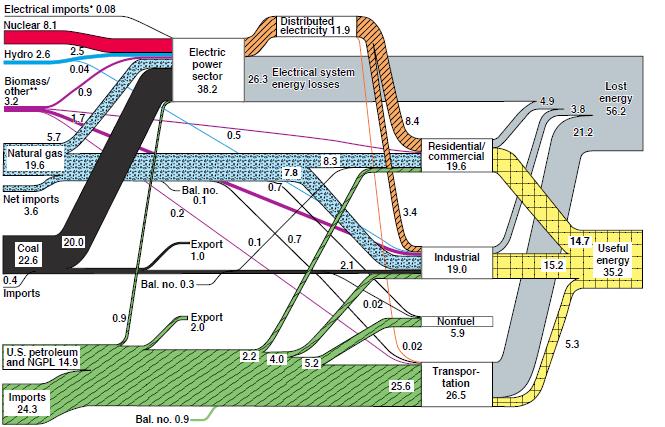
You can see natural gas makes up only a small part of the US's electricity generation. Coal makes up the bulk. It averages out to 31% efficiency (advanced NG plants included). (These numbers are from 2004 if I recall correctly.)
Using that number you get a wheel to well energy efficiency much the same as the Prius.
One question on natural gas. It is ususally touted as a GHG friendly fuel source because of its relatively low carbon emissions. But doesn't methane have a much greater impact than carbon?
Not when burnt.
Thus the "low hanging fruit" of reducing natural gas leaks in pipelines, etc, collecting and burning landfill gas and sewage processing gas (both active trends in the US ATM, with some gov't mandates)..
Although methane is a stronger GHG, it is also much shorter lived than CO2. Forgot #s, but methane leaked today will have almost no effect by 2100 (many half lives) but most of the CO2 will still be here.
Best Hopes for less GHG of all types,
Alan
I'm sure most of us have seen versions of the above chart before. The thing I keep looking at is the relative width of that gray "waste" stream compared to the yellow "work" stream. There is a lot of energy to be gained through efficiency.
You have some sort of method to increase the efficiency of a thermal electric plant?!?
WNC Observer, you'd better patented it fast, cause you'd be a billionaire overnight!
The truth of the matter here folks, is that technology does not create energy. And these technologies (thermal electric plants) have been around for a long time. Due to the nature of the creaming curve most of the gains in effeciency have been met long ago. Any remaing gains are almost inconsequentail.
Take a good hard look at that diagram folks. You see those effeciencies there? They are not going away no matter how much moore's law increases the power of your PC.
EV's are a solution to nothing.
What you are seenig here is the reality of expanetial growth. And the only engergy source dense enough to meet it has been fossil fuels.
Those fossil fuels are just about tapped out and positive thoughts don't have the energy density to run your SUV or even your EV1.
^That is why I am fixated on the "20 BTUs of diesel/gasoline for 1 BTU of electricity" trade that I see with both electrified freight rail and Urban Rail + TOD. With some "500 BTUs of gasoline for 1 BTU of food" trades with bicycling :-)
The last # is WAG.
Best Hopes,
Alan
Anybody think that when Darth Cheney visits KSA this week he's going to tell them he wants some of that 2mbpd produced they're saving?
No. Cheney understands peak oil.
No Leanan. Someone who says "conservation may be a sign of personal virtue but it is not a sufficient basis for a sound, comprehensive energy policy" doesn't understand peak oil. It's not just about the oil. It's that "P" word. And maybe the "G" word.
What Cheney said after he became Bush's running mate is markedly different from what he said when he wasn't a politician.
He knows the truth. But don't expect him to talk about it, at least as long as he's in office.
Understand the situation and the resulting tactics may not be what you presume/wish also. jus sayingg.
http://rawstory.com/news/2007/Network_Explosion_near_Green_Zone_as_0509....
He also said the insurgents were losing and "on the run" a year or so ago.
Quid Clarius Astris
Ubi Bene ibi patria
Oh, I certainly understand that.
But that wasn't the question. The question was whether Cheney was going to pressure the Saudis to produce more oil. I don't think so. I think he knows they are doing the best they can.
I think Cheney's visit is to kiss up, and maybe find out what's up. The White House seems a bit worried about their relationship with the House of Saud. The King refusing a dinner invitation, Prince Bandar suddenly out of the loop. An individual might send a greeting card, trying to revive a cooling friendship or ease over a rough patch. When you're president, you send your veep. Or your wife.
Yep it seems the shoe is migrating. Condi at that Egyptian summit was kinda chasing the Iranian ambasador as he became offended at some woman in a red dress and left the banquet. (not making this up)
I'm wondering whether leaders in the mid-east are going to respond to the gloved hand again, after so much bullying, or just adopt the good ol' wait-and-see how we're looking after the hurricane season approach.
Condi wore a RED DRESS to the banquet. Really, now tell me this White House is either clueless or knew this would be a way to keep them at bay from her. Offended now why o why would that be. Is this state dept this clueless, careless or manipulative.
Its hard to say because of the secrecy of this administration, but it appears the trip was rather quick. I agree Leanan its for a reason other than to ask for more oil. Face to Face. The reason last time was supposedly about the Iraq Sunni political problem. I don't recall hearing much about that in the news after it was reported. The invite turn down was supposed to be related to that also. Is it. There does not seem to be any action from the admin on that problem.
then add in this unannounced meeting in Iraq. Hello, maybe he's there to make sure the pipeline meters start getting fixed. Maybe not.
or maybe he's trying to do something political to appease the Saud's about Iraq, that should be obvious, and would it be announced or not. Politics and religion in the ME, and who's zoomin who.
Quid Clarius Astris
Ubi Bene ibi patria
No some other person there, described as a 'somewhat comely woman' in a red dress which offended the ambassador. His exit then coincided closely with Condi's entrance and the reporters later said to her that it appeared she was chasing him. I caught this on C-span Monday.
This would be like the Archduke Ferdinand event for WWIII. Woman in the red dress. I was thinking how bizarre these macinations too.
O good thats not as bad, but an interesting story none the less.
yes yes all the boys at the mosque might raise an eyebrow or two if a color photo appeared with him in the company of a western woman wearing of all things a RED dress.
Taint the man for life. From Condi perhaps an insult or more, this does make it even more interesting so to speak.
Have to check the calender and see what the moon was that night.
Quid Clarius Astris
Ubi Bene ibi patria
The Saudis are going to be well able to rebuff that one - in fact two of the links above give them all the ammo they need -
- Oil markets ‘over-supplied, refineries are the problem’ (with comments by the Qataris to the effect that what the world needs is not more oil, it's more refineries)
and
- Good Question: Why Not Build More Oil Refineries?
(which explains that more refineries will not be built, in the U.S. at least, because of high capital costs, environmental and NIMBY barriers, biofuels competition and probably also possible climate-change legislation - the article also gives interesting statistics that the number of refineries in the US has actually declined since 1985)
So the Saudis just say 'See Mr. Cheney, there's nothing we can do about this - we're not going to crank out all this oil we could do because we'd be simply driving down the cost of crude, but the refinery bottleneck would remain, so refined prices would not fall, just we'd make less money and your mates at Chevron and Exxon would make more. Not gonna happen, sorry, Dick'.
The question, of course, will remain entirely open as to whether they actually COULD pump that much crude. And TOD will continue to be a hotbed of debate!
I was struck by a solar energy idea yesterday. It is based on a solar refrigeration system for 3rd world off the grid villages. A trough type solar concentrator is focused on a tube filled with calcium chloride salt which has adsorbed anhydrous ammonia. The heat increases the pressure enough to drive out the ammonia which condenses in a tank immersed in a water container. At night the ammonia evaporates cooling the water as the salt adsorbs the ammonia. The cycle repeats every 24 hours. The idea is to put a turbine-alternator set between the solar concentrator and ammonia tank to convert the fluid flow into electricity. Electricity would be generated both day and night except for sunrise and sunset periods as well as providing chilled water.
Here's something very close to what you described:
http://www.solarhaven.org/AmmoniaAbsorptionIcemaker.pdf
At roughly 70 gm per sq mtr per hour of ammonia flow wouldn't generate much electricity. There are more cost effective ways of using solar thermal for power.
http://www.shpegs.org
:) You're on the right track.
You're on the right track.
Not really. The water-Ammonia powered by sunlight cycle can work with the open and closing of three valves.
Lower tech than the animated GIF.
http://www.sculptors.com/~salsbury/Articles/atmospheric-condensing.html
http://www.areed.org/training/technology/solar_ice/ice_annexxes.pdf
Subtropical Storm Andrea
http://www.nhc.noaa.gov/
Electricity in Zimbabwe rationed to 4 hours per day as economy disintegrates:
http://news.bbc.co.uk/1/hi/business/6638993.stm
A possible link between energy supply and food production?
It seems to be a link between everything (everything that worries me that is). Incompetent government, financial collapse, energy, water, food and possibly climate change.
Its a snapshot of our future.
All the news is bad.
One of my favorite TOD lines.
On a happier note I drove up the Willamette valley today on old rout 99 and was pleasantly surprised to see blossoming clover as far as the eye can see. This is one of the grass seed capitals of the country so it is usually lawn as far as the eye can see, (A Kunstler nightmare no doubt).
Also present were hundreds of bee box’s with some visible action all around them. I didn’t go into the fields but there was major bee activity all around where I stopped.
I don’t know if the grass seed market is down or if some farmers are really on top of things and figured the honey market will bee strong. Could bee ( OK I’ll stop with the spelling pun).
Got to watch out for those political droughts, they'll get you every time.
Hello GTrout,
I would hope North America will do the same thing: cutoff power to the cities in order to keep the farms' irrigation pumps and fertilizer supplies adequate.
I will gladly sit peacefully in the nightly darkness if it means I can still get minimal safe water & food. Australia's march to Olduvai may be the least of their problems if they don't get widespread moisture soon.
Bob Shaw in Phx,Az Are Humans Smarter than Yeast?
Just the opposite happening here in the US. We are turning agricultural production into vehicle miles traveled. It looks like Europe is planning to do the same (to meet CO2 reduction goals).
I feel for the Australians, but I am glad this is happening now while oil is still cheap. Imagine the nightmare if they could not import food? Maybe it will be enough of a shock that they will change course. I hope so.
''Imagine the nightmare if they could not import food?''
I am wondering where countries will import food from when no country can export food.
Bob, yes, they do seem to have done what you'd expect them to do under the circumstances. Which makes the Australian response (up thread) to cut water to the farmers seem rather strange. Perhaps that's the difference between a democracy and an authoritarian regime, the latter does what's necessary and the former does what's politically expedient. Perhaps democracy will have to go before we can actually start getting anything done (Cuba, Venezuela, Russia, perhaps there's something in it).
I assume that Australia will make up the agricultural shortfall with imports and compensate the farmers for their loss. Very short sighted, unless you've already decided agriculture is toast anyway.
The thing that strikes me is this; a man dying of thirst and hunger will of course prioritise water as more important than food, but a man doing so is obviously in a life and death situation. What does it mean when a country does it?
I'm astounded that such events hardly seem to lift an eyebrow of the world at large. Climate change, peak oil, housing crash, nothing seems to bother anyone or so it seems. The IPCC report on climate change seemed to have been greeted with a big yawn. I wonder what it will take to make people wake up and pay attention?
On GG's Overshoot post a few days ago (legendary by now I would think), someone commented that population reduction may occur when the world at large starts to ignore catastrophes. Perhaps that's what's happening here. Catastrophes become normal, everyday occurrences and they just aren't interesting anymore (not my personal view just yet).
I suppose if I were a yeast in a barrel and all my counterparts were dying off it would get boring after a while.
This does not indicate that I believe I will survive catastrophes while all y'all don't. I'm just using a metaphor to illustrate.
Tom A-B
One thought that I had was that a good portion of the biosphere goes to supporting livestock. We raise grain to feed to cattle that we will in turn eat.
The thing I don't have a good handle on is what fraction of the carrying capacity of the earth is devoted to raising meat for humans to eat.
I saw the number once and was absolutely flabbergasted. Something like 20% of the earths surface. Maybe it was even more. Does anyone have figures for this?
Matt
Australia has to get above average rain in the next few months for irrigation to resume next summer. Apart from local food prices there may be severe flow-on effects. Dead or uprooted fruit and nut trees will take years to regrow. Meat and grain customers in the Middle East and Asia may drive up world prices. Now they are saying coal fired electricity generation may have to be cut back due to lack of cooling water.
"coal fired electricity generation may have to be cut back due to lack of cooling water". According to some reports (see my post below), coal-fired electricity generation may have to be cut soon due to a lack of coal!
I see the first named storm of the year, Andrea, has been reported. This is the earliest I can remember the weather channel's Hurricane Central web-site being active.
http://www.weather.com/hurricanecentral/?from=wxcenter_subnav
Can't be good omen for Hummer owners.
jt
From 1886 to 1985 there were 14 Atlantic tropical systems that formed in May, 3 of which became hurricanes, according to an old NOAA book of mine. The two earliest formation dates were May 5 and May 6, so this one (Andrea) is the third earliest system to form. There is a weak positive correlation between storms forming in May and a more active than usual hurricane season.
Regarding the possibility of hurricanes, the major factor is sea surface temperature which you can get marvelous up to date mapping of at NOAA.com . Currently, and yet again, the Med is above normal as is the Baltic region heralding a probable repeat of heat and drought in western Europe. April has been uncommonly warm according to the coverage of bicycle racing, with such races as the Paris Roubaix - the Hell of the North - being plagued with heat and dust instead of the usual cold, rain, and mud.
China also had a record setting April. To be fair, there are a few areas with colder than normal seas and temperatures, but for the most part the hot and dry seems to be outweighing the cold and wet as a problem. The whole US looked uncommonly warm on last night's weather show and even Winnipeg, Manitoba hit 87 degrees or 31C yesterday.
British Columbia is sitting on a time bomb at the moment. Snowpacks in the north are at record levels fifty percent or more above normal which have only the Fraser River as an exit. This system passes by - or over as the case may be - the agricultural floodplain east of Vancouver. If there is a warm May, the possibility of a major flood becomes an inevitability. This is the water that normally falls further south and would be so welcome in the Colorado system, what with Lake Mead being so far down.
But, the whole Global Warming thing is just a conspiracy by liberal scientists to bring capitalism to its knees, isn't it? These denyer guys don't realize that a one percent change in global temperature isn't one percent of 15 Celsius but 288 Kelvin. They probably grew up with a Kelvinator but never got the reference. So now we have the twin troubles of thermodynamics and geology simultaneously peeing on our recently acquired and non negotiable lifestyle. Somehow I have a hunch that humanity will become exponentially more intimate with both fields in the very near future.
EIA's numbers have been updated yesterday. NGPL production has increased (the new record is now February 2007). The period of decline in crude oil + condensate is almost two years old now but still shorter than previous periods of temporary production decline (i.e. 2001-2002, 1991-1993, 1990-1993). If this current decline last another two years we can then say that this event is historically significant.
We don't have the May production numbers yet, but we do have oil prices through early May.
It might be useful to plot the periods of prior world crude oil declines against Brent spot prices, versus the price response that we have seen since May, 2005.
It is always exciting to read your comments about the new numbers. I really appreciate this.
I was planning to do exactly that analysis.
It looks like the cumulative C+C shortfall, between what we would have produced at the 5/05 rate and what we actually produced, based on the current EIA data, is on the order of 450 million barrels of oil, while the average monthly Brent spot price after 5/05 has been about $62, versus $38 in the 20 months prior to 5/05.
We have certainly seen multiyear local production shortfalls versus price increases, e.g. Texas and the Lower 48 in the Seventies.
But the question is, can we demonstrate, prior to the current one, a multiyear global production shortfall versus a price increase?
The current cumulative production shortfall is modest (around 0.5 mbpd) as compared to other periods of decline but price level and volatility are much higher.
In blue: cumulative production shortfall (crude oil + condensate) since last production peak (in mbpd); In green: Europe Brent Spot Price FOB (Dollars per Barrel).
We do have the IEA guesstimate up through March and tomorrow (May 11, 2007) the IEA will release their estimates for April (plus revisions for earlier months). There has been a slight divergence of the total liquids reported by the EIA (US) and the IEA.
However, the key that we should probably be looking at is either CO or the C+C values. It's great that the NGLs and other liquids are helping offset the shortfalls of crude or C+C production, but eventually that ability will become limited as well.
It probably does not require a time-series analysis through SAS to conclude that there has been a fundamental change in the trend (separating out the outliers from the periodicity/seasonal effects), nor is it likely we have to wait 2 years to sort it out. By the end of 2007 should probably be sufficient given the characteristic trends going back several decades.
This is probably not a good place to be with no plan B or plan C. However, without a dramatic decrease in global production getting the attention of the (American) publis is going to be difficult.
khebab
thanks for your efforts and charts. Always interesting.
I think that all liquids peaked in 05 if you correct for ethanol's 1/3 reduced energy content, which has nothing to do with eroei but simply total produced liquid energy as opposed to total produced liquid volume... would be interesting to see a chart corrected in this way.
Also, charts with 3-month moving avg seem to smooth out the chart considerably, makes it easier to see trends.
IMO the 01/02 reduction was on account of very low oil price in 97/99.
NGL, Natural Gas Liquids, is used in mixing gasoline (a few % are these lighter fractions, especially in winter blends AFAIK). From memory, their energy density is about 65% of crude oil.
NGL production has increased with LNG and other natural gas production. (My understanding is domestic pipeline NG is a mix of light hydrocarbons, usually normalized to a certain BTU content. When NG is liquified by cooling under pressure, all hydrocarbons except methane drop out early, leaving nearly pure methane for transport. Butane, Propane, Ethane and Ethene, etc. are sold seperately. LNG is good fro power plants and industrial uses but is not suitable for your domestic appliances without mixing.
So NGL production has increased significantly in recent years. But 3 barrels of NGL are worth 2 barrels of light sweet crude :-)
BTW, I am less sure of this than normal.
Best Hopes for Accuracy,
Alan
PER HURRICANE SEASON: The season will be active, but there are reports that see a pattern coming back that will send storms up the east coast. We could have that NYC storm that the Science channel has been talking about for years. The Cosmic Irony award would follow if there is one for the DC area! _> ! <_
Peter M. DeLorenzo at the autoextremist.com quotes Sen. Obama and rants like a TOD poster today. Supposedly the "Detroit Powers That Be" follow his site closely.
http://www.autoextremist.com/index.shtml
He usually isn't so PO aware IMO.
Oh ho, perhaps we have a reason for a sudden visit to Iraq by Veep Cheney.
if they do strike and the oil flow stops. This would test the non working meter theory and the hidden flow going to other locations.
Would show up in numbers of output. What happens if the oil flow stops. How many "known" barrels would this effect. What if the oil is filling a gap through the non working meters and stops.
If supply is this tight, might reveal or knock down some theories.
Quid Clarius Astris
Ubi Bene ibi patria
Is food off-topic enough for you?
So far we have a bunch of fjord-pining pooches. Will it stop there? Not very likely.
But wait, that's not enough: we're going to import Chinese chickens.
How about some pork?
Time to grow some veggies on your balconies, kids.
Probably a good time to shop at Whole Foods and to buy the stock.
It's worse than that. People have been killed. Hundreds, maybe thousands:
From China to Panama, a Trail of Poisoned Medicine
And they weren't even trying to hurt anyone. They just wanted to cut costs and make more money.
It's the markets, they're trying to cure overshoot!
Go markets, go!
There is another location that has a problem like the "pig" problem in China. This problem though is in the US. Fresh water fish have started showing up with the same kind of symptoms and dying off in great numbers. I heard about the fish from a lady that does all sorts of investigations that no one else touches for obvious reasons, and some not so obvious. Linda Molton Howe. She reported on the fish and also about the Bee's (the story that it was a virus that surfaced last week as an explanation). That was news to the people that are looking into it. Linda had an interview with the man running that organization and he said they didn't talk to them about it, that it wasn't something they thought was a cause. Its still a big unknown. Then a couple days later the pig story out of China appeared. Fish and Pigs showing the same types of outer skin bleeding etc. Bee's nothing on that either. The interview with the person working on the Bee disappearance seemed to show agitation at the group that released the story to the press, and wondered why they did it. The fish story in the US may turn out to be huge if the report is as dire as it sounded.
http://www.earthfiles.com/news/news.cfm?ID=1240&category=Environment
Scroll down to find the story link on the front page.
Link to the interview with the govt officials about the fish. Sounds like the same thing in China with Pigs.
The bee story was an audio interview, she might have a transcript of it.
Quid Clarius Astris
Ubi Bene ibi patria
"Time to grow some veggies on your balconies, kids."
Actually this week I have been tilling the soil and starting my first ever garden. I recently bought a small condo and there is a little bit of land on the side of the property, which I am using. I have no idea what I am doing but it should be fun. I hope to have a small harvest later this summer. That is if the neighbors don't steal it all.
FYI:
I probably would be a good idea to get your soil tested before consuming any of your garden produce. You soil could be contaminated.
>That is if the neighbors don't steal it all.
No so bad if you found out your soil was indeed contaminated.
Good luck shawnott. I'm at my 5th garden this year--each year we've increased the size and tried more things.
We have still to get anything resembling a harvest. A few tomatoes, some peppers, a cucumber or two, that's about it. Every year something happens. One year it was too cold, a second year some animal ate a good deal of what we were growing. Each year has brought a new learning experience, and I'm hoping eventually it pays off with a decent harvest someday.
If you've still got the stomach for second helpings:
US: Another Chemical Emerges in Pet Food Case
http://www.corpwatch.org/article.php?id=14467
There's no end to the tampering with foods to increase profit and its not just the Chinese. I'm convinced many of today's chronic illnesses are linked to the industrial food and agricultural processes. It's not just the processes that are rotten, it's the whole system and especially its controlling logic, economics.
Burgundy: Great post.If anyone feels the USA is the champ at rampant greed and environmental damage, just wait till China is running the show (which appears inevitable). You ain't seen nothing yet.
"Chicken pens are frequently suspended over ponds where seafood is raised, recycling chicken waste as a food source for seafood"
Before you get all worked up reading this, think where the nutrients are supposed to come from-only from antiseptic, industrial conversions of natural gas?
Shortly after diplomatic relations with China were reestablished in the early seventies, Bardach et al released their monumental text "Aquaculture", a shot in the arm from previous redundant works of bass-bluegill ratios. Several of the coauthors, having just returned from China and SE Asia, included many ideas gleaned from the trip. Prominent was the raising of ducks,other waterfowl and chickens over or in the pond, or hogs in the hillside above the pond. With the ducks, not only are nutrients to create plankton blooms directly released, but their digging in the sediments also releases nutrients which are otherwise "lost".
Throughout the rest of the decade, some researchers branched off into North American polycultures, and integrating fish, plants, and terrestrial systems. Perhaps it is only coincidental, but we returned to predominantly species specific aquaculture as oil became cheap again.
The practice may seem foreign to us today, but it has a long history. As McLarney stated in his 1984 "Freshwater Aquaculture" work: "It is quite easy to throw such a system out of tune. Asian farmers have the benefit of many years of tradition to help them avoid mistakes."
Could anyone recommend some good books or internet sites with information on building a super energy efficient home? Much appreciated.
If you want to see how a house was built with low embodied energy and natural materials as well as low energy use, there's a book by Ben Law (can't remember exact title) - you should be able to find it on Amazon. Published 2005 or 2006. The house looks a bit weird! There's also the Green Building Bible. Also plenty of others around.
One place to start might be the German Passivhaus (in English)
http://www.passivhaustagung.de/Passive_House_E/passivehouse.html
Click on the "Step by Step" link...
Coincidentally... due to changing personal circumstances... I have just this week sold the 4,000 sq ft super-insulated/ passive gain/geothermally-heated house I designed & had built in 2003... and am asking myself: What next?
Check out www.monolithic.com
Google '"earthships".
There is a place in Texas that trains you and will also help you build a "concrete" home. Google is your friend on this.
What do you want to do. Going into the side of a hill like a hobbit could be very insulated, going underground might be a problem depending on where you locate.
Hay bale homes. SEP constructed homes.
I like Steel building/shipping container with an outer wall made of pre-made SEP panels for appearance and insulation. Roof same thing. Except one side faces south and its glass for solar heating of a "roof type garden" in the winter above you.
The concrete homes are about as good as going underground, which is much more difficult.
Quid Clarius Astris
Ubi Bene ibi patria
...going underground might be a problem depending on where you locate
Yep !
Best Hopes for a city that buries it's dead above ground :-)
Alan
Not hay bales. Straw bales. Hay has seedheads which will sprout after the first good rain. Straw is the stalks left behind after grains are harvested, and it won't make your walls suddenly spring to life. It's also much cheaper than hay, because it has no use other than as bedding for livestock. According to the U.S.
Department of Energy,the insulative R-value of strawbale walls is about 40, compared with a range of 8-20 for concrete block.
concrete homes I am referring to are not made of concrete block. Its a spray on concrete that is very solid. concrete block solid or the type with a "hole" in the middle. The type of concrete block with a hole (s) is not insulated well at all. It transfers the outside air temp easily from what I am told.
Quid Clarius Astris
Ubi Bene ibi patria
Thanks to all for your replies.
Lately, my roommates have been handling Peak Oil with much difficulty. They are mentally fatigued and have trouble sleeping because its all they can think about. They often ask me how I deal with it so well and why cant they deal with it the way I do. I really never had answer to that question until yesterday. Recently, I read a post on TOD that mentioned a different view of "The Nightmare Scenario". It basically mentioned that if humans did discover some way to have an abundant energy supply forever, it would be hell on earth. Population would continue to boom; there would be no solitude. Wars would be fought over land and water instead of oil. The sky would turn black from pollution. People would wallow in their own waste. I asked one of my roommates to think about this scenario. He quivered and his eyes lit up. I asked him, "Which would you choose; Peak Oil and its effects, or abundant energy forever and its effects?". He simply replied, "Peak Oil."
I think I will use this alternate "Nightmare Scenario" to help other people I know that are having difficulty dealing with Peak Oil. Thanks TOD! =D
I am pleased to read that at least some young people are seriously thinking about what the future has in store.
As has been mentioned previously on TOD… it does seem to be a majority of “oldies” who are concerned about these issues… perhaps that is simply a function of oldies having the available time to read/research… wade through Drumbeats?…
I suspect that at my age (55)... Peak Oil will not have too much of an impact on my life… and, having no kids of my own, I have no vested interest in the next generation.
Furthermore... I notice that children of friends seem to be too concerned with just surviving in the present day… getting an education...(tho’ often in fields that seem to me worthless in the upcoming scenario… Fine Arts anyone?); or simply struggling with various personal & financial crises.(Ever try being first-time buyer in the UK’s crazy housing market)
However, as one who has been interested in “alternative technology” since 1974… I can’t help but continue to be fascinated by “the future”… and find myself wondering what to do that is “worthwhile”… not just for myself, but for the next generation in general.
Any suggestions?
PS As mentioned in a previous post… post-divorce… I have just sold my first geothermal “large family house” design… built within constraints of local planning codes here in Canada. Have the next "passive-haus" design in my head…
If peak oil happens, and there is a push for organic farming, we are going to need large numbers of people to move back out into the tiny farming towns along the older rail lines.
Those people are going to need housing. It would be nice to have some designs ready to go for high density housing with high efficiency.
It would also be great if it was concrete construction for long life (and low fire risk). Basically a set of packed housing we could invest the last bits of fossil fuel into, and they could house farm labor for the next 100+ years.
Unlike the German designs posted they should have full basements to get under the deep frost layer (and to function as inexpensive root cellers).
No shortage of wind power in the upper Midwest US (and Canada I expect) so I think there will be some electric available.
Smallish, like 800-900 sqft, two bedroom to keep them inexpensive (peak oil remember). For this reason, I don't expect many architects to be working the issue today.
What do you think?
gtrout
Funny you should suggest that…
Several years ago as a mental exercise I spent several months “designing” a car-free city… (ideal population 100,000)
My daily reading on TOD these last 15m has further refined my ideas… to incorporate the problems of low energy use, recycling, community, the urban lawn syndrome... and returning vast tracts of countryside to its natural state…
Having travelled extensively it frustrates me that every city is built on essentially the same “western model”… Bangkok, London, Cairo, Bombay, Sydney… they are all the same… grid-locked & polluted roads… every residential street blighted with parked cars down both sides. (and let’s not even get into the mono-culture of the same Japanese cars everywhere around the world…)
The only city I have seen that is slightly better (and I use that worded guardedly)… is Kuwait City… which had the fortune to be planned from scratch post oil-discovery in the 1950s… and was able to lay out a grid system of residential-only districts connected by local freeways, in advance. (Do a fly-over on Google Earth!!)But it is still a city of the “motor car age”(and given their year-round sunshine may possibly live on in the next age of EVs and PV arrays.)
Anyway, it is my contention that we need to completely throw out the old urban paradigm… stop trying to retrofit our cities for the motor car… as we have been doing for 100 years now… & completely start from scratch. (And for those of you that claim European cities are better endowed with mass-transit than their American counterparts… well yes, but they are still car-clogged hell… does anybody really ENJOY living in these places?)
Yep... I reached exactly the same conclusions. As they now build in the Gulf... concrete frame with infill... high thermal mass with external insulation; air recycling & heat retrieval
The only catch?… such a city design can’t really be done incrementally… it needs a billionaire benefactor or far-sighted dictator to even get started! And of course history hasn’t left us with any good role models of this kind of “social re-planning”.
So...anyone got Bill Gates’ email address?
PS: Meanwhile realising that the world currently prefers suburbia...and building codes restrict "out-of the box" thinking... I have been trying to do my bit with insulation and geothermal heating.
Sell'em to baby boomers as retirement homes in the country. Low long term energy costs for fixed incomes! Pleasant country living! Later they can figure out that retirement has been canceled by Peak Oil.
I traveled across South Korea and one sight that amazed me was seeing these little farming villages with a single tall high rise apartment in the center. I think I finally figured it out. They didn't have cars and hey walked to the fields. They didn't want housing taking up valuable farmland and they wanted the walk as short as possible.
So how long do you think a geothermal system would last? 50 years? 100? 500?
>If peak oil happens, and there is a push for organic farming, we are going to need large numbers of people to move back out into the tiny farming towns along the older rail lines.
This is exactly we don't need to happen. Urbanites should remain in urbania. No need to destoy even more farm land to build tiny homes.
I seriously doubt that US food consumption is going to be met with organic farming. Most of the US best farm land has been converted into suburbia. I assume your also referring using co-op farming. A single farmer with a tractor and a harvestor can produce far more food than a large army without mechanized farming equipment.
The bottom line: Urban regions are for people and farm land is for farming. You might find it interested to google for Khmer Rouge and "Communist peasant farming" to see how that worked out.
>It would also be great if it was concrete construction for long life (and low fire risk). Basically a set of packed housing we could invest the last bits of fossil fuel into, and they could house farm labor for the next 100+ years.
There are wood homes in the US that are more than 200 years old and still lived in today. Concrete production requires way too much energy to make this practical.
>Smallish, like 800-900 sqft, two bedroom to keep them inexpensive (peak oil remember). For this reason, I don't expect many architects to be working the issue today.
How are you going to heat and cool all of them? Are they going to burn all the trees until the area is depleted? Also where does the money and resource come from to relocate these people. When resource depletion begins in the not too distant future, jobs and capital will disappear.
Over all, I suspect that other factors beside starvation will become much more critical. During the little ice age, agraculture production fell because of climate change. However most people didn't starve, most died because of diseases related to malnutrietion.
I suspect that as declining energy production begins to affect the economy, people will not be able to afford the same level of medical care. Diseases that can be treated with anti-biotics and other medicines will go left untreated (or worse: under-treated resulting in super-bugs). We will probably face some major pandemic that will kill a large fraction of the global population. We already have some nasty diseases that are become drug resistant. Perhaps high unemployment, declining food quality and lack of medical treatment is all that is required kick off a pandemic.
Cuba survived a 50% drop in oil by raising the wages of farm workers to above that of office workers to entice people into farming. I expect the way our market will do it is by unemploying all the office workers.
Essentially, we should see a reverse of the industrial revolution, where the migration from country to city reverses into a migration from city to country. The economics will make it happen as fossil fuels dry up. (assuming nothing else steps in).
High density wooden structures are a poor idea in a low energy world (see city wide fires in Chicago, San Francisco, Rome, London (twice), Tokyo, etc).
>Cuba survived a 50% drop in oil by raising the wages of farm workers to above that of office workers to entice people into farming. I expect the way our market will do it is by unemploying all the office workers.
This has been discussed in much detail months ago at TOD. Cuba survives on food imports. The US supplies a significant amount of food to Cuba and the majority of Cubans have diets that border on malnutrietion.
>Essentially, we should see a reverse of the industrial revolution, where the migration from country to city reverses into a migration from city to country. The economics will make it happen as fossil fuels dry up. (assuming nothing else steps in).
That will only happen when TSHTF. The majority of the people living in cities no nothing about farming. Good farming requires decades of experience and lots of physical labor even with mechanized equipment.
Any suggestions?
Maybe you could put your passive-haus designs (past, present and future) on the internet? Open source perhaps?
Not a bad idea...
Don't know how "original" they are... though I was rather pissed off when the builder I contracted to build it... later stole the plan and built it for another client nearby with no credit or financial reembursement to me.
Furthermore, as I mentioned, ideas & plans are one thing... local building codes are another. (We weren't allowed an insulated slab nor PV on our directly-south facing roof) Hell, my neighbour had to redo his roof mid-build because the tiles were slightly the wrong colour!!)
"It basically mentioned that if humans did discover some way to have an abundant energy supply forever, it would be hell on earth. Population would continue to boom; there would be no solitude."
???????????????????????????????????????????????????????????????????????????????????????
Trivia question: Excluding immigration, where is the population actually flattening and in many cases dropping?
Yep, in the most developed, energy consumptive nations on Earth, the U.S., Japan and Europe.
(Don't tell the Kunstler, Heinberg crowd, they don't like to hear things like this....
RC
Remember, we are only one cubic mile from freedom
This is a relevant observation, and made me pause to consider the ramifications of "an abundant energy supply forever" as you so put it.
Abundant energy is cheap energy. And you said "forever," so it seems like this would be limitless energy, able to grow to meet the needs of ever-expanding economies.
Under these circumstances, it is imaginable that the currently observed population trends in the developed nations could reverse. Here's why: With abundant (cheap) energy, raising children would be very inexpensive. And there'd be more free time to do it. With energy cheap enough, most people might get away with something like a 5 to 10 hour work week, if they wanted. Or, not work at all with the support of their spouse, parents, what-have-you (let the robot do the work for you and take the $$$). Remember: Abundant = cheap.
Certainly not everyone would have lots of children. Some people just want to "party hard" and not feel the pressure of "obligations." Some might not be able to have children (however, medical tech in an energy-rich future might eventually find solutions to such problems). Those people who have the tendency to produce many offspring, would be spreading their genes at a faster rate than those who didn't. Some of the children from these big families would probably opt-out and not want the responsibility of parenthood. But others wouldn't. After all, there are some profound rewards that go with parenthood. It's quite possible that, over time, those people interested in having more offspring would become the norm, as their genes would spread faster than those who have a tendency for few children. Why, kids just might be running around everywhere! Sounds like paradise! (Or some people's version of "hell.")
And population growth would accelerate under these conditions. Extending life-spans and a woman's child-bearing years (more of that energy-rich medical tech) could exasperate this trend. Though, longer life-spans might motivate parents to spread their children over a longer span of time (one child every five or ten years instead of one every two or three), which would probably slow the population growth a bit.
We're told that the higher education of women in developed nations tends be the largest predictor in regards to the number of children they decide to have over the course of their lives. That is an interesting statistic, but it does not really explain what's going on. What are the actual reasons behind this trend? For many people, even in the developed world, resources are still limited. An educated woman might think carefully and concentrate those limited resources on one or a few children. In a situation with abundant energy, this kind of thinking could change. In an energy-rich world, one might have five children and be able to focus *abundantly more* resources on each child than the average U.S citizen could bring to bear on a single child in, say, 1965, or 1995, or 2007.
My line of reasoning is probably bogus. Who knows? This is speculation. People and societies are complex. But, I suspect that, just as entering an energy-limited world post-peak-oil may change many fundamentals in a big way, entering a truly energy-rich world will likely have a similar impact on the fundamentals.
-best,
Wolf
PS. Now, one thing to consider--in a world with abundant energy, moving into space ceases to be an issue. So, there would be a chance to escape and find solitude, at least for awhile (say a few millennia). At some point, an exponential growth rate would overtake the cubic rate of an expansion limited to near light-speed.
"Abundant energy is cheap energy. And you said "forever," so it seems like this would be limitless energy, able to grow to meet the needs of ever-expanding economies."
The "forever" and "limitless energy" came not from me, but from the poster I was replying to.
"In an energy-rich world, one might have five children and be able to focus *abundantly more* resources on each child than the average U.S citizen could bring to bear on a single child in, say, 1965, or 1995, or 2007."
That would be true, except women know better than men that for them a child consumes the one non-renewable resource that is more valuable to them than any other including energy:
TIME
RC
Remember, we are only one cubic mile from freedom
Hello Wolf,
I like how you're looking from different points of view - expanding the discussion.
re: "What are the actual reasons behind this trend?"
Here's one explanation: It's not the education of women, per se - it's the education of men. (Or, the education of men about the humanity of women.) (and children.)
How so? It's the legal rights of women that go hand in hand (not always, but often) with the education of women. This gives a basis of "power", i.e., the law, backed up by force (as law), and culture -(as supporting the enforcement of the law, which in turn...and here's my speculation - renders the application of law less necessary over time, as the culture takes hold)- to the real-world interactions of men and women. So, law and culture, in turn, serve to elevate the status of women to one requiring and deserving of protection of their persons, property and basic rights. Under all circumstances.
By all circumstances, I mean, for example, so that women are safe *even* at night, *even* when alone among strangers, *even* when lacking the protection of brothers or husbands. Just as examples.
Another way to say this: As an example, any techno-fixes (as per our X-rated illustration) WRT birth control, cannot work unless women have equal rights, and are not subject to different forms of force and coercion, including sexual exploitation (as children and as adults), abuse, assault, violence, and so forth. I'm not saying equal rights are sufficient. I'm saying they are fundamental and necessary. (And a requirement for the application of "techno-fixes".)
Also, perhaps, once fully in place (which we have yet to quite see in the world, though getting close in some places)...these rights and norms of equality are *also* sufficient. Perhaps.
Likewise, the lessening of these patterns of (what we might call one-sided, power-based) interaction also results in a woman having the ability *in the real world* to make those kind of educated choices you talk about above, namely, to concentrate resources.
"An educated woman might think carefully..."
In such a world, an educated man might...learn how to think about women.*
The goal, being, of course, for people to see each other first and mostly as human beings, all of whom have needs, and less as "objects of one's needs", (so to speak).
As much as this sounds like sermonizing, really, I'm trying to say the kind of social changes TOD posters often end up pointing to as the great obstacles to positive mitigation paths...these changes might not be so beyond "our" reach, as we might imagine.
*And share this w. others.
Hello Aniya,
You are absolutely right that the education of men (along with the definition of civilisation as the absence of violence, even implied violence or intimidation) is the central issue.
Agreeing with what you said, I am also referring to the absence of even intimidation in _all_ circumstances.
I am not at all happy at the reascendence of "tough guy" culture apparent at the moment (suspect it is being deliberately pushed by advertising as an attack on social solidarity).
ciao,
Bruce
Hey I got another trivia question, actually stems from what you were saying, Thatsit, about population flattening and dropping. I think it's a country western song, can't remember the name. talked about a bird and loosing the will to sing. It was pre-Viagra if that is any help. Gee that another thing to think about, it must be a real pain to marketers of same to look at this market with such envy. Well china is on it's way and soon the Chinese will all be driving and poping Viagra like Billy Oh and flattening their population too.
BTW who is this Heinburg, if he is as Vervy 'and Ballsy as Kunstler point me the way my friend, point me the way.
You can just exclude immigration that easily, eh, Roger? Just ignore it? At current rates of immigration, which will only worsen if Mexico and the rest of Latin America undergo severe economic, resource, and/or climate shocks, the US will be about 600 million people by the end of this century and over 450 million by mid-century. That's a 50% growth by mid-century despite these "low" rates of growth. Do you understand that any percentage growth over time is an exponential function?
Ghawar Is Dying
The greatest shortcoming of the human race is our inability to understand the exponential function. - Dr. Albert Bartlett
I like this. Not that all that many people would 'get' it, but some may.
Q: What's worse than peak oil? A: Unlimited oil.
Maybe someone should do a film about how peak oil may save the planet from even weirder exponential nastiness. They shouldn't expect to make money on it, though.
It is very simple, all use of energy produces waste.
Apparently very hard to understand. Too simple?
For the umptieth time here:
Daly and Townsend's corollary of the 2nd law of thermodynamics:
"What's worse than peak oil? A: Unlimited oil."
That's EXACTLY CORRECT! :-)
But, what about "unlimited energy"? Oil is only one form of energy, but energy is much more and different than just oil, something often forgotten here....:-)
What if, for example, solar panels improved from their current level of conversion efficiency per dollar of the high teens to say 35% (effectively as good as most internal combustion engines, but without the carbon release!) or say 50% (meaning that we could try to get the other half of the efficiency on another day, but 50% would mean one of the greatest revolutions in energy history, so we could afford to wait....:-)
kick it around....these college age kids carrying on about this amaze me....damm how great it would be to be college age again, and still have these opportunities in front of you...how freakin' blessed are the young....
RC
Remember we are only one cubic mile from freedom
15 years to Peak Coal?
Richard Heinberg has just released a special Museletter update on coal. It's for subscribers only but some points are:
http://globalpublicmedia.com/richard_heinbergs_museletter_179_burning_th... consisted of a summary of the conclusions of a recent study by the Energy Watch Group (EWG) on future global coal supplies. That study, “Coal: Resources and Future Production,” www.energywatchgroup.org/files/Coalreport.pdf published on April 5, found that global coal production could peak in as few as 15 years. This astonishing conclusion was based on a careful analysis of recent reserves revisions for several nations.
“The Future of Coal,” a study by B. Kavalov and S. D. Peteves of the Institute for Energy (IFE), prepared for European Commission Joint Research Centre, is ready in final draft and will be published within days. ... conclusions [of this report] are broadly supportive of the EWG report. “Coal production costs are steadily rising all over the world, due to the need to develop new fields, increasingly difficult geological conditions and additional infrastructure costs associated with the exploitation of new fields.” [Does that remind you of oil!?] “The analysis in the preceding chapters indicates that coal might not be so abundant, widely available and reliable as an energy source in the future.”
Heinberg says that "all of this translates to higher coal prices in coming years." As prices for coal rise, [the draft IFE report says] “the relative gap between coal prices and oil and gas prices will most likely narrow,” with the result that “the future world oil, gas and coal markets will most likely become increasingly inter-related and the energy market will tend to develop into a global market of hydrocarbons.”
The report’s authors indicate that these price increases may discourage the deployment of technologies to capture and bury the carbon from coal so as to reduce greenhouse gas emissions.
According to Heinberg "The sustainability of China’s economic growth, which has largely been based on a rapid upsurge in coal consumption, is thrown into question. And the ability of the US to maintain its coal-powered electricity grids in coming decades is also cast into doubt. ". Also "higher coal prices [would] discourage the adoption of carbon sequestration technologies."
doctorbob,
Interesting post. While I have extreme doubts about a great deal of Heinberg's musings, the remarks as quoted in your post open up a fascinating line of thought. I would like to make just a few observations, from the "hill country":
(a) The efforts to reduce costs in coal removal are nothing short of environmentally catastrophic, in particular in Kentucky and West Virginia.
Mountaintop removal has to be seen to be believed, in which complete old growth forests are blown to bits and whole mountains are removed. The bio-diversity loss is staggering, and the acres destroyed make the tar sand mess seem like a small mud puddle. The Americans however are in hysterical outrage about Canadian environmental damage, while completely ignoring the destruction of the American south. It is an outrage, and one reason I could care less who is in the Congress or White House. Both major American parties have dismissed the concerns about American destruction, and those who should be speaking loudest such as Al Gore and other Southern leaders remain silent. it is a crime.
(b) The increase in coal prices may be a revolutionary leap forward in the advance of alternatives if they do occur.
Right now, photovoltaic and wind are competitive with natural gas produced electricity in many places. However, coal is so cheap as to keep the march of these alternatives out of a great deal of the country.
The south for instance is the absolutely perfect place for the advance of photovoltaic, with great sun and big electric power markets. However, solar has also been dead in the crib if it has to compete with coal. Coal pays no cost for the vast damage done in it's extraction, and the carbon release.
It is astounding to me the way the human mind works! If one mentions solar photovoltaic, they are immediately dismissed here. "It's not scalable ", "it's too expensive", "it requires too many raw materials"....on and on and on....
I will resort to begging: Please do some research on the costs involved in extracting, moving and using coal. The destruction is astounding, the issues of how to handle the carbon is a world nightmare, and the sunk costs of a century investment and the externalized cost is all that makes coals seem competitive.
As for China. It is only the absolute insane American policy of being willing to accept poison food, rubbage and garbage from China, and give them special terms to assist us in our own destruction that makes them competitive for even a short time, It will not last long.
If any American business tried to sell that stuff to the American people they would be driven out of business in less than a month. The whole thing reeks of corruption beyond belief. If we want to give someone favored status, let's give our border country in Mexico a chance. If one of their tomatos gives somebody the shiits we use it is a propaganda against them for a year....
Not peak oil folks, peak stupidity....
RC
Remember, we are only one cubic mile from freedom
And so they should be my friend, and people like me should be horse whipped for being taken in by companies like Suncor with their pretty brochures of windpower towers fading into the distance. Of course I did net a tidy 200% profit before the lord showed me the darkness of that sun.
Seriously I don't see why anything done anywhere to the detriment of OUR planet shouldn't be free for all to make complaint about.
"Seriously I don't see why anything done anywhere to the detriment of OUR planet shouldn't be free for all to make complaint about."
Some of the greatest areas of biodiversity short of the Amazonian tropical forests exist right here in North America in the Appalachian range of the American south. Would anyone care to complain about this before it's too late:
http://www.wju.edu/ai/profile/mtr.asp
http://www.wju.edu/ai/images/MT1_2.jpg
http://www.wju.edu/ai/images/MT1_1.jpg
http://www.wju.edu/ai/images/MT1_3.jpg
http://www.oriononline.org/images/om/06_1om/Reece/Header.jpg
http://www.appvoices.org/index.php?/mtr/environmental_impacts/
“Mountaintop removal mining, if it continues unabated, will cause a projected loss of more than 1.4 million acres by the end of the decade—an area the size of Delaware—with a concomitant severe impact on fish, wildlife, and bird species, not to mention a devastating effect on many neighboring communities.”
Trivia: The mining companies of the South are now the largest consumers of explosives in the nation. For those who are looking for a great source of waste wood and chips for cellulosic biomass for alcohol, check out the mountaintop removal areas of the American South where whole old growth forests are being blasted to bits.
This is what I mean when I talk about creating hysteria over low probability scenarios when the damage is being done NOW.
Roger Conner Jr.
Remember, we are only one cubic mile from freedom
It's disturbing how many "walls" we seem to be approaching - and the inappropriateness of our actions as we do so. Oil more or less at peak, gas and coal about to peak - even quicker if we step up CTL and GTL. Food stocks dangerously low and falling fast, yet we contemplate turning food crops into auto fuel. Soon we will be out of options and as Heinberg might say "The Party will be Over".
Someone here today commented on the different aproaches of Australia and Zimbabwe to maintaining food production when stricken by drought. Of course Australia is a rich country and can afford to import food to keep the suburban masses happy and their washing machines running, while the (few) farmers see their crops shrivel. Zimbabwe is not is this position. I expect increasing numbers of nations to be in Zimbabwe's position in the next decade.
doctorbob
Despite the ongoing drought over the last few years (and the rising $A) Australia remains a significant food EXPORTER
2006 Exports $A23.8 billion
2006 Imports $A 6.8 billion
Australian Food Statistics 48 Page pdf
Just a couple of comments re:those latest EIA figures on a couple of country's I follow:
a) Mexico - as has been commented previously elsewhere the Mexicans seem to have 'temporarily' stemmed the headlong fall in their total production, with the average for Jan and Feb (3.145mbd) comparing favourably with what was an awful Q4 of 2006 (3.1mbd average). However note that a comparison with average Q1 production 2006 (3.34mbd) still shows a year on year fall of 200,000.
b) Kuwait - reports last year that their super giant Burgan had peaked had not as yet been reflected in any fall in their total production. However perhaps there is now the first inkling of a fall off (see below). Or maybe they are shouldering some of the OPEC cuts????
2005 Q4 2.6
2006 Q1 2.56
Q2 2.53
Q3 2.55
Q4 2.5
2007(2mo) 2.436
Speculator's dream! Last 5 days gasoline futures
http://finance.yahoo.com/q/bc?s=RBM07.NYM&t=5d
Not since the glory days of Enron in the California electric power market have we seen such a glorious opportunity for the vultures and outright manipulation.
Once, more the Americans eat shiit while the "business" class gets rich....
And just like the days of Enron, we blame all the wrong parties....
"Just like chickens, they wake up in a new world everyday." :-)
RC
What is your point? I don't get it. The price of insuring for June delivery should not have gone up???
Engineers test first methane rocket built for spaceflight.
VIDEO: http://tinyurl.com/2x5yb9
Prediction of ethanol bust:
http://www.msnbc.msn.com/id/18575725/
Yeah, a bust for whom though?
"A growing number of analysts, once bullish on the product, are warning that an oversupply may be coming as soon as this year."
THE HORRIFIC COST TO AMERICA OF GASOLINE PRICES OR THE $520
THAT DESTROYED AMERICA-CLOSING OUT DRUMBEAT MAY 10 2007
As it is now early in the morning on May 10, 2007, I have to assume that Drumbeat, May 9, 2007 is winding down. Yes, there may be another few posts, but this one is almost dead. So I thought I would finish with a bit of math, a little exercise I have been doing after reading post after post extolling the horrendous economic damage the high cost of gasoline was doing to America. One poster asked for instance just how bad it could be if gasoline moved up another dollar, and others linked to stories from JHK (the man now so famous here that like FDR or JFK, only his initials are needed) and from Energy Bulletin, among others, once more proclaiming the suburbs dead, soon to be an abandoned wasteland as the transportation to get to and from them would be just to expensive to withstand, and the massive costs of rising energy and gasoline prices would cause default after default.
So just how horrendous is the price of gasoline to get to and from the suburbs? I am leaving aside for this discussion the cost to heat the home, since the number of possible alternatives are just too great, (nat gas, propane, ground coupled geo thrmal, passive and active solar, woodstove, and others, but I will stop there...my grandparents heated their home with coal, in downtown Louisville and out on the farm at one time,,,,), NO, what we are here going to look at is transportation costs. Just how far from town are these commuters? I do not know. I lve far out in the country in a tiny town, and I only commute 20 miles each way per day, or 40 miles. So, we will use that as a starting place. How good is my fuel mileage? I get 31 mpg with Diesel, so that's not fair. My sister lives near by, and gets 22 over the road with an S10 pickup truck, so that's not fair either, many cars do better.
But, let's REALLY make it fair, and say 20 mile per gallon flat! How much do we pay for fuel?
That's the whole purpose of this exercise, to see if the rising cost of fuel will drive mllions of Americans into foreclosure, and cause them, like the children of Israel, to begin a long suffering of wandering in the wilderness. Surely, the costs of fuel must be an enormous burden to cause such a thing. Let's see:
20 miles per gallon at 40 mile commute
Gallons
Price daily Dollars Dollars per Dollars per year Daily week
$1.50 2 $3.00 $15 $780
$2.00 2 $4.00 $20 $1040
$2.25 2 $4.50 $22.50 $1170
$2.50 2 $5.00 $25 $1300
$2.75 2 $5.50 $27.50 $1430
$3.00 2 $6.00 $30 $1560
$3.50 2 $7.00 $35 $1820
$3.75 2 $7.50 $37.50 $1950
$4.00 2 $8.00 $40 $2080
(table will not translate, but not the progression from $1.50 to $4.00 per gallon)
At a 40 mile per day commute, getting only 20 miles per gallon, 52 weeks a year, the difference in commuting costs PER YEAR between $3.00 dollar and $4.00 fuel is.....$520 dollars.
!!!!!!!!!!!!!!!!!!!!!!!!!!!!!!!!!!!!!!!!!!!!!!!!!!!!!!!!!!!!!!!!!!!!!!!!!!!!!!!!!!!!!!!!!!!!!!!!!!!!!!!!!!!!!!!!!!!!
The $520 that destroyed America.
With that, I bid you good night.
Roger Conner Jr.
Remember, we are only one cubic mile from freedom
Suburbia is MUCH MORE than commuting to work.
It is having to drive to get food, clothing and other shopping, entertainment, church, visit friends (although social isolation can be intense in Suburbia).
It is poorly built, poorly insulated post WW II sprawl housing with associated utility and repair bills as time goes on.
It is a vista of cars, concrete and asphalt.
It is also a type of group think.
IMVHO (a sin JHK could never be accused of) and based upon my study of the impacts of "white flight", once a suburb reaches a tipping point (say 10% or 15% of homes vacant for 2 years with associated neglect), a spiral of rats leaving the sinking ship (or desperately trapped there) will emerge.
Some percent (half ?) of the residents will "stick it out" because they have no choice. But property taxes collected will fall, rates will rise and schools will decline. Shopping malls will empty, squatters may appear at a later stage and suburban lifestyle for that suburb will collapse.
Other nearby suburbs may avoid that fate if they can stay clear of the tipping point. They will get the remaining buyers, keep decent schools, etc. IMO, suburbs with the attraction of an Urban Rail station will ALL be on the list of surviving suburbs (although their urban form may change somewhat).
A few hundred dollars in commuting costs CAN tip the decision between buying in a "troubled" suburb approaching the tipping point and another with brighter prospects. Or the decision to move into town once the last kid leaves rather than stay in the old home. Thus putting another home on the market. There is a leverage effect that you are not considering, a snowball that can chase existing homeowners out and prevent new ones from coming in.
Aren't real estate agents ALWAYS talking about the "hot" neighborhoods ?
If the overall economy is in recession (but less depression) the ratio of dying suburbs to surviving ones will be high.
Best Hopes for TOD (the other one),
Alan
PS: Who said gasoline was capped at $4/gallon ? Associated with declines in the US $ and associated inflation, I expect to see the need for 5 digit gas pumps (>$10/gallon) within a decade or so.
Alan,
Your thoughts as always are interesting and caused me to think, "I have seen this!"
Where? Base relocations by the U.S. military! At the edge of the Fort Know military base, there was a 50% plus emptying out of suburbs, the schools emptied, the strip malls were abandoned....your picture was perfect of what it looks like.
At about the same time, my sister, who lives beside Ft. McClellen in Alabama, saw exactly the same thing. The cause of the declining suburb was obvious, as the military shipped it's folks out, no choice. Even then one sees how very complicated the situation is:
My sister for example could see that the neighborhood declining, but could also see the declining interest rates, so she moved to an even nicer suburb.
The houses in the old suburb did not stay empty for long. People will drop prices to unload the old property, and newer younger couples moved into the them. The same thing happended at Fort Knox.
Interestingly, the decline of the shopping areas and schools actually increased driving distances slightly, as the stores and schools across town picked up the customers that once went to the old abandoned malls and schools.
In both cases, the driving increased by a distance to these locations from about 3 miles out to about 5 or 6 (I am in market and media research as a profession, so I made it something of a hobby to watch the response of both towns, a rare oppurtunity to see two communities cope with the same challenge!)
What was fascinating (and I have mentioned this before), was how resiliant the suburbs are....despite what some may wish for here, people like living in them (all the normal things, space, larger homes, pools, yards) and most did not even seem to consider moving closer to the "hub" of a city. The only advantage of that would have been reduced driving costs, and the costs just were not that big of a factor. The attempt to, for lack of a better word, "re-densify" or increase density of communities will only happen in the event of an absolutely catastrophic situation, which basically forces people to abandon their equity in their property, and be forced to move. There are just too many ways to change behavior slightly and stay put, and unless energy goes to or beyond the $10 dollars per gallon you mention, I simply cannot put together a scenario that will empty out the suburbs due to energy issues.
At $10 per gallon at the pump, a range of alternatives begins to open up that would make the transportation fuel industry the most competitive and fast changing in history. Grid based, plug hybrid, electrics, Diesel, propane, natural gas, it would be a free for all. it would almost be fun to watch, except the poorest among us would indeed have trouble making the changes fast enough.
On a personal and aesthetic note, I am neutral about the suburbs (I actually live in a small rural town) they are just somewhere to live to me, and more of a marketing tag (like SUV or baby-boomer) than actually being a descriptive, despite the stereotypes....that is why I never understand JHK's raw hatred of them.
As for the light rail, as we have discussed before, I LOVE IT, but getting the density and planning right for it, and of course you know this, is a challenge.
Thanks for the thoughts....until the collapse comes we are still up on them with the old Diesels! Have you seen the plans for the new 4 cylinder-6 speed manual Bluetech "little Benz", 45 miles per gallon.....the first new car I have lusted for in awhile! :-)
Till, next,
Roger Conner Jr.
Remember, we are only one cubic mile from freedom
HI Alan,
Thanks for your work, as always.
re: "(although social isolation can be intense in Suburbia)."
One of my little hypotheses is that some X percentage of miles traveled in Suburbia on what are termed "unnecessary trips", are really social outings in the guise of a "run to the store", etc. Too much social isolation, which a jump in the car (seemingly) helps fix.
"Best Hopes..."
For addressing the social isolation along w. VMT and TOD...
Yes, one gets to see "the red Lexus down the street" and "the black minivan" accross and up one house. Honestly, that is how relatives in Phoenix know their neighbors !
And I suspect that is true; Seeing fellow humans in the flesh in the store probably satisfies some basic need as well as interacting with traffic.
OTOH, riding the streetcar is a great social leveler and we in New Orleans talk all the time :-) I saw our only billionaire aboard several times on his way to work (he died of a heart attack a year before Katrina).
Best Hopes,
Alan
Searching the past studies (of impact of oil price increases on inflation, GDP, etc.) leads me to believe that there is inadequate understanding of what exactly will be the impact of oil price changes near and shortly after P.O.
Some studies indicate that small-ish changes in oil prices lead to only very small increases in inflation. Others conclude the affects are non-linear. Etc.
I do agree with you that a $520 annual increase in commuting costs is unlikely to have that big of an effect.
OTOH, perhaps simply because of that one could believe that the price changes will be much more than simply going from $3 to $4 gasoline.
Roger: Good one. However, I am sure you see the writing on the wall. $4.00 gasoline will not kill suburban sprawl. However, $10 gasoline will. A high percentage of American drivers (families) currently log 20000 miles per annum including all vehicles. At 20 mpg, are there a high % of families that can afford $10000 per year on gasoline?
That $520 you speak of has not occurred in a vacuum. There's the $520 from $1 to $2. There's the $520 from $2 to $3. Totaled up that looks like a total change of $1560 per year. For a family of four on the average US income of about $45,000, that's a big chunk of change, Roger. For a family living at the poverty line of around $19,000, that's a gigantic chunk of money.
And it's not just gasoline. It's the price of electricity. It's the price of food. It's the price of natural gas to warm your house or heat your water. Can you add all this together yet or is this another number beyond your mental capacity, like your inability to add production and consumption in the India story?
Those are the people that work at McDonald's, that cut your lawn, that run the gas stations, that harvest your food, etc. I could go on, but you appear to, once again, be stuck in your fantasy beliefs that KSA is somehow going to magically turn on the tap and replay the 1980s over again. You also appear to forget that the price rise from $1.50 to over $3 has already had negative effects. Look at GM for an example. Surely you are aware of the dire financial situation of GM and Ford?
Somehow you always seem to overlook those pieces of data that you don't like, Roger. It would be amusing were it not so tiresome.
Ghawar Is Dying
The greatest shortcoming of the human race is our inability to understand the exponential function. - Dr. Albert Bartlett
Greyzone,
You said,
" It's the price of electricity. It's the price of food. It's the price of natural gas to warm your house or heat your water. Can you add all this together yet or is this another number beyond your mental capacity, like your inability to add production and consumption in the India story?"
True. But I tied my logic and math to the study of the so called great abandonment of suburbia, per JHK and others, and the idea that is being put forth that the "energy crisis" is somehow causing the housing collapse. I just wanted to do some hand calculation on my own (of course I did not try to handle issues concerning India or the balance sheet at Ford and GM, my post was already too long! :-)
On other household costs, your correct that higher energy per se does propel them upward. But will electricity be cheaper in the city with less commuting distance than in suburbia? Will natural gas? Food? One could go on and on...medicine, medical care, education....but remember that it was the car and the driver that was being accused of having to spend fantastically more on gasoline to commute about that was under discussion.
When I started the count I didn't know where I would come out, I have to admit that it had been a long time since I just did the simple math of commuting costs (blush) for fuel. I was not and am not trying to propagandize for any radical cause....well, maybe one: being that if the price of gasoline per se (as said, I wasn't trying to report the work of the CBO (Congressional Budget Office) or the Department of Labor stats about entire household costs), is what is under consideration, then the price of gasoline, and here's the radical theory, might not destroy us or suburbia after all, at least not yet.
Frankly, we are beginning to sound like a pack of crybabies in the U.S.. By the way, my stats are not nearly as bad as the ones shown...I get better mileage on a Diesel, and right now Diesel is finally cheaper than gasoline again, at least for a day or two! :-)
Roger Conner Jr.
Remember, we are only one cubic mile from freedom