


The Economics of Oil, Part II: Peak Oil and the Energy Supply Curve
Posted by Prof. Goose on September 13, 2007 - 10:00am
This is the second (the first can be found here) in a series of guest posts by Robert Smithson, a portfolio manager at a London based investment fund.
Introduction
The world’s oil supplies are not unlimited. Unless the abiogenic theory of oil is correct, then reserves will one-day dwindle, and production will decline. New barrels cannot be “magic-ed” by some trick of economics. Extraction of any fossil fuel extraction is limited. Peak oil is inevitable. Of course, there is debate about when production hits its highs; it may have already happened, perhaps it will come in the next few years, and just possibly, it will be in 2020 or later. But make no mistake about it, we are not endowed with infinite amounts of the stuff.
Sceptics rightly point out that this bell has been rung before. In the mid 1980s, world oil reserves were forecast to last about 20 years; and yet here we are in 2007, with near record production levels. Historically, we have always found new sources of oil – in Alaska, in the North Sea, in the Gulf of Mexico, and off the coast of Africa – to satisfy our addiction. There are prospects in the future too: there may well be (very substantial) new discoveries in the Middle East, ultra-deepwater drilling holds promise, as does the development of new areas such as the South Atlantic, and increased enhanced oil recovery will certainly play a role. This misses the point: finding new oil reserves may push out peak production, but it does not invalidate the concept. Our planet does not contain an unlimited amount of oil.
Many – particularly on this site - argue that economics has little that is intelligent to say about peak oil. Yet the very definition of economics is the study of scarcity, and in particular, the study of the efficient allocation of scarce resources. What more relevant subject could there be for studying the effects of peak oil?
Peak Oil and Micro-economics
Over the past fifty years, mankind has prospected for and found enormous quantities of oil. These discoveries and their development have relentlessly pushed the oil supply curve to the right. That is, at any given price point, more oil will be supplied. Simultaneously, we have seen economic growth; people have become richer, and with more money comes greater levels of demand for oil (petrol for their new cars, kerosene to fly them to their second homes in Florida or the South of France). The demand curve has also been pushed to the right. The result is that – until the last few years – we have seen constantly rising oil supply and demand, while pricing has remained broadly stable in real-terms.
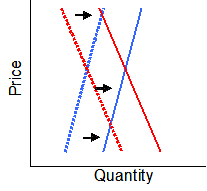
This process appears to have broken down in the last few years. Oil prices have risen, while the quantity supplied has not. In other words, the demand curve has moved to the right, while the supply curve has stayed broadly in the same place. Economic theory suggests this should lead to greater investment in prospecting and development. Yet persistently high oil prices – by historical standards – have not led to any increase in capacity.
There are a number of reasons why this might be: suppliers might be waiting for evidence that the demand curve has moved sustainably to the right (those who invested in oil shale projects in the 1970s did poorly), or projects might simply take long-periods before new oil comes to market (the Sakhalin II project was signed in 1996 for instance). Alternatively, we may be at or approaching a peak in global oil production. This may be Hubbert’s Peak.
Are We There Yet?
Oil watchers tend to discount the evidence of the market, often accusing it of being “blind”. But they would do well to keep an eye on one of the more interesting indicators, the oil forward curve. This measures what people will pay for a barrel of oil to be delivered at various points in the future. These forwards are the only way to bet on long-term movements in the price oil. The two charts below show forward pricing for oil (NYMEX) futures, and are taken from Bloomberg:
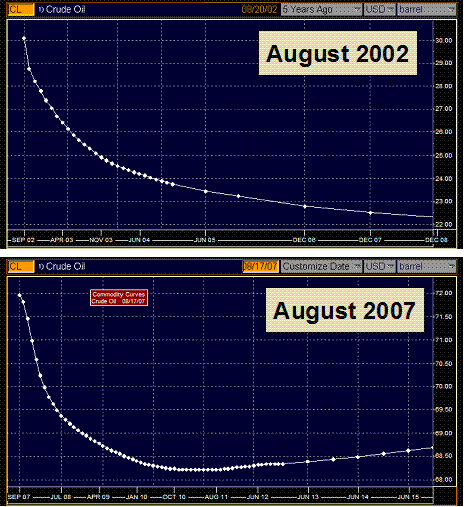
In August 2002, the markets forecast oil prices would fall, and keep on falling. You could buy oil for August 2007 delivery for under $23 a barrel. That would have been quite a trade. The current chart is more interesting; it sees oil prices trough at the end of 2010 and then begin to rise. For the first time in all my experience in looking at oil forward curves, there is a long-term upward bias. As recently as February of this year, the long-term curve pointed downward.
These charts do not, of course, show that peak oil has been reached. (The market was woefully wrong in August 2002, so its predicative power should not be over-stated.) What they do show is that the market does not expect new sources of oil – be they from oil sands, or from ultra-deepwater – to move the supply curve sufficiently to the right to mitigate rising demand from China and India. In other words, the market is forecasting a period when oil becomes less abundant.
What Does it Mean?
Let us be bold: let us assume that the market is not only right that oil will become less abundant, but that overall supplies will start falling. (This is not an unreasonable assumption: after all, production in Mexico, in the US and in North Sea is declining.) What does this mean?
Well, firstly, it does not mean oil stops being pumped! On the contrary, it merely means that the supply curve stops moving to the right. For any given price there will be less oil supplied. In the short-term, demand curves will not change: the pressures from economic growth in India, China and the like will not have abated. In other words, prices will rise.
But they will not spike due to some sudden “realization”, because the price dynamics have not fundamentally changed. Realization means nothing to the spot price of oil. That price will continue be the level which causes (slightly diminished) supply and demand to meet. (The argument that speculators would or could use large underground “reservoirs” to store oil is spurious: the cost of doing so, once one includes the capital charge for owning the oil, would be enormously prohibitive. If you wanted to bet on rising longer-term oil prices, you’d simply buy the 2012 futures.)
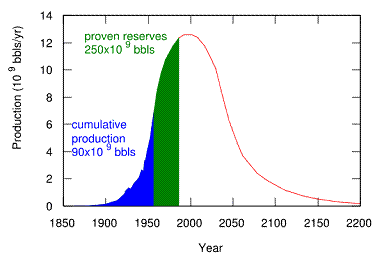
The other thing worth noting is that the decline in total oil volumes produced suggested by Peak Oil is relatively modest, at least initially. The chart reproduced below is from Hubbert’s 1956 Paper “Nuclear Energy and the Fossil Fuels”, and suggests that production will only have fallen 20-25% by 2030 (although it does fall off more steeply after that).
As we described in the reaction of the world to the 1970s oil shocks, increased awareness of higher long-term oil prices, will cause the demand curve will change. Before going into the details, let us not forget that between 1973 and 1985 (just 12 years), world per capita oil consumption fell from 5.45 to 4.40 – a 19% reduction, a period during which world GDP still increased at a 2%+ rate.
The Price Elasticity of Oil
There is still a great deal of skepticism about whether demand for oil is price elastic. Much is written about “Minimum Operating Levels” of oil, below which a modern economy simply cannot function; and while there may be a minimum level of oil required – although I suspect there is actually more of a minimum level of energy – it is well below current levels, particularly for developed economies like the US. This can be demonstrated by looking at the “oil intensity” of various developed nations.
According to the CIA World Factbook, the United States currently uses 68.8 barrels of oil a day per 1,000 people. This compares to 43.8 in Japan, 32.2 in Germany, and 30.1 in the UK. While some of this might be explained by the greater distances people have to traverse in the US, it can hardly be the only reason - after all, there are large distances to cover across Europe. The point of this data is that the US and Canada are anomalies: their economies use more oil per person, and more per unit of GDP than comparable countries. There is ample opportunity to become more energy efficient without causing significant economic damage.
The other interesting piece of the puzzle is the driver of oil usage. Looking at countries with similar GDPs and population densities, but different oil per capita oil consumption, it is clear that gasoline pump prices are the largest determinant of oil usage. In other words, where the price of oil (gasoline) is high, consumers use less. And this difference in consumption (which can be in the order of 40-50%) has little to no effect on GDP. The following tables (based on 2004 data) illustrate this:
Developed Countries
Price per Litre Oil Consumption per Person
UK 156 30.1
Germany 146 32.2
Spain 121 38.9
Ireland 129 44.4
Greece 114 40.7
US 49 68.8
Developing Countries
Morocco 110 5.0
Tunisia 68 8.7
Russia 55 17.7
Saudi Arabia 24 66.8
Kuwait 21 133.7
(There are some countries – although surprisingly few - which clearly do not fall into this pattern: The Netherlands has some of the highest petrol prices in the world, but also has high per-capita oil “consumption”. This is due to the Port of Rotterdam, and its associated petrochemical industries.)
For those who think these numbers are somehow cherry-picked, or contrived, the chart below tells the tale in a different way. On the x-axis is the GDP at purchasing-power parity created by each barrel of oil, and on the y-axis is retail price of gasoline (US$, March 2005). Countries where gasoline is more expensive, use it more efficiently. Or, to put it another way, consumption reduces surprisingly efficiently in response to higher prices.
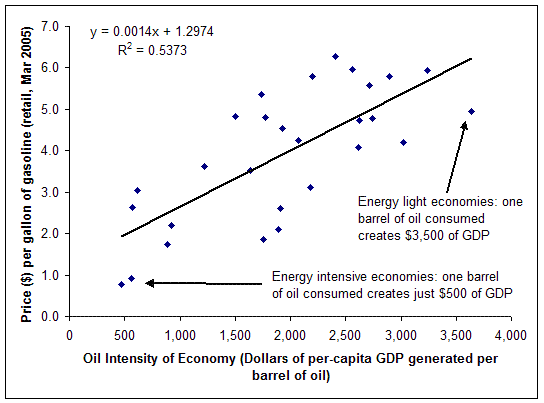
The evidence is clear: people respond to higher prices of petroleum products with reduced consumption, and this reduction does not necessarily result in economic catastrophe. Consumers are rational; their consumption of oil depends on its price. And oil products are surprisingly price elastic – at least over long-periods. Reducing world oil consumption by 25% in the next 25 years, with the price mechanism as the driver, can and will happen. It may not be pleasant, and it may well result in lower economic growth and higher unemployment, but it will not be a disaster.
The Energy Supply Curve
Do we really demand oil? Or do we really demand usable energy? Oil is not the only source of energy in the world. There are alternatives. Forty years ago, oil was commonly used to generate electricity. Today, outside oil exporting countries and the occasional peaking power plant, it is virtually unknown. It is just not economically efficient to generate electricity from oil. Electricity generators are rational consumers: when the price of one input got too high, they switched to another. Of course, this happened over a long-time, but the impact was relatively modest.
When we think of oil as something unique and irreplaceable, we make a great mistake. Oil is just a store of calories, in the form of long chain hydrocarbons. When it is burnt, it releases those calories as heat, which can be harnessed to turn a turbine for electricity, move a car, or fly a plane. But it is by no means the only store of calories. Even just taking other hydrocarbons (so-called fossil fuels), there are supplies of coal, tar, oil sands, methane, gas hydrates, and other gases. The total calorific value of these supplies outweighs that held in traditional crude oil. In addition, there are alternative energy technologies: wind, biomass, geothermal, nuclear, solar. Mankind can extract calories from each of these, and in the case of the latter two, there is the possibility of almost limitless supplies of energy.
We think of the oil market as monolithic, as standing on its own. It's not. Oil is just an incredibly convenient source of calorific energy. It has an infrastructure already in place, and a reasonably efficient mechanism (the internal combustion engine) for translating its energy into motion. If the oil price exceeds the price of alternatives (and it already has in baseload electricity generation), then alternatives will substitute it. The long-term price of oil is determined by the price of alternative energy supplies.
That said, this convenience should not be underestimated. In terms of energy density, there is nothing – except nuclear power - to match oil products. Gasoline has 47m joules of energy per kilogram, and 35m per litre. Even the best batteries are an order of magnitude worse. (Interestingly, liquid hydrogen has fairly good characteristics from an energy density perspective, and can be generated – albeit not particularly efficiently – from electricity. This is why there is so much focus on hydrogen power – whether fuel cells or a straight hydrogen burning engine. There is, of course, no infrastructure in place for the distribution of hydrogen.)
Living in an Oil Constrained World
According to forecasts from the Energy Information Administration, world consumption of oil will rise from a little over 150 quadrillion BTUs in 2003 to almost 250 quadrillion in 2030. While anything is possible, this would require extraordinary discoveries; indeed even assuming continued improvements in recovery rates, the world would need to discover the equivalent of all the oil extracted ever in the next 20 years. Good luck.
That won’t happen. We’re going to live in a more oil constrained world. But we’re also going to discover that this isn’t the end of the world. These articles have focused on demand destruction caused by higher prices; perhaps it is more helpful to think in terms of more efficient use of energy. People will drive less. When they do drive, they will use more fuel efficient cars. 100 miles per gallon is not unachievable. More energy will be consumed from the grid (where nuclear will make up an ever greater share of generation). When we go off-grid, we’ll use batteries more, and fuel oil less.
Public transport – particularly buses and trains - will look better value, while airlines will look for more fuel efficient ways of flying. (Ultra-high bypass engines – aka Propfans – which have 20-30% fuel savings over traditional jet engines may enter widespread use as fuel efficiency becomes more important than speed.) Even so, the price of air travel, which has been on a downward curve for the last quarter century, looks set to rise. People will respond by traveling less.
Consumers will react in predictable ways. If getting to out of town shopping malls is difficult, they will instead head into towns for their consumer goods. Likewise, businesses in cities will have an advantage (it is easy to commute into cities by public transport). Indeed, the demise of the high street is mostly the consequence of cheap personal transportation; i.e. the car. So Cities will look more like they did 70 years ago, with central areas preferred over suburbs.
We will become more reliant on telecommunications networks, and the economy will become more service focused. It is fortuitous that video conferencing and the Internet are maturing and improving at the same time our oil supplies are beginning to dwindle. We will need to spend on grid infrastructure: on HVDC lines to reduce transmission losses. There will be investment in nuclear power stations, with commercial fast breeder reactors, and a move from Uranium and towards Thorium. Biofuels, from sugarcane, will become more prevalent. There may be commercial algae farms in the next decade.
Oil will not stop flowing just because peak oil has been reached. We are fortunate that the downward curve of production will probably be as gentle as the upward one. Even in a hundred years time there will probably be commercial production; it will just be an irrelevancy as a percentage of global energy usage. We are given an awful lot of time to adapt to an oil constrained world.
More important that what will happen when we pass peak oil is what will not happen: there will be no queues at the gas station (why should they: we have rationing by price), the electrical and water networks will not cease to function (they were there before we got our present oil dependence), and some people will continue to buy gas guzzling SUVs and Ferarris (there will just be very few of them, and they’ll pay extraordinary sums for the privilege). The government will not collapse. Democracy will not come to an end. Economic growth will not end. Our lives will not look so very different to how they do: or at least they’ll look no odder than our lives would to those who grew up two generations ago – in an age before the automobile was ubiquitous.
Economics does not provide an answer to declining oil supplies. Its models try and explain – however imperfectly – how people will react to a scarce commodity becoming scarcer. The price mechanism is a powerful thing: it forces people to prioritize and choose, and it performs a rationing system. This is not to say a transition away from oil as a primary energy source will be painless. But we must avoid the trap of thinking there are no alternatives, and we must avoid the conceit of thinking these alternatives are costless or easy.
Contact
- Content: editors at theoildrum dot com
- Tech support: support at theoildrum dot com
License

This work is licensed under a Creative Commons Attribution-Share Alike 3.0 United States License.
Nice commentary.
The real danger comes from those who would try to ration by some means other than the price mechanism ... the "entitlement society" has caused a whole generation of people to think that they are entitled to things they can't pay for.
I like much of this. We can adapt to nearly everything. It is not price but price spikes, economic heart attacks, that will get us into trouble.
We can even contain most of those if we act in advance.
Acting in advance will also mitigate increased political risks during periods of flux. What will Mexico be like when they lose their oil revenues?
bill.james@jpods.com
It costs less to move less
We can only adapt to things to which our physical existence gives possibilities to. No amount of economic modeling can know this. Only physics can and even that very roughly/approximately.
As for Mexico, oil exports are c. 20% of their export revenue. As such, the fall in exports is probably not critical on its own, but there are another factors:
RISK = Lost oil exports + Increased oil imports * increasing oil price + supply risk (i.e. delivery disruptions in imports)
This combination may be harder to stomach for Mexico at least temporally as it is not just a mere price hike.
Time will tell though. I hope that Mexico will weather this well, but I'm not counting on it.
This is, I think, the exact problem with the analysis above. It is based on a model which does, to a great degree, reflect the economic processes involved.
HOWEVER - after having said this...
Your first assumption is that the oil market is a "free" market. This changed at the latest in the 1970s after production in the US peaked. National oil companies now account for 80% of production!!!
Are they going to react free-market rationally to make sure that production drops are gradual? OPEC did the exact oposite at the end of the 1970s, if I may just offer one small case in point.
I missed the part of the essay which acounts for W*A*R, natural catastrophy and other "minor" disruptions which can and will change the world over night.
And who is going to garantee me that I'll get my petrol when I need it??
I have no problem with steadily rising prices when I can the act accordingly - and *rationally* by conservation etc.. What will more than likely happen is that I wake up in the morning and find out that the local gas station won't be able to fill my tank on that day - just because some tanker riffed somewhere between here and Nigeria, ie a very tight supply chain snaps. What to do? Jump into the non-existent public transport? Buy a house in town that I can't afford and won't be finanzed for anyway?
Post Peak will hurt, despite all signs at the moment of a relatively funtioning transition.
Next objection:
Living in Germany, I would agree from experience on the fact that higher prices influence consumption. This ASSUMES however, that these prices happen gradually. Petrol was extremely expensive here 16 years ago when I came - and since then it has gotten much more expensive. No problem, we all had time to adjust. What would we do if there were a sudden price spike - say doubling or trippling? Of course - change my lifestyle!! It's just too bad that this doesn't happen over night. Or how fast can you move out of the suburbs when everyone else wants to move out too? House, kids, mortgage to the hilt, job too far away, public transport (which I already use, by the way) which is already a pain in the gazoo.
Cheers from Munich,
Dom
----------------------
Just remember the Golden Years, all you at the top!
http://science.reddit.com/info/2p2rc/comments
if you are so inclined...
If price rationing would work without any big problems, then what`s the problem with Peak Oil. It would merely mean ever higher price of gasoline, and a lower economic growth rate.
And then the price should force the society to adapt to other solutions with a lower energy use.
I hope he is right there. And perhaps he is. Well i hope he is.
EDIT: If we would solve this with price rationing, then USA with very small gasoline taxes, should have big problems compared with the Europeans who could easily lower already high taxes to mitigate the impact on its citicens.
So now i understand, why USA has chosen the military option.
I agree that price rationing alone may not solve the issue and to think like that would be utterly foolish (reality doesn't follow an economic model, esp. such a broken one).
As for US/gasoline tax/war option, how about UK? They have high gasoline tax as the rest of the EU, but they are still with US in the oil wars.... err... I mean the great generational just war against terrorism (sic)
Well, i don´t know why UK is in the war. But i know that Sweden has a military force in northern Afghanistan supposedly for idealistic reasons helping the people of Afghanistan, when they and some other countrys in reality are lured by the US to be a part of the oil war.
EDIT: I hope Sweden as payment will get a share of the oil US is going to steal from the region.
I've pointed it out many times before, but price, availability , and in particular supply models post-peak are in a different world to those pre-peak. Attempting to take pre-peak 'elasticity' curves and trying to predict what will happen post-peak is a mugs game.
They are very much different worlds.
Sure, the world could make sane and sensible decisions as to how to reduce demand to match supply. World history is the history of a world not making sane and sensible decisions. Economics is a best a set of temporary, localised, rules of thumb that don't survive upheaval.
Spot on. No matter how sensible economic theory will work in a post-peak world and how other forms of energy will be brought to bear, the underlying presumption of this exercise is that this problem is occuring in its own perfect isolation!
This is a tragically false assumption, albeit not an unsurprising one. Any reasonable assessment of the facts now coming to light about our climate change problem and its unforeseen effect upon the Arctic region -- whether it be the preciptious decline in polar sea ice, Greenland glacial melting, or tundra thawing -- refutes this pure economic stance.
Economists can and do wager what the economic cost of this change will be, but as yet we've done little to alter any of it, be it peak oil, climate change, or most any other ecologic degradation from growing worse with our economic practices that do not accurately reflect the real costs involved.
IMHO, abstract economic theory one thing (of which our GNP, the DJI, and the prices of anything reflects), and messy earthly and human reality is another. Neither are in accord with one another but one will definitely soon strangle the life out of the other.
In either case we are losing badly.
"Supply and Demand in the Irish Potato Famine"
During the Irish Potato famine, at least a million starved to death and at least as many emigrated --as we all know -- while the English landlords continued to export food from Ireland to Britain and the Continent.
I would like to see the supply demand curve for this.
It would seem (from the viewpoint of the economist) that demand for food fell during the famine. Since peasants had no money, they could exert no demand (demonstrations, rioting, theft etc. are, of course, not considered modes of expressing demand).
It is an interesting point of view: I can starve to death, needing and desiring food, but without "demanding" it. I can only "demand" it if I present whatever amount of money is required to buy it.
In the Energy Descent to come, presumably things will be similar. Demand (as defined above) will fall, but it won't be because desire or need has lessened in any way.
Excellent point. I agree completely.
The green, blue, white with red outline bell curve appears to be skewed to the right. Why?
Are septuagenarian differentiations of the normal density correct or not?
Legal cheers
Put me in both the disagree and agree columns.
In the disagree column, the problem with supply is threefold: exports; exports and exports. From the point of view importing countries, the aggregate world oil supply is largely irrelevant. Importers are primarily focused on two things: domestic production and net world export capacity.
Our mathematical model (Export Land Model, or ELM), real life case histories and our quantitative forecasts suggest that net export declines accelerate with time, e.g., the UK went from peak net exports in 1999 to net importer status in 2006, from an initial exponential decline rate of 38% per year to a final exponential decline rate of 178% per year. I have compared a net export crash to an airplane doing a terrifying near vertical dive into the ground.
Having said that, regarding the "agree" column, Alan Drake has documented how the US and Switzerland arranged for the transport of people and goods with minimal oil input--via electrification of transportation.
WT: Basically I agree with your ELM, but IMO the UK experience obviously cannot be extrapolated to exporters like KSA. KSA's reliance upon the export of crude oil is too great for a similar decline to occur. The UK, economically speaking,was never reliant upon the exportation of oil, unlike KSA.
The UK and Indonesia case histories are interesting. It would be hard to find two more different net exporters.
UK: high per capita income; high energy taxes; minimal rate of increase in consumption. Result: Peak exports to net importer status in seven years.
Indonesia: low per capita income; subsidized energy prices; rapid increase in consumption (4.4% per year from 1996 to 2005). Result: (1996) Peak exports to net importer status in eight years.
ELM: Peak exports to net importer status in nine years.
WT: You could be right, but for KSA to go this route would be economic suicide. I still think any countries that are, economically speaking, based around nothing but the export of oil or oil products should be slotted in a separate category. KSA is obviously the first one that comes to mind-possibly you could refine your model to attempt to account for this (just a suggestion).
The 2005 to 2006 numbers for KSA are as follows (exponential increase/decrease):
Production: -3.7%/year
Consumption: +5.7%/year
Net Exports: -5.5%/year
Extrapolating from year to date numbers, my guesstimate for 2007 is as follows (I am adding in some increased liquids consumption, because of their natural gas shortfall):
Production: -5.6%
Consumption: +10%
Net Exports: -9.5%
"WT: You could be right, but for KSA to go this route would be economic suicide."
Nope. As long as prices rise faster than exports fall, they will keep making money. And because of the low elasticity of oil, that is almost certain. Oil prices have doubled, but they are only down about 8-10% on supply. That does not look like suicide to me.
Plus the US chemical and fertilizer industry is closing and heading to the Middle East, so they will be able to diversify (didn't they just purchase Dow Chemical?).
Jon Freise
Analyze Not Fantasize -D. Meadows
G: I was referring to WT's example of two exporters actually going to net importer status. Hard to see how KSA would have a functioning economy as a net importer of oil and refined products.
I thought it was interesting that Indonesia's consumption kept increasing until they were a net importer.
What is your estimate for Mexico?
bill.james@jpods.com
It costs less to move less
Mexico is an odd case. Their consumption was increasing, up until 2006, when it actually dropped, probably because of the sharp drop in transfer payments home from workers in the US--presumably because of the decline in housing construction.
Their 2004 to 2005 net export decline rate was -9.7%. If their consumption from 2005 to 2006 had increased at the same rate as 2004 to 2005, their net export decline rate from 2005 to 2006 would have been -12.0%. However, because of the decline in consumption, their net export decline rate was only -1.7% from 2005 to 2006.
In any case, they were the only top 10 net exporter to show a decline in consumption from 2005 to 2006.
The question on the production side is how long they can partially offset the Cantarell decline/crash. I'm surprised that production is not falling faster.
Do you have numbers on what part of the governments ability to act depends on oil?
Political instability seems likely as revenues drop.
Except for the positive feedback loop--cash flow increases (for a while), even as exports decline, because of rising oil prices.
Pemex accounts for a huge percentage of government revenue. I don't have the exact number though.
I did not find specific numbers but it looks like political instability will be a significant risk post peak.
Thanks for your insights.
http://www.brookings.edu/views/op-ed/20070905martinezdiaz.htm
Finally—and this Mr. Calderon recognized less explicitly—the Mexican economy remains perilously dependent on the country's northern neighbor. Ninety percent of Mexico's exports and 70 percent of its imports go to and come from the United States, while some 65 percent of Mexico's foreign direct investment comes from US investors. Nearly a third of Mexico's commercial bank assets are owned by US financial institutions. And crucially, over $20 billion in remittances from Mexicans working the United States flow into the economy every year, providing the country with a major source of foreign exchange and improving the lives of thousands in some of the country's most depressed areas.
According to Wiki the Mexican fed takes 60% of Pemex's Gross, or about $US 46 billion / yr. this in turn is claimed to be 1/3 of the Mex. Fed. Budget
http://en.wikipedia.org/wiki/Pemex
"Taxes on the state oil monopoly Petroleos Mexicanos SA, which faces declining output, now account for about 40 of collections"
The KSA has very large investments in refining in the US economy. When Texaco lost the lawsuit to Pennzoil over the Getty takeover, they sold 1/2 of their refining in the US to the Kingdom of Saudi Arabia. If you'll recal at that time they were worried about maitaining market share. That's the real reason they flooded the world with crude in the middle 1980's, not some nonsense about ccoperating with Reagan to destroy the Soviet Union.
They've also bought other US assets for years, including treasury notes. The Saudi's have no desire to knock down the house of cards, but members of the extended family certainly do. And I'm sure the US refining industry isn't their only foreign invetsmenst, they apparently have large investments in the European Union too Bob Ebersole
Westexes, I thought you and Khebab where working on a story that gave a more detailed ELM prediction for the decade ahead. I havn't seen anything yet, is it still in development?
Regards, Nick.
We will do a preview in late September, with the final report delivered at ASPO-USA. It will not be a pretty picture.
As an finance type, I enjoy reading a post that doesn't completely discount the impact the invisible hand will have on peak oil. However the post ignores ELM as westexas points out. You also ignore the ecomomic and political fallout that demand destruction will have in less developed nations. Sure I can walk to the store and save the fuel but what of the african village that can't irrigate their crops for lack of any useable energy source?
Is there any precendent for ELM or for demand destruction in marginal economies that we could look at to see how it will impact the global economy. Is an orderdly energy descent possible globally or just in the developed nations?
Only with nations that have lots and lots and lots of social capital
Robert,
Thank-you for this fair and very well researched post. I have a couple of points:
- Oil futures curves imply an expected discount rate in addition to the commodity price. The August 2002 oil futures curve did not necessarily mean that investors expected " oil prices would fall, and keep on falling". It only meant that they did not expect prices to rise as fast as other investments available at that time, like flipping real estate. They were right, and that's why they make the big bucks. Maybe they no longer see easier money ahead?
- The best batteries are almost two orders of magnitude less energy-dense than oil, and when the weight of the containment system, be it cryo-tank, pressure tank, hydride medium, or whatever, is taken into account, hydrogen is about 1/5 as energy dense as oil. Fine for land transport, but a Boeing 787 at take-off is 40% kerosene by weight, so for aviation there is *no* substitute. The last of the oil and coal will used almost exclusively for aerospace, and after that it will be synthetic kerosene.
Half: No. Anyone, in 2002 that was confident of an oil price of $80 in 2007 would jumped all over it. They do not make the big bucks because they are usually right, contrary to popular opinion, and they did not miss this one because they were distracted by property flipping.
Some property values have doubled in that time, and did so smoothly. Oil has been volatile (and is currently off almost a dollar from yesterdays record) so harder to read. No-one could have been completely confident in $80 and thats the point. Plug that volatility into Black-Scholes and I'm not sure even in hindsight that a smart investor would have taken the bet.
Some reference on energy density
http://en.wikipedia.org/wiki/Energy_density
For planes, we still would have biofuels or fuel produced using other power sources like nuclear power.
Plus for planes and all vehicles we can reduce the weight and redesign them.
An all solar plane flew for 54 hours recently (very low energy density). It would be a passenger plane replacement but it shows that intermediate versions could be made.
Also, further in the future there is beamed power.
http://advancednano.blogspot.com/2007/05/lasers-and-magnetic-launch-for-...
Basic trials have been performed that shows that the systems can work. The systems can use laser arrays (allows for the many smaller 100kw lasers that can be built to take the place of the GW lasers that we cannot) and mirrors to reflect the lasers (boosting effiency by 1000 to 100,000 times)
=========
http://advancednano.blogspot.com
if the beams were properly formed in the first place, no mirrors are needed, mirrors always cause losses. The beam will lose coherence due to atmospheric dust and some refraction, but mirrors are usually a loss once the beam is on the way to the target.
the solar plane was unmanned irrc. adding passengers would make for some tough trips because these planes are really only good at moving near the equator, or at a fixed latitude. moving from a given latitude means the solar panels need to be reoriented(and this thing is suppose to fly) which affects the aerodynamics in a profoundly negative way (in addition to adding a host of complexity.
There are two kinds of laser propulsion.
without mirrors you just are providing energy for a block of propellant.
The other is pure photonic propulsion.
http://advancednano.blogspot.com/2007/02/photonic-laser-propulsion.html
Photonic Laser Propulsion has had a proof of concept demo it generated 35 micronewtons of thrust using mirrors that generated 3000 times amplification. You need the mirrors and amplification because photons only impart so much force at each reflection.
The 10 watt laser was based on 100 watts for the total satellite power budget. Thus the best mirrors (20,000 times amplification) would deliver 1.3 milliNewtons.
If they can use the MIT dielectric mirrors those are supposed to reflect 99.999% of the light which would have 100,000 times amplification.
Scaling it up for more power.
130 millinewtons per kilowatt (0.13 N/kw)
But 10 MW lasers would give 1300 newtons. Solid state lasers with 100KW should be completed this year and ones with 67 KW were already made. The laser propulsion can use an array of lasers. one hundred 100KW lasers is 10MW.
This is something that we can get ready post 2030+ when simply belt tightening to get more efficiency might be problematic.
The post was in response to no substitute for jet fuel or problems for chemical rockets.
Not fantasy: since the lasers work and the small power version of mirror lasers works. Scaling it up is engineering.
========
http://advancednano.blogspot.com
Yeah, sure. First of all, the potential of biofuel is really pitiful. Biofuels will never fuel even more than 10 to 20 percent of the global carfleet (and even that at a terrifying environmental and humanitarian cost). Secondly, there is really no replacement for kerosene. A kerosene replacement would require wider operating temperature range than available from biofuels.
I also used to be a great fan of science fiction. But lately I've turned towards pure fantasy, as it's easier to separate from reality.
- Jay
"If we lose the forests, we lose everything"
- Bill Mollison
Biomass gasification:
"Gasification can proceed from just about any organic material, including biomass and plastic waste. The resulting...syngas may be converted efficiently to...diesel-like synthetic fuel via the Fischer-Tropsch process."
It is unfortunate that oil was discovered before airplanes, as this makes it seem old-fashioned. Science-fiction schemes don't change the laws of chemistry. Kerosene, or its synthetic equivalent, is the only fuel with the required properties for aviation fuel:
- highest gravimetric energy density
- highest volumetric energy density
- non-toxic, non-carcinogenic
- non-corrosive to airframe materials (aluminum, epoxy)
- high flash point
- high liquid range
Other synthetic fuels have been tried; hydrazine, UDMH, liquid hydrogen, diborane etc.. None are safe *and* powerful enough. A modern airliner can be fueled at the gate while loading passengers, go from a +40C airport to -40C tropopause in minutes, and fly across the pacific non-stop, only because of kerosene.
Somewhere in a galaxy far, far away, alien creatures are flying around in kerosene fueled airplanes, because it is the only fuel that works.
Superb pragmatist engineering rant. I'm going to memorize the whole thing for use when extremely drunk in the company of arts-graduate scum.
Crank open that bottle oh plucky one I think you will need it, because you are in the presence of an art scum who kept the overdue library books rather than pick up the diploma. Now that is a real low life and much worse than a clean cut (relatively) arts-graduate. Anyhew the following for your august perusal:
Total Population of the World by Decade, 1950–2050
(historical and projected)
Year Total world population
(mid-year figures) Ten-year growth
rate (%)
1950 2,556,000,053 18.9%
1960 3,039,451,023 22.0
1970 3,706,618,163 20.2
1980 4,453,831,714 18.5
1990 5,278,639,789 15.2
2000 6,082,966,429 12.6
20101 6,848,932,929 10.7
20201 7,584,821,144 8.7
20301 8,246,619,341 7.3
20401 8,850,045,889 5.6
2050
http://www.infoplease.com/ipa/A0762181.htmlhttp://www.infoplease.com/ipa...
I am sure you will be able to figure out what this means being much above both pragmatic engineers and arts-graduate scum. But if you can't try that pragmatic engineer, I am sure he will walk you through it.
BTW I rather like dumb animals:)
In the previous crunch, we could (and did) turn to natural gas to replace the energy inputs to the economy. While oil consumption fell somewhat, total energy consumption fell much less.
We won't have that luxury this time around, particularly in North America.
Oh well! ... What those figures seem to show to me is that in 12 years between 1973 and 1985 the per capita worlds use of oil fell 19 % while in 10 years between 1970 and 1980 the world population rose by 18.5%. And if one crudely adds an extra two years of the next period of 10 years at that rate of 15.2% or 1.52% per year we get 18.5 + 3.04 = 21.9% increase in population. To hit this point on the head with a hammer, the world per capita use of oil fell because the world supply of people rose.
The arguments made by Robert for the present 'economic' structure is merely an argument for supporting capitalism and not what should be considered; preserving the world's economy. We stand by the world's grace not by how extraordinarily powerful, adept or guileful that machine, capitalism, is at sucking the blood out of this planet.
half full,
Kerosene was first discovered in the early 19th century when chemists were doing experimentation in England on coal gas for lighting. There's an awful lot of coal at mineable depths, certainly more than enough to ensre that the jets of the future will need pontoons to overcome the sea level rise from global warming (sarconal alert).
Source: Wikipedia article on coal gas
Also, we will never run completely out of oil. It may not be worthwhile except for specialty uses for which there are no other substitutes, but evn the most depleted oil fields will ooze a lttle forever and make perhaps 1/2 a barrel every couple of days with a timer and on a pump. The first major oilfield in the US, the Bradford field on the Pennsylvania/ New York state line sill has a few wells producing even though it was discovered just after the Civil War, and so does Corsicana the first major field in Texas and producing since 1890. Bob Ebersole
I vaguely recall that in the mid 1990s, workers at Edwards Air Force Base found several old corroded cylinders of pentaborane. (Or was it that they found that known cylinders had corroded?) I think they ended up blowing them up to avoid the danger of handling them.
You make an excellent point about the many advantages of keosene; I'd like to add that it's telling that even the US millitary uses kerosene for aviation (I'd expect them to be quite willing to make sacrifices in convenience to improve flight performance).
Pentaborane is, I guess, about as bad as day-old nuclear waste. It is much, much worse than year-old.
They blew those cylinders up remotely because a hot explosion would ignite the pentaborane, which had, of course, been expected to be useful, decades earlier, because of its very high heat of combustion. With air that includes some water vapour, it becomes boric acid ...
B5H9 + 6 O2 + 3 H2O ---> 5 B(OH)3
which you can buy at the drugstore. A few years before they blew up those tanks they learned the hard way that exposure to pentaborane, in the absence of a reliable ignition source, is death. One worker who got it all over his hands died. A second who came to his aid lost the use of his limbs, and IIRC, most of his mental faculties.
If the book-of-the-month club wants to sell you a really thick book that does not count as two of your three selections, but includes bound-in plastic sachets of any BxHy compound -- any "borane", as they are called -- don't forget to send in the refusal card.
--- G. R. L. Cowan, boron car fan
http://www.eagle.ca/~gcowan/boron_blast.html :
oxygen expands around boron fire, car goes
Less than a fifth for the cryotanks that have been demonstrated for cars. But the conclusion is false. If liquid hydrogen did not cost more per unit energy than kerosene, or not too much more, airliner makers would be all over it, because the much larger tanks in airliners allow container mass to be small compared to contents mass and airliners are not required to pass collision tests the way hydrogen BMWs, I seem to recall, have.
A slightly higher cost per joule would still end up cheaper for lH2 because a 100-tonne maximum takeoff mass aircraft with 60 tonnes non-fuel, 40 tonnes kerosene would, if the tanks were simply enlarged and thermally insulated to accommodate the equivalent 16 tonnes lH2, weigh at most 80 tonnes; the non-fuel mass fraction would thus be raised to 80 percent, and less of the fuel's energy would be spent on its own haulage.
This PDF looks like a competent treatment.
--- G. R. L. Cowan, boron car fan
http://www.eagle.ca/~gcowan/boron_blast.html :
How shall the car gain nuclear cachet?
My secret contacts at the NCSA borrowed me a few supercomputer hours and inform me that 60 non-fuel tonnes out of 80 total is actually 75 percent, not 80. Sorry.
--- G. R. L. Cowan, former hydrogen-energy fan
http://www.eagle.ca/~gcowan/Paper_for_11th_CHC.html :
oxygen expands around boron fire, car goes
Good points...I was trying to contact oil drum staff but the "contact" us link is not working. does anyone know how to contact them?
aherrera@anwr.org
Interesting post and I'm sorry I don't have the background to address the holistic point you are making but I have some comments about the micro.
The Futures market isn't a real market, is it? Because the future price can never rise above the arbitrage price cap, it is incapable of telling us much. The rare times the future price is below the arbitrage price cap, not THAT tells us something. The fact that it is rare, also tells us something.
I think the only way the downward side of the supply curve will be gentle, given currently accelerating demand, is if major suppliers start withholding supply now, if they aren't already. The smart ones should be. The basic economics supply/demand curves doesn't take this into account; shuns it, in fact as a "rational" notion.
The Minimum Operating Level difference between the U.S. and other parts of the world is a fascinating issue and so complex to compare in one article. I've spent a lot of time in Europe and would comment that the Europeans don't move around as much as we do in the U.S. at every level. Yes, there are large distances to cover, but they don't think of them the way we do. Partly this is the price of gas limiting them, but also it is cultural. If I tell a European that I regularly drive ten hours one-way to visit my parents, they stare at me as though I've grown an extraneous limb, and for me that's only a tank of gas in a Prius, and the diesel Peugots we regularly drive there get even better milage. Europeans like to live and die in the city they were born in so they don't have a familial draw to make them travel enmasse like we do. And more important their urban sprawl now overlaps so thoroughly as to make 100% public transit coverage viable in a way the U.S. will never be, even if we had the public policy wherewithall to actually try. (Case in point, why the heck isn't there high speed rail connecting all of the U.S. East Coast cities??) Another example: A Dutch friend of ours went on and on one visit about how he had found a temporary job in Amsterdam and would have to find, to his great distress, a second apartment there for the duration. Note that he lives in Rotterdam, a whole hour train ride away from Amsterdam. To him that was WAY too far to commute. So given that the U.S. mode of living will HAVE to change, we should be working harder to change it now, while the cost of changing the infrastructure are cheaper to change. Playing down the impact as you seem to be doing, isn't going to help.
I completely agree that rationing by price will save a lot of trouble all around, but I think it will save more if it happens pre-peak through supplies being withheld. I grind my teeth everytime a politician says they will lower the price of gas for voters. What ignorant and awful policy notion that is.
I have two elementary questions about the supply and demand curves...
First, why are they always shown as linear functions? I would think that for peak oil, the price would "explode" asymptotically at levels that represent a modest increase to current production. For example, I wouldn't be surprised if the price for doubling current production would be greater than the entire gross world product.
Second, why are changes to supply and demand shown as (simply) shifting the curves left or right, but not changing their slopes? I would think that the natural limits of oil availability would make the high quantity regions much steeper.
And why are they 2 dimensional?
Shouldn't we have N-dimensional differential equations with multiple solution nodes?
The supply and demand curves can be forward or backward bending, or any shape you like, like Paul Krugman's at the bottom of this article:
http://www.pkarchive.org/crises/opec.html
Generally straight lines keep it simple, and the aim of models is to simplify.
That is a feature of economists' communication, not of the data. Since they don't know the shape of the curve, they draw something simple. Yep, we engeneers have a bad time reading it, since for we a line is a line (if it wasn't linear, it would be curved)...
The slop changes, and the curves are finite, they have well defined start and stop points. Theoreticaly, there is a minimum cost of production, bellow what nothing is produced, and a maximum production capacity, when the society uses all its resources producing something. There is theoreticaly also a maximum amount of demand, since there is an up limit on the amount people can consume, and a maximum price anybody will pay for the product.
But those extremes poits never happen on practice, so economy isn't too concerned about them
Yet the very definition of economics is the study of scarcity, and in particular, the study of the efficient allocation of scarce resources.
Did they teach you that in college? Because everything you learn in college is crap. Economics is the study of making things sound complicated so you can steal and get away with it.
I am guessing you don't have a degree?
mkwin,
Nice ad hom attack. Totally unconvincing though.
If a person is reading TOD (as Petropest obviously is), we can assume that they have an education going beyond the formal grant of a sheeple's skin. After all, in college they don't (for the most part) teach us about Peak Oil and its perils.
I have a lot of college degrees.
I'm not willing to say that "everything" taught in school was "crap". After all, I did take courses in thermodynamics, in physics, in chemistry, etc.
But when it comes to "Egonomics", that was a loadfull of crap. I am only coming to understand that now in my geezer years. For much of my youth, I was as much an ardent believer in The Market and the Invisible Appendage as the next brain washed graduate of a cliff-side Higher Edge Occasion Institute.
Egonomics is addictively appealing because it has numbers and graphs and calls itself a "science" (of the dismal kind) and calls us "rational" consumers (of the utility maximizing kind). In hindsight, it's a piled higher dogdropping (PhD) of poop.
Good, thoughtful post.
I have one caveat, however: As prices rise, developing and poor countries will be under increasing pressure and may become increasingly unstable.
True, developed countries will back-pedal on their usage, seeking alternative sources and greater efficiencies. They will increasingly do so as the price rises. No end of the world for them....
However, because poor or developing countries are closer to the razor's edge, they will become more volatile, more chaotic, more prone to "terrorism." Terrorism will find its targets not only at home but abroad. Now, I use the term "terrorism" in the sense of "protest" and "counter-defense," not in the foolish way we often here it.
In defense, developed, rich countries will become more like enclaves...even while the pressure to accept more and more immigrants grows. As poor countries become more volitile, more and more people will seek the safer haven in the developed world. The developed world will, of course, have none of this.
The "good old times" may well be gone.
The question is: Can the transition to a less oil-centred economy or world be extended to the third world in such a way as to keep them from becoming exploding pressure cookers?
I do not see the leaders or the profiteers in the developed world responding enlightenly to these "pressure cookers." If Bush's War on Terror is the password, then we are indeed in for quite a ride. Indeed, the fact that these leaders and businessmen have no qualms about dirt cheap labor or cheap extraction of a poor country's resources tells me more than I want to know about their mindset.
Robert, where do you stand on the issue I have raised?
I would suggest to you that you and those at your level will have to speak loudly and boldly if we are to pass through this needle's eye safely. You will have to see "terrorism" and immigration pressures as natural responses to unforgivable conditions. Using only force to subdue them will only worsen them.
As an aside, I found the recent TOD post on Mexico's disintegration instructive.
However, because poor or developing countries are closer to the razor's edge, they will become more volatile, more chaotic, more prone to "terrorism." Terrorism will find its targets not only at home but abroad. Now, I use the term "terrorism" in the sense of "protest" and "counter-defense," not in the foolish way we often here it.
As an aside, I found the recent TOD post on Mexico's disintegration instructive.
The combination of these two actually is what bothers me. I'm worried there might be ripple effects. It's difficult to completely isolate bordering regions where a nation like the US meets a potentially unstable region such as Mexico. If one destabilizes, it could potentially generate significant issues in the neighboring nation. Does this make sense?
Forgive me if I'm out of line, I'm not a geologist or a petroleum engineer but I was trained as an aerospace engineer and I work as a systems engineer. I tend to see things on the big picture level and nothing in this area of concern is a "closed system".
Hi Bob,
Thanks for a great post. The forward pricing curve for oil was very interesting, and the optimistic tone provides balance.
Robert, you wrote:
But the evidence to prove the market is blind is there in the first graph. It tells us nothing about the actual price in the next 5 years does it?
If PO has happened there is nothing, nothing, that the oil forward curve will tell us until it suddenly spikes up on the "day of recognition" by a hundred dollars or more...
No, I shall not be using the 'oil forward curve' as a comfort blanket anytime soon thank you.
Regards, Nick.
Based on comments in the original article and several related posts, I think there are some misconceptions about the futures market and the futures forward curve for oil. In interest of full disclosure, I work for an investment management firm that participates in up to 5% of all the futures contracts traded globally on any given day not the mention the same fraction of global equity and currency trading. So, my viewpoint is unavoidably from the financial side of the table. And, if you are predisposed to distrust someone who earns a living in the financial markets, you have ample excuse to stop reading at this point. Nonetheless, I believe I have a realistic view of how the futures market operates.
First of all, contrary to popular opinion (and even Forbes and the WSJ make this mistake often), forward prices in the futures market do not represent price expectations. I know this point is going to be hard to accept, but the forward prices do not reflect the expected price movements of the underlying asset.
This realization is blantantly obvious if you take a look at the forward curve for the S&P 500 futures. The forward prices for the S&P 500 simply represent the current S&P 500 price plus the carrying cost of the position. Thus, the forward curve slopes up and then levels off. This is always the case for the S&P 500 futures. Everyday. All year round. The forward prices vary because of changes in the price of the underlying S&P 500 and future interest rate expectations. This behavior is typical for financial futures contracts. And since the underlying S&P 500 can be held both long and short, all of the price relationships along the forward curve are maintained within tight tolerances.
Futures contracts for physical commodities, on the other hand, are influenced by additional factors such as current inventories, seasonal supply and demand variations and by the hard constraint that it is impossible to be short the underlying commodity. That is, you cannot hold negative oil like you can hold negative stock (yes, you can hold negative stock). These differences allow the forward curves for physical commodities to behave somewhat differently than strictly financial assets. Since physical commodities cannot be hold short and are perishable (even oil in the pipeline must be comsumed in the short term), the carrying costs are often effectively negative. The relationships along the forward curve prices are not always maintained within the same tolerances and the curves often bend into funny shapes for pysical commodities.
You might wonder, what good are futures contracts if they do not reflect the future price expectations of the underlying asset. Well, that is a good question. Futures contracts allow one to lock in the cost/return of obtaining/supplying something in the future based on current conditions (i.e. mainly the underlying asset price and carrying costs). This explains why the futures market never predicts anything. The word "futures" is really is misnomer and causes untold confusion about how the market operates. The futures market is not designed to predict future prices, but simply to facilate future exchanges based on todays prices (notwithstanding the pure speculators who go into the market to make a quick buck) .
So, while I agree with the overall ideas in the article and do believe that you ignore the market at your own peril, I have to take exception with the concept that the uptick in the outer regions of the oil forward curve is pricing in an increase.
That said, if you want to get the market viewpoint on a price expectations, the options market will tell you everything you need to know. And, on average, the options market is reasonably accurate. Otherwise, the sellers of the options would go out of business.
I will try to post the predictions from the options market for oil prices later today. Due to time constraints, I am going to have to call it a night.
-mark
ps. As one futher example of the erroneousness (is that even a word?) of simpy interpreting forward prices as predictions: Traders buying the 2007 oil contract for $23 in 2002 did not think the price of oil was going to be $23 in 2007. I mean, if you go around buying assets that you expect to be worth $23 in 2007 for $23 in 2002, you are not going to last long.
TraderJoe,
I'm surprised you didn't mention Black-Scholes.
Isn't the future price determined by the current price, historical volatility of the asset, cost of holding and a pinch of salt?
As we approach 'the point of no return' volatility of the underlying asset price is going to go through the roof. The spreads on futures is going to get bigger and bigger. Someones going to make a lot of money, straddle that...
Nick.
Nick,
I did not mention Black-Scholes because it is used to price options, not futures.
Option contracts represent to the right, but not the obligation, to exchange assets at a fixed price at some point in the future. Futures contracts, on the other hand, represent the obligation to exchange assets at a specified time in the future.
You are correct that option prices are generally determined by the current price, volatility, carrying cost and, since 1987, "a pinch of salt". Before the 1987 market dislocation, option prices were based strictly on Black-Scholes which assumes a normal distribution of price changes. Immediately after the 1987 event, option pricing changed to take into account the non-normal distribution of price changes. But that is a little off the subject...
Futures prices are not governed by Black-Scholes and are not necessarily dependent on volatility since both parties are obligated to make the exchange. That is a significant difference between futures and options. Again, the word "futures" is really a red herring and provides for endless misdirection about what the forward curve means for a futures contract.
I agree that as we move forward oil prices are likely to become extremely volatile. And for those willing to take the necessary risks, that will provide opportunity for both innovation and profit.
Are you saying that calendar spreads (i.e. the price delta between oil contracts with different expirations) will increase? What is your reasoning here?
-mark
Maybe I'm reading this wrong, but it seems to discount the possibility that there is any speculative factor in the oil spot price. You seem to be saying the price is driven solely by the need to make supply and demand meet.
However, when a speculator buys oil, or oil futures, he/she is increasing demand. If, over a few months, many millions of people get clued in that oil production is going down down down forevermore, or if they get clued in the net exports are going to crash, they are going to buy some oil - not for storage and use, but for speculation. So, I can't agree with your anti-realization argument.
This whole post is calm calm calm, but, in real markets, panics happen. Oil prices will spike, and in general, get very volatile.
This post has opened up the controversy over rationing by price versus some other contrived system. On a global basis, we already have rationing by price in which those countries short of USD are reducing consumption so the newly emerging wealthy states such as China and India can have their increasing share. Any internal national rationing schemes - of which I am reluctantly in favor - will pale in comparison to an unregulated global market.
Because there is no world organizational body capable of rationing global consumption, it will be done by a combination of economics and belligerence. This is one argument for rationing; it's a lot less ugly than belligerence. The free market can 'fail' into things uglier than unfree markets. But we have chosen to paint everything with the free market brush, except the sacred cows of military contracting, corn production, public works and so on - not to mention the legion of tariffs and subsidies that still exist.
Free markets are great when supply and demand are similarly free. When they are not, a great question arises. Sharing a surplus is easy, a shortage not. Because oil is different from Rolex watches, those going without will also be subject to higher prices and possible shortages of such things as heat and foodstuffs while being too economically drained to invest in newer low energy consumption technologies. Americans are in the main inexperienced in the realities of actual shortages because there haven't been any. Until we get there, I wouldn't make too many assumptions.
History has examples of the demands of the rich being permanently destroyed at the hands of the poor. I like E F Shumacher's concept of a limit on wage differentials between the top and bottom being capped at about 5:1. This still allows for sufficient incentive to get to the top of the heap, but insures that if you want to make more, you have to take your underlings with you. CEOs get five times tha janitor's pay, but there is no limit on janitor's pay.
Social disharmony may be considered inevitable, but lots of things were considered inevitable a few hundred years ago that would be inconceivably so today.
Rationing was acceptable and successful during WW2, but if you think that the effects of looming shortages are going to be less messy, good luck. Personally, I''ll take the rationing and hold the mayo and the war. As for the invisible hand, lately it seems to be vacillating between scratching its head and picking its nose.
Are we due for the ghost of FDR in the form of the Ever Normal Refinery?
"As for the invisible hand, lately it seems to be vacillating between scratching its head and picking its nose."
In between slapping the poor upside the head.
Schumacher also argued that there was no economic theory for extractive industries. Conventional economics does not cover the use of finite resources rather than scarce resources. Therefore applying conventional economics to extractive industies produces the wrong policies.
While I know that the supply and demand curves shown are simplifications, it still made me think how less simplified supply and demand curves may look like, and I did the following considerations.
In the short term the supply is very rigid, even in a pre peak scenario. New oil field have a lead time of many years, even when there are known reserves, so new supplies will not come online immidiatly. This means that the supply curve is infinitly steep in the short term. After an oil peak, it will be infinitly steep even in the long term, since no more oil can be produced regardless of price.
Developing an oilfield require fairly high upfront investments, and the maintainance cost run even with no production, so a big portion of the fields will run on full capacity, even with fairly low prices. This is especially the case for deep sea offshore fields, like those in the North sea, and I would guess that it will also be the case for most of the fields owned by privatly owned companies. The only elasticity is provided by swing producers like Saudi Arabia. The curve will then look like below.
When the peak is passed, the supply ceiling will be lowered as the oil depletes (or in the diagram, move to the left)
Thanks for the report, one question though:
You compare world per capita oil consumption to world GDP. Shouldn't you be comparing it with world per capita GDP? Did this rise between 1973 and 1985?
It seems like it rose by about 40% between 1970 and 1985, or about 2.3% per year.
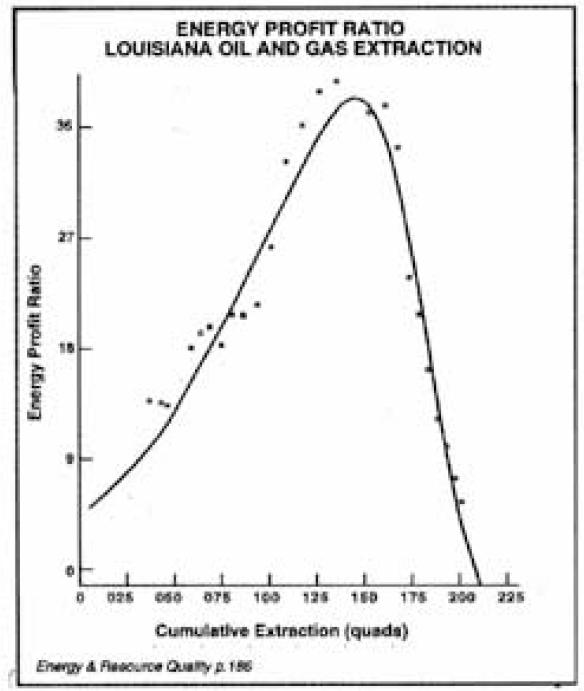
I am very pleased to see this point raised. So, When does the price of oil exceed the price of alternatives?
If we use EROI to estimate "production cost" then when does a lower EROI source replace a high EROI fossil fuel?
As you can see from this chart, a replacement with an EROI of 10 would not have a lower price until the fossil fuel source was almost entirely exhausted.
 EROI
EROI
This assumption is supported by looking at the real world. Almost no alternatives are market competitive today. From memory Solar PV is $0.25 per KWh, Solar Concentrators are $0.12, Wind is $0.08 and Coal is $0.06. The moment that government price supports vanish, so do the alternatives.
The market alone will attempt a transition. But will there be enough time to build a huge new energy infrastructure while burning the last few scraps of low quality fuel?
Jon Freise
Analyze Not Fantasize -D. Meadows
Jon, I've seen this graph before from you but didn't really get what it was implying. I don't see what you say "can be seen from this chart..." -is the Y axis the EROI?? Sorry, must be thick Thursday today.
Nick.
It is my understanding that the Y axis is EROI and the X axis is cumulative production. (I don't have a copy of his book as it is out of print.) I took this chart from one of Nate's posts yesterday (but he has used it before).
So if the dollar cost of an energy source is related to EROI (and it must be in some way) then you can roughly predict when a new source will be competitive.
For instance, we know that Natural Gas has now risen high enough in price that Wind is cheaper. However, we also know that NG production is becoming more and more reliant on non-conventional sources. Sources which need more drilling, have poor flow rates, and fast declines. (thus low EROI).
Looking at NG predictions (by sliding the discovery curve forward) Jean Laherrère shows that NG in the US is nearly played out. Which is what one would expect if a lower EROI source is now competitive.
It seems to me the whole "Will Peak Oil and Gas turn out well" comes down to rates of change. What is the rate of decline in net energy? What is the rate of increase in alternatives? Once alternatives can stand on their own price wise, how much time do we have left to change? Is that enough time?
Jon Freise
Analyze Not Fantasize -D. Meadows
Exactly.
This is what sh*ts me the most about economic "analyses" of peak oil.
To use the physical analogy of market "forces" created through supply and demand and the pricing mechanism, the corresponding ideas of market "mass" and market "momentum" and "acceleration are entirely missing.
To use another physical analogy, the economic argument is an equilibrium argument where peak oil is a profoundly non-equilibrium, or kinetic, problem.
The issue is the *rates* at which these things will or will not happen. Adaptation to resource scarcity can only happen at a finite rate, and if that is slower than the rate at which the ground is shifting from under us then we are in very, very deep trouble.
I think you're onto something here. This is probably tied in with the economic concepts of price elasticity and demand destruction in some way.
I wonder if it would be possible to model this 'changeover inertia' using a parameter? The rate of decline in oil (say -2.5%) would be countered by the rate in increase of replacements/renewables (say +20%), the issue being that -2.5% of something very large is far far greater than 20% of something much smaller -hence massive demand destruction, resulting high prices and subsequant impact on the +20% figure...
The "Decline Inertia Impact" or DII model perhaps?
Nick.
Except of course if those 20% figures are extracted from a moment in time where those energy sources are still more expensive than the formers.
Now if those energy prices would be the same, or if they would be cheaper, will those 20% be mantained? Or will they skyrocket?
That's true, but there is a world of difference if this happens 20 years from now, or today.
Oil is rising rapidly in price, making all sorts of other scenario's possible. 20 years from now with oil above 80 $US, preferrably rising with something like 2-3x inflation is an almost foolproof scenario to mitigate peak oil.
In that case, peak oil will be something in the 'tin-foil-hat-conspiracy' blog-sphere, right where everybody would like it to be, including you and me.
And we would all go back and say: That was a horrible dream. Glad it's over.
On the other hand ... suppose it's not 20 years from now ...
Richard: Global oil supply has already peaked. We are currently past peak on the downslope. Whether or not the past peak supply can be exceeded in the future will be debated for years, but every month that global oil supply decreases makes it less likely, obviously. Finding new oil reserves will not ensure that the previous peak is exceeded-any reserves found will take a while to be productive, at which point current fields will have depleted further.
Brian,
I know, that's what it looks like. Just have a look at the IEA etc graphs.
But how do you really know KSA is in decline? Half of the country has not seriously been exploited. That's a big pile of sand out there. How about Iraq? More than a decade, well before peak oil was made popular, we boycotted the lot. Maybe there are large oil fields to be found, out there in the anbar etc.
Please remember, you only need a few cubic miles to mitigate peak oil. About a dozen cubic miles and PO is a non-issue. How about the deserts in the arab world where nobody really looked because oil was 10 US$ a barrel?
We could be at PO, but als maybe we just didn't really look for new oil yet.
Have you read "Twilight in the Desert?"
Assuming that Ghawar is in decline, it appears that every oil field that has ever produced one mbpd or more of crude oil is now in decline. The only confirmed new one mbpd or larger field on the (distant) horizon is the problematic Kashagan Field, which may be producing one mbpd or more some time after 2020.
In any case, in 1956 Hubbert noted that a one-third increase in estimated Lower 48 URR only postponed the projected Lower 48 peak by five years.
And beyond that, the one year increase from 2005 to 2006 in consumption by the top five net exporters was almost 400,000 bpd.
I think that there is a good chance that Saudi Arabia will show a double digit decline rate in net exports from 2006 to 2007.
Richard: Since this thread is supposedly about "economics" somebody should stick a fork in that tired cliche you are repeating which basically states that giant oil fields were not discovered because nobody was motivated enough to look for them (once the price of oil hits $100 or $200 or $10000 all of a sudden they will get off their butts and find those giants-that is how the invisible hand works). Are you aware that there is actually a relatively high negative correlation between the amount of money spent looking for oil and the amount of oil reserves actually discovered? Spending more money looking for oil does not appear to magically "produce" oil. Maybe an "economist" with 10 letters after his name can explain that enigma.
Look at an oilfield map of the Middle East. Most of the oilfields lie on a well-defined belt that runs SSE from Iraqi Kurdestan, through Kuwait, and then trends SE by East into the Saudi Eastern Province and the Emirates.
http://www.petroleum-economist.com/default.asp?page=19&searchtype=17&pro...
That is where the paleogeography worked out right to provide the highly specific coincidence of circumstances (source, reservoir and seal, continuous over large areas, followed by modest structuration as the Arabian impactor headed north, enough to form big anticlines but not enough to seriously mash things up) for the formation of supergiant oilfields.
Basically this province was the margin of what is known as the Tethys Sea, a narrow seaway of moderate depth that separated Africa from Europa. Lots of dead fish (source), coral reefs and deltas (reservoirs) and coastal salinas and sabkhas (evaporites, cap-rocks). In the same place, at different times, over millions of years. And all that delta deposition and reef-building loaded the Earth's crust enough to provide the subsidence that took everything down and heated it up to make ..... hmmmmm ..... (sniff) .....
http://en.wikipedia.org/wiki/Tethys_sea
Outside that belt, the conditions for the formation of supergiant oilfields don't obtain. There will surely be some localized small stuff, but that's true in almost any sedimentary basin. But don't dream about another Ghawar, or even another Abqaiq, because t'ain't gon'appen, mon. Expect to see plenty of hype aimed at gullible investors, though.
What rubbish, the Earths only 6000 years old. You'll be telling next we all descended from Monkeys! Haha ;o)
Nick.
I don't think we're in a position to know whether the transformation from less energy efficient industrialized economy to more energy efficient industrialized economy can occur without causing significant economic damage.
It depends in part on the pressures the system is under while the transformation occurs. It also depends on the kinds of steps that become part of the transformational process.
High prices are only part of the picture of incentivizing reallocation of energy consumption and investment in energy efficiency and conservation. Price rationing may give way to political pressure for different kinds of approaches for allocation of supply. Recessionary pressures may mount because of supply bottlenecks unrelated to price.
Thanks everyone,
re: "industrialized economy".
To really get an idea of effects, it seems like we might need to make some distinctions...consumption of industrialized energy inputs and goods v. manufacturing of such goods, etc.
The only issue I have with this statement is I think it understates the loss represented by sunk costs, i.e.: past investments that will either be tremendously devalued or lost altogether.
- Infrastructure built with no regard for anything other than the automobile.
- Suburban development that locks people in to a relatively fixed amount of driving and home energy use.
- An unhealthy reliance for over-the-road trucking for the bulk of US commerce.
- All manner of manufacturing and other economic activity sited based on the assumption that they can truck anything anywhere.
Hi Joe,
Thanks for making this point.
Not only that, but we need to finance *new* "sunk costs", for example, alternatives to everything you mention, plus, well, say...all the capital costs for what I see as obvious first necessities: Renewable energy source and possibly more "distributed energy" for water (or something that takes Bob Shaw's water and sewage system analysis into account), conversion to organic agriculture on a large scale, education of young farmers to make this possible, Alan's rail proposals, etc.
The current successful rise of solar, for eg., seems to be based on tax policy - ? To what degree does this effect change? There's more to it than the price of electricity, isn't there?
I am not an economist and am glad to see another article on basic economics. I have several questions related to price elasticity.
First, the price elasticity of gasoline usage in the US is very low: a 50% increase in prices resulted in a drop of demand by about 0.5% giving a value of 0.01 which is very low (according to the basic economics text I have). Other studies have also placed it as as low as 0.1.
What can we predict from such a low value?
Can we predict that people will pay a high price for gasoline? It would seem so. How high? I don't know. What happens when prices rise to double or triple current value? What does economic theory say about elasticity? (my text says nothing, so I am guessing it is an advanced topic).
Can we predict that people will purchase gasoline over other goods with higher elasticity values? Can we compare elasticity values? Could we have predicted that Walmart and other retailers were going to take a pounding when gasoline prices rose, because consumers were always going to pick buying gasoline over buying shirts and household goods?
Can we predict that Exporters will tend to restrain exports? The elasticity function being small encourages cutting of production to drive up price (according to Wikipedia) and my calculations of Export Land Model pricing do match that expectation.
Can we predict that oil companies will fight against the idea of Peak Oil? I think we can. The very small elasticity value predicts that prices will spike as supply is restrained, but they also predict that prices will drop quickly if supply outruns demand. Even a few percent of excess demand will drop the price of a low elasticity good. For that reason one would expect the oil companies to live in fear of any efficiency measures. A sudden improvement in MPG ratings and they could be facing low oil prices again.
What else can basic economics predict about Peak Oil and the kinds of symptoms we can expect to see going forward?
Jon Freise
Analyze Not Fantasize -D. Meadows
I did a search for both 'backwardation' and 'contango'. I found both, each exactly once, in the list of tags. I think it is very problematic to draw real world conclusions from futures contract prices without carefully considering these two concepts (backwardation & contango). I'm not an economist, but surely there is more to be said about futures market data than is presented here.
Post Peak Oil things will have to change ... the question is can we change to alternatives quickly enough?
We know from hard learned experience during the last century that we can only successfully change at a rate of <4% a year without serious disruption to our economies.
ELM indicates importing countries could lose much more than 4% of their oil per year ... and accelerating!
Xeroid.
Arthur Robey
Please expand on the idea that we can absorb change at less than 4%.. What experience in particular? I think it strikes at the core of wether we are in trouble or not.
Then again...Our excess population is a byproduct of oil. How do we get out of that trap?
I see this as a feedback loop and there will be overshoot.7 billion down to 1 billion.
How do we minimise the evil? Swift sudden death? A manufactured plague? Stand back and not play God?
I cannot see us coming out of this a we went in.
This is one of those moments when we find that we are still subject to evolutionary forces. I have heared that it takes 10 generations to fix a new species. 200 years. That is all.It happened 5 million years ago. We were down to 30 individuals and we became human by inheriting schizophrenia.
‘Economic growth will not end.’
I have been accused of belaboring the obvious for making the point I am about to make, but since we have here another example of someone refusing to acknowledge the obvious I return to the same old game.
An economy which grows by a constant percentage every year is increasing in size exponentially. Exponential growth cannot continue forever in a finite world. Any person who makes the statement ‘Economic growth will not end’ without adding the condition ‘for X years’ should be dismissed as a brain dead zombie moron and every world he or she utters on the subject of economics should be discounted.
It is best to dig the well before you are thirsty.
The litre per capita use of fuel is interesting.
I'm not schooled well in economics but I see and feel the every day world
So because the per-capita use in The USA is much greater and The USA has huge slack to play with compared to Europe I'm supposed to believe that rising prices won't effect the world because The USA will take up the slack and cut usage. Rising prices elsewhere in the world won't matter?
As I see it the bigger you are the harder you fall, the big economies will suffer first and greatest.
Rising transport costs mean rising food costs, the basis for life. We can do without services and entertainment but not food.
I see it now, I shop for food, I know I'm paying much more than normal inflation in just the last twelve months.
The transport infrastructure in Europe is vastly more efficient than North or South America, I would bet that is a major reason why their per-capita use is lower.
I know, I know, Hydrogen powered B doubles will save the day.
The economic (natural resource) elastic band is stretched taught, my betting is it will snap and not continue to stretch.
Bandits,
That's why Alan Drakes Electrification of Rail plan is a necessity as quickly as possible. Combine that with hyybrid technology for cars leading to full electrification and we can cut our fuel useage very quickly and very fastBob Ebersole
This is an insidious fantasy that we often see from TOD posters who think the end of civilization is a good thing. Like, in this time of crisis the socialists will win.
The big economies have highly productive farm land, great potential savings through conservation as well as economic, political and military power, to name just a few. We might want them to take the lion’s share of the hit but that is very unlikely to happen. The rich have many options to protect their ways of life. That’s why people work so hard to get rich.
The poor countries will take the brunt of

a power down. Had their live not changed due to cheap oil, they could stay with their subsistence ways and be little affected. But that is not what has happened. In the image below, check out the population growth rates in percent, as listed in the CIA World Factbook (2006 estimate) from Wikipedia.
Notice in the chart, with the possible exception of China, that you can practically pick out the developed world by the countries that have low growth rates. In the developing world, the availability of cheap food, often imported from the developed world and made possible by cheap oil, has led to rapid population growth along with the practical collapse of their subsistence food production and natural environments. These are the parts of the world that are now far beyond their carrying capacities. They also have no resources to fall back on.
The poor countries will be priced out in the competition for declining resources and it is very unlikely that the rich countries will voluntarily cut back and give the available resources to the poor. When the big crisis comes, the poor countries are the ones who will starve.
The economist Kenneth Boulding is a bit more pithy:
Anyone who believes exponential growth can continue forever in a finite world is either a madman or an economist.
Roger, you know at saturation of exponential growth the rules change and then it's economic toast that will not end.
Brain dead zombie morons will in fact revel in the growth of toast as a humane means to allocate scarce resources.
Brain dead zombie morons will in fact revel in the growth of toast as a humane means to allocate scarce resources.
John,
I am not sure I understood the intent of your post, so pardon me if I am interpreting something that was intended as satire incorrectly. However, if you meant to imply that the market in its current form will humanely allocate resources in a post growth world, I think that you are out of your mind. Look how the market is currently 'humanely allocating' farmland to the production of biofuels and driving up food prices. The market allocates the most resources to people who have the most money. In a post growth world this tendency will greatly exacerbate the huge economic inequalities which already exist.
A market could humanely allocate resource in a post growth world only if global incomes are largely equalized so that the market is producing goods and services that everyone needs and can afford. Bringing about such income equalization will require fundamentally new rules of the game.
Roger - Sorry for the confusion. My comment was humor aimed at those who think "Economic growth will not end.’
All growth phenomena saturate, usually plateau or decline, depending on depletion. Whether we're talking nuclear chain reaction or population in a petri dish or coherent amplification of light.
The current market could care less about allocating resources humanely. It will take non-economic factors to replace economic value with just plain old values. Yes that seems highly unlikely.
Are the numbers correct ?
If the US uses 21 Million barrels/ Day and has 300 Million inhabitants, that works out to 25,55 barrels per US citizen and year, and not the 68.8 Barrels given in the article.
Austria, one of the three richest nations in the EU uses about 9,5 barrels per inhabitant and year. About 6 barrels are used for transport, 2,5 barrels for space heating and industrial uses, half a barrel for flying, and half a barrel for paving. Of course Austrian society wouldn´t collapse if our oil use is cut in half.
With this split it is obvious that major savings would have to come from transport. But then I find it very hard to imagine continuing economic growth with shrinking transport facilities. Building roads and other transport infrastructure was a time tested method of investing in economic growth. With less transport the markets will decrease in efficiency. Just think about the job market restrained to your town instead of your province. Or as a local producer, you will have to do with a lot smaller market for your produce.
As always, there's the potential for some kind of economic growth to fill new needs. As we drop from 30 Billion to 10 Billion barrels a year the contemporary "conventional" car industry will fade, and the fuel efficient car industry will grow.... As we go below 10 Billion barrels a year the horse carriage industry will grow....
(Nothing funny was intended in this remark, but it sounds funny to me now as I proof-read it here.)
{:-)
It is best to dig the well before you are thirsty.
According to the CIA World Factbook, the United States currently uses 68.8 barrels of oil a day per 1,000 people. This compares to 43.8 in Japan, 32.2 in Germany, and 30.1 in the UK. While some of this might be explained by the greater distances people have to traverse in the US, it can hardly be the only reason - after all, there are large distances to cover across Europe. The point of this data is that the US and Canada are anomalies: their economies use more oil per person, and more per unit of GDP than comparable countries. There is ample opportunity to become more energy efficient without causing significant economic damage.
Am I supposed to believe that rising fuel prices elswhere in the world won't matter because the USA and Canada have room to improve.
Give me a break......oranges and tomatoes produced in California and eaten in New York and rising fuel prices won't affect the cost of transport and the economy.
What will happen to the aircraft industry? What flow-on affects when they feel the pinch?
Motor vehicle industry, what happens when rising food prices stop families purchasing new cars?
We all have to eat. We can cut back or out entertainment, pleasure trips, services, dining out, communications etc but we must feed ourselves and our children. Food is the bottom line, there is nothing else, it's the basis for existence and we are eating fossil fuels.
If you don't eat, you don't crap if you don't crap you go to hospital if you go to hospital you die. Stupid I know but maybe shares in crematoriums would be a good idea.
Market theory states that you'll buy what is more convenient for you. If you bougth oranges from California, it's because they are sufficiently cheap, and available. The more expensive they'll get, the less you'll buy, hence, less oil used. But you won't stop eating. You'll just buy more oranges and apples from your region. So this isn't the issue.
The real issue is: will peak oil be sufficiently slow for the united states agriculture, economy and industry to adapt to new reality? How many agribusiness will simply collapse? How will communities react? How will cities react? How will the government react?
These are hard to figure issues, they are all non-linear, meaning they all depend on the sequence of reactions of different agents of the economy and society.
That's why I don't have a clue. But the storm is coming and it doesn't look good.
Bandits:
'...maybe shares in crematoriums would be a good idea...'
Or maybe not!
Cremation takes between 800,000 and 1.2M BTU, depending upon
the size of the body, and apparently nearly all crematoria in N. America are now fired by (rapidly depleting) natural gas.
It would take a huge investment to return to ovens fired by
coal or coke, with consequent increases in pollution.
Why bother with wasting energy?, let us adopt the Parsi
'towers of silence' which is much friendlier to the environment. Bring on the vultures; plenty of them working
in Wall Street, the City of London, and politics.
I want to be freeze-dried, powdered and turned into fertilizer, there's a company in Scandinavia that does that right now. I hope the practice spreads, either that or I'd like to be buried in the desert. Right now it's monitored as a public health issue; burying a body next to a stream = bad idea. The current system forces us to go to licensed undertakers, and since the only profitable services they sell are open caskets, that's what they push for. People are slowly getting more aware of their options and clearly stating their body disposal wishes before they die, so I think that will help. All of my family is currently slated to be cremated. If they start offering freeze-drying I will jump at the chance.
Any solution to peak oil, global warming and poverty will depend on wide or universal access to contraception.
The slope of the forward curves is fairly complicated issue. Some of the factors determining the forward pricing of future contracts are interest rates, the ease of storage of the good on which the futures contract is based, and obviously also the supply/demand dynamics for any given contract on the futures curve.
To simply conclude that a downwards shaped curve is indicative of lower future futures prices is highly questionable.
Outstanding post!
The first detailed and thoughtful post I've read in a LONG time at TOD that discusses price in the context of peak oil.
Quite.
It's useful to see an alternative viewpoint on the situation, particularly one that brings some expertise on the non-geological aspects of oil production. It's common to see assertions about how economies or societies will behave in the face of lower oil availability; it's much less common, but much more useful, to see a cogent argument backing those assertions up.
The price-vs-intensity graph is especially interesting. To me, at least, it argues strongly that an orderly decline in supply can be dealt with easily enough via price pressure on oil users. Only if the decline is too fast or too chaotic does there seem to be significant potential for serious problems.
Which raises the question, then - what is too fast or too chaotic? At what point will established mechanisms be unable to cope?
The oil shocks of the 70's were modestly chaotic and resulted in world consumption decreasing by about 5% per year, for multiple years in the second case, so I think historical evidence shows a certain amount of resilience in the system. Obviously, some level of shock would result in substantial trauma to even developed countries, and what level that is would be an interesting question.
If my observations are correct, people seem to have an even greater sense of entitlement now than they did 30 years ago. Many people are not accustomed to the idea of "doing without'-- in fact it's a totally alien concept to many Americans (suggest doing without to a 20-something, and note the reaction). Credit card debt in this country is a good indicator of the attitude.
Rising gas prices are generally greeted with howls and suggestions of boycotting this brand or that brand; seldom is there any sort of connection made between supply & demand. Where's my cheap gas? they shout.
Edwards recently suggested Americans "sacrifice" and give up driving SUVs (OMG, the very horror of such a sacrifice!!)
IMO it is going to take quite a while for people to understand that they're *not* entitled to cheap gas & cheap everything whenever they want it and start to understand the difference between I Want and I Need. Right now, there are a lot of people out there who are allegedly adults, but inside are really 2-year-olds, demanding more & more toys and candy.
Ishtar
Perhaps; however, folks have been lamenting about how much more noble people were "back in the good old days" since practically the beginning of language, so it's not clear that's a particularly reliable metric.
I've known a fair number of 20-something Americans. I did not get the impression you describe. Perhaps I'm familiar with a different segment of society than you are.
Is it now?
"As we have previously reported,3 credit card debt among chapter 7 debtors is closely associated with age. Only about 20 percent of the debtors in our sample listed their age on Schedule I of their petitions. Generally, credit card debt is less than average for debtors under the age of 45, and higher than average for debtors 45 or older. Elderly debtors (65 or older), on average, have nearly four times as much credit card debt as debtors under the age of 25."
How often is that not true?
When times are good, it's so easy to get needs that attention shifts to wants. When times are bad, attention shifts back to needs. I've never seen any indication that the Flappers of the Roaring 20's were any better than today's youth, but they managed to deal with the Great Depression.
If something similar were to happen today, I don't see any reason to expect any less; the nature of people hasn't changed that much.
Pitt -
My observational data are that the 20+ age group in the US breaks two ways: deadly serious about inequity and meaningless crap lifestyles, or, we know we're living on borrowed time and we're going to pay.
But then of course those of us 40+ are so wise...Lies that life is black and white...
They are better than us now. And older.
To compare generations is as ridiculous as it gets. People often have a selective memory, and thus people only remember the good things. This notion that somehow people were "better" in previous generations is blatantly false, not because it could be proven that by stats X and Y, they commited less crimes and went more to churches, but because our very definition of "better" people is obviously subjective. I see my generation with the eyes of my generation, and not my father's. Likewise, I see my son's generation with my own eyes and not his. He may have a very different viewpoint in the years to come (he's only ten months now, I doubt he has a clear mind about the world...).
Weren't once the Beatles the symptom our world was crumbling to its end?
Mankind is like it is. Nor Angels. Neither Demons. Will our children survive? I hope so!
To compare generations is as ridiculous as it gets. People often have a selective memory, and thus people only remember the good things. This notion that somehow people were "better" in previous generations is blatantly false, not because it could be proven that by stats X and Y, they commited less crimes and went more to churches, but because our very definition of "better" people is obviously subjective. I see my generation with the eyes of my generation, and not my father's. Likewise, I see my son's generation with my own eyes and not his. He may have a very different viewpoint in the years to come (he's only ten months now, I doubt he has a clear mind about the world...).
Weren't once the Beatles the symptom our world was crumbling to its end?
Mankind is like it is. Nor Angels. Neither Demons. Will our children survive? I hope so!
Pitt the Elder,
Stuart Staniford had a key post 8/25/05 entitled "4%, 11% Who the Hell Cares ?" in which he examined the collapse rate and society's ability to change. Its a great article, as are all of Stuart's articles and his conclusion was that our civilisation could survive with up to a 8% decline in fossil fuel, but any more meant the mutant zombie cannibals would soon be prowling the streets with their barbecue pits. Bob Ebersole
The question of Zombies post peak has clearly not been covered enough here. I think its yet another "below ground constraint" that may rise in importance as we go forward.
As has often been documented here Yergin et. al. have published a definitive paper in 2006 clearly showing that should what they descibe as a "hypothetical post peak oil period" occur the zombie population would follow an "undulating plateau". The original is only available to Cambridge Energy Research Associates subscribers but the key graph is here (from page 237)
The blue line shows human population post peak as expounded on here by several authors for comparison purposes.
The suggestion that these folks:

(photographed recently waiting in line at a JPod station)
could operate a BBQ sucessfully is clearly silly. As any self styled expert knows the sole food source for Zombies is Raw Human brains so they will have no need for such technology.
This is fortunate because post peak all available charcoal will be needed for Terra preta production and starter fluid will be available only to the military and other elites within wealthy countries, subject to a revenue neutral carbon tax, which most zombies would not be able to afford, except perhaps this bunch:

This is serious.
First, and critically, you are transmitting the 'Bush with full ears' image. So it's clear we are now at The Time (TT).
Key assets are engaged. The Church of the Flying Spaghetti Monster(TCOTFSM)is standing down. Pirates, small in number, are in control. We xfer to pic 'munication. X nay.
Mr Checkov. Warp speed 6. Get us out of here fast.
Funny, and the only correct application of a variant of the Logistic equation I have seen on TOD, evah!
I don’t think the energy intensity graph can keep pointing upwards for long assuming we are post Peak. Those countries with service economies might find there is a retreat to necessities like local food production, not so much tourism or finance which could collapse. There has to be a turning point when we go ‘back to basics’. I doubt that real GDP per person can be maintained when half the transport industry is grounded due to unaffordable oil. This could be sooner than we think.
Easter Island shows what happens when the last tree for fuel is cut down. We still have some fuel, but when it is all gone, the end of this world as we know it.
And as that oil disappears we will be busy creating a new world.
We know how to get usable energy from the sun both directly and via secondary sources such as wind and wave.
We know how to store that energy with batteries, pumped water, hydrogen, and compressed air.
As oil becomes more scarce (over many years) and the price rises we will put more and more effort into better, more efficient ways to generate and store (and conserve) energy.
This is not a ticking bomb that will suddenly explode in our faces. We are not Easter Islanders. We have tons more technology and resources than they had.
This is more like a very slowly developing disease. One that we know how to treat. We just need some better treatments in order to make the process more enjoyable.
It is best to dig the well before you are thirsty.
The human condition is exactly like Easter Islanders.
We will most certainly pump the oil and use it all up before meaningful alternatives can effectively offset the calamity.
Without the oil, construction of alternatives will be either impossible or meaningless for what is needed for replacement and/or not cost effective.
What one country does not want another will use or stockpile. Will the USA allow Russia or China or vice versa, stockpile or even hoard a fantastic resource like crude?
Everyone will scramble for their share.
Just think of a limited supply of food, not enough for everyone but you know you can cut down a bit and go hungry, going hungry means you will lose strength, you won't be able to work as hard but you want to do your bit.
Then your neighbour says "if you don't want it I'll have it".
Most probably though, we'll just fight over it.
This is so true. We're not particularly stressed and already alternatives all around us. eg. Oil prices are nowhere near high enough in Australia to make a significant impact on society.
Here, everyone with a car can switch to LPG with a conversion that costs $400. After that your fuel costs are halved. LPG is widely available here. Almost every filling station sells it.
Only a small fraction of motorists have chosen to do this, even though the fuel savings would pay for the conversion in about 6 months.
I don't think Australians are much different from people in other OECD countries. This example just shows how little stressed we really are.
I used to be worried about peak oil, now I'm more worried about global warming.
Synthetic Oil from coal looks very viable and is gaining a lot of traction. Our challenge will be to regulate this technology so we don't screw the environment.
Nuclear and Solar are viable long term solutions with a minimal environmental impact. Nuclear is here already, solar needs to scale up but the technology is almost ready.
The thin film CGIS solar PV technology has the the potential to be so cheap that countries that decide to forgo nuclear would be faced with just a factor of 2 increase in baseload power using electrolysed hydrogen storage.
With energy we already have the technology to make everything else we need.
It is perhaps a mistake to assume that economic growth and oil consumption rates are irrevocably linked. During WW2 we had actual economic growth despite lower [civilian] consumption per person. If we have a crash program to build alternative energy, we can have economic growth without increased use of energy. Just because it appears to have been so doesn't mean it has to be.
Our current concept of economic growth is a piss poor evaluation of actual useful goods and services being produced. As John Ralston Saul put it in The Unconscious Civilization, a heart bypass is considered a drain on the economy but a face lift is economic growth. If we measure by uncreased utility to the citizen rather than increased flow of transactions, then most of the recent economic growth has been a colossal waste of time and resources.
I just did a decadal service on my 35 year old Maytag washer, which - again - needed practically nothing. Such a brutally reliable and durable device. If replacing this with a failure prone modern one is economic growth, then count me out. I'd rather go fishing.
Posts like this are very dangerous.
A very simplistic economic model straight from the textbooks suggesting all will come to some conclusion. If only the world was this simple.
While I understand the intent of the post, it is dangerous to show an economic view without the political, engineering and thermodynamic aspects. We are in for a major and long drawn out upheaval.
The post uses a common assumption from economists that there is choice between products. There is no choice, oil is what makes the world what it is today, we do not have any alternatives. We might be able to develop alternatives over the next 100 years, but don't kid yourself that because something is proved on paper or in the lab that is it available. It takes decades of product development, supply chain development, standards development. It took us 150 years to get where we are today with oil.
Oil provides us with the ability to pour energy into our cars in a safe manner, a cup of fuel has the energy to lift our car a mile into the air. We get 86 million barrels per day with ease (for now). We pour it into tankers and ship it across oceans.
The volumes, energy density, the ease of transporting it has made our world as it is today, and has set the expectations of 6 billion people.
In our lifetimes, no energy source will go near oil in volume, ease of use and energy density.
At no time in history have we moved to a lesser fuel source for our main source of energy. Peak Oil will be a very new world, and looking at the invastion of Iraq, nationalisation of oil supplies, Russia's moves to control oil and gas, I think we see the indications that the leaders of the world will use what it takes to control dwindling supplies. This will likely see price setting and export control, overriding expected economic controls.
In summary:
There are no alternative energy supplies which look like taking up the shortfall after Peak Oil.
Political leaders are already moving to override market forces to secure and control energy supplies.
Having said that, I agree this is not the end of the world, however I think we must expect many more conflicts and probably much starvation, particularly in areas such as Africa.
This is going to be a long drawn out situation, the long emergency.
montal
you have a definite failure of imagination. When I was a kid each family had a car, now every adult in each family has a car. Just allow one license plate per family with an exemption allowed for one per hybrid vehicle getting over 40mpg and immediately cut oil use substantially. Combine that with a crash building program for Alan Drake's Electrification of Rail plan and watch how fast oil dependency drops.
Really and truly, before WWII the US had cars owned by less than 50% of the population. The interstate highways were built only 50 years ago, there was Rail hauling most of our heavy freight. With the decrease in traffic we will already have the right-of-way for trackage in between cities.
Bob Ebersole
montal
you have a definite failure of imagination. When I was a kid each family had a car, now every adult in each family has a car. Just allow one license plate per family with an exemption allowed for one per hybrid vehicle getting over 40mpg and immediately cut oil use substantially. Combine that with a crash building program for Alan Drake's Electrification of Rail plan and watch how fast oil dependency drops.
Really and truly, before WWII the US had cars owned by less than 50% of the population. The interstate highways were built only 50 years ago, there was Rail hauling most of our heavy freight. With the decrease in traffic we will already have the right-of-way for trackage in between cities.
Bob Ebersole
Hi Bob - and Montai,
I actually liked Montal's post - I thought it was a nice summary, and made an important point about the interconnected aspects of the problem we face. In addition, as I see it, there as kind of "hierarchy of dependency" when you look at any one system, say the water system, or the transport of food system, or...i.e. what depends on what?
I, perhaps, interpreted it slightly differently than you did.
I also appreciate your point: We need imagination and obvious good choices and examples, for sure. We (at least, I) want things to work in the best way possible.
The thing is - how do we get Alan's program ASAP? (Or - your idea about limiting car ownership?)
Your example about car ownership is a good one. Though, to counter it - how many people had jobs requiring them to travel long distance to work? What percentage of adults worked at jobs? (as opposed to in the home, for eg.).
Montai says: "At no time in history have we moved to a lesser fuel source for our main source of energy."
As a broad generalization, this is one of the most telling.
Who is the "we"? And how are we going to engineer a move like this in time? (In other words, some of "us" may have the ability to move strategically - but what about the rest?)
In other words, will the idea of "price as a mechanism of change" really work, given the reality of that any move is really to a lesser fuel source...? (W. appropriate caveats others can better describe.) This is one of the problems.
(That and insuring women's legal rights :))
Aniya,
Yes, I think this the part that people don't appreciate, the engineering and societal impacts of trying to go to a lesser fuel.
In 1981 in my engineering lectures, I had a lecturer telling us that over history, it took 50 years to transition from wood to coal, from coal to oil etc. Back then he was indicating the end of oil was coming and that the transition may be to a lesser fuel source and suggested that to move people to a lesser fuel would take much more than the 50 years as there wasn't the benefits, that people would start wars over the remaining oil rather than plan for the transition.
It stuck in my mind at the time, and I fear I am starting to see it happen.
How long did it take for the transformation from paper/pen ledgers to computer spreadsheets and databases?
How much faster do changes occur these days?
We already have the basic infrastructure for electric. We need to increase non-oil based production and beef up the transmission lines, but the basics are there. Nothing new to invent.
The US was able to crank out one new supply ship per day during WWII, and that was with very crude manufacturing capability (by today's standards).
If we really wanted to, how quickly do you think we could crank out sub-$10k "commuter" electric cars? (Two passenger, ~40-50 mile range, moderate top speed.)
how quickly do you think we could crank out sub-$10k "commuter" electric cars? (Two passenger, ~40-50 mile range, moderate top speed.)
We simply cannot meet all those criteria ! Doubly so with current safety standards.
Look at the GEM http://www.gemcar.com
http://www.gemcar.com/models/details.asp?MID=3
25 mph top speed (this allows safety waivers)
"Up to" 35 miles range (with heater in winter likely half that)
Base Model $7,620 + Tax, Title License without the extra cost optional "doors", a fan or heater,
Add better batteries and the $$ go up.
Now with $50,000, or even $35,000, things change !
Alan
Options listed below, easy to get to $10K for a GEM
Accessory Outlet
$35
Alpine Stereo System
$695
Dome Light
$35
Fan (Dash-mounted) Note: No air conditioning
$65
Grab Handle Package
$20
Heated Seats
$395
Heater/Defogger
$425
PA System
$1,295
Scorecard Holder
$20
Scuff Guards
$55
Steering Wheel Lock
$105
Exterior
Beacon Light
$115
Chrome Bumper
$165
Door Trim
$65
Hazard Lights
$35
High-Low Beam Headlamps
$155
LED Light Bar
$1,195
Mud Guards
$55
Rear Window Insert
$85
Right Hand Mirror
$20
Rugged Bumper (Front/Rear)
$345
Security Light Bar
$475
Carriers
Clip-In StakeBack™
$445
LinksBack™
$445
TrunkBack™
$445
Doors
Framed Canvas Doors
$1,095
Hard Doors
$1,995
Soft Canvas Doors
$750
Under the Hood
Maintenance-Free Gel Batteries
$445
Windshield Washer Kit
$90
Accessories
Car Cover
$175
Charging Cordset Kit
$59
Fast Charger Pedestal
$895
Fast Charger Receptacle Kit
$495
License Plate Bracket
$35
LSV-100 Fast Charger
$8,795
LSV-2472 Convenience Charger
$3,195
Wheels
12-inch Chrome Wheels
$595
12-inch Silver Wheels
$395
Extended Service Programs
Global Care (12-month)
$715
Global Care (24-month)
$970
Global Care Plus (12-month)
$775
Global Care Plus (24-month)
$1,055
See, we're almost there.
"25 mph top speed (this allows safety waivers)"
Top speed is limited by the need to avoid meeting current safety standards.
""Up to" 35 miles range (with heater in winter likely half that)"
Using battery power for heating isn't the best idea. That's where a bit of compressed gas works best.
And we (apparently) have much better batteries coming to market.
"Base Model $7,620 + Tax, Title License without the extra cost optional "doors", a fan or heater,"
And this is for a low volume product. Scale this puppy up to the sort of production numbers that "real cars" produce and the price will come down. Even adding the safety features and better batteries.
And this is for a low volume product. Scale this puppy up to the sort of production numbers that "real cars" produce and the price will come down. Even adding the safety features and better batteries
This is a medium volume, not low volume, product with some. but not large savings, going to high volume/year. I could not find exact #s, but about 5,000/year.
Out the door pricing (doors & a trunk added for example) means $10K all told.
You are hopefully wishing and not being realistic is you think
Even adding the safety features and better batteries
will triple the price !
Safety features add weight (lots of it), the enemy of EVs. More weight > lower range & higher cost. Lead acid batteries have the virtue of being cheap. Priced laptop batteries ?
GEMs ride the streets of New Orleans. They work in walkable communities. NA for most suburbs (cannot be used on streets with speed limits higher than 35 mph, not even 40 MPH).
Upgrading the GEM into a Suburban commuter EV at a similar price point (or even close) is NOT going to happen.
Alan
I agree totally that we will get to that, however the path to that is not simple. You cannot just tell people with huge expectations that they must do these things and not expect massive reactions.
Do the maths on food production and distribution. We are not at World War II population levels, and people no longer have the expectations that people had back then.
We are currently consuming more grain than we are producing, wheat stockpiles have declined 7 out of the last 8 years. Todays production it totally reliant on oil.
Oh please.
Long-distance transportation? Electrified rail.
Short-distance transportation? Electrified tram and metro.
Industrial or domestic heating? Electricity.
That's about 75% of current oil consumption, totally replaceable by known, mature technologies.
Other than people moving back into cities from the suburbs, the level of societal disruption would be pretty small. And, having spent time in European cities that are laid out like the above and North American cities that are laid out for cars, I can say pretty confidently that overall quality of life would remain very high.
It is best to dig the well before you are thirsty.
Oh please
What do make the electricity with? Coal and Uranium, how do you mine and refine etc.
What do you make the infrastructure with?
How do you manufacture the rolling stock?
What do you do with old infrastructure?
Who is going to finance these grandiose schemes?
You do all of those things exactly the way you do them now.
Oil isn't going to magically vanish overnight, so none of these will be removed as options. Even if the price of oil goes up 10x - causing massive demand destruction in other sectors - none of these will be prohibitively expensive, since oil is a relatively small component of manufacture. Moreover, other than driving around mining vehicles, which is a tiny fraction of overall oil consumption, there's very little in there that's not easy to switch to an alternative.
I've often seen it claimed that it'll be impossible to manufacture things after The Peak, but I've never seen an argument supporting that assertion. Perhaps you'd like to offer one?
It is best to dig the well before you are thirsty.
Obviously you think post peak the economy will remain stable.
You think oil will remain in plentiful supply.
You think oil is only a small component of manufacture.
With thinking like that I'm not going to argue.
Devil's Morton.
With thinking like that I'm also not going to argue with you Bandit. Let's just get the divorce, okay?
I see no reason to assume without evidence that it will collapse. It survived a previous multi-year oil crisis, so historical evidence argues that it is not so fragile.
Unless you're suggesting that I'm saying the economy won't be hurt by an oil shock. Of course it will; it's just not likely to be killed.
There are plenty of old wells in stable countries that will decline at slow, predictable rates - the US, for example, has declined at 2% for about 40 years. Combined with a few stable growth areas, such as Canada, and the ability of stable countries to do fiscer-tropsch on coal, all evidence suggests we'll be managing some sizeable fraction of current oil production levels decades from now.
So, yes, I think it will be quite a while before oil production falls below 25% of its current level. I wouldn't call that "plentiful supply", though.
I think that because it's true.
I've looked up the energy consumption by source numbers for different sectors of the American economy; see, for example here. The total amount of non-fuel use of energy sources in US manufacturing is about 1B boe, which includes all feedstock uses of oil, natural gas, and coal. The oil part of that is about 7% of total oil consumption.
What's your reason for believing otherwise? Do you have any evidence to support these beliefs you so strongly hold?
Oh please,
Electricity is not an energy source, it is not mined. To generate electricity you need an energy source. You will not find an electricity source in the volumes and energy density you need to replace oil at any significant depletion rate. Not nuclear, not solar, not wind. These barely scratch the surface on the amount of energy we need. Just measure the energy in 86 million barrels per day then see if you can make up 40% of that with these technologies and the size of investment required to deploy them. Simply won't happen without huge pain.
I suggest you do the maths.
The socieal disruption has started and will slowly grow and grow over the coming decades, no big shock, but bigger and bigger disruptions as depletion sets in.
No, You do the maths! I'm sick and tired that people call others lunatics and stupid, if not only implied in the text, and then summon those to do the maths.
You believe A. Other believes B. between those, I suggest a straight line that is the present and which shares a language of respect, scientific skepticism and open-mindness.
Electricity is not the energy source, but it is the perfect carrier of energy, because it is the most flexible of all. If things were run on it, we could more easily change from a depleting source than now. So, yes, you are right in the sense that it is an enormous task. Perhaps there isn't the capital.
Ok, so borrow it. I'm not kidding. It's the perfect boom that wouldn't be the next bubble. Unlike dot-com and housing bubble, incredible mass investment on energy renewables would have a real payoff. So, if this thing is about to plummet again like 2001, I suggest going for the energy hype and boom.
Grr - thanks, Firefox, for eating my post.
Short form: ground transportation accounts for about 2/3 of oil consumption, and can be replaced with electrified rail and the like at 5x less energy per passenger mile, even taking into account generation and transmission losses. I've lost the links I had to show this, but compare rail freight with truck freight (5-10x better, moreso for electric), and public transport in the UK, particularly London (5-10x better at currently-observed ridership levels and car efficiency standards).
So replacing the 30% of world energy used for ground transportation can be done with only 5% of world energy and a few relatively modest changes to people's behaviour. Some folks won't want to leave the suburbs for an apartment in the city, but it beats societal collapse, so I don't doubt they'll move if they must.
EDIT: UK public transit (p.7), rail vs. truck (p.5, although remember that this is vs. diesel rail, and electric is typically more efficient).
The relevant table from the British Columbia Report
From my response to a question in Comments for the ASPO article
Yes, let's do the math.
In the US, it would take about 1,000 nuclear reactors to produce as much power as all source we use now. At $3 billion each, that's $3 trillion or about 25% of one year's GDP. In 1944, we spent 38% of GDP on the war effort. Say you double or triple that for other infrastructure like the power grid. That is still comparable to what the US spent on World War II. And it is a lot less than the oil industry is expected to spend managing the tail.
Also not mentioned above are hybrid or totally electric vehicles. There was a great article on new battery technology on TOD a month or so ago. Seems like fully electric vehicles are on the brink of being cost competititve while we still have cheap oil. 200 mile ranges with 5 minute charge times. Seems you could use those for mining too.
With enough energy you could even make the greatly reduced amount of liquid fuel we will still need for applications like aviation from oil shale and other low grade sources. And do not get me started about the availability of Uranium. There is plenty for any amount of growth for at least thousands of years.
See AC propulsion's all-electric eBOX (http://www.acpropulsion.com ), recently reviewed here.
It's real, and out there with 150+ mile range. This coming Wednesday Sept 19, one will be driven 100 miles to get to the Omni Shoreham Hotel in Washington DC for the
Plug-In Hybrids: Accelerating Progress 2007
sponsored by the IEEE. Policymakers, send some staff. Behavior will be one of many topics.
At $3 billion each, that's $3 trillion or about 25% of one year's GDP
Utter nonsense !
The US does not have the experienced manufacturing & engineering personnel to safely build 1% of that # !
We have finished ONE nuclear reactor in the last 15 years (and that one was started long before) !
The USA does build heart valves (also safety critical). Hundreds of million $ worth each year (one of our manufacturing exports). Minimal raw material costs (unlike nukes), yet there is a clear limit as to how much that industry can grow each year and maintain safety standards (30%, 50% ? after the first couple of years)
Rosie the Riveter could build poor quality Liberty ships with a few weeks training, but not heart valves or nuclear reactors.
A thousand fold (10,000%) growth in heart valves, or nuclear reactors would take decades. And we have a healthy & active heart valve industry to start with, but a dead nuke building industry with most of the experienced personnel dead or retired !
Alan
I disagree with the article on many points -- it paints far too rosy a picture. Catastrophes happen despite economics. I'll only mention WW2 and the Depression for example. One cannot smooth over the problems posed by peak oil by simply trotting out the same old stuff -- supply and demand equalization via the market.
The US gov't right now is making an extreme although unsuccessful bid to dominate world oil reserves. There is every chance this bid will intensify. These types of phenomena are not captured in supply/demand graphs.
There is what I call virtual peak: once oil's end is in sight, it becomes more profitable to leave it in the ground than to extract it -- if one can get away with it. This can result in a far more rapid dropoff than the post here envisions, not to mention geopolitical cataclysm.
Oil is not the only source of energy in the world. There are alternatives. False. There are no alternatives to oil as a transporation fuel, not on anything like the scale the world is consuming it now, even if there is a considerable increase in mpg and so forth.
That said, this convenience should not be underestimated. In terms of energy density, there is nothing – except nuclear power - to match oil products. It's about a lot more than just convenience -- fertilizers, bases for chemical products, etc. Nuclear has nothing to offer as a transportation fuel. (Yeah, I know, convert it into hydrogen.) The scale of the problem is drastically underestimated here.
We are fortunate that the downward curve of production will probably be as gentle as the upward one. This is a pious hope. The upslope was a hundred years long and started with a population less than a quarter of today's and a rate of energy consumption some teeny fraction of today's. Because of these factors alone, the downslope has every chance of resembling a cliff at some point.
Democracy will not come to an end. Democracy is eroding by the day. The Patriot Act, the John Warner act, FISA, torture, renditions, stolen elections, signing statements, demonization of a religion and the other branch of the semitic family, and, yes, 9-11.
Electrified rail, metro, and tram can cover short, medium, and long-distance travel very effectively.
Having just spent time in a city whose network of those was so good that I wondered why anyone would bother to drive, all I can say is that believing there are no alternatives for transportation is a very North American perspective.
Oil isn't used in fertilizer - that's natural gas - but the hydrogen could easily enough come from electrolysis.
The vast majority of industrial use of oil is for heating - look up the uses of LPG sometime - which is obviously replaceable. Even the small amount used for chemical feedstocks is replaceable via biomass gasification and fischer-tropsch.
As is airplane fuel, for all that, and the other small fraction of oil consumption that isn't immediately easy to replace. (Not that we'd need to for decades, of course - ground transportation, heating, and electricity generation is something like 80-90% of oil consumption, so there'll be enough produced for the remainder for a long time.)
Whether alternatives can or will be rolled out fast enough is a valid question; whether alternatives exist is not.
Thanks for your contribution, Robert.
Some qs:
re: "If the oil price exceeds the price of alternatives (and it already has in baseload electricity generation), then alternatives will substitute it."
How does a price rise alone insure that there will be sufficient "alternatives", eg. solar, along w. necessary infrastructure, in place to assume all the functions (food, water, transportation) in all necessary sectors currently powered by oil, including not only those powered by oil, but relying on the oil/gasoline infratructure for some aspect of the existence of those sectors (eg. maintenance, etc.)?
I guess here, for the sake of argument, I should include all fossil fuels, as we face essentially the same problem in terms of finite supply, and for two of them - oil and NG - the beginning of decline looks to be approximately the same.
In other words, given
"we must avoid the conceit of thinking these alternatives are costless or easy."
Who will pay the cost?
(Capital-intensive, large-scale projects need capital.)
2)re: "the economy will become more service focused."
Do you mean as a percentage? More than it already is?
3) re: "Cities will look more like they did 70 years ago, with central areas preferred over suburbs."
Well, this seems like an interesting model, except when I try to think about what percentage of, say, manufactured goods were made in cities 70 yrs. ago and what was the avg. distance those goods traveled to the consumer?
Are you envisioning a re-winding of globalization, in terms of manufacturing, say?
re: "We are given an awful lot of time to adapt to an oil constrained world."
Well, most here probably think otherwise, and would only hope (by some miracle) you are right.
What I'm wondering, since you hold this view...what do you think people, communities, states and or nations should do?
Or, is it the case there is no need for any kind of action?
What is your concept of the ideal US energy policy, for eg?
I normally try and stay out of the fray here. I don't want to be accused of causing the CLO debacle.
I'd just like to address the last point, and I may well make an article out of this in the future. The ideal US energy policy is terribly simple: it must raise the price of oil now, and the best way to do this is to increase taxes on gasoline. Similarly, it must make it clear, that taxes on gasoline will continue to rise at c. 10% p.a. for the next 10 years.
The effect of this will be to make it clear to consumers that oil will be increasingly expensive in future. In other words, we start getting used to an oil constrained world *now*, rather than in the future.
Consumers will choose more fuel efficient cars (as they did in the late '70s), and will choose to live nearer their place of work, and other amenities. If you want to cut oil consumption: raise its price. And start now, while it is only a modest percentage of people's income.
The money raised from increased taxes could be used to build out electrified rail systems, or subsidise althernative energies. (Personally, I think raising the price of oil as a source of energy alone is the best idea, as it leaves the choice the competing technologies to the market. But this may be simplistic.)
Because gasoline is so inelastic, trying to use price to drive change is pretty ineffective. I think it was $8.00 gasoline needed to cause a 10% reduction. Not that it cannot be done, but the taxes will need to be huge to have any impact.
CAFE standards can reach the same levels of change without taking a fortune out of the consumer pocket. The Auto companies will see reduced profits however, so they don't like it.
Jon Freise
Analyze Not Fantasize -D. Meadows
This looks to me like an application of static analysis to a dynamic system. (Which can work, but doesn't always.)
I will agree, your data demonstrates this quite clearly, and it is a very cheering point, however...
It seems to me that this conclusion is not supported by that evidence. To support this conclusion, your evidence would have to demonstrate that for a number of countries increase in gasoline price did not catastrophically effect GDP, preferably graphing rate of increase against GDP change for each example country. A static price versus use/GDP plot does not provide this information.
Conflating those two points excludes the difficulties of the transition period from efficient (with cheap oil) to efficient (with expensive oil) systems. I would suggest that, while this may be a close approximation for some rates of change, it may also be widely off the mark for others.
Here you move from stating that it "does not necessarily result in economic catastrophe" to stating that it "will not be a disaster". The first of these statements I could have agreed with, but not the latter, it's too definite. I don't think that evaluating this on a 25-year timespan would reveal the potential for rapidly developing disasters that could derail its progression.
This is one of the most utopian (= dangerously naive) articles I have ever read on this site.
With regards to energy, the writer fails to make a distinction between power production (for which there are "many" alternatives) and transport (for which there are virtually none).
His general conclusion is no different from the traditional free market invisible hand theory: Everything will take care of itself as long as we don't mess too much with the system, people will adapt and find a way. This complete and utter faith in Man's powers is ultimately self-destructive.
Notice the author's frequent use of "will", with his last several paragraphs nearly every sentence making a positive prediction of the future. The author is 100% certain that his predictions will come true. Such is his complete faith in Man. Myself, if I were that positive, I would have used the word "may" instead.
Historically, most civilizations have collapsed: the Romans, Aztecs, Mayans, Egyptians, etc. Mostly due to overexpansion, costly wars, environmental degradation, resource depletion, and in some cases, natural disasters & disease. What a coincidence that Western civilization is currently plagued by most of these factors, so it is not outside the realm of possibility that Western civilization may also collapse due to our own hubris, lack of foresight, lack of preparation, and over-optimism and faith in ourselves and our superiority.
The reason why I have little faith in Mankind is because people don't act - instead, they just react, and they react only when disaster strikes, not before. I would have more faith if the government & people took a more pro-active approach, investing heavily in alternative fuels research & public transport/rail infrastructure, oil rationing & taxing, mandating laws on fuel efficiency, car use, public transport.
Planned, Directed Transitioning NOW, instead of waiting for the oil to run out and oil prices to force reduced consumption.
Because the problem with prices is that prices only reflect
general demand & supply, and do not reflect the TRUE VALUE of the commodity. Oil at +$2 a gallon is still cheaper than milk or beer, and yet oil is definitely much more valuable (and irreplaceable) than either milk or beer. This anomaly is the result of the Unintelligent Free Market, which is unable to properly guage or even estimate True Value. Oil is not just any commodity, it is the current lifeblood of the economy, being responsible for the transport of virtually all goods & people.
Speaking of Unintelligent Free Markets, prices are the general product of human demand and supply. Demand is human, and therefore in most current cases, also unintelligent. Oil demand, if it were intelligent, would be declining as a result of future knowledge that supply is declining and becoming more expensive, and that burning oil is a major contributor of pollution and a detriment to human health. And yet demand continues to remain stable or increase. In other words, what people want isn't necessarily good for them, for society, or for the world.
Prices also can't tell you how much time you have to prepare for transitioning before the commodity runs out. And the less preparation that is made, the rockier the transition is more likely to be.
Thank god, a rational mind. Thank you sky2evan for a great response to that ridiculous post by Prof. Goose, his intent backfired. First, most people do not act rational but instead react emotionally, especially when politicians use fear to manipulate the masses. Second, yes, most people on this site have a high IQ, but the other 50% of the world’s population is below 100 (by definition). Third, people in this country are entitled. They have a right to Hummers and SUVs and I don’t think these people are going down without a fight. After all, we did invade Iraq. Fifth, L.A. is not foot friendly. I know, I live in this disgusting mess. Sixth, Infinite growth on a ball is impossible. Seventh, although I like solar (using mirrors to heat a tank) and wind technology, I do not believe that alternative forms of green energy will drive heavy industry. Finally, I can’t take all this talk anymore about improvements in battery technology. Batteries have never been a primary source of energy.
There are too many pinheads on this site lately.
That being said, I do agree and have a lot of respect for both Westexas and Oilmanbob. I love the idea of light rail to get from point A to point B. I just don't think it'll be so easy to convince the NASCAR and soccer mom crowed to ride a train.
Generally, I try to ignore others to avoid headaches.
P.S. Lenean is a clown. I can always count on her to say something stupid.
I also believe all immigration should stop, but she came off kind of biased to me in a previous post. I have no particular deep seated desire to see "Aztlan," the southern part of the U.S. go back to mexico. I don't send any cash back there (i wouldn't know who to send it to) and i don't even speak spanish, let alone understand it.
Nice Rant.
Leduck: Off topic- why does everyone on this site hate LA? I realize it has bad traffic and air pollution but OTOH it does have perfect weather and the beach. I have visited SF and drove down as far south as Carmel- everything I saw looked like a literal paradise. What is the big complaint with LA all the time?
Hi leduck,
I find your points interesting, except for pejoratives on Leanan in the "PS".
We all need have a need for respect, which, to me, means trying to refrain from the labels that box people in (like "clown".)
BTW - I couldn't find the post you are referring to?
There's such a difference (to me) between your first two sentences and your third one.
re: " Leanan is a clown. I can always count on her to say something stupid.
I also believe all immigration should stop, but she came off kind of biased to me in a previous post."
I'd like to propose and possibly encourage a model of communication that uses the following:
1) Description of action (what happened, what someone said or did)
2) How you feel about it (not what a scumbag/genius the other person is)
3) What need of yours is met or unmet
4) What you'd like the other person to do.
Thus, avoiding a label that boxes in the person (gives them no room). Judging the action/behavior/words - not the human being.
So, I'd like, if you don't mind, to use your two sentences as an example.
When Leanan talked about immigration, (sorry I don't have her exact word),
I felt - dismayed
As I have a need for - respect for people
And I'm concerned someone might interpret this as racist.
Leanan if you could tell me, do you think there is any policy the US might put in place which would help Mexico as Mexican oil production falls?
In other words, perhaps you were worried about someone possibly interpreting your views as racist (since they are roughly the same as Leanan's views)?
www.newconversations.net, www.cnvc.org, www.gordontraining.com
Nice post.
Sky2: You said it. The free market is very useful, but as you state it is also incredibly stupid and not equipped to deal with this situation. Great post.
The free market is a convention. Acutally the rules prhibit any sort of true feedom. Just think of Japanese non-tarif barriers to free trade way back when and the tax code supporting God knows what house purchase or other investment or consumption behavior. Without govt. road building programmes the automobile culture would not exist. Most costs for cars are externalized to the taxpayer. In essence we are playing monopoly by some set of rules. When the game gets upset because the rules do not approximate any sort of reality anymore then we have to start from scratch. Trying to fit ourselves into the old game is a losing proposition. War and revolution are just attempt to change the rules or really a breakdown of the conventions.
This always happens and is a failure of theory. Generational theory states that this breakdown must happen as people are forgetful. So we will get a world war after the last heroes from the WWII generation have died off. So the rules are more biology and the people living now think they can control things and have no stress. They believe they eat their cake and still have it. Bush thinks he makes reality as he is too obtuse to see that he is just a part of the picture and being carried in the stream of history. There is no system that can avoid this cyclical nature of history, neither communism nor capitalism nor socialism nor theistic govt. People just have a war crisis then are careful for a long time. The following generations are less careful and dig themselves a deep hole to fall into and then the cycle starts over. Downfall of civilization is just a longer term cyclical repeat of this after maybe ten such cycles. I am guessing we are hitting the end of two such cycles ( a short 80 year crisis war cycle and a longer 800 year civilizational collapse cyle) right now.
People use up greater amounts of energy as the civilization gets more sophisticated and wasteful in both cycles resulting eventually in exhaustion of the environment and collapse. White man in America has gone through several such short cycles recovering each time to start at a higher point. This time there is only a downward slope into some deep dark ages so that nature can be cleansed of the detritus that humanity has become.
I'm not sure if this has been said above, but I believe that the thinking that "others get by well using half the oil that we currently do, so thus we can get by with the amount they use" is an extremely flawed idea.
If you let things work themselves out for a hundred years, that might work, but face it, we're at the mercy of our infrastructure. I have good insight into this because I'm an American living in Tokyo, Japan. Although import-reliant Japan is in for some major trouble, there are some things that let it get by relatively well with far less oil than the U.S. ever could.
I think that the the Tokyo train map given below will give you a good idea of some of the differences between Japan and the U.S.
http://www.johomaps.com/as/japan/tokyo/tokyo2.jpg
In my daily commute to various jobs in my hometown of Charlotte, North Carolina, there was no alternative but to drive. Charlotte, while being a great city that I love, is highly suburban, and this cannot be changed overnight (although they are in the process of building their first train line). No job I had was downtown, but instead, they were out in other suburbs. It was impossible to take a bus, and there was no train at all. If I wanted to take a bus uptown (to the center of the city), I would have had to walk about 20 minutes from my house and make sure not to miss the five or six buses that came every day. After arriving at "Uptown", I would have had to wait some time for another bus to take me back out of the city, but in the direction closest to my workplace, and then probably walk another 10 minutes from that bus stop to the office. A 30-minute car ride, if even possible witih public transportation, would have turned into a 2.5 hour affair each way. In Japan, however, you can zip anywhere using a train. The train station here is 5 minutes away by foot, and a train usually comes every 10 minutes. And I live out past the bounds of the above map (yet can easily access just by train every station shown). In the city center, trains come every 2 minutes or so. Then factor in buses, which are just as numerous.
Granted, Tokyo is a large city. And also, some cities like New York (well, maybe ONLY New York) have nearly comparable public transportation systems. And some small towns in Japan don't have access to public transportation. But generally, I can easily see how Japanese can use less energy than Americans.
For Americans, gas prices rising doesn't translate into "OK, I'll just take the bus" or "It's finally time to buy a hybrid." Even if people tried their hardest, it would take at least a decade even for half the population to own hybrids, and by then, the increasing loss of oil supplies would put us - with hybrids - in still a worse situation we were in when we drove gas-guzzlers. And to build an infrastructure based on public transportation (essentially, the end of 1/2 acre lots for single families, along with massive construction of electrified train lines) is not merely a 10-year project. This massive infrastructure build-up (not done willingly by most people and governments) will further stretch our resources, and add to that funding alternative energy projects much more (with probably most dollars going to corn ethanol production until starvation sets in) will really test the limits of a society. I don't see it as just a peaceful time when economics are far in the background, out of sight and out of mind of most people.
So yeah, I do agree with many things in the article, but I don't think that all countries are created equal (with regards to infrastructure) so we can't expect the same use of oil out of them. The U.S., as was mentioned in the article, looked a lot different 70 years ago. But remember, it took 70 years at a fast pace, with resources to squander, to get this far. Can we expect an equally radical change back (with fewer resources to utilize) in a matter of 10, without upsetting the economy? It's something to think about...
At any rate, I think the U.S. and Canada had better start NOW.
Ready to Go Urban Rail Projects in the USA that can start "throwing dirt" in 12 to 36 months.
http://www.lightrailnow.org/features/f_lrt_2007-04a.htm
The French can build new tram lines in 3 to 4 years XX month.
Best Hopes,
Alan
I'm from the US, so this post really comes from that point of view. I'm am amazed at how many people on this site are such doomsayers - you remind me of the fanatics in the airport that carry the signs "THE END IS NEAR" and question anyone that is an optimist. Consider me one of those optimists, and not just a "technology will solve everything" person. Oil is a fantastic substance - it's verastile, it's got amazing energy density, and yes, our whole economy runs as well as it does because we have (or had) ample supply of the stuff. Are we at peak oil? I think so, and I also think that governments and oil companies are deluding themselves about how much is really left out there.
Yet I don't think that spells gloom and doom. The market is not going to beautifully account for the transition to an economy not based on oil, but I think the landing will be softer than many think. We'll likely suffer through an economic downturn of a decade or so as we work to come up with alternatives, and as the economy shifts to use something different (likely a mix of solar, nuclear and coal). Some of this will be sudden, some of it more gradual. We'll still use oil (it's not like it's going to be completely gone), but it will just be more expensive, so we'll be more careful in what we use. I think it will be like the 70's, where people became aware of where their energy comes from, and conservation and other efforts will begin. People will start taking mass transit, because it will simply be much more affordable to take the bus. Indeed, the statistics over the last three years indicate a growth in mass transit usage after a couple of decades of declines. This will continue.
I don't think that this will be easy, and people will have a hard time making the adjustment, but I look at it as a long recession (several years), but not some time of apocalyptic scenario where we lose the rule of law, people have to grow vegetables in their front lawn and sit on their porch with a shotgun to hold everyone off.
Is it better if we start trying to build up an electric mass transit infrastructure now rather than waiting until most people cannot afford to buy gas? Absolutely. Advance planning for this will make it easier to make the transition, and advocating for this kind of change is important (and something everyone should be fighting for). Having lived in Europe, I'm jealous of how much better positioned they are to make the switch. Having lived in Africa, I'll have an easier time than most in my great nation of doing without. It will be a difficult thing for my countrymen to get used to, but they'll find that in many ways it can be far more rewarding.