
 | This Week in Petroleum 9-12-07 | The Oil Drum | The Economics of Oil, Part II: Peak Oil and the Energy Supply Curve |  |
DrumBeat: September 13, 2007
Posted by Leanan on September 13, 2007 - 9:17am
Oil hits new record on refinery outages
Oil prices briefly hit a record high and gasoline futures jumped Thursday as refiners reported production problems after Hurricane Humberto hit Texas.UPDATE: Oil closes above $80 for first time...Valero Energy Corp.'s 325,000 barrel-per-day Port Arthur, Texas, refinery was shut due to a power outage. Exxon Mobil Corp. said its Beaumont, Texas, refinery suffered a minor production outage from Humberto.
Dow Jones Newswires reported that Port Arthur refineries owned by Motiva Enterprises LLC and Total SA were also shut down due to the power outage.
The world oil benchmark price briefly topped $80 a barrel
"The idea of OPEC bringing on just 500,000 barrels a day, and not until November, is like Ben Bernanke saying maybe we should lower interest rates 1/10th of 1%: It has no relevance," said Matt Simmons of Simmons & Co., an energy investment bank in Houston, and author of a controversial book contending Saudi oil reserves are less prolific than claimed.
New energy agency chief sees household energy use rising in industrial countries
Despite the growing political commitment to tackling global warming, individual energy use and carbon emissions in the leading industrial countries have actually increased in recent years, the new head of a major energy advisory group said Monday.
Dirty energy threatens health of 2 billion
The health of about 2 billion of the world’s poor is being damaged because they lack access to clean energy, like electricity, and face exposure to smoke from open fires, scientists said on Thursday.
Carmakers Turn 'Green' But is it a Smokescreen?
Even while showing off their new-found clean and green credentials, carmakers filled hall after hall in Frankfurt with powerful, tyre-squealing sports cars boasting up to 530 horsepower, or giant gas-guzzling SUVs.
Investors bask in solar power's sun
Whereas solar photovoltaic panels are installed directly on buildings and convert sunlight into electricity, solar thermal power is more complicated: it uses mirrors to concentrate sunlight and heat liquids, which are then used to drive turbines to make electricity.
Tom Whipple - The Peak Oil Crisis: A Meeting to Remember
This 500,000 barrel increase could turn out to be a real test of just how close Saudi oilfields are from going into decline and the real prospects for future world production.
The core concept that has to be grasped to make sense of the future looming up before us, it seems to me, is the concept of limits. Central to ecology, and indeed all the sciences, this concept has failed so far to find any wider place in the mindscape of industrial society. The recent real estate bubble is simply another example of our culture’s cult of limitlessness at work, as real estate investors insisted that housing prices were destined to keep on rising forever. Of course those claims proved to be dead wrong, as they always are, but the fact that they keep on being made – it’s been only a few years, after all, since the same rhetoric was disproven just as dramatically in the tech stock bubble of the late 1990s – shows just how allergic most modern people are to the idea that there’s an upper limit to anything.It’s this same sort of thinking that drives the common belief that limits on industrial society’s access to energy can be overcome by technological innovations. This claim looks plausible at first glance, since the soaring curve of energy use that defines recent human history can be credited to technological innovations that allowed human societies to get at the huge reserves of fossil fuels stored inside the planet. The seemingly logical corollary is that we can just repeat the process, coming up with innovations that will give us ever increasing supplies of energy forever.
A series of attacks on September 10th on Mexico’s natural-gas pipelines have dealt the country a triple blow: they have crippled affected businesses, caused losses to the state oil company Petróleos Mexicanos and hurt the government of President Felipe Calderón. Concern about the vulnerability of Mexico’s infrastructure and its vital oil and gas industry is likely to increase as a result. The incidents also suggest that Mr Calderón, who has proven to be more effective in his early months in office than had been anticipated, still faces considerable challenges from both within and outside the political system.
India Caps Natural Gas Price, May Scare New Explorers
India capped natural gas prices 34 percent below a global benchmark, cutting returns for Reliance Industries Ltd., and deterring global companies from exploring.
Venezuela may double, triple natural gas reserves, Chavez says
Venezuela, the biggest oil exporter in South America, has proved natural gas reserves of 180 trillion cubic feet and hopes to double or triple the total through exploration, President Hugo Chavez said on Wednesday.
OPEC says new fuels pose risk to future oil demand
OPEC sees efforts by consumer nations to promote alternative fuels as posing risks of a fall in world oil demand in the long term, an official of the exporter group said on Thursday.
Italians call for pasta strike due to increase of prices
Italians were called to join a pasta strike on Thursday to protest against the inexplicable increase of prices.
Hurricane Humberto Hits Texas With Winds of 85 Mph
In Port Arthur, about 16 miles southeast of Beaumont, Total SA, Europe's third-largest oil company, said its refinery lost all power at 4:33 a.m. Crews are assessing damage and working to restore power, Total's Petro Chemicals USA Port Arthur plant said today in a report to the Texas Commission on Environmental Quality. Valero Energy Corp. closed its Port Arthur refinery because of Hurricane Humberto.Port Arthur's Total SA plant produces 240,000 barrels of oil a day, Valero Energy Corp.'s facility produces 325,000and Motiva Enterprises LLC plant produces 285,000 barrels a day. Motiva is a refining joint venture between Royal Dutch Shell Plc and Saudi Aramco.
Ecocidal Tendencies: Must we destroy the family to save the world?
Is contemporary environmentalism motivated by genocidal fantasies? Responses to Daniel Engber's analysis of calls for voluntary population control include several such accusations. Supporters for the proposition tend to argue that population reduction is coming; our only choices relate to how it will happen.
Bill McKibben may inspire you to change more than light bulbs
McKibben, an American environmentalist and author best-known for his work The End of Nature, postulates in his latest book, Deep Economy: The Wealth of Communities and the Durable Future, that in order to truly push past the energy crisis, there must be more local direction, with regions producing their own food, energy, culture and entertainment.
No escape from the day when the power turns off
The soaring consumption of oil is quickening the pace of the impending oil crisis. It has been estimated that by 2059 - 200 years after the world's first commercial oil well was drilled in 1859 - oil resource will be used up.
The rise of resource nationalism in Indonesia
The rise of resource nationalism today manifests itself in moves by host country governments to either raise taxes on international oil and mining companies (IOCs), tighten the state's control over production, change contract terms or nationalize the operations.
Russian Control Of Iran-Armenia Pipeline Confirmed
Armenia’s Russian-controlled national gas distribution company has become the owner of the entire Armenian section of an under-construction natural gas pipeline from Iran, it was officially confirmed on Wednesday.
Zimbabwe: Delta Resorts to Coal Imports
LOCAL companies have resorted to expensive coal imports from South Africa due to escalating shortages on the local market, primarily supplied by Hwange Colliery Company whose deliveries have declined to precarious levels, The Financial Gazette can report.Production capacity at most industrial operations in the country has plumbed fresh depths, severely undermined by the erratic deliveries of the critical industrial mineral.
Iran and the revolution’s economic malaise
The IMF estimates that Iran state subsidies on gasoline, food, housing, bank credit and fertiliser account for 25 per cent of GDP, a recipe for economic disaster. Government spending in Iran has gone ballistic with the rise in crude oil prices. The gasoline subsidy ensures Iran has the cheapest petrol in the world, a major factor that explains Teheran’s clogged traffic, pollution and oil smuggling syndicates. The billions of dollars Iran wastes in subsidising gasoline should have been used to build local refining capacity or upgrade ageing oilfields in a rational world but the economics of revolutionary Iran is anything but rational.
Saudi petchem JV likely to delay plant start to Q1
Saudi Chevron Phillips Co is likely to delay the start up of its $3 billion petrochemical plant in Jubail to first-quarter 2008 from fourth-quarter this year, industry sources and end users said on Thursday.
OPEC Seeks to Bridge Gulf Over Venezuelan Oil Output
Staff from the Organization of Petroleum Exporting Countries have met with officials from member country Venezuela in a bid to bridge the gulf between the country's stated official oil production level and estimates a third lower by news agencies and institutions, a gap that some say has undermined the credibility of the Latin American nation's oil policies.
Raymond J. Learsy: OPEC Tosses Us A Few Crumbs While Oil Marches to $80. Why?
Perhaps the more interesting question, though,is why oil went on to reach new highs after OPEC tossed us this crumb. Might the lack of transparency in commodity futures trading have something to do with it? How easy it would be for OPEC members to promise a supposedly price-easing quota boost just to fill a newspaper headline, while surreptitiously manipulating the price higher by buying up oil futures contracts in markets that are both opaque and commodity exchanges that are largely unregulated from London to Singapore.But then again, why bother manipulating futures prices higher when the scaremongers and peak-oil pranksters will do it for you.
BP shrinking Gulf of Mexico operations; to focus on two platforms
BP will be concentrating on the Atlantis and Thunder Horse regions - among the world's biggest platforms and underwater structures. BP has been forced to delay both projects several times, and their falling further behind schedule would be damaging to the U.K. oil giant, the FT reported.
BP Alaska oil output down on maintenance, not fires
A sharp drop in BP's Alaskan crude production this month has been caused by seasonal maintenance and not by a string of fires, the oil major said on Wednesday.Alaskan government data shows output from BP's Prudhoe Bay field dropped to 186,000 barrels per day on Monday, down from over 300,000 bpd at the start of the month.
A data-driven analysis of new oil projects outside of the Organization of the Petroleum Exporting Countries (OPEC) reveals that production growth is now surpassing the dismal performance exhibited in 2005 and 2006. New project schedules and the EIA's supply data make it possible to take a close look at the non-OPEC supply situation, and thus make a rough estimate of how 2007 will turn out.
Record oil prices to hurt Asian Q4 gasoline demand
Record oil prices are set to hurt Asian gasoline demand in the fourth quarter, as major importing nations will come under pressure to conserve fuel or roll back retail subsidies that prop up demand.
Compromise on oil law in Iraq seems to be collapsing
A carefully constructed compromise on a draft law governing Iraq's rich oil fields, agreed to in February after months of arduous talks among Iraqi political groups, appears to have collapsed. The apparent breakdown comes just as Congress and the White House are struggling to find evidence that there is progress toward reconciliation and a functioning government here.
Mexico blasts could threaten investment
An attack on Mexico's gas and oil pipelines this week has shut down more than 2,000 businesses throughout the country at a cost of $200 million per day, an industrial official said Wednesday.
Venezuelan state grasps 70.9 percent of 2006 Pdvsa income
The overwhelming increase in the input by state-run oil holding Petróleos de Venezuela (Pdvsa) in 2006, to USD 11.9 billion raised the percentage of oil revenues that ended in the hands of the Venezuelan state, both as taxes and contributions to social welfare programs.
Analysis: Venezuela, China boost oil ties
Venezuelan and Chinese state petroleum companies said they will spend more than $10 billion to develop the oil-rich Faja del Orinoco region, part of a continuing effort by Caracas to bolster ties between the two countries.
Exxon seeks deal on Venezuela oil
Exxon Mobil is seeking arbitration over a stand-off with Venezuela about the takeover of its oil assets.
Leaders from the Canadian oilsands sector offered their own warnings yesterday against tinkering with Alberta's royalty structure, four days before a special six-member task force reports on whether Albertans are getting a fair share of the province's oil and gas riches.
Natural gas drillers brace for sour year
Hopes that Canada's natural gas industry might soon pull itself out of its severe slump were dashed Tuesday as the country's largest natural gas producers said low commodity prices will force them to keep domestic spending on exploration in 2008 on a par with this year's anemic levels.
Denmark Aims for Meeting of Arctic Nations to Discuss Borders
Denmark and semiautonomous Greenland plan to host a meeting of five Arctic nations next year against the backdrop of increasing interest in the region's natural resources, reports said Thursday.
Mitsubishi, Shell, Exxon to develop coal liquefying device to process oil
Asia's biggest power equipment manufacturer Mitsubishi Heavy Industries Ltd. will jointly develop coal liquefication facilities, which are used to produce gasoline and other petroleum products, with Royal Dutch Shell Plc and Exxon Mobil Corp., a leading financial paper here reported Thursday.
Russian coal exporters buying own rail wagons
Russian coal exporters are scrambling to buy thousands of rail wagons because a chronic shortage of those provided by state rail monopoly RZhD has disrupted exports, an official at major exporter KRUTrade said.
Russian Gas Politics: Putin Does It Again
Putin is also an expert at playing the hydrocarbon card. He's arrested oligarchs who won super-cheap oil and gas contracts from predecessor Boris Yeltsin after the USSR fell, merging their fossil fuel assets into national champions Gazprom and Rosneft, its oil equivalent. He also used creative contract revision and even environmental citations to wrest control of two major Siberian exploration projects away from Shell and BP.
As We Stand on the Brink of Catastrophe, Bio-Fuels are no Magic Bullet
Having made ethanol into this magic elixir, politicians, financial investors, and the occasional environmental organization are masking the need for far deeper investigation and solutions.
Study: Rising sea endangers coastal cities
A chilling set of three-dimensional images of climate-triggered sea rise flooding into coastal U.S. cities was released this week by the environmental nonprofit group Architecture 2030.Check out the U.S. flood maps here. Click on a location, and you'll get a Google Earth image. Mouse over it, and you'll see what it would look like with a 1.5m sea level rise.A sea level rise as little as 1 meter could have catastrophic impact along the country's 12,000 miles of coastline, where 53 percent of Americans live, according to the group's pathbreaking scientific analysis.
Such cities as Miami Beach and Hollywood, Fla.; New Orleans; Hampton, Va.; and Point Pleasant, N.J., would have major areas underwater with a sea rise of 1 meter or less. By a 1.5-meter rise, Miami and other Florida communities, along with East Boston, Mass.; Galveston, Texas; and Atlantic City, N.J., are in deep trouble. By 3 meters, San Francisco, New York, Boston, San Diego and Savannah, Ga., fall victim to severe damage.
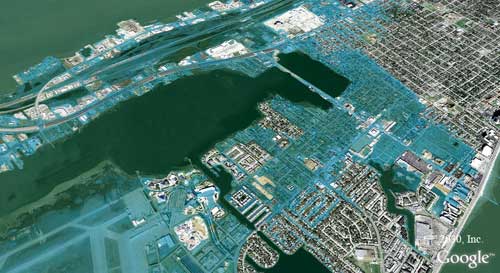
Galveston, oh Galveston...
Shell CEO says "psychology" behind high oil prices
Royal Dutch Shell Plc's top executive said on Wednesday he sees no fundamental reason for crude oil prices to have jumped above $78 a barrel."No one has to wait at the gas pumps of the world. There is no physical problem," Shell Chief Executive Jeroen van der Veer told reporters in Calgary.
Forget about fundamentals, this is the oil market after all
As oil prices surged to a record of more than $80 (U.S.) a barrel yesterday, analysts were asking just one question.Why?
Bodman Says $80 a Barrel Oil Prices Are `Troublesome'
Record crude oil prices above $80 a barrel are "troublesome," U.S. Energy Secretary Samuel Bodman said today.
Traders doubt OPEC's ability to boost output
Such uncertainties also lead inevitably to renewed airing of the Peak Oil theory, which posits that the world's petroleum production is at or near an unsustainable high and doomed to drop as demand gradually overwhelms supply.
China targets strategic oil reserve of 12 mln tons by 2010 - report
China aims to increase its strategic oil reserve to 12 mln tons by 2010, from 2-3 mln tons currently, the official Shanghai Securities News reported, citing a senior state planner.
Thais suffer without subsidies as oil hits record
Thais are to suffer another economic blow as global oil prices rose to a record above $80 a barrel and the post-coup government ruled out resurrecting fuel subsidies that were dumped as too expensive.Motorists in Thailand are more exposed to global oil rises than many in Asia, after the country freed fuel prices at the pump to market rates by 2005, unlike countries such as China and India that maintain government-capped prices.
Officials: Pipeline will help N.D. oil producers
Increased pipeline capacity may help North Dakota oil producers avoid discounts as high as $30 a barrel when selling their crude, along with giving them more shipping options, two industry officials say.New pipelines designed to bring Canadian oil to Midwestern refineries also may ease pressure on an important east-west pipeline that many North Dakota producers rely on to transport their oil, said Lynn Helms, director of North Dakota’s Department of Mineral Resources.
API Chief Economist John Felmy: Cellulosic Ethanol Potentially a ‘Holy Grail’ (Part 4 of 6)
But while Felmy was optimistic about the contribution plug-ins might make, he was downright ecstatic about the potential contribution that cellulosic ethanol might make. “Potentially, it’s a Holy Grail,” he told EnergyTechStocks.com.
Ten fuel-saving tips from a hypermiler
Wayne Gerdes knows how to wring a gas tank dry.He can squeeze 84 miles per gallon from your standard-issue Ford Ranger pick-up. He once averaged more than 100 mpg during the course of an entire summer. And while behind the wheel of a hybrid electric Honda Insight, he coaxed the vehicle into yielding an astonishing 180.1 mpg. Gerdes can do these seemingly impossible things with a car because he is one of a rare breed of drivers known as hypermilers.
Judge rejects carmakers' emission suit
Vermont and several other states scored a victory on Wednesday in their battle to get automakers to comply with rules aimed at reducing global warming.A federal judge ruled that states can regulate greenhouse gas emissions from vehicles, rejecting automakers' claims that federal law pre-empts state rules and that technology can't be developed to meet them.
Brazil wants probe of U.S. farm aid
Brazil will ask the World Trade Organization for a formal investigation of U.S. farm subsidy programs, which it says includes payments for ethanol production, a senior Brazilian official said Wednesday.
Yunus calls for lifestyle 'traffic rule' to fight warming
The 2006 Nobel Peace Prize winner Muhammad Yunus called for a worldwide lifestyle change, saying global warming is "a matter of life and death" for low-lying nations like his own country Bangladesh.In a keynote speech to a symposium on climate change, Yunus suggested a "traffic rule" under which products bear red, yellow or green markings to indicate the extent to which they come from renewable sources.
Tories propose new 'green taxes' to protect the environment
A higher tax on domestic flights and a moratorium on airport expansions are among some of the key proposals a Conservative policy group will announce Thursday as part of the political party's commitment to fighting climate change.
Eating less meat may slow climate change
Eating less meat could help slow global warming by reducing the number of livestock and thereby decreasing the amount of methane flatulence from the animals, scientists said on Thursday.
English coastal storms more intense, but is it climate change?
Coastal storms battering the southern coast of England have sharply increased in intensity over the last century and a half, a possible consequence of global warming.
Global warming impact like "nuclear war": report
Climate change could have global security implications on a par with nuclear war unless urgent action is taken, a report said on Wednesday.The International Institute for Strategic Studies (IISS) security think-tank said global warming would hit crop yields and water availability everywhere, causing great human suffering and leading to regional strife.
World crops could decline 16% due to warming
Global warming could send world agriculture into serious decline by 2080 with productivity collapsing in some developing countries while it improves in a few rich nations, a study reported on Wednesday.India, Pakistan, most of Africa and most of Latin America would be hit hardest, said economist William Cline, the study's author. The United States, most of Europe, Russia and Canada would probably see agricultural gains if climate change continues on its current course, the study found.
Contact
- Content: editors at theoildrum dot com
- Tech support: support at theoildrum dot com
License

This work is licensed under a Creative Commons Attribution-Share Alike 3.0 United States License.
Re: Forget about fundamentals, this is the oil market after all
Hurricane Humberto popped up last night and hit land near Houston. As of 11 PM EDT last night, the NHC thought Humberto would hit as a tropical storm. Surprise, surprise!
Don't forget, it's already Fall and we saw record low temperatures across the northern U.S. the past few days. Time to stock up on that heating oil.
E. Swanson
Humberto-linked power outage shutters Valero refinery
Speaking of heating oil - I got my tank topped off on Tuesday at $2.47/gallon, which was the same price I paid in April. Wednesday, the same company was charging $2.62/gallon (I'm in Mass). I'll be stacking the rest of my wood this weekend...
I was gathering wood all last weekend, and will be this one too. Found a nice big oak that's been dead a couple of years and just recently fell - jackpot!
I'm putting the finishing touches on my Geothermal Heat Pump over the next couple of weeks (after work and weekends). I retrofitted my house from Electric Baseboard to Radiant floors in my half, and hot water baseboard in my tenants half. Hopefully it saves as much as I think it will, 4-5 Kwh of heat for every 1 Kwh I pay for. I have been using a woodstove in my half for the past several years, but I'm opting for the super efficient. Also if/when I move out, I don't want to give a tenant a woodstove, I'd rather they have this.
The Hurricane centre is certainly on their toes this year...not due to numbers, but unpredictability.
NHC was pretty much predicting TD9/Humberto would fizzle as it move onshore...and it did neither (move on shore or fizzle).
Dean, Erin, and Felix were no different in their surprises...rate they intensified, tracks they took, how long they sustained insensity.
Definitely, new factors in play they need to integrate into the models.
On another note, Apparently we are "Peak Oil PRANKSTERS" now! Like crop circle pranksters...were doing just for fun!
A Truckstop Perspective
"Sand?" Surely I'd misunderstood. "You're hauling sand from Canada to Texas?"
"Yup," the driver said as he tasted his coffee. "There's pretty good pay in it, 'cept I had to deadhead up to Alberta to get it. I'll get a little extra fer that, at least."
I shook my head in disbelief. "Wouldn't it be cheaper to ship it by rail?"
"Prolly." He looked thoughtful, then shrugged. "Guess they don't have trains running close by where the sand is. It keeps movin' around, an' the railroads can't move around to keep up."
I took a moment to digest this. "Doesn't Texas have sand? Who in the world is paying for this?" An image of a Texas zillionaire rolling gleefully in sand came unbidden to my mind, and I forced it to the background.
"Well, there's different grades of sand, and I reckon this drillin' outfit needs this particular kind." He took another sip of coffee. "I think their name is Diamond somethin' or other."
I made a noncommittal noise as I tried to come up with a reply. "It's a crazy world."
"Got that right!" He grinned and waved on his way out the door.
Reminds me of a news story I read about Saudi Arabia importing sand. You'd think if there's one thing they'll never have to import, it's sand. But, as your trucker friend noted, it's the kind of sand.
Re: Sand to Saudi Arabia
I think I may have mentioned this on TOD quite some time ago. Circa 1971 I worked for a company that supplied water and wastewater treatment equipment. They had just won a big order from ARAMCO for sand filters to treat injection water. These filter require that the sand particles conform to a certain specified size range and uniformity (if the particles are too small, the filter plugs up too easily; if they are too large, the filtration effectiveness is impaired).
So, along with the order for the filters was an order for several hundred tons of properly graded filter sand. Evidently, at the time, the Saudis either didn't have the capability or the inclination to do sand particle size grading.
After that, our salesmen (no 'salespersons' at the time) used to brag that they were so good, they could sell sand to the Saudi Arabians.
A year or two back there was a shortage of sand for frac jobs in the Permian Basin. We had newly drilled wells sitting idle for months for lack of sand.And you are right, it had to be a very specific type of sand. One of our engineers was very passionate that we not accept substitutes the vendors had offered up as solutions. He was a good engineer, and I trusted his judgement, but until then I never thought of sand as a potential constraint to oil and gas operations.
While on the subject of sand, it is almost universally assumed that sand is essentially infinitely abundant. It is not. There are many regions of the country with little usable sand, thus requiring sand to be shipped in from other regions. If you are not near a seashore or an area with readily accessible alluvial deposits, chances are sand is probably not too plentiful in your area.
I discovered this fact sort of accidently a number of years ago while playing around with an invention to rapidly fill large fabric sand 'sausages' for emergency flood control, following the severe 1993 floods in the US Midwest. Not all parts of the Midwest have ready access to large sand deposits. (Anyway, due to potential patent problems, I chose not to pursue this idea any further. The next time there is a major flood, you will still see people manually filling sandbags, one by one, which is pretty absurb if you really think about it.)
it's a great idea though
--
All these memories will be lost in time
like tears in rain
More sand. After the local molybdenum mine shut to overseas competition, a sand outfit took up with expensive white sand for golf courses, private beaches. Priorities; it's trucked.
Anybody worked out a date for Peak Sand?
I would hope that they could truck it until they got to a train terminal that could take it down to Texas, then truck it from there to it's destination. I'm sure they could arrange it, but then you'd be dealing with 3 companies instead of just one. Likely the buyer doesn't care much about the price, so the guy arranging the shipping doesn't care either. Bad sourcing, IMHO.
~Durandal (http://www.wtdwtshtf.com/)
Some of this may be due to the "just-in-time" logistics. Any breakdown in train or river transport and you have to pay big bucks to truck in some commodity so that your whole process doesn't shut down.
I have a truck-driver friend who just switched jobs so he could be at home more. Used to drive long-haul but now drives a dump truck. He was told most of his deliveries would be local but he's found himself doing a lot of runs from SE Ohio to Pittsburgh (around 200 miles) with a load of coal or manganese alloy steel or even concrete. It seems crazy to truck heavy commodities in this way and especially so given the fact that SE Ohio and Pittsburgh are connected by the Ohio river and materials can be shipped very cheaply on the river. Of course, they cannot be shipped quickly on the river. The just-in-time system of logistics may be an early causalty of peak oil.
Then again it did not surprise me to hear of another strange logistic. After all, every day I see coal barges going down the Ohio river from West Virginia passing barges going up river with coal from Wyoming (via Iowa) to West Virginia.
That is no nonsense - I have a friend who's father works for an aggregates company in outstate Nebraska. They're putting a certain grade of sand into semis going all over the place. They've got some stuff that is the right size/weight/whatever and they're putting 90% of their energy into that because demand is so high right now.
Here in Sonoma county (CA) we've just had a fair mixup about sand. It seems that fom umpteen years the concrete companies have been mining the Russian river. I guess they got too close to some vineyards and had to stop. We now import sand from, I think, Oregon.
Chris Skrebowski on record high oil price
http://globalpublicmedia.com/chris_skrebowski_on_record_high_oil_price
UK Petroleum Review editor Chris Skrebowski discusses today's $80 per barrel record high oil price with GPM's Julian Darley. Skrebowski also talks about his expectations for the rest of 2007.
On a side not (and perhaps this is a nod to WT's Iron Triangle Theory) has anyone else noticed that the inflation adjusted 'peak' in the 80s keeps moving forward? Just two days ago, I read that, adjusted for inflation, the cost per barrel was 84.xx cents. Today, in this article, the inflation adjusted price jumps way up:
What gives?
Inflation has dramatically escalated in the last few months.
One wonders just what the MSM is drinking. Sarconal ?
Alan
How many big macs could you get for a barrel of oil in 1980?
Right - as the price of oil rises, overall inflation increases, meaning that the current oil price must be deflated even more to compare it to the 1980 price. So the question becomes, can the oil price spike quickly enough to catch it's old record?
I dont think inflation has increased to 75% in the last 3 months, which is what would have been required to cause that spike :P
It also depends on whether you use the daily, monthly or annual peak price in the 1980/1981 time frame.
The interview is worth listening to. 14 minutes so not too long.
The EAT LESS MEAT... article above has to be one of the stupidest things I heard. What do we substitute? Broccoli and beans? Then we change the source of flatulence from farm animals to us? Perhaps we could get some new government regulations to help curb our emissions? I know my 80 year old father and 81 year old mother-in-law both need regulating.
ej
Hey be serious I am gassy no matter what! I mean I litterally eexplode all day long
Anyway I do think that it is a good thing sure you do end up farting more but who really cares anyway? Would you rather trash the planet or save it? I really see no way to continue to eat meat at this rate and keep things sustainaable.
next they will ask me to get rid of my dog ... But he can't help himself
For an aromatic experience, dine with a team of long distance runners.
That's actually one of the reasons why I've cut out red meat from my diet except with rare occasions. (I'm not a fanatic about refusing it, but I won't buy it.)
~Durandal (http://www.wtdwtshtf.com/)
I have nothing against Vegans, but the holier than thou approach gets old. If hard times come, I'm sure the Vegans will be the first to go "missing". According to the Russians, they taste like chicken....;-)
It may be better to be a live jackal than a dead lion, but it is better still to be a live lion. And usually easier. - Heinlein
To Ride, Shoot Straight and Speak the Truth - Col Cooper
I despise any holier than thou crowd, which is why I don't rag on people who eat meat, and I don't make a stink about things. (In other words, when eating out, I'll opt for the fish dish instead of trying to make a hundred substitutions.) If a vegan were to come to my house and complain about my meal not being vegan friendly, I'd reply by asking if they would serve dairy and meat for their non-vegan friends if THEY came over.
It's just the normal thing of, you do your thing, I do my thing, and we leave each other to our own things. hehe.
~Durandal (http://www.wtdwtshtf.com/)
Agree wholeheartedly. I believe that dining together is one of the most sacred and primitive of rituals and a guest should honor the host by eating and enjoying what is served, regardless of food ideologies (with exception of actual allergy problems).
When I lived in WNC mountains, I was a guest many times at mountain folk's dinner tables. I enjoyed many a serving of corn bread, soup beans, pork and ham. I don't think it ever hurt me a bit.
Agree somewhat... Break bread?... Yes! Anytime!.... But when the host is serving pre-packaged foods from Sam's on styrofoam plates, I'd rather honor the host planet because it's damned impossible to eat and enjoy what is served.
What if your hosts were serving you the flesh of new-born human babies ? Non-canibalism is a food ideology.
What if these babies where breeded by slave women that would be "used" only for their babies and their milk ?
You would also be served their milk as your drink. Anti-slavery is a food ideology.
So that the population of your host's country can sustain this way of feeding itself, they have "farms" of millions of these women spread everywhere in the country. We could go on with the fiction for sometime but you will always find a way of bringing food to your potential hosts table that will go against your deepest feelings of what you can accept.
I personaly do not feel separation between animals and humans. Their sensual experience of life is very similar to our own as they have a nervous system similar to our own. My brutal change towards veg food only came as a sudden realisation that animals were my friends, that I felt close to them, responsible for them. SO this came from "feeling" rather than from "thinking". The word ideology refers to "thinking". Do you have an ideology that prevents you from eating your mother, your brother or your son ? No. You just don't feel like doing it, like killing them, like treating them like that. You feel close to them therefore you pay them respect. Many people would feel it outrageous to breed cat and dogs for food, that's because their proximity with these animals made them feel closeness and therefore respect for these animals.
Beyond the feeling of closeness between human and animals, there are the plain, hard facts that cannot be refuted by any honnest mind. Breeding animals for food is extremely costly : in water, in energy, in topsoil, in CO2 emissions, for our own physical and mental health at the individual and collective level.
"Nothing will benefit human health and increase chances for survival of life on Earth as much as the evolution to a vegetarian diet." --Albert Einstein
Albert Einstein understood this long before we find ourselves in the clusterfuck that we are now in. But still a large portion of humanity remains blinded by their destructive food conditioning. Replacing the food habits goes deeper into what we think we are than changing more peripheral behaviors as transportation or heating. But if we want to stand a chance to go through the coming changes, we should look deeper as well and put into question all our behaviors, even those that we never thought could/should be changed.
... for our own physical and mental health at the individual
Cattle ranchers and dairy farmers tend to be exceptionally healthy both physically and mentally.
It is healthy way to make a living and a healthy lifestyle.
My brutal change towards veg food only came as a sudden realisation that animals were my friends, that I felt close to them,...
Your choice, not mine.
To the extent that I reduce meat eating, it is for reasons other than my friendship with animals.
Alan
In no way do I support the conventional livestock farming and heavy meat diet of North American and Western Europeans. But I get really sick of seeing all livestock farming practices lumped together. All livestock operations are not high-density feed-lot operations. Lumping all farmers together does a disservice to those of us who are trying to practise a form of agriculture that respects the land and our crops (plant or animal).
I own some rural land which is rented to a cattle farmer who runs his cattle on the property over the summer. I also have a few sheep and ducks that I keep for family use. Just because we want to, we are gradually letting about a quarter of the property return to natural boreal forest.
The livestock use almost no water at all. On a weight-basis, the ducks consume the most by far. The two dozen ducks go through about four times as much water as the four sheep. The only issue with water on our property is that the cattle have access to it. They are pretty hard on the pond-banks. We've begun to remedy the problem by fending around the ponds. We do this because we care about the land that we own and the cattle will do better if we pump water to troughs near the water than letting the cattle directly into the water bodies.
Energy? Except for getting the livestock to the property, almost no energy has been spent on the ruminants. They walked to the property from their winter quarters. When the cattle are shipped to market, fattened in a feed-lot, and eventually processed into meat, there will be something to talk about. However, our family livestock are harvested by hand on the property. Until I can do more myself and fine tune a better feeding system, the grain and hay for winter feed comes from adjacent properties. The energy used in growing this food and moving it the 50 yards to the property bothers me, but the silver lining is that it is a fertility input.
Topsoil? There are almost no topsoil issues on our property. We care too much about the property to allow that. Our family food production system doesn't even see nutrients leaving the property (composting toilet). Now, if you'd like to see topsoil issues, we could till the soil and plant a cash crop. Top soil erosion is much more of an issue in our garden than in our pastures. In our pastures, we don't need to apply mulch or grow cover crops because the native pasture does it for us. We've been letting the most steeply graded parts of the property return to native boreal forest to further prevent any erosion issues.
Just like producing grains or vegetables, grazing ruminant livestock can be as friendly to the land as you want it to be. It can be a sustainable way to put marginal land to use.
I don't think it's stupid. Less does not mean none. Cows have flatulence based on digesting plant material that humans can't even eat. I doubt the flatulence is equivalent. I also didn't see government regulation mentioned.
So you are pissed off about the state of the world and you are angry at bearers of bad news. Oh well...
Cow flatulence is compounded by the use of corn and other grains in feeds used at CAFOs, as well as the additional hormones and antibiotics they are forced to consume in such facilities. Cows raised and finished on grass do NOT emit similar levels of gas.
Actually 95% of the methane produced by cow digestive tracts is emitted via burping rather than flatulence. Makes a much less interesting headline though.
It is far from being stupid. Don't forget the rule of thumb that each ladder in the food chain multiples 10x the energy requirements at the base. Therefore, even if humans produced as much flatulence as bovines (per Kg/mass), you would still get a ten-fold reduction in the amount of flatulence if we were to become vegans.
I know it's a hard truth to face for many meat-lovers, but switching to a vegan diet is among the most substantial measures a individual can make to mitigate climate change and/or peak oil.
(And before the flames begin, note that I am not a vegan myself, and this message is not meant as evangelising).
You might want to checkout some thoughts from some grass based farmers (e.g. Joel Salatin). The reality of big agribusiness is that it is one of the most highly energy-inefficient industries in existence. We grow corn which requires large energy inputs in terms of fertilizer, tilling, harvesting, drying, shipping, etc. We harvest from decentralized production sites just to ship it to centralized processing locations, then ship it to huge feedlots where the cattle are fed. Then we ship the cattle to a few centralized processing centers. Finally we ship the finished products back to where the corn was produced and it is placed in the grocery cooler. All of this uses a tremendous amount of unnecessary energy.
Cattle don't metabolize the corn as well as grass - and don't metabolize it nearly as well as pigs or foul (chicken) so enormous amounts of calories are wasted even in the digestion. Where do these go? The run off in manure or are wasted in lagoons - essentially be released back to the atmosphere/environment in very damaging forms. Since we can't really expect corn to be viable with increasingly expensive fertilizers and humans can't eat grass it makes much more sense to use cattle to graze pastures (which when properly operated require minimal energy inputs) and eat the cattle than it does to expect to eat corn.
It is also much more realistic to put 500 acres in grass than it is to plant and harvest vegetables or fruit on those acres due to the water, fertilizer and tending (human energy) inputs. Where would the fertilizer come from in the first place to keep the crops going? You must have a large animal biomass to complete the nutrient cycle.
While I hear the food chain argument it feels drastically simplified. The empirical evidence for the sustainability of meat production from pasture and the beneficial impacts on the environment over the long term are significant. The economics of grain and fruit/vegetable production don't really lend themselves to production at the scale that pasture operations do. I think that has to factor into any balanced approach.
The 10/1 calorie argument is too simple to solve the problems of cultivation / harvest not to mention the development of a sustainable production environment.
koob, I'd like, if I may, add a few points to your post. You make it clear that the current Big Agro system is one that wastes FFs, vast amounts of money and contributes massively to pollution. These are the immediate effects which I can observe every day, both in my village (in A-Small-Country-In-The-Middle-Of-Europe) where small farmers call it a day and sell their lands and buildings to real estate speculators (yup, that still makes you good money over here) whereas "factory farms" thrive. Behind that is, to a large extent what the EU calls the Common Agricultural Policy, or CAP, which is essentially about subsidising agriculture and represents 44% (!) of the EU budget - 55 billion € and counting. I gather the US has a similar system of agricultural subsidies, but I don't know enough about it to comment, so forgive me if I focus on the European angle.
The CAP grew out of the food shortages of the post WWII years, and was also meant to stop the growing depopulation of rural areas by encouraging farmers to go about their business. While this was very laudable, it has turned, over time into am obscene travesty of what it was intended to be. For a more detailed primer, I would refer you to this:
http://en.wikipedia.org/wiki/Common_Agricultural_Policy
What, pray, does this have to do with PO, I hear you ask. Well, in a nutshell:
The degree of doublethink that goes into this is truly mind-boggling - on the one hand the EU prides itself on the amount of developmental aid it hands out while creating the circumstances that make it necessary. On the other hand "sustainability" and "organic" are trumpeted as policy goals while the real policy is to make their very existence so economically unattractive that none but the most idealistic farmers will take the bait.
More here:
http://www.citizen.org/cmep/foodsafety/eu/common/articles.cfm?ID=13825
Thanks for the follow up UncivilServant - definitely good to get some confirmation that the US is not the only one operating on such a backward system.
Maybe it is just blind hope, but it appears that in some ways the economics (even with the subsidies) are starting to turn in favor of sustainable operators in some areas of farming here. This is particularly true in the area of meat production due to both quality issues as well as due to cost pressures (e.g. increasing cost of chemical fertilizers, pesticides, antibiotics, etc.)
It does show that there are alternatives available that can be successful on drastically less energy. It doesn't seem that this transition will be possible in a crisis since the skills required to operate sustainably require significant amounts of experience. If the energy predicament unfolds slowly enough there is definitely room to drastically improve energy efficiency in agriculture on both sides of the Atlantic.
Aw shucks, people. If there were fewer enough of us, we could all just eat deer and groundhawgs like I do. Takes almost no work and is even partly fun. And never even slows 'em down, leastwise, not around here.
And as I say, lots better to harvest those critters with my gun than with my toyota. Doesn't mess 'em up as much.
PS. We have 500 acres of steep, wet, woody hills for 4 people. About right. Life is easy. Don't come here.
Re: Compromise on Iraq oil law seems to be collapsing...
Patraeus Out Of Step With Top Brass
Lots of things in and around Iraq are collapsing and the oil law might be the least important of them at present. General Petraeus boss, Admiral Fallon (head of Centcom), holds his subordinate in very low esteem. How low? Fallon told Patraeus that he considered him to be 'an ass kissing little chicken shit' and added 'I hate people like that.'
http://www.atimes.com/atimes/Front_Page.html
snip...'In a highly unusual political role for an officer who had not yet taken command of a war, Petraeus was installed in the office of Minority Leader Mitch McConnell in early February just before the Senate debated Bush's troop increase. According to a report in the Washington Post on February 7, senators were then approached on the floor and invited to McConnell's office to hear Petraeus make the case for the "surge" policy.
Fallon was strongly opposed to Petraeus's role as pitchman for the "surge" in Iraq adopted by Bush in December as putting his own interests ahead of a sound military posture in the Middle East and Southwest Asia - the area for which Fallon's Centcom is responsible.
The Centcom commander believed the United States should be withdrawing troops from Iraq urgently, largely because he saw greater dangers elsewhere in the region. "He is very focused on Pakistan," said a source familiar with Fallon's thinking, "and trying to maintain a difficult status quo with Iran.'...snip...
snip...'He demonstrated his independence from the White House when he refused in February to go along with a proposal to send a third aircraft-carrier task force to the Persian Gulf. Fallon questioned the military necessity for the move, which would have signaled to Iran a readiness to go to war. Fallon also privately vowed that there would be no war against Iran on his watch, implying that he would quit rather than accept such a policy.'...snip...
If Admiral Fallon resigns there might be some money making opportunities in futures...
Perhaps before resigning, his position should be heard. Arcs and sparks, leaks and squeaks:
http://www.washingtonpost.com/wp-dyn/content/article/2007/09/08/AR200709...
Maybe there is someone thinking outside the cube.
Prediction: Pres address tonight will highlight energy security as a reason to stay in Iraq.
If he mentions it at all, I doubt that he will highlight it. But then I won't know because I'm unable to watch him without throwing up.
-Don
Tis why I read the transcripts online the next day.
~Durandal (http://www.wtdwtshtf.com/)
There is less energy coming out of Iraq now than before the war. Think they would like to brag to the world about their ideals of energy security, yet they have opened a "pandora's box" of insecurities.
The Iraqi army and police forces were heavily infiltrated. Haliburton got no-bid open ended contracts. What sort of an ass-kicking politician lines up no-bid open ended contracts for a generic oil service company and expects to keep costs down? Probably gets a "goden fleece award." An oil company that moved to Dubai after unsuccessfully overbilling the U.S. government for at least one contract.
I can recall watching Bush on TV after his brother was successfully elected. He said, "We kicked some ass."
Then later he was saying about the Iraqi slamicists, "Bring them on." Trying to sell unecessary war to a population who did not want Bush to got it alone in the first place. Many of them voted Democrat this past election at the local, state, and federal levels. Like there were not enough Lockheed-Martin shareholders or defense industry workers to vote for Republicans in favor of a decade of war.
A nation another day older and deeper in debt. He could fool some of the people some of the time, but not all of the people all of the time.
They turned off the oil meters for Iraq's pipelines after the invasion, and they've never been turned back on. Nobody really knows how much oil is flowing out of Iraq, except the American military. I bet Iraqi exports are a lot higher than the official numbers.
You're right, I should have said mention instead of highlight. Got carried away.
Transcript of Bush's speech is here. There was one mention of energy security, in the following paragraph:
I also noted his use of the word "ally" to describe Iraq.
I do not remember a vote on a treaty of alliance between the two nations. And if such a treaty were put to a referendum in either nation, I would expect it to fail.
Alan
Ok, time for a very naive question.
Could someone please explain to me (in polite - I know you will - English) what it is, from the Administration's POV, they - or anyone- believes an attack on Iran will achieve?
Another opportunity for "shock and awe" but bigger and better.
In fact, another Iraq, only bigger and better.
Seriously, Aniya, you m ust be indeed maive.
This administration and its allies have done so very well with Iraq. The propaganda war in the USA has tranformed the Democratic Party into Bush's new Lapdog: prowar, just for a more effectively administered war.
The Indian Wars are back in full force, and soon will be seen as absolutely essential and God-Ordained by every Red-Blooded American. Iraq, Iran, Syria, Nigeria, Venezuela, Columbia, Equador -- all of these places and more -- are "Injun Country."
When Europeans arrived there were maybe 12 million Native americans on the Continent of North America. Decades later, we were herding the last couple of hundred thousand onto tiny reservations. We took vast resources through genocide.
Don't you get it, Aniya? Globalization is Injun Country globalised.
Welcome to the New World Order. There will be many less people -- we've managed to kill over 1 million Iraqis in a very short time already. Look for the war to spread and intensify greatly.
Are you starting to get the picture?
Actually, Beggar, the way you put it, I have to wonder if peak oil mightn't be a strike Against 'big war', just as it should be against things like large-scale rainforest decimation. We might still want all that wood cleared for cropland, or to have air-superiority, but how much will any of those processes be maintainable or even on the radar, so to speak, once we're all mired in local challenges to keep people fed and not rising up?
I mean, the PNAC can have all the 'Wehrmacht' ambitions in the world, but we're already in a two-front campaign, with several other armies mustering (proverbial armies of PO, Climate, Housing, Fishery Collapse.. etc) at the borders. It's one thing to hang a banner on your aircraft carrier proclaiming to be the 'one and only world superpower' .. just PLEASE, pay no attention to all this kryptonite lying around.
By the way. She did ask you to be polite, and it seems you could have tried a little harder. I know it's all the rage to snap each other with our righteous anger, etc.. but it's much more radical and revolutionary to be kind and straightforward.
"Always tell the truth. This will gratify some people and astonish the rest." - Twain
Blessed are the Bike-to-workers.. let's follow their fine example!
Bob
I guess it seems obvious to me that the killers in high places pray loud lies.
I am pretty tired of all of the bogus dialogue that is nurtured as "political reality" and encouraged by the MSM and by the leagues of lawyers and psychologists and others of the professional managerial class that is paid to keep Americans in a bubble of unreality.
As we burn the planet and commit wholesale genocide along with capricious false imprisonment and torture we continue to have these hollow, seemingly appropriate and civil dialogues about it all. It is like sitting in Hell with the Devil and having a chat about why we are roasting innocent people -- along with most of the planet's species -- while dining in air-conditioned comfort.
Or better yet: the Native American people were shocked when trainloads of white men would shoot bison just to leave the carcasses rotting on the prairie. Just for the Hell of it. These same people -- Native Americans -- were similiarly decimated and those few remaining were isolated into relatively tiny reservations and subjected to all kinds of torture and cruelty just for the sake of cruelty along the way.
Sociopathological behaviour is accepted and chatted about in our nations most sophisticated circles as though we might need to tweak our perspectives and behaviour a bit. Sociopathological behaviour has become our "political reality."
What is happening is no longer a subject for polite conversation. What is happening is a matter of genocide and eco-cide.
So many scientists have pointed out that we are destroying our species and much of life on our planet that it is a commonly available fact. That most folks refuse to look at the reality of the sixth great extinction -- largely anthropogenic -- seems to be a symptom of "Mad Human Disease."
The only question I have is whether or not we can survive our own complicity in our collective war crime of "Last Man Standing" Resource War.
This is not about Iraq or Iran, even though it is convenient to keep the discussion there. This is about killing off others so that we can eat our planet and have it too, for another week or so at a time.
We are down to Capitalism's End Game -- which unmasks the reality that capitalism is all about war. Daddy Warbucks wins just as he dies off. Who laughs last? Does anyoe laugh at all in this game? Or is the last sound heard more like a whimper, or a desperate gasping for just one more breath?
Nobody wins any war that we engage in now.
If anyone wins maybe it will be one of those few last mating pairs of humans in the tropical wildlands in what are now northern Canada, sometime about 2100....will there be any memory of how things went wrong, and how to try to keep things going right?
If we keep praying really loud, or chatting really loud, will the sounds of all that murder, rape, torture, and cruelty for the sake of cruelty be covered up?
Sorry, I'm just very tired of it all right now.
Getting closer to thee, my God.
Sorry Aniya, too difficult to get into the current state of the collectively deranged mind of this administration, without risking madness or falling into the Kool-Aid pitcher and swallowing the poison.
The loose cannons keep loading and firing the rhetoric rounds. Why just yesterday Ahmadinejad claimed Iran wants peace and friendship 'for all' except of course Israel, which "cannot continue its life." How do you think that one is going to work out? But Bush&Co will need a smoking mushroom cloud large enough to get overwhelming ‘buy in’ from the American public, hmmm, perhaps the media could lend a hand.
Bush&Co. have visited the vision, and nearer to thee is a finer place to be. And it'll be better for us all. Yeah, that's what it'll accomplish. A better life.
The autopsy will show the body was otherwise fairly healthy. Most Iranians, Americans, and Israelis would be more than happy to tend to their sick parents or toddlers, put food on the table, keep above water and maybe start adjusting to the coming crisis that will levelize the globe. Oh, wait, that was some part of my dream.
"I was lying in a burned-out basement - with the full moon.."
The attack on Iran has two purposes:
1. As net energy from fossil fuels winds down, civil rights and social services must roll back to the 1700s. Americans are most likely to peacefully give up rights and services during wartime. The Iraq war was enough to roll back habeas corpus and wiretapping laws, but a larger conflict is required to roll back social security & other cherished services. Iran is the natural next step in the escalation of war in The Middle East, and surely not the last.
2. As oil dwindles to nothing during our lifetimes, with every year The Middle East controls a larger percentage of the oil that remains. Without American intervention, The Middle East would naturally organize into some sort of "United States of Arabia" that could rule the world with oil export policies that put Middle Eastern interests first. If America fails to prevent this democracy, America will become like Africa - a dirt poor source of raw materials for oil-rich foreigners.
Thanks to everyone for these replies.
Fire from Seawater - Have you guys seen this:
Every new blip is going to be the one silver bullet to solve all our problems -Any way here are the links:
google
http://www.google.com/search?hl=en&q=fire+from+sea+water+%5D
http://www.shoutwire.com/comments/103109/Inventor_Sets_Fire_to_Seawater
http://www.newscientist.com/blog/technology/2007/09/fire-from-seawater-c...
http://www.wpbf.com/news/13383827/detail.html
Discussed in the DrumBeat the day before yesterday. I kinda doubt this one is going to be even a silver BB.
my favorite response to the sudden return of this "new tech"
"it only takes about 30 seconds to throw a watt meter on the front end."
we have not heard of the eroi or even input. Why.. my guess is
that it sucks. (literally)
I'm surprised this one isn't dead yet.
I got an email from the EnergyResources moderator this morning asking if he could re-post my comment on it from earlier in the week to other lists; not that it was deathless prose or anything. It follows:
I think I saw a video of this guy several weeks ago; basically it looks like he is using a microwave oven with no walls to heat saltwater, which then disassociates into some hydrogen and oxygen and burns with a bright yellow sodium-tinged flame.
So all you have to do to get a candle's worth of heat is pump a thousand or so watts of microwaves into a tube of saltwater. Presto! Burning water!
Not only is this no more a source of energy than is microwave popcorn, but by standing right next to an unshielded microwave oven this 'cancer researcher' is exposing himself to all sorts of radiation, which may lead to lymphoma, tumors, or any of the other microwave-associated maladies.
Too bad you can't run generators directly off stupidity.
There are no known microwave associated maladies. You can cook yourself and get heat associated maladies.
Electricity can be converted to microwaves at 95% efficiency. Depending on the efficiency it heats water, this can be better than electrolysis. Which isn't the same as saying it is useful.
RobertInSantaBarbara
I haven`t escaped from reality. I have a daypass.
You seem to have refuted your own point a bit there; such maladies could include cooked testicles, steamed kielbasa, poached eyeballs, "microwave lip", and a whole BubbaGump shrimplist of other broiled parts. Don't even get me started on piercings.
The contention that "partially cooking" ones tissues doesn't lead to known maladies is one I'd call BS on. I realize there's no hard-and-fast research showing that cell phones are linked to brain tumors; however there were two guys at my brother's TV station some years ago who went up to align the microwave relay dish atop a tower, and it was inadvertantly switched on. They both died within 6 months of the same rare lymphoma. They weren't related. So you can take that as anecdotal. And you really can see your food better if you knock the window out of the microwave door, at least until that pesky vitreous humor goes opaque.
Sure, it's kinda interesting, but it's not a way to burn water and the researcher is evidently of the icecream/forehead persuasion.
Robert;
I'm not so sure about that. I know it's tough to prove a negative, but I'll show you my links if you show me yours..
"What distinguishes technologically produced
electromagnetic fields from most natural ones is
their much higher degree of coherence. This
means that their frequencies are particularly welldefined,
and therefore more easily discerned by
living organisms, including humans. This greatly
increases their biological potency, and ‘opens the
door’ to the possibility of frequency-specific, nonthermal
influences of various kinds, against which
existing Safety Guidelines – such as those issued
by the International Commission for Non-ionising
Radiation Protection (ICNIRP) - afford no
protection.
"...Some oscillatory endogenous electrical activities
of the living human body are quite familiar - such
as those of the heart and brain, which can be
monitored by an electrocardiogram and
electroencephalogram, respectively. Equally
familiar is the circadian rhythm.
"Others, - such as the coherent electrical
excitations at the cellular level whose frequencies
typically lie in the microwave region of the
electromagnetic spectrum, and those pertaining
to crucially important biochemical activities,
involving, for example, the transport of calcium
ions across cell membranes - are somewhat less
well-known.
"Until the frequency/information dimension of nonvisible
electromagnetic radiation (microwaves
and other non-propagating electric and magnetic
fields such as those from overhead power lines) -
is recognised in its own right, these fields will
constitute a potential threat to all living
organisms.
http://www.goodhealthinfo.net/radiation/eu_report_2001.pdf (in the executive summary, page 3)
Also:
http://www.goodhealthinfo.net/radiation/health_efx_western.htm
~ does refer to specific studies. I have not checked more than a couple of them.
My family's greatest concern about using Microwaves is the effect that it has on particularly fats/oils in the foods cooked, as there is a claim that the high freq. radiation takes even the healthiest oils and splits free-radicals off of the molecules, creating a high potential for increased cell-damage, especially with ongoing use.
~
There is also the case of Dr.Hans Hertel of Switzerland, who conducted his own study in 1992, and was given a gag order at the insistence of the 'the Swiss Association of Dealers for Electroapparatuses for Households and Industry' or FEA that he not publicise the findings of this study..
http://www.mercola.com/article/microwave/hazards2.htm
"LEUKOCYTOSIS
"Leukocytosis (an increase in white blood cells)," Hertel explained, "which cannot be accounted for by normal daily deviations such as following the intake of food, is taken seriously by haematologists. Leukocyte response is especially sensitive to stress. They are often signs of pathogenic effects on the living system, such as poisoning and cell damage. The increase of leukocytes with the microwaved foods was more pronounced than with all the other variants.
It appears that these marked increases were caused entirely by ingesting the microwaved substances." The cholesterol markers were very interesting, Hertel stressed: "Common scientific belief states that cholesterol values usually alter slowly over longer periods of time. In this study, the markers increased rapidly after the consumption of the microwaved vegetables. However, with milk, the cholesterol values remained the same and even decreased with the raw milk significantly."
Hertel believes his study tends to confirm newer scientific data that suggest cholesterol may rapidly increase in the blood secondary to acute stress. "Also," he added, "blood cholesterol levels are less influenced by cholesterol content of food than by stress factors. Such stress-causing factors can apparently consist of foods which contain virtually no cholesterol-the microwaved vegetables."
Anyway,
I am not a Doctor, and I don't play Doctor on my TV (because of the radiation, of course.. also my wife would worry about me- ), but I just don't believe the promises, and for now, have unplugged the Microwave until I know more.
Regards,
Bob Fiske
http://www.microwaves101.com/encyclopedia/biological.cfm
I'd be lieing to you if I said you couldn't cook yourself with microwaves and I'd be lieing to you if I said standing in front of a military radar is safe. Beyond that, microwaves are safer than sunlight which is both 1000 W/m^2 and contains ionizing radiation. Sunlight is a known killer.
RobertInSantaBarbara
I haven`t escaped from reality. I have a daypass.
Robert:
If you are implying that you have some advanced knowledge of radiation effects on biological tissue, please email me. If you're in the business, it'll take nothing for you to get a hold of me and to get my email. Clue: My real name and log-in name are the same.
Had you noticed the discussion the past two days at TOD regarding the 'discovery' that microwaves can 'burn' salt? Everyone focused on how and why, and 2nd law. Give this some thought.
Then, let's have a discussion. Bob F. is reasonable in his caution. If you want to dispute that, let's take it to a higher level. But here.
But Robert;
Yes, the Sun's radiation is toxic. So is Oxygen. Sunlight is a multifrequency source that living cells have had the opportunity to adapt to for hundreds of millions of years.
When you create a blanket of high frequency sources: Cell Phones, Ovens, Radar, TV Transmissions at fixed/focused frequencies, and bombard your cells with these in a daily bath, just as with chemical sensitivities, you are risking a dangerous disproportionality in this new environment.
"Others, - such as the coherent electrical
excitations at the cellular level whose frequencies
typically lie in the microwave region of the
electromagnetic spectrum, and those pertaining
to crucially important biochemical activities,
involving, for example, the transport of calcium
ions across cell membranes - are somewhat less
well-known. (From EU study, linked in earlier post)
Luckily for businesses, the effects may be vague or unmeasurable, and their effects may develop long-term, while the profits roll in in the short term.. problem solved. Bullet Dodged.. (it was moving way to slow!)
Bob
The effects may be vague or unmeasureable or long-term. Or there may be no harmful effects whatsoever. My statement was there are no KNOWN harmful effects from microwaves other than by heating and I stand by that. When new science appears, I'll change my stance. What will you do? If you don't want to use a microwave oven you don't have to.
Do you have lightbulbs in your cave? Do you go outside during the day? Visible light is at 10^15 hertz and microwaves 10^10 hertz. It's kind of funny calling microwaves "high frequency".
We got the doctor and the electrical engineer on one side of this debate and I don't know who on the other.
RobertInSantaBarbara
I haven`t escaped from reality. I have a daypass.
Bob,
The thing about free radicals is that they are by nature incredibly reactive--they will react with the first thing that they encounter. If indeed microwaving oils creates free radicals, they will not exist as such by the time you consume them. Might there be chemical changes in the food as a result? Perhaps, but these should be measurable. Not only that, broiling or frying or sun-drying all have similar potential for transient free radical creation in food.
Don't equate possible free radical chemistry in cooked foods with internally-generated free radical damage in living cells (yours).
Yes I have advanced knowledge of the effects of microwave radiation. It is called a masters in electrical engineering. I used to design cell phone integrated circuits. If I am owned by the cell phone industry why do I think driving with a cell phone should be illegal? Anyways, I work for the military industrial complex now. They can't offshore it. I have read all the scientific literature. Other than by heating, there is no known biological effect due to microwaves. Yes, you can harm a gerbil by putting her in a microwave oven. You are free to hypothesize unknown health effects that have escaped the attention of all the researchers but there is no evidence for them.
Free radicals are caused by cooking food. Cooking produces chemical changes in the food producing lord knows what. I assume you eat your meat tartare.
RobertInSantaBarbara
I haven`t escaped from reality. I have a daypass.
Microwaves are non-ionizing and therefore will not cause cancer. Accidental exposure, however, can cause serious thermal injury.
Actually, therapeutic microwaves (a.k.a. microwave diathermy) had been used extensively as deep heat therapy for muscle pain and arthritis as recently as the 1980's until being replaced by therapeutic ultrasound. Interestingly, microwave diathermy is one of the few effective therapies for chronic prostatitis. Problem is most men suffering from this condition are unwilling to accept this treatment as it involves a microwave emitting wand inserted through the... um ... back door.
Phineas Gage, MD
Phineas - With all due respect, when you know what causes cancer, please get back to me. I'm placing my money on cancer stem cells. Too bad, no one knows yet if they are cause or effect.
It has been posited that light at night (ie, ordinary incandescent light bulbs) cause cancer. The mechanism is disruption in natural melatonin cycles, which have a regenerative effect. This is based on lower breast cancer rates in non-industrial nations.
EVERYTHING causes cancer, everything causes allergic reactions in someone, you're not safe anywhere.
"no known harmful effects" is good enough for me.
In the EU report: (in reference to non-ionizing radiation and non-thermal effects..albeit in phones instead of ovens, in this case)
p.4
"It can be no coincidence that in Russia, where the frequency-specific sensitivity of living organisms to ultra-low intensity microwave radiation was first discovered over 30 years ago, that the exposure guidelines (even if applied in theory, rather than in practice) are still 100 times more stringent that those of ICNIRP!
"There is a regrettable tendency to attribute market–friendly research a greater significance, publicity and profile than non-market friendly research, which suggest the possibility of adverse health impacts. An example of this is provided by the recent publication of a USA epidemiological study, in which the statistically significant finding of an elevated risk amongst users of mobile phones of the incidence of a rare kind of tumour (epithelial neuroma) in the periphery of the brain – precisely where there is maximum penetration of radiation from the mobile phone (the laterality of which also correlated with phone usage) - was glossed over and completely escaped the attention of the media, who focused instead on the finding that there was no overall increase in the incidence of brain tumours amongst mobile phone users.
p.5
"...It is not so much that, in the haste to make this new and valuable technology available, the necessary safety research has been bypassed or compromised, but rather - and more reprehensibly - that already available indications that the technology is potentially less than safe have been, and continue to be, studiously ignored, both by the industry and by national and international regulatory bodies.
http://www.goodhealthinfo.net/radiation/eu_report_2001.pdf
Is your "science" limited to quoting the regulatory agencies try to justify their existence? There is no peer reviewed paper in a scientific journal that shows health effects from microwaves other than by heating. The European Parliament can release any statement they want.
RobertInSantaBarbara
I haven`t escaped from reality. I have a daypass.
I also mentioned Dr. Hertel's research, tho' it was a tiny, privately funded study. I'm not anti-science, but we know how some conclusions seem to be allergic to research funding.
There ARE also researchers trying to 'justify their existence' by getting grant money from big oil, big pharma and big microwave interests. Science would be perfect, only there are human beings involved.
To me, this one is like PO or Climate Change.. what if the conclusive proof shows up just when the illnesses also start to? I don't need to prove that it does cause cancers, or does reduce the nutrients in foods that help my body defend against various illnesses.., etc, etc. I've heard enough to give me reasonable suspicion.. and at least I have cooking alternatives, even if they're less convenient or energy-efficient.
But there is SO much money at risk if microwave smog and point sources do turn out to be harmful.. how could I possibly suspect the 'lack of peer-reviewed research' replicating what the outsiders have said they found?
Best,
Bob
Magnets Can Boost Production Of Ethanol For Fuel
Parking spaces outnumber drivers 3-to-1, drive pollution and warming
Edinburgh diesel exhaust study
Diesel Exhaust Kills Throat Cells, Study Shows (pdf)
Synthesizing Gas, Making Energy
Re: 'Magnets can boost production of ethonol for fuel'...
I used epoxy to permanently fasten a large crystal pyramid onto the hood of my truck directly above the fuel injection pump. I was stunned by the dramatic change in my fuel consumption. I have ordered a gross of crystal pyramids to give to all my friends and relatives for xmas gifts.
you will get better results by affixing the crystals over each cylinder. I have 4 neolithic quartz crystals fasten to my hood over each cylinder (1 per). I have gotten about a 36% improvement in gas mileage. One time I ran out of gas but I was able to keep driving for 4 miles, although not as fast.
Yous guys really aught to let folks know when ya been sippin' the sarconol
"Yous guys really aught to let folks know when ya been sippin' the sarconol"
And a mighty fine vintage - that's some good hooch!
No, no, they're serious! Look here: Magnetic Fuel Saver
Sort'a speaks for itself, if you know what I mean.
I do crystals, for real. Not on cars, but to amplify or generate natural energy frequencies. Hold them a certain way and you can get "harmonic generation". It works, for real.
No offence to Architecture 2030, but do they do such an interesting job beyond the borders of the US of A? I took a google at Cape Coral Fl and quite a stunning vision on several levels, the amount flooded, the size of the place, and the homogeneous suburban look of the place. It reminded me of a statement I made to an American doctor, a fellow student with myself at The Art Center in L.A. in 1964. He was feeing rather up about all the progress that was happening with the new bridges freeways building etc (yes I know that seems a little unbelievable now, but true) anyway his comments brought the vision of a coastline all the way from my Vancouver Canada to LA ending up as a gigantic cement slab and I made the social blunder of telling him of my slab filled vision. Old turn of speech here...'and he went ballistic' and told me If I didn't like it I should go back to my own country. He was a very nice person but I had caught him on a tender spot, his country, so don't blame him for his reaction.
I am treading the same water again now, but I will preface this statement by making sure it is understood I include my own country when I say this. The self contained vision of flooding by Arc 2030 really seems to speak loudly about how we in the west draw the world's borders about our first world countries. This goes further than flooding to how we treat or allow the rest of the world (including that 'rest of the world' within our borders) to be treated so badly. Here in Canada we have allowed our leader PM Harper to draw us into a dirty war in Afghanistan for oil, to renege on Kyoto, to write off Africa as a basket case and not live up to its commitments of a mere .7 % of GDP towards world relief. Food price increases directly causing third world starvation due to increased corn prices are glossed over because we really don't mind as long as it allows us to drive one mile more. We are warm and cozy and when we aren't the world better listen. Iraq destroyed by Bush Father & Son a million dead mostly children and women makes barely a ripple yet the world must stop and remember the great tragedy of 9/11 when early in the morning, before most were at work, the Trade Towers were destroyed, this in a fit of rage and impotence by people literally driven mad by our western greed and ignorance. Within our borders a third world of men woman and children are living out of shopping carts and when driven in their desperation to drugs and crime become fair targets for our high-minded displeasure.
*waves 'hi' from B'ham, just across the border.* I couldn't agree more. I was hoping to see Vancouver as well.
Thanks, I think the border is still open; but these days you better phone first:)
--------
http://www.architecture2030.org/current_situation/coastal_impact.html
Is the link to the coastal maps Leanan found that I refer to in my comment above.
Thanks Leanan, long time I wanted to get that off my chest.
Took me a second to puzzle out the miscommunication. I meant that I looked for Vancouver on the flood map, although I 'd certainly like to see it in person as well.
Welcome anytime, gotta get rid of borders physical and mental:)
BTW, I can really feel for Noam Chomsky and his upward battle to get the idea of marginalization of dissent across:)
To build on your initial observation, I find it very annoying, yet a very good example of American Exceptionalism, that Mexican or Canadian provinces or major cities are rarely if ever shown on US weather maps, especially those produced by the Weather Channel, nor is there any mention of the large number of major typhoons that have traversed the same general area in the western pacific. Hell, the Weather Channel rarely if ever focuses on the incoming Pacific weather systems that will drive the Northern Hemisphere's future weather. Thus, it is very difficult for folks to see the connection between incresed typhoon activity and the later associated weather effects occuring here.
Can't complain about marginalization myself when I bury the message in verbage. But something that I think can be easily followed is the Interactive Surge graphic on this page; I would imagine the orange indicates things like those one's mother never spoke about ?
http://www.ft.com/cms/s/0/4a5e705a-5d56-11dc-8d22-0000779fd2ac.html
May 16 I find should be of more general interest to this site, if the rest be considered mere dross.
BTW Thank you karlov1 for your insightful ..oops almost mispelled that inciteful....weather observations:)
Oh and your American Exceptionalism I find that rather fine, I hope you don't mind if I borrow it some time?
Flood Maps
This site will give you an idea of the areas affected by sea level rise (up to 14 metres).
For lack of an ounce of prevention in Africa we're going to see someone end up applying a hundred kilotons of cure sooner or later. Seriously ...
CR - Well said, and can't be said enough. The tragedy of peak oil will not be the shock of living with less, but that it will come so severely at the expense of those with nothing.
0.7% of GDP. Un-fvcking believable how we've set our priorities.
From Greer: The Innovation Fallacy
When the Second World War broke out in 1939, Germany arguably had the most innovative technology on the planet. All through the war, German technology stayed far ahead of the opposition, fielding jet aircraft, cruise missiles, ballistic missiles, guided bombs, and many other advances years before anybody else. Their great vulnerability was a severe shortage of petroleum reserves, and even this area saw dramatic technological advances: Germany developed effective methods of CTL (coal to liquids) fuel production, and put them to work as soon as it became clear that the oil fields of southern Russia were permanently out of reach.
The results are instructive. Despite every effort to replace petroleum with CTL and other energy resources, the German war machine ran out of gas. By 1944 the Wehrmacht was struggling to find fuel even for essential operations. The outcome of the Battle of the Bulge in the winter of 1944-5 is credited by many military historians to the raw fact that the German forces didn’t have enough fuel to follow up the initial success of their Ardennes offensive. The most innovative technology on the planet, backed up with substantial coal reserves and an almost limitless supply of slave labor, proved unable to find a replacement for cheap abundant petroleum.
The WW II German CTL fuel did not have the high octane rating which was available to the Allies, therefore they could not run as high a turbo boost in their aircraft.
Daniel Yergin wrote a long description of the German CTL effort in his book "The Prize". The CTL plants provided 92% of their avgas. On 12 May 1944, 935 bombers hit the CTL plants. The bombing continued on 28-29 May. The German production of avgas never recovered, dropping from 92,000 bbl/day to 5,000 bbl/day. The resulting loss of fighter cover gave the skies to the Allies after D-Day. Not only could they not put up fighters against Allied bombers, but they could not train new pilots. We won the war.
E. Swanson
Heh. There have been several news stories recently, about how high fuel prices are impacting training. Those jet fighters use a ton of fuel, and some countries are finding they just can't "waste" it on training.
A wealthy person around here somehow managed to acquire a surplus MIG-21, I think from some Warsaw Bloc country sometime after the fall of the Soviet Union. He keep it at a small commercial airport near Wilmington, Delaware and takes it up on weekends.
There is no mistaking when he's out for a joy ride, because it makes the ground shake, particularly when he kicks in the afterburner. I was told that he typically uses over 300 gallons of jet fuel each time he takes it out.
With fuel prices going up and up, he may not be able to take the MIG-21 out as often ..... a good reminder that it's not just the poor who suffer from high fuel prices.
if the guy is prepared to pay $20million for a jet fighter even a few grand every time he takes it up won't matter to him
--
All these memories will be lost in time
like tears in rain
Here come the helicopter -- second time today
Everybody scatters and hopes it goes away
How many kids they've murdered only God can say
If I had a rocket launcher...I'd make somebody pay.
I don't believe in guarded borders and I don't believe in hate
I don't believe in generals or their stinking torture states
And when I talk with the survivors of things too sickening to relate
If I had a rocket launcher...I would retaliate
On the Rio Lacantun one hundred thousand wait
To fall down from starvation -- or some less humane fate.
Cry for Guatemala, with a corpse in every gate
If I had a rocket launcher...I would not hesitate
I want to raise every voice -- at least I've got to try.
Every time I think about it water rises to my eyes.
Situation desperate echoes of the victims cry
If I had a rocket launcher...some sonofabitch would die
Bruce Cockburn: IF I HAD A ROCKET LAUNCHER
Canadian singer-songwriter Bruce cockburn has been writing and composing and performing some of the most insightful music that I know of for at least 40 years.
Much of his work is prophetic in every good sense of the word. His latest albums "You've Never Seen Everything" and "Life Short, Call Now" are superb.
Bruce Cockburn travels to places of intense conflict -- "If I had a Rocket Launcher" was written after living in Nicaragua back when the Iran-Contra ops were going down. US government drug-dealing and arms selling to Iran in order to raise funds and kill democracy in the name of God, Democracy, and the Gipper. Oh, and Mom and Apple Pie and Morning In America as well. Never mind undermining the only US president to ever understand and attempt to address the energy crisis in a rational, globally-aware, and constructive manner.
Ah, well -- check out Cockburn's work. His lyrics alone are worth perusing.
Other competition. To 10 gph.
"Forget about the Bentley, the Gulfstream jet and the sprawling mansion in the Hamptons. Nothing says conspicuous consumption quite like a cigarette boat. These high-powered watercraft cost as much as $1 million, create giant wakes, consume thousands of dollars in fuel in a single day and can drown out conversations half a mile away."
http://www.ohioboating.net/index.php?cat=27
Fuel performance varies based on weight, speed, etc., but an F-16 fighter can use about 800 gallons per hour, while an F-15 can use about 1500 gallons per hour. For an F-15, that's about a gallon every 2.5 seconds. In dollars, you could figure it at $4500 per hour.
It's one of the reasons only the wealthier nations field a modern air force these days. It is possible to fly much cheaper planes, but in a conflict of more advanced planes vs the cheapies, the cheapies tend to all get shot down without drawing any blood. Future trends may alter this equation, though.
Only the USA had 100 octane aviation fuel. We exported it to Great Britain and the Soviet Union. Some credit it for winning the Battle of Britain but I'm not sure Goering had a winning strategy in the first place. I'm not sure what Germany's experience teaches us. You won't be able to make enough synfuel if someone keeps dropping thousand pound bombs on your refineries. Germany's oil problems only got serious after the Soviets captured Ploesti August 1944.
RobertInSantaBarbara
I haven`t escaped from reality. I have a daypass.
All of this should make everyone realize to what extent, after the peak, oil will equal power. There will NEVER be ANY demand destruction. The peak oil "moment" will coincide with the peak credit one. But, while Joe Blow will not have money to put gas in his tank anymore, his army will buy, steal, or conquer, all the oil he can't afford anymore. A country with no oil will be indefensible, an easy prey. And every single army is aware of this.
Byron King last year wrote the perfect story on why the axis of evil version 1940's lost their quest. Note: Japan and Germany both went to war because they were shut off from oil. 70 years ago there were still illusions that a war could be won without oil. They proved wrong.
Their problem wasn't American airplanes. It was Russian soldiers. Read Speer, Hitler's armaments minister or JK Galbraith's military comission on allied bombing.
"Our Germans are better than their Germans"
- LBJ via Tom Wolfe..
And yet you seem to conclude that this innovation was 'ultimately a failure', since Germany was not able to succeed with the help of these innovators without energy, or to find enough energy. These innovators and their discoveries are still abundantly with us today, including Fischer-Tropf, FWIW, rockets and jets and the accomplishments of the space-industry and all the 'sympathetic' innovation that grew from those efforts. Now yes, these were HEAVILY supported by an energy-rich environment, but many of these developments are absolutely energy and materials-misers compared to their predecessors (ie, transistors v. tubes) , and so can be re-applied towards the goals of addressing a new energy reality, instead of trying to use them to win a war, which is essentially an energy shoving-match, against an oil-rich enemy. (I did say 'can be', not that it will be..)
Bob
Guess I feel compelled to complete the energy thought with Yeager's response to Grissom's Liberty Bell 7 letdown..
'Gussie did alright. Sometimes you get a pooch that can't be screwed..'
I fully agree!
A technological lead is often a necessary but not a sufficient condition for prevailing militarily over a much larger foe.
Given that the Germans were fighting the combined might of the US, USSR, and Great Britain on no less than three fronts, it is quite remarkable that they held out as long as they did. And one of the reasons that they did hold out was that they were able to produce liquid fuels from coal. Was it enough to win? No. But that does not negate the importance of technology in modern warfare. Their technological lead in jets and rockets was a case of too little too late. I shudder to think of what the outcome of WW II might have been if the Germans had jets and V-2 rockets in say 1941.
Germany's defeat is also a perfect example of being incapable of not repeating the same mistake twice. The lesson the Germans should have learned from WW I was that you should avoid fighting a war on two fronts at all cost. So, what does Hitler do? He fights a war on two fronts (three if you count the
campaign in North Africa separately.).
V-2 rockets are a terror weapon. All they do is kill civilians and not enough civilians to be worth the resources. The Germans did have jets in 1942. Hitler made them to go back to the drawing board and make jet bombers not jet fighters which wasted two years. Anyways, Germany didn't have the strategic metals to make good jet engines that work at high temperatures. The ME-262 is a widowmaker because of the engine out frequency. Hitler planned on taking out the Soviet Union long before the USA could be a factor. He lost in front of Moscow and then at Stalingrad and then the pooch is screwed. Hitlernomics is a ponzi scheme that requires new plunder to keep going. Sitting still in 1941 doesn't work either.
RobertInSantaBarbara
I haven`t escaped from reality. I have a daypass.
Yes, but Hitler should have been perceptive enough to expect that a war with Britain automatically means an eventual war with the US, just as in WW I. Hitler may have been a brilliant politician, but was an incompetent general.
Regarding the V-2s, yes, by the time they were deployed they were only a terror weapon, but if they had been mass produced in 1941, they would have been much more than that, and could possibly have brought Britain to its knees.
While it's common to cite examples of German technological superiority, there are also examples of German technical backwardness. Take the U-boats, for example. The WW II German U-boat was a slightly improved version their WW I U-boats. They were much smaller and in many ways inferior to the US subs of WW II. Instead of building giant battleships, such as the Bismark and Tirpitz, both a total waste of resources, the Germans should have developed and mass-produced a newer generation of U-boat.
Another example is tanks. While the Germans had great tanks, they spent so much effort in producing a bewildering array of tank variations, that they ignored the most important factor: maximizing production. It's the old conflict between quality and quantity. As one Russian general said, in replying to a criticism that Russian armaments didn't have the quality of the American's, "Quantity has a quality all of its own."
So, in the final analysis, warfare, like chess, is a game of how to best use one's limited resources.
The Germans developed a superb U-Boat, the Type XXI, which was vastly superior to anything the Allies had. The Battle of Atlantic was close enough as it was. If the Germans had been able to deploy large numbers of Type XXI boats, in the 1942/1943 time frame, they would have been able to cut off Great Britain.
http://en.wikipedia.org/wiki/German_Type_XXI_submarine
Well, that's the whole point: the German's had super U-boat designs on the drawing boards and managed to build a few prototypes. These were more or less successful, but the fact remains that the exigencies of war dictated that the almost obsolete Type VII U-boat be produced and deployed as fast as they could. To paraphrase that great military genius, Donald Rumsfeld, 'You fight the war with the U-boats you have, not the U-boats you want'.
If I had to be reincarnated as a participant in WW II, one of the last roles I would have liked to have played would be that of a crew member on a U-boat during the end of WW II. I think that, overall, less than a third of them ever came back.
One of the better WW II movies, IMHO, is 'Das Boote'. Shows the real horror and pointlessness of what it was like.
Actually, they built 118, but only two went on war patrols, before the war ended.
I have to double check this factoid on sinkings, but I am pretty sure that the majority of German U-boat's never sank a single allied ship. It's the old 20/80 rule. 20% of German skippers probably accounted for about 80% of sinkings.
But really, the thing that brought Germany to war with the U.S. were the events in the Pacific theater. Without Pearl Harbor, would the U.S. eventually have declared war on Germany? Perhaps. But you'd thing if we were going to do it, it would have been in the dark days immediately after the fall of France when the threat against them was the greatest. If we didn't do it then, why would we have done it at a later date when the chances of an outright defeat for Britain were much less?
Also, remember that Germany declared war on the U.S. after Pearl Harbor, not the other way around. But my guess is we would have declared war on Germany anyway at that point. In for a dime, in for a dollar.
This is a key point that is little understood. Immediately prior to WWII Germany was in the position of running through all of her gold reserves; Germany was as bankrupt as the US is today.
The annexation of Austria and the occupation of Czechslovakia were both undertaken in order to gain access to the needed foreign reserves as well as additional industrial capacity. Hitler basically "funded" his war effort through his occupation of Europe.
I suspect this is one reason why obtaining energy security is not given as a reason for the occupation of Iraq; it would invite unwanted comparison with a prior conflict undertaken for a similar objective.
I alway find it extraordinary how people have been conditioned by Hollywood as regards WW2.
80% of German military resources were on the Eastern Front - against the USSR. The remaining 20% were occupied by the US/UK/Canada etc.
I know you, joule, probably know this fact, I just wanted to point it out to your readers.
By the way, don't forget who got to Berlin first!
A significant fraction of the US war production went to the Red Army. The highest % area of support was in trucks; 90% of the Red Army trucks were American ("Khrushchev Remembers" details the problems of assembling enough Soviet made trucks post-WW II for the May Day parade).
But food, aircraft, the T-34 was an American design, raw materials, and much more came from the USA. The Air War was entirely an USA & UK operation (1 million men detailed by Germany to fight that front).
And 100% of the Italian Army fought the USA & UK and the Japanese fought the USA, UK and China with a garrison in Manchuria to watch the Soviets (stripped by the end of the war).
So 80/20 is hardly representative.
Alan
In the film Ice Station Zebra, a British character states: "The Russians put our camera made by our German scientists and your film made by your German scientists into their satellite made by their German scientists.
I thought Greer's article was excellent.
His example of bacteria mutating to use a new sugar was a decent example.
However, there ARE dense energy sources on earth: hydrogen fusion comes to mind. However, it simply may not be practical; it hasn't been so far. Alternately, there may be some techy way to do it more easily that we never figure out; how ironic if a researcher comes up with an easy form of tabletop fusion which requires exotic elements, AFTER the infrastructure to make them readily available has receded beyond the horizon of do-ability.
People seem to believe that the universe is set up in such a way that human technology will always find a new source of energy just in time to take over for the one they've used up. That's really a religious idea entirely detached from reality.
Conflating energy and technology, or energy and innovation, is delusional.
There may be a Slight Chance of breakthroughs; like some of the more offbeat approaches to fusion. The odds of finding them 'just in time', and having them be something simple enough we could build a lot of 'em, are vanishingly small though.
The universe isn't set up for human convenience. I imagine relatively few of our anscestors would even have entertained such a notion; the main draw of religions has been that life mostly sucks, but if you do thus-and-so you'll get another one in a situation that IS set up for humans.
To me, the ironic thing is that there actually IS a huge amount of energy potential in the deuterium in our seas, and we'll probably never use it. Of course, even if we did, all else being equal we'd stuff up the planet some other way.
Mexican oil production fell in July to 3.166 million barrels per day, down from 3.206 in June and down from 3232 in July of 2006. This overall decline seems modest, considering the sharper drop in their large Cantarell field. Here is a link (Spanish language): http://www.pemex.com/files/dcpe/petro/eprohidro_esp.pdf
A further drop in August is certain due to Hurricane Dean.
In regards to "Ecocidal Tendencies: Must we destroy the family to save the world?"
Couple of unnerving climate change stories dug up by vox mundi at PO.com:
The sea-ice is getting thinner
Researcher finds lake boiling with methane
Leanan - both links go to the methane lake story...
Here's the other:
http://www.awi.de/en/news/press_releases/detail/item/the_sea_ice_is_gett...
Thanks. I fixed it.
It's the combination of loss of sea ice extent and thickness that caused me to put this together (which I've now updated to include '07 data) nearly 18 months or so ago, subsequent to a post by SS:
I think we’re missing the boat on the severity of the loss of summer Arctic ice. Taking the data on summer ice extent as summarized in the Independent article posted by Stuart on Monday and combining it with the summer ice thickness as provided at http://psc.apl.washington.edu/thinning/thinning.html, it’s pretty straightforward to arrive at a figure for the volume of ice. I’ve called the period from 1900-1955 as the historic baseline, as that data as posted by Stuart on Monday looks pretty stable to me. In the table below, I’ve used an average figure for extent for each subsequent decade (by eye, from Stuart’s post, but I think you’ll see it’s quite accurate). I’ve taken the Washington thickness data of 3.1 meters (10 ft) “early” to be the historic baseline, and 1.8 meters (6 ft) in the ‘90’s (1995), and extrapolated the decline as 1 ft per decade. I know this is taking some liberty with the data available, but the trend is irrefutable. We’re losing that mass of sea ice at an astonishing rate. Unless it reverses (and it looks to me to be accelerating), summer ice will be gone in 3 decades on the outside.
Years.......Ft......Mill. ...... Mill....... % of.
...............Thick..Km2.....Km2Ft.....hist
1950s.....10..... 11.0...... 110..... 100%....
1960s.......9..... 10.0........ 90...... 82%.....
1970s.......8....... 9.5......... 76...... 69%.....
1980s.......7....... 9.0......... 63...... 57%.....
1990s.......6....... 8.5......... 51...... 46%.....
2000s......5....... 7.8......... 39...... 35%.....
2007........3.5.... 4.2......... 14.7.... 13%.....
2010s......4....... 7.0......... 28...... 25%.....
2020s......3....... 6.0......... 18...... 16%.....
2030s......2....... 5.0......... 10........ 9%......
3rd column is extent, 4th column is 2nd times 3rd, yielding a mass value similar to acre-feet of water. The last column shows the percent of historic ice remaining. If this is anywhere near accurate, then you can see that we are likely to see the end of summer arctic ice well before the 2040's this originally projected, and the 2050's now breathed by the scientists. If we're at 13% of the historic norm, we have a scant few years of summer ice left.
Its not linear like that clifman - it gets just so thin, then wave action tears the sheet to bits, allowing the water underneath to absorb more heat. We saw this recently - 1M km^2 lost in something like three weeks.
Exactly what I've been saying over the last few days regarding ice extent - we had 3m in the 1950s, 2m not so long ago, and now a 1m average? Besides the loss of 33% of area we've lost 66% of thickness. So that would be 0.66 * 0.33 ... 21% of the ice remaining from fifty years ago.
Ice free arctic in 2100? This suggests 2010 might be a better estimate.
All things considered, would anyone care to wager on an ice-free Arctic Ocean NEXT summer? Relatively thin ice, as pointed out above, is far easier to subsume and melt. Add in the higher temperature of the water (IIRC, someone said one station reported 50°F+ water on the North Shore this summer) and it won't take much to melt the remainder.
The other effect that few people have commented on would be this coming winter's weather, probably because nobody saw the ice melt coming on this strong. Unpredictable might be a word we are all going to get tired of REAL quick...
Franc (penguinzee)
I'd take a bet for 2009.
Wouldn't be surprised to see it in 2008, but it depends a bit on that unpredictable winter...
The subject of Arctic ice melt is starting to remind me of oil depletion. Someone presents numbers and a logical conclusion would be an ice free summer in probably 2013 (estimating). Then some expert discusses the same subject and he is talking about 2030 or 2100. There is never any explanation why a non expert would conclude 2013 while the expert sees 2100.
Not totally ice free by 2008, but ice-free NW & NE passages, yes. In other words, ice free circumnavigation of the Arctic ocean starting next year. We are almost there right now.
My point exactly, SCT et. al. We have managed to push the arctic ice beyond a tipping point, such that it is disintegrating and will vanish before our eyes, before the masses even learn of it. Then what impact will that have on ocean currents, therefore global climate, therefore species extinction and food production and ...? We have jumped off the cliff, and like a cartoon character, are poised in mid-air, our feet still running full speed on the only path we could see. But the terra firma upon which we depend for life has disappeared from beneath our feet. We just don't know it yet... Or something like that.
California Attorney General Brown Wins Climate Deal With Refiner as
ConocoPhillips Agrees to Offset New Emissions
I believe that the article is behind a pay wall. Below is a portion of the article.
Hey everybody,
Where's our wall-to-wall coverage on the effects of Hurrican Humberto on the Port Arthur-Beaumont energy complex? What about offshore effects? Sure, this one came up fast, but apparently that's the new paradigm and we've got to factor that into oil prices. No warning.
We didn't even know it was going to be a hurricane last night. This one was a real surprise.
Is there such a thing as micro-refining?
I get how expensive refineries are, and what mammoth undertakings they are.
In a scenario of a fragmented society with stockpiles of oil showing up here and there, is there some simple viable way fora small community to do their own cracking of the crude into useful products on a small scale?
--
All these memories will be lost in time
like tears in rain
It might be easier to set up a small biodiesel plant.
In fact, I would think that this would be an interesting line of business.
I believe that Rudolph Diesel initially designed the diesel engine so that it could run off non-petroleum liquids.
Current diesel engines can run off non-petroleum liquids.
RobertInSantaBarbara
I haven`t escaped from reality. I have a daypass.
Well, that would be the reason for building a small biodiesel plant wouldn't it?
As I said up the thread, it could be an interesting line of business.
I always asked myself why there is the need for biodiesel if the diesel engine can be run on pure vegetable oil?
Maybe someone can give me a hint.
Thank you!
Biodiesel is able to flow at temps at which straight veggie oil would gel at. Straight veggie oil (SVO) and waste veggie oil (WVO) can be used in cold weather if the tank is kept warm enough. Cars using SVO or WVO usually start up using petrodiesel until engine heat warms the tank enough. before shutting down petrodiesel is used for a short time again to keep pumps and injectors from clogging on gelled SVO. In very cold weather even biodiesel will stop flowing.
http://www.ybiofuels.org/bio_fuels/history_diesel.html
I don't have any illusions about biodiesel being able to power our suburban nightmare, but a local biodiesel plant, in an agricultural area, might be a good investment.
"Demand for biodiesel made from soybean oil will rise 40 percent to 4 billion pounds in the marketing year that begins Oct. 1 from 2.85 billion this year, the USDA said yesterday. The forecast was up 14 percent from an August projection. Reserve supplies of soybean oil will drop to 1.735 billion pounds on Oct. 1, 2008, down 33 percent from an estimated 2.58 billion at the start of next month."
http://www.bloomberg.com/apps/news?pid=20602013&refer=commodity_futures&...
Two years ago I built a biodiesel plant with a 40 gallon hot water heater. It worked pretty good but my diesel buddies got sick of the mess. (French fry and Chinese food grease)
Greer:
The core concept that has to be grasped to make sense of the future looming up before us, it seems to me, is the concept of limits. Central to ecology, and indeed all the sciences, this concept has failed so far to find any wider place in the mindscape of industrial society.
From a developmental psychological angle, the concept of limits is built on pragmatics, first. Eg. one can only eat so much; if one runs, at some point one tires and must stop. The concept of NO limits (number infinity, death as a sleep that never ends, the universe, etc.) is counter-intuitive and takes time to grasp, it is even a frightening concept in many ways, as it is ‘abstract’ -eerie, other worldly, even adults can experience awe- and not part of daily experience, which is always bounded by ‘actions or events’ situated in particular time-spans.
then....Norms or means pinned to some kind of scale or quantitative measure, even if intuitive or not well worked out, used in a comparative frame: cars can’t go as fast as planes, that is just a ‘fact’. Cars are limited in speed. Mountains can be very high, but don’t reach to the moon. Etc.
then...The concept of ‘run to the end’, where the end provides a ‘limit’ for ongoing processes is also easy to understand. Eg. Eat really too much; you get fatter and fatter and then die. If a fire burns endlessly, nothing is left.
Limits are normative, part of categorical cognition, properties of classes of objects / events, or the outcome of processes that lead to systemic change which involves a change of state. (Burnt earth, death, etc.)
Most abrupt changes of state as noted by humans are negative.
Positive change is usually incremental - you get stronger and stronger with exercise, better cars need less petrol, Mary will love John more, we will get richer, armies will reduce their budgets, etc. Generally situated in conventional frames, with change of state as hopeless, or mythical, fanciful, goal: peace on earth, becoming an angel, being raptured, etc.
The negative result is the ‘marked’, note-worthy case, whereas the positive case is ‘unmarked’, natural, normal, situated in the here and now, life at it is.
The concept of limits is thus generally skewed towards catastrophic outcomes. *Overcoming* limits is often seen as a process of small steps. (Light rail, Prius hybrid, more education for the handicapped, couples therapy, eating less meat, etc. etc. )
Why is the limit on use of resources not intuitively, generally perceptible? (As Greer sorta asks)..
That is the nub...Blame oil companies, the military-industrial complex, Bush, war mongers, capitalism, human rapaciousness, stupidity, lack of understanding of ‘science’, invoke modern schemes like selfish genes and Social Darwinism, all no doubt contain some grains of truth - then what? Where is the center, how does it hold? What does it all amount to?
...‘Nature’ is seen as bountiful, resistant, self-renewing, a backdrop that humans interact with but don’t fundamentally change. Polar bears die out, but seals survive, water may flood cities, it is still just water... The interaction between ‘Nature’ and the exceptional class of humans are viewed in a partial, lop-sided, incomplete way. Exploiting it does no harm, or only localised temp. harm, or no harm in the long run - an ugly land fill, a sub species of trout extinct, etc. Not stunning flash news.
Second, human's primary attention is drawn to other humans, threats, the competition, allies and friends - atom bombs, invading armies, are more dangerous than floods or a one degree rise in temp.
Third, the groups of humans who will prevail, dominate and control others, are those who can best garner / exploit / appropriate / steal resources for military or other coercitive means, like owning a Tv station, nukulear war heads, a slave population, a big army, precious resources, land. To keep power and dominate, it is necessary to exploit ‘Nature’ and to deny limits, or to see ‘limits’ not as representing a possible obstacle, end point, barrier, but as a threshold that can be shifted by rational, calculated action, ‘will’, bit by bit. More oil, more firepower, more slaves, etc. will garner advantage. More must be forthcoming....Limits, through *group* action, are no longer seen as a 5-year-old sees them - you run for long time and then have to stop, you get too tired or sick and collapse.
bit of long embroidery on a familiar theme...
edit was tags or some other rubbish
Hi Noizette,
I really enjoyed this.
re: "Most abrupt changes of state as noted by humans are negative."
I'm wondering about emotional bonding and attachment, and how it relates to this. The "abrupt change" of abandonment/death (and how powerful even the threat of it is), the abrupt change of birth - and from whose point of view? The necessity of attachment that works (for a healthy outcome)...which is just to say I find this interesting.
I also wonder about how power is experienced on the part of the individual.
re: "Third, the groups of humans who will prevail, dominate and control others..."
I guess the time frame matters, huh.
Time frame, yup.
Power.... now there’s a big topic. Mostly, ppl experience power (feel it, enjoy it, benefit from it, wield it, think about it) not so much in social roles such as ‘patriarch’, ‘big sister’, ‘boss’, ‘policeman’, though what is a ‘social role’ vs. ‘belonging to a certain class, institution', would have to be defined; but through their belonging to larger groups such as professional cadres, military, Gvmt, corporation, secret society, status group, other network with accredited power of action, members of large institutions...
It is the weight, importance, solidarity, tightness, influence of the collective that counts, which is why ‘power’ of that type works and spreads, it attracts adherents and hangers on, who then effectively share the power and are legitimised. The power is not personal, but groupal, institutionalised, thus ‘natural’ ...experienced vicariously and open to denial (I’m just a regular Joe but these are the rules..)
Hehe... what were you smoking? It's like some interesting ideas were forming and then Brain decided to move off on another tangent...
:)
"You can never solve a problem on the level on which it was created."
Albert Einstein
A lot of folks making forecasts (including actuaries) assume that the future will be similar to the past. If there is a trend, the assumption is that that trend will continue. No one stops to think that there might be limits involved. Turning points are hard to predict, so get ignored.
Hello TODers,
Drought update map:
http://www.drought.unl.edu/dm/monitor.html
I would like the Govt. to require that every house use these camping toilets to save massive amounts of water, and it will help create the initial mindset for later Humanure Recycling:
http://www.jacksons-camping.co.uk/general/toilet.htm
These are easy to empty into the household sewer cleanout openings generally found near the foundation of every home. Of course, this is for pooping-- piss in your backyard, recycle your nutrients! My guess is that the other household water uses will be more than sufficient to flush your sewer pipes.
Recall the other numerous TOD postings on growing sewage problems & Humanure: are Americans too ignorant and irrational to ever abandon our thrones? Should we require the wearing of diamond tiaras and jewell-encrusted crowns for cash-flush toilet users?
Zimbabwe could not solve this problem: they now have sewage overflows into housing and neighborhoods even though their country is ravaged by drought. Will America be any different postPeak? Can local govts setup municipal Humanure programs before the sewage spiderwebs break down?
EDIT: http://www.nytimes.com/2007/04/04/us/04drought.html?ex=1333339200&en=918...
-------------------------------------
An Arid West No Longer Waits for Rain
--------------------------------------
http://www.marketoracle.co.uk/Article2105.html
-----------------------
Grain Bull Market - The Cartel in Your Cupboard
-----------------------
I am afraid that the drought, energy shortages, and skyrocketing fertilizer prices will form the 'sledgehammer coming out of the darkness'. How much longer do we want to ship our water and topsoil overseas in the form of food exports?
Bob Shaw in Phx,Az Are Humans Smarter than Yeast?
Can't recall the source but residential water use is only about 10% of total fresh water use. The biggest user is agriculture caused by farming methods inappropriate for local conditions. If every household cut its water use in half but industry and agriculture didn't change then total water use would only drop 5%. If industry and agriculture cut their use in half and residential use didn't change then total use would drop by 45%.
My humble opinion is that the arid west should outlaw golf if they are seriously concerned about water.
Hello Thomas Deplume,
Thxs for responding with good points, but please expand your thinking to the capital investment in infrastructure, maintaining these spiderwebs, and the mind-boggling amounts of energy & chemicals to keep them operational on a daily basis out here in the West.
Much of our water is pumped uphill [old western saying, water flows uphill to money], then expensive chemicals and/or filtration added to assure safe potability, then pumped uphill again for adequate pressurization at the household tap or toilet, and I would imagine that most sewer lines have maceration pumps to lift sewage so appropriate scour rates are achieved for optimal downhill flows. Then lots more energy & chemicals to process the sewage, then even more to haul it away for farmland enrichment. Just not sustainable as we go postPeak.
Irrigating a farm basically requires a open ditch & siphon pipes. Compare to the millions of miles of input & output piping in my Asphalt Wonderland. Urban water use might be just 10% of water supplies, but probably requires 90% of the capital, energy, and chemical inputs.
If pooping & pissing in drinking water could be eliminated: the cost savings could be enormous, and societal safety and resiliency greatly enhanced.
IMO, the definition of 'true societal insanity' is to even dare to come close to the Liebig Minimum of massive urban water shortages and/or uncontrolled sewage overflows. Recall my earlier postings on how covert redirection of sewage could be an awesome military weapon, or, on the other hand, it could also be a tremendous tool for speeding relocalized permaculture in an urban setting.
I agree that industrial agriculture could use water much more efficiently, but the required equipment, energy, and piping costs will skyrocket food prices as a result, unless we go to humans carefully handwatering each plant. Thus my speculation of 60-75% of us working daily in the fields and gardens. Time will tell.
Bob Shaw in Phx,Az Are Humans Smarter than Yeast?
Hi Bob,
Thanks - any chance you could write this up, similar to what Alan's doing for rail? Perhaps you could solicit input. (Add up the numbers, etc.)
Hello Aniya,
Thxs for responding, but no can do. I am too busy in my personal life at the moment, and I don't have the computer graphic and/or statistical skills to expertly flog the dog like the TopTODers do in their terrific keyposts. Sorry.
Bob Shaw in Phx,Az Are Humans Smarter than Yeast?
flog the dog like the TopTODers do in their terrific keyposts.
But ya do a better job than some of 'em.
And a toilet museum reference:
http://www.ananova.com/news/story/sm_2504860.html
Lake Mead is definitely down a whole bunch - this thing was almost entirely under water a decade ago.
http://farm2.static.flickr.com/1387/738670777_40a04bd81b.jpg
And the folks in Arizona are quite concerned about poorly planned development in Nevada:
http://www.nonevadawatergrab.com/
With the melting glaciers in Switzerland, many walking trails are no longer passable, and we have a new lake, which is fast becoming a tourist attraction.
swiss info in french
With the wet summer, all the rivers roil and run, there is water, water, everywhere...sog and mud... though generalisations in this up and down terrain are perilous.
Public teach-in on the triple global crisis Sept 14-16
by Press release
The Triple Global Crisis
• Climate Change
• Peak Oil (The End of Cheap Energy)
• Global Resource Depletion (including Species Extinction)
George Washington University
Lisner Auditorium, September 14-16, 2007
San Francisco CA & Washington, DC:
Over 60 prominent policy leaders, activists, scientists and scholars from 16 countries will gather for a unique three-day public Teach-In co-organized by San Francisco-based International Forum on Globalization (IFG) and the Washington, DC-based Institute for Policy Studies (IPS). The Teach-In will begin on Friday evening, September 14th and run through Sunday afternoon, September 16th, 2007, and take place in the 1600-seat Lisner Auditorium on the campus of George Washington University at 730-21st St. NW, in Washington, DC.
Speakers include: Vandana Shiva, Bill McKibben, Michael Klare, Winona LaDuke, John Cavenagh, Jerry Mander, Ross Gelbspan, Frances Moore-Lappe, Helena Norberg-Hodge, David Suzuki and Randy Hayes.
Four of the speakers will be appearing later at the Community Solutions peak oil conference in October at Yellow Springs, Ohio: Thomas Princen, David Korton, Richard Heinberg and Megan Quinn Bachman..
http://www.energybulletin.net/34665.html
Are humans wiser than Rats?
You folks in the US are fond of thinking the world ends on your shores, but out here in the "outback of beyond" oil is only AUD$96 (at USD80) compared to last years AUD104 (USD78), so things are not so bad.
But this highlights a real issue. The USD is falling in a series of steps and as it does so oil will be repriced. How this plays out, the USD vs the oil price will be interesting. It seems the producers are looking through the USD at a basket of currencies and that may have been the reason OPEC didn't move beyond tokenism.
Even if the dollar were more firm, oil would still not be overvalued at $80. I'm sort've incredulous at some of the posts here of the variety "I'm a peak oiler but I think oil is overvalued." Let's review:
1)We're 2 years past crude peak. Production has fallen 1 MM BPD since then and will continue to fall. Then it will start falling faster. We are out on that sagging production plateau that is sure to be followed by a sharper decline.
2)Oil is significantly below it's all time high in real dollars
3) YET, we are just as dependent on oil as we have ever been and ...(just go sit out on RT 80 in PA some Saturday)
4)not only are there 300+ Million Americans now, but we also have a voracious China and India that are just in the process (great timing) of building out a western-style auto-highway complex for their new middle classes.
5) Which (speaking of 3&4 together)probably explains why we continue to wait & wait for any real slackening of demand in response to higher prices.
The only thing that really seems to be working against higher prices is demand destruction in the Third World. How low can they go?
How can one say that oil is expensive in light of all these facts?
Matt
PS--Hurricane season goes into November now. The E. Atlantic seems to be serving up a pretty steady supply of candidates for the Big One. We appear to be in a period of steady, minor weather-related disruptions. How can one call the season a dud?
TS Ingrid (was TD8):
... THE NINTH NAMED STORM OF THE YEAR.
http://www.nhc.noaa.gov/text/refresh/MIATCDAT3+shtml/140229.shtml
MODERATE WESTERLY VERTICAL WIND SHEAR CONTINUES TO AFFECT INGRID.
MOST OF THE DYNAMICAL MODELS KEEP THE SHEAR ABOUT THE SAME FOR THE
NEXT 24 HOURS...WHICH SHOULD ALLOW FOR A MODEST INCREASE IN
STRENGTH. THEREAFTER...WESTERLY SHEAR SHOULD INTENSIFY...LIKELY
CAUSING A WEAKENING OF INGRID. ...
THE INITIAL MOTION HAS TURNED A LITTLE MORE TO THE RIGHT TONIGHT...
ESTIMATED AT 300/5. THE TRACK FORECAST IS TRICKY AS IT PROBABLY
HAS A STRONG DEPENDENCE ON THE FUTURE INTENSITY OF INGRID. WATER
VAPOR IMAGES SHOW A MIDDLE- TO UPPER-LEVEL LOW DIGGING
SOUTHWESTWARD TO THE NORTH OF THE SYSTEM. THIS LOW HAS CAUSED A
VERY WEAK STEERING ENVIRONMENT WITH ONLY SLIGHT MIDDLE-LEVEL RIDGING
REMAINING TO THE NORTHEAST OF THE TROPICAL CYCLONE. A STRONGER
TROPICAL CYCLONE WOULD PROBABLY BE MORE RESPONSIVE TO THE
LOW...AND MOVE FARTHER TO THE NORTH OF THE OFFICIAL FORECAST. IT
IS ASSUMED THAT INGRID WILL REMAIN WEAK AND STAY ON THE SOUTHERN
SIDE OF THE GUIDANCE ENVELOPE FOR NOW.
From Calculated Risk
http://siliconinvestor.advfn.com/readmsg.aspx?msgid=23879837
$80 is low for the true value of oil right now. The OPEC increase will be offset (for at least a month) by the UAE field maintenance that is about to start. There will be no fall ramp-up for winter fuel (heating) oil. What you see is pretty much what you are going to get.
Unbelievable.
Mortgage lending fallout starts to hit UK lenders:
http://newsvote.bbc.co.uk/1/hi/business/6994328.stm
"Shares in one of the UK's largest mortgage lenders, Northern Rock, have fallen by 20% (half hour after start of Friday trading) after the Bank of England decided to give it emergency funding. It has 18.9% of UK lending."
Very very serious - the BBC shows people queuing outside branches to get their money out. I have seen nothing like this in the UK in my adult life:
http://news.bbc.co.uk/2/hi/business/6994328.stm
In regards to Raymond J. Learsy's article: "OPEC Tosses us a Few Crumbs While Oil Marches to $80. Why?"
Mr. Learsy has apparently forgotten about the accelerating decline in the US$. To paraphrase Ben Bernanke - The US$ has value in that it is strictly limited in supply. It is being supplied in too great quantities at present, with money supply expanding at 50% annualized rate for 2 weeks in August alone and depending on the measure in the low teens per annum (can you say Zimbabwe?). The spectre of a rate cut after the Fed meeting on September 18th creating further forward weakness.
Opec does not want to repeat its mistake of 97/98 of expanding production in front of the Asian economic crisis. The US Economy is likely to go into recession in Q4 07 or H1 08. Recession has been the outcome of 90% of all tightening cycles by the Fed.
Finally, the market is not rational. It displays a bounded rationality at best. Price extrema are always formed by the weakest traders. As for producer manipulation of futures products in Singapore and London, why bother? It is highly unlikely that there trades would not go un-noticed. A little like the 11am gold fix on Nymex.
... There is no try.