
 | The Economics of Oil, Part II: Peak Oil and the Energy Supply Curve | The Oil Drum | Declining Net Oil Exports Versus “Near Record High†Crude Oil Inventories: What is going on? |  |
DrumBeat: September 14, 2007
Posted by Leanan on September 14, 2007 - 9:29am
OPEC states' realignment reflects oil supply reality
OPEC has published new oil supply targets for its 10 members bound by a pact to raise production, a move that reflects increases in production capacity in some countries and declines in others....Under OPEC's old quota system, changes in individual member states' limits would have been made on a pro-rata basis. But quotas in this form had long ceased to reflect the realities of OPEC states' ability to produce oil.
For instance Indonesia, an importer of oil, had a quota that far exceeded its capability.
"The quota system is in the past," an OPEC source said on Friday. "Everything now is based on actual production."
Humberto may reenter Gulf of Mexico: weather models
While most weather models show the remnants of Humberto reaching Virginia and the Carolinas later Friday, a few models suggest the system could turn south and reenter the oil-rich Gulf of Mexico over the weekend.If the storm returns to warm Gulf waters, AccuWeather warned the oil and natural gas industry to watch for tropical development.
OPEC Says $80 Oil Won't Last Due to `Fundamentals'
OPEC, whose members produce more than 40 percent of the world's oil, said crude at $80 a barrel won't last because ``fundamentals'' don't support the price.
OPEC expects big growth in demand
In a monthly oil market report released Friday, the Organization of Petroleum Exporting Countries (OPEC) left its outlook for world oil demand growth this year largely unchanged at 1.3 million barrels per day or 1.5 percent above last year.
Phoenix Canada Oil Extends International Patent Filings on Hydrogen Gas Generation Technology
Phoenix said that the U. S. patent was the primary milestone that established its leading position in the developing hydrogen economy. Phoenix claims that the U.S. patent validates its proprietary "foundation" technology covering the solar light-powered generation of low cost, pure hydrogen gas from a common water feedstock.
The end of oil: A small - but growing - group of experts think world oil production will peak in the next few years, to devastating effect.
At some point in the near future, worldwide oil production will peak, then decline rapidly, causing depression-like conditions or even the starvation of billions across the globe.That's the worst-case scenario for subscribers to the "peak oil" theory, who generally believe oil production has either topped out or will do so in the next couple of years.
What follows depends on who one talks to, but predictions run the gamut from the disaster scenario described above to merely oil prices in the $200-a-barrel range while society transitions to other energy sources.
Oil Is Steady After Reaching a Record $80.36
Crude oil was little changed after rising to a record $80.36 a barrel in New York on concern that oil and fuel inventories will decline."There's a significant global supply deficit," said Sarah Emerson, managing director of Energy Security Analysis Inc., a consulting firm in Wakefield, Massachusetts. "The buffer is gone so when there is any hiccup in the supply chain you'll get an outsized reaction."
Norway's Oil Output Fell 7.3% in August From a Month Earlier
Norway, the world's fifth-largest oil exporter, said crude production in August decreased 7.3 percent from a month earlier.Output averaged 2.111 million barrels a day, compared with 2.277 million barrels a day in July, according to a statement posted today on the Web site of the Norwegian Petroleum Directorate, which oversees the nation's oil industry. The figures for August are preliminary.
Valero Says It's Beginning Start Up at Port Arthur Refinery
``Startup activities are under way at the plant with some units on circulation,'' spokesman Bill Day said in an e-mail today. ``The refinery is working towards returning to production by the end of next week.''
Michael Klare on the Internal War For Control of Iraq's Oil (video and audio)
We speak with Michael Klare, author of "Blood and Oil: The Dangers and Consequences of America's Growing Dependency on Imported Petroleum." Klare says, "There's a second war underway in Iraq that's a war for the control of the oil wealth. That's a war that is pitting Kurds against the Arabs of the country, Shiites against Sunnis, and Shiite against Shiite. Because eventually the Americans are going to leave and the people of Iraq know this."
Peak oil: Facts converge with theory
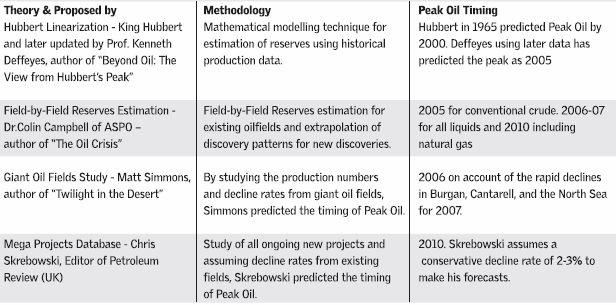
Given in the Table is a summary of the four theories that could be used to estimate the timing of peak oil.All four methodologies show a remarkable confluence in their predictions regarding the timing of peak oil.
China's expanding refining capacity will not lead to increased oil product exports - analyst
China's rapidly growing refining capacity is targeted at meeting soaring domestic demand, and as such is unlikely to lead to a significant increase in oil product exports before 2012, a senior consultant with Edinburgh-based energy consultancy, Wood Mackenzie, told Interfax at the 23rd Asia Pacific Petroleum Conference held in Singapore yesterday.
Asian Coal Prices May Rise 22% in 2008, Goldman Says
Japanese utilities may have to pay 22 percent more for Australian coal next year after South Korean buyers locked in supplies seven months early, anticipating a shortage, Goldman Sachs JBWere Pty. said.
US, China to reward North Korea with fuel aid
The United States and China are preparing to provide tens of millions of dollars in fuel aid to North Korea as it moves to declare and disable its nuclear weapons program, US officials said Thursday.
Possible Food Unrest in Central Asia
Harvest yields below projected levels combined with rising prices have analysts watching events in Central Asia, wondering if increased food prices might trigger civic protests.
Mexican Intelligence: Hugo Chavez equips and funds the Pemex pipeline bombers
The subversive group, the Revolutionary Popular Army (EPR), that claimed responsibility yesterday the attacks against six gas pipelines of state-owned Mexican Petroleum (PEMEX), is financed by the government of Hugo Chavez, according to a press report based on the Mexican intelligence service.
Mexican tax reform clears Senate committees
Another of the measures would allow state oil monopoly Pemex to keep more of its revenues from crude oil sales to reinvest in exploration and technology.Mexico wants to reduce its dependence on revenues from oil exports, which are faltering as yields slip at the country's biggest offshore oil field. Crude revenues currently fund about one-third of the federal budget.
FOR years, the world has grown increasingly aware of the risks of global warming. Companies, households and governments, you would think, have been stepping up action on "no regrets" measures to improve their energy efficiency, saving money and emissions at the same time.Not so. The International Energy Agency this week revealed the exact reverse. At least up to 2004, rising awareness that an environmental crisis could be about to hit us had far less impact on the decisions we made than the cattle prod of oil price hikes had in the 1970s and '80s.
Reaction time: climate change and the nuclear option
There is no objective truth about the future performance, cost and safety of nuclear reactors. There is a range of defensible opinions, as well as some that appear indefensible.
A series of bad blows -- high corn prices, intense commodity speculation, a shortage of "crushing" plants and excess production capacity -- have formed a "perfect storm" for the young Texas biodiesel industry.At least two small biodiesel production plants in Texas have already ceased operating for lack of feedstock, says an industry source, and it's likely that across the nation more will be shuttered, energy economists say.
Nepal: Petrol shortage no laughing matter

We’ve been here before. Endless lines of stationary cars sit nose to tail for mile after mile along the roadside. Massed ranks of motorcycles, in places five deep, spill out onto the highway, their hot and weary owners looking for a shady tree to rest beneath.Once more the Kathmandu valley is in the grip of a crippling fuel crisis. The Indian Oil Corporation (IOC) had already slashed Nepal’s fuel supply because of unpaid bills, but a tanker drivers’ strike that started nearly two weeks ago made things far worse.
...Nepal Oil Corporation (NOC) loses Rs 310 million each month on the heavily subsidised fuel, and also needs to pay Rs 250 million a month to settle past debts to Indian refineries, which now amount to Rs 4.2 billion.
Any one want to take bets on when we’ll be hitting $100 a barrel? It seems extreme right now (cool it, peak oil enthusiasts, we know you’re itching for the day). But, perhaps its not so far off - - oil prices have increased four fold since the year 2000. Throwing on another $20 a barrel doesn’t seem like such an improbability.
Oil Falls From a Record as Hurricane Weakens, Spares Platforms
The output increase is just "rhetoric," because OPEC may not have 500,000 barrels of spare capacity, especially as Persian Gulf suppliers are preparing for field maintenance, Matt Simmons, chairman of Houston-based Simmons & Co. International, said in an interview today.
Iraqi Kurds demand oil minister's resignation
Iraq's northern Kurdish administration has demanded Baghdad's oil minister be sacked, following his remarks that oil contracts signed by the regional government are "illegal."
Ecuador to Begin Oil Contract Renegotiations
Talks will begin with companies Andes Petroleum, Canadá Grande, Petrooriental, Repsol YPF and Perenco, which "have demonstrated their willingness to begin the process," minister Galo Chiriboga said.
Report: S. Korea plans two reactors
South Korea plans to build two light-water nuclear reactors by 2014 to plug its energy gap, Chosun Ilbo newspaper reported.
Compositesworld to launch north american composites trade event and conferences
In the morning, “Wind Energy – Preparing for Life after ‘Peak Oil,’” will be presented by Chris Red, editor and VP of Market Research for Composite Market Reports (Gilbert, Ariz.), with assistance from Chuck Segal, managing director of Omnia LLC (Raleigh, N.C.).
Oil heading for $150 super-spike?
Supply worries pushed oil to a record high of $80 a barrel this week, adding fuel to Investec fund manager Tim Guinness' predictions that a "supply crunch" could result in oil prices hitting $150 a barrel by 2010....Somehow it seems hard to believe that just three years ago Deutsche Bank analysts were forecasting a 2010 oil price of $24 a barrel. What were they thinking?
Crude oil gushing to the $90 milestone
Analysts at investment bank Goldman Sachs predicted yesterday that $95 was a real possibility, while other industry experts forecast $100-plus within three to five years.
Soil is the basis of the planetary terrestrial life. In the best of circumstances such as old growth forests and prairies, soil builds at the rate of one inch each three hundred to a thousand years. It is being exhausted and is eroding away. The way that the industrial system has continued to increase the food supply is by trading off soil fertility for fossil fuel energy through artificial fertilizers. Now, nearly half of the world’s people eat because of the added production of food caused by artificial fertilizers being injected into depleted soils and the use of all of the other accouterments of fossil- fueled industrial agriculture. Half of the planetary population are hanging out on a limb essentially eating petroleum! Now as the population continues to explode we reach peak oil and its decline.
Hopes Dim for Measures to Conserve Energy
The prospect of a comprehensive energy package’s emerging from Congress this fall is rapidly receding, held up by technical hurdles and policy disputes between the House and the Senate and within the parties.
Car weight limits a big, fat problem
Some motorists may be too big for their cars.The growing girth of Americans is colliding with government-mandated warning labels on all 2006 or newer cars that list the maximum weight — passengers and cargo — that's safe to carry.
Needy students given food for weekend
An estimated 12.4 million children live in U.S. households that were uncertain about having or could not get enough food at least part of the year, according to a survey by the Department of Agriculture. The number of low-income students receiving free lunches at school has increased from less than 3 million in 1969, when record-keeping began, to nearly 15 million last year.Those meals feed kids during the week, but teachers noticed some students hoarding food on Friday and coming to school lethargic and hungry on Monday. "Some were going to the dumpsters," says Rodney Bivens of the Regional Food Bank of Oklahoma.
Bivens began his program five years ago after a boy passed out at school one Monday morning. The principal found out the student had eaten nothing over the weekend but a hot dog without a bun.
Mexico rebels vow more attacks
A rebel group claiming responsibility for gas pipeline explosions that cost Mexican businesses millions of dollars said in a statement e-mailed to The Associated Press Thursday that the attacks will continue until authorities release two rebels they believe are in government custody.
Mexico oil bomb rebels in political, personal fight
The leftist rebels behind huge pipeline bombings in Mexico this week are from a small guerrilla group held together by family ties that has long personal and political grudges against the government.
Pemex Starts Work Repairing Pipelines
Mexican state oil monopoly Petroleos Mexicanos said Tuesday that it has started work repairing pipelines that were hit by explosions, and expects to restore natural gas supplies beginning next Sunday.The attacks on the pipelines early Monday, for which a leftist rebel group reportedly claimed responsibility, affected natural gas supplies to 10 states, shutting down thousands of factories, including major steel, glass and auto manufacturers.
Income gap closes in rural suburbs, Census says
Fast-growing suburbs sprouting on farmland near thriving metropolitan areas are much less likely to be home to people of widely disparate incomes than urban centers, according to Census data.In a nation that continues to see the gap between the very rich and the very poor widen, these new, remote suburbs stand out as islands of income equality.
Wisconsin's sights are set on Earth-friendly tourism
The Legacy Center is the latest of some 100 lodgings, restaurants, attractions and other tourism-related businesses to be certified by Travel Green Wisconsin, a statewide initiative launched earlier this year that's the first of its kind in the USA.
Ethanol boom, rising prices divide corn lobby
Corn farmers are pushing for more ethanol production as the industry creates an enormous new market for their crop, giving corn prices the kind of lift they haven’t seen in years. But the corn farmer’s win is the hog farmer’s loss. Meat, dairy, and other food producers are pushing back against the ethanol boom as higher grain prices cut into their already slim profit margins.
Toxic jatropha not magic biofuel crop, experts warn
Its nuts and leaves are toxic, requiring careful handling by farmers and at crushing plants, said experts at an oils and fats conference.In addition, it is a labour-intensive crop as each fruit ripens at a different time and needs to be harvested separately. Its productivity is also low and has yet to be stabilised.
Technology necessary for purely electric car remains elusive
Amid all the talk of replacing fossil fuels, there has been considerable misinformation about electric vehicles and batteries.
In Greenland, an interfaith rally for climate change
Standing on the bow of a passenger ship before the fast-melting Ilulissat glacier, religious leaders from around the world lowered their heads in a silent prayer for the future of the planet.
Study sees cities' air quality worsening
A study released Thursday predicts more bad air days in the summer for Cleveland, Columbus and eight other eastern U.S. cities if global warming continues unabated.
Earth's "vital signs" in bad shape: report
More wood was removed from forests in 2005 than ever before, one of many troubling environmental signs highlighted on Thursday in the Worldwatch Institute's annual check of the planet's health.
Climate change and desertification two sides of same coin
Climate change and desertification are two sides of the same coin and must be tackled together, according to participants at the Madrid conference on desertification.
Study: Cutbacks imperil climate research
The government's climate change research is threatened by spending cuts that will reduce scientists' observations from space and on the ground, a study says.
Contact
- Content: editors at theoildrum dot com
- Tech support: support at theoildrum dot com
License

This work is licensed under a Creative Commons Attribution-Share Alike 3.0 United States License.
A new Round-Up has been posted at TOD:Canada.
Today's Round-Up focuses on disappearing acts. First, out of $12 billion in $100 bills that were physically flown from the New York Fed to Baghdad, $9 billion are missing. Second, more of life on Earth is vanishing - the updated Red List of endangered species shows a large increase in species in critical condition.
In the world of finance, the next month is full of key moments, where debts will have to be covered, paper of various sorts matures, hedge funds will need to fork over lots of cash to investors who want out, and take-over deals will come under scrutiny. It looks like trillions of dollars could disappear from the markets before the end of the year.
And Greenspan had no idea. None. Now there's a mystery.
Billions over Baghdad
Under old news:
http://benfrank.net/patriots/news/national/pentagon_missing_trillions
"According to some estimates we cannot track $2.3 trillion in transactions," Rumsfeld admitted.
*whistles do de do de do*
And according to some estimates, there are still 3 trillion barrels of oil left in the world. Does that make it true?
For all we know, Rumsfeld's statement was "[According to some estimates, we cannot track $2.3 trillion in transactions, but that's ridiculous." Taken out of context and without knowing what the entire statement was, this is kind of meaningless.
For all we know, Rumsfeld's statement was "[According to some estimates, we cannot track $2.3 trillion in transactions, but that's ridiculous."
Tell ya what - why don't you go research the matter and let us know the context.
If it matches "but that's ridiculous." position.
Because that is not the take away *I* got on Sept 10th, 2001.
The "War on Bureaucracy" I believe it was.
http://www.defenselink.mil/speeches/speech.aspx?speechid=430
The technology revolution has transformed organizations across the private sector, but not ours, not fully, not yet. We are, as they say, tangled in our anchor chain. Our financial systems are decades old. According to some estimates, we cannot track $2.3 trillion in transactions. We cannot share information from floor to floor in this building because it's stored on dozens of technological systems that are inaccessible or incompatible.Eric--
Tell ya what--I'll concede the point. Now the context was that Rumsfeld was selling a position and the GAO came out a few months later and said there were about 1.1 trillion in 'undocumentable adjustments' [http://en.wikipedia.org/wiki/United_States_Department_of_Defense], so about half of Rumsfeld's number, but you are right, it is certainly not a 'but that's ridiculous' context.
Thanks for the 1.1 figure and the stat3ement about how we can't find it and are not gonna look for it.
More "missing money" here:
http://www.solari.com/learn/articles_missingmoney.htm
Word is that the weekly supply of cash to and from the New Orleans branch of the Federal Reserve comes in a white panel van with incognito armored SUV escorts.
But the Wednesday before the new $100 bills came out, I was riding the St. Charles streetcar when traffic was stopped by uniformed NOPD whilst an 18 wheel truck backed into the loading dock of the Federal Reserve. Perhaps a dozen serious looking guys in suits and attache cases walked around behind the perimeter and I spotted what looked like a sniper on the roof of the Federal Reserve.
Traffic was halted even after the truck entered the grounds of the Fed, for perhaps 15 minutes after.
*LOTS* of security for a furniture delivery.
Alan
An example of some of the improvements in metal making/processing.
Via:
http://www.urbansurvival.com/week.htm
The briefing happened when I was talking to one of my consulting client's customers - CyroScience Technologies Wolf Creek Racing Division. Offering the details of what the company does was owner Todd Walrich, who explained that when metal (and other) car parts are chilled to 300 below zero in a controlled environment, some permanent changes to the molecular alignment of the materials takes place. The 'grain' of materials (and even metal has a grain to it) becomes aligned.but most of them have their brakes cryo-treated. "What happens is the rotors and pads usually last from twice to three times longer than untreated parts," he explained. "We do the brakes and pads for about $90 an axle." The brakes get silky smooth and more predictable, besides lasting the life of the vehicle - if you can even get 150,000 miles out of it. A testimonial on his site claims 3=times the brake life under harsh SCCA racing conditions.Cryo treatment of metals has been going on for a very long ttime, I was involved with a project 10 years ago that used it and it seemed to be a well established contractor doing the work.
By the Buy, VERY energy intensive.
Don't forget...cryo treated musical instruments.
Cryo is also big in the audiophile aftermarket. Cables, mostly, but I've heard of cryoed vacuum tubes. Check out www.cryo-parts for the prices. I've been thinking about their silver wire, which isn't unreasonable compared to a lot of copper speaker cable you see these days.
A Truckstop Perspective
"How much are your cheapest cigarettes?" asked the young woman as she fished around in her purse.
I recited the bargain brand price.
"How much is your gas?"
I looked out the window (pointedly) at the big sign and read her the price.
"Hmmm, I guess I'll take the full-flavor 100s, then." She continued rummaging in her purse obliviously.
As I turned away to get the cigarettes I heard the distinctive clatter of a large handful of coins on the counter. Smiling dutifully, I set the pack next to the pile of coins and proceeded to count it out.
"This won't leave much for gas," I said finally, with as much concern as I could muster. "It won't even buy a half-gallon."
"That's okay," she chirped brightly, and snatched the pack from the counter. "Cigs before gas, always!" She flashed a smile and flounced out the door.
What an interesting thing to say, I thought as I began scooping the coins and depositing them in the register. I wonder which addiction will win out when things start to get difficult -- tobacco, or gasoline?
It was with an odd mixture of excitement and chagrin that I discovered three silver coins in her pile, and quickly bought them from the till. Maybe the tough times aren't so far away, after all.
I closed the drawer in time to watch her climb into her full-size pickup and drive off...
I wonder which addiction will win out when things start to get difficult -- tobacco, or gasoline?
That's a good one!
I enjoy your truck stop perspectives BTW.
Thanks! I enjoy writing them, and I'm glad someone enjoys reading them.
And as much as I enjoy Truck Stop Perspectives I would prefer to see the band that gave you your name back on tour ...
You'll get no argument here 8^)
4th row for Division Bell at their Ames, Iowa show ... delicious. And Momentary Lapse of Reason before that, but those years are a little fuzzy for me ...
I do as well ! :-)
Alan
With reading, I think NO's best exports are James Lee Burke novels.
It really is time to take Thomas Edison's advice (1910):
"Sunshine is spread out thin and so is electricity. Perhaps they are the same, Sunshine is a form of energy, and the winds and the tides are manifestations of energy.”
“Do we use them? Oh, no! We burn up wood and coal, as renters burn up the front fence for fuel. We live like squatters, not as if we owned the property.
“There must surely come a time when heat and power will be stored in unlimited quantities in every community, all gathered by natural forces. Electricity ought to be as cheap as oxygen...."
Historical Curiosity: I wonder what our world would look like today if Edison had teamed up with Eistein based on Einstein's 1905 proof of Quantum Mechanics based on the PhotoElectric Effect. Sunshine and electricity might cost nearly the same.
I've already saw that post here at DrumBeat, and resisted to answer.
I'd only like to point that sunshine is quite expensive nowadays. And headed to get even more so.
Enough already, mr Bill. We get it, you don't need to repeat ad nauseum the same post repply in whatever blog post here in TOD. Just because ppl don't repply to you doesn't mean they don't read it.
Yeah solar will save your soul.
Unless of course it doesn't.
Then again, why not?
Reality will tell. Future will say. For me, all the efforts are little, so please, go for it as badly as you can get.
The Oil Money Speaks: Iraq Is A Failed State
By Scarecrow on Fri Sep 14, 2007 at 07:30 am
Paul Krugman’s op ed today nails a key link between President Bush’s call to maintain a substantial permanent occupation force in Iraq and the expectations for Iraq’s future on which the occupation is premised. The occupation assumes not only that the surge has failed but that the Iraq national government has failed, and we must hold together a failed state indefinitely.
The key indicator, Krugman argues, is in the separate oil development contract Bush friend, Ray L. Hunt of Hunt oil signed with the independent Kurdish Province. The Hunt/Kurdish oil deal came just as Iraqi discussions of the Administration’s repeatedly hyped oil law “agreement” collapsed.
Some commentators have expressed surprise at the fact that a businessman with very close ties to the White House is undermining U.S. policy. But that isn’t all that surprising, given this administration’s history. Remember, Halliburton was still signing business deals with Iran years after Mr. Bush declared Iran a member of the “axis of evil.”
No, what’s interesting about this deal is the fact that Mr. Hunt, thanks to his policy position, is presumably as well-informed about the actual state of affairs in Iraq as anyone in the business world can be. By putting his money into a deal with the Kurds, despite Baghdad’s disapproval, he’s essentially betting that the Iraqi government — which hasn’t met a single one of the major benchmarks Mr. Bush laid out in January — won’t get its act together. Indeed, he’s effectively betting against the survival of Iraq as a nation in any meaningful sense of the term.
The smart money, then, knows that the surge has failed, that the war is lost, and that Iraq is going the way of Yugoslavia. And I suspect that most people in the Bush administration — maybe even Mr. Bush himself — know this, too.
So while the President told the nation last night that our troops will remain in Iraq until they achieve success, his oil buddies are already signaling that Iraq is a failed state that will require our presence indefinitely. And the only thing Bush has left to do is to make sure the Democrats get blamed for his failure:
At this point, Mr. Bush is looking forward to replaying the political aftermath of Vietnam, in which the right wing eventually achieved a rewriting of history that would have made George Orwell proud, convincing millions of Americans that our soldiers had victory in their grasp but were stabbed in the back by the peaceniks back home.
What all this means is that the next president, even as he or she tries to extricate us from Iraq — and prevent the country’s breakup from turning into a regional war — will have to deal with constant sniping from the people who lied us into an unnecessary war, then lost the war they started, but will never, ever, take responsibility for their failures.
We are only 18 months away — and another 1000 or so US troop deaths — from Mission Accomplished.
Thanks for posting this, hightrekker. I was about to do same so you saved me some work. The column by Paul Krugman in today's NYT is here.
A wealth of things to snip, but then I'd have to give you the whole column, so here's just one.
If you plan to "lose" a war, are you still losing it? There is a playbook from 2003 somewhere that someone is very proud of. It works better even than anyone could have dreamed it would.
.
".. we must hold together a failed state indefinitely..."
You got that right. And that requires 150.000 troops, give or take 500.000.
Every soldier that has come back from a tour of duty in Iraq that I have talked to, when I've asked them if they thought that Iraq would end up as one country or three, has always replied "Three".
Iraq as a unified country makes about as much sense as those other historic paragons of unity, like Yugoslavia, USSR, and W + E Pakistan.
"But we can't let them partition, there would be a bloodbath, just like India/Pakistan!" Right. And nobody ever stops to consider what the Indian subcontinent would have looked like if the Brits had insisted on setting India lose as a unitary state. Might it not have ended up looking something quite a bit like Iraq looks today, perhaps? All the way up to the present moment, perhaps?
When peoples hate each other so much that they want to kill each other, then giving them their own separate countries with a border to separate them makes a good deal of sense for the long run, even if it is very messy in the short run..
hightrekker, what makes you think that the war has been achieved it's aims? There is sufficient evidence to show that the partitioning of Iraq and it's descent into chaos is the planned result. Now, I'm not suggesting that George had this objective - his interest was exemplified by that moment of petty triumph on that carrier. The architects are cynical men whose aim was the dismantlement of the state and subjugation of the rights of the people to their own interests, which by the way, coincide with those of another much smaller Middle Eastern state.
-
James Gervais
merely a means to facilitate the looting of the treasury.
Historical Curiosity: I wonder what our world would look like today if Edison had teamed up with Eistein based on Einstein's 1905 proof of Quantum Mechanics based on the PhotoElectric Effect.
It would look about the same as it does today. Bell Labs was well onto photoelectric devices and their scientific and technological capabilities were much more advanced than Edison's.
Simply put the same fundamental physics limits solar energy then and now: thermodynamics of energy density. Sunlight simply is very poor at this.
No technology can get around this limiting geophysical fact about the Sun's illumination and spectrum.
Clients Ignore Bank's Plea For Calm
Does UK have the equivalent of the FDIC insurance?
I think so. The article said something about the government bailing them out.
I have my doubts about FDIC insurance. It's never really been tested in today's global economy. If a big bank fails, like Citibank or Morgan Stanley, will the government really be able to bail them out?
I am sure the FDIC will come through. It is really easy to print money. The problem is how long would it take to get your money back? You could lose your home, car and have your utilities turned off before the government gets around to mailing you your check.
And, of course, by the time they finish printing that money...you will have lost most of its value due to rampant INFLATION!!!
Can anyone say PESO?!
I spoke with a reliable source today who said the UK government underwirtes 95P in the £ up to £25,000. ie. 95% of not very much. I stand to be corrected.
It has been a bizzare day on the UK market. Northern Rock - one of the UK's biggest mortgage banks, a member of the FOOTSIE - but still a tidly company was down 31% today (mkt cap is now less than £2billion - but it controls 10s of billions of assets). Other banks thought to be exposed were hammered and house builders also took a beating - 10%+ losses.
Midday the FOOTSIE looked like cratering - but ended the day just 1.2% down - big deal!
The news sites are saying they hope the problem with the banks doesn't spill over into the real economy! WTF - I thougt the banks were at the heart of the real economy.
The FOOTSIE is heavily weighted towards Commodities, Banks, Pharmers and Telecoms.
I don't think they know where the "Real economy" is any more.
Think back to the S&L fiasco of the late 80s to early 90s. Bill Seidman was Papa Bush's point manon the bailout. Even though accounts were only insured up to $100k Seidman made sure every penny of every account was paid in full with some folks getting millions above the insured amount. It was estimated at the time that the bailout was more then 50% of the then record federal deficit. No reason why it couldn't happen again.
But you "won't" get back all your "buying power".
Good info at calculatedrisk.blogspot.com, especially some of the comments.
And no, Great Britain does not have something like the FDIC, and for depositors with any funds over 35,000 pounds, they can lose all their money above that limit.
Which makes someone pulling out a six figure sum in this case utterly and completely rational - which is just one of the problems in terms of a bank run.
The 'bailout' was simply in extending loans - the institution will likely prove a major problem if it fails.
As for the FDIC - again, according to co-blogger Tanta at Calculated Risk, they hand out checks, which are good at any other bank - at least until no one accepts checks from any U.S. government backed source. Which will be a long time, I'll wager.
And no, Great Britain does not have something like the FDIC, and for depositors with any funds over 35,000 pounds, they can lose all their money above that limit.
Does it mean that depositors are protected upto 35,000 pounds?
In which case, they do have the equivalent of FDIC insurance, albeit with a limit that is lower than the US.
It won't be lower for much longer, if the dollar keeps going the way it's going. ;-)
I don't know, a good bank run or two will leave the pound sterling scraping gutter pay dirt too.
Then again, if the US government really starts writing those FDIC checks, they'll have lost half their value by the time you reach the cashier at the bank.
Not that the plan writing checks would work. Where would you deposit or cash that check? Not at the bank that just blew up on you, and most likely not at the bank next door either. Why trust them? You're going to want cash or gold. And nobody has any of that. That's after all how this whole problem started. Fractional banking and leveraged risk.
Another problem with FDIC hand-outs is that once you start applying them there's no way back, you'll have to write checks for some 50 million accounts pretty fast, you'd just speed up and encourage bank runs, while murdering the value of the dollar, and increasing the federal deficit by trillions of dollars. Makes little sense.
In case of bank runs, I'd expect the Fed to do what Argentina did 5 years ago: freeze all acoounts, and allow a $200 withdrawal once every 2 weeks. At the same time they'll make sure banks don't fail, so the whole FDIC issue is moot to begin with.
You'll be told your money is safe, but you can't get it right away. If it gets real bad, and chances are, the dollar will be de-valued by 50-80%, and that's what you will lose from the savings you no longer have access to.
I don't know what you're talking about. I can take that FDIC check to another bank, and instead of depositing it, I can just cash it out right then. And when the bank tells me they don't have the cash just then, I'll get another FDIC check to cover it. I don't see the problem.
You don't see the possibility of infinite recursion there? You could wind up with a check that nobody can cash at which point it's just toilet paper, and scratchy TP at that. Also, what makes you think that a bank has to cash a check from the FDIC? They may require that you deposit it and wait for it to clear. You can try to withdraw the money after the money transfers from the government to the bank, but then we wind up back in that recursion loop again.
- Scott
"Try sour grapes; you might like them."
There are approximately $266 cash money in paper and coins per capita in the US. That's why runs on the banks are possible.
Sure, the Treasury can print new bills very quickly, but the vast, vast majority of the money used for economic transactions is in electronic form. There is a limit to how fast new Federal Reserve Notes can be printed.
So any crisis in confidence - regardless of the FDIC or fiat printing presses running 24/7 - will crash the economy if we each try to get our $266 out of the bank and try to run the econmy on just that amount.
How many people would accept a bank payout that was completely spendable but only as plastic? So few transactions are done via cash at this point anyway... Would a failure of confidence go far enough to break that?
Y'know, that's an interesting point. Has there ever been a bank run in a nation with ubiquitous credit-card use as we have in the USA today?
Could the government just mandate that credit transactions continue, or what? Would a modern crisis-of-confidence play out as a refusal by merchants to accept credit cards?
Or would there be a bank run on savings institutions while credit cards kept working?
hmmm..
Boy, I can hear the griping already. A lot of people strongly oppose electronic money. They think it's a plot, to let the government to crack down on under the table transactions and other tax dodges. It's right up there with the national ID card.
Hello Leanan,
I think it is worse than that. Only $266 & coin/capita in holdable currency? Yikes--Wasn't it Dimitry Orlov that urges everyone to go to the bank first thing, or else keep some folding money hidden at home? From memory, I think he said that this was more important than hitting the gas-station or grocery store.
When the Olduvai power goes down: credit cards, ATMs, paper cheques, money orders, and computers will be worthless for financial transactions. Grocery stores will pull out the mechanical cash registers, and banks will have to go back to paper ledgers and hand-pulled keypad calculators to conduct cash business only.
Bob Shaw in Phx,Az Are Humans Smarter than Yeast?
Hi Bob,
in the UK we usually have a £200 limit per day current account 'real cash' withdrawal from an ATM machine.
Cheques and electronic payments are not limited to £200 per day.
Since the ATM machines service many banks, the rate of withdrawal is limited - they will run dry quickly [restocked daily I guess]. Finding a real bank anywhere, open at a time when you are not at work is pretty rare nowadays. I guess only 20% of the UK adult pop could get to a branch fast without major inconvenience/time off work.
I have been withdrawing £200 chunks for some time now...just so someone else can have my place in the queue.
Also bringing forward useful financial burdens like overpaying the mortgage, paying builders for new windows etc. I want my account to be as empty as is sensible for the next year-ish [with useful things to show for it]. I would go for the rice/beans/toilet paper stockpiling thing, but my missuss thinks I'm off the scale anyway. Those photos of savers queuing to withdraw got her back on song yesterday though...
cheers all
Well, the 'does not have' is based on some pretty important details - for example, it is not really a government agency, the 'fully' insured amount is 2000 pounds, from 2001 - 35000 pounds there is a 10% loss (assuming all goes well), meaning that everything above 2000 pounds is perhaps better seen as backstopped.
The FDIC is essentially there not to stop a bank run, but to make one meaningless when it occurs, thus stopping an landslide by blocking the first stone. And since the federal government has essentially infinite dollars, the FDIC can stop any landslide by catching every falling stone.
The British (or other European) institutions are essentially insurance pools funded among the banks. Unfortunately, these pools are of quite finite size, and there is no way for them to deal with multiple bank runs.
A lot of people are likely to discover these technicalities in the next period of time. And unlike peak oil, since this is pure economics and history, people will grasp the salient points quite rapidly - grab the cash.
BBC has a photo:
A good old-fashioned run on the bank, that's what that is.
Hello Leanan,
Thxs for the scary photo! Since liquidity is seizing up by the anal-retentive actions of 'casino-fractional bankers' worldwide: recall my earlier postings calling for the key govt. banks to team up with the real gaming casinos to covertly change the gaming odds of slots, keno, and other lotteries; thereby instantly pumping multibillions into the lower levels of the economy which will vastly increase money turnover velocity and liquidity again. Lots of winners everywhere as this economically trickles upstream!!
Although I am not an economist, it seems like a much better way to release money with less perceived and more delayed inflationary expectations than Bernanke's plan of helicopter cash dispersals. His plan will essentially make the cash worthless as soon as it flutters down to the ground.
Lots of newly enriched casino and lottery winners will rush out to pay credit card bills and late house payments, then buy the big-screen plasma HDTV of their dreams, new Hummers, and plastic surgery for the whole family-- the economic cycle can be easily restored one more time for the final 'something for nothing' growth blowout phase. Wheelbarrow sales will skyrocket as lots of happy gamers push the piles of cash out to their SUVs for their next shopping extravaganza.
Then when this final blowout inevitably goes bad: if we had been stockpiling NPK fertilizers as earlier suggested by me, the last bank-run withdrawals from the local bank could have been those multimillions of wheelbarrows stacked high with easily-tradeable sacks of fertilizer instead of worthless cash or gold. Instant liquidity in a barter system for the next phase. Such is life.
Bob Shaw in Phx,Az Are Humans Smarter than Yeast?
I was over at the couny seat this morning and cow manure at the Alco's was $1.99 per cu ft. With it all dried out and hermetically sealed it could be indefinitely stored. Then again across the road from me is the auction barn where I might get it fresh each week for pennies per pound. I'd have to do the composting and bagging myself which the owner of the trailer park I'm in might object to. I wonder if cow shit is traded on the Merc in Chicago?
NYSE seems to have a market for that substance ...
http://finance.yahoo.com/q?s=CFC&d=t
Hello Thomas Deplume,
Thxs for responding.
Your Quote: "I wonder if cow shit is traded on the Merc in Chicago?"
I bet it soon will be once people realize how valuable any compostable biomass is in relation to postPeak topsoil health. More likely: local auctions, with fevered bidding wars for worm casings, bird & bat guano, pig manure, municipal Humanure, ground bone meal from scavenged graveyards, extracted mausoleum cremation residues, autumn leaves & old phonebooks & corncobs for toilet paper, etc, etc.
IF mined & processed NPK goes back to $10,500 ton [recall prior posting], or even higher: it will become fully legal to shoot anyone you catch looting your compost pit, NPK stockpile, or garden.
Catching a thief trying to steal your wheelbarrow will legally empower you to chain him to the tool, then work him to death like an 'energy-slave'. Instead of our present day ease of flipping a switch or pushing a remote, you get to enjoy the relaxing experience of kicking back while you watch him work for a sip of water and a crust of bread.
Not currently morally correct [and I hope things never get that bad here in the USA], but it just might drastically change that much postPeak. Recall the Chinese brickmaker 'energy-slaves' that were recently rescued. Is Halliburton buying millions of wheelbarrows and handcuffs for the workcamps?
Bob Shaw in Phx,Az Are Humans Smarter than Yeast?
Reminiscent of the panic of 1907. I just finished the book - "The Panic of 1907-Lessons Learned from the Market's Perfect Storm" by Bruner and Carr. It's a timely read.
Platinum-free and Hydrogen-free fuel cell developed in Japan
This could be a major breakthrough. It could use cobalt or nickel instead of platinum AND uses hydrazine hydrate instead of hydrogen !!! It is being developed by a division of Toyota. See full story: New Fuel Cell
COBALT!!!!! WTF! The russians were going to use cobalt-jacketed hydrogen bombs for a doomsday device. Kill all life on earth. Now toyota wants to put that in cars?? What happens iff it gets in a wreck and explodes?
It just gets worse around here....
It is only radioactive isotopes of cobalt that are dangerous, not "regular" cobalt itself. Cobalt is part of the natural B-12 vitamin, for instance. There is nothing inherently dangerous about cobalt that is not equally true of other metals. While cobalt appears in vitamin B-12, in large doses it can be mildly toxic.
Most isotopes of cobalt last mere seconds. The one stable radioactive isotope, cobalt-60, is dangerous because it is a huge emitter of gamma rays. This is the danger of incorporating cobalt into a nuclear weapon.
"The greatest shortcoming of the human race is our inability to understand the exponential function." -- Dr. Albert Bartlett
Into the Grey Zone
CHILL OUT!!!!!!
Cobalt (the stable isotope that is used in all industrial applications except those requiring radiation) isn't any more dangerous than other transition metals used for catalysis (rhodium, ruthenium, etc.).
What you seem to be fearing is:
which isn't any more likely if Co is used in your car.
The bombs were to use radioactive cobalt isotopes - about as much to do with ordinary cobalt as radioactive tritium has with the hydrogen of which all water is composed. What we need to be concerned about is heavy-metal contamination. But that might also apply to the "non-radioactive" depleted uranium that our troops use and are exposed to.
Cobalt 60 is a high-energy gamma ray emitter. Acute high-dose exposures to the gamma emissions, such as can occur when irradiation equipment is inadvertently diverted into scrap, can cause severe burns and death. Extended exposures increase the risk of morbidity or mortality from cancer.[4]
Maybe the car will be made out of lead.
But Cobalt 60 wouldn't be in your car, but rather Cobalt 59. Perhaps if you're packing serious heat (thermonuclear device) you could become a dirty car bomber, but there are probably easier ways to do that.
I thought the first post was snark but now I'm starting to wonder, Mr. Korg Sir ...
Ionizing radiation is the problem - gamma and neutrons will zip right through you causing much mischief along the way. Beta is just a fast electron - enough of them can burn you, but low doses are fine. Alpha emitters are harmless if they're outside your body but they're a great big problem when they're inside.
All elements except for the very lightest ones have isotopes that are radioactive. Some cook off quickly while others hang around. The cobalt60 from the bomb detonations come from plain ol' cobalt catching neutrons during the blast ... otherwise cobalt is just another metal.
Carbon and oxygen can be radioactive and get that way from cosmic rays. Coal is 1ppm to 13ppm uranium ... we put that into the air and if it catches a neutron in a cosmic ray shower ... plutonium!
Radiation can be harmful. We have a lot of people in this country who are quite fearful of anything involving radiation, even though its a very common phenomenon.
catches a neutron in a cosmic ray shower ... plutonium!
Ahhh, so that is how all Karen Silkwood or the Sellafield workers got plutonium in her tissue - because we all know how safe nuclear isotope processing is.
More snark :-) I wasn't kidding.
Coal is 1ppm to 13ppm uranium. Natural uranium is 0.7% bomb grade U-235 and 99.3% stable U-238. I did the math on it some time ago and if we weren't catching fly ash we'd be putting something like 25 tons of bomb grade uranium in the air every year and a whole bunch of U-238 as well. The U-238 to plutonium cycle isn't well known, but it does exist :-)
One can only hope the lungs of antinuclear activists catch a bit more uranium and thorium laden fly ash than the rest of us ...
http://www.ornl.gov/info/ornlreview/rev26-34/text/colmain.html
The title of the article at the link is "Coal Combustion: Nuclear Resource or Danger by Alex Gabbard".
Alex Gabbard works for Oak Ridge National Laboratory , as the leader of the High Temperature Fuel Behavior Group in the Nuclear Fuel Materials Section of ORNL's Metals and Ceramics Division. He is a principal investigator for the Laboratory's Nuclear Energy Program.
Mr. Gabbard, as he says in the article, thinks coal power is bad and nuclear power is good.
The article is spacious and coherent. He might have a bit of an agenda but he is a fact checking, scientific type. The other resources are not so well arranged ... I can hunt down citations if there is any doubt to the "truthiness approaching unity" in this publication ...
He might have a bit of an agenda but he is a fact checking, scientific type
I don't have a problem with an agenda - if you are using real data.
The ARGUMENT here of 'Oh yea, well they release more during operation' is the same framing of 'pick the lesser of 2 evils'
Hydrazine hydrate? HYDRAZINE hydrate! They gotta be joking!
http://en.wikipedia.org/wild/Hydrazine
In small doses hydazine is merely an irritant and carcinogen. Larger doses inhaled or absorbed through the skin are quickly fatal. An accidental hydrazine exposure KILLED a Nobel Prize-winnner chemist.
This has got to be some kind of practical joke!
PLAN, PLANt, PLANet
Errol in Miami
On: “Texas biodiesel low on fuel?” :
see article:
Ethanol Reduces Government Support for U.S. Feed Grain Sector
by Linwood Hoffman, April 2007, USDA.
link
for a quick glimpse, see graphic :
link
Dow, Monsanto to Modify Eight Genes in Corn Seed
http://www.bloomberg.com/apps/news?pid=20601087&sid=a142ry4nNfNM&refer=home
"Dow and Monsanto said they will ask the U.S. Environmental Protection Agency to lift a requirement that growers of insect- resistant corn also plant a portion of their land with conventional corn..."
This tech is far too untested to continue willy-nilly introductions. Gould may have convinced us of saltation in evolution, but still, it is introduced slowly in comparison. Our new Burgess Shale.
I love the article that quotes Mr. Simmons:
What will he say when production does increase by 500,000 barrels? I bet the conspiracy theorist will have a field day with where this oil is coming from :P
Just using the word "conspiracy" proves your point. You shouldn't bother typing any other words, just type "conspiracy" over and over.
Oh come on. KSA increased its production long ago to keep oil within KSA's preferred price band of $22 to $28. Their successful efforts to keep oil in that band since 2002, combined with the phenomenal success of both the American invasion of Iraq and the introduction of option ARM financing across the Middle East has transformed the world, and made possible the imposition of a world-wide "flat tax" of 6%, to replace all other taxes. Must go on, must continue snark, can't stop....
Don't worry, BrianT. I will bookmark this post, and remind you of it when the time comes, which will be sometime mid November when people come out of the woodworks proclaiming that the oil is really the Iraqis, or perhaps from the UAE which explains why their production is dropping, or other such nonsense!!
On a serious note: Mr. Simmons is going to look ESPECIALLY foolish in November. BTW, has anyone invested in his silver bullet seaweed for biodiesel company? He says its a winner!!!
And if OPEC's production is flat or lower in November, will you go away?
I don't think PartyGuy is all that bad. Besides, if OPEC's production is flat or lower in November, we will all want him around so we can make extra fun of him (as in, more than usual).
I agree Leanan, this fool has never backed up any of his rediculous BS with even a single link or documentation. The poster is just a troll that couldn't present a logical defence of a position if his life depended on it. I'm tired of his crap.
I apologize for the length of this post but all this needs to be said. Maybe there are even a few people left who are open-minded enough to read it.
By the way, OPEC's production will be flat or lower in November because of the UAE field upgrades. The question is what happens thereafter. If OPEC production rises in December and beyond, then it's not "rhetoric" as Matt says.
Why must there always be two extreme polarized positions in this peak oil debate?
Why must the world always be black or white?
I have a scenario, reasonable in my view, that sees the world topping out at somewhere over 87 to 88 million barrels a day (all liquids) in about 4 years. There may be a dozen or more independent variables that must be fixed to get that result. Geopolitical variables,OPEC variables, price variables, inflation variables, other demand-side variables, upstream variables, substitution (for oil) variables, etc. See the problem? My reasonable scenario could be off in either direction, perhaps very badly.
I'll give you an example. Do you know that the IEA has forecast demand in the 4th quarter of this year at 88 million barrels per day. Now, that's just nuts, way over the top.
Here's an example of what I'm talking about. The End of Oil (CNN Money).
Rich doesn't know that oil production peaked in May, 2005 for sure. Some people told him it did, or he looked at the EIA numbers and decided that was it. Now he's taking the ball and running with it. Did oil peak in May, 2005? Maybe, maybe not. Reserves overstated? Probably, but maybe not. These are open questions. And now the other side: This guy is appealing to technology which hasn't been invented yet. Peak oil is crap? Does he think I'm too stupid to analyze the oil supply? Why did he just insult me? I don't even know the guy. But he's right about one thing: there's a lot of sensationalist fear mongering going on. What he neglected to say is there's a lot of hopelessly unrealistic nonsense from the optimists. When EIA says the world will consume 118 million barrels a day in 2030, and Rich says "that's never going to happen," he is most certainly right.But suppose my scenario is correct. That would entail that the oil supply would continue to increase for a few more years. That doesn't negate peak oil—it still arrives. It's just a bit later than many think. Does 4 years and 2 to 3 million barrels a day matter? Not at all. If conventional oil reserves are few hundred billion barrels higher than some people think they are, does it matter? Not at all.
When the peak oil debate takes its usual polarized form, it impoverishes us all.
I generally apologize to anyone I have insulted on this weblog. But I'll tell you the reason why—all these extreme statements coming from both sides of the debate just make me crazy. It's hard to stay sane. And because oil is the lifeblood of the world's economies, it makes everybody extra crazy, including me.
Dave
Yeah, well, that's why PartyGuy is fast moving to the top of the ban list. It's not his point of view. It's the way he expresses it. Almost everything he says has a juvenile, "Nyah-nyah-nyah" tone. Which of course ticks people off, even those who agree with him.
Unpleasant as he may seem to you, you need people like him. Without those elements, a group like on TOD can take themselves too seriously and get too into their groupthink. Ever thought of banning Korg or Cid? I find PartyGuy no more ridiculous than them, and I often appreciate the way he gets some posters here to better express their arguments.
Yes.
lol, touche. Still, I hope you don't ban any of them.
What?!?! Outrageous! :)
I see my role here as very valuable. I try to get alor of you super-brains here to see things from the average joe perspective. I know the average joe perspective because I work among them everyday in my job. I go from the super wealthy homes to the dirt poor homes every day. I see things most of you wouldn't believe, and its here in America!
I can tell you this: I predict that most off you will be schocked at how fast things change from business-as-usual to anger, riots, and general mayhem. The public has no clue, not one, that oil is finite, that it will run out, and that Everything depends on it. They believe things are going to "work out" OK because they always have. I would say that this time next year, or sooner if we attack Iran, the public will be up in arms about gas prices like the 1970's and if they ever get whiff of the finiteness of oil the herd will turn and it will get nasty.
Wars have been fought over less then oil...
Please tell me the average Joe doesn't believe George W. Bush was steering Hurricane Gonu.
The average Joe doesn't even know about Gonu or anything else outside of "Entertainment Tonight" on TV. They don't care, until you tell them they can't get gas that is...
Wars have been fought over less then oil...
War of Jenkin's Ear
http://en.wikipedia.org/wiki/War_of_Jenkins'_Ear
Yes, {sigh}
Alan
I can tell you this: I predict that most off you will be schocked at how fast things change from business-as-usual to anger, riots, and general mayhem.
Not at all. Tell ya what - share the insight of when and where that will happen so we can attempt to afford protection(s) for ourselves mkay?
gotta disagree with the you need people like him argument
you avoid groupthink by having diverse opinions expressed and discussed - pointless nonsense just takes away from it
if he grew up and made a point and argued a case people wouldn't get pissed off i don't think
--
All these memories will be lost in time
like tears in rain
THANK YOU!!!
TOD is so overdue for another house cleaning
Dave,
I am always pleased when you post. But it how do you argue that conventional oil has not peaked when we see massive investment in tar sand?
If there was ever a coal-mine-canary for peak oil, I'd nominate the tar sands. Why would anyone place billions of dollars on the table and face uncertain NG supplies and significant water limitations UNLESS they absolutely needed to book reserves?
The international oil companies are running to the tar sands because they have been excluded from working in so many places. They refer to this as the "access" problem. Russia is kicking them out. They can't work the Persian Gulf countries, mostly. Venezuela just changed the deal in the Orinoco. 3 companies left rather than agree to the new terms. The tar sands are another alternative for them to pursue like the ultra-deepwater. (And they are having problems there.) In general, the fact that the world is developing the tar sands is an indicator of peak oil sooner than later. It is definitely a sign of desperation.
Dave: The "senior energy analyst" (salesman) Gheit neglected to mention that these huge fields of oil will become profitable to extract specifically because the other fields have depleted. A teetertotter is not an airplane.
It's better that society prepare now for such an energy flux, even if the peak is not yet in your rear view mirror. That being said, I don't believe Heinberg's statements are extreme. OTOH,
We all know what's been said about someone understanding a concept when their stipends depend on them not understanding it.
Thanks, Dave.
I'm with you all the way on this one.
The oil scene is a bit of a Rorschach test right now, except that there is a reality to it which will be known, but only well after the fact. I believe as you have indicated that the truth is literally impossible to percieve right now - too many variables unknown or that can change unpredictably.
And most important, a few years changes very little in the long run.
Dave--
OPEC decreased the quotas by 1.2 mbpd effective Nov. 1 2006. According to their production numbers however, they only decreased actual production less than 400k. They decreased the quota by 500k in Feb 2007, but according to their production numbers, the decrease never took effect. Presumably that is the source of the 'target' of 27.253, that they are adding another 500k to the current production (rather than to current quota levels). But they were producting north of 27 back in October, so even with declines, they should be able to reach that again.
But it is interesting to track production declines which seem to lead quota declines. They had 28m as their quota through Oct '06, but production fell steadily from 28.332 in Sept '05 to around 27.420 in Oct '06. The quota was dropped from 28 to 26.800 which was pretty much followed until the additional 500k quota drop in Feb '07.
On a different note, why don't they ever use the phrase "hope-mongering"? It seems just as bad or could actually be much worse since it prevents people from preparing what may well befall.
If hope-mongering is bad then what about peace-mongering?
Dave thanks for the typical well reasoned post on your part. I listened to Chris Skrebowsky's interview and he also made a point that the UAE would be down for maintenance and the 600,000 plus barrels per day in November and therefore the 500,000 increase would not materialize actually until December and not hit our shores until January and not the finished product pipes until maybe February. He is pretty much in agreement with you assuming that projects start as now promised as far as the peak. Fadel Gheit has no cred with me I have been listening to his speel for to long and wonder what orifice he keeps sticking his head in.
Have a question for you and maybe you don't feel this is your area of expertise but I keep hearing the bear chorus claiming the fundamentals don't justify the $80 dollar price. What say you?
it seems to me that gheit is implying that drilling more wells in a depleted oil field will somehow increase recovery above the 30 to 40% quoted.
and recently an aquaintance told me that there was plenty of oil........he had driven through texas, oklahoma, kansas, nebraska, colorado and wyoming and everywhere there were oil wells sitting idle.
That depends on how you characterize 'flat or lower' and the circumstances involved. If there is an accident or terrorist attack, does that count? What about the massive planned maintenance in UAE? Will that count? Lets keep this in perspective, shall we?
If KSA production is lower in November(We'll know in December/January?), IE they can't increase their production, I will leave. Simple as that.
On the flip side, what happens with me if it is? :)
Complications go both ways though. Their quota raise supposedly goes into effect in November, so that is when we can righly expect the increase to happen, regardless of other predictable factors (like UAE maintenance). Stuff like that absolutely should be accounted for by them.
Terrorist attacks can also play both sides - the peak oilers say, that's how peak oil plays out, the cornucopian side says, there's no peak, there's just above-ground factors. Only time can tell.
Which is also important, time - if a 500,000 mbp increase only lasts 4 months and then the start falling again, does that not tell us it's just a case of having a surge capacity, rather than true excess capacity? Maybe.
WT at least is very consistent in looking at the longer term numbers rather than month-to-month numbers.
You should not leave no matter what in December if you are interested in this topic. It is no sin to be wrong. I think you're wrong, but I have nothing against you.
This sounds fantastically like Bush massaging the body count in Iraq to earn himself another Friedman Unit.
Bush is always wrong about Iraq, and he always changes the goalpost to say he scored. We are now governed by people trying to hold onto their power for a week at a time - aided by their cult of media flacks and internet trolls. Are we not ruled by GOP talking points from week to week on the following issues?
Mortgage meltdown - government, Fed, banking elite coordinating funny money and funny data to hide a shakeout that any real conservative economist will tell you is structurally inevitable
Troop exhaustion - government and generals coordinating desperate, politically-timed bonuses to literally get enough graduating high-schoolers to forego delayed entry to bail out the surge, while the first local newspaper stories are appearing about abnormal cancers in the current troops.
Global warming - the bad guys laid out multiple trenches to defend on this issue long ago, on Big Tobacco principles, but now they're ready to just make enough concessions on carbon emissions to get through another summer. Hey, if you were wrong that CO2 wasn't rising, and that it wouldn't have effects, and that it wouldn't have effects that hurt Americans, and that it wouldn't have effects that hurt white Americans, and that their hurt is made up for by our healthy right-wing economy, then what's left?
Scandalgate - my God, they're actually relying on GOP congressmen getting busted for solicitation to take the public's mind off the destruction of the Constitution. Successfully.
The world - we're losing three civil wars, including one in Pakistan that we don't even admit exists.
Folks, these are not sustainable conditions. They're all designed to hold the system together for a certain length of time. Then something is expected to happen. Will it be a last-second ransacking by all the elites we call the Powers That Be? Or will they bomb Iran, cancel our elections, and just say, "You need us, what can you do about us?"
So one could make a case to keep PartyGuy talking for all the Tobacco Institute-style harm he does. If he is part of an organized effort by a tyrannical, threatened regime, then what sort of statements would he make if his Talking Points were coming from mere thieves, versus traitors? Is he just tasked to attack Peak Oil issues? What will he be saying one month, one week, one day before Bush declares emergency rule?
The reason I'm sure he's not just a genuine right-winger expressing his own opinions: the guy is specifically gloating that the anti-American, Wahhabist tyranny of Saudi Arabia is supposed to be able to keep sellling us more oil! Does that sound like any Republican you personally know? Or any good American, liberal or conservative?
And if OPEC's production is flat or lower in November, will you go away?
Naw. And if things go TU on Dec - PartyGuy won't go 'oh, looks like they were right - only a month late.
OPEC says Saudis to assume almost two-thirds of output hike
tod has been expecting a (likely temporary) boost in sa production this fall because a new project is scheduled to start up. SA made most of the cuts, now making most of the increase; quite consistent with all flat out, sa in decline with stops on the way down as new, smaller, projects start up.
http://www.hydrocarbons-technology.com/projects/saudi-aramco/
I noticed that the way OPEC allocated their 500,000 barrel increase included supply increases from Iran and Venezuela. I think both those countries have peaked.
Venezuela certainly has not peaked, unless, of course, its peak mismanagement :P
According to IEA, Venezuela is a million barrels per day below July 1997 - 10 years ago and has shown a pretty steady decline since. Do you have any proof of your confident assertion (I'm open to data).
The real laugher was Indonesia since they are now an importer.(According to what Ace posted the other day). What are they going to do import and then export oil from the KSA? Some of this doesn't seem to gin.
Yes.
Both Indonesia and UK produce mostly high grade oil, some of which is exported. They import lower grade crude and oil products (bunker for example).
Net negative by volume, perhaps still positive by $ value.
Alan
Waiting for the price rise, if it's your stock portfolio, is not seen as mismanagement.
peak mismanagement ? that would be bush's handling on anything. hugo chaves is a fricen' genius compared to mr doofus president, your hero.
Except Bush is not my 'hero'. Project much?
The NPC report (TOD discussions here and here) was presented yesterday in Houston to a lunch time meeting of the Society of Petroleum Engineers. The audience was mainly professionals from the oil and gas industry, service companies, and banking. There were 120 attendees, which is higher than average for this forum.
The presentation was by Rod Nelson of Schlumberger. Rod gave an excellent and balanced presentation of the report.
ASPO and Peak Oilers were mentioned prominently at two points. One slide clearly showed the ASPO reference case that estimates a peak in about 2015 (as I recall). This was contrasted with the EIA case showing steady oil production growth the 2030, and an average case from international oil companies that was less optimistic but close to the EIA case.
Rod also made the point that views from a number prominent personalities from the peak oil community were solicited. Some mention of this input has also been discussed, I believe, in past posts on TOD.
During the Q&A session I asked (already knowing the answer) whether the NPC took a position on if and when oil would peak, and also on oil price. The answer of course was that they did not take a position on either of these, one reason being the political sensitivity of their conclusions . But Rod did not shy away from the idea that peaking was indeed shown in some cases and that things were not all rosey. Overall I think it was a remarkably honest report considering that it was requested by the current administration and that the effort was lead largely by oil company people.
His biggest point was that there was no one solution that would fix the US energy challenge. There needs to be efforts toward better energy efficiency, improving extraction technology, widening the energy mix, diversifying energy sources, etc. The previously verboten topics such as demand reduction, energy efficiency, and controlling CO2 emissions were all put front and center as part of the solution.
One interesting point Rod made is that several of the presidential candidates are interested in energy issues and have asked for a briefing on the NPC report. They are also in dialogue with the officials in the current administration who seem to be serious at least about understanding the recommendations, if not also acting on them.
There have been a bunch of TOD posts on the NPC report. One you didn't was mention was my report. My report looked at what the NPC report actually included in terms of peak oil forecasts. I think my "take" on the NPC report was more favorable than that of several others writing on it.
Many thanks, as always, for collating all these news stories every day. But I don’t remember seeing anything in these Drumbeats about the B-52 nuclear cruise missile event that happened a week ago in the US. The report is due out today from the Air Force; any bets on whether it will clarify more than it obfuscates?
The story from the wire:
http://news.yahoo.com/s/afp/20070906/ts_afp/usmilitarynuclear
And a little more detail here:
http://www.nti.org/d_newswire/issues/2007/9/5/149D6ECF-3C61-4CD4-B4D8-58...
This one is a real head-scratcher. First off, it’s no “error,” as the AF claims:
a) The AGM-129 is a nuclear-only delivery system; there is no other possible warhead.
b) The weapons (5 or more) were mounted on external pylons on the B-52.
c) The plane didn’t fly to Kirtland, where decommissioning takes place, but to Barksdale, which is a staging area for transit to the Iraq theater.
It beggars belief to suggest that the whole chain of command at Minot failed to detect these highly recognizable, clearly visible nuclear weapons, transported not internally, in their conventional crash-proof containers, but mounted for deployment. So what gives?
A guess: Sy Hersh was right when he wrote some months back that the military is nearing an open revolt against the Executive and their neocon cadre. Vice-President Cheney still has the authority and the mechanism in place to direct back-channel military operations, but that doesn’t mean he can get any love from his commanders. Complaints from Adm. Fallon and others have reached the surface recently, in orchestrated leaks that deny the Executive any fig leaf for claiming consensus on Mideast “strategy.” This B-52 story smells like another leak, designed to spoil somebody’s party.
So what are we witnessing? “Seven Days in May” come to life, but with the civilian and military roles reversed? And was there really an intention to use nukes in a first-strike tactic? If so, then why use the most advanced ALCM in the inventory? Who but the US or possibly Russia could even detect, much less defend against any US ALCM? It takes look-down, shoot-down capability to see them in their terrain-hugging mode, after all. It seems to me that the only players in the Mideast right now that could even see a strike coming from an older, AGM-86 missile would be the American forces or Israel. So I wonder: Were the AGM-129’s to be used pre-emptively against Iran, or as part of a false flag op to justify the next phase of the crusade?
[\paranoia]
And now for a contrary viewpoint, from someone who, unlike me, actually appears to know what he’s talking about:
http://www.uruknet.info/?p=m36242&hd=&size=1&l=e
But but but...
The AGM-129’s are supposed to be gone from Barksdale by now, all decommissioned through Kirtland.
And, there’s the small matter that a B-52 delivering its six megatons of gravity bombs is highly visible to all the players in the region, unlike when it uses standoff weapons like ALCM’s.
I have always found the following essay to be profound in its implications:
http://www.time.com/time/magazine/article/0,9171,1181629,00.html
Why Iraq Was a Mistake
Sunday, Apr. 09, 2006 By LIEUT. GENERAL GREG NEWBOLD (RET.)
Two senior military officers are known to have challenged Defense Secretary Donald Rumsfeld on the planning of the Iraq war. Army General Eric Shinseki publicly dissented and found himself marginalized. Marine Lieut. General Greg Newbold, the Pentagon's top operations officer, voiced his objections internally and then retired, in part out of opposition to the war. Here, for the first time, Newbold goes public with a full-throated critique:
Excerpt by Lt. General Newbold (Ret.):
Some very strong words from a other service people.
Read Bobs Letter to the Pentagon Sept. 13, 2007
Duty, Honor, Country 2007
An Open Letter to the New Generation of Military Officers Serving and Protecting Our Nation
By Dr. Robert M. Bowman, Lt. Col., USAF, ret., National Commander, The Patriots
http://thepatriots.us/
Some VERY heavy duty times kids.
Put that together with this from Paul Krugman linked elesewhere:
Paul Krugman’s op ed today nails a key link between President Bush’s call to maintain a substantial permanent occupation force in Iraq and the expectations for Iraq’s future on which the occupation is premised. The occupation assumes not only that the surge has failed but that the Iraq national government has failed, and we must hold together a failed state indefinitely.
The key indicator, Krugman argues, is in the separate oil development contract Bush friend, Ray L. Hunt of Hunt oil signed with the independent Kurdish Province. The Hunt/Kurdish oil deal came just as Iraqi discussions of the Administration’s repeatedly hyped oil law “agreement” collapsed.
Impeachment may not be an option for the military, but they do have options.
Do you find this scary? This warms my heart - they can place sock puppets at the top and the competent lieutenants and captains are exiting as fast as the doors open, but there is a steel hard middle there that knows presidents come and go.
Will the army really do what our spineless Democratic Congress can not? This gives me hope ...
I find this less scary than 15 more months of Bush & Co sitting around fingers on multiple buttons.
Regarding the nuclear weapons transport discussed below, a shot across the bow of SS Bush?
Hello Sacred Cow Tipper,
From memory: Jay Hanson thinks that it is inevitable that a military coup will happen.
Imagine if the Joint Chiefs & Secret Service arrested Bush/Cheney, then re-installed Jimmy Carter as Prez till the next election. Carter could re-read an updated version of his famous 'Sweater Speech' plus tell the world to get up to Peakoil Outreach speed as he works with the Democratic Congress to get us rolling into mitigation. The candidates would be forced to talk bluntly about FFs, RRs, population control, immigration, etc, etc.
The Holy Roller Christian Conservative Right would be reluctant to arm themselves to overthrow a pious man like Carter [also protected by military & Secret Service], and would study Peakoil & Climate Change info instead. Carter could re-install solar panels on the White House and plant vegetables in the plowed up lawn.
EDIT: He could invite Tiger Woods to drive the tractor & disc harrow back and forth in a terrific made-for-TV moment!
Bob Shaw in Phx,Az Are Humans Smarter than Yeast?
Bob,
We simply must talk at a level of detail not appropriate for comments. Please go to LinkedIn.com, join up, and search for "theoildrum.com" and you will find me. Drop me a note ...
Neal
This B-52 incident is truly bizarre.
I read Air Captain Scott Vest's article, in which he thinks the most likely explantion is that it was a major screw-up. But as he also implies, if it was a major screw-up, it was also one that has never happened before and is very hard to explain. However, he does make a good point that Barksdale AFB normally stocks nuclear weapons, so if one wanted to launch something from Barksdale, it would not be necessary to transport nuclear cruise missles from Minot AFB. There are also stockpiles of such weapons already far closer to the Middle East.
One chilling conjecture is that this may have been part of a failed attempt by neocon elements in the Bush Regime (i.e., Chaney, et al) to remove one or more nuclear weapons from the normal nuclear weapon inventory chain of command control, so that some sort of false-flag nuclear incident could be initiated. Don't forget: these people continuously threaten that with regard to Iran, "all options are on the table." Is this a 'conspiracy theory'? Well, it's not a theory, only a conjecture. And if it turns out to be true, then indeed there is a conspiracy. Almost by definition, most wars are the result of somebody's conspiracy, so 'conspiracy' is not a dirty word.
I have another more benign conjection. The current Air Force transport system is badly strained due to the demands of making continual flights to and from Iraq. Could it be that these cruise missiles were slated for decomissioning at Kirkland AFB, via Barksdale, but that no transports were readily available to transport them in the normal mode, and thus somebody found himself being pressured into taking a shortcut by using one of th B-52s already at Minot. Plausible? Maybe, maybe not.
Some here will be tempted to say that principle of 'Occam's razor' forbids us to seriously consider some of these darker possibilities. Well, in my view, Occam's razor, which was originally intended for the resolving questions of logic and philosphy, is often misapplied to questions of fact. One can find numerous examples throughout history where the real explanation of what occurred in a give situation would not have been accuratedly predicted by the simplist explanation.
The B-52 incident probably means nothing (I hope), but there are still legitimate reasons to be suspicous.
What made this a very significant event was that it was a violation of U.S. Air Force regulations concerning the transportation of nuclear weapons by air. Nuclear weapons are normally transported by air in specially constructed planes designed to prevent radioactive pollution in case of a crash. Such transport planes are not equipped to launch the nuclear weapons they routinely carry around the U.S. and the world for servicing or positioning. Further, Air Force regs regarding nukes make it close to impossible to put them on a combat aircraft ever since 1968, after a SAC bomber crashed in Greenland, all nuclear armed aircraft have been grounded but were kept on a constant state of alert. After the end of the Cold War, President George H. W. Bush ordered in 1991 that nuclear weapons were to be removed from all aircraft and stored in nearby facilities.
My comments were helped by this, http://www.nti.org/d_newswire/issues/2007_9_5.html#149D6ECF
That a very strict chain-of-command was bypassed in the act of drawing the weapons to arm the plane is very disturbing. IMO, there's no way the ordnance crew didn't know what is was loading, nor was the aircrew ignorant. There are also descrepencies about the number of missiles involved as some reports say five and some six.
That a very strict chain-of-command was bypassed in the act of drawing the weapons to arm the plane is very disturbing.
There are several stages between secure storage and "having them laying around to be accidentally loaded as an active weapons system hanging from the wings of a B-52."
Not possible. Absolutely not possible. Absolute BS is what it is. Nuclear weapons are NEVER just laying around there out on the flight line. Loading crews could NEVER make that kind of mistake in identification of weapon system or order for armed weapons package. Someone had a valid order to release those weapons. Someone validated that order was correct. Someone transported those weapons to the flight line. Someone provided security for those weapons throughout. Someone had a valid order to load those weapons on the pylons of that B-52. Someone validated that the correct load was loaded. No accident was possible. This was a validated ordered load. Certainly the crew that loaded them on the plane did not have the ability to have access to the weapons without valid orders and security throughout.
I dunno.... just in trivia, I happened to be on a SAC mission in 1970 over US territory, or maybe just over the border with Canada, in which the plane I was in refueled a B-52 which had nuclear cruise missiles hanging off it.
An impressive sight in the dusk from the underpod of a KC-135 during an electrical storm.
A long time ago, I was a submarine officer and served with collateral duty as Nuclear Weapons Security Officer. I can't imagine how much security protocol has changed, or how different Air Force Regulations and handling procedures would be from the Navy, but this story is truly bizarre. The security involve in handling and transporting N Weapons would absolutely prohibit this sort of screw up. The oversight, use of 2 man rule, and security details that would be planned and executed make it un-imaginable for weapons to be casually loaded on to the wrong plan or the plane flight plan not being checked by several people. Mistakes could occasionally happen, but not one of this magnitude. At least that is my opinion.
ej
From your post and from the last several posts it appears that this B-52 episode could hardly have been analogous to a mail order clerk mistakenly sending you the wrong color polo shirt because he slipped a digit in your order number.
Unless the whole system suddenly broke down, it appears that someone pretty high up in the nuclear chain of command must have given a specific order for those nuclear cruise missiles to be taken out of storage and then loaded onto that specific B-52. It could not have been a ground crew level screw-up.
And if that indeed is the case, the question that screams to be answered is: who gave the order for that B-52 to be loaded with nukes, and why? Was Barksdale really the originally intended desination? Could it be that the original order was countermanded by someone in the chain of command?
Now that my paranoia has been fully activated, would it be totally unreasonable to speculate that Barksdale AFB was NOT the originally intended destination of that B-52, but that it landed there only because certain things did not go according to plan? Did someone in the nuclear chain of command refuse to carry out an order from on high? Was Barksdale a default scenario?
These are very dangerous times, and an incident like this happening right now is extremely worisome, given the type of people we have in power, and should be scrutinized very carefully. Something tells me we haven't heard the last of this.
Hi Joule,
I must say that someone cut the order for the sortie and that same someone ordered it armed with nuke cruise missiles, and that the Minot folks confirmed the validity of the order and proceded from there. I suspect nothing went wrong at Minot--too many safegards and too much professionalism. Further, the aircrew knew it had nukes but never seems to have questioned the validity of its orders.
If the above is correct, then who has the authority to issue an order that so totally goes outside existing SOP and still has the order followed? That's where the fault lies, IMO
I posted the above at http://www.militarytimes.com/forum/showthread.php?t=1559956 after reading the whole thread, which was very time consuming but very educational. We reached similar conclusions, and I suspect we'd both like to see the original op-orders.
greenish, obviously the missile you saw wasn't the same, and being on the KC-135 you wouldn't have known if is was live or a training dummy. On page 14 (as of now) of the thread linked above is a photo of a B-52 with a pod of such cruise missiles, for those curious for a looksee.
1970 is getting to be a long time ago, not saying it's relevant. The "hound dog" missiles were tightly integrated with the plane, to the extent of the B-52 using the missile's avionics as well as its thrust during take-off. There is no doubt of the missiles' identity, I had a clear view of them from much too close.
The Hound Dog could carry a dummy warhead on training flights; I was given to understand this wasn't a training flight for the B-52 and each carried a 1 megaton warhead plus whatever the bomber had inside it. (BTW, I wasn't in the military, I just wind up in odd spots sometimes). So just an anecdote.
http://en.wikipedia.org/wiki/AGM-28_Hound_Dog
Here's a synopsis of the more important posts:
“What the hell happened here?”
One correspondent, identifying himself as a “retired B-52 crew chief,” described the official account as “unbelievable.”
He wrote: “Back in 1979 we had to sign for nuclear weapons verifying serial numbers, the security folks posted two man guards at the aircraft, the cops enforced two man maintenance crews access to the aircraft, the 781s are annotated, maintenance job control was informed, the wing command post was informed, weapons were moved in an armed convoy, etc. How were the weapons removed from storage? Who was guarding the weapons, military troopers or contractors? How were they transported to the aircraft? How were the aircraft forms updated? How was the chain of custody broken? Did the flight crew and munitions maintenance OICs [officers in charge] verify weapons status? What the hell happened here?”
Someone self-described as a “former cruise missile troop” writes, “I do not see how this could have happened. If the ‘missile shop’ failed to download the heads before taking them to the flightline, the crew loading them on the plane has a checklist asking them to ‘verify no warheads installed,’ as do the pilots....”
Another correspondent questions claims that the weapons were merely being moved from one base to be decommissioned (destroyed): “When I was in the Air Force and worked on these types of missiles we never would have sent these missiles out on a B-52 for decommissioning. These missiles would have had their warheads removed and boxed for shipping and the missile body itself would have been boxed up and both items would have been shipped out [on a] C-5. This was the only way we...could have shipped them out, not on or in a B-52. This could not have happened, we are not being told the whole story, there has to be more to it!”`
Another posting reads: “I think everyone here is making an assumption that they didn’t know. This is an absurd assumption. As soon as those ACMs [advanced cruise missiles] hit the hard-mounts, the talkback between the computers instantly enabled. The crew knew they were carrying nukes long before they finished the checklist for takeoff.”
A correspondent who writes that he was an Air Force officer in the late 1970s describes the intricate procedures that are carried out before a nuclear weapon leaves the site where it was stored:
“A nuclear weapon can only be removed from an igloo upon written orders originating with a very limited number of senior base command officers and signed by at lease three other senior officers. Even then, the senior OIC of the arsenal site along with at least one junior officer will only order a weapon be retrieved and prepared for transfer after they both have verbally confirmed their written orders to do so with the base commander or his deputy. This is done using special limited access and encrypted telephone lines or in person, and verification is accomplished only after each party has correctly read a unique sequence of letters and numbers printed on their orders. A senior OIC along with at least one junior munitions officer will arrive at the arsenal site at the time designated in their orders to transport the weapon. They will have already verified their written orders with a very senior base command officer. Each pair of munitions officers can only sign and be responsible for a single weapon at a time, and they must be accompanied by a special highly trained munitions crew and by a squad of heavily armed security police officers. After the two arsenal site officers and the two munitions officers have each visually verified the serial number of the weapon being transferred matches the serial number typed on both sets of their orders, all four must sign both sets of orders indicating the transfer has been verified and completed. A maximum of four nuclear weapons can be transferred to the flight line in each convoy, but each weapon must have their own team of officers with verified orders, munitions specialist, and a security detail. Also, the printed orders for the OIC of each munitions team indicate exactly which aircraft will receive that weapon and exactly where every weapon is to be mounted. Everyone involved is trained to repeatedly triple check everything for accuracy.”
He goes on to detail similar procedures for the flight crew, which he notes “can easily and clearly view a weapons display that electronically verifies every weapon system installed on their aircraft. That display also clearly identifies every weapon as being a practice, conventional or nuclear weapon.”
The former officer concludes: “Therefore the only conclusion I can come up with is that this event must have been concocted by someone to appear as an accident. And, because nuclear weapons were said to be involved, orders approving such an event most certainly came from the White House."
The last entry is very alarming.
Being in particular places at certain times is quite entertaining in strage ways, yes?
At Barksdale, the missiles were considered to be unarmed items headed for modernization or the scrap heap, and of no particular importance. They were left unguarded for almost ten hours.
According to one report, almost ten hours were required for airmen at Minot AFB to convince superiors that the nuclear weapons had disappeared. According to information provided to Congress, this time lapsed before airmen at Barksdale "noticed" the weapons were present.
Early news reports spoke of five nuclear warheads loaded onto the bomber. Apparently, this information was provided from Barksdale.
That number was later updated to six weapons missing from Minot, apparently based on anonymous tips provided to Military Times by people at Minot.
Six nuclear weapons disappeared from Minot AFB in North Dakota.
Five nuclear weapons were discovered at Barksdale AFB in Louisiana.
Which leads to my chilling conclusion:
Someone, operating under a special chain of command within the United States Air Force, just stole a nuclear weapon.
This week Congress was told, "We assess with high confidence that al-Qaida is focusing on targets that would produce mass casualties, dramatic destruction and significant aftershocks."
al-Qaida? Sounds more like someone else with the ability to orchestrate the movement of nuclear weapons.
http://www.abovetopsecret.com/forum/thread302187/pg1
http://de.indymedia.org/2007/09/193720.shtml
Another truth respecting the vigilance with which a free people should guard their liberty, that deserves to be carefully observed, is this--that a real tyranny may prevail in a state, while the forms of a free constitution remain.
Remember this? Mystery trader bets market will crash by a third. Options expire 9/21/07
http://www.rumormillnews.com/cgi-bin/forum.cgi?read=108416
Another truth respecting the vigilance with which a free people should guard their liberty, that deserves to be carefully observed, is this--that a real tyranny may prevail in a state, while the forms of a free constitution remain.
While I agree that this didn't just happen, there may be a long shot explanation for it.
There has been a lot of discussion re using MOAB in Iran. The FSU testing FOAB for the media was a message. Maybe this was the counter message.
There really are only two logical targets for FOAB.
Some links about the B52 story.
USAF stands down today 9/14
http://www.airforcetimes.com/news/2007/09/airforce_aircombatcommand_stan...
http://tpmcafe.com/blog/coffeehouse/2007/sep/05/staging_nuke_for_iran
http://www.thiscantbehappening.net/2007.09.01_arch.html
http://de.indymedia.org/2007/09/193720.shtml
Ignore what site on this next one. It does have a great chronology of past Nweapon mistakes and losses.
http://www.rense.com/general78/missn.htm
There is something NOT right about this innocent story.
Kirtland AFB, not Kirkland.
Does anyone know the flight path that B-52 took and what the B-52 that carried the bombs looked like? Just curious.
What I find interesting about the B52 story is that no one mentions how we spent 45 years with nukes being constantly flown over America. There were a few accidents but no civilian casualties. The only casualty of this incident was the officer who failed to prevent the flight. Also we would never had known about the flight if the Pentagon's own newspaper hadn't mentioned it.
EXACTLY, TdP:
The flight was illegal, and the military blew the whistle. Publicly!
Looks like the Air Force thought the whole episode to be rather important:
http://www.msnbc.msn.com/id/20628998/
E. Swanson
thomas
The Military Times is not the Pentagon's own newspaper, but is published by Gannett (who publishes USA Today), and is not aligned with the WH or Pentagon, but serves primarily the military and their families. Notably it called for Rumsfeld's resignation back in Nov 2006 before he actually resigned.
The Military Times is where the story was first reported, after 2 unnamed Air Force officers provided information to the Times.
Make of that what you will.
gannett a tool of the cia ?
probably no nore or less than anyone else. But the point is the Military Times is not the Pentagon's newspaper, so don't infer this was the Pentagon officially putting this out there.
Just to put my two cents in.....
The whole thing is part of a psychological warfare operation, IMHO. Whether it is aimed at the American people or a foreign government is the only question.
The absurdity of the story makes me believe it never happened. If this was just a standard radioactive source, used in nuclear medicine or an industrial setting, it wouldn't be handled so cavalierly.
Although I have never seen the weapons, as a health physicist, I have talked to people in the industry who have. This absolutely could not happen. The safeguards are just to elaborate.
(Of course it is always possible that bush/cheney have gone completely mad. But if your going to nuke someone, why advertise that you are a bunch of bumbling idiots)
That was my gut feeling as well, as I cannot judge the correctness of the matter as reported in various press articles.
My first thought was, this story was somehow made up, spun, hyped by the press, fabricated on figments - The US has made official, or one might better say advertised, as it has not taken pains to denounce various international treaties but just ignores them, its right for pre-emptive nukulear strike (no options off the table, etc.) and the US public had better start considering nuclear weapons not within the frame of balance of power in a cold-warish fashion or as a defensive last resort, but as a natural, sensible option, the exploitation of its military superiority without checks, which means, heh, transport round and about, etc. Normalisation!
The would involve hyping nuclear threat (terrorists the latest culprits), thus suitcase nukes, etc., as has been done, and mentioning nukes often, to get the US public accustomed to the word ‘nuclear’ and take the sting out of it, or even get them on board, insofar, or course, as nukes would be used aggressively against others and would be dissociated from the dangers of nuclear plants (three mile island, Tchernobyl, etc.) that gets your nimby alarmist riled up. Curiously, DU, depleted uranium, used without restraint in Kosovo or Iraq, gets no press at all.
Platinum-free fuel cell developed in Japan
This is pretty exciting in terms of making fuel cells more viable as an economic replacement to the internal combustion engine. They didn't mention how long the fuel cells would last, just that the metals being used were less resistant to corrosion than platinum. Still, good stuff.
- Scott
"Try sour grapes; you might like them."
Look upthread. Already posted and discussed.
That's what I get for posting at work after having to be in about 2 hours earlier than normal. So tired.
- Scott
"Try sour grapes; you might like them."
A better catalyst and/or fuel cell is only (a smaller) part of the challenge. The production, distribution, and on-vehicle storage of the fuel you are going to put through it is the biggie. They are using hydrazine hydrate (N2H4-H2O ).
Needless to say, there are no HH wells around. To make it:
Not very encouraging for our fuel of the future. And from the MSDS:
This isn't it. Next!
Yes, hydrazine and its derivatives UDMH and MMH work well for station-keeping fuel in satellites, but simply aren't realistic for the average knucklehead to handle in SUV-filling quantities.
From the International Herald Tribune:
Dollar's retreat raises fear of collapse
Here's a link.
The first paragraphs sound like the kind of thing we're always talking about:
RE: Valero Port Arthur Plant
You would think the gasoline market would be a little spooked by this.
Went offline (Wednesday) - not back until next Friday (give or take).
Capacity 325,000 barrels per day. 10 days X 325,000 = 3.25 MILLION barrels of total refining capacity off line for the term.
Next's weeks report (and the one following) ought to be interesting.
Motiva: Some Power Restored To Port Arthur Refinery;Still Shut
So just where is Congress on reconciling the two energy bills passed separately this summer by the House and the Senate?
Hopes Dim for Measures to Conserve Energy
By JOHN M. BRODER
Published: September 13, 2007
snip...
Democratic leaders in both chambers have signaled that conference committee members are unlikely to be named until late October, at the earliest.
snip...
Ordinarily, House and Senate leaders appoint conferees to reconcile bills. But because the Senate and House passed entirely different bills, not simply different versions, one or both chambers will have to pass the other’s bill before it can be “conferenced.”
snip...
“It’s not a pretty picture,” said Frank Maisano, an energy lobbyist. “That’s not to say that in time they won’t be able to craft a compromise. But they’re clearly not in any hurry.”
No problem. Mitigation is just a river in denial. Gosh I hope they don't forget to extend the extensions for tax credits from EPACT 2005 before New Year's Eve.
I used to think that there would be no "silver bullet" solution. Well, it seems more and more like concentrated solar thermal power is going to be the closest thing we get to a silver bullet. Yesterday's article on the drumbeat really beat it into my head:
http://money.cnn.com/2007/09/12/news/companies/ausra_solar.fortune/index...
There are so many companies starting up, all working with significant investment capital, proven designs suited to our needs, often with working demonstration prototypes or previous implementations, that if just half of those companies survive, I think this sector could really blossom over the next 10 years.
Another fact: the lead-time for these projects is usually around 18 months, which handily beats out nuclear.
I used to be gung-ho for wind, but the intermittency thing really hampers it. Concentrated solar thermal power has almost all of the advantages of wind (low cost, scalability, proven technology (a lot of it off-the-shelf from existing power generation schemes), low environmental impacts, renewability, and plenty of good sites...PLUS concentrated solar promises to have an easier time with energy storage and dispatchable power generation, even at night. According to the Ausra website, their solar thermal plants will have enough stored heat to power the plant for 20 hours without any incoming solar radiation. That's all you need!
Heck, even if you need a little more dispatchable power, it is so easy to integrate burning stuff to heat the dual-use biolers (natural gas, biomass, coal, or perhaps even hydrogen created by excess daytime concentrated solar electricity providing electrolysis).
So, the big thing about concentrated solar is that we are talking about a non-fossil fuel, non-nuclear energy source that can provide BASELOAD electricity capacity! Wind, PV, all that good stuff will supplement this, but concentrated solar can act as the essential keystone that we have been looking for. It is a renewable energy technology that can generate real confidence about the reliability and viability of renewable energy--through actual power plant demonstrations, not in 10 years (when it might be too late to act to the resource depletion and climate change crises), but RIGHT NOW.
Solar of any kind is inherently intermittent. There is the scheduled "outage" of the sun setting, but there are also those troublesome periods where the sky is cloudy for more than a couple of days. At that point, their 20 hours of on demand energy will go away. This is not a silver bullet, but it is a pretty nice BB.
- Scott
"Try sour grapes; you might like them."
Perhaps in some grudging acknowledgement of our subservience to Nature we'll change the conventional workweek from Monday-Friday to Sunday-Sunday.
3 x 12 hours shifts work nicely for me. 40% less commute gas.
I agree, not enough energy to maintain our current lifestyle. But I like the idea that we could keep solar thermal plants running during a larger technological breakdown. The problem then is that they will be located in deserts, away from population centers, and the power grid itself will break down quickly. Since converting the electricity to hydrogen is absurd under those circumstances, does anyone have a suggestion as to what we can turn solar power into that can be transported by rail and keep society from collapsing?
a. It could be used to recycle zinc oxide back into zinc, used in zinc-air batteries. But you still have to use energy shipping a heavy substance. Google "engineer-poet" for an informative advocate of the technology. Zinc is plentiful, it and zinc oxide are safe to handle, and cells of over 200 wh/lb already are in military use.
b. Use it to process tar sand. Just kidding.
c. We could just dismantle the plants, move them closer to cities, and accept the loss of efficiency. By then we'll take what we can get.
Google "engineer-poet" for an informative advocate of the technology.
His "model" was to 'char the wood waste' to make zinc air batteries. To mine the top soil to make electrical power - in effect. And I note how your advocacy ignores changes in zinc demands such a plan would cause.
To bring you up to speed - "This is one reason we ought to be pushing terra preta very hard. "
http://www.theoildrum.com/node/2882#comment-228534
People always bring up the energy storage problem with wind and solar. Keep in mind that we have been using pumped hydro storage for a long time, in many places in the world. It works just fine.
You do not have to have a big lake up on a mountain. Just dig a big hole, works just as well.
I have misplaced the link that tells how to make big holes cheaply.
I like water storage far better than batteries. I am plugging away on my domestic biomass home power system, and intend to use water rather than lead. Fortunately, I do have a hill.
Digging big holes is one thing this Administration has been very effective at.. not that they'd share their secrets or would even have any recollection if asked.
Seriously though, good Point Wimbi. Gravity is a great source to store energy with. Hope you're pulling forward with your plans so we can see them sometime!
Bob Fiske in Portland
I've always been a fan of Solar-Thermal, and it's always puzzled me as to why it hasn't taken off. I think the biggest reason is that the sites of best inSOLation are in the southwestern U.S. Which happens to be sparsely populated, and with little transmission capacity (HVDC) to get it to the places that need it. Though, I imagine it should be economically viable in other southern states as well (tx,fl, etc). I wonder if there is some subsidy issue involved (I don't think it's subsidized, therefore less attractive).
What's really nice is that as a technology it's pretty brutally simple and requires, at its lowest possible level, 1800's technology. Just need to point a bunch of mirrors at a boiler to run an engine/turbine. Certainly a lot of potential should it ever really catch on.
I don't know if you'd call this "news," since it happened two weeks ago. But it was apparently only announced today...
Zambia shuts refinery after crude oil shortages
You have to cut through the verbiage in this article, but it looks like Q3 2007 Russian crude oil exports were down about 9% versus Q3 2006 exports. I don't know what total liquids exports look like. Note that the small Q4 increase in exports is projected.
http://uk.reuters.com/article/oilRpt/idUKL1480706120070914
Russia to raise oil exports by 50,000 bpd in Q4
Dont forget to check all the facts and see how much refined product they export. Your own bolded statement points out that Russian firms 'increasingly tend to refine crude at home.' I know their 'domestic' consumption is increasing, but the lions share could simply be them refining the product to sell at a premium and not all going towards new cars...
Anyone that know what the reason for the sharp reduction in Norway's oil output. Are some big fields down for maintainance, or is this a more permanent reduction?
I was wondering that myself. The article didn't say anything about maintenance, just depletion, but who knows.
I vaguely recall something being posted here back in June or July about some really large planned maintenance. Can remember when it was supposed to be or how long it was supposed to last, though.
I was a bit surprised to see the article "The End of Oil" at the top of CNN/Money this morning as I did my usual 10-second stock-market-crash status check.
It's starting to get 'out there', isn't it?
Wonder how many other TOD bloggers emailed CNN's Steve Hargreaves after he wrote Wednesday's column "The mystery behind surging oil prices"
Sent: Wednesday, September 12, 2007 2:42 PM
To: 'steve.hargreaves@turner.com'
Subject: Mystery of oil prices
Heaven forbid the mainstream media consider PEAK OIL…
(So maybe heaven allowed?)
US Claims North Korea Provided Nukes to Syria
According to The New York Times and The Washington Post, the attack in the desert is linked to intelligence which Israel says it has obtained that Syria is receiving nuclear technology, if not weapons, from North Korea. This time around, however, a US-led intervention in the Middle East could have even broader implications for world peace than the disastrous Iraqi phase of the "war against terror".
http://www.theage.com.au/news/world/tensions-skyhigh-on-the-golan-height...
http://cid-yama.livejournal.com/26176.html
For those interested...Amy Goodman on Democracy Now is going to devote 3/4 of her show (ongoing now on channel 375 on Direct TV satellite) to Peak Oil, Global Warming and other resource depletion. It is rare for Democracy Now to do a show on PO...might be a first.
what day ? tomorrow?
--
All these memories will be lost in time
like tears in rain
CNN just ran one of their "War on the Middle Class" segments. It was about how higher costs but stagnant wages are squeezing families. They're dealing with it by taking on more debt.
The expert advice offered? Save as much of your paycheck as you can, and make sure your children are trained for the kind of jobs the economy will be producing: service jobs. Because everything else will be shipped overseas.
Gak. Do they really believe we can survive as an economy of hookers and hairdressers?
What is the U.S. economy right now, if not a service economy? It is "surviving" on debt and has been for some time.
Besides, what else are the "experts" going to say? They are in the "service economy" as well.
What did you expect from a leadership of johns and hairdos?
Pretty soon poor, unemployed Americans will be emigrating to the third world for jobs with American corporations so they can eat.
Hello TODers,
I have posted on this before, but I think it bears repeating:
How prepared is North America [NA] for a postPeak global trade war [assuming the full-on nuclear & bioweapon gift exchange can be avoided]?
Once China, India [Chindia] and other countries refuse to accept American Dead Presidents toilet paper--what comes next?
My guess is that Chindia will immediately declare no more exports of wheelbarrows, bicycles, ball-bearings, hand tools, garden equipment, pedal-sewing machines, and other energy-leveraging human-powered essentials. They will need these vital tools for themselves as they once again fully revert back to an non-FF agrarian lifestyle. Recall that China's ancient invention of the rickshaw and wheelbarrow was considered a top-secret advantage.
They can easily pre-FF-Decline shutdown the American-outsourced phone-bank service jobs and software industries and move these people back to the fields in an anticipative mitigation move. Instead of their daily walking to an office, these people can easily push a wheelbarrow of urban humanure the other direction into the permaculture fields and gardens. In contrast: it will be much harder for NAmericans to achieve this conversion due to our paved-over suburban sprawl and massive human-powered tool shortages.
IMO, Chindia will have no choice as the global food & fertilizer cartels in the US, Europe, and Russia will instantly restrict and hoard these resources for their future generations' benefit. I am not a religious scholar, but I think there is a common sense biblical injunction calling for a seven year grain stockpile instead of our current 60-day stockpile. Makes sense to me if we are heading into a Dust Bowl plus Climate Change. Recall the latest Drought Map I posted yesterday.
I forsee depleting P,K plus other minerals, and our deep Overshoot dependency upon these non-substitutable mined elements as vital to long-run civilizational security. Recall my post on mining potash by human power-only 3300 ft underground.
Any country that lets its topsoil become photosynthesis-worthless due to Liebig Minimums plus pollution will be screwed with very high levels of cascading blowbacks. Consider Zimbabwe and their shutdown mineral mines, guano caves, and lack of proper Humanure Recycling. Nitrogen is always a problem, but it can be mitigated by persistent legume crop rotation, as has been done in the ancient pre-FF past.
If NA is planning for the worst, but hoping for the best:
We really need to get building Strategic Reserves of railcars [Go Alan Drake!], fertilizers, tall trees for commercial sailing ships [Go Don Sailorman!], heirloom seed banks, wheelbarrows, bicycles, draft animals [$8,000 USD for an Iraqi donkey], and camels for crossing Dust Bowl deserts. Will we mitigatively react in time?
A Russian multibillionaire just bought a huge chunk of potash mining--I wonder if he reads TOD, LATOC, EB, & Dieoff?
http://www.bloomberg.com/apps/news?pid=20601100&sid=azZxWsvb6DWg&refer=g...
Bob Shaw in Phx,Az Are Humans Smarter than Yeast?
Zimbabwe pets become food:
http://www.cnn.com/2007/WORLD/africa/09/14/pets.zimbabwe.ap/index.html
Are we at peak barn cats here in the great white north?
http://farm2.static.flickr.com/1079/1203632900_6a09e570db.jpg
Hello TODers,
[see Russian potash stock purchase in above link]
What better way to rapidly juice your investment than to derail your competition? Russian businessmen have long competed this way with many bloody corpses found frozen in the glistening white wintry snows. Are they going 4th Generation War international?
http://www.newstalk980.com/index.php?p=ntnews&action=view_story&id=9851
--------------------------------
CP Line Still Closed Friday
September 14, 2007
Canadian Pacific says it will be some time this weekend before one of its rail lines reopens north of Regina.
This, after 18 cars of a potash train hopped the tracks near the town of Govan, Thursday morning.
-----------------------------
Gee, I can hardly wait until the petroleum pipelines supplying my Asphalt Wonderland get blown up. =(
$50/gal for gasoline in Phx & Vegas, $2/gal in California. How much profit$$$ could be made on this price spread? Glad I got a scooter & bicycle.
I got a kick out of this statement:
http://investing.reuters.co.uk/news/articleinvesting.aspx?type=allBreaki...
----------------------------
"No one has to wait at the gas pumps of the world. There is no physical problem," Shell Chief Executive Jeroen van der Veer told reporters in Calgary.
-----------------------------
Evidently, he missed the pictures of Nepalese on small 50cc mopeds waiting in long gas queues. Much less the billions more that would love to buy petrol if the price came down to their drastically low affordability level.
How will North Americans react when your local gasstation's products are more exclusive than a trip to Tiffanys or Van Cleef & Arpels?
Bob Shaw in Phx,Az Are Humans Smarter than Yeast?
We should have a pool for picking the day when the structure hits begin here in the U.S. due to the disenfranchised getting clipped by rising energy prices.
Big oil is pre-demonized and that stuff sticking up out of the ground must belong to them ...
picking the day when the structure hits
I'd love to find the link to the claim....but it went something like this.
Guy goes to IRS office in strip mall. Does his agent business. Gets summoned again - different strip mall same agent. Gets summoned a 3rd time - different office same agent. Asks agent 'why the different offices?' and was told 'the offices get firebombed' The next question went like 'That sounds like news - why have I not heard about it?'
Another:a federal office once with 2 news trucks outside. Inside was a bleeding man, 3 EMTs, and gents (over 40) with flack jackets and machine guns. The local news said nothing.
My point? I would not be shocked that infrastructure attacks are not already happening - and "we" are just not hearing about it.
A government (or, well any organization) obtains its power via its perception of legitimacy - mostly obtained by its ability to provide for the common good using the common resources. A "lack of cheap oil" will be seen by many as "a challenge to the legitimacy"
I couldn't understand the claim of ten grand per ton of mixed fertiliser (more like one grand) so I checked the website of a local producer
http://www.impactfert.com.au/impact_tas/products/index.html
The map of their global ingredient suppliers shows that indeed food production is going to be tougher post Peak. Every country will have to find ways a.s.a.p. of producing both more food and biofuels with less imported nutrients.
Hello Boof,
This link to my earlier posting will explain how $500/ton in 1914 USD = $10,500/ton in 2007 USD.
http://www.theoildrum.com/node/2909/230022
Basically: What would you pay to keep from starving?Americans in 1914 were willing to pay a lot!
Bob Shaw in Phx,Az Are Humans Smarter than Yeast?
Peak Oil term used in a Murdoch website:
Chavez is now funding Mexican pipeline 'terrorists'?
:)
What next?
Oil rich Shi'a Iran is funding Sunni-led terrorists in Iraq? Ooops, already tried that news piece.
How about: oil rich Syria is harboring nuclear explosives and is a threat to Israel? Oops, been there done that.
It's becoming increasingly more easy to spot the outright propaganda from the news.
People can't be as stupid as to believe that crap, can they?