
 | National Petroleum Council Report Based on API Call and Report Review | The Oil Drum | DrumBeat: July 22, 2007 |  |
The National Petroleum Council Report
Posted by Stuart Staniford on July 21, 2007 - 9:59pm
Update: Webcast of the presentation here, though it's badly edited. (E.g., one has to wait 15 minutes to hear Mr Raymond begin speaking). Executive summary here (very slow download right now) and the 422 page full report (BIG .pdf warning) here.
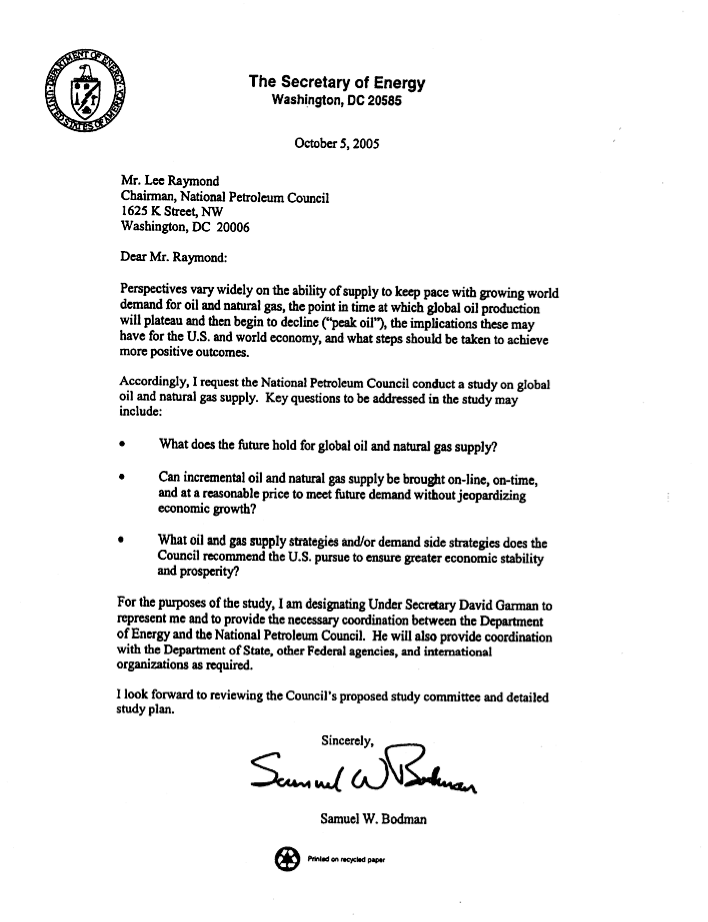
The National Petroleum Council (NPC), a federally chartered and privately funded advisory committee, was established by the Secretary of the Interior in 1946 at the request of President Harry S. Truman. In 1977, the U.S. Department of Energy was established and the NPC’s functions were transferred to the new Department. The purpose of the NPC is solely to represent the views of the oil and natural gas industries in advising, informing, and making recommendations to the Secretary of Energy with respect to any matter relating to oil and natural gas, or to the oil and gas industries submitted to it or approved by the Secretary.Ok, so we're asking the oil and gas industry, who make their living by selling us oil and gas, whether there might any problem with the supply of oil and gas. I don't know what Secretary Bodman was expecting, but in his place I would have expected to get a sales pitch for buying more oil and gas. Given that very low expectation, the report is better than one might have feared. However, it's still pretty biassed, and fails to address the Secretary's questions.
An aside to Secretary Bodman: next time try the National Academies.
Anyway, continuing, the NPC put together a crack team of industry executives and consultants to answer the question of whether they could continue to deliver us enough oil and gas or not. (I should note here that my comments are based on a June 29th draft of the Executive Summary. I was one of the hundreds of persons consulted by the NPC, though not one of the ones who they paid much attention too, it seems. I'm assuming the final version will be on their website by the time you read this).
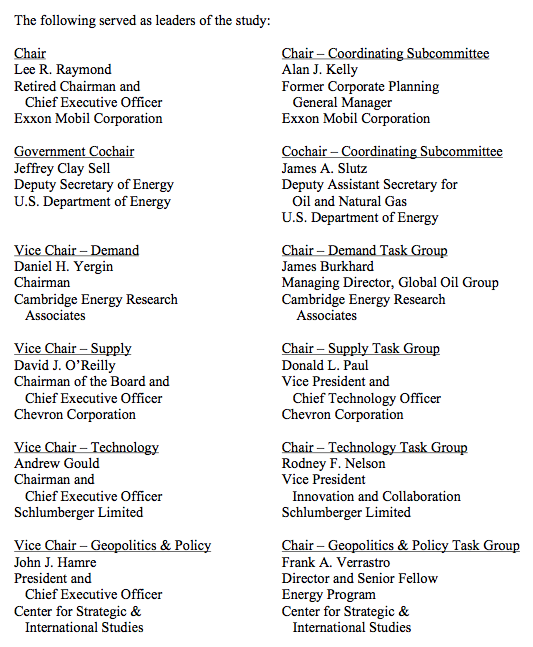
Here's the folks who ran the study:
There will be a large, unprecedented buildup of oil supply in the next few years. Between 2004 and 2010, capacity to produce oil (not actual production) could grow by 16 million barrels a day -- from 85 million barrels per day to 101 million barrels a day -- a 20 percent increase. Such growth over the next few years would relieve the current pressure on supply and demand...Well, the "not speculative" forecast, made in July 2005, is not looking too good so far:While questions can be raised about specific countries, this forecast is not speculative. It is based on what is already unfolding. The oil industry is governed by a "law of long lead times." Much of the new capacity that will become available between now and 2010 is under development. Many of the projects that embody this new capacity were approved in the 2001-03 period, based on price expectations much lower than current prices....
But at least for the next several years, the growing production capacity will take the air out of the fear of imminent shortage. And that in turn will provide us the breathing space to address the investment needs and the full panoply of technologies and approaches -- from development to conservation -- that will be required to fuel a growing world economy, ensure energy security and meet the needs of what is becoming the global middle class.
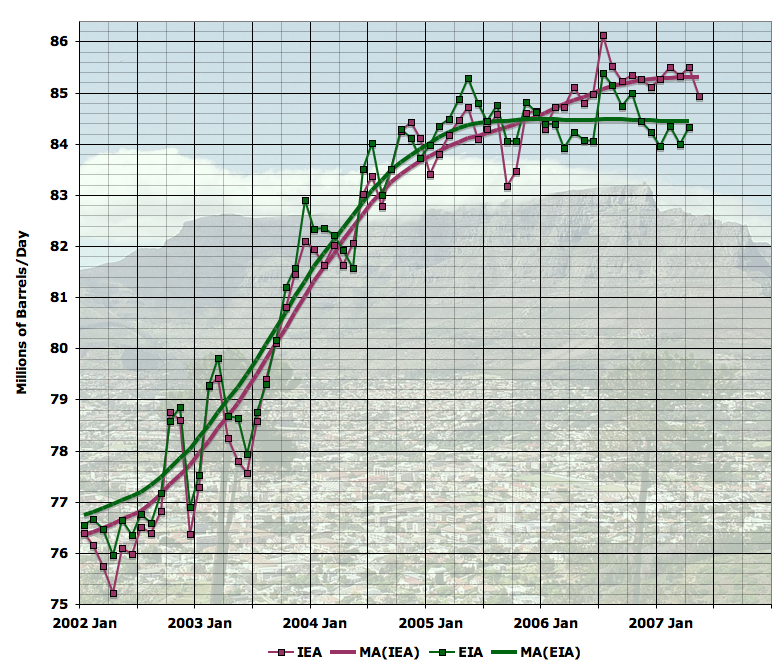
Of the 16mbd of new capacity over five years, after two years we have seen somewhere between zero (EIA), or 1mbd (IEA) of new production. Not a good start, and it certainly hasn't been enough to "take the air out of the fear of imminent shortage" as Mr Yergin promised us.
So you get the idea: the NPC put together a team who have a track record of being relentlessly overoptimistic, and the absolute trailing edge of concern about oil supply issues. What did they have to say?
During the last quarter-century, world energy demand has increased about 60 percent, supported by a global infrastructure that has expanded to a massive scale. Now, most forecasts for the next quarter-century project a similar percentage increase in energy demand from a much larger base. Oil and natural gas have played a significant role in supporting economic activity in the past, and will likely continue to do so in combination with other energy types. Over the coming decades, the world will need better energy efficiency and all economic, environmentally responsible energy sources available to support and sustain future growth.So, we could summarize this as "Peak oil is nowhere in sight; we think we can continue to grow oil supply in coming decades as we have in recent decades, but it's getting trickier and you a) better be prepared to grant all our various requests for assistance in pulling it off, and b) should start trying to use less of our products in case we can't quite manage it".Fortunately, the world is not running out of energy resources. But many complex challenges could keep these diverse energy resources from becoming the sufficient, reliable, and economic energy supplies upon which people depend. These challenges are compounded by emerging uncertainties: geopolitical influences on energy development, trade, and security; and increasing constraints on carbon dioxide emissions that could impose changes in future energy use. While risks have always typified the energy business, they are now accumulating and converging in new ways.
The National Petroleum Council (NPC) examined a broad range of global energy supply, demand, and technology projections through 2030. The Council identified risks and challenges to a reliable and secure energy future, and developed strategies and recommendations aimed at balancing future economic, security, and environmental goals.
The United States and the world face hard truths about the global energy future over the next 25 years:
- Coal, oil, and natural gas will remain indispensable to meeting total projected energy demand growth.
- The world is not running out of energy resources, but there are accumulating risks to continuing expansion of oil and natural gas production from the conventional sources relied upon historically. These risks create significant challenges to meeting projected energy demand.
- To mitigate these risks, expansion of all economic energy sources will be required, including coal, nuclear, renewables, and unconventional oil and natural gas. Each of these sources faces significant challenges – including safety, environmental, political, or economic hurdles – and imposes infrastructure requirements for development and delivery.
- "Energy Independence" should not be confused with strengthening energy security. The concept of energy independence is not realistic in the foreseeable future, whereas U.S. energy security can be enhanced by moderating demand, expanding and diversifying domestic energy supplies, and strengthening global energy trade and investment. There can be no U.S. energy security without global energy security.
- A majority of the U.S. energy sector workforce, including skilled scientists and engineers, is eligible to retire within the next decade. The workforce must be replenished and trained.
- Policies aimed at curbing carbon dioxide emissions will alter the energy mix, increase energy-related costs, and require reductions in demand growth.
So this is undoubtedly some kind of progress. The fact that the trailing edge of the debate is now officially calling for efficiency and conservation measures is a big deal and good progress. But I still think these guys are a long way from making contact with reality. CEO's are supposed to set impossible goals and then exhort the troops to meet them, and that's what we have here, I think, from this group of oil company CEO's.
My bias is to look at the graphs and tables rather than the words. There aren't too many in this report, but the ones they do have are very revealing.
Middle East Reserves
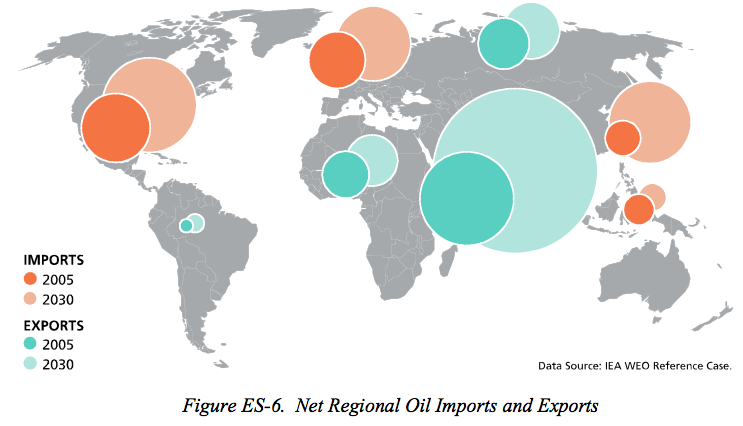
A major concern with the NPC report is its failure to take seriously the potential concerns with Middle Eastern oil reserves. As figure ES-6 of the Executive Summary makes clear, almost all the growth in oil export capacity that the report assumes by 2030 is anticipated to come from the Middle East:
Note that Asia, North America, and Europe all grow their imports significantly, while Latin America, Africa, and Russia increase exports only slightly. The Middle East is required to increase exports massively to balance the books. This is no doubt predicated on the claims that two-thirds of the world’s oil reserves are in that region (eg see the BP Statistical Review of World Energy 2007). However, it needs to be realized that there are serious long-standing concerns about whether these reserves exist in the amounts claimed. For example, in the 2005 World Energy Outlook, the International Energy Agency writes on pages 125-128:
There are doubts about the reliability of official MENA reserves estimates, which have not been audited by independent auditors…The reserves data for the five main Middle Eastern oil producing countries are shown in this next graph:MENA proven oil reserves increased sharply in the 1980s and, after a period during which they hardly increased, rose further around the turn of the century. From around 400 billion barrels at the start of the 1980s, reserves ballooned to almost 700 billion barrels by 1989 and reached nearly 800 billion barrels at the end of 2004... Most of these increases occurred in the Middle East. In the second half of the 1980s, Saudi Arabia and Kuwait revised their reserves upwards by about one-half. The United Arab Emirates and Iraq also recorded large upward revisions at that time. Total Middle East reserves jumped from 398 billion barrels in 1985 to 663 billion barrels in 1990. As a result, world oil reserves increased by more than 40%.
This dramatic and sudden revision in MENA reserves has been much debated. It reflected partly the shift in ownership of reserves away from international oil companies, some of which were obliged to report reserves under strict US Securities and Exchange Commission rules. The revision was also prompted by discussions among OPEC countries over setting production quotas based, at least partly, on reserves. What is clear is that the revisions in official data had little to do with the actual discovery of new reserves. Total reserves in many MENA countries hardly changed in the 1990s. Official reserves in Kuwait, for example, were unchanged at 96.5 billion barrels (including its share of the Neutral Zone) from 1991 to 2002, even though the country produced more than 8 billion barrels and did not make any important new discoveries during that period. The case of Saudi Arabia is even more striking, with proven reserves estimated at between 258 and 262 billion barrels in the past 15 years, a variation of less than 2%.
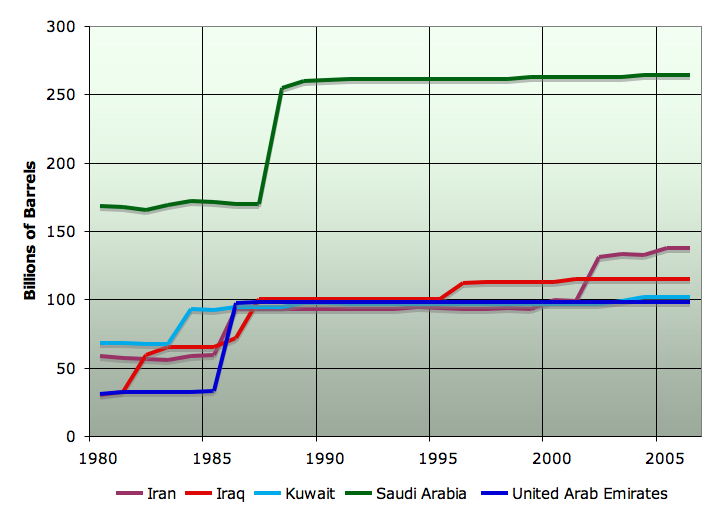
This clearly shows the very strange pattern of reserve updates, which is quite unlike reserve histories in western countries that wander up and down year-by-year as oil is consumed and new discoveries are made and additional recovery projects are implemented.
Recently, data is starting to come to light that suggests that not all these reserves additions were appropriate. For example, in 2006, Petroleum Intelligence Weekly obtained a 2001 document from the Kuwait Oil Company which suggested that remaining proven plus probable oil reserves there were only about half of the official number for proven reserves. This has now been somewhat confirmed by the Kuwaiti Oil Minister, with the Kuwait Times reporting earlier this year: “Sheikh Ali also confirmed to Al-Wasat newspaper that the state's proven oil reserves have fallen to 48 billion barrels, as reported last year by Petroleum Intelligence Weekly, down from an announced 100 billion barrels.”
In the case of Saudi Arabia, concern that future production would be limited has existed since at least 1979, when a Senate Subcommittee Staff report on the subject stated, after extensive interviews with the American oil company executives managing the country’s fields at that time:
Saudi Arabia’s decision to cut back its producing target to 12 mmbd was significantly influenced by the conclusion that higher production rates would require costly investments and might not be maintained for a period of time acceptable to Saudi Arabia. The oil production level that can be maintained until it begins to decline to lower levels is known as the “production plateau.” The plateau that the Arabian American Oil Company (Aramco) now uses as a basis for its planning indicates that a rate of 12 mmbd may last 15-20 years before irreversibly declining, a period Saudi Arabia now finds uncomfortably short. Higher rates, such as 16 mmbd, could only be maintained for a shorter period of time before declining. Moreover, the prospect of future discoveries in Saudi Arabia is highly uncertain. In addition, technical problems have complicated the management of the oil fields since the early 1970’s. Taking into account all these factors, it would be imprudent for the United States to plan on a change in Saudi Arabian oil development plans to increase long-term production above 12mmbd. The current plan of a target capacity of 12 mmbd achieved no earlier than 1987 is a considerable change from an earlier one which envisioned a capacity of 16mmbd in 1983.In fact, due to a combination of lower production (via the demand collapse of the 1980s), and technology that allows oil operators to both increase recovery and maintain plateau until a field is more deeply depleted, Saudi Arabia has still been able to produce over 9mbpd in recent years, more than 25 years after the words above were written. However, is it at all prudent to assume that now, at this late stage, production can be increased significantly more than was thought feasible in 1979, and continue for decades more? That is what the NPC report would have you believe.
More recently, Matt Simmons, in his book Twilight in the Desert has documented in great detail that extensive exploration efforts have only found modest amounts of new oil discoveries, just as Aramco executives predicted in the late 1970s. Thus Saudi production still comes from the same handful of giant fields it was coming from in 1979, most of which are now quite mature. In particular, recent research here at The Oil Drum has shown that the northern half of Ghawar, which historically accounted for 4mbd of Saudi production, is significantly more depleted than Saudi Aramco has revealed, and production from this part of the field cannot be maintained much longer at recent levels. This raises the question of whether the development of other fields that Saudi Arabia is now undertaking will be sufficient to increase overall capacity, or only offset declines in north Ghawar. This may be in part why Saudi Arabia has not been able to increase production since 2004, which has had a great deal to do with the fact that global oil production has not increased appreciably in the last two years.
It seems to me that this issue is of central importance to global oil reserves and production capacity. Given the fact that most of the relevant data are closely held state secrets of the countries in question, I can see that reasonable people might hold a different view than me about the amount of oil remaining in the Middle East, and the potential for production increases. However, the fact that the issue is not even flagged to the reader of the executive summary of the NPC report suggests the degree of bias that pervades that document.
Reliance on Undiscovered Oil
Not only is much of the growth in oil anticipated to come from the Middle East, where it is unclear whether the oil exists, and whether the region will be stable enough to produce it, but it is also mainly not yet discovered:
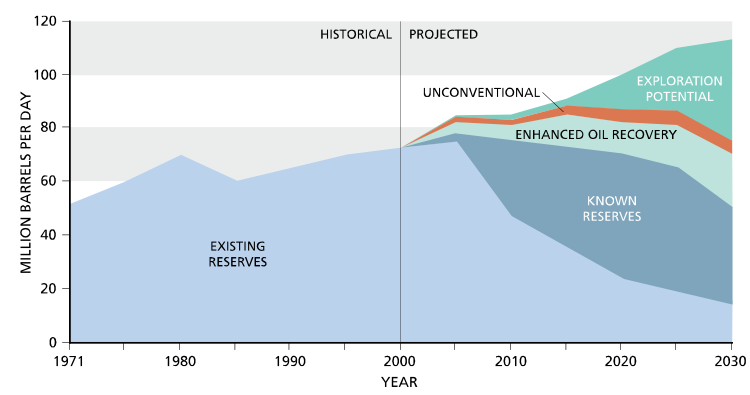
As you can see, the growth in total liquids supply comes by and large from about 40mbd of "Exploration Potential". Now, to put this in context OPEC liquids production at the moment, according to Table 16 of the OPEC Monthly Oil Market Report (PDF)) is just around 30mbd. So the NPC wants us to believe that there is a whole other OPEC plus a third waiting to be discovered.
If that doesn't sound too likely to you, you're not alone. The ASPO curve for the trend in oil discoveries shows a peak back in the 1960s, with gradual downtrend ever since:

So in summary, the NPC report is saying that production will increase by around 25% over the next twenty five years, but this increase is entirely reliant on finding large amounts of new oil, mainly in the Middle East. Unfortunately, it is rather unlikely that the existing claims of oil reserves in the Middle East are true, and even less likely that massive amounts more oil can be found there. Even if it could, the Middle East is the least politically stable region of the world, and relying ever more heavily on it for critical inputs to our economy is likely to be fairly painful at regular intervals.
However, their number one recommendation on the demand side is:
Based on a detailed review of technological potential, a doubling of fuel economy of new cars and light-trucks by 2030 is possible through the use of existing and anticipated technologies, assuming vehicle performance and other attributes remain the same as today. The 4 percent annual gain in CAFE standards starting in 2010 that President George W. Bush suggested in his 2007 State of the Union speech is not inconsistent with a potential doubling of fuel economy for new light duty vehicles by 2030. Depending upon how quickly new vehicle improvements become incorporated in the full fleet average, it should be possible to lower U.S. oil demand by about 3-5 million barrels per day by 2030. Additional fuel economy improvements would be possible by reducing vehicle weight, horsepower, and amenities, or by developing more expensive, step-out technologies.That's something I can heartily agree with, and it's great to hear the oil industry calling for a doubling of fuel economy.
Contact
- Content: editors at theoildrum dot com
- Tech support: support at theoildrum dot com
License

This work is licensed under a Creative Commons Attribution-Share Alike 3.0 United States License.
Any mention in the report of the recent rapid increases in domestic consumption in oil exporting countries?
Interesting news item:
VLCC Tanker Rates to Japan Fall About 50% From Last Summer
No collapse forecast as tanker rates fall near year lows
Reuters
Published: July 04, 2007, 00:00
Note that Mexico's cash flow from oil export sales is increasing faster (for now, in their "Phase One" Net Export Decline) than their oil exports are declining:
http://www.bloomberg.com/apps/news?pid=20601086&sid=asL_Fmzu80R4&refer=news
Mexico's Peso Rises to Highest in Almost a Month on Oil Prices
By Valerie Rota
WT,
I wonder if maybe some of the VLCC rate drop isn't because there is a glut of tankers - not only from reduced deliveries - but also from excess new tankers.
Many new tankers have been planned for years, based on growing demand and Yerginism. Some new tankers must have been delivered this year, but only to find that there is less deliveries of oil taking place even for last years fleet.
So the problem is amplified...hence the 50% rate drop.
Plausible. That means that 2008 may be interesting for shipbuilding as well...defaults on delivery, cancelled contracts...etc.
2008 really shaping up to be turning point in many ways.
I've read a few times that we are in the middle of phasing out single hull tankers for all double hull not sure what the status is of this. But in the interim you would have a tanker glut.
But those would have been scheduled replacements, and then there is NEW capacity.
If they accelerate the replacement/retire of older fleet with NEW capacity, still leaves deliveries of tankers on the books that are not needed...so will still lead to a crunch in shipbuilding in the near future.
Well, its good to get all these groups on record. Otherwise, if Yergin wasn't on record, for example, what would we do for a Daniel Yergin Day ?
Yerganism - now there's a whole new concept. A Yergin day is a brilliant idea, that's if there any days left after love your dog day, hug a stranger day etc.
Talking of Yergin, CERA's 16mbpd, and the NPC's 1.33 new OPEC's we should add Schlumbergers prediction of 24mbpd declines from existing fields by 2010 (from 2006). That will bring CERA up to a nice round total of 40mbpd new production by 2010 and the NPC is in effect looking for more than 2 new OPECs! Or maybe its just 5 new Saudi Arabias. Heck, it's only nearly half global total liquids production by 2010!
We know these new reserves must be there, somewhere, because the NPC are the guys that know these things. Everybody else believes them, so it must be true. Maybe Yergin day can be the day we find them.
We need to add a bubble out on the edge of that map for Titan -- that's where all those extra hydrocarbons are!
Great EROEI, that!
Rename it KSA II and everything comes out right!
The NPC report isn't on their website yet.
I was hoping that we could come to some sort of agreement with the cornucopians so that we could come up with some realistic plans to mitigate the production declines. Your analysis, Stuart, makes it pretty clear that thats not possible. Did they address the issue of production costs?
This is not "some type of progress"--it is merely more of the same, the usual AEI cipher apologetics for the usual TEOTWAWKI-inducing agenda. Not that I blame them, it's pretty late in the game and they're clearly privy to this. The proof is in the pudding, the cliché goes.
Hey, Big Time Dick, bust out those nukes and lets enforce some more global energy security ...
I haven't read the full report yet, but it sounds like it might be progress of a sort. Considering it is the National Petroleum Council and all.
This story, for example:
I suspect we will deal with peak oil obliquely - via global warming, and petro-politics. Peak oil is too scary. Much more comfortable to phrase the problem in terms of climate change and recalcitrant national oil companies.
Fair enough. Just throwing my two cents in--when you've got really flimsy propaganda (meaning that it's easily detectable to critical thought), one occasionally needs to update it to something resembling reality, or at least a reticulation of something resembling reality. Let us remember, that up until I think only a few months ago Mr. Raymond's former corporation did not publicly accept the scientific consensus on CC. This is the tip of the iceberg, no pun intended.
No worries though. Window dressing on more or less absurd scenarios of CERA et al is to be expected. It makes them seem less absurd as it becomes increasingly obvious as time passes forward what the real situation is. It also paves the wave for excuse making ("WMD" is the prime, cynical example at the top of a nauseatingly long list.)
The triple D's of saying nothing: distract, distort and defend. (Maybe that can be applied to this comment. God, I love being a self-hating liberal.)
Gee wilikers what have they been putting in the bath water being drunk here?
Golobal warming scares the bejesus out of me and the only hope I can see is that engendered by Peak Oil. To me it comes down to whether there is a bang or a whimper to end the age of human controlled energy excess. With a bang there may be some pieces to pick up with mitigation there might be nothing except a rather nasty heat death.
Yes, Leanan, I realize that you were talking about how differently the main stream punters would view PO and GW in degrees of fear and you are likely right in that. I am trying to make the point that the NPC,Cera and all the rest of orthodoxy might be right in their actions, even if for very wrong reasons.
Maybe this point has been discussed to death on TOD, if so, I wouldn't mind seeing any articles about it. Or even any threads if there are no articles.
Global warming does not raise the specter of the end of growth. GW, to most of the population, seems like a problem that can be solved with some technical changes but no fundamental change to the infinite growth paradigm.
But you cannot go near peak oil without running smack into that question. Thus, peak oil is far more dangerous than global warming in the attitudes and expectations that it seems to foster.
Ghawar Is Dying as we slide Into the Grey Zone
"The greatest shortcoming of the human race is our inability to understand the exponential function.
Hi Greyzone,
I agree, like you tell some guy, "hey man you know Peak Oil is on the way and your job as car jockey in the local Suds and Slop car wash is soon to be a thing of the past" and guess what? He will get that picture pronto, but you say "hey man there is going to be climate change with crazy weather, hail, mudslides,dust, dirt, , tornadoes and even an all invasive shitstorm" and all that means to him is one hell of a lot of overtime at that Suds and Slop car wash.
My big fear is that PO will not live up to expectations and cause a soon enough or large enough blow to the belly of the beast to cause an economic collapse deep enough to 'mitigate' the effects the human race is having on the planet.
Global warming does not raise the specter of the end of growth.
Alas, NPC report is in accord with you. Interestingly, note how CC is used in this report not as a major problem to be dealt with, but something which will "lessen demand", and will diversify "alternative energy sources". They know the latter is bs, from a fiscal perspective--which is certainly Mr. Raymond's overriding concern, albeit the only meaningful perspective to take. They in essence say so much, under their breath, by not investing all that much in "alternatives" if you compare to hydrocarbon investments. "Lessen demand" is code for, if things do get hairy--we warned you may be driving too much! (Wow, talk about the pot calling the kettle black...) Mommy tells you "eat all the cookies you want" and then she leaves the room for a minute and comes back to find you sick and bloated from too many cookies she slaps you over the head and says "now if you want a cookie, it's gonna cost you--you know you want some more right? There are no shortages of cookies it's just now all your friends down the street want cookies, and there are evil-doers trying to blow up your cookies" etc etc... You get my drift.
I agree with Leanan* that they would sooner bring out the relatively minor boogeyman of global warming, than the stink bomb of peak oil (and these are all Big Oil guys!) Clearly, because CC is an ancillary issue. We "don't know what causes it" or "even if it is happening at all." Either way, it would cost too much money to fix, right? So fuck it all, BAU.
CC cannot be directly tied to "war" and "terrorism" (PO can). This maintains the facade, the disconnect, between war terrorism and oil. This is a critical distinction, the elephant in the room which our culture has somehow built up immunity too. "National Security", I believe the secret handshake goes...
Why would that be? The reason is pretty clear... CC and other "above ground security and political issues" will be the bellwether front for peak oil. It is far more comforting for businessmen and average Joe to think "well, these here economic problems are at root caused by 'terrorists' and the other ancillary affects of 'combating CC'" (a futile effort if I've ever seen one, one reason among a myriad that conservatives are so uber-cynical... anyone for throwing beach sand at waves? I'll take profits, thank you very much.) This is probably due to the fact that the markets need to be comforted, and even coming close to endorsing worst case scenarios for oil depletion would be tantamount to burning money (surely not something Mr. Raymond would want--can you sense my seething jealousy? ;] )
But you cannot go near peak oil without running smack into that question. Thus, peak oil is far more dangerous than global warming in the attitudes and expectations that it seems to foster.
This is why it is so easy to see how things are going to turn nasty quick, because when you can't even acknowledge a problem, then there is little chance of "fixing" it (particularly problems that seriously border on the insurmountable.) By definition, even if this so-called "progress" continues, actually addressing the root issue is an anathema to everything our society is and wants to be. Predictions are worth the price of storing them on a hard drive (hint: close to nothing) but I believe one can say fairly confidently that you will not hear these birds tweet 'uncle', ever. Why would you when you own everything and you can harp on about above ground issues?
A growing economy based on burning fossil fuels will self-destruct in possibly as little as 30 years.
Leanan
Thats why we need to come to some points of common agreement with the cornucopians and stop focusing on the exact minute of the peak or getting into doomer scenarios. If we have to blame above ground stuff, O.K.. The important thing is to start on mitigation right now.
A couple of days ago we discussed how people change their minds. If they get their ego's involved in the process it really slows the change-look at how the NPC report is still in the global warming denial column, Lee Raymond's contribution. Lee Raymond sees himself as a hero, making giant money for his stockholders and providing the world with prosperity with cheap energy. He and his cohorts are threatened that they have part of the blame for global warming. So we've got to find some agreement so we can enlist them in a common cause. National Security is my best guess as to an opening, but I'm not an expert on conservative, type A psychology.
Bob Ebersole
One can't negotiate with a malignant psychology by trying to make it a friend... Just doesn't work. I'm young and have figured that out, and I believe you're older than me so you should know this doubly. You negotiate with malignant psychology by trying to remove it or reform it, unfortunately neither are really an option as these "things" are deeply entrenched and not going away short of a revolution (which would essentially mean the end of the civilization anyway, since we would be in fact toppling the very psychology that gave us all the wonders of "modern American life"). Perhaps you'll say I'm entering Doomer psychology, tweeting chicken little in my sleep... Although, I respect your attempt at some type of hopeful outcome, it is very unlikely that simply by "saying nice things" about these people that they'll somehow all of a sudden say "Gosh, you know what, you're right, we're just so wasteful, and this profit motive thing--what's that all about anyway?"
I do agree with you though that one must forge on and keep tootin' the horn, no matter what happens. It's just, honestly, trying to wrangle the "higher-ups" is really a lost cause, like pissin' in the wind (or up a rope, take your pick).
From the bottom-up people will do what they find neccessary to prepare for whatever our future holds.
The top-down leadership of our country will do whatever they deem in the "interest" of the "country"--it matters little what you and I say--it's a large world out there (for now) and the people that "run it" are tasked with keeping themselves and their cronies happy. Lets see how long they can keep the jig up.
Ain't dat da troot, eh?
If there are a hundred people in a room, and only one person knows the right solution to a problem, any compromise will yield something less than solving the problem.
That's what we have now. The one solution is Demand Destruction, yet almost everyone in the room is trying to figure out how to compromise on that.
I read an interview with a Conservative once who said, "If you want to change a conservative's mind, you only have to show them how to make more money doing it your way. The only way to change an intellectuals mind is to take it out and put in a different one."
This scenario doesn't work for either now, because 99% of the solutions require Conservatives to stop thinking in Perpetual Growth terms, and they require intellectuals to stop expecting to get grant money from the perpetual growth System.
The Peak Oil scenario will hopefully be mitigated by demand destruction due to economic impact, but if global warming hits hard and fast "With Speed and Violence" (nod to Fred Pearce), then the resource demand may simply increase even more.
Oh... that is so perfect. U.W., Madison just went whore's-ville for some ethanol money. Your words express exactly how I feel.
Speaking of which, did you hear about the dumb sailor that was at sea for six months and then spent 3 days hanging around a warehouse?
Ahhh. As we refer to it from the farm; "The People's Republic of Madison". I'm all for progressive ideas and education, but the first time I drove through Madison, I told my wife I could never work there. "Why is that?"
"No smokestacks." It's like a mini-Washington D.C. All government buildings and Jaguar dealers. (Service Economy, my a.... Farmers get poorer while government contractors get pools.)Cheap food and expensive cars: that's the plan. Well, the price of milk is going up again..At least until people can't afford Pizza deliveries anymore. Time to get some cows, I guess.
"If you want Change, keep it in your pocket."
Now you get to hear my more paranoid theory. The NPC issued a 440 page report in order to bury peak oil where nobody will read about it because its too long and written in beaurocrat double speak. That way, if we're right they can say "we warned you" while making sure nobody but geeks reads the report. Certainly not Congress or the Media, who can be counted on to be lazy.
I understand they have now pulled the graph up at the top that shows how crazy their projections are. The NPC expects EOR to go up about 2,000%, the Saudi's and Iraqis to give us their all, the "alternative fuels" to scale up 1,000% and the crude oil fairy to reveal a couple of new Ghawar fields, all with no consideration for above ground factors, global warming or economic costs. As Matt Simmons has noted, the chances for all of that happening are zero.
Bob Ebersole
The NY Times also sees progress:
Note that this article was written by Jad Mouawad, author of the infamous Oil Innovations Pump New Life Into Old Wells in which he wrote "There is still a minority view, held largely by a small band of retired petroleum geologists and some members of Congress, that oil production has peaked, but the theory has been fading."
In today's article, he also refers to peak oil:
So, he refers to peak oil with the pejorative "so-called" adjective, and he also gets the peak oil definition wrong.
Calorie,
The problem is with Jay Mouawad, not with the NPC report. If you'll skip down to Gail the Actuary's report downthread on the API conference call today you will be pleasantly suprised to see that they reference peak oil and use ASPO graphs as one of their production scenarios in the report.
I really think we are doing the cause of peak oil a real disservice constantly disparaging oil company executives and industry writers. It makes us look crazy. I've been around oil industry people all my life, and they are generally decent, honorable men who have spent their working lives ensuring that gasoline sells for less than bottled water in a gas station. They're not cheats or members of a cartel. They are wrong-headed in their politics, but I have no doubt they love their countries and want whats best for the world.
Even Daniel Yergin, while he's a lousy price predictor, is a fine author and a good historian. He deserved the Pulitzer prize, and I'd happily buy him lunch to meet him.
We need to give respect if we expect respect, and try to find common ground so we can work towards real solutions.
Bob Ebersole
My take on this issue is that the two biggest threats facing US oil & gas independents are ExxonMobil and Daniel Yergin.
When the trillions of barrels of oil that ExxonMobil and Yergin promised us fail to show up as actual production, it is going to give credence to the people who claim that high oil prices are a result of oil companies deliberately withholding oil off the market.
I also listened to much of the meeting today, and I also tend to agree that most are trying to do a good job, trying to be forthright. But I also believe that they are largely accountable to stockholders, etc. and are likely not being entirely forthcoming. And what's good for business may not be what's best for the rest of us.
http://www.energybulletin.net/18111.html
Published on 13 Jul 2006 by Energy Bulletin. Archived on 13 Jul 2006.
Daniel Yergin Day, July 13, 2006
by Jeffrey J. Brown
My concluding comments:
WT,
I know you're right that Exxon-Mobil's and Daniel Yergin's attitude of total denial is the great enemy of all of us who are afraid of punative taxation. The question is have they learned anything from the XOM reversal on climate change?
We've now seen three giant cracks in the cornucopian dam-the IEA report, and now the respect given the peak oil position in the NPC report, and the conservation recomendation. Events are going to make the water leak through soon enough, probably this winter or spring as exports to the US decline and prices continue to escalate. Daniel Yergin is already getting the "above ground factors" line prepared.
The question is: Are we going to be gracious and allow them to revise their position, or are we going to be assholes and rub their noses in it? Remember, it took about 8 years to stop XOM funding the global warming deniers and the Neocons, at least in part because the environmentalists threatened them and demonized them. The world can't afford the fight or the time.
I guess its a landman's perspective-always leave the other guy a face saving out in a negotiation. Its not a good deal unless everybody walks away with something, and nobody should get everything they want.
We really are on the same side. Everyone wants the country and the world to be prosperous and secure. We'd love to see plentiful energy delivered at a fair price, and we all want a clean world for our children. And, our positions aren't that different. This report shows that they acknowledge that there will be a peak, and that we're going to have to change. The difference is about 30 or 40 years on the timing-not very much when you consider the 70,000 year history of mankind, or the 4,000 year history of civilization.
Bob Ebersole
it took about 8 years to stop XOM funding the global warming deniers and the Neocons
That is completely unsubstantiated. There is no evidence that XOM will or has stopped in its mission of disinformation, support of ridiculous front organizations, funding of irresponsible corporate think tanks, the propping up of individuals of dubious scientific credentials and efforts at viral astroturfing. In all likelihood it will continue the familiar tactics we have all seen before, this time with a bigger grin and better talking points. As prices get higher, I'm sure it will become no-holds-barred. Anyway, that "funding" is a trifle compared to the surreal political power XOM and the other big oil players wield behind closed doors, to the detriment of society IMHO. There is a enough blame to go around to society as well, I should note here. I'll also be the first to state that Big Oil is not "price gouging". They are just performing a business function, just like any other business. It happens to damage the environment, fuel CC etc etc, but it does run the economy, help make my cheap plastic gilette razors I like to buy etc etc, and generally make everything about modern life nice. Their function happens to support the life blood of the economy, and they certainly know it. They also don't have "control" to the extent that OPEC and various others now are singing to their own tunes. Perhaps that's why they're updating their propaganda, sign of the times. Bracing for higher prices--need something to point to substantial... I do not personally think, and have never said, that the people that work within the US oil and gas industry are money grubbing zealots and just state this because I am unsure if my earlier remarks sparked you to write the above--and another comment somewhere else in this thread where you lament the poor treatment given to the poor 'ole oil companies... The individuals that work in the hydrocarbon industry, like many Americans in various other industries, are hard-working and surely want the best for the country, and all that jazz, etc. The leadership in big oil and the think-tanks and ideologues that flank her is an entirely different matter. Avarice is the life blood of Wall Street and it is still overriding all systems--as the warning lights flash red, beeping. The status quo seems to be full speed ahead! I'm not sure this decision is wise, but perhaps realpolitik dictates it, I'm no apparatchik or fellow at the CFR, and wasn't educated at Harvard or Yale, so I wouldn't know.
As for "revising their position", I hardly see how that qualifies as a truism in the present context. This is illustrated by your last point (of, again, a questionable efficacy) of time lines...
*blink* .... *blink*
I honestly don't know how to respond to that. First off, you're an oil man (hence the name :]), right? Then, why don't we use Titusville (or better yet the early 20th century) as a reference point. I mean, Jesus, you use civilization and then the origin of language as reference points to the age of oil? That scaling does indeed denigrate a meager 30 to 40 years--which seems your intention, although it is an odd one since we don't have close to that much time... I hardly understand what would motivate you to pooh-pooh that (disingenuous) time frame.
When one actually considers the relevant time line one quickly sees that 30-40 years (gasp) is indeed a long time. Not to mention, that it is a complete and utter pipe dream. Much like the earlier statement that XOM has finally seen the light and been delivered to accept Christ died for all its sins..... Repentance can certainly be rare in some people, yes--but you will be hard pressed to find it in the eternal soul of XOM.
Which is to say, that the only point you really make--admittedly in a cryptically surreptitious manner, is that this is old hat with new window dressing. Plus, we should smile and be nice because our corporate overlords may well be listening, and besides, deep down inside they're really nice fellas if one just gives them a chance and is gracious enough...
Maybe I misunderstood you... If so, my apologies, I just thought I would "clarify" so as neither of us are misconstrued.
WT,
I've reconsidered, and posted my reasoning above. If Nate's right about the discount rate of future events-and I think he is- then 440 pages of Beaurocrat speak is just a soporific. Bury the truth where no one will find it, and count on boredom to conceal the truth.
To be frank, I really don't know the best course to pursue. The thinking person's quandry-GWB and Osama Ben Laden aren't plagued by any doubts. They have the mystical light of true believers in their eyes.
But I'd still like to be cautious about attacking them, the Doomers have already got us tagged with being nuts. And, we needn't forget that Cassandra was right about all the shit that was going to happen, but look what she got for being vocal.
Bob Ebersole
Here we go again with the semantics...
"Pollyanna", "cassandra", "chicken little", "doomer", "cornucopian"--all diversionary, but also delineating the minefield of this debate quite well... Maybe if they're put to use enough they will lose potency? With that in mind, I will now attempt to weave in all of those into this comment.
Look, seeing how this is an open forum I don't understand your desire to be uniformly accommodating, to universally "stay on a positive message"--seems to me that is the problem to begin with... There will be dissent. As long as it isn't childish, I say bring it. Being nice is not a foolproof plan, and sure, neither is screaming the sky is falling. As for your self-conscious point of being "tagged with being nuts"--this is another non-sequitur. We are nuts, didn't you get the memo? *grin*. It matters little if we "attack them" or instead send "them" flowers and chocolates--they are going to do whatever is dictated by their business models, they are after all just businesses, in fact major transnational corporations that literally fuel the global economy. The last thing they'll do is read a blog for advice on how to run their industry which has been around for a hundred years turning a profit, without any help before from the blogosphere... They know how to do that much better than any of us. Can TOD influence public policy? Perhaps. But I doubt these here comments (that I'm sure only real TOD cultists read all the way through--people like you and I) really get all that much attention payed to them. Perhaps I'm wrong and Exxon Mobil has a crack team of people hired by Steven Milloy to go through the TOD comment section and document just how "nuts" most of us are... but again, I seriously doubt that. Entirely more likely is that the comment section at TOD is a way for people to bat around ideas, discuss things and generally converse with fellow concern citizens in a social and educational manner. It is much more grassroots here than power corridor...
I agree with your new comment upthread stating that they have "revised" their position by winking at PO in a underhanded fashion by inserting the right implications into a massive report that otherwise is generally, in the spirit of the markets, cornucopian... This is in fact, I believe, the first comment I made (which was, yes, pessimistic). "Nuts" is all in the eye of the beholder, isn't it? You wrote:
I happen to 100% agree with your "paranoid theory". I stated this differently upthread, saying they have modified their propaganda so as to use your "we warned you" clause, plus to update their alma mater, so investors still have confident marching orders in the face of rising spot prices. Certainly, to at least the publicly pollyannaish oil companies you, I and much of rest of TOD would be considered chicken little doomers. Cassandra comparisons are unwarranted, because IMHO the people that tell the ideologues what to go do (I use "ideologues" here to mean people that actually believe what they say) probably have a very real sense of where things are going. Hence the ideologues are trotted out in front of the cameras and behind the op-ed pages to have their glowing eyes of faith communicate just how jolly well fine everything is. Meanwhile, the powerful corporate cynics are positioning to weather the "storm", whenever it may crop up. In other words, the Cassandra connection is non-existent, because I'm sure that the non-ideologue realpolitik business corporate strategists already do agree with the TOD consensus. People that argue this also love to argue that Iraq was totally not thought through... ie. that these people really are being honest and truthful about their "optimism". I call BS. The oil companies should know their futures better than anyone (which is why assuming not telling the absolute truth just has to be the default poise.) An analogy (and a not entirely unwarranted one) could be OIF. One may not agree with neocon war policies on a whole or at all, but it is quite easy for anyone familiar with realpolitik and not totally blinded by magical ideology to see what is at play here--and to also realize that our over half a trillion dollar DoD budget certainly spelled out the risk management and aftermath of an Iraq invasion. Obviously, since the first Gulf War, the intelligence community and the military establishment had more than enough time to figure out what would, would not, or may occur if Saddam was toppled and we went into to control the oil. The whole idea of Iraq being a "cake walk" was, again, only stated as such to allow the invasion to take place. It may seem like I've wandered off the beaten path, but I think the parallels of deception and disingenuousness of the PR that both the Bush admin and Big Oil put out are mighty similar. Hrmmm, I wonder if there is a connection in these tactics? Nah, couldn't be, I must be nuts...
WT, you are my man - on the other side of the pond !
Keep up your good reflections.
- from my neck of the woods, I see "a full and neck above head"-production all over the place, and also around here they celebrate small finds as they where really gonna make any difference, North Sea that is...
Those promoters (CERA, Exxon) of an undulating plateau have no references at all in claiming that such a plateau will occur - because such a claim would have been rooted in treaties and coordination from all/most oil-developers and exporters of this world, and full transparency on reserves – but that is not happening, or ?
The scope of an undulating plateau and the claims thereof – would include some prophetic understanding concerning;
-number of new vehicles hitting the roads during this period how far will these travel/day, the pace of declining productions from old wells – where/when new wells are put online for substitution – what is Wall-street doing in some years – this list goes on forever AND there is NO ONE from the homo-homo-sapiens branch able to assemble the full algorithm as to where this will go----
Actually I feel OPEC is a good thing for the planet these days because they give a “certain” reliability – and at medium term they will probably be able to stick to their words..
If we dont listen to these signals soon, we'll be in a several feet of rubbish before we know of it.. AND there is no free lunch from me to this Yergin-bloke.
I think you contradict yourself a bit here. If the problem is $50K suvs and $500K homes, then there shouldn't be a tax offset with tax on energy. There should just be some disincentive to consume overall, since all consumption at this point leads back to energy and wasted resources. The days of needing a patent system to convert "vast lands and resources" into a national quest of Destiny are over. A consumption tax across the board, eliminate the income tax (which encourages excess mortgages and discourages saving), set up a prize system for inventions which reduce waste and increase Net Creativity, set up mandatory mass transport systems, incentives for gardening, more vacation time, etc.
When you get down to the needs of human beings, most of our economic activity is useless and inane. It's time for a Descent Plan.
"If you want Change, keep it in your pocket."
Yes, I agree. Jay Mouawad seems to be disdainful of peak oil.
In my opinion, the discussion subtly knocks peak oil as an unsophisticated approach:
The key phrases are italicized and amount to cornucopian language suggesting that the peak oil forecasts are wrong because they use unsophisticated and "discredited" static analysis, while the economic models use modern, sophisticated, and therefore correct, dynamic analysis.
Dynamic analysis is the argument frequently used by tax cutting proponents to explain why cutting tax rates will increase tax revenue by spurring economic growth (static analysis, because it ignores the growth stimulus, suggests that cutting tax rates leads to lower tax revenues). What this argument misses with regard to forecasting oil production is that one of the chief peak oil forecasting techniques, Hubbert modeling, implicitly takes supply, demand, and price into account by virtue of its using the actual production history.
I think you are increasingly going to see the MSM no longer give Daniel Yergin a free pass, and hold him to account for his incorrect past predictions. People like Matt Simmons, T. Boone Pickens, and groups like ASPO will be given equal or more airtime than Mr. Yergin from here on out. He will repeatedly be asked about peak oil, the term will gain currency, and he will work harder and harder to make it go away. This is not rubbing his nose in it, but shining a light on his spotty track record.
I have to admit to some surprise to see that most MSM accounts of the NPC report, including the Jay Mouawad piece, are taking the position that "we have a problem" rather than "all is well." Casts some doubt on WT's Iron Triangle theory.
Note that the NPC report is talking about potential problems in about 25 years. I think 25 days is a better estimate.
I like your style, Bob.
By the time this is over we will be whistling while Rome burns since we can't afford a fiddle.
It´s a nice effort but I don't see anything new in this report. The same arguments are exposed here: 1) we have a lot of reserves so we will be able to increase flow rate 2) There are some above ground risks so we may be wrong. Looking at their production forecast (around 115 mbpd in 2030) they are assuming an URR of 3.3 Tb which is what the USGS has forecasted. I'll bet you they will blame a lack of private investments when it will be obvious than middle east reserves have been overstated.
What are big oil companies supposed to do ?
Look at homebuilders now in the US they continue to build homes despite the massive overhang of unsold homes. They have no choice builders build. Big Oil needs big discoveries just around the corner without big discoveries you don't need big oil. Post peak the world is probably better served by smaller more nimble oil companies willing to work with National companies to maximize reserves. KSA still employees a large number of contractors on a per project basis. These companies make great returns. I'm sure Venezuela and even Mexico will in time open up but it won't be to Big Oil.
If you consider this report a attempt by Big Oil to force the US government to embark on more gunboat diplomacy to meet their needs then its perfectly reasonable. About the only thing Big Oil can do thats difficult for smaller companies is ultra-deep offshore and the return on these projects cannot sustain Big Oil. They are probably marginal no matter what the price of oil is because of cost factors.
Look at another part of the old oil triangle Big Auto we are already seeing it broken up and pieces sold off. The same fate awaits Big Oil.
I think its obvious that Big Oil is scared about its survival and this report can be viewed as a call for help.
If you think about it the Texas Oil crash damaged Big Oil.
I think that the Oil companies actually understand that the Texas oil industry failed not because flows of cheap oil came online from other sources but because they spent a lot of money and did not find any oil. They know that they are in the exact same position now.
They can spend a LOT of money on marginal projects that are barely profitable or lose money, bankrupting them. Or they can pull back and break themselves up into units with less overhead. What they don't have outside of this hail mary report is a way to survive. Big Oil is dead and they know it.
Regarding oil investments, Matt Simmons says that he is personally invested in independent oil companies and service companies--no major oil companies.
But its no bed of roses for the small companies. One reason they work well in this sort of situation is that some overextend or make mistakes thus going bankrupt. The investors in these companies lose out but the assets are purchased cheap by another small company which can now afford to profitably operate the project. Its vicious but this constant write down ensures that a lot of projects become profitable and are brought into production even if a few investors are burned in the process.
Commercial real estate works in a similar fashion often the company that originally builds a project goes bankrupt and a second group of investors comes in and purchases the property for a song and then can operate it at a profit.
This churn is bad for investors but good for actual utilization of resources.
Westexas,
Do you know what companies he invests in? I had a look over at his website without joy.
Thanks.
I haven't heard any specific recommendations. I just know that he has concerns about large major oil companies being able to replace their reserves. The last time I heard Boone Pickens offer some recommendations, he liked US coal and Canadian tar sands companies.
IMO, we have not seen the energy "boom" yet. This is just a squall line in front of the big storm. We are going to see an absolutely desperate across the board push for more energy production.
I don't know what he has been investing in, and how it has done, but my only oil investment is Big Oil, and my average annual return over 5 years is close to 30%.
I agree that we are reaching the point where they won't be able to replace reserves. But are reserves going to shrink faster than prices increase? If he has correct that $200 oil is right around the corner, does he think Big Oil stocks won't follow that price rise?
So far, I have not invested in refineries, gas stations, pipelines, tankers and all the downstream operations.
I want crude producers with as little baggage as possible,
So far, with global production down less than 1%, the downstream operations have certainly held their own and refining has become a gold mine. But reduce global oil production by 5%, add a few refineries in Export Land, and refineries lose much of their value. The crack spread shrinks.
A dollar invested in an integrated oil company (and COP is the best managed IMHO) will likely increase in value several fold, but on the back of their oil production post-Peak Oil, The downstream operations are likely to loss value as volumes decline and we have a surplus (Note: this assumes retirements - planned new capacity will be less than declines in exported crude).
OTOH, a dollar invested in a crude only producer with long lived reserves will not have an anchor.
As always, diversify your risk.
Robert, I would be glad to send you my short list of investments.
Best Hopes for Smart Investments,
Alan
WestExas & Robert,
Thanks. I would have been interested in knowing what stocks he thought would do well in terms of Peak Oil.
Although I have some large positions in Shell & BP, I am now having some doubts as they are giving up in the North Sea.
Having listened to Jim Puplava's radio show last week it seems that due to geopolitics the big oil companies have only about 15% of the world left to explore. That doesn't look good for future earnings.
However, I have found some smaller fish that are operating in the North Sea (ie. safer investments) that have excellent production capacity. I think Simmons may be right about about smaller oil and service companies.
I'm pretty sure Boone Pickens has a big piece of XTO. He sold them the Mesa Hugoton royalties and production, and they are now a seperate royalty trust, the Hugoton Royalty trust, which is sold publicly.
XTO is the second or third most successful company in the huge gas field in the Fort Worth-Dallas area, the Barnett shale. The guys at XTO are very savvy operators.
Boone Pickens is also promoting LNG as a replacement for gasoline and has some outlets in the Dallas area. When TSHTF in gasoline, LNG is going to be the only replacement quickly available-it costs about $2,000 per car or light truck to convert the vehicle. Ferrell Gas is in that business too, and seems a good company.
Bob Ebersole
Memmel,
the major oil companies haven't invested much money in the US except offshore in the last 35 years. The reason is their overhead-they find it impossible to make money on anything less than giant (100 mmbbl) oil fields, and they are scarce as hen's teeth in the basins of the US. And, if you'll look at history, they've gotten their big reserve additions in the US as acquisitions.
The big exploration push was from independents in Texas. They found the Giddings field (500,000,000 bbls. so far) and the Bryan Woodbine field, the only significant onshore Texas finds in oil in the last 35 years.
The political climate didn't help. Nixon's price controls and the Windfall Profits Tax put a double-whammy on their efforts.
Bob Ebersole
Correct and I'll admit I may not have my facts perfectly correct around the transition. The point is that US productions levels have been in a large part maintained not by Big Oil but by smaller independents that are profitable and lower cost.
And yes politics are a factor but what I see in this report is Big Oil trying to actually get trillions out of the government to fund production from marginal resources or use gunboat diplomacy to force nations to open up. What the Yergin crowd is really trying to do is make a lot of promises so that the government underwrites all the risk and they get the reward.
What they are not saying is that their is no way in hell they can raise the money they claim they need for exploration and that even if they did the results will probably be far less than they promised.
Big Oil is in the difficult position of trying to get a massive government bailout while making outsize profits.
The truth is they simply don't have the money to do what they claim needs to happen even if the Nationals opened up.
Understand this is trillions of dollars.
So whats really happening is they are trying to convince the worlds governments to bet the farm on Big Oil and all will be well except if its not.
Big Oil is dead and they know it.
I don't agree with that at all. Here's the way I see it, and the way I have seen it for 5 years. Peak Oil, or its ugly step-sister Peak Lite, will keep prices very high. The major oil companies still have substantial oil reserves. Even if we peaked today, they are going to be pumping ever more expensive oil for years. Profits are going to be even higher than they are now. (There will of course be political pressure to intervene with higher taxes, but that won't help on the supply side).
Big Oil is going to be a cash machine for a long time - long after oil production peaks. Think OPEC. Their production is flat, yet they are making more than ever before. If production is down 10% next year, but prices are up 20%, they make more money. That's the situation I see with Big Oil. And they will have the funds to get into just about any business they want. Exxon could easily buy up most, if not all of the ethanol production right now if they wanted to. It's a drop in the bucket. That kind of money gives you lots of options. The idea that oil is going to peak and then the oil industry is going to die is not what I see unfolding.
This is exactly why, 5 years ago, I left the chemical industry and came to work for the oil industry. The scenario that has unfolded to this point is the scenario I envisioned. What I did not realize at that time was that the workforce in this industry is very old, and will be mostly retiring in the next 10 years. That means job security is incredibly high.
Robert,
You mentioned the possibility of resource nationalization before.
Don't you think that in a not so distant future, politics will limit big oil corporations profits? I mean, oil is just too much important to allow years and years of big profits while the rest of the economy has to pay tributes to those corporations.
Fernando
Instead of taxing producers, in order to subsidize consumption, I suggest that we tax consumption, via an energy consumption tax here in the US--offset by eliminating the highly regressive Payroll (Social Security + Medicare) Tax.
A consumption tax is a rational response and encourages savings, Jeffrey. It also interferes with the growth at any price mentality and with the credit bubbles that fuel them. It's far easier to maintain the illusion of easy credit and a constantly expanding economy if they nationalize or punitively tax the oil companies. Thus, while I certainly do not want to see that occur, I still think there is a reasonable risk of it occurring several years after peak as things unwind and the government is faced with oil as a clear and present national security risk.
Ghawar Is Dying as we slide Into the Grey Zone
"The greatest shortcoming of the human race is our inability to understand the exponential function.
Yes vote for the fair tax - and read the book and understand it completely before you discount it. It's a consumption tax with a rebate up to the federal poverty level. If you’re worried about Peak Oil, government spending, and consumption this should be much better than our current income tax system. A tax on just energy isn't politically possible, so this is the next best thing. Especially with the future black market; remember drug dealers or illegals don’t pay income tax; but they do buy things...
I think that we direct the focus on the individual who drives a gas guzzler, but what about the industry or the agriculture? That tax would be for everyone?
Taxes on gasoline are incredibly unpopular with the general public. With gasoline prices steadily rising without such taxes the public is even more opposed. Plus, the rising prices are already sending out the signals the public wants to hear.
When will gasoline hit $4 per gallon? When will it hit $5? Those points are going to be huge wake-up calls. We are reaching the end of the era when we needed to preach conservation. Pretty soon everyone is going to get that religion out of necessity.
You guys need to get accustomed to a majority of the public agreeing with you about both peak oil and conservation. It isn't going to happen tomorrow or next month. But it'll probably happen by 2010. You might want to give thought to what other messages you want to reach the public with at the moment where they start agreeing with you on peak oil in droves.
You said:
/We are reaching the end of the era when we needed to preach conservation/
Once the conservation concept has neared it's end, and the public finally understands it, the panic will begin. It'll be every man/woman for themselves. With a world population over 6 Billion and rising every minute as we speak, and getting hungrier by the minute, I can see how the term desperate times means desperate measures comes into play!. Oh, once the SHTF we will see gasoline much higher than $4, but only briefly for a few hours, and then as we watch, it climbs much higher as the have's and have nots battle it out!
I am hearing from many people (uninformed, as many more people are) that big oil is behind the high prices, but throw in a gasoline tax and the general public will see big oil and govt in cahoots to squeeze the little man. I smell a revolution if that happens!
This will not be popular, I hate to spew gloom and doom, but when you or anyone (gotta love those politicians) tells the general public that they HAVE to change thier lifestyle NOW! Things are gonna get pretty ugly! This is not a personal attack on you or anyone else here that thinks the same way!, but a mere observation, hope you understand!
Don't you think that in a not so distant future, politics will limit big oil corporations profits?
Yes, and I have commented on this before. I think the pressure in all countries will be intense to nationalize the oil industry. In a peak oil world, it is obviously not going to relieve the supply crunch, but it would redirect the money flowing in to the government.
Like Jeffrey, I advocate much higher taxes to stem consumption. This will stretch out our remaining supplies, and it will start redirecting that money right now. But U.S. politicians don't have the courage to enact higher gas taxes.
I have to agree with Robert here, if you think about the classic Hubbert curve and consider the hypothetical case of a constant oil price over the curve then the amount of cash generated from the sale of the oil will be the integral of the curve -which will be an 'S' Curve.
The Maximum rate of increase of cash will be exactly at the peak in production of this model where it will be half the total amount generated and the rate of income will decline afterwards to zero income when all the oil is gone.
In the real world before peak the price has been low and after it is likely to be a lot higher -i.e. not a constant. This will have the effect that the 'S' curve will be flattened before peak and be less than half the total at peak.
What this implies to me is that those countries/companies with oil for sale after peak are likely to get a lot more than half the total cash EVER generated since the sale of oil began... Looking at that global bubble map I would expect a huge wealth transfer to Brazil, Russia some parts of Africa and the Middle East -and it's all going to come from America, Europe and Asia/China. Oh, and the oil companies are going to do really well too.
Regards, Nick.
This is the premise of "Phase One" of the Export Land Model (ELM). Starting from Peak Exports, I define the first 50% decline in net exports to be Phase One, and the second 50% decline (from peak) to be Phase Two.
I expect that most oil exporters will see rising cash flows from oil export sales in their Phase One decline, which will generally have the effect of accelerating the rate of increase in domestic consumption.
On my simplistic ELM, the net export decline rate in Phase One is 15% per year, and Phase Two is 45% per year. Note that the decline rates for specific countries will be a function of three principal variables: consumption as a percentage of production at peak exports, the production decline rate and the rate of increase in consumption.
In virtually all oil exporting countries, flat production = declining oil exports.
To answer everyone. I think the phase one condition is short lived and probably already fading in many exporting countries.
The reason is inflation of all sorts monetary assets etc. The economies of these countries cannot convert the cash flows into any sort of useful outcome so you get a huge amount of waste internally and massive inflation undermining any attempts to create a real economy. Also of course you have the importers who print the money inflating like mad to keep their economies growing as energy becomes more expensive.
Next after adjusting for inflation and the relative drop in the dollar against the rest of the worlds currencies we have yet to actually see a large real gain in oil prices despite flat production for several years.
I think we will see a real price spike in the next year no matter how you adjust it but it will be short lived and we will see a fairly major retraction of the economy followed by a big drop in oil prices and the end of a lot of projects.
The economics should follow the same boom bust style as the gold and silver strikes of the west. In fact we are seeing exactly this happening now in Canada with the tar sands region economy already stumbling despite the record flow of cash. Its like people paying a half million dollars for houses in Compton California they would have been better off just burning the money.
The Western Oil companies will of course be under continuous threat of nationalization especially once peak is clear. One reason I hope they break up voluntarily since I think punitive taxation or nationalization is not the right answer.
In general this dream of a pot of gold at the end of the rainbow held by oil companies national and private is I think just that a dream. Its pretty obvious that everyone inside the oil industry is blinded by visions of immense wealth that will be flowing into their coffers for many years to come.
I give it two years more at best before a wrecked world economy war and nationalization of resources to protect the god given rights of this or that country kill this dream.
This expectation of immense wealth is based on the false premise of business as usual and I assure you once the world understands that peak oil is in the past business will be anything but usual.
But with all thing time will tell I hope I'm wrong since for the oil companies to make the kind of money they think the will implies that peak will bring no real problems besides high prices no problem. I don't think so.
WT often mentions the Iron Triangle well on of the obvious things the will happen in my opinion well before export land goes to the end is that the Iron triangle will fall apart once the consumer economy is no longer effective at generating wealth. At this point former allies will be instead competing and fighting to take the lead position in a economy moving away from oil. Large industries and powerful groups have risen and fallen rapidly through out history so we can expect the same sort of struggle to ensue once its clear that suburbia and its consumption economy is dead.
In general once exports drop by about 5% all bets are off and the party is almost certainly over.
As always I hope to be wrong but no one seems to be able to give good reasons why everything will keep on working like it does today and in general most of the positive assumptions make business as usual a prerequisite.
It reminds me of the mark to model concept used for rating the housing bonds. Mark to market seems to give very different results. Very few seem to want to consider reasonable real situations.
I though of a simple way to express it. Can the world afford to have hundreds of billions of dollars flow into the oil exporting nations and into investors in the majors ?
If so for how long ?
Thats the question that needs to be answered.
I think the phase one condition is short lived and probably already fading in many exporting countries.
Some examples, maybe? Which countries do you expect for production to drop more in the next year than prices will increase?
The Western Oil companies will of course be under continuous threat of nationalization especially once peak is clear.
Agree.
Its pretty obvious that everyone inside the oil industry is blinded by visions of immense wealth that will be flowing into their coffers for many years to come.
That’s completely wrong. Speaking from within, everyone is convinced that the price will fall back down, and we will start back down the cycle. I have argued for several years that in a supply constrained world, there is no more cycle. These recent acknowledgements by the IEA and the NPC were a bit of fresh air, because every since I joined the oil industry all I have heard about is that we were in an up cycle, and hard times were just around the corner. Just like every other time.
This expectation of immense wealth is based on the false premise of business as usual…
No. Not at all. It is based on the realization that people are going to give up a lot of things and sacrifice a lot in order to keep buying oil. This will drive prices and profits through the roof. And I say that not with glee, but just as what I think will happen. And my actions in my personal life reflect that belief: It is why I came to work for Big Oil, it is why I am in the North Sea now, and it is why I am making the plans I am making (essential to use oil money to buy arable land).
Since the dollar as been devaluing at a pretty good clip
and production rates have been decreasing I'd say that we have already seen production declines greater than price increases. This is not however a good measure for the end of phase one for a country.
1.) Iran
2.) Venezuela
3.) Mexico (later)
In the case if Iran we can expect demonstrations and strikes at some point that will disrupt the oil sector. Its just a matter of time.
In the case of Venezuela I expect simple mismanagement of the fields to have a big effect but Venezuela will redirect more and more of its oil revenue into military spending and eventually have strikes. This is dependent on the rate that military spending increases. I expect Chavez to both gain more power and get more paranoid ( not without reason ) thus the massive growth in military spending.
Lets define the end of phase 1:
Phase one for oil exporting countries ends when oil revenues are no longer growing fast enough to meet social service/diversification needs and keep the oil industry going.
Iran seems well past this phase the oil price could double and the would need more money.
Considering the way our fiat currencies are manipulated and that countries such as KSA recycle a lot of its petrodollars the flow of true wealth is not just the flow of nominal dollars. Its the rate of conversion to goods and services and for oil exporting nations more important is the rate of conversion to the means of production for a diversified economy. Underlying the money flows is a transfer of wealth and power from one group to another.
As and obvious exception look at Norway and the way they have managed their oil wealth. They have created real wealth. Compare and contrast to Iran Mexico and Venezuela.
Expectations of immense profits:
This was generalized across all oil producers but OPEC concept of a fair price increases daily. The fear your speaking of is more caused by the fact that most of the project open to the major to increase oil production are very expensive and marginally profitable and I think they believe OPEC will increase production. Next you would be a fool to believe the world economy is on a permanently high growth trajectory it will go down. So I think for your slice of the oil industry fear exists which is preventing investment regardless of profits. But even with all this even reasonable projects show supply will be constrained and huge profits possible over the next several years. The oil industry has raked in record profits to date.
This is the key problem.
Lets say I work for blockbuster and gasoline and related inflation is putting a tight squeeze on my budget. So I give something up lets say its and expensive hair cut every week I go to say two weeks.
Over at the salon the hair stylists notices that he is making less money and gas is pinching his lifestyle. He decides to give up renting movies at blockbuster to pay for gas.
Blockbuster notices a drop and revenue and puts everyone on part time. The guy at blockbuster now decides to let his mom cut his hair....
High oil prices create nothing they are an absolute negative on the worlds economy at best they redirect consumption from importing countries to exporting countries. As you notice from this scenario no new money i.e growth was created from high oil prices instead just the opposite the total amount of wealth went down.
OPEC used to be correctly worried about high prices and its effect on the economy right now we have a myth that high prices have not affected the economy but.
We have pumped more money into the worlds economy than has ever been added in history probably more in the last four years than the last 50. The savings rate is negative in the US and speculation is rampant. The GDP is negative or anemic. The only reason the economy has not crashed is we have been willing to debase our fiat currencies to the point of hyperinflation this is a game and it will end.
The reality is no one can afford the high prices for long that everyone expects to occur post peak since the world economy cannot grow under and expensive oil regime. The money simply does not exist.
The current situation of growth even with high prices has come at the expense of putting our entire economic system at high risk and probably past the point of catastrophic failure. Fundamentals will not be held back forever.
Show me how our current economy can continue to have robust and healthy growth even as oil prices increase. I'd say it can and it will contract and oil prices will be highly volatile. Freemarket conditions will almost certainly end quickly.
I guess if the oil industry is afraid they probably are correct but oil price won't change because of some new huge finds but because of economic and political factors.
But like I said show me where the money will come from without damaging the economy and I'll happily admit I'm wrong since that means life will still be perking along even as we pass peak.
Memmel,
I do not think you can accurately make that assessment about phase one. For one thing, much of the oil from the exporting nations is not sold at spot price but at some contractually agreed price (that probably has built-in adjustment factors related to spot). So the best you could do is estimate. To do that you would probably want to take the monthly average spot price for the oil closest to that of an exporting nation (like the OPEC "basket" price for Iran) then look at the value of each month's or week's exports from probably July 2004 forward. And even then this would just be a guess.
In other words, I don't think anyone except the exporting nations themselves will ever be sure of exactly when phase one ends for a particular nation. We can probably tell in hindsight from behavioral clues after the fact but not before because we are not privy to the actual data.
"The greatest shortcoming of the human race is our inability to understand the exponential function." -- Dr. Albert Bartlett
Into the Grey Zone
I agree its not clear cut when it ends or even the exact definition of phase 1. But the general idea that increasing oil prices result real wealth transfer and benefits for lack of a word of the health and wealth of a oil producing nation makes sense. I think Iran is no longer getting increased benefits from its oil exports and has begun to decline.
Maybe you can compare it to our housing bubble at some point people simply refused to borrow any more money for oil producing nations the influx of money ceases to benefit the nation because the internal economic policies. Since we have Norway as a gold standard its not that hard to see that most of the other nations are not practicing and economic model that will maximize the wealth transfer from oil exports.
However I think its important to do our best to define phase one vs phase two because of the political ramifications as nations transition between the phases. In phase two above ground factors could easily cause supply disruptions.
But like I said show me where the money will come from without damaging the economy
I never said the economy wouldn't be damaged. In fact, I expect it to be. I just think, relatively speaking, the world will continue to demand oil and that's a safer place to be than most.
But thats the problem if the economy contracts and the price of oil drops or does not increase to levels needed to spur investment in the oil industry. Export Land economies esp will fail to invest causing increases in the decline rate post peak causing a price spike causing further economic contraction.
I don't think you go far in this cycle before the political climate changes. I don't disagree in the broad sense that the demand won't be there I just think the political/economic structure will undergo significant changes. I don't see any sort of smooth transition into the era of expensive oil.
In any case I post this scenario on the new global report since its more a global economic issue. In my opinion once global economic damage is certain then we have primarily a political issue on our hands and actual production demand and prices will depend on how this is resolved.
OK, assuming that the bubble graph is correct and that their IS going to be a huge transfer of oil revenue to -say- KSA: what are these newly wealthy KSA citizens going to spend their money on?
KSA doesn't make BMW cars, Boeing planes, it doesn't own the patent to Coca Cola ("symbol of the free west") or a host of other things...
It doesn't even make enough simple oil derivatives like gasoline or petrochemicals (yet).
To look at the bubbles and say it's a one way street is correct but it only sees the oil wealth street...
Perhaps If we where to overlay GDP we would see that the KSAs GDP bubble expands but so does the USs...
Any thoughts?
Nick.
We need oil to expand to build for this new economy thats the problem. Your basically adding a large middle class that is producing virtually nothing or better less everyday and consuming more.
Things may get started in this direction but it simply a impossible set up something has to give.
Understand we have less and less oil everyday.
You mean something like this? :
Does anyone else find it really ironic that Dubai is looking to create a 'post oil' economy by massively expanding it's tourism potential?? Hahahahaha!
Nick.
You ain't seen nothin' in Dubai yet!
I'm sure that under water hotel is going to come in handy a few decades from now...
On several occasions the completion of the the -then- tallest building has conincided with a major peak in business acitvity. This can be explained by land prices rising dramatically as the peak nears and tall buildings that have small footprints making economical sense to build. Consider Empire state: 1931, WTC: 1973.
I note the Burj Dubain will be the tallest structure in the world when built in 2009.
Thanks for your very well done write-up!
I am supposed to be on the conference call with the American Petroleum Institute at 2:00 pm regarding the NPC report, and still have not received anything from API, except a note saying that the information will be out "shortly".
...it's probably got the Saudies scratching their heads as well. Where do they come up with this rubbish?
What's been the average KSA production since 1979? If we knew this we could re-calculate the 12mbpd for 15-20 years estimate in line with the actual output...
Say if it was 8mbpd that would be 20 * 12/8 = 30 years or 1979+30 = 2009 tops...
Nick.
I presented this argument a few times in private emails to WT.
Its the old chemist trick of taking a complex graph cutting it out and weighing the paper. Since KSA effectively has a big hole in the middle of its production its pretty trivial.
Actually the flat production since 2002 seemed unlikely with this approach they should have gone into decline starting then. But the difference can be attributed to advances in extraction technologies which allowed them to produce for longer also they had a few real discoveries since.
I think if you work it out you will see that KSA should have gone into decline in 2002 using this approach thats what I came up with. It would be interesting to understand exactly what allowed them to continue to produce for almost five years past this number. I'm glad to see someone else going this route its different from other approaches and does seem to indicate that technology has played a big role in maintaining extraction rates. Of course we have evidence that this simply leads to higher decline rates later but thats a different story. The key is it actually points to a real technology effect and no other approach not even HL has this.
Thank you Stuart, for being an honest, credible bulldog in search of the truth
Mr Yergin had this to say about the average Big Oil forecast being some 10 million bpd below EIA 2030 supply estimates:
Hmmm. I wonder what underpins Hubbert Linearization, net energy, best first principles, etc...?
A life death model based on the creation and decline of individual wells is what I believe underpins HL. If I'm correct and above ground factors start to limit the creation of new wells while old technically advanced wells "die" at greater rates then HL will overestimate real world production post global peak. At the end of the day its well counts and flow rates that matter.
Crow tastes better with a little dressing.
As one of those who has seen the Executive Summary, I am wondering when I will see the full report, which has not appeared yet. I am not cheered up by the fact that previous NPC reports cost money to look at.
Re: The NPC put together a crack team of industry executives and consultants to answer the question of whether they could continue to deliver us enough oil and gas or not.
That's not the drug "crack", which is obtained by heating powdered Cocaine in a spoon to liquid form, which Stuart is referring to — just in case anyone was confused by the usage as I was. I believe he means the adjective, meaning "stellar" or "outstanding".
Regarding discovering another OPEC and a third, this seems to be an allusion to the promise of the Arctic, which should be pretty much melted down by the time the NPC estimate kicks in. On the other hand, it may refer to exploitation of the vast hydrocarbon resource base on Saturn's moon Titan.
Assuming it is the Northern Polar regions of the Earth that is being referenced here, I did show in Arctic Dreams that the best opinions on the region reveal that it is gas-prone, and that liquids production from there will never exceed 3 million b/d in the best case.
"The NPC put together a crack team of industry executives and consultants to answer the question of whether they could continue to deliver us enough oil and gas or not.
That's not the drug "crack", which is obtained by heating powdered Cocaine".
As many may know, in Britain we have a term "crackers" which refers to people who are (at best) of unsound judgement or (at worst) completely delusional.
From my experience... assemble a crack team of crackers on crack and you'll never have a dull moment.
At least for a while.
That was tech in '99... ahhh the good old days... I do miss them and I'm not being sarcastic.
Sounds like my neighborhood, crackers on crack who are crackers!
(crackers is a term for a white person of low socioeconomic status, or redneck, and crackers means crazy)
Beats the hell out of amateurs with limited data I'll tell ya.
Drawing pictures of mountaintops with him on top blazing yellow sun arms raised in a V
FF
"The world is not running out of energy resources.." is stated more than once. Therein lies the difference between them and us. Hydrocarbons are being oxidized, uranium is decaying, the sun in burning out. The question is, do we delay the inevitable by 5 or 5 million years? Denial merely hastens the collapse--ELP or Die.
What? You mean in five billion years? Um, that's the least of our concerns, or mine. I'll be dead (if you run the US life expectancy averages) in around 50 or so years--that is if something else doesn't get me first... I don't know about you, but I'm guessing you also won't live to see the sun engulf the earth, or supernova, or whatever the hell it is it is supposed to do (I forgot, it has been a long time since AP physics.)
I could care less about the sun!
Another great post, Stuart. Just one correction: the PIW report put Kuwait's "proven" reserves at about 24 Gb, or about a quarter the official number. "Proven" and "nonproven" reserves together were about 48 Gb, or half the official figure for "proved" reserves alone.
This squares pretty well with other estimates. A presentation by IHS Energy's Kenneth Chew, examined earlier on TOD, put Kuwait's remaining "proved and probable" reserves at about 52 Gb, and your own HL analysis at the time of the PIW story put likely future production at about 40 Gb.
The Kuwaiti Oil Minister's quote seems to suffer from this same conflation of "proven" and "nonproven" reserves.
Thanks - I fixed that.
According the EIA country analysis brief about Kuwait, if Kuwait goes to 4 million barrels of oil per day production, they will have to handle a 10 million barrel a day water cut. This plan does not include increasing production at Burgan.
http://www.eia.doe.gov/emeu/cabs/Kuwait/Oil.html
New oil fields were being discovered in Kuwait and there are plans to develop heavy oil resources previously not considered to be economical.
That might have been injecting 10 million barrels of water to get 4 million barrels of oil. The report was not easily understood.
Thank you, Stuart, for clearly articulating what many of us have already expected - a biased report by a clearly biased body whose mission is to continue business as usual rather than really address energy security questions.
Further, the fact that Secretary Bodman turned to the NPC at all rather than the National Academies as Stuart suggested, is clear evidence of what forces are really driving this administration. When faced with questions of energy supply, this administration did not ask scientists. Instead it asked salesmen for the very industry under scrutiny. You could not write comedy this rich if you tried.
Ghawar Is Dying as we slide Into the Grey Zone
"The greatest shortcoming of the human race is our inability to understand the exponential function.
If you go by that rather concise map in the keypost, you have to give the NPC gang one thing...they intend to hold OPEC to it's claims that it can deliver the good...there are no big bubbles over South America, none over the polar regions, Mother Russia stays a bit above flat at best, Afrrica gains some...but the motto could be "it's OPEC or bust!"
Even the most optimistic observer can see the wheels coming off that OPEC cart pretty easily on above ground issues, and betting the future of a culture on the idea that there is that much readily extractable oil there is a fools bet...remember, I am an optimist, and feel there is still unexplored and unknown oil out there, but NOT THAT MUCH, it just goes past all credibility...
Christophe de Margerie of French Total Oil seems to have called it right...
"120 million barrels, never."
Time to stop laughing at the alternatives and get to work on them, folks, and remember the ole' adage,
"Don't build your nuke on a fault line..." ;-), {it only hurts when we laugh, hee, hee, owww! :-(
Roger Conner Jr.
Remember, we are only one cubic mile from freedom
(and we better get our butts in gear looking for that next mile!)
Roger,
Even Hubbert's theory says we've still got a trillion barrels left-but flow rates, aye, that's the rub.
At least we've got some agreement on conservation through mileage standards.
Bob Ebersole
Yeah, the quote from the French Total chief should have been "120 million barrels a day, never", I short handed it...but I now think he was right...120 per day, never...and if so, for about one day at the most.
RC
Why the need for mileage standards ala CAFE if the price of oil is going to keep going up and up? Won't prices drive the demand destruction?
Look, as soon as Peak Oil becomes a reality in the minds of the majority of the car buying public do you think people are going to buy cars based on what gasoline costs now or based on what they expect gasoline to cost 3 years from now or when they go to sell?
I'm thinking people are going to shift to hybrids and diesels and smaller cars as soon as the conventional wisdom becomes that we will have $4, $4.50, $5 and higher gasoline prices in the US. They'll also start choosing jobs and places to live in order to cut down on driving.
I'm surprised that no-one has picked up on the totally incompatible quotes from the summary report:
"this study sees the need for a new assessment of the global oil and natural gas endowment and resources to provide more current data for the continuing debate."
"The world is not running out of energy resources"
Assuming that the latter quote (backed by other parts of the report) is trying to emphasise oil and gas resources, then these two positions cannot be held simultaneously. One cannot have inadequate data and conclude that there is no problem with resources. The best they could do is say that they do not feel that there is a problem with supplies that cannot be addressed by more investment.
Indeed, they reinforce the need for more research in other parts of the report. I think this needs to be their number one conclusion:
"We just don't know!"
I participated in the American Petroleum Council's bloggers' conference call this afternoon. I think the major take-away I got was that they had not done any projections of supply and demand themselves - just taken the work of others and looked at ranges. When I look at the summary report PDF (takes forever to pull up), what they seem to show is ranges - including ASPO projections. Page 18 shows this graph of supply ranges:
On the phone call, I asked how their projections matched up with the IEA's recent Medium Term Oil-Market Report. They said that for the 2012 time period, their forecast (which as made prior to the release of IEA's report) matched up quite closely with the IEA forecasts. I am not sure if they were talking about the range shown, or a specific point in the range.
Page 18 of the summary report also shows this discussion of the Peak Oil Debate:
So they are definitely acknowledging the Peak Oil issue.
What the NPC seems to be saying is that even considering the high forecasts that the various agencies are making, there is a need for new energy sources and energy conservation.
Thanks for that update. I almost dialed in, but decided to sit one more out. This would have been a good one to participate in, but I would have liked to have had time to study the material before the call.
Gail,
Thank you for taking the time to make the call and report back so promptly. I find it very encouraging that the NPC members are acknowledging peak oil concerns.
Its the security of our country and the economic security of modern civilization that we're all discussing, and I think we're all studying the same book, we're just on different pages. It really doesn't matter much if we're right about the timing of the peak, or the big oil companies are right. Its prudent to prepare for the future as quickly as possible.
Bob Ebersole
The Rosetta Stone is PRICE.
The Peak Oil community asserts that inherent geological limiting factors will reduce supply, falling short of demand. Oil prices will have go up to maintain equilibrium.
The Big Oil community asserts that there are still plenty of hydrocarbons in the ground, sufficient in theory to meet "demand", but that they will be increasingly expensive to extract. Oil prices will have to go up maintain equilibrium.
The bottom line is that oil prices are going up. Period. End of argument. The trajectory of the supply curve is interesting to speculate on, but there is no need to any longer speculate on the direction of the price trend: UP is the only direction it can and will go.
If anyone is looking for a "point of consensus" to move beyond debate toward constructive mitigation, there it is.
Oil prices (and ultimately, all energy prices as users switch to substitutes) are going up. We (households, communities, nations, mankind) need to be talking seriously -- right now -- about what we need to do to mitigate, as best as we can, the obviously predictable and seriously damaging ramifications of that undeniable fact.
WNC Observer,
Exactly. Costs are going up quicker than people can stand, and lowering demand through substitution and conservation is the only possible relief.
Bob Ebersole
This has been going on for a few years now. You need to ignore the minor retreats that have happened and draw a line (or curve) through the month-by-month average price since 2004 because there will be more minor retreats. And every one of those minor price retreats will be trumpeted by the mainstream media as the end of tight oil but it won't be. And prices will head up again to reach new average highs.
Ghawar Is Dying as we slide Into the Grey Zone
"The greatest shortcoming of the human race is our inability to understand the exponential function.
That's pretty good over an 202000 year span. Who says these government/corporate guys are nothing but inertia?
Was wondering last night about those 1980s updates to OPEC reserves: Why'd they ever do such a thing? What was the official reason giving at the time? How are decisions made in OPEC, anyway? And if it were truly done in innocence, how could they be so naive as to not expect members to revise upwards simply to make more money?
I also asked at PO.com whether when shortages begin to appear in bulk whether the ODEC etc. would demand some real auditing. Got nary a response.
Ooops - fixed. The "14" tacked onto "2030" was a footnote number.
I just saw this report on the World Tribune -- don't know anything about IHS and I can't vouch for the origin of this article, though give the link at the end:
Report: Iraq may have world's second largest oil reserves
BAGHDAD — Iraqi oil production could double in five years, according to a new study.
The report found that Iraq's oil reserves may be almost twice as much as previously estimated. The study by the U.S. consultancy IHS said another 100 billion barrels of oil reserves could be found in Iraq.
IHS said the estimate would rank Iraq as having the second largest reserves in the world, following Saudi Arabia. Currently, Iran has the second largest oil reserves in the world.
So far, Iraq has reported reserves of 116 billion barrels of oil.
The consultancy said Iraqi oil production could also increase from two million to four million barrels per day.
The new estimate was based on exploration in Iraq's western desert near the border with Jordan. So far, Iraq has reported one commercial discovery in the region.
http://www.worldtribune.com/worldtribune/WTARC/2007/me_oil_07_18.asp
The report is old news, was dissected here months ago, and is done by IHS, the parent corporation to CERA, those notoriously overoptimistic prognosticators who the MSM turns to because they keep promising infinite growth.
If you choose to believe them, then feel quite free to invest billions in western Iraq. Please do not pay attention to the rest of us here as we laugh hysterically. ;)
Ghawar Is Dying as we slide Into the Grey Zone
"The greatest shortcoming of the human race is our inability to understand the exponential function.
Greyzone, Haven't been here in quite a while and posted the article in haste at work. I haven't nearly enough time to study the sorts of things I see on the web and thus my disclaimer of not knowing the reliability of the source. Yes, it was posted prominently on Drudge, and therefore is meant as propaganda. (As much as I loathe Matt Drudge, he really is a master at propaganda.) But if there is no merit in the report, I would readily accept that. I posted it here in part due to the thought that it served some "larger" purpose in the national discourse, which is discussed in part below by some who feel its inclusion on Drudge is meant to prime the public for the larger energy crunch and associated wars to come.
Thaxter,
I'm sure the Iraqis could increase production. Now if we can just keep those pesky guys from shooting at us and blowing up pipelines...
Bob Ebersole
For a rough idea of the massive reserves that are likely to be found in the western areas of Iraq I would start with:
1.)A straight edge [the Eastern part of Iraq is part of a southeast to northwest trending line of massive discoveries -- the Western part of Iraq is not.] and
2.) An analysis of the oilfields of KSA west of the eastern oil belt, Syria, Jordan, and Isreal -- [a few decent sized fields and a whole lot of square kilometers of real estate.]
There may be vast new reserves in Iraq. No one will know until all the prospective structures are drilled, but if new giants are going to be found in Iraq, I would still bet they will be found in the eastern parts of the country.
USGS estimated an additional 45 billion barrels of conventional oil reserves for Iraq in 2000 (Louis Christian's Iraq maps + USGS computer model) on top of the 112 billion barrels of 'old' reserves at that time. Those older reserves have since gone up to 115 bbls in the BP 2007 Review.
This 45 bbl should incl. new discoveries in the yet-to-be explored are of Iraq, right?
These are the same maps that Cheney's energy task force used in 2001.
* Source: "The Last Oil Shock", David Strahan
I don't think the facts are truly known. Iraq's potential is probably more of a mystery to its national oil company than KSA's potential is to ARAMCO.
I still buy into Iraq having significant upside potential, but who really knows? Then again, can anyone reasonably take it on faith that a significant fraction of the hundred million plus barrels [per BP] are actually there?
Drudge decided to splash that on his page for some reason... perhaps a good one. Perhaps it is meant to coincide with the NPC report.
It amazes me to watch "news" stories circulate the globe. With the current WWW it is possible to see an item hatch, get reported in one language, translated, re-reported, then finally show up on various advocacy "news" sites... good stories have unusually long life spans.
Example is the NPC report itself. Over a week ago the news stories broke about the report process coming to a conclusion and both Yergin and Simmons were referenced as contributing and even asked by a reporter to comment (I believe, I think it was a Houston newspaper...), finally the story goes mainstream yesterday and today. Expect the various AP stories to be printed in various newspapers over the coming 14 days or so... then we'll be seeing quotes from it in foreign news media... and so on and so forth...
The NPC committee members are not dummies - they know exactly what they are doing. They understand and fully participate in the larger social/political processes in this country and the world. One cannot get to any sort of position of leadership without being a good politician (= understanding group dynamics and the vagaries of human nature.) That they show the world's eggs in the ME (specifically OPEC) basket with a simple graphic accomplishes several goals.
I wonder if all of this--NPC Report, the Iraq Reserve story again, etc.--is coming out in preparation for Bush and Cheney coming out of the "oil closet," i.e., explicitly admitting that the US is in the Middle East to maintain access to and/or control of the oil reserves in the Persian Gulf area.
I have been thinking about that too Jeff, I have to admit. It may be all the Rs have left to run on come this time next year: energy security. But it sure is not going to seem genuine.
Seems to me everything is being done to inch prices up secularly to the tolerance point ($80? $85?), let us get used to it, then market forces will be allowed to secularly raise them again. Ceteris paribus of course...a shock changes the game.
There will be a flat spot come September. There always is.
By flat spot, do you mean flat oil prices? I wonder if this will be impacted by OPEC's September announcement.
IMO, the US military presence in the MIddle East may be the only thing standing between a continued decline in the value of the dollar and an absolute collapse in the value of the dollar.
So, it comes down to a question of how much longer American soldiers are willing to be killed and maimed in order to prop up the US economy and to keep the oil preferentially flowing to the US. Puts a whole new perspective on the "Support the Troops" ribbons that we see on SUV's in the US.
On the other hand, I have sometimes wondered if the Neocons planned all along to crash the dollar and to inflate away our foreign debt. This would severely curtail US overall consumption, but that has to happen anyway. But anyway you slice it, the willingness of American soldiers to continue to die and to be maimed is key to the Neocons' plans.
I've been an Oil Drum member for almost exactly a year. And as my 'anniversary' approaches, I've been wondering whether one could detect any improvement at all in the quality of the energy debate in official circles. Or were we stuck with the silly long distance Simmons-Yergin sniping until the sky fell (or not)?
Well, a couple of hours into the NPC report and, folks, things have definitely improved a little on that front! At least we have the phrase 'peak oil' without the usual sneer
What I've been looking for in particular is evidence that the various parties have studied each other's positions and know them backwards and forwards. Real discussion is only possible once you can say to the other dude, "This is what you believe and why" and she agrees that you understand her position.
I think we might be getting closer to that point.
Which, IMO, is precisely the view a front line researcher should take. But for the rest of us, well, you know what they say about statistics. And there's good reason for it.
We don't have your brain power or your skills. But we may be able to sense when the analytical community is starting to get its act together.
Asebius: In one year Yergin has changed his forecast for long term prices from $38 to $60. That speaks volumes. His latest pronouncements focus on the difficulties of increasing supply (he blames it on foreign guvs). He doesn't sound so optimistic of late.
I think his change in tune is just another way of trying to put the blame on NOCs:
"World would be dandy, if it weren't for those pesky _evil_ countries hoarding their oil."
When an optimistic guy turns a pessimist, he can always blame it on somebody else and people will believe.
This is the same pseudo-truism now being played in the congress, in the IOC PR blurbs and in the comments by 'independent' energy reviewers.
I'm afraid, it all points out to this:
(Click for full size version)
I'd love to be wrong on this, but I think Engdahl and Klare are probably right on this one.
I just wonder what they are going to do with those pesky Canadians once they hit ELM thinking (there are already early signs of it, in the Canadian MSM).
I hope Secretary Bodman takes a read of your concise critique.
Is there any indication that he scans this site? I am certain one of his under secretaries scans this site now and again.
To me, it is not the world's oil reserves that matters to this country, it is what we have access to. We use 25% of the world's oil production with only 5% of the population and 3% of the reserves. We are in a BIND! If people have not figured that out by know, they are NOT paying attention.
We can not keep spending $100 Billion per year on oil wars forever. Sooner or later, the falling dollar, the trade deficits, the national debt and our eroding credit rating will catch up and we will be screwed! (and on that happy note, everyone can go back to watching TV :)
A 100 billion is chicken feed. Consider ELM we are talking about at least 100 million people living and advanced American style life style maybe more. Understand that we use 25% of the worlds oil so this is another group that wants 7% of the worlds oil and other resources. So what ELM is really proposing is not only do we have consumption rising in China and India in addition we have the Oil Exporting countries reaching and even exceeding American consumption levels.
This means the flow of trillions of dollars not just billions.
Next the Oil industry can be viewed as a consumer of resources and overall to offset decline we are talking about doubling or tripling of the resources and money used by the oil industry. 100's of billions if not another trillion dollars.
After a while a trillion here and a trillion their tends to add up.
What this means is everyone else has to pay this money. The way our society make more money is by increasing production which means the worlds economy needs to continue to grow robustly to pay this expensive oil tax. To grow we need more oil.
Do you see the problem yet ?
Also, all the graphs of oil production in North America look like the series that include refinery gains (which is a bit of a dodge, because most of the gain in domestic refineries are gains on imported oil, but are here being counted as domestic production).
There appears to be no significant discussion of the merits of OPEC reserves claims in the section. Sigh. I don't know how anyone can purport to seriously assess the global picture without mounting a very serious effort to develop a position on that question.
Stuart,
The Lower 48 and North Sea production peaks are both consistent with their HL (crude + condensate) plots, and the data prior to their respective peaks would have predicted the actual peaks.
My position is that the post-peak Lower 48 and North Sea net decline rates (about 2% and 4.5% respectively) pretty much represent the best case scenarios for post-peak regions, since both regions are and were managed by private companies, using the best technology available.
Some would argue that some areas in the Lower 48 were off limits to exploration, and that is true to some extent, but I don't think that it is material, and in any case how do they then explain the post-peak Texas net decline rate of 4.1%? The areas off limits to drilling in Texas are tiny.
Empirically, the function of oil companies in conventional post-peak producing regions is to slow the rate of decline in production.
Overlooked Alternative by NPC & USA but not by France
Not One Drop of Oil in Twenty Years
On New Years Day, 2006 President Chirac announced that French Railroads would be 100% electrified by 2026. He specifically stated (in French) "That RATP and SNCF [the French railroads] not have to use one drop of oil in 20 years."
US railroads were seriously looking at electrification in the 1970s, but the drop in oil prices killed these projects.
http://www.trains.com/ctr/objects/images/railroad_electrification_1970s.gif
Inexhaustible & Ever growing Oil Field
in Washington DC. Used everyday by NPC and Dept. of Energy employees.
Washington DC Metro, WMATA. Up to about 90,000 barrels/day in oil saved. MANY possibilities for expansion for Urban Rail.
http://www.lightrailnow.org/features/f_lrt_2007-04a.htm
France is WAY ahead of the USA in this as well. In my research, I found FIVE French towns of over 100,000 without a tram or plans for one (about 4 have unbuilt plans, but that number shrinks every year).
Mulhouse France (pop 112,000) got their first tram line in 2006 and has plans for two more by 2012. Grenoble France (pop about 250,000) wants to turn themselves into a tram + bicycle transportation city AND region.
My plan to reduce US Oil consumption by 10% in ten to twelve years:
http://www.aspo-usa.com/index.php?option=com_content&task=view&id=168&It...
Best Hopes,
Alan Drake
Twenty BTUs of Diesel traded for One BTU of Electricity
Below is my response in the Comments area of my ASPO article.
Wading through the report (maybe "slogging" would be a better term), I add my two cents worth:
For a bunch of people, some of whom are on the record as saying that "we" don't know what we are talking about because "we" don't or can't know what they know, there seems to be a remarkable degree of caveats in this report that are begrudging acknowledgements that maybe all the hope and wishful thinking might be little more than "fairy dust."
Still, an incredible reliance upon "sources of authority." For example, in brushing aside one aspect of peak oil (and declines) they tout the North Sea production. Yes, but they miss the point and they forget that people can read what these sources of authority have said in the past. The EIA in their IEO reports up to 1996 "predicted" that the North Sea production would peak in 1999. Then, abruptly, they said and kept saying until the 2007 that the peak would not occur until sometimes in the fist decade of the 21st century.
Well, they got it right the first time. Yet, year after year in the face of actual production data they kept assuming something else. It really looks more like a yearly "cut and paste" edit than serious analysis of data and trends. So, the point is that as authoritative sources, they can't seem to get things right when looking forward.
Another noticeable issue in the report is this: for the uninformed, there is a great deal of use of "total liquids" and unconventional oil, and even NGLs keep floating in the mix for oil. Also a great deal of reliance on all the undiscovered stuff (if only we could go and take whatever we want in the name of free markets, all would be well forever and ever, Amen!) and the reasoning behind "why" we have only "found" 18% of the stuff that the USGS told us that we would find.
It again comes down to the size of the pipe, not the size of the tank. And unlike Yergin's previous "dismissal" of peak oil, this report does not seem to dismiss it out of hand. But it does tell us that we don't consider economics in our evaluation (as if economists know anything ahead of time about the technical aspects of production). I think it was M.K. Hubbert that said this (or something close to this): "The only group with a worse track record than petroleum engineers searching for oil is economists."
Well, back to the slog.
http://tech.groups.yahoo.com/group/Voluntary_Energy_Knowledge_Security/m...
You wrote:
"Ok, so we're asking the oil and gas industry, who make their living by selling us oil and gas, whether there might any problem with the supply of oil and gas. I don't know what Secretary Bodman was expecting, but in his place I would have expected to get a sales pitch for buying more oil and gas. "
The problem I have with this, is that I am in the oil industry, and have been a fairly high level employee, and it isn't true with me since I first wrote on this topic in 1999. It also isn't true of many of the high level people I have worked with. All know the coming problem. What is wrong with Exxon's managment I don't know--maybe it is their desire to get into Saudi Arabia. But don't tar all oilmen with that broad brush. Many people on this list are in the industry as well.
http://home.entouch.net/dmd/Oilcrisis.htm
Bob,
As I noted up the thread, I think that ExxonMobil and Yergin are the two biggest threats facing the US oil and gas industry. They are literally providing support for the demagogues' claims that high oil prices are the result of a conspiracy by major oil companies to withhold oil off the market.
Well, Glenn Morton and a handful of others have done an enormous amount to get the word out, and those people who have done so are heroic. But point me at some official oil industry trade group or professional society that has issued a clear and timely warning about peak oil. SPE? AAPG? NPC?
Stuart asks,
"But point me at some official oil industry trade group or professional society that has issued a clear and timely warning about peak oil. SPE? AAPG? NPC?"
I don't now if you consider NOW timely, but look at the two charts the NPC showed off:
http://www.theoildrum.com/files/npc_explore.png
http://www.theoildrum.com/files/npc_exports.png
Any literate reader can see the implications of these two charts clearly
1. All the possible growth in production is now in oil of unknown quantity and quality, still to be found.
2. Almost every drop of it is in the Persian Gulf if it exists at all
3. Even if it does exist in the quantity needed (a very long shot, pinning our future on that hope is madness), it will bleed the developed world to death financially to get it.
(for a more complete essay on the two charts linked, go to
http://tech.groups.yahoo.com/group/Voluntary_Energy_Knowledge_Security/m...
An organization of the stature of the NPC cannot be expected to scream "Run for the hills! It's over!" Wild eyed panic is not in the job or the nature of the NPC.
They gave us all the warning they could, as directly as their mandate allows them to. The rest is up to us.
Roger Conner Jr.
Remember we are only one cubic mile from freedom
(edited to correct links)
What an utter crock of crap! NPC did nothing of the kind. There was no serious warning there. Instead there was a clarion call to keep on partying, spending, and doing exactly what we are doing because there is plenty more where that came from.
The only thing the NPC report did was set the stage for scapegoating OPEC if OPEC fails to nearly triple its total output in coming years. And that leads to more preemptive wars by the US. How in the world you can come to the conclusion that the NPC issued a warning is completely beyond mortal comprehension.
James Schlesinger's testimony before Congress about peak oil was rightly called "weak" by everyone but at least he did issue some warnings. Yet here we have the NPC report being far, far weaker and even encouraging vastly higher consumption yet you claim it is a warning?
I don't even think we are speaking the same language any longer, Roger. You are in some fantasy land if you read the NPC report as a warning.
"The greatest shortcoming of the human race is our inability to understand the exponential function." -- Dr. Albert Bartlett
Into the Grey Zone
GreyZone said,
"What an utter crock of crap! NPC did nothing of the kind. There was no serious warning there."
"I don't even think we are speaking the same language any longer, Roger. You are in some fantasy land if you read the NPC report as a warning."
Despite GreyZone's appeal to politeness and reason, I am afraid I am going to have to stick to my position on this one. The more I read, review the slides, and digest what the NPC said, the more jarring it appears. What we have is the one of the largest and most highly regarded energy industry groups trying, if we will listen, trying to tell us that we must change. The charts are within measurement error distance of looking like Peak Oil charts, there is almost no real credit given to alternatives such as tar sand, ethanol or oil shale as being of anymore than marginal value, no real hope shown for large volumes of oil being found anywhere except the Persian Gulf, which as I said would be an economic catastrophe for the advanced consuming nations....
No, there is little to cheer about in this document, and if anyone can see it as a "party on" recommendation, then that person would indeed be right,
"I don't even think we are speaking the same language" so blinding must their hatred be of the oil and gas industry.
I have long distrusted the oil industry. But I am still convinced that as a general rule, they do not want to see the utter and complete destruction of America and the rest of the developed world, which is what walking into this thing with no warning would mean.
Now the NPC has a problem doesn't it? It cannot, as can the rank amatuers, scream, curse, call names, attempt to trigger panic and hysteria, and act in a completely uncivil and untrustworthy way. This would assure the end of the organizations credibility. Terms such as "utter crock of crap" for example, while descriptive, would not be expected to be seen in an NPC Report. I may use such terms and other wild eyed rhetoric, and GreyZone may use it, after all, we do not the heritage and pride to protect that the NPC does.
Of course, there are those who will never be satisfied with any report that does not go off the edge of rationality with screaming, panic driven language. Any display of restraint from hysteria will be resented.
More is the pity. The NPC and other inteligent rational organizations must expect the reader to be able to draw inferences, to understand the gravity of the images they are being shown, and understand that when these words and images come from a restrained and rational organization, they carry all the more authority.
I read them. I saw them. I am an normally an optimist. Screaming coming from people who always scream can be laughed off or discounted heavily.
Well chosen words and images from a group of professional, knowledgeable grownups carry a great deal more weight.
What I saw rattled the helll out of me. What I saw I TOOK AS A VERY CLEAR WARNING.
Perhaps the NPC did not intend for me to take the report this way. If that is so, then they accidently accomplished what a hoard of panic mad wild eyed hysterics had not been able to accomplish.
Roger Conner Jr.
Remember, we are only one cubic mile from freedom
Page 141 of the draft report says:
Does anybody have access to that CD?
A programming note:
At 4:30 pm (EDT) on CNBC there will be a likely unsatisfactory encounter between Lee Raymond, chairman of the NPC and Maria Bartiromo.
Asebius said,
At 4:30 pm (EDT) on CNBC there will be a likely unsatisfactory encounter between Lee Raymond, chairman of the NPC and Maria Bartiromo.
That strikes me as unlikely. Any encouter with Maria Bartiromo is not likely to be unsatisfactory.
Raymond's like the rest of us old guys, he better enjoy just getting to talk to Maria, and take advantage of any excuse to be int he room with her at his age! :-)
RC
Remember, we are only one cubic mile from freedom
Hee hee :-) Roger, you old coot... you'll be devastated to learn that Raymond didn't actually get to be in the same room as Maria. I'll bet it ruined his day. (and maybe now yours)
Raymond made many interesting comments. Among them... he stressed that countries who choose not to develop resources by restricting access were within their sovereign rights and he expressed some discomfort with how the NPC report might be used politically.
If you do the simple math on what Raymond was saying throughout the interview, you arrive at something in the same ballpark as peak oil. For instance: He expressed doubt about new resources being brought on in a timely manner and he stressed that all energy sources had to be pursued with all speed and that we simply have no choice in the matter.
I think peak oilers should adopt some of the NPC's language. ie. They should admit at the outset that the earth's endowment is incredibly abundant and then focus on why we could starve in the midst of it because our access to it will be systematically squeezed off by geological, economic, technological and political factors. Peak access to oil.
Stuart,
On reading the executive summary of this report I did not read what I expected. With Messers Lee Raymond and Daniel Yergen at the helm I think many were expecting a cornucopian pipe dream. And to be sure the document is laced with elements of Exxon and CERA. One thing though about Yergin is the Prize is a tour de Force. He and Raymond know The Industry much better than most. And they have just published a report titled:
Facing the Hard Truths about Energy
Lets take a look at their first four recommendations:
(my emphasis).. and:
As a committed peak oiler - these are exactly the measures I've been promoting to our politicians. So I'd judge that, like the IEA, the NPC are also Schizophrenic. Part of what they say is "business as usual", but their recommendations anticipate much trouble ahead. And the way to avoid that trouble in the early years is through conservation.
"Expedite permitting of EOR projects, pipelines, and associated infrastructure. Potential Effect: An additional 90 to 200 billion barrels of recoverable oil in the United States alone, which could help slow the current decline in production."
Do you think there is anything on the horizon that could squeeze an extra 90 [or 200!!!] billion barrels out of existing US fields?
Permitting??? OCS / ANWR aren't EOR.
Maybe a wonder surficant? "New and improved" used to appear in every detergent add ... whatever they are alluding to would really need to be just that.
Yeah - I agree entirely the numbers are silly. Acoording to this source:
http://www.hubbertpeak.com/US/
the US has produced around 170 billion barrels to date and the notion that a further "170 Gbs" can be squeezed from these depleted reservoirs is absurd.
The principal, however, of encouraging domestic energy production is a sound one. In the UK, 21st century energy tax policy has penalised production and rewarded consumption.
In terms of EOR, it would also be interesting to know what becomes attractive at $150 / barrel? And what the actual "new volumes" might be.
I agree with that Euan. I liked their recommendations a lot too. And I agree the report is movement for where these people were at, and I am grateful for that. But I still think they have some ways to go before they make contact with reality.
I think they know the reality. This doc is quite a sea change. They have probably gone as far as they can for now. IMO we will see media and the market begin to accept po.
But the National Petroleum Council should give us recommendations on how/if we can get more oil, or assess likelihoods, using science, as to the likely % chances of various supply distributions. Giving advice on fuel economy or how to reduce natural gas usage isn't really their balliwick, nor should it be - they are oil experts - give us the geology/technology on the world oil situation and let another agency decide how best to reduce demand or respond accordingly.
Kind of like a cocaine dealer telling us the stuffs going to be a bit more expensive and hard to buy -here are some tips on how to make it last longer-cut it with flour- use it every other day and drink beer in the meantime etc.
While I agree with their suggestions, I dont think its their place to make them.
Nate
You're right about the technical recommendations, but I think it is very prudent to recomend conservation.
Euan's also right about the claim we will get 170 billion barrels out of old US fields. I think an additional 20% would be wildly optimistic, 10% is a lot more probable, 17 billion barrels, and that 10% is spread over 50 years. Their claims for oil shale and tar sands are ridiculous without trillions of dollars of investment, and would require more natural gas than practical without massive imports, while their "new discoveries" need about 2 Ghawars and a whole bunch of giant fields.
So maybe they're just trying to hide the truth in a barely readable 440 page report. How many people can understand it, let alone be willing to take the time to even skim it? It leaves the NPC plenty of room to say "I told you this was going to happen" while prolonging business as usual. If that's the plan, they are truly evil.
Bob Ebersole
I've been reading you guys for months and really like your writings. But I'm puzzled by one thing: If the situation is as bad as many of you paint it then why would higher CAFE standards make much difference?
Look at it this way: proposals for higher CAFE standards have CAFE rising gradually for a couple of decades. But aren't gasoline prices going to go up so rapidly in the next 5 years that the market will scare car buyers into buying smaller and more fuel efficient cars anyway?
You guys show lots of graphs on past and projected future oil production. But I rarely see any projections on future prices. If we are going to hit $4/gallon gasoline in the United States in 2008 and $5 by 2010 (are we?) then prices alone will make people adjust far more rapidly than CAFE standards and the car companies could easily find themselves selling mostly compact cars and with average fuel efficiency well above any legislatively proposed rise in CAFE standards.
I can think of several. I expect many more are listed in the CAFE legislation. CAFE is one of the peak oil mitigation strategies listed in the Hirsch Report and Stuart Staniford has looked into increasing fleet MPG.
Ok, the list:
Gasoline usage is inelastic with demand. People drive despite the high prices and cut back on other things. And higher prices can just push poorer drivers out of the market. CAFE standards keep those other parts of the economy intact and put the pressure where it is needed, on MPG.
CAFE standards also provide a uniform requirement. Prices in a supply constrained market of very volatile.
People are really lousy at planning ahead. Most cars last 15 years (over several owners). If you need a car in 2020 that gets 75 MPG to keep your current standard of living, why would you purchase a car that gets 8 MPG today? Because people are lousy at planning one or two owners ahead.
Cars are status symbols. As people get wealthier they purchase less efficient cars, even if they don't drive them more. If all cars are held to a high standard, then the flashy ones don't drag down the economy while showing off.
The question remains: in the face of imminent oil price spikes, what practical good would slightly higher CAFE standards in ten years do?
If CAFE standards were raised by 10mpg this year, at least it would force a lot of people to start thinking about conservation and efficiency.
But since they are due to rise only slightly in ten years, they are effectively moot because the extremely high price of oil in ten years will cause demand destruction sufficient to drive gas-guzzlers off the road anyway.
Bryan
bmcnett,
I think your mostly right. If there are no shortages, but only massive price increases, the people with income and desire to drive will keep driving, and driving what they want to drive. This was true in the 1970's.
For the upper class, gasoline prices would have to go to astronomical levels to push them off the road or into more efficient cars.
In the 1970's It was the working class and poor who had to make the effort at better economy.
For me personally, this has been an interesting effort: I have been preaching that we need to reduce transportation consumption first and most, with a goal of 10% per year decrease in fossil fuel consumption.
I would normally make one vacation trip to Alabama and one trip to Wisconsin in the summer, starting point for both in Kentucky. This year, I am forgoing both of them, and doing local vacation, one day to a local lake, another to Louisville to see a play, more relaxing in the yard...a 1500 mile saving. On my normal 12,000 per year commuting to work, that's my 10%.
I drive a Diesel, and I have reduced debt for the last two years, so that the real deal is this: I can afford to make the commute to work as long as my job holds, given my budget corrections, at any Diesel price up to about $10.00 per gallon. What is interesting about that is, if I put the grease kit on the car, I can run Wesson oil (not salvage stuff, but brand new Canola oil) bought at the supermarket, as it is currently cheaper than that!
So this got me thinking....My Diesel 240D gets about 30 to 32 miles per gallon over the road....but what it I fixed one up with a real efficient drivetrain...a little Hatz 2cylinder turbocharged Diesel, combined with hydraulic hybrid...goal to be about 50 miles per gallon...this is not high tech, college kids have been known to do cars about like it....here's where it gets wierd for sure....theoretically there would be no reason, given that kind of milieage, that I could afford fuel up to $12.00 per gallon or more!
Notice I said fuel, not gasoline, because this car could run on Diesel or vegatable oil, and at those prices, I could, to repeat, afford store bought vegetable oil brand new (If I could source it in 55gallon drums at a bulk price, I would be in even better shape....:-)
Of course, I could buy a used Volkswagan Diesel,do the same deal on a lighter car like that and have a shot at maybe 70 miles per gallon....or if the batteries get cheap, go over to the plug hybird Diesel combination....this is really jus too easy....
Yeah, it may not be "hot rod" days, but most folks in this country will find a way to keep right on driving .....sorry Kunstler, the auto age is probably going to outlast you and me both....:-)
RC
Remember, we are only one cubic mile from freedom
Roger: Should be bullish for oil prices. In an urban environment, drivers would likely drive less than half your miles annually (6000). Which means these urban drivers are good up to $24 a gallon ($600 oil?)
OTOH, heating a home in Toronto with oil at $600 (assuming an equivalent rise in the price of NG) will be a serious issue.
Here is a paper discussing the elasticity of gasoline demand vs price. Basically, people don't get more efficient in the short run, and they get only slightly more efficient in the long run. Prices have to do insane things to cause the changes planned in CAFE.
http://economics.about.com/od/priceelasticityofdemand/a/gasoline_elast.htm
CAFE isn't really about the choices of people. It is about retooling automotive factories. It works like having a floor on gas prices. Auto companies don't have to guess at the future, they can just plan on meeting the law. Worked great in the 80's. Part of the reason we had 10 dollar oil.
bmcnett makes my argument better than I did. Let me enumerate my points:
1) Even if the Senate version of new CAFE legislation gets passed it will only very gradually raise fuel efficiency requirements of cars.
2) If the Peak Oilers are correct (even if Robert Rapier's Peak Lite is correct) then gasoline prices are going to go up pretty rapidly in the next 5 years. We are going to be paying $1, $2, $3 more per gallon 5 years from now.
3) People are more inelastic about their energy demand in the short run than in the medium to long run. People can't immediately move or take a new job or buy a more fuel efficient car right when gasoline prices take off. But they will respond eventually.
4) Even very affluent people will respond simply because, say, the additional cost of a diesel hybrid will pay itself back when gasoline costs $7 per gallon.
5) Car companies (at least those that survive) will make the same sorts of cost calculations that individual buyers will make. We will see 2, 3, 4 cylinder diesel pluggable hybrids by 2012 or 2014 at latest.
6) I expect even without CAFE legislation the average fuel efficiency of American cars will double as gasoline prices rise. This will happen through both technological changes and through shifting of buyers toward smaller cars.
7) A123Systems and other developers of next gen electric cars will enable mass production pure electric cars to hit the market by 2014. People will drive electric cars to work on shorter commutes.
8) People will shift to motorcycles, scooters, and bicycles which can be produced rapidly in large quantities with relatively small amounts of metal.
I do not see societal collapse in our future. But I do see some really large scale changes in behavior.
And this is a reasonable line of thinking, but you need to explain some discrepancies (preferably using numbers) like this one:
As gasoline prices increased from $2.00 to $3.00 (a 33% increase) the short term gasoline elasticity of -0.26 predicts a drop in fuel demand of 9%.
That drop did not happen. Instead, fuel use went up! The opposite of what economic theory predicts. The opposite of what your line of reasoning is based upon.
Until that discrepancy is explained the argument is incomplete and does not match the real world data.
Jon Freise
Analyze Not Fantasize -D. Meadows
Here is the data to back the argument:
US average gasoline prices from 2002 to 2004 increased 51% which should have decreased gasoline use by 13%. Instead fuel use increase 0.5%.
US average gasoline prices from 2004 to 2006 increased 49% which should have further decreased gasoline use by -13%. Instead fuel use increased by 1.3%
Clearly some "other factor" is overwhelming the price effect. To claim that the whole transportation infrastructure is going to change due to price increases, that "other factor" will need to be identified and understood and shown to not influence future driving choices.
Data taken from EIA:
http://tonto.eia.doe.gov/dnav/pet/pet_sum_mkt_dcu_nus_m.htm
The 'other factor' is called economic growth. For the periods you list the economy grew several percentage points in 'real' terms (adjusting for inflation). If gasoline prices had remained stable during that time then fuel usage would have increased in line with economic growth.
Instead, higher gasoline prices caused more substitution, more investment in fuel efficiency, etc. and restrained the increase in fuel consumption.
That is a fair assumption. Looking at the EIA data it looks like 2.5% growth in gasoline usage was common in the 90's when prices fluttered up and down.
So that means that during the 2002-2004 period, we could claim that a rise in prices of 50% caused a drop in demand of 2%. This means my prior elasticity value is too high, and price does not have nearly as much impact as my predictions. The elasticity calculated from the 2002-2004 data says a 100% increase in price would cause a 4% decrease in fuel usage. The prior calculation said a 100% increase in price would cause a 26% decrease in fuel usage.
So to cut 10% off the US fuel usage, prices would need to rise 250% Just to stop growth in fuel usage prices will need to rise 70% every two years.
It gets worse with the 2004-2006 data. There a 100% increase in price causes a 2.5% decrease in fuel usage. So as fuel prices increased, people became more resistant to using less. So to stop growth requires a 100% increase in price per two years. To cut a 10% decline would need a 400% increase in price (only $8.00 per gallon). Ouch.
One last note. The total money spent on fuel in 2006 was 29 billion (from EIA price * volume). If we let the market cut that 10% demand using $8.00 gasoline, the cost rises to 110 billion, or an extra 81 billion dollars. (good news for the oil companies).
How much did Alan Drake say he needed to cut fuel usage 10% with rail?
First off, the car drivers weren't convinced that gasoline prices would stay high.
Second, most car drivers don't buy a new car in any given year or 2 year period.
Third, given the perceived value people get from driving cars they still think the amount they are spending on gasoline is worth it. But as gas prices go higher a growing percentage of the population will hit thresholds where they decide they've got to change their ways.
If the TOD contributors are right about KSA, Russia, and other countries peaking then we are not far from $3.50, $4, $4.50, and $5 gasoline. I expect $4 is going to be a big psychological shock. Hybrid and diesel sales will double and double again. People will buy smaller cars and choose jobs closer to home. Lots of adjustments will get made.
The first three points are why we use the short term elasticity factor of -0.26 which is half the long term value of about -0.58, because people don't change much short term.
I think it is important to separate faith from fact. What is needed to show that the price effect will happen is some study showing that the elasticity is going up as gasoline prices rise. What is the threshold? $1.00 was not it, $2.00 was not it, $3.00 was not it. We blew past all of those without the expected drops in fuel demand. Will 4 be different? 5? 7? Are the Europeans dropping in demand?
My goal is not to be argumentative, but to say, "before you trust your life to this rope, consider testing to see it works", because in this case, it does not seem to work like you hope.
I disagree. All of what they say is business as usual. All of their recommendations are designed to ensure business as usual, for as long as possible. If all we end up with is business as usual (but a bit more efficiently) then we will be in exactly the same boat at some not too distant point in the future.
Economic growth cannot be sustained but this lot don't want to even contemplate that.
Interesting New York Times article: http://www.nytimes.com/2007/07/22/business/22refine.html?ei=5065&en=652e...
Gas Prices Rise on Refineries’ Record Failures
By JAD MOUAWAD
Oil refineries across the country have been plagued by a record number of fires, power failures, leaks, spills and breakdowns this year, causing dozens of them to shut down temporarily or trim production. The disruptions are helping to drive gasoline prices to highs not seen since last summer’s records.
These mechanical breakdowns, which one analyst likened to an “invisible hurricane,” have created a bottleneck in domestic energy supplies, helping to push up gasoline prices 50 cents this year to well above $3 a gallon. A third of the country’s 150 refineries have reported disruptions to their operations since the beginning of the year, a record according to analysts.
There have been blazes at refineries in Louisiana, Texas, Indiana and California, some of them caused by lightning strikes. Plants have suffered power losses that disrupted operations; a midsize refinery in Kansas was flooded by torrential rains last month.
American refiners are running roughly 5 percent below their normal levels at this time of the year.
“You have a system that is taxed to the limit,” said Adam Robinson, an energy research analyst at Lehman Brothers. “This is what happens when spare capacity is eroded.”
(snip)