


Economic Impact of Peak Oil Part 2: Our Current Situation
Posted by Gail the Actuary on September 25, 2007 - 9:45am
This is the second of a three part series giving my view of the economic impact of peak oil.
Peak oil seems likely to make a huge change in our economic system--more than would be expected by a worldwide decline in oil production by a few percentage points a year. In Part 1, we looked at the contrast between economic systems before the industrial revolution and the current economic system. We also looked at economic studies that suggested that energy, and the more efficient use of energy, seem to be big contributors to the real economic growth that took place since the industrial revolution.
In this segment, we will look at some other changes affecting the economy besides the growth in the use of fossil fuels. We will look particularly at debt and how peak oil is likely to affect a financial system that is tied to debt. We will also look at some the stresses that the economy is currently under. Some of these stresses seem to stem from a failure of the United States to fully adapt to its own decline in oil supply since 1971; some of these stresses come from the fact that the world is finite, and we are reaching the earth's limits with respect to more than just oil.
1. Why is debt important to our economy today?
Debt, and the trust that makes debt work, is the glue that holds our economy together.
There is a very close relationship between debt and the supply of money. When a person borrows money from the bank, the loan actually increases the supply of money available. When more and more people take out mortgages and other types of debt, the people taking out the mortgages end up with more house then they would otherwise have. When homeowners refinance their homes and take the equity out, they get additional cash that they can spend on other things.
If we suddenly have a situation where there are many defaults on mortgages or other debt, we end up with a reverse of the above situation, so that there is in fact less and less money. If a bank takes possession of the house when a purchaser is behind on payments, and tries to sell the house to get its money back, the house is added to the large inventory of other unsold houses. This tends to bring the prices of houses down further, and tends to reduce the amount of equity other homeowners have in their homes.
Besides this role of debt, debt (in the form of bonds of various types) makes up a large share of the assets of insurance companies, pension funds, and banks. If there are suddenly many defaults on debt, most of the financial institutions in the country are at risk.
Debt is also a means of smoothing financial transactions. We use credit cards for personal purchases. Businesses make purchases from other businesses, and are often given some specified period to pay (say, 30 days or 60 days), before interest starts accruing. This is a form of debt. Because the US has a trade deficit, there is debt associated with purchases we make abroad. If we buy a car from overseas, on average, there are not enough exports to balance out our imports. Japan (or whoever is selling the car) ends up with more cash than it can use for imports. It often takes its excess dollars and buys US Treasury bonds--another form of debt.
2. How did we get to a situation where debt is so important to the economy? Weren't panics and crashes (like the bank failures during the depression) between 1800 and 1932 so disruptive to the economy that debt could only play a minor role?
During the time when panics and crashes were frequent, it was difficult to use debt widely, since defaults were a major problem. A number of changes were made over the years in an attempt to provide stability. The indirect result of these changes was to make greater use of debt possible. (Increased use of debt was also enabled by going off the gold standard in 1971, since the money supply was no longer tied to the amount of available gold.)
Factors which contributed to the stability of the system included:
• Establishment of the Federal Reserve System in 1913. This acts as a central bank, and tries to regulate monetary supply, primarily by adjusting interest rates.
• Establishment of the Federal Deposit Insurance Corporation in 1934. The FDIC insures deposits in banks and savings and loans up to a specified limit (now $100,000), to prevent runs on banks.
• Establishment of rules for international financial relations at the Bretton Woods Conference in 1944, including the establishment of the International Monetary Fund in 1945.
Another factor adding stability to the system was the economic growth that came through the growing use of fossil fuels.
3. Why would economic growth--pushed along by growing fossil fuel use--make the debt system more stable?
The reason that economic growth makes a debt system more stable is that we are dealing with a system in which a person (or company or government) borrows money at one date, and pays back that money plus interest at a later date. If the economy is growing rapidly, incomes tend to be rising, making the payback of loans, with interest, easier. A person who has taken out a home loan, or a loan for college expenses, will find that his higher income over time makes debt payments relatively affordable. Default rates tend to be low, so interest rates can be relatively low.
If there is no real growth (that is 0% economic growth), there will still be a few situations where loans make economic sense. These projects will have a good enough return that borrowed money can be used, and the return on the project will cover the interest on the loan. In general, the process will not work very well, however. Real incomes will not be rising fast enough to provide a cushion to make interest payments more affordable. Default rates will be quite high, so lenders will need to charge a higher interest rate to cover defaults. This will make loans affordable only in fairly rare circumstances.
If we get to a situation where there is long-term economic decline, rather than growth, debt becomes a losing battle. Default rates are likely to be very high, making required interest rates (to cover expected inflation, a "rent" payment on money, and expected defaults) extremely high. Virtually no project will have a high enough expected return to be financed by debt in such an environment.
4. Where do we stand now with respect to economic growth?
Wikipedia tells us that income per capita was essentially flat until the industrial revolution. Between 1790 and 1946, Economic History Services data shows that the US experienced long term economic growth. There were a lot of ups and downs, related to the bubbles, panics and crashes that were so much a problem in that era, however.
Since 1946, Economic History Services data shows that the US real growth has been about 3% per year. Year to year fluctuations have been smaller than prior to 1946, due to the changes described in Question 2 and the interventions of the Federal Reserve to maintain stability.
Going forward, it seems very probable that the US real growth rate will decline once world oil production begins to decline. From Part 1, we know that there is a close tie between energy use (and more productive use of energy) and economic growth. We also know from Part 1 Question 6 that productivity growth at this point is relatively small - only 1% or 2% per year, so that we are unlikely to make up a very big decline in supply by efficiency gains.
Surprisingly, a decline in US real growth rate may come even before peak oil. The issue is really one of how much oil is available to the US, through its own production and through imports. If something happens to reduce our imports, such as a drop in the value of the dollar, or greater competition for existing supply, we could find ourselves with less oil, even before the world reaches peak oil. If the decrease in oil supply is large enough that we cannot make up the shortfall by other means (increased coal or biofuels, for example), we could face declining real growth on a long term basis, even before peak oil.
5. Wouldn't declining economic growth cause problems in an economy that is as tied to debt as ours?
Yes! I It is likely to cause a lot of problems.
If no intervention is made, there are likely to be a huge number of defaults. This will lead to many insolvencies and deflation, most likely.
If steps are taken to guarantee the payment of loans, this may lead to hyper-inflation. We may still have our bank accounts and pension plans, but we will find that the funds in them will purchase much less than in the past.
It is possible that there will be such serious disruption that the monetary system as we know it disappears. We could temporarily end up with barter as the primary means of exchange. Presumably, an alternative monetary system would be developed fairly quickly, but it could still be quite different from what we have today.
New agreements with trading partners to facilitate inter-country trade would also be required. These new agreements could prove to be a more difficult problem than developing a new monetary system for use within the country.
6. Hasn't planning been done that considered the possibility that over the long term, economic growth may not really be possible?
No. Economic theory has grown up since the industrial revolution, during a period of long-term economic growth. Recent economic work has been done using data since World War II. No one has stopped to think that the analysis period data might not be typical of the situation over the long run.
Some examples of calculations that are distorted by looking at data from only periods of economic growth include the following:
• Pension calculations. Much higher contributions will be needed, it economic decline is expected.
• Loan calculations. A much higher margin for default is needed in interest rates, if a decline in economic growth is expected. Thus interest rates on loans will be higher.
• Projections of stock market values. An analysis that considers only periods of economic growth will show good prospects for stock market growth in the future. An analysis that considers the possibility of long-term economic decline will show declining values.
• Models used by quantitative analysts to price derivatives and sliced and diced bond funds. It is not clear that these models are very good in the best of circumstances. If one adds the major shifts caused by declining economic growth, rather than increasing economic growth, the models are likely to be hugely distorted.
7. I have heard that the US has been spending more than its real income in recent years. It seems like this will only make the problem of a future decline in real income worse. In what ways are we overspending?
There are several ways that we are spending more than our real income:
• We keep adding more and more debt (personal, business, and governmental). We use debt to finance our expenditures, with the idea that our income will be higher in the future, so we can afford to pay for our expenditures plus interest later. One example of this is refinancing home loans, and using the equity to pay for current purchases.
• The government has developed programs like Social Security and Medicare that promise payments in the future, that are only partially funded today.
• We defer maintenance on our infrastructure - roads, bridges, pipelines, and electric grid, for example.
• We are depleting our non-renewable resources. Besides oil, we are depleting our natural gas, so that declining production is expected in North America in a few years. We are also using water from our aquifers more quickly than it can be replenished, and we are depleting our soil by not returning enough organic matter to it.
• Debt payments are artificially low,
• We are importing more than we are exporting, resulting in a growing balance of payments deficit.
8. I'd like to know more about the last two points. Tell me first about the US Balance of Payments situation.
US oil production began to drop in 1971, and the US went off the gold standard the same year. Since then, the US has been importing increasing amounts of oil and other products. This increase in imports has not been balanced by an equivalent increase in exports, so our balance of payments is getting more and more lopsided.
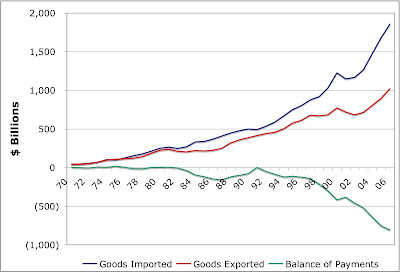
Figure 1: US Balance of Payments, 1970 – 2006
What is happening is the US standard of living is increasingly being subsidized by the deteriorating balance of payments. In 2006, this deficit amounted to about $2,700 per US resident, or somewhat more than 10% of US per capita income. This deficit relates to a wide range of products --only about 15% of our imports are currently petroleum products.
US trading partners are becoming increasingly unhappy about this situation, partly because they realize that they are financing a lifestyle Americans cannot really afford. In addition, many trading partners are becoming aware that world oil production is likely to decline in the next few years. Peak oil is likely to result in declining real GDP and a much greater chance of default on debt. Our trading partners do not want to be caught with a lot of worthless debt.
9. What about the other point in Question 7, "Debt payments are artificially low"?
There are several reasons debt payments are artificially low:
• Foreign trading partners in recent years have been using the excess cash they received from the US purchase of imports to buy US debt. This has helped to keep interest rates artificially low. This issue is closely tied to the balance of payments situation above.
• Low interest rates set by the Federal Reserve have also tended to keep interest rates low.
• Some new debt products have artificially low teaser rates for the first few years they are effective.
• The charges required for defaults on loans have been calculated in a period of economic growth, so are artificially low.
• Underwriting of loans has often been very loose.
If payments on loans are artificially low, lenders will generally fare poorly. Such a situation is not sustainable--In the long term, debt payments (on all new loans and some existing loans) are likely to rise, resulting in market contraction and defaults.
10. Are there problems with the debt system, over and above the artificially low payments that may cause defaults in the future?
Yes. Confidence in the system is being severely tested. One of the basic characteristics of a debt-based finance system is that there must confidence in the system for it to continue to exist–-otherwise lenders will stop granting credit and the system will come to a screeching halt. For example:
• Debt products have been put together without adequate concern for protecting the lender. Home loans were made with initial teaser interest rates and little down payment. Commercial loans were made without proper covenants.
• Questionable loans were repackaged (after being sliced and diced) and resold around the world. These repackaged loans cannot be valued properly, partly because of the questionable nature of many of the underlying loans, and partly because the valuation system that was planned (using rating agencies and theoretical models) works very poorly in practice.
• Off-balance sheet financing of banks makes it impossible to assess a bank's true financial situation. Banks are becoming less willing to lend to each other, because they cannot tell what each other’s actual financial situation is. Banks lending to other banks are not protected by FDIC coverage, so they are concerned when there may be a risk of default.
11. What other issues are currently on the horizon?
The world is finite, and we are reaching its limits in many ways. Besides energy-related impacts discussed in Part 1, there are many others:
• There is increased competition for soil and fresh water. It is not easy to increase production of biofuels, because of competition with food production. Costs of food and other products tend to rise with scarcity, adding to the overall pressure on consumers, and pushing real economic growth downward.
• Many minerals are becoming harder and harder to extract, because the locations with high concentrations have been mined. The real cost of mining these minerals is rising, both because of the higher cost of fuel and because of the additional work required to extract these minerals.
• Climate change is becoming a serious issue. There is a significant possibility that climate change will disrupt food production in not many years. There is also a possibility of coastal flooding causing significant damage.
12. How would you sum up what we are seeing here?
We are facing a world that is already stressed - by a debt market that is not working well, by pressure on limited resources, and by climate change. In such a world, it does not take much of a change to disturb the debt system, and to cause serious problems with the world monetary system.
Peak oil, or even the squeeze preceding peak oil, is likely to result in a decline in real growth. Even a slowdown in growth might cause a problem at this point, given the existing problems in the system. This disruption of economic growth is likely to put pressure on the monetary system, because our monetary system is tied to debt, and debt is easily disrupted by declining economic growth.
The United States is particularly vulnerable to problems because we are living beyond our means and because we are already straining our debt-based system to its limits. There is a significant possibility of a discontinuity of some type--either deflation or rapid inflation. There is even a possibility that our monetary system will fail completely, and need to be replaced.
The long period of economic growth in the past 60 years has lulled analysts of many types into believing that the favorable patterns associated with economic growth will last forever. It is pretty clear that these favorable patterns are in fact temporary. Peak oil, or the squeeze preceding peak oil, is likely to result in a rapid change in the financial situation that may have more impact than the decline in oil production itself.
In Part 3, we will look at the changes that are likely to occur in the years ahead.
Contact
- Content: editors at theoildrum dot com
- Tech support: support at theoildrum dot com
License

This work is licensed under a Creative Commons Attribution-Share Alike 3.0 United States License.
Pay off your debts, make practical preparations. Thereafter if you have any surplus savings left exchange them to the only real money: GOLD.
The fiat money systems are likely doomed at least to further depreciation year after year ahead.
RE the gold standard: IMO the US dollar's link to gold had long become a fiction by the time France 'called the bluff' and actually began demanding payment in gold. The pros and cons of a gold standard have been debated extensively on this list and elsewhere. I don't see a way that a gold standard can realistically work. But then, I don't see a way that the worlds current economic situation can work regardless of the commonly accepted monetary standard. We are in a bad fix.
OIL AND MONEY
Hello TODders,
As an economics neophyte you might ask:
1. What is "money"?
2. Where does it come from (how is it "created")?
3. Why does our culture need ever-growing supplies of money (and the goods/bads, services/disservices to back up that money)?
Similarly, a PO neophyte might ask:
1. What is "oil"?
2. Where does it come from (how is it "produced")?
3. Why does our culture need ever-growing supplies of of flowing oil (and the goods/bads, services/disservices dependent on that growing flow of oil )?
OIL and MONEY: How did we get on this accelerating treadmill and where is the button for stopping and getting off?
A good video http://video.google.com/videoplay?docid=-9050474362583451279&hl=en-CA
Paul Grignon's 47-minute animated presentation of "Money as Debt" tells in very simple and effective graphic terms what money is and how it ... all is being created. It is an entertaining way to get the message out. The Cowichan Citizens Coalition and its "Duncan Initiative" received high praise from those who previewed it. I recommend it as a painless but hard-hitting educational tool and encourage the widest distribution and use by all groups concerned with the present unsustainable monetary system in Canada and the United States.
It's a great video but the arguments at the end about why the system is unsustainable aren't correct. Look below for the reasoning as to why.
Rajiv,
The punch line near the end is that hardly anyone gives a second thought as to what money is or how it is created.
I think if we took a survey, as some of us do, of how many people ever give a second thought to what oil is, how it is created (formed and extracted) and why it might be an essential element of our very existence, the results would be very similar.
The "rational" human mind doesn't give it a second thought. Second thoughts hurt. Best to leave such painful thinking to the invisible smart people who are taking care of things --the care takers and crude givers. :-)
http://politics.reddit.com/info/2sxcg/comments
if you are so inclined to promote this piece around the web, we would appreciate it.
All money is created as debt, as is easily understood after viewing Money as Debt. You're almost there but hesitant to say it, or so it seems. If we all pay off our debts, there's no more money. It is really that simple.
The first task of the Fed is to maintain the value of the US dollar. It has lost some 95% of its value since 1913, so that is definitely not working. Saying that the Fed "tries to regulate monetary supply" could mean anything, from overflowing the markets with debt-ridden funds, as in the past decade, to suddenly withdrawing lots of money, as it did in 1913, and, in my view, soon will again. For whom does the Fed work? The American people? It's a taboo question, but perhaps not a bad one.
You use terms like "real growth" and "real GDP" as if these are knowable. They are not. For all we know both may have been negative for years, a possible fact hidden by -exponentially- increasing money supplies, aka debt.
One thing you haven't touched upon is what Henry Liu called:
The rise of the non-bank financial system. That is, the debt instruments issued by institutions other than banks. These instruments have allowed the rise of the derivatives industry, which at their present estimated value (sic) of close to $500 trillion have the potential to bring down the entire existing global financial system.
Derivatives are far more important than homeowners defaulting on loans, both because of the much bigger numbers involved, and because underlying assets have been leveraged to a far higher extent. The world has never had anything remotely like them, which makes it hard to oversee, but all governments, banks, pension plans etc. are deeply invested in them, and that is scary.
It is tempting to try and see a link between peak oil and the economy, but it's not very clear so far in what I've read here. I doubt the causality of the link very much; the financial system is imploding on its own accord, in my view. Allowing the creation of 100-fold leverage on any asset one can think of is an insanity that could not even be balanced if we had 10 times as much oil as today.
One last thing: oil prices seem to be on the rise these days, but are they really, or are we fooling ourselves? For instance, did they rise in Euro's? Can't be much. Could that be why pump prices are still relatively low? Nobody addresses this, might by a US blinder kind of issue. The dollar just reached another all-time low vs the Euro.
I couldn't find a Euro chart offhand, but this one should be cause for pause when discussing oil prices:
Brent Spot/dollar commodity charts
- development last 3 month(s)
Thanks for saying it for me. The inflation that you blame on the fed is to an extent necessary; the prospect of cash depreciation is a goad to invest rather than hoard, and 3% is considered sufficient motivation. This keeps the cards on the table and moving. Compounded over time, we shouldn't have a loaf of bread or an hour of work be the same as 1910, but the reality has been not a smooth curve but a lumpy one. Nuther lump coming, but is it up or down?
We may see the fall of the non bank financial system, and much faster than its rise, as is common in the sawtooth world of such things.
P, I don't know where that idea comes from, but it's pretty wild. A quick look at exponential functions says it's doomed from the start. It simply forms the basis for a consumer society, I would think, and that's not going very well.
As long as people have not fulfilled their (basic) needs, they will spend in order to do so. When they have, why entice them to spend more? As all money is issued as debt, they will only get deeper into debt, so who benefits from that 3% inflation? Not the people.
It will bring down the banks as well, or at least I can't see how it couldn't. The entire system is neck-deep invested in derivatives.
Then there is the obvious connection to a growing population. Picture a village with a fixed number of people and you could conceive of a steady-state economy with no inflation. Keep adding people and this triggers all the other pressures to adopt 'inflationary' systems such as resource extraction and fiat money. Population expansion must, I believe, be seen as the fundamental driver behind expansionary economics.
No it's not. In periods with very low inflation or even deflation like around 1900 other mechanisms were used to achieve the same effect, for instance the Woergl stamp scrip. This currency was used to rejuvinate a small city and it worked by causing money to "rust" by forcing people who held the cash to pay to keep it valid.
This practically forced investment and usage of the money rather than hoarding, as people are wont to do when a currency is deflating. It had an amazing affect on the town, by all accounts.
These days inflation is used to achieve the same thing. Rather than sit on piles of cash waiting for them to get more valuable, people invest. They do this even if they don't realise it - by holding their money in savings accounts or pensions.
It's widely accepted that a small amount of inflation "greases the wheels".
Why entice them to spend more? Perhaps because people spending money is how things get done? If everybody bought only the minimum they needed to survive and hoarded the rest our civilisation would grind to a halt. Nothing new would be created, infrastructure would decay, our society would become a pathetic joke.
You want money to circulate, you want investment. What you don't want is too much new money entering the system because that can cause nasty feedback loops.
Also, whilst it's true that the money system is based in "debt" that's not necessarily a bad thing. The word has many negative connotations, but having money be issued via bank loans has both pros and cons when weighed against alternatives (like full reserve banking or Ripple-style mutual credit systems).
Why entice them to spend more? Perhaps because people spending money is how things get done? If everybody bought only the minimum they needed to survive and hoarded the rest our civilisation would grind to a halt. Nothing new would be created, infrastructure would decay, our society would become a pathetic joke.
Sounds like a prescription for exactly what we need. (although, I do believe our society is already a pathetic joke for holding on to growth as one of its core values)
Anyone touting inflation as a good thing doesn't understand exponential functions.
Inflation does one thing only: it depreciates the value of your assets, while debasing the value of your currency.
And you wish to make the point that that is a positive thing, and our civilization would even grind to a halt without it.
That may be true for a civilization based on American Idol, McMansions and Cheese Doodles, but why would we wish to save or maintain that? Aren't the limits sufficiently clear yet? How much longer will it take?
Of course. if what you have loses value all the time, and what you need gets more expensive at the same time, you will have to go and work and dig holes and what not, in order to make up for that loss, and you'll get mighty active, but that’s good for who exacttly? For you? Who do you think collects as profit what you are losing?
The early 1900's are not a case pro inflation, they were a time where an inflation based economy was showing the same cracks that we see around us now. Fight the evils of inflation with more of the same. Real promising.
.
Inflation ultimately can only destroy societies. And my, look around you.
Inflation reduces the value of currency, which makes sustainable investments more compelling.
Consider a forest that I own. If there is no inflation ... if there is deflation, in fact ... then it's in my best interest to clear cut the forest straight away. I'll get a lot of money up front and that money will become more valuable year after year! But if there is some mild inflation, then it's in my best interest to run the forest sustainably, because I get a guaranteed income each year (the price of wood will rise along with the price of everything else to match the increase in money supply). In other words I invested and produced value rather than hoarding currency and eliminating value.
You're right that inflation can destroy societies - just like deflation can, if allowed to get out of control. Your position on the early 1900s don't make any sense - the Great Depression was a time of deflation, not inflation.
I believe that ilargi was referring to
You seem to be fixated on 1929. Before 1929 but still very much a part of the early 1900s (part of that same 20th century), we saw numerous financial events that demonstrated the hazards and folly of inflation.
"The greatest shortcoming of the human race is our inability to understand the exponential function." -- Dr. Albert Bartlett
Into the Grey Zone
While I understand the point Mike was making, it does provide a valuable counterpoint: The way in which this forest is *considered* is from a purely economic standpoint, and that's the tragic rub of our whole economic way of life -- EVERYTHING is reduced to its pure economic value regardless of any other value ethic!
IMHO this all encompassing capitalist economic meme is our ruination as a species. We need a land ethic that supports our basic communal ecologically based survival needs first and foremost. In other words, the forest is valuable as an intact healthy ecosystem that supports our life and all the other living things that contribute to the same! As soon as we diminish this land ethic valuation and substitute it with an economic one we devalue and diminish our own survivability.
Hence the lesson we are soon to learn as a species: Nature does not make economic compromises with anyone!
1. What is economy but the mathmatical analysis of scarcity of resources?
2. Why are you considering an entire math science to be "bad" just because humans used it to understand better how to destroy Earth? Economy isn't bad and that's the issue we face. The problem is that it worked too well, not too bad.
3. Isn't morality only a traditional-based "economy" of things? We all have learned by moral that we should be in more of a harmony with the environment (the greens), but isn't that a purely economical stance of sustainable existence? Aren't you confusing "Economy" with "PR using economical terms to rape the Earth"?
I'm not against what you're saying. I'm against the way you're saying it. The program you present (get the ecological issues back to politics, aka society, from the economics) has some problems, but essentially I agree with it. Society should decide what is best for the ecossystem first, and only thereafter what is best for particular economies.
But this kind of thought will be referred to as "communist" or "extreme left nugget thinking", and so I wouldn't bet on it.
I'm sorry but I do not accept your definition of "economy" as a "mathematical analysis of scarcity of resources." I do believe this is way too narrow a definition of what should constitute a healthy and life sustaining *economy* and our understanding of it.
Secondly, I did specify the particular economic analysis system I was referring too: "all encompassing capitalistic" one. Your suggestion that I was inferring all economic (or math based) analysis "bad" is a misguided interpretation of your own making.
However, as to your suggestion that such an economy as you conceive it, as a mathematical abstraction, "worked too well, not too bad" in *destroying the earth* only serves to prove my point!
Without an ecological ethic (or however else one wants to call it) to guide us, all our scientific and mathematical genius can not save us from continually doing harm via these lofty methodological abstractions -- they need to be grounded in earth based limits and our acceptance of them. In short we need to accept that we aren't demi-gods over this earthly creation but mere caretakers, and very ignorant and fallible ones at that.
Finally, I don't care what anyone may think to negatively label such thoughts as representing. We don't have as much choice in this matter as we pretend we think we do and/or will have. The way we are going about accounting the economy of the world is without a doubt leading us to ruin. Ultimately, earthly reality and the very real limitations that rules the natural world here and within ourselves will prevail over our ecologically unhinged abstract economic conceits.
Whether we make amends before our civilized destruction is complete is *the bet* we are wagering and it is the only one none of us can predict with certainty, but make no mistake we are betting against ourselves daily with our unethical economy as is!
Thus my assertion stands: Nature does not make economic compromises with anyone!
Mike Hearne:
If the Woergl stamp script worked so well, then why wasn't it revived during the Great Depression at least in Woergl? Why are there no more examples of this system working in the years after this one experiment?
When I'm looking at an idea for an oil well one of the first things I look for is evidence that other people or companies are doing a similar type of prospect.Its confirmation that my idea isn't too outlandish. And its the same with other ideas, I don't mind being fairly original but if I'm too original its not a very good sign. Bob Ebersole
Bob,
Democratic forms of government were invented by the Greeks several hundred year before Christ. After a relatively brief period of experimentation these forms of government disappeared from the world for over a thousand years. Did this disappearance constitute 'proof' that democracy was a bad idea?
And, by the way, the Woergl was deliberately suppressed at the request of the Austrian central bank. The case was fought up to the Austrian supreme court which ruled in favor of the central bank. What a surprise.
Roger
Peak oil guarantees that any debt based system that depends on infinite growth is doomed. So by itself, peak oil guarantees our current monetary system, even without the non-bank financial system, is doomed.
Our current system has so many deficiencies that it seems to be doomed, with or without peak oil. I agree that the non-bank financial system is a big part of the problem. It seems like the whole system will collapse fairly soon. Any push from oil prices, or the drop of the dollar, or knowledge of peak oil, will only help it along.
When I started trying to tackle this subject, I found myself with too big a topic to handle. I divided the subject up into three posts, but even these got long. I stayed away from the non-bank financial system because I needed to contain the topic somewhat. Perhaps I can do another post later with some other issues. In this post, I do mention off-balance sheet financing of banks as one issue.
That´s why i maintain that GOLD is the only real money in existence. It ain´t debtbased and can´t be printed out of thin air. Sure you can´t go and buy milk for a gold piece, but its a sure thing for wealth preservation of ones hardearned savings.
Gold is ‘real money’ only in the presence of a healthy economic system in which relatively wealthy people exist who want to deck themselves out in gold trinkets. If everyone is worried about where their next meal is coming from or how they are going to keep warm this winter a whole warehouse full of gold will not be of much use to you.
Couldn't one say that about any good, be it a precious metal, mineral, commodity, or a chicken? They aren't debt-based and can't be printed out of thin air either.
What I'm nervous about is your use of the word "only". I would argue that there is a large basket of stuff that can be used to efficiently store value, and that picking a single one isn't wise.
Couldn't one say that about any good, be it a precious metal, mineral, commodity, or a chicken? They aren't debt-based and can't be printed out of thin air either.
Unlike other commodities, gold is not perishable, does not rust or corrode and takes very little space to store. 500 gold coins - which can easily fit in a small briefcase - can buy you a decent house in most parts of the US.
Also, gold has a 5000 year history as a store of value. I would argue that silver is also "money", but not as much as gold.
Of course. And that's the reason for my use of the word "efficient".
Diamonds would also qualify and have far better value density than gold. Many currencies would do the trick. I'm actually fond of land as a store of value.
In case it wasn't clear, my point was not that one shouldn't buy gold, but rather buy a diversified basket of assets to cover yourself no matter what happens.
Gold is a universal currency. I know I spend a lot of time in Asia. And yes you can but a litre of milk with gold. In fact gold is the prefered currency especially in Chinese communities. You can buy and wear standard weigh gold earings / sleepers in any pierce-able point on your body. The minimum is about 5g. They will even give you change. This is handy to know as you can buy or have made a large amount of these if you are traveling from say Thailand to China via indochina just as an example. It is also common in Central asia to use a chain you can cut links out of. I have done this in Tashkent.
Diamonds are no good as money. How do you value it? A goldcoin as a Krugerrand is recognised by almost everyone around the world, and are smaller more convinient pieces of value than diamonds.
My stupid opinion..........
For the average Joe Blow.
In the not too distant future, your labour and health will be your biggest asset.
Wealth eventually will be seen in land barons.
Livestock, farmland and the ability to defend it, will be all that matters.
Big land barons will be like the monarchs of old.
The worth of gold will be determined by how well it can keep you alive, if a gold coin can't buy your next meal then I would say it was worthless.
Initially labour will be very, very cheap. There will be enormous competition to provide it.
The inevitable crash in populations, will be the only pressure relief.
Paying for and providing security may be a growing trend.
The big problem with diamonds is that the price is far, far higher than their cost of fabrication. If the De Beers cartel falls apart, the price of diamonds will quickly fall to around the price of fabrication. Even in a world with scare fossil fuels, I'm sure diamonds can be manufactured for less than 1/10th the current market price.
I learned about the value of diamonds when I went to sell my mother's jewelry after she died, to help fund the estate (needed to raise money to pay bills). Furs older than three years old are worthless. You can't give them away. No one wants them. Furs older than one year, but newer than three years old have a value of about 1/25 of their retail price.
Costume jewelry is worthless, about $5.00 per pound.
"Gold-filled" anything is worthless. 18K to 22K gold is worth the melt value, anything less than 18K is worthless.
Diamonds are worth 1/10 of the retail value, if they are big enough (>1/10 carat). My mother's wedding ring, with an insurance valuation of $4250, brought $430.00. I checked this value on Ebay, and this is the general state of the market. Diamonds bought at retail are *NO* store of value. Diamonds at wholesale may be valuable, but unless you're one of the diamond traders, you aren't going to get a diamond for the true wholesale value.
Steuben glass is worth 1/10 of retail value. And so on. Mass-marketed collectibles are worthless (but check prices on Ebay, some of that stuff has deceptively high prices). Usually anything stamped "Made in China" is worthless. Silverware is worth the melt value. Make sure it's sterling, silverplate is worth the melt value of the copper which comprises most of it, unless of course it's more than 150 years old and has recognizable hallmarks from a recognized UK or Irish silversmith (same for silverware).
Stainless steel "silverware" is worthless
Land only works as a store of value where there is some authority that grants land rights and protects them. Without such a government (and note that not all governments protect land rights or even recognize them), your land can be alienated at will.
Silver is actually a pretty good place to park your money too, but it's big problem is storage. The price of gold (when calculated by weight) is almost 50 times greater than silver. Furthermore, a 1-ounce silver coin is larger than a gold coin of the same weight, because silver is lighter. So if you're storing silver coins for the coming disaster, you are going to need over 50 times the storage space. A large safe-deposit box could store over $1 million worth of gold, but only $20,000 in silver.
Of course, after the US$ collapses and you go to the corner gas station with a 1-ounce gold coin, it's going to be awfully difficult to get change. In that case, silver would certainly be better.
Sure you can store value in any tangible good. Bu if we talk about money, gold is and has been THE money for 5000 years around the globe. Why should it cease to be money now, come what may?
And it takes little space, is easily hidden and transported.
Cash is just a set of tokens valued by others. I think if you actually tried to live your daily life using only gold you'd be quickly disabused of the notion that gold is "real money" at least in the west.
Try to imagine going to the local supermarket, or gas station, and attempting to pay using gold coins. Do you think they'd accept? Or would they point out that it's a lot easier for them to understand the value of a $20 bill than a piece of metal which may or may not actually be gold (how many people have even seen a real gold coin these days?).
Another problem with using gold as money is that there isn't enough to go around and hasn't been for decades. It's also far more valuable as a useful material for things like semiconductor manufacture than it used to be. Hoarding gold makes no sense. I'd much rather try and buy things using IOUs in my local community than haul around easily-stolen pieces of gold!
"try to imaging going to the local supermarket, or gas station, and attempting to pay using gold coins"
I have never suggested that. As long as we have some kind of paper money working, you of course use it for daily purchases.
But the gold coins preserves the value even in the not so unlikely hyperinflation we perhaps are going to endure.
Then you exchange your gold coins now and then, whenever you need to a little more paper money for daily needs.
If you travel abroad, you can always have some goldcoins in your purse, for exchange to the local paper money.
If we have a collapse, and the paper money systems collapse. What do you think has more value; The old paper notes, or the gold coins?
Anyway, as i said in the thread before, you should first take care of other preps, and only buy gold if you have eccess savings left after the preps are made.
Once gold reached spectacular highs of $750/oz. only to be liquidated at $300/oz. a few years later. Some who trusted in gold to save them became greatly disappointed.
Some who trusted in the value of their real estate are seeing fortune dissappear before their eyes.
On the dollar bill it was written, "In God We Trust." One cannot trust the government in these times, rather that the government is doing all it can to dilute the value of the U.S. currency without producing favorable returns. Iraq is in its worse year of the war. Republicans indicated they were in Iraq to stabilize it, yet Iraq would have been more stable if they have never conned Americans into supporting the war in the first place.
Germany's banking system collapsed in the 1920s. Anybody want to tell us what that resulted in?
Cute blonde girls in waving cornfields.
I am sixteen going on seventeen.
Lots of them.
Cornfields?
I thought they were mountain tops with boom boxes tucked away in the corners to blast out the sounds of music.

(Vellcomin to my Cabaret. Everything is beautiful. The show girls are bea-u-tiful. The sounds of boots stomping is bea-u-tiful. Life is a Cabaret ole' chum.)
I presume, that all know what happened in the Weimar Republic at that time.
There is a story from that time of a hotelboy in Germany, who got a one oz goldcoin as a tip from an american guest.
The boy kept the coin, and eventually the hotel went bust. The hotel owner stood in the corridor and said out loud, that if he could get one oz of gold for the hotel, then he would sell it.
The hotelboy happened to stand there hearing what he said. He asked the hotel owner: do you really mean it? Yes said the hotel owner. Then i will buy the hotel said the boy and gave him the coin.
The boy managed to get the hotel on its feet again, and after the war he traveled abroad and founded a worldwide hotel chain. The boys name was Hilton.
So you see in some years you can perhaps at least buy a fine mansion for a few gold coins.
Nice urban legend, but this bio of Conrad Hilton doesn't back it up. It has him in Texas, not Germany, at the time of the great hyperinflation in 1923. Was it somebody else instead?
No it was not somebody else. It was just a nice urban legend. Why do you have to come and spoil it???
Gail,
I see a drop in the dollar as a very positive thing right now. It is a way to boost fuel prices while supply is also increasing. Since the US is doing little otherwise to control oil consumption, this gives at least a push in the right direction. With the building trade slowing, this will turn out to be a very good time for insulating existing building and converting their heating to geothermal heat pumps. We are already seeing substantial European investment in renewables in the US. This is likely to increase as the potential for export improves. The key thing that we need to shake loose of is the yuan's dollar peg. Getting oil sold in Euros might just do that job.
I can kind of see your point that debt as we use it now is tied to growth; we certainly do not have jubilee cycles these days. I listened to two young people join in the sermon on Sunday interpreting the reading about the unjust steward. Neither they nor the priest recalled that a regular cancellation of debt is biblically mandated. Still, they all did well interpreting a difficult text. Now we are going to pay our debt in devalued currency. Is this unjust or ordained?
UAW feels strong enough to strike. They know that there are going to be a lot of cars built with better fuel efficiency and they want to be sure that they are the ones to build them rather than robots. We are not done with economic growth because there is a very big energy conversion to undertake and a huge export market to serve. Because the US is good at process engineering, it will be the US that does much of the industrial work for the energy conversion. The rest of the world is just making sure that it does not cost them too much to buy our products since they will be essential. The losers who speculated in the dollar as a reserve currency will also be winners as they get solar panels, wind turbines and plug in hybrids at a reduced price. Hopefully we will not decide to hold a single currency once we have built up our foriegn reserves. The way I see it, we've baited our hook with the US market in consumer goods to catch the largest possible market in durable goods and having let China run out on our line long enough so that their government's continued control requires what we can provide, it is now time to reel in the profits (Chinese New Year pun intended). The Chinese tradition of not eating all the fish may be as old as the biblical tradition of not allowing debts to build up. They both speak to sustainability in interesting ways.
Chris
The work a society can do is proportional to the energy it has available. It might still be advantageous to spend more as energy gets expensive in order to get work done, but when the energy is not available no amount of money will suffice to get work done. Nor is it simply a matter of applying more labor, because what one man with a backhoe can do in a day, it might take 10 men a week; even those ten men accomplish in a year only a tenth of what the single man with the machine could do. Ten people now must share a gross output only 20% of what it was - or even less if they are working 6 1/2 days a week instead of 4 1/2.
My guess is the present meltdown is already reflecting tight energy and therefore productivity and work. I'm reading Odum's "Prosperous Way Down" right now; he makes much more sophisticated arguments about how energy [not only oil] and economy tie together.
cfm in Gray, ME
Peak oil is something that just geologically happens. It is a mineral minimal bit of brain clattered un-sense borne with good intentions and later becoming an overused worn-out tramp-- that offtrack simple comment can never fully register until the greased ways become rough/gruff and lacking. Money (as we know it) is in bed with the easy greased up petrol dollarium whore. Not a big mystery or concern until the source is stretched in too many geo differing means and starving mouths. Any real stored value becomes mute and is to accept this farce as a tradable medium of ever constant growth built on the nothingness + nothingness = infinitity of more of the same, with ever renewing fossil fueled-up mentalities.
We do not even get the washable stupid truth anymore. Perhaps, this is because we are all too damned brilliantly stupid from taking in their boob toobed lesson sessions to handle it....? In the nearest timetable of funny monetarism (mone here comes the "real" inflated terrorism)(monet of money) as an outlet to those ongoing betterments of bullshit Fedfaux fiat inductions, then, we do not have much of a choice..Or do we?
Ah, the wonders of it all. The great influence of a fiat masters werking and jerking those majic puppet strings in the fogged-up closing daze of empires running low on reality and energy, is a sight to behold.
Oil is not rising nearly as much as our currency is floundering. One is becoming greater in quantified uselessness and the other is becoming greater in quality of usefulness.
God bless the restart of real America.
Did you compile this report before the present economic problems that are affecting the housing and financial markets?
Looking foward to reading Part 3.
Not really. I didn't want to overstate how awful things are.
We live in house of cards land.
I think you're missing one point when claiming, that debt is only a useful instrument if one speculates on rising income.
What about borrowing money for buying a house? I just got married and I want to start a family, which is something I don't wanna do in my parents home. So even if I don't expect my income to rise, if I can expect it to be more or less constant and I can afford the rates to be out of debt in 20 years, I would still buy the house...
But would anyone give you the loan? Without a growing economy, loans become much riskier.
In the old days, people didn't borrow, even for "worthwhile investments." Instead, they saved their money until they could afford it. If you couldn't save enough to get it, you didn't. Even if that meant not marrying.
Leanan,
The problem with individuals saving up money for investments is that is it likely to be very inefficient, particularly so in an environment in which people are struggling to make a living anyways. Saving means forgoing current economic consumption (maybe for a long period of time) in order to make a relatively large purchase later. If the item being purchased is a 40” plasma screen television, then I have no problem with this scenario. On the other hand if the item being purchased is a replacement roof or improved insulation which will save energy, then the personal savings scenario does not seem like the best idea. Making due with tarps while you save up money for a new roof will be more expensive than replacing your roof right now. Living in a poorly insulated house while you save money to purchase insulation will waste energy. A better solution would be for the community to finance worthwhile wealth preserving investments with interest free loans. That is everyone should give up a little consumption in the present in order to make sure that worthwhile investments are made on a timely basis. The reason you should be willing to help your neighbors out in this way is that when your turn comes to make a relatively large wealth preserving investment then your neighbors will help you. The old fashioned version of such community investment was house raisings or barn raisings.
Yes, barn-raisings and such are a possibility. But I suspect it would be more difficult. Barn-raising was most common in 18th and 19th century North America. When resources were not a problem, and constant growth was expected. The growth was fueled by expanding into new territory, rather than oil, but it was still growth.
I think we're going to be in for a rude shock when we find out what a steady-state economy is really like. Where you can't get a job or a house unless someone else loses theirs.
Leanan,
Without a doubt we are in for a shock. But the fact is that our long term destiny (assuming that we are smart enough to survive in the long term) has always been to live in dynamic equilibrium with a finite world and a finite ecosystem of which we are codependent members rather than its god like masters. The process of creating and maintaining the required social and economic institutions should be regarded as a positive challenge rather than as a falling away from the glories of the suburb, the six-lane freeway, and the big-box store. I am imagining something more sophisticated than barn raisings without in any way supposing that the ridiculous excesses of the current economic system can be retained.
I have to say, I have a hard time imagining what it will be like. The two most likely outcomes, IMO, are a return to a sort of feudalism, where birth is pretty much destiny and Malthusian forces keep population in check, or an authoritarian government, like in The Giver, to ensure population is kept in check, resources distributed, and the environment protected.
I'm not too keen on either one, though I'm not in love with the glories of the suburb, either.
Leanan,
I think it is pretty hard to know what outcomes are likely even though the outcomes you mention are certainly possible. You seem to be assuming that voluntary restriction of the human population and democratic cooperative economic systems are impossible so that we will need stern masters (starvation, disease, feudal overlords, dictators, etc) in order to keep our stupid, greedy, expansive impulses in check. I refuse to take this pessimistic view (although I do not assert absolutely that it is incorrect). I see no physical reason why we cannot develop a system of democratic, social investment whose purpose is to preserve wealth for the community rather than to increase the net worth of private investors. If such a system cannot be implemented because we are too stupid and self-centered to carry out such cooperation, then we deserve whatever terrible fate that the end of economic growth is going to bring us.
No, I don't think it's impossible. It's happened, as detailed in Jared Diamond's Collapse. (He writes about societies that have succeeded as well as those that failed.)
However, his work suggests that certain criteria are necessary in order for a society to become sustainable, and the odds are not in our favor.
In particular, he notes that two kinds of societies can succeed: small ones, where everyone knows everyone, and everyone feels a sense of ownership of the environment; and large ones, with strong central control and a hereditary ruler (who has incentive to preserve resources for his heirs). Medium-sized societies cannot make the transition to sustainability. They are too large for everyone to feel ownership of everything, and too small to support strong central control. They invariably collapse into internecine fighting.
Diamond suggests that that is the likely fate of large societies without strong central control as well, and I fear he is right. Democracy - where those in power are only in power temporarily - encourages people to loot the system while they can.
Democracy - where those in power are only in power temporarily - encourages people to loot the system while they can.
The governments of the OECD countries are not democracies. They are governments of, for, and by private finance capital. These governments do not loot because they are temporarily in power; They are in power because they promised their corporate masters that they would be looters. Your claim that democratic cooperative economic systems cannot exist is a claim that democracy itself cannot exist (with the possible exception of village style communism). Of course such cynicism cannot be disproved, and you are right that history is discouraging in its revelation of human beings’ shortsighted selfishness. However, being philosophically a democrat (I do not mean a member of the democratic party) deep in the marrow of my bones, I refuse to admit that history is destiny and will continue to hope that civilization and democracy will some day find a way to coexist.
People behaved unsustainably historically, generally because they did not know the long-term consequences of their actions, but we are better informed now. Since the industrial revolution people have tended to take a short-term and selfish attitude due to economic and social insecurity - the neoconservatives didn't invent globalization, fear-mongering and xenophobia. For example we have enough information on overfishing of world fish stocks to know what policies can improve it, but people pay little attention to such 'altruistic' issues when they are worried about the mortgage.
We need to do two things: replace our growth-dependent debt-based monetary system; and reorient our socioeconomic goals to improving quality of life within limited resources (which includes greater economic equality and local food production). I see two phases of social change happening:
Firstly a period of increasing insecurity, fiscal crises and domestic and international aggression while people demand that the existing big business/government 'fix things'. Meanwhile local groups will be quietly building 'lifeboat' communities with LETS, sustainable businesses and organic farming.
Seondly most people will become disillusioned with TPTB after they fail to deal with major problems (perhaps a peak-oil-induced depression, or life-threatening pollution). At this point the 'alternative' economics will gain mainstream support, social capital will increase, countries will start making the real changes needed, TNCs will be neutered, and international cooperation on climate-change, pollution and resources will improve.
The major unknown is how quickly the second phase will occur, which depends on how long the MSM disinfotainment will keep the sheeple hypnotized. If food production and imports fall too far too quickly, phase two will be replaced by civil war and dictatorship.
This is all with regard to the richer countries. I don't think a major overpopulation/food crisis can be avoided for most of the poorer countries. Cuba was lucky with good soil, permaculture experts and a responsive government; North Korea represents a more likely outcome.
When you say "People behaved unsustainably historically" what exactly do you mean. You go on to talk about the industrial revolution, so is "historical" since the IR?
Civilization is full of examples of peoples living non-sustainably. And in one sense you are absolutely correct if you define historical as recorded history.
On the other hand, many peoples have lived sustainably for long periods of time (some suggest the aborigines of Australia lived essentially the same life for 50,000 years prior to the modern era.
Us moderns have a tendency to want to shorten the length of time that we consider as significant to our lives. Knowledge of ancestors has been reduced to "geneology" on the internet. The seventies was "a long time ago," even for those of us who lived through it. And little prior to WWII (when we fought alongside the germans against the russians ;-)) is considered of any importance.
So when you say "people behaved unsustainably historically," I want to respond with - you're right, and before that we were smarter!
Unsustainable behavoir has been happening from the moment agriculture was invented. Mesopotamia was once rich enough to create the first civilization but is the soil is now largely degraded and salted. I believe Plato commented on the loss of fertile soil in Greece. Libya was once the breadbasket of Rome. The leading civilization slowly moved West from Mesopotamia to the UK as successive fertile lands were degraded and populations declined.
Australia was a largely forested land before the Aboriginies arrived, although the role of man in deforesting it and eliminating large animals is disputed. Agriculture itself can be seen as a response by an overpopulated hunter-gatherer community which degrades the ecosystem.
Some communities have learned to manage the soil so that its long-term fertility is preserved, but generally soils are overexploited until the human population declines from lack of food and the soil has a chance to partially recover its fertility, whereupon the population increases and damages the soil again. This cycle may be 'sustainable' but it's an impoverished state. It's only with the recent development of a scientific understanding of soil and ecosystems generally that we have the potential to improve and maintain our environment.
Looks like we agree, then, that the problem is civilization (as long as you adhere to the connection between large scale agriculture and civilization).
Unfortunately no country, developed or otherwise, has ever agreed to voluntarily limit either its economic activity or population growth. On the contrary the cry is for more growth, on all fronts, by nearly everyone, rich and poor alike. Those who raise the issue of limits and overpopulation are few, and in no position to influence the situation.
This is untrue. Please refer to Jared Diamond, he can provide examples of societies that chose to live within the means of their environment.
This is not to say that our society will ever choose to live within its means.
True, but those societies that did live within the scope of their environment were few and far between and also tended to be very small compared to our global civilization. This smallness made the boundaries of their environment much more immediately obvious as well. And most importantly, the few societies that did live within the physical boundaries of their environment were rare compared to those that managed to destroy themselves either directly or indirectly via ecological destruction.
"The greatest shortcoming of the human race is our inability to understand the exponential function." -- Dr. Albert Bartlett
Into the Grey Zone
With the obvious exception of the most populous nation on Earth, China with its one child policy.
An individual's income can grow even without a growing economy. Even now, it's normal for a person's income to start low, grow throughout their life, and then decline when they retire.
When put in that context of personal income growth, lending to a young couple to build their house makes great sense - the lender gets a long-term contract with a borrower whose demographic (young but stable) has a strong tendency towards income growth, and has the loan secured by a tangible and valuable asset (a house).
Indeed, if the economy overall is not growing, such personal income growth may be one of the few opportunities to earn real rates of return on an investment, and hence may be extra attractive for that reason.
That doesn't seem to be true. Here is an article about a book on the history of lending and interest ("usury"), and credit is old. As in, "you can go back to the Mesopotamians who kept records of borrowing and lending on stone tablets" old.
Peasants may or may not have borrowed, but that's because they didn't have much in the way of earning power. Businessmen - the middle class - apparently could and did borrow, even for propositions with a high chance of failure; the article mentions a Genoese trader who had to pay 20% interest rather than the prevailing 8%, due to risk.
So it's not at all clear that long-term economic contraction would cause lending to vanish. What is the evidence saying it will?
But what will you do 3 years down the road if that 200K house is now worth 130K? And it's roof is leaking. And your wife had complications from delivering your second child.
Be extra cautious in today's housing market.
There's always risk. It's unavoidable.
Hypothetically, which would you rather have right now?
$100k in the bank, paying $1500/month in rent.
or
$40k in the bank, and a 30yr fixed loan (240k at say 6.25%) for $1500/month, living in a house that's valued at $300k? With a tax write off to boot?
There's a ton of talk here about deflation. And don't get me wrong, it's a worry. But M3 is growing at 12% a year. The fed just gave away billions in loans with nothing but crappy mortgage bonds as collateral. England guaranteed all deposits at Northern Rock. Inflation is high. The government has trillions in unfunded liabilities...
INFLATION IS THE SILENT TAX.
If you want to bet against inflation, be my guest, but I've always found it hard to make money betting against the long term trend.
I'm not saying buy something you can't afford. I'm not saying buy 6 houses. And I'm sure as hell not advocating tapping into your home equity to buy a boat or SUV. But a properly financed, 30 yr fixed mortgage (or even better - a 15 yr mortgage) makes a lot of sense to me.
But what do I know.
G
This is a dilemma that I think about a lot. Betting for inflation generally is harmful for society (such bets typically increase consumption), but betting against it is asking to lose ones shirt.
You are assuming that the income source will always be there and that assets and commodities inflate proportionally. It also fails to consider the rising cost of maintaining the value of the property.
The odds of all this going ones way are much less then even and most likely vary with location.
If it were my deal I would like to have the 100K in gold outside of the US and would reduce my rent payments drastically.
The problem with property, especially near major cities, is that the value can drastically deflate due to above ground issues (in TOD speak), while commodity prices increase.
If you lose your job, then you have to get another one. And if you can't get another one - you might lose the house. But that's always been a risk. You can minimize that risk by not buying the "max" that you can afford, and by having 6+ months of reserves in the bank.
In my mind - it comes down to weather or not you believe the current "system" is going to continue on fairly long term (20+ years) or if you think a big disruption is going to happen sooner, say 5 or 10 years.
There always is risk but the risk is not always the same.
Right now the risk is very high and has to be priced into it.
If you feel that you can, or more accurately "will want to", hang on to the property long term and think it will increase in value then go for it.
My experience has been that even in good times the real estate I owned remained desirable for only so long even in an appreciating market. The only exception may be very high end property.
Inflation is the silent tax, agreed.
But, most today refer to the "bubble" As in exceedingly inflated or about to burst.
The problem is a couple years down the road. And for whatever reason, you have to sell. An asset that has declined in value and eaten up your hard earned down. Markets are pretty unforgiving, you may sweet talk an agent to listing at what you paid, but it'll sit. The fact that your income has remained static only compounds the problem. You borrow more.
So it is a gamble. I think the majority of the folks today can't believe real estate prices will fall. Appreciation is the only game they've known, and they still play it.
The flip side says keep your freedom, and your ability to move from one low priced rental or better job to another. Invest the difference in assets which are known to be appreciating, or expected to. Avoid those who seem likely to fall. Should housing stabilize, and your employment picture remains bright, then buy. Also, by then, your family's needs and your picture of the ideal home may be different.
"Tax writeoffs" work only for those with sufficient income. For most, it's not worth itemizing.
Everything is a gamble!
Housing, Oil, Gold, and stocks, are all "gambles." Obviously, the name of the game is to pick the asset classes you think will do best.
I don't see housing that way at all. It's a fixed cost. You have to live somewhere. Pay the mortgage off quicker if you can. If you can pay cash for it - so much the better!
I guess I just see "cash" as a much riskier investment long term then I do a piece of real estate.
G
I'd take the rent - easier to up stakes and change cities if the climate gets too problematic, move closer to jobs or transit, etc.
Thanks for tackling this subject. I've been hesitant to ask the actuaries I know about peak oil. The couple I mentioned it to weren't keen on considering it, and since I left the actuarial track some years ago I'm not too close with them anymore.
I just wanted to let you know that an actuarial approach is appreciated.
Keep up the good work, it's good to have you contributing.
Question: Do you discuss Peak Oil with other FSA/ASAs (actuarial designations)? What type of response do you generally get?
My experience is that people buy into infinite growth and they are wearing blinders to any alternative (short conversation, I don't even bother anymore).
With actuaries, as with others, you get a variety of responses. I have found quite a number who are interested in the subject. I first heard about peak oil in an actuarial publication, several years ago.
"Shunyata", author of Monetary Policy and Weaseling Out of Debt, is an actuary, among other things. His view is similar to mine, or bleaker.
Poster 710 has passed several actuarial exams. There are several good comments by 710 on the Part 1 thread, including this one.
I wrote an article for the May 2007 issues of Contingencies magazine (sent to all actuaries) titled Our Finite World: Implications for Actuaries. I got a lot of favorable e-mails and phone calls about it (from 0.1% of the readers).
I was recently asked to write a similar article for the "Actuary of the Future" publication of the Society of Actuaries. I believe this will be published shortly.
So there are at least a few actuaries who are interested in the subject. I think a lot of them are scared by the subject, or else have never stopped to think about the problem.
Great article. With so much raw information and opinion available its a huge relief to see someone investing from themselves to benefit everyone else with sound reasoning and construction. Tying the oil price risk and the credit market risk to the full economy is a meritorious effort and worthwhile read for everyone. Gail has done an even better job than last week's piece making it understandable by everyone. We've reviewed it and are encouraging our readers to share Gail's work at http://newenergyandfuel.com/ with others.
Thanks! Glad you like it!
I've got a question about fundamental "philosophical" issues rather than the technical aspect of money/debt/financial growth as underpinning of the modern economy.
If things do change radically, as it seems they must, and the current economic arrangement of an ever-expanding economy backing up a debt-based monetary system changes to something else, does it follow that the practice of lending at interest will be abandoned of necessity? I guess my question suggests an answer (that is 'no'), but I would like to get some feedback on a few issues.
First, and just briefly, I believe there is historical precedent for money lending at interest in the absense of hydrocarbon energy supply. Maybe someone with more knowledge can consider if that is a system that might be returned to, or readapted to the midterm(?) future.
The second point is more general. I've posed this question on reddit before with only tepid response. Suppose peak oil production causes disruption in the energy system -- this seems likely to me I don't mean to question this assumption. Is the following a reasonable post-peak-oil scenario? Development, production, lending, population etc. simply scale down in a smooth slope without any more cataclysm than we're seeing now. I have in mind a situation in which the western lifestyle becomes much more like subsistence living, but the change is gradual and relatively peaceful? I don't think this scenario is particularly likely, but I'm curious to see an argument to the effect that the post-peak-oil situation will be catastrophic.
On a related note, if such a gradual scale-down were possible, could a finance system based on money lending at interest be possible for "value-added" production. I have in mind a situation in which I borrow money from a bank to build a brewery or bakery, and I do so, and the value I'm able to add to things like wheat, malt, barley and hops allows me to make a profit and repay my debt. It doesn't seem that this sort of arrangement necessarily involves massive hydro-carbon energy inputs and seems the sort of thing that could work in a money based economy.
In the ancient world, people did borrow money...but only if they were desperate. That's why there were such strong prohibitions on "usury" - charging interest on a loan. Paying back a loan was difficult enough without adding interest.
I think it's more likely that you be required to save up the money to start your venture. Perhaps with help from your extended family.
Another thing they used to do, and still do in many countries, is a kind of lottery. It's usually within a family or other small group. Everyone puts a certain amount of money in the pot, and lots are drawn to see who wins it. The winner might use the money to buy a house, or start a business.
Leanan
A number of Vietnamese and Chinese immigrants in Houston in the 1970's and 1980's used that system, but they were'nt necesarily blood related. Its been superceded since their community started banks. A lot of Moslems in the area have similar arrangements, because the religion of Islam prohibits interest. These seem to be more family related, though.
Bob Ebersole
Schmendrick,
I think post peak oil you can get short term collateralized loans, such as for inventories. Longer term, there tend to be too many defaults, and the interest rates (with the charge for defaults) becomes exorbitant. By the time you pay the high interest rate, it becomes very difficult to make a profit with your brewery or bakery. There is also a possiblity that you will find no one to make the loan.
Regarding whether you can have a gradual scale down or not, I look at that in Part 3. My conclusion is that you cannot. There are too many discontinuities that take place - both on the side of oil exporters and on the side of oil importers.
Your scenario is you wishing upon a star. What you describe happening would occur only if certain conditions are met:
1. Economic contraction occurs at exactly the same rate as fossil fuel decline rates.
2. Population contraction occurs at exactly the same rate as fossil fuel decline rates.
3. Fossil fuels are not substituted out at all.
These occurring together are extremely unlikely.
Instead, the question needs to focus on alternatives and substitution rate versus decline rate. If the substitution of non-fossil fuels can occur as fast or faster than fossil fuels decline, then civilization stays intact (although it may also reorganize itself along new energy lines). If substitution rate is less than fossil fuel decline rate, then we have catastrophe in some form awaiting us.
This is why so many in the peak oil camp are not just worried about total URR (ultimately recoverable resources) but also about the extraction rate of those resources. It doesn't matter if we have 10 TB of liquid fossil fuels if we can only extract a maximum of 5 mbpd due to various limits on the system (hypothetical numbers there simply to drive home a point). Flow rate is very important as it directly correlates to how much fossil fuel energy we can use per unit of time.
Thus the entire question becomes about flow rates. Can we sustain current BTU flow rates in our civilization? There are interesting arguments pro and con but almost no one thinks that we will decline at a rate exactly matching fossil fuel declines. Thus, we are either headed for more economic growth in a new direction if substitutes can come online faster than oil depletes or we are headed for a crash if they cannot come online fast enough. (Please note that this entire discussion does not incorporate other problems, such as other resources being depleted, population pressures, climate change, loss of biodiversity, etc., all of which present unique and difficult challenges of their own. In order to form a reasonable opinion of the likelihood of collapse, you need to consider all of these issues and the historical examples associated with each.)
"The greatest shortcoming of the human race is our inability to understand the exponential function." -- Dr. Albert Bartlett
Into the Grey Zone
Grey Zone-
The largest flow of oil ever acheived in the US was the 10 mbopd acheived in 1973. We are currently at about 3 mbopd, plus natural gas liquids roughly another 1.9 mbpd. I've been studying tertiary development fairly seriously for the last year, and think it has the potential for another 2mbopd to 3mbopd-around 25% of the original flow rates.
I think our oil drum guys have proved that biofuels aren't sustainable for the long term, so I'm not counting anthing for them. Same way with oil shale-its not economicly viable and shows no sign of becoming viable, there aren't even any research projects being pursued in shale. Coal to liquids has such horrible greenhouse gas emmissions I doubt it ever gets much capacity built
My scientific wild ass guess (SWAG) is that the US can count on about 10 mbopd from conventional and non-conventional domestic energy. We're currently using about 22 mbo from all sources, so thw range I'm talking about is 40% to 50% of current useage can be produced long term from domestic sources for the next 30 or 40 years.
So the rest of the energy we need has to come from conservation, solar, wind and water and nuclear- about the equivalent of 7 million barrels of oil per day.
In Europe the per capita consumption of oil is about 12.5 barrels per capita per year. Inthe US we use about 24 barrels per capita per year, so we can probaly cut out domestic useage to around 11 mbopd without undue hardship through sane energy prices. So our real shortfall isn't going to be that great with good policies. But its going to require all of us to sacrifice and start being prudent. Bob Ebersole
Bob, your numbers don't seem to add up.
You state that the US produces roughly 3mbpd C&C + 1.9mbpd NGL. Let's call it 5mbpd. Then you state that there is another 2-3mbpd in tertiary development. we can do. Let's be generous and take your high number. This gives us 8mbpd rounded up, not 10. Further, you note that we are using 22 mbpd. That leaves a deficit of 12mbpd, not 7. Further, you cannot instantly switch over to these alternatives or tertiary production. That takes investment and that requires capital and time. So what you are arguing is that the US will do sufficient investment to replace 60% of its total daily oil usage. When? With what capital? How long can your tertiary production last before it needs to be replaced? It will decline too, you know. Even if we reduce consumption that still takes investment. You are talking about sufficient investment to reduce consumption by 60% and sufficient investment to produce an additional 2-3 mbpd of tertiary oil and sufficient investment to replace the remaining gap with alternatives. In short, you are proposing a staggeringly huge sum of capital be expended with no time frame specified and then offering that up as a "solution". I just do not see it, sir, without a "war" mentality across the entire USA driving us like scared rabbits. And since that is not happening yet, when should I expect it? Next year? 2010? 2020? What if Bakhtiari is right and global production is down to 55 mbpd worldwide in 2020? I'm not seeing it yet. Even if we peak at 88 mbpd as Dave Cohen and a few others argue by 2010-2012, we'll still be well into the downslope by 2020. You've seen the ELM in action. You know what's coming.
The problem remains flow rates now not later, not while we spend decades rebuilding our entire infrastructure. Decline rate will dictate everything. And if that decline rate is higher than society's ability to adapt, then nothing will change the outcome in any significant manner. I believe we've peaked. C&C peaked in May 2005. All liquids appears to have peaked in July 2006. How long do I have to wait to see this replacement of 12mbpd of oil with alternatives and tertiary production, Bob? One year? Five years? Ten years? In short, your proposal would have been fine 20-30 years before peak as that's about how long it would have taken to get ready for peak. But now? With peak either past or almost on top of us? I don't think so.
"The greatest shortcoming of the human race is our inability to understand the exponential function." -- Dr. Albert Bartlett
Into the Grey Zone
Grey Zone,
As I said, these are just some wild-ass guesses.
Let me get a little more specific about the prospect I'm buying currently, it might give you an idea of what could be accomplished in at least some areas
Location-its within a 100 mile radius of Houston, and is an easily identifiable piercement salt dome prospect. Thats as specific as i'll get here.
Size-theres about 500 acres open that I'm buying, but about another 1,000 acres thats prospective.
Cost-I'm raising $500K for lease purchase, but my original 500 ac. should cost $150K, more or less. I've got some money from an inheritance and I'm trying to raise the rest
Expected production-there are 5 miocene and frio formations that produce in the area, from about 600' to 5500' in depth. The original wells came in as high as 7500 bbls a day, but its expected that most of the good-sized reservoirs have been discovered at shallow depths. I've worked on 3 fields like this in years past. The wells come in great-200 to 300 bbls/day, but average about 50 bbls/day the first year, 25 bbls the second year, and are strippers for the life of the wells, which is nearly infinite at 3 bbls/day
Expected reserves-around 20 mbo has been produced since the onset of production over 80 years ago. The US Dept Of Energy thinks that most fields like this produced about 10% of the original oil in place on primary drive. This field has never had secondary production (waterflood) because it was sold by the major that owned it before waterflood became common in about 1965. I'm hoping that reentering and redeveloping the field will therefore yield somewhere between 20 mbo and 140 mbo, but it will take place over a period lasting past even my son's natural life.
Production Rates- Aye, that's the rub. The natural pressure has been depleted on these fields through bad production practices before 1935. I suspect that the maximum modern peak will be 5,000 bbls a day or less, and the end stripper production that the field declines to in 30 years will be around 300-500 bbls. a day but last that way forever.
Costs of drilling and equiping shallow wells like this should be about $200-$250 a foot for new wells, and about $80,000 for reentries. Its going to cost around $1,000,000 to drill enough and reenter enough to figure out if my idea is viable on this field, and somewhere between $20,000,000 and $50,000,000 to redevelop old part of the field with tertiary development.
Personel. I've got a couple of young geologists working on the prospect in exchange for override in the evenings, plus I have some geology available on parts of the field from the era 1924-1960. But the main geology is closeology-we know the oil's there, and can even figure out many of the main fault blocks from production records . I haven't found an engineer yet, and a good production engineer is the key. Also, although I can figure out how to operate the wells myself-I operated some strippers about 20 years ago, its a waste of my time and talents. I'd really like to find a young operator to operate while I generate and assemble more prospects, of which I have several.
To be perfectly frank, there are not enough small independents any more in the oil and gas business, and in the oil side. There was a huge wave of retirement after 1988, and very few new guys got in during the 1990's, the capital available went only for purchasing old field from the majors until 2002. After that, the new smaller companies got involved in natural gas resource plays-Barnet Shale and coal bed methane. An operator is a lot like a building contractor in that they seek the types of prospects to drill for which they can raise money, and the herd of investors all decided to go for the "sure thing" of natural gas resource plays. And now all the gas storage is full, gas prices are hovering between $5-$6/mcf, and between the huge discoveries in the Gulf on the sub-salt trend and the dozen or so LNG import terminals that have been built and/or being built, natural gas is going to be depressed for the next 20 years to something like its current level. They don't call it the oil business for nothing, thats where the money is made. Bob Ebersole
Yes, there's nothing magical about oil, despite what many posters here seem to believe. Large loans for investment were being made long before we started sucking oil out of the ground (see the expansion of Europe into the new world for one example, construction of the canals or railways in England for another).
This may be true but it seems at least from a U.S. agricultural standpoint, farmers did not borrow or could not borrow money until gas powered tractors became available. Refined oil products allowed one farmer to do the work of many with horse teams, thus minimizing some of the risk (not getting the fields planted) for instance. The so called chemical revolution also increased the per capita efficiency of farmers although I personally do not believe in the use of chemicals.
btu,
that's not correct. Planters borrowed money to purchase slaves, so lending was available for agricultural ventures since the early 19th century at least. I've seen the documents in old probates and deed records a number of times.
Also, railroads were given land to finance track building in the late 19th century, and farmers and planters could borrow money on next years cotton crop. Plus land was sold reserving vendor's leins.It is safe to say that subsistance farmers couldn't borrow money, but thats true today too except for federally subsidised loans. The problem with loaning money to poor people is they don't have any money-so that dries up rapidly, just as the sub-prime mortgages are drying up now.
I am a landman and look at old deeds very often. This is from my personal knowledge gained running titles.
Bob Ebersole
Maybe the real difference is that they were careful about who got loans back then. People who had a business purpose, and who could earn additional money with the investment the loan bought got the loans.
Recently, we heard about businesses at the edge of bankruptcy being able to borrow as much as they wanted. And of course all of the mortgages without income documentation.
"Yes, there's nothing magical about oil, despite what many posters here seem to believe. Large loans for investment were being made long before we started sucking oil out of the ground (see the expansion of Europe into the new world for one example, construction of the canals or railways in England for another)."
What do you think made that physical and economic expansion possible? Could it be that coal and other natural resources (in that New World in particular) were abundant and exploited to fuel that growth before oil? What was the population of people on the Earth before the industrial revolution? If you think that our population can continue in a resource constrained world with the same prospects as smaller populations of old who had abundant resources, please explain how...
"You can never solve a problem on the level on which it was created."
Albert Einstein
schmendrick, IMO a "soft landing" transition isn't possible simple because people are still having more children than necessary for replacement. A 15 years-old child eats a lot more than an infant does; this means if no more children were born after today food requirements of humanity would still increase for a while.
While I understand that the Powers That Be are stalling widespread knowledge of PO in order to prevent panic, it's sad and tragic that people I know are making decisions to have children without knowing what surely looms in the near future. Ugh!
PLAN, PLANt, PLANet
Errol in Miami
Historically there were often periodic cancellation of debts or limits on repayments (eg after 2 x initial loan has been repaid). Google 'history of usury' for details.
If a government eliminates debt-based money generation (fractional reserve banking), then it could still inflate the (fiat) money supply at a slow and steady rate by providing grants or loans at low rates of interest. This would provide an alternative to bank loans. It would avoid the problem of compound interest swallowing the real economy by waiving repayments for socially beneficial projects after a time and returning gains as public spending.
The problem with the second point is that population can't 'scale down' on the timescale of oil depletion (say 40 years for 75% decline) from ~6.5 to ~2 billion (that can be fed without fossil-fuels) without mass starvation or nuclear wars. I don't think people will agree to draw straws.
Interesting stuff. I too think that Peak Oil + Bursting Credit Bubble (i.e. Dollar Crisis) could make for interesting times, and that the former may well trigger the latter.
I am inclined to contest a few points, but I will constrain myself to one. The assertion that "Peak oil guarantees that any debt based system that depends on infinite growth is doomed" is overly doomish in my view - I do think that we will be able to transition to an economy based on solar/wind/nuclear energy that will continue to give us ongoing economic growth, though I won't be surprised if that transition is fugly.
Does anybody know of a "credit bubble" blog that does for the ongoing US current account deficit and consumer credit bubble what TOD does for Peak Oil? The closest thing that I know of is calculatedrisk.blogspot.com's coverage of the US mortgage/housing situation - CR is awesome. Oh, and I HIGHLY recommend this paper by Paul Krugman on whether there will be a dollar crisis: http://tinyurl.com/yrx75w
jamest,
Some very good commentators on the credit bubble:
Bill Bonner
Daily Reckoning
http://www.dailyreckoning.com/
Martin Hutchison
Prudent Bear
http://www.prudentbear.com/
Tim Iacono
Mess That Greenspan Made
http://themessthatgreenspanmade.blogspot.com/
Eric Janszen
iTulip
http://itulip.com/
Henry Liu
http://www.henryckliu.com/
Peter Schiff
Euro Pacific Capital
http://www.europac.net/
John Stucco (aka Mr. Practical), Kevin Depew and others
Minyanville
http://www.minyanville.com/
Mike "Mish" Shedlock
Mish's Global Economic Trend Analysis
http://globaleconomicanalysis.blogspot.com/
Any of the market commentators at Financial Sense
http://www.financialsense.com/Market/wrapup.htm
Dr. Housing Bubble
http://drhousingbubble.blogspot.com/
Dollar Collapse . . . http://www.dollarcollapse.com/ . . . carries Best of Web links featuring most of these authors as well as others like Frank Barbera, Gary Dorsch, Paul Kasriel and Doug Noland.
Hutchison's most recent article (posted at Prudent Bear today) has an interesting explanation of why the gold standard wouldn't work today - basically, because gold production grows more slowly than world population, which would lead to catastrophic deflation, at least until population starts to decline. He suggests a sort of hybrid gold/silver standard that could be very cautiously debased as necessary by some international successor institution to today's impotent central banks.
Wayne
and for those who are digg inclined:
http://digg.com/business_finance/The_Economic_Impact_of_the_Decline_in_C...
Thanks for all the effort, GTA. You omitted, by choice, commenting on (or explaining!) the non-bank financial system or the off-book bank liabilities. If you felt moved to explain a bit on that, before it falls on our heads, I for one would be appreciative, even if it is 'off topic'.
I am not certain how well I can explain the situation.
A large share of debt that used to be in banks is now just passed through the banks, and resold to investors as part of loan packages. Some of these loan packages are actually owned by special purpose vehicles, owned by the banks themselves. As I understand it, these special purpose vehicles are supposedly low risk and do not directly affect the banks' financial statements.
We end up with a situation where very little of the debt that is provided by banks actually ends up on the balance sheet of the bank that sold it. Instead, we have all kinds of players in the in the market, buying and selling slices of packages of loans. Most of these players, particularly hedge funds, are not regulated. They also trade in huge volumes of derivatives. The balance sheets of the banks (which are regulated) are so unhelpful that banks are concerned about lending to each other.
The Federal Reserve policies affect banks and the prime rates charged by banks, but they do not as directly affect these other players. Thus, the Federal Reserve interest rate policies have less effect than they might otherwise.
This is a link to a good article about some of the off-balance sheet "stuff" going on. Money market is part of this. So are over the counter derivatives that are being traded.
In the good old days (pre-1970), the balance sheets of banks reflected what was going on within the banks - loans made, bank deposits made. The banks were required to hold a specified reserve on all of this. This type of regulation was felt to be needed, because of the guarantee that depositors were getting from the FDIC on their accounts. Without such supervision, there was concern that banks would take on excessive risk. (Heads the bank wins; tails the FDIC loses!)
Now, banks have all kinds of off-balance sheet subsidiaries (referred to as "conduits") that have little or no reserve requirements. Some of these are what we think of as money market funds. Other conduits may hold derivatives which are backed by virtually no collateral, and debt of various kinds that has been sliced and diced. It is the lower (or non-existent) reserve requirements that allow these conduits to grow rapidly, and expand the effective money supply. It also makes them very risky.
Besides banks, we also have hedge funds. These do many of the same kinds of things as conduits, and more, with very little regulation. Hedge funds tend to be very highly leveraged. Hedge funds do not have FDIC coverage.
All of this amounts to a huge amount of "banking" type risk, that is no longer will regulated, and no longer has reserve requirements to protect against loss.
A lot of the loans in the system are now very hard to value -- they have been sliced and diced, and valued using questionable models. Rating agencies (who get their funds from selling these ratings) have been very generous in the ratings given to the bonds. All of this makes a big mess.
Provocative and useful stuff. I'm not qualified to comment much of the economic stuff, but with a gloomy overall response (mine, not necessary that of Gail's) I try to remind myself:
"Change always arrives later than everybody expected, and it is always more profound than anybody could imagine." - Paul Saffo, professional futurist (paraphrased)
"Prediction is very difficult, especially about the future." - Niels Bohr
"Theory is extremely useful, because your theory determines what you can see.” - Albert Einstein
"As for the future, your task is not to foresee, but to enable it." - Max Jakobson
"There are two kinds of forecasters: those who don't know and those who don't know they don't know." - J K Galbraith
... the last quote of course reminds me of the deep uncertainty future policy decision making method developed at RAND:
Shaping The Future (Scientific American, 2005)
I'm not sure I completely agree with their approach, but I don't discard it either.
What it does underline however is that: simplistic cost-benefit analysis in our current world (energy/soil/water/carrying capacity/biodiversity depletion) puts us into a very high impact/probability risk scenario, without having any reasonable ability to handle it.
The alternative method is their proposal - a safety valve method, because for some reason, Americans on the average do not want to follow the European precautionary principle tradition (not that Europeans have been particularly good at it either, I'm forced to admit).
This probably applies to financial systems as well, although the signals I've been getting lately is that it is beyond anybody to model at this point. Just too complex. Risk that cannot be assessed remains an uncertainty and as such, by definition outside the quantitative risk management tools of finance mathematics/statistics, afaik.
At which point one could apply the basic rule of risk probability from C. Perrow:
The higher the coupling of the parts of the system, and more complex the interactions between them, then the higher the likelihood for a really catastrophic failure (as time goes by).
I don't know about you, but our financial system seems to me to be on a such a path (increasing complexity and coupling) of more likely catastrophic risk.
Unless of course, somebody resets and simplifies it, before a big meltdown happens.
In fact, this is what I consider to be a more likely scenario: a big mini-crisis (sic) and a reset + reform, resulting in a gigantic redistribution of wealth.
Whether that's pre or post peak oil, within my lifetime or next thousand years - I simply have no idea :)
Great post, thanks for writing it. I found it balanced and objective. TOD needs more articles like that.
But (there's always a but ;) I have a couple of quibbles.
The way this is phrased makes it sound like when a loan defaults the money is destroyed. The opposite is true - when a loan is paid back the money is destroyed. If the loan defaults then the money it created stays circulating in the economy.
This is probably what you meant but I thought it seemed a bit unclear.
My other concerns are slightly deeper. You assert that flat or negative economic growth will cause very serious problems, even collapse. You also claim that our economic system assumes permenant growth. That's not true. Japan in the 90s is an example of a modern capitalist society that experienced long periods of zero or negative growth, including negative interest rates (ie, you had to pay the bank to store your money for you). Yet Japan did not collapse into anarchy and decay.
It's also not true that our currency systems assumes permanent growth. Nothing in the way our money supply works mathematically requires growth.
When I looked at the Japan situation, it looked to me like real growth was positive, most of the time. The problem was that the inflation rate was negative. This is a different problem than the one I am talking about--that when the real growth rate is consistently negative.
And you are correct, I should have phrased the part you quoted differently.
That is partly correct, There is a second possibility. Collapse.
But as long as you pay interest on loans, those are all the options there are.
And since all our money is issued as debt, you will always pay interest, over every penny. And that can only be paid for with more debt, which can only be provided for in two ways: economic growth, or printing presses.
Japan is a non-example of anything related to the subject, it is A/ one of the prime exporters on the planet, and B/ its population did become a lot poorer and suffered badly. Japan is not a closed system. As long as there are enough African nations left to rape and pillage, we will seem to do fine.
In other words: its economy collapsed, and was sort of saved by money flowing in through exports. But only sort of.
Everything in the way our money supply works mathematically requires growth. Why is simple math so hard to understand?
Because the "simple math" is wrong. Let me explain. The idea that fiat currencies require growth to pay the interest is common but incorrect.
Consider a loan of $1000 made at 10% interest. For simplicity let's assume it's the only loan in existence, therefore there are now $1000 circulating. I spend that $1000 into the economy and now I need to pay back $1100. Let's say I agree with the banker to pay back that loan in 10 montly payments of $110.
It appears at first that I cannot win - there are only $1000 in existence yet I owe the banker $1100! But this appearance is deceptive. I can pay back the loan just fine, because money circulates, and because interest payments aren't made in a lump sum but rather distributed over the period of the loan.
In the first month I earn myself $110, perhaps by cutting my neighbours lawn. I use that money to make my monthly payment on the loan. That payment consists of $100 against the principal and $10 against the interest. The $100 is destroyed, it no longer circulates. The $10 is not destroyed. It goes into the bankers own pockets as profit.
Now what happens to that profit? Does the banker sit on it, simply watch it collect dust? No. That makes no sense. If the money isn't spent it may as well not exist, he has simply made a loan "for nothing". It will get spent back into the economy, where it is available for me to earn once again.
Now next month, let's say I cut some lawns again and I charge $100 for that this time, and now I go work for the banker - perhaps I clean his office - and I earn back that $10. The very same $10 that I paid him the previous month in interest payments! If this seems stupid, consider that the banker is getting what he wanted - for the service of making the loan, he's getting something back from me in return.
This cycle can repeat as many times as is necessary. Although the original loan was only for $1000, I can pay the banker back $5000 if I really want, simply by re-earning the currency that circulates back to me.
Now, there are two situations in which this breaks. Firstly, the banker might not spend his profits back into the system. This seems remarkably unlikely: why did the banker make the loan if there was nothing in it for them? Secondly, the banker may require that all the interest be paid in one lump sum at the end. But this isn't actually how loans are made (even my example is an oversimplification - real loans use compound interest). In reality then, it's perfectly possible for people to pay off the interest on their loans without taking out new loans.
Where did the neighbor get the $110 to pay you for mowing the lawn?
LOL
Not fair to ask that.
Gail,
There is an interview today with former Fed chair Greenspan.
http://kpfa.org/archives/index.php?arch=22424
In speaking about the US deficit, you can hear real emotion, fear in his voice as he relates the possibility that the federal deficit might approach zero. As the waning days of Clinton began to show actual lowering of the deficit, and payback of the debt, it unnerved Greenspan. Even though the debt was just starting to be paid off for the first time in decades.
I thought a balanced budget was the goal for government, both parties and fed included. I can understand a party's arguments for debt for their project or vision, or that a certain level is helpful to the economy, but levels of 5.5 to 6 trillion, under Clinton, to the nearly 9 trillion today is ruinous. I see it only repaid via inflation.
Would you care to comment more on our debt, or Greenspan's irrational, exuberistic fear?
What is money today? Money is debt. Eliminating the deficit means eliminating lots of debt and therefore lots of money. Since money is how the wealthy control society, elimination of such would certainly cause Mr. Greenspan some sleepless nights. ;)
"The greatest shortcoming of the human race is our inability to understand the exponential function." -- Dr. Albert Bartlett
Into the Grey Zone
Money issued via government debt makes up a large portion of the money supply. Paying it off basically means taking money out of circulation.
Greenspan and Bernanke both fear above all else a return to the Great Depression, in which the money system basically broke down and currency was scarce. Their policies have always been to avoid a return to those days at any cost.
Our economic system is prone to feedback loops. If the money supply starts shrinking, then a dollar tomorrow is worth more than a dollar today, so people start hoarding cash. Money that isn't circulating is effectively not a part of the money supply, which makes the deflation problem even worse - it reinforces itself.
Certainly, for a politician it makes a lot of sense to pay down the national debt. For one thing it frees up tax revenue that would otherwise be spent on interest payments. For another most people feel that paying off debt is a good thing, because their view of debt is as an individual and not an economist, so it wins politicians brownie points.
Nonetheless, if the national debt were reduced to zero it'd cause a liquidity problem unless done very slowly.
Why? There must be plenty of other ways to create money.
I dont see why a country must grid to a halt simply becouse the government dont need to loan money.
Where does money come from? It comes into existence when the central bank loans the government some money. This debt is added to the national debt, however, the money is new - it was simply summoned into existence through the will of the central bank.
This money is called "high powered money". High powered money is then spent into the system, for instance, by paying the governments bills for the quarter. That money is deposited into private banks, where it can then be multiplied via the fractional reserve into a much larger amount of money (the textbook example is 10x but in modern economies it's more complicated than that).
Not all money is high powered money - a lot of it is created by private banks. But the amount private bankers can create is limited by the amount of high powered money in the system. Whilst they have the power to create money through sheer force of will, they cannot do so indefinitely - there are limits to their powers.
Of course there are alternative systems. Google "dropping money from helicopters" for an illuminating quote from Ben Bernanke on the issue. As long as money gets into the system somehow it doesn't really matter what the exact mechanism is - but today, we use a system in which the money system is controlled via government debt. It has its problems but it does basically work.
If that's true, why have countries which have sharply reduced their debt as a fraction of GDP not run into economic problems?
Simply reading down the OECD gross government liabilities table (.xls), Australia, Belgium, Canada, Denmark, Iceland, Ireland, Netherlands, Spain, and Sweden have all reduced their debt as a fraction of GDP by 25% or more in the last decade, and some of them (e.g., Canada) have also reduced it in absolute dollar terms.
Far from economic danger, though, most of those countries have been or are enjoying significant economic booms - off the top of my head, I know Australia, Canada, Ireland, and Spain have had tremendous economic success in recent years.
So it's not at all clear that reducing government debt is such a bad thing for a country.
And yet Greenspan admits he was terrified of the idea, Pitt. Don't argue with us here. Argue with Greenspan. That's the entire point of this discussion - that the man who was Fed Chairman found the possibility of paying off the federal debt terrifying. Why?
"The greatest shortcoming of the human race is our inability to understand the exponential function." -- Dr. Albert Bartlett
Into the Grey Zone
Considering how frequently unflattering things are said here about Greenspan's competence, do you really expect me to take it as gospel when he agrees with you?
My question exactly.
It may very well be that he - and you - are right, but why? There are very few claims I'm willing to take at face value, and that's not one of them.
The evidence available to me - the recent, real-world experiences of more than a handful of the world's rich nations - strongly suggests that running surpluses and lowering governmental debt is not at all a bad thing. In the face of that, I can't simply accept one guy's opinion that it's bad, even if that guy should know what he's talking about.
Everyone can be mistaken, Greenspan included. That's why I'm so insistent on evidence and numbers; less chance for personal biases and mistakes.
I didn't say I agreed with Greenspan. Go back and note the smiley in my prior post. If that's not clear enough for you, then you need to take some internet reading classes. I simply pointed out that the curiosity here was that the Chairman of the Federal Reserve feels that eliminating debt is a bad thing. Both you and I are wondering why, because, as you note, paying down the debt does not seem to have hurt other countries and heck, starting to pay down the debt sure didn't seem to hurt the US either under Clinton.
Unfortunately, I doubt that Greenspan is going to produce his data or even his thinking on why eliminating debt is bad, at least to you or me.
"The greatest shortcoming of the human race is our inability to understand the exponential function." -- Dr. Albert Bartlett
Into the Grey Zone
Greenspan's concern was in the nearer term, and the possibility of federal surpluses in excess of the amount of the debt that could be redeemed. Most of the federal debt is not callable -- the government cannot demand that you redeem the bond early. Greenspan is/was "terrified" that the federal government would use such surpluses to either (a) buy real assets (stocks and bonds) or (b) increase social spending. His personal ideological bias (and we all have them) is strongly opposed to both of those.
Doug: A lot of money is made by Wall Street off US government debt. I wouldn't say Alan was afraid, but he always knew who buttered his bread.
Buttering his bread is a good analogy. One expects the little extra, the butter on a slice of bread. This is akin to taking multiple loaves.
The question is really how much? A certain amount of debt is good for the economy, at least the arguments state that, that it is needed to foster development and make the system work.
One the other hand, awash in sea of debt won't work, no confidence that it'll be repaid. 6 trillion in 2000 was awash, I think. Obviously Greenspan didn't. Today, at 9 trillion, or 30K per individual in the US, it seems unsurmountable without massive inflation. I recall when the debt was 2 trillion, rapidly increased from a trillion under Carter. On a per capita basis, it seemed surmountable at the time, given the political will. Today, declining energy sources, overpopulation and food supply make it impossible with political will.
I know Don Sailorman believes the current fed is inflation oriented, that helicopters will fly. I see no reason to doubt his positions.
But what debt load can we handle, in the cornucopian world, and in the world where some see gradualism at work, with declining oil slowly giving way to new energy sources. The doomer position is pretty spelled out, it's the others where I think the adherents should begin speaking.
Many economists make arguments why a modest rate of inflation is good. For example, competitive markets are efficient only if they "clear" -- if prices adjust up and down to balance supply and demand. However, many prices are "sticky" in practice -- they are hard to adjust, particularly in the downward direction. One example often used is the price of labor. It is difficult for a firm to adjust wages very often, and very difficult for the firm to adjust wages for existing workers downwards. Modest inflation provides a mechanism for real wages to adjust downwards that is not as severe as laying off the staff and hiring new workers at lower wages.
As others have noted, the economy is full of feedback loops. Once started, deflationary loops appear to be extraordinarily difficult to break. Better, in AG and BB's opinions, to keep the cycle from starting.
email Monday September 24, 2007 1;30 pm
? Which is worse
Borrowing money you cannot repay or lending money that can't be repaid?
I think the big boyz are a little nervous.
Lent a lot of money into a declining value real estate market.
MEW will decline - who will buy inflatable Santa's...
Nobody buys Santa's who can't pay their loan...
Imho the Fed can only delay not stop this.
Gail, would you be able to include (maybe in a Part 4) some discussion of alternative economic theories, such as those of Herman Daly (Steady State Economics) and Paul Hawken (Natural Capitalism)? I've long been meaning to look into such matters, but I'm pretty naive about economics.
These are two whom I should know more about than I do. I would have to do some studying. I'll keep it in mind. Thanks for the idea!
I second that. Please do a part 4 on the alternatives.
Tim
A world government (UN?) could handle the situation?
There is no need for growth if there is no competition between businesses and countries, right? Would the solution be like international 5 year plans but with democratic rulership?
On a documenary where they discussed global warming and peak oil they mentioned this.
I'm afraid I don't see a world government handling anything. It is hard enough getting local people to agree on anything.
As the price of oil gets higher and more countries have monetary and debt problems, I think we will see less and less international trade (peak international trade!). I even see the possibility of countries breaking up in to smaller components. People will be more worried about their own particular situation. I see more local resource wars--five year plans for only very small areas.
lagedargent
Gail, an excellent and insightful summary of our predicament!
I've been a lurker on TOD for about two years now, but after reading your article, I decided to step out of the woods, if only to express my admiration for your succinct and clear presentation of a rather complex subject. Bravo!
For myself, I'm trying to spread the PO message in the Netherlands - Rembrandt's playground - but it's an uphill battle.
Thanks. This is a difficult subject to try to write about.
The fundamental problem with markup-based debts is that it is assumed that for all the purposes for which money is borrowed there would be a profit, no consideration is made about cases of loss or break-even. So, if world economy is running with say 3% growth rate and markup is 2% then majority of world's people are getting only 1% share in world's economic growth, with 2% going to the financial institutes (making rich richer as twice the rate than poorer are becoming poor). That is when we do have a growth in economy. Now suppose, we are having a 3% decline in world's GDP instead of growth. Do you think bank's would settle down on a -3% markup? Why don't they? When they were so much interested in eating up the fruits of growth why not they share the declines too? Let me tell you the obvious, they would still keep asking u for a +3% markup. Imagine the situation, a world running on capital that comes from debt. Year after year the value of capital fall 3% due to declines in world's GDP (due to fall in energy resources production) BUT banks are still asking for a positive markup rate. So, the business decline not with the rate of decline of world's gdp but with sum of that and markup rates. Ofcourse the govts can inflate currency but that is equal to robbing off people to give banks their markups as the real value of people's money fall down. In long term that squeeze out purchasing power that in return result in much higher losses in businesses as sales declines much fast.
We certainly have an awfully lot of people making their living in the financial sector today. What really makes a difference is producing real goods. The financial sector is just one form of overhead. When growth is a -3%, we will certainly not need the financial sector taking its still positive share.
I'm very much afraid that Cain's Law™ applies: Any situation in which it is easier to get rich by manipulating financial instruments than by producing the underlying goods and services will end badly.
I hadn't heard that one before. It's a good one. Are the the Cain of Cain's Law?
Yes.
Very clear Gail, very mainstream thus palatable, I have passed it on to a few ppl who's eyes should be opened. The measured tone is just right, thx.
What bothers me personally is that there is no reason *per se* that ‘the economy’ or the ’invisible hand’ should create any kind of problem; humans could, in principle, figure out an exchange system that does not lead to crashes, impoverishment, debtor’s prison, war, etc. etc. The present economic system is geared to profit some and disadvantage others; reality today, unfortunate certainly, but not set in stone. Political systems in the West accept that pov, or at least encourage it, again, that might change.
Exchanges between ppl are inherently three way - person to person, or group to group, with the environment (includes animals, plants, other living organisms) as a third, passive actor. The third party is not accounted for, and human greed or need for domination see to it that the profit motive is overriding....but there is nothing inevitable about that. I like to think. On my more optimistic days.
I would question the tight relationship that is generally made between energy (oil...) and ‘the economy’. As already mentioned in some posts above. There are so many in-between variables, the relationship is strong but also imponderable.... It exists... but is not in itself related to human happiness, for example. Peak oil is physical; the money arrangements are a human construction, the two don't cohere...
on edit; typo and a missing word
Somehow people (a lot fewer of them) got along before oil. At least some will get along afterwards.
The number of people employed in the finance industry today is amazing. I saw one estimate of 20%, but I think that was probably profits, or stock market capitalization, not people. Regardless, there is way too much money being spent on finance. We need to be expending our efforts on things that people really need. It would help too, if the wealth were more evenly distributed, so everyone had at least enough.
Maybe barter is the ideal exchange system. No one makes big profits--everyone comes out well.
"there is way too much money being spent on finance. We need to be expending our efforts on things that people really need. "
An admirable comment, coming from one in the industry. But what would the plethora of finance grads do?
Actually, what will most of us do? My head swims in the city when I see all these multitudes of people buzzing around me. "How do they all support themselves, what do they do?" I ask a brother. "I dunno man. Just more and more."
I would appreciate your thoughts on the Federal debt. Silly question, given energy and food supplies? Do you see the present debt load as too large an impediment to enable us to tackle energy or climate change? While I don't see it repaid without massive inflation, I likewise can't imagine the country not doubling the debt should a major multination conflict arise, one which requires the draft to be reinstated.
I talk about Federal debt and my guess as to what happens in Part 3 (tomorrow?) - basically not good.
I think most of us going back to doing things like growing food, woodworking, and eventually (when our present supply wears out) making clothing. I am afraid we will be taking a big step backward.
"But what would the plethora of finance grads do?"
Something more productive? Perhaps if enough jobs evoporate there will be a tipping point in the number of people examining the soundness of the economic/societal altars at which we have been worshipping.
"You can never solve a problem on the level on which it was created."
Albert Einstein
Worker owned businesses would broaden the distribution of wealth or, more to the point, broaden the distribution of ownership which would necessarily broaden the distribution of wealth.
I think changing the dominant economic actor from corporations to worker owned businesses would have a greater impact on society and the economy than any other change to the economic structure we presently have.
Tim
Noizette,
Good observation.
The GAADOM (Generally Accepted Accountant's Definition of Money ) is that money is a medium of exchange and a liquid storage of value.
The promise (or assumed expectation) is that if I have say $15K-$50K of the liquid money stuff, then on any given day of my choosing I can convert that money into say, a "car" (a personal transport robot) that takes me where I want to go when I want to go.
Peak Oil threatens the trustworthiness of that "promise" and therefore threatens the underlying expectations that come with having "money".
I am reminded of "Lay up not treasures on earth where moth and rust can corrupt. . ."
We think we have a promise. A lot of people have a lot of energy invested in the belief that the money will always be here. With Peak Oil, the belief is not really true--may not have been otherwise either, since our world is finite.
Lots of good posts on here attempt to describe money. The differences between "real" and "fiat" money. That gold is a "universal" currency. That money is a token, a shared idea, an illusion, or a store of value or effort.
These all address the question "What is money." But what about the question "Why is money"? As in, why do we use money at all? Why is it necessary?
Money is necessary to ensure the survivability of an otherwise unmanageably complex society.
Human existence is both bound and enabled by our resources and our skills. An individual human, though, does not do well in solitary. There is very little that a single person can accomplish on their own. So individuals form relationships with each other that allow each person to use their resources and skills to contribute to each other in order to promote individual and group survival.
People use skills and resources to provide necessities and support to other people, and vice-versa. This survival arrangement permeates every human society.
But.
Any group of cooperative people is still made up of individuals. And while synergies exist in groups, there is still a limit to what each individual may accomplish, contribute, or process.
As a thought experiment, we can define this limit in the form of effective management of "relationships". Every human activity contains a relationship with either yourself and your skills, the resources you have available, or other humans. You must understand how your body works and how to use it effectively (one relationship), how to manage resources available to you (one relationship), and how to interact with other humans (many relationships).
Considering that other humans are necessary for any individual's survival, we'll just consider the relationships with other humans to be the relationship limit.
Ignoring variability, suppose that the relationship limit is 100, that is, each individual can effectively manage 100 relationships. The ideal group size for this situation would be 100 people, as in this situation every person in the group has a complete and effective relationship with every other person.
With 100 people in a society, money is not necessary. Every person has skills and resources that are contributed to the group, and every person gets back what they need from everyone else.
With 1,000 people in a society, things are a good deal more complex. The group can still operate as a whole, but no single person has an effectively managed relationship with each and every other member. Each member can still get what they need to promote individual and group survival, but numerous interactions are obstructed by lack of ability to effectively process the relationship.
With 10,000 people in a society, the complexity involved becomes unmanageable to any individual, as most interactions necessary for survival involve, from the individual's point of view, "strangers".
But when some form of exchange is agreed upon, when the idea of money enters the system, stresses resulting from complexity are relaxed. Instead of having to trade, barter, and make agreements with 60 different people to build a house for yourself, most of whom you don't know, don't understand, and don't regularly deal with, instead you get paid money for your furniture-building efforts in society, and you can pay others to build the house, who then may pay you to build their furniture.
So my answer to "what is money?" Money is a standardized, agreed-upon, form of exchange. And "why do we use money?" In an attempt to manage a society too complex for any single individual to manage.
Interesting analysis.
In every society, decisions are made as to who is more "deserving" and who is less deserving.
Those who are deemed more deserving (i.e. male, white, of the proper political affiliation, etc.) are allocated (paid) more money while those who are deemed less deserving are paid less.
I hadn't thought of it that way before. Thanks!
It's the rule of 150. To summarize a person is capable of keeping organized in their head the names and faces of so many people, that grows linearly, but the relationships between those people grows exponentially. People can can fully understand a group with an upper limit of around 150 people. I learned about it in either Freakonomics or The Tipping Point, I forget which. After that threshold is reached some system needs to supplant that personal knowledge of people and their relationship to each other with a functional metric which they can all comprehend.
Tim
Thank you for those references. I will check them out.
150 = about the upper limit to band size in the long 99% of human history when we lived as hunter-gatherers. Not a coincidence.
That's an awfully good description. You might want to add it to Wikipedia's definition.