


The ASPO Conference - a comment
Posted by Heading Out on September 25, 2007 - 10:30am
So! Going to Cork was not a cheap experience, with at least a day of travel each way, not to mention the energy cost – so was it worth it? And to define whether it was worth it, what did I learn? What follows is purely my set of opinions and recollections, and given the number of TOD folk there – do please chip in with your own comments. And let me begin by stating that I am definitely glad I went, and, even though a fair amount of what we heard reflects posts on different topics that have appeared here over the past year or so, the information was largely more up-to-date, the speakers were highly qualified, and the conversations outside the formal presentations could not have been reproduced in any other way. (And if you want to consider that a hint about the value of going to the Houston ASPO Conference , you’d be right).
Putting together the papers on Supply, there are perhaps two or three significant thoughts that have hardened based on what I have heard. The first is in regard to the actual peak volume of oil and associated liquids that will mark the peak. Numbers at the conference floated up around 100 mbdoe, but I think it is now likely to be closer to 90. The second is in regard to how much of this will be exported. Westexas points on the decreasing amounts that will flow from producing countries were validated by the growth numbers that we heard for the indigenous economies of the producers. This reduction in export volumes will likely advance the arrival of an apparent peak to oil-importing nations to a time in advance of the real peak in production, with an even earlier significant economic impact above that seen to date. My sense for that timing is about two years, with the potential that, given the sensitivity of the issue, volumes might be adjusted prior to that in order to influence the next Presidential election. And in regard to how much of the export volumes the OECD can anticipate – well probably less than they are currently expecting. The way in which China, with foresight, has sought out future supplies and lined up commitments is likely to make the available supply significantly less for the rest of us, and the earlier optimistic projections from the majors that they had enough for us not to worry is being increasingly made irrelevant, as they get displaced from country after country. And, finally, as sort of a combination of these, I worry that the post-peak supplies may decline faster than the long plateau that currently keeps us complacent, and which does not reflect the bell-shaped curve that some of us use when talking about the subject. I am significantly more pessimistic.
In regard to the supplies of other fuels that were discussed at the Conference, I was a bit disappointed that we did not hear more about the state of natural gas. This has to be a topic of some concern, given the decaying prospects for North American supply, against a large use, and the current stories from the Middle East. It is a major concern for Ireland, given that they are at the end of a long, “leaky” supply pipe that stretches back to corroding pipes set on melting muskeg in Siberia. I did not find the discussion about nuclear supplies particularly credible. The delay in the re-opening of the Canadian mine can easily be offset by increasing production from adjacent mines owned by the same company, and the alarmist nature of this as presented in the paper tended to reflect on the overall value of the paper itself. There was really no comment on coal – apart from the reply, elicited by Dr Schlesinger that China has definitely stopped CTL development. Which in itself is highly informative. Given that it will become, while definitely not the fuel of choice for many, but the fuel of necessity, I thought it might have been useful to have a debate on the size of the resource – perhaps next time.
In terms of Demand, there are many things going on, outside the Conference, that make it hard to come to a definite conclusion. Anecdotally the car park that I normally use at the airport was full, for the first time in at least five years, when I got there. Planes I flew on usually seemed to have stand-by passengers ready to fill untaken seats (which may be why the airline let the flight I was supposed to cross the Atlantic on leave, when the 20 passengers on my delayed connection had been promised that it would be held for us). However the rising use of energy in China and India, as well as the oil-producing countries, will likely help pull demand to the levels of future availability of supply, with demand being managed (I got told off for saying destroyed) by price. The futility of imposing a gas tax to manage demand was briefly discussed. The tax would have to be so onerous (see European experience) to have any impact that any Government imposing it could anticipate a short life, and a long political exile. Unfortunately the uncertainties that governs this, taken with some of the increased costs for new production equipment, are likely to impact the decisions to start new projects, and so will influence intermediate term supply. Demand can, therefore, be expected to grow, at levels that will not be met by the available supply at current prices.
So, what do we do about this – the Conference was, after all, named “Time to React?” Well to make my point here I suspect I am going to make a whole lot of you mad at me, again. But, if you will allow me to make the argument, it might help you to understand the problem.
One of the speakers at the Conference was the ex-Minister for the Environment in the UK. As part of his remarks he made a fairly passionate set of statements about Global Warming in the course of which he stated that “the case for greenhouse gases causing Global Warming is inarguable” (or words to that effect). Now that is not a true statement. On my way back to the States, for example, I read the book The Chilling Stars – A New Theory of Climate Change by Svensmark and Calder. In this book they show the influence of cosmic rays on cloud growth, and thereby on global climate. Anecdotally you have only to go out on a clear night in winter, as opposed to a cloudy one, to see the role that clouds play in reflecting heat (you will find it colder without the clouds). However, it is in the reflection on the top side, which reflects sunlight back into space, rather than letting it through, that the book discusses. The relative cloud cover is, in part, potentially due to the changing density of the cosmic rays to which the Earth is exposed, in itself a function of the relative position of the Sun in the Galaxy, and the strength of its magnetic field. Experiments are described (carried out last year in Denmark) that show that this occurs. Specks are the small droplets that form the nucleation sites for the larger particles that form a cloud.
They showed very clearly that the greater the number of charged particles set free in the air, the higher was the production of ultra-fine specks. To double the count of specks needed a fourfold increase in the number of ions. (In other words the productivity goes with the square root of the density of ions). That means that any variations in the cosmic rays would have most effect on speck production when the overall intensity was fairly weak. So the ion seeding was real, after all.
What is also interesting (to those of us more nerd-like) is that geological information is then used to calculate the speed of the Sun through the Milky Way. (12 km/sec). This is deduced because as the Sun (and us on the planets) moves through the different parts of the Milky Way, so the intensity of the cosmic rays changes significantly. This affects the clouds, which is, in turn, reflected in the ground temperature, and what grows (and is retained in the fossil record).
An experiment is planned in a cloud chamber at CERN in 2010 that will look into this further. (Anecdotally it was a visit to my later alma mater on a school trip to see the construction of a cloud chamber that ultimately led to my going there). By the way did you know that the Alpine glaciers were at their greatest extent in 10,000 years in 1852 during the Little Ice Age? It might be why Hannibal could cross the Alps with elephants during the Roman Warming period, when the ice was about 300 m above current levels. The ice advance of the Little Ice Age was sufficiently great that it destroyed or moved earlier moraines (p 24 in "Glaciers and Climate Change - Spatio-temporal Analysis of Glacial Fluctuations in the European Alps after 1850," Michael Zemp von Roomos LU, Dr. sc. nat. Dissertation, Univ Zurich, 2006).
So why the big concern with this, and why are the authors treated as pariahs and find it difficult to get funding or serious consideration, well:
Svensmark and Nigel Marsh were able (to) reckon that the reduction of the relevant cosmic rays since the beginning of the century was 11 per cent. Translating that into the effect on clouds, they concluded that low-level cloudiness diminished by about 8.6 per cent as the Sun became busier. “A crude estimate for the century trend in low cloud radiation forcing is a warming of 1.4 watts per square meter. That was a provocative figure to give, because the Intergovernmental Panel on Climate Change used the same 1.4 watts per square meter for the supposed global warming effect of all the carbon dioxide added to the air by human activity since the Industrial Revolution.
So how many of you are going to go out and buy the book? Raise your hands, oh! That Few! Instead (if you haven’t read beyond this) what we are likely to see, based on past experience, is a lot of ad hominem attacks on me and the authors and, aside from that, more salient comments pointing to a web-site of climate scientists who have discussed this issue, an international panel that reviews these matters, the opinions of influential, and knowledgeable people and your own common sense based on the media keep giving examples of how it is happening, and it does seem hotter this year.
OK so you’re all good and mad at me – but now I want you to change places. You are John Q Public (or the mayor of a small town in the US) concerned with your fuel bill. You have not really heard about Peak Oil, but when you look around to see if it is true you will find industry experts that tell you not to worry. There are International Agencies that state that there will be no problem, and national agencies that state that there is loads of oil left to find. International figures and reputable folk that graduated from Harvard tell you that there is no problem, and the media talk about oil companies ripping us off and that this is an excuse, and your common sense remembers that gas prices always go up immediately on a crisis. And so you decide it is a conspiracy of the oil companies. Now you have made that decision, and you start to read more of the blogs that state that Peak Oil is a myth, and interpret the stories in that light. And you become more of a believer.
Now here is the problem – you remember the incredulity that you felt when I told you about the Cosmic Ray book? Was this based on your own evaluation, or on your “knowing the facts”? (This is not meant as a judgment, I am trying to make a point). And the reality is, as I believe it was Debbie Cook said in the closing session – once someone has made up their mind it is very difficult to get them to change it. We deride politicians who “flip-flop” on issues. However, as yet the general public really does not have a strong perception of the Peak Oil situation. She noted that no academic had come to her, during her time as mayor. (Note to self – go talk to the mayor). And where there is media comment, in large part it is still (in the mainstream) equivocal about the issue, though, as George Lee an Economics Reporter for a national TV station in Ireland mentioned, he found it, actively against the concept of peak oil. And this ties in with what I think that Nate was referring to in terms of mental activity. Tie the two together and instead of a response we will, apart from Ireland, (and even there it may be that they are more concerned with political supply restrictions than geological ones) likely see a continuing inertia in the system. The public will continue to believe in the conspiracy. (And there is a good example of this in the story that Leanan led off with on Sunday.)
The public, therefore, needs to be educated on the problem, and this is likely better done at the grass-roots and local government levels, since these are those who see the problems already. But who should do the educating. Those that are aware of the issue. And who are they? Stand up, go find a mirror and take a good look! If you have been a reader here very long you have been given information that very few people on the planet have. You have an understanding of the issues that very few others have. If you don’t do it, who will?
But if you think it will be easy – well you really aren’t going to buy that book, are you?
From which you will gather, that the answer to the Conference question is a strong YES!
Contact
- Content: editors at theoildrum dot com
- Tech support: support at theoildrum dot com
License

This work is licensed under a Creative Commons Attribution-Share Alike 3.0 United States License.
Indeed, for most developed countries, the most significant metric is peak exported oil; from our examination of the Export Land Model, it is obvious that overall global peak production is important, but not the sole driving factor for most industrialized nations.
I too am very interested in the state of natural gas production, especially in North America; a drop in production followed by a recession/depression there would ripple devastating through most of the economies of the world.
You will find that the Cosmic Ray hypothesis has not received much confirmation from the climatology community (quite a bit of disagreement, in fact).
The Hubbert Curve, e.g. the Lower 48, is actually kind of "comforting," in that a 2% decline rate in production would seem to give us plenty of time to adjust, to conserve, to bring on alternative forms of energy, etc.
In fact, with a steady exponential decline rate, the year over year volume of the production decline falls with time. For example 2% of 10 mbpd is 200,000 bpd, while 2% of 5 mbpd is 100,000 bpd.
The Export Land Model (ELM) and the UK and Indonesian net export declines were far worse than the Lower 48 production decline. The net export decline rate accelerates with time, leading to volumetric declines that more or less stay the same, or in some cases, actually increase.
A case in point is Saudi Arabia. From 2005 to 2006, their net exports declined by about 500,000 bpd (EIA, Total Liquids). From 2006 to 2007, their net exports will probably decline by 700,000 to 870,000 bpd.
WT, your ELM would put extreme upward pressure on price which would severely curtail demand - not just in the exporting country (as subsidies in producing countries are removed to preserve profit from exports) - but also in the OECD.
This will definitely have the effect of flattening the curve and putting us back into the "Comfort zone" (any comfot??!!) of 2% decline.
Marco.
Marco,
Which countries have net subsidies of their exported crude oil?
I think you misunderstood what I was saying in brackets. Many OPEC countries subsidise petroleum products INTERNALLY eg IRAN. It will be these subsidies that are removed to protect their own export revenues. But my main point in post is needing addressed and that is WT's ELM will force up price on an exponential curve of a higher order that that already being witnessed which will in turn lessen the gradient of the decline curve as demand is pinched ever higher up the ladder.
Marco.
Note that the UK had practically no increase in consumption, versus a fairly rapid increase in consumption in Indonesia, but UK net exports crashed faster than Indonesia's.
Also, at least at first, what I call the Phase One decline, I expect that the cash flow from export sales will increase, even as export volumes fall, because of rapid increases in oil prices, which will create some problems for exporting countries that try to reduce domestic consumption.
And, we may see some efforts to reduce exports, even beyond the effects of declining production and rising consumption. If exports are going to crash anyway (i.e., the big importing countries are toast no matter what), why not conserve your oil, maximize the per barrel price, and try to use your remaining oil to develop a less oil dependent lifestyle?
I agree with all 3 of your point here - but if we both acknowledge these points then price rise in crude will accelerate further (2nd order acceleration!!) which will pinch demand drastically - hence my conclusion that the downslope of oil production will be less steep.
I live in the UK and am aware of the flat consumption. For example many people i know have ben moving to cars with 5-10+ MPG BETTER than they had before. i have just spent ove £1500 on energy efficient measures around my house as have many i know.
I read with much interest your take on the housing markets and related economic posts here and the outlook for a recession (aka reduced oil demand) is indeed strong.
Marco.
Marco,
Is demand going down in the UK? Do you have any specific references you can share on his topic? Thanks
WT explained that demand has been essentially flat
From: http://www.cslforum.org/uk.htm
Good tables of production/consumption for UK
Marco.
Thanks for the good reference. After re-reading your above post, it seems you mean that demand will be reduced in producing countries when prices accelerate further (2nd order), which implies that we are not at that point now. Do you see consumption in the UK going down as a result, or are you referring to the developing producer countries?
I see 3 divisions:
1) Slightly reduced demand in OECD countries as the price starts to bite - but remember we are highest up the food chain and will survive the highest prices for longer.
2) 3rd world/developing countries are already seeing severe shortages. A previous post 2 weeks ago listed about 20 instances of this, so demand is already being destroyed here rapidly. Major problems soon. A good example is that world oil production is down 2% in 2 years yet OECD consumption is up?? HOW? Simple - we bid up and destroyed consumption elsewhere.
3) The third divison I see, and WT has pointed this out, is hoarding by oil producing countries, tempered by their need for export revenues where their reduction in consumption is likely to be similar to the reduction in OECD countries.
There is no doubt that sustained +$70 oil is curtailing demand. it must as world production of all liquids has been flatish since JAN 2005. WT's ELM puts extreme upward pressure on price as noted before, with the potential to wreak havoc on demand and I believe this is the only achilles heel in the ELM. (Would you agree WT?). I agree that essentially net exports decline exponentially but i refuse to believe this wouldn't nock the price on by the same order of magnitude. It's just that we appear to be on the cusp of that happening so right now it is conjecture.
Marco.
I think this is getting off the topic of oil production and heading into the way in which oil is traded. The flattening in UK oil consumption can be shown in the Nth Rock credit squeeze. This is because the countries you are referring to are beginning to shift the way they trade oil from US$ to €'s the problem hear is about the availability of credit not the availability of oil reserves. Under this scenario it is more a case of the last man standing, will oil be traded in $ € or cash in the local currency. The economic implications of this for the countries that are trading outside the US$ is profound. Even if say Iran further linits it's production without expanding it's € based bourse, it will cause pressure on, for examplke US housing prices. The lack of liquidity in markets will pinch oil exploration rather than increases in price.
Your reply is like that junk mail I get from loan companies and people that want to enlarge my penis/conservatory.
I am not refering to the broader picture hear Marco just this specific incidence. I think you have the cause and effect a little mixed up. Not that the supply is not flattening off but that your reasons are narrow in scope.
WT:
One of my regrets is that we had almost no discussion of decline/depletion rates and the easy assumption that we make in picking numbers is not something that gives me a whole lot of confidence.
I really like the way that Khebab did the production/consumption projections for the top five net exporters. He used low, middle and high case production and consumption curves, resulting in nine estimates of when production = consumption.
It is not a pretty picture.
BTW, the number of Google listings for Net Oil Exports has increased significantly, from about 2 million or so to 19 million recently. The Paris Hilton to Net Oil Exports Google ratio is down to only about two to one. It was something like forty to one.
Jeffrey,
The analysis based on logistic equation shows that, for the world, production decays at the rate which starts at zero at the peak and increases progressively to about 5% as the world moves down the production curve. This is also the projected decay rate for USA. For a smaller basin such as North Sea the decay rate increases progressively toward 11%.
Dear Heading Out,
Thanks for going to Cork for me and giving your take on the conference!
I'd just caution you not to to lend too much credence to the work of Svensmark and Marsh, just yet. Svensmark, like Lomborg are two very controversial figures in Denmark and their work is regarded with a great deal of scepticism, which, in Svensmark's case, doesn't mean he's not on to something, but what and how important that 'something' is, is still uncertain. Appearing to be a 'lone voice, crying in the wilderness' doesn't always mean that one is 'correct' or a misunderstood genius! Fanstasic theories are, often, fantastical.
And now, with apologies, an aside about Bjorn Lomborg, because like Svensmark he's a Dane. Here goes, no holds barred! Lomborg is almost a textbook definition of a charlatan. His new book on global warming is scandalous, pure propaganda, amazingly selective in his use of statistics and strangely, bizarrely amoral at its very core. Lomborg isn't even an 'expert on climate', he very rarely contradicts people in the media who introduce him as a 'climatologist' or 'expert' in that area. He's no more an 'expert' than I am. He's actually a statistician whose 'spinning' the numbers for all he's worth. He uses the 'goodwill' that lots of people have for a country like Denmark to promote himself and his books. But he isn't stupid, he's a propagandist whose identified a hole in the market and has stepped into it. In my opinion he not dumb enough to really believe the stuff he's writing about global warming and the bizarre choices we could/should make - whose to live and whose to die. Basically I think he's just in it for the money and the opportunity to smile and bask in all that very sexy attention.
In the American system there is a built in cultural bias in favor of those who are optimistic. It is the optimists that climb to the top of the ladder. People don't want to hear, or vote for, or buy from pessimists.
The optimists at the top or on their way up always have plenty of money to pay for the services of those who are ready to tell them what they want to hear. Such people always have a market and can do very well for themselves.
Sorry, but that is the way the world works -- all the way up to the moment when the optimists are proven wrong and their house of cards collapses.
Thanks Heading Out, and that was interesting and particularly about: China has definitely stopped CTL development sounds like maybe Alan has sold them on electric trains?
Hey WNC, don't leave out the British, they built the Titanic and called that unsinkable too.
Stoneleigh has some really interesting articles on The Roundup about icebergs int the path of our economic ship today, also a laugh or two in this first one he put up:
http://articles.moneycentral.msn.com/Investing/SuperModels/AreWeHeadedFo...
Optimism is a species survival trait. A turtle spawns "millions" of turtle-etts [sorry, I forget the right term], and almost all of them die. An optimistic guy might have 5 kids. If even one of them gets lucky, and bonks the pessimist over the head, it's still a win.
Sometimes, risky behavior has a higher expected rate-of-return than "safe" behavior; given this, blindness to risks is probably a good thing.
An optimist might think he sees possible advantages and take a risk on solar energy, perpetual motion, aerogel insulation, oil sands, fusion generators, gallium powered cars, thorium fusion, insurrection, pokemon speculation, grain farming, or whatever.
He may well fail. We sometimes call people who succeed "visionaries", but many of them are probably just hard working, lucky, and unjustifiably optimistic.
If 1000 lottery tickets sell for 1$ each, and the prize is $1050, it's still rational to play. I don't think that optimism is a zero-sum game quite yet.
This incessant optimism has led in part to a culture of failure in the USA. Americans preference for what they want to hear in exclusion of facts, is part of the problem.
Svensmark comes in for some criticism for cherry-picking as well. Still, the point Heading Out makes that breaking through with a new idea is tough going has some merit. His own nuclear cornucopian views are in evidence earlier in the post by his use of the term alarmist. In the presence of growing demand, just a few glitches can create scarcity, which he acknowledges for oil yet dismisses for uranium. In fact, greenhouse gasses do warm the Earth, this is basic physics and it is becoming very difficult now to argue that recent warming is not owing, in part, to the gasses we have added to the atmosphere. The cosmic-ray data do not show this recent trend and so cannot provide much in the way of explanation. This is the reason for the environmental minister's statement.
I've noticed that the mark of a good conference is that it takes a while for things to sink in. The broadening of interest to other depletable energy resources, which Heading Out would have liked to see more of, and to the effects of concerns about climate change on the peak oil issue are likely all to the good.
Chris
Ah! I think you misunderstood what I meant to say (which may mean that I didn't write it clearly enough). In my review of what was said, I noted
There is no doubt that the flooding has had an effect on price. But, I think the point would be that an anticipated ability to use uranium (enrichment facilites and reactors) can't be supplied at any price in say 2012. I would not put a lot of faith in other mines to pick up the slack in the short term, but I would not be too suprised if the growth in demand did not materialize. Nuclear power stuff usually comes in delayed and over budget. The NRG application, for example, will likely run into siting issues as the sea level rise projections from current warming get updated based on the observed icesheet behaviors that did not make it into the latest IPCC assessment. They'll need to find an inland cooling water source. But, the concern about Cigar Lake has been expressed elsewhere so I would not call it alarmist, just part of the mix.
Chris
No sun link' to climate change
By Richard Black
BBC Environment Correspondent
A new scientific study concludes that changes in the Sun's output cannot be causing modern-day climate change.
It shows that for the last 20 years, the Sun's output has declined, yet temperatures on Earth have risen.
It also shows that modern temperatures are not determined by the Sun's effect on cosmic rays, as has been claimed.
http://news.bbc.co.uk/go/pr/fr/-/2/hi/uk_news/6290228.stm
It would be nice if it was natural, but you just can't dump 14 months worth of fossilized carbon into the atmosphere every day and not expect a change. As Bartlett pointed out to Dana Rohrback at the House GW hearings, if you have a balance with equal weights on it, and you add 1000 lbs to one side, it will move the balance. And we are adding 7.5 GT of carbon to the atmosphere every year.
Rat
Writerman,
I do not find your personal attack on Bjorn Lomborg helpful. If you would like to criticize his work, please pick some aspect of it, and do a technical post
Thanks,
Dave
Dave R
Re. Bjorn Lomborg.
At first I thought - why bother, I really don't have the time. On the other hand, there are a lot of people who actually take Lomborg's books seriously. I suppose I worry about what the 'Lomborg brand' tells us about the state we're in intellectually and culturally. It ain't a good place. How is it possible that a guy like this can be so influential, when it's all built on sand? Is it because he's a kind of psuedo-scientific novelty act? Or is it more serious? Does he represent a kind of attack and attempt to undermine the very basis of science, rather like the creationist cultists? Where is this whole faith-based 'science' going to lead us if we aren't careful?
I really thought I was being helpful. Lomborg continually presents himself as something he isn't - a professional and qualified expert on climate change. My remarks about Bjorn Lomborg were meant to be a warning - be careful! I just thought I'd cut to the chase about this guy. It's rather sad when so much first class work is done in Denmark relating to climate change by dedicated scientists who are really experts in their respective fields, and Lomborg comes along, and, because of his political connections, pushes the genuine Danish climate experts to the sidelines. They are going nuts!
I hope this doesn't sound like another personal attack on Bjorn Lomborg; but Lomborg has never had a scientific paper on climate change, or global warming, accepted for publication in any scientific journal and subject to qualified peer review. There's a reason for that, because he's not an expert in this field. The guy presents himself as something he is not, or perhaps, to be very charitable, he allows himself to be presented as something he isn't. Journalists, especially in the US, let him get away this over and over again.
Dave you suggest I pick some aspect of his work and do a technical post, why should I do that, when so many other people have already done it refuted almost everything he's written? I'm more interested in the general nature of the Lomborg brand and what it tells us. One of the many problems I have with Bjorn Lomborg, is, that he often blinds people with 'science' and statistics in debates, and any person that's dicussing this subject with him is forced to use lots of statistics and numbers too, and soon one can't see the wood for the trees, and most people listening are confused and totally lost. I'm really not sure how productive such debates really are. The fundamentally amoral nature of his writings is usually obscured. He's like a guy who knows the price of everything and the worth of nothing. With Lomborg this numbers game is like fighting a battle with him on field of his chosing, with the weapons he's decided to use. This might be interesting, even entertaining; but stripped of all the numbers his writing is highly political. I'm deliberately not using the word 'work' to desribe what he does, as I think it makes it sound way too credible, like he's producing 'scientific work' which he has not, unless one really chooses to bend the meaning of the word science.
I've read Bjorn Lomborg's latest book about global warming. It's called 'Cool It' which is a pithy little title for a serious subject. Bjorn thinks we should relax and calm down about the 'threat' of climate change. Things really aren't that bad, in this the best of all possible worlds. And he writes this stuff at at time when the North West Passage has become safe for surfers and the ice at the North Pole has shrunk to its lowest level ever! It almost beggars belief.
Also it's hard to not to criticize Lomborg's 'person' when he has done so much to promote himself and his person as a brand. Sceptical Bjorn the 'environmentalist' a brave iconoclast prepared to speak truth to power, in this case the evil scientific establishment who've slavishly manufactured a politically motivated concensus designed to question the very foundations of Capitalism! How fortunate we should count ourselves that a man of Bjons mettle walks among us, a man not afraid to challange the dogmas of the day! A man of humour, charm and boyish good looks.
However, most Danish academics involved in the fields of economics, climate research and statistical analysis are virtually incredulous and enormously frustrated that Lomborg receives so much attention abroad. And it isn't based on envy because of his success. It's the damage he's doing to the reputation of Danish science. In Denmark he's regarded mostly as a joke, and a rather dangerous one. One could get the impression that he represents mainstream and reputable Danish research into climate change and global warming - believe me, he doesn't. It may be hard to believe, but Lomborg is an extremist. He reminds me a lot of another 'charming' extremist - Tony Blair. Lomborg has a social and political agenda which is appreciated by right-wing elements in the US who support him precisely because he's sceptical about the need to radically transform the Capitalist system before it drags us all over the edge into oblivion. After all when this planet becomes too expensive to maintain we'll just substitute it for another one. With Lomborg I'm really not sure if one should laugh or cry.
Writerman characterizes Lomborg fairly, and Lomborg has been thoroughly rebutted by many scientists. I attended one of his presentations in 2005, and I can assure you that he doesn't understand the first thing about environmental and climate science, and he has no grasp of feedback systems.
If Lomborg had really discovered that the environmental and climate sciences are wrong on so many counts, he could have published in a peer-reviewed journal. Instead he published his Skeptical Environmentalist "results" in a Danish political magazine. He is not doing science, and he is not interested in science. Kysar describes Lomborg’s position succinctly:
Interestingly, I saw Jared Diamond's presentation a week later. I asked him about Lomborg’s book, and he said, "It is an embarrassment."
Here are some critiques of Lomborg’s "methods".
Climate scientists on Lomborg’s views about climate change
Danish biologist Kåre Fog's detailed "Lomborg errors" catalog
Something Is Rotten in the State of Denmark: A skeptical look at The Skeptical Environmentalist
Misleading Math about the Earth: Science defends itself against The Skeptical Environmentalist
Penn & Teller: Exposing Bullshit or Spreading It? Part 6
I like the errors catalog. The portion on the Copenhagan Consensus is enlightening.
Chris
A few more. If he was a doctor, we would call him a quack.
He actually acknowledges AGW; he just thinks we should leave it for 30 years for our kids to deal with, because they will live in a rich world. LSHIPIMP.
Debunking Bjorn Lomborg: Part I
http://gristmill.grist.org/story/2007/9/13/105130/672
http://gristmill.grist.org/story/2007/9/14/142514/357
http://gristmill.grist.org/story/2007/9/17/151133/245
Svensmark 's work has been reviewed at RealClimate. Its a paper, not the book, but the thesis is the same.
http://www.realclimate.org/index.php/archives/2007/03/cosmoclimatology-t...
Worth reading.
Svensmark's thesis has numerous problems, including:
-Night time temps have risen faster than daytime, which is tough to explain by varying albedo due to clouds
-Not much trend in Cosmic Rays, etc since 1952
-Cosmic rays may well cause ultra-fine specs (which is what the cited experiments prove). However, there are already plenty of these (salt, etc) near the ocean's surface. Ultra-fine specs aren't a bottleneck for cloud formation.
Nope, I'm not going to go buy a book whose main thesis has already been debunked.
HO - one speaker showed a slide of CO2 (Keeling / Muana Loa) and O2/N2 (I think) - it might have been Jeremy Legget, or was it Lord Oxburgh?
The fluctuation of O2 in tandem with CO2 seemed to show that CO2 accumulation in the atmosphere was due to buring FF which removes O2 - as opposed to warming being the cause of increased CO2 from the oceans and clathrates etc.
The physicists seem to have nailed the blanket / greenhouse effect of CO2 and other gasses. So if higher CO2 is the result of burning FF, do we not need to accept that this is at least partly (if not wholly) responsible for observed warming.
As for educating the public - I feel that PO is actually a much more powerful argument than GW for getting folks to burn less. The Irish lady Councillor asked at the end how she could get her constituents to accept more wind mills - I say give them the stark choice between having windmills and having electricity. Having said that, reports of accelerated melting of ice in the Arctic and in Greenland is cause for considerable concern - we don't know what the consequences might be.
Euan:
Thanks for chipping in - scribbling as fast as I could, there was still a lot I missed. I am not sure how much you picked up on the Irish nervousness about being at the end of that "long, leaky pipe" of fuel supply, but it was something that I sensed as an undercurrent to the Conference.
HO,
Thanks for your reports. Would you happen to know if any material from the Cork conference wil be put up on the ASPO website (transripts or sound files of the presentations, or even the powerpoints themselves)? After the UK Soil Association conference earlier this year, whose theme was peak oil, audio files were put on their site within a week or two.
I believe they intend to, they did say that they would be releasing a DVD of the video of the Conference within a month.
Euan, Heading Out,
Thanks for these summaries of the kind of things that were discussed in Cork. I for one was disappointed not to be able to be there (particularly since I'm from Ireland, but live in the UK). If either of you do remember where the CO2 vs. O2/N2 slide comes from then I would be very interested to find out. I know a fair bit about climate research but have never come across this series before - as you point out, Euan, if the two can be shown to track each other then you really do have a hard job blaming the rise in atmospheric CO2 on anything other than fossil fuel burning.
Thanks for the summaries Heading Out,
Cuchulainn
Cuchulainnn and HO - I'll send an email round the TOD crew about the O2/N2 chart and copy it to Richard O'Rourke - the organiser, to see if I can't get a copy of the slide.
HO - along with getting a clear understanding of global coal and uranium reserves, getting a handle on Russian gas supplies must be a priority. Personally I don't think any piped Russian gas will ever make it to The British Isles. The UK will survive a while on Norwegian gas.
I'm writing a Cork retrospective right now - hopefully ready to go later this week - then I hope to work up a model for UK gas - tricky cos of the huge annual cyclicity in demand.
The source of CO2 should also influence the composition of carbon isotopes depending on the source. Plants change the C12/C13 ratio by the photosynthesis, so it can be detected if the extra CO2 is from an orgainc (as opposed to volcanic) source. The C12/C14 ration can be used to see how much that come from fossile or more recent sources, like deforestation, since C14 is radioactive, and will be almost gone in fossile carbon sources.
Hi, HO.
I'm glad you gave a recommendation for the ASPO Houston conference. It should be a good one. I was impressed with the speakers and publicity that ASPO 6 generated, and I think we can do just as well in Houston.
I'm looking forward to seeing you there.
My own view is 87-88 million b/d and no higher. My analysis tell me that what we will have in 2012 is all we will ever have. That includes a medium-case scenario for OPEC production. I now call the growth we will experience in the next 3 or 4 years the world's "last gasp." The period thereafter is the denouement. I will be publishing on this scenario soon.
Of course, I could be wrong!
About Svensmark and his unsubstantiated view about solar irradiance and cloud formation, I have nothing to say. You really like to stir it up, don't you?
all the best,
Dave
Re: The Chilling Effect...and Beliefs in Theories.
So whether true or not, are you saying then that CO-2, CH4 etc have no effect? Are you saying the huge reduction in Arctic Sea Ice is nothing to worry about. Just a blip.
My logic tells me that while there may be some kind of small third order effect with cosmic rays, it is going to be just that (i.e. very small/tiny) in comparison to the known more powerful factors....
I realize that you are hovering over the well known fact that people will tend to believe the first account of a report or their encounter of knowledge with some issue and it can be very hard thereafter to dislodge their views. That's why propaganda and lies in general work so well, because they get in there first.
Which takes us on to spreading the Gospel about Peak Oil and the difficulty encountered by anyone in that regard (aka George Lee). People always look around to see what others are doing and believe. It is a case of going with the crowd, because except for the last 100 or maybe 1000 years or so, for most of modern human existence (40 or 50k yrs), that was probably the right thing to do. So you give someone the Peak Oil line, and they nod their head in agreement, but when you are gone, they will check with their friends and workers who will mostly disagree. These people of course have all been exposed to the mainstream media via TV, radio and newspapers. However from the perspective of our hapless 'victim', he probably thinks (unconsciously) that they have all carefully thought about this and crucially would have access to different information. However in the modern world they don't. They are all singing off the same mainstream songsheet. But we all sort of know that here, otherwise why would we be reading alternative websites like this?
So effectively what you have to do to get the public to believe this, is that they all have to be brought along at the same time. That's why we all instinctively know or feel that a single 'event' such as a price spike is the thing that will finally convince them since it is the thing that synchronizes with everybody. But I wouldn't hold out hope for that because the propaganda machine of the corporate state is really good at its job and may well give out some other more desirable explanation.
The net conclusion then is that we will have more success convincing the public of global warming, because the huge melting of the Arctic Sea ice now happening is very hard to hide and explain away in any other way. Better still, why should this be an either or 'or' debate? Why don't we just dish out both stories at the same time, because they are both true. And let's have a bit of faith in the public and assume they can only handle one message at a time. We have bought into this notion that we all have to compete exclusively for the public's mind. Let's share it.
Maybe the banner on the Oil Drum should be modified to a have link to some important site discussing Global Warming in the manner that Peak Oil is discussed here. At vice aversa for that site.
Reference: See the book: The Wisdom of Crowds which says the wisdom of an informed crowd is greater than that of individuals. This book gives a good insight into why people instinctively check against others because instinctively we know the crowd collectively knows more (but not when it is in a propaganda bubble).
http://en.wikipedia.org/wiki/The_Wisdom_of_Crowds
www.randomhouse.com/features/wisdomofcrowds/
Actually I have got more informed comment on this post than I usually get when I bring up the subject. But what I was getting at, as you note, is the problem of "first impressions" and the filter that is applied to them by the press. If you are told that "Peak Oil is a ploy by the majors to put up their profits" or the "The glaciers melting shows global warming, caused by GHG" often enough then your first impressions become set, and when an opposing point of view comes along you don't give it much credence, or have much willingness to investigate the subject, because you "already know" it's wrong. And as noted, the press filter can be quite effective.
hmmmm no.
What you did was read a book with the faintest idea of its errors, and you didn't even researched a little to see if they stood out or not, before publicizing it in here.
It's clear that they don't. At all. Those are debunked theories.
For example, when I heard about PO for the first time, I didn't take it like "ok, we are gonna die, I accept that because I can take new ideas". No, I was skeptic. And that means, I've searched and searched for debunkers. The most informed debunker site I've found was of one PO believer that simply didn't buy it all (peakoildebunked.blogspot.com), but nevertheless he did buy PO generally speaking. The only ones talking against such a theory sounded like bought people, shills.
So I took it.
This theory that you present, however, has been tried and peer-reviewed. It has been showed that this is not the case. And by serious scientists with serious research. So, this is not the same thing.
To search for the truth, not only is required an open mind, but also a rigorous skepticism.
You will forgive me if I point out that you make a number of presumptions about my behavior without any factual basis or knowledge upon which to make them.
I am sorry, I am not trying to offend you. You missed the point. I said and quote:
Now, I can be wrong. But if you did know its errors, then I can't imagine why you published it in here. Just to stir up things? Its like asking "hey, but couldn't we be wrong and the sun really goes round the earth?" and then complaint that people make presumptions about your behaviour when they knock you down.
Come on, you were asking.
Nevertheless, great reporting work. I really enjoyed reading your posts. Hope you had a good time in Cork.
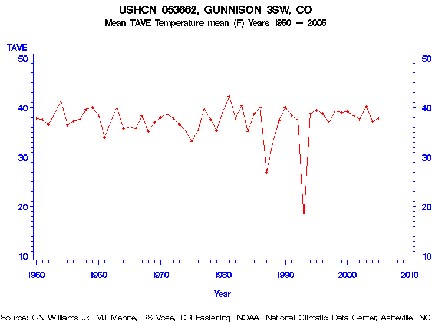
You might want to look at the temperature changes around Climax, relative to the cosmic ray count, over the same time interval of the past 50 years, before you become too dismissive. (I actually looked at Gunnison data).
Thanks for sharing your thoughts on Cork. Re global warming (or cooling, as the case may be), Brian Bloom, beyondneanderthal.com offers a well thought out article on the subject of cosmic rays, cloud formation and global temperatures at
http://www.financialsense.com/fsu/editorials/bloom/2007/0710.html
His research also raises questions about CO2 as a leading indicator of global warming. If his take on cosmic cycles impact on cloud cover and the weather is correct, we'll know soon enough.
The above link reflects the typical blind groping of a non-scientist feeling their way around the vast maze of a specialized scientific domain. Some of the points he believes haven't been answered by the climatology community have indeed been addressed. I'm afraid he is a victim of propaganda (see above); I give little to no merit to non-scientific bumblers who attempt to tell us why the scientists are all wrong.
Apparently Brian Bloom of beyondneanderthal.com is not much beyond Neanderthal.
(Not a slight toward our now extinct fellow hominids, just a statement of fact--the Neanderthals never had science. And perhaps we Homo Sapiens never gave them the chance. Who knows what would have happened.)
I am somewhat upset to see this drivel on Financial Sense, even if it is an editorial.
"I give little to no merit to non-scientific bumblers who attempt to tell us why the scientists are all wrong."
Which is not all that far from saying that the church is the final arbiter of god's message on earth. Oppose the church and you are a heretic.
Application of the scientific method is vastly removed from religious belief indoctrination. Can groupthink get in the way from time to time? Indeed, but remember that global warming was met with great skepticism by the scientific community 2 decades ago, so it had to overcome groupthink itself.
"Application of the scientific method is vastly removed from religious belief indoctrination."
Care to explain? Otherwise this is just an assertion. And do yourself a favor, unload the language first, it could just as easily be turned around on you - "so-called scientific indoctrination is vastly removed from religious scripture knowledge." (your biases are showing!)
(And I don't know where the comments on groupthink are coming from.)
If you are unaware of the sharp differences between the scientific method and religious indoctrination, or the meaning of groupthink in the context presented, this is not the forum to bring you up to speed, hence I will discontinue participating in this subthread.
Will, I had a simple request. You choose to interpret that as your superior knowledge or intelligence. Be my guest. But, you might want to ask yourself just why you are so sure that there is a difference. Can you explain it? Or is the evasion a sign of something else?
shaman, our understanding of this universe is incomplete, and so by necessity the views of conventional science are incomplete. any scientist would tell you so.
but there is an essential difference between science and religion. science is by definition a search for truth. there are no laws of science, other than what can be proven by experiment. there is nothing sacred in science, other than what is proven, over and over again, by observation.
religion is the opposite sort of thing: there is no part of Christianity that can ever reject Jesus, regardless of any observation made by anyone, ever.
Something you might imagine is equally sacred to science, such as the laws of thermodynamics, would be widely rejected in a few short years if evidence were found to disprove it.
The scientists would not care who disproved it, or how, or why. If the disproof is repeatable, they would simply accept it.
Even if it were disproven by a process that kills millions of babies. The scientists as humans may feel very sad about the dead babies, but as scientists they must accept repeatable observations, no matter how or why they exist.
Thanks for the civil response. I'd like you to consider that you have made precisely the error that I have warned against. You are using the internal rules of science to make an argument against religion and to validate science. The religionist is generally prone to the same error. They will respond to you that religion is about received truth and that anything the scientist finds is merely the will of god. If they are wrong, then it is because of the inability of the scientist to comprehend the mind of god.
Now, here's the difference that I would like to propose, let's stop placing our trust in some objective (science) truth or some transcendent (western religion)truth and start finding our truths right here and right now.
Hi bmcnett,
Thanks for your comments.
I'm getting back late to this thread, and seem to have been the object of luis' and others misinterpretation (or, ridicule?) at that (IMVHO). Given this, I'd just like to jump in here on one small point:
re: "...proven, over and over again, by observation."
Observations may become quite complicated rather quickly, see ref. I gave below on "how we know the earth goes around the sun".
In other words, just to try to support what I believe Shaman's point to be - the methods of observations, what counts as observation and what does not, the interpretations of what observations mean, and even the assumptions made about what counts as "method", "observation", "assumption" - perhaps these are part of the "internal logic" Shaman is referring to. These are "choices" made by the practitioners, who all agree (or, agree in a particular time and place).
Without getting too far afield, it's difficult to have conversations like this without a lot of very specific examples, say, from science, and that's hard to do in this context (of the forum).
It's also difficult to talk about religion without trying to talk about what something (anything) actually means to someone, i.e., what it translates to in some other terms. This makes the comparison somewhat limited.
So, all that time I was reading articles in the science journals Science and Nature, I was actually attending church?
Ridiculous.
No, Dave, its not ridiculous at all. You were reading the scripture. You just don't buy it because you're a true believer.
Now, if you'd really like to engage the idea, try this - find a measure of the truth value of science that is not established by science.
So do you have a point?
What is your recommendation for how we are to know what's actually happening and what to predict? What method or approach are you espousing?
The same one you use, the same one Dave uses, the same Will uses. And I'll be the first to admit to its shortcomings. I listen to the discussion, compare it to what else I know (and yes, fit it to my worldview, cause that's what all people do), and evaluate it based on how convincing it is to me.
If you need a name for it, I'd call it "interpretation," but "local knowledge" or "story telling" also work for me.
Most of all, though, I want to draw attention to false authority when I throw these bits out. Just because something is called "scientific" doesn't make it good or right. Before worshiping at the alter of science, I suggest taking a good long hard look at "science's" complicity in the mess we're in right now.
Well, shaman -- if that really is your name -- I know your type. The wonderful thing about science is that it is self-correcting. People didn't used to think the continents moved, but now they know they do. People didn't used to think ice ages occurred, but now they do.
And now, the physics of CO2 in the atmosphere is abundantly clear, and has been since Arrhenius. Yes, the system is complicated and there are some uncertainties. But you would rather take the risk that the best science we have is wrong.
You think everything is a story. If a 2 ton pile of bricks fell on you right now, that's a story. Unfortunately, you wouldn't be around to tell anybody about it.
Thanks for the civil comments Dave. But your comments indicate that you no little to nothing about my "type." You appear to be so vested in your own way of thinking, one that says that it corresponds to some truth, that you think that all ways of thinking have the same view of truth.
I've read your comments and articles before and I know that you are an intelligent man. I'd like to encourage you to expand your horizons and explore some non-dualistic ways of thinking (and before you jump, check it out, there is more to the moniker "non-dualistic" than simply not being dualistic, indeed most of the knowledge of the subcontinent is based on it).
I have nothing against science done well. Some of the best thinkers of the last few generations have been scientists. But I'd remind you of the horrors committed in the name of science as well. Consider the early enlightenment work done on animals, things most contemporaries would shudder at. But "scientists" could do it because they were convinced that animals had no souls and thus couldn't feel pain.
Sure, science changes (and T. Kuhn never could re-appropriate the way that the rest of the world interpreted his notion of "paradigm shift"). And frequently the explanation that science provides is the most convincing interpretation of events. I've been reading both science and popular literature on climate change (and resource depletion) since the seventies and was an early convert. (oops, does that destroy another assumption you made about me?)
And as for those rocks falling on my head. You make the assumption that I won't be around to tell anybody about it. But that is your assumption. The truth is, you don't know. You can't know. (Frankly, I also don't believe in life after death or reincarnation, but, like you, can not prove it either way.) Yet still, those rocks fell, and if someone saw it, the story can be told and the end of David Smith (since my name seemed important to you) becomes a part of the larger story. But let's suppose that no one saw those rocks fall on my head, and that something that is me does not continue on, that nothing of any consciousness witnessed or learned of the event - what precisely happened? You can't say, because there is no story. And once you start to hypothesize about it, you have established the story.
And that demonstrates the fundamental flaw in any correspondence theory of truth; in order to talk about it you have to presuppose awareness (Do you know Wittgenstein's "If I grant you that 'here is a hand...'"?)
So, while I would agree with you and the others that blaming global warming on cosmic rays is silliness. It is not because I am a devotee of science. It is because I have looked at what people write about it, thought about it and checked it against my own understanding of the world. And that is all I ask of anyone; think for yourself. Because if you are going to accept the word of the "scientist" because she is a scientist, you are no different that someone who accepts the word of the minister because he is a minister.
Jesus Frigging Christ!
What have you smoked? Seriously! I want some of it.
Mr Shaman, if you take all of us as idiots who don't have a clue about the "duality" philosophy debate and who know nothing about the relativism you were almost about to preach us into, spare us! Derrida is dead. Levi Strauss is dead. So get over it!
Mr, you sir, are an idiot. You take science as an idiocy, but the nerd is you. If you have problems understanding the seriousness of science, I recommend you to read more about Scientific Method.
It is very difficult to establish a theory into a form of an unanimous "story" that explains reality. It must overcome skepticism not in the form of a "good story", but one that really plays well with the numbers and physics, makes forecasts that can be detected, and mostly, a theory must always contain elements that, if the theory is false, then its error is detectable by other scientists (Popper).
It surely takes a lot more than rambling about duality, Mr. Shaman, scientists are not medieval priests, nor science in the 21st century is the Church of the Inquisition!!
Bah, and then you could have come with Gilles Deleuze and the likes, they are all idiots. You could have come with Zenon, in which the tale is widely known. He claimed that the rock that was in front of him didn't exist, because he said so. Reality was only an illusion. A peasant passing by trowed him the rock and he fell with his idiocy.
Or you could have come with Descartes and his "cogito ergo sum", and I could even ask, is he really thinking or could even that be an illusion?
Of course, you could even not end it. That's the virtuosity of dilettantism. And that's where you're heading. You are trolling this thread with your diatribes and your ranting accusations, but all you've got is lapalicities, shenanigans and idiocy all around.
Then again, I know you know a lot about this and that somehow I surely haven't got your "type", but then, mr. there is only one solution.
Quit the booze already.
Gee, thanks for the thoughtful and serious reply.
No problem.
Shaman's comment that awful things have been done "in the name of science" is strange.
Science is, simply, a search for explanations for how the universe in fact works. Yes, an evil person may kill millions "in the name of science" and yet if by doing so they produce theories about the universe that cannot be disproven by experiment, any scientist would accept this knowledge as law.
As shaman might tell you, science has nothing, whatsoever, to do with morality.
But, that is the point. Science of course has nothing to do with morality! Unlike religion.
Science has only to do with finding explanations for how the universe works, that match real-world observations better than what explanations we had before.
This is an amoral thing. But, since it is utterly unrelated to morality, that is an OK thing for you and me.
Hi again bc,
Interesting point.
re: "This is an amoral thing. But, since it is utterly unrelated to morality, that is an OK thing for you and me."
Actually, there has to be a set of common assumptions about the ethics of science, how it's done, and one can definitely have the view that the prevailing ethics (politics, even?) of a particular field are lacking. So, I would say science is not unrelated to morality, in the sense that, first of all, it requires a set of ethics in order to function at all.
Further, calling science "amoral" can be an excuse for individuals who do certain actions and have knowledge to act in a less than responsible fashion. (In a way others might judge as less than responsible.)
Back to the oil world, which is the one we're in here, I like a quote (darn, I can't find it right now) - it's by a geologist who said (I paraphrase here), "If we wait until the last barrel is out of the ground (i.e., to warn people) - how is that good science?"
"
OK, I'll bite, what';s a lapalicity (? sing.)
A neologism by me :). It should be spelled lapalissade.
La Palice was a brave man, but:
in wikipedia.
Hi Dave,
This is really interesting. Here's the reply I was working on before I saw the one Shaman posted. It's my own take.
Hi Dave,
Thanks for your response here. You know...I think "we've been here before" at different times (including w. Heading Out bringing up something about GCC/GW when reporting on an energy conference in order to illustrate some other point? I think this happened before, didn't it?) (http://www.theoildrum.com/node/2266)
re: "I know your type."
My take on this discussion is that you may be misinterpreting what Shaman's point is, and also - to me this looks almost like an "ad hominem" (what do you think?) In any case, Shaman may be of a “type” or he/she may be trying to make a slightly different point than ones you’ve encountered before.
I'd like to modify just a bit of what you way here.
"The wonderful thing about science is that it's self-correcting."
Well, I'd say, it's not "science" per se - it's the people who do science, and who enjoy thinking about science (and, I'd add - want to learn science and talk and challenge scientists) (and what scientist in any field "knows it all"?) Anyway...this ability of people to "self-correct", and thus to help "science" "self-correct" - there's something about that...
It's a function of the people and the time, the place, the ability, the culture...yes?
Another way to say this is: until those "self-corrections" actually occur, well...then, they don’t. (See what I mean?) Things can go without “self-correction” for a very long time, perhaps forever (i.e., we don’t know until we know).
In other words, science is a human endeavor. Thus, it depends on the capacities of the humans who are doing it. Thus, "self-correction" may take place...or it may not. It is only apparent after the fact, in the sense that, individuals may or may not be able to gain insight into the particular biases, history or politics that allowed and promoted certain views and/or even certain methods and/or assumptions, over others.
In other words, I don't think what Shaman may be trying to say *necessarily* is the same as either Heading Out's stance, nor is it necessarily equivalent to: "the best science we have is wrong."
The example "ton of bricks" makes a case for the information from the senses, like kicking a rock, and for consequences that can be easily measured. The thing is, scientists often quickly get away from this when they rely on something about logic and/or thinking, as opposed to observation. (eg. Optical illusions, for eg.). This becomes, then, a philosophical question. Why trust “logic” more? Or, “rationality” more? (A philosopher named Kwaja wrote about this in a small book called "Five Approaches to Philosophy". I haven't read the ref.s Dave Smith cites.)
There's something about rationality and logic that also involves emotional capacity. (That's my 2 cents.)
Point one: That's Frigging Brilliant!
Man, that's hilarious! I could not imagine a better statement! Of course, it is also true, which gives me to the second point.
Point Two: Get off the booze already.
Let the scientists work it out. That's right. SCIENTISTS. That's what they are paid to do. Listen. They've been working in GW for DECADES. That's DECADES. They know a lot about scientific method, so don't bother trying to philosophying it too much, you will always be an amateur.
Now, don't get too mad at me. Listen. (Read). These guys are not fantasizing about this, like we do here in TOD, playing around with some graphs and all. No. This is their lifetime job. These people are the most intelligent people in the world and they math this to exhaustion. When they debunk this solar thing, its not a fantasy story. It's not a fairy story they are telling us. They friggin analyse it to the core of it. They spend month-hours scrutinizing the works and they are genuinely interested to know if it stands to their tests or not.
If they do, problem solved. More tests to follow (through the scientific method), but the hardest battle has been won. GW passed all tests. It's even been predictive for the last two decades now. Newsflash: Solar blah blah didn't pass the first peer-review test.
So, I'm sticking to the first. And that's not because I drink the kool aid. It's just that the earth does go round the sun you know?
Frigging Brilliant! Someone get a Nobel Prize for the gentleman! Next time, you're gonna say what? That Icecreams contain water? Can't wait for that!
There's nothing human that doesn't involve emotional capacity. Nothing. But there is a blatant difference between emotion and subjectivity.
I'll give you those two cents if you figure out this by yourself.
Well, LuisDias,
we are on the same page argument-wise, but maybe not tone-wise. Never mind.
Something funny happened to me on my last evening in Cork after the conference:
At the bed-and-breakfast I was staying, I met an American couple which had just arrived. We exchanged a couple of niceties and when I mentioned the conference, the guy asked me to tell him about peak oil. He seemed to grasp the concept, its reality and consequences very quickly.
Then his wife asked me if I had ever thought about Jesus. It turned out they were some of these reborn christians, visiting a missionary church in Cork!
Me being a radical atheist, you can imagine the interesting discussion that started!
Now to the point: The guy fell into the "Intelligent Design" category, he actually tried to convince me that it can be scientifically proven that god created all life on earth. He even tried to venture into quantum physics to make his point.
A phrase he repeatedly used was: "...and these are scientists who say this".
Now that tells me that you still have to check if the scientists in question uses the one "scientific method" or the other "scientific method" (yes, I deliberately made no difference, although I certainly know there is one) - very difficult for most people who do not understand what the scientific method is in the first place.
Just my two cents...
Cheers,
Davidyson
Well yeah, forgive me there, people. It was 3 in the morning in here, and I ought to be in bed.
When I am tired, I overdo myself in my rants.
PS: Your story is funny. I've had a few that had the same strange "weather", but scarcely at the same level of that. I avoyd discussions of physics with close-minded people.
But sometimes, it is funny. Like the other day, when a colleague of mine, which has a degree in a hard course (archictecture), asked me if I had read Da Vinci's Code. Yeah, I answered. "Then you must know that Christmas was a pagan ritual of the solstice before it was Christmas".
Of course, that was entirely correct. But the thought that people who have degrees with good grades took Da Vinci's Code as a knowledge source was completely comical. And depressing too.
@ Davidyson I am surprised you could not pick a pentecostal Protestant by their dress. :) It's a shame scientists balk at using the term G.O.D. to describe things they can not explain for fear of creationists seizing the admission and using it for their own agenda.
Hi again, luisdias,
re: "I avoyd discussions of physics with close-minded people."
Me, too. Sometimes one gets inadvertently drawn in, though. (Or, misjudges the state of mind of others.)
Hi Davidyson,
re: "we are on the same page argument-wise,"
What is the argument?
Hi luis,
Thanks for your response.
re: "GW passed all tests. It's even been predictive for the last two decades now."
I agree. I do not disagree. Perhaps you misunderstood my post.
re: "Newsflash: Solar blah blah didn't pass the first peer-review test."
Yes, quite so. I agree completely.
re: "It's just that the earth does go round the sun you know?"
There's quite an interesting history about this. (http://curious.astro.cornell.edu/question.php?number=190). I was attempting to make a point about "how we know".
re: "Frigging Brilliant! Someone get a Nobel Prize for the gentleman! Next time, you're gonna say what? That Icecreams contain water?"
Well, I assume this is sarconal ice cream. Yes, I realized later that last statement didn't relate to my main point, which was an attempt to talk about "how we know". I probably should have erased it, esp. since it seems to have struck a nerve.
re: "gentleman"
Incorrect assumption, perhaps due to subjectivity?
Can anybody tell me where is the excessive heat of global warming suppose to go once we run out of ice places on earth (north pole, south pole, greenland, sibera etc). Right now the effect of global warming is compensating with melting of ice-shields. Once that is gone imagine the rise in global temperatures.
The main drag on temperature is the heat capacity of the oceans though the ice sheets can play a small role. Melting the icesheets to the level of the last time the earth was 3C warmer gives 25 meters of sea level rise. The average depth of the oceans 3790 meters so melting the ice sheets adds about 0.7% more water. The latent heat of fusion for ice melting is large, but the quantity of ice is small compared to the quanitity of water. So this comes to about 18% of the energy needed to cause 3 degree warming of the oceans.
It is important to understand that the Earth is in radiative equilibrium so that all of the incoming solar energy goes back out to space. What the greenhouse gasses do is to raise the altitude in the atmosphere where that equation balances leaving the surface of the Earth warmer. The extra energy that is kept during warming is a tiny tiny fraction of this flow.
Chris
Hi Chris,
I really appreciate your explanation here.
Let me see if I understand what you are saying...
Somehow the heat of the the surface of the earth is moved up into the atmosphere, from which it gets radiated out into space. This thermal transfer from the surface would be some combination of convection, conduction, and radiation.
Seems to me that hot things radiate more... but also isn't it the case that dark surfaces also radiate more? I seem to recall some theorem in physics that the more incident light a surface absorbs, the more it radiates. That's why an aluminized mylar sheet can work as a blanket.
No, somehow I am just having a hard time getting my head around this. Maybe what is confusing me: when the earth's surface emits some infrared radiation, does this generally manage to get to outer space directly, say when the sky is clear, or ....
Nope, my head just hurts too much. Pressure and temperature both decrease with altitude. Must be some kind of PV=RT thing. So clearly the upper atmosphere is just sucking up any kind of radiation it can get its hands on.
I give up. Maybe a link to some basic equations that govern the energy flows between layers of the atmosphere? I think maybe I could understand the equations, but I sure can't invent them ab initio!!!
This looks like fun:
http://physics.gac.edu/~huber/envision/instruct/ebm1doc.htm
Is there any fundamental flaw in this way of looking at the problem? It sure helps me think about it!
JimK,
IIRC, the thing you are talking about was called the Black Body effect in physics class; a name that is probably an endless source of confusion.
But the thing is that heated objects generally emit more radiation than cooler objects. That is why iron glows red when its temperature is raised to molten hot --or more simply why the incandescent light bulbs in your house emit light due to heating of their filaments. So when the average temperature of the Earth rises, a new, higher equilibrium point is set at which energy emitted out as radiation equals energy in as absorbed solar incidence. If an equilibrium were not struck, temperature would go up endlessly.
See this Link to Daisy world
http://en.wikipedia.org/wiki/Daisyworld
I took my final in radiative transfer at an altitude of 9000 ft after spending the night at 14000 ft. I had a headache too.
The Earth's atmosphere is largely transparent to the light coming in from the Sun. It is mainly opaque for the infrared radiation coming from the surface of the Earth. That is why I was spending the night at 14000 ft, to try to get above some of that opacity.
You are correct that pressure and temperature decrease with altitude. This is because the atmosphere is in hydrostatic equilibrium. The temperature is set at the altitude where the atmosphere is just becoming transparent to outgoing infrared radiation. That temperature is close to that of the average temperature of the surface of the Moon which is also in radiative equilibrium with the Sun and at about the same distance from the Sun. In the case of the Moon, the equilibium is established at the surface because there is very little atmosphere. For the Earth, raising the altitude at which radiative equilibrium occurs means that the rise in temperature going down towards the surface has a longer distance over which to occur so the surface temperature rises. We see a temperature effect rather than a pressure effect because the pressure is fixed at the surface of the Earth by the amount of atmosphere over head that is being supported (hydrostatic equilibrium). One thing that might help is to think of the atmospheric temperature profile over Death Valley, then lift it up and put it over the desert surounding the valley while substituting the existing pressure profile. You get to lift it up because it is being pulled up from the top by the higher opacity there owing to a higher concentration of greenhouse gasses.
Hope this helps,
Chris
Yes, this explanation helped a lot! I am going to have to think about this for a while! But now I think I have enough of a handhold, I am not just floundering.
Thanks!
GCR counts from Climax (red) and the aa-index (blue). The straight lines show the best linear-fit against time estimated through linear regression. The yellow line shows the global mean temperature from CRU for comparison.
It might be a bit more accurate to look at the temperature changes around Climax and plot those, rather than the global temperature change, don't you think? You can get the data here . The temperature variation for some of the sites in CO does not follow the global trend you show.
The cosmic ray hypothesis can be dismissed without resorting to closed minds or ad hominem attacks. One simple fact is enough - the cosmic ray flux at earth has not changed for 50 years. And the point about cloud formation in the lab is a classic example of misleading psuedo-science that misses out crucial information, namely that the scale of particles in the lab in which such effects have been observed is orders of magnitude smaller than in real clouds.
And the speed of the sun around the galaxy can be determined very simply using classical mechanics and simple distance measurements, no need to resort to fancy cosmic ray measurements which cannot tell you anyway (if you want to use cosmic ray variation you have to know a priori what the distribution of cosmic rays in the galaxy really is.)
As a former astrophysicist, I used to see this sort of nonsense theory all the time which, when dismissed, was usually followed by comments about closed mindedness or ivory tower references.
Having said all that, I have seen the cosmic ray hypothesis advanced numerous times recently by non-scientists as proof that the whole AGW thing is a myth. So I guess if the point of the article is that bad science can be used as a crutch by those who have already made up their minds for other (usually political) reasons, then I agree.
I agree with you. This "theory" is at best very bad science. If I had a nickel for every pseudo-scientific theory I've heard I'd be a rich man. The latest one someone tried to explain had to do with holograms and energy fields. I won't even go there. How these people talk about this stuff with a straight face is beyond me.
Nigel Calder is the ex-editor of New Scientist ... he is a journalist ... he writes for a living ... people don't want to hear arguments that GW is man made ... so, you can make a good living trying to debunk it ... if you bought the book he's made himself some more money to live a little longer ... sadly, this cosmic ray stuff is 'old news' and poor science.
Nigel Calder is also famous for the 'Great Global Warming Swindle' tv program ... also shown to be a load of bunkum! When people bring his name up I'm reminded of Steorn ... just because people sound like scientists doesn't mean they are!
http://inthegreen.typepad.com/blog/2007/03/deconstructing_.html
Finally, there have been thousands of papers supporting the view that it's greenhouse gasses that are the major cause of GW ... one paper suggesting something else is the MAJOR cause is unlikely to be correct ... it may be true, but Occam's razor says almost certainly not!
Xeroid.
Oh hell...this isn't the same Nigel Calder who's the well-respected author of several sailing books, is it? I surely hope not.
Many of them make a lot of noises without attaching any conscious meaning to the noises they make. They just want to feel like they are part of the group. They just want to sing the same bird songs.
Next time you are in a group setting, check out how often people in the group make the same giggling noises or repeat each others words and body motions. They are just trying to be "social".
Birds of a feather flock together. (And of course the same can be said of us Peak Oilers.)
So when a person approaches you and makes noises about "holograms and energy fields" for example, it could be that he just testing to see if you belong to his flock. Obviously you don't.
Although I am an arch liberal; I enjoy listening to right wing radio talk shows such as Rush Limbaugh. I do it for the purpose of tuning in on the tonality of these people (bird brains). If you pay close attention, there is a special sing song tonality employed when they say phrases like "GloBALL WAR-ming" or "aL GOre".
Instead of being purely visual and looking for the substance of what people say, try listening to the underlying tonalities; how they "talk" rather than what they say. Listen to how they begin to resonate with each other as they engage in "sound" logic. Have fun with your new Bird Listening hobby!
Man, you're my hero.
I don't second what you said.
I really third you and fourth you and fifth you.
And no, I'm not gay.
They are bad GW deniers. They should have gone with a theory that couldn't be instantly disproved. Maybe like the earth is heating up due to friction with the cosmic ether.
Heading Out, this is not a personal comment about you. I am glad there are lots of TOD Folks asking lots of questions. But here is my gut feel about the whole subject of the causes of global warming.
Humans are making all kinds of major changes to this planet on a scale perhaps not surpassed since the time of another life form: stromatolites. When one looks at the rate at which we are changing things, and the slowness with which thing generally changed in the past, it just seems like we are somehow to blame. Do we understand the how? Perhaps.
So why is it in our nature to grasp at every "It Wasn't Me!" explanation for what has and is happening?
Looking at how people cope with tough situations, you might go through the following stages:
1. Denial: It isn't happening.
2. Blame: Someone else did it.
3. Bargaining: It costs too much.
4. Anger: Scapegoating.
5. Despair: Overwhelming.
6. Acceptance: Take Action.
Each of us is at a different place along this spectrum with regard to a whole host of environmental and natural resource issues. The folks here at TOD are certainly farther along than most.
I would add one parallel path to your stages (which I thought accurately summed up the situation for most people approaching the issue honestly):
1. Unwavering denial, since it's in my own, short-term economic best interest to do so, no matter how much pain it causes other people or even myself in the future.
This is the phase most professional or adamant amateur PO and GW deniers are stuck in.
Heading Out Appreciate the commentary and the report on the conference. As I live on an island I understand the "end of the line anxiety" felt by Ireland. We feel like we are the last hair on the end of the dogs tail. One question, the same people today, who are indicating growth to 90 to 100 over the next 5 years were indicating growth to 90 by now. Why believe now if they have been wrong so far?
It is like plotting EIA forcasts, "step across this line, now step across this line, now step"etc, etc. As to climate change, it is what it is, China is not going to stop burning coal or oil, we are not going to stop burning coal or oil, We will use it until it is gone or until the price has risen to the point of alternative substitution. All the rest is verbal masturbation.
Heading Out,
You write:
Now here is the problem – you remember the incredulity that you felt when I told you about the Cosmic Ray book? Was this based on your own evaluation, or on your “knowing the facts”?
Perhaps many readers did feel “incredulity”, but my reaction was somewhat different. Educated laymen with some scientific background (like myself) are skeptical rather than incredulous about ‘thought-provoking’ new theories on anthropogenic climate change for a pretty simple reason. It is not because we make our own evaluations (we lack the expertise) or know the facts ourselves (we don’t, and we don’t even imagine we know them) – but because we know that those who ‘know the facts’ (i.e. the relevant scientific community) are pretty unanimous on the issue. We know that every national scientific society in the world, every prestigious scientific journal, and the scientific sections of all leading world newspapers now look on climate change as pretty much an open and shut case.
All the Cosmic Ray theorists have to do is to have their findings published in prestigious peer-reviewed journals – Science or Nature, say. Then they can be taken seriously by the rest of us, eventually. Educated laymen know a black box when they see one – and cosmic ray theory is one of them. We know when we are out of our depth. So we ‘leave it to the experts’ and hope they’ve got it right.
But I’ve ordered the book anyhow.
For a counter-argument to Svensmark's paper, see http://www.realclimate.org/index.php/archives/2007/03/cosmoclimatology-t...
Don't jump on this new bandwagon before its tires are most carefully examined!
Heading Out, it’s me again.
You write:
International figures and reputable folk that graduated from Harvard tell you that there is no problem, and the media talk about oil companies ripping us off and that this is an excuse, and your common sense remembers that gas prices always go up immediately on a crisis. And so you decide it is a conspiracy of the oil companies. Now you have made that decision, and you start to read more of the blogs that state that Peak Oil is a myth ..
I think you are being a tad too defeatist here. If you read what the ‘other side’ has to say (such as the CERA warriors, or Duncan Clarke in ‘The Battle for Barrels’) you will see that the flat-earthers almost come to the opposite conclusion – namely that peak oil is the flavour of the decade, that peak oilers are winning the hearts and minds of the general public.
For example Duncan Clarke writes (TBFB, page 23):
Some pages further down:
.
You pesky guys at The Oil Drum – just look at all the trouble you’ve been causing!
Couple of points. Firstly I've seen other reports that say that Chinese CTL is going ahead on a large scale. Which is correct? I think other countries should consider a carbon tax on Chinese imports if that happens.
Secondly I was going to spring for $1300 to buy a polycarbonate greenhouse to ripen tomatoes. If the cosmic ray thing is confirmed I won't bother and I might zap them with a ray gun instead.
Specifically, NDRC has put a moratorium on new CTL plants in China until the ones under construction can be evaluated. The ostensible reason is water consumption. CTL takes 3-6 tonnes (depending on method) per tonne of product output. Northern China, where most of China's coal resources are located, is experiencing a physical deficit of water, and the situation is critical.
Other Chinese reports refer to the coal input needs for the original target volume of production being excessive (which it is).
Mad? Not really.
However re: "well you really aren’t going to buy that book, are you?"
Maybe I'll borrow it from someone who has already bought it.
I'll have to assume that based on your statements you probably don't agree with the folks over at Realclimate.org and their general opinion of Svensmark? http://www.realclimate.org/index.php/archives/2007/03/cosmoclimatology-t...
Whwnever AGW has come up on this site, I have avoided comment because it is usually way OT, and because most posters here are so certain of AGW, clearly without having done the research that they accept here on PO. (I am a PO believer by the way). I was also an AGW believer 1994-2001, a serious questionner 2001-2003, and a confirmed skeptic since. The only reference used here to attack skepticism is Realclimate, which is a very questionable source. There are many skeptic sites deserving of equal or greater weight. the skeptics know well the meaning of the terms "hockey stick" and "hockey team". If you don't, you are not qualified to address this issue. Realclimate is run by the hockey team. Some of you above refer to failure of the cosmic ray/surface temperature correlation in the last decade or so. the CO2/surface temperature correlation has also failed in the last decade as it did from ca 1940 to 1975. Hmm. As for ice melting - there is no reason to believe that Arctic ice didn't retreat to about the same extent ca 1940, Greenland edges are retreating while the central plateau is getting thicker, for about a wash, both Greenland and glaciers retreated farther than now during the MWP, and probably during the Roman optimum. Tree lines were at least 300 m higher and 200 km farther north during the holocene optimum, Antarctic ice is increasing except for the peninsula, etc., etc. Also there are quite a few scientists investigating and writing on the cosmic ray theory, and getting published in peer reviewed journals. Just do some googling. There is no science to support catastrophic AGW, only climate models that are known to be very inadequate. CO2 may have contributed to recent warming, but it was not alone, not the primary contributor, and can contribute little more. Also the trend of the last 3 decades in the surface instrument average temperature has now come under wide scrutiny, and is very probably overstated by 20 to 30%. For a couple of useful urls try www.climateaudit.org, www.junkscience.com, www.climatescience.org.nz. There are many others, but you will find links st these. As for the famous "consensus", try this: http://www.dailytech.com/Survey+Less+Than+Half+of+all+Published+Scientis... . Gentlefolk, please apply the same open minded research to AGW that you do th PO before reaching such certainty in your conclusions.
There has been no warming since the alleged high point of warming -1998 - now changed to 1934 ( NASA ), in fact temperatures have dropped slightly while CO2 emmissions have soared. We need to keep an open mind on this - Arctic sea ice is at its lowest since detailed scientific records began in 1979 BUT ice in Antarctica is now very close to its maximum - OK, I know, GW causes global cooling !
"UPDATE: Wednesday, September 12, 2007 - *correction* - close to record SH sea ice maximum and NH sea ice minimum
Just when you thought this season's cryosphere couldn't be more strange .... The Southern Hemisphere sea ice area is close to surpassing the previous historic maximum of 16.03 million sq. km and is currently at 15.91 million sq. km. The observed sea ice record in the Southern Hemisphere (1979-present) is not as long as the Northern Hemisphere. Prior to the satellite era, direct observations of the SH sea ice edge were sporadic.
The NH sea ice area is currently at its historic minimum (2.92 million sq. km) representing a 27% drop in sea ice coverage compared to the previous (2005) record NH ice minimum.
Correction: we had previously reported that there had been a new SH historic maximum ice area. Unfortunately, we found a small glitch in our software. The timeseries have now been corrected and are showing that we are very close to, but not yet, a new historic maximum sea ice area for the Southern Hemisphere."
http://arctic.atmos.uiuc.edu/cryosphere/
The only reference used here to attack skepticism is Realclimate, which is a very questionable source. There are many skeptic sites deserving of equal or greater weight.
Interesting attack on RealClimate. And then the astounding recommendation of obvious shill sites...
www.climateaudit.org, www.junkscience.com, www.climatescience.org.nz.
Which of theses sites is run by a climatologist, or even has most of its contributions by climatologists?
One is run by an mining executive, another by a 'scientist' who has shilled for tobacco and oil companies. An editorial in the American Journal of Public Health noted that "... attacking the science underlying difficult public policy decisions with the label of 'junk' has become a common ploy for those opposed to regulation. One need only peruse JunkScience.com to get a sense of the long list of public health issues for which research has been so labeled."
Here is a list of organizations whose statements you assume are close-minded;
Intergovernmental Panel on Climate Change (IPCC) 2007
Joint science academies’ statement 2007
Joint science academies’ statement 2005
Joint science academies’ statement 2001
U.S. National Research Council, 2001
American Meteorological Society
American Geophysical Union
American Institute of Physics
American Astronomical Society
Federal Climate Change Science Program, 2006
American Association for the Advancement of Science
Stratigraphy Commission of the Geological Society of London
Geological Society of America
American Chemical Society
Engineers Australia (The Institution of Engineers Australia)
The usual attack - "shills". Sounds like something from Realclimate. Please provide some evidence. Note the "mining executive" is an expert statistician who has clearly demonstrated the incorrect use of statistics in dendrochronology and has pointed out a 0.15 degree C error in NASA Giss temp trend. He is clearly interested in good science, and clearly does not try to debunk GW per se. As for the IPCC, try looking at the SRES in the 2000 TAR. If you really follow energy, you should be able to estimate on the back of an envelope the probability of the worst 70% of the scenarios. There just isn't enough fossil fuel to drive them. Then consider the projections of future temperature to 2100. It ain't science! Then consider the hockey stick (not in the 1993 SAR), now debunked. Then read recent findings on the IPCC peer revioew process. If you believe the IPCC represents either objectivity or science you have a problem. Try looking at Junkscience for the temperature trend data they publish all in one place, that you can't find elsewhwere. Maybe the public health issues considered are junk, but that is not the issue here. Why are you changing the subject? Could the Journal of Public Health" be a shill? Ad hominem attacks in place of evidence - enough said.
You have misunderstood the meaning of ad hominem. When it is discovered that a person is intentionally misleading, then this is a datum, not a rhetorical stance. There remains a possibility that what is said is correct despite the intention of the speaker to speak falsely, but it is not an irrelevant attack on character to take into consideration that the person knows what is said is false and intends it to be false.
It is, however, a favorite tactic of those who do intend to mislead to complain that there is an ad hominem fallacy when they are called to account for their lack of candor and good faith. Calling someone a shill is not irrelevant and thus not an ad hominem. If you are confronted with this claim, it is up to you to demonstrate that the person is not a shill. If you can manage that, then it is possible to return to their arguments to see if they have any merit on their own. A claim of dishonesty ends debate on the arguments until it is addressed.
Chris
How does one go about demonstrating that someone is not a shill? It would think that this is something that one must decide for themselves. The most anyone can do is to give reasons why they think a person is not a shill, which is what Murray does. Your "proof" would require that every claim of shillery be proven to be false, which would be a never ending task.
Here, it goes something like this: Hey mdsolar, you are a shill; now prove that you are not.
Or is the burden of proof on the accuser?
In journals, one makes a declaration about potential conflicts of interest. In the case of the Milloy, about the only thing that would work is deep, sincere and complete repentance of past dishonesty and a strong commitment to break with his funders.
Chris
Hmmm. I see you didn't prove that you are not a shill. Remember, it is up to you to demonstrate that you are not.
The hockey stick is most certainly not debunked. How come the IPCC latest report sez there are 12 studies confirming the stick, and the handle is 300 years longer?
http://ipcc-wg1.ucar.edu/wg1/Report/AR4WG1_Pub_SPM-v2.pdf
It refers to chapt 6.6 of the report. The graph is on pg. 467.
http://ipcc-wg1.ucar.edu/wg1/Report/AR4WG1_Pub_Ch06.pdf
Index to all the reports, Working Group 1.
http://ipcc-wg1.ucar.edu/wg1/wg1-report.html
Mr Murray, please.
I don't know if these people just write this for fun, to stir up a debate upon a too-much-discussed-and-too-little-action-done theme, or being really truthful about their claims.
Science does not play with 100% safety that the theories are correct. They can be wrong. Utterly wrong. And we can also be very wrong in our feelings about particular theories. Einstein had pure hatred towards quantum mechanics, but he also said it was the best tool science had in describing the universe, because it worked pretty well (amazingly well). He said however that there should be a deeper theory behind QM. There are no theories, that despite its success, are somehow "dogmatic". Not one theory.
And GW is not an exception. Yes, that's right, it is no exception at all. Hence, any correction is very much appreciated by scientific community (like the one you said there was). In those cases, solid science always prevails. Science is not dogmatic, except for the people that are trying to take another approach at the theory for political reasons, and are unable to do it with sound science. We have witnessed how the media has been giving coverage to reporters and documentaries that lack the bona fide of science, distort facts, make silly questions that are long-time answered just for the sake of a conspiracy theory, and we ask only, how did that happened?
Follow the money.
And so the "shill" argument prevails. Most arguments I've seen are NOT from dedicated scientists. And those arguments aren't also very strong. Let's see yours:
1 -
"Realclimate is run by the hockey team."
For someone accusing others of ad hominizing by calling them "shills", you're making big points here. But it fails. Because they are not only yelling GW! GW! GW! GW! They always present sound arguments backed by maths, and always show when things are doubtful, even if somehow that could be read as a fragility. They don't see it that way, and that is serious scientific attitude: focus on the truth;
2 -
"Some of you above refer to failure of the cosmic ray/surface temperature correlation in the last decade or so. the CO2/surface temperature correlation has also failed in the last decade as it did from ca 1940 to 1975."
I'm no scientist. But even I know this: In WW2 airsols (?) were used so much that it had a cooling impact on the atmosphere. The problem was that they were also very pollutant, so people stopped using it. Thereafter, a warming trend has been following CO2 graph pretty well. And CO2 growth hasn't been a constant. It has been accelerating;
3 -
"As for ice melting - there is no reason to believe that Arctic ice didn't retreat to about the same extent ca 1940, Greenland edges are retreating while the central plateau is getting thicker, for about a wash, both Greenland and glaciers retreated farther than now during the MWP, and probably during the Roman optimum."
Right. Look. The problem is not that we're HOT right now. The problem is that we are getting hotter, so that's a straw man you're beating. Okay?
4 -
"Also there are quite a few scientists investigating and writing on the cosmic ray theory, and getting published in peer reviewed journals. Just do some googling. There is no science to support catastrophic AGW, only climate models that are known to be very inadequate."
This is the most misinformed statement you've made. "Investigating" does not equal "proving". Of course cosmic ray does affect the earth. That's what's being studied. I wouldn't like the scientific community just being blind to alternative theories and phenomena and focus too much in main thematic. That's part of the process. What you fail to show is a proven model. At least, climate models with greenhouse gas exist and are there to be criticized. This is no easy task: the climate is a very big non-linear phenomenon and not easily computed. Still, forecasts haven't been that wrong. Greenhouse Gas science is very sound, despite of what you think about it, and we should be worried about this and not illuding ourselves to death.
5 -
"Also the trend of the last 3 decades in the surface instrument average temperature has now come under wide scrutiny, and is very probably overstated by 20 to 30%"
O RLY?
....
Okay. Let's eat it. I won't even bother checking for a rebuttal of that. It still says that we are warming, so what? So the best you can find is critics that state that we are not warming that fast, only 70% of it?!?
That's it? That's your best shot?
Pfff.
Now, stick with me. No one knows what will happen when the sheets of methane in the artic vaporize. That's 400 GIGATONS of material that is in the brink of vaporizing, giving way to runaway GW. That could be a false call, but OTOH, evidence has been found that this has occurred in the Earth previously and created several devastations (Total extinction of 95% of species).
IPCC report doesn't account for methane. Only CO2. But methane is leaking into the atmosphere because of the warming planet.
So, perhaps it is 30% better. But also perhaps it is 3000% worse, which is still to come. This is still a big unknown.
6 -
"There are many others, but you will find links st these. As for the famous "consensus", try this:"
I have. Let's quote it:
Now, that's a lot of BS, excuse me. If 48% of papers don't discuss GW theory, it's *perhaps* because they don't want to get hot politically by endorsing or not endorsing it, and rather be done with the particular thesis that they are defending. If 6% "reject" the consensus, this doesn't mean they reject "the hypothesis". They only reject that all the people endorse it. I could even say that those 7% that aknowledge the consensus are perhaps a bit distracted. The most stupid point of this survey is that they didn't ask if they were for or against GW. They asked if they believed there was a consensus! This is blatantly stupid. Even Quantum Mechanics, in its glorious heights, had people against it. There is almost nothing scientific that has "consensus" (that's even a taboo thing, for scientists hate consensus on everything, except for basics of course).
The problem is, we are confusing "political consensus" with "scientific consensus". The former is when people in the upper majority has the same conclusion, like 80%. The latter, is 100%.
I could also say this. As I don't know what these guys refer as "neutral" (I imagine papers that discuss the weather patterns of a global region, and by doing it they don't really care if GW is real or not, they just math their thesis), I'll consider them as blank votes, okay? Now, we've got 45% saying "high five" to the theory against 6%, who didn't question the theory, but its consensus. Even if I granted you that they don't agree with the theory, which they didn't stated, that would still give 89% against 11% (out with the neutrals). That's enough consensus for me!
Schulte's Analysis: Not Published; Not Going to Be
20 Sep 07
The celebrated research by Dr. Klaus-Martin Schulte, claiming that a legitimate debate still continues over the science behind climate change, is "a bit patchy and nothing new," according to Sonja Boehmer-Christiansen , editor of the Energy and Environment journal to which Schulte had submitted the work for publication.
It is "not what was of interest to me" and will not be published, Boehmer Christiansen said (in email correspondence reproduced in full at the end of this post).
http://www.desmogblog.com/schultes-analysis-not-published-not-going-to-be
===
Editor of "skeptic journal"
Boehmer-Christiansen is the editor of a journal called Energy and Environment. In a 1995 article written by Paul Thacker, Energy and Environment was described as being a journal skeptics can go to when they are rejected by the mainstream peer-reviewed science publications. Boehmer-Christiansen explained at the time that "it’s only we climate skeptics who have to look for little journals and little publishers like mine to even get published.” According to a search of WorldCat, a database of libraries, the journal is found in only 25 libraries worldwide. And the journal is not included in Journal Citation Reports, which lists the impact factors for the top 6000 peer-reviewed journals.
http://www.desmogblog.com/node/1281
Heading Out:
Thanks for going and giving us a review of the conference. Houston is just 50 miles up the road for me and I've made plans to come, in fact I've been drafted to help with registration.
Alan Drake is coming over a couple of days early and we are going to see our city councilman who is most open. She is trying to organise a local movement to get Galveston-Houston Commuter Rail, and I'm using it to get her to the ASPO Conference. There was a Galveston-Houston Interurban Rail Line which was taken out in the mid 1930's. The line makes perfect sense, the whole west side of Galveston Bay and the Houston Ship Channel is possibly the biggest refinery-petrochemical complex in the world, and national security will demand that we can get workers back and forth in the Houston area. Plus, there's 5.5 million people in the metropolitan area, and a heck of a lot of commuting along the corridor which also includes NASA. Galveston's a tourist area and our port has 4 or 5 cuise ships as well as a lot of oil rig repair. We're a town of 60K, but this would hook up League City, Texas City, Dickonson, and Friendswood to the NASA area, from which the Houston Light Rail could complete the trip to downtown and the Texas Medical Center.
At any rate, that's my effort on a local level, trying to connect our local people with our rail expert. I figure that when the Export Land Model kicks in the plans that are furtherest along will get the funding, particularly if we can show a national security benefit.
The other thing I'm doing locally is assembling an old shallow oilfield for a tertiary development prospect. It got at least 5 different producing formations between 1100 and 5,000 ft and has produced about 24 million barrels, but is now mostly abandoned. According to the US Department of Energy, fields like that averaged about 10% of the original oil in place produced without secondary development, and modern fields in the same formations get up to 65% of the OOIP, so my target is all the stranded oil. Its gambling wildly. I'm using the cash I just got from an inheritance to buy the leases, but I'm thinking I can raise the money to get them drilled or sell the whole block and idea and go on to the next one, as I have a bunch of ideas about where more of these kind of fields are located and the leases assembled. I'm trying to put a leasing fund together to work on them. The key is going to be to get a big enough area to justify 3D seismic where we can locate the virgin reservoirs and the best well placement for "attic" oil, and also to get an engineer to figure out the best kind of tertiary development strategy. Its either going to be wildly profitable or I'm going to piss off my inheritance on a reckless gamble. The new century's version of wildcatting!
Bob Ebersole
What I wonder,is how much of Global Warming is caused by the release of the energy in all the coal and oil which has been consumed in the last 1000 years, how fast does this energy leak out of the biosphere back into Space?
Negligibly. The heat produced is a one time thing whereas the insulating effect is permanent until the carbon comes back down again. As a proportion of total heat input globally, our 85 million barrels is pretty paltry. that's why solar is such a great option; it's abundant, but unfortunately not comncentrated or storable without conversion.
As to the bunk/debunk arguments about the dreaded GW, I find the temperature comparisons pretty meaningless unless we do two things. First, concentrate on the higher altitudes and latitudes, and second, look at duration and minima emphasized over maxima. May I state emphatically: It's about global lack of cooling. Warming is the side effect. Unless you get this you haven't got to clue one.
Hi Petro,
Thanks. I really appreciate your comments (and MDSolar's) that add insight on a topic I don't have time to read up on.
Did you make any money?
Cheers
Thanks IouGrinzo!
Here is my revised list of stages.
1. Denial: It isn't happening.
2. Unwavering Denial: Faux Science.
3. Blame: Someone else did it.
4. Bargaining: It costs too much.
5. Anger: Scapegoating.
6. Despair: Overwhelming.
7. Acceptance: Take Action.
Thanks also to Big Tobacco for teaching moneyed interest how to do #2 and almost get away with it.
You forget 6.5:
Shit Happening.
And 4. is not four, but a flavour spreading from 1. to 6.
Why this everything or nothing approach to Global Warming?
It is possible that the Global Warming science is spot on - but that at the same time we will never see a temperature rise of anything more than one additional degree, because fossil fuel production peaks by 2050, declines thereafter, and forces the rapid adoption of alternatives simply to keep the lights on.
If you think Peak Oil is now, then you would have to expect gas to peak by 2030 and coal by 2050 as we are forced to rely on other fossil fuels to take up the slack.
You can't burn what you don't have.
Now I am not stating anything as a fact. I am simply pointing out that there are a range of possibilities. Someone who doesn't think GW is a problem isn't necessarily denying basic physics, or espousing any exotic explanation for an observed warming trend.
If we are to believe in things we cannot see or touch, how do we tell the true belief from the false belief?
I once looked at the numbers with a friend and to my surprise, Jeremy Legget did something similar (with slightly different numbers) in his speech on the conference.
Our result:
Gross Climate Limit: 4.90 GtCeq/y (IPCC for 2000-2100)
- Land use change: 1.60 GtCeq/y (IPCC for 2000-2100)
- Livestock GHG: 1.25 GtCeq/y (FAO, for 2004)
= Net Climate Limit for Energy: 2.05 GtCeq/y max.
I.e. Net Climate Limit for Energy for 2000-2100: 205 GtCeq
(GtCeq means gigatons of carbon equivalent. There are other units around, like CO2eq, so if you want to compare, be careful!)
If you compare this "climate limit" of 2.05 GtCeq with the various reserve estimates, you find that even with the most conservative fossil fuel reserve estimates, we can just afford to burn all the oil and gas that's there but only if we do not burn a single gram of coal at the same time.
So, as many speaker said during the conference: Peak Oil will not save us from Global Warming, especially not if CTL and tar sands will be used as large-scale substitutes.
Cheers,
Davidyson
Reference to the FAO report:
http://www.virtualcentre.org/en/library/key_pub/longshad/A0701E00.pdf
Some time ago I helped a highly regarded professor emeritus of geology research portions of the second edition of his highly regarded book on geologic resources and man's destiny. Along the way this professor warned me that if I brought the bad news of pending petroleum depletion to any entity I should be prepared to have my head handed back to me on a platter. After this sage advice I mailed two letters to the Board of Directors of a nation-wide outdoor supply organization based in Sumner, Washington. In the first letter I suggested the organization move expeditiously to have goods shipped by rail, rather than tractor-trailer, owing to the far greater energy efficiency of rail compared to motor transport. In the second letter, which was more broad reaching, I discussed global peak, the shoddy products the organization sells, the obscene excess of products, stated the organization should cease it's international adventure travel business, and suggested that given the current direction of the organization, the organization is ill prepared for the near future. The upshot is I did indeed have my head handed back to me on a platter. The letters apparently were not delivered to the Board, I received a nasty letter from a mid-level manager telling me I should consider shopping elsewhere, and the local outlet of the organization ordered me permanently out of the store, on pain of arrest. Now this anecdote is an abstract and there is more, but the point is this -- if you are going to speak out loudly about an impending disaster that very few appreciate let alone understand, be prepared to be ordered out of the store, out of the county, possible off the planet, and to indeed, have your head handed back to you on a platter. People do tend to hold fast to their earlier conclusion regardless of abundant and available information that contradicts their conclusion. As the great man said -- "Most people would sooner die than think; in fact, they do so." -- Bertrand Russell.
" In the second letter, which was more broad reaching, I discussed global peak, the shoddy products the organization sells, the obscene excess of products, stated the organization should cease it's international adventure travel business, and suggested that given the current direction of the organization, the organization is ill prepared for the near future."
Gee, and you assumed it was the discussion of peak that was the point of all the above points that pizzed 'um off?
I take it your not a reader of "How To Win Friends and Influence People."
:-)
RC
Did you get a poor response to this too? Did you suggest that it would be more cost effective?
Just remember the Golden Years, all you at the top!
Heading out,
thank you for your notes and your wake up call and analogy.
A slight nitpick about the analogy, which I believe even with its failings, is very useful.
Global Warming*
- CONSENSUS: "It's a fact, it's in large part antropomorphic, it has high probability/consequence risk associated", suppoted by: scientific theory, scientists, raw data from the field, politicians, most of the public (hence consensus)
- ALT THEORY: lobbyists, PR companies, non-published (and debunked) scientists + a number of real scientists who work on alt theories (but have yet to show anything that hasn't been torn to shreds by data/multiple peer reviewed papers)
Peak Oil*
- CONSENSUS: "No problem, 50 years off", supported by Oil companies, economists, politicians, PR companies AND many scientists (cannot estimate percentage) and the public (I assume)
- ALT THEORY: "Peak soon, will be a big transition issue, poses high probability/consequence risks", supported by data from the field (some, not all), energy insiders, some politicians, a lot of geologists, minority of oil companies and even some government working groups.
Spot the difference?
In both cases, the alt theory camp is trying to guide the public from the consensus to the alt.theory.
In the case of Global Warming, it is NOT based on science.
In the case of Peak oil, it is at least partially (to the extent data is trustworthy) scientific.
This is a crucial difference, IF you believe that science, not PR brainwashing wins in the end, regardless of how adept the public is in separating science from denialist pseudo-science.
It doesn't necessarily make a big difference, the cognitive level of disbelief on part of the average Joe may still be equally high (i.e. "I don't believe you, because everybody else keeps saying the opposite").
In the end, I agree with Dr Schlesinger, that a crisis is the real changer of consensus opinion:
And yes, I for one will keep informing people, but only selectively and by trying to save my energy. It is very hard/low probability success rate to convince a whole city, nation or the world. In the end, reality will do that work for us, even if a little bit too late.
* 'Climate change' is a propaganda word invetend by master-propagandist-doublespeaker Fank Luntz, I try not to use it. It tries to hide the true nature of the problem and seem less threatening.
SamuM – very neatly put, congratulations.
Just to back up what you said with some numerical data, I compared the ‘hit rate’ for the terms ‘peak oil’ and ‘climate change’ in online Science, which I take to be the gold standard of the scientific community.
Peak oil: 4
Climate change: 2899.
The four contributions on ‘peak oil’ consisted of one letter to the editor (‘When the oil supply runs out’, by Alfred Cavallo, May 2007), two ‘News of the Week’ items (‘The Looming Oil Crisis Could Arrive Uncomfortably Soon’, by Richard A. Kerr, April 2007 and ‘Even Oil Optimists Expect Energy Demand to Outstrip Supply', also by Richard A. Kerr, July 2007) and one commentary in the ‘Policy Forum’ rubric (‘Oil: Never Cry Wolf--Why the Petroleum Age Is Far from over’, by Leonardo Maugeri, May 2004).
Well, that’s a ratio of approximately 1:1000 (if one leaves out anti-Christ Maugeri) – so climate change awareness still appears to be three orders of magnitude greater than that of peak oil. Besides, ‘peak oil’ has not yet penetrated the journal’s peer-reviewed inner sanctuary.
But at least three out of the four ‘peak oil’ contributions were published this year – and before 2004 the topic was not on the agenda at all.
Now let’s start generating trendlines!
Re: Greenhouse Warming and Peak Oil
When I was a child, I spake as a child, I understood as a child, I thought as a child: but when I became a man, I put away childish things. For now we see through a glass, darkly; but then face to face: now I know in part; but then shall I know even as also I am known.
Paul of Tarsus (c. 10 - c. 67)
(I Corinthians 13:11)
Concerning those mysterious cosmic rays: Have you already watched the BBC documentary called Global Dimming?
Scientists appearing on the show suggest these clouds are man made. It gets even scarier as they reveal these clouds could have dampered the effects of Global Warming.
The documentary is available on the Bittorrent network (400MB) as well as on Google Video.