
 | Economic Impact of Peak Oil Part 1: A Flashback | The Oil Drum | The Wild 'n' Out Energy of the Burning Man |  |
DrumBeat: September 24, 2007
Posted by Leanan on September 24, 2007 - 8:59am
Russia to run out of oil in 50 years, gas in 75 years - scientist
Russia will run out of crude oil reserves in 50 years, and the country's natural gas will be depleted in 75 years, a geologist specializing in oil production said Monday.Yevgeny Kozlovsky, who served as geology minister in the Soviet Union, said the forecast was based on predicted production levels and the size of current reserves, including possible new finds.
Cheap oil days nearing end, UNH prof warns
The supply of oil will peak this decade and the world no longer can depend on it as a cheap energy source, according to a professor at the University of New Hampshire.
Venezuelan 2008 budget estimates oil prices at USD 30-50
Assessments comprise six oil-related scenarios. The first scenario estimates the oil price at USD 30 per barrel, with other scenarios where the oil price is calculated at USD 33, USD 35, USD 40, USD 45, and USD 50. This time, the experts are presenting a high-price scenario, as opposed to previous fiscal years.
HAVE the policy mandarins in George Street been sniffing petrol instead of putting it in their taxpayer-funded cars?It's the only possible explanation for the hare-brained proposal to regulate petrol prices in Queensland.
Qatar seeks $2.5bn to fund power plant
Qatar, holder of the world's third-largest natural gas reserves, wants to triple electricity output from about 3,500 megawatts last year to meet soaring demand, driven by population and industrial growth.
Syrian minister meets Canadian team on oil fields
Syrian Minister of Petroleum and Mineral Resources Sofian al-Alaw met here Monday with a team of Canada's Dublin International Petroleum on the latter's development works in Syrian oil fields.They discussed the company's efforts to develop and increase production at Ouda and Tishreen oil fields, east of Syria, the Syrian Ministry of Petroleum said in a release.
India pledges 150 mln dlr investment in Myanmar as protests swell
India has pledged to invest 150 million dollars for gas exploration in Myanmar, a statement here said, as pro-democracy protests in its military-ruled neighbour swelled to 100,000 people.
Wal-Mart to study energy impact
Retailer Wal-Mart Stores Inc. said Monday it will partner with a nonprofit climate group to measure the amount of energy used to create products throughout its supply chain.Wal-Mart said it would work with the group, called the Carbon Disclosure Project, to determine the environmental impact of making DVDs, toothpaste, soap, milk, beer, vacuum cleaners and soda.
Ex-CIA chief: Renewable energy is key for national security
Tapping renewable sources of energy to replace oil is in the national security interest of the U.S. government and its people, former CIA director James Woolsey said Friday.
Yes, The Internet Saves Energy
Recently, in this column, I said this, “I don’t think there’s been a study, and I can’t prove it, but I think the Internet is one of the greatest energy saving inventions ever created.”Well, now there IS a study to back up my claim. The Consumer Electronics Association (CEA (tm)) thinks the Internet saves energy too; and it’s substantial.
Academy maps out China's strategic energy plan
The plan proposes three steps. The first is to develop energy-saving technology and master techniques in the collection, storage and utilization of carbon dioxide by 2020.From 2021 to 2030, the focus will be on promoting nuclear energy and other renewable energies so they become main resources and maximizing the efficiency of solar energy.
Over the following 20 years, the academy advocates the reduction of fossil energies (coal, petroleum, natural gas) to less than 60 percent of total energy consumption.
Armed Group Threatened Renewed Attacks In Nigeria's Oil Rich Delta
One of the main armed groups operating in Nigeria's oil rich delta, The Movement for the Emancipation of the Niger Delta, or MEND, has released a statement calling an end to a four-month ceasefire on attacks and kidnappings of expatriates. The statement follows unconfirmed reports that a leading figure in MEND was earlier this month arrested in Angola on arms trafficking charges.
Venezuela to Expand Petrochemicals Production, Chavez Says
Venezuela, the fourth-biggest supplier of crude oil to the United States, will expand its petrochemicals industry during the next five years, lifting annual revenue to $100 billion, President Hugo Chavez said.
Ethanol runs out of gas when you tote up true cost
In the politically motivated rush to replace gasoline with corn ethanol, we may be doing ourselves real economic harm.
China: Cities promote 'energy saving' in blackouts
Beijing authorities switched off the landscape lights and flood lamps at Wangfujing, the busiest commercial street in the Chinese capital, for 30 minutes Sunday night, in the hope of raising the public awareness of saving energy.
Climate change spooks companies
Ever more companies see climate change as a growing threat to their commercial interests, according to a study carried out on behalf of 315 global investors.But others expect to benefit, says the Global Climate Change Report.
Climate action needed now, U.N. chief urges
U.N. Secretary-General Ban Ki-moon told an unprecedented U.N. summit on climate change Monday that “the time for doubt has passed” and a breakthrough is needed in global talks to sharply reduce emissions of global-warming gases.
Shell president: Energy crisis ‘one hurricane away’ in U.S.
“We are one hurricane away from energy scarcity and volatile, high prices,” Hofmeister said a day after crude oil prices topped $80 — a record, unadjusted for inflation. “We are so tight on the demand-supply relationship.”Americans for the past half-century have largely enjoyed a lifestyle based on the availability of cheap, abundant energy, Hofmeister said. As demand for energy has grown — the nation today consumes 10,000 barrels of oil per second, he said — its “energy security” has been compromised, he said.
“We have seen our country pass, in my opinion, a tipping point of energy supply keeping up with demand,” Hofmeister said.
Raymond J. Learsy: The NYTimes, The Oil Patch's Faithful Cheerleader Trashes Ethanol
Perhaps it was inevitable. The New York Times with its 'rose tinted glasses' reporting on the world oil industry, standing shoulder to shoulder together with Hugo Chavez and his well rehearsed sense of victimization, bashing "ethanol", happy to undermine ethanol's growing challenge to oils perfidious hegemony over our lives.
The Mogambo Guru: Silver and gold salvation
As regards peak oil, Mr Puplava ominously says, "All the canaries have stopped singing", a reference to the fact that the mining industry used to stick a canary down in a mine to see if the air was poisonous by noting whether or not the bird died, a callousness towards canaries that reminds me of the Federal Reserve policy of constantly creating the poison of too much money and credit, and then watching their indicators to see how many people die a financial death.
Albany activists strive for sustainability
On Saturday, Sept. 29, several Mansion neighborhood residents will host Albany Skill Share 2007, a community-organized conference aimed at teaching city residents how to live self-sufficiently."It's kind of a way to prepare for a post-peak-oil society, but it's also about taking any steps you can to reduce the use of petroleum products now," said main organizer Dylan Boyce. "The best way for society to prepare is that everyone knows as much as possible, and whatever happens, they can provide for themselves."
Fears over rush into green funds
Fears are mounting of a bubble in funds investing in renewable energy stocks as asset management companies rush to launch funds to tap into the environmental zeitgeist.
To bomb or not to bomb Iran, that's the question the Bush Administration appears to be debating these days, once again revealing the extraordinary disconnect between the White House and the American people. With a catastrophic occupation of Iraq and polls showing the American public so skeptical about the use of military force that only eight percent support military action against Iran, there is nevertheless a clear and present danger that Cheney and the neocons will again prevail and lead this Administration into another disastrous military misadventure.
Taiwan provides Sao Tome and Principe with US$15 million for new power station
Taiwan has provided US$15 million to Sao Tome and Principe for the construction of a new thermal power station in order to overcome the energy crisis on the archipelago, the president of Sao Tome said Friday.
Ohio road projects could be squeezed by higher gas prices
The Ohio Department of Transportation estimates that it may face a $1.5 billion deficit by 2013, partly because the high cost of fuel has Ohioans driving less and buying vehicles that are more fuel efficient. Those choices mean less gas-tax revenue for the state.
India absent as Iran, Pakistan resume gas talks
Iran and Pakistan started a new round of talks over finalising a long-delayed multi-billion dollar gas pipeline project with India, but in the absence of Indian officials.Officials said India's absence was linked to its lack of agreement on pricing terms with Pakistan for the so-called "Peace Pipeline", which aims to usher in a new era of cooperation between the three countries.
Schwarzenegger, Gore add star power to climate meet
California Gov. Arnold Schwarzenegger and former Vice President Al Gore are set to join world leaders for a U.N. meeting on Monday aimed at spurring global negotiations on how to cool a warming planet.
Maine: Economic development committee mulls rezoning, downtown facades
Co-owner Matthew Simmons' plan for an ocean institute is moving ahead, Hall said, noting up to 25,000 square feet of the building have been designated for possible use for ocean energy research. One component of the ocean center would be nonprofit, and another, entrepreneurial, Hall said, noting a business plan is in place.
Edison on front lines of greenhouse gas effort
In some ways, the challenges Bryson and his utility colleagues face now are tougher than dealing with the chaotic, disastrous electricity market meltdown that hit in 2000 and 2001. How do you provide more power to a growing state without worsening global warming? How do you meet the state's renewable energy goals if the public opposes the necessary wind farms and transmission lines? How do you upgrade an aging power infrastructure and keep customer rates in check?
Global oil extinction: Could be a blessing in disguise for Sri Lanka
This is a several billion dollar market opportunity if the Government is ready to grab it. Here we have a chance of becoming one of the next generation Middle East countries who sat on gold like oil mines. All we have to do is to convert from oil into solar, wind and wave energy as soon as possible.
Would you believe that the weather in Indiana could trigger popular unrest in China? Global demand for fuel made out of food is growing so fast that grain supplies are becoming dangerously thin. In this market, a hiccup in agricultural production — like a drought in America’s Corn Belt — could cause food prices to skyrocket in countries like China that depend on food imports. When poor urbanites in developing nations suddenly cannot afford to eat, they just might take to the streets in anger.
Viable coal deposits discovered in Kenya
Kenya’s hopes of becoming a coal producer have received a major boost after exploratory drills in two districts in Eastern Province yielded encouraging results, with the country’s cement industry expected to be the first beneficiary.
Now it’s worth keeping in mind that New Jersey is one of the East Coast States that is on record as not wanting to permit any drilling for oil or natural gas on its part of the continental shelf, presumably because the sight of any rigs might dampen property values or pose a hazard to the “pristine” environment. So, let’s see, a few oilrigs are bad, but miles of wind turbines are good.
Nepal: Petroleum Shortage Doing Harm
The shortage of fuel has prodded some sections of the society to stage protests against the government recently. The other day, Kathmandu's taxi drivers created road-blocks protesting the government's apathy in providing fuel easily to them. Students have also protested the short supply of fuel. If the situation continues for long, the average Nepali citizens too would join the protests against the government's failure to ease the supply. Because, these sections of the society are the worst hit by the crunch in fuel. Without fuel, the daily income of public vehicle operators and others suffer while the general people too would feel the hit due to shortage of petrol, diesel, kerosene and most of all cooking gas.
Record numbers join Burmese protests: as many as 100,000 demonstrators take to streets
The protests, which were sparked by a doubling of petrol and diesel prices and a five-fold increase in cooking gas, tapped a deep well of anger in a country in economic crisis. Inflation is running at about 40% and most people suffer real economic hardship.Yet the protesters' anger against the government appears to have become more broad-based, even though the monks have restricted their demands. They seek only a cut in fuel prices, an apology for an earlier attack on monks, and dialogue between the military and the opposition in order to promote "reconciliation".
Analysts watch, wince as Mexico's oil supply dwindles
The threat of economic sabotage by a shady group known as the Revolutionary Popular Army EPR poses a major new headache for the Mexican government. But Mexico's energy industry problems run far deeper than terrorist attacks on its infrastructure, analysts say, and have major implications for U.S. oil supply."Mexico's oil production is in decline. There's probably no way to stop it," said Mike Rodgers, an expert at one of the top oil industry consulting firms, PFC Energy in Houston.
To understand Venezuela today, you have to understand Venezuela B.C. — Before Chavez. That is, of course, radical left-wing President Hugo Chavez, who is poised to descend on New York again this week. As a graduate student in the 1980s, I was a volunteer teacher at a school in a Caracas slum; when it rained I often had to help families lodge boulders under their ramshackle homes to prevent them from sliding down the steep hillsides. More than half of Venezuela's population lived in similar poverty, even though the country has the hemisphere's largest oil reserves. So shamelessly did its kleptocratic elite rob the oil wealth that a best-selling book of that era was the three-volume Dictionary of Corruption in Venezuela. It chronicled the nation's surreal and mostly unpunished scandals, the kind of chronic, brazen theft that has left Latin America with the world's widest chasm between rich and poor.
Argentina fury at UK bid for Falkland seas
Argentina has reacted furiously to plans by Britain to lay claim to vast new tracts of potentially oil and gas-rich territories in the seas off the Falklands.
Bad Weather Triggers Oil Production Cut
About 46 percent of the Gulf of Mexico's daily oil production was still shut off Sunday even though a short-lived tropical depression that caused platform evacuations had long dissipated.
ConocoPhillips Reports Malfunction at Borger, Texas, Refinery
ConocoPhillips, the second- largest U.S. refiner, said a malfunction necessitated flaring yesterday at its plant in Borger, Texas.The refinery burned off about 500 pounds (227 kilograms) of sulfur dioxide for one hour, ending at 4:38 p.m. local time, according to a company report on the Texas Commission on Environmental Quality Web site. The incident marks the sixth malfunction at the plant this month.
Terry Hunt, a ConocoPhillips spokeswoman, didn't immediately respond to messages seeking comment on the malfunction and its impact, if any, on production.
Internal Iraq oil pipeline cut by bomb
An internal pipeline carrying crude oil to a Baghdad refinery was ruptured in a bomb attack by insurgents, police said on Sunday, the second attack on a pipeline in Iraq in five days.
South Korea's October Gasoil Exports May Decline on Maintenance
South Korean refiners may reduce gasoil exports by 3 percent next month because of refinery maintenance at S-Oil Corp., officials at the companies said.
Gas prices drop about 2 cents last two weeks
The average price of regular gasoline on Friday was $2.79 a gallon, mid-grade was $2.91 and premium was $3.03, oil industry analyst Trilby Lundberg said.
Three die in North Sea accident
Three men, two Scots and a Pole, were killed in an accident aboard a North Sea gas rig supply vessel on Sunday, the boat's owners said.
Peak Oil and the Fall of Suburbia
I come at this with two premises:● Any new dominant settlement system will, of course, emerge from an already existing pattern of settlement; and,
● Any new dominant settlement system will, of course, have to be able to grow into a dominant position within the context of the previous dominant system.
Sustainable society within reach, ecological designer says
If the summer's crop of drought and wildfire headlines threatened to send you sliding into a sweaty, globally warmed pit of despair, you'll find the words of David Orr inspiring, albeit in a tough-love kind of way. According to Orr, a pioneer in ecological design and Paul Sears Distinguished Professor and chair of the environmental studies program at Oberlin College, we already have the technology and know-how to create a world where every individual alive today can live a fulfilling, sustainable life. But only - and here's our kick in the pants - if we act immediately to reduce our consumption of fossil fuels.
Rising Seas Likely to Flood U.S. History
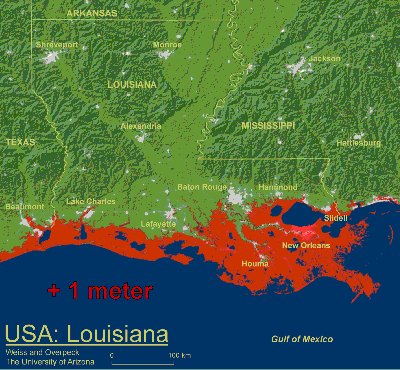
Ultimately, rising seas will likely swamp the first American settlement in Jamestown, Va., as well as the Florida launch pad that sent the first American into orbit, many climate scientists are predicting.In about a century, some of the places that make America what it is may be slowly erased.
New study: Urban sprawl a factor in global warming
A new study says gas-guzzling SUVs and industry are not the only major factors in producing the greenhouse effect.The Urban Land Use Institute, based in Washington and London, says urban residential sprawl is a big factor.
Colorado is a textbook example of the effects of such growth, says Michael Leccese, director of the institute. He told the Summit Daily that shifting 60 percent of new growth to more dense patterns could reduce carbon dioxide patterns by 85 million tons annually.
Scientists hopeful despite climate signs
NASA's James Hansen, who forecasts some of the bleakest outlooks on global warming, said in an e-mail: "I am always surprised when people get depressed rather than energized to do something. It's not too late to stabilize climate."
Contact
- Content: editors at theoildrum dot com
- Tech support: support at theoildrum dot com
License

This work is licensed under a Creative Commons Attribution-Share Alike 3.0 United States License.
A new guest post by Chris Nelder has been posted at TOD:Canada.
We thought we just had to provide you with the opportunity to see Chris' wonderful pictures of the unique event that is the Burning Man, many of which have to do with (sometimes truly) alternative energy forms. It all looks like an amazing experience, and we can only imagine what it must have been like to physically be there.
Many thanks to ilargi for web-optimizing the photographs.
The Wild 'n' Out Energy of the Burning Man
Recently, I spent eight days in the Nevada desert with 47,000-some-odd other folks at the utterly unique annual event called Burning Man.
This was my third time there, and it was more than a third larger, and quite a bit more taxing, than I remembered from my last attendance in 2000.
For those who haven't heard of Burning Man, it's . . . well, it's hard to describe. In fact there are probably as many descriptions as there are attendees.
A quick check of Google Earth suggests that increasing territorial waters around the Falkland Islands would have minimal direct impact on Argentina, since at the closest point the countries are only 230 miles apart anyway (eg a dividing line has already been drawn and wouldn't change).
What it does do, particularly around South Georgia and South Sandwich Islands is significantly extend the potential areas for drilling to cover a sizeable chunk of the South Atlantic.
Seems as if its just another case of Argentina trying to claim the Falklands (again) and not liking another thing that might make the UK even more certain that its staying put.
Anyone know if anyone has done any drilling and if there is real, rather in wishful thinking, oil in the area?
Somebody punched a hole down there back in the late '80s.
No idea of the actual result. I do know that there is as much "rumour oil" down there as is located in the Canadian arctic.
Info on Falklands exploratory drilling (first posted by MUDLOGGER about a week ago
http://www.desireplc.co.uk/pdfs/journalpart1.pdf
Regards Chris
Hmm, interesting.
Although I'm not well enough informed to know what that means for the possibility of finding oil deposits in the region.
Its interesting to note how the territorial waters shown would extend further eastwards if 350 rather than 200miles were the limit.
There was already a war there between Britain and the Argentines twenty five years ago. I believe there, as in Iraq, we took a crap on the PM's desk as well, failing to back them when the Falklanders' interests and theirs coincided.
With allies like us the Brits don't really need enemies, do they?
If there is oil we'll get a nice Hugo Chavez/GWB ego proxy war out of the deal, and then perhaps some real shooting later.
A lot of people back home felt like the US shat all over the UK over the Falklands too...
...though personally to be fair, I heard that the US, and Regan administration, did some strong behind-the-scenes work in the UN to help out without coming out and directly helping...
--
All these memories will be lost in time
like tears in rain
I was not politically aware when the war was on ... I recall the U.S./U.K. "misalignment" from an article I read within the last year - probably something in the CFR's Foreign Affairs.
Bummer about that, as we got on rather famously on a shared problem back in the 1940s ...
The US should have helped the Argentines! In fact, the US did provide logistical support for the British, I think in or near Bermuda, as their ships proceeded South.
I am of the opinion that the Argentinians have a legitimate claim on the Falklands (Malvinas) and that the British shoiuld relinquish control of the Islands. The French were the first to settle on East Falkland in 1764. The British settled an outpost on West Falkland in 1765. Spain bought the French outpost and rights to the Island in 1767. The British withdrew in 1774 due to economic reasons while the Spanish remained until 1811. Argentina became independent in 1816 and declared sovereignty over the islands and established settlements in 1828. The British took the islands by force in 1833 and forced the Argentinians to leave. Argentina has maintained its claim ever since.
Although I believe that Argentina has a legitimate claim to the Malvinas, I disagreed with the invasion in 1982. Again, the Malvinas is Argenine territory and should have the rights to all resources around the islands.
See: http://yendor.com/vanished/falklands-war.html
Amen.
I was in the UK during the Falklands War in 1982 and as a Canadian it was embarrassing to see the blatant jingoism on the street and in the tabloids ("gonna get me an Argie!").
This was a 'war we can win' just like the US invasion of Grenada around the same time; a war to increase support of the government in power.
Grenada- Wasn't that the last war the US won?
Oh- I forgot about Panama-
It was a distraction for the press, to get the Marine Corp Barracks Bombing in Lebanon off the front page--
And the sheeple went along.
You seem to have forgotten that the Argentines actually invaded the Falklands. Forcibly. Armed with weapons. You also seem to have forgotten that the Argentines at the time were in thrall to a military dictatorship (which had 'disappeared' 10-20,000 of its own people). The Falkland locals did not ask them to invade. At the time (and now) 99% of the population wanted to remain linked to the UK.
As for it being a 'war we can win' - I suggest you study the campaign in detail; the UK forces were operating at the end of a 5000 mile seaborne supply link which was extremely tenuous (with aircover provided by less than 30 Harrier jump jets), and the Argentine military (particularly its aviation) were no Grenadian militia (I wonder if you have heard of the word Exocet?). The loss of one aircraft carrier would have doomed the enterprise. Considering the difficulties with logistics (at one point the Argentines knocked out 90% of the UK forces heavy lifting helicopter force) it was really an immense gamble to even undertake the mission.
Still, hell why let a few inconvenient facts get in the way of your political bias.......
absolutely right
the entire argument seems to be that Argentina is close by therefore they have the right to invade
and as to easy - this was an incredible achievement that few militaries in the world could have matched at the time and the Argentine army was a serious foe
--
All these memories will be lost in time
like tears in rain
Has anyone thought to ask the folks who live there what ought to be done?
Seems like its similar to Gibraltar - an issue between the U.K. and Spain, but the Gibraltarians have their own ideas on what is good for them.
they did
the islanders didn't want to be Argentinian
just cos a country is close to a small nation doesn't mean it has the right to invade
--
All these memories will be lost in time
like tears in rain
just cos a big country is far away from a small nation doesn't mean it has the right to invade
The US military secretly helped the Brits in the Falklands. The US transferred some missiles to the Brits and helped out with logistics.
If they push it and drill down there they might be flying every last nut and bolt in. LOL.
Can Magnets Boost Ethanol Production?
http://www.technologyreview.com/Energy/19412/
Can Magnets Boost Ethanol Production?
No. Mixing can.
Peak Oil and "The Shock Doctrine"
I've started treading Naomi Klein's new book "The Shock Doctrine". Jesus, what a book.
It is required reading for anyone who understands the implications of the current convergence of Peak Oil, ecological collapse, climate chaos and economic instability: that the merging of these global storm fronts is going to result in large-scale, widespread disruptions to our social and economic fabric.
An excellent, extensive "Cliff's Notes" style review is available here on Truthout. Here's an excerpt:
Klein's book describes exactly what we have to look forward to on the political front as doctrinaire free-marketeers take advantage of major crises to push forward their agenda of privatization, wealth accumulation, the acquisition of absolute power and the establishment of what amounts to a neo-feudal system. As happened after 9/11, the tsunami, NOLA, the coups in Chile and Argentina and the invasion of Iraq, effective opposition will be shocked into paralysis and supporters of radical restructuring will have a clear field.
For those of us who are convinced that Peak Oil will result in disruptive failure cascades but have not yet articulated their possible political consequences, the book provides a powerful cautionary message. The world faces risks on the political front that may well eclipse the purely technological difficulties we normally focus on here on TOD. For those of us who already foresee an enhanced probability of social collapse due to the effects of Peak Oil, this description of the forces waiting in the wings to take advantage of such events only makes the probability of global disruption that much more certain.
If the coming turmoil is as deep and widespread as many of us fear, it will present the greatest opportunity in history for the "Chicago School". If things go as far as I expect they will, then in 50 or 75 years this may become moot, but in the meantime it's something to be very concerned about. As times get tougher people will clamor for strong-handed governments and those governments will inevitably be drawn from the authoritarian ranks of those who are most aware of the Shock Doctrine. They may then deliberately exacerbate the very crisis they were selected to guard against, because increasing the crisis furthers their ultimate goals.
The approach Klein describes is already visible in the obstructionist political appointments made by the Bush regime in virtually every area having to do with the environment. It's as though they actually wanted to make the problems worse, isn't it? Why would they do that? Naomi Klein presents a frighteningly plausible reason.
Get the book.
Glider: I will read the book. I agree with the basic premise, which is that there is no overseeing institution existing in the USA to look out for the well-being (economic and otherwise) of the nation. For this reason I am more cynical than most on this site re peak oil mitigation efforts in the USA e.g. public transit. IMO, other countries such as Germany, France and Japan are better placed to transition because their societies are still cohesive (the common good is considered important). This is not a criticism of the USA, still one of the best countries, just an opinion.
Jane Smiley on The Shock Doctrine...
http://www.huffingtonpost.com/jane-smiley/the-shock-doctrine_b_64306.html
I would say that Klein's book would only be of interest to those that:
1. spent some part of their waking time in the last half or third of the 20th century
2. are interested in the future, if not for themselves, then for their children and grandchildren.
Other than that, it's of no interest.
Klein was just debating Greenspan on Democracy Now! today.. I don't know if it's even fair to say 'debate', but they did have a chance to get their licks in.
Avail to watch, listen or read Here..
http://www.democracynow.org/article.pl?sid=07/09/24/1412226
apologies if this is covered elsewhere down thread. Takes me a while to get through the pile some days.. what with a life to live and all..
Bob
Jokuhl: Good interview. It was like Naomi was trying to catch a bullfrog-Alan kept squirming away. I lost count of how many times he contradicted himself. I thought his most absurd/interesting comment was his excuse for promoting runaway deficits- he was afraid that consistent giant budget surpluses(in the USA-LOL) would fall into the evil hands of (to paraphrase him)the likes of Lyndon Johnson or Richard Nixon. His destruction of the dollar was done to protect the nation. Classic. Some of his comments made him sound like he might be on meds of some sort.
My favorite squirm was when Klein asked him about income disparity (in the 80s CEOs made 40x worker salary, and now they make 400x.) Greenspan said that cheap foreign skilled labor drives wages down, thus reducing income disparity!
This is exactly what I mean when I say we're busy losing a multi-generational fight against fascism that people foolishly thought ended with WWII... WWII was a strategic setback and the focus just moved into the background and shifted tactics for a while...
--
All these memories will be lost in time
like tears in rain
I bought the book online and just got it. I am just now into the first chapter and find it fascinating. It essentially undresses the myth and reveals utterly that the emporer has no clothes. You are right on. The book is indespensible in analysing the interplay of resource scarcity, economics and political opportunism.
Over the weekend, www.lemetropolecafe.com (paywall) posted the following comment:
I thought that this would generate some discussion here. How do you covertly "subsidize" gasoline prices? One way would be to have a stash that you can dump onto the market. Recent numbers on gasoline in storage has been below average - so there is no sign of a stash in the USA. Another way would be to import it.
What do you think?
Francois
Francois, here are some interesting comments about current manuvers by the Fed by some people in the biz...There are charts at the link that show a close correlation between recent movement of commodities.
http://www.atimes.com/atimes/Global_Economy/II25Dj04.html
"Low core inflation will give the Fed latitude to ease monetary policy further if necessary to limit downside economic risks. But those reflationary policies and the uncertainty in the outlook will continue to drive some traditional inflation gauges higher. And global growth is still strong, supporting demand for commodities, especially energy. Thus, investors should continue to bet on higher volatility, steeper yield curves, a weaker dollar, rising commodity prices and further increases in inflation breakevens." - Morgan Stanley economist Richard Berner'...snip...
'Talk about being between a rock and a hard place. The dollar continues to edge closer to the cliff. The Fed is banking on low core inflation as justification for additional rate cuts. Something may not wash here.
If the buck breaks down into overshoot territory - the Treasury (though the Fed) will have to muster some real defense, not just the usual sheepish pronouncement, "We maintain a strong dollar policy." Thus, the dollar could lead rates higher.
Higher US rates might exact more pain for the US economy - further endangering growth and further solidifying the view that global growth is decoupling. Which would of course not be good for you know who - the dollar.'...snip...
Thank you. Very important post.
We're at MOL now.
“We are one hurricane away from energy scarcity and volatile, high prices,” Hofmeister said a day after crude oil prices topped $80 — a record, unadjusted for inflation. “We are so tight on the demand-supply relationship.”
By subsidizing, we've disguised our desperation.
There's something in the GOM now.
Headed for NO.
Mexico will not come back on like it was . It exports to NO/Houston.
And brings the gasoline back home.
http://www.ssd.noaa.gov/goes/east/gmex/loop-wv.html
And like I've been saying since Humberto.
I've never seen anything like this in the GOM.
And brings the gasoline back to
Arkansaw of Samuel L Clemens
how MOL are the US ? 185 mb ?
Although I'm skeptical of the ability of any group to subsidize gasoline prices, it would make sense in the context of the US 'addiction' to auto travel to keep gasoline cheap. It would stand to reason that the real cost would then show up somewhere else in the 'whack a mole' fashion.
I have read many screeds purporting to calculate the 'true' cost of gasoline, usually taking into account environmental and social costs and typically giving something like $15 USD/gal. The subsidy being talked about here is of a different nature though. This subsidy would not only say 'hang the environmental and social costs' it would say 'hang any other costs we can extract from whoever in the economy has the least power.' Expect a complete drying up of whatever little social safety net type of services are available in society. This also means that especially city and county governments will be the 'beast' getting starved of revenue while the Federal govt' 'beast' consumes greater quantities. Already I'm segueing into a rant.....
I ask the question, how can crude be at $81 or $82 dollars per barrel and gas selling for $2.71 (in Minneapolis)?
Speaking as a longtime Iowa resident I'll theorize that there is something ... different ... about Minnesotans :-)
All kidding aside this is a fascinating issue - the more I read about oil production, processing, and distribution, the less I feel I know. Every clarifying link I open produces new vistas of stuff I don't know. Perhaps $2.71 is exactly where its supposed to be today based on causes and conditions?
SCT, You make a good point, I check daily the Nymex Gasoline Future and add .65 to it for an approximate MN retail cost. The close today, $2.06 + .65 = $2.71, that was easy, the question others have raised is why the low gasoline futures price, almost equal to the cost of crude per gallon? There was a time recently when the Nymex price was $1.90 and gas was $3.39 in Minneapolis so my formula does not always hold true. I refuse to get into the MN/IA debate, I am told there are some nice folks in Iowa.
Give a low-cost laptop, get one free
I'm kind of tempted, even though I already have a laptop. I wonder how much it weighs?
About 1.5 kg (3 to 3.5 pounds). Here are the specs.
You won't be able to replace your current laptop with it though. That said, my kids need a computer and this may be it. Plus daddy would like to play with it too...
I think that depends on what you're using it for. If you just want e-mail and web browsing, as a lot of people do, this could be perfect. A step up from a Blackberry, but not as heavy and expensive as the average laptop.
Obviously, you're not going to play Halo 3 on it.
It runs emacs and LaTeX, everything anybody would ever want from a laptop (at least as I see it) :)
In Euros, they've actually hit their original price target.
Yeah,
maybe the "100 Dollar Laptop" should consider unpegging itself from the dollar. Might be a Million-dollar baby before too long.
Bob
Shell President, from up top (9/15/07):
And what was the energy leg of the “Iron Triangle” telling us in late 2005 and 2006, and by and large, what are they still telling us?
http://graphoilogy.blogspot.com/2006/07/daniel-yergin-day-july-13-2006.html
Excerpts From “Daniel Yergin Day”
Well boys and girls, this kind of sounds like Saudi Arabia won’t be riding to the rescue, or at least not to any meaningful degree. If the recent price rise only goes to offset the decline in the dollar, a significant increase in production could be bad for overall revenue.
It’s kind of funny, notice how Bush has constantly evolving reasons for staying in Iraq, at the same time that Saudi Arabia has constantly evolving reasons for “voluntary” production cutbacks.
http://in.reuters.com/article/businessNews/idINIndia-29672620070923
OPEC sees oil prices offsetting weak dollar - report
Sun Sep 23, 2007 6:33am IST
http://www.ssd.noaa.gov/goes/east/gmex/loop-wv.html
It can't be much fun drilling deepwater in the GOM today.
Arkansaw of Samuel L Clemens
And don't forget:
"Peak Oil theory is garbage as far as we're concerned."
Robert W. Esser, CERA, Business Week, September 7, 2006, Plenty of Oil - Just Drill Deeper
Incidentally, CERA is sticking to their story, at least for now. It may have already been discussed here, but they have a relatively new (Sept. 4) report out called
Finding the Critical Numbers: What Are the Real Decline Rates for Global Oil Production?
In the summary, they say:
CERA is getting close to the abiotic folks.
"global productive capacity will continue to rise strongly for the foreseeable future..."
Big Oil has dropped production since 02.
Everyone else is at capacity now, at best(Angola,the exception).
Where is that "rise" showing up?
Arkansaw of Samuel L Clemens
Rise in capacity does not = rise in production. Read "capacity" as "imaginary figure that we decided sounds good".
"You can never solve a problem on the level on which it was created."
Albert Einstein
I posted a link yesterday that went on forever about the wonderful business opportunities in Saudi Arabia--no mention of plans to increase oil exports though.
Kind of makes one think that the Saudis have decided that the US, at least under Bush/Cheney, is a dangerous, fading regime and that they have decided to look out for #1.
When you look at the net export models, once a region starts declining, the net export decline is rapid and accelerating. With so many large exporters are relatively advanced stages of depletion, the net export decline will be swift. So, why maximize exports if exports are going to crash anyway? Why not minimize exports, and thus maximize the per barrel price, and focus on using the remainder of one's oil to try to build a bridge to a less oil dependent lifestyle?
Jeffrey,
I posted this little chart at Gail's thread earlier, with the question: are oil prices really rising, or is the dollar falling? Anyone with an income in dollars might reflect on this, and certainly oil exporters.
Brent Spot/dollar commodity charts

- development last 3 month(s)
NB: NOK=Norwegian krone
Both.
If you believe Federal Reserve numbers (a big "if"), the dollar has fallen in value at about 3% (purchasing power) per year since 1999, while Brent crude oil prices have risen at about 20% per year since 1999.
However, a useful chart would be Brent crude, in Euros, since 1999.
I did a graph from 1997 and it worked out at about 17.5% YOY till present (10 years $16-$80)
Marco.
Brent in 1999 (average) $19 = 19.00EURO IN 1999 EUROS
Brent Now $80 = 56.00EURO
I work that out to be 13.5% YOY if it were always priced in Euros. (Still fairly high compared to "Core" inflation)
I got the $ YOY oil inflation wrong it is actually about 18.5% YOY
The chart would be more believable if the ratios were the same, but this charted has been fudged to exaggerate a point.
Each dollar tick is 1.125% but each NOK is at 0.833% which means the green line should be dropping 25.96% less relative to the shaded area.
Nice try.
WT, it takes a lot of energy to desalinate sea water. SA is not going to sell crude that it will need to keep Saudis from perishing from thirst...Plus, they are growing fond of driving autos instead of riding camels. I can feel the tension wratcheting up daily.
There is a report out that Saudi Arabia is going to have to shift an additional 500,000 bpd of liquids production to domestic consumption--power plants and desalination plants--because of shortfalls in natural gas production, which is why the Saudis are talking about importing coal.
Note that Rembrandt put Saudi domestic liquids consumption up at +9% year over year, from first half of 2006 to first half of 2007.
[Kind of makes one think that the Saudis have decided that the US, at least under Bush/Cheney, is a dangerous, fading regime and that they have decided to look out for #1.]
So have many Americans.
I don't go this far. I note the difference between the prices the Saudis get in Asia for their product and what they get in the USA, and then I notice that theya re cutting shipments to Asia, instead of us, and I realize that the friendship between the House of Bush and the House of Saud is very, very deep.
It looks to me like Hofmeister from Shell has found a good excuse to ramp up pressure to increase drilling within the U.S. borders sooner rather than later.
-Don
... and what did James Schlesinger (former US energy secretary) say in his interview with David Strahan, just some days ago:
Quotes a many. Who does one believe?
Again, I'd go with Matt Simmons on this: trust the data from the field.*
*(even with it's uncertainties).
Yes the internal combustion engine.
Its been a great ride but............. if you wanted to point out a single invention responsible for the precarious ecological and economical state the our planet, then that would be it.
Can't live with it, can't live without it.
It has bought us heaven and probably hell.
No spy satellite.
http://news.nationalgeographic.com/news/2007/09/070921-meteor-peru.html
Finally a non-demonising article on Chavez in the mainstream... the man is not an angel but the fact that he doesn't agree with the US and the IMF etc does not make him a devil. If the kleptocracy class is squawking then he must be doing a few good things.
ciao,
Bruce
ps of course if he sets it up unsustainably then he'll fail the same way everyone else does...
The problem is Chavez is funneling the petro$'s
into domestic consumption instead of TPTB.
Like Saddam.
The US cannot allow this.
And if we attack Iran, Chavez will cut us off.
Arkansaw of Samuel L Clemens
'Finally a non-demonising article on Chavez in the mainstream...'
Ah, Bruce, are you refering to the article that starts "That is, of course, radical left-wing president Hugo Chevez..."
Yeah, that must be the one...and you are right, I have seen tons of MSM items recently that started with "That is, of course, radical neo-con right-wing president George Bush..."
President Chevez is doing the unpardonable...He is doing something for his people. If the Merkin People find out that their natural resources could be used to improve their lot instead of just enriching TPTB, well...that just wont do, will it? The Merkin PTB are busily stamping out the last vestiges of the Bill Of Rights and have gutted the Constitution...Empowerment of the peons...Not likely! Where is our Chevez?
Greenspan and Naomi Klein are both being interview on Democracy Now by Amy Goodman...Right now! Channel 375 (Link TV).
Both concurrently?
I've never had tv, that might be a show worth watching. Is it on radio?
archived here
http://kpfa.org/archives/index.php?arch=22424
Thanks.
The shocker, perhaps naive on my part, was Greenspan's fear of the US deficit approaching 0. That caused him to change track on tax cuts. No wonder Warren Rudman's Concord Coalition crashed with such an adversary at the Fed. Balanced budget, anyone?
Alexander Hamilton, the first Treasury Secretary, wanted the US to run a permanent deficit so that it would be dependent on his national bank and the elite investors. Now which investors was Greenspan trying to keep empowered - domestic or foreign?
Unfortunately, Madison was only able to stop him for a few centuries.
I think you mean Aaron Burr.
Cage match?
There's the transcript and Podcast links..
http://www.democracynow.org/article.pl?sid=07/09/24/1412226
AMY GOODMAN: Alan Greenspan, let's talk about the war in Iraq. You said what for many in your circles is the unspeakable, that the war in Iraq was for oil. Can you explain?
ALAN GREENSPAN: Yes. The point I was making was that if there were no oil under the sands of Iraq, Saddam Hussein would have never been able to accumulate the resources which enabled him to threaten his neighbors, Iran, Kuwait, Saudi Arabia. And having watched him for thirty years, I was very fearful that he, if he ever achieved -- and I thought he might very well be able to buy one -- an atomic device, he would have essentially endeavored and perhaps succeeded in controlling the flow of oil through the Straits of Hormuz, which is the channel through which eighteen or nineteen million barrels a day of the world eighty-five million barrel crude oil production flows. Had he decided to shut down, say, seven million barrels a day, which he could have done if he controlled, he could have essentially also shut down a significant part of economic activity throughout the world.
What a slick barsterd! The Oil was just making Hussein rich, huh, and we had to stop that? .. So he watched Saddam for 30 years and missed the part where we were arming him to attack Iran?
Ok, Greenspan's not a young man.. maybe he's trying to avert waking up to a Blackwater Caseworker poised with a dagger over his bed some late night..
What really bothered me about this interview was that Klein and Goodman, while they have perfectly valid points to make, posed so many of their questions to Greenspan as 'Don't you agree that such and such was your fault as head of the Federal Reserve?' .. I'm sorry. I'm on their side politically, but the answer to 'Softball Puppydog Journalism' is not 'Hit them with baseball bats' Journalism.
I miss C-span. It's the one thing I really wish I had a TV hooked up for. Washington Journal let people debate, let callers have their say, guests be able to air their views without the sense that they were coming out of an LCT on the beaches at Normandy..
Who would you all put with Greenspan to have a productive debate on the Role of the Fed and a pair of useful counterpoints for what's going on in the economy? How is Robert Reich? I don't mind a good tussle.. but just slinging blame isn't going to get the discussion anywhere.. everyone just bristles, and it all becomes about the best digs, not the best points. Has me thinking about Robert Rapier, actually. (EDIT.. and I mean that to his credit, that Robert prefers a factual discussion, while not shying away from disagreements.. absolutely a goal I'd strive for)
Bob Fiske
I seemed to have caught most every Greenspan interview during this blitz - Diane Rehm, Teri Gross, Amy Goodman, Tim Russert, Charlie Rose, John Stewert. I've had enough.
Tim Russert was the only one who pushed Alan's assertion that Sadamm was going to threaten the straights of Hormuz.
Tim asked the question of whether a Democracy should pre-emptively attack when it perceives a threat to it's economy. (Alan responded that it was a moral question he did not have an answer for, which I thought was alright. It is a question we all have to ask).
I thought the Goodman\Klein tagteam was poorly handled and too confrontational without substance behind it. I was looking forward to hearing it.
And I can't believe Tim Russert had the best interview with him. Diane and Teri dissapointed.
That's my take.
When I look at a windmill I see a cleaner, safer future.
That makes windmills 'pretty' in my eye.
I agree. Wind turbines are visually appealing to me. Plus, I'd rather see wind turbines than to see an oil rig with natural gas flaring, oil washing up on the shores, and the resulting dead wildlife from oil contamination.
Wind turbines, solar panels, and tidal generators are all pretty in my eyes, especially compared to increased deforestation, more pollution, and decreased glacial coverage.
I agree.
~Durandal (http://www.wtdwtshtf.com/)
Because that kind of bad stuff happens to every single oil well drilled. Seriously though, no sympathy for the birds that will be slaughtered? (sarconal)
Wow!
They have a big turkey dinner each time they put a windmill on line? How many hens per worker?
Who knew....
(Do some Googling on wind farm bird kill. The actual data. Old fields, in particular Altimont, did kill a number. The industry has learned how not to....)
Don't bother trying to 'educate' partyguy - He is not here to have is opinion changed.
Better to post links and show how PartyGuy is just some wacko to any reader who looks into who's position is backed with research VS hysterical handwaving.
http://www.treehugger.com/files/2006/04/common_misconce.php
The whole dead birds business is, I think, some weird NIMBY/environMENTAList scam.
There are lots and lots and lots of turbines here. I'm in the Iowa Great Lakes region - think "Motel 6 for migrating Canadian waterfowl". The area is thick right now with Canadian geese and at least half a dozen other species on their way south. I've not seen a single dead bird anywhere near the turbines I have easy access to and I'm not seeing any newspaper stories about it happening in the plantation of them just south of here.
A fowl that ran afoul (phonological ambiguity!) of a turbine blade would definitely get turned into pavement pizza in the air, but said bird would have to be blind and deaf. Turbines are huge and they make an amazing noise clearly audible from far away. I actually find it disquieting walking under one of them in operation and there is a good hundred feet between a person on the ground and a blade tip.
Birds are not the brightest animals. I have large windows for passive solar and because my house is small and lots of big windows makes it seem bigger and also bring in the outdoors. Anyway, the birds fly into the windows with a thud quite often. Most of the time they are just stunned and recover after 5-10 minutes. But there are fatalities. I would guess about 1 dead bird every couple of months.
You can stick silhouettes of predatory birds on your windows. The birds won't fly that way.
Especially when one thinks of all the automotive roadkill. No one is demanding the curtailment of auto usage in favour of the animals. If racoons, fox, porcupine and moose, had wings they might have a chance of survival. This evolutionary failure on their part means they are doomed. Pigs are next.
Those folks aren't environmentalists.
This post brought to you as a public service.
I considered responding to that article, and when I saw how the guy was ranting, realized it just wasn't even worth the effort. Yes, the 'eyesore' argument has got to be one of the most overused and underchallenged pieces of the windpower debates. It's the same red herring as PV payback. It gets wedged into being the most important thing in the world, while the numerous benefits of each of these technologies makes the others pale in comparison..
Scientists hopeful despite climate signs
"Schneider's wife, Stanford University biologist Terry Root, recalled how in 2002 she was sitting at the hospital as Schneider slept after cancer treatment. The oncology nurse came in, chatted and asked her what she did for a living.
Root said she studied how animals are being hurt by global warming. "That is such a depressing job," replied the nurse who daily deals with cancer patients.
Then they both laughed."
We need the optimism, the humor.
What to do with all those petrodollars?????
Who owns America these days??
http://business.guardian.co.uk/story/0,,2175537,00.html
That is a lot better than the ($500,000) average negative worth of US citizens.
Also it is great that Walmart is going ahead with a determination of the engergy input of its goods. That has the potential to have significant influence as it impacts multiple supply chains.
I have spent the last 2 years reading TOD & other sites everyday. Read lots of books about many topics. I have changed my views on every thing. After all the time invested, its time for me to make a few serious conclusions and observations about PO, economy and the world.
It will be very tough for my kids to reach the prosperity I have achieved.
My 26 year business sells expensive electronics from Asia & vehicle accessories, won’t survive.
My back is stronger as I work in my garden.
Chickens are easy to raise.
Neighbors, friends & family think I am depressing, too bad I say.
Sadly, I have sold off 45 years of coin collecting and several antiques.
I’m planning on the lights staying on and my freezer working.
Paper money will still be the measure for account & transactions. Gold is too heavy to carry around.
I will have to grow 50 percent of what my family eats, with their help.
Travel will be safe to & from town. Walking, biking or by scooter.
I think about Westexas ELP model. How can I make it work for me?
Some event is building; it will change how everything works in the world. When? Sooner than later.
Gold is not too heavy. 10 coins (10 ounces = $7300.00) buys you a decent truck.
Tough to send in to the electric company or use to pay for dinner at a restaurant and ask for change though . (See Mark Twain's "The $5 Million Banknote")
Yes - of course. That is why we have always had lesser coins, or even paper "notes". As long as gold anchors the whole thing - you could even have gold debit cards against your gold balance somewhere in a bank or write a gold check to pay the utilities.
I am just trying to debunk this idea that gold should not be money because it is too heavy (it is not), or because there is not enough of it (price it higher), or because it is not secure (it can be).
Over the last few weeks the FED and other central banks created $300 billion of new "money" to bail out the subprime lenders and banks affected by the credit freeze. That "money" is now in the worldwide system where it is an additional claim on production, and hence provides additional impetus to price inflation. This theft of our purchasing power can not happen under an honest money system based on gold.
Dont get me started!
Francois.
Well, in my time of reading I have found that I was doing quite a few things right despite not having the proper technical knowledge.
I have also found that I was most likely a bit too optimistic and that social unrest in the US will be very pronounced if it is not preempted.
I was looking at it in the sense of looking for the best area in the US to weather the storm. I am now convinced that this will probably not be a good idea other then for very wealthy people.
I think we are running out of time, but it is time consuming and not so inexpensive to disengage from the system.
I've been stumbling across these "the world is coming to an end" scenarios for 40+ years. I'm sure they were going on long before I started paying attention
World didn't end when the Dow passed 2,000. Didn't end when the calendar hit 2,000. Probably won't end when we start down the backside of the peak.
Things do change. Smart people work out strategies to deal with the stuff that might happen, but don't start building their coffins every time Henny Penny squawks.
We're living in interesting times. We've just come through the transition from pen/paper to computers. Now we're getting ready to transition away from petroleum.
Some people will be Microsoft. And some people will be Wang. (Remember Wang? Owned corporate desktops - the wooden kind. Rode the old system right into oblivion.)
Short term, transportation, food, and a bunch of other stuff will most likely get relatively expensive. Plan on how you can comfortably cut back. And reduce your debt as much as possible. No reason to be paying interest on that latte you charged back in '05.
Longer term. We'll have more comfortable lives. At least most of us will. At least that's how it's played out after all of those 'sky falls' to date....
at the end of the day there is a maximum carrying capacity for the world - higher with oil than without
once this is exceeded for too long a lot of people die because they cannot eat
it isn't rocket science
--
All these memories will be lost in time
like tears in rain
I appreciate your upbeat tone but........
You appear to be a little contradictory
To whom are you addressing your advise Bob? Just "smart" people?
Will just smart people take your advise?
What will happen to those who don't?
Will there be consequences for anyone or group which do not?
How many in your estimation will go into "oblivion"?
If there are no dire consequences as you allude to, why bother heeding your advise at all!
I do remember Wang. I was in charge of one of their systems in the state gov't agency that I was working for in the early 80s. It was very good technology for its time, but the times changed and they didn't. My take was that as long as Wang was just up against Word Perfect, they could have held their own against the IBM PC. However, they never could come up with a decent equivalent to Lotus or VisiCalc. IMHO, that was what actually killed Wang. Too many office workers needed to do things besides just striaght text, things that were numerical and better served by a spreadsheet. The other big problem was that once offices started to become populated with PCs, they couldn't interchange data with the Wangs. The proliferations of LANs and then the Internet just left them behind on the dustbin of history.
I just returned from shopping, refilled the gas containers that I rotated into the vehicles. Guess what? Charlies Citgo, never been out of gas before, plastic bags on ALL pumps. Went to Hess about four miles from Citgo...Hess has removed their mid-grade pumps. High test and low test only. Very strange.
Most stations have only the high and low grades in a dual chambered sotrage tank-- the mid grad is just a blend from the two tanks. Probably either the blender is out of order, or their supplier is sick of running a separate truck out to the only guy in his service area with a dedicated mid grade tank.
Mr Possom Sir,
You seem to have some knowledge of the "access" end of the gasoline network. Could you please read and comment on my "thinking like a network engineer regarding MOL" post below???
Moo!
I always assumed that all the different grade pumps simply drew from the same tank. You know, so that people with extra money could feel good about buying hi-test.
:-)
olepossom, the mid grade pump is physically gone, removed, not there any longer. There are at least a dozen Hess stations within a 15 mile radius, next time I am out on a bike I will do some station checking and see if all the Hess stations have removed their mid grade pumps. Mid grade gas is still advertised on the sign at $2.85 per gallon. Guess you can sell it cheap if you dont have any.
BTW, there is a big difference in the way my vehicles perform with mid grade vs low grade gas...especially the motorcycles. If you are running the ignition a little more advanced than specified gas mileage will improve a bit but the engines will ping from early detonation with low test.
I ride a HD Lowrider 2001 and I use on 87 octane.I never experience what you describe...I get 50 MPG..
I ride every day almost. My bike has over 20,000 on the odometer.
I have ridden motorcycles all my life from Cushman Eagles and up...even in Hawaii I rode a bike.
And all this time I never used aught but low octane..the cheapest available.
I have tweaked my idle jet a bit but otherwise the bike is factory. Plugs run very clean and right color. Exhaust tailpipe is perfect..Never any blueing of the exhaust(vance and hines)...plenty of power....
Now I could likely run hi-test and have to drive further for it and have to pay more..but why should I.
I am not saying your wrong...this is my experience of 50 years of motorcycling...I also burn 87 in my 99 Jeep Wrangler and hook my OBDII module up to my laptop and observe all readouts. Nothing abnormal observed.
I have a 'color tune' spark plug to observe thru the port the actual firing of the cylinder..used it on my 1100 Yamaha in which I burned 87...again all was normal..this was a twin carb engine and I tweaked it for the best performance quite often but again stock..
Now one of the differences could be the addition of ethanol to the gas mixture that is now sold..however my experience predates that quite a bit...
I also drove VW beetles for many years. Rebuilt the engines many times..and I have three of them in my barn right now..1970s in vintage...I never used but the low octane at the pumps..and that was travel to and from both coasts..mountain driving as well over the Rockies and the Appalachians.
I'm not again saying your wrong..its my experience I am speaking of.
In my opinion todays embedded processors(PCMs) can easily adjust the fuel trim and timing to handle the correct operation of the engine. Of course HDs that are carbureted have only the spark timing to compensate with...I intend to never own a FI Harley...the sound is part of the ride.
I will admit that older HDs were problems and one could burn a hole in the piston were they not careful. But back in about 1956-57 I rode a smallish Harley 30 miles roundtrip each day.
Even in all the automobiles I have owned , and thats quite a lot,I have never touched the handle of the high octane pump.
Currently I own 5 vehicles but the Jeep is my main set of wheels along with the LowRider.
Irregardless of what the dealers say , I make my own rules up. The owners manuals are not worth the paper they are printed on IMO.
AD
So let me see if I've got this straight ...
The Falklands, seen of the U.K. Argentine war are now an oil flashpoint.
Myanmar, where people don't say boo to the government, appears to be about to do a Zimbabwe on energy issues.
Nepal, which has been tottering about with a Maoist insurgency hanging off its back for the last many years continues to face an ongoing energy crisis.
Nigeria is going to continue to behave badly.
India skips a meeting involving Iran and Pakistan where there is gas involved. (Because China will get it all, due to their proxy North Korea arming and thusly protecting Iran?)
Mexican production is dwindling, except the production of radical groups willing to blow up oil handling infrastructure.
Oh, and Iraq has infrastructure troubles, too.
My big meta-question with all of this stuff is this:
Who suffers dramatic inconvenience if Iran's oil and gas industry is savaged by American air power?
If you're going to answer that please rank the displeased by size/weight/overall ferocity/access to nuclear weapons/etc.
My answer to that question:
China obviously wants no more neocon Christofascist silliness in the region. Iranian gas goes to China? Check. Chinese fuel oil goes to North Korea? Check. North Korean nuclear personnel definitely in Syria? Check. North Korean nuclear personnel in Iran??? The hyperinflation adjusted zillion dollar question of the day.
The United States citizens who are not religious fanatics praying for the end of days. If we're truly hovering just above MOL on gasoline an attack on Iran would cause chaos in the short term and reduce crude supplies. I can't tell if less crude is a horrible thing as long as the straights of Hormuz remain open, and I'm curious if the refining capacity that now sends gasoline to Iran might be turned our way instead. So many variables to try to wrap my tiny little mind around ...
One scary thing--among many--is that Iranian forces have to be on a hair trigger alert, based on a use it or lose it premise, i.e., if they think (correctly or incorrectly) that the US is attacking, they will be afraid, if they don't immediately launch, that a lot of their surface to surface and anti-ship missiles would be destroyed on the ground without being launched.
I hear through various channels that we've been up to "stuff" inside Iran for a while. I have a friend who, although he is not and has never been "an operator", is on a mailing list run by retired special forces folks. The U.S. has been desperately trying to work the Iranians to that "OMG they're attacking ...fire!!!" point for quite a while with no success.
Lets see ... twelve years of a Republican dominated Congress overlapping six of eight years of the Worst. President. Ever. and now the Republicans are calculating how they can keep the Whitehouse in 2008 without a viable candidate ... either they're dead in 2008 or our democracy is. The moves on Iran make me think its the latter ...
It strikes me that a PR victory would be better for Iran than any kind of military 'success'.
Thus - it is best if they wait to be hit, show pictures of the crying widows et la. Let the larger, more powerful fighter the exhaust himself in a series of blows all the time taunting while being hit.
Yeah. Iran really needs to hold off on any kind of "first strike." If they decide to throw missiles at U.S. troops or Israel before they get attacked, we'll paste them pretty badly and the world will back us up. I'm pretty sure that the debacle they suffered when we destroyed their navy a couple of decades ago is still flitting about in the strategiests heads.
Personally, I think we ought to be leaving Iran alone and maybe even talking to them as if they're grown ups. Hell, they've been more mature in some things than we, the U.S., have been for the past couple of years. It wouldn't hurt to just decide that the government they have is legitimate and treat it as such.
- Scott
"Try sour grapes; you might like them."
oh, what a way to hide the peak?!?!
Presidential press conference summary: Supplies are down because the SoH is unnavigable. We'll all have to tighten our belts when it comes to oil. But keep spending those dollars to help the US economy. And, oh, by the way, since the US military need oil to protect us so well, the Iraqi gov't is now null and void.
(Okay, the scenario unwinder is working overtime, I admit).
I think there are probably half a dozen top scenarios that they've got in mind for how this plays out and I agree that besides the whole Iran getting into our business in Iraq stuff, the end of days style doomer desires, and whatnot there is very definitely a desire for a smoke screen to cover the ARM scam unwinding. I just wonder if that is coming 10/1/2007 or if the heat really comes on at the end of the year with lots of Christmans presents to former employees from distressed companies.
The Bush administration was stupid++ and way clumsy with Iraq when our army was whole and no one had dreamed what a storm like Katrina would do to the gulf coast. Do you have confidence in their ability to predict the future? I absolutely do not ...
Oh, look, General Motors and their workers are flirting with disaster - a million mortgage workers lose their jobs and now 73,000 Union auto workers are picketing in the middle of hurricane season.
http://money.cnn.com/2007/09/24/news/companies/gm_uaw_strikedeadline/ind...
Who was saying GM was most likely of the big three to survive? Everything I've read indicates they're the most troubled ... seems like we're all one step away from the crevasse today ...
Just watched the president of Columbia introduce the President Mahmoud Ahmadinejad. Really bad form on his part!
Looks from that introduction, as well as the commentary by MSM after the speech, war drums are really beating hard. I guess maybe the US economy is in even tougher shape then generally thought.
-----
Sorry meant to hit new thread.... bad form on my part.
Anyone have a link to a transcript of the speech and the Q&A?
No idea what he said except that the simultaneous translation seemed very hesitant and didn't match the body language.
Some of the points the MSM focuses on are obviously ridiculous when looking at the big picture.
The transcript:
http://www.azstarnet.com/sn/hourlyupdate/202820.php
Thanks.
Agreed, that was extremely disappointing conduct for an educated man such as Bollinger. Even moreso considering his legal record and the fact that he is the president of an Ivy League school.
i gotta say i thought Bollinger was disgraceful
he's the President of a great and proud nation - he is your guest... treat him with respect not with pompous posturing...
"...confront the mind of evil..."
"...know our enemies..."
"...despicable ideas..."
"...petty cruel dictator..."
and the ironic thing was that in the face of a media image as some crazy extremist the guy came across pretty well i thought - he didn't answer complex questions in the yes no manner that was demanded
but i also thought Bollinger did us all a disservice by focusing on old comments about the Holocaust, and gay rights in Iran... which when you have a major power threatening to attack Iran and the President comes to talk directly to the American people to bypass an intransigent US junta and corrupt media i think one can be a bit more serious than that...
--
All these memories will be lost in time
like tears in rain
"petty cruel dictator" - that pretty much sums up the behavior of President Cheney and Sock Puppet Bush.
It's a race to the bottom - or more likely out of the country, to Europe and Australia where GM lets its vehicles be designed by engineers instead of Toby Keith.
It's as American as RCA!
I'm hoping to get all of my debt paid off, land purchased, and small house built before things get too bad. Considering my income is coming from one of the Detroit 3, I know the writing is on the wall. Whether they want to admit it or not, they're doomed, and even if they could dump all of the union workers, they'd still be doomed. You wouldn't believe how old-line the thinking is in these companies.
They've really improved things internally, and it's visible. Ford has refocused themselves at a pretty impressive rate. Chrysler will be put into shock via Cerberus, and as a result will be able to limp along for a good while.
If the Detroit 3 can get their acts together by completely converting over to hybrid drivetrains with plug-in capability, they'll be able to squeeze another 20 years before things collapse entirely. I hope for their sake, and the sake of their workers that they make the transition quickly. Change is in the air, and you can smell it in Detroit. It's going to be a shock for a lot of people, the UAW included.
Which one of the Big 2.8 will go out first? Each has it's own terrible set of circumstances I cannot decide...
If you want some fun on subject, give thetruthaboutcars.com a run on their editorial section of Ford Deathwatch, GM Deathwatch, Chrysler Suicidewatch.
Also they have had some editorial snippets regarding peak oil here and there.
http://www.arlo.net/resources/lyrics/chrysler.shtml
It seems to me that if you believe in Peak Oil, then you necessarily can't believe in the long-term prospects of any automotive institution.
Think of the world of good it would do if GM never built another Hummer or Suburban. Now if we can get the UAW go strike at Ford and Cerberus, it might just be a beautiful fall.
Actually, if they can keep the strike going legally and leverage it into a chapter 11 bankruptcy, then they will be the most likely of the 3 to survive.
The first into bankruptcy will have the best odds of survival.
Plausible. It would allow them to dump their pension obligations onto the US government, and free them up to cut other costs...but would they actually use the opportunity wisely or just flub it and completely do themselves in?
What really irks me about the situation is that if the workers concede and take pay cuts/benefit cuts to keep the business afloat - you KNOW there will be a round of million dollar bonuses and pay raises at the top, and they'll laugh all the way to the bank - just like the airlines did.
The whole US style corporate model with no social responsibility is a problem, but IMO it is the result of other unique underlying social issues and will never be resolved.
Frankly I think GM is suprised by this strike and for that reason my gut feeling is this could last for a spell.
They seem unprepared.
But the cards aren't lined up for a long strike, there's no big stockpile of vehicles to be sold, it's screwing up the launch of the new Malibu among others, etc.
But to think a lengthy North American strike would put them out of business is a stretch since they're global and have been having trouble making money in NA for years.
Thinking about MOL like a network engineer
We've got this atomic number of 185m bbl of gasoline required to reach the Minimum Operating Level(MOL) for the United States that we use here, but the network engineer in me puzzles over just exactly what this means.
If we take the entire body of processing and delivery equipment to be a single "autonomous system", ie under one administrative control, then the 185 m bbl number makes sense. This number does not address the fact that there are multiple owners in the system and that overbuild has occurred in many areas.
BP withdrew from the Dakotas, Montana, etc, citing a desire for customers closer to their pipelines. These states continue to receive gasoline. This tells me there must be someone's pipeline somewhere close that is better suited to delivery than BP's was.
There are areas that are full of refineries, like the gulf coast, and presumably there are a lot of "trunks" running out of this area - high volume pipelines from each refinery headed out to their distribution network. This is overbuild and its needed in areas where production occurs, but how much does this happen in areas where distribution occurs? If there are three pipelines to California each running at 66% of capacity may we not close and drain one, or otherwise repurpose it, thusly recovering its volume of fuel and reducing the MOL?
I am handicapped by my layman's knowledge of this network. I believe that pipelines are multipurpose, with transporters mixing fluids, perhaps with some high viscosity dividing liquid between them. This would greatly complicate the analysis of the system. I also don't know where pipelines(distribution) ends and tank trucks(access) start. A reduction in pipeline radius from the production means a lower MOL but higher miles and perhaps more tankers required to continue to serve the gas stations.
Are fuel station storage tank volumes part of the MOL? We are over capacity on fuel stations ... what percentage of that MOL is bound up in them? If half of them close how much does it cut the size of the MOL?
Enquiring minds want to know ...
Let's consider the weekly EIA gasoline report for this last week (lifted directly from the EIA website):
Gasoline Stocks (Million Barrels) and Days of Supply
The PADDS themselves are clearly of vastly differing capacities. This would imply that an overage in one area could offset a shortage in another, yielding a total that is over the MOL yet still having shortages appear. Thus I would not read too much into the MOL except that if we drop below that number then shortages (or rationing) must appear somewhere as the entire system is short of product.
Further, some PADDs, like the West Coast, are very insular and use gasoline products and blending components that are different from and in differing ratios than the other PADDs, so a shortage there would not necessarily mean anything elsewhere.
MOL is a useful "executive summary" sort of number but to see what is actually happening, you have to get closer to ground level.
"The greatest shortcoming of the human race is our inability to understand the exponential function." -- Dr. Albert Bartlett
Into the Grey Zone
If the MOL is 185mb, it would seem to make sense to me that by shutting off the tail end of the supply chain you could keep things running on less then that. The spot shortages in the midwest seem to be indicative of that as well.
Its a network, ggg71 - think of it as trying to carry an armload of barn kittens - get a firm grip on one and another will be biting your ear - the concept of a national MOL is a starting point to literacy but there is much more interesting stuff under there than just a 185m bbl tub that has to be kept full.
Production(refineries) attach to distribution(pipelines and storage) and the access layer(tanker trucks) fill the gas stations. Draining part of the system does not drain the vehicles filled with drivers who expect to fill up where and when they want.
My initial thought on this question was that some of that 185m bbl total might be due to areas being "overbuilt". I'm not sure if the oil industry uses this word as we do in telecom, but overbuilding is where you go into a town that has an existing service, usually traditional copper voice lines, and you build another network, usually cable TV/data/voice right over the top of the original work.
I've learned that we administratively divide the country into five Petroleum Administration for Defense Districts (PADDS)
http://www.eia.doe.gov/pub/oil_gas/petroleum/analysis_publications/oil_m...
Each PADD has some production and some refining capacity.
http://www.eia.doe.gov/pub/oil_gas/petroleum/analysis_publications/oil_m...
http://www.eia.doe.gov/pub/oil_gas/petroleum/analysis_publications/oil_m...
This ancient, low detail map shows many pipelines in a fan from Chicago to Texas with the base of the fan being the Mississippi river delta country. The PADDs are obviously administrative rather than operational - there are plenty of cross connections.
http://www.cartome.org/pipe-1.jpg
So the next big question I have is "How does this pipeline stuff work?" Some pipelines are dedicated to a product while I recall reading here that others would carry multiple products, perhaps with a slug of high viscosity divider between loads. This level of flexibility makes it much harder to analyze the system.
I suppose this is all well done and known and someone is going to come along and school me momentarily, but in the meantime I'm enjoying the detective work ...
Darn you to heck, greyzone - charts and graphs and writings for days in there ... networks and their contents fascinate me. I may resurface with more questions at a later date after I digest some of this stuff.
Well then you must know that not all packets arrive at the same rate. You've got latency issues at the end of the pipe, and surely the military has a QoS arrangement whereas Bubba's Sac o' Suds probably doesn't.
Eventually the packets arrive, but the streaming video might be a little jerky.
Its upside down though - with a data network you start worrying right before the pipe fills up, but with this network the worries start when you don't have queue depth. And the pipelines aren't dedicated so that is hard to analyze, and the run size is variable within the pipelines, and its full of many to many relationships with ownership and government defined administrative boundaries ...
I get the feeling that there are enough variables that once they're accurately described the only way to predict system behavior would be with a simulation regimen. I'm curious about how it works ... but not that curious.
Good FT opinion piece on the links between housing growth and credit:
http://www.ft.com/cms/s/0/a3e429d6-69d0-11dc-a571-0000779fd2ac.html
Missteps in the Bunker - a preliminary summary of what apparently occurred with the B52, the nuclear warheads, and Minot and Barksdale Air Force bases.
"The greatest shortcoming of the human race is our inability to understand the exponential function." -- Dr. Albert Bartlett
Into the Grey Zone
Sorry to say, I think the story in the WP is a white wash. Do you really think that, given the reported strict security, these folks would put the disarmed missiles back into a nuclear storage bunker next to a bunch that were still live? Were these reported actions in any way credible? Were there NO CHECKS on serial numbers anywhere along the way?
What was done sounds sort of like unscrewing a blown light bulb and putting it back in the package with new ones or removing dead batteries from a flashlight and placing them in a box with new ones.
The WP got their information from unofficial sources, which means there's no way to check the facts in the story:
I think it's interesting that "former U.S. officials" were given details about the investigation, which would seem strange, given that the investigation is not complete and probably classified. All this sounds to me like an orchestrated campaign of leaks intended to cover up the real events. Where's Congress when we need them?
E. Swanson
Note that the article did not say the cruise missiles were in a nuclear storage bunker. It said they were in a "sod-covered bunker."
In my time the warheads were stored separate from the missiles in a dedicated nuclear storage bunker. Missiles and warheads were mated together in a special assembly area and then kept there until required to be moved to the aircraft for immediate loading.
It seems that now, due to large reductions in the numbers of nuclear and non-nuclear weapons being stored at USAF bases, the number of weapons bunkers in use has been reduced to save money and that nukes and non-nukes may be sometimes stored in the same bunkers. IMHO, this is (and obviously was) a recipe for trouble.
Storing missiles with inert warheads in the same facility as missiles with live warheads is not the same as putting dead batteries back into a package. The solid fuel motors are themselves potentially dangerous. The exhaust from the motors can be noxious, and it can cause severe burns to personnel, damage surrounding equipement and potentially set off other motors and possibly even explosives. The bunkers provide some protection from fire, explosive shock and electromagnetic radiation.
To this old vet, the bigger story is that the article states that in 2005 (IIRC) over one half of the USAF units inspected for nuclear weapons handling failed their inspections. That strongly suggests endemic, system wide problems. That should have triggered a USAF-wide housecleaning and retraining effort, starting with folks with stars on their collars and continuing down the leadership and supervisory ranks.
FWIW, I too think there may still more to this story. Not necessarily anything involving a neocon conspiracy, but at a minimum something about how badly the USAF is being hurt in funding for the staffing, training and readiness of its personnel in the less-visible, but still important, skill areas.
I think the event was planned saber rattling, but budget cuts and airforce radicalization probably greased the skids on this one.
November 2008, seems a long, long, long time from now :-(
I myself am leaning toward the view that this nuclear cruise missile incident was just the result a massive screw-up.
But the question that is starting to bother me is that if nuclear warheads could accidentally become unaccounted for, then is it possible for some to become deliberately unaccounted for? That is, if procedures are as lax and careless as you seem to imply, then how hard would it be for rogue elements in the chain of command, for whatever reason, to take a few nukes 'off the books', so to speak?
It appears that this would be terribly hard to do for nukes that are actually in our active nuclear arsenal, but far less difficult to do for those nukes slated for decommissioning, where they are a bit further removed from the rigorous chain-of-custody. I'm not saying someone is planning to do this, but am wondering whether it is possible to do such a thing.
I would not want to have been the poor lieutenant or captain in charge of those warheads when it came time to do the daily inventory. "One, two, three, four, five, ... one, two, three, four, five, ... Damn it!"
- Scott
"Try sour grapes; you might like them."
"We must consult the Book of Armaments...
Two, being the number reached after one...."
I don't know if they're "lax and careless", I think someone knew exactly what they were setting off and that the strain on the armed forces just created conditions that made it easier.
This is one of those that will get chewed on for years but we'll probably never really know what was behind it.
Congress? -- out to lunch.
Wow, what a remarkable coincidence--12 missiles taken from storage and exactly half of them are nuclear; the (soon to be ex-)flight officer only glances at the 6 missiles on the right wing and the 6 nuclear missiles have magically all been hung on the left wing. What are the odds? (Serious question for all you math types on TOD.)
Odds can not be calculated.
We do not know the actual number of people involved, the number of forms needing sign-off, then numbers of weapons - in short less than "we" "know" about world oil production.
It could be a whole world of possibilities of what happened, from 'screw up' to 'illegal orders' to the way-the-hell-out-there-foreign-government(s)-did-it-with-'hackers' claim.
And "we" won't know the reality. The closest "we" will come is the public report from Congress.
Commodities: Behind the Global Boom
Site TECH question;
Leanan, Super G..
I wondered if there is a way to downsize or reposition the "More Information about Formatting Options" link below the Comment box, since there is no buffer (?) to hold a comment we're posting, if we jump to that page by accident. I just lost a hard-won bit of writing when that link was activated, tho' the cursor was not over the text, just far off to the right. (on FIREFOX)
Thanks for your efforts, in any case!
Bob Fiske
If you are using Firefox, I strongly recommend you get and learn to use Xinha Here!, a WYSIWYG text editor extension.
Another extension that might be useful to TOD readers is TableTools - useful for searching and copying tables from web pages.
"The greatest shortcoming of the human race is our inability to understand the exponential function." -- Dr. Albert Bartlett
Into the Grey Zone
Thanks for the suggestion, GZ.
I'll have to see if my mind can handle any new apps and plugins at this point.. I'm just about to start learning Delphi, and I'll need all the cupboard space I can keep clear.
Bob
(Sorry for some snottiness last month.. can I chalk it up to a bad day?)
No harm, no foul. :)
Xinha Here! is a really nice extension and makes composing replies that are longer than a few sentences much easier. I need to reformat my signature though as I am always "fixing" it in Xinha Here! versus how the default Drupal text box handling goes.
"The greatest shortcoming of the human race is our inability to understand the exponential function." -- Dr. Albert Bartlett
Into the Grey Zone
Hey, I had the exact same problem many years ago and soon figured out how to fix it. I was always writing in email, or wherever then losing my text whenever the we had a power glitch or I accidentally hit the wrong key or something. I soon fixed the problem by writing everything in Word or Notepad if you don’t have Word. Then you can just copy and paste everything into your email or Drumbeat or wherever. And it is so much easier and convenient because it is so much easier to use spellchecker in Word.
Ron Patterson
I don't do that, because I use a Firefox extension to add HTML coding. It really makes it much easier and faster to compile the DrumBeats. Doing it in Word or Notepad would take a lot longer.
I suppose I could use an HTML editor like CoffeeCup, but I've gotten used to doing with Firefox. Most text and web editors don't let you do everything with a mouse click, as web apps do.
Lou Dobbs Tonight is running a story about the deficit, the high price of oil, and how all those petrodollars are buying up US assets.
It's almost like the '80s, when the Japanese were the evil foreigners buying up America...
Yes, doesn't bring back memories. :)
I have read, that the illuminatis control the Bush administration as well as the EU. They are comitted to a one world governement, and a BIG reduction of useless eaters in the world.(3 billion away by 2050)
Perhaps they will start the war with Iran, which then will escalete to world war with nukes, were half of the world population of "useless eaters" are liquidated.
After what i have read Bush is only a puppet to the illuminatis, and that he is illuminati himself. But i don´t know what to believe.
Scary thoughts anyway.