
 | Why wind needs feed-in tariffs (and why it is not the enemy of nuclear) | The Oil Drum | Saudi Arabia's Crude Oil Reserves Propaganda |  |
DrumBeat: March 4, 2008
Posted by Leanan on March 4, 2008 - 9:40am
Nuclear cannibals: Nuclear power will feed on itself
Nuclear energy production must increase by more than 10 percent each year from 2010 to 2050 to meet all future energy demands and replace fossil fuels, but this is an unsustainable prospect. According to a report published in Inderscience's International Journal of Nuclear Governance, Economy and Ecology such a large growth rate will require a major improvement in nuclear power efficiency otherwise each new power plant will simply cannibalize the energy produced by earlier nuclear power plants.Physicist Joshua Pearce of Clarion University of Pennsylvania has attempted to balance the nuclear books and finds the bottom line simply does not add up. There are several problems that he says cannot be overcome if the nuclear power option is taken in preference to renewable energy sources.
OPEC Could Be Powerless To Cool Crude
"OPEC has been under a lot of pressure to increase its output," said Lawrence Poole, analyst with Global Insight, adding that he expected the cartel to freeze production on Wednesday. "But the problem is that for the first and second quarters, you usually tend to see demand fall slightly."Even if OPEC does decide to turn on the taps, argues Poole, the race into commodities like crude oil will be far from tamed. Crude prices hit a record high on Monday, just shy of $104 per barrel, with the U.S. dollar's unprecedented weakness fueling investment in safer commodities like gold and oil.
"In our opinion, oil will go as high as the dollar goes low," said Deutsche Bank analyst Paul Sankey. "Name your target."
Bush Warns OPEC on Energy Prices
WASHINGTON (AP) -- President Bush is chiding OPEC for failing to pump more oil as energy prices soar and the U.S. economy slumps.After an Oval Office meeting Tuesday with Jordan's King Abdullah II, Bush said the OPEC countries should understand the consequences of high energy prices. Bush said it's a "mistake to have your biggest customers' economies slowing down as a result of higher energy prices."
Imports from Latin America may help US meet energy goals, study finds
OAK RIDGE, Tenn. -- Latin American nations could become important suppliers of ethanol for world markets in coming decades, according to an Oak Ridge National Laboratory study released recently.The report, “Biofuel Feedstock Assessment for Selected Countries,” presents findings from research conducted in support of a larger study of “Worldwide Potential to Produce Biofuels with a focus on U.S. Imports” by the Department of Energy. The ORNL study highlights the importance of Brazil’s dynamic sugarcane industry in future world trade in fuel ethanol.
Speculation Adds to Oil Price Surge
WASHINGTON (AP) -- Market speculation on energy prices may have added as much as 10 percent to crude oil costs and the peak may be yet to come, a top Energy Department official said Tuesday.Guy Caruso, head of the department's Energy Information Administration, told a Senate hearing that supply and demand would suggest a price of about $90 a barrel.
Will global warming increase plant frost damage?
Widespread damage to plants from a sudden freeze that occurred across the Eastern United States from 5 April to 9 April 2007 was made worse because it had been preceded by two weeks of unusual warmth, according to an analysis published in the March 2008 issue of BioScience. The authors of the report, Lianhong Gu and his colleagues at the Oak Ridge National Laboratory and collaborators at NASA, the University of Missouri, and the National Oceanic and Atmospheric Administration, found that the freeze killed new leaves, shoots, flowers, and fruit of natural vegetation, caused crown dieback of trees, and led to severe damage to crops in an area encompassing Nebraska, Maryland, South Carolina, and Texas. Subsequent drought limited regrowth.Rising levels of atmospheric carbon dioxide are believed to reduce the ability of some plants to withstand freezing, and the authors of the BioScience study suggest that global warming could lead to more freeze and thaw fluctuations in future winters. This pattern is potentially dangerous for plants because many species must acclimate to cold over a sustained period. Acclimation enables them to better withstand freezes, but unusual warmth early in the year prevents the process. A cold spring in 1996, in contrast to the 2007 event, caused little enduring damage because it was not preceded by unusual warmth.
Oil Tops Inflation-Adjusted Record Set in 1980
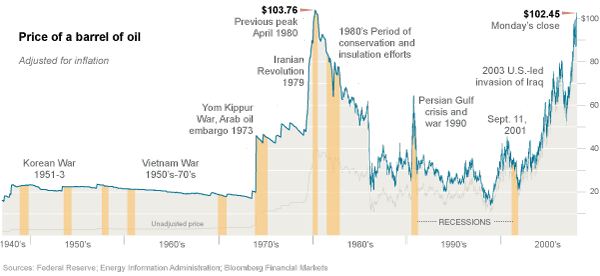
Capping a relentless rise in recent years, oil prices hit a record high during the day on Monday, then pulled back to close below the record.The day’s highest trading price, $103.95 a barrel on the New York Mercantile Exchange, broke the record set in April 1980 during the second oil shock. That price, $39.50 a barrel, equals $103.76 today, when adjusted for inflation.
US urges oil producers to keep market 'well supplied'
WASHINGTON (Thomson Financial) - The White House urged OPEC to keep world markets 'well supplied' ahead of the cartel's production meeting tomorrow.Spokeswoman Dana Perino declined to comment specifically until OPEC formally announces a decision, with record oil prices sparking consumer calls for increased production.
But she reiterated past US appeals that 'oil producing countries should work to keep the markets well supplied, and right now we have extremely high demand and tight supply, it's worldwide demand.'
For Qatar, relations with West are a balancing act
DOHA, Qatar: For Sheik Hamad bin Jasim bin Jaber al-Thani, Qatar's prime minister and chief diplomat, it's natural to play host to the U.S. military while sharing one of the world's largest natural-gas fields with Iran.Qatar's royal leadership has learned to balance contradictory political interests as a means of national preservation for the tiny country. Saudi Arabia, a kingdom friendly to the United States, looms on Qatar's western border, and Muslim clerics rule Iran just across the Gulf.
BP to stay in Sakhalin project despite move to temporarily stop drilling
LONDON (Thomson Financial) - BP PLC will remain in the Sakhalin project in Russia despite the joint venture's decision to temporarily stop drilling work on the gas fields.
Qatar Shell GTL plant to start 2010 - Attiyah
VIENNA (Reuters) - The first train at Qatar's gas-to-liquids plant will start in 2010, Qatari Oil Minister Abdullah al-Attiyah said on Tuesday.The Pearl GTL plant to make super-clean fuels is Shell's largest foreign investment and will be the world's largest such plant. Spiralling costs have taken the price to $18 billion from an original budget of $5 billion.
PetroChina Eyeing Singapore As Refining Base
HONG KONG - China's largest oil firm, PetroChina, is reportedly planning to build a multibillion-dollar refinery in Singapore, seeking an overseas production base to meet its home country's rising energy demand.
Vehicle Sales Fell by 10% Last Month
DETROIT — Sales of cars and trucks in the United States fell 10 percent in February as oil prices climbed past $100 a barrel and worries about a recession rattled consumer confidence.
Outlook '08: Biofuel to drive record coarse grain demand
The US demand for feedstock for ethanol will ensure that worldwide demand for coarse grains remains at record levels, according to ABARE.The forecaster has predicted last year’s production and consumption records will again be smashed as farmers clamour to get a piece of the high prices, all driven by the US hunger for corn.
Outlook '08: Biofuel to drive up sugar prices also
The worldwide demand for sugar continues to be very strong, thanks increasingly to biofuel production.Add a reduction in beet production in Europe and you have an estimated 11pc increase in sugar price to US13c a pound for this current financial year, according to ABARE.
The strength in this price has surprised the economists as it comes despite a 17pc increase in global production this year.
Helping developers map out renewable energy source
Remember the thrill of checking out your house from outer space with Google Earth? Now a Seattle company wants you to know whether there's enough wind to power it with renewable energy.3Tier, a weather-consulting service geared toward renewable-energy developers, is expected to release a global wind map, available free on the Web.
Tesla: Little electric roadster that could
Tesla's groundbreaking distinction is under its carbon-fiber skin. The $98,000 Tesla is the first production high-performance electric car. It is powered entirely by electricity, a plug-in that will never use a drop of gasoline. And it's billed as being able to go 221 miles in mixed city/highway driving on a full battery charge.
Rush of investors to oil costly for all
The surge of mainstream investors into commodities is driving record crude prices - and we're all feeling the pain.NEW YORK (CNN) -- The economy is stumbling, energy supplies are rising, yet oil prices are hitting new records. What's going on here?
Oil's surge to an all-time high of nearly $104 a barrel Monday is the latest evidence that speculative investment flows are driving crude prices more than physical supply and demand for the commodity.
"This has gone beyond reason," said George Littell, an analyst with Groppe, Long and Littell in Houston. He believes oil should be trading in the range of $60 a barrel.
Daniel Yergin, chairman of Cambridge Energy Research Associates, said the oil-price gusher "has more to do with the turmoil in the credit markets and the weak dollar than it does with the flow of oil in and out of refineries.""This time the cause and effect isn't the fall of the shah of Iran," said Yergin, author of "The Prize," a Pulitzer Prize-winning history of oil. Instead of OPEC, oil companies such as Exxon Mobil Corp., Venezuelan leader Hugo Chavez or even the supply and demand for oil, Yergin said, "the people who are driving this bus are in the financial markets."
The world’s food situation is bleak, and shortsighted policies in the United States and other wealthy countries — which are diverting crops to environmentally dubious biofuels — bear much of the blame.
Australia wheat crop seen doubling, more iron ore
CANBERRA (Reuters) - The wheat crop in Australia, the world's second biggest exporter, could double this year to near its biggest ever, a top government body forecast on Tuesday, helping ease anxiety about a world shortage of staple grains.It also predicted that thermal coal exports would rise by the most in seven years and that shipments of iron ore, the country's biggest earner, could climb by more than 12 percent for a second year in a row. With both prices now at record highs, commodity revenues are expected to rise by 30 percent, it said.
Outlook '08: Wheat's perfect storm to continue
The perfect storm that has led to the record increases in wheat prices over the last 12 months is set to continue virtually unchecked, according to Australian Bureau of Agricultural and Resources Economics (ABARE).
From wheat to tea, inflation hits hard
In Pakistan, the prohibitive price of tea became an election issue; Mexican housewives have rioted to protest the shortage of affordable tortilla; Swaziland is facing famine, even as it exports cassava to feed the rich world’s hunger for biofuel.Rising agricultural inflation, or “agflation”, is a global phenomenon that touches everyone, and almost every day it seems to intensify.
South Africa: Blackouts plunge PMI to 2003 level
Johannesburg - The purchasing managers' index (PMI) fell to a four and a half-year low of 46.4 last month, knocked by slowing demand and the power shortage, sponsor Investec said yesterday.The fall in the measure of manufacturing activity from 52.1 in January reflects fewer new sales orders and marks the first decline below the 50 mark, which separates expansion from contraction, since 2003.
Kenya: Food Reserves Won't Last Long
Agriculture PS, Dr Romano Kiome, says only 15 to 50 per cent of agricultural land had been prepared in the North Rift.Under normal circumstances, 50 to 80 per cent of the land in these areas would be prepared by this time of the year in readiness for planting.
Besides the post-election chaos, erratic weather and high prices of inputs have complicated the food status.
Ethanol changing future of consumers' gasoline needs
In the five minutes it takes you to read this column, the United States will consume 70,000 barrels of oil. According to the Energy Information Administration, we burn 6.2 billion gallons of oil in a single day. Our insatiable appetite for petroleum, which is both expensive and finite, has economists and scientists worried.Where will we turn when the oil wells run dry? When will the price of crude oil finally prove too expensive to run our cars, produce our plastics and manufacture our chemicals? In the debate over energy and carbon emissions, an unlikely hero has emerged in corn-based ethanol.
While the governor and others in Annapolis are demanding cuts in electricity consumption, there's a better way: increasing the supply through nuclear power.
MMS: Central GOM Sale 205 Nets More Than $2 Trillion in High Bids
The Minerals Management Service (MMS) has accepted high bids valued at $2,829,926,881 and awarded 683 leases to the successful high bidders who participated in Central Gulf of Mexico Oil and Gas Lease Sale 205. Funds from the total high bids will be distributed to the general fund of the U. S. Treasury, shared with the affected States, and set aside for special uses that benefit all fifty states.
Venezuela Gets OPEC's Ear, Secures Some Support In Exxon Row
Venezuela managed to make its battle with Exxon Mobil Corp. (XOM) a point of discussion in this week's meeting of the Organization of Petroleum Exporting Countries, hoping for support in a commercial dispute that could set a milestone in conflict resolution between oil-rich nations and oil companies.Several ministers arriving in Vienna expressed support for Venezuela's position and agreed the Andean country's case against Exxon will be heard, though it's unclear what that would mean.
Jean Laherrere: Revisiting “The End of Cheap Oil"
The strongest argument in the article was the huge difference between the confidential technical backdated mean reserves and the published political current proved reserves as shown in Figure 1 for conventional oil. Nine years later, the updated data (Figure 2) confirms the trend we forecast, despite the fact that the political data now includes some unconventional oil (tarsands). Our guesses, indicated by the two arrows, were not too bad, despite the fact that the growth in political reserves was more than anticipated, thanks to the changed definition of oil. Figure 2 helps explain why many economists, who have no access to the technical data, are wrong; it is not bad analysis on their part, but bad data.
In Hungry Zimbabwe, Pet Food as a Priority
NORTON, Zimbabwe -- Meals come only once a day for Helen Goremusandu, 67, and the six children she is raising. With prices for the most basic food products increasingly beyond her reach, that daily meal often consists of nothing more than boiled pumpkin leaves, washed down with water.About a mile away, a Zimbabwean government grain mill is churning out a new product: Doggy's Delight. Announced by its creators in January, the high-protein pet food is aimed at the lucrative export market, one of the dwindling sources of foreign exchange in a collapsing economy.
Fears of a commodity crash grow
Crude oil has surged to $104 a barrel, yet US gasoline inventories are at the highest level in 14 years. Oil stocks have been rising for the last seven weeks, even though we are at the top of the winter season when inventories normally fall. The tsunami of pension money is beginning to distort the market for energy futures. Texas oilman T Boone Pickens said investment froth has pushed up prices by $15.This is not to downplay the powerful reasons behind the oil boom. Output has been flat for four years despite efforts by BP, Shell and peers to find new supplies, yet China's oil imports rose 14pc in 2007. The era of 'peak oil' is certainly with us. But it was with us a decade ago when oil prices fell to $10 a barrel.
Commodities on Fire: It's more than just a dollar implosion story
Despite the skyrocketing prices, the inventories of many commodities are lower than they were during the 2001 recession. Discovering, permitting, extracting and shipping natural resources can take years, even decades. It will take time to overcome the past two decades of massive underinvestment in resource exploration and development. This is why commodity bull markets can run 15 years or more before significant new supply brings prices back down. In addition this is the first commodity bull market with the specter of Peak Oil looming ahead, if not already knocking on the door. That alone can have huge implications in terms of supply, price, and future expectations of market behavior.
Hedge funds have new opportunities in global market: Experts
According to the Monaco-based Hedge Funds Research Institute (HFRI), the industry has grown rapidly, with global hedge fund assets now estimated to exceed $1.8 trillion, almost double from $1 trillion in 2005.Clarke said that long term macro trends - like demographic shift, climate change and peak oil production - are also expanding the opportunities.
Shallow Water Ahead for Panama Canal (audio)
The Panama Canal is the shortcut between the Atlantic and the Pacific oceans. As the Earth's climate changes, the canal will face changes, too. It depends on rain, not seawater, to fill its locks, and changes in rainfall might mean the canal could run out of water.
Police bust copper theft racket
Victoria Police have cracked the state's largest copper theft racket, which they say is valued at more than $1 million.The copper wiring, believed to be stolen from a variety of locations including rail tracks, power stations and scrap metal depots, was destined for the Asian black market, police said.
Will these places simply devolve into slums with roving bands of thieves stripping building materials and other valuables from abandoned homes and formerly homeless drug addicts burning them down while trying to keep warm? They’ll probably be some of that especially if the housing crisis worseness (and it will) and the government continues to address it largely by bailing out banks.
Is Oprah Our Only Hope? Or, If Humanity Doesn’t Grow Up Fast, Can We Survive?
Eckhart Tolle has a new book out called “A New Earth.” Actually, it came out in 2005, but Oprah recently discovered it and put it on her list, which means instant best-sellerdom. (Though Tolle was doing quite well before Oprah’s endorsement.)The central question is this: Do we humans need to take an evolutionary step in order to continue to exist? It is not only Tolle who raises this question; many spiritual people have suggested we cannot survive unless we grow up.
Review: World Made by Hand by James Kunstler
World Made by Hand comes at a time when the subjects of high gasoline prices and soaring heating and electricity bills—as well as the looming energy shortages that are driving those high prices—are slowly starting to enter the realm of public discourse. The novel presents a view of what the world might look like not so many years from now, when the cheap flow of fossil fuels that keeps modern life running has dried up once and for all.
Ken Livingstone - Peak oil “opportunity” for London Mayor
Peak oil is not a threat but an opportunity to force through the policies needed to combat climate change, according to London Mayor Ken Livingston.
Why a Carbon Tax Would Hit Living Standards
All I have done is to apply "Austrian" capital theory to the proposed carbon tax. The Austrian school correctly see capital as a heterogeneous structure consisting of complex stages of production with a time dimension. From this they conclude that shortening the structure lowers living standards. This is something that Machlup lived through:Austria has a most impressive record in five lines: she increased public expenditures, she increased wages, she increased social benefits, she increased wages, she increased bank credits, she increased consumption. After all these achievements she was on the verge of ruin. (Fritz Machlup, The Consumption of Capital in Austria, Review of Economic Statistics, January 15, 1935).
Kjell Aleklett: Uninvited observations
I understand that the Association for the Study of Peak Oil & Gas (ASPO) will not always be invited to speak at CERA Week (Cambridge Energy Research Associates annual conference in Houston), but if I had been invited I could have discussed the CERA 2006 forecast of future oil production.
Australia: Radical plan to drive cars from key roads
SPEED limits will be dropped on key routes, lanes removed and traffic lights changed to favour public transport and pedestrians under a new strategy for Melbourne's inner north to be launched by Public Transport Minister Lynne Kosky today.Darebin Council's new transport plan — the first in Melbourne to explicitly give priority to trams, pedestrians and cyclists on key roads — could lead to the removal of clearways on some routes in a bid to discourage drivers.
US State Dept oks pipeline to ship oil from Canada
WASHINGTON, March 3 (Reuters) - The U.S. State Department on Monday published approval of a presidential permit for the $5.2 billion Keystone Pipeline to ship crude oil from Alberta to U.S. Midwest.
Nigeria police: Foreign worker kidnapped
Gunmen attacked a highway construction crew and kidnapped a foreign worker Tuesday in southern Nigeria, police said, marking the first seizure this year of an expatriate worker in the restive oil region.
StatoilHydro Seeks Thrills In Brazil
LONDON - Five months after StatoilHydro became the world's largest offshore operator, the Norwegian, state-controlled oil and gas major has announced $1.8 billion worth of acquisitions in Brazil and the Gulf of Mexico as it compensates for declining reserves in the North Sea.
Nigeria: Bwari Residents Protest Over Power Outage
Residents of Sabongari quarters in Bwari Area Council of the Federal Capital Territory at the weekend protested over constant power outage in their area.The group took to the streets carrying placards that had different inscriptions, condemning Power Holding Company of Nigeria (PHCN) for their failure to supply electricity for the past three months.
MEXICO CITY - President Felipe Calderon announced a 60-billion-peso ($5.6 billion) package of tax breaks, utility-rates discounts and spending programs Monday to help Mexico's economy weather the slowdown in the U.S. economy.
Poll: Mexicans split on possibility of private investment in oil sector
MEXICO CITY: Nearly two-thirds of Mexicans oppose foreign investment in state-owned oil company Petroleos Mexicanos, according to a poll published Monday, although less than half object to a similar role for private Mexican firms.
"Eat whale and save the planet" - Norwegian lobby
OSLO (Reuters) - Eat a whale and save the planet, a Norwegian pro-whaling lobby said on Monday of a study showing that harpooning the giant mammals is less damaging to the climate than farming livestock.
NANSEN G. SALERI: The World Has Plenty of Oil

Many energy analysts view the ongoing waltz of crude prices with the mystical $100 mark -- notwithstanding the dollar's anemia -- as another sign of the beginning of the end for the oil era. "[A]t the furthest out, it will be a crisis in 2008 to 2012," declares Matthew Simmons, the most vocal voice among the "neo-peak-oil" club. Tempering this pessimism only slightly is the viewpoint gaining ground among many industry leaders, who argue that daily production by 2030 of 100 million barrels will be difficult.In fact, we are nowhere close to reaching a peak in global oil supplies.
OPEC not moving to ease high oil prices
VIENNA, Austria - OPEC has virtually ruled out pumping more oil to ease record-high prices, key oil ministers signaled Tuesday on the eve of a cartel meeting.Chakib Khelil, president of the Organization of Petroleum Exporting Countries, said the 13-nation group is shying away from boosting production because of the U.S. economic slowdown, political turmoil in the Middle East and expectations of slackening global demand for crude.
Aramco Official Calls to Develop New Technologies
MANAMA, 4 March 2008 — Saudi Aramco’s operations chief challenged the world’s leading geoscientists to hone existing technologies and help create new ones to maximize oil reservoir recovery and take exploration activities to a new level of performance and sophistication. Khalid A. Al-Falih, executive vice president of operations, made the remarks Sunday at the opening session of the 8th Middle East Geosciences Conference and Exhibition being held over three days in Manama.
OPEC oil output to fall in Feb-Reuters survey
VIENNA (Reuters) - OPEC oil supply is set to fall slightly in February because of lower output from Iran and Nigeria, a Reuters survey showed on Monday.OPEC's 12 members bound by output targets, all except Iraq, pumped 29.78 million barrels per day, down from a revised 29.89 million bpd in January, according to the survey of oil firms, OPEC officials and analysts.
The drop reflects lower exports from Iran and supply outages in Nigeria. Some analysts said there were also signs that OPEC members were trimming output to prepare for seasonally lower demand in the spring.
Nigeria oil reserve to last 43yrs
Nigeria’s strategic oil reserve, put at 36.2billion barrels, is expected to sustain her for the next 43 years, statistics have shown.The statistics also show that the nation has the lowest reserve life span among the members of the Organization of Petroleum Exporting Countries (OPEC).
Gazprom set to cut gas supplies to Ukraine by another quarter
MOSCOW (RIA Novosti) - Russian natural gas giant Gazprom announced on Tuesday it would reduce gas supplies to Ukraine by a further 25% to half their normal level, due to an unresolved dispute over the country's debt.
Ukraine can cope with 50 pct gas reduction
"At the moment, the situation is not critical," Naftogaz spokesman Valentyn Zemlyansky told reporters. He said conditions were helped by sufficient reserves and mild weather.
Ukraine says it could cut Europe's gas
KIEV, Ukraine - Ukraine's natural gas company on Tuesday warned that if Russia further cuts its gas supplies, it could begin diverting shipments intended for western Europe.
Analysis: Russia, others eye Iran ties
While it has been a cornerstone of U.S. foreign policy since the 1979 Iranian Islamic revolution to contain and isolate Iran, Washington's increasingly factious relations with Moscow and record-high oil prices are beginning to ripple through the relations of the five Caspian nations, producing several developments that all point to the increasing failure of Washington's containment policy against Tehran. The Bush administration's rising hostility against former "Evil Empire" Russia and charter "Axis of Evil" member Iran has infuriated both nations and driven them closer together.
Venezuela's War Talk Suggests More Trouble For Andean Oil
Venezuela's President Hugo Chavez raised the possibility of a war between Andean neighbors Sunday in a heightening of political tensions that may spell trouble for the oil industries of two OPEC member nations.
China's natural gas output to double in 10 years
BEIJING (Xinhua) -- China's natural gas output would at least double the present volume in the coming decade to reach 150 billion to 200 billion cubic meters, PetroChina Vice President Jia Chengzao said on Tuesday.
U.S. retail gasoline price nears record: government
WASHINGTON (Reuters) - U.S. retail gasoline prices rose closer to record levels last week, up 3.2 cents from the previous week due to higher crude oil costs, the government said on Monday.The national price for regular unleaded gasoline averaged $3.16, up 66 cents from a year ago and about a nickel away from the record $3.22 reached last May, the Energy Information Administration said in its weekly survey of service stations.
Russia, China Block UN Iran Resolution
VIENNA, Austria (AP) -- Russia and China on Tuesday scuttled a Western attempt to introduce a resolution on Iran's nuclear defiance at a meeting of the International Atomic Energy Agency, diplomats said.The decision appeared to be the result of lingering unhappiness by the two world powers about not being informed earlier of plans for such a resolution.
Will dams again rise across the West?
SPOKANE, Wash. - The Western states’ era of massive dam construction — which tamed rivers, swallowed towns, and created irrigated agriculture, cheap hydropower and environmental problems — effectively ended in 1966 with the completion of Glen Canyon Dam.But the region’s booming population and growing fears about climate change have governments once again studying construction of dams to capture more winter rain and spring snowmelt for use in dry summer months.
Weather Channel Founder Blasts Network; Claims It Is 'Telling Us What to Think'
TWC founder and global warming skeptic advocates suing Al Gore to expose 'the fraud of global warming.'
EU nations voice objections to climate change plan
While most ministers and officials representing the 27 EU countries gave broad backing to a package of measures proposed by the European Commission, some warned it could lead to job losses and rising energy costs.The main split appeared to be between former Soviet-bloc states in eastern and central Europe -- traditionally heavy users of coal -- and older members.
UN warns of climate change in Mideast
CAIRO, Egypt - Climate change is likely to reduce agricultural production and exacerbate water shortages in the Middle East, threatening the region's poor, the U.N. Food and Agricultural Organization warned Monday.Many countries in the Middle East already suffer from a shortage of arable land and limited access to water necessary to irrigate crops. But climate change could bring higher temperatures, droughts, floods and soil degradation, according to a new report released by the agency.
Climate change's most deadly threat: drought
Events once considered anomalies, such as the current drought gripping metro Atlanta, could be commonplace and the kind of social mayhem witnessed during the aftermath of hurricane Katrina widespread. Globally, he points to the millions upon millions of people in Asia who rely upon fresh water emanating from glaciers in the Himalaya that are now disappearing and desert areas of Africa where drought events are foretelling larger disasters.The imperative for policymakers, he says, is a massive and unprecedented intervention on a global scale. Civilization depends on it.
Contact
- Content: editors at theoildrum dot com
- Tech support: support at theoildrum dot com
License

This work is licensed under a Creative Commons Attribution-Share Alike 3.0 United States License.
It’s behind a pay wall, but the Wall Street Journal today on page C1 has a story entitled “Hard Assets an Easy Call?” containing charts of the run in oil and gold from 1978 to 1981, and then 2005 to 2008. The chart for the late 70’s shows a run-up, then sharp drop. The chart for 2008? No drop yet. But the title of the chart says it all: “Back to the Future.”
For those who are thinking that they have missed out on the oil bull market, I believe that this suggests that much of the “smart money” still believes that oil, and gold, will come back down, in the not too distant future. In other words, the piling-in hasn’t occurred yet.
There is a wonderful quote on page C2 from the Libyan oil minister; when asked if OPEC would stick to the status quo on production, he responded, “How can you do otherwise?” He tempered his remarks by saying that oil inventories were growing, but perhaps he was using “can” in the way my fourth grade teacher drilled us: “can” means having the ability; “may” indicates permission; “would” indicates intention. If OPEC could actually raise production, my teacher would have edited his comment to say: “Why would you do otherwise?” But perhaps not.
I note that Leanan has cited Nansen Saleri's piece on the op-ed pages of the WSJ. That is freely available. I think that the adage "you get what you pay for" applies.
Even CERA has only been bandying around 3-4 trillion, and we've all been considering that to be quite incredible. This must not refer to the planet Earth that actually exists, but rather to the SciFi one with the hollow core filled with abiotic oil.
Why stop at 2 out of 3? Why not assume that they can recover it all? We are in fantasyland here, after all.
One thing you will not find at all in this ridiculous article is any recognition that there is such a thing as EROI. Just how much energy does he think those advanced recovery techniques are going to require? (Answer: he doesn't think, and that's the whole problem with this article.)
Great news! Mr Saleri calls $100+ oil just a near-term obstacle.. You guys at theoildrum.com can obviously close shop now and we can all continue happy motoring for many decades to come!
I don't know what sort of drugs Mr. Saleri is ingesting to come up with those resource numbers, but if it makes your vision go that rosy, we could just distribute some of that stuff to make the problem go away.
And I thought CERA was insanely optimistic......
Lots of Acid and cheap Vodka
If you sift through all the spin and homage to The Holy Market, Saleri's article actually was kind of interesting. He's tacitly admitting we are already past Peak Cheap Oil - basically his supply argument is that there's a lot more $100+ oil than there was $20- oil. And his projected consumption increases run from 0% (i.e. we're already at peak) to 2% per year; is he assuming slow global growth, or increased global conservation/efficiency? His projection actually sounds like a more optimistic version of Stuart's bumpy plateau: we're already at an inflection point, where continuous increases in production are no longer possible, but we can still grow supply at a much slower rate and at much higher prices for a while longer.
Who saw Peter Jackson's King Kong?
I laughed the whole way through, it was just so completely over the top.. I haven't even stopped to decide whether it was a good movie or not.. it just made me giddy, running down a ravine under the legs of some great, stampeding Saurpods, because that was the safest place to hide from the Marauding Allosaurs..
Can a market economy really get powered by giddiness? 'You say there's less?! Well now, I'll tell you how there's really MUCH, MUCH more!!' Wow, what a feeling I get, just saying that out loud!
I guess my take-away is that it's easier to print an article that basically says YES, than one that says NO. I could keep saying NO, and not get heard (there's a place in the world for the angry young man), or I could find the YES component on my side of the court. Back to that Kayaking analogy.. focus on the water you want to ride, not the rocks you are trying to avoid.
"There's no greatness without audacity." Oscar Wilde
Bob
The old adage about reserves not being the same as production capacity remains true.
There are some projects booked, but not completed that will dissapoint. A case of one Australian project that dissapointed was published by the U.S. EIA:
"In July 2006, Woodside brought online the Enfield project. However, while the project was planned to have reached 100,000 bbl/d, output peaked at just 74,000 bbl/d, before dropping to 10,000 bbl/d due to water and sand in one of the main wells. Woodside has estimated that production from Enfield will average 50,000 bbl/d throughout 2007."
Numerous projects are years late, over budget, and might not produce as much as planned. Some oil companies faced higher government taxes and tarrifs, derivatives losses, and rising production costs. Venezuela and Ecuador have been leaning more towards Marxist policies stiffling foreign investment there. It is probable nationalized oil holdings there might not be able to retain enough internal capital to generate investment needed for large scale expansions. These companies were being tapped as sources for funding everything else the people needed.
As one should beware of becoming biased, this is the other side of the Australian oil story from the United States EIA:
Australia produced more than 562,000 barrels of oil per day in 2006. (EIA)
"In 2008, BHP Billiton has plans to bring online its Stybarrow field (80,000 bbl/d), while Woodside is planning to bring its Vincent field (100,000 bbl/d) online. In addition to new projects, Santos increased production at its Mutineer-Exeter project by drilling the first of three new wells on the fields. The first well increased production by 20,000 bbl/d to 55,000 bbl/d. Once all three wells are drilled, the Mutineer-Exeter project is expected to have production levels between 70,000 bbl/d -90,000 bbl/d."
In addition to its bumper wheat crop Australia might see its oil position improve in the near future.
The WSJ (Wall Street Journal) has a Forum page for responses to the outrageous Saleri piece at http://forums.wsj.com/viewtopic.php?t=1638&
I encourage someone with more command of the facts than myself to submit a response there.
Question: Why is Mr. Saleri spreading such nonsense and misinformation? Who gains? All I can figure is that oil companies stock prices will remain high if investors don't understand that oil companies will be under stress to maintain production.
It all seems very similar to how tobacco companies attacked science on smoking, and then oil companies attacked the science on global warming.
Why? It is pretty well known that one thing the Saudis (and remember that Saleri worked (works?) for ARAMCO) really fear is that oil importing nations will get really serious about conservation and renewables, and thus permanently reduce the demand for and drive down the price of their exports. Thus, anything FUD they can spread to discourage investments from being made in renewables & conservation, so much the better for them.
In other words, this piece is pure propaganda & disinformation.
So much for the reputation of the paper that printed it.
Please let us not descend into another disgusting greed fest over how to profit on the misery and death of others.
Money = energy.
Those with more of it than they possibly need, and/or who are relentlessly pursuing more ARE THE PROBLEM.
it's been debated here in the past but the basic gist is this. money != energy because money is a poor measure of energy.
Money is a representation of stored energy and resources.
And money is a poor measure of those energy and resources, but that's what we tend to use in the practical, day-to-day world.
Is it just me, or are other people absolutely sick of the "speculators have unreasonably driven up oil" articles. Hey big guy, stop typing and put your money where your mouth is. Go open a commodities account, and short oil back down to its "reasonable" 60 dollar level (or was it 30 dollars, I can't ever keep track). This is a once in a lifetime opportunity!!!. Think how much money you'll make. Put $7500 down, and reap 44,000 in profits--why not buy twenty? In fact, it's such a sure thing that you probably don't even need a cash reserve, because there's absolutely no way these insane prices could possibly go higher, right? Either put up or STF up! --rant over, thanks for listening
I think the whole "It's the speculators' fault" mantra rather ammusingly ironic. For several years now, there's been chanting about the need for more investment in oil and gas. Well, that's what's happening; it's just that the "investing" isn't in material infrastructure, etc., for the most part. My observation is that hot money will go where it can make the greatest, quickest return. But the Dotcom and Housing Bubbles weren't scarce commodities rapidly being consumed by "real" economies on growth tears, which makes the commodities boom qualitatively different from others as there are REAL limits on resource quantities. In this regard, I think it would be of more than mere interest to also display the price of coal underneath oil.
Yes, the massive influx of investment capital into the oil sector does press the question as to why the oil industry is not taking advantage of that capital to actually invest in new megaprojects? Isn't it about getting to be "put up or shut up time"?
In the Texas/Lower 48 article, we (Khebab & Brown) warned (using production data through 2005) that Saudi was on verge of a long term production decline. In the second article, we show 2006 and estimated 2007 Saudi production data. It may be a coincidence, but the fact remains that Saudi Arabia has shown two years of annual production declines at about the same stage of depletion (based on our models) at which the prior swing producer, Texas, started declining.
We shall see what happens in 2008.
In any case, in my opinion, CERA, ExxonMobil and Saudi Aramco, et al, are giving consumers the worst possible advice at the worst possible time---basically party on dude, because we don't have to worry about finite fossil fuels for decades.
The Texas and North Sea case histories are interesting. Both regions were developed by private companies, using the best available technology, with virtually no restrictions on drilling. Texas, which peaked in 1972, has declined at about -4%/year. The North Sea, which peaked in 1999, has declined at about -4.5%/year (crude + condensate in both cases).
Jeffrey J. Brown
Texas and the Lower 48 as a Model for Saudi Arabia and the World (May, 2006)
http://www.energybulletin.net/16459.html
A quantitative assessment of future net oil exports by the top five net oil exporters (January, 2008)
http://www.energybulletin.net/38948.html
WT, thanks for the post and links...
I have a question about 'the advice Exxon Mobile, Saudi Aramco, et al, are giving consumers to party on'... What would be the outcome if this group, all invested in the ever expanding capitalist model, gave the opposite advice, ie, conserve, power down, stop the party?
http://graphoilogy.blogspot.com/2007/07/net-oil-exports-and-iron-triangl...
Net Oil Exports and the “Iron Triangle” (July, 2007)
That is a more difficult question than is implied, and really depends on how difficult you think it is to 'come off oil', as the immediate result would be to send prices sky high, therefore maximising your returns on what you know to be a limited resource, just so long as it was not quick and easy to substitute.
What I imagine is happening now is a game of chicken, where no-one wants to admit that their own reserves are low, if everyone else is still denying it, as that way you loose influence and still don't get a substantially higher price.
I can see things switching quite suddenly to one where all the oil producers are talking up shortages and so maximising their yields that way, whilst hopefully misdirecting substitution efforts into entirely unrealistic alternatives.
Well and good, DaveMart, but the real problem with admission by governments that we are 'coming off oil' is that it means an end to a continually expanding economy, at least in the short term, and probably forever unless some substitute for FFs is found. By substitute I mean something that can be put in the tanks of vehicles currently in use, not a switch to sustainable energy requiring change in peoples daily lives. The public is not ready to hear such a message and the politicians that delivered it would be ex-politicians in short order. imo we will stay on the present course untill the problem of limited FFs and ever expanding populations become obvious to almost everyone...and no 'official anouncement' will ever be made. I worked around DC for a long time and found that when confronted with a difficult decision the government, if at all possible, will delay making a decision untill there is no longer a decision to be made. Cheney made the statement long ago that 'The American Way Of Life Is Not Negotiable'...and, he meant it...if The US Government intended to change course, admit that PO is upon us, admit that we have to slow the party, our foreign policy and military stance would be much different than they are currently. TPTB intend to ride this horse untill it dies and at that point it will be every man/woman/child for themself and a lot of disruption. Our best hope is that it plays out slowly...Hey, I hope I am dead by then.
I agree, that governments in the West will fight tooth and nail to avoid confronting their electorate with unpleasant truths.
I should have been clearer, I was referring to the oil-producing states, who in my view will all tend to switch together, or at least in large blocks, to talking down the future availability of oil from talking it up at present, in the hopes of getting more for what they have left.
Hello River,
Just a FYI:
I posted a long reply in yesterday's Drumbeat further explaining my speculative 'Federal Reserve Bank of I-NPK'. No fractional banking practice is possible with industrial fertilizer, and bank robbers will find the 'cash' is too heavy to steal.
Bob Shaw in Phx,Az Are Humans Smarter than Yeast?
Hi Bob...I like the I-NPK Bank idea...similar to gold but not as portable. It would definitely slow down the velocity of money. :)
Re: Weather Channel Founder Blasts Network; Claims It Is 'Telling Us What to Think'
The so-called International Conference on Climate Change which is put on by the Heartland Institute is being held in New York this week. I'd call it a denialist love fest, as the list of presenters includes many of the people who have written or spoken out against the science of climate change over the past decade. The whole thing is a sham, as seen in the obvious bias as described in the conference invitation and the fact that the speakers were offered money to speak.
http://www.heartland.org/NewYork08/newyork08.cfm
I would expect to see many more PR releases from this event, as the whole thing is a setup to provide credibility for the professional denialist crew. It's a fine example of politically motivated disinformation.
E. Swanson
Here's one:
Cirque de Solar Power: New York Conference Puts Lie to 'Consensus'
This would be a golden opportunity for owners of property on NC's Outer Banks, So. Fla., or So. LA to find
suckersbuyers on whom they can unload their soon-to-be underwater acres.Jay Lehr, the science director of the Heartland Institute, is working on a multi-volume energy encyclopedia for Wiley. He is soliciting submissions. I believe that he expects the free market to solve any future energy problems. http://www.globalwarmingheartland.org/expert.cfm?expertId=53
what else would?
Uhh, how about a radical shift in attitudes (among survivors) about what is important in life? The Christians, at least some of them, have this doomsday myth and they think its getting close. Buddhists, on the other hand, have this renunciation thing. "Oh, well, it was impermanent anyway, and that stuff I liked was just a subtler form of suffering anyway".
One has skills, education, and beliefs that fit one's life situation, or one fails.
Namaste
Die-off
peak oil means things need to be done by hand and we'll need lots more human labor. we need a large population.
Well, prior to fossil fuel use we did everything "by hand" (and horse, sail, watermill, etc) with a much smaller population, and besides even if we wanted a large one the conditions are unlikely to support it i.e. "after oil" will be "after dieoff" in my opinion
Your joking, right?
There a great report from an undercover attendee with video here:
http://nwf.blogs.com/arctic_promise/
From the report:
Well, I love the term "denier." If I recall correctly, AGW is still called a theory. Therefore, to not beleive it can hardly be called being a denier of it. Theories are cheap. Let's monitor the facts for a few more years, especially if sunspot activity remains low. How has this winter been where you live? By the way, Sydney Australia has just had its coolest summer in history.
A theory is supported by facts and is predictive. A hypothesis is the equivalent of a guess, which are indeed cheap. Not knowing the difference shows you are a nincompoop.
karlof1 -
[L. theoria, from Greek theoria - a looking at, contemplation, speculation]
1. A doctorine or a scheme of things which terminates in speculation or contemplation without a view to practice; speculation; contemplation.
But, screw Webster when WE KNOW what we are talking about.
A theory is founded on INFERENCES drawn from principles; a hypothesis is a proposition that has no other evidence of its truth other than it affords a satisfactory explanation.
Since we are discussing scientific theories perhaps you would be better prepared for the discussion if you used the definition given by the National Academy of Sciences and found here:
"Fact: In science, an observation that has been repeatedly confirmed and for all practical purposes is accepted as "true." Truth in science, however, is never final, and what is accepted as a fact today may be modified or even discarded tomorrow."
"Hypothesis: A tentative statement about the natural world leading to deductions that can be tested. If the deductions are verified, the hypothesis is provisionally corroborated. If the deductions are incorrect, the original hypothesis is proved false and must be abandoned or modified. Hypotheses can be used to build more complex inferences and explanations."
"Law: A descriptive generalization about how some aspect of the natural world behaves under stated circumstances."
"Theory: In science, a well-substantiated explanation of some aspect of the natural world that can incorporate facts, laws, inferences, and tested hypotheses."
The above are taken from a pamphlet put out by the NAS regarding the teaching of evolution, but the definitions apply to all fields of science.
After the definitions, they go on to say:
"The contention that evolution should be taught as a "theory, not as a fact" confuses the common use of these words with the scientific use. In science, theories do not turn into facts through the accumulation of evidence. Rather, theories are the end points of science. They are understandings that develop from extensive observation, experimentation, and creative reflection. They incorporate a large body of scientific facts, laws, tested hypotheses, and logical inferences."
The Webster definition seems to fit the "common use" the NAS specifically cautions against above.
There is also a good discussion of scientific theories at Wikipedia.
Here are some other theories from physics:
1. Theory of Gravity
2. Heliocentric theory of the solar system
3. Special theory of relativity
4. Quantum theory
5. General theory of relativity
Which of those do you choose to deny?
I pulled an elementary college physics book off my shelf last night to check how much of einsteinian theory was incorporated since it hit me that I learned only newtonian gravity in physics. Albert's theories were not included except for a short E=mc^2 blurb in an advanced chapter. Anyway, the textbook was copyrighted in 1992 and had a thorough coverage of the greenhouse effects. It stated that many of the warmest years have happened since 1980 and the likelihood of it being caused by GHG seemed probable. It also had coverage of energy sources and stated we would begin having shortages of oil and natural gas in the coming decades. Funny and sad, to go back and read where we were at 15 years ago and find we haven't made any progress.
To answer your question, I think the Earth is the center of the solar system and that Copernicus was an idiot. Really, how else would you see the sun rise and set if it wasn't revolving around us.
Sydney too cool? You could always move to the UK which has just had one of its warmest, sunniest winters in history.
http://www.metoffice.gov.uk/climate/uk/2008/february.html
November, December and January were all above average as well.
Now in theory, how many people would have to die before you'd be willing to sacrifice your way of life to change things?
Unless one secretly expects and intends AGW to kill off all the people one sees as an impediment to Free Enterprise, and views a ruined, depopulated Earth as a form of "creative destruction" requiring only procrastination. Social Darwinism is my favorite theory!
This is just silly.
http://www.theaustralian.news.com.au/story/0,25197,23314972-11949,00.html
If you want an actual run down on the actual weather we experienced in Aus this summer.
Weather does not equal climate. One season is weather, 30 seasons is climate. All the cool conditions in Aus this summer are due to the change from La Nino to La Nina conditions. If they swap back again we'll get drought and roasting temperatures once more.
Claiming a cool month or two disproves global warming is as silly as claiming a heat wave proves it. Decades of steadily increasing temperatures could mean something though...
bados
"All the cool conditions in Aus this summer are due to the change from La Nino to La Nina conditions. If they swap back again we'll get drought and roasting temperatures once more."
First of all you should have written: change from El Nino to La Nina conditions.
El Nino to La Nina conditions occur in the eastern Pacific and the effect is opposite in the western Pacific. So During La Nina conditions, Australia is currently observing warmer than normal sea temperatures.
See page 7 of this PDF
http://www.bom.gov.au/ntc/IDO60101/IDO60101.200801.pdf
This will provide a better understanding of this phenomenon.
Sydney averaged 25.2°C this summer (the three months ending 29 February). This is the coolest summer since 1996-97, not since the beginning of time, and was the result of a major La Niña year, the first in 6-7 years, causing high rainfall, with 438mm of summer rain that also causes lower daytime temperatures. Figures from Australian Bureau of Meteorology.
To claim one cool summer in Sydney is evidence of a global warming myth is ingenuous at best, and intentionally dishonest at worst. Or it reflects a total lack of understanding of the huge impact of El Niño and La Niña on all the East Coast of Australia. It will also contribute to a rebound in the wheat crop, hopefully.
Please do some research on the devastating impact of global warming on Australia, particularly in terms of drought, and the impact of indigenous flora and fauna, prior to quoting such figures as support for some spurious argument.
There is a difference between required scientific equivocation borne of not saying "fact" until something is absolutely proven and actual scientific uncertainty. There is zero uncertainty about global warming. Read the IPCC again. They state clearly they are certain. Any equivocation is purely due to scientific principles or political interference.
This denier crap is foolish, if not downright unintelligent. Virtually all sources of denial come from a small cadre of hired guns. Name me *any other* issue we face that has 95% certainty that is generally doubted. Just one.
EIA Annual Energy Outlook 2008. I've seen no comments about this even though it was released in December. It basically supports collapsing crude oil prices in the next 5 years. What is their source?
Link here: http://www.eia.doe.gov/oiaf/aeo/
Mr. Saleri, perhaps? According to him, one needs hardly do more than pound a pipe in the ground, and "up through the ground comes some bubbling crude", if not a gusher -- and that this will continue to be the case for another sixty years.
Jubak's Journal3/4/2008 12:01 AM ET
Retirement crisis: From bad to worse
'What we've lost that can't be replaced is time.
As anyone planning to retire in 10 years or so knows, your biggest nightmare -- the one where you wake up screaming -- is a collapse in the financial markets and the economy in the years just before you retire.
If you've had such a nightmare, take a shower and then buckle down to some serious financial discipline.'
[having difficulty w/ link-it is on MSN Money]
pretty amazing words. i had to reread to make sure!
Jubak appears peak aware in other articles.
8 months to go, and I am so looking forward to it.
congrats wharf!
i got a few yrs. & trying to maneuver towards retirement. Tis tough to live w/ one foot in today & the other post-peak.
link to above article by Jubak
http://articles.moneycentral.msn.com/Investing/JubaksJournal/RetirementC...
I think we all need to reduce our expectations. May be you and others can have a short retirement, but with peak oil, I think that every able bodied person who can work will eventually end up needing to go back to work. Social security was in trouble before peak oil. With peak oil, the total "pie" we will be dividing up will be much smaller. Retirees will find it hard to get by, unless they can supplement their income or find a way to stretch their resources by living with children.
What I wonder about with retirement policies, discounting the difficulties in projecting an accurate chronology of peak or global warming problems, is the difference between public vs private plans. We already are seeing the dissolution of most company plans, what will everyone do when the majority of plans still operable are taxpayer funded public retirees, but the taxpayer lost theirs?
gail
i couldn't agree with u more.
i expect collapse; only don't know if that's in weeks, days, decades or drug out over 30+ yrs.
my vision is soon enough we'll all be working longer days & lots more physically, & if we can't contribute we'll need to 'get out of the way'.
retirement to me now is to get off the '9-5' treadmill ; gardening, raising chickens, heating with wood, etc.& more time w/ wife,, friends, kids & grandkids.
luckily i am mostly off the treadmill but worried i may need to get back on it more so.
i look forward to us all needing to work with one another more, & the togetherness that can bring about.
thinking about this today i realize i am only thinking of what i have & maneuvering an ira. if we inflate significantly or go belly up as a gov. social security won't make much difference.
i used to dream of extensive travel to national parks etc. Other than the close ones this would seem very irresponsible; mostly because of the above thinking & having kids that will need all the help we can give[ i mean for the post peak world]; not to mention not being a burden. Yes less, & a lot different expectations.
Retirees will find it hard to get by, unless they can supplement their income or find a way to stretch their resources by living with children.
Possibly. More likely the other way round. Because those retiring today had the opportunity to accumulate wealth during the era of cheap oil and an appreciating housing market. The children OTOH who moved into the housing market, the job market, and are feeding families from the supermarket recently have distinctly less opportunity to accumulate on the scale their parents did. Facing the triple headwinds of peak oil, the morgage meltdown, and wage/price divergence means post peakers are at a decided disadvantage to the preceeding generation.
Anyone who has children hasn't much comfort here. But the expectations can be quite varied across the spectrum. A retiree with a realistic peak oil outlook on the future may be in a better position to mitigate it's impacts and adapt their lifestyle accordingly. Some may choose to work but as a case of dire survival as an alternative to cave dwelling I worry more about those who follow.
Hopefully those who can will direct their energies toward helping out where they can. There should be ample opportunty. That's my plan with any spare time and money.
xburb
looks true for me & my kids. well put!
creg
Thanks for your response.
Some are mainly struggling but I am so proud of how these young people are facing what they know to be tough times. Many of them are making very appropriate choices in their lifestyles and avocations. They seem to be keenly aware of how their happiness does not depend on the accumulation of things but on the relationships they build and their commitment to workable solutions for the train wreck they've been handed.
Supporting them to meet these challenges is probably well worth our time and energy.
I think we all need to reduce our expectations. May be you and others can have a short retirement,"
LOL. 40 acres, 2 ponds, solar powered, 100 fruit trees,and a garden.
Summer vacation for the rest of my life. Y'all can be working, but not the Kid, unless I need to help out my kids.
I'm a cheap date; think I'll save money on SS. Means my retirement stuff is all for play (which covers a multitude of sins, including solar for the kids). If I ever get paid for making electricity, so much the better.
Live long and prosper.
Well we got no choice
All the girls and boys
Makin all that noise
'Cause they found new toys
Well we can't salute ya
Can't find a flag
If that don't suit ya
That's a drag
School's out for summer
School's out forever
School's been blown to pieces
No more pencils
No more books
No more teacher's dirty looks
Well we got no class
And we got no principles
And we got no innocence
We can't even think of a word that rhymes
School's out for summer
School's out forever
School's been blown to pieces
No more pencils
No more books
No more teacher's dirty looks
Out for summer
Out till fall
We might not go back at all
School's out forever
School's out for summer
School's out with fever
School's out completely
2 1/2 months to go... Taken shower (or was it a 'bath') buckling in process. Looking forward nonetheless!
Just an observation.
The price of oil is not at an inflation adjusted all time high. It is just a tad over the high price of 1980, adjusted for inflation. World oil consumption that year dropped by 5 percent from 1979. But prices continued to stay high until 1985 before dropping off sharply in 1986. But by 1983 oil consumption had dropped by 15 percent from 1979.
In the early 80s the oil supply dropped causing prices to rise until supply met demand. Today it is a little different. Oil supply has been level for the last three years but demand has still increased. However the price has risen until supply now meets demand.
World oil prices, nominal and adjusted for inflation.
http://www.inflationdata.com/inflation/Inflation_Rate/Historical_Oil_Pri...
And World Crude Oil production, in thousands of barrels per day.
http://spreadsheets.google.com/ccc?key=pL1ZqwKbkFcdpNlL8EaWkVw&hl=en&pli=1
1979---$25.10---$71.96---62,674
1980---$37.42---$95.50---59,558
1981---$35.75---$82.70---56,050
1982---$31.83---$69.33---53,454
1983---$29.08---$61.34---53,257
1984---$28.75---$58.14---54,499
1985---$26.92---$52.56---53,966
1986---$14.44---$27.66---56,199
What this tells me is that demand destruction takes time. If prices stay this high then demand will drop along with, perhaps, prices. Prices hit their all time high three years before demand dropped the lowest.
Ron Patterson
What I love about the chart from the NYTimes is that it identifies the 1980's as a time of energy conservation and insulation efforts. No mention of the opening up of the North Slope or the North Sea. Very small factual oversights there. And it was Carter, not Reagan, who led the conservation and insulation efforts-- those were gutted in the Reagan Revolution. Oh, and it was in the 70's that we stopped burning oil for electricity and substituted all that nuclear. Very small oversights, don't ya know.
There is a basic misunderstanding of the oil markets, even among those paid to write about it. Jeesh.
Keep in mind that the above chart from The New York Times gives the inflation adjusted closing price highs. These are probably weekly closes, I am not sure. But the link I posted is the inflation adjusted price for the entire year. For 1980 that price was $95.50. So far this year, the average closing price has been $94.31. Pretty close and we may yet pass the 1980 yearly average price.
Ron Patterson
But this time we have a production decline rate that is likely to surpass the demand drop, and keep prices rising.
Hi Moe,
Good observation. Just wondering...go you have a way to quantify esp. that second part (demand drop)?
RE: Leanan's link above...'Nigeria police: Foreign worker kidnapped' and also 'Nigeria Bwari Residents Protest Over Power Outage'
There has been lots of discussion on TOD about what will happen when the governments of third world countries export resources while their populations do without the basic necessities of life. In addition to doing without the basics their lands and waters are being fouled by pollution by those exporting their natural resources. Below is a link that sheds some light on the unrest in Nigeria...
http://globalguerrillas.typepad.com/globalguerrillas/
'Henry Okah is likely someone you have never heard about. Despite that, he is one of the most important people alive today, a brilliant innovator in warfare. A true global guerrilla.'
Some claims for Mr Okah's activities...
'amassed a personal fortune through arms sales and oil bunkering in the Niger delta.
was able to orchestrate the shutdown of over a half a million barrels a day of Nigerian/Shell oil production for over two years, with a total market value of $29 billion -- a major reason why the global price of oil is currently over $100 a barrel today.
pioneered aspects of a system of warfare that will plague nation-states and their corporate allies for decades.'
Mr. Saleri is entitled to his own opinion, even though it contradicts reason, the facts, scientific studies, objective government reports from independent agencies (like the National Academy of Science, National Academy of Engineering, and U.S General Accountability Office). The Wall Street Journal has recently published some good articles on Peak Oil. So, the WSJ here offers readers some hope, false though tis. The journalists and editors at WSJ are actually well informed. I sent the WSJ oil journalists my report on Peak Oil (it reviews/summarizes the scientific and government studies). They wrote back a thank you and said we will read it. I later sent them an updated repoprt and suggested that they send it to their editors. I'm sure they did so, as it will make their task easier when they submit an article that bites that hand that feed the WSJ. Peak Oil is bad news for Wall Street. Similarly, TOD editors like Big Gava and many TOD posts provide false hopes that solar, wind, or some electric gadget will save us, even though this defies reason, the facts, scientific studies, objective government reports from independent agencies (like the National Academy of Science, National Academy of Engineering, and U.S General Accountability Office). The solar/wind folks have lots of words, but not one seriouos plan on how solar/wind will plant/harvest/fertilize and transportation and heat for homes, hospitals, etc. False hopes lull us in to avoiding reality. It is time for serious risk management planning, not propounding solar dreams. The solar vision that many TOD members, the public, Congress and presidential candidates will pursue will dig us faster into oil depletion, and the electricity will do us no good, especially because we will have surplus electricity when the global economy collapses. Chris Shaw says it more poetically: "In the (alas, too few) years to come, we will see great argument over the proper allocation of dwindling oil reserves. It will be realised that other sources of energy cannot deliver sufficient surpluses to replace the potent portable energy we know as gasoline and diesel. It is not generally understood that poorer quality energy sources can be critically dependet on oil for their extraction, processing and distribution. In other words, oil is the precursor for other sources of energy; gas, coal, nuclear, solar, hydro, because these require oil fuel to create and maintain infrastructure. It also gives them the illusion of being profitable." http://www.onlineopinion.com.au/view.asp?article=3837
There is something in what you say, but it appears to me that you are too readily confounding different alternative energy sources which have widely disparate characteristics.
Solar energy, for instance, is a radically different proposition in areas where solar incidence is fairly constant in different seasons and where the highest demand occurs due to cooling needs from those in the higher latitudes where is varies wildly from winter to summer and the primary need is for heating.
The oil requirements to produce PV should be relatively trivial, and your stricture against electricity seems to me to be mainly a function of the ready availability and cheap price of fossil fuels - modest improvements in battery technology should do a lot to help.
Just the same, I agree with the basic thrust of your argument, that there is a lot of bs about using renewables.
Wind power is perhaps the resource where your critique is most powerful, as it's distributed nature and variability make is perhaps difficult to conceive that it can ever be more than a marginal player.
Oil resources to mine uranium are perhaps a real concern, but the highly concentrated nature of nuclear power and it's excellent EROI perhaps make it unlikely that shortages of liquid fuels will cause it to seize up - You can always use nuclear power to make liquid fuels, albeit the process is somewhat expensive at the moment, and you can extract uranium from seawater at around 5-10 times mining
costs - that figure could easily be reduced with simple measures, and in any case fuel is a very small part of nuclear energy costs, so the power from nuclear reactors would still not be ridiculously expensive.
Ultimately than, I find your argument, although important and relevant, ill-founded in some of the alternatives and really fully applicable for only some resources in some areas.
How are you going to make liquid fuels from nuclear without using much oil and natural gas. EROEI is fine, but electric energy is useless. EROEI is a great concept, but the people using it forget to include most of the EI.......think about this before I blow you out of the water.
I find your talk of 'blowing out of the water' a bit irrelevant - you also chose to only mention only one part of my reply, the first part of which dealt with solar power and where it is perhaps more difficult to see how oil shortages with stop the party - of course they will put prices up for transport and so on.
As for nuclear energy, it is certainly true that you would need some liquid fuels, mostly for the extraction of the uranium.
Not only have I provided you references to a lower energy way of getting uranium from seawater, but also prospective enhancements of the nuclear cycle could lead to better fuel use of the order of 50-100 times.
You also can produce liquid fuels from either nuclear or solar energy, although it would be admittedly expensive the technology is well known.
You can also make liquid fuels from coal.
I am not saying any of this would be easy, just that the prospects are radically different for different energy resources in an oil-constrained world.
CJ,
Rabid as usual.
How, again do you propose that 'Electric Energy is Useless'? We use it to move extremely big and small things, both powerfully and accurately, to compress, to heat, to cool, to freeze, to communicate (and MIScommunicate, albeit over a multitude of systems), to cut, drill and sand, to add and formulate long columns of figures, to see (television), to measure.. and on and on.
I find this argument about 'low-quality' energy to be oft stated by you, but never adequately supported.
WHY is this extremely versatile and portable power-source be considered useless? The tools that use it can be built to be EXTREMELY simple and durable, so the Energy invested gets a long, long chance to achieve payback.
Bob
Nothing after a day..
CJ, if you're going to blow me out of the water, make it quick, ok? I haven't got all week.
it might be a waste of time and bandwidth here to repeat this again: nh3 is a liquid fuel that can be made from electricity, water and air. it can certainly power all types of engines, ergo, it can be used to plant, harvest, transport and fertilize. it can heat as well as cool.
I've got a few more doubts than you about the use of ammonia by the general public, but for industrial use such as is under discusslon here you are certainly correct.
hmmm. did i ever suggest the use of nh3 as a fuel by the general public?
Yes, I believe it's implied in your many posts on the topic.
implied? i can only imagine that's because personal transportation is the only thing in the subconscious of some readers whenever liquid fuel is mentioned.
Yes, by saying "all types of engines".
How shall the car gain nuclear cachet?
that's only because you take it as a suggestion.
Ammonia is a farm/industrial fuel. Biodiesel and ethanol are road fuels. Perhaps we'll evolve to doing a liquid fuel that fits our current infrastructure that depends solely on stranded renewable resources, but I don't know what that might be.
And we are going to be following Alan Drake's rail electrification scheme, so the need for liquid fuels decreases to just police, fire, rescue, buses, and the like ... which we can get done with biofuels.
ammonia can be road fuel, too - why should a tanker truck for transporting liquid ammonia carry another more expensive fuel? it is also reported in the 1970s that refrigeration truck using ammonia as fuel can significantly cut down the overall fuel consumption.
Repeat after me: Truck are bad.
I presume roads are going to fall to ruin without cars on them. The cars pay the taxes, the trucks break the roads (subsidy), and with that gone ... no more trucks.
Dang big picture party pooper guys anyway! We should have a narrow discussion on someone's area of expertise ... I nominate theantidoomer!
how you suppose to deliver the liquid ammonia to each farmer? will every farm be accessible by rail, water or pipeline? long distance trucking is bad. short distance trucking is a life saver. prior to the recent decades, you would likely to find more trucks than cars around the world outside the US and Europe. i would say the opposite: Cars are bad.
SpiderWebRiding by railbikes is my mitigative solution. If a muscleman by move a train by his teeth, a fit human can pedal a heavy load of NPK from the endpoints of Alan Drake's ideas to the outlying farms and gardens.
Its just my position, you know. Everyone here talks about urban solutions and scooters and other crazy talk. I'd like to ride my bike ... but can I get one of those hopeful theorists to come over and help me dig it out? :-)
It never occurred to me to need delivery - we'd all just have big pickups here (farm use only) pulling the mixed mode rail/road nurse tanks that a small tug would drop off at grade intersections in the country.
it could be a good work out to be post FF ready. not too long ago, people in northern China used to dig frozen ground with hand tools in -40C to build irrigation channels.
SCT Beautiful drifts.
I'm riding all winter, every work day. (10 miles) NE Wash. Plowed and unplowed. The coldest mornings were 11 below. Last time I ran the car was 5 mo. back.
I am using a set of studded snow tires on an old mountain bike, lotsa studs, quite inexpensive, very stable. To protect my face and lungs a full shield motorcycle helmet.
Granted the traffic where I live isn't bad. The dogs and I have a running competition. It's maybe not for everybody but it has proved very workable in at least one case.
The nearest work for me is either across this room ... or twelve miles north of here and its twelve miles of 55 mph state highway with gravel shoulders. I look fine but there is a small matter of damage to the top of my right rotator cuff and my C5/C6 vertebral disk. If I ride in icy weather I very well might find myself dysfunctional due to pain if I manage to survive the ride and falling can have serious consequences. I keep a neck collar handy in the house and another in the car in case I run into trouble. No, not the cutesy neck warmers, hard plastic immobilization collars I've saved from ER visits where they've been needed.
I don't like this aging business, not one bit.
Yeah not relishing it much either.
Always appreciate your contributions. Keep after those integrated solutions. We're going to be pursuing ideas like yours (and nh3's) much sooner than many believe.
Re transport. Between dismantling suburbia (the dark ages) and full blown infrastucture build out (technucopia) there are many local ,ad hoc solutions which will work And are more likely. In addition to Alan's urban rail and RE I do look forward to seeing these operating on an individual basis as an alternative to despair and defeat.
And once again your contribution to the process very important. Not being too technical myself I can maybe do a little gardening, some shadetree inovating and this cyclemania as long as possible.
Back in the old days, snow and ice were not a transportation problem, they were a transportation SOLUTION. Everyone used to look forward with eager anticipation to the arrival of snow and ice, because that meant that they could haul out the big sleds out of the barn, hitch up the horses, and haul the really big loads. Local governments would hitch up teams of horses to big rollers to compact down the snow on the roads into a solid bed or ice. People would shovel snow INTO covered bridges.
Things change. For the better?
I keep seeing these claims posted to the effect that the use of FF inputs in the fabrication of renewable energy infrastructure NOW thus requires that the same level of FF inputs shall ALWAYS be required in the future for said fabrication, that there is no possible way to fabricate such things as WTs or PV panels without the input of FFs, and this thus implies that renewables will no longer be possible once the FFs are gone. I fail to understand the logic behind this claim, or any factual analysis to back this up. Perhaps someone would care to make an actual case for this claim, instead of just an unsupported assertion.
Wind power is perhaps the resource where your critique is most powerful, as it's distributed nature and variability make is perhaps difficult to conceive that it can ever be more than a marginal player.
Storage could improve that, and not necessarily industrial-scale storage. What I want is a unit sized for a household that can sit in my garage, and some smart metering. When the local utility has lots of cheap wind power available, I'll charge up my storage device. When there's a shortfall, I'll run largely off that stored energy. I keep hoping that EEStor turns out to be real. 400 pounds and 54 kWh, plus the electronics, would be a great candidate for such a system. We could run our house for something over two days off that on average, and we're still nibbling away at our consumption.
You want a 25kw turbine, the appropriate amount of solid state ammonia synthesis tubes, and you route your graywater through it. The output would most likely be used in a fuel cell rather than a piston/turbine engine in a residential area.
A mad scheme, eh? I think this is almost cooked, so much so that negotiations are happening for the SSAS tube manufacture and some prickly tempered, impatient Iowa guy is pushing a Power Fund application along to get some money to test it locally.
I feel 10,000% better about the future than I did 90 days ago. There are some solutions that will work. It will get ugly, but not totally ugly, and not everywhere. We have to start building this stuff right now.
SSAS tube manufacture
SSAS as in ?
Have you seen any graywater systems in Iowa ?
(S)olid (S)tate (A)mmonia (S)ynthesis. This is as big a deal as Nanosolar's thin film solar advances - doubles yield on ammonia production with electricity and it does so in small, incrementally scalable plants. Instead of industrial processing on the hundred million dollar scale we're talking home processing on the hundred thousand dollar scale ... if they get it commercialized to the point where the O&M cost is sensible.
I've got real high hopes of this one ... we shall see how it goes.
Actually, I would prefer not to own my own turbine. I live within 100 miles of excellent commercial-scale wind resources, and believe that big turbines mounted high will be much more efficient than anything I could realistically own and operate by myself. Big wind systems are all about the capital cost; the owner needs to sell energy whenever the wind blows in order to recover those costs; sometimes that will be at "bad" times in the sense that existing demand is being met by other generators. Most of those generators can't be spun up and down quickly, so the wind guy needs to create some short-term demand for his power. He can do so, given smart metering and communications, by pricing that power low enough to get me to buy and store it.
Similar ideas have been put forward using PHEVs as the storage devices to sop up such short-term excesses. Stationary household storage, however, is not constrained by the same weight and volume considerations that battery packs for cars are. It may be possible to do the job with much less sophisticated technology.
I agree. Far far too many people are applying "science fiction" beliefs to solving problems that we already know will appear in the future. Sci-Fi belongs in books and on movie screens. There is no guarantee that technology will continue to increase at the pace it has been for the last 100 years. If the peak oil plateau is indeed happening now, it is entirely possible that 99.9% of everything that will ever be invented by humans HAS already been invented.
..and also entirely possible that most inventions are still to come.
Your own 'prediction' here is just as much science-fiction as the alternative.
We don't know.
We do know. It begins by with the complex answer to a simple question.
What is necessary for innovation and technological progress?
innovation: Excess resources so that society can pay a very small number to work on things which have no current productive survival value
technological progress: large excess resources so that society can pay a lot of them to gamble on making things which might, but are far from guaranteed to yield productive survival value
A CRISIS!!!
Utility Patents granted each year by the US Patent Office, with certain historical events added as annotations.
http://www.theoildrum.com/node/2370
Patents do not necessarily equal innovation. Often these days they are about copying someone else, and changing the product just enough to get in the market without being accused of stealing...
True,
Stuart talks at length about innovation and crisis. Patents are but one small part of his argument.
He concludes that inovations won't nescisarily stop.
I just cherry picked the patent graph because it illustrates that crisis is *not* a positive influence on innovation as john15 claimed.
An energy crisis is good for saving...energy! nobody tries to save energy when gas is $1.00
necessity is the mother of all invention.
Wrong.
Does the smart person base his future on "possible break-throughs", or on planning that is based on current reality, whilst learning to shift his plans as that reality changes through invention/discovery? Your posts overall imply you lean heavily towards the former.
new technology is not a necessity to solve the world's energy/fuel problem as of today - nothing will solve the problem of endless growth, of course. devices to harness wind energy were invented thousands of years ago, ammonia synthesis and fuel application are almost three quarters of a century old, even the SSAS mentioned above is nothing new - at least to the folks in DOE.
Hi Cliff,
Many points here.
re: "we will have surplus electricity when the global economy collapses."
Could you possibly you expand on this? What is the fuel source for this surplus? So, do you think the fuel sources themselves with be abundant?
Or, to back up a bit your post,
re: "It is time for serious risk management planning, not propounding solar dreams."
1) Are these necessarily mutually exclusive?
2) Some things seem obvious, but perhaps only within an assumption that does not consider collapse and its aftereffects. (Which is not to say I eliminate the possibility, or even the probability - of economic collapse.)
One of these is that solar/wind are currently dependent on oil, but not necessarily theoretically. I guess another way to say it is - if we want anything as a power source, it has to be solar and/or wind. (I realize I'm speaking loosely, not precisely, but just trying to outline it.) So, the question is: how much, how soon, can we do to put this in place?
(And this also is not intended to sidestep the obvious problem of continued growth - were an abundant new power source to be found.)
3) What about the argument that "the problem" is basically not a technological one, but rather one of "politics" and/or social organization (whatever one might mean by that).
4) Do you think there is *any* "serious risk management" planning that can be done on a national and/or international scale, and if so, could you please describe it? (simply...I realize I'm asking for a lot.)
Fed chief says mortgage crisis set to continue
He wants lenders to reduce the loan amount so that a struggling homeowner has some equity. To discourage default.
Easy for Bernanke to say but the group of bankers meeting in Orlando are 'small banks' according to a report I saw this morning on Squeek Blab. So Bernanke wants the small local banks to bite the bullet? The small banks were hustled out of home mortgage biz, except origination, by the big guys and their derivatives that few understand. Once again Bernanke is acting as a mouthpiece for Wall St at the expense of Main St...
A nice thought (hey -- I'm a stuggling homeowner too; can I get a discount on my mortgage?) but I think this shows Dr. B to be an "ivory tower academic." Ain't gonna happen. Does it occur to Dr. B that our current crisis is, in part, a problem of people not getting back money that they were (literally) banking on?
In a declining housing market, some banks may conclude it is worth working with certain customers, those who have a chance of getting above water. On the other hand, this is kind of a slap in the face for those of us who were prudent enough to live well below our means with respect to mortgages. Do the flippers also get a break?
Let's just mandate that everyone's loan amount get reduced to make it fair.
That's hardly fair to the 1/3 of Americans who rent rather than own.
I completely agree with Leenan on this. I knew there would be a downturn in the market and am anxiously awaiting for what I feel is the bottom to jump in and buy a home.
antidoom - good luck catching that knife!
did you just read the hossanas of CNN Money?
http://money.cnn.com/2008/03/04/real_estate/markets_less_overvalued/inde...
Renters could catch a break if the loan reductions were passed down as decreases in rent. Admittedly, the odds of this happening are small. A bailout of all mortgages would also suck for people who paid down their mortgage, either because they are old/retired or because they were wise enough to foresee the bust coming in advance.
IMO, the big losers in all this will be the formerly soon-to-be-retired, who have seen their 401K balances stagnate in real terms through last summer and decline in real terms since then (maybe with much worse to come). Few boomers will have a pension or healthcare benefits after they retire. Basically, all they have is their 401K and the equity in their houses, and that won't last long the way things are going.
Basically, all they have is their 401K and the equity in their houses, and that won't last long the way things are going.
For those of us who saw this coming and sold their house in 2004ish and closed out their 401 and paid their pound of flesh penalty, and rented and bought gold and silver at $400 & $7, ....
Well, we're just waiting and buying things now of what we will need 10 5-10 years. Hoes, Rakes, Seeds, and a couple 45's and 308's and ammo. etc...
Call'em as you see'em. Place your bets, put your money where you think it will do you the most good....
Note to TODD who posted just below...
Jim Rawles Patriots Surviving the Coming Collapse,
Couldn't agree more. Read it in 2003 and did the things above.
and good luck to all of us.
I agree. If you view your home as an investment, and you do view it as an investment if you're concerned about the price it has, versus living in it until the day you die, then as an investment, it has RISK associated with it just like any investment does. (Sorry for the run-on.)
I won't be getting all of the "help" like other home owners will, but I never looked at my home as an investment in terms of appreciation. I looked at it as a roof over my head, and a way to get rid of having neighbors above my head with their leaden feet. I have no remorse over my home purchase, and very shortly, my home purchase will be a travel trailer that I will live in until I build my new SMALL home with plenty of land surrounding it.
I figure plenty of people will be selling travel trailers, considering gas prices. They look at it as something they won't use with high gas prices. I look at it as a truly home that is mobile, CHEAP, and will provide me with shelter should I need to abandon my original homestead.
This is a political game - they're inflating away debt and they don't want the political fallout from people losing their homes. They're trying to package it up so the rich stay rich and the poor get poorer ... but with an improved standard of living.
Can someone please email me with a complete, rational explanation of what I just said? Its what I see ... but I keep ending up whipping out the square root of negative one when I try to come up with equations to describe the various scenarios.
What is that I smell? Burning money?
I notice that Kunstler's book, World Made By Hand is mentioned up top. Like a fool, I bought it. The best I can say is that it is a useless POS. My take is that Kunstler wanted to make a few extra bucks and cranked it out. Aside from having no useful information such as Jim Rawles Patriots Surviving the Coming Collapse, the scenarios are plain dumb and contain the usual steriotypes (the good guys, the bad guys, the survivalist who prepared). In an apprarent attempt to add a few more pages, some sci-fi is also thrown in.
Don't waste your time or money on this book. For about the same price you could buy Rawles' book or Carla Emery's book The Encyclopedia of Country Living and have information you can use.
JHK really lost most of his credibility in my view putting his name on this work.
Todd
Strange, I bought the book and had the exact opposite opinion. I read it in two sittings because I simply could not put it down. True, Kunstler probably gets a lot of things wrong. I think he is way, way too optimistic. And if we all admit it, none of us know exactly how things will play out. Kunstler is just telling a tale of how one small community in Upstate New York may survive.
Of course there are good guys and bad guys in his tale. What the hell do you expect? Perhaps there won't be any bad guys after the crash? Dream on! And how can you call having bad guys in a novel "stereotyping"? Just who are you stereotyping? Other bad guys?
Ron Patterson
Ron,
Give me a break. The main character is banging his best friend's wife, the town's minister, but the guy either realizes his wife's needs or doesn't care. The people all have clothes and shoes years after the collapse, yet a big deal is made about opening a cobbler's shop and a town laundry (Like the people haven't washed clothes for years?) And, where did all the seed come from for all those little and big gardens?
The power comes on and off for a while. If society has collapsed, who's running the generators? But no one cares or is interested. And the preachers have the air waves but what's left of the .gov doesn't?
And, it appears that only DC and NYC got nuked. Really?
Oh, we have the forceful shaving of beards by the New Faith people with never an explaination as to why. Make them convert?
Then we have "the Queen Bee." You want to tell me what purpose that serves?
And, then our heros go out to arrest the bad guy (who is subsequently killed by apparent magic) without back up. Naturally, one gets the crap beat out of him and the other has a pot of poop dumped on his head. That's supposed to represent what people will do in the future?
You want to read real collapse fiction, read Rawles' book or Lights Out by Half Fast (David Crawford) which is available on line (although I can't find the URL). These have believable plots and real bad guys.
Ron, I'm probably a bigger doomer then you are and my guess is I'm a shit load more prepared to survive...and that includes dealing with the bad guys.
Todd
Todd, you give me a break. It was a work of fiction!
Well, I seriously doubt that you are a bigger doomer than than I. However I have no doubt that you are better prepared than I. I will turn 70 in only 4 months and have made no preparations to survive because I do not plan to survive. In fact I hope to be safely dead when TSHTF.
Ron Patterson
Ron,
This is neither here nor there, but it's amazing to me that you are 70. I visualized you in your 30's. Your writing style is very vigorous :-)
Please enjoy your 70th and many more.
NR
Why thank you Rex. I feel like I am 35. You will be astonished that when you get older your mind, unless you develop dementia, still thinks you are a young man. Sure wish my body could still perform like a 35 year old. :-(
To WNC Observer who wrote:
Correction: Thar ain’t no sich thang.
Ron Patterson
Ron,
FWIW, I'll be 70 in 9 months so we're in the same age ballpark. Yup, it would be nice to be 35 again in some ways. But, I'll tell you, I'd sooner have the life experiences I've had that may help me survive than those young muscles. This afternoon I'll be planting potatoes. This will be followed by working on firewood. I have about 2+ cords of trees on the ground that I felled and need to buck-up and split (eventually).
Going back to fiction for a minute, there is good collapse/survival fiction and crap. Kunstler's is crap. Buy a copy of Rawles' book http://www.survivalblog.com and compare it to Kunstler. If you don't want to spend the money read Lights Out or Crawford's new effort at http://www.ar15.com/forums/topic.html?b=10&f=20&t=483521
Another writer named Tom Sherry has had some excellent work. The two of his I am familiar with, Shatter and Dark Winter, were once avaiable online - but no more.
Todd
Todd, we are the luckiest generation. We were not born earlier when living was hard and health care was almost nonexistent. We were born into a time when everything was happening to make life easier and we could gain knowledge that ancient philosophers would have killed for. And dental and health care made life more enjoyable. And we come to the end of our lives just about the same time as everything goes to hell in a hand basket. The timing could have not been better.
But pity those born later. Right in the prime of their lives........oh hell, it is depressing even to think of it. But I got good bourbon so I don't have to think about it...not tonight anyway.
Ron Patterson
Ron,
I couldn't agree more about "our" generation. I have a long lunch with a 78 year old buddy once a month where we discuss what is going on in the world and energy. The reality is that I find it impossible to discuss this stuff with "younger" people because they know nothing of the Depression...a life without much stuff..and wars...and the importance of family and community...and on and on.
There's also long ago things such as the Indians coming into my grandmother's house when she was a child to sleep by the fire during the winter.
Such is life.
Todd
Hey Ron,
My mother, who unfortunately died of cancer in her early 80's, told me not long before her death how she still felt like a 16 year old in her mind. She was sharp until the end.
My father retired from full-time farming at 75 and then kept active and alert for another 20 years, before a 2 year decline led by a series of small strokes. He outlived all his siblings by a good many years so I don't think he was blessed with longlife genes. His secret: 10 deep breaths every morning after rising and 10 more before bed, and lots of laughs in between.
I hope you're around for a good many more years, if only because I suspect the s doesn't have the guts to hit the fan while you're still drinking from the bucket.
Re: In fact I hope to be safely dead when TSHTF.
Being 65 I agree. I use to think Kunstler was writing dystopian fiction. However, lately I have become convinced that he is producing doomer porn from reading his weekly output. His latest book which I have not read sounds like more of the same.
I am hereby awarding my first Doomer Porn Award to James H. Kunstler for his weekly efforts and his latest book based on reviews at TOD.
Furthermore, I am awarding the book a Doomer Porn XXX rating as any true doomer should be able to get off on it.
I'd have guessed you to be half that age, but a little but grouchy at times, like I am :-) I hope you enjoy each and every day until your time comes :-)
Ron in 10 years i'll pick you up in my electric car, you'll tell me how thanks to gene therapy you fell like your 30 again. Then we'll celebrate your 80th birthday, and we'll both have a good laugh at this whole die off thing. :)
" I do not plan to survive"
No one is going to "survive" we are all going to die
http://www.survivalmonkey.com/SF%20books/LightsOut!/LightsOut-Current.pdf
To a guy with a light grey hat, the guy with the dark grey hat must be a bad guy..
I thought the book was fantastic, as far as reading about a post peak era goes. JHK lays out believable future and a probable one too. Yes, there are good and bad guys in the story, such is the nature of our lives. My take-away from the book was your health is your wealth.
I think Kunstler wanted to put out a somewhat "optimistic" outlook. After all, he goes around telling people about "the end of the world" and it just makes them all depressed. They want "solutions". We see that all the time here on TOD. So his message is yeah things are going to be tough, a lot of people will die, but life will go on for some in small town America. Telling them they are all going to die in Mad Max scenarios wouldn't cut it.
I think too its a bunch of crap. I just look around me, and I'm in a small town in central Vermont that you might think would fare as well as Kunstler's Union Grove, and I just see no chance that people are going to pull together like they do in his story. Almost no one has the skills or the motivation to get the skills to live post-collapse, and they certainly aren't going to acquire them after SHTF.
I noted that the book takes place during the summer. What about surviving a winter in upstate New York with no fossil fuels or electricity. Give me break!
I still thought the book was an entertaining read though.
Yes, I noticed the same thing, and came to the same conclusion. Kunstler has said, in some of his blogs, that it will be difficult to survive in the South because of the very hot summers. Well, I think it will be one hell of a lot easier to survive the Southern summers than the Northern winters.
If there are a lot of survivors in the North, trees will disappear after only a few years due to cutting for heat and cooking fuel. Then they will start burning lumber from the houses of those who did not survive. And they will likely salvage clothing from the dead as well. But after only a very few years all this will be gone. The population will then drop dramatically.
But this scenario assumes that a lot of people will survive. This is really not likely to be the case.
Ron Patterson
One of my few beefs with Kunstler is this uninformed, and thus undifferentiated, view of the Southern US. As a transplanted Midwesterner (don't you DARE call me a Yankee!), I have realized that a lot of people from the North tend to have this undifferentiated view of the South if they have not spent much time down here. For example, many Northern people will speak of a "Southern accent". Thar ain't no such thang - there must be a dozen or more different accents here in the South. We've got at least three just here in NC: mountains, piedmont, and tidewater. Virginia has the same thing, except that their three are not quite the same thing as ours, and thus are distinguishable from our three. Ditto with SC, and so on around the South. With a little time and a careful ear, you can learn to pretty much figure out where someone is from just by listening to them talk. I very much doubt that Kunstler is even aware of this.
The same thing holds true for topography and climate. For example, here in the mountains of WNC, it ISN'T boiling hot in the summertime, never has been, and never will be (unless the entire planet becomes uninhabitable). The mountains moderate the climate here, as they do everywhere around the world. It is quite pleasant up here in the summertime. People from the steaming coastal plains were coming up here in the summertime to escape the heat and humidity long before there were automobiles. It is quite possible to live here in the mountains without a/c, many people do, and everyone probably WILL in the future. As for winter heating, lots of people have wood stoves (everyone SHOULD), and we've got huge forests around here. With good insulation and building envelope sealing, a small amount of wood should go a long way. It rarely gets colder than around 15-20F, and most of the winter it is well above freezing. In a small, well insulated house people could probably survive without any heating at all if they really had to. Upstate NY, though, would be a totally different matter.
WNC is a yankee.
'will be difficult to survive in the South because of the very hot summers.'
ya get near h2o & get /stay wet;kinda like northerner's do similarly w/ a fire when bitter cold!
Agreed. I lived in South Alabama for a while without A/C. Some nights, it was pretty hard to sleep but I never feared for my life.
I keep wondering if you will see a mass exodus from northern climes. My guess is that if the energy squeeze comes slowly enough, you will see people migrate out of colder regions. If it comes quickly, we may get the horror show that you envision, Ron.
I now live in Western MA and I've been looking at what it will take to replace my propane furnace with something more affordable and sustainable. There are some alternatives but all involve some compromises and all will be quite expensive to implement (approx $20k).
I now live in Western MA and I've been looking at what it will take to replace my propane furnace with something more affordable and sustainable.
Hi POT,
I don't know how bad things are down your way, but the average retail price of propane in Halifax now stands $1.25 per litre or $4.70 per U.S. gallon. A litre of propane contains roughly 24,000 BTUs or 7.0 kWh of heat. The net heat gain of a high efficiency propane furnace operating at 92 AFUE is 6.5 kWh and the equivalent cost per kWh is 19.3 cents. For a mid-efficiency furnace with an AFUE 80 per cent, the numbers are 5.6 kWh and 22.2 cents respectively, and for a typical gas fireplace with an AFUE of 55 per cent we're looking at 3.9 kWh and a whopping 32.3 cents. I currently pay 10.67 cents per kWh for electricity and with a seasonal COP of just under 2.5, my ductless heat pump is effectively heating my home at 4.3 cents per kWh -- BTU for BTU, the operating costs of a high efficiency propane furnace are four and a half times higher than my $2,100.00 heat pump.
Addendum:
Here I was complaining about propane selling for $4.70 a U.S. gallon when a gentleman in Boothbay, Maine paid $6.75 -- actually, $7.33 per gallon including delivery fees.
See: http://www.mainelincolncountynews.com/index.cfm?ID=30674
At these prices it would be cheaper to burn a couple Cézannes in an open fireplace. =:-o
Cheers,
Paul
I don't know why but our regional supplier ran a propane special in January, 20% off and some for free. It really took me by suprise.
So we topped off at $1.78/gal.
I'm not so good at math but I think that would change your scenario by a factor of about 2.64. Also our furnace is ~94% AFUE. We will be supplementing in spring and fall with hydronics from the solar thermal panels.
The main reason I like propane for us (rural) is that the tanks are giant capacitors storing a whole seasons' worth of heat. We got two tanks 'cause we're paranoid. Another reason is that with 2 seasons of storage we can just wait for seasonal cycles (like this one) where it's cheap. And no I can't imagine how they made money on $1.78.
If you're OK being on the grid for heat, I'm all over heat pumps. I've learned quite a lot here from your postings & links recently.
Maybe it's the same theory under which a drug dealer gives away the first fix for free.
Hi NR,
Wow, a $1.78 per gallon is an amazing deal and I'm pleased you were able to take advantage of it. At 94 per cent AFUE, you net just under 25 kWh/gallon, so you're cost per kWh(e) is about 7.1 cents. At $7.33 per gallon, the gentleman in Maine would be paying 29.4 cents per kWh or more than four times this amount.
I like propane because it's flexible, convenient and clean-burning, and because it can be stored on site and has a long shelf life. As an emergency backup fuel it's pretty hard to beat. I have a propane cook top, dryer, BBQ and four fireplaces and there's some comfort in knowing I can still prepare a hot meal and keep the pipes from freezing in the event of an extended power cut.
What I don't like is that it has just about tripled in cost over the past five years and that my provider now charges a $15.95 flat fee with every fill. We can only lease our tanks and these rates have gone up as well (now $120.00/year for a 100 gallon tank) and the company has just recently implemented a new policy whereby it doubles if you don't consume a minimum number of litres each year; my usage is about 90 litres/24 U.S. gallons a year, so that puts me well below their threshold, thus I'll be opening my wallet a little wider come August. There are two other local providers. One requires you to sign a ten-year contract and pay the full cost of the tank lease upfront! The other has the scruples of a dead snake and I'd rather swallow crushed glass and wash it down with used motor oil than do business with those bastards.
Anyway, my advice is 1) reduce personal demand to the greatest extent possible; 2) secure multiple fuel sources, one or more of which do not depend upon electricity for their operation; 3) keep at least one fuel stored on site and maintain an adequate supply to see you through an extended period, ideally six months or more; and 4) monitor price carefully and switch between fuels as required. My three primary fuels are heating oil, propane and electricity and I keep at least 500 litres of heating oil and 350 litres of propane on hand at all times. At this point, the heat pump is my least costly option at $0.043/kWh, followed by electric resistance ($0.1067/kWh), heating oil ($0.112/kWh) and, lastly, propane ($0.32/kWh) so, not surprisingly, that's the order in which they're dispatched.
My other advice is to take a close look at off-peak electricity as a potential heating fuel. By law, all U.S. utilities must offer TOU rates and in many cases the cost per BTU during these discounted periods is one-half to one-third that of heating oil or propane. A new duel fuel or ETS heating system might be cost prohibitive, but something as simple as turning back your furnace or boiler at night and firing up one or more electric heaters in its place could save you a considerable amount of money and the upfront cost would be negligible. In addition, if you have an electric hot water tank it makes sense to put it on a timer so it recharges overnight and, where possible, to run major appliances at these designated times (e.g., your dishwasher overnight if it has a time delay function and your laundry, major baking, etc. on the weekends).
Cheers,
Paul
If you want to read a good fiction on survival, read Ken Follet's, World Without end. Years 1327 to 1361 in Merry Old England during the plague. You may be able to relive the future. Copywrite 2007, 1000 pages.
Realistically, what will happens is that fossil fuels will become less available and more expensive over a period of a decade or more. That will give people both the time and incentive to learn necessary skills.
I don't think thats realistic at all. Fossil fuels are already becoming more expensive and less available and do you see a lot of people trying to learn how to save seeds, preserve food for the winter, milk a goat, cut hay by hand, spin wool into yarn, or any of the hundreds of other tasks they would need to learn? Do you see harness makers, blacksmiths, coopers and cobbler shops springing up? Do you think any of this will happen spontaneously when oil reaches $300 per barrel? I sure don't. It's all going to turn into one huge clusterf!ck.
JD-the doom debunker-does make some good points. Oil goes from $10 to $104 and almost all goods from China drop in price-in a few years a large Plasma TV will cost less than filling up the F150-yet somehow when oil hits $300 everybody will need a cobbler and a blacksmith? Come back to reality. JHK was just writing a novel in the attempt to entertain. CHRISTINE was a great read about high school but it doesn't mean that cars are possessed.
Brian,
The cobbler and blacksmith is a metaphor. The antidoomers and debunkers on this list insist that as fossil fuels become scarce people will adapt, peacefully for the most part. I say baloney. But you can make up your own mind and prepare accordingly.
The problem with your (and JD's) reading of the situation is that the cost of Chinese made big screen TVs is really irrelevant. Anyone can survive peak oil without television but most would find it hard to survive without heat and transportation. We are entering a period in which the essentials -- heat, food, transportation fuel, health care -- will be so expensive that most will not give a damn what the Chinese are charging for a big screen television.
Peak: You can't blame USA health care costs on oil prices-those scammers would be ripping you off (and were) when oil was at $10. Re food prices, a barrel of oil buys more food than it ever did. Not being able to tool around aimlessly on a Friday night in your F150 is not the end of civilization.
we are already there. oil prices are at records and have risen 10X in the past few years and yet I bet we've never bought more plasmas and etc. than ever before. that is in spite of a mortgage mess. some people will always be buying tv's not matter what the economy is doing.
" Fossil fuels are already becoming more expensive and less available and do you see a lot of people trying to learn how to save seeds, preserve food for the winter, milk a goat, cut hay by hand, spin wool into yarn, or any of the hundreds of other tasks they would need to learn?"
obviously then we don't have to, correct?
welcome to the long transition.
Look around you. I see people seeking out somewhat more efficient automobiles and appliances, adding insulation, going to farmers' markets. My municipal utility just sent out a survey to find out how many customers want sustainably sourced methane.
We're going to be extracting oil for at least another century, even as the rate of extraction drops over time. Not everything has to change right away. We won't need blacksmiths tomorrow -- we had coal and steel mills in the 1880s. We know how to use those same resources more efficiently today, and our existing plants won't vanish like the morning mist.
There's a difference between expecting major change, and insisting that it happen in an instant.
People act like one day we'll be practicing BAU and then get smacked in the mouth with peak oil. we're already changing and oil is 1/3 of it's actual worth according to simmons.
oil prices will steadily increase and we'll adapt. there maybe a shock or two but that just shocks us into action.
Jim Rawles' "Patriots Surviving the Coming Collapse" is excellent as a how-to guide thinly dressed as a page-turner novel. As a first novel written over a period of years, it is truncated at times but still a good read.
http://www.survivalblog.com/writings.html#Patriots
IMO, Jim's blog http://www.survivalblog.com/index.html has the best information extant on the subject.
His novel scenario of a hyper-inflationary economic collapse precipitated by a derivatives implosion is quite prescient. There may be a movie version in the offing.
Highly recommended for those who are spurred from intellectual speculation to action by the alarums that are going off all around us.
Ukraine may cut Europe gas supply
http://news.bbc.co.uk/2/hi/business/7276589.stm
Where's Cheney and his blather about "blackmail" now? Timoshenko thinks she can use the fact that most of Russia's gas exports transit through Ukraine to get a free ride. She made her billions by siphoning Russian gas in the 90s and she is still at it.
Too bad Russia does not go all the way. Since Timoshenko wants Ukraine to be a NATO member state (even if only 20% of the population support this) then NATO should pay for her extortion attempts. One year of no gas exports through Ukraine should make this parasite and her patrons back off.
Daughter of the Ukrainian president just bought the most expensive house in London. It cost just $160 million.
http://www.vz.ru/society/2008/3/1/148875.html
Maybe she's a talented entrepreneur ;)
Hi dissident--How long do you expect Gazprom to export NatGas to Europe? What do you think of the idea of a NatGas cartel based on Russia, the central asian gas producing states and Iran? I think it inevitible based on geopolitics. Do you think there's been a genuine healing of the Sino/Soviet Split of the 1950s (not that they were ever really together)? IMO, there's too little discussion about Russia and its energy policy as it relates to geopolitics.
It appears that an alliance built on profits is more durable than one built on ideology.
Gazprom is bending over backwards trying to export to Europe. It is even pushing for coal to replace natural gas in electricity generation in Russia (aside from nuclear and hydro). So as long as it has the chance it will be exporting to Europe. The only real constraint is actual gas reserves in Russia. I think that by 2015 there should be an indication that the supply situation is not that great. So Gazprom is making too many promises it can't keep.
The gas cartel will probably just mean higher prices for natural gas but the looming global gas crisis will make it irrelevant. I see this attempt at a cartel as blowback from the obvious attempt by the rich consuming nations to bully and demonize gas exporters. The inane propaganda about "political coercion" of Ukraine by Russia via Gazprom is a fine specimen of this BS. The only people gaining from a confrontation with Russia over gas are Timoshenko and her camp. Clearly, Russia is in no position to prevent the Ukrainian regime from joining NATO or doing anything else it wants. To do that would require some rent-a-crowd revolution or an invasion.
The cooperation between China and Russia is very superficial. China depends much more on the west than does Russia. I am not sure that the communist era confrontation in the 1960s is directly relevant for today, but it probably plays a psychological role in shaping mutual perceptions.
Even though China depends on the west for exports, it is at the same time the main competitor for fossil fuel resources (as is India to a lesser extent). So China will spoil the EU's gas supply plans (i.e. Nabucco) for Central Asia. China will also divert Russian gas exports from Europe, if it pays the same price. I think things are going to get quite nasty by 2020.
dissident--Thanks for the reply; it confirms some of my thoughts about Gazprom. However, I do think their pipeline building is based on the idea that Turkmen, Uzbek, Iranian, Khazak, and Qatari gas will also fill the pipe. China has contracted for a considerable amount of Persian Gulf gas that has yet to be developed, and requires the building of LNG tankers and loading/offloading facilities. It's my understanding that the SCO could provide the framework for a gas cartel; I agree with your explanation for its formation. IMO, the UK is being very pigheaded with its hydrocarbon policy and future energy outlook, while the rest of the EU recognizes it must make preparations for a nonhydrocarbon energy future.
I don't know much about Medvedev, but should find out somewhere other than the western corporate media. Putin will likely continue to influence policy. It seems clear to me that as the US/UK/Israel falter we will see the further rise of Russia/China/Iran.
Dissident, I have a question that is off topic but you might be the one to ask: Before or during the 'collapse' of the CCCP was any 'offical announcement' made to the people about the state of the nation or what to expect regarding citizens jobs, food supply, currency, etc? The reason I ask this is that up thread there is a discussion about the US Gov and what sort of guidance they should provide the American citizens regarding PO, the economy, etc. I have read what Orlov published but he doesn't seem to say much about what the government of the CCCP said during that time. Just curious. Thanks.
Being only a student of CCCP and closely watching stateside as it imploded, I'll only look at one aspect that seems important to your question. The CCCP populace generally understood its government and state-controlled media lied quite obviously about many things. Also, a large black market already existed for many items in short supply, plus many were already engaged in growing their own food prior to 1991. Further, there is an historic collective ethos in Russian culture centered on the soviet, village council, that reached decisions through consensus.
Now, compare all that with the USA. Despite all its lies and propaganda that are obvious to only a few, the corporate-controlled media and its government is generaly believed. A rudimentary structure of flea and farmers markets exist, but a comparative volume of tranactions with the CCCP/Russian black markets would show the latter to be far more extensive and vital. Finally, there is little culture of cooperation here as socialdarwinistic cut-throat competition is the norm in most circumstances that matter. The Zero-Sum Game prevails and cooperative social efforts demonized in both foreign and domestic policy.
Ask yourself honestly, Do I trust the federal government and corporate media to tell the truth about anything that matters?
I missed this era and haven't been back since the 70s. But from relatives and other information sources, it looks like things were being continuously painted as progress towards something better. This BS was not disrupted by the 1991 breakup and the neoliberal regime that took over pushed the same line. I highly doubt that any official announcement was made describing the true state of affairs. That would be giving the game away. Various politicians and technocrats will just make pronouncements about fixing a crisis and never about creating it or even identifying it at the early stages. Orlov probably does not mention this since it would not even cross his mind, people in the CCCP would just not expect this sort of responsibility from people in power.
Maybe there will be some Churchillian moment in the US when a president gives a state of the nation address that really lays out the crap that is heading our way. But that would require the polar opposite of Bush. So far all I see is tranquilizer infotainment which is basically isomorphic to the non-news in the CCCP.
If Western Europeans are so anxious to get Russian/CIS gas maybe they can pay the $1.5 billion that Ukraine owes Russia (and refuses to pay).
1. It is only Euro 1 billion
2. They could print it and with the strong demand for the EURO it would barely budge Euro/Dollar
3. They make far more than Euro 1 billion on tax free interest payments on aid that they have so charitably handed out to wretched souls in the "third world"
4. I bet that the Russians are not even charging interest and $1.5 billion today is not quite what $1.5 billion was 3 years ago.
Australia oil output to peak in '08, then fall-govt
Australia says oil production will peak there this year at 483,000 barrels per day, up from 449,190 bp/d in 2007. Then they say it will start to decline at a moderate rate. This is quite misleading however because Australia actually peaked in the year 2000 at 722,000 barrels per day average for that entire year. What we will have in Australia this year, if it pans out, is a slight bump in production while well on the downhill slope of Hubert's Peak.
Ron Patterson
GM Volt by 2010? Now product chief Bob Lutz backs away calling that "a stretch".
As usual, GM just keeps moving the goalposts. Meanwhile GM lost $39+ billion dollars last year and is on track for another year of record losses as the recession kicks in. If GM wants to survive they better figure out how to deliver what is selling and that's not pickups and SUVs anymore. Even Toyota is slashing prices on its pickups, a very rare thing for Toyota to do in the past compared to GM and Ford.
Too many cornucopians assume that the market will replace all these inefficient vehicles with efficient ones. But did any of these cornucopians ever consider what would happen if the market itself is reeling from economic dislocations at the same time as the energy crunch is worsening?
GreyZone, you don't even have to read that story to see that GM is blowing hot CO2 over emissions targets. The most fuel efficient car in their fleet is the Aveo (made by Daewoo) which is sold around the world under other names. In some markets it has been sold with a 800 cc engine, and performed acceptably. In North America only, they include a 1600 cc engine because "that's what drivers demand".
People now want better fuel performance, so should be willing to pay more for it, GM reasons. Marketing 101. Why sell a smaller, lighter, cheaper car when you can strap a bunch of lithion-ion doodads onto the existing hulk (Saturn Vue) and charge thousands more?
Stay tuned for more losses, as GM will have to shrink to about half its current size before it can profitably make small simple cars.
I don't see GM putting anything smaller than a 1.3L engine in a vehicle in the US market in the next 5 years, unless it is supplanted with an electric motor for low-end torque. They're deathly convinced that people won't stand to have an anemic (by who's standards?) engine in their cars.
In other news, sales of Honda's vehicles were up 5%. I expect this to continue as gas prices rise.
It all makes me wonder how much of a market there is for putting motorcycle engines into cars..
yes. here is the thing, people will buy cars even in the worst of times. we bought more fuel efficient cars during the last energy and financial crisis in the 70s.
It wasn't mainly a financial crisis. Banks worldwide did not have assets composing of fraudulent American mortgage debt. This is a 1929 situation, and you might recall that the Great Depression was very hard on the car companies, despite dirt-cheap gasoline. There won't be any kind of bailout like when the Feds revived the economy with war spending using massive borrowing - we're already borrowing like crazy.
"It wasn't mainly a financial crisis.:
I call the massive inflation of the 1970's to be a financial crisis.
I'm still inclined to consider the Volt to be vaporware, and seriously doubt that it will ever actually go into production. In other words, I'll believe it when I see it.
I agree WNC but only because I think there is a chance that GM might not survive to produce the Volt.
Finally got a hold of a copy of The Collapse of Complex Societies by Joseph A Tainter, and noticed on page 99 this:
Modern data not only illustrate the trend quantitatively, but indicate that the process of declining marginal returns is continuing. Adjusted for inflation, each dollar invested in energy production in 1960 yielded approximately 2,250,000 BTUs. By 1970 this had declined to 2,168,000 BTUs, while in 1976 the same dollar could produce only 1,845,000 BNTUs (Rifkin with Howard 1980: 124). The World consumers do not need to be shown such figures to know that energy and minerals production follows the classic curve of declining marginal returns.
Doing a quick and crumby extrapolation of those three points , I got to zero return about the near end of the 1990-2000 decade. It would be nice to have more information in order to have a proper look at what is happening there.
On a purely experiential level it does seem to follow how the 'richness' of our society and environment have been decreasing from those halcyon days of the sixties.
BTW I still would really like to know how the net or useful energy of a barrel of oil has been decreasing , I imagine figuring that out would be something useful for someone to drive themselves to bedlam with:)
This is not in agreement with the analysis of Robert Ayres and Benjamin Warr. They have found that the increased use of energy, and the more efficient use of energy, explain the rise in real GDP. They also found that electricity was becoming cheaper and cheaper in the period 1990-1998, because of greater efficiency, and the fact that the fuels used in electrical production were not rising rapidly during this period. This is their electrical price and demand graph.
I write about this in this post from September 2007.
Hi Gail, at the risk of looking to be more dense than usual would you let me know what your word 'this ' refers to, pretty sure I know but don't want to go flying off to Paris when I should be going to L.A. Thanks.
Crude May Rise to $120 in Six Months, Taqa CEO Says (Update2).
OPEC president would welcome cut at tomorrow's meeting.
Don't count your production chickens before they hatch!
FYI - haven't seen this yet.
There is a new ETF for US gasoline called UGA. It was just created in the last day or two.
This is not investment advice.
There was a recent diary on DailyKos by a medical professional decrying John McCain't running for president - the man is past that magic fifty year old point where "mental fluidity" decreases greatly.
http://www.dailykos.com/story/2008/2/29/144055/876/385/466412
I wonder how many of these "oil should be $60/bbl" analysts are on the far side of that dividing line.
I'm not down on age, experience, stability, etc - my current project is 40% gray hair, 60% young & restless, which seems to be a nice balance. I'm just saying that being unable to envision dramatic change either temperamentally or biologically is going to be a big disadvantage in facing what is coming at us.
He might win-the "mental fluidity" of the USA public matches his. The most important issue of the day is the sneaky Ay-rab evidoers ready to turn NYC into a melting crater (as per Condasleeza).
Even the dumb people have clue enough to know that Republicans are more dangerous than a gay black abortion doctor who donates to the ACLU - everyone connects the word "Republican" with the phrase "big oil" and they get a little reminder every time they fill up ...
We hate scary brown people isn't much of a platform for a supposed national party, but that is what I'm seeing from them.
Hillary lately seems to be trying to top Mccain in fear mongering. She should be President-she has only lost 12 in a row.
Hi SCT,
IMVH unreferenced opinion, a lot depends on how aware and open one was to begin with (if that's what you meant by "mental fludity".) It's kind of rare in any age group - (or what is your experience?)
That and neck exercises (said to maintain blood flow to the brain) :))
I think that the TOD regulars are a skewed sample, even if we throw out a few outliers (and a few outright liars). This group is quite bright and flexible by anyone's standards.
The point was that we establish certain methods and models of the world which are easily adjusted up until a certain age, and then we may handle each thing as if its meant to fit in our previously completed learning. I think the surviving Great Depression babies like my mom will have some sense of what to do and the very young may adapt to change, but a vast mass of baby boomers and the older Gen-X members are going to have a heck of a shock when the rug goes out from under them, never to return.
I stop and sit and get real quiet some times when something strikes me - handling an object and realizing peak oil may make it the last one I ever own, seeing someone upset about something in life that I know will be an unbelievable wonder to something a generation from now, and peeling a banana is always good for a "Oh, no ..." moment.
SCT, Aniya,
There are so many levels of understanding society. My personal formative years started with cars and vacuum tubes and airplanes and space travel.
Think back to the early sixties, a country boy building radios from scratch, being flabbergasted listening to roaring gospel preachers fading in and out on groundwave from stations a thousand miles away. Blues. Old-time Country. Flaming religious screeds. In those days there were fairly rigid social barriers; I would not have ever perceived these things and was incredibly grateful to technology.
Later my ticket from boredom (school) was electronics, repairing tube equipment and building things. (By the way, I think this talent of fixing things might come back into vogue soon. I just repaired a receiver (paging Mr. and Mrs. Darlington, heatsink for two!) that I would have tossed a few years ago. Total parts cost: $9. New receiver: $450).
My whole life has been wrapped around technology like a DNA swirl up to now. My life has been saved at least six times by technology (and uncountable others, c.f., vaccination).
But here's the point (and thanks for reading this far). Almost in every way my "official" training and propaganda has set me up to plug into the Machine. We never imagined (nor were we told) that the whole society did eventually have to connect to the World. You know, "the place raw materials come from," and that we were ultimately completely dependent on our relationship with it.
This is one level of adjustment. I can think of several others, each happening at a personal, family, city level. There is some serious mental and emotional heavy lifting that everyone will be going through just to adapt worldviews. That leaves out the usual illness, deaths, relationships, and larger societal threats like mass migrations, global weirding, H5N1 and accidental nuclear war (yes, still possible).
So I try to understand when I talk with people, and imagine myself as a young child who just began to piece the world together in one way in 1965, being dropped into the cold bucket of water that we see in energy. And remember that that kid didn't define the systems, he adapted to them.
And now it's time to change.
Best luck to everyone, and sorry this was so long.
Darlington? Woz up with that? Sounds like you suffer from a "bipolar" disorder (heh, heh)
Maybe it's time to dust off the old spark gap radio kit? Dem was the days. Guys like us we had it made. ;-)
Yes, disorders like that can leave you feeling somewhat Sziklai.
You youngsters have some learning to do. Did you ever build a crystal radio? The kind with a chunk of germanium tickled with a fine wire to locate an imperfection which could create a diode? Sort of like back in the 1930's, when the Boy Scouts did that sort of thing. My first foray into electronics was thru an educational kit which used a crude plug board with paper overlays to teach how to wire things up. The kit had one tube and the power supply was a 45 volt battery and a "D" cell. I still have it, along with my childhood Erector Set of simulated beams. There was even a box of Lincoln Logs hidden up there in my parents attic when I moved out.
I feel sorry for the kids born since about 1968. They reached the driving age (16) after the OPEC and Iranian mess had passed. Maybe that's why there are so many younger folks who think it's OK to waste tremendous amounts of gasoline doing utterly useless "power sports" on land, water and in the air. Eat, drink and make Mary, for tomorrow, we die...
E. Swanson
Hi Nerv,
No need for "sorry". It was well-stated - and appreciated, too.
Hi again Nerv,
re: "Almost in every way my "official" training and propaganda has set me up to plug into the Machine."
There's a poignant line in a talk by James Baldwin where he talks about the person who sees the lights on in the house (on the hill) (I'm terribly paraphrasing - I'll try to find the original)- and "you want to go in but they won't let you" - it's all a description of the person who does not (cannot) "plug in", as you put it - even though he or she may want to...which is all a way to say...sometimes there's that person for whom the whole thing never did quite make sense...until...
This article is mentioned in "Can We Stay in the Suburbs?" above, but is worth a read in its own right.
The Next Slum?
And energy costs are part of it:
Good article--thxs! Just postPeak extrapolate further: many Southwestern US towns and cities will be mostly huge ghost towns with a small, struggling core. I see no easy answer to huge climate change droughts, deforestation, and depleted aquifers. Water is paramount. Cascadia--are you listening?
Hi Bob--Drought conditions often come into play east of the Cascades. Recently, a state-of-emergency was declared in Washington's many drought affected counties. When I've visited the Olympic Peninsula, it reminds me of a green desert as it's very sparsely populated. But the essense of your warning is well taken. Of course, our plentiful rainfall also rapidly watersdown soil nutrients. We still have a lot of Granges here, and I wonder how they'd like your NPK bank idea.
When you see Bill Gates doing his best Richard Rainwater imitation by stuffing his mansion with NPK, seeds, wheelbarrows, and other biosolar mission critical goods: then the NPK bank idea should move rapidly into the Cascadian mainstream. Or maybe not, then, by default, the choice will be machete' moshpits. Time will tell.
The droughts sparked a chain of events that led to the demise of the Maya. "Sunny days, in and of themselves, don't kill people. But when people run out of food and water, they die."
— Richardson B. Gill, The Great Maya Droughts: Water, Life, and Death
Mounting evidence supports the theory that climate change played a crucial role in the demise of the classic Maya. Research in 2001 by University of Florida peleoclimatologists, consisting of sediment core analysis from Lake Punta Laguna (near the site of Cobah in the southern Yucatan) has shown that the region's generally wet conditions were intersperse with periods of dryness. These occurred around 250, 585, and 800 — the latter event enduring especially long, into the eleventh century. These dates correspond to period where little Maya development is observed in surviving arts and architecture. (Specifically the dates relate to the end of the Late Preclassic, the "hiatus" between the Early and Late Classic, and the Great Collapse.)
A 2003 report in Science magazine confirmed and extended these results. Researchers from the University of Potsdam, Germany, found that there were three large droughts occurring between 810 and 910. "While the Maya had learned to live with shorter droughts, the study indicates that a more subtle, long-term drying trend was ongoing during the collapse. The three specific droughts may have been what pushed the Mayan society over the edge."
Hello Jmygann,
The invasion of non-native grasses and trees is also helping to make desert conditions worse:
http://energybulletin.net/41222.html
--------------------------
The hills are green, but all's not well
-------------------------
My local news had a segment on exactly this topic; talking about how it makes for wildfires and less water retention as the habitat morphs.
We may get an up close and personal taste of this if we don't see some nice tropical storms in the southeast this year. I fear this almost as much as the impending Mexican implosion.
What does it mean to the religious fanatics among us when the most Christian, Republican portion of the country is decimated? I'd say in times gone by it would be a sign that god has abandoned them, as the failure of the Spanish Armada was interpreted, but given this end of days myth it may be taken that the "tribulations" have begun and they'll be spreading everywhere, invigorated by this apparent validation of their beliefs.
5% of the population being "barbarians" tore the Roman empire apart. We've got at least a couple multiples of that here in the form of the disloyal Christian Right and they've seeped into the halls of power. I'm having another emigrate to New Zealand moment as I type this ...
Hello SCT,
I wonder how quickly the postPeak political consensus for Secession will grow when Peak Everything starts hammering home:
http://www.reuters.com/article/topNews/idUSN0454699420080305
--------------------------------------
Vermont towns vote to arrest Bush and Cheney
------------------------------------
Defensible habitat territoriality is a deeply ingrained genetic trait. Recall my earlier postings on how keystone predators mark their ground by urination and defecation, and will viciously fight against intruders. I would expect postPeak humans to imitate this behavior by the eventual demarcation of watershed geo-territoriality as the basic secession scheme.
Bob Shaw in Phx,Az Are Humans Smarter than Yeast?
Given that Jesus is recorded as explicitly warning people not to build their houses on sand, I'd say that it means that more than a few Christian religious fanatics haven't bothered to actually study the Bibles they thump all that well.
I've often suspected that "suburb" will end up meaning pretty much the same thing in English as "favela" does in Portugese.
While he's at it can he tell me who is going to win the Super Bowl and World Series in 2025?
Re: Top Link: Climate change's most deadly threat: drought
Good to see this aspect covered in the print media.
"Events once considered anomalies, such as the current drought gripping metro Atlanta, could be commonplace and the kind of social mayhem witnessed during the aftermath of hurricane Katrina widespread."
In countering evidence of past climate warming:
"But the difference between then and now is that climate is changing faster today and the corresponding effects of drought over the next century have implications for hundreds of millions, if not billions, of people, some living in the wealthiest of nations"
Maybe this is an answer to the question- Who is going to have the money to do that?
http://news.yahoo.com/s/ap/solar_plant;_ylt=AoOoZpfDyAgGUqhSgOKMKIUDW7oF
Leanan, you missed this story:
Peak Sawdust, a synopsis of Joel Millman’s March 3, 2008, “Sawdust Shock: A Shortage Looms as Economy Slows”. Wall Street Journal.
The Wall Street Journal, of all places, has an article about shortages of sawdust. Isn’t Mr. Market supposed to step in with colorful confetti or some other Amazing Product to replace sawdust?
Since 2006, sawdust has gone up more than oil – from twenty-five dollars a ton to over one hundred dollars a ton in some areas.
Sawdust was plentiful when the housing industry sent chips flying, but now that suburbia is no longer oozing out into the wilderness, there aren’t enough wood chips.
One enterprising fellow, Mr. Johnson, mines old homes for lumber that he can grind up to sell. I once told James Howard Kunstler that abandoned suburban homes would someday be used to house goats, perhaps because I once saw an old school bus with a goats sticking their heads out of every window, as if they were all going to goat school, so I figured they’d do just fine in abandoned homes.
But I was wrong, old homes will be ground up to make horses comfortable, since a big use of sawdust is for horse beds. And there’s nothing wrong with that, a well-rested horse might obey your commands instead of trying to throw you or rub you off his back on tree limbs like sleepless horses I’ve ridden in the past. But poor, poor dairy cows. They won’t be sleeping in sawdust beds– they’re going to sleep in their own manure – after it’s been processed to create methane, you’re practically back to the original hay ingested, according to Lee Jensen of the Five Star Dairy in Elk Mound, Wisconsin.
Sawdust is also used to make pellets for stoves, to flavor wine, and burned in biomass plants. Who knew it had so many uses?
Though for me, the most interesting is the role of sawdust in oil drilling – some oil –rigs in Wyoming and Colorado pour sawdust into underground caverns to give drill bits something to bite into. Now they’re dumping whatever they can find in, things like almond and walnut shells.
The people who make a living creating sawdust from logging “slash” are doing well. Though long-term this is short-sighted -- downed trees eventually are recycled into the soil and provide nutrition and soil tilth for the next generation of trees. But who needs trees? Mr. Market will always come up with something….
Alice Friedemann in Oakland, CA
How are you going to grind it ?
What will run the grinder ?
What is the EROEI ?
Horses like to sleep on ground-up bricks?
That story was discussed in yesterday's DrumBeat.