
 | Maryland Legislation Taps Energy Efficiency as the "First Fuel" | The Oil Drum | Cracking shale and why horizontal wells are slick |  |
DrumBeat: April 10, 2008
Posted by Leanan on April 10, 2008 - 9:23am
Delta, Northwest could announce merger next week
Pressured by extraordinary jet fuel prices, Delta and Northwest airlines want to announce a merger deal as soon as next week, according to two sources briefed on the airlines' plans.The companies, which were ready to announce a merger in February, have held off for two months in hopes the unions representing their pilots would agree quickly on how to merge their memberships. Merging the pilots into one union with one labor contract would allow the airlines to use each others' planes, airport gates and pilots most efficiently as soon as the merger closed.
Although the pilots have not come to agreement, the companies feel pressured to move forward now with a merger — with or without an agreement between the pilot groups — because of the crisis in jet fuel prices, the sources say.
There are those that will claim we are in a new era of peak oil and that oil supplies are being controlled by unfriendly countries and that oil has only one way to go but up. That oil is a finite resource and that we will never see prices be cheap for a sustained period again. Of course this argument is not one I am taking from today but back in the 1970’s.
Lukoil tries to pacify indigenous people
One of the newest oil-producing regions in Russia, the Nenets autonomous district is home to lucrative projects for Lukoil and Rosneft. It is also home to a population of 7,000 indigenous Nenets whose livelihood and semi-nomadic way of life are being increasingly threatened by the growing oil industry.
Shell signs accord for China to buy liquid natural gas from Qatar
China signed a 25-year agreement Thursday with Royal Dutch Shell PLC and Qatargas to buy three million tons of liquid natural gas a year from Qatar.
Strategic move: Hugo Chávez seeks to nationalise the cement and steel industries
IN A surprise decision, the government of President Hugo Chávez announced in the early hours of April 9th that it would renationalise the huge steel complex belonging to Sidor, which has been embroiled in a bitter labour dispute for over a year. Just days earlier the president had taken a similar decision in relation to the cement industry: three foreign transnationals—Mexico's Cemex, France's Lafarge, and Holcim of Switzerland—which supply most of the local market, are being offered a joint-venture scheme like the one applied last year to the oil companies in the Orinoco heavy-oil belt.Oil, steel and cement have all been declared “strategic” industries, and must therefore, according to the government's economic and political programme, be placed under state control.
U.S. navy secures oil, fights drugs off Africa
DAKAR (Reuters) - The United States is stepping up its naval presence in the lawless waters off West Africa to secure vital oil supplies and curb drug smuggling being used to finance terrorism, an admiral said.
If Peak Oil comes, my family is screwed
At Williams-Sonoma I bought a yogurt maker. This was sort of beside the point, Peak Oil-wise, and had more to do with trying to reduce the volume of food packaging coming into our home, although part of my justification for the splurge could be summarized as: "What if we can't find yogurt after Peak Oil? We need to keep our acidophilus counts high in our stomachs in case we have to, you know, digest rats or whatever." In any case, the yogurt maker runs on electricity, so after the oil crisis, there won't be any home made yogurt. We'll have to rely on the enzymic assistance of pineapple, vis a vis the rats.
Next-generation nuclear fuel may be too hot to handle: report
PARIS (AFP) - New high-efficiency nuclear fuel meant to burn longer and stronger may prove unstable in an emergency and hard to dispose of, according experts cited in a report published Wednesday.
Shell wants developing nations in carbon market
Royal Dutch Shell wants a global carbon market to be introduced as "quickly as possible" to ensure nations like India and China participate."We need this as soon as possible to ensure that CO2 reduction dollars focus on the most cost-effective and implementable solutions globally," Malcolm Brinded, Shell's head of exploration and production, said at an energy conference in Paris today.
Russia to Cut Oil Taxes as Production 'Stagnates'
(Bloomberg) -- Russia will cut taxes on oil companies to overcome production "stagnation" after a decade of growth, Energy and Industry Minister Viktor Khristenko said."The output level we have today is a plateau, stagnation," Khristenko said in an interview with Bloomberg Television in Moscow. "We hope the debate on tax changes will be complete within two or three months."
For those of us who have been watching the energy scene for the last few decades, there’s a certain wry amusement to be gained from the daily fare on the peak oil newsblogs. Once the conservation and appropriate tech movements of the 1970s collapsed beneath the weight of the falling oil prices of the 1980s, it became highly unfashionable to question the theory that the market economy could extract infinite resources from a finite planet.
Saudi oil minister predicts fossil fuels to serve global energy needs for at least 50 years
PARIS (AP) - Fossil fuels will supply the bulk of global energy needs for at least the next 50 years, the oil minister of OPEC's biggest oil producer said Thursday.Saudi Arabia's Oil Minister Ali Naimi said told the International Oil Summit in Paris that his country is boosting production and refining capacity to meet future demand.
IEA Chief Nobu Tanaka Urges Oil Producers To Maintain Output
International Energy Agency executive director Nobu Tanaka repeated a call to oil-producing countries to maintain their output levels, speaking on the sidelines of an international energy conference.
New York to Reject Proposal for Gas-Import Terminal
(Bloomberg) -- New York officials will reject a plan by TransCanada Corp. and Royal Dutch Shell Plc to build a liquefied-natural-gas terminal in Long Island Sound, Connecticut Attorney General Richard Blumenthal said.
Iraqi Oil Ministry: Deals are imminent with major companies to boost production
BAGHDAD: Iraq is in the final stages of discussions with major oil companies to help the country boost its production, an Oil Ministry official said Thursday.The official told The Associated Press that only "one or two" issues remain under discussion, including "mechanism of payment."
Venezuela assures assistance to India in attaining energy security
(KUNA) -- South American Oil-rich nation of Venezuela Thursday assured India of full cooperation in attaining energy security.
Mexico's PRI wary of private companies refining oil
MEXICO CITY (Reuters) - A key Mexican opposition party said on Thursday it was wary of parts of a government energy reform proposal that would allow private companies to invest in refining.
The New Boom Echoes Deep In Oil And Gas Fields
The answer to why oil and gas production declined in the 1930’s and yo-yoed until the present will require looking back a few years. In 1912 West Virginia ranked number two in the nation in oil production and number one is gas. At the turn of the century most oil and gas was piped or sent out of state, because no refineries existed in West Virginia and the buyers were in the major industrial areas of the east. By 1907 West Virginia sent 77 percent of its gas to the Pittsburgh area, to Ohio, and to some extent Maryland. Current data indicate 70 percent is still exported out of state, connecting to pipelines allover the U.S., more is under construction and old lines are being refurbished. Charlie Burd, executive director of the Independent Oil and Gas Association of West Virginia, states “West Virginia only has 1.8 million people. We don’t have the local market.”
Total CEO welcomes Chinese state fund investment in the oil company
PARIS (AP) - The head of French oil company Total SA welcomed a Chinese investment fund as a new shareholder, saying Thursday it will help strengthen Total's presence in China.
NEW YORK (AP) -- UAL Corp.'s United Airlines, the second-largest U.S. carrier, said Thursday it is raising domestic ticket prices by as much as $30 round-trip."The fare increase will help us to offset record-breaking fuel costs," spokesman Jeff Kovick said.
Fuel costs are even starting to affect long-haul drivers who work for major nationwide carriers.Michael Conaway (and his beagle-Jack Russell terrier mix, Cody) drives for Crete and earned $69,000 last year as one of the carrier’s top drivers. But he’s getting less from the company’s profit-sharing plan because of higher fuel prices.
“The company don’t make as much money with the price of diesel,” he said last week, parked at Johnson’s Corner while he waited for his shipment to be ready.
The instructions on the bag say ‘add sand and water and mix thoroughly'. Or at least that's what they would say if you could find a bag of cement in the UAE these days.With the highest per capita expenditure on construction in the world, many building sites in and around Dubai have stopped work while contractors desperately try to source the grey stuff from the black market.
Pakistan: Fear reigns supreme as city hit with more mayhem
KARACHI - Violence paralysed civic life in the city on Wednesday. All activities were suspended, and traffic on major arteries came to a standstill for hours. Hundreds of thousands of private as well as public transport vehicles that could not make it off the roads in time remained stranded in massive traffic jams after riots erupted Wednesday afternoon in Saddar Town, the city’s main business district, and then extended to other parts of Karachi.The public transport that was not stranded in the gridlocks disappeared from the roads minutes after some buses, cars and trucks were torched.
Food Shortages An Emergency - FAO Chief
NEW DELHI (IPS) - Jacques Diouf, director general of the United Nations Food and Agriculture Organisation (FAO), on Wednesday described spiralling food prices as an "emergency" that demanded concerted global attention."In the face of food riots around the world like in Africa and Haiti, we really have an emergency," Diouf said at a news conference in New Delhi that was also addressed by Lennart Bage, president of the International Fund for Agricultural Development (IFAD) and Kandeh K. Yumkella, director general of the U.N. Industrial Development Organisation (UNIDO).
WHILE there are many reasons to believe that Bangladesh can emulate the FDI success story of India or Vietnam, one factor that could de-rail even a perennial Bangladesh optimist like me is the escalating power crisis gripping the country. I have read all sorts of statistics, such as the current power generation capacity of 4000 MW versus a required 5000 MW (excluding captive power plants). I have read that for every percentage point increase in growth above 7%, we need to add 2000MW of power.
International aviation officials approve Sasol's coal-based jet fuel
South Africa-based Sasol Ltd. announced April 9 it has become the first company worldwide to receive international approval for its 100% synthetic jet fuel produced by its proprietary coal-to-liquids process.Sasol's CTL product will be the first fully synthetic fuel to be approved for use in commercial airliners, said the company. "This marks a significant development in the adoption of clean burning alternative fuels for the aviation industry; engine-out emissions of Sasol's jet fuel are lower than those from jet fuel derived from crude oil due to its limited sulphur content," said the company.
The Peak Oil Crisis: The First Shortages
Fuel prices alone are unlikely to bring America to its senses.It clearly will take outright shortages with lines at the pumps, curtailed deliveries and many other misfortunes before serious measures to deal with declining oil supplies –- speed limits, rationing, mandatory car pools, improved mass transit -- are taken. Thus the question becomes: how soon?
Al-Naimi slams biofuels, favours solar energy
Saudi Arabia's oil minister on Thursday slammed biofuels, saying they did not protect the environment or help supply security, but added solar power had to be considered one of the best clean energy sources.'Let's be realistic, ethanol and biofuels will not contribute to the protection of the global environment by reducing (carbon dioxide) emissions, they will not increase energy security, nor will they reduce dependency on fossil fuels to any appreciable degree,' Ali Al-Naimi told an oil conference.
'Biofuels are not the solution,' he added.
Stop using food for biofuel, West told
NEW DELHI - India and African nations are calling on the Western world to rethink the diversion of huge amounts of food for biofuel, which has created shortages and driven up prices in poorer countries.Faced with record-high oil prices, governments in Europe, the United States and Canada are subsidizing the production of ethanol, a gasoline substitute, from corn and other grains.
Brent Crude Oil Hits New All-Time High Of $109.98/bbl
Brent crude oil rallied to a new all-time high in midmorning trade after a surprise drop in US crude stockpiles yesterday fueled fears supply will remain tight going forward.
Parker Drilling Exits Saudi Venture
"We concluded that this joint venture was not the best organizational structure for applying our project management expertise and disciplined processes," Robert L. Parker Jr., chief executive, said in a statement."As noted in our public filings, we anticipated that completion of construction and commissioning of the rigs would require significant additional capital due primarily to cost overruns, delays and remedial work."
With gas 55 cents per gallon higher than last year — the national average is now $3.34 per gallon — a group of small business owners testifying before Congress Wednesday called for government price controls.
How accurate are these predictions? Like weathermen, governmental and private oil watchers often get it wrong.Daniel Yergin, a Pulitzer Prize winning author of several books on the oil industry, heads a group called the Cambridge Energy Research Association.
Although Yergin is often quoted as an expert in the field of predicting global trends and price structures for crude oil, he assured CNBC viewers in August 2007 that, “Early next year we expect to see prices drop into the mid $60s for a barrel of crude oil.”
India's Gas Shortage Gets Relief From Reliance Output
(Bloomberg) -- Reliance Industries Ltd. may produce 50 percent more natural gas from India's biggest field than the company estimated, easing shortages that idled utilities in the world's second fastest-growing economy.
Norwegian Oil Production Down Over Last Year
Norwegian oil production was somewhat lower in February than last year, while natural gas production increased, the Norwegian Petroleum Directorate (NPD) said Wednesday.A total of 20.6 million standard cubic meters of oil equivalents (Sm3 o.e.) were produced, one million higher than February 2007, NPD said in a press release.

Oil price could hit $150 within five years, says Guinness
Experienced commodity investor Tim Guinness expects the oil price will hit $150 a barrel in the next five to 10 years before a demand shock reverses the current trend of increasing prices.
Scientist Seeks Ways To Squeeze More Oil Out Of Existing Wells
ScienceDaily (Apr. 9, 2008) — Lewis Brown continues to devote much of his more than 40 years in petroleum microbiology figuring out how to squeeze more petroleum out of abandoned or soon-to-be-abandoned oil fields.The Mississippi State researcher already has extended the life of one field by 17 years. That may sound far-fetched for those unfamiliar with his ongoing research that involves the forced growth of oil-chasing microbes used to redirect injected water that, in turn, sweeps once-inaccessible oil from old wells into production.
UK: PM writes to G8 urging action on food scarcity
Gordon Brown raised fresh concerns about the impact of biofuels yesterday, as he put rising food prices on the world agenda by writing to fellow G8 leaders to prepare an international package on food scarcity.
Lukoil's profit rose 27 percent in 2007 on higher oil prices, increased refinery production
MOSCOW (AP) - OAO Lukoil, Russia's second largest oil producer, said Thursday its profit rose by 27 percent in 2007, fueled by high world oil prices and an increase in refinery output.Lukoil, which also operates service stations in the northeastern United States, earned $9.51 billion as revenues climbed 21 percent to $81.9 billion last year.
Two Russian regions suing oil giant Total for billions
Paris - Two Russian regions have taken French oil giant Total to court to recover up to 170 billion dollars they claim the company owes them for breaking a contract, the daily Le Figaro reported Thursday. According to the report, in 1990 - when the company was known as Elf - its chief Loik Le Floch-Prigent wanted to take advantage of the break-up of the Soviet Union to exploit oil in some of its regions.
Energy-hungry Vietnam awaits first refinery
Vietnam, desperate to meet energy needs expanding at about twice the rate of its booming economy, is putting the final touches on its first oil refinery, with a second soon to follow.
Australia: Wither peak oil at Rudd's 2020 Summit?
Australia's current pattern of settlement is impossible to maintain without cheap oil - it is essential for providing barely affordable food to remote aboriginal communities and for the operation of our car-dependent outer suburbs where young families on lower incomes try to afford record-high mortgages while trying to avoid "travel poverty".
Conservationist Erickson states population is 'hanging on a thread' with current oil consumption
"Here comes the sun, little darlin', here comes the sun, it's all right now...here comes the sun..."According to Rochester resident Norm Erickson, the sun might be one of our energy saviors. It's free, doesn't come in a tanker from the Middle East, shines nearly every day, and its solar energy can be stored underground during the spring and summer for winter heating use.
New Zealand: Climate change forecasts 'invalid' - researcher
Karori researcher Kesten Green has told MPs there was no need to pass the Government's Climate Change (Emissions Trade and Renewable Preference) Bill - because global warming forecasts are unscientific.
Warming Trends Rise In Large Ocean Areas – Study
HANOI - Warming trends in a third of the world's large ocean regions are two to four times greater than previously reported averages, increasing the risk to marine life and fisheries, a UN-backed environmental study said.
Environment can find unusual friends in unusual places
Perhaps the most surprising thing to me is the reaction from people and organizations that I normally wouldn't expect to be interested in environmental conservation.In one example, a young professional hockey player named Andrew Ference from the Boston Bruins approached the global-warming experts at the David Suzuki Foundation to see how he could reduce his own carbon footprint.
Saudi Says Won't Dump Oil On Market; OPEC Sees Weak Demand
PARIS -(Dow Jones)- Oil Minister Ali Naimi said Thursday Saudi Arabia won't put extra crude onto the market to take advantage of high prices as the Organization of Petroleum Exporting Countries' data head warned its monthly oil market report due Tuesday would show weaker-than-expected demand."I'm not going to dump oil into the market," Naimi told reporters at a Petrostrategies oil summit in Paris.
"If there are buyers, then we will sell him more oil," Naimi said. "From my perspective, I believe the market is well supplied. Inventories are building...the world is producing more oil than is being consumed."
High-rise towers joined by wind turbines
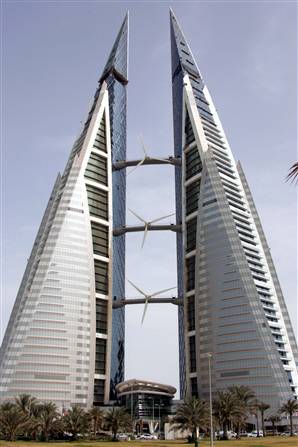
Taking architecture, and wind power, to new heights, developers of the Bahrain World Trade Center in Manama, Bahrain, flipped the switch to start three huge turbines set between two towers — a first glimpse of technology that they hope will power up to 15 percent of the center.
The UK needs to rethink its 'romantic' energy policy or face disaster
Puffing on a Sumatran Nobel cigar, Germany's energy baron Wulf Bernotat has a few words of friendly warning for Britain: face up to the harsh realities of the global power crunch, or face strategic disaster.
Analysis: Companies race for nuclear plant
The United States may soon see a resurgence in nuclear power--if the government approves any of the applications for new power plants currently piling up in record numbers.As of this month, nine different businesses have requested permission to build a total of 15 nuclear reactors from the Nuclear Regulatory Commission, which oversees U.S. nuclear power plant operation and licensing. The agency expects to receive applications for another 18 power plants, totaling 33 altogether, in the next year or so.
Westinghouse wins first US nuclear deal in 30 years
Westinghouse Electric, the nuclear design and build firm sold by the British government two years ago, has won its first contracts in America for 30 years.The move underlines the worldwide renaissance of atomic power generation as a source of low-carbon energy. The Pittsburgh-based group, which has sought approval for its reactor design to be accepted in Britain, has won a deal from Georgia Power to build two AP1000 nuclear reactors at the Alvin W. Vogtle site near Waynesboro, Georgia, for an estimated $13bn (£7bn).
Mitsui proposes ammonia, methanol production on Sakhalin
YUZHNO-SAKHALINSK, April 9 (RIA Novosti) - Japan's Mitsui & Co., Ltd. put forward a proposal on Wednesday to convert natural gas to ammonia and methanol on Russia's Far East island of Sakhalin.The Japanese company owns 12.5% in the Sakhalin II oil and gas project, controlled by Russian energy giant Gazprom.
Silk-clad sheikh protects Iraq's northern pipelines
MULTAKA: Sheikh Abu Saif Al-Jubburi is a man to be reckoned with in Iraq's northern oil hub, where the tribal leader and his 800 men protect strategic pipelines and US troops in the volatile region. Clad in black silk, a shining gold watch clasped to his wrist, Jubburi welcomes visitors at the gates of his kitsch candy-pink mansion, with its swimming pool, fake crystal chandeliers and monumental staircase. Jubburi is the mayor of Multaka, a town between the rebel bastion of Hawija and the northern Iraq oil hub of Kirkuk, a flashpoint city riven by ethnic tension.After the US-led invasion of Iraq five years ago, Jubburi left a lucrative trade "selling potatoes" which he says earned him "up to 10,000 dollars a day" to devote himself to guarding roads in areas where there are oil pipelines. The pistol-toting father of 18 is now the uncontested master of 885 men and 80 checkpoints on the Hawija-Kirkuk highway that runs alongside pipelines that transport Iraq's black gold north to Turkey.
Iran To Spend EUR17 Billion-EUR18 Billion On Oil Refineries Until '12
LONDON -(Dow Jones)- Iran plans to invest between EUR17 billion-EUR18 billion in its downstream oil sector until 2012 to upgrade existing refineries and build new ones, an Iranian oil executive said Wednesday.
SANAA - An explosion rocked the Yemeni capital overnight near the offices of Canadian oil company Nexen, without causing any casualties, a security official said on Thursday.
U.S. trade gap widens unexpectedly in Feb.
The usual culprits of a higher deficit, higher imports of oil and imports of cheap goods from China, were noticeably absent in February. The Chinese New Year caused imports from China to fall to their lowest level since March 2007. And oil imports fell after eleven straight monthly gains. Record imports of food, industrial supplies and consumer goods pushed the deficit higher.
MARCUS HOOK, Pa. — Sunoco Inc. declined Wednesday to estimate how long its 180,000-barrel-a-day Marcus Hook oil refinery will stay closed while an electrical failure is investigated.The power outage forced the refinery along the Delaware River southwest of Philadelphia to close. The shutdown involved dramatic flaring at the refinery, and nitrous oxide was emitted from a neighboring chemical unit.
Shell and Total eye Mexico oil law changes
LONDON (Reuters) - European oil majors Royal Dutch Shell and Total said they were keenly watching proposed legal changes in Mexico that could pave the way for investment by foreign companies in oil production.
More plastic than ever on Britain's beaches
The latest Marine Conservation Society (MCS) check revealed that plastic litter has increased by 126 per cent since the annual survey began in 1994.The survey found big rises in the amount of drinks bottles, plastic bags and cigarette butts dumped or washed up by the tide.
Over 170 species of marine wildlife including birds, whales and turtles were recorded fatally mistaking plastic for food.
Philippines to make climate change part of school curriculum
"Our children will inherit the earth from us," said Education Secretary Jesli Lapus. "We must make sure that this inheritance is in great shape for them to cherish."
Hunters worry about global warming
WASHINGTON - Global warming could force elk and mule deer from much of the American West. Wild trout could disappear in lower Appalachian streams. Two-thirds of the country's ducks may disappear.A new assessment of the threat to fish and wildlife habitat has hunters and anglers calling for action.
TV docs on a roll, with China, climate change topping sales
The growing global taste for programmes that roll out reality is currently so high that factual shows have become the second most purchased TV genre at the twice-yearly television trade shows organised by Reed MIDEM -- MIPTV and MIPCOM....TV buyers this week showed particular interest for green docs, such as National Geographic's "Six Degrees Could Change The World" and a France Television docu-drama "Changing Climates", that looks forward to 2075 when global warming has seriously affected the everyday lives of our grandchildren.
Contact
- Content: editors at theoildrum dot com
- Tech support: support at theoildrum dot com
License

This work is licensed under a Creative Commons Attribution-Share Alike 3.0 United States License.
from article:
High-rise towers joined by wind turbines.
I wouldn't like to see one of the blades fail on that thing. It does happen. Blades have been known to fly off!
You mean like this
http://www.dumpert.nl/mediabase/42761/12d9620a/windmolen_zegt_krak.html
BTW, that tower is in Bahrain. I don't think they have a lot of strong wind there. But then again, maybe should've been fitted with solar instead.
Interesting enough, but I see that as a WT-techno-stunt.
They depend on a prevailing wind from one direction only – head on (as I se it). That funneling effect between the buildings I suspect will cause more trouble than benefits. If wind is slightly offset head-on, there will be much more strain on one side than the other, spawning wobbling and balancing problems, but we shall wait and see. I’ll give it a short year or so ….
Why did't they mount two WTs on top of the buildings(?) a lot of wind up there, and from all directions.
I smell some audible and visiual noize-issues as well for those offices near the WTs, but fancy to look at from a distance.
Here's a video link to this story:
http://news.bbc.co.uk/2/hi/science/nature/7340528.stm
Cheers,
Paul
My 6 year old son is a pretty talented drawer. He can draw very well and takes an art course at the local art museum and the teacher is enthusiastic about him. We are generally worried about him as he is completely undisciplined; say in learning music or doing anything we tell him to, like learning to read, so we see this drawing talent as one good thing that he could develop.
So when my wife read an article yesterday evening in an educational magazine she gets, which said that when kids learn to read and write and memorize lots of stuff in school they lose their creativity/spontaneity she got worried as our son only has his creativity and is completely undisciplined.
It occurred to me while riding on my bike to work this morning that the western language is based on phonetic symbols/alphabet which anchors language/speaking skills in the left brain hemisphere (right handed). Western civilization is very linear and logically oriented therefore as the left brain hemisphere dominates. However in China they use ideograms (similar to hieroglyphics system of the very long enduring mystically based Egyptian culture) and when a Chinese person has a stroke in the left brain hemisphere they can still speak whereas a westerner cannot. In China the dominant cultural tradition is holistic and cyclical. This would be presumably because the dominant right brain hemisphere organizes itself in this manner.
So it would appear that instead of arguing about linearity or progress vs. cyclical holistic systems or if civilization is good or evil or man himself we might look at some more basic features of how we think and why this has so developed. A balanced way of thinking (between the hemispheres due to our predominant way of communication or learning) might allow us to survive long term.
There might be some tactics to remedy this domination of the left brain hemisphere. For example I was raised right handed as were my parents although they were really left handers. I taught myself writing left handed several years ago and had to retrain my older son (now turned 9) also last year to write left handed after he took a test with a professional who said that he was 90% left handed.
Besides our language and handedness there might be other ways to change/balance our dominant left brain hemisphere mental patterns which apparently doom us personally / societally to perpetual/cyclical self destruction due to a lack of yin/yang left/right brain hemisphere balance. Suggestions would be here welcome. I think ecological economics and similar are a start but these do not go deep enough into the root problem. Psychology and religion are just explanations but explanations and base on logical and not holistic constructs.
If we change literally how we think through simple mechanical changes in handedness and language structure and perhaps through other means perhaps we could tip the balance towards long term stability in human culture. I do no mean to say that China or Egypt were without up/down cycles with wars, etc. as in the west or to romanticize them but just to show that as the current dominant culture is based on the western scientific/economic paradigm which again comes from western concepts of ideology and linearity so that perhaps a simple choice of alphabet over ideogram in the ruling class predetermined the fate of our culture. We could perhaps reverse and arrest this problem but only if it can be recognized as the problem.
You might find this video of interest... it's a lecture given by brain researcher Jill Bolte Taylor on the differences between the brain hemispheres. The most fascinating part is where she describes her personal experience of suffering a left-hemispheric stroke. It's about 20 minutes long, but well worth it.
I couldn't manage to download the flashplayer so it wouldn't play. I read the text and it confirms esoteric religious concepts are bassed on right brain hemisphere.
http://blog.ted.com/2008/03/jill_bolte_tayl.php#more
As an implicit test of your thesis that choice of written language representation determining dominant culture, one would expect there to be much less difference between the two kinds up to the point that a significant proportion of the population became literate. Given that illiteracy was the norm until relatively recent historic times when I think you could already see the distinct cultural patterns in east and west, I'm not sure it supports your contention.(Actually it's more complicated than that in that, from what little I understand, both the written representation and the kind of "deep language structure" -- in the Chomsky sense -- of the language, which apply even as spoken, differ. So you could argue the spoken forms might hugely affect brain processing, but I'm unconvinced.)
I'm naturally right handed and at twenty forced myself to learn to use the computer mouse and brush my teeth left-handed. (I type, write and sketch an awful lot and I was worried about carpal-tunnel type issues from doing everything with my dominant right hand.) Fifteen years later I can't say I've observed any particular increase in holistic thinking.
he is more self confident and natural, can learn interact better. I think this is a problem with left handers who are forced into right handdness, they don't fit and so are suppressed and become more neurotic their whole lives without knowing why to a certain extent, not developing their natural capabilities.
Raising my right hand here, a lefty who was forced to use my right hand to write etc, in school. As a result I can't really write but can print. On the other hand, I've found building houses, working on telecom towers, it really comes in handy having both hands to use. Take shingling for instance, perched on a ladder sometimes you just can't swing the hammer with your left hand but can with your right. Or if your left arm is getting tired driving 16d nails, you can easily switch.
Same thing with tower climbing being able to rely on both hand made positioning at extreme heights much easier. I still throw a ball with my left hand but I really consider myself more ambidextrouse than lefty now.
I'd give my right arm to be ambidextrous. :-)
The left-right brain thing is similar to cornucopists techno-fixes or abiotic oil.
It is pop stuff the media like to tout, as do some irresponsible, unscrupulous authors. Compare to: Men are Martians contrasted to Women are Venusians. Sounds a bit scuzzy?
Nothing in the pop or pseudo Science press about left/right brain can, or *should be*, related to ordinary individuals, such as boys who paint, adults who ride bikes, engineers who make plans, drivers who brake, women who knit, Generals who take military decisions, and on and on.
Perhaps a mechanical metaphor can serve: the brain as a material machine. If you knock off a part of the thing, it can still move forward, light up, and reverse for three meters. The other functions don’t work. If you knock off another part, the lights have gone, there is no more reverse, but great speed forward can be attained. So, the different parts of the machine react differently to destruction - to the left or right (or front or back) doesn’t have the same effect. That does not mean that the ‘left or right’ parts have specific functions, its a complex system, coordinated.
No way these left-right (or back front) effects can be related to the characteristics of the machine as a whole, with some machines being “ohhh.... right controlled”...or “mostly left” - a ‘left’ tractor? Might Chavez invent it? ;)
People have different interests and different ‘gifts’, live in different milieus, adapt differently, etc. Nothng to do with left or ride side of the brain.
So please have some understanding and pity for those who think hydrogen will solve problems or that oil was injected into the earth by some mysterious action of solar rings managed by ...UFOS?
No, you're wrong-if I had been taught to write with my left hand I would have a ton more money, or maybe I would be the oldest contestant to ever win American Idol-I would sing my hit song while throwing together some Jackson Pollock type piece of garbage. Damn those primary school fascists.
hazel nut,
It was just a thought I had riding to work on my bike and I have enough experience with relearning handedness that I know the limits of the concept and how hard it is to change one person with a lot of effort after 40 years of age for minimal results so no I am not into quick and easy mass solutions for society or working on an impractical level. However if you do not start at the most basic level you just don't have a solid enough foundation for your new building. Basic human behavioural patterns must be changed. I also have been doing yoga for 13 years and Tai Chi for 6 years and meditation as well so I am felxible in my use of techniques for self change and experiment and a serious and non dogmatic. I do not think a new invention will fix everything. Maybe we are the problem as humans and a new species is called for to start over and we should go extinct. But we might need a totally new approach. Beyond controlled evolutionary change, which nobody knwos how to control without making Frankenstein's monster I can only suggest using those levers we understand to alleviate problems in modern human nature which occur due to overemphasis on linear thinking, etc. which might promote the seven deadly sins, alienation,etc. by using modern techniques and Asian techniques like yoga to balance us out as individuals and as a culture. Who knows if we can get a second chance after the coming PO dieoff. Why just continue repaeting all our mistakes again and again due to simple misunderstandings like language type, handedness or a cultural emphasis on logical thinking vs. holistic thinking. Of course it is deeper. Duality is wrong and unity is the way. It sounds like the link above from a video of the lady who had a stroke shows similar to mystical experiences in some ways. We just have to be able to consciously control that experience then we do not need to run around seeking happiness in externals. This is truly just a trick. From the indian theread I take it most indians, poor as dirt get this idea better than we do.
Heh, @ Brian T, it is said that left-handers are more ‘original’, more ‘creative’, etc. - most likely simply because they are different from the majority. There is solid evidence they die younger (from many places in the world) but why exactly is not known, perhaps simply because they live in a right-handed world. (Google turns up stuff.) I believe insurers do not use this categorization. @ galactic, oh I agree with most of what you write, it’s general thrust anyway. Also - Forcing children to ‘switch’ is a poor idea and not very current today, though of course who knows what happens on the ground here or there.
So, to sum up (moving far away from OIL..), 1) left-right handeness is related to left-right brain dominance in complex ways (see link, just the first reasonable hit off google), 2) culture and the construction of our world play a tremendous role - think sports, or flying a Boeing.
Enough!
http://www.indiana.edu/~primate/brain.html
I can only golf left handed,bat a baseball left handed, and played hockey left handed. I write and throw right handed so it is all messed up-there are probably millions in the same situation-have no idea of any relevance.
I can very much believe that forcing someone into writing with their non-dominant hand can be have very negative results (both neurologically and because of the psychological implication that "there's something wrong with you"). As far as I know, in the UK forcing people to be right-handed has not been done for at least twenty years, and that's a good thing too in my opinion.
What I'm more sceptical about is that if there was a push towards using "right brain" languages we as a population would develop "holistic thinking" that would lead to societies that avoid some of the problems of current western society.
I have found that any paricular task takes time to learn fluidly with left hand after being used to using right hand. The brain and musles problbly store it in memory onthe other brain side and that side of the brain needs practice like a muscle.
I suspect scientific studies would show some mental differences. I think I am better adjusted but i do lots of self development work so it is hard to say what is working bettter for me, to separate the various "therapies" out.
What that all could do for society if everyone got into it is a different matter.
Great point. Maybe we could put a European and then a Chinese under one of those magnetic resonance machines and see how their brains work wtih regards to language to figure this out with radioactive markers and such.
It would be interesting to try the same with right and left handed people and with people who change from right to left handed over the time period they switch to see how brain functions change.
People like Tibetan monks do similar tests and their brain scans are pretty interesting as well compared to normal peoples. They can control this stuff and that is the big difference to us. That is an art/science in their "religion", if you want to call it that, is actually more a higher form of scientific brain/consciousness control with nontechnical means.
The **classic** pov is that in daily life, in functioning, in resistance to insult (brain damage), in learning capacity, in diversification (learning new languages, etc.) the language spoken makes little difference. - They all work pretty much the same way though the surface grammar is not the same, and differ from lang. to lang. Chomsky would be the first to say that.
The written transcriptions, however, as they are wildly varied, are conserved (insult) / not, easier / harder to learn, more / less easeful to use, extensible to other scripts, or not, etc.
Well known example: China claims it has no dyslexics, as the written system is - more or less whole word - one graphic positioned in a rectangle corresponds to one meaning (like a picture, but the pictographic quality is much exaggerated.) Italy, by contrast, has problems with hyperlexics - children or ppl who can read aloud text and haven’t a clue what it means.
pardon for going on about this.
Interesting. Have you noticed a change in your and your son's mental patterns since switching handedness?
he is more self confident and natural, can learn interact better. I think this is a problem with left handers who are forced into right handdness, they don't fit and so are suppressed and become more neurotic their whole lives without knowing why to a certain extent, not developing their natural capabilities.
Hey Galactic;
Ever the moderate (and a very impressionistic Left-hander myself), I don't want to overreact to Left-brain cultural dominance with an overemphasis on the opposite. As ever, we have to find a balance of the two natures, and not just take sides, as it were.
As with the other Left-Right, we have to be able to orchestrate between 'staying and going', 'holding on and letting go', and between 'literal and figurative' etc.
Looking back, I see that you do present it as rebalancing. I'd only noticed phrases like 'reverse and arrest this problem' on the first read, but didn't mean to imply that you were being extreme, either.
For me growing up, 'Discipline' was a word I always got stuck on. It was the "D" word.. I've worked to find in myself appropriate tools of discipline and group leadership structures that are productive and functional, but also are not blindly 'disciplinarian'.
A memorable image from my years in NYC (which has a leash-law), was a dog and owner, where the dog wore his leash, but carried the rest of it himself in his mouth, and he and his human walked along at 'leash-length' anyway. It's my icon for 'Self-discipline'
Blessed are the artists!
Bob
That dog is a bit like my kid. He leads however.
I'm a lot like your six year old - creative and naturally averse to discipline. I secretly learned to read when I was three but refused to put any effort into memorizing the order of the alphabet until I was about six or seven. Memorizing things like passages from the Bible and multiplication tables was a huge part of my education from first grade until fourth grade, then I switched to public schools. I'm still a creative and largely undisciplined person, so I don't think my early education changed my personality or the way my brain is wired. For people like me and probably your son, it's important to be motivated to learn and to have room to figure things out on one's own.
The left brain/right brain thing probably isn't as black-and-white as you may think. Individual brains can vary quite a bit. Good luck.
PS I'm a lefty as well.
We have been trying to get our son interested in keyboard lessons for a month or two and he would just play games mostly with the teacher except for maybe 5 minutes. My wife and the teacher were about to give up. Yesterday however he paid attention the whole half hour, a miracle! Discipline is neccessary to get throught he basics and then creativity takes over when you know what you are doing, in any "discipline". A master had to memorize routines first laboriously as a child or a student. After that the right brain integrates the information fluidly. For an artistic "little genius" getting him past this painful memorizing phase is the critical problem. Afterwards he will get the idea, have fun with it and learn easily, like with drawing, I hope.
His older brother is the absolute opposite, slow and methodical, disciplined and conscientious. He will obviously never be an artistic genius but loves science, despite his left handedness.
galacticsurfer thanks, very interesting read.
The Alphabet Versus the Goddess speaks directly to this topic. I found it fascinating, I think you will to.
http://www.amazon.com/Alphabet-Versus-Goddess-Conflict-Between/dp/014019...
and yet the person never learned the word irony...
GalacticSurfer writes: "Besides our language and handedness there might be other ways to change/balance our dominant left brain hemisphere mental patterns which apparently doom us personally / societally to perpetual/cyclical self destruction due to a lack of yin/yang left/right brain hemisphere balance. Suggestions would be here welcome. I think ecological economics and similar are a start but these do not go deep enough into the root problem. Psychology and religion are just explanations but explanations and base on logical and not holistic constructs."
You might want to join Jay Hanson's new yahoo group with the URL below: http://tech.groups.yahoo.com/group/killer_ape-peak_oil/
His group discusses such issues. Here's a snippet of their discussions.
"This group mainly discusses what the evolved human brain "does". Besides "what the brain does", we can also discuss (to a limited extent) "how the brain works". Of most interest will be fitness strategies which evolved to address the type of absolute resource conditions imposed by population "overshoot", "peak oil", and at least a hundred years of falling "net energy". Also of interest, are critiques of current political arrangements, "realpolitik" (practical politics), and neoclassical economic theory."
Enjoy!
members only
Like one of the other posters, I think the right/left stuff has been way overdone. It's not that the phenomenon isn't real in the brain -- brain researchers have clearly established lateralization of various capacities. But projecting this stuff into an explanation of differences between wester v. eastern culture, holism v reductionism and so forth is a very slippery business and has gone way beyond what the actual facts can justify.
I also was converted left to right. I have always been undisciplined and creative. Any connection? Maybe. But it would confuse the heck out of me to try to undo any of it now. We are all of us the sum total of the slings and arrows that assail us in our passage.
Here's advice no parent ever takes: don't worry overly much about your son. 90 pct of the time, it turns out you worried about the wrong thing. The reason you won't take it is genetic: in other words, I'm full of shit. I still worry about my kids even though they're in their 30s. But the things I worried about when they were young were often not the things I should have. And my worries now are wasted, because things are completely beyond my control. So you see, the advice I give and neither of us can take is good advice.
One poster speaks of neurosis and other pathologies associated with conversion. This I flatly and vehemently deny -- I don't care what my wife, kids and friends say.
I have also been doing waht they call "energy work". When you do yoga or Tai Chi correctly for many years and then maybe some breathing exercises your enrgy body(maybe electrical network of nerves across whole body) gets more stimulated over time. This can be felt as tingling on the skin, along spinal cord, etc. Now the corpus collosum connects the two brain halves and the better this connection is the bettter teh brain operates as a whole. As I had developed what they call "kundalini" or "chi" very heavily I was able to rapidly change my hand orientation over some months. I felt the energy between the brain halves flowing. At any rate when one is conscious of the "electrical/energetic impulses" then it is easier to control what were previously subconscious or autonomous impulses. I think as I said above that the Yogis have litersally a mind/body control science. Teh word religion or vauger "spirituality" is not adequate.
So as you and others here say it is a lot more complicated. We know very little and every one is different. This is probably why we have to grab ancient knowledge and people like the Dalai Lama under an MRI and ask him to teach us all his technique to be cool in times of turmoil or we are just subject to our own primal urges.
Texas Won't Dump Oil On Market; RRC Sees Weak Demand
Texas & Saudi Arabia Increase Their Surplus Productive Capacity:
http://www.energybulletin.net/image/uploads/38948/image010.jpg
How about those guys working the Bakken oil formation - what if they decide to dump all that oil on the market!
I stand by my "prediction" that the flood of Bakken oil will make gasoline "too cheap to meter." We will just pay a flat rate per month and drive to our heart's content. Those who believe that Texas has voluntarily cut production for 36 years should also believe that my Bakken prediction is correct.
LOL Westexas I been reading your comments the past few days just cracking up :)
Your sarcanol is working full force heh.
snip..."We sell oil to customers who ask for it and there are no customers asking for it...why should we increase production? There has not been any increase in demand and in fact it's falling," Qabazard told reporters, adding that the data was contained in the 13-member producer group's next monthly oil market report due Tuesday.
So Bush going to KSA begging for more oil doesn't count? I really don't understand this rhetoric coming from these folks. I wouldn't mind if they put another million barrels per day onto the markets if it would lower the price to $80. In sure Yergin wouldn't mind if one of his predictions would pan out. Im sure the US economy wouldn't mind if people would travel more this summer to pull it out of the dumpster. Show me some oil! I might just buy some more gas.
That's weird because my wife and I have also voluntarily restricted our oil production. I didn't know we held that in common with the RCC. One day we just said, "You know, we shouldn't produce oil here in suburban North Carolina- we just shouldn't do it!" And we don't and we're happy with our choice. We don't care how expensive oil gets, we're not going to give in!
Today is the day of the Converging Environmental Crises Teach In. My talk is supposed to be at 12:15. (I suspect the timing won't be exact.) There are several others between 11:30 and 2:00, particularly, but more until 4:00.
I have received more "how to" information about logging in. The web site is http://sg60.oar.net, and you have to scroll down to "Converging Environmental Crises". It is best to read the last page of this PDF for details - you need to disable Pop-up blocker, and it doesn't work with Safari. There are other details as well. You can test in advance, using one of the archived talks.
The talks will be archived, so there is no real need to dial in today, unless you want to call in with questions, and hear the questions with answers. I won't be one of the people answering questions. I also plan to put my talk on YouTube later, but you might want to hear some of the others.
All the best in changing people's thinking....
Since thinking is how we know what we know, our personal world is largely arbitrary. This is a hopeful and good thing rather than an insurmountable obstacle.
Look at the poor man riding his bicycle in the rain.
Look at that moron riding his bicycle in the rain.
Look at the lucky guy who gets to be outside rather than behind this dumb computer.
These are three different universes with three unique sets of feelings AND consequences - all because a thinker thought something different. The Oil Drum is an invitation to think differently and experience a new chain of consequences. And, because reality is so pliable, this invitation has great power.
It's all about mind training.
Misfortune is adventure misunderstood.
Brilliant, tstreet.
Precisely!
Our response to our knowledge and perceptions creates our internal world, from which flow the decisions and actions that end up constructing much of our immediate outer world. This understanding has caused me to conclude that my previous responses to the Converging Crisis as exposed in my few TOD keyposts were malignant in the extreme (even though they were shared and supported by many around here).
Once you have a sufficient collection of facts under your mental belt, the critical decision is what kind of an inner world you will paint using those facts as your pigments. That question can cause a lot of unexpected directions to open up. It turns out that personal self-discovery, awareness/emergence work and spiritual development are probably more important to that process than simply knowing ever more minutiae about energy supplies, the global carbon balance or permaculture techniques.
"Our response to our knowledge and perceptions creates our internal world"
If "our" response is to our internal knowledge/perception, this begs the question of who it is that is responding, who this "our" (or "I" as the case may be) is. Knowledge and perception have become things we own and not a part of the "I" in this formulation.
Not saying this is wrong, but if you're going to chase the rabbit down this whole, be prepared that it may be deeper than your first impression.
:-) That's exactly what I (?) understand and what I(?) hope. This is a brand new direction for me, but it has an odd resonance of inevitability about it.
Decades ago I got a taste of being part of the One, using the same psychedelic keys as Huxley, Leary and Ram Dass. The state never stuck, but the awareness that the state existed did. A year ago I rolled over in my sleep and woke up as a pantheist/Deep Ecologist which turns out to be Phase I of where I really need to go. It appears that a growing awareness of the Converging Crisis can make a dandy trigger.
a short passage from Alan Watts that I have tacked up to my cube wall;
"conventional thought is, in brief, the confusion of the concrete universe of nature and cultural symbolism.... Thus one who actually perceives or feels this to be so no longer feels that he is an ego, except by definition. He sees that his ego is his persona or social role, a somewhat arbitrary selection of experiences with which he has been taught to identify himself.... Having seen this, he continues to play his social role without being taken in by it. He does not precipitately adopt a new role or play the role of having no role at all. He plays it cool"
"I" am the observer of both "inner" and "outer" world. Nothing more, nothing less. (It kind of puts a big twist on the whole notion of being a "doomer" or a "techno-enthuse.")
GliderGuider and shaman, scoring huge points with me today! Way to elevate the dialogue! (I read a bunch of books by all of the above...and had my own small handful of transcendent experiences...fortunately, one can remember the realization without that state of consciousness persisting!)
oh, left this out - that One is just yet another one of those knowledges and perceptions you own. ;-) Fun to watch, just don't take it any more seriously than all your other knowledges and perceptions.
You've been doing this a while, I can tell. :-)
Yes, it's just another among many, but at least it's a far less damaging perception than the ones I'm in the process of noticing (with horrified amazement) that I've been treating as Truth for so long.
Thanks.
You should check out 2012: The Return of Quetzalcoatl by Daniel Pinchbeck. I think you would enjoy it.
The problem here is that even with a PO or similar shock, like surviving a close crash or coming out of war situation, people do not fundamentally change.
Gail can give her speech and hope the people wake up to see the matrix, at the level of the Iron Triangle for consumers and see they are living on a sea of oil but then they just see potential death and destruction. Eventually they might land at the positive view of "I'm just happy to be alive today regardless" and powerdown.
However once they have stablized in their new situation, whoever it is that gets through the hole in the needle of civilizational/PO needle alive and well, will forget and repeat the old mistakes, or their children will. Everyone has to learn for themselves. This is good of course and bad as we can never expect our chidren to take our advice about "waste not want not".
Even with a bigger brain or more spiritual connectedness and a very long life span of say 1000 years(imagine aliens) I tend to think people would just rely purely on their own experience and screw things up totally if at all possible.
Being religious I think that is the whole purpose of course of every human incarnation/birth, being allowed to learn for ourselves, but regardless when one sees the massive damage to earth it is a bitch to accept such damage from any species.
Looks like Firefox 2.0.0.13 and Opera 9.27 aren't invited to the party!
I have stooped to using IE ... it was fine for ten minutes then IE crashed. The 'Environmental Crises' option from the sign-on picklist is now giving "No such directory or user."
The archived talks (like mine) seem to be available now. The actual listing is "Environmental Crises" in ths scroll down menu. The conference starts at 11:00. I am sure that is when you find about things like calling in with questions.
Gail,
Let us know how it goes.
Gail thanks for the heads up! Looks like some impressive participants. Hopefully you won't be advocating drilling in ANWR again today...
I've been skimming through some old saved links and documents on the subject of oil that I've accumulated over the past two years, and I plucked this from the Oil Shockwave (PDF) simulation report.
In the report's scenarios, they have $125 crude equaling $4.79 gasoline, and $161 crude equaling $5.74 gasoline. I don't know how they arrived at these figures, but I'm assuming they weren't pulled out of thin air. In looking at our current situation of roughly $110 crude, the current price of gasoline would seem to have some significant catching up to do. Any thoughts?
Yes, but. Gasoline prices are a result of the the market price for wholesale gasoline, plus taxes, which I believe are levied in cents per gallon rather than a percentage of total price. So, to compare apples to apples, we really need to compare wholesale to wholesale. However, crack spreads are very low, and refiners need lower crude oil prices and/or higher product prices.
I can assure you Pedalpower that they arrive at those numbers the very same way they arrive at the weekly stock numbers. Pure guesswork and one finger in the air …
This has been discussed quite a bit here over the past few months.
Basically, refineries can't raise prices, because customers are balking at paying them. They don't want to lose market share by raising prices while their competitors don't.
This is hitting the bottom lines even of big oil companies, who are making big profits off crude oil, but losing them in their refineries.
Gas stations are using gas as a "loss leader," making very little or even losing money on it, but making it up by selling coffee, soda, sushi, or whatever in their mini-marts.
I think this is something that many peak oilers did not foresee.
This process of squeezing out profits is getting close to an end, and it won't matter whether customers balk or not. At most, another year. Then we will see gasoline prices rising at exactly the same rate as oil.
We will see the same thing throughout the economy, including the price of things like solar panels. Profits will get squeezed to the bone, and all the money going to fluff like marketing will get squeezed out (as well as those fluff jobs), and then prices throughout the economy will be rising at the same rate as energy prices.
What this means when you consider hedging for the future is that there is a period of some years here where betting on the price of oil will actually give you big profits, and get you a much bigger bankroll for what's coming.
After that, bets on energy prices will only keep the money invested even with the overall rate of inflation.
So, people should be getting as much money bet on energy prices right now as possible, and that would include things like investing in installing solar panels, and the like. This kind of investing would be the one thing worth going into debt for.
I am considering going in debt for installing solar panels. But studying PO the first advise always was to get out of debt.
My estimate is another 4-5 years of saving before I can directly pay for wind/solar to run my household on, totally. But I'm not sure I have so much time.
PaulusP, have you considered investing in a smaller PV setup now, one that you can afford to pay cash for? You're right that it's doubtful that there are 4-5 years left to save, then do. That choice likely means that you'll be transitioning to NO electrical power. Installing a smaller system now avoids that. For example, I run my entire homestead, including well pump, computer, washer, lights, power tools, etc, on a system that would cost around $10,000 today. As Westtexas or someone said: " you can conserve now, or you can conserve later...".
On the other hand - the transition to no electricity may be inevitable. So why postpone it? Start practicing living without it as soon as possible.
My wife's attitude is that we should keep the electricity since we grew up with it and are used to it. It would be hard to give it up. But in the meantime, we perpetuate the dependence on our children/grandchildren. We couldn't give it up, it was too hard for us, so we'll make our children/grandchildren to that. Gee, seems to me that's the same kind of thinking that got us into this mess.
Dunewalker, I'd like to email you. If that would be okay, please send me an email (click on my name to retrieve email address). Thanks.
My current thinking. Two accelerants on oil prices: (1) As forced energy conservation moves up the food chain, the rate of increase in oil prices presumably has to accelerate, in order to balance supply & demand, because energy costs as a percentage of income decline as forced energy conservation moves up the food chain; (2) Net Export decline rates tend to accelerate with time. And of course, food prices are rising in tandem with energy, showing many of the same ELM effects.
Regarding #1, there is a secondary factor driving up food & energy prices--consumers cutting discretionary spending, so that they can pay their food & energy bills.
But consider the effect that has on discretionary spending. These three factors would act together to drive down discretionary spending at a ferocious rate.
Now, all of these companies dependent on increasingly expensive crude oil or refined product inputs e.g., refiners and airlines, are faced with the problem of balancing ever more expensive energy inputs against the volume of the product and/or service that consumers can and will buy. Thus, we see declining refinery utilization and airline cutbacks/failures.
I am reminded of an economic peculiarity, noted only during the Irish Potato Famine, as the price of potatoes soared, demand for potatoes increased as well. People did not buy more substitute foods (wheat, rye, beef, pork) but less.
Why ?
Any substitute food still cost more than potatoes, and people were spending all of their income and meager savings on potatoes (or starving as millions did). They economically "fought" over the last remaining potatoes till demand destruction (death and emigration) brought the supply of potatoes in line with demand. Meanwhile the too expensive, and "unwanted" wheat and beef was exported.
The Irish "middle class" (wealthier peasants, merchants, trades people) saw their income drop and stopped eating wheat and beef (their diet before with some potatoes) and used their savings and residual income to buy and eat the few potatoes left.
Meanwhile, the peasants that once got over 85% of their calories from potatoes had their demand destroyed by death or emigration (about half & half).
Now apply this economic model to "Drive or Starve" Suburban Americans, those that require gasoline in order to procure food. Some of them have savings, some do not. Some savings will survive a "Financial Potato Blight", some savings will not.
Best Hopes for finding another way,
Alan
That really doesn't describe what happened during the Irish Potato Famine. The English had colonized Ireland and English landlords owned all the land. They used their best land for raising export crops (beef and wheat) while renting very small parcels of land (1-5 acres each) to the Irish. The only crop that yields enough calories per acre to keep you alive that grew in Ireland at the time was the potato, so that's what the Irish survived on. Food was exported by the landowners was protected by armed guards. It's worth also noting that the British government prevented foreign aid from being sent to aid the starving and killing off a large portion of the Irish population was in England's interest. Someone more cynical than I might accuse England of genocide.
The wheat that Ireland exported to England was uneconomical to export. The English had to tax American wheat at 45% to make it cost effective to export. Google "Corn Laws".
Alan,
Let me see if I understand you….
One analogy of several. I am still working on it :-)
Another is that some suburbanites "emigrate" to Non-Oil transportation, whether it is a shopping cart to and from a lean to under a bridge, or a rooming house a half mile from a subway stop.
The Irish Potato Famine was real, and the human reaction to extreme resource stress was real as well. I think something can be learned from their experiences that will be useful post-Peak Oil.
Best Hopes for a Better Way,
Alan
I was surprised to find the following on Wikipedia
http://en.wikipedia.org/wiki/Giffen_good
Alan
Westexas,
IMO, there's another factor: the size of the skilled workforce. As we come to rely increasing on the more numerous smaller fields, it seems that the workforce won't be growing fast enough to fill the required positions... nor too the positions of those who will have retired by then.
A few things to think about:
If it truly does become worst case and the grid goes down, don't think that your neighbors and local governing authority/warlord is going to see your highly visible PV panels on your roof and think "Oh, how wise and smart he was to get PV panels while he still could." No, your PV panels will be appropriated, maybe with or maybe without compensation. You might also lose your life on account of having something that others don't, even if you voluntarilly give them up.
Some people are saying if that worst case scenario comes to pass, all debts will be uncollectable as well, so don't worry about paying them off. Maybe, but there are also all type of scenarios that are only slightly less bad than worst case, but which still might entail semi-functioning governments and financial systems. A massive default of all debts means that a lot of poor people win and a few rich people lose. Is that how our world usually works? I'm not sure that it is wise to place a bet on your winning out against people that are far more powerful than yourself. Thus, I think the advice to pay off your debts first is reliable.
There are certainly lots of no-cost and low-cost things you could be doing in the meantime to conserve energy. Anyone who has gone totally off-grid will tell you that you need to shave your KW load to the absolute minimum. You'll have to be doing this anyway, so get started now. Electricity might very well be rationed by price before it goes away entirely, so it will serve you well to invest in energy conservation.
You might also consider investing in a solar water heater and solar space heating panels. The technology for these is mature and available now, the up front cost is not all that high (maybe under $5-6K for water and $2K for space heating if you do a lot of the work yourself), and the payback periods for either are much shorter than for PVs. You'll need to do this anyway, so do these first. You'll learn some useful skills about orienting and mounting solar panels, thus enabling you to do a lot of the work for PV panels when you are ready for them.
Before the grid goes out altogether (if that ever happens), it will become increasingly intermittent and unreliable. Extended blackouts might become the norm even if the grid never does completely shut down. Thus, you might want to think in terms of investing in batteries, inverters, and control equipment prior to investing in the PV panels. I would especially want to think about this if I had a freezer and were constantly at risk of losing all its contents. Some will argue that a generator could cover you for that, but the time will come when fuel for generators will be expensive and hard to get, or maybe even prohibited. Furthermore, generators advertise their presence by their noise, which subjects you to the same risk of appropriation from government/neighbors mentioned above. In contrast, a battery array could be completely hidden, and if you only use it to keep the freezer in the basement running and are not so stupid as to advertise to the whole world that you've got power unlike everyone else, you should be OK.
Finally, while it is true that there are risks involved in waiting to buy PV panels, there are also risks involved in buying too soon. The technology continues to improve, and if we do manage to avoid a total or near collapse for a few years, the cost for them should go down considerably.
"The technology continues to improve, and if we do manage to avoid a total or near collapse for a few years, the cost for them should go down considerably."
I keep hearing this, and just don't buy it. It's a great excuse to continue procrastinating, or to convince others to do so, but how does it add up? Electricity gets more precious, or the grid has more failures and insecurity.. etc.. where does that put demand and supply? Even if cheaper to build, the customers will still be coming to your store at today's prices.. why would you discount them?
Dave Mart said the German and Chinese(?right?) demand of present day will likely slacken soon, and nobody else will pick up the gap.. we'll see.
Bob
http://globalguerrillas.typepad.com/globalguerrillas/2008/04/resilient-c...
The Microgrid enables this by creating a local network (electricity plus data services) that can become a platform for the organic growth of a diverse and innovative ecosystem of solutions and providers.
WNC Observer - you're describing exactly what's going on, in slow-motion. Having a big ham radio mast, having PV panels, etc is increasingly making people targets. Power failures *are* becoming more common, more of the population *is* becoming more desperate, etc.
The trick is to appear to be an ordinary poor person just trying to get by like everyone else, but somehow seeming to do it a little better than some.
Nobody would think it strange to see a poor person heating with wood and having a couple of cords stacked out in the back yard. That's poor folks heating.
Nobody would think it strange to see a poor person raising a garden, or maybe even keeping a few chickens. That's poor folks food.
Nobody would think it strange to see a poor person drying their clothes on a clothesline. That's poor folks laundry.
Nobody would think it strange to see a poor person walking or riding a bike (clunker, not top of the line racer) or driving a very small (not shiny new) car to get around. That's poor folks transport.
Cheap chic, it's the way to live.
According to the GAO, the USA imports more than ten percent of its gasoline. This is a factor weakening the linkage between crude oil prices and pump prices. http://www.gao.gov/new.items/d0814.pdf.
The most recent stats used in that report are from 2005: "U.S. imports of gasoline
and gasoline blending components, which accounted for about 31 percent
of our imports of refined petroleum products in 2005, averaged about 1.1
million barrels per day, or more than 10 percent of U.S. daily consumption."
Gasoline alone now amounts to roughly 1 Million Bpd by itself. Regarding my post down thread, increased gasoline demand from China and elsewhere is really going to stress the spot market price.
We haven't switched to summer mix yet this year. That seems to add twenty cents or so. Of course we shed that in the winter.
Re the USA trade deficit, the lower US dollar is really doing wonders at righting it, as the MSM economists said it would.
Ross Perot predicted (re: NAFTA) that we would start creating jobs in the US when the average American wage sank to the level of the average Mexican. An oversimplification but not much of one.
The truth is that almost anything can be produced at lower cost elsewhere in the world today. The American middle class may be feeling the pinch but not like they are going to feel it.
The real joke was on the Mexicans. NAFTA sanctified outsourcing for '90s Americans, but when the time came to actually make deals, it became apparent China could offer cheaper, better educated (and motivated by genuine national pride?) workers than Mexico, with fewer shakedowns by corrupt cops and drug gangs. Since China is run in the interest of Chinese power, not a handful of plutocrats who hate their own country, the profits were quickly funneled into the next stage, those middle-class jobs in software, tech development, banking, etc. The architects of NAFTA had not counted on this.
Question is, will a post-Peak world really need most of the jobs that middle-class Americans have? What are the resulting products? Who needs telephone sanitizers?
http://www.nytimes.com/2008/04/10/opinion/10thu1.html?_r=1&ex=1365566400...
EDITORIAL: The World Food Crisis
Published: April 10, 2008
Bill Bonner of the DailyReckoning had a piece on technology some months ago that would very aptly apply to this whole ethanol mess:
"Man cannot leave well enough alone, we conclude. He gets ahold of an idea and he cannot help himself. He takes it up clumsily, as he would a new wrench. Then he begins twisting it…hammering it…stretching it out…sharpening it…until he can use it to cut his own throat.
Every innovation turns against him. His television brings him reality shows. His automobiles lead him into traffic jams. And scarcely a single generation after he invented them, his airplanes are dropping bombs on London."
My latest article (published today) is on the same topic:
Skyrocketing Food Prices and the Commodity Crunch - Grain's Gains: Profits or Pains?
Hmmm...
For years and years many of the poorer nations of the world have complained, at trade talks, of the agricultural subsidies that the wealthier West have implemented. The claim was that because of the subsidies the food produced in the subsidized nations were undermining local agriculture.
Now grain prices are rising.... due in part only to the increased use of grains in non-food products (e.g., ethanol.)
So before grain was too cheap... now it is too expensive.
Which is it?
"It" is just hypocrisy... or rather, a way to divert attention from the (real) problems of the agricultural economies in many nations as well as factors beyond their control (e.g., droughts.)
What if:
first the West subsidizes its big agribusinesses to run down prices, then farmers in the 3rd world must leave their farms and flee to sweatshop work in the city to make export goods (since the crops are no longer worth exporting), and then the prices go up. Once a farmer raises his children in the city, there's no chance that they will go back to farming, so the intellectual resource is gone forever. Thus the natural market response of simply returning to farming is only available to their own big agribusinesses, which have capital and flexibility.
If you're in Japan, you might be aware that the Meiji government taxed the hell out of Japanese farmers to drive them to the cities for industrial work. They were right to do so because of the threat of Western imperialism, but how did Japan continue to feed its growing population? Did it rely on the conquest of Taiwan and Korea, or did it import rice on the market?
Some are scaling back summer vacations
Then there's the mass flight cancellations. Driving to Florida was grueling, but I'm glad I did it, because if I didn't, I'd probably have been sleeping on the floor of the Atlanta airport. Delta did the mass cancellation thing the week I went on vacation, and they're the airline that serves my regional airport.
Our summer vacation is a local YMCA camp where we stay in bunk beds in a cabin with 10 people (other families with kids) and have great forest, river, activities and food. This is amazingly inexpensive, little hassle, and plenty of relaxation and good times.
I have heard that family camps like this used to be very common and perhaps will make a come back.
"Cheap is the new chic."
As I said the other day, I think that you and Sharon are going to be the equivalent the high tech gurus in the Nineties--widely sought out for advice.
What is really reprehensible about the ExxonMobil, CERA, et al pronouncements that we don't have to worry about Peak Oil for decades is that they are, in effect, encouraging people to continue to go into debt, trying to hang on to their old way of life--in many cases with credit cards increasingly used to pay for food & energy bills. According to the WSJ, total US revolving debt is up over 8% from a year ago.
If one adopts the ELP type recommendations, and if the Peak Oilers are wrong, what's the downside? You have little or no debt and a simpler, lower stress way of life?
There are still a lot of camps like that around here. (One made the news a few years ago when a bear grabbed a baby out of a stroller on the back porch and killed it.) Most of them are groups of cabins that are suitable only for summer use (no heat). Some have been converted to year-round residences. Some have been made into no-tell motels. And some are still operating as they always did. Only the customers are now the economically disadvantaged, rather than the middle class and upper middle class of decades past.
We've got a lot of big camp & conference centers around here as well. Most of them are church related, and were built back almost a century ago. It would be the thing for middle class families from the steamy pre-a/c southern cities to load everyone up on the train and send them up to the mountains for several weeks, or even an entire summer. Some of the slightly better off families would even build summer cottages near the campgrounds.
The camps and conference centers here are still all in operation and seem to be doing OK, plenty of people here in the summer. This is still very much a middle class thing, not at all upper class - they have different places to go, more exclusive & secluded with more amenities.
I just hope that we'll get passenger rail service back, and get it back in time.
My parents just reassessed their plans to fly from Washington to Texas (to visit family) this summer: They're driving now. That sudden change-of-mind brought the airline situation home for me.
-best,
Wolf in YVR BC
Flying is making less and less sense. And there's always my saying:
"If you don't like what someone is doing, STOP PAYING THEM"
That of course applies to the airlines, is anyone else watching the tussle over the Passengers Bill Of Rights and how the airlines are resisting it?
You can rent a car that's thrifty on gas for your vacation, if you don't have one. You can learn the KOA Kampgrounds and the joy of truck stops (I'm sorry but truck stops are cool) and you can learn to camp in random places.
Here's hoping for a decent national passenger rail system again.....
Yesterday I poked fun at the dreamers that seem to be multiplying like rabbits on this forum and was threatened with a deletion of post for 'lack of humor.' The real humor is generated by the trolls that continually post nonsensical ideas and have a laugh at the board because of the waste of time and energy caused refuting their idiotic ideas.
Recently there has been a daily barrage of posts containing pie in the sky schemes, reminiscent of the days of the dot.com bubble. Problem is, the financial systems of the US and EU are in no condition to risk capital on crazy schemes that have not been subjected to feasibility study, and/or sufficient engineering much less reliability testing. Any fool should know that equipment sunk in salt water in order to create electricty is going to be attacked by not only sea water but as yet unseen and unknown sources of electrolysis. I believe that prior to posting 'Popular Mechanics' style articles some thought should be given to their practacality. Perhaps this would cause us to miss a cutting edge advancement...I don't think so. The Edisons, Fords, and Einsteins will make themselves known...if any are out there...and there are individuals and corporations, like the one in the following article, that know how to raise funding for viable projects.
Here is a man with experience, a head for business, and the where with all to put into practice what he believes will work for the UK and the EU. He knows that pie in the sky is going to lead to disaster when a great deal of resources are allocated to schemes that will not work and, consequently, the country and lunatics that promoted the schemes are left in the dark.
http://www.telegraph.co.uk/money/main.jhtml?xml=/money/2008/04/10/cnener...
The UK needs to rethink its 'romantic' energy policy or face disaster
'"You cannot replace 60pc of the country's generating capacity just by betting on renewables, which is what the pressure groups are demanding. It will be decades before we reach that point, and until then Britain is going to need coal-fired units. I hope some realism comes through in energy policy," he said, speaking in near perfect English from his London days as a Shell executive. He was once in charge of Shell's operations in Eastern Europe, and Africa.'
This is the way it is! If the US and world had listened to Carter we would be in a much better situation now with many more choices going forward. We did not and we are left with few choices in the short term and a dearth of funds to spend on testing renewables. If so much money had not been wasted on rediculous wars, if our countries had not off shored their manufacturing bases and skilled labor, if if if. The situation is what it is so lets cut the crap and get down to usefull projects that are proven. GW is going to happen. Do you want to observe GW in the dark?
Amen.
Though I think it is also necessary to start renewables on a household level ASAP. This will lessen the need for coal generated electicity gradually, as more and more households invest in it. I certainly will as soon as I can.
I've been thinking that a good way to get started is, instead of springing for the Big Kahuna solar PV etc. system that costs as much as a luxury SUV, rather to set up the SIMPLEST PV system possible, something like a single 120W panel, a couple batteries, and a cheapie inverter/charger etc. This might cost $1500 or so. Then, I would leave this system on a separate circuit with maybe a single outlet or power strip in the house, and continue to use regular wall power.
In the case of dire emergency, like long-term blackout, a single panel system would be worlds better than nothing. You could run a single light bulb off it, hang it in the kitchen, and be on your merry way. Second, you would learn something, which would enable you to make a more informed decision if you wanted to upgrade and expand later.
Y'know, I came to the same conclusion and that's what I'm doing, though I still need to snag the PV. The first hundred watts probably gives you the best value, too, since you're a long way from diminishing returns on your investment. For that matter, I also added a dirt-cheap generator even though it's aesthetically displeasing & highly temporary, for times of high power drain. It's amazing what Amazon will ship for free to the middle of the ocean.
This is what I've done.
I have around 350w in various panels, incl a pair of 130's.. some would be for 'direct use', like running fans for summer cooling and HotAir Panel Heating, plus driving tracking panels.. and wouldn't suffer the losses of battery charging and charge dissipation, or even of control circuits, since they are designed to be needed in proportion to the amount of sun available, using that available power immediately and close to the panels.
The biggest reason for stocking up on the PV though, is that right now, they are on the shelves at a modest price, considering what they do. (~$5/watt) Whether it's product availability, prices shooting up, or my cash-flow dropping away, a rough-patch in the future would probably steal my chance to get hold of these. Even a little dashboard charger for keeping carbatts topped up (US $20) would be able to keep a cell phone, a flashlight, an emergency radio and a walkie-talkie running for you.. a little bigger (30-40w) and you've got Laptop Power and a couple essentials in the house, like a Pocket TV and the Answering machine/Cordless phone...
Ask your calculator. It isn't till you've had no electricity that you realise how precious just a little can be.
Dude, the problem wasn't lack of humor. It was waste of bandwidth. One person posted in your support...and he thought you meant the opposite of what you actually meant.
The post you replied to did not deserve that kind of juvenile mockery. How would you feel if you posted something you felt was interesting or important, and then had the whole thread derailed by a silly reply?
I am not a 'dude' and I doubt you have a crystal ball that would determine 'what I meant'.
Fact is, the board is being over run with pie in the sky popular mechanics ideas that are not worth the bandwidth.
'Driving to Florida was grueling'? Did you mean that as a joke? See, I don't have a crystal ball but I have made the trip to NH, Canada, Alaska, etc, many times on a motorcycle and never thought of it as grueling. It's an adventure in my crystal ball.
...and, I have posted on items that I believed were of interest and had them rediculed. So?
Do you, personally, think that scarce resources should be allocated to undersea turbines when the future of the Island of GB is at stake? What if these turbines are short lived due to electolysis, corrosion, or other as yet unknown problems? Are you willing to bet your own money, as stock purchase, on such a venture...after all, that is the real test of faith in a venture, isn't it?
ahh...but those ideas are in the media and are worth discussing...even if it takes one post to discredit them.
That said, I am one of the biggest doomers around here, but I think we shouldn't limit the discourse of "on-topic but maybe misguided or cornucopian" news items.
How can we filter what is postable, if it is ON-TOPIC, without discussing?
This happens. At the time of the oil crises of the 70's and 80's you got all kind of Heath Robinson ideas to replace oil for energy. The media forcast a stream of innovation rivalling that in the war.
Then oil prices fell and it stopped. Amidst all the crazy ideas there will be some worth persuing.
The essential problem is that there has been no clear definition of the problem(s). Clearly, whacko stuff is going to be suggested until that occurs. Unfortunately, it is not just an energy problem but also an economic one. By this I mean, is BAU viable by changing energy sources or is BAU a dead end? If BAU is dead (which I believe it is) then the first order of action should be to address that rather then simply push for different, large scale energy sources given limited capital resources.
This is not to say that nothing should be done at this time. There are a variety of proven things such as conservation/energy efficiency. In other words, pick off the easy, low hanging fruit. Lest anyone think I'm against going ahead with some alternative energy actions, I'm not. I have a 3.6kW PV system, had a 1.5kW wind generator, solar hot water and more.
Todd
I don't need one, since you just posted an explanation of what you meant.
Actually, I kinda like the idea. Not going to make a huge difference in the big picture, but it won't do much harm when it fails. Unlike, say, a large hydro dam or a nuclear power plant. It's an idea that has resilience, rather than efficiency, going for it.
If you feel otherwise, then say so...in a way people can understand. Without a crystal ball.
And if these people are the trolls you think they are, then the right thing to do is not respond at all. Ignore them, and they'll go away.
I do agree in principal - silly posts like "Revolutionary process points to sugar-fueled cars" are getting tiresome, but it is a judgment call I guess. I know what I think is worthwhile and not, but others may have different opinions. Perhaps we'll just have to ignore the nonsense until it goes away.
River,
"1. dude - an informal form of address for a man; "Say, fellow, what are you doing?"; "Hey buster, what's up?" buster, fellow,
2. dude - a man who is much concerned with his dress and appearance
dandy, fashion plate, fop, gallant, sheik, beau, clotheshorse, swell
coxcomb, cockscomb - a conceited dandy who is overly impressed by his own accomplishments
macaroni - a British dandy in the 18th century who affected Continental mannerisms; "Yankee Doodle stuck a feather in his cap and called it macaroni" http://www.thefreedictionary.com/dude
You ate more sugar, didn't you? NO Sugar!
First, just because you dislike Dave Mart so much, doesn't give you a pass on reading the post that you are supposedly reacting to. It's for floating "WIND Turbines", dude.
"Wind farms could be moored off Scotland -
Remote wind generation in deep water out of sight of the shore will avert local opposition to land-based turbines" http://www.timesonline.co.uk/tol/news/uk/scotland/article3690387.ece
"The project has been welcomed by renewable energy organisations. “It's all very interesting,” said Jason Ormiston, chief executive of Scottish Renewables, a leading green energy trade association.
“We want to get this technology working because Scotland's continental shelf drops off very quickly and we have very limited potential for shallow offshore wind. It's about how we get these machines into deep water and do it economically.”
Sounds like a reasonable proposal to me, but it's not pie-in-the-sky, it's pie-in-the-ocean!
You're a smart guy, but you let Dave bring out the stupid in you.. Look at Anti doomer's next thread if you want some good Popular Science flash and splash! B}
Bob
Bob, my take on River's dismay, tho he did mistake the whole idea of that article, is that money and resources chasing a chimera such as this could be better utilized. And there's 2 or 3 parties who seem to get their jollies by disrupting the train of discussion with total pipe dreams. And adhominem attacks. This is serious shit here.
There seems to be some romantic notion being promoted that wind and solar are going to ease SOCIETY thru the long emergency. Hardly, the PV company I worked for didn't even bother hooking up to the mfg.plant the very panels they made to offset their own energy inputs. And we blew the power out on a semi-regular basis. On an individual basis such as your own, it WILL work. I agree to that. But nothing's going to replace oil for society at large. The lumpenprole doesn't have the capital or tech know-how to establish such on an individual basis. Not everyone's a self starter with the brains enough to teach themselves. Products of our system. We need to learn to live without it (oil).
It could be too late for nukes, and that's the only thing that would come close, and I'm not sure about that either. We here on the north coast came to within a heartbeat of a meltdown at our local nuke because of piss poor maint. We want to continue to live as we have and do, and we just can't. The sooner we realize this, the less confusion and chaos for our greatgrandchildren. Maybe grandchildren.
PS-I lost your Email when I changed mine (spam infestation) I just took the h out of my address.
Jeff
About your experience with a PV company. It's likely that an industrial company is able to pay less per kWhr than an individual for electricity from the grid. Also, if your company is located at a higher latitude, say MA, there's not much PV potential, especially during the winter months. Not only that, but an installation of PV with fixed orientation exhibits a very sharp peak in output around local noon.
These issues are well known and can be overcome, especially at lower latitudes in deserts, such as the American Southwest. For starters, today's solar thermal electric generation is more efficient and with tracking, can produce a much flatter output during the day. That's where the market appears to be going for large scale solar electric power production, not PV. For an individual, a grid tie PV system with minimal battery storage makes sense, as the individual can sell the electricity at a greater return than that which is available to the industrial producers. The PV power from the individual tends to be a good match with the peaking load, especially in the Sun Belt areas where the peak in demand is due to A/C load.
E. Swanson
Hi BlackDog,
"not much PV potential"...I guess that was part of my overall point. Most residential, and commercial arrays are fixed. We're in NW OH BTW. If I had a house, I'd load up on as many as feasible per site allowance and $. Don't get me wrong, it's a very worthwhile investment, but in and of itself (PV panel) just not scalable at the civic or regional level IMO.
I agree solar thermal.
As to my comment to jokuhl, the individual use is pound for pound best use.
Jeff
Hey Slinky;
(My e-m is at my profile, too, if you want to grab it there. I'm at the non-email PC right now)
I kind of agree with some of River's point, but why floating WindTurbines? These hardly seem like fripperies to me. Maybe it's my preference for portability and modularity that makes these have some appeal.. I'd also think that the platforms could have leveling eguipment that would be simultaneously grabbing wave and swell energy, too. But the requirements and potentials of windpower are hardly 'fusion', after all.
River has had these blowups at DaveMart before. I think he's just letting his buttons get pressed, and I hope he starts noticing. Otherwise why isn't he aiming these tirades at the Antidoomer, whose Signal/Fluff ratio is a LOT worse than Dave Martin (who is generally advocating for the more conservative and provable technologies..)
As for your old bosses.. well, at least Telluride is still a decent film festival!
RF
Hi B.F.
Re floating wind turbines, when I start thinking of the logistical inputs, my eyes roll into the back of my head, tongue lolling out of my drooling mouth, etc. That's no easy task (the logistic stuff I mean, the eyes and tongue stuff is easy). The oil guyz can do that because the $ return is cat-call crazy. I dunno, every time there's a maint. issue, the ka-ching bell goes off in the wrong direction. You saw the video of that turbine going bye-bye right? And try getting somebody to underwrite a project like that. You want to do what? Uhm, well...gee...sir, can I get you some water?
It's that Tainter complexity thing.
I like WTs. Put 'em on terra firma.
And I don't know who's tweaking who around here, cripes yuze guys, get a room :^)
I'll drop a line
Jeff
Edit
Cheers, Bob.
As you say I am generally advocating at this stage conservative and provable technologies, which gradually expand as we gain experience in others - OTOH they sometimes contract as projections prove too optimistic.
Not that I have anything against new technologies - I think we should pursue them vigorously, but I am generally wary of putting huge sums in as feed-in tariffs as they often lead to immature technologies gaining too much market share too early, when a rather slower pace at the beginning might lead to the development of better technology which could economically be deployed - this happened in my view in both wind turbines and nuclear power.
Just after my deep water off shore wind post this post interested me a lot:
http://www.speakerfactory.net/wind_old.htm
wind_old.htm
The traditional 'lollipop' design of windmill has never convinced me too much, but it seems it can still do a good job in very windy areas like Texas.
Of course, the funny thing about River's post was that he was under the impression that the subject under discussion was underwater turbines, when of course it was deep-water wind power.
It doesn't really bother me - I don't take the internet too seriously, but it does make proper discussion rather more difficult.
He may be right, and things will deteriorate so badly that capital intensive projects will not work.
I just don't know, although he appears to be absolutely certain - I don't have an inside line to God, so I just try to find somethi9ng which might work.
There doesn't really seem to be too much point in dwelling on the possibility of complete collapse, as it would probably in my view lead to over 6 billion dead, so we might as well assume that we can take some effective action.
It is far too early to say that I am an 'advocate' of tethered deep-water wind power - it certainly does not yet fit my conservative criteria as yet, and as you rightly note that is how I think about things.
Costs would seem doubtful to me, as I indicated in my post.
I just thought it was an interesting new technology which merited some attention, and we will see how it pans out.
River, You tell ‘em Brother.
It’s time to start calling bull$hit when we see it.
We are not going to seriously solve the huge problems facing mankind and still make a tidy profit.
Everything is undertaken for the sake of PROFIT.
We blew through any level of reasonable “sustainability” for the sake of profit.
We have harvested the finite resources of the world (most often at the point of a gun) and called it “production” for profit. Total BS.
We have even figured out a way to extract any profit that the future might hold and cash it in NOW.
Now we are trying to address these issues using BAU and if it does not pencil out it’s off the table.
IMO the mind set of the masses was hijacked a long time ago, (see A Century of the self, Manufacturing Consent, etc.). I don’t believe the species is rapatious across the board and therefore this outcome was all that could be expected because we are all greedy monkeys.
We need to take back the discussion and make sure the talk is based on real research like “Limits to Growth” and others and call BS when someone starts to hijack it.
Those are your political views and you are entitled to them. However, you should understand that other people have different political viewpoints and equal rights of expression. Both sides are bound by the guidelines and tolerance of TOD owners and editors.
Personally, I think the site has been highjacked by a bunch of people who are against capitalism and want to change the system for some nonspecified one that they think would work better. It is an essential component of this belief that the current system must fail and that we are on a downward path to doom. These people, in my view, have latched onto peak oil as a way to perpetuate their pre-existing viewpoints. It is also essential that they attack anyone who proposed positive solution, or worse tries to analyse or critically discuss their dogma.
The presence on the site of a group that has a near religious viewpoint is destructive in my mind. They feel so self righteous that they need to shout down, insult and attempt to ban people who disagree, - even lobby for them to be banned. Despite their undying conviction in their doom faith, they won’t even enter into discussions, preferring to head off any assault on their thinking with the rude tactics I have described.
My inclination would be to ban anyone who refused to discuss points analytically or reverted to ad hominim attacks, etc. Then we would not have some many pages of conspiracy theories, stories of doom and venom directed towards those who disagree. However, at the end of the day, I think Leanan and other editors are probably walking the right line. TOD is a great blog despite the optimists annoying the pessimists and the pessimists annoying the optimists – or maybe because of it.
Well, Jack, does your definition of "doom" include the death we all face? Because that's not doom. That's fear, ignorance, and denial of the inevitable.
Death is not doom. What it is, is the only universal equalizer - every living thing catches it once.
Perpetual growth on a finite world is impossible. No other living thing or organic system grows without bound, and neither does civilization.
These facts are not anti-capitalism. Capitalism is anti-reality.
The "infinite growth" misapprehension isn't peculiar to capitalism. Every communist and most MOR socialist governments have subscribed to it as well. The roots of that worldview run much deeper than any particular socioeconomic ideology. It has infected virtually every society and culture for the past 10,000 years to one degree or another.
It stems from our core dualism - the idea that humanity is preternatural. When we took over the world's food (and by extension reclassified everything but us as "resources") 10,000 years ago we justified it by deciding that we inhabit a separate plane of existence from all other natural things in the universe and that as a result the rules don't apply to us. Now that's anti-reality.
Yeah Jack, but optimist or pessimist, bullSh*t is still bullsh*t.
Jeff
That's right.
I research wave energy (which is undersea turbines, unlike the story you are referring to) as part of Supergen Marine, the largest wave energy research group in the world. The fact that sea water corodes things has occured to us, but thanks for pointing it out.
You managed to entirely miss the fact that the post you imagined was about undersea turbines in fact referred to deep water tethered wind-turbines, and so any 'humour' is on you.
River,
Any machinery sunk to produce energy will also be attractive to barnacle growth, clam colonies, sediment build-up (where velocity changes), etc..... As wind-turbines gears will too be subject to friction and will need lubrication and cooling systems and....
Many people don't consider the maintenance costs of things. A few go so far as not change the oil in their car engines.
Heck, I think even my muscle lubrication system has cut back on regular maintenance budgets over the years.
;-P
How sweet it is: 'Revolutionary' process points to sugar-fueled cars
http://www.eurekalert.org/pub_releases/2008-04/acs-hsi031208.php
Ok...one more time...
NO FOOD for FUEL.
Well, maybe after a couple billion die-off. Hold that thought!
Europe is starting to get that; the U.S. is not. Too many votes at stake.
Probably because what is eaten in much of the US is hard to call food.
OK, Canada applies, too. My wife came out of a grocery store in Ontario and said 'There's no food in there.'
I don't think Europe is starting to get that. Recently the EU commision President desparaged talk the biofuels were contributing to high food prices and that the target to get Europe's cars to run on 10% biofuel by 2020 would not be compromised. Not much getting it there.
The Great Forgotten Clean-Energy Source: Geothermal
http://discovermagazine.com/2008/apr/03-the-great-forgotten-clean-energy...
One of the things that I learned at the WIREC conference in DC recently was the success of "secondary cycle" geothermal.
Technically (from what I gathered), this was any geothermal turbine that used a working fluid other than water (and a wide variety have been used). Costs were significantly higher than straight "drill a hole, put steam through turbine, generate electricity" but generally cost competitive (every site is unique).
Best Hopes for more geothermal,
Alan
Yes! Unlike the old geothermal turbines, binary cycle turbines, which use an organic working fluid (similar to Freon) can harvest heat from a relatively low heat source--e.g., 140 degrees F or higher differential between the hot and the cold side. There is a project in Cheena, Alaska built by Raser Technologies that does just that. The biggest mfr of such turbines that I know of is that giant industrial conglomerate United Technologies.
Dood
On geothermal the New Scientist are even more upbeat.
http://environment.newscientist.com/channel/earth/energy-fuels/mg1932588...
Pretty remarkable article, considering where it was published, in the UAE, since it discusses a study which basically endorses Matt Simmons' work (he is discussed in the article):
http://www.business24-7.ae/cs/article_show_mainh1_story.aspx?HeadlineID=...
Oil: old supply, young demand
By Nadim Kawach on Wednesday, April 9 , 2008
If you look at Mish and Automatic Earth today (both good sites) they are wringing their hands over the Fed venturing into uncharted waters (confiscating Joe Shmuck's money and transferring it to the connected). Interestingly, both sites still cling to the "deflation" position based on the ultimate powerlessness of the Fed. The way it is going, the only way consumer prices are going to "deflate" is if you measure them in something other than the toilet paper the US dollar will ultimately become through the guv's actions (IMO).
Heading Out's article takes some really cheap shots at climate change science. I would advise anybody posting links to TOD consider this. By even visiting this site, you are advancing anti-science rhetoric to the detriment of humankind. Agree or disagree?
Disagree... you are being way too dogmatic here. Most long time readers of TOD know of Heading Out's occasional darts thrown at "global warming". While I find it distracting it is also hardly worth worrying about.
Perhaps, you are right. I take public transportation to help reduce pollution. Is that being way too dogmatic?
By not linking to articles or visiting this site, you can help reduce the pollution of misinformation. Leanan posts articles at PO dot com so I don't lose anything there. Stay gold.
I thought you weren't going to visit.
The only true "anti-science rhetoric" is that which attempts to stifle debate and skepticism on the grounds of "universal consensus".
I am not trying to stifle debate based on universal consensus. If a HO wants to point to some scientific research like solar irradience that is fine. However, to take the words of an oil company CEO and use them to mislead the readers of TOD is a wholly different matter. Especially in an article titled "..Shale...".
I agree it is a gratuitous slag particularly since it is unrelated to the main theme of his post. If HO would like to use TOD as a platform for a CC discussion, have the integrity to make the topic a main post on its own.
When you create a blog that gets 10 million visitors, you might be in position to tell HO what to do.
I have been reading TOD for 1.5 years, and until yesterday, I had no idea that HO had a privileged position here. If he is to be given special status, his posts should be prefaced with that requirement. Otherwise, this tends toward an infantile game of "gotcha".
HO owns the joint. He can post what he wants.
Re: New Zealand: Climate change forecasts 'invalid' - researcher
This is a story about a report produced last year. There was a commentary on RealClimate last summer regarding this paper. The RealClimate commentary also provides a link to the report, for anyone interested.
E. Swanson
Funny the Real Climate commentry was last Summer. From the item the paper appered more recent, especially since last Winter appeared to give them ammunition.
When did the Russians become Republicans?
Hah, the Russians haven't become Republicans...they're just scared $hitle$$ that their predominant driver of economic growth for the last decade is about to fall off a cliff. Not that the tax breaks will significantly help their production though...they're probably just a little deluded. Wait, maybe they have become Republicans.
I wonder, what is the level of peak oil awareness in Russia currently? Do average Russian citizens, or even engineers and economists, have any idea how scary their Hubbert-Linearization graph looks?
i think the russians invented abiotic oil.
When I did the HL based post on the top three net oil exporters in January, 2006, I noted that Saudi Arabia was at about the same stage of depletion at which the prior swing producer, Texas, peaked, and after numerous discussions with Khebab, I concluded that Russia could show a year or two of rising production, with the downturn probably starting in 2007 (Russia started declining in January, 2008).
What is interesting is that almost all of the discussion revolved around Russia, not Saudi Arabia.
U.S. Natural gas in storage fell again last week. Because the normal seasonal increase has been delayed a little, we have now fallen below the five year average for the first time in well over a year.
Hello TODers,
Interesting conflict shaping up on guano and potential bird culls up north:
http://www.thestar.com/comment/article/410424
------------------------
Cormorants, geese nothing but pests
------------------------
http://www.canada.com/windsorstar/news/editorial/story.html?id=eb4d6d6c-...
-------------------
Living with the cormorants
------------------
More can be found by googling guano in the news button.
Bob Shaw in Phx,Az Are Humans Smarter than Yeast?
Some 'wild & crazy' thoughts [I am certainly not a cormorant expert]:
If biologists studied these birds to determine how often they pooped, how big their average flight circles were, and other biometrics--could they possibly induce/train these animals to crap on a collector in exchange for a small amount of food? I am picturing a bunch of floating collection buoys [1 per sq. mile?] and many more in their nesting/roosting sites. This way the birds wouldn't poop everywhere, but would fly a short distance to 'release for a reward'.
Of course, the birds' ERoEI would have to be slightly positive otherwise they would quickly figure out it is not worth the effort to fly there and poop. But the easy human collection of the birds' guano, in the full enviro-systemic ERoEI measure, may be much better than simply culling the birds.
If birds readily fly to birdseed-feeders, can they be trained to fly to combo birdseed-toilets? Could this help collect huge amounts of guano to help offset the rising price of I-NPK?
Some more thoughts: cats readily use their cat-litterbox so humans can easily collect their guano--could this be extended to penned livestock so the cleaning of their bedding is greatly reduced?
I would think that chickens, cattle, pigs, and sheep could also be trained to respond, like cats to their litterbox, if the right reward mechanisms could be designed.
Add "rabbits" to your list of creatures who will use a litterbox if they are given one. In our case we have two female rabbits (a mother and her daughter) who live in a double sized cage in our house. They are given grass from our garden (I cut it myself) and in return they provide excellent manure in a plastic box box (there is a mesh cover so they won't wet their feet). (We don't use any litter or sand, by the way). I put this manure on the plants. It is a bit of work of course---they miss sometimes and we clean out the whole cage about once a week---but all their bedding is great compost because of the nitrogen activation from their urine. I used to really hate cutting the grass (we don't have a big garden or much lawn but I still hated cutting it), But even since we got the rabbits I'm happy to "exchange" the grass for fertilizer! It's free and since we don't have a car, I don't have to LUG heavy bags of rabbit food OR fertilizer in my bicycle from the home center. (Well, I do have to buy rabbit food for three months in the winter when the grass isn't growing), but otherwise FREE and EASY.
What I would really like (if we had more land) would be a goat or a horse!! Then the manure would be in greater quantities! And if I had a horse to ride, I wouldn't have to bicycle either....
"How much more fun life must have been (before cars) when we went around on horses, chatting to strangers, leaning over gates, leaping over fences, singing with joy, being at one with nature, its animlas and its weather" (pg. 128, "How to be Free" by Tom Hodgkinson, a book I'm enjoying reading now.)
I have some great rabbit stew/soup recipes.
and an easy way to strip off their pajamas, wink, wink.
Bat caves are easy to make. Bat Guano is one byproduct, less mosquitos is another.
Don't forget to texture the roof so they can get purchase for their feet.
Pigs will do this if put in a big enough pen, and small enough group, on their own.
As a youngster I had two pigs in a well cleaned and roomy pen. I kept straw and cover in one corner, feed and water in another. They made their own 'litter box' in another. The last corner they chose as their place to dig down to cool dirt during hot parts of the day.
PS make sure your chickens can't get into the pig pen. Man those two were efficient at eating chickens.
I love your wild & crazy thoughts. In principle, just this sort of thing could be done... though it would be done by a civilization with a less-yeastlike outlook. For instance, look at what a great deal Salmon are.... a mechanism for having teeny fish swim around the entire ocean and then come back to exactly where they were released, enormous and tasty. We've devastated them.
In the Eastern Tropical Pacific, large yellowfin tuna "parasitized" the large herds of dolphins by always staying beneath them in the cool waters below the thermocline, but rising to the surface when the dolphins found food fish, and then savagely competing with them. The fish are faster so the dolphins can never lose 'em in the open sea. The dolphins learned, though, that they could lead the tuna to human fishing boats as a "cleaning station" and for decades all humans had to do was go out to the waiting dolphins, and then lower unbaited hooks into the water and tossing out a little chum for scent. The dolphins would hear the boats, approach, hang out and never get hooked, while the tuna were pulled aboard en masse as fast as the men could get hooks in the water. A perfect symbiosis in which slow, low-powered human boats with human muscle powered poles could easily collect full boats of tuna... the basis for the so-called "baitboating" industry.
Except that industry no longer exists: in 1959 Americans invented the 'powerblock' and purse-seine net which surrounded the (herded and bombed with explosives) dolphins and the unseen tuna below, killing them by the millions & essentially wiping out the dolphin populations as well as the symbiosis. Still in progress, mostly subsidized by cheap Pemex fuel running the Mexican tuna/cocaine fleet. Now that fuel is getting expensive, it'd be nice if that "free fish" thing still worked... but gee, those dolphins are dead and the ones that aren't are conditioned to avoid fishing boats. Etc.
You could certainly design cheap little floating islands where seabirds could sit and poop... that's why islands are covered in guano, after all. But we're conditioned to wanting fast payback instead of long-term payoff.
Figuring out ways of having other species directly help us out... like bees pollinating our plants and making honey... is something we've mostly just stumbled upon so far, and mostly messed up. Making bat roosting houses is a good idea; gee, maybe there are useful things to be done in cooperation with other species.
Keep throwin' those ideas out!
I echo your words regarding Bob's terrific musings. Can you point me to further reading on the tuna/dolphin bit. Fascinating bit of history. Many thanks.
My thxs to all that read and/or responded to my minithread. My hope is that my 'wild & crazy' thoughts will stimulate those more skilled/technical than me to create even better ideas to ease the downslope pain.
Sounds like a good future use for all those oil tankers out there. They could be equipped with sails to reach parts of the Pacific where guano deposits are the best. Speed would not be an issue, since being out to sea longer would mean more guano deposits.
Wow, those Saudi's sure are confident about their ability to continue to meet World oil demand.
"Fossil fuels will supply the bulk of global energy needs for at least the next 50 years, the oil minister of OPEC's biggest oil producer said Thursday."
I suppose we are now expected to kick back with blind faith that their reserve estimates are accurate and their black gold will flow as needed, when needed. How about a pick me up now Saudia Arabia. How about 10 million more barrels a day. Sure, make it 20 mbd and let the price drop down to where fuel is a buck 30 a gallon. Then I'll be right there with you on all this fossil fuel bragadosia.
Cs: The quoted statement might be accurate.
The quoted statement just may turn out to be correct, however my doubt is in their bragging rights to be able to raise output to continually meet world demand over that 50 year period. I think with the Saudi's they have a history of raising output to meet world demand, so they have developed a certain ego gratification from that stature and are unwilling yet to admit that at some point not long from now they will be unable to continue to supply world oil as needed.
IMO the statement is possibly accurate as possibly global energy needs will be greatly reduced 50 years from now. Demand equals supply-currently there is a lot of global need for $10 crude.
Don't forget that coal and NG are also fossil fuels. And they can probably "supply the bulk of global energy needs for the next 50 years." Even 51% can be considered bulk if the other 49% is mix of various Nuclear/hydro/wind/solar/geothermal stuff.
Well, if they said "conventional oil will supply the bulk of global transportation fuel needs for next 50 years", it's another story. However, I would bet even on that statement being true with one little caveat - how big (or small) is that need (demand) in 50 years. I see the supply shrinking, demand going down with it and price rising. Leave aside the consequences for the economy and civilization.
Even in a world of 50-mbpd production, oil will still provide the bulk of liquid fuel supply.
I suspect the non-oil modes, electrified rail, EVs, bicycles and shoe leather, will provide more transportation than the oil based modes in 2058.
And the total miles traveled will be significantly lower,
Best Hopes for fewer long distance commuters,
Alan
Re: Stop using food for bio-fuel, West told. Up top.
How is that crude oil producing countries are never blamed for the high oil prices that make bio-fuel economic? Third world countries with expanding populations and few resources never blame themselves for their predicament either. All they are able to see is open mouths and rising prices for food. They have the same problem as Americans: The fault is in ourselves. We have met the enemy and it is us.
They are in effect asking western countries to subsidize their way of life. They are not food self sufficient yet breed more open mouths every year. They expect the West to reduce it's standard of living so that they can continue on a suicidal population trip. It ain't going to happen.
When oil prices reach new highs farmers are going to sell to the bio-fuel producers to maximize profits. Third world countries had better figure out how to control population and produce more food or produce something of value to buy the more expensive food.
The idea that the West will be intimidated by food riots is baloney. It is the failed economic and population policies of those who are complaining about bio-fuel that are at fault. Many Western countries have modest or even negative population growth especially if immigration from third world countries is excluded.
Put those masses crowded in third world cities to work in the country side growing food. Higher food prices for all should make this possible. Wasn't it low grain prices caused by western farm subsidies that had been the complaint for a long time? Maybe the complainers have finally figured out they were benefiting from the old system too.
It's a Post Peak Oil world with high energy and food prices because to some extent food and energy and fungible. To have high energy prices and low food prices means that food profits would fall and less would be produced. That is not what is required and it would be a disaster in the end. Those who are complaining about high food prices better put their thinking caps on and figure what the real culprit is: Peak Oil.
So this morning I got a haircut...
Ended up talking about gas prices, and my barber, who saw someone (from Consumer's Union?) on CSPAN, went on about lack of competition among refiners and distributors. I mentioned that the "other theory" was that it's getting more expensive to produce crude oil. Her rejoinder was "If it's getting more expensive to produce oil, why are the oil companies making record profits? Those expenses would eat their profits." I didn't have a ready answer for that.
Maybe I said the wrong thing. Maybe I should have said: "There's less oil to go around. Conventional crude oil production hasn't risen above 2005 levels." But, I still want an answer to her question...Why ARE the oil companies making record profits? I'd like to hear your comments.
May I suggest that your answer was wrong?
A better answer would have been "because you and your fellow countrymen are willing to pay more, the prices rise." And, as a rejoinder, "If you learn to live with using less gasoline, not only would rising gasoline prices mean less to you but also the oil companies would be getting less of your money."
The emphasis being of course that she is of her own free will choosing to send her money to the oil companies she berates.
She knows that, that's exactly how she started her explanation of the price rise. "They knew people would pay more, so they [engineered that]."
Sorry, but you missed the point, I'm seeking an explanation on where the oil companies published profits are coming from. This is the old "is it economics or geology?" conversation, but I don't think the geologic argument explains Chevron's record profits last year (at least, not in a simple manner), so I'm wondering how TODer's think that fits in. This is something I've been wondering about for a while, actually.
jaggedben--Oil companys are making record profits because their cost of production remains very low due to having lots of older fields whose E&P costs were recouped. Remember, the USA where most of former "Big Oil" resides extracts over 5Million bpd at very low costs. Only some of that oil is then sold on an "international" market, the rest being moved along the vertically integrated industry for refining and then gas station and car. The same can generally be said of what reserves "Big Oil" has internationally. The extraction of bitumen deposits and ultra deep water are very recent and made possible by the big rise in price; and as the remaining "easy" oil is exhausted, profits will rapidly be squeezed as the remaining reserves consist of evermore costly to extract crude. The two keys are international markets and very low extractiion costs. Something to remind your hairsylist is the US imports on average 42 million gallons of gasoline daily, and the price of that imported gas is bid on internationaly. To illustrate, I'll bring up an item I was going to post seperately.
Last Tuesday's PO Daily had an item from China announcing its expectation to add another 10 Million vehicles to its fleet. Lets assume these 10 Million vehicles exist from the beginning of 2009, average 20mpg and will be driven 6,000 miles during 2009. 10,000,000 x 6,000 = 60,000,000,000 miles driven/20mpg = 3,000,000,000 gallons/71,428,571 bbls of gasoline, or the rough equivalent of 71 days of US gasoline imports. Do global refineries even have the capacity to produce that much additional gasoline? And even if they do, it'll be sold on international markets where all importers will be bidding against each other, which will certainly drive up the price even more. China will expect to add even more vehicles in 2010, as it did announce its expectation to use 63% more oil in 2020 than today.
Now, the figures above were for illustrative purposes. But going forward, China, and others, will have ever more vehicles on the road using ever more of a resource that can no longer meet 100% of demand. Price is going to go up, as there's no way around the bidding war that westexas has talked about for almost the past two years. And that means oil companies's profits will continue to rise, albeit at a slower pace as their ultra low cost reserves are depleted and replaced by much higher cost reserves; and eventually, their profits will shrink to nil as their resource base runs out.
Thanks Karlof and also to JaggedBen for bringing this up.
I really appreciate it, as I have had the same exact question posed to me and it really derails the conversation, esp. as I didn't stop to think about majors - in terms of their geographical base. (Though I'd thought about the conclusion - i.e., resource base running out.)
Some additional questions...
How does the IOC profit margin compare with NOC "profit margins", or is there any useful way to think about this?
In other words, is there an equivalent "slack" (excess money, so to speak) in the system for NOCs? Do any have comparable histories to US (at least original location in US) IOCs?
Is there any possibility you could expand on this and write it up as an article (as opposed to a post)?
It would be very (very) useful, it seems to me.
Ya, I got a hair cut today also.
The gal lives in Mcminville, 50+ miles away.
She said she drives a Suburban and it costs her about $25 to $30 each day which is about what she makes in tips.
She makes min. @ $7.5 per. or $45 per shift.
How long is this economical?
you could have pointed out that if gas prices are too high, then don't buy any.
imo, gas prices are not high enough, observe the number of single occupant cars on the road.
i have found that cutting gasoline use by 20% is easy. walk,bike,car pool,take the bus or stay home one day per week.
Report says up to 4.3 billion barrels of oil in Bakken shale
USGS
At 22 MBD of oil consumption a day, the US uses 8 billion barrels a year. So 4.3 billion barrels only amounts to a little over 1/2 years supply. Start in January and be done with it sometime in July, and that is if it was all available at once. So it doesn't seem like that much.
It's clearly a mistake. They meant 430 billion barrels, or 4,300 billion barrels, or perhaps on the optimistic side, 43,000 billion barrels.
In any case, returning from La-La Land, the USGS doesn't have exactly the best track record in the prognostication business, generally being on the--shall we say--optimistic side, but let's assume 5 Gb for the sake of argument.
In 1956, Hubbert noted that a one-third increase in URR, from 150 Gb to 200 Gb, for the Lower 48 delayed the Lower 48 peak by all of five years. In other words, an addition of 50 billion barrels of oil delayed the projected peak by five years. If the Bakken Shale were fully developed prior to 1970, it would (using the 5 Gb number) have postponed the Lower 48 peak by about six months.
4.3 Gb! I thought it was a new Saudi Arabia!
Note that 4.3 Gb is the F05 estimate (5% of chance of getting higher), the mean estimate is lower (3.6 Gb). Also, the USGS is talking as usual about "resource" which is neither an URR or an OOIP.
i looked in on the bakken shale blog. heretofor they were calling this the usgs's "accurate assesment" of technically recoverable reserves. now some are saying that it will be revised in the future to 25 to 50 times this amount.
i suppose an "accurate assesment" depends on whether they tell you what you want to hear.
and of course the 3.65 gb is not at all certain, requiring the drilling of about 12,000 wells(not counting dry holes) at the industry's often mentioned 300,000 bbls/well.
i have a problem or two with the usgs's assumptions especially their claim that this is a "continuous" resource. are they not aware of dry holes ?
Oil prices plunge on reports of Bakken Bonanza! The USGS released it's much anticipated top-secret "eyes-only" report on the so-called 'Bakken formation' today. That's the North Dakota super-field that is expected to soon free the US from dependency on unreliable Middle East suppliers. Upon release of the report scores of speculators started frantically unloading positions causing huge turmoil on commodity markets across the world. Trading has had to be suspended while markets adjust to the new reality. Advance orders for new light-duty trucks and SUV's have started pouring into auto dealerships across the nation.
The National Ass'n of Realtors has called the report a 'godsend'.
President Bush has declared tomorrow a National Day of prayer and thanksgiving for a providential Lord.
There was a resolution introduced in the Senate to have April 10 set aside as a National Holiday, henceforth to be known as 'Bakken Day'.
If that trend continues by 2020 there will be more oil in the Bakken formation than there is in Saudi Arabia
And if I invest $50,000, at 25% per year, I'll have a million dollars by 2020.
"If that trend continues by 2020 there will be more oil in the Bakken formation than there is in Saudi Arabia"
your statement seems to imply that the oil flows into the bakken via the usgs.
Must be a mistake, US shale oil is at least 2.1 trillion barrels says the World Energy Council which sourced the table below from who else, but the USGS.
http://www.worldenergy.org/documents/shale_table_3_1.pdf
Shale Data 2005 - click to enlarge
Worldwide, there is about 3 trillion barrels of shale oil. Production should reach 10 mbd soon or maybe not.
The chart above shows that world production was 684,000 tonnes of oil in 2005. This works out to be about a pitiful 14,000 barrels/day. The chart above also shows that US shale oil production in 2005 was zero.
The chart below shows that shale oil production peaked in about 1980.
Shale Oil Peak - click to enlarge
source World Energy Council http://www.worldenergy.org/documents/fig_shale_3_2.gif
For more info on shale oil
http://www.bossenergy.com/files/Oil%20shale%20-%20fact%20sheet.pdf
and a good paper by Laherrere
http://www.oilcrisis.com/Laherrere/OilShaleReview200509.pdf
with a great quote at the end of his paper
Perhaps the shale oil rocks could be burned to produce heat?
Two points.
First, it helps to differentiate between original oil in place and recoverable reserves.
Second, we need to differentiate between Kerogen deposits, such as the Green River Formation, and thermally mature oil bearing deposits, such as the Bakken Shale.
I'm pretty pleased the esitmate came in low. If the earlier estimates of oil in place are correct, only 1% can be recovered. The thing in the mix that I'd still like to know is how steep is the response to a changing oil price. If, as you suggested, only traps can be economic now, and the resourse is continuous, then I would guess that a trap is where the layer between the two shale layers is thickest and most pourous. So, this must be a little similar to estimating coal reserves where there is a cut off on how thick a layer one might mine. If 4% of the resource is thick enough, then the recovery of oil in place in that portion might be 25%. If half the resource is thick enough, then the recovery of oil in place in that portion would be 2% or so. Doubling the price of oil might affect the two senarios differently. In the first case, there is a lot more land area that could become economic, while in the second, you can't more than double the reserves without a technological breakthrough.
The press seems to be treating this as a big discovery, so there might be hope that this can be used to take pressure off of more drilling in Alaska.
Chris
Yes, they are burned to produce heat for electric power. Sometimes the oil is extracted and then the carbon rich rock powder remaining is burned to produce heat for power.
The Bakken formation isn't an oil shale deposit. It is regular oil in a layer of dolomite between layers of shale.
Here's a link to the USGS podcast describing the report: http://www.usgs.gov/corecast/details.asp?ID=69
Hello TODers,
Recall that the head of POT says we need record crops everywhere this year to avoid the Big Hurt. My brief perusal of googling the numerous drought newslinks was not reassuring [brief example below]:
http://allafrica.com/stories/200804100860.html
-------------------------------
Somalia: Villages Abandoned As Drought Bakes Puntland
Like most of Puntland, Hamure village is experiencing what locals describe as one of the worst droughts in decades. The last rains fell three years ago.
-------------------------------
Is the best way to measure the combo of Climate Change & Peak Everything by examining rising death rates, declining life expectancies, and other statistics readily available [and updated fairly often] in the CIA Factbook?
Bob Shaw in Phx,Az Are Humans Smarter than Yeast?
We've got the dollar hitting new lows against the Euro.
People have been speculating that it would start to strengthen but it's not really doing that yet. And the price of oil shooting up needs to keep the weakening dollar in perspective, as well as the oil supply issue. There is more at work here than just peak oil, though peak oil is certainly a factor. Trying to focus on one symptom though, even peak oil, while ignoring other symptoms or even the root causes does not bode well for any sort of real solution to these multiple crises.
I think the preferred solution is to funnel money from the taxpayer to connected Wall Street banks and investment firms. It will all trickle down eventually.
LOL!
Or needy homebuilders...
Tax break for builders: "perverse, absurd, unwarranted"
The main housing debate in our nation's great sausage factory is over write-downs, or cram-downs: Should lenders be encouraged (forced?) to write down bad mortgages, and if so, under what terms, and what possible benefits? And where do the new mortgages come from, and who is on the hook for them?
That said, the Senate, in its great wisdom, continues to push for a seemingly unrelated tax break for home-builders.
Re Phil Flynn, this guy is in a perpetual fog. Now he thinks that possibly global oil reserves are infinite (no surprise).
Sometime questions about fission power take time to answer.
http://www.boston.com/news/local/vermont/articles/2008/04/01/nrc_takes_3...
Yesterday, Rep. Wexler had an opportunity to deliver a question to Petraeus from his constituents and others on his email list, as explained below. From the answer received, it should be clear why I'm posting this. I've tried to reinstall the original emphasisized format:
I want to thank you for the overwhelming response we received to my request for questions for General Petraeus. Thousands of emails poured in from all over the nation. My staff and I examined every suggested question and we were truly impressed with the passion, sophistication, and knowledge of the submissions. Choosing a few questions out of so many excellent entries was an extraordinarily difficult task.
One of the most commonly suggested questions centered on how General Petraeus defines victory in Iraq. This question struck a chord with me - as it no doubt did with so many of you - because it demands that the Administration actually define its goals (which, as you'll see below, are totally unrealistic).
Underscoring the tragedy of the Administration's failed policy, one of my constituents died in an attack on the Green Zone on Monday. I spoke with his parents yesterday, and they asked me to ask General Petraeus a simple question: For what? For what had they lost their son?
I asked him this question, and then asked him to define "victory."
I did not expect General Petraeus to answer either directly, but he did.
He stated that we were fighting for national interest, including region's "importance to the global economy." (In my mind, a stunning admission of the true motives behind this war.)
He stated that they were trying to achieve a country that is "at peace with itself and its neighbors," "could defend itself" that was "reasonably representative of and broadly responsive to its citizens."
These are not reasonable objectives. Half the countries around the world are not able to defend themselves. Many have internal and external conflict - and few - including our own, are broadly responsive to its citizens.
(I find that last objective sadly ironic, as the Bush Administration, by continuing this misguided war, is broadly unresponsive to American citizens.)
I was out of time before I could ask a follow up… but if you read between the lines, his answer is vast in its scope. Clearly, their goals for Iraq and interpretation of "national interest" are wholly at odds with a swift redeployment of forces.
It has been a year and a half since the 2006 elections - more than enough time for us to have required, through provisions attached to funding, a phased withdrawal. At the least, we could have forced a genuine showdown with President Bush that would have forced him to defend his policies.
There is no excuse for even one more American casualty in Iraq. Our troops must be redeployed. The Bush/Petraeus policy that denies reality must not carry the day....
Congressman Wexler:
Thank you. General Petraeus, last week in anticipation of this hearing I sent an urgent e-mail asking my constituents and other Americans: if they were serving on this committee, what is the one question they would pose to you.
There was an extraordinary response, with more than five thousand questions submitted, these e-mails and phone calls expressed deeply held frustrations about the war in Iraq, and reflect the concerns of millions across the nation who feel their opinions and concerns were cast aside by the Bush Administration.
I want to thank everyone who responded and submitted a question for today's hearings. While many of the respondents rightfully-highlighted the bravery of our troops, a majority of the e-mails expressed a strong desire to see withdrawal of American soldiers from Iraq, and an end to this five year war, that has cost our nation so dearly.
Most of the question's boiled down to this: General we often hear President Bush and Senator McCain say we must win in Iraq. What is the definition of winning? What would a military victory look like, that was sufficient enough, to allow us to begin leaving?
Then, in a horrific turn of events, two of my constituents: Hester and Linn Wolfer of Boca Raton Florida, learned that this past Sunday their son had been killed for this war. Major Stuart Wolfer was a thirty six year reservist on his second tour. He was married with three young children ages five, three, and twenty months. His family was relieved that he was in the green zone, for they hoped he would be safe there. He was not.
I spoke to Mr. Wolfer last night, who asked me to ask you, simply: For What, for what had he lost his son? So allow me to combine if you will, the questions from the people that responded to me and Mr. Wolfer: What has all this been for? And please, respectfully, don't tell us as you told Senator Warner yesterday: to remove a brutal dictator. That's not good enough.
There are many dictators in the world. For what did Stuart Wolfer and the other four thousand and twenty four sons and daughters die for? And how will we define victory, so we can bring this never ending war to a close?
And if I will, when Mr. Burton asks for a definition of what is failure, we get a litany of items. But when Mr. Ackerman asks what is the definition of victory, we get little. Please tell us General, What is winning?
General Petraeus: First of all, Congress, let me tell you that what we are fighting for is national interest.
It is interest that as I stated have to do with Al Qaeda, a sworn enemy of the United States and the free world, has to do with the possible spread of sectarian conflict in Iraq, conflict that had engulfed that country and had it on the brink of Civil War.
It has to do with regional stability, a region that is of critical importance to the global economy, and it has to do with certainly the influence of Iran, another obviously very important element, in that region.
In terms of what it is that we are trying to achieve, I think simply it is a country that is at peace with itself and its neighbors, it is a country that can defend itself, that has a government that is reasonably representative and broadly responsive to its citizens, and a country that is involved in and engaged in, again the global economy.
Ambassador Crocker and I, for what it's worth, have typically seen ourselves as minimalists, we're not after the Holy Grail in Iraq and we're not after Jeffersonian Democracy.
We're after conditions that would allow our soldiers to disengage, and that is in fact what we are doing. As we achieve progress, as we have with the Surge, and that is what is indeed allowing us to withdraw the Surge forces, again well over one quarter of our ground combat power five of 20 brigade combat teams plus two marine battalions and the marine expeditionary unit by the end of July.
Congressman Wexler: Thank you.
What Petraeus says is victory, "In terms of what it is that we are trying to achieve, I think simply it is a country that is at peace with itself and its neighbors, it is a country that can defend itself, that has a government that is reasonably representative and broadly responsive to its citizens, and a country that is involved in and engaged in, again the global economy," I say can never be achieved with US military remaining in the country. I would also argue that the "National Interest" for which we alledgedly went to war according to the general has NOT been served in any way, shape or form as the less than .05% of the population that's benefited cannot be said to be the "National Interest."
[Iraq] could defend itself
Most people have missed the signal that the Americans plan to stay in Iraq a *LONG* time.
Where is even the beginnings of an Iraqi Air Force ?
An Air Force takes much longer to organize and develop to the point of being able to defend Iraqi air space than an Army.
If that was in fact a goal, the USAF could transfer 40 to 60 F-16Cs in mothballs (and maybe 12 to 20 A-10s) to Iraqis while training Iraqis to fly, maintain and support them.
A nation incapable of intercepting intruders cannot be said to be capable of defending itself, or to be truly independent in a neighborhood like the Middle East.
So a role for the USAF for a long time to come (or so GWB & Cheney thinks).
Not Much Hope for Iraq,
Alan
Alan,
Thank you for expressing this point amout the air force . I had not considered it.
Thank God! TOD is now back online! "Down for Maintenance"? How could you, Leanan? I was starting to go through some very serious withdrawal symptoms. I mean, I tried to substitute "Energy Bulletin" but, come on, we all know it's just not the same...
SubKommander Dred
EB and TOD compliment one another aptly. I like the format at EB, and I think the editors are appropriately selective about what appears there. I also appreciate the editorial comments BA makes from time to time. The drumbeat is great too, of course, but a lot of noise ;-)
Wa Happa? Wanted to see what the verdict was on the Bakken bubble bursting.
Scroll up a bit: http://www.theoildrum.com/node/3824#comment-329069
Exposure to radon can reduce the incidence of lung cancer:
http://www.sciencedaily.com/releases/2008/03/080325122807.htm
It may be that those regulations meant to protect people from harmful effects of radon are actually increasing their risk.
OPEC Reaches Peak Power? April 10, 2008
http://www.dailyreckoning.co.uk/commodities-trading/opec-reaches-peak-po...
It's April now and the temperature in Riyadh, Saudi Arabia is rising towards the 2008 summer, shown in the chart below. Will more crude and natural gas be burned to run Saudi Arabia's air conditioners this year?
source BBC
http://www.bbc.co.uk/weather/world/images/country/barcharts/TT002770_riy...
Hello Ace,
That is a fascinating research statistic! Their peak A/C needs, if like Phoenix, are a 24 hour round-the-clock, thermostat-cycling, energy-burner--much worse than a ICE-vehicle, which only burns energy when it is moving. If they are like us, then their dwellings will have inside appliances pumping additional heat into the interior too.
Additionally, I would expect the region's desalination plants to be going full-bore during the summer too. Does the region's oil & natgas networks require more energy in the summer to function, or is more energy required in the winter [I have no idea].
http://www.globalinsight.com/SDA/SDADetail12118.htm
--------------------------------
Gulf States’ Gas, Power Shortage Might Curb Crude Exports During Peak-Demand Season 4 Apr 08
Spiralling energy demand in the Middle East—especially in the Gulf states—coupled with a gas-supply crunch, might lead to export levels from the region falling during the coming peak-demand summer season.
...With little success in discovering new gas assets and rapidly bringing them onstream in many of the Gulf states, fears are now being raised internationally that the already tight crude market will be tightened further as oil increasingly will be used to provide emergency fuel for the region's power plants—staving off the widespread blackouts suffered in past summers. A shortfall would be exacerbated by gas being diverted from oilfield injection, hitting crude output further.
-----------------------------
Of course, this summer heat season corresponds with the A/C heat season in NA & Europe, plus the peak travel mileage during the summer vacation period. This could really setoff a energy superspike and/or shortages if a few hurricanes are also thrown into the mix.
Since KSA is abandoning growing food, the question becomes: Do you prefer high housing temperatures in exchange for cheap food or vice versa?
Bob Shaw in Phx,Az Are Humans Smarter than Yeast?
Thanks, ace, for pointing out an important fact that is overlooked:
Increasing oil production is not just a matter of increasing oil production, but also of increasing all the stuff that goes into oil production.
Interesting that the world oil rig count increased from 2006 to now while Saudi Arabia's oil rig count appears to be on a peak plateau.
Now that the development drilling for Khursaniyah should be complete, Aramco probably needs less rigs. Next projects being developed are Nuayyim, 100 kbd and Shaybah Exp, 250 kbd. After that, Khurais and Manifa.
Could Saudi Arabia have passed peak oil rig count? Answer is probably yes which adds further evidence that Saudi Arabia has passed peak oil production in 2005.
Rotary Oil Rigs - World and Saudi Arabia - click to enlarge
source: http://investor.shareholder.com/bhi/rig_counts/rc_index.cfm
In post-peak Texas, we saw: Higher Oil Prices + Increased Drilling = Lower Crude Oil Production
We have not stopped finding new fields, but we have not been able to offset the declines of the old, large fields, and IMO East Texas is to Texas as Ghawar is to Saudi Arabia, except that Ghawar, in 2005, represented a much larger percentage of total production than did East Texas in 1972.
Hello TODers,
Please see the photo in this link of a multi-thousand traffic jam of human-pulled rickshaws in Dhaka,Bangladesh. I see only three or four ICE-vehicles in the topright of this photo.
http://www.thedailystar.net/story.php?nid=29806
Are people really that lazy to peddle a bicycle? Does it take very little income to make an even poorer, unlucky bastard have to cart their fat-ass around?
Of course, if you read the article, the author is complaining about these rickshaws; he wants them abolished and ICE-vehicles to replace them:
--------------------
Ever since I returned to my homeland after staying in America for eleven years in 2001, the dilemma of rickshaws and their unparalleled contribution to the world famous traffic chaos in our capital city have been haunting me....
...So, please think about this. We cannot just wait casually and let the rickshaw eat up every open space on our streets, sidewalks, parking lots, fields, stations and any other place the ever intelligent rickshaw-pullers can find. Rickshaws must be eliminated from Dhaka metropolitan city streets starting now...
-------------------------------
Bob Shaw in Phx,Az Are Humans Smarter than Yeast?
Hello TODers,
While most 'Murkans are deeply concerned about American Idol and whether Tiger Woods will win the Masters...May I suggest Karachi, Pakistan as a vacation hotspot:
http://www.thenews.com.pk/top_story_detail.asp?Id=14029
----------------------------------
KARACHI: Eleven people were killed, at least six of them feared to be lawyers, and several others injured when violence broke out in various parts of the city following a clash between two groups of lawyers outside the City Courts on Wednesday afternoon.
The most horrifying incident took place at Tahir Plaza, where six charred bodies including those of two women were recovered. The police said that the six bodies were of lawyers. The rioters also torched around 50 vehicles in different parts of the metropolis.
-------------------------------
If you read this entire link: I would say Karachi is pretty damn close to mindless and total anarchy.
I expect the same thing here in the US SouthWest once our legions of water-rights lawyers start fighting.
Whiskey is for drinkin', Water is for fightin'.
Bob Shaw in Phx,Az Are Humans Smarter than Yeast?
Looks like TSHTF there.. strangely no cause is mentioned in the article, just listing the violence.
British firm closes biodiesel business due to United States subsidized biodiesel being exported to England:
http://media.cleantech.com/2685/d1-oils-shuts-down-uk-biodiesel-refineries
Biodiesel no longer sustainable without the United States government manipulating the biofuels markets with mandatory quotas and subsidies.
Those on the road to hunger are thin and malnourished.