


DrumBeat: May 29, 2008
Posted by Gail the Actuary on May 29, 2008 - 9:19am
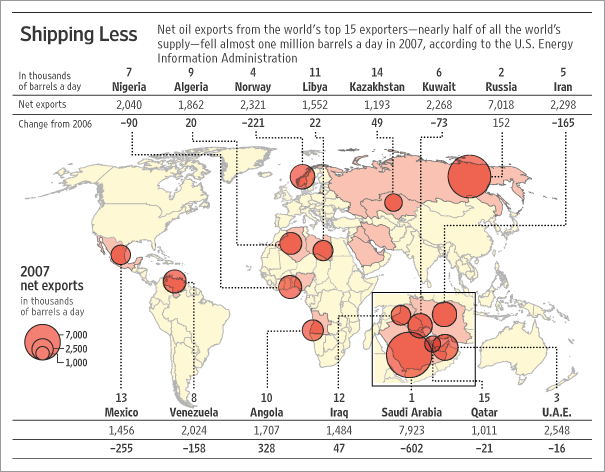
WSJ: Oil Exporters Are Unable to Keep Up with Demand
The world’s top oil producers are proving unable to put more barrels on thirsty world markets despite sky-high prices, a shift that defies traditional market logic and looks set to continue.
Fresh data from the U.S. Department of Energy show the amount of petroleum products shipped by the world’s top oil exporters fell 2.5% last year, despite a 57% increase in prices, a trend that appears to be holding true this year as well.
Mexico's Plan to Open Oil Market May Not Solve Production Woes
Mexico's planned opening to foreign oil companies may come too late to make up for a fall in the country's production.
At current rates of decline, Mexico will become a net oil importer by 2016, and maybe sooner, according to the Energy Ministry.
Are Energy Markets In For Storm-Tossed Season?
As if the energy markets weren't jittery enough: Sunday marks the start of the first hurricane season in the era of $100-plus oil.
Although severe storms rarely hit until July, market experts say the approaching prospect of major summer storms already is contributing to the skyward push of oil and natural-gas prices. Once a hurricane actually begins traveling through the tropics, prices could spike higher as investors begin buying on fears of supply disruptions to oil facilities in the Gulf of Mexico.
U.K. Cuts Taxes on Oil Fields, Opens Areas to Development
The British government, pressed for solutions to soaring fuel prices, said it will exempt about 30 existing North Sea crude-oil and natural-gas fields from some taxes and approved the development of two new North Sea oil fields, which could begin production in early 2009.
But the measures, announced as U.K. Prime Minister Gordon Brown and Chancellor of the Exchequer Alistair Darling met with U.K. oil-industry executives to explore ways to increase oil and gas production, seemed unlikely to significantly alter Britain's fuel-price problems.
Exxon Mobil yesterday fended off a revolt by descendants of company founder John D. Rockefeller Sr. at the firm's annual meeting in Dallas and defeated a shareholder resolution that would have divided the jobs of chairman and chief executive, now both held by Rex W. Tillerson.
If you thought being charged $15 to check your first bag on an airline trip was the final insult: Yesterday, US Airways said it will stop serving free snacks. What's next? Reusable air-sickness bags? Coin-operated toilets?
Earlier this month, Murti, 39, and Currie, 41, raised their forecast for crude oil to $141 a barrel for the second half of this year and reiterated their prediction that oil would have a "super-spike" to $150 to $200 a barrel.
Prices jumped immediately. It was the third increase in Goldman price predictions in five months and the fifth time in four years that the firm's analysts had pushed past what people previously thought possible. Every other time the Goldman team had turned out to be right.
The cost of a gallon of gas gets all the headlines, but the natural gas that will heat many American homes next winter is going up in price as fast or faster.
That fact makes the scene in the languid, alligator-infested marshland here in coastal Louisiana all the more remarkable.
Only a month after Cheniere Energy inaugurated its $1.4 billion liquefied natural gas terminal here, an empty supertanker sat in its berth with no place to go while workers painted empty storage tanks.
$3.99 Pump Ceiling, and Gas Sells by Half-Gallon
For a brief moment on Wednesday morning, the gas pump at Gary Staiano’s Texstar service station in Bellerose, Queens, turned into a time machine. After 11.3 gallons was pumped into a Pontiac Grand Am, the meter read $23, or $2.03 a gallon, a price not seen in more than three years.
Then Mr. Staiano transported his customer back to reality when he doubled the total at the cash register.
Increase in Oil Prices Lifts Energy Sector
Stocks rose for a second day as a rebound in oil prices set off a late-day rally in energy shares, and a better-than-forecast report on durable goods orders lifted industrial companies.
Exxon Mobil, the nation’s largest oil company, led gains in 34 of 36 energy companies in the Standard & Poor’s 500-stock index after oil erased a decline of more than $2 a barrel. Caterpillar and Alcoa helped send the Dow Jones industrial average higher after the government said durable goods orders, excluding transportation, unexpectedly increased in April.
Sapphire Energy turns algae into 'green crude' for fuel
A San Diego company said Wednesday that it could turn algae into oil, producing a green-colored crude yielding ultra-clean versions of gasoline and diesel without the downsides of biofuel production.
The year-old company, called Sapphire Energy, uses algae, sunlight, carbon dioxide and non-potable water to make "green crude" that it contends is chemically equivalent to the light, sweet crude oil that has been fetching more than $130 a barrel in New York futures trading.
Work-at-home programs may be shortest route to fuel relief
Studies show that you only need to take 5% of cars off the road to make a difference," said Sarah Catz, director of UC Irvine's Center for Urban Infrastructure. "I remember the 1984 Olympics. I could just sail down the 405."
These days, it's an Olympic event simply getting to work.
American drivers spent 4.2 billion hours stuck in traffic in 2005, according to a recent report from the Texas Transportation Institute. That's about 38 hours per driver, or nearly an entire workweek.
Incentives provide buzz to energy-efficiency effort
You don't have to be the brightest bulb in the building to know a good deal when it comes along. Commonwealth Edison and Ameren are about to kick off an ambitious energy-conservation program for commercial and industrial consumers of electricity.
A close-to-home vacation may help keep your job
A leisurely vacation in the south of France? Forget about it. It's time to bid adieu to any hope of a two-week trip to the Riviera and say, "Hello, Six Flags."
Such is the wisdom that may be gleaned from a report out today from Challenger, Gray & Christmas Inc., a global outplacement consulting firm.
With gas prices getting close to $4 a gallon and with job insecurity rampant, Americans may want to consider shorter vacations close to home, Challenger, Gray & Christmas said.
State can't wait for producers to build gas line, Palin team says
The state can't afford not to support TransCanada Corp.'s proposal for a natural gas pipeline, Gov. Sarah Palin and her aides said Wednesday.
British Energy hit by second plant closure
The troubled auction of British Energy suffered a fresh blow yesterday after the group admitted that it had been forced to shut down its second nuclear reactor in a little over 24 hours, further eroding confidence in its assets.
The company said last night that one of its two reactors, at Hunterston, Scotland, had been forced to close shortly before 2pm yesterday because of a technical issue.
Take a lead: keep petrol expensive
Yet lurking beneath the tangled bureaucratic language and the nervous justifications for paying another political ransom, it is just possible to discern the outline of a sensible approach.
British Energy 'able to go it alone'
BRITISH Energy has a strong future and can develop new nuclear plants even without a partner, its chief executive said yesterday, as the company fended off questions about bidders.
You think fuel prices are bad? Historically, they're not - and we've graphed it
Yes, fuel prices at the pump are high in absolute terms. Yet when you compare them over time and adjust for inflation, some surprising results emerge.
Using data from the AA, with prices (for four-star fuel) going back to 1903, and mixing in the inflation data (which goes back to 1750, though cars don't), you get the graph below, showing the real price of fuel over the past century.
Tax U-turn to boost North Sea oil
Oil industry leaders are anticipating more North Sea tax relief after the first signs of a Government U-turn. Modest tax changes were announced yesterday as the Prime Minister and Chancellor intervened to try to boost flagging production.
Asian countries begin to burst the oil bubble
One by one, countries across Asia and the Middle East are being forced to abandon price controls on fuel and energy, bringing hundreds of millions of consumers face to face with the true market cost of oil. The effect has already begun to chip away at world demand and may ultimately trigger a slide in crude prices.
The lights may be going out but power cuts provide an ugly vision of Britain's future
Half a million people hit by power cuts on Tuesday may just have had a sneak preview of what the future holds.
Environmentalists yesterday seized on the blackouts as evidence of Britain's over-dependence on a handful of ageing power plants, while electricity producers claimed a series of unfortunate coincidences were to blame.
Public ownership to hydro power secured
The Ministry of Petroleum and Energy has presented a white paper to Parliament (Stortinget) on law amendments, stating that Norway’s hydro power resources will remain in public possession.
Increased popularity of diesel cars pushes up fuel price
The past spring has been an exceptional one on the motor fuel market in Finland. May 2008 was the first time that diesel oil has cost more on the world market than the more refined petrol, or gasoline.
“This is truly remarkable. I don’t remember anything like it”, says Jarmo Nupponen, managing director of the Finnish Oil and Gas Federation.
Usually, with the onset of spring, when the need for heating oil decreases and driving increases, less-refined distillates, including diesel fuel, fall in price and petrol becomes more expensive.
Emergency cars to be switched to helicopters in Moscow
Moscow authorities are considering the plan of small aircrafts penetration in Moscow. Particularly, there was considered a plan of switching emergency cars to small helicopters.
One of the authors of this plan, ecologist Sergey Shvedov, says: ‘There are a lot of traffic jams in Moscow. That’s why emergency cars often don’t have time to take patients to the hospital. The use of small helicopters will solve this problem’.
European Parliament Urged Gazprom to Find Another Route for Nord Stream
European Parliament’s PETI concluded that Nord Stream gas pipeline that Gazprom intends to lay offshore via the Baltic Sea from Russia to Germany would threaten the environment and proposed to consider some other routes for this purpose.
Pioneers show Americans how to live ‘off-grid’
With energy prices going through the roof, an alternative lifestyle powered by solar panels and wind turbines has suddenly become more appealing to some. For architect Todd Bogatay, it has been reality for years.
When he bought this breezy patch of scrub-covered mountaintop with views to Mexico more than two decades ago, he was one of only a few Americans with an interest in wind- and solar-powered homes.
Now, Bogatay is surrounded by 15 neighbors who, like him, live off the electricity grid, with power from solar panels and wind turbines that he either built or helped to install. “People used to be attracted to living off-grid for largely environmental reasons, although that is now changing as energy prices rise,” he said, standing in blazing sunshine with a wind turbine thrashing the air like a weed whacker overhead.
PPP senator to push for cut in OMCs’ margins, taxes on oil
KARACHI: A senior leader of Pakistan People’s Party (PPP) on Wednesday said she is going to push for a cut in margin of oil marketing companies (OMCs) and state taxes when she meets senior government officials in the next few days.
Senator Rukhsana Zuberi told The News that talks would focus on ways to ease petroleum product prices at pumps by slashing avoidable taxes and capping profits of marketing companies.
OCAC wants fuel price burden reduced for poor
ISLAMABAD: The Oil Companies Advisory Committee (OCAC), in a meeting with the Economic Advisory Council (EAC), asked it to reduce high fuel price burden on poor through a holistic approach involving the entire petroleum sector.
Dhaka to seek $2b IDB loan for oil import
DHAKA: Bangladesh will ask the Islamic Development Bank (IDB) to double its annual loan to $2 billion for the next year because of ballooning costs of oil imports, a senior government official said on Wednesday. "We will request the IDB to increase the loan as we are unable to cope with the rocketing oil prices in the international markets," said M. Tamim, responsible for the ministry of power, energy and mineral resources in the interim army-backed government.
IOC posts mega loss, warns of shortages
No more petrol or diesel? We haven’t got there yet, but the nightmare may well come true, if Indian Oil chairman Sarthak Behuria is to be believed.
State-run oil retailers will run out of money to pay for crude imports in the next few months unless the government raises prices of petrol and diesel. On Wednesday, Indian Oil Corporation, the biggest of the firms, warned of fuel shortages countrywide.
Fuel prices may rise next week
New Delhi: The government is expected to take a decision on petrol and diesel prices next week, officials said on Tuesday as state-owned oil marketing companies mounted pressure for a steep hike in retail prices of the auto fuels.
A hike in government-controlled prices of petrol and diesel is “inevitable,” Petroleum Secretary MS Srinivasan said after a meeting with chief executives of oil companies. “The situation is alarming and we want to stem the rot at the beginning.”
Tax Cuts Likely to Benefit Russian Oil Service Companies
Russian oil-field service companies could be among the biggest winners as the government slashes oil-sector taxes in a bid to revive stagnating production, industry participants say.
After annual growth of up to 10% at the start of the decade, Russia - the world's second-largest crude producer - saw output edge up by just 2.2% last year, with oil production down 0.1% year to date as what many deem an excessive tax burden hampers investment in new fields.
Qantas wields hatchet as jet fuel bill jumps by $2b
QANTAS had its credit rating cut by Standard & Poor's yesterday as the airline announced a savage round of cuts in services and jobs to cope with record high oil prices.
The credit and debt ratings on Qantas were cut to negative from stable because surging fuel prices will probably "undermine" the company's earnings and hurt cash flow, Standard & Poor's said.
XTO Energy Deal Highlights Interest in U.S.-Canada Field
XTO Energy Inc. agreed to pay $1.85 billion for drilling rights in an oil-producing area near the U.S.-Canadian border, highlighting the once-obscure field's growing importance. The move also reflects rising confidence by energy companies that oil will stay above $100 a barrel.
The Fort Worth, Texas, oil and natural-gas producer said it will buy rights to 352,000 acres in the Bakken Shale, which stretches across Montana, North Dakota and Saskatchewan, from closely held Headington Oil Co. XTO will pay $1.06 billion in cash and $790 million in stock. The deal is expected to close July 15.
Ranchers Get OK to Graze Animals on Protected Land
The U.S. Agriculture Department Tuesday announced it would help livestock producers struggling with record feed prices by letting growers, nationwide, harvest hay and graze animals on millions of fragile acres set aside in a landmark conservation program.
USDA Secretary Ed Schafer said the initiative could bring up to 24 million acres of land into use. That could provide 18 million tons of feed and forage, worth $1.2 billion. Farmers who participate will still have to protect the most sensitive areas, like wetlands and buffer strips along streambeds. . . .
"(This) will significantly increase the amount of feed available to the livestock industry," Schafer said.
Gas prices may knock a big hole in Georgians' boating
Leisure activities always take a hit during a downturn, and rising gas prices aren't helping.
A sampling taken Saturday of about a dozen marinas on Lake Lanier found regular gas going for $4.39 to $5 per gallon.
Marina managers say their prices are higher than at gas stations on land because their sales are seasonal, and they have to employ dock hands and pay for extra equipment and environmental insurance to protect against spills.
Prices like these guarantee boaters a tab for each fill-up well into triple digits, sometimes topping $1,000.
Russia May Increase Oil Production in 2008 - Natural Resources Official
"We will either post a production gain or stay at the same level as 2007," he said.
Fyodorov rejected the notion that Russian oil production has peaked. "We will have growth until 2020," he said.
Global Demand Squeezing Natural Gas Supply
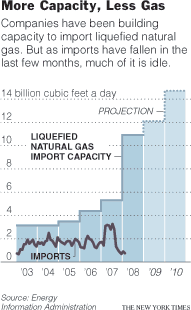
The nearly idle terminal is a monument to a stalled experiment, one that was supposed to import so much L.N.G. from around the world that homes would be heated and factories humming at bargain prices.
But now L.N.G. shipments to the United States are slowing to a trickle, and Cheniere and other companies have dropped plans to build more terminals.
B.C. has 'huge' energy potential, says Encana
VANCOUVER - British Columbia is emerging as a North American energy "powerhouse" thanks to vast untapped natural gas reserves that have exploration companies scrambling for a share of the resource, a senior executive with EnCana said on Wednesday. . .
The most persistent challenge is cost.
Cutbank and Greater Sierra, which encompass the Horn River and Montney areas that have been the focus of fevered bidding in recent months, are expensive to drill and develop compared to conventional gas plays in Alberta and the U.S. lower 48 states.
That means they aren't economic to drill unless gas is priced on North American markets at $9 a gigajoule.
Oilsands: Total Joslyn Mine Delayed on Environmental Hearing, Globe Says
Total SA's Joslyn mine in Canada will be delayed until 2014 because regulatory hearings on its environmental impact will begin later than expected, the Globe & Mail reported, citing the head of the company's local unit.
The project had been planned to come on-stream in 2013, Total's Michael Borrell was quoted as saying. The company will lose a winter of construction, including work such as ditching and drainage, because of the delay to the inquiry, he said, according to the newspaper.
Lukoil, Gazprom Find Oil at Tsentralnaya in Caspian (Update2)
OAO Lukoil, Russia's largest independent crude producer, and state-run OAO Gazprom found a "major'' oil field after drilling the first exploration well at the Tsentralnaya site in the Caspian Sea.
"The well gushed a fountain of low-sulfur oil during field tests,'' Moscow-based Gazprom and Lukoil said today in joint e-mailed statements.
The site, in the Russian part of the Caspian near the border with Kazakhstan, may hold 3.8 billion barrels of oil and 91.7 billion cubic meters of gas, the companies said after setting up a joint venture in 2003. Lukoil at the time said it may cost as much as $12 billion to develop.
Tax Cuts Likely to Benefit Russian Oil Service Companies
Russian oil-field service companies could be among the biggest winners as the government slashes oil-sector taxes in a bid to revive stagnating production, industry participants say.
CIBC World Markets: Will Soaring Transport Costs Reverse Globalization? (PDF)
Globalization is reversible. Higher energy prices are impacting transport costs at an unprecedented rate. So much so, that the cost of moving goods, not the cost of tariffs, is the largest barrier to global trade today. In fact, in tariff-equivalent terms, the explosion in global transport costs has effectively offset all the trade liberalization efforts of the last three decades. Not only does this suggest a major slowdown in the growth of world trade, but also a fundamental realignment in trade patterns. . .
With oil prices now accounting for almost half of total freight costs, it should come as no surprise that soaring oil prices have translated directly into soaring transport costs (Chart 1). Over the last three years, every one dollar rise in world oil prices has fed directly into a 1% rise in transport costs.
Contact
- Content: editors at theoildrum dot com
- Tech support: support at theoildrum dot com
License

This work is licensed under a Creative Commons Attribution-Share Alike 3.0 United States License.
Matt Simmons on CNBC this morning talking about Peak Oil.
Peak Oil Worries
And Merrill Lynch Vice Chairman Tom Petrie basically agreeing with him.
Crude's Wild Run
I really did not like Matt’s reply to the question: “How do we know there are not ten times as much oil out there”, referring to those who write in explaining that we have explored only a tiny fraction of the deep ocean. We know there is no oil in the very deep ocean, off the continental shelf, because it is not sedimentary rock, it is basement basalt. That question always pisses me off because it is so basic, so simple, and no one ever gives the correct answer.
Ron Patterson
I've wondered about the question you raise as well. The deep ocean would not seem to be a place likely to produce oil, yet, we have recently learned that Brazil has found a large reservoir located deep under water. Is the Brazil situation unusual (or unique) or is there more oil still to be found from sites several kilometers below the surface? Are there ocean zones where sedimentary rock has been subducted to great depths and not lost their oil bearing rock in the process?
E. Swanson
No, Brazil is not unique or unusual. The find was still on the continental shelf. The continental shelf is sedimentary rock. All oil is found in sedimentary rock because the nature of oil is sedimentary itself.
I think the word "subducted" is not the right word. Sedimentary rock can never be pushed under the basement rock because basalt is far heavier than granite or other continental rock.
When sedimentary rock is pushed into basement basalt, as is happening right now on the West Coast of the USA, it is the basement basalt that is pushed underneath the continental shelf.
The continental shelf can sink to lower depths but it never subducts. When continental drift pushes continental shelf into another continental shelf, you get mountains.
Ron Patterson
You're right -- this is a point everyone interested in energy should be aware of. I wasn't til now. Thanks!
How big does a chunk of rock have to be before buoyancy dominates. Clearly small bits of crust can get dragged down. But plate motions are from the mid ocean ridges towards the continental margins, so I wouldn't expect any oil oceanward of the trenches. Could enough relatively recent sediment accumulate in the trenches themselves?
Some trenches fill with eroded continental land mass from an adjacent mountain chain and create a subduction melange of sediments.
But if the subduction zone is active, these deposits do go under: so not really.
To get oil you need BASINS. these can form in a variety of ways, typically, the north sea is a failed rift valley that sunk and was subject to rapid burial. This failed rift was probably a first attempt at an Atlantic. (though maybe theories have changed a bit in the last 30 years...)
Oil in Brazil and its opposite numbers in West Africa, formed when the Atlatic Ocean was much younger and South America and Africa were a close fit, separated by a depositional basin.
As this early basin provided all the right ingredients: Organic matter - source rocks, Clastic reservoirs, Clay and mud and salt seals, and rapid burial to cook the kerogens.
Then , the Atlantic continued its split, giving continental crust and oil deposits on both sides of the Atlantic.
BTW: This is why the Canadians look on the Atlantic coast as do the Brits and Irish on the Atlantic Margin.
Just to add on to what MUDLOGGER said, some sediment does subduct in a trench, in fact this is called an accretionary wedge. Don't think of it as chunks though, the aspect ratio on sedimentary rock is more like a piece of paper than a "block". i.e. wide and flat. So typically in continental crust collisions sediments, like sheaves of paper, just crumple and form the Himalyas or get skimmed off like California and glued to the side of a continent (think what it would look like if Japan got stuck onto the side of Asia). But when you have oceanic plate subducting under continental plate, some of the sediment can get pulled under the continental plate alongside the denser oceanic plate.

I wouldn't think of an accretionary wedge as a good place to form oil, too much stuff getting smashed up and moving around. Although, just a cursory glance at google showed me this which seems to indicate that there is at least the possibility of oil deposits in them.
"just crumple and form the Himalyas or get skimmed off like California"
i think i understand what you are saying here, but it is my understanding and belief that the himalayas were created when two continents collided. i dont believe there is any similar collision anywhere on earth.
and i think your california example and hypothetical japan/asia collision represent islands, carried along on an ocean plate, colliding with a continent.
.....and, how can i view that tiny cia print on the document you cite ?
Deffeyes addressed the question of finding oil in the ocean bed beyond the shelves in his '01 book. He describes the necessary conditions for formation of oil, then states:
It would have to be some new-fangled kind of oil to have formed there I guess.
I read a blooomberg article 28 April
http://www.bloomberg.com/apps/news?pid=20601086&sid=aalWn.eJHGZk&refer=l...
"...Pumping oil from the Brazilian finds, parts of which are 32,000 feet (10,000 meters) below the ocean's surface..."
Obviously 32,000 feet is much deeper than "but no deeper than 15000 feet"
So how does that work then?
7500-15000 feet below the dirt surface, whether air or water lies above that.
32K feet of water may change the pressure/temperature map slightly for that deposit, but it is depth below the solid surface that most counts.
Thanks. I realised it would be the depth below the solid surface that mostly counted but thought it was around 7,000 feet deep but carelessly didn't mention that:-( so the water must be deeper then i thought.
To form oil? No, that would not work. The sediment needs to be primarily organic, as in phytoplankton. Then it must be buried deep enough at "coffee pot" temperatures and long enough to form oil. If such a trench, filled with dead organic matter happen to get subducted, the temperatures would be way too high and it would be buried way too deep. But it would not matter because the organic matter would simply decay and form methane gas long before it got a chance to subduct. The methane would either form hydrates or just bubble to the top.
Oil fields form from buried phytoplankton deposits in shallow seas from long periods of intense global warming. It then falls to the bottom of the sea where, because of climate and other conditions, little or no oxygen exist so it does not decay. It then gets buried by other sediment, deeper and deeper, then it eventually becomes oil and gas, seeps up until it is trapped by non porous rock. More to it than that of course but that's enough for here.
Ron Patterson
There was drilling deeper than 15,000 feet that discovered oil in offshore sedimentary basins. Water was less than half the weight of rock and salt was lighter than most rock. Although oil was found deeper than 20,000 feet below surface it have formed before more sediment piled on top and the earth's crust became compressed and lowered with the extra weight burden. The deposition of delta sediments offshore created a huge wedge of sediments that caused a trough in the basement rock as the rock had some elasticity or plasticity. Over millions of years rock layers were folded or bent. These troughs were huge synclines.
As for further offshore in the middle of the sea, there was less sediment and more basaltic basement rock without the thicker accumulations of organic sediments found near shore. It is not likely one will find hydrocarbons beyond the continental shelf areas. The oceanic crust subducted under the coast of Oregon contained sedimentary rocks and as the subducted rock sank towards the mantle these rocks melted and formed various volcanic and intrusive lavas containing more felsic and silica rich melts than the oceanic crust that subducted with the leucocratic sediments.
Choice quotes from Mr. Simmons:
and
Darwinian, I agree with you about the limited prospects for oceanic crust conventional oil deposits. I'm guessing Simmons' answer is because his background isn't a geology one, he's an investment banker. In any case, I can rationalize that the answer is one that an economist could understand because it fits in with the idea that oil is produced rather than extracted. I.e., rate of "production" at some point in the future is proportional to number of current drill-rigs (here we all know that production is not necessarily proportional to number of drill-rigs, see Texas).
Deffeyes pointed out that there is still the chance of finding a field larger than Ghawar; if we were to stumble across such a field by all means it should be given one of the names he suggests - "Imelda" or "Ho Chi Mhin."
Could happen, but a long shot; and it would simply be to the world as Prudhoe Bay was to the US.
Rock stupid people who don't understand the absolutely simple concept of seafloor spreading drive me nuts, too.
Have you seen this?
We only explored a fraction of all sedimentary basins in the world. This does not mean there is a lot of oil, but it does leave a big question mark. Many of the basins are either off limits due to political reasons or do not show evidence of large oil/gas.
The Brazilian find does mean we need to go back to explored sedimentary basins to look for oil under the salt layer. This does open new areas. This will not resolve peak oil as peak oil is about production. We do not have the resources to discover and produce oil at higher and higher rates.
Los Angeles' carbon footprint is a light one -- sort of
The full story is not quite so clear-cut, but still interesting. As I have maintained in the past, a modern life in Southern California can be led with very little energy usage at all. As long as you live somewhere you can walk/bike/use public transit, and well-insulated, you hardly need AC or heat at all.
Good luck with the water.
Natural gas prices in Alberta to almost double.
http://www.canada.com/edmontonjournal/news/story.html?id=9612f7b7-82ab-4...
Will this shake us out of our complacency? Maybe. Maybe not. Let's see if the "S" word (supply) is mentioned in the next week or so.
Anyone know what % of tar sand oil production cost is due to NG though?
That's the wrong question.
What % of TS production could be done w/o NG?
A lot of NG is currently used to supply heat for the initial extraction and separation processes. AFIK, this can be replaced by other heat sources such as nuclear, coal, coke or possibly geothermal. On the refining/upgrading side, I believe that NG is required as a primary source of hydrogen to produce synthetic crude.
FWIW, in the longer term I don't see NG or water as being limiting factors to oil sands production. Short/medium limits are the supply of skilled labor and long term limits will be the environmental impact.
Most MSM "analysis" is simply a linear extrapolation of 40-year-old technology.
I'm not sure if this is what you're asking, but JHK (I think) mentioned that 20% of Canada's entire NG output goes to the tar sands.
Oil sands consumed 1.13Bcf in 2007 to produce 1.4Mb/d, making the average consumption 800cf/bbl. At $12/Mbtu (about 1000cf), that puts the natural gas cost at $9.50/bbl.
So it's probably a major portion of operating costs, but capital financing probably dominates overall economics. (Before someone asks, 800cf of natural gas has 14% the energy of a barrel of oil.)
Interesting numbers. Thanks, Pitt. That makes natural gas a non-trivial component of the price but not the dominant component (yet).
According to the same source total Canadian NG production is 16.8 Bcf/d, to tar sands are diverting about 7% of Canada's natural gas. Not an insignificant amount on all accounts.
Re: WSJ article, linked uptop
My estimate for 2007 Saudi net oil exports was about 7.8 mbpd. According to Neil King (with the WSJ), the EIA shows 7.9, with production of 10.2 mbpd and consumption of 2.3 mbpd (all total liquids). Relative to the original EIA consumption number, this was 10% higher, but the EIA has revised 2006 consumption upward, so the rate of increase was about +7%/year, but they are showing an accelerating rate of increase in consumption. The five year rate of increase is about +6%/year, which would cause their consumption to double in about 12 years.
The Saudis have shown, through 2007, a net export decline of 1.2 mbpd, from their 2005 peak. Although they have recently shown a rebound in production, IMO there is almost no chance that their 2008 production will exceed their 2005 rate, while their consumption increases at a rapid clip. We shall see what happens in 2009, but our model, and recent case histories, show that net export decline rates tend to accelerate with time.
westexas - Congratulations for being mentioned in the WSJ article on export declines!! But, what is with the "westexas" logo? I was surprised that they said you were in Dallas, which is east texas. I have worked in both Dallas and Amarillo (west texas) and there is a vast difference between the two.
This is an extremely important article. That declining exports graph deserves to go into a permanent archive on the history of the peak oil debate. It's a turning point people should remember when we look back ten years from now. Congrats Westtexas on your contribution to the piece.
Good job, WT. I thought the writers did a pretty good job explaining your Export Land Model.
Now about that Times piece about old meters:
Is it just me, or does $9.99 seem awfully short sighted? These guys are just going to have to replace their pump meters again in 18 months or so if they limit themselves to single digit meters, I think.
If a tree falls in the woods...
So, last night (I'm in Korea) I'm all jacked that the ELM made it into a major, major publication. A publication with few detractors. A publication to be taken seriously. Here I am thinking, "This will put this issue on the map! There should be some interesting reaction coming!" And there was...
Oil fell hard. We are told today that GDP is going UP! I'm telling you, life is a bed of roses with no thorns, a bowl of cherries with no pits and a heaven full of horny virgins (male or female, according to your proclivities and religious bent)!!!
For chrissake...
Cheers
One might suspect that I am not originally from Dallas.
Dear WT, is this WSJ article the one you referred to yesterday as "a major MSM article about exports"? The one about which you were not allowed to talk yet? Or is something else about to be published these days about exports in MSM? This topic is definitely gaining momentum, in spite of all the headache it creates for economists ("opportunity costs", "free market", ..., it seems to violate many of the economists' axioms ...)
Re: Puntaldia
I suspect that Neil will be doing more followup articles, but this is the one that I was referencing (without naming the paper).
THANKS for all you do.
Pete
If people would like to track net exports on an annual basis, you don't have to restrict yourself to the top 5, top 15 etc. You can track everything.
In 2006, there were 42 net exporters. May have missed a couple of small ones.
They can be looked up individually here:
http://tonto.eia.doe.gov/country/index.cfm
(2007 data isn't available yet on this page)
1 Saudi Arabia
2 Russia
3 UAE
4 Norway
5 Iran
6 Kuwait
7 Venezuela
8 Nigeria
9 Algeria
10 Mexico
11 Libya
12 Iraq
13 Angola
14 Kazakhstan
15 Qatar
16 Canada
17 Oman
18 Azerbeijan
19 Equatorial Guinea
20 Ecuador
21 Argentina
22 Sudan
23 Columbia
24 Yemen
25 Congo
26 Malaysia
27 Gabon
28 Brunei
29 Syria
30 Trinidad & Tobago
31 Chad
32 Denmark
33 Vietnam
34 Turkmenistan
35 Cote d'Ivoire
36 Cameroon
37 Papua New Guinea
38 Bahrain
39 Egypt
40 Mauritania
41 Congo (east)
42 Bolivia
In addition these countries are of interest for having been net exporters in the past or, in the case of Brazil, likely to become one in the future.
1 United Kingdom
2 Indonesia
3 China
4 Australia
5 Tunisia
6 Brazil
7 Burma
8 Suriname
Have I missed any?
Yes, you missed the United States of America
Thanks.
Are there any that have been net exporters since 1980?
The EIA has net export data from that year.
For comparison the net coal exporters. also from EIA.
1 Australia
2 Indonesia
3 South Africa
4 Colombia
5 Russia
6 China
7 Poland
8 United States
9 Kazakhstan
10 Vietnam
11 Venezuela
12 Canada
13 New Zealand
14 Czech Republic
15 Burma
16 Mongolia
The top 5 account for 79% of net coal exports,
the top 10 for 97%
Neil King obtained the annual 2007 data for the top 15 which I forwarded on to Khebab for an update on net oil exports.
If my math is correct, the EIA data for the top five and the annual rate of change are as follows:
2005: 23.9 mbpd
2006: 23.1 mbpd (-3.4%/year)
2007: 22.0 mbpd (-4.9%/year)
This is of course what Khebab and I have been warning about--an accelerating net export decline rate.
These declines tend to be linear, similar volumetric annual declines. If we take the collective average initial decline for the top five, it's 950,000 bpd per year, 23.9 mbpd divided by 0.95 mbpd = 25 years of remaining exports, from 2005, which would be 2030. Our middle case for the top five approaching zero net oil exports is 2031.
This is why it's so useful for the U.S. to remain in Iraq and maintain a permanent low level civil war/insurrection there that will prevent Iraqis from improving their standard of living and consuming all their own oil.
Useful to whom?
Not so useful if you're an Iraqi. Whose oil is it, anyway?
But maybe your comment was just snark...
Useful to USA of course. We dont just do random even if we have a "chimpy" in charge. Everything is calculated and exact motives may never be known.
Everything is calculated and exact motives may never be known.
Ahhh, but were the results the same as the original calculations claimed the results would be?
But why restrict yourself to the top 5 or top 15?
We can count everything.
Don't have all the data for 2007 yet, of course, but for 2005 and 2006 (if my math is correct):
2005
Top 5: 23.7
Total World: 46.3
2006
Top 5: 23.0
Total World: 45.7
Can't wait to see the complete 2007 data. But from 2006 it looks like the top 5 net exporters declined at a much faster pace than the whole world did.
Big difference between counting and modeling future production. "We" (actually Khebab did 90% or more of the work) attempted to model future production, consumption and net oil exports by the top five, accounting for about half of total net oil exports in 2005.
Well, if 2006 is any indication, the model will be off considerably. (modeled decline is 3X greater than world decline)
As mentioned downthread, because of the fall of US$ in 2007, for much of the world the price of oil fell on an average annual basis. (The dollar, of course, also fell in value due to inflation)
So, why is the WSJ so surprised that net exports fell?
(But of course, there had been a price runnup over the previous years, but it stalled in 2007 from a world perspective)
Because net exports have to rise if global demand rises (at least demand outside the exporting countries). Like Alice, they have to keep running just to stay in the same place. Not only did they not stay in the same place, not only did they fail to keep up with growth in demand, they actually fell in abolute terms. I'm guessing you won't find very many years that has ever happened in, regardless of the price of oil.
Actually, it's happened twice since the fall of the Soviet Union.
See downthread....
http://www.theoildrum.com/node/4066#comment-352141
As I said, you won't find many.
Even accepting for the moment your calculation of the "real" cost of oil, this time is clearly different. In the past, export declines always lagged price declines. That is what one would expect from classic commodity cyclical patterns. This time exports peaked and rolled over into decline, even as the price was still rising. That is definitely not the way one expects commodities to behave, and is strong evidence that something different is going on this time.
However, I think your "real" price decline is mainly an artifact of your choosing to choose annual averages rather than instantaneous prices throughout the interval, something that could be easily graphed. I think it is also curious that you left off all of 2007, waiting for "final" numbers. We have almost all the numbers for 2007. In fact, we have reasonable numbers for first part of 2008. There's no reason I can think of to leave them off, unless it could be that they don't show what you want them to show.
Then think harder.
As he said at the beginning, he's using EIA data, and the EIA hasn't released 2007 net export numbers for several key producers, such as Russia.
That someone presents data that doesn't agree with your views doesn't mean they're being misleading.
That would of course be true if we were modeling world net oil exports. Perhaps the title of our article was too subtle?
A quantitative assessment of future net oil exports by the top five net oil exporters
http://www.energybulletin.net/38948.html
From said article:
In any case, my guess is that total net world oil exports in 2031 will be at 25% or less of the 2005 level.
But don't you or Khebab say somewhere that world net exports will decline faster than the top 5?
I believe that you've written that world net exports go to zero in 9 years. That's definitely faster than the time to approach zero for the top 5 which you give as 2031.
The data for 2006 suggests that, on the contrary, the top 5 are shrinking faster than total world net exports. Will have to wait for the full 2007 data set to make confirmation.
Yeah, that was the article where Khebab said he was a space alien, and my comment about world net oil exports going to zero in 9 years was the article where I admitted that I am actually Dick Cheney, in a secure undisclosed location.
Whatever you are smoking, it is some really good stuff. I suggest that you take a break from net export analysis and light up another one.
Actually net exports is a lot of fun and quite interesting!
But here is your article about net exports going to zero in 9 years. (From July of last year)
http://www.theoildrum.com/node/2767
Seemed like a serious article to me.
I honestly don't know of anywhere to discuss net exports except on The Oil Drum.
I realize that it is easy for some people to confuse a simple mathematical model, the Export Land Model (ELM), with total world net oil exports, and that appears to be the situation in your case.
So, for the benefit of other readers who are confusing the ELM with world net oil exports, the ELM is not a model for the world.
Hint: there is a "slight" difference between the production rate used in the model, 2 mbpd, and total liquids production by all net oil exporters, but I digress, on to more important matters.
We have learned, from the Drudge Report, that Khebab will be appearing in a video:
OK, now I'm truly confused.
What is ELM a model for?
If I've missed something elementary sorry to waste your time. But, believe me, I'm quite puzzled.
Okay, could you tell me what part of the following emphasis added excerpt from the article that you linked is confusing to you?
I used the ELM show to show how declining production and rising consumption interacted to product an accelerating net export decline rate.
The three key variables that determine how much oil will be exported once an exporting country peaks are: (1) Consumption as a percentage of production at final peak; (2) The rate of change in production; (3) The rate of change in consumption.
The reason that we then modeled the top five net oil exporters is that it is somewhat easier than modeling dozens of net oil exporters, and the decline in net exports from the top five will determine the fate of the world economy and will be the major contributor to the overall net export decline.
Thanks. I stand corrected.
I mistakenly thought the ELM was being used as a model for world net exports.
"Perhaps the title of our article was too subtle?"
subtle, like a 2 X 4 whack agross the head.
False statement and it has been proven by analysis by other posters here at TOD in the recent past. Oil prices have increased in every major currency, though they have increased more in dollars than any other currency.
If you have data to the contrary, please demonstrate it. Otherwise stop making unsubstantiated assertions that do not match data that has already been presented here.
For the data (downthread):
http://www.theoildrum.com/node/4066#comment-352159
You merry peak oil pranksters. Don't you know the US didn't really peak?
I can remember when the decision to develop ANWR or not was initially being made, there were some environmentalists who were concerned that maybe perhaps they should have let them drill in ANWR. The reason being: if they had let them drill then, they would have done it in at least a nominally environmentally friendly way. Okay, there is no such thing as environmentally friendly resource extraction, but let's say less damaging. If they stopped the drilling in ANWR then, they might only be putting off the day that drilling in ANWR occurred until a later date when the U.S. was having a shortage of oil. When that later day came, it might be that circumstances were such that any possible concessions that the environmentalists could have gotten in the past were not possible to get any more, because people would be so desperate for the oil and would drill at any cost.
Well, we all know how the decision came out, but it seems like the conservatives are gearing up for that next battle over ANWR, the desperate one. I personally would have accepted drilling in ANWR, so long as it was coupled to real environmental concessions such as increased fuel economy or funding for public transit that would reduce our total consumption.
I think negotiating a drilling versus conservation trade would be a constructive way to go about now. We may need a little fuel for the hard times during our transition, and it would be most useful to extract that oil while the pipeline is still operable.
Mark Folsom
I have proposed dedicating 100% of ANWR lease revenue to Urban Rail (and improving and electrifying the Alaskan Railroad for the locals).
Alan
Or how about using the funding to sponsor free sterilization by the government for anybody and everybody who wants it! Let's hit the root of the problem here..
How about both! As a bonus, if you scan your 'Proof of Sterilisation' Card you ride the system for free. :)
Now that the SPR is not being filled, presumably the government will be getting revenue instead of oil from its leases. How about adding that money to rail projects? $130 price of oil times 100,000bpd = $13,000,000.00 per day, that would pay for a lot of rail electrification.
As the SPR is presumably an insurance against oil import disruption this would further that goal in another way, by reducing potential future oil imports, this would be a rational diversion for the money.
More like 35,000 barrels per day average over the last 12 months, so about 1/3rd of that...
Actually it has been roughly 70,000 barrels of oil a day of late see i.e. Bush signs law halting oil shipments to reserve Mon May 19, 2008
However the system is set up for 100,000 bpd that is why I used that number.
See Energy Security Act(P.L. 96-294). The energy security act established a minimum fill rate of 100,000 barrels per day(b/d). As there is an authorized (required) 100,000 bpd amount that is not being acquired, 100000bpd times the price of oil per barrel (approx $130 US) that could/should be used to fund rail.
"drilling versus conservation trade would be a constructive way to go about now."
i agree with you and have held this position for a long time. drilling anwar to fuel the gas guzzling pleasure barge suv rat race to nowhere just doesn't make sense.( except possibly to the dittoheads)
As Gomer Pyle would have said, "Surprahse, surprahse, surprahse!"
This part of WSJ net exports article is misleading:
What matters for net exports is not the highest price reached that year but the average price.
Average Nymex Front Month Crude Oil:
2006 66.25
2007 72.41
http://tonto.eia.doe.gov/dnav/pet/hist/rclc1a.htm
So, the increase in price is only 9%!
(adjusted for inflation it's more like 5%)
The WSJ used the 57% figure for purposes of drama.
In addition, the US$ in which oil is priced declined substantially in 2007. For much of the world, oil prices fell on an average annual basis.
Why are they so surpised net exports fell? Isn't the WSJ aware of the fall of the dollar? :-)
Here is the dollar it is for 2006,2007....
A decline of 14% of so. That has to have some effect on supplier decisions.
False statement!
Here's the actual data versus other currencies.
Oil Prices around the World: Do Exchange Rates Matter?
Pointing to a decline in the US dollar without correlating it to the increase in oil price is a deliberate act of deception. Note that dollar value fell by just over 10% but oil prices increased by 100%. Obviously part of that increase is due to the dollar's fall but just as obviously a major part of it is not.
I'm talking annual averages for oil prices. That's what matters for suppliers.
By that measure oil prices (after inflation) barely rose in the US from 2006 to 2007.
De Sousa's graphs support my point. (if you mentally estimate annual average price)
The average annual price of oil from 2006 to 2007 did not rise for many of those currencies. (Euro for instance)
We also need to correct for inflation in the foreign currency.
But I will do the math for the Euro to make the point.
For 2006 (The columns are Date, WTI Monthly, Euro exchange average for the month, and then conversion in Euros)
Jan-2006 65.54 1.2126 54.0492
Feb-2006 61.93 1.1940 51.8677
Mar-2006 62.97 1.2028 52.3528
Apr-2006 70.16 1.2273 57.1661
May-2006 70.96 1.2767 55.5808
Jun-2006 70.97 1.2661 56.0540
Jul-2006 74.46 1.2681 58.7178
Aug-2006 73.08 1.2810 57.0492
Sep-2006 63.9 1.2722 50.2280
Oct-2006 59.14 1.2617 46.8733
Nov-2006 59.4 1.2888 46.0894
Dec-2006 62.09 1.3205 47.0201
Average WTI price in Euros: 52.7540
2007
Feb-2007 59.39 1.3080 45.4052
Mar-2007 60.74 1.3246 45.8554
Apr-2007 64.04 1.3513 47.3914
May-2007 63.53 1.3518 46.9966
Jun-2007 67.53 1.3421 50.3167
Jul-2007 74.15 1.3726 54.0216
Aug-2007 72.36 1.3626 53.1044
Sep-2007 79.63 1.3910 57.2466
Oct-2007 85.66 1.4233 60.1841
Nov-2007 94.63 1.4683 64.4487
Dec-2007 91.74 1.4559 63.0126
Average WTI price in Euros:52.4844
And don't forget, Germany for instance, had 2.4 % inflation in 2007. So oil was cheaper in euros in both nominal (slightly) and real terms
Source for Nymex average monthly prices:
http://tonto.eia.doe.gov/dnav/pet/pet_pri_fut_s1_m.htm
Source for monthly exchange rates:
http://research.stlouisfed.org/fred2/series/EXUSEU/downloaddata?cid=280
Oh, you're cherry picking your data then making sweeping broad brush statements.
Ok, I understand your "methodology" now.
Suppliers do NOT care about "annual" prices. They deal with price changes daily and weekly as they sell oil to middlemen like refiners who also deal with those prices daily and weekly. Likewise for the consumer.
Your comments are deliberately manufactured propaganda.
Cherry picking?
And the euro is used by how many people?
Annual oil prices also fell in British Pound, Canadian Dollar, Swedish Krona, Australian Dollar, New Zealand Dollar, Norwegian Krona, Russian Ruble....(just from looking at De Souza's graphs)
Do I really have to do all that math for you here?
Actually, oil producers look at longer time frames than annual average prices. They look at decade prices also. The industry is known for very long time horizons.
PS: I'd add Real to that list. The ruble is a bit iffy. But they have high inflation in Russia, which might make the real price lower in the end.
yes, cherry picking
why are you leaving out 2007? this is when the real run-up in price took hold - waiting for final numbers? please - why don't you go ahead and use some preliminary numbers and get back to us - oh, and for giggles, why not throw in some preliminary 2008 numbers - we know the prices numbers are correct, and most corrections for volume are downward anyway - so yours will be some nice rosy projections and we can see if your point is proven
so yeah, do the math for us
There are no preliminary numbers for world net exports 2007.
(Just numbers for the top producers).
My projection is that world net exports will shrink significantly more slowly than top 5 net exports.
AF - While there is a lot of trading on daily and weekly basis, most exchanges, done by refiners (and producers) with location/market differentials imbedded in contracts, that do actually use monthly figures. That, however, misses what I took from your chart. The nominal cost of oil in Euro's is virtually unchanged. I have looked at the number on a few days, but not over time, and I do appreciate your charting this. If someone wanting to nitpick your work was so inclined, they could do the same thing themselves on a daily basis. It would be tougher, but probably on an hourly basis as well, if they were inclined to do the work.
Hey GreyZone - I suggest that we not be so harsh on AnalyzeFirst [propaganda]. I think that different perspectives are useful and he/she does know how to find and analyze data. Anytime data is analyzed, there are criticisms of the methodology. So, I look forward to other discussions about the future using different methodologies. I do not think that it is possible to be dogmatic when we are trying to figure out the future.
Consumers pay current prices. They don't average their prices in their heads. Yearly averages are intersting only to analysts, not consumers. Newspapers are not printed for analysts.
Tweeting Jeffrey Brown. Well done, Jeffrey!
https://twitter.com/gregormacdonald/statuses/822478312
Gregor
well done sir!
and don't forget folks, TOD also has its RSS feed on twitter:
http://twitter.com/theoildrum
It will ping you each time a new TOD article comes out--and then you can forward it to your followers.
So, tell your followers to follow @TheOilDrum !
(Just like right now, I am going to "follow" gregor so I see his updates...and he will likely do the same in turn. Etc., etc.)
Is this the article that was rumored yesterday's DB ;-) .
we can neither confirm nor deny that rumour, but um, yes.
Here is a graph of World Net Exports to 2006, all countries. (Don't have world data for 2007 yet). Average annual real price of oil is also plotted.
Not to minimize the importance of the current net exports decline, but there have been substantial declines in recent history, namely after the "Asian Flu" financial crisis of 1997 (-2.3%) and after the Tech Bust recession in the US (-4%).
What's different about the recent decline is that oil prices were quite high in 2007 and economic growth was robust worldwide. Though, as noted upthread, from a world perspective, the annual average price of oil was a little lower in 2007 than 2006 for many (most?) people in the developed world. That could expected to have some effect on supplier decisions (eg. Saudi Arabia).
OPEC was the worlds swing producer until 2004 or so. They took oil off the market when prices fell, and put it back when prices rose. OPEC tried to keep prices in a narrow band. Prices are now 3x 4x (or 2x 3x by your chart) higher than the OPEC band.
Are you claiming that prices are not high enough to bring oil onto the market? Why not? Why did oil production increase over most of the last decade at prices half or less as high?
What are you hoping to prove?
Even poor quality resources like Bakken are economic at these prices. If supply existed, it would be on the market.
Prices fell steeply in 2006 and then rose throughout 2007 to make records. So, in addition to average annual oil price not rising much (or even falling) suppliers have faced a very uncertain market.
I'll wait for the full net export data set (2007) before making specific conclusions and projections.
But I would predict that net exports for world as a whole (2007) will fall at a substantially lower rate than for the top 5.
The lead times are HUGE with many projects. That will take time.
Regarding OPEC.....I suspect they figured out that they can charge high prices without the world economy shrinking. So they have. OPEC isn't a machine. They see the world change and they adjust too.
Regarding total world net oil exports, I anticipate that they showed an accelerating annual decline rate in 2007, just like the top five (although the total decline rate will probably be below the top five rate), but as I said up the thread, it's not a good idea to pin your hopes on smaller fields and smaller exporters saving the world economy.
Does this mean you are revising your prediction about net exports going to zero in 9 years? Your prediction was that the top 5 approach zero more than 20 years from now.
Net Exports and the Iron Triangle
http://www.theoildrum.com/node/2767
Can you please go to
http://en.wikipedia.org/wiki/Export_Land_Model
And Learn about the Export Land Model
See my comments up the thread.
Despite an apparently clear statement that the ELM is a model for a hypothetical exporting country, our friend persists in inventing the assertion that it is a model for total world net oil exports.
Here is more of the excerpted article:
Are you really this dense?
I smell a troll, Hrothgar style, no less.
This guy must have been bad. WT once accused me of being a clone of Hothgar. It sounded cool and futuristic so I didn't argue.
“I smell a troll, Hrothgar style, no less.” Posted by GreyZone
I have been reading and posting on the Oil Drum for going on three years and Hrothgar was gone by then. He must have been a baaaad Troll, because every few months I see occasional dark references to the name “Hrothgar”, seemingly in muted voice and with a nervous glance over the shoulder.
I suppose any site has its share of Trolls, but it doesn’t seem too bad here. Other than one or two annoying waterboys for the Ethanol industry and a couple of “free-market” shills this hasn’t been a problem on the Oil Drum.
But Hrothgar…….Even the name conjures up images of a Tolkienian Orc-Lord wreaking havoc and destruction on the countryside. What was this guy’s MO anyway, that people should still be referencing him over three years after he has gone? Inquiring minds would love to know!
Antoinetta III
First, I think it was "Hothgar", which Oilrig medic thought might be a misspelling of Hrothgar (from Beowulf). Hothgar was posting in late 2006, so you must have simply missed all the "fun." See here.
This was back in the good ol' days when TOD had an AlphaMaleProphetOfDoom and an odograph. ;o)
-best,
Wolf in YVR BC
Hrothgar was the first troll banned from TOD, and we lost Dave Cohen in the dispute . {shiver}
Hard to describe. Intelligent, obtuse, immune to logic, ...
Alan
He wasn't the first. Nor the last.
"I smell a troll, Hrothgar style, no less"
Yeah, just who is this Analyze First, anyway. I been comin' round here for a while now, and I never heard of him before. Suddenly he's all over todays Drumbeat and down on Westexas.
SubKommander Dred
Did you actually read Jeffrey's article that your link points to? It is clear that the results you quote are for the hypothetical country being modeled by his Export Land Model. The section immediately above your quote is:
Perhaps a handle change from AnaylzeFirst to ReadFirst would be appropriate.
Nice one WT. I saw this article referenced on CNN this morning. I like how the writer lays out a very doom and gloom scenario on the state of exports, and then finishes with...
Nothing to see hear, keep moving.
No complaints from me. The lead writer, Neil King, is in the 99th percentile of Peak Oil aware journalists as far as I am concerned. It's easy for those of us not in the biz to be critical of journalists (I am among the most guilty of course, with my "Iron Triangle" theory), but it is very tough to buck the conventional wisdom.
I suspect that Neil will probably be doing more in depth net export articles in the future.
Kudos to Mr. King for writing this story. I get frustrated by a lot of what I see in the media. I've read dozens of books in the last three years on energy, ecology, global warming, food production etc. I've also watched many documentaries on similar subject and I see a familiar pattern. An author will lay out a devastating case for (take your pick) , fossil fuel depletion, loss of biodiversity, dangers of GMO's, overshoot etc, but then the final chapter or scene says, "Don't worry. Humans are smart. We'll figure a way out." I think this kind of downplaying allows people to discount the need for action.
Optimism is good, until it prevents you recognizing that the light at the end of the tunnel is a speeding train.
It's weird the way there are hundreds of newspapers and media outlets, and only a couple of acceptable 'storylines', so that the apparent choice in the media is in fact confined within conventional tramways of discussion.
Can nuclear energy solve the UK's energy problems?
http://news.bbc.co.uk/
See 'Newsnight' video at the link.
The two party energy spokesmen are united - neither has much of a clue, or any sense of urgency! :-)
It's a Bus. It's a Train. It's Both!
http://blog.wired.com/cars/2008/05/half-bus-half-t.html
It will be interesting to get Alan's comments.
On the face of it it would seem to give the opportunity to greatly reduce feed-in costs for light rail systems - in the lighter travelled areas you don't have to install lines, but once the vehicles reach the main spine then you switch to rail.
For areas like my city, Bristol, I would have thought them a great idea.
In the congested areas in the city centre then you use dedicated track, but can build the network rapidly and feed in large amounts of traffic from the suburbs.
If we are to have any "salvation" it will be via out of the box thinking such as this! :)
MAJOR safety issues. Think head-on collision at speed with a locomotive (or even a Light Rail vehicle).
Due to grandfathering, RR employees can and do use cars and pick-up trucks with rail wheels (I have seen several different RR pick-ups on streets of New Orleans with steel wheels lifted up. Perhaps they were scouting for a new rail route down Bourbon Street :-).
*IF* these converted mini-buses were the ONLY vehicles on the tracks at certain times of the day (1+ hour separation before other rolling stock is allowed on), it might pass muster. Rail safety standards are MUCH stricter than rubber tire standards.
Norfolk Southern ran (unsure if they still do), trains with semi-trailers with auxiliary steel wheels. Fine in normal operation, but their unique couplers and weak structures made any breakdown very problematic. Once that specialty train shut down a main line for almost 24 hours (per verbal story).
The Japanese LOVE gadgetbahn and will try anything. I suspect that a transfer (minibuses and full size buses come to a station and transfer pax) is the way to go, but there are always specialty applications.
Best Hopes for Japanese Experiments,
Alan
I'm not sure that safety issues would bother TPTB much here if they decided they fancied it.
They would just declare themselves world leaders in safety, find a barrister to act as a poodle and declare it safe, and take it away.
Think 'Nimrod'
Ah yes, the handmade (no two alike) RAF submarine surveillance a/c that they decided to rebuild and life extend.
The USN went with modified 737s.
Alan
Actually the USN uses the modified Lockheed Electra turboprops (the P-3 Orions). The 737-based P-8 Poseidons will start coming on line in 2012 or 2013.
The Nimrod was a quirky bird, but did the job fairly well. I made a number of flights with RAF Nimrod crews out of Kinloss back in the late 70's to compare some of their techniques and procedures with those used by P-3 crews.
Excellent search radar, though considerably heavier than that in the P-3. Theirs had been mentioned for consideration for the updated P-3 that was being planned then. Would have added so much weight to the nose of the P-3 that we would have had to add compensatory weight to the aft end to maintain center of gravity within design limits. We decided we preferred the fuel we would have had to give up. Mixture of old and new in the Nimrods. The two I flew in even had fuses on some (all?) of their electrical bus and load panels. Weird. Not sure if all Nimrods had fuses.
Alan:
Leaving to one side this particular item, if a freight rail line were to be used for commuter rail as well, what would be the minimum requirements wrt rolling stock? Must it be purpose built, or is there some sort of conversion of something else that is within the realm of possibility?
With the way finances are going, that is the sort of question I was wondering about myself.
Proper railway rolling stock is expensive, so this might be a quick and dirty fix if petrol goes through the roof so that the vast majority of people would need to use public transport in the UK.
Density of population is mostly not a huge problem, but financing a railways would be.
The major standard (USA FRA regs) is that commuter rail cars must be able to withstand 800,000 lb of crushing force without significant deformation. I am not an expert on details (I know people that are).
It is hard to conceive of anything that could be adapted to this standard that would be cheaper than purpose built.
This FRA reg is designed to make pax cars survive a derailment accident/ collision with a freight train.
A VERY few times, FRA has given a temporal separation exception. Clear the last freight train off the tracks, wait an hour, then run non-FRA light rail, etc. Then clear those light duty cars off, wait an hour, then run freight trains.
Philly is retiring some (120 ?) very good 42 year old EMUs (self propelled electric rail cars). Refurbing them would be your best low cost option. Buy for scrap prices, and refurb.
At first, remove motors, etc. and just have a diesel loco haul them.
Hope that helps,
Alan
The critical point seems to be whether the light rail uses some of the same track as heavy rail.
Should that not be the case I don't understand why standards for crushing should need to differ from the road equivalent.
Rails align two, say, light rail cars for a perfect "head on" collision. Most road crashes are at least a few degrees off "head-on". And the cars "bounce" more in a collision. Rail wheels tend to keep them focused for a few milliseconds.
And there is just a long tradition of rail being safer, reflected in regulations.
Alan
I would have thought one of the chief problems with designing a road vehicle to cope with collisions is that you don't know what angle you will be hit from.
I appreciate your point about focussing, but just the same would have thought that knowing where 99% of your collisions were going to hit would enable easy beefing up at that point.
The FRA buff strength requirements are the main thing that makes rail transportation less economic in the United States than in Europe. They do this because they require U.S. equipment to be much, much heavier than equivalent European equipment and therefore much more expensive and lower performing. It also makes true high speed rail in the U.S. nearly impossible. There are a few operations in the U.S. that have managed to convince the FRA to let them use temporal separation. The newest is the Sprinter which just opened in San Diego and uses German DMUs. Caltrain, the commuter rail operation between San Francisco and San Jose is considering moving to non-FRA compliant equipment when they electrify because such equipment is much cheaper and performs better.
Hi Alan,
It sounds to me like another case of poor risk understanding, i.e. beef up the regulations until they are completely "over the top". On the rare occasions there is a rail crash there are calls to make it safer yet nothing much is heard about car crashes that kill many times more people every day.
Best hopes for more rails
Yes, it would seem to me that preventing crashes from happening in the first place would be considerably preferable - and maybe cheaper - than trying to make the crashes preventable. If I were in a passenger rail crash, I'd be happy to survive to tell about it - but I'd be happier still to never have been in a crash.
I can channel Alan from his earlier comments: "a better intermodal connection method is to open the doors of the bus and the train car and say 'this way, please.'"
Ah, YES !!
I remember.
Far less parasitic weight and complexity.
Best Hopes for OTHER people NOT remembering what you wrote better than you do,
Alan
Large Methane Release Could Cause Abrupt Climate Change As Happened 635 Million Years Ago
http://www.sciencedaily.com/releases/2008/05/080528140255.htm
John Barnes wrote a science fiction novel 14 years ago of which this was the premise. Mother of Storms.
The piled high and deep at UC Riverside finally figured that out?
Had they investigated the Tunguska Event, a large earth fart in a remote region of Siberia which released a huge quantity of methane and the air burst explosion of said methane, they would have had the answer long ago.
Geesh...
River: I don't understand any of your comment.
Since when was the Tunguska Event methane and not an asteroid?
NR
EIA inventory report is out very early today. It is a bombshell.
Hey they posted it early by accident. The report suddenly disappeared. I just got in at the right time.
Ron Patterson
Ha...let's see what the figures are when it comes out at the correct time. Wouldn't that be funny if it's completely changed?
I just wrote the same comment (but deleted it) because I know Ron loves conspiracy theories-we must think alike.
Well I'm sure a non-conspiritorial reason exists. If it does change, I'll look forward to hearing it.
Whe it comes out again ;-) make sure it isn't changed to be less of a bombshell.
Can't trust almost no one these days.
Edit: Too many of us thinkign alike. But since no on else has the earlirr release could Ron be the conspiracy :-) JK of course.
Pete
I saw that too. At ~10:10 I went to their site to get in the queue and the actual file popped up. At first I thought perhaps it had been posted yesterday despite the holiday, but when I tried again in another window, I got the queue. 20 minutes heads up, on a 9 million bbl supply drop....Somebody could make a ton of money.... It will be interesting to see where oil ends up today.
When someone profits from a mistake,
you can expect to see that mistake over
and over again.
Someone took advantage of this.
The report is exactly what Ron pulled up.
"Holy Cow. Oh My Gosh!" was how CNBC just reported the figures.
Price Elasticity of Demand
4 Week Averages 08 vs. 07
Finished Motor Gasoline. . .9,347 . . 9,387 .-0.4%
Kerosene-Type Jet Fuel. . . . 1,575 . . 1,622. . -2.9%
Distillate Fuel Oil . . . . . . . . . 4,144 . . 4,093 . +1.2%
Residual Fuel Oil . . . . . . . . . . . 716 . . . 743 . . -3.6%
Propane/Propylene. . . . . . . . . .967 . . 1,000. . -3.3%
Other Oils. . . . . . . . . . . . . . . . 3,732. . . 3,776. . -1.2%
Total Products Supplied . . . 20,481 . 20,620. -0.7%
Note: Gasoline includes gas station inventory demand in anticipation of Memorial Day, but no effects of actual holiday driving
Not Much Hope,
Alan
A further note:
Computing a 4 week average produces a phase delay. The correct date which should be associated with the resulting data point is 2 weeks before last Friday...
I notice that the numbers quoted in the commentary do not appear to agree with that presented in the 4 week averages which you showed. (Of course, that may be due to my misunderstanding.)
E. Swanson
Gasoline has finally separated from crude.
Only in the last week have I seen gasoline rise
while crude falls.
So, Finished Motor Gasoline is -0.4% compared to 2007.
That's while the price went from $3/gallon to $4/gallon.
I get 32.8% YoY increase in the amount spent on gasoline. (it would be 33.3 with flat demand)
Not much of an elasticity eh.
Google the text Ron quoted, guys. No need to Appeal to Paranoia.
crude oil inventories
"Temporary delays"? Fog in the Houston Ship Channel again?
Yeah, it's the fog...
(Note that the guy in Chicago talking about "worst year he remembers" on the Gulf coast)
Given that there's no weather related reason for this, I suspect that it's a polite way of saying that a bunch of tankers that were scheduled to deliver crude from somewhere, let's say Nigeria for example, didn't turn up because there was, let's say, a force-majeure due to industrial action a few weeks back.
Yup.
There was no appreciable fog in the Houston ship channel last week except May 23rd for a few hours. This left 3 ships trying to get in and 2 trying to get out, hardly a major issue. For reference, the last major real fog problem of which I am aware left 41 ships trying to get in and 18 trying to get out, a rather larger problem. But last week? Nothing important.
I smell obfuscation and rationalization.
It must be magical fog; only cornucopians can see it, sort of like the magical Huber/Lynch oil fields--where discrete oil wells peak and decline, but the total field output, the sum of the output of discrete wells, increases forever.
The fog of (propaganda) war.
Temporary delays = US doesn't pwn Iran yet.
It's the Fog Within!!
Purple haze all in my brain
Lately things just dont seem the same
Actin funny, but I dont know why
scuse me while I kiss the sky
Purple haze all around
Dont know if Im comin up or down
Am I happy or in misery?
What ever it is, that girl put a spell on me
LOOP# almost never gets fog and they are the only US supertanker port.
# LOOP is offshore terminal south of New Orleans.
Alan
I wonder if this is relevant...
Pemex Lowers Daily Oil Output Target to 2.9 Million Barrels
http://uk.reuters.com/article/oilRpt/idUKN2929207020080529
"LOOP says tankers canceled deliveries last week"
Does this weeks report deserve it's own thread?
Smoke on the water, a fire in the sky
They burned down the gambling house
It died with an awful sound
...
No matter what we get out of this
I know I know we'll never forget
Smoke on the water, a fire in the sky
Smoke on the water
Keeps running through my head for some reason...
[Edit] By the way the actual words in the report are: "The drop was due to temporary delays in crude oil tanker off-loadings on the Gulf Coast."
Was fog mentioned other than by the media?
I think it deserves TWIP treatment.
Does this weeks report deserve it's own thread?
Yes.
When you put oil into one end of a pipeline, you pretty much know where it will come out (except in Nigeria).
I've been told that ships will change destination, even after leaving port, if the financial incentive is high enough.
So, are we seeing early signs of Asian importers highjacking US bound cargos? If so, I would expect the Gulf Coast "fog" to get a lot worse.
One could probably write a pretty good short story about "The Tanker to Nowhere" - oil prices keep going up so rapidly that it keeps getting rerouted mid-ocean, and never arrives at a port.
Yeah, we will see a lot more tankers lost in the "fog" from now on.
A supertanker carrying 2 million barrels of oil, at $125/barrel, is worth $250 million.
Those things will have to be escorted by destroyers and air cover soon.
The API report was similar. (Sometimes they're not.)
But apparently people aren't worried; they're accepting the fog explanation.
Then people are just incredibly gullible - Gulf Coast inventories have fallen by about 15-16 million barrels over the past 2 EIA inventory reports ( ouch ) - there's only one credible explanation for that, which is the non-arrival of anticipated deliveries, with the most likely culprit being Nigeria. The time-frame certainly fits the imposition of FM's towards the end of last month for a good 8-10 days, thereby impacting deliveries from the middle of May onwards.
And don't forget Mexico & Venezuela--which are both showing sharp net export declines.
The new EIA net export data show that:
Mexico was down at -16%/year in 2007;
Venezuela was down at -7.6%/year in 2007;
Canada was down at -1.3%/year in 2007.
So much for our three closest major sources of imported oil.
It is not clear the problems in Nigeria are over. This is an article that was published yesterday:
UPDATE 1-Shell contains Nigeria oil spill, Bonny affected
Links to other Nigerian oil stories:
Rebels Threaten Stability In Nigeria, Pushing Crude Above $131 A Barrel
Weekend Nigeria attack on Shell shut 130,000 barrels a day, minister says
The ultimate terrorist weapon? I'm sure that everyone is in a panic over the thought of a catastrophic breakout of stability!
CNN ran a story today, claiming that $40 of the price of a barrel of oil is due to terrorism.
Is it that one third of the price of oil is due to terrorism, or that one third of all terrorism is indirectly caused by peak oil?
To be exact, the Gulf Coast (PADD III) is down 15.6 million barrels in the last two weeks, or an average of 1.11 million barrels per day. Total crude imports are down 974,000 barrels per day from their average two weeks ago. But Gulf Coast imports are down 1.134 million barrels per day from what they were importing two weeks ago.
But in fact this has been a three week slide on the Gulf coast. They were importing 1.687 million barrels more per day three weeks ago than this past week. Here are the figures, in thousand barrels per day, three weeks back, two weeks back, one week back and last week.
Gulf Coast (PADD III) 6,683 .. 6,130 .. 5,173 .. 4,996
Ron Patterson
Maybe few are buying oil because they can't make money on gasoline - at least last I heard. US gasoline stocks need to fall far enough to make refining more profitable.
Right, and there's no way all of that is due to the strikes, by the way.
Actually, the price hit the top of the expected trading range channel, and traders sold. It stopped for the day at a possible bottom of the trading range channel. However, with the big oil bubble debate, and the ships-lost-in-the-fog propaganda, I wouldn't be surprised to see the price do the full normal correction, which would be about 10% plus a buck or two, or down to roughly $120, before starting up again. So if people are doing something short-term, be sure to have stops on a bit below $126. I'm off to the WSOP, so I don't think I'll be able to post a buy signal. If you've got long-term investments I wouldn't worry about any of it.
Bloomberg's Su Keenan said last Friday "...and for the first time in 20 weeks, a majority of analysts polled forecast oil to rise rather than fall next week. They've been wrong 18 times out of 20 so far so you could take that as a contrary indicator and expect oil to fall next week."
Hehe :-)
Quoted from memory but, I think, fairly accurate. Still a day to go though...
Oh you TOD doomers. The end is not near. I have it from good sources (ABARE) the Aussy equivalent of the EIA, that prices will fall to the 60's in the next 5 years. Moe, your better change your investment strategy. According to them this is just a spike which will correct. After all their forecasts have been as accurate as the EIA's over the last eight years. (They copy them) Check the link http://www.industrysearch.com.au/news/viewrecord.aspx?id=32481
Well, speaking as an Australian, I must say that I am relieved. All of my analysis is completely wrong. The fact that events have unfolded pretty much exactly as Peak Oil analysts predicted is obviously just a coincidence. We are saved.
Seriously, where do the ABARE analysts get there predictions from? I just can't find any way to analyse current data and reach those conclusions. You would have to make some wild assumptions, utterly unsupported by evidence.
Australian oil production dropped 3% in 2007. Spending on oil & gas exploration and development was increasing at double digit rates.
http://www.bloomberg.com/apps/news?pid=20601081&sid=aJFs3X25jjrQ&refer=a...
Australia might be able to switch to natural gas cars, taxis, and cars. Argentina, Brazil, and Pakistan were finding this mode of transportation to be profitable. The U.S. does not have the natural gas reserves to sustain much CNG transport.
lol, but I do think the final fast move to $135 was a spike--but it was a supply/demand imbalance spike triggered by the UK and Nigeria strikes, rather than the spec bubble everyone wants to think it is.
Now it all depends on how long China feels like leaving its drivers in long fuel lines, and how close they want to cut it to the Olympics and harvest season.
I feel like China is pretty much in control of everything now. The only place I feel safe is at a poker table.
Why are blaming fog? I see no mention of fog as the reason anywhere except these comments. The weekly report simply says "problems"
All of the reporters are calling the Ship Channel and ports and asking if there was fog. And the people at the ports are saying everything's been pretty much normal, no fog: http://uk.reuters.com/article/oilRpt/idUKN2939765720080529?pageNumber=2&...
Everyone here is kidding about fog because fog has been blamed in the past for weak inventory reports.
Also, did you guys see the API report: http://online.wsj.com/mdc/public/page/2_3020-oilstats.html?mod=topnav_2_...
Just as dismal.
So there could have been delays offloading ships in port - non-fog related. Which could result in a monster build next week as things get caught up.
Because the analysts all blamed fog.
Oil prices steady after sharp falls
Oil prices take a slide
Did record oil prices just get talked to death -- or at least into ...
From: Energy Sector Roundup: Crude oil slides
So we have fog being blamed by everyone from AFP to LA Times to CNN to Forbes magazine. Even the EIA is alleged to have said fog.
What was that about fog again?
Maybe it's all the fault of those coal power stations:-)
If more coal is burnt then there will be even more fog/smog. The Great Smog of 1952 in London killed approximately 4,000 people in 4 days.
It's interesting wording - "...where heavy fog has been a problem". Not that it was the problem this time, necessarily.
Energy Department Malfunction Sent Oil Data Out Early
Note "in the vicinity of 15 minutes before..." and Darwinian's post time. Do they read TOD? ;-)
Clipper Windpower: Setting Up To Become a Global Player
http://renewenergy.wordpress.com/2008/04/21/clipper-windpower-setting-up...
Slightly old news, but I wondered if anyone has any information on how the cost of building larger turbines scales, as against, say, current 3urbines.
With maintenance it is too early to say, although some years ago there were problems with larger models, hopefully the technology has moved on.
Some info can be gleaned here...
http://burningourmoney.blogspot.com/2008/01/windmills-of-your-mind.html
the latest figures for the 33GW nameplate offshore build, 10GW average hourly output, runs at around £99bn, not the £40bn given in the link.
And that excludes connection, back up and so on.
So you can appreciate that I am pretty sceptical.
Just the same I would be interested in getting an idea of how the materials used and so on scale with size, as the energy situation of Britain is getting difficult, so desperate measures may have to be taken.
The usual response to the problem is to hose it down with lots of taxpayers cash.
The Chimps in Charge have as much idea as a stunned Troll.
DaveMart -
For a given turbine configuration and wind speed, the power output is roughly proportional to the swept area of the turbine, which in turn is proportional to the square of the turbine diameter. If you double the diameter of the turbine, you will quadruple the power output, all other things being equal.
So, going from a 3 MW turbine to a 7.5 MW turbine, the swept area will have to increase by a factor of 7.5/3 or 2.5, and thus the diameter will have to increase by a factor of 1.58 (square root of 2.5).
As we can see, increasing the power out by a factor of 2.5 only increases the diameter of the turbine by a factor of 1.58, so there are theoretical cost advantages to going bigger and bigger. However, as a practical matter, once you start getting past a certain size, you begin to encounter all sorts of manufacturing, logistical, construction, and maintenance problems which can wipe out much of the theoretical benefits of going bigger. Where that point is, I do not know. However, these turbines are already very large, and I have a hard time seeing individual turbines getting too much larger.
One rough analogy might be super tankers. I think the biggest ones are in the neighborhood of 400,000 to 500,000 tons, with most being more like 250,000 to 300,000 tons. While it is theoretically possible to build a 1 million-ton super tanker, doing so would create all sorts of building and drydocking problems as to make it not worth the effort.
Economies of scale do have a limit.
Yeah, this one is for an ocean build, where the economics would work out differently, as you have to build a base and so on, and aren't worried about noise.
The economics of off-shore wind are so dire that it is probably unsavable, but it would be nice to get some figures.
You probably do a bit better than the square of blade length. Bigger blades must on average be higher up, where the wind is usually a bit stronger and more reliable. I saw an article about a year back, where IIRC American Superconductor claimed to be designing a superconducting generator that would enable 10MW turbines. There are still design optimizations to be made, curved blades supposedly take vibrations better, and may allow a bit greater scaling than straight. So the trend towards larger probably hasn't ended just yet, although I'd bet that we are getting within a factor of two of ultimate size by now.
Curved blades also weaken and spread out the "tower shadow" effect. Even with blades in front, there is a mechanical shock every time the low blade passes in front of the tower and the wind slackens.
Alan
Electric Vehicle Charging Continues to Spread Across London
Lets hope the sheeple dont rebel against lots of these then, otherwise you are going to be running round in a hamster wheel charging your car:-)
http://www.independent.co.uk/news/uk/politics/nuclear-power-expansion-ne...
I say put the people on treadmills, stairmasters and spin classes to work charging the grid :-)
I have previously suggested this as a way to charge PHEV's. Just put pedals below the passenger and rear seats, so the passengers can help charge the battery while you are driving them around.
Fred Flintstone didn't even need pedals.
This makes me think of Dr Bunsen Honeydew and Beaker from the Muppets.
This is so fitting to our world situation now:
"what's the matter?"
"poor little beaker is getting tired in the wheel"
"we'll have to throw the overdrive lever"
"what does that do"
"it puts an indian tiger in the wheel with him"
I wonder what year they made that show... good to have a bit of humour.
Unfortunately we are past peak Indian tiger.
The world must end its addiction to oil
Hamish McRae: Crude prices may have peaked but developing countries hold the key
Just tag us and bag us. No seats like Bob Newhart's Grace L. Ferguson Airlines and Storm Door Company.
As was pointed out in the discussion of Robert Rapier's $100/gal thought experiment, at that point the fuel costs per passenger for a round-trip flight LA to NYC to LA are greater than $10,000. Well below that price, the airline industry is gone, except for a small number of planes occasionally flying the truly wealthy. The airlines can see their future in a world of permanently high fuel prices: collectively they own far too many planes, employ far too many pilots and maintenance workers, etc, for the amount of air travel that people will be able to afford. We would all be better served if the Washington Post editors had made the writer use the statement made in the last paragraph of the short article -- "we won't be able to afford to fly anymore" -- as the focal point for a real story, rather than the toss-off filler humor of reusable air sickness bags.
"Oil has reached a turning point" - says Daniel Yergin in the Financial Times. (In German here)
More like Yergin has reached a turning point. But sure, blame it on oil - not like he was wrong all along, it's that oil has suddenly changed, and he's just changing with it!
From your link to the FT Yergin item.
Looks like he still thinks that the resource base is not a problem - everything is due to technical/financial gliches.
Yes, Yergin and others are making the (obvious) point that there is still a plenty of oil in the earth crust. And one can hardly deny that there is still a lot of oil.
But he speaks of the aging labor force, too. And of surging commodity prices, steel, copper and deep water drilling rigs for $600,000 a day in stead of 125,000 a couple of years ago.
In a year or two he might even be speaking about EROEI ..
Massachusetts Energy Hearing Postponed
Apologies to those who traveled to the Massachusetts State House for a special hearing on energy prices and supply. The organizer, Senator Marc Pacheco, became ill shortly before the hearing was to start and we had to cancel for the day.
We are re-scheduling the hearing for next Tuesday, June 3rd, at 1pm in room A1 of the State House (same room as before). I will be presenting the ASPO-USA view of Peak Oil and energy supply. We're optimistic there will be good press coverage.
Dick Lawrence
ASPO-USA
One word: exports
I hope to have a list of bills under deliberation that merit review on the grounds of oil scarcity.
Listening to my MP3s while working on the wormfarm/garden I came across this gent:
http://www.dinesletter.com/
who here:
http://feeds.feedburner.com/~r/fsn/~3/167044487/
claims that *HE* is the only person asking where Tata motor customers would get fuel for the $3000 cars to be sold in India.
Funny, I thought the idea was mentioned here. Guess *WE* don't matter here.
(I'm looking forward to the water and uranium one - and is there a TOD for potable water out there? I'm getting more into the enegry and effort embedded in water.)
http://feeds.feedburner.com/~r/fsn/~3/167044487/
There's two senses of "where they will get the fuel from?": the global sense of "is there enough global oil capacity for the additional customers" and "where locally are they going to buy their fuel?" To a large degree the car maker makes almost all their money (and recoups development costs) when they make the sale of the car, not from maintenance expenses like spare parts which bring in minor amounts of revenue, so it doesn't really matter to them if there's enough fuel. But creating a comprehensive network of petrol stations costs serious money that's only recouped after years of trading. So if there's a big company that's actually planning to build petrol stations for these cars then I'll start to wonder if they know something we don't.
Remember this? Caused by drilling, supposedly...
Two years on, Indonesia mud volcano still flowing
Oil news today:
Oil prices flucutate on supply drop explanation
U.S. crude oil stocks sink unexpectedly
Gas prices keep climbing even as oil prices drop (This one is disingenuous in the extreme since the price "drop" has been less than 2% and is really just daily volatility.)
Iran 'negotiating swap of Repsol, Shell gas projects'
From the "Gas Prices Keep Rising..."
article.
The entire thing is tortured logic, but this:
"The Nymex July contract dipped below $126 a barrel Wednesday in New York before recovering to finish at $131.03, up $2.18. At its low in the floor session, oil was more than $9 off the record high it hit last week above $135 a barrel."
But at it's high, which was the close, the price
was less than $4 off...
And my bill for groceries was almost free,
except it wasn't.
"Fears that soaring oil prices could damage demand continue to weigh on sentiment," said a report from research firm JBC Energy in Vienna, Austria"
Why are we afraid of damaged demand at the same time that we're praying for demand destruction
to lower gasoline prices?
'If we had any bacon we could have bacon and eggs, if we had any eggs..'
This reminded me of the stroy of stone soup.
According to the story, some travelers come to a village, carrying nothing more than an empty pot. Upon their arrival, the villagers are unwilling to share any of their food stores with the hungry travelers. The travelers fill the pot with water, drop a large stone in it, and place it over a fire in the village square. One of the villagers becomes curious and asks what they are doing. The travelers answer that they are making "stone soup", which tastes wonderful, although it still needs a little bit of garnish to improve the flavor, which they are missing. The villager doesn't mind parting with just a little bit to help them out, so it gets added to the soup. Another villager walks by, inquiring about the pot, and the travelers again mention their stone soup which hasn't reached its full potential yet. The villager hands them a little bit of seasoning to help them out. More and more villagers walk by, each adding another ingredient. Finally, a delicious and nourishing pot of soup is enjoyed by all.
The moral is that by working together, with everyone contributing what they can, a greater good is achieved.
Hello TODers,
If the world can ever agree to limit population: let's hope we can do a better job of protecting and providing for those precious kids. The following NYT article is a sad and tragic commentary:
http://www.nytimes.com/2008/05/28/world/asia/28quake.html?bl&ex=12121200...
--------------------------------
Parents’ Grief Turns to Rage at Chinese Officials
...Parents of the estimated 10,000 children who lost their lives in the quake have grown so enraged about collapsed schools that they have overcome their usual caution about confronting Communist Party officials. Many say they are especially upset that some schools for poor students crumbled into rubble even though government offices and more elite schools not far away survived the May 12 quake largely intact.
-----------------------------------
Bob Shaw in Phx,Az Are Humans Smarter than Yeast?
Hello totoneila,
Just want to say that over the past three or so years I have found your posts to be insane, rational, deluded, freaky, incomprehensible, intuitive, depressing, uplifting, and intelligent. I seek them out. Thank you.
~C
1. Just a reminder, thanks for clicking those reddit/digg links or the "share this" button and vote for our work. It helps us get more eyes, which means more ad revenue to support the site.
2. Has everyone checked out alltop.com yet? Especially http://green.alltop.com? TOD is featured there as are the latest RSS feeds of many of the major green sites.
3. Also, as I mentioned above, TOD is on twitter now with our RSS feed: http://twitter.com/theoildrum. If you are a tweeter, erm twitterer, erm, give us a follow...and tweet your friends about our posts now and again.
4. If you have a blog, or are a member of a messageboard, or play at a link farm like metafilter or anything else, the more you plant links to our stuff that you like, the more eyes it gets...it's that simple. Every little bit helps. Submit our stuff to those link farms or use the ShareThis buttons found around each post, they're simple (as long as you are logged in to the respective sites).
5. Tell your friends! :) We really do need and appreciate your support. That and educating folks about the problems we face is what keeps us all going.
Thanks a lot!
Abu Dhabi invests $2 billion in thin-film photovoltaic solar technology in Germany: http://www.bi-me.com/main.php?id=20744&t=1&c=34&cg=4&mset=1011
Doesn't look to me like they're worried about competition from cheap oil.
The company being invested in is Masdar PV.
Would have been nice to see the U.S. leading the field in this technology.
More on Masdar: http://www.masdar.ac.ae/institute/index.aspx?mi=mi
yes, and it answer the doomer/Linearist question of where will we get the money? it will come from oil!
Hello TODers,
As discussed long before, postPeak cascading blowbacks rear their ugly heads:
http://www.flex-news-food.com/pages/16783/Cocoa/Ivory-Coast/ivorian-coco...
----------------------------
Daloa, Ivory Coast, May 28 - Cocoa farmers in west Ivory Coast have fallen behind with fertiliser and pesticide treatments and this threatens to cut output and raise the risk of disease in the coming 2008/09 main crop, farmers say.
...The damage was worst in some older plantations, which tend to require more use of fertiliser because nutrients in the soil have had more time to deplete since cocoa groves were first carved out of the lush forest.
"They tell us to spray the fields and put down fertiliser when it starts to rain in April but we don't have the money. All the money goes on feeding and schooling the kids -- there's nothing left," he said.
The high prices recorded each week by the Coffee and Cocoa Bourse (BCC) in major cocoa trading towns have also been negated by surging costs for food to feed large farming families.
------------------------
I would expect this Thermo/Gene Collision phenomena to continue spreading worldwide. Have you hugged your bag of NPK today?
Bob Shaw in Phx,Az Are Humans Smarter than Yeast?
REALLY? most of our farmers are making out pretty good. did you read this quote?
Rising cocoa prices will definitely get my fiancee's attention...
Hello,
I’m a frequent reader and lurker on The Oil Drum for over a year. I look forward to reading all the great articles, insights and clever analysis on TOD.
But lately, I’m facing a dilemma, and I’m wondering if any wise TOD readers could give me some advice. I’m a 17-year-old student, going into Mechanical Engineering next year. I consider myself to be a realist, i.e., I understand the logic and consider the possibility of doomer arguments, but I hope that we can create a better scenario for our future (which is a major factor in why I plan to study engineering).
However, my plans have been slightly compromised since my parents are separating. That means that my efforts to gain skills with gardening, e.g., are in vain (our house is being sold, however, our local housing market is skill quite strong). This also means that I am mostly on my own as for paying for tuition and housing.
My big question is: how would you react if you were in this situation? Does anyone have tips on how to minimise expenses? Any tips on how to continue learning gardening skills whilst most likely living in apartments, etc? Also, what would you recommend with regards to preparing for a less-than-rosy scenario, if the doomers turn out to be correct (i.e., how would you go about preparing whilst studying and moving around a fair bit)?
Any tips and advice would be greatly appreciated. And, to all TOD staff, keep up the great work!
Is there a CSA farm in your area? If you Google CSA and the name your town, you might find one. It's a good way to learn farming even if you don't have land. And you get some nice, cheap veggies out of it.
As for school...I would do everything possible to stay out of debt. Even if it means getting a two-year degree instead of four, or joining the military. Student loans are killing young people today, and it's only going to get worse. With or without peak oil. Student loans can't even be erased by bankruptcy.
Though I guess I should ask...where are you? From your spelling, I assume it's not the U.S. ;-)
All good advice, except for the bit about joining the military, particularly if you are in a NATO-allied country.
It's a law of thermodynamics: Dead People Don't Graduate.
It seems to me that most future scenarios are likely to include the US empire flailing around – either frantically or systematically – and part of this will involve calling in their markers and enlisting NATO 'allies' in all sorts of military adventures.
Mostly these will be dangerous and ugly neo-colonial wars, like the one we Canucks are fronting for the US in Kandahar. Percentage-wise the casualty rates in Southern Afghanistan are higher than the US is taking in Iraq, I believe.
So, don't be taken in by the classic 'Don't worry you'll be a REMF' pitch you'll get from on-campus recruiters when they wave the dollars in front of you. There are rows and rows of little white crosses standing over people who believed that one over the past century or two!
I'm really sorry to hear about your parents. Regarding Leanan's advice, I think it's very good, with one exception. In today's world, especially if your home country is governed by conservatives on the order of Bush, Brown, or Stephen Harper, and if your country has troops in the Mideast, I would not join the military if I were you. It might be a very, very costly way to get an education, and once the government got their hands on you, they might never let go (think stop-loss, for instance).
I did a lot of things to get myself through college: selling pens (thankfully, I don't work in sales now), selling chocolate, tutoring kids, remodeling houses as a grunt laborer, and installing real estate signs on buildings. I fell off the roof of a single story house once...
Thanks for that tip, Leanan--I'll look that up (community-supported agriculture... or even just talking to people in the community horticulture association). And it now looks like I'll be able to live with a grandparent (who current owns a house 4 kilometres from the university, and who can easily continue to afford it if I move in). This means I may also be able to start some gardening there, despite the extremely small yard.
And, I'm from the province of Ontario, Canada.
I'm trying to find out about programmes at the Royal Military College in my province. But, also looking at what the other posters have said, I think it may be wise to avoid that prospect, and instead use things like co-op: I have the option to have 20 months worth of work, making on average $3500 per month, over a 5-year program (under current economic conditions). This theoretically means that I could graduate with money in my pocket, depending on living expenses. Tuition in Ontario isn't all that expensive, if I'm wise with money and get a few small scholarships: my first year tuition and books will be under $4000, since I've got over $3500 in scholarships this year, and I do have enough savings. The wildcard is living expenses (and how inflation will affect them).
Thank you EarlyAdaptor and TH in OR, I am definitely considering the fact that since my country is ruled ('led') by a Stephen Harper, I won't graduate or go far in life if I die.
Look into summer internships. Talk to several schools (and hint @ graduate school, most are dying for US students).
Find good cheap state engineering school and consider moving there for 1 year to get residency if not in your state.
Just off the top of my head,
GOOD LUCK !
Alan
[You don't say where you are, but the choice of words suggests the USA. I'm in the UK so this is from that perspective.]
Some very general advice: There's almost always a trade-off between what you think you ought to be doing (for whatever reason) and what you are interested in doing, and this applies particularly to studying where it can be difficult to do the hours required to do well on your studies. So steer a median course between the two as it's much easier to get a good quality degree that way (even if it means taking courses that interest you but don't seem that applicable to the envisioned future), and that'll likely be at least as much use as specific things you learn during the degree. Secondly, don't over-dilute your effort by trying to prepare for every eventuality. I don't think about the more extreme doomer scenarios (except occasionally to note that something I'm planning would fail in those cases) because I don't think I can really prepare meaningfully for them. My planning centres around the possibilities things remaining the same or getting better ("technology will rescue things") and the possibility of "big changes in the way people live, but still living" such as dramatically increased local living with little long distance travel (which I don't count as a "doomer" scenario but others might). Although other things, like dramatic die-off, might be more probable but since I can't do anything meaningful to prepare I don't think about it. With a restricted range of possibilities you can proactively work on things in greater depth.
You think he sounds American? I think he sounds British. Must be a Canuck. ;-)
(Americans don't often use the world whilst, and don't spell minimize with an s.)
Regarding gardening -- I like the idea of working at a csa suggested above. Also, remember container gardening. Explore the possibility of getting into a community garden or allotment where ever you end up.
As for school, definitly don't let any talk you into incurring loads of debt for education. Work for a while if you have to first. I remember that when I was 17 a year delay in plans seemed like forever, but you will find out in time that a year is nothing.
The advice above about studying something you like rather than something you "should" do is also good, but temper it with practicality. Although it is hard for me to imagine that anyone would really "like" marketing!
A number of people on this site have commented, for example, that "lawyers" as a job classification would be obsolete WTSHTF. However, as a lawyer I can imagine there still would be a use for people who understand dispute resolution, probate, land ownership etc. at least as long as some sort of civilization is maintained. Note that even in Kunstler's World Made by Hand he referenced needing to consult a lawyer about the title to the proposed washhouse.
Above all be optimistic and open to the possibilities as they open up. I'm not saying that optimistic is "right" but is the way to stay sane.
Kansas Lawyer and Gardener
or is it Gardener and Lawyer?
Yes, there are lots of options listed above/ below for getting into gardening, all of which I will look into soon (depending which part of the city I'm living in come September).
And, most people (who are oblivious to potential weakness in the economy, PO, etc.) typically say that debt is "not all that bad!" I have a few plans devised to get me through--co-op placements should earn me enough money over the course of my programme to pay off tuition completely and most living expenses. So, if current economic conditions continue, i.e., the economy does not sink into depression, I should be set. Of course, I am currently crossing my fingers that a depression does not happen in the next 5 years, otherwise, my plans are a little more sketchy.
Thanks for the insights!
embryonic, I chose engineering both because I enjoy sciences and maths and because I feel it'll be in demand in the future. So I think I should enjoy it, but I don't have a concrete contingency plan if I don't.
And, I'm interested in many other fields, e.g., law, political science (although it may not be wise), and of course sustainability, so I can take elective courses on these topics.
I hope that doomer scenarios don't play out (which is why I'm attempting to enter a field where I could design more sustainable systems, technologies, and energy production infrastructure). You're also right--I should not be too concerned about planning out for every possibility, but rather concentrate on gaining valuable skills, which could help me if things ever do turn bad (worse than I anticipate).
By the way, Leanan, I am indeed a Canuck. I thought it was somewhat obvious :P
McGraw,J:
It sounds as if you are wise already. Mother Nature does not divide herself into specialities like M.E., Chem. E., law, poli sci, etc.
I would strongly recommend that you go against the grain in your studies. Do not follow the herd. Do not specialize in only Mech. engineering. It's a tunnel vision rabbit hole.
If there is one off beat subject I would recommend, it would be neuroscience.
How does the human brain work? What makes people tick the way they do? (Try to skip the silly intro to psychology which is usually a waste because most of psych is alchemy. Do take basic chem and organic chem. You might feel that these are not ME valid courses. But ask yourself, what are plastics (organic polymers) made of? And what ME does not use plastics in his/her designs?)
You might start your studies by inquiring as to why your "human touch" story drew such a large response here at TOD. What made the TODders tick the way they did? Human behavior is part of science. It is not a thing separate from the rest of the universe. And it is human behavior that causes the Peak Oil problem. If only we were 10% smarter than yeast. Sigh. ;-)
start reading the math books needed for the ME classes. Same with Thermo. (Read up on how Japanese students treat pre-college.)
Ask for a local ME to help you on the book list. Visit the various 'free' internet courses.
Join the military (USAF) and get a guaranteed (this is important!) job in structures (carpetry/metal/welding is one job, atleast it used to be) or aerospace machinist. If you go the machinist route, learn as much about non CNC (manual) stuff as possible. Any of these skills will never go obsolete irregardless of the energy situation ie someone will always need things fixed/made even if the lathe is cranked by a bicycle.
While you're in take as many classes as possible (they pay 75%, you pay 25% and books) and use CLEP tests to get out of as many "basic" classes as possible (tests are free).
Yes, just plan on spending a year of your life in the "sandbox", don't sweat it because you won't be in Baghdad and this will be the time to do the previously mentioned free internet courses. My six months over there in '92 were pretty boring. Also, don't sign up to go to Europe, those guys are ALWAYS gone.
After four years (or six) you'll be halfway done with college, have real skills that don't require a computer and you can take anywhere you want to live. You'll also be better for the experience, have the VA benefits, GI Bill etc.
There is always some old crusty TSgt around that has forgotten more than anyone else knows so buy him a beer, listen to his stories and when on the job with him..."be a sponge".
Its the route I took, except I worked as an electrician and majored in Physics. It took me 15 years to finish because I was distracted by pretty girls and good beer in Florida and Germany.
Well, since I'm in Canada, things are a little different (although I can get fairly subsidised tuition in mechanical engineering). I'm still considering this as an option if things turn out very poorly, but with the current Prime Minister and the way he's leading the country and its military, I feel it's wiser to stay away.
But you have some very true advice about trying to learn as much as I can without technology... even in engineering, using CNC & nonpowered tools to do a fair bit of stuff. And I also have learnt a fair bit of stuff from older guys, let's say one of my older neighbours who taught me a fair bit about gardening. I'm sure there are tons of skills I should try to learn from older generations while they're still here.
lol, and I know how it can be with the pretty girls and drinks, but I think I can balance studying and the distractions if I apply myself ;)
As an engineer I wish I had studied soil sciences and organic agriculture instead. The world I prepared for will likely not exist by the time my career would typically have been expected to end. Whatever you do, take Westexas's advice to heart, and target something that is non-discretionary and food and/or energy production related.
I get this question a lot in "my real job"...and my stock answer goes something like this:
Critical thinking and learned skills are the last defense of your freedom and self-determination. How you do that is best determined by your own interests and situation, there is no one recipe. For some, it is piano lessons and calculus, for others it is sport and writing, and for others it is engineering and hunting skills.
All you can do is prepare your mind and body for what it needs to address in your life in the way that fits you as a person. That requires self-knowledge, discipline, caring, and empathy for your fellow travelers.
In order to engage in "critical thinking", first you must understand what thinking itself is is.
So once again: neuroscience. The latest stuff. How does the human brain work? What makes your fellow species mates behave the way they do? Why do they stay the course? Why do they like to MOO-ve forward? Why do they like a strong confident leader?
One more important item: The Memory Book. Do it now while you are young, while your brain is still moldable. It will be the best 10 bucks you ever spent.
Good luck!
Very insightful, Professor G.
Though, what's the first defense of freedom and self-determination?
critical thinking and critical talking done by your parents ... even before you are born
That's the first defense.
Consider joining a community garden in your area, the American Community Gardening Association can direct you to a local garden. If you are going to be attending a college near where you live or if you are going to live full time (including summers) where you are in school you will be able to tend your garden over the spring and summer.
This will also give you access to fresh produce helping with your food budget.
1. If you have the opportunity to take any advanced placement courses while still in HS, then do so. The more of an inexpensive head start you can get, the better. If you are smart enough to cut it for entry into an engineering program, then your time will probably be better spent in an AP class than with standard HS fare anyway.
2. Unless you are able to get into an elite top tier program, you are probably better off going to community college or a regional branch of a state university for your first two years. You are mostly going to be getting your GenEd humanities, social studies, and basic science courses out of the way, plus calculus. Most of those can be gotten just about anywhere, and should be transferrable to most other colleges. If you can possibly do so, what you want to do is live at home (with one of your parents) and commute (very short distance, inexpensive - NOT driving 50-60 miles per day) the first two years. That is how you save a ton of money. If it is not going to be possible to stay with either parent, then explore other alternatives: grandparents, aunts & uncles, etc. You might be able to offer some help around the house in exchange for reduced or no room & board payments.
On the other hand, staying in a dorm on a walkable campus could be a good alternative, if the tuition & room & board are cheap. We are talking about state schools, here, and probably not the central campus of the flagship university either - at least for the first two years.
3. You might also explore credit by examination and correspondence (mail or online learning) options for getting some of your lower level courses out of the way. These only work if you've got the disciplined learning style to handle independent study (many don't) and these actually save you money over #2 above. One advantage is that these enable you to make good use of the summer and make substantial progress in your program. You are not stuck on campus, where there may be few good employment opportunities and a very limited course schedule. Using these judiciously might enable you to complete the first two years of your program (and pick up an Associate's degree at a community college) in just a year and a half, saving yourself the time and expense of a whole semester.
4. For your final two years, you want to get into the best engineering program that you can qualify for and afford. It is in the final two years where the differences between the great and so-so programs really show up. More importantly, the better programs will have better profs - profs who have made quite a name for themselves and have lots of valuable contacts throughout industry. Having references from such profs (or better yet, a few well-timed and well-placed phone calls in your behalf) can make all the difference in the world when it comes to getting that first job. The value of that probably is worth at least several thousand dollars per year in tuition. It might very well be worth tens of thousands of dollars per year.
5. Working your way through school is not a negative. There are too many people who go through K-12, 4 (or maybe 6 or 8) years of college without having ever done a real day's paid work in their life. Without any real work experience, a resume looks pretty weak no matter what the GPA is. Furthermore, work experience offers the opportunity of lining up additional references. Work hard and well at whatever you have to do, this is the real payoff down the road.
Obviously, you want to try to get some work experience that is at least somewhat relevant to what you ultimately want to do. MEs don't do janitorial work in factories, yet to even be able to say that you've just seen the interior of a factory and actually worked in one for a few months might give you quite an edge over the student who has no idea what actually goes on inside one. MEs don't repair engines, yet getting your hands dirty, learning out how engines work, learning how tools work, and developing some problem solving skills is not a bad thing; many employers will hopefully see that there are some transferrable skills that you've acquired.
6. With regard to gardening, if you are living almost anyplace other than a dorm, you will probably have the opportunity at least to grow some vegetables in containers. That is a good place to start.
Find out if there is a community garden near where you live. That would be a good opportunity for you. At our community garden, some students team up and each rents half a plot, since a full 300 sf plot might be a lot for one person to start with.
If there is no community garden, try to look around/ask around and see if there is anyone who owns their property, would like to produce their own fruits & vegies, but doesn't have the time or know-how or physical ability to do it themselves. You might be able to work out some sort of share-crop arrangement with them.
There might also be volunteer opportunities for getting gardening experience. At our community garden, half the plots are dedicated to food bank production, and volunteer students from a local college do most of the work.
Quite a few CSP farms will take on interns. In exchange for work, they get a good learning experience and also some of the food.
Hope these ideas help. Good luck!
Thanks for all the insights. Since I'm in Canada, some stuff doesn't apply--for example, switching between universities here is very difficult. If I start somewhere, it's far easier to finish there. The one exception is after first year, I would most likely be able to transfer.
And, I am accepted to three engineering programs, all at good universities, one of them renowned to be the best in the country (although it's pricey, and not a nice city). So that's why I'm settling with university in my city, which is still considered a good programme. It also looks like I can move in with a grandparent, who lives about 5 km from campus, which is a reasonable bike or bus ride.
I've also got some good job experience already (working at a science centre), and I am crossing my fingers to get a position at an engineering firm this summer (before first year). I definitely relate to your advice: if you work hard and well, it does pay off now and will continue to do so. Any mechanical, problem solving, etc. experience is an asset--I shall keep that in mind!
MEs don't repair engines, yet getting your hands dirty, learning out how engines work, learning how tools work, and developing some problem solving skills
Do pay attention to this part. Try to design things that are actually REPAIRABLE vs some of the abortive things I've seen and heard tell of. Where one has to pull the engine to replace a transmission VS just seperating and dropping the transmission to replace the part.
I second the idea of keeping your debt down. One possibility is to get into an engineering coop program if you can. Generally not available until after your first year of school, with even more available after the second year.
My nephew got into one after his freshman year. Program involved working one semester with the company, then one semester in school, repeat until graduation. Took him 4 years and one semester to finish what would have taken 3 years the usual way.
They paid his tuition. He was able to live at home during the working semesters so he saved a good deal of money towards his room and board, books and other expenses.
He received pay increases as his experience and skill level increased and went to work full time for two years with them after graduating. Now has a couple of offers from other companies he is considering.
You might like to try looking into "Aquaponics" -I had a small balcony system up and running, You'll need water and air pumps, heaters, filters, UV -its all great fun tech to setup. I wouldn't recommend using a polystryrene box for the tank though -they are porous!
Some pics of my system here:
http://www.flickr.com/photos/8745365@N04/
Also check out www.backyardaquaponics.com
Once you have learnt the basics if "TSHTF" you can move to a larger setup and provide yourself food and protein for peanuts...
Nick.
McGraw J,
I'm starting an apocalyptic cult here in Northern California. By the time you're done with school, I can envision needing somebody around who has both engineering and gardening skills and is still young and spry. Perhaps you would be interested in representing the cult there on your college campus?
I'm curious--is this Matt Savinar from LATOC fame and interviewed on several peak-oil films?
I don't think I'd fit in in an apocalyptic cult, let alone fitting in most places in the United States. But if things get bad I'll definitely be knocking on your door. :P
And I do know the president of the sustainability club at the university I'll be attending next year, and he strikes me as a realist when it comes to his views on peak oil and climate change, but leaning somewhat towards doomerism. Maybe I'll relay the offer to him for you.
If you wish to chat about this/ anything else related to PO, drop me an email at "mcgraw.j [at] gmail.com".
Nobody answered you.. (except that you got LOTS of other answers today. Good work!)
Yes, that is Matt. He says 'cult', but I think he really means 'club'. Apocalyptic is such a long word that the meaning has probably changed by the time you get to the end of it.
I really like Prof Goose's answer. It was a bit vague, but very real. Join that club, if you can. (Matt might have better parties, though.)
Best of luck! Stick around!
Bob
Oui c'est Lui!
My favourite is the fatigues and canned stuff in the background on "A Crude Awakening" (which is also on sale at his store price $24.95 -hey if your gonna go take a bag of cash with u... :o)
Nick.
As an engineer who went to college during a previous energy crunch, and a deep recession, I can see where you're at. If you want to date me, I would tell you my first exposure to peak oil was from listening to a college lecture given by James Schlesinger after he had been an ex- Secretary of Energy for a year or so.
I would not worry that the doom scenarios will do you in. Engineering is a rewarding profession and you will be in demand. A "can-do" attitude is actually going to be one of your most important assets, because people are going to be looking to you for technological answers. I would advise that if you are a logical thinker who likes to tinker, you are in the right place. As always, where you should be depends more on who you are than on what the world demands.
I was never able to do engineering school and *anything* else at the same time. That includes part time work, hobbies, girls, you name it. It's just too much of a grind. Keep your nose to the grindstone and get done in 4 years. This will put you farther ahead in the long run than working during school and finishing in 5. Sure, you will meet those super-human individuals who can do it all. You will probably not be one of them.
With the world situation as it is, I would avoid the military. I've seen and heard too many stories of people messed up with PTSD, etc. My uncle still hasn't gotten his life straightened out, and he was in Viet Nam. See above- you are probably not super-human.
Keep your expenditures modest. The fastest way to blow money is by owning a car. See if you can find a way to avoid this.
Work your butt off in the summer, but don't think you're rich based on the pile of money you have accumulated by late August. It will be gone soon enough.
I guess what I'm saying is live lean, work hard and look toward the future. How can you go wrong with an attitude like this?
As for gardening, you will not have time to plant in the spring, nor harvest anything after school starts. This means gaining knowledge from other people's activities, either thru reading/research, or helping out in someone else's garden. Its hard to imagine a gardener who wouldn't share with you if you helped with weeding/chores.
HTH
Dan
That's reassuring--I enjoy problem solving, working with technology, and science and math practically, which is why I feel engineering would be a rewarding job with good prospects.
And, I know that as an engineering student, your free time is limited--but some people I know can still accomplish a lot on the side (and they are not superhuman by any means)!
I'm still split on the co-op programme, which extends my studies to 5 years instead of 4, but I feel the engineering-related experience and added funds would be greatly beneficial. I still have till the end of 2nd year to decide if I do co-op.
When it comes to the military, a lot of people here seem to be contradictory. But I think avoiding it for now is probably in my best interests. Although joining the Canadian reserves after university, i.e., 2012-2013, depending on how the world is shaping up, would be good, since you would get survival training, learning how to operate firearms, and would not be deployed only if there were a major war (and if this is the case, we would be conscripted regardless).
Car-free living seems to be in my future, so I'll see how I manage with that in coming years (last summer & this school year, I commuted by bicycle most days where the roads didn't have much snow & when the temperatures were above -16°C).
I'll definitely remember good work ethic and I'm naturally cheap, so I'm built for that kind of 'live lean' lifestyle. And I'll use ELP whenever possible.
Although you are in Canada there are still community gardens in your country, there is a link off of the main link that I posted earlier in the thread.
Also look to working for a company that gives tuition reimbursement. A friend of mine worked for Exxon as a front line employee working full time at a gas station mini mart type store, although he was not paid very well (but as much as he would have been paid as a law clerk) as a full time corporate employee he was eligible for benefits medical etc including full tuition reimbursement, he went to law school part time and Exxon paid for it, books and tuition all.
mcgrawj, you're all set. The only advice you need is that you should avoid Northern California apocalyptic cults at all cost.
I might make an exception to my "don't work during school" advice for the co-op program. That's a cool deal. Also, its a big plus to have your foot in the door if there's a chance they might hire you when you're out.
Dan
Does the university you are looking at have its own power plant? Many do, some are cogeneration power plants, and you might be able to get a part time job at that facility as a student worker. You can learn about power generation (the old fashion way) and have something great to put on your resume'. Definitely look in to a co-op or internship where you might take one semester off your junior year to work at a company, maybe even another power plant.
If you don't want to join the forces etc and want to stay in the same area then find yourself a rich older woman (more of them than men) with a large garden. If you have some charm you should easily be able to ingratiate yourself and then will probably inherit. I have seen this done twice by the same person in the last 15 years.
Move to Alberta - the only requirement for finding a job is that you have a heartbeat (and I'm not even sure if that's necessary).
You can probably get some government help to learn a trade like welding or carpentry or operating heavy machinery. Also, ranchers and farmers are always looking for help - and you get free room and board.
Work in the university library. Sign up for Friday nights, Saturdays, and Sunday morning. Nobody else will want these time slots. You will have no time to spend socializing and save lots of money that way. The library will be empty while you are working, so you can study while (whilst?) getting paid to sit there. The professors and fellow students who will be in the library during those times are the ones you really want to know anyway.
A follow up to the gardening tips.
Learn how to garden without store bought chemicals and fertilizers.
Grow only non hybrid seeds and learn to save your own.
An excellent site for that would be: http://idigmygarden.com
Lots of friendly people there to answer your questions.
There is also a political forum there with discussions about peak oil and tshtf.
Sorry I didn't catch the fact that you were a Canuck..:-D That changes things slightly, but the idea is the same, get some experience while going to school.
Regarding the draft or conscription, lets hope it doesn't come to this but if it does.......its always better to volenteer than to be a drafted because (atleast in the states) you get a chance to pick your job. Consripts are usually cannon-fodder, not much else. An old MSgt I worked with was drafted by the Marines during Vietnam and joined the Air Force that very day so he was no conscript. Yes, he still went to Vietnam, but instead of humping through the jungle he had a nice cot and tent to go to every night, and carried a tool bag instead of an M16, small consolation but in bad situations you make the best of it. The US forces take Canucks too, I served with two of them. Joining any military service is the most life changing experience one can go through. Some join because of family tradition, others (like me) join because its the only bootstrap they can find to pull on. Everyone has their reasons both for and against.
I don't know if they have something similar up your way, but if you wish to aquire wilderness survival skills and firearms training, the Hunter Safety program is a decent start and it doesn't cost anything to attend, other than a couple days of your time. You might even be able to hook up with a group of older hunters, they are the best teachers and know alot about basic camping skills, meat preservation, map reading etc. Stay away from the trophy collectors or guys who only go on guided hunts, most of them would be clueless on their own. On that same note, if you decide you like it and get really skilled, working for a guide service is good work if you can get/stand it and Canada has alot of them.
Since you are going to study ME, if there are any machine shop or maintenance facility that you can work at it will make you a much better engineer. Too many guys design from their desks and have no idea how things work beyond the numbers.
Good luck and watch out for those pretty girls. I'm learning gardening from my Mexican wife so I married my teacher for this. Her family is from the hills of Hidalgo province where they still don't have running water/electricity/telephone to this day, so everything is grown or butchered on the spot. Funny how everyone there lives to be a ripe old age, unless they fall of a donkey. The world could end tommorow and they wouldn't know it for atleast a month, hence I don't think they are worried about Peak Oil at all. Sometimes I think they are the lucky ones.
http://nationmultimedia.com/2008/05/29/business/business_30074223.php
-------------------------------
Potash mine future in doubt
-----------------------------
I would suggest they get this mine up & running ASAP, so when the FFs are gone: they can continue the underground mining with picks, shovels, and wheelbarrows.
Hello TODers,
Diesel prices, and their ramifications, have been much earlier dissected by us TODers, so this is just confirmational news:
http://theland.farmonline.com.au/news/state/agribusiness-and-general/gen...
--------------------------
Rocketing diesel the third big hit
Record fertiliser and glyphosate herbicide prices have grabbed the spotlight this season, but diesel is the third big hitter in what is becoming a year of exceptionally high-cost inputs for farmers.
...“The issue is that if input prices remain up at $14/L for glyphosate, $600 a tonne for fertiliser and $1.70/L for fuel, farmers are out of business if the wheat price drops back to a normal 10-year average of about $180/t,” he said.
--------------------------------
I hope the planet outrageously ramps the building of Alan Drake's standard gauge RR & TOD ideas soon, plus narrow gauge minitrains and SpiderWebRiding, plus strategic reserves of bicycles & wheelbarrows.
Bob Shaw in Phx,Az Are Humans Smarter than Yeast?
This complex puzzle of speculation in oil is vexing investors and stirring a witch-hunt in politics. The Michael Masters testimony before Congress painted a picture of greedy, fat cat investors grabbing up barrels out of the needy hands of those that would use them. It's easy to sell this story to Congress because it's too complicated for them to figure out and rife with political sentiment. They like stuff like that.
The complexity of this issue was highlighted on CNBC this week when Joe Kernen incited a debate with Rick Santelli, CNBC futures expert, and a guest over the massive speculation in oil. Joe and his guest took the position that they could run up the price of oil by grabbing up contracts and rolling them forward like the funds. Rick Santelli waved his hands excitedly and said "Wait.." and proceeded to explain the way a contracts commodity market works concluding that the physical delivery process keeps speculation very limited unless massive amounts of oil are being delivered and stored by the speculator. Joe pointed out that his guest was a whiz at solving the Rubik's cube and wanted to know if Santelli could solve one. Santelli admitted that he never fooled with a Rubik's cube, but retaliated by claiming he could tear down a 1960 Lincoln transmission blindfolded. What we really need here is a brain surgeon to set us all straight on this.
Well, how about a Professor of Finance and Energy Markets, University of Houston? Such a person is Graig Pirrong. He points out that this isn't a new problem or a new debate. It's about something very basic and they've gotten to the bottom of it already! Back in '06, you had another standard Congressional report blaming speculators. At his blog the prof said in response to that report:
He then pointed out speculators being blamed for shorting down farm prices and an investigative paper released debunking it - dated 1901.
When a barrel of oil is bought, there are only three things that can happen to it:
1. At end of contract, it is delivered and used
2. At end of contract, it is delivered and stored
3. It is sold before expiration of the contract
There is no speculation in #1. There is only limited short term speculation in #3. That leaves only #2, storage, as a playground for any serious, persistant speculation. Any buying frenzy during the early life of a contract must either result in equal and opposite price pressure by selling before contract expiration or in the physical delivery and storage of the buying frenzy. That applies to rolling - rolling means selling of a contract.
Professor Pirrong's refutation of the '06 Senate report sounds like a direct confrontation with Mr. Masters' current Senate witch-hunt:
So if we are to look for massive speculation, we must look for #2 above, oil storage, not at oil price. If we were to take a historical view of oil storage, in the U.S. anyway, we would see:
This chart was done back in '03 to point out the low level of preparation for another energy crisis like the ones in '73 and '79, when inventories were low. In '03, oil was still cheap and we were quite complacent about another energy crisis on the horizon with low oil storage. Speculation in oil does happen and it happened in the '70s. The huge demand surge of that time along with Mid East trouble was intensified by speculators too. As the chart shows, there is a strong link between supply concern and stockpiling of oil. Storage ran way up as a response to the price run up of the early 70s and, after these problems died down in the middle 80s, the return of all this stored oil onto the market aggravated a swift sell down from $30 to $15 in early '86. Another, more mild episode of speculation happened in the Gulf War of '90.
But if you project this on out to '08, you see that, despite the mother of all shortages and price climbs we are entering, there has been essentially no storage response. This is just the U.S. inventory, but the OECD storage is pretty much the same story. All you see reported about inventory is that it's about at the 5 year average, which sounds reassuring. But it's about the most meaningless bit of information imaginable to focus on.
The volatility of our present era of oil pricing may have more to do with the observation pointed out by Deffeyes that when demand approaches capacity, pricing becomes chaotic, both up and down. It becomes a bidding war for net exported oil, and pricing gets as unpredictable as guessing what a rare painting will go for at an auction. All we know is that the more scarce it gets, the higher the average price.
So if the Senate is itching to go on a witch-hunt for oil speculation, why don't they look for oil storage by evildoers? In the above CNBC debate, Rick Santelli wanted to know where these speculators were hiding such massive amounts of oil. John Maynard Keynes, the economist, was also an avid commodity speculator. It was rumored he filled many a campus basement with wheat. Maybe we should redirect all this Congressional sleuthing.
Good explanation. I had a "discussion" only today with someone who said "there is plenty of oil, it is just speculators".
It's worth mentioning the case of Yasuo Hamanaka, the Sumitomo copper trader, as an example of why a commodity bubble is short lived. He was selling options, but in order to support his position he had to resort to buying physical copper, which is where he came unstuck, eventually losing $2.6 billion.
I can understand how bubbles form when dumb investors off the street put their money into speculative schemes. But oil speculators are mostly savvy professionals in a highly competitive market. If it is so obviously a bubble that the guy in the street can see that, no speculator is going to buy into a bubble. On the contrary, they would be shorting.
Hello netfind,
I was just wondering what the effect of all the money that piles into Oil ETFs has? (+other commodities like 'grains', 'wheat', 'soyabeans', etc) There has been a tidal wave of money piling into these -where does it all go? Maybe this is where the comments come from -people see Billions pouring in and say "that's driving up the price due to demand"...
Nick.
Where does the tidal wave of ETF money go? It is rolled. Thus it is sold, unless the ETF sponsor is storing oil. This is what Professor Pirrong refered to when he said, "the physical spot price will be driven by supply and demand fundamentals regardless of the magnitude of the "side bets" on commodity price risk". All the buying and selling without delivery is "side bets". It can be any ridiculous number and it's all balanced between buying and selling and thus price neutral until somebody starts storing big amounts of inventory.
On the gold/silver bug websites there has been a lot of buzz over the past 15 years or more about various deep-pocketed banks and investment houses shorting gold and silver and keeping the price artificially low. I've wondered how credible this is. It seems that in a thinly traded market like silver, it would be possible to short and roll for a long time, keeping prices low. Silver bug/commentator Ted Butler has lots of rants about this, explaining the back and forth between the commercial traders and the 'tech' funds. One would think there would be a 'day of reckoning' in which the shorts would get overrun by the longs looking for delivery of nonexistent silver, but this day of reckoning keeps getting postponed somehow.
On the gold/silver bug websites there has been a lot of buzz over the past 15 years or more about various deep-pocketed banks and investment houses shorting gold and silver and keeping the price artificially low. I've wondered how credible this is.
I have no idea, but:
1) Not a bad plan on having some silver/gold on hand for trade if the fecal matter is going to impact the rotary cooling device.
2) having part of your portfolio in metal would be different than just stocks
3) The bugs HAVE their metals. Creating demand just makes what they already have more valuable.
The main thing that scares me about gold is that we have tons and tons of it in vaults. Doing nothing. It won't rot. Its not consumed. It just sits there. Tons of it.
Even the stuff Solomon mined is still around.
And all it takes for its value to plummet is some banker gets his head bobbing in front of some microphone saying he's gonna dump several tons of it onto the market.
What in the heck do I do with the stuff? There are all sorts of substitutes for it if I need it for any intrinsic properties it has. Admittedly, gold is nice for electrical contacts and dental work, but there are substitutes.
If I am gonna have anything, its going to be something that has the intrinsic value of its replacement. If a gallon of gas is roughly equivalent to a week's hard labor ( think power saw vs. manual crosscut saw ), than that is what its worth. Right now, petroleum doesn't sell for near what its replacements are worth.
And how do I even start to put a worth on fertilizer components such as phosphate?
And these are not only in finite supply (like gold), they are also being consumed! I don't have some hoarding banker sitting on tons of the stuff, just waiting for me to plunk down my money then he renders my investment useless by yapping about releasing untold tons of the stuff on the market.
Gold is for people with lots of money. I much prefer some asset which can be used to satisfy a personal need. I can't eat gold. It won't warm me. It won't pull a plow. I can't make much of anything with it.
All it seems good for is to show it to someone else and hope he will give me something of value for it. Seems to me to be of the same level of stuff as one would use with financial people who deal with stuff like subprime paper.
Real valuable stuff, ya know. Or at least they seem to think it is.
Hello Netfind,
Your Quote: "So if the Senate is itching to go on a witch-hunt for oil speculation, why don't they look for oil storage by evildoers? In the above CNBC debate, Rick Santelli wanted to know where these speculators were hiding such massive amounts of oil."
Geez, c'mon people--how many times can I restate the obvious where 'massive amounts of oil' have gone?
I originally posted on TOD, now probably over two years ago [when FF-energy was much cheaper], that we needed legislation to stockpile I-NPK fertilizers--remember the need for biosolar mission-critical investing?--how many billions or trillions of dollars [think massive amounts of oil] have shifted into building the total fertilizer infrastructure, supply flowrates, and consequent stock rise? This is a gigantic, global supply-chain process that requires gobs of energy and equipment to mine, beneficiate, then globally disperse the Elements N,P,K, and sulfur. Not something easily accomplished overnight.
Recall my earlier weblink that stated that 3 gallons of gasoline equivalent were embedded in a small 30-40 lb. bag of fertilizer. With just a moment's reflection: one can easily see massive amounts of oil stored in the global NPK supply.
Another example: take sulfur stockpiles extracted from sour natgas and sour crude. From my earlier posted weblink: 47 million tons/annum. At soon-to-be sulfur spot prices of $1,000/ton, this means $47 billion in 'oil', but probably a much lesser oil-dollar amount because much of these stockpiles were built earlier, was transformed/hoarded into $47 billion in postPeak saleable sulfur. Recall the recent spate of articles talking about how oil and gas companies will see their earnings rise from the whittling away of these hoarded stockpiles.
Another example: China, plus other countries, shutting off I-NPK exports effectively results in a huge amount of 'oil hoarding' for them.
I think the little farmer understands this process:
http://www.chinapost.com.tw/taiwan/%20business/2008/05/28/158388/Agencie...
------------------------------------
Agencies work to tackle acute fertilizer shortage problem
TAIPEI, Taiwan -- Among the long list of problems the new administration has been battling is the suddenly acute shortage of fertilizers as complained by many farmers who also anticipate soaring prices in the months ahead.
...Fearing possible price increases that can be induced by the rise in oil products, many farmers have tended to purchase 30 bags of fertilizer each procurement when they actually need 20 bags, FTC officials said.
The wide anticipation that the new government will also lift the price freeze on fertilizers, probably in one week, has exacerbated the practice of over-purchases.
---------------------------------
For those farmers that can afford to hoard some extra I-NPK, that is even better than hoarding oil because of the longer shelf-life [and much less flammabilty] of I-NPK. Recall my earlier speculation on biosolar mission-critical investors teaming up with farmers to further this trend, or the equally speculative 'Federal Reserve Banks of I-NPK'.
Storing excess I-NPK above ground for later subsequent crop-use is just 'transformed oil-hoarding'. Adding I-NPK to nutrient deficient topsoil is again just 'transformed oil-hoarding' below ground; it only makes sense to leverage your soil to keep it above a Liebig Minimum; i.e, hoarding for later crops. Recall my earlier links that stated how many acres of land needed enrichment; too many years of living off the soil, but now needing to bank/hoard much more 'oil' in the 'tops-oil'.
The planting of nitrogen-fixing legumes, or adding manures, naturally banks or hoards nitrogen and other Elements, but it still takes diesel tractors and manure spreaders for most farmers to accomplish this task. Nevertheless, it is easy to see that this diesel burning is 'transformed oil-hoarding' again.
As usual: I welcome any further elaboration or diputation from other TODers.
Bob Shaw in Phx,Az Are Humans Smarter than Yeast?
There may be some significant fertilizer hoarding going on. You'd think there would be. But they can't release fertilizer back onto the oil market, so there's no price speculation bubble issue with fertilizer or anything else oil is made into. However, the "transformed oil hoarding" with fertilizer or any oil product does have the effect of taking oil out of the hands of the buyers who would use it immediately. And as the stored material is used, it would dampen the demand for oil to make the material with.
"Oil prices fell back Thursday ahead of a report expected to show U.S. inventories of crude and petroleum products grew last week."
http://news.yahoo.com/s/ap/20080529/ap_on_bi_ge/gas_prices;_ylt=Am3BiAqL...
Are inventories up or down ??
Full report upthread, Crude down 8.8 MB, total inventories down 9.7 MB. NYMEX Crude down $3.60 as I post, 30 min delay where I get info.
What gives?
inquiring minds want to know!
bad supply report and oil drops - the Free Market works! huzzay!
I don't trade oil but from watching short term price movements it really wouldn't surprise me if it's back nearer to $135 by close tomorrow. But who knows...
Russia announced a big oil find in the Caspian Sea (?):
http://www.bloomberg.com/apps/news?pid=20601072&sid=ajZS2q76gDAw&refer=e...
Am not sure what the worldwide inventory situation is. Having the United States data alone excludes upwards of 75% of the world inventory reports, especially as some countries do not do inventory reports.
Well that should keep the world running for a month or so.
Sometimes I think that NYMEX traders are schizophrenics. Oil stockpiles are down so let's sell, WTF?
WEEEEEEEEEEEEEEEEEEEEEEEEEEEEEEEEEEEEEEEE!!!
Shanghai: Fuel supplies will be sufficient
State-owned oil refiners told to boost supply
Taken at face value it seems even less oil and especially diesel will be available for the rest of the world in June and beyond.
http://www.marketwatch.com/news/story/eight-reasons-youll-rejoice-we/sto...
$8-a-gallon gas
Commentary: Eight reasons higher prices will do us a world of good
No, no...there won't be any suffering. It will be great!
I like this one:
Yes! Got it! Miniaturization! We'll drive around in HO scale cars, giving new meaning to that old transit-system term, "crush load"!
I basically agree that higher prices are good, I just think it's about 20 years too late.
My favorite was:
Easing global tensions
The first paragraph posits the opposite of his point on easing global tensions. The next paragraph lists the benefits of reducing gasoline use in Chindia and how successful we'll be exporting technology that doesn't exist! I missed the part where $8 gas reduces global tensions though. It makes me wonder if he even read this before he put it up.
Oh, $8/gal gas, is there any problem you can't fix?
People are so damned naive.
Like this Obama supporter:
What about something so supreme as ending wars...forever?
Mr. President - we lack the energy to strike the bastards. Not to mention not enough tanks and support for the tanks. Or troops. My suggestion - the tac-nukes or the non-treaty complaint bio-weapons program.
No you say? How about the 'salt the Earth' option then - Hoof-N-Mouth and UG 99?
(Yea, end war. Sure. )
Though it doesn't really show in the piece you linked to, Takahashi has a PhD in biochemical engineering and has been involved in alternative energy for over 3 decades. I think the whole "Kumbaya" comes from him looking at the big picture for humanity. Though I don't find much hope in the world peace thing, he's probably forgotten more about alternative energy than most of us will ever hope to learn and I have to respect that.
Yeah, well, I guess this shows the idea of a technocracy is fatally flawed. Those who are smart at science and engineering are often dunces when it comes to human nature.
Baratunde loves Euan's piece yesterday (and TOD in general): "Milkshakes Are Harder To Come By: Why Oil Costs Over $120 Per Barrel"
http://www.dailykos.com/story/2008/5/29/134254/584/893/524914
http://baratunde.com/blog/archives/2008/05/milkshakes_are_harder_to_come...
http://www.jackandjillpolitics.com/2008/05/milkshakes-are-harder-to-come...
Go to one of those and give him some love...
We need a huge build-out on the rail system asap. I wonder what Warren Buffet has up his sleeve, I somehow don't think he missed this point when investing in railroads recently.
Ian
------------------
US rail network facing congestion 'calamity'
...The blotches illustrated areas where, by 2035, traffic jams could be so severe trains would grind to a halt for days with nowhere to go.
''For those of you who've ever seen a good rail meltdown, this is what it looks like,'' Rose, CEO of Burlington Northern Santa Fe Corp., said as the crowded hall shifted uncomfortably in their chairs. ''It's literally chaos in the supply chain.''
http://www.nytimes.com/aponline/us/AP-Rail-Congestion.html
CREATE is a program to "un-plug" Chicago.
Electrification adds 15% to capacity (trains can accelerate & brake faster).
Double tracking adds 3x to 4x the capacity over single tracks and speeds delivery times. IMHO, at least 20,000 miles of RR tracks needs to be double tracked (almost all main lines were during WW II).
Best Hopes for Improved Rail Capacity,
Alan
Thanks Alan, figured if anyone knew, you would.
p.s. I got to ride NOLA streetcar #913 (renamed #952 "Desire") here in San Francisco on the F line recently. After 10 years living in NOLA, I still miss walking one block up Maple Street and hopping on the streetcar for a trip to the quarter or to work. Life seemed so much simpler then!
http://www.streetcar.org/mim/streetcars/fleet/antique/952/index.html
I saw the drop in Saudi exports mentioned on CNN this morning. Unfortunately, the story was overshadowed by this non-story.
Gov't discloses investigation of crude-oil market
On CNN they discussed this investigation at length, even though there is basically no information other than the fact that the investigation started in Dec. A more cynical person than myself might suggest that this story is meant to deflate attention to the net exports story, but hey could that really happen in the iron triangle?
Here's the CFTC link:
http://www.cftc.gov/newsroom/generalpressreleases/2008/pr5503-08.html
That cynical person could be me :-). Though no doubt some poor schmuck who accidentally traded some FF futures could, for good measure, be executed (figuratively).
Might we be getting near a ceiling on oil prices?
With the U.S. using about 20 million barrels of oil a day at $130 per barrel, that comes to $949 billion per year. That's just for oil; refined products are a bit more expensive, and we also pay for other energy. The U.S. GDP is $13.8 billion, so we have reached a point where total energy costs (oil, natural gas, coal, etc.) are probably exceeding 10% of GDP.
I realize as our oil supply goes down costs could continue to go up, but we're obviously never going to get to a situation where we spend more on energy than the national GDP. That makes me think that we may not be too far from a ceiling on oil prices, though the ceiling may slowly move up as supplies fall.
A quick sanity check on this: I figured today that our home spends $400 per month on energy, and this figure is not unusually high for a suburban family. That comes to $4800 per year, which is close to 10% of the income for many families.
Let me know if my analysis is wrong.
You are wrong because of demand destruction.
Example: Income 20,000; Oil = 200/bbl, 50 bbls = 50% of income.
Income 20,000; Oil = 400/bbl, 10 bbls = 20% of income.
Your math is correct, of course, but the demand destruction you illustrate is not happening yet. Going from 50 barrels to 10 barrels represents demand destruction of 80%. Currently in the U.S., demand destruction is less than 5%.
Consumer is correct. IMO, the primary reason that the price of oil is going up is the declining volume of net oil exports. So, we will be paying more for less volume, as forced energy conservation moves up the food chain.
I think you mean trillion on the GDP. Looks good to me median U.S. income is $48,400 so nums should play as you indicate. 10% of income for energy is not a historically high number and if we hadn't been so spoiled over the last 20 years would seem like the bargain it is.
What analysis? I mean, not to be an ass, but you basically just stated that since spending on oil can't exceed GDP that we therefore may be near a ceiling on the price of oil. Well, there's a lot of distance between 10% and 100% and I don't think anyone has a good handle on how much the US can afford. Personally, I think it'll be a case of overshoot as we'll "afford" as much as we can borrow and the we'll default and then $60 oil will be tough for us.
Nasa: Oil prices, like any commodity, are expressed in nominal US dollars. The limitation on prices is related to the limitation of global currency supply (which is what the product is purchased with). The point is that devaluation of currencies is an important factor in future oil prices http://www.financialsense.com/fsu/editorials/andros/2008/0529.html
Council on Foreign Relations Panel on Rising Food Prices (May 29, 2008)
An interesting discussion on food shortages that was on C-SPAN this AM. The link goes to c-span's main page but the video can be found under 'recent programs'.
Rupert Murdoch predicts landslide for Democrats
" Murdoch said. "In the next 18 months, this country is going to be in for a very hard time."
http://news.yahoo.com/s/nm/20080529/ts_nm/usa_politics_murdoch_dc;_ylt=A...
Why did oil fall so much today? I don't buy the dollar argument and oil stockpiles were awful. I suspect that it was profit taking and therefore a big runup to $140 is in our near future.
I think it was jawboning to drive down prices and that a surge again is inevitable.
Note the stories about issues in GOM offloading which turned out to be false but were repeated by the MSM anyway. The tankers appear to have simply been diverted, and no explanation is forthcoming about that yet.
Second, a report came out that gasoline purchases are way down, yet the EIA data shows only an overall 0.4% decline in consumption. Looking for the discrepancy, I find that the report of far lower consumption was focused on credit card purchases of gasoline and appeared to ignore cash purchases of same. Thus I think the reports of significant gasoline demand destruction are premature, and people are no longer charging credit cards but starting to pay cash.
When the above two points sink in with traders, there will be a rebound in price because they will realize that there is a bigger problem than they thought but consumption has not moderated at all to the degree originally believed.
It's usually hazardous to pay too much attention to short term data, but in the past four weeks total net imports into the US have been dropping like a rock, so last week's data fit the very short term trend. I wonder how much of it is simply a falloff in oil exports from Venezuela and Mexico. If this is the case, refiners on the Gulf Coast are going to have to bid the price up. One of the problems is the considerably more time that it takes to replace oil imports from Venezuela and Mexico with imports from other sources.
P.S. And it looks like almost all of the recent drop in US crude oil inventories was on the Gulf Coast.
I don't know, sometimes I think that pure emotion drives oil traders, they are like sheep running in the same direction, today it was down the hill, tomorrow it may be up the hill.
At the truckstop where I work we are starting to see more declined cards and checks, as well as more $100 bills. I've started saying that the hundred is the new twenty :)
Several Asian countries are phasing out their gas subsidies.
Links, please?
Energy Bulletin. The news broke today.
Actually, the news broke five days ago.
All the more reason for you to quit taking time off.
Thanks for all you do.
Without the least bit of disrespect to Leanan(hurry back), I just wanted to thank Gail the Actuary for her efforts on this site.
I think this has a lot to do with it:
http://www.latimes.com/business/la-fi-oilprice30-2008may30,0,4595533.story
US Regulators Unveil Probe of Oil Market.
Welcome to Mad Max Land:
As gas prices soar, thieves grow more brazen
Sounds like they may have to start thinking about having someone ride "shotgun".
There was a story on my local news channel about thieves puncturing gas tanks or cutting fuel lines to circumvent gas cap locks. I'd rather pay for a tank of gas as opposed to the cost of repairing or replacing a fuel line or tank.
No stories in my neighborhood. People walking the streets at all hours discourage this type of theft. And diesel seems significantly less attractive than gasoline to thieves.
Best Hopes for Old M-B Diesels that can burn diesel, ATF, used motor oil, vegetable oil and ...
Alan
discourage this type of theft.
Alas, the sniper's nest overlooking the car is not encouraged.
(there was a discussion a few weeks ago about gas additives to 'fix' the 'wagon' of gas thieves. I liked the Chlorine one.)
I think it depends on your situation. For ordinary drivers...a locking gascap is probably enough to get thieves to move on to easier pickings. Especially if you have a small car, with presumably a small tank and not much gas.
It's the "big targets" - like parking lots full of school buses - that are probably better off letting them siphon.
Looks like the northwest passage will open again this year.
That is the current fear/prediction from the NSIC, etc. Climate Pollyannas fail to consider how much heat was absorbed last summer. That heat didn't go anywhere, what with energy being conserved and all. They also like to pretend that AGW doesn't include increasingly chaotic patters, i.e. that the coditions of last summer may become much more frequent.
I'm betting the blue is under the green by the time this summer is over.
Cheers
Whatever is going on is playing havoc with the local weather here in SE Mich.
It is almost June and the deciduous trees are not all leafed out.
Last weeks maple tree seed drop has to be one for the record books as well.
My sons Little League game last night is the first where wind chill wasn't a factor.
Double click.... you know the story.
About that maple seed drop... the last time I recall something similar was the spring of 1988.
Can anyone confirm?
The computation of sea-ice area is also showing a decline which is running close to last year at this time:
http://arctic.atmos.uiuc.edu/cryosphere/IMAGES/current.365.jpg
Of course, looking forward, one can see that there were a couple of periods of rather dramatic declines last year. Whether similar periods of rapid decline will appear this year is yet to be seen. Of the two indices, I think the extent variable may be more important, since the area computation includes an estimate of open area within the main area of higher concentration. Since the ACOGCM's don't produce this sort of reduction in sea-ice in models of the present, the obvious question is what's causing this premature decline. Another record (or near record) melt season and the climate modelers will have to face some hard questions.
E. Swanson
I've read that the gulf stream will weaken over the next decade before resuming it's normal strength for another 80 or so years, I'm wondering if the cooling North Atlantic will mean that Siberia gets warmer as a result?
That the THC (which is NOT the same as the Gulf Stream) may weaken has been found in many model experiments. One question I would like to find an answer to is "How many of these models have shown the recent rapid decline in sea-ice?". Models which can not give a reasonably accurate representation of historical climate should not be trusted when they are used for projections into the future.
E. Swanson
From the data that I've seen, the youngest ice lies in the Canadian Arctic and off the coast of Siberia, I find the warming off of Siberia to be particular worrying, not only because it is the largest in the Northern Hemisphere, but because of all the methane trapped in the permafrost peat bogs of Siberia that could be released if they melt.
Fairbanks might experience natural gas deficits before 2015 as the natural gas resources of Cook Inlet are disappearing. Anadarko, BG Group, and Petro-Canada have about 3 million acres held in a joint venture west of Prudhoe Bay. Their Gubik Gas Field has been partially explored and might be tapped as a source for Alaskan gas consumption within ten years; pending regulatory and corporate approvals:
http://www.alaskajournal.com/stories/051108/hom_20080511047.shtml
So, an Amstel beer - beeer - commercial was on the tube last night and I caught a glimpse of something that seemed - well just the thing for multi-person inthe city transport. And then is was gone...
Ahh, but then there's the internet so after many failed search term combinations I FOUND IT.
Didn't realize it was a pedal bar - not that its a bad idea.
The bar patrons are actually pedaling - while they can.
Pete
LOL. It's the Fietscafé. Better hope the guy steering is sober.
Only in Amsterdam. But no, they have a 'partner' in Minneapolis.
Now that's how you carpool.
White House issues climate review 4 years late
Global Demand Squeezing Natural Gas Supply
In the header has a bad link (does not work for me).
Alan
Hopefully it does now. Here is another link.
Global Demand Squeezing Natural Gas Supply
I've had several discussions with the writer of the article, Clifford Krauss. He has written some good stuff, and he is definitely aware of Peak Oil/Peak Exports.
The US government is not alone in its inept handling of the implications of peak oil. You have the Indian government for company.
Our chaps are still trying to figure out a way to keep the increases of petrol prices moderate. All this in the name of protecting the common man. If a person in India can afford a car or bike he can jolly well pay market prices for petrol.
http://www.hindu.com/2008/05/30/stories/2008053057920100.htm
Meanwhile the state owned oil companies are on the verge of bankruptcy. IOC has said that it cannot import diesel and the market will be supplied from what it makes in its own refineries.
http://uk.reuters.com/article/oilRpt/idUKDEL1523420080527
Sporadic outages at petrol pumps in Bombay and nearby cities.
http://www.ibnlive.com/news/oil-firms-set-for-quota-mumbai-petrol-pumps-...
Yet the Info Tech. industry's first demand from the new government here in Karnataka is better road infrastructure for Bangalore!
There are worries that the new airport in Bangalore will be super crowded, with projections for 50 million by 2015. It is designed for 12 million people - right now the traffic is 10 million people. I hope they realise that even 12 million will seem like a lot when the airline industry starts tanking.
Srivathsa
Asia Has Blown Its Chance to Destroy Oil Demand:
http://www.bloomberg.com/apps/news?pid=20601072&sid=asPernv6Wn0A
Hello TODers,
Evidently, President Bob Carlson has not read my earlier postings explaining why I-NPK prices will be higher than energy prices due to the energy input for transformation:
http://www.kfgo.com/news/details.asp?ID=6538
----------------------------------------------
FED PROBE REQUEST FOR SPIKE IN FERTILIZER PRICES 5/29/2008
PRESIDENT BOB CARLSON SAYS HE KNOWS OF NO REASONABLE EXPLANATION FOR THE HUGE INCREASE. THE FERTILIZER INDUSTRY DENIES PRICE GOUGING. THE 65-PERCENT HIKE IN FERTILIZER PRICES COMES AS OTHER FARM INPUT COSTS HAVE ALSO RISEN DRAMATICALLY. FUEL PRICES HAVE JUMPED 43-PERCENT...
-------------------------------------------------
Also, a interesting guano link:
http://www.nytimes.com/2008/05/30/world/americas/30peru.html?pagewanted=...
--------------------------------
Peru Guards Its Guano as Demand Soars Again
------------------------------
Of course, We TODers have posted much on this earlier in the archives.
Bob Shaw in Phx,Az Are Humans Smarter than Yeast?
http://www.mineweb.com/mineweb/view/mineweb/en/page67?oid=53827&sn=Detail
--------------------------
Wall Street's new horrors
How is it that two humble potash producers are worth the same as the once-mighty Citigroup?
-------------------------
Duh! Recall that the original reason for a bank was to store surplus grain. In a world of postPeak Overshoot: I would expect banks to go back to this model, plus the storing of I-NPK.
Recall my earlier Morocco postings:
http://business.africanpath.com/article.cfm?articleID=57631
-------------------------
Libya, Morocco Plan Billion Dollar Fertilizer Venture
...Early this month, OCP signed a memorandum of understanding with Vietnam's Pterovietnam to build two fertiliser plants worth $600 million.
In February, OCP invited non-Moroccan investors to set up plants to help Morocco expand its fertiliser and chemical business.
OCP, with an annual output of 27.25 million tonnes of raw phosphate, has 43.5 percent of the world's phosphate market, 47.2 percent of the phosphoric acid market and 9.5 percent of fertiliser output, according to the company.
----------------------------
Bob Shaw in Phx,Az Are Humans Smarter than Yeast?