


The Newsweek Special Edition on Energy
Posted by Heading Out on December 18, 2006 - 1:13pm
The vast numbers of folk trying to move through London's airports this weekend were providing a good reason to show up at least two hours before departure, and though we were ready for the shuttle two-and-a-half hours before departure at the local hotel, the problems the shuttle had with traffic made it just barely possible for us to catch our plane. As we headed across the waiting lounge, however, the thought of a ten-hour flight caused me to stop and snatch a copy of the recent Special Edition of Newsweek, dealing with the Energy Issue. Since I just got back, I am not quite sure how much of this has already been covered, but perhaps I can provide comment to some of the articles in the issue.
The first article "What lies below?" is by the ENI vice president Leonardo Maugeri, who has written for Newsweek before and about whom we have commented earlier. I had assumed that as the Senior Vice President for Corporate Strategies he would know something about oil development. However one reads in the article
Now doomsday forecasts are back, predicting the end of oil in this decade or the next. The verdict of the new catastrophists may appear more convincing because they use statistical and probability models that appear to penetrate the mysteries of our planet's subsoil. In fact, they do no such thing. In sum, what little is known about the world's underground resources justifies a positive view of the future.It then goes on to note:
While the mainstream view is that oil resources are finite, no one knows just how finite they are. And to complicate matters further, we are witnessing a minor revival of interest in an old Russian theory that oil can be born of chemical reactions in deep inner Earth, not of fossils decaying closer to the surface. This holds the dim but intriguing prospect that oil might be a renewable resource.Yup, here we have a Senior VP of a major energy company giving credence to abiogenic oil formation, an idea criticised in some detail by Richard Heinberg among others. He goes on to describe more conventional oil formation in a way that seems to indicate a lack of understanding of the process.
Even the standard fossil theory leaves many mysteries. It traces oil's origins to organisms dying and decomposing, to be covered through many millenniums (sic) by layers of sediment and rock, and gradually filtering deeper into the Earth, until they hit an impermeable rock barrier, somewhere between 2,100 and 4,500 meters down. There, pressure and high temperatures trigger chemical reactions that turn the organic sediments into oil and gas.The impermeable rock barrier actually comes into play after the sediments have been buried deeply enough that they have been transformed into oil (shallower) or natural gas (deeper and hotter), and as the fluids then start to percolate upwards, rather than downwards. If the impermeable rock, overlying the migrating fluid, is shaped such that it can form a trap for the hydrocarbon, then an underground pool is formed, that can later be found and tapped. Mr Maugeri has a similarly poor understanding of the capabilities of modern 3-D seismic accuracy, which lack allows him to blandly assume that since only the US has been widely explored using exploration wells, that there is still a lot of unfound oil out there just waiting for an oil rig to come along and find it.
The final part of his argument about our "rolling in oil" deals with the limited amount of the oil-in-place that we now recover. While the basis of his argument is sound - we leave a lot of the oil in the rock in place after the well is considered exhausted - and while, for example, mining the oil deposit might recover all of it (vide the oil sands of Alberta) the technology to economically do so is, I would suspect, at present no further along than, at best, lab scale. Thus I find his final comment "But this is a new oil age, not the end of oil as we know it. Not in this century, anyway," to confirm that he is more likely one with a corporate management, rather than a geological background, and not really credible.
Moving on through the rest of the magazine I was struck by the lack of concern in the "debate", for example Fareed Zakaria notes
There are only five countries that matter in the world of oil--Saudi Arabia, Iran, Russia, Iraq and Venezuela. In none of these, with the possible exception of Saudi Arabia, are serious efforts and investments being made to expand the supply of oil. Russian production is growing at less than 3 percent a year. Iran is flat, Iraq is in chaos and Venezuelan production has dropped 50 percent since Hugo Chávez took office.He makes no mention of the fact that the current contender is natural gas, and thus he can conclude his essay with the note that "After a century and a half, oil will be put in its proper place."What all these nations need is government that would invest the oil windfalls in expanding production and supply--but that would take 10 to 15 years to bear fruit. And all these dysfunctional regimes are too busy buying off their populations with cheap subsidies. Unless these governments cease to behave as islands of corruption and dysfunction, they will slowly but surely sow the seeds of their own long-term decline. . . . . . . . . . . . . There's an even bigger shift underway, from fuel to electricity. In 1950, 20 percent of U.S. economic output came from industries powered by electricity. Today that number is 60 percent and rising fast. All the growth sectors, from technology to services, are powered by the grid, not gasoline. What will feed this grid--coal, nuclear power or new technologies--is another large subject, but one thing is certain: it will not be oil.
The Secretary of Energy was given a page to list the Administration answers as: Develop cellulosic ethanol, harness the power of nature, build a hydrogen economy, power up the hybrids, use our own natural resources, clean up coal, get real about nuclear power, (and nuclear waste), modernize our power grid and conserve. Nothing exactly inspiring or illustrative of any new initiatives that might be anticipated.
Owen Matthews had an interestingly more realistic view of Russian future production, pointing out that they are not making the investments needed to sustain production.
The immediate threat: Russia lacks the capacity to pump oil fast enough to sustain exports at a time when domestic demand is accelerated dramatically, to 4.8% in 2006, up from an average of 2% in the previous five years. . . . . . . Aramco plans to spend $25 billion by 2010 on opening new wells and raising production. Meanwhile Russia needs to spend about that much every year for at least the next decade just to replace the oil and gas it is now pumping.Despite those concerns the article concludes that Russian exports will keep world prices down and that, as a result reduce the imperatives for change.
Daniel Yergin anticipates that all these changes will lead to major investments in new technology. In contrast to our ENI vice-president he sees
Around the world, the "digital oilfield of the future" is becoming the digital oilfield of the present. The large-scale conversion of natural gas into high-quality diesellike fuel is getting closer.Renewables have captured the public's imagination and are coming into their own. Wind power is the one that is closest to becoming conventional. This is not just the result of market forces. The development of renewable resources is being driven by mandates and subsidies of the European Union and of the federal and state governments in the United States, and by similar programs in countries like India and China. But it is working. . . . . . . . . When it is all added up, there has never been so much activity in new energy technologies. If it stays at this pace, expect dramatic results.
The Newsweek issue went on to talk about programs for coal liquefaction, nuclear power and the need to find an alternative source for plastics.
I brought it home, and will slip it into my library, so that, perhaps five years from now, I can look back and see how right they all were. Perhaps you might want to do the same. But, unfortunately, in the meantime I suspect that it has just continued to suggest to the general public that there really is no problem. And so, again, realistic solutions will likely not get enough funding, despite Dr Yergin's predictions - from the other side of the fence I can tell you that the optimism he anticipates is flowing into new projects is not visible at the levels or covering as much of the territory as he thinks is there.
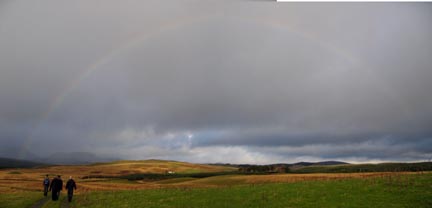
Oh! It may be that you might find this a bit bleak, particularly the bit on Scotland, so I will close instead with a picture that the Engineer took of the younger members of the party on the Southern Upland Way at the beginning of the visit, I was just the driver and so did not do the 12 km they did. Perhaps it is a bit prophetic?
Contact
- Content: editors at theoildrum dot com
- Tech support: support at theoildrum dot com
License

This work is licensed under a Creative Commons Attribution-Share Alike 3.0 United States License.
This is only the beginning of their campaign of disinformation. WestTexas' program of Economise, Localise, Produce is a huge threat to their version of a corporate ruled world, so expect more attacks based on Ad Hominem arguements and pure lies. But the facts of geology are going to trump any argument very quickly.
Yea, I was getting Newsweek for 10 years and just last year decided not to renew (despite their 4 or 5 tempting "final offers"). I have no energy expertise, but as a physician I cringe to think people read their medical articles and accept that as truth. At their best, the medical articles are painfully naive. At their worst, they're just plain wrong. The articles that predict the future of medical treatment and devices are the worst offenders. The predictions are often laughable. These articles invariably follow a simple format:
- until recently disease X was a mystery to ignorant scientists and doctors and we were essentially in the dark ages.
- a "breakthrough" (or series of breakthroughs) occurred and now we understand things so much better than those dark age idiots did 2 years ago.
- New treatments are just around the corner and living with disease X will be revolutionized in a matter of years.
I could read through all this BS when it came to medical stuff, but I dropped my subscription when it occurred to me that the other articles on politics, economics, etc. were probably just as bad, only I didn't know any better.Thank goodness the newspaper journalists are at least accurate when it comes to Peak Oil.
I'd like to offer empathy. Also, a suggestion you may know about (though it may be no longer useful to you.) There are a couple of research companies that will do a lot of looking up on treatments, given a diagnosis, and people have apparently made good use of these. (I'm not finding the links easily; there was a write-up in the LATimes a couple of years ago and I could look for it, if you're interested.)
No, the gas nozzle is what Putin was holding - and if you have any experience of how the Russian energy 'business' was created and currently operates, it is a clever reference.
Leaving aside where maybe $10 million worth of polonium came from, or why Grozny was flattened (check a pipeline map), here a couple of quick links -
http://news.bbc.co.uk/2/hi/europe/6146570.stm
http://en.wikipedia.org/wiki/Yukos - especially the background section
http://www.indymedia.ie/article/78812
I think Putin is well informed on the Chicago School of economic thinking - the only problem, it is the one from the 1920s.
And as for buying from Putin - I live in Germany, and Merkel knows who she is dealing with - after all, she grew up in the system that Putin was sworn to protect. Business is business, after all. And since she knows what he represents, she is strongly supporting long term planning and short term measures to try to reduce the need to deal with the sort of people who seem to own most of the world's oil - after all, I don't think Merkel can actually pay a polite visit to the Saudis, can she? I mean, being a Christian Democrat and a woman unlikely to wear a veil.
Poor Merkel, she can't be Thatcher enough for sanctimonious hypocrites.
Hope that makes my comments more consistent.
As for pipeline rerouting - was that done before or after Yeltsin got done flattening the city? I am pretty sure it was after - though it might have been after the second Chechen war, when Russia reconquered what it had lost, in the Wikipedia formulation.
As for Merkel - we must be living in a different world, as Merkel has nothing to do with Thatcher or Thatcher's politics, except in the English language press. Interestingly, Merkel just proposed that companies should be strongly 'encouraged' to share their profits with their workers - strangely, I haven't read much English language press coverage about how Germany's new model Thatcher seems like an old model socialist. Too scary, I guess, to have a 'conservative' Christian Democrat actually suggesting that obscene profits taken from the labor of workers is just that - obscene.
What I simply meant is that Merkel is very familiar with how people like Putin did their work - after all, I'm pretty sure she has read her Stasi file, and as a university graduate, she passed the necessary tests to prove her desirability and political reliability to the state. I know a couple who were very Lutheran, and there was never any chance of her getting a job in a state run nursery school, and since the number of Lutheran kindergartens was very, very strictly limited, she knew that holding her beliefs meant never working in her desired profession - well, until 1989, that is.
Pointing out misinformation or false beliefs is fine - but please, don't think that everyone fits into your own misconceptions. And yes, I do know a number of people with very, very intimate experience with the East German, Romanian, and Soviet governments. The ex-Romanians and ex-Soviets were 'fascists,' being ethnically German, and that was what they were called before they applied to emigrate. As for the East Germans, well, what can I say? And as for the East Europeans I know, none seem nostalgic for 1985, though they tend to be quite, quite critical of 2006. After all, they don't believe what so many Americans consider to be a fundamental truth, that the rich getting richer is a benefit for us all.
What happened in 1989 was a small improvement for normal people in Eastern Europe (in objective things like the stopping of environmental pollution), and a disaster for most people living in the former Soviet Union. It was not the dawning of a shiny new world, as trumpeted in most Western media. And Putin was someone who worked, in Germany, trying to prevent what happened in 1989.
Merkel knows what he is, and quite honestly, Putin probably knows what she is - another ungrateful German fascist. However, on the news last night, the Russians just launched Germany's first military satellite, allowing Germany the chance to no longer have to rely on American intelligence (really, what Bush has done to American interests is unfathomable). Business is business, and both Merkel and Putin have a clear view of what they want, regardless of what they think of each other's past.
But to Merkel's credit, unlike Thatcher with Pinochet, I don't think she will have many regrets when Putin is buried.
Add to that the tedium of reading so many posts on TOD over so many complex issues, and I have to say the best quotation you have in the upper right of the page is "Men argue, nature acts."
Hatfield quietly retired in 1999 after realizing that no corrective action would be taken in time to mitigate peak oil. He is not a cynical or negative man, either. That's what's so shocking.
I've come to the same conclusion, reluctantly. It's nice to sink back into a hot bathtub and be thankful that I've had 45 years on the planet, and to wonder if all the preparations I've done will do any good.
I think probably not. For ultimately if my neighbors are not prepared, then I'm really not either.
Man...that says it all!
It seems also that some folks might have been asked to clearly and briefly state their case or have been interviewed. Why not Matt Simmons, Defeyes (sp), or Heinberg, or even someone like Dr. Hirsch of the official government studies fame?
Was the issue truly presented so glibly? Was PO represented by straw men easily knocked down by hacks just to give the appearance of dealing with the issue?
Our US Federal government seems to operate this way increasingly: dramatic political "showdowns" are staged when the outcomes are pretty much decided in advance.
I've not seen media really interview and talk with some of the key voices talking about PO. I't like to see in-depth wotk done, so that ppeople can really understand various data and viewpoints.
Similiarly, I think that al Gore's book and movie only got limited exposure (better than PO) because he was VP of the USA and still has connections and a certain amount of media "pull." Media can get audience share by yakking about Gore's movie, and so could make money by giving it a little time.
Back to the NW post. Thanks for the info HO! Be safe, and be sure to post any additional reflections.
Because that is what sells. The journalist's role is push what "sells." Now do you want to tell the Larry LawnMower that his "way of life" is at risk. No. He will cancel Newsweek.
Here's the Saudi graphic:
http://www.theoildrum.com/story/2006/12/1/24016/6621
Who will take the blame for running out of cheap fossil fuels?
- Republicans will blame the Democrats.
- Democrats will blame the Republicans.
- Most Americans will blame the "greedy oil companies."
- There will be a backlash against the media and sources such as CERA when oil spikes up over $100 per barrel for giving no warning.
When will Peak Oil get respect in the media?5.When and only when the prices of oil and gasoline abruptly rise to fifty to one hundred percent from current levels.
6. Inept, despotic, corrupt, foreign governments which failed to make appropriate investments in exploration and productivity, while squandering their resources on utopian social programs...
Republicans and Democrats have shared this crib far too long and received far too much corporate-love-money for it to be otherwise.
7. Inept, despotic, corrupt, foreign governments which failed to make appropriate investments in exploration and productivity, while squandering their resources on dystopian anti-social programs.
6, I take it is Venezuela, 7, perhaps Iran and Russia?
My explanation is that Newsweek, US News and World Report, Time and the other general news magazines have not extended ther demographics in the last 30 years. At one time they were more relevant, due to a lack of competition. But now they have been superseded by 24 hour cable news channels and the internet. Nobody under 50 actually reads those rags unless they are sitting at the doctor or an oil change shop.
The only surprise about their story is that TPTB thought it necessary to fend off the peak oil crowd with their demographic-it shows how far our ideas are penetrating!
Subversively Yours,
Bob Ebersole
8?. Some antisemites will blame the Arabs; others will blame the Zionist-imperialist international conspiracy.
Made that at least 5 to 10 times more. We've had tripling of oil and natural gas prices and doubling of gas prices and nothing much has changed.
$100 oil is just +50% from where we are, and +25% from the current top. It will be an easily ignore anticlimax. $500 oil, maybe not, depending on how quickly it comes.
Our chocolate rations will be adjusted as circumstances permit.
Thanks. I had a not-unusual moment of "overwhelm" (fear, etc.) as I happened to catch a few minutes of the program "Money talk" on the radio Sat. evening. ( http://www.bobbrinker.com/). Bob was talking about KSA announcing a "voluntary cutback" in production, and saying things like "They are not our friends!"; and - I don't remember the exact words but along the lines of - "They know this is the beginning of winter!" "How could they do this!" , etc. It seemed there was also some implicit blame of the US administration in what he said, - (for not knowing "they are not our friends!") - though it was hard to decipher the whole thing.
Apparently he lacks the background to wonder if the Saudis have any choice, in terms of the production itself. And later, I wondered...in fact, if (as we might suspect) the cutback is not entirely "voluntary", what are the choices, for, say, someone in the position of, say, the "insider"-type Heinberg referred to? In terms of telling the truth? I've been wondering about this, ever since Robert R mentioned insiders talking as a criteria for "peak now". In fact, even later, I wondered if any individual could actually tell the full truth and retain - what? - position, citizenship...life? And absent full disclosure, coupled with a plan, would this itself be ethical? (We could ask the question.)
The more I read the more I come back to the same conclusion:
We need nukes, lots of them, starting now. Best if they are very proliferation-resistant.
Once we start having more than 2000 people a year killed by uranium mining and nuclear waste, then it may be time to adjust course. (I think the second of those two will never happen).
Nuclear risks are terrible and unacceptale, until you consider the alternatives.
Looks like you got the best of the week.
Articles that run along these lines should no longer concern any here:
''If only we western companies could gain access to their oil...''
''If only Chavez would stop wasting money on his own people..''
''If only people realised that oil is abiotic...''
I have noticed over the last four or so years that abiogenesis appears when people get worried and / or ask questions. Perhaps these sedatives will work a little while yet.
Abiogenesis got a big puff-piece in the Telegraph about two Autmns ago. Odell featured heavily. My aging parents were suitably reassured at the time. The piece therefore, had served its purpose.
Considering the time of year (Santa Claus, Zwarte Piet, Jack frost, Three Kings etc) it is quite in keeping with the season.
The French revolution began with ineffective governance and tax issues that precipitated a financial crisis.
Robespierre offered a unique solution, n'est-ce pas?
People here should start using the words "digital" with "collapse" so that the meme "digital collapse" gets greater mileage rather than "digital oil field".
Oil Watcher Named Ed said,
"Daniel Yergin likes to use the word digital to link oil technology to the Internet aura."
True, it's amazing what language can do. He also likes the word "globalization" as though that is some kind of solution to everything. His version of events when CERA proved catastrophically wrong about the North American natural gas market? Re-cast it as "the globalization of gas"! "Globalization" of course, we know according to the new modern way of thinking, CANNOT be a bad a thing, it is always GOOD, a sign of real forward movement....even when if you look behind the curtain, you see it is nothing but a cheap attempt to hide the fact that the "trip to bountiful" crowd are using it as a word to avoid admitting that the U.S. will soon be bleeding to death trying to import more and more crude oil and more and more natural gas...
By the way, how does "Newsweek" explain that natural gas problem?....we can't blame the declines per well on Chevez, the corrupt Russkies, the lazy Saudi's, after all, nat gas was our baby....and yet production per well keeps dropping....and the "invest, and it will come" is not working, the more we drill the less we get (per well), Let's see if some of the Newsweek genuises want to tackle that one for us.....
Roger Conner known to ou as ThatsItImout
The quibbling about angels on pinheads is oh so fascinating, but in truth, the fact of peak is indisputable. The only real question is do we act now while there is x amount of cheap energy available, or do we act later when there is x-y?
You people are being too hard on each other. Just agree that the stuff is about to hit the fan. I am curious about the purpose of pinning down the "actual" peak date - future or rear view mirror. What will be your recommendation? If it is out in the future, will you recommend business as usual? I would be surprised if not disappointed. If it is in the past, then what?
In other words, the answer is always the same. We need to act now with all due haste.
- We need to lower the population. That means more funding for population control, condoms, information, media instruction to shape public opinion, creation of international treaties. I would also suggest that this means socialized medicine. Countries with socialized health care have lower birth rates.
- We need to develop non-growth based economies. You can find many great suggestions for this style of economy:
http://mondediplo.com/2004/11/14latouchehttp://dieoff.org/page88.htm
http://www.eartheconomics.org/ussee2005/documents/workshops/USSEE2005_Scale_Workshop.pdf
- We need to restructure the tax system in order to reward steady-state economics and penalize growth economics.
- Zoning laws must be nationalized. We cannot let sprawl continue.
- The entire United States's land and water resources must be examined for its feasibility for localized gardening. NOT INDUSTRIAL FARMING.
- The public school system must include permaculture, sustainable ecology, practical non-petroleum based, localized manufacture, and any other skills that will be needed either in the transition from the current system or in the post-oil era.
- We need to redevelop a decent rail system.
- The first world must share its resources with other countries. In our case, we must work with Mexico and the Caribbean to bring a non-authoritarian locally oriented government much like the government we will have instituted in our own country. In other words, local people need local control that does not hurt other locally controlled areas. The national government will serve as a facilitator, coordinator, and resource, not a crypto-fascist monster serving the rich.
- We must consider how to deal with huge refugee populations streaming out of the Southwest. Where will we put these people?
- We need to know how we will be able to feed the coasts which must import their daily bread.
- We need to rebuild our manufacturing base. We are truly the luckiest industrialized country in the world. We will not have to tear out our disfunctional, poisonous industries. We did that with globalization. Let the Chinese drown in the poison. We can build local industries built on economies not of scale but of need. By using the techniques found in the book, "Cradle to Cradle: Remaking the Way We Make Things," By William McDonough & Michael Braungart, we can create truly non-poisonous industries.
- To facilitate the adoption of these techniques, we need to use our currently unassailable standing as the most ridiculously consumerist nation on the planet and demand that those who do not also adopt these techniques can no longer participate in our economy. (I know, I know. All hell will break loose. You can't do that cause they won't go for it, blah blah blah. Well, just let the world keep going with business as usual and see how that goes.)
- Repatriate corporations. In order for any corporation to do business in the United States, it must pay full on corporate taxes. No more off-shoring of profits.
- Base corporate compensation on indices other than profits. No one should be paid more than 15 times the lowest paid worker's salary. Stocks must be held for ten years (this will play well with the idea of long-term steady-state economics.)
- Bring other suggestions to the table no matter how small. To learn from others will be the future. Demanding a consumerist utopia is the past.
After everyone stops laughing or spewing coffee through their nostrils, because we all know that a rational approach will never happen, let's begin the resources wars, start the balkanization of the US along religious, racial, economic, and familial lines, start the starvation, let's fire up the riots, just accept the facism, lay back and take it like a good peon, open the camps, gear up the riot police, tap the telephones, and issue our travel papers.Just thought I'd throw out this little bon mot of holiday entertainment for the hardest working nitpickers in the business, my good friends at TOD.
Namaste!!!
One I really relate to right now is re-designing public school curriculum.
I know it might not bring the biggest immediate results, but having school-age kids really makes me aware that much of the educational curriculum (not to mention "entertainment") designed for our children is irrelevant or worse.
Young people are often bored in school, honestly wondering why they are forced to "chew sawdust" intellectually.
Contrast that dullness with flashy entertainment that teaches them to feel entitled to a life of empty "clubbing" with all the trappings that the celebrities have.
Young people are seduced into feeling deprived if they do not in fact have this desultory "slumming celebrity" lifestyle.
I've spoken with public school teachers who would love to blow the curriculum wide open and talk about permavulture (oops! Freudian typo -- I meant permaculture) and sustainability and developing a new skill set for the future.
I've helped out in some small ways with this, but don't know of anyone who has been able to challenge the educational status quo.
At any rate, your ideas might be a good springboard for a full discussion -- don't let them drop. Maybe do a TOD post eleborating on them a bit -- see if the editors would put such a post in the line-up?
Do kids still do the boy/girl scouts, or are they too busy playing xbox or messing around with myspace??
If they still do scouting, it seems that a scoutmaster ought to be able to get a lot of relevant concepts introduced to kids at varying ages. Don't know how much flexibility an individual scoutmaster has to introduce concepts such as this though.
I've got a dynamite article I'm working on right now that is right up your alley.
I can't divulge until I've gone to print, but it has something to do with outlaw Rural Electric Co-ops and a plan to localize renewable energy.
The pirate economy is not going to like it one bit.
I'd like to add (though I'm at a loss on this computer, at the moment - or, maybe it's because it's "safari", it won't let me switch windows to find my links)...A while back, I believe around Nov. 21, a brief TOD discussion re: population: someone talked about the event of women in Japan attaining legal rights as a cause of lower birth rates after WWII.
So, I'd like to add to your sentence number one: full legal rights for women, and the means to make this real. So much has yet to be done. Funding for "population control", without women being free to avoid: coercion, being trafficked, rape, sexual abuse, what is called "domestic violence", and etc. (long etc.), does not really address the problem. Suggestion: couple legal rights of women and children with "population control" in your number 1.
Also would like to add: My view is the editors and contributors here actually have many means at their disposal, perhaps more than we realize. I'd like to see even one consensus suggestion as a start (say, a speed limit). Perhaps with a list to follow. And one specific goal.
And, re: "laughing". Actually, I know the feeling of hopelessness. Many people have it, and some express it as a rational conclusion, which actually (when thus formulated) may omit crucial counter-arguments.
It well may be some aspects of a rational approach can work. There may be an example in the (so-far) control of nuclear weapons, (if we start after the first use by the US.), http://www.pugwash.org/. Best to get started. As you say.
I remember reading a statistic (can't find an online equivalent) that looked at two countries with low and high rates of education for women, respectively, and broke the population into low, moderate, and high income; consistently, the more education and the higher the income level, the lower women's self-reported 'desired' number of children became and the lower the discrepancy was between their 'desired' vs. actual number of children.
I need to practice my sockpuppetry occasionally - it is something of a new rage among CEOs and South American democracy proponents these days.
Please get back to us with their response, if any.
We are a country of greed and bloat, the fattest people in the world. This will not change anytime soon.
But what you say must be said. A thousand mile journey starts with a single step. No doubt everyone laughed and ridiculed Martin Luther King, Gandhi, Carson, et al.
Please add to your list, carfree cities.
As we moved from Italy to France to the UK we saw that the vehicles got larger. Smaller than ours in the US, for the most part, but very small in Italy. Gasoline was 1.21 - 1.37 Euros per liter. Diesel is popular as a fuel.
Still, just like the US, lot's of single occupants in vehicles.
I can't wait for the Smart Car to show up in the US. It might be the only Mercedes I'll ever be able to afford.
There has been a dramatic rise in motorscooter numbers on the continent over the past 5 years. Most noticeable in the cities, of course.
There are SUVs in Europe...small SUV's and many fewer than the US. A friend told me that "everyone has one" over there...not true.
An occasional Range Rover, saw only 5 Cadillac Escalades in two weeks. Saw only one Hummer...pulling into the parking lot of the American Consulate in Florence.
LPG (or GPL) for vehicles is common in Italy.
A great commitment to both low-watt/high intensity halogen bulbs and to CFLs. I noticed that the designs used in Europe for CFLs were much brighter than the North American couterparts. Don't know if that has to do with the higher voltage or just a different design.
In nearly all the hotels, the electronic room key is also the access control to the room's electrical system. Open the door and there may be a single room light that comes on. But you have to put your romm key in the "circuit" to have the rest of the lights and television come on.
When you pull the key to leave the room, in some cases the power went off immediately and in others there was a 15-30 second delay.
Lots of recycling. Of course, the way they deal with food and packaging is quite different.
The train system (or at least the one's we used, the TGV and the Eurostar) were fast, clean and efficient.
Cities and villages tend to be much more "walkable" for what you need for day-to-day life.
Just a few observations.
This, I think, is an intrinsic quality of private vehicles. The difference in Europe is that a not-insignificant proportion of trips are done by human power or by public transit. Cars will fill all remaining space, so whether there is a fabulous public transit service or not, expect to see lots of people all alone in their vehicles stuck in traffic.