


DrumBeat: July 24, 2006
Posted by threadbot on July 24, 2006 - 9:16am
Heatwaves and biofuel demand in Europe and US to fuel bread, pasta and beer price rises
Grain Drain: With unstable supplies of staples, we'll need to rethink ethanol as an alt fuel source.
Brace yourself for crises at the cash register. Major price hikes for food are coming, as Peak Grains join the lineup of life-changing events such as Peak Oil and Peak Water. Unless this year's harvest is unexpectedly different from six out of the last seven, the world's ever-decreasing number of farmers will not produce enough staple grains to feed its ever-increasing number of people. Quite a shift from obsessing about obesity, isn't it?
Gas tops $3 a gallon, hitting 25-year high
Bush told to plan for Chávez oil shock
"Venezuela's leverage over global oil prices and its direct supply lines and refining capacity in the US give Venezuela undue ability to impact US security and our economy," Mr Lugar wrote in his letter to Ms Rice.
Iraq ready to restart northern oil pipeline
LONDON - Iraq has completed repairs to one of two sabotaged oil pipelines that export crude from its northern fields to Turkey and aims to restart the flow this week, Iraq’s oil minister said on Sunday.
India: Soaring oil takes us for a ride
Discontent clouds Angola's oil boom
...On the outskirts of the African nation's bustling capital of Luanda, the talk is not of a more prosperous future but rather of a stolen one.Led by a collection of reformed Marxists and Western-leaning technocrats, Angola's government is struggling to convince sceptical citizens that it will use the proceeds of vast oil reserves to improve living standards in a country shattered by a brutal 27-year civil war.
They were the images that finally demonstrated the irreversible climate change now taking hold in Britain. Where green parklands once provided cool refuges in our cities, newspaper photographs last week showed them to be bleached, white landscapes. Reservoirs were revealed as cracked, arid deserts. And from Cornwall, pictures of the nation's first cage-diving trips for shark-watching tourists, an experience normally confined to Australia's Great Barrier Reef.In addition, schools closed, steel railways buckled, and road surfaces melted.
[Update by Leanan on 07/24/06 at 12:02 PM EDT]

Will Mexico Soon Be Tapped Out?
A rapid demise of Cantarell, the country's chief oil field, could pose a serious economic threat.Output at Mexico's most important oil field has fallen steeply this year, raising fears that wells there that generate 60% of the country's petroleum are in the throes of a major decline.
Production at Cantarell, the world's second-largest oil complex, in the shallow gulf waters off the shore of Mexico's southern Campeche state, averaged just over 1.8 million barrels a day in May, according to the most recent government figures. That's a 7% drop from the first of the year and the lowest monthly output since July 2005, when Hurricane Emily forced the evacuation of thousands of oil workers from the region.
Contact
- Content: editors at theoildrum dot com
- Tech support: support at theoildrum dot com
License

This work is licensed under a Creative Commons Attribution-Share Alike 3.0 United States License.
The EB (Energy Bulletin) has a very good/scary series of articles on food and on food versus fuel.
In regard to my ELP (Economize; Localize & Produce) recommendations, I would start making preparations now. If I'm wrong, you will have less debt, more money in the bank and a lower stress way of life.
Texas billionaires Richard Rainwater and Boone Pickens--hardly a couple of guys typing out dark conspiracy theories in their basements--have tried to warn us about that the dangers posed by Peak Oil. In fact, Mr. Rainwater questions the survivability of the human race.
According to the 12/05 Fortune article (search EB for Rainwater Prophecy), Mr. Rainwater is currently trying to expand his ability to grow his own food.
http://urbansurvival.com/week.htm
Excerpt:
"And the Russians are having a field day with U.S. policy putting us into the box where we don't have much room to move. I mean, there's a reason by Condi is not calling for a cease fire: in the crass world of oiltics, the number of dead doesn't matter because it will be such a small number in comparison to an oil drought induced die-off."
As for the oil fields, there are a few others who have mentioned this before, and I tend to agree with 'em. I see no reason why the oil fields grab needs to be viewed as a failure thus far. As long as the area is occupied, that seems to be a win to me. With the huge complex in Baghdad a permanent presence seems assured. Much of this stuff is at least alluded to in PNAC. As well as the multiple theatre military assertions. Will they keep it up? Will that require conscription? Will there be another 9/11 as Pearl Harbour incident? Guess we'll find out in due course.
Richard Lugar, chairman of the US Senate foreign relations committee, has urged the Bush administration to adopt specific "contingency plans" for a potential disruption to oil supplies from Venezuela.
In a letter sent to Condoleezza Rice, secretary of state, last Friday, a copy of which has been obtained by the Financial Times, Mr Lugar warned the US that it needed to "abandon" reliance on a "passive approach" to energy diplomacy.
----------------
If somebody was saying those oil fields matter at any cost, this might be them. Maybe that is all that does matter to the Neocons.
From that article: "Unless this year's harvest is unexpectedly different from six out of the last seven, the world's ever-decreasing number of farmers will not produce enough staple grains to feed its ever-increasing number of people."
The "scary part" you mention from the Energy Bulletin's list of articles is that this year IS going to be "unexpectedly different" from the last six or seven in that grain harvests could be much, much worse than last year as the result of the heat waves in the U.S. and Europe.
Has anyone seen any forecast or discussion of where that storage cushion may be at the end of the year?
Also, how quickly can ethanol production be ramped up? Can ethanol expansion really have such an immediate impact on supply and price, or is that something more likely to occur 2-5 years down the road?
Crop Prospects and Food Situation
The other day I was taking a plane flight, and the fellow in the seat next to me was reading Jared Diamond's "Collapse". At the time I was reading "Limits to Growth - 30 year update". We briefly chatted about Collapse, and then he asked what my book was about. I had only started in on it, but I had an idea what the basic idea behind it was, and I mentioned that LTG is referenced in Collapse in numerous places.
Don't know what kind of impression it made. Just an interesting story.
Brews yer owns beers 'n ails, thas' what I sashesz.
Yo ho ho . . . .
Crude Tops $71 on Louisiana Refinery Snags
These are just my impressions, any further enlightenment is highly appreciated.
Another question: I was a high-school student in rural Wisconsin about twelve years ago - have there been any major changes in urbanization patterns since then, or was it as bad then as it is now? (I wasn't aware of any issues at the time, obviously, maybe apart from inner-city crime).
A very European attitude, don't you think? If gas is cheap enough, distance becomes less of an issue, especially when you have no choice anyway.
Though I'm an American, I'm not one of "you guys" as I live in Germany. It doesn't sound like any of "those guys" felt addressed by your post. Of course, there aren't that many of them at TOD.
My attitude is similar to yours. I drive when I have to, but I take the train when I can. To me, driving to work is a complete waste of time. But many people (here too) really are forced to drive, or at least feel that they are, or feel "freer" driving.
The points you listed in your original post explain the situation well enough. The zoning in many areas pretty much forces people to drive. Cheap gas made driving more bearable, and cheap credit allowed people to buy bigger cars and build bigger houses farther away. That brought them to where they are now.
Back in the day, I put my belongings in storage and spent a year living in the office. I could get away with it; most people can't even consider such a possibility. No rent, relatively little driving. It was the best year of my life up till then. I paid off my debts and haven't been in debt since. Even then, I wasn't a typical American.
Whatever absolute figures may be longrange commutes are considered normal. I have a neighbor who commutes 5 days a week from home in Chicago to Manhattan, no one blinks an eye.
The U.S. was a country of farmers only a few generations ago, and it shows in the our preferred housing. Suburban homes are symbolic farms, with back yards instead of the back forty.
Laura Ingalls Wilder's father used to say that when you could see the smoke from your neighbor's house, it was time to move on, and a lot of Americans seem to have similar ideas. My boss grew up in a row house in Boston, and hated it. He now lives a 45 minute commute away from his job, on five acres so he won't have any neighbors.
What's so funny about this is that just this spring, as I visited the 138-acre family ranch in East Texas, I sat outside at night with a camp-fire crackling in the woods, and could hear the neighbor's music blaring away, from a home at least a half-mile off...
It's apparent that even 5-acres (and 138) is just symbolic isolation. Perhaps a penthouse apartment downtown may provide a greater sense of distance from the rest of the populace. If that is what one seeks.
-best
Ummm... well if we have another blackout and the elevator fails to appear when summoned I'd say you would be right for sure. Most would rather walk a mile in the outdoors than up 40 flights of stairs in the dark ;)
When I consider how my light is spent,
Ere half my days in this dark world and wide
For many, though, it is symbolic isolation. Those huge McMansions on relatively small lots, for example.
IMO, it's not so much the noise as the sheer human presence. People want to putter around their homes and yards without having to talk to their neighbors.
I live in an apartment complex, and I confess, I often do things at night, so I don't have to deal with my neighbors. Take out the trash, do the laundry, etc. Not that they're bad neighbors. I just don't want to deal with them.
Oh, fer christsake - what a pussy. A black bear, and I suppose there wasn't even a cub around. I have seen many black bears in the wild, and it really isn't a big deal.
Just tap the horn and it will run off into the woods.
And we have had some surprisingly aggressive black bears around here. One pulled a toddler out of a stroller on the porch as its mother was trying to get her other kids inside. The bear killed the kid, and the cops eventually killed the bear.
That wasn't in NY was it - I remember a couple years back that same kind of incident happened near the Catskills. Maybe the same one ?
http://news.bbc.co.uk/1/hi/world/americas/5067912.stm
The auto body shops love the black bears. You hit one doing sixty miles an hour in your full-size newish SUV and do about $15,000-25,000 of damage--not quite enough to total out a valuable vehicle, but enough to make several boat payments;-)
A few months ago I did move into another apartment block across the city, in a beautiful quiet area. It is a small block (36 apartments in total) and my plan is in progress, albeit slowly and in unexpected ways. There are 3 stairways in the house, 12 apartments each. I am disappointed in the neighbors living in my stairway - they are polite but uninterested in any contact beyond the obligatory greeting. There is one exception - a retired guy who is a part-time janitor for the whole house. Very polite yet never annoying. Just brightens up your day.
Most of my contacts, however, are with two neighbors from the other stairways. One is a thirtysomething teacher who I met at the apartment owners meeting (most owners at the meeting were over 50, younger people generally don't care about such things). We've exchanged visits and my girlfriend even takes care of her dog sometimes. Another neighbor I talk to is a guy who started organizing people interested in high-speed Internet (no-one here has broadband yet and if there are at least X subscribers in the same house you can get bulk rates). So slowly but surely I'm building up social capital.
I think relationships with neighbors are an interesting challenge. You don't want them to be your best buddies (they're tough to avoid when you fall out over something) but you don't want them to be strangers, either (who knows when you might need them). You also have to tread a fine line between tolerance and assertivity. I always felt, though, that avoiding neighbors is a wrong response to the challenge.
A couple of random collected thoughts....
First you have to define "long-range". 60 miles each way? 100 miles each way? Those folks are indeed rare.
One complicating factor is that you have married couples both of whom have jobs. One may change jobs, but if they move to be closer to that job then the other one might be further.
Another complicating factor is affordability - housing closer in tends to be a lot more expensive. On the flip side though, there are lots of people who wouldn't consider a condo or apartment and just gotta have that standalone house, and if that's what you want then you end up living further out. Another complicating factor is just the crass materialism in our country - this causes people to buy lots of crap, and if you have lots of crap, then you need a larger house to hold all of that crap.
Some of the problems are self-inflicted by goverments. There is this tendancy to have separate areas for businesses and housing, and they aren't always close to each other. In fact, inner suburbs have tended to emphasize office buildings, which means that there is insufficient housing nearby for all of the people who work in those office buildings.
I work in the Buckhead area of Atlanta (which is farther from home than downtown Atlanta). My husband teaches at Kennesaw State University, in a suburb of Atlanta. We live near my husband's work, making a long commute for me.
But on the good news front, my brother may have sold his Mcmansion in Orlando and is going to downsize in the big way despite his wife's objections..
I think one of the key reasons for the long commute is the undesirability of the inner suburbs as a place to raise a family. This isn't necessarily because of crime, it is also because of the quality of schools, the busy streets and the air polution. When people have children they will sacrifice almost anything including many hours of their life commuting so that their children have the right environment in which to grow.
Furthermore, once settled, people are reluctant to move as their children become embedded into their schools and neighborhoods. Hence, commutes often get worse as people's jobs change while their kids are growing up.
One final perceived advantage of an exburb is that young families often want to build a new house and it's often easier and less expensive to build a new house in an exurb than it is in an older more fully built inner suburb.
I don't fully understand why so many people are willing to build huge houses on small lots, thereby giving up most of what could be nice yards.
http://www.amazon.com/gp/product/0195049837/102-2973107-9492943?v=glance&n=283155
I live in a rural county. The "American Dream" around here is to have a lot of land so that you can't even see any of your neighbors. Nearly everyone who can afford it lives on a mult-acre lot and commutes on back country roads to work. The land is very cheap, and until recently, the extra driving might only cost you a dollar or two a day. All of these properties are on former farms. As farming became unprofitable, the 150 acre farms got bought by an investor, who then sold it off in multiple 5 to 20 acre parcels for individual development. If grain production continues to drop, however, one good thing is that this land can be easily converted back to a farm. For some strange reason, these people insist on mowing their lawns. It's not unusual to maintain 10 acres of lawn even though they never use it at all (unless you consider 5 hours every weekend on a riding lawn mower to be enjoyable). I live in town. If I lived out in the country and I wasn't running a farm, I would want to live in the woods, not in the middle of 20 acres of grass. It seems that people around here have a strange notion that we have to tame nature. That keeping a lawn is somehow improving the land, whereas to let it grow wild and back into a maple-beech forest would somehow be a moral failing.
first more people will try to heat their homes with wood as other energy sources become more expensive (this is already happening around here)
Second, plastics and metals will be more expensive and more difficult to produce, and wood or wood by-products can make an affordable substitute for many applications.
Furthermore, displaced farm land will probably rise in value post-peak. Crop yields are already dropping as per the above discussion and this type of land may become viable again for farming.
I remember in Econ class back in the early eighties when the price of gasoline came up, and I happened to mention that for a month I spent between seven and eight dollars for gasoline in one typical month, winter and summer. The students were incredulous; some burned 200 gallons in a weekend of water skiing.
Why drive when you can walk or bike or take the bus?
And power boats? An experiment that failed;-)
Suburbanization pattern = accelerated and worse.
http://www.capecodonline.com/cctimes/fuelfor24.htm
Area boat owners discovered in the past few weeks that ethanol can gum up engines and filters and even lead to the deterioration of certain kinds of fuel tanks.
Depending on the age and condition of the marine vehicle, boat experts said the new fuel blend could be merely a manageable nuisance or a potentially explosive problem.
I love the title of this article...
http://today.reuters.com/news/newsArticle.aspx?type=reutersEdge&storyID=2006-07-24T122653Z_01_SP 265591_RTRUKOC_0_US-ENERGY-ASIA-UPSTREAM.xml
You know according to this, we're all going to be OK since we're selling more equipment to tear up the planet than ever before!
http://www.ft.com/cms/s/6a140df4-18f3-11db-b02f-0000779e2340.html
This article talks about the looming crisis facing the retailers inability to transport goods into this country. I think the last paragraph sums it up. Damn we can't by more junk....
http://www.latimes.com/business/la-fi-ports24jul24,1,7466466.story?coll=la-headlines-business
Doom & gloom about the nations power grid...
http://today.reuters.com/news/newsArticle.aspx?type=businessNews&storyID=2006-07-23T191327Z_01_N 21456781_RTRUKOC_0_US-UTILITIES-SUMMER-DEMAND.xml&archived=False
High prices have caused those once sleepy wells to become a bit more active, a they are bringing towns along with them. Typical market behavior.
http://today.reuters.com/news/newsArticle.aspx?type=businessNews&storyID=2006-07-23T144432Z_01_N 21245396_RTRUKOC_0_US-BIZFEATURE-TEXAS-DRILLING.xml
Last, here's an article about the lifestyle changes that people are being forced to make (finally) to cope with higher gas costs.
http://www.chron.com/disp/story.mpl/business/4064784.html
Maybe if people have to start paying what food is really worth, more farmers will start to grow it?
However since it is mostly congolomerate ran, and petro intense, the new farmers will struggle to find ways to adjust to the higher petrol prices. I think as the transport of all food becomes increasingly higher, at some point it will be more profitable to begin growing mostly local again. When this happens, I believe more people will grow their own gardens at least.
Organic farmers have it easier for many of these costs. They still have the weather to deal with though.
And speaking of costs, the poop must cost a whole lot more than NG, b/c all organic products are priced @ a premium currently. So either the farmers are getting some extra cash for the "organic" label, the retailers are getting extra, or the fact that you can't use fertilizers actually costs more per unit.
At some point, organic farming will become more cost effective and fertilzers based from NG will be abandoned due to prices. However the poo needed comes from a circle of life and if we are busy killing the plants with GW, there are going to be less plant food, less poo, less food for all. So even if we agree that organic is a better alternative, you start to run into some limits on poo input. So there will be those who starve
We will all become producers to offset not only the cost of BUYING food, but the scarcity of those items. It was done like this a long time ago, at least around here it was. Regional farmers markets have made it through the tough times and I feel like they will have their renassaince within the next decade, give or take a few years. We will all basically be micro farmers and the macro farmers will take care of the harder, more expensive crops (tobacco will still be needed).
I knew the refinery wasn't coming right back up, but I didn't want to start a stampede to the pumps. I was just puzzled that the media did not react quicker to this story.
I will reiterate that with supplies as tight as they are, any time you hear about a big refinery going down in your area (and this is a very big one) you better top off your tanks. Prices are likely to go up in an attempt to keep the tanks from running dry.
Can anyone in STL or the surrounding areas tell us what is happening there with gas prices?
Cheers,
RR
Low = 2.94
High = 3.19
Prices are within the last 4 hours.
Rick
The MSM just assumes that "they" have enough in storage, can change shipping patterns, etc.
When Houston has a refinery fire, there is never a local shortage (except perhaps one brand) because of the massive exports from there. Same for New Orleans, Baton Rouge, and Lake Charles. Other than those locales, I do not think any other area can absorb the loss of the largest local refinery without a local supply issue (perhaps Midland as well).
If not, why would you refrain from its mention? Seems to me, in this era of ever-icreasing secrecy and obsfucation, knowing about this and not mentioning it seems rather perverse. I know I could be wrong, but it seems to me that announcements such as this should be made public and if not by the MSM then by those who are aware of them in places like these.
Yes. It had not yet been released to the public just how long we might be down, and until it was it has to be considered company confidential information. I knew that it was worse than the piddling mention in the media, but could not mention it because I would be releasing privileged information. Once that information has been released to the media, I can comment on it.
Understand that if I had come out and given that information on Thursday morning, when I knew about it, that would have been grounds for dismissal. It is no different than if you are doing a project at work, there are unforseen complications that will delay completion, and you release that information to the public. In some cases, your competitors could be all over it, and it could give them a competitive advantage. Your employer would also have grounds for your dismissal.
Cheers,
RR
When I talked about it on Friday, it was in response to someone else having posted the story, and I just clarified which refinery it was, and how much production they have. Where I would have crossed the line would have been to say "And it looks like it will be down until next week, so STL will probably run out of gas this weekend."
Cheers,
RR
Cheers,
RR
The chair on supply issues is David O'Reilly the CEO of Chevron. And the vice chair of the supply task group is Donal Paul aka Vice-President and Chief Technology Officer Chevron Texaco. Good grief.
No worry, it's based on "sound" data and science.
Burned children bring war horrors home
Sugar Pine is the world's largest pine tree (grows to 81 m) and would be a good addition to Icelandic forests if it was adaptable to any of the Icelandic sub-climates (see GW).
The Icelanders have made several attempts in the past to get selected Sugar Pine seeds (from high (close to 2,700 m, 9,000'), dry locations in Southern California) and failed (it is a hard tree to collect from in difficult terrain). I found a knowledgeable local, Todd Foster, who agreed to try and collect them. Iceland wanted 200 seeds for a Phase I trial.
He misjudged this year's seed fall (it was early), and after two weekends effort managed to collect just five seeds from Mt. San Jacinto. He will try Mt. San Gorgonio next weekend. If no success, then next year. These five seeds plus any others collected this coming weekend will be shipped to Iceland.
A few million sugar pines, growing to 30 or 40 m on former sheep pasture land in Iceland, could capture a fair amount of carbon. Perhaps enough to set GW back a few weeks.
The Vikings released 6 million tonnes of carbon when they settled Iceland (annual release today is just short of 7 million tonnes of carbon from fossil fuels), but the trees that the Vikings cut down were never taller than 14 m and "skinny". Reforesting Iceland with larger trees could make a small dent in GW.
An article "Forestry in a Treeless Land" by my friend Þróstur.
http://www.heradsskogar.is/Apps/WebObjects/Skogur.woa/wa/dp?id=1000172
Mitigating Global Warming & Peak Oil and Rebuilding New Orleans are all tasks well worth doing. One step at a time for many years. Little immediate gratification but still worth doing. Perhaps against the "odds", but things would be worse without my efforts (I think).
My partial solutions for Peak Oil also helps GW.
http://www.lightrailnow.org/features/f_lrt_2006-05a.htm
As a seven-month reader of, and very occasional poster on, TOD, I have admired your singleminded perseverance. But I'm posting to ask you a question about trees, since you are obviously involved with them.
When my wife and I began farmsteading in the mid-'70s, we were enthusiastic about honey locusts (not the ornamental variety, but the Gleditsia triacanthos that grows large seed-bearing pods). We had read several books on forest farming and thought they might be a source of protein for our few cows and goats as well, perhaps, as a source of protein for ourselves. We were particularly excited by a chapter in J. Russell Smith's TREE CROPS: A PERMANENT AGRICULTURE (orig. 1950, 1977), which cited some work at the Alabama Agricultural Experiment Station in the 1940s that seemed to show that ground honey-locust pods are equal in feed value for livestock to oats, pound for pound. We were excited, because honey locust trees would allow us to grow concentrate on our rocky, hilly soil, while helping to protect against erosion.
As Smith himself notes, the Alabama honey locusts were all cut down and research was switched to peaches. When we were building our barn and house (ourselves, that is, not causing them to be built), we bought some honey locusts that, we were promised, were the pod-producing kind. Well, they turned out not to be.
One thing and another diverted our attention from honey locusts--and even from our attempts at self-sufficient living. (It was called that in those days, rather than, as now, sustainable living.) We got overly involved in our teaching careers and lost our way as farmsteaders.
Well, impending retirement and Peak Oil has renewed our sense of good fortune in living on 35 acres of our own land with a barn and all.
So, my question to you is: do you know anything about pod-bearing honey locusts, where we might get some, etc.? Any information or references you might be able to share would be greatly appreciated.
And do keep up the good work!
Thanks very much.
Bob (Vermont Agatha Zoe)
What area are you from ? Find an Arborteum in your gneral climatic zone and call them. And then call another. etc. This would be the most likely path to success.
I am waiting to get some Black Walnuts from Ohio from an abandoned USDA breeding program. The parents were the second generation selected (from memory). Plant them on my parents farm.
There is amsll family nursery just north of Mammoth Cave in Kentucky with a good selection of nut trees and paw paws as well..
Contact me later (this fall) and I will look up the name & contact. Better quality & prices than Starks IMHO.
I asked this late on Friday, but it may have gotten buried. If anyone has an idea, I'm willing to listen.
Don you teach, so maybe you could answer this question I never got to ask in class. The way I was stringently taught, was the good ol FED does not control interest rates. They control the MS, which in turn controls the interest rate. However the more I think about this, the more BS I want to call. First off WHO says the FED doesn't directly control interest rates. I've never worked at a bank, but my proff described the NY fed as hyper nimble and able to apply the new higher interest rates asap when called on.
Now if this were true, then it would imply speed. He is saying that the NY fed starts selling bonds like crazy to take liquidity out of the system. Now this in effect causes rates to go up. While I understand the reasoning I think this is crap. It seems more direct, and rational to simply "set" the new rate. If I'm the lender of last resort, then I have the power and full control of monetary policy. I can simply tell all banks in the system that money costs 25bp higher today than an hour ago and that will work too, right?
The reason I'm confused about this is the inflation rate. Now I understand cost push etc, so I would assume that oil rising as fast as it has, in short time has contributed to inflation in a large way, but it's not going away. If the Fed has tightened the belt 17 times straight why is liquidity still so high? Going from 1% to where we are now, you would think there would be a large contraction, but there has not at least according to MAR06 M3 data. Combine that with recent discontined M3 data and this is why I come to the conclusion that maybe the S&D of money and "setting" interest rates is BS. Where did I go wrong?
Without market manipulation the Fed could lower the discount window rate but if they didn't perform and money supply adjustments the increased use of the discount winodw itself would increase the money supply. Alternatively if they raised the rate at the discount window but did not adjust the money supply people would just not use the facility because they would be able to receive lower rates on the open market.
I agree with all of what you said. Let's get specific though. Your quote above is how I see it as well.
However, that being the case....
http://www.federalreserve.gov/releases/h6/20060316/
Per their data @ 3/04 M3 stood at $9.0807T
Per their data, prior to discontinuance 3/06 - %10.2943T.
So in a little under two solid years our FED has managed to grow the money supply by 13.36%, yet they have raised rates consistently for the same two year period.
Even if we stick to M2 data over the same period it comes to 9.5% over the two years. So maybe this is where I have a hard time understanding, or I'm being lied to. In the last two years only, money supply has grown between 9-13%. According to BLS inflation figures, inflation can't be the culprit to explain an increase like this over two years. Even at higher inflation rates, the numbers don't add up.
So if the Fed controls interest rates by controlling the money supply, I think they can't be controlling them too well at 5.25% since the only tool they have to control it, the money supply, has nothing but increase and at a faster rate than inflation!
So again I ask, how can the Fed decrease the money supply to increase rates, while liquidity has nothing but increase? I really think it's arbitrary and simply a push of a button.
I will just express my personal opinions on the different methods of estimating URR and peak production years.
In this blog we are using two types of curves for modeling oil production:
- A Hubbert curve
- A Gaussian curve
Depending on what-against-what we plot these curves become different things:- cumulative production (Q) versus the ratio between annual production (P) and Q (i.e. P/Q). In this plot a Hubbert curve becomes a line.
- time (T) versus Log of P. Then a Gaussian becomes a parabola.
- Finally, P versus Q. Then a Hubbert curve becomes a parabola passing through the origin.
My favorite plot is 3).Pros of 3):
a) The first years of production (which usually are unreliable) are compressed around the origin, and the peak years are amplified (they take up more space).
b) exponential constant growth or decline becomes a line. This is a very nice behavior.
c) In fact, the slope of the line equals the rate of growth or decline, assuming that P is annual production (not daily production). This is also very nice.
d) The URR is just the intersection of the parabola (if you model with a Hubbert curve) or a line (if you model with a constant decline) with the x-axis.
Cons of 3):
e) You need the whole production history of the region, if you miss some years of production history you are dead.
f) It is difficult to get an idea of the time scale, unless some of the points are labeled with years.
I should note that Laherrere is very fond of plot number 3). See for example Jean Laherrère (pages 11-14). And he draws lots of lines in those plots, which correspond to exponential growth or decline.
When you plot production of fields, the decline becomes almost invariably constant for a period, and sometimes even becoming worse but not becoming better: "The only clear example of significant decreasing decline (save where due to previous poor management) that could be found after reviewing about 2200 fields of over 100 Mb, is Eugene Island 330 in the Gulf of Mexico." This quote is from Laherrère's document on page 14.
In other words, he is saying that after the peak in plot number 3 you tend to see a straight line which intersects with the x-axis at a number that is an upper bound of the the final URR.
For the case of Romania, I just did an eye-ball linearization from Stuart's graph:
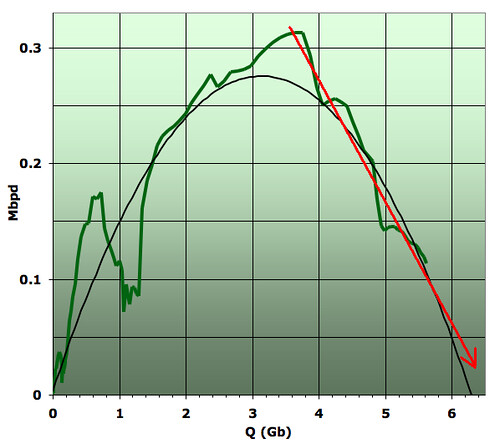
For the case of US48 I did the graph and an estimate of 243 GB of URR:

Since the line has equation y= 5.56 - 0.0228 x, then the average decline rate from 1970 to 2004 is 2.28%.
=====Plot number 2)
Pros of 2):
b) exponential growth or decline becomes a line
e') You do not need the whole production history.
f') The time scale is on the x-axis.
Cons of 2):
a') The first years of production get stretched and the peak years get squashed.
d') It is not easy not visualize the URR.
=
==========Plot number 1)
Pros of 1)
d) The URR is just the intersection of the interpolating line (if you model with a Hubert curve) with the x-axis.
g) The maximum decline rate is just the intersection of the interpolating line with the y-axis.
Cons of 1)
a') The first years of production get extremely stretched and the peak years get squashed. A very good example of this is the FSU, where the 1990 collapse just looks like very minor ditch.
e) You need the whole production history of the region, if you miss some years of production history you are dead.
f) It is difficult to get an idea of the time scale.
In the cons of 3) you said: "You need the whole production history of the region, if you miss some years of production history you are dead." I don't see why, you can offset your cumulative production numbers in order to match a target cumulative production for your last available date (BTW, this is aslo true for the HL technique).
For the Lower-48 case (last figure), the URR estimate from the HL technique is very close to the URR even based on early production data (i.e. Q<25% of the URR):
Note that the URR estimate from a P vs Q chart using a straight line requires to have data post peak which makes its predictive value less attractive. I believe that the HL behaves well if: 1) the production profiles is almost symmetric; 2) P/Q are small and below 10% very quickly.
About "You need the whole production history of the region", I
agree that if you have an estimate of the cumulative production
until a year, but you don't have annual data before that year you
are still alive. But that is a big assumption.
By the way, measurements of annual production have a certain
reliability. Some periods in time and some countries might be more
sloppy. How would these errors propagate to future predictions?
How robust are predictions to errors in measurements? In the Time
vs Log(P) plot if production of a year has an error it is not very
important. Have you though about these issues? I haven't.
About estimating the peak year on the P vs. Q plot: before the
peak you can use a parabola that passes through the origin. My
first impression without much empirical evidence is that this
method is not so good at predicting the peak year. But the
downslope of the curve looks very linear to me and I have seen
several downslopes of countries and fields, maybe the upslope and
downslope are very different in nature and should be treated
separately.
One more thing, for US48 you predict using HL an URR of around
195Gb!, my estimate is 243Gb. Your estimate looks very pessimistic,
don't you think so? US48 production should start a free fall very
soon to achieve that number.
That's very possible. For the Lower-48, the downslope looks clearly linear. However, the model P= a + b*Q is a little bit awkward because it does not lead to a purely exponential curve due to the constant parameter (a) which will give an additional linear function of time.
One issue with the HL approach is that changes in the tail are dampened by high cumulative values. In short, the HL is less and less sensitive to variations in P as Q increases.
But it is disturbing because both these realities cannot exist at the same time, at least not long term. One of them must be wrong. I know what I think is happening, but the lack of obvious impact in my part of the world is surreal - sooner or later this must be reconciled!
Oh yes they can.
In my job I travel between differnt worlds (different industries). Some are doing great and have no sense of any impending doom. Some are on their last legs. Wasn't it like that in the Great Depression too? It wasn't one homogenous wash. There were pockets of prosperity in the midst of ruin.
I know what you're talking about, and I have similar trouble. I look at all the data, I use uncommon sense and everything I know tells me that Peak Oil and all the probable evils that it will bring are just years away. But then I go to town and see everyone acting normal...not a hint of concern or trouble, a few people casually complaining about gas prices maybe. Nothing that would lead me to believe TEOTWAWKI is just years away, and I'm left wondering if I'm just crazy.
Collapse is not going to come in one fell swoop.
It's going to be death by a thousand cuts.
Not everyone is going to get cut.
Not everyone is going to notice all at once.
I'll give you a personal example.
Today one of my doctors informed us he will no longer honor our health insurance policy --and he's not the first health provider to refuse this insurance company.
What does it mean? I didn't get fired. I just got a reduction in compensation, quietly with hardly any confrontation --and my employer can pretend they didn't know, they didn't do it. The finger of blame is an invisible one.
The price at the local gas station inched up another few cents.
Another cut. Another jab by the invisible finger.
Fruit at the supermarket shrunk in size by an almost imperceptable amount.
Another cut.
One cut at a time. That's the way it's going to creep up on us.

After a while you get numb to the pain.
The real stampede is going to be toward coal. Burning as much coal as possible as cheaply as possible as fast as possible to shore up industrial civilization as long as possible. Coal gasification. Coal to liquids. And the desperation to ramp up coal quickly will ensure that all talk of carbon sequestration is forgotten. This is what the Hirsch report advocates. This is what David Goldstein predicts as the most likely scenario as well as the most environmentally destructive.
If the U.S. is the Saudi Arabia of coal, why would it forego exploiting that resource to the hilt regardless of the environmental consequences if that is the only option for retaining its economic hegemony?
And we'll do it without sequestering the carbon because we will be in a panic. The last phase of the Industrial Revolution will be the most destuctive. As we switch from oil to coal our carbon generation will accelerate due to the less efficient use of the resource as we transform it from it's natural state.
Only after we use up all the fossil fuels, and go through an immense amount of pain, can we find a new sustainable balance. Interesting times.
Even a 2-3 percent decline does not allow enough time to replace. Prices continue to rise, infrastructure costs continue to rise, ala tar sands, and socio/ economic upheaval makes it all even more difficult. Don't look promising to me.
The trouble with the word environmentalist is the word "environment". When one mentions the need to protect the environment, people think that's too bad but we are talking about something abstract here, so I don't have the time or inclination to worry about that. People need to understand that from now on, we are talking about events like the death of the Amazon rain forest which may leave much of our planet largely uninhabitable.
The niches available that will not be too adversely affected by these changes may be very crowded in the future.
This looks very much like a crisis to me but there are no adults in charge. They are too busy spinning reality in preparation for the next election. If only terrorism were really our biggest problem. The terrorism of the future may involve fighting over the few remaining places where food is stored.
Do you think then that they should qualify as "adults"?
Possible tropical cyclone forming in the Gulf of Mexico.
http://www.breitbart.com/news/2006/07/24/D8J2HH4O6.html
I would guess those private planes still shoot his goal to hell, but what do I know. This is nothing more than talk if you ask me.
I think we should run the peak production numbers on USA coal as we talk a great deal about using Coal to Liquids to off set declines in petroleum production we should know how long we have left on our Coal reserves as well. Thanks.
Thanks for the link to the coal information.
After looking at the numbers we in the USA have around 270 Billion Tons of coal left after having consumed 70 Billion Tons mostly for electrical production.
So our total recoveralbe reserve was originally 340 Billion Tons of coal in the USA. As of today we have consumed 20% of the total resource. We now consume over 1 billion tons per year. We will not reach a peak in coal production until we have produced 170 Billion tons. With that logic we have 100 Billion tons to burn through.
If we assume a growth rate of 5% in coal consumption to make up for loses in oil and natural gas then we could see a peak in Coal production from 2040 to 2045.
Up until a few weeks ago I thought that the likelihood of a US and/or Israeli attack on Iran was growing smaller and smaller.
But now, after Israel's major offensive against Lebanon, it has become apparent to me that not only does the US fully approve of what Israeli is doing, but is direcly complicit in the murder and destruction in Lebanon. Israel and the US are guilty of war crimes. And today that makes me very ashamed to be an American.
I think that the US and Israel want to morph the situation in Lebanon into an all-out war against Syria and Iran - the fulfilment of the 'clean break' envisioned by the neocons in their plan for the 'New American Century' and backed by the AIPAC.
Whether this is more likely to happen before or after the November congressional elections is not clear. On the one hand, if the Bush regime is afraid of losing control of Congress, it might want to make such a war a fait acccompli by starting it before the elections. On the other hand, if it thinks it will retain control over Congress, then it might not want to roil the waters before it has secured another term of congressional control and then start the war. I think it's a toss-up.
Never let it be said that the Bush regime doesn't have an energy policy. It has a very clear and ambitious energy policy. And that policy is to militarily dominate the countries of the Middle East to such an extent that the US will have its hand on the oil spigot and can decide who gets how much and when. Of course, Russia, China, India, and the whole rest of the world have different ideas.
The Bush regime is basically going for broke and shooting its whole wad on this one. If it 'works', we'll be guaranteed a goodly supply of oil at the cost of perpetual low-level war throughout the Middle East. If it doesn't work, then we can kiss our collective arses goodbye, because these people have no Plan B.
I know it is not going to work.
That is something I can agree with.
This whole "War on Terror" thing is a distraction.
TPTB do not want someone like Clinton standing up and saying:
"It's our oil economy, stupid."
So just like other despots in other collapsing societies, our PTB have created an "us" versus "them" game.
Sort of reminds you of summer camp doesn't it? You, you and you are on the red team, the rest are blue team. Never mind the mosquitos. Line up and start playing. We are here in camp to have fun people!
then what is the doomer opinion if both these conditions are met going foward. Thanks for any thoughts.
$100 Oil Sure Bet, Rogers Says
Excerpt:
Rogers said declining supplies from existing fields and a lack of new oil discoveries will drive prices higher.
``The bull market has about 10 or 15 years to run,'' he said. ``How high it's going to go I don't have a clue during that time, certainly over $100 a barrel or over $150 a barrel before it's over.''
? I searched the EOG resources website but found nothing. I first saw this last year on a Simmons presentation and jumped out of my seat. I'd love to see an updated plot through 06.
MADRID (Reuters) - A Spanish company claimed on Thursday to have developed a method of breeding plankton and turning the marine plants into oil, providing a potentially inexhaustible source of clean fuel.
/ Vehicle tests are some time away because the company, Bio Fuel Systems, has not yet tried refining the dark green coloured crude oil phytoplankton turn into, a spokesman said./
Are these guys on to something?
http://www.theoildrum.com/comments/2006/7/21/9404/01279/95#95.
Pretty hard to keep up with the news on TOD, Eh?
BTW, though the TOD forum software is already excellent (many thanks Super G) it is still a bit difficult to search recent posts for some topics given that Google is lagging behind by about 3 or 4 days.
Any way to improve this?.