


DrumBeat: February 18, 2007
Posted by Leanan on February 18, 2007 - 8:21am
Oil facilities on Google Earth
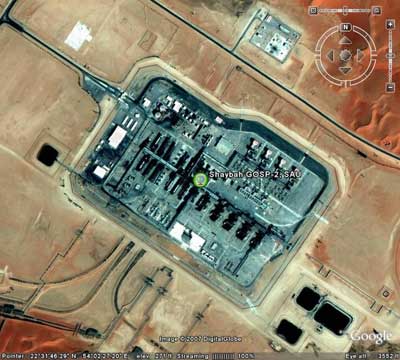
A tip from Mike Hearn:
Google just released KML Search in Google Earth. It's pretty good for exploring the worlds oil industry and makes it a lot easier than it was before.To play with it, install and run Google Earth, then zoom in on, say, Saudi Arabia so it fills your view. Now try a query like gosp, oil or trans-arabian pipeline to see some great pictures of cities in the desert or huge processing plants in Qatar. Or try refinery over the UK. Or petronas platform over Nigeria to see a small but ultra-hi res image of a desert oil well. Or oil rig under construction over Ireland.
These images have all been available for a while but now you can easily locate items of interest.
Yes, the US military is completely addicted to oil. Unsurprisingly, its oil consumption for aircraft, ships, ground vehicles and facilities makes the Pentagon the single largest oil consumer in the world. By the way, according to the 2006 CIA World Factbook rankings there are only 35 countries (out of 210) in the world that consume more oil per day than the Pentagon.An interesting point is that even though there are only a few data sources, how much oil the Pentagon really consumes is still kind of puzzle, at least to me.
OPEC works to stabilize market despite easing of oil prices
While we continue to hold an agnostic position on the "Peak Oil" philosophy, reports that the supermajors are increasing investment and seeing production decline does support their argument. Of course, some of this trend is due to the fact that the firms have been denied access to the best fields. Still, this does suggest that geopolitically safe and accessible oil is becoming difficult to acquire.
Falling investment levels, high taxes and rising costs threaten the viability of an oil-producing region which is just over halfway through its expected lifetime.
Is Houston smarter than Detroit? Big Oil versus Big Auto (and a simple solution for global warming)
US car makers and the US oil industry appear to be speeding in opposite directions in what may seem like a complete paradox. Just as companies like Chevron, Exxon and Shell announce the highest profits of any company in history, Chrysler, Ford and General Motors sales are in free fall. Is the oil industry in Houston is smarter than the car industry in Detroit?
Baltic Sea Gas Pipeline Meets European Resistance
Resistance to a planned Russian gas pipeline in the Baltic Sea is growing in Europe. Sweden is especially uneasy about the project. Besides environmental concerns, some Swedish politicians fear it may be used for spying.
Indian officials to visit Islamabad for Iran pipeline talks
Indian oil ministry officials will travel to Islamabad next week to discuss constructing a long-awaited multi-billion dollar gas pipeline from Iran through Pakistan, an official said.
Hostage takers release U.S. oil worker
Hostage takers in Nigeria's restive oil region have released an American oil worker captive, police said Sunday.
Tensions high in Mediterranean over oil field
Warnings and threats backed by gunboat diplomacy have electrified the eastern Mediterranean region, where news of a possible major oil and natural gas field has created visions of unexpected wealth.
Wild grass could hold key to clean fuels of the future
Miscanthus, a perennial grass native to subtropical and tropical regions of Africa and southern Asia, was the ideal plant for producing ethanol at a lower cost than corn, currently the most widespread source of the fuel.
Frustration over delays on clean coal
The UK Offshore Operators Association (UKOOA) has joined calls for the government to stop dragging its feet over a technology that a number of industry experts say could significantly affect climate change and extend the productive life of the North Sea.
'Green energy' project gives Swiss the shakes
Swiss prosecutors are investigating a green energy project after it was revealed that it caused earthquakes.
The average global temperature last month was the highest for any January on record, according to NOAA, climbing to 55.13 degrees Fahrenheit, which is 1.53 degrees warmer than the 20th-century average.
Philanthropist's latest beneficiary: the environment
"There will always be people who will hold onto the old ways of doing things, but with global warming and with peak oil, the fastest-growing trends in construction are energy-efficient homes, for obvious reasons," Chandler said. "We can't keep creating big boxes to heat and air-condition. Small houses are going to become more attractive to buyers, and big houses are going to have to become more energy-efficient."
AAAS president urges swift action to build a sustainable future
Challenges such as poverty, climate change and nuclear proliferation pose global risks that require scientists and engineers to join with political and business leaders in a concerted search for solutions, AAAS President John P. Holdren said Thursday.
Who are we and where are we going?
In the coming permanent world energy crisis, North Dakota is going to be one North American locus of intense industrial activity. We have abundant lignite coal reserves, and what is regarded as plenty of water to process that coal. That means liquefaction and gasification, and more coal-fired power generation plants.
Energy: healthcare's preconditional crisis
Modern healthcare is dependent upon large inputs of energy as well as an array of products derived from petroleum. Nevertheless it is silent on the threats posed by the end of the fossil fuel era, colloquially know as “peak oil.”
Investor group unveils climate blacklist
The move by Ceres, a group of state pension funds, environmental and religious groups with more than $200bn in assets, highlights a rise in investor and political demands on business to do more to deal with environmental problems.
Contact
- Content: editors at theoildrum dot com
- Tech support: support at theoildrum dot com
License

This work is licensed under a Creative Commons Attribution-Share Alike 3.0 United States License.
Tahiti is suffering from overpopulation:
And the more remote Tuamotu islands are in danger of being lost to the sea due to global warming:
There is nothing at all more tragic than whan humankind is doing to the Earth right now. Consuming, destroying and polluting everything like a plague.
The world that humans created doesn't look pretty except for those who are in love with asphalt.
David Mathews
http://www.geocities.com/dmathew1
Hello Everyone,
Also from today's New York Times':
The second question is more important than the first. Science is declining from neglect and a lack of funding.
David Mathews
http://www.geocities.com/dmathew1
well it is not a secret here that the u.s. administration has put political pressure on scientists to water down their message, lobbied intensively with the u.n. to watter down their report and include asinine plans to solve the problem in a way that allows us to keep businesses going as it is now.
Bush/Cheney are climate terrorists. They have shown the world how to do everything wrong to prepare for peak oil and global warming.
Hello Everyone,
Evidence that China is drinking the kool-aide of consumerism:
I consider the statement, "You know, you have to save something for your next generation; you shouldn't spend everything" an unintentional morbid irony. The next generation is going to lose a lot more than gasoline. But this party will continue until it cannot continue any longer.
The Chinese have become consumers and they are trashing the Earth in the same manner as the obese American hyperconsumer. That's progress for you. Too bad for the Earth. But the Earth will recover, so too bad for humankind.
The Chinese are emulating Americans. They are becoming consumerism addicts and oil addicts and polluting the entire globe. What does it say when a five thousand year old culture begins to copy the insane excesses of a declining two-hundred year old culture?
There are a depressing photo album associated with this story:
http://www.washingtonpost.com/wp-srv/photo/galleries/021507/china/index....
The Chinese are every bit as vain and foolish as Americans. There is no cause for optimism in this world. Global civilization is fading fast: Humans are burning up the Earth for the sake of fashion, comfort and luxury.
David Mathews
http://www.geocities.com/dmathew1
China at least is making a very serious effort to limit its population. The US, on the other hand, admits as refugees those Chinese illegal aliens who claim they are oppressed by the one-child policy.
Hello sf,
China has more than 1,315,844,000 citizens(http://en.wikipedia.org/wiki/People%27s_Republic_of_China), greater than the entire population of North America (518,000,000: http://en.wikipedia.org/wiki/North_America). So if China is limiting its population it is not doing so very effectively.
Anyhow, limiting population is a futile endeavor while China is not limiting consumption.
China's got a bleak future just as North America has a bleak future. We are all in this boat together and the boat is sinking.
David Mathews
http://www.geocities.com/dmathew1
I'm not trying to minimize the impact of consumerism but population is half of the equation. China's population will take a while to stabilize, and possibly diminish, because the current generation of fertile women was born before the current population policies became effective. Whether this will happen in time is an open question.
China is also building a new coal-fired power plant every week.
http://www.washingtonpost.com/wp-srv/photo/galleries/021507/china/index....
(slide #2)
nothing like a woman in a black dress with a #3 wood.
"To the hard of hearing you shout, and for the almost-blind you draw large and startling figures." (Flannery O'Connor)
and thank YOU b3n for that inspirational sunday morning sermon.
I like it. Inspirational. Good job, b3NDZ3La.
And here is your sacrament of Kool-Aid and protein pills (sorry listening to Bowie this morning).
Please give generously this morning due to the rising costs of maintaining the Church's steel spires that extract the Holy Spirit from the bowels of the Earth so that we may all share in Spirit's blessed powers and gifts.
...it just gets weirder around here every day... :-(
For fans of the Antarctic lakes story, check out CNN's spin today. They state that GW is not causing this. Probably only partly true, and I can't find any scientist saying that. They also state that melting all of Antarctica would raise sea levels 23 ft. Wrongo! That's the figure for Greenland, or the West Antarctic Ice Sheet. Melting all of Antarctica would raise sea levels by more like 200 ft! This article is definitely spun to give the impression that this has always been going on, nothing to worry about, move along...
I like this quote at Energybulletin today from AAAS President John Holdren:
Also this:
I've been riding the ol' cargo trikes and pedicab for years with the understanding that we all need to radically change the way we live in order to survive.
We need to live peaceful, human-scale lives. But how do we "slow down fast" as one song puts it?
I hope we can raise awareness and inspire local action with regard to peak oil and global warming.
The "corporatists" are mighty slow at recognising and responding to the realities of the planet, so we need to lead the way ourselves.
Things look grim, but I continue to believe that one of the best ways to face reality is by focusing on the things I can do to bring about the changes we need to see.
I do not control others, just what I can do. I do not control the outcomes, just my own contribution for better or for worse.
After those first two long comments today, I find that mine was clipped off somehow. This has happened a couple of times.
Is it something I am doing, or not doing, or is that a kink in the site software?
Not upset -- just curious.
We'll see if this comes through in one piece.
Keep on being the change we need to see, folks.
Using these: >>>>>, which are used for tags, you're asking for clip-off trouble.
HeIsSoFly has a point, I used to use those as bullets sometimes, and would end with all kinds of wierd cut offs and issues, so I now stay away fromt them...:-)
RC
Remember, we are only one cubic mile from freedom :-)
Use <ul> (unordered list) tags for bullets:
<ul>
<li>a bulleted item;</li>
<li>another item;</li>
<li>third item.</li>
</ul>
The list above would render like this:
They're used in HTML, and so the software looks for them, and tries to interpret them. They are reserved characters.
I'm not sure what the problem is. I have never experienced the problem you describe.
Are you trying to use HTML code of some sort, or are you just posting regular text?
Hmmmm....
I think I'm doing the HTML thing using IE as my browser.
Maybe it is my use of those funny little arrow deals that is messing me up.
I'll try to not use them.
No biggee -- those uninterested in this little glitch can of course skip the "post cut off thread."
Thanks -- I've gotta go do some work, then I'll see later if it happens again.
It was your French quotation marks that were the problem. I edited your post to replace them with blockquote tags, and voila.
The Oil Drum's character set is in UTF-8, so it WILL support use of correct chevrons, rather than two less-thans and two greater-thans «oui oui» — even supports m-dash.
“Supports correct English quotation marks,” claims capslock.
¿Es esto necesario? Perhaps.
I just got back from doing some work. I saw the comment fixed, then saw your explanation.
Thank you Leanan!
The City Car of the future? or maybe just a way to fit more stuff in one's garage.
That car was very cool. I very much wish that if cars are to be allowed in the city at all, that they would be something like this. They could start by offering free parking for the city car or similar, while charging a very high parking fee for everyone else.
The idea use for a city car of this type would be in conjuction with a light rail system of the type that Alanfrombigeasy often proposes. The cars would be of the "station car" type, rented to the driver, taken over night to the home, and then parked at the station. The commuter then rides the rail system to the city center, and gets into another one for commuting to final point.
This system will work, and would give people the best of all worlds, a vehicle to maintain freedom for point to point at each end, but no longer distance commuting by car. But, let's admit it, it will take $6.00 per gallon fuel prices to make people accept the idea of being in such a small electric vehicle that they do not own, and in only two years, due to normal inflation, the per gallon price will have to be $8.00 plus to cause such a change. We know that fuel prices in Europe are alread in the plus $5 and $6 dollar range, and many people still are able/willing to accept the cost of auto commuting.
With ever increasing fuel economy possible for privately own hybrid and Diesel cars, the leverage to force people out of their cars by price will be reduced even further. Toyota Prius type hybrid getting over 60 miles per gallon, and plug hybrid over 100 mpg, technically well within reach, means fuel has to go to astronomical levels (my guess is $8.00 to $10.00 per gallon plus) to make any other option competitiive.
Roger Conner
Remember we are only one cubic mile from freedom
me thinks that the city car of the future won't be a car... think bike instead.
911 was an inside job.
We don't talk about that any more on TOD. Those who can't see it never will. Let it go, and take care of your family.
thats a very true statement.
I didn't see this article in yesterday's Drumbeat. Not good news for Mexico....
Mexico's economy loses steam: Sluggish manufacturing and falling exports to the U.S. are blamed for the deceleration. Slowing growth could spur emigration.
http://www.latimes.com/business/la-fi-mexico17feb17,0,3975830.story?coll...
DragonFly,
That was originally posted by Bob Shaw at the tail end of Friday's Drumbeat.
Its a good article, and certainly belongs at the top for some that may have missed it.
Northern Exposure: As the Arctic melts, vast deposits of oil and gas may be opened up for exploration.
From the Northern Exposure link above.
Not only will vast deposits of arctic oil and gas be opened up for exploration but there will also be a significant arctic tourist trade as folks go charging up there to check out mosquitoes as large as their heads.
When it is 70 at the poles they are going to need every last BTU to keep the AC cranked in Houston where it will be 212 in the shade.
Don't wory about Houston. At the beginning of the 20th Century, Houston was about 50 ft. above sealevel. There has been about 15 ft. of subsidence, varying by area of town, due to groundwater withdrawl, soil compaction from urbanisation and production of oil and gas. The town has grown from about 30,000 people at the end of WWI to its current 5 million in the metro area. My conclusion? Houston will be the New Atlantis, with all the concrete roads and house foundations providing a perfect substrate for coral reefs!
Have faith, its the secret environmental plan of our elected Republicrat and Demican officials!
Houston is far too large to generalize about, I think.
It is fascinating that the MSM must softly enter the PO debate. Once they were hostile athiests, now some are "Peak Oil agnostics" .. soon to be part of the communion of true believers?
Our resident PO athiest and curmudgeon extraordinare seems not to be a candidate for this conversion. However people should check Freddy out:
http://www.trendlines.ca/time.htm
He is the one on the left in the first picture I believe.
Trendlines does have some nice comparative graphs and photographs. Freddy is a forceful if obnoxious representative of those anchored in past business success and desperate to have business as usual.
He is a skilled statistician and as normal with that breed views life in a rear view mirror. It works if the future is like the past so it is not surprising that Freddy had a lot of success between 1973 and 2000. I don't know why he fled to the Yukon but cabin fever might explain his irascibility. His presence from the remote outposts is only workable in the world of the internet and he is running mainly on hydro power. Yukon Energy only runs the diesil generators in emergencies.
Perhaps the Yukon might be a good place to be in the doomer future, however the frost free season is only a few weeks. Freddy seems like a fun guy to have as a neighbour and I could argue with him all day long as we hoed the potatoes side by side. He will have a nice pile of stock certificates for fire starter.
The Yukon is a beautiful place. He does seem desperate for business as usual.
If you click on his "Politics" link, you will see that his models "failed" to properly predict the outcome of the election...
Many years from now, I wonder how his other predictions will fair.
Is Hothgar his soulmate? Does Hothgar only post at night?
Dear Granny, when u have time read the archives, u will find that i don't have to be right as a forecaster. Just "righter". The Media and the "other" pollster picked the wrong Party to win.
Freddy,
Nice looking dog you have there.
Nice phot of you in that purplish outfit out with the snowboard. A bit "coma si coma sa" are we?
Flamed by the chief doomer himself. And just think, WE'RE the ones who are accused of this crap.
Thoughts from the Peanut Gallery:
There has been considerable concern expressed at TOD recently about the tone and sheer volume of some of the comments, some folks going as far as to suggest that some people are no longer bothering to read or post because of this. If I may be permitted a couple of observations:
First of all, TOD is under no obligation to function as a democracy. It is the world wide web which functions as a democracy. What happens within any particular website should be under the sole control of those who commit the resources to make it work. TOD -- as I understand it -- is a site created by people who believe that the industrial world is fast approaching a peak in petroleum production and that the effects on society of this peak -- for better or worse -- will be significant. While there may be some room for disagreement about when this occurs and what the fallout will be, there is absolutely no need to acommodate those who seem to persist in making life miserable for the folks who make this site what it is. None.
Some have suggested that TOD has become a magnet for paid trolls whose goal is to render the site so dysfunctional that it becomes irrelevant. I can't speak to that but I think it is fair to say that some of the individuals who post here obviously have a big axe to grind and that much of their "attention" seems to be directed at select individuals.
I am sure that I speak for many when I say that TOD is a great site and it has proved an invaluable resource for many of us. It is my sincere hope that a way is found to keep the site up and running for a long time to come. But I understand the frustration of those who have spent countless hours researching, writing, and discussing the various topics that are discussed here, only to feel that they are being continuously under assault. It is also my sincere hope that -- if those who make this site worthwhile are indeed feeling this way -- that they consider a few options before pulling the plug:
Some measure of autocratic control may be necessary to keep this site a place worth coming to and -- just as importantly -- to make it worthwhile for those who generously invest their time and effort in making this thing go.
Bottom line is, too many thoughful and talented people have invested too much to let this thing end with a whimper.
Yeah, the problem with some of these options is that it would also cut out things like a question to the author of the article asking them to clarify some point, or perhaps fix a broken link. Clearly there are some types of comments that have value to the community, but the endless bickering and name calling is something that most if not all of us could do without.
I don't know what the answer is here. When I get busy at work, I don't even read the comments - just the articles. I guess one question is how the comments from the peanut gallery would be viewed by an outsider. To me, the articles are where the real value is on the site.
There's always e-mail.
Not that I'm necessarily in favor of eliminating comments, but many blogs do work that way.
Leanan. I'm sure you have noticed that today's drumbeat has been taken over by long, irrelevant discussions unrelated to the topic here, before any discussions of actual interest to those who come here to be educated about energy issues could begin. Another wasted day. Dave is leaving, WT probably to follow. I'm giving up on today.
We are discussing the problem.
I am trying to convey the urgency of the issue to the rest of the staff, but I suspect most of them don't hang out here that often, and don't really understand the magnitude of the problem.
Leanan, I have not kept up with the proposals for policing/organizing this site so please forgive me if this is a repeat of a past suggestion(s).
I would recommend TOD editors consider the latest format used by Yahoo boards.
It seems to make for a much cleaner site and is easier to skim for topics that interest the individual viewer. It saves time scrolling through long-winded posts and discussions on topics not of interest.
Each thread is listed by title and author only and the initial post as well as all replys are buried beneath a fold.
You can see the number of responses within and wade in if you choose. Or skip that thread entirely.
The topics with the newest replies and most interest continuously recycle to the top of the list while those of little interest to the majority of readers float to the bottom.
The rating system can be included as well as an ignore feature.
Just food for thought.
And look at the bright side of this current problem: the cacophony shows growing interest which is better than death by disinterest. Now you just need to restore "order in the court" (hopefully in way that will not exclude all of us court jesters).
I agree. The time consuming part is that you have to wade through all the comments, not that there are comments, many of which are welcome. Absolutely do not get rid of the comments. One of my frustrations with the energy bulletin site is that there is no interaction. Despite the fact that there is a lot of crap, I still learn a lot from the comments and it is a good mechanism to test one's ideas.
The Yahoo format would be an improvement. Also, an ignore button would be an improvement.
Hello tstreet,
The format of the threads is not as as serious a problem as the thread's contents. If people would behave in a civil manner more intellectual discourse would surely follow ... and civility would have the added benefit of reducing the number of posts in these threads because at least 25% of these discussions are consumed in the trading of barbed insults, accusations, and other personal attacks.
As to the ignore button: This is only an necessary tool for those people who otherwise lack self-control. No one is obligated to read all of the posts so why should anyone need an ignore button?
People read only those posts which are relevant and interesting to their own self. People do so instinctively: For example, I was at Barnes & Noble this morning and read only one article from that excellent magazine. I did not need an ignore button because the presence of time constraints render it impossible to read the entire magazine.
Who has time to read everything? There are a hundred thousand books at the bookstore, I cannot help but ignore over 99.9% of them.
I have twenty different newspapers and twenty different magazines in my "Favorites" folder: I have no choice except to ignore the vast majority of new information which is made available every day.
There are over two hundred channels on my cable: I find it very easy to ignore all of them and listen to music instead.
No one needs an Ignore Button. No one is obligated to read everything.
David Mathews
http://www.geocities.com/dmathew1
No, it's for others to use as a tool on those people without self-control.
Pity you're so deaf to irony, but coming from you that's seriously smirk-worthy.
Hello Engineer Poet,
Glad that you can see humor in an ironic situation, Engineer Poet.
That's a virtue in a place such as The Oil Drum.
But these other people are beyond help & beyond hope. Pity the suffering masses with their delusions of grandeur and thin skin.
They can see no humor anywhere in life so they come to The Oil Drum to work of their aggressions in a fight.
Look at how this thread has degenerated over the last eight hours. Pretty remarkable how these people reveal their unhappiness, stress and anger.
I do agree with their decision to impose self-censorship. They cannot stand to hear alternative viewpoints so they must find a technological solution to their intolerance problem. These people are beyond hope.
Their lack of participation in future threads is a blessing, a gift from God Himself, and also a gift from the techno-God. I'm inclined to let those people go. They didn't mean that much to me to begin with, and they mean less to me now. So much for the self-censors. Their silence is more eloquent than their speech.
David Mathews
http://www.geocities.com/dmathew1
all I need is a dmathew1 button.
Agreed.. Once you've read his first ideological sermon it's the same spew over and over again on almost every single drumbeat.
Let's see, why wouldn't you like this device? Oh I get it; reduces your trolling. Darn!
Yes and no. The new reader has no idea who to ignore, and will have to wade through huge amounts of troll-dreck before figuring it out. (For one thing, if the trolls are being ignored, they are also going unrebutted. Unrebutted nonsense looks a lot like irrefutable arguments to the uninitiated.) This is a serious problem if we hope to keep the threads both civil and accessible.
If we are going to do this, the off-topic and loggorheic trolls must be on ignore (esp. for readers who are not logged in) by default. This can be like a -1 default score on Slashdot; you can override it, but you have to make the choice.
Would it be possible for the newcomers to be assigned a "default profle" which represents a consensus option of all TOD accounts?
To clarify:
1) All accounts have an "ignore button" which they can assign to other account comments to prevent viewing of those comments.
2) Drupal is coded to identify those accounts blocked by 90% of all accounts. This then becomes the basis for a default account and this default is the one that is assigned to all new members of TOD.
3) After a set period of time (one month?) the new member is able to elect to view all comments and set her own ignore filter as desired.
4) HO has been gathering a set of key posts as "The Book." A new member could be required to review a set of key posts which introduce the topic and give the new member a basic understanding of the issues and the methodology and key points of debate.
I had at one time thought that providing each account with feedback in the form of seeing how many other members have any of us on ignore might be a way to encourage more responsible interaction. I now doubt that such feedback would have any impact on an irresponsible poster.
There are posters that I dislike and try to avoid but even they sometimes surprise and produce a comment that is of interest. My preference would be to establish and set my own signal to noise ratio rather than have this be under the control of an editor. Part of the strength of TOD is the exposure to a range of perspectives on a topic that includes all aspects of the FF age.
Cheers!
The magnitude of the problem is huge. What was once (mainly)a polite online community of well informed people has been lost. Now the TOD comments are dominated by a few nasty cranks, and the adult readers are quietly departing. (Has anyone seen SelfAggrandizedTrader lately?)
I have limited time to spend online, and the EROEI of reading TOD comments has become less than one. I realize I am no Stuart S., and my departure will not even be noticed. But make no mistake, there is no longer a question of saving TOD as it has already been trashed. The issue now is whether the TOD can be rebuilt, or whether it will become another playpen for the dysfunctional similar to peakoil.com.
To throw out another option, has TOD considered a paid subscription site? I would sign up to read the discussions of HO, Stuart, Dave, Khebab, Nate, Jeffrey, RR, etc. without the extraneous noise. (How much does CERA charge?) FT.com costs $120 US/year and it is just a mediocre newspaper.
Microhydro... see end of thread... Greenman's blocking script works wonderfully.
Of course, whilst this solves the individual's need for a sane TOD.. it doesn't solve the problem for the general viewing public... other measures still need to be taken by the owners/editors re: blocking one or two disruptive influences.
As many others have indicated... whilst the trolls dominate conversation here... there is no way I could currently recommend TOD to anyone.
Leanan... can you promote Greenman's comment to its own thread/put a link on the sidebar???
Hello MicroHydro,
Exactly what sort of golden age are you thinking about, MicroHydro? Please point to a daily thread which exhibits the polite, well-informed conversations that you have in mind?
If you have a limited amount of time to spend online you probably wouldn't agonize so much over the "loss" of TOD. In losing TOD you haven't lost very much ...
Would you really pay $120 a year to hear Jeffrey Brown vs. Robert Rapier, ad nauseum ad infinitum?
If so, you have a lot more money than sense ... as they saying goes. Too bad for you. You are mourning the loss of a terrible thing.
David Mathews
http://www.geocities.com/dmathew1
Err, the golden age before you arrived.
Wanker.
grow up. dmathews did not insult microhydro, yet you insult him just because your too thin skinned to just skim over his comment..
Yep, in a heartbeat. As long as it came with Dave's great work, Heading Out's articles, any updates from Stuart or Khebab, and anything that Leanan, EP, Nate, Euan, Jerome or many others care to post.
I would like an ignore feature though. I can't decide what I think of your posts yet, but the "more money than sense...mourning the loss of a terrible thing" comment gives me a good clue.
Hello kjmclark,
Suit yourself.
You are entitled to your own opinions, Mr. Clark. I don't write in order to make everyone (or anyone) happy.
That's life, you know.
David Mathews
http://www.geocities.com/dmathew1
Thank you for the vote of confidence.
Hello Engineer Poet,
Those worthy of praise shall receive praise. The Oil Drum deserves praise for its oil professional content but it suffers from terrible leadership across the entire chain of command.
Anyhow, Engineer Poet, I have addressed a question for you at the following website:
http://www.futurepundit.com/archives/004079.html
Please do visit the website and post your answer. I'd love to hear it and discuss it there.
I wouldn't want to engage you in a discussion here because it is evident that The Oil Drum is site for shallow-minded closed-minded thin-skinned people who would rather engage in censorship than engage in actual discussions.
Maybe open discussions are still possible at the Future Pundit site.
David Mathews
http://www.geocities.com/dmathew1
Hello Engineer Poet,
Oh, and one more question for you, Engineer Poet:
What is your opinion of Islam as depicted in the following video:
http://www.youtube.com/watch?v=icaseQQO-hs&watch_response
I noticed that you did approve of the video on your website:
So is there something about Islam that you would like to say, Engineer Poet?
I mean, I am certain that the many Muslims who visit this website (undoubtedly they do) would love to hear your opinion of their religion. So do you agree with the video's prejudiced representation of Islam?
If you disagree with the video, just say so ... I will believe you.
David Mathews
http://www.geocities.com/dmathew1
Trolls such as yourself may consider my advice to Google to apply to them also.
We do seem to have a very few one-note commenters who nevertheless sound off at great frequency and length.
If we don't boot them, some sort of limit on their posting would improve matters greatly.
How about
10 lines(200 words) or less 3 x per thread! Unless you are one of the "chosen".
.02 worth
Leanan. Thank you for your incredible dedication to this site. It would not function without you. Keep trying, and I hope your efforts will bear fruit soon, or TOD will become useless, which, I am sure, is the goal of the disruptors.
I agree.
Hello hummingbird,
What is remarkable about today is that it is almost 1 p.m. and the thread hasn't yet degenerated into personal attacks & accusations & insults. Maybe by 9 p.m. the thread will have returned to its traditional form.
For those who want to appreciate The Oil Drum's glory days I encourage you to read the threads from six months ago, nine months ago, a year ago, fifteen months ago, eighteen months ago ...
I mean, we are here talking about a set of behaviors which is so well established as to become The Oil Drum tradition:
Defensiveness, paranoia, accusations, personal attacks, calling all contrary voices "troll" ... and that's just the beginning.
I can speak with some authority on this subject because I have read these discussions carefully and I do pay close attention to what people say.
The Oil Drum appears like a website for anonymous people who have excessively thin skin.
Tolerance is a trait only of the bold and open-minded. Peace is possible only to those who need no defense.
David Mathews
http://www.geocities.com/dmathew1
I confess to being thin-skinned. After reading Freddie's insults and name-calling towards everyone who doesn't agree with him, over and over and over again, I responded in kind yesterday. Afterwards, I wish I hadn't as it makes me appear just as small. I vowed yesterday to never do it again and plan on keeping that vow. But it also means I won't read his posts -- even when they do contain good information. The reason is because he always resorts to insulting someone.
It is really easy to be rude on blogs (and email) due to the anonymous nature of the whole thing. Very few of us would actually act that way in person--the net allows even the meek amongst us to become foolish and loud.
I'm sorry for my part in this. He eggs people on and I succomed.
Dave, in spite of all the vitriol spewed at you, you have remained gracious. Even though I don't always agree with you, I respect you and you come across as a truly decent human being who is very concerned about what humanity has done to it's only little planet. That's a good thing and we need more people to care.
Hear, hear. Insults and name calling should be grounds for banishment.
I wish I knew what the answer was here....
There are a couple of models out there for self-policing of blogs. Slashdot is probably the most well known, but I don't hang out there enough to get a sense of who it is that decides how to rate the individual articles. As a newbie, you get the ability to check the ratings of others, and if you do enough of those then you apparently get the ability to rate things yourself.
There is the scoop model, where comments have ratings that are determined by others, and if enough people rate a comment down, the comment is hidden to all except "trusted users". We no longer run scoop here, so I don't know how easy that would be to fit something equivalent in place.
A facility that would let you "ignore" certain users might be of value - that would make it easy for those of us tired of the bickering to filter out those users, and I guess the presumption is that if enough people are set to ignore a troll, then nobody will respond.
Forcing the admins to police the thing would probably work, but it would be a huge amount of work, and I am not sure if anyone is really up to it.
Perhaps you could limit each person to 3-5 comments per day, which would allow for some amount of discourse, but make it impossible to have a long drawn out battle with another commenter. I suppose if you did this you would need to make sockpuppetry a bannable offense. This has the advantage that it is (probably) easy to implement.
I consider myself an 'outsider' since I am not in the oil industry and everything I know about Peak Oil I have learned here. Including the fact that not everyone agrees on the meaning of current events in exports and production (the WT/RR discussion). Kunstlers book The Long Emergency got me started. This is a valuable site.
I think TOD offers a great deal to everyone. It would be a huge mistake to cut off comments just because certain visitors either stray off topic (and take others with them), troll, or are simply obnoxious. I can think of a couple already. I have learned who to ignore. I don't want to lose the opportunity to ask questions or to make comments just because others are fed up with the noise in the system.
I second that. TOD is my main source of oil & PO news other than the books I've read by Deffeyes, Simmons and others. I've learnt a lot from it.
One suggestion is for TOD to scan posts for swear words or obvious misspellings of them, reject the post and disable that users login for a day. That will at least clear up the language.
A fold for each thread is too easy to get around. Every post then becomes a new thread.
Hello PeakOil Tarzan,
The problem with the above evaluation of the Oil Drum's problems is that you failed to notice that the character of a website is derived from the top down not the bottom up. There is a certain attack atmosphere present at The Oil Drum which is altogether created by the attitudes and behaviors of the editors and then exhibited by many posters.
These enraged arguments are the products of defensiveness and paranoia (and this paranoia has been explicitly expressed several times by editors and contributors to this website). The discussions here have therefore displayed a certain inevitable arms race of increasingly vile personal attacks and counterattacks, accusations and insults.
But I do believe that it is worthwhile to note: These behaviors are exhibited on nearly all internet discussions and they occur routinely enough in real life (i.e., politics, religion, etc.) that we are here dealing with a human problem just as much as an internet problem.
I believe that people are especially offensive on the internet because anonymity makes such behavior a form of passive aggression. Whereas some people are so bold as to engage in fist fights at bars or lead the nation to aggressive war (George W. Bush), on the internet people work out their aggression by engaging a verbal assaults against strangers.
Ideally humans would behave differently but if humans behaved ideally technological civilization would never have existed in the first place.
David Mathews
http://www.geocities.com/dmathew1
I think that the problem may be solved by the opening of the debate to the MSM. Within the next nine months, I believe that we will see an inflexion point in the availability of fossil sunshine, and you won't be able to swing a dead republican without hitting a website chatting about peak oil.
In other words, this site will become not so much irrelevant but redundant. The same old posters will be here, but the industry hacks and attention seekers will gravitate to more heavily traveled sites. Government officials and industry princes will hire their own "experts," probably former CERA weasels, and with a new-found zest, flap their gums about this and that.
Meanwhile, TOD will find itself increasingly a small coterie of friends with all the punch and power of a small-town book club. They will, of course, claim primacy, claim an important readership, and will wave their hands with increasing fervor to attract attention. The days of trolls and paid hacks will seem the golden age. At some point, server costs and dwindling readership will sink the site. It will be taken over by some commercial site where it will initially be touted as an important resource, but will soon find itself under the fold. Eventually, it will disappear and end up as an archive on a set of DVD data disks filed in the back of a file cabinet in the basement of Fox TV.
At this point, most of the east coast, gulf coast, and Florida will have fled to higher ground, surplus populations not already killed in the riots will be shipped to work camps in the northern plains in order to pull plows, every male and female older than thirteen and younger than sixty-five will be registered for the draft to fight in Venezuela, Mexico, and Canada. The Kingdom of Caulifoorneeyah will have succeeded from the United States. The TOD will be a fond memory that the elite of the site will relate to their cell mates, brothers in arms, fellow plow pullers, and anyone else who they can pin down in order to feel again that brief glimpse of importance that impelled them to worry about the sanctity of their web site, so much so, that they had to get rid of the "bad" people.
Thank God I tuned in today. Cherenkov and b3NDZ3La are perfect for a Sunday morning perspective.
The problem with the MSM taking up the banner of peak oil, is that they do a pretty deplorable job with the issues they currently discuss. I have on occasion had the MSM report on things of which I have first hand knowledge. Not only do they they misrepresent what happened, they don't even get the basic science right.
There has always been multiple levels of the Media coverage: MSM for the masses, the mainstream science magazines and the hardcore technical journals. The Oildrum is more of a technical journal.
I come to this site for graphs, data and Leanan's survey of the MSM. Not to actually read the links provided in the drumbeat, but to see who is writing about it and what their spin is. Sometimes I will click on a MSM link just to see how close to their front page the story is posted.
... end up as an archive on a set of DVD data disks filed in the back of a file cabinet in the basement of Fox TV.
That was cruel, Cherenkov. Probably true, but almost as cruel as John Michael Greer.
Curios, what do you see as the future of LATOC and myself?
Matt, you are survivor. I see you finding a clever way to talk yourself through whatever chaos may come.
As far as LATOC, see Kevin's notes on Strong Angle III. The next 'event' (as Nick Rockefeller would have put it to Aaron Russo), will be the end of the internet as we know it. LATOC will vanish along with youtube and other politically incorrect eaters of energy and bandwidth.
LMAO! It's the only thing I really excell at: running my mouth.
My friend you are wrong, at least in regards to LATOC if I play my cards right. What does a "survivor" with a big mouth and an eye towards self preservation in Cah-leee-forhnia do in times like this? (I'm assumming you read the recent N.Y. Times article)
I agree with your general sentiment, but I'm not sure what the solution is. I tend to favor a solution that revolves around civility, being polite and not stalking a contributer. If you're not polite then you are kicked off the site.
On the other hand, how long do you tolerate the polite, but technically illiterate, guy constantly presenting his latest perpetual motion machine. Like the screaming bully he also degrades the status of the site.
A lot of time, the persistent trolls may have valid points, but their language and attitude is that of a crazed bully. Finding the truth means tolerating dissent, but it also means kicking the crazy screaming bully out of the room.
Unfortunately all solutions mean someone has to put an enormous amount of time in playing policeman. My own experience has always been that fighting with crazy people is quite exhausting.
In the end analysis it is up to the site owners to decide which direction they want this site to go: Wild west open forum, technical elite, echo chamber democracy..........
Maybe a multi-tiered voting system would be appropriate. Rather than a straight up or down vote, a system where you vote on distinct qualities of the post/comment (technical merit, civility, stalker, duplicate post......). This seems like a lot of work just to ban a couple of persistent trolls.
Of course the ultimate problem is that this site tends to peak under the dress of a multi-billion dollar business, while simultaneously tossing a bucket of cold water on the happy motoring lifestyle. Maybe The Oildrum should change its' logo to a bull's-eye.
Hello Bitteroldcoot,
It is good that people are discussing the problem rather than people.
The above sounds good until it is realized that the crazed screaming bully happens to be one of this website's editors or contributors. Because:
The editors and contributors have behaved in the above-described fashion numerous times, too numerous to count.
As to the supposed trollish behavior, I have observed editors & contributors behave in a trollish fashion, too. There is a certain amount of combative arrogance coming from the top which is mysterious from the standpoint of a website which supposedly functions for the good of humankind (or whatever other noble goal is claimed).
The editors & contributors have a long history of exhibiting paranoid defensiveness, a sort-of us-against-the-world behavior. This is not a matter of speculation on my own part, several of The Oil Drum's editors have expressed such sentiments explicitly numerous times.
The Truth is not determined either by popularity or votes.
Shall I state the obvious: Peak Oil is an unpopular idea which is routinely reviled by the media and mainstream culture.
In other words: The votes are against your viewpoint and yet you would complain if the MSM applied the above rules in order to quiet all Peak Oil talk.
Contrary views are inevitable regarding any controversial view, otherwise no controversy would exists.
Tolerance is always better than intolerance.
David Mathews
http://www.geocities.com/dmathew1
Actually, sometimes the truth is determined by a vote. It is called peer review, or trial by jury. I've never participated in one, but the Army something uses an engineering congress to decide whether to institute a particular design change in its equipment. If you can't convince your peers that your proposal is valid, then it doesn't get done.
Of course another way to view this is to use the sage wisdom of an old car salesman: “There are no bad customers, just bad salesman.” If someone has to constantly scream a point, then either that point isn't valid, or they have presented it in a manner that offends, rather than converts their audience.
Hello Bitteroldcoot,
If Peak Oil chooses to decide the truth by the above means then undoubtedly the Peak Oil idea will fail. The general public (hundreds of millions of Americans) are certain that either (1). the oil supply will always increase, or (2). technology will resolve this problem so that the party can continue forever.
Just ask the random person and this is exactly what they will say. The American Way of Life is an entitlement from God Himself, Americans need not make any sacrifices whatsoever. These people vote with their wallets -- that's why there are so many SUVs on the road and also so many obese Americans shopping at the mall.
The Peak Oil idea would never survive a popular vote.
Those who insist on tolerance for contrary unpopular opinions ought to practice tolerance for opinions which are contrary to their own.
David Mathews
http://www.geocities.com/dmathew1
Actually, the truth is never determined by a vote.
Decisions are made by votes, and power is excercised by votes, but whether you are a theist or a scientist, the truth is determined by Reality.
Many an innocent man in jail knows that his conviction did not change the reality of his innocence.
If we behave in ways that are inconsistent with reality eventually we may, if we are lucky, bump into it and find our views corrected.
The goal of political/scientific prognostication and discourse is to create the outlines of reality in our minds (create an internal model of reality) that enables us to function rationally in relation to the reality that we will encounter a few years down the road.
I don't know how much a bulletin board helps us do that... but presumably everyone who reads and comments here is trying to get a grip on what is real and what is false, and perhaps on what is a sensible response to future realities.
Hopefully this is all more than just a community of worriers, even of intelligent worriers. And yet perhaps that is all an online community is... at least the comments section.... a place for people to sit around and grumble and murmur and worry after reading another article about some part of the emerging reality of our planet.
---
Isn't the slashdot comment system open source, available for use? Daily Kos troll rating system works OK too I think.
Why dont you just shrivel up n die?
1. you are a tosser
2. you live in a tossers state
3. The only good thing about global warming is that it will drown tossers like you.
You infect drumbeat with your pompous, fatuous, diahorretic crap.
I used to come here to listen and learn: people like Westexas, Don Sailorman, Dave Cohen and many others.
Just do us all a favour and fook off.
Hello Mudlogger,
> I used to come here to listen and learn: people like Westexas, Don Sailorman, Dave Cohen and many others.
You know that when you praise Westexas, Don Sailorman, Dave Cohen, etc. that this doesn't amount to much in the way of actual praise?
Mudlogger, Mudlogger ... I feel bad for you. Such a small mind and tortured soul. So much anger, so much stress, so much hate.
God forgive Mudlogger because such a soul is worthy of pity and mercy.
God bless you, Mudlogger.
David Mathews
http://www.geocities.com/dmathew1
While I disagree with the personal insults I fully agree with this statement. Dmathew, I feel sorry for you as you are too fatheaded to realise how fatheaded you are. Have you never learnt to censor yourself? Just like you don't speak every thought you have, same thing applies to the internet.
I would like to suggest that while emotional postings are off topic for a technically-oriented website, they are probably both inevitable and necessary.
I'm a 57 yo geologist who expects to be dirt napping by the time PO really starts to bite. Nonetheless, I have had emotional reactions and depression since becoming aware about 6 months ago of just how late in the game it is. I will conjecture that DMathews and Hothgar are substantially younger than I and so have a lot more skin in this game.
For example, if Hothgar is a young person working in retail, what are the chances of him stashing enough cash to buy a 10 acres of bottom land + 10 acres of woodlot up in the hills before TSHTF? If I were him, I would have a fervent belief in technofixes, too.
For example, when my ex-wife (against my advice) visited dieoff.org, she spent the following week doing pretty much nothing but drinking wine and smoking cigarettes (she quit some time ago). This stuff is a head-whipper; cut people some slack.
For example, I share DMathew's dismay that despite humanity's godlike potential, our legacy will probably be about that of the Chixlub (sp?) meteorite. The fact he is grief-stricken merely indicates that he is an intelligent and caring person.
The people who post here are probably above average in intelligence but otherwise represent a cross-section of the people we are trying to educate. Learn to communicate with them.
Hell, NITD, I'm seventy, and seriously afraid I WILL be above ground when PO, climate change, species die-off, and the economic consequences thereof truly hit the fan -- the downside of trying to take care of myself. I can well understand DMathew's angst. His real
problem is he needs to work on a sense of humor, no matter how dark. Laughing into the teeth of the shitstorm is good for longevity, if that is a goal.
Have your ex-wife read Sustainability for another perspective (slightly more reader-friendly version here).
POTarzan, yes, that is a great idea, a panel discussion arranged in advance with no comments from any but the panel. followed by coments from whoever wants to .
One way to increase the EROI for reading TOD would be to have a 'reverse subthread' button, with which you could skip the entire subthread without having to scroll past it, looking for when the long winded discussion ends, or even have some type of collapsible comment tree - so far there are 2 comment trees that i probably would of skipped (the discussion on truncated comments and this one).
This way you don't censor individuals, but as an individual you can trivially skip off-topic conversations. Note that this does not deal with the problem of deliberate dis-information, which requires filtering of comments, either by restricting posting rights according to some criteria, or by manually filtering comments. The manually filtering of comments can either be done collectively (in a manner similar to dig or slashdot, allowing trolls to be modded below visibility, if you so desire), or by a team of 'experts' (either editors, or recognized positive contributors).
i would prefer some way of skipping off topic sub threads, but i suspect that, like most casual readers, i wouldn't be able to effectively moderate the discussion.
The other side of this is the suppression of the 'freedom to disagree' that TOD seems to be looking for, however we do definitely need a fire extinguisher for some of the flame wars that go on around here.
thanks for bothering to read this, and i hope this site survives and manages to maintain its quality, its been quite interesting and informative over the last quite a few months that i've been reading it.
I don't think "freedom to disagree" is the issue. Among the most complained-about posters are at least one doomer, one cornucopian, and one "moderate." It's the way some people are expressing themselves, not their stands on the issues.
As Stoneleigh put it...we are not trying to stifle anyone's opinions. What we do want is to maintain a certain level of professionalism. People say things on online that they would never say in person. Let alone in a professional situation, such as to a customer, coworker, or boss.
Hey Leanan,
While I can pretty much guess who the 'doomer' of the bunch is, would you mind clarifying who you consider the cornucopian and the moderate to be? I would very much like to know.
You are first on my list with the new script, fool.
Exactly. Please just do something NOW, I can't be arsed with TOD anymore. Ban the IPs of the time-wasters, I don't care if they are a doomer or a cornucopian or martian for that matter, just get rid of their crap, and set up a system that allows trusted users to unrate comments so they disappear from view... for everyone. Start with a small groups of trusted users and the pool of trusted users will grow naturally (eg dailykos.com ... they are the leaders of IT in the blog world). Ignore is not the answer as it makes the site look unprofessional.
If the TOD management are not in the comments long enough to be familiar with the tone and who the time-wasters are then they should be - or they need to delegate that authority to trusted moderators who do spend enough time in the comments.
LinkTV is re-running the end of oil program "Crude Impact" this weekend.
I have to admit that I had never heard of linktv before someone here mentioned it, but I have become a steady viewer. It helps that we have DirectTV, and I just have to change the channel to get it, but I will never again have to endure hours of coverage of stories about things like Anna Nichole Smith.
I guess that is one of the disadvantages of giving up on television - missing worthwhile programs like this.
Too bad it's not available on the web.
Glad to hear that. I can't put up a dish at my apartment, and I greatly miss LinkTV and FreeSpeech TV. They aren't perfect, but they are more informative than the usual gamut of infotainment. At least I can pull in Democracy Now on radio.
The budget for the US military should be cut in half as fast as possible. This would do more to help our energy security than all the wars the neocons can dream up.
The trouble is: what precisely does the US have to offer the oil producing nations in exchange for their energy? As the developing world continues to grow, competition for most US goods and services will be on offer more cheaply elsewhere.
The role it can play is world-cop ( or world-thug if you are so inclined). And the world's central banks can repay the US by accumlating reserves of US dollars and treasuries. Reserves they know will decline in value.
Currently nations that are publicly very critical of US mideast policy accumulate US reserves, thus enabling the US to fight a war without raising taxes or experiencing any economic disruption. The guys buying those reserves know they will will decline in value. It's a tax they are willing to pay. It's a hidden payment that they don't have to explain to their own people.
So, the US army is your money-maker. Your future is that of global enforcer. You export police services. Hey, it's a living.
Just a theory.
http://www.vdare.com/buchanan/070215_chrysler.htm
Buchanan makes a pretty good case that American manufacturing could be pretty competitive were it not for unwise globalist economic policies.
Asebus,
You make some good points. We don't have nearly enough "stuff" to export, to pay for the oil and natural gas we are using. I wonder how long this game can continue, and how it will unwind.
It seems likely that a crash will come at some point. The US military may try to delay the day of reconning by using the approach that has worked to date - more and more aggression.
Normally in this situation one would expect the $ to slide until (1) US exports were attractive price-wise to foreigners and (2) demand in the US for imported energy moderated due to the inflated cost of imported energy.
But, of course, China, Gulf States and others accumulate US reserves to fix their exchange rates with dollar kept high.
One can understand, short term, why they do it. It keeps their exports attractively priced. But longer term, it's more problematic because chances are increasing that those dollars are going to have less value going forward.
I can't see them willingly being left holding the bag. So, I'm starting to think they see themselves as getting value for their money. As long as the US behaves with moderation, the empire's legions are not a completely unwanted force in the world.
That's how many nations behave, but of course they publically decry US aggression.
That is indeed, Asebius, the theory of empire, from Rome to Britain to America. The problem is that the world's central banks can decide not to repay the US by accumulating reserves.
Do you doubt that they will come to that conclusion? I don't.
All empires have become overextended, and then they collapse. I believe that the collapse of the U.S. empire, tied as it is to the willingness of China and others to hold dollars, will be particularly spectacular, and that we should be trying to find a post-imperial path.
There are 3 intertwined issues... Peak Oil and Global Warming of course, but the third is U.S. Imperialism. They all need to be solved together... or they will all unravel together.
Just a theory!
And if you pay really close attention, you will find that they are already unraveling.
Maybe. But they have a lot to lose. The world does not want to be under US domination. But, on the other hand, the governing elites of the world don't want a weak US either.
Sure. But sometimes they last for a millenium or more before expiring.
Not that I find it comforting, but I think peak oil might give further impetus to the empire.
IMO, problems like these aren't solved, they are endured and hopefully mitigated. It's arguable that there will always be empires. Our job might be to make the best of it.
How biology will help fill your fuel tank
Some Maine Families Struggling With Propane Shortage
People who need propane for heat are getting priority. Some businesses have been forced to close.
The official statement from the governor's office:
Interesting array of headlines from Iran:
A view from the Other Far Side of this coin (from the good ol' 'biased' Jerusalem Post).
Deffeyes says, that as of 1/1/06, we had about 1,000 Gb of conventional crude oil reserves left (crude oil = crude + condensate, EIA data). In 2006, we used about 2.7% of remaining conventional recoverable reserves.
An interesting question: out of Deffeyes' estimate of remaining 1,000 Gb of conventional crude oil reserves, how much will be exported?
Consumption in virtually all exporting countries is growing, and generally growing quite rapidly. I estimate that crude oil exports by the top 10 net oil exporters fell by about 7% from 11/05 to 11/06.
Note that Russia reported: (1) an increase in year over year crude oil production from 2005 to 2006 and (2) a 2.4% decrease in oil exports (because of rapidly rising production). Consider what will happen if, as I expect, Russian oil production starts falling this year. The top 10 net oil exporters could easily start showing a 10% annual decline rate in net oil exports.
If the top 10 do start showing a 10% decline rate, it would mean a 50% drop in net oil exports by the current top 10 in about seven years.
My WAG is that perhaps only about 250 Gb of remaining conventional crude oil reserves may be exported. Look at the number of countries that are importing, on the verge of importing, or that will become importers in a few years. Some examples: (1) Definite major importers, e.g., US & China; (2) Recent importers, UK; (3) Fluctuating, e.g., Indonesia; Soon to become importers, e.g., Mexico.
"(1) Definite major importers, e.g., US & China ..."
What is interesting is the different tactics taken by the US and China.
The Needy China seems to recognize the growing trend of nationalization (protection/hoarding) of resources and actively seeks to lock up deals with countries that have the resources.
On the other hand, the Needy US resists the natural swing towards nationalization of resources and wants to cling to the old "free market" system for energy - a system that favors the current dominant power in the current "dollar-based" commodity markets (see Sam Bodman's "CERA Tweek" speech from the other day).
The US doesn't like the new rules where they lose the advantage of being able to outbid other countries, as well as lose the "International Policeman" role where they can use gun boat diplomacy while hiding behind the claim of "securing free market access to energy for the world."
It truly does look like too many people are competing for too few resources.
It also looks like the USA is prepared to make the energy crisis into a military crisis.
Geopolitics may very well trump Peak Oil by causing catastrophic disruptions which result in very significant die off.
War, energy shortages, famine, water shortages, pestilence, disease, and global warming throwing in some big storms and other tricks could change the face of the planet pretty dramatically.
I know that we need to keep after the technical discussion here. We ought not to lose sight of the human dimensions of peak oil. How are governments and corporations already responding to peak oil?
Right now it looks like resource war under cover of various "noble" and completely inadequate disguises -- liberation, spreading democracy, culture clash, religious war -- whatever distracts people temporarily. Meanwhile, the resource war grinds on.
While there is reason to lose faith in humanity with all that has unfolded, take solace that the USSR did collapse agin all odds. My dad and i had many heated political debates. He was from Hungary and had huge probs with communism. My poli-sci classes were under a socialist campus regime in manufacturing rich SW Ontario.
While we saw advantages and disadvantages, we both agreed that the ultimate fate of communism in its then present form rested on the rise of the pre-boomer generation grasping eventual positions of power. It would come with time. And it did. The dinosaurs died out.
Similarly, the usa is about to undergo a changing of the guard in Nov 2008. It doesn't matter whether the Dem's or Repub's win. The ideological diff is blurred. Same in Canada. Same in many places. Does anyone really believe that Tony Blair (i luv the guy btw) is a poster child for Labour?
The USA dominance in commerce will last a very long time despite the hatred of same here at TOD. They are second world exports (behind Germany) and most of the global currency reserves are usdollars by such a magnitude that enshrines status quo no matter what.
But all is not well in the educational differential in the us of a and the growing stability of the huan, yen and euro has allowed greater choice for flights to safe havens for investors and capital.
To make a short story long, the visions of grandeur in the white house, corporate america and the pentagon are numbered. 21 month to be exact. No matter which Party wins, there seems to be no groomed political clique to assume the role of continued hegemony.
Even if the Right wins (and i hope they do) neither Rudy nor Newt are of the same ilk as the current Hawks. A changing of the guard is under way and the usa will be a kinder gentler player at the table. Still the super star in most every regard, but much subdued.
That is not to say that diplomacy trumps the gunboat. Some corrupt regimes can only be taken out by force. Thus whoever is at the helm must have the ability of supreme commander and have the where-with-all to delegate those needed qualities when the occasion presents itself. Much needed Reform within the UN Security Council could mitigate that need so that sanctions and embargoes are more effective as deterrents.
Alternative cockeyed scenarios being presented by the lunatic fringe are mere fantasies and games ... like the movie based on the pentagon wargame shutdown of the atlantic conveyor. A realm of the reality-challenged...
We can see via the prolonged Aghanistan and Iraq policing actions that neither NATO nor the UN can muster up sufficient batallions for ground wars. It stems from lack of appetite for body bags by the troup source nations. The USA has no allies for a ground war described by the lunatic fringe. None. Canada asked for 5000 more troops in Aghanistan last month. Only Poland a few others came to the table. The USA had to make up the most of the Call this week.
The writing is on the wall...
Newt Gingrich was on the Pentagon's Defense Policy Board and a big cheerleader for the war in Iraq.
He's going to have some 'splaining to do if he wants to run for president with that albatross around his neck.
Newt is bipolar and that anyone at all takes him seriously is a measure of how bankrupt the American political class is.
You are so right.
Hi Freddy.
My father is also from Hungary. He left in 1956 for obvious reasons when he was 19 years old. Only left his mother behind, because the rest of the family was dead. His hatred for Russia and communism was not debateable in our family.
The most profound statement he made to me about that time:
"You will be amazed what you will do when you are cold and starving"
The will to live and survive has few boundaries.
For those that believe that things will be orderly if TSHTF, you are in for a great surprise. I think seeing pictures on CNN of dead bodies left in shopping carts around the stadium after Katrina proves that this can happen in the United States.
I am not pontificating what may happen. I know what will happen if things get interesting. People unwilling to use deadly force will have truncated lives.
Listening to my fathers stories, the ones he is willing to share, are simply bone chilling. I'm sure he may have thought, like many here, that things like that could never happen. They do happen. They are happening all over the world, every day.
I have a wonderful life. I'm 42 and retired when I was 37. I still work, because I like it. I savior every day.
Remembering my father waking up in a cold sweat from vivid nightmares, remind me that things can change rather quickly.
Enjoy!
Rant off. Had to get that off my chest for the uninformed perpetual optimists.
Sandor, thanks for that.
I amazed by the breadth of the human experience shown in your father's life, your own, and then comparing with my own experiences and those of others.
It seems to me that people mostly want the same sorts of things, but we are tangled in multiple webs of ideaology, raw grasping for power, and too many are caught in situations where we are required to fight to survive.
We've not solved the most fundamental problems of human existence.
All the technology in the world, and not a clue about what to do with it.
"You will be amazed what you will do when you are cold and starving"
I think that is an understatement. We in the US are used to a life of plenty. A life of extreme discomfort is hard for most Americans to even imagine.
Let's see, retired at 37 and now 42. You savor every day. Does Sandor = Ed????
ck
Oh Oh. (a petroleum economist sees . . .)
From James Hamilton on his Econbrowser blog February 17, 2007 Saudi oil production cuts
Most interesting; bolding mine. My apologies if I missed a previous TOD link to this. Hmmm.
I thought that the most interesting admission in the WSJ article referenced in the Econbrowwer post is that Saudi Arabia was essentially producing flat out at the average (EIA) crude oil producton rate of 9.55 mbpd in 2005, which is the same stage of depletion at which the prior swing producer, Texas, went to virtually 100% of capacity. In 2006, Saudi Arabia was at the same stage of depletion at which Texas started declining (based on HL).
Regarding Saudi Arabia and HL:
First, an observation: The cumulative production in Texas, Lower 48, Total US, North Sea, Russia and Mexico has fit their respective HL models.
So, we have two choices:
(1) Saudi Arabia--which is currently showing lower production, EXACTLY as predicted by the HL model, will show sustained increasing production, above the 9.55 mbpd rate we saw in 2005;
or
(2) Saudi Arabia--like Texas, Lower 48, Total US, North Sea, Russia and Mexico--will fit the HL model, which implies that remaining Saudi recoverable conventional crude oil reserves are down to about 75 Gb.
Look at where the US is sending the bulk of its remaining combat forces, and look at the almost frantic effort to come up with a justification for a move on Iran. Remember, Bush/Cheney presumably do not want all of Iran. The only thing that they want is the oil fields.
A theory for the justification for seizing the Iranian oil fields:
(1) The US needs control of a buffer zone in Iran to protect the troops in Iraq (with troops being pulled out of Baghdad for Iran);
and
(2) Seizing control of the oil fields would deprive Iran of the cash flow that they need to develop nuclear weapons (and to fund terrorist attacks).
So, the US would seize the oil fields in order to protect Iraq and US troops and in order to save the world from the threat of a nuclear terrorism from Iran.
A question I keep asking is what if Bush/Cheney believe that Jay Hanson and Richard Duncan are more or less right about the upcoming die off. What if they believe that they are super patriots who are determined to secure oil supplies for the US, no matter the cost in blood and treasure, because the net dieoff in a few years will be measured in millions per week.
Whatcha think?
First of all, I think Bush/Cheney don't give a damn about America. They're globalists.
Yes, we are in the ME to secure oil and natural gas supplies, but not specifically for the benefit of the American people. Controlling those energy resources will provide unmatched power in the decades ahead. Power is what these guys are all about.
Russia is trying to re-invent itself as an energy superpower. It has its own oil resources (declining), its own natural gas resources (considerable), and exclusive (I think) access to Turkmenistan's natural gas resources. Europe is obligated to go hat in hand to Russia for natural gas supplies that the US is unable to provide.
The other two major sources of natural gas are Qatar and Iran. Qatar is safely under US control.
Iran is the wildcard.
If Russia can ally with or otherwise gain control of Iran's natural gas supplies (and the oil is important too), it will have a powerful tool to pry Europe out of America's sphere of influence.
If the US can maintain "control" of Iraq, and grab Khuzestan and a very few other bits of Iran, it will be in primary control of the oil and natural gas that are lifelines for Europe and Japan.
Also note that Iran borders Turkmenistan. If the Iran project has a positive result (and no, I don't think it will), look for Turkmenistan to be the next target.
That would complete the economic and military encirclment of Russia. Their only ally would be China.
I think that's what is really the NeoCon motivation in all this. They never gave up on the Cold War.
it's about the money, how to facillitate the looting of the treasury.
Greenman,
Take a read on this and see who the target it.
Clue: It ain't Iran.
V. Putin & the Geopolitics of the New Cold War:
Or, what happens when Cowboys don't shoot straight
like they used to...
http://www.financialsense.com/editorials/engdahl/2007/0218.html
John
From the above link.
Peak Oil, Peak CO2, Peak Conflict, Peak Self Deception. We live in interesting times.
Outstanding article! Thanks for posting.
Every once in a while I wonder if they think they are super-patriots out to save the US from what might be coming down the pike. But then I look at their shredding of the Constitution and Bill of Rights and can not even come to the conclusion that they are patriots at all. I also question how little they seem to really care about the US casualties (and we won't even address the loss of Iraqi life in their "quest for freedom"). It appears that they just want to assure that they remain in charge since he who has the oil has the power....and how much oil does our military use?
Never underestimate the ability of people to delude themselves. Bush/Cheney may real thing they are doing what is best for god and country. Many a brutal dictatorship started with someone trying to “save” the country.
As I think about it, they all seem to start that way.
I think the neocons — at least according to their literature — have always considered Iraq as the staging area for the assault on Iran, which is what military strategists would call "the hill."
My opinion is that whoever controls the last great oil fields controls the 21st century. Will Asia control them, or will they be controlled by the Western banking system?
This is the great drama ... I can't tell yet who's going to win.
"My opinion is that whoever controls the last great oil fields controls the 21st century. Will Asia control them, or will they be controlled by the Western banking system?"
Or will no one control them, as they are pounded into radioactive rubble in the fight over them.
Yeah, Asia is going to just say "darn, those crafty Western bankers did it again, beat us fair and square".
There will have to be some sort of international agreement, or there will be a shitstorm - mark my words. The rest of the world is not going to (nor should they) sit idly by while the West camps out on the last big fields.
Around 325,000 bbl/d.
James Baker III rationalized Gulf War I by a four-lettered word--"J-O-B-S." You're right on with this theory, WT. They are trying to preserve our lifestyle long enough for Jesus or technology to take over and save them from the fate of the French aristocrats.
westtexas, I'm convinced that Bush/Cheney are so arrogant and out-of-touch that they believe they need no justification, and, judging by their lies and shifting justifications about Iraq, this is quite possibly true.
Iran shares a border with both Iraq and Afganistan, so they actually have a stategic logic. But the real reason is that the Persians are now denominating their sales of oil in Euros, and this threatens the hedgemony of the Petrodollar.
Question-if 250 mmbbl is the total to be exported before your export land hypothesis kicks in, is this total world production, or around 3 years or total exports, net of domestic consumption by the producers, or 5 or 6 years?
Re: 250 Gb Conventional Exports
It's just a wild guess, after domestic consumption in current and former exporters is taken into account. But consider the number of countries that were exporters and that are now importers--none of their remaining oil production will be exported.
And consumption in the exporting countries is going up like crazy. From 2004 to 2005, Total Liquids consumption by the top 10 net oil exporters went up by 9%. At this rate, it would double in 8 years.
The US doesn't have enough manpower for a ground invasion. Not unless they bring back the draft.
US learned the invasion lesson in Iraq. What we are likely to see is the "Lebanonization" of Iran with the degree of destruction contingent on the Iranian response.
But how does "Lebanonizaton" of Iran allow the US to control the oil fields in Khuzestan? For that, they will have to have boots on the ground, don't they?
I believe the intent is a "Lebanonization" that will destabilize the polity and result in regime change and a new government more favorable to US interests. Should this occur then an expected future outcome would be the re-entry of foreign firms and capital.
Iran accepted massive loss of life during the Iran/Iraq war. Given that fact, and the failure of US forces in Iraq, I find it difficult to see anyone advocating boots on the ground in Iran. I can see an attempt to provide pressure to cause population to reject current leadership.
In support of the above there are some indications that the Israeli attack on Lebanon was a tactical defeat (Israeli ground forces suffered at hands of unexpectedly strong opposition) but may turn out to be a strategic victory. The population presently rebuilding their lives and urban centers are questioning their allegiance to a leadership that exposed them to this destruction. I suspect Bushco may anticipate something similar in Iran.
Problem with all of this is while it may look good on paper, no plan ever survives first contact with an enemy and the danger of a regional war is high.
Jeffrey: My thoughts as follows. First the facts:
1) Increase in Iraq troop strength, increase in Afghanistan troop strength, increase in carrier task forces and marine expeditionary forces assigned to the Persian Gulf, deployment of Patriot batteries to allied ME nations, appointment of Navy air tactician to head CENTCOM, all of these increases in military force are more than are needed to stabilize Baghdad.
2) Statements out of KSA (cannot find link to story) that indicated KSA was seeking to build reserve capacity for late April. This was suggested as a reserve buffer to compensate for removal of Iranian production from market. Late April is the date for Iran response/compliance with U.N. Security Council resolution.
3) Even the MSM have commented on the Administration's drumbeat on Iran and the degree to which this is similar to period prior to Iraq invasion.
4) US is known to have developed and tested earth penetrator "bunker buster" bombs.
5) KSA is known to have set aside some volume of POL for use by US forces.
Conjecture:
1) The US will secretly facilitate an Israeli attack on some portion of Iranian assets. (There is information on the Israeli attack on Osirak which suggests US covert assistance by laying ground navigation beacons. KSA would also have lent assistance as their airspace was violated both coming and going.)
2) US does not have grounds for pre-emptive attack as a form of self-defense. Israel will claim pre-emption under right of self defense.
3) US military build up is visible not only to Iranians but also to the NATO nations and everyone else. This build up will be used to put pressure on UN to take strong action to prevent unilateral US action but I suspect no UN action will occur and this lack of concerted UN response will be a further argument in defense of any Israeli action. (The nations of the world may fail to act today and in the past but Israel will always defend its people).
4) Under this scenario US forces in ME are not intended as initial strike force but as a Response Force to make Iran think twice before it undertakes any action in self defense.
5) Should Iran undertake self defense then to will be subject to US attack. This will include air interdiction and landing of forces to clear any Iranian attempt to interdict passage of Hormuz. This also gets Bush off the hook as his recent statements regarding lack of intention to attack Iran are true but only in the sense of I did not have sex with that girl.
6) Note that under this scenario Israel only has to undertake a small pin-prick attack, one just strong enough to provoke an Iranian response. If Iran takes the bait then they are pummeled by full weight of US air capabilities in ME.
7) I had thought that only 2 carrier task forces were in Persian Gulf during invasion but was wrong. There were six assigned but two of these remained in Mediterranean. US has two on station now plus the Ronald Regan en route plus it has at least 3 major air bases in Iraq for an equivalent strike force more than equal to 6 carrier strike forces.
Expect a logistical peak this summer if the conjecture above is in any way correct.
EDIT: Correction: February 21 is the United Nations Security Council deadline for Iran to comply with its nuclear demands.
I wonder whether the BRIC nations sits on their hands and do nothing as Iran's oil and gas fields are commandeered.
I have a feeling they've all talked about this and have a response prepared.
Sounds about right.
If one accepts for the sake of argument that PO is now, the corollary question is how significant will this be? Is it a die-off event, is it a tragedy? Moreover it is not primae facie evident that PO is not a net benefit? I think much of the answer has to do with the responses of individuals and governments. While it may seem silly to conceive of PO as a net benefit it is far from certain that a "cliff" is imminent. If PO is instead an, at first gentle, and subsequently gradually overwhelming push towards the sort of ecomomize, localize, produce community you have espoused this may be beneficial.
1) The role of PO and its relationship to GW has been recently explored on this site. Unified response to PO will likely benefit GW
2) The ideal of sustainable energy embodies many of the ideals held by environmentalists for decades.
3) Adoption of sustainable energy would seem to hold promise for decreased international tensions, making individuals, communities and nations both more self-reliant and resilient and decreasing some of the causes for large disparities in wealth.
4) The types of communities wrought by an oil based society have seemingly contributed to social isolation, superficiality and lack of a healthy lifestyle, an angst touched on frequently in what little I've read of Kunstler.
5) IMO, if national and international will exist, transition away from oil may occur with our present level of understanding and technology without a war type of national disruption, though we will see. In consideration of this, a point hardly ever discussed on this oil obsessed site, in 2006 oil use in the US declined (gasoline consumption also declined in Japan) for the first time in 20 years, this during a 3.5% economic expansion. Of course such a finding may be a) an aberration b) not generalizable internationally 3) related to economic metrics not capturing reality accurately 4) related to GW decreasing oil demand 5) something else. However, I am surprised at how little discussion it generated.
If PO and GW continue to play out it is likely that never before in history will the world have faced a well-recognized, well-characterized "common enemy" which impacts all peoples. Will we view it as such and, as all peoples, take a united we stand approach? Maybe not, but I also don't think its near a time to buy a shotgun and just start shooting off randomly in 360 degrees. While this comment is not directed at anyone here in particular, I suppose I am more concerned about the people who would prefer I "die-off' than I am about PO or GW. What's the saying hope for the best prepare for the worst.
Here's hoping we are not too angry to hope.
There are two ways it can go -
1) alert all the scientific experts / decision makers, on the basis that "a problem shared is a problem solved"
2) tell no-one, on the basis that "what you don't know about won't hurt you"
Seems to me like they're adopting option 2.
Not Mancon: you've made the assumption that this site's belief that the peak is nigh [WT being the chief propagator] is correct. Perhaps the spy agencies actually know the situation and it will not be dire for several more years. This seems the more lileky explanation.
And Stalin, believing that Churchill was manipulating him, remained certain that Hitler wouldn't invade the Soviet Union - 'Stalin ignored the single most important piece of information that it would have been possible for a Soviet spy to obtain: advance knowledge of Germany's plans to invade the Soviet Union in 1941' -
http://query.nytimes.com/gst/fullpage.html?res=950CE2D9103FF932A35752C0A...
I find it fascinating how often it is people with a real attachment to the subject, whether Simmons, oil investment banker, or Whipple, former CIA analyst, that are attempting to bring peak oil to public attention, but so far, their success has been minimal. Of course, their reaons for doing so are unlikely to be pure charity, but quite honestly, nothing they attempt to bring up for discussion is thought to be anything but commonplace in Germany - finite resources run out, and planning to deal with that fact is simple prudence, not evidence of some giant conspiracy, of whatever complexion.
The problem with intelligence information tends to be in acting on it when it contradicts what we know to be true, not in collecting it.
To end this tale -
'Thwarted by Stalin's stubborn refusal to believe his warning of the German invasion, Sorge leaked that information to an American journalist, Joseph Newman of The New York Herald Tribune. He also provided information to Western reporters on Japan's ambitions to conquer Southeast Asia. ''Taking a broad strategic view, Sorge reckoned that it was imperative to alert the Western democracies to Japan's aggressive designs,'' Mr. Whymant concludes.'
For his pains, Sorge was executed by the Japanese, after being 'offered to the Soviet Union in exchange for Japanese spies imprisoned in Russia. ''The man called Richard Sorge is unknown to us,'' Soviet officials replied, wanting nothing to do with their most important espionage agent in Asia.'
History tends to be littered with grand mistakes, which tend to be known only after the major actors no longer hold power - Sorge became a hero of the Soviet Union in 1964. Imagine how many millions of people were killed because Sorge was ignored due to a tyrant's belief in his own superior knowledge of the truth. The world is much stranger than that presented in a Hollywood script.
Effects of Next Oil Price Shock & Saudi Arabia
Oil prices have not yet returned to their 2006 highs due partly to a lack of hurricanes and mild winter weather.
The arrival of the northern hemisphere summer will increase the demand for oil causing prices to increase. The increase could be large if Saudi Arabia does not have spare capacity of 2-3 million barrels/day.
The next increase in oil price could have a serious effect on US interest rates and economic growth.
The US CPI (consumer price index) may be understated by about half. The “real” CPI might be closer to 6%.
http://www.nowandfutures.com/cpi_lie.html
An important future indicator of price inflation (CPI) is monetary inflation as measured by M3 money supply growth rates. Unfortunately, the US Federal Reserve stopped publishing the M3 data in Feb 2006! Many other countries continue to publish M3.
However, M3 can be reconstructed and shows a growth rate of about 11% for 2007. In Feb 2006, it was only 7.5%. In June 2005, it was 4%. The M3 rate has increased by 7% in a year and half. The US is printing lots of money and will push up prices.
http://www.nowandfutures.com/articles/20060426M3b,_repos_&_Fed_watching....
http://bigpicture.typepad.com/comments/2006/11/the_return_of_m.html
Other countries are showing high M3 growth rates.
http://www.dailyreckoning.com.au/buy-gold/2007/02/13/
On Mar 1970, M3 growth rate was 0.8%. About a year and a half later, on July 1971, it was 16%!
This excessive M3 growth caused a huge jump in the CPI. On Aug 1972, the CPI was 3%. On Nov 1974 it was 12%!
http://econ161.berkeley.edu/Econ_Articles/theinflationofthes.html
My forecast is that oil prices will resume their uptrend this year. The size of the price increase depends on Saudi Arabia’s true production capacity.
As oil prices increase, the US CPI will increase sharply and interest rates will go up. Other countries will probably raise their interest rates due partly to their high M3 growth rates. These interest rate rises will significantly slow the US economy.
Hi J,
Thanks for you post.
Re: "Unless the spooks don't understand the full implications of the facts they are sitting on."
The more I thought about this, the more I wonder...look at the range of views we find on this website. (I know what I believe the implications to be...then realize this assumes a lot).
In any case, my experience is the degree of ability and/or willingness even to look at the issue, (let alone contemplate the implications), is unrelated to anything -(such as level of education or income or anything else)- as far as I can tell. Just to say...it's hard to tell what they - (or any one of "them")- know, even if they "know".
Greetings, all!
I've noticed many people expressing concern about the level of discourse on TOD of late, including farther up in this Drumbeat.
In an attempt to give back a little to the TOD community which has provided me so much information, I spent yesterday writing a Greasemonkey plugin for Firefox that implements a killfile function for TOD. It is my first Greasemonkey attempt, so I may have commited some style faux pas, but it seems to do what I want. WARNING: late alpha-quality software, but it is easy to uninstall if it is not working for you.
This operates on the client side to hide posts by users you add to your blacklist, and if you are logged into TOD it will also hide sub-threads of those posts.
Testing it on a page from a couple of days ago, with just two people in my blacklist, it hid over 100 posts. Reviewing them, I saw nothing that I cared to read.
In order to use it you need Firefox as your browser, the Greasemonkey extension, and my little script.
Details and downloads available here:
http://www.hovenweeptrading.com/gm/index.html
I am trying to contact my web host to set up another email account to support this. So, at the moment, no support, but that should change in a day or so.
It's just a coincidence that several days ago when Leanan commented about Firefox extensions... I was going to reply to her.. "has anybody written a dmathews-blocker Firefox extension"!!
But I didn't as I didn't think a client-side blocker was possible.
Your script works wonderfully!!
TOD becomes a valuable resource again...
Hello canbrit,
Censorship is itself a form of weakness, a form of defensiveness, and a confession that a person possesses an excessively thin skin.
Needless to say, those people who advocate censorship have added very little positive content to the discussions.
But your not able to read this post. Good for you.
David Mathews
http://www.geocities.com/dmathew1
Choice, David, is not censorship.
People ignoring you is not censorship, it is freedom. Unless they have a conflict of interest, of course.
'Free at last! Thank God Almighty, we are free at last!' - Martin Luther King Jr.
And who knows, maybe a number of people won't read this either - so what?
Technology to the rescue! Many thanx.
Hopefully this isn't too late to prevent Dave Cohen from doing serious injury to himself or others.
20 posts disappeared from this thread by dropping one troll!!!
Signal to noise ratio is dramatically improved...
Wow, thanks! It works beautifully.
Hello Leanan,
Oh my, I've lost Leanan. And I was just beginning to like her ...
The Oil Drum is populated by a bunch of thin-skinned oil-industry types who cannot bear to hear any sort of criticism. Who would have thought that this is the case?
Lovely Leanan, the goddess of Peak Oil, won't hear my prayers. To whom shall I pray, then?
David Mathews
http://www.geocities.com/dmathew1
Solamen miseris socios habuisse doloris.
I've always like 'illigitemi non carborundunum'. Easier said than spelt.
Hello Thomas,
Are you still there? Can you hear me? I'm talking to you?
Maybe you've gone deaf. Oh well. I have many fond memories of you.
About that phrase:
Seems like it doesn't really exist:
http://en.wikipedia.org/wiki/Illegitimi_non_carborundum
Oh well, that's enough, I have many fond memories of these people who have chosen blindness over seeing.
God help the blind, especially those who have blinded their own eyes!
David Mathews
http://www.geocities.com/dmathew1
Thank you very much for sharing this link, Dave. Around our parts its spelt as Illegitimus non carborundum and it's meaning always escaped me. Take care.
It's loosely translated as "Don't let the bastards wear you down".
:) OK, i get the sandpaper thing now. Thank you, Thomas and David. Speaking of abrasives, I noticed this funny TOD dig today.
yeah, hilarious...in that February isn't over yet.
Hah!
On the bright side, now you can carry on a conversation without having to listen to the pretentious whiners.
It does work fine. I installed it, tested it, confirmed that it worked, and... disabled it.
It's just too weird. Ironically enough, I'm one who has been calling for just such a feature, thinking it would be the simplest solution to "the problem". But now that it's here, it doesn't seem quite right to me. I certainly don't fault anyone who wants to use it.
If I can't handle the lowering S/N ratio, I think I'll just bow out of TOD.
Posters' names are at the top of their postings, and if I search on [new], I instantly see the name on the header. If it's someone who's been rubbing me wrong lately, I just hit "Find Next", and that's that. That's what I've been doing, and although a bit of attention required, it's really fast and easy. But here's the point: The "been rubbing me wrong lately" category is very fluid - it's more about flareups into insulting ugly attacks than challenging content - and so I guess I don't really need or want a kill file per se.
It's already easy enough to sculpt your input to support what you already believe, and avoid any challenge at all. I don't want to live in an echo chamber. I already know what I think.
But then I think of the "mission" of TOD, and the natural desire on the part of all of us to not cause some of the wonderful contributors here to just skedaddle due to the occasional weirdness.
The solution? Beats me.
It's not weird at all. Position it this way, you are at a party and you cannot get away from someone who is drilling your ear... This allows you to escape... you are no longer a captive audience.
I love it. You can listen to the experts again, not the fruitcakes.
The beauty is that you can read it all. I can read less. The censorship is self-imposed, not mandated from the editors. I have blocked 4 posters... that is 30% of this thread.
What could be better?
Will;
The party analogy is a good one, but I have to agree with Sgage that the solution (for me at least) has to have an actual fix in it. The scripted 'autoclipping' sounds like a painkiller to me. I'm not into painkillers, since I want to know what is hurting and why, and then make sure I can actually cure it, not just cover it up.
Posters who drone along without really being part of a conversation are 'sort of' exercising free speech.. kind of like that kid in the schoolyard who would talk trash and call it free-speech. I guess the unmentioned expectation in your right to speak is your responsibility to listen as well, and the ones who are talking 'at' this board, and not with it seem to be unwilling to engage in a two-sided conversation or notice or care that there is a disconnect with the others involved. The other part of this responsibility, or 'ability to respond', is of course what kind of feedback you give to that 'party-drone'. All I can try to do is respond honestly to their behavior, and then move on to the discussions I do want to be a part of. When it's become clear that they won't really even get this feedback from me, then I just keep out of any engagement with them. If I'm dragged back in, try again, and get away. Focus on what you do want more than the distractions and the rough patches.. drive on through.
'Every Automation is an Amputation'
- some famous anthropologist..
Bob Fiske
So, I wonder if this post makes it disappear! :P Great tool for the close minded indeed :P
I just ran the filter on Dave's CERA thread (deleting only three posters) and the number of posts dropped by 149 out of 241 (62%).
Holy guacamole.
Pretty amazing. I just e-mailed this little factoid to Dave.
Hello westexas,
What percentage of the posts disappear when westexas is removed from the thread, Jeffrey?
And:
If you performed this same experiment on one of those threads including both yourself and Robert Rapier debating, what percentage of the posts would disappear on that thread?
David Mathews
http://www.geocities.com/dmathew1
I hope that Jeffrey can read this posts. I'd hate to think that I was talking into thin air.
David Mathews
http://www.geocities.com/dmathew1
Does it work on a Mac?
Untested, but it ought to work. There is nothing inherently platform-specific. Or, rather, Firefox is the platform.
Only problem appears to be that User Script Commands is disabled on the Mac.
That is a contextual menu. In order for the commands to be active:
1. Greasemonkey must be enabled.
2. todban must be enabled
3. You need to be on a page where the todban script will run. This is http://www.theoildrum.com/node/*. If you are on the front page, or anywhere else, you will see the User Script Commands are disabled.
On my Mac I found that "Tools->GreaseMonkey->Install User Script..." did nothing, but opening the todban script using "File->Open File..." did the trick - GreaseMonkey automagically recognized the script and loaded it.
Edit: Or perhaps this is just my misunderstanding on how GreaseMonkey is supposed to work. In any case, great job!
I had that happen, myself, a couple of times. I should add that tidbit to the downloads page. Thanks for the info!
Thank you, It works perfectly, and lighten the lecture!
Maybe the TOD staff should add a warning on top of the main page, which would inform the potential reader that this very usefull tool is at disposition...
Very nice script!
First time poster. Great contribution GreenMan! Now we can read real discussions.
Many thanks.
Good work GreenMan. Now I can lurk far more productively.
Just came on board to offer my thanks.
Also to FWIW I have added the big three to my ban list:
Freddy
dmather1
Hothgor
Am thinking of adding Imsceptical as well.
It would be wise for those who reply to any of the trolls likely to be
banned by many , that not only are their comments invisible but likewise those who reply to them are invisible as well so it might be wise to remember that your creating a comment to a troll that will maybe be seen only by the trolls themselves and not the rest of us.
Back to lurking. Thanks again man. Another programmer saves the day.
PS. I note that it seems to have affected the ability to do FINDS. NOt the first FIND(the type of find created by just entering the text in white space) but the succeeding ones. Just hangs but maybe it was a fluke. Will test further. Foxfire 2.0.0.1
[blockquote]
Now I can lurk far more productively.
[/blockquote]
That is exactly the point of this.
As to the FIND issue, are you perchance searching for "[new]"?
The script does not remove anything from the file sent to your browser by TOD, it only hides things. The FIND feature pays no attention to whether something is hidden. So if you are searching for new posts and some of those new posts are hidden, it looks like it didn't do anything. Keep searching, at it should eventually find a new post that is not hidden.
It is also possible for me to actually trim out posts instead of hiding them. Trickier, more chance for me to corrupt the page, but it would solve the FIND issue, if that is in fact what you are seeing.
Ahhh well its a solid failure on my Firefox.
Here is the procedure:
1. enter the find on the screen(I pick and piece of whitespace.
2. I enter GreenMan...and get one hit which it then focused on.
3. I hit PF3 to repeat or click on Next...nothing happens..
it stays focused on the first hit.
I also tried it on [n for new and the same failure occurred.
Why do I use it? I review a topic after a day or so and just wish to view the new comments. Unless you are a logged in user this is not displayed. One of the better reasons for having an account. I really much prefer to read valuable comments that become involved in disputes and arguements. I rarely have anything I wish to add and so I usually just lurk.
I created an account just in this case to express my appreciation for your extension and now to inject my experiences with the 'find' function. If its broke as a result then no big deal. Just thought to mention it.
Bummer. I'll try to get a Firefox 2.0 installed on a machine this week and have a look. Thanks for the feedback!
I'm using Firefox 2, and the search function works fine for me.
Hi codemavis,
FWIW, I do the exact same thing to locate new posts using Firefox 2.0.0.1 (albeit on a Mac), and the search function is working fine in conjunction with GreenMan's script. Is there any possibility that the single item was the only thing found in the page?
Works GREAT on Firefox 2.0. Thanks a bunch.
"It would be wise for those who reply to any of the trolls likely to be
banned by many"
One person's troll is another person's insightful contributor. Let's don't get carried away.
I actually find the solution to be a perfectly equitable one, so long as the site doesn't endorse ignoring specific people. I'm sure that I am instantly on the ignore list for a few people around here, and I expect this will increase my demeanor dramatically as I no longer will have to engage in needless flame wars and unwarranted personal attacks simply because they disagree with me. And as you said, one person's troll is another person's insightful contributor. The dozen or so emails I get a day now are testament to that :P
Edit: Besides, the irony of it all isn't lost on me. If I'm debunking someones erroneous assumptions on a subject, and they dont respond, any third party person will simply assume that my stance is the correct one. So revel now, but don't be surprised at the loss of credibility that comes from your tactful avoidance of any issue.
Silence always speaks louder then words.
Hello Hothgor,
Exactly, Hothgor. These people are engaging in self-censorship and this does have a benefit: They will no longer have any excuse to engage in offensive, belligerent, aggressive posts against viewpoints which they cannot stand to hear.
This is an equitable solution. There are a number of Oil Drum posters who have tainted the discussions with their own brand of intolerant aggressiveness (anonymous passive aggressiveness) and now they will no longer have that outlet any longer.
These people will remain silent simply by virtue of their not hearing.
I can think of at least a dozen regular posters on The Oil Drum who have used this forum as a personal war zone. These people have now -- hopefully -- excluded their own self from the conversation and therefore will no longer have any cause to engage in offensive behavior.
The number of posts on The Oil Drum will reduce significantly simply because these personal arguments consumed a tremendous amount of bandwidth. Repetitive arguments will reduce and (especially) repetitive insults will disappear.
As for myself, I need not engage in any sort of censorship. I am inclined to hear a variety of viewpoints & I don't have a thin skin so I can afford to hear criticism & opposition.
The Oil Drum is getting better. I suppose that I am cleaning this website up. Maybe my work will succeed, or maybe it will fail: In the long run it doesn't make a bit of difference.
Life is short. The Universe is very large. The Oil Drum is just a blog.
David Mathews
http://www.geocities.com/dmathew1
''The Oil Drum is getting better. I suppose that I am cleaning this website up. Maybe my work will succeed, or maybe it will fail: In the long run it doesn't make a bit of difference''
Errr...
No. You are not.
Basically you are a Wanker.
Look it up.
Hello Mudlogger,
You haven't yet added me to your killfile list yet, Mudlogger?
That's too bad.
You are one of the reasons why I said that The Oil Drum's discussions are horrendous. You have very little to say and more often than not it is negative.
Your exclusion from the discussions would greatly improve the The Oil Drum. So I invite you to exclude yourself.
You are really not needed here anyway, Mudlogger.
Get your killfile and go quiet. I won't miss any sort of dialogue with you. No great loss, you know, no great loss at all.
David Mathews
http://www.geocities.com/dmathew1
Mudlogger is a dinosaur. Him and his kind have giant mudden balls. No future whatsoever.
Wrong, you are not intelligent enough to search the quotes and understand the subtlety of the quips. The posts are funny and insightful. Understanding humor is a sign of intelligence - get it.
Hello Greg Hunter,
Now that is really humorous in an ironic sense. Mudlogger might be a lot of things but he certainly isn't any sort of intellectual. His posts are "funny and insightful" in the same sense that South Park is "funny and insightful".
Not that it matters so much any longer. Mudlogger has disappeared and his posts shall not reappear. Mudlogger has vanished without a trace. My filter has removed Mudlogger and now he is gone for good.
Alas, I shall miss him.
David Mathews
http://www.geocities.com/dmathew1
You mean you are engaging in self-censorship, which is a sign of weakness and a thin skin - how the mighty have fallen.
And only within a couple of hours - boy, talk about fast crash doomers.
Hello expat,
No, expat, I don't have that stupid killfile program. And, no: I haven't performed a killfile on Mudlogger.
But the killfile is a double-edged sword and those who use it should keep that in mind.
David Mathews
http://www.geocities.com/dmathew1
What has been disappointing to me is the way in which the distinction between controversial viewpoints and outright flaming/personal attacks/profanity/baiting has been completely erased.
If someone comes on and calls another contributer a sorry #$^%$ who isn't qualified to write for a porn mag that is obviously out of line.
If someone comes on and engages in repeated personal attacks against a contributor, and accusing them without evidence of being in the pay of oil companies/the auto industry or the CIA, that would be abusive.
If someone only posts in a wildly contentious way, always baiting for a fight about even the smallest of difference, that seems to me to be out of line with the tone of TOD.
But if someone comes on with a clearly controversial viewpoint, one that is obviously not inline with the tone of TOD, but uses no personal attacks, profanity, or baiting, would they be considered candidates for blocking.
Hypothetical: Suppose a person composed a post, purely for FYI mind you, to guide folks here, that the oil URR of the world is approximately 10 times that given in most reports (maybe even provided somekind of chart or stat sheet to try to back this up), and then said that any, ANY attempt to reduce or slow fuel consumption should be regarded as either an error of judgement or a willfull attempt to damage the income, freedom, and life of the aging American and should be resisted AT ALL COSTS. Said writer then closes with a few links of "like thinking folks" at other websites who endorse this position.
Question: Should this poster come under attack if he/she did not engage in any personal attacks or insults, did not use profanity, and in fact was very civil in expressing what for TOD would be a very sacriligious and controversial viewpoint. In other words, can people be pushed off TOD purely because their viewpoints are just so far out of the mainstream for the tone of this blog?
RC
Remember, we are only one cubic mile from freedom
Hello Roger Conner,
Except in those cases in which the contributor is explicitly and unmistakably in the pay of an oil company. Robert Rapier is employed by ConocoPhillips and his work on behalf of his employer is a matter of the public record and therefore not subject to dispute.
Robert Rapier isn't the only one, either. The Oil Drum is an oil industry website. There is a reasonable doubt regarding the honesty, objectivity and reliability of information dispensed on this blog.
I believe that the evidence on behalf of this accusation is so abundant and so egregious as to not escape even the most casual of readers.
David Mathews
http://www.geocities.com/dmathew1
I will respond, against my better judgment. You are probably too arrogant to take to heart what I am about to tell you, but I will try nonetheless.
First of all, my recent absence has nothing to do with you, despite your vanity for thinking it does. I am in a new country with a new job, and I don’t have Internet access at home. Since this is my personal hobby, something you don’t seem to be able to comprehend, I try to avoid posting from work, where I do have Internet access. You see, I want people to be very clear, and I want to make sure that my employer is very clear, that the opinions I voice here are my own, and not to be confused with my company’s (something you clearly do not understand).
Second, I think you have a serious problem. You come on here and deliver your pompous sermons, denouncing people like me for no other reason than who we are. You are not that far removed from the type of thinking that a bigot engages in. They hate people for who they are, and not what they stand for. Your tirades against me are based on who I am. Yet you use the products made by my industry. You make these lame excuses that you have no choice, when in fact if you had the will, you could greatly reduce your fossil fuel footprint (but it isn’t without discomfort). As I have said, I will put mine up against yours any day of the week. Yet somehow, you have convinced yourself that you are somehow exposing evil with your tirades. It is the worst case of delusional behavior I believe I have ever come across.
You have never made any attempt to actually address any of my arguments. When I (or more recently Engineer-Poet) speak out against your behavior, you run off trying to dig up dirt on us from other sites. That is very disturbing behavior. That is the behavior of someone who has a serious problem, in my opinion.
What contribution have you made here? None. What contributions have the rest of us made? Some of us are actually trying to influence the public debate toward a more responsible energy policy. Politicians do read this site. I know, because I have gotten e-mails from them. On my own blog I have had visitors from the highest levels of government. When they read a well-reasoned argument to increase gas taxes, it might make an impact. When they read your hypocritical drivel, it won’t.
The fact is, you complain about the atmosphere around here. It got a lot worse when you showed up. Before you showed up, it was common for people to have disagreements, and then argue out those points. There was some abuse, but you really cranked it up when you showed up. And you think you are making things better! LOL! But you are in the process of reaping what you have sown, as people start to put you on ignore. As much as I am against censorship (I have always made sure the other side gets a voice) you do nothing to further the debate or to educate. Therefore I have no reason to talk to you. So go on believing that you are doing some good here. You clearly have a lot of time on your hands, but I suspect that before long you will be talking to yourself.
Now, I once again won’t be posting regularly for a while, due to my Internet situation. And unlike you, I don’t feel the need to post just to feel self-important. Good day.
Right you are indeed Robert. Well said, although I don't have any illusions about whether the message will get through dmathew1's particular thick skull, and even if it did, the concrete inside isn't much of an information processing device anyway.
Hello Robert Rapier,
I am listening Robert. Pleased to hear from you.
The distinction between your hobbies and your work are not well defined, Robert.
I hate the oil industry for what it has done and continues to do to the Earth, and its deplorable record of human rights abuses which occur too often to be mere accidents .
The oil addict cannot criticism the oil industry! Such a glorious feat of morally impoverished reasoning.
I have an interest in getting to know my critics. What people say and do are relevant to our argument and that is why I listen.
Politicians visiting this website for objective advice are unfortunately ignorant of this website's conflicts of interests. I doubt that they would receive any good advice here which would contradict the goals of the oil industry.
A very good example of selective memory, Robert Rapier.
I don't particularly care about the ignore button because I consider that this functions as a form of self-censorship which indicates that certain people have excluded their own self from the conversation. Their loss is not mourned.
I don't particularly care whether you talk or not, Robert Rapier. I did not come to The Oil Drum because I was impressed by you.
Everyone who engages in conversations here has plenty of time on their hands.
You seem to feel pretty self-important already, Robert.
David Mathews
http://www.geocities.com/dmathew1
Two words: hear, hear!
Hello codemavis,
I'd love to talk to you -- though I must point out that I don't know you -- but it seems like that is an impossibility now:
Undoubtedly, The Oil Drum is by far the most insane Peak Oil blog on the Internet. Filled with dozens of thin-skinned people who would rather use this website as an echo chamber in order to reaffirm their own thoughts.
Such a pathetic group of small minded individuals who would rather engage in censorship rather than hear any contrary voice or (especially) any criticism.
But what is the point of me talking to you when you won't hear me speaking? Such a shame. Such a pity.
We had grown so close, and now we are so far. Dear departed friend who won't hear and won't speak. I had so much that I wanted to learn from you, I had so much that I wanted to say to you, I really thought that our relationship would last a bit longer than one post.
But now it is all gone.
Please wait while I shed a tear for us.
Don't mind me getting so emotional. I would restrain my sorrows if I knew that you would read this post. But now I know that our conversation has gone silent and therefore can tell the world that I mourn for the lost love between myself and codemavis.
Codemavis was such a great acquaintance. We had so much in common. We both loved Peak Oil and enjoyed talking about the HL method and Oil Peak (2005? 2006? 2007? 2012?).
But now that is all gone.
Please tell codemavis that I miss him/her.
Thanks.
David Mathews
http://www.geocities.com/dmathew1
It would be wise for those who reply to any of the trolls likely to be
banned by many , that not only are their comments invisible but likewise those who reply to them are invisible as well so it might be wise to remember that your creating a comment to a troll that will maybe be seen only by the trolls themselves and not the rest of us...
...your creating a comment??
Do you mean you're, perchance? Egad, this blog is filled with pretentious prima donnas. I wish I had a filter to block out west texas, leanan, and engineer poet. Got a script for that? Please block me out as well, doofus heads.
Hello Petropest,
Amen to that notion, Petropest!
How many posts would disappear if westexas, leanan and engineer poet (whomever that guy is!) were removed from the threads?
How many posts would disappear if Robert Rapier were removed from the threads? (Uh ... not so many recently, fancy that ...)
And if David Cohen's posts were removed from these threads, what percentage would disappear?
The Oil Drum's in bad shape. This is not a new condition. The discussions here have been horrendous for at least eighteen months.
I just wonder why it has taken the main posters & contributors & editors so long to notice?
Where have all the wise people gone?
Fortunately there are plenty of excellent Peak Oil related websites which are not similarly afflicted by so many unhappy, narrow minded, overstressed and combative people.
Who was it who said that The Oil Drum was the best Peak Oil website on the internet? Whomever it was, he must have been mistaken.
Good thing that excellent websites like Energy Bulletin, Powerswitch, and Sydney Peak Oil exists.
All these unhappy people fighting over some worthless piece of digital turf. Is it any wonder that people are fighting wars over worthless plots of sand in the Middle East right now?
David Mathews
http://www.geocities.com/dmathew1
"I wish I had a filter to block out wes texas"
I also think that he should be blocked out.
Thanks - now TOD just like Pravda - no more free speech - only have to hear what the "party" has to say.
Much better that way - free speech way toooooooo dangerous.
Hello beechdriver,
The Oil Drum has always behaved like Pravda. In the past, the powers-that-be have utilized a form of censorship-by-abuse and this is why daily threads have routinely degenerated into verbal fist fights. Unwelcome views and those who expressed those views were routinely insulted, abused and handled in an obscene manner.
The contributors and editors of The Oil Drum have routinely engaged in this behavior and many posters have emulated their behavior. This is the main reason why The Oil Drum's discussions have exhibited a horrendous quality for the last eighteen months ... and also one reason why I was hesitant to post here.
These people are angry, stressed, intolerant, thin-skinned and abusive. Yet they are all so very certain that they are the best and that The Oil Drum is the very best Peak Oil website.
Too bad for them, but they are seriously deluded about a whole lot of things.
David Mathews
http://www.geocities.com/dmathew1
Most of the few that many of us are likely to ban here have their own websites. There is no restriction on them expressing themselves. I don't see any suppression of free speech.
Freedom of speech does not include the power to force others to listen.
Hello Asebius,
That's an odd definition of free speech that you have there, Asebius. Needless to say, Americans hate the Freedom of Speech as much as anyone else. That is why the Constitution included a Bill of Rights in order to protect this very fragile freedom.
People are not inclined to listen to any viewpoint which contradicts their own.
David Mathews
http://www.geocities.com/dmathew1
LOL! I choose the same terrible trio and 66 posts vanished! Sweet. Now would everyone else stop replying to them and they can just fade away. GreenMan is my savior!
OOOAAHHH!! MAGNIFICANT GREEN MAN!!! THANKS.
Awesome! Thank you! Just deleted 76 comments from this thread...
Greenman
Thank you - removing just one user has made the site much more readable
Good work. Thank you!
Hello TODers,
WARNING! As you will see-->Be glad you are reading this here on TOD.
Cost of Free Speech in the Asphalt Wonderland!
Most of you will recall my email campaign to use a piece of my taxpayer-owned vacant land for a neighborhood community garden. Instead, the city spent millions building a Senior Energy Fiesta Center [SEFC] whereby the elderly can enjoy the 9-5 only thrills of A/C comfort under taxpayer-supported Govt supervision to work on jigsaw puzzles. Periodic free entertainment provided, again at taxpayer expense, while watching the police hustle the homeless back to Skid Row, the alleys, or the comforting tarmac next to strip mall dumpsters.
So I thought maybe I could give Peakoil Outreach speeches to the people within as a stimulating alternative to dubious pulse-quickening thrills of Yahtzee gameplaying. I thought that seniors would readily understand the concept, then virally pass the message on through the family tree to kids and grandkids.
I called the SEFC to inquire: the taxpayer-supported employee, who seemed irritated that she had to exert the effort to answer the phone: informed me that speeches were not allowed unless pre-approved by the city, then gave me a phone number.
Now most of you are already familiar with the maddening process of dealing with automated robophones and the endless decision tree that grows exponentially. Imagine a blind ant having to go to nearly the end of every tree-twig first before finally finding some food. I was rendered speechless by the difficulty of negotiating the bureaucratic maze, brainless by the public awareness messages while on hold, and witless by the constant Orwellian message of, "Calls monitored for your protection and satisfaction". Truly a Tragedy of my Tax-paid Commons.
When I finally got a barely living and breathing taxpayer-supported lifeform to respond: Most seemed shocked that I was actually interested in talking to a fellow taxpayer-- my guess is that they go to great lengths to avoid this task.
But eventually, I was given another department phone # and I had the joy of climbing another robot decision tree until I finally got the correct department that controls my right, my wish to merely express my opinion on my tax-paid property: the daunting "City of Phoenix, Human Services Department, Senior Sevices Division, Presentation Review Committee, Application Request Office." As you will see, I was glad that I was sitting at my desk.
The tax-paid parasite who answered [who I instantly imagined to be Darth Vader himself, as I could feel my life-force rapidly ebbing while being transferred over the phone, making my throat constrict] informed me that I would have to fill out a form if I wished to think outloud, then asked me for my name, home phone, and other details--you know the drill.
I weakly, barely audibly, croaked back the info, while I helplessly listened to the furious background battlesound of keyboard entry summoning up the massive FORCE OF EMPIRE by database inclusion. But I was totally floored when the Dark Lord asked me what topic I wished to talk about.
Fortunately, in a desperate last-gasp measure to save myself, I suddenly realized a means to rescue myself. By summoning my last bit of strength to hit my keyboard's spacebar: the overwhelming darkness of my Microsoft Olduvai streaming starlight screensaver magically transformed my desktop light saber into full power TOD-website illumination. My strength restored, I proudly answered back, "I wish to speak about Peakoil".
"Wazzat? Never heard of it, but I will send out the forms."
Wishing to safely withdraw back into seclusion to battle yet another day, I thanked him for his efforts. He didn't thank me for mine, but just hung up.
The envelope holding the forms arrived today. Nothing was hand written to convey a warm personal feeling that my taxdollars are being spent with great forethought and care. Alas, a cold, cruel font of darkness predominates across the five pages of a now lifeless tree cruelly crushed to a pulp to express the dominion of human forces beyond my control.
Thankfully, I found no RFID chip in the envelope, nor a spillage of powder to gently dissuade my desire to inform others, but the $125 non-refundable processing fee for mere consideration to speak my mind is an obvious speech impediment.
Furthermore: "Your application includes a 'Presentation Agreement' which must be signed. Your application will be reviewed by our Presentation Review Committee, which meets once a month. Please describe in detail the benefits to the Seniors. You may be requested to present your speech and materials [speech text, videos, handouts, slides, computer screenings, other formats] to the Committee if questions arise. You will be notified if this is the case. The Committee may choose to conduct a full background reference check.
Following the meeting in which your application is reviewed, you will be notified concerning your approval or denial of your application. If your application is approved, your approval notification will include a request for you to send in the appropriate presentation fee and any other required paperwork.
Once the requested fee of $500/yr and any requested documents are received and approved, you will be mailed a list of the Senior Centers, and they will be notified that you are now an approved presenter. At the end of one year, the application process is begun again in its entirety."
My tax-paid employees [who labor selflessly for my betterment], bolded the following text: "Please be aware that the scheduling of presentations is at the discretion of the supervisor at each site; in some cases, the supervisor may deem that your presentation does not match the the interests of the center's participants."
I left out a lot of the other ironclad legalese, but I think you get the picture. Even if these seniors wanted to hear my message to possibly help save their offspring-- my enlightened city govt. could say "NO WAY!"
Does anyone think this Phoenix will rise from the ashes?
Bob Shaw in Phx,Az Are Humans Smarter than Yeast?
Bob -- what a story!
This does sound exactly like a culture filtering out precisely the kind of information needed to formulate strategies for survival.
We need the air conditioned structures so much more than we need community gardens?
We must require those who wish to intitiate thoughtful and meaningful conversations with neighbors and fellow-citizens to pay large sums of money for the privelege?
Your experience is too Kafka-esque. Perhaps if you just copy your narrative and hand it out to some of the seniors as they come and go, and invite them to some other nearby location to discuss Peak Oil, that will do?
There are a number of faith communities in my city who are glad to provide some space for little or no money to folks who they feel are doing a good thing.
Do the seniors know how this is set up? Or do they care? Do they have any say in it? do they want any serious or challenging discussions?
Hello Beggar,
Thxs for responding. Yep, it was quite a shock for me too. I didn't know things had gotten so bad. I guess the city has had problems with conmen, professional politicians abusing public property, or salesmen wanting to sell products to the elderly in the past, thus the highly restricted rules.
I just thought a simple phone call to the Senior Supervisor explaining what I wanted to do would have been sufficient. The center has a few small card-playing rooms--that would have been big enough for me to get started. Setup a reserved block of date/time, put up a flyer on the Center's bulletin board, gather my materials, then wait and see if anyone shows up to hear me talk.
I doubt if any of the seniors are aware of this policy, but my guess is that any senior wanting to be a speaker would have to go through the same stifling process. Nothing more rowdy than a Bunco Group is tolerated by the staff.
We recently had the FBR Open Golf Tournament, huge crowds [508,000 attendees]: http://www.eastvalleytribune.com/story/84071
That was when I was thinking about the possibility of going there with a placard to hold up to the teeming crowd and TV cameras. The placard would simply say, "When are we going to plow up this golf course to grow vegetables? Research Peak Oil!".
But I realized this was private property and that they would be within their rights to confiscate my placard before I even got near the grass. The event organizers obviously want everyone to drive miles to this affair, spend money, have some overpriced drinks and food, chase the opposite sex at the Tourney's huge parties, have some fun, instead of the crowd spending a few moments thinking.
Additionally, and most importantly: I didn't want a bunch of golf pros teeing off on my body with graphite drivers while the drunken masses cheered them on and the cameras rolled.
I will have to think of some other strategy to help spread Peakoil Outreach before it is too late.
Bob Shaw in Phx,Az Are Humans Smarter than Yeast?
Hi Bob,
Gosh. I (sincerely) just felt empathy and at the same time, laughed until tears started to fall.
We have to find a venue for you. Have you tried the public library? Many towns schedule and even encourage educational events. I just looked up yours (http://www.phoenixpubliclibrary.org/events.jsp). Maybe you could try the "teen" audience, as opposed to the seniors. Perhaps give an evening's review of some of the major peak oil books. (Just trying to be helpful.)
The placard would've been wonderful.
Freedom of Speech -- it will cost you $500 and a huge amount of effort just to try and speak, and then a single, tax-payer funded yokel can censor/stop you before you ever utter a word.
Wow, are we in trouble.
Oh, this is so Faux News. They could put you on right after Anna Nicole.
wow.. i never knew things could be so screwed up.
though it's a shame very few people will read your wonderful post. your most likely on a good 60% of people's black lists using that program from above of in this drumbeat.
I doubt it. Bob is pretty popular around here.
I'll second that. Great story, Bob. I'm shocked to hear of the fees charged presenters. As you say, there may be some rationale relating to conmen, but I can't believe there is no other way to deal with problems of that type. I wonder what de Tocqueville would write if he came back from the great beyond for a visit to modern day America?
"In general, the American functionaries are far more independent within the sphere that is prescribed to them than the French civil officers. Sometimes, even, they are allowed by the popular authority to exceed those bounds; and as they are protected by the opinion and backed by the power of the majority, they dare do things that even a European, accustomed as he is to arbitrary power, is astonished at. By this means habits are formed in the heart of a free country which may some day prove fatal to its liberties."
Maybe merely re-reading his work would suffice?
Excellent quote. But something tells me that the functionaries in the story above obtained their writ from elected officials, who in turn have chosen to submit to the notion that citizens are consumers and subject to the user pay principle.
They are prisoners of the system too, after all. Not that they aren't morally obligated to escape. But the prison is warm, and has three meals a day.
Bob,
awesome post, as usual. I'm reposting this over at LATOC. I'm going to put it under community prep although I think humor would fit very too. Thanks so much for the laughs!
Hello TODers,
Thxs to all who enjoyed my post, and to those who responded. I think it illustrates quite well the enormity of the task ahead of all of us if we wish to have proactive mitigation, yet retain some semblance of our Bill of Rights.
Arizona, along with the other border states, have a difficult task ahead with the rising problems in Mexico. As Churchill said, "We are entering a time of consequences." I think that we will see our AZ civil liberties eroded faster than in Maine, Idaho, and other Northern states. Consider this link please:
http://www.tucsonweekly.com:80/gbase/Currents/Content?oid=oid:92554
---------------------------------------------------------------
With a grim chuckle, the commander tells me, "We call this place Iraq with bushes."
-----------------------------------
Bob Shaw in Phx,Az Are Humans Smarter than Yeast?
Bob,
Why not just leave a bunch of paper fliers?
Or is there a $5 gizallion fee for that too?
Your flier may have an eye-popping headline like:
Why Your Grandchildren Won't Go to College ...
and then fine print explaining how there won't be enough oil to support that form of lifestyle for the next generation.
My experience with the geezer generation though is that they really don't give a flying flatulance about what happens after they depart from this mortal coil. Give them their prune juice and a canaster table and they're happy. (Can you blame them?)
As an old geezer, I care very much about the world we leave behind. Life was pretty good to me -- I really hate to think that I sucked it all up and left nothing for generations to follow. Some of us do have a conscience.
Don't blame yourself. It was all those free glasses at the Esso gas station that made us do it.
Late night article addition:
Expert urges response to looming oil supply problems
http://www.supplychainreview.com.au/article.cfm?StoryID=30293&SiloID=0
There's a similar U.S. publication that has been printing peak oil stories in recent years. The manufacturing people who are responsible for supply chain stuff don't seem to buy into the "invisible hand will provide" point of view as readily as the rest of the business world.
That's because when the truck doesn't arrive, the invisible hand is invisible, as is the truck's cargo.
Sadly, most American enterprise seems to be oriented to financial engineering, where it is quite possible to make something from nothing. Read about neg-am mortgages to see how non-payment of these mortgages actually allows a bank to show how its assets has grown - truly the invisible hand at work, but generally, such magic is only practiced in America. Other countries lack such dynamic, creative economic thinking, which is why they still do things the old fashioned way, in factories.
New York Times article on oil and gas shows in Iraq:
http://www.nytimes.com/2007/02/19/world/middleeast/19oilfields.html
rest of article