
 | Soliciting Questions for the API Conference Call on Energy Issues | The Oil Drum | NYC's Carbon Inventory |  |
DrumBeat: April 15, 2007
Posted by Leanan on April 15, 2007 - 8:58am
Global Warming Called Security Threat
For the second time in a month, private consultants to the government are warning that human-driven warming of the climate poses risks to the national security of the United States.A report, scheduled to be published on Monday but distributed to some reporters yesterday, said issues usually associated with the environment — like rising ocean levels, droughts and violent weather caused by global warming — were also national security concerns.
We Can't Go On Feeding - And Breeding - Like This
In the Road Runner cartoons there is usually a scene where Wile E. Coyote, chasing the Road Runner, runs off a cliff. He continues on a horizontal line for a couple of seconds, looking increasingly puzzled and concerned, until he realizes his predicament, tries vainly to reverse course, and falls to the desert below.This is symbolic of the situation ecologists call "overshoot." Overshoot is when a species reproduces to a number that its environment can't sustain.
Saudi Aramco, Developers Tie Up in Khursaniyah Mega Oil, Gas Project
It's an amazing enterprise — one of several ongoing Saudi Aramco mega-projects intended to add new increments to Saudi Arabia's production. The output of these projects will rival the entire production capacity of many oil-exporting nations.
Crop prices soar, push food costs up globally
Soaring prices for farm goods, driven in part by demand for crop-based fuels, are pushing up the price of food worldwide and unleashing a new source of inflationary pressure.The rise in food prices is already causing distress among consumers in some parts of the world - especially relatively poor nations such as India and China.
Russia commences construction of floating nuclear power plants
Russia has launched the construction of floating nuclear power plants, the head of Russia's nuclear power agency said Sunday.
Stopping climate change: tomorrow is too late!
Unfortunately, the goal being proposed by the ALP premiers is woefully inadequate for an Australian contribution to achieving the reductions that the Stern and IPCC reports say are necessary, especially given that Australian per capita greenhouse gas emissions is over four times the global average.
U.S. Report Predicts Peak Oil by 2040
Many analysts say peak oil production will occur before 2040; some say it’s already happened. Even some big oil producers say peak production will happen prior to 2050. Now, a U.S. report confirms the validity of Hubbert’s theory.
Russian gas giant moves in on British consumers
Gazprom is planning to sell energy direct to UK households using its own brand name, undercutting British Gas and other gas and electricity suppliers.
James D. Hunt, a student at Carl Sandburg College, believes his on-demand, hydrogen fuel generation system can save consumers thousands of dollars. Hunt said large-scale versions could be converted into power generation plants, eliminating the exorbitant cost residents currently pay for electricity, as well as offering substantial savings for fuel for vehicles of all kinds. Hunt has a patent pending.
Global Warming Pollution Up in 48 States Since 1990
Global warming pollution increased in all but two states nationwide between 1990 and 2004, according to “The Carbon Boom,” a new analysis of state fossil fuel consumption data released today by the U.S. Public Interest Research Group (U.S. PIRG). This is the first time that 2004 state-by-state data on carbon dioxide emissions have been released.
Much of the recent news in Bolivia has been about the ongoing problems of the Morales Administration is having in implementing its much-heralded “gas nationalization” decree. The musical chair dramas of coming and going government gas officials, revelations about poorly drawn contracts, and a basic lack of professional capacity at the highest levels have cast real doubt over how much Morales can really deliver on the centerpiece of his government so far.
SPE official sees oil and gas as 'sunrise, not sunset' industry
"Some call us a sunset industry, like we're over the hill," commented Bill Cobb, who will assume the presidency of the Society of Petroleum Engineers International in November. "I say 'Hey, we are a sunrise industry.' I know of no other industry that utilizes higher technology than the oil and gas industry, from computers to drilling wells."
Australian Oil Body Seeks Tax Breaks for Exploration, Projects
Australia's oil and gas companies need better tax incentives to encourage exploration in new areas and to help develop large natural gas projects, the industry's biggest lobby group said.
Natural gas 'future' for oil industry
QUADRUPLING Australia's natural gas capacity could be both an environmental and economic solution to the challenges facing the industry, a major international conference will hear this week.
India: Oil prices risk to financial stability
"While I see good prospects for the global economy, there are a number of risks emanating from the behaviour of oil prices, adverse developments in the US housing market, persistence of global imbalances and possible emergence of inflationary pressures," Rakesh Mohan has said.
The Philippines: Time to revisit nuclear energy
We could have succeeded and would have been miles ahead if we had a different public and more daring leaders. The credit for the idea of a nuclear power plant goes to Marcos during the oil crisis of 1973. But the idea went to nothing. Instead it became the most flagrant example of corrupt lending (note that: not borrowing).
Russia To Display Alternative Energy Projects
It has been learnt that for the first time Russia for the first time will exhibit alternative energy projects including Hydrogen at the Hanover Fair, the famous industrial fair in Germany.
Report blames coal-fired plants for carbon dioxide increases
A report released Thursday by an Illinois environmental group blames coal-fired power plants for nearly half the country's increase in carbon dioxide emissions from fossil fuels between 2000 and 2004.
Don't argue about climate change, plan for it
Internecine scientific struggles over defining and measuring global climate change are obscuring more important questions about the policy dimensions of such change. Exacerbating the problem are ostrichlike government attitudes toward climate change that fail to focus attention on the more serious challenges facing society.
Eye on Iran, Rivals Pursuing Nuclear Power
Two years ago, the leaders of Saudi Arabia told international atomic regulators that they could foresee no need for the kingdom to develop nuclear power. Today, they are scrambling to hire atomic contractors, buy nuclear hardware and build support for a regional system of reactors.
Canadian Rail Workers Reject Contract Offer
A 15-day strike in February led to plant closings and shipping disruptions throughout North America, but the union said on Wednesday that it would try to limit the current walkout’s impact on rail customers.
The strategy for the air and road transport industry is perplexing. The renewable fuels obligation means that a percentage of biofuels will be added to oil and gas based fuels, but shortage of agricultural land and competition to food producers will restrict their universal application.Even at the current level of activity, road traffic would consume more than 3 times all the electricity we generate to produce a hydrogen equivalent. With the end of North Sea gas looming and as the de-commissioning of nuclear power gets under way, electricity will be at a premium and only rail can make use of the limited amount of renewable electricity efficiently.
Energy crisis? Not for the Danes
The country was almost totally dependent on the imported fuel for its energy needs when the world was struck by an oil crisis.War in the Middle East and an oil embargo sent the country a painful wake-up call — oil isn’t forever.
A series of such shocks quickly tripled the price of heating.
Things were so bad that during some winters, people closed off rooms and lived in the dining area, remembers engineer and energy specialist Niels Bahnsen. It shocked the country into rethinking its energy policy and every Dane into just how much he was using.
Military-ruled Myanmar has recently signed off on a raft of energy deals with its power-hungry neighbours, winning the junta a desperately needed income stream.But Chinese and Thai dams to be built on Myanmar's rivers to power their own economies and Asian companies drilling for natural gas off the coast to boost fuel exports are cold comfort for impoverished locals.
..."Now we average about four hours per day with power in our industrial zone, about a 50 percent decline from eight hours per day in March," a businessman, who spoke on condition of anonymity, told AFP.
Shrinking oilfields alarm observers
Almost a year ago, this column reported the conceivable implosion of Mexico's Cantarell Oilfield, second largest in the world. This prediction proved to be correct as Cantarell lost a fifth of its production from January 2006 through February 2007. This meant a loss of 400,000 daily barrels of production from this field, dropping from two million daily barrels to 1.6 million during this time period.
According to the government’s own figures, by 2015, energy demand will be nearly 22 percent greater than projected supply. By 2030, this shortfall will be 64 percent. What do these figures mean for Pakistanis? Higher prices, fewer jobs in a slowed economy, reduced opportunities, less comfort, heightened political turmoil.
Area drivers slowly warming up to E85
More flex-fuel vehicle options and places to fill up with E85 fuel are finding their way to Northwest Indiana, but drivers have yet to fully embrace the locally produced gasoline replacement.
An unmanned hydrogen fuel cell powered jet made history this week as it took to the skies over the hills of Bern, Switzerland. The Hyfish astonished its creators as it flawlessly performed vertical climbs, loops and other aerial acrobatics at speeds reaching 200 km/h.
Cal Poly Wins First Shell Eco-marathon Americas with 1,902.7 MPG
Saudi king says he wants to boost kingdom's oil production, help ensure 'fair' prices
Saudi Arabia wants to increase its oil production so it can meet domestic and international demand while ensuring "fair" world prices, King Abdullah said.Now pumping just over 11 million barrels a day, the kingdom is the world's largest oil producer and the biggest supplier of petroleum to the United States.
The king did not say Saturday how much Saudi Arabia might increase production, but it has repeatedly said it was prepared to do so. Last May, Oil Minister Ali al-Naimi spoke of raising output to 12.5 million barrels a day by 2009.
Our modern world is one of televisions, computers, big houses, long commutes, and superstores. We might be better off with smaller houses and more family interaction. Main St. stores and farmer’s markets with higher prices and more human interaction might provide more happiness than big-box stores and supermarkets with impersonal service and low, low prices.
Petrobras May Buy Ethanol Tankers as Part of Brazil Ship Plans
Petroleo Brasileiro SA, Brazil's state-controlled oil company, may purchase tankers from Brazilian shipyards to export ethanol as the company moves to quadruple foreign sales of the biofuel.
Kerry backs focus on renewable energy
The United States has been outpaced by European and Asian nations in developing technology that conserves energy and protects the environment and must encourage new incentives for creating renewable energy sources, Sen. John F. Kerry said this week.
G7 ministers give nuclear energy a nod
Finance chiefs from the G7 industrialized countries have endorsed nuclear energy, an increasingly attractive power source as governments confront global warming and over-dependence on fossil fuels.
Venezuela Pays Off IMF, World Bank Debt, Finance Minister Says
Venezuela said it paid off $3 billion in loans owed to the International Monetary Fund and the World Bank this week, ending ties to two multilateral lenders it says curtailed its ``economic sovereignty'' for decades.
The bad news is that the new testing procedure makes gas-electric hybrid vehicles look less attractive in comparison with conventional gas-only cars and SUVs, which also will see their mileage ratings drop, but by a smaller amount.
The race to build really cheap cars - Hot new trend is sturdy, inexpensive — and probably not American-made
How cheap is cheap? Renault-Nissan Chief Executive Carlos Ghosn is betting that for autos, the magic number is under $3,000. At a plant-opening ceremony in India Apr. 4, he was already talking up the industry's next challenge: a future model that would sport a sticker price as low as $2,500 — about 40 percent less than the least expensive subcompact currently on the market.
Contact
- Content: editors at theoildrum dot com
- Tech support: support at theoildrum dot com
License

This work is licensed under a Creative Commons Attribution-Share Alike 3.0 United States License.
How does this affect the recent in-depth TOD analysis?
If SA does raise production what will that show?
Will all those raging arguments be cancelled or put "on hold"?
Not at all, IMO. The Saudis have always said they can raise production. Whether they actually can is the issue.
It will show that they are not at peak now, obviously.
But if they don't raise production, that won't prove anything. There will still be people saying they could, they just don't want to.
The article says:
Obviously they are not pumping over 11 million barrels per day, even if you count NGLs and anything else you can come up with. Saudi does not produce biodiesel or ethanol and obviously they are not producing 2.5 mb/d of NGLs.
But if you take that "over 11 mb/d" figure as a base, then they would need to increase production by about 1.4 mb/d in three years. (Years 07,08 and 09). Their megaporjects already in the works would do that.
What I am saying is there is absolutely nothing new in this statement. They have been singing this same tune for years. So I would not get excited about it. All we must do is wait, the data will tell everything in time.
Anyway, if you believe the "over 11 mb/d today" figure, you might as well believe the 12.5 mb/d figure in 09, after all, they both quote figures that cannot be supported with any hard data.
Ron Patterson
Ron,
You misunderstand. The oil industry recently introduced smaller barrels. At 30 gallons per barrel the new ones are smaller easier to transport and come in 19 different shades including environmentally friendly green.
Even Paris hilton was noted saying "those barrels are Hot!"
Rex Tillerson went on air to say " In an attempt to decrease global warming and increase barrels of oil production we were left with only one solution. Researchers overwhelmingly support or private research that each barrel now has 25% less carbon emissions than before. We also reached our goal of 5 MBPD of production as soon as we made the shift." He added that Exxon plans to triple production to 15mbpd by 2011 as research on 10 gallon a barrel, barrels look promising. Assuming enough govt subsidies of course.
Best,
Fireangel
And if one reads the fine print of all this PR mega production, what they are pumping is... water! ;-)
Well...oily water or watery oil perhaps!!
Hah. I will sell you all the seawater that you want for 30$/bbl :-).
If its the larger 42 gallon barrel I will take u up on that
LOL
I think next step is not to go to 10 gallon per barrel, but to go back to 42 gallon per barrel and make the gallons a bit smaller.
It does show one thing. If parts of Ghawar are watering out, and the Saudis were planning to do anything about it (for instance, more wells, bigger GOSPs, etc) they should have started 3 years ago. Remediation takes quite a while, even if it's possible.
Well, if you look at Stuart's chart, the blue line showing rig counts, they did start ramping up very seriously a bit over two years ago. Not quite as early as you say but it does suggest that they anticipated today's needs some time back and got going on a fix.
The increased number of rigs are probably working 24 hours/day to ensure that the two 2008 key projects of AFK and Shaybah expansion are not delayed any further.
Here are more charts on Saudi Arabia.
Saudi Arabia Ultimate Recoverabe Reserve (URR) Scenarios
Further to my comment on using HL analysis to estimate the Saudi Arabia URR, I thought I would plot depletion rates and remaining URRs for the three scenarios of URR=165, 175 and 185 Gb. Depletion rates are calculated as the annualised monthly production volume divided by the remaining URR.
In the annual BP statistical review, Saudi Arabia reported reserves of 169.6 Gb in 1987 and 255 Gb in 1988. Technology and increasing prices should increase reserves which gives justification to the higher URR scenarios of 175 Gb and 185 Gb. I believe that the huge increase to 255 Gb in 1988 is not true as no new fields were discovered. The misleading increase might have been due to the introduction of the OPEC quota system or some representation of original oil in place (OOIP).
URR=165 Gb
The figure below shows Saudi Arabia increasing production to just over 9 mb/d in 2011 but due to the lack of scheduled megaprojects, the production declines to under 6 mb/d in 2020. The remaining URR of crude oil and lease condensate is just under 20 Gb at the end of 2020.
Fig 1 – URR 165 Gb – 2020 Forecast – click to enlarge
Fig 2 shows in red the depletion rate being over 5% during the Iraq invasion in early 2003. However, during the high oil price periods of 2005 and the first part of 2006, depletion rates reached almost 6%. This depletion rate appears high as some damage to reservoirs could occur.
Fig 2 – URR 165 Gb – Depletion Rates – click to enlarge
URR=175 Gb
This figure has the same production profile as Fig 1 but the remaining URR at the end of 2020 has increased to just over 25 Gb.
Fig 3 – URR 175 Gb – 2020 Forecast – click to enlarge
Fig 4 below shows a lower depletion rate than the 165 Gb scenario. The depletion rate reached almost 4.5% during the Iraq invasion and then increased to just over 5% in July 2006 and fell as production rates fell. If depletion rates were increased back above 5% this would correspond to a surplus capacity of about 1 mb/d for Saudi Arabia.
Note also how production drops before quotas are reduced.
A depletion rate of 5% might be the upper limit for Saudi Arabia's fields before reservoir damage occurs. Does anyone have technical knowledge of appropriate depletion rates for Saudi Arabia fields?
Fig 4 – URR 175 Gb – Depletion Rates – click to enlarge
URR=185 Gb
This figure has the same production profile as Fig 1 but the remaining URR at the end of 2020 has increased to over 35 Gb.
Fig 5 – URR 185 Gb – 2020 Forecast – click to enlarge
For the scenario below, depletion rates never exceed 4.5%.
Fig 6 – URR 185 Gb – Depletion Rates – click to enlarge
As field by field data is not available from Saudi Arabia, the depletion rates shown in the URR 175 Gb scenario together with the HL analysis points to an increased probability of Saudi Arabia having 175 Gb URR.
Changes to Red Zone Boundary
Robelius’ thesis predicts peak oil between 2008 and 2018. However, this range of peak oil dates is due mainly to one parameter in his model: the best and worst case assumptions of Ghawar – worst case URR 66 Gb and best case URR 150 Gb. That’s a huge difference! As the world does not have any certainty over the accuracy of Ghawar URR, the red zone now starts this winter in about Jan 2008.
Given the increased confidence of Saudi Arabia having 175 Gb URR, this means that as of April 2007, Saudi Arabia has produced about 60% of its URR. This gives more support to the red zone starting sooner.
Based on the analysis above, Saudi Arabia, being the only country with significant surplus capacity, probably has about 1 million barrels/day surplus capacity in heavy crude. Since demand is forecast to be at least 2 million barrels/day greater than supply later this year, Saudi Arabia will not be able to meet the supply call and oil price shocks will occur.
Fig 7 – Ghawar URR Uncertainty brings Red Zone closer – click to enlarge
Thanks Ace,
That should have been a guest post, lots of work.
I appreciate you working both ends and modifying the megaprojects database graph, I think it provides a great amount of predictive ability going forward.
Thanks for all your work.
>> >> If SA does raise production what will that show?
>> It will show that they are not at peak now, obviously.
If they are trying to manipulate the markets, or to raise confidence in their supply abilities, perhaps they could source exports for a few days/weeks from tank farms or even over-driven wells?
They could, but if they are truly declining what benefit would delaying the day of reckoning by a couple of months do? More water handling at Ghawar, nuke power plants, offshore production, anything would take years to implement. I don't think they can stall that long. Either they can turn up the production or they can't, and we'll probably know before long.
According to multiple sources, even those actively hostile to the peak oil view, KSA produced about 8.4 mbpd last month, not 11 mbpd. KSA produced an average of about 9.6 mbpd a year ago. Neither of these numbers is anywhere close to 11 mbpd.
In short, the king of KSA is either full of it or counting on the general ignorance of journalists to let him spew propaganda.
Ghawar Is Dying
The greatest shortcoming of the human race is our inability to understand the exponential function. - Dr. Albert Bartlett
Hi Greyzone,
Produced or exported?
On my post from Friday, I questioned these numbers as well.
Either way, they are in the midst of a Net Exports crunch...which is translating into "we cannot sell our oil" - because we need it internally and we are decreasing at 8-12% per year.
PRODUCED.
The exported was that minus about 2 mbpd (give or take a few hundred thousand bpd). Call it 6-7 mbpd exports over the last year down to 5-6 mbpd exports now. I've not seen recent consumption figures for KSA so can't really say what the actual exports are at the moment.
You can perform the same assessment for Russia. Roughly 9.5 mbpd but in Russia they have something near 5.5 mbpd consumption because of a very strong economy (and it's not just oil). So Russia exports about 4mbpd or so after internal consumption. Russia is still huge, is the currently largest producer, but is not the largest exporter. That title still belongs to KSA even after the declines.
Ghawar Is Dying
The greatest shortcoming of the human race is our inability to understand the exponential function. - Dr. Albert Bartlett
Produced! Export numbers for 2005 can be found here.
http://picodopetroleo.net/temp/exporters/Exporters.png
However these numbers are for "all liquids" and include NGLs. The actual C+C export numbers would be quite a bit lower than the figures on PNG.
Ron Patterson
Hi Ron,
That matches against the 2005 export and production data from the EIA, I used in the Friday post.
By the EIA chart, they were producing 11.1, and exporting 9.1 ALL LIQUIDS, in 2005. Flash forward to now, and we have ~11 production and ~8.4 exports possibly.
The Crude, C+C, All liquids nomenclature issue clouds these announcements...what are they talking about (and are we sure)?
Again, I am not proclaiming to be any authority or expert, but it appears that KSA is telling the truth, just in a different tongue. (as the ALL LIQUIDS data matches their announcement numbers)
And IMVVHO, this makes it more scary. Why? Because this means, if they say they can produced 11.1 productive capacity/production, so to export more they have steal energy from their own people(internal consumption increased since 2005). This would explain why they didn't ramp up in 2005 with Katrina as well.
Or put again another way, it means THEY WON'T RAMP this summer, they have NO excess productive capacity, in All liquids(even worse).
Assumptions: (1) Total Liquids consumption increased from 2005 to 2006 at the same rate that it increased from 2004 to 2005 (2) C+C = 85% of Total Liquids.
Based on these assumptions and EIA data, Saudi C+C net oil exports dropped by about 13% from 12/05 to 12/06. At this rate, Saudi C+C net oil exports will drop by 50% in about six years.
Based on the same assumptions, estimated net oil exports by the top 10 net oil exporters dropped by about 8% from 12/05 to 12/06. At this rate, net oil exports by the current top 10 will drop by 50% in about nine years.
If, as I expect--and as the Russians and the IMF have begun to warn--Russian oil production starts declining this year or next year, I would expect net oil exports by the current top 10 to drop by 50% in around five years or so.
Based on latest HL estimates (Saudi Qt = 165 Gb), Saudi Arabia (#1 Net Oil exporter in 2005) is about 70% depleted; Russia (#2 Net oil exporter in 2005) is about 90% depleted (at least mature basins) and Norway (#3 Net Oil exporter in 2005) is about 70% depleted.
Since I first predicted (in January, 2006)--based on prior work by Simmons and based on Khebab's HL plots--a decline in net oil exports by the then current top three net oil exporters, have we had any data which would serve to contradict this analysis?
As I said elsewhere, every time I look at these numbers, I get more--not less--concerned.
While looking at 2005 annual population growth rate figures, the numbers for some ME countries is pretty shocking.
The United Arab Emirates topped the list at 6.51%.
Qatar was #3 at 5.86%
Kuwait #7 at 3.73%
Iraq #26 at 2.78 (nothing that a little civil war can't fix?)
Jordan #28 at 2.74%
KSA #30 at 2.69%
Considered along with yesterday's DrumBeat article on Pakistan's energy crunch, today's Lighting Up Pakistan is another reminder of the potent geo-political dangers we face with PO.
Armed with nukes under the control of a quasi-stable military dictatorship, a restless population of 165 million +, growing at 2% a year, prone to radical Islamic fundamentalism, while already squeezed by oil demand not being met with supply, does not make for a happy outcome should PO arrive unannounced and unplanned for soon.
As westexas suggests about meeting growing internal (or regional) demand versus the rest of the world's growing demand is going to result in some highly interesting and perhaps very deadly consequences sooner than later.
:-/
I think fertility rate is a better indicator than population growth rate. At least for some M.E. countries, a high influx of workers will affect population growth rate.
Ok, looking at the average fertility rates (between 2000-2005) and we discover the following:
Pakistan clocks in with a 5.48 avg. (world ranked #28)
Iraq at 5.25 (#32)
KSA at 5.09 (#36)
Jordon at 4.11 (#53)
UAE at 3.17 (#69)
Niger tops the fertility ranking list at 8 per woman over her reproductive life span!
Yemen is next with 7.3
Somalia third with 7.25
None of these three countries is sitting on an oil patch and all are pretty FUBARed.
Nigeria has oil, but its fertility is 5.92 (ranked #22) on top of its huge population and they are definitely FUBAR.
The point is still this: With fertility rates this high, both in the ME, and outside (e.g., Pakistan) something has to give between demand growth (internally, regionally, or by religious affiliation) and supply availability of oil for the rest of the world (and if for not growing population pressures, their imperatives of economic growth).
The deadly consequences I mentioned before are already in plain sight in Iraq. Buying time (or rather control) in this manner, while hoping for the market place to solve the oil / energy crunch, along with pretending / denying we don't have a real problem here, is not a plan of much good hope.
What percentage of those number of children go on to reach childbearing age themselves?
WT
You always talk about the ten top export countrys. How many percent is their share of the global exports??
About 94 percent!
http://picodopetroleo.net/temp/exporters/Exporters.png
Ron Patterson
Ron,
There is some degree of discrepancy on the lower end of this chart, versus the EIA data, but that's not exactly a new development. The top three, in both cases, represent about half of the net oil exports by the top exporters.
And the top three, based on HL, have collectively consumed about three-fourths of their oil (at least mature basins for Russia). So, based on the HL model, I wonder how much of their remaining conventional crude oil production will be exported? This is why I was so emphatic last year in warning about a rapidly developing net oil export crisis.
Regarding the use of top 10, partly this is because of the difficulty of getting annual production data on the top 15, those with net exports of one mbpd or more (total liquids, EIA).
In any case, in 2005 the top total liquids exports by the top 15 (one mbpd or more) were 39.9 mbpd. The top 10 represented 33.8 mbpd, or 85% of the net exports by the top 15. My guess is that the top 15 are at least 90% (probably 95%) of total net oil exports and the top 10 are 75%-80% of total net oil exports.
Note that the top three (Saudi Arabia; Russia; Norway), in 2005, represented 46% of the net exports by the top 15. As noted above, I estimate that Saudi Arabia is about 70% depleted, Russia (mature basins at least) is about 90% depleted and that Norway is 70% depleted.
It's a pretty good guess that at present, net oil exports represent about one-half of current production worldwide. My guess is that future net oil exports will only be about one-fourth of future cumulative conventional production.
So, at our current rate of imports, and assuming importers get one-fourth of remaining conventional oil, our import supply worldwide will last for about 18 years.
This is a lot of guesswork, but for the sake of argument if we assume a 90% drop in net oil exports in 18 years, this suggests an annual decline rate of 13%. Interestingly enough, this is my estimated decline rate for Saudi net oil exports from 12/05 to 12/06. As noted above, this suggests a 50% drop in net oil exports every about every six years.
A reminder, the UK went from probably maximum net oil exports to probably zero in about 5 years. My simple Export Land model, with a 5% decline rate in production and a 2.5% increase in consumption, resulted in zero net oil exports in 9 years.
Note that the world's largest importer, the US, is about 85% depleted, and world's second largest importer, China, is probably now, or will be soon, in terminal decline.
As I said before, every time I look at these numbers, I get more concerned--not less--and IMO if the export situation does not scare the crap out of you, you do not understand the problem.
"You always talk about the ten top export countries. How many percent is their share of the global exports?" I had asked this question a few weeks ago, but at the bottom of a day's Drumbeat so got no reply. So basically just under half of total world production is exported and (excuse any naivety) presumably bidding for this is what global oil prices are based on.
You "suggest an annual decline rate of 13%" and "90% drop ... in 18 years" (by 2025) in this amount - i.e. down to 4 mbpd which is an insignificant amount. Is the % decline rate based on any modeling or field-by-field analysis? It would be very interesting to see projections of exportable oil - as opposed to world total liquids - for the next 5-10 years. Maybe Khebab would have something on this? A double-digit decline in exportable oil with all that implies for price and availability, would as you say, be a very concerning scenario once we start dropping off the current oil production plateau.
Khebab and I are going to work on a Net Oil Export article for the ASPO meeting, but I am basically waiting for the EIA Net Oil Export data for 2006, so that we can plot 2004, 2005 and 2006 production, consumption and net oil exports for top 10 and then make some projections based on the historical data and the HL models. The result, IMO, will not be a pretty picture, but we will see what Khebab comes up with.
Regarding my Export Land model, consider the following: We start with a country exporting half of their production and then assume an annual decline rate of 5% and an annual increase in consumption of 2.5%. This results in an annual decline rate in net oil exports of about 16% as of year 4.5. Interestingly enough, from year zero to year seven the decline rate is 23% per year: http://static.flickr.com/97/240076673_494160e1a0_o.png.
So, from year zero (start of the production decline) to the 4.5 year mark, the decline rate was 16% per year. From year 4.5 to year 7, the decline rate accelerated to 37% per year.
In other words, we can look forward to accelerating decline rates in net oil exports once these exporting regions start declining.
In any case, once an exporting region starts declining, they are all going to have some kind of similarity, to some degree, to the UK. The UK was presumably MAX to ZERO net oil exports in about five years.
Remember, my model was a 5% decline rate an annual 2.5% increase in consumption. The most recent available data for Saudi Arabia, world's largest net oil exporter, showed an 8% annual decline rate in production and a 22% increase in consumption.
See why I get more concerned every time I run these numbers?
One question about your export model:
You seem to indicate that you think exports will drop faster then internal consumption in exporting nations...
Since oil is a global market, can't we expect high prices post peak to destroy demand equally in all countries even those exporting?
The only way I see this NOT being the case is if a country subsidizes the cost of oil in their own market or they decide that it is in their national interest not to export any oil at all.
Garth
Except for Norway & Canada, significant oil exporters do shield their domestic markets from price signals (and ebven those two OECD nations might stirve to shield their markets from severe price signals; remember US oil price controls ?).
Good example is Russia last year. Booming economy due to high oil prices. Production up 400,000 b/day, domestic consumption up 400,000 b/day, exports flat
If you think yopur needs are going to trump the needs of Moscow cabdrivers, think again !
Only when nations are on the edge of becoming oil importers do they restrain demand.
Best Hopes for Realistic Planning,
Alan
Can you provide a single instance where an exporter was close to being an importer and, at that point, ended or even reduced subsidies? Indonesia is a recent case where a substantial subsidy remains in place after they switched to importer status - every effort to increase prices, ie reduce budget busting subsides, is met with riots.
You know it aint easy...
Thanks, westexas. The presentation on this at the ASPO meeting in Cork in September (shuld be there) should be very interesting. It looks like you will have a grim forecast for what lies in store for us.
By the way, last time I looked at the "how to get to ..." page on the conference website, it only had details of air routes - nothing on ferries or rail!
Sorry, I should have been more clear. We will be working on a presentation for the ASPO USA meeting in Houston, in October. But my prediction is that declining net oil exports won't be a news item by this fall.
West Texas
Thank you for your exellent post, it was very informative for me as an ordinary person.
One thing that could worsen the outcome, is that some of the exportcountrys could stop exports totally, because it could be a national interest to save the remaining oil for domestic consumption.
Particulary i think of Russia. They have now payd off all of their debts. And they could very well choose to stop oilexports, and use the oil for their own(and military) needs.
Swede, Yes, good point-- it seems to me that is the very thing that will make the post Peak Oil decline especially sharp from the viewpoint of importing nations. World oil production may decline at a rate of 5%-11% per year as the GAO says, however as the decline becomes clear to everyone I'd expect practically every exporter nation to hunker down save what's left for their own use.
Or maybe that is what he is told by his ministers!
"Saudi king says he wants to boost kingdom's oil production, help ensure 'fair' prices."
"wants" "Fair"
what is implied is not what was really spoken.
The King should be viewed as a "political" figure and statements are "Policy based".
Politicians always "want" things and believe it should be "fair". Read a couple of the last State of the Union speeches. The speech contains many words that can be "taken" to make you think they mean you> directly<. However, the words do
not say that. They could easily mean something different, and indicate a group that you are not a part of. Statements like,.. "for the people"..(which people?), instead of a blanket statement that can used, such as, "the citizens of the US". Weasel words are used so much, and are spoken so often, "insinuating" has become an art of mental motivation.
Doesn't mean a thing. Weasel words to provide reassurance when no such reassurance is really implied. "Cover" is a real strategy when speaking in public. He needs to give a statement that doesn't really say anything but implies he is on the side of more oil. Voila. Now who wants to be against more oil. Certainly not the King of SA.
Clarius Astris
Ubi Bene ibi patria
Why not both?
If SA does raise production what will that show?
Well, as stated above it will show that they weren't at peak production today. But I bet that we will have no shortage of analyses showing that SA will have finally peaked and this time for sure is about to head straight downhill.
I believe that Texas, in one year out of 34 years of data since 1972, showed a year over year increase in crude oil production. Does that mean that Texas has not peaked?
In order for 2005 not to be the final peak, Saudi Arabia would have to show annual production higher than their 2005 production level of 9.55 mbpd (C+C, EIA).
Have SA and OPEC kept their lips sealed about PO specifically to guarantee the demise of the United States and western civilization as we were born into?
Is PO the checkmate that SA and OPEC have planned all along?
PO is checkmate for all of us including KSA.
There are no winers.
It's not often that I get SHOCKED by something. But here goes...
I just got back from my college reunion. I found out that this guy that I knew then (but hadn't kept in touch with) was the head of trading at a reasonably well known refinery company in Texas. So I asked him for his opinion about the Peak Oil situation. He said that he had never heard of Peak Oil.
I had assumed that anybody involved in the oil business would have at least heard of Peak Oil. Mindboggling!
"I had assumed that anybody involved in the oil business would have at least heard of Peak Oil. Mindboggling!"
It is really not that surprising. "Peak Oil" is still very much fringe. Sorry to have to say that, but in my experience, it's true.
I know of firms (no names, I know people that still work with them) involved in the "energy risk management" business. These are firms that are involved in arranging the purchase and planning of energy for business and industry. There are at least a dozen of them that I know of....they arrange contracts for purchase of oil, natural gas, propane, electricity, do risk evaluations for business and bill on the basis of providing expertise on reducting energy cost by strategic buying and laddering of contracts, and advising the business as to which type of energy will be most cost efficient and reduce risk to their customers of volatility in energy price.
Most of these firms seem completely unaware of any "peak oil" risk, and in their advertising and literature, never mention the subject, and their employees and "planners" seemingly have no knowledge of the subject even existing as a factor in the energy risk management business. It is a fantastic disconnect from what goes on in the so called "peak" aware community, where we think the issue is a big factor, and think the debates between CERA, Simmons, TOD and Campbell actually influence anyone.
The "risk managers" and traders at street level for example have sometimes heard of Simmons "Twilight In The Desert" but think of it as an oddity, something like a book about cold fusion in a jar or abiotic oil theory...."it could impact the energy business I guess", but it is so far from the "real" world of daily energy trading and management, and so "offbeat" that they don't really pay attention to it.
Non energy bankers are even much worse. To them, if you talk about peak, you may as well have brought up flying saucers. They will NOT take you seriously from that point forward.
I guess only time will tell. Until then, I am still of the theory that we are running completely blind.
Roger Conner Jr.
Remember, we are only one cubic mile from freedom
(edited for spelling correction)
When i try to talk PO with friends they seem to think that i am a crackpot.
I feel that we TODERS live in another universe. Perhaps we are crackpots? And this is only a dream, and i will soon awaken from this doomer mood.
If you are doomer don't show it, talk about things people can “understand” like loosing jobs becose of recession, make them think about before they take the next credit (managed to convince a friend of mine that a credits are bad idea not using a single doom option, just projecting his costs in the long run and explaining him that the best option is to save some money and then buy not other way round.). Then you can share the Al Gores movie and talk after about strange weather patterns evolving. I know this dosent sound as much but you will end up looking a lot less a crack pot then and in general it would be more helpful for those you talk to. Of course it implies you don't talk about things all the times and sound nervous when you do.
As for the dream, sorry but wakening is not for you to do.
You are right. I have decided to stop trying to persuade other people about PO. You only get hurt yourself.
The only thing to do(for me), is to do your own preps, and then follow the events from the sidelines.
It will be interesting, i have some bags of popcorn ready.
That's pretty much where I am. My co-workers know my opinion on this. Most disagree and refuse to debate me on it because I can summon way more material than they can. But I don't debate unless someone else initiates it. Mostly the system is hosed and it's going to get very ugly. The only questions are how ugly and can we ever pull out of the freefall once it starts? The technology is there but it's human nature that is standing in the way of applying that tech to the problem.
Ghawar Is Dying
The greatest shortcoming of the human race is our inability to understand the exponential function. - Dr. Albert Bartlett
Greyzone,
This isn't a trick question. It might be a riddle? What do you think is the "default-mode" of liberal democracies when they hit troubled waters?
democracy can only exist when resources are plentiful.
when that situation changes they get more authoritarian, for example the united states is starting to show some really big signs of becoming a fascist dictatorship/one party state.
the united kingdom is well on it's way to a police state.
In the face of dwindling resources, the less homogeneous a society is the greater the probability for authoritarianism to take hold. The minorities and dissidents will take the brunt of the abuse and inequality, leaving more, both in goods and freedom, for the "constituents" of those in power. That is one reason, of several, why traditionally you will see a history of more stable social democracies in smaller Northern European countries.
I think it's a poorly phrased question. "Default mode" seems to me to be loaded semantically. And democracies existed before the advent of the industrial revolution. They were just rarer. Some lasted centuries though. However, I also think the question is poorly phrased for other reasons. The question almost seems loaded to lead one down a path that is littered with conspiracy theories and such. You may not have intended that but it is what I see.
I would rather consider typical human behavior generally throughout history when facing similar pressures. Regardless of whether the nation involved was a democracy or not, the tendency has been towards authoritarianism. This is not a conspiracy either. It's just good old human nature at work. There is a reason that hierarchical social structures predominate in human cultures larger than the tribe.
Authoritarianism in the US is caught between two forces. If the decline rate is sufficiently modest, then market forces can effect the necessary changes for the US to survive. The market itself will play against authoritarian forces. The market is pretty robust. But on the flip side, if the decline rate is too high, then the authoritarian state cannot hold together.
While the USA may try to become a fascist state, I don't think it can succeed long term because the decline rate seems unlikely to cooperate and sit in that narrow window where it can exist.
Ghawar Is Dying
The greatest shortcoming of the human race is our inability to understand the exponential function. - Dr. Albert Bartlett
According to the ideas put forth by Joseph Tainter of Collapse of Complex Societies fame, the default mode of human problem solving organizations (i.e governments) is to increase their complexity to try to overcome problems. This means more rules, regulations, systems, hierarchies, etc. Unless there is increasing energy though, what happens is that societies start producing negative marginal returns on their efforts at increased complexity.
When increasing complexity yields worse results, societies usually try more complexity, yielding worse results until the whole civilization just collapses from outright revulsion and disillusionment -- as what happened with Rome.
I wrote a whole bunch about this on earlier threads comparing the collapse of Rome to the persistence of Byzantium. Byzantium decided to drastically simplify. It would be the equivalent of the Libertarian party taking over the federal government. Rome decided to tighten the screws until the whole thing just fell apart.
Good essay on all this:
http://garnet.acns.fsu.edu/~jstallin/complex/readings/Tainter.pdf
I agree with your assessment but "default mode" as written in the question seemed (to me, at least) to be driving towards something else. Again, that may not have been what writerman intended but it is how I read the question.
You have to remember that early in any cycle, increased complexity does tend to solve problems and work. It is only later in the cycle as complexity has reached levels not really sustainable that problems begin to outstrip solutions. The US has seen one way to solve problems. The US is a hammer and all of its problems are nails. Unfortunately that is not how the universe works. The US needs to see that problems can be solved with something other than hammers. ;)
And yes, I know there is an entire rest of the world out there but if the USA, largest consumer of petroleum products, could solve this problem, then it would provide both a leadership role and incentive to others to do so also. Sadly, with the USA denying the problem even exists, other nations see no reason to believe the problem is real either, leading to continued failing behavior which leads to collapse.
Ghawar Is Dying
The greatest shortcoming of the human race is our inability to understand the exponential function. - Dr. Albert Bartlett
Guys,
I should, perhaps, have been more precise and disciplined in my use of language. I wasn't being 100% serious when I posed my question - sorry. I have a tendency to react against the level of seriousness I see around me. Sometimes events appear so grotesque that they are hard to comprehend without lurching into satire and dark humour.
I was just wondering about some of the social mechanisms at work in society when hard times come knocking at the door, how do we deal with change in times of change and/or scarcity?
I was also thinking about the current presidential race in France. Many people, including many frenchmen, think that France is a country mired in problems. The french model is under threat for a variety of reasons. The "answer" to these challanges, from the main political parties, appears to be growing "nationalism" and "patriotism" and "conservatism" and "authoritarianism". So I thought, is this the "default mode" of western democracies in crisis, have we tried other metods, are we "doomed" to go down this road?
Ok, in regards to France, I think you are seeing something fundamental occurring that is true irrespective of whether a nation-state is a democracy or not. What many people here fail to realize is that these are genuine threats to survival. These are not just minor inconveniences. And when there are genuine threats to survival, when resources become scarce, you must come up with some way to apportion those remaining resources. So how do you do it? Throughout history those in control (regardless of the political structure) have apportioned scarce resources literally by who was closest to them then moving outwards. Frequently this starts with family and close friends and moves outwards from there. You can see this in the behavior of nobility throughout much of the world when the bulk of the world was dominated by feudalism or empire.
Nationalism, patriotism, and other such mechanisms are, to some degree, a similar kind of response just on a slightly larger scale. The mood in France appears to be "we have enough trouble taking care of our own so the rest of you go away!"
And actually this is a survival oriented response. There are NOT enough resources to go around. There are NOT enough resources for a soft landing. We sit here at TOD and discuss oil depletion as if it is occurring in a vacuum but it is not. My worst case scenario sees a 97% dieoff over the next century, not occurring in a smooth curve either. People are innately beginning to feel something is wrong and a smooth landing may not occur. In such a situation, someone is going to have to die. Lots of someones. How do you decide? Can you even decide?
This is the dilemma of the human race as we finish consuming the last moments of ancient sunshine.
Ghawar Is Dying
The greatest shortcoming of the human race is our inability to understand the exponential function. - Dr. Albert Bartlett
ThatsItImout,
I *am* having to re-assess my opinion. Previously I had run in to a variety of Peak Oil aware people in seemingly random social settings (some of whom tried to "educate" me as I remained silent about my knowledge). This led me to believe that a lot of people must have a passing acquaintance with PO. Anecdotal evidence fools me again.
Your example is even more mindboggling than mine.
I have NEVER run in to other people that has tried to inform me about PO.
I have met TWO.
One was an old ex-1970s hippy who has known for years ... and who has since discovered God who will come and save us ..
The other was a 50 year old farmer who somehow knows what's coming and simply wonders why nobody is doing anything ...
I haven't run into anyone who tried to inform me out of the blue, but several people have shown they've already read quite a bit about it when I myself brought it up. With colleagues, who are scientists, it is pretty straightforward to discuss data, though as in any scientific discussion opinions span the range they do between the experts here. With others, it depends on how well-read they are. I find that those who are educated and aware at least get the idea even if they disagree on the degree of urgency. With global warming, the general discussion is much much better than in the US. The deniers have very little currency here. The sort of cornucopia types typical of discussions in the US don't tend to find much traction in Germany. Perhaps they would among similar-class people actually making money, but in Germany at that level everyone seems to understand the difficulties we face are severe ones and business as usual is "unhaltbar" (untenable). The car companies are obvious foot-draggers, but I've seen them pilloried for that even in places like Auto Motor Und Sport.
I don't see much awareness that peak might be now +/- 2 yrs but there's a lot of awareness that continued supply is very uncertain. The particular words "Peak Oil" are not in the mainstream yet, however. But all that takes is a clear admission that all the fields are in decline and the new projects cannot make up for them. A document with similar prominence to the IPCC report on climate is all it takes.
Germany is not a major oil producer. If it were, I'm sure we'd all be hearing about this right now.
In my mind, the only reason we don't hear much about peak oil is that all the attention is on the climate problem and the government's attempts to deal with that.
ciao,
Bruce
In Sweden there is no public awareness of PO. Nothing in media. All is about global warming, and why we must reduce hydrocarbon consumption because of that.
The swedish governement has invented an oilcommission, and has a goal to be completely oil undependent year 2020(because of global warming).
They believe that we can substitute oil with so called green fuels like ethanol(Which Sweden as of now imports from Brasil).
The swedish farmersuniversity SLU made recently a report on the possibilitys for Sweden to substitute oil with biofuels. Sweden is sparsely populated with vast forrests.
But it would take thre(3) times the whole swedish forrest to produce the biofuel, and then we would have nothing left for papermills etc.
Clearly we in Sweden are sleepwalking into the abyss, like elsewere, and with unrealistic plans for altertnative transportationfuels.
Exactly the same position in UK - it would take about 4 times as much arable land (crop land as opposed to grassland for animals) to produce biofuels for all UK's cars, buses and trucks, as there actually is in the UK. So to replace 1/4 of all our transport fuel (excepting rail), we would have to turn all this land to biofuel and we would then produce zero grain, sugar beet, vegetables, etc. Not going to work!
The Swedes are doing several things right (not enough, not fast enough, yes). BUT Sweden may be sleepwalking towards the edge; the US is a drunk driving as fast as he can towards the edge.
Maybe the crash of the US will awaken the Swedes ?
If one is already doing half of what needs to be done; doubling efforts will have good results.
Best Hopes for Sweden, Switzerland, Thailand, Brazil and others trying to prepare,
Alan
BTW, A Swedish minister (cute blond but forgot her name) attended a Peak Oil conference in DC. No US Secretary has yet doen so.
PS: You are nice to the Norwegians aren't you ?
It appears that Sweden has simply transferred the problem of global warming and peak oil elsewhere, to Brazil. Therefore, the problems of ethanol are out of sight, out of mind and they can feel quite noble in substituting so called "renewable" fuels. Eventually, they will find that what they thought was renewable really isn't. Brazil has not even solved the problem of oil dependency for themselves, and they certainly will not be helping themselves, Sweden, or the world by exporting their ethanol. There is another problem cropping up, so to speak, because of the rush to ethanol, and that is peak soil.
The more I think about it, the more global warming seems like a nice way to talk about what needs to be done to deal with peak oil. If governments were talking about Peak Oil the way they talk about global warming there would be no biofuels push, there would be no carbon credits talk, there would be a big move toward coal and synfuels, and all the oil exporters would hoard every last drop -- completely destroying net exports.
What's a conclusion from the above?
As I see it, it means that in hardly any way does the financial market as whole adequately price in long-term future problems.
Markets only work when HUMANS are aware and can predict the future outcomes. Mother Nature isn't trading contracts.
Also, there is an arbitrage issue between short-term and long-term tradable oil contracts. Namely that the long-term price is upper bounded--at the margin---by the cost of short-term oil plus the cost of storage until then plus/minus interest rate inflation corrections.
Of course the storage is only possible for the tiny amounts of indicative oil deliverable on the public exchange, not remotely the actual global amount of oil needed between now and then.
In that case, the only preview of future supply decreases in the market "theoretically" ought to be visible in the short term spot price---where oil sellers of current oil intentionally forsee depletion and manage their finite reserve in the rational Hotelling manner. (Did oil whalers in the 19th century do so?)
But again, this seems to be contrary to reality. Even many of the oil producers don't seem to (publicly) really recognize this, and most importantly they have distinct motives from the hypothetical rational actor in perfect knowledge.
In brief: the swing player and most large producers needs money and hence production NOW, to keep their heads connected to their necks.
It was said that the Seven Sisters in of ARAMCO pumped excessively during the early era because they feared nationalization (rightly so). And likewise the House of Saud probably pumps excessively now because they fear Islamic revolution and nationalization.
It seems that the only way oil is going to go unproduced for "saving it for the future" reasons is by accident: war and chaos (Iraq, Nigeria) or incompetence and insufficient investment (Venezuela).
Hence the mainstream oil commentators will continue to assert---and it will be superficially correct---that The High Oil Prices Are Not A Result of That Peak Oil Baloney But Just The GeoPolitical Fear and Logisitics Factors Exclusively And It Will Go Back Down Any Day Now.
How many times was Back To $30 or $40 oil predicted by mainstream people over the last 4 years?
This should not surprise anybody. Even newly qualified geologists have scant knowledge of PO , Hubbert or related topics.
I recently had a long chat with an investment banker that works in a country whose economy is dominated by natural resources and energy. I explained the problem of "the new fields are 10x smaller than the old giants" and why production growth has stagnated. He was completely unconcerned about what problems might arise from this, although he acknowledged that, "the oil can't last forever".
I have a relative who works in the industry (pipelines, shipments), and had not heard of Peak Oil, either. This person knew that wells peak, that fields peak, and even that countries peak. But when I suggested that there could be a global peak, all I got was a not, and, "...hmmmmm."
I tried to follow up with some relevant articles, but this relative has not yet responded.
My niece is a geologist for one of the IOCs. She knows that wells peak, that fields peak. But when I suggested that nations and the world could peak she looked at me as if I was spouting heresy. It wasn't until her grandfather (my father-in-law) said the same thing that she even considered taking this notion seriously. But then she pointed to yearly increases in production and concluded that all was well. That was when I slapped her with a question - what does the overall historical discovery curve look like? She didn't know. She honestly did not know. When she saw the discovery curve, she got very quiet. I didn't press further. There was no need. The point had been made.
Ghawar Is Dying
The greatest shortcoming of the human race is our inability to understand the exponential function. - Dr. Albert Bartlett
''When she saw the discovery curve, she got very quiet.''
Good.
Quiet usually means thinking...
Maybe you saved somebody.
Greyzone,
My brother-in-law and his wife are intelligent, educated, politically aware, environmentally concious, they don't own a car - they cycle everywhere. Rome to Paris type cycling! He works as the central planing department of a national railway company here in Europe. Reads a lot.
They've never heard of Peak Oil either!
React with an unusual and unnerving pasivity, when I brought the subject up.
It's as if most of us are almost in a kind of trance or we've been hypnotized, by the shear "magical" nature of our incredibly sophisticated technological society.
Another guy I know works on a two hour radio programme that deal with computer and technological innovation and all the wonders apparently waiting for us just over the horizon. He believes with a religious fervour that technology will supply the answer to all our problems, once we indentify them and allot the required resources to the matter.
It's almost as if he, and others like him, and there are a lot of them, believe that we have almost become Godlike in our abilities to control our destiny. That we have not only reached the end of history, but in some way the end of nature too. That is, we can control nature like it's a giant "machine". I fear this attitude is deeply ingrained and is going to require a "jolt" of such gigantic proportions to "wake us up" that by the time that happens it may be too late for us to change course.
Catton addresses this phenomonea.
Ron Patterson
David Ehrenfeld also addressed this 'we are in control' myth:
I very highly recommend this tour-de-force of end-product analysis of our humanistic assumptions of control. Written in 1975 he foresaw much of what we are now dealing with, and reading his generalized prediction for the end of this control madness is eerily accurate.
All human beings are programmed ... some to believe unquestionably in a divine being ... others to believe unquestionably in the divine abilities of "technology" or of "mankind" or of the "market".
In the end it won't matter what we believe.
It will still be the end.
(Unless, of course, we question the unquestionable: Free Will. But then again, we can't because we have no free will.)
What are they including in the 11 mbd production number they are using for current output. That seems strange compared to the numbers c. 9 mbd that have been discussed here?
I wish we could afford the life we are living.
11 mbd, from where? This is confusing. The latest Out put release from March and through all of this year KSA was never above 8.8 mbd.
http://www.cnw.ca/fr/releases/archive/April2007/11/c4225.html
KSA: lies, sex, and videotape.
You can't hide the truth forever.
The article also claims that Saudi Arabia is the number one supplier of petroleum to the USA. While I don't have facts and figures before me, I'm almost certain I've read (multiple times) that Saudi Arabia is America's number four supplier, after Canada, Mexico and Venezuela.
I suspect that the journalist who wrote this piece simply didn't check his facts.
The Reuters version of the story said it appears that the King was talking about production capacity, and not production. All other versions mistook capacity as production.
A great quotation from John McPhee's book about his time spent with Professor Deffeyes, "Basin and Range."
This is from a letter by Tanya Atwater, describing the excitement of the discovery that plate tectonic theory was right, that it explained so much:
Change "wondrous excitement" to "utter dread," and that describes the feeling peak oil awareness gave me back in 2003.
Yeah, me too. I had heard Hubbert's prediction that the world peak would occur in about 40 years, then forgot. Websites like dieoff.org had failed to really get much of my attention, either, they were just words and crappy diagrams and amateur websmithery. <sigh> I'm the victim of marketing </sigh>
In August 2005, I was looking for some hurricane pictures and stumbled on TOD. Hubbert was mentioned and I recalled the 40 year prediction and it was OMFG, that prediction was made in the 1960s! It's 40 years now!!!! Continuing to follow TOD, my dread has been confirmed...
Now I'm trying to figure out how to get past the neurotic dithering and what to do to achieve an easier old age. Without a whole lot of savings ... retirement savings would just about pay off the mortgage on the mcmansion here, leaving nothing ... how to ELP? 'ELP!
| The problem will solve itself.
| But not in a nice way.
My bumper sticker submissions for the day..
GOOGLE "Peak Oil"
Happy Motoring!
or
Don't Just Sit There!
Well, Ok. Just Sit there.
~Peak Oil
(The latter was a subway ad in NY in the 90's for ABC -where 'Peak Oil' was instead 'ABC'. No Joke. )
Bob Fiske
RE: Global warming
Mars was heating up four times faster than the earth:
http://www.news.com.au/dailytelegraph/story/0,22049,21504254-5006007,00....
This seems to point to a solar source of global warming rather than a terrestial occurrence alone.
May not be wise to buy ocean front real estate. Rising seas and fears of what might be coming.
Perhaps it points to the disadvantages of having a CO2 atmosphere..
We have been observing the Sun for centuries, have made space-based observations over the last 50 years or so, and if the Sun were to change its output by even 0.1%, we'd know. Some of these same "scientists" have proposed that cosmic rays are affecting the weather -- that too is a silly idea, since enough cosmic rays to change the weather would also kill off most life from the ionizing radiation.
On the other hand, observation of weather on Mars has barely spanned a Martian year. (Though the dust storms have been known for a century or so.) It goes through violent weather changes as its atmosphere seasonally condenses at the poles and later sublimates, changing the carbonic concentration at all latitudes.
Agreed on the folly of buying ocean front real estate though. We are almost certainly changing the climate here.
| The problem will solve itself.
| But not in a nice way.
Some simple tests of GreenHouse Gases vs. increased solar activity.
1) Satellites would have observed increased average radition since at least 1960. They have not (except for normal 11 year cycle and that seems in bounds).
2) Summers would have warmed more than winters with increased solar activity. Opposite for GHG. Winters are heating more than summers.
3) Days would have heated more than nights with increased solar activity. Opposite for GHG. Nights are warming more than days.
No great scientific knowledge required (99.x% of scientists agree with GHG theory BTW).
NOW, if solar activity IS increasing, then we need to move 3 times as fast to reduce GHG, so as to not accelerate natural warming with unnatural heating as well !!
So, we DESPERATELY need to reduce GHG ASAP, don't you agree ?
Best Hopes,
Alan
Thanks! It's great to see actual science facts (I am sometimes the lone person on some other thread & board attempting to clean up the propaganda which infects otherwise smart people.).
There is one more slightly technical fact:
If solar output were primarily responsible for the observed warming, then we'd see both lower and upper atmosphere heating. However, it is not happening that way, the upper stratosphere is in fact cooling (and falling) while lower parts are warming, exactly as predicted by the physics of an increased greenhouse effect in the upper atmosphere.
The overall meta-answer is that indeed professional scientists have looked at all sorts of other hypotheses and explanations, starting literally decades ago, investigated them with significant quantitative modeling and experimental study. There is no legitimiate "gotcha" that any clever amateur can think up that the scientists have not considered a long time ago.
There still may be some residual influence of solar changes, but it is likely to be upper bounded by 20% of observed warming (lower bounded by zero), and as the GHG warming rapidly accelerates this will likely get smaller.
I started to type that, but edited it out, instead going for the KISS ! It is not as intuitively obvious as the examples I gave.
But a good catch !!
Best Hopes for Reality Based Planning,
Alan
Technical facts.?
Which drives the climate/weather H2O or CO2. If you claim that CO2 is driving the H2O can you directly say in a paragraph how that works.
You seem to gloss over the technical data that does point to this as a solar cycle that does influence climate.
You claim that one specific type of solar activity is the only output from the sun that can effect the planet. This might be called cherry picking.
Saying 99 percent of this or that is pleading to authority. If you don't allow it in other debates, why do you allow it in this one.
Its not just Mars, it the other planets with atmospheres of different makeups than earth, saying CO2 drives all atmospheres on all planets, please point to the technical data that supports that view.
Would you explain the storm on Saturn and the Hexagon shape it makes.
Would you explain how "heat" from the surface air is heating the oceans and melting the sea ice. Funny way to heat water, seems Al Gore puts his flame above his tea. I think heat works better when coming from below.
All other explanations, ha, Volcano and other tectonic activity that works on Volcanic activity is where in the CO2 theory.
How does CO2 warm the oceans at its greatest depths and this warming is increasing. How does the heat from the surface air do that. Does heat rise or does it sink.
Settled, no, just trying claim its settled.
Where are the seas rising. Can you direct me to actual data that shows overall sea levels are rising in major oceans. Is it rising or falling in the Arctic Ocean.
Is the amount of moisture in the air H20 which is what 40 times in quantity than CO2, isn't the water vapor increasing and snowing on Antarctica and growing the land ice while the seas melt from warmer water, not air temp. Prove how the land ice in Antarctica EVER be able to reach an air temp to melt that ice and make the sea levels rise. What is the current mean temperature for Antarctica, and how much does it have to rise to melt that snow.
How did this warmer water travel to Antarctica in such quantities to melt the ice so fast. Or is it that Volcanic activity under the water is heating the water in the North and Souther poles. Gakkel Ridge, volcanic activity, huge source of heat is active and thought long dead. Its in the norther cap area. Yea, they looked at all the other explanations, if you wish to only keep your vision on things that CO2 could do.
Peer reviewed, yea if you belong to the CO crowd and can comment and relate it back to CO2,, if it doesn't fit, taking it in a tortured route to achieve our goal.
One more thing. Can you give us a list of all Glaciers, and show which ones are melting and which ones are growing, and include the 14 new ones forming in Colorado just discovered.
list of growing glaciers, and not the recent news the glaciers in Greenland are slowing their discharge.
http://www.iceagenow.com/Growing_Glaciers.htm
note the common theme here, MORE WATER VAPOR
Quid Clarius Astris
Ubi Bene ibi patria
I would suspect that as rainfall patterns are altered over time--perhaps by CO2-induced global warming, perhaps by changes in solar output, and perhaps by other means or a combination of many--one might expect to have a differential expansion and retreat of glaciers world-wide. In a warming situation, things aren't heating so fast that suddenly everywhere above freezing. And weather patterns that influence precipitation could possibly change significantly.
Moisture is, indeed, key. For example, take an imaginary montane region in the northern hemisphere that had average Dec-Jan-Feb temps of -10C in during the 1931-1960 climate normal. Say by 1971-2000, the temp normal had warmed to -7C. Snow will still accumulate. Also, say, the subfreezing season shortened by several weeks, too. So the window for snow accumulation is more narrow. Things are working against glacier formation. But if there's a major shift in winter weather patterns, such that precipitation is enhanced between the 1931-1960 and 1971-2000 normals, glacial formation could still happen, and might, indeed, expand in the region.
This is all hypothetical, of course. It would be interesting to see what the precipitation and temperature trends have been for areas where glaciers are retreating, maintaining status quo, and growing, and see if the concept has been supported by good data (I don't have the time to dig around at the moment).
-best,
Wolf
Sunlight is absorbed in the surface of the ocean and heats up. At night (and day), the ocean surface radiates IR to the atmosphere. Increasing levels of CO2 in the atmosphere intercept outgoing CO2 and re-radiate back to the ocean. The ocean stays warmer, leading to more evaporation.
Please enlighten us (although I guess cherry picking is an activity). Neutrinos?
????

It's just like the face on Mars
There's radiant heating (instantaneous and very effective--just go stand in the sun).
I'll risk incorrectly interpreting that gibberish. Please identify the eruption of Mt. Pinatubo on the following plot:

Or perhaps your merely contending that volcanism is heating up the oceans. Please provide evidence (not one of your blog links) that subsea volcanism has increased dramatically over the last few decades and that this heating is sufficient to be measurable over the whole ocean.
Ever hear of Thermohaline (Deep) Circulation?

From NASA:

Last time I checked, all the oceans were somehow connected to each other. Perhaps the Army Corps of Engineers was responsible for those levees too (sorry Alan).
The radiative behavior of water is certainly important, as it amplifies the effects from increasing CO2 levels. We know how much CO2 we dump into the atmosphere. Some stays in the atmosphere, and some dissolves in the ocean (which is becoming increasingly acidic).
In any case, I'm not sure what your point is of arguing this topic on TOD. You do seem to accept Peak Oil. Are you a proponent of burning up all the coal because it makes no difference?
Edit: Persons interested in research on geothermal effects on ocean circulation and Antarctica can access these articles (peer-reviewed) online:
Impact of Geothermal Heating on the Global Ocean Circulation
Heat Flux Anomalies in Antarctica Revealed by Satellite Magnetic Data (abstract only--unless you get Science mag.)
Sensitivity of Cenozoic Antarctic ice sheet variations to geothermal heat flux
Which drives the climate/weather H2O or CO2. If you claim that CO2 is driving the H2O can you directly say in a paragraph how that works.
Many things are important for radiative transfer, but H20 has a typical residence time in the atmosphere of weeks and CO2 has a residence time of centuries. The H20 of course is dominated by the oceans and humans have little effect on it.
http://www.realclimate.org/index.php/archives/2005/04/water-vapour-feedb...
Saying 99 percent of this or that is pleading to authority. If you don't allow it in other debates, why do you allow it in this one.
You seem to gloss over the technical data that does point to this as a solar cycle that does influence climate.
On what time scale are you talking about? On long term (thousands of years prior to human civilization), yes. Within the modern instrumental record and industrial civilization, relevant to global warming debates, no.
http://www.realclimate.org/index.php/archives/2005/07/the-lure-of-solar-...
http://www.realclimate.org/index.php/archives/2007/03/cosmoclimatology-t...
Pleading to scientific authority when they are the authority is legitimate. The amount of CO2 emitted by volcanoes is answered by physical scientific measurement, not sterile debate. The opinions of those who do this professionally matter, and those who don't don't.
Would you explain how "heat" from the surface air is heating the oceans and melting the sea ice. Funny way to heat water, seems Al Gore puts his flame above his tea. I think heat works better when coming from below.
Are you being intentionally silly? I guess this must be a humorous parody of a climate contrarian.
(if readers actually want an answer, the increase in greenhouse forcing results in greater infrared electromagnetic radiation emitted from the upper atmosphere in directions which hit the lower atmosphere and surface of the Earth. Photons have no mass and go up and down with little change.)
umm.....uh.... heat rises or falls according to the zeroth law of thermodynamics : heat flows downhill temperaturewise. hot air rises (above cold air) and hot water rises (above cold water) because of differences in density.
of course if you believe that heat only rises you could insulate your floors with ice
Mars' atmosphere, being much thinner and drier than the Earth's, would likely respond to small solar changes in a much more dramatic fashion. Even with a "meager" 0.43 solar flux compared to the Earth.
-best.
Wolf
I believe what these GW deniers are reporting about is Martian weather as opposed to Martian climate. The weather on Mars has long been known to include planetwide dust storms, wild fluctuations in the polar ice (dry ice?) caps, and varying albedo. You don't really need to propose solar flux changes to account for these weather effects.
Of course the Sun is expected to change as well. Nothing lasts forever:
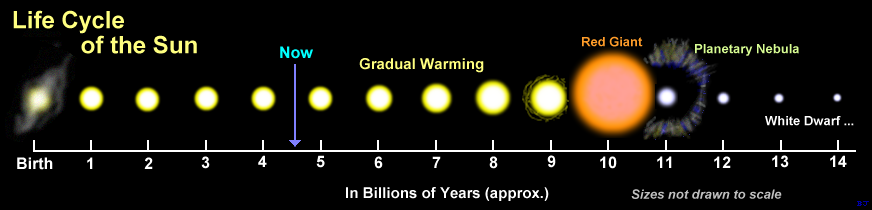
(Wikipedia)
| The problem will solve itself.
| But not in a nice way.
I concur!
And, as the sun evolves on the main sequence, the Earth's due for the ultimate "global heating" in about 0.5 to 1.0 billion years. That's when moist greenhouse conditions are anticipated to run away. The oceans will boil. Barring some kind of unforeseen variable, of course.
-best,
Wolf
By then the raccoon space program will have the ability to deploy reflectors at the L1 point, thereby controlling insolation. :^)
Let us hope! :o)
Houston we lost your data:
http://sfgate.com/cgi-bin/article.cgi?f=/c/a/2007/04/14/MNGHNP8L001.DTL
Rapid warming on Mars, and loss of glaciers around the Earth, along with the largest solar flare ever recorded happening in 2007 might be linked to the theory that changes in the sun change weather; or some isolated anamoly mentioned to try to disuade the some of the CO2 global warming people from their intended purpose of requiring large energy consumers to pay CO2 taxes to hunter gatherer, goat herding type peoples, else come up with some "green energy" projects.
Correction, the flare was in 2006
http://www.noaanews.noaa.gov/stories2007/s2831.htm
There is a decade of data from a Mars orbiter about the polar conditions and more data from observatories on earth. One might consider the Martian warming is being caused by changes in the sun.
The interior of the earth was heated by the radioactive decay of radioactive elements. These elements are becoming older and losing potential energy.
Ah, yes, solar flares. They can be quite the disruptors of modern electrical infrastructure, among other things.
If any TODers haven't, I suggest reading the award-winning novella "Inconstant Moon" by Larry Niven.
-best,
Wolf
Another, and probably more plausible, theory is that the Martian heating is part of a longish-term Martian weather cycle involving albedo and dust storms. 0.6C (which would correspond to about 1% or 13W/m2 at Earth's orbit) in only 20 years seems way too fast to be caused by any plausible secular increase - i.e. an increase spanning multiple 11-year solar cycles - in solar radiation. And even given the difficulties of optical measurement, which are considerable and perhaps underestimated around here, a 1% increase since 1987 would be very, very noticeable by good optical instruments. Most of the variation is just a tiny increase and then a compensating decrease over the course of each solar cycle.
Solar variability occurs in the extreme UV and higher frequency range. This radiation is absorbed in the atmosphere in the mesosphere and higher. It's contribution to the heat budget of the troposphere is negligible, since it gets efficiently re-radiated out to space as infrared (by CO2) in this optically thin region. In contrast, visibile wavelengths are the primary source of heating of the troposphere and the Sun is extremely stable in this radiation band.
Comparing Mars and the Earth is plain silly. Mars has a surface pressure of 6 hPa. This pressure is found at 36 km above the surface on Earth. The Earth's atmosphere is sensitive to solar variations at these altitudes and higher but it is not contributing much to the energy balance of the troposphere.
The solar output only varies by ~0.1% over an 11 year period. We are at the high point in one of these 11 year maximums.
Plotting global temperature variation against the warming cycle gives good correlation, until about 100 years ago.
The sun is indeed warming the earth (As it has always, since it was born in a nuclear fire), however adding more insolation (CO2,methane, other GHGS) to the earth can only aggrivate it.
Question if the increase of solar radiation by 0.1% is more important, or a near doubling of CO2?
Futhermore, there is no such thing as global warming, it is climate change, and with a decrease in the ability of the planet to throw off excess solar radition, some places will get wetter, some colder, some drier, some hotter. The magnitude (or amplitude if talking about cycles) of these changes increases, and thus decreases the ability of humans to adapt. A lack of adaption will kill us.
Anyone interested in increasing the mpg of their vehicle might want to look into the “ScanGauge II”.
I've been obsessed with better mileage for decades, but this little item is really nice. It plugs into the ODBII port on any car built after 1996 and allow you to monitor just about every function of the engine while you are driving.
Everything from instantaneous mpg, to throttle position and engine load. I've only had one for a couple of days, but I think I can use it to significantly improve my gas mileage, by optimizing my driving habits.
I also will allow you to look at (and clear) the engine error codes that make your “check engine” light come on.
http://www.scangauge.com/
http://www.scangauge.com/features/digitalgauges.shtml
Bitter;
I've been eyeing these things too, now that my Dad bought a Prius, and gets to monitor his own minutiae. Tell us what you discover. I've been hearing people say that the optimal speeds on their cars are sometimes up in the 80's, not some wimpy 55! I have to wonder if that's not wishful-thinking instead of great engineering.
I also want a version of this in the center of the house, with a visual giving you quick feedback to how fast your meter is spinning on the Electrical Service Box. Remind people they are idly spewing their money, and more people have a healthy 'frugal' side. Most of us live in blithe ignorance of these kind of invisible flows, as the system was set up that way.
Bob
I just watched former CIA Michael Scheuer, head of bin laden task force before Bush admin yanked him. He said most Americans believe that Saudi Arabia is our friend and ally and that nothing could be further from the truth.
Is this close to the truth? and if it is it adds a whole other level to disseminating the fractional information avaliable from there.
P.S. Someone was asking about electric welder for post peak a few days ago and I can not find it now. I purchased a Lincoln 100HD MIG unit that doesn't need gas for steel. I can weld using an inverter off the car battery so I believe a battery pack with some alternative charging methode could easily power it. It can be cranked up to weld 1/4".
Way back in 1979 politicians of both parties looked on the Shah as a great ally. Less than a year later his replacement labeled the US as the Great Satan.
If BooBoo Bush would just spend a little more time holding hands and walking in the garden everything would be fine.
Things like that will be good to have. I wonder what the require wattage for such a thing is? (I have a 1500 watt inverter, for instance, and I recharge my deep-cycle battery with solar panels. My laptop that I'm typing on is running via that system right now.)
I thought the two paragraphs hidden in the middle of the NYTimes "Rivals Pursuing Nuclear Power" article were interesting:
I wonder if that grudging support would extend to Israel? It seems to me that for the Israeli's to carry out the strikes they were supposedly training for against Iranian nuclear facilities, they would have to overfly at least Jordan and Iraq. I don't think the Iraqi air defenses would give them much hassle. However, the Jordanians would have to at least secretly OK it. Alternately, the Israelis would have to fly over Syria (not likely) or Saudi Arabia. Jordan seems much more likely.
With support from US KC-135 tankers the Isrealis could fly south over the Gulf of Aquaba and around the Arabian Peninsula and enter Iran without violating any other country's airspace.
Seen from the Middle East. Iran is a terrible threat to the corrupt elites who rule most arab states. They rule with our help. Most of the states are US protectorates. They supply us with oil and gas, we supply them with security. Howver, the great mass of the ordinary people in the region see Iran as a beacon of hope - an inspiration. Finally Iran managed to throw off the yoke of foreign domination and acheive independence and sovereignty. It's hard to explain to Weterners just how popular the idea of the Islamic Revolution is among the arab masses, and that popularity is growing the more the West attacks Iran and the more Iran stands up for its rights.
We may not agree with Iran in the West, but it would be an historic mistake of dimensions, if we deluded ourselves into thinking that the Iranian revolution was frowned upon by the people of the region. And there is the rub.
The longer we support the unpopular dictatorships that rule the arab world the worse the eventual explosion is going to be when these dreadful regimes are finally overthrown. The massive ligitimacy chasm that exists in the region between the pro-western elites and the great mass of the people is really dangerous for us, because it leads to instability. The regimes we support so lavishly are doomed in the long run, which is why we will never support democracy in the region. If popular governments were to come to power in the Middle East they would resemble Iran. We may not like it, but that's what they'ed look like. And the paradox is, that the longer we support the unpopular, corrupt, wasteful and deeply undemocratic regimes in the region, the worse it's going to be for us when the lid finally comes off. The West has become so identified with the old ruling order, that our values have become tainted by association and compromised.
Like so much else, we should have begun "mitigation" and reform in the Middle East, twenty years ago if we wanted a smooth transition to a new and better order, now we'll be lucky if we aren't drawn into and dragged down by the Revolution when it comes, which, if we attack Iran, could be far sooner than most of us imagine.
I would strongly suggest that this is WRONG! The Arabs should be aware that they are in the crosshairs of the axis of evil [Washington, London, Tel Aviv] and therefore would be unwilling to countenance an attack on an ally. Iran has threatened no one, except for Saddam an the Zionists.
I also believe that King Abdullah of KSA warned against such an attack when he stated that the invasion of Iraq was ILLEGAL.
-
James Gervais
Hope was the last ill to escape Pandora's box.
Iran to build 2 nuclear power plants
Meanwhile, in North Korea:
North Korea Takes No Apparent Action as Deadline Passes
Reading that article i finding it difficult to ascertain whether the North Koreans actually got the $25 million.
I'm trying to figure out what the Hydrogen Fuel Cell Jet is all about? I thought the usual procedure for powering a jet was to directly convert fuel (hydrogen is the hottest fuel there is) into combustion products and high-temperature air, which are then directed opposite to the desired direction of travel. The toughest requirement is that the jet engine be able to survive at the temperature of the fire for whatever fuel you are using.
So this thing has a 1.3kW fuel cell? They're converting hydrogen → electricity → propulsion? How? An electric propeller inside that cowling?
| The problem will solve itself.
| But not in a nice way.
UAV is a better catchphrase than "Radio Controlled Model Airplane launched by hand off a hill".
Video of it Flying
Another article
I think "Jet" is a misnomer. Everything I found was vague, but it looks like it's an electric turbofan. I am guessing Electrolux or Hoover is an engine parts supplier. If they used a jet engine with the compressed hydrogen, they wouldn't need the fuel cell or the electric motor. I don't understand what they are gaining.
I would think 3kg of compressed hydrogen would have launched a model rocket without someone throwing it into the air. :)
This is a regular prop model airplane powered by a fuel cell. This is interesting, but it's not even a feasible model airplane power system, never mind getting billing as some radical change in aviation.
Thanks for that, yes, I can hear the Electrolux running in the video.
And, yeah, I've seen parafoil jocks take off from a mountainside in Utah with no fuel at all. They get some lift out of the prevailing wind up the slope.
There are of course model aircraft with true jet engines, video here:
http://www.youtube.com/watch?v=2WI2r3TFOY0&mode=related&search=
They do not sound like dustbusters! :)
The guys at Nye Thermodynamics have a lot of imagination, tools and willingness to stay late at the shop to risk life and limb messing around with gas turbines.
They put a 1,370 HP gas turbine in a jet boat. This is the best video of it.
That does not sound like a dustbuster. It is also about as off-topic from peak oil as you can get.
They also built a wood gas turbine and several other nifty turbocharger conversions and other projects.
LOL, those guys are steampunks on steroids! The hard part is getting the boat to stay on the water!
This is as good a bad example of exuberant technology gone wild as anything I have seen- loud, flashy and dam near useless otherwise. But fun.
Maybe off-grid people will be cheered to hear that we are working on a real wood to electricity widget that does not make like a banshee. The first version works well, but is expensive. We have a new idea that is cheap, efficient, long lived and quiet, and burns just any old wood, weeds, chicken litter, etc, you might have around.
It will work on or off grid, and store energy for big starting loads without a battery.
Don't hold your breath, but progress is being made.
Um, I mean, the exhaust is clean- just nice wet warm carbon dioxide.
In theory, you suck air in, heat it up somehow, then let it rush out the back. If you look at the jet engine hanging off the wing of a 747 you will see a large turbine at the front. To do the required sucking.
Hence we talk about turbofans and turbojets. To qualify as a jet engine you simply have to get a large part of your thrust out of imparting heat to the airstream, rather than just pushing it with a propeller.
So if you use a fuel to cell to generate heat, and dump that heat into the airstream going through the engine, and create a significant amount of thrust in the process, you have a jet engine. Even if your heat transfer mechanism is something as simple as a superhot electric bar heater.
If we are to believe in things we cannot see or touch, how do we tell the true belief from the false belief?
They are using a fuel cell to generate electricity. Rohar1 posted a link to a video of the craft, above. It is a fuel cell powered dust buster.
From chatting recently about ag and the current weather conditions , due to IMO climate change, and the always background level of PO crisis, it occurred to me, say *epiphany*, that after we have accepted and lived thru the PO energy shutdown scenario that the most and the most absolute next and perhaps ONLY item on the agenda for mankind and civilization, if anything is left is:.....
AGRICULTURE....yep.. food is next after all the yuppie toys are down the drain. All those fancy gizmos, the Ipods, cellphones with web browsing and text messaging, the SUVS the soccer moms prize so highly....after all those wonderous toys are toast that the simple process of bringing FOOD out of the ground will have to be all that is of supreme importance.
The only thing that will allow life to proceed on any scale.
Well yes water as well. Most of the USA having polluted our streams might find potable water high on the list. Potable water being found at all , its going to be out there in the farmland as well. You can't farm much without moisture.
Yet its all done by an extremely thin sliver of our folks. They use enormous technology to bring forth the abundance that we have come to expect and almost dismiss as unworthy of our attention.
Considered a bunch of throwed back ,yahoo, ignorant rednecks and a usual subject of derision within the yup circles of higher intelligentsia.
Going to therefore IMO be some very very interesting times ahead. Barring a military takeover of all the ag areas of our country(hard to imagine without those toys) then some folks are apparently going to have to eat a whole lot of crow regarding those areas of derision spoken of above.
How much for a tomato? A bucket of cows milk? An egg? That will be what we use for trade instead of useless gold or silver. Just like when we hitched the team on Saturday and drove into town for Trade Day. Our butter for salt and our cream for sugar. No money changed hands. You got your account cleared to zero maybe and a jawbreaker thrown in.
You traded with your neighbor and if you were found to be a cheat and liar? Too bad. No one wanted to deal with you as the word went around. Morality meant your livelhood in the community. You needed to be a man whose word was his bond. A handshake meant a lot more than just someone shining you on. You didn't give your hand to just any one. To this day I find it hard to shake hands with someone I really don't know and those I do know and respect I hope take me at my word. Trust and respect. Words not much in vogue these days YET farmers have been doing business that way for a long time. Its only of late(last 20 yrs) that its started to change and now landowners and farmers are not so sure anymore and cheap paper has to be drawn up where in the past it was not needed.
Folks are going to have to learn a whole new way of relating to one another. An 'epiphany' then, forced by a new set of circumstances.
As always,an opinion here on TOD,
where sometimes the trolls come out to play.
But this is the way I remembered it, toys aside.
Class of '57..Airdale
Maybe or maybe not PM:s wont be worth so much, but i do not believe, that gold and silver should be LESS worth than fiat money. Of cource you should not invest in PM:s before your other preps are fulfilled.
Airdale, good comment on AG. I don't know any stupid farmers, but I do know a lot of very smart ones. "throwed back ,yahoo, ignorant rednecks " don't last long in the farming biz.
Resounding comments Airdale!
but my McMansion (yup circle intelligentsia) neighbor has the water supply figured out, installing a backyard pond this wknd...
CO2,
I have drank out of rivers,creeks,branches, springs, cisterns water buckets and wells. But I have never drank out of a pond.
I have a 250 ft. deep well piercing way down into one of the most abundant aquifers in the country. With a 4 inch casing I can just pull the pump out and with a 3" length of pipe pull up all the water I need to for basic requirements.
regards,
airdale
If you assume that the bulk of suburbia may end up foreclosed and abandoned, and further that you will manage to hang on to your property (paid off or whatever other reason), then there are still several things you can do.
1. The state of Texas encourages people to install rainwater catch systems. The best way to do this is to replace the asphalt-shingle roof with something else, probably tile being best as you can move to a light colored tile and get lots of reflection of solar energy that way.
2. You can install grid tie PV systems for electricity. Even if the system doesn't cover all your needs, reducing your dependence on the grid is still good.
3. You can convert some of that backyard from useless lawn to garden space of some sort. Such a changeover also gives you a healthy outdoor activity to pursue and provides some fraction of your overall food needs.
4. You can improve overall insulation on your house as well as installing double paned storm windows and sealing any air leaks you find.
In short, there are lots of things you can do. Finally, if you do as WT has suggested, and arrange your affairs such that you can live on 50% of your income, then you have the other 50% for doing these sorts of activities.
Ghawar Is Dying
The greatest shortcoming of the human race is our inability to understand the exponential function. - Dr. Albert Bartlett
Grey Zone,
I tend to think that there will enourmous amounts of property available. Think 'squatters/squatting'. As the die off proceeds it will be open for whoever can deal with it.
Ownership will be enforced from those already 'on the ground' and have made improvements or do not perish from the chaos. They will tend to fight for what they have and not let it just be taken from them. Otherwise there will be plenty to go around. Granted a lot of useless concrete and asphalt will cover a lot of the very best.
Backyard gardens? The lots size of todays dwellings is IMO rather useless. Just one of my gardens is larger than most burb lots. And how much is condos and apartments with basically zero lot sizes. Postage stamp size comes to mind.
All that aside the problems will be the lack of knowledge. Lack of tools and lack of infrastructure and most of all...the biggie....the LACK OF SEEDSTOCKS...this due to hybridization.
So if a ragtag group can find some quality land that is not resided upon and not in contention they still face a very big challenge.
This is what has to be mitigated. This is what will NOT be mitigated. So it will be IMO 'root hog,or die'.
You might be capable of convincing the ones on the land to give you a leg up but the problems are 'who do you trust' and to me that is the biggie. We have become a nation of con artists, liars, cheap thieves and of absolute no trustworthy values. Who would trust those who have been the ones whose
ignorant uncomphrendingly stupid lifestyles have put us here in the first place?
Very little of trust left in this society. We are at each others throats constantly , be it on the highways or in business competition.
I would never never trust someone whose past life was in management (in business). These are the culprits who stole us blind and put us in this mess. Likewise our 'elected' representatives have garnered absolutley no bonafides to speak of whatsoever.
A far different world must come into being.
Putting tiles on your roofs? Oh come on man.
Sorting out some wires and PV panels? Sure.
You think it will all go down real slow like. I don't.
We are way way beyond civility.
Actually, airdale, I think it is going to go down very fast. You should think about that very carefully and thoroughly. More than that I am not interested in discussing in a public forum. You attend to your needs and I will attend to mine.
Ghawar Is Dying
The greatest shortcoming of the human race is our inability to understand the exponential function. - Dr. Albert Bartlett
Well GreyZone as you can see by my postings I have thought about it very carefully.Mule power,dung for sale and well then all the rest..yes....I do seem to be on track.
As to 'attending to one's own needs'?
No comment ,but think about what you just said. Did I miss a circular logic loop there? Let's see...we all just deal with our own needs..then.......well..mhhhh....Maybe ur right. Last man standing and so forth..yes chap I do see it clearly, bravo.
Last man standing? Where did I say that?
Stop being a juvenile fool, airdale. Not everyone is as stupid as you seem to think.
Ghawar Is Dying
The greatest shortcoming of the human race is our inability to understand the exponential function. - Dr. Albert Bartlett
From the plant, animal and well prepared human perspective the faster the better, it that is to be the fate. Faster means more biodiversity has a chance to survive and maybe the meek will eek it out to start again. Ground hog day.
Corrugated metal works great for water catchment systems.
I'm in the process of getting quotes on solar pv. I wanted to be wired for both grid-tie and stand alone, so that I could cut the grid-tie if the grid became too unreliable. Can't do that. It seems that the panels are wired differently and they use very different inverters. The other thing to keep in mind is that if you have a grid-tie system and the grid goes down, your solar investment is worthless to you.
Since my ultimate concern is the reliability/availability of the grid in the years to come, I've made the decision to go stand-alone. It costs about 1/3 more to go stand-alone versus grid-tie, but I don't want to make this huge investment and have it useless when the grid goes down. We already have quite a few power outages here, and since we are on catchment with pump, when the power goes out we are cast into the "outdoor plumbing" situation after the first flush.
BTW, estimates for a 17kwh per day (about 500kwh per month) solar grid-tie system in HI is about $40K. Add about 1/3 for stand-alone. OUCH! I'm trying to decide if we could live with 1/2 that and not feel too deprived.
Outback makes inverters that can be either grid-tied or standalone. I have such a system - 6Kw panels, 2 x 3.6Kw inverters and 800AH 48V battery bank. THe extra cost for standalone / mixed versus only grid-tie is only in the batteries and charge controllers + small amount of additional wiring.
http://www.wholesalesolar.com/products.folder/inverter-folder/outbackGVF...
A battery bank for a system the size of yours should run around $3K plus another $1000.00 for the charge controllers - so 10% more, instead of 33% as you were quoted.
Francois.
Then it appears these guys are lying to me. I wonder if it's because they aren't dealers for those inverters and don't want to use anything that they aren't dealers for.
HI is a real stickers on using licensed contractors for solar -- if you want the tax credits and want your home insurance to remain in force. They are the ONLY ones that can pull a permit. Originally, we were going to do it ourselves.
Thanks for the info. I will be asking many more questions. It seems that they REALLY push the grid-tie only here, and I'm not sure why. "Unless you are WAY off the grid, there is no reason to go stand-alone. Just get the grid-tie and buy a generator."
Also, the 30% more for stand-alone seemed steep to me since it involved the batteries and charge controllers plus a little wiring -- as you said. This was my first quote. I have 3 other contractors I'm still waiting on.
Also, the other thing he said is that I can't use the SunPower panels for stand-alone because they are wired for grid-tie and won't work for stand alone. I am just getting started learning about this stuff, and that sounded weird to me. Does that sound right to you?
francios---I have outback 7 kw, with about 6kw of collectors and the breakers on the inverter keep tripping--any ideas as to problem?
I had the same problem - there are a number of breakers in the system, and you do not say which ones are tripping, - but for me it was the output of the charge controllers - rated at 60A. It was strange to me that the panels would be able to output a little more than their rated wattage, but apparently this can happen early in the morning when the panels are cold and get full sunlight.
I solved it by adjusting the maximum output current on the charge controllers from 60A to 57A. I figure the little bit of energy I loose is worth not having to worry about tripping and resetting the breakers., You could also install 70A breakers.
I downloaded the catalogue from wholesalesolar.com do you, or anyone else, know of other good sources for solar panels? Has anyone used the Uni-solar thin-films? Any advice on purchasing offgrid solar system is appreaciated. Thanks in advance.
www.homepower.com
They are a semi-monthly (6 issues/yr), with a bunch of archived articles on the site.
I've bought from Arizona Wind and Sun
www.windsun.com
and the Alt Energy Store in Massachusetts
home.altenergystore.com
Bob Fiske
While there may be some inverters that only work as a grid-tie in system, the best ones are fully capable of functioning for a stand alone and grid-tie. The different wiring claim (if true) for the PV seems irrelevent -- you wire the PV's as an array and there should be no difference in wire costs either way.
If you want back-up power when the grid goes down you definitely need a battery bank. Without it the inverter senses the grid failure and shuts off feeding the PV juice any further down line.
With a battery bank you have your own back up power, and with a grid tie-in what you do is set the inverter to shunt off any excess power generated to the grid instead of into your battery bank.
That's why I wanted the battery bank. I can't see sinking tens of thousands of dollars into something that won't work when the grid is down. His response was to just buy a generator. Yeah, right. Then why do I need the solar to begin with?
What he said about the array is that they are wired differently and you can't use an array wired for stand-alone with grid-tie, so that I have to buy panels made specifically for stand-alone if I go that route. It didn't make sense to me that they would be designed that way. If memory serves me correctly, he said that one way requires parallel arrays and the other requires serial arrays, but again my memory is foggy on this. I was so stunned when he said "can't do" that I missed the next few sentences.
I'm sure glad I posted the solar stuff here. Thanks for the great feedback guys!!!
AFAIK all solar panels are equally capable of being wired in parallel or serial. I.E., it has nothing to do with the PV panels themselves, it's how they are wired together into an array that makes them either serial or parallel.
Also, AFAIK, with either the Outback or Xantrex brand of inverters it doesn't matter how they are wired. That it might due to whether one is planning a grid tie-in only, or a combined stand alone/grid tie-in with a battery bank shouldn't make any great difference in wiring costs.
I suggest you find a better solar dealer to go over what you want with.
When it comes to batteries, don't skimp on them with rinky dink car/golfcart types. Go for the biggest bad ass MoFo Industrial Grade ones you can afford. Real Goods sells the kind I'm talking about. What you want is the most AmpHours if you are planning to power your house for any extended periods of time off grid.
Living in HI with good amounts of sunshine will help, even if you find out that you don't have enough or large rated PV's. The thing is you can always easily add more PV later. But if you start out with a too small rinky dink battery bank and discover you are draining them too much, too fast, you'll regret not going for a bigger bank and one that will last.
Try and find some HI folks who are using battery banks and how big their banks are and how much PV they've got. Ask a lot of questions.
And lastly, take care of the batteries. Check them regularly for water loss, do a hydrometer check at least once a year and keep records for each one. Your battery bank is only as good as its weakest one. If one starts failing, it will drag the rest along with it. Get a battery life saver and install it too.
Thanks Godraz. More great info to print out!!!
I haven't signed any contracts, and did order some books from Amazon but they haven't arrived yet. This was just the first contractor to respond. I mentioned this company to someone else, and they said that they do good work but are expensive and "slick like the glossies."
Another friend is going grid-tie only and doesn't care that they told him he still needs a generator when the grid goes down. He was trying to talk me out of a battery bank because "they're a pain." I think many of these folks think they are getting a deal on energy costs with the grid-tie and net metering. By my calcs, the payback period is quite long, enough so that I see it more as a self-sustainability issue.
The simpler method of charging batteries from PV panels is more or less direct (although via a charge controller). Thus if you have 12V panels and a 12V battery you wire them all in parallel. (The "12V" panels actually output close to 20V without load.) Similarly for higher voltages, e.g. for a 48V system you wire the panels (say they are 12V panels) into groups of 4 in series, so they output 48V, and you connect all such groups in parallel.
Some recent model charge controllers are really a kind of inverter, and they can take input from higher voltage panel wirings (in series, e.g. 230V) and convert to lower voltage DC for the batteries. One advantage is that the cables from the panels to the device can be thinner and yet lose less power from resistive loss, since at a higher voltage the current (amps) is lower for the same wattage.
For grid tie you get the best performance from a high-input-voltage grid-tie device for the same reason. And there are devices that combine both functions as somebody posted above.
For me the grid-tie setup does not make sense since, under the local rules (net metering at the going rate and no time-of-day pricing), it would never pay for itself. On the other hand, why go off-grid when I am already on the grid?
My thinking has been that, barring a total sudden societal breakdown, the grid will still function, albeit intermittently. The reason I believe that is because that's what's happening now in many countries. The power is on anywhere from 2 to 20 hours per day. Sometimes it's out for several days after major storms. (That has happened in the USA too of course.) If that's what you want to prepare for, I would suggest the following:
* decouple (in your mind) the "renewables" issue from the "how to manage power outages" issue. Below I am talking about the latter issue only.
* you can set up batteries for power outages and charge them (mostly) from the grid (no PV panels necessarily involved).
* you can have more than one "system" on hand, e.g., a larger battery bank for larger loads (e.g., well pump), charged by the grid, and smaller batteries (charged by both small grid-powered chargers and small solar panels) for small loads (e.g., 12V LED lamps). (And don't forget some LED headlamps powered by small rechargable (NiMH) batteries. And a NiMH charger that runs off of 12V... And a radio that runs on 12V.)
* think about what you really want to keep running in a power outage. It's a cost vs comfort issue. E.g., with water coming from a private well (electric pump), will you or won't you give up running water for the duration of an outage? How about running the washing machine, can that wait until the power is on?
* note that you can get a significant amount of water (tens of gallons) out of a largish pressure tank after the power goes out. A larger pressure tank is far less expensive than a large batteries-and-inverter setup!
* for a deep-well pump that can run on a medium-size (<1KW) inverter, check out the Grundfos SQ series "no starting surge" 1/2-HP pumps. (Remember to add "90 feet" to your actual below-ground water level for the 40psi pressure in the pressure tank, e.g., the 140 feet model is good down to a water level of only 50 feet under the pressure tank location.) Note that with a large pressure tank (that won't run out in the middle of a shower) you can manage with a lower-flow pump (it will finish topping off the pressure tank after the shower it over). (I assume you will not attempt to water a large garden with this setup!)
* heating: that's a big issue here in Vermont! Typical heating systems won't run without electrical power. Solutions (other than a large off-grid PV system) include a wood stove and/or the rare propane heater models that can run without electricity but are nevertheless fairly efficient. (The old models without fan-driven "sealed combustion" are NOT efficient, and let your warm house air up the flue even when not running!) A compromise is a unit that needs electrical power but with low-wattage needs, set up so you can run it off an inverter when needed. E.g., my propane-fired boiler (Baxi Luna) uses only about 150 watts of 115VAC electricity when running, for the combustion fan and for the hot water circulation pump.
On the renewables (or conservation) side, I should add that if you cook or heat water on electricity, consider switching to gas. Once you do that, it is easy to bring the electrical usage (for a modest 2-person household) down well below 500 KWH per month - more like 200, doing simple things like CFL bulbs and turning lights off when not needed and putting PCs on standby and TV on power strip. You really should do that first, before considering a PV setup.
One more thing: for a small PV setup (for limited 12V usage, not whole-house) it's hard to beat this deal from Harbor Freight right now. Includes three independent (but meant to be wired in parallel) 15 watt solar panels (each panel dimensions: 12x 36 inches), "Power center", mounting hardware, 2 12V CFL lamps, etc - all for $200. They say "Requires ... inverter (not included)" but that's not true if you only want to run 12V stuff on it.
Re: putting phantom loads on a power strip - does anyone know of a power strip with a remote control ?
Yes, this would have a phantom load of its own, but that would be peanuts compared to the wattage of TV/home audio/computer that are plugged into the strip... My plugs are all nicely hidding under / behind stuff, and powering them on & off is inconvenient enough that we rarely do so...
CW
Thanks vtpeaknik!!! I just knew I'd get some get great responses here on TOD. I'll print all of this out too.
Learning to live in the tropics has been interesting--there are many issues I never considered before we moved, one of the biggies is the humidity and the organic matter everywhere. I am not joking when I say that you can literally watch the mold grow on fresh food in a matter of hours. So the truly biggest issue for us is REFRIGERATION. We've got this huge garden now, and try to pick and eat fresh food and give lots away, but the frige is always full. My worry is exactly what you mention--an intermittent grid. The power was out for 4 hours last time, during a cool winter evening, and Gary's ice cream melted, the meat started thawing, etc. Meat is VERY, VERY expensive here, and we usually buy whole fish from local fisherman and freeze about 25 pounds at one time. So that is the number one issue--we can't afford to ever get down to 2 hours per day. If Gary would quit opening it during an outage, that would help, but he just keeps checking....
Interestingly, we were just gone for about a week and I got the electric bill right after we returned and it included that period. I estimate that the electric usage while we were gone was only a couple of kwh's per day. I was stunned since it knocked off a whole 100kwh's that month. Now earlier that month, I did start replacing all of our lights with CFL's so I'm sure that helped. And I've been checking up on the old man and turning off stuff behind him. He's pretty notorious for turning on fans and then going outside for 8 hours. Guess I need to train him better. But what was stunning to me was that except for about 2kwh's, it appears that the rest of our electricity usage is discretionary (except for the pump, natch). I unplugged almost everything (that had a clock, remote, or phantom load) before I left except for the UV water treatment (should have turned that off too), the stove (clock), a few 7w night lights to make the place look occupied, the message machine, and I forgot my toothbrush and water pick. It's really making me rethink whether we need a 17kwh per day solar system. I'm actually thinking that a 5kwh system and hopefully at least some grid in the years to come will be sufficient. That should power the frige, UV water treatment, pump, and maybe a fan and a light without any problem.
I've also put all of my PC stuff on an outlet strip and switched to my laptop unless I really need my desktop. The biggest problem is all the stuff that attaches to it and requires separate power with all of those little phantom loads--my external harddrive, speaker system, 24 bit stereo, scanner, etc. Sometimes I only want to use one of those items, so that either means multiple power strips or unplugging them individually--which is a big pain. Does anyone know of a power strip that has individually switched outlets? That's what I really need.
Besides refrigeration, the only other thing I consider essential is the water pump. Our pressure tank is getting a little long in the tooth and isn't very big, so a bigger tank would definitely help. We bought a new pump but haven't installed it yet, but could always get the low surge type you recommended and resell our new one. Since we are on catchment, I've often mentioned to my husband that we should have a second catchment tank since they have had droughts here. Currently, you can buy a tank of water and they will deliver, but I wonder if things get bad if that will still be available. Anyway, if we had a second tank, I'd want it elevated so that we have water pressure the old way. The other thing I've tried to get Gary to do is install a spigot on our catchment tank so that we can fill buckets easily if need be by using the hose and starting a siphon. You have to keep the tanks tightly covered here due to plant material, bird crap, frogs, toads, lizards, and rats. So it's a pain to "dip" a pail for water, but it can be done in a pinch. I've even mentioned composting toilets to Gary, but he always get that disgusted look....
ckauup,
I haven't seen you mention anything to do with bid/paperwork. Even if you get written bids I'd suggest you get a LARGE notepad and the minute you meet them you pull it out. This serves several purposes, both for you and any contractor.
Where IS that 'Theory of Everything' ?
Hi RBM, I haven't gotten any real bids yet, just rough estimates. Still putting out "feelers." I like the notepad idea. And before I sign anything, I will be checking all available resources for complaints/resolutions. I'm also aware of the "female" problem, in that many men will try to take advantage. But since I'm just getting started and haven't read my books yet, this guy doesn't know what he is in for if he thinks he's going to take advantage of me. He also hasn't met my Alpha Male husband yet, which would be a requirement once it gets to the onsite bid stage, and that AM hubby isn't nearly as nice and polite as the missus is. I'll just say no and quietly go away, he will say exactly what he thinks and then tell them to do something to themselves.
My solar books are supposed to arrive today, so I should be able to bone up on this stuff especially noting all the good info TODers gave me.
One guy I haven't heard from yet does get rave reviews, but he isn't a licensed contractor. Evidently, he works with one in order to get around the HI legal requirements. His bid for a friend was one of the most competitive, so he's near the top of my list of "must talk to's."
CK;
I think you got some misleading info there. As Francois said, there are some other wiring options and inverters around that will offer you a choice.. but beyond that, if you have panels and just start with the grid-tie setup for costs sake, let's say.. those panels will be generating with or without the grid, and it's not that hard to switch them over to feeding an 'independent' line, if the main grid-tie inverter is shut-off with a utility outage.
The 'Wired Differently' advice must mean that the grid installation would connect them in series sections to boost their voltage up to say 48, 96 or 120 volts, depending on the inverter being used. It saves on the cost of wiring, since higher voltage lines don't need to be as heavy a gauge (copper $$) as the old 12 and 24volt systems. Such a setup would make it a 'little' more difficult to just be able to plug in a bunch of 12volt Car/RV accessories to some accessible point where the wires are coming down from the roof, but not untenable. Voltage converters (DC-DC converters) are available, or panels can be 'repatched' back to 12v, if it was a series string of 12v panels that was feeding the HighV line initially.
The panels are the crux, and I think anybody who can afford to make the investment should do so quickly. Any real stumble in Energy supply or grid-reliability could send demand for PV through the roof, (so to speak) and with Panel supply being as constrained as it is, those prices might not come back down again, what with all that we might be facing soon. As much as people think they cost so much.. considering what they do, I still think they're cheap, while I've still only managed to pick up 250w so far, with our budget. I would get at least a 1-2kw array 'in hand' ASAP., maybe with the racking set up to allow for expansion, for when you are ready to increase it..
I'm expecting to have my setup with one part being grid-tied, and another independent array working directly with DC applications around the house (ie, CarAdapter to the Laptop, DC Fans for ventilation, etc)
Best,
Bob Fiske
Wonderful, thanks for the info jokuhi!!!
One question, if the grid array wiring difference is series versus parallel, I really don't understand why I couldn't use the SunPower panels that I want. Most things I ever wired before didn't really care, but then that was back before we had really sophisticated electronics and my knowledge is pretty outdated. But most stuff I ever did depended on whether I was looking for higher voltage or higher current. Why would the panel matter? He flat out told me the SunPower panels won't work with stand-alone due to these wiring issues. I understand basic electricity, but this is my first venture into solar pv and I'm just starting to "bone up." I was so flummoxed by the "can't do with SunPower" comment that I didn't really listen to the next few sentences.
Things in HI are more expensive than the mainland -- everyone tends to add in the shipping costs and I don't really blame them. Shipping to HI can be very expensive.
I'm not sure why they'd say that. I don't know the Sun Power brand myself. Virtually all the panels I see are nominally set up as 12volt panels, with a varying amount of wattage, depending on the size of the individual panel. (They produce, in fact, about 17-18volts without load, but balance out at 12v when they are in full sun, under load and producing ~theoretically~ their stated wattage) There is a brand of panel called Kaneka that is set to 67volts (at 60w), which would demand certain minimum equipment and a unique setup, but usually a system builds from 12v panels, afaik. Are the Sun Power higher voltage panels, or otherwise unusual?
Charge controllers that I have are clear about how NOT to mix varying-brand/wattage panels within a series string, but otherwise, as long as it's not seriously over- or undervolting your inverter, this technology is built around the understanding that the sun comes and goes, so a variable input has got to be accepted by the technology. In fact it's a selling point, as Charge Controllers and Inverters have developed to grab the 'Max Power Point' (or MPPT) of the panels through varying conditions, to squeeze out everything possible, even when the sun is getting obscured. Before, you would get down into a bit of a cloud and the system would just have to cut out at its threshhold. Now, it can at least still trickle in some watts at fairly low illuminations.
Get those other quotes, I'd say, unless you think this would be a contractor worth building a relationship with, and pursuing the question further. You are right. There should be no reason to think you can't get power from your system during an outage. Maybe it's a HI building-code issue? (or that some electricians still think it is.)
I read about a Solar and Wind installer on Maui named Laf Young, in the 'New Independent Home' book. (1999 Latest Story on him) Lives on the Hana Highway near Haiku, if that means anything to you. His testimonial about all sorts of things-Hawaiian, Useful Architecture and energy smarts would possibly be helpful to you.
This is all Google gave me, aside from a DMV form with his name on it.
"Laf Young (808) 572-8632 Makawao, HI 96768"
Hope that was helpful. I'm not an installer, either, but I do have a pretty good grasp on the eq.
Bob Fiske
Thanks again Bob for the great info and for answering this newbie's questions. SunPower evidently makes on-grid models and off-grid models according to some spec sheets I found on their site--but it doesn't say what the diff is between them. But instead of recommending the SunPower off-grid model, he is recommending panels that have a much lower efficiency rating according to their spec sheets. So I'm doubly perplexed. I know he is a SunPower dealer -- maybe he knows something about the panels that isn't good, although he raves about SunPower and how he is the only SP dealer on the island. Or maybe, for off-grid installs he gets a better margin on the other brands.
I sent him a follow-up email with questions about the panels as well as the "can't do" regarding the dual setup.
Mahalo!
Cheryl
Roofing tile is expensive. Also very very heavy. It requires a lot of structure underneath it to support the weight. Try metal roof instead. And please not lead. (Yes that still exists.)
We had a steep (16/12) clay tile roof once. It was very durable, but hardly anyone knew how to repair it, much less install it. Consider imitation slate shingles made from recycled tires.
Imitation slate shingles would be unsatisfactory for the same reason that shingles are - they are made from a material that potentially contaminates the roof runoff, which you want to capture in your water catchment system.
Tile is about idea. Metal is damned good too. But avoid petroleum based roofing products if possible.
Ghawar Is Dying
The greatest shortcoming of the human race is our inability to understand the exponential function. - Dr. Albert Bartlett
Why highlight today this 3/13/07 Toledo article highlighting absolute MPG differences versus % differences?
Most Americans can't seem to understand percentages. They also insist on expressing fuel consumption backwards, as distance per fuel unit, i.e., miles per gallon, rather than the way Europeans do it: fuel per distance, e.g., liters per 100 km. So lets translate (made-up numbers):
Old way:
Prius: 60 mpg
SUV: 20 mpg
New way:
Prius: 51 mpg
SUV: 17 mpg (still 1/3 of the Prius)
Converted to the other units:
Old way:
Prius: 3.9 liters/100km
SUV: 11.8 liters/100km
New way:
Prius: 4.6 liters/100km (0.7 more liters)
SUV: 13.9 liters/100km (2.1 more liters)
A response from Dr. Lehr
In response to my post to Dr Jay Lehr yesterday, (posted on yesterday's Drumbeat), I received the following reply.
Jay Lehr wrote:
Dr. Lehr, thank you for your kind reply. You say Dr. Hubbert had an incorrect view of the future of world oil reserves. I understand where you are coming from. Dr. Hubbert believed that the oil in the ground is finite and, because of this finiteness, if we keep pumping it out the reservoir will one day start to deplete and eventually run dry. You on the other hand, if you believe the book which you championed in your Heartland article, believe oil seeps up from deep in the earth's mantle and the reservoirs will never run dry.
Thanks but no thanks. The evidence clearly shows that reservoirs are depleting, some at a very alarming rate. Even Russia ’s very old reservoirs are depleting. Russia is currently developing new fields on Sakhalin Island and elsewhere in an attempt to offset the swift depletion of their older, [abiotic ;-) ], fields. Russian oil will probably peak this year or next, at around 9.5 million barrels per day.
Thank you
Ron Patterson
Technically, even if oil did seep up from the earth's mantle, it would still be finite. The earth has only a finite number of atoms, after all. So belief in abiogenic oil is consistent with Hubbert's theory.
This shows the emptiness of the claim that Peak Oil is in some sense proven merely by the finiteness of our oil reserves. Suppose we had a billion years of oil even at exponential growth rates. Then it would still be finite, wouldn't it? But Peak Oil would be no more a concern than that the sun will go out someday, and wasting any time worrying about it would be as foolish as worrying about the sun.
The point is that merely reciting the fact that earth's oil reserves are finite does not prove anything. The meat of the Peak Oil argument has to focus on the details of supply and demand.
As I pointed out on the ELP thread, there are really two parts to the George Bush question (What percentage of all crude oil consumed to date worldwide was consumed during George Bush's first term?).
The second part of that is that based on the HL model, we will consume about 10% of all remaining conventional crude oil reserves during George Bush's second term.
So, what we are doing is using one finite area, e.g., the Lower 48, as a model for another finite area, the world, and as Deffeyes predicted, world crude oil production is declining, while Brent spot prices are currently about 80% higher than the average monthly price in the 20 months prior to 5/05.
http://static.flickr.com/45/145186317_215cd1247f_o.png
(Note that the world data are for C + C + NGL)
I note that, if abiotic oil were real (and I'm dubious), one would have to ask at what production rate can it be accessed? Would 85 million barrels a day be a realistic production rate, or, would it be more like 5 million barrels a day, or 185 million? Makes a big difference. Production rate is important. Incidentally, it doesn't seem like depleted oil reservoirs are "replenishing" very fast based on the evidence I've seen.
-best,
Wolf
I'm a newbie here and don't pretend much current information. But isn't the slam-dunk refutation of abiotic oil the chirality of the molecules, which is inexplicable without a biological origin?
Great point!
No, the abiotic crowd explains that too: the oil is formed by methanogenic bacteria living deep in the crust, feeding on the primordial methane emanating from the deep earth. The existence of primordial methane is (I believe) fairly widely acknowledged to be valid, and is consistent with the observation of methane on many lifeless planets and moons.
I found "the Deep Hot Biosphere" to be a very entertaining read, once I filtered out the constant self-promotion by Dr. Gold ( I chose to find it amusing, rather than annoying...). He managed to tie together many different areas into a single, coherent, but probably incorrect theory. He touches on abiotic oil, the origin of life, the highly asymmetric concentration of minerals (e.g. veins of metal ores), a mechanism for transporting diamonds from the deep earth, even non-seismological earthquake activity e.g. the New Madrid earthquake.
Abiotic oil formation is largely irrelevant to the discussion of oil supply, even if it were true (for the reasons noted upthread - refill rates are almost certainly far too low to be meaningful for the modern economy).
I actually think the 'origin of life' portion of his theory is quite plausible - much moreso than any of the standard models. But that is a topic for a different board :-)
CW
Global peak: 2007 - 2010
Global decline rate, Post peak: 2%
Economic response: Severe global recession, ~5 years, then slow recovery
I always envision that if abiotic oil does exist then the oilfield refill rates are more likely to be attuned to geologic time than human time, and I have this picture in my mind of some guy growing old as he waits by the side of the well with his abiotic oil bucket in hand....peering into the hole and waiting, and waiting, and waiting...
...and then, plink!
"Yeeeehawwww! Hippy Joe, I got a drop of earl! Now that it's going for $3,377,543,998,797.73 a barrel, I'm rich! Woo-hoo!!!"
;o)
-best,
Wolf
Hehehehe. I like your ending. You know what? At that price, I might stand there with my bucket and wait too...
Excellent point. Presumably the abiotic process has been running for millions of years. And has produced about 2 trillion barrels in that time.
So if we say, 2 trillion barrels over 200 million years, that's ten thousand barrels a year. Or about 30 barrels per day.
Not much of a refill rate.
If we are to believe in things we cannot see or touch, how do we tell the true belief from the false belief?
Even if you jack the assumed barrels to the highest and most absurd figure that even most cornucopians reject - say 10 trillion barrels - that's still only a 5 fold increase to 50,000 barrels per day. And we are using 85,000,000 barrels per day. So the abiotic theory, even if true, does nothing to resolve our oil dependency issues.
Ghawar Is Dying
The greatest shortcoming of the human race is our inability to understand the exponential function. - Dr. Albert Bartlett
When one wants to believe something enough, scientific details are superfluous.
Exactly. Let's have the abiogenic loons explain coal.
As noted above, finite areas like the Lower 48 appear to serve as good models for the finite world, and the finite areas like the Lower 48 don't seem to support the abiotic thesis.
http://www.energybulletin.net/3845.html
Published on 6 Jun 1974 by Technocracy.org. Archived on 27 Feb 2007.
Hubbert on the Nature of Growth
by M. King Hubbert
Water instead of gas
As far as I can tell this is electrolysis with solar cells and batteries. I don't understand posting these types of links, did the "could lead to","possibly" and "maybe" comments by a biology teacher make it news?
>>> shakes head <<<
This was a better idea:
Dog and Squirrel Power
(and he even has the foresight to realize squirrels might end up in short supply)
I liked the made-up term plasmatic induction. Very scientific. [rolls eyes]
Of course, one must construct a plasmatic collector to gather the plasma. I did some research and discovered that there are several YouTube videos of a punk rock band called the Plasmatics. Perhaps I, too -- by researching ancient Illimunati texts -- could construct a plasmatic collector out of earphones and an old bong. By playing Plasmatics music at high volume using special vibrational resonance/beer bong headphones, the plasma would be stored in them. Then the headphones would then be plugged into the vehicle when one wished to go for a drive (zero-emission).
This must be the Plasmatics bid to be 'Inducted' into the R&R Hall of fame..
They use the plasmatic inductor to charge the flux capacitor. It probably forms a resonant circuit with the beer bong. Of course the details, patent applied for, require an you to sign an NDA to see them.
Hello rohar,
Funny you should mention dogs. I've read that during the European middle ages dogs were used as "fractional horsepower" motors. An example would be to turn the spit in a baronial kitchen.
Best of luck to us all,
Errol
Sometimes they ended up on the spit...
The much-reviled Thomas Friedman attempts to address the problems of US energy security, global warming and America's non-competiveness (remember, it has to fit into his "flat world" theory) in this article in the NY Times Magazine today:
http://www.nytimes.com/2007/04/15/magazine/15green.t.html?ref=magazine
Lots to argue with in this article, but he does have some things right...
Careful ya don't fall off the edge there, Tom ... you know there are disadvantages to a flat world.
The one thing he has right is this phrase "The Power of Green."
The problem is that the green isn't environmentalism.
Hello Seadragon,
Jim Kunstler has posted his blog early in response to the Friedman article:
http://jameshowardkunstler.typepad.com/
I think Jim would say that us TODers don't exhibit a huge tendency towards 'cranial-rectosis'--but most of the US does--LOL!
Bob Shaw in Phx,Az Are Humans Smarter than Yeast?
Thanks for the Link, Bob.
Did you see who's dogging JHK's site today?
"After Homo sapiens are extinct, Mother Nature will prosper for perhaps another billion years. Nature simply doesn't care whether a self-destructive primate survives or goes extinct."
A proud TOD 'graduate'. Guess who?
I knew who after the first five words of the quote. :)
I went to JHK's site and followed an interesting link somebody posted on the possibility that cell phones could be playing a role in honey bee colony collapse disorder (CCD):
Are mobile phones wiping out our bees?
Thought some might be interested in reading it! Amazing to consider.
-best,
Wolf
I saw that article and thought it interesting as well, however, I would think cell phone towers and local cell units on light poles and such would be the culprits and not individual cell phones.
Heck, if we could paint the air with all the transmissions we use this day and age I bet we could hardly see through it.
I'm sure this wacks out quite a few animals homing radars.
Yes, I pretty much had similar thoughts. It'd be interesting to see more research down this line of inquiry.
-best,
Wolf
Sure somebody will be looking at the correlation between the location of towers and the proximity of lost hives. It'd sure be interesting if no hives were lost where there is no 'coverage'.
I wouldn't be too shocked if it was, but one of our 'Eric's' (Eric Blair, I think) Talked about how his Colonies are unaffected, knock wood, and that they only pollenate Organic or non-GM (?) fields. I've heard this connection mentioned a couple times.. here's some..
http://hawaiihealthguide.com/healthtalk/display.htm?id=563&hhsid=423dd4f...
"Bee mites, as well as fungus and viral infections, overwork and poor diets of corn syrup and GMO pollen have been recently implicated as part of the serious problem for the Bee Colony Collapse Disorder.."
http://deltafarmpress.com/news/070403-honeybees-malady/
“There are some concerns about GMO crops that can produce a toxin used to battle harmful insects. Those traits are also in nectar and pollen.”
I believe there is also signs that bee colonies in Europe are being affected and GMO crops are not grown in Europe (or has that now changed?).
Give the man a break. He is doing us a huge favour just by bringing up these issues - he has a big readership. Other columnists will discuss the points he makes simply to maintain their own relevance.
As several other posters have said, people aren't ready to hear about peak oil. They just can't get their head around it yet. But I think a lot of people are ready to at least listen to the idea that a dependance on oil leaves the US vulnerable to some very undesirable people. I think the term "petroauthoritarianism" is a useful meme to introduce to as many people as possible. Get across the idea that your oil consumption supports tyranny around the globe.
Any topic which would lead people to question Car Culture is helpful in preparing people to eventually consider Peak Oil. Whether it's global warming, or geosecurity, or the obesity epidemic. If you can get people thinking it might become a habit.
If we are to believe in things we cannot see or touch, how do we tell the true belief from the false belief?
Can anyone more knowledgeable than myself comment on the viability of vanadium redux batteries such as those developed by vrb power systems as an alternative liquid fuel for vehicles or point me to where they might have been discussed already?
Seems to me that they could be pretty useful for making wind and wave power more viable from a technical point of view, but what is the likelyhood of using them as an electric vehicle fuel, replacing the electrolyte when it's discharged?
This is WAY too heavy per watt-hour stored for mobile (electric car) application. May find a use (if they can make them cheap enough) for home solar PV/wind or even utility size applications.
Best Hopes,
Alan
A small island near here uses the batteries to smooth windpower. I think the problem for nonstationary apps is not just the logistics of storing toxic electrolyte but the upfront cost despite indefinite cycle life. From memory that was about $150,000 per kwh. Proponents of V2G want PHEVs to have a battery of at least 10 kwh. That's $1.5 mill just for the battery.
Great. Americans need more incentives to buy SUV's and P/U's.
Recently 4 friends or relatives of ours have bought big P/U's. None IMHO needed them. If America never built another one I really think we would have enough for all the fuel we are likely to ever see to put in them. There must be billions of barrels of 'expected' fuel use for all those already in existence. Someone suggested that SUV's and P/U's will turn into neighbor hood mini-busses and communal supply wagons for struggling suburbanites. Plenty enough for that.
Short of an income tax offset and a high 'carbon' penalty at the pump I doubt we will throttle back until the Mid-east and Hugo Chavez cut us off.
Comparing a speeding AC using Prius driver with something else may make one feel more comfortable in that guzzling tank, but WTSHTF well be loading them both up to the roof and taking donations to pay for the fuel. I saw that in West Africa.
We watched
http://www.communitysolution.org/cuba.html
again yesterday. I do think there are some lessons in there for us. I doubt these folks envy our lifestyle as much as they once did.
Comment upon the No-Till method of ag cultivation and as it regards soil erosion, carbon sequestration and soil OM(organic matter).
Since a lot of comments I read lately concern the prospect of food availability in the future, carbon storage and to a lesser degree sustainability of farming I am posting some data and links on the topic of No-Till farming.
Some time back when ethanol was being discussed I stated and debated with R. Rapier the concept of no-till as we used it in Kentucky to combat soil erosion , which was a major point at that time and the use of large amount of chemical fertilizers.
When I suggested that we in Ky no longer suffer from erosion to any meaningful degree I met with some disagreement on that subject as well as Robert stating that he was from farm country and had never seen No-Till in operation.
Far as I am aware from dealing closely with the UnivOfK ag science dept and reading their material plus visiting many site demos and programs , we in Ky pretty much led the way early on into using the principles of NoTill. Primarily in the central and western areas. Our soil here is such that it very easily erodes if not properly tilled. This is where NoTill outshines all other methods.
Here is the info:
"In 1961 and 1962 demonstration trials were run in several farms in the United States. These demonstration plots led Harry and Lawrence Young from Herndon, Kentucky, to apply the novel technology on their farm and became one of the first mechanised farmers in the world to use modern no- tillage crop production."
This is the link which contains the above quote as well as a huge amount of information on No-Till practices and advantages , all very well documented.
I was not aware precisely of the carbon issue until I read it in this document but it was somewhere in the back of my mind.
Note that I have soil sampled and tramped over and driven over a huge number of acres of farm ground. On my own land and acreage I am extremely familiar with each and every plot and acre of it. Intimately so. I brought back in the mid 80's when it was then under NoTill cultivation yet was experiencing some erosoion due to sloppy practices of the operator by not using 'grassy waterways' and other methods. At that time I threw him almost bodily off my land and turned it into pasture and grasslands range. However I had already seen in the topsoil the advantages of NoTill on my land, excepting the areas stated above.
In others lands I see a minimum of erosion. Both wind and water and most of this always due to usage of NoTill methods.
Its obvious that if you leave residue on the land and do not wound it with plowing or exposing the raw ground to erosion that you will not require such large quantities of chemial fertilizers since the OM will offset it quite a bit.
I leave the reader with the link to the document and they can draw their own conclusions. I would simply say that in my area of Ky we have solved these problems that apparently the more northern and western areas have not seen fit to implement. If so we would not have the quoted loss of topsoils that I have read of on TOD.
Here is the link:
http://www.rolf-derpsch.com/notill.htm
One further note: If we are to save agriculture and make it sustainable then we need as many advances in agriculture as is possible in order to sustain us on this rapidly depleting planet. Water,soil, fertility and all the rest.
Believe me that if you do NOT maintain the fertility and tilth of your soil, it will not produce much for you. This is of extreme importance now that we have 'robbed' all pretty much easily gotten oil out of the ground. I say 'robbed' because when talking to miners(my wifes uncle was a miner in Illinois coal mines) they sometimes use the term as in 'we then began to rob it out'. A good term for indeed IMO they are 'robbing' it out. As say opposed to agriculture where you growing but if you do it blindly and ignorantly then your are once more just 'robbing' the earth and will later have to pay that overdue bill.
Airdale-been there and seen it, we don't wanta go there
Gullies you could bury McMansions in.
I remember reading articles about no-till back in the '70s. They were written by folks who worked for chemical companies and involved land treatment with stuff like Paraquat. They thought it was the bees' knees back then...
| The problem will solve itself.
| But not in a nice way.
The decline of tobacco farming in Kentucky has also been good for the health/quality of the land. Even prime land should not be in tobacco more than once in every 4 or 5 years, hard to keep from washing.
I spent two months last fall helping my father after knee replacement surgery in Georgetown, KY. So I got to pull up garden crops in the fall as they died (sweet corn, squash, cucumbers, watermelons and canteloupes, tomatoes, peppers, okra, etc.) toss them over the fence for the cattle and sow winter wheat as ground cover a few rows at a time as each crop was pulled. I will be interested to see if the cover is alive today. My parents (both 79) will return from Phoenix May 1.
My father and his sister/my aunt own slightly over 500 acres in Scott County, northern Bluegrass area. However, relocating there has little appeal to me. I know how to garden successfully on a multi-acre basis and could learn enough more for farming (I know most about tobacco; John L Drake was generally acknowledged to be the best tobacco farmer in Scott County decades ago and sold his own strain of seed for extra $). But I am adverse to doing so.
Best Hopes,
Alan
Scott County,
Yes land of the Toyota factory. Huge as I remember it.
The locals as I recall were not happy with Martha Lane's treatment of the Japanese. I heard something like almost forcing school teachers to do extra time tutoring the Japanese children in English. The county bore a heck of a run up in taxes to support the infrastructure that Toyota required I heard. She basically 'gave the shop away'.
Then the local golf course was brought up by the Japanese mgmt since in Japan membership was enormous. Some of this might have been gossip without foundation. Just what went around my work areas in Lexington.
I did also speak to some who worked there and they claimed that in the end very few Kentuckians were hired. Mostly out of staters. Again questionable but sounds right. As I recall though that Toyota did not have to abide with any equal rights as required quotas in hiring. Again ???
So I preferred Anderson County and my mini horse farm. I raised quite a few horses and loved the bluegrass area except that Lexington was becoming obscene with the sprawl which started about the time I left for good. I had a tobacco base BTW and rented it mostly.
You must say that a family with just a few acres could at least plant a decent tobacco and with good care make a reasonable amount of money. Something not possible with cattle or hay or crops. Such was the way that many many Kentuckians supplemented a very low wage. Wages in Ky were nothing to get excited about.
Of course the yuppies moved in and well...glad I got the hell out. Man O War just pushed it all out. The horses were no longer meaningful for me so I packed it in. Made a few bucks on the move but not much. Luckily I had my farm back home here so I came out ok.
There is nothing worse than sprawl to destroy what once might have been worthy. Something historic. Something worth keeping a bit of.
After J.D. Crowe and bluegrass music fled the scene I was glad to finally retire.
We still do a lot of tobacco in this part of the state. Its rather an honorable crop IMO. I still love the smell and so smoke the ocassional pipe or cigar. This is tobacco done righteous rather than the noxious hits of nicotine the cigarette smokers are going for.
Not many know perhaps that the Duke family were really big in tobacco. And thus Duke University..or do I have that wrong also? No think not.
I love my home state. Never intend to permamently leave it. My own county is where my bones will finally rest. My soil is all that I care to ever dig in.
Its an old tale that if you come to the Ohio valley and your not indigenous that you might get lung problems and die. There is something in the soil that does it. I finally figured they were talking about histoplasmosis. And if you were born and raised here you generally didn't get it.
Google : histoplasmosis Kentucky
My step mother lived here with my father. She was from Mo. and got histoplasmosis. Had to have parts of her lungs removed. Never got over it. If you mow you lawn you can stir it up and get a big shot if not careful. Myself I guess I am immune. Again maybe just urban legend.
Airdale-not sure of the truth of much of anything lately
Darn airdale you irritate me so regularly. But if you're going to go and plug J. D. Crowe maybe I have to accept you after all.
I still get sentimental over Bill Monroe and can hardly believe I was lucky and smart enough to catch his show twice.
From Kentucky further east J. P. Fraley, Rob McNurlin and yes Jean Ritchie.
Not Kentucky but at age 81 Ray Price is strong, in full voice, and the Cherokee Cowboys still kick. Do not miss.
Tobacco -- Gary grew a few plants here in HI and dried the leaves. I love the smell of tobacco leaves...before the cigarette companies get a hold of them. Mellow, soothing sweet smell--makes an interesting sachet. And burning a braid of sage makes a wonderful room deodorizer rather than the chemical crap in the stores.
It cracks me up that people flee the place they despise, only to move to a new place and create the place they despised. I see it here in Texas, from a quaint country setting to a sprawling business centered area. Or where the immigrants from central america move in to a section of town and replicate the place they left!
Excellent yields have been achieved on near-desert land using no-till with early weed spraying. However herbicide resistance is growing through natural selection (eg ryegrass) and some say it will happen accidentally as a result of genetic modification. There are now so many mouths to feed we can't go back to the old ways.
Not only does no-till help limit soil erosion, but rotting roots and litter feed the earthworm population. I began doing the no-dig gardening method (based on Ruth Stout's work) of permanent mulch about three years ago and the soil is soft as a marshmallow. What I'm really doing is raising a large population of earthworms and a seasonal population of moles which till the soil for me and add fertility. Check this out:
I don't keep a super-thick 8" mulch like Stout did. Mine is a bout 4". I get weeds, but not very many. I don't have a compost pile anymore. Everything goes right on top of the garden instead. I also keep an eye on Ph and add dolomite accordingly. It's a great method for household gardens. Stout's method doesn't rely on cardboard sheets or other such nonsense.
Now that the Generals and the business community both say that climate change is real, MAYBE Bush will do something. I'm not holding my breath.
I'm avoiding asphyxiation too :-)
Meanwhile, the Seattle Times has a GW inspired Climate Challenge on the front page of the Sunday edition:
Climate Challenge intro
They are challenging readers to reduce carbon emissions by 15% for one month, and providing tips on conservation, trip reduction, etc.
I also had a friend at work who pointed out the re-print of the Wall Street Journal article on Cantarell, which ran on p.3 in the Seattle Times on Friday (p3 is the main "in-depth" analysis page).
Almost convinced him that Peak Oil is a real problem (he's an economic cornucopian...)
CW
Global peak: 2007 - 2010
Global decline rate, Post peak: 2%
Economic response: Severe global recession, ~5 years, then slow recovery
A nicely balanced editorial on biofuels today in the Seattle Times (apparently from the Washington post, though I couldn't find it there):
Fuel for Thought
CW
Global peak: 2007 - 2010
Global decline rate, Post peak: 2%
Economic response: Severe global recession, ~5 years, then slow recovery
A Few days ago I read that the going rate or proposed going rate for the processed corn waste from an Ethanol Plant is $125.00 a ton or just over 6 cents a pound.At present market rates for corn being near $4.00 a bushel then that would be slightly over 7 cents a pound for the input corn before it's starches are removed through ethanol processing.That article stated that the processed corn waste was highly desirable for feed to cattle 40%,pigs 30% ,and chickens15-20%.With some problems regarding oil content.But generally a very good food source for meat animals.
Would someone reiterate for me why the ethanol processing is so intensive as to render the eroei basically nil?Is the value
of the ethanol plus the processed corn waste still undesirable?
The most common calculations I have seen value the feedstock at 0.2 EROEI and ethanol at 1.1 EROEI for a net 1.3 EROEI.
LOTS of heat (usually NG) is used to distill ethanol from water/ethanol mix (think still). Plus lots of nitrogen fertilizer (made from NG) is needed for corn.
Add planting, harvesting, transporting, ...
Best Hopes for something other than ethanol,
Alan
I thought I posted this on the Friday Drumbeat, but I don't see it:
Who Killed the Electric Car? on Democracy Now
http://www.democracynow.org/article.pl?sid=07/04/13/1421243
A high school classmate of mine had one in LA. He lived only five miles from work so it was great transportation for him. His EV-1 was handsome, like an Italian coupe, and dead quiet. He was carefully planning a long trip, which might be this one:
http://ev1-club.power.net/archive/990905/jroe2.htm
Please keep in mind all you survivalist , stock up, hold my semi-auto to my cheek while sucking my thumb, type folks....
If you are the only light on in times of darkness you are simply the TARGET!!!
I have to agree emphatically with all the past posts that add an H to the ELP.
Humanize.
If you do not include “flinging open your doors to any and all who come” to your post PO event planning you are living in a fantasy world. They will come.
I’m not talking about “community planning” in the traditional sense but you better hope that the greater population of you immediate vicinity are aware and prepared or else forget about it.
Truly scary - China confirms it will become a net coal importer within 2 years:
http://www.advfn.com/news_China-to-become-net-coal-importer-in-1-2-years...
And a couple of years after that the CTL capacity they are currently building will start to come online, and their coal imports will really take off.
If we are to believe in things we cannot see or touch, how do we tell the true belief from the false belief?
Check out the Australian ABC 'Four Corners' program on renewable energy
http://www.abc.net.au/4corners/
TOD favourite Vinod Khosla is interviewed and states that solar thermal with storage is likely to be ready before clean coal.
Edit: actually I think the inference was just concentrating solar, not sure if PV or thermal.