


Home Heating in the USA: A Comparison of Forests with Fossil Fuels
Posted by nate hagens on December 14, 2007 - 10:51am
As the shortest day of the year is just ahead, and colder temperatures abound, (at least in the North), I thought I'd edit and repost an analysis on home heating I ran last summer. (That post was followed by quite a good discussion)
A short fifty years ago, people heated their homes in winter with coal. A hundred years ago and before, people living in cold climates largely stayed warm in winter with firewood. Today, in a country (and planet) with vastly more people, we heat homes in northern climates largely with high quality fossil fuels, specifically natural gas, heating oil, and propane. Trees, a less energy-dense form of stored sunlight than oil and gas, have recovered a good part of their former % of landcover in the US, despite being still used for paper, wood, furniture, pulp and some heat. Below is an analysis of how the US residential sector heats its homes, how large are our forests and how much they grow and how much wood we could use for heat, after fossil fuels decline.

US direct fossil fuel use for heating Click to enlarge.
INTRODUCTION
Peak oil and Peak Natural Gas have so many implications that I could think of a new one (and write about it) pretty much daily. In a recent discussion of the depletion of high quality fossil fuels with a neighbor - she quipped "Well - I guess its time to buy a woodstove then". It was the same day that the EIA heating oil inventories had dropped sharply. This got me to thinking, which resulted in the below analysis of how much heat from fossil sources we currently use and how much could be generated from our forests.
At some point in the next decade, perhaps later, probably sooner, we will likely be faced with liquid fuels shortages. Coincident with the decline in high quality oil production, a portfolio of alternative energy sources will be sought out to fill the gaps, both on the macro scale and by individuals. Already given increases in heating oil and natural gas prices, there is renewed interest in using alternatives to fossil fuels. Consumer switching ability for home heating exists, as it did in the 1970’s, but in today’s world we have little choice but to go southwards on the energy pyramid (oil/NG to wood or coal) as opposed to the lateral movement 25 years ago (oil to NG and propane) (Natural gas has more hydrogen atoms than does oil, and both have more than wood).
What if some of the TOD and private forecasts for dramatically higher oil and gas prices occur in the coming years? People quickly respond to these price signals, and may increasingly look to heat their homes using more traditional means that they can individually control. Trees are ubiquitous, and it takes but some money or effort to create a nice neat stack of warmth producing wood next to ones home, especially for the more rural dwellings in our nation. Living in Vermont and buying firewood for my woodstove has made me ponder the following questions: What if everyone wanted/needed to heat with trees at the same time? Would there be enough trees to go around? What is the annual biomass ‘interest’ vs. existing forest ‘capital’? Could any states replace their winter heating requirements sustainably from forests? (note: the Drupal spell check is telling me 'sustainably' is not a word...;) What would be the environmental impact of over-harvesting for heat? Would home heating demand for wood then displace other wood uses, (electricity, lumber, paper, etc.)
(A special thank you to long time oildrum contributor and GIS whiz, Luis a de Sousa, for helping create the GIS images of the United States).
CURRENT HOME HEATING MIX
The US uses over 7 quadrillion BTUs (quads - written 7,000,000,000,000,000) for heating our homes each winter (out of 100 quads total energy use). Heating needs are a function of a) cold temperatures, b) population and c) efficiency of heating method (I suppose I could add d)tolerance/preference). As seen in the below graphic, natural gas is by far and away our largest source of residential home heat, followed by heating oil and propane, which is a product of both natural gas and crude oil refining.
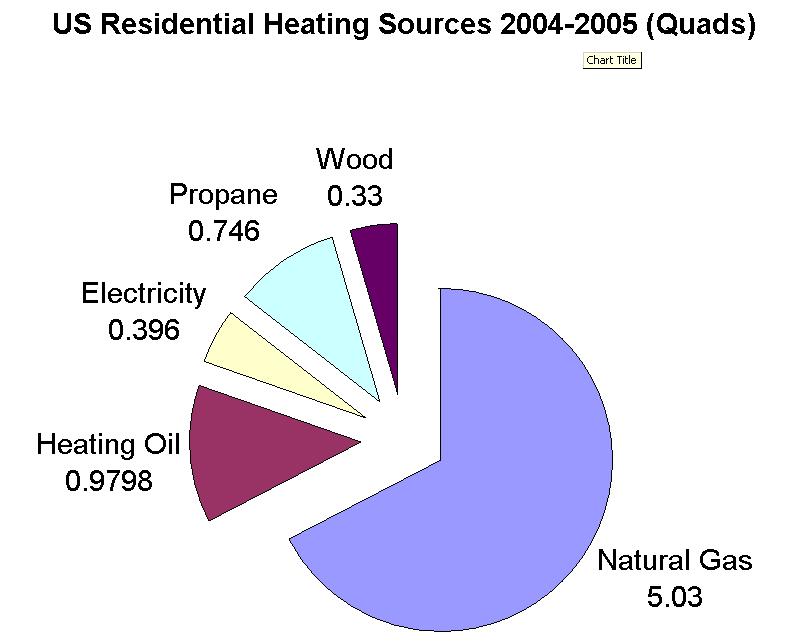
2004-2005 United States residential heating BTUs, in quadrillion units (quads) Click to enlarge. Source: EIA and Propane Council.
HOME HEATING DATA
Some notes on the data. Heating oil is the combined total of distillate #1, distillate #2 and kerosene, though the vast majority is distillate #2. Home heating use of distillate fuel (essentially diesel) is about 10% of total distillate use. (highway trucking is over 50%) (Source). I used 2004-2005 heating data partially because it was easier to find but also because the last 2 winters were among the lowest in the last 30 years as far as fuel usage. 2001 and 2003 were considerably higher (11% and 13%). 2004-2005 was close to the average of the last 7 years. There are a small number of homes that still heat directly with coal but good data doesn't exist so coal was excluded from the analysis. I don't particularly trust the EIA data on wood either as it appears they use the amount of firewood purchased and reported so those numbers may be light because of do-it-yourselfers are not good at reporting-it-to-authorities. Also excluded were heat generating sources/devices like the sun, better insulation, extra blankets or dogs, cats and spouses. In the broadest sense, these are very real heat sources, but they should still be there after fossil fuels decline.
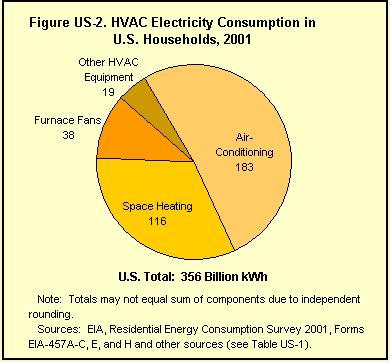
Electricity makes up a minor part of home heating use - of course, there is also natural gas and coal used as a precursors to electricity but I didn't extend this analysis that far. (About half of all energy used by a household goes to heat and cool the home. (116 billion kWh (2001) = 116 billion * 3,413 Btu = 396 trillion BTUs (.396 quads))
US residential heating is dominated by natural gas - more than 2/3 of our home heating is derived from piped natural gas. Below is a historical graph of demand for this largest component of heat in the United States.

Historical United States usage of natural gas for home heating, in quadrillion units (quads) Click to enlarge. Source: Energy Information Agency.

Current county by county United States usage of propane for home heating, dark blue >25%, light blue 10-25%, tan <10% Click to enlarge. Source: US Propane Council.
In 2005, 18.895 billion gallons of propane were sold in the U.S. 7.942 billion gallons were sold to residential users. At 92000 BTU per gallon this equated to about 6% of our residential heat needs. The above graphic illustrates that propane (LPG) is primarily used out West, and in the more rural areas that may not have natural gas pipelines or consistent oil access.
United States natural gas and heating oil use in millions of BTUs per person. (Note: ~5.7 million BTU per barrel of oil)
Heating demand is essentially a function of population and cold (temperatures). The above graphic shows the intensity of fossil BTU use for home heat per person.
The northeast and midwest have the coldest temperatures (and or the wimpiest people). Maine uses the most heat per person in the United States, but their low population makes the state itself not one of the higher ranked users. Adding the population factor produces the below graphic:
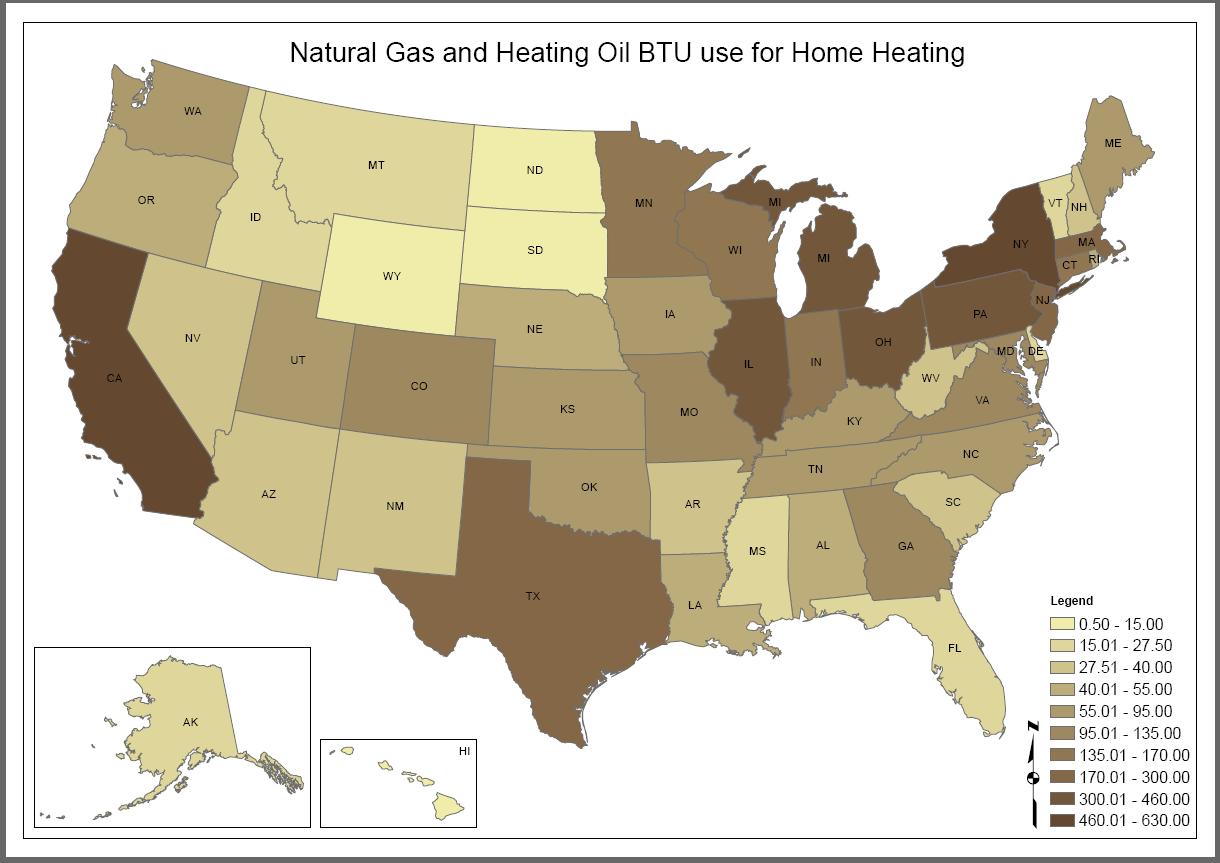
United States natural gas and heating oil use per state in trillions of BTUs.
WOOD AND FORESTS
Humans have used wood since the dawn of civilization and historical scarcities of wood have triggered major technological changes. Wood shortages in Greece taught architects how to exploit solar energy. Thousands of years later, shortages of wood forced England into the fossil fuel era, and it began a widespread use of coal. Englands attraction to America was in no small part due to the scarcity of timber resources in the British empire and the awareness of huge wood resources in the New World. In the United States, the market for coal expanded slowly and it was not until 1885 that a low population density, heavily forested nation burned more coal than wood. Even in the world today over 2 billion people use firewood as their primary fuel source. (1)

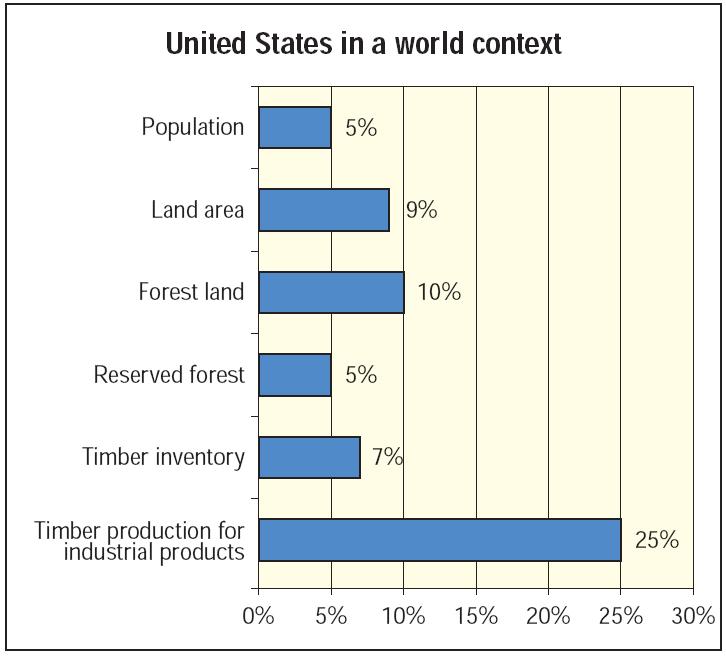
United States forest statistics compared to the World - Source National Forest Service (2).

United States land and forest statistics - Source National Forest Service (2).
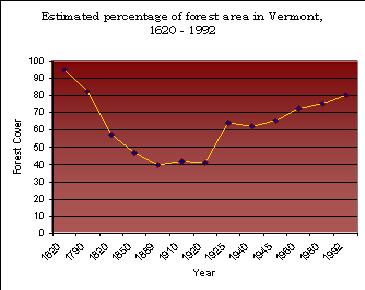
The US was heavily forested when it was discovered/populated in the 1600s. (note that the 30% decline in last 375 years is by land area not by volume of wood). Though the statistics above mask it, in the 1800s so much wood was used for construction, export and heat that the eastern forests were largely clearcut. Vermont went from 100% down to 40% forest cover and has since rebounded dramatically. According to biologist Stuart L. Pimm the extent of forest cover in the Eastern United States reached its lowest point in 1872 with about 48 per cent compared to the amount of forest cover in 1620. In the last 100 years, the amount of forest, due largely to presidential decree of increasing reserve land and intensive tree planting has generally held steady or increased.
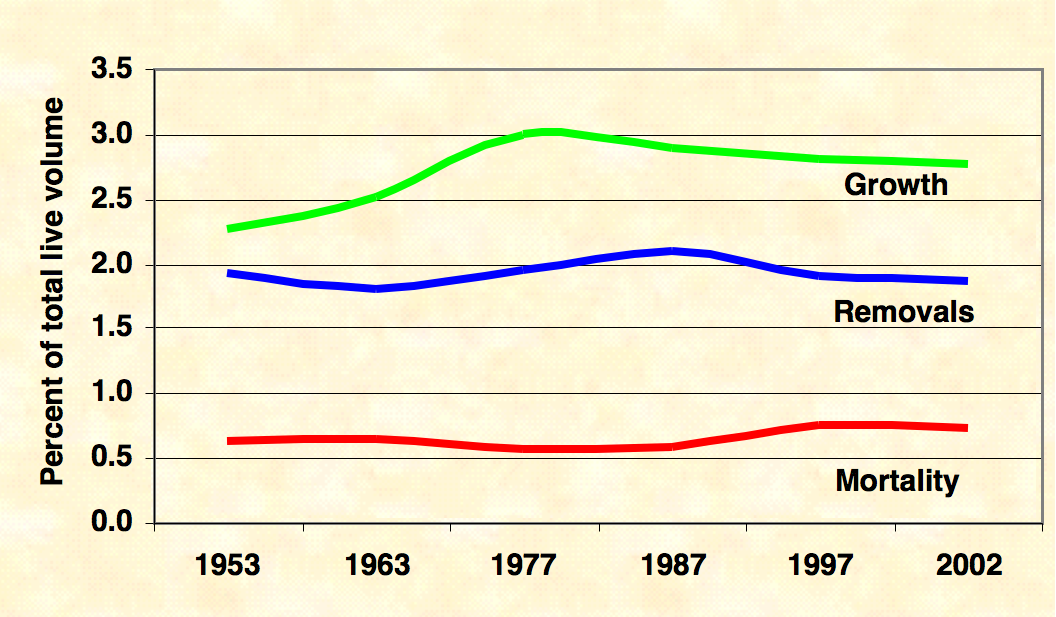
Rates of growing stock growth, removals, and mortality on productive unreserved forest, 1953-2002. Source: USDA Forest Service (Graphic first posted on TOD by Stuart Staniford here).
The US standing forest as of 2002 was 856,000 million cubic feet. The annual growth of this forest is 23,689 million cubic feet, or around 2.5% of the volume. The above graph shows historical trends of growth, removals and mortality on non-reserved forest - the growth on this type of timber is closer to 3% annually. As can be seen, the forest size was gradually growing as annual growth outpaced removals and mortality until recent years. Now the annual growth net of mortality is just about used. There is no rule saying removals cant be above growth - that just portends a smaller forest the following year. (It is unclear how much of the dead wood can or could be used, and decaying woods impact on soil nutrients and ecosystems is beyond the scope of this post.)
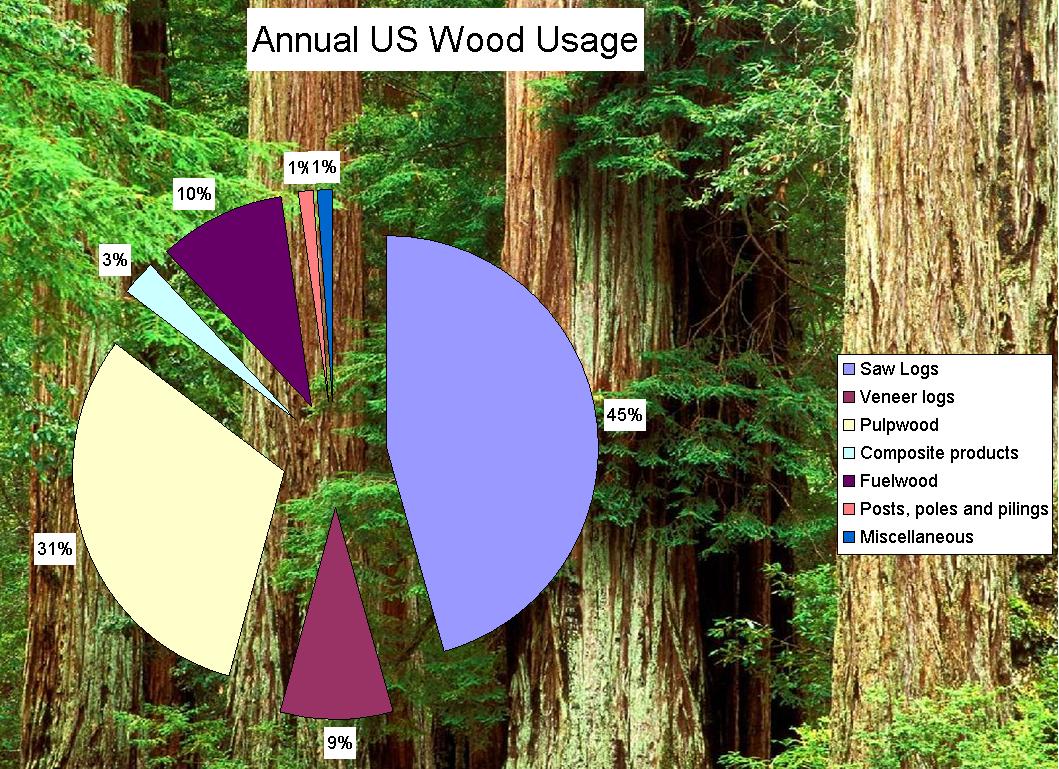
Total US forest products for all uses 2002 - Includes Hardwood and Softwood - Total wood used 15.7 billion cubic feet Click to enlarge. Source (2) National Forest Service.
Less than 10% of our wood use currently goes towards fuel use, and even less of this towards heating. The forest service did not break down this category into fuelwood for home heating and other fuel sources, though one can assume the majority is for residential use (though I know my schools city, Burlington, VT uses wood to generate heat and electricity for the public utility). The total use of 15.7 billion cubic feet is less than the annual total growth of 23.69 billion cf, but there is mortality of 6.3 billion cf which needs to be subtracted (though in theory this would have some heat value). Essentially, we are using all of our forests growth right now, even at the same time we are using all time record amounts of coal, oil and near record amounts of natural gas.

Cords per wood (128 cubic feet) per person in individual states. Click to enlarge. Source (2) National Forest Service.
THE ANALYSIS
HOW MANY CORDS OF FIREWOOD GROW IN ONE YEAR?
In 2002, the forested area of the United States contained 856,000,000,000 cubic feet of tree volume, of which 364,000,000,000 cf were hardwoods. (This is the forest capital). (Due to larger amounts of creosote and much lower wood fiber density in softwoods, they are not suitable for conventional firewood and I assumed are not used for heating –in a more advanced analysis this assumption could be relaxed as people could harvest softwoods and replant with hardwoods at least to some extent and/or install external wood burners).
The current annual volume growth is 10.1 billion cubic feet annually (or about 2.5%). Existing usage rate is 5.7 billion cubic feet with an annual mortality rate of 2.7 billion cubic feet. (Interestingly, the mortality rate was at a 50 year high and the USFS admit they do not know the reason for it). For ease of calculation let’s be aggressive and assume that humans can access all of the dead wood for burning. We then have 4.4 bcf of annual growth of potential firewood that is not otherwise being utilized for lumber, electricity or current home heating. At 128 cubic feet per cord, this equates to approximately 34.7 million (more) cords of wood that can be accessed sustainably, without dipping into the forest ‘capital’. If we discontinue other current market uses for the wood we would have 10.1 billion cf or 78.9 million cords of potential firewood per year.
THE ENERGY CONTENT OF FOSSIL FUELS
Each cubic foot of natural gas, depending on its origin, has about 1,027 BTU’s. #2 Heating oil has 149,793 BTU’s per gallon. Kerosene, used in some places for winter heating, produces 134,779 BTUs per gallon. In total, the amount of fossil fuels used for winter heat in the United States equates to over 7,000 Trillion BTU’s. (2001/2, a much colder winter, was 13% higher).
THE ENERGY IN WOOD
Freshly cut wood has over 60% moisture and therefore takes much more effort to release the energy in the wood fibers. Seasoned wood approaches 20% moisture content and releases about 6,400 BTUs per pound of wood. (Pure bone-dry wood tops 8,000 BTUs per pound but is not practical for home use). Almost all wood types create the same amount of BTUs per pound (6,400), but depending on their individual densities and other properties, differ in how many pounds make up 1 cord. Some examples are:
Hickory => 4,327 lbs per cord => 27.7 million BTUs per cord
Red Maple => 2,924 lbs per cord => 18.7 million BTUs per cord
Cottonwood => 2,108 lbs per cord => 13.5 million BTUs per cord
Cedar => 1,913 lbs per cord => 12.2 million BTUs per cord
A complete list of wood types and BTU content per cord can be found here
This analysis assumes one cord of wood typically is about 2400 pounds. We then arrive at 2,400 X 6,400 BTUs =15,360,000 BTUs per cord. Therefore, in the 52 US states, we have 34.7 million cords of annual volume growth of wood available times 15.36 million BTUs per cord => 533 Trillion BTUs that can be presently be accessed sustainably from hardwoods. (If we eschew all other forest products, this number roughly doubles, and if we include softwoods, it roughly doubles again)
PUTTING THE PIECES TOGETHER
Heating with wood is not as efficient as heating with natural gas or #2 heating oil. A significant portion of the heat generated from burning escapes up the flue to dissipate as heat in the atmosphere. Wood stoves and furnaces average about 55% efficiency. This compares to 85% efficiency for natural gas furnaces and 80% for furnaces using #2 heating oil or kerosene. (the lower the efficiency rating the more BTUs of heat is ‘lost’ and unable to provide heat to targeted areas).
So, of the 5,030 trillion BTUs generated by natural gas furnaces in 2004, 85% or 4,275 trillion BTUs went directly to heating, and 15%, or 755 trillion BTUs was dissipated as waste heat. Similarly, of the 998 trillion BTUs generated by heating oil, roughly 80%, or 799 trillion BTUs went directly to heating.
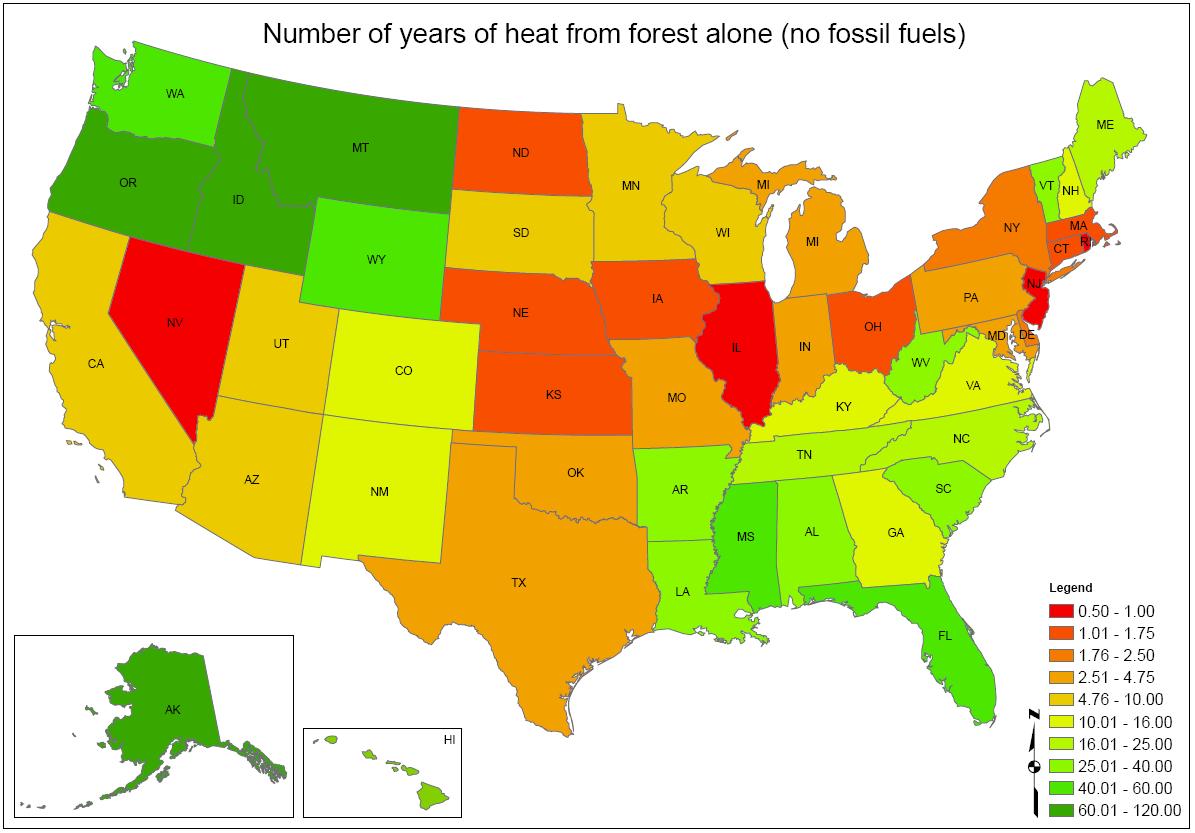
Of the 532 Trillion BTUs that could be generated annually from forest growth, approximately 55% or 297 Trillion BTUs would end up as ‘actual heat’. Natural Gas and Heating Oils collectively generated 5,074 Trillion BTUs of ‘actual heat’. Thus, this analysis indicates that we could sustainably replace 297 / 5,074 Trillion BTUs or 5.8% of fossil fuel home heating use with home heating from wood. Alternatively, the entire United States forest stock of hardwoods contains 364 billion cubic feet of wood, or 2.84 billion cords which would throw off 24,024 Trillion BTUs (note, this is only 24% of the total annual energy usage of the country). So the good news is if we were really cold and sans fossil fuels, we could chop down trees for at least 4 years before the US would resemble Easter Island (24,024/5,074= 4.74 years). On a state by state basis, the distribution would look like the following:
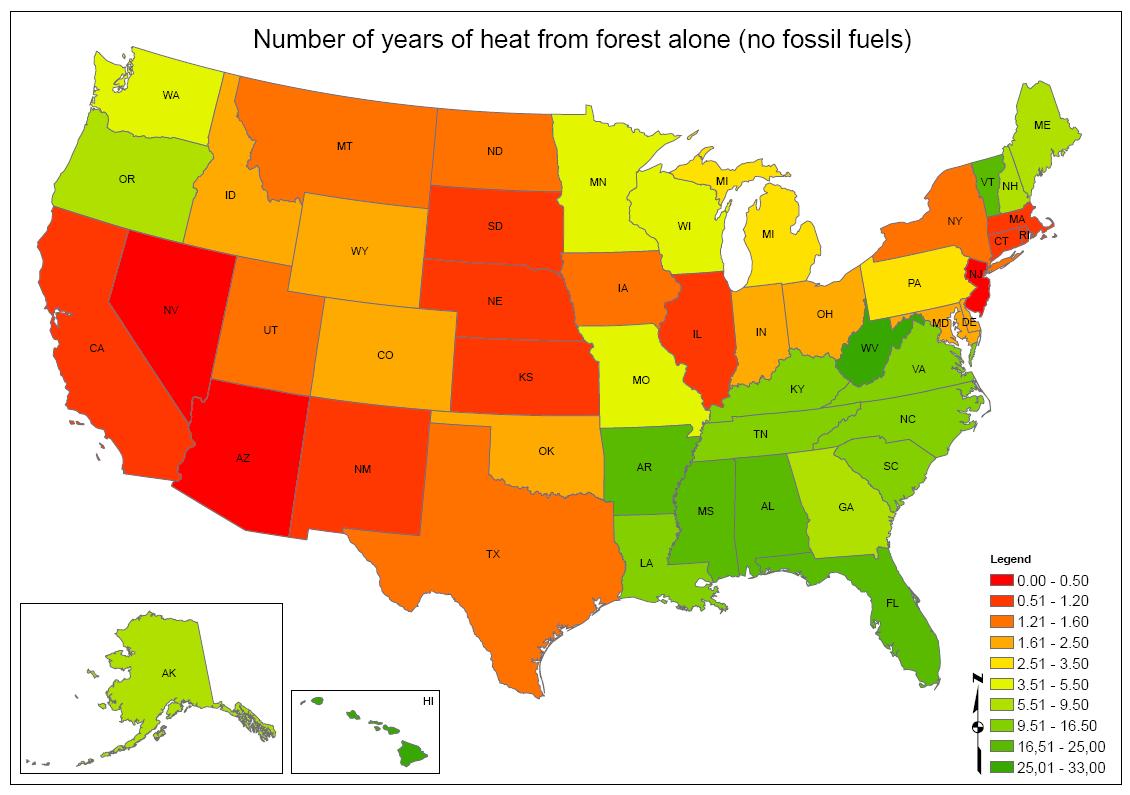
Years of heat in standing forest (hardwood only) in individual states. Click to enlarge. Source (2) National Forest Service.
To see a graphic including softwoods click here
THE ECOLOGY
If there is wide scale deforestation, for heating, ethanol or other uses, we will increase the CO2 in the atmosphere directly through wood burning, and indirectly through loss of soil biomass, not to mention changing the water/irrigation patterns due to increased erosion, etc. Furthermore, there are already cities/communities with inversion problems that limit the amount of wood-stove burning on certain days due to particulate matter and air quality. An in-depth environmental assessment of over-harvesting the annual growth in wood biomass is beyond the scale of this preliminary analysis, but of course is both relevant and important.
THE ECONOMICS
This last statement suggests that only a moderate amount of switching can occur given macro constraints. Consumers however, do not look at the macro picture of sustainability, but at their own microeconomics. Let’s see how the current rates of $2.70 heating oil and $14 natural gas (retail) stack up to $260/cord.
Cost per Million Btu's (MBtu) Useful Heat Into the Room:
1) Fuel oil at $2.70 per gallon: There are 149,793 Btus per gallon of fuel oil and oil furnace efficiency equals 0.80:
1,000,000 Btu x $2.70/gal
-------------------------------------
149,793 Btu/gal x .80 = $22.84/MBtu
2) Natural gas retail at $14.00/1000 cu ft, 1007 Btu/cu ft, and efficiency equals 0.85:
1,000,000 Btu x $14.00/1000 cu ft
--------------------------------------
1,007 Btu/cu ft x .85 = $16.36/MBtu
3) Wood ( red oak) at $180/ cord, 19.6 MBtu/cord, and efficiency of airtight stove equals 0.55:
1,000,000 Btu x $260/cord
-------------------------------------------
19,600,000 Btu/cord x .55 = $16.70 /MBtu
At today’s approximate prices, the per BTU cost is about equal natural gas and wood but a good deal less than heating oil. For those that own their own trees however, cutting them may prove a substantial savings. Economic theory would suggest that as fossil fuel prices increase, wood prices, as a substitute, will also increase – the large private landholders then may hold the key to whether we dip into the forest bank account when a fuel shortage presents itself.
ADDITIONAL ISSUES TO CONSIDER
1) Technically, since forests and people are not uniformly distributed, and a tree is too large to fit into a woodstove, energy must be used to reduce forests to manageable human chunks (by chainsaws or axes) and then transported to individual houses (by trucks or horses). These tasks mostly require oil. To an individual, the added costs will show up as higher price for cords of wood. To a society, they result in less BTUs available to heat what is needed from the new source. Clearly with NO fossil fuels, to obtain these amounts of BTUs from wood would be unattainable, as one would need chainsaw and transportation ability to cut all but the low hanging fruit in ones yard. So the net BTUS to the system, as opposed to each individual should be considered (in an Energy Returned /Energy Invested sense). Obviously, as with oil, there is a gross resource (which Ive presented here) and a net resource - I expect people in Colorado won't be heating their homes with the trees on Pikes Peak as they would likely be procured only at an energy loss.
1a)(deleted) I decided to make the discussion about wood harvesting, time and net energy a separate post - "The Energy Return on Time"
2)Using softwoods, while creating some problems, would increase the available BTUs available annually by 45% or so.
3)Very little of the Southern forests are used for winter heating. In this way, wood could be ‘imported’ if it were necessary. Again – how much would it cost to do this (in $ and energy?)
4)At some harvest point greater than the sustainable harvest of 5.8% of our heating requirements, there would arise externalities from loss of ecosystem services. Clearly the scale does not exist for large increases in the amount of firewood consumed annually without environmental consequences.
5)Walmart, Home Depot and others have recently been selling large quantities of electric heaters. If people are switching to electrical heat due to high fossil fuel prices, this will in turn increase the price of electricity and increase the amount of biomass currently used for electricity production (thereby reducing the amount of wood available for home heat)
6)Most population dense areas, and most new houses, don't easily have the ability to heat with wood. But external burners might be come popular in a hurry if winter heating needs increase in price or availability. In the same vein, most modern houses dont have the ability to NOT heat with natural gas unless modifications are made. This is another example of how fixed vs marginal energy investment will be key - like the automobile, home heating is not just a plug-and-play BTU problem, as there is long lead time necessary to change relevant built infrastructure.
CONCLUSION
This post has been a first look at the comparative scale of our home heating use from fossil fuels vs. more traditional methods. A more rigorous analysis using dynamic systems modeling could eventually be a component of a larger renewable energy meta-analysis.
We are at the very early stages of a Sustainability Revolution, equally momentous for humankind as were the Agricultural and Industrial Revolutions. While no one can know with certainty the timing of the decline in liquid fuels, analysis can be put in place ahead of time to focus our efforts on alternatives and portfolios thereof that collectively give us a chance at sustainability. While there is seemingly a huge inventory of trees in our country, there is also a huge inventory of humans and their respective consumptive wants. Warmth and protection from cold are among the most basic of our human needs – quite simply, there are not enough trees for an annual growth harvest to provide more than a fraction of our current heating needs. I don't really expect we will return to heating with wood, but the point of this exercise is to show that if the market should incentivize people to heat with wood, we have upper limits in expanding our use of wood for heating, and they are not too far from where we are now. This analysis provides yet another example of the power, density and importance of natural gas and oil in our society.
(1) A Forest Journey: The Story of Wood and Civilization, Perlin, Josh,; Countrymen Press 2005
(2) Forest Resources of the United States(large pdf warning), Smith, W. Brad; Miles, Patrick D.; Vissage, John S.; Pugh, Scott A. 2004 General Technical Report NC-241. St. Paul, MN: U.S. Dept. of Agriculture, Forest Service, North Central Research Station (I encourage anyone with an interest in trees and forests etc. to peruse this long pdf - lots of fascinating data)
Contact
- Content: editors at theoildrum dot com
- Tech support: support at theoildrum dot com
License

This work is licensed under a Creative Commons Attribution-Share Alike 3.0 United States License.
Excellent post.
It just shows how interconnected everything is and it fundamentally comes down to lifestyle issues in conjection with the number of people.
Everything is interconnected for sure! I have often been bemused by all the effort being applied to trying to convert cellulose to alcohol to burn that as car fuel. Why not convert the cellulose(possibly switch grass) to stove pellets and use pellet stoves to displace natural gas from home heating. Then that natural gas could be compressed and used for vehicle fuel. All at fairly high efficency and without some new invention(Cellulose to ethanol) that may or may not ever work. But then, a lot of grants and University funding might be lost. Pork-barrels explain too much of our energy policy!
Or use the stove pellets to fuel the cars! Google "Producer Gas" -- that's how civilian cars still got around in Nazi-occupied Europe.
Use the pellets to run a stationary cogenerator and heat the house with the waste heat. Use the electricity to charge batteries to run the car. Voila, a two-fer!
Remember that you need more fuel to do that though. It's a two-fer but not a freebee. If you used the electricity in the house then you'd get all the energy as heat. Seems to me that you do better using wind or solar and leave the plants to themselves.
Chris
It's not free (especially the hardware) unless you compare to e.g. ethanol/biodiesel; with biofuels, you get less energy at the wheels and no space heat at all.
Unless the cogenerator is very inefficient or the building is very well-insulated (by today's standards), the electricity production will often exceed demand. If you just turn it into heat, you've used a lot of hardware to do the job of a flame.
Cogeneration can produce "something from nothing". Suppose your alternatives are a 95%-efficient furnace or a cogenerator which yields 30% as electricity, 65% as heat and 5% losses. You can run 1/3 of the electric output through a heat pump with a CoP of 3 and have the same 95% of the fuel's energy as space heat, plus you have 20% of the fuel's energy as electricity.
If the developing solid-oxide fuel cell technology can be turned to domestic use, cogenerator efficiency could hit 50%. A therm of gas could create 1/2 therm of heat, plus 14.64 kWh of electricity. 14.64 kWh of electricity into heat pumps achieving 3:1 (far from the best available) would produce another 1.5 therms of heat; the system would effectively double the gas supply. Or you could settle for making up the balance of 1 therm of heat and putting 9.76 kWh of electricity into a PHEV. At 200 Wh/mi, you'd get close to 50 miles out of that energy. That would displace roughly a gallon (115,000 BTU, or more than 1 therm) of liquid motor fuel even in a Prius.
No, there is no magic in this. Energy is conserved, and the efficiency figures have been demonstrated. All it does is refuse to give in to entropy too easily.
Seems to me you're not seeing the whole picture.
Nate,
Sorry to see that you still have OLD information. I thought from the title we would be treated to a revised and update article.
How about in your next update you include some of the new technology in wood burning. Start your re-education here:
Burn it Smart!
http://www.ec.gc.ca/cleanair-airpur/Campagne_chauffage_au_bois-WS69573E1...
The videos are very good:
Harvesting:
Firewood, from the Forest to the Shed. Note John address the issue of softwoods vs. hardwoods.
How to light and operate a woodstove.
Note the woodstove is being fueled with Poplar. They also address the pollution issue.
Advanced Woodstove Technology.
Note the side-by-side operational comparison between old tech and new tech wood stove.
-- Brandy
I'll check it out - though wood burning, unless done by a city, like Burlington, can only be done by a small % of population that don't live in concentrated areas. Id have to do a study on that but clearly everyone in Boston and NYC cant use those woodstoves. But people who do burn wood would benefit from the newer technologies for sure - my fireplace is probably only 20-25% efficient (Im serious). On the to-do list for next year.
Thanks for the link - I'll try and incorporate that in next iteration, though I expect to be working on the demand side for the next good while (except for some almost finished EROI stuff)
Nate,
When asked about wood burning I first ask how much sweat are they willing to put in. Do they want a fire to look at or to keep warm with.
Then my recommendations are:
* Gas fireplace insert, or zero clearance FP install.
* Wood pellets if they have the storage.
That takes care of 98% of the people who ask.
* Then cordwood and what type of stove.
In the last few years I have been getting my firewood from the local "suburban" forrest. There are many mature trees being removed and storm damage trees that would just go for waste that can be used for cordwood. This last season the local arborist would drop off a tree about every three weeks. These were only good clean burning trees. Very nice! I could not store all he had.
IF you live in New England here is a new product that is taking off like "wild fire": http://www.biopellet.net/
These are "BioBricks" basicly wood pellets for a cordwood stove. They are suppose to be much better than the usual compressed logs.
And winter time smoke pollution has become a seriuos issue. If you follow the links back on my previous post you will see what Canada is doing. Since I live in the suburbs I try to make as little smoke as possible.
Since I converted my fireplace to woodstove insert I would never have another fireplace. If building a house I would use a freestanding woodstove. Go to the woodheat.org site or hearth.com there are number of papers there, some talk about fireplace efficiency, depending upon construction a fireplace can be a net heat LOSS.
-- Brandy
WRT woodstove technology, one thing that is absolutely essential, IMHO, is outside combustion air ducting. This increases efficiency substantially, because you are not pulling already-heated interior air into the woodstove for combustion. It is also hugely safer, because you virtually eliminate the danger of backdrafts and carbon monoxide.
It is surprising that some woodstoves STILL haven't incorporated this very simple feature, even at this late date.
While the forests of the Southern Highlands are so huge that firewood harvesting does hardly make a dent, nevertheless it is a fact that a lot more people in these parts do use wood heat on at least a supplemental basis. Anyone that lives here and knows what they are doing will have a woodstove and a cord or two on hand just in case we lose power for a couple of days in the winter (which does sometimes happen, even in the towns). Get out of the towns and into the backwoods and it becomes a mainstay.
One of the problems with your state-by-state analysis is that there are fundamental differences between different parts of many states. The situation here in WNC is very different from the Piedmont, which is different from ENC.
We probably do have enough forests here in the Southern Highlands to heat all of our homes (at 60F, not 72F!), plus have some for export to other parts of the southeast, all with sustainable harvesting. Air quality would become an issue in the cities and towns, though.
WNC
I remember your astute comments from the original running of this piece. I agree that air quality would be the next step of such an analysis but is beyond my ken. Also, EIA and other energy sources don't have county by county data though the forest service does - but imagine the amount of work that would be! (How many counties are there in the US??? Im guessing 2500??)
In the biggest norwegian cities it is estimated that around half of the PM10 is because of wood burning. http://www.ssb.no/svoveln/main.html (these two in english http://www.ssb.no/english/magazine/art-2003-09-15-01-en.html http://www.ssb.no/english/magazine/art-2005-01-19-01-en.html may be of interest aswell)
I don't think that it can totally replace all of the NG and LPG presently used for home heating, but biogas could be a good potential renewable resource for the future. I am referring to the anaerobic generation of methane from agricultural and municipal wastes. This is something low-tech, already installed and in operation in much of the world. It is a scalable technology, a distributable technology, and not a particularly expensive technology. Given that the stream of ag and muni wastes also seems to be relatively non-variable, this is also one of those rare renewable technologies that can supply a relatively steady base load. Some US farms and municipalities have already installed digesters, more will undoubtedly do so in the future.
As icing on the cake, the anaerobic digestion process kills some pathogens and renders the used sludge safer to incorporate into the soil, thus increasing soil fertility and the soil's ability to hold moisture, thus reducing agricultural demands upon water supplies. This is obviously a considerably preferable system to dumping ag wastes into streams and rivers. (I realize that there is more of a problem with this when it comes to muni wastes. However, these could go into pasturelands. Given the looming issues with future food supplies, perhaps we'll consider it worthwhile enough to protect our municipal waste streams from toxic wastes generated by industry and careless individuals.)
Gas furnaces can be a relatively efficient method of residential heating; that is one reason why so many people have gone to them. The advantage of biogas development is that we can just keep those heating plants and the infrastructure that supplies them in place.
There is no good reason to not be puttting this on a fast track as a definite part of the future energy mix.
The link to the list of wood types and BTU content per cord isn't working.
fixed. thanks.
http://science.reddit.com/info/6302v/comments/
thanks for your support...
This article's efficiency of burning wood is much less than for gas because of the poor design of most wood stoves. I built a wood "heater" for my shop that had a blower with heat exchanger. It burns about one log (20" long by 6" diameter) about every 20 minutes with a 10" blower duct coming out the top. After the unit is hot and the damper is adjusted almost shut, the stove pipe out of the top is almost cool enough to touch. This means that very little heat is going up that pipe. The air coming out of the blower is in excess of 140 deg. F.
Wood pellet stoves that have automatic fuel feeds are also very efficent and don't require as much manual adjustment as my stove. The key to efficency is getting sufficient heat transfer surface and the exchange air to move fast enough.
About the use of forests for supplying heat for homes: the US produces tremendous amount of wood scrap such as sawmill waste, home construction & remodelling refuse, old & broken pallets (often hard wood like oak), dunnage from shipping containers & trucks (often oak), yard waste & cut trees from city parks. So, the forest need not be cut down for a lot of people to start using wood for heat.
I was burning broken pallets that I retrieved from dumpsters at my rented warehouse space, so my heat was free. When I heated with electricity the winter electric bill surged by $360 per month. During last year's winter the savings was over $1100 for heating with wood.
We import pallets from China and it doesn't pay to ship it back. Electricity has to be the most expensive heat there is.
"Electricity has to be the most expensive heat there is."
Actually an electric heat pump is by far the
cheapest $/btu. Around here resistance electric
heating is only 7% more than heating with fuel
oil/kerosene. A COP 3 heat pump will cost per
btu, about 1/3 of oil and about 1/2 of wood.
I installed 4.5 kW of net metered solar PV here
which allows us to be zero energy. We bank the
surplus (2.7 mWh last summer) for use in the
heat pump in the winter.
Todd
Agree with comparing apples to oranges for wood vs other heat.
I have a super efficient Vermont Castings wood stove insert in my fireplace. It is rated at 85% efficient and very low particulate due to a catalytic converter.
I know what the wood ratings say about btu's per cord but the reality is that some woods burn much better in airtight wood stoves than others. Honey locust, apple and oak burn great because they burn slow with a lot of long lasting coals. Maple, which has a high btu rating, is not nearly as good because it burns too fast and hot. Enormous heat but doesn't last as coals so it doesn't provide a long consistent heat in my stove.
I have a smallish 1930's house (1680 sq ft) with a 96% gas furnace along with the Vermont Castings insert. I don't eliminate the use of natural gas at present to heat my house, just reduce consumption A LOT. But wood is not as simple as NG. You need to know what wood works and you need to plan a year ahead which most people won't do. I get most of my wood from clearing trees off my friend's farm terraces. We both win. He doesn't want the trees and I want the firewood. But a lot of sweat equity replaces the flip of a switch!
You need to know what wood works and you need to plan a year ahead which most people won't do.
Yup. That's our post-peak future: learn, plan ahead, make hay when the sun shines, do the laundry ahead of sunny weather (for drying on the line), stack up your firewood well ahead of winter, use the wind power when it's windy, etc. The flick-a-switch lifestyle is going away. And that "sweat equity" means that energy is expensive, in a real sense (independent of the monetary-policy games). We'll have to do with less of it.
The hardest part (even for many on this blog) is giving up on "economic growth". This article shows that it would be difficult or impossible to supply the current heating energy from wood instead of fossil fuels. But why is the current amount of heating energy a given? With "growth" it would grow, and thus definitely become unsustainable. On the other hand, after "economic growth" is abandoned (voluntarily or by force of nature), the "needed" heat can decrease. Smaller houses, more inhabitants per house (i.e. fewer houses), better insulation, more sweaters, and eventually a declining population, all mean fewer needed BTUs.
Giving up on exponential economic growth and population growth is the single biggest obstacle that will be faced, and it will be the most important. A stable state economy, as near as I can tell has never been proposed, that I know of, and certainly is not a part of anything Jim Kramer or anyone else ever considers. It has little room in modern capitalism. It is so foreign I, like most, can hardly comprehend it. We could use some future thinking individual, maybe Alex Smith, great, grandson of Adam, to step up and lay it on the line. His motto could be “Our life style is negotiable!” or “A steady State is better than no State” .
If you are getting that kind of efficiency in your VC insert you are one of the few, take it from one who cleans the chimneys in the summer. Few people actually use their catalytic stoves in such a way that they operate as designed. We have an HS Tarm wood gasification boiler which is rated at about 80% efficiency and it is WAY more efficient than our VC Encore catalytic stove. We have not used any propane for heat or hot water in a year and a half, since putting in the Tarm. http://www.woodboilers.com/ will give you a look at the boiler. When it is in operating mode it makes no smoke at all and even produces relatively little ash. We cut some white pine to improve exposure for planned solar panels and I burned some of that during the summer. In my area of (semi)rural New England there would look to be a lifetime (for my lifetime for sure... 20 years?...) of wood within walking distance. Gotta go get ready for the ice storm...
Tremendous is a relative term. If everybody switched to wood heat, there would not be nearly enough of the above to be sustainable. There is a certain amount on the above list that is truly wasted (i.e. just rots in landfills), but a lot ends up as compost. Also, abundance can be fleeting. For example, biodiesel proponents pointed to the seemingly abundant and formerly cheap commodity of waste cooking oil or even ray soybean oil that could be exploited, but it didn't take long for the excess to disappear. Further, consider the effects of a pronounced downturn in the economy where things don't get shipped as much and less wood gets sawn for construction.
Yes, and on the flip side, the efficiency of fossil fuel furnaces is overrated. We have a 92% efficient natural gas furnace. In reality, it turns 92% of the energy of the natural gas into heat for the house. Of course, that doesn't count, at all, the large amount of electricity our forced-air furnace uses. The blower on our furnace is the second-highest amperage electrical appliance in our house. Only the AC compressor is higher. When we're running on the furnace in the winter, the furnace blower is our highest total electric use. I've always thought it's funny that the furnace manufacturers get away with ignoring the electricity needed to run the furnace in their calculation. It's like businesses ignoring their huge parking lots and saying they have a green building.
Our woodstove on the other hand is rated at 70% efficient and our small blower uses less wattage than my laptop. It also helps that our woodstove is located in the middle of the main living area in our house, so we don't need as much fuel to heat the house. Our furnace is in the coldest room in the house, down in the unheated basement. I think if we compared the total energy used to heat the used part of the house for the woodstove and the furnace they would be very close.
However the fuel for the woodstove is completely renewable, and we live in a region where trees grow like weeds (Michigan). Of course, we need more heat here than other parts of the country as well.
Two points.
The electricity used by the fan ends up as electrical resistance heat, not a total waste.
A variable speed/load fan adjusts to the air resistance in the ductwork and usually cuts electrical demand by half. Simple, short, wide ductwork reduces it by more than that.
Best Hopes for Energy Efficiency,
Alan
"About the use of forests for supplying heat for homes: the US produces tremendous amount of wood scrap such as sawmill waste, home construction & remodelling refuse, old & broken pallets (often hard wood like oak), dunnage from shipping containers & trucks (often oak), yard waste & cut trees from city parks. So, the forest need not be cut down for a lot of people to start using wood for heat."
My pellets are mostly walnut shells and tree trimings from the Central Valley of CA, about 90 miles from here. Past practice was simply to burn them at the end of the season in a big massive smoky fire.
In Nepal they have a new project underway where they take waste cardboard and pulp it into blocks for use as a cooking fuel. I'm sure you could do something similar with timber mill scraps.
I do have a wood fire for heating and do use softwoods but I mix them with hardwoods each time I fire it up.
Since my wife is Russian and she was familiar with the particulars of the extremely efficient traditional Russian stoves, which her grandfather on her father's side built as a wandering journeyman, I once looked up a website which I posted the link to on LATOC or PO.com, some time ago but received no responses as I suppose nobody had any knowledge.
http://www.russianstove.com/
According to the website this is the most efficient technology for wood burning that you have on earth. In Russia there ia bitter cold and they have huge forests. Why reinvent the wheel. Perhaps somebody is familiar with this and could comment.
Ive seen a similar drawing for a stove that incorperated a water heater and cooking stove.
You will need a good brickie to build that. You dont want a cowboy who is going to cut corners and clip joints just so he can get the job done faster.
I have seen this before. On the net you can find a number of links by using the term "Masonry Stove" which is the same contact
http://mha-net.org/msb/html/gallery.htm
Neat pics
The masonry stoves were very popular up until the beginning of the 20th century in Sweden, when central heating began taking place. They were used in both apartments and houses alike, but differed from your pictures by being smaller, usually there was one in each room. Here's a picture search of the Swedish "kakelugn" as it's called
http://images.google.com/images?hl=en&q=kakelugn
Very few uses them anymore but since they're very decorative they often tend to add value to apartments being sold.
This type of masonry stove was apparently used in the eastern europe also, I saw a lot of these in Poland years ago, still actively used.
I've also heard of the "finnish baking oven" which is quite a bit larger, reportedly one could weigh up to 15000Kg and often had multiple purposes, heating the house, baking bread and preserving food by smoking. It has a complex labyrinth of smoke channels and may have two fireboxes. I suspect the Russian oven is closely related to the Finnish one.
Here's a few pics of the finnish ovens:
http://www.kirjastovirma.net/taivalkoski/jalava/kuvia/uuni.htm
http://www.paijanne.com/kursu/uuni.htm
Of course all these stoves work with the same principle - burn intensely and route the smoke/heat through a long channel of bricks that take up the heat and store it for later. Very economical and efficient, often the smoke is not very warm at all when coming out of the oven.
"wood pellet stoves that have automatic fuel feeds are also very efficient"
The Swedish governement oilcommission last year had hearings with energy experts. One was about EROI of different fuels. According to the expert wood pellets had a negative EROI.
Great post, Nate. I had missed the first version. You may be interested to know that just these days we were discussing the same subject in our Italian forum; that is whether the Italian wood resources would be enough to heat homes in winter. Nobody could make a precise calculation, but it is clear that it would be impossible, even though here it is not so cold in winter. Several interesting points were made in the discussion. One was that, even if we had enough wood, the effects of large scale wood burning on the atmospheric pollution would be a total disaster for people's health. But we also discovered that a fireplace doesn't pollute indoors. Another point was that maybe we could make it if we went back to the way fireplaces were used in the old times; that is no attempt to heat the whole house uniformly; maybe 24 C near the fireplace, -5 C in the bedrooms. Not exactly our modern standards, indeed. People who are in their 50s and 60s today still remember the times when they would wake up in the morning and find that the water kettle in the bedroom had frozen at the top. And, finally, there was a whole art of running an open fireplace using very little wood and controlling temperatures and even the smells you wanted to get from it. An open fireplace is inefficient, sure, but art is art!
Nate's post doesn't mention home heating using corn stoves which is quite common in Iowa. His chart which shows the number of years of forest left to heat homes therefore is largely irrelevant for Iowa. Few in Iowa including yours truly are going to go through the work of cutting, drying and handling bulky wood when corn is readily available and is much easier to pick and handle. I use about 100 to 125 bushels of corn per year to heat my house. Currently the local LP price is $1.80/gal.. The local corn price is $4.00/bu.. Since each bushel of corn has the heating value of 5 gals. of LP, each bushel of corn burnt is worth 5($1.80)=$9.00. Those who burn corn approximately double their money plus don't have the back breaking work of wood. I know because I use to heat with wood.
Practical, my (practical) friend,
This post was about seeing the forest through the trees, and was more an analysis of how large our heating subsidy is from fossil fuels than a realistic prediction on heating from wood. IF heating oil and natural gas werent available, heating with wood would quickly denude the landscape. By the same logic, IF natural gas (fertilizer and pesticides) and diesel fuel (tractors and harvesting) were not available, your surplus of corn to heat your home would disappear pretty quickly - you might want to read 'The Worst Hard Time" about the 1930s during the dust bowl, when people walked around to find tumbleweeds to feed their cows and burn for heat.
The central point is that the amount of BTUs for home heating, as well as corn stover production, will not be easy to replace. Left to its own devices, without fertilizer and irrigation, what is the annual biomass growth from corn vs trees on the same land? (I will have to research this). In either case, without fossil fuels, it wouldnt be enough to heat everyones homes, even in Iowa.
I'm not sure why you're raising the specter of a time with no heating oil, no natural gas, no diesel fuel etc. Peak oil isn't going to cause any of those things to happen. Add all the fossil fuels together (coal+oil+NG+other) and look at the curve. In hundreds of years, there's never been a break where it all dropped to zero. So why are you even talking about it? You might as well say "IF the sun weren't available... IF everyone on earth were tied up in their bed..." It has no relevance to what's actually going to happen.
Its a cataloguing of our assets. We have nat gas, oil, coal and trees that are 'standing assets'. Are the forests huge, medium sized, or tiny in comparison to the others? I wanted to find out - and I shared my results. And there is certainly a greater than zero chance that these other fuels won't be available at some point - not that they will geologically run out, but the market that delivers them may not work.
add it to Peak Oil Debunked #359 - There are Plenty of Trees....;)
How many trees are in Japan vs heating needs? I'm guessing less, and there is little in the way of other indigenous heating fuels
Since you mentioned Japan, just a word about how an overpopulated island solved their heating problem with too few trees:
First, they converted the wood to charcoal. There were BTU losses in this process, sure. On the other hand, it was a lot easier to transport and store charcoal. Those factors need to be part of the equation as well.
The traditional Japanese would have a small charcoal heater in the middle of the central room of the house. There would be a recessed place in the floor for the burner, and a low table would be placed over it. The family would spend their evenings around this table, with legs and feet under the table, close to the burner. Everyone would also be bundled up in warm clothing. At night they would roll out warm, heavy bedding and sleep on the floor near the charcoal burner.
The average indoor temps in the traditional Japanese home was probably quite a bit lower than even the most hardy Americans would tolerate. The point, though, is that they didn't even TRY to heat the whole house to a tolerable level. They simply didn't have enough trees to make enough charcoal to even have a prayer of a chance of doing that. Thus, what they did instead was to make the most of a too-scarce resource, and take maximum advantage of what little heat they could get.
A thought to keep in mind. . .
That's such a great point. In fact, as I type this, my wife and I are sitting at a table with a small space heater heating our legs. I'm also dressed very warm -- two layers + thick sweater on top, long underwear, pants, warm socks, hat. Japanese people don't "heat the house". They heat the people in the house. They turn off the heat when they sleep, and when they leave the house.
When I was younger, I was an avid wrestler, and when I originally came to Japan I played judo. It amazed me that the Japanese didn't heat the dojo. My team practiced and played matches in freezing gyms where the windows were wide open, the mats were hard as a rock, and you could see everybody's breath. But that's how they do it over here. Heating is for pussies! ;-)
Introducing the condition that we need to "heat the house" screws up these calculations, IMO. In fact, the other day at peakoil.com, I was informed about poor people who "need" $1000/month to "heat their houses". Which is about the most braindead thing I have heard recently. Continuing to operate with the "heat the house" assumption just perpetuates wasteful practices, and does a great disservice to the public. The message should be educational: dress very warm; heat yourself, not your house; heat one room not all of them; turn off the heat when you sleep or leave the house. The message should not be "How are we going to keep heating our houses?" because that assumes that we actually need to "heat our houses", when we don't.
JD
feel free to do a guest post on how much energy America (or elsewhere) would save by just 'heating the people in the house' instead of the house. Im curious if its 30%? 60%? of our home heating needs. Myself I bring my mattress downstairs in the winter in front of the fireplace and shut off the upstairs.
Me and the golden retriever in front of the fire - he has no opposable thumb tho so I must be the one to add logs at 3am.
Guest post on this welcome...;)
Well I am practicing the "heat the person" philosophy. I live in a partially uninsulated 60 year old house, so heating the "house" with the single natural gas gravity wall furnace is not the wisest choice financially or environmentally. Last year I only ran it when we were home and in the main living space. The worst month I could attribute 37-40 therms for direct heating. This is down from 70-80 thems the previous occupant used to keep a constant temperature. This year I put a used pellet stove I found for $100 (from an eviction sale) and am on track to use 0 therms of gas for heating. Instead, I picked up a ton of pellets for under $200 and hope to use slightly less than half for the entire season. I've gone through five bags in about 7 weeks, but with the nights getting cold, the burning has picked up somewhat. If I do burn 1000lbs I will have used approximately 8.2-8.4M BTU of pellets to keep us warm when we are home, contrasted with the 10.2M BTU of NG heat last year.
The added hassle of cleaning the stove, lighting a fire and manually shutting it off has been the greatest source of savings. My wife doesnt like to mess with it so she is not going to just "flip it on" and forget about it so we only burn when we know we are going to be there.
The rest of the time we bundle up (right now I am wearing 2 sweaters) and utilize small electric space heaters on timers for the bedrooms (on before bed, off overnight, on again at sunrise).
My pellets BTW are comprised of walnut shells and tree trimings and sourced from only 90miles away.
These local solutions are great - walnut shells and tree trimmings from a local source! But that is you looking out (rightfully) for your own interests (staying warm and saving money). Is this scalable to everyone in your state? Nation?
Nope. The solution (and only one for the masses) is cheap, cheap and plentiful electricity to power heat pump devices. That would obviate fossil fuel use (assuming of course we get the renewable sources online to generate!!) for home heating. Electric resistance heat would also be okay for small applications as well.
In the winter we fire up our wood burner which is situated in the living room/kitchen. Half an hour before we decide to go to bed we open the door to the upstairs. This allows the heat up to warm the bedrooms before we actualy move up there. Our downstairs/basement also acts as a cold sink at the same time.
Wood burners need to be tended unlike other heating systems but if your home is well laid out (and I'm lucky that my home is)they can work very efficiently.
When outside temps are > 40 F, I use my window heat pump to heat the bedroom and let heat "leak" into the otehr rooms (front room door is closed and it gets colder there).
Below 38 F or so, I use an electrical heater, on low (750 watts) blowing directly on my face. I turn it to high in the morning, until it is warm enough for the heat pump to be efficient.
I have been known to bake bread at night though :-)
Best Hopes for Energy Efficiency,
Alan
This comment on braindead presumtption of needing to heat the house not hte people reminds me of Diamond's comments regardning the Vikings in Greenland with a cultural aversion to fish dying as a result when food was actually quite plentiful.
JD, great comment on Japanese practice. Very succinctly expressed. Here in Lithuania, it is not uncommon for even newly-built multi-family residences (i.e., blocks of flats) to be equipped with heating systems that cannot be regulated at the individual-flat level, let alone on a room-by-room level. Buyers are only slowly becoming aware of modern heating systems, and so builders are only reluctantly moving away from heating systems that Soviet-era builders knew and loved.
My point is, widespread knowledge of better ways of doing things makes all the difference. The things that seem obvious to a Japanese strike many a Lithuanian as physically impossible. I can't count the number of times I've been told by (uninformed) neighbors and acquaintances that regulating heating at a room-by-room level is just plain physically impossible. Just because they've never seen it, means they think it can't be done.
Undoing decades of investment into energetically-nonsensical living arrangements will take years in and of itself, but before that, we have to change how people think. And that might take even longer than retrofitting the Soviet-era construction. [He shudders.]
Just as true for American Suburbanites !
Best Hopes for Human Adaptability,
Alan
Burning food to stay warm is a crime, and is cetainly even more stupid than burning the furniture. With food prices climbing steeply, it won't take long before the economics of burning food will change, to reflect the true values of food vs. joyrides. (Home heating is not joyriding of course, although it's greatly over-done too.)
As a side note - I use a wood stove, and during the winter, all my cooking water is preheated on the stove, or leftovers are warmed on it (and at this point, yesterday's dumpling soup is not refrigerated before being heated as today's lunch, either). The stove is for heating, but putting a pot or pan with water alone is not a problem.
If you look at such shared use, you may find wood can supplant a bit more fossil fuel consumption than at first glance, at least in colder months. Though co-generation is a poor term, taking advantage of ways to combine energy uses just makes sense. The wood stove is also my clothes dryer, at least during the wetly grey and cold days of a German winter - since a wood stove leads to dry air, I just use the recently washed clothes as a humdifier.
There is a lot of low hanging fruit, the problem is that people will need to live differently, and that is unlikely to happen in any sense of the word voluntarily for most people.
After all, my 'standard of living' has been declining for years, measured by what we own or how much energy or other resources we use. This makes us poor, at least by American measures, and one thing that Americans don't want to be is poor - they will go ever deeper into debt to avoid that fate, it appears.
I agree. We use oil to heat a drafty old farm house to 55 and a wood stove that heats the rooms we use in the winter to 70. The heat is so dry that we can hang all the laundry on a rack and skip the dryer. I can imagine folks making a slow transition using less of increasingly expensive fossil fuels to maintain a minimum temperature that keeps the water pipes from freezing and spot heating with wood stoves for their "winter rooms."
Just like other energy consuming devices, wood burners are available in a range of efficiencies. Assuming 55% may reflect the current stoves in use (I would like to see some data on this...), but I doubt it will into the future.
“Old” style outdoor wood boilers are about 40% efficient. Wood gasifiers (such as HS-Tarm, Greenwood, or Garn) are about 75-80% efficient. A well designed masonry stove can also approach 80% efficiency.
Going forward, IMHO, most people will be more mindful of efficiency when it comes to energy and will consider the most efficient option – as long as they know about it, and it has a reasonably short payback time.
Nate,
I suspect that the substitution will be electricity rather than more wood in many cases. Wood works well in multigenerational housholds but when childcare isn't shared, those able to haul the wood into the home are preoccupied while those whose children have grown end up having physical limitations. We require more conveinient heating because of nuclearization of the family. This is largely the origin of the growth of the service sector in out economy as well I think.
It seems to me though that a shift to electricity opens up sustainable options because electricity is so versitile. With the growth of wind power, heating looks like a fairly good demand management option and there should be ways to make use of the electricity on its way to degradation to heat. I've proposed making jet fuel as part of home heating using electricity here because there is coincidence in energy use and aviation seems to be stuck with liquid fuels.
Chris
While we all agree that Electric heating is the worst, how bad is it when it is used to move heat than create heat.
more than half of winter in half the country can get by with heat pumps, those that remove heat from the air, and Ground source heat pumps that move it from water below ground.
Here in south western PA, it does get very cold, but this year so far we have had weeks in the forties, where the heat pump kicks in.
The house had heat pump since the days when NG was 2- 4/ MCF. So I guess it is more efficient to use it when NG is 8-10/MCF. (of course when it is sold to the end customer in ccf and it is probably close to 16/MCF)
I am not sure of the break even, ie if electicity is 15 c /Kwh, would it still be a good deal?
Rough guess I am using 20 Kwh / day on such days(20* 3400BTU =68K BTU, when without a heat pump I might have user 2 ccf of Gas(200K BTU)
so it is $2/day(20 kwh*.10c) vs $3.20 / day during the not so cold days.I guess this is because heat is moved instead of being created.
I have a strong prejudice against using electricity for heat. It comes from the following argument: If you burn fuel at the power plant to make electricity, more than half the energy goes up the stack (or into the cooling tower). If you burn fuel at home, you keep much more of the energy in the fuel. Heat pumps can give you a factor of three back (in mild climates) compared to ohmic heating so my prejudice is shaken a little by that. What blows my prejudice away though is that some sources of generation don't require any fuel at all. So, if I want an easy way to not use fuel, home heating is a good place to substitute. But, I still have a nagging feeling that electricity is too good to use for heat. So, that is why I'm looking at co-heating options. I can't make enough brownies though to keep the house warm all the time because we can't eat them all. And, I can't beat the heat pump yet on efficiency, but I might be able to displace fossil fuel burning in other sectors so that is why I'm looking into it.
I'm hopeful that your electric rates will keep stable because you are investing in wind in PA. Looks like you can still save a little at $0.15/kWh compared to gas on a heat pump day, but then, if electric rates go up because of fuel costs, your cost for gas might rise as well.
Chris
Today's closed loop, ground-sourced heat pumps are very efficient, about 400% efficient for heating (and even higher for open loop systems, althogh the pumping energy must be accounted for). Even if we assume that electricity generation is only about 33% efficient, then ground-sourced heat pumps are still 132% efficient, compared to perhaps 90% efficiency for natural gas systems. Of course, ground-sourced heat pumps are much more expensive to install.
I recently calculated that in my area (SE Michigan) that natural gas heating (90% efficient furnace) costs about $10/MMbtu compared to $4.2/MMbtu for my 400% efficient ground-sourced heat pump.
Retsel
To continue the comparison... if you assume combined-cycle gas-fired generation, the efficiency is about 0.6; average transmission efficiency is about 0.93; use your COP of 4.0 and the overall efficiency is 2.23. That's more than twice as much heat per unit of NG as a 95% efficient furnace.
The up-front capital costs can be a lot higher. Especially if you are looking at a retrofit and limited land area, so that you need vertical bores for the ground-contact. When we looked last year, the difference between the ground-source system and a dual-fuel system (air-source heat pump with NG burner as an auxiliary heat source) was about $20K. A sizable chunk of the difference was the permitting, drilling, and sealing required for three vertical bores.
One of the real long-term advantages is that it's an efficient way to heat with hydro, nuclear, wind, tide, etc. I think there are problems with trying to make use of it in a high-density urban setting; the higher per-household efficiency in dense housing would appear to me to be more than offset by the decreasing ground-source volume available per-household.
An interesting exercise I need to start on one of these days is to figure the capital investment that would be needed to allow a modest suburban household in an area with reasonable renewable resources (primarily sun and wind) to be energy-sufficient, assuming serious insulation, ground-source heat pump, and a small electric car. How does that compare to the amount of capital required to build new transit-oriented development housing (just as an alternative)?
Heat pumps shuold be more efficient than just burning the fuel. That is because there is a smaler temperature difference between your house and the outdoor than between the usine's furnance and the outdoor.
Of course, for maximum efficiency you could use your house as a heat sink to the generator that feeds a heat pump.
Or, you could skip the generator and run the compressor off of gas directly.
Chris
"you could skip the generator and run the compressor off of gas directly."
Could you elaborate on how this would be done? Is anyone doing it?
Seems that there are such things. I was thinking of gas powered refidgerators which are still somewhat common. These are heat pumps of a sort. It is also possible to run absorption coolers on gas.
Chris
Nate, thanks for reposting the article. I did read the first one, but didn't respond because I didn't know where to start. I am a wood heat geek and have been for 30 years, both heating my home and shop and being a designer, consultant and retailer in the business since 1978. Wood energy is a very big part of my life.
One thing I have learned in my years in wood heat is that wood burning doesn't lend itself very well to statistical or mathematical analysis. I have been involved in a series of wood heat surveys for the government of Canada and upon careful analysis of the results, have concluded that they are all unreliable in various ways.
Nate wrote: "Due to larger amounts of creosote and much lower wood fiber density in softwoods, they are not suitable for conventional firewood and I assumed are not used for heating –in a more advanced analysis this assumption could be relaxed as people could harvest softwoods and replant with hardwoods at least to some extent and/or install external wood burners"
Creosote is a function of the combustion process rather than an inherent quality of the wood species, although it is correct to say that softwoods do tend to have pitchy bark and if burned badly, they do produce a lot of creosote. But it is worth noting that the people who heat with wood in the coldest parts of North America burn mainly softwoods, and if they do have hardwood, it is mainly birch, which also has pitchy bark, and poplar/aspen, which is as soft as most coniferous species.
Also, EPA certified wood stoves burn far cleaner and more efficiently than older conventional wood stoves. They average almost 70% overall efficiency, which is not bad considering it is an almost unprocessed fuel.
I could go on for pages on the subject, but I'll just point to the web site that a colleague and I have had online since 1996. It contains a lot of information about residential wood heating:
http://www.woodheat.org/
Two articles might be of particular interest. One is The Argument in Favor of Wood Heating:
http://www.woodheat.org/why/theargument.htm
And the other is The Environmentalist's Guide to Wood Heating:
http://www.woodheat.org/environment/guide.htm
In that article we say the following regarding the appropriateness of wood heating in particular regions:
"So, if you don't live in a city, and your region doesn't have winter air quality problems, but is forested, then hey, wood heating might be for you."
It is so nice to see an article about wood heating as a factor in the overall energy picture.
John
if only 5.8% equivalency is sustainable then the answer is very simple. Reduce the population of the USA to 18 million.. or treat it as a population wedge and add other sustainable wedges. Your total is the feasible population for any given standard.
I am sure we must have had good carrying capacity articles that cross reference sustainability Vs "standard of living" values?
Boris
London
Boris - thats a bit of an extreme solution, and extremely extreme for the 282 other millions.
Lowering thermostats, wearing sweaters, moving population centers more southward, increasing efficiency, living more people per residence, generating human body heat more often, reducing our wasteful consumption of fossil fuels so that basic needs (like heat) can be more easily stretched until alternatives can scale, are all more moderate suggestions.
I am curious as to what such an analysis might portend for UK forests.
"Stick to the road and steer clear of the moors...."
I wasn't being that serious Nate.. I think the UK would need to return to pre Elizabethan levels of population something around 3-4 million. maybe less.
however wedges ain't such a bad way at looking at the problem. if you say 300 million people need lifestyle "x" and 18 million of them can be covered by wood you only need have another 282 million to go...
Boris
London
good points nate. it's important to bring all those into the calculation and unfortunately that's what makes the future so hard to predict.
most homes I've been in have the thermostat at 70 or above! madness. lots of demand destruction. I"m sure room could be closed for the winter.
Nate - This is a very nice posting and very nicely points out that we must do more than use substitutes to adapt. I will be sending this to my local cabal for discussion.
With home heating systems changed to heating a smaller area in the home and smaller homes the product of your calculations will be different. In Iowa 50 years ago we would dress warm, hang blankets over room entrances and huddle around a small kerosene heater with 30 below outside. In the kitchen heating was the cook stove, fueled by corn cobs and my wife, born 1/1/41 spent her first few hours after birth in a turkey roaster in the oven.
Not that it will balance the deficiency but using waste wood and wood unaccounted for ie urban wood/burnable waste will change things somewhat but again another factor is competition for wood in other emerging technologies.
Where I live, in a discussion with a stump grinding company on the topic of them installing a small pyrolyser to make charcoal for soil additive I learned they are currently negotiating a contract for all of their production to be shipped 50 miles away to a bio-oil producer. There will be therefore competition for other uses for this resource.
With reqards to heater efficiency and air quality, Washington and other states have standards for wood stoves on both. My new wood stove is 73% rated and is manufactured in British Columbia.
Excellent post. One thing for sure, there will be no one size fits all solution. It will be done with a high variety of small efficiencies including wood.
"that is no attempt to heat the whole house uniformly; maybe 24 C near the fireplace, -5 C in the bedrooms. Not exactly our modern standards, indeed."
From the Italian posting above..
Large uniformly heated residental spaces for the masses arose from the availability of cheap fossil fuel. All the 72F heated bedrooms in the US are absurd and most likely unhealthy.
Heating space no one occupies is absurd.
I am fortunate to be able to burn lumber mill oak scrap and use heat pump and electric resistance as back up. A $100. truckload heats the house for the winter in the mid Atlantic. And with global warming that is decreasing.
The house has too much SF but can be divided off in winter.
It is nice warm weather to expand the living space.
Lots of factors to consider.
Re: using pallets for firewood -
You'll want to be cautious about 'acquiring' pallets to use as firewood...many if not most are constructed from treated wood, impregnated with copper or arsenic compounds to resist decay. I imagine you don't want to deal with the health hazards from the smoke.
My roommate works for Trader Joe's, and he says that's what their pallets are made from. Also, the beach patrol in san diego has been cracking down on bonfires that use pallets (and issuing fines) because of the treated wood issue.
I have been handling pallets for several years and would say that most pallets are not made from treated wood due to the cost of treating and the fact that pallets tend to decay rather easily. If the wood had a greenish tone then it may be treated with an arsenic compound. I agree that some companies do have their pallets treated with preservative.
Most good wood stoves and wood heaters have little or no smoke at ground level. So if some preservative compound is burned it will be exhausted at above the chimney, hopefully far above where it could enter the building. Breathing any smoke is bad, so wood stoves should have high stacks, at least a foot or two above the chimney to get a better draft.
Folks might be interested in learning about what a company here in Willits, CA has been doing to deal with the problem Nate brought up about the use of fossil fuels to cut, process and haul wood.
The business is found here: http://www.edburtoncompany.com
If you scroll down to the section on Research and Development of forest-maintenance Technologies you will see some of the solar-powered equipment they have.
Basically, they have small, electric powered crawler vehicles that are loaded with cutting and processing tools. They go after small wood, either branches or understory trees, not the big canopy trees, and aim to produce fairly uniform chunks that are designed for gasifiers (and potentially home wood stoves). They have also developed passive solar driers to speed up the dehydration of wood chunks.
Ed Burton, the head of this group, is in his 80s and can still use this equipment to work the woods in his backyard.
We need smaller more efficient dwellings
But here is ..
Pete Seeger and his wood harvester ....
http://www.renewablenys.org/retrieve_file.php?type=article&id=13
And mine
http://tech.ph.groups.yahoo.com/group/RunningOnEmpty2/photos/view/8ff2?b...
Nate
"...(Due to larger amounts of creosote and much lower wood fiber density in softwoods, they are not suitable for conventional firewood and I assumed are not used for heating –in a more advanced analysis this assumption could be relaxed as people could harvest softwoods and replant with hardwoods at least to some extent and/or install external wood burners)."
I seem to remember pointing out to you when this was posted the first time that this statement is not true. Perhaps I thought about it and did not reply then. In any case the statement is highly inaccurate. In the northern half of the western US almost ALL firewood used is pine or aspen softwoods. I do not have figures on whether the western US has more total wood stoves for heating than the eastern US (and perhaps you might find that a useful addition to this post?) but I would be surprised if the two regions are not at least pretty comparable. This would mean that use of softwoods for heating is pretty similar to use of hardwoods. You would probably find that in the upper mid-west a large amount of softwood is also used as firewood, but this is a guess as I have not lived there.
This may effect your analysis to some extent.
As an example, I grew up in Wyoming. Our house was entirely heated with wood (except for those times when temps went below minus 20F or so) and this wood was entirely pine and aspen as that is all that grew in the region. Our total use was approx 8 cords per year. Many of our neighbors would have also fit this description.
regards, Wyo
Thanks, Nate for your well documented article.
I remember having read in John Perlin in "A forest Journey. The Role of Wood in the Development of Civilization" you have quoted, that in the 16th-17th. century in England, when the population was about 4 million, the deforestation was considerable.
The level of consumption in that period, was that of a very incipient industrial society, basically pre-industrial, with plenty of rural activities. The main uses of wood were for naval construction, both military and commercial (the straightest, largest and thickest trunks), to make charcoal for the smelting industry (coal was starting to be used for this purpose, but still charcoal was much preferred), housing, warming and cooking, tooling and for karts and in construction in general.
The forests of England were plentiful of high density woods; very good in terms of energy content per kilogram; and also storing in themselves a lot of natural capital that took the Nature centuries to grow.
The English society of that period can be considered as if every particular being was consuming some 500 to 1,000 watts in average as a power machine (permanently connected) and almost all of it was wood, with very little contribution of wind for shipping, windmills and hydro mills.
The today English average individual is consuming as a machine of some 6,000 watts power (permanently connected), of which 36 percent is oil; another 36 is gas, a 19 percent is coal; 7.5 percent is uranium and just a 0.8 percent is hydro. Excluding from this BP Statistical pie (2006) the biomass than in a modern country represents today some 3 percent of the primary energy (with per capita amounts than in other developing countries may represent as much as 50 to 70 percent) and is mostly being used in Ikea mode; plywood with chemicals and toxic paints that can not be recicled, not even as firewood, because the toxicity of the contents and the difficulty to extract them first from the debris.
The idea coming to my mind was:
If 4 million people, consuming as 750 watts per capita average power were depleting the immense forests, with the highest possible biomass density on a square meter of land, what could happen if today the 60 million Britons (15 times more), consuming today about 10 times more energy per capita, had to live on biomass? Simple, the depletion rate will be about 150 times faster, for much less amount of forests.
Thanks for the data on the United States. The coming storm is almost perfect.
Pedro from Madrid
Wyo
Thanks for your input - I dont disagree but I had to make some assumptions. If softwood assumption is relaxed (which I couldn't do in my last place in VT or current place in WI without retrofit), the western states have significantly more forest resources for home heating use.
there are several steps that can be taken to cost effectively reduce the energy used for homes.
I have an article on optimum cost efficiency for home energy
It summarizes info from a 16 page pdf from NREL
Getting down to 44% less than Title 24 efficiency can actually be lower monthly costs for a home. Getting down to 50% less can be breakeven. Some regional variations based on regional cost differences.
Cooling and heating costs can and should be brought way down. One of those things like CFL or LED light bulbs where taking the right steps saves money instead costs money for the person to do the right thing.
Consider performing an energy audit of your home
Answers about home heating. Portable heating versus central heating cutoff points etc..., 2 portable heaters better than central gas heat.
Energy companies may have encouraged this for business reasons.
PNM now is looking twenty years into its electric and natural gas futures.
Currently they project a linear increase in demand.
This may not be realistic in view of possible natural gas and oil depletion.
Use the wood to insulate houses and it'll get you much further. Building log walls is one way to go, but cold areas would require inconveniently thick log walls. Fortunately different wood based insulating materials are available. In these wood fibres have been separated so that big part of the material is air. Air is an excellent insulator and wood fibres stop air from circulating too fast. The structure can still breathe and should also be a healthy home, unless somebody plasters it up. Roof insulation is most important, since that's where the heat would like to get out, but of course walls and floor are important as well. Windows have to be triple glazed and preferably using some additional insulating measures, so that the gains from better walls and roofs are not lost to leaks from windows. Especially important is to make sure that there is no convection leaks.
Insulating is of course more difficult than to start to use wood as a heat source, but in the long run it's much more important so that the biomass yields could have a chance of covering reasonable percentage of heating needs. However, there's a lot to do, US houses are generally very poorly insulated. Of course wood is not the only source for insulating material, but I think it has some very nice qualities and it has been use for centuries. We know that it can be done in a way that yields good indoor air quality as well as lower energy bills.
This is a great post. To the list of inputs on heating needs, I would add housing stock. The Northeast presumably has older (and therefore draftier) buildings with older equipment, which would decrease efficiency and increase BTUs per person.
For example, I live in a small apartment in Boston. The building was constructed in 1920. The window frames are no longer true, drafts come under the door, and the furnace is so old that replacement parts are no longer available. While I have taken some action to mitigate these issues (i.e. trying to block drafts), many people probably just crank up the heat. Also, absentee landlords do not care how high your heating bill is, so you get a crappy generic old-school spring thermostat. Again, I replaced this with a programmable one, but how many people do that?
Forest Journy is a great book.
The best use of wood for home heating is as framing for a double pane greenhouse on the home's south side. The amount used is considerably less than what would be burned and it would be repeatedly used to provide home heating for many decades. Treated sawdust could be used as insulation for the other three sides of the house.
I live in rural southern Missouri where firewood is abundant, and have cut, split, and burned wood for both heating and cooking. It is hard but satisfying work; there are always aches and pains associated with handling wood; there are associated accidents from minor small to deaths. As health and abilities decrease with age, a point is reached where it becomes impossible to use wood. Also tolerating the smoke is a problem for some people with allergy or lung problems. In towns where many people use wood during the winter, there is a constant smell (some people find it a pleasant smell) in the air and stains can be seen on roofs from settling of particulate matter. Chimney and house fires are more common than you might think and even with well engineered furnaces, stoves, and fireplaces there is inefficiency and inconsistencies in the distribution of temperature in rooms. If you leave home for too long, the fire will die, and it can be a bad experience to come home to a freezing house and struggle to get a fire going again while your mind goes numb from the cold; no instant on like with gas or electric heat.
It works, but not anywhere as easily as gas, coal oil or electric heat.
On the positive side, food cooked on a wood cook stove has a taste far superior to any other means; there is just no comparison. Also there is the joy of standing near a stove or fireplace, and feeling the slow radiation of heat strike your body; it is sort of a form of meditation. There is a tranquilizing effect of being able to watch a fire on a cold winter day, and the exercise from moving wood in and ashes out can keep your mood elevated (endorphins I suppose).
Those of us who live in or close to the forest, wood is even now a workable solution. Given the bulk of wood, the further it must be moved, the less practical it becomes. I notice that the price of wood in the largest nearby city (65 miles away) is about three times what it brings around here, the difference being transport cost and relative scarcity. Given the pending shortage of transportation fuel, I wonder if the additional strain on the gasoline supply from transporting wood might make it impossible for dwellers in big cities to even consider this as an alternative. Remember that associated with every benefit, there is a cost that must be considered.
OK...cut and paste Carter's "Sweater Speech" and insert here.
Seriously slightly cooler homes in the winter with significantly more insulation.
All the biomass we want to make into ethanol besides grain pelletize and burn in stoves. There are tons of leaves and other combustables on the forest floor that burn and stoves/furnaces designed to burn them.
matt
OK...cut and paste Carter's "Sweater Speech" and insert here.
Seriously slightly cooler homes in the winter with significantly more insulation.
All the biomass we want to make into ethanol besides grain pelletize and burn in stoves. There are tons of leaves and other combustables on the forest floor that burn and stoves/furnaces designed to burn them.
matt
"There is a lot of low hanging fruit, the problem is that people will need to live differently, and that is unlikely to happen in any sense of the word voluntarily for most people."
If the price goes up enough, we will see what people suddenly held dear and no long need. now people are realizing that they don't need a 4,000sqf home. hopefully these homes will be filled with large families instead of empty nesters. this should help reduce energy demand.
I see people already switching to wood. some local governments are looking at banning some wood stoves because of pollution. hopefully people in large scale won't have to switch and the change from peak nat gas to whatver follows next is slow enough to allow us to adapt.
pardon my ignorance, but what can solar power, geothermal and other alternative sources do for us? what can radiant heat do for us?
I built my own house a couple of years ago. I designed it to take advantage of the sun, passive solar. I made it with R50 walls and R70 ceiling w/ triple pane windows, mostly on the south. Most "to code" homes in MD have R13 walls and R30 ceiling. I have a heat pump and wood stove for heat. On sunny days the heat does not come on unless it is really cold. I used about 600-800KWh/month (~$60), and now with PV panels that I added this summer, so far 300KWh/month. My bills would have been be a lot more w/o the passive solar and extra insulation.
I put in pipes for radiant heat that I will, in the future, heat water with the sun to store for cloudy days. I hear that with radiant heat you can keep the temp down since it "feels" warmer.
The key is in designing and building homes that do not need much energy for heating and cooling. It can be done.
Unfortunately, most homes in the US are not insulated well at all and do not take advantage of the free energy coming from the sun. I think it will be hard to retro fit all these buildings...
Wood can be burned clean:
http://www.quadrafire.com/aboutUs/index.asp
Wanted to say this when you first posted this but...
A critical element to burning wood for heat is using an air tight stove and making sure you are drawing air for combustion from outside, because you will anyway either by ducting from the intake on the unit or by pulling cold air in from around the doors and windows of the house if you do not duct.
This can be done with any air tight even if the mfg. does not supply a kit. A little creative sheet metal work, you can even find some off the shelf pieces at a good hardware store that might work.
With an insert you can just clean out the ash dump, create an air dam around it, and drill some holes in the bottom of the convection box outer layer of the stove, before sliding the insert in. (this only works with stoves that are set up for this).
Freestanding I recommend ducting through the floor if possible.
The point is not creating negative air pressure in the house. In fact, with older leaky houses you can create a small amount of positive pressure by ducting a small amount of fresh air from outside and forcing it around the stove or through some sort of heat exchanger. Careful not to force too much air around the stove or you can in effect insulate the box sending all the heat out through the flue.
Just my $.0000002 worth (hyperinflation)
Soup wrote: "A critical element to burning wood for heat is using an air tight stove and making sure you are drawing air for combustion from outside, because you will anyway either by ducting from the intake on the unit or by pulling cold air in from around the doors and windows of the house if you do not duct."
You are a chef, I am a wood heat specialist. This advice is about 20 years out of date. The need for and effectiveness of outdoor combustion air is mainly unscientific speculation. See:
http://www.woodheat.org/outdoorair/outdoorair.htm
The term 'airtight' is not used any more because it is inaccurate and not meaningful. Here are some suggestions on how to select a wood stove:
http://www.woodheat.org/planning/buyright.htm
I'm sure your soup is great.
The idea of outside combustion air is to improve thermal efficeincy of the wood heater or stove. This referenced article mainly makes the point of outside air not fixing the problem of smoke leaking into the living space, which is caused by interior negative pressure.
To get best thermal efficiency with outside comustion air and eliminate the possibility of smoke being forced into the living space, a small draft inducer could be added to the stack. This would draw about 120 watts of electric power (1/6 HP motor) and make sure outside air is drawn into the combustion chamber even if inside has slightly negative pressure.
Although not a wood burning expert, I do have some (old) certification on energy conservation.
The main reason I was told to use outside air for combustion was energy efficiency. One would not use heated air (which must be replaced by unheated air) for combustion and then sent out the flue.
Using interior air also tends to widen the heat delta between the room with the wood heat and other parts of the house. Cold air can be drawn into the remote rooms, making them colder.
Best Hopes,
Alan
On a tangential note, I've seen some of the proposals to use wood, perhaps from the trees that die on their own, for the production of biofuels. Based on what I've read here about corn ethanol, this seems like a bad idea, but I wonder if anyone else has any comments about it.
Nate, at one point in the post you say there are 856 trillion cubic feet of wood (856,000 million) in the US. At another point, you say 856 billion. Which is right?
Wood, like a lot of other things, is a silver bb, but not a silver bullet. In my region, a serious shortage of fossil fuels would probably increase the proportion of people using wood heat from one third to 90%. If in good health, I could probably survive with a hand saw and a wheelbarrow. We use mostly softwood here, although oak is great when we can get it.
856,000 million is correct. so thats billion. thanks -I'll change it.
I envision a charcoal based economy using cellulosic feedstocks such as wood, paper and straw. The material is gasified and the producer gas used to drive electrical generators for grid credits or maybe battery banks. Some have suggested using old car engines if the gas is poor quality, thereby reusing another wasted resource. The charcoal residue can be pelletised and used in stoves and water heaters. Mineral rich ash from the stoves is collected and spread back on the soil. The minor inconvenience is offset by the cheap price of the locally made pellets.
Charcoal appliances would need to be made quick start and dust free. Air blowers and igniters use just a few watts of electricity. The user has the satisfaction that the energy doesn't come with a resentment tag from the other side of the world. In time the system could be FF free. It should be carbon neutral and soil nutrient conserving. I'm not sure what the EROEI is as I've only experimented with parts of it. It couples a lo-tech front end with the efficiency of electricity.
This is how the Mad Housers in Georgia power the homeless shelters they build. Their main developer, Frank Jeffers, is now working with Danny Day at the University of Georgia to develop a throw it together from the junk yard setup that will work reliably. The plan though is to charge the charcoal with urea and use that as fertilizer. The development project is aimed at underdeveloped countries where home heating is not a big issue but getting fertilizer is. Last time I checked he is finding a magnetite residue in the motor oil that indicates either a iron source in the biomass or in the engine. So, he is still working out the durability issues.
Chris
Great post.
Dad and Mom's house in CT is heated by a combination of heating oil and wood. He cuts and stacks himself, so it goes unreported. I suspect that they'll be doing more of the latter as the price and availability of the former becomes more expensive/scarce. The only trick is getting that heat upstairs to the bedrooms.
In recent months, I have been reading about all of the different organizations that somehow think wood is going to be their new renewable resource. I think that if they looked at things the way you do, they would quickly discover that everyone can't use the same forest resources.
Some folks hoping to use wood, besides homeowners:
(1) Cellulosic ethanol - It is awfully difficult to transport and store switchgrass and corn stover, so most folks looking into making cellulosic ethanol seem to be looking at wood, typically pine trees or poplars.
(2) Electric power plants - If they need to do something "green", burning wood is likely to be the first choice for many, especially if wind is not available. If a 15% renewable requirement were added, you could bet that many of them (most?) would be looking to get it from wood. Wind is currently used to generate less than 1% of US electricity.
(3) Paper making - Currently this is being done by clear-cutting virgin forests in Indonesia and importing the finished paper. Using our own forests and replanting would be a better alternative from the point of view of the environment, but this would compete with other uses of forests.
Hi Gail,
Wind is growing pretty rapidly. This chart should be updated to 13884.58 MW Q3 2007. I expect by the end of Q4 it will between 14000 and 15000. Somewhere in there or not to far from it is 1%.
Chris
PS You can see why Chuck Hagle deep sixed the energy bill. Colorado, Kansas and Iowa are blowing Nebraska away even though only Kansas ranks ahead in terms of resource. He probably feels he's been snubbed. Tough to know what's up with Brownback and Roberts though. Maybe they're just not living in Kansas anymore. In the real Kansas there's another 100 MW under construction. Same goes for the real Pennsylvania, so what's up with Specter?
Out of curiousity - how much has coal and nat gas fired electricity increased over the same time span - or even since the big spike up since 2000?
Hi Nate,
Wind was about 20% of new generation in 2006 with natural gas ahead. The EIA site seems slow tonight so I'm not getting numbers from them very well. I get planned new generation for 2007 for coal 1.7 GW, oil 0.2 GW, gas 9.9 GW, hydro 0.1 GW and renewables 5.7 GW. Wind dominates renewables right now. Solar will probably come in near 0.2 GW and wind near 3.5 GW. There are 5.7 GW of wind under construction at the end of Q3. There are big plans for gas for 2008 and for coal for 2009 each at about 13 GW, but we've been able to scuttle some coal plants lately so I'm not sure how solid the coal planning numbers are. Given growth in gas reserves I'd expect the plans for gas to hold up unless demand goes down as a result of conservation. I found CFLs for $1.28 each after Thanksgiving so there is a good chance that folks will start investing in these pretty strongly soon. They pay for themselves in two months at that price so it is really getting to be worth it to make the change before the old bulbs burn out. If this happens, demand for electricity will be down about 5% and investing in fuel based generation will look a little risky since the new plant might not be used as much as anticipated. I keep some of those bulbs in my car and change peoples lights for them if the opportunity presents itself. Non-fuel based power should continue to grow despite reduced demand because it undercuts the price of fuel based power. Because of this, fuel based power prices have to rise until some underused plants default on their financing and shut down. Nuclear and coal ganged up on the energy bill in the senate, but they'll be fighting each other shortly as their market share shrinks. What happens when the Volt comes into the market will be interesting. By then most commercial buildings will be installing solar with long term power purchase agreements giving another 15% reduction in demand. Will the Volt manage to keep some fuel using plants operating that would otherwise close or will there be a power offer that comes with the Volt that is built on wind? GM would likely make the most money if it set up a power management division that sold wind and grid balancing. If that is what happens then there won't be new demand for seperate generation that GM does not control.
Chris
Coal. Since 2000 (and actually for a longer period) coal capacity has been drifting downward, from 315,114 megawatts in 2000 to 312,956 megawatts in 2006, a loss of 2,158 megawatts.
Natural gas. Nearly all the capacity increase since 1990 has been natural gas. If we start at 2000, capacity was 219,590 megawatts. It increased to 388,294 megawatts in 2006, an increase of 168,704 megawatts.
Wind. It is hard to find wind capacity data on the EIA website, because it is too small to be broken out separately. It can be calculated from one of the databases, however, and I presume this is where the data that has been graphed is from (and it seems consisted with other EIA data). The graph would seem to indicate that the installed capacity was about 2,300 megawatts in 2000 and 11,700 megawatts in 2006. The increase in capacity was thus 9,400, or about 6% of the increase in Natural Gas capacity since 2000.
It might be noted that coal and nuclear are both used at very high percentages of nameplate capacity (around 90%). Wind is much lower, and natural gas is somewhere in between. Many of the new natural gas plants are used for more than "peaking", now that fewer coal plants are being added. Also, there are significant line losses between where wind is produced and where it is consumed, so this further reduces its contribution.
Coal does not average a capacity factor of 90%, except where it is ONLY used for baseload or slightly above baseload.
And I believe the capacity factor of NG is less than wind.
And since no one wants a major coal fired plant or nuke close to a major urban center (some are surely), they suffer from transmission losses as well.
Often wind generation in moderate winds is absorbed locally. And even at maximum output, much is absorbed locally (especially during the winter).
I have noted that the location of wind farms in Ontario will likely reduce and not increase transmission losses, as one example.
In Idaho, Exergy is installing twelve small 10.5 MW & 18 MW wind farms "here and there", matching maximum generation with local distribution wiring (I strongly suspect). Feed local demand in rural areas and ship the remainder back to the high voltage grid.
http://www.awea.org/projects/idaho.html
Best Hopes for Wind,
Alan
Chris - am I misreading that graph? It basically looks like Californias installed capacity has stayed essentially flat for over 20 years? And maybe even shrunk?
Hi Nate,
That's right. California's wind resource is pretty seasonal and their farms use smaller turbines which turn faster so that there have been problems with bird injury and mortality. There is some potential for offshore wind in California.
Chris
When I compare energy produced, the percentages come out awfully small. As a percentage of total energy consumed (not just electricity, everything), using EIA data I find the following percentages:
Wind:
1990___0.04%
2000___0.08%
2006___0.36%
Biofuels:
1990__0.16%
2000__0.34%
2006__1.07%
Wood:
1990__3.13%
2000__3.16%
2006__2.98%
Thus, wind is still tiny compared to wood, as are biofuels (although they are catching up). If utilities and others are looking at the "big" available renewable source, wood looks like it.
Since the wind turbines installed in 2006 will only produce a bit less than half a year in 2006 (on average, note dramatic growth means more installed in late 2006 than early 2006) and a full year in 2007, and the WTs installed in 2007 likewise for 2007 & 2008.
2008 should see substantially larger % than 2006.
See link for a graph of dramatic growth in wind energy.
http://www.awea.org/faq/instcap.html
Same graph as mdsolar above.
Best Hopes for more energy from wind than wood by 2012,
Alan
Hi Gail,
In terms of big available sources, wind does a lot better than wood as Nate's post kind of indicates. I responded to your initial post because I was concerned that you did not know about the rise in wind's contribution to electricity generation. It is beginning to be a significant contributer though it has a lot further to go. You can get government published info on wind here. It tends to be a little behind industry compiled data which you can find here. If you want to burn wood to make electricity you need to go where the trees are which is not always where the people are. This is similar to wind so that transmission losses may well be comparable. I suspect that wood's value as timber will generally keep fuel prices above the cost of harvesting by more than say coal prices are marked up from the cost of mining. In some places though the use of scrap helps out.
Chris
Gail - These are good points, but I have issue with concern number 2.
I don't think wood is a good fuel for power plants to use for replacing coal because:
1. Wood has lower BTU per ton.
2. Processing would be more difficult because the wood must be gasified. Then they have more ash to get rid of.
3. Collection of the wood is much more energy intensive than coal and wood would be much more expensive per KW-HR than coal. Wood price will rise as power plants' demand for it rises, just like food prices and corn ethanol.
But If they utilities have a mandate to meet they might just try wood, especially in the west.
I haven't seen mentioned CHP which stands for Combined Heat and Power. Honda, for example, makes CHP units ( http://www.hondanews.com/categories/1048 ). The idea is that the coolant of an internal combustion engine would be used to provide heat for the house and the engine would power a generator to provide electrical power for the house. My understanding is that these units are quite efficient especially when powered with natural gas or propane.
Then there is cogeneration based on the Stirling engine. Some 5hp units have been designed which can use wood or cow chip burning for the heat source.
CHPs have been mentioned. I've posted links to stirling engine designs.
IC based CHPs are 'loud' VS Stirlings.
I used to use wood stove in the Southwest. At least in that part of the country the amount of slash left over from forestfire danger reducing operations greatly exceeding fuelwood demand. Not that piles of slash scattered about the forest floor is easy to collect. But burning it seems such a waste.
Most houses can benefit at least somewhat from passive solar. If you have windows that recieve winter sun, you cen get at least some free heat from them. Most people don't realize this and frequently close the blinds. Here in California temperatures are relatively mild (but note your map shows Ca as no. 1 in NG heat use). Keeping the thermostat at 61 I recon about half of my space heating comes from passive solar. Estimated by degree hours when the furnace is running/ not running. Quite a bit of supplemental heat is being foolishly rejected by clueless homeowners.
"Most houses can benefit at least somewhat from passive solar"
Any pics or links to any SIMPLE Affordable Single Story Passive Solar Dwellings ?
Something similar in size to the Solar Decathalon structures
Bunch of links for plans here:
http://www.builditsolar.com/Projects/SolarHomes/plansps.htm
Passive solar concepts:
http://www.nesea.org/buildings/info/passivesolar.html
Some info:
http://www.nesea.org/buildings/info/
More from NC:
http://www.ncsc.ncsu.edu/information_resources/publications.cfm#passive
I think that superinsulation with passive solar is the way to go.
Here's my house that I designed and built:
http://www.xecu.net/thorn/house.html
Great post & comments.
The fact that it's a lot of work to cut, split, stack, dry, haul, & store wood, feed the stove, remove ashes, and occasionally clean the flue, means that wood users are constantly conscious of utilization rate. For similar behavioral reasons, putting a fuel consumption meter on a car is associated with improved fuel economy. Even without modification to the home, such as increased insulation, etc, the wood user will tend to keep temps low to the point of discomfort much of the time, as a matter of simple work avoidance. The wood user will always balance the discomfort of cold against the discomfort of cutting and hauling wood (or paying others to do so).
As noted in above comments, bedrooms need not be heated at all. The rest of the home can be kept minimally heated at night, or if occupants are away in daytime. Such measures may substantially decrease wood BTU requirements, in comparison to BTUs from gas, oil, or electric heat.
Manufacture of polyester fleece clothing is an efficient use of oil/gas resources. Fortunes will be made in goose down futures.
Wood as sole heat source is also problematic due to it's inability to operate beyond 12 hours or so, without manual refueling. Without an automatic back-up heating system, such as gas or electric, wood heat is incompatible with presence of a flush toilet, at least in winter. For example, my grandfather's home (built ca. 1910) had plumbing only in the kitchen (near the woodstove), which could be drained relatively easily if the house was to be unoccupied. After he added an indoor bathroom in about 1960, the toilet cracked during a cold winter night. He then converted to gas heat.
In northern or even central areas, use of wood heat alone will probably mandate at least seasonal use of composting toilets, chamber pots, or outdoor privies.
Water pipes tend to freeze up as well in temperatures below about 10 degrees. As a kid I remember this being an occasional problem despite heating the whole downstairs (with a coal furnace until I was maybe 10 or so when they switched to natural gas). We used to occasionally allow faucets to drip slowly at night when very cold temperatures were forecast, to keep them usable the next morning.
Another interesting (but difficult) analysis would be to track the demographic shift northward correlated to increased availability of on demand heat (fossil fuels). I suspect without nat gas and coal the population centers were more towards the equator, but I haven't seen data on this. Anyone?
That contradicts the theory of poleward migration.
At a BBQ last weekend I met someone who moved to Lat.45S mainly for cooler temperatures. I got the vibe that his wife yearned for the city, any city.
Good question. It is common sense. My bet is that those living in warmer regions (not necessarily to the equator, where temperature is sometimes very unpleasant, but to mild climate regions) were generally the successors of the past winners of population clashes. And the ones living in Northern regions may be the successors of the losers in those clashes, having to flee and go exodus to Northern regions and were able to survive by the intensification of the use of energy resources, among them and mainly, the fossil ones.
Statistical data of the world population throughout time, correlated with the development of different energy resources (not only fossils, but also wood and biomass or leather or fur clothing from animals) will give very good hints. The starting point is the solar energy taken in temperate climates, the easiest to take; the one that provides more vitamins to the body by direct insulation and direct heat and warming, with a negligible effort.
The problem now will be to put the reversal, when fossil energies will start to fade. If clashes took place in the past for the scarce and depleted resources, with already that very low population densities and very low per capita consumption living standards (from 150 to 2,000 watts per capita average power in consumption) , I can not imagine the forces and masses trying to move to the sunbelts in desperation, and trying to preserve the living standards of today (from the 6,000 to the 12,000 watts per capita average power in consumption of the Europeans or North Americans, respectively).
I enclose some information on the energy consumption and the standards of living in different regions. Please note the insurmountable differences and the latitudes of the main world consumers.
See also the European consumptions and differentials, related to both the living standards or ways of living, as known today, and their geographical latitude:
Pedro from Madrid
Pedro - were you going to enclose a link?
I do not know how to attach the link. Any help?
Pedro from Madrid
I'm not that shure about it.
The Scandinavian Sami people have been known to live in the harsh northern climate for at least 2500 years, and the Inuits of Alaska/Greenland at least 1500 years. I'm no anthropologist but I'd suspect these people gradually moved/expanded further north as they adapted their way of living and discovered the resources tht do exist in the northern climates.
But then again, I might be completely wrong..
I remember reading about the southern USA becoming heavily populated mainly due to AC. Now people work 9-5 M-F and the malls are filled in the days in summer and people work regardless of weather in factories and offices. Before AC everything shut down in July/August. I think a return to "seasonalism" everywhere will save a lot on energy use- Like the articles recently about French or Russian countryside dwellers sleeping almost the whole winter off and the siestas in Latin american countries in hot summer days.
We can't expect to eat non seasonal foods far away from where they were grown either or to live wtihout regard to external weather conditions. I think our adaptability is fairly endless. "Hibernation", siestas, lazy farming, fasting, slow living, huddling in one room or bed for warmth or undeground in adobe huts to cool off, all are possible.
Highly efficient stoves and well constructed, insulated houses are just one part of the solution. We need bascially to return to localized cultures based on what is available in terms of plants to eat and provide energy(wood, food) and adjust our rhythym to nature to manage to survive dependent on local climate. The margin of carelessness to survive given us by excess FFs is just so great that a global monoculture has come into existence stifling local culture whose existence was not coincidental but a reaction to local climatic realities. This makes one realize what a big lie globalization and end of history is. Even forms of government are based on climate. Where in northern climates every member of society makes a critical contribution to survival, as in Northern Scandinavai and the Russian northern coast, women are much more independent and have equal rights and a sort of democracy has always existed which in Central or Southern Russsia for example did not come into existence. Reasons for this are self evident. Sruvival depends absolutely on group cohesion and usage of skills of every member. Population sizes are always small. Where excess food and energy has always existed in excess so that excess population came into being dictatorial forms of government with corruption and repression of the masses were the norm.
Local conditions will demand a return to local, seasonal solutions to all problems at all levels, whether it be how much or when we sleep or eat and how we govern ourselves or the relations between the sexes, or for example rights of children and minorities.
I am in Michigan and do not pay 14.00 for Natural Gas. I pay 76.714/ccf, which of course is 7.67.
http://www.consumersenergy.com/welcome.htm?/eninfo/index.asp?asid=484
Rick
well you're heat broker is working for free then - that is no markup to henry Hub futures, but Michigan produces its own NG -perhaps there is a basis differential.
They purchase it in the summer and store it in underground tanks.
As I have pointed out before, I suggested a "three halves" approach to heating to a friend in Peabody MA.
A ground loop heat pump sized to her summer a/c demand (adequate for cool days, perhaps down to freezing or so). Also enough heat to keep the pipes from freezing regardless.
A small high efficiency gas furnace. Again undersized for comfortable heat on the coldest days, but enough for "survival heat". Next to the furnace, a NG wall heater (small, but no electricity required, just gas pressure).
And a small wood stove, with enough wood reserved to last a month. Again, survival levels of heat from this source.
Adding passive solar heat to this mix would make things better. (A four thirds solution ?)
Long term; better insulation, smaller homes with common walls (a MAJOR and often overlooked savings) and a combination of passive solar heat, ground loop heat pumps (using renewable sources of electricity) and wood heat could "work".
Best Hopes,
Alan
Don't forget windows.
You can put in R50 insulation in the walls & ceiling, and still lose a lot of heat with inadequate windows - even very good windows might be only R3, and be by far the biggest source of heat loss.
We put in 4 layers of windows - 2 layers provided by standard thermopane windows, 2 layers provided by retrofitted laminated glass. We added 1/2" laminated glass to a plastic skylight and immovable picture windows, and 3/8" on moveable windows. The walls/ceiling are standard R values, perhaps R13/R22.
We can maintain 70 degrees F (21 C) without turning on the heat until outside temperatures dip below 30 degrees F (-1 C). We could probably do without heat at all until 0 F (-20 C), if we had to, just by turning on all of the lights.
Greetings,
A well layed-out article, however, I would like to point out that the so called "forest recovery" that you speak of is somewhat lop-sided, in the fact that the original de-forestation was caused by crop and farm creation, NOT the burning of wood as a heat source as you indicate.
As well, the fact of "de-forestation" at todays level, as you put it, would spew a large amount of Co and Co2 into the air is also lop-sided, as one needs to consider this, one gallon of gasoline's use as heat or transportation is the equivilent of using over 100 full size trees to heat a home... So, in fact, I would say that this would indicate that fossil fuel is MUCH worse than wood as a heat/energy source.
wood-lot management is the new key to survival, in todays energy demands.
I didnt suggest the clear cutting was for heat, but for all sorts of uses - actually a Forest Journey suggests a great deal was shipped to the West Indies to make casks and ships.
And you are correct regarding gasoline, except we are USING it now - what if we run low?
Have a look over to old Europe. Wood stoves have been perfected over the last 25 years in countries with high traditional use of firewood due to air polution policies. The result is, that e.g. in Austria no wood boilers are sold in the market with efficiencies below 90 %. In Austria 25% of all new boilers for residential heating are based on wood fuels - logwood, chips and wood pellets. State of art wood pellet stoves have emissions almost as low as natural gas boilers. The efficiency of using biomass as energy source for heating in state of the art boilers and stoves is up to 10 times higher than by using it for ethanol production. It is about 4 times higher than producing electricity from it. Have a look at www.bioheat.info for a start.
CO2 footprint of using wood as an energy source is a strong negative. Most state planes for CO2 management (there are a few in the US) include biosequestration (an unfortunate term in my opinion). There are several lobbying groups now actively pushing wood as an energy option, generally focused in the hardwood forestry sector. These groups have presented pellet and higher technology options.
Using biomass for heating can come in many forms, but one of the simplest and most efficient ways to do it is with a pellet stove. Standard wood stoves burn a large quantity of fuel slowly, resulting in efficiency losses and incomplete combustion. Pellet stoves burn a small quantity of fuel fast. The newest ones are as efficient as the highest efficiency gas stoves.
www.bixbyenergy.com
http://www.hinkletown.com/bixby
There are also commercial size pellet stoves made for retrofitting large buildings like schools. The stoves are placed outside and use heatexchangers to connect to the building's present system.
REAP-Canada has been researching biomass production and conversion. They have been burning both wood and switchgrass in a pellet stove. Their EROI for switchgrass production and pelletizing in S/W Quebec is 14.6. They have an interesting Powerpoint presentation up at
www.reap-canada.com/online_library/Reports%20and%20Newsletters/Bioenergy...
Pelletizing of switchgrass was done at a wood pelletizing plant, but if grass pellets as heating fuel takes off, I'm sure that pelletizing will ultimately end up being done right at harvest by the same machine. Remember, the word combine comes from "combined harvester" which reaped, threshed and separated all in one pass. This is a trivial engineering problem for ag engineers and farmers.
Switching from anual grain crops to perennial biomass crops has huge positives for farmers: lower production costs, lower risk, lower capital needs, higher return. Biomass has the potential of giving a farmer three paychecks: the crop, carbon credits, wildlife habitat payments.
Perennial grasses sequester carbon underground. University of Illinois miscanthus plantings were averaging four tons per acre per year of carbon sequestration, while producing 15 tons per acre per year of burnable biomass at an EROI of 50 (as reported to me by the grad student running the project -- I don't think they included transportation).
Just as an aside, I don't think the comment about northerners being wimpy because they use more fuel is appropriate. I know it was done in jest, but inland New England and the Upper Midwest and Northern Plains have the most sever winters outside Alaska. Where I live in northern Minnesota we have 11,000 heating degree days, a 72 day growing season, and one year out of three we have frost in every month of the year. I bet if you correlate heating-degree days with fuel use you would find that we use less fuel for conditions, since we're prepared better for cold.