


The Energy Return on Time
Posted by nate hagens on July 25, 2007 - 11:07am
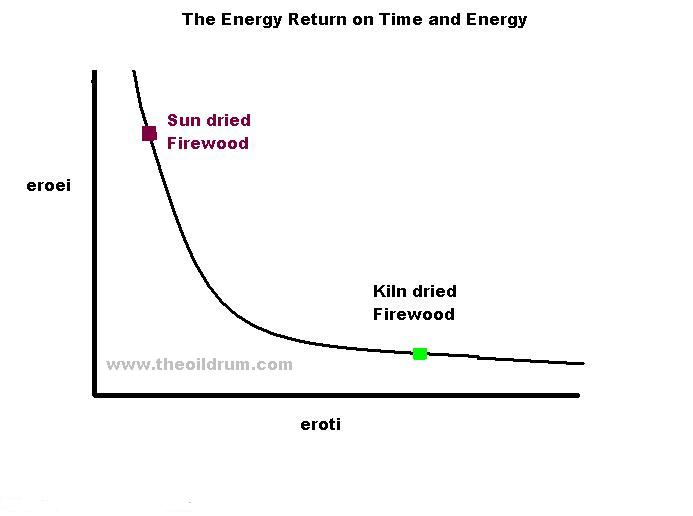
While writing the recent piece on home heating, I was surprised to calculate many different numbers for the energy return on firewood. Though the outputs were only slightly different in quantity of BTUs, there was a wide range of inputs. But the primary reason for the return disparity was the presence of the market economy - those processing firewood for their own use had higher energy returns than those selling wood for profit - the accelerated drying time to process large amounts of wood required an additional wood input which dropped the energy return. Graphically this showed up as a tradeoff between maximizing energy return on TIME versus maximizing energy return on ENERGY. This reminded me that energy return is not a hard-and-fast principle, and also that society, obviously, will optimize its resources based on what it perceives to be its most limiting input(s). However, in an upcoming world constrained by energy, or any limiting variable other than time/money, we can increase our energy available by reducing the return on other inputs, such as time.
INTRODUCTION - A COMMON FRAMEWORK
I've written several articles here related to net energy:
"Using Hubbert Method on EIA Data - The Tiger Chasing its Tail?"
"A Net Energy Parable -Why is EROI Important?"
"Energy From Wind - A Discussion of the EROI Research"
"Ten Fundamental Principles of Net Energy"
"Peak Oil - Why Smart Folks Disagree - Part II"
Since my thinking and research has changed a bit recently, I'd like to first take a big step back and attempt to simplify things, before moving on to a discussion on energy and time. The post ended up being longer and denser than intended, but I believe it gathers momentum as it goes, like a fallen sasquatch on a ski slope.
Humans use exosomatic energy - we use more energy than our own body can store. We procure this energy from a variety of sources and build infrastructure to harness and deliver it all around the planet. But other than drying our hair and laundry in the sun/wind, most of this energy needs to be found/harnessed/refined and distributed to a new or existing societal infrastructure to be able to provide us with its energy services.
We can measure (or at least estimate) in BTU terms, the planets numerous energy 'capital accounts'. Some stores of energy, like light sweet crude oil are awesome in their energy density and versatility and there is, (or once was) a great deal of them. Other energy sources, like wind via wind turbines, are also impressive in the energy they provide, but it is of a different nature - diffuse, intermittent and renewable. Just like we don't really care about dollars but instead what they buy for us, we don't especially care about energy per se, but rather the energy services it provides. Once we pay for the harnessed energy, how we use it is almost as important as how expensive it was to procure.
SUPPLY AND DEMAND WITH A TWIST
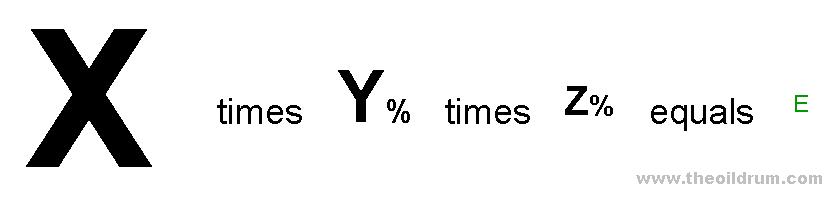
Energy allows us to do work. More energy allows us to do more work (i.e. grow). Societies energy profit from one period to the next, is the sum total of all the harnessed energy itself, less the amount we needed to use to deliver this energy to a socially desirable form. We then have to subtract the amount we waste in its consumption to arrive at whats left -this small fraction is the amount actually used to produce human utility - lets call this E. Let's call the former 3 pieces X, Y and Z respectively. So our entire energy supply snafu can be simplified into X (the energy), Y, the efficiency of harnessing it, and Z, the efficiency of using it. If we cut X (the energy) in half, we can still arrive at the same E by doubling either Y (the efficiency/technology through which we harness the energy) or Z, (the efficiency with which we use the energy). While the Peak Oil problem is mostly specific to liquid fuels, the broader energy problem facing the growth economy is how to maintain/increase E, or be happier/generate the same or greater utility from a smaller E (energy used).
Here at theoildrum.com and other circles discussing our energy future, all things energy basically fall into those 4 areas:
X What is and how big is the energy source? (Actually, X is the sum of all energy sources, x1 (coal), x2(oil)....+xn = X)
Y How efficiently do we harness the energy? (what % of each x gets to the energy service side, after subtracting out energy costs?)
Z How efficiently do we use the harnessed energy in our infrastructure and human systems?
E This is the energy that's actually 'used' after all heat losses have been subtracted. What do we use energy for? Why is it important?
My main points in presenting energy in this framework are 1) X is what it is, and will not change meaningfully on any human time scale unless it is consumed, 2) decreasing Y% and Z% (becoming more efficient at both harnessing or using X) are identical in their impact on E, 3)Though there are physical limits on X, Y and Z, there are none on E, in either direction (except perhaps minimum trophic levels of caloric consumption).
Now that we've dispensed with the energy-world-according-to-Nate, lets move on towards the meat of the post:
A REFRESHER ON NET ENERGY ANALYSIS AND ENERGY RETURN ON INVESTMENT
One method for evaluating alternative energy systems is net energy analysis, which seeks to compare the amount of energy delivered to society by a technology to the total energy required to procure that energy to a socially useful form. Biophysically minded analysts prefer net energy analysis to standard economic analysis because it assesses the progression in the physical scarcity of an energy resource, and therefore is immune to the effects of market imperfections that distort monetary data. Also, because goods and services are produced from the conversion of energy into utility, net energy is a measure of the potential to perform useful work in social/economic systems.
Energy Return on Investment (EROI) is an oft-confused controversial but important subset of net energy analysis. EROI is basically a combined measure of how high of quality/density the original energy source is with the energy cost that the composite of harvesting technologies uses to deliver the energy to the consumptive stage. It is often confused because analysis crosses back and forth between 'Y' and 'Z' in the introductory graphic. (Google Robert Rapier and Vinod Khosla...;) EROI is strictly a measure of energy and its 'harvesting' costs in energy terms, not the efficiency of its use or it's transformation to another energy vehicle. For example, once coal is procured out of the ground at a particular energy return, the decision, and subsequent efficiency loss to turn it into electricity or Fischer-Tropsch diesel, are both part of Z, the consumption whims of society. Each energy technology (e.g. in situ mining for tar sands) is a composite of X and Y in the above graphic - a combination of the density/BTU caliber of the energy source and how much energy it takes to procure it to a useful form.
Combining everything then, x times y for each energy technology (oil, coal, solar, nuclear, etc) gives us the net energy, (or energy surplus) for each of earths energy sources. Add all these together and we get X, which is the current planetary energy resource. Multiply them by Y, and we have how much energy is available for human use. X times Y changes over time, as the race between depletion of high quality stocks/flow sites versus better technology unfolds.
Below is a graphic of the peaking and declining of EROI for Louisiana oil and gas production. Its very similar to an actual production curve - as production peaked and declined, net energy also declined sharply (fortunately we had 49 other states and 50+ other countries to get oil from when this occurred)
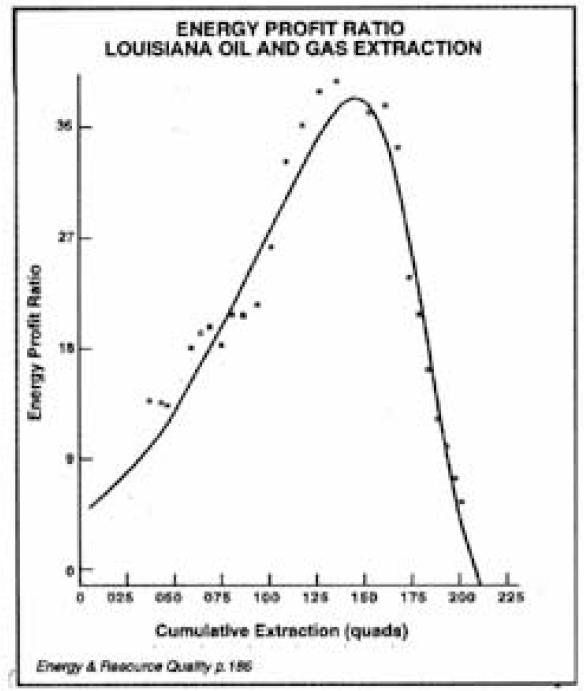
Lousiana EROI Profile - Source "Energy and Resource Quality - The Ecology of the Economic Process", Hall, Cleveland and Kaufman, 1986
EROI is an important concept because we live on a finite planet ruled by physical systems subject to entropy. There is only so much low entropy energy present in fossil fuel stocks and solar/tidal flows that can be accessed at a meaningfully positive energy return. If society collectively becomes dependent on a certain aggregate energy gain system and attempts to replace it with a lower energy gain portfolio, keeping all other inputs equal, then a larger % of societies resources (labor, capital, etc) would have to be devoted to energy procurement, leaving less available for hospitals, infrastructure, and bowling, etc. EROI has a trade-off with scale - at low scale, EROI can be very high - at higher and higher scale sizes, EROI eventually declines. What society actually uses is EROI x Scale, which equates to the energy surplus (or net energy). If EROI x Scale of all energy sources declines from year to year, all the dollars in the world can't produce the energy gap that has been created. The missing energy would have to come from efficiency, conservation or demand destruction. A numerical example of a hypothetical society facing declines in net energy can be read here.
There are however, many problems with basing energy decisions solely or primarily on EROI. First, as will be seen below, it is not as physical a number as some would like to believe. Second, it has to be adjusted for societies choice of energy quality and this adjustment makes it follow the dictates of the market, something it was designed to look beyond. Third, any collapse-like implications of lower EROI from a societal perspective are not set in stone - lower system wide EROI could be trumped by higher efficiency or new technologies on the consumption side, at least in theory. Fourth, an EROI figure, either high or low, doesn't tell us about the potential size nor of the timing of the alternative energy technology -my potato crop this year will probably be in excess of 50:1 EROI, but it will only help myself and my neighbors because my entire crop is about 50,000 BTUs worth of potatoes - or about 1/2 gallon of gasoline equivalent. Also, unless one parses environmental impacts into energy terms (which is doable but not at all accurate), EROI (currently) still fails to quantify undesirable energy externalities like increased pollution or ecosystem degradation. Finally, it gives us a narrow metric (though certainly broader than dollars) on one limiting variable (energy) that we may be facing in the future. Energy is probably the most important variable I can think of that propels global society forward, but water, soil, ecosystem services, and greenhouse gas emissions also may play a role in societal functioning at some future date.
Onward..
*SIDEBAR - NET ENERGY AND NATIONAL PETROLEUM COUNCIL FORECAST*
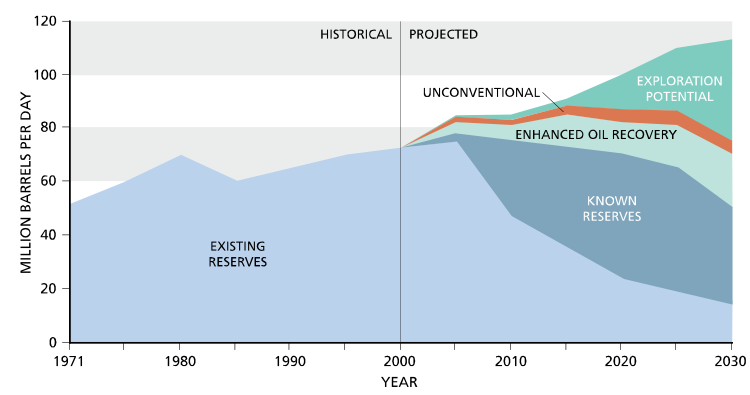
Illustrative Total Liquids Supply. Source: Figure ES-5 of NPC report Executive Summary.
There was not a single mention of net energy in the NPC report released last week. Perhaps the reason that oil companies don't use net energy in normal parlance is that it's really an ecological concept, and not (yet) congruous with the market system. True, if there were unlimited other high quality energy dense resources that comprised societies "X", then oil agencies could reasonably exclude the 'net' from their analysis. As it is, oil is ubiquitous in allowing every aspect of the global capitalist system to flourish. It can be replaced, but so far only by lower energy return liquid fuels or by changing the massively entrenched oil dependent transport infrastructure.
Net energy doesn't have much meaning at the company level. An oil company CFO doesn't say "Joe, I think we have declining EROI on our oil fields - what should we do?" He says - "We have accelerating cost pressures in finding new oil-should we even be drilling for that oil if its costs us $50 a barrel?". From a companies perspective, one looks at the dollar cost of accessing and delivering future production - the more difficult to access fields of the future will likely require more energy, and thus higher prices. This is an economic analysis. But when looked at from a societal perspective, while dollars are certainly important, another phenomenon emerges with declines in the net energy available. If the aggregate of the energy producing (harvesting) sector requires more energy due to depletion of the 'easy' portions of a resource, this energy has to come from what once went to non-energy sectors. So what the NPC is missing in the above graph, is that the projected 'growth' in oil supply will, especially the categories of ethanol, biofuels, tar sands, oil shale, etc. free up much less energy to non-energy society per barrel produced than the original, already used, high EROI oil. Essentially, can we assume that the 100+mbpd shown in 2030 would (if it were actually achieved) still free up the same % of oil and gas to society as it does now? More, or less? If less, then which currently productive sectors of the economy will this energy come from (electricity, natural gas and oil products)? Are agencies like the NPC responsible for this type of analysis? If not, then who is?
THE ENERGY RETURN OF FIREWOOD
Ok. Sorry for the long preamble. We now arrive at the central point of this post, which is that energy, due to human decisions on their inputs to Y and use of Z, is perpetually in a tradeoff with time. Recently, an oildrum post showed the potential scale of the forests in the United States were they to be used for heat/firewood. This analysis was 'gross' and did not take into account how much energy it would require to harvest and transport all the wood. While we are in reality not going to accomplish or even attempt this (I hope not), I learned many things from working through the numbers.
THE ANALYSIS
I interviewed 7 firewood 'experts' (Thanks to Hans, Gene, Lynn, Oildrum readers Vtpeaknik and Johnwilder, Whitey and my father), (I consider my father an expert...;) who have been harvesting repeatedly for a number of years - 2 were 'professional' firewood vendors (one in WI, and one in VT) and the other 4 procured the wood themselves for their own use in WI, VT, ME and AK. The energy needed to get firewood is a) to chop down the tree b) to buck it up into transportable pieces, c)to tranport it to the place where it will be d)split and e)dried (green wood has too high of moisture content to burn). Finally, f)it had to be transported again to its final place of consumption.
I came up with a range of EROIs for firewood from 7:1 to 100:1. Yes, thats what I thought - how could something with an equivalent energy output have such disparate energy returns? The math for 2 of the study cases is below:
Example 1 - Gene in Maine
Per Cord
Chainsaw - 3/8 gallon gasoline.
Splitter - 1/2 gallon of gasoline.
Gene uses horses to deliver the wood from the forest to his 'factory'
Feed for the horses (an indirect energy requirement) is also procured by horse/human labor
Wood is air dried from Jan-Feb to September when its delivered (time input 9 months)
Saw rig and conveyor to load in truck for transport to customers- 7/8 gallon of gasoline.
Total loaded in truck - about 1 3/4 gallons of gasoline.
Truck carries one cord and gets 10 mpg.
(I assumed average customer is 5 miles, so 1 gallon round trip)
Time input 8 hours per cord, plus 1 hour for equipment maintenance and 1 hour for horses
or 10 hours of labor per cord
Energy input per cord delivered 2.75 gallons x 115,000 BTU = 316,250 BTUs
Energy output per cord of mixed, dried hardwood = 20,000,000 BTUs
EROI of this particular firewood operation =20,000,000 / 316,250 = 63.25
Note, this does not include the energy inputs into the making of the saws and truck, the food requirements of the horses or Gene, or any of the maintenance of the roads used, or any other 'wide boundary' analyses. (that would be more correct but a heck of a lot of work)
Example 2 - Lynn in Vermont
Buys wood from firewood jobbers - 1/2 gallon per cord for chainsaw
Wood transported average of 5 miles to his firewood company (.5 gallon)
1/2 gallon for splitter
To kiln dry the wood (and have a 5 day turnaround time, year round)
Lynn uses 1 unit of 'crap wood' for each 8 units of salable firewood
Average customer distance for the 2,000+ cords per year - 20 miles but his truck holds 2 cords so 2 gallons round turn
Labor estimate 3 hours per cord
Time estimate - turnaround time 1 week
Energy inputs 4 gallons x 115,000 BTU
1/8 cord of wood =1/8 X 20,000,000 =2,500,000
Energy output = 20,000,000 per cord
Energy input = 3,075,000
EROI of firewood operation #2 = 20,000,000/ 3,075,000 = 6.75
The other 5 people I interviewed had a variety of similar inputs and their EROI calclulation ranged from 18:1 to 100:1 (the 100:1 was a person who chopped the wood by hand and required 52 hours per cord of labor).
Takeaways:
Clearly there are tradeoffs in the procurement of firewood between time, labor and energy. To mass produce, or to do things in a hurry (for reasons other than mass producing), using part of the lower quality scrap wood to quickly dry the wood reduces the energy return but increases not only the profit margin but the EROTI (Energy Return on Time Invested). Alternatively, using extra time and the 'free' drying heat of the sun dramatically increases the energy return but gives a lower return on both labor and EROTI. While this example may be unique to this particular subset of X (forest biomass), we see this phenomenon as well in oil production. Bottlebrush extraction, horizontal well drilling and other new technologies access more parts of an oil field simultaneously, at a higher energy cost, in order to bring them to market faster than traditional slower methods. I don't have ready access to this data, but presumably we could increase the EROI of oil or at least stem the decline from over 100:1 in 1930 down to 10-20:1 earlier this decade (anecdotally this has dropped even further of late in the US), were we to suck on the straw a little slower.
TIME AND ENERGY ALSO HAVE TRADEOFFS ON THE CONSUMPTION SIDE
"But the rate at which new energy technologies, especially conservation, will in fact be introduced will depend on how we perceive the trade-off between time and other resources, and our sophistication and understanding of the new technologies. Thus a conservation measure doesn't happen automatically: it happens only if the economic penalties imposed by not conserving outweigh, in the individual's perception, the loss of time that the conservation measure entails; or if the individual can be persuaded to take a view of the future that is long range enough to justify his investing in the additional capital equipment necessary to save energy over the long run".(4) Alvin Weinberg, 1979
Once in the consumers control, energy again undergoes entropy, going from a low entropy high value substance that is paid for with money, to a high entropy, low value heat waste product (e.g. at 10-15% efficiency, 80-85% of the energy used in the internal combustion engine of an automobile is dissipated as wasted heat). Overspeeding, overlighting, overdrying, overlighting are all examples of how the average efficiency of our energy use declines.
As the introductory graphic explained, a high energy gain technology/energy source means we can be more profligate with how we spend energy. Similarly a lower energy gain system, especially compared to what we've built our infrastructure around, will require high energy gain substitutes, or corresponding increases in efficiency of the energy services we use for human utility. Time also impedes the 'efficiency' with which we use energy. One example that everyone is familiar with is driving. To get the most mileage per gallon, we would have to drive at speeds at or below the speed limit, depending on the size/type of car we are driving. Very low speeds don't generate enough force to overcome engine baseline and idle, very high speeds get us to where we are going faster, but at a cost of using considerably more energy.
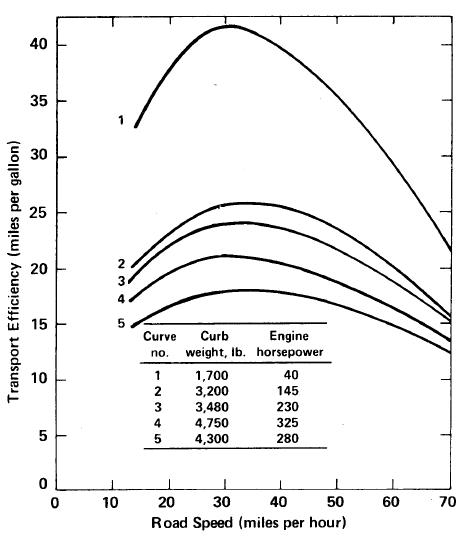
The tradeoff between time and energy in gas mileage of various size automobiles
D. Spreng "Time, Information and Energy Conservation" (2) (Click to Enlarge)
Here is a calculated example on an electric car (Prius) with values based on 68F, at sea level, with no A/C or wind.

The maximum return on energy for this car is at 32 mpg. (The maximum return on time would be as fast as one could safely drive.) The electric assist appears to help up to around 42 mph, at which point the engine starts to spin up, and mileage quickly falls off a cliff, and then continues to decrease more gradually as speed rises. (The shape of the graph could also only have come from a car with a continuously variable transmission - other than the transition where the internal combustion engine spins up, there are no obvious "steps" in the plot.) (source)
For most cars, a sharp dropoff in 'energy return' (which we usually call engine efficiency), starts at around 40-50 mph.

(Source)
Interestingly, going 50 mph gets twice the gas mileage (roughly) as going 100 mph. So its takes twice as long to get there but costs 1/2 as much.
THE MAXIMUM POWER PRINCIPLE
It is no surprise that people want to optimize their return on time, especially when a) energy and other basic requirements are currently cheap and b) we have a genetic propensity (amplified by culture) to steeply value the present over the future. The market optimizes dollars, via positive interest rates (which are based on time). If one has more time, one can effect more iterations of a money making process.
The tradeoff between time and energy is consistent with but slightly different than Lotka's and Odum's Maximum Power Principle, which states that organisms and ecosystems arrange themselves not by efficient energy use but by the maximum rate*flow of energy they can harness from the surrounding environment. Some even claim this organizing principle is the 4th law of thermodynamics. Late Tuesday night, I've decided the parallels of time/energy with the maximum power principle will require a subsequent post, (adding it to the list) but the fact that maximum power is achieved through the compromise between speed and efficiency of energy conversions at intermediate efficiencies is a well known biological concept(6). It's quite possible that the market, in a culture of resource extraction is the ultimate vehicle to pursue maximum power - power being represented by status which is currently correlated with dollars in digitized storage. However, I did find a fascinating paper, "On Ungulate Foraging Strategy - Energy Maximizers or Time Minimizers" which disputes some of the earlier ecological work asserting that animals maximize on power/energy. This study showed that bison, a prey animal, do in fact choose to optimize time, rather than energy intake, presumably to have more of their day to pursue other fitness increasing events (watching out for predators and finding really attractive bison). Clearly there are evolutionary forces that draw organisms to choose between energy maximization and time maximization - to me this seems like fertile ground for more research (if there is time...;)
Eighth, in a compelling harmony with all the above thoughts we should cure ourselves of what I have been calling "the circumdrome of the shaving machine", which is to shave oneself faster so as to have more time to work on a machine that shaves faster so as to have more time to work on a machine that shaves still faster, and so on ad infinitum. This change will call for a great deal of recanting on the part of all those professions which have lured man into this empty infinite regress. We must come to realize that an important prerequisite for a good life is a substantial amount of leisure spent in an intelligent manner." Nicolai Georgescu-Roegen Energy and Economic Myths
ON ENERGY AND TIME - THE REALLY BIG PICTURE
We live on a planet of entropy, though its process it much too slow for us to notice. The first law of thermodynamics states that energy can not be created nor destroyed, only changed. The second law (the entropy law) states that low entropy (high potential) energy gradually but inexorably gets changed and degraded to high entropy (low potential) waste - each transformation results in a % of the original energy being lost as heat. Entropy can be slowed by leaving the low entropy sources alone, harnessing them more efficiently, or using their services more efficiently. Entropy can be hastened by opening the energy service spigot wider and wider, and using energy with little attention to how much is wasted. Unnoticed by everyone involved (except me, because Im writing this), my morning drive to Starbucks today took what was 1 gallon of high quality oil from beneath the sand in Saudi Arabia, and translated it to: a tiny amount of work for a great many people, a 30 minute joyous freedom-ride at 60 mph on a beautiful day, an unneccesary but pleasant jolt of hot caffeine, and about 115,000 BTUs dissipated into the earths atmosphere as heat, never to be used again. ( I could have, were my priorities different, chosen to raise the temperature of 115,000 pounds of water by 1 degree Celsius - ahhh freedom.)
In this sense, energy is time itself, for once ALL usable energy is gone, and our sun reaches heat death, physically speaking time itself will cease to exist - for what is time other than a way to measure the process of entropy?(7) Amazingly, each American born today can be expected to live 77+/- years, and extrapolating the current roughly 60 barrel of oil equivalent per year use by the average American, use over 4,600 barrels of oil equivalent of energy during their lifetimes. (Note: at 1 trillion barrels of global URR (ultimate recoverable reserves), that works out to 130 barrels per person for all time, and thats NOT including the impact of net energy). Looks like the 4,470+ will have to come from something other than oil, or we'll have to cut down on lifespan, or energy use per year, or both.
What if a magic machine that could allow each of us as individuals to allocate between energy and time for our own lives? How many people would choose to live to be 154 years old (77*2) but only use 30 boe per year (60/2)? My bet is quite a few. Take that a step further. How many would be willing to live to be 770 years old but only use 6 barrels of oil equivalent per year? Still some, but 770 years might get boring - thats a heck of a lot of Gilligans Island reruns - also 6 barrels per year isnt too many. How many would choose to live to be 7700 years old while using 6/10s a barrel per year of energy? Probably far fewer, (except for the vampires..;) The point being, not only is there a continuum between energy and time, but also of quality of life! People will and should conserve, but will they and should they beyond the point where there lives are improved. In this sense, I visualize a triad between energy, time, and quality, each having minimum values, beyond which steps towards one of the 3 are offset/substituted by one of the other two - we can increase in quality by decreasing our return on energy or time - we can increase our return on energy, by reducing our return on time, or quality, or some such concept.
CONCLUSIONS
Net energy is a physical measurement but can be meaningfully influenced by cultural valuations of other inputs (e.g. time). To me, net energy is most important in the following 2 senses: 1) given that we are beginning to acknowledge that the market does not provide perfect information, using net energy analysis to compare mitigation/adaptation strategies for the coming era of oil depletion is like looking 2 cars ahead in a snowstorm (the market is fixated on just the car taillights ahead). In this way one gets a truer sense of whats really happening up ahead because decisions are based on (at least partially) physical principles. Second, society continues to grow on a certain summation of energy density/quality and BTU total. As we exhaust the low hanging energy fruits, not only in oil, but in hydroelectric, coal, and other sources, to find the remaining, lower quality/density sources, more energy will have to be used. This energy doesn’t come from the sky, but will be subtracted from the also declining amount of oil, natural gas, and electricity produced annually. Therefore the combination of these new energy technologies with end-use consumer efficiency improvements will have to overcome depletion and the increased energy requirement needed for lower EROI sources in order to maintain economic growth. Its really quite simple.
Ironically, net energy principles only purely work when time is not a factor. Given unlimited mitigation time, policymakers can use net energy analysis to determine the best use for our remaining high energy gain assets. But if fuel shortages develop, fixed infrastructure on the current declining energy return technologies may deliver more of an energy service payload to society than a new investment and scaling up of new technologies due to time lags.
The market is expensive in it's use of energy, not the least of reasons is that it incentivizes us to repeat iterations making money as often and quickly as possible. Getting things done quicker is much more important than getting them done using less energy. The market mechanism can coexist with oil depletion, but rules will eventually have to be created that coordinate our expected energy profit with our "E" (actual energy used), limit energy waste, choose what E brings the most meaningful and consistent human utility, and perhaps reduce our EROTI- energy return on time, thereby boosting the return on energy, or whatever the limiting factor is to human systems. A return to slower ways may not only provide us with more energy, but make us happier at the same time. How to get there?
Nathan John Hagens
The University of Vermont
www.theoildrum.com
email nate at theoildrum dot com
Next Up "On The Origins of Exponential Growth, Part I"
(1) Bergman et Al, "Ungulate Foraging Strategies: Energy Maximizing, or Time Minimizing?"(pdf) Journal of Animal Ecology 2001:70,289-300
(2) Spreng D. "Time, Information and Energy Conservation" ORAU/IEA-78-22(R), Institute for Energy Analysis, Oak Ridge Associated
Universities, Oak Ridge, Tennessee, December 1978.
(3)Hall, Charles "The Continuing Importance of Maximum Power", Ecological Modeling 178-(2004) 107-113
(4) Weinberg, A. "Are The Alternative Energy Strategies Achievable?" ORAU/IEA 79-15 (O) Institute for Energy Analysis, Oak Ridge Associated
Universities, Oak Ridge, Tennessee, September 1979.
(5)Georgescu-Roegen, N. Energy and Economic Myths
(6)Smith, C. "When and How Much to Reproduce? The Tradeoff Between Power and Efficiency" American Zoologist 1976 16(4):763-774
(7) Rifkin, J. "The Entropy Law" 1982
Contact
- Content: editors at theoildrum dot com
- Tech support: support at theoildrum dot com
License

This work is licensed under a Creative Commons Attribution-Share Alike 3.0 United States License.
Nate,
I haven't read most of the post but wanted to respond to your Energy vs Time statement. You have hit the nail on the head bringing this concept up.
I have been telling everyone I meet since I learned about peak oil that much of our energy problem is trying to do everything fast, rather than most energy efficiently. Driving fast, just in time delivery, air travel, 24 hr shopping, all are premised that fast is better. We have created a world that values quickness more than energy efficiency, at least with respect to making money.
Take the need for speed out of the equation and many energy problems will have different solutions. Unfortunately we are not there yet. The world is still trying to go faster so solutions often can't be the most efficient. They can only be the most efficient at the same or faster speed.
Can't wait to read your whole post!
NC- did you not read it perhaps because you are pressed for time?? ;)
Water, Water, Everwhere.
I'm not an expert on biofuels, but it seems to me that water is the nemesis. All living things have water in their cells, but fuel doesn't like it.
We can dry firewood by aging (solar powered evaporation) or kiln dry if we have more energy than time.
Take thermal depolymerization of Turkey guts to oil. ISTM that the water in biological waste makes it hard to get this process to exceed break even. The turkey wast has to be heated to 600C and evaporating water takes energy. There's special enzymes and drying agents and all kinds of secret sauce, this isn't my field, but water seemd to be the nub of it. And turkey guts has value as fertilyzer or animal feed if it isn't being used to make artificial oil.
Ethanol has to be distilled. Again water problem. Huge energy expendature and worse ethanol likes to be mixed with water so 100% ethanol can't be exposed to the atmosphere. They have filters to desalinize seawater, maybe filters is the way to go.
The great thing about biodiesel is that water and vegetable oil don't mix. Yeah it has the glycerin problem and this and that but nothing smart minds can't solve. Other than we can't grow enough of it and still eat and still have tropical rain forests.
Musings by Robert
robert-funny you should mention that. Water too, may be a limiting variable as Peak Oil unfolds. Two colleagues and I have a paper pending in Science called "Burning Water - The Energy Return on Water Invested", showing that many alternative energy technologies, especially biofuels, use an order of magnitude more water than fossil fuel extraction. Wind and solar obviously use next to none. We calculated "EROWI" statistics for 8 different energy sources. We also showed that in the next 20 years, a majority of the world population will live in countries that have zero or minimal extra water to allocate to energy production -I will post a summary of that paper here once/if it gets published.
http://www.pennwellblogs.com/sst/eds_threads/labels/HSMC.php
Silicon fabs use a lot of deionized water but I don't have a number it is probably recycleable. Compared to thermoelectric or ethanol, it is probably close enough to none.
Given cheap energy, making clean water is trivial. But clean water is necessary to make energy.
Ireland exported food during the potato famine. As did India during some terrible 19th century famines when the monsoons failed. Food and energy will follow the money this upcoming century. Before railroads, it was impossible to move staple foods by land in or out of a famine area. Maybe that was a good thing.
Hi Nate,
Thanks for your work.
See if you can get in touch with this guy http://www.sredmond.com/vthr_index.htm
He has a modified wood gasifier that he claims works best with green wood chips.
(I commented on this at your previous post but days after it was posted).
Hmmm.
This sounds very curious to me. Im not really a firewood expert per se other than doing some numbers - everyone has been pretty emphatic in telling me that wet wood is a no-no, which is why they work so hard to dry it - many even put some extra wood they are about to burn NEXT to the woodstove for a day or two while its on, so as to get extra dry. I'll check out the link, but my mind is already working on why we WANT so much stuff and the drivers that underlie this behaviour....
There might be a two other reasons for that - the wood helps as thermal mass to keep the area warmer longer, and a wood stove is very dry, and to the extent more water is in the air, the more comfortable it is. (Yes, the amount is truly trivial - but sometimes, we don't notice benefits/disadvantages when looking at what we do.) I specifically try to dry wet clothes when the fire is burning, for just that reason - though the main reason, of course, is that they dry faster.
But the other thing about storing/drying firewood - how cold is it when you bring it in? I try to stack a few days worth of wood in the sun, and bring it in near the stove in the afternoon - wood in the room at 55° F is a lot better than wood at 25° F. The unheated basement is my other burning storage area, a solution for a week of gray and damp days around freezing.
Hi Nate, great article. The first part would make an excellent primer too.
Would be very interested to see what the EROWI paper says.
Cheers :)
"You can never solve a problem on the level on which it was created."
Albert Einstein
Here I sit contemplating a pile of green maple that I have cut. I've been slowly busting it up to dry, which takes time away from another project of building storm doors so that I will need less firewood for heat. Sigh! Caught between a stump and a cold place.
Fortunately, maple is easy to bust. In fact 'bustability' is another important parameter left out of the firewood measurement statistics. I would hate to see the energy expended on trying to use black gum for firewood. Also fortunately, in Western OR where I live the summers are very hot and dry, providing a quicker 'natural kiln' for the busted up wood.
The time issue looms extremely large when applied to PV. PV attains positive EROI numbers but on a cloudy winter day, I would like my omelet cooked right now and not have to wait a day or even a few hours for it..... back to busting wood.
Awesome article, the top part is fundamental to discussion on any issue about changing the system, using alternative fuels etc. There is a project called drive 55 http://www.drive55.org/pn/index.php trying to get speed limits changed, would be far safer for all concerned and take a massive bite into our fuel use in a very short time, would also make the roads safer for other forms of transport as less vehicles would be passing you if you where traveling at 20 and them at 55 rather than them at 70+.
The point about the firewood is useful too, designing a solar kiln would be an awesome project and very useful for the movement, especially if you could use its heat to cook on with a small amount of supplementary burning of the wood you just dried :)
Buying kiln dried firewood is just silly. It burns like paper.
It works ok for splitting into small pieces for kindling to start a fire. But I was never use it as the primary fuel source in my wood burning stove.
Not all sellers use kiln drying. I have found that the overpriced bundles sold at Home Depot and Lowes do, but many small local places by me sell it by the cord, naturally dried/seasoned, split, deliverd, and stacked at your house for a good price.
don't most fireplaces have air vents?
what i mean is control the oxygen, control the combustion.
add water to the wood and then you have to evaporate the water before the wood can burn.
Edit. i just read a link posted below me about wood, apparently turning down o2 causes problems with tar and incomplete combustion. My new suggestion is to heat water in a sealed pressure container (no excess humidity).
Exactly dbar. Kiln drying of firewood is a huge waste of uneeded energy chasing timely currency and orders of untimely deliveries.
Nate's article is top notch nonetheless, I especially like when he brings the fiat dollar into the energy equation and then vacates/sidesteps the thought/ramifications rather timely :o)
The fiat handlers care little of whom makes or contrives actions, laws, populace democrazies, or usurped adjusted directives of human wills...As long as they control the medium that has the final deciding factor, then the war between finite resources and ever infinite fiat will escalate. It is a losing/jugglin' balancing act based on an increasingly stupidfied society that can not fathom the value of cheap energy in their daily needs of unlimited mammon consumption. Such was that life. The shock waves continue to reverberate, but our programmed blind denseness can no longer feel the warnings.
Excellent thoughts sir.
Takecare
Regarding EROEI on wood.
I loved the book Better Off by Eric Brende and wondered just what the minimites do in the winter.
Of course they chop wood - no wood splitters involved.
In the winter the ground is frozen and it's perfect for
getting in, culling trees, hauling out the logs when they're
mostly dry. Then split them in the cool of fall or spring.
I just ran across this:
http://www.toolbase.org/PDF/CaseStudies/TucsonZEH1Report.pdf
a Rucson "zero energy home" that has a clothes drier! They budget and use 1/3 of the total electrical use of my family of 4 just for lighting! Their actual electrical use seems to be over 2x that of my family.
In our home it was intolerable that the gas fired water heater takes 1/4 of our entire yearly natural gas use (and we live in Ontario where there is a thing called winter and much natural gas is used to heat the house). So we went with a 19 gallon electric water heater. The standby losses are 1/2 or less of the old heater (in dollars) and heating costs are slightly more expensive. We look forward to time-of-day electricity pricing because that'll cut water heating costs by 25%.
At 20,000,000 BTU/cord of mixed hardwood and given our home burns the equivalent of about 350 ccf/natural gas in the winter that means it would take about 1.8 cords of wood to heat our home. I wonder how many trees that would be and how many years it would take to grow that much wood.
I'm sure its all over the place but a figure you often hear is one cord per acre per year.
Note that many consider coppicing to be the most sustainable and efficient way to grow and harvest firewood.
A frind of mine on the EcoAction Committee tells a story about his youth when he was stacking firewod in a shed. His uncle, seeing him toiling, told him: "See that woodshed? It works harder than you do." The point being that drying the wood in the shed was giving more benefit than the splitting and stacking. Your article makes this point nicely. He has since gone on to become a madhouser, building energy efficient shacks for the homeless in Georgia and also converting lawnmower engines to run on syngas produced when making charcoal for the shack stoves. These run generators. Small-scale, reliable innovation.
I took Amtrack once across the country. One of the nice things about it was meeting the other passengers and playing many games of backgammon. I've ridden the TGV and Acela as well but they give a different feeling.
Does your freind have a Web presence or site?
Well, the mad housers do and a little of Frank's handywork can be seen in the car that was converted into a generator/water heater. The biogas project is something he wrote to me about.
Alternatively, using extra time and the 'free' drying heat of the sun dramatically increases the energy return but gives a lower return on both labor and EROTI.
Though perhaps there's a better compromise in between the two. Use a solar collector to power a kiln. You still use "free" energy but use a little technology to compress the time line.
In the end, the oil you burn is solar energy time shifted over millenia, rather than months. Almost all of the energy we use is time shifted solar energy. Solar, wind, coal, oil and biomass, are all just different means of storage for solar energy.
Basically what we need is a way to collect ambient energy as efficiently as possible, and a way to store that energy as efficiently as possible. Oil has been the fundamental driver of the economy because it's pre-collected energy and it stores energy quite efficiently, relatively speaking. Taking solar energy and growing trees over years, and then drying them with the sun over months is terribly inefficient in terms of energy use and time, but it is easy to do.
On the other hand, take a solar concentrator, and then store that energy in a high efficiency batter is more difficult, technologically speaking, but is a way better system from an efficiency stand point. It seems wholly ridiculous that we could possibly have an energy crisis when we've got a source of energy so powerful that it can cook food at a distance of 93 billion miles. The crisis isn't about energy, it's about having to overhaul our infrastructure to make use of the energy that's already there.
'Alternatively, using extra time and the 'free' drying heat of the sun dramatically increases the energy return but gives a lower return on both labor and EROTI' (Energy Return on Time Invested)
I should probably read the rest of the article first, but this is wrong. Or based on another idea of time than mine.
If letting the wood sit in the sun means that the scrap/lower quality wood is used for heating, that means that less wood is used for heating (leaving aside the idea that 'co-generation' is a refinement - scrap wood used for heating can also be used for drying - but like trying to determine the energy cost of passable roads, this spins out of control quickly).
The value of time is easily obscured by 'economic' thinking - this is one reason sustainable practices seem so easily trumped by more 'efficient' ones.
But the firewood producers have another time constraint - how quickly the wood grows. To the extent these are not in balance, they can simply plot their maximum return in economic terms, but not in long term energy.
And that is the real point. German insulation rules about homes is deeply connected to German forestry - over the long term, we will need to be much more efficient than we are now, if we all wish to stay warm in the winter. And that is where the equation about energy return on time is wrong - we will need the energy, and only by allowing for enough time can we possibly hope for a realistic solution.
And yes, that is an attitude which seems contradictory to how our economy works - or even most of human experience.
Your article reminds me of the research that has been done on calorie restriction versus increasing life-span. It is almost as if we have been programed to use only so much food energy. We can use it slowly, and live a long time; or we can use it quickly, and die of obesity-related illnesses.
Nate - I'm sorry I don't have time to read all this but since I got some recent experience of burning stuff I've found your articles on wood to be interesting.
I spent quite a bit of time trying to burn some recently cut trees and garden litter that had been sitting out in the rain for several months. That was a real pig to get going.
I also burned an old chest of drawers (that was riddled with wood worm) - boy did that burn brightly. I was amazed how quckly it caught and the amount of energy released.
Sun drying wood presumably is a good way of capturing more solar energy or upgrading the energy you already have - by simply drying out the timber.
Its actually quite a fascinating example. Green wood must have ERoEI close to or less than 1. Old sun dried wood ERoEI way over 10?
Kiln dried wood for heating purposes is ridiculious with any other source beyond mother natures sun and father times seasonal wait. Kiln drying is nothing more than speed induced lower percentages of moisture. The summer/solar heat does a fine job of this when the subject concerns firewood. The summer kiln drying of furniture grade material takes much more effort and precision.
Firewood, (hickory and white oak being some of the best btu examples) are 12-20% moisture content after a season of solar drying. (And this is not unweathered enclosed drying.) This moisture content is perfect for most wood burning devices. And, again, it is easily achieved with no other actions or inputs of energy being displaced beyond stacking it in full sun with slight breezes.
Once firewood is artificially dried under a natural state of 12-14% outdoor moisture content, then it is indeed the material that produces fast/quick heat. Yet, it produces roughly the same amount of capable heated btu's regardless, but is the heating device engineered to capture that fast burn? Or, does most of it go up the chimney/oxygen vent unharnessed....? And thus, the extra heat is therefore wasted twice. A person has to remember that a rough subject such as firewood has many more rough examples of human usage in practice than any possibilities of ultimate efficiency.
In practice we are all perfect...if only more of us could observe practical purposes beyond our oiled up lifestyles and that fiat medium it caters to, then we might have a working chance at practical futured solutions.
Takecare
On your Transport Efficiency graph, is the information saying that there is less benefit to slowing down a SUV than an energy efficient vehicle? The graph doesn't really show much at the upper end of the speed range.
It may be that the absolute level of fuel used is so high with these vehicles that even a small percentage saving provides a reasonably good number of gallons of fuel saved. For example, to go 100 miles, it takes:
At 46 mpg - 2.17 gallons
At 38 mpg - 2.63 gallons
Fuel lost at lower mpg 0.46 gallons
At 11 mpg - 9.09 gallons
At 10 mpg - 10.00 gallons
Fuel lost at lower mpg 0.91 gallons
Hi Gail
Even with large trucks, slower speeds increase fuel savings.
This Ford study gives evidence:
http://www.greencarcongress.com/2007/05/ford_charts_imp.html
Hope this helps!
Haha! Some funny bits but also some deep thoughts, thanks. I will reread when my head stops spinning!
I especially like the calculation for the amount of energy expected to be used and how much actually existed -Oooops, somethings got to give.
Isn't one issue though that you consider the Earth as a closed system -when in fact it is part of the much bigger sun-Earth energy system? If we start using solar energy in any meaningful way the pie increases.
Also, a parting thought, I did a stint at CERN for a time and was always impressed by how much energy those little particles could hold. A single proton can in theory weigh as much as an apple or an elephant! At those fractions of light speed the passage of time itself shrinks to next to nothing...
Nick.
Solar flows are part of "X". But Y% is very high by the time we upgrade solar energy into the forms a "fast" society demands, so X * Y% in the case of solar gives us not much left over for Z (consumption). We either can improve technology on solar capture, or slow down the whole system so that we need less energy dense infrastructure.
"X * Y% in the case of solar gives us not much left over for Z (consumption)"
Not really. X is so large that the efficiency of capture isn't that important - it's really more of a practical & cost problem, rather than a question of having enough left over. I.E., it's nice to collect enough energy on one's roof to provide for one's needs, so we want efficiency to be high enough to do that. Similarly, higher efficiency reduces costs.
Our total solar insolation is around 100,000 terawatts, and our consumption (excluding the heat & light that we always forget, that I discussed in another post...) is the equivalent of about 5 TW. There's plenty of solar power...
I argue higher efficiency increases costs.
Efficiency increases requires more technology.
The technology has to be built (amortize the costs over its life) and maintained. In essence we become the slaves of technology. Technology allows for more people to become slaves to technology! It enables for more people to be fed on 1 acre of land, but those people must maintain the systems which if they breakdown will cause the death of the maintainers. Thus the maintainers are in a panicked state, constantly trying to have fewer people sustaining the machines, which sustain everyone, but only succeeding in causing more growth and more panic!
and fyi, people currently use 12TW, 72TW is easily achievable wind power, and solar insolation is as you say.
"higher efficiency increases costs."
Sometimes, but not usually. Most of the time it's simply better design.
12TW is in terms of BTU's, but electricity is, in general, worth 3x what the raw BTU value of thermal inputs. For instance, the US uses 39 quads to generate 13 quads of electricity. That's why I said "equivalent".
you are right there, but with wind having maybe 25%-30% capacity factors, you would have to buildup 12TW of potential to drive that 4 TW of work!
(as opposed to 12TW thermal producing 4 TW work!)
Yes, but it's still only 4TW of average power, not peak, which would be needed from wind (or solar) electricity, where thermal heat engines start with 12TW of energy, and throw away 2/3 of it.
The 72 TW of wind resource is also average power, so the 4TW figure is the important thing: we could provide all of our current energy needs using 4/72, or about 6% of wind potential.
It is interesting to note that by moving to renewable electricity we could reduce our energy consumption by 2/3, and still have as much useful energy.
Nate:
Nice work, but you sort of glossed over a few things (not intentional I'm sure)
For the person who you calculated was getting 100:1 eroei:
You said that took 52 hours of time. If we call that a weeks work then did you assign 1/52 of all the energy he used in a year to the energy cost of his firewood i.e. the energy to heat and light his house, feed him and his dependents etc.?
Then there are the tools and equipment: those trucks, chainsaws, splitters, axes, kiln houses etc all took energy to make, will wear out and be scrapped at some point (which will recover some of the energy unless they are just left in the back 40 to rust). and during their lifetime can process x cords of wood, so the energy of production less energy recovered at scrap time should be aportioned as an energy cost per cord.
These apparently unincluded "externalities" might I think change the eroei numbers for the various methods quite a bit
No, I didn't. And you are correct. To look at an analysis of energy systems, one should use as wide of boundary as possible - but when we do that, it reduces both accuracy and readability...
Yup! Same goes for oil rigs, ethanol factories, tractors, etc.
Thanks for pointing that out.
"These apparently unincluded "externalities" might I think change the eroei numbers for the various methods quite a bit"
Probably not. Energy is a small portion of manufacturing costs, and these things have a long lifetime.
Keep in mind that E-ROI and $-ROI aren't going to be light years apart, where costs have not been distorted by subsidies or externalities. If it pays on a $-ROI basis to cut & sell firewood, it probably does on a E-ROI basis, unless we value the firewood per BTU a great deal more than gasoline or electricity BTU's. Hmmmm. Given the recreational nature of much firewood these days, that could be....
Still, one should do at least a few sample calculations before making assumptions here.
I think the operative phrase is:
"where costs have not been distorted by subsidies or externalities"
If you have production cost (price) externalities, all bets are off.
So, in order to do any kind of meaningful analysis (in scientific terms), we'd need to have a way to:
1) Identify the presence of externalities
2) Calculate the size of price/cost externalities with included margin of error
3) Validate the calculation through empirical study
4) Validate the cycle repeatedly as the first externality measurement result is unlikely to remain a constant
This is very difficult to do, as far as I know.
This is also why I think there is a way too big error of margin with any price based proxy energy analysis.
If the range of results is already 1:8 - 1:100 with rough energy calculations, it is unlikely that the calculation will become more accurate via price-proxy method?
This applies, IMHO, for both full life-cycle estimates (through, say EIO-LCA) or price-based proxy estimations for primary production EROEI.
Could you give some examples & numbers? This all seem spretty vague & theoretical. In particular, subsidies seem much more important in this case than externalities.
Remember, we're talking about a specific case: whether the the energy cost of manufacturing a saw (or other such equipment or supplies) will materially change the E-ROI of wood.
It seems highly unlikely to me.
As I'm in the process of laying up about 5 cords of wood for the winter (and I've been doing this for quite a few years), I'd say the two estimates (8 or 3 hours) of labor required to generate a cord of wood is rather optimistic. I've got a lot of mechanical goodies (tractor, front end loader, logging winch, hydraulic splitter etc.) but by the time one whacks down a tree, limbs it up, hauls off the slash, drags the tree to a central location, cuts it up, then splits and stacks it, it's a lot more than 8 hours of work, but I've never tried to calculate the time involved. Since my time is "free" - nothing like being retired - my EROEI is undoubtedly excellent for my woodstove and outdoor boiler that pumps hot water into my heating system. Wood is good when one looks at the btus in from chainsaw gasoline plus tractor diesel vs around 26MM btus available from good hardwood - if you live in the boonies.
Excellent essay, thanks!
I really appreciated your focus on the time element. This is something I try to stress in all my peak oil and biofuels talks, since it is intimately related to the flow issue that defines peak oil in the first place. I usually am "forward looking" in the sense that I talk about the mismatch between the capacity to increase tar sands output, biofuel production, or solar or wind power generation vs the volume of incremental energy demand in a single year. But you've given a very clear example of how to decrease that increment by extending time (in ways more than just driving slower). I am going to be thinking about this a lot more, since I think there are many insights in this.
With regard to the net energy discussion, I think it's useful to look at it in terms of the impact on primary energy consumption, since that is a concrete concept to people who may not grasp net energy. One example I use is the comparison between petroleum gasoline and corn ethanol. In the case of gasoline, we use about 10.3 mmb/d of primary energy to deliver the transport services of 9.5 mmb/d of gasoline. In the case of corn ethanol, we would consume 19 mmb/d of primary energy to deliver that same 9.5 mmb/d of gasoline-equivalent transport services. (This assumes, as is the case today, that none of the ethanol output is an input to the process). So the question is..where does that energy come from? And as you note, that energy is no longer able to do anything else in the society. And it directly relates to policy discussions--why are we increasing primary energy consumption if energy security and energy availability itself are becoming more critical?
One small note. I think you would only be able to raise 63,889 gallons of water 1 degree Celsius with your 115,000 BTUs :)
Personally, I am an SI engineer. However, I believe that 1 BTU is the heat required to raise one pound weight of water by one degree Fahrenheit. If one gallon of petrol is 0.73722 Kg/liter, we would raise the temperature of 10,384 US gallons by 1 degree Celsius.
Nate, a few thoughts
“other than drying our hair and laundry in the sun/wind, most of this energy needs to be found/harnessed/refined”
This is a little misleading. Most of our total energy needs come in the form of space heating & general lighting from the sun. Just think of what things would be like if the sun went out.... Why is this important? Because it reminds us that renewables are much more important than we tend to think. Minimizing the need for "manufactured" heating & lighting is made far easier by the abundant natural energy around us, and renewables really are far more important than fossil fuels - they always have been, and likely always will be.
“Other energy sources, like wind via wind turbines, are also impressive in the energy they provide, but it is of a different nature - diffuse...”
Wind (and solar) only seem more diffuse because we tend to make the wrong comparisons. Wind is a raw material, and is comparable not to oil but to oil bearing rock. The crude we pump out of the ground is comparable to electricity, which is very, very energy-dense. We tend to get confused because wind (and solar) are much simpler, and have many fewer processing steps. This question can be further clarified by a comparison between the roughly 500,000 wind turbines that might be needed to provide 100% of US electricity, and the 500,000 oil wells which provide 40% of our oil.
“As we exhaust the low hanging energy fruits, not only in oil, but in hydroelectric, coal, and other sources, to find the remaining, lower quality/density sources, more energy will have to be used.”
Wind, solar, nuclear and hydro all have E-ROI that is a minimum of 20 (mostly much higher). We tend to get confused by paying attention to biofuels, which in the long run will be only a small part of our energy picture.
"This energy doesn’t come from the sky"
It is striking that this seems to be intended as a metaphor, and yet it is, quite literally, not the case. Both currently, and in the long run, solar is our most important energy source. It is a free lunch, and inexhaustible for tens of billions of years.
On the TOD, we tend to accept carelessly analyses done elsewhere of things like solar. Many pundits continue to say that solar isn't competitive, and in fact that's mostly true, if you exclude externalities like direct pollution, climate change, supply security, foreign wars.... But, that doesn't mean it isn't feasible, even at current prices of roughly $.35/KWH, meaning we could run things on it if we absolutely had to. Fossil fuel costs will continue to rise, and solar (and wind) costs will continue to fall, and those two lines are starting to cross even now in certain places and times. The lines will contine to cross in more & more places & times, until solar is clearly better in general. By that time (roughly 10-15 years out), it will be catching up to wind in scale. Well before that time (5-10 years out) wind could be providing all new electrical generating capacity in the US, and starting to replace coal and natural gas.
Nick
good points regarding space heating and general lighting- thanks - i was thinking more of our energy needs above the solar flows
Wind clearly does and existing hydro does but there is little capacity for new high energy return hydro - nuclear depends on externalities and how one concentrates uranium down the road. Ive not seen anything close to 20:1 on solar - please post if you have - also there is the timeline of how to change transportation structure to these kinds of energy.
Nate,
Great article. And the links at the top really help.
What reference on Nuclear EROI do you find more useful? Cleveland gives a value of 4 and then states it is most likely less than 5 but I can't find his source.
Thanks!
Jon Freise
Analyze Not Fantasize -D. Meadows
"there is little capacity for new high energy return hydro "
Alan Drake indicates that there's a fair amount of hydro potential out there, even in the US. After reviewing some of the literature, I tend to agree. I noted that the DOE recently shut down it's program of research into reducing the environmental impacts of hydro - it appears to have been promising, and there doesn't appear to any good reason for the shutdown. Those environmental impacts are the problem: there is clearly a great deal of untapped hydro potential, if that problem could be mitigated.
"nuclear depends on externalities and how one concentrates uranium down the road"
I'm a bit puzzled. Nuclear advocates indicate that the E-ROI is quite high, in the area of above 50. They say that the study on which Prof Cleveland relies is outdated, assuming, for instance, energy intensive gaseous diffusion (which is being phased out) instead of centrifuge enrichment. Given that most manufacturing and construction isn't all that energy intensive (even with a lot of concrete), that makes sense to me.
I certainly think that nuclear has its problems, most notably its large unit size and slow development cycle, but i suspect it will continue to grow somewhat, and provide some diversity in our supply.
"Ive not seen anything close to 20:1 on solar"
IIRC, the studies Prof Cleveland used gave about 15:1. There is a basic problem with solar E-ROI research: people stopped publishing analyses roughly 10 years ago, when their results indicated that it was "high enough". After that, it wasn't worthy of further effort & publication. Solar PV manufacturers have continued to reduce the energy needed, mostly by reducing the use of energy intensive purified silicon. That's part of why PV growth has continued at roughly 40% per year, when silicon supplies have been pretty stagnant for about 2 years.
I would estimate that silicon PV is at least 30:1 now.
Thin film is even better: nanosolar, for instance, has a 4MW power supply for a factory which will produce, IIRC, 100MW of capacity per year. Given a long life of production, that's a pretty high E-ROI.
You also have to keep in mind that the energy input for silicon PV is process heat, mostly from natural gas or night time electricity, which is 2-3x less valuable than the peak period electricity put out by PV when in use. That effectively triples the E-ROI of PV.
Does that make sense to you?
"there is the timeline of how to change transportation structure "
With all due respect to Alan Drake's rail proposals, this is primarily a matter of going to PHEV's and EV's. This post is getting pretty long, so I won't go into detail, but I'd estimate that these will be on the road in large production volume in 3 years. They could be the majority of new vehicles in 10, should we choose. After that, it takes 6 years to replace 50% of vehicle miles. Also, let's note that hybrids are 2% of new vehicles now, are growing at 55% per year, and installation of a plug & expanded battery is very simple in most hybrids (Toyotas and Fords).
Nate: On your "Fuel Economy at Higher Speeds" graph, shouldn't that be kph instead of mph? I doubt that mph plots would go to 160, but kph plots would. Furthermore, aren't several of those models are only available in Europe, suggesting this is kph data?
Though we think firewood is renewable it has similar problems to fossil fuels. People want the easy pickings so they can take their petrol powered chainsaw and drive their petrol guzzling truck or trailer way out of town to a stash of ‘free’ wood. As that gets harder because of both (roadside) wood and oil depletion maybe a few will go deeper into the forest with axes and drag out cut timber by hand, maybe not. Lots of work for scant reward. Net energy gain declines so firewood is like everything else. It seems like all forms of renewable energy need fossil inputs the way things are done now.
That observation leads me to question these high EROEI figures often cited for wind. A figure of 20 or so doesn’t make sense if a fuel burn generator is needed on standby. This is akin to the dependence on chainsaws and trucks to gather firewood. Some allowance also needs to be made for becalmed idle time and repair downtime of wind plant. Here’s a sample calculation; a windfarm produces its nameplate output 50% of the time. The windfarm has nominal EROEI of 20 but the backup natural gas generator has EROEI of 8. I ‘d suggest the backed up wind farm system has effective EROEI of
0.5 X [(20 X 0.5) + (8 x 1.0)] = 9
based on weighting the contributions though some might suggest other weightings. Wind energy enthusiasts need to talk more in terms of systems.
"A figure of 20 or so doesn’t make sense if a fuel burn generator is needed on standby. "
A fuel burning generator isn't needed any time soon.
Wind's intermittency can be accomodated by normal load following methods until wind is up to 10-20% of KWH demand.
After that point, geographical diversity & long distance transmission, demand management, and storage from PHEV's & pumped storage will be able to reduce or buffer the intermittency until wind is up to 35-50% of KWH demand.
If wind & solar get up to 80% of KWH demand, you might begin to need a fuel burning generator, which could be powered by biomass, which is much more efficient in stationary generating applications than in transportation.
Wind E-ROI from modern, large wind turbines is more like 50. If as much as 20% of a wind system were to be backed up in this way, we would change "0.5 X [(20 X 0.5) + (8 x 1.0)] = 9" to:
100/(80/50 + 20/8) = 24
Even if the E-ROI is 20 you'd get
100/(80/20 + 20/8) = 15
and even if it's 20, and the fuel burning generator provides 50% of the power you'd get
100/(50/20 + 50/8) = 11.4
Hi Boof,
Although wind isn't reliable it's reasonably predictable (i.e., it can be forecast in advance) and so system operators are seldom caught off guard. In addition, interconnections with neighbouring utilities help tremendously (large balancing areas greatly reduce operating and spinning reserve requirements) and highly responsive hydroelectric resources, where they exist, also help to smooth out any variability.
The general consensus seems to be that there are no technical or operational barriers to increasing wind's share to 20 or 25 per cent and, from what I can tell, the ancillary service costs are no different from those of nuclear or coal.
Cheers,
Paul
Geez Nate, you sure do cover a lot of bases in these posts. I have one quibble. For EROTI, do we really care about total time required, or just human labor time invested? For example, in your firewood example, the EROTI for kiln-dried wood is very low, but the EROTI for seasoned wood is quite high. Yet from my experience drying wood, I would have thought the EROTI would have been about the same. That's because from my perspective as a human, I don't care about time except as it relates to human labor for something such as drying wood. I stack green wood in my back yard and let it sit there for the summer. Total time invested by me for drying that wood is an hour or two, not several months. There's an opportunity cost in that the space I use for the drying rows of wood could have been used for something else, but I don't have to spend any more of my time after I've stacked it.
Where I would think EROTI would really be important in this example is if I choose to cut the tree, haul it out, buck it, split it, and then stack it to dry, all with my own labor - which I do for about half of our wood. That is, I get out my crosscut saw, pick a likely victim or two, cut it down, cut it to lengths that will fit in my wagon, pull the wagon by hand or connected to my bike to my house, buck it down to 16" logs, split them, then stack the split pieces. For a mostly fossil-fuel free operation, the EROTI is high, but the drying time doesn't really affect me, since I do other things while the wood is seasoning.
there is a subtle but important difference between time (the passage of time) and labor (human effort, which also takes time). They are both separate inputs - you can use 9 months to dry the wood but you arent spending any of your own time doing it.
The way Mike Ruppert of From the Wilderness described his concept of EROEI matches the above description. Although he did not do the math he raised the point of sustaining the associated infrastructure (replacement and creation energy cost) as a part of EROEI or I guess net energy.
Well obviously, the problem in a free market is that if you're drying naturally then some other individual can make more money or increase customers at your expense by having higher availability and quantity of dry firewood. So by drying green wood you are optimizing your own personal energy return in the form of money, which allows you to procure more energy than if you had less money.
The fact that it is not optimal from a resource point of view is a moot point. It's the same reason for many other environmental problems. Economically it makes sense and is profitable.
I think it was the coal thread where someone pointed out that mining coal by human hand was more net energy efficient than machine, however with machines you get that much more return it makes no sense to employ humans. Same with wood, I'd guess a good stone axe, coupled with horses or oxen, natural sun drying is more net energy effective than chainsaw factory, smelters for ore, rigs to get oil and gas to run that, artificial drying etc.. etc.. but why bother your chain saw and truck will give you far greater overall energy return than stone axe and beast of burden. Resource exhaustion is someone else's problem.
I don't think society will optimize it's resources either, it has shown no inclination to do so, all indicators point to ever increasing rates of consumption. A recession might slow the world down but my bet is on humanity burning whatever it can get it's hands on.
This won't happen in a homogeneous manner either, there might be pockets of incredible efficiency, incorporating renew ables wind, solar etc.. and walkable neighborhoods, telecommuting, cycling and the like. There will also be areas of incredible energy waste large cities spring to mind. Not to mention things such as flaring of natural gas (I believe they still do this in Siberia on a large scale) and on-going forestry in Brazil and Indonesia.
The ability to have 300 energy slaves or even 50 is just too good a deal to pass up, extrapolate this to the developing world... You don't need a spread sheet to see we face challenges.
I think your argument essentially boils down to conservation, be wiser in our usage of energy. Was it Matt Simmonds who said conservation is our largest source of energy.
Interesting article I read yesterday on New York buildings being cooled by ice. Ice gets frozen overnight when energy is cheaper, then air is blown over said ice and pumped through the building during the day. It was expensive to set up requiring government (you/me/taxpayers) subsidy.
Energy Return on Time is a very important concept. I suspected it existed but couldn't put my finger on it, but you have delineated it par excellence. This the reason that Kunstler's idea of using rail transportation to mitigate PO is flawed. There is a major time loss in waiting for trains and in the operation of the train and therefore a major energy loss. This a very significant concept.
I use to heat my house with firewood. It was cheap, but the time and work involved was too much. That is why I switched to burning corn. I can harvest the corn in a about 15 minutes that will heat my house for the whole winter. It is much easier to handle and the corn stove regulates itself with much less attention.
I believe this is also the reason low density feedstock for cellulosic bio fuels is a non starter. The time involved in gathering,transporting and processing cellulosic renders the supposed gain from the cheaper cost irrelevant. It also puts the lie to the supposedly cheaper cost of ethanol production in Brazil from sugar cane. Sugar cane is very labor intensive and difficult to transport as compared to American corn. I believe RR has not taken this into account in his calculations. To me it is like saying mowing your lawn with a hand scissors is more energy efficient than using a lawn mower. Time is money and your point that time is energy is well taken. Congratulation on an original and new concept, at least for me. I think it changes all the calculations about what we should do to mitigate PO.
Another example of the Energy Return on Time is corn drying. The buyers of corn require a standardized bushel of corn with 15% or less moisture. This is because the corn will spoil at room temperature if the moisture content is greater than about 15%. Seldom is the corn around here down to 15% at harvest, so many farmers buy dryers and expensive LP gas to dry the corn. I have found that if one waits until the corn dries down to about 18% and the weather cools down at night to about 30-40 degrees, the corn can be harvested and with careful watching and some fan running held until about April when the weather warms up. Then the fans can be turned on for a week or two to dry down the corn, thus saving the cost of the dryer and LP gas. To me this is clearly a case of Energy Return on Time and usually saves me several thousand dollars per year.
This illustrates to me that Energy Return on Energy Invested, which I have faulted many times in many posts, is at best only part of the energy gain calculation. For sure the energy gain is at least the Energy Return on Investment (capital if you will) plus the Energy Return on Time (labor if you will). Leaving out the energy gain on time gives a false picture of the energy gain from an endeavor. I suspect the EROT is larger than the EROEI although I have no evidence other than "thought experiments". Clearly time was a very significant factor in forming earth's endowment of fossil fuels. I suspect the EROEI was very low at the time fossil fuels formed. It was the eons of solar storage in plant and animal remains, their submersion plus the further eons of high pressure and temperature that formed fossil fuels. Even this produced only about 2 trillion barrels of oil. Considering the earth is about 4 billion years old that isn't much production per year. And we've used about half in only 150 years. I submit that the EROT for ethanol is higher than that for crude oil. If ethanol could reach 10% of yearly gas consumption in the US, that means every 10 years, the equivalent of a years worth of U.S. oil consumption for gasoline would be produced. Considering the eons it took to form crude oil and the low per year output of the earth at the time, ethanol looks like a bonanza. It appears to me that the EROT may be several times greater than the EROEI.
Nate Hagens is a genius.
practical
thanks for your comments and interest in this concept.
By your definition this might be true, but what we care about is the time that WE have to put into the effort and in fact the the energy return on time AND labor for crude oil is far higher than it is for corn - crude oil can be pulled out of the ground in a day once infrastructure is built - corn, (other than the stuff you've stored and are drying..;), needs a season to turn a crop into ethanol.
Yes. But at what cost and to whom? You are forgetting that natural gas, coal, oil and other inputs go into corn production, and that corn ethanol has a very small energy gain. The US uses 385 million gallons of gasoline a day (source.) This is 140 billion gallons per year - 10% of that amount is 14 billion gallons per year. However, ethanol has less than 2/3 of the BTUs as gasoline, so we really need closer to 20 billion gallons of ethanol to displace 10% of our gasoline use.
The USDA has this chart showing rough energy inputs into the corn ethanol process
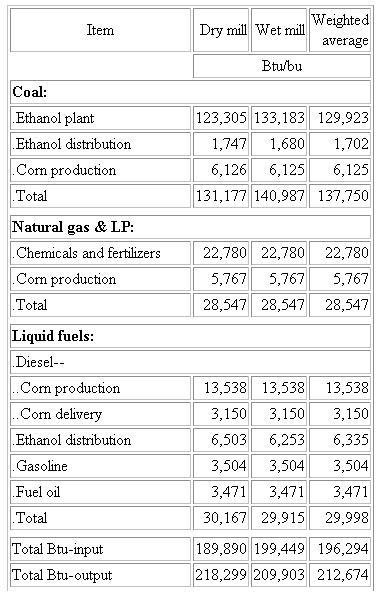
(source)
As can be seen, the USDA study assumed it was a coal fired plant that generated the electricity to steam the ethanol to high usable concentrate, in addition to large amounts of natural gas based fertilizer, diesel for tractors etc. For ease of calculation, lets assume that the coal electricity is natural gas - in either case- the process has a very low energy return of 1.15:1 ( 218,899/189,890 ). This means to generate 20 billion gallons at 84,000 BTU per gallon of ethanol we would have an output of 1,680,000,000,000,000 (1.68 quadrillion) BTUs of ethanol. Since it has a 1.15 EROI (slightly higher or slightly lower doesnt matter), it requires 1.68 Q / 1.15 = 1,460,000,000,000,000 (1.46 Quads) of energy input to get that ethanol. According to the above assumptions, 84.6% of which would be fertilizer and electricty and the remaining 15.4% from diesel and other liquid fuels.
So to replace just 10% of our current gasoline consumption from corn ethanol, we would burn 1.46 quads of natural gas per year, which is fully 30% of what is used fo an entire home heating season.
Thank you for understanding the importance of energy return on time. The reason energy return on energy is very important is that the energy inputs for a marginal energy processs need to come from somewhere. In this particular example, we would be getting 10% of our gasoline, by using a large chunk of our natural gas. What other things would be displaced by this natural gas usage? And if we did use coal, how would that impact GHGs, etc?
The point is that oil, so far, has had a huge energy gain, and has not required large extra inputs, like many biofuels do. You are correct that EROI is not a panacea, but in examples like corn ethanol, the decision on whether this should be scaled, using anything remotely similar to current technology, is pretty clear. If the energy inputs into the process were moon rocks or saltwater, then I would agree that EROI is not too relevant - but diesel, natural gas and coal are robbing from Peter to pay Paul.
I will end with this caveat Practical, as I know you are a farmer and a corn advocate - in a world almost destined to go more local, corn ethanol may be a great solution for you and your community - due to the unique attributes of where you live (though industrial corn farming will likely have problems if fossil fuel prices double or triple). The above analysis is a national one - the local situation could be different given your specific needs and infrastructure.
This is pretty much the best post I have seen in a month.
Keep up the good work.
It's good to know some people have their heads screwed on straight!
Also big thanks for the study link.
My wood harvester
http://www.flickr.com/photos/10162336@N06/900258336/
Another interesting example of the Time is Energy concept is in waterborne transport. In the 60's as global trade surged, the emphasis was on very fast transoceanic container ships. It takes something like 33% more fuel to make a transoceanic voyage in just a few fewer days time; yet with the emphasis on just-in-time delivery (or its 60's equivalents) the additional fuel cost was gladly paid to expedite delivery.
After the oil shocks of the 70's, new construction of container ships was of slow-moving fuel efficient vessels. Then with cheaper oil of the 90's, the move was back to faster container ships. There is a lot of potential fuel savings in slower moving ocean vessels and shippers, being very cost sensitive, will make the necessary adjustments going forward.
What amazes me is that it is cheaper to ship a manufactured good from Guangdong, China to Los Angeles by ship, than from Chicago to Los Angeles by truck. Any idea that globalization will come to an end as a result of Peak Oil fails to recognize the tremendous efficiencies of waterborne transport, that, if anything, increase the attraction of globalization, at least in the medium-term compared to the traditional national economy, linked by road and rail.
More importantly, with most manufactured goods, the fuel consumed in trans-oceanic transport is a very, very small component of total cost. So that even if fuel cost goes up by a factor of ten, manufacture will not return to less competitive areas.
I don't remember if it was this thread or another but somebody wrote peak oil means the end of railroads. Umm no, peak oil helps railroads. Trucks are going to take it in the shorts. Peak oil really helps electrified railroad.
Surface ships have a "natural velocity" depending on their size due to bow waves. To go any faster, fuel expenditures go way up. If you really want to go fast, subs are more efficient then surface ships, density of water vs. air not withstanding, but you have to bring your own oxidyzer.
By the transitive property, it must be even MORE expensive to get a product from Guangdong to Chicago. Post-peak ports will be better off, ceteris paribus. (though Chicago is a port too, just not to China unless you go the VERY long way)
Thank you, Nate, for an interesting article coming from a point of view rarely expressed.
"The greatest shortcoming of the human race is our inability to understand the exponential function." -- Dr. Albert Bartlett
Into the Grey Zone
Hi Nate,
Dunno about Lotka and Odum, but in electronics, there is also a maximum power transfer theorem. Basically if you have a power source and a load, the maximum power that you can transfer into the load is when the source's impedance is equal to the load impedance, which means 50% is wasted in the source.
Think amplifiers, a 100W amplifier will consume ~240W at full power, 40W for ancillary functions and 100W within it's output devices for the 100W delivered to the load - loudspeakers). With a power station, where efficiency is necessary, the impedance of the source is low, most of the power is dissipated in the customer's load.
You may be onto a generalised principle there, keep investigating.
There's two loopholes to the maximum power transfer theorum. 1) you don't have to maximize the power delivered to the load if efficiency is more important. 2) You can interpose a step up transformer or a DC-DC converter between the source and the load.
This return issue over time is not understood or embraced
hence the term "powerdown" is not used with much understanding.
Boris
London
Robert2734,
Not really sure what you mean by loopholes, as a step-up transformer reflects the impedance back anyway (and a DC-DC converter won't relay an audio signal). My point was that the maximum out of such a system was when 50% was not utilised in the load; a seemingly wasteful condition.
Nate seems to be honing in on some principle in nature where the use of energy is controlled by the maximum output/use of that energy, not the most efficient use, and interpolating it to our modern use of energy.
Uncle, the Maximum Power Principle is well known in ecology and energy, that systems and organisms maximize power instead of efficiency in their intake of energy from the environment, so there certainly is a biological pull in that direction.
What I may be "honing in on" is that human society may be following the maximum power impulse in the vector of the market system, but doing so maladpatively - maximum power applies to physical systems yet we 'perceive' that it works on economic systems, and it may, for a period. But I'm not sure, Im still honing..;)
A posting of uncommon wisdom!
One needs to reconsider Odum's Power Law in light of Keynes' Law of Temporal Horizons - "In the long run, we're all dead."
This is an excellent piece. Thank you so much.
If I may add another ‘things are easier to understand and explain than is normally supposed’ comment, because I do believe in a scheme that goes from understanding to action (with a lot of hurdles and possibly insuperable obstacles in between.)
Peak oil or peak energy can’t be understood meaningfully without the concept of EROI. “We use more than we produce” for example, doesn’t hack it; it merely conjures up ‘dwindling’ or ‘depleting’ reserves, stocks of some kind that run out. That concept is so incomplete it is no wonder that ppl who hold only that rebel and thus refute peak oil; it does not really ‘make sense’ or ‘explain what is going on’ - must be ‘wrong’ somehow.
EROI is easy to explain. The only pre-requisite is some kind of grasp of an energy in-energy out unidirectional process. The easiest analogy is human eating and working, which most ppl over the age of 10 have. (Those below will have to take it on faith as in the West hunger and listlessness are not related through experiential knowledge; rather it is over-eating that is associated with sloth..) Given that idea, an invented measure of energy invested (whatever compendium of human work, machines run, effort, calories, etc. ..) is intuitively clear, and energy inputs/outputs can be compared and seen as ‘favorable’ or not (low hanging fruit, etc.) It is a surprising and “a -ha!” concept for many. The energy recovered can be a constant; or, as a second step it’s variability in quality or end-use (eg. light crude / coal /wind, simply as differing..) can be added in.
Then the basic model (with variables at both ends) can be refined or embroidered on, with the idea of ‘multiple factors’ that are hard to work out. Including time, as here, where the fourth dimension is calculated in energy terms, based on 'nature' (eg. drying time) intertwined with ‘economic time’ and ‘psychological time’ .. a great example of complexity.
Our societies have seen to it that any such simple approach, congenial to both the complete novice, and the high flying expert, is not popular or common.
Knowledge is power. Therefore it’s distribution is uneven.
There are other factors in almost every case. Firewood and particulate matter are just one example. Even if wood was plentiful and efficient, the particulate matter would cause major health problems in more densely populated areas.
I think that solar thermal home heating can provide most of what we need in many parts of the country. It is such a simple concept that many people may wonder why we are not already doing it on a widespread basis right now.
Why aren't we?
Because it costs money. A furnace or heat pump is a few thousand dollars, but costs many times that to operate over a 20 year period. Solar thermal costs up front $10-20k, but costs very little to operatie over that same 20 year period. You pay now, or you pay later...big time.
The final thought in Nate's article is:
"A return to slower ways may not only provide us with more energy, but make us happier at the same time. How to get there?"
That's really the key question, but I did not see much discussion of it above. My thought on 'how to get there' is by being a visible example that people can take note of and therefore comfortably begin to imitate.
People seem most comfortable following the herd, but if they notice someone suceeding outside the herd they may take notice of that success and consider switching herds. In a flock of sheep the adventurous animal that moves away from the flock in search of greener pastures, and is therefore eventually followed by the less adventurous, is called a bellwether.
In human terms, Wikipedia describes a bellwether this way: "In sociology, the term is applied in the active sense to a person or group of people who tend to create, influence or set trends."
We need more bellwethers...
Greg in MO
PS. Bellwether is also a good fiction book.
I think of the TOD community as bellwethers, or at least the people here have potential to be such.
There is an interesting article on this by John Michael Greer called "A Failure of Mimesis" at...
http://www.energybulletin.net/32529.html
a quote from his article:
"...It might be worth suggesting that a change in approach is in order. If the peak oil movement can present a vision of the future that inspires and energizes people outside the peak oil scene – including those rap-listening, wide-wearing kids whose energy has gone unharnessed by any other movement for change for so long – the possibilities for constructive change may be greater than many people now suspect..."
Greg in MO
Two days later, some speculative musings on the human predicament and the maximum power principle:
There is ample evidence that nature organizes itself, both ecosystems and the species that inhabit them, around principles of energy maximization. But organisms, including humans, do not perform EROI calculus in their brains - our thought is algorithmic and analog, not computational.
We are born into an environment with energy maximizing (as opposed to optimizing) neural machinery - the environment gives us cues how to maximize energy and we recognize this by 'feelings' of whether we are doing so correctly or not.
Our culture maximizes 'money', and teaches us to do so - so rate x flow in a physical sense is hijacked by rate x flow in an economic sense.
The upshot - the maximum power principle holds for our behaviour -we think we are maximizing power but this is really a byproduct of us maximizing the 'feelings' that we perceive will lead to maximum power optimization given cultural cues. Humans are different beasts in this calculus - the vast majority of other organisms have virtually identical environments to those of their ancestors. E.g. if bark beetles become scarce due to a pine blight, woodpeckers will learn quickly to optimize energy by eating some other bug, but they still 'eat bugs' for energy, whereas our metric has changed, and may change again, substantially.
The rate x flow of atavistic neural signals in a society of plenty, almost has to lead to excess and maladaptive behaviour. Because we don't optimize on energy, efficiency or power - we optimize on feelings.
At some point, this will start to revert back to energy optimization, instead of optimizing its abstract substitute
Very good article Nate!
Your concluding chapter is a brilliant distillation of a lot of discussion that has gone around here and elsewhere!
Now, can we calculate some examples through time for infrastructure transitions? Has there been any work around this on the historical energy analysis of earlier primary energy source transitions (wood->coal, coal->oil)?
Of course, these would only give two examples.
What we need is akin to Stern Report's analysis:
- We can transfer to a new energy system, but the less time we give ourselves for this, the more energy it is going to cost, thus more money it is going to cost (incl. all externalities)*
* (assuming now that speeding up the energy infrastructure transition beyond some unknown point X, will incur an increasing penalty in energy needed while not changing the energy return results)
Another, completely different point:
I think a lot of the discussion is already happening on how do we actually use 'E'.I think this discussion is going to get heavier and uglier as oil/gas scarcity develops.
The X*Y*Z parts are mainly in the domain of physics, engineering (and yes, economics), but everybody has an opinion on 'What is useful end-use of energy? What gives me quality of life? How important is that for me?'.
This debate is going to get uglier as we head towards the energy availability crunch.
Can we have a meaningful discussion about this @ TOD? Starting from the POV of biology perhaps? I know it's a very difficult and touchy subject, but perhaps worth a try.
cheers,
Samu
Excellent post. Time indeed is very important to factor in when considering our options.
I might somewhat disagree that "what we care about is the time that WE have to put into the effort". Perhaps the other time, the one spent to create the resource should be equally considered. Remember that energy (as well as water) is essentially a renewable resource. It can come as a stock or as a flow. The stocks (coal, oil, etc.) are the non-renewable part. The flow (sun, wind, etc.) is renewable. So far we have been mostly concerned with the non-renewable part. This is because we found out that by digging into the stock we could get so much more and so much easier, than by using the flow. It is actually the stock that allowed humans to develop into a geological force (Vernadsky), which may very well bring them to extinction, unless they find alternative development goals and paradigms.
Once we're done with stocks, renewable flows become crucial. Renewable resources are limiting if the rate of their renewal is not fast enough. As you have mentioned in your previous articles, Nate, if we switch to wood for heating purposes, we will run out of forests very soon. So while we are dealing with stocks, indeed we will be mostly thinking about the time WE spend. But once we switch to flows - the renewal time becomes equally if not even more important.
A few more notes. Time is indeed tricky. That is because it can come in chunks and may have different value. I've used to cut and split by hand all the 4 cords that I need every year. However I was doing it in my spare time as an exercise. Instead of sweating in a crowded gym I would go out and split my wood. I can't even call this time "wasted". Someone else riding a bike to work would also spend more time, but that time is also not a waste. So it's really a matter of attitude and perception. Flying an airplane from the East Coast to Seattle is a complete waste of time. But if there were an alternative of riding Amtrack with my computer hooked up to the Internet, reading the TOD and writing papers for 4 days, that could actually be time very well spent. I'm really looking forward to the times when I could board a ship and spend 5 days sailing to Europe, while working in my cabin just as I would be doing it in my office or home. Imagine, no jet lag, no red eyes, and plenty of work done. And then those evening strolls on the deck, breathing the ocean air. Just thinking about it makes me feel really good about peak oil and the need to cut our CO2 emissions.
So time is subjective and may be hard to compare in these analyses.
And finally the increased gas consumption with speed should not come as a surprise if you recall that the air drag is proportional to the square of your velocity (e.g. http://hyperphysics.phy-astr.gsu.edu/hbase/airfri.html). So it should actually be even more than linear. Perhaps you don't see it so much, because it's mostly the acceleration phase that requires most of the force, plus there is a small rolling friction involved.
Enjoying your writings. Thanks.
very good points thanks,
In effect you are saying that energy invested is based on physical principles and subject to entropy. But time isn't as physical - there are positive externalities from 'spending time', that may not correctly be considered 'costs'. I totally agree - my point was more a general one of the tradeoffs, though not precise, between more energy and more time. Must ponder...
What I was trying to say is that there is a difference between time that is needed to produce energy and time that WE spend.
Higher quality energy may be viewed as compressed time. It took millions of years to produce that sweet crude. I don't know how long it took to make that uranium that we now use. The energy we produce from the flow of renewables requires less time but is of lower quality. But again we are compressing time to condense that energy. If we don't do that we get a solar driven vehicle - you know what they are and what kind of output you can get from them.
(e.g. http://www.udel.edu/igert/pvcdrom/MANUFACT/LABCELLS.HTM - even here you've got condensed time that was required to produce this beauty.)
So it's not just the time that WE spend that is important. The real crunch will be when we will run out of stocks and turn to flows and find out that there is not enough TIME to produce all the energy we need.
In contrast the time that WE spend is relative, and to a certain extent depends upon our perception of what is waste and what is not. Certainly if we HAVE to cut and split all our wood by hand we will not have time to invent and produce such beauties. So energy works as a repository of time, which is given back to us now. The question is really how we use it. Most of the free time that we now have is given to us by the still abundant energy. Once it's gone there will be much less time to go shopping and play ball. So what we really see is
Time -> Energy -> Time
Energy in a way works as a conductor of time from the past worlds to us now, giving us a chance to design a better world, the noosphere (again in Vernadsky's terms). The problem is that we, instead, prefer to use this time to go shopping and play ball.
Solar & wind are quite high density, and have very fast flows: 100,000 terawatts is pretty good.
High density compared with collecting dew to run a turbine?