


DrumBeat: April 25, 2008
Posted by Leanan on April 25, 2008 - 9:03am
New Matthew Simmons presentations

Including:The 21st Century Energy Crisis Has Arrived
Are We Nearing The Peak Of Fossil Fuel Energy? Has Twilight In The Desert Begun?
The Peak Oil Debate As The EIA Turns 30
Clothing stores feel sharp economic pinch: High fuel, food prices crimping spending on apparel
After years of routinely asking consumers what they think of the coming fashion season, it would seem that nothing could surprise C. Britt Beemer. But this year, when Beemer asked women to rate spring clothes, he got an unexpected response — 50 percent of women said they hadn’t even noticed what’s in store windows....If rising food and fuel prices aren’t exactly getting you in the mood to hit the mall for a new spring outfit, you’re not alone.
Clothing retailers are facing a double whammy of drooping consumer interest — fueled by economic woes — coupled with their own rising costs for raw materials such as cotton, fuel to transport goods and even labor in China.
North Pole could be ice free in 2008
You know when climate change is biting hard when instead of a vast expanse of snow the North Pole is a vast expanse of water. This year, for the first time, Arctic scientists are preparing for that possibility."The set-up for this summer is disturbing," says Mark Serreze, of the US National Snow and Ice Data Center (NSIDC). A number of factors have this year led to most of the Arctic ice being thin and vulnerable as it enters its summer melting season.
LOS ANGELES - Spurred by visions of their cities frying in a warmer world, mayors around the nation have grasped a green solution: trees! Like Johnny Appleseed, they have vowed to sow their seeds in great profusion, promising millions of new trees in the coming years. Arbor Day, that old fusty holiday, is getting a makeover.Cities once planted trees because they were beautiful. Now trees are being retasked as "green infrastructure" managed by "urban foresters" to work as powerful energy-saving, carbon-sucking, wastewater-treating tools to save the planet. But as the mayors spin their green dreams, their releaf teams have had to confront a brutal reality: Planting a tree is a lot harder than it looks.
Insects left disfigured by nuclear radiation
No one wants to live too close to a source of artificial radiation, not even insects. Cornelia Hesse-Honegger has spent 20 years travelling around the world, mostly in Europe, capturing and studying over 16,000 insects, many living in the vicinity of nuclear power stations, or other artificial sources of radiation. Her conclusion, not surprisingly, is that exposure to radiation increases the chances of deformity.
How to End the Global Food Shortage
The world economy has run into a brick wall. Despite countless warnings in recent years about the need to address a looming hunger crisis in poor countries and a looming energy crisis worldwide, world leaders failed to think ahead. The result is a global food crisis. Wheat, corn and rice prices have more than doubled in the past two years, and oil prices have more than tripled since the start of 2004. These food-price increases combined with soaring energy costs will slow if not stop economic growth in many parts of the world and will even undermine political stability, as evidenced by the protest riots that have erupted in places like Haiti, Bangladesh and Burkina Faso. Practical solutions to these growing woes do exist, but we'll have to start thinking ahead and acting globally.
The Politics of Food is Politics: An Alternative Agriculture is Possible
We buy food at the supermarket; so we don't generally experience -- directly -- the association between fuel and food. The connection, however, is every bit as central in the current food production regime as the link between aircraft engines and their fuel. Industrial monocropping for global distribution is "neither tooled nor organized for oil at $120-a-barrel." It is not just the far-flung food transport network (much of it refrigerated and fuel-hungry) that creates the intimate dependency on oil; it is the whole scheme called industrial (or corporate, or "modern") agriculture.This oil/food link -- during the onset of what some call the Peak Oil event -- has resulted almost overnight in steep food-price inflation, hitting peripheral economies like a tsunami.
I do not wait for permission to become a gardener but dig wherever I see horticultural potential. I do not just tend existing gardens but create them from neglected space. I, and thousands of people like me, step out from home to garden land we do not own. We see opportunities all around us. Vacant lots flourish as urban oases, roadside verges dazzle with flowers and crops are harvested from land that was assumed to be fruitless. The attacks are happening all around us and on every scale - from surreptitious solo missions to spectacular campaigns by organised and politically charged cells.This is guerrilla gardening.
Hundreds of EPA scientists cite political interference
Washington — Hundreds of Environmental Protection Agency scientists say they have been pressured by superiors to skew their findings, according to a survey released Wednesday by an advocacy group.The Union of Concerned Scientists said more than half of the nearly 1,600 EPA staff scientists who responded online to a detailed questionnaire reported they had experienced political interference in their work.
Falling Polish coal output raises energy security fears
Poland's largest hard coal companies said Wednesday they produced 1.8 million metric tonnes less in this year's first quarter compared to the same period last year, raising concerns about supplies to the country's power plants. Poland produces almost 95% of its electricity from coal-fired plants.
The fact is, nuclear power has not recovered from the crisis that hit it three decades ago with the reactor fire at Browns Ferry, Alabama, in 1975 and the meltdown at Three Mile Island in 1979. Then came what seemed to be the coup de grâce: Chernobyl in 1986. The last nuclear power plant ordered by a US utility, the TVA's Watts Bar 1, began construction in 1973 and took twenty-three years to complete. Nuclear power has been in steady decline worldwide since 1984, with almost as many plants canceled as completed since then.All of which raises the question: why is the much-storied "nuclear renaissance" so slow to get rolling? Who is holding up the show? In a nutshell, blame Warren Buffett and the banks--they won't put up the cash.
World’s largest solar farm set for California
Stealth Bay Area solar startup OptiSolar has quietly revealed plans to build the world’s largest photovoltaic solar farm on the central California coast — a 550-megawatt monster that would be nearly 40 times as large as the biggest such power plant operating today.
With First Car, a New Life in China
SHUANG MIAO, China — Li Rifu packed a lot of emotional freight into his first car. Mr. Li, a 46-year-old farmer and watch repairman, and his wife secretly hoped a car would improve the odds of their sons, then 22 and 24, of finding girlfriends, marrying and producing grandchildren.
Is humanity's restlessness a threat to the planet?
Humanity's history is marked by constant movement, mass migration from continent to continent in search of a better way of life. Is this restless addiction to travel - and our desperate demand for more fuel to feed it - our fatal flaw as a species?
The rapid pace of environmental change threatens to drastically transform our world. What might the future look like? Alan Weisman, best-selling author of The World Without Us, peers ahead 50 to 100 years to construct plausible scenarios for three widely divergent ecosystems, and the people who inhabit them.
U.S.-contracted ship fires toward Iranian boat
WASHINGTON (Reuters) - A cargo ship contracted by the U.S Military Sealift Command has fired at least one shot toward an Iranian boat, a U.S. defense official said on Friday....The United States in January said Iranian boats threatened its warships on January 6 along a vital route for crude oil shipments.
Strike refinery shutdown complete
The shutdown of the Ineos oil refinery at Grangemouth in central Scotland has been completed, the company has said.
White House Rejects Dem Plan Linking Arms Deals with OPEC Output
The White House said Thursday that Senate Democrats are "barking up the wrong tree" by threatening to hold up arms deals with Saudi Arabia and other Organization of Petroleum Exporting Countries unless the oil-producing countries agree to increase oil production."The last thing that we want to do is increase our dependence on foreign sources of energy," White House spokeswoman
CNOOC in Tax Dispute in Nigeria Over OML 130 License
Chinese oil producer Cnooc Ltd. (CEO) is involved in a tax dispute in Nigeria that might affect the price of its biggest-ever acquisition of a foreign oil field.
Hunger returns. We look to history for solutions
What can we learn from the green revolution? And could a “second green revolution” extricate us from today’s food problems?
Unpaid utility bills soar as economy sags
CHICAGO — Hundreds of thousands of utility customers are at risk of disconnections as the sagging economy drives up the number of past-due home heating bills and the amounts owed, utility companies in cold-weather states say.Xcel Energy says 17%-19% of its 1.1 million Minnesota customers and its 280,000 Wisconsin customers are in arrears. That's about the same as a year ago, but balances owed are up 10% in Minnesota and up 20% in Wisconsin, says Pat Boland, Xcel's credit policy manager.
Xcel disconnects 600-650 customers daily, he says. "Obviously the economy is playing a very big role in the disposable income that folks have," Boland says. Another factor: Cold weather added 7%-8% to this year's bills.
The extent of the problem is becoming apparent now because most states in the Midwest and Northeast have moratoriums on disconnecting utilities in winter months. Those restrictions typically end March 31 or April 15.
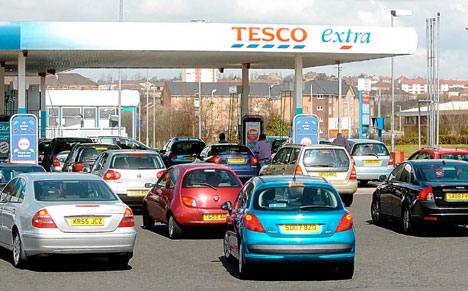
Petrol stations in Scotland are already running dry, despite appeals for motorists not to panic buy ahead of a strike by workers at one of Britain's biggest oil refineries.Several filling stations in Edinburgh are down to just two or three pumps as customers queue to stockpile fuel.
And at least one station has been closed, ahead of the imminent strike at Grangemouth, based nearby.
The Era of Cheap Food, Energy and Credit at an End
Eight years into a new millennium, it feels like the end of an era.The end of the eras of cheap credit, cheap food and cheap energy. Will they be back? Even Pollyanna might swallow hard before giving the nod to that one.
Driving down the highway we have seen the future pass us by
What Kunstler did was make you feel guilty driving anything larger than one of those Smart cars that are only slightly bigger than a breadbox, and kicking the thermostat up a notch. He is quite literally a Prophet of Doom.Doom? At the rate we were using oil in 2006, he estimated that the known reserves would be drained by 2043. That's 35 years away — as far in the future as 1973 is in the past, which is not that long ago, if you're about my age. I know exactly where I was in 1973: Waiting in a gas line at a Sunoco station in Florham Park, in the days following the Yom Kippur War. The 1973 gas shortage was blamed on international politics. The coming shortages are based on Mother Nature running dry.
SOUND BITES and sloganeering just won’t cut it anymore. Energy security—defined as reliable supplies at reasonable cost obtained in an environmentally sustainable manner—is no longer assured. All the presidential candidates loudly proclaim that they will reduce our dependence on foreign oil and, as a bonus, curb carbon emissions. Yet these same politicians, for the most part, have overlooked a serious problem. In so doing, they risk missing an important opportunity.We are on the verge of an oil-production crunch—in which the growth in the global demand for oil will outpace supply. This is expected to occur, if present trends continue, after 2012.
Brazil: biofuels threaten food production only in U.S.
NEW YORK (Reuters) - Brazil's finance minister rejected on Monday the idea that the production of biofuels is driving higher the price of food globally, saying that this is a problem restricted to the United States."It endangers (food production) here in the United States, but not in Brazil, not in African countries, not in Latin American countries, which have enough land to produce both" food and biofuels, Guido Mantega told journalists in New York.
National Expert Touts Fuel Alternatives
While prices at the pump keep rising, some say it's time to look for alternatives.National expert and author, Richard Heinberg, visited Vermont to talk to lawmakers. He thinks we're close to peak oil, which is the point when the rate of oil production will start to decline. He told Vermont leaders that they should look at cutting back on driving and buying local food to avoid the fuel it takes to truck it across the country. He also suggested helping people better insulate their homes so they're using less home heating oil.
Buying Our Way to a Better Planet?
There is a debate, subdued at times, between various approaches toward changing the planet to the better. In many ways, my viewpoint (on the optimist side) tends toward the 'enviro-capitalist', thinking that we can work to structure the economy to make the right choice, the easy (and preferred) choice. There is a challenge between using financial mechanisms as a tool to move toward a A Prosperous, Climate-Friendly Society and going overboard.
Energy Independence Isn't Very Green
THERE'S BROAD AGREEMENT that America should reduce its dependence on imported oil, but far less agreement on why. Are we combating global warming, or are we distancing ourselves from hostile and unstable regimes? The popular reply is that it hardly matters - we need to do both and the goals reinforce each other. But these two national energy goals are not only different but frequently in conflict, and effective policy will not be forged until those conflicts are addressed.
Top scientist objects to coal-based power plant
Dr. James Hansen has asked Gov. Tim Pawlenty to quash the plant, citing the governor's work to reduce greenhouse gases. But Pawlenty hasn't reached for the "off" switch yet.
There's more to $120 oil than speculation
So there we were, dancing on the doorstep of $120 this week.When we last discussed oil prices in this space, crude was crossing the $100-a-barrel milestone. That was less than four months ago.
Crude futures barreled through that threshold and have kept climbing, which wasn't supposed to happen. Our mounting economic downturn was supposed to curtail demand and drive prices down.
Our demand is falling — the International Energy Agency predicts U.S. oil consumption will slip by 2 percent this year — but the markets don't seem to have noticed.
It's as if our recession is meaningless.
"All the conventional wisdom about oil markets is wrong," said Jeffrey Brown, an independent geologist in Dallas who studies energy market data.
T. Boone Pickens Predicts $125/Barrel Oil
"My IQ is the gas price. At $3 I'm a genius. At $1.50 I'm a moron. Don't talk to me too fast; it's at $1.53 today."T. Boone Pickens, 1999 from his online biography.
Here's the headline: T. Boone Pickens thinks oil prices are still going up. So who the heck is this guy and why should you care?
A rebounding dollar started to take the steam out of crude prices, until another militant attack in Nigeria spooked oil markets Friday, reports AP. Is crude set to go higher with more disruptions? About 700,000 barrels per day could be taken offline if British unions strike and disrupt North Sea refineries, reports the WSJ (sub reqd.)Does that count as a severe disruption, though? That’s the White House criterion for releasing oil from the Strategic Petroleum Reserve, now 97% full, while Democrats call for the government to ease prices with a timely release of crude, also in the WSJ (sub reqd.) Higher energy costs, from heating oil to gasoline, to electricity are hammering households, reports the NYT: Federal aid for energy bills is at its highest level in 16 years.
Oil Prices will stop rising, but until then
Oil prices are breaking new records and it seems like not going to cool down soon. In energy business, the predictions are doomed to get falsified. Short terms blink some hint, but in the long run it is full of surprises. This is the magnet of this business. And we are not sure when the prices will slow down. But panicking makes everything worse.
Carolyn Baker: Peak Civilization And The Winter Of Our Disconnect
For countless Americans across the nation, this winter has brought with it something far more distressing than brutal, bone-chilling temperatures-horrific, traumatic revelations that the American dream, neatly packaged and sold for decades, has become their worst possible nightmare. Should they happen to see on TV the guy from the Countrywide commercial greeting them with "Homeowners...", they are probably wondering why he hasn't been assassinated and at the very least wondering why Countrywide is still in business.
Kunstler's book details many factors of the ongoing global oil crisis we now face, which will, Kunstler says, lead to the inevitable destruction of American society and way of life. When this happens, Kunstler also alludes to the dwindling of globalism and the inability of suburban life forms to exist.I really didn't want to listen. I want my American dream. I want my white-picket fence, a big backyard where the kids can play and the dog can run free while I watch from the house with my loving husband. I want my big, fat paycheck to buy expensive, fancy furniture. I want to entertain guests with my fancy china. I want to take jet planes all around the world where I can lay in pristine sands of paradise beaches. And, I want my big, fancy cars so I can drive into town when I need some groceries or want to spend a day at the spa - that is, of course, how all Americans dreams turn out, right?
UK: Dithering governments blamed for biofuel tanker shortage
Britain is facing a big shortage of ships for carrying biofuels unless politicians give clear guidelines about the future of renewable fuels, a leading maritime organisation warned last night.The comments from Lloyd's Register that the world fleet might be "unable to cope" unless an extra 400 suitable vessels - 20% of the present fleet - were constructed, came after energy minister Malcolm Wicks questioned the use of biofuels at a time of rising food prices.
The Peak Oil Crisis: The Case for 2008
It is conventional wisdom for most of the people following the peak oil story that we still have a few years to go before the real troubles begin. Some say 2011, others 2015 or later, but in general, among those calculating the depletion vs. new supply balance most have been talking about troubles starting in years rather than months.Let’s ponder for a second the meaning of “peak oil.” Ever since the concept was invented some 50 years ago, peak oil has meant the point in time when world oil production increases to a level that never again will be reached. For most of us, however, peak oil will not be a point on a government chart, but will be the day when we drive up to a gas station and find the tanks empty, restrictions on how much we can buy, or more likely a price that makes us realize our lifestyles are going to change. We can no longer afford to use our cars in the manner that we have been doing all our lives.
In recent weeks there have been developments suggesting that the troubles associated with peak oil may be coming faster than many realize.
Peak oil's a chimera. Dumb policies are the real problem
Fossil fuels are finite by definition. Eventually, since a growing global population will consume more energy, we'll run out of oil.Some time after the world's oil reserves are depleted, what little food hasn't been contaminated with Bisphenol A will be gone.
Climate change will have rendered the earth uninhabitable, and WE'RE ALL GONNA DIE!
The environmental movement has become a death cult seduced by the fantasy of the coming Apocalypse.
Avoiding a 'Soylent Green' Future
Here is something to keep in mind concerning the sudden Soylent Green hysteria about rising food prices: Resources are limited only by the imagination and creativity of people operating in a free marketplace. Peak oil? Maybe. Peak energy? No way. Likewise, I don't think that McDonald's selling vat-grown burgers and algae fries is in our future.
Is B.C. ready for peak-oil refugees?
When Kitsilano-based strategic planner, architect, and peak-oil proponent Richard Balfour talks about environmental refugees, he mentions his own speculation that “20 to 30 million people” could be living in the Georgia Basin in the next 15 to 20 years.“They come in three waves,” Balfour told the Georgia Straight in an interview at his home. “The first is the one that is already happening, where people with money think they are going to find refuge up here. So they are buying up the coast of B.C. and the farmland of the Interior. The second wave is the middle class thinking they are going to move up to have a better place for their family, and that has started. And then starts the true wave, where you have the refugees arriving with nothing. How do you stop them?”
Some Aspects of the Future Supply of Middle Eastern Oil
In a recent edition of his ‘blog’, one of the authors of Freakonomics (2005) – Stephen Levitt – made a few comments about his short stay in the United Arab Emirates [UAE] state of Dubai. As most viewers of CNN are aware, luxury is the order of the day in that lucky nation, however in mulling over the details of this condition, Professor Levitt failed to emphasize the key economic element behind Dubai’s rise from a fishing village to a middle eastern version of Monaco. The ingredient to which I am referring is systematic diversification, which in this case means that emphasis is unambiguously put on the conservation rather than the production/export of crude oil – where crude oil is oil as it is found underground, i.e. unprocessed. This approach means that less than 10% of Dubai’s GNP is now directly attributable to oil, and as trade and the provision of services increases, measures may be taken reduce the output of crude even further.
Saudi Output Growth Can Help Forestall Peak Oil, Bernstein Says
"Saudi and global oil production has the potential to grow slowly going forward," the authors wrote. "We do not believe world oil production supply is peaking today."Proponents of peak-oil, the theory that global production has or is about to reach its zenith, say booming demand and dwindling supply are responsible for the rising price of oil. Analysts debate the extent and timing of a drop in crude production in Saudi Arabia, the world's biggest oil exporter. Some argue Saudi Arabian Oil Co., known as Saudi Aramco, is downplaying reservoir declines and that the country may be forced to reduce output.
Sanford Bernstein commissioned a survey by GeoVille Information Systems to use satellites to monitor drilling at Ghawar, Saudi Arabia's biggest oil field. The analysis ``concludes that the Saudi peak oil production conspiracy theories, based on little or incomplete current field data, do not fit with our findings.''
OPEC oil output to dip in April - Petrologistics
LONDON (Reuters) - OPEC oil supply in April is expected to slip by 100,000 barrels per day (bpd) from March, led by lower supply from Iraq, Iran and Nigeria, an industry consultant said on Friday.All 13 members of the Organization of the Petroleum Exporting Countries are set to pump 32.5 million bpd this month compared with a revised 32.6 million bpd in March, Conrad Gerber of tanker tracker Petrologistics, told Reuters.
High oil prices put focus on Strategic Petroleum Reserve
New York - Uncle Sam is adding 60,000 barrels of oil a day to giant underground caverns in Texas and Louisiana to be used for the proverbial "rainy day."Is it raining yet?
UK: Petrol crisis looming as fuel fears grow
Britain could be on the brink of a petrol shortage as work begins to close a pipeline that delivers 30% of the UK's oil.It's feared a two-day strike at the Grangemouth refinery could spark panic buys at petrol stations.
Record oil price to boost oil majors' profits
LONDON (Reuters) - Exxon Mobil, Royal Dutch Shell and BP are expected to report bumper first-quarter profits next week, thanks to record crude prices, but $110 per barrel oil will also squeeze refining profits and delay a return to oil production growth.
Strike shuts 200,000 bpd of Exxon Nigeria oil - source
LAGOS (Reuters) - A strike by workers at Exxon Mobil in Nigeria has forced the company to shut down some 200,000 barrels of crude oil output, a senior union official said on Friday.
Oil pipeline bombing reported in Nigeria
LAGOS, Nigeria - Militants say they have sabotaged an oil pipeline in Nigeria's south.The Movement for the Emancipation of the Niger Delta says its fighters hit a pipeline late Thursday in southern Rivers State.
That brings to four the number of pipelines the militant group claims to have blown up in the past week.
European airlines face squeeze on profit
The American airline industry lost $1.5 billion (£760 million) in the first three months of the year and fears are growing that European carriers will be the next to feel the pain.High oil prices have caused enormous losses among airlines in the United States, forcing them to seek bankruptcy protection, cut capacity and look for mergers.
Britain faces industrial unrest as unions threaten strikes
Britain faces a wave of industrial unrest this summer as unions, emboldened by Gordon Brown’s climbdown after the 10p tax revolt, ballot millions of members on strike action.Workers in local government, the health service, the Civil Service, the Royal Mail and even the Sellafield nuclear site could join teachers in an escalating confrontation with the Government over pay.
...Mark Serwotka, of PCS, the Civil Service union, said: “The 10p tax U-turn has shown that the Government can change its mind and it needs to change its mind on public sector pay. People on the minimum wage are facing rising fuel, mortgage and food costs and are being expected to take a pay cut in real terms. The Government has to act quickly to stem unrest.”
BMI reveals approaches from ailing airlines
Several airlines struggling to cope with the record oil price have approached BMI to sound out whether the carrier would be interested in buying them."They have already started coming to us," said the chairman Sir Michael Bishop after a speech in which he predicted the slowing economy and the record price of fuel was leading to a clear division of airlines into the "haves and have-nots." Those able to withstand the difficult conditions – five airlines have folded in recent weeks – would be determined largely by their fuel hedging positions. BMI, he said, has hedged 75 per cent of its fuel for this year.
Natural-gas vehicles hot in Utah, where the fuel is cheap
SALT LAKE CITY - Troy Anderson was at the gas pump and couldn't have been happier, filling up at a rate of $5 per tank.Anderson was paying 63.8 cents per gallon equivalent for compressed natural gas, making Utah a hot market for vehicles that run on the fuel.
It's the country's cheapest rate for compressed gas, according to the Natural Gas Vehicle Coalition, and far less than the $3.56 national average price for a gallon of gasoline.
Global warming fix could damage ozone layer
A climate "fix" to curb global warming would have a serious side effect, damaging the Earth's protective ozone shield.
Environment groups target Senate races on climate
WASHINGTON (Reuters) - U.S. environmental groups joined forces on Thursday to target Senate candidates in Colorado, New Hampshire and New Mexico, aiming to elect a 60-vote majority to deal with global warming.Environmental measures have failed to clear Congress by "a handful of votes in the Senate" in recent years, the groups' leaders said, noting the legislation to fight climate change is set for debate by the full Senate this year.
Contact
- Content: editors at theoildrum dot com
- Tech support: support at theoildrum dot com
License

This work is licensed under a Creative Commons Attribution-Share Alike 3.0 United States License.
the oil drum was linked in the bakken shale blog yesterday. let the bakken bickering begin.............
Now that should be interesting. If it's the blog I cited the other day, I'd like to see some support for their numbers. Do you have a link?
One other OT point -- the reason I'm an independent is I don't want to be blamed for any one political party's obvious stupidity.
Currently, I'm getting a little annoyed about Democrats harping about the SPR (stop filling it, release oil...). In my opinion, this equates to lighting the extra four boilers on the Titanic. It removes/reduces our ability to respond in the event of a real emergency. Having a marginal effect on oil prices now = getting to New York in record time. When it becomes plain for all to see that we're heading into the teeth of peak oil, we'll want every last drop in that reserve.
Where I rail against Republicans is their stupidity when it comes to alternative energy. They only think with the oil half of their brain. But when thinking with that half, they can be pretty darn smart.
here is the link to the bakken shale blog :
http://bakkenshale.blogspot.com/search?updated-min=2008-01-01T00%3A00%3A...
(top link http://www.bloomberg.com/apps/news?pid=20601072&sid=afwStwp54V7o&refer=e... )
The verb Forestall means :
To prohibit from occurring by advance planning or action: avert, forfend, obviate, preclude, prevent, rule out, stave off, ward (off) ... according to answers.com
Is this the silliest point in time? Where people are allowed to say the maximum of stupid things....
Impossibilities are approved and printed with Fat Types in MSM, never double checked.. just swollowed and accepted!
The 2 things that amazed me about the Bloomberg article:
1. They mention peak-oil outright and give its simplified definition.
2. They don't 100% trash peak-oil researchers.
The last line is actually a big statement on a major financial web site.
If Russian production is declining as well, will KSA's "slower growth pace" really help out the world situation.
Step by step...MSM is facing up to some hard, cold facts.
Obviously there is a “silent approval of PO taking place/imminent”, since they state that it (PO) can be Forestalled! Why forestall anything that doesn’t exist nor will happen …?
Also strange from within that article :
Right now WTI is at 118 $ ....and it is early 2008.
Your post Paal caught my eye. 114 by 2015, yet right now in 08 its 118?! Really makes you wonder if these guys worked on this article in a mountain hideaway and then published it before watching the revolving ticker on CNBC to see what oil is actually trading at. Either that, or they work for CERA.
Exactly. I think it would be unrealistic for any of us here to expect the MSM to suddenly have a sea change of opinion and embrace peak oil. Nevertheless, they ARE mentioning it, AND not immediately dismissing it as some sort of nutbar conspiracy theory.
As the term becomes more prevalent in the media I think more inquiring minds will come across it, look into it, and take it seriously (this includes other journalists).
The process is maddeningly slow, but look how long it took AGW to be taken seriously... granted, peak oil theory may be older, but it was in the face of ever-increasing production or deliberate supply shut-ins whereas AGW was slow on the uptake in spite of increasing temps and emissions.
Besides, if the MSM 'got it' who would we make fun of?
What has been quietly accepted (without mentioning it) is that Peak $40 oil has passed. Suncorp said the other day they need a floor of 75-80, none of the proposed non-conventional work at $40. Realistically, you cannot compare "oil" extracted or derived in the future at a cost of e.g. $400 a barrel to today's oil.
It's a process of "Handling the Internalization" of the message.
They cannot come right out and say anything.
How J6P receives the amalgamation of soundbytes and internalizes them IS the task at hand.
It's not so much handling the message as handling the internalization of the message.
Watch how topics come up, watch the EXACT wording used by Expert from the xyz Foundation. (fill xyz in with your fav. Like AEI or Heritage, or or)
In my book, any time peak oil gets mentioned anywhere, no matter how it's framed, is another chance that someone ignorant of the subject may copy and paste the term into Google and eventually find their way here.
I would prefer peak oil be mentioned in a more fair context, but still. I believe MSM has avoided using "peak oil" in lieu of euphamisms for over two years now in order to cloud the topic in the public's mind. Searching for the goldmine of information gets much easier when you know the correct terms upon which to search.
bernstien apparently bases his conclusion on the claim that there is no subsidense above ghawar. what an unmitigated crock of s***. the pressure in ghawar is being maintained with water injection, there would be no subsidense.
Furthermore, the oil at Ghawar is >6000 feet underground, overlain by and encased in rock. Why would the ground subside, with or without water injection? It's absurd to say the least.
Perhaps the Bernstein analyst, the much discredited Neil McMahon, thinks that oil fields are big underground caverns or somesuch.
Last thing I remember from this guy, he was saying that oil prices were going back to $35 - this was when they were at about $60. Worse than Yergin..... 'nuff said.
the pore volume of all reservoir rock is compressible. in the range of 4 x 10^-6 vol/vol/psi. in the case of unconsolidated rock, the compressibility is much greater. as the pore pressure is reduced, the pore volume compresses. in some cases, this can result in subsidense at the surface.
the removal of 60Gb (or about 84 gb of reservoir volume) from a reservoir at 7500' depth could result in subsidense, depending on the compressibility and flexibility of the overlying strata. the reservoir pressure in ghawar has been maintained by water injection for most of the reservoir life, so recent subsidense is a non issue.
hypothetically, i dont think we have enough data on ghawar to say if subsidense would or would not have occured, had the pressure been allowed to deplete.
Its not uncommon for subsidense to happen. Long Beach CA comes to mind as and example you have have many others from both mining and oil and gas. The indonesian mud volcano is probably the best example. But what does this have to do with oil outside of the fact it can happen if you withdraw the fluid. Its very common in water wells but I can't think of a worse way to measure reserve levels.
Throwing a abacus down the stairs works better.
there are examples of subsidense in some faily deep north sea fields. maybe euan means could shed some light on this, if he's around.
i dont think bernstien is trying to claim that their analysis is able to determine flow rate:
"Rapidly depleting reservoirs tend to collapse slowly in small ``micro-earthquakes'' if oil and gas are extracted"
i believe that statement implies that "rapid depletion" is not occuring. and he is correct in a sense, pressure depletion is not occuring.
Ekofisk has undergone subsidence in the Norwegian CS.
"Ekofisk has undergone subsidence in the Norwegian CS."
apparently ekofisk is a different animal (not related to compressional subsidense).
i found this on wiki:
"Detailed geological investigation showed that it was the result of delayed compactional diagenesis of the Chalk Formation reservoir rocks. As hydrocarbons were produced and replaced with water"
yeah I know.
Different beast altogether.
Compaction is going on in the north sea and the North Sea southern basin is subsiding anyway (eg Essex and Holland ) Just as Scandinavia and Northern Scotland are rising due to isostatic readjustment.
The Ghawar satellite story is just nonsense
I'm very foggy on this point. To the extent that brine displaces oil, wouldn't subsidence only be associated the pore compression due to the pressure differential between "normal" reservoir pressures [more or less the pressure of a standing column of brine to formation depth] and whatever additional pressures might be present due to gas in solution?
Ekofisk has a water column (north Sea)
And then a few thousand feet of uncompacted claystones that are fairly recent and results of rapid deposition and undergoing de-watering and are therefore prone to continued compaction and loss of volume These ultimately follow a normal compaction trend , though overpressure was a problem , but near surface are uncompacted.
Add the weight of a few thousand tons of platform(s) on top of this.
Ekofisk reservoir is a soft chalk. I believe the entire column is still undergoing diagenesis and prone to compaction. Then extract the oil at virgin formation pressure from the chalk. Quickly...
But, it is not Ghawar and the subsidence (or lack of) is not an issue at Ghawar.
Someone up top suggested that many seem to believe that oil is found in giant underground pools. It is true that many people do seem to think this and I have heard this myself.
This article is not worth anymore time from any here except to say it is doo-doo.
Just how is a satellite going to determine limited subsidence, unless we are talking a very detailed SAR radar (something Geoville don't mention in their website service list)?
I have to wonder if someone might have been repurposing JoulesBurn's work - but they couldn't be that crass, could they?
I don't know if they like my work or not, but I am definitely a fan of their brand of comedy:
Satellite Sleuthing Gone Bad
Can't wait to read Abqaiq and Eat It Too.
I can't either. Oh wait...
ASTER elevation data is no better than +/- 12.5m at best (according to a NASA doc). So there is zero percentage chance that they could be estimating reservoir collapse using it.
I'd also suggest that from the diagram,
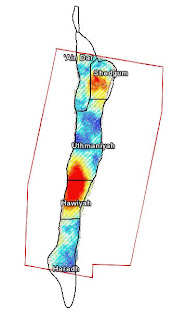
if that's what they have produced, would call their work even further into question. The red looks to be gas, so ignoring that they actually suggest no drilling in most of Ghawar. Hardly something to base a "everything's fine" on, particularly since Aramco have already stated loads of infill drilling.
Do people actually pay for work of this standard?
They alluded to the current "research" on satellite-based interferometry in their previous performance. It seemed ridiculous at the time because, as others have pointed out, Ghawar is kept under pressure -- but I didn't comment on the idea because I didn't want to discourage them from actually going forward with it. Sort of like knowing that someone is going to slip on a banana peel.
I don't know where they got their data from (not ASTER), but SAR can resolve small changes.
SAR can't do miracles, even UWB with a wide aperture, particularly from orbit with all the effects that can produce. That goes double when the region you're talking about is covered by shifting sand dunes.
Frankly I'd have to say the whole thing doesn't pass the sniff test.
"Do people actually pay for work of this standard?"
All the time when they want a particular answer.
Hang on a minute....
Is that all they have? Satellite data?
Ghawar is a grain supported carbonate reservior with water injection to maintain formation pressure with a relatively light overburden cover and on land.
Interestingly, the article states "Rapidly depleting reservoirs tend to collapse slowly in small ``micro-earthquakes'' if oil and gas are extracted too rapidly for water or other substances to fill the gaps, McMahon told Bloomberg News in December" while they keep up pressure by waterinjection.
And it concludes by asserting "The field may be showing signs of ``mild production decline rates at worst.'' "
Which is still a decline off course
Actually if they are blowing down the gas caps on ghawar right now then we should
have some decent seismic data from the area. I'm guessing that gas cap blowdown probably generates a lot more seismic activity then water driven oil extraction.
http://www.sciencedirect.com/science?_ob=ArticleURL&_udi=B6V9Y-4FR8PT6-2...
And
I found this
http://www.sciencedirect.com/science?_ob=ArticleURL&_udi=B6V7P-3VB9B6V-1...
Plus KSA has a seismic array did not find the data.
However the second paper is interesting since it seems to identify the source rock for Ghawar I have not seen anyone calculate how large a reserve could be based on the size of the source rock formation. However given KSA's wild claim it might be interesting to bound them based on the size of the original source rock deposits.
Would blowing down the gas cap manifest itself as a measurable P-Wave or the like?
Dunno myself but it seems to me that it could be big enough to show up on seismic. Considering your basically not replacing the gas with anything else.
I'd assume that its a good contender.
http://www.ig.utexas.edu/research/projects/eq/faq/tx.htm
http://www.nature.com/nature/journal/v257/n5528/abs/257661a0.html
Blowing down the gas cap on a field the size of Ghawar's gotta have some effect.
Even more telling is the straw man: their study "concludes that the Saudi peak oil production conspiracy theories, based on little or incomplete current field data, do not fit with our findings." I am not sure what conspiracy theory they are referring to, since a conspiracy usually involves more than one person and an agreement to commit a bad act. They certainly cannot be referring to Matthew Simmons, since his arguments are made by himself, for good purposes, and on a significant amount of data. Jeepers, for the money these guys make, they should be able to write better than that and knock down a better argument than that-- unless the data they do have is so compelling that this is the only type of argument that they can refute. The rest of our arguments, eh, they won't consider just now. So, carry on, BAU, oil prices have reached their limits, go back to your credit cards and ARM's and SUV's.
anybody who has been reading tod would recognize this scam. but bernstiens claim has enough plausibility to sound authoritative. i think another term for this is goblygook.
and as i have heard many times: if you cant dazzle them with brilliance, baffle them with bullshit.
The eternal skeptics' question: "Who profits? Who pays?"
Perhaps peak oil denial is just a conspiracy to increase the price of oil without inducing general panic.
Perhaps peak oil theory is just a conspiracy to stampede the masses into paying more for oil.
Perhaps we are entering a new and dangerous phase of civilization, and no one, least of all the leaders, know what to do.
the underlying reality will be clear soon enough.
I am beginning to wonder what good it does me to watch the asteroid approach the earth. Who will listen to Chicken Little -- if the sky is indeed falling, no one can push it back up. Reading the Oil Drum (and now, the Automatic Earth) has a sort of morbid fascination for me -- and I justify my sick obsession by convincing myself I am learning some things that will help me survive the coming tectonic shifts.
Start watching Japan:
The net loss of 153.9 billion yen ($1.5 billion) in the three months ended March 31 compared with profit of 33.1 billion yen a year earlier, the Tokyo-based firm said in a statement today. The loss was 15 times larger than the most pessimistic estimate among six analysts surveyed by Bloomberg. Nomura fell 5 percent to 1582.21 yen in German trading after the announcement.
Nomura joined rivals including Merrill Lynch & Co. in reducing the value of bond-insurance contracts after a slump in subprime-infected mortgage securities triggered more than $300 billion in losses and writedowns worldwide. Chief Executive Officer Kenichi Watanabe, reporting earnings for the first time, must also contend with a 27 percent drop in investment banking fees and an insider trading scandal.
``It's clear they haven't managed to boost their main businesses to cover the losses, and that's problematic,'' said Yoshihisa Okamoto, a fund manager at Mizuho Asset Management Co. in Tokyo, which oversees the equivalent of $26 billion."
This story's being covered up.
Bloomberg.com: Japan
Nomura Posts Record Loss on Bond-Insurance Provisions (Update5) ... More News. Government Bonds Fall Most in Nine Years, Sparking Halt in Futures Trading ...
www.bloomberg.com/apps/news?pid=20601101&sid=aC2ilbTGV2Bw&refer=japan - 4 hours ago - Similar pages
But there's nothing in the story about that last sentence.
NeverLNG writes: "Reading the Oil Drum (and now, the Automatic Earth) has a sort of morbid fascination for me -- and I justify my sick obsession by convincing myself I am learning some things that will help me survive the coming tectonic shifts."
I have a similar fascination. I think I'm watching a slow motion train wreck from several cars back from the engine and I just can't take my eyes from the scene. In my minds eye the trains are going too fast to jump off. Several do and most don't live beyond the jump. I can see the other train with dozens of rail cars similar to mine just around a long, long curve. I hope a TV commercial break doesn't cut in. This is gonna be sumptin'.
No worries about the commercial break, since you are actually on the train.
Be hard to deplete reservoir pressure below virgin with no pumps, huh Elwood.
Flowing wells.
Unbelievable waste of time and money.
FF
"Unbelievable waste of time and money."
agreed, the bernstien article is a waste of time. but many ignoranties(new word) wont know the difference and buy it.
you mean
Ignoratii
as in
Literatii
or
Gliteratii
ignoratii or ignorantii,
couldnt find either on dictonary.com
They are not in any dictionary.
They are colloquial terms for the great and good (writers , artises, politicians, celebraties and and other gang leaders in London)
"concludes that the Saudi peak oil production conspiracy theories, based on little or incomplete current field data, do not fit with our findings."
AND
they should be able to write better than that
They CAN, but that's NOT the job at hand.
See my post above about what their "Task" is with giving the news.
Same link:
How on earth did Saudi oil production get to be a conspiracy theory. Sure Saudi is very secretive about their production but that is just their nature. They were very secretive from day one, from even before there was oil found in Saudi Arabia. Saudi, and every other Mid East OPEC nation is behaving exactly as they have always behaved, very secretive and always denying that there are any real production problems.
But saying it is a conspiracy theory makes it sound a little kooky. It makes it sound if the idea that Saudi is peaking is a theory of a bunch of wingnuts and to be taken with a grain of salt. But geology cannot be a conspiracy theory. Facts of geology can be denied, the creationists are doing that today, but that does not make it a conspiracy theory. It just means those doing the denying are either really dumb or a really big liar.
Ron Patterson
As I have previously noted, Peter Huber--who believes that the sum of the output of a group of depleting energy sources will show an infinite rate of increase--is considered mainstream, while people who believe that a finite world has finite limits are considered akin to space alien cultists.
I don't know how you figured it out, but as a space alien I really resent being called a cultist!
That, of course, is essentially a religious position -- unassailable, because data doesn't matter. The Earth is the center of the Universe because God made it that way.
Schools nowadays teach only adherence to received wisdom -- critical thinking is anathema.
Can anyone doubt that we are headed back into a medieval theocracy?
.
Does data matter with this claim? This is just as goofy a misstatement as the ones in the article you refer to. I know for a fact that one teacher teaches critical thinking, and that would be me. I do this pretty much every day in my 9th grade English classes.
I can't believe I'm alone. In fact I know that I'm not.
Well said and well done, Bosuncookie.
Wayback when, with the exception of an exceptional physics teacher, most of the critical skills I learned in school could be attributed to English teachers.
My daughter's grade 12 philosophy teacher showed his class a battery powered electric drill of several years vintage and his grandfather's manual drill just the other day. He described his unsuccessful attempt to replace his worn out batteries for the electric unit and described out he completed his home project with his grand-dad's hand drill.
He was teaching them about durability, sustainable systems and resilience, as well as waste. He led the class to consider the vulnerability of technically complex systems, and so on. He is a wonderful teacher, showing and directing his students to films and books dealing with peak oil, among many related subjects. Of course, they are also become familiar with the great philosophers, but most importantly they are learning how to frame questions.
There are a lot of goofy misstatements on TOD. Some of the most silly claim that the liberal arts and humanities are useless luxeries, or close to it. To prepare for a post-peak world, it is opined, young people had better concentrate on 'practical' matters.
There is nothing more practical than learning how to think clearly, critically and imaginatively.
Thanks. I'm just as big a critic of our educational system as the next person; in fact, I chafe under many of the maddening contradictions inherent in my school and my district. So often we seem to be doing the opposite of what we're supposed to be doing...
Having said that, many people toil mightily in the trenches every day working against the myopia of No Child Left Behind and a world gone mad with standardized testing.
Sometimes the sweeping generalizatons get tiresome. In a nation projected to have 3.46 million teachers this year, surely there are a few teaching critical thinking!
Link: http://www.ericdigests.org/2000-3/demand.htm
I have nothing but contempt for the public education system. My granddaughter was struggling badly and her teachers and the system itself fought against us getting any additional help to her. We moved her into a private religious school and she is doing wonderfully there. My wife and daughter spend several hours each evening working with her but they did that when she was in public school too so that is not the difference. The difference is a teacher and school system that was open to customizing the child's lesson plan to help her catch up without being a constant failure.
Are there good teachers in the public school system? Certainly! But the system as currently structured is inherently flawed, focusing more on getting kids pushed through to the next grade and passing standardized tests than in actually teaching the children. Thus it IS fair to criticize the system generically. The fact that there are a few good apples in the bunch doesn't change the fact that the entire basket of apples is mostly rotten.
As the son of a professor and a public school teacher, I always wanted my children to go through the public school system. And in fact my kids did have a couple of VERY good teachers there - but this was not enough to make up for a public school system that has hopelessly failed, finished off by no child left behind and the glut of children with learning disabilities from over-vaccination and dietary problems. Now my children are enrolled in wonderful private schools where they are learning critical thinking skills - but paying for this is a major burden. I will be taking my soon-to-be-worthless 401k money and spending it on education.
In a real sense it was destroyed by money. The NCLB program is designed to pull money out of the school system to the benefit of the testing companies (i.e. Neil Bush, etc.), and once test scores were tied to funding there was no hope for it. Similarly, the initially well intentioned vaccination programs long ago became big business, and the primary motivation is now profit, with disastrous results.
Money destroys everything.
Money destroys everything.
My view: Man's greed (for money etc.) destroys everything.
Yes because all those people who created every damn thing ever created by people were not looking for a profit.
There is nothing wrong with profit gained from creating something. The problem is when most things are created just for (or mainly for) the profit. That's when quality suffers and people justify doing questionable things. Hence our corporate society of mass produced rubbish. Hell, even a guy in his garage can build a better racing motorcycle than multi-million dollar companies (Britten). Passion and drive often produce far superior results than pure profit seeking.
http://nz.youtube.com/watch?v=5HhGQJ2hn8Y
I'm not a Christian, but Timothy 6:10 comes to mind. Often misquoted as "Money is the root of all evil", it is "For the love of money is the root of all evil..."
Yes, I know there are teachers out there busting their buns to teach critical thinking -- my brother-in-law taught 9th grade history for decades, and he was awesome. But it was always an uphill struggle, and in recent years, there was more discouragement than encouragement from the administration and the parents. He is very thankful to be retired and teaches only part time as a sub.
My hat is off to those who are out there doing the work, but in general, although my comment included no data, it must be true that The Oil Drum would be mainstream if the average person thought rationally. It isn't -- it is relegated to kookdom -- because the average person in this culture thinks magically.
Uh, you've hit one of my buttons: claiming the majority of people aren't "rational" when, IMO, they are generally uncurious about the world, of short attention span and prone to excessive regard for their own conclusions. (Yep, there's a potential self-applicability of that final one :-) ) People are generally rational in the areas that interest them (even if it's only figuring out which brand of TV dinner to buy). Part of the difficulty is that curiousity is in undesirable in its own right until you're a functioning adult, yet to get it in adults parents and teachers have got to deal with curious children, who are always more work than nice children who do exactly what you want them to do without any surprises.
Regarding the excessive regard for things you've worked out yourself, I suspect that's inherent human nature and you're only disabused when the physical world doesn't respond in line with your pet theory. There's a Feynman quote from the Challenger disaster that I really like: "For a successful technology, reality must take precedence over public relations, for nature cannot be fooled." To understand it the background is that NASA engineers responsible for the O-rings had written reports giving arguments why the O-rings would work acceptably in low temperature conditions and had given a good presentation that convinced those higher up the management hierarchy. They'd "won" the debate, but the winning the debate without being right doesn't matter.
I'd be inclined to say that the average person doesn't think about oil magically because they don't think about it at all, and to the extent that oil signals impinge on their lives, up until the last year or so there hasn't been one that's signaled "something's wrong".
That's because it calls for an act known as "criticizing".
And criticizing is unpatriotic.
Vespucciland, love it or leave it.
yes Ron, that article is one of the more interesting ones. It had a little "of everything" ..
and thus it concludes my question : Is this the silliest point in time? Answer; YES indeed it is !
The establishment is tossed between their "ultimate hope n’ wishes/BAU" and "the crude reality", this is spawning heaps of silly-talk and a good portion of cognitive dissonance. This result is given “by default”
The Geoville page on Saudi analysis: Spatial monitoring of surface movements and oil production facilities | Applications and Projects | Geoville.com May be of interest.
There's a PDF on that page but it seems to be merely a synopsis in German.
Thank you for finding this.
looks like a consultant looking for work(and promising stuff that cant be delivered). but anyhow what does the pdf say aus duetche ?
If you are curious, you can copy the text of the pdf and put it in Babelfish or some other translator. It's always a rather amusing rendition, but it's better than my German. Nothing new in the pdf, but it is obvious that GeoVista does not understand oil fields and see this as a new opportunity.
"the Saudi peak oil production conspiracy theories" "do not fit with our findings"
As Jeffrey Brown would quote, "Who ya gonna believe? Me or your lying eyes?"
I wonder how Matt Simmons feels about being reduced to a theoretical conspirator?
And I love the prediction of $114 per barrel by 2015. Bernstein is a real rocket scientist.
Saudi Total Liquids production was 11.1 mbpd in 2005. I estimate that if the Saudis wanted, and more importantly, were able, to match their 2005 net export rate, they would have to boost 2008 Total Liquids production to about 11.7 mbpd.
The Saudis and the energy analysts can issue all of the happy talk press releases that they want to, but the fact remains that the #1 net oil exporter has shown back to back annual declines in the volume of product actually delivered to the market, with 2007 showing an accelerating net export decline rate versus 2006.
We shall see what happens in 2008.
It is this production profile which yields the "slow growth" under discussion in the Sanford Bernstein article.
WestTexas the eagle has eaten the noodle I repeat the eagle has eaten the noodle.
Await your reply
Comrade 42
I am en-route to a secure undisclosed location. Will reply later.
Will you share the venison?
http://thequailhunter.com/20061219/cheney-shooting-deer-at-own-home/
Tell the cute stewardess on Aloha Airlines I said hi :)
assuming "the eagle" means the us$, what is the noodle ? yen ? what does that mean?
tell us, tell us.
The the joke was 42. The rest did not mean anything.
To explain a bit more.
http://en.wikipedia.org/wiki/Answer_to_Life,_the_Universe,_and_Everything
Of course Douglas Adams has left this world a poorer place. But In my opinion his approach to life makes him the religious leader of peak oil if there is one. If you can't view life like he did then your not ready to ELP.
So if anything the conspiracy if there is one is to ELP enjoy life and recognize the fools in the rate race for what they are.
Don't panic.
Good luck. I heard Dick Cheney is a terrible roommate and NEVER lets you heat up nachos in the microwave.
Yep, a well-paid rocket scientist who knows on which side his toast is buttered.
Economy: 2 years of pain
I should show this article to my parents who continue to pour obscene amounts of money into a rental property they own at Mont Tremblant in spite of the rental market completely drying up thanks to high gas prices, high CA$, and people with no disposable income... tell me any of that's going to change any time soon?
They believe they can funnel rental income (currently HUGE loss) into lavish improvements thereby making it into a 'million-dollar vacation property' that they can sell for huge profit. The problem with this is that there's already a massive over-supply of vacant multi-million dollar vacation homes, but they believe that the glossy real estate rags teeming with these things are proof of high demand. Sadly, this is their retirement plan, and no matter how much I plead with them I can't get them to give up their pipe dream.
- The Progeny of Yerginites
They are going to suffer no doubt, so will thousands of others who spend 3-5 hours each weekend going to the cottage, and those in the small towns who rely on those cottagers for their livelyhood. Yep, we are going to see major changes, and soon. I fear it will be too late now for your parents. I'm kinda thankful my father died last fall, so he does not see all this come crashing down. It's my grandchildren I worry about the most. At least my kids understand and some of them are actively changing and preparing.
Your parents need to sell that house, take the loss, and do something more productive with their nest egg. The fact that they have such an undiversified retirement plan worries me. Tell them a really smart person urges them to sell ;)
I don't know if everyone caught the remarks made on CNBC during the interview with Jeff Rubin but peak oilist's were referred to as "PHOPHETS OF DOOM".. Until Mr Rubin corrected the interviewer..
Crude price forecasts are all over map
I can't help but respect this David Wyss character -- at least he admits that he has no idea what he's talking about. If only more economists were as wise as him...
Better get ready for $2.25 gas [Liter]
Gas prices in Mendocino Co, NorCal... super, $4.05-4.15; diesel $4.43-4.45.
There was a story on CNN this morning about a gas station in the middle of nowhere (in California somewhere) that charged over $6 a gallon. And the guy was losing money on the deal.
Turns out, there's a reason why he's the only gas station for miles around. There's no power in the area, so he has to run his gas station off a generator. He said he uses 100 gallons of diesel a day.
They also showed video of long lines of cars waiting to buy gas in New Jersey. People were trying to fill up before gas prices jumped 22 cents a gallon.
Early warning signs of a 1970's Deja Vu? Problem is that I don't foresee the Seventies ending this time.
free market economics ?
The Saudis turning on the tap.
"The Saudis turning on the tap..."
In the other direction.
Nigeria, Saudi, Russia, Forties, The North Sea, Mexico --
Seems we have one hell of a mess brewing on the supply side.
EV's with opera windows and fine Corinthian leather? Disco and polyester forever? Climate change and energy and food scarcity stuff, etc. are one thing, but there are limits to what I can accept.
It's ALL about the Stag, Baby!
(Click Here For Music)
Now, there's a candidate for solar!!!
wholesale...around 320 dollars a day. 320*365=$116,800 PER YEAR...ummm...he could start a fairly nice solar power plant for that kinda dough.
He is in California...sun shouldn't that much of a problem. Throw up a wind turbine for cloudy days and some battery backup.
Anyone in the area what to pitch the guy. Get your start in gas station renewable backups :P
Somebody needs to show this guy what a solar panel is...
Uh ? 100 gallons diesel a day = 100 * 12 * 3.6E6 = ~16e9 J day^-1
which is 185kW load averaged over 24 hours.
Solar at 10 hours a day to be generous = 450kW or @ $9 per watt ...
he'd better be selling finest Columbian pure to make a profit on that.
Another fine example of math gone bad. Where are you getting these numbers from?
If he has even a 5-6kw array going, he could preclude most of what he probably draws with diesel. If he has heavy pump or tool loads, the Gennie could kick in for peak times, or on demand.
Of course, if his $6 gas is still a loss-leader, there's surely no cash around after the diesel bill to put up for a PV system. But arguing that running Diesel gennies is cheaper than Solar is ridiculous.
Bob
what's wrong with the 'math' ?
100 gallons diesel the man says he uses.
1 gallon diesel is about 12kWh or 40MJ so he uses
100 * 3.7 * 12 * 3.6e6 = 16e9 J or is it not ?
16e9 / 86400 seconds in a day = 185000 watts or is it not ?
Since the sun doesn't shine at night, even in the States, I figured on 10 hours per day. So he needs a peak kWp of 24/10 * 185 or ~450kw or is it not ?
Roughly $8 a watt including batteries and inverter etc and ... what's the problem ?
I guess he doesn't use all his diesel for power generation but you can pick up gen sets of that size for the order of $20-30k.
I know I only have a physics major and no PhD but ...
Generators are only about 30-40% efficient while the solar PV cells are delivering straight electricity. So the first thing you need to do is reduce your total energy number to whatever is actually used by the station (in the form of pumps, lights, etc.) as opposed to what is consumed by the generators.
There's more you can correct but you can start there.
What's wrong is the meaning you're trying to attribute to your calculation.
besides a purely theory-based assumption of what his running electric demand might be- using the energy available from diesel fuel, since we have no information about his actual electrical draws, as the generator is going to be sized somewhere over his demand, and it has a conversion efficiency and waste heat to be discounted..
But clearly, at today's rates, he can be expected to be paying some (100gal * 365day 36,500* $4.00?/gal) $146,000/yr in diesel just for this electricity.. growing year after year, and assuming diesel is available. If we knew how many actual KWH he is able to glean from this fuel, we could compare the cost/watthr to solar, but beyond that, you still have to consider the much costlier implications of BOTH the diesel cost hikes and a supply emergency, which will make pretty much any investment into a renewable supplemental source a smart purchase.
Trying to second guess a solar installation cost for his (assumed) total electrical demand today is really an unhelpful comparison, which is why I didn't find the extrapolated numbers to be very useful. Designing a solar setup for this business would probably entail a system that provided some 60-80% of his current usage, if that much, and a parallel effort with the owner to economize on any waste and excessive draws in the system, as there will very likely be a number of them. Keep the gennie, but make your principal watts come off the panels, and the rest that you pay for in fuel will be an incentive to find more economies in your daily MO.
Bob
OK I see what you mean, I guess it's just a 1st order estimate but in the ballpark. The common theme is there's no energy dense substitute for diesel.
Thanks for your comments, guys.
Hellooo? It's a GAS STATION. There's an electric pump to run the gas pump, which runs maybe 1hr a day. There are some fluorescent lights. There might be a refrigerator. If he has a shop, he might use a few power tools intermittently.
He's not growing marijuana (I think).
Leanan that sounds to me like a place called Desert Center, out in the middle of nowhere on I-10. If I understand correctly that place runs off of locally generated power, and may well be charging $6 a gallon these days.
It used to be somewhat common when driving around some of the more sparsely populated parts of the US to sometimes come across gas stations with a sign reading "LAST GAS FOR X00 MILES"
We are probably going to start seeing such signs popping up again very soon now.
My bike has a range of about 180-190 miles on a fill, so I may be stopping and partaking of of expensive gas and maybe a yoo-hoo and a moon pie, at every chance.
Fleam - do not click the "post" button more than once. Clicking on it repeatedly will not make the server work any faster. Quite the opposite, actually. And you end up with multiple copies of the same post.
OK ..... peak internet here lol.
Gas prices Broome County, NY upstate 3.61 regular, Diesel 4.60 this morning.
Jeff Rubin might be holding back somewhat-he works for CIBC and they are definitely not in the doom business. Although he forecasts 2.25, his opinion might be far higher-a few months ago he issued a forecast saying the subprime mess would not be a big deal-at the time I am confident listeners pictured a gun being held to his head by his superiors on that one (CIBC has been burned badly).
$1.60 = €1.-
Gas here is €1.58 ~ $2.52 a liter.
Greetings from the land where 2/3 of the population lives below sealevel.
Dont worry,
All that bulky wooden furniture floats.
BTW: Do you guys still get tax relief on boats?
And when we are at $2.50 a liter where will yours be? €3.00 a liter? Yep.
By European standards, that's still almost peanuts. In Germany today the price of 1 liter hit €1.48.
€1.48 = $2.31
1 liter = 3.89 US gallons
3.89 * $2.31 = $8.99
So Germans are now paying $9 per gallon.
Why can't the government just do something about it?
I drove from Luxembourg to Trier and back today. Large cars still zooming past my modest little Citroen C1 at 160 km/hour. Same as in 2007, 2006, 2005 ....
On a light note, my wife and I have come to realize we have been talking about peak energy issues far too much when our 3 1/2 year old daughter asked, “Daddy, what is energy?” I tried to explain it was the power to do work and energy can come from “the sun, like solar power, from wind, from coal, and oil.” She jumped in excitedly, “and hot chocolate?!?”
Ah yes, Hot Chocolate Geothermal (HCG) shows great promise. A Wonka Industries pilot facility at the famous bubbling chocolate pits of Rotorua, New Zealand already provides enough power for 300 homes, and pipes hot milk to local houses where it is circulated through radiators for winter heating and early-morning heart-starters.
Sadly few other countries are blessed with such abundant and delicious resources. The treacle pits of Venezuela come a distant second.
My 3.5+ year old daughter also loves hot chocolate, and overhears far too much; it's amazing what they pick up from conversations.
Anyone who can't take a dip in oil prices should sell on the price rise due to the Ineos/Forties news today. There is probably (no guarantees) going to be a consolidation here, with the chance to buy in again at lower prices. It will probably be a shortish consolidation, but a lot is up in the air with the dollar that could lengthen the consolidation or make the lower end of it lower. So, it's impossible to know the future, but the risk/reward equation for owning oil isn't the greatest right now for short-term positions.
I agree with you that the supply disruptions probably arrested, at least for a while, a short term correction, but it is interesting that oil and the dollar are both rising today. Having said that, IMO the physical market, i.e., an accelerating net export decline rate, is driving the market.
Yeah, yeah, Westexas, I agree with you about the accelerating export decline rate, and I am long-term bullish on oil. I still see us hitting the $140s by the end of the year. I'm not selling long-term positions I bought to buy and hold. It also looks like the dollar will continue in this trading range and probably not break out on some big rally.
But look at what's happened to backwardation over the past couple of days. Speculators are essentially getting close to a buck to go long, up from 50 cents a couple of weeks ago, and 75 cents a few days ago.
It's risk/reward. The risk just got significantly higher short-term.
As well as Forties production hit there's also this
Exxon's Nigerian Unit Shuts in Production on Strike
Add in various pipeline attacks and it looks as if that's over 1.5MB/day of production shutoff this weekend worlwide. Both situations remaining unresolved. What would a lack of 1.5Mb/day due to strike action do to oil prices if say both lasted for a month?
Yeah, that certainly sounds bullish, and I love the action today. (Speaking as a trader, not a citizen.) I sold just over $119, but we may get a good set up to buy back in as early as next week.
But what's striking is that the commercial traders aren't buying on this news. Maybe they expect a big inventory add next Wednesday. Or maybe they expect a dollar rally to save them. Or maybe they're just in denial. Too soon to tell.
Conventional wisdom seems to be solidifying around the idea that the Fed isn't going to lower interest rates next week. There are some good reasons why the Fed shouldn't lower rates further, but I'm not sure the conventional wisdom takes those reasons into account. I think the CW has it that everything is right with the economy, so there is no need for further cuts. I have no idea what's going to happen with oil next week, but I did lower my short-term exposure a bit today, after upping my long-term holdings yesterday. After POT got hammered for crushing their earnings, I'm beginning to distrust my expect-o-meter.
Your expect-o-meter sounds in pretty good shape to me.
Meanwhile, the gasoline subsidy (i.e. rebate) checks hit bank accounts starting Monday.
META:
Why do we keep on commenting the Bloomberg / CNBC crap?
Even most people in the investment business know it's utter bullcrap: "oil price went up today $0.75, because...", "oil prices are going to go down to €XX, because I have a crystal ball in my office", etc.
Random causal reasoning, dogmatic pontification and wild guessing disguised as educated analysis, without any base theory, empirical data or critical inquiry. There are of course exceptions, but those are usually the guys/gals, who are representing the minority view, i.e. usually also looking at the downside risk.
But for balanced, honest and hopefully scientific analysis? Fuggedaboutit! They're in the business of making news (entertainment) and if there's none, they can always make it and spice it up.
Yes, noticing their change in attitude is relevant. Like Schöpenhauer said:
PO is not quite in third stage yet, but going back-and-forth between stage one and two.
rgds,
Samu
PS Final geology imposed production plateau now or later? I don't think we're there yet, but I also don't think it makes any difference and there's no use bickering about it, esp. with dogmatics who do not want to look hard at empirical data from the field or to challenge their belief structures (e.g. markets fix all).
I love watching analysis of oil prices, my recent favourite was this:
http://www.thestreet.com/_yahoo/video/strategysession/10412773.html?cm_v...
It's almost like voodoo.
Hhahah! What a laugh riot, thanks for that.
This is exactly the kind of crap that gives TA a bad name, and deservedly, if you ask me :)
That was the funniest thing I've seen in a long time.
Wow. That immediately made me think of this South Park bit:
http://www.youtube.com/watch?v=vA4RvAf2Vds&NR=1
The logic is about the same.
She is a technical stock analyst, a chartest, even with stocks that is a very dubious way of predicting price and valuation, chartism does not so much deal with actual value but with profit making and taking, it is circular because the chart people and the programs used do actually affect the price of stocks, it is in effect a heard mentality that manipulates valuation.
The declining availability of oil from decline and increased demand make this type of valuation meaningless, she would be better off taking her ruler and sticking it in the Saudi sand, she would get a better idea of the future of oil than from her price - valuation chart.
Although I doubt the KSA would even allow that.
This young lady would have been much more believable if she had neatly coloured in her graph with wax crayons and put on some smiley facey and cross facey stickers.
Yeah, just ONCE I'd like to hear them say: "The DJIA (or oil, or whatever) changed by a fraction of a percent today. It was a totally random fluctuation due entirely to statistical noise and is of no real significance whatsoever."
Ha! I wrote a piece along those lines for newspoetry.com in 2002:
Stocks Down Amid Inscrutable Factors
New York (Associated Poets) -- Stocks were down over 1% in mid-day trading for absolutely no reason. There was no demonstrable correlation between the movement of the major stock indexes and any known factors, including today's news or recent economic data.
"The stock market is just fluctuating randomly," a leading analyst explained. "Will it go up from here or down? I don't know. Perhaps we should roll dice," the analyst continued.
The stock market has been known to fluctuate randomly before, but any suggestion that today's random fluctuation is part of a pattern was quickly dismissed by leading economists. "It's impossible to predict when the market is going to fluctuate randomly, and when its fluctuations will be based on confirmable factors," said Lee Ding, an economist at the Leading Economic Institute in Leading, MA.
Investors are as concerned as they can be, given that there is no specific reason to be especially concerned.
New source for biofuels discovered
http://www.eurekalert.org/pub_releases/2008-04/uota-nsf042308.php
That's the kind of report that really bugs me.
Not only does the bacteria produce cellulose but it secretes sugars in the process - fascinating.
It is pretty interesting. If it can be scaled I really don't see anything bad about it. As always with this kind of stuff, Robert Rapiers input is greatly appreciated.
If it can be scaled I really don't see anything bad about it.
1) Food sources to the bacteria comes from where?
1a) Processing the food to get it into the bacteria gets done how?
2) Material for holding the bacteria comes from where?
2a) What is the lifetimes of these materials which will be exposed to the elements?
3) Keeping the bacteria 'pure' happens how?
4) The space for placing these solar powered bacteria will be found where?
But don't let actual logistics stop your vision of the future!
Cyanobacteria are akin to algae in that they perform photosynthesis. They still need other nutrients (minerals), but perhaps less so than algae since they don't need to make a shell (like diatoms).
In any event, problems keeping cross-contamination down (bacteria are rather good at mutating). Unless the cellulose they now are forced to make benefits the bacteria in some way, any mutation which stifles that trait would surely take hold. Daily. And they might secrete sugar? Hmm.. what might that invite? Finally, you need a lot of energy to distill the small amount of ethanol from the vast amount of water.
Yup. VS a PV panel - it still looks like PV would be less of a hassle.
Not only akin, until recently they were classed as algae. And it was a long battle to make the change. It was the single(bacteria) vs double walled membrane that finally won over the idea that all organisms with chlorophyll were plants. Steam for inclusion in the algae camp also lost with differentiation of the types of chlorophyll in the bluegreens. Still, it was hard to get over the sight of a golf ball size green Nostoc colony as bacteria.
In freshwater, diatoms have fewer species than other algae, though in some environs, biomass including the silicon shell may be higher. I have not heard of a diatom candidate for biofuel, would appreciate any information otherwise.
Heard Obama on the radio stating we need to transition from grain ethanol to cellulosic ethanol as cellulosic ethanol does not take grain out of the food chain.
Cellulosic ethanol seems like oil from oil shale. Something that might happen some day but is not happening now.
People might have to transition out of cellulosic ethanol too, as they do not want government programs that make the price of gasoline go up beyond their means to afford it.
Name one thing -- anything -- that doesn't produce negative consequences. You should know better.
You should know better.
Alas, he does not.
This isn't scalable, at least not in the approach they are assuming would be taken to commercialization. This is traditional ethanol production from a non-traditional source, which means it will require substantial amounts of distillation energy (~20 kBTU per gallon), and that, added with the other energy inputs needed, will set a low bound on potential energy return. Since this approach doesn't produce lignin, there is no alternative here but to use purchased energy for distillation and other processes, not to mention the water requirement. Even if they can increase bacteria productivity, where would all the energy come from to run this process at a scale that would have an impact on the magnitude of gasoline we use?
It isn't just an issue of scaling, it's an issue of SCALING! To make an impact would require implementation on a massive scale, where any negatives that seem small now would also be amplified by orders of magnitude. While no one thing needs to provide all of the energy we use now, and indeed we can use less, the amounts are still so large that all of this stuff pales in comparison.
If we all join hands we can wish abiogenic oil into existence.
So why is crude on the rise and the euro falling on the dollar?
Edit
This was before the shot across an Irainian ships bow.
Edit
This was before the shot across an Irainian ships bow.
That's it.
When will we know if the Iranian has fired back.
And a military contractor?
Mercs are going to start WWIII?
And notice how we've heard nothing about the following?
"Hundreds killed in Sri Lanka battle
The defence ministry says 76 government
soldiers are dead or missing [GALLO/GETTY]
Heavy fighting between Tamil separatists and government soldiers has subsided in northern Sri Lanka after intense battles left hundreds dead or wounded.
The Liberation Tigers of Tamil Eelam (LTTE) claimed on Thursday they killed more than 100 soldiers, wounded about 500 and lost only 16 of their fighters in a 10-hour firefight the day before."
http://english.aljazeera.net/NR/exeres/60CBC0EB-432A-4C01-B5C8-16973381A...
Iran has just denied this happened.
Iran denies any clash with US vessel in Persian Gulf
The Iranians seem to be leaving open the possibility that the US might have fired on someone else...
Anyone have any thoughts on how a 'contracted' ship has the heavy weapons to fire at other ships? I'm assuming a 'contract' ship isn't military? Are non military ships in that area normally armed?
Ship is contracted, but manned by US Navy personnel and functions as an auxiliary supply ship. Just a guess
Arr, ye best be armed in them seas matey.
I thought that was odd too, but I couldn't resist.
Military Sealift Command, fine ships and fine sailors all! And yes they have to be armed these days matey! I've gone across the Pacific in one, it was fun I think?
Numerous incidents like this happened during the Cold War. U.S. planes did recon over the East German border, the Pueblo incident in North Korea, Russians shooting down Korean Airliner 007, a U.S. CIA team crossing the border into Laos. Russian SAMS in N. Vietnam, U.S. soldiers in Saigon, an alleged Russian minisub incident near the Nowegian palace etc. People sensed all out war would be too destructive and gradually the U.S. lost its interest in the war in Vietnam and the voters demanded an end to the war. Eventually people in Russia sensed some other nations had better systems and Russia began to reform with the leadership of Gorbachev. The Russian government was taken off human rights violations watch lists. Some Islamic regimes remain on the human rights watch lists as they do not allow basic freedom of religion, subverted freedoms of speech and press, and punished dissidents (a.k.a. apostates from Islam and/or "infidels") mercilessly.
Who woulda thought, a Merc Navy.
And how does a Merc get the cash to start a Merc Navy?
Blackwater indeed.
There was a very similar incident - quite possibly involving the same ship actually - a few weeks ago when a security contractor on a US ship waiting to transit the Suez Canal shot at Egyptian fishermen, killing one IIRC.
The contracted ships are merchant carriers - they don't have heavy weapons, but do have heavily-armed security contractors. The "heavy" weapon in this instance would most likely be either a 50-cal machine gun or an assault rifle.
Joint Chiefs Chairman Says U.S. Preparing Military Options Against Iran
http://country-joe-and-the-fish-i-feel-like-i-0-lyrics-mp3.kohit.net/_/1...
Sing along version.....
http://www.youtube.com/watch?v=s5btZWbViPA&feature=related
OK, we got Iraq in one side, Afghanistan on the other... Hell, let's just take them from both sides and really mess up the whole area.
Notice how a friendly us controlled iran would provide a good bridge for any pipelines going through afghanistan through iran into iraq and into saudi arabia if say a persian gulf route was not usable?
Iranians, Egyptians, in fact anyone percieved to be in the way anywhere. Just last month another cargo ship fired on an Egyptian boat killing one of those aboard.
U.S. cargo ship Global Patriot fires on Egyptian boat
"Global Patriot" -- I love it. In service of the Uber-Kapitalist state.
Oh, this one should be good.
http://www.darkreading.com/document.asp?doc_id=151872&WT.svl=news1_1
I'm not sure if we discussed Pemex March production yet. Their March total crude production was 2.847 million barrels a day, down from 2.929 in February and down from 3.182 a year earlier - more than 10% lower than last year
Assuming zero increase in consumption, not likely from what I have seen, 2007 net exports fell at -13%/year. I don't see much hope for them maintaining much of a net export capacity beyond 2014 or so.
U.S. natural gas storage is slipping further below the five year average (from yesterday's report)
A surge in gardening this year (in Vermont)
Perhaps a reader knows enough of the data sets (Seeds sold/plants sold per person) vs the %age of food budget.
WTI breaks $120. Woo hoo.
Re: "Is B.C. ready for peak-oil refugees?"
The responses of the Vancouver politicians are appalling, and range from "peak what?" to "the incumbent is a bum. Vote for me and I will fix it." Vancouver is doing a better than average job of coping with peak oil, with light rail, high density, and some local farmland left. From these responses it seems that the pols don't even know what they are already doing, and could do more of.
*raises half full pint*
Peak Oil!
on, Hunger returns, We look to history for solutions .. link
Objecting to prices and rioting is now news but strarvation is, has been, ongoing since forever.... the Times article, link, mentions bio fuels and climate change as two of the main factors, those are minor, are quoted because easily excused, a stupid mistake, and out of our hands (climate.)
There will not be a new Green Revolution. It was basically pulling everyone into modern agriculture. Mechanized, watered, planned, transported, etc. (oil.) I don’t hold hope for GM seeds etc.
The IMF and the World Bank and ‘western’ countries impacted local agri. big time.
The poor were told: Don’t subsidize, don’t let the State buy at favored/fixed prices, but grow some specialized cash crop, join the free market, and we will lend you some millions (right, wink wink, I have some planes to sell and you can have my Mercedes right now..), at attractive rates, everyone will be fine. You don’t need all this little chicken sh*t stuff about.
The EU paid farmers not to grow what they wanted to grow - glut. (A family member refurbished a home and sent two kids thru upper ed with those subsidies.) The developed world sold the surplus at bargain prices or imposed it (food aid, emergencies, etc.), thereby destroying yet more fields, local initiatives, etc.
Oops! Now the hungry hordes are at the gates, well not quite, just some rumblings, disturbing, those who starved before didn’t demonstrate - they were in a minority position and incredibly poor and just expired...
Hi TOD! I have been lurking for a while and would like to pose a question to the group. There are many folks here much smarter than I but I don't know if I have seen this twist addressed....
We understand the impact of the Export Land Model developed by WesTexas. In addition to that, what are the impacts of declining EROEI? Seems to me that as we move toward lower EROEI that this actually increases global demand, because a much greater amount of energy (oil) is consumed in the exploration/extraction/refining processes. If all fields were at a 100/1 EROEI then the amount needed to supply the industry would be roughly .9% but when we move to a potential 4/1 EROEI then 1 out of 5 barrels or 20% goes into the industry. Seems to me that if we then needed "80" mbd production, we are really saying we need 100 mbd for production to allow 80 to go to market. Or if "production" is maxed out at 80mbd coming out of the ground, then 20 percent or ~16 mbd would be needed to fuel the lower ERORI industry leaving that much less off the market. Is the decreasing EROEI taken into account for the various models or projections? Comments welcome,
EJ
Please note the imprecise semantics and math, as I am trying to convey a concept rather than discuss pedantic numbers...
Estamos
I think this is a very real factor. Though we have been, more or less, on a plateau for several years re. production, The EROEI issue you mention would indicate that we actually have LESS oil available. Seems like just common sense. Along with greater demand pushing up against constrained supply, it would also help explain the major price increases we've seen.
Remind my again how your name translates into English? I remember it was good, but don't remember what it was...
got2surf,
Thanks for the response. I sense that the declining EROEI has the potential for a greater demand on energy than many currently realize. Sort of like needing to run faster just to stay in place.
The handle is spanish, roughly translated into a cruder form of "We are screwed".
ej
Senor Jodidos,
I've asked Nate about this before and he points out that most of the energy input into oil extraction is natural gas:
from Cleveland, C.J. (2001) Net energy from the extraction of oil and gas in the United States.
The availability of natural gas to input into oil production seems to be key. If it isn't available, (N. America in the near future perhaps) then that region's oil extraction would presumably be lower than forecast. Another scenario is that oil production cannibalises the natural gas that is available and non-energy sector consumption (i.e practically everybody who uses it now) must fall dramatically. I'm not sure to what extent future projections of oil extraction take this into account if at all. As EROI is so difficult to quantify I don't think they do. I think memmel is preparing a post on this or something similar. Which I personally await with great anticipation...
Simon
Nate is going to do a key post on Maximum power.
I plan to follow with a old chemistry trick of cutting and weighing paper to integrate.
http://www.astro.umd.edu/~marshall/50phys.html#27
I won't really weight paper but effectively I plan to take Nates maximum power concepts and the areas under curves derived using that concept and see how our historical oil production stacks up agianst a maximum power curve with one additional assumption.
But we really need a good into into Maximum Power first.
Mexico cartels post 'help wanted' ads
Hello Leanan,
Thxs for the toplink: "Is B.C. ready for peak-oil refugees?"
Reads to me that they are finally starting to get worried about Cascadia being overrun by the fleeing hordes from the Southwestern US & Mexico WTSHTF.
I have posted much on this topic before, along with mitigative strategies to enhance their protective isolation from the invading Overshoot. IMO, it is only a matter of time before we read about Earthmarines, Foundation for predictive collapse and directed decline, watershed boundaries for effective political demarcation, and sequential building and enlargement of biosolar habitats. Time will tell.
Bob Shaw in Phx,Az Are Humans Smarter than Yeast?
Globalization’s Aftershocks
Used to be you just didn't know what you were eating. "Catch of the Day" "Sea Scallops"- usually the wing of a stingray skinned and then diced with a cookie cutter. Imitation crabmeat, anyone?
This is very standard discourse typical of part of the EU left. Blaming ‘globalization’ (which began when ppl got the idea the world was a small globe, from Pythagoras to say the Spaniards-Portuguese who, e.g. in the shape of Ferdinand and Isabella, were looking for new opportunities and actually sunk a bit of money into the enterprise), and the ‘rogue economy’ in the shape of the sex trade and so on (forgetting arms!) and calling for more regulation and controls is not, imho, helpful. The approach is a-historical (for banks, neglecting gold standard, Glass-Steagall act, and collapses after 1930, etc.), for trade, its long history, particularly the free trade time before 1925, imported and other labor (slave trade, colonisation, etc.). The discourse avoids mention of capitalism or other economic arrangements, energy, over-population, over pollution, and war. New rules and ‘cleaning up’ the rogue economy will fix things. Not. Many of the laws these ppl wish to set up exist already, enforcing them more strongly either can’t be done or will have little effect. The argument is at heart a moral one: if only ppl were good or could be forced to be so we would be fine. If only bankers didn’t gamble, let’s put a "policeman" behind every one of them, not literally of course, but...! And so on.
I realise I'm being a bit hard on this lady, it is hard to take on multiple issues in a short interview.
Hello TODers,
http://www.theboholchronicle.com/editorial.php?issue=333&s1=4442&s2=&s3=...
----------------------------------
RICE CRISIS: PREDICTIVE AND RESPONSE FAILURES
...Why did this administration allow this to happen? Didn't it calculate the horrible damage that a rice-dependent nation who imports a lot of it can be afflicted with during food shortages that we are now experiencing globally? Were we purposely allowed to deteriorate into a rice import-dependent status by unseen hands?
Or if we are so poor in our predictive analysis - despite the advancement of econometrics science - what shortage we will fall prey to. Fertilizer? Water? Corn?
What's next?
-------------------------------
I would suggest Asimov's Foundations.
Bob Shaw in Phx,Az Are Humans Smarter than Yeast?
What next? As any economist will tell you, the market will supply a solution at the right price. For example:
Poor Haitians Resort to Eating Dirt
Hello Afteroil,
Sad, but true. I guess we just have to wait for the maximum supply-side economist to advocate for burying them alive as the best long term market solution to provide a bountiful and convenient stockpile for their future nutritional needs.
rant off/
Nanosolar promotes 2-10MW distributed solar power
http://www.nanosolar.com/blog3/2008/04/16/municipal-solar-power-plants/
I really like Nanosolar's take on how to get the cost out of the technology - you can avoid so many of the transmission and regulatory costs this way, and you haven't got people messing around on rooftops cutting installation costs way down.
They are also now talking about going domestic with a roadmap about how to do that more efficiently. However, in their usual coy manner, no details as of yet.
I'm not actually very confident of Nanosolar's technology, it seems to me fairly likely to be BS, and you can't actually buy any of the supposedly very cheap panels, but their notion of how to distribute power sounds good - similar things have been done in Germany in an integrated power set-up, but Germany suffers from the not-inconsiderable disadvantage of not having much sun!
http://commentisfree.guardian.co.uk/jeremy_leggett/2008/02/renewed_energ...
Much of the US needs peak power in the hotest time of the year, which is an excellent match for solar power, and many areas are also blessed with wind resources which are massively better than Germany. As soon as the ludicrous obsession with ethanol is overcome, biogas should provide good amounts of power far more effectively in land and fuel resources:
http://biopact.com/2007/12/biomethane-presented-as-most-efficient.html
There seems little reason why much of small town America should not power itself in an effective manner by the use of these sources - although maybe not from Nanosolar.
DaveMart, thanks for the Nanosolar plug. But I'm skeptical. Here's an extract therefrom:
Sorry, but that data isn't hard enough. What's a "decent amount of sunshine"? How much does it cost per watt in the real existing world? What's the ratio between rated output and de facto output? What happens in winter? How many hundreds are 'several hundreds'? What's a 'socially acceptable size'? Etcetera
For hard data comparing solar power with nuclear power and other alternatives, I prefer quality stuff, such as Bill Hannahan's papers. Here's what he has to say:
( http://www.nuclearcoal.com/ENERGY%20REV%20X1.pdf )
That's the difference between plugging a product and making a contribution to knowledge.
You have very strange ideas of what constitutes a plug.
I specifically mentioned reservations about Nanosolar, and made it perfectly clear that it was the system of building solar on the ground but in relatively smaller sizes which would be cost effective.
Here are expert comments by SW on reasons to be sceptical of Nanosolar:
http://anz.theoildrum.com/node/3477#comment-287663
You seem to be unaware of the different characteristics of nuclear and solar.
FYI I have consistently supported nuclear here as part of the energy mix, but have studied the matter enough to be well aware that it is much more suitable for base load, which answers your second question:
'decent' sunshine occurs in areas where the primary need is for cooling rather than heating, and wisely the quote you reference talked about daytime load, IOW no need for expensive storage, so that costs would only need to be low enough to compete for peak rate power initially rather than base load.
You also seem unaware that wind power tends to be stronger in the winter in much of the States, neatly supplementing solar power, with biogas to make up for some of the remaining intermittency.
In the scenario you suggest, what would be the cost of building large nuclear plants and a much beefier transmission system to take the power to all the small towns in the American Mid-West?
You would have to cope with not only present electricity needs, but also shortly substitute for gas.
That is also one reason why your request for exact costings is not realistic, as the cost of competitive FF generation is going up steeply.
As a guide First Solar who are more forthcoming than Nanosolar are selling cells for a couple of dollars a watt, and make high profits at the moment.
Wind power also costs around $2.5/watt in Texas using the figures from the new Boone Pickens plant, after allowing for intermittency that is perhaps around $7.5/watt, similar to the figures for this power generation system after allowing for the intermittency of sunshine.
Since small nuclear plants are not on offer at the moment, what are you going to do, build a huge transmission system for the many small towns as well as the plant?
In addition to this, one of the main benefits of using solar in this application is this:
If we build nuclear plants as fast as we can, we would still have a massive shortfall.
Unlike those who want to plug a particular technology, nuclear or otherwise, I believe in using different sources where they are most suitable and as the economics mature.
Solar makes little sense in cold northern climates (other than residential solar thermal), but neither does it make any sense to try to use nuclear power for peak power in hot climates.
DaveMart,
Thank you for your detailed and informative reply -- much appreciated. I confess I tend to blow a tube when I hear the word 'solar energy' because so much hype has been written about it in the past. Perhaps I shot from the hip this time. Anyhow, having read what you wrote I would say it's basically my own 'commonsensical' view, except that I think that the hope placed in renewables still tends to be exaggerated.
To explain my gut reaction (shoot first), here's an example of the kind of solar crap that REALLY turns me off. It's from Jeremy Leggett's 'Half Gone' (which as far as peak oil goes is summa cum laude, BTW):
[page 201]
Sounds too good to be true, but it's Jeremy Leggett's endnotes that reveal all:
251. I first heard this from Roger Booth, when he was Head of Renewables at Shell, in the mid-1990s. Roger subsequently joined me as a director of solarenergy in 1999, and he remains a key adviser to the company to this day.
253. "Solar energy: brilliantly simple", BP pamphlet, available on UK petrol forecourts.
Need I say more? At any rate that's why I tend to be wary --- when I hear the word 'solar', I reach for my bullshit detector.
I guess a lot of the people here I have battled with about nuclear power would get a laugh out of the idea of my being anti-nuclear!:-0
Your comment on a lot of attitudes to renewables is IMO spot on - there are buckets of people selling the Brooklyn bridge out there, typically by trying to confuse the public between nameplate installation of of renewables and the cost after you allow for intermittency.
Renewables by their nature are dependent on local conditions, and it is foolish to try to use wind power where it ain't windy, or solar where it ain't sunny.
Nuclear power won't do the trick on it's own though, and in spite of the hype solar power looks set fair to take one heck of a lot of the load on - the announcement of costs from First Solar is in my view critical, and moves the whole thing on from the realm of maybe to a proper engineering resource which can be integrated into energy plans:
http://www.sciam.com/article.cfm?id=solar-power-lightens-up-with-thin-fi...
Solar Power Lightens Up with Thin-Film Technology: Scientific American
Wind power in the States has a totally different potential and cost-profile to in Europe, and a fast build is also possible with this.
Can someone answer a question for me?
Using the 2007 BP stats, it looks like the Saudis should have plenty of oil. Since 1980, the U.S. has pumped about 300% of our 1980 reserves. The Saudis have pumped about 50% of their (pre-boosted) 1980 reserves. Even assuming that their boosting "reserves" in the late 80's was BS, they should still be able to pump 250% of 1980 reserves of 168 billion barrels. That would mean they can pump another 420 billion barrels if they follow our trends.
Did Simmons address this stat in his book?
I can get you a really good deal on a SUV and a suburban McMansion, and you might want to take a look at some quality financial stocks.
Wow, thanks for that really helpful reply. I assume what you meant to say was that our big discoveries in Prudhoe Bay and GOM offset our production and the Saudis won't be able to make such discoveries?
If I didn't care, I wouldn't be reading and posting here, so a little courtesy would be nice for people who are actually trying to understand the math behind all of this.
thanks.
Lets say you are correct, you are still making the mistake of confusing the keg with the tap. Big reserves do not always equal big production! Reserves are not an issue, ability to produce those reserves is THE issue.
Yes, but we still produce 62% of peak at 35 years after peak. This would mean that the Saudis would still be producing 7 mb/d in 2043 (assuming they are at peak now). While that's still a big problem, my point is just that that's not as steep a drop as some seem to think.
My real point is that Simmons complains that the Saudi reserve estimate stays the same (around 260 billion barrels) even though they are producing 4 billion barrels a year. I am just pointing out that we have done the same thing. We had reserves of 35 billion barrels in 1980, and 30 billion barrels today, but have produced 82 billion barrels in the meantime.
Lets assume the world is producing 62% of peak production in 35 years...
Assume peak=88mbpd
88 * .62 = 54.56mbpd
88 - 54.56 = 33.44mbpd lost
33.44mbpd / 35 years = 955,428bpd loss per year
We would be losing about 1mbpd every year after peak. Im sorry but that does NOT make me feel any less d00med.
If it makes you feel any better, Matt Simmons is wrong with his calculations. Hey look, still d00med! =)
This makes a very good point in my view. The US did this by increasing drilling density and progressively moving to crappier, tighter, less disirable, but still productive reservoirs. The desire to make money combined with better technology allowed the industry to go from the very prolific East Texas field in the early 1900's, which could be drilled on close spacing with virtually no technology, to the Barnett shale, which is a reservoir that would been unproducible with technologies of 10 or 15 years ago.
Although I believe that peak oil is nigh, it has to be true that places like Saudi Arabia and Russia, if pushed, could do the same thing.
No one in Saudi Arabia would ever think of completing a 100 barrel/day well, but 50 years from now, that may look a lot more interesting to some one. Likewise, if/when economics permit, there must be dozens or hundreds of tight shales in the world to which Barnett shale-type technology could be applied.
The biggest constraint I see is the availability of manpower, equipment and expertise. This is a constraint now in the US and will be a constraint worldwide for the foreseeable future.
These technologies won't delay the peak by much, if any, but they may slow the decline a bit.
Hey hey Consumer,
I'm afraid you are not going to get a satisfactory answer to your question. KSA is very secretive about it's numbers and books them differently then the USA, see GreyZone's reply down thread. Khebab's reply is probably the most descriptive/closest to an answer.
The problem is that nobody knows what's really under all that sand. It's the subject of contentious debate and wild speculation. The major oil companies all got booted out of the desert a long time ago in a wave of nationalization, closing the books and effectively ending the world's ability to audit the reserve numbers.
As GreyZone mentions the SEC rules ensure that reserves are understated initially then grow over time because the oil companies are penalized if they overstate the reserves or downgrade them at any point in the future. On paper this allows reserves to increase annually in spite of production.
OPEC rules are nearly opposite in their effect as production quotas are linked to reserves encouraging member nations to inflate the reserve numbers. That is likely what led to the "magic" increase in OPEC reserve numbers in the 80's.
So, to clarify with an over simplified example:
In the USA a field is discovered.
The geologists initially estimate it to contain 100 barrels. The company books it at 50 barrels of reserves and then produces 10. The geologists later realize the field actually contains 115 barrels The company books it at 55 barrels of reserves, accounting for production and leaving room for future reductions or growth.
In the KSA a field is discovered.
The Kingdom books it at 120 barrels and produces 11
The Kingdom books it at 120 barrels and produces 5
The Kingdom books it at 190 barrels and produces 15
The Kingdom books it at 190 barrels and produces 8
Everyone on TOD wonders aloud "I wonder how big that field really is"
Tim
Consumer: Those reserves numbers are unaudited-your premise is that an objective third party established USA and KSA reserves, so one can draw conclusions based on respective flow rates. Your premise is flawed-no objective third party came up with these reserves numbers. If you keep reading TOD you will read many expert opinions on the size of KSA reserves (all of which disagree materially with KSA estimates).
That was why I subtracted the 100 billion barrels that they added in 1987. Is that not enough? Was the 1986 number BS as well?
IMO all the KSA numbers are BS-Simmons, WT, Khebab, Ace-these guys are putting forth their best estimates all the time. I am just an observer of the KSA reserves debate.
On the off chance that you are not the latest reincarnation of Hothgor, or one of his clones, IMO the best way to evaluate the reserve potential of a region is with the logistic or Hubbert Linearization (HL) method, which takes the numbers we have the most confidence in, annual production to date and cumulative to date, to estimate URR for a region. See the link below for more info.
The best model for Saudi Arabia is not the US; it's Texas, which is down by close to 75% from its 1972 peak:
My April Fool's Resolution was to try to quit arguing with Cornucopians and wherever possible agree with them, and encourage them to buy energy dependent assets. That is the path I tried to take regarding the recent Bakken discussion, where the only question among the cheerleaders was whether the Bakken would yield one, two, or three Saudi Arabias.
In any case, here was our early 2006 approach to using Texas & the Lower 48 as a model for Saudi Arabia and the world:
Texas and the Lower 48 as a Model for Saudi Arabia and the World (May, 2006)
http://www.energybulletin.net/16459.html
BTW, from fossil fuel + nuclear sources, worldwide we burn through the equivalent of our big discovery at Prudhoe Bay about every 60 days.
However if you prefer the Peter Huber point of view--that the sum of the output of a group of depleting energy sources yields an infinite rate of increase in production--I agree that this is a more comforting point of view than the alternative theory that a finite world has finite limits.
Problem is that the proven reserves for the US were always grossly underestimated. They don't correspond to URR minus cumulative production at a given time. if you look at the R/P ratio it's always been around 10 years, even through the 1972 peak. Reserves should have been at 150 Gb in 1980 (R/P ratio= 40 years) and at 25 Gb today.

The truth is that the US has pumped since 1980 around 66% of its real 1980 reserves.
Proven reserves are generally a poor predictor of a production peak, see Stuart post:
http://www.theoildrum.com/story/2006/4/26/18109/8251
Given that we are down too the last 25GB or 83% depleted I contend that the US will begin to see steep drops in production which have probably already started.
Say the US produces about 2GB a year right now thats 12 years at current production rates but no way are we going to keep going to 90% depletion.
So 10% of 15 = 15 gb or about seven years at current rates. But no way is it going to stay at this level right to 90% so figure 2 years to transition downward and 2 years to reach the super depleted production rate of 1 mbpd. This gives at best 3 more years close to our current rate before rapid decline.
But US production could easily effectively collapse any day now we are well into the danger zone if you will where technology/increased depletion will result in fast drops in production rate.
Lets take Purdhoe Bay as a sample its max production was almost 2mbpd 1.8 I believe and its easy to consider that with todays technology we probably could have gotten to 2.5 mbpd. Purdhoe bay was about 12GB so we have about two Purhdhoes left. You can see that we are certainly pumping at maximum power right now at about a 7% depletion rate or if you use my high production / low production model i.e production drops rapidly after 90% depletion then the oil remaining that can be produced at a high rate is being depleted at a 12% depletion rate the rest will be produced at a much lower production/depletion rate in a long tail.
Now to complicate matters the US is not evenly depleted of course we get about 2mbpd from stripper wells this will probably remain fairly constant as fields enter stripper well status and tend to stay for a long time. So about .7 of our 2GB a day production is already in instage production.
But lets assume for the US of the 25GB remaining say 50% is from this end of life production. Its probably a lot higher.
So we have 12GB of fast oil its 90% depleted at 10.8GB and we produce it at 1.3 GB a year or we have a life of 8.3 years and a depletion rate of 12% again.
Now I think that the stripper wells are pumping from more like 70% of our remaining reservers and they stay at 2mbd for a long time. This gives only about 8GB of "fast" reserves or 7.2 to 90% recovery and a 1.3GB a year depletion rate or 18% a year depletion rate. This is inline with the depletion rates in the GOM where most of our current fairly easy production exists.
These could last 5.5 years but go all the way back to the top assume time to turn the curve downwards from 5->1 or 2mbd at 2-4 years but note this is primarly offshore production so it won't be produced as stripper wells to replace lost land stripper wells for the last 10% i.e we have probably overestimated recoverable from the GOM. Offshore is not on shore.
So basically GOM production can go into a steep decline any day now and we are producing at maximum power right now in the US. In my opinion a 2 year time period or like a 35% decline rate is unrealistic while a 4-5 year span to turn downwards with a 20-25% production decline rate makes more sense. But this puts us right at our 5 year level and basically it seems that as you pass 80% depletion overall your yearly decline rates basically match your depletion rates.
Here is a link into the middle of a paper that talks about this.
http://findarticles.com/p/articles/mi_qa3970/is_200410/ai_n9461232/pg_14
See the page before also. It pust GOM at 80% depleted in 2004 which fits well with a 83% or so today however I think that the depletion rates they discuss on the previous page are low and we are close to North Sea rates. Which I think are also themselves low in the sense I dismiss the last 10% of reserves as being produced at a much lower rate and about 5-10% for a transition from fast to low or in other words if your at maximum power steep declines in production rates occur between 80-90% depletion.
So it would not be surprising to see that US will soon or may have already started a final steep drop to terminal production at between 1-2 mbpd.
This same sort of analysis applies to the world but I put what I call terminal production much higher for the world for a host of reasons at about 15GB a year but with 80% or more of the worlds reserves in this terminal producton mode and
15GB a year coming from about 50-100GB of fast reserves with a total reasonable reserve level left of about 250GB and maybe a lot more in very low production rate tar sand/ tight formation deep sea area maybe as high as 750GB but these would only serve to give us a longer plateau at 15GB a year. In a sense I think a long plateau is possible but its at about half of our current production rates.
Or between about 3-7 years of high production levels left with a 4-5 year decline from 30->15GB overlaid at any point during that 3-7 years.
Overlay export land on top of this and you can see why I've been saying that the TSHTF could happen fairly quickly over the next few years if its not already started given that world depletion levels are probably higher outside of OPEC in general. If move 90% of the worlds remaining reserves to the old field group then we are pulling 15GB a year out of a 25GB reserve.
Given that peak discovery was in 1960 this is unfortunately not completely unreasonable and given that world production is massively parallel a aggregate depletion rate of 60% of our fast fields is not completely implausible. Since what this means is only about 10% of the remaining oil will be produced at todays production rates before effectively all our fields are old.
Another way to look at it that might be easier to see is that as a field ages the water cut goes up rapidly as the field passes 80% depletion or if its gas drive you have other problems etc. Sort of a phase change this approach is trying to capture how much oil we are producing from good fields vs high water cut field and postulating that we will see most of our fields go into terminal high water cut production any day now.
Yet another way to look at it is we have this oil we can produce very rapidly thats blocking access to the reserves we will produce at high water cut and low production rates. And whats happened is even if we are at 50% URR because of the massively parallel nature of global oil production we have been able to produce the high flow rate oil first ad we have very little of this good oil remaining. Thus the end of cheap oil actually signals that we should see effectively a production crash any day now.
Waiting on Nates Maximum Power paper to expand on this.
The word reserves does not mean the same thing in every nation. In the United States, due to SEC restrictions, "booking" of reserves is done extremely conservatively because failure to produce then becomes a financial liability subject to punitive fees by the SEC.
However, KSA is under no such regulatory system and may choose to book things as "reserves" that would only merit the notation of "resources" in the United States. Thus the statements are not even comparable.
I suggest you research the topic of reserves and resources more deeply. In fact, I believe there are a few good articles on TOD:Europe about that very topic as well as perhaps here on the main TOD site.
consumer,
i think you are extracting apples from oranges. but keep in mind that the us has probably already found most of the easy oil, i dont think ksa has anything but "easy". when the saudi's start horizontal drilling of their source rock..................well, head for the hills.
What I am reading is if the tail is fat won't we have time to adjust? I think the issue is less how fat will the tail be, but more that we will no longer be in a growth system. Continued growth is a reality that underlies all of our economics and politics. We are reentering a steady state, so all our current preconceptions will need to be altered, no matter how slow the decline because at root we are changing the polarity.
Hello TODers,
More evidence of Climate Change?
http://news.nationalgeographic.com/news/2008/04/080425-ocean-storms.html
--------------------------
Extreme ocean storms have ramped up in frequency over the past 30 years, according to new research based on small tremors.
The faint tremors, called microseisms, are periodic movements of Earth's surface that can last anywhere from 5 to 30 seconds.
Unlike earthquakes, which are caused by movements of Earth's tectonic plates, microseisms are created by the incessant beating of waves along the coasts.
------------------------
I bet surfers will welcome this new dataset, but I wonder if this extra saltwater jiggling will lever quicker breakups of the floating ice at the poles?
Bob Shaw in Phx,Az Are Humans Smarter than Yeast?
Gee, Bob, haven't you been reading the 'other side'? Don't you realise that there are a lot of very smart people who are taken seriously by the general public and are fed up with all this scary wolf-crying doom-mongering angst-provoking garbage?
(Nicholas Lawson, Daily Mail, 4 April 2008)
Sarcasm off.
Here's the Nigel Lawson link, for those who seek wisdom:
http://www.dailymail.co.uk/pages/live/articles/news/news.html?in_article...
Don't forget your sick bag.
Mske sure it's extra large -- 'Wheelie Bin' size recommended.
You were warned Nicholas.
You were warned.
PealOil Tarzan,
Sorry - I got his first name wrong first time round. He's Nigel, not Nicholas.
A thought.
I wonder how much of the sky would have to fall in before Nigel Lawson and other 'skeptical enviromentalists' would say something like:
I'm sorry. I've changed my mind. You guys from the scientific community were right and I was wrong. Please forgive me, for I knew not what I did. We're done for.
After average winter temperatures in Scotland rise to 30 degrees Celsius?
After the price of oil hits $1000 per gallon?
After half the population of India starves to death?
To think that Lawson is still deemed by many to be one of the best and the brightest of his generation.
Time for my favourite Islay single malt. Double, please.
People will not take GW seriously until there is serious GW. That's about the whole story. Just like people will not take Peak Oil seriously until world production drops dramatically.
My prediction: The Lawsons of the world will never admit they were wrong, but will stop talking at 1 meter of SLR (if this happens by 2050).
What if all that never happens? Besides if the World warms the Indian monsoons will increase in intensity. They will even get heavier Winter rainfall. Starve not.
If (?) the world warms, the Indian monsoons will DEcrease in intensity, as the sea temperature will become closer to the land temperature. Do you even know what a monsoon is?
And, as the world warms, and the Himalayan glaciers melt away, the rivers that provide water to > 2 billion people will dwindle.
You don't have a clue as to what you're talking about.
Not really. In the previous warm period 4-8,000 years ago the Indian subcontinant was a lot wetter than today. There was a flourishing civilisation in a part of Pakistan which is now desert.
Yes, the Sarasvati. But that river disappeared due to plate tectonics, which is also very much at work altering the Indain sub-continent. LOng before Mesopotamia, there was the Vedic peoples; and before them there was likely a civilization in the now flooded Sunda Sea.
Good news to me, Bob.
My local surf forecast site aided in research concerning the breakup of Antarctic ice shelves. It seems intense storms in the Northern hemisphere (Gulf of Alaka) led to waves which traveled to Antarctica, which helped finish off some of the ice shelves that have broken up in recent years.
See Stormsurf.com for details...
When I was at junior college, 30 miles inland, we had a seismograph readout from a nearby coastal bluff. By looking at the 'trace' readings, one could figure out how big the waves were. Of course, this was before worldwide real-time internet buoy and satellite reports.
Hello TODers,
My thxs to all that responded to this minithread. Spawned from my usual 'wild & crazy' thoughts:
Are any scientists studying the Pacific Gyre floating trash for albedo effects? Or would it be the opposite [I have no idea]?
Could this be having a subdued effect on Pacific storms and waves, or could this be magnifying effect on weather, the direction and intensity of high and low pressure systems, and climate?
In case this was not linked they are having a discussion on peak oil over at mish's.
http://globaleconomicanalysis.blogspot.com/
Lots of deniers over there.
I got into an interesting discussion today with a person who was arguing that all this peak oil hype is unfounded and that many of the participants are only unwittingly helping the oil companies get higher profits by helping to justify higher oil prices. Now for some qualifications before I explain:
*This person does support transitioning away from the use of oil, but for other reasons (pollution).
*This person does not belieTve in abiogenesis or any of that really really crazy stuff. This person does not postulate that the earth is a creamy nougat filled with oil. This person does acknowledge that oil is finite. In this person's opinion, we might reach a peak period of oil extraction maybe later than 50 years from now, but it could be 100 years from now because...
*This person acknowledges the official company and government statistics concerning proven oil reserves but asserts that pretty much all are outright lies, and that companies have an enormous incentive to drastically downplay their reserve numbers so as to make oil seem more scarce and more expensive. He claims that the really big investors in the oil companies are also in the know.
*This person does not think of this as a "conspiracy" per se, but simply as the normal, lying way in which corporations and governments operate, and he asserted that this is a feasible arrangement and that it is discoverable for anyone who cares to put some effort into investigating it (it was a spoken conversation, so there weren't any hyperlinked sources or anything).
*This person argues that the current stagnation in oil production in the face of skyrocketing prices is being achieved by purposeful restriction of production (presumably coordinated across a fairly large segment of the oil market in order to make sure cheaters don't take advantage of the high artificial prices and produce above their secret quota). Thus, even if in 2020 we are producing 70 mbpd rather than 100 mbpd, that won't convince my friend or disprove his theory since he will continue to insist that oil production is being subtly and gradually restricted.
Now, I wasn't really sure how to respond to this. I mean, I don't place a whole lot of trust on official oil statistics either, except I tend to argue that, if anything, oil reserve numbers are artificially inflated, not deflated. I'm sure we carry some different assumptions about how oil markets tend to work, but even assuming his idea of collusion and secret statistics is possible, there still must be some way to prove his theory wrong....
Well, what reason do we have for presuming that the oil production numbers are reasonably accurate? When it comes to the US, what kind of independent auditing is there? And then when it comes to OPEC (since there's little if any independent auditing even), how can we be sure that Saudi Arabia has 60 billion barrels and not 500 billion barrels or a trillion in fields that they have never announced publicly? I mean, there are those suspicious little spikes in the oil reserve graphs in the 1980s and such, but aside from that, what do we rely on to estimate that, if anything, OPEC numbers are inflated? My friend doesn't really dispute peak oil "theory," and he understands the concepts...he just doesn't buy the numbers that official sources purport.
Show your 'friend' some of the umpteen articles and comments on this blog going back two years dealing extensively and in-depth with all the points you raise.
If they don't convince him he either does not understand the question or he does not want to be convinced.
Well, yes, I already thought of just send him a link to a TOD article such as this:
http://www.theoildrum.com/node/2470
But then I realized that this would probably not suffice for him because of those 4 little words underneath the fancy graphics: "Courtesy of Saudi Aramco." In other words, what can I say to prove to him that Saudi Aramco didn't just pull that colorful "Linux Supercluster" picture out of their, well, you know...? How can I convince him that those pictures aren't doctored or otherwise manipulated by their original official source?
You don't move on to someone else. Their are plenty of people ignorant of peak oil the can be cured by simply teaching and giving them information. You don't have the time to waste dealing with stupidity. One day this person may get a clue and come to you if he does then point out the resources. But don't waste your time right now. We only need a significant minority of people to advocate eletric rail and ELP to convert places over to saner ways of living. Get a few going and if people see that ELP makes people happier others will covet this lifestyle and you have turned greed agianst itself. Then I suspect your stupid friend will follow the herd and let you know privately he always believed in peak oil just though your case was not compelling.
Probably the best approach is a combination of arguments, and the different contributers to TOD each provide a different take on the problem and the evidence. For support of Stuart's Ghawar post, for example, you could point him to my satellite posts (I know...self serving).
Ask him how in the hell they get countries to coordinate fictional declines and give up all that cash. Also, how deep a recession/depression are they intentionally creating here? I'd love to know so I can better plan...
Sarconol: the Drug of the Gods!
Cheers
Please show this person the chart below which forecasts IRREVERSIBLE production rate decline.
click to enlarge
Next, this person can read the following stories:
World Oil Forecasts Including Saudi Arabia, Kuwait and the UAE - Update Feb 2008
http://www.theoildrum.com/node/3623
Saudi Arabia's Crude Oil Reserves Propaganda, March 2008
http://www.theoildrum.com/node/3665
If that's unconvincing, this person can email me at tonyeriksen [at] hotmail [dot] com.
Petrol stations run dry and we are all going to die:
well...at least according to the daily mail , that is...
http://www.dailymail.co.uk/pages/live/articles/news/news.html?in_article...
Nighty night
Prof Goose:
Saw your comment on my recent DailyKos diary indicating some of them might be linked here. I suspect half or less would qualify, I'd be glad for the exposure ... but I don't have your email so I can notify you when I've posted a new one.
Neal
http://www.dailykos.com/story/2008/4/18/104237/726/674/496633
http://www.dailykos.com/story/2008/4/20/121534/143/908/499474
http://www.dailykos.com/story/2008/4/21/15541/8572/516/499850
http://www.dailykos.com/story/2008/4/22/01617/4766/865/500510
http://www.dailykos.com/story/2008/4/24/1470/28556/98/502294
http://www.dailykos.com/story/2008/4/25/162033/295/912/503514
This is really good stuff SCT and the photos are really wonderful. Thanks for sharing!
SCT, ahoy from Omaha. You have some wikkid photography and essay skills. Hope you don't find a use for your .25 piece.
The answer my friend...
PG's e-mail address is available to anyone who clicks on his name (on the sidebar). Probably a better bet than posting in the DrumBeat. I don't think he reads them every day.
Story in the FT has IEA warning against backing off on biofuels. Aren't these the same clowns that have long said there is no oil problem?
IEA warns against retreat on biofuels
Published: April 25 2008 22:30 | Last updated: April 25 2008 22:30
Biofuel production is critical to meeting current and future fuel demand in spite of its possible role in driving up food prices, the west’s energy watchdog has warned.
Amid signs of a growing backlash against biofuels in the wake of the worst food price spike since the 1970s, the International Energy Agency said that the crop-based fuel was vital to meeting current and future demand.
Hello TODers,
Interesting essay:
http://www.redpepper.org.uk/article1219.html
--------------------
The troubles with food
Food prices have soared over the past year. One might think that this would provide a welcome boost to the incomes of the world’s poorest people, most of whom are farmers and farm workers. But it doesn’t work that way, as Raj Patel explains.
----------------------
Bob Shaw in Phx,Az Are Humans Smarter than Yeast?
Cool paper effectively a ELP instruction manual from the food perspective.
I wonder how it could be applied to light manufacturing. Reading the paper one of the problems was also that workers would go to the cities but not have jobs. A way around this is to first lobby for rebuildable replaceable goods then develop the light manufacturing to supply the parts. Cuba has done this with its automobile fleet for example. This would work to address the needs of the urban poor and allow some more migration to the cities to allow the farmers large plots for production. In my mind the heart of the problem is that you have farming split into to disparate groups industrial large scale farming and small unprofitable farms often less than 1 acre. Whats missing is the right size farm which would be the amount of land one farmer and his family could manage.
My best guess is this is probably quite variable but in the range of 10-40 acres. Minimum five ? This is highly variable but certainly quite a bit larger than what most of the poor farmers have today.
Back to light manufacturing a lot of the complexity in many manufacturing lines is not in the actual manufacture of a part but in the assembly line. In a sense this is a return to something similar to the home manufacturing of cloth thats then sent on for creation of clothes. Although in our case would would say spin the cotton in a small regional factory and ship cloth instead of raw cotton.
On the transportation side a return to large inventory would allow the use of slow wind power and caching shipments for cheap delivery. I.e a widget shipment would only move forward at a given price. Minimization of logistics for energy instead of time is doable. In general its also the perfect answer to the empty ship problem. Right now for example we have very lopsided shipping with many ships returning empty from a lot of ports or filled with raw materials after dropping of finished goods. Distributed light manufacturing with a return to inventory seems to solve a lot of problems in a energy constrained world.
Also the farmer and the factory worker need not be two different people in Egypt they where the same with the farmer often working on government projects during the off seasons. Again proper inventory would allow large variations in production rates and smooth transportation.
Is collapse (slowly) beginning?
In the society I live in (i.e. a city somewhere in the "First world"), as of April 2008
(0 = BAU
1 = a few problems, nothing in MSM yet though
2 = whats going on here? MSM starting to report
3 = what the ****'s going on!!?? People getting quite worried
4 = Widespread alarm
5 = SHF)
Food crisis: 2 / 5 (prices rising noticeably)
Oil crisis: 2 / 5 (fuels rising noticeably)
Financial crisis: 2 / 5 (credit crunch effects)
Electricity crisis: 1 / 5 (system tight)
Total : 3.5 / 10
Compared with one year ago: 1 / 10
Where a total of 5-7 is mainstream acknowledgment that things are getting bad and 8+ is Highway to Hell
Thinking about how the oil crisis is getting lost in the other bad news made me come up with this. And I just realized how the mainstream works. It's all about how the current total is TODAY. Whereas it was predicted over the last 3+ years in the alternative media that these 'crisis numbers' would begin to creep up sooner or later, the mainstream just acts as if such events are impossible and it will be Total = 0 and BAU forever. Even now, TV news coverage is tiny, especially regarding future projections of where this is all heading.
Prediction for one year from now:
Food: 3
Oil: 4 (guessing at supply disruption during next 12 months)
Financial: 4
Electricity: 2
13
:)