
 | Energy Strategy for ETH Zurich: A Critical Review | The Oil Drum | Herman Daly: Towards A Steady-State Economy |  |
DrumBeat: May 5, 2008
Posted by Leanan on May 5, 2008 - 9:12am
Oil passes $120, gas prices slip more than a cent
NEW YORK - Oil futures surged to a new record over $120 a barrel Monday, raising concerns about higher prices for gasoline and goods and services throughout the economy. Retail gas prices fell more than a cent over the weekend, but oil's advance increased the likelihood that pump prices would resume their climb.Supply threats that emerged overseas and a weaker dollar sent light, sweet crude for June delivery to a new trading record of $120.36 a barrel on the New York Mercantile Exchange before futures retreated slightly to settle up $3.65 at a record $119.97.
Oil's sharp rise this year has driven gas prices to unprecedented levels, prompting consumers to reconsider summer vacation plans and limit daily excursions; they're also spending less at malls and shopping centers because they're paying more not just for fuel, but for all kinds of goods and services.
Bush to discuss oil prices on trip to Saudi Arabia
WASHINGTON (Reuters) - President George W. Bush is expected to talk with Saudi Arabian officials about the effect record oil prices are having on the U.S. economy during his upcoming visit to the kingdom, the White House said on Monday.
Mexico key opposition party criticizes oil plan
MEXICO CITY (Reuters) - A key Mexican opposition party lawmaker has recommended rejecting part of President Felipe Calderon's energy reform proposal that would allow private companies to own refineries and pipelines.
Canada minister says duck deaths won't go unpunished
CALGARY, Alberta (Reuters) - A top Canadian official sought to calm an international uproar over hundreds of ducks killed at Canada's biggest oil sands plant by promising, at a U.S. oil industry event on Monday, that the incident will not go unpunished.
No electric power shortage is seen this summer for the Northeast
The only situation in which the electricity supply may be overtaxed is the combination of extreme weather conditions, such as a prolonged heat wave with high humidity, along with "severe resource unavailability," or the outage of several power plants in the region, the NPCC said. Under those circumstances, the New England and New York power grids might need to implement procedures that cut demand, such as asking people to conserve electricity. "This scenario is unlikely to occur," the council said.
Quebec plans US$2-billion wind park project
Repower Systems AG, a German wind- turbine builder, will supply turbines for a US$2-billion, 954-megawatt wind power project planned in Quebec, Canada, one of the largest contracts in the industry.The project, which consists of five wind farms, is due to go into service between December 2011 and December 2015, Repower said in a statement on OTS newswire Monday.
But despite the apparent tidal wave of new consumer goods and what appeared to be a healthy appetite for their consumption among the well-to-do, industrialists were worried. They feared that the frugal habits maintained by most American families would be difficult to break. Perhaps even more threatening was the fact that the industrial capacity for turning out goods seemed to be increasing at a pace greater than people’s sense that they needed them.It was this latter concern that led Charles Kettering, director of General Motors Research, to write a 1929 magazine article called “Keep the Consumer Dissatisfied.” He wasn’t suggesting that manufacturers produce shoddy products. Along with many of his corporate cohorts, he was defining a strategic shift for American industry — from fulfilling basic human needs to creating new ones.
The era of cheap energy is over
The price of oil is more than $110 per barrel, coal costs more than $75 per ton and natural gas prices are climbing. To those who hope to see a return to $1.50-per-gallon gasoline or a reduction in heating and electricity bills, I have bad news: The era of cheap energy is over.We've had a century of declining energy prices due to an abundance of oil, natural gas and coal. Supply has kept up as our consumption of fossil fuels doubled, doubled again and now is 10 times higher than it was in 1900. If energy prices stayed low, we would double our consumption again by 2050.
Angola sees oil production of 2 mln bpd by 2009
HOUSTON (Reuters) - Angola's minister of petroleum on Monday said he expects his country's oil production to rise to 2 million barrels per day next year, boosted by ultra deepwater projects.
ATLANTA (CNN) -- After a two-week climb in gasoline prices, there appeared to be some short-term moderation Monday - but another run at the record high set last week seems likely, two surveys indicated.
A Full Plate Today, Uncertainty Tomorrow
João Cardoso is a fisherman in northern Brazil who lives in a floating house on the Amazon River. The world market does not drive his food security, at least in the short term. He and his wife eat fish that they catch, grow vegetables on their dock and spend only a relative pittance on other things they need, using a small government pension paid to rural retirees. They're fairly self-sufficient. If he moved to Manaus, the capital of his state, Amazonas, or some other urban area, both his diet and his financial circumstances would change greatly, and he'd suffer along with other poor urban Brazilians. Solang da Silva Correia, a cattle rancher's wife who lives two hours upriver from Cardoso, has very little expendable income, but because she and her husband raise cattle, fish and vegetables, their food security is pretty high.Do they consider themselves poor? Yes. Do they have enough to eat? Yes. Both of these people are rural dwellers, and these days, they seem to be the lucky ones. Hundreds of millions of people have moved into cities around the world in the past 20 years. It is they, the new urban dwellers, who are increasingly being held hostage to international market forces.
School kids feel the bite of high food prices
NEW YORK (CNNMoney.com) -- Rising food prices are making it harder for schools to cook up ways to give kids the nutrition they need...."I've been in school service for 27 years and this is the worse it's ever been," said Sara Gasiorowski, food service director for Wayne Township Schools in Indianapolis. "I have never seen food prices jump up so far."
Demonstrators Protest Chinese Petrochemical Project
BEIJING — Hundreds of people marched in a western provincial capital in China over the weekend to protest environmental risks they say are associated with the construction of a petrochemical factory and oil refinery, witnesses said Monday.It was the latest in a series of rare but increasingly ambitious organized movements in Chinese cities aimed at derailing government-backed industrial projects that could damage the environment and people’s health.
Kurt Cobb: The just-in-time economy crumbles
Almost two years ago I wrote a piece called "Is just-in-time nearly out of time?" laying out how completely the just-in-time inventory management idea had infected businesses, governments and even nonprofit organizations. I catalogued concerns that the practice of holding razor-thin inventories of many critical items such as food, fuel and medical supplies could potentially imperil our ability to provide them in circumstances where 1) supplies grow unexpectedly tight, 2) logistical lines are impaired or cut, or 3) a large humanitarian catastrophe requires surge capacity for food aid and medical treatment.
America's oil: Good to the last drop
During several of the pressers, the Democrats rattled their swords. They pointed out that the Saudis had reduced their oil output by 800,000 barrels a day since 2005. Then came the threat, saying that Congress would "block their, (Saudi Arabia, Kuwait and UAE), lucrative arms deals." Of course Americans would be on the Democrats' side on this one. Why should we sell arms to countries that are making record profits? The answer is two words: Russia and China. Having just returned from Sudan, it is clear that as soon as the United States opts out of oil production, then China is going to opt in. If that means the price of entry is arms sales, then China and Russia are going to "pay that price" and sell arms. The threat of no arms sales sounds great to the Americans watching the evening news, but it is short sighted indeed.
The headlines this month have been taken by the most insidious of America's vices: black gold. Oil futures are now projected to exceed $100 a barrel until 2016, and continue to sit comfortably near the $115-120 a barrel mark. Many different causes have been blamed for rising prices at the pump, ranging from massive speculation to supply instability in some oil-producing nations. However, one factor must surely be worrisome to most every American: oil companies haven't been getting enough of the stuff out of the ground.
U.S. Recovery Could Push Oil Much Higher
Yesterday on the Connie Mack show, retired Oppenheimer fund manager Bill Wilby made a very simple but very smart observation about oil that resonated with me.Essentially, he said that oil has made its way up to $120 all the while as the U.S. has struggled economically. Not to turn this into a debate about whether there is a recession or not (or how bad or whatever), but clearly the U.S. economy, which consumes about a quarter of the world's oil supply, has not been going great guns - yet oil has rocketed higher.
Tired of paying through the nose, Americans try praying at the pump
"Someone's making a lot of money and it's really, really wrong," added Twyman, who founded the Prayer at the Pump movement last week to seek help from a higher power to bring down fuel prices, because the powers in Washington haven't...."Lord, come down in a mighty way and strengthen us so that we can bring down these high gas prices," Twyman said to a chorus of "amens".
The Figure "25" is the Most Circulated Figure in Syria
The Syrian government has stopped lately, in partial, the subsidies of fuel in the sense that each citizen will be granted 1000 Liter of fuel for each Syrian family and with a subsidized price said to be higher than the previous price.Moreover, two days ago, subsidies of gasoline prices have also stopped considerably with regard to the Public sector, as prices of one liter of gasoline has become 25 Syrian Pounds instead of 7 Syrian Pounds.
Burma: Gas prices spiral to all-time high
Chiang Mai – Gas prices have risen nearly 20 percent over the past week, reaching an all-time high of 7,000 kyat per gallon in Burma.Gas stations under the Energy Ministry have stopped selling fuel, and the situation is likely to persist for at least two more days. The prices of gasoline and diesel on the black market have gone up to 7,000 kyat (about $6.30) and 7,800 kyat ($6.80) per gallon, respectively, from 6,000 kyat ($5.40) and 6,500 kyat ($5.90) as of last Wednesday.
Minister of Technology Clive Mullings in a speech recently seems to have grasped the seriousness of Jamaica's energy crisis when he enunciated the urgent need for ending the 'talk shop' attitude and beginning the shaping of a new energy policy. With the widening of the country's current-account deficit and oil prices spiralling upwards, the country must deal with this issue now.
China's Hu: East China Sea Issue Could be Resolved with Japan
President Hu Jintao said here on Sunday that he believed the issue of joint exploration of oil and natural gas resources in the East China Sea, lying between China and Japan, could be resolved.
Japan’s Fragile Relations with Indonesia and the Spectre of China
Unfortunately for Japan, the failure of its Kashiwazaki-Kariwa nuclear power station coincides with record oil prices, and the impending expiry of long-term LNG supply contracts which require price and volume renegotiation. Moreover, since China signed its LNG contract a new government with different priorities regarding resource exports has taken office in Jakarta, to Japan’s detriment.
Chinese to rescue Russian coal-fired power expansion
MOSCOW/LONDON (Reuters) - Chinese engineers are coming to the rescue of the Russian electricity sector, as outgoing President Vladimir Putin backs a five-year expansion plan that will rival Lenin's drives to electrify the nation.An estimated 41,000 megawatts of new generating capacity is to come on line by 2011, much of it coal-fired rather than gas, a goal that is way out of reach for Russian machine builders, and even threatens to swamp the order books of global giants such as General Electric Co and Siemens AG.
Long-awaited Asian energy grid gets going finally
THE region’s energy and petroleum ministers in their meetings in Islamabad, last week, completed their negotiations and readied the agreements for constructing two transnational gas pipelines. The two projects will cost $15.1 billion. The efforts to provide energy to the region were topped by Iranian President Mahmoud Ahmadinejad’s commitment in talks in Islamabad this week with President Musharraf and Prime Minister Yousuf Raza Gilani. President Ahmadinejad, aware of China’s interest in the IPI gas pipeline project, also welcomed the proposal for inclusion of China in the project. In addition, he also agreed that Iran will provide 1,100 megawatts electricity to Pakistan immediately. The supply will be through the existing grid network connecting Iran and Pakistan via South Western Pakistani province of Balochistan.
Two killed as Somalis riot over high food prices
MOGADISHU, Somalia - Troops opened fire and killed at least two people as tens of thousands of people rioted over high food prices in Somalia’s capital Monday.
Brazil to continue biofuel production amid food crisis
BRASILIA (Xinhua) -- As the world faces a sharp rise in food prices, the Brazilian government recently announced that the country will continue with the production of biofuels, especially ethanol made from sugar cane, without risking food security in the country.Brazil, a world leader in both food and biofuel production, has faced mounting pressure in the wake of a widespread shortage in staple foods and resulting price hikes for foodstuffs.
Ethanol, Starvation, and other Liberal ideas
Democrats once accused Republicans of wanting old people and children to starve to death because the Republicans wanted to end the welfare state’s food stamps program. So why are they silent on the government program that’s actually causing starvation and food shortages? Oh. Right. The ethanol boondoggle is their idea.
ANWR drilling benefits Americans
One of the United States' most pressing political issues over the past 40 years has been the question of whether or not to drill for oil in Alaska's Arctic National Wildlife Refugem known as ANWR. Action has never been taken by the U.S. government to approve drilling because of presidential vetoes, Senate filibusters and allegiance to environmental lobbies. Our economy has reached a breaking point, and it has never made more sense to further explore this option as a means to alleviating our energy crisis in the United States.
McCain's victory would threaten America with more ill-judged Republican remedies. A triumph for Obama, by contrast, would send a thrilling message of change to the world.But once the cheering dies, expectations would surely be disappointed, because they are impossibly high.
I hope I am wrong in sensing about him something of Tony Blair - a man of inspiring vision, rather than effective execution.
Under any president, American power is waning. The energy crisis will not go away.
Australia: Wrong turn - freeway funds a waste
At what point is this cycle of stupidity to stop? When peak oil pushes the price of oil to $US200 a barrel or when carbon dioxide emissions and other forms of vehicle pollution become so acute that car access to the city will be severely restricted?
New Zealand: City transport Plan built on fantasy, not fact
"Despite acknowledging public concerns about climate change and peak oil it's 'business as usual' for the traditional transport planners, who are fixated with ever more cars needing ever more road space," said Cr Pannett.
Matt Novak has seen a vision of the future. A lot of visions.That's because in the past year or so, the 24-year-old St. Paul resident has turned himself into a sort of accidental expert on the paleo-future: depictions of the future from the past.
This oil squeeze may be permanent
Whether it is rising cost of the commute to work or operating a second car for the family, Canadians are justifiably stressed out by the sky-high price of oil. We are all nervously wondering if current prices are a once-in-a-generation spike, or if $1.20-per-litre gas will seem like a bargain a year from now.
Sprott Hedge Fund IPO May Signal Top of Canada Commodity Rally
Sprott espouses the ``Peak Oil'' theory that says new supply is insufficient to replace declining production. He devoted his April newsletter to the topic. The September issue stated simply, ``Buy Gold.''
Our Energy Efficient Economy Can Handle $112 Oil
The energy-efficient economy of today is much better able to absorb higher energy prices than in the past. Although high oil prices crippled the economy in the 1970s and early 1980s, and contributed to three serious recessions between 1973-1982, the energy-efficient Goldilocks Economy of the 21st Century just keeps humming along, recession-free.
Saudi Aramco Widens Heavy Crude Discounts for Asia
``Demand for fuel oil has remained feeble,'' Vienna-based JBC Energy Research GmbH said in its weekly report today. ``More supplies from South Korea are pressuring the crack.''
McCain Calls for 700+ New Nuclear Plants (and 7 Yucca Mountains) Costing $4 Trillion
McCain is repeating his little-noticed uber-Francophile statement from his big April 2007 speech on energy policy, "If France can produce 80% of its electricity with nuclear power, why can't we?"Why can't we? Wrong question, Senator. The right question is -- Why would we? Let's do the math.
China's satellite launch city aims to be globlal wind power giant
LANZHOU, May 5 (Xinhua) -- The northwest Chinese city of Jiuquan, famous as the nation's satellite launch center, has been busy with a new mission to exploit its rich wind energy resources in the hopes of becoming a global giant in the field of renewable energy.Altogether 28 new wind farms, with a combined installed capacity of 10.65 million kilowatts, will be built around Jiuquan,a far-flung Gobi desert city by the year 2015.
Oil-Rich Abu Dhabi Builds Renewable-Energy City
In the United Arab Emirates, Abu Dhabi sits on nearly 10 percent of the world's oil reserves. So it may be surprising to hear that climate leaders there have launched a major initiative in sustainability called Masdar. The demonstration city of 50,000 inhabitants will have a zero carbon footprint.
For more than a decade, English petroleum geologist Colin Campbell has been sounding the warning bell about the coming of peak oil and its disturbing ramifications for the world. Since 2005 Dr. Robert Hirsch has been giving specific warnings for the United States through a series of Department of Energy-sponsored reports outlining the dangers to America if the peak finds us unprepared. And in the past year, the GAO, the National Petroleum Council, and scores of other organizations and governments around the world have reported on the severe consequences the world might incur once the peak has been achieved.The issue is not simply a concern that we will have to pay outrageous prices for a gallon of gas. If that were the worst of it, the situation would be difficult but manageable. The reality, however, goes deeper and is much more troubling. There are multiple problems affecting the world that are having a decidedly negative net effect: a global rise in demand for crude oil, the plateau in the production of crude oil (which may indicate the peak has already been reached) and continued global population growth. Together, these three factors are serving to shove the world into a crisis that has ominous possibilities.
Shell Execs Briefed on Peak Oil in 1956
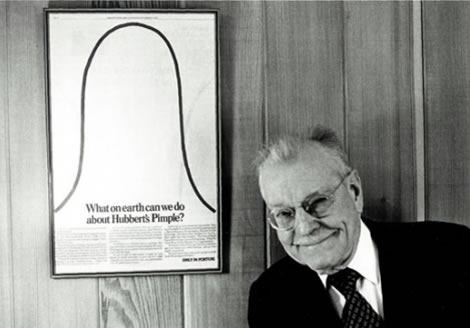
When did Shell executives first learn that the world would one day face the moment of peak oil, known to many as Hubbert’s Peak? Answer: as far back as 1956 when M. King Hubbert delivered his seminal speech to Shell employees predicting the day when oil reserves would begin to decline. For more than a half century, Shell has known that the world of the 21st Century would begin running out of oil with disastrous ramifications. Yet little was done to prepare society.
Survey finds gas prices up about 15 cents over past 2 weeks
The average price of self-serve regular gasoline on Friday was $3.62 a gallon, up 15 cents from two weeks ago. Mid-grade was at $3.74 and premium was $3.85. That's all according to the Lundberg Survey of 7,000 stations nationwide released Sunday.
The recipe for record US gasoline prices goes like this: Take a tight oil supply and growing world demand. Add a falling dollar and lots of investment money flowing into oil and other commodities.Finish with market turbulence caused by the annual switch from winter to summer gasoline blends. The result: an average US retail price for regular of more than $3.60 a gallon.
...Buffett also said that the world's production of oil, about 87 million barrels a day, is close to capacity. While the world won't run out of oil this century, as one questioner suggested, Buffett said gradually depleted oil fields could reduce the amount produced.Munger said he thinks oil production 25 years from now will be less than today.
"That's not an insignificant prediction, believe me," Buffett said, since demand for oil is growing steadily as the population grows and standards of living rise. "If oil production is down 25 years from now, it's going to be a different world."
"I think we can confidently predict there will be some pain in the process," Munger said. After using oil, coal, natural gas and uranium fuel supplies, "we will have no other alternative to the sun."
Dallas Fed: No Letup in Energy Prices
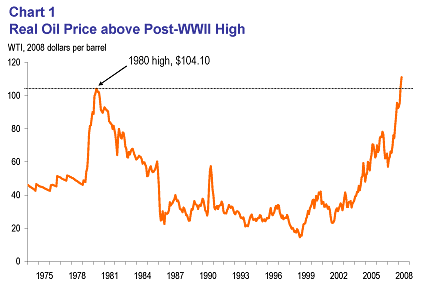
Oil prices continued rising, with the benchmark West Texas Intermediate (WTI) crude oil setting new records week after week and strengthening by about 20 percent in April alone. On Tuesday, April 23, WTI surged to nearly $120 per barrel, eclipsing the previous inflation-adjusted high of $104.10 set in April 1980.
Department of Irony: On Tuesday, members of the Rockefeller family won media huzzahs for airing their grievances against Exxon Mobil, the oil and gas giant in which they are the oldest continuous shareholders but which they say isn't doing enough to prepare for a greener world. Then yesterday, Exxon reported a 17% rise in first-quarter profit, to $10.9 billion. It was merely the second-largest quarterly profit in U.S. corporate history, though Exxon still holds the quarterly and annual records.Could it be that the heirs of John D. Rockefeller's Standard Oil empire (founded 1870) are angry that Exxon's management made them too much money?
The recent announcement of a large natural gas deposit in northwest Louisiana, called the Haynesville Shale, could be this century's gold rush — or a fool's gold of hype.
Kazakhstan Increased Oil Production 6.3% in First Four Months
(Bloomberg) -- Kazakhstan, the largest oil producer in the former Soviet Union after Russia, increased crude production by an annual 6.3 percent in the first four months of the year, the government said.
The poor will inherit the dearth
Queues for petrol on British gas station forecourts appear to bear scant relation to ongoing killing, rape and mass refugee movements in eastern Congo. The unfolding humanitarian disaster in ungoverned Somalia likewise seems unconnected to Western taxpayers’ worries about falling mortgage lending and rising prices.But as UN Secretary-General Ban Ki-moon pointed out recently, it is those least able to cope who will be hardest hit by rocketing food and energy costs and a global economic slowdown. The world faced “the spectre of widespread hunger, malnutrition and social unrest on an unprecedented scale”, he said. In short, the poor will inherit the dearth.
As oil prices soar, crofters return to the old ways and get their heat from peat
The soaring price of fuel is leading cash-conscious crofters in the Outer Hebrides to revive the ancient tradition of cutting peat to fire their kitchen stoves and central heating. Over the past few months the steep surge in the price of oil, now routinely used by residents on islands such as Lewis, has led to a rush in orders for traditional, hand-made peat cutters and peat-cutting permits.
Multinationals make billions in profit out of growing global food crisis
Giant agribusinesses are enjoying soaring earnings and profits out of the world food crisis which is driving millions of people towards starvation, The Independent on Sunday can reveal. And speculation is helping to drive the prices of basic foodstuffs out of the reach of the hungry.
Oilsands suck dollars from cleaner oil and gas
There's a giant sucking noise emanating from northeast Alberta that gets louder as oil prices rise.Called the Athabasca Tar Sands, its rapid development is draining imagination from the Stelmach government, flexibility from labour markets and diversification from Alberta's economy. It has also sucked Edmonton into a hopeless global environmental confrontation.
Is Japan a Leader in Combating Global Warming? The Wind-Power Problem
In the country that hosted the Kyoto Protocol, wind power has ground to a stunning halt. According to the last assessment by the Brussels-based Global Wind Energy Council, Japan ranked a dismal 14th in terms of yearly growth in wind capacity, with newly installed wind power totaling only 139 megawatts in 2007. That compares with 5.2 gigawatts – 38 times the capacity – installed the same year in the United States, and lags even further behind other wind-power giants such as Denmark, Germany and Spain.
U.N. sees world climate change deal in 2009
MADRID (Reuters) - The world can reach a significant new climate change pact by the end of 2009 if current talks keep up their momentum, the head of the United Nations climate panel said on Sunday.The United Nations began negotiations on a sweeping new pact in March after governments agreed last year to work out a treaty to succeed the Kyoto Protocol by the end of next year.
Climate Change Warms Arctic, Cools Antarctica
"All the evidence points toward human-made effects playing a major role in the changes that we see at both poles and evidence that contradicts this is very hard to find," said Jennifer Francis, an atmospheric scientist at Rutgers University in New Jersey.
Sinking without trace: Australia's climate change victims
Father Ezra Waigana, priest of St Matthias Church on Saibai, says: "We were told there's an iceberg melting and the level of the sea is going up. We don't know how we will survive. Our island is only flat, and the water seems to be taking all the land."There was an exodus from Saibai after a major flood in 1948 but elders of Mr Waigana's clan decided to stay on, in the place where their ancestors are buried. Their descendants feel it would be disrespectful to move – and some people cite God's promise to Noah never again to flood the Earth.
Contact
- Content: editors at theoildrum dot com
- Tech support: support at theoildrum dot com
License

This work is licensed under a Creative Commons Attribution-Share Alike 3.0 United States License.
That the WashingtonTimes would run an editorial that essentially is a reiteration of the emerging resource competition problem just goes to show how high oil prices can lead on to other effects - in this case prominence for Peak Oil concepts. However, I wonder that should oil prices fall even just 20% would the concern be put on the back burner again?
On the piece from Japanfocus.org.... I read it a couple of days ago, and like many japanfocus.org documents I am highly critical of it. Put simply, most of Japan isn't ideal for wind energy or even solar (though I think much more could be gained in Japan from passive solar than what they've done so far.) The article just doesn't discuss the realities of wind, or solar insolation. Put simply, too much on japanfocus.org is agenda driven, and not data driven.
Regarding Japan and nuclear power - it makes much sense for them to continue with nuclear, especially with new designs. For a nation of relatively little land and direct sunshine, with lots of people, the energy intensity of nuclear is a good fit.
I was just thinking the same thing. With oil prices so high, even the wingnut sites that usually scoff at peak oil are suddenly taking it seriously. But if prices drop - due to a recession, say - will interest in peak oil also fade? You kind of see that happening with climate change. Some heat waves and hurricanes, and everyone's talking about AGW. A normal or cold winter, and it's suddenly off the radar. People have really short attention spans.
Even if oil falls back or consumers start adjusting to 3.5 gasoline.Starting this fall if nat gas plays out like it looks like the other shoe may drop a gentle reminder.
As Nate has (continually) pointed out, we humans discount the future. We do so sharply. On AGW it becomes also an issue of tribalism. That is, not only are the (most) negative effects decades in the future, those who will suffer most are on another continent and we will never know them.
It is because of these two human traits that when I first saw the newswire story from the UN, on the likely possibility of a new agreement on AGW by the end of 2009, that all I could do is scoff. Oh, an agreement of sorts will be created and signed in a wonderfully lavish signing ceremony - but it will be worthless in stopping the emissions of CO2.
How to deal with these twin characteristics of humans (future discounting, tribalism)? Perhaps Alan's approach is best - the pre-positioning of (good) ideas. This is a variant on the old proverb "it is better to light a single candle than curse the darkness".
On balance, short attention spans and future discounting seem like adaptive traits. Human beings always have to process new information to survive in their continually changing environments, but trying to constantly pay attention to everything forever all the time just leads to mental breakdown. This site focuses on peak oil, which is good, because someone has to do it. But other disasters are quite likely to overtake the average individual before the true effects of peak oil are felt and accurately related to that reality.
The average person isn't really going to pay much attention to "peak oil" or "global warming" over any protracted period -- it's just too diffuse. It's the same with economic meltdown. I read the Automatic Earth for its amusement content --"look what those crazy people are doing now!" -- not for investment advice.
Individuals can only deal with events that directly impact them in the more or less immediate present.
So I agree. Light a candle, and go bravely forth into the darkness.
What economic meltdown?
Service sector in surprise rebound
Jobs: 'Not as bad as we thought'
More signs the world isn't ending
Factory orders in surprisingly strong jump
I'm off to buy a flatscreen TV!
It's Monday, and I just came back from a fine sunny day at the beach, ready to hit the pavement running. I'm so happy to discover the world isn't ending after all!!
http://money.cnn.com/2008/05/02/markets/thebuzz/index.htm
Seriously, the world is a great place. The Oil Drum is one of those things that make me believe there are a lot of people out there who really care about each other and the world. Three blind men can't adequately describe an elephant, but possibly 3 million of them can -- if they can learn to communicate with each other.
Exactly.
For my part, I thought oil prices would relax a little. But I was wrong, wrong. Geopolitical turmoil now appears to be only window dressing. We have serious fundamentals driving up and keeping the price of oil high. Now I know this will sound like preaching to the choir but here goes:
1. China + India + Russia + The Middle East go on a major car buying/consumption binge.
2. Peak oil in traditional oil fuels is being masked by unconventional and biofuels. That said, the world is still struggling with all its might to stay on the bumpy plateau and not to slide down the cliff. The analysis in recent media reports has been little more than mind fogging propaganda. We're in a false sense of bliss driving into the teeth of this thing.
3. People should know something is dreadfully wrong when US gasoline consumption falls 7% from the previous year in February and the price of oil doesn't even pause.
4. Oil currently at new record (120+) and rising.
5. It's getting pretty obvious we have a serious problem right now. Not 2035, not 2018, not 2015, not 2010. NOW.
Rob out...
*goes off to plant potato gardens for friends and family*
>>3. People should know something is dreadfully wrong when US gasoline consumption falls 7% from the previous year in February and the price of oil doesn't even pause.<<
New competition for that 45% of World Gasoline output that the United States used to burn.
http://www.gravmag.com/oil.html
Surely the MSM does not expect the US to burn an expanding percentage of static/declining world gasoline output forever.
If there is some increased economic activity I don't think it is the average folk reaping the benefits. I have several friends working in restaurants and all of them are telling me the same: people are cutting back and it's much slower then last year. Hardly a surprise, given that I am cutting back on some things too, despite my income being above the average.
But of course who am I to believe: our government's statistics or my own lying eyes?
Things are slow here, and the two pillars of our economy, real estate construction and tourism, are faltering. Well, RE is crashing actually. And tourism is down. Much of the tourism is visitors from Europe, for some reason they're fascinated cowboy towns and us wrangler-wearing locals. But the Empire is becoming more and more hostile to outsiders, and many overseas are deciding not to visit the US. It's kind of like visiting Germany in the very beginnings of Nazism, it's a nice place if you're oblivious.
A local gas station closed, no signs saying they're closing, we just noticed they're empty. A couple of friends went to the Subaru service center to ask about a part, and it's empty - building abandoned. Houses are also emptying, and the "garage sale'ing" is good.
We have a lot of 'refugees" coming here from other parts of the US, the great American tradition, going on the road in hard times to try to find a better situation. Lots of middle class people who are on the road ..... you get talking to them and find out they're losing everything, hoping one of their kids living on Disability here will take them in, that sort of thing. This area is sort of famous for being one where you can live in the woods and still be fairly close to town....
fleam,
"It's kind of like visiting Germany in the very beginnings of Nazism, it's a nice place if you're oblivious."
Too true. In my opinion, this next 4 years will be a last gasp effort by the ptb to hold on, and then everybody bales. (bails?) I think we are now on our own. Your posts indicate this is probably more true than I had hoped for. Time's up. Keep yourself alive, and use your art and musical leanings for good and survival after the system collapses.
After Ob, Cli, McC, things are gonna be really wierd. Hell, they already are now. It's not this crop of candidates we worry about, it's the ones after. Some freakazoid is going to come to power 4 years from now. Let us beware. It's on the wall and the ink is still fresh. I have never been one for the "run for the hills mentality", but seriously, run for the hills. Run away, live to fight another day.
Good night, hale and heart !!!
Jeff
Chris Martenson (the same author as The Crash Course — which I highly recommend everyone watch) points out that the actual job loss number was 287,000 but the Bureau of Labor Statistics "adjusts" them with its Birth/Death model and comes out with 20,000.
It's fascinating (and sad) how many bad numbers the world is using to make its decisions.
The full exposition is available after a free registration here:
http://www.chrismartenson.com/headlines-may-2-2008
-Andre'
Better be quick!
Get the picture: TVs may cost more
Down day on Wall Street
"Too diffuse"? I'd have to say, "Too depressing"! No way we non-futurists want to hear the end is nigh. Has to be HUNDREDS of years left to sort out our woes! And anyway, there's always Super God to save the day.
"Doing something" effective about AGW will take a coordinated global effort - this is simply not going to happen. Accept that the world is going to change, and do you best to anticipate and adapt. Tribalism will probably be an effective social organization, just like it always was, but for a brief period of large scale nationalism (which I believe is the result of cheap and available energy and the transportation it enabled).
With oil prices so high, even the wingnut sites that usually scoff at peak oil are suddenly taking it seriously. But if prices drop - due to a recession, say - will interest in peak oil also fade?
Naw, the people who claim the price being up so high due to fraud/regulation/taxes/lack of martian technology will just say "See! I was right!"
Over on peakoil.com there was a poster who was claiming $38 a bbl oil in less than a year. When the price took a drop - he bragged for weeks. When price was at $50 a bbl - no where to be seen.
The Washington Times editorial "The coming crisis" is quite good, but it is paired with another editorial also printed today titled "Energy? Here's the drill" that says among other things "There's nothing wrong with the price of gasoline that a few dozen new refineries cannot cure..."
The Peak Oil aware editorial was a guest editorial, the non aware article was from the Washington Times chief political correspondent.
The Times prints a lot about energy issues. They mostly come from a cornucopian point of view and are skeptical about global warming. But they are quite generous in printing reply letters to the editor. You can check out the 'here's the drill' article at http://www.washingtontimes.com/apps/pbcs.dll/article?AID=/20080505/COMME... and e-mail them a response at letters@washingtontimes.com. Be sure to include your address and phone number.
OK, this is sortof unrelated . . . but. . . why no comment on the dock-worker strike on Mayday? Majors ports shutdown, you would think we could learn something from it. How did distribution networks react? etc. And it was a strike protesting the Iraq war! How is this not big news?
I didn't even make the front page of any newspaper I saw on May second. WTF. If anyone has any information on the material/economic meaning of the strike let me know. I am fascinated and I just can't let it go.
There has been very little coverage. Just short stories like this. The only other article I've seen was one from one of the big oil companies, saying their production was unaffected because they have their own port facilities.
The kind of censorship we see in this country is a conspiracy of silence. You can say anything you want to, but if it offends the officials, it will be ignored.
Americans are proving to be so wasteful and unaware it would be foolish to give us access to more natural resources. I am against drilling for oil in areas that are currently off limits because it is the only way we will save even a trifling amount of fossil fuels for our children and grandchildren.
Americas stewardship of natural resources is criminal on a generational scale. The lack of vision and awareness we display is a crime against future generations.
I am at the bargaining stage.
We should take the remaining US resources only when gasoline is taxed as it is in Norway.
This may be true for sites in the lower 48 but perhaps not for ANWR. At some point the Alaskan pipeline may freeze, or become uneconomic due to falling throughput. If we wait to evaluate and develop ANWR, any economic oil may be lost forever. If developed soon it might be available for our children and grandchildren.
"At some point the Alaskan pipeline may freeze, or become uneconomic due to falling throughput."
huh? what is going to freeze ?
the alaskan pipeline is insulated to keep the permafrost from melting.
A couple of points:
1. The Alaska pipeline is elevated for most of the northern section. While it does use insulation in the vertical supports to prevent the permafrost from melting, this has little relation to the temperature of the pipeline contents.
2. The oil traversing the pipeline is typically kept pretty warm; if Wikipedia is to be believed, above 120 F. This keeps the viscosity down (imagine trying to pump oil at -40 F through miles of pipeline!). If the flow rate gets too low, in cold-weather conditions the temperature of the oil will drop unacceptably in the transit from one pumping station to another. This effectively establishes a lower limit to the practical flow rate for the pipeline.
In the distant past and at least once in the past year I have read that the pipeline may not function through a cold Alaskan winter if the throughput drops below 300,000 bbl/day. I have no clue as to whether or not this is true.
Pipeline facts. Throughput during 2007 averaged 740,170 bbl/day, far below the maximum of over 2,000,000 bbl/day during 1988
http://www.alyeska-pipe.com/PipelineFacts/Throughput.html
But clearly even w/o issues as to the minimum volume needed to keep the oil from cooling and becoming too viscous to pump, there is the secondary issue of maintainence. At some point it will be uneconomic to keep it running, then corrosion sets in.
Powerdown in Juneau AK, good read on coping:
http://www.adn.com/news/alaska/story/390413.html
jjlalaska
I recall that they decreased the number of pumping stations several years ago due to falling throughput
This is why pushing for a gas tax holiday is exactly the 'party on' signal that will help insure the worst hangover in consumer history.
1. Gasoline imports are as plentiful as ever.
http://tonto.eia.doe.gov/dnav/pet/hist/mgfimus1m.htm
2. Weather has been colder than normal meaning demand may be 'artificially' down. (Inland Empire ,my area, very busy this weekend with nice weather and $3.60-$3.79 gas)
http://www.wrh.noaa.gov/climate/monthdisp.php?stn=KGEG&year=2008&mon=4&w...
3. The refinery margins on gasoline are squeezed to the bone in deference for distilate profits.
http://www.energy.ca.gov/gasoline/margins/index.html
Ubearible gasoline hikes and gouging from refiners are the political football. The reality is that gasoline is waaay cheap right now with no where to go but up. Yes we are spoiled rotten and the crying game has just begun.
Does anybody else find it amusing how the 'inflation-adjusted' 1980 oil price high seems to march higher and higher with time? I remember when WTI broke $90 we were assured that it was no big deal because in 1980 it was then the equivalent of $97 - then when we broke $97 suddenly the inflation-adjusted number was $99 to $101 - then $102, $103, and now $104.
Gotta love that 'denial-creep' :p
--
That Washington Times editorial is pretty good - short, mentions some credible names/sources, and hits on all the key issues. I don't know if you could syndicate such a thing but it's one of the better summaries I've seen. Does the Washington Times get national readership, or is it more of a fluff rag? (I have no idea).
The Washington Times is widely read, but it's kind of a rightwing nut paper. Very conservative. The Fox News of print. It's also known for being the Moonie paper.
It's not considered all that credible outside conservative circles, but the fact that such a conservative paper is writing about peak oil is noteworthy, IMO.
Yeah it's sort of the same situation with the National Post up here in the Great White North. Occasionally you can pick out the odd half-decent article, but for the most part it makes me want to gag. Their standard modus operandi is to put opinion pieces on the front page in order to disguise wingnut ideas as real news. The Financial Post section (as it's semi-autonomous) is a little better since at least the pro-business slant is transparent.
No comments about the current Moonie rag, but for a while, it provided a surprisingly reliable second source of information to the Post, as long as you ignored anything that could be considered editorial (which at times seemed like 90% of the paper). To read either the Washington Post or Times requires a certain set of skills.
The Post is a massively manipulated source of information, a fact which far too few people seem to understand - and when they mention such things, they tend to get printed in something like the Washington Times, a blatantly manipulated source of information.
One of the striking things about America is how so many people actually believe in objective journalism. Europeans scoff even at the idea - and when you delve into the history of U.S. government funded 'objectivity' during the Cold War, it seems as if the European perspective is more realistic, or at least more realistically cynical, especially as regards the idea of 'objectivity' when it comes to power structures attempting to win advantage for themselves.
There certainly are journalists who believe in trying to find "truth" and believe in "objective" reporting. Those individuals never make it to the editorial desks of national papers, however. There are alternatives -- Read CounterPunch for great investigative reporting. They are clear about their biases, and can be, because that's all they sell. The Washington Post has a different purpose. The Moonie organization is really scary -- you can't find out much about them, and their paper is amazingly influential. George Bush I was apparently very close to them.
When people in general finally realize that the "media" -- all of it, TV, Radio, print, Google -- is about selling the message of the advertisers (one of which surely is the Government), then there might be some possibility of a democracy.
A friend of mine who used to teach Mass Communications courses at the Univ. of Houston told me that the concept of "objective" journalism was just a temporary anomaly caused by the era of wire-service journalism. Before that, reporters wrote stories just for their own blatantly biased Democratic and Republican newspapers. The wire services wanted to sell their articles to everybody, so they had to develop a tone that would offend nobody.
The problem is, now there are few traditional outlets, owned by even fewer corporations, and plenty of news sources, some of them created specifically to lend authority to certain biases while the reporter acts as stenographer.
The problem is not that you can't find some relatively decent sources. I would mention Christian Science Monitor, and McClatchy newspapers for domestic news. Couple that with a healthy dose of international sources and you should get enough varied information to be reasonably informed. The problem is that the public is addicted to fancy packaging, and celebrity worship. That requires the sort of money that only mega-corporate advertising can provide. The result is they lap up the propaganda from the main stream media, without even realizing that it is giving them a deluded view of reality.
My father was dean of the Univ. of Oregon journalism school in the 1960's. He was a professional, who believed that journalism was a sort of objective social science. I don't know where that notion came from, but he always hoped that the profession would reform and mend its wayward ways -- which got more outrageous as time went on. He died too soon to see the war-whooping of the Washington Post and the New York Times.
However, I have read enough of those rags to know that it didn't just start -- journalism is always political, always comes with a bias, always reflects the preferences of the owner of the medium. I don't really see much wrong with that in principle, but in an era of chain newspapers and mass media, it starts to look a lot like indoctrination when the media get too cozy with the government.
I think the Internet will be around just long enough to kill off the newspapers.
One of the things I want to do once I'm out of here and back in the SF Bay Area, and once settled down there and once I have a place to do it in, I'd like to learn the old traditional type of printmaking, both for artistic purposes and start primitive newspapers again. Leaflets and broadsides and pamphlets! Just like the year 1500.
Might not be "denial-creep", it could really be additional inflation. The dollar is falling.
That's true, I suppose 2008 dollars are worth less than 2007 dollars, looks like my lack of economist's wings is showing.
Understand, as a one-time English major I feel compelled to invent new words and terms. I did take economics 101 back in my school days, but the teacher was so intent on getting "juicy As" (100% scores) on all the tests, that he neglected to teach us anything... wish I was making that up, I think the median grade was 92%... believe it or not, there were a lot of failures.
I don't know what the rest of the faculty was like, but I'm not sure if my esteem for economics majors will ever recover.
--
*had to edit for a grammatical error -- couldn't let my English street cred go down the tube
OK, so if an year ago the inflation adjusted high was $97/bbl and now is $104/bbl this means we had 7.2% additional inflation in the meantime.
Should we take this as an admission that the official inflation rate (running at a ~2.7% IIRC) is undersated by almost three times?
See comments (Millbrook and myself) above and below - it's probably a combination of inflation, obfuscation, and journalistic inconsistency. At this point in the process, folk seem to be rounding up (never down) to the nearest $10 for rhetorical purposes.
Does anybody else find it amusing how the 'inflation-adjusted' 1980 oil price high seems to march higher and higher with time?
That's because it's inflation-adjusted - just think about it. Though I'm sure a few reporters may have had their thumb on the scales. Nobody ever says what price deflator they are using.
(Edited - damn - Millbrook got there first)
Much appreciated nevertheless, I framed it as a question because I wasn't particularly confident in what I was saying.
It's a Canadian thing, eh?
You're welcome - I'd been asking myself the same question as you, until the light suddenly came on in my head!
(Edited - LevinK at 10:51 has a valid point though).
According to the Minneapolis Federal Reserve Inflation Calculator, a $38 per barrel price of oil in 1980 is worth $99.43 today.
For the "inflation adjusted" price to be higher than the $115 or so where we hover lately, would mean that we have had 15% inflation in just the first 4 months of 2008.
I defy anyone to demonstrate where we have had 15% inflation in the first 4 months of this year. Even the dollar has not fallen by that amount since January 1.
Moving the "inflation adjusted" target higher is purely a falsehood in this case. We passed the old "inflation adjusted" high quite some time ago and I doubt we will be going back any time soon. This argument is an attempt to dodge the fact that we are in a very real supply side crisis with growing demand from China and India driving the flat supply price ever higher.
IMO the current price is well below the 1980 high-a guesstimate would be $155 to match it. The Fed estimate of 3.5% annually over the last 28 years is a little light IMHO.
While I also believe the official inflation figures are suspect, I have seen no one here on TOD yet produce a convincing case that sways those that believe otherwise. Therefore I use the "official" numbers until they are proven wrong for the point of this discussion.
By the way, what do you think was the "average" inflation annually over the last 28 years?
My guess would be 5-5.5%-I realize this number is considered high-I might be wrong-3.5% seems light. With the change in the structure of the USA economy since 1980, it would be hard to compare impacts of $38 then and $120 now-the wealth and income disparity is so much greater now-the top 10% in the USA have had a great run over this period-not so good for the bottom 90%.
In addition to the information in the other posts, it also depends on your selection of the crude price in the "base" year. At the time, there was no NYMEX trading for a reference point. Oil companies "posted" prices for each field. So, it depends upon the "source" of the base inflated price, and most have started with different posted prices. I know that the WSJ started with a higher posted price in 1980 than many others did. So, it is extremely likely that will see different numbers from different sources because they each selected their own posted price starting point.
The problem with inflation figures is that it measures the abstraction of money without giving due attention to what money itself represents: goods and services.
Things are priced in money and money is priced in things.
If you want a look at real scarcity/surplus figures, things need to be priced in things. How much a barrel of oil can get in in terms of gold, silver, wheat, corn, cars, houses, concrete, copper, and hours of human labor. Then compare those multiple relationships over multiple time periods.
But that would take time to analyze and piece through, and when you're done with the analysis, who will take the time to learn about it?
Who will take the time to learn about complex systemic relationships, period?
Well, I see the ground I was going to cover has been gone over with a backhoe. TOD really needs a "delete reply" function.
Hi, everyone. I've updated the Best of The Oil Drum Index:
Best Of The Oil Drum Index
http://www.inspiringgreenleadership.com/blog/aangel/best-oil-drum-index
Tips for serious research on The Oil Drum
All techniques are for Google unless otherwise stated; click to try them.
Thanks for your index, alot of work I'm sure.
One suggestion, place your "Tips for serious research on The Oil Drum" above on your index also.
You're welcome, Doug. I've learned a lot from TOD and I wanted to give back.
I like your suggestion; next time I'm in there I'll add the tips.
-Andre'
MUCH Appreciated !
Best Hopes for Many Individual Efforts,
Alan
Peat cutting on Lewis
Peat is a non-renewable resource and this is telling response to the energy crunch.
The article seems to be presenting the whole thing as a quaint part of the tourist focus there but it does finish with the observation:
"There are concerns, however, about the environmental impact of the trend. Iain MacIver, chairman of the Stornoway Trust, one of Lewis's largest landowners, said that since the cessation of peat-cutting most of the peatlands had won protection under wildlife legislation. And most peat banks available outside the traditionally cut areas were already heavily depleted. "There's nowhere left, unless we start getting into the designated zones," he said.
There are windfarm plans for the islands and for them we must hope they can switch to electric heating for all uses. The population is about 20,000 and there is some domestic industry that is perhaps sustainable but it appears that tourism dominates. There will be a large economic shock in the future and this will likely reduce the population so the place might become sustainable based upon wind generation and traditional industry. We will see this rush to exploit local resources, mainly wood, in many areas and we have many scary examples of the devestation this will cause. Stories such as these are another bit of the warning of what is to come.
Actually, I am going to contradict you a bit here - 'abiotic' peat can be seen in a number of places on the planet. It is merely that peat requires both the correct environment and the correct amount of time.
Viewed that way, peat is a non-renewable resource.
Woah! You are going to have to explain that one Expat. I was under the impression that peat was biological by definition. Peat beds, if buried long enough and deep enough, eventually become coal beds. Does that mean you could have "abiotic coal"? I don't think so.
Ron Patterson
I detected a whiff of sarcasm in the concept of "abiotic peat". But I think he meant that peat is a renewable resource on the proper timescale.
The period of time in which coal or peat are created is very different.
The German "Teufelsmoor" took 8,000 years to grow; peat layers there have a thickness of up to 30 feet. Coal (and oil) is created in millions of years and requires considerable pressure AFAIK.
Given that we are going to burn all our oil and coal in about two centuries your 8,000 years might as well be 8mln. years - no difference in human timescale. It's a non renewable resource, period.
Right! And did hunter-gatherers need peat? I suppose they may have burned it, but I doubt it. This is yet another point to support that hunter-gatherer cultures are the only sustainable ones.
Interesting. That timesclale means that peat bogs must fix quite a lot of carbon in human timescales. Does that mean they could make the climate cooler?
Peat bogs (like swamps, old-growth forests, and the tundra) can fix a lot of carbon. Whether they can make the climate cooler depends on whether we could have enough peat bogs to remove carbon faster than we are putting it into the atmosphere (and faster than it is being released from tundra melt and clear-cutting old-growth forests). My guess is it would require a LOT of peat. But every bit helps.
The point is that without human carbon emissions peat bogs would cause a major cooling of the climate. Could they be responsable for ice ages?
If that time is right it means peat takes a lot of carbon out of the atmosphere on a human timescale. If left alone would it cause global cooling?
'Abiotic' was truly a joke - you can actually see peat in creation, and follow its various stages to the point where it is burned as fuel.. There is no magic peat fairy around
I'm not a peat expert by any means, but both in Germany and Ireland, peat is fairly recent. In the case of Ireland, from what I remember on a trip there, is that by cutting down essentially all the forest in Ireland, the process of peat creation ended.
Which means that burning trees for warmth as a method to preserve peat is not really a smart idea over the long term, either.
Peat formation, not being abiotic is anaerobic. This process produces methane, a much worse green house gas than CO2. The melting of the tundra is releasing a lot of methane from those peat bogs. The mature peat that can be dried and burnt has already given up a lot of methane. Technically peat is renewing itself, but on any practical human time scale it is a non-renwable resource. If there are any ten meter thick deposits laid down in the ten thousand years since the last glaciation then they grew at an average of one milimeter a year. If I am going to burn peat for energy I would need a lot of hectars of bog to feed the hearth in a sustainable way. Seven billion desperados on the planet will strip it of fuel (peat or wood)like locusts if the example of Lewis is the method of choice.
BANGKOK (Reuters) - The cyclone and flooding in Myanmar's two major rice growing areas have "potentially serious effects" for food supply in two other impoverished countries, a U.N. official said on Monday.
World Food Programme spokesman Paul Risley said it was not yet known whether Myanmar could meet its commitments to supply tens of thousands of tonnes of rice to Sri Lanka and neighboring Bangladesh.
http://in.reuters.com/article/domesticNews/idINBKK12985520080505
That is looking like a horrendous tragedy. New reports this morning say the death toll has surged to 4,000.
The Myanmar Government's now saying the death toll may be in excess of 10,000.
This is probably why there's not a whisper about it in US news sources.
Of course the Tabasco flood in Mexico was a larger disaster than Katrina, but it didn't happen to Americans so it never happened, according to news within the Empire.
And as hard as it may be for us to believe, Fox News is considered gospel truth in most of the US.
Rather early in the season for a cyclone, wouldn't you say? Has this ever happened before -- IN MAY???
(edit: Northern Indian Ocean cyclone season occurs in the spring and fall. http://mpittweather.com/nio2.htm)
In neighbouring Bangladesh, this time of the year (April - May), before the monsoon sets in, is indeed the season for cyclones, but also North-westerly thunderstorms during which you better take shelter in a concrete building
http://www.discoverybangladesh.com/meetbangladesh/climate.html
This is another warning to stop with coal. Read here:
http://www.rollingstone.com/politics/story/16956300/the_prophet_of_clima...
When did oil executives know about Peak Oil? M. King Hubbert informed them in 1956. Then in 1977, a National Academy of Sciences team of 300 scientists, including scientists from the oil companies, concluded that Peak Oil would occur in the 1990s if economic development continued at the current pace. Peak Oil is now. Both Hubbert and the NAS got it right. Given the slow economic growth in the 1980s period Peak Oil was delayed. So, the oil company executives have known all along. Some things that Matt Simmons and Colin Campbell say make me think that the profit motive might have something to do with the faulty memories of oil company executives:
Matt Simmons:
http://seekingalpha.com/article/75461-why-exxon-still-denies-peak-oil?so...
Colin Powell: "The world now faces a discontinuity of historic proportions, as nature shows her hand by imposing a new energy reality. There are vested interests on all sides hoping somehow to evade the iron grip of oil depletion, or at least to put it off until after the next election or until they can develop some strategy for their personal or corporate survival. As the moment of truth approaches, so does the heat, the deceptions, the half-truth and the flat out lies."
CJ - Campbell rep. Powell
Just thought I'd try this comment on a current thread, to see if anyone likes/dislikes the idea:
To reduce our dependence on foreign oil, without offending domestic producers or targeting specific countries, I propose:
The Miles from Lebanon (KS) oil tax: All oil produced in, or imported to, the United States will be subject to the following tax:
$0.001 per barrel for each mile of distance from the originating well to Lebanon, KS. This tax will increase 10% per year to 2050, at which point it will decrease at 1% per year thereafter.
I would make it revenue neutral via a direct payment to each US citizen for the per capita amount of the tax revenue for that year.
You are discriminating producers based on how far they are from the US. This is against all international trading norms and I'm sure US will get trialled big time if this happens.
Well, they could just ignore the ruling like they do with most of the rulings they get against them.
Yeah, I think all of the US' trading partners know that all too well. Heaven forbid they play by the rules of the treaties they steamroll onto other countries.
--
If you would indulge me, what is your take on Sask's new(ish) government? My mother's family is from the mighty metropolis of Wolseley, but I haven't heard much since Lorne got kicked to the curb... just curious.
I'm not at all keen on the new gov't. They're quite keen to take credit for the great state of the province's finances even though they had nothing to do with them, as what they are reporting is all from the NDP era.
They're also exactly the wrong kind of rabid worshipers of endless growth, and I fear they'll risk destroying the environment in the name of development. I know the premier is pushing for oil sands development in north-west Saskatchewan, which would be a disaster (much like Ft. McMoney in Alberta).
I heard Brad Wall talk a few weeks ago at the Hindu Society Vegetarian Supper (great event, BTW) and in his speech he went on and on about growth, how great it is and how it will solve all our problems. From the way he said the word "growth", it almost sounded like he was having an orgasm every time he said it. It was so bizarre.
But if you don't rape your environment who's gonna pay Ontario's equalization payments?
Ugh, that's pretty much what I was afraid of, but thanks for the run down.
I'm curious ... last weeks NPR's Marketplace had an interview that suggested that some banks were getting money from the Fed in order to get into the commodities market.
http://marketplace.publicradio.org/display/web/2008/05/02/central_banks/
Does this mean that some loan officers have given up on the prospect of getting a decent return from regular loans? It reminds me of Gail's comments on a contracting economy.
Is that what we're seeing here, the symptoms of a contracting economy? Or could it just be that risky behavior has gotten into (parts of) the banking business?
Doesn't this just mean that the Federal Government (oh yes, the Fed is in the pocket of the Federal Government, or perhaps the other way around) is desperately flogging the giant Ponzi scheme that is called the "Global Economy?"
New Pictures of Oil: price seismographs and a trip down memory lane (thanks to the unnamed TOD poster who jogged my memory about the arm and leg pictures).
The above article: McCain Calls for 700+ New Nuclear Plants (and 7 Yucca Mountains) Costing $4 Trillion is a really good article. Romm says "Lets do the math. And he does.
Of course Romm is talking about eventually replacing all our old nuclear plants because by then they would need replacing, plus a lot more because those plug in hybrids would require a lot more grid power.
Of course all those cornucopians, all those anti-doomers, would say we don't need the nukes, all we need is a lot of solar panels and wind generators. Well, will someone please do the frigging math! How many wind generators would that take? How many square kilometers of solar panels? How many batteries would it take to store energy when the sun does not shine or the wind does not blow? And how many per month do we need to be building? How many square kilometers of solar panels do we need to be building every month? And how many batteries do we need to be making? And how much is all this going to cost?
I have been reading about these cornucopian panaceas for years but I have never seen one scratch of math to support their pie in the sky ideas.
Ron Patterson
Just think of those 10 Gigawatts of wind capacity that were added worldwide in 2007 alone. How much nuclear power was added in 2007?
That figure is complete misleading. 10 Gigawatts refers to the absolute maximum output of all the wind turbines combine. In order to deliver 10 Gigawatts of power to the grid, the wind must blow at precisely at the maximum output windspeed everywhere those wind turbines installed.
We all know that the wind doesn't blow at a constant maximum speed all the time 7/24/365. rarely does the wind blow at the optimal speed. If it blows too slow only a fraction of the turbine's output is produced. if it blows to hard, the turbine need to reduce its output to prevent damage.
On the other had, except for brief periods Nuclear, Coal, and N-gas power plants can produce at the maxiumim rating 7/24/365.
To get an an actually power output rating for wind you have to derate them somewhere between 9% and 15%. At 15%, 10 GW is only about 1.5 GW. A single new nuclear plant would match or exceed the entire 2007 new wind turbine installation.
Another critical issue, is large wind turbines require expensive periodic maintaince. Winds can change directions very quickly causing excessive stress on the joints and bearings. Eventually bearings and parts of the joints need to be replaced. This often means dragging a service crane to the turbine to perform maintaince.
Wind global production will probably max out in the next five to seven years, as material, deliver, and maintaince costs soar because of depleting fossil fuels. Fossil fuels are the fuel source to mine ore for metal. Trucks and cranes need diesel fuel. Capital required to build large wind farms will disappear. I suspect that most countries will focus on food, and other basic human survival needs. Civilization managed to exists with out electricity for thousands of years.
FWIW: No way in Hell will the US ever construct 700 new Nuclear power plants. A few dozen new ones, if we are extremely lucky.
The same is true for nuclear plants. A reactor may be capable of producing, say, 1 Gigawatt, but since there are times of shutdown for maintenance, due to lacking cooling water and the like it will produce less.
The typical load factor of wind turbines used to be well below 20 per cent in the past; it is around 20 per cent today. So mankind may harvest 15-20 per cent of those 10 Gigawatts nominal output which is between 1.5 and 2 Gigawatts. So, where are 1.5-2 GW from nuclear plants in 2007? Not only are they not here, but the share of nukes in worldwide electricity production has gone back further. The share was at its highest, appr. 18 percent in 1993, and is ~15 per cent now.
I'm not opposed to nuclear power, and I believe that not shutting down our plants in Germany (as decided by our politicians) is worthy of discussion. But, honestly, I do not see the nuclear renaissance come true.
I agree about the discussion, but some of the nuclear plants are getting a bit old. Which means that shutting them down in the planned time scales makes good sense.
Unfortunately, as the case of Obrigheim makes clear, give EnBW even the tiniest chance to grab something, they will grab as much as possible. As compensation for Obrigheim going offline 2 and 1/2 years later than planned, Philippsburg is supposed to go offline earlier than planned. Which won't happen, of course.
I prefer a strict adherence to the nuclear shutdown plan, if only because that is the only way to even force some change in the German energy mix, away from large coal or nuclear facilities.
If you have less available, you waste less of what you have.
But I am not dogmatic - safe nuclear designs, along with a decent approach to long term nuclear waste storage, are completely acceptable. Unfortunately, that is rarely what is being discussed, by either side.
I suppose that was the idea in Germany, but the reality painted was build more coal plants to make up for the shortfall, not to mention buying votes from coal miners. Good job guys.
Germany has truly lousy resources in both wind and solar energy.
In practise they are putting loads and loads of money into a minor contribution to their power needs, and have to burn filthy and provenly lethal coal.
For their lack of success in reducing CO2 emissions, see here:
http://business.timesonline.co.uk/tol/business/industry_sectors/natural_...
The man behind the nuclear power shift - Times Online
This is far from saying that nothing they have done has been worthwhile, as their greenroof and passivhaus initiatives lead the world, and they are doing interesting work on biogas and integrated systems:
http://www.treehugger.com/files/2008/02/germany_gets_cr.php
Germany Gets Creative with Renewables : TreeHugger
The massive amounts of money they have poured into them has also led to the technology for wind and solar power being developed, and solar power in particular looks to have a very bright future in hot areas of the world where maximum use coincides with solar incidence - the exact opposite of Germany, where peak use is in winter when there is very little power produced by solar arrays.
For their own power use, with the exception of residential solar thermal, solar technology is a very expensive distraction.
As for waiting for a perfect version of nuclear power to come along, in practise this means continuing to burn dirty coal.
There are no confirmed fatalities due to the civil nuclear program in the west, mining excepted, as you have to mine coal anyway in enormously greater quantities and even solar or wind power uses huge amounts of steel and so on and so involves large mining operations.
Umpteen billions of tons of carbon dioxide has already been dumped into the atmosphere in excess of what would have happened with a more vigorous nuclear program, and opposition to it's expansion continues to hinder efforts to mitigate Global warming - how many deaths is that going to cause?
And how many deaths will shortage of power cause if nothing is done?
German policy at the moment is entirely unrealistic, and based on a false prospectus.
At that latitude a renewables only future is based on fanciful assumptions rather than practical proposals.
Coal fired power plants should be closed down rather than nuclear power plants. Those Gt of CO2 are more dangerous to our climate than a couple of tons of additional nuclear waste.
Well, really this is a misapplication of statistics, especially since the actual share of raw generating capacity has significantly rose for nuclear power and there are over 30 nuclear plants under construction today. The nuclear power production in 2006 accounted 2,658 TWh, which was 16% of world's total electricity production. In 2007 it was 2,768 TWh.
Why? Does the wind blow 5% more today than it did in the past? I suspect that wind turbine statistics are alterated from real world conditions in order to sell more turbines. Just like granite counter tops sold more homes.
You've miscalcated again. Your not accounting for growth in power generation which has increased significantly since 1993. More fossil fueled power plants (coal and n-gas) have been constructed than new nuclear plants. Mainly because up until a few years ago, fossil fuels were extremely cheap.
My original point was the Solar and wind aren't going to save us. Pretty soon high material prices and declining capital will gut Solar and wind expansion (as well as other forms of power plants including coal, n-gas, and nuclear). Already the cost of metal is soaring, as the the higher fuel prices are resulting in higher mining and smelting costs. Capital is drying up because of the housing bubble, and gov't expenditures are rising for higher entitlement costs (Health Care, SS - aging baby boomers), and aging infrastructure, high energy costs, declinig dollar. Capital will simply not be available to support any grand scale energy redevelopment projects. What we will see in the near future is energy subsides for the poor, and energy rationing, excerbating the problems as resources are deverted to keep the voters happy for as long as possible. No money, or resources will be available to for energy development, rationing and price caps will prevent business from new projects.
You seem to confound the world with the US, as many of the factors you describe are peculiar to it.
And yes, build costs for all forms of power are rising, perhaps to around $8-9/watt for several forms of energy, nuclear and wind being amongst them, and solar dropping in hot areas to similar costs.
Why you should think that cost entirely unfinancible I don't know.
If you simply use the various technologies where they are most suited, with nuclear for base-load and solar for peak power in hot areas, and in some areas with good wind resources such as much of the States wind contributing as it is very suitable for rapid build, and if higher prices lead to some obvious measures, like the installation of air-source heat pumps and residential solar thermal then the cost comes out to perhaps very reasonable values, more expensive than the very cheap rates in the US with emissions form fossil fuels uncosted to be sure, but by no means out of reach, although the transition will not be easy.
It is only if fantastic solutions are pursued such as using solar for base load and so having to build massive spare capacity, vast storage facilities and great webs of transmission to get power to cooler regions that costs become unsupportable.
Sheesh Ron,
There have been numerous threads with calcs on how many square miles of panels or thousands of windmill installations it would take to equal the quads we use today. You can go look them up, but try to also recall the countless OTHER disclaimers that look to how many exajoules we need to CUT from our consumption in the first place, so that the inevitably insufficient amount of Soalr and Wind that we can realistically install will only be 'distressingly short' instead of 'disastrously short'
So what if there are clowns who think these alternatives will 'fill the gap' seamlessly and painlessly? We still need to be working on getting what capacity we can.. How much? A lot. A lot more than we will be able to get together in time. That's no reason not to have some of our efforts working in that direction. Oh, right. you don't believe in "We', since humans never could join forces to accomplish big challenges. It's every man, or at best every family for itself. Anything larger would start looking too much like a conspiracy or a movement, and we know that those don't exist.
By my very primitive calculations, we only need to quadruple our renewable generation (from 50 TWh to 200 TWh) to offset oil used for electricity generation (122 TWh). That doesn't seem too hard to me.
If you want to start offsetting Natural Gas, that becomes more difficult, but there are lots of gains to be had in efficiency and transmission.
Jokuhl, sorry but I have not seen any thread that gives this information. And I certainly have not seen anything about battery banks storing for this energy for when the sun is not shining or the wind is not blowing. And absolutely nothing about how many wind generators, square kilometers of solar panels or battery banks that need to be built each month to get us to a given point by a given time. A little hot air perhaps, but no real figures.
And we are not talking about replacing the power we consume today, we are talking about running our automobile fleet, truck fleet, tractor fleet and whatever from the grid. And the power generated would have to be two or three times greater than what we would consume around the clock. Must charge those batteries you know. Again, I have NEVER seen any figures on battery banks. Why are they always ignored?
And I hope Jokuhl, that you are beginning to understand why I have such little faith in "we". I mean what are WE doing right now? What are we doing to prepare for the day when our transportation and farming fleet will be run off the grid? What steps are WE taking each month toward that end? WE haven't even done the math Jokuhl.
And of course WE will have to conserve. Hell, I imagine WE will pretty much have to stop driving altogether. And WE will need to eat a lot less as well. Conservation will be the name of the game. Unfortunately it will be involuntary conservation.
Naw, we have a remedy for all these peak oil problems coming down the pike, WE will bake pies in the sky.
Ron Patterson
Jokuhl, sorry but I have not seen any thread that gives this information.
Ron, I think I have a pretty moderate view somewhere between the Doomers and the wild-eyed optimists, but I did do some calculations before to try to get a feel for what it would take to run the U.S. on solar power:
Running the U.S. on Solar Power
The costs are certainly staggering, but I think it is technically feasible. On the other hand, a similar analysis will show that running the U.S. on biofuels is not technically feasible.
Robert, great article, thanks. However the Arizona plant is a solar thermal plant. You then talk about how much land enough such plants would take. Then you say "A lot of "land" is available right now of rooftops." Well, a lot of land is available on rooftops if you are talking about solar panels but not solar thermal plants. You are mixing apples and oranges here.
Arizona and that area of the Southwest is a great place for such a plant, but not anywhere else in the USA. Even Florida has too many cloudy days. I know you can store energy in the form of hot water for several hours, generating power at night in some cases, but that storage will not last for days.
You write:
Exactly, so now we are talking about solar thermal only! And solar thermal is not possible in the great Northeast or the great Northwest, or even the Midwest, where we use the most electricity. Then you write:
Damn! That just shoots your theory all to hell. Solar power migration to transportation is what we are talking about Robert. In fact, that is the only thing we are talking about. We are headed for peak oil, not peak coal.
Oh well, back to the drawing board.
Ron Patterson
Everything is "Either/Or" with you.
Domestic Solar Heating is quite viable in Maine, and would preclude the burning of thousands of barrels of #2 Heating Oil, and the Burning of countless KWH equiv of coal and NG for water heating.. AND it's storable!
PV on Rooftops across the country would support the grid and work Parallel, not in Opposition to great CSP intalls in the desert states, making electric rail as sensible an investment as ever, not to mention Hybrid Electric/PedalPowered Velomobiles that even My Mother could do her shopping in for pennies worth of electricity.
There are lots of steps that will be helping. So what is the Theory that's just gotten shot all to hell? Did Robert, by calculating that elusive 'amount of solar required' somehow promise that all our consumption and all our transport would be fully met with this? No, let's leave that kind of argument for extremists..
Jokuhl, the debate is whether or not we can run our transportation fleet from sunshine. (See my reply to consumer below.) Okay, perhaps that was not Robert's idea but it was what we were talking about. I said no math, to my knowledge, had been done on that. And Robert said he had done some math there. Then on his blog, which he provided the URL, he stated that his figures did not include running the transportation fleet from solar power.
Remember, the 800 nuclear power plants were to run the transportation fleet! He did the math! I then stated that there had seen no such math for doing the same with solar or wind power. And I still have seen no such figures. Perhaps someone has done that math but Robert has not. If you know of any such figures, please post them or the URL for those figures.
Ron Patterson
Jokuhl, the debate is whether or not we can run our transportation fleet from sunshine. (See my reply to consumer below.) Okay, perhaps that was not Robert's idea but it was what we were talking about. I said no math, to my knowledge, had been done on that. And Robert said he had done some math there. Then on his blog, which he provided the URL, he stated that his figures did not include running the transportation fleet from solar power.
The point is, it is a pretty trivial extension from what I did (replacing current electricity demand) to go ahead and apply that to the transportation fleet. It's just a matter of converting those BTUs to the equivalent solar outputs. If I get a bit of time, I will do that.
BF,
give me a shout please, got some PO media ideas I think the OD ptb may appreciate.
Best...Jeff
jokuhl,
You know me, I'm totally for individual efforts to employ PV. Go go go. Whether, regardless, or in spite of PV happening on a civic scale? Uugh, I don't see it right now. Maybe 4 years from now, but not in the "age of eth". Please continue to post methods and ways for individs to employ PV to benefit the individs. The "thin film" PV co. I used to work for declared their customers are "industial" purchasers. Read into that declaration. Read it. What is that statement really sayin? Rest my case on the civic poss.'s It's over. Gear up and do for yourself. You will hold the power of the future via your efforts to do so.
Hittin' the keg hard,,,
Jeff
Wow, how to start shooting holes in this one.
1. Solar Thermal and PV are not mutually exclusive. You use ST for utility scale power and PV for distributed. A universal net metering law would help.
2. In Northern areas, use coal and wind for utility scale, PV and wind for distributed.
3. In the South, painting roofs white would cut electricity usage significantly (about 30% of A/C electricity usage can be eliminated). This costs almost nothing.
4. Building new houses with good insulation and passive solar systems would be a big help.
5. Auto fleet. A lot of oil usage can be reduced by making the auto fleet more efficient. The tech is there, you just need price signals.
Consumer, you have not shot even one hole. You simply fail to understand what the debate is all about. Of course there are lots of things we can do to improve the efficiency of our house, our cars and our electrical use. The problem is, none of this has one thing to do with what we are talking about.
I agree 100%. And if that had anything to do with the debate, you would win hands down. Unfortunately.... We are talking about running our transportation fleet from sunshine produced electricity after the oil gets too expensive to use for transportation.
Can you run your car from sunshine? Can you run the trucking fleet from sunshine? That is the question?
Ron Patterson
I wouldn't run the trucking fleet on sunshine, I would move those goods on the trains that I would run on sunshine.
Sure, you can run cars on sunshine and coal. It's not that hard, but you do need price signals. A little biodiesel would go a long way too.
Errrr Consumer, okay, let's backtrack here a little. The original thread concerned a man who said" Lets do the math. And he did. Then I wrote:
Of course Romm is talking about eventually replacing all our old nuclear plants because by then they would need replacing, plus a lot more because those plug in hybrids would require a lot more grid power. Then I stated, to the effect, that no one had done the math to do that with solar or wind.
Have you done the math Consumer? Do you know what running our transportation fleet, cars, trucks (for local delivery only) and trains from sunshine would entail? Of course running the transportation fleet is only half of it, but it is a half for which you cannot ignore. Got any numbers? That was what I asked for.
The numbers would have to include battery storage in areas where solar thermal would be impossible, and those numbers must include BOTH normal grid plus extra load due to charging transportation batteries. (Trains, car and trucks)
Ron Patterson
Sure. We can fly to the moon, too.
As a matter of fact, we already have.
Dec 14, 1972, Apollo 17 left for the return flight to Earth, and we haven't been back since.
Many of us here remember it, and it would have seemed inconceivable to us then that would be the last lunar expedition.
My point?
'Capitalism' is not likely to give you those 'price signals' to make the technology fairy give you solar powered trains.
Price signals plus massive government subsidies, maybe.
Cars are a mass-market phenomena, solar or CTL powered automobiles will not scale, not even, not in what remains of my lifetime, not ever.
Mass market privately owned personal transportation (other than muscle-powered) will seem as distant a memory 36 years hence as moon walks are to us today.
Conceivable but unaffordable, 'price signals' or no.
Just the bitter truth that Ron, to his credit, keeps reiterating.
Arizona and that area of the Southwest is a great place for such a plant, but not anywhere else in the USA.
Lets see - I can capture sunlight, use it to power a stirling cycle engine, then use buildings and other 'things' to 'cool' the engine.
If mass produced dishes can exist - it strikes me that Maine is a fine place to capture whatever sunlight you can, make a bit of electricity and heat your buildings in the process.
However the Arizona plant is a solar thermal plant. You then talk about how much land enough such plants would take. Then you say "A lot of "land" is available right now of rooftops." Well, a lot of land is available on rooftops if you are talking about solar panels but not solar thermal plants. You are mixing apples and oranges here.
Ron, if you read the article, you will see that I linked to another article in which I did the same exercise for solar PV. The numbers were on the same order of magnitude. That's why it read as it did. It wasn't apples and oranges; maybe Granny Smith apples with McIntosh apples.
Damn! That just shoots your theory all to hell.
What theory is that, Ron? I did a calculation to determine what it would take to replace current electrical usage. It's very trivial to extend that to transportation. You will have a bigger area; but I doubt it would take the hypothetical area from 100 miles by 100 miles to 200 miles by 200 miles, but it might. I will do that calculation when I have some time.
I think I see. You're looking for ONE thread that has a proposal for how ALL Alt Electricity will somehow solve the whole problem? Tall order for a long list of BB's.. and I would love to see which of the Solar or Wind advocates out there are ever trying to tell you that this one technology and energy-form will solve the whole problem. It's cranky handwaving, Ron. There are WE's all over doing what they can to tell City Hall, to start companies, to 'reduce their footprint', to design new combinations and tools, to get the word out. When YOU are part of this WE, however, it seems that the common denominator is "We're arguing,.. so we don't have to actually do any Work on the problem.. so WE can just sit on the sidelines and tell everyone else how their BB's will fail." Can we bring you a sandwich? Are you comfortable?
And again (and again and again), this is not a promise of BAU. While Greyzone suggested there are a lot of BAU believers lurking out there, it is a pretty hazy target, and seems to be a perfect red-herring for arguing against any BB getting to be part of the Mix.
Batteries? See "Pumped Storage", air and hydro, molten-salts, or lots of Chemical Batteries that might be going in a good direction, but aren't there yet, and may never be 'enough'. There are lots of battery discussions. Are you looking for the one that 'solved the problem once and for all'? Also see discussions that suggest that we create systems, grids, energy habits and appliances that can use it while it's there, but largely endure dark spells as well. That might be the new reality, as opposed to the magical fantasy of "Baseline" power.
"Again, I have NEVER seen any figures on battery banks. Why are they always ignored?"
Maybe you're really not looking, Ron. There was a story about an Irish Wind Installation that also contains a battery bank to fill in some gaps. There are lots of figures presented on batteries, even if they're not spoonfeeding you the data you are expecting.
All you want is an argument, Ron, and you are a true artist at getting your wish. Anything more cooperative than that might implicate you as part of WE.
And why the fixation on batteries?
As long as 'we' are spitballing change - how about deciding that some change will be that you can't expect 24x7 electrical power to the limits of your feeder lines?
Because everyone always forgets that if you get your power from PV or wind, you must have batteries for when the sun does not shine or the wind does not blow. Batteries are at least half the expense because they must be replaced ever so often. But most people, when doing the numbers, simply ignore that half.
No problem there. My position is not to expect any pie in the sky at all. Wind and solar just ain't gonna save us. This link was posted yesterday. I post it here to make my point:
CHINA VS THE US: THE BATTLE FOR OIL
With only half the oil they need, their economy would collapse. So would ours. We don't have decades to convert the fleet to batteries and the grid to solar or wind. When the collapse hits, in less than ten years, all hell will break loose. Collapse means millions are out of work, the economy is in shambles, people are hungry, real hungry.
Those hungry people cannot eat pie in the sky.
Ron Patterson
"Wind and solar just ain't gonna save us." Well ya know, I think wind and solar may save some of us, the rest I'm not overly attached to anyway. I see very few redeeming qualities in most of so'called
humanity.
As the US becomes a 3'd world power, having a couple of hundred watts of generation for yourself will be far better than most.
how about deciding that some change will be that you can't expect 24x7 electrical power to the limits of your feeder lines?
That's rhetorically clever, but not practically useful.
Sure, you might be able to run your iPod off solar when it's overcast, or wind when it's nearly calm, but the biggest demand by far is heat or a/c; though if you'd prefer not to die young of gastrointestinal disease, cooking might be an issue too. It's not uncommon to go for endless weeks at a time with nearly continuous overcast, or with wind below the useful limit of a turbine, or even both.
Now, before air-conditioning, the South, with its awful summers, was very sparsely populated (to say nothing of key areas being pestilential malarial swamps), which is why you have to look so hard to locate the tiny historic central districts in the big cities. Before coal and central heat, Northerners relied on firewood, which today's population would obliterate in short order, to help survive the awful winters. Oh, and all that was despite the fact that back in those days, they were almost all robust young folks, since under the awful conditions, non-robust folks tended to die very shortly after becoming that way.
Hence a concern with energy storage seems IMO eminently reasonable even if you might possibly have some odd aesthetic reason to oppose it. Of course, if we want to and would be able to pile almost all of the US population onto the Pacific coastal plain from central California north, with its (almost) perpetually equable maritime climate, then surviving the awful extremes might be less of an issue.
At least, that's the climate it has now.....
Change is coming, for just about everything.
Yup, which only exacerbates the problem, since unpredictable (or poorly predictable) change tends to call for flexibility and responding on the fly, more than it calls for the rigidity of ascetically-oriented optimized-to-the-hilt we-don't-need-this we-don't-need-that nothing-to-spare centrally planned 'efficiency'.
The reality is that we have become incredibly whimpy beings psychologically. For tens of thousands of years humans had very little heating & cooling available, yet we found human settlements in the desert, and on the shores of Greenland. Our species is quite capable of living in far tougher climates than current rich country people can conceive of. The limit is food supply (and water), not the ability to greatly modify the temperature. Our physiology likes to push us towards the temperature at which the human body uses the minimum amount of energy. We got used to being able to do that with a twist of a thermostat. When I was younger, and training for mountain climbing I could sleep comfortably naked in 40 degrees. So if out of necessity, we find that we have little capability for artificial heating and cooling 24/7, we will do just fine.
There you go, this is so true, most people living have never come close to testing their limits, it tends to build a certain attitude. I, for one, know I can take down someone 3 times my size and do it almost as far as it goes. Doing broadcast, I've been hit at the top of a 500 ft tower with a sudden squall and T storms, or hiking thru 4 ft snow at 40 below wind chill. I'm close to 60 now, gained weight, I'm now 108 ilbs. I have no fear of what the future brings, I no longer climb towers, my upper body strength is not the same. I live in a house I designed and built, on land that is long ago paid off, no mortgage. I have next to no fear, and the self confidence that I will adapt to anything the system can throw at me.
Just fyi, for all of you, we changed what we plant, going for carrots, onions, and potatoes. All root crops which will do better in terms of a changing climate.
... and not to forget the advocacy of the article you linked, I hope you are also insisting that someone (including yourself perhaps) is goin g tp be doing the math for the outrageous inputs and 'externalities' that some 800 new Nukes in the US would require, as well. Are we pretty sure we've got enought river and lake sites that can remain wet, or coastal sites that will still be dry in 30 years?
No Jokuhl, I am not going to do that math. Those nukes are simply not going to happen. A few perhaps, but not very many.
However I am busy doing other math. Did you know that South Korea has 12.24 people for every single acre of arable land? Taiwan has 11.98 and Japan 11.81 citizens for ever acre of arable land. Did you know that these nations have virtually no fossil fuels whatsoever? They depend on world trade for food, fuel and virtually everything else.
The US has .75 citizens for ever acre of arable land. Russia has .47, Canada .32 and Australia .18 citizens for ever acre of arable land.
Just things to consider when contemplating the safest place to spend your peak oil years.
Ron Patterson
Interesting figures. On the other hand, I'm not sure that considering large regions such as the US and Russia as one really makes sense, as there are wide variations within.
How "arable" do you suppose that land in Oz is? I don't think the ag industry is doing so good down un-... there.
Replying to both Twilight and Mir:
Twilight, no one is considering both Russia and the US as one. This is just a calculation of arable land to population, nothing more.
Mir, I took my figures from The CIA Factbook. Australia has 7,617,930 square kilometers of land. 6.15 percent of that is arable. That comes to 468,503 square kilometers of arable land. Convert that to acres then divide by the number of population of Australia and you get .18 people per acre of arable land. To convert square kilometers to acres you multiply by 247.105381.
Ron Patterson
I was just making a qualitative observation. As someone who's not mathematically inclined, one of my favourite things about this site is that I can get other people to do my math homework for me :)
p.s. (not) to be petty, it's an "L" but I was reading Weber's "General Economic History" at the time I made my account, 'Darwininan' was already taken, AND I like double-entendres ;)
- MLR
As MLR said, it depends on your definition of "arable" land, or more to the point, how you see that land being used.
Australia is subject to extreme weather variations for years or decades at a time. An area that looks great for farmland now may go through severe drought and become parched semi-desert in 10 years time. In another 10 years it might be fertile and green again. Permanent, reliable water sources are few and far between and the major river system (Murray/Darling) is facing catastrophic collapse.
A lot of the "arable" land in Oz is marginal at best, and that's today with all the oil-based resources to cultivate and transport produce. In a post PO era, vast swathes of Australia will not be viable as farmland - it'll be too remote and impossible to grow anything without irrigation and fertilizers.
And some of them especially Japan had roughly that many people before fossil fuel consumption caught on.
You are right, we can't possibly do enough to sustain BAU. What we must do is figure out to what extent we CAN build renewables, and then figure out how to live within that constrained capacity. It can't be BAU, it is definitely a powerdown exercise.
Most of us are going to be a lot poorer in the future, and that explicitly means being a lot more energy-poor in the future as well.
I don't know if this was posted before, but I believe this article explains why this is just not going to happen:
http://www.bloomberg.com/apps/news?pid=20601109&refer=home&sid=aaVMzCTMz3ms
Japan Steel Works is the largest supplyer of heavy forgings, but Creusot Forge in France can also supply pressure vessels, and with increased demand it would be surprising if other companies didn't pursue heavy forging capacity.
Also, not every reactor requires single solid forgings; Its a feature of several types of PWRs thats desirable.
I took a shot at that once.
http://geocities.com/rethin/
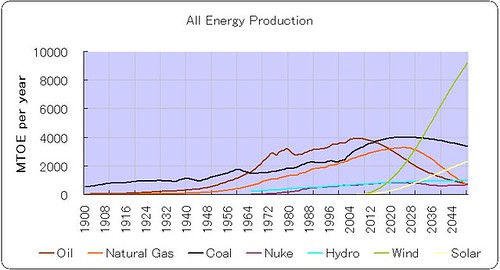
Hi Ron,
The argument and calculations there seem to me to have contradictory assumptions.
For a start, the numbers of reactors given are based on the same size as at present, whereas new reactors are heading towards the 1.6GW size, so you can immediately knock a third off of the 700 reactors they say are needed.
Secondly, they argue that because McCain favours expanding the electricity supply industry rather than conservation, this is what would happen and demand would keep right on growing.
OTOH, they indicate that costs would be vast.
If it is expensive, then use will not grow according to that pattern.
France uses around half the energy that the US does, so potentially to 'become like France' you would be talking about a much lower number of reactors.
The declaration that 4 Yucca mountains would be needed also contradicts their 'concern' that uranium will be in short supply - in practise just about everyone but the US reprocesses, which would enormously reduce the storage space needed and use fuel more efficiently.
Without going into much more efficient designs like molten salt reactors, we already know how to use thorium in reactors which is much more abundant so concerns regarding uranium supplies seem anyway misplaced.
They have also presented cost figures in a way designed 'ter make yer flesh creep' - as Robert points out in:
http://i-r-squared.blogspot.com/2008/02/running-us-on-solar-power.html
the US would pay around $6trn for oil at $100/barrel in 8 years, so the estimate they give for the vast numbers of reactors they hypothesise at $4trn becomes a lot less impressive in that light.
France anyway is part of a much larger European grid, which means that it is OK for them to have a very high penetration of nuclear as they can sell the surplus when demand is low.
It would not make sense for the US to build what is basically a base-load system to that scale, so let's assume that they build nuclear power to cope with the average load, which is around 460GW.
With modern reactors that is around 300 reactors, over 30 years ( coal burn is not going to stop anytime soon ) that would need 10 reactors per year for 30 years, about the same as the Chinese plan to be able to build by 2020.
Cost, using their figures of $6watt, would be around $100bn a year, or about $300 per person.
So what would you do for peaking power?
Basically, use solar where it is appropriate and does not require vast over-build or storage to make up for it's intermittency.
Taking Nanosolar's ideas for building plants at small scale so as to avoid the need for transformers or long distance transmission lines, but largely avoiding roof-top construction to hold down costs the costs should be reasonable:
http://www.nanosolar.com/blog3/2008/04/16/municipal-solar-power-plants/
Nanosolar Blog » Municipal Solar Power Plants
Since you are not having to worry about base-load power the area needed is fairly small, at a 15% efficiency about 15sq/km/GW, and because you are building it in small units where it is needed you don't need to allow much additional space between the mirrors and so on, so you could get 1,000GW in 15,000 sq km, a square of roughly 120km on a side.
What about large power needs after the sun is down, say on hot days later at night?
Storage and back up would help there, but the point is that the costs would still be reasonable, as you would not need one for one back up, but a much smaller reservoir.
You would still need to substitute for NG and so on, but I will not attempt precise calculations for a couple of reasons:
Mainly due to my unfamiliarity with the exact patterns of energy use in the US, but also because there will be a long run-in to substitute for NG which is not going to run out anytime soon, but also because higher prices will enforce conservation and because technologies are changing rapidly.
I have given around 500GW of 'wriggle room' anyway in my calculation of the areas needed to provide peaking power, and also my nuclear figures are for average consumption, so over-supply base-load.
Two areas of supply I have not addressed at all, wind power, which in much of the States is a fine resource, and PV power on individual roof-tops, which is now approaching some kind of reasonable cost.
A large number of EV cars would in itself provide a lot of back-up storage for intermittent energy sources, given a proper metering and charging system.
In colder areas the balance would change somewhat, as the winter would peak a lot more, so for those areas just as in Europe a higher proportion of nuclear power would be sensible, and transmission of power between these areas and warmer regions would appear to make sense, together with wind power and biogas.
In practise though in those areas coal burn would probably carry on longer than in other areas, so some time could be taken to address the issue.
To sum up, after an admittedly rough transition, there seems no reason why the US could not produce all the power it needs, but the cost will be higher than very cheap FF, running at around $6-8 watt, but the higher costs and in many cases greater efficiency of using electricity, for instance in cars, means that not all current energy sources need replacing one for one, holding the cost down somewhat.
All you need to do is use resources where they are most suited, nuclear for base-load and mainly solar for peaking, and not try to use them inappropriately by massively over-building solar to provide base load with storage or nuclear to provide peak load.
A couple of other figures that may interest you, Ron:
The average size of a US house is now 2349sq feet:
http://www.oasisdesign.net/faq/green4000ft2home.htm
If we make the very conservative assumption that all of these are two-story, we have over 100sq meters to play with - which checks well with the average for the UK, which is 48 sq meters with a lot of our housing being small and densely packed.
You can get around 60% of the maximum power from a solar PV array even in a poor orientation, but let's ignore that, so if we take 50sq meters as being the average south-facing area and assume an efficiency of 15% you would generate peak 7.5kw of power per hour.
IOW there is plenty of space just on America's rooftops to provide peak power, which could be stretched by other non-residential solar thermal arrays which is much more storable.
If charging points are provided at work then a lot of this power can go to powering cars, with plenty left over for air-conditioning.
This does not mean that every roof everywhere will be covered in all suitable areas with PV panels, but does indicate that with the proper balance between nuclear for base-load power, utility or municipal scale solar thermal, and PV panels could provide ample power without covering unreasonable areas of ground with arrays.
Hot water can also be supplied very economically by using part of the roof area for residential solar thermal.
Costs for PV are reducing rapidly, and should drop further with better supplies of silicon.
The comments here are a window into other's thinking...
http://www.techdirt.com/articles/20080502/0326021008.shtml#comments
No, what you really want are the really old pumps with the graduated clear glass top and a hand crank. The math was done by hand. Those will work regardless of price, and regardless of whether or not the grid is up. Of course, they DO assume an attendant that knows how to add. . .
Of course, they DO assume an attendant that knows how to add. . .
Who needs to add? Solar powered calculators bay-bee! Addition in the House!
I don't know if it has been discussed in previous Drumbeats. The ASPO just released their last newsletter (#89):
http://www.aspo-ireland.org/index.cfm/page/newsletter
They heavily revised their model and they now see a peak for crude oil + NGL (what they call "All Liquids") in 2007.It's a big revision compared to their forecasts from last year but they are basically back to their initial 2003 forecasts (~#40):
There was a little discussion at the end of Saturday's DrumBeat.
If anyone is "in" with ASPO, tell them their PDF is screwed up. It seems to be missing pages.
And as you said Saturday, this is the first time they actually moved the date of PO into the rear view mirror, after having been ridiculed by CERA et al because they always seemed to postpone the date.
Looking at the graph they seem to anticipate a plateau till 2010 then a gentle decline is seen beginning.
Other bad news for consumers sitting at the wrong end of the pipeline : Oil future for front month contract on WTI has hit 120$, despite a rising dollar (!!!). Europe is now going to get hit hard, this puts the barrel of WTI crude at 78 Euros (absolute record AFAIK). In my region, the most expensive 98 octane gasoline is 1.68 euros per litre and the cheapest diesel is 1.30 euros per litre.
It seems that we have already passed the peak and will soon be facing a decline in world production.
Flat or declining world production means that the only way to satisfy increasing demand in the developing world is by reducing consumption in the developed world. And the BRIC countries now have the financial clout to outbid the west for tanker cargos.
Faced with the impending emergency, McCain is proposing the pure techno-fantasy of 700 new reactors while Hilary wants to sue OPEC!
This would all be funny if it weren't so serious.
And that jingle keeps playing in my mind: "Sooner or later, you'll have Generals"
LOL
McCain will be sooner, Hillary will be later - Obama, I don't know.
Anyway, the Generals should help answer the question:
"Just how high can oil prices go, anyway?"
Happy elections !
anyhow .....700 Nukes ! couldn't he at least have stoped at 500 ? And regarding that NOPEC law, is that really in place ?
Khebab, nitpicking but...
when I check newsletter #87 http://www.aspo-ireland.org/contentFiles/newsletterPDFs/newsletter87_200...
the value for 2010 is 88 mb/d and for 2020 is 70 mb/d. Eyeballing your chart I can't see this revision. I think a substantial revision occurred in March 2008 and this has been further revised
My chart does not show all the revisions just some of them but it could be interesting to complete it.
I dropped Dr. Campbell a note earlier today about the incomplete May PDF, and had a few questions of my own...
I saw item 1040 about the increase of the Deepwater category from 68 in the April newsletter, to 85 Gb, and comparing the two models I noted the rather sharp changes in the projected annual production rates. But I didn't really understand how the production rates for 2010-2030 could all be cut several Gb from the previous figures, while increasing the ultimate total. Anybody get that?
Similarly, I noted that the total for the Gas Liquid category had been cut to 203 Gb from 261, yet the production rates had increased across the board from 2010-2030. I am hoping for a clarification on this point as well.
Finally, of those two category revisions, I have to wonder which is most responsible for advancing the peak date from 2010 to 2007?
I agree, their updates are puzzling, I wish they could make their model public.
A nice story in this weekends print version of the Financial Times:
I saw that. I didn't post it because it was behind a paywall.
But there's a shorter version of the article here.
This is something I don't understand. The price of petrol, diesel, kerosene and LPG cylinders in India is fixed by the government. It has gone up during the last 2 years, but in very small increments. So why is the cost of gas-guzzling tractors soaring?
The reporter was writing to the meme instead of reporting the news?
About 25 years ago I met an old man who had in his younger years had plowed with a mule. It was fueled with alfalfa, clover, or even switch grass.
If one has to choose between freezing to death or burning coal to cause global warming, one will choose burning coal everytime. Only the rich can afford to blow up hydroelectric dams in order to try to improve their sports fishing habitats. Lake trout or salmon were as good as any.
Hello Rainsong,
Your Quote: "Only the rich can afford to blow up hydroelectric dams in order to try to improve their sports fishing habitats."
Or the rich can just ignore their sport fishing dam's condition until it washes away. This is what caused the Johnstown's Flood:
http://www.jaha.org/FloodMuseum/history.html
---------------------
...The South Fork dam held back Lake Conemaugh, the pleasure lake of the South Fork Fishing and Hunting Club, a prestigious club which included such famed entrepreneurs as Andrew Carnegie and Henry Clay Frick on its membership rolls.
--------------------
Bob Shaw in Phx,Az Are Humans Smarter than Yeast?
Some evidence of the process of hydroelectric dam removal:
http://www.nrcs.usda.gov/NEWS/thisweek/2006/091306/sandydam.html
Hydroelectric power at Niagra was used to help the early aluminum industry in the United States. They wanted to take the hydroelectric dams and give us switchgrass policy instead. It is a mad, mad world.
One problem with dam removal is the re-release of toxic sediments that had been contained in the bottom of the impoundment. This is seen in west, where heavy metals associated with mining activities in the watershed must be dealt with. The Milltown dam removal outside of Missoula, MT faced this. Today, the sediments of Lake Roosevelt behind Grand Coulee Dam on the Columbia are filled with heavy metals. It is a big bone of contention between the US and Canada, believed source of much of the problem. This spring, WA State Dept F & G added two more Roosevelt fish species to the Do Not Consume list.
Nice Hubbert pic, I printed it out, it's going up on the wall somewhere.
But...Hubbert's Pimple??? Hmmm.... (Sshhhhh...let's not mention it again...)
The Oil Drum is now on Twitter: http://twitter.com/theoildrum
Give the feed a follow if you are on there.
ROFLMAO! That just made my day.
Notice that he's not asking his god to strengthen him so he can bear the tribulations of high oil prices. Methinks Christianity has changed over the years. :)
The rise of a new Cargo Cult? Will gas pumps become the same as easter Island's Carved Icons?
I have proof that the Lord is not going to help us. He created the Earth in 7 days and we all know oil takes millions of years to form. So therefore it was floating around in space waiting for a planet to bump into.
Marco.
Instead of this at the pump prayer every few weeks, why not take a serious deep and well-plannede prayer at the casino next time .... and do they actually have to stand nearby the scope of the prayer (petrol pump) "to make it work " , isn't that more like Voodoo ?
120 hit
http://biz.yahoo.com/ap/080505/oil_prices.html
Ok well not really but it is Cinco De Mayo and it is the day I figured it would be kinda creepy :/
NEW YORK - Oil futures surged to a new record over $120 a barrel Monday as supply threats emerged overseas and the dollar weakened against the euro.
" Retail gas prices, meanwhile, fell more than a cent over the weekend, offering further evidence that prices may have peaked for the year. "
How do they figure that gas prices may have peaked for the year ?
The MSM hasn't a clue as to why oil prices have gone up. They have a set of stock responses they pull out. However, the dollar is stronger vs. the Euro then it was when oil was cheaper, so the "weak dollar" argument is silly. As for the Nigerian rebels, they've been causing problems for months. Has there been an escalation that warrants a big jump in oil prices? It doesn't seem so to me.
To the MSM it is anything but the ability to grow supply. Anything.
I think the real reason is the good economic news. The consensus now seems to be that we'll avoid recession, or it will be short and shallow. The world's biggest oil consumer is going to keep consuming.
Perhaps my all-time favorite post on TOD (I have long-since forgotten the author), apropos the $120 ceiling being passed:
"Damn. I just blinged up the Tahoe, and now this?"
Man won't marry woman who won't drive
They broke up. Abby's advice? Get counseling and learn to drive.
What is your point then? That women should not drive?
I wholeheartedly agree:-)
Quite the opposite. You're at a huge disadvantage if you don't drive in our culture. Even people who shouldn't drive feel they have to.
I think we know how that is all going to end. I was just teasing though!
I think that woman is setting herself up for a very unhappy marriage. She should run screaming from that marriage and find herself a better husband. Or stay single (speaking of things that are considered unacceptable in our society).
Another thing this woman could do is move to another country. Because the US has about 770 cars per capita (#1 in the world) but other countries have fewer. WHY? One reason is that in other countries much of the infrastructure predates cars, of course there are other reasons too. It's MUCH easier to be a non-driver in another country. I don't drive and won't drive (except my trusty bicycle) and so I won't and don't live in the US. It is that simple.
"the US has about 770 cars per capita"
WTF? Look. the US is all f***ed up in any number of ways, but come on! Try to make sense. 770 cars per capita? How do you figure?
Sorry sorry!!! I meant 770 cars per thousand people, effectively one per adult. (I was temporarily distracted by someone here and couldn't think plus talk.) In other countries, it's lower, So, to prepare for a lower amount of oil consumption, all you have to do is leave the US. Yes, all over the world people are living quite nicely on half the oil, or a fourth of the oil, you consume in the States. They don't have a big house, they don't have a car, they don't have a big refrigerator or even much food to put into it. But they can get around.
Dick Cheney presumed to speak for the American people when he said "the Ameican way of life is not negotiable" but it would have been a lot better for him to rethink the assumptions that underlie his braggadocio (sp?)
In a lower thread, people aretalking about how teenagers in the US don't acre about driving. In my view this is a very healthy development. They see that the marginal benefits of driving are few---lots of wasted time and money. They are waiting to see what comes next instead of investing in something that will prevent them from spending money on things they need more.
In the US not driving often makes you a housebound invalid. It's like that 5 months of the year where I'm living now - I don't have the cash flow to have a car, and I'm very lucky to have my small motorcycle. For five months of the year there's no business, to generate income to keep gas in that, and it's too cold to ride anyway. Jim Kunstler has written about this though, that in a lot of places in the US you can't walk anywhere, it's not safe at all. Everyone drives. And the elderly, when they can't drive, become housebound and very socially isolated.
I'm young and healthy and still full of spunk, and moxie, and all that, and I feel that effect quite strongly out here in the Outer Exurban Asteroid Belt.
It's funny, I have a 17 year old half-brother who lives in a rural area and has absolutely no desire to drive even though it would be a huge help to him and the rest of the family. He's driven 30mins to school every day and to friends' houses and the like and complains endlessly about a lack of independence, but won't get his license. He's also got two younger siblings who need to be ferried around and to make matters worse my father is no longer able to drive, dropping the number of eligible drivers to one... with two cars in the household!
We've all sat him down and pleaded with him, but he just won't do it and as far as I can tell his opposition isn't ideological or anything, he just doesn't want to drive.
I hate driving, but sometimes I just want to wring his neck. Thankfully the next one in line (15) is more receptive.
Let him earn money so as to buy himself a bicycle. Then he can travel and not be such a burden. I bet after a few days of riding he will want to get the driver's license asap. John
Of course, he might end up being like me, and decide that he rather prefers cycling. That's ok too.
I too prefer cycling, my (other) parents think I'm insane because I won't buy their old car from them, but I'd much rather spend the money on other things because it makes no sense for me to pay the operating expenses on a car I'd drive, at most, 2500kms a year.
Were he to bike it would take him about an hour to get to school so it's not too practical. Although he could sure as hell use the exercise, as Leanan mentioned below, he's quite "indoor-oriented."
Sadly, bicycling here is very dangerous. There is no bike lane to speak of, and on most roads there's mere inches between the "fog line" (that white line you follow to keep from running into a ditch or through a gate at night) and the edge of the pavement. Very very narrow and this is huge SUV and pickup truck territory, and the drivers generally can't see, nor do they want to see, anything other than other huge SUVs and pickup trucks.
For putting around the older part of town, a bicycle is great, but frankly I like my own two feet - being in the urban environment of downtown is my one chance to get some walking in.
Your brother is not unusual. Apparently, a lot of teens these days don't care to learn to drive. It's quite a striking trend. (I posted an article about it a few months ago, but I can't find it now.)
Among the reasons: parents are willing to drive the kids everywhere, so they feel no need to drive. And kids these days are more "indoor" oriented. They'd rather play video games and text-message their friends than actually see them in person.
So what? No one can say NO to the little Bastard? Get some backbone, stop whining, show some Parental Authority and stop hauling them around. Let them walk...they can walk right? Not handicapped or anything?
A perfect example of the failure of Parental responsibility. Jeeesh...You'll not survive the Peak oil mess.
BZ
Wow you're a prick!
Actually, he is presenting quite a realistic attitude.
I'd personally get him to school, but rides to friend's houses? Pipe dreams are under the bed, this here is the nightmare closet.
The final indignity, after you have gotten old and lost your marbles, is to lose your drivers' license.
Driving defines our culture. That is about to change. People are born with legs, not wheels.
We went through this when my father (86 at the time) lost his license. It was a huge blow to him.
I also have experienced the other end of the spectrum being discussed here. My 16 year old has his license, but a surprising number of his friends do not. I think this is a good thing, but it also scares me in that I realize I am of a different era. I can't imagine not wanting to drive.
I think the good of it is that the teens in this area learn to like to use public transportation and bicycles, which ultimately will end up being important components in their transportation life, no matter where they live.
People are born with legs, not wheels.
Legs will be of little help with this one. It does vary, but by the time one loses or gives up that license, one is oftentimes in no condition, physically or mentally or perhaps both, to walk much of anywhere either. This is simply new ground: abundant fossil fuels and modern medicine more or less coincide, so "we" have little social experience combining serious energy scarcity with an enormous number of older people so frail that they cannot safely propel themselves more than a few dozen meters, if that. Then consider, too, that "walkable" areas tend to be somewhat dangerous, so that a person who can get around safely but slowly may in effect be wearing a target saying "mug me."
Hello TODers,
Through my many sulphur and NPK postings, I have tried to cover the major topics like in this following $4,000 report:
http://www.marketwire.com/mw/release.do?id=851948
-------------------------
Key Challenges and Issues Facing the World Sulfur Markets
-------------------------
Of course, I try to analyze from a Peak-Perspective. I would like to thank all that responded to my efforts, especially TODer Metalman, who generously provided his expertise in areas beyond my understanding.
Bob Shaw in Phx,Az Are Humans Smarter than Yeast?
You're most welcome, but I still have an awful lot to learn about fertilizer. You're "fertilizerman" to me.
Hello TODers,
http://www.theledger.com/article/20080502/NEWS/805020410/1004
-----------------------
Senate OKs Higher Tax on Closing Mines
..Mulberry Phosphates, the company that operated both sites, declared bankruptcy and abandoned the plants and their gypsum stacks in 2001, forcing the state to take over the plants temporarily to avoid a potential environmental catastrophe.
In 1997, a dam at one of two gypsum stacks at Mulberry Phosphates broke, sending 56 million gallons of acidic waste water into the Alafia River, killing aquatic life from Mulberry to Tampa Bay.
-----------------------
The photo shows the giant size of these gypsum piles, and if you look closely at the background: another huge pile can be seen in the distance.
IMO, just another example of how corps internalize profits and socialize the costs of their waste.
Bob Shaw in Phx,Az Are Humans Smarter than Yeast?
Hello TODers,
http://seekingalpha.com/article/75600-buying-fertilizer-stocks-in-lieu-o...
--------------------------
Buying Fertilizer Stocks In Lieu of Camel Futures
...As the cost of running gas-guzzling tractors soars, even-toed ungulates are making a comeback, raising hopes that a fall in the population of the desert state’s signature animal can be reversed.
“It’s excellent for the camel population if the price of oil continues to go up because demand for camels will also go up,” says Ilse Köhler-Rollefson of the League for Pastoral Peoples and Endogenous Livestock Development. “Two years ago, a camel cost little more than a goat, which is nothing. The price has since trebled.”
-------------------
I got a kick out of this link when I think back to my prior postings of advocating a large postPeak camel herd for the 'Murkan Southwest. To refresh your memory:
http://www.outwestnewspaper.com/camels.html
When Climate Change really kicks in: we will eventually need them to move trading goods, like I-NPK, across the endless miles of sand dunes and parched scrublands, from one small desert oasis to the next oasis, if we haven't built out some measure of Alan Drake's ideas and SpiderWebRiding.
Bob Shaw in Phx,Az Are Humans Smarter than Yeast?
Hello TODers,
http://www.abs-cbnnews.com/storypage.aspx?StoryId=117247
---------------------
..ABS-CBN’s Middle East News Bureau reported that rice prices in Saudi Arabia have risen more than 70 percent in the last five months.
----------------------
Although this article is mostly about the rice-price impact on Filipino workers in KSA, I wonder how this affects the average Saudi. Is rice a major part of their diet, or are wheat imports the dominant food driver? Could this be a potential political flashpoint for revolt in KSA?
Bob Shaw in Phx,Az Are Humans Smarter than Yeast?
Bob,
from reading Thesiger's "Arabian Sands" and T.E. Lawrence's "Seven Pillars of Wisdom" - and a quick look at modern Saudi dishes - rice has been and remains one of the big staples of Arabian diets - even prior to oil, feasts were usually whole lambs served on huge platters of rice
so I'd guess it's pretty important....
Hello MacDuff,
Thxs for responding with the info. So has KSA nearly always imported rice? Somehow I just can't picture rice paddies in the land of towering sand dunes.
Since SA has always sat on some of the east-west trade routes - and since the foundation of Islam SA has been the destination for all Muslims to go on pilgrimage - my guess is they have imported from the not too distant Indian subcontinent - pilgrim ships could bring rice as well as people
my understanding is trade between Arabia and India has a very ancient basis
Bush: No quick fix for gas prices
Sounded kinda promising, until I got to this part:
Huh? If we're diversifying away from oil, why bother building new refineries? And how does increasing the supply of oil for American consumers square with diversifying away from it?
And of course, ever Dubya's ultimate answer to every problem:
C'mon, George. You're a lame duck. You'll never face the voters again. You of all politicians can tell the truth now.
Research has led to the discovery of the heaviest element yet known to science. The new element, Governmentium (Gv), has one neutron, 25 assistant neutrons, 88 deputy neutrons, and 198 assistant deputy neutrons, giving it an atomic mass of 312.
These 312 particles are held together by forces called morons, which are surrounded by vast quantities of lepton-like particles called peons. Since Governmentium has no electrons, it is inert; however, it can be detected because it impedes every reaction with which it comes into contact. A minute amount of Governmentium can cause a reaction that would normally take less than a second to take from four days to four years to complete.
Governmentium has a normal half-life of 2- 6 years; it does not decay, but instead undergoes a reorganization in which a portion of the assistant neutrons and deputy neutrons exchange places. In fact, Governmentium's mass will actually increase over time, since each reorganization will cause more morons to become neutrons, forming isodopes. This characteristic of moron promotion leads some scientists to believe that Governmentium is formed whenever morons reach a critical concentration. This hypothetical quantity is referred to as critical morass.
When catalyzed with money, Governmentium becomes Administratium, an element that radiates just as much energy as Governmentium since it has half as many peons but twice as many morons.
Over the past 20 years or so, Governmentium has irrevocably bonded with Corporatium to form an even heavier element that sucks the life-blood from all surrounding life sources in order to perpetuate its existence. Some have called this new bonded element - "Fascititanium."
This is the U.S. Governmentium closed system isn't it? Other elements aren't quite structured this way, where the 2nd Law, enacted by a legion of shyster lawyers, dictates that everything that happens increases chaos and disorder.
Re: And how does increasing the supply of oil for American consumers square with diversifying away from it?
You do realize that he has absolutely no clue what he's talking about.
Sub caption: "Here's looking at you kid, err ... I mean Mr. Putin."
Assuming he knows the truth. I think Bush has been letting on more recently about the situation. Still for me...it is hard to know where exactly we are in the PO timeline. I think 2030 is probably the most agreed upon date right now. I thnk even the EIA has that date as their projection. Wouldn't it be nice to have accurate data worldwide. I like the ELM model as the best measuring stick.
Peak Oil. I think the recent history shows us on a plateau. So..no, not collapse. You been studying that aspect? Got any dates for us ? ;-)
Sad that I agree with you. Sucks to have kids now.
Hello TODers,
http://morningsentinel.mainetoday.com/news/local/4968185.html
------------------------------
With start of gardening season, seed suppliers see growth in demand
...The last time Fedco Co-op Garden Supplies saw such a spike in demand for seeds was in 1999, when survivalists tried to buy up inventory believing that seeds would become the post-apocalyptic currency if things didn't go well on Jan, 1, 2000.
...This year's run on seeds stems from less dramatic, but still sobering, sources. Increasing prices for food and fuel have inspired more people with access to land to begin planting their own gardens in hopes of saving money, seed sellers say.
---------------------------------
I think it would be interesting to see if retail I/O-NPK sales are spiking upwards at the local garden outlets and bigbox chains like Home Depot, Wal-Mart, and Lowes. But specifics are hard to google up, at least for me.
I also keep googling on wheelbarrow sales, which I expect to be a leading indicator of this gardening trend, but I haven't yet found any detailed info. Any ideas would be welcome from the much-admired TOD data-freaks.
Bob Shaw in Phx,Az Are Humans Smarter than Yeast?
In edits done today at Wikipedia:
http://en.wikipedia.org/wiki/Oil_price_increases_since_2003
World down 15% since May 2007 doesn't sound right. Can someone hazard a guess at what they actually mean. Is 1.5% even right?
15% is quite obviously wrong. However 1.5% may be correct as that would represent just under 1.1 million barrels per day of C+C below May of 07. However that would be a dramatic development if correct. Not the fact that it is down that much but that it was so unexpected. We just hit a new record high in January. If the figure of 1.5 percent below May of 2007 is correct then we would be 2.6 mb/d below January of 2008. That just don't sound right. But if it is correct then the crap is about to hit the fan.
Ron Patterson
Something else doesn't sound right either...
"May 2007 while demand increased by 20% in the same period (mostly in China and India"
20% increase in demand in one year...compounded that would be a doubling in oil consumption every three years... so we would be doing what, 170 million barrels per day by the end of Hillery Clinton's first term...:-) yeah, that means peak is absolutely here!
RC
Hello TODers,
Is this company perfectly postPeak positioned WTSHTF? How insightful is this strategy? Sell I-NPK, make big profits, but if the poor cannot afford your fertilizer, then start getting 'incited' to go nuts: then this corp. can quickly 'pivot' their product lineup for quick demand destruction and a continued profit stream:
http://www.theaustralian.news.com.au/story/0,25197,23651199-16941,00.html
--------------------------
Winners and losers sprout forth
Incitec Pivot shareholders won't be the only ones smiling as a result of the fertiliser group's bumper first half-year result -- a by-product is that it also improves the takeover offer for Dyno Nobel. Shareholders of Orica, on the other hand, may well be unhappy.
...Incitec's bid for Dyno, the world's second-largest explosives maker, is designed to reduce the cyclicality of the company's earnings. At the same time, it will give the company a global platform for expansion, both in terms of geography and product. And because Incitec is a significant producer of ammonium nitrate -- used to make both explosives and fertiliser -- it will also produce significant synergy benefits.
-----------------------------------
It sure would be fun to see a company PR-spokesperson trying to fully explain this postPeak 'synergy' without somehow alluding to the violent death of someone.
Recall my earlier speculation that the coming NPK-Wars will make the previous Guano-Wars look like a friendly neighborhood tea-party.
IMO, the better PR-strategy is to give away lots of wheelbarrows to offset, as much as possible, our machete' moshpit genetic tendencies.
Bob Shaw in Phx,Az Are Humans Smarter than Yeast?
Don't worry-Hillary is going to crush OPEC using anti-trust law (once she is elected Emperor of the Universe). Plenty of oil if those Ay-rabs would get off their butts and start pumping http://www.politico.com/blogs/bensmith/0508/Clinton_OPEC_can_no_longer_b...
LOL
Maybe Hillarity can file a second antitrust law suit against planet Earth for monopolistic practices and conduct unbecoming one who is stuck between Mars and Venus? How about a cause of action under the UnAmerican Activities Act (a.k.a. Patriot Act) for refusing Federal official requests to cough up more oil from the creamy nougat center? Surely there is a legal violation in that.
When the phone rings at 3am it's usually a call back from Hillary's psychiatrist ... assuring Hillary that Bill is not there, at the psychiatrist's office.
Thanks for the midnight chuckle.
For those interested, in addition to some stories not posted today here in Drumbeat there's a small format change at
http://www.energyshortage.org
I'm providing some very brief summaries and English teaser translations for the foreign language items. If you have the time, it would be great to get some feedback on whether or not readers find these changes useful. There's a poll that you can vote on if you'd like.
Thanks very much!
thanks PigglyWiggly, your format change is appresiated. I am zapping through your site every few days and those changes make it even more worthwhile !
http://www.bloomberg.com/apps/news?pid=20601072&sid=arAVpMqtGh4E&refer=e...
Over 800,000 barrels of oil production shut due to a strike in Nigeria is scheduled to resume.
WSJ Online just posted a new article by Neil King, Jr.
Tracking Saudi Oil From Space
The article goes on to discuss the Sanford Bernstein satellite study of Ghawar. The author also gives JoulesBurn a plug in the last two paragraphs:
My understanding from 'Twilight in the Desert' by Simmons, is; Saudia Arabia must have 10-20 mbd sparce capacity to supply the world with enough oil to meeet demand for the next 20-30 years. They are in fact the only country with the possibility of that much spare capacity based on their controversial reserve estimates. So whether or not they are in fact reaching peak, which is of great academic interest, by not having a huge spare capacity means supply will not be meet demand. And the price of oil remaining steady at $120 a barrel seems to support the fact that we have past the initial point of peak plateau. We have been, since May 05, in what Kunstler referred to in his book 'The Long Emergency'. Long, because it doesn't happen over night, but once started it will have certain unavoidable consequences due to a lack of a plan B.
As the price increases, downward pressure is added to the world economy. My question is: What is the price at which there is so much downward pressure that the world economy stalls. Shipping goods overseas becomes too marginal to be profitable. Trucking those goods from the ports eliminates any profit from the undertaking. At what price does the cost of energy cancel out profit? When it does there is no economy because there is no profit in pursuing an economic gain that cannot be achieved. What is the price of oil when that occurs?
As much as people on these boards are familiar with all the aspects of peak oil, they always avoid that question. It's as if it would require too much recognition of the consequences of peak oil to venture a guess.
Why not take the percentage of GDP that energy took in the '70s as a baseline? At that point, the economy was in rough shape. The Christian Science Monitor claimed that $100 oil (2006 dollars) was about 14% of the economy, but that $78 oil (2006 dollars) was only 7% of the economy.
http://www.csmonitor.com/2006/0717/p01s01-usec.html
Then, one might expect 70's level problems once we reached about $170/barrel (in 2006 dollars), or maybe at $200/barrel (just a guess) in 2008 dollars.
Given a 30% per year increase (based on a factor of 10 increase from 1998 to now), we might expect that level to be reached about two years from now.
Naive guess: $200/barrel oil before 2010 causes new depression.
JoulesBurn has a response he wrote back in January here. He will probably be doing a key post on it here at TOD soon. (If the WSJ follows its usual pattern, the article will be out from behind the paywall tomorrow.)
a lot of the "debate" revolves around subsidence. and what we have here is a failure to understand what the hell they are talking about. this was thourghly discussed here on tod a few days ? weeks ? ago.
the bottom line is the are trying to extract information that is just not extractable.
That's better!
You only normally put things that you are quoting in blockquotes, surprisingly enough though.
I'm not sure why you seem to dislike capital letters.
It is now readable, but would be better if you created it in a program like word where spelling and grammar mistakes would be picked up, and copied and pasted it into the reply box here.