


Peak Oil Not a Problem According to NY Times; Scientific American - Our Response on the Financial Aspects
Posted by Gail the Actuary on September 26, 2009 - 10:40am
Recently, we have had two new articles aiming to put to rest people's fears about peak oil. One is from the New York Times:
Oil Industry Sets a Brisk Pace of New Discoveries
It talks about the many discoveries this year, and how, if they continue at the pace they have in the first half, they will be the best since 2000.
The other is from the October Scientific American, called
Squeezing More Oil from the Ground.
It is behind a pay wall (you can get it for $5.95). There is also a draft version available on line. Its premise seems to be that there are a lot of promising areas that we have not yet explored. When you put this together with advances in drilling and the promises of secondary and tertiary recovery, there is a good chance that oil production will not peak for many years.
In this post, we will look a little more at these articles, and see why peak oil, and perhaps the financial issues associated with peak oil, are still an issue, regardless of what these articles may suggest.
New York Times Article
A few excerpts from Oil Industry Sets a Brisk Pace of New Discoveries
NY Times:
It is normal for companies to discover billions of barrels of new oil every year, but this year’s pace is unusually brisk. New oil discoveries have totaled about 10 billion barrels in the first half of the year, according to IHS Cambridge Energy Research Associates. If discoveries continue at that pace through year-end, they are likely to reach the highest level since 2000.
Two times 10 billion barrels of oil is 20 billion barrels of oil. Twenty billion barrels of oil divided by 365 is only 54.8 million barrels a day--not nearly enough, if we are currently using 72 million barrels of crude oil a day. If 10 billion barrels is an unusually large amount in the first half, the likelihood of having equal success in the second half by luck is not very good.
NY Times:
While recent years have featured speculation about a coming peak and subsequent decline in oil production, people in the industry say there is still plenty of oil in the ground, especially beneath the ocean floor, even if finding and extracting it is becoming harder. They say that prices and the pace of technological improvement remain the principal factors governing oil production capacity.
There are a lot of issues with difficult to extract oil beneath the ocean floor. While it is theoretically possible for the oil price to be high enough to extract this oil, there is a real issue with too high an oil price (resulting in wholesale oil costs of over 4% of GDP) causing a major recession. Currently, such an oil price is about $80 per barrel. So it is not clear that prices can go enough higher, and stay enough higher, for extraction.
The more difficult to extract oil also has severe challenges in terms of the amount of up front investment needed, and the long time delay before it will actually come to market. For the new very deep ocean "finds', it could be 10 years or more before we will actually get the oil extracted. By then, our oil needs, if economies continue to grow, will be much higher than today.
NY Times:
Since the early 1980s, discoveries have failed to keep up with the global rate of oil consumption, which last year reached 31 billion barrels of oil. Instead, companies have managed to expand production by finding new ways of getting more oil out of existing fields, or producing oil through unconventional sources, like Canada’s tar sands or heavy oil in Venezuela.
Companies haven't managed to expand production. Crude oil production has been on a plateau since 2005. That is the problem.
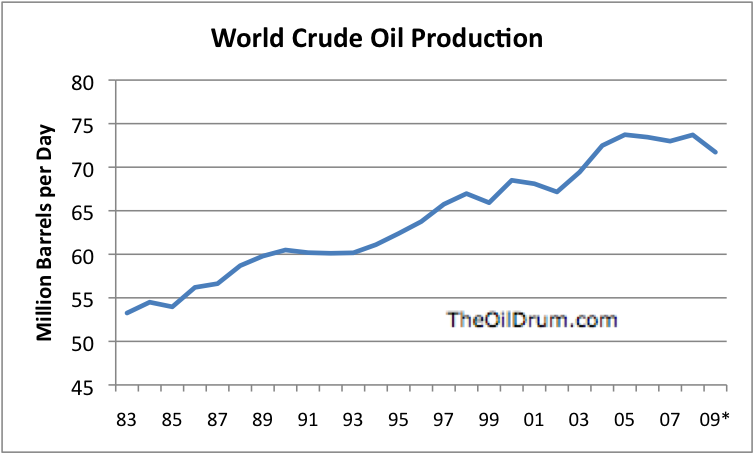
In Figure 1, note that oil production has not risen significantly since 2005. This happened, despite rising prices.
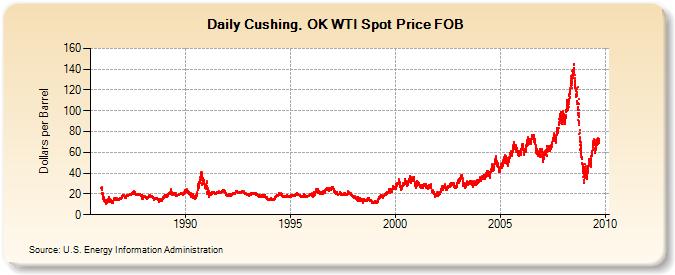
In Figure 2, note that even when oil prices rose far above their historical average price of $20 barrel in the 2003 to 2008 period, oil production in Figure 1 rose very little--virtually none after 2005. In fact, it was the lack of rise in production that was a major driver of higher prices.
When prices finally dropped, there is significant evidence that it was related to high oil prices indirectly causing problems with credit markets.
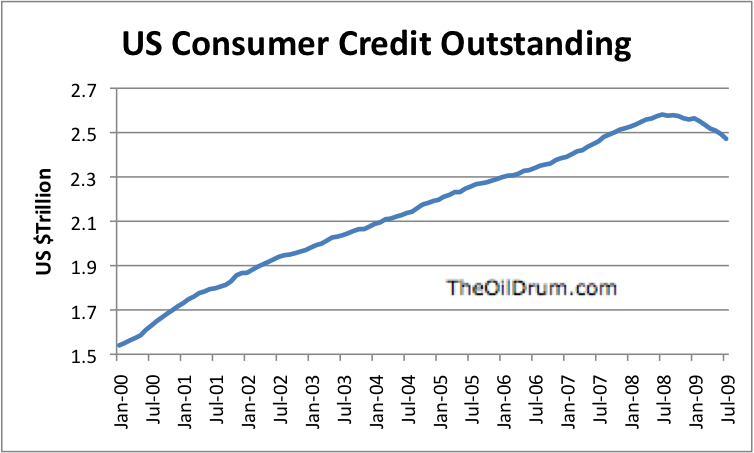
In Figure 3, note that US consumer credit reached its peak in July 2008, precisely the same month oil prices reached their peak. Once credit started contracting, purchase of goods that required oil in their manufacture (such as cars) dropped. The drop in oil price reflected the inability of purchasers to continue buying products that used oil in their manufacture. If credit had continued to expand, it is possible oil prices would have continued to rise further, but still with virtually no increase in oil supply.
NY Times:
Reserve estimates typically rise over the life of a field, which can often be productive for decades, as companies find new ways of getting more oil out of the ground.
Maybe, maybe not. We don't have very good knowledge of reserves around the world. In many places, particularly the Middle East, the reserves seem to be quite inflated. If reserve estimates are starting out from an inflated base, it is doubtful they will increase. They may still be overstated, even with huge improvements in technology.
One of the big issues is whether new technology can be implemented cheaply enough to keep the prices to a level that the consumer can afford. If new technology can only be implemented at $150 a barrel, and the economy starts crashing at $80 or $90 barrel, the new technology really may not be all that useful.
NY Times:
"The industry’s record has improved in recent years, thanks to high prices. According to Cambridge Energy Research Associates, oil companies have found more oil than they produced for the last two years through a combination of exploration and field expansions.
This comment is strange. Cambridge Energy Research Associates (CERA) is part of IHS, and IHS was quoted as saying:
In 2008, world oil reserves declined nearly 3%, primarily due to a 5.2 billion bbl decline in revisions that stemmed from reduced commodity prices.
World oil reserves (excluding oil sands) were 1,261 billion barrels at the end of 2007, according to British Petroleum. A 3% decline would amount to about 38 billion barrels--more than the 20 billion barrels hoped for this year in new discoveries.
Another question is how a 5.2 billion barrel decline (from reduced commodity prices, as stated by IHS) could cause most of this decrease, if we are talking about a $30+ billion decrease. One wonders whether the IHS statement really was intended to apply to some subset of world oil reserves. Perhaps the CERA statement should also be interpreted to apply to some subset of world reserves. It is possible the CERA statement about reserve replacement may also apply to oil and gas reserves on a combined basis, since companies generally give their oil and gas reserves on a combined "barrel of oil equivalent" basis.
These quotes regarding reserves illustrate how difficult it is to interpret statements found in newspapers about reserves. The reporters often don't understand quite what they are talking about, so the quote doesn't quite get all of the specifics needed to understand what is being described. If someone wants reserve replacement to sound favorable, he or she can often find a way to word the statement so it sounds good, whether or not the details really add up to an increase.
Price is important in all of this. If the price of oil isn't high enough, reserves may not be developed. But if the price of oil is too high, it may sink the economy, and the reserves still may not be developed.
Scientific American Article
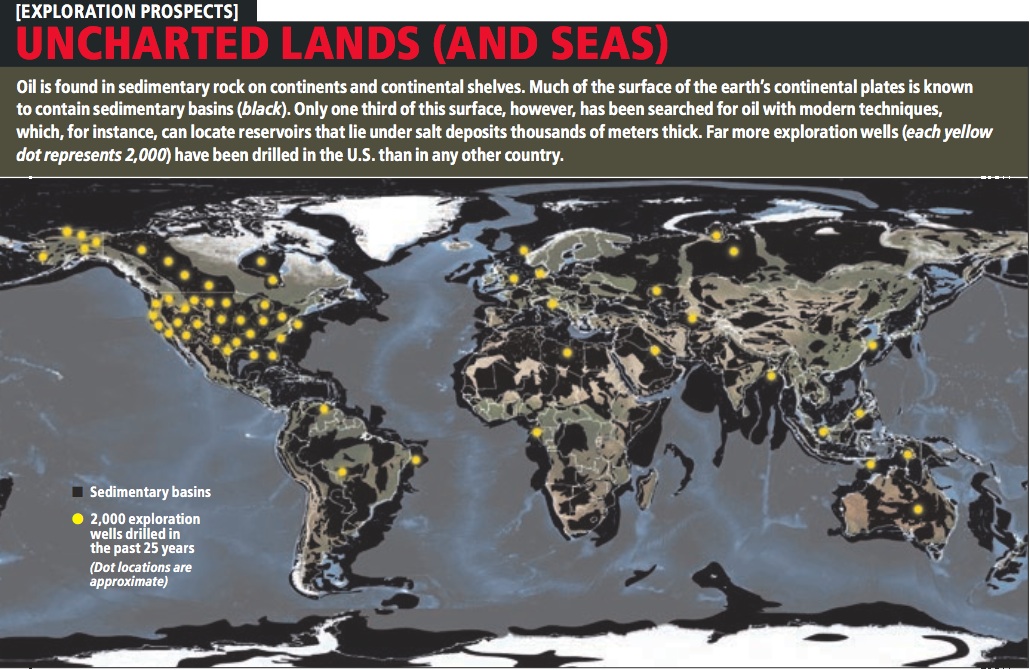
This graphic alleges that much of the world's oil deposits have not adequately been explored with modern technology. It seems to me that one doesn't really need modern technology to get at large reservoirs in easy to reach locations. It is only when one is looking for either very small deposits, or deposits in locations that are difficult to extract from that modern technology really is needed. We aren't likely to find any more Saudi Arabias, whether or not we have fancy new equipment.
The issue that arises with deposits that are in difficult to reach locations, like thousands of feet under the sea, and then under a salt dome as well, is that the oil found in those locations is almost always very expensive to extract. It is hard to believe that even with new technologies that will change--it is the location that makes oil extraction so difficult. New technology may make extraction a little easier, but it is still likely to be expensive.
Scientific American also has a graphic on tertiary recovery techniques. It says:
After primary and secondary recovery have run their course, more aggressive methods, some of them still experimental, can soften the remaining oil so it can flow toward the wells. Because these advanced methods are expensive, the battle to get more out only gets this fierce when resale prices are sufficiently high.
incendiary
Burning part of a reservoir (which requires injecting air underground) enhances the recovery rate in three ways. First, heat from the fire makes oil less viscous. Second, the combustion produces carbon dioxide, which pushes oil out. Third, the fire breaks the larger and heavier molecules of oil, making it more mobile.Chemical
Substances called surfactants, injected into a reservoir, help oil detach from the rock and flow better. Layers of surfactant engulf oil into droplets, similar to the way ordinary soap washes oily materials off a surface. A variation consists of injecting chemicals that generate the soaplike materials from components present within the oil itself.Biological
Experiments are testing the injection of bacteria (together with nutrients and, in some cases, oxygen) that grow in the interface between the oil and the rock, helping to release the oil. The bacteria are allowed to grow for several days before recovery resumes. In the future, genetically engineered microorganisms could partially digest the most viscous oil and thin it out.
Here again, the issue is price. Can these techniques be implemented cheaply enough that they can be used without raising the price of oil so high that the price is beyond what consumers can afford?
More on the Financial Issues Involved
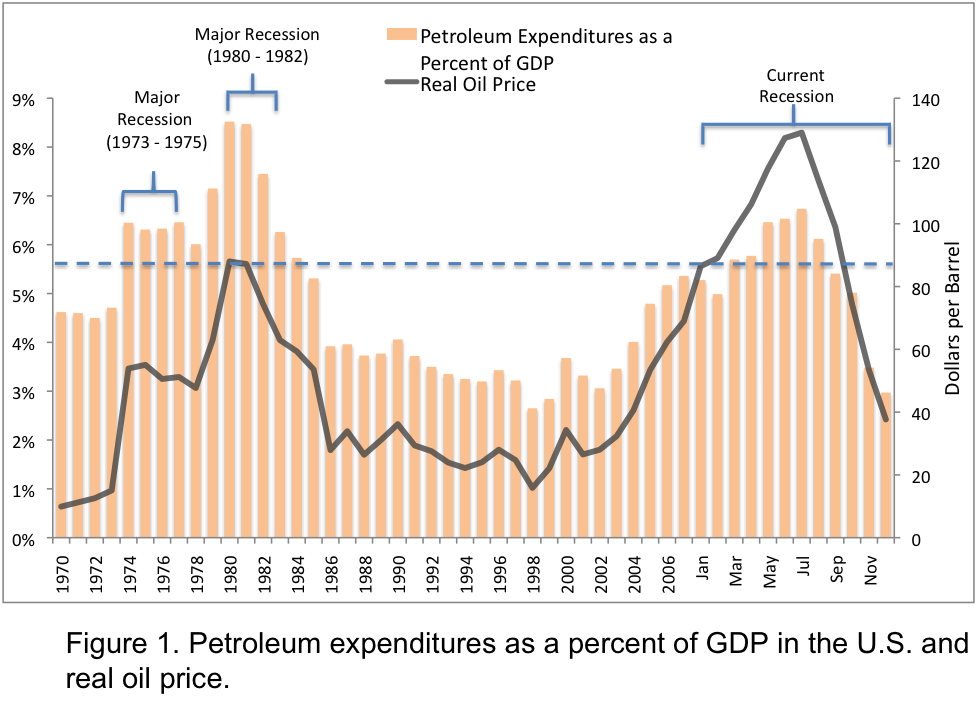
Dave Murphy showed a graphic earlier this year that illustrated the relationship between oil prices and recession. In this graphic, Dave uses retail prices to determine his percentage of GDP. The threshold for retail oil prices seems to be about 5.5% of GDP (equivalent to 4% wholesale). The dollar per barrel cut off for causing a recession seems to be in the $80 to $90 barrel range.
It will be hard to maintain an oil price at a level that sends the US (and the world) into recession. While we usually think of oil production as being limited by geology, it seems to me that the weak link is really finances. What tends to happen is that when the price of oil gets very high, people change their purchasing patterns. People continue to buy oil products, because they need transportation to work. People also continue to buy food, and it also is a heavy user of oil. What people cut back on is expenses that can be deferred--buying a new larger house, buying a new car, going to a restaurant, contributions to charities.
This cutback in expenditures causes recessionary impacts. As things get worse, some debt holders start defaulting on their debt. This might be restaurant owners who have less business, and because of this can't pay their debt. It might be homeowners with long commutes, who cannot pay both their mortgage payments and the cost of gasoline for their long commutes. It might be governments who cannot collect enough taxes, because of dropping demand (and lower prices) for houses in their suburb. It might be a charity with lower contributions.
Eventually, the debt defaults result in a cut-back in credit like we saw in Figure 3, because of the adverse impact of the debt defaults on lenders. Once there is a cutback in credit, consumers are no longer able to purchase as many cars and other durable goods. These durable goods require oil in their manufacture. With fewer purchases of goods using oil in their manufacture, the demand for oil drops. Because of the drop in demand for oil, oil prices drop again, allowing the economy to recover a bit, as it is doing now.
But as the economy recovers, demand begins to grow again. With the rise in demand, oil prices are likely to rise again to a level where they have an adverse impact on the economy. The world economic system was damaged pretty badly with the last price spike. Another spike could have much more adverse results. Eventually, the world economy may become so damaged by oil price spikes that recovery of the world economy in the form we now know it may not be possible.
I don't know how this will work out. There could be huge international defaults. The result might be each country more on its own, with much less international trade, because countries would no longer trust each other for credit. Globalization could start unwinding.
How soon such a scenario would might occur is not certain, but it seems to me that a scenario like this, rather than the amount of reserves in the ground, is likely to determine how much oil is ultimately produced. Some countries may be able to keep up production for a while, even with a world financial crisis, but eventually oil producing companies are likely to run into barriers--parts they need for equipment that they cannot obtain, or lack of trained people to perform needed services (because such services were formerly done by an international trade partner).
It would be nice if there were a guarantee that came with oil reserves as currently reported that we really will be able to extract the oil that they represent. It seems to me this will be the case:
(1) If the world economy stays together,
(2) If the price of oil stays in a zone that is neither too high to crush the economy, nor too low to discourage the expensive investment needed for getting the oil out, and
(3) If there are enough investment dollars available, for the sizable front end investment required to produce the oil.
Those are three pretty big "if"s. Without them, it seems like oil production will be very difficult.
Peak Oil Not a Problem According to NY Times; Scientific American - Our Response on the Financial Aspects
PDF version
345 comments
Peak Oil Not a Problem According to NY Times; Scientific American - Our Response on the Financial Aspects
PDF version
345 comments
Contact
- Content: editors at theoildrum dot com
- Tech support: support at theoildrum dot com
License

This work is licensed under a Creative Commons Attribution-Share Alike 3.0 United States License.
Thanks Gail. Heading Out has some comments also:
The NY Times is now so firmly in the Neville Chamberlain energy camp that is it difficult to see a way for them to back away from their position without looking foolish:
"I believe
it is peacethere will be no peak for our time. We thank you from the bottom of our hearts. And now I recommend you to go home and sleep quietly in your beds." (Amendment from Mr. Chamberlain's original comments in italics :)They should be ashamed.
When was the last time the NYT was of any use, about anything? It's very sad.
Bird cage liners. Late night commercials asking for you to subscribe. Oh, and paper burns well- might keep us warm post-peak. I hear that they have news, kind of like the internet but where someone will actually deliver it to your house a day later. How quaint.
Don't burn it - newspaper is a very good insulator. Just ask any of your local homeless people.
"Help! They Can't Find Any More Oil!" (Jay Yarow, the Green Sheet)..
.................................................
Really oil industry is unable to find more oil with used exploration technology.
http://binaryseismoem.weebly.com
Beliefs tend to linger on well past the point when they are no longer valid, and it takes a catastrophic collapse to really drive the point home. No conspiracy theory; these articles are just the reflection of the Western-industrial consciousness.
I think things will begin to unravel in a major way by 2011-12.
Some interesting stuff in there and I like the name: "Last_Historian" :o)
I was wondering if you had attempted to map out how westexes' ExportLandModel may impact the relationships between the powers in the coming decades -I can see ownership of energy resources being critical to ones position in the world as it rises in importance...
I think westexes is due to publish an update soon, keep an eye out for it.
Nick.
I was only looking ahead 5 or so years, so no.
Re- the Export Land Model,
Fortunately, domestic consumption is unlikely to rise, perhaps, if the rest of the world is in permanent recession due to the oil shock. An example would be Russia in 2009, where oil consumption actually fell (due to the GDP fall of c.8%) and exports increased during the economic crisis. This will remain the case until said oil exporters go autarkic, - which is a choice for big, powerful nations like Russia (and it will probably do so after 5 years or so when it really internalizes the reality of peak oil), but not smaller or weaker ones like Saudi Arabia (which is reliant on an outside power for basic security). These smaller and weaker oil exporters are, I think, going to come under the increasing domination of new empires built by the advanced industrial world.
Hello Last_Historian,
Fascinating blog, but I think you may not be aware of the strategic game changer of unmanned, remote controlled, small subs. Think of the UAV Predator, but underwater: silent, but listening; deathly still, but ready to attack on a moment's notice. Designed & controlled properly in sufficient numbers: the Iranians would not even be able to get a ship out of their harbors to lay mines or attack shipping in the Hormuz Strait. I discussed this years ago on TOD, maybe elsewhere too. If the subs are small enough: you could even send them far inland up rivers to monitor, then attack river ports.
Same goes for global sealane control if the US has enough minisubs in quantity: tell the cargo captains to sail these precise coordinates, or else he and his crew are fish-bait. You might only need 500 personnel [based on land in the US] to control 1,000 minisubs because most ships will follow their directions, thus the subs can just float beneath the surface on station. The subs only need to move for a storm when the surface ships are rerouted, or when a rogue ship tries to break from its designated sealane.
Thus, you might only need to recharge the sub-batteries and/or reload torpedoes every six months. Easy to do with a mothership sailing along with topside PVs to recharge the batt-packs for the swap function.
Imagine an enemy air force, low on fuel, trying to find, then destroy 1,000, or 2,000, or 3,000 or more minisubs in the ocean. You might as well tell them to find an equal number of specifically shaped snowflakes in a snowstorm.
A surface navy has a limited function, but a giant undersea navy of remote minisubs has an Unlimited function; it would quickly make most become land-lubbers. I have no idea how capable any Navy is in this deployment. My guess is that it would be highly classified info.
I'm not sure you have thought this through. The sea is not a benign or static environment. Salt water at high pressure is not an easy thing thing to keep out for long periods. Underwater tidal flows will prevent silent, low power 'hovering'. Especially in a narrow strait like Hormuz. You would be lucky to get a week's operation out of a battery pack.
Now, if you used UAV subs to lay thousands of intelligent bottom dwelling mines (or torpedo?) which could be activated remotely and only surface and explode when a matching sonar signal is overhead....
I'm sure the US has had such mines for several decades.
your right. ;)
On the other hand, though, German U-boats operating off of the US coast during WWII would just submerge to the floor of the contenintal shelf during the day and rest there, using minimal battery power. The subs under discussion could do the same, just surfacing when something was going on.
As for recharging the batteries, you could equip them with an engine, fuel tanks, and a snorkle, and they could operate just below the surface (except for the snorkle) long enough so that the engine could recharge the batteries. Or equip it with PV panels that can be deployed when it surfaces every so often, and fold up when it dives. With those, these things could remain in operation for a very long time.
As for your issues about operating under high-pressure salt water, I would think that the fact that these vessels would be much smaller than conventional manned subs would make a difference in how they are engineered and built. Besides, they might not have to go all that deep; being small, they would be harder to detect in any case.
You might be surprised at how small a surface object radar can paint. Now what the air war situation might be in such a scenario is a whole notha ? But I would assume that the guys that had the little subs would also have air superiority. Interesting speculations though.
The IR and radar signature of a snorkel can be quite large, yes. It would be trickier to catch something on an unmanned autonomous mini-sub that is basically an engine and weapons and sensor suite, but I imagine stealth isn't the issue anyway. You don't move these things to an area in a vacuum, and their threat works better than being used for the time being.
True True another military guy?
Very interesting.. although I suspect that communication would be a major issue. Continuous communication means being close enough to the surface to be noticeable, especially if you are using 2-way communication.
You could of course build dummy minisubs that just followed a predetermined patrol, and have solar cell 'streamers' that could randomise the shape as seen from the air, and help with recharge.
Of course, you can also defeat such a system by replying with motor boats - anything small enough to be impossible to torpedo. And nets work perfectly well to protect most rivers..
So, assuming I had control over the airspace (otherwise you don't need minisubs!), I'd use aircraft to try and detect signals, using jamming to try and break contact, then listening for transmissions to try and get locations. Small patrol craft could then home in to get kills.
Actually, the more I think about it, the more it seems more of a thereoetical problem. If you control the airspace you don't really need a swarm of minisubs. If you don't control the airspace then you have real issues trying to control and use your subs (how do they even detect targets? Passive sonar? Let alone confirm..)
So on second thoughts they don't seem a lot of use..
I have to agree. Salt water makes for a poor medium for high-speed communications links. Communication would be limited to very low frequency signals -- information can travel over the link only very, very slowly. You can make some pretty sophisticated torpedo systems, but an autonomous sub is a very difficult AI problem.
The predator aircraft are just an advanced RC plane. Don't think you can have the same kind of remote control reliability for underwater subs.
Toto,
Tou don't know how much your Buck Rogers inventions cheer me up!
:)
That might be an excellent idea, but AFAIK it remains firmly in the realm of fantasy. A program with small craft is that they have limited ammo space or defense capability, so they'll need to compete on price.
PS. An in-depth study of what a US-Iran war in the Gulf would look like.
http://belfercenter.ksg.harvard.edu/files/IS3301_pp082-117_Talmadge.pdf
http://www.armytimes.com/legacy/new/0-292925-1060102.php
There was a similar article in german at Spiegel Online yesterday, the internet version of the leading german news magazine
http://www.spiegel.de/wirtschaft/unternehmen/0,1518,650953,00.html
pointing out the big current discoveries and spreading an optimistic note.
The agenda seems quite global nowadays having the same story with similar spin at the same time across the atlantic.
I was talking to someone about new discoveries who was from the financial industry. He pointed out the recent Big Discovery in Brazil. I said "Oh that is nice, but remember that of the number mentioned of how much is in the ground we can only get out about 30%". That was big news to him, we don't empty the tank, we only get about a 1/3 of it. :-)
Ah yes, but according to the Sci_Am piece, technological breakthroughs are 101% guaranteed to be just around the corner. We vill squeeze everything there is to be squeezed out of those suckers. History says so.

As someone who has had a subscription to SciAm off and on since the 70's I finally let my subscription lapse for good last year. Their requests for renewal now go straight to my spam filter. The current editors have gone over to the far side in my opinion.
As for the New York Times, I no longer keep parakeets as pets so I don't need the liners.
Interesting, I have had a subscription to New Scientist for 40 years but have just cancelled it because it seems to have run out of real new breakthrough relevent information and runs lots of meaningless 'speculation' or Sci-Fi type articles.
At my age I want to know 'what is' not what might be in 50 years time, by then the world is likely to have changed for the worse and anyway I'll be long dead.
Ditto here.
Had a subscription to Sci_Am for almost a lifetime.
Dropped it about 2 years ago.
Then, just like the TV guys do during ratings week, Sci_Am ran a couple of decent issues and convinced me to re-up on my subscription.
Now I wake up to see this; a Sci_Fictional_American story about how just-around-the-corner breakthroughs are a scientific certainty and will certainly save us from the PO "theory". Well, at least I can say that thanks to my subscription, I was among the first to read this latest in Sci_Fictional stories. That's the consolation prize.
If it was up to me, our Scientific American subscription would be long gone. But my husband has subscribed since his childhood, and at one time had every old issue in boxes.
There are occasional things that are worthwhile. I noticed an interesting letter to the editor in this month's edition about phosphorous in the soil:
He sounds like someone we would like a guest post from.
You know, there are only 7 comments so far at the Sci_Am online magazine site, here:
http://www.scientificamerican.com/article.cfm?id=squeezing-more-oil#comm...
I would have expected a better response over there from the TOD readers who have been commenting here. Instead, we see just the BAU whining over here.
(It's not that hard to register and post a comment at the Sci_Am comments page. Come on. What are you people (yes you people) waiting for; an invitation?)
Gail
Absolutely.
Valuable quote you posted.
Soil Phosphate resource availability varies with locality and history. The US still has a wealth of local agriscience knowledge, with testing backup, and this knowledge is itself an extremely valuable resource. An inventory for each of our local areas (and I include my own in UK) could be a smart move for those involved in Transition preparation. I personally do not expect a 'sudden crash' in conventional modern agriculture in either of our countries, but a long term alternative strategy needs preparation along lines advocated by Uphoff.
Phil
I sent him an e-mail. I don't know if there is any chance he will respond.
If anyone knows him personally, that approach might be more effective.
OFF TOPIC
FMagyar,
I have been toying with the idea of getting into the residential solar area.
Just curious.........do you need a background as say an electrician?
Not to sound pompous but from the cursory look that I have taken it looks fairly straight forward.
I am just wondering if the market would be big enough to make it a viable enterprise and not just a "hobby business".
I am not trying to be flippant that is just the way I talk.
Good questions Porge,
You are right, it ain't brain surgery and anyone with normal intelligence and some basic handyman skills should be able to learn how to do it. However the licensing requirements can be byzantine to say the least.
My own background is rather eclectic to say the least. Taught ESL in Brazil, majored in Biology never really worked with that, was a commercial deep sea diver in the oil business, worked in international business import export, worked in art business, had computer graphics consulting business, owned retail toy store, sold scientific and GIS software to oil companies... became officially unemployed. I recently took a basic PV design and installation course geared to electrical contrarctors. I'm currently working in sales in the PV industry, however as I said before to actually be allowed to do installations or design work you either need to have a contractor's license or be an electrical engineer.
If you really want to get into the business I'm sure you can find a way, if an old fuddy duddy like me can do it anyone who really wants to can surely find a way.
If you want to drop me a line my email is in my profile.
OK thanks,
I have a degree in Mechanical Engineering but have never used it.
So my take away is that training and licensing is required from my starting point.
I just wonder if there is enough of a market but i guess that all depends if PO is for real or not!
What is ESL?
By the way what do you want to be when you grow up?!!
I will e-maill you when I have a coherent list of Qs.
Thanks
English as a second language.
There is certainly a need for Mechanical Engineers to do structural and wind load analysis for large scale commercial installations.
So you are already probably ahead of the curve. If you can join an existing organization and they already have the licenses they may be willing to pay for your additional training.
The company I'm affiliated with probably has more business than it can handle and I see the need continuing to rise.
Is PO for real? Umm, gee I'm not sure...
Why would anyone ever want to grow up? LOL!
No one should ever grow up!
That was Albert Einstein's secret.
Once again I am perplexed by the reasoning that an electrical engineer would be qualified as a PV contractor/installer? I would think the primary qualification would be a roofing contractor. The electrical parts are not that difficult.
I got involved with Citizenre a few years back and its too bad they can't get it off the ground (last I checked). They have a good concept and it appears to be commercially viable over the long run.
There's the rub, eh? The long run, who wants to invest in that these days.
Yes. I was thinking that electricity won't be as much of a problem as liquid fuels in the future and the up front costs of solar PV are very expensive unless financed. In a worsening economic environment it may not be the best business.
I am just trying to come up with business ideas that will help and not hurt going forward.
I could always go back to trading but that just seems like a worthless occupation and if anything supports the corrupt financial system that i want to see fail so that we can do something better.
Maybe zero/low energy structures or even communities might be a good business model.
I would share this thought. I am thinking that electric bicycles would be a good thing to get into. I think we will all be doing a lot more biking in the future. Might help the nation with rising health care costs too. It really makes me feel sad to see so many obese children in the US.
I'd step back and take a deep breath first.
I don't quite see how electric bikes would help much with obesity or health care costs. Unprotected bicycle riders will incur more medical costs due to 'accidents' than lavishly cocooned car drivers. With manual bikes, exercise may offset that, and low-ish speed may also mitigate it somewhat. But with electric bikes, exercise will be minimal - just the very thought of manually pushing all that motor and battery weight will induce exhaustion and flunk the "why bother" test. Speeds will be much higher - the very idea of crawling at a pedal-bike pace will flunk the "why waste the time" test, and there will be no push-back from tired muscles.
Also, electric bikes are conspicuously expensive pieces of apparatus - after all, there's essentially no chance of confusing an electric hub with a cheap Walmart hub, nor of mistaking the throttle control for anything else - that simply cannot be secured properly. And the attitude of virtually all police departments is that they couldn't possibly care less about bike theft. This issue is often worst in exactly the environments in which bikes might otherwise be the most useful.
On top of all that, there's the vexatious problem of what to do with the hugely expensive and somewhat large and dangerous - normally lithium - batteries at one's destination. At many of the larger sites, taking them inside with you, past the metal detectors and security guards, will simply not be an option. (Now I'm also wondering - are they allowed on the New York City or Seattle ferries in the first place? If so, how likely is that permission to outlast the first battery pack to catch fire?)
Hi Paul,
As much as I prefer any type of Human Powered Vehicle (HPV), my experience working in India in the mid 90s leads me to believe that bicycles will have a hard time competing with motor scooters and small motor cycles if cars actually become too expensive to buy and operate.
My observation, in India, was that bikes were really crowded out by these small motor vehicles. The steets were also jammed with Auto Rickshaws
Please, Paul, step back and take a deep breath.
You spouted a typical list of falsehoods about electric bikes, that prevents many people who could use them as a great solution, from actually using them. Hence we continue BAU, polluting the environment and burning up oil because "there is no good solution" (when there actually is).
Here are the items needing correcting in your post:
1. You claim electric bikes don't give exercise. False. I know personally of many people who've lost a lot of weight riding an electric bike. It is better exercise than walking, and FAR better exercise than sitting on your rear end in a car.
2. You promote the misconception that it is electric assist or pedaling. False. On nearly any electric bike, you use the assist while pedaling to achieve an overall higher speed, especially on hills.
3. "Simply cannot be secured properly" - That's funny. Actually, hub motors are harder to remove/install than standard quick release wheel. And they don't operate without a controller. And someone stealing the throttle would have to strip all the wiring off. I'm not saying it can't be done - but it is not going to be an easy, quick operation. More important, the battery (the most expensive part) can be taken inside. I do that every day to charge mine and keep it from getting stolen.
4. "dangerous" lithium batteries. False again. There are 3 different types of lithium battery. Li-CoO2 is the type used in laptops and cell phones. It is highly unstable and can have runaway fires/explosions if short-circuited. This type is not used in electric bikes! Second, there is Li-Mn. This is more stable than LiCoO2 by far. Now, many bikes are converting over to LiFePo4 (lithium iron phosphate), which is even more stable and longer-lived than LiMn. It is a bit heavier than LiCoO2, but its safety advantages far outweigh the few extra pounds (i.e. an 8-lb pack for a LiFePo4 vs 6-pound pack for LiCoO2). This is by far the most common type of safe, light, long lasting battery used on modern electric bikes. All forms of condensed energy have dangers (just think about the thousands of gallons of gasoline stored in autos on a typical ferry). But with proper enclosures and safety features, lithium batteries are certainly less dangerous than the flammable gasoline people drive around with in their cars.
5. "conspicuous" piece of apparatus. Well, who do you think a thief is going to target? Someone driving a $50k BMW, or someone riding a $1.2k electric bike? Hmmm. I see a lot of beemers, porsche's, audi's, lexi, etc around my area still. I also see plenty of carbon fiber road bikes (all worth > $2k). Talk about "conspicuous". My bike looks like a beater in comparison to any of these items. If someone stole it, they'd have to do a lot of work to make it look like something someone would want to buy.
6. You imply that electric bikes are a pain to ride because of carrying the batteries around. False again. Most people get very big grins on their faces after they try the first electric bike. I've ridden one nearly every day for the past four years, and I'm not bored with it yet (even though I get bored easily). Electric bikes are, first and foremost, fun to ride, which encourages riding more often, which in turn means less car driving and less oil use.
Finally, I will get back to responding to the original poster with a real piece of information. Yes, electric bikes are great. But there is also an explosion of competition with new people selling them coming on line all the time. My business has yet to break even, and I have some large loans to show for it. It is a good thing I have another day job to pay the bills, because the business doesn't. Further, it requires a lot of marketing, financing, managerial, and technical skills to run a company like this successfully. If you're up for those challenges - then go for it. But please don't think it will be a cake walk, it won't. I founded my business simply with the goal of promoting electric and cargo bicycles as alternatives to cars - I never expected to make much if any money from it. So I can accept the lack of profit, at least for now. But many people would not be able to do so.
Morgan
Maybe I can try to clarify a bit.
In South Florida at least, if you are already a licensed contractor such as a roofer or an electrician you can do the installation of PV panels on someones roof if you pull the necessary permits.
To do the wiring and especially tying into the local power grid you must have an Electrician's license. If you are completely off grid you can do it yourself. You need to be an Electrician to do residential installations say up to a 5KW systems that are grid connected.
You need to be electrical engineer preferably specializing in PV to do any larger commercial designing, say 25KW and greater, you have to be able to sign off on the drawings for the permits.
Most designs need to have signatures and stamps from both structural and electrical engineers before the permits are given.
The company I happen to be affiliated with has a team of engineers that do drawings for other contractors. We do structural and wind load analysis in house and and of course we have a team of electrical engineers led by someone with a PhD in electrical engineering we have done 1MW design and are working on a 2MW project at present we have done many smaller 25 to 150 KW commercial systems so we pretty much know the ropes for the permitting process. We also teach our competition and do a substantial amount of the engineering for them as well.
In a nutshell if you have a contractor's license you can do the work but you need engineers to do the drawings for the permits. So it certainly doesn't hurt if you can do both.
I hope that helps a bit.
Well, I have been a chimney sweep for over 30 years and I have often thought about this idea, though my lack of electrical experience... or at least my lack of pleasant electrical experience, as most was when I was a lot younger and a new home owner: dzzzztttt!!... has seemed an obstacle. But with much roof experience and a contractor's license, maybe it is a good time.
I wondered about Citizenre (though I guess I didn't wonder enough to google it) and wondered if it would ever get off the ground, so to speak. I didn't like the uncertainty involved with having something I depended on like that if I didn't own it. How do you repo a solar installation?
Yep, you are counting on access to a functioning credit market to get paid in full on completion of installation. You may need substantially more bonding even for a small scale PV installation business than the chimney sweep business has required, and at least one or two workman's comp insured employees are needed get installations done in a timely manner. All that said barrier, to entry is still relatively low so competition could get cut throat in a hurry. A low debt load and good reputation often get small contractors through such crunches though. You can make a go of it in the right area at the right time, just go in with your eyes wide open.
You should be able to get a lifelong job of ESL here in South Florida.......
At the risk of sounding elitist, in Brazil I was fortunate to be able to teach technical and scientific English geared to an intellectual elite composed mostly of scientists, doctors and engineers. I had to come up to speed on a lot of very specialized knowledge to be effective. Part of why I enjoyed doing it was because I learned so much from my students that I would almost have done it for free.
In South Florida we are very much in need of ESL teachers who are able to teach basic literacy, while that may be a noble calling, it is not a niche I'm interested in filling. There are plenty of people much better qualified than myself to do that.
Out here in California we have a glut of installers, not enough buyers. Drop me a note and I would be happy to put you in touch with people who can answer your questions.
About Der Speigel in Germany.
Note that the New York Times is a partner of this german weekly magazine. You can have a look to the english site at: http://www.spiegel.de/international/ So the concerne is a translation of what they read from (may be) your side of the ocean...
I put away my Oct. 2009 issue of Sigh Am-err-i-can for another day when the critical thinking juices can be rejuvenated. There is just too much in the MSM nowadays that needs critical review.
IIRC, the Don't-Worry-Be-Happy Sci_Am article was authored by an "economist" of Italian extract, not by a scientist of American or other extract. It used the BAU, illogical logic. Chief among these was the appeal to the "Lessons of History". Ah yes. We've had claims of peak before. It didn't happen then and therefore for sure it won't happen now. Technology has always come through for us. The markets have provided, yet again. Oh yea of little faith. Yeeha. Logical is as logical does.
A good counter to this illogical logic is the example Nassim Taleb gives in his book, The Black Swan. It's the one about how the 3 year old turkey concludes that this upcoming Thanksgiving Day will be no different than the previous ones. The farmer was good to Tom in the past, stuffing him with food and feast. Surely history will repeat itself.

The turkey is evidently not well-trained as a Bayesian learner.
Here's what the Wikipedia turkey has to say:
http://en.wikipedia.org/wiki/Bayesian_probability#History
See, it's highly plausible that the Turkey really had nothing to worry about...Nom, Nom, Nom.
Huge Kudos, Gail,
I am ALWAYS amazed how fast, and with such quality wordsmithing too, at your ability to bang out fascinating analysis in TOD keyposts.
MSM-Journalists don't seem to understand the key difference between flowrates and reserves--the first is always a time-dependent measurement, the second is a static measurement.
An untapped reserve can sit for years or decades but it neither shrinks or grows. If someone can find a beer bottle, that when placed inside a refrigerator constantly grows from its original 12 ounces into a Big Keg--CALL ME FIRST!
Another example: my parked ICE-vehicle is a potential 'Transportation Reserve', but it is not going anywhere. Then, only when I fire it up and start moving at any speed, say 10 mph==>then I am FLOWING along. Obviously, at 60 mph, I am flowing along much faster than 10 mph, or ZERO mph, duh!
I almost expect some journalist to say a new reserve discovery is 10 billion barrels per hour. Recall my recent weblink with the recent MSM article gaffe about 1 million bats eating 700,000 TONS of mosquitoes over the course of a summer when I am sure they wanted POUNDS. I haven't seen any bats the size of a B-2 Bomber flapping around [if I did--I would be in favor of White Nose Syndrome, LOL!]:
http://future-weapons.org/images/b2.jpg
Bob Shaw in Phx,Az Are Humans Smarter than Yeast?
Don't forget all the "reserves" on Titan.
But then again, MSM reporters won't understand the joke of that. So let's keep it a secret from them.
How much would it cost to transport hydrocarbons from Titan, I'm sure MSM will come up with a good case for it sooner or later. It has to be a winner, surely. In the meantime........ :-(
Where are you going to ship the oxygen from as well... you can't have one without the other if you want to use hydrocarbons for energy!
You just run it through a Worm Hole, and put it in the center of the Earth, with the rest of the Anabolic Oil.
Haven't you been keeping up on the news?
Inquiring Minds want to know!
Anabolic oil is like abiotic oil on steroids, any questions [-)
Trekker, the Little Green Men who are trying to sell this technology to the Little People who live in the oak wood just over the event horizon from my peach orchard are balking-they say we have nothing to offer in ecxhange worthy of consideration.
Of course this data comes to me via the blue jays, and any worldly traveler such as yourself will know better than to trust a jay.Interesting conversationalists, but prone to improvise freely as suits thier agenda!
The response I always like to give wrt reserves vs. flowrate is Geothermal. The center of the earth has pretty much unlimited geothermal reserves. Good luck with the flowrate.
No dude, we're going to reach Titan with the carbon nanotube space elevator.
We'll get much better EROEI that way!
Relax. Hydrogen cars are making a come back. Plenty of hydrogen on Jupiter.
Also, you know that new black monolith they just found orbiting among the rings of Saturn? Close up photos show it has three push buttons on its face: (1) Premium Hydrocarbons, (2) Super-Premium Hydrocarbons and (3) Begin Transport to Earth via Wormhole.
The writer just got a little carried away, they meant 700 tons of mosquitoes (.0025 gram per mosquito, 3000 eaten per bat each night of about a 100 night summer gives 822 tons). I know I blow things on the napkin backs by different exponents of 10 regularly but I expect SA to fact check a little better that is for sure
We need to keep in mind what is going on in the oil market right now and the time of year. Normally at the end of the driving season the price of gas/oil declines and reaches a low sometime in January. Speculators and commercials in the oil market are no fools.
Seasonal market forces are very powerful. I have watched them for years in the grain market where they are again at work preparing for the fall harvest. But in oil this year's fall/winter decline is complicated by a very bullish oil chart:
http://futures.tradingcharts.com/chart/CO/W
Oil has been basing all summer. This normally happens before a breakout. The debate has been whether it would be up or down. The bulls point to "green shoots" and China usage and the chart looks bullish to them. But the bears point to weak American demand due to weak car sales, unemployment and the Great Recession.
Yesterday's market action makes it look like the bears are winning. There are big bucks riding on this since oil is now a major investment vehicle.
I do not put it past some of these sophisticates to arrange the timing of these articles such that they come out at critical market junctures. They know about seasonal declines and charts. They have friends and connections and some of them no doubt are in the publishing business.
The bulls have set themselves up and there are too many of them. Too many people see the good looking base and read of demand from China and the developing world. Also Peak Oil is now main stream. Everyone and his brother has heard about it and probably gotten in on the long side.
Commodities are a zero sum game, for every long contract there is a short contract. For every winner a loser. When the market sophisticates sense that so many have taken the long side and ignored the powerful seasonal factors, they see a set up.
A few key calls to friends and walla, bearish "news" appears from several sources at the same time and and at a key junction on the charts. The name of the game is Scare the Bulls. They are breaking the oil chart down just as they wanted and will make millions if not billions on the short side.
They will cover their short positions in January so taxes are not due until April of 2011. Then the game will be to run oil prices up for the 2010 summer driving season, rinse and repeat.
That's commodities. Seasonality trumps all. But the long term trend in oil prices is still up or we won't see much of the hiped "discoveries". There will be lots of peak and valley action on the way as there always has been in commodities.
These articles, plus the Lynch op-ed in the NYT, plus some other things. Yes, there is a definite, concerted media campaign being orchestrated.
My guess is that the Obama administration is in real trouble with the health care bill and knows that getting it passed is make or break for his administration. A deal has been cut to gain some crucial support, and a shift in emphasis from renewables to more oil exploration has been the price paid. The media blitz is just to soften up the public and prepare them for the official announcement of the policy change, which will probably be coming soon.
Or maybe I'm wrong, maybe it is something else going on. It does appear that SOMETHING is going on behind the scenes, though.
My 2007 “Iron Triangle” essay:
http://www.theoildrum.com/node/2767
"At least those of us trying to warn of what is coming can try to be ready with a credible plan to try to make things "Not as bad as they would otherwise be,” when it becomes apparent to a majority of Americans that we cannot have an infinite rate of increase in the consumption of a finite energy resource base. How's that for a campaign slogan?"
----------------------------------------------------------------
Actually, as a campaign slogan, we all know it loses. These people win elections by promising BAU. Most people fear change - when they vote for it, they think it means different policies that will stop inevitible changes that they fear.
WNC, I think your comments are right on target. It feels like a stepped-up coordinated, iron triangle campaign. Powerful interests are at play here as storm clouds gather. Buckle seatbelts.
I don't know about the NY Times. It's just an establishment mouthpiece and never seems to get more than superficially deep into any subject other than fashion, automobiles and expensive real estate. Here's 'emeritus' staff Keynesian economist Paul Krugman this morning:
The balance of the time, PK expends electrons cajoling the government to spend, spend and spend more until it hurts; here he undercuts his own argument by pimping tight- fistedness.
Wishful thinking is everywhere in the Times, and this example is no different. Paul thinks the US carbon problem can be solved cheaply. Sorry to break it to ya, but the price tag is to shift from industrialization and finance to a artisanal/craft economic model - will be a concurrent 70 - 80% decline in GDP. It's gonna be expensive! Here, the Republicans and industrialist- nay sayers are absolutely correct. There will be no reduction in climate gasses until most manufacturing industries are kaput. You cannot run a steel mill on solar panels.
The greatest part of that expense won't be regulatory requirements, it will be the price of oil or the equivalent price of wresting control of it from current owners. We are at the end of the period where globalization and finance manipulations can gain the developed world cheap power. We are also at the end of cash- flow and economy- of- scale pricing scheme. This is happening despite all the best efforts of the G20 and the inner, closed circle of high finance in NYC, London, Frankfurt and Shanghai.
If the metric used to determine the availability of crude oil is money - which is what every Earth inhabitant uses at some point to measure oil and oil product flow rates currently - the oil peak is simple to determine. Looking @ Gail's EIA chart, it was in 1998- 99. Since then, the market seems not to have 'priced in' any of the discoveries suggested by either the Times of Scientific American. The real indicator of oil supply relative to demand is 'Mr. Market'.
Producers are gaining more and more control of the oil market and are gathering as much of the profits available to oil use to themselves as possible. Within the fluctuations of the day-to-day market the producers are becoming price- makers. This process is visible in its effect on the general economy - a steady increase in business bankruptcies that parallels the trend increase in oil prices. With secular demand rising steadily worldwide, the oil producers will be able to sell product regardless of how many businesses go under. The legacy auto fleet and industrial base insures this. Both are massively overbuilt, contain extreme overcapacity and are operated by those totally oblivious to the consequences of their operations.
This state of affairs gives the producers leverage that steadily increases. Taking place at a rate of 80 mbpd.
The ordinary way to overcome this shift is with sufficient supply added to the market to shift the balance toward the consumers, again. (This obviously would add to capacity on the demand side as it always does.) The balancing force would be competition for market share among producers. This condition existed briefly during the beginning of the year when prices fell to $34 a barrel. Unfortunately, the cause of this decline then was not new supply but the crushing of demand as a result of +$100 prices for an extended period leading up to the decline.
The feedback cycle is: Price increase -> Business failures and economic decline -> Less demand for oil products -> oil price decrease. Businesses that are destroyed cannot be quickly revived and when they are or subsitutes arrive, the increased demand pushes up prices again.
Shifting the balance back toward consumers and into balance would take a large increase in NET oil supply. This means a an overall gain in the production side of the ledger with new supplies overtaking the secular declines in existing production and the increase in demand. Since this shift isn't apparent in the price the market does not perceive sufficient new supply currently or in the future.
This is the NYMEX crude June 2010 contract chart. (It may disappear in a few days. Current charts are found @ TFC Commodity charts.)
Two things to note: the long- term contango is disappearing. Also, the economy isn't strong enough to drive demand - and prices - higher. It also indicates the dollar is still stable. Contango in the oil market - and the 'floating storage' phenomenon - are both dollar, rather than energy plays. Traders buy with relatively more valuable dollars and sell for less valuable dollars, keeping the nominal dollar profit. Oil traders are starting to bet the world's economy is going to slow some more, killing demand and triggering a flight to dollars. Rather than dollar bears, stock market touts, Keynesian economists and G20 lapdogs, I'd keep an eye on the oil market and traders there. As 'x' mentioned above, seasonality is an issue as well.
The governor on oil prices is the oil prices themselves, feeding through the economic destruction caused by high oil prices. I suspect anything over $45 is high. We've been @ $65 - 70 for some months now, time for another deleveraging leg to take place.
Gail is right. Look out below!
Not that I have any leverage, but I wish that Krugman would start to acknowledge resource constraints in his writings. I tried to stroke him by pointing out how closely some of the math in his specialty field of economic geography corresponds to oil resource distribution.
http://mobjectivist.blogspot.com/2009/09/krugman-cities-and-oil.html
Alas, you are right, the mainstream economic profession is somehow not seeing the writing on the wall. Is this intentional, or naive thinking?
I think it has to be intentional. Can you imagine the carnage in the grossly over leveraged financial system if he basically said the era of growth is over?
What's the saying?...........Yelling fire in a crowded theater.
That which is about to fall deserves to be pushed (Nietzsche) but there is no way they are going to cause collapse.
Economists always crow about their knowledge of the effects and dangers of "sunk costs". The biggest sunk cost known to man is the entire petro-chemical establishment. Yet when it really hits home, the economists ignore it because their entire careers will be sunk if they admit to it. Could that be right?
It is difficult to get a man to understand something when his salary depends on him not understanding it. (Upton Sinclair)
The truth hurts doesn't it, Hapsburg? Oh, sure maybe not as much as jumping on a bike with the seat missing. (Police Lt. Frank Drebin)
LOL I am going to remember that one.
I read that, WHT. Are you telling us his math is 'real'?
I don't suppose you can reach Krugman any more, he's a big radio/TV star. Why would he listen to anyone? His articles and statements completely reflect establishment thinking. He'a 'Mr Inside'. For him and the system, the only answer is to fix finance.
Part of the problem is that the economy isn't, there are two economies, one on top of the other.
The production or physical economy lies underneath the finance economy. The critical thinking is directed toward the finance economy because that is where the 'action' ... and profits are. Here, the bulk of developed- country economic activity takes place. Consider that most 'retail' activity (70% of GDP in the US) consists of persons taking and changing money and keeping accounts. This is the work of countless underpaid sales clerks, tellers, cash- register operators, account reps, etc. Finance makes up a large part of consumption - that is, consumption itself is a finance activity; the changing of money for something else of 'value'. Consider consumer credit; real estate agency and brokerage, the business of appraisers, mortgage brokering and origination, auto and other durable good lending and brokerage - all this money handling is finance. The business levels above direct consumption are directly part of the commodity money industry - banks, trust agencies, credit card companies, derivatives brokerages, insurance companies, etc. All this finance leaves room for pseudo- math and other neologisms that will parlay into big money for the lucky economist.
http://economic-undertow.blogspot.com/2009/09/some-short-cuts.html
Meanwhile, the dull, boring physical economy is stuck with Ricardan value theory and comparative advantage. Here, market forces such as increases in price leading to more investment will solve the energy problem, just like they always have ...
Since all the attention is directed at finance, it takes a disaster in the productive economy to get anyone to take what happens 'down there' seriously. The oil shortage idea - and the shortage itself - has been around since 1970. It's not new, it's just boring ... and the establishment keeps trying to get those banks lending, again.
Perhaps call the finance economy an abstract interface to the real economy? In software development, there is a principal that states another level of indirection can be used to solve any problem.
It certainly starts to call into question what an economy really is. Is it a wealth aggregator or a cheap theatrical. There really is no limit to the number of Potemkin villages that can be crafted. When is doubt, throw up another oone. The establishment is congratulating itself for bringing the '... whatever it is ...' from the brink but down here realityland, things are (still) trending downhill.
There is Export Land, maybe the time is now for 'Reality Land'.
What is really happening (pulling aside and whispering) is the real economy is yelping for attention. Stand on the dog's tail long enough and he'll start barking and whining before he takes a bite out. You have all these people calling for more diversion of funds from office peddlers toward something solid. Fat chance of that; it spoils the party.
The n indirection has successfully added a zero to stock prices while not adding any to the pump price of gasoline. Yes, you are absolutely right, the problem has been solved.
... for now. Tomorrow is another day. I wonder if dispersion adds any clues to how long intellectual dishonesty remains in force when the resources that support it ... disappear.
Read this, btw, it's interesting by Steve Keen. He's a lot more accessible than Krugman, more thorough and probably has better models.
Thanks, I also mentioned the abstract interfaces because there are software people around that get paid the line of code. The more interfaces they have, the more they get paid. It doesn't add to the utility, yet they still get paid and, due to the volume of code, become maintainers of the SW for life. They are setting themselves up to become indispensable.
But like the financial industry, these people are not necessary.
Isn't that what we all do/are trying to do?
:)
Missing link, Steve
this?
http://www.debtdeflation.com/blogs
WHT,
Thanks for the link to Steve Keen's DebtWatch blog.
I for one, don't see how Keen is being any simpler or more accessible than other economists.
Porge and I discuss lower down in the Comments area how "The Economy" is a phony invisible boogey man which they, the economists, would like all of us to picture as being a living organism that has health issues; and to whom voodoo medical treatments can be applied.
Steve Keen's post here does the same thing.
He portrays Mr. Economy as a person who is walking around and visiting doctors from different schools of thought (neo-classical, etc.), hoping one of them will come up with a proper diagnosis, and then with a proper treatment.
But as any scientist might tell you, the chance of a good diagnosis is slim to none if you don't have the measurement technology to measure what is going on (to detect reality). Real medical doctors have blood tests, X-rays, MRI's, etc. Economists, on the other hand, rely on government lies as their input data. They are the equivalent of Medieval blood letters.
__________________________
Without proper measurement technology, one operates in a FIFO world.
FIFO= Fantasy In, Fantasy Out (sort of like GIGO)
Been thinking about that same question recently.
I think it's language.
Very often our vocabulary does not include words or phrases that allow for that kind of thinking. How often does one see the phrase, "Unsubstituteable Depletibles" in economic scholarship?
Wasn't the 1970s about U.S. Peak Oil? Since then, we have substituted Saudi Oil, [and North Sea, Alaska, Iran, Iraq, Mexican, etc.]. Now that those sources are reaching peak, e.g. the world peak has arrived, what do we use for a substitute? Some, above, noted Titan as a source. That seems a bit far off.
Dude !
It was a joke. Perhaps you didn't sense the sarcastic note, but it was meant as a joke.
The EROI on launching a rocket and propelling it to Titan and then back to Earth and then gliding it through a fiery (energy wasting) entry through our atmosphere is well below unity.
Of course, your typical MSM journalist would not understand that. Instead they would think, hey this is great, they found oil on the Moons of Endor.
Unless you have some calculations to back that up, I am not certain. One could launch rockets from Earth into low Earth orbit to assemble a much larger space craft. The amount of material that would need to be lifted is proportionate to the square of the radius while the volume of methane that could be recovered is proportionate to the cube. The space craft could potentially use a solar sail to catch the solar wind to propel it outward to Titan. For the return journey some of the methane could be used for maneuvering thrusters with most of the acceleration being provided by Sun's gravity. The space ship could be parked in Earth orbit or reenter the Earth's atmosphere which would dissipate the kinetic energy gained mostly from gravity.
In terms of keeping ERoEI above one it seems to me from a cursory consideration that the hard part would be lifting the methane out of Titan's gravitational field. If Titan's methane is used as the fuel, then possibly. Only the energy used on Earth to make the system work would be included as the energy input. ERoEI would be how much (energy brought back to Earth) / (how much energy on Earth was used to bring it). As someone else mentioned we would need some extra oxygen for burning and a carbon sequestration system which would consume more energy.
LOL
Used with what oxygen Dude?
How many centuries is it going to take for your solar ship to get up to speed, and when you get there, how will you slow down? Step on the brake pedal? (OMFG)
LDOL (Laughing Doubly Out Loud)
The Sun's gravity? Are you serious? Have you heard of Newton's three laws? Have you not figured out why Jupiter does not "fall" into the Sun right now and immediately? (OMFGx2)
Acceleration depends on the size of the sail and the mass of the spacecraft. One could gain additional speed using gravity assists from various planets as JPL as already done with other spacecraft.
One could use the upper atmospheres of Saturn and Titan to decelerate enough for orbital insertion. It is called aerobreaking.
Do you know enough about the composition of Titan to rule out the presence of oxygen or water? Have you considered what may lie below the surface of Enceladus which may be easier to retrieve because it has less gravity?
Gravity is a major force to consider in celestial navigation. It can work for the trajectory or against it. During the return trip, Sun's gravity is helpful.
Perhaps such a mission could be done robotically which would reduce the mass of the spacecraft and the need for speed.
As I wrote, removing the methane from Titan without making ERoEI less than one would probably be the hardest problem to solve, but that was not one of your original criticisms. The reasons you cited are probably not the limiting factors.
You sound like a NASA engineer who dismissed the possibility of foam damaging a space shuttle wing because he neglected the v2 part of 1/2 mv2. One should give prudent consideration to an issue before dismissing it as ludicrous.
that was not one of your original criticisms
I was merely pointing out how a MSM journalist would probably not understand the ridiculousness of crowing about having found hydrocarbon "reserves" on Titan.
I never intended to start a detailed calculation of the EROEI of such a project.
Note that your proposed aero-brAking would involve giving up energy as waste heat into the atmosphere of Titan. As far as I know, Earth is the only body in the Solar System that has free oxygen in its atmosphere. So once you "land" on Titan to collect your precious 2 gallons of methane, how do you propose to get off and return to Earth?
The thing is, with the ETFs one can hold one's position with little risk until the termination of the fund. With Barclay's ETN (OIL), this Barclay's note terminates in IIRC the year 2036. For those with patience, short term moves aren't fatal. One can stay long "indefinitely". Probably a bigger risk is if Barclay's as a banking institution collapses. In that case, their notes are no good either.
x, as long as OPEC has spare capacity its members will open their spigots to keep the price of crude oil between $70 / barrel and $100 / barrel. They will not allow another oil price spike that would create more demand destruction while they have control. The price of crude oil will not rise above this range until their spare capacity is gone. Maybe that will begin in Spring 2010.
Hi Blue,
You make an excellent point that I often wonder about. Let's say we are talking about 83-85 demand with 4-6 spare capacity. Then, we have demand edging up or down a bit due to the current state of the economy. With this in mind we need to factor in decline rates, reserves and discoveriers on one hand and population growth and consumption patterns in developing economies on the other hand. Add to this conserservation and efficiency (voluntary or forced) plus advances (we assume) with alternative energy sources. Plus, as Gail points out, the cost factor for "new" oil.
Barring some great new technical advance or major war, these seem to be the basic factors that will drive the price of oil - but, perhaps I missed a major factor. One could argue that environmental concerns (GW for example) could be a big driver - but I doubt that humans have that much intelligence to address this issue in any meaningful manner.
Is there a flexible computer model that can take these factors (and anything I missed) to drive an almost realtime prediction of when "spare capacity" will cease to exist? As long as there is spare capacity there is the ability to manipulate the price of oil - when this is gone, then we will begin to experience the actual consequences of PO. That predicted date is still a big mystery for me.
Some more major factors: Export Land Model, the grade of crude oil, the availability of refineries to process the particular grades and the availability of crude oil tankers. ERoEI should be included for longer term modeling.
Modeling this would be difficult because the data is incomplete and inaccurate. The IEA and EIA revise their data often.
My thinking is qualitative. I look at the IEA's decline rate of existing wells at about ~6% / year, assume ELM makes the effective decline a little worse, new production will be less than Oil Megaprojects shows due to the collapse in oil price last year, ~3% decline in demand (74 Mb/d to 72 Mb/d) and that OECD demand will seasonally increase in Spring 2010 while China's and India's demand will continue rocketing upward. Consequently I think Spring 2010 is the earliest that demand could again intersect maximum supply.
The factors you add make a lot of sense. And, I still think a model would be possible and useful - what could be more useful than understanding the fate of the planet?
The kind of model I would envision would allow for incomplete and inaccurate data. The idea would be to have adjustable parameters for all the factors we mentioned. The model could be exercised repeatedly with various scenarios using a different set of parameter values. I suspect that we would see some type of convergence for the most likely scenarios.
On the other hand, your analysis might be good enough to save a lot of time and money building a model that rivals global weather prediction models.
Two opinions on oil prices going forward:
http://asburyresearch.blogspot.com/
http://3.bp.blogspot.com/_cA-hOpUae8c/SrjMRfszWCI/AAAAAAAACWA/1FX984fe4J...
http://www.decisionpoint.com/ChartSpotliteFiles/090925_uso.html
http://www.decisionpoint.com/ChartSpotliteFiles/090925_uso-2.png
Notice that the the overall market correlates with oil prices pretty much.
oil seasonals:
http://www.spectrumcommodities.com/education/commodity/charts/cl.html
I don't think you quite credit the compounding effect on food prices and their share of household expenditure as oil prices go up. It's not just that households always have to have food, but as oil prices go up, so inexorably do food prices (with a short timelag). As they do, they very quickly squeeze the disposable incomes of the less affluent and this has a dramatic effect on their consumption of non-food items.
As this cycle gets underway it leads to a reduction in employment, locking in the decline in the economy for a certain period of time. There are lags in all of this and so ultimately as the oil price repeatedly bumps up to the maximum sustainable level, as long as the intervals between this happening are less than the time it takes for the economy to recover, it seems to me that this must lead to a gradual ratcheting down of the economy.
Of course this should in time lead to the economy rebasing at a level low enough that the oil price has to fall as consumption reduces. However we are living in a globalised world and some economies will be more resilient and so will not hit the buffers in the same way, and this will therefore have the effect of keeping the oil price more buoyant than it would be if it were just dependant on US and western domestic demand. I assume that this will be the mechanism by which the balance of world economies adjusts itself to take account of the degree to which the economy is built on oil - if so, doesn't look too good for the US in particular!
Why do these 'feel good about oil production' articals keep appearing in the MSM now (4 in the last month)? Is this a last attempt to keep things going before we drop off the production plateau?
Why? See my post above. It is increasingly starting to look like these things are not just coincidental, but that there is some behind-the-scenes orchestration going on.
If the recession is a bit better (and TPTB would like to convince us it is gone), they would like as many upbeat articles as possible. Some of these have been in the works for months, though. The draft of the Scientific American article appeared on line in April 1 (appropriate date!), and I know I offered some comments (not favorable).
Gail,
While we should not rule out conscious intentions to "extend and pretend" articles about abundant oil, it is also the case that dominant social myths take on a life of their own, as Nate H. and others here have observed. It is to be expected that the unconscious wish to preserve the status quo gives rise to such articles -and the rejection of those articles that challenge it. I saw this with East Germans who believed socialism was superior to capitalism. They never in their wildest dreams thought the Wall would fall; and when it did they thought socialism would be reformed, not abandoned. They literally had to have their nation be abolished before most -not all- of them accepted that socialism had lost. (A very few I met saw the connection to capitalism -both exploit the natural environment- and more or less anticipated what's going on today.)
Uncommonly Clever Economic Indicators
http://finance.yahoo.com/banking-budgeting/article/107795/uncommonly-cle...
Thanks Gail,
I posted in another thread that Germany in WWI didn't have famine. I was wrong. Why didn't Germany produce enough food? They were never invaded. Blockade should have been anticipated. Motorized agriculture had barely been invented. There was plenty of land, horses, and coal.
Germany starved during WWI because the German leadership believed articles like these. They thought preparations were not necessary because the war would soon be over. So they did not prepare.
The lesson I take home is not to expect foresight on a national basis. Everyone should expect to be on their own, just like every serf during every period of social chaos for the past 5000 years. Prepare to hunker down and wait it out.
Cold Camel
Hey, I'm not depressed, I'm optimistic. I see a realistic way through the coming crisis. All I have to do is hunker down, feed my neighbors and we'll be relatively ok. I'm a pretty happy guy but it boggles my mind that so many others fail to appreciate and take advantage of the opportunity. Every one of you who refuses to take action with such clear forewarning reinforces the accuracy of my judgment. You old fogeys that are full of wisdom couldn't survive the jump, but it's a shame that you lure youngsters back into the cocktail lounge for one last drink before the ship goes down. You should be chasing them to the rail and handing them your life jacket. Where did the leaders go?
Why didn't Germany prepare ?
The Just in Time Technological Fairy.
The Imperial German Army had just enough munitions (using imported Chilean nitrates) for 8 to 12 months of war. A swift successful offensive or they would run out of ammunition. There was simply no way a protracted war could be fought.
But then, two German chemists developed a way to to extract nitrogen from the air, and make both fertilizer and explosives. Industrial scale production started in 1913, months before the start of WW I.
http://en.wikipedia.org/wiki/Haber_process
See, if you need a resource badly enough, it will appear.
Alan
LOL!
The right answer to those „technological breakthroughs to be just around the corner“ freaks!
The Haber-Bosch process didn’t save Germany from starving, but streched the stupid mutual mass-slaughter from 8-12 month to over 4 years....
Kind of points up how the redirection of resources that happens in any major war scenario changes the whole game in unforeseen ways. Use the unmanned subs (an earlier thread) to constrict and control shipping routes and that makes it easier for some responding technology to to annilate or at least completely disrupt those more confined shipping lanes. Oil then stops flowing over the seas and resources are directed in a major way to make all the oil consuming developed world less dependent upon it. Long drawn out major regional conflicts then replace the global one that ensued from or started the move on shipping lanes to begin with as the new low oil reality sets in. The stranglehold the intial shipping lane control policy was supposed to give the controllers of the unmanned subs ends up strangling the BAU they where so trying to protect in the first place.
Shortages of critical resources, increasing world population and increasing distance (in time) from only true global war in human history (WWII) are incessantly clicking up the likelihood of the next true world war. The kind of world that might or might not emerge on the other side of it are not at all predictable---that uncertainty is what keeps pushing the world conflict farther out into the future ... an interesting balancing act ... the more material we juggle, and faster we juggle that material (the whole world economy mechanism) creates a gyro effect that allows us to balance it all on a thinner and thinner knifes edge .... it would be breathtaking to watch .... but we are all part of the act
I posted to this effect on yesterday's DB. I think that preparations could be achieved at the township level rather than the individual level.
This makes far more sense and has a much better chance for success.
I guess think tribe size efforts.
Every town mayor should be thinking like this.
http://www.theoildrum.com/comment/edit/543623
This wouldn't be that hard and the several months buffer of supplies will give enough time for the physical and psychological transition to the new more austere conditions with minimal distress.
I think the the feeling of knowing that your group can survive for a while without depending on the outside world is a huge psychological booster.
And what, should a "Town" like Miami do?
Or a smaller one like Ft. Lauderdale?
Or an even smaller one like Deerfield Beach?
I don't know about them but If lived there I would move!
They already are beginning to do just that.
http://www.time.com/time/nation/article/0,8599,1919916,00.html
I have my eyes on the grain silos just upriver, and the loaded grain hopper cars that cross our railroad bridge.
Alan
The Germans had serious food problems from 1914 onward in part because the Allied blockage but largely because Hindenburg/Luddendorf--'The times are hard but victory is certain!'))--directly took over the economy in 1916. It was a complete disaster.
http://en.wikipedia.org/wiki/Blockade_of_Germany
Industries deemed not essential were closed as were the universities.
Imported essential materials like aluminum, brass, copper were confiscated by the government.
To boost munitions they drafted every male for war work first between 17 and 60. Russian prisoners of war replaced peasants. Women were put into munitions plants. The skilled unions supported the war gaining some privileges.
On the food front, originally only certain foods were price controlled but over time all foodstuffs were rationed.
To save potatoes, they slaughtered the pigs leading to a deficit of animal fat and oil which helps food flavoring. The government called for 'meatless days' which was a joke as people got almost no meat at all.
There was war bread(potato flour mixed with rye),potatoes, cabbage and turnips. Food shortages caused labor unrest.
In the end the collaborating unions(SPD) were challenged by Bolsheviks who adopted Lenin's motton 'Land, peace and bread'.
To keep the capitalists happy the government
gave out huge military contracts.
Everything that interfered
with the war effort was treason.
The capitalists kept skilled labor(German Metal Workers)happy with high wages and a bidding war but other workers were conscripted into labor battalions.
Bond drives were orginally successful but deceived the High Command as to the popularity of the war.
Inflation wiped out the savings of the average German during the war.
Naturally when the government finally collapsed in 1919 the whole place descended into total anarchy as the High Command was directing every economic function by then.
From Peak Oil Not a Problem According to NY Times; Scientific American
This second paragraph is what I contend, that as oil depletes past peak there will be sudden drop offs in production due to recessionary effects from too high an oil price, and much of the remaining oil reserves will go untapped. In essence, collapse occurs before a linear, or something approaching a bell curve extraction can deplete the majority of remaining reserves. Just the opposite of running out of oil, but rather running out of the credit at ever increasing prices to sustain extraction of the remaining trillion barrels.
That's an odd idea too, because many people presume BAU, just at lesser amounts of oil per year. But instead it will probably be a herky jerky recessionary contraction, followed by collapse.
I agree with you. It is quite possible that much of the remaining reserves will remain untapped. Our whole system is tightly networked. When people are out of work, they can't buy oil products. If economies are in too bad shape, there won't be money for investment in very high priced new facilities. Oil will go untapped.
If the oil remains untapped, then most likely large amounts of coal remain untapped, at least until we bottom out into a more rational global economic model, and that is the most hopeful scenario for the future of humanity, because we may avoid the worst effects of climate change.
Either way, we won't live long enough to see the other side of this mountain.
I agree that coal will tend to go untapped as well, if we are unable to tap oil. The same issues that would stop our high tech oil development will also tend to stop our high tech coal development. There is a possibility of some low tech coal development still going on, but this is likely to be at a much slower pace, and the coal that is mined is much more likely to be used locally. The small amount will be much less of a CO2 issue.
And you are right. There is a good chance population will be much lower as well.
The % of world coal that is exported is quite small, so by ELM I expect imports to disappear rapidly once world coal peaks.
With one notable exception: Australia exports close to twice as much coal as it consumes, and consumption is not growing significantly. Australian coal is probably the cheapest to produce also, and reserves are very solid figures. In fact, the actual reserves -- supposedly enough for 210 years at current production rates -- may be very much larger than the quoted figures. Australia is currently the largest coal exporter (by a very large margin -- more than twice the exports of Indonesia, the number two exporter), and can keep up exports for a long time, probably much longer than the industrial economy will survive.
I wouldn't expect the Export Land Model to be a significant problem with coal when the largest exporter has very large reserves and relatively small consumption.
Future coal exports will be a problem if these ships are currently required to run on low-sulfur bunker fuel and suddenly there is not enough to go around. Coal-to-liquids to power the ships is possible, but again, diminished net energy profit sends us down the path of receding horizons. Exports can continue if coal-burning ships make a comeback, but obviously, that would be a disaster for controlling CO2 emissions.
Australia's recent increase in net coal exports (on a BTU basis) have not offset the declines from China and the US (EIA), although if we add in Indonesia, Australia + Indonesia would of course significantly offset the decline.
In any case, here are the 2001 to 2007 net coal export numbers for Australia, the US and China:
Australia: 4.9 to 6.2 (trillion BTU's)
US: 0.7 to 0.6
China: 2.2 to 0.5
Total: 7.8 to 7.3
And BTW, the EIA puts Indonesia's net coal exports at 5.2 in 2007 (and 1.7 in 2001), versus 6.2 for Australia (again Trillion BTU's). So, if we add Indonesia to the total, the sum of the net exports from these four would be 9.5 Trillion BTU's in 2001 versus 12.5 in 2007.
In any case, this would be a fairly simple research project for someone--Plot the total net coal exports worldwide for the past 10-20 years or so. Edit--which of course is posted right up the thread. Duh.
We're the Saudia Arabia of Coal! We win! ...
We'll keep exporting Coal even if it means we have to rip up perfectly good farmland to do it.
Here is a simple tweak on the logistic equation, morphing it into something like a predator-prey equation, that shows how resource gets left untapped:
http://peakoil.com/depletion-modeling/logistic-equation-model-for-collap...
In my opinion thats a fairly good dynamic way to represent something like EROEI.
Instead of thinking of it as the number or predators think about them catching some disease and weakening lowering there effective numbers and most importantly making them unable to kill the healthiest prey.
As they are weakened they go after the weakest prey. However if the population of predators is large a substantial number where already chasing the weakest.
So its like several wolf packs where the lowest group is going after the weakest and the powerful groups get the best pieces however when the disease strikes that all fight over the weakest prey and the strongest survive. In the case of oil the strongest are the hardest to produce fields i.e deep water and the arctic.
The disease is of course expensive oil or low EROEI crippling our abilities to expand our oil extraction efforts.
And obviously the outcome is that use i.e oil users will quickly begin to fight over the remaining oil starting in the weakest countries Iraq, Sudan etc then probably going after any remaining existing sources of oil.
And of course as they fight they get weaker.
What you find is that very little oil will actually be recovered shortly after peak exactly how much depends on how the EROEI changes and the real remaining rate. As your model shows and as I've thought for a while we have start with a large population of healthy predators so at peak the "weak" population is fairly small and most of the remaining prey is strong. I.e when we start to downward spiral its with very very little easy oil left.
The if you and this concept of weak and strong which I guess makes it four dimensional ? You get the entire solution. Not sure its easily graphed but effectively a vortex or whirlpool spontaneously forms.
I think these four dimensional vortex's are Talebs black swans although I don't consider them black swans
your just getting feedback forming in four dimensions which is not something people generally look at.
However it obvious once you think about it. The key at least for me is to transform this feedback int a rotational force then visualize it as a vortex forming. You go quickly from and unpleasant swirling to sucked down the vortex. This is one reason that most of the proposed solutions fail since they effectively involve climbing out of the vortex but the act of climbing actually speeds up the collapse as it diverts energy from extraction. Weirdly enough I think politicians intuitively understand that supporting attempts to change the status quo while its under serious stress is a bad thing at least for them. They know that if the react by doing the right thing they could destroy the support that got them in power.
Thats collapse.
Basically we are going to be literally flushed down the toilet.
If we were to get flushed down the toilet at least we would eventually come out somewhere.
It sounds like we are heading for something more like this:
http://www.newscientist.com/article/dn16885-what-would-it-look-like-to-f...
For anyone interested in the math that JimK talks about, read that thread in PeakOil.com that he links to. I was involved in the comments at the time and the similarity to his math and what Ugo Bardi posted a few days ago is almost exact.
"Mid Sized Hubbert"
http://europe.theoildrum.com/node/5731
Too bad JimK missed out on the recent comment thread. Ugo essentially recreated Jim's entire set of calculations.
There's been some suggestion that we need to rename EROEI. My suggestion is that we call it "energy leverage"
As the cost of finding and developing new oil fields goes up, and as the amount of new oil that is needed to replace depletion losses increases, the percentage of GDP going to oil exploration must increase. Especially given that the economy is unlikely to grow, and will more likely at least stagnate and probably decline. So, we've got a static or shrinking economic "pie", and the slice going to oil exploration getting bigger and bigger and bigger.
Of course, should the economy somehow manage to resume growth, as the technocopians so fervently hope, then that will inevitably mean that even more new oil needs to be found, driving the percent of GNP going to oil exploration up even further and faster.
It needs to be clearly understood that as that oil exploration slice grows larger relative to the whole pie, that leaves less of the pie for everything else. Don't be confused about prices, this is the real underlying reality of what we are facing.
Subtract oil exploration from the US economy, and what's left must shrink, even if the overall economy somehow is lucky enough to just stagnate instead of shrink, or even if it somehow manages to srape up a bit of actual growth.
And if we try to grow renewables as well, there is even less left over for everything else.
The economy may shrink even more.
According to Chaos Theory there is this inevitable instability between one stable regime and another. The transition is neither smooth or sudden, but self similar and chaotic. It might be interesting to see if there are any self-similar peaks and troughs during the transition. Will we see a mini spike similar to the recent one?
There are some unexplored areas with significant oil & gas potential. The South China Sea, claimed by 7 nations, is one. The Arctic Ocean and bordering lands is another.
But regardless of how much oil will be found there, it will be too little AND too late to preserve business as usual. Our demand for oil is too high, and depletion too certain, to stake our future on prospects that have not yet been drilled.
And even if massive oil fields are found, they will not be enough.
Taking the money for your heart surgery and going to the casino with it seems wise in comparison.
Alan
Very upbeat analysis Alan.
Very true, unfortunately.
10% of all the oil every burned was burned in GWB's first four years. 10% of all the oil left was burned in his second four years.
Large new discoveries will be too late (10+ years from discovery to completion) and too little to offset depletion plus any growth at all.
Alan
Price is important in all of this.Thanks Gail, this is exactly the point of my earlier comments:
The relation of exploitiation costs versus the consumer's purchase power is the paramount issue.
Those are three pretty big "if"s. Without them, it seems like oil production will be very difficult.Your list of conditions is similar to those postulated by the outlook of the IEA and the German BGR (whose models have the global peak around 2030). Strangely, none of them writes a word about what may happen if these conditions don't come true. Maybe they weren't paid for that.
Hi Gail
I am not sure you are correct in your assertion that the world cannot cope with oil prices above $90 a barrel mark without going into recession. For instance in the UK and Europe we have been paying petrol prices which equate to oil being $130-$150 per barrel. This did not effect the economy during 2004 to 2007.
It appears to me that people cannot imagine a growing economy having fewer cars. I know many people who have sold their cars, but continue to go to work. Indeed they have more money for other things such as Restaurants, electrical goods, clothing etc.
Millions of people in UK do not own cars and live quite well travelling by public transport. Manufacturing trains, buses and trams could easily fill jobs lost in the car industry, also they all need drivers ideally working 3 shifts to providing a reliable service.
Also if people feel they cannot do without cars they can buy one which gets 60mpg and not 30mpg, this move alone allows a person to cope with a doubling of fuel costs.
I also know people who still have their car but only use it at weekends, some cycle to work.
Oil production will peak soon but there are many ways we can use less oil.
There is nothing to stop US cities from building tram system and park and ride systems and a decent rail system. This would cut several million barrels from US consumption and everyone still could get to work.
I am not sure you are correct in your assertion that the world cannot cope with oil prices above $90 a barrel mark without going into recession. For instance in the UK and Europe we have been paying petrol prices which equate to oil being $130-$150 per barrel.
But most of this premium is tax which gets recirculated into the economy in one way or another. The drain on gdp from oil is still related to the absolute oil price. Although for the UK this should still be broadly neutral as recent demand destruction has meant that imports and exports are roughly balanced.
TW
?... we import about 200k/300k barrels daily (net). And growing...
Or 2-3 pints per person per day. 50p a day after tax, or 20p before tax. Maybe an increase of 10p. Oil is still cheaper than bottled water.
Maybe that is the way to look at it.
Use a how many bottles of water per barrel of oil yard stick.
My point is that a lot of the "high price" of oil is the "lower dollar".
If priced in Euros then oil isn't as expensive.
At least for the US economy it would be best to relate the oil prices to other prices to keep apples to apples.
The only thing I can tell for sure is that the us dollar is declining against a basket and that will probably continue until something causes the need for the US military to flex it's muscles and reminds the world just who really is in control.
?... we import about 200k/300k barrels daily (net). And growing...
Yes, you're right, for some reason I assumed we still produced around 1.5-1.6mbd but have checked and it's closer to 1.3. The decline has caught me off-gaurd even with the power of hindsight!
TW
Yes I agree, but much of the money spent on oil gets recirculated also, such as buying shares, companies and military hardware. But my main point is the world does not need to operate on the basis of the private car. One bus journey can remove the need for a hundred car journeys. The problem is many people want to keep their car at the expense of other things. Therefore their money goes into petrol rather than the economy. Those who have decided to give up their car can infact go out more and spend more on other things. So the economy does not have to suffer if people stop driving.
But my main point is the world does not need to operate on the basis of the private car.
Oh I completely agree. I live in the UK and could get rid of my car altogether with an increase in inconvenience but no major change to my lifestyle.
As I've mentioned before this is my main area of disconnect with the doomer arguments*. About 50% oil use is for cars and personal experience tells me society would function fine if this were reduced dramatically. With many health benefits.
Other sectors are more critically dependent on oil but don't use nearly as much. The agricultural oil requirements for example are often overplayed with only single figure % global consumption coming from this sector and, as illustrated the other day on here, the possibility for some or all of this to be made up from other sources (possible self-sufficiency from biofuel production??).
Elimination of waste (including unneccessary transportation) needs to be factored into any demand-side argument about peak oil. A reduction in private car use, especially discretionary driving, will be forced by market prices but is hardly a recipe for societal collapse.
*It may also explain the different perspective people in the US have wrt peak oil compared to Europeans. It really is hard for someone living in a European town to get their head around the idea that less driving equals collapse and starvation, no matter how circuitous the arguments!
TW
Let me assure you that most people in the US do not believe this and may have never heard of it outside of a few internet forums.
What I see coming is a revolution in auto transport with EV development. Also, worldwide potential for biofuel production is enormous. There's basically only 2 countries in the world right now producing biofuel in large quantities.
If I were in the oil business, I would be more worried about competition from renewables than running out of places to drill.
It wasn't me, it was the computer!
Hey, we're open-minded here ;-)
Yet again two comments that I find incomprehensible. (Well at least it may counter any tendency to conceit.)
Hi Watcher,
I totally agree that the US "car culture" is a form of mass delusion bordering on insanity. However, mass delusions are not easy to correct. Many millions of people live in suburban situations where mass transit was never contemplated. To make these suburbs viable with much higher fuel prices would require a significant effort - and very soon.
Certainly, rational people could solve this problem and cut oil consumption significantly. We could use bicycles, small ICE or EV cars, scooters, etc, for local transport and mass transit for longer trips. We could start by converting one side of our express ways to bus and/or light rail. However, the US car culture is so strong and powerful that it is hard to imagine any meaningful action will be taken in an appropriate time frame. Fuel price alone is not a replacement for leadership and planning for the future.
I wish I was sure of that - a challenge to our car culture will be very, very painful.
Since the UK and Europe use less oil per person than the US, the impact on the economy is in fact lower. What is important is the net cost to the economy. As another commenter noted, most of the UK and Europe cost is taxes, and the high taxes on petroleum products are made up for by services provided and lower taxes elsewhere. The net effect is actually beneficial.
Hmmmm ... it is until we use much less oil, then the part of the economy paid for by those taxes has to go too.
The UK is already in this situation - recently many new roads, hospitals etc that the Goverment is required to supply are actually rented from the private sector so that they can spread the costs over several years - we've run out of taxes for new infrastructure investment.
"All" you have to do is raise taxes elsewhere. I am sure the laid off workers will be happy to pay them. Everything is interconnected, it seems.
I'm coming to grips with all this.....are we assuming prices will continue to adjust the supply and not affect the economy, because "the people" will drive less or not drive, thereby allowing the various businesses to battle on?
I "think" I agree with that but I also assume that eventually the supply we require will not be sufficient at any price. I don't think its a simple task for businesses to cope with shortages or unreliable supplies of fuel.
It will not be a smooth transition across the board for everyone, there will be the haves and the have nots just like the present. So some businesses will fold due to rising prices and some businesses will fail due to the unreliability of supply. There will continue to be less for growth and less even for sustainability. Survival will depend on outlasting the business down the road to get their consumers, either that, merge or acquire.
The poorer countries will fall out of the oil markets and the rich states will continue to sacrifice their futures in the pursuit of BAU and the hope of a technological pot of gold.
I just think that we can muddle on with slowly rising prices, albeit with ever increasing unemployment and failing economy but shortages, the suburbs, lines at the gas pump, failure to deliver and unreliability of various systems will put us over the edge of the steep slide and with no effective brakes.
So some businesses will fold due to rising prices and some businesses will fail due to the unreliability of supply.
And some businesses, e.g. local ones, will thrive and other new ones will start up - more bicycle repair shops and farmers markets for example. We will eventually get used to less consumption and if some see this as getting poorer then so be it, for me the relationship above a certain level of gdp is tenuous at best.
The argument about employment levels is also dubious. Wasn't technology and wealth supposed to free people from the yolk of long working hours and provide more leisure time? Given that hasn't transpired it's even harder to see the argument working in reverse - that reduced energy availability will result in less requirement for work! Unemployment is the last thing we need to worry about in my opinion. Redeployment maybe.
TW
You know, I started and deleted about a dozen replies, I just don't know where to start.
Your naivety it astounding, I don't whether to laugh or cry. The last sentence is the biggest load of garbage ever written.
All I can say is you think BAU in another form. Cornucopians are rabid in their denial of how dependent we are on FF's.
That's one way of looking at things.
Another is that they simply have different models of reality running in their heads.
You see it as a sick society heading towards collapse and dieoff.
But They see it this way:
This is wonderful, the cancer cells are "thriving".
Projections point to unending and exponential "growth".
Sure, some of the cells from the old way will be crushed and die off due to the new and modern way of moving forward, but hey, that's the way economics has always worked: "creative destruction".
It's always been good and it always will be for the good.
You doomer-gloomers simply don't understand history.
The last sentence is the biggest load of garbage ever written.
If you mean the bit about employment then how so? Don't forget we came from a World without significant oil consumption only 50 years ago and, depression era aside, unemployment was no more of a problem then than it is today. The distribution of employment may have been different and it will likely be different in the future. But there is no a priori reason to suppose the future holds lasting high unemployment. Quite the reverse.
All I can say is you think BAU in another form. Cornucopians are rabid in their denial of how dependent we are on FF's.
What is BAU? Isn't it just lots of people going about their daily business producing, consuming, trading and trying to hit it off with members of the opposite sex? Why will that change? I'm not arguing the nature of production won't change, of course it will, but that's always been the case over the course of history as people have adapted to changing circumstances.
Cornucopians are rabid in their denial of how dependent we are on FF's.
Not sure I'd describe myself as a cornucopian and to be honest I go through quite violent swings between optimism and pessimism. But many on here seem to have given up even trying to see how things can work out. Which tends to develop into very blinkered one-sided thinking which can ultimately become self-fulling and destructive.
Of course we are dependent on FF's but that's not to say we always will be or always have to be! Again I would urge you to remember that this dependence is very recent in our history. What I've been trying to point out with the private car example is how much of this supposed 'dependence' is not dependence at all but, depending on your viewpoint, convenience or waste.
A challenge for you - explain why reducing private car usage by 50%, or even 80%, would lead to any form of collapse. Becuase I just don't see it. And if car usage can be cut that much then that gives an awful lot more time for alternatives to take the place of declining oil production.
TW
Automobile usage is incidental to the greater issue of the entire global and local economies being in very large part dependent of fossil fuels to function, fossil fuels are woven so deeply into the fabric of our very existence that we are almost completely unaware of it. We are like fish unaware of the water that surrounds us, but we can't survive if we are removed from it.
Yes, this is a relatively recent development for human civilization.
Unfortunately the access to cheap easily obtainable fossil fuel has allowed the human population to go into ecological overshoot at the same time that it has caused tremendous stress and severe damage to the ecosystems that might have otherwise been able to sustain us.
Personally I have come to depend less and less on a car over the last couple of years and can easily imagine living completely without one but to even cite that as an example, is in my opinion, to pretty much miss the point.
Automobile usage is incidental to the greater issue of the entire global and local economies being in very large part dependent of fossil fuels to function
How can 50% of oil consumption be considered incidental? Because that's what private cars consume, at least in the OECD. And a large part of this car use is discretionary and therefore not essential for economies to function. Yes, they will have to change and adapt but not neccessarily collapse.
We are like fish unaware of the water that surrounds us, but we can't survive if we are removed from it.
But we're not talking about removal. We're talking about a gradual decline with a huge swathe of discretionary use taking the first hit. During which time alternatives, both in lifestyle and energy, will need to be implemented.
Unfortunately the access to cheap easily obtainable fossil fuel has allowed the human population to go into ecological overshoot
This is a conclusion based IMO on pretty tenuous assumptions. The main drivers of the population explosion have been increased food production/yields, prevention of disease and sanitation. The amount of oil used to provide these factors is actually pretty small compared to private car usage which I cannot in my wildest fantasies believe has had much to do with population growth (apart from activities in the back seats of said vehicles which we won't go into here!). As I said before, doomer arguments that point to the need for FF's for agriculture miss the point that this is a relatively small part of the total. Sure, food prices will rise and take a greater part of our income but that was true back in the 70's. It doesn't have to spell armageddon.
Caveat - I'm talking about oil depletion and its impact here. I'm not saying other factors such as topsoil erosion, fishery depletion and climate won't impact civilisation, just that they are seperate issues.
Bottom line it's easy to jump from declining energy to population collapse but to make the argument credible you need to go through the individual steps and test the assumptions in each one. Too much holistic thinking can be a dangerous thing without attention to detail.
TW
Based on your statements I conclude you are located in a city within walking or bicycle range of stores. Consider the systems needed to support the packing of people into high density cities. The farms and resources are a long way away from your city and must be transported to it. Could the oil industry survive a massive down scaling of operations as people reduce and then eliminate personal automobile use without creating high prices or shortages that would impact the vital uses? People will also have to reduce or substitute the use of kerosene, propane and fuel oil for heating as the number of barrels of crude oil produced per day shrink. Consider the supply side. One barrel of crude oil can not be converted into one barrel of gasoline. One barrel of crude oil produces a fraction of most of the refined products, and the fractions can only be adjusted slightly. Saving gasoline does not make substantially more diesel and propane available.
The farms and resources are a long way away from your city and must be transported to it
Actually not. Food processing is a major local industry, so once the raw materials are "in town", energy use to transfer them is minimal.
For other cities, once the railroads are electrified and operating off largely renewable energy, the impact of distance is less significant.
Saving gasoline does not make substantially more diesel and propane available
As crude supplies grow heavier and heavier (we were Peak Light Crude Oil over a decade ago), it is easier to transfer product the product mix towards diesel vs. gasoline. Milk and garbage trucks (and farm tractors) can be made that operate off gasoline as well as diesel.
Alan
Which heavily depends on oil to transport them.
Another hopeful assumption lightly tossed out.
And who is going to pay for that conversion in a broke economy (along with the railroads re-engineering above)? Governments seem much more preoccupied with keeping the ff-auto industries going till the bitter end.
Altogether looks rather cornucopic to me.
I'm wondering if you've ever visited the United States on something besides a holiday to a large city. If you had, I don't see how you can discount the absolutely VAST swaths of land dedicated to housing tens of millions of Americans in very low-density living with many many essential services absolutely unavailable without motorized personal transportation.
To try to imagine a new system whereby all of these areas are served by buses, trams and/or bicycles when our country is pretty much broke already just blows the mind. And this is just the Herculean effort of putting the system in place without regard the absolute, unshakeable cultural repulsion to public transit inherent in a good portion of the American population.
Either you totally just don't get it or you've seen a completely different American landscape and culture than I have in my 40+ years there.
I'm wondering if you've ever visited the United States on something besides a holiday to a large city. If you had, I don't see how you can discount the absolutely VAST swaths of land dedicated to housing tens of millions of Americans in very low-density living with many many essential services absolutely unavailable without motorized personal transportation.
Yes, I've travelled the US a fair bit and do understand where you are coming from. And, yes, the current infrastructure and cultural attitudes are unsustainable. But that's still very different from saying they cannot change or the US cannot afford to change them. Look at what many countries did after the war. Germany and Japan were in a far worse financial situation than the US is now and yet completely rebuilt their infrastructure and economies. Not to mention their cultures! Don't forget one of the features of human civilizations is that they get replaced every generation and the attitudes prevelent today can become obsolete remarkably quickly given enough incentive. And rapidly rising oil prices is going to provide a pretty powerful incentive.
We are a very adaptable species and have developed a huge repository of knowledge, technology and expertise that will not go into decline just because oil does.
Anyway I think I hit peak doom about 6 months ago and am now on the upslope of an inverted Hubbert curve ;-)
TW
Would Germany have rebuilt with Adolf and his cronies still in charge? Unlikely. The guys running the USA like the current setup and the results it produces and have no intention of being crushed by outside forces. There are Green Shoots popping up everywhere-it says so on the boob tube.
Hi Watcher,
A serious war on US soil would probably be enough to put a dent in our car culture. Short of this, it is hard to see how we will elect the kind of leadership that would have the guts to change our car culture before real hardship occurs. For the vast majority of US folks, their "car" is part of their "soul" not just a means of simple transportation. Watch TV here for 10 minutes and you will notice that relentless ads (that cost huge $) focus very little on the basics of transportation - it is mostly about image, freedom, power, etc.
As I said before - the market force of "price" is no quarentee that comsumers will change their behaviour in a timely manner. Jared Diamond makes some pretty good observations about people's inability to make rational changes in the face of impending danger.
Jared Diamond makes some pretty good observations about people's inability to make rational changes in the face of impending danger.
Yes, JD is pretty good and I enjoyed and learned a lot from 'Guns, germs and steel'. But even with JD (dare I criticise him?) there is the danger of extrapolating from some simple examples (e.g. his remote pacific islanders) to a more complex global society. One key difference is that we do have alternative energy available and the technology to harness it. The Easter islanders didn't. So it still comes down to willingness and ability to adapt when required and history has plenty of examples of human adaptability to stack up against examples of collapse.
I do agree that the US is a fascinating example of cultural manipulation through advertising. Quite sad in some ways to see a nation moulded almost like putty in the hands of TPTB (amongst which I include big business). But that same moulding process could end up as a powerful force for change when required. What is 'the soul' today could just as easily become 'the curse' tomorrow. Ever read 1984 ;-)
I think we all need to be careful on here about falling into the trap of becoming so invested (whether financially, morally or lifestyle-wise) in some form of collapse that we start actively wanting it to happen. Sounds bonkers I know but there is a powerful human need for status even if that means falling not quite as far as those around us (one eyed man in the kingdom of the blind syndrome).
Anyway, I'll make this my last post on this thread as it's becoming unwieldy. Am I alone in finding navigation of TOD comments difficult once they get past a certain size? IMO the format needs to change now that there is such a large audience.
TW
Rapidly rising prices suggest steadily rising prices. The price of crude oil may become volatile with periods of overshoot and undershoot followed by temporary economic stability at successively lower levels. When people lose their jobs and can not find replacements, most of them lose their ability to switch to alternatives. Demand destruction takes the form of being evicted from your house and unable to buy stuff. Some will move in with family and friends while others will be left homeless. During the periods of undershoot and stability the price of crude oil may be low discouraging conversion. Such volitility would decimate investors further interfering with conversion. If sales of electric vehicles are weak in the coming years, maybe more bankruptcies lie ahead for General Motors and other automobile manufactures. As far as I know none of them are designing an inexpensive compact PHEV pickup which is what I want. The system may crumble without converting.
True, but even extreme suburban sprawl doesn't necessarily mean Americans won't choose very small high MPG cars if they are forced to choose between these and public transit. Even suburbanite I have spoken to has told me they will choose something smaller than a SMART car over public transit of any type excepting commuter trains (these are considered to have a somewhat higher standard of rider).
Let's hope they choose narrow gauge SpiderWebRiding as I believe it offers the best Optimal Overshoot Decline migration path downward as the Circle of Life [Evolution] tightens it loop through the Periodic Table and Asimov's List. IMO, a railbike offers the best of personal time-schedule mobility and societal cohesion through localized bi-directional cargo flow.
Two-thirds of a HP is all that is required for easy mobility, whether by a small ICE-kicker, or batt/motor setup [see prior postings for details].
http://upload.wikimedia.org/wikipedia/commons/2/27/Spider_web_with_dew_d...
Consider the consequences of failure to adopt this in a timely manner, then moving stuff this way:
http://www.daylife.com/photo/0bLmcaEcFm97s
Your mileage may vary [YMMV].
No we don't, oil is fungible, we pay the world price for oil and Gordon Brown's price for all our different taxes. Ask BP how much they get per barrel from North Sea oil - they also have to pay a lot of tax.
For the UK oil production did already peak - ten years ago. Now UK production is about half peak, one of the ways we are using less oil is called a recession, people aren't using trams to get to work, they are out of work all around the world and that's just with ~2% less crude oil than world peak - get real.
I think petrol means pump prices which has a tax added.
We have taxes added at the pump here in the US as well.
People need to stop reading The New York Times (and almost all other newspapers) when they want scientific reporting. I work for a science research institution. We regularly have reporters coming in to "report" on our research. We have had TV production companies, radio program producers, newspaper reporters, we've had them all (yes, this includes the New York Times, too). And the one constant is their shared ability to get the story wrong on important details. It really doesn't matter what one tells them, or how one tells it, they just consistently get it wrong.
The most egregious cases happen when there is a preconceived story that these reporters want to tell. In those cases, the data simply doesn't matter. They will shoehorn whatever they are told into the story they want to tell.
Here in our own department, I have noticed a gradual progression in our attitude towards the media; 1) Eagerness to share what we have found. Then, 2) Concern that WE need to work harder to make our message clear. Followed by, 3) Frustration that no matter what we do, we just don't seem to get the story out straight. And then the final stage; 4) We just want the media to GO AWAY and stop bothering us and wasting our time. We're well into stage 4 now after ten years of this nonsense.
Which is precisely why anyone with more than one functioning synapse has already stopped doing so. Probably there are hundreds of thousands of those people reading this post right here ;-)
One would think, but unfortunately, not. My own extended family is a perfect case in point. All of them are intelligent people with college educations (in some cases, advanced degrees) and yet they are very much dyed in the wool "New York Times" readers; convinced they are consuming "cutting edge" information. It's enough to make one scream. The core problem I think is people's strong tendency to trust sources of information with which they agree on a broad philosophical basis. In the case of my own family, they happen to have very firmly entrenched liberal views, therefore, for them, the "New York Times" is THE authority on everything. I've long abandoned any attempt to change their views on issues upon which I know for a fact the "New York Times" is in deep error:(
Bias confirmation - deeply entrenched.
Well said, Sir Jabberwock!
Your comments may be easily extended to include the hordes of people who trust thier spiritual leaders, or the guys they play golf with, or who take thier cue from the local lawyer/car dealer/ financial advisor /banker/el Rushbo/Al gore.
Thinking is time consuming work and it's soooo much easier to let somebody else do it for you.
I heard today that a recent poll indicated that the most "trusted" source of information for most people were their friends. Who just heard it from their friends...but there you have it.
Don't remind people how many eyeballs are watching they might get stage fright and become reluctant to throw out ideas!
I fully agree that the msm in firmly in the grasp of business and government entities which are not interested in leveling with the public.
But we still need to keep an eye on them-the best place for an enemy is where you can observe him easily.
This said, there is still some useful content there.
Mac, we agree on most things but here I must disagree. MSM doesn't give a damn what the government wants or what business wants, they want to sell newspapers and advertising. Of course one would say that they report what businesses want reported in order to get their advertising. But I simply don't believe this is the case. Every business has competition and if they don't get one account they will get the other.
Three things, and three things only is important to tevelesion. Thost three things are ratings, ratings and ratings. If leaning one way politically will gain them ratings, they will do that. But even here there is competition. Fox has a lock on extreme right wing viewers. MSNBC has the left. CNBC tries to play both sides of the isle but are losing audience while doing that.
But the idea that some government official calls up NBC and tells them what to broadcast is jut not correct, though I could never convince a conspiracy theory wingnut of that. And business does not tell them what to broadcast. But business will cancel their ads in a heartbeat if the ratings go down. To the advertising dollar ratings is all important. That is why it is so important to the networks.
As far as leveling with the public goes, if that will sell newspapers or increase ratings then they will level with the public. There is however no evidence that this is the case. The public wants to read and hear what they desire to believe, so that is what they usually read and hear. But the ratings, circulation and ad revenew are what dictates what is printed or broadcast and nothing else.
Ron P.
Hello Darwinian,
I have posted on this before, so this will be familiar to you, but I still wonder why Google, or one of its Search Competitors [Bing, AskJeaves, MSM, Yahoo, etc] haven't posted my speculative "I'm Feeling Unlucky" button that would automatically take the viewer to Dieoff.org or some other suitable 'Peak Everything' Website.
Surely by now, they have received lots of email requests because I have relentlessly prodded for TODers, and on other forums too, to keep emailing these outfits for several years now. If, for example, BING wished to greatly encroach on Google's massive market share, and I was a Bing's CEO, I would tell the programmers and marketing people to give it a huge gung-ho push. The MSM coverage following its premiere would be global and very intense, too.
IMO, this surprise strategic move would be like flying two jets into the Twin Towers [picture Google as the owner of WTC]. If it resulted in just 20% of Google Users switching over to BING--now your talking billion$$$ of dollars of revenue swing between competitors. I cannot figure out why this hasn't occurred yet as Google gradually gets even stronger in Search market share.
Your Quote: "As far as leveling with the public goes, if that will sell newspapers or increase ratings then they will level with the public. There is however no evidence that this is the case. The public wants to read and hear what they desire to believe, so that is what they usually read and hear."
BING Bonging the heads of millions of users with Peak Outreach could get millions of people to suddenly become Peak Aware,IMO. If just 1 out of a every hundred people clicking this new BING-button, for the first time, subsequently joined TOD---the membership would skyrocket overnight. Same for LATOC, EB, and other forums.
Toto, if you can convince Google that they can gain ad revenue and more subscribers by doing this, I am sure they would be glad to do it. However I can only imagine that this would cost them ad revenew and subscribers. Everyone would see this as Google, or whomever, having a political ax to grind. It would cost them dearly.
Ron P.
Respectfully Disagree, Ron. For example, Fox News was created because some felt the MSM was too far to the Left; they thought they could tap into a huge market Specifically by having "a political ax to grind". The same for all Right wing radio. The strong ratings and profits are No Joke to these outfits. They carved off huge market share from the Big Four of CBS, NBC, ABC, and CNN causing a political bifurcation in our national discussion.
Compare to these Optimal Overshoot Decline ideas of Unity based upon Asimov's Bio-Elemental List:
---------------------------------
"Remember when the music...[Harry Chapin]
Was the best of what we dreamed of for our children's time
And as we sang we worked, for time was just a line,
It was a gift we saved, a gift the future gave..."
Elysium is referenced in the Schiller poem which inspired Beethoven's Ode to Joy (9th symphony, 4th movement):
"Joy, beautiful spark of the gods,
Daughter of Elysium,
Touched with fire, to the portal,
Of thy radiant shrine, we come.
Your sweet magic frees all others,
Held in Custom's rigid rings.
All men on earth become brothers,
In the haven of your wings."
---------------------------
Discussed extensively before in my posting series.
BING could try and do the same thing against Google. IMO, the Economic Draft of the young into the Military is a huge success for TPTB, especially as we go postPeak and unemployment rises even more for these kids. TPTB love the idea of military growth for their Mil/Gov industrial complex, less education, and No Peak Outreach.
What if conditions arise soon where TPTB want to restore the full Military Draft again [See Germany WWI postings upthread by other TODers]? Also recall the Jay Gould quote: "I will pay for half to fight the other half". BING could decide that creating a meme of Peak Everything Unity is the better and more profitable course.
Slight edit for further clarification.
Not a problem Toto. My point is that we have no hope of influencing how Google runs their site. Google is not Fox. Networks pander to a particular political group, search engines do not. I would be shocked if Google posted anything on their home page that appeared even remotely political. And if they did, and I held Google stock, I would sell it immediately. So would everyone else. They know that and that is exactly why they do not.
Ron P.
Darwinian,
I have never been one to believe in conspiracies, but in this case I believe something AKIN to a conspiracy is at work.
Owners can for instance install managements disposed to a particular pov, as suits thier own agendas.Management has to turn a buck as you say but some things will go untouched by unwritten agreement.
I need to think about what you have to say because as usual you are level headed when so many others are getting carried away.
You may be almost alone in never forgetting Occam's razor.
There is a GREAT DEAL of truth in what you are saying but somehow something is missing too-something that has been touched upon several times by others in this thread but not quite clearly delineated to my satisfaction.
All or at least most of the pieces needed to make the origin of the conspiracy picture come together seem to be in the thread, but just scattered around.
Probably the "conspiracy "angle is so clear to the ones who have posted certain details that they have not felt the need to explain just how it arises and maintains itself.Hopefully some others will go into this before the thread closes.
I want to talk about this in terms of meme theory but if I do so off the top of my head I will get in over my head pdq.
OFM,
This way of thinking misses the point. And in a strange way, Darwinian's moniker is right on point.
You know, people who refuse to believe in "Evolution" insist that there must be an "Intelligent Designer" out there (a.k.a. the Great Conspirator in the Sky).
They can't for the life of them see how complex systems (e.g. symbiotic organizations) can evolve simply due to random mutations and chance collisions.
The symbiotic Iron Triangle of MSM--Corpotocracy--Best_Government_Money_Can_Buy did not arise because a bunch of fat cigar smokers gathered into a secret Star Chamber and planned it all out back in 1901.
No. It arose because of randomness and chance positive feedback loops.
Good point, but many who feel evolutionary theory is flawed do not subscribe to a Great Being in the Sky theory. There are forces in the universe that science has identified. Are there forces that science has yet to identify or will never identify? Of course not, these are SCIENTISTS! They have lab coats and diplomas and government grants! Years ago, we used to believe everything revolved around the Earth, but that was when our scientists were ignorant-we fixed that problem. Now they tell us what is reality and we don't need no stinkin religion. The thing is, labelling anything as "random" means you don't know why it occurs-yes, dice can have a random occurrence but only if the dice are perfectly weighted, which you need to be able to determine properly. You cannot just roll dice and assume they are random because you have no idea why one number comes up rather than another. The funny thing is, that sort of thinking isn't science in any way, it is just the Religion of Randomness. Sh-t happens because it is Random.
Labelling something "random" is too broad a brush. Randomness can have a certain distribution, which may well be understood, like a flawed set of dice. It just so happens that the typical distribution goes according to the maximum entropy principal.
But then again, I am not sure which way you are leaning. Do you agree with StepBack or not?
Labelling anything "random" without proof of randomness isn't science at all, it is religion-the Religion of Randomness. Sh-it happens because it is Random.
Of course conspiracies happen. Those 19 guys who on 9/11/2001 strolled onto separate planes with box cutters didn't happen by pure chance. Of course it was planned, rehearsed and fine tuned into a well oiled operation before it took place.
But the bigger developments in our society, like the evolution of the Military-Industrial-Complex, the Iron-Triangle; the need for perpetual war, the need for perpetual "enemies" out there who don't like us very much because they are the bogey creatures and we are the only genuine human beings on Earth; the need for perpetual consumption and constant "growth"; yes all that, kind of evolved on its own due to a happenstance entanglement of positive feedback loops. No one conspired for all of this to happen and yet it did.
Similarly on the question of Evolution, no one conspired for there to be a third rock from the sun with all the right circumstances coming together by chance (e.g. right planetary mass, right distance from Sun, magnetic core that sets up shield against cosmic particles, etc.) and then this complex pattern of life forms emerging. But it happened (somewhere in the vast Universe, and that somewhere happened to be here).
Step: Saying "no one conspired" on the topic of the origins of life on Earth doesn't prove randomness. It is just a statement. More accurately, we don't have any real understanding on this subject (since you mentioned 9/11 we don't know what happened that day either).
Step Back, give it up, one cannot argue with a religious fanatic. They do not use reason or logic be rely upon the misuse of words and other silly tricks to try to make their argument.
Brian's argument is that one cannot prove randomness. That is absurd. If nothing is random then God controls everything, even the decay of every atomic particle or the shape of every snowflake or the shape of every grain of sand.
Such is the absurdity of the arguments of all religious fanatics. Just try to prove that the shape of a grain is truly random. No, of course not, God decides the shape, size and texture of every grain of sand in the universe. ;-)
But what Brian does not realize, or cannot understand, is that "randomness" is just another word for "variation". And you can prove variation, it is observable. Incidentally "variation" was the word Darwin used, not randomness.
Ron P.
For a guy that professes to be an atheist, you certainly talk about this "God" character a lot. Now you are seeing him in a grain of sand.
Brian, I am not the subject of this thread. Why is it that when anyone pins you against the wall you change the subject and attack the man rather than the argument?
The subject is "variation"! Is there variation in nature? Is there variation in animals? Do puppies from the same litter vary in physical characteristics? Does this happen in nature? Would nature choose the beneficial variations over the harmful variations? That is natural selection!
And that is the subject Brian.
Ron P.
Darwinian,
Don't you understand? Religious fanatics are proof in and of themselves that the Great Intelligent Designer (the GID) does not exist. Would a GID design a world populated by irrational religiously fanatic monkeys with their itchy trigger fingers constantly pecking on the Launch Armageddon Button (the LAB)?
(And would such a Supreme Being fashion such irrational creatures with yet another organ that causes them to fanatically reproduce more and more of their irrational selves and train the next generation in fervent unquestioning belief? What kind of fan club is that? Psst, listen up, god to god here; I'm worshiped by billions and billions of mental patients. How cool is that?)
That is me in the centre-Ron is the guy shaking his fist in anger behind me-time to get a good shave.
A supreme being might "fashion such irrational creatures" if he/she /it has a twisted sense of humor.
And since gods are inflated and distorted reflections of our own defining characteristics(jealousy,rage ,greed ,status seeking,leadership,group think, etc-I have not taken time to do a good job on this list)such a being might very well have REALLY nasty sense of humor.
Since everybody is into religion today I was wondering if it would be appropriate to recruit some followers (or donations) from TOD-everyone is welcome http://thechurchofbrian-tology.blogspot.com/2009/09/dedication-of-our-ch...
If you are referring to conspiracies in general, let me present an example. How do you suppose the global cocaine industry is structured? Should we assume there are just random individuals scurrying around, hiding from the police in the shadows, "Psss wanna buy some blow?" Somehow the product gets all the way from South America to e.g. NYC just randomly, various individuals working independently carrying suitcases?. Of course not. There has to be structure and organization, and if there isn't some other gang will apply it and a lot of force and take over the business. Does anybody really think that these power players just wake up one day and decide "Jeez, I have enough money, now I want to work in the government for a couple of years and help the little sheeple". C'mon-seriously. All random individuals just moving independently once in a while interacting? I guess if people believe that nonsense then they should believe the Hells Angels just like to get together and ride bikes.
I apologize as I lost the context of the argument. Perhaps I shouldn't have stepped in. I agree that complex human interactions is unpredictable and has more to do with game theory than pure probability and statistics, which is the domain of inanimate, non-intelligent forces such as oil and micro-organisms.
Brian, to my knowledge there are only two positions, evolution or God. If you know of a third position, that you say many subscribe to, I would love hear it.
That being said, you obviously do not understand randomness as it applies to evolutionary theory. Randomness, in this case, means nothing other than variation. No two puppies in a litter are exactly alike. This is variation that can be observed. Dog breeders will pick the variant they desire and breed those puppies. Others will get spayed or neutered and, hopefully, given away or sold. That is "change by domestic selection", as Darwin called it. Change by natural selection is the same thing except nature rather than the breeder does the selection.
Now I know, form past discussions with you on this subject, that you are a religious man and believe that God guides the vairation. That is the GOD theory! Whether you believe in a six day creation six thousand years ago or an old earth with God guiding the evolution, it is still the God theory. The other of the two theories is that nature causes the variation and nature selects from those variations.
But as I said, if you know of a third.....
Ron P.
You think I am religious and I think you are religious. I guess this is projection. Anyway, the power you assign to "Nature" is one of the oldest religions-maybe we are both Pagan Worshippers.
Well, I noticed you did not give that third position, not God, not evolution. But I really did not expect that you would.
But believing variation is an old religion? Even pagan? You can observe variation in everything, in life and non life, in grains of sand, in snowflakes, in everything. Any animal born is different from any other animal born. That is variation. If these variants are helpful, giving the ainimal a better chance of survival and reproduction, then it will be passed on. If this variant is harmful, harming chances of survival and reproduction, it will have a far less chance of being passed on. That is natural selection! There is nothing religious or pagan about it.
Write it down Brian. There is always variation. Variants can be either helpful or harmful. Naturally the helpful variants will have a far better chance of being passed to offspring than harmful variants.
That is so damn simple it is stunning. Simple, simple, nothing could be simpler. To say that variation is pagan is just totally absurd.
And I have heard that dumb argument that atheism is really a religion a thousand times. That argument is just pathetic and unbecoming of anyone with intelligence.
Theism: belief in the existence of a god or gods (opposed to atheism ).
Atheism: without a belief in god or gods (opposed to theism.)
Ron P.
Absolute certainty is one of the hallmarks of the religious fanatic. IMO you possess and express more absolute certainty (on many subjects) than any other poster on this site. If the religious fanatic glove fits, Ron, you must admit.
Brian, we are not talking about other subjects, we are talking about variation in nature and natural selection from that variation. You had no argument so you changed the subject. That is an old trick and I am not surprised that you tried to pull it. Nothing in my above statement even suggest anything absolute except that there is always variation in nature! (Except for identical twins of course and even they vary somewhat.
You never named that other option other than God or evolution. You even tried to make variation a pagan religion. And when you ran out of silly arguments you changed the debate to saying I was religious fanatic because I think some things are absolute.
The word "absolute" is a figure of speech and I often use the word as kind of a metaphor. But that does not mean I am absolutely certain of anything.
Anyway your argument is absolutely pathetic! ;-)
Ron P.
You keep using the word "God" all the time and you cannot even define it. Then you start talking about Nature and natural selection and you sound like you are talking about a force or forces similar to what many refer to as "God". You sound like a very religious guy who is very afraid of being thought of as religious IMO.
Step Back,
Astute!
I think randomness and positive feedback loops have a LOT to do with this phenomenon.I am not sure there are not other important factors at work however.
I chose a poor word when I used akin- I should have said something to the effect of "displays outward similarities to the effects of a successful conspiracy".
A discussion of the early origins of these feed back loops would be worth reading imo.
Add to that a discussion of the random factors that just happened to come into play at the right time.
There could be a best seller in this for anyone who can flesh it out with style and substance.
Mac, owners install managers because they think they will make good managers. And doing this is not a conspiracy or even anything akin to a conspiracy. Of course managers install people who think they like they do. They think these people will make the best managers. And even if they do appoint managers for other reasons, this is just human nature.
When I was in Saudi Arabia in the early 80s, all the (non-Saudi) higher management in Dhahran were Mormons. Mormons hire Mormons. This was no conspiracy because everyone knew it. This sort of thing just happens because of human nature. It was allowed to happen because of the ineptness of the Saudi managers. They thought this sort of thing was just normal because after all, they do exactly the same thing.
Read Step Back's post. Crap happens!
Ron P.
I always forget, give us your definition of a conspiracy again? I think that's what always sparks these debates. I think you are definitely right in that the word 'conspiracy' is thrown around a lot. But on the other hand, oftentimes we find forces working in concert, unintentionally, sort of unconsciously, but to those on the receiving end, it certainly looks, feels and smells like a conspiracy. So then who's really right, the one sticking firmly to the textbook definition or the one experiencing the result?
Wow, not in the places I've worked or in a lot of the businesses with which I'm familiar. Owners/managers install those below them pretty much solely based on who will: make them look good/help them gain more power in the organization/maintain more control over their own destiny, take your pick. Also a lot of people are promoted to 'manager' just by default. There has to be a promotion path and even those who are completely ill-suited to managing other people are promoted all the time to these positions because the system is set up that way. People have to be moved "up" (and eventually out). So I would have to politely disagree with your statement, at least based on my experience.
A conspiracy is a secret agreement by two or more persons to defraude, entrap, or commit a crime against one or more other people. In other words to be a conspiracy they must conspire covertly. You may call something that happens in broad open daylight a conspiracy but you are stretching the definition. If no one conspires covertly then it is not a conspiracy.
A conspiracy does not have to be an evil act. An undercover agent for the FBI is part of a conspiracy to entrap the criminals while committing a crime. In other words a "sting" is a conspiracy. Everything, of course, must be kept secret unitl the trap is sprung.
If a an owner or manager does not pick other managers because he thinks thy will make good managers then he is just a piss poor manager and that is all one can say about it.
Ron P.
LOL.
Journalist: Please don't confuse me with the facts, I have a whopper of a story to tell here.
_____________
All the misinformation that is fit to print
(and to post on the web). ;-)
Of course, you must remember that journalists are not hired on the basis of how well they report facts, they are hired on the basis of how well they entertain and sell newspapers. If people remembered this fact they could stop getting so worked up over the news and stop taking journalists so seriously.
Absolutely correct-anyone who needs a good belly laugh today can read Twain's little piece about the time he got a job editing an agricultural paper.
Just type twain and agricultural paper and online into your browser and presto.
I will personally send anyone who doesn't enjoy it a dollar if he sends me a self addressed stamped envelope and his ss number.
This really is the most entertaining five minutes or so possible, in relation to this article.
I've always been a sucker for good Sam Clemens yarn and I'd not read that one before.
Thanks for the laugh!
Nice work Gail.
Again, the issue is not "how much oil is left?", but rather "how much oil can be acquired at a significant energy profit?"
There are reasons why Saudi Arabia and Texas were found and developed first - i.e. they were easy! Energy return on investment for global oil and gas is decreasing, and has been for some time.
I should probably have made a point to say this. Somehow, in trying to get everything in, and writing the financial part of the post after midnight, it got left out. The petroleum that is too high cost to extract is low EROI petroleum. It doesn't have enough energy profit to make it worthwhile. That is why the economy cannot afford it, and sinks into recession when prices get this high.
You know that expression "Energy Profit" would probably get across to more readers and make sense.
EROI and Net Energy etc. are not self explanatory or obvious but when you say "profit" everybody gets the concept.
If you want people to understand you have to talk their language.
edit spelling
Yes, and that's where I think that those who are counting upon tertiary recovery methods are going to run into problems. It might be theoretically possible to extract more oil that way, just as it might be theoretically possible to extract liquid hydrocarbons from Titan. Both the ROI and EROI for those ventures are going to be problematic, though.
Porge,
Net energy has had too many names over the years - EROI, EROEI, Net Energy Production Ratio (NEPR), Energy Cost of Energy (ECOC), and the list goes on. I like the term energy profit, and will infuse it into my academic writings more often.
WNC
You hit it dead on. People misunderstand Peak Oil as having importance only in so much as it marks the exact day of peak production, when in fact, the implications are far greater reaching. It is about rates of change, net energy, economics, etc... In much the same way people that believe in AGW have harped on showing that the earth is + some marginal degree in temperature, something that is inherently difficult and therefore controversial to show empirically, when the important findings are in the rates of change of concentrations of gases. In other words, it is not wholly an absolute debate, but a relative one.
I thought this comment was interesting:
"The dollar per barrel cut off for causing a recession seems to be in the $80 to $90 barrel range."
It also seems that the $70/barrel range required for tar sands to be economically feasible is awfully close to this threshold.
It's like I tell people who aren't as informed in this subject: we'll probably always be able to find some oil, somewhere. But at what cost is really the issue. Fundamentally, while the price of a barrel is quite flexible, one barrel of oil only produces so much value in terms of economic output and that value is far more static, being more a function of the energy efficiency of a society. So what happens when a barrel is worth more than the amount of economic activity it generates?
At the end of the day, there's a finite amount of energy in that barrel and there comes a point where we're really losing out in the EROEI balance. I don't think we're going to suck every last drop of oil out of the ground because there will come a time when, although we will all be paying more for energy, it's more cost-effective to obtain that energy by other means. The market will dictate when that happens, but I think the growth in renewables globally has a lot to do with that. It doesn't take a whole lot of government help to make these renewables projects happen (essentially little more than a friendly tax structure) which implies to me that our fossil energy sources don't have to get much more expensive to make the alternatives economically viable.
Oil's important, but it isn't impossible to replace. If energy prices are going up regardless, as they are in every fossil energy source excepting natural gas, then the alternatives to fossil fuel energy sources become far more attractive. For example, if natural gas prices spike and coal prices continue to rise, then nuclear power will suddenly become quite popular with investors.
In times of price instability or periods of consistently high commodity prices, the tendency of the market is to diversify first and then replace second. Our policy goals should be set to maximize this tendency and focus resources to be most effective.
Gail -- What strikes me as the most dangerous aspect of such articles as the SA report is the way it mixes truths (and some half truths) with unsupported claims. Playing the devil's advocate I can easily argue in favor of most of their points:
"Forecasts that global oil production will soon start to decline and that most oil will be gone within a few decades may be overly pessimistic": Of course most of the oil will not be gone. The majority of oil ever discovered will still be there in those old fields decades down the road. When you recover less than 50% of the oil in place there's certainly a great deal of proven oil left in place. Of course, they don't mention the inability to economicly recover most of this residual but the statement is absolute true: "Most of the planet's known resources are left unexploited in the ground". All that need be done is develop some unimaginable tech to recover those resources or spend several hundred $'s per barrel to recover it.
"The author predicts that by 2030, thanks to advanced technologies, wells will be able to extract half of the oil known to be underground, up from the current average of 35 percent." Hell....why wait until 2030. I can recovery 70% or 80% of that residual oil with current tech today. I once analyzed a field in La. where Shell Oil had recovered more than 80% of the in place oil. Of course, much of that was done on a money losing basis. Too long a story to explain but Shell did have specific reason for doing so. As long as the economy can support the hundreds of $'s needed per barrel to recover that oil we won't have any supply problem.
"Together with new discoveries, the increased productivity could make oil last a least another century". Absolutely true. I guarantee you that Ghawar Field will still be producing oil 100 years from now. But it will, of course, be considerably less then it's producing today. The great Spindletop Field in Texas, discovered in 1909,is producing. In fact, in several months I'll be drilling some new deep wells along the flank of this salt dome. Oil will be produced far into the future. Hell...the Japanese still produce whale oil today. This industry is still alive though at a very small level compared to 100 years ago.
"...no one knows what the total amount is...". So true. How many discussion have we had on TOD regarding the absurd and unsupported assertions of how much more oil is left to be found? Granted the vast majority of such foolish assertions predict huge resources left out there but none the less we have repeated argued the inability to predict such a future.
"Advanced exploration and extraction methods can keep oil production growing for decades to come". Absolutely true. If by "growing for decades" you mean continuing to find new oil reserves, then of course we will. Growing could be taken to mean increasing the flow of oil in the world beyond previous levels...or not. Sort of one of those what is the definition of "is" is situations.
"...the worst effect of this recurring oil panic is that it drives Western Political circles toward attempts to assert control over oil producing regions". Difficult to argue against this point. Unless one believes we spent 100's of billion of $'s and thousands of the precious lives of our military to bring democracy to the Middle East. And those who buy that must be eagerly anticipating the deployment of our forces into sub-Sahara Africa to bring democracy to those war-savaged folks. They actually fail to mention China's apparent "panic" as they spend 100's of billions' of $'s securing future oil production around the world.
Granted, one would expect that a journal with the pedigree of SA would not take such broad statements and spin them towards an obvious editorial bent. My guess is that's it's just a desperate effort to stir up publicity for their rag. After all, I can't remember the last time I saw anyone discussing SA. And here we are focused on it. As some say: "There's no such thing as bad publicity". It just a real shame that the cornucopians can now use this rag's once prestigious rep to foster their beliefs.
I agree with you. I find the Scientific American article especially disappointing. They should know better, but go out of the way to spin the result in the way they want it to come out. The New York Times article is less biased--also one doesn't expect as much of them.
The Scientific American also has a book out on Peak Oil that I don't recommend. It is a compilation of articles leading to the conclusion that certainly we will live happily ever after--complete with hydrogen powered cars.
Yet the assertion that the NYT makes is somewhat quantifiable within the context of a depletion model. They assert "New oil discoveries have totaled about 10 billion barrels in the first half of the year, according to IHS Cambridge Energy Research Associates. If discoveries continue at that pace through year-end, they are likely to reach the highest level since 2000.". One can easily show that statistical fluctuations of that order are possible, but the envelope of the rate of discovery will still decline. The reason that the spikes can be huge is that the oil reservoir size distribution is very "fat tailed". Kind of like when Bill Gates walks in the room, the average income of the people in the room can go up by an order-of-magnitude or more. Yet how often does Bill Gates walk in the room, or how many Bill Gates are there? Those parameters go in the model as well.
WHT -- I thin I get your point but I supose it's all in the eye of the beholder. In the context of all oil discovered to date I see that 10 billion bbls as part of the late skinnier end of the tail. Don't have the numbers handy but the amount of oil discoverd during the last 10 years probably looks a little slim compared to any 10 year period during the heady days of ME exploration. Just my gut feeling of course.
You are correct, but I am talking about relative changes in the last few years. We are going down the curve so that 4% compounded declines over 10 years will only give a cumulative relative decline of about 1/3.
This figure shows the effects quite well. It incorporates the DD model with a random oil field sizing element riding on top. This random bit was generated via a Monte Carlo simuation.
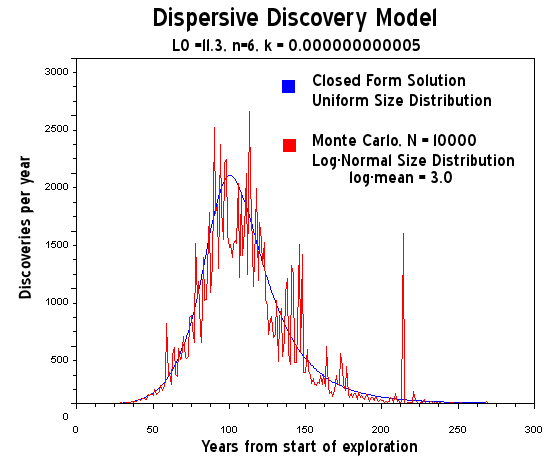
Note that a big spike can still occur way down the curve. This is the "fat tail" that Taleb and Mandelbrot talk about. Somebody looking at it will start to get excited, but this needs to be moderated when you point out the stochastic envelope. The envelope essentially precludes with a very high probability that these random spikes will upset the course of behavior.
Just for yucks, if we had 1,000,000 fields that were dealing with then the statistical fluctuations would largely be minimized and we would get the following figure:
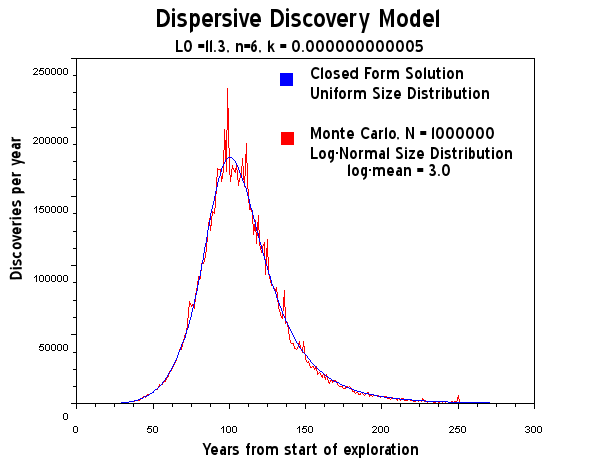
We only have on the order of 10,000 to 40,000 fields that we are dealing with spread out over time, so these fluctuations are entirely predictable and readily apparent.
This entire exercise is a prime example of "Fooled by Randomness", which is the the title of one of Taleb's books.
Intersting charts WHT...thanks
That largely matches the actual history (below) it seems. Sure, oil production can continue to rise with ever more expensive extraction, but that's with costs rising to equal renewables, that's the next ceiling, right? I think if the new finds would have competed with the old ones we'd have found them in the first great wave of discoveries from 1930 to 2000.
Does anyone have a curve of exploration investment cost per barrel of reserves discovered??
If you read the caption on the original discovery data graph (by Laherre I believe), you can see that he placed a 3-year moving average on the yearly data. This has the effect of reducing a lot of the fluctuation noise.
I found two good Oil Drum posts on the discovery history.
Rembrandt http://www.theoildrum.com/story/2006/11/25/22361/503
WebHubbleTelescope http://www.theoildrum.com/node/2712 oil production
Both focus on the models and data showing the same peak and decline, but neither mentions the initial inflection point as the leading signal that the search/discovery process is ending. From a prospective view, discoveries and trends are hard to predict.
From experience it's also clear that discovery curves which have persistent slowing rates of increase are likely enough to continue to peak in the normal fashion and then declining, and making the first inflection point your initial sign of the future of the curve.
From a systems view, isn't that point of diminishing acceleration THE steering signal to prepare for decline?
Is the inflection point you are talking about on the cumulative curve or the yearly curve?
The only way you can get rid of most of the fluctuation noise is to do a cumulative. In that case the inflection point happens to be the peak on the yearly curve. But then to really detect the peak you have to be past it.
Trying to find an upward curve inflection point on the yearly will be obscured by noise I am afraid, unless perhaps if you do some really creative filtering.
Overall, an interesting suggestion.
I'm talking about it as the first signal of declining responsiveness for the expanding search process, so either will do. To get the turning points of running averages to align with the events in time, the point bracket needs to be centered on each time. From a prospective view, simply the presence of a compound growth trend raises the question of where the first inflection point will occur.
Any straightening in the upward turning curve would alert you to look at other measures for information, like the relation between increasing depth of wells and the scale of finds, etc. My guess is that by 1955 the engineers already knew that they were needing to apply more effort to the search in proportion to increases in oil found. Would you agree??
I use various ways to reconstruct the dynamics of developmental processes, but a Gaussian running average is a good place to start. It did a rather sensitive analysis of crime waves in New York that demonstrates what I do, picking out turning points with some precision, showing that a real cultural collapse occurred I think. Crimewave's Collapse
Understood. Take a look at the green Bronx curve with the highest peak. I assume the jagged straight black lines are the data. In the green curve where you label an inflection point, the data never does show an inflection, it just hits a cusp at the peak. That is what I am getting at with respect to the noise. The severe fluctuations will hamper any attempt at getting at the underlying inflections. You can only get the inflections by doing a running average post-mortem. By then it is too late and it doesn't give you much predictive capacity.
That is my intuition of the situation. This is also partly why I don't use the stock market as an investment vehicle. If people could use the inflection points effectively, then they could anticipate the "buy low, sell high" dynamics. Unfortunately there is no longer any underlying model to the stock market, so this is at best a zero-sum game as no one would make any money if everyone could predict the dynamics. Oil depletion is different in that there is a real underlying model, such as dispersive discovery, and we can actually make some progress in understanding what is happening and apply it to a useful end.
So the subtlety is in watching for real slow-downs in the dynamics.
Yes, of course. Single measures don't reveal systemic change well for various reasons, even when there are quite continuous systemic processes taking place none the less. Whether you can find the systemic processes that are hidden from view is sometimes a matter of investigation, or the investigator knowing the whole environment and reading the signs holistically.
The thing that predicts that there will be a turning point is the continuity of the preceding trend though, and so it follows the "precautionary principle" to look for it. In that case the surprise is that when the curve did reverse, it plummeted and the prior fluctuation ended completely.
At the worst of the NYC crack epidemic, which is what the 1990 peak represents, after 30 years of living in NYC with "exceptionally mean streets" I noticed some very unusual changes. One that was remarkably out of character was that the street artists started celebrating their friends who were victims of it with the most splendid wall murals. I didn't quite know what it meant at the time of course.
As to whether the oil exploration inflection point could have been discerned might be determined from what the engineers were talking about at the time. I kind of suspect that in the history of oil exploration there have been various times when there have been flurries of articles about engineers rapidly intensifying their creative efforts in order to keep up with past rates of discovery. If the diminishing productivity of the strategies in use in the 1950's was visible to them at the time, there would have been one of those flurries of articles to mark their response to it I think. Was there?
Excellent point.
One can clearly see from your proposed example (copied on the right) that the big spike on the right end tail could be "Jack" or some other acclaimed, deep water find. But that does Jack sh*t for the overall trajectory of things.
Of course, the Cornucopians will yell, Hooray, We're saved and See I told you so, the Peakists are nothing but Chicken Littles. But that will be because they were fooled by the random dispersal of a new big find. It could have been to the left, buried in the main flurry of finds. But instead it randomly showed up in the tail and made itself more noticeable, as if it were a harbinger of things sure to come, when in fact, it is not.
Please do not assume that $70 is a reasonable estimate of the minimum price to justify extracting the bitumen (oil) from the Oil Sands in Alberta. A very rough ballpark number for the amount of energy required to extract 1 barrel of bitumen using the In-situ method (e.g. SAGD) (at least 10 times more bitumen available from this method than the "mining method) is 1.0 MMBTU of natural gas and about 2 barrels of brackish water (or less if it is carefully recycled). Since the cost of 1.0 MMBTU of natural gas is currently about $4, the operating cost to remove that much bitumen is NOWHERE NEAR $70. Admittedly, you should double that amount of energy for the upgrading and transporting process and probably double the price again for the other operating costs (like water and electricity and salaries and maintenance), but an estimate of the cost of extracting bitumen TODAY from the Alberta Oil Sands of less than $20/bbl is pretty well certain. (with an "Energy profit" of about 3:1+ and with an almost unlimited resource base)
So you might say, what about the capital costs?? If so, you would be correct that that is the difficulty. Numbers like $10,000-$20,000++ /bbl/day can easily be found. I cannot ignore the possibility that there will not be enough capital to increase the supply and I have no reason to doubt the failure of projections of increasing supply due to the global international recession. Banks just don't have $100s of billions of dollars to invest in the Oil Sands anymore. That being said, Canada will not run out of energy anytime soon. Also, with the amount of natural gas available either directly (e.g. shale oil) or indirectly from the gasification process, I doubt that North American will run out of energy anytime soon. The increase of CO2 in the atmosphere as a result will have many effects but one of them is certain: an increase in plant growth. So much the better for Canada if the climate warms. Most of the agricultural land in Canada is "cold-limited" (i.e. food production would increase if the temperature increased). There is also not much reason to believe that a warmer world would be drier (on average). All of the more serious projections of global warming from CO2 increases rely heavily on a secondary effect: increased amounts of water vapor (and precipitation). Also, Canada has a LOT of water for irrigation (if necessary). So again, although it may not be the most important factor in future crash scenarios (maybe world-wide capital flows, nuclear war, or other crisis may end up being more important), there is probably enough energy in North American to preclude the worst energy-dependent crises. This is OF COURSE not to say that a world-wide disruption in the economic sphere or a war wouldn't cause famine (especially in the poorer countries like Bangladesh, Haiti, etc.) or worse, but I thought I would inject a note of realism on the price issue for the Oil Sands.
IWylie
I think you are over-optimistic on the scaling. Oil sands even with some expansion are just a small piece of North America's energy needs. Canada will need oil sands oil itself, to offset loss of imports.
This is a link to a post I wrote on the subject.
Gail,
I think we generally agree, but perhaps I was too simplistic in my phraseology. I was NOT implying that BAU would be a reasonable future for NA. I was saying that there would be enough energy for the essential industries to "avoid the worst of the energy-dependent crash scenarios". However, I also do NOT think that $70 is an appropriate number to use as break-even for the Oil Sands. Most of the current production was brought on line with much lower numbers (like $20-$40/bbl) as their break-even assumption and they are doing quite well indeed at the current price.
Thank-you again for a superb article. I particularly appreciated the 4-5.5% number for the threshold for recession. Very handy indeed to know that one.
Ian
The 4% (wholesale) and 5.5% (retail) numbers are really pretty much the same. One has delivery and other end costs built into the calculation.
There have been articles about the subject, but they tend to be technical, so most people don't read them, and connect them to what is going on now. It seems to me It is really doubtful that oil prices can rise indefinitely, without bringing the economy down.
But what about repeated oil price shocks causing the threshold to change? It seems to me that as each shock removes superfluous demand from the economy, the remainder is more critical and can tolerate higher prices.
This is not at all "certain."
Indeed. Some plants just don't react favourably to extra CO2, and in any case, even if they do grow faster/more/better, they'll run into some other limitation before long.
Thanks Gail,
The problem for those of us who are trying to convince others that PO and it's implications require immediate risk management is that conversations can become bogged down in the minute of geology/technology/oil markets/financial& economic issues, who says what, and who know what. This is a sure fire way to dissipate any sense of urgency. Typically, it is those who know a little about the subject who are most difficult to progress with. With the confidence born of a little knowledge, they might counter "Well CERA (or the guy on the telly) say...,... therefore no problem!". It is highly unlikely they have compared methodologies of Cera, Udall, Campbell, Total, IEA...., they have most likely found an answer that suits their worldview.
To avoid this I use a simple risk management approach. I do not seem to be able to post graphs to this window, but it should be clear to describe.
In its simplest form: Risk=Probability of Occurrence X Consequences
To estimate probability of occurrence (of a peak in oil production in year Y):
Collect all available estimates(E) of peak oil year(E1(Y1),...En(Yn)) from recognised experts (those with the ability to make an independent estimate, with an open methodology). Assign each an equal probability of being right(no favorites). I assume that the total probability of any One of them being right is 95% (because one can never be sure).
So lets say there are 30 estimates, then the probability of any estimate being correct is 0.95/30.
Graph the cumulative probability of expert opinion against the year.
An S-curve fits this data well. From my collection of others estimates, there is a probability of 50% that we will have hit PO by 2014.
This may not be elegant or the most accurate method, however it integrates all expert opinions, and allows the conversation to move on to:
Consequences:
Well, you do not have to expect like me a fast collapse, to realise one way or another, that the consequences are huge!
Finally, being explicit about a methodology allows one to argue that uncertainty demands risk management, and ignoring uncomfortable things can be a failure of risk management.
It is not all that clear to me that risk management is very possible, because of the way our system is networked.
One of the issues is keeping our current system (financial and otherwise) together is keeping our electric system together.
How does one keep the electric system together? The biggest risk is probably financial collapse of some of the companies in the electric business. I could imagine a scenario in which electric companies would fail, because they could not raise rates enough to make up for the cost of renewables added to their system. Another possibility might be that a huge number of business go out of business because of the recession associated with peak oil, and because of this the amount of electricity will drop so greatly that the electricity companies cannot raise rates enough on the remainder to stay in business.
Another issue is adequate investment in oil and gas. If investment dollars are channeled elsewhere (renewables), there is likely to be less for oil and gas.
So the things that look like they might be beneficial long term might also push forward the time of collapse. It is all very complex.
Learning to garden using hand tools in a lightly populated, fertile area might be a worthwhile risk management exercise.
I agree in the sense that I believe that there is very little we can do, but to the extent that we can do something-I'd call it a form of risk management (like having a piece of foam at hand as the ship goes down). The risk management structure formulated above is mainly used to avoid getting bogged down in arguments over details with interlocutors, with the result that nothing at all is done.
My feeling is that rather than expecting much, some relatively simple pre-collapse preparations might, just might, make things a little better than absolutely awful!
"...Our current system(financial and otherwise) together is keeping our electric system together"
-Not just that, it holds together (in 'advanced' economies) almost all our basic needs, and our ability to exchange our skills to procure those needs.
I suspect that the detonation point of a large-scale systemic collapse will be the complete collapse of the financial system which will be the acknowledgement that All Banks Are Insolvent (because debts cannot be repaid and bank assets evaporate)+money cannot be trusted as a store of value. With this all bank inter-mediation collapses, which means supply-chain collapse. This means not just or grid goes down (for several interconnected reasons), but everything including our ability to buy food. I reckon this will happen over a very short period of time (I may send in a post on this soon).
One area that could be somewhat risk managed is, as you have said, food. One would be to get people to hold bigger inventories at home, learn to grow food etc. Indeed, it rapidly becomes very complex if one tries to organise in-situ food insecurity management. I live in a small country where nobody makes shovels & spades-if we can warn of risks clearly now it gives us (as individuals or businesses) the possibility of importing such basic equipment while our money has value and supply-chains remain open. I'm reminded of The Great Helmsman (Mao) causing famine through ordering the melting down of such basic tools. Yes, it is small beer.
A second area that might be risk managed is a high quality printing of a complimentary paper currency to hold in reserve, with some good systems design. Even this though is a relatively long shot-as there is limited quality global note printing capacity (as most of our money is today electronic), a limited time horizon, and a possible stampede for such services as the risks become clearer.
Personally, I need to feel we can risk manage something even though I'm sceptical. It is the little something that allows me to say "I'll go on"!
D.
One thought has occurred to me--instituting alternate currencies becomes much more difficult if one cannot produce precious metal coins (if there is little local high quality ore left) and if it becomes difficult to make paper. Even if you make a good run of paper now, how do you get it to last longer term?
The map of sedimentary basins and oil exploration is extremely deceptive. First, notice what color they made the sedimentary basins? BLACK! What else does that color remind you of? OIL! The intent is to suggest that underlying ALL of that territory is oil, and we simply haven't gotten to it yet.
Furthermore, while petroleum geology isn't my field, it is my impression that finding a likely site to explore for oil involves more than simply finding a sedimentary basin and starting to drill. There probably are some cases where there are some promising locations that so far have been too difficult to get to. More likely, though, most of those black expanses don't have yellow dots on them because there are good reasons not to bother.
Thirdly, the map gives the impression that only North America has been intensively explored, and implies that if only the rest of the world were explored to equal intensity then there would be huge amounts of oil to be found. What is left out of the picture is the SUCCESS RATE of all that exploration. If, instead, they had shown just those exploratory wells drilled that had resulted in a successful find, the picture would look very different. We've drilled so many more wells here in North America because we are very rich and could afford to gamble to a much greater extent than is the case with most countries.
I know propaganda when I see it, and this is it.
Good point!
In our research (Devonian paleontology) we examine and work sedimentary basins all over the world. We have never found any oil (not that we're lookin' for it, but we have sure never found any either!).
The Relationship of Oil Drilling and Oil Production
From the referenced article:

The next graph he shows is that the trend follows a power law. This looks awfully close to the hyperbolic "cutting the pie" law, i.e. N*Size=Constant. That is, given a certain size of resource, by cutting the resource into N parts, your size per part gets reduced accordingly.

The hyperbola also follows Zipf's Law which corresponds to the empirical observation of the size distribution of oil reservoirs historically discovered. There are a few large reservoirs and lots of small reservoirs -- and the number of rigs follows this pattern, i.e. lots of stripper rigs. (I have a comment in today's DrumBeat about this, here http://www.theoildrum.com/node/5812#comment-543850)
The fact that the hyperbola isocline is moving to the left means that the cumulative volume of pie is shrinking with time.
So the "Drill,Baby,Drill" argument has 2 problems. (A) It might be a cannabilistic effect and is otherwise empirically well understood and (B) The overall pie is still shrinking.
This is one thing I at least partly don't agree on.
I agree that drilling what we have left will by no means solve our energy problems.
But I don't see saving oil until later has any particular value--If we save it until later, we likely won't have the rest of technology in place to develop it later (due to decline in globalization). So we will just lose it. Period.
Because of this, if there is a little oil of reasonable EROI left, it probably makes sense to develop it now. It has a slight chance of warding off collapse a bit.
I don't see any issue with burning our oil making any difference with OPEC bargaining chips. In not too long, it will likely to too late for any of us - OPEC or the US or anyone else--to develop what look like the reserves we have left. If we have set oil aside, it will be permanently set aside.
Well this is where the discussion gets to objectives, time frames, in groups out groups, species, intergenerational equity, and other really sticky issues. For me at least, I would rather sacrifice next 5 years of pleasantries for a better future for my nephew and others, but I am probably a minority.
It is time to jettison all this economic stimulus - each marginal government dollar spent on reviving consumption is going to make things worse.
Perhaps I should be arguing that we should somehow be extracting the oil, and putting it into long term storage tanks, so that later generations will at least have a tiny bit of oil for making essential products, like medicines.
If the oil remains underground (or probably more precisely, under ocean, as in off the California coast and off the Florida coast), no one will ever get the benefit of it, unless, say 100 generations from now, if people have redeveloped needed technology. If we extract it and save it for others, they will at least have the benefit of it.
It is hard to see that current generations would allow this though.
Where are we going to extract it to?
"What part of locked box, don't you understand?"
"If we have set oil aside,it will be permanently set aside."
It's hard to argue with this if enough time passes-my own wag is that it will be several decades at the very least before this becomes likely ,if the field is a reasonably good one in terms of ease of drilling ,etc.
I would like to hear know what you and others think in terms of time until we might actually lose th ability to bring in a new field.
Some of my more shall we say hard core acquaintances believe that keeping as much as possible of our domestic oil first and any other oil next-in order of distance from our seaports-in the ground is a no brainer.
Thier thinking is that we are buying with rubber checks and that when tshtf(within twenty years or less) we will be in much better shape to weather the storm.
As they see it,war is inevitable, history is written by the victors, and all other questions are either academic or irrevelant.
We need to set aside oil as energy input into all the projects required to get away from oil and to reduce CO2 emissions. Global warming will get worse every year so somewhere down the track - maybe already in 5 years when the Arctic summer sea ice goes - nature will physically force us in weird weather events beyond our experience to abandon coal. In Sydney we just got a foretaste of what is to come when we woke up to apocalyptic skies
Red alert as big dust storm blankets Sydney
http://www.theage.com.au/environment/red-alert-as-big-dust-storm-blanket...
Projects to get rid of coal and to make us less dependent on oil (electric rail) are massive civil works using huge amounts of diesel. For those who want to go nuclear, the mine expansion at Olympic Dam in Australia will mean a 16 fold increase in diesel consumption.
If we are not careful, we may fall down the energy ladder, if we have not already lost one rung. We must now stop discretionary use of oil, gas guzzled away in cities for convenience purposes. This waste of energy will be bitterly regretted later.
I think that the USA has around 14,000 operational fields and the world total is about 35,000. So the North America fraction is very significant.
Just to add, that map of sedimentary basins lost all credibility in my mind when they indicate there have been 4,000 exploratory wells drilled in the devonian ordovician and silurian sediments under Hudson Bay. This just doesn't accord with my knowledge of Canadian Oil History. There hasn't been a single exploratory well drilled in this region to my knowledge. There was a company trying to raise money to go up and do some initial exploration but I think they were having a hard time because of the fundamentally low prospectivity of the geological history and the high coost of working so far away from any infrastructure in a bay that is ice bound for over 6months a year. If anyone has a record of any exploratory wells in this basin I would be extremely interested.
Edit: I'm also highly skeptical of the 2000 exploratory wells drilled off the mid Altantic coast of the United States. Don't they have a moratorium on for the past 25+ years?
nero -- I didn't see the map but if they are depicting 2000 wells drilled offshore U.S. east coast I can't imagine what data base they are accessing. I don't recall the exact number but it was no more than a handful. That number is wrong I don't really know how to respond. The wells that were driled were joint venture research wells ("stratigraphic tests") on unleased Federal lands. No oil production leases have ever been issued off the U.S. east coast
51 US Atlantic offshore wells in the late 70s/early 80s, according to this: Wapedia - Wiki: Offshore drilling on the US Atlantic coast. One non-economic hit in the Baltimore Canyon area.
Thanks Dude. A lot more wells drilled then I remembered but I was just a puppy back then. Wonder if we've developed better models since then for this region.
The map is misleading in another quite clever way, too.
The projection used makes the Arctic - Siberian area look much bigger than it really is, in relation to, say, Africa. This gives the impression that the "unexplored" areas are bigger than the already-explored basins. This is probably the most misleading aspect of the whole thing.
Why lie with statistics when you can do it with pictures? Nothing needs to be said...
It's interesting that this subject should come up the day after a BP geologist showed me a seismic section across an area which is frequently mentioned as a likely area for large untapped reserves: the Canadian sector of the Arctic Ocean.
It certainly looked promising geologically. There were tilted fault blocks under a major unconformity, very much like a lot of the world's oil and gas accumulations, and they were large enough to hold billions of barrels of oil.
But the economic problems with something like this are probably insuperable, even with the most optimistic assumptions:
I really can't see this kind of prospect ever being feasible economically. Each of the problems I've mentioned does have a conceivable engineering solution, but the economics, and in particular the energy return on investment, will probably never work.
Thanks for the example. This seems to be the situation so often. The oil is there, but the feasibility of getting it out at a reasonable price is pretty low. If each of the problems has say an 80% chance of an engineering solution, the chance of all of them being solved simultaneously could be pretty low: ( 1.0 - (80% ^ n)).
So true gail. As an example the Brazil Deep Water play is rather simple and obvious geology. And the probability of liquid hydrocarbons was always there. It wasn't until DW prices and drilling technology reached a point when development at such water depths was feasable. Engineering isn' my thing but I'm pretty sure the tech and money factors of Artic exploration could make DW Brazil look like a walk in the park. You learn to avoid saying "never" in the oil patch but if the Artic ever does become commercial it's likely to be many decades out.
All one has to do is look at how difficult it has been to extract oil from the near shore of Alaska to see that arctic oil exploration (and subsequent extraction) is not going to be a walk in anyone's park.
From an engineering perspective, things don't always work (or fit) like they do at the relatively balmy temperatures of the mid and equatorial latitudes.
Hello Starship Trooper,
I am all in favor of setting up an offshore rig in the Arctic-here is the reason why. After it is built: we helicopter Yergin & Lynch out to take a Wintry walk in this new park--they will be just like highly excited kids on a new playground. Their tongues will wagging endlessly, giving us an opportune time to freeze both their tongues to some ice-cold steel. Rig setup >$100 million. Complete Silence from Yergin & Lynch==>PRICELESS!!!!
/rant off
Very funny mental image toto...thanks. BTW...DW GOM/Brazil wells are running $150 to $200 million late last year. On the last Bz well I worked on it cost $31 million just to move the drill rig from Africa to Bz. It's not difficult to imagine mobing a rig to Alaska and setting up won't cost at least that much before you drill the first foot.
Regarding your Figure 5, showing petroleum expenditures as % of GDP at 8% in early 70s and 6% last year, I would contend that debt as money expanded far beyond its % of GDP than it was in 70s - ergo if you back the debt/credit subsidy out of GDP, it is vastly overstated, meaning oil expenditures of true GDP is probably north of 10%. (Also, the implications are that EROI of global oil is significantly overstated due to phantom GDP, not to mention sunk cost of all the depreciated infrastructure, whose energy and materials inputs were expended long ago)
Good point! Hope you or someone else has some time to put together some numbers and graphs on this.
Debt gets so intertwined with everything. GDP in has looked better than it was, especially since 2000, because of expanding debt. Now that debt is contracting, this impact is going away. Governments have thought there was growth, but it was a temporary illusion, caused by the pump up in debt.
Its taken me a decade to internalize it - but I fear we really are in a Wile E Coyote moment - over the cliff but still levitating because everyone alive today believes that dollars and digits are real - an honest tether to real productive capacity is going to reduce standard of living for all, or, more likely reduce it for vast number and increase it for a few. I see no other end game (though lots of skirmishes) than a)debt forgiveness on massive scale or b)printing our way all the way to hyperinflation - which path we take will depend on how long our collective belief in fiat-as-real will hold.
NATE FOR PRESIDENT ,ALL THE OTHER STAFFERS FOR CABINET SECRETARIES!.Our last hope;)
No thanks - I like naps and privacy. Plus RR and Euan would eventually have me assassinated. ;-)
Then your our man. Anybody that actually wants to be President is a poor choice.
Unfortunately, this is real life, and unlike Wile E, there is no getting up and moving on in the next frame after that little puff of dust on the desert floor.
Good points Nate once you back out the debt things are a lot worse.
Also in my long post below I'm in agreement that at the moment we are in a sort of Wiley coyote moment and its not just financially but also on the supply side with oil. The entire system was shocked tremedously by the rapid collapse in 2008 and its just now starting to figure out the truth I ended calling it a twilight zone.
Its important that everyone remember this before reading to much into anything thats happening right now and that includes me !
We need to let the system reset and settle if you will before we really know much about what our future will be like.
If you read Calculated Risk
http://www.calculatedriskblog.com/
Great graphs showing that we are no longer collapsing but a new normal is forming. Its not recovery but more the economy no longer in frantic collapse. Its still way to early to understand how this new normal is going to move. Obviously of course we have plenty of houses and way to much debt but other than that its hard to say.
Agree with the Wile E Coyote. But as you know my position i think debt forgiveness is a huge mistake and printing will only work if the new digits find their way into the pipes of the economy.
The only real way to accomplish this is to send out checks to every citizen and that "accomplishes the objective in the fairest manner I think.
I wonder what the ratio of perceived wealth to real wealth is?
I wonder if it is on the order of 10-1.
Ever since Reagan production has been chasing debt creation like crazy and now the last monster injection has to put it something like that.
Guessing anyway.
In a very real sense I think thats exactly whats going to happen I'd not use our current monetary system as a guide or even the nominal owners of anything thats on a piece of paper. Thats not to say titles won't be respected but if you have anything it can and may be taken. That does not mean it will. Go read up on land laws etc no one owns anything for real in most countries.
So given that what forces counteract basically absolute chaos ?
Well first and foremost we have to eat. This does not mean farmland won't be confiscated but at most once and even then taking land that is held free and clear is probably the last thing that will happen. In general this means killing the farmer which given how few farmers actually exist today is not a good idea.
So starting from the premise which is just this side of collapse that people will at least be smart enough in most parts of the world not to kill most of their farmers you can see it puts a sort of basic level of stability.
And it also empowers those you actually make stuff we need. Higher levels of stability than the above are possible all the way up to pretty much BAU with a transitioning to electric cars all thats needed.
But even the rosiest scenario that included declining oil still increases focus on producing needed goods not luxuries and certainly not exotic financial instruments.
So no matter what happens I think going forward in the future rewards for providing necessities for a given culture at what ever level that culture is at will increase while ponzi schemes and financial tricks will fade i.e bankers will become increasingly irrelevant. Thats a very big change give bankers have had control for literally thousands of years. However they are intrinsically the vampires or better ticks on the dog of growth without rapid growth they eventually die replace by hard money partnerships as accepting the business risk of and investment and part of its profits blows away attempts to make money via interest in a stagnant society thats incapable of inflation.
So no matter what happens and regardless of how bad it gets or not I think we have and underlying huge shift back towards making growing and building stuff that matters.
Thats a very good thing and it will happen in my opinion no matter what the current elite do.
Do you know how remote those thoughts are from most peoples minds?
However, I keep watching what is happening in disbelief. The criminals at all levels of the financial system just keep blatantly stealing and swindling to the point that I think that they believe they are not doing anything immoral.
This has to be the way societies fail......when wrong becomes right and right becomes wrong.
I am not a religious person but I can see the purpose of religion and that is to instill a moral code into those that can't tell right from wrong.
Amazing, just amazing.
You seem to jump right to the end game but I think that there will be incremental declines and a reallocation of the remaining fuels down the Maslow pyramid.
I am assuming that order will remain more or less for a while as lives contract and become redefined in more local terms.
I see paper of all types getting thrown into the wind first and common sense replacing old contracts.
As far as money I see barter and local currencies and a whole lot more trust.
All these things are good and sorely needed if we are to have a chance at all to survive as a species.
I actually have a model in mind for a constitutionally consistent monetary system and it has no central bank but a bank controlled by the people of the Nation and no fractions are allowed and all money is based on PREVIOUS production. The only entity that can "create" new money is the "Bank of the People" at the top of the system when extra is needed in the system to prevent deflation and interest can be charged on the depositors money that gets lent out because that money represents some good or service that has enhanced the economy for all involved. The Bank of the People can lend to the member banks at interest and any interest collected by the BOP is revenue for the Nation and hence the people. Basically like a giant integrated credit union system owned by the community. It would work if everyone played nice.
I should lay it all out and maybe get some feedback.
Oh incidentally I ran this system by Mish and he literally told me I was insane.nice guy that Mish arrogant Ahole is more like it.
Mish has good ideas but its hard not to get immersed in the current system when you study it i.e you start putting on blinders. Mish is so hooked on deflation esp debt deflation he's gotten stuck in a rut.
I think your concepts are sound but I guess in my opinion monetary systems serve as a symbolic way to store wealth outside of trying to use natural resources that can degrade. Houses are not good stores of wealth since they need constant maintenance. Consider a society that based its wealth on modern boats it would collapse quickly as the store of wealth is itself a money pit :)
Now thats the intrinsic reason for money is everyone agreeing to defer true wealth in the form of material goods in exchange for the right to "buy" them at some later date. Money is a sort of coupon.
On top of this you have debt etc etc etc but the basic concept is the above. Gold works well because of its physical properties and its relative scarcity. Although that does not prevent inflation ala Spanish conquest of South America.
Now if you have a very static society with a very small increase in wealth year on year i.e our traditional renewable society talked about on the oildrum and other alternative sites you really don't need a complex monetary system loaning out of accumulated wealth is fine. In fact your notational wealth actually build to the point that if to many people actually tried to spend the money it would instantly inflate.
But this sort of society invests in art literature science etc etc. The industrial revolution itself is a direct result of the idle rich primarily in Europe created from the past centuries of mercantilism/empire.
Of course shortly after this we generally go on to mess it up big time but thats a different issue.
However the future is not the past and I really don't see why we won't return to a simply monetary system and money is a store of wealth maybe even gold once we have and effectively static society.
Maybe this time around or the next one or the one after that we won't blow it once we gain a significant amount of real wealth again.
Without oil I think we are destined to have to finally solve this problem and my hope is that we control our population and keep it low eventually leading to a society of effective billionares socially constrained to use their money to further the arts and sciences and no longer interested in crass showy materialistic wealth.
We become collectively a bunch of snobs :)
I tend to agree a very very simple money system is a must since only by going bare bones do you prevent the creation of fraudulent schemes and of course somehow also equitable distribution and that not something I've really figured out since its really difficult to prevent concentration of wealth which is even worse since it can happen all along the way with good people doing good things yet eventually the concentrated wealth can be abused. Like I said I don't have and answer for that and I don't think its a monetary system issue.
Its a social problem to ensure that wealth is steadily rebalanced without creating a welfare state.
Even the right monetary system does nothing to fix this as history shows since what your describing was the basic monetary system till recently and it really did not fix anything.
Bill Maher (of HBO's Real Time talk show) had Paul Krugman (NYT economics guru) on as a guest tonight.
Bill asked Paul, "Where will all the money come from [to pay for these things]?"
Paul Krugman's eyes rolled up to the top of his head. He never answered. He came up with some diversionary response that quickly moved off topic.
Later in the show, Elliott Spitzer admitted, "We print the money, that's where it comes from. But so what?"
p.s. See also Paul Krugman in this You-Tube (Clash of the Titans):
Good point! Hope you or someone else has some time to put together some numbers and graphs on this.
I have not had much time to look at these graphs but they do suggest that excessive house prices were more to do with recessions than the price of oil.
http://www.wtrg.com/prices.htm
http://www2.standardandpoors.com/spf/pdf/index/CSHomePrice_History_08256...
http://www.housepricecrash.co.uk/graphs-average-house-price.php
In this last recession, if you consider USA, the house prices had been falling since August 2006, two years before the oil price high. Oil prices were only around the $70 mark at that time.
Also if you look at data of house repossessions they started to increase in 2006.
I believe situation in the USA similar to UK where house prices nearly doubled from 1999 to 2007.
A family paying a mortgage on a house in 2007 would have been paying £500 more a month than a family buying a house in 1999. This had a much more detrimental impact on the economy than the oil price increase over that time.
The oil price increase would have been an added burden, but the cost of housing removed far more money from the retail economy.
Since blaming the oil price on recessions is an often quoted government explanation, this should ring alarm bells.
Incompetant governments and greedy banks are the more likely culprits and not arabs in the middle east.
After all the great crash was nothing to do with oil, but excessive lending to buy things not worth the money.
http://www.cnbc.com/id/33004753
US May Face 'Armageddon' If China, Japan Don't Buy Debt
“May” face 'Armageddon'?
IMO, constrained energy supplies acted as a trigger for the financial firestorm, and they are now acting as an accelerant--like an aerial tanker dropping napalm on a forest fire, instead of fire retardant.
The bottom line for governments--from local to state to the federal level--is that we cannot afford our current level of government spending, and I think that we are headed at a pretty rapid clip toward the point at which the Fed has to choose whether or not to massively monetize federal debt. In the mean time, governments will try, probably unsuccessfully, to increase revenue by raising taxes. Ultimately, the choice on the federal level will come down to monetizing or massively cutting spending. I suspect that we will see all three--monetization; higher taxes and forced reductions in spending.
Of course, local & state governments are already being forced to make hard choices about spending.
I remember that some people here were pretty sceptical when that $20/gal gasoline book came out a few weeks (months?) ago. If the US$ drops like a rock and loses 90% of its value (and some currencies have done much, much worse than that, it is by no means impossible), then we could see $20/gal gasoline VERY quickly.
(N.B.: Don't think that it wouldn't matter because the prices of everything else would change as well. They would not. Much of our oil is imported and paid with dollars, so that is where it will really hurt the worst. There is no reason to think that wages and salaries - for those fortunate enough to still have them - would change at all.)
Totally agree anything imported will show the increases due to exchange rates.
Look closely at the Scientific American draft cited up top - emphasis added - and all is revealed:
Great analysis. One more thing to add: I think part of the reason that average people reading these articles see it as such good news is that they are not used to dealing with such large numbers as 10 billion barrels. That seems like tons of oil but people don't realize how many billions of barrels are being used already. The price issue is a big one though and you really explained that well.
As to saying that $150 a barrel in Europe works ok, tax issues aside, I would guess that because the US has had low gas prices hard wired into it's construction of cities since the 1950's we are much different than Europe. We will have to undo all of our sprawl to live in a lower per capita energy use world. That is a HUGE task. Europe was mostly built pre-oil so it is easier for people to live without it.
Jad Mouawad is the Pollyanna of conventional oil.
The real news is BAD--31 Gb per year in consumption.
10 Gb in 200 discoveries for the first six months but no
(super?)giants since 2000 discovery of Kashagan(wiki says 9-16 Gb, 15-25% recovery--current production =0 bpd). The oil is mixed with 19% H2S natural gas making releases as toxic
as a gas attack.
http://www.rigzone.com/news/article.asp?a_id=49533
In the decade 1995-2005 35 giants(>0.5 Gb?) were discovered none of which will produce more than .365 Gb/yr.
http://www.peakoil.net/AIMseminar/UU_AIM_Robelius.pdf
Plus the price of oil dropped to $65 per bbl.
The exploration business is in terrible shape
contrary to Mouawad.
Can any one point me to an updated (mid to late 2009) historical summary of US and global annual discoveries?
You can get decent info from the UK and Norway. Everything else is inferred and extrapolated from spotty sources. And once again, if you are willing to pay for it, I am sure someone will provide it at a rather steep price.
That said, I sure would like to see this info as well.
From the latest Goldman Sach's crude report. They still maintain $85 by the end of this year which would hit our 4% of GDP number and they maintain the supply-side of the equation holds "few" surprises down the road as demand increases.
3) Finally, the global economic recovery is coming faster than expected. Since we last published our global oil supply and demand balance table, GS economists have raised their yoy global 2009 and 2010 real GDP forecast by 0.5% and 0.7% to -0.9% and 4.1%,
respectively. This is worth 1.2% in terms of oil demand or about 1.0 mmb/d alone. Further,the expectations that the inventory cycle will significantly boost 4Q09 US GDP growth to 3.0% yoy, is critical to the distillate outlook as it is this end of destocking at the macro level that is driving our positive fourth quarter distillate outlook.
On net, the combination of stronger than expected non-OECD demand growth, higher GDP forecasts, and increased confidence that demand even in the OECD countries is beginning to improve off a higher trough than we initially expected, leads us to raise our 4Q09 and 2010 global oil demand forecasts by 1.2 million b/d and 1.6 million b/d, respectively.
Importantly, the permanent damage from the credit crisis is much less than we had
previously thought, driven by the likelihood that the trough in oil demand was not nearly
as low as we had initially anticipated, which means that we are beginning the recovery
from a higher base. The higher trough combined with an improved economic outlook allows us to anticipate a world demand level in 4Q09 that we originally thought would take until 3Q2010.
While this demand revision would suggest an upward revision in prices and hitting supply constraints sooner than early 2011, we instead are maintaining our price forecasts as the higher demand has been met by stronger supply – particularly out of Russia and the rest of the FSU where supply has surprised by an equally impressive 650,000 b/d. As a result, we are raising our global supply forecasts by a similar amount as our global demand forecast.
Although we are only modestly changing the near-term growth paths for both demand and supply based upon these surprises, it is important to emphasize that the supply surprises are more one-off events than the demand surprises are, which will likely persist and strengthen, bolstering the medium- to longer-term bull case for 2010 and beyond. More specifically, the supply surprise was mainly due to five new greenfield Russian projects coming on sooner and stronger than expected. When you take those projects out, we find that the underlying decline rates in Russia did not change significantly and will likely act as a drag on forward production once the impact of these greenfield projects passes. Further, an analysis of new greenfield projects from the GS energy equity team shows that 2009 is "as good as it gets" from a supply perspective.
Here's the reddit links for this post (we appreciate your helping us spread our work around, both in this post and any of our other work--if you want to submit something yourself to another site, etc., that isn't already here--feel free, just leave it as a reply to this comment, please so folks can find it.):
http://www.reddit.com/r/energy/comments/9o25k/peak_oil_not_a_problem_acc...
http://www.reddit.com/r/environment/comments/9o25n/peak_oil_not_a_proble...
http://www.reddit.com/r/collapse/comments/9o25s/peak_oil_not_a_problem_a...
http://www.reddit.com/r/Economics/comments/9o25y/peak_oil_not_a_problem_...
http://www.reddit.com/r/reddit.com/comments/9o260/peak_oil_not_a_problem...
Find us on twitter:
http://twitter.com/theoildrum
http://friendfeed.com/theoildrum
Find us on facebook and linkedin as well:
http://www.facebook.com/group.php?gid=14778313964
http://www.linkedin.com/groups?gid=138274&trk=hb_side_g
Thanks again. Feel free to submit things yourself using the share this button on our articles as well to places like stumbleupon, metafilter, or other link farms yourself--we appreciate it!
Thanks Gail!
I think it's interesting that Kern River keeps getting trotted out as a "see, you are/were wrong" kind of approach. Yes, the technology has changed for heavy oil and Kern River shows just how much effort you have to put forward to increase the ultimate recovery.
I went back a bit in time and pull this article up that you posted:
http://www.theoildrum.com/node/5023
It seems that Chevron is expending a fair amount of energy (injected into the ground) to recover the oil. Granted that cogeneration is the way to go, a rough back of the envelope calculation of how much energy is being injected into ground (think of it as burning natural gas to heat the ground) and you find that Chevron is injecting approximately 55% of the BTU equivalent recovered from the oil at a 90% water cut.
That energy balance would go negative somewhere between 93-95% water cut. Then it comes down to the $ balance between gas/steam and treatment costs and whether addition oil could/should/would be pulled out of the ground for "negative profits."
Of course, it still might profitable from the standpoint of what they can get from selling MW on the grid, but if and when that goes away, it will no longer matter how much oil is left in the ground if no other technology is able to efficiently/economically recover what's left.
You are right. Kern River does keep getting trotted out.
To my way of thinking, Kern River was about as depressing a place as one could find--thousands of wells in every direction, as far as you could see. It was in the middle of the desert. In terms of environmental impact, they were way over the top, at least within the area being drilled. The Canadian in situ production, which is in some ways similar, seems to have much less above ground impact.
But Kern River did manage to do some things right. There were no tailings ponds around. The water was mostly treated and sold as agricultural water. The remainder was reinjected in deep wells. And they sold a lot of electricity to the grid.
This is not specific to this article, but related to new/potential discoveries and something I'd wanted to throw out there for a while. Has anyone heard anything about interest in the Ankeny Basin as having possible oil? Or even heard of something called the Ankeny Basin? There was some experimental drilling further west in Iowa in the late 80s at the Eischeid Farm (Guthrie Co.) which came to not much, but I have seen some information indicating that a more likely area might be in this basin, named after the Polk Co. town that sits roughly over its middle. Maybe someone who knows a lot more and spends a lot more time on this knows something about it?
Here you go Metz. I had not heard of it before either. I didn't research too deep into this "basin". It looks to be the size of several large Texas counties and thus volumetricly would be rather insignificant even if it were a good oil province. From the slice below you can gather that little or no oil potential probably exists there in either case.
http://www.igsb.uiowa.edu/Browse/rift/mrs.htm
In Iowa only 73 wells penetrate into MRS rocks. Most of these wells (49) are clustered into three areas, where gas storage facilities were developed in structural domes that formed in basal Paleozoic sandstones above Iowa Horst-bounding faults. Of these gas storage wells, 44 penetrate into mafic igneous rocks (a total penetration of 388 feet -116 m), and 5 penetrate into MRS clastic rocks (total penetration of 40 feet -12 m). The gas storage drillingproduced cores from 10 wells, 6 of mafic rocks (totaling 97 feet - 29 m) and 4 of clastic rocks (totaling 79 feet - 24m). The #1 Sharp well in Webster County penetrated 57 feet (17 m) of basalt, including all or parts of three individual lava flows separated by weathered, vesicular flow tops.
The Midcontinent Rift System (MRS) is a billion year old rip in the continental crust that represents an episode of crustal stress that nearly ended in the complete severing of the southeastern part of North America and the formation of a new ocean. Like a giant scar, the MRS stretches for over 1450 kilometers from eastern Lake Superior to southern Kansas, with a possibly related eastern arm extending southeastward across Michigan and into Ohio. Rocks produced during the formation of the MRS are exposed in the Lake Superior area, along the lake shore from Duluth north into Canada and east into Michigan, including Wisconsin's Bayfield and Michigan's Keweenaw peninsulas. The rocks exposed in this area are dominated by basaltic lavas (and related intrusive rocks) and reddish sedimentary rocks (sandstones, siltstones and shales), a pre-volcanics, early clastics sequence and a post-volcanics, late clastics sequence. These rock units continue southward beneath a cover of younger sedimentary rocks. In Iowa, the rocks of the MRS are buried to a depth of 1,200 to 5,500 feet. The very dense basaltic lavas and very light sedimentary rocks produce a series of linear gravity anomalies that follow the trend of the MRS and produce the most dramatic gravity anomaly in North America. Because it lies so deeply buried in Iowa and south, and few wells penetrate into MRS rocks, much of what is known about the characteristics and trend of the MRS in this area has come from interpretations and modeling of geophysical data including gravity, aeromagnetic, and seismic.
"nearly ended in the complete severing of the southeastern part of North America and the formation of a new ocean."
If only.....(sigh)....
I note that the stenographer for the New York Times has included a few numbers among all the letters. Still, I'm left wondering about the constitution of the 10 billion barrels discovered. Is 40 to 60 per cent of this at Tiber? Do discoveries this year amount to 10 billion barrels or 8 billion barrels? Tiber may be in part gas, the stenographer suggests. How much of the 8 to 10 billion is gas?
What is the average size discovery? What is median discovery? Of the "more than 200" discoveries, how many are of interest to the development teams?
I would have appreciated more numbers from the stenographer. I also would like to see more information about the accuracy of the estimated volumes of 'discovered' oil.
Articles in the newspaper seem to be low on details. I agree--it would be nice to see more numbers, and how they add up. It the Tiber amounts to half of the total, the chance of getting an equal amount in the second half would seem pretty low.
Idiot-Logues are blind
the right thinks we can drill our way out of this mess.
and the left believes that diffuse energy from windmills and the sun will save the day.
both sides believe what they want to believe.
You make a good point.
Each side seems to firmly have their mind made up. Neither approach to my way of thinking will work very well.
If there we could count on BAU for the next 40 years, wind and solar might somewhat work, but if a financial collapse comes early on, they are not likely to do much for us. In fact, the funding for wind and solar could hasten the financial collapse, and thus the loss of broader energy availability. If the grid isn't working, the wind turbines will be doing little, except where they have been set up with an alternate purpose--like making fertilizer.
Solar panels may work, if people still live in the same houses. But if most cities become uninhabitable, panels will have to be moved to new locations in the country, where people now live. How this is will work is not clear. The availability of things to plug into solar panels (computers, refrigerator, washing machines) is likely to drop fairly quickly. Without a grid or batteries, use of solar panels is likely to be more limited.
We missed our opportunity. Carter was right, we needed to start working on alternatives beginning in 1976.
We collectively put off wearing the sweater for what ... 35 years?
Sez Ronald Reagan, "Take that, you sweater- wearing grandkids!"
It's going to wind up taking everything we can think of to keep some sort of social organization functioning. Unfortunately, the snake oil peddlers with their perpetual motion machines will get a lot of attention. More time and resources will be lost. In the meantime, no conservation plan, no organized alternative program! Nothing but more half- truths and outright lies.
"We are saved by newspaper articles!"
I think it is more likely a drying up of non- financial investment will throttle a lot of energy investment. The bias is going to be investing money in money for the time being. Right or wrong. The way around the investment constraint is for more DIY solar. 40KW? Why not! China is ramping up production and the Japanese are making better panels at lower prices.
40% solar efficiency conversion from Boeing.
One of many Japanese designs.
Actually, Hyman Rickover was making the point about the need for preparations, back in 1957. We should have started a long time ago.
I have mixed feeling about solar panels. They will work, as long as we still have appliances to connect to them, and the houses they are attached to are in the right locations. If people have to move to villages in farming areas, the question will be whether the panels can be moved adequately, and attached to appropriate electrical devices. They will only provide power when sunlight is available, without battery backup.
It seems to be that we should be putting our primary focus on sustainable agriculture, adequate fresh water supplies, and local manufacture of essential items (clothing, pots and pans, nails). Solar panels are part of keeping of BAU--maybe we can for a while, maybe we can't. If they take our mind off longer-term goals, they probably aren't all that helpful.
Gail,
Massive PV systems are heavy and for the rich.
Small scale systems tho' do work for certain purposes.
My grain grinder uses a 30W panel, and the unit is very portable for use by the neighbors.
Using direct electromechanical work from small PV systems negates the need for batteries and associated expenses.
They will however charge up batteries for home lighting, LED headbands, radios, IPhones, recharging electric bicycles, etc.
And there is no reason why they could not use energy stored to cycle up flywheels for later electric generation.
As with pumping water from wells, or into overhead storage containers.
Or running leather belts to turn metal and woodworking tools to help with local manufacturing.
Small PV can run water/air through solar thermal systems, and even provide for refrigeration on a personal small level with small peltier fridges....
I used 60W worth at Burning Man to run my very small evaporative cooler, and it worked well.
PV has potentially great uses, but covering your roof with them to run your AC unit is not good Karma IMO.
My next project is to use a small panel to not only recharge battery packs, but to help my solar cooker to track the sun, and then turn back to East for the next mornings cooking.
While not a wholehearted PV fan (I like solar furnaces and water/air heating better), I think they have some very practical uses.
Especially after we are forced to downscale our life-machines and forced to become more efficient.
Craig
Hi Gail,
Aside from BAU, I think that electricty is the key factor that will decide if we have a collapse scenario or a decent "muddle through" scenario. The transportation model (car culture) in the US is simply nonsense and there are many alternatives that could survive post PO. The heating and air conditioning moddel in the US is also crazy - thinking back to the 50s without air conditioning in the summer and using heavy sweaters in the winter - those were good times. We can get by with more local food - even Victory gardens like my parents had.
I can think of lots of examples of how we can get by with less oil - but I am hard pressed to see how we can get by with failing electric facilities. Electricity is fundamental to almost every aspect of our daily lives - I submit that we could only survive as a species with a population less than 2K if we did not have reliable electricity as it exists in the US today. I have had the experience of working in a poor country with intermittent electric supply - not fun! Finding substitues for electricity is far more difficult than finding substitues for an ICE luxery car.
We totally power our homes with electricty. Our business/industry sector is totally dependant upon reliable electricity. Traffic lights need electricy, telephones need electricity (most anyway), the internet is completely dependent upon electricity, hosptials use lots of electricity.
If solar and wind have a chance of keeping the electrical grid going - I hope they succeed!
scientific american article:
Much of earth's crust is made up of sedimentary rock and only 1/3 of this rock has been explored.
lets see. off the top of my head
most oil is found in anticlines, reverse faults or salt domes.
you must have source rock or forget it
you must have resevoir rock or forget it
this oil most be within the oil window or it's likely to be natural gas or nothing.
the resevoir rock must be porous and permeable.
and there must be an oil trap
not all sediemntary rock can make a good source rock or resevoir rock
have i missed anything?
i'm sure i have
help me out here petroleum geologists
in other words, there's a good reason for not exploring sedimentary rock just because it's sedimentary rock.
what happened to scientific american???
You've fairly well nailed it duckie. In reality the generation, trapping and preservation of hydrocarbons is a somewhat rare and unique event in sedimentary rocks.
The editor included a set of questions for the readers in the draft article, but none of the commentators answered them directly. Only Gail Tverberg and sofistek provided useful critiques of the draft article. I ask, what happened to the readers of Scientific American?
Nicely argued Gail. The only thing I could think to add would be the bar graph of new oil supply costs from CERA that was found in the Horizon Oil presentation. That is pretty lethal to the idea of a painless transition to Tar Sands oil, etc.
Thanks! I probably should have mentioned this too, but the post was getting long, and I was getting tired. It is not a good idea to start posts as 9:00pm!
SENT TO NY TIMES AUG. 25, 2009:
Michael Lynch makes the same mistake as many peak oilists: that economic collapse from the loss of cheap liquid energy cannot happen near-term because there is plenty of oil still in the ground. The difference between Mr. Lynch and these peak oilists is that the latter see conventional oil reserves diminishing.
The oil market is unforgiving when a crunch hits. When supplies tighten from a 10% or greater shortfall, from whatever event, the result is skyrocketing prices, panic buying and hoarding. This happened in the 1970s when Lundberg Survey predicted the Second Oil Shock from a 9% shortfall of U.S. gasoline for March 1979.
The next shock will see no rescue from more cheap energy in the more globalized economy with greater population size. The effects of petrocollapse, which started last year when high prices overtaxed the financial system, will stop much economic and agricultural activity -- bringing about a "national Katrina" due to society’s lack of preparedness.
Mr. Lynch gives no net-energy data; instead, anecdotal comparisons about Persians laboring a century ago. As to prices for oil dropping post-1970s when he claims people cried wolf over supply, subsidies (direct and hidden) have increasingly hidden the real oil cost.
Denying peak oil and denial of human-induced climate change are closely related. This is the drive to keep consuming as if the Earth were infinite.
Sincerely,
Jan C. Lundberg
Independent Oil-Industry Analyst
CultureChange.org
Portland, Ore.
http://culturechange.org
Nice to see you posting on TOD, Mr. Lundberg.
If there is one voice with enough historical perspective to make sense of the situation, it is yours.
Thank You
great article gail
the problem though i see with the great analysis that you see at sites such is this is that, i see little that addresses the people out there who believe that "peak oil" is a myth perpetuated by one world elite types, who are determined to foist another scare on the masses so that their standard of living can be decreased at the expense of the all-powerful. i got this line of reasoning from the article by f. william engdahl, entitled global warming or global freezing: is the ice really melting? until this type of thinking is put down, the few of us in the know, will standing amid the clueless with the consequences hit.
Don't hold your breath waiting for global enlightenment. Ya see, it's like Creationism; it's a belief system. Long after the final collapse there will be large cults of the Church of "Drill, Drill, DRILL!" They will probably even have rusted oil derricks set up as idols for worship. They'll probably be pretty dangerous people, too. If you try to explain what happened to them, they'll prolly kill you.
Yeah but probably not as dangerous as the peak oil doomsday cultists. lol
Standing on a ziggurat topped with an alter built from human skulls two doomer priests, with hair matted by the blood of their victims, cut out hearts with blunt stone knives in an effort to keep the human population under control :P
The sort of people who believe this are likely the least worth engaging with. Such minds enthusiastically think up an idea but then have zero capability of unthinking it. Best stick to addressing those who have more open, self-doubting, minds.
Regarding the map showing sedimentary basins, I wonder if they have considered a cutoff value on ocean depth:
A good fraction of the dark area lies below 3 km of water (the deepest well drilled last year was under 2.45 km (8,000 feet) of water). In addition, the exploration triplet requirement (source, reservoir, seal) has to be met.
The sediment thickness is probably a factor also:
In fact, potential oil and gas provinces are at least 1,000 feet thick:
src
Once you move off the sedementry basins on land esp those that continue known reserves on land like the GOM and Persian Gulf and except for a quirk the North Sea which just has small oil and gas deposits on shore the future search volume is much lower than what we have already search.
Most of the oil in the world should be in onshore basins and shallow offshore with deepwater in my opinion providing at most and additional 20% at high cost and thats being very generous. A 5% or less increase is probably a lot more realistic.
I just don't see many huge discoveries at best one more Ghawar or its average equivalent. That sounds like a lot but its what we have been able to do on average over say a period of five years for many years.
For me at least if you look at the potential production from deep water vs existing production its really not all that important. That does not mean its not profitable and might provide a regional boost to production in any give year but our current aging source for oil just seem to be much larger than future sources at best 80% larger at worst 95% or more.
9,627 feet. I would think the distance from shore (200 miles) is more of a technical challenge than ocean depth.
http://www.shell.us/home/content/usa/aboutshell/strategy/major_projects/...
In general the scenario is not a bad one however.
My only objection is that this is really not required to have oil prices start increasing again. All thats required is implicit demand exceed supply. Assuming that we are probably post peak with oil production and this is probably true simply based on investment as pointed out in the article. Regardless of the future price of oil actual investment in bringing on new oil supplies will be lackluster as demand for expensive oil is fickle at best. Given that we are post easy oil and this seems accepted by most parties then a significant increase in supply probably won't happen. As depletion continues relentlessly the chances of hitting previous peaks diminishes and we are officially post peak.
So on the supply side without really invoking peak oil just peak cheap oil we can see that new production highs are probably in the past as oil gets progressively more expensive.
Now under this scenario there is no real requirement for the economy to grow to result in high oil prices and a recession. The only intrinsic requirement is that potential demand exceed available supply and the weakest bidders suffer demand destruction. Now this bidding war can result in prices reaching a point that the winner does not really win as it causes them to suffer serious losses "overpaying" for oil and demand destruction happens across the board. Depending on the outcome supply may exceed demand and prices drop.
However its a dynamic situation and in the end it all depends on the actual decline rate in oil production.
On the demand side the only base requirement is that the above decline rate result in supply not meeting demand regardless of the actual changes in demand.
Next of course as you point out oil demand has a large intrinsic value based on population and infrastructure its very very hard to push oil demand below this level generally as you point out it results in pullbacks in spending in the rest of the economy. And as I've said many times products which require large debt financing like homes and cars are particularly venerable as the payment on the debt is fixed but excess income declines.
So as long as substantial amounts of debt exist in the system and can be defaulted on further demand declines slow or even stop for a while. All of this becomes a issue after growth stops.
I call this peak BAU or you have a initial transition from growth and sharply increasing oil prices to contraction and if its fast enough falling oil prices. It all depends on the relative rates.
In our particular case the economy contracted rapidly over a period of months rapidly outpacing the decline rate in oil resulting in a short term glut. AKA we crashed.
Thats a unique event and is simply not predictive of the future it says nothing about how real oil decline rates and the economy will interact. I argue that at the moment the future is still completely unknown all scenarios are still probable and its completely unpredictable.
It all depends really on future oil production rates as long as they are high enough then the economy probably can cycle in and out of recession with conservation slowly reducing economic dependence on oil.
At each cycle of boom bust or at least after the first few I'd argue that a structural transition away from oil will begin to take hold as it becomes clear that the only way to grow is to do it with less and less oil.
It might not be a lot of fun bit its survivable and of course it results in significant destruction of debt over a number of years until real growth can resume in a less oil dependent economy. Other resources may become problematic at that point but thats a different issue we will continually hit limits until the economy becomes substantially sustainable. But this does not have to happen rapidly assume oil supply remains adequate and simple recessions are sufficient to balance supply and demand.
So I'll just close point out the obvious that the price and oil is dependent on supply and demand given that supply should be declining demand need not increase at all to result in high prices just decline slower than oil. Given the structural support for oil usage demand becomes increasingly inelastic even as the economy slows and debt default acts to buffer the point at which oil becomes to expensive and demand destruction starts in earnest.
Now with all that what if oil supplies are actually declining rapidly ????
Well if they are then the initial end of BAU and transition from growth to decline will only result in a relatively short period of low prices. I define rapid collapse as a change in oil supply by 10% or more over the course of a year. If we are anywhere close to this then demand rapidly hits its structural limits and a transition off oil has to happen in a very high oil price environment even as the current economy comes to a screeching halt as debt default explodes. The problem is that the inelastic portion of demand is hit so fast that you simply don't have time to transition. And of course transitioning requires taking away from other areas of the economy yet natural contraction is so rapid that you don't have any financial support for transition.
Sure most governments will at this point step in and support a last minute change off of oil but in doing so they are certain to destroy their fiat currencies and debt balloons. So maybe we make it maybe not regardless your certain to get a complete default in the monetary system as and outcome. If your lucky you get a economy rapidly transitioned off of oil and are able to create a new monetary system based on storage of wealth as growth rates are so low that fractional banking offers no value. This does not mean gold based but probably means gold will again become a important part of the monetary system. Given the problem is energy I suspect a energy tied currency is probably more likely.
Or you don't pull it off and you crash.
Regardless the most critical point to understand is that economic growth is no longer required to cause high oil prices we are past that point and now into the unknown. The combination of economic growth and high oil prices followed by decline and low prices was a one shot deal marking the end of BAU. It need never happen again that does not mean it can't simply that its not required all the scenarios I've outlined are possible which one is the future is simply not know yet. We are still in the last echoes of the end of BAU.
With all this said the only future that can safely be discounted soon is the rapid crash scenario as by its nature you might get one year and at best say six months before you hit the wall again after the end of BAU.
This is assuming a sharp 10% or so contraction in oil demand over a period of six months followed by say and additional 2-3% or say 12-13% or so. Also of course even in the shark fin model or fast collapse scenario you have period where you turn the corner and production declines accelerate up to fast collapse levels.
Lets say they accelerate over a period of 2-3 years from say 4% to 10%. Just depending on how things are really changing you don't even need a rapid 10% decline in demand 8% can do it. Way to many relative rates are involved initially to even begin to figure out whats causing what.
But this does not matter as the system soon enters its final phase with rapidly falling supplies hitting the wall of structural demand.
Whats will be really interesting if we are actually on this path is how oil prices varied before we hit the wall. In my opinion only a very small number of people actually think such a collapse is possible much less actually happening. Unless they are very highly placed in the world economy their concerns have little or no influence on the market. Therefore until you hit the wall the market itself is effectively mislead into assuming variants of whats assumed in the article and of course including peak oil is actually in the future.
Thus unfortunately give that there is little chance of a fast collapse being priced into the markets by any substantial amount you have the result that the market signal of such a situation will remain weak until the last minute. This means of course I'll look like a fool since the market probably will discount such a scenario right up to the point its forced to except it which is variable.
Bottom line is if we really are hitting the wall then the market response itself will probably be delayed and sudden as the truth unfolds. The only real constraint is if I've done a good job of windowing the period of fast collapse to predict when it becomes impossible to be true. I'm pretty comfortable in my prediction so lets see what the future holds and see what the true track is. We don't know much except that the worst case is fairly easy to discount soon. Lets see what happens over the next six months. I am to some extent waiting myself to see as I'm not about to make any long term decisions outside of the one to I made to leave LA for Oregon until after I know more about our future. How we respond to peak oil all depends on what happens next and what the real supply, demand and economic situation is like now that growth is no longer effecting the system.
I'm actually somewhat hopeful I could be wrong I am seeing a underlying signal of rapid collapse in the market but given that the entire market probably does not know the future any better than I do who's to say.
To a large extent the markets have been predicting a rapid recovery and thats the one situation thats obviously not going to happen. Maybe this mis-prediction is based on misinterpreting rapid decline as a rapid increase in demand. So far thats my working hypothesis that the markets are seeing what they think is robust gains in demand but in reality its rapidly falling supply and thus are mislead.
And by markets here I mean all markets and of course this has to include a healthy dose of government support.
One possible scenario for the near future is that the markets finally realize that rapid growth is not on the horizon contract with both stock and oil prices falling significantly and any supply signal is simply completely ignored the market thus cries wolf. However in doing so it misses the real situation even worse as of course oil supply continues to collapse. If so then you really hit the wall maybe oil falls to 40 or 50 a barrel then wham. Regardless until the markets at least return to their senses and at the minimum price in a very long recovery period with little or no growth its difficult to divine the real underlying fundamental situation. Obviously my current opinion is that the stock market is misinterpreting rising oil prices as a return to growth and this is coupling rising prices with the stock market as both misinterpret each other. The tight coupling is obvious until this coupling is broken what ever it takes to break it we don't know for sure whats going on. In the case of a fast collapse of course the stock market and oil prices should decouple and begin to move in opposite directions and further the bond markets should see rising interest rates as the risk of default overwhelms the printing presses. This in not inflationary but rising interest rates because the currency itself and its backing government are on the road to collapse.
Its way to early to even being to discuss this situation and you could well get stock market rallies along the way but once we get locked into the situation of rising oil prices and rising interest rates driven by the real default risk the party is over and its a matter of choosing how the system collapses. Historically its a hyperinflationary death spiral but with the coupling to oil its not clear that even hyperinflation will work as the economy collapses before monetary stimulus takes hold.
All of us will have to wait and see even super doomer me. We are in a sort of twilight zone where nothing is certain but I don't see it lasting that much longer and things should be much clearer in six months.
Memmel,
I believe you have condensed it all down to one critical thought-economic growth is on longer necessary to high oil ptices and that we are in uncharted waters.
Everything else is basically just commentary.
I would not be sleeping well if I were the parent of a young kid.
The mountians here in the southeast may not be as good a place as Oregon but I think they will be a close second at least.
I went to college in Fayetteville AR and I'm originally from Little Rock. Discounting around Chicago the rest of the midwest should do very well and there is plenty of room to disperse the population of Chicago.
In general throughout the Missippi, Missouri and Ohio river region on into Upstate New York and Main and the southern eastern coast then back to the cost the main problem is right sizing the cities for a less oil intense age.
You have problematic mega cities such as Minneapolis, Chicago, Dallas, Huston, Atlanta etc. But its not that the population in these cities can be absorbed. The land is generally rich and could theoretically support a much larger population esp if less food was exported.
In general for the US the real problems are in California for SF on down and thats the whole state including the central valley if the complex irrigation system fails. And the North East Boston down to Washington DC.
We have the potential for serious issues in those regions with Atlanta and Chicago as additions but other that opps and Phoenix in my opinion the rest of the country faces solvable problems.
Whats interesting is the situation deteroites rapidly if you have a significant movement of population out of the problem areas and into the regions that are currently reasonably sustainable.
I like having some serious Mountains between me and CA :)
In the case of the Mississippi more western regions such as Missouri and Arkansas would be difficult to reach by any sort of mob. Distances helps a lot.
Unless of course the US government remains in power and manages to do significant resettlement which I seriously doubt. In general if we do see TSHTF politically for the most part your stuck wherever your at.
Believe it or not I think we can have serious regional social upheaval and still keep a surprising amount of our current technology working. I may not come off most of the time as believing this but I do.
That does not mean that food won't become hard to get but it won't be because of intrinsic capacity to produce it it will be because of above ground issues. For example corn trains from Missouri getting hijacked outside of NYC and the food stolen et etc.
I guess my point is I think over the next several years people will be surprised about what makes it and what doesn't and the variability of collapse.
Right now by any measure Pakistan is lurching towards collapse if you read Egypt is not doing well at all etc. Already the relative rate of collapse is highly variable. I'd argue that the world has already moved well down the road of collapse just its not yet extreme in the western countries. I think the hallmark of our collapse will actually be the major variability between at first regions then countries then regions inside of former countries.
As long as global trade is important we are all fairly closely tied but global trade can readily start failing well before regions begin to have serious problems and once global trade becomes a issue then the overall situation become more of a case by case basis.
I might add I see global trade starting to break down sooner than later with the petrodollar being a big part of that break down. At some point not that far off sentiment will finally turn against the US dollar in a serious way and it will be increasingly be viewed as a temporary thing to keep till you can turn it into assets.
This is true for all fiat currencies people will increasingly not want to hold them long. Most importantly the selling of debt will become very difficult. Once this really starts I don't see global trade as lasting much past that point. You can imagine the impact this will have on oil.
Regardless once your past this sort of global financial crises then I don't really see a "collapse" that effects the whole world equally from there on out its pretty much each man for himself and some places are distinctly better of than others. And even at this point I don't see global trade ceasing just moving to a cash business with maybe say gold becoming important. I could see us readily move to a world were gold/barter was important internationally and fiat currencies remained locally albeit without fractional banking.
To try and some it up I can readily see our great globalization experiment shatter into a thousand pieces but I don't see that the future of those pieces is in any way predictable from the previous collapse of globalization. Just like I don't see our current future as closely related to the recent collapse of growth.
In both cases these events although major tell you little about what happens next and using the end of growth or even end of globalization if it happens as some sort of prediction of what follows is simply not correct the fundamental situation is simply to different. They are phase change events and what happened before them has little to do with what happens afterward. We are at the moment in a probably brief interlude before the next big one which is the shattering of globalization as debts mount and commodities and esp oil become difficult to obtain.
After that who knows ? I'm not in LA anymore so I'm happy :)
A decline of 10% per year seems reasonable to me. This would be lower than Canterells decline rate but slightly higher than what the IEA is predicting.
And then there is the issue of green houses. If oil is there should we really be bringing it into the light of day?
And how about leaving some for our descendants? Aren't they what it is all about?
This is further evidence that humans are a work in progress.
Lets see.... what shall we call ourselves?
QUESTION to any TOD willing to take it.
Would a nuclear weapon detonated on an oil field render all the oil useless due to irradiation.
I know depth probably has something to do with it.
Any how. thanks in advance.
I thought Goldfinger already tried that a long time ago (only on gold at Fort Knox) http://www.youtube.com/watch?v=U1TmeBd9338
Typical bad guy move. He sets up an overly elaborate death contraption and of course leaves the room.
They all must go to the bad guy school of how to screw up an execution or something.
Its been proposed as a means to help liberate kerogen from shale.
http://www.theoildrum.com/node/1538
Thank you that answers my question and more.
Well they rebuilt Hiroshima and Nagasaki on top of ground zero so by the time they had rebuilt all of that extraction infrastructure that was destroyed in the blast I assume they would deem the oil usable.
In the draft version of the Scientific American article Leonardo Maugeri states the "oil" production rate as "85 million barrels per day" which is actually the value for global liquid fuels production, not crude oil and natural gas condensates. He predicts "... by 2030 we will have consumed another 650 billion to 700 billion barrels of our reserves...." Over 21 years this amounts to an average production of 85 Mb/d to 91 Mb/d suggesting he is estimating a production plateau that lasts at least 25 years or rises, peaks and then declines before 2030. He estimates the URR to be between "... 4,500 billion to 5,000 billion barrels of oil" which includes "unconventional oils." Given his use of the liquid fuels production rate he may be including liquefied natural gas, ethanol and biodiesel as well as tar sands and oil shale.
"There are a lot of issues with difficult to extract oil beneath the ocean floor. While it is theoretically possible for the oil price to be high enough to extract this oil, there is a real issue with too high an oil price (resulting in wholesale oil costs of over 4% of GDP) causing a major recession. Currently, such an oil price is about $80 per barrel. So it is not clear that prices can go enough higher, and stay enough higher, for extraction."
Assuming that the various governments involved understand this 80$ threshold will send us back into recession and also that oil price must remain high enough to allow investment for future production, Is the 70$ price range we have been leveled off at for the past few months an indicator of oil market manipulation? It just seems a bit too convienient to me.
Neal
You do realize that OPEC has made several production cuts to try and jack the price back up. The US mint printing presses run amok have probably contributed as well. Even so, prices have dropped 8% this past week, with higher than expected crude inventory levels.
I mean apart from the obvious. I dont think OPEC could hold a price so exactly from their end.
Is the US able to manipulate the price, as the largest consumer, with the Strategic petroleum reserve?
Would the Plunge Protection Team be able to pull this off?
If they could do so then it prevents the next recession and gives the producers enough to invest in future projects, for a while anyway.
Re the "oil over 4% of GDP -> recession" meme:
I'd be wary of thinking in terms of absolute levels. The thing that matters is the rate of change exceeding the ability of oil-producing nations to recirculate the money.
Thought experiment: The price of oil goes from $40 to $80. Oil producing nations expect a price of $40, and have budgeted accordingly. If the rise happens over the course of ten years, there is no problem - producer/exporter budgets expand, and the money is recirculated. There is a change in relative living standards between oil importing nations and oil exporting nations, but that's about it.
If the rise happens in a few months or less, and the price stays high while everyone expects it to collapse at any time -- does that ring a bell? -- the money just piles up in exporters' bank accounts. It's not recirculated as loans or asset purchases or increased spending. So the effect is that a significant amount of money is taken out of circulation. It's (temporarily) unavailable to be lent out. In an overheated debt-dependent economy, this constriction in lending triggers a recession. Once started, the recession can be self-feeding.
So the problem is not the price per se, it's a sudden, large, unexpected increase in returns to producers (a "shock") in an economy structured to run on debt.
On this viewpoint, the US economy could operate quite well with oil at $200 (constant 2009 dollars), if the price rose steadily over fifteen or twenty years. Fewer than five years, and there will be trouble.
So far, the USA economy has not demonstrated the ability to operate quite well with oil above $70 (constant 2009 dollars) so what you are theorizing is a stretch IMO.
Here's the problem with $200 oil. Gas at the price will be around $9/gallon. Compared to ethanol @ $2/gallon, or EVs @ $1.25/gallon (equivalent cost).
Oil producers would be shooting themselves in the foot with prices that high.
The future is bright for corporate podiatrists then !
Oil is a major component of ethanol, and natural gas an even larger one. Higher oil > higher ethanol prices (not 1:1 but ethanol has 60% of the energy density of gasoline, so $2 ethanol -> $3.33 gasoline, and somebody has to pay taxes (ethanol does not, just subsidies).
The mythical EVs. The solution to all of our problems.
17 years to turn over the fleet once ALL new cars are EVs, and we have not even started to start yet. And a 17% uptick in electrical demand to feed these EVs.
Alan
Saab has already produced an engine that can get the same gas mileage with ethanol as it can with gasoline.
Ethanol price is not nearly as dependent on oil as gasoline is. Natural gas is cheap and plentiful.
EVs are not mythical. They've been around for 100 years at least. EVs have not been mass produced because gasoline and cheap oil have been king. Unless you're living under a rock, you would know that major manufacturers are gearing up for EV mass production now.
17 years may be the historical average to turn over the fleet, but if the price of oil spikes, I suspect that number will be cut down dramatically. When oil prices spiked last year, dealers couldn't keep the Prius on their lots.
Electrical supply from renewables have increased despite the recession, and despite high oil prices. High oil prices only help to spur more renewable development.
EV in production today by a major manufacturer (Chrysler).
www.gemcar.com
There are a couple in my neighborhood, they work here (speed limit 25 mph on most streets here, max speed 25 mph for GEM). I do not see Republican Suburbanites lining up in a queue for one though.
The GM Volt is first, and foremost, a PR exercise to help get votes in Congress for the coming bailout (PR was there on meeting one and they have incredible access, GM is not concerned about letting trade secrets out via the web).
We are years away from EVs getting 5% market share and decade(s) from 100%. They cannot be a meaningful part of the solution much before 2030. (Perhaps some marginal impact by 2022, about as much impact as if GWB had adopted Obama's fuel mileage standards 8 years earlier).
I expect that "17 year turnover" to grow longer, not shorter, if oil prices increase. See US auto sales in 2009 vs. 2007.
I question whether Saab is generally applicable. Brazil has been selling ethanol cars for decades and they ALL get worse mileage than the comparable gasoline cars.
Alan
I'm a suburbanite and I sometimes vote Republican (but I have no affiliation) and I have a GEM bought in 2005. We (mostly my wife) put about 1200 miles a year on it. It's our insurance against potential gasoline shortages but is not cost-effective compared to a regular car. It gets us to the grocery store, doctor and my wife's bridge club. What more could you ask?
One general response to any argument referring to how vast the unknowns are, to prove why you needn't worry about all the things you know running out,... of course... is
"are you kidding me??"
Here's my review of the Scientific American article:
The Scientific American (October 2009) article, "Squeezing More Oil from the Ground," claims that, "Amid warnings of a possible 'peak oil,' advanced technologies offer ways to extract every last possible drop."
The author is Leonardo Maugeri. He is, according to the bio accompanying the article, "... an economist and senior executive vice president of the Italian oil company Eni." The article is supposed to be about advanced technologies for extracting oil. It wanders off into discussions of other possible sources for liquid fuels without clearly distinguishing these from oil, creating more confusion than clarity on the subject of peak oil. The confusion is deliberate.
A key concept of the article - according to a table of "key concepts" leading off the article - is that "Forecasts that global oil production will soon start to decline and that most oil will be gone within a few decades may be overly pessimistic." He mentions in particular predictions made using the methods of M. King Hubbert, first published in 1956. These are the predictions Maugeri wants to refute.
Specifically, the article has a graph on p. 62 which is supposed to compare different predictions of peak oil. The main comparison is between the 1998 model of Campbell and Laherrere and Peter Odell's 2004 projection showing the possibilities of "full use of non-conventional oil."
According to Maugeri, Campbell and Laherrere predicted a peak in 2002, and have been proven to be wrong. The graph drawn up for this article certainly seems to show that. Too bad the comparison is illegitimate.
Ordinary crude oil, the substance referred to as 'conventional oil,' is at ordinary temperatures and pressures, a liquid. As a liquid, it flows from reservoirs into oil wells, and thence into pipelines to refineries, or to ships and then to refineries.
Even though it is possible to process coal to make a liquid fuel, it's obvious that coal is not a liquid and it is not oil. It is extracted by mining, not by drilling. It is possible to ship it by pipeline, if it is first ground into fine particles and mixed with water to form a slurry, but this is not how it is ordinarily shipped. Trucks, trains ships and barges are the normal shipping methods.
Coal is not oil. Clearly, the possibility of making fuels from coal has very little to do with peak oil.
Bitumen (the substance extracted from 'oil sands') is not a liquid and is not oil. After a processing step called 'upgrading,' it is made into a synthetic equivalent of crude oil, and this synthetic crude can be shipped by pipeline. Bitumen is extracted either by mining or by heating the reservoir.
Kerogen (the substance extracted from 'oil shales') is not a liquid and is not oil. After a processing step called 'pyrolysis,' it becomes a synthetic equivalent of crude oil, and this synthetic crude can be shipped by pipeline. Kerogen, like bitumen, is extracted either by mining or by heating the reservoir.
So-called 'heavy oil' is similarly not a liquid. It is the tar left behind in some oil fields after the crude oil is exhausted. If it is sufficiently concentrated and the reservoir is sufficiently porous, it may be extracted by some combination of heat and solvents. It is like oil, but it is certainly not conventional oil.
Conventional oil and only conventional oil is cheap oil in the sense that once extracted, it requires only refining to become the useful liquid fuels of gasoline, diesel and so on. Now, if it is being extracted from several miles beneath the surface of the ocean in an area prone to violent storms, the extraction is not cheap. However, the shipping and refining for liquid oil is just as cheap as if it were extracted from shallow reservoirs below land.
Campbell and Laherrere in their 1998 Scientific American article were predicting the peak only for conventional oil. They were very clear about this. The title of their article is "The End of Cheap oil." The subtitle of their article says, "Global production of conventional oil will begin to decline sooner than most people think, probably within 10 years." In the text of the article, the actual prediction was for an increase in the price of oil sufficient to curb demand for roughly 10 years. Then, "... by 2010 or so, many Middle Eastern nations will themselves be past the midpoint. World production will then have to fall."
The graph which Maugeri produces to illustrate how Campbell and Laherrere have been proved wrong is therefore illegitimate. Campbell and Laherrere's graph should no more be compared to Odell's than a graph of peanut butter sandwiches eaten in school should be compared to a graph of all children's lunches. All fuels for children are not the same, nor are all sources of liquid fuel for vehicles.
Meanwhile, the Campbell and Laherrere prediction of 1998 has not been proved wrong. In fact, it may not be wrong. The question is why the editors of Scientific American allowed such an illegitimate comparison to be published in their magazine. It won't do anything good for their reputation in the scientific community.
Maugeri makes much of the unreliability of predictions for the Kern River oil field. He shows a chart comparing predictions of recoverable oil about this field made in 1899, in 1942 and in 2007. Of course, the first phase of recovery was of liquid conventional oil, and the second phase is recovery of meltable tars. But in any case, predictions made in 1899 or in 1942 were not made using Hubbert's methodology.
In fact, the only predictions about the Kern River field that could have been made using Hubbert's methods are the 2007 ones. Hubbert's method did not exist before 1956, and was not generally accepted until decades later, after his 1956 prediction of America's 1970 peak oil production was demonstrated to be accurate by America's history of conventional oil production.
It's interesting that Maugeri spends so much time talking about Kern River to refute Hubbert, Campbell and Laherrere. The production history of the field shows that, with steam flooding, production of meltable tars peaked in 1985; maintained a rough plateau of production between 120,000 to 140,000 barrels per day form 1985 through 1999; and since 1999, has been steadily declining at a rate of 6% per year. In early 2009, it was producing about 80,000 barrels per day from 8000 wells - about ten barrels per day per well. The predicted remaining recoverable reserves shown in Maugeri's p. 58 illustration were predicted - by Jean Laherrere in a study he published in 2006. Laherrere used Hubbert linearization to make the prediction.
Maugeri is as selective about the facts he presents as a lawyer constructing a brief for his client. This is not how science is supposed to operate, and such an article should not be published in Scientific American.
The thrust of Maugeri's article is to soothe anxieties that the supply of fuel for our cars and trucks might be unreliable. To do this, he mixes up oil with bitumen produced from tar sands, diesel fuel made from coal, ethanol made from corn, diesel made form soybeans, and so on. He also concludes that the price range between $60 and $70 is ideal, and that he thinks much can and should be done to stabilize prices.
According to him, it's OK to continue burning these fuels for the rest of the century. He ends his article with a wave of the hand in the general direction of not "endangering the environment and climate of our planet." This is literally the final phrase of the final sentence of his article, so he does not address how burning these fuels is compatible with this goal.
Overall, Maugeri's article is intended to create confusion, not understanding. It is not science. It is speculation and propaganda aimed at propping up the idea we need not worry about our supply of transportation fuel. In short, it's bullshit.
The draft of the story can be found here. If you look at the 19 comments to the article, you will find mine among set 11-19. My comments are similar to what I said in the article today:
Too many negative vibs here about the New York Times. While it's not really worth reading, it has no equal for wrapping freshly caught fish. Before you go fishing this weekend just pluck a nice fat Sunday addition out of the trash (where it belongs)and enjoy a fine day of fishing knowing that you'll get your haul home in fine shape. The glass is half full folks.
I think we all agree that we have now passed Peak Oil production. (Certainly Peak conventional oil production). What we disagree about are the implications.
I strongly believe that increases in power production, coupled with energy savings, will outstrip the annual fall in oil production. ie. I don't really believe that we have a huge problem: Although in the short term we most certainly have huge challenges!
As one small example: In the Nordic countries at the moment electricity generating capacity is growing far too fast and demand is nowhere near keeping up. Norway, Denmark, Sweden and Finland will all have huge surpluses within a very few years as wind-farms are built, hydro-electric generation capacity is extended and as nuclear power plants are built. Power cables are also being built to continental Europe to export the power. At the same time Germany and the UK are continuing to make giant investments in renewable energy which is gradually coming on-line.
Added to all this there is also the fact that the world is swimming in natural gas: And finally there are signs of a spot-market for LNG developing. This will greatly affect the European gas markets - and the disconnect between oil and gas pricing will soon become obvious.
To sum up: Peak Oil is behind us - but in the future we will struggle to find ways to use all the energy that we are going to be able to produce. The whole business of a lack of energy is complete and utter rubbish.
.......................
Example of Norway:
Current annual electrical generation: 122 TWh
Planned increase in capacity until 2020: 52 TWh
An increase of over 40% in 10 years!!! Certainly enough to power quite a few electric vehicles....
http://www.aftenposten.no/pengenedine/article3278906.ece